HENRY S. SIMMONDS.
Reading edition
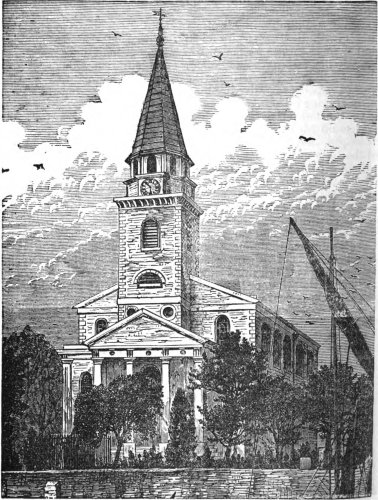
S. MARY'S, built according to Act of Parliament, 14. Geo. III. Opened Nov. 17, 1777. About 1823 an Entrance Portico of the Doric Order was added.
London: ASHFIELD, PRINTER, BRIDGE ROAD WEST, BATTERSEA.
1882.
This small volume IS MOST RESPECTFULLY DEDICATED (by permission) TO THE REV. JOHN ERSKINE CLARKE, M.A., Honorary Canon of Winchester, Vicar of Battersea; AND TO THE INHABITANTS IN GENERAL.
INDEX.
Page.
Introduction.iv
Nine Elms Lane.—The King's Champion.3
Thorne's Brewery.—What Battersea has been called.4
London and South Western Railway Company's Goods Station and
Locomotive Works.4-7
Mill-Pond Bridge.—New Road.8
A Royal Sturgeon caught in the wheel of the Mill at Mill-Pond Bridge. 9
Wallace's Vitriol Works.10
Sleaford Street.—Coal.11
Street Lighting.12-13
London Gas-Light Company's Works and Vauxhall Gardens.14-23
On a recently-exposed Section at Battersea.23-24
Phillips' Fire Annihilating Machine Factory
Destroyed.—Brayne's Pottery.—The Old Lime
Kilns.—Laver's Cement & Whiting Works.25
The Southwark and Vauxhall Water Works.26
Water Carriers and Water Companies.27-29
The Village of Battersea.—Growth of the Parish.30-31
Boundaries.—A Legal Contest between Battersea and
Clapham Parishes. Clapham Common.32-33
Lavender Hill.—The Seat of William
Wilberforce.—Eminent Supporters of the
Anti-Slavery Movement.—Frances Elizabeth Leveson
Gower. Mr. Thornton.—Philip Cazenove.—Charles
Curling, Lady George Pollock, and others.34-36
Battersea Market Gardens and Gardeners.36-37
Stages set out for Battersea from the City.—Annual
Fair.—Inhabitants supplied with Water from
Springs.—The Manor of Battersea before the Conquest.38
Battersea and its association with the St. Johns.39
Henry St. John Lord Viscount Bolingbroke.40-42
A Horizontal Air Mill.43
St. Mary's Church.44-46
The Indenture.47-48
Epitaphs and Sepulchral Monuments.49-51
Rectory and Vicarage.52
A Petition or Curious Document.53
Dr. Thomas Temple.—Dr. Thomas Church.54
Cases of Longevity.—The Plague.—The Three
Plague Years.—Deaths in Battersea.55-56
Vicars of Battersea from Olden Times.56-57
Thomas Lord Stanley.—Lawrence Booth.57
York House.58
Battersea Enamel Works.—Porcelain.—Jens Wolfe,
Esq.—Sherwood Lodge.—Price's Patent Candle
Factory.59-62
Candlemas.63-64
The Saw.—Mark Isambard Brunel's Premises at
Battersea.—Establishment for the preservation of
timber from the dry rot burnt down.65
History of the Ferry.—The Old Wooden Bridge.66-67
Albert Suspension Bridge.68-69
Chelsea Suspension Bridge.70
The Prince of Wales.—Freeing the Bridges "For Ever."71-73
The Stupendous Railway Bridge across the Thames.74
The spot where Cæsar and his legions are stated by some
antiquarians to have crossed the river.75
A haunted house.—Battersea Fields.—Duel between
the Duke of Wellington and Lord Winchelsea.76
The Red House.77
"Gyp" the Raven.—Billy the Nutman.—Sports.78
"The Old House at Home."—Sabbath Desecration.79
Her Majesty's Commissioners empowered by Act of Parliament
to form a Royal Park in Battersea Fields.—Wild
Flowers.—Battersea Park.80-84
London, Brighton and South-Coast Railway Company's two
Circular Engine Sheds and West-End Goods Traffic Department.85-86
Long-Hedge Farm.—London, Chatham and Dover Railway
Locomotive Works.87-90
A Canvas Cathedral.91
H.P. Horse Nail Company's Factory.94
St. George's Church, its clergy, its graveyard, epitaphs
and inscriptions (St. Andrew's Temporary Iron Church 96).95-99
Christ Church, its clergy.100
St. John's Church.101
St. Paul's Church.102
St. Philip's Church.103
St. Mark's Church.104
St. Luke's Chapel-of-Ease.105
St. Saviour's Church.106
St. Peter's Church.107
Temporary Church of the Ascension.—St.
Michael's Church.108
All Saints' Temporary Iron Church.—Rochester Diocesan
Mission, St. James', Nine Elms.111
St. Aldwin's Mission Chapel.—The Church of our Lady
of Mount Carmel and St. Joseph.112
Church of the Sacred Heart.—The Old Baptist Meeting
House, Revs. Mr. Browne, Joseph Hughes, M.A., (John Foster),
Edmund Clark, Enoch Crook, I. M. Soule, Charles Kirtland.113-116
Baptist Temporary Chapel, Surrey Lane.116
Battersea Park Temporary Baptist Chapel.117
Baptist (Providence) Chapel.118
Baptist Chapel, Chatham Road.—Wesleyan Methodist
Mission Room and Sunday School.—United Methodist
Free Church, Church Road, Battersea.—The United
Methodist Free Church, Battersea Park Road.119
Primitive Methodist Chapel, New Road.119
Primitive Methodist Chapel, Grayshott Road.—Primitive
Methodist Chapel, Plough Lane.121
St. George's Mission Hall.—Battersea Congregational
Church, (Independent), Bridge Road.122
Stormont Road Congregational Church, Lavender Hill.123
Wesleyan Methodism in Battersea.124-126
Methodist Chronology.127
Wesleyan Chapel, Queen's Road.128
Free Christian Church, Queen's Road.129
Trinity Mission Hall, Stewart's Lane.—Plymouth
Brethren.130
"The Little Tabernacle."—Thomas Blood.131
Battersea Priory.—Alien Priories.132
Ursulines.132-134
Battersea Grammar School, St. John's Hill.134
The Southlands Practising Model Schools.—St. Peter's
Schools.—St. Saviour's Infant.136
Christ Church National Schools.—St. George's National
Schools.—Voluntary Schools.136
London Board Schools.137
London School Board, Lambeth Division.138
The Elementary Education Acts.—Regulations affecting
Parent and Child.139-140
A Coffee Palace.—Latchmere Grove.—Plague
Spots.—The Shaftesbury Park Estate.141-142
The Metropolitan Artizans' and Labourers' Dwellings
Association.143-144
Latchmere Allotments.—Dove Dale Place.—An Old
Boiler.—Lammas Hall.—The Union Workhouse.145
Old Battersea Workhouse.—The "Cage."—The
"Stocks."146
The Falcon Tavern.—A Cantata.147
Origin of Bottled Ale in England.—"Ye Plough
Inn."—"The Old House."—Stump of an Old Oak Tree.148
"Lawn House," Lombard Road.—The Prizes for the Kean's
Sovereigns and the Funny Boat Race.—The Old Swan
Tavern.—Royal Victoria Patriotic Schools.149
St. James' Industrial Schools.—Royal Masonic
Institution for Girls.150
Clapham Junction.—Battersea Provident Dispensary.151
Wandsworth Common Provident Dispensary.—Charity
Organization Society.—The Penny Bank.—No.
54 Metropolitan Fire Brigade Station.—Origin of
Fire Brigades.152
The Metropolitan Police.—Police Stations,
Battersea.—St. John's College of the National Society.153
The Vicarage House School.—Various Wharves and
Factories.154
Mr. George Chadwin.—T. Gaines.—Tow's Private
Mad House.—The Patent Plumbago Crucible Company's
Works.155
Silicated Carbon Filter Company's Works.156
Condy's Manufactory.—Citizen Steamboat Company's Works.157
Orlando Jones & Co.'s Starch Works.157-159
Battersea Laundries.—Spiers and
Pond's.—Propert's Factory.—The London and
Provincial Steam Laundry.159-160
St. Mary's (Battersea) Cemetery.—Numerous Epitaphs
and Inscriptions. Scale of Fees, etc.161-175
The Battersea Charities.175
Parish Officers.—Vestrymen.176-178
Battersea Tradesmen's Club.—Temporary Home for Lost
and Starving Dogs.179-180
London, Chatham and Dover Railway—Battersea Park
Station—York Road Station (Brighton Line).—West
London Commercial Bank. London and South Western
Bank.—Temperance and Band of Hope
Meetings.—South London Tramways in
Battersea—Fares.180-181
LIST OF ILLUSTRATIONS.
Page.
St. Mary's Church.44
Price's Patent Candle Company.59
St George's Church.95
St. John's Church.101
St. Mark's Church.104
St. Luke's Chapel-of-Ease.105
St. Saviour's Church.106
Baptist Temporary Chapel, Surrey Lane.116
Battersea Park Temporary Baptist Chapel. 117
The New Baptist Chapel.119
Battersea Congregational Church.122
Orlando Jones & Co.'s Starch Works.157
Introduction.
London, after the lapse of centuries, has been compared to an old ship that has been repaired and rebuilt till not one of its original timbers can be found; so marvellous are the changes and transmutations which have come over the "town upon the lake" or, harbour for ships as London was anciently called, that if a Celt, or a Roman, or a Saxon, or a Dane, or a Norman, or a Citizen of Queen Elizabeth's time were to awake from his long slumber of death, he would no more know where he was, and would be as strangely puzzled as an Englishman of the present generation would be, who had never stirred further than the radius of the Metropolis, supposing him to be conveyed by some supernatural agency one night to China, who, on rising the next morning finds himself surrounded by the street-scenery of the city of Pekin. Costumes, manners, language, inhabitants have all changed! Viewed from a geological stand-point, even the soil on which New London stands is not the same as that on which Old London stood. The level of the site of the ancient city was much lower than at present, for there are found indications of Roman highways, and floors of houses, twenty feet below the existing pathways. There are probable grounds for supposing the Surrey side to have been some nineteen hundred years ago a great expanse of water. London so called for several ages past, is a manifest corruption from Tacitus's Londinium which was not however its primitive name this famous place existed before the arrival of Cæsar in the Island, and was the capital of the Trinobantes or Trinouantes, and the seat of their kings. The name of the nation as appears from Baxter's British Glossary, was derived from the three following British words, tri, nou, bant, which signify the 'inhabitants of the new city.' This name it is supposed might have been given them by their neighbours on account of their having newly come from the Continent (Belgium) into Britain and having there founded a city called tri-now or the (new city) the most ancient name of the renowned metropolis of Britain.[1] Some have asserted that a city existed on the spot 1107 years before the birth of Christ, and 354 years before the foundation of Rome. The fables of Geoffrey of Monmouth state that London was founded by Brute (or Brutus) a descendant of the Trojan Æneas the son of Venus and called New Troy, or Troy Novant until the time of Lud, who surrounded it with walls, and gave it the name Caer Lud, or Lud's town etc. Leigh. A certain Lord Mayor when pleading before Henry VI. assumed from this mythological story with a view to establish a claim to London's priority of existence over the city of Rome. The Celts the ancestors of the Britons and modern Welsh were the first inhabitants of Britain. The earliest records of the history of this island are the manuscripts and the poetry of the Cambrians. Britain was called by the Romans Britannia from its Celtic name Prydhain. Camden. We need not tarry to discuss whether Londinium originally was in Cantium or Kent the place fixed by Ptolemy and some other ancient writers of good authority, or whether its original place were Middlesex, or whether situated both north and south of the Tamesis Thames. The Trinobantes occupied Middlesex and Essex, they joined in opposing the invasion of Julius Cæsar 54 B.C.; but were among the first of the British States who submitted to the Romans their new City at that time being too inconsiderable a place for Cæsar to mention. Having revolted from the Roman yoke they joined their beautiful Queen Boadicea and were defeated by Suetonius Paulinus near London A.D. 61. But before reducing the Trinobantes who had the Thames for their southern boundary, it is the opinion of some antiquarians that the Romans probably had a station to secure their conquests on the Surrey side, and the spot fixed upon for the station is St. George's in the Fields a large plot of ground situated between Lambeth and Southwark, where many Roman coins, bricks, chequered pavements and other fragments of antiquity have been found. Three Roman ways from Kent, Surrey and Middlesex intersected each other in this place. It is thought that after the Normans reduced the Trinobantes the place became neglected and that they afterwards settled on the other side of the Thames and the name was transferred to the New City. The author of a work entitled "London in Ancient and Modern times." p.p. 12 and 13 writes.—Let the reader picture to himself the aspect of the place now occupied by the great Metropolis, as the Romans saw it on their first visit. He should imagine the Counties of Kent and Essex, now divided by the Thames, partially overflowed in the vicinity of the river by an arm of the sea, so that a broad estuary comes up as far as Greenwich, and the waters spread on both sides washing the foot of the Kentish uplands to the south, and finding a boundary to the north in the gently rising ground of Essex. The mouth of the river, properly speaking was situated three or four miles from where London Bridge now stands. Instead of being confined between banks as at present, the river overflowed extensive marshes, which lay both right and left beyond London. Sailing up the broad stream, the voyager would find the waters spreading far on either side of him, as he reached the spots now known as Chelsea and Battersea—a fact of which the record is preserved in their very names. A tract of land rises on the north side of the river. It is bounded to the west by a range of country, subject to inundations, consisting of beds of rushes and osiers and boggy grounds and impenetrable thickets, intersected by streams. It is bounded to the north by a large dense forest, rising on the edge of a waste fen or lake, covering the whole district now called Finsbury and stretching away for miles beyond. This tract of land, rising in a broad knoll, formed the site of London.
An old writer says "it is now certain that the spot, (viz. St. George's in the Fields) on which the city was described to have stood, was an extensive marsh or lake, reaching as far as Camberwell hills, until by drains and embankments, the Romans recovered all the lowlands about the parts now called St. George's Fields, Lambeth etc. London never stood on any other spot than the Peninsular, on the northern banks, formed by the Thames in front; by the river Fleet on the west; and by the stream afterwards named Walbrook on the East. An immense forest originally extended to the river side, and, even as late as the reign of Henry II. covered the northern neighbourhood of the city, and was filled with various species of beasts of chase. It was defended naturally by fosses, one formed by the creek which ran along the Fleet ditch, the other by that of Walbrook. The south side was protected by the river Thames, and the north by the adjacent forest."
In the reign of Nero the first notice of Londinium or, Londinum occurs in Tacitus (Ann xiv. 33.) where it is spoken of, not then as honoured with the name Colonia but for the great conflux of Merchants, its extensive commerce, and as a depôt for merchandise. At a later date London appears to have been Colonia under the name Augusta (Amm. Marcell.; xxvii. 8.) how long it possessed this honourable appellation we do not know but after the establishment of the Saxons we find no mention of Augusta. It has received at various times thirteen different names, but most of them having some similarity to the present one. However as it is not a history of England's Metropolis but All about Battersea[2] we write, we will at once commence at Nine Elms.
ALL ABOUT BATTERSEA
NINE ELMS LANE it is said derived its name from nine Elm Trees which stood in a row facing a small mansion known as "Manor House"—on the site there has recently been erected, partly out of some of the old materials, the offices and premises belonging to Haward Bros. Forty years ago, Londoners wending their way to Battersea fields regarded themselves in the country away from the smoke of town where they could rusticate at pleasure as soon as they entered Nine Elms Lane on their pedestrian excursions. Here were hedgerows, and green lanes, and market gardens, and orchards, meadows, and fields of waving corn, where reapers might have been seen in harvest-time reaping and binding sheaves of golden grain. Dikes and ditches had to be crossed.[1] In the event of high tide, which was of no uncommon occurrence, the district would be partially inundated with water, in some places people might ply in small rowing boats as easily as on the River Thames. On the site where now stands the wharf of John Bryan and Co., the celebrated Contractors for Welsh, Steam, Gas, and household Coals in general, were situated the pleasure grounds and tea gardens belonging to Nine Elms Tavern—the old tavern is still remaining. By the side of the Coal Wharf is the Causeway where watermen used to ply for hire in order to ferry people across the river. Steel has given us a lively description of a boat trip from Richmond on an early summer morning when he fell in "with a fleet of gardeners.... Nothing remarkable happened in our voyage, but I landed with ten sail of Apricot boats at Strand bridge after having put up at Nine Elms to take in melons." Within the immediate vicinity is Thorne's Brewery with its clock turret at its summit which at night is illuminated with gas so that the passers-by looking at the clock might know the hour. On the spot where Southampton Streets are, stood in olden time a large mansion surrounded by extensive grounds, said to have been inhabited by the King's Champion. The Champion of the King, (campio regis) is an ancient officer, whose office is, at the coronation of our Kings, when the King is at dinner to ride armed cap a pie, into Westminster Hall, and by the proclamation of an herald make a challenge "that if any man shall deny the King's title to the crown, he is there ready to defend it in single combat, etc., which being done," the King drinks to him, and sends him a gilt cup with a cover full of wine, which the Champion drinks, and hath the cup for his fee.
On the north side of Nine Elms Lane, nearly opposite the place where the "Southampton Arms" Tavern is situated was a windmill.
On the site now occupied by Thorne's Brewery there used to be a Tan Yard and Fellmonger's Establishment. When the ground was opened for the purpose of drainage some old tanks were discovered in which the hides were soaked containing remains of lime and hair. In the rear of the Brewery there was a Hop Garden where that bitter plant much used for brewing was cultivated. The only regular vehicle that passed through Nine Elms Lane was the carrier's cart—the few inhabitants of the place used to "turn out" to see it pass—a marked contrast to the present hurried and incessant traffic! Facing the Railway Terminus were two Steamboat Piers for landing and taking up passengers. At race times the excitement between the rival steamboat companies was intense—"touters," men hired expressly by each of these companies to induce passengers to go down their respective piers, became at times so exasperated with each other that they fell to blows, a sight which the baser sort of the crowds assembled on such occasions enjoyed to their hearts' content.
Many things have been said by way of disparagement of Battersea and not at all reflecting credit on certain localities within the parish. Battersea has been called "the Sink Hole of Surrey." Europa Place, Bridge Road, has been designated "Little Hell," and the spot where Trinity Hall has been erected at the end of Stewart's Lane, received the epithet of "Hell Corner." Persons in the habit of receiving stolen property were said to reside in the neighbourhood; moreover, there was a gang called "Battersea Forty Theives!" "Sharpers" are said to have abounded in every direction, so that strangers going to Battersea would be "cut for the simples." But we who know something of London life know that other Metropolitan parishes have their "dens of infamy" and localities of "Blue Skin," "Jack Sheppard," and "Jonathan Wild" notoriety, that beneath the shadow of St. Paul's Cathedral and Westminster Abbey, our Houses of Parliament and Mansions of the Nobility and Aristocracy, squalor and crime, vice and grandeur walk side by side, and oftentimes hand in hand.
Adjoining Thorne's premises and Swonnell's Malt houses, is the London and South Western Railway Company's Goods Station, which, before the extension of that Company's line in 1848 to Waterloo Road, was originally the Metropolitan Terminus. Though this part of the line crosses the most grimy portion of Lambeth, a distance of two miles and fifty yards, yet it cost the Railway Company £800,000. The London and Southampton Railway (as it was first called) was opened on the 11th of May, 1840, which, in connexion with the opposite wharf and warehouses on the banks of the river, at that time occupied an extent of between seven and eight acres. The entrance front of the (then) Metropolitan Terminus at Nine Elms, erected from designs by William Tite, Esq., Architect to the Company, was not unhandsome though at present it has rather a dingy appearance for want of renovation, and has a central arcade which originally led to the booking office and waiting rooms now used for the manager's and clerks' offices for the goods traffic department. The railroad was commenced under the authority of an Act of Parliament which received the Royal assent on the 5th of July, 1834 (it was opened as far as Woking Common on the 21st of May, 1838). By this Act the Company were empowered to raise £1,000,000 in £50 shares, and a further sum of £330,000 by loan. Since that time several additional Acts have been passed authorizing the Company to extend their line and increase their capital. The Company's capital for the present year (1879) is £17,000,000. Mr. Wood was the Company's first Locomotive Superintendent. When the London and Southampton line was first opened all the workmen in the Company's service had a half holiday and one shilling each given to them. The Richmond Railway—this though an offshoot of the South Western, and worked by that Company, was executed by a private one. It was however sold to the South Western Company in October, 1846. It had been opened on the 27th of July previous. Number of miles open 648. The gross receipts for the year ending December 31, 1873, were £2,195,170. The railroad intersects Battersea parish to the extent of two miles and a half. The Goods Department comprises the hydraulic shed, down goods shed, carriers' shed, egg shed, the old warehouse and granary by the riverside; down office, Wandsworth Road Gate; cartage office, Nine Elms Lane. Officers of the Company.—General Manager, Archibald Scott, Esq.; Locomotive Superintendent, W. Adams, Esq.; Resident Engineer, William Jacomb, Esq.; Treasurer, Alfred Morgan, Esq.; Goods Manager, J. T. Haddow, Esq., Nine Elms; Assistant Goods Manager, Mr. W. B. Mills, Waterloo; Superintendent, R. H. Ming, Esq., Nine Elms; Chief Inspector, Mr. Robert Lingley, Nine Elms; Law Clerk, M. H. Hall, Esq.; Mr. H. B. Terrill, Cashier; Mr. J. E. Hawkins, Chief Clerk; Superintendents of the Line, E. W. Verrinder, Chief Superintendent, Waterloo Station; John Tyler, Western Division, Exeter Station; William Gardiner, Assistant Superintendent, Waterloo Station; W. H. Stratton, Storekeeper, Nine Elms Works.
Soon after the opening of the London and Southampton Railway a collision between two passenger trains occurred at the Nine Elms Terminus resulting in the death of a young woman, a domestic servant, who, with a fellow servant, had been spending the day at Hampton Court. The Coroner's Jury returned a verdict of accidental death a deodand of £300 was levied on the "Eclipse" locomotive engine, the moving cause of death. The Railway Company paid the £300 to Earl Spencer as Lord of the Manor, who most generously divided it amongst the deceased's relatives.
Omnia qua movent ad mortem sunt deodanda: What moves to death, or kills him dead, Is deodand, and forfeited.
On the South Western Railway Stone Wharf are the agents' offices of the several depôts for the sale of Portland stone, Bath freestone, etc. Huge blocks of stone direct from the quarries are here deposited and piled block upon block. A single block in some instances weighing ten tons elevated and removed by means of a steam traveller moving on a gantry.
When the workmen were engaged in "digging out" the ground for the foundation of the goods sheds a human skeleton was discovered, on which Mr. Carter (coroner) held an inquest. Dr. Statham, who made the post mortem examination, stated that the skeleton was that of a male person, that there were three severe cuts upon the head either of which was sufficient to cause death. As no further evidence was procurable a verdict was given in accordance.
About forty years ago, when Mr. Gooch was Locomotive Superintendent, a fire broke out at the London and South Western Railway Works, Nine Elms Lane, which caused great destruction of property, including a very handsome clock tower. Various metals were fused and mingled into shapes fantastic, portions of which were substituted for chimney-piece ornaments in the homes of the workman and kept as mementos of this conflagration! A man of the name of Dover who it is said accidentally set the stores on fire was so frightened that it turned the hair of his head grey in one night!
At Nine Elms Locomotive, Carriage and Stores Departments are fire precautions which the Railway Company insist upon being strictly observed. A fire engine with hose and all necessary appliances is kept in a building set apart for it adjoining Heman's Street Entrance gate. A properly qualified fireman is appointed to look after the whole of the buildings by night, as a precaution against fire. The fireman's name is Thomas Lewin, and his residence is 51, Thorne Street, Wandsworth Road. His hours of duty are from 5.30 p.m. to 6.30 a.m. It is the fireman's duty to perambulate the whole of the works during the night, and to make a daily report of the circumstances in the book provided for that purpose. He is responsible that the fire engine, hose, hydrants, etc., are kept in working order and tried once a week. A statement of the trial is to be made in the fireman's report book with any suggestions or remarks. Positions of Hydrants at Nine Elms Works—There are 120 hydrants (always charged) distributed as follows:—15 in the offices, paint loft and shops beneath; 4 in the general stores; 4 in wheelwrights' and signal shops; 2 in bonnet shop; 5 in waggon shop; 4 in new waggon shop and saw mill; 5 in smiths' and carriage fitting shops; 9 in erecting shops; 2 in turning shop; 3 in tender shop; 4 in new erecting shop; 1 in permanent way shop; 4 in arches under the Viaduct; 52 in running shed; 4 at outlets of water tanks, and 2 on the coal stage. Positions of Tell-tale Clocks:—1 in the office; 1 in general stores; 1 in wheelwrights' shop; 1 in paint shop; 1 in saw mill. It is the fireman's duty to commence to "peg" each of these blocks four times every night at the following hours, viz., 8 p.m., 10.30 p.m., 1 a.m. and 3.30 a.m.
Facing the Goods Station are the Company's Wharves with an extensive river frontage. Here also formerly stood Francis' Cement Works, adjoining is Nine Elms Steamboat Pier. The South Western Railway Locomotive Works and Goods Department occupy a vast area. It is computed that about 2,000 persons are employed in the various departments. Here were formerly orchard-grounds—many a goodly tree bearing fruit and pleasant to the eye has been felled. "Woodman spare that tree!" though spoken by feminine lips would have no force of appeal in this fast age of iron railways and steam locomotives, when Railway Companies scruple not by virtue of Acts of Parliament to pull down by hundreds the dwellings of the poor, it is not to be supposed for an instant that a few fruit trees however delicious their produce or delightful their shadow should prove a peculiar obstacle in the way of this March of Civilization! On payment of sixpence, children at half-price, persons might enter these orchards with full liberty to eat as much fruit as they liked on condition that they brought none away. The old Spring Well near Nine Elms Lane, Wandsworth Road, is within the recollection of many, who by descending some six or eight steps reached with their hands the iron ladle out of which they often drank cooling draughts of nature's sparkling aquatic refreshment. Ah, everything has a history and its lesson if we did but know. We all exert unconscious influence either for good or evil,—some secret action performed; some deed of kindness done; some public boon conferred with the benefactor's name concealed shall by-and-by be proclaimed upon the house-top. A cup of cold water given in the name of a disciple of Jesus of Nazareth shall not lose its reward. Some persons wish to be remembered by posterity, even wicked parents would not like after death to be obliterated from the memories of their children. The best of all human monuments is a good character,—Solomon says, "a good name is rather to be chosen than riches."
Our forefathers never dreamed of erecting such drinking fountains[1] as we have in these days with troughs for cattle and smaller ones for mongrel barking curs to slake their thirst; the pond by the way, the wooden horse trough outside the road-side Inn, the long-handled iron pump, in some instances resembling the head and tail of the British Lion having the body of a greyhound, pleased them and suited their purpose. The site now environed by the London Gas Works was formerly a large market ground, here too grew apple, pear, and cherry trees, gooseberry bushes and currants, roses were cultivated and rendered the air fragrant with their sweet perfume. In the ditches and trenches or small channels and streams occasioned by the tidal overflow from the river, juveniles of both sexes might have been seen catching with hand and cap sticklebacks and utilizing a medicine phial or gin bottle for an aquarium. Senior boys and hobbledehoys with jovial facial aspect who had not studied ichthyology or that part of zoology which treats of fishes, attempted to catch larger fry by adopting the Izaak Walton method of angling with rod and line, and thought themselves amply rewarded if after much patient endurance the motion of their floats indicated that their baits had taken, their eyes would glisten at the sight of a few roaches and perches. Youngsters would amuse themselves by watching the newts and tadpoles, the leaping and swimming of that amphibious reptile of the batrachian tribe, wondering perhaps, supposing their biblical knowledge to have extended thus far, whether those were the kind of creatures that crawled out of the river Nile and crept into the houses of the Egyptians.
Many a dainty dish of stewed eels have the miller's men had at Mill-pond Bridge, who not unfrequently caught alive this precious kind of anguilla as it lay concealed between the stones and mud, without the aid of eel-pot or basket. Mill-Pond Bridge derives its name from the old tidal water flour mill, the only vestige of the mill remaining is the outward carcase, which is in a ruinous condition; beneath its cover are the lock gates, the entrance of the creek where thousands of tons of coal are conveyed in barges to the London Gas Works.
NEW ROAD, as it is designated, leading from Battersea fields to the Wandsworth Road was a lane with a mud bank on both sides. In a line with the centre of the South Western Railway "Running Shed" was formerly Mill-Pond which answered the purpose of a large reservoir of water raised for driving the mill wheel.
Water mills used for grinding corn are said to have been invented by Belisarius, the General of Justinian while besieged in Rome by the Goths, 555. The ancients parched their corn and ground it in mortars. Afterwards mills were invented which were turned by men and beasts with great labour, yet Pliny mentioned wheels turned by water. See Telo-dynamic Transmitter.
The simplest mill for bruising grain was nothing more than two stones between which it was broken. Such was often seen in the country of the Niger by Richard and John Lander on their expedition to Africa. The manna which God gave to the children of Israel in the desert "the people went about and gathered it, and ground it in mills or beat it in a mortar," Numbers xi. 8.
From mills and mortars thus rudely constructed there must have been obtained at first only a kind of peeled grain which Dr. Eadie says may be compared to the German graupe, the English groats, and the American grits or hominy. Fine flour was laboriously obtained from household mills like our coffee mills. The oldest mention of flour is in Gen. xviii. 6; but bread which is made of flour or meal is named in Gen. iii. 19. In order to reduce the flour to a proper degree of fineness it was necessary sometimes to have it ground over again and cleared by a sieve.
Samson when a prisoner to the Philistines was condemned to the mill-stone to grind with his hand in the prison-house, Judges xvi. 21. In England prisoners are sent to the treadmill as a punishment.
The Talmudists have a story that the Chaldeans made the young men of the captivity carry mill-stones with them to Babylon where there seems to have been a scarcity at that time. They have also a proverbial expression of a man with a mill-stone about his neck which they use to express a man under the severest weight of affliction.
Windmills are of great antiquity and stated to be of Roman or Saracen invention, they are said to have been originally introduced into Europe by the Knights of St. John, who took the hint from what they had seen in the crusades (Baker). Windmills were first known in Spain, France and Germany in 1299 (Anderson). Wind saw-mills were invented by a Dutchman in 1633, when one was erected near the Strand in London.
Acorns was the coarse fare of the old inhabitants of Britain, when wild Britons painted their skin to make themselves appear more fierce, and native tribes in a still more barbarous condition, half naked or clad in the skins of beasts, not cultivators of the soil, subsisted on the flesh of their cattle or on the precarious produce of the chase. Packs of hungry, growling, cruel wolves[1] prowled in the woods and forests, and Druidical Priests exercised an entire control over the unlettered people they governed, and human captives seized on Britannia's shores were offered as victims in sacrifice, a holocaust to the divinities and false gods which ancient Britons worshipped!
The Accipenser, in ichthyology, a genus of fishes belonging to the Amphibia Nantes of Linnæus. The Accipenser has a single linear nostril; the cirri are below the snout, and before the mouth. There are three species of this genus. The ruthenus has four cirri, and fifteen squamous protuberances; it is a native of Russia. The huso has four cirri; the body is naked, has no prickles or protuberances. The ichthyocollo, or isinglass of the shops, famous as an agglutinant, and used also for the fining of wines, is made from its sound or scales. The Sturio, or Sturgeon with four cirri and eleven squamous protuberances on the back. This fish annually ascends our rivers (it has occasionally been seen in years gone by as high up the river Thames as Wandsworth) but in no great numbers, and is taken by accident in the salmon nets. It seems a spiritless fish making no manner of resistance when entangled, but is drawn out of the water like a lifeless lump. This cartilaginous fish is highly prized for food, not unlike in taste to veal. About thirty-six years ago a Royal Sturgeon was caught in the wheel of the mill at Mill-Pond Bridge then in the occupation of Mr. Hutton the Miller (who was noted as a breeder of game fowls), now the property of the London Gas-Light Company. It appears that a local tradesman named Henry Appleton was going to town and saw a great crowd, some with guns shooting at a great fish, but the Sturgeon's natural armour resisted the force of their small shot such as they were then using. Mr. Appleton upon seeing the state of affairs hastened to procure a bullet or two as a more effectual means of capturing the prize and the first shot or bullet fired was fatal to the poor sturgeon which was then landed and conveyed into the garden of Mr. Hutton's private house upon the exact spot of which at the present time stands the house (since erected) on the banks of the Creek in the occupation of Mr. Methven. It then became after the usual ceremony of asking the Lord Mayor, the property of Mr. Appleton, and was exhibited by him in York Street (now Savona Street), on premises now in the occupation of Mr. Dulley, Butcher. After being exhibited several weeks great crowds coming from all parts of London to see it, the Sturgeon was sold to a Fishmonger residing in Bond Street, who publicly exhibited it in his shop for some years with a description stating particulars, where it was captured and by whom and its length, being upwards of 9-ft. It is said to have been equal in weight to a sack of flour viz., 280 lbs.
The Sturgeon is more abundant in the Northern Coasts of Europe. It is also found in the more Southern parts. It was esteemed by the ancients as a very great luxury and it was held in high repute for the table by the Greeks and Romans and at their banquets it was introduced with particular ceremonies.
In England when caught in the Thames within the jurisdiction of the Lord Mayor of London it is a Royal Fish reserved for the Sovereign. The flesh is white, delicate, firm and nutritious. It is used both fresh, generally stewed. The largest species of Sturgeon is the Bielaga, or Huso. Huso (A. Huso) of the Black and Caspian seas and their rivers. It attains the length of 20 or 25 feet and has been known to weigh nearly 3000 lbs.
Near the site where now stands the Park Tavern at the corner of the New Road, opposite Mr. Featherstonhaugh's Brewery and not far from "The Plough & Harrow," were the flower gardens and beautiful residence of John Patient, Esq., afterwards occupied by Mr. Carne the Barge Builder. The house where Mr. Bennett, Lath-render, resides, and the house adjoining were used as a Private Asylum for the insane and was called "Sleaford House."
The picturesque and retired Country Parsonage, the residence of the Rev. J. G. Weddell, stood a considerable distance from the main road—"The Prince Alfred" tavern situate in Haine Street occupies the site. In this locality was a tenter-ground the entrance to which from the road was through a white gate.
A gateway at the commencement of "Hugman's Lane" which had "no thoroughfare" led to the works belonging to Peter Pariss and Son, Oil of Vitriol Manufacturers and Manufacturing Chemists. Mr. Wallace, who subsequently held these premises had them considerably enlarged to facilitate his project in working up gas liquor for making Sulphate of Ammonia, which is extensively used for agricultural purposes. The sewers in the neighbourhood became impregnated with a deleterious gas and the stench from the drains was intolerable. After considerable litigation with the Board of Works Mr. Wallace became a bankrupt.
By order of the Mortgagees on Wednesday and Thursday, March 3rd and 4th, 1880, Mr. Douglas Young sold by auction the plant and machinery of the above extensive works, including 5 large Cornish steam boilers, tubular boiler, 3 egg boilers, a bottle boiler, a 4000 gallon wrought iron tank, 12 smaller ditto, 4 large circular tanks, 5 steam barrel of various sizes, flange pipes, 3 large iron coils, about 70 tons old metal, several copper and iron boilers of various sizes, furnace fittings, weighing bridge by Hodgson and Stead, self-feeding boiler and engine, about 150,000 sound bricks, a large quantity of sound timber including balk timber, yellow deals, planks, battens, die-square, floor and lining boards, and 50 tons of breeze, several stacks of firewood, pantiles, drain pipes and other plant materials.
SLEAFORD STREET appears to have obtained an amount of respectability that it had not of yore. Once upon a time one side was nicknamed "Ginbottle Row," and the opposite side was called "Soapsuds Bay!" Mill-Pond Bridge was very narrow, about half its present width, with a low parapet on both sides.
If the following statement could be relied on, it would perhaps allay the fears created by certain alarmists respecting the physical limits to deep coal mining and duration of the coal supply. "There are coal deposits in various parts of Great Britain at all depths down to 10,000 or 12,000 feet. Mining is possible to a depth of 4,000 feet, but beyond this the high temperature is likely to prove a barrier. The temperature of a coal mine at a depth of 4,000 feet will probably be found as high as 120º Fahr.; but there is reason to believe that by the agency of an efficient system of ventilation the temperature may be reduced, at least during the cooler months of the year, as to allow mining operations without unusual danger to health. Adopting a depth of 4,000 feet as the limit to deep mining there is still a quantity of coal in store in Great Britain sufficient to afford the annual supply of twenty-two millions of tons for a thousand years."—Hull.[1]
"Early to bed and early to rise makes a man healthy, wealthy and wise," was a motto adopted by our forefathers when the inducements to promenade London streets by night were not so inviting as now.
"Ranelagh and Vauxhall were places of frivolous amusement resorted to even by the higher classes. From those and other haunts of folly, lumbering coaches or sedan chairs conveyed home the ladies through the dimly lighted or pitch dark streets, and the gentlemen picked their way over the ruggedly-paved thoroughfares, glad of the proffered aid of the link boys who crowded round the gates of such places of public entertainment or resort as were open at night, and who, arrived at the door to which they had escorted some fashionable foot-passenger, quenched the blazing torch in the trumpet-looking ornament which one now and then still sees lingering over the entrance to some house in an antiquated square or court, a characteristic relic of London in the olden time."
Street lighting was not known to the Greeks and Romans, it was therefore necessary for them whenever they went abroad after dark to carry flambeaux. Street lighting was first introduced at Paris about the beginning of the 16th century. An Edict was issued ordering the inhabitants to keep lights burning in their windows after nine at night. In 1558, lamps were exchanged for lanterns, and in 1671 these lanterns were ordered to be lighted from the 20th of October to the beginning of April. This however did not prove a satisfactory arrangement. At length a premium was offered by the Government for a dissertation on the best mode of lighting the streets. The successful competitors were a journeyman glazier, M. M. Bailly, Le Roy and Bourgeois Le Cheteaublanc. To the glazier was awarded a prize of 200 livres, and to the other three jointly 2,000 livres. The result of their suggestions was a general lighting of the streets by oil lamps set upon posts.
In London, lanterns were first used in 1688, and those inhabitants whose houses fronted the streets were ordered to hang out their lanterns and keep them burning from 6 to 11 o'clock at night; the number of lanterns thus used within the boundaries of the City of London was 5,000. Without the City, inclusive of the suburbs, the probability is that the number was 15,000.
In 1874, another act was passed for regulating the lighting of the City still further. Since the lighting of the streets, alleys, courts, etc., of our Metropolis with gas have come many other sanitary and social improvements, and it is not unlikely that under a wise Providence we owe to this invention as much security from the nightly depredations of burglars as much so as from the vigilance of the police.
The existence and inflammability of coal-gas has been known in England for two centuries. In the year 1659, Thomas Shirley correctly attributed the exhalations from the "burning well" at Wigan, in Lancashire, to the coal-beds which lie under that part of the country; and soon after, Dr. Clayton, influenced by Shirley, actually made coal-gas, and detailed the results of his labours in a letter to the Hon. Robert Boyle, who died in 1691. About a century later, 1753, Sir James Lowther communicated to the Royal Society a notice of a spontaneous evolution of gas at a colliery belonging to him at Whitehaven. Bishop Watson made many experiments on coal-gas, which he details in his Chemical Essays. Mr. R. Taylor, on the Coal-fields of China, says, "The Chinese artificially produce illuminating gas from bitumen coal we are certain. But it is a fact that spontaneous jets of gas derived from boring into coal-beds have for centuries been burning, and turned to that and other economical purposes. If the Chinese are not gas manufacturers, they are nevertheless gas consumers and employers on a large scale, and have evidently been so ages before the knowledge of its application was acquired by Europeans." In 1792, Mr. Murdoch, an engineer at Redruth in Cornwall, erected a little gasometer with apparatus which produced gas sufficient to supply his own house and offices, and in 1797, he erected a similar apparatus in Ayrshire. In the following year, he was engaged to put up a gas works at the Manufactory of Bolton and Watts, at Soho, Birmingham,—this was the first application of gas in a large way. Except among a few scientific men, the manufacture of gas excited but little curiosity until the year 1802, when the front of the great Soho Manufactory was brilliantly illuminated with gas on the occasion of the public rejoicings at the Peace. In 1801, M. Le Bon, at Paris, succeeded in lighting up his own house and gardens with gas from wood and coal, and had it in contemplation to light up the City of Paris.
Only within the present century has gas superseded in London the dim oil lamps. About forty years ago, oil lamps and lighted candles were used in our churches and chapels; in some places of worship evening services were dispensed with altogether. A humorous anecdote is related of Dr. Johnson: it is said, one evening, from the window of his house in Bolt Court, he observed the parish lamplighter ascend a ladder to light one of the small oil lamps. He had scarcely descended the ladder half-way when the flame expired. Quickly returning he lifted the cover of the lamp partially and thrusting the end of his torch beneath it, the flame instantly communicated to the wick by the thick vapour which issued from it. "Ah!" exclaimed the Doctor, "one of these days the streets of London will be lighted by smoke."—Notes and Queries, No. 127. Certain scientific men were incredulous as to the practicability of lighting up the whole of London with gas, and Sir Humphrey Davey asked if it were intended to take the dome of St. Paul's for a gasometer! In 1820 gas meters were patented by John Malan, in 1830 by Samuel Clegg, in 1838 by Nathan Defries and others. Mr. Daniel Pollock, father of the late Chief Baron, was governor of the first "chartered" gas company in 1812. In 1822 St. James' Park was first lighted with gas. In 1825, its safety had not then been established on the part of the Government, a committee of the most eminent scientific men immediately inspected the Gas Works, and reported that the occasional superintendence of all the Works was necessary. However, since then so rapidly has the invention of gas-lighting progressed, that now in the present year of grace, there is neither City nor town in Great Britain of any note but what is illuminated with gas and has works for its manufacture in close proximity to the houses of its inhabitants. Gas supply of London, receipts for the year 1872, £2,133,600, for 1873, £2,544,000. What is coke? Coke is the residual carbon of pit coal after the volatile matters have been expelled by heat, it has a porous texture and a lustre sometimes approaching the metallic. It is a valuable fuel, producing an intense and steady heat and leaving but little residue after combustion. The residual coke in retorts has a quantity of ash, which, besides its earthy base of silicate, usually contains sulphur and other deleterious matter. The breeze can be used in furnaces and in burning bricks. There is a considerable quantity of pure hydrogen produced by the decomposition of water in cooling coke. Attempts have been made to manufacture gas from other substances besides coal—oil, resin, peat, and even water having in their turn commanded capital for a fair trial of their merits of all these; however, coal has alone stood the test of commercial success, those companies formed for other schemes having either been dissolved or become converts to its superior advantages. No doubt it will be considered Utopian—Mr. Robinson thinks that the electric light might be so modified as to be used in public dwellings! There are exhaustless stores of latent electricity, but the difficulty is to know how to develop and utilise it.
Street gas lit by electricity, by Mr. St. George Lane, Fox's method: trial partially successful, Pall Mall, etc., 13th April, 1878. British Museum Reading Room illuminated by electric light, October, 1879.
Common bituminous coal obtained from the mines of Northumberland, Durham, York, South Wales, and a few other coal districts is the kind from which most of the gas of this country is manufactured. The Cannel or Scotch Parrot coals produce a gas of a much richer quality, which, though expensive, has the advantage of superior illuminating power. Gas companies use to a very great extent coals from the following mines:—Pelaw, Leverson's Wallsend, Pelton, New Pelton, Dean's Primrose, Garesfield, South Peareth, (The London Gas-Light Company use principally Peareth) Urpeth, Washington, Yorkshire, Silkstone, Haswell, West Wear, Wearmouth, Brancepeth, South Brancepeth, and Ravenshaw Pelaw. The resulting products of carbonization of these coals when an exhauster is employed will be found to give about the following average per ton:—
Gas, 9,500 cubic feet; Coke, 13 cwt., or one chaldron; Tar, 10 gallons; Ammoniacal Liquor, 13 gallons. Ammonia, a compound of Nitrogen and Hydrogen, is converted into Sulphate of Ammonia, Sal Ammonia, Carbonate of Ammonia, etc., etc. Tar, which is a Hydro-carbon, after producing Naptha and light oils, becomes useful as Asphalt, or for exterior paint work. Benzole, the base of our newly-discovered dyes, is extracted from the Naptha; which, besides, is either used as a solvent for india-rubber and guttapercha, or yields a brilliant light when burned in a common lamp. Gas, as it issues from the retorts, is chiefly composed of light carburetted and bicarburetted hydrogen or olefiant gas, accompanied by condensable vapours and other gaseous impurities. The condensable vapours are principally hydro-carbon compounds which become deposited in the form of oil, and amongst a variety of deleterious substances may be mentioned as the chief: ammonia, carbonic acid, carbonic oxide, and sulphuretted hydrogen, but the value of coal-gas principally depends on the presence of bicarburetted hydrogen, and the greater proportion of this the higher will be its light-giving properties.
The connection of the London Gas-Light Company's Works with Vauxhall takes us out of the parish of Battersea for a moment into the parish of Lambeth. Vauxhall, the early Spring Garden, was named from its site in the Manor of La Sale Fawkes, Fawkeshall, from its possessor, an obscure Norman adventurer, in the reign of King John.[1] The estate was laid out as a garden about 1661, in squares enclosed with hedges of gooseberries, within which were roses, beans and asparagus. Sir Samuel Morland took a lease of the place in 1665, and added fountains and a sumptuously furnished room for the reception of Charles II. and his court, and a plan dated 1681, shows the gardens planted with trees and laid out in walks and a circle of trees or shrubs. They were frequented by Evelyn and Pepys; and Addison in the Spectator, 1712, takes Sir Roger de Coverley there. In 1728, the gardens were leased to Jonathan Tyers, who converted the house into a tavern. The beauty of its rural scenery rendered it so much frequented that the proprietor in the year 1730, introduced vocal music, the price of admission at that time was 1s., but from the competition of others who opened public places of amusement in the neighbourhood, the proprietor introduced a great variety of amusements and raised the price of admission to 2s. During the season of 1807, the price was constantly 2s., the gardens being open only three nights in the week, and each of these nights was what was termed a gala night. Vauxhall Gardens were extensive, they contained a variety of walks illuminated with beautiful transparent paintings. Opposite the west door was a magnificent Gothic orchestra, illuminated with a profusion of lamps of various colours; and on the left was an elegant rotunda, in which the band performed in the cold or rainy weather. At ten o'clock a bell announced the opening of a cascade, with the representation of a water-mill, a mail coach, etc. Fireworks of the most brilliant description were also introduced among the attractions of the place. In numerous recesses, or pavilions, parties were accommodated with suppers and other refreshments and were charged according to a bill of fare. The ham sandwiches were of such an excellent quality and so thinly sliced that they became proverbial. The respective boxes and apartments were adorned with a vast number of paintings, many of which were executed in the best style of their respective theatres. The labours of Hogarth and Hayman were the most conspicuous. On a pedestal, under the arch of a grand portico of the Doric order, was a fine marble statue of Handel, in the character of Orpheus playing on his lyre, done by the celebrated M. Roubiliac. The number of persons who were employed in the gardens during the season is said to have amounted to 400, 96 of whom were musicians and singers, the rest were waiters and servants of various kinds. The celebrated Lowe and Beard were amongst the first singers who were engaged at Vauxhall. Upwards of 15,000 lamps were said to illuminate the gardens at one time,—the effect of the illumination was peculiarly beautiful in a moonlight night. The band of the Duke of York's regiment of Guards dressed in full uniform added to the attractions of these enchanting gardens; by military harmony, as a place of public entertainment, it became the most famous in Europe. The greatest season was in 1823, when 133,279 persons visited the gardens and the receipts were £29,590. The greatest number of persons in one night was on the 2nd of August, 1833, when 20,137 paid for admission. The carriages outside the gardens were so numerous that they extended in lines as far as Westminster Bridge in one direction and to Kennington Common in an opposite direction. The greatest number on the then supposed last night, 5th September, 1839, was 1089 persons. So fascinating did this place of amusement become that it acquired the name of the "fairy land of fancy," answering in conception to those enchanted palaces and gardens described in the "Arabian Nights Entertainment."[2] It was in these gardens gas was manufactured by the London Gas-light Company prior to gas being made at the Company's Works in the neighbourhood of Vauxhall Row.
The London Gas-light Company was Incorporated in the year 1833.[1] The Works at Vauxhall were constructed from designs furnished by Mr. Hutchison, the Engineer. The first bed of retorts set on the Company's premises was heated by a man of the name of William Batt, June, 1834. The old man is still living, he is seventy-five years of age, and has been in the London Gas-light Company's service forty-three years. At that time the Company used a small gasometer erected in Vauxhall Gardens. It was with gas from this vessel that Mr. Green, the celebrated æronaut used to fill or inflate his great balloon. The first place lighted up with the Company's gas was Old Lambeth Market, the site now occupied by the Lambeth Baths. In December, 1858, the London Gas-light Company manufactured gas at their New Works, Nine Elms. The following month, January, 1859, an Act of Parliament came into operation to prevent gas companies from erecting other works for the manufacture of gas within ten miles of London; however, it was not until the year 1863 that the London Gas-light Company permanently removed from Vauxhall to Nine Elms.
The London Gas Works are environed with a brick wall, varying in height from ten to twenty feet, bounded on the North by Nine Elms Lane; on the South by the South-Western Railway; on the East by Everett Street; and on the West by Moat Street and Haine Street. The works within this enclosure cover an area of seventeen acres, and at the field Prince of Wales Road, about three acres more. There are five gates to the Works, but the principal entrance is in Haward Street, by the porter's lodge. At the right-hand-corner is a spacious building, on the basement is the Engineer's office, the Light office, and Messenger's lobby, which has in it a small telegraphic apparatus for communicating intelligence between this and the Chief office. The Grand Entrance is from Nine Elms Lane, opened by two pairs of massive folding doors leading into the hall, facing which is a flight of stone steps with ornamental cast-iron balusters mounted by rails on either side of polished mahogany, communicating with a similar staircase right and left which conducts to the Board room and Draughtsmen's offices. The Board room is a beautiful and commodious apartment, 33 feet by 19. It has never yet been occupied by the Board of Directors, the Board preferring to transact their business at their Chief Office, 26, Southampton Street, Strand, W.C. Secretary, A. J. Dove, Esq.; Engineer, Robert Morton, Esq.; Manager, John Methven, Esq.; Outdoor Superintendent, T. D. Tully, Esq.; Cashier, W. G. Head, Esq., with a staff of Inspectors, Collectors, Clerks, &c.
On the 31st of October, 1865,[1] a terrible gas explosion took place, when ten men were killed and many others injured. At that time the houses in Haward Street being contiguous to the works, had the window frames shattered, and similar calamities occurred elsewhere. These houses were occupied by some of the Company's employés. Lately, partly on account of the recent tidal inundations, sixteen houses belonging to the Company have been pulled down and a wall built so as to keep out the flood, in the event of extraordinary high tides. The open space between the inner and outer gates is used, as well as other open spaces about the works, for heaping up the coke mountains high, which certain youngsters in the neighbourhood would only be too delighted to have the privilege of scrambling and of bearing some of the precious fuel home to their fireless grates. Alas! much of the distress prevalent in the district is caused through the drunkenness and improvident habits of parents.
Passing through the inner gate, over which is mounted the factory bell of 2 cwt.,—its size and tone would not disgrace the belfry of many a church steeple,—on the right is situated the timekeeper's office, the carbonizing foreman's lobby, the meter stores, and the stores. On the left-hand-side of the gate is the coke clerk's office, counting house, and a range of workshops, sheds, etc. for smiths, painters, fitters, and carpenters. Adjoining the coke office is the shop where all the Company's meters are tested before being sent out to the consumers. In different parts of the yard lines of iron rails are laid down, with turning tables to allow for shunting, communicating with the South-Western Railway, so as to admit trucks, which, when loaded with coke from the factory, are then conveyed to their destination. The retort houses are oblong buildings with gable wrought-iron roofs, are strongly built of brick, the walls being of immense thickness; this is necessary, not only on account of the great heat within, but on account of the large quantity of coals stowed away in the coal stores, the stock on hand being 15,000 tons.
There are seven retort houses, five of these occupy a central position in these works; they have been erected at different periods as the demand for the manufacture of gas increased. Of these retort houses No. 7 is the largest; it is 260 feet long by 80 feet wide (inside measurement), and it is 45 feet to crown of roof. Each retort house has independent shafts, but the tallest shaft faces the east end of retort house No. 2. It is a splendid piece of brick-work, the height of which is 135 feet. When the top stone was laid Mr. B. Gray, the builder, treated the men who were under him with a dinner. On this occasion sixteen persons sat on the summit and partook of this sumptuous repast. Nos. 1, 2 and 3 are ground retort houses, the other four houses are stage retort houses. With respect to the interior of these retort houses, there is plenty of room in front of the retorts for a storage of coal and good space for drawing the retorts. On the whole there is good ventilation in the roofs for allowing the smoke, etc. to escape. The floor of the stage retort houses are paved with grooved cast-iron plates. In these retort houses an open space is allowed between the furnace and the flooring in order that the coke when raked out of the retorts might fall into the coke hole below. The benches of retorts are placed in the middle of the houses. The retorts are built in settings, they are cylindrical tubes made of Stourbridge clay open through and through with mouthpieces at both ends. At the front of each bed of retorts is a furnace for heating up the retorts with the residual coke after the coals have been carbonized. The flame and hot draft of the furnaces are made to circulate thoroughly throughout the setting, traversing as great a space as possible round, under and above the retorts before egress is allowed to the main flue communicating with the chimney. The retorts are charged every six hours. Formerly, for cooling the retort lids, a pulpy mass of lime and mud of the consistence of mortar was used under the cognomen of "blue billy." This has been superseded by Morton's Patent Air-tight Lid, and Holman's Patent Lever. The two mechanical contrivances combined for this purpose are most efficient, and when financially considered must be a great saving to the Company. In the new house there are seven retorts in a bed; these, when heated sufficiently, are simultaneously charged at each end with two scoopfuls of bituminous coal; the upper retorts, on account of their retaining more heat, are charged with three scoops—each scoop contains 1 cwt. 2 qrs. of coal As soon as the lids are closed with the patent lever and cross-bar the process of gas distillation commences. In house No. 7 there are 392 mouths—total number of mouths in all the retort houses 1,793. As clay retorts when heated at first have a tendency to crack, it is necessary that the process of heating should be slow, also to get them up to their proper heat a similar caution is requisite when cooling. Apart from the manufacture of gas, in order to attend to the furnaces with the view of keeping up the heat of retorts, a certain amount of Sunday labour is involved, but it is gratifying to state that at these works labour on the Lord's day is reduced to its lowest minimum. Among several annoyances in the manufacture of gas is the choking or stoppage of ascension pipes; the person whose employment it is to look after, and if possible prevent this, is called by his fellow-workmen "the pipe jumper." Pipes connected with the mouthpieces called the ascension pipes conduct the gas to the hydraulic main, this is a large pipe at the back of the ascension pipes partly filled with water, when the works are started into which the ends of the pipes from the retorts are made to dip, and by this means forms a seal by which the gas is prevented from finding its way back either by those retorts which the workmen may be re-charging or to other parts of the bench that for the time may be out of action. The hydraulic main and its supports are very strong in order to stand the alternate and unequal heating and cooling of the benches, and the enormous strain occasioned by the large extent of pipage. Wrought iron is used in preference to cast-iron because of its lightness, strength and elasticity.
There are four lobbies for the accommodation of the stokers and seats at either end of the retort houses. The men in the carbonizing department are supplied with lockers in which to keep their provisions and clothes. Each man has a half-pint of the best Scotch oatmeal per diem allowed him to make "skilly" with. A quantity of oatmeal is put into a bucket, water is poured on and then stirred, after the meal has "settled" they dip it out with a mug to drink as often as they feel themselves thirsty. The engineer has no objection to the men having lemonade, etc., but all intoxicating drinks on the works are strictly prohibited. On Sundays, between 9 and 10 a.m., a religious service is conducted in the lobby at No. 6 retort house by the Missionary.
Scene in a retort house on week-day.—The stokers, after having been at work in the retort houses for half an hour, are "off" for nearly an hour, during which they employ their time in various ways; some play at cards, some at draughts, some at dominoes, others read the newspapers,—eight men in a group will club together and subscribe a penny each, this enables them to purchase six dailies and two weeklies, thus a group is furnished with newspaper intelligence for a week. Others of the stokers will seek to bring grist to their mill by employing the time they are off to their own pecuniary advantage either in mending their own boots and shoes or the boots and shoes of their fellow-workmen. At times some of the men may be seen mending their clothes, or washing a pair of trowsers in a bucket of water and using the wooden handle of a shovel as a substitute for a "dolly." Now and then a man will lie on his back at full length on a heap of coals, locked in the arms of Morpheus, presently he awakes out of his dreams, rubs his eyes astonished at what has transpired during the past hour. The foreman's whistle, similar to that used by a railway guard when a train is ready to start, is the signal for the men to resume their work, and to their credit be it said, they go at it manly and rush to their shovels and scoops like British sailors fly to their guns when commanded to salute a Prince or fire at an enemy! A stranger for the first time is startled when the lids or "lips" as they are called are removed from the mouths of the retorts by the bomb! bombing! a kind of percussion or shock occasioned by the gaseous vapours confined in the retorts being liberated by coming into direct contact with the atmosphere, then commences the belching forth of flame, the issuing of smoke, the raking out of carbonized coal blazing with tar in order to clear the retorts which are again quickly charged with that peculiar fossil of vegetable origin found among the carboniferous strata of the earth. It is interesting to mark the agility with which the stokers perform their duty. Five men constitute a gang,—there are three men to a scoop. Scoops are made of iron. A scoop is 10 feet long, 7½ inches wide, and 5½ inches deep with a T piece for a handle. It is placed on the ground, filled as soon as possible, then raised by two men who put underneath it a wrought iron bar called a "horse" so bent or curved in the middle on which to rest the scoop. These two men, with the aid of the man who holds the T piece, thrust the coals into the retorts as quickly as artillerymen ram cannon, and so work at each bed of retorts stripped to the waist, while the perspiration is oozing from the pores of their skin like melted tallow! Now and again a hissing noise with steam accompanied with clouds of vapour caused by buckets of water thrown on the carbonized coal taken from the retorts. No sooner is the coke thus cooled than it is (in keeping with all the movements preceding) wheeled in iron barrows to a place in the yard, where pyramidically it is piled stage upon stage until purchased by the coal contractor and coke merchants who require it for their customers. Respecting the employés at these important works—beneath the rough exterior of their sooty skin, incidental to their occupation, these sons of toil who forsooth earn their livelihood by the sweat of their brow in common with their brother man, have hearts akin to the finest specimens of humanity, and stand related to our Father in heaven, for we are all His offspring, brothers for whom the Saviour died. Whatever a man's status in social life, whatever part he may take, however humble in the divisions of industrial, honest labour, these men know that as Robert Burns says; "A man's a man for a' that."
From the hydraulic main the gas passes on to a set of condensers or coolers at the south side of the works, through which it is made to circulate until it is reduced to a temperature bearing some approximation to the surrounding atmosphere, also to separate condensable vapours before allowing the gas to pass to the purifiers. The tar well or tank is a receptacle for the overflow of the hydraulic, etc. A branch pipe from the main is inserted and sealed in a stationary lute at the bottom. The tar thus deposited as well as the ammoniacal liquor is valuable. There are five scrubbers, the tops of which are reached by flights of wooden steps with hand-rails and a stage or gallery above communicating from one scrubber to another. Each scrubber is a cylinder 19 feet in diameter and 70 feet high, they are made of cast-iron plates and contain a series of iron trays or gratings on which are spread layers of coke, furze, etc. Water is injected from the top by means of a revolving apparatus connected with vertical and horizontal shafting and driven by a small engine below, thereby keeping up a constant humid spray, the object being to separate the ammonia and acids from the gas.
In front of houses Nos. 4 and 5 (which by the way are the oldest retort houses inside these works) is situated the boiler and engine house. There are three boilers 28 feet by 6 in diameter. In the engine house four of Beal's exhausters occupy prominent positions, they are used to exhaust or suck the gas from the retorts and afterwards force it through the vessels for purification; two of these driven by engines of 20 horse power work 150,000 cubic feet per hour each. Two driven by engines of 12 horse power work 100,000 per hour each. Attached to the inlet of each exhauster is one of Wright's exhauster governors, it is made on the principle of pressure or suction elevating or depressing a light cylinder working in a water-lute of sufficient depth. When an exhaust is maintained on the water gauge, counter balance weights equal to the exhaust on the area of the cylinder are applied, and the oscillations, as the suction increases or diminishes, regulate to a nicety the exhaust. The whole of the machinery in this department is in excellent order and will bear the minutest inspection. Over the engine house, which is reached outside by a corkscrew or spiral iron staircase, is a workshop fitted up with machinery; it contains a horizontal engine of eight horse power, which drives two lathes, one bolt screwing machine, two drilling machines, and a saw bench. Against the wall of the engine house is one of Tangye's Special Pumps for raising water from the dock to supply the whole of the works with water for cooling purposes. Outside the engine house an apparatus called a jet exhauster has recently been erected composed of a series of vertical iron tubes, a steam boiler, a generator, and jet. A vacuum is created by a blast of steam, thereby compelling the gas to rapidly leave the retorts and at the same time the ammonia is supposed to be entirely removed by means of water which percolates through shavings with which the tubes or pipes are filled.
On the south side of the works, in addition to the coolers, there are thirteen purifiers and fifteen plots or courts including the foreman's lobby. Each purifier is of cast-iron, it is oblong in form, the cover is wrought iron riveted together in sheets, and the seal is made by means of a water-lute round the edge of the purifier. The purifying material, which is sometimes lime but principally oxide of iron, is carefully spread out on trays and these are disposed in tiers or sets in such a manner as to leave a clear open space between each succeeding layer to allow the gas to diffuse itself thoroughly throughout the mass. Lime when once fouled cannot profitably be renewed for gas purifying purposes, but the oxide of iron can be further utilized by spreading out the oxide in an open court when the oxygen of the atmosphere precipitates the sulphur and the oxide is again fit for use.
The gas passes from the purifiers to the station meter house fronting the stores on the north side of the yard, where the quantity of gas made is registered; adjoining which is Mr. Methven's the Sub-Manager's office, and a test room or laboratory where various experiments connected with the manufacture of gas are conducted. Against the north boundary is a small gas house with gas-holder, etc., all complete, occasionally used for experimenting purposes. From the station meters the gas passes to the gas-holders; each of these enormous circular vessels possesses great storage capacity. It is made on the principle that the circle of all geometrical figures is the one that a fixed circumference or outline is capable of enclosing the greatest amount of space. A gas-holder is made by riveting together light wrought iron sheets upon an angle framing and in shape resembles an inverted cup, the crown being either flat or the segment of a large sphere. It works in a circular water-tank, round which columns are erected that sustain guides at proper intervals by which the gasholder when working is supported, etc. Erected in different parts of the works, including those (two) in the field Prince of Wales' Road, are five immense gasholders with double lifts capable of holding in all 7,000,000 cubic feet of gas. The most imposing view of the Works is from the gate near the entrance of the Creek at Mill-Pond Bridge; in the creek there are sometimes as many as forty barges. On entering at this gate the eye is attracted by two ponderous lifts, which, by an arrangement of rope bands attached to shafting with revolving iron drums and pulleys supported by columns and girders and driven by two horizontal engines of twelve horse-power, are capable of lifting 500 tons of coals every twelve hours. The coals are raised from the barges in iron waggons which hold 1 ton 15 cwt. each, there are two waggons to each lift so that while one waggon is being filled the other on the stage above is being conveyed on iron rails to whatever part of the retort house the coals may be required. Each engine has a powerful brake and is worked with two levers. On the west side of the creek is the manager's residence, and an enormous gasholder with capacity to hold 2,000,000 cubic feet of gas; further on is a hand crane. In front of No. 7 retort house is one of Winshurst and Hollick's engine cranes, which is capable of lifting 200 tons of coals in ten hours by means of a chain and bucket lifted up to the hopper, a distance of nearly sixty feet, and emptied. The bucket holds 15 cwt. of coal. That portion of the Company's premises known as Mill-Pond Yard is used for the storage of pipes, bricks, fire-clay, etc. Here is the carcass of the Old Tidal Mill with lock gates; here too is the Workman's Institute and Band room. Mothers' Meetings are held at the Institute on Wednesdays at 3 p.m., on Sunday afternoons at 3 o'clock for Bible readings by a Missionary in the district.[1]
Upon the mains at their exit from the works valves are placed, each valve having a revolving pressure indicator attached, the paper of which is graduated into inches, and tenths, and marked with spaces corresponding to the twenty-four hours of the day. In the meter-house self-regulating governors are used for this purpose. From the gasholders the gas is driven through cast-iron mains or pipes, and from them by wrought iron service pipes to the lamps and burners which help to illuminate our Metropolis. The Company's mains extend about 170 miles, and at any point they supply gas with the same abundance and precision as at Nine Elms. At one time, the Works of the London Gas-Light Company at Vauxhall were considered the most powerful and complete in the world, and even now, in this age of rivalry and sharp competition, under the judicious management of their Board of Directors and their skilled Engineer, Robert Morton, Esq., the London Gas-Light Company maintain an honourable position among other gas-light companies, and are worthy the name they bear. The number of men employed at these works in the Winter season is about 500. There is a Sick Provident Club belonging to the works.[1]
On a recently-exposed Section at Battersea.
Extracts from a Paper read before the Geologists' Association, March 1st, 1872, by John A. Coombs, Esq.
"This section was exposed on a piece of ground recently acquired by the London Gas-light Company for a Gas-holder Station. It is situated to the north of the Prince of Wales' Road, Battersea, between the high-level lines of the London, Brighton, and South-Coast, and the London, Chatham, and Dover Railways, near the point of their separation after crossing the Thames near the Chelsea Suspension Bridge. The excavations were commenced at the latter end of last year, for the purpose of constructing two gas-holder tanks, each 185 feet inside diameter. The total length of the excavation, therefore, was about 400 feet, by about 200 feet in width, and 30 feet in depth, the direction of the longest distance being very nearly from N.W. to S.E.
The average surface of the ground was 12-ft. 9-in. above the Ordnance Datum Level, or 8 inches above Trinity High Water Mark. The general Section was as follows:—
Alluvial Soil and Vegetable Mould 2 feet
Thames Valley Gravel22 "
Altered London Clay (brown)1 "
London Clay (excavated)5 "
An interesting series of mammalian remains were obtained from the Valley Gravel, which, considering the limited extent of the excavation, and the number of specimens destroyed in the removal of the material, shews this section to be fully as prolific in these remains as the long-worked pits of Erith or Crayford. The specimens have been examined and identified by William Davies, Esq, of the British Museum, who kindly undertook to compare them with those in the national collection. The following is a list of these remains:—
Elphas primigenius, Blum. Portion of lower jaw and tooth, and the shaft of a humerus of a young individual.
Rhinoceros tichorhinus, Cuv. Part of a cranium, a lumbar vertebra, a right metatarsus, and a left metacarpus.
Equus caballus fossilis, Linn. A right metacarpus, a right radius, and an upper molar.
Bos. sp. Cervical vertebra.
Cervus elaphus, Linn. Portion of left ramus of lower jaw, and portion of a right radius.
Cervus tarandus, Linn. The base of a shed antler. (This had suffered considerable attrition).
There were also found a rib and a portion of an ilium of a Cervus (species indeterminable), besides many other fragments too small or too much mutilated for recognition. But the most unusual fossil found in such deposits was that of Pliosaurus, a portion of the paddle bone of which was found associated with the remains above mentioned. This fossil, which was probably derived from the Kimmeridge Clay, shewed evident signs of attrition, but not so much as to efface the marks of muscular attachment; it was, moreover, charged with peroxide of iron. Search was made in the anticipation of shells of Cyrena (Corbicula) fluminalis being associated with these remains, but without success.
Immediately beneath the Thames Valley Gravel was the London Clay, possessing all the typical features of that formation, without any of the loamy gradations found in higher parts of the metropolis. The top of the clay, however, to a depth varying from 9 to 12 inches, was of a brown colour, resembling the brown (altered) London Clay found at Hampstead and elsewhere.
The clay was excavated only to a depth of a few feet, thus preventing a great number of fossils being obtained. Those found, however, are sufficient for comparison with the zones of fossils found in larger sections, and thus may afford evidence of the amount of denudation to which the clay had been subjected at this spot before the deposition of the gravel. By far the most abundant fossil found in the London Clay was the Pentacrinus sub-basaltiformis, which was obtained in the rounded angular, as well as the perfectly cylindrical form. The following Mollusca were also obtained:—Nautilus regalis, Pyrula Smithii, Fusus bifasciatus, Voluta Wetherellii, Pleurotoma teretrium, Natica labellata, Dentalium, sp., Leda amygdaloides, Nucula Bowerbankii, Cryptodon angulatus, C. Goodallis, and Syndosyma splendens. Teredo borings, Serpula, and teeth of Lamma complete the list of organic remains.
Septaria were abundant in the clay, many of which contained drift-wood, bored by the Teredo, one contained a Nautilus regalis as a nucleus, and several exhibited the usual crystallizations of calcite, heavy spar, and iron pyrites. Selenite, however, was very scarce in the clay, being found only in small crystals, and these by no means numerous."
In Nine Elms Lane resided Mr. Sellar, a respectable tradesman who kept a tea and cheesemonger's establishment, and who for five years discharged his parochial duties as an overseer. Greatly deploring the irreligious condition of the spiritually-benighted poor of the neighbourhood, he had erected at his own expense, a hall at the back of his premises in Everet Street, to be used for religious and secular educational purposes. Subsequently the hall was rented by the Wesleyan Methodists, and was used by them as a preaching station, Mr. Farmer acting as steward and superintendent of the Sunday school which he commenced there. When the Sunday school was opened in 1871, not more than 20 per cent. of the children who presented themselves for admission could read, and their knowledge of the sacred contents of the Holy Scriptures was nil. However, though the task was difficult, for seven years Mr. John Farmer, assisted by his small staff of Christian teachers:—
Plodded hard, and labour'd well As many in Nine Elms can tell.
The hall is now engaged by the Metropolitan Tabernacle Evangelization Society. A Sunday school is still held in the place and evangelistic services conducted there every Lord's day evening.
In this neighbourhood stood Phillips's Fire Annihilating Machine Factory. The public were frequently invited to come and see the working of the machines. At the time appointed an improvised cottage was set on fire; when fairly alight, the machines were brought to bear upon the flames and with marked success. A man and his wife had charge of the factory. One Sunday morning the man went out into the fields with his gun, leaving his wife to prepare dinner. Soon after the composition in the factory exploded, and immediately the building was enveloped in flames—the man hastened back to save his wife, but failed in his attempt to rescue her—the poor woman perished.
BRAYNE'S POTTERY for Stone-ware manufacture has been pulled down, on the site adjoining is Laver's Portland Cement Works. The Lime Kilns which had stood nearly two centuries have long since disappeared. The Whiting Works which mark the site remain among the oldest structures in this vicinity were established in the year 1666. At the entrance to the Works stood the rib bones of a Whale which the proprietor fancifully had placed there. One of the Whiting sheds formerly stood higher up the river. Mr. Laver is the owner of these works. Where Lloyd and Co's Manufacturing Joinery Works are situated were the house, timber yard and premises, owned by Mr. Robbins, father of Mrs. Cooper, Dairy, New Road. Near the spot where now stands the Royal Rifleman tavern, was a timber dock. Moored close to the river's bank was a barge house or cabin called "Noah's Ark." In the dock adjoining Noah's Ark was an old steamboat said to have been one of the first that "ran" on the Thames. The river about this part offered great attraction to swimmers and became a famous place for bathing. Hayle Foundry Wharf, Nine Elms, is now occupied by H. Young & Co., Engineers and Contractors, Founders, Smiths, etc. Their Art Works are at Eccleston, Pimlico, and are noted for casting the statues of Lord Derby, opposite the House of Lords; John Bunyan, erected at Bedford; Wellington Memorial in St. Paul's Cathedral, and (part finished) Sir John Burgoyne.
THE SOUTHWARK AND VAUXHALL WATER WORKS.—The Borough Works at St. Mary Overies, in 1820, became the property of one J. Edwards, who in 1822, also purchased from the New River Company the Works on the South side of London Bridge, and combined both concerns under the designation of the "Southwark Water Works." The whole being thus possessed by one opulent individual. In 1805, several persons united to give effect to a scheme for organising the South London Water Works (subsequently called the Vauxhall) and by an Act of Parliament passed in July, 1805, they were incorporated as a Company, with authority to raise capital for attaining their object amounting to £80,000 in 800 shares of £100 each. In June, 1813, another Act was obtained for empowering the Company to raise a further sum of £80,000. The operations of this Company commenced inauspiciously for their interests by reason of their having originally adopted wooden pipes, and having then been compelled to substitute iron in their place. The principal works were on the south side of Kennington Lane, formerly Kennington Common, near to Vauxhall. These companies experienced various vicissitudes in their progress, until in 1845, when an amalgamation took place under an Act of Parliament, to which we owe the creation of the Southwark and Vauxhall Water Company as it now exists. The area of the district supplied extends for about 13 miles E. and W., and 3 miles N. and S., the home district stretching from Rotherhithe to Clapham and the suburban and rural districts from Wandsworth to Richmond. Thus an area of 39 miles south of the Thames receives a supply of water distributed to about 80,000 houses, having a population of 550,000. The Company's property at Battersea consists of one Pumping Station, standing on freehold land of some 50 acres, and six Cornish Engines, erected by Messrs. Harvey and Co., with a total of 1,200 horse power; two Reservoirs of about 10 acres, containing about 46,000,000 gallons of water, and six filter beds, having an area 10¾ acres, with a filtering capacity for 1,300,750 gallons of water per hour. The Filters are to a certain depth filled with sand, through which the water percolates, leaving the impurities on the surface to be removed at pleasure. There are 18 fires or furnaces in the boiler house, the daily consumption of coal is about 22 tons. The water at this station is pumped partly over a stand pipe 186 feet high,[1] and the remainder through an air vessel to a height of about 380 feet. The Company have considerable property at Hampton and Peckham. The Registrar General's return shews the Company possess about 685 miles of mains and service pipes, 100 miles of which (mains) are perpetually charged, and could be made available for constant supply should circumstances render it desirable. Office, Sumner Street, Southwark; Chief Engineer, Thos. W. Humble, Esq.; Resident Engineer, Mr. John Sampson. Adjacent to the Water Works are premises belonging to Harvey and Co., Machine, Hydraulic, and Mining Engineers of Hayle, Cornwall.
Fitz Stephen (William) a learned Monk of Canterbury, being attached to the Service of Archbishop Becket was present at the time of his murder. In the year 1174 he wrote in Latin the life of St. Thomas, Archbishop and Martyr, in which as Becket was a native of the Metropolis, he introduces a description of the City of London with a miscellaneous detail of the manners and usages of the Citizens; this is deservedly considered a great curiosity, being the earliest professed account of London extant. He describes the springs and water courses which abound in the vicinity of Old London as "sweet, salubrious, and clear," so that all that the inhabitants and water-carriers had to do was to draw water from the wells and springs, or dip their vessels in the pellucid stream of the river which was fit for culinary and all ordinary and domestic purposes. London then though considered a "Great City" was as a small town when compared with its teeming population of nearly 5,000,000 which people its City and environs now.[1] Since that time the Majestic Thames and its tributary streams have been so polluted with sewerage and other deleterious and poisonous matter as to induce some of the most scientific men of the age to consider not only the desirability but the necessity of obtaining for London a pure water supply. It is asserted as a fact that in England and Wales alone upwards of eight hundred persons die every month from typhoid fever; a disease which is now believed to be caused almost entirely through drinking impure water, and Dr. Frankland, the official to whom is entrusted the analysing of such matters reports "The Thames Water" notwithstanding the care that is taken to filter it by certain Water Companies is so much polluted by organic matters as to be quite unfit for dietetic purposes.
The first conduit erected in the City of London (Westcheap now Cheapside) was commenced in the year 1235 but was not completed till 50 years afterwards (1285). The Citizens, who had to fetch their water from the Thames often met with opposition from those who resided in the lanes leading down to the river who monopolized the right of procuring a water supply by stopping and imposing a duty upon others who sought to obtain it. This state of things as might be expected became unbearable and in 1342 an inquisition was made and persons were sworn to inquire into the stoppages and annoyances complained of in the several Wards. In the fifteenth century the authorities of the City had erected New Conduits and had laid down leaden pipes. "In 1439 the Abbot of Westminster granted to Robert Large, the Lord Mayor, and the Citizens of London, and their successors, one head of water containing twenty-six perches in length and one in breadth, together with all the springs in the Manor of Paddington for an annual payment of two peppercorns." In the sixteenth century owing to the increased population and the drying up of the springs other means of supply were obtained in the neighbourhoods of Hampstead Heath, Hackney, and Muswell Hill. An Act of Parliament applied for by the Corporation was passed in 1544 for the purpose of obtaining from these springs an increased supply for the North Western portions of the City. The scheme however was not carried out until the year 1590 when another important source of supply had been procured. In 1568 a conduit was constructed at Dowgate, for the purpose of obtaining water from the Thames. "In 1580 Peter Morice, an ingenious Dutchman brought his scheme for raising the Thames Water high enough to supply the upper parts of the City, and in order to show its feasibility he threw a jet of water over the steeple of St. Magnus Church, a lease of 500 years of the Thames Water, and the places where his mills stood, and of one of the arches of London Bridge was granted to Morice, and the Water Works founded by him remained until the beginning of the present century." About the same time that Morice propounded his scheme for utilizing the Water of the Thames, Stow informs us that a man of the name of Russel proposed to bring water into London from Isleworth. In 1591 an Italian named Frederick Genebelli said that he could cleanse the filthy ditches about the city such as the Fleet River, Hounsditch, etc., and bring a plentiful supply of pure, wholesome water to the City through them, but his offer does not appear to have been accepted.
"In 1606 nearly £20,000 was expended in scouring the River Fleet, which was kept open for the purpose of navigation as high as Holborn Bridge." An Act was passed in 1609 for bringing water by means of engines from Hackney Marsh, to supply the City of London; the profits arising from the enterprise were to go to the College of Polemical Divines, founded by Dr. Sutcliffe, at Chelsea. At the close of Queen Elizabeth's Reign an Act was passed empowering the Corporation to cut a river for the purpose of conveying water from Middlesex and Hertfordshire to the City, but nothing was done in this direction till after the accession of James I to the throne. In 1605 and 1606 Acts of Parliament were passed empowering the Corporation to bring water from the Springs of Chadwell and Amwell to the northern parts of the City. The Corporation transferred their power in 1609 to Hugh, afterwards (Sir Hugh) Middleton, Citizen, and Goldsmith, who with characteristic energy entered into the vast scheme which was effectually carried out at an immense expense. On Sept. 29th, 1613 the New River was opened, and London from this source received an abundant supply of water. The New River Company was incorporated in 1620. The City was supplied with its water by the conveyance of wooden pipes in the streets, and small leaden ones to the houses.
Among the Records known as the Remembrancia preserved among the Archives of the City of London. London, 1878. Some curious particulars are mentioned respecting the applications made by various noblemen to be allowed to have pipes, of the size of a goose-quill, attached to the city pipes, for the purpose of supplying their houses with water. "In 1592 Lord Cobham applied to the Lord Mayor for a quill of water from the conduit at Ludgate to his house in Blackfriars, but the consideration of the request was postponed, and in 1594 Lord Burghley wrote to the Lord Mayor and Alderman in support of Lord Cobham's application. Lady Essex and Walsingham asked for a supply of water for Essex-house in 1601, and obtained the Lord Chamberlain's (Earl of Suffolk) influence to further their suit; but on June 8th, 1608, the Lord Mayor wrote to Lord Suffolk that the water in the conduits had become so low, and the poor were so clamorous on account of the dearth, that it became necessary to cut off several of the quills. 'Moreover,' he added, 'complaints had been made of the extraordinary waste of water in Essex-house, it being taken not only for dressing meat, but for the laundry, the stable, and other offices, which might be otherwise served.' As London extended itself westward, and the City came to join Westminster, the drain must have been great upon the water supply, which was originally intended for a considerably smaller area. In 1613 Lord Fenton applied for a quill of water for his house at Charing Cross, but the Lord Mayor refused to grant the request on the ground that the conduits did not supply sufficient water for the City. Sir Francis Bacon (afterwards the great Lord Verulam) asked, in 1617, for a lead pipe to supply York-house, and Alice, Countess of Derby, requested to be allowed a quill of water in the following year. This celebrated lady, afterwards married to Lord Chancellor Ellesmere, lived in St. Martin's-lane, and we learn from the City letter-book (quoted in the index to the Remembrancia) the amount of water supplied to her was at the rate of three gallons an hour. In subsequent years, we notice among the applicants for quills of water the celebrated names of Sir Harry Vane, Denzell Holles, the Dukes of Albemarle and Buckingham, and the Earl of Northumberland." Cavendish and Watt demonstrated that water is composed of 8 parts of Oxygen and 1 part of Hydrogen. In freezing, water contracts till it is reduced to 42° or 40° Fahr. It then begins to expand till it becomes ice at 32°. Water was first conveyed to London by leaden pipes, 21 Henry III. 1237.—Stow.