HENRY S. SIMMONDS. (continued 3)
Reading edition
A bright spark at the candle denotes that the party directly opposite is to receive a letter. Windy weather is prophesied from the waving of the flames without (apparent) cause, and wet weather if the wick does not light readily. There is a tradition in most parts of Europe to the effect that a fine Candlemas portends a severe winter. In Scotland the prognostication is expressed in the following distich:—
"If Candlemas is fair and clear There'll be twa winters in the year."
It is said that condemned criminals making the amende honorable at the church doors were constrained to bear in their hands a wax taper of six pounds weight. That it is only thirty-two years since a woman convicted of the offence of brawling in church, stood, by sentence of the Ecclesiastical Court, in a white sheet and with a candle in her hand, coram publico, in a church in Devonshire. By the superstitious in olden times in England the rescued parts of Candlemas tapers were supposed to possess supernatural virtues. "Candlemas Bleeze" was until recently, a bonfire festival still observed in sequestered parts of Scotland. A "winding sheet," a "thief" in the candle, etc., were regarded as evil omens, and anxious fears excited if suddenly a hollow cinder were ejected from the fire to know whether it resembled a cradle or a coffin!
About a century ago London was so infested with gangs of highwaymen that it was dangerous to go out after dusk. In 1705 an Act of Common Council was passed for regulating the nightly watch of the City. A number of strong able-bodied men had to be provided by each Ward. Every person occupying any shop, house or warehouse had either to watch in person or pay an able-bodied man to be appointed thereto. Watchmen were provided with lanterns and candles and armed with halberts; to watch from nine in the evening till seven in the morning from Michaelmas to the first of April, and from ten till five from the first of April till Michaelmas. Thus they went their nightly rounds calling "Lantern and a candle! Hang out your Lights!" for during dark nights a certain number of householders in each street had to hang out lanterns with a whole candle, and the Watchman thundered at the door of those delinquents who neglected to do so. The total number of Watchmen appointed by this Act was 583.
Facing Price's Candle Factory was a field which was rented by the Company and used as a cricket ground for their employés. Queen's Terrace and streets adjacent now cover this portion of land.
Among the State Papers is a letter dated August 22, 1580, from Archbishop Sandys to John Wickliffe, keeper of his house at Battersey, in which he directs him to deliver up the house to the Lords of the Council so that it might be turned into a prison for obstinate papists. During the Commonwealth, York House was sold to Sir Allen Apsley and Colonel Hutchinson for the sum of £1,806 3s. 6d., but it was reclaimed by the See after the Restoration.
Brayley in his History of Surrey says, "Besides this Mansion (near York House) there are several handsome seats fronting the river and various large manufacturing establishments, Chemical works, and melting furnaces, etc. are extensive along its banks, greatly to the annoyance of the market gardeners and florists who complain grievously of the injury they sustain by the smoke and noxious vapours of the numerous steam engines now employed in this hitherto rural district. The establishment here for the preservation of timber from the dry rot, called Kyanizing from the name of its inventor, was destroyed by fire on the 20th of March, 1847; and the conflagration extended to other neighbouring works. The process was carried on by forcing tar through the pores of the wood, and here was a large pond of that fluid, the blaze of which set fire to immense piles of timber which had either undergone the process, or were in a state of preparation for it."—Brayley, Surrey Mantel, Vol. iii. P. 447.
A very useful thing is that dentated instrument called the Saw. Pliny says that the saw was invented by Dædalus. According to Apollodolus Talus invented the saw. Talus it is said having found the jaw-bone of a snake employed it to cut through a piece of wood and then formed an instrument of iron like it. Saw-mills were erected in Madeira in 1420. At Bresdan in 1427. Norway had the first saw-mills in 1530. The Bishop of Ely Ambassador from Mary of England in the escort of Rome describes a saw-mill there 1555. The attempts to introduce saw-mills into England were violently opposed, and one invented by a Dutchman in 1663 was forced to be abandoned. Saw-mills were erected near London about 1770. The excellent saw machinery at Woolwich Dockyard is based upon the invention of the Elder Brunel, 1806-13. Sir Mark Isambard Brunel was the son of a Normandy farmer, and born at Hacqueville, near Rouen, on the 25th of April, 1769. He early shewed an inclination for mechanics, and at school preferred the study of the exact sciences to the classics. In 1786, he became a sailor in the French Navy. In the revolutionary period of 1793, having involved himself by his political opinions he escaped from Paris to the United States. Brunel's career as an engineer began 1794 when he was appointed to survey for the Canal which now connects Lake Champlain with the river Hudson, at Albany. He afterwards acted as an architect in New York. On his return to Europe in 1799, he married the daughter of William Kingdom, Esq., Plymouth, and settled in England. Here he soon established his reputation as a mechanician by the invention of a machine for making block pulleys for the rigging of ships. The erection of steam saw-mills in Chatham Dockyard, a machine for making seamless shoes for the army, machines for making nails and wooden boxes, for rolling paper and twisting cotton hanks, and lastly a machine for producing locomotion by means of Carbonic acid gas, which however though partially successful was afterwards abandoned. "But the great work by which his name will be transmitted to posterity is the Thames Tunnel which, though almost a complete failure as a commercial transaction is nevertheless a wondrous monument of engineering skill and enterprise. It was commenced in March, 1825, and opened to the public in 1843, after a multitude of obstacles and disasters." He held extensive premises at Battersea on the site now occupied by the Citizen Steam-boat Company, where his celebrated saw and veneer mills were burned down about the year 1814. He was elected a Fellow of the Royal Society in 1814; was appointed Vice-President in 1832. He was Knighted in 1840. Died Dec. 1849, in his eighty first year, universally respected.
Sir Richard Phillips, who had an opportunity of inspecting Brunel's machinery at Battersea, eulogizes his fame and speaks of his merits and scientific genius thus:—"A few yards from the toll-gate of the Bridge on the western side of the road stand the workshops of that eminent, modest, and persevering mechanic Mr. Brunel, a gentleman of the rarest genius who has effected as much for the mechanic arts as any man of his time. The wonderful apparatus in the Dockyard at Portsmouth with which he sets blocks for the navy, with a precision and expedition that astonish every beholder, secures him a monument of fame and eclipses all rivalry." At Battersea Works Sir Richard witnessed four circular saws, two of them 18-ft. in diameter and two of them 9-ft. in diameter, besides other circular saws much smaller used for the purpose of separating veneers. He saw planks of mahogany and rosewood sawn into veneers the 16th of an inch thick. By the power that turned those tremendous saws he beheld a large sheet of veneer 10-ft. long by 2-ft. broad separated in ten minutes "so even and so uniform that it appeared more like a perfect work of nature than one of human art." In another building Sir Richard was shown Mr. Brunel's manufactory for shoes, where the labour was sub-divided so that each shoe passed by aid of machinery through twenty-five hands complete from the hide as supplied by the currier. By this means a hundred pairs of strong and well-finished shoes were made per day. He remarks, "each man performs but one step in the process, which implies no knowledge of what is done by those who go before or follow him. The persons employed are not shoemakers, but wounded soldiers, who are able to learn their respective duties in a few hours. The contract at which these shoes are delivered to Government is 6s. 6d. per pair, being at least 2s. less than were paid previously for an unequalled and cobbled article." The shoes thus made for the Army were tried for two years but afterwards abandoned from economical views.
Sir Richard Phillips in his "Morning Walk from London to Kew" (page 42) says, "at the distance of a hundred yards from Battersea Bridge an extensive pile of massy brick work for the manufacture of soap has recently been erected, at a cost it is said of sixty thousand pounds. I was told it was inaccessible to strangers and therefore was obliged to content myself with viewing it at a distance." This soap factory stood by the water side, a little to the east of the Bridge, erected by Mr. Cleaver. There were some large turpentine works in this parish, which belonged to Mr. Flocton.
Battersea has three bridges across the Thames communicating with Chelsea.
The history of the Ferry prior to the erection of the OLD WOODEN BRIDGE at Battersea can be traced back some two or three centuries. It was much used as a means of transporting passengers, goods, etc., over this part of the river. At the commencement of the reign of James I. the Ferry from Battersea to Chelsea or Chelchehith Ferry was in full operation. When James I. ascended the throne "by Letters Patent for the sum of £40, the King gave his dear relations Thomas Earl of Lincoln, and John Eldred and Robert Henley, Esquires, all the ferry across the river Thames called Chelchehith Ferry, or Chelsea Ferry." In addition to which some grants of land were included and the Grantees were empowered to transfer their rights to "our very illustrious subject William Blake." In 1618 the Earl of Lincoln, who owned Sir Thomas More's house in Chelsea which Sir Thomas More had purchased from Sir Robert Cecil, sold the ferry to William Blake. In 1695 it belonged to one Bartholomew Nutt. The ferry appears to have been rated in the parish books in 1710 at £8 per annum. Between the year 1765 and 1771 the ferry produced an average rental of £42 per annum. Sir Walter St. John by virtue of his manorial rights held possession of the ferry, at his death in 1708, the ferry with the rest of the property went to his son Henry, who died in 1742 having left the family estate to his son Henry the famous Viscount Bolingbroke, at whose death in 1751, in consequence of his having no issue or progeny of his own, the estates with the title descended to his nephew Frederick (son of his half-brother, John Viscount St. John) who obtained an Act of Parliament in 1762 to sell his estate, which, as we have already observed, was purchased in 1763 by the Trustees of John, Earl Spencer. Earl Spencer being anxious to replace the ferry with a bridge, in 1766 obtained an Act of Parliament which empowered him to build the present bridge. The bridge is in Battersea and Chelsea Parishes (the marks defining the boundary line of these Parishes meet in the centre) it was not to be rated to the land tax, or any public or parochial rate; nor deemed a County bridge, so as to subject the Counties of Surrey and Middlesex to repair the same. In the event of any casualty occurring to the bridge thereby rendering it "dangerous and impracticable" the Earl had to provide a convenient ferry at the same rate of tolls as the bridge. Some old writers who have written on the Antiquities and History of Surrey, state that the bridge was built at the expense of fifteen proprietors each of whom subscribed £1,500. Mr. Walford says in 1771, "Lord Spencer associated with himself seventeen gentlemen, each of whom was to pay £100 as a consideration for the fifteenth share of the ferry and all the advantages conferred on the Earl by the Act of 1766. They were also made responsible for a future payment of £900 each towards the construction of a bridge. A contract was entered into with Messrs. Phillips and Holland to build the bridge for £10,500. The work was at once commenced, and by the end of 1771 it was opened for foot passengers and in the following year it was available for carriage traffic. Money had to be laid out for the formation of approach roads, so that at the end of 1773 the total amount expended was £15,662. For many years the proprietors realized only a small return upon their capital, repairs and improvements absorbing nearly all the receipts. In the severe winter of 1795 considerable damage was done to the bridge by reason of the accumulated ice becoming attached to the (timber) piles and drawing them on the rise of the tide, and in the last three years of the eighteenth century no dividends were distributed." The bridge is 726 feet long and 24 feet wide. It originally had 19 openings, the centre opening had a space of 31 feet, and the others decreased in width equally on each side to 16 feet at the ends, but in consequence of the serious hindrances which the structure caused to navigation on the Thames within the last few years the bridge has undergone alterations in order to widen the water-way, four of the openings have been converted into two and strong iron girders have been introduced. The centre opening is now 75 feet wide with a clear head-way of 15 feet at Trinity High Water Mark. In 1799 only one side of the bridge was lighted with oil lamps. "In 1821 the dangerous wooden railing was replaced by a hand rail of iron, and in 1824 the bridge was lighted with gas the pipes being brought over from Chelsea although Battersea remained unlighted for several years afterwards." In the year 1878, the bridge, which had hitherto remained in the hands of the descendants or friends of the original proprietors came into the possession of the Albert Bridge Company under their Act of Incorporation. Its revenues in 1792 were about £1,700. About nine years ago its yearly income was estimated at £5,000.
Battersea Bridge Tolls by Act of Parliament 6° George III. 1766.
For every description of vehicle drawn by one horse,
ass, mule or other beast 4d.
"two6d.
"three 9d.
"four1s.
For every horse, ass mule or other beast laden and
not drawing 1d.
For every hackney carriage with plates returning
empty per horse 1d.
For every foot-passenger whatever ½d.
For every drove of oxen or neat cattle per score l0d.
and after that rate in any greater or less number.
For every drove of calves, hogs, sheep or lambs per
score 5d.
and after that rate in any greater or less number.
On a Notice Board dated 6th October, 1824, are the following words: "Notice is hereby given that no trucks, wheelbarrows or other carriages will be permitted to be drawn upon the foot-paths of this bridge. By order of the Proprietors."
The Bridge though convenient has an unsightly appearance and unworthy its position across a river spanned by some of the finest bridges in the world. At the foot of the Old Bridge is a toll-house with walls twenty inches in thickness, facing which is a painted board with charges for tolls headed "Old Battersea Bridge Tolls by Act of Parliament 6° George III., 1766."
ALBERT SUSPENSION BRIDGE, conceived originally many years ago by the Prince Consort, it was not until 1864 that an Act for its construction was obtained. Although the works were commenced soon after the necessary powers were conferred upon the Company, they were retarded by the action of the Metropolitan Board of Works. That body proposed to embank the river from Pimlico to Battersea Bridge, Chelsea; the execution of that work would involve questions affecting the bridge level and approaches. Not until 1867 did the Board obtain their Act, and not until the Autumn of 1870 did their engineer determine the open question affecting the approaches and levels of the Albert Bridge. In the mean-time the powers of the Bridge Act expired, but were revived on application to Parliament on condition that the bridge should be constructed on Mr. Ordish's rigid suspension principle. This principle is now generally well known, it having been carried out in practice on several instances, notably in that of the Francis Joseph Bridge at Prague, which is 820 feet long and has a centre span of 492 feet, and two side spans of 164 feet each. The Ordish system consists in suspending the main girders which carry the road-way by straight inclined chains, which are maintained in their proper position by being suspended by vertical rods at intervals of 20 feet from a steel iron cable. The total length of the Albert Bridge is 710 feet and 41 feet in width between the parapets, which are formed of the main girders, which are of wrought iron 8 feet deep and continuous; the upper portion is perforated in order to lighten and improve the structure. The main girders are connected transversely by cross girders placed 8 feet apart, on these the planking is laid for the carriage road-way, which is formed of blocks of wood placed with the grain vertically on the planking. The roadway is 27 feet in width. On either side is a foot-way 7 feet wide, paved with diamond-shaped slabs of Ransome stone 12 inches square and 1½ inches thick, laid on the planking with a layer of tar and asphalted felt interposed. The slabs in the centre of the footpath are of a grey color with an ornamental border. The four towers carrying the main chains of the bridge are placed outside the parapet girders; they are placed in pairs, each pair being connected at a height of 60 feet from the platform level by an ornamental iron work. The towers are of cast-iron and consist each of an inner column 4 feet in external diameter, and surrounded by eight 12-inch octagonal columns placed 12 inches from the central shaft, the whole group being connected together at intervals by disc pieces of collars of cast-iron. The straight chains are composed of rolled iron bars, united end to end by riveted joints and having swelled heads only at the extreme ends. The curved cable from which the straight chains are suspended to preserve their equilibrium is of steel wire and is 6 inches in diameter. It is composed of a series of strands of straight wires, about 900 in number, bound together by a coiled wire of smaller diameter. The bridge is divided into a centre with two side openings, the former a span of 400 feet, and the latter 155 feet each. There is a clear headway of 21 feet at the centre of the bridge from the under side of the platform to Trinity high water mark, the height being reduced to 10 feet at the abutments. The piers carrying the four towers are formed of cast-iron cylinders sunk down to the London clay and filled with concrete. The foundations of the piers consist also of cast-iron cylinders, the bottom or cutting ring being 21 feet in diameter, 4 feet 6 inches high and 1 3/8 inches thick. The next ring above this is 5 feet high and tapers from 21 feet at its junction with the cutting ring to 15 feet at the top, from which point the pier is constructed with cylinders 15 feet in diameter up to the level at which the towers commence. The thickness of the metal in the coned and upper rings is 1¼ inch. The bottom or cutting rings are noticeable as being the largest cylindrical castings ever made in one piece. One of the chief peculiarities in the Albert Bridge is the method introduced by Mr. Ordish in forming the anchorage. The arrangement is perfectly independent of the great mass of masonry generally employed in anchorages the anchorages being contained within an iron structure. It consists of a cast-iron cylinder 20 feet 6 inches deep and 3 feet internal diameter enlarged at the bottom into a chamber 5 feet diameter for anchoring the chains. The cylinder is water-tight, and is provided with a manhole and steps, so that the anchorage can be examined at any time, and cleaned and painted when necessary. This cylinder is set vertically in a surrounding bed of concrete, the bottom being 26 feet below the road-way bed. From this proceeds a vertical anchorage chain, connected to the end of the main girder, to which is also connected the principal back chain and the wire cable. The horizontal strain is thus taken through the main girders and the vertical lift by the mass of concrete in which the cylinder is embedded, and which is about one-tenth the quantity required in ordinary anchorages. The bridge commands an extensive and picturesque prospect, having on the one hand Battersea Park and on the other the Thames Embankment. Messrs. Williamson and Company were the contractors for the bridge and Mr. F. W. Bryant was their engineer. The cylinders for the piers were cast by Messrs. Robinson and Cottam, of Battersea; the cast and wrought iron work for the superstructure was supplied by Messrs. A. Handyside and Company of Derby and London, and the steel wire cables by the Cardigan Iron and Steel Works, Sheffield. There are twenty upright lampposts in keeping with the character of the bridge each bearing a lamp. One rather taller than the rest stands in the middle of the road approaching the bridge, at the base of which toll-bars are swung on iron hinges to obstruct the carriages, the others are placed at certain distances apart opposite each other on either side of the pathways. There are also four small lodges at which to receive carriage and foot tolls. The bridge was opened 31st December, 1872, at 1 p.m.; re-opened the 23rd of August, 1873, at 12.30 p.m. Estimated cost of bridge with approaches, etc., etc., about £90,000. Battersea Old Bridge belongs to the Albert Bridge Company.
Off Park Road, Battersea, is an antique cottage, the birthplace and residence of Mr. Juer, who for several years discharged the duties of Overseer and other Parochial offices in a manner creditable to himself and highly satisfactory to the parishioners. From family records he has been able to trace that his ancestors have occupied this dwelling for the last three centuries. Mr. Juer died Nov. 30, and was interred Dec. 6, 1878, in the family vault in St. Mary's Church-yard, where there had been no burial for 25 years. Canon Clarke read the burial service, and many of the old parishioners were present who respected the memory of the deceased.
CHELSEA SUSPENSION BRIDGE is an elegant structure on the suspension principle, (from the site of Ranelagh to Battersea Park): it measures 347 feet between the towers and 705 between the abutments. It was made at Edinburgh and erected in 1857 after designs by the late Mr. Thomas Page, the architect of the New Bridge at Westminster, at a cost of £85,319. It was opened on the 28th of March, 1858. The roadway is suspended upon chains, which hang from two massive and ornamental piers in the river, the ends being firmly secured by solid masonry on the shores. On a portion of the iron-work of the beautiful arches connecting the towers of this magnificent bridge, beneath the escutcheon representing the Royal Standard, are emblazoned the following Latin inscriptions in old German characters:—Anno Regni Vicesimo Victoria, Anno Domini, 1857, Gloria Deo in Excelsis. The large globular lamps at the top of the piers are lighted only when the Queen sleeps in London.
Tolls paid for passing over this Bridge were:—
For every foot-passenger½d.
For every description of vehicle drawn by one horse
and other beast of draught2d.
For each and every additional horse or other beast
drawing1d.
For every horse, mule or ass not drawing1d.
For every wheelbarrow or truck not drawn by any
horse or other beast1d.
For every score of oxen or neat cattle and so in
proportion for any greater or less number8d.
For every score calves, sheep or lambs, and so in
proportion for any greater or less number4d.
Hackney coaches and licensed cabs without passengers, waggons, carts and drays unladen with two or more horses, to pass over the bridge upon payment of half the above toll. And all post chaise returning without passengers and return post horses, to pass over the bridge free. By virtue of an Act of Parliament 9th and 10th Victoria, cap. 39. By order of the Commissioners of Her Majesty's Works and Public Buildings, 1858. Office of Works, 12, Whitehall Place, Westminster.
Londoners may congratulate themselves that they are at last allowed to cross the bridges which connect the opposite banks of the Thames at the western end of this great city without paying toll. The Metropolitan Board of Works have expended £538,847 19s. in freeing these five bridges—viz.: Lambeth Bridge, £36,059; Vauxhall Bridge, £255,230 16s. 8d.; Albert and Battersea Bridges, (including Parliamentary costs), £170,305; Albert Bridge Company (taxed costs of arbitration), £2,253 3s. 1d.; Chelsea Bridge, £75,000. On Saturday, the 24th of May, 1879, Her Majesty Queen Victoria's birthday was appropriately chosen for the occasion and great preparations had been made for giving éclat to the ceremony. The route taken by the Royal Party (which included the Prince and Princess of Wales—two of their children, Prince Albert Victor and Prince George of Wales, attired in naval costume as naval cadets; the Duke and Duchess of Edinburgh, the Crown Prince of Denmark) which was gay with Venetian masts, bannerets, streamers and flags. The Circular Engine Shed in Victoria Bridge Road and that portion of the railway bridge which spans the Thames belonging to the London, Brighton and South-Coast Railway Company were lavishly festooned and decorated with coloured flags most profusely. Shortly after 3 p.m. came three open carriages each drawn by two horses and the well-known scarlet livery of the Court Mews on the hammer-cloths. At the south side of Lambeth Bridge the Prince was received by Sir James M'Garel Hogg, M.P., Chairman of the Board of Works; the Archbishop of Canterbury, Lord Middleton, Sir Henry Peek, Sir James Lawrence, M.P., Mr. Alderman McArthur, M.P., Mr. Selway, M.P., Mr. Coope, M.P., and other notabilities. The keys having been surrendered with the customary formalities, a Royal salute having been fired from the banks of the river and the bands having played the National Anthem, Mr. J. M. Clabon handed the Prince of Wales an address, folded and tied with green tape, after a moment's parley His Royal Highness with a smile and an approving nod of the head from the Princess, who was by express wish a joint participator with the Heir Apparent in the ceremony of opening the bridge, handed back the address asking that it might be read as he wished to reply, then Sir James M'Garel Hogg untying the tape and unfolding the address read as follows:—
"To their Royal Highnesses the Prince and Princess of Wales. May it please your Royal Highness—It is with great gratification that we, the Chairman and Members of the Metropolitan Board of Works, receive your Royal Highnesses on the occasion of your opening free to the public the five bridges over the Thames, from Lambeth Bridge on the east to Battersea Bridge on the west, which serve to connect important districts on the two sides of the river. London, which in many respects stands at the head of the great cities of the world, has too long, we fear, in the matter of free passage across the river, been behind the capitals of other countries. Until to-day there has been no free bridge in the metropolis westward of Westminster by which the population north and south of the Thames could pass from one side of the river to the other. We are glad that this reproach will now be removed. The bridges which your Royal Highnesses are about to declare free have been acquired by the board under the powers of an Act of Parliament passed in the year 1877, which had for its object the extinction of the tolls on all the bridges in London. Waterloo Bridge and the Charing-cross Railway Footbridge have already been made free. The tolls will this day be extinguished on five other bridges, and before the end of the year it is hoped that there will be none but free bridges over the Thames throughout the metropolitan area. The metropolis and its inhabitants have received many proofs of the interest which your Royal Highnesses feel in their welfare, and of the encouragement which you are always ready to give to those who are engaged in promoting that welfare. Your presence upon this occasion is a further proof of the interest you feel, and we offer your Royal Highnesses our sincere thanks for the honour you have done us.
Signed, on behalf of the Metropolitan Board of Works,
J. M. M'Garel Hogg, Chairman of the Board,
May 24, 1879.
The Prince of Wales spoke in reply as follows:
Sir James Hogg and Gentlemen—I thank you in my own name and that of the Princess of Wales for your address, and I can assure you that it gives us both sincere pleasure to take a part in this day's proceedings. The opening of the five bridges westward of Westminster is an important event in the annals of the metropolis, and I rejoice that you should have chosen the Queen's Birthday to declare them free. It is a source of great gratification to us to hear your announcement that the other bridges will, before long, be equally open to the public. A free communication across the Thames is an incalculable boon to all classes of the inhabitants on both sides of the river, and it is our earnest hope that you will be enabled to carry your promised work into effect within the specified time. Let me state in conclusion that the Princess and myself are always ready to assist in advancing any object which identifies us with the population of London, and which tends to promote the interests of the public. The Prince then, amidst loud cheers, exclaimed, 'I declare this bridge open and free for ever.'"
Twenty carriages were devoted to the Members of Parliament, Members of the Metropolitan Board and the Officials the twentieth containing Sir James M'Garel Hogg and some ladies and following this came the three Royal carriages. The route being kept clear of traffic and the spectators massed in lines along side by the police—some 1600 were on duty—the arrangements south side of the bridges being in charge of Captain Braynes, while on the north side Colonel Pearson had the directions. His Royal Highness proceeded by way of the Albert Embankment to Vauxhall Bridge, the approach to which was exceedingly picturesque the banks of the Thames fluttering with flags, and the river crowded with boats that followed the cortège. The procession crossed and re-crossed Chelsea Suspension Bridge. In the London, Brighton and South-Coast Railway West-end Goods Traffic Yard a Royal salute was given on the arrival of the Prince by the crushing weight of a locomotive named Rennes, No. 130, passing over twenty-one fog signals, an arrangement previously made by Mr. J. Richardson, the effect of which gave general satisfaction. The west side of the Victoria Railway Bridge which spans the Thames was elegantly decorated from one end to the other by the London, Brighton and South-Coast Railway Company. Festoons and tri-coloured flags representing the colours used for signals on railways were voluntarily displayed in such profusion by Messrs. J. Richardson and Everest as to render the scene quite imposing. In front of Chelsea Hospital were drawn up two hundred warriors of olden times, pensioners in their beaver cocked hats who knowing more about "Brown Bess than the Martini rifle managed to do a salute with tolerable precision." The people assembled in Battersea Park made a rush for Albert Bridge as the procession approached that graceful structure. The Albert Bridge Company was represented by Mr. Ewing Matheson, the Chairman; Mr. Youngman, Manager; Mr. A. C. Harper, Secretary, and Mr. Frederick Stanley, Solicitor. (The Countess of Cadogan presented the Princess of Wales and the Duchess of Edinburgh with handsome bouquets on behalf of the ladies of Chelsea. Button holes of a very choice nature were also presented to the Prince of Wales and the Duke.) Mr. Kingsbury, Chairman of the Chelsea Vestry, had the honour of presenting a silver medal commemorative of the occasion to the Prince of Wales which was graciously accepted. At the north side of the bridge were drawn up the boys of the Duke of York Asylum; at the south side the children of the local schools, all singing with as much gusto as their little lungs would allow "God bless the Prince of Wales." The Pier Hotel and the houses facing the Albert Bridge were gaily and handsomely decorated with flags of all nations, and the balconies at the corner of Cheyne Walk being filled with ladies arrayed in summer toilets, thus lending an additional charm to the mise en scène. The military display consisted of guards of honour from the 1st Middlesex Engineer Volunteers and the 2nd (South) Middlesex Rifle Volunteers. The keys of the Albert Bridge were handed over on behalf of the Company by Messrs. Matheson and Stanley and a device swung across the bridge denoting that the latter was "free for ever." On the Chelsea side Mr. Stayton was the designer of the festivities. Passing along the Surrey side of the river the Prince made for Old Battersea Bridge the last of the five to be opened. Here the Surrey Volunteers and the Surrey Artillery mustered in force, and a Salvo of Artillery from the Citizen Steamboat Company announced that the bridge was free. At the approach to the Bridge in Bridge Road stands of evergreens were most tastefully arranged by the employés of Messrs. H. and G. Neal the well-known Nurserymen of Wandsworth Common. At no point in the line of route were greater demonstrations of joy expressed and loyalty manifested than by the Battersea people.
The Royal party returned to Marlborough House—-the other carriages then went to Chelsea Vestry Hall where a banquet was served, and at night there was a display of fireworks at Battersea Park supplied by the Crystal Palace Pyrotechnists, T. Brock & Co., the expense being borne by Earl Cadogan to wind up the eventful day's proceedings.
At the foot of Chelsea Suspension Bridge a board is erected on which is written the following: Notice, Metropolitan Board of Works. No Traction Engine, Steam Roller, or any load exceeding 5 tons on each pair of wheels, must be taken over this bridge. By order of J. E. Wakefield, Clerk to the Board, May, 1879.
Shortly after the freeing of the bridges the "bars" were removed, and the old toll house at the foot of Battersea Bridge entirely demolished.
The stupendous Railway Bridge across the Thames at Battersea from Battersea Park Railway Pier to Grosvenor Road Station is said to be the Widest Railway Bridge in the World. It consists of four arches each one hundred and seventy-five feet span in the clear, with a rise of seventeen feet six inches. The immense ribs which support the superstructure are formed throughout of wrought iron, and are firmly attached to massive cast-iron standards which are placed over the piers; the whole of the frame-work is thus made continuous throughout. On each side of the river is a land arch of seventy feet span, making the entire length of the bridge eight hundred and forty feet. The abutments were put in by means of coffer-dams, and the foundations are carried down thirty feet below Trinity high-water mark. The piers are built upon the same principle as that which was first applied by the late Charles Fox to the building of the Bridge at Rochester, Charing Cross, and Cannon Street, Railway Bridges. The bridge was first erected by Mr. J. Fowler. In 1865-6 it was enlarged by the late Sir Charles Fox.
Some antiquarians have stated that about fifty yards westward of Chelsea Suspension Bridge, Cæsar and his legions crossed the river Thames by a ford when in pursuit of the Britons who were retreating from the Romans. The ford is described at low water as a shoal of gravel not more than three feet deep, sufficient for ten men to walk abreast, except on the Surrey side where it has been deepened by raising ballast, and the causeway from the South bank may yet be traced at low water. Others think that the place of crossing was higher up the river, either at Chertsey or Kingston; the latter was anciently called Moreford, or the Great Ford. However, landing at Deal, it is natural the Romans would cross the river at some ford nearest that point.[1]
We would suggest that the next Monolith brought to this country from the land of the Ptolemys or Cæsars be erected on this spot, similar to that of Cleopatra's Needle on the Victoria Embankment.
Watermen and others who navigate the river have observed how very shallow the water is at this spot. Sir Richard Phillips says "the event was pregnant with such consequences to the fortune of these Islands, that the spot deserves the record of a monument; which ought to be preserved from age to age, as long as the veneration due to antiquity is cherished among us. Who could then have contemplated that the folly of Roman ambition would be the means of introducing arts among the semi-barbarous Britons, which in eighteen hundred and forty years or after the lapse of nearly sixty generations, would qualify Britain to become mistress of Imperial Rome; while one country would become as exalted, and the other be so debased, that the event would excite little attention, and be deemed but of secondary importance? Possibly after another sixty generations, the posterity of the savage tribes near Sierra-Leone, or New Holland may arbitrate the fate of London, or of Britain, as an affair of equal indifference."[1]
We shall not attempt to speculate as to what is within the range of human possibilities knowing as all history teaches us how transient is the glory of sublunary things. We believe that while England is true to herself and true to God such a state of things concerning Britain as that depicted by Sir Richard will never be realised. The overthrow of dynasties, of nations and of empires is the result of moral degeneracy—the effect of national and individual sins. "Righteousness exalteth a nation but sin is a reproach to any people. By the Almighty who doeth according to His will in the armies of heaven and among the inhabitants of the earth, kings reign and princes decree justice, He putteth down one and setteth up another." However, while reading the fore-mentioned quotation we were forcibly reminded of Macaulay's New Zealander sitting upon a broken arch of London Bridge contemplating o'er the desolation of England's chief city, or some other traveller from the Antipodes who shall stand on the broken arches of Westminster Bridge, and gazing on a horizon of ruin, cry "Here stood the Metropolis of a Mighty Empire!"
Many years ago a person wrote a note to the Rev. John Brand, Secretary to the Antiquarian Society, to say that as he was passing through Battersea Fields he saw some labourers dig up a leaden coffin, in which was a skeleton and near it there were three more human skeletons. There is no date but it is addressed to Mr. Brand, at Northumberland House, which he left about 1795.
About sixty-five years ago there was a house situated in the middle of Battersea Fields which remained for a long time uninhabited on account of the strange and weird stories related and circulated about it. Ignorant and uneducated people said it was "haunted." Nobody would live in it. At midnight "lights" it was said were to be seen "flitting about the rooms," and "dismal groans of one in extremes, at the point to die" were to be heard, and so many believed in "old bogies" and tales of "hobgoblins" so their minds pictured the most frightful and hideous spectres imaginable. At length the house like other old buildings in the neighbourhood was demolished. The Rev. John Kirk, who wrote a Biography of the Mother of the Wesleys, says: "The legendary literature of the world teems with wonderful stories of haunted houses where invisible spirits were believed to utter mysterious sounds, to perform extraordinary pranks, and sometimes communicate revelations of the future, or disclose the dread secrets of the hidden world. These beliefs though strongest and most prevalent where the Gospel is unknown or least influential, are not peculiar to generations 'of old time' or to any particular nation under heaven." Certainly the present generation do not appear to have improved much more than their forefathers in this respect when there is so much nonsensical talk about communicating with the invisible world by means of "spirit rappings," "table turnings," etc. Surely the age when men shall give heed to seducing spirits and doctrines of demons has come!
Battersea Fields, within the Manor along the Thames, were long notable as a marshy tract producing a great variety of indigenous plants; and were the scene on March 21st, 1829, of the duel between the Duke of Wellington and Lord Winchelsea.[1] Battersea Fields were reputed as a place for duelling and prize-fights but are now partly disposed in a fine Public Park, and partly covered with streets and buildings. A lane from Nine Elms past Tuggy's Mill and Rock's Tea Gardens, by the poplar trees led to the Red House which faced the river near the foot of the South side of Chelsea Suspension Bridge since erected. Here in front was a tall flag-staff with flag waving in the breeze on which were letters denoting the sign of the house. Seats and ale-benches, embowered with clusters of elm trees with wide-spreading branches overhead, were placed for the accommodation of persons who resorted thither for refreshment. The space here embanked and enclosed with an iron palisade formed a kind of jetty, divided in the centre by a flight of steps from the river as well as having a flight of steps at both ends where watermen landed their passengers or took up their fares. There was a ferry here to the "White House" on the opposite side of the Thames. The "Red House" was built of red bricks with white pointings, wide but not high in elevation. It had one story above the basement with slanted slated roof, and contained in all fourteen rooms. Each of the windows on the ground-floor had wooden shutters hung on hinges painted green, which, when closed or folded, fastened inside with bolts. The windows did not project from the general face of the building except the refreshment bar and the upstairs dining room. This apartment and the long room adjoining commanded an extensive and pleasant prospect of the river. A large lamp, supported by means of an iron branch fastened to the wall, projected over the middle door. The Royal Humane Society's drags were always kept here in readiness in case of emergency, and notice was written on a board suspended outside the west end of the house to that effect. The gardens were laid out in small arbours decorated with Flemish and other paintings and fancifully formed flower-beds. In the centre of the garden was a fish-pond; the walks were prettily disposed; at the end of the principal one was a painting, the perspective rendered the walk in appearance much longer than it really was. The shooting ground was about 120 yards square, and inclosed by palings. Beyond the east end of the house was situated a range of "boxes" or alcoves—seven in number—which at night were illuminated with oil-lamps. Each "box" had a table in the centre with seats all round so that twelve persons could sit inside very comfortably. Of a morning several of the Guards were in the habit of arriving here by water from Whitehall stairs to enjoy their "Flounder breakfast" at ten o'clock. And certain noblemen dignified with their presence and patronage the annual "Sucking Pig Dinner," which generally took place in the month of August.
Mr. Wright, who at one time was proprietor of the "Red House," had a Raven that he called "Gyp" that used to talk. Sometimes as if hailing a waterman from the river the bird would cry out "boat ahoy!" "What's o'clock? what's o'clock?" it would hurriedly repeat as if anxious to know the hour. At another time "Gyp" would call "Rock! over!" "Over!" as if to intimate that somebody requested to be ferried over to the other side. Many a scull has been deceived by the mimic cries of this black-feathered rascal. One day Rock the ferryman was so irritated, having been twice deceived that day by the call of "Gyp," that he took up a quart pewter pot and threw it at his head. "Gyp" narrowly escaped uninjured. Mr. Wright remonstrated and said he would not have the bird hurt at any price. The raven was deliciously fond of picking bones. On one occasion a gentleman accidentally dropped his spectacles; presently, on looking up, he discovered his lost property in the beak of the raven perched on a bough with all the gravity of a sexton. "Gyp" had an incurable antipathy to dogs. If perchance a dog passed by, in an instant he would pounce upon its back, hold on by his claws and peck at it most unmercifully, while the dog thus attacked ran away yelping and howling. When dislodged, "Gyp's" pinions bore him swiftly away from the reach of the teeth of his canine adversary. "Gyp" was of a jealous disposition and did not like to see other birds petted. He has been known to kill a magpie and a raven. It was dangerous to put money down in the presence of "Gyp" for "Gyp" had the propensity of picking it up and of flying away with it. On one occasion he seized a sovereign which a customer put down. As "Gyp" had several hiding places where he deposited "stolen articles," as spoons, knives, forks, etc., diligent search was made but the valuable coin was never discovered. The last account we heard of "Gyp" was that he was taken down to Shropshire and that the poor bird died. Mr. W. Puttick, to whom we are indebted for some curious pieces of information, says, "One of the notabilities at the Red House beside the Raven whose bites I have often experienced was a half-witted man who went by the name of 'Billy' the nutman. He used to carry a bag of nuts and a dial, people paid a penny and turned a hand and had nuts for their money. I have often seen this man stand in the water and let the pigeon shooters shoot at him for a few pence, his gesticulations and grotesque movements at the same time exciting from the spectators shouts and roars of laughter."
Mr. Wright took the house of Mr. Swaine, but after Mr. Wright left, the house was taken by a man of the name of Ireland.
James Rock, a respectable ferryman and lighterman, whose house was hard by, was accidentally drowned in the river Thames, August, 1874. His son, George Rock, is now Pier-master at Battersea Park Railway Pier.
The "Red House" was famed for aquatic sports. Adjoining the premises were grounds for pigeon and sparrow-shooting, and the performance of athletic feats. Pigeons were there sold to be shot at, at 15s. per dozen; starlings at 4s., and sparrows at 2s. The place attained a notoriety not surpassed by the number of excursionists who in summer visit Rye House. Subsequently the Red House with its shooting ground and adjacent premises was purchased by the Government for £10,000.
"The Old House at Home" was a small thatched hut, kept by Farmer Hall, where beer was sold direct from the cask, to be drunken on the premises. It answered the six-fold purpose of shop, dormitory, fowl-house, pig-sty, stable and cow-shed. Within this hovel were gathered pigs, fowls, cats, dogs, singing-birds, ducks, cows, horses and donkeys, which, together with the landlord and his customers who regaled themselves here, constituted a "happy family!" This was a famous place for "egg flip," which consisted of new-laid eggs taken from the hens' nests, beat up in hot ale or porter, sweetened with sugar, and sold to persons who preferred roaming about at mid-night or in the small hours of the morning.
On the Lammas land, in the summer months, gipsies pitched their encampments. On Sundays the place presented the aspect of a pleasure fair, lawlessness, Sabbath desecration, immorality, and vice were rampant. At length the place became a scandal and a public disgrace, and even now, notwithstanding the vast improvements in the neighbourhood, Battersea, as a Parish, to a certain extent is ignored, and persons would no more have smiled at Battersea Park being called Lambeth Park than they do now at Clapham Junction being called by that misnomer, and so with other parts of the parish. A great boon was conferred upon the inhabitants of the South-west of London when this infamous locality was converted into a public park. The intolerable nuisance complained of did not take place previously to the year 1835, after Lord Spencer's first sale when the land fell into the hands of small proprietors. Irrespective of social propriety, public decency and order, horse-racing, donkey-riding, fortune-telling, gambling, cock-shying, swings, roundabouts, boxing, and all the paraphernalia of a pleasure fair with its concomitant evils were the constant scenes witnessed here on Sundays. Mr. Thomas Kirk (now Curate of St. George's) who was for many years a Missionary in Battersea, in his report published in the "London City Mission Magazine," September 1, 1870, states, "that which made this part of Battersea Fields so notorious was the gaming, sporting, and pleasure-grounds at the 'Red House' and 'Balloon' public-houses, and Sunday fairs, held throughout the Summer months. These have been the places of resort of hundreds and thousands, from royalty and nobility down to the poorest pauper and the meanest beggar. And surely if ever there was a place out of hell which surpassed Sodom and Gomorrah in ungodliness and abomination this was it. Here the worst men and the vilest of the human race seemed to try to outvie each other in wicked deeds. I have gone to this sad spot on the afternoon and evening of the Lord's day, when there have been from 60 to 120 horses and donkeys racing, foot-racing, walking matches, flying boats, flying horses, roundabouts, theatres, comic actors, shameless dancers, conjurers, fortune-tellers, gamblers of every description, drinking booths, stalls, hawkers, and vendors of all kinds of articles. It would take a more graphic pen than mine to describe the mingled shouts and noises and the unmentionable doings of this pandemonium on earth. I once asked the pierman 'how many people were landed on Sunday from that pier?' He told me that according to the weather, he had landed from 10,000 to 15,000 people! This influx was besides that by the various land roads by which hundreds of thousands used to come, till the numbers have sometimes been computed at 40,000 and 50,000." Mr. Thomas Cubitt, in 1843, suggested to Her Majesty's Commission for Improving the Metropolis the advisability of laying Battersea Fields out as pleasure-grounds, and this design was subsequently pressed upon their attention by the Hon. and Rev. Robert John Eden. An Act of Parliament passed in 1846 empowered Her Majesty's Commissioners of Woods to form a Royal Park in Battersea Fields. Acts to enlarge their powers were passed in 1848, 1851 and 1853, by which a Commission, incorporated as the Battersea Park Commission was appointed with power to sell, demise or lease lands not required for the park. Mr. (afterwards Sir) James Pennethorne's plan was approved, by which 320 acres were to be enclosed at an estimated cost of £154,250. The fields were entirely overflowed by the river at high water, until about three hundred years ago when an embankment was raised, and the land reclaimed.[1] Brayley referring to this period says, "The land reclaimed went to the Lord of the Manor, but was subject to some ill-defined rights of inter-commonage exercised by the inhabitants of Battersea at stated periods of the year. From various causes these rights have been nearly extinguished and most of the land is now held by different proprietors, and partly let for building and other uses." Wild flowers grew abundantly in Battersea Fields.[2] A learned botanist in the last century compiled a flora of Battersea, and many of the plants that luxuriated in these fields were not to be met with elsewhere, except at places much farther from London. Its surface was raised by a million cubic yards of earth from various sources, particularly from the London Docks (Victoria) Extension. The Park comprises 198 acres, was purchased at a cost of £246,517, and laid out in 1852-58 at a further cost of £66,373. In 1857 planting was commenced. Up to this period the works had been executed under Mr. Pennethorne, Architect of the Office of Works, when the late Mr. Farrow was appointed to take charge and complete the unfinished works. The park has a grass surface of nearly 66 acres. About 40 acres are set apart for cricket and croquet. There are two match grounds, which, together, admit of seven matches being played at the same time. On these grounds between 600 and 700 matches are played annually. The spaces are assigned by ballot. There is a practice-ground for organized adult cricket clubs, on which from 70 to 90 cricket clubs practice on different days; and a general practice ground, appropriated to schools and junior clubs, and the public generally. The season for cricket is from 1st May to 30th September. Other large spaces are used for the drill and exercise of troops stationed at Chelsea Barracks. Various volunteer corps as also the district police are drilled here. The park contains one of the richest collections of shrubs and trees in or near London. Its soil is specially suited to the rose, so that visitors who take delight in the queen of the English garden resort to the rosery.
The Sub-tropical Garden opened in August, 1864, is nearly four acres in extent. It is situated at the head of the ornamental water surrounded by sloping banks, parterres and rolling lawns. In this region flourish palms, tree-ferns, plants with large leaves, gigantic grasses, and the climbers and creepers of Equatorial forests and jungles. India-rubber trees, castor-oil plants, Japanese honeysuckle, Chinese privet, the banana of Abyssinia recalling the expedition to Magdala; the papyrus plant of Egypt, the veritable bulrush of the Nile, the beautiful scarlet foliage of the dragon's blood tree from South America, the large-leaved tobacco plant, the caladium esculentum from the West Indies, the neottopteris australis etc., besides a variety of other vegetable forms from the tropics. Eastward of the Sub-tropical Garden is situated the Peninsula, containing some of the choicest combinations of floral work, resembling in pattern the most exquisite tapestry. The Alpine point gives a miniature representation of the valleys and mountain-peaks of Alpine scenery. Several little hills are so arranged as to show in miniature the ascending zones of vegetation, beginning with the low warm plains with palms, and leading up to snow-clad heights. The snow is represented by gnaphalium tementosum. The lake, rocks, waterfalls and landscapes are truly picturesque, being so arranged as to produce the most pleasing effect.
The ornamental water covers 23 acres of ground, with an average depth of 2½ feet. Ornithological specimens of the web-footed class afford sport for the aged as well as for the young who feed the aquatic birds with cake, biscuit and crumbs of bread. Besides a large colony of Moorhens that have settled down in these friendly waters may be seen Chinese, Egyptian and Barnacle geese, and Carolina and Muscovy ducks; also
"The Swan, with arch'd neck Between her white wings mantling proudly, rows Her state with oary feet"
The lark, the linnet, the thrush, the black-bird join in chorus to fill the air with their bird-song. At night passers-by are charmed with the sweet, rich mellow notes of
"The merry nightingale, That crowds, and hurries, and precipitates, With fast thick warble his delicious notes, As if he were fearful that an April night Would be too short for him to utter forth His love chant." Coleridge.
It may not be uninteresting for the naturalist to know that larva of the goat moth (cossus ligniperda) inhabits poplars and willows in Battersea Park. This park too is considered famous for the congregation of vast flocks of starlings just before their migration.
Boating here is a safe and enjoyable amusement. Skiffs are one shilling per hour, party boats eighteenpence. In Winter, when the water is frozen over, it is quite an area for skaters.
The lake is an artificial one, and is fed partly from the Thames and partly by a steam engine fixed for the purpose of supplying the park with water for the lodges, drinking-fountains, roads, flower-beds, etc.
The Gymnasium is in the South-western portion of the park. On the adjacent sward Sunday and other schools may hold their annual treats. In the space thus appropriated preaching is allowed and public meetings are permitted.
Nearly at the centre of the Peninsula there is a reservoir which is excavated below the level of the neighbouring springs. The water from this self-supplied source is as clear as crystal; it is pumped into an elevated tank above the engine house which holds 20,000 gallons, from which are laid service pipes for the supply of the park.
The avenue occupies a central position of the park; the trees are the English elm. This affords an enjoyable and shady promenade.
The horse ride or equestrian road, about forty feet wide, nearly encircles the park and is almost two miles in length. Here is also an excellent carriage drive separate from the latter by a row of young plane trees. There are numerous seats in the park for the accommodation of the public. Situated in the centre of the park is a band-stand. The band plays in the Summer and Autumnal months for the entertainment of those who are fond of instrumental music.
There are two refreshment rooms where light refreshments can be obtained at moderate prices. The lodges too are appropriated to the public and offer refreshments and cloak-rooms.
The advantage of a river frontage possessed by Battersea Park is shown by the fact that upwards of 12,000 persons have landed at the Park Pier on fine Summer days. On Sundays, when Chelsea Bridge is free, in fine weather, 40,000 or 50,000 people have been in the park.
The public owe a tribute of grateful respect to the late Mr. John Gibson, of Surrey Lane, whose acquaintance with horticulture and the science of botany was something considerable, who for about fifteen years was Park Superintendent. That gentleman went on a Botanical Mission to India for and at the expense of the Duke of Devonshire. The manner in which portions of the park are disposed was from designs originally his own. The new rock work is by Mr. Pulham, of Broxbourne. Mr. Alexander Rogers is at present Park Superintendent; Mr. E. W. Partridge, Inspector. There are twelve Park Constables, viz., Mr. J. Cook, South-east Lodge; J. Hawkins, South Lodge; Edwin Ashby, West Lodge; George Weedon, Charles Page, William Jones, James Powell, J. Pointer, George Dicks, W. Sheppard, Isaac Chamberlain, William Withers, Mr. Dowly, Foreman of the Gardeners. On an average about forty gardeners are employed in the park. The park is under the Commissioners of Works, No. 12, Whitehall.[1]
The park was opened March 28th, 1858.
In 1862 the Royal Agricultural Society of England held their Annual Show in Battersea Park.
Recently some beautiful villas in Queen Anne's style have been built in Albert road.
Opposite the Western gate a site has been chosen for the erection of a Chapel-of-Ease to St. Mary's.
At the angle facing the South-western gate two stately mansions have recently been erected contiguous to each other, called Lancaster Tower and Strathedon House.
The two Circular Engine sheds, about 90 yards in diameter, belonging to the London, Brighton and South-Coast Railway Company, adjacent to the East-end of the Park, Victoria Road, built about seven years since, show a marked difference to the small wooden shed they erected some eighteen years ago when they had convenience for only four engines. The present sheds are very soundly built, and can accommodate 56 engines which work from the end of the line, there being 63 engines at work when there is no extra traffic, which is not very often the case. The locomotive staff numbers upwards of 300 hands, the major part being drivers, firemen, and cleaners, who muster 200. They have every facility for doing work required in a prompt manner. There is an engine-hoist which will lift an engine of forty or more tons in a very short time. The break-down van stands in one of the sheds ready at a moment's notice for any casualty that might happen. This is fitted up with hydraulic apparatus and every appliance for getting engines and other vehicles on the line quickly. The method of coaling engines is very good. Half-ton trolleys are loaded out of the trucks of coal, which can be moved with ease by one man on the iron-plated coal stage, from which it is shot on the tender of the engine; so that one man can in a few minutes put one or two tons of coal on a tender. Three hundred tons of coal are kept in stock, and the weekly consumption is about five hundred tons. The sheds are remarkably clean, being constantly whitewashed, and the engines, which are kept clean and fresh painted, to use a figurative expression, are perfect pictures. The passenger engines are a light brown color and the goods engines are a dark green. The offices attached to the sheds are at the entrance in one of the railway arches, and suit in every way the requirements of the place, and when inside one would hardly think it was only a railway arch. Other arches have been fitted up as work-shops for the mechanics, and another arch is entirely appropriated for the stores. Also an arch has been utilized so as to form a comfortable mess-room for enginemen and firemen, with cooking apparatus, lockers, and lavatory; adjoining which is a room similarly fitted up for the engine cleaners. Although these works are fraught with many dangers, it is rarely that any serious casualty occurs. District Loco. Superintendent, Albany Richardson, Esq.; Assistant Superintendent, Mr. John Richardson.
There are two gauges known as the Stephenson or narrow gauge, 4-ft. 8½-in., and the broad gauge 7 feet between the rails introduced by the younger Brunel on the Great Western Railway.
The locomotives on the Brighton and South-Coast Railway are constructed for the narrow gauge. The "Kensington," No. 205, belonging to the London, Brighton and South-Coast Railway Company, is a four-wheel coupled engine, designed by W. Stroudley, Esq., Locomotive Engineer. Diameter of cylinders, 17 inches; stroke, 24 inches; diameter of driving and trailing wheels, 6 feet 6 inches; leading wheel, 4 feet 3 inches; wheel base, 16 feet 3 inches; number of tubes, 260; diameter of ditto outside, 1½ inch; length of ditto, 10 feet 11¾ inches; area of fire-grate, 10.25 square feet; pressure of steam, 140 lbs. per square inch; tube surface, 1,125 square feet; fire-box surface, 112 feet; total surface, 1,237. The total weight of this class of engine and tender when loaded is about 50 tons, and will convey a load of 236 tons at a speed of 40 miles an hour.
This class of engine was constructed for running the express traffic, which in the season is very heavy on this line. Cost of engine about £2500.
"A pint of water is converted into two hundred and sixteen gallons of steam by two ounces of coal, and has sufficient power to lift thirty-seven tons; the steam thus produced has a pressure equal to that of common atmospheric air. By allowing it to expand, by virtue of its elasticity a further mechanical force may be obtained, at least equal in amount to the former. A pint of water therefore, and two ounces of coal are thus rendered capable of raising seventy-four tons a foot high. Two hundred feet of steam can be condensed in one second by four ounces of water, and their expansive power reduced to one-fifth."
The first person who sought to apply the expansive force of steam as a motive power to machinery was an Egyptian, Hero of Alexandria, who lived about 15 years before Christ.
In the year 1543, Basco de Garay, a Spanish captain, astonished the world by asserting that he would propel a vessel without sails or oars. The Emperor Charles V. ordered the experiment to be made, and on the 17th of June a vessel called the "Trinity," of 200 tons burden was moved by wheels turned by steam at the rate of two leagues in three hours. To Spain belongs the honour of having invented the first steam vessel.
In the annals of the steam-engine are enumerated the names of Solomon de Caus, Giovanni Branci (1629). Edward Somerset, (1698). Newcomen, Cawley, Humphrey Potter (an engine boy), and Smeaton. But it is to the master spirit and inventive genius of James Watt the mathematical instrument maker who was born at Greenock in Scotland January 19, 1736, that we are indebted for the high state of efficiency to which our modern steam-engine has been brought. Matthew Bolton of Birmingham undertook the enterprise of introducing Watt's condensing engine into general use as a great working power.
Samuel Smiles says, "Many skilful inventors have from time to time added new power to the steam-engine; and by numerous modifications rendered it capable of being applied to nearly all the purposes of manufacture—driving machinery, impelling ships, grinding corn, printing books, stamping money, hammering, planing, and turning iron; in short of performing every description of mechanical labour where power is required. One of the most useful modifications in the engine was that devised by Trevithick, and eventually perfected by George Stephenson and his Son, in the form of the railway locomotive, by which social changes of immense importance have been brought about of even greater consequence, considered in their results on human progress and civilization than the condensing engine of Watt."
The Stockton and Darlington Railway was one of the first examples of locomotive power on a railway for passengers. Mr. Murdock was the first Englishman who in the year 1784 constructed a non-condensing steam locomotive of lilliputian dimensions. It is to be seen at South Kensington, in the Patent Museum.
Battersea Wharf, belonging to the Brighton, and South-Coast Railway Company, close to Chelsea Bridge, combines a water frontage affording facility for discharging cargoes of goods for and from all parts of the Brighton, South-Eastern, London, Chatham and Dover Railways. The traffic during the last ten years has very sensibly increased, and the point itself has become an important place and of great convenience to the public.—Manager, Mr. William Everest.
The London and Brighton Railway was opened 21st September, 1841. In 1873, Number of miles open 345; gross receipts for the same year including 31st December, £1,618,461.
Comparative statement of traffic returns for week ending October 6th, 1877, to corresponding week in 1876. Total miles open 379¾.
Receipts, 1877, Receipts, 1876, Increase,
£40,425.£37,210.£3,215.
That part of Battersea known as Long-Hedge Farm which was kept by a Mr. Matson and afterwards by Mr. Graham, is now partially inclosed by the London, Chatham and Dover Railway Locomotive Works. The land originally purchased by the Railway Company was about 75 acres, and nearly one-half this space is appropriated to the Locomotive Department and Goods traffic yard.
The Works were built by Messrs. Peto and Betts, from designs furnished by Joseph Cubitt, Esq., engineer, and finished in the year 1863, (two years ago the erecting shop was enlarged). The name, however, is still retained and the Works are called Long-Hedge Works. These Works are surrounded with a wall ten feet high. There are six gates, but the principal entrance to the Works is at the gate by the time-keeper's office; the other five gates are used for shunting purposes. Within this enclosure no person is allowed to go except on business, and this rule is strictly carried out. There are the boiler-shop, the tender-shop, erecting shop, copper-smiths' shop, fitting-shop, brass-finishers' shop, pattern-makers' shop, smiths' shop, boiler-house with three large boilers, which drive the large stationary engine. The whole of these buildings, which consists of a series of ranges, are substantially built of brick, with walls of immense thickness. On the south side is the stores department. At the east-end of the turnery is the Superintendent's office, clerks' offices, etc. The area between each shop has an intersection of rails communicating with the line.
The lower turnery is 250 feet long and 44 wide. It has twenty-five windows on either side; the dimensions of each window is 12 feet by 3, and a third portion of each window can be opened or closed at pleasure for ventilation; also three pairs of double doors of the same height as the windows, and wide enough to admit a truck or carriage. There are lines of rails laid parallel with the building, both on the outside and through the centre. Opposite each of the large doors, both inside and out, are turn tables to connect the shops with any part of the yard. The floor is laid with blocks of wood about five inches square. Around large steam-pipes are laid on either side of the shop to add to the comfort and convenience of the men. The shaft which gives motion to the machinery passes through the centre of the shop and the machinery on each side. Towards one extremity of this range of building is the engine house, in which are two beautifully-finished high and low pressure horizontal engines of one hundred horse power, which drive all the machinery and fan-blasts for smiths. There are three boilers, each thirty feet long, and six feet in diameter, having pressure of forty pounds upon every square inch. The shaft belonging to the stationary engine is forty-seven yards high.
In the lower turnery there is a double-headed slot-wheel, three large wheel lathes, and two small wheel lathes; the small are for carriage wheels. There are also three fifteen-inch lathes, two crank lathes for turning crank axles, two twelve-inch lathes, two large boring machines—one of these is a radial machine for boring tube plates; one boring machine for cylinders, also one large planing machine for the same purpose, and one hydraulic press for taking off axles. On the same basement with the turnery is the Loco. Manager's office.
Leaving the turnery we ascend a broad and substantial staircase of wood overlaid with sheet-lead, leading to the fitting-shop which is over the turning shop. On the same story is the brass-finishers' and pattern loft. The fitting-shop is light, clean, well ventilated, and comfortable. Here, as in the shop below, the shafting runs through the centre with a continuous branch of counter shafts on one side, extending the entire length of the building. The whole machinery is propelled by the same engine as that below. In this shop there is one large planing machine, nine shaping machines, six drilling machines, three slotting machines, one double-headed slot drill for cutting key-ways in axles, one twelve-inch lathe, four ten-inch lathes, four eight-inch lathes, two six-inch lathes, one ten-inch break lathe, six small planing machines of different sizes, four screwing machines, one nut-cutting machine, two grindstones, one hoist, twenty pairs of vices, etc., etc. In the brass-fitters' shop are four six-inch lathes in use for cocks, plugs, injectors, etc. Length of fitting, brass and pattern shops (inclusive) 406 feet.
The boiler shop is 200 feet in length and 48 feet in width. It has a stationary engine with machines for punching, drilling and bending the boiler-plates; also a powerful travelling crane, arranged for conveying boilers from one end of the shop to the other. The second building on the left-hand-side and facing the turnery is the erecting shop, 380 feet in length and 100 feet wide. This shop has a travelling table which runs from one end to the other, and is worked by a small engine. The use that is made of the table is to convey those engines which need repairing to the different pits. There are 42 pits in this shop with room for 42 engines. There are two travelling cranes above which run on girders; these are worked by the hand and are employed for engines. There is also a small stationary engine for driving drilling machine and grindstone, and each side has a row of vice-benches extending from one end of the shop to the other.
Not an uninteresting department is the smithery. Its length is 306 feet and it is 48 feet wide. On entering one seems to have got into a region where Vulcan and his Cyclops are at work, not forging thunderbolts for Jupiter, but giving shape and form to bars of half-molten iron, which shall afterwards be used in the structure of steam-engines and for other practical purposes. The scene is grand, and might supply a study for such painters as West, Stothard, Conway and Northcote. In the back ground is a depth of gloom, sombrous and murky which is relieved at intervals by the fierce glare of thirty fires. At as many anvils strong, athletic, Titan-like figures, with uplifted arm and heavy stroke scatter "as from smitten steel," sparks like brilliant stars, in all directions. Here are thirty smiths' forges, and the tools used by the smiths, as tongs, hammers, swages, etc., are arranged in racks against the walls. Here also are two steam-hammers, one fifteen tons, the other five tons. Either can be most scrupulously adjusted by aid of a small lever. Here also are furnaces, a stationary engine with fan, grindstone, and powerful shears for cutting bar-iron. Lines of rails run throughout the shop, so that the coal and iron can be conveyed to any part where it is required.
A Second Shop for Carriages, Waggons, etc., is being erected at an estimated cost of nearly £14,000.
The carriage shop is 370 feet long, 150 feet wide, 30 feet high in the centre, and is capable of containing 80 railway carriages. It is divided longitudinally into three parts by the two rows of iron pillars which support the roof. The central division is forty feet wide and is occupied by the traversing table which is used for shifting the carriages. The two side divisions are the parts for vehicles under repairs, and are also occupied by the workmens' benches, etc. The roof is composed of a light but strong iron framing covered first with deal boards, and with slates over all except the central part, which is composed almost entirely of glass. The floor consists of wood bricks, laid on a solid foundation of concrete, and is intersected by the iron rails for the carriages and traverser. At the south end are the offices, with the trimming shops above them. The shop is well and efficiently ventilated, and is furnished with a system of heating apparatus consisting of a double row of large steam-pipes passing all round under the windows. Water is laid on in ample quantities, and one of the regulations carried out with unvarying rule, is to fix hose pipes in two separate parts of the shops every night with stand pipes ready for instant use in case of fire. There are 130 windows in the shop exclusive of the roof. Most of the carriages are made of teak instead of mahogany, as being more durable as well as economical and not so likely to split when exposed to the heat of the sun.
The saw-mills are used for cutting the timber, with rack and vertical saws. It is then prepared by eleven other different machines, such as general joiner, rabbeting, grooving, tenoning, mortising, boring and moulding machines, of every description. The timber is first cut out with the hand-saw, and then shaped by a large shaping machine 5 feet 4 by 2 feet 10, with two perpendicular spindles performing upwards of 1200 revolutions a minute. The saw-mills are well arranged, the driving wheel and shafting being all underneath. Next to the saw-mills is an engine-house in which is a horizontal engine of forty horse power with two large boilers, sixty pounds pressure, made by Walter May and Co., Chelsea.
At the west end, and near "Long-Hedge House," is a small building containing the gas-meter; this, like the water-meter in the traffic yard, has its index taken every morning to show the amount of gas that has been consumed in the works.
The stores department consists of a large building, with various offices for the store keeper, clerks, and warehousemen. One half is upstairs which is fitted up with shelves, tables and pigeon-holes for the various articles kept in stock. The lower part is arranged for heavier goods, such as brass, copper, steel, and iron. There is a large yard for goods of different descriptions, and for the purpose of receiving goods brought by carriers, etc. The design of this department is to keep for immediate use almost every article used on a railway, to supply all the departments with materials for the making and keeping of the line in good condition, and to forward the goods as required to their destination on the line, and the quality of the goods is there determined before received for use.
In the running sheds engines are cleaned and running engines kept repaired, etc.[1] There are 82 locomotives, 65 of which are daily running on the line. Since the opening of the Ludgate Station on the London, Chatham and Dover Railway Metropolitan Extension Line a very considerable portion of the Goods traffic is carried on at Blackfriars.—Locomotive Superintendent, W. Kirtley, Esq.; Works Manager, Mr. G. Leavers; Manager of Carriage Department, Inspector, etc., Mr. C. Spencer; Superintendent of Stores Department Mr. John Ward.
The number of operatives employed inclusive of drivers and firemen is about 600. The men are intelligent and orderly; they, with myriads of their fellow-countrymen, are assisting in carrying out the great practical issues of civilization. Of such a class of noble-minded, generous-hearted, skilled mechanics and artisans, England may well be proud.
"What says each true workman, where'er he may toil As bravely he joins in life's busy turmoil, With each sinew brac'd stoutly by duty and love, And the gaze of his soul fixed on heaven above. Oh I'm king of a line of long renown, And the sweat of my brow is my diamond crown; I toil unrepining from morn till night, For I bear in my bosom a heart brave and light, And my labour no matter how hard it may be, Brings ever a joy and a blessing to me."
The London Chatham and Dover Railway was opened 29th of September, 1860. Number of miles open 141. Gross Receipts including 31st December, 1873, £904,509.
The first railway train (London, Chatham and Dover) entered the City of London over the new Railway Bridge, Blackfriars, 6th October, 1864.
Adjacent to the Railway Viaduct and facing the south-eastern gate of Battersea Park is Sargent's Carpet Ground. Here during the Summer and Autumnal months a Gospel tent is pitched wherein Special Religious Services for the people are conducted by Messrs. Simmonds, Swindells, Waller, Rigley, Harris, Smith, Hewett, Crosby, Turpin, Twaites, Kirby, Reeve, Thompson, Eveleigh, Lane, and other well-known Christian workers.
Extracted from the Kensington News.—Amidst the various styles of ecclesiastical architecture which our modern amalgamation of various civilizations has produced, none strikes one as so peculiar as that which is called the preaching tent. Associated as this moveable structure is with the wandering life of the Eastern Arab, its consecration to purposes of modern Christian evangelization is a proof of the intense catholicity and energy of our modern religious life. While thousands of our home heathen never enter the sacred precincts of our churches or chapels, it is a blessing to find that they enter by hundreds inside the temporary canvas walls of our consecrated gospel tents. Very often the surroundings of the locality where these places are erected, the kind of services held in them, and the earnestness, homeliness, humanity, and appropriateness of the illustrations of the preachers who discourse at them, have beyond question, great attractions for the class of our Metropolitan inhabitants just mentioned. It calls for no surprise to find gigantic temporary structures of this kind erected amidst the uncultivated and populous "East" for the purposes of religious worship, but we hardly expect to find their tapering canvas roofs amidst the luxury of the "West."
But in these days of change, and strange things, we are not easily surprised, and consequently we passed by gospel tents at Kilburn and Kentish Town without expressing much wonder. Having a desire to see how the un-church and un-chapel going population of this mighty metropolis spent their Sunday out doors, we strolled to the classic ground of Chelsea and found ourselves on the north side of the bridge. This spot has been for several years the scene of rather unclassical and disorderly debates, and open air preaching. This arena of intellectual life was rather dull on this occasion; there was only the ordinary open air service and a few groups of the usual unintelligent and sceptical wranglers. Seeing nothing worthy in what we witnessed to detain us at this place, we strolled over the bridge, towards the canvas cathedral, which has lately been erected there. Having reached the middle of the bridge, the floating banners in the distance clearly indicate the locality where this place of public worship rears its canvas walls, and as we approach nearer we find the well known words "God is Love" neatly inscribed on one of them. At this portion of the road our attention is arrested by a few of the church-going population outside the entrance to Battersea Park, gathered round some open air preachers. At last we reach the south-eastern gate of Battersea Park, opposite which is the front of the canvas cathedral a substantial tent, capable of holding about 300 people. (The tent will seat 200). We were very much surprised to find at one of the entrances a well-executed and coloured diagram of the famous Babylonish temple of the Seven Spheres. We saw from the crowded nature of the audience that the service on this occasion was a very special one, for not only was the tent full but large groups of people surrounded the entrances. A small bill informed us that Mr. G. M. Turpin, a gentleman in connexion with the Christian Evidence Society, was to preach this evening on Modern Discoveries and the Bible, illustrated with diagrams. As we entered the interior of the cathedral, we noticed hung behind the preacher a number of nicely drawn and strikingly coloured diagrams representing views of Nineveh, Babylon, Nimroud, slabs discovered in their ruined palaces, a page of the annals of an Assyrian monarch, representations of a besieged city, and a copy of the Moabite stone.
The service was very simple in its character. It consisted of a few devout extempore prayers, reading a portion of Scripture, and the singing (accompanied with an harmonium) of some of Sankey's hymns. As may be imagined, our curiosity was excited as to how the preacher could make a sermon containing anything spiritual profitable to his hearers out of the pictures behind him. The portion of Scripture selected for his text only stimulated our curiosity for it was the beautiful words of our Lord contained in John c. 17 v. 17, "Sanctify them through thy truth; Thy word is truth." One felt inclined to say "Sanctification and pictures; a great deal of sanctification the preacher will get out of them for his audience." No sooner, however, has the preacher got into his introduction than the connection between his diagrams and his text is clearly apparent, for he was evidently going to talk about the truth of God's word as contained in the Bible. The text was divided into two parts; first the assertion that God's word was truth; secondly, the instrument of His people's sanctification. In treating of the first division of his discourse the preacher gave forth some very clear ideas on some of the most difficult topics, for revelation, the instrument through which it ought to come and the form by which it was to be transmitted to humanity in after ages, were all noticed, and men as the media, and the book as the written record, and not oral tradition, were shown to manifest the wisdom and condescension of God. "The Christian Church," said the preacher, claims that in the Bible they have a revelation of God's will, and the sublime idea of God in the possession of the Jews plainly proved that it came from God's own revelation. But objectors exist, and modern doubt cast suspicion on the sacred records. What then is the voice of modern discoveries? Is it for or against the credibility of the sacred record? In favour of reposing trust in its statements, for modern science and discovery and exploration have proved the truth of all the historical and geographical details of the Bible, removed many of its historical difficulties, and by its identification of sites of cities which were the subject of prediction, proved its fulfilment and thus borne testimony to the supernatural in the Bible. These propositions were supported by a vast array of facts drawn from the traditions of mankind, the newly-discovered palaces and libraries of Assyria, and the scholar's translation of its clay and stone records.
When the preacher treated the second portion of his theme, the intensely practical nature of his mind was clearly shewn in the way in which while asserting God's truth to be the instrument of the sanctification, he appealed to all present in a most solemn manner to put the important question—"Were they sanctified?" "If you are not you will never tread the golden streets of the New Jerusalem, but while your friends are passing in you will be shut out." Mr. Turpin evidently had the whole of his audience in his mind, for at the end of his discourse he pressed home on the juvenile portion of his audience the beauty of early piety by a contrast between the dying chimney-sweep and Lord Byron in which the character of the sweep shone to the disadvantage of the celebrated poet. Another hymn and prayer closed the interesting canvas cathedral service. Those present, both old and young, evidently enjoyed the service, for they listened with breathless attention for the 100 minutes which the preacher had occupied in delivering his glowing discourse. A brief prayer meeting closed this instructive Sunday evening, which if we may judge from the expressions of some of the audience, will not soon be forgotten. As we retired we felt that many such canvas cathedrals, with able preachers and hearty singing, would lay hold of large numbers of those who are at present outside ordinary religious influences.
The tent was purchased expressly for this object by Basil Wood Smith, Esq., a warm and devoted friend of the working classes and who is a member at present of the Parent Committee of the London City Mission. The tent was originally erected on the triangular piece of ground outside the south-eastern gate of Battersea Park before the roads were completed, with the sanction of Lord John Manners when his Lordship was in office as Chief Commissioner.
Among other respectable firms in the building trade within the Parish may be mentioned the firm of Messrs. Lathey Brothers, Builders, 1, St. George's Road, New Road. Messrs. Lathey Brothers were the builders of St. George's Vicarage House, Christ Church Schools and Residences, Infant School in Orkney Street, St. Saviour's Church, the enlargement of St. George's Church, and the enlargement of St. George's National Schools. Also a Mortuary built in 1876 in the Churchyard of St. Mary's from designs by Mr. W. White, Architect, and the re-interment of all coffins, 1875, in the vaults or crypt under the church 424 in all. Some of these coffins were brought here from St. Bartholomew's Church, Royal Exchange, in the city of London, in 1840. A Record was made of the Inscriptions on all the coffins which were re-interred. This document, which is in the possession of Messrs. Lathey Bros., would form an interesting Obituary if published.
The H.P. Horse Nail Company's (Limited) Factory, New Road, has at present machinery capable of turning out one million nails per day. With the exception of a few mechanics most of the employés are young women. Of late years horse nails have become an important branch of industry and a leading article in trade, the consumption, indeed, being very large; and when it is considered that each horse has in its four hoofs 28 or 30 nails, and that these nails are wearing out all day and all night, and require renewing about every month, and that in Great Britain and Ireland there are at the present time not less than 3,000,000 horses, representing a demand exceeding a thousand million nails per annum the trade is entitled to rank with others in importance and influence. Mr. J. A. Huggett, the inventor of the Patent Machinery employed at this factory for the manufacture of horse nails, has hit the right nail on the head, the quality of the nails having met with the general approval of veterinary surgeons, farriers, and ironmongers. The quality of the iron of which the nails are manufactured has its perfection attributed to three causes:—First, it is the best Swedish charcoal iron; secondly, it is heated in the Siemens furnace; and lastly, which certainly is not the least important, it passes through a rolling-mill worked by steam power, each roller weighs about ten cwt.—Manager, Charles Moser, Esq.
Hugh Wallace's Vitriol Works were situated in the New Road; Schofield and Co.'s Steam Saw-Mills and Stone Works, Stewart's Lane. The saw frames are worked by fly wheels and connecting shafts so constructed that the frame is always level be it ever so high a block sawing; this is done by lengthening or shortening the shaft. By some persons the frames are considered the easiest working ones in London. The moulding machines are by Hunter, Queen's Road, Battersea, specially adapted for string courses and steps. About eighty men and boys are employed at these works.
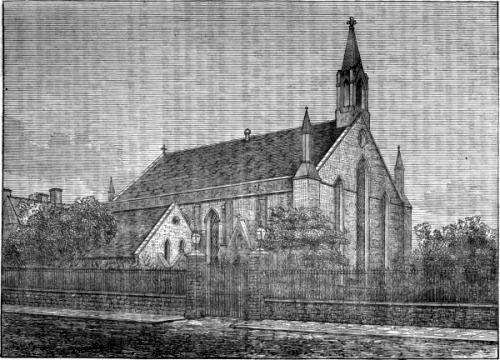
St. George's Church.
ST. GEORGE'S CHURCH, Battersea—The following particulars respecting this Church may not be uninteresting. The living is a vicarage of the yearly value of £240 with residence in the gift of Trustees.
The Chapel-of-Ease, as St. George's was called, in Battersea Fields, was built partly by a rate and partly by grant from the Parliamentary Commissioners at a cost of £2,819; it is a neat building in the style of English architecture, by Edward Blore, Esq., Architect. Its erection began September 18, 1827. It was consecrated August 5th, 1828, by Dr. Sumner, Lord Bishop of Winchester, and the first church his Lordship consecrated in his diocese. The Rev. J. G. Weddell was the first clergyman appointed. He held the living twenty-five years: died June, 1852. Within this hallowed sanctuary the venerable, esteemed and truly honoured servant of Christ the Rev. John Garwood, late Secretary of the London City Mission, laboured as curate in charge for nine years previous to Mr. Weddell's death. The Rev. H. B. Poer was appointed in 1852. It was made a District Church in 1853. The churchyard was closed as a burial ground in 1858. The Rev. E. S. Goodhart was appointed in 1859: he remained ten months. The Rev. Burman Cassin was appointed in 1860: he resigned and was instituted at St. Paul's, Bolton, 1872: he preached his last (valedictory) sermon December 31, 1872, at a watch-night service.
The Rev. John Callis was appointed January, 1873. During his time the Church underwent alterations. These were begun August 24, 1874, when the side galleries were removed and the church enlarged by the addition of two aisles at the cost of £1,700. The church will accommodate 800. The church was re-opened by the Right Reverend Harold Browne, Lord Bishop of Winchester, November 21st, 1874, at 4 o'clock p.m. The Rev. John Callis left for South Heigham, Norwich, July, 1875.
The Rev. Thomas Lander, M.A., now holds the living, he was appointed August, 1875. The Rev. T. Kirk ordained and appointed Curate to St. George's, September 24th, 1876. Previously to his ordination he had laboured for twenty-six years in connection with the London City Mission, and was much beloved and respected in the district among the people to whom he has been and still is so much blessed.
The population of the Ecclesiastical parish in 1871 was 16,172.[1] The register dates from the year 1858. The area is 443 acres.—John Gwynn, Samuel Lathey, Churchwardens.
"I love her gates, I love the road; The church adorned with grace Stands like a palace built for God To show his milder face."—Watts.
At the east end of the interior and south of the pulpit a white marble tablet mounted on a dark marble slab has recently been erected. Within a wreath of virgin marble most artistically executed is the following epitaph engraved. "In memory of Elizabeth Maria Graham, of Clapham Common, died December 14, 1874, aged 79, through whose devoted and indefatigable labours this Church, the Vicarage, and Mission-room were built and the St. George's Schools were founded. 'The love of Christ constraineth us.'—2nd Cor. v. 14. 'The harvest truly is great but the labourers are few, pray ye therefore the Lord of the harvest, that He would send forth labourers into His harvest.'"—Luke x. 2.
"They that feared the Lord spake often one to another; and the Lord hearkened and heard it, and a book of remembrance was written before him for them that feared the Lord, and that thought upon his name. And they shall be mine saith the Lord of Hosts, in that day when I make up my jewels; and I will spare them, as a man spareth his own son that serveth him."—Malachi iii. 16-17.
In St. George's Churchyard the ground has been levelled and the hillocks have disappeared to make it resemble more a garden or field with flat grassy surface studded here and there with shrubberies than a receptacle of the dead, there are however some "sacred memorial," a few grave stones etc., which indicate to the passer-by that this was formerly used as a place of interment. We will just pause to read some of the inscriptions. At the east-end of the churchyard is the vault of the Rev. John Grenside Weddell, twenty-five years pastor of this flock, who died the 23d of July, 1852, aged 75 years.