HENRY S. SIMMONDS. (continued 5)
Reading edition
Young as Angela was she had been elected the first Superior of her Order and had ruled it well for the two or three years she lived.
At first the Ursulines practised charity and devoted themselves to the education of Children without being bound to the rules of Monastic Life. In 1571-2 Pope Gregory XIII. made the Society a religious order, subject to the rule of St. Augustine, at the solicitation of Charles Borromeo the additional privileges thus conferred were afterwards confirmed by Sextus V. and Paul V. "They add to three religious vows a fourth to occupy themselves gratuitously in the education of their own sex. The order is under the Superintendence of the Bishops. In the 18th Century, it had 350 Convents. Many governments which abolished Convents in general, protected the Ursulines on account of their useful labours, particularly in the practice of Christian Charity towards the sick. The Dictionnaire de Theologie published in 1817, says that 300 Convents of these sisters existed at that time in France, their dress is black with a leather belt, and a rope for the purpose of self-scourging. Their congregations however did not universally accept the Monastic rule; and in France and Italy, there were Societies, the members of which only took the vow of Charity, and gave instruction like their sisters. Their dress was that commonly worn about 200 years ago by widows." In some countries however, their dress appears to have been white, and to have varied in other respects as well as colour. The Ursuline Sisters have several Educational Establishments in Ireland, in England and the United States.
BATTERSEA GRAMMAR SCHOOL, St. John's Hill. Founded under the Trust of Sir Walter St. John A.D. 1700. Scheme revised A.D. 1873. Governors:—William Evill, Jun., Esq., Robert Hudson, Esq., Rev. Evan Daniel, M.A., W. G. Baker, Esq., John Costeker, Esq., Treasurer, Rev. Canon Clarke, M.A., James H. T. Connor, Esq., Richard Hadfield, Esq., Thomas D. Tully, Esq., Charles Few, Esq., James Stiff, Esq. Head Master:—Rev. E. A. Richardson, M.A., late Scholar of Queen's College, Oxford. Assistant Masters:—W. H. Bindley, B.A., late Scholar of Emmanuel College, Cambridge, M. Michael, Bachelier-es-Lettres, University of Paris, C. P. Martinnant, University of London, Mr. Badel, Writing Master, Serjeant Major Doberty, Drill Master.
Scheme of Instruction. Religious Instruction, (according to the principles of the Church of England) forms a regular part of the teaching of each class. Those boys are excepted from the teaching of the Church Catechism and Prayer Book, whose parents, (being Dissenters), express a desire to that effect, in writing to the Head Master. The Course of Study comprises the English, Latin, Greek, French and German Languages; Writing, Arithmetic, Book-keeping and Mathematics. History and Geography; Natural Science and Drawing. French is taught throughout the School; German in the three highest classes only. Drawing, (Freehand, Model and Landscape), is taught in all classes. Technical Drawing, (including Practical Geometry, and Perspective), and Painting are taught only in the two upper classes. Science, (comprising Physics, Chemistry and Botany), is taught only in the upper classes. Vocal Music is taught.
School Term and Holidays. The period of instruction is divided into three terms, as nearly equal as possible. The holidays are four weeks at Christmas, three weeks at Easter, and six weeks at Mid-summer, commencing about the 1st of August.
1st Term commences September 7th; ends December 7th.
2nd.do. January 8th;do. March 29th.
3rd.do. April 23rd;do. July 31st.
Tuition Fees. The annual payment for boys above 12 years of age, £12; for boys under 12, £10. The fees are to be paid terminally and in advance.
Regulations for Admission. Application for admission must be made either in person or by writing to the Head Master. No boy will be admitted, who shall be found on examination unable to read English, to write correctly and legibly from dictation and to work sums in the first four rules of arithmetic. The boys must attend at the school for examination on the first day of each term, at two o'clock p.m. The Governors require a term's notice to be given on the removal of a boy, or the payment of the terminal fee.
THE SOUTHLANDS PRACTISING MODEL SCHOOLS.—Girls' School, seven years and upwards, 6d. per week. Infants' Boys and Girls to seven years, 3d. per week.
ST. PETER'S SCHOOLS. Fee, 9d. per week.
ST. JOHN'S, Usk Road. Boys 1st, 2nd, and 3rd classes, 4d. per week, the rest 3d. Girls 1st class 3d., the rest 2d. Infants 2d. per week.
ST. SAVIOUR'S INFANT. Infants 2d. Girls 3d. over 10 years of age 4d. per week.
CHRIST CHURCH NATIONAL SCHOOLS, Grove Road, Falcon Lane, were erected from designs of Mr. C. E. Robins, selected in competition, and were built by Messrs. Lathey Brothers at a cost of £3,000. Accommodation is given for 200 boys, 200 girls and about the same number of infants. There are two residences, one for the Master and the other for the Mistress. The buildings form a picturesque group facing the roads on three sides with intermediate play-grounds for each sex. Mr. Robins was also the Architect for the British Schools at Wandsworth and other Educational Buildings in the Parish, as the Walter St. John's Upper Schools and the extension of the Training College, the Chapel of which was decorated by him some seven years since. The office of E. C. Robins, F.R.I.B.A., etc., is No. 14, John Street, Adelphi.
ST. GEORGE'S NATIONAL SCHOOLS, built in 1857 from designs furnished by Joseph Peacock, Architect, Bloomsbury Square. Cost about £4,500 including a Parliamentary Grant of £1,500. The Schools were enlarged in 1870. The Infant Schools were established in 1826. The following text of Scripture is engraved on a stone outside the buildings.
"From a child thou hast known the Holy Scriptures, which are able to make thee wise unto Salvation through faith which is in Christ Jesus."—II. Timothy iii. 15.
Boys and Girls 4d. per week for one in a family, 6d. for two brothers or sisters, and 7d. for three in a family, Infants 2d.
Erected outside St. Mary's Schools, Green Lane, is a tablet bearing the following inscription:—"National Schools for Girls and Infants. These buildings were erected by Miss Champion on land granted by Earl Spencer, and opened April 10th, 1850, for the education of the children of the poor on Scriptural principles." This tablet is placed by order of the Parishioners in Vestry assembled in Grateful Remembrance of her Munificent Charities to the Parish of Battersea.—Rev. J. S. Jenkinson, M.A., Vicar. W. H. Wilson, John Hunt, Churchwardens, 1855.
Within the Parish of Battersea there were in the year 1879, Fourteen Voluntary Schools, viz.:—
Accommodation.
Sir Walter St. John's
Up-stairs Middle-class for Boys.
Terms, 15s. to 25s. per quarter.
Ditto Ground-floor Public Elementary School for Boys.
Payments, 6d. and 9d. per week. Head Master, Mr.
Taylor; Assistants, Mr. Jones, B.A., Mr. E. Mills,
Mr. Oliver, and Mr. Blackman.489
St. Mary's, Green Lane. Girls; Mistress, Miss Keene.
Infants' Governess; Miss Paul. Boys: Master, Mr. T.
Ryder. Fees, Boys and Girls 4d. a week, of which
at the year's end 2d. a week will be returned to all who
have attended more than 250 times. Infants 3d. a week,
of which 1d. a week will be returned to regular
attendants at the year's end.606
Christ Church, Grove Road. Master, Mr. Weston.
Mistress, Miss Paton. Infants, Miss Kemp.590
St. John's, Usk Road. Head Master, Mr. Henry Smith.
Mistress, Miss Hook. Infants' Governess, Mrs. Hughes.658
St. Peter's, Plough Lane. Head Master W. F. Normon.
Assistant, W. Beasley.180
St. Mark's, Battersea Rise. Infant Schools, Miss E.
Townsend. 4d. per week.99
St. George's, New Road. Head Master, Mr. John Douthwaite.
Mistress, Miss Salter. Infants' Governess, Miss
Holding.609
St. George's Girls and Infants' Schools, Ponton Road, Nine
Elms. Mistress, Miss B. Smith. Infants' Governess,
Miss A. E. Basnett.184
St. Saviour's, Orkney Street. Mistress, Miss Merrett.201
Wesleyan Model, High Street.557
St. Michael's, Bolingbroke Grove, (mixed). Mistress, Mrs.
M. Watson. 3d. per week.152
Grove Boys' British, York Road, Established 1799, Enlarged
1840. Master, Mr. James Hammond.196
Girls' British, Plough Lane. Mistress, Miss Mansell.
Assistant, Miss Willett.297
St. Joseph and St. Mary, Battersea Park Road.466
Total 5284
In 1879 there were Nine Board Schools in Battersea:—[1]
Name ofBuilder.When Opened. Boys' Master. Girls'Infants'
School. Mistress.Mistress.
Bolingbroke Mr. Spinks,Dec. 1, 1873Mr. Pink.MissMrs. Pink.
Road.Clapham Deacon.
Junction.
BatterseaMr. Sheppard,April 14, 1874Mr. Stokes.Mrs. Cox.Mrs.
Park.Bermondsey. Parker.
Winstanley Jan. 6, 1874Mr. Vince.Miss Gale.Miss
Road. Blackburn.
SleafordWilliam Higgs,Aug. 10, 1874Mr. Wheaton.Miss Pook.Miss
Street.South Lambeth. Browett.
GideonWall, Bros.,May 16, 1876Mr. Lee.Miss Dunn.Mrs.
Road.Kentish Town. Pyle.
Mantua Sept. 1876Mr. Mansell.MissMiss
Street. Spalding.Spalding.
Holden Feb. 1877Mr. Morris.MissMiss
Street. Macleod.Marshall.
TennysonMr. Tyerman.Feb. 1877Mr. Philips.Miss Davis.Mrs.
Road. Lower.
BellevilleMr. Thompson, Aug. 13, 1877Mr. Barter.Mrs.Mrs.
Road.Camberwell Christopher. Watson.
Green.
N.B.—There are Sunday Schools connected with the different places of Worship some of which are held in Board Schools.
LAMBETH DIVISION LONDON SCHOOL BOARD.— Accommodation Area and Cost of New Permanent Schools.
Name of School.ChildrenAreaCost ofCost of
Accommodation. sq. feet. Site.Building.
Sleaford Street1,05523,000£2543 1s. 4d.£8399 19s. 3d.
Tennyson Road83728,000£2376 18s. 6d. £7590 9s. 1d.
Gideon Road77619,700£3404 18s. 3d.£9921 7s. 5d.
Holden Street1,10126,887£3074 14s. 1d.£10305 1s. 7d.
Battersea Park1,33432,670£2378 5s. 5d.£7442 12s. 9d.
Bolingbroke Road 79254,426£768 5s. 5d.£5980 15s. 10d.
Mantua Street1,10532,670£2334 5s. 4d.£11337 1s. 1d.
Winstanley Road1,12717,792£3152 5s. 5d.£7948 4s. 7d.
Belleville Road828 £1661 6s. 2d.£10165 19s. 11d.
8,955
The first building erected for the London School Board, situated in one of the most densely crowded localities of the East-end, was opened in July, 1873, and since that time no fewer than 152 large Schools have been completed with a total accommodation for about 182,000 children, and an average accommodation for 872 children each. In addition to these, between 30 and 40 schools are now in course of erection, and about 50 other schools have been determined upon, thus the Board is most active in providing for the educational requirements of the Metropolis. Mr. E. R. Robson, F.R.I.B.A., is the Architect of this Board.
The Board School in Winstanley Road accommodates about 1130 children, the site is the shape of a rhomboid, and the School has been skilfully planned to make the most of it.
Gideon Road Board Schools, the boys and girls' departments are built upon arches to form covered play-grounds underneath. As the site contains sufficient area, the infants' department has been erected as a separate building.
The Board Schools are elaborately fitted up. Books, slates, pencils, etc., for the scholars are provided. The terms for tuition at the Board Schools in Battersea are:—Bolingbroke Road, boys, girls, and infants 2d. each. Battersea Park, Mantua Street, Winstanley Road, Tennyson Road, and Sleaford Street, boys and girls 3d. each, infants 2d. Gideon Road and Holden Street on the Shaftesbury Park Estate, boys and girls 4d. each, infants 3d. each.
School Board Visitors in Battersea:—Mr. Armstrong, Mr. Dalton, Mr. Myland, Mr. Fane, Mr. Chamings and Miss Sydney.
London Ratepayers' School Board Association Established 8th October, 1870.
London or Metropolitan School Board elected 29th Nov., 1870.
Regulations for School Boards issued 21st December, 1870. First election of Metropolitan School Board (Lord Lawrence, Chairman). Arrangements for erecting or adapting buildings for New School Board, December, 1871.
London School Board Education Scheme proposed 23rd June, 1871.
The London School Board occupied their new buildings on Victoria Embankment, 30th September, 1874.
Second Metropolitan School Board elected; religious party strongest. Sir Charles Reed, M.P., Chairman, November, 1878.
Sir Charles Reed, Chairman of the School Board for London, died March 25, 1881. Was interred at Abney Park Cemetery, Wednesday, March 30, 1881.
Fourth Metropolitan School Board elected, 1879.
E. N. Buxton, Esq., Chairman of the London School Board.
LONDON SCHOOL BOARD, LAMBETH DIVISION.[1] Miss Hen. Muller, T. E. Heller, Esq., Chas. R. White, Esq., Rev. G. M. Murphy, James Stiff, Esq., Stanley Kemp-Welsh, Esq.
The Elementary Education Act of 1870 aims at the compulsory supply of school accommodation in those districts in which there is a deficiency. The general survey under the Education Act of the School provision of every Parish in England did not commence till the 1st of May, 1871.
By virtue of the Elementary Education Act, 1876, and of the Bye-Laws of the School Board for London, the following will be, on and after the 1st January next, the state of the law as regards children, their parents and employers within the Metropolis.
I.—Regulations affecting Parent and Child. The term "parent" includes guardian, and every person who is liable to maintain, or has the actual custody of the child. The parent of every child between the ages of 5 and 14 must cause such child to receive efficient elementary instruction in reading, writing, and arithmetic.[1] A.—By the Bye-Laws of the School Board, which continue in force, the parent of every child between the ages of 5 and 13 must cause such child to attend an efficient School during the whole time for which the School is open. The following cases are excepted:—(a) where a child is receiving efficient instruction in some other manner. (b) where a child is not less than 10 years of age has received a certificate that he has passed the 5th Standard of the Code of 1871: in which case he is wholly exempt from attendance at School. (c) where a child of not less than 10 years of age has obtained a certificate that he is beneficially and necessarily at work: in which case he is exempt from the obligation to attend School more than 10 hours a week. (d) where the child cannot attend School through sickness or other unavoidable cause. If a parent commits a breach of the Bye-Laws he may be summoned before a magistrate, and fined 5s.; and the child may be ordered to attend School. B.—By the Act of 1876, if either—(1) the parent of a child above the age of five years who is prohibited from being taken into full-time employment, habitually and without reasonable excuse, neglects to provide efficient elementary instruction for his child; or, (2) a child is found habitually wandering, or not under proper control, or in the company of rogues, vagabonds, disorderly persons, or reputed criminals; the parent may be summoned before a magistrate, and the child may be ordered to attend School. If the attendance order be not complied with, the parent, if in fault, may be fined 5s.; and in cases of continued non-compliance, the fine may be repeated at intervals not less than a fortnight. The child may also, under certain circumstances, be sent to a certified day industrial School, there to be detained during certain hours each day for a stated period; or to an ordinary certified industrial School, there to be wholly detained for a stated period, which, however, must not extend beyond the time when the child will reach the age of 16 years. In either case, the parent may be made to contribute to the maintenance, of the child. II.—Regulations affecting Employer and Child. The term "employer" includes a "parent" who employs his child by way of trade or for the purposes of gain. A.—No person may employ, in the year 1877, any child who is under the age of nine years; or in subsequent years, any child who is under the age of 10 years. B.—No person may employ a child within certain limits of age, unless the child shall have obtained either a certificate of proficiency that he has reached the fourth Standard of the Code of 1876; or a certificate that he has previously made 250 attendances at least, in not more than two Schools, during each year for a certain number of years, whether consecutive or not, as follows:—
Age of Children,Unless they shall
who may not behave obtained
employed.a Certificate.
Either ofOr; of
Proficiency,previous due
according to theAttendance
undermentionedfor the
Standard.undermentioned
number of years.
In 1877Children between 9 andFourthTwo
12, with the exceptionStandard of
of those who were 111876
before the 1st January,
1877
1878Children between 10 and Ditto.Two
13, with the exception
of those who were 11
before the 1st January,
1877
1879Children between 10 andDitto.Three
14, with the exception
of those who were 11
before the 1st January,
1877
1880Children between 10 andDitto.Four
14
1881 andChildren between 10 andDitto.Five
subsequent 14
years
The penalty incurred by an employer who acts in contravention of the above provisions is a sum not exceeding 40s. But no penalty will be incurred by the employer (a) if the child was lawfully employed on the 15th August, 1876. (b) If the child obtains efficient instruction by attendance at School for full time or in some other equally efficient manner. (c) If the employment be during a specified time allowed by the School Board for purposes of husbandry, &c. and if the child be over eight years of age and be so employed. (d) If the child be employed and be attending School in accordance with the provisions of the Factory Acts, or of the Bye-Laws of the School Board. (e) If the employer be bona fide deceived as to the age of the child or as to his having obtained a certificate; or if some agent, without the knowledge of the employer, shall have employed the child—in which latter case the agent will be liable to the penalty. Although the employer be exempt from penalty, when the child is lawfully employed under the above regulations, the parent will still be liable for any breach of the Bye-Laws, where the latter are more stringent. III.—Regulations as to the Payment or Remission of Fees. If a parent is unable, from poverty, to pay the School fee of his child, he may apply either to the Guardians of the Poor for the Parish where he lives, or to the School Board. The Guardians, if satisfied of the poverty of the parent, must pay the school fee, not exceeding 3d. a week, of the child, in any Public Elementary School which the parent may select. If the parent select a Board School, the School Board, on his application, may, if they think fit, remit the school fee. The payment or remission of the school fee will not subject the parent to any disability. IV.—Free Instruction. Subject to conditions to be made by an order of the Education Department, a child under 11 years of age who obtains a certificate that he has attended a Public Elementary School 350 times a year, for two, three, four or five years according to circumstances, and, also, that he has attained a Standard (to be fixed by the Department) in Reading, Writing, and Arithmetic, will be entitled to have his school fees paid for him by the Education Department at a public Elementary School for three years more.
BY ORDER OF THE BOARD.
15th November, 1876.
In 1879 there were 63 Board Schools in the whole of the Lambeth Division and 45,000 children on the rolls.
In Battersea there are 68 taverns for the sale of spirits, etc., and 84 beer-houses, making a total of 152 public-houses. There are also 29 coffee-shops.
A COFFEE PALACE IN OLD BATTERSEA.—On Saturday afternoon, Dec. 13, 1879, a coffee palace, belonging to the Coffee Taverns Company, Limited, was opened at Lombard Market, York-road, Battersea. This is the 22nd tavern of the kind opened by the Company, and carried on, in regard to the business, on the same principle as others. A well furnished room is provided for public meetings and other gatherings.
LATCHMERE GROVE, which is almost encircled with Railway embankments, was noted for its piggeries. The lane once known as "Pig Hill," leading from Battersea Fields to Lavender Hill, is now a wide open road and forms the west boundary of the Shaftesbury Park Estate.
Somewhere near the foot of "Pig Hill" were two places called in olden time "Plague Spots" where many bodies of persons who had died of the Plague were buried.
THE SHAFTESBURY PARK ESTATE[1] formerly the site of Poupart's Market Ground, covers an area of 42 acres, contains about 1100 houses and 8000 inhabitants. The houses are built on the most improved sanitary principles, they are prettily and artistically constructed, having small gardens back and front; on either side of the streets are rows of lime and plane trees which in the course of a few years will give the "Work peoples' Town," a beautiful and pleasant aspect. The Houses are built in four classes, containing 5, 6, 7, and 8 rooms respectively, (the latter including a bath room), and the weekly rental (at first was) 6/6, 7/6, and 8/-, and the best class £26 and £30 per year, which sums, except the best class, includes rates and taxes, but if the tenant is buying the house under the repayment table, the rates, taxes, and ground rent have to be paid by him in addition to the purchase money.[2] The purchasing prices of the houses are £170, £210, £260, £310, and £360; and they are leased for a term of 99 years subject to annual ground rent of £3 10s., £4 4s., and £4 10s. according to the class of house. Each dwelling is thoroughly ventilated by means of improved ventilating valves, which are fixed to every room and connected with air shafts in all the external walls and the same are applied beneath the floors, the houses have concrete foundations and are considered dry and healthy. [3]It is intended to convert the premises used as the Estate Agency Office into a Club house, equal in accommodation to any at the West End, with Library, reading, smoking, and billiard rooms; a small hall to hold about 350 is being built which among other things is intended to be let to benefit clubs and such like societies. It is suggested that the present temporary hall be converted into Swimming and Washing Baths. Brassey Square a space about one and a quarter acres, the Estate Company are going to make into a garden like that on the Thames Embankment, in which seats are to be placed and it is intended to have a band to play there in summer months. Beside Co-operative Stores, there is a Social Review connected with the Estate, and a Newspaper has been started called "The South Western Advertiser."[4] The London Board School on the estate is situated in Holden Street. Between houses Nos. 21-23 in the Grayshott Road a stone may be seen bearing the following inscription "Healthy homes the first condition of Social progress." This stone was laid by the Right Honourable the Earl of Shaftesbury, K.G., for the Artizans, Labourers and General Dwellings Company, Limited, on the 3rd of August, 1872. R. Austin, Architect.
No Beer-shop, Inn or Tavern is erected on the Estate but it must not be inferred from this, that all the inhabitants are Total Abstainers. However the ostensible and important objects of the Estate Company are to help the Working Classes to become owners of the House they occupy; to raise their position in the social scale; and to spread a moral influence over their class, tending to foster habits of Industry, Sobriety and Frugality. Obedience to moral and physical laws, the right and proper use of material appliances for sanitary purposes, have a tendency to prolong human life and to make life more enjoyable, and the Supreme Governor of the Universe hath so ordained that it should be so. According to the metropolitan average, the deaths should have been 194, but they only numbered 100. In 1877 the births on the Shaftesbury Park Estate were 284. Connected with the Estate is a Volunteer Rifle Corps known as the "26th Surrey." Mr. Samuel E. Platt, Secretary to the Estate Company; Mr. J. V. Muller, Manager. Office, 221, Eversleigh Road. The Missionary who visits in this district is Mr. Vost, who holds meetings in the Temperance Hall, Elsley Road.
Eastward of the Shaftesbury Park Estate is situated Beaufoy's Chemical Works. Entrance, Lavender Hill. Mr. Matthew Cannon, Manager.
This site was formerly a brickfield. When Mr. Henry Beaufoy purchased the land comprising some 17 acres he named it "Pays Bas," signifying in French a low country. Recently 7 acres have been let on Lease of 99 years for building purposes, it is proposed to erect thereon 230 houses. In this locality and that of Latchmere it is said the bricks were made for the construction of Chelsea Hospital.
THE METROPOLITAN ARTIZANS AND LABOURERS DWELLINGS ASSOCIATION have just erected three blocks of houses in the Battersea Park Road, designed by Charles Barry, Esq., President of the British Institute of Architects. Accommodation in A Block for 98 families with 3 and 4 rooms each. There are two B Blocks, 45 families in a block, having accommodation for 90 families with one or two rooms each for labourers. The whole of the front window-frames facing the main road are glazed with Plate Glass. Between the pathway and the Blocks is erected an iron palisade and some evergreens have been planted within the enclosure. There are underground Laundries at the north end of the Blocks with all necessary appliances. The B Blocks have three tiers of balconies supported by iron columns communicating with the dwellings on the upper storeys. The roofs are tiled by the Broomhall Tile Company. The Builders, are Messrs. Downs & Co., Southwark. Major-General Scott, Secretary, office, 9, Victoria Road, Westminster Abbey. It is intended to erect more Blocks on the land adjoining. Chairman, John Walter, Esq.
The buildings are intended as models of the dwellings for Artizans and Labourers, to replace the habitations condemned in various parts of the Metropolis under the Act of 1875. They are built in flats as nearly fire-proof as may be. Each tenement in the Artizans dwellings and each block of four rooms for those of the labourers are entirely separated from others by an open space, each tenement has a constant supply of fresh water, the use of a wash-house and a coal bunker, a dust shoot, and generally great care has been taken to insure to the tenants all the advantages of the best known sanitary appliances. Within the outer door which opens on to a general staircase, are all the conveniences except the wash-houses which are detached from the building. These tenements contain in most cases, three rooms, viz.: kitchen, bed-room, and sitting-room. The labourers blocks are so divided that they can be let singly, or in twos, threes, or fours. The dwellings were formally opened on Saturday Afternoon, June 23rd, 1877, by the Earl of Beaconsfield. The ceremony was graced by a select company, among whom were in addition to the Prime Minister, the Earl and Countess of Rosslyn, the Countess of Scarborough, the Earl and Countess Stanhope, the Lord Chancellor and Lady Cairns, Lady E. Drummond, the Marquis of Bristol, the Earl of Ilchester, the Earl of Verulam, the Bishop of Winchester, the Right Hon. R. A. Cross, M.P., Mrs. and Miss Walter, Mr. W. H. Smith, M.P., Mr. Roebuck, M.P., Mr. Montague Corrie, Mr. Algernon Turner, Major-General H. Y. D. Scott, Manager of the Association, and numerous Members of Parliament. Her Majesty who takes a deep interest in this movement for the improvement of the dwellings of her people, commanded Earl Beaconsfield to express Her wish that Her name may be associated with this institution and that in future these buildings will be called the Victoria Dwellings for Artizans.
On the North side of Battersea Park Road is the site for Messrs. Spiers and Pond's New Steam Laundry, contiguous to which (Propert's) Blacking Manufactory is now built. Mr George Ashby Lean, Architect; Mr. Waters, Builder, The Common, Ealing.
Up the centre of the meadow a new road is to be made 50 feet wide. About forty years ago this ground yielded as fine a crop of wheat as any in England. At that time certain Notice Boards were erected with the words "Any person found plucking an ear of Corn will be fined one shilling." An old parishioner, who is still living, told the writer that he had been fined three shillings because he had picked up three ears of corn which another man had thrown away.
BATTERSEA (LATCHMERE, formerly called Lechmore) ALLOTMENTS cover an area of 16¼ acres, and are let to the industrial poor of the parish to encourage habits of industry, the land was applied to the present purpose in the year 1835. Originally there were 74 allotments now there are 156. The Allotments let at 3/- a plot, each allotment being divided into 10 plots. Application must be made to the Churchwardens, William Evill and Joseph William Hiscox, Esqrs.
Pleasantly situated between the Albert and Bridge Roads, Battersea Park Road, is Dove Dale Place, founded by the late Mrs. Lightfoot of Balham, (Widow of the late Dr. Lightfoot) for persons in reduced circumstances professing godliness, whether in connection with the Church of England or members of other Christian Churches having small yearly private incomes of their own. There are twelve accommodations of two small rooms each, there are two four-room cottages one at each end with gardens. In the middle of the centre block is a Chapel and over the window is the representation of a Dove bearing an Olive Branch. There are some pecuniary advantages connected with the foundation. It is in the hands of Trustees.
On a plot of ground by the main road opposite Dove Dale Place stands an old boiler that belonged to one Andrew Mann—it has stood (we are told) where it is for the last twenty five years. Before its removal to Battersea, it stood on a piece of land in Vauxhall Bridge Road.
LAMMAS HALL situated in Bridge Road West, is Licensed Pursuant to Act of Parliament of the 25th of King George 2nd, was erected in 1858. The Hall will seat about 400 persons and may be hired for lectures, concerts, and other public purposes. The front part of the building is used as a Vestry Hall and for the transaction of other parochial business. A more commodious Hall is urgently needed in a central part of the parish, so also are required Baths, Lavatory, and a Public Library. Lammas Hall owes its origin from a fund which was paid by the Battersea Park Commissioners for the extinguishment of the Lammas Rights to the Churchwardens, by resolution of the Vestry after several schemes had been brought forward they proposed to build a Hall and Vice Chancellor Stuart appointed the Trustees hence its name "Lammas Hall." Mr Thomas Harrap, Vestry Clerk.
THE UNION WORKHOUSE, erected in 1836 is situated within the boundary of Battersea parish at the junction of East Hill and St. John's Hill, it is an extensive brick building with accommodation for 833 inmates. The Infirmary adjoining was added in 1870 at a cost of £40,000. The Casual Ward in addition is constructed for 117 casual paupers. The Union comprises Battersea, Clapham, Putney, Streatham, Tooting, and Wandsworth with a population in 1871 of 125,000 and an area of 11,488 acres. John Sanders, Solicitor and Clerk; Edward H. Taylor, Assistant Clerk; Rev. William Armstrong, Chaplain; T. H. Cresswell, Medical Officer; John Hodge, Master; Mrs Martha Hodge, Matron; Mr. Pettman, Missionary.[1]
Old Battersea Workhouse, which has long since been pulled down, was situated in the neighbourhood of Battersea Square. In the same neighbourhood is the "Priory," now the residence of Mr. Oakman. Not far from the Raven Tavern was the "Cage," in Surrey Lane, for the confinement of petty criminals. Near the Prince's Head Tavern was the Pound in which cattle were enclosed for trespass until replevied or redeemed. Also a wooden machine called the "Stocks" to put the legs of offenders in, for securing disorderly persons, and by way of punishment in divers cases, ordained by statute, &c., was erected without the gates of Battersea Churchyard, near the waterside.
In the last quarter of the eighteenth century, writes Robert Chambers in his "Book of Days," there flourished at the corner of the lane leading from the Wandsworth Road to Battersea Bridge a tavern yclept "The Falcon," kept by one Robert Death—a man whose figure is said to have ill comported with his name, seeing that it displayed the highest appearance of jollity and good condition. A merry-hearted artist, named John Nixon, passing the house one day, found an Undertaker's company regaling themselves at 'Death's door,' having just discharged their duty to a rich Nabob in a neighbouring churchyard, they had ... found an opportunity for refreshing exhausted nature; and well did they ply the joyful work before them. The artist, tickled at a festivity among such characters in such a place, sketched them on the spot. This sketch was soon after published, accompanied by a cantata from another hand of no great merit, in which the foreman of the company, Mr. Sable, is represented as singing as follows, to the tune of 'I've kissed and I've prattled with fifty fair maids':—
"Dukes, Lords, have I buried, and squires of fame, And people of every degree; But of all the fine jobs that ere came in my way, A funeral like this for me. This, this is the job That fills the fob; Oh! the burying of a Nabob for me! Unfeather the hearse, put the pall in the bag, Give the horses some oats and some hay; Drink our next merry meeting and quackeries increase With three times three and hurra!"
A portion of the Falcon Tavern erected about 275 years ago at the end of Falcon Lane still remains with the old witch elm tree in front, its hollow trunk, to which a door is attached, answers the purpose of a bin or cupboard where hay is put with which to feed horses, and the old wooden-cased pump, fastened with rusty holdfasts to the tree, may still be seen. On the 15th of January, 1811, a printed engraving was published representing "Undertakers regaling" by this road-side inn, a copy of which may now be seen within. At that time R. Death was the landlord, he had written outside the tavern in large characters, Robert Death, Dealer in Genuine Rum, Gin, Wine; an Ordinary on Sundays; Tea, Coffee and Hot Rolls; Syllabubs and Cheese-cakes in the highest perfection. The subjoined doggerel lines as a skit or burlesque on the publican's name is published with the engraving:—
"O stop not here ye sottish wights, For purl nor ale nor gin, For if you stop whoe'er alights By Death is taken in. When having eat and drank your fill Should ye, O hapless case, Neglect to pay your landlord's bill Death stares you in the face. With grief sincere I pity those Who've drawn themselves this scrape in, Since from this dreadful gripe, heaven knows, Alas! there's no escaping. This one advice my friend pursue Whilst you have life and breath, Ne'er pledge your host for if you do You'll surely drink to Death."
The Falcon Tavern is now kept by Mr. J. G. Brown.
Mr. Edward Walford in his work entitled "Old and New London," published by Cassell, Petter and Galpin, London; in Part 66 at Page 479, writes, "Battersea has other claims to immortality: in spite of the claims of Burton and Edinburgh, there can be little doubt, if Fuller is a trustworthy historian, that one of the ozier beds of the river side here was the cradle of bottled ale. The story is thus circumstantially told in 'The Book of Anecdote':—Alexander Nowell, Dean of St Paul's and Master of Westminster School in the reign of Queen Mary, was a supporter of 'the new opinions' and also an excellent angler. But, writes Fuller, while Nowell was catching of fishes Bishop Bonner was after catching of Nowell, and would certainly have sent him to the Tower if he could have caught him, as doubtless he would have done had not a good merchant of London conveyed him away safely upon the seas. It so happened that Nowell had been fishing upon the banks of the Thames when he received the first intimation of his danger, which was so pressing that he dared not even go back to his house to make any preparation for his flight. Like an honest angler, he had taken with him on this expedition provisions for the day, in the shape of some bread and cheese and some beer in a bottle; and on his return from London and to his own haunts he remembered that he had left these stores in a safe place upon the bank, and there he resolved to look for them. The bread and cheese of course were gone; but the bottle was still there—'yet no bottle, but rather a gun: such was the sound at the opening thereof.' And this trifling circumstance, quaintly observes Fuller, 'is believed to have been the origin of bottled ale in England, for casualty (i.e. accident) is mother of more inventions than is industry.'"
On the road to Wandsworth and facing Plough Lane was "Ye Plough Inn," erected A.D. 1701. In front of this Inn grew an oak to which an iron ring was fastened, and it is supposed that here Dick Turpin the notorious highwayman occasionally reined up his bonny black mare. When the Inn was re-built in 1875-6 the trunk was removed to the front of the "Old House" in Plough Lane, which formerly belonged to Mr. Carter, who owned extensive market gardens about here. The following lines were written in commemoration of the famous Old Plough Tree, and the present landlord has had the lines enframed for his customers to read:—
"This stump the remains of the Old Oak Tree, That flourish'd when knights of the road roamed free, When bands of lawless yet chivalrous knights Struck fear to the hearts of purse-proud wights! This gay old king of the forest's wilds, His proud head bow'd to the sun's bright smiles, In glorious prime when his branches were strong As shoulders of Atlas in time long gone! His leaves in the murmuring breeze did fling Their sweet green shade o'er the Old Plough Inn! When the knights of the road of their deeds did sing, 'Twas there to his side was first fixed the ring To which Dick Turpin the gallant and bold When going to the Plough to spend his bright gold Did tether his mare, swift Bonny Black Bess. When rider and horse stopp'd here to get rest. Removed from his place when the Old Plough's head By time's fell decree in ruin was laid! This stump that remains of the Old Plough tree In front of 'The Old House,' in Plough Lane you may see. Here placed in memory of the Old Plough Inn An aged memento of things that have been! Here in his last stage, sapped branchless and grey, Here in cool September, the trunk's first day, In the year eighteen hundred and seventy-six, Was planted by Messrs. J. Goodman and Wilkes." William Holloway.
Situated in Plough Lane, and nearly opposite the residence of the late Rev. I. M. Soule, were Alms Houses for eight poor widows, founded by Mrs. Henry Tritton. The whole of this estate is now built upon and is called May Soule Road.
At Lawn House, now occupied by Mr. Miller the Barge Builder in Lombard Road, of the Firm of Nash and Miller, lived Mr. Hammett, of the firm of Eisdale and Hammett, Bankers. He was a great patron of the rowing fraternity and kept an open house two days in the year. He awarded the prizes for the Kean's Sovereigns and the Funny Boat Club races on the lawn in front of his house.
The Old Swan Tavern (now kept by Mr. R. Turner) nearly opposite the Star and Garter, was a kind of half-way house between Lambeth and Putney for the Eton and Westminster scholars who used to put in here when training for the great rowing match so strongly contested between them, but who in the zenith of their fame never obtained such popularity as the annual boat race has done of late between the Cantabs and Oxonians.
An old-fashioned print represents the former Parish Church of Battersea with square tower crowned with lantern and pinnacles, not far off is the Swan Tavern with stairs leading down to the river where persons arriving by boat might land. An excellent wood-cut engraving in "Lysons's Environs" represents not only the New Parish Church but the sign of the Old Swan with two necks. Charles Dibdin in a ballad opera entitled "The Waterman; or the first of August," first performed at the Theatre Royal, Haymarket, August 8th, 1774, Scene III.—Battersea—represents a room at the Swan, with a large open window looking on the Thames in which Master Bundle the honest gardener and hen-pecked husband, and Mrs. Bundle the termagant wife, the Star of Battersea, figure conspicuously. Reference is also made in Scene I. to the "Black Raven," now kept by W. Ambrose. It is said that in olden time this was a Posting Establishment for Royalty.
Situated on Wandsworth Common and overlooking the London Brighton and South-Coast and South-Western Railways are the Royal Victoria Patriotic Schools for Boys and Girls, children of deceased soldiers, sailors and marines. Founded by Her Most Gracious Majesty, 1854-56. The Patriotic Asylum was endowed by the Commissioners of the Royal Patriotic Fund which was instituted in 1854 for the purpose of giving "assistance to the widows and orphans of those who fell during the Crimean and more recent wars, and to provide schools for their children." Within the boundary of Battersea Parish is situated the Asylum for Boys but the Asylum for Girls which is some three hundred yards distant is in the parish of Wandsworth. 200 boys are in the Asylum. Superintendent, W. Ridpath; Office, 5, St Martin's Place, Trafalgar Square; Secretary, W. H. Mugford, Esq.
Near the southern boundary of the parish and not far from Wandsworth Common Railway Station, are situated St. James' Industrial Schools. [1]This Institution stands on a portion of 22 acres of land purchased of the Right Honourable Frederick Earl Spencer, K.G., and conveyed to the Governors and Directors of the Poor of the Parish of St. James, Westminster, by Deed bearing dates, the thirtieth day of December, one thousand eight hundred and fifty. The first stone laid 24th September, 1851. The School opened 22nd June, 1852. F. Parkis, Superintendent. There are now 141 boys in the schools. On leaving a premium of £10 is given to each boy to learn a trade. Mrs. Anne Newton, late of upper Harley Street in the Parish of Mary-le-bone, widow, deceased, by her Will left, dated the 12th of March, 1806, £1,000. £429 19s. 3d. has been received through the Court of Chancery. The interest is given to the best boy selected by his fellow scholars, on condition that the Superintendent agrees with their decision.
The Royal Masonic Institution for Girls supported entirely by Voluntary Contributions, was instituted on the 25th March, 1788, at the suggestion of the late Chevalier Bartholomew Ruspini, Surgeon-Dentist to his late Majesty, George the Fourth, for the purpose of educating, clothing, and maintaining a limited number of girls, whether orphans or otherwise, the children of Brethren whose reduced means prevented them from affording their female offspring a suitable education. His late Majesty, the Prince of Wales, with other members of the Royal Family, the nobility, clergy and gentry, and many of the most influential members of the craft, gave the project their warmest support, and by their united efforts established this Institution, which has preserved numbers of children from the dangers and misfortunes to which females are peculiarly exposed, trained them up in the knowledge and love of virtue and habits of industry, and cultivated the practice of such social, moral and religious duties as might best conduce to their welfare and eternal happiness. A school-house was erected in 1793, near the Obelisk, St. George's Fields, on leasehold ground belonging to the Corporation of the City of London. At the expiration of the lease in 1851, it was determined by the Committee to remove to a more healthy locality. Accordingly about three acres of freehold land were purchased on the high ground of Battersea Rise. Upon this land the present building, which is an ornament to the neighbourhood, was erected in 1852. It is constructed of red brick of Gothic architecture from the designs of Mr. Phillip Hardwicke, and is noticeable for its great central clock tower. Since the first erection of the building a wing has been added and the wings of the buildings have been extended in front in order to afford extra school-room, dining room and dormitory accommodation. Detached from the main building an Infirmary has been erected in the grounds, including convalescent room, laundry, and every appliance necessary thereto. The establishment consists of a Matron; a Governess; three Assistant Governesses; an Assistant to the Matron, and six Junior Teachers; a Gardener and his Wife; and eight female Servants. Since its establishment, one thousand and ninety-one girls have been educated, clothed, and maintained within its walls. There are now one hundred and sixty-two girls in the Institution. The school is open for inspection every day from eleven to four (Sundays excepted) and can be reached by any train stopping at Clapham Junction which is closely adjacent.
CLAPHAM JUNCTION is in the direction of St. John's Hill, at the north-eastern extremity of Wandsworth Common. "The station itself which was at first one of the most inconvenient, was re-built a few years ago, and now with its various sidings and goods-sheds cover several acres of ground." It is one of the most important railway junctions south of the Thames, offering facilities to persons desirous of travelling not only to any part of the Metropolis but to all parts of England. Easy access can be had to the eight different platforms for "upline" and "downline," etc., on entering the tunnel. Booking office for Kensington, Metropolitan line, etc., on the ground floor at the north end of the tunnel and facing No. 2 platform; Booking office South-Western line No. 5 platform; Booking office Brighton and South-Coast No. 8 platform; also Telegraph office ditto ditto.
At the Junction there are thirteen waiting rooms, two refreshment bars, two cab ranks, two carriage roads to the Junction from St. John's Hill. Nearly 1,000 trains pass through the Junction daily. The staff of railway employés are respectful and obliging to passengers; there is none of that bull-dog growl in reply to questions which characterize some men with surly dispositions who fill public positions.
"Evil is wrought from want of thought As well as want of heart."
London, Brighton and South-Coast Railway: Station Master, Mr. John B. Carne; South-Western Railway: Station Master, Mr. Thomas Green. West London Extension Railway: Battersea Station, High Street.
BATTERSEA PROVIDENT DISPENSARY, 175, High Street, founded 1844, re-organized 1876; President, The Rev. Canon Erskine Clarke, Vicar of Battersea; Hon. Secretary and Treasurer, Mr. B. W. Bayley; Committee for 1881, Dr. J. Brown, Mr. J. H. T. Connor, Mr. Heale, Mr. Merry, Mr. Pilditch, Rev. S. G. Scott, Rev. H. G. Sprigg, Rev. J. Toone, Mr. Trehearne, Mr. Tyrer, Mr. H. Urwicke; Elected Representatives of Benefit Members, Mr. King, Mr. Whensley; Medical Officers, Mr. Oakman, The Priory, Battersea Square; Mr. G. F. Burroughs, Queen's Road, and Grayshott Road; Dr. R. Frazer, Sisters Terrace, Lavender Hill; Mr. Biggs, 93, Northcote Road; Mr. Sewell (Kempster & Sewell), 247, Battersea Park Road; Resident Dispenser, Mr. Whitehead; Collector, Mr. Chatting.
The Funds of the Institution are derived from two sources. (1) From the weekly payments of Subscribers who are termed members. (2) From annual contributions of the more affluent, who on subscribing to the Institution become honorary members. Medical attendance and medicine are supplied to persons earning not more than 30/- a week on payment of one penny per week for those over 14, and one half-penny per week for those under 14; but no greater sum than fourpence shall be required from any family residing together as such. To persons earning more than 30/- and not more than 50/- per week, double the terms named above. Members select their own medical attendant from the medical officers of the Institution. The medical officers attend at the Dispensary at appointed hours, but give advice at their own residences, and visit the sick at their own houses when necessary. The Dispensary is open for the supply of medicines daily, except Sunday, at 10, 3 and 7; but medicines are supplied at all hours in urgent cases.
WANDSWORTH COMMON PROVIDENT DISPENSARY, Bolingbroke House.—President, The Rev. Canon J. Erskine Clarke; Honorary Secretaries and Treasurers, Rev. J. H. Hodgson, Church House, Bolingbroke Grove; J. S. Wood, Esq., Woodville, Upper Tooting; Honorary Dentist, A. J. East, Esq., St. John's Hill, New Wandsworth; Resident Medical Officer, Dr. John H. Gray.
CHARITY ORGANIZATION SOCIETY, 1, Clifton Terrace.—Office hours, 9 till 10 a.m. and 5 to 6 p.m. Joint Secretaries: J. H. Ward, Esq., and Frank Knight, Esq., Agent, Mr. J. T. Thornton. Sub-office: St. George's Mission Room, New Road.
THE PENNY BANK, 1, Clifton Terrace, Battersea Park Road, is open on Mondays and Saturdays, from 7 to 8 p.m.
Conspicuously situated at the corner of Simpson Street, Battersea Park Road, is No. 54 Metropolitan Fire Brigade Station, erected 1873-4, is substantially built of red brick, with turret. In case of fire two engines and one fire-escape are kept on the premises. Staff: one officer and four men.
"We are indebted to Germany for the invention of the first fire engine."
Respecting the origin of fire brigades: "In 1774 an Act was passed requiring every Parish to provide itself with one large and one small engine, &c., and everything necessary in case of fire. The first London fire brigade was an Institution entirely independent of the parishes, as indeed also of the Government and of the Corporation of London. It was created and exclusively supported by the Insurance Companies of the Metropolis. At first every Insurance Company had its own fire engine and men to work it, but in 1825 some of them joined, and when the advantage of union was seen most of the others desired to take part in the combination already formed, the result of which was that in 1833 a more extensive organization was made, to which the name of the London Fire Brigade was given. Such was the state of matters until by Act 28 and 29 Vict. cap. xc., July 5th, 1865, the duty of extinguishing fires and protecting life and property in case of fire was declared to be entrusted to the Metropolitan Board of Works within their jurisdiction, and provision was made for the establishment of the Metropolitan Fire Brigade. The Act provides for its support from three sources, viz.: 1st, £10,000 Grant from Treasury; 2nd, ½d. in the £ Rate; 3rd, £35 for every £1,000,000 insured in the Metropolis from Insurance Companies, which in the year ending December 31, 1872, realized £16,267. All the Stations are in direct communication by telegraph with the Central Station, so that any required number of engines or men may be summoned to any given spot without delay. In 1872 the cost of maintenance was: Brigade, £67,520; Stations, £8,793; Total, £76,313. All the Dock Companies have engines, and some large private firms."—Popular Cyclopedia, Blackie & Son.
By 1833 all the important Companies combined and the London Fire Brigade was formed, organised and raised to an efficient standard under the management of the late and much lamented Mr. James Braidwood, who met with his death in the act of discharging his duties at the great conflagration which broke out in the afternoon of Saturday, June 22nd 1861, in one of the warehouses on the banks of the river, close to the Surrey side of London Bridge, which in spite of increasing efforts to extinguish it, continued to burn until it destroyed property worth nearly £2,000,000. The destruction of property thus caused by the fiery element is without a parallel in the Metropolis since the great fire of 1666. "Three acres of ground were gradually covered with a mass of fire, glowing and crackling at a white heat like a lake of molten iron. The saltpetre, the tallow, the tar and other combustibles stored in the warehouses ran blazing into the Thames until the very river appeared to be covered with the flames. Ships were burned as well as houses, and the danger to life was almost as great on the river as in the street. The glare of the conflagration was not only visible but strikingly conspicuous 30 miles off."
THE METROPOLITAN POLICE.—The organization of the present effective Police force is due to Sir Robert Peel's bill of 1829. The force is divided into the City Police, confined to the City proper, whose office is in the Old Jury, and the Metropolitan Police, which consists of about 8,200 men, and whose Chief Station is in Scotland Yard.
Metropolitan Police Station, Battersea, V. Sub-Division, Bridge Road. Superintendent, Mr. Digby; Inspectors, Mr. McCrory, Mr. Steggles. Number of men about 70. W. Division New Police Station, Battersea Park Road.
The full force of the Metropolitan Police in 1876 was 10,238.[1]
Board of Works for the Wandsworth District, Battersea Rise, S.W. Arthur Alex. Corsellis, Clerk of the Board.
ST. JOHN'S COLLEGE of the National Society is situated in Lombard Road for the training of young men who are intended to become schoolmasters in schools connected with the Church of England. There are at this time about 80 students. The Rev. Evan Daniel, M.A., Principal; Rev. Edwin Hammonds, Vice-Principal; Mr. George White, Secretary and Tutor; Mr. Arthur Macken, Tutor; M. Alphonso Estoclet, French Master; Mr. E. C. May, Teacher of Music; Mr. W. Taylor, Normal Master; Mr. E. Mills, Organist; Dr. Connor, Medical Attendant.
The College owes its origin to Dr. J. P. Kay-Shuttleworth and Mr. E. C. Tufnell, Assistant Poor-Law Commissioner, who with the view of establishing a Normal School in this country for imparting to young men that due amount of knowledge and training them to those habits of simplicity and earnestness which might render them useful instructors to the poor, travelled to Holland, Prussia, Switzerland, Paris and other places that they might witness the operations of such educational schemes as had been projected by Pestalozzi, De Fellenberg and others interested in promoting the education of the poor. The plan suggested by Dr. Kay-Shuttleworth and Mr. Tufnell met with the hearty and most cordial approval of the Vicar, the Hon. and Rev. R. Eden, who offered them the use of his village schools to carry out their benevolent intentions. In 1840 they selected a commodious manor house near the river Thames, at Battersea. Boys as students were first obtained from the School of Industry at Norwood, who were to be kept in training for three years. Subsequently some young men joined the Institution whose period of training was necessarily limited to one year. In 1843, the Directors, Dr. Kay-Shuttleworth and Mr. Tufnell, who had supported the Institution by their own private means, had it transferred into the hands of the National Society. The Continental modes of instruction which had been adopted, such as Mulhauser's method of writing, Wilhelm's method of singing, Dupuis' method of drawing, etc., were so satisfactory that a grant of £2,200 for the enlargement and improvement of the premises was made to them by the Committee of Council on Education which was transferred to the National Society and without delay disbursed in completing the alterations required. In the early part of 1846 a new class-room was erected. "The Institution is supported by the National Society's special fund for providing schoolmasters for the manufacturing and mining districts. Only young men are received as students, whose term of training is generally two years."
THE VICARAGE HOUSE SCHOOL is also situated here. Principal: Miss Crofts. Fees from half a guinea to a guinea per quarter, according to age and attainments. The only extra subjects are Music and French.
On the border of the river between Albert Bridge and Watney's Distillery are several wharfs and factories. Ribbon Factory of Cornell, Lyell and Webster; the Glove Factory of Fownes & Co.; Garton, Hill & Co.'s Sugar Refinery now in course of erection; Orlando Jones & Co.'s Rice Starch Manufactory; Denny's (Creek) Flour Mills;[1] Price's Patent Candle Company's Factory; B. Freeman & Co.'s Varnish and Color Works; T. Whiffin's Chemical Manufactory; Nash and Miller, Barge Builders; A. B. Cox, Barge and Boat Builder; Watney's Malt Houses.
On the site where now stands Fownes & Co.'s Glove Factory, formerly used as a silk factory, was Bonwell and Waymouth's Distillery. This firm furnished a Corps of (Battersea) Volunteers, of which the late Mr. George Chadwin was an ensign. Mr. Jonathan Browne, who used to preach at the Old Baptist Meeting House, York Road, was the grandfather of Mr. George Jonathan Chadwin, of Lombard Road, who was Vestry Clerk for 29 years in conjunction with his father.
T. Gaines, a celebrated Horticulturist and Florist, resided in an ancient mansion that stood in Surrey Lane, thought by some to have been a private residence of Queen Elizabeth. The house has been pulled down.
J. Tow kept a Private Mad House in High Street, It is now occupied by Austin & Co., Dyers.
It is supposed by some that there was in olden time a Foundry in Battersea for casting shot, etc., for the Tower of London.
THE PATENT PLUMBAGO CRUCIBLE COMPANY'S WORKS, which are the largest crucible works in the world, cover a large space of ground and have a river frontage. The principal elevation in Church Road is a conspicuous feature in the neighbourhood. It is Italian in character freely treated and somewhat Continental in design. The clock tower rises about 100 feet high, in which is an illuminated clock that may be seen at a considerable distance. A portion of the basement of this elegant structure is appropriated to the private office of the manager and clerks' offices where every quality of plumbago is represented by specimens from all the most celebrated mines, particularly those of Ceylon, Germany, Spain, Siberia, Canada, Finland and Borrowdale. The other departments are the stores, grinding room, mixing room, potters' room, drying room, the clay department, store room, etc. Crucibles for melting and refining metals have been used ever since man threw aside his hatchet and bone-chisel for bronze. For scientific research the crucible has occupied an important place. It was constantly used by the first alchemists and has truly been styled the cradle of experimental chemistry. The word crucible from the Latin crux-crucis recalls the alchemical practice of marking the vessel with the protective sign of the cross. Crucibles of different shapes and sizes are extensively employed by the refiner of gold and silver, the brass founder, melters of copper, zinc and malleable iron, the manufacture of cast steel, the assayer and the practical chemist. For ordinary metallurgical operations clay crucibles are extensively employed. At the International Exhibition of 1862 the only prize medal for crucibles was awarded to the Company and another prize medal for blackleads. The Company's crucibles are now used exclusively by the English, Australian and Indian Mints; the Royal Arsenals of Woolwich, Brest, and Toulon, etc., etc., and have been adopted by most of the large engineers, brass founders and refiners in this country and abroad. Their great superiority consists in their capability of melting on an average forty pourings of the most difficult metals, and a still greater number of those of an ordinary character, some of them having actually reached the extraordinary number of 96 meltings. These crucibles never crack, become heated much more rapidly than any other description, and require only one annealing, may be used any number of times without further trouble, change of temperature (they may be plunged while cold into a furnace nearly white hot without cracking) having no effect on them. The Patent Plumbago Crucible Company are the greatest consumers of the Ceylon Graphite brought to the United Kingdom. The total quantity of Graphite exports from Ceylon in 1862 was 40,195 cwt., of which 34,730 cwt. was shipped to Great Britain.
This Company are at present carrying out very extensive improvements on the river side along the front of their premises in the construction of a river wall built of Portland Cement Concrete, the foundations of which are carried down four feet below Trinity Low Water Mark, which have been done without the aid of a coffer-dam. These works when completed will reclaim a very valuable frontage of the river. The total length of wall and camp-shedding together with the adjoining property of Messrs. May and Baker's Chemical Works will be about 500 feet.
These improvements if extended westward towards the Parish Church will be the means of doing away with the unsightly mud banks which now exist, there is no doubt then a clean foreshore will be accomplished similar to the south side lower down the river where more extensive embankment works have been constructed. Behind a portion of the wall which the Plumbago Company are constructing will be some extensive cellars, which will be covered over with a concrete floor carried on wrought iron girders and supported by cast iron columns, and on the top of this floor will be a tram seven feet wide for the use of a heavy steam crane, and when completed will be able to unload goods out of barges alongside and deliver the same into the second floor of the present warehouse.
These works have been constructed from the designs and under the superintendence of Mr. W. H. Thomas, C.E., of 15 Parliament Street, Westminster, Engineer to the Patent Plumbago Crucible Company, and now being carried out by Messrs. B. Cook & Co., of Phœnix Wharf, Church Road Battersea, Mr. Maples acting as Clerk of the Works.
The same firm are also constructing large river-side works at Nine Elms for the London Gas-Light Company for a Ship's Berth, from the design and under the superintendence of Robert Morton, Esq., the Company's Engineer.
A very striking feature is connected with the latter works, as it is proposed to bring vessels up the river capable of carrying 1,000 tons of coals which will be discharged by the use of hydraulic cranes and delivered by tram direct into the Gas Works.
Adjacent are the Silicated Carbon Filter Company's Works. Whenever man has arrived at any considerable degree of civilization the subject of water supply had a share in his solicitude, and it is questionable if our modern works for supplying water surpass those of ancient Judea, Greece, Rome, Mexico and other places. The effect of impure water on the health and life of the community was alas, too painfully evinced by the outbreak of cholera in 1854-1866, and by the reports of medical officers as to the cause of typhoid fever.
The Silicated Carbon Filters are so constructed that the solid matter deposited on the filtering medium can be easily cleansed away. They entirely remove from water all organic matter and every trace of lead, and for all domestic purposes they may be said to render water absolutely pure. Testimonials from eminent authorities describe the extraordinary power possessed by these filters of entirely freeing water from every noxious quality.
Contiguous are the premises belonging to Mr. H. Bollman Condy, the Inventor, Patentee, and Manufacturer of Antiseptic Aromatic Vinegar, "Condy's Fluid," and "Condy's Ozonised Sea Salt."
Adjoining are the Citizen Steamboat Company's Works and Dock, whose steamboats leave Battersea to London Bridge and intervening piers every ten minutes from 8 a.m. till dark. Entrance: Bridge Road. Manager: Mr. M. Williams.
Situated in Wellington Road is A. Ransome & Co.'s Battersea Foundry.
S. Williams' Barge Works, Albert Road.
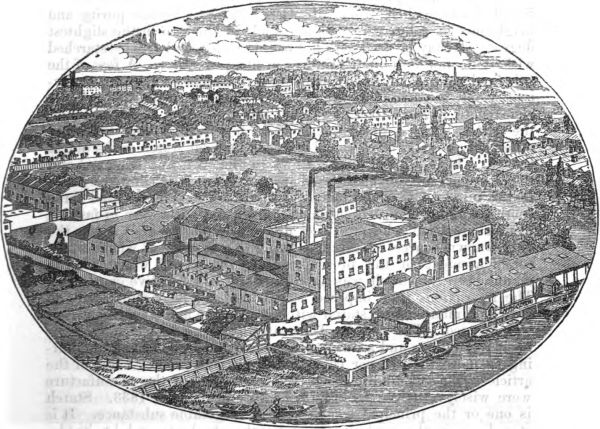
ORLANDO JONES & CO.'S STARCH WORKS.—Oryza is the name by which rice was known to the Greeks and Romans and which has been adopted by botanists as the generic name of the plant yielding that valuable grain. The name Paddy is applied to the rice in the natural state, or before being separated from the husk. The genua Oryza has two glumes to a single flower; paleae two, nearly equal, adhering to the seed; stamens six, and styles two. The common rice Oryza Sativa unlike many cultivated grams is still found in a wild state in and about the borders of lakes in the Rajahmundy Circare though the grain in its wild state is white, palatable and considered wholesome the produce when compared with the varieties of cultivation is very small. The rice plant is described as a native of India from which country it has spread over a great part of the world especially in Asia where it forms the principal portion of the food of the inhabitants. A failure of the rice crop is most disastrous as has been experienced too painfully by the natives of India during the late famine in that region. "A rice field produces a much greater quantity of food than the most fertile corn fields. Two crops in the year, from thirty to sixty bushels each, are said to be the ordinary produce of an acre." Rice is now extensively cultivated in North and South Carolina, and in Georgia, also in Italy and the South of Spain and likewise a little in Germany. There are forty or fifty varieties of rice. Dr. Roxburgh divides them into two kinds. One called in Telinga, Poonas Sans; the second division of cultivated rice is called Pedder Worloo by the Telingas.
Rice Starch is principally used for laundry purposes it will be found distinguished from all others by its singular purity and brightness of color. It will not stick to the iron in the slightest degree. It may be used with hot or cold water, and articles starched with it do not lose their stiffness in damp weather. A few of the principal sources of the various known starches are sago, arrowroot, yams, the manioc-root and horse chesnuts in addition to those resorted to by manufacturers, viz.: wheat, potato, maize and rice, the latter being a great novelty and illustrating more than any other the progress of chemical science. Wheat starch is the oldest known. It is alluded to by Pliny in the 'Natural History,' and the discovery of the method of its extraction is attributed by him to the inhabitants of the Island of Chios. The starches used three centuries ago, when such enormous ruffles and frills were in fashion were made from wheat; in fact down to modern times it was the only known source of starch. Owing to a scarcity of wheat at the commencement of the present century the use of wheat for the manufacture of starch was prohibited by a legislative enactment. The restrictions thus imposed were considered most oppressive, no one could manufacture starch without a licence and a tenement rent was exacted. The details of manufacture were subject to Government regulations and a duty of 3¼d. per pound was levied, amounting to more than 75 per cent. of the present market value of the article. These hindrances to the extension of the manufacture were wisely removed by our Legislature in the year 1833. Starch is one of the principal constituents of vegetable substance. It is stored up in the seeds, roots and piths of plants and by its decomposition furnishes the materials for keeping up respiration and supplying the animal heat. It has an organised structure and when examined by the microscope presents the form of rounded grains or granules composed of concentric layers which differ in size and shape in the starch of different plants the granules varying in diameter from 1000th to 300th of an inch. However the composition is the same, consisting of seventy-two parts of carbon and eighty-one of water. "In its pure state starch is a fine white powder without taste or smell. It is not soluble in water or alcohol, or ether, but mixed with boiling water it swells, bursts, and forms a kind of mucilage, which cools into a semi-transparent paste or jelly." The process of manufacturing starch from rice was discovered and patented about the year 1840 by Mr. Orlando Jones, founder of the house of the same name. His invention consists in the treatment of rice by a caustic alkaline solution during the steeping, grinding and macerating of the grains. The alkali used is either caustic potash or soda, of such a strength as to dissolve the gluten without destroying the starch; it must consequently vary with the character of the grain and hence the utmost nicety is required. The Battersea Works of Orlando Jones & Co. were built in 1848, the firm having previously carried on their manufacture in Whitechapel, they are situated on the banks of the Thames near the works of Price's Patent Candle Company, and occupy ground extending from the river to York Road; thus the firm possesses facilities of conveyance both by land and water—this latter is particularly valuable to them to enable them to save all dock, landing and warehousing charges. A large new store has been recently built on their wharf to which rice is barged direct from the ship. From the wharf also the manufactured article itself is conveyed to the docks for shipment to the Continent and our Colonies, with which a large trade is carried on. As an illustration of the extent of Orlando Jones & Co.'s operations it may be added that the box making department is a little factory in itself, and the machinery employed for the various purposes of sawing, dusting, cleaning, lighting, pumping, stirring, and grinding is driven by steam engines. It will be obvious that the manufacture of rice starch on a large scale requires no little capital and skill, and takes high rank among those industrial enterprises which are so peculiarly the characteristic and the glory of our age and country. Messrs. Orlando Jones & Co's manufacture has been awarded nine prize medals at International Exhibitions, and the grand distinction of the gold medal of the Académie Nationale of Paris. These medals have been awarded 'for introduction of the process,' 'for excellence of manufacture' and 'for large production.'
It is worthy of note that Messrs. Orlando Jones & Co. are the manufacturers of Chapman's Patent Prepared Entire Wheat flour especially distinguished by its richness in earthly phosphates which are essential to the development of bones and teeth. This farinaceous food for infants, children and invalids is much recommended by the medical faculty.
Battersea is becoming quite noted for Laundries. There is Strutt's (Lawn) Laundry, Orkney Street; Royal Albert Laundry, Battersea Park Road; Laundry, Sheepcote House; Latchmere Laundry; Alder's South Western Laundry, Surrey Lane; Lombard Road Laundry; Palmer's Laundry, Chatham Road, Wandsworth Common; and many others.
But one of the largest and most gigantic of Laundries is the Colossal Steam Laundry, belonging to Messrs. Spiers & Pond, erected 1879. The Laundry is situated on the North side of Battersea Park Road, it is constructed of yellow brick, with stone window-sills, and Beart's white-moulded brick for string courses, window jambs, arches, and cornices. The Building and Works are from designs by Mr. Kemp, Architectural Engineer. Mr. Priddle of Hounslow was the Contractor; and Mr. Warburton, Clerk of the Works, under whose superintendence the work was carried out.
The Building and Grounds extend over an area of one acre, the principal frontage which is 170 ft. in length, faces the East in a road leading to the South gate of Battersea Park, now called Alexandra Avenue. The central portion has an elevation of 45 ft. in height consisting of three floors containing, Manager's Residence, Clerk's Offices, etc., also a mess-room for the Employés, with bath-room and domestic lavatories. A spacious archway leads into the court-yard. This entrance is 10 ft. in width and 15 ft. in height. The wings of each side of the central portion have an elevation of two floors. Other blocks each containing one lofty floor are built on the North, South and West sides, to nearly one half the extent of the site. The remaining open space which is set apart as a drying ground is furnished with necessary appliances. Securely fixed in the ground by means of struts are 96 poles, to which is firmly attached a galvanic wire-rope for bleaching purposes. A separate block at the South West corner is for stables, adjoining which is the engine and boiler house with a chimney-shaft 70 ft. high, 7 ft. wide at the base and 4 ft. at top. This part of the Building is fitted up with a horizontal Engine and 2 Boilers by Manlove, Alliott and Co. of Nottingham of sufficient power to drive the Machinery requisite for the various processes of the Laundry; the Patent Machines used are made by Mr. Bradford of London and Manchester. The boundary wall enclosing the building and grounds is 7 ft. high. On the South side of the laundry is a sorting-room 63 ft. in length by 18 feet in width for the reception of articles as they arrive in the vans. The washing-room is 50 ft. square with large open louvres in the ceiling for the purpose of ventilation and to allow the steam to escape. The drying-room is 70 ft. by 30 ft. A flue-pipe 70 ft. in length is placed horizontally immediately along the floor in this department and about 1,200 ft. of corded piping are utilized for the heating chamber. In the West block are the folding and the mangling rooms, their dimensions being respectively 40 ft. by 30 ft., and 52 ft. by 30 ft. In the North block is the ironing room which is 55 ft. by 25 ft., next to which is the packing room 40 ft. by 25.
Estimated cost of building and machinery about £12,000.
Matron, Mrs. Tobin. Number of employés 60.
Propert's (Blacking Factory) built 1878-9. Hunting Mark a fox's head. Hunting preparations, established 1835, South Audley St.
B. Beddow and Son, Sole Proprietors.
A site past Propert's factory has been selected by the London and Provincial Steam Laundry Co. Limited. Ernest Turner, Architect, 246, Regent St. W. Mr. Austin, Secretary.
The London and Provincial Steam Laundry (Company Limited) is elaborately fitted up with Machinery of the very best description—the building is said to be the largest in the world and it occupies an acre and a half of ground. Its working-staff is composed mostly of females numbering 150 including 32 who reside upon the premises, and there are 20 males. The Laundry is capable of turning out from 80,000 to 90,000 pieces weekly. The Architect was Mr. Ernest Turner of Regent Street. Messrs. Bradford and Co. of Manchester and London, supplied the machinery which was specially designed for this Laundry. The works are entered at the west by double gates which lead into a second court-yard where the vans can discharge and receive their freight in all weathers. The main body of the building is cut off from the resident portion by a second pair of gates. The general Laundry is divided longitudinally into three sections. The wash-house is fitted up with machinery adapted for speed and economizing labour.
The washing machines which are of various sizes are known as Bradford's "Vowel A." Then there is a range of boiling troughs, and again the hydros in which the articles when washed and rinsed are put and whirled round at the rate of 400 revolutions per minute "till every drop of extractable moisture is driven off through the side holes." The Ironing-room is in the central hall and occupies an area of 80 by 70 ft. being 20 ft. high. For curtains, lace, etc., there is a separate room. The boiler-house is provided with two 15-horse power horizontal engines, driven by two 20-horse Cornish boilers. There is a disinfecting chamber, and the severest penalties are demanded, not only against any person sending infected articles, but against any of the employés neglecting to give immediate notice of any case of infectious disease, with which he or she shall be brought into contact. Mr. J. T. Helby, Manager.
It is interesting to know how enormously property has increased in value in Battersea, within the last one hundred years. The Battersea Bridge Estate which contains about 4 acres, was sold by auction at the Mart by Norton, Trist, Watney and Co., 62, Old Broad Street, on Thursday, May 20, 1880, realizing £35,000. At Mid-summer 1791, this property was let on three leases for 90 years, at ground rents amounting together to £90 per annum.
The Workman's Institute erected two years ago has full complement of 150 members. It has a kitchen, library, newspapers, games, etc. One of the workmen has been thirty-eight years and a few others thirty years in the service of the firm.
The man how wise, who, sick of gaudy scenes, Is led by choice to take his fav'rite walk, Beneath death's gloomy, silent, cypress shades, Unpierc'd by vanity's fantastic ray! To read his monuments, to weigh his dust; Visit his vaults, and dwell among his tombs! Young's Night Thoughts.
Situated on Battersea Rise at the commencement of Bolingbroke Grove, Wandsworth Common, is St. Mary's Cemetery used as a place of interment for the parishioners. It covers an area of 8 acres, and cost £8,000, including the erection of mortuary, chapels, etc. The ground thus purchased formed part of an estate that belonged to Mr. Henry Willis. It was opened Nov. 1860. It is fringed on the north and west sides with stately elms, and partially on the east boundary with poplar trees.
Grassy hillocks, planted with flowers and evergreens, monumental inscriptions and tombstones, together with the number of each grave denote the spot where many a tributary tear of fond affection has been died by the surviving relatives and friends of loved ones who have departed this life, but whose mouldering dust lies sleeping here. The congregation of the silent dead seems to make the place sacred, and gives it a solemn air. Here lie the mortal remains of the late Venerable John S. Jenkinson, M.A., for 24 years Vicar of Battersea, he died 17th October, 1871, aged 74, much beloved and greatly lamented. An appropriate text of Holy Scripture, I Thess. 4, 14, is engraved round the beautiful block of granite that covers his grave. On the occasion of his decease the following lines were composed by a parishioner, dated October 17th, 1871:—
Our Vicar has been called away, From earthly ties has risen, To take the place prepared for him; Our Vicar rests in Heaven. His journey ended, trials o'er; Now all his sufferings cease, He's gone to be with Him who said, "In Me ye shall have peace." He ever faithful to his charge, The Saviour's love set forth To sinners that they might be saved; Was faithful unto death. Full twenty years and more he trod, God's house His flock to lead; In sickness words of comfort gave, In want assist their need. May we his flock example take, Before our sun go down; That when our Saviour comes, we too May win a heavenly crown.
A mourning or memento card headed "Falling Leaves" bears the following lines written on the Funeral of the Rev. J. S. Jenkinson:—
'Twas Autumn—and a mournful train Proceeds beneath the trees, Our Vicar in the tomb was laid, Amid the falling leaves. Fit emblem of the hoary head, And many such were there; Methought they spoke in silent words For this event prepare. The mighty shepherd of his sheep, In seasons such as these, Speaks gently, that each one may take A lesson from the leaves. A Parishioner. October 21st, 1871.
Here is a superb monument of red polished granite in memory of John Humphrey Esq., Alderman of London and late M.P. for the borough of Southwark who died 28th September, 1863. Ætat. 69.
Here is a tombstone with epitaph in memory of Mary Davies, who departed this life January 24th, 1872, aged 88 years. "For more than sixty-two years she was connected with Battersea Chapel Sunday School, where by her consistent Christian character and entire devotedness to her work, she won the esteem of all. Being dead she yet lives in the hearts of many teachers, scholars and friends, who erect this stone in remembrance of a course of quiet usefulness which they deem worthy of all honour.
"Not myself, but the truth that in life I have spoken, Not myself, but the seed that in life I have sown Shall pass on to ages—all about me forgotten Save the truth I have spoken, the things I have done."
Here is a marble obelisk.—In memory of the Rev. James Milling, A.B., Curate of St. Mary's Battersea, who entered into rest the 11th of January 1865 aged 27 years. His last words were "Not by works of righteousness which we have done, but according to his mercy he saved us by the washing of regeneration and renewing of the Holy Ghost which he shed on us abundantly through Jesus Christ our Saviour." Titus iii 5 and 6. This monument was erected by the parishioners and children of the Parochial Schools.
On another tombstone is an inscription to the memory of Mr. John Nichols, a devoted husband and estimable father, Baptist minister and Editor of Zion's Trumpet, a magazine devoted to the interest of the Aged Pilgrims' Friend Society and its Asylum; who fell asleep in Jesus Feb. 1st, 1867, aged 67 years.
"His presence guide my journey through and crown my journey's end."
In the faith of Christ here also rests the Rev. Philip Pennington M.A. of Christ's College, Cambridge, sometime civil chaplain of the Island of Mauritius. And God shall wipe away all tears from their eyes, and there shall be no more death neither sorrow, nor crying, neither shall there be any more pain for the former things are passed away.
Many are the pledges of conjugal endearment which help to tenant these graves.
"Ah! those little ice-cold fingers, How they point our memories back To the hasty words and actions, Strewn along our backward track! How those little hands remind us, As in snowy grace they lie, Not to scatter thorns—but roses, For our reaping by and by."
We perceive here that ruthless death with his scythe pays no regard to infantile age, and that others in the vigour of their youthful prime as well as the matured adult and hoary-headed have been suddenly cut down by an awful surprise.
Here is a grave planted with flowers, the stone at the head of the grave states that William Gobell was accidentally killed on the London and Brighton Railway, March 4th, 1873, aged 65 years. Here is another stone in affectionate remembrance of William James, late Engine driver on the L.B. and S.C.R., who was killed while in the execution of his duty on the 29th of July 1876, aged 38 years. This stone has been erected by his fellow mates, as a token of respect to his memory.
Another stone is erected in memory of Henry Blunden, who was killed on the L. and S. W. Ry., on the 17th October, 1871, aged 22 years.
"All you that come my grave to see, Oh think of death and remember me, Just in my prime and folly skilled; When on the Railway I was killed, Take warning, hear, and do not weep, But early learn thy grave to seek."
Sacred to the memory of Thomas Hutchinson Higerty, who departed this life October 13th, 1869, aged 5 years and 2 months.
How very soon is age upon us, Ere we know our way to earth, But in heaven there's no sorrow, There's nothing but joy and mirth. How soon hath time closed around us, First a child and then a man, How soon he's turned to mouldering dust Which from a few years back he sprang.
The head-stone states that the above lines were written by his brother, aged twelve years.
I like that ancient Saxon phrase which calls The burial ground God's acre! It is just: It consecrates each grave within its walls, And breathes a benison o'er the sleeping dust. God's acre! yes, that blessed name imparts Comfort to those who in the grave have sown The seed that they had gathered in their hearts, Their bread of life—alas! no more their own. Into its furrows shall we all be cast, In the sure faith that we shall rise again At the great harvest, when the archangel's blast Shall winnow, like a fan, the chaff and grain. Then shall the good stand in immortal bloom, In the fair gardens of that sacred birth; And each bright blossom mingle its perfume With that of flowers which never bloomed on earth. Longfellow.[1]
Another stone bears the following inscription:—
In loving remembrance of William Hayward; born April 4th, 1850, died December 8th, 1874.
"Time, how short—Eternity, how long." Reader, this silent grave contains A much-loved son's remains; Death like a frost has nipt his bloom, And sent him early to the tomb; In love he lived, in peace he died, His life was craved, but God denied.
This stone is erected by his mother as a small token of love for him.
Also of Thomas Hayward, brother to the above; born October 26th, 1855, died June 8, 1876.
Had He asked us, well we know We should cry, Oh! spare this blow; Yea, with streaming tears should pray, Lord we love him, let him stay.
A grave stone records the death of Henry Stening, who met with sudden death on the 25th November, 1875, aged 59 years. "In the midst of life we are in death."
Here is a white marble head stone with gilded monogram (I.H.S.) and stone border to grave prettily decorated with flowers, sacred to the memory of Alfred Thomas Martin, who died September 29th, 1876, aged 31.
Also of Nelly, died July 19, 1875, aged 7; Alfred William, died March 17, 1876, aged 6; Charles Percy, died February 23, 1877, aged 18 months, children of the above. "The Lord giveth and the Lord taketh away."
Within the precincts of this cemetery is entombed the body of Henrietta, Lady Pollock, widow of Field Marshal Sir George Pollock, Baronet, G.C.B., G.C.S.I., died February 14, 1873, aged 65 years. "Jesus said, I am the Resurrection and the Life." John xi. 25-26.
Here is a vault in memory of William Henry Wilson, of Chapel House, Battersea Park, and 6, Victoria Street, Westminster, born 4th of September, 1803, died 8th March, 1871; also of Margaret Isabel (Daisy,) third child of John Wilson; and Margaret Isabel Theobald, died 3rd March, 1876, aged 3 years and 1 month.
Not far from the gravel walk is a grave-stone at the head of which is a dove with a scroll on which is engraved "Thy will be done." Sacred to the memory of Mary Jane Webb, the beloved and only child of Charles and Mary Webb, who departed this life Nov. 30th, 1869, aged 8 years and 8 months, deeply lamented by her sorrowing parents and regretted by all who knew her.
She is not dead, the child of our affection, But gone into the School, Where she no longer needs our poor protection, And Christ Himself doth rule.
Here is a grave-stone; an opening in the stone which is glazed, represents a female in a recumbent position reading a book. In affectionate remembrance of George Barrett, who departed this life January 9th, 1871, aged 2 years and 3 months; also Louisa Barrett, who departed this life September 24th, 1872, aged 16 years and 6 months.
Dear to their parents! to their God more dear, Brother and Sister sweetly slumber here; Blest in their state from fear and danger free; To us they died; they live O Lord with Thee.
Also Daniel Barrett, father of the above, who departed this life August 23rd, 1873, aged 46 years.
Even as he died a smile was on his face, And in that smile affection loved to trace, A cheerful trust in Jesus' power to save, An aged Pilgrim's triumph o'er the grave.
Here is a grave planted with Laurels, having a Rhododendron in the centre, the stone at the head bears the inscription—In affectionate remembrance of Philadelphia Emma, the beloved wife of Ephraim Wilson, of Bridge Road, Battersea, who departed this life, June 24th, 1875, aged 27 years.
The losing thee, our comfort is, to know That those relying on a Saviour's love, Have left this troubled world of sin and woe To be at rest with Christ in heaven above.
Here is a grave covered with a white marble slab and cross, bearing this simple inscription; Phillis, wife of Wyndham Payne, taken to her rest, 26 July, 1870.
Here is a grave-stone; in affectionate remembrance of Clara Cahill, who died 20th of December, 1871, aged 2 years and 3 months.
Dear lovely child, to all our hearts most dear, Long shall we bathe thy memory with a tear; Farewell, to promising on earth to dwell; Sweetest of children, farewell! farewell!
Also Albert, Brother of the above, who died August 7th, 1874, aged 14 months, interred in St. Patrick's cemetery, West Ham.
Oh! why so soon! just as the bloom appears, Strayed the brief flower from this vale of tears; Death viewed the treasure to the desert given, Claimed the fair flower, and planted it in heaven.
Also Caroline, sister of the above, who died March 1st, 1876, aged 1 year and 7 months.
Yes, dearest Carrie, thou art gone, Thy brief career is run, Thy little pilgrimage is past All sorrowing here is done, Just like an early summer's rose, Thou did'st come here to bloom, But long ere thou beganst to blow, Death snatched thee to the tomb.
A head-stone marks the grave of Mary Childs, who died Nov. 24th, 1865, aged 68; for 33 years a faithful servant in the family of George Scrivens, of Clapham Common.
A beautiful granite Grecian cross is erected in memory of the dear loved wife of Arthur Steains, Jun., born 8th January, 1844, taken to her eternal rest 22nd June, 1875. "Blessed are the pure in heart, for they shall see God."
Here is a stone—sacred to the memory of Wm. Chas. Brewer, who died June 11th, 1875, aged 21 years. Remember the days of thy youth. This stone was erected by some of his fellow employés, as a token of affection. Our time will not allow us to comment upon the different inscriptions, but it is gratifying to observe how many grave-stones have been erected as a tribute of generous affection by working men themselves, in memory of their deceased fellow workmen. A noble feature this in the British Mechanic, a quality possessed and not unfrequently displayed by English hearts and hands.
At the head of a grave is a marble stone, erected to the memory of Anne Grover, late of Wendover, Bucks, who died April 30th, 1877, aged 54 years. "The Lord is a stronghold in the day of trouble, and He knoweth them that trusteth in Him."—Nah. i. 7.
A small stone is erected in loving memory of Catherine Weedon, who departed this life, December 24th, 1876, aged 38; underneath are the following well known lines.
We cannot tell who next may fall, Beneath Thy chastening rod; One must be first—but let us all Prepare to meet our God.
At the head of a grave is a stone erected by the friends and companions, in memory of Alfred Fell, and Arthur Ronald, who were accidentally drowned while bathing in the River Thames, July 6th, 1873, both aged 19 years. The subjoined lines read—
Mark the brief story of a summer's day, At noon, in youth and health they launched away, Ere eve, death wrecked the bark and quenched their light; The parent's home was desolate at night, Each passed alone that gulf as eye can see, They meet next moment in eternity. Friend, kinsman, stranger, dost thou ask me where? Seek God's Right Hand and hope to find them there.
A few yards from the spot is a stone in memory of Alfred Halsted who died May 1st, 1873, aged 2 years and 5 months.
Also of Emma Halstead who died January 3, 1875, aged 12 years.
Also of Emma Halstead sister of the above who died June 28th 1879 aged 18 months.
"Speak gently to the little child, Its love be sure to gain; Teach it in accents soft and mild, It may not long remain."
Here is a private grave with a stone in affectionate remembrance of Agnes Eliza Waller, who fell asleep in Jesus, April the 6th, 1871, in her 15th year; also Elizabeth Waller, mother of the above who died in the Lord, February 27th, 1873, in the 37th year of her age. Looking unto Jesus the Beginner and Finisher of our faith.—Hebrews xii. 2.
Here also lie buried the mortal remains of James Waller, who died July 7th, 1880, he was an earnest and successful city-missionary.
Here is a monumental stone, in form of an Iona cross, encircled with a ring emblematical of the Unity and Catholicity of the Christian Church. The epitaph states, that Laura Susan Cazenove, "fell asleep," August 24th, 1861, in her 22nd year. "There shall be one fold and one Shepherd."
Here is a sepulchre stone, in memory of Frances Elizabeth Scrivens, widow of George Scrivens, Esq., of Clapham Common, who died March 11th, 1867, aged 81 years.
In this cemetery are interred the mortal remains of Arthur Miller Rose, who died 12th July, 1864, aged 67; also Susannah, his wife, who died 30th December, 1870, aged 75. "The memory of the just is blessed."—Proverbs x. 7.
Near this spot we observed an iron label, with the number of somebody's grave; there was no hillock, the surface was completely flattened; over the label was placed by fond hands a faded wreath.
Covering a brick vault is erected a superb monument, bearing the following inscriptions—in affectionate remembrance of Marianne, the beloved wife of Robert Jones, of Clapham Common, born May 9th, 1808, died November 17th, 1868; also in memory of Anne, second daughter of Robert and Marianne Jones, born July 12, 1841, died October 22, 1872. "He hath prepared for them a city."—Hebrews xi. 16.
"O Paradise! O Paradise! Who doth not crave for rest? Who would not seek the happy land Where they that love are blest? Where loyal hearts and true, Stand ever in the light; All rapture through and through, In God's most Holy sight."
Also Falkland Robert, the third son of Robert and Marianne Jones, who died 29th November, 1875, aged 23 years.
Adjacent to that of his parents, is erected a monument of Scotch granite, mounted with a white marble urn, partially covered with a cloth or veil. Sacred to the memory of Joseph May Soule, second son of the late Rev. I. M. Soule, who departed this life, 15th March, 1875, aged 33. "I am the Resurrection and the life."—John xi. 25. On the south side of the beautiful obelisk erected over his Parents' grave is an epitaph to the memory of Hannah Turnbull, for 13 years a devoted nurse in the family of the Rev. I. M. Soule, who died June 9th, 1866, aged 44 years. Fallen asleep in Jesus.
By the side of one of the gravel walks a modest head-stone is erected in memory of Elizabeth Ursula, wife of James Pillans Wilson, Esq., born October, 1836, fell asleep in Jesus, 11th May, 1869, in her 33rd year. She was a regular attendant at the public worship of God, from her childhood, and sought sincerely to please Him, but did not become a worshipper of Him, 'in spirit and in truth,' by believing in the Lord Jesus Christ, and being saved until her twentieth year, from which time she knew Him indeed as her Father, and walked with Him in this world as His child. Subjoined is the following address to the reader—