HENRY S. SIMMONDS. (continued 4)
Reading edition
"I have sinned but Christ hath died."
Also in the same vault are the remains of Caroline the beloved wife of the Rev. J. G. Weddell, who died the 22nd of December 1839, aged 64 years.
"Whose faith follow, considering the end of their conversation. Jesus Christ the same yesterday, and to-day, and for ever."—Hebrews xiii. 7.
A few yards from this spot a head-stone is erected "Sacred to the memory of Mrs. Ann Puttick of Nine Elms, who departed this life Oct. 5th, 1855, aged 64 years. Also of Henry her beloved husband, interred at the Cemetery, Battersea. 'Even so Father for so it seemed good in thy sight.'"
Here is a vault sacred to the memory of Leonora the wife of John Charles McMullens, Esq., of Lavender Hill, in this parish, who died 24th June, 1813, aged 35 years. The epitaph states,
"Faithful and meek she bore the will Of Him who to a troubled sea, In powerful words said 'peace be still,' My grace sufficient is for thee."
Also that of her husband, J. C. McMullens, Esq., who died 30th September, 1855.
On the west-side of the gravel walk leading to the entrance of the church a stone slab covers the grave of all that was of Louisa, wife of Mr. J. A. Michell of this parish, who died in child-bed on the 24th November, 1834; aged 23 years.
Far, far remote from objects dear, A virtuous wife here rests; Who ever studied while on earth, To comfort and caress. Her husband, and her parents dear, Now mourn departed worth, Affections was her constant theme, While she had breath on earth. In child-birth first her troubles rose, Her babe on earth abides; Extreme her grief, extreme her pain, Delivered, and she died. Her husband now consoles himself With hopes not found in vain, That as her happy soul's at rest, His loss will be her gain.
Also of Sarah Gywnn, wife of James Gywnn, who died May 28, 1850, aged 67. And also of James Gywnn, who died January 28, 1851, aged 77.
Hard by is another grave-stone sacred to the memory of Mrs. Elizabeth Stewart, widow of the late Lieut. James Stewart, R.N., who departed this life on the 10th of —— aged 60 years. The letters on this slab are so eaten away by the tooth of time that we could not decipher the date.
A head-stone marks the grave of Margaret Young, who died August 13th, 1855, aged 58 years. Added to this inscription are the words:
"For now shall I sleep in the dust; And thou shalt seek me in the morning, But I shall not be."—The book of Job vii. 21.
The epitaph on another slab is as follows: "Blessed are the dead who die in the Lord"—so died on the 24th of May, 1829, aged 56 years—Mary, the beloved wife of B. Jonathan Broad, late Chief Secretary at the Rolls. Also beneath this stone are deposited Barber Jonathan Broad, Esq., many years an inhabitant of this parish, who died the 10th of July, 1831, aged 61 years.
On another grave-stone is an inscription sacred to the memory of Alice Buckney, daughter of Thomas and Charlotte Buckney, of this parish, who died 9th August, 1830, aged 16 days.
Against the west wall in the rear of the houses in Ceylon Street is a head-stone erected sacred to the memory of Elizabeth Dicker, the beloved wife of Job Dicker, who departed this life May 6th, 1858, in the 55th year of her age. At the bottom of this epitaph are inscribed the lines so familiar to us and which all have seen in many a churchyard:
Afflictions sore long time I bore; Doctors were in vain! Death and disease—and God did please To ease me of my pain. Weep not for me, my children dear, Nor shed for me a single tear: In heaven I hope we all shall meet, Then all our joys will be complete.
Here is a stone in memory of Richard, third son of Henry Roston and Amelia Bowker, who died Sept. 18th, 1849, aged 6 years. His dying words were: "Suffer little children to come unto me, and forbid them not." Also Elizabeth, who died Sept. 23rd, 1849, aged 1 year 3 months. Also Alfred, who died Oct. 18, 1849, aged 4 years. Also Mr. Henry Roston Bowker, father of the above children, who died July 23rd, 1852, aged 40 years. Also at the foot of this grave lie the remains of Mr. William Robbins, grandfather to the above children, who departed this life July 1st, 1858, aged 71 years. "Boast not thyself of to-morrow, for thou knowest not what a day may bring forth."
Near the wall at the south-side of the burial ground stands a solitary head-stone sacred to the memory of Sarah Fisher, relict of Jonathan Roundell Fisher, late of Cumberland and Otley, Yorkshire, who departed this life 17th September, 1854, aged 67. The memory of the just is blessed.
Near the entrance to the church at the south-side stands a plain head-stone with no adornment, sacred to the memory of Elizabeth Clunie, during 40 years the beloved friend of Mrs. Graham's family, of Clapham Common. Born at Hull, August 29th, 1793. Died at Clapham Common June 22nd, 1853. Carefully trained by pious parents and by faith engrafted in youth into Christ the living vine. She brought forth throughout her whole life the precious fruits which spring from that all important union, and abiding in Him her end was peace.
Scripture Readers, Mr. F. Vellenoweth, 62, St. George's Road; Mr. C. Brooks, 9, St. George's Road; City Missionary, Mr. H. Langston; London Mission Bible Woman, Miss Hulbert, 1, Ceylon Street.
CHRIST CHURCH is a composition of the early Lancet style, consisting of chancel, nave, aisles and north and south transepts, with tower and spire built of Kentish rag and Bath stone, raised by subscriptions at a cost of £5,556, with sittings for 900. Interiorly it has two small galleries. It was designed by Mr. Charles Lee, and repaired, decorated and re-heated under the superintendence of Mr. E. C. Robins. The first stone of this elegant church was laid by the Bishop of Sodor and Man, on May the 27th, 1847. The living is a vicarage in the gift of the Vicar of St. Mary's. The income is derived from the pew rents. The area is 408 acres and the population of the Ecclesiastical parish in 1871 was 18,720. The Rev. Samuel Bardsley was the first Vicar of Christ Church but not the first minister. For some years it was a Chapel-of-Ease and was supplied by the Vicar of the Mother Church. The Rev. Samuel Bardsley was there from 1861 to 1867. The schools, the Vicarage, and the school in Orkney Street were built during his time. He resigned the living to become Rector of Spitalfields, and was succeeded by the Rev. Edward Cumming Ince, M.A., of Jesus College, Cambridge. In May, 1877, Mr. Ince resigned having suffered from enfeebled health, amid the painful regrets of his beloved flock, who for ten years had listened to his thorough evangelical discourses and had profited so much under his faithful ministry.
The Rev. Stopford Ram, M.A., Secretary of the Church of England Temperance Society, Instituted (Hospital Sunday) June 17th, 1877, left on account of ill health, July, 1880, and died at Bournemouth, May 22nd, 1881, and buried on Ascension day.
"There remaineth, therefore, a rest for the people of God."
He has gone to his rest, like the bright summer sun As it sinks in the west when its day's work is done, But only to leave us a little while here, To shine in another and far distant sphere. He has gone to his rest—the journey is o'er, And safely he lands on that bright, blissful shore, Where banished for ever is sorrow and pain, 'Mid the harps that are tuned to a holier strain. He has gone to his rest—no longer to roam, The Master has called His dear labourer home; Triumphant he enters the mansions of bliss, And welcomes the change from a world such as this. He has gone to his rest—the race has been run, And vict'ry accomplished through Jesus the Son. Unwearied by conflict, he knew no defeat; His trophies are laid at our Great Captain's feet. He has gone to his rest—we shall miss the dear voice Which so often on earth made our spirits rejoice. Yet mourn we? Ah, no! If in Jesus we reign To-morrow we all shall be meeting again. He has gone to his rest—that sweet Zion to share With some of his flock awaiting him there; Like him let us labour, the right to uphold; Brave, patient, enduring, true-hearted, and bold. Alfred Sargant.
The Rev. H. Guildford Sprigg, M.A., the present Vicar, commenced his duties, September, 1880.
"Holy, holy, holy: Lord God of Sabaoth. Heaven and earth are full: Of the majesty of thy glory. The glorious company of the apostles: Praise thee. The goodly fellowship of the prophets: Praise thee. The noble army of martyrs: Praise thee. The holy church throughout all the world: Doth acknowledge thee." —Te Deum laudamus.
"Serve the Lord with gladness: Come before his presence with singing."—Psalm c. 2.
Mr. Lowres, of Plough Lane, an energetic City Missionary, has laboured in Christ Church district for nearly twelve years, and his local Superintendents were the Rev. S. Bardsley and the Rev. E. C. Ince.
Mr. Warren, in an adjoining district, is another devoted Missionary.
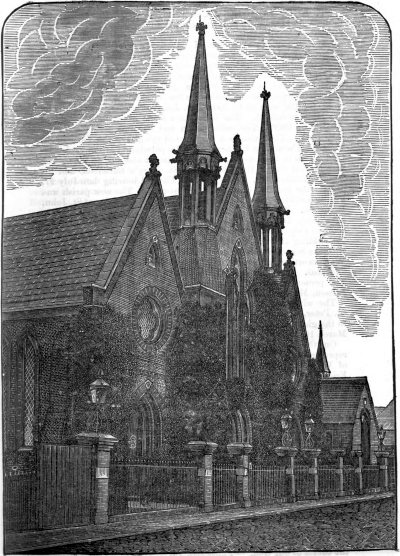
St. John's Church.
ST. JOHN'S CHURCH, Usk Road, was completed from the designs of Mr. E. C. Robins, selected in competition. It is a remarkably inexpensive church. It provides accommodation for about 750 persons at a cost of £4 10s. per head. The church received a grant from the Incorporative Society for Building Churches upon one-third of the sittings being made free. It is designed in the early English style, with nave, north and south aisles and apsidal chancel, a small western gallery and two bell turrets. Messrs. Sharpington and Cole were the builders, who executed the work for the sum of £3,300. (St. John's Parsonage was built by the same architect). The foundation stone of St. John's was laid August 6, 1862. The consecration and opening took place May 5th, 1863. The living is a Vicarage in the gift of the Vicar of St. Mary's. The area is 157 acres, and the population of the Ecclesiastical parish in 1871 was 7,839. The district assigned to the church was formed out of the parishes of St. Mary's Battersea, and St. Anne, Wandsworth, by an Order of Council bearing date July 27, 1863—(the register dates from this period). The new parish was legally constituted and named the Consolidated Chapelry of St. John, Battersea. The first Vicar of the new parish was the Rev. Edwin Thompson, D.D., who from beginning his work with services in a room in Price's Candle Factory, afterwards, lived to be instrumental in building the two Churches of St. John and St. Paul, together with the Schools in Usk Road, erected 1866, and Parsonage House, Wandsworth Common; a noble monument of his untiring energy and zeal. He died suddenly February 2nd, 1876, aged 51 years. The present Vicar of St. John's is the Rev. William John Mills Ellison, M.A., Wadham College, Oxford.
The windows in the chancel representing John the Baptist, St. Peter, St. Andrew, St. John; the last supper and the ascension to the glory of God, and in memory of Daniel Watney, departed March 16, 1874, aged 74, are erected by his son John Watney.
On the south side of the church the Memorial Windows representing David and Samuel to the glory of God, and in memory of W. H. Hatcher, at rest August 2nd, 1879, aged 58. Erected by Friends and Sunday Scholars. "Their works do follow them."—Rev. xiv. 13.
On the north side the Memorial Windows representing St. Paul and St. Barnabas, in loving memory of a dear mother, Martha Colden, who died August 25, 1880. Erected by her only child M. A. B. S. Estimated cost of each window £15 15s. Guard and fixing to each £2 2s.
"Know ye that the Lord he is God: it is he that hath made us, and not we ourselves; we are his people, and the sheep of his pasture."—Psalm c. 3.
ST. PAUL'S situated on St. John's Hill, is a Chapel-of-Ease to St. Mary's Battersea, designed by Mr. Coe for the late Rev. Dr. Thompson. It is a stone structure consisting of chancel, apsidal, nave, aisles and tower with spire. It was built at a cost of about £6,300.
"Those that be planted in the house of the Lord shall flourish in the courts of our God."—Psalm xvii. 13.
ST. PHILIP'S CHURCH, Queen's Road, is a Gothic stone building consisting of chancel, nave, aisles and transept with tower, built from the designs of Mr. James Knowles, Junr., at a cost of £13,000. A considerable portion of this sum was given by P. W. Flower, Esq., the remainder was raised by public subscriptions. The church will accommodate nearly 1,000 persons. The living is a Vicarage, yearly value £200, in the gift of the Bishop of Winchester, and held by the Rev. John Hall.
A Mission in connection with the Bishop of Winchester's Fund was commenced in the month of June, 1869, in a house lent by the proprietor for the purpose, in Queen's Road, Battersea Fields. Services and Parochial Institutions were then established, which have become the foundation of those now in active operation.
On July 13th, 1870, the New Church of St. Philip was finished, and consecrated by Dr. Samuel Wilberforce, Bishop of the diocese, and who also held his Trinity Ordination at the Church of St. Philip the year before he died.[1] On May 16th, 1871, a District formed out of the Parishes of St. Mary, St. George, and Christ Church, Battersea was attached to the Church, and published in the "London Gazette." On the 6th July, 1871, an Endowment of £200 per annum, which had been promised by the Ecclesiastical Commissioners, was legally secured to the Cure of St. Philip, and published in the "London Gazette" on the 26th of the same month. The payments were to date from the day on which the District was assigned (viz., May 16th, 1871), and the first payment was to be made on November 1st, 1871. The seats are free and the expenses of the church have to be defrayed by the weekly offertory.
A New Organ has been built by Messrs. Hill and Son and placed in the north chancel aisle; the cost with the platform is £516 1s. 11d. If, when the Church of St. Philip was erected, the original design of having a lofty spire with flying buttresses had been carried out, St. Philip's Church would have been the most magnificent Ecclesiastical structure in Battersea.—Churchwardens, W. G. Baker, A. W. Wilkinson.
"They continued stedfastly in the apostles' doctrine and fellowship, and in breaking of bread and in prayer."—Acts ii. 42.
"Blessed is the man that heareth me, watching daily at my gates, waiting at the posts of my doors."—Proverbs viii. 34.
We'll crowd Thy gates with thankful songs, High as the heavens our voices raise; And earth with her ten thousand tongues Shall fill Thy courts with sounding praise. Wide as the world is Thy command, Vast as eternity Thy love; Firm as a rock Thy truth must stand, When rolling years shall cease to move.—Watts.
The construction of Queen's Road, etc., on Park-town, Battersea Estate, cost Mr. Flower about £3,000.—C. Merrett, Clerk of the Works for the Estate.
A New Railway Station has been erected in the Queen's Road, on the South-Western Line.
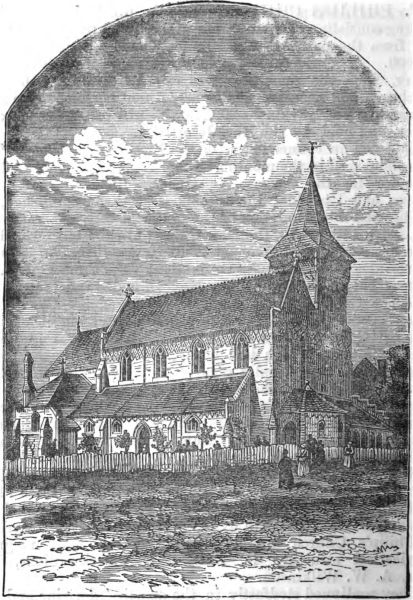
ST. MARK'S, Battersea Rise, is a Gothic building, and consists of chancel, nave, aisles, transept with porch, and western vestibule and handsome crypt. The corner-stone was laid by the Right Rev. Dr. Harold Browne, Bishop of Winchester, November 11th, 1873, and it was dedicated by his Lordship September 30th, 1874. The Architect is Mr. William White, F.S.A., and the total cost has been £6,500. It is seated for 600, with backs and kneelers throughout. Mr. T. Gregory, of Battersea, builder. The living is a Vicarage, in the gift of the Vicar of St. Mary's.
"The rich and the poor meet together; the Lord is the Maker of them all."—-Proverbs xxii. 2.
The dedication festival of this church, in which the late Philip Cazenove took so warm an interest, was agreeably marked by the placing of a stained window of two lights, representing St. Philip and St. James, in the north transept. The name of Mr. Cazenove is inscribed on the tablet of a glass mosaic, set in alabaster, and sunk in the brick-work of the wall beneath the window. The tablet is a material much used for church purposes by the executants, Messrs. Powell, Whitefriars, and called "opus sectile." The design is simple and chaste, as befitted one whose unostentatiousness was one of his leading characteristics. The window was placed in the transept by his two daughters.—South London Press, May 15th, 1880.
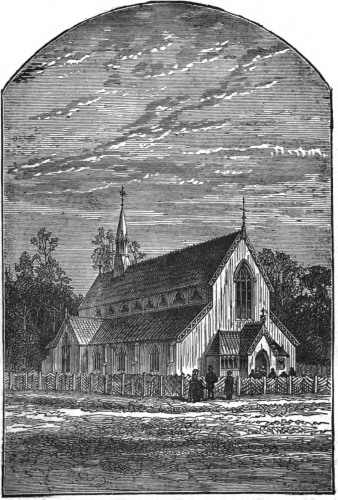
ST. LUKE'S CHAPEL-OF-EASE, Nightingale Lane, is a pretty Iron Church, originally erected on Battersea Rise in 1868, was moved in September, 1873, to the adjacent plot, and used by the congregation while St. Mark's was being built. On November 14, 1874, having been once more removed to its present site it was dedicated anew in the name of St. Luke by the Bishop of Guildford.
"O come let us worship and bow down, let us kneel before the Lord our Maker."—Psalm xcv. 6.
ST. MATTHEW'S, Rush-hill Road, Lavender Hill, is a Chapel of Ease to St. Mary's, it is built in the Early English Style of Architecture, has vaulted roof and sacristy, seats 550, and cost about £3,000. Mr. W. White, F.S.A., Architect; Mr. W. H. Williams, Builder. The Dedication Service was conducted by the Right Reverend J. S. Utterton, D.D., Bishop Suffragan of Guildford, on Saturday, 28th of April, 1877, at 3 p.m. The Rev. W. B. Buckwell is the Officiating Minister.
"Blessed are they that dwell in thy house; they shall be still praising thee."—Psalm lxxxiv. 4.
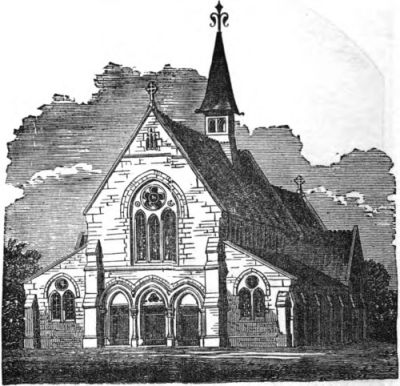
ST. SAVIOUR'S CHURCH, Lower Wandsworth Road, now called Battersea Park Road, erected by Messrs. Lathey Brothers at a cost of £4,000 from the designs of Mr. E. C. Robins. It accommodates 700 persons and is designed in the early French Gothic style faced with Kentish rag and Bath stone dressings. It consists of a nave with clerestory, north and south aisles and rectangular chancel with small western gallery over the entrance lobby. There is a bell turret at the east end. The chancel has been decorated in color by Messrs. Heaton and Butler. The glazing is of cathedral glass. The living is a vicarage in the gift of the trustees. The population of the district is about 11,500. The foundation stone was laid by H. S. Thornton, Esq., January 4th, 1870. The consecration of the church on the 19th October, 1871, by the late Samuel Wilberforce, D.D., Lord Bishop of Winchester. The offertory amounted to the sum of £40, which was added to the Church Building Fund. The Petition to consecrate was read by the Rev. C. E. Ince, Vicar of Christ Church, Battersea, and the deed of conveyance was presented to the Bishop by W. Evill, Esq., one of the most generous and zealous friends of the undertaking. The litany was read by the Rev. J. MacCarthy. At the evening service an appropriate sermon was preached by the Rev. E. C. Ince, and at the opening services on Sunday, the 22nd, the morning sermon was preached by the Rev. J. MacCarthy, and that in the evening by the Rev. E. Daniel. The Rev. J. MacCarthy was the first Vicar.
The institution of the present Vicar, the Rev. Samuel Gilbert Scott, M.A., Magdalen College, Oxford, took place on Sunday, April the 29th, 1877. The Bishop of Guildford instituted the Vicar after the Nicene Creed. At the close of the sermon the Bishop celebrated Holy Communion; there were 55 communicants. The offertory on the day amounted to nearly eight pounds. Curate, the Rev. W. J. Harkness, B.A., Emmanuel College, Cambridge. Churchwardens, John Elmslie, John Merry. Lay Readers, with Episcopal sanction, Mr. Hussey, 32, Chatham Street; Mr. Hann, 2, Millgrove Street. Mission Women, Mrs. Wootton, 23, Warsill Street; Mrs. Collins, 5, Chatham Street.
"Enter into his gates with thanksgiving, and into his courts with praise: be thankful unto him, and bless his name for the Lord is good; his mercy is everlasting; and his truth endureth to all generations."—Psalms c. 4-5.
Mr. Crosby, a Missionary in this district, held Evangelistic Services at a Mission Hall in Arthur Street, Battersea Park Road.
ST. PETER'S CHURCH, Plough Lane, is a beautiful Gothic structure built of red brick, with chancel, nave, aisles, and lofty tower with spire pointing like a finger to the sky as if to remind man that when the Saturday night of this world shall arrive and earth's trials are o'er "there remaineth a rest for the people of God."—Hebrews iv. 9.
In the tower are four illuminated dials, by Messrs. Gillett & Bland of Croydon. The Church has sittings for about 820. The top-stone of the spire of St. Peter's Church was laid about 5 p.m., on the 24th of April, 1876, by Mr. Toone, in the presence of Mr. White the Architect, Mr. Carter the Builder, Mr. Williams the Clerk of the Works, and a few others, with the formula "In the faith of Jesus Christ and to the glory of His Holy Name we lay the top-stone of this spire of St. Peter's Church, in the Name of the Father, and of the Son, and of the Holy Ghost, Amen." A crowd of well-wishers below watched the ceremony with interest. The corner-stone of this church was laid by the Bishop of Winchester, on St. Peter's Day of 1875, and on the same festival, June 29th, 1876, it was Consecrated by the same prelate. At the Consecration Service the Bishop of Guildford read the Gospel, the Rev. S. Cooper Scott the Epistle, and the Bishop of the Diocese preached the Sermon from the words of the Gospel "Thou art Peter and on this rock I will build my Church." There were 120 communicants. The Bishop of Guildford preached in the evening to an overflowing congregation.
The interior of St. Peter's Church is spacious. The rich carving of the capitals has been executed by Mr. Harry Hems, of Exeter, as also the pulpit and font. The pulpit is of stone with alabaster figures introduced in the panels representing St. Peter, St. Paul, St. John, Isaiah, King Solomon, Moses and Noah. The bowl of the font is also of alabaster supported by angels carved in the same material. The pavement is beautifully tessellated and has several scriptural illustrations. The seats are fixed—these and all the internal wood-work are varnished. The cost of erection was about £10,500. The belfry at present contains one bell only, a tenor of six, it cost £120, and cast with the words on it, "When I do call, come serve God all!" It was rung on St. Peter's day, 1876. The Register dates from 1876. The living is a Vicarage, in the gift of the Vicar of St. Mary, and held by the Rev. John Toone, B.A., of St. John's College, Cambridge.
"I was glad when they said unto me let us go into the house of the Lord. Peace be within thy walls, and prosperity within thy palaces."—Psalm cxxix. 1-7.
St. Peter's Temporary Church and School-room was completed in 1874, at a cost of £1,200. St. Peter's Vicarage was formerly the residence of Mr. Burney.
TEMPORARY CHURCH OF THE ASCENSION, Lavender Hill.—A permanent church adjacent is now in course of erection, and being raised by voluntary contributions. The Rev. J. B. Wilkinson is the Officiating Minister. The foundation stone of this church was laid by the Earl of Glasgow, 1st of June, 1876. This structure is being built of Bath stone and red bricks, and is groined throughout with stone ribs and brick panels. The foundation stone is situated under the "altar." James Brooks, Architect, 35, Wellington Street, Strand; Mr. Chessam, Builder, Shoreditch.
"A day in thy courts is better than a thousand; I had rather be a door-keeper in the house of my God, than to dwell in the tents of wickedness."—Psalm lxxxiv. 10.
ST. MICHAEL'S CHURCH, Chatham Road, Bolingbroke Grove, Wandsworth Common—the Memorial to the Rev. H. B. Verdon and Mr. Philip Cazenove, the eminent and successful merchant. The Temporary Iron Mission Church which for the last nine years had been used as a Chapel-of-Ease to the Mother Church of St. Mary, Battersea, and the site on which the present edifice is erected were the gifts of the latter gentleman. Henry Boutflower Verdon was born December 8, 1846. Himself the son of an excellent clergyman was educated at the Clergy Orphan School, Canterbury, from which he went to Jesus College, Cambridge, as Rustat Scholar and took his degree in 1868. After a period of study at Cuddensdon Theological College he began clerical work as a curate under the Rev. Aubrey Price, M.A., Vicar of St. James', Clapham, where the poor speak in affectionate terms of his memory. In the Spring of 1872 he became curate of Battersea, a few weeks after the appointment of the present Vicar. From the first Mr. Verdon took special interest in the district known as Chatham Road, Bolingbroke Grove, and the residents there were very much attached to him. The Sunday evening services and Sunday Schools held in St. Michael's Chapel were objects of his unremitting care. He acted as the Secretary of the Committee during the time St. Mark's Church was being built. He was an active member of the Charitable Organization Committee—he promoted the work of the Royal Society for the Prevention of Cruelty to Animals and established a mission Branch in Battersea. His marriage in January, 1879, to Miss Wheeler, was the cause of much congratulation; but before the expiration of many months this conjugal relationship was to be severed. Had he lived the Incumbency of St. Mark's Church would have been transferred to him. He died of a rapid consumption October 10, 1879.
The two Memorial Stones were laid in the Chancel of the Church (which is now completed) by the Archbishop of Canterbury. "The Archbishop after tapping them with the mallet saying at each 'In the faith of Jesus Christ we place this stone for a memorial of thy faithful servant whose name is written thereon and in the name of the Father and of the Son and of the Holy Ghost,' and the choir chanting Amen. The stone on the south side of the chancel bore the inscription carved in antique on a gilt ground, 'Henry Boutflower Verdon, M.A., Æt. 33 obt. X. Oct. A.D. 1879,' and that on the north side, the words, 'In mema. grata Philip Cazenove, Æt. 81 obt. XX. Jan. A.D. 1880.' After laying the stones the Archbishop delivered a short address in the course of which he said that the two servants of God whose names were on the memorial stones worked hand in hand together for good though separated from each other by fifty years of life; one dying almost in his prime and the other living on to a long old age but each dedicated to the service of God, one ministering in the sanctuary and daily officiating in the house of God, the other taking part during a long life in the trade and exchange of this great city, busy with the arrangements by which human industry is promoted. Both different yet wonderfully alike, and both judicious servants bearing the stamp of their heavenly Master and serving Him bravely, faithfully and laboriously. Let them be thankful that this space of fifty made no difference in the two men. As we got old we began to think that wisdom and goodness were with the old only, but he thanked God that in His Church there never had failed and never would fail a succession of faithful servants century after century to carry on the work which the Lord loves and which will make the world at last ready for His second coming. The name on the one stone might be little known beyond his own neighbourhood or the name of the other beyond the city of London, but they were known to their heavenly Master whom they served faithfully, and in His book are the names of both written. The memory of the young man whose name was on the one stone would linger long among those whom he loved and the poor and the sick to whom he had endeared himself and for whom he faithfully laboured, but for the speaker his thoughts and friendship were with the old man whose name was on the other stone. Five and twenty years ago when the speaker entered on the laborious work of the See of London, the first to welcome and assist him was Mr. Cazenove. He belonged to the noble band who helped Bishop Bloomfield from the very first. Those five and twenty years had been as laboriously spent in doing good as the years that had gone before. When those men first entered on the work how different was this suburb of London to what it is now. Great wars had absorbed the attention of men, and a large population had grown up before people knew it, and before men had thought of the duty of meeting the spiritual wants of the new suburbs. If it had not been for the noble band who gathered round Bishop Bloomfield what a different account would have had to be rendered now. Let us trust and believe that when all of us have passed away it will be found that God has raised up a succession of faithful servants; men of every business and profession who will still regard the profession of Jesus Christ as the most noble of all, for no profession was more noble than the service of the Heavenly King. Let us trust that with dangers around us the spirit of vigorous Christianity may continue to be triumphant as it had been in so many instances already. Let us trust to the good work begun and carried forward during the last fifty years will flourish with God's blessing for many years to come."
"The new church is a plain Gothic structure built of red and stock bricks, and is 90 feet long by 70 feet wide. It consists of a nave, chancel, and two aisles, surmounted with a timber roof of three spans covered with red tiles. There are two entrances, one in Chatham Road and the other in Darley Road; the former surmounted by a figure of St. Michael in conflict with the serpent. There is also a small tower containing a bell weighing 2 cwt. There is a commodious crypt beneath the chancel. The latter contains three rows of stalls for the clergy and choir, and is lighted by six small windows of stained glass, in each of which there is an angel exquisitely executed from the Studio of Messrs. Lavers, Barraud and Westlake. It is also intended to place a reredos of white marble here. The altar is approached from the nave by nine steps. The nave communicates with the aisles by large Gothic arches supported on octagonal pillars of 'granolith'—a material composed of granite chips and Portland cement. The floor is of blocks of wood and the building is 'pewed' with open benches to accommodate about 750 worshippers. The pulpit (a memorial gift by Mr. Verdon's widow) is of carved oak with a base of Caen stone, and is reached by a short flight of stone steps. Behind the pulpit in the south aisle is the organ, which has been brought from St. Luke's church, Derby, and was built by Mr. Abbott of Leeds. At the west end of the church is a font (which is in memory of a loved grandchild of Mr. Cazenove) of veined marble supported by nine columns of polished granite and Caen stone. It is surmounted by a polished oak cover and is a gift 'to the glory of God and the memory of Philip Henry Hessey.' The church is warmed with hot air. It has been erected by Mr. J. D. Hobson, from the designs of Mr. White, F.S.A. The total cost is £4500, which (with the exception of £800 unpaid at the commencement of the dedication services) had all been contributed by the relatives and friends of the late H. B. Verdon and Philip Cazenove. The church is provided with prayer books, hymn books, and kneelers throughout."
The Dedication of St. Michael's Church was on September, 10, 1881, by the Right Rev. The Lord Bishop of Rochester—the service commenced at 11.30 a.m.
Lord of hosts, to thee we raise Here a house of prayer and praise! Thou thy people's hearts prepare Here to meet for praise and prayer. O King of glory come, And with thy favour crown This temple as thy dome, This people as thy own! Beneath this roof, O deign to show, How God can dwell with men below. Here may thine ears attend Our interceding cries, And grateful praise ascend, All fragrant to the skies! Here may thy word melodious sound, And spread celestial joys around! Here may thy future sons And daughters sound thy praise, And shine like polish'd stones, Through long succeeding days! Here Lord, display thy sov'reign power, While temples stand, and men adore!
ALL SAINTS' TEMPORARY IRON CHURCH, is situated in Victoria Bridge Road, near the south-eastern gate of Battersea Park. It will accommodate 200 persons. All seats free and unappropriated. It was opened for Divine Service Saturday, Sept. 6th, 1879, at 3.30 p.m. The Rev. Canon Clarke, Vicar of Battersea, and Rural Dean, preached the first sermon. His text was:—"Nevertheless the foundation of God standeth sure, having this seal, The Lord knoweth them that are his."—II. Timothy ii. 19. An income of £200 a year from the Rochester Diocesan Fund has been granted to the clergyman of the district, the Rev. A. E. Bourne, formerly Curate of St. Peter's, Battersea. The new provisional district of "All Saints," Battersea, has been formed out of three parishes, viz., St. Mary's, St. Saviour's and St. George's, to meet the requirements of the rapidly increasing population of the neighbourhood. Roughly speaking the boundaries of the new district are the London, Chatham and Dover Railway from the river to the London and South Western Railway, along the London and South Western Railway to Park Grove; down Park Grove, across the open land to the Park round the north corner. The only exceptions are the streets between Queen's Road and Russell Street which remain part of St. Philip's parish.
"God is greatly to be feared in the assembly of His saints and to be had in reverence by all them that are about Him."
Let us then with gladsome mind Praise the Lord for He is kind; For His mercies shall endure Ever faithful, ever sure.
ROCHESTER DIOCESAN MISSION, St. James', Nine Elms. Clergyman in charge, Rev. William George Trousdale, B.A.—The Mission Buildings situated in Woodgate Street and Ponton Road, Nine Elms Lane, have lately been enlarged by the Misses Baily of Esher, at a cost of over £1200. The church contains sittings for 250. There are in connection with the Mission, Sunday Schools, two Mothers' Meetings, Girls' Bible Class, Girls' Sewing Class, Recreation Room for Girls, Provident Club, Penny Bank. It is also proposed to establish shortly a Working Man's Club and a Crêche, for which there is ample accommodation in the Mission Buildings. Services—Sunday at 11 and 7, Wednesday Evening at 8, Children's Service the 3rd Sunday in the month at 3.
ST. ALDWIN'S MISSION CHAPEL, (Rochester Diocesan Society) Poyntz Road, Latchmere Road, was opened on Sunday, 12th September, 1880, at 7 p.m. It will comfortably seat 300 persons. St. Aldwin's district is formed partly out of St. Saviour's and partly out of Christ Church parish—the latter ceded the Colestown Estate, the former handed over Latchmere Street and Road, and the cluster of streets which is surrounded by the triangle of railways. Mission Curate—Rev. T. B. Brooks, M.A., 2, Nevil Villas, Albert Road. Mission-woman—Mrs. Monk, Mission House, 25, Poyntz Road.
"Both young men and maidens, old men and children; let them praise the name of the Lord."—Psalm cxlviii. 12-13.
"Blessed is the people who know the joyful sound: they shall walk O Lord, in the light of thy countenance."—Psalm lxxxix. 15.
"Thy power to save!" thrice happy they Who taught of Thee delight to pray, Rejoicing in Thy love: Now clothed in righteousness divine, The heirs of glory,—soon to shine In realms of joy above. A pastor's warning voice!—"Take heed, Whilst by the sunny banks you feed Of England's good old Church! Live close to Jesus;—not on forms, Lest, unprepared for coming storms, You founder in the lurch! Heed well the Word—the joyful sound, The Gospel of our God—still found To point straight up to heaven: Beware of sounds of 'yea and nay,' For God's own 'yea' is man's sure stay, Not Pharisaic leaven." The presence of the Lord is found Where love, and joy, and peace abound, Fruits of the Spirit's Word; Where Christian hearts unite in prayer In Jesus' Name—the Lord is there, Jehovah, Jesus, God.
There are two Roman Catholic places of worship in Battersea, viz.:—
THE CHURCH OF OUR LADY OF MOUNT CARMEL AND ST. JOSEPH, situated in Battersea Park Road, was built by a lady of the name of Mrs. Boschetta Shea (of Spanish extraction, and whose husband was an Irish Protestant) in 1868, and put under the management of the late Very Rev. Canon Drinkwater, who retained the control of the church and adjacent buildings, including the Convent of Notre Dame and Girls' School, the St. Joseph's Boys' School, and the New Church lately erected. The Duke of Norfolk gave £500 towards the building fund for the new church.
Within the grounds adjoining the Convent are kitchen and flower gardens with a gravel walk and a very compact grotto.
In the month of May, the month dedicated to the Blessed Virgin Mary, there are processions in the grounds every Sunday afternoon in which boys and girls take part, singing hymns in honour of "our Lady." The Boys' School is of an oblong shape, and is governed by the Xaverian Brothers, including several pupil teachers. Subjects taught: reading, writing, arithmetic, grammar, English, Roman and Grecian history, geography, mathematics and the Roman Catholic religion.
CHURCH OF THE SACRED HEART, Trott Street, is an Iron building with turret and cross, opened 10th of October, 1875. It was built by the Countess of Stockpool at a cost of £700. The freehold site of land including one acre cost £1,000. Priest, Rev. McKenna. New Schools have lately been erected.
THE OLD BAPTIST MEETING HOUSE, York Road, Battersea, was erected in 1736, but a church was not formed for sixty-one years afterwards. About the year 1755 the Rev. Mr. Browne became Officiating Minister, and for forty years preached to a small congregation, but as his age and infirmities increased the number of attendants on his ministration diminished till he had not more than four or five persons to hear him; enfeebled and disheartened he resigned, and in 1796 a young man, then a Student at Bristol Academy, afterwards well known as the Rev. Joseph Hughes, M.A., supplied the pulpit with so much acceptance that in 1797 a church was constituted, and he, in the 29th year of his age, was elected to be the pastor. The constitution and order of the church thus formed may not be uninteresting, it reads as follows:—
"We, the undersigned, desirous of the privilege connected with religious fellowship and a stated ministry, having already sought the Lord, and we trust, chosen Him as our Sovereign and Friend, do hereby give ourselves afresh to each other, according to the Divine Will, that being united in a Christian Church, we may render mutual aid, as fellow-travellers from earth to heaven; and, though we firmly embrace the sentiments peculiar to the Baptists, yet, espousing with equal determination the cause of evangelical liberty, we welcome to our communion all who give evidence of a change from sin to holiness; who appear to love our Lord Jesus Christ, who are willing to be accounted learners in His school, and who wish to be enrolled in connection with us. And we hope it will be our united endeavour, and the endeavour of such as may hereafter be added to us, by all means to keep the unity of the Spirit in the bond of peace; to mingle faithfulness, spirituality and affection in our intercourse; strictly to regard the Divine Ordinances—so far as we know them; and to walk before the Church, our families, and our God, worthy of our heavenly calling."
Under the Rev. Joseph Hughes's ministry the work of God took deep root here and greatly flourished. By his energy, learning and eloquence, and his connexion with different local societies for the promotion of religious worship, he was brought acquainted with Mr. Wilberforce, Mr. Vansittart, and Mr. Perceval, by whose aid he established the "Surrey Mission Society." At a meeting of the Religious Tract Society he afterwards promulgated the idea of an institution for supplying not only the inhabitants of the British Isles, but the whole world, with copies of the Holy Scriptures; and hence arose the Bible Society, of which Mr. Hughes was joint Secretary until his death. Mr. Hughes expired on Thursday evening, October 3, 1833, in the 65th year of his age. His mortal remains were interred in Bunhill Fields.
"John Foster derived much spiritual benefit from his friendship with Mr. Hughes of Battersea Chapel with whom after he left Chichester he resided for a time, and it increases not a little the debt of gratitude due from the Christian community to that excellent man, that though his own authorship was limited to a few pulpit productions, and his sphere of duty was one of action rather than of meditation, he performed the noble office of stimulating the exertions and cherishing the piety of one of the most original and influential religious writers of his age."
Mr. Foster says "the company who made sometime since an establishment at Sierra Leone in Africa, have brought to England twenty black boys to receive European improvements, in order to be sent when they are come to be men to attempt enlightening the heathen nations of Africa. They have been placed in a house at Battersea for the present till some kind of regular and permanent establishment shall be formed, and I have been requested, and have agreed to take the care of them for the present."—Foster's Life and Correspondence, Vol. I. p. 58-60, edited by J. C. Ryland, A.M.
The Rev. Edmund Clark held the Pastorate from Spring of 1834 to Mid-Summer, 1834—three months. He was succeeded by the Rev. Enoch Crook, who was two years and a half Pastor of the Church, viz., from Mid-summer, 1834, to 1837. A tablet to his memory is placed on the wall in the vestry of the chapel. Subsequently from January, 1838, it was the scene of the labours of the Sainted Israel May Soule, who for thirty-six years was Pastor of the Church of Christ assembling here; he faithfully discharged his ministerial duties; his doctrine was truly evangelical; his services unremitting and his deportment exemplary—beloved by his flock and highly esteemed by Christians of other denominations for his large liberal-heartedness, sound judgment and unsectarian spirit. It was he who first conceived the idea of enlarging the Old Chapel and had a model in his study to represent the style of alteration which his own mind suggested with a view to meet in some humble measure the growing and increased spiritual wants of the neighbourhood. However, instead of enlarging the Old Chapel a second time, he used strenuous efforts and succeeded in having the Old Chapel demolished and a commodious place of worship erected on its site. The Chapel was enlarged and repaired in 1842 and the freehold purchased and put in trust at a total cost of £1,000. In 1868 the requisite land for further enlargement of the Chapel was purchased. The present handsome Chapel involved an outlay of £5,000, erected in the Romanesque style from the designs of Mr. E. C. Robins. The accommodation on ground-floor and galleries is for 900 worshippers. The open timbered roof is one span, and the building is faced with white bricks with Bath stone dressings. It was constructed by the late Mr. John Kirk. The same architect has recently enlarged East Hill Chapel, Wandsworth. The memorial stone of the New Chapel was laid by Field Marshal Sir G. Pollock, G.C.B., G.C.S.I., on the 8th of June, 1870, being the 33rd year of the Rev. I. M. Soule's ministry; the building was completed by the end of the year, so that Mr. Soule had the pleasure of conducting the opening services January 1st, 1871. Previously to his coming to Battersea Mr. Soule for seven years had been Pastor of the Baptist Church, Lewes, Sussex. He was born Dec. 25, 1806, died unexpectedly Nov. 8, 1873, having preached with his usual energy on the previous Sunday, when in the morning he took for his text Rev. xxii. 14, and afterwards administered the Lord's Supper. The funeral service was conducted Nov. 15th, by the Rev. D. Jones, B.A., of Brixton, assisted by the Rev. Edward Steane, D.D., the Rev. Robert Ashton and other ministers. At the grave, in the presence of about 7,000 persons, the Rev. Samuel Green delivered an address. On the following day, Sunday, November 16, Funeral Sermons were preached in Battersea Chapel to overflowing congregations, in the morning by the Rev. D. Jones, in the evening by the Rev. Dr. Angus.
His mortal remains lie interred at St. Mary's Cemetery with those of Amelia his wife, where in token of fond affection to his memory a beautiful obelisk of grey polished granite has been erected. The epitaph states "that he consecrated himself in early life to the service of God; that he received during a long and faithful ministry signal tokens of Divine favour in the number who through his instrumentality were brought to a knowledge of the Saviour. His earnest constant labours to the last for the education and welfare of the young are of untold benefit, while rich and poor alike have lost in him a kind and sympathizing friend, whose loving and Christian spirit will long be remembered in Battersea." A monumental tablet to his memory is about to be erected in the Chapel.
"Servant of Christ well done, Rest from thy loved employ, The battle fought, the victory won, Enter thy Master's joy."
In a small room under the south gallery is erected a beautiful marble tablet in memoriam of the Rev. Joseph Hughes, M. A. Also under the north gallery are erected tablets in affectionate remembrance of Henry Tritton, Esq., for many years a resident in the Parish of Battersea, and whose mortal remains lie buried under the Chapel. He died 20th of April, 1836, aged 48 years. Also Amelia, his wife, third daughter of Joseph Benwell, Esq., died March 28, 1855, aged 64 years.
April, 1874, Mr. Soule was succeeded by the Rev. Charles Kirtland, who still continues to fill the pastoral office.
Let strangers walk around The city where we dwell; Compass and view the holy ground, And mark the building well. The orders of Thy house, The worship of Thy court, The cheerful songs, the solemn vows, And make a fair report.
"God is a Spirit: and they that worship him must worship him in spirit and in truth."—John iv. 24.
Deacons—G. Lawrence, Cubbington Cottage, Battersea Rise; H. M. Soule, St. John's Hill, Battersea Rise; W. H. Coe, York Road, Battersea; G. Mansell, 1, Cologne Road, St. John's Hill; Philip Cadby, 24, St. Peter's Square, Hammersmith; Thomas Sadler, 88 Spencer Road. Chapel-keeper—D. Rayner, 31, Verona Street, York Road.
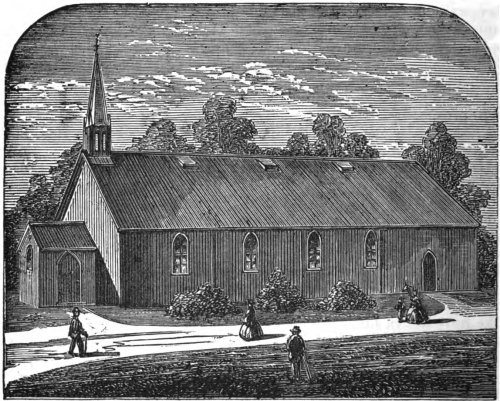
BAPTIST TEMPORARY CHAPEL, Surrey Lane. This building having stood beyond the time allowed by Government was condemned by the Board of Works. The Church which formerly worshipped there have removed to the Lammas Hall until a permanent building can be raised. A fund is established which progresses slowly. A. Peto, Esq., The Boltons, South Kensington, is the Treasurer to the Building Fund. Rev. C. E. Stone is the Pastor. Deacons, J. Weller and F. T. Ashfield. It is worthy of note that this was the second Baptist Church formed in Battersea.
"I have set my affections to the house of my God."—I. Chron. xxix. 3.
"Christ is the Foundation of the house we raise; Be its walls salvation, and its gateways praise! May its threshold lowly to the Lord be dear; May the hearts be holy that worship here!"
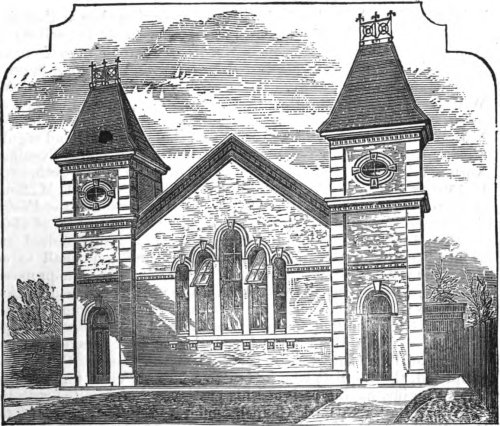
BATTERSEA PARK TEMPORARY BAPTIST CHAPEL was erected in 1869, at a cost, including the purchase of freehold land, of £2,000. In 1872 a front gallery was added which cost £175. In 1876 a piece of ground was bought at the back of the Chapel for £105, and new class-rooms and vestries erected at an additional cost of £420. The grand object of the London Baptist Association next to the promotion of spiritual work, is the extension of their bounds by the erection of at least one new Chapel in each year. The Rev. C. H. Spurgeon, the third President (1869), had the pleasure of seeing a chapel erected in this region where the poor would be gathered. He was able to purchase and give to the enterprise this fine freehold site in Battersea, and leaving the front portion thereof for a future chapel, he expended the grant of the Association in erecting a school-chapel, seating 630 persons, which was put in trust without incumbrance. The neighbourhood being too poor to bear the burden of debt, and no wealthy friends being forthcoming this was thought to be the wiser course. The Rev. W. J. Mayers commenced his pastorate in the beginning of the year 1870. Upon his resignation he was succeeded by the Rev. Alfred Bax, who for two years or more preached with much acceptance. On the 2nd of April, 1877, the Rev. T. Lardner became the officiating minister. Deacons of the Church—J. S. Oldham, William Weller, W. Chaplin.
In 1866, Mr. E. Carter shoemaker by trade, residing at 16, Henley Street, commenced holding a Sunday School in his own hired house.
One Sunday Afternoon, two young students from the Metropolitan Tabernacle, called at his residence to see if they could hold religious services there, but it does not appear that they at that time succeeded. Afterwards the School was removed to 32, Russell Street, then to 53, Arthur Street, where Mr. Rees, a young man from the Metropolitan Tabernacle conducted Morning and Evening Services regularly every Lord's day. Subsequently he was succeeded by Mr. William Wiggins of the Rev. C. H. Spurgeon's College who on account of the place "being too strait" made arrangements to open Norton Villas, Battersea Park Road, for Sunday School and regular Sunday Religious Services, and at stated times on Week Evenings. Norton Villa, was opened as a place of Worship, October 20th, 1867. In 1868, a Baptist Church was formed by the late Rev. I. M. Soule of Battersea Chapel and Mr. Wiggins was recognised as the Pastor, the Church consisted of forty members and a Congregation of about a hundred persons besides a Sunday School of one hundred and twenty Children; this place however, became too small to accommodate the persons desirous of attending. It was proposed therefore, to erect an Iron Chapel on a site near York Road Station. But those friends who made the proposition, on hearing that the Baptist Association had an intention to build a permanent Chapel in Battersea Park Road, abandoned the idea of purchasing and erecting an Iron Chapel so in 1870, when the present Chapel was completed, the Baptists who had met at Norton Villa for worship, (Mr. Wiggins, having resigned his pastorate there) united with the Church at Battersea Park Chapel, under the Pastoral care of the Rev. Walter J. Mayers.
"Not forsaking the assembling of ourselves together, as the manner of some is; but so much the more, as ye see the day approaching."—Hebrews x. 25.
"Great the joy when Christians meet, Christian fellowship, how sweet! When, their theme of praise the same They exalt Jehovah's name."—Burder.
"Truly our fellowship is with the Father, and with his Son Jesus Christ."—I. John i. 3.
BAPTIST (PROVIDENCE) CHAPEL, Meyrick Road, is a brick building—seats 350. It is intended to have galleries when it will then accommodate 500. The memorial stone was laid by Mr. H. Clark, October 5th, 1875, on which are engraved the words "The fear of the Lord is the beginning of wisdom."—Psalm cxi. 10. Cost of Chapel including the purchase of freehold land on which the Chapel is erected £2,400. G. G. Stanham, Esq., Architect; Messrs. Turtle and Appleton, Builders, Battersea. Officiating Minister, Mr. Philips. Deacons, H. Clark, S. Stiles, Joseph Palmer.
"Philip said (to the Eunuch), If thou believest with all thine heart thou mayest (be baptised); and he answered and said, I believe that Jesus Christ is the Son of God."—Acts viii. 37.
"For we are all partakers of that one bread."—I. Cor. x. 17.
"Come in, ye chosen of the Lord, And share the bounties of His house; His dying feast, His Sacred word, Our joys our hopes, and solemn vows. Come share the blessings of that board, Which Jesus for His Saints has spread; Receive the grace His ways afford, Commune with us and Christ our Head."—G. Smith.
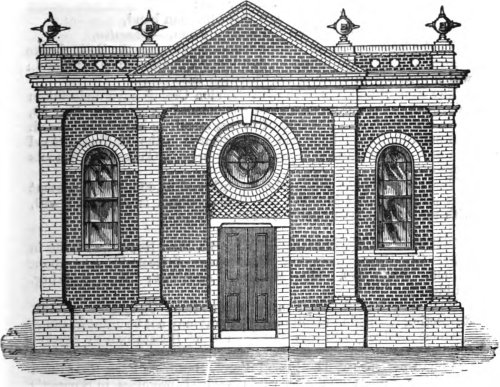
THE NEW BAPTIST CHAPEL, Chatham Road Bolingbroke Grove.—A suitable plot of ground was obtained at a cost of £150; cost of Chapel, about £850. Services were conducted by Charles and Thomas Spurgeon. The building will seat 258 persons.
The cause was commenced about fourteen years ago in a very humble way by Mr. G. Rides, a working man, who, previously to the erection of the above place of worship, held meetings in his own hired house, Swaby Street. William Higgs, Jun., Architect; Higgs and Hill, Builders.
WESLEYAN METHODIST MISSION ROOM AND SUNDAY SCHOOLS, Everett Street, Nine Elms, opened 1871. Mr. John Farmer, Steward and Superintendent. Now closed.
UNITED METHODIST FREE CHURCH, Church Road, Battersea.—The Memorial Stone was laid by James Wild, Esq., May 25th, 1858. Another stone was laid by Mrs. Bowron, Sept. 22, 1864, when the Chapel was enlarged. S. J. Stedman, Architect.
THE UNITED METHODIST FREE CHURCH, Battersea Park Road.—The School-room at the back of the Chapel in Landseer Street was built in 1865, at a cost of £500, and it was used as a preaching Station. In 1871-2 the present Chapel was built, at a cost of £2,200. Seats about 600. Has a Lecture-room and Schools underneath the Chapel. The freehold was purchased in 1876 and cost £400. Rev. James Whitton is now Resident Minister in connexion with the 7th London Circuit.
"The brotherly covenant."—Amos i. 9.
"One in heart, and one in hand, One for all, and all for one; Love shines through this Christian band, Kindled from the heavenly sun."—Edmeston.
In the District known as New Wandsworth, near the Bolingbroke Grove, Wandsworth Common, is a large and increasing population which presents an opening for Christian enterprise.
The Free Methodists of the 7th London Circuit have undertaken this work. Preaching has been commenced in a room No. 89, Bennerly Road, and a society of twelve members have been formed.
A suitable freehold site has been secured in the Mallinson Road at a cost of £400, and it is proposed to erect a Chapel and Schools thereon.
The whole scheme will involve an outlay of £4,000, but at present it is only intended to build the School, which is estimated will, with the ground, cost nearly £1,200.
PRIMITIVE METHODIST CHAPEL, New Road, was built in 1874. The Chapel including the purchase of freehold, cost about £1,030. Seats 200. Mr. Murphy, Architect; Mr. Stocking, Builder.
Now a new and much more commodious Chapel is erected. Respecting its origin the following account may not be uninteresting.
About twelve years ago the friends of Hammersmith Station decided to Mission this neighbourhood. First of all they opened two small parlours at 32, Russell Street, Battersea Park Road, as a Preaching Station and afterwards secured premises in Stewart's Lane, which they converted into a small Chapel, and here, for several years, were numbers of conversions; but, like all small and out-of-the-way places, it became a feeder to other churches. It was at last decided to secure a suitable site and build. First a lease of a piece of land in the New-Road, and eventually the freehold was secured, and a small school-room was erected on part of the site, which has since been used for school and preaching services. The building being altogether inconvenient, it was decided, after prayerful and mature deliberation, to build a Chapel which should be more in harmony with the requirements of the neighbourhood. Mr. A. J. Rouse, the Architect, was consulted, plans were prepared, and tenders invited. The contract was let to Mr. J. Holloway, builder, Wandsworth, for £2000, which, with the debt of £690 on the school-room and Architect's fees, will bring it up to £2800. The building is plain, neat, and substantial, with stone facings. It will accommodate about 600 persons; there are two aisles, a gallery on the sides and at one end, with a back gallery for the organ. Adjoining the chapel is a large class-room capable of holding sixty children. Externally, the building is one of the most imposing and attractive in the neighbourhood, and one of the cheapest in London.
On Whit-Monday, 1878, the memorial-stones were laid. The opening address was delivered by Mr. G. Harris. It was practical, earnest, and eloquent. Stones were laid by R. Burns, R. Adams, and R. Morton, Esqs., and Messrs. J. J. Flux, W. Bayford, W. Gibbs, Rev. T. Penrose for G. Palmer, Esq., M. P., Mr. S. Fortune, Circuit Steward, for the Sunday-schools, Mesdames W. and H. Baker, and Miss Whiting.
At the end of the Chapel is a Tablet in memory of Alfred James Rouse, Architect, who met with his death in the collision between the Princess Alice and the Bywell Castle on the Thames, September 3rd, 1878. Life is short but Art is long.
"Therefore be ye also ready for in such an hour as ye think not the Son of Man cometh. Matt. 24. 44."
The first Primitive Methodist preachers were, William Cowes and Hugh Borne, in 1807. When the first Primitive Methodist Church was formed it consisted of ten members; now it numbers over 180,000 and employs more than a 1,000 ministers.
"Where two or three are gathered together in my name, there am I in the midst of them."—Matthew xviii. 20.
PRIMITIVE METHODIST CHAPEL, Grayshott Road, was erected in 1875. The stone was laid by J. T. Hawkins, Esq., M. A., for the Right Hon. Earl Shaftesbury, K. G., November 21, 1874. Rev. J. Toulson, Superintendent, 7th London Circuit. Another Stone was laid by a Shareholder of the Artizans, Labourers and General Dwelling Company Limited. Rev. W. E. Crombie, Minister. Mr. A. J. Rouse, Acting Architect; J. Lose, Builder. The Chapel seats 400, and cost about £2,600. The entrance to the Chapel is up a flight of steps; the Schools are underneath the Chapel.
"Jehovah, Shammah." Ezek. xlviii. 35. "Allelujah!" Rev. xix. 1.
In the Wandsworth Road, near Grayshott Road, is an old milestone which marks the space between that and the Royal Exchange five miles, and Whitehall four and a half miles.
PRIMITIVE METHODIST CHAPEL, Plough Lane,—In the year 1855, a few Primitive Methodists, residing in the neighbourhood of York Road, with the view of having their hearts knitted more closely together in holy love by Christian fellowship and prayer, met from house to house for this purpose to worship God—In this way they continued to meet till the year 1858, when the Firm of Orlando Jones & Co. gave them the use of their Reading Room. Here as elsewhere they preached the Gospel of Jesus Christ and their numbers steadily increased. In 1870, a piece of land was secured in Knox Road, and the firm above mentioned, helped them to erect an Iron Chapel with a School-room underneath. This building having stood beyond the time allowed by Government was condemned by the Board of Works. It was opened in June 1871, and was finally closed in September 1880. About this time the Estate of the Late Rev. I. M. Soule was sold, and an effort was made to secure a plot of land thereon, situated in Plough Lane. The freehold site selected, was purchased, and a substantial brick Chapel with School-room underneath erected at a cost of £2,300. The Chapel will accommodate 400 worshippers. It was opened October 24th, 1880, on which occasion Sermons were preached by the Rev. J. Baxter. I will command My blessing upon you—Lev. 25. 21.
Command Thy blessing from above, O God on all assembled here: Behold us with a Father's love While we look up with filial fear. Command thy blessing Jesus, Lord, May we thy true disciples be; Speak to each heart the Mighty Word, Say to the weakest, follow me. Command thy blessing in this hour, Spirit of Truth and fill the place With wondering and with healing power, With quickening and confirming grace. With Thee and these forever found, May all the Souls who here unite, With harps and songs Thy throne surround, Rest in Thy love, and reign in light.
ST. GEORGE'S MISSION HALL, Stewart's Lane, formerly belonged to the Primitive Methodists, and was used by them as a chapel.
"Glory, honour, praise and power Be unto the Lamb for ever; Jesus Christ is our Redeemer, Hallelujah! Amen."
"Walk about Zion, and go round about her: tell the towers thereof. Mark ye well her bulwarks, consider her palaces; that ye may tell it to the generations following. For this God is our God for ever and ever: he will be our guide even unto death."-Psalms xlviii. 12-14.
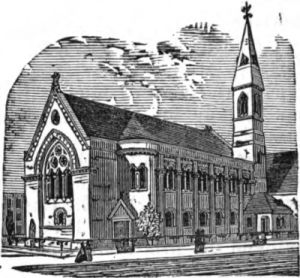
BATTERSEA CONGREGATIONAL CHURCH (Independent), Junction of Bridge Road and Surrey Lane South, fifteen minutes' walk from Clapham Junction and York Road Stations, ten minutes' from Battersea Station; is an edifice constructed of Kentish rag with Bath stone dressings, and has a tower with spire at the north end of the building. The interior is spacious and lofty; the pews are made of pitch-pine, varnished, and will accommodate, including the seats in the south gallery, 600 persons. Cost of erection £4,500. H. Fuller, Architect; F. W. Sawyer, Builder. With respect to its history, this is the first Congregational Church in Battersea. It owes its origin to the Surrey Congregational Union, under whose directions services were held in the Lammas-Hall previous to the erection of the previous Church building. The Foundation Stone was laid by the Rev. J. G. Rogers, B. A., of Clapham, September 17th 1866. It was opened Tuesday, October 12th, 1867, and the Dedication Service was conducted by the Rev. Samuel Martin, of Westminster. The present is the third pastoral settlement, the first minister being the Rev. J. Scott James, of Cheshunt College, who commenced his ministry in Battersea. In 1870 the Rev. J. S. James resigned to take the Pastorate of the Church at Stratford-on-Avon, and was succeeded April, 1871, by the Rev. Joseph Shaw, of Boston, Lincolnshire. In 1878 the Rev. Joseph Shaw resigned and was succeeded by the Rev. Thomas Jarratt, the present Pastor.
The Sunday School and Lecture Hall, with class-room adjoining, was opened in April, 1874. The entire cost of the building, furnishing, heating, lighting, and fencing the ground was £510, the whole of which was discharged July, 1875. Of this amount a generous friend gave £300 through the Rev. Joseph Shaw; and thirty-two pounds were contributed by the Sunday School Children. The room will seat 300 persons.
The "Church Manual" for 1870 states "This is Congregational, we regarding the New Testament as the only infallible guide in matters of Church order, and learning from it that each Church is authorized to elect its officers, receive and dismiss its members, and act authoritatively and conclusively upon all questions affecting its purity and administration. We recognize the Lord Jesus Christ as our King and Sole Ruler in spiritual things, and His Word as our Statute-Book and only Standard. The membership. We believe this should be composed only of regenerated persons who are received into the Church on profession of their faith in Christ, or by letters from sister Church. Members of other churches, acting on this principle, are also received on their producing proper certificates. Candidates for membership should make their application direct to the Pastor. Deacons, Mr. John Allen, Mr. Thomas C. Tabor; Treasurer, Mr. Samuel James Roberts; Secretary, Mr. Edwin John Eason."
The seats are free, not sold or rented, but are allotted for family convenience and to preserve order. The revenues of the Church are chiefly derived from the weekly free-will offerings of the church and congregation.
"How amiable are thy tabernacles, O Lord of Hosts."-Psalm lxxxiv. 1.
"The Hill of Zion yields A thousand sacred sweets, Before we reach the heavenly fields Or walk the golden streets."
STORMONT ROAD CONGREGATIONAL CHURCH Lavender Hill.
The Schools are in connexion with the above place, where the worship is at present conducted. They are built from designs by J. H. Vernon Esq., and are capable of accommodating 450 scholars. There are eight class-rooms, and there is every convenience for carrying on Sunday School work.
The site, which is freehold, as is also the adjoining one for the future Church was the gift of the London Congregational Union. The cost of the school buildings was £2820. The foundation stone was laid on July 27th, 1878, by J. Kemp Welch Esq., and the buildings were opened on February 18th 1879, when Sermons were preached by the Revs. R. W. Dale of Birmingham, and Dr. Raleigh. A Church is now being formed under the Pastorate of the Rev. R. Bulmer, late of Whitby, who commenced his ministry on Sunday the 2nd of October, last. It is proposed to commence the building of the Church as soon as possible. The building according to plans will seat 850. The whole of the Christian work in connection with the above place is in a very active state, and include Band of Hope, and Improvement Societies.
WESLEYAN METHODISM IN BATTERSEA.—It is not easy to determine the time of the first appearance of Methodism in Battersea. From Mr Wesley's Journal it appears that in his later years he was accustomed to pay an annual visit to this neighbourhood, including Chelsea, Wandsworth and Balham. In the absence of any definite record of the matter we may assume that some persons in Battersea came under his influence. A half century elapsed before the Methodist Society found a local habitation in Battersea, even then, not destined to be a permanent one. A small Chapel, chiefly at the cost of the late Rev. J. Partes Haswell, was erected on the site of the present one in the Bridge Road West in 1846; the foundation stone being laid by the late Mr. Scott of Chelsea, and the works being executed by Mr John Sugden, Builder, of Bermondsey New Road.
The building was let to the late Mr. J. Boughton and others, for the use of the Wesleyan Society by Mr. Haswell, and it continued in their occupation until 1855. The agitations which disturbed the Wesleyan Connexion in 1851 and following years were felt with great severity in Battersea. The congregation and Society were so weakened by the separation that took place, that the Lessees, after allowing the Chapel to be occupied for a time by the seceding party, finally surrendered their lease into Mr. Haswell's possession again.
In the meantime, however the Wesleyan Society, began to recover from the great depression into which it had fallen; and in 1858, on their behalf, Messrs. Bell and Molineux, with the late Mr. Holloway of Battersea, took the former Chapel on a short lease from the persons into whose hands it had passed; and ultimately it was purchased by a duly appointed body of Trustees in 1862.
In 1864, aided by a munificent donation of £425 from Mr. J. Steadman of South Lambeth, and by other liberal contributions, the Trustees were enabled greatly to enlarge the building, nearly doubling its former area; and finally in 1871, it was brought to a state of completion, by the erection of a Gallery and an Organ, with other minor improvements. It now furnishes accommodation for 700 people.
The usual congregation amounts to about 500, of whom more than 300 are members of the "Society."
The Rev G. Bowden, and the Rev. E. Hawken, are the present circuit ministers, the latter being resident in Battersea, and taking special charge of the Wesleyan Church there.
The usual times of service on Sundays are, 11 o'clock in the morning, and 6.30 in the evening. There are also Weekly Prayer Meetings on Sunday mornings at 7 a.m.; and on Monday evenings at 7 p.m.; and a Week-night service on Tuesday evenings at the same hour.
In 1870, in view of the growing Educational necessities of the Wesleyan Body, the General Wesleyan Education Committee decided on the establishment of another Training College, in addition to that which they had in Westminster. Circumstances led to the placing of this on the Southlands estate, near the Battersea High Street Railway Station. It furnishes accommodation for 110 female Students, who are under training for the Office of Teachers; and who in due time are employed in all parts of the kingdom in Schools under Inspection. They constitute, it need hardly be said a very interesting portion of the congregation. The Rev. G. W. Olver, B.A., is the Principal, and Mr. James Bailey the Headmaster of the College.
A Sunday School with 280 Scholars in average attendance meets twice on each Sunday, and is conducted with more than the usual efficiency. There are also the customary benevolent and religious agencies maintained by the Wesleyan Church here; and Day Schools for Girls and Infants are connected with Southlands Training College.[1]—W.S.
O happy souls that pray Where God delights to hear! O happy men that pay Their constant service there! They praise thee still; and happy they Who love the way to Sion's hill. They go from strength to strength, Through this dark vale of tears, Till each o'ercomes at length, Till each in heaven appears: O glorious seat! Thou God, our King, Shall thither bring our willing feet.
We know for certain Battersea on one occasion was honoured with the preaching of the Rev. John Wesley as recorded in one of his Journals, dated November 4, 1766, wherein this indefatigable servant of Christ states, "I preached at Brentford, Battersea, Deptford and Welling, and examined the several societies." His Journals state that he preached repeatedly at Wandsworth, as the following extracts will show. Wednesday, November 16, 1748. "In the afternoon I preached to a little company at Wandsworth who had just begun to seek God; but they had a rough setting-out, the rabble gathering from every side, whenever they met together throwing dirt and stones, and abusing both men and women in the grossest manner. They complained of this to a neighbouring Magistrate, and he promised to do them justice; but Mr. C. walked over to his house, and spoke so much in favour of the rioters, that they were all discharged. It is strange, that a mild, humane man could be persuaded by speaking quite contrary to the truth, (means as bad as the end) to encourage a merciless rabble in outraging the innocent! A few days after, Mr. C., walking over the same field, dropped down and spoke no more! Surely the mercy of God would not suffer a well-meaning man to be any longer a fool to persecutors."
Tuesday, January 17, 1758, "I preached at Wandsworth, a gentleman come from America, has again opened a door in this desolate place. In the morning I preached in Mr Gilbert's house. Two Negro servants of his, and a Mulatto, appear to be much awakened. Shall not his (God's) saving health be made known to all nations?"
Thursday, 8th February, 1770, the Rev. John Wesley writes, "I went to Wandsworth. What a proof we have here that 'God's thoughts are not our thoughts!' Every one thought that no good could be done here; we had tried for above twenty years, very few would even give us the hearing, and the few that did seemed little the better for it. But all of a sudden crowds flocked to hear; many are cut to the heart; many filled with peace and joy in believing; many long for the whole image of God. In the evening, though it was a sharp frost, the room was as hot as a stove, and they drank in the word with all greediness, and also at five in the morning, while I applied 'Jesus put forth his hand and touched him, saying I will: be thou clean!'"
Previously to the erection of the present commodious Wesleyan Chapel in Bridge Road West, the friends of the Wesleyan Communion met for worship in a large upper room over a carpenter's shop in King Street. Subsequently they removed to premises now belonging to Mr. G. King, Ironmonger, in the vicinity of Surrey Lane.
John Cullum, an artist by profession, who resided in Battersea, was connected with the Wesleyan-Methodists. He was a zealous Open-air Preacher and Temperance Advocate. It is said that he was the first person who introduced Teetotalism in Battersea and held meetings for that object. He died in 1852, aged 51 years.
This good man kept a record of important events which had transpired in Battersea. From a manuscript of his, entitled "The Antiquities of Battersea," the following extract is taken—it will be read with interest.
"There is also a Wesleyan Chapel and Society here, which originated at a small house in Bridge Road, near the Bridge, after which it was removed to Mr Steadman's yard, in which a large room was fitted up for Divine Worship, and a School formed under the fostering care of Mr. Lark and Mr. Bridge, assisted by other zealous female teachers. In conformity with the principles of Mr. Wesley the Society has, under God's blessing, increased from one Class to three Classes, besides a Sunday School which is in a flourishing condition. Mr. T. Boughton, the present Superintendent, is assisted by twelve male and female teachers who still persevere in the good work of instructing the young. The present Chapel was built in King Street and was considered necessary both from the fact that there was not room for the persons who assembled for worship and other circumstances relative to the Society at that time. The Chapel was opened by three sermons being preached on Sunday, October 11, 1840, by the Rev. W. Atherton, Rev. J. P. Haswell, and the Rev. J. Scott. And on Monday evening, October 12, a meeting of the Friends connected with the Chapel was held, at which the Rev. J. P. Haswell presided, one of the chief friends to the cause at this place. The object of the meeting was to excite a spirit of enquiry with respect to the ministry of the Word and Christian instruction of youth in order to benefit the morals of the neighbourhood and salvation of souls.
"There is connected with this Chapel a Stranger's Friend Society, whose object is to search out the most forlorn and distressing cases of poverty and sickness. Its plan is carried out by Visitors who read to the sick a portion of the Holy Scriptures and engage in prayer with them, and by conversation and tracts endeavour to instruct so as to lead the heart to the Saviour, and relieve their temporal wants by affording them food, &c. rather than money. Many instances of good have been the result, and the conversion of some to the truth. Its founders were Messrs. Cooper and Stanley, Wandsworth; its present officers, Messrs. Stedman and Evans, Secretary and Treasurer, Cullum, Bridge, Winter, &c., Battersea. There is a small Branch of the Wesleyan Missionary Society carried on here—a Tract Society, &c. May the Lord prosper the work that many may be enlightened by the Gospel of Jesus Christ and made partakers of his great Salvation."
METHODISTIC CHRONOLOGY.
1703, June 17. The Rev. John Wesley born.
1725, Sept. 19. Mr. Wesley ordained by Bishop Potter.
1735, Oct. 14. Mr. Wesley sailed as a Missionary for America.
1739. The Wesleyan-Methodist society established.
1744, June 25. The first Methodist Conference held in London.
1751, April 24. Mr. Wesley preached his first sermon in Scotland, at Musselburgh.
1769. Messrs. Boardman and Pilmoor sailed for America.
1784. The "Deed of Declaration" enrolled in the Court of Chancery.
1785, Aug. 14. The Rev. John Fletcher died.
1786. The Methodist Missions in the West Indies established.
1788, Mar. 29. The Rev. Charles Wesley died.
1791, Mar. 2. The Rev. John Wesley died.
1814, May 3. Dr. Coke died on his passage to Ceylon.
1821, Feb. 16. The Rev. Joseph Benson died.
1832, Aug. 26. Dr. Adam Clark died.
1833, Jan. 8. The Rev. Richard Watson died, in the 53rd year of his age.
1834. The Wesleyan Theological Institution established.
1838. Members in the Methodist society, 1,062,427.
1839. Centenary of Wesleyan Methodism.
The first Œcumenical Methodist Conference held in London September, 1881.
WESLEYAN CHAPEL, QUEEN'S ROAD.—The following is a brief account of the rise and progress of Wesleyan Methodism in this neighbourhood. In the year 1871, in the order of God's providence, a good man and his wife removed from the Great Queen's Street Circuit to Frederick Street, now known as Newby Street, Wandsworth Road. On October 17, 1871, they very kindly opened their houses for a class meeting, to be held in connexion with the Society of which they were members. Here on Sunday, December 3rd of the same year, the first preaching Service was conducted. As the room became inconveniently crowded at the Sunday Services it was felt that a more suitable place was needed, so after a short time a Billiard Room capable of holding 150 persons, situated at No. 588, Wandsworth Road, was secured, and on April 21, 1872, was opened for Public Worship. On June 2nd, about 30 children were garnered in and a Sunday School commenced. Notwithstanding the unsuitableness of the place and other difficulties which had to be surmounted, the work of the Lord was carried on in this place until February, 1879; in the meanwhile however, strenuous efforts were made in order to obtain an eligible piece of ground on which to erect a more commodious building. In 1878, the freehold site situated in Queen's Road, was purchased for £1,140, and a temporary Iron Chapel erected, with seats for 500, at a cost of about £600, this temporary Sanctuary was opened February 14th, 1879. This Structure while making ample provision at first was soon found to be inadequate to meet the requirements of a neighbourhood where the population was large and rapidly increasing, hence the Trustees and Friends endeavoured to raise £4,000, by means of grants and loans from the late Sir Francis Lycett's Fund, the Metropolitan Chapel Fund, etc., towards the entire outlay of about £7,000, (the estimated cost of the permanent building etc.) leaving about £3,000, to be raised by funds in the Lambeth Circuit. On August 28th, 1881, the New School-Room which holds about 320 persons, was opened for Public Worship and Sunday School purposes. The Iron Chapel having been sold to make way for the New Chapel now in course of erection which is expected to be opened for Divine Service about May 1882.
On Friday July 15th, 1881, the Memorial Stone was laid at 3 o'clock, by Lady Lycett, when the Rev. G. W. Olver, B. A., gave an address.
By express desire of the Local Committee the Italian Style has been adopted, and the building will be erected in Bath Stone and Picked Stocks—Sitting accommodation for 1,000 will be provided, on the ground floor 650, and in the galleries 350. Adjoining the Chapel large School-Rooms have been erected with Vestry, Class-Rooms, and the usual offices. The Architect is Mr. James Weir, of the Strand. James Holloway, Builder, Marmion Road, Lavender Hill. "That thine eyes may be open upon this house day and night." 2. Chron. vi. 20.
Christ is our corner stone, On him alone we build; With his true saints alone The Courts of heaven are filled; On his great Love Our hopes we place Of present grace and joy above. O! then with hymns of praise These hallowed courts shall ring; Our voices we will raise The Three in one to sing; And thus proclaim in joyful song, Both Loud and Long, that glorious Name. Here gracious God do Thou For evermore draw nigh; Accept each faithful vow, And mark each suppliant sigh, In copious shower on all who pray Each holy day Thy blessing pour. Here may we gain from heaven Thy grace which we implore: And may that grace once given, Be with us evermore: Until that day, when all the blest To endless rest are called away.
FREE CHRISTIAN CHURCH, Queen's Crescent, Queen's Road. Some 6 years or more ago, Mr. Crosby began the above work in Arthur Street Mission Hall, a small Hall situated in the lowest part of Battersea, and the work under his superintendence has been so manifestly owned and blessed of God, that it was some time since deemed imperative on his part as the Lord's steward, to seek further to extend this effort in His cause. As far as the means of himself and friends allowed, and in the exercise of much consecrated faith and self-denial, a plot of land was secured, and an iron building erected adjacent to the most needy part of the neighbourhood, where the extended work is now carried on. The building, however, is of a temporary character, the Board of Works granting a license only of two years on iron buildings, and according to an agreement entered into in faith of the Lord's continued favour, a brick building must be erected in the course of 4 years. The present building, owing to the speedy growth of the work is even now too small. An effort is being made to purchase the freehold, and erect a building capable of holding about 700 persons, at an estimated cost of £2,750. W. Crosby, Pastor, E. V. Kelly, Treasurer.
In addition to other lay helpers (including Scripture Readers and Bible Women) there are six agents at work in Battersea connected with the London City Mission. This is an excellent Institution, having for its object the Evangelization of the poor of London. Mr. David Nasmith founded the London City Mission May 16, 1835. The general business of the London City Mission is conducted at the Mission House, Bridewell Street, Blackfriars, by a Committee consisting of an equal number of members of the Established Church and of Dissenters; and the Examiners of Missionaries consist of an equal number of Clergymen and Dissenting Ministers, all of whom, with the Treasurers, Secretaries and Auditors and Members of the Committee, ex-officio. These gentlemen give practical illustration of the purest ideal of Christian unity by showing, notwithstanding the peculiar church organization to which each may be attached, how harmoniously they can work together on one common platform under the guidance of their Divine Head for the extension of the Redeemer's Kingdom by bringing back wanderers from God to the fold of the one Great Shepherd, Jesus Christ. The number of City Missionaries engaged in the Metropolis is about 450.
The Corner Stone of Trinity Mission Hall, Stewart's Lane, promulgated and subscribed to by the members and adherents of Trinity Presbyterian Church, Clapham Road, was laid Wednesday, June 20, 1877, by the Rev. David Macewan, D.D. in the presence of a very large concourse of people. It is estimated that the Hall will accommodate about 400 persons; and in addition to the Hall there is a School-room which will probably accommodate 150 to 200 scholars The building cost about £2,500. The land, which is freehold, has been purchased for £400. The Hall is built of brick with box stone dressings. W. H. Robbins, Esq., Architect; B. E. Nightingale, Builder. Mr. Cameron is the Minister.
The handsome edifice belonging to the Presbyterian Church of England, Clapham Road, cost about £12,000, built through the unremitting energy and pious zeal of the late Dr. John MacFarlane and was for many years the scene of his earnest, faithful and successful pastoral labours.
PLYMOUTH BRETHREN.—A body of Christians calling themselves "The Brethren" came into existence about 1830-1835 in Plymouth, Dublin, and other places in the British Islands, extended throughout the British Dominions, and in some other parts of the continent of Europe, particularly among the Protestants of France, Switzerland, and Italy, and also in the United States of America. Many of the first religious communities found in Plymouth and elsewhere, were retired Anglo-Indian officers, men of unquestionable zeal and piety and those communities began to appear almost simultaneously in a number of places. Mr. Darby, regarded as an influential member, afterwards separated from them with many adherents. Mr. Darby was previously a Barrister, moving in the highest circles of Society, and under deeply religious impressions became a Clergyman of the Church of England, lived for some time in a mud-hovel in the County of Wicklow devoting himself to his work. The Plymouth Brethren object to National Churches as too Latitudinarian, and to other Dissenters as too Sectarian; their doctrines however agree with those of most Evangelical Protestant Churches, but they recognize no ordination of minister; their tenets may be stated thus:—Original Sin, Predestination, the efficiency of Christ's Sacrifice, the merits of his obedience, the power of his intercession, the gracious operations of the Holy Ghost in Regeneration and Sanctification; they also generally maintain millenary views, usually practise the Baptism of believers without regard to previous infant baptism, they acknowledge the Sacrament of the Lord's Supper and administer it to one another in their meetings usually every Sunday, or first day of the week. In 1851, they had 132 places of Worship in England and Wales. This year 1879, the (exclusive) Brethren have erected a small place of Worship in High Street, near Battersea Railway Station.
A Railway Arch in Latchmere Road, has been utilized for a Gospel Hall where the (Open) Brethren meet for worship.
Situated in the rear of Lawn House Laundry, Orkney Street, is a small place of worship called the "Little Tabernacle" erected at the sole expense of Mr. John Strutt, where meetings for Bible Readings, Breaking of Bread, Exhortation, and Prayer are held every Lord's day.
THOMAS BLOOD, generally known by the appellation of Colonel Blood, was a discarded officer of Oliver Cromwell's Household; he was notorious for his daring crimes and his good fortune. He was first distinguished by an attempt to surprise the Castle of Dublin, which was defeated by the vigilance of the Duke of Ormond, and some of his accomplices were executed. Escaping to England he with his confederates meditated revenge, and actually seized the Duke of Ormond one night in his coach in St. James' Street, intending to hang him, and had got him to Tyburn, where, after struggling with his would-be assassins in the mire, the Duke was rescued by his servants, 6 Dec, 1670. Blood afterwards in the disguise of a clergyman, attempted to steal the crown and regalia from the Jewel Office in the Tower, 9th May, 1671. He was very near succeeding, for he had bound and wounded Edwards the keeper, and was making off with his booty, but was overtaken and seized with his associates. Blood, who was accused as being the ringleader in this conspiracy, when questioned he frankly owned that he had taken part in the enterprise, but refused to discover his accomplices, "the fear of death (he said) should never induce him to deny a guilt or betray a friend." All these extraordinary circumstances made him the subject of general conversation. Charles II. moved by the influence of popular excitement, or from idle curiosity, granted him a personal interview. Blood confessed to the king that "he had been engaged with others in a design to kill him with a Carbine (said to be in the vicinity of Battersea Priory) where His Majesty often used to bathe (beneath the garden belonging to the Priory was a Subterranean passage leading to the river-bank); that the cause of this resolution was the severity exercised over the consciences of the godly, in destroying their religious assemblies; that when he had taken his stand among the reeds on the other side of the river full of these bloody resolutions he found his heart checked with an awe of Majesty; that he not only relented himself, but diverted his associates from their purpose; that he had long ago brought himself to an entire indifference about life, which he now gave for lost; yet he could not forebear warning the king of the danger which might attend his execution; that his associates had bound themselves by the strictest oaths to revenge the death of any of their confederacy and that no precaution nor power could rescue any one from the effects of their desperate resolution." Yet notwithstanding these and other offences, the King not only pardoned but granted him an Estate of £500 per annum, thus this man who had been regarded as a monster became a kind of favourite. He lived to enjoy his pension about ten years, till being charged with fixing an imputation of a scandalous nature on the Duke of Buckingham, he was thrown into prison, where he died August 24, 1671.
Battersea Priory is a castellated building reported to have been a Convent for Ursuline Nuns.
PRIOR was the Ecclesiastical title formerly given to the head of a small Monastery, to which the designation of Priory was applied. The Prior ranked next in position to the Abbot. Similarly the term Prioress was applied to the head of a female convent. The title of Grand Prior was given to the Commandants of the Grand Military Priories of the Orders of John of Jerusalem, of Malta and of the Templars.
Alien Priories were cells of the religious houses in England which belonged to foreign Monasteries. The whole number is not exactly ascertained; the Monasticon has given a list of 100. Weever, p. 338, says 110. The houses belonging to the several religious orders which obtained in England and Wales, were, Cathedrals, Colleges, Abbeys, Priories, Preceptories, Commandries, Hospitals, Friaries, Hermitages, Chantries, and free Chapels. These were under the direction and management of various officers; the dissolution of houses of this kind began as early as 1312, when the Templars were suppressed; and in 1323 their lands, churches, advowsons, and liberties, here in England were given by Ed. II., st. 3, to the prior and brethren of the hospital of St. John at Jerusalem.
In the years 1390, 1437, 1441, 1459, 1497, 1505, 1508, and 1515, several other houses were dissolved, and their revenues settled on different Colleges in Oxford and Cambridge. From the year 1312 in the reign of Edward the 2nd to the close of the reign of Henry VIII, 1547, the number of houses and places suppressed from first to last as far as any calculations appear to have been made were 23, 4; besides the friars' houses and those suppressed by Wolsey, and many small houses of which we have no particular account. Henry VIII founded six new bishoprics of which Westminster was one, which was changed by Queen Elizabeth into a Deanery with twelve prebends and a school.
Persons desirous of obtaining information respecting Monasteries should consult Dugdale's Monasticon Anglicanum, (Lond. 1655, 1661, 1673). Also a new and greatly Enlarged Edition by Bandinel, Caley and Ellis, published in 1817, 1830, and reissued in 1846.
URSULINES, or Nuns of St. Ursula: a sisterhood founded about the year 1537, by Angela Merici at Brescia, the community numbering at that time, as many as six hundred. St. Angela was born in 1511, at Desenzano, on the Lago de Garda, and died at Brescia, 21st March, 1540. The institution was formally approved of and confirmed by Paul III., in 1544, and it was on this occasion that the name of Ursulines was given to the order after the famous St. Ursula; a Virgin Martyr of the Roman Catholic Calendar especially honoured in Germany, and especially at Cologne, which is the reputed place of her Martyrdom. The Legend substantially, in its present form, can be traced as far back as the end of the 11th or beginning of the 12th Century, as it is to be found in the revised Edition of the Chronicle of Sigebert of Gemblours (Pertzs Rerum Germanicarum Scriptores VIII. 310) which was made between 1106 and 1111. "According to their writer, Ursula was the daughter of the British King, Deonatis; and on account of her distinguished beauty, was sought in marriage by the son of a heathen Prince who was originally named Holofernes, but afterwards when a Christian was named Ætherius. Her father was forced to yield to the demand; but Ursula made it a condition that her suitor should become a Christian, and that she should be allowed the space of three years, during which she proposed, in company with her maidens to each of whom should be assigned a thousand companions and a three-oared galley to convey them, to make a voyage of pious pilgrimage. The conditions were accepted; the maidens to the number of 11,000 were collected from all parts of the world, and at length the expedition set sail from the British Coast. Arriving at the mouth of the Rhine they sailed up the river to Cologne, and thence upwards to Basel, where leaving their galleys, they proceeded by land to visit the tombs of the Apostles at Rome. This Pilgrimage accomplished, they descended the river to Cologne, which however, had meanwhile fallen into the hands of an army of Hunnish invaders under the headship of a Chief, who although not named is plainly the Attila of history. Landing at Cologne in ignorant security, the pious Virgins fell into the hands of these barbarous heathens by whom they were all put to the sword with the exception of Ursula, who for her beauty sake was reserved as a prize for the chief. She too, however, as well as another maiden, who had at first concealed herself in terror, demanded to join her companions in Martyrdom and then the full number of 11,000 victims was made up. Heaven, however, interposed a host of Angel Warriors who smote the cruel Huns; Cologne was again set free; and in gratitude to their Martyred intercessors the citizens erected a church on the site still occupied by the Church now known under the name of St. Ursula." Soon after the Reformation this legend became the Subject of a most animated controversy "on one hand the Centuriators of Magdeburg exposed its weak points with unsparing severity, on the other a Jesuit father, Crombach devoted an entire folio volume to the vindication of the narrative." Secular writers deny that the Legend has any foundation in historical facts; they trace no reverencing of Virgins in the Martyrologies and missals till the latter half of the 9th Century. Many suggestions have been offered by way of explanation of its startling improbability viz., the alleged number of the Martyred victims 11,000. One of these is that the belief arose from the name of a Virgin who was really the companion of Ursula's Martyrdom called according to the legend and according to a Missal which belonged to the Sorbonne, Undecimilla for a number. The Roman Martyrology mentions the Saint and her Companion, without stating their number. St. Ursula was the Patroness of the Sorbonne. The record of the Martyrdom in the Calender thus begins. "Ursula et Undecim Milla V. V." Ursula and Undecimilla Virgins was easily mistaken for "Ursula et Undecim Millia V. V. Ursula and Eleven thousand Virgins." Respecting further remarks concerning this Legend, suffice it to say, "that while the most learned of the Catholic hagiographers, putting aside the idea of a directly and unintentionally invented narrative, have traced the origin of the legend to a real historical massacre of a very large number of Christian Maidens, which took place during the invasion of Attila, and soon after the celebrated battle of Chalons in 451, all the modern writers of that Church are agreed in regarding the details of the narrative, the number, the pilgrimages to Rome, the interposition of the heavenly host, etc, as legendary embellishments of the Medieval Chroniclers."