HENRY S. SIMMONDS. (continued 2)
Reading edition
So late as Queen Anne's time there were water-carriers at Aldgate Pump. The Water Works at Chelsea were completed and the Company incorporated in 1722. London Bridge ancient water works were destroyed by fire, 29th Oct., 1779.
Commissioners for Metropolitan Water Supply appointed 27th April, 1867; Report Signed 9th June, 1869; London supplied by Nine Companies. The New River (the best) East London, Chelsea, Grand Junction, Southwark, and Vauxhall, Kent, West Middlesex, Lambeth, and South Essex; who deliver about 108,000,000 gallons daily, 1867; about 116,250,000 gallons daily, 1877.
In 1880, the Nominal Capital of Eight Water Companies was £12,011,320.
THE VILLAGE OF BATTERSEA lies on the south side of the Thames opposite Chelsea, to which it has some historical relationship on account of its having been the seat of our Porcelain manufacture and of Saxon origin. It is situated about four miles South West of St. Paul's Cathedral. Battersea is a polling place for the Mid-divisions of the County in the Wandsworth Division of the West Brixton Hundred. Wandsworth Union and County Court District, Surrey Arch-Deaconry, and late Winchester, but now Rochester Diocese;[1] it is also within the jurisdiction of the Central Criminal Court, Metropolitan Board of Works, Metropolitan Police, and Wandsworth Police Court. The Parish is divided into four Wards. Penge[2] lies in Croydon district detached from the main body seven miles distant. The entire parish comprehends an area of 3183 acres.[3] Acres of the main body, 2177 of land 166 of water.—Wilson's Gazetteer of England and Wales. In 1792, there were two places of worship, viz., the Parish Church and the Old Baptist Meeting House in York Road; the number of houses within the parish at that period was 380. The following tabular statement will give but an inadequate conception of the growth of the parish since then:—
Date of Year. Population. Number of Houses.
18315540**Of whom 3021 were females.
18394,764801
Main Body18416,616
Entire Parish18416,887
Main Body186119,6003,125
Of Entire Parish 186124,6153,793
Ditto187167,218
Ditto1880 15,208
Including 13,202
in Penge Hamlet.
Main Body, not
including Penge187779,00011,500
In 1840 the rateable value was about £28,000. In 1856 the rateable value was about £79,100. In 1876 the rateable value was about £331,846. In 1880 the rateable value was about 416,000.
Anno Domini 1658, the Hamlet of Penge, seven miles from the Parish Church, contained twelve families. The Commissioners who were vested with power to unite or separate parishes did nothing in this case, they could not find a convenient place in the Hundred or County to unite it to. The nearest place of public worship was Beckingham in Kent, about a mile distant.
With respect to the true etymology of the name Battersea,[1] it was anciently written Battries-ey, and in Doom's-day Book Patries-ey, probably a mistake for Patrice-ey and signifying St. Peter's Isle, the termination ey, from the Saxon eze or ize, often occurring in the name of places adjacent to great rivers; as Putney, Molesey, Chertsey, etc. Battersea has a history dating from the time of Harold. At the Norman Conquest it passed into the hands of William the Conqueror, who exchanged it with the Abbey of St. Peter's, at Westminster, for lands at Windsor.
The earliest record we have of Battersea appears in Doomsday Book, where it is written Pattricesy. Some authors have supposed that because Petersham, which belonged to St. Peter's Abbey, Chertsey, is there spelt Patricesham, that the earliest form of Battersea originated its connexion with St. Peter's Abbey, the c they say in both these words was sibilant and therefore did not differ very much in pronunciation from that it is now, though they admit that it is a "curious anomaly that while P in Patricesy has been changed into B the P in Patricesham remains unchanged." What the final syllable represents is less clear as there are now no traces of Battersea having been an island although there may have been once. Chelsea, it is remarked, "was originally Ceale-hythe or Chelc-hythe, and a haven on the Thames, not an island, just as Lambeth was 'Lambe-hithe' or haven, but there is no recorded form of Battersea that would allow us to say that ey or ea represented hithe. There was, however, until about thirty years ago, a Creek, up which tradition reports that Queen Elizabeth rowed. A bright little stream rising in Tooting, and passing by Wandsworth Common, flowed into the Thames at this Creek, which is now a mere sewer, and its better character is only kept in remembrance by the name of Creek Street." The Rev. Daniel Lysons, in a book entitled "The Environs of London," published in 1792, which, through the kindness of Mr. R. J. S. Kentish, Librarian of the Beaufoy Library, we have had the privilege of consulting, says, "the name has undergone several changes. In the Conqueror's Survey, it is called Patricesy, and has since been written Battrichsey, Battersey and Battersea, each variation carrying it still further from its original signification. Of the original signification of the word, I think there can be little doubt. Patricesy in the Saxon is Peter's water or river; and as the same record which calls it Patricesy mentions that it was given to St. Peter, it might then first assume that appellation, but this I own is conjecture. Petersham, which is precisely the same in Doomsday—Patriceham, belonged to St. Peter's Abbey, Chertsey, and retains its original name a little modernised. Aubrey, Vol. I. p. 135, derives the name from St. Patrick; but Aubrey was mistaken by seeing it written Patricesy, instead of Petricesy, in Doomsday; but the Normans were not very accurate spellers. Petersham was written in the same manner with an a."[1] "The Parish of Battersea is bounded on the East by Lambeth, on the South by Camberwell, Streatham and Clapham; on the West by Wandsworth, and on the North by the River Thames. The greater part of Wandsworth Common, which extends nearly two miles in length towards Streatham, and a considerable part of Clapham Common are in the Parish of Battersea." The boundaries of Clapham Parish, according to the oldest documents of that Parish and Manor, when taken, have usually commenced at the corner of Wix's Lane, formerly called Browmell's corner. The limits of Clapham Parish where it adjoins Battersea in the early part of last century was the subject of a legal contest, that part of Clapham Common extending to Battersea Rise being claimed by both parishes. In 1716 the inhabitants of Battersea inclosed with a ditch and bank the tract of land in question, and the people of Clapham levelled the bank and filled up the ditch; in consequence of which Henry Lord Viscount St. John, the Lord of the Manor of Battersea, brought an action for trespass against those who were engaged in this work, or their employers, which was tried at the Lent Assizes at Kingston, in 1718, when the plaintiff was non-suited. The men of Battersea however were not discouraged but persevered with greater determination than ever in supporting their claim by including when they beat the boundaries of their Parish the disputed ground in their perambulations; and says Mr. Brayley "it would seem to have been eventually successful, a certain portion of the Common being now held on lease of Earl Spencer as Lord of the Manor of Battersea."—Brayley, Surrey Mantel, Vol. III. p. 281.
Last century Clapham Common was little better than a morass; it covers 202 acres. The number and variety of trees both English and exotic with which it is ornamented give it very much the appearance of a park. The Metropolitan Board of Works have purchased the manorial rights over the Common which is now under their supervision. "In the year 1874 (says Mr Walford) the Enclosure Commissioners for England and Wales under the Metropolitan Common Act, 1866, and Metropolitan Commons' Amendment Act, 1869, certified a scheme for placing the Common under the control of the Local Board, the Common was purchased for the sum of £17,000 and it was proposed that it should be dedicated to the use and recreation of the public for ever. By the above mentioned scheme the Board were to drain, plant, and ornament the Common as necessary, no houses were to be built thereon, but eight lodges necessary for its maintenance."
The writer of a work entitled "Clapham with its Common and Environs," says, "The Mount-Pond was originally a gravel pit, excavated principally to form the turnpike road from Tooting to London. The Mount was raised, and a Pagoda Summer House planted on the top, by Henton Brown, Esq., of the firm of Brown and Tritton, Bankers, Lombard Street, member of the Society of Friends. Mr. Brown lived in the house, late in the occupation of J. Thornton, Esq., and was at great expense in forming the Mount and Pond. The Mount was larger than it now is, and planted with choice shrubs as well as trees. A bridge was thrown over the east side to connect it with the Common, and a pleasure boat was kept under it, but which after the failure of Mr. Brown, went rapidly to decay. He fenced it round with posts and rails, and in 1748 the Parish gave him leave to put down a close fence, which a subsequent Vestry refused to ratify. He was also at the expense of making a conduit from the pond to supply a reservoir in his own grounds." Lavender Hill seems to have been long noted for its nursery gardens. Situated on the Hill was Lavender Villa—at the foot of Lavender Hill was a brook. Now Lavender Hill has the appearance of a busy town. Splendid shops, handsomely decorated and well stocked line both sides of the main thoroughfare, and rows of respectable houses and semi-detached villas forming roads and streets have sprung up in all directions. The same may be said of a great portion of Battersea Rise extending to Bolingbroke Grove. Stately trees have been felled and green slopes that were are now covered with houses, with here and there a place of worship, and all this transformation has taken place within the last twelve years. Clapham Common and its immediate vicinity was in the early years of the present century the seat of the knot of zealous men who, labouring together for what they believed to be the interest of pure religion, the reformation of manners and the suppression of slavery, came to be known as the Clapham sect. One of the most distinguished of them, William Wilberforce, lived at the house known as "Broomfield," (Broomwood) on the south-west side of Clapham Common, and there his no less distinguished son, the late Bishop of Winchester, was born September 7th, 1805. "Conterminous with his fair demesne was that of Henry Thornton, the author and prime mover of the conclave, whose meetings were held, for the most part, in the oval saloon which William Pitt, dismissing for a moment his budgets and his subsidies, planned to be added to Henry Thornton's newly-purchased residence.... It arose at his bidding, and yet remains, perhaps a solitary monument of the architectural skill of that imperial mind. Lofty and symmetrical, it was curiously wainscoted with books on every side except where it opened on a far-extended lawn reposing beneath the giant arms of aged elms and massive tulip trees."—Stephen's Essays, Vol. II. p. 290. "In this saloon, and on the far-extended lawn, after their long years of effort, assembled in joy and thanksgiving and mutual congratulation over the abolition of the slave trade, Wilberforce, Clarkson, Granville, Sharp, Stephen, Zachary Macaulay and their younger associates and disciples. But the Villa-cinctured-Common was also the birthplace or cradle of another and hardly less remarkable and far-reaching religious movement or institution. Just as it was the dwelling place, the home or haunt of every one of the most eminent supporters of the anti-slavery movement, so was it the home or haunt of the founders of the Bible Society, its earliest ministers or secretaries, and above all the first and greatest of its presidents, John Lord Teignmouth."—Handbook to the Environs of London, by James Thorne, F.S.A., Part I. pp. 111, 112. Broomwood was the seat of the late Sir Charles Forbes, contiguous to which and facing the tall poplar tree is situated a spacious villa once the residence of the late Frances Elizabeth Leveson Gower, an estimable Christian maiden-lady who was a subscriber to several benevolent institutions. She used to conduct bible readings not only for the female servants of the gentry of Clapham Common but also for navvies and others of the labouring classes in her own dining room, where they partook of her generous hospitality after their daily toil in the shape of a hearty meal.
A Good Example of liberality was given by one Mr. Thornton, of Clapham, a noble-hearted Christian merchant. One morning, when he had received news of a failure that involved him in the loss of no less than a hundred thousand pounds, a minister from the country called at his counting-house to ask a subscription for an important object. Hearing that Mr. Thornton had suffered that loss, he apologized for having called. But Mr. Thornton took him kindly by the hand and said: "My dear sir, the wealth I have is not mine, but the Lord's. It may be that He is going to take it out of my hands, and give it to another; and if so, this is a good reason why I should make a good use of what is left." He then doubled the subscription he intended to give.
The recently deceased and much lamented Philip Cazenove was for thirty years a parishioner, residing on Battersea Rise, whose name was a Synonym for kindness and Christian charity concerning whom we feel that we cannot pass a better eulogium than that recorded in St. Mary's, Battersea, Parish Magazine for February, 1880. "He has been a benefactor such as a parish rarely numbers amongst its church folk. The magnificent Girls' School in Green Lane was added to Miss Champion's benefaction, almost at Mr. Cazenove's sole cost. To every church building scheme, to Battersea College, to new schools, to the proposed Hospital, to every good work he was a munificent contributor. And what he did in Battersea, he did in all parts of East and South London, indeed in all parts of the metropolis and in the country. And he sought no thanks for his donations, but with a rare self-forgetfulness he seemed to avoid the acknowledgments of gratitude. His liberality, great as it was, by no means represented all that he did for good works. In our parish he took a personal interest in our Schools of all grades. He always had words of kind encouragement for the teachers. He was always ready to preside at any meeting, or to act on any committee. And as his alms deeds went far beyond his own parish so did his personal service. There was no more familiar face than his in the Board-rooms of the great Church Societies, for some of the chief of which, as the Gospel Propagation Society, he acted as Treasurer. He was an active member of the governing bodies of Guy's Hospital, and other like institutions, and everywhere he freely gave his sunny sympathy and the ripe counsels of his long experience. He was indeed a notable instance of an open-handed, simple-hearted Churchman, some would add 'of the old school,' and we would say, may God of His mercy put it into the hearts of others to perpetuate such a 'school' for truly they are a blessing and a stay to all around them. Our venerated friend was stricken with illness in the beginning of last year, and it seemed as if he would then have succumbed to the physical weakness of the action of that great loving heart. But he rallied somewhat, and during the summer and autumn he was able to sit in his garden or to drive out in his carriage. He was able to be at S. Mark's on S. Michael's Day, 1879, and to receive the Holy Communion there for the last time in the Sanctuary. With the return of winter, his weakness increased, and after a year of weariness and languor and the depression incident to his illness, he entered into the Rest, for which he had yearned, in the early morning of January 20. Philip Cazenove, born Nov. 23, 1798; died January 20, 1880, aged 81."
Hear what the voice from heaven proclaims For all the pious dead, Sweet is the savour of their names, And soft their sleeping bed. They die in Jesus, and are bless'd; How kind their slumbers are! From sufferings and from sins released, And freed from every snare. Far from this world of toil and strife, They're present with the Lord: The labours of their mortal life End in a large reward.—Isaac Watts, 1709.
At a semi-detached villa situated in this part of the Common, resided the late Charles Curling, Esq., whose memory many of the poor inhabitants of Old Battersea cherish with feelings of grateful respect. He relieved the temporal wants of the needy; opened day and night schools in order that the poorest might be educated; under his excellent wife's superintendence maternal meetings were conducted; at his own expense he supported an Evangelist and a Bible Woman to work in the district.
The Villa adjoining that of Mr. Curling's was occupied by the late Misses Sarah Hibbert and Mary Ann Hibbert, who erected Alms Houses in Wandsworth Road, Clapham, for eight aged women, in grateful remembrance of their father, William Hibbert, who was for many years an inhabitant of Clapham. Not least among the benefactresses of the poor might be mentioned the names of Lady George Pollock, Lady Lawrence, Mrs. Sillem, and Mrs. Robert Jones, of this part, (all deceased). The memory of the just is blessed!
When Lysons wrote, Battersea Rise being a salubrious locality was ornamented with several villas, also it was much admired for its pleasant situation and fine prospect. Referring to the Market Gardens, etc., he says, "About 300 acres of land in the Parish of Battersea are occupied by the market gardeners, of whom there are about twenty who rent from five or six to nearly sixty acres each." Fuller, who wrote in the year 1660, speaking of the gardens in Surrey, states, "Gardening was first brought into England for profit, about 70 years ago; before which we fetched most of our cherries from Holland, apples from France, and hardly a mess of rath ripe peas but from Holland; which were dainties for ladies, they come so far and cost so dear. Since gardening hath crept out of Holland to Sandwich, Kent, and thence to Surrey; where, though they have given £6 an acre and upwards, they have made their rent, lived comfortably, and set many people at work. Oh the incredible profit by digging of ground! for though it be confessed, that the plough beats the spade out of distance for speed, (almost as much as the press beats the pen), yet, what the spade wants in the quantity of the ground it manureth, it recompenseth with the plenty of the good it yieldeth, that which is multiplying an hundred fold more than that which is sown. 'Tis incredible how many poor people in London live thereon, so that in some seasons the gardens feed more people than the field."—Fuller's Worthies, Pt. 3, p. 77. "These gardeners," continues Lysons, "employ in the summer season a considerable number of labourers, though perhaps not so many as is generally supposed—on an average I am informed, not one to an acre. The wages of the men are from ten to twelve, of the women from five to seven shillings by the week. Most of the women travel on foot from Shropshire and North Wales in the spring, and as they live at a very cheap rate, many of them return to their own country richer than they left it. The soil of the ground occupied by the gardeners is sandy and requires a great deal of rain. The vegetables which they raise are in general very fine; their cabbages and asparagus particularly have acquired celebrity." The asparagus first grown in or near London was raised by the Battersea gardeners. Owing to its rich and alluvial soil, Battersea has always been noted for its fine asparagus—110 heads of extraordinary size and fit for the kitchen have been known to weigh 32 lbs.[1] There was no market at Battersea, its vegetable produce was sent to the London market. In Bibliotheca Topographica Britannica Antiquities (British Museum) Vol. II. p. 227, is a brief note on Battersea by Mr. Theobald. This old writer says, "The lands are fruitful beyond most others and this Parish is famous in the London market for its asparagus, hence called Battersea Bundles. It also in the time of a noted man there, one Mr. Cuff, was famous for producing the finest melons. The common field called Battersea Field, is constantly cropped with peas, beans, wheat, etc.... Lands are here let from 50s. down to 16s. an acre.... There are three windmills on the river's brink, one for corn, one grinds colours for the potters, and another serves to grind whitelead. Being in the neighbourhood of London so commodiously within about four miles of the City and on the banks of the river Thames, where so many conveniences of carriage are constantly to be met, and the merchant can in an hour return to his country house. Several citizens and merchants have both built handsome houses here."
In 1816, Stages set out for Battersea from the following places:—A coach from Pewter Platter, Gracechurch Street, and Black Dog and Camel, Leadenhall Street, daily at 11 a.m., 3 and 7 p.m., Sunday morning at 11. Red Lion, Strand, daily 11 a.m., 3 and 7 p.m. A cart, Kings and Key, Fleet Street; Bell, Bell Yard, and George and Gate, and Pewter Platter, Gracechurch Street; King's Arms, Bishopgate Within; Ship and Hope, Charing Cross, and Angel and Sun, White Hart, and Spotted Dog, Strand, daily at 2 p.m. Boats, Queenhithe, and Globe, Hungerford Stairs daily. Waterman's rates from London Bridge to Chelsea (Battersea) Bridge—oars, whole fare 2/6, sculls 1/3, with company each person oars or sculls 4d. Not more than eight persons in any passage-boat between Windsor and Greenwich. Over the water directly every person 1d. and sculler's fare 2d. No waterman could be compelled to go below the Pageants, and Ratcliff Cross Stairs, or above Vauxhall and Feathers Stairs after five, from Michaelmas to Lady Day, nor after nine in the evening from Lady Day to Michaelmas.
The annual fair held here in Battersea Square, at Easter, was afterwards suppressed. The houses in Old Battersea were irregularly built; the inhabitants were supplied with water from springs. The County Magistrates held a meeting at Wandsworth, an adjoining village, where also a Court of Request for the recovery of debts under £5 was held, under an Act obtained in the 31st of George II., the power of which was extended by an Act in the 46th of George III. The Court of Requests, which is called a court of conscience, was first instituted in the reign of Henry 7th, 1493, and was remodelled by a statute of Henry 8th, in 1517.—Stowe. Established for the summary recovery of small debts under forty shillings, but in the City of London the jurisdiction extends to debts of £5.—Ashe. There were Courts of Request in the principal corporate towns throughout the kingdom, until 1847, when they were superseded (those of the City of London excepted) by the County Debts Court, whose jurisdiction, extending at first to £20, was enlarged in 1850 to £50. The Lord of the Manor held a Court Leet at Wandsworth, at which the Headborough and constables for Battersea were appointed.
"The Manor of Battersea, which, before the conquest, belonged to Earl Harold, was given by the Conqueror to Westminster Abbey in exchange for Windsor. The Manor was valued in the Confessor's time at £80, it afterwards sunk in value to £30, and at the time of the Survey was estimated at £75. In the taxation of 1291, the possessions of the Abbey of Westminster in Battersea were rated at £15. Thomas Astle, Esq., (says Lysons) has an original deed of Archbishop Theobald, confirming a charter of King Stephen by which he exempts the greater part of the Manor from all taxes and secular payments. Dart mentions several charters relating to Battersea, viz., William the Conqueror's original grant; a charter of privilege; a grant to the Abbot of Westminster of liberty to hunt in this Manor; a charter of confirmation in Henry the First, and another of King Stephen, besides that of privilege before mentioned."
"After the dissolution of monasteries, the Manor was reserved in the hands of the Crown; a lease of it was granted to Henry Roydon, Esq., by Queen Elizabeth, for twenty-one years, in the eighth year of her reign; it was afterwards granted for the same term to his daughter, then Joan Holcroft; and was assigned amongst others for the maintenance of Prince Henry, A.D. 1610. In the year 1627, it was granted in reversion to Oliver St. John Viscount Grandison. Sir Oliver St. John was the first of the family who settled at Battersea, he married Joan, daughter and heir of Henry Roydon, Esq., of this place, widow of Sir William Holcroft. Lord Grandison died in 1630, and was succeeded in that title and in the Battersea Estate by William Villiers, his great-nephew, who died of a wound received at the siege of Bristol, A.D. 1644. Sir John St. John, Bart., nephew of the first Lord Grandison, inherited Battersea; from him it passed in a regular descent to Sir Walter St. John, Bart., his nephew, to Sir Walter's son, Henry Viscount St. John, and to his grandson, Henry Viscount Bolingbroke, who, by an Act of Parliament passed before his father's death, was enabled to inherit his estate, notwithstanding his attainder. The estate and manor continued in the St. John family till 1763, when it was bought in trust for John Viscount Spencer, and is now property of the present Earl Spencer."[1]—Lysons' Environs.
Battersea has many memorials; its historic interest culminates in its association with the St. Johns. One is stated to have been "eminent for his piety and moral virtues." Henry in 1684 pleaded guilty of the murder of Sir William Estcourt, Bart., in a sudden quarrel arising at a supper party. His case, if Bishop Burnet be correct, could be regarded only as manslaughter, but he was induced to plead guilty by a promise of pardon if he followed that advice or of his being subjected to the utmost rigour of the law on his refusal. No pardon is enrolled but it is stated that the King granted him a reprieve for a long term of years; and in the Rolls Chapel is a restitution of the Estate (Pat 36 Charles II.) for which it would seem and the reprieve conjoined he had to pay £16,000, one half of which Burnet says the King converted to his own use and bestowed the remainder on two ladies then in high favour.—Burnet's History of his own times; fol; 1724. Vol. I. p. 600.
Bolingbroke or Bullingbroke, a town of great antiquity in Lincolnshire, gave the title of Viscount to the St. Johns of Battersea. In 1700, Sir Walter St. John founded and endowed a free school for twenty boys, and both he and his lady afterwards left further sums for apprenticing some of the number. It was re-built in 1859. Over the gateway in the High Street, are carved the Arms of St. John, and underneath them is inscribed the motto, "Rather Deathe than false of Faythe." As we gazed upon the above motto we were reminded of other lines which we have seen and read elsewhere. Sir Walter St. John died 3rd July, 1808, aged 87; his portrait is in the school. He built a gallery at the west end of the Old Church.
"Dare to be right, dare to be true; Other men's failures can never save you; Stand by your conscience, your honour, your faith; Stand like a hero, and battle till death. Dare to be right, dare to be true; Keep the great judgment day always in view, Look at your work, as you'll look at it then, Scanned by Jehovah, and Angels and men. Dare to be right, dare to be true; God who created you, cares for you too, Wipe off the tears that His striving ones shed, Counts and protects every hair of your head. Dare to be right, dare to be true; Cannot Omnipotence carry you through? City, and Mansion, and throne all in view, Cannot you dare to be right and be true? Dare to be right, dare to be true; Prayerfully, lovingly, firmly pursue The pathway by Saints, and by Seraphim trod The pathway which leads to the City of God."
Bolingbroke (Henry St. John) Lord Viscount, descended from an ancient and noble family as we have already seen. His Mother was Mary, daughter of Robert Rich, Earl of Warwick. He received a liberal education at Eton and at Christ Church, Oxford, and when he left the University was considered to possess uncommon qualifications, but with great parts he had strong passions, which as usually happens, hurried him into many follies and indiscretions. Contrary to the inclinations of his family he cultivated Tory connections, and gained such influence in the House of Commons, that in 1704 he was appointed Secretary of War and of the Marines. He was closely united in all political measures with Mr. Harley; when therefore that gentleman was removed from the seals in 1707, Mr. St. John resigned his office; and in 1710, when Mr. Harley was made Chancellor of the Exchequer, the post of Secretary of State was given to Mr. St. John. In 1712, he was created Baron St. John of Lediard Tregose in Wiltshire, and Viscount Bolingbroke. But being overlooked in the bestowal of vacant ribands of the Order of the Garter, it is said he resented the affront and renounced the friendship of Harley, then Earl of Oxford, and made his court to the Whigs; nevertheless, on the accession of George 1st, the seals were taken from him. Having been informed that a resolution was taken to pursue him to the scaffold for his conduct regarding the treaty of Utrecht, Signed 11th of April, 1713, he withdrew into France and joined the Pretender's[1] service and accepted the seals as his Secretary. But he was as unfortunate in his new connection as those he had renounced, for the year 1715 was scarcely expired, while being attainted of high treason at home, he was accused by the Pretender of neglect, incapacity and treachery, and had the papers and seals of Foreign Secretary's Office taken away. Such a complication of distressful events threw him into a state of reflection that produced by way of relief "a consolatio philosophica," which he wrote the same year under the title of "Reflection upon Exile." The next year he drew up a vindication of his conduct with respect to the Tories in the form of a letter to Sir William Wyndham. In 1718 his first wife died; in 1720 he married a niece of the famous Madam Maintenon and widow of the Marquis de Villette,[2] with whom he had a very large fortune. In 1723, after being in exile seven years, the King was prevailed upon to grant him a free pardon, and he returned in consequence to England. But his spirit was not satisfied within while he remained a mere titular Lord, and excluded from the House of Peers. His recall had been assented to by Sir Robert Walpole, but he cherished a secret dislike to Walpole and regarded him as the cause of his not receiving the full extent of the King's clemency. Walpole invited Bolingbroke to dine with him at Chelsea, but it appeared to Bolingbroke rather to shew his power and prosperity than for any other reason. Horace Walpole, the celebrated son of the Minister, says in his "Reminiscences" "Whether tortured at witnessing Sir Robert's serene frankness and felicity, or suffocated with indignation and confusion at being forced to be obliged to one whom he hated and envied, the first morsel he put into his mouth was near choking him, and he was reduced to rise from the table and leave the room for some minutes. I never heard of their meeting more." He distinguished himself by a multitude of political writings till the year 1735, when being thoroughly convinced that the door was shut against him, he returned once more to France. In this foreign retreat he began his course of letters on the Study and Use of History for Lord Combury, to whom they are addressed. Lord Bolingbroke was born and died in the family Mansion at Battersea. The house was very large, with forty rooms on a floor; but with the exception of a wing,[3] it has long since been taken down and otherwise appropriated.[4] Dives' Flour Mills cover a portion of the site where once stood this venerable mansion. Upon the death of his father, who lived to be extremely old, Lord Bolingbroke settled at Battersea, where he passed the remaining nine years of his life in philosophical dignity. Pope and Swift, one a great poet, the other a great wit of that time, almost adored him. Arbuthnot, Thompson, Mallet, and other contemporary men of genius were his frequent visitors. Mr. Timbs says "here took place the memorable destruction of one of Bolingbroke's most celebrated works, his 'Essay on a Patriotic King,' of which the noble author had printed only six copies, which he gave to Lord Chesterfield, Sir William Wyndham, Lyttelton, Pope, Lord Marchmont, and Lord Combury, at whose instance Bolingbroke wrote the essay. Pope lent his copy to Mr. Allen, of Bath, who was so delighted with it that he had five hundred copies printed, but locked them up in a warehouse, not to see light until Lord Bolingbroke's permission could be obtained. On the discovery, Lord Marchmont (then living at Lord Bolingbroke's house at Battersea), sent Mr. Gravenkop for the whole cargo, and he had the books carried out on a waggon and burnt on a lawn in the presence of Lord Bolingbroke." Pope, when visiting his friend Lord Bolingbroke, usually selected as his study a parlour (the grate and ornaments were of the age of George 1st) wainscoted with cedar, and overlooking the Thames, in which he is said to have composed some of his celebrated works. It is well known that he received from him the materials for his famous poem the "Essay on Man."
Lord Bolingbroke was born about the year 1672, or as some think, in 1678; he was baptized October 10, 1678; died December 12, 1751, and left the care and benefit of his M.S.S. to Mr. Mallet, who published them together with his former printed works in five vols. 4to.; they are also printed in 8vo.
Lord Bolingbroke sank under a dreadful malady beneath which he had long lingered—a cancer in the face—which he bore with exemplary fortitude. "A fortitude," says Lord Brougham "drawn from the natural resources of his mind, and unhappily not aided by the consolation of any religion; for having cast off the belief in revelation, he had substituted in its stead a dark and gloomy naturalism, which even rejected those glimmerings of hope as to futurity not untasted by the wiser of the heathen." He used to ride out in his chariot every day, and had a black patch on his cheek, with a large wart over one of his eyebrows. He was thought to be essentially selfish; he spent little in the place and gave little away, so that he was not regarded much by the people of Battersea.
A popular writer states that "Bolingbroke's talents were brilliant and versatile; his style of writing was polished and eloquent; but the fatal lack of sincerity and honest purpose which characterised him, and the low and unscrupulous ambition which made him scramble for power with a selfish indifference to national security hindered him from looking wisely and deeply into any question. His philosophical theories are not profound, nor his conclusions solid, while his criticism of passing history is worthless in the extreme. He was one of those clever unscrupulous men, unhappily too common, who forget that God has something to do with the government of this world as well as themselves, and who in spite of their ability, can never see that swift destruction treads like Nemesis on the heels of those who dare to trifle with the interests and destinies of a great people."
His opposition to revealed religion drew from Johnson this severe remark: "Having loaded a blunderbuss and pointed it against Christianity he had not the courage to discharge it himself, but left a half-crown to a hungry Scotchman to pull the trigger after his death."
Oliver Goldsmith in his life of Lord Bolingbroke says: "In whatever light we view his character, we shall find him an object rather more proper for our wonder than our imitation; more to be feared than esteemed, and gaining our admiration without our love. His ambition ever aimed at the summit of power, and nothing seemed capable of satisfying his immoderate desires but the liberty of governing all things without a rival."
On the site of the demolished part of Bolingbroke House,[1] a horizontal Air Mill was erected in 1790, of a conical form, 140 feet in height, and having a mean diameter of 50 feet; it was 54 feet at the base and 45 at the top. It was originally applied to the grinding of linseed for oil, and subsequently by Messrs. Hodgson, Weller and Allaway, of malt for the Distilleries, which were at that time in extensive operation here. Mr. Thomas Fowler erected this mill, the design was taken from that of another on a smaller scale, constructed at Margate by Capt. Hooper. It consisted of a circular wheel, with large boards or vanes fixed parallel to its axis; and upon the vanes the wind acted as to blow the wheel round, one side of it being sheltered from the action of the wind by its being enclosed in frame work, with doors or shutters to open and admit the wind, or to shut and stop it. If all the shutters on one side were open, whilst all those on the opposite were closed, the wind acting with diminished force on the vanes of one side, whilst the opposite vanes were under shelter, turned the mill round; but whenever the wind changed, the disposition of the blinds had to be altered, to admit the wind to strike upon the vanes of the wheels in the direction of a tangent to the circle in which they moved.—Dr. Paris's Philosophy in Sport. "The Mill," says Mr. Timbs, "resembled a gigantic packing case, which gave rise to an odd story, that when the Emperor of Russia was in England in 1814, he took a fancy to Battersea Church and determined to carry it off to Russia, and had this large packing case made for it; but as the inhabitants refused to let the Church be carried away, so the case remained on the spot where it was deposited." The Mill served as a landmark for miles around, being more conspicuous an object at that time than the lofty square tower of Watney's Distillery a little further westward is now. At length the upper part of the Mill was taken down; the lower part is still used for grinding corn. Capper, referring to this Mill, says, "it had 96 shutters, which though only 9 inches broad, reached to the height of 80 feet; these by means of a rope, opened and shut in the manner of Venetian blinds. In the inside, the main shaft of the Mill was the centre of a large circle formed by the sails, which consisted of 96 double planks placed perpendicularly, and the same height as the shutters; through these shutters the wind passing turned the Mill with great rapidity, which was increased or diminished by opening or shutting the apertures. In it were six pairs of stones, in which two pair more might be added. Adjacent were Bullock Houses capable of holding 650 bullocks, which were fed with the grains and meal from the Distilleries."
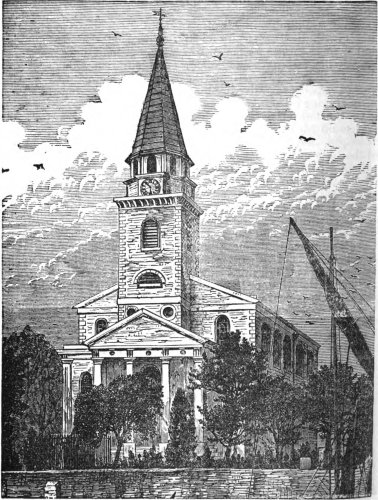
St. Mary's Church.
ST. MARY'S CHURCH forms an interesting object from the water. It was re-built by Act of Parliament passed 14 Geo. 3. The former church, which was built of brick, was found to be in such a dilapidated state that the Vestry deemed it more than desirable to erect a new church than to enlarge and repair the old one. Their unanimous resolution in this respect met with the sanction of Earl Spencer; his lordship in compliance with a petition generously granted the petitioners in the year 1772 a piece of ground, etc. for the enlargement of the church yard. During the re-building of the church, divine service was conducted in the tabernacle at the Workhouse. The cost of its erection was about £5,000, which sum was raised by a brief by the sale of certain pews for 99 years, by the sale of some estates or docks belonging to the Parish, and by granting annuities on lives; the leases expired Michaelmas, 1876. It was opened for divine service November 17, 1777. The ground given by the Earl Spencer for the enlargement of the church yard was consecrated by the Lord Bishop of Oxford, on Wednesday, the 15th of April, 1778. The Church is built of brick and has a tower with a conical copper spire at the west end, besides a clock and porch.[1] The belfry contains a set of eight bells, which, in addition to their ordinary Sunday chimes, ring out their merry peals on special occasions.
"Ring out the old year's evil, The world, the flesh, the devil; Let them go! let them go! And ring in the Prince of Peace, Messiah's gentle reign. And let war and bloodshed cease, And righteousness obtain. Ring out the old year's crimes, And ring in the new year's birth,— Good words, good deeds, good times; Oh, were ever sweeter chimes Rung on this fallen earth Since creation's virgin anthem rang, And morning stars together sang?" "Chime on, ye bells! again begin, And ring the Sabbath morning in."
Six of the old bells were in the Old Church but re-cast, and two were added to them. Length of church, 88 feet; breadth, 49 feet 3 inches.—Rev. Owen Manning, S.T.B. In digging for the foundation of the present structure was found an ancient coffin lid of stone, on the top of which was a cross fleury. The Rev. Erskine Clarke in an article headed "S. Mary's Church in the Last Century" has furnished his parishioners with some interesting details gathered from the Parish books respecting the re-building of the Parish Church. He says: "It does not appear that our ancestors were more expeditious in carrying on business of this nature than we of the present day, as the first resolution to inquire into the state of the old Church[1] was passed by the Vestry in December, 1769, whereas the re-building was not finished till November, 1777. The first suggestion was to sell a portion of Penge Common in order to raise the money required, but it was afterwards found that the condition of the church was so bad that the money raised by this means would not be sufficient for the necessary repairs. On March 1st, 1771, it was ordered by the Vestry that an extra estimate be made of the needful repairs, allowing for enlargement of the chancel to the north wall, to elevate the roof and make galleries, and to raise the bottom of the church so high as five inches from the present coming in, and that the Vicar and Churchwardens wait upon Lord Spencer to get his sanction and assistance for this, and to enlarge the church yard. On December 14, 1771, it was resolved this Vestry is unanimously of opinion (there not being one dissenting voice) that a new Church shall be built in this Parish at an expense not exceeding £4,000: the said sum to be raised by annuities at the most advantageous rate; and the interest or annuity thereon to be paid by a rate not exceeding sixpence in the pound. That twelve gentlemen be nominated to be a Committee for carrying the above-named purposes into execution, and that the following gentlemen be the said Committee with such others as choose to attend, all having voices. Viz.:
The Revd. Mr. Fraigneau, Vicar. Mr. Rhodes, Mr. Dixon, Churchwardens. Mr. Camden, Mr. Bremmer, Overseers. Isaac Akeman, Esqr. Chrisr. Baldwin, Esqr. Philip Worlidge, Esqr. Mark Bell, Esqr. Thos. Bond, Esqr. Thos. Misluor, Esqr. Philip Milloway, Esqr.
And that any five of them be a Committee to transact the business. And that the said Committee may adjourn themselves from time to time, to such place as they shall think proper and at their own expense: and that the Vestry Clerk be ordered to attend the said Committee at all times of their meeting. In the following year we find that the petition to Lord Spencer to present an additional piece of ground was granted, for the following resolution is recorded in the Parish Books on April 21st, 1772. 'That the Rev. Mr. Fraigneau, Mr. Rhodes and Mr. Dixon do wait upon the Right Hon. Earl Spencer on behalf of the Parish of Battersea, to return his Lordship their hearty thanks for his noble and generous grant of the houses and ground north and south of the present entrance to the church yard.' In March, 1773, a plan prepared by Mr. Dixon was laid before the Vestry, and it was unanimously resolved that the said plan be carried into execution with all possible expedition, and the expenses not to exceed £3,000. On March 1, 1774, it was reported to the Vestry by the Church Committee that it would be necessary to apply to Parliament for power to sell some estates belonging to the Parish, and also forty pews in the new church in order to procure necessary funds. From this time to the reopening of the Church there is no further reference to the restoration except an order for the payment of £18 for 'alterations to the Tabernacle at the Workhouse which was used for Divine Service during the re-building of the Church.' The entire cost of the Church was £4950 13s. 9½d. The following entry is made in April, 1778. Entered by order of the Reverend Mr. William Fraigneau (Vicar), Mark Bell and John Camden, Esquires, Churchwardens. The new Church of Battersea Parish was opened for Divine Service on Sunday, the 17th of November, 1777. The additional ground for enlarging the church yard granted by Earl Spencer, was consecrated by the Lord Bishop of Oxford, on Wednesday, the 15th of April, 1778. Towards the end of the year 1778 we find the inhabitants of Battersea developing a musical taste. A faculty was applied for to erect an organ, the petitioners making their request on the ground that an organ would be 'a decent and agreeable addition and ornament to the Church.' The faculty was granted, and an organ was erected at the west end of the gallery where the present one now stands."—St. Mary's Battersea Parish Magazine, Nov. 1876. The organ has been removed to a place under the gallery, adjacent to the choir, and the Church has been re-seated.
The following copy of one of these leases on which the pews in St. Mary's Church were held, will be read with interest.
THIS INDENTURE made the Twenty-sixth day of December, in the Year of our Lord, One Thousand Seven Hundred and Seventy Eight, and in the Nineteenth Year of the Reign of our Sovereign Lord George the Third, by the Grace of God, of Great Britain, France and Ireland, King, Defender of the Faith, &c. Between the Reverend John Gardenor of Battersea, in the County of Surrey, Clerk, Allyn Simmons Smith, John Camden and Thomas Rhodes, all of the same place Esquires, and John Lumisden of the same, Surgeon, (being five of the Trustees appointed for carrying into execution an Act of Parliament made and passed in the fourteenth year of the Reign of his present Majesty King George the Third, Intituled an Act for Re-building the Parish Church of Battersea, in the County of Surrey, and for enlarging the Church Yard of the said Parish Church) of the one part, and William Dent of Battersea in the County of Surrey, Esquire, on the other part, Witnesseth that for and in consideration of the sum of Thirty-one Pounds Ten Shillings already paid and advanced by the said William Dent to the Treasurer appointed for the purposes of the said Act of Parliament, and also for and in consideration of the Yearly Rent and Covenants hereinafter reserved and contained, they the said John Gardenor, Allyn Simmons Smith, John Camden, Thomas Rhodes, and John Lumisden, in persuance and in Execution of the powers and Authorities vested in them in and by the said Act of Parliament, have Leased, Lett and Demised, and by these presents, do Lease, Lett and Demise unto the said William Dent, his Executors, Administrators and Assigns, All that Pew situate and being in the Gallery on the North side of the said Church of Battersea, (No. 62), with the appertenances. To have and to hold the said Pew, with the appertenances unto the said William Dent, his Executors, Administrators and Assigns, from the Feast day of Saint Michael the Archangel, which was in the Year of our Lord, One Thousand Seven Hundred and Seventy Seven, for and during, and unto the full end and Term of Ninety Nine Years thence next ensuing and fully to be complete and ended, Yealding and paying therefore Yearly and every Year during the said Term, unto such person or persons, who for the time being shall be lawfully appointed to collect or receive the same Rent or sum of Two Shillings and Sixpence of lawful money of Great Britain, on the Feast day of Saint Michael the Archangel, in every year. And the said William Dent for himself, his Executors, Administrators, and Assigns, doth Covenant and Agree to and with the said before named Trustees, their Heirs and Assigns, That he the said William Dent his Executors, Administrators and Assigns, shall and will well and truly pay or cause to be paid the Rent hereby reserved and made payable according to the reservation aforesaid, And also at his and their own proper Costs and Charge, well and sufficiently repair the said Pew so Leased to him, during all the said Term of Ninety Nine Years, Provided always that if the said Yearly Rent hereby reserved, or any part thereof shall be behind and unpaid by the space of Three Calendar Months next over or after the said Feast day of payment, whereon the same ought to be paid as aforesaid (being Lawfully demanded) then and in such case the Demise or Lease hereby made shall cease, determine, and be utterly void to all intents and purposes whatsoever. In witness whereof the said parties to these presents have hereunder interchangeably set their hands and seals, the day and Year first above Written.
Sealed and Delivered without stamps, according to the Act of Parliament above in the presence of:
Wm. HOLT, ROBT. CORAM.
J. GARDNOR, ALLYN SIMMONS SMITH, JOHN CAMDEN, T. RHODES, JOHN LUMISDEN.
The window over the Communion table at the east end of the church is decorated with portraits of Henry 7th, his grandmother Margaret Beauchamp and Queen Elizabeth in stained glass which was carefully preserved from the former church, and executed at the expense of the St. Johns.[1] The following will explain why the three portraits were placed at the end of the Church. "The first, that of Margaret Beauchamp, ancestor (by her first husband, Sir Oliver St. John) of the St. Johns, and (by her second husband, John Beaufort, Duke of Somerset) grandmother to Henry VII.; the second, the portrait of that Monarch; and the third, that of Queen Elizabeth, which is placed here because her grandfather, Thomas Boleyn, Earl of Wiltshire, (father of Queen Ann Boleyn), was great-grandfather of Anne, the daughter of Sir Thomas Leighton, and wife of Sir John St. John, the first baronet of the family."—Oulton.
The epitaph written by Lord Bolingbroke on his wife reads as follows: "In the same vault are interred the remains of Mary Clara des Champs de Marcelly, Marchioness of Villette and Viscountess Bolingbroke, born of noble family, bred in the Court of Lewes 14th. She reflected a lustre on the former by the superior accomplishment of her mind. She was an ornament to the latter by the amiable dignity and grace of her behaviour. She lived the honour of her own sex, the delight and admiration of ours. She died an object of imitation to both with all the firmness that reason, with all the resignation that religion can inspire, aged 74 the 18th of March, 1750."
The interior contains some interesting sepulchral monuments, among which is one of Roubiliac in the reliefs to the memory of Viscount Bolingbroke and his second wife, niece of Madame de Maintenon, both lie in the family vault in St. Mary's Church. The epitaphs on himself and his wife were both written by Bolingbroke. That upon himself is still extant in his own handwriting in the British Museum, and is as follows:—"Here lies Henry St. John, in the reign of Queen Anne, Secretary of War, Secretary of State and Viscount Bolingbroke; in the days of King George I. and King George II. something more and better. His attachment to Queen Anne exposed him to a long and severe persecution; he bore it with firmness of mind, he passed the latter part of his life at home, the enemy of no national party, the friend of no faction, distinguished under the cloud of proscription, which had not been entirely taken off by zeal to maintain the liberty and to restore the ancient prosperity of Great Britain." Another monument commemorates the descent and preferments of Oliver St. John, Viscount Grandison, who was the first of the family that settled at Battersea. When studying the law at one of the Inn Courts, he killed in a duel the Captain of the Guard to Queen Elizabeth and Champion of England. "In 1648, Sir John St. John was buried at Battersea with such unusual pomp that the heralds were fluttered and commenced a prosecution against the Executor for acting contrary to the usage of arms and the laws of heraldry. William Riley, one of the heralds deposed 'that the funeral of the deceased was conducted in a manner so much above his degree that the escutcheons were more than were used at the funeral of a Duke; and that he never saw so many persons but at the funeral of one of the blood royal.' This burial is omitted in the register." In the south gallery is a monument to Sir Edward Wynter, an officer in the service of the East India Company in the reign of Charles 2nd, on which is recorded an account of his having singly and unarmed killed a tiger, and on foot defeated forty Moors on horseback. He appears to have been a friendless youth but obtained his promotion by virtue of his intelligence, courage and good conduct as the epitaph states:—
"Born to be great in fortune as in mind, Too great to be within an Isle confin'd, Young, helpless, friendless seas unknown he tried; But English courage all those wants supplied. A pregnant wit, a painful diligence, Care to provide, a bounty to dispence, Join'd to a soul sincere, plain, open, just, Procur'd him friends, and friends procured him trust; These were his fortune's rise, and thus began This hardy youth, rais'd to that happy man, A rare example and unknown to most Where wealth is gain'd and conscience is not lost. Not less in martial honour was his name— Witness his actions of immortal fame! Alone, unarm'd a tiger[1] he oppress'd And crush'd to death the monster of a beast; Twice twenty mounted Moors he overthrew Singly on foot; some wounded, some he slew, Dispers'd the rest—what more could Samson do? True to his friends, a terror to his foes Here now in peace his honour'd bones repose." Vita Peregrinatio.
He died March 2nd, 1685-6, aged 64.
Near at hand is a monument—a small statue of a mourning female leaning upon an urn—erected by the benevolent James Neild, in memory of his wife Elizabeth, who died 30th of June, 1791, in her 36th year. The epitaph states:—
Here low in beauteous form decay'd My faithful wife, my love Eliza's laid; Graceful with ease, of sentiment refin'd, Her pleasing form inclos'd the purest mind! Round her blest peace, thy constant vigils keep And guard fair innocence her sacred sleep, 'Till the last trump shall wake the exulting day. To bloom and triumph in eternal day. Conjux Mærens Posuit.
And of her father, John Camden, Esq., whose son, John Camden Neild, lived in Cheyne Walk, Chelsea, and bequeathed to Queen Victoria the whole of his property, £500,000.
At the east end of the north gallery is a beautiful marble monument most elaborately sculptured sacred to the memory of Sir John Fleet, Knt., Alderman of the City of London. He was unanimously elected Lord Mayor of the City in 1693. He received Royal favours, and all ranks of the greatest honour and esteem from his fellow citizens, having been one of their representatives in Parliament thirteen years, and constantly interested in their highest stations, in which offices and honours he was universally applauded. He was a merchant and just magistrate, constant to church, loyal to his Prince, and true to his country. He was fortunate and honest, bountiful in charity a generous benefactor and a faithful friend.—Obit 6 Julii 1712. Ætat: 65.
Another tablet is erected to the memory of Margaret Susanna Pounsett, wife of Henry Pounsett, Esq., of Stockwell, in this County, and eldest daughter of Richard Rothwell, Esq., of this Parish; Alderman of the City of London and High Sheriff of the County of Middlesex: she died on the 22nd day of March, 1820, in the 32nd year of her age, leaving two sons and three daughters. Her numerous amiable and exemplary qualities, endeared her to her family in her life—Her Christian piety and cheerful resignation alone consoled them in her death. Also of Ellen Anne Pounsett, her second daughter, who died the 7th of December, 1834, aged 22.
In the west gallery is a marble tablet sacred to the memory of Richard Rothwell, Esq., Alderman and formerly High Sheriff of the City of London, and County of Middlesex; who departed this life most deeply regretted, July 26th, A.D. 1821, in the 60th year of his age. In the public station which he filled of Magistrate and Sheriff, his strict integrity, his splendid liberality, and his genuine philanthropy, justly merited and procured the highest esteem, and warmest approbation of his fellow citizens. In his private character he was respected for the vigor of his mind, the solidity of his judgment, and the uprightness of his principles, and beloved for the urbanity of his manners, and the benevolence of his heart. In him the perplexed found an able counsellor, and the distressed an active friend. His feelings were tenderly alive to the important truths of religion, and while punctual in the performance of the duties of this life he placed his sole reliance on the merits of his Redeemer for happiness in the life to come.
On the right-hand-side of the pathway leading towards the porch of the Church is a grave stone at the bottom of which is the following inscription:—"Mrs. Sarah Eleanor McFarlane, who fell by the hand of an assassin the 29th of April, 1844, aged 46 years." This poor widow resided in Bridge Road, and obtained a subsistence by keeping a Day and Sunday School. The name of the murderer who deprived the life of his victim by cutting her throat on Old Battersea Bridge, was Augustus Dalmas, a Frenchman. This horrid crime was committed late at night. The woman who had charge of the toll seeing the helpless condition of Mrs. McFarlane conveyed her to the "Swan and Magpie" Tavern at the foot of the Bridge, where she expired exclaiming "Dalmas did it!"
In the north gallery is an upright marble tablet for Sir [George] Wombwell, Bart., of Sherwood Lodge, who died October 28th, 1846, in his 77th year.
At the east end of the south aisle is a tablet to Thomas Astle, Esq., F.S.A., keeper of the records in the Tower, and who wrote on "The Origin and Progress of Writing." He left a valuable collection of manuscripts which were deposited at Stow, the seat of his noble patron the Marquis of Buckingham, to whom he gave by his will the option of purchasing them at a fixed sum.
In the churchyard lies Arthur Collins, author of "The Peerage and Baronetage of England." His grandson, David Collins, Lieutenant Governor of New South Wales, and author of a History of the English Settlement there. William Curtis a distinguished botanical writer, author of the "Flora Londinensis," was buried here, January 31, 1731.
"While living herbs shall spring profusely wild, So long thy works shall please dear nature's child, Or gardens cherish all that's sweet and gay So long thy memory suffer no decay."
The Countess de Morella, who lived in one of the five mansions which gave its old name of Five House Lane to Bolingbroke Grove, has placed a coped stone with a cross on it over the old grave of her aunt Miss Elizabeth Hofer, in the church yard near the mortuary, and has had the tablets of her family at the west end of the north gallery cleaned.
Mr. Poole, the Curator of the monuments in Westminster Abbey, is now engaged in cleaning some of the mural monuments in the Church which had become grimed with the dust of years.
In the centre of the plot in front of the portico is the family vault of Sir Rupert George, Bart. Mr. Chadwin, one of the oldest parishioners now living in Battersea, relates how Sir Rupert George came to select St. Mary's Church yard as his burying place. "He was on a visit to Lord Cremorne, at Cremorne House, on the opposite side of the Thames, and he came over to Battersea and was so impressed with the beauty of the view across the river that he purchased the vault as a resting place for himself and his family. Several of his sons and daughters are interred there, and Dr. Inglis, Bishop of Nova Scotia, the first Colonial Bishop, was also buried in the vault of Sir Rupert George, to whom he was fondly attached by the strongest ties of friendship and also closely allied by marriage." The Bishop's tablet is on the wall under the north gallery.
Charles Williams of London was an actor of some eminence at the Theatre Royal, Drury Lane. He died in the prime of life. His mortal remains were interred in the church yard. As a tribute of respect his funeral was attended by the whole body of Comedians; the pall was supported by Wilks, Griffin, the two Cibbers, and the two Mills. "There is" says Daniel Lysons, "no memorial of his grave."
It is thought that as the former Church was built of brick that probably it was not very ancient. A church is mentioned in Doomsday, a most ancient record, made in the time of William 1st, surnamed the Conqueror, and containing a survey of all the lands in England. Lysons, from whom we take the liberty of making some liberal quotations, when writing about 85 years ago, says, "The Church of Battersea is dedicated to St. Mary; it is in the Diocese of Winchester, and in the Deanery of Southwark, the benefice is a Vicarage. Lawrence, Abbot of Westminster, first procured the appropriation of the great tithes for that Abbey about the year 1156. The monks of Westminster were to receive out of it two marks, reserving sufficient to the Vicar to support the Episcopal burdens and himself. The Rectory was held by John Bishop of Winchester in the time of Philip and Mary. The principal profits of the Vicarage accrued from the gardens, which rendered the living one of the most valuable in the neighbourhood of London. The gardeners at Battersea paid 7s. 6d. an acre for tithes to the Vicar. The living of Battersea is dated in the King's Book at £13 15s. 2½d." The present living is estimated at about £1,000 with residence. "In the Valor of 1291, usually termed Pope Nicholas' Taxation, the Rectory is valued at 26 marks and a half: the Vicarage at £4 3s. 4d. In 1658 the Rectory was stated as worth £80 a year, and the Vicarage at £100, and in the King's Book the Vicarage stands at £13 15s. 2½d. Battersea was one of those parishes which in memory of the Abbey dedicated to St. Peter, presented to the Abbot and Convent in early times, the tithes of salmon taken in this portion of the river. The Incumbents however of Chelsea, Battersea, and Wandsworth endeavoured to shake this custom off as long ago as 1231, but failed: the composition entered into upon the occasion may be seen in Dart's History of Westminster Abbey."—Ecclesiastical Topography.
"There are two terriers of Battersea in the register of Winchester fastened together of the dates of 1619 and 1636."—Ducarel's Endowments of Vicarages, (Lambeth Library). "Owen Ridley, who was instituted to the Vicarage of Battersea, A.D. 1570, appears to have been involved in a tedious litigation with his parishioners and to have encountered no small degree of persecution from them. The circumstance would not have been worth recording but for two curious petitions which it produced, the originals of which (date of both 1593) were in the possession of the Rev. John Gardenor, Vicar, by whom, (says Lysons) they have been obligingly communicated. One of these is from certain inhabitants to Dr. Swale, one of Her Majesty's High Commissioners for crimes Ecclesiastical; in which they state many grievances which they suffered from their Vicar during the space of eighteen years. Amongst other crimes alleged against him is that of conversing with a Witch. The object of their petition was, that he might be deprived. It is signed with thirteen names and about thirty marks. The other petition, which is to Lord Burleigh, being the more curious of the two is here given at large. To the Right Honourable the Lord Burleigh, Lord High Treasurer of England. Most humbly sheweth unto your honor, your daiely orators, the inhabitants of Battersey, besechinge you to extend your favor in all just causes to our mynister Mr. Ridley: (so it is right honorable) that some have sought his deprivation, by many trobles many years together, and in divers courts sometymes in the Archdeacon's, sometymes by complayninge to the busshop, sometymes before the highe Commissioners, sometymes before the Archbusshop of Canterbury, his grace: Yea and once he hath ben edicted at the assizes. But God the defender of the innocent, hath so protected him that his cawse beinge tryed and knowene he hath hadd a good issue of all theis trobles; yet the adversarie will not cease, but seeketh to deprive him of his life, for seekinge after Witches, and procuringe the death of a man by Witchcraft. He hath byn our Vicar theis twenty years: he is zealous in the gospell, honest in life, painefull to teache us and to catechise our youth; charitable and liberall to the poore and needy accordinge to his ability, he never sued any of all his parisheoners for tythes, althoughe he hath hadd cawse gyven by some so to doe. Of our conscience wee take him rather to hate wytches, than to seeke after them; for he hath spoken often very bitterly against them out of the bible, neither doe we thinke or suspect the woman to be a witche which is accused, but hath always lyved honestly, quietly and painefully here, to get a poore lyvinge truly. Therefor the man being such a one, whom for his virtues wee love, his trobles heretofore so greate, so many and so chandgable to the undoings of himself, his wife and children, and now so daingerous for the hope of his life, doth move us to become suitors unto your honour for him, besechinge your honor to take notice, and to make due triall of him and his cawse, so that the truth being fownd owte, justice maie take place; Your honor will defend the innocent in his innocencee, putt an end to his tonge, many wearisome and daingerous trobles and be a patrone unto him in all his good and honest actions; so shall we be bound to thancke God for you, and pray for you for ever. Signed by Robert Cooke Alias Clarencieulx Roy d'Armes, Robert Claye, preacher, and fourteen others."
"Dr. Thomas Temple, brother of Sir John Temple, the Irish Master of the Rolls, was instituted to the Vicarage of Battersea in 1634, and continued there during the civil wars; he was one of the ministers appointed by Cromwell to assist the Committee for displacing ignorant and insufficient School Masters and Ministers. He was likewise one of the Assembly of Divines and a frequent preacher before the long Parliament. Several of his sermons are in print. Mr. Temple was succeeded in the Vicarage of Battersea by the learned Bishop Patrick, who was educated at Queen's College, Cambridge, and was domestic Chaplain to Sir Walter St. John, by whom he was presented to this benefice. Several of his tracts were published while he was Vicar of Battersea and are dedicated to his patron. He resigned the Vicarage in 1675. He was a zealous champion of the protestant religion, both by his writings and in conversation, particularly at a conference which he, in conjunction with Dr. Jane, held in the presence of James the Second with two Roman Catholic Priests, in which he had so much the superiority over his opponents in argument, that the King retired in disgust, saying that he never heard a good cause so ill defended or a bad one so well. At the Revolution he was rewarded with the Bishopric of Chichester, and was afterwards translated to Ely. He died 1707, and left behind him a numerous collection of printed works; consisting of sermons, devotional and controversial tracts and paraphrases on the Scriptures, which are held in great estimation and which were continued by William South."
"Dr. Thomas Church, of Brazen Nose College, Oxford, who was instituted to the Vicarage of Battersea in the year 1740, distinguished himself much in the field of controversy in which he engaged against Westley and Whitfield, and Middleton: for his successful attacks on the latter and his defence of the miraculous power during the early years of Christianity. The University of Oxford gave him the degree of D.D. by diploma. He was too zealously attached to his religion to let the opinions of Lord Bolingbroke pass unnoticed notwithstanding he had been his patron. His publication on this subject however was anonymous, it was called 'An Analysis of the Philosophical Works by the late Lord Bolingbroke,' and came out in 1755. He died in 1756, aged 49."
"The registers of this parish begin in the year 1559, and excepting the former part of the 18th century appear to be accurate. Dr. Church soon after he was instituted to the Vicarage began to transcribe a considerable part of the registers, which for many years preceding had been kept by a very ignorant parish clerk. He proceeded so far as to copy the whole of the baptisms, and with great industry rectified a vast number of mistakes and supplied many deficiencies; the difficulty of transcribing the burials of which indeed for some years there were no notices, discouraged him from proceeding any further in this laudable undertaking."—Lysons.
Cases of longevity in the Parish Register: Goody Harleton, aged 108 years, buried 1703; William Abbot, 101, 1733; Wiat, 100, 1790; and William Douse, 100, 1803. The case of Rebecca, wife of Richard Harding, a waterman, is mentioned. She gave birth to four children, she died in labour of the fourth child, which was still-born. The mother was buried February 8, 1730; her three infant children, Mary, Sarah, and Rebecca were buried the 2nd of March following. Respecting the rate of mortality in London during the plague years, in the year 1603, 30,578 persons died of the plague. At the accession of Charles I. in 1625, another dreadful pestilence raged in London, which carried off 35,417 persons. In the year 1665, about the beginning of May, there broke out in London the most dreadful plague that ever infested this kingdom, which swept away 68,596 persons, which added to the number of those who died of other distempers, raised the bill of mortality in this year to 97,306. And the mortality raged so violently in July, that all houses were shut up, the streets, deserted, and scarce anything to be seen therein but grass growing, innumerable fires for purifying the air, coffins, pest-carts, red crosses upon doors, with the inscription, 'Lord have mercy upon us,' and continual cries of 'pray for us;' or the melancholy call of 'bring out your dead.' The cause of this terrible calamity was ascribed to the importation of infected goods from Holland where the plague had committed great ravages the preceding year. During the whole time of its continuance there was a great calm, for weeks together there was scarcely any wind so that it was with difficulty that the fires in the streets could be kept burning for want of a supply of air, and even the birds panted for breath. The plague as is generally agreed is never bred or propagated in Britain, but always imported from abroad, especially from the Levant, Lesser Asia, Egypt, etc. Sydenham, an old writer, has remarked that it rarely infects this country oftener than once in forty years—thank God we have happily been free from it for a much longer period. There have been various conjectures as to the nature of this dreadful distemper. Some think that insects are the cause of it, in the same way that they are the cause of blights. Mr. Boyle thought that it originated from the effluvia or exhalations breathed into the atmosphere from noxious minerals to which might be added stagnant waters and putrid bodies of every kind. Gibbon, in his Roman History, 4th Edition, Vol. IV, p. 327-332, gives a very particular account of the plague which depopulated the earth in the time of Emperor Justinian. He thinks that the plague was derived from damp, hot and stagnating air, and the putrifaction of animal substances, especially locusts. The Mahometans believe that the plague proceeds from certain spirits, or goblins, armed with bows and arrows sent by God to punish men for their sins; and that when the wounds are given by spectres of a black colour, they certainly prove fatal, but not so when the arrows are shot by those that appear white. The learned Dr. Chandler, who travelled in Asia Minor, was of the opinion that the disease arose from animalcules which he supposed to be invisible.
The three Plague years.
In 1603 the number of deaths in Battersea was 22
" 1625ditto61
" 1665ditto113
Average of Births with Burials:—
1580-1589 Births 13 Burials 7
1680-1689" 58" 68
1780-1789" 60" 69
In 1876 the number of births in Battersea Parish was 3459, and the number of deaths 1751, not including the Hamlet of Penge.
The subjoined is copied from "St. Mary's Battersea Parish Magazine" for November, 1875. "Vicars of Battersea from Olden Times. The following extract from 'A History and Antiquities of Surrey,' begun by the Rev. Owen Manning, enlarged and continued to the year 1814 by William Bray, Esq., printed for White, Cochrane & Co., at Horace's Head, Fleet Street, will be of interest.
Patron. Vicar.Institution.
Abbot and Convent
of WestminsterThomas de Sunbury13 Nov. 1301
"William Trencheuent21 Nov. 1306
"Gilbert de Swalelyve26 Oct. 1320
"Richard Condray11 Dec. 1325
"Thomas at Strete de
Cadyngton20 April 1328
"Elias de Hoggenorton10 Aug. 1330
"Richard de Wolword9 Dec. 1331
"William Handley26 Nov. 1366
"John GelleResigned, 1370
"William Bakere8 Feb. 1370-1
"John Colyn5 Oct. 1378
The King (the
temporalities
of the abbey
being in his
hands)Henry Green31 Oct. 1383
Abbot and Convent
of WestminsterHenry WalyngfordResigned, 1394
"John Berewyk22 Oct. 1394
"Richard Gatyn12 May 1402
"William ComelondDied, 1413
"John Smyth25 Aug. 1413
"Henry OxynResigned, 1457
"John Moreys30 Sept. 1457
"Thomas Huntyngton5 Nov. 1485
"John Heron20 April 1487
"Nicholas TownleyResigned,
18 Feb. 1523-4
"Christopher Wylson9 Mar. 1523-4
"Richard Rosse, L.L.D.16 May 1530
"John Edwyn18 Nov. 1560
"Thomas Mynthorne5 Jan. 1561
Queen ElizabethWilliam Gray10 Mar. 1561-2
"Owen Ridley21 June 1571
Sir John St. John,
Bart.Thomas Temple, B.D.21 Nov. 1634
Sir Walter St. John Simon Patrick, D.D.[1]1658
"Gervase Howe, M.A.22 Mar. 1675-6
"Nathaniel Gower20 Oct. 1701
Lord St. JohnGeorge Osborn4 Oct. 1727
Henry Viscount St.
JohnThomas Church, D.D10 Mar. 1739-40
Frederick Lord
BolingbrokeLilly Butler18 June 1757
"William Fraigneau18 Mar. 1758
"John Gardenor[2]Oct. 1778
The Crown[3]Robert Eden, M.A.1 Feb. 1835
"John Simon Jenkinson, M.A. 20 June 1847
Earl SpencerJohn Erskine Clarke, M.A.2 Feb. 1872
The Registers of 1345, 1366, 1415, 1446, 1492, and 1500 are lost."
In the reign of Henry VI. Thomas Lord Stanley held possession of a valuable estate in Battersea, which, in order to prevent its confiscation at that troublesome period, he had conveyed to trustees for the benefit of himself and that of Thomas his son and heir. In December, 1460, the property was transferred by the Trustees to Lawrence Booth, Bishop of Durham, and his heirs, and in the year following the grant was confirmed by the two Stanleys. The futility of this transfer was obvious for before Edward IV. had reigned eleven years the estate had escheated to the Crown "in consequence of the action of John Stanley, who assigned the lands and tenements in trust to the Abbot of Westminster, in contravention of the statute of Mortmain. The Bishop therefore had to apply to the King and on payment of £700 he obtained a grant under Letters Patent dated July 10th, 1472, of the property forfeited by John Stanley."
Lawrence Booth was made Bishop of Durham in 1457, he built a Mansion Brygge Court at Battersea, and by the King's license enclosed with walls and towers imparked his land there, with the right of warren and free chase therein. In 1476 he was translated to the See of York. He died in 1480 and bequeathed this property to the Dean and Chapter of York as an occasional residence when the Archbishop visited London. The name of York Road perpetuates this ancient occupancy. One of the few prelates who resided here was Archbishop Holgate who was committed to the Tower by Queen Mary in 1553 for being a married man, and lost much property by illegal seizure. Strype, in his life of Cranmer, relates that the officers who were sent to apprehend the Archbishop rifled his house at Battersea and took away from thence £300 worth of gold coin; 1,600 ounces of plate; a mitre of fine gold set with very fine diamonds, sapphires, and balists; other good stones and pearls; some very valuable rings, and the Archbishop's seal in silver; and his signet, an antique in gold. It is contended that Wolsey resided at York House, Battersea, where he was introduced to Anne Boleyne though the interview is more commonly believed to have taken place at York House, Whitehall; but Shakespere in his plays makes the King come by water, and York House, Battersea, was a residence of Wolsey and provided with a creek from the Thames for approach to the house. Sir Edward Wynter is said to have resided at York House, whose exploits surpassed even the heroic achievements of Lord Herbert Cherbury, who, alone in his shirt chased a host of midnight robbers from his house. Sir Edward Wynter's exploits have been already mentioned. The Mansion House was considerably altered by Joseph Benwell, Esq., the occupier who took down many of the old rooms. One of these called the painted chamber had a dome ceiling and is said to have been the room in which Wolsey entertained Henry VIII. with masquerades, and in which he saw Anne Boleyne. When the floor was removed there was found under it a chased gold ring on the side of which was inscribed "Thy virtue is thy honour." This superbly painted room with a dome forms the back ground of an ancient print representing the first interview of Henry VIII. with Anne Boleyne.
There was also another large building in 1818 standing parallel with York House but nearer the river divided into two houses, then in the possession of F. Alver and H. Tritton, Esqrs., and noted for having a very fine terrace in front next the Thames.
The art of transfer-printing produced from copper-plate impressions is said to have been made at Liverpool; but Mr. Binns, F.S.A., in his very interesting History of Worcester ware traces the claim of transfer-printing to the Battersea Enamel Works at York House, (the Archbishop's old palace) where Ravenet and other artists wrought in engraving plates from which impressions were taken on enamel plaques, etc., for snuff-boxes and other articles. The Liverpool claim to the invention dates from 1756. Whereas Horace Walpole writes from Strawberry Hill, six or seven miles from Battersea, to R. Bently, September 18th, 1755; "I shall send you a trifling snuff-box only as a sample of the new manufacture at Battersea which is done with Copper plates." The Battersea Porcelain[1] Works failed and Alderman Jansen's stock, furniture, etc., were sold by public auction, March 4, 1756. The Battersea and Chelsea wares being rarities are expensive, particularly the former. A writer in the "Athenæum" thinks it probable that some of the Battersea workmen found their way to Worcester and Liverpool.
The public may see some beautiful as well as curious specimens of Battersea enamel exhibited at Kensington Museum, lent by the Hon. W. F. B. Massey-Mainwaring. Also some bought at Mrs. Haliburton's sale. Battersea enamel 1750-60. Blue and gold, pink and gold candle-sticks, snuff-boxes, scent-bottles, needle-cases, handle for a cane, tray (circular) from Dulparry with floral medallions, tazza, Bulton's hunting subjects in brown transfer, thimble cases, etui with implements. Battersea enamel portrait on copper, a gentleman in armour wearing the garter, etc., etc.
Jens Wolfe, Esq., who was Danish Consul to this country, had a seat at Battersea called Sherwood Lodge. He built a gallery 76 feet long by 25, and 30 in height in the most correct style of Doric architecture for the reception of plaster casts purposely taken for this collection from the most celebrated antique statues. The most remarkable of these were those from the Fighting Gladiator and the Niobe, the Barberini Faun, the Dying Gladiator and the Farnese Hercules. The mansion was pleasantly situated and beautifully shaded with poplar, lime, and sycamore trees. It was the residence of Mrs. Fitz Herbert. Sir George Wombwell chose it as his seat and resided in it about fourteen years. Subsequently Sir Edward Hyde East dwelt here. The stable belonging to Sherwood Lodge still remains, also the old wooden-cased pump with leaden spout.
Price's Patent Candle Company, Belmont Works, Battersea, S.W. (above) Price's Patent Candle Company, Bromborough Pool, near Liverpool. (below)
On the site where stood York House, Tudor Lodge, and Sherwood House, stands a great hive of industry known as Belmont Works or Price's Patent Candle Factory. Price's Patent Candle Company (as a private firm) was among the earliest to apply in commercial enterprise the discoveries of Chevreul, and has continued to hold the first place among candle manufacturers in Great Britain; and notwithstanding the manufacture of gas, the importation of American oils and the many competitors for supplying light-giving material this Company makes its way by dexterity between them. At the present time the store room of the Belmont Factory actually contains candles of about 240 different kinds. Until Chevreul had begun his scientific investigations in 1811, oils and fats had been regarded as simple organic substances. On the complete publication of his discoveries in 1823, the complex character of these bodies became extensively known. In 1829 the plan of separating cocoa-nut oil into its solid and liquid components by pressure, was in that year patented by Mr. James Soames of London; this patent was purchased by Mr. William Wilson and his partner, who, trading upon it under the title of E. Price & Co., perfected it as to manufacturing details. In 1831 the candle manufacture in England was set free from the excise supervision to which it had been previously subjected. From that date then its progress became possible. After a time, in order to carry out successfully certain enterprises which required more capital than the Company had at their command, Mr. Wilson's partner sold his share in the beginning of 1835 to three capitalists. With these gentlemen as sleeping partners and with the aid of two of his sons, Mr. Wilson continued under the name of Edward Price & Co. to carry on the concern until it passed in 1847 into the hands of Price's Patent Candle Company, with a capital of £500,000; of this Company Mr. Wm. Wilson became the first Chairman, and his sons, Mr. James P. Wilson and Mr. George F. Wilson, the two Manufacturing Directors. It is interesting to notice that in the year 1840, while Mr. J. P. Wilson was endeavouring to produce a cheap self-snuffing candle for the coming illumination in honour of the marriage of Her Majesty Queen Victoria, then about to take place, succeeded in making such candles of a mixture of equal parts of stearic acid and cocoa-nut stearine, they gave a brilliant light and required no snuffing. These candles came rapidly into notice, they were named "Composite" because of the mixture in them. Africa supplies the palm-oil which was hitherto used almost entirely for soap-making. The imports of palm-oil into England, which amounted to about 9,800 tons in 1840, have for many years past exceeded 40,000 tons annually, and averaged 50,000 tons in 1871, 1872, 1873 and 1874. This increase of importation is undoubtedly due in very great part to the use of oil in the manufacture of candles; and it is this trade which presents to the African chiefs and kings along the West Coast the motive that they can best understand for the abandonment of the slave-trade, they learn in fact, that their subjects are of more value to their rulers when collecting palm-oil than by being sold into slavery. The cocoa-nut oil brought from Ceylon is largely used in the factory. The palm-oil from the Coast of Africa being converted by chemical processes into stearine, is freed from oleic acid by enormous pressure, is liquefied by steam, and then conveyed into the moulding machinery, by which 800 miles of wicks are continually being converted into candles. Among the earlier operations of the new Company was the acquirement in 1848 of the Night-Light Patent held by Mr. G. M. Clarke, and in 1849 of the Night-Light business of Mr. Samuel Childs, and the erection of a new factory for the purpose of carrying on this new branch of manufacture on an extensive scale. In 1875 no less than 32½ millions of new lights were sold by the Candle Company. Geology informs us that in the age of the coal formation a great part of the earth's surface was covered by a dense and tangled vegetation composed mainly of flowerless plants growing with wonderful luxuriance in the warm damp atmosphere which must then have prevailed—the masses of vegetable matter—the decay of gigantic ferns sinking into the boggy soil formed peat which as ages rolled on became converted by heat and pressure into coal. The conditions of the earth now are so different to what they were at that geological period that we are unable to state with certainty how long the process must have taken to form the ancient beds of lignite (mineral coal retaining the texture of the wood from which it was formed) and brown coal, and the still more ancient beds or seams of true coal. From these paraffine is extracted by chemical processes—it is the chief material in the Golden Medal Palmitine Candles (the name given to the candles in consequence of the award to the Company at the Paris Exhibition, 1867, and other products—the name "Palmitine" having been given to them because of the presence of a beautifully pure white stearine obtained from palm-oil). The paraffine thus procured by a process of distillation yields at the same time a liquid product affording under the name of coal oil, or petrolium, one of the cheapest of the Company's light-giving materials. Price's Glycerine has obtained a world-wide reputation for its purity—much of it is manufactured from palm-oil. It was in the Company's factory that pure glycerine was first produced. The total of raw materials brought into work by the Company in 1877 amounted to nearly 16,000 tons. The produce in the same year was as follows;—-
Candles of all kinds147,000,000
Night-lights32,000,000
Oils for Lamps, Machinery and Wool-working gals. 990,000
Household and Toilet Soapscwts. 38,000
Stearine and Candle-material sold in bulkcwts. 16,000
Glycerine of various qualitiescwts. 3,500
The year's produce of candles named above would suffice to give the continuous light of one candle during about 84,000 years. The Night-lights would in like manner give the continuous light of one Night-light during about 25,000 years. In 1853 the Company took a step of much importance. Liverpool being then as now, the place of arrival of the largest importation of palm-oil, it was felt to be desirable that the Company should have in or near it a second factory, prepared to manufacture this material where it could be purchased without cost of land carriage. The capital of the Company was therefore increased and an estate of about 60 acres was purchased at Bromborough Pool, near Liverpool, on which was erected the second factory with cottages. The factory village numbers 97 houses with a population of 530. It has its own place of worship, schools, co-operative stores, rifle corps, and all the organization of a model village. At present this factory employs about 320 operatives. The London Works (Battersea) occupy an area of about 13½ acres, those at Bromborough occupy 7 acres. The buildings are all roofed with corrugated iron so as to reduce inflammable material to a minimum. The area covered by the roofs is a large one, as the buildings again, with a view to safety from fire have generally no upper floor. This area amounts to nine acres for the two factories. The operatives number about 1,300, nearly 1,000 of whom are employed at Battersea. Connected with each factory is a mess-room in which the work-people can either purchase their food from the Co-operative Society established among themselves, or can have their own provisions cooked for them. At each factory a brief devotional service is conducted every morning. Each factory has its reading room and library; each maintains a corps of rifle volunteers (the two establishments together providing about 300 efficient riflemen), and each during the winter has its evening school for boys employed in the Works. Bromborough enjoys an excellent recreation ground and set of allotment gardens, but the growth of buildings about London has precluded the London operatives from having these privileges. During the winter months, lectures and science and art classes offer amusement and instruction to those who desire one or the other. In each factory a medical officer pays a daily visit, and attends to all who may be ailing; a weekly payment of one penny from each man and a half-penny from each boy being required in return for this privilege. On the whole this is one of the best regulated firms in the Metropolis.
Mr. James Pillans Wilson, Consulting Adviser. Mr. John Calderwood, General Manager. Mr. W. H. Withall, Secretary. Mr. Kingston George Woodham, Superintendent. Mr. S. J. Roberts, Chief Engineer. Mr. G. Childs, Superintendent Night-Light Department. Mr. J. Day, Superintendent Bromborough Pool Works, near Birkenhead.[1]
Though hour-glasses were invented at Alexandria B.C. 149, and water-clocks about the same period, yet it does not appear that hour-glasses and clepsydras or water-clocks were known in England during the reign of Alfred the Great. Sun dials might be, but were of no use from eve to morn and when the days were sunless. In order to allot certain portions of time to particular objects, eight hours to sleep, meals and exercise, eight to the affairs of government, and eight to study and devotion, Alfred contrived the expedient of having wax candles made of equal weight and twelve inches in length, with marks upon them at regular distances. The combustion of one candle lasted four hours, and each intermediate part, an inch in distance, denoted a period of twenty minutes. Six of these candles lasted twenty-four hours. The duty of tending these candles was entrusted to one of Alfred's domestic Chaplains who had to give the Monarch notice of their working. As currents of air rushed through the unglazed windows and chinks in the walls of the Royal residence as to render the combustion irregular and the register inaccurate, the ingenious King surrounded the candles with horn and wooden frames to make them burn steadily in all weathers.
It was a custom in olden time to conduct a sale or auction by inch of candle. A small piece of candle being lighted the bystanders were allowed to bid for the merchandize that was offered for sale—the moment the candle went out the commodity was adjudged to the last bidder.
There was also excommunication by inch of candle, when the sinner was allowed to come to repentance while a candle continued to burn; but after it was consumed he remained excommunicated to all intents and purposes.
CANDLEMAS, a feast of the Romish Church, celebrated on the 2nd of February, in honour of the purification of the Virgin Mary. It is borrowed from the practice of the ancient Christians, who on that day used abundance of lights both in their churches and processions, in memory as is supposed of our Saviour's being on that day declared by Simeon "to be a light to lighten the Gentiles." In imitation of this custom, the Roman Catholics on this day consecrate all the tapers and candles which they use in their churches during the whole year. At Rome, the Pope performs that ceremony himself; and distributes wax candles to the Cardinals and others, who carry them in procession through the Great Halls of the Vatican or Pope's Palace. This ceremony was prohibited in England by an Order of Council in the year 1548.
Some writers affirm that Candlemas was first instituted by Pope Gelasius I. in 492. "The Romans were in the habit of burning candles on this day to the goddess Februa, the mother of Mars; and Pope Sergius seeing it would be useless to prohibit a practice of so long standing turned it to Christian account by enjoining a similar offering of candles to the Virgin. The candles were supposed to have the effect of frightening the devil and all evil spirits away from the persons who carried them, or from the houses in which they were placed." It is evident that the numerous superstitious notions and observances connected with candles and other lights in all countries had a remote origin, and may be considered as relics of the once universally prevalent worship of the sun and of fire, for mankind had so far forgotten the One living and true God as to worship the creature instead of the Creator who is God over all blessed for evermore.