PART I.
Reading edition
HISTORY.
2
SECTION I.
GRECO-EGYPTIAN PERIOD.
5
THE LAND AND THE WATERS.
The situation of Alexandria is most curious. To understand it we must go back many thousand years.
Ages ago, before there was civilization in Egypt, or the delta of the Nile had been formed, the whole of the country as far south as Cairo lay under the sea. The shores of this sea were a limestone desert. The coastline was smooth as a rule, but at the north-west corner an extraordinary spur jutted out from the main mass. It was not more than a mile wide, but many miles long. Its base is not far from the modern Bahig. Alexandria is built half-way down it, and its tip is the headland of Aboukir. On each side of it there used to be deep salt water.
Centuries passed, and the Nile, issuing out of his crack above Cairo, kept carrying down the muds of Upper Egypt, and dropping them as soon as his current slackened. In the north-west corner they were arrested by this spur, and began to silt up against it. It was a shelter not only from the outer sea, but from the prevalent wind. Alluvial land appeared; the huge shallow lake of Mariout was formed; and the current of the Nile, unable to escape through the limestone barrier, rounded the headland of Aboukir, and entered the outer sea by what was known in historical times as the “Canopic” Mouth.
This explains one characteristic of Alexandrian scenery—the long narrow ridge edged on the north by the sea and on the south by a lake and flat fields. But it does not explain why Alexandria has a harbour.
To the north of the spur, and more or less parallel to it, runs a second limestone range. It is much shorter than the spur and much lower, being often below the 6surface of the sea in the form of reefs. It seems unimportant. But without it there would have been no harbour (and consequently no town), because it breaks the force of the waves. Starting at Agame it continues as a series of rocks across the entrance of the modern harbour. Then it reemerges to form the hammer-headed promontory of Ras-el-Tin, disappears into a second series of rocks that close the entrance of the Eastern Harbour, and makes its final appearance at the promontory of Silsileh, after which it rejoins the big spur.
Such are the main features of the situation; a limestone ridge, with harbours on one side of it, and alluvial country on the other. It is a situation unique in Egypt, and the Alexandrians have never been truly Egyptian.
Best survey points on ridge are:
Quarries beyond Mex: p. 171
Hill of Abou el Nawatir: p. 165
Montazah: p. 175
Headland of Aboukir: p. 182
PHAROS, RHAKOTIS, CANOPUS.
Who first settled on this remarkable stretch of coast? There seem to have been three early centres.
(i). Homer (Odyssey, Book iv) says:—
“There is an island in the surging sea, which they call Pharos, lying off Egypt. It has a harbour with good anchorage, and hence they put out to sea after drawing water.”
Homer’s island is now the promontory of Ras-el-Tin; the intervening channel has silted up. There are no traces of any early settlement on its soil, but in the sea to its north and west the masonry of a prehistoric harbour 7has been found. Homer goes on to tell how Menelaus was becalmed on Pharos as he returned from Troy, and how he could not get away until he had entrapped Proteus, the divine king of the island, and exacted a favourable wind. A similar legend has been found in an ancient Egyptian papyrus. There the King is called the “Prouti” or “Pharaoh”. “Prouti” is probably the original of Homer’s “Proteus,” “Pharaoh” of his “Pharos.” It is significant that our first glimpse of the coast should be through the eyes of a Greek sailor.
(ii). But our historical survey must begin with Rhakotis. Rhakotis was a small Egyptian town built on the rise where “Pompey’s Pillar” stands now, and it existed as long ago as 1,300 B.C., for statues of that time have been found here. The people were coast guards and goat herds. Their chief god was Osiris. Rhakotis was never important in itself. But it is important as an element in the great Greek city that was built up round it. It was a little lump of Egypt. Compare it to the Arab villages and slums that have been embedded in the scheme of the modern town—to Mazarita or to Kom-el-Dik. Rhakotis was like one of these. The native and conservative element naturally rallied to it, and it became the site for Alexandria’s great religious effort—the cult of Serapis.
(iii). At the tip of the limestone ridge, where the Nile once entered the sea, was another early settlement. It also appears in Greek legend. In historical times, it was known as Canopus.
Ras-el-tin (Homer’s Pharos): p. 129
Prehistoric Harbour: p. 130
Pompey’s Pillar (Rhakotis): p. 144
Canopus: p. 180
8
ALEXANDER THE GREAT (B.C. 331).
Few cities have made so magnificent an entry into history as Alexandria. She was founded by Alexander the Great.
When he arrived here he was only twenty-five years old. His career must be sketched. He was a Macedonian and had begun by destroying the city-civilization of ancient Greece. But he did not hate the Greeks, no, he admired them immensely and desired to be treated as if he was one, and his next exploit was to lead a crusade against Greece’s traditional enemy, Persia, and to defeat her in two tremendous battles, one at the Dardanelles and one in Asia Minor. As soon as he conquered Syria, Egypt fell into his hands, and fell willingly, for she too hated the Persians. He went to Memphis (near modern Cairo). Then he descended the Nile to the coast, and ordered his architect Dinocrates to build round the nucleus of Rhakotis a magnificent Greek city. This was not mere idealism on his part, or rather idealism was happily combined with utility. He needed a capital for his new Egyptian kingdom, and to link it with Macedonia that capital had to be on the coast. Here was the very place—a splendid harbour, a perfect climate, fresh water, limestone quarries, and easy access to the Nile. Here he would perpetuate all that was best in Hellenism, and would create a metropolis for that greater Greece that should consist not of city-states but of kingdoms, and should include the whole inhabited world.
Alexandria was founded.
Having given his orders, the young man hurried on. He never saw a single building rise. His next care was a visit to the temple of Ammon in the Siwan Oasis, where the priest saluted him as a god, and henceforward his Greek sympathies declined. He became an Oriental, a cosmopolitan almost, and though he fought Persia 9again, it was in a new spirit. He wanted to harmonise the world now, not to Hellenise it, and must have looked back on Alexandria as a creation of his immaturity. But he was after all to return to her. Eight years later, having conquered Persia, he died, and his body, after some vicissitudes, was brought to Memphis for burial. The High Priest refused to receive it there. “Do not settle him here,” he cried, “but at the city he has built at Rhakotis, for wherever this body must lie the city will be uneasy, disturbed with wars and battles.” So he descended the Nile again, wrapped in gold and enclosed in a coffin of glass, and he was buried at the centre of Alexandria, by her great cross roads, to be her civic hero and tutelary god.
Coin of Alexander: Museum, Room 3.
Statues of Him: Museum, Rooms 12 and 16.
His Tomb (Soma): p. 105
Tombstone of Macedonian Officer: Museum, Room 20.
THE FOUNDATION PLAN.
(See Map of Ancient City p. 98).
Before dissecting Alexander’s plan we must remember three differences in the configuration of the soil as it existed in his day.
(i). As already pointed out, Ras-el-Tin was then an island. He thought of building here, but rejected the site as too cramped. A shrine to his dead friend Hephaestion rose here, that was all.
(ii). Lake Mariout was much deeper then than now, and directly connected with the Nile. Consequently it was almost as important a water-way as the sea, and a lake harbour was an integral part of the plan.
10(iii). There was then through water-connection between the Mediterranean and the Red Sea. The ancient Egyptians had cut a canal from the Nile at Memphis down to the salt lakes that begin by the modern Ismailia. Thus Alexandria stood in the position of Port Said to-day; a maritime gateway to India and the remoter east.
The city was oblong, and filled up the strip between the Lake and the sea; she was laid out in rigidly straight lines. Her main street (the “Canopic”) still exists in part as the Rue Rosette. It ran almost due east and west—a bad direction because it was cut off from the cool north wind that is the real tutelary god of Alexandria, but, owing to the site, nothing else could be contrived. Westward it terminated in the sea; eastward it proceeded to Canopus (Aboukir). It was the natural highway along the limestone spur, and no doubt existed long before Alexander came.
Crossing the Canopic Street, and following the line of the present Rue Nebi Daniel, was the second main artery, the street of the Soma. It started at the Lake Harbour and ran northward to the sea. Where it intersected the Canopic Street stood the Soma, or burial place of Alexander—close to the present Mosque. Parallel to these two streets ran others, dividing the city into blocks of an American regularity. It could not have been picturesque, but the Greeks did not desire picturesqueness. They liked to lay their towns out evenly—Rhodes and Halicarnassus had just been laid out on the same lines—and the only natural feature they cared to utilise was the sea. The blocks were labelled according to the letters of the Greek alphabet.
Of the sea front magnificent use was to be made. Only one feature shall be mentioned here: the dyke Heptastadion (seven stades long) which was built to connect the island of Pharos and the mainland. It performed two functions; it enlarged the city area, and it broke the force of the currents and created a double harbour—the Great Harbour to the east and the Eunostos 11(“Safe Return”) to the west. In the Arab period the Heptastadion silted up and became the neck of land that leads to Ras-el-Tin.
The course of the walls is uncertain. Perhaps their eastern course was from the promontory of Silsileh to the lake, and their western from the modern Gabbari to the lake. Their foundations were accompanied by a portent of the usual type. There was not enough chalk to mark the outlines, so meal had to be substituted, and a number of birds flew out of the lake and ate it all up. The Greeks interpreted the portent satisfactorily: to the Egyptians it might well have symbolised the advent of the hungry foreigner. We are not told what was substituted for the meal, but somehow or other the walls were built and were studded at frequent intervals with towers.
Lake Mariout: p. 190
Rue Rosette, (Canopic Street): p. 104
Rue Nebi Daniel (Street of Soma): p. 104
THE FIRST THREE PTOLEMIES.
Ptolemy I., Soter, 323-285.
Ptolemy II., Philadelphus, 285-247.
Ptolemy III., Euergetes, 247-222.
(See Genealogical Tree p. 12).
When Alexander died the empire was divided among his generals, who ruled for a little in the name of his half-brother or of his son, but who soon proclaimed themselves as independent kings. Egypt fell to the ablest and most discreet of these generals, a Macedonian named Ptolemy. Ptolemy was no soaring idealist.
12
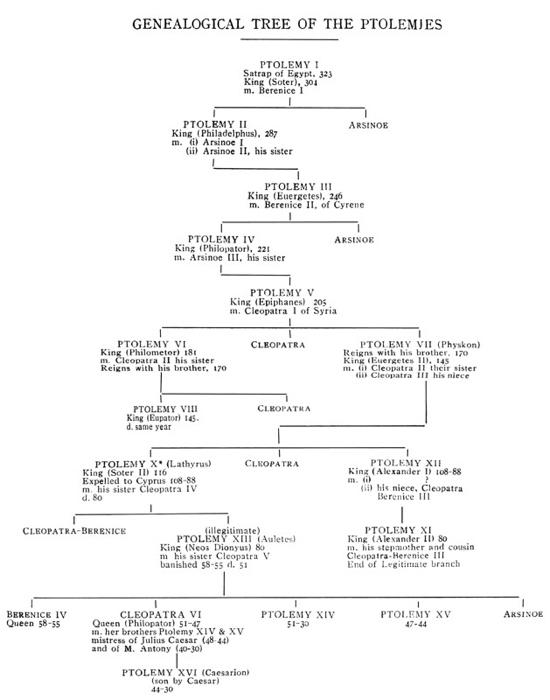
For a larger view, click on illustration.
14He desired neither to Hellenise the world nor to harmonise it. But he was no cynic either. He respected mental as well as material activity. He had been present at the foundation of Alexandria, and had evidently decided that the place would suit him, and now, taking up his abode in the unfinished city, he began to adorn her with architecture and scholarship and song. Rival generals, especially in Asia Minor and Macedonia, occupied much of his energy. At the very beginning of his rule he was involved in a curious war for the possession of the corpse of Alexander, which he had kidnapped as it was on its way from Persia to the Oasis of Ammon. Ptolemy annexed the corpse and much else. Before he died he had assumed the titles of King and of Soter (saviour), and had added to his kingdom Cyrene, Palestine, Cyprus, and parts of the Asia Minor coast. Of this substantial domain Alexandria was the capital, and also the geographic centre. Then, as now, she belonged not so much to Egypt as to the Mediterranean, and the Ptolemies realised this. Up in Egypt they played the Pharaoh, and built solemn archaistic temples like Edfu and Kom Ombo. Down in Alexandria they were Hellenistic.
The second Ptolemy, Philadelphus, (Friend of his Sister), was a more pretentious person than his father. He is famous through the praises of the poets whom he patronised and of the Jews whom he invited, but his personal achievements were slight. Indeed the chief event of his reign is domestic rather than military—in 277 he married his sister Arsinoe. This was as startling to Greek feelings as it is to Christian, but in Egypt he had a prototype in the god Osiris who had married his sister Isis, and he justified the union on the highest sacerdotal grounds. He and Arsinoe were deified as the “Adelphian Gods,” in whose equal veins flowed the uncontaminated blood of their divine father, the general, and their example was followed, when possible, by their successors. It was the pride of race carried to an extreme degree. The royalties of to-day, for fear of debasing their stock, marry first cousins; the Ptolemies, more 15logical, tried to propagate within even narrower limits. In flesh, as in spirit, the dynasty claimed to be apart from common men, and to appear as successive emanations of the Deity, in pairs of male and female. Arsinoe—to come back to earth—was a domineering and sinister woman. She was seven years older than her brother, and when they married he had already a wife, whom she drove from Alexandria by her intrigues. However, he liked her and when, a martyr to indigestion, she died, he was so far inconsolable that he did not marry again.
The closing years of his reign were divided between his mistresses and the gout. During a respite from the latter he looked out of his palace window on some public holiday, and saw beneath him the natives picnicking on the sand, as they do at the feast of Shem-el-Nessem to-day. They were obscure, they were happy. “Why can I not be like them?” sighed the old king, and burst into tears. His reign had been imposing rather than beautiful and had initiated little in Alexandrian civilization beyond the somewhat equivocal item of a mystic marriage. He could endow and patronise. But, unlike Alexander, unlike his father, he could not create. He completed what they had laid down, and appropriated the praise.
Ptolemy Euergetes (Well-doer) was the son of Philadelphus by his first wife. In character he resembled his grandfather. He was a sensible and successful soldier, with a taste for science. By marrying his cousin Berenice, he secured Cyrene which had lapsed—Berenice the most highly praised of all the Ptolemaic Queens, though we know nothing of her character. In their reign the power of Egypt and the splendour of Alexandria came to their height. It is now time to examine that splendour. One hundred years have passed since Alexander laid the foundations. What has been built upon them?
Coins of First Three Ptolemies: Museum, Room 3.
Inscriptions: Museum, Rooms 6, 22.
Ptolemy Euergetes, Statues: Museum, Room 12.
Berenice, Statues: Museum, Rooms 4, 12.
16
THE PTOLEMAIC CITY.
(See Map of Ancient City p. 98).
The following were the most important buildings in the Ptolemaic city.
(i). The Lighthouse.
The Egyptian coast, being mainly alluvial, is difficult to sight from the sea. It was therefore imperative to indicate, by some great monument, where the new city stood. It was desirable too to provide a guide for sailors through the limestone reefs that line the shore. For these reasons the Ptolemies built a lighthouse over four hundred feet high on the Eastern end of Pharos Island (present Fort Kait Bey). Full details are given later (p. 132); here it is enough to note that the Pharos (as it was called) was the greatest practical achievement of the Alexandrian mind and the outward expression of the mathematical studies carried on in the Mouseion; Sostratus, its architect, was contemporary with Eratosthenes and Euclid.
A fortress as well as a beacon, the Pharos was the pivot of the city’s naval defences. It dominated both the harbours, and kept special watch over the more precious of them—the Eastern, which held the Royal fleet. Here the promontory of the Palace stretched towards it. Westward, it could signal over the other harbour to the Chersonese (present Fort Agame). And further west, the system was prolonged into a long line of watch towers and beacons that studded the north African coast, and connected Egypt with her daughter kingdom of Cyrene. One of these towers (that at Abousir) still remains, and shows in miniature what the Pharos must once have been.
Fort Kait Bey (Pharos): p. 132
Coins illustrating Pharos: Museum, Room 2.
Tower of Abousir: p. 102
17(ii). The Palace.
We can locate one point in the Palace, or rather palace-system: it certainly covered the Promontory of Silsileh, which was then both longer and broader than now. But no one knows how far the buildings stretched inland, or along the shore, nor what the architecture was. Each Ptolemy made additions, and the whole formed a special quarter, somewhat like the Imperial City at Pekin. Egypt being an autocracy, the palace was the seat of government as well as royal residence; clerks had their offices there. There was a palace-harbour (left of Silsileh), and an Island Palace or Kiosk called Antirrhodus, which rivalled the glories of Rhodes; Antirrhodus lay in the Eastern Harbour, and rocks, now deep below the surface of the sea, have been identified with it.
Inland, the Palace connected with another great system—that of the Mouseion. On its seaward side, it was prolonged by breakwaters towards the Pharos.
Silsileh (Site of Palace): p. 163
Columns from Locality: Museum, Room 16.
(iii). The Mouseion.
The Mouseion at Alexandria was the great intellectual achievement of the dynasty. Not only did it mould the literature and science of its day, but it has left a permanent impress upon thought. Its buildings have all disappeared, and the very site is conjectural; perhaps it had a facade opposite the Soma, west of the present Rue Nebi Daniel. In its vast areas were lecture halls, laboratories, observatories, a library, a dining hall, a park, and a zoo.
It was founded by Ptolemy Soter, who summoned a follower of Aristotle, Demetrius Phaleras, and ordered him to organise an institution on the lines of the Athenian Mouseion—a philosophic establishment that had contained the library of Aristotle. But the Alexandrian Mouseion soon diverged widely from its model. It was far richer and larger for one thing; the funds being 18administered by a priest who was appointed by the King. And it was essentially a court institution, under palace control, and knew both the advantages and disadvantages of royal patronage. In some ways it resembled a modern university, but the scholars and scientists and literary men whom it supported were under no obligation to teach; they had only to pursue their studies to the greater glory of the Ptolemies.
The most famous element in this enormous institution was the Library—sometimes called the “Mother” library to distinguish it from a later and even greater collection. 500,000 books, and a catalogue that occupied 120. The post of “Librarian” was of immense importance and its holder was the chief official in the Mouseion.
The actual literary and scientific output of the Mouseion will be considered elsewhere (p. 28).
Rue Nebi Daniel (Site of Mouseion?): p. 105
(iv). The Temple of Serapis.
The idea that one religion is false and another true is essentially Christian, and had not occurred to the Egyptians and Greeks who were living together at Alexandria. Each worshipped his own gods, just as he spoke his own language, but he never thought that the gods of his neighbour had no existence, and he was willing to believe that they might be his own gods under another name. The Greeks in particular held this view and had already identified Osiris, god of the world beyond death, with their Dionysus, who was a god of mysteries and also of wine. So when Ptolemy Soter decided to compound a god for his new city, he was only taking advantage of this tendency, and giving a local habitation and a name and a statue to sentiments that already existed.
Osiris was the main ingredient. He was already worshipped on the hill of Rhakotis, and he was the most celebrated of the Egyptian deities. To him was added the bull god Apis, of Memphis, whose cult had been 19recently revived, and out of their names was formed the compound, “Serapis.” But while the origins and title of the new god were Egyptian, his appearance and attributes were Greek. His statue—ascribed to the Greek sculptor Bryaxis—showed him seated in Greek garments upon a classic throne. His features were those of the bearded Zeus, but softened and benign; indeed he more closely resembled Aesculapius, god of Healing, to whom in a civilised age men naturally turned. The basket on his head showed that he was a harvest god, the three-headed Cerberus stood by his side to show that he represented Pluto, god of the underworld.
The Ptolemies could launch such a being without any fear of wounding religious susceptibilities. What they could not have foreseen was his success. Serapis not only fulfilled their immediate political aim of providing the Alexandrians with a common cult. He spread beyond the city, beyond Egypt, and shrines to him arose all over the Mediterranean world. Osiris-Apis-Dionysus-Zeus-Aesculapius-Pluto may seem to us an artificial compound, but it stood the test of time, it satisfied men’s desires, and was to be the last stronghold of Paganism against Christianity.
The Temple stood on the old citadel of Rhakotis, where “Pompey’s Pillar” rises to-day. It was in the midst of a cloister, and colonnades connected it with each of the cloister’s sides. The architecture was Greek: a large hall, and, at the end, the shrine with the god’s statue. As the centuries passed, other buildings were added, and the second and greater of the two Alexandrian libraries—the “Daughter”—was arranged in them.
Temple of Serapis and “Pompey’s” Pillar: p. 144
Statues of Serapis: Museum, Room 16.
Serapis on Coins: Museum, Rooms 2, 3.
Temple at Canopus: p. 180.
(v). The Royal Tombs.
The “Soma” of Alexander became so famous that the earlier Ptolemies were buried close to it, and a mass 20of building—probably Greek in architecture—arose where the present Rue Rosette and Rue Nebi Daniel intersect. Later on, the burial place seems to have been in the Palace enclosure, and perhaps the “Mausoleum” where Cleopatra died was on the promontory of Silsileh, by a little Temple of Isis, within sound of the sea.
Rue Rosette: p. 104
Promontory of Silsileh: p. 163
(vi). Other Buildings.
Theatre and Racecourse. Both were near the Palace: the former was probably on the site of the present Egyptian Government Hospital. Their architecture was Greek.
The Dyke of the Heptastadion was part of Alexander’s scheme. But the Ptolemies completed it and fortified it where it rested on the Island of Pharos.
Egyptian Government Hospital (Site of Theatre): p. 162
Such were the chief buildings and institutions that arose during the first hundred years of the city’s life. Additions were made—notably the “Caesareum,” begun by Cleopatra. But on the whole it may be said that Alexandria was the product of a single scheme, laid down by Dinocrates and executed by the first three Ptolemies, and that she exhibited all the advantages, and perhaps some of the drawbacks, of a town that has been carefully planned. There was the majesty of well considered effects; but there also may have been a little dullness, and there were certainly none of the mysterious touches that reminded Athens and even Rome of an unanalysable past. In one sense the place was more Greek than Greece—built at a date when the Hellenic spirit had freed itself from many illusions and was winning a command over material forces that it had never possessed before. To her also Romance was added in time; but she started brand new, gleaming white, a calculated marvel of marble. Everything in her had been thought out—even her religion.
21
THE LATER PTOLEMIES (B.C. 221-51).
(See Genealogical Tree p. 12).
After the death of Euergetes, the dynasty declines: Some of his successors were able men, but a type evolved that made neither for morality nor for success. The average later Ptolemy is soft; he has the artistic temperament but no passionate love of art; he is born in the Palace at Alexandria and spends all his time there—so much so that it was not known for a year that Ptolemy IV had died; not naturally cruel, he is easily hurried into cruelty; he is unexpectedly shy; in his old age he grows fat, so that the Roman envoy murmurs “at all events the Alexandrians have seen their king walk” when Ptolemy VII comes puffing to greet him along the quay. And as the men soften, the women harden. The dynasty is interwoven with terrific queens. There is the Arsinoe whom Philadelphus married; there is Arsinoe III who faced the Syrian army at Rafa; there is Cleopatra III who murdered her son; and there is the last and greatest Cleopatra, with whom the tangled race expires.
In contrast to this confusion there rises the solid but unattractive figure of Rome (first embassy B.C. 273, first intervention B.C. 200). Her advance was postponed until she had gained the Western Mediterranean by defeating Carthage. She then came forward with studied politeness as the protector of liberty and morals in the East. Legal and self-righteous, she struck a chill into the whole Hellenistic world. She was horrified at its corruption—a corruption of which she never failed to take advantage, and the shattered empire of Alexander fell piece by piece into her hands. The Ptolemies were the allies of this impeccable creature—a curious alliance, but it lasted over 200 years. As the Egyptian fleet and army decayed, Rome’s ministrations multiplied. She 22declared herself guardian of the dynasty; then that one of the Ptolemies had bequeathed Egypt to her in a will that she never produced. The dynasty became, with Ptolemy XIII, illegitimate, and Rome made him pay her to recognise his legitimacy. When he was driven from Egypt (B.C. 89) she made him pay her to restore him. He was escorted back by an army of creditors, and to raise the necessary sum of ten thousand talents he had to grind down the people with taxes. Rome was shocked, but firm.
Against this relentless advance Alexandria could do nothing. She was the brain of Egypt, and its five senses too and, as each embassy touched her quays, she realised, as the priest-ridden towns of the interior could not, that the glory was departing from the Nile. There was only one hope. Would Rome, before she could annex Egypt, fall to pieces herself? There were signs of it. The victorious republic had absorbed more plunder and more ideas than she could conveniently digest. She had always found it particularly difficult to digest an idea. Rival Ptolemies had contended in Alexandria. But rival Romans were now contending in Rome. Might it be possible to play off against one the other, and so win through to safety? The scheme commended itself to the Alexandrians. It also occurred to the daughter of the bankrupt Ptolemy XIII, a beautiful and amusing princess called Cleopatra.
Coins of Later Ptolemies: Museum, Room 3.
Portrait of Ptolemy iv: Museum, Room 12.
Inscription to Ptolemy vii: Museum, Garden Court.
Caricature of Roman Senator as a rat: Museum, Room 13.
23
CLEOPATRA (B.C. 51-30).
(See Genealogical Tree p. 12).
The girl who came to the throne as Cleopatra VI Philopator was only seventeen. Her brother and husband Ptolemy XIV was ten; her younger brother eight, her sister fifteen. The palace at Alexandria became a nursery, where four clever children watched the duel that was proceeding between Pompey and Caesar beyond the seas. Pompey was their guardian, but they had no illusions, either about him or one another. All they cared for was life and power. Cleopatra failed in her first intrigue, which was directed against her husband. He expelled her, and in her absence the duel was concluded. Pompey, defeated by Caesar, drifted to Egypt, threw himself on the mercy of his wards, and was murdered by their agents as he disembarked.
With the arrival of Caesar, Cleopatra’s triumphs began. She did not differ in character from the other able and unscrupulous queens of her race, but she had one source of power that they denied themselves—the power of the courtesan—and she exploited it professionally. Though passionate, she was not the slave of passion, still less of sentimentality. Her safety, and the safety of Egypt were her care; the clumsy and amorous Romans, who menaced both, were her natural prey. In old times, a queen might rule from her throne. Now she must descend and play the woman. Having heard that Caesar was quartered at the Palace, Cleopatra returned to Alexandria, rolled herself up in a bale of oriental carpets and was smuggled to him in this piquant wrapper. The other children protested, but her first victory had been won; she could count on the support of Julius Caesar against her husband.
24Caesar’s own position, was, however, most insecure. He was Lord of the World, but in his haste to catch Pompey he had hurried ahead of his legions. When the glamour of his arrival had worn off the Alexandrians realised this, and in a fierce little war (Aug. 48—Jan. 47) tried to crush him before reinforcements arrived. He held the Palace (near Chatby) the Theatre (Egyptian Government Hospital); also part of the Eastern Harbour where his small fleet lay. They held the rest of the town, including the Western Harbour and the Island, and they had with them Cleopatra’s sister who had escaped from the palace and, later, Ptolemy XIV himself,—so that they could claim to represent the dynasty.
It was indeed a national rising against the Romans and ably conducted. Five stages (see Map. p. 98).
(1). Siege of the Palace.—This was succeeding by land but failed by sea, when Caesar, making a sudden excursion down the docks of the Eastern Harbour, set fire to the Alexandrian fleet. The flames spread to the Mouseion and the Library (“Mother” Library) was burnt. An attempt to contaminate the palace water supply also failed; when the Alexandrians pumped salt water into the conduit, the besieged Romans bored wells in the Palace enclosure.
(2). First Naval Engagement.—Caesar’s reinforcements had begun to arrive, and a heavy east wind had carried them past the entrance of his harbour. He went out to tow them in, and the Alexandrians issued from their own harbour—the Western—to intercept him. They failed.
(3). Second Naval Engagement and loss of the Island of Pharos.—Issuing from his harbour, Caesar rounded Ras-el-Tin and deployed outside the line of reefs that stretch from it to Agame and guard the entrance to the Western Harbour. The Alexandrians waited inside. Dashing through the entrance he pressed them against the quays of Rhakotis and defeated them. Now he could attack the Island on both sides. On the following day it fell and he made it his headquarters, thus changing the strategy of the war.
(4). Battle of the Dyke.—Caesar now blocked up the arches that penetrated the Heptastadion so that the Alexandrians could not manœuvre from harbour to harbour. Then he tried to force his way into the town. He employed too many troops, and landing in his rear the Alexandrians threw him into confusion. He himself had to jump from the dyke and swim to a boat. Victory. They recaptured the whole of the Heptastadion and reopened its arches.
25(5). Battle by the Nile.—The war was after all decided outside Alexandria. More reinforcements were coming to Caesar down the Canopic mouth of the Nile and the Alexandrians marched out to intercept them there. The young Ptolemy XIV was their general now. He was defeated and drowned, his army was destroyed, and Caesar returned in triumph to its city and to Cleopatra.
Cleopatra’s fortune now seemed assured. Having married her younger brother (as Ptolemy XV) she went for a trip with Caesar up the Nile to show him its antiquities. The Egyptians detested her as their betrayer but she was indifferent. She bore Caesar a son and followed him to Rome, there to display her insolence. She was at the height of her beauty and power when the blow fell. On the Ides of March, B.C. 44, Caesar was murdered. She had chosen the wrong lover after all.
Back in Alexandria again, she watched the second duel—that between Mark Antony and Caesar’s murderers. She helped neither party, and when Antony won he summoned her to explain her neutrality. She came, not in a carpet but in a gilded barge, and her life henceforward belongs less to history than to poetry. It is almost impossible to think of the later Cleopatra as an ordinary person. She has joined the company of Helen and Iseult. Yet her character remained the same. Voluptuous but watchful, she treated her new lover as she had treated her old. She never bored him, and since grossness means monotony she sharpened his mind to those more delicate delights, where sense verges into spirit. Her infinite variety lay in that. She was the last of a secluded and subtle race, she was a flower that Alexandria had taken three hundred years to produce and that eternity cannot wither, and she unfolded herself to a simple but intelligent Roman soldier.
Alexandria, now reconciled to her fate and protected by the legions of Antony, became the capital of the Eastern world. The Western belonged to Octavian, Caesar’s nephew, and a third duel was inevitable. It was postponed for some years, during which Antony acquired and deserted a Roman wife, and Cleopatra bore 26him several children. Her son by Julius Caesar was crowned as Ptolemy XVI, with the additional title of King of Kings. Antony himself became a God, and she built a temple to him, afterwards called the Caesareum, and adorned by two ancient obelisks (Cleopatra’s Needles). This period of happiness and splendour ended in the naval disaster of Actium in the Adriatic, where Octavian defeated their combined fleets. The defeat was hastened by Cleopatra’s cowardice. At the decisive moment she fled with sixty ships, actually breaking her way through Antony’s line from the rear, and throwing it into confusion. He followed her to Alexandria, and there, when the recriminations had ceased, they resumed their life of pleasures that were both shadowed and sharpened by the approach of death. They made no attempt to oppose the pursuing Octavian. Instead, they formed a Suicide Club, and Antony, to imitate the misanthrope Timon, built a hermitage in the Western Harbour which he called Timonium. Nor was religion silent. The god Hercules, whom he loved and who loved him, was heard passing away from Alexandria one night in exquisite music and song.
Arrival of Octavian. He is one of the most odious of the world’s successful men and to his cold mind the career of Cleopatra could appear as nothing but a vulgar debauch. Vice, in his opinion, should be furtive. At his approach, Antony after resisting outside the Canopic Gate (at “Caesar’s Camp”) retreated into the city and fell upon his sword. He was carried, dying, to Cleopatra, who had retired into their tomb, and their story now rises to the immortality of art. Shakespeare drew his inspiration from Plutarch, who was himself inspired, and it is difficult through their joint emotion to realise the actual facts. The asp, for example, the asp is not a certainty. It was never known how Cleopatra died. She was captured and taken to Octavian, with whom even in Antony’s life-time she had been intriguing, for the courtesan in her persisted. She appeared this time not in a carpet nor yet in a barge, but upon a sofa, 27in the seductive negligence of grief. The good young man was shocked. Realising that he intended to lead her in his triumph at Rome, realising too that she was now thirty-nine years old, she killed herself. She was buried in the tomb with Antony; and her ladies Charmion and Iras, who died with her, guarded its doors as statues of bronze. Alexandria became the capital of a Roman Province.
Coin of Cleopatra: Museum, Room 3.
Portrait of Cleopatra (?): Museum, Room 12.
Death of Cleopatra in Plutarch, Shakespeare and Dryden: Appendix p. 214.
Inscription to Antony: Museum, Room 6.
Colossus of Antony: Museum, Garden Court.
Site of Caesareum: p. 161.
Shrine of Pompey (?): p. 155.
Departure of the God Hercules: p. 98.
Thus the career of the Greco-Egyptian city closes, as it began, in an atmosphere of Romance. Cleopatra is of course a meaner figure than Alexander the Great. Ambition with her is purely selfish; with Alexander it was mystically connected with the welfare of mankind. She knows nothing beyond the body and so shrinks from discomfort and pain: Alexander attained the strength of the hero. Yet for all their differences, the man who created and the woman who lost Alexandria have one element in common: monumental greatness; and between them is suspended, like a rare and fragile chain, the dynasty of the Ptolemies. It is a dynasty much censored by historians, but the Egyptians, who lived under it, were more tolerant. For it had one element of greatness: it did represent the complex country that it ruled. In Upper Egypt it carried on the tradition of the Pharaohs: on the coast it was Hellenistic and in touch with Mediterranean culture. After its extinction, the vigour of Alexandria turns inwards. She is to do big things in philosophy and religion. But she is no longer the capital of a kingdom, no longer Royal.
28
PTOLEMAIC CULTURE.
Before leaving the Ptolemies, let us glance back at their civilisation. We have seen how they founded two great institutions, the Palace and the Mouseion, which communicated with one another, and which stretched from the promontory of Silsileh to some point inland—as far as the modern railway station, perhaps. It was in this area, among gardens and colonnades, that the culture of Alexandria came into being. The Palace provided the finances and called the tune: the Mouseion responded with imagination or knowledge; the connection between them was so intimate as almost to be absurd. When, for instance, Queen Berenice the wife of Euergetes lost her hair from the temple where she had dedicated it, it was the duty of the court astronomer to detect it as a constellation and of the court poet to write an elegy thereon. And Stratonice, who was perfectly bald, presented an even more delicate problem; she sent over a message to the Mouseion that something must be written about her hair also. Victory odes, Funeral dirges, Marriage hymns, jokes, genealogical trees, medical prescriptions, mechanical toys, maps, engines of war: whatever the Palace required it had only to inform the Mouseion, and the subsidised staff set to work at once. The poets and scientists there did nothing that would annoy the Royal Family and not much that would puzzle it, for they knew that if they failed to give satisfaction they would be expelled from the enchanted area, and have to find another patron or starve. It was not an ideal arrangement, as outsiders were prompt to point out, and snobbery and servility taint the culture of Alexandria from the first. It sprang up behind walls, it never knew loneliness, nor the glories and the dangers of independence, and the marvel is that it flourished as well as it did. At all events it is 29idle to criticise it for not being different, for if it had been different it would not have been Alexandrian. In spirit as in fact the Palace and the Mouseion touched, and the Palace was the stronger and the older. The contact strangled Philosophy and deprived Literature of such sustenance as Philosophy can bring to her. But it encouraged Science and gave even to Literature certain graces that she had hitherto ignored.
Temple where Berenice dedicated her Hair: p. 183.
(A) LITERATURE.
Callimachus, about 310-240.
Apollonius of Rhodes, 260-188.
Theocritus, about 320-250.
The literature that grew up in the Mouseion had no lofty aims. It was not interested in ultimate problems nor even in problems of behaviour, and it attempted none of the higher problems of art. To be graceful or pathetic or learned or amusing or indecent, and in any case loyal—this sufficed it, so that though full of experiments it is quite devoid of adventure. It developed when the heroic age of Greece was over, when liberty was lost and possibly honour too. It was disillusioned, and we may be glad that is was not embittered also. It had strength of a kind, for it saw that out of the wreck of traditional hopes three good things remained—namely the decorative surface of the universe, the delights of study, and the delights of love, and that of these three the best was love. Ancient Greece had also sung of love, but with restraint, regarding it as one activity among many. The Alexandrians seldom sang of anything else: their epigrams, their elegies and idylls, their one great epic, all turn on the tender passion, and celebrate it in ways that previous ages had never known, and that future ages were to know too well. Darts and hearts, sighs and eyes, breasts and chests, all originated in 30Alexandria and from the intercourse between Palace and Mouseion—stale devices to-day, but then they were fresh.
Who sculptured Love and set him by the pool,
thinking with water such a fire to cool?[1]
runs a couplet ascribed to one of the early Librarians, and containing in brief the characteristics of the school—decorative method, mythological allusiveness, and the theme of love. Love as a cruel and wanton boy flits through the literature of Alexandria as through the thousands of terra cotta statuettes that have been exhumed from her soil; one tires of him, but it is appropriate that he should have been born under a dynasty that culminated in Cleopatra.
Literature took its tone from Callimachus—a fine poet, though not as fine as his patrons supposed. He began life as a schoolmaster at Eleusis (the modern Nouzha) and then was called to the Mouseion, where he became Librarian under Euergetes. His learning was immense, his wit considerable, his loyalty untiring. It was he who wrote the poem about Berenice’s hair. Dainty and pedantic in all that he did, he announced that “a big book is a big nuisance” and cared more about neatness of expression than depth of feeling, though the feeling emerges in his famous epigram:
Someone told me, Heracleitus, of your end;
and I wept, and thought how often you and I
sunk the sun with talking. Well! and now you lie
antiquated ashes somewhere, Carian friend.
But your nightingales, your songs, are living still;
them the death that clutches all things cannot kill.[2]
Only once was this exquisite career interrupted. There was among his pupils a young man from Rhodes with thin legs, by name Apollonius. Apollonius was ambitious to write an Epic—a form of composition detested by Callimachus, and opposed to all his theories. In vain he objected; Apollonius, then only eighteen, gave in the 31Mouseion a public reading of the preliminary draft of his poem. A violent quarrel was the result, Apollonius was expelled, and Callimachus wrote a satire called the Ibis, in which his rival’s legs and other deficiencies were exposed. The friends of Apollonius retorted with equal spirit, and the tranquillity of the Mouseion was impaired. Callimachus won, but his victory was not eternal; after his death Apollonius was recalled to Alexandria, and in time became librarian there in his turn.
The Epic Apollonius insisted on writing has survived. It is modelled on Homer and deals with the voyage of the Argo to recover the Golden Fleece. But there is nothing Homeric in the treatment and though we are supposed to be in barbaric lands we never really leave the cultivated court of the Ptolemies. Love is still the ruling interest. He slips, the naughty little boy, into the Palace of Medea, and shoots his tiny dart at her, to inspire her with passion for Jason. So might he have inspired Queen Berenice or Arsinoe. Pains, languors, and raptures succeed, and the theme of the heroic quest is forgotten. Callimachus can have found nothing to object to in such a poem except its length, for it is typical of his school. Its pictorial method is also characteristic of Alexandria; many of the episodes might be illustrated by terra cotta statues and gems.
But one of the poets who worked in the Mouseion—Theocritus—was a genius of a very different kind, a genius that Alexandria matured but cannot be said to have formed. Theocritus came here late in his career. He had been born at Cos and had lived in Sicily, and he arrived full of memories that no town-dweller could share—memories of fresh air and the sun, of upland meadows and overhanging trees, of goats and sheep, of the men and the women who looked after them, and of all the charm and the coarseness that go to make up country life. He had thrown these memories into poetical form, sometimes idealising them, sometimes giving them crudely, and he had called these poems Idylls—little 32pictures of rural existence. Love, mythological fancies, decorative treatment—he liked these things too, but he backed them with a width of experience and a zest for it that Callimachus and Apollonius never knew. While they are “Classics” who have to be studied, Theocritus appeals to us at once; his Fifteenth Idyll, describing life in the Greek Quarter at Alexandria, is as vivid now as when he wrote it. The dialogue with which it opens can be heard to-day in any of the little drawing rooms of Camp de César or Ibrahimieh. Praxinoe, a lady of the middle classes, is discovered seated, doing nothing in particular. In comes Gorgo, her friend.
Gorgo. Is Praxinoe at home?
Praxinoe. Oh my dear Gorgo, it’s ages since you were here. She is at home. The wonder is that you’ve come even now. (calls to the maid). Eunoe, give her a chair and put a cushion on it.
Gorgo. Oh it does beautifully as it is.
Praxinoe. Sit down!
G. My nerves are all to bits—Praxinoe, I only just got here alive ... what with the crowd, what with the carriages ... soldiers’ boots—soldiers’ great-coats, and the street’s endless—you really live too far.
P. That’s my insane husband. We took this hut—one can’t call it a house—at the ends of the earth so that we shouldn’t be neighbours. Mere jealousy. As usual.
G. But, dear, don’t talk about your husband when the little boy’s here—he’s staring at you. (to the little boy) Sweet pet—that’s all right—she isn’t talking about papa.—Good Heavens, the child understands.—Pretty papa!
P. The other day, papa—we seem to call every day the other day—the other day he went to get some soda at the Baccal and brought back salt by mistake—the great overgrown lout.
G. Mine’s exactly the same, he....[3]
And so on. But Gorgo wants to go out again, in spite of her nerves. It is the Feast of the Resurrection—the Resurrection of Adonis—and there is to be a magnificent service inside the Palace, with a special singer, Praxinoe decides to venture too, and puts on the dress with the full body, that cost “at least eight pounds,” excluding 33embroidery. They are ready at last and then the little boy begins to scream; he wishes to be of the party. But his mother remarks, “cry as much as you like, I cannot have you lamed,” and takes Eunoe instead. In the street the crush is terrific, they are terrified of the Egyptians (just like Greek ladies to-day) and Eunoe, who is always awkward, nearly falls under a horse. The battle at the Palace Gate is worse still, Praxinoe’s best muslin veil is torn, and she is more thankful than ever that she did not bring her little boy. But for a kind gentleman in the crowd, they would never have got in. Once inside, all is enjoyment. The draperies are gorgeous as might be expected when the Queen Arsinoe is paying for them—Arsinoe the wife of Philadelphus. And here is a Holy Sepulchre on which lies an image of Adonis, the down of early manhood just showing on his cheeks! The ladies are in ecstacies and can scarcely quiet themselves to listen to the Resurrection Hymn. In this Hymn Theocritus displays the other side of his genius—the “Alexandrian” side. He is no longer the amusing realist, but an erudite poet, whose chief theme is love.
O Queen that lovest Golgi and Idalium and Eryx, O Aphrodite that playest with gold—lo from the everlasting stream of Hades they have brought thee back Adonis.... A bridegroom of eighteen or nineteen years is he, his kisses are not yet rough, the golden down being yet on his lips.... Thou only, dear Adonis, so men tell, visitest both this world and the stream of Hades. For Agamemnon had no such fate, nor Ajax the wrathful, nor Hector the first-born of Hecuba, nor Patroclus, nor Pyrrhus that returned out of Troy, nor the heroes of yet more ancient days.... Be gracious now, dear Adonis, and bless us in the coming year. Dear has thy resurrection been, and dear shall it be when thou comest again.
A beautiful hymn; but as Gorgo remarks “all the same it’s time to be getting home; my husband hasn’t had his dinner and when he’s kept waiting for his dinner he’s as sour as vinegar.” They salute the risen god, and go.
This delightful Idyll is not quite characteristic of Theocritus—he generally sings of Shepherds and their 34flocks. But it is his great contribution to the literature of Alexandria, and our chief authority for daily life under the Ptolemies. History is too much an affair of armies and kings. The Fifteenth Idyll corrects the error. Only through literature can the past be recovered and here Theocritus, wielding the double spell of realism and of poetry, has evoked an entire city from the dead and filled its streets with men. As Praxinoe remarks of the draperies “Why the figures seem to stand up and to move, they’re not patterns, they are alive.”
The Mouseion was at its best under the first three Ptolemies. Then it declined—at least in its literary output—and though Alexandria turned out poems, etc. for several hundred years, few of them merit attention. With the coming of the Romans her genius took a new line, and essayed the neglected paths of philosophy and religion. But she remained attractive to men of letters, and nearly every writer of note visited her in the course of his travels.
Statuettes of Loves: Museum, Room 18.
Nouzha (birthplace of Callimachus): p. 156
(B) SCHOLARSHIP.
In the Mouseion at Alexandria Greece first became aware of her literary heritage, and the works of the past were not only collected in the Library but were codified, amended, and explained. Scholarship dates from Zenodotus, the first Librarian. He turned his attention to Homer, divided the Iliad and Odyssey into “Books,” struck out spurious verses from the text, marked doubtful ones, and introduced new readings. He gave a general impulse to research. Hitherto the Greek language had developed unnoticed. Now it was consciously examined, and the result of the examination was the first Greek Grammar (about 100 B.C.). Grammar is a valuable subject but also a dangerous one, 35for it naturally attracts pedants and schoolmasters and all who think that Literature is an affair of rules. And the Grammarians of Alexandria forgot that they were merely codifying the usages of the past, and presumed to dictate to the present, and to posterity; they set a bad example that has been followed for nearly 2000 years. Greek accents—another doubtful boon—were also invented in the Mouseion. Indeed the whole of literary scholarship, as we know it, sprang up, including that curious by-product the Scholarly Joke. For instance: one learned man wrote a poem that had, when transcribed, the shape of a bird, another wrote a poem in the shape of a double-headed axe, and a third re-wrote the whole of the Odyssey without using the letter S. The donnish wit of the Mouseion infected the Palace, and was practiced by the Ptolemies themselves. One scholar, Sosibius by name, complained to King Philadelphus that he had not received his salary. The King replied “The first syllable of your name occurs in Soter, the second in Sosigenes, the third in Bion, and the fourth in Apollonius; I have paid these four gentlemen, and therefore I have paid you.”
(C) ART.
Unimportant. Alexandria had her special industries—e.g. glass, terra cotta, “Egyptian Queen” pottery, and woven stuffs, and her mint was famous; but for creative artists the Ptolemies looked over seas. Greek and Egyptian motives did not blend in Art as they did in Religion; attempts occur, but they are not notable and on the whole the city follows the general Hellenistic tendencies of the time. These tendencies led as we have seen away from the ideal and the abstract, and towards portraiture and the dainty and the picturesque. Men had lost for the time many illusions, both religious and 36political, and were trying to beautify their private lives, and the tombs of those whom they had loved.
Glass and “Egyptian Queen” Pottery: Museum, Room 17.
terra cottas: Museum, Room 18.
Ptolemaic Coins: Museum, Room 3.
Blend of Greek and Egyptian Motives: Museum Rooms 11 and 15; also Kom es Chogafa Catacombs, (p. 148).
Tomb Ornaments: Museum, Rooms 17-22.
(D) PHILOSOPHY.
Unimportant. The Ptolemies imported some second-rate disciples of Aristotle to give tone to the Mouseion, but took no interest in the subject, and were indeed averse to it, since it might lead to freedom of thought. It was not until their dynasty was extinct that the great school of Alexandrian Philosophy arose. (See p. 60, under heading “The Spiritual City.”)
(E) SCIENCE.
The Ptolemies were more successful over Science than over Literature. They preferred it, for it could not criticise their divine right. Its endowment was the greatest achievement of the dynasty and makes Alexandria famous until the end of time. Science had been studied in Ancient Greece, but sporadically: there had been no co-ordination, no laboratories, and though important truths might be discovered or surmised, they were in danger of oblivion because they could not be popularised. The foundation of the Mouseion changed all this. Working under royal patronage and with every facility, science leapt to new heights, and gave valuable gifts to mankind. The third century B.C. is (from this point of view) the greatest period that civilisation has ever known—greater even than the nineteenth century A.D. It did not bring happiness or wisdom: science never does. But it explored the physical universe and harnessed 37many powers for our use. Mathematics, Geography, Astronomy, Medicine, all grew to maturity in the little space of the land between the present Rue Rosette and the sea, and if we had any sense of the fitting, some memorial to them would arise on the spot to-day.
(i). Mathematics.
Mathematics begin with the tremendous but obscure career of Euclid. Nothing is known about Euclid: indeed one thinks of him to-day more as a branch of knowledge than as a man. But Euclid was once alive, landing here in the reign of Ptolemy Philadelphus, and informing that superficial monarch that there is “no royal road to geometry.” Here he composed, among other works, his “Elements” in which he incorporated all previous knowledge, and which have remained the world’s text book for Geometry almost down to the present day. Here he founded a mathematical school that lasted 700 years, and acknowledged his leadership to the last. Apollonius of Perga, who inaugurated the study of Conic Sections, was his immediate pupil: Hyspicles added to the thirteen books of his “Elements” two books more: and Theon—father to the martyred Hypatia—edited the “Elements” and gave them their present form, so that from first to last the mathematicians of Alexandria were preoccupied with him. An insignificant man, according to tradition, and very shy; his snub to Philadelphus seems to have been exceptional.
(ii). Geography.
In Geography there are two leading figures—Eratosthenes and Claudius Ptolemy. Eratosthenes is the greater. He seems to have been an all round genius, eminent in literature as well as science. He was born at Cyrene in B.C. 276 and, on the death of Callimachus, was invited to Alexandria to become librarian. It was in the Mouseion observatory that he measured the Earth—perhaps not the greatest achievement of Alexandrian science, but certainly the most thrilling. His method was as follows. He knew that the earth is round, and he was told that the midsummer sun at Assouan in Upper Egypt cast no shadow at midday. At Alexandria, at the same moment, it did cast a shadow, Alexandria being further to the north on the same longitude. On measuring the Alexandria shadow he found that it was 7⅕ degrees—i.e. 1/50th of a complete circle—so that the distance from Alexandria to Assouan must be 1/50th the circumference of the Earth. He estimated the distance at 500 miles, and consequently arrived at 250,000 miles for the complete circumference, and 7,850 for the diameter; in the latter calculation he is only 50 miles out. It is strange that when science had once gained such triumphs mankind should ever have slipped back again into fairy tales and barbarism.
38
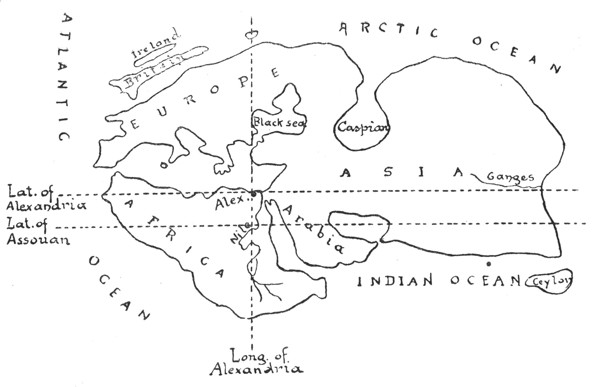
The World according to Eratosthenes B.C. 250
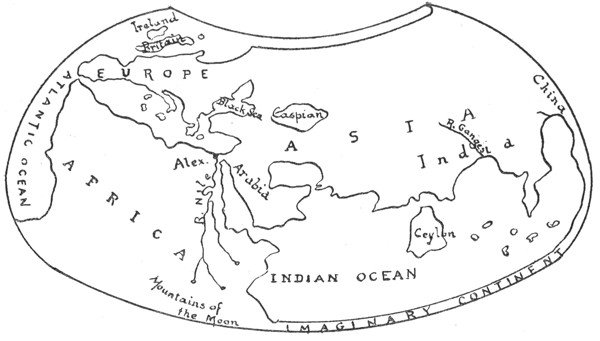
The World according To Claudius Ptolemy A.D. 100
40The other great work of Eratosthenes was his “Geographies,” including all previous knowledge on the subject, just as the “Elements” of Euclid had included all previous mathematical knowledge. The “Geographies” were in three books, and to them was attached a map of the known world. (See p. 37). It is, of course, full of inaccuracies—e g. Great Britain is too large, India fails to be a peninsula and the Caspian Sea connects with the Arctic Ocean. But it is conceived in the scientific spirit. It represents the world as Eratosthenes thought it was, not as he thought it ought to be. When he knows nothing, he inserts nothing; he is not ashamed to leave blank spaces. He bases it on such facts as he knew, and had he known more facts he would have altered it.
The other great geographer, Claudius Ptolemy, belongs to a later period (A.D. 100) but it is convenient to notice him here. Possibly he was a connection of the late royal family, but nothing is known of his life. His fame has outshone Eratosthenes’, and no doubt he was more learned, for more facts were at his disposal. Yet we can trace in him the decline of the scientific spirit. Observe his Map of the World (p. 39). At first sight it is superior to the Eratosthenes Map. The 41Caspian Sea is corrected, new countries—e.g. China—are inserted, and there are (in the original) many more names. But there is one significant mistake. He has prolonged Africa into an imaginary continent and joined it up to China. It was a mere flight of his fancy: he even scattered this continent with towns and rivers. No one corrected the mistake and for hundreds of years it was believed that the Indian Ocean was land bound. The age of enquiry was over, and the age of authority had begun, and it is worth noting that the decline of science at Alexandria exactly coincides with the rise of Christianity.
(iii). Astronomy and the Calendar.
Astronomy develops on the same lines as Geography. There is an early period of scientific research under Eratosthenes, and there is a later period in which Claudius Ptolemy codifies the results and dictates his opinions to posterity. He announced, for example, that the Universe revolves round the Earth, and this “Ptolemaic” Theory was adopted by all subsequent astronomers until Galileo, and supported by all the thunders of the Church. Yet another view had been put forward, though Ptolemy ignores it. Aristarchus of Samos, working at Alexandria with Eratosthenes, had suggested that the earth might revolve round the sun, and it is only a chance that this view was not stamped as official and imposed as orthodox all through the Middle Ages. We do not know what Aristarchus’ arguments were, for his writings have perished, but we may be sure that, working in the 3rd century B.C., he had arguments and did not take refuge in authority. Astronomy under the Ptolemies was a serious affair—lightened only by the episode of Berenice’s Hair.
As to the Calendar. The Calendar we now use was worked out in Alexandria. The Ancient Egyptians had calculated the year at 365 days. It is actually 365 ¼, so before long they were hopelessly out; the official Harvest Festival, for instance, only coincided with the 42actual harvest once in 1,500 years. They were aware of the discrepancy, but were too conservative to alter it: that was left to Alexandria. In B.C. 239 the little daughter of Ptolemy Euergetes died, and the priests of Serapis at Canopus passed a decree making her a goddess. A reformer even in his grief, the King induced them to rectify the Calendar at the same time by decreeing the existence of a Leap Year, to occur every four years, as at present; he attempted to harmonise the traditions of Egypt with the science of Greece. The attempt—so typical of Alexandria—failed, for though the priests passed the decree they kept to their old chronology. It was not until Julius Caesar came to Egypt that the cause of reform prevailed. He established the “Alexandrian Year” as official, and modelled on it the “Julian,” which we use in Europe to-day; the two years were of the same length, but the “Alexandrian” retained the old Egyptian arrangement of twelve equal months.
(iv). Medicine.
Erasistratus (3rd. cent. B.C.) is the chief glory of the Alexandrian medical school. In his earlier life he had been a great practitioner, and had realised the connection between sexual troubles and nervous breakdowns. In his old age he settled in the Mouseion, and devoted himself to research. He practised vivisection on animals, and possibly on criminals, and he seems to have come near to discovering the circulation of the blood. Less severely scientific were the healing cults that sprang up in the great temples of Serapis, both at Alexandria and at Canopus;—cults that were continued into Christian times under other auspices.
Site of Mouseion: p. 105.
Map of Eratosthenes: p. 37.
Map of Claudius Ptolemy: p. 39.
Temple of Serapis at Canopus: p. 180.
“ ” Alexandria: p. 144.
43
SECTION II.
CHRISTIAN PERIOD.
44
THE RULE OF ROME (B.C. 30—A.D. 313).
Octavian (Augustus) the founder of the Roman Empire, so disliked Alexandria that after his triumph over Cleopatra he founded a town near modern Ramleh—Nicopolis, the “City of Victory.” He also forbade any Roman of the governing classes to enter Egypt without his permission, on the ground that the religious orgies there would corrupt their morals. The true reason was economic. He wanted to keep the Egyptian corn supply in his own hands, and thus control the hungry populace of Rome. Egypt, unlike the other Roman provinces, became a private appanage of the Emperor, who himself appointed the Prefect who governed it, and Alexandria turned into a vast imperial granary where the tribute, collected in kind from the cultivators, was stored for transhipment. It was an age of exploitation. Octavian posed locally as the divine successor of the Ptolemies, and appears among hieroglyphs at Dendyra and Philae. But he had no local interest at heart.
After his death things improved. The harsh ungenerous Republic that he had typified passed into Imperial Rome, who, despite her moments of madness, brought happiness to the Mediterranean world for two hundred years. Alexandria had her share of this happiness. Her new problem—riots between Greeks and Jews—was solved at the expense of the latter; she gained fresh trade by the improved connections with India (Trajan A.D. 115, recut the Red Sea Canal); she was visited by a series of appreciative Emperors on their way to the antiquities of Upper Egypt.
In about A.D. 250 she, with the rest of the Empire, reentered trouble. The human race, as if not designed to enjoy happiness, had slipped into a mood of envy and 45discontent. Barbarians attacked the frontiers of the Empire, while within were revolts and mutinies. The difficulties of the Emperors were complicated by a religious problem. They had, for political reasons, been emphasising their own divinity—a divinity that Egypt herself had taught them: it seemed to them that it would be a binding force against savagery and schism. They therefore directed that everyone should worship them. Who could have expected a protest, and a protest from Alexandria?
Ramleh (Nicopolis): p. 165.
Statue of Emperor (Marcus Aurelius): Museum, Room 12.
Imperial Coins: Museum, Room 2.
Certificates to Roman Soldiers: Museum, Room 6.
THE CHRISTIAN COMMUNITY.
According to the tradition of the Egyptian Church, Christianity was introduced into Alexandria by St. Mark, who in A.D. 45 converted a Jewish shoemaker named Annianus, and who in 62 was martyred for protesting against the worship of Serapis. There is no means of checking this tradition; the origins of the movement were unfashionable and obscure, and the authorities took little notice of it until it disobeyed their regulations. Its doctrines were confounded partly with the Judaism from which they had sprung, partly with the other creeds of the city. A letter ascribed to the emperor Hadrian (in Alexandria 134) says “Those who worship Serapis are Christians, and those who call themselves bishops of Christ are devoted to Serapis,” showing how indistinct was the impression that the successors of St. Mark had made. The letter continues “As a race of men they are seditious, vain, and spiteful; as a body, wealthy and prosperous, of whom nobody lives in idleness. Some blow glass, some make paper, and others linen. 46Their one God is nothing peculiar; Christians, Jews, and all nations worship him. I wish this body of men was better behaved.”
The community was organised under its “overseer” or bishop, who soon took the title of patriarch, and appointed bishops elsewhere in Egypt. The earliest centres were (i) the oratory of St. Mark which stood by the sea shore—probably to the east of Silsileh—and was afterwards enlarged into a Cathedral; (ii) a later cathedral church dedicated (285) by the Patriarch Theonas to the Virgin Mary; it was on the site of the present Franciscan Church by the Docks. (iii) a Theological College—the “Catechetical School,” founded about 200, where Clement of Alexandria and Origen taught—site unknown.
It was its “bad behaviour,” to use Hadrian’s term, that brought the community into notice—that is to say, its refusal to worship the Emperors. To the absurd spiritual claims of the state, Christianity opposed the claims of the individual conscience, and the conflict was only allayed by the state itself becoming Christian. The conflict came to its height in Alexandria, which, more than any other city in the Empire, may claim to have won the battle for the new religion. Persecution, at first desultory, grew under Decius, and culminated in the desperate measures of Diocletian (303)—demolition of churches, all Christian officials degraded, all Christian non-officials enslaved. Diocletian, an able ruler—the great column miscalled Pompey’s is his memorial—did not persecute from personal spite, but the results were no less appalling and definitely discredited the pagan state. While we need not accept the Egyptian Church’s estimate of 144,000 martyrs in nine years, there is no doubt that numbers perished in all ranks of society. Among the victims was St. Menas, a young Egyptian soldier who became patron of the desert west of Lake Mariout, where a great church was built over his grave. St. Catherine of Alexandria is also said to have died under Diocletian, but it is improbable that she ever lived; she and her 47wheel were creations of Western Catholicism, and the land of her supposed sufferings has only recognised her out of politeness to the French. The persecution was vain, the state was defeated, and the Egyptian Church, justly triumphant, dates its chronology, not from the birth of Christ, but from the “Era of Martyrs” (A.D. 284). A few years later the Emperor Constantine made Christianity official, and the menace from without came to an end.
Coin of Hadrian at Alexandria: Museum, Room 2.
Site of St. Mark’s: p. 163.
Capital from St. Mark’s: Museum, Room 1.
Site of St. Theonas: p. 170.
Column from St. Theonas: p. 163.
Statue of Diocletian: Museum, Room 17.
Coins of Diocletian: Museum, Room 4.
Pompey’s (Diocletian’s) Pillar: p. 144.
Church of St. Menas: p. 195.
Remains from St. Menas: Museum, Rooms 1, 2, 5.
Modern Church of St. Catherine: p. 142.
Pillar of St. Catherine: p. 106.
Certificate of having worshipped the Gods: Museum, Room 6.
ARIUS AND ATHANASIUS. (4th Cent. A.D.)
It was natural that Alexandria, who had suffered so much for Christianity, should share in its triumph, and as soon as universal toleration was proclaimed her star reemerged. Rome, as the stronghold of Paganism, was discredited, and it seemed that the city by the Nile might again become Imperial, as in the days of Antony. That hoped was dashed, for Constantine, a very cautious man, thought it safer to found a new capital on the Bosphorus, where no memories from the past could intrude. But Alexandria was the capital spiritually, and at least it seemed that she, who had helped to free imprisoned Christendom, would lead it in harmony and peace to its 48home at the feet of God. That hope was dashed too. An age of hatred and misery was approaching. The Christians, as soon as they had captured the machinery of the pagan state, turned it against one another, and the century resounds to a dispute between two dictatorial clergymen.
Both were natives of Alexandria. Arius, the older, took duty at St. Mark’s—the vanished church by the sea at Chatby where the Evangelist was said to have been martyred. Learned and sincere, tall, simple in his dress, persuasive in his speech, he was accused by his enemies of looking like a snake, and of seducing, in the theological sense, 700 virgins. Athanasius, his opponent, first appears as a merry little boy, playing with other children on the beach below St. Theonas’—on the shore of the present western harbour, that is to say. He was playing at Baptism, which not being in orders he had no right to do, and the Patriarch, who happened to be looking out of the palace window, tried to stop him. No one ever succeeded in stopping St. Athanasius. He baptised his playmates, and the Patriarch, struck by his precocity, recognised the sacrament as valid and engaged the active young theologian as his secretary. Physically Athanasius was blackish and small, but strong and extremely graceful—one recognises a modern street type. His character can scarcely be discerned through the dust of the century, but he was certainly not loveable, though he lived to be a popular hero. His powers were remarkable. As a theologian he knew what is true, and as a politician he knew how truth can be enforced, and his career blends subtlety with vigour and self-abnegation with craft in the most remarkable way.
The dispute—Arius started it—concerned the nature of Christ. Its doctrinal import is discussed below (p. 75); here we are only dealing with the outward results. Constantine who was no theologian and dubiously Christian, was appalled by the schism which rapidly divided his empire. He wrote, counselling charity, and when he was ignored summoned the disputants to Nicaea on the 49Black Sea (325). Two hundred and fifty bishops and many priests attended, and amid great violence the Nicene Creed was passed, and Arius condemned. Athanasius who was still only a deacon, returned in triumph to Alexandria, and soon afterwards became Patriarch here. But his troubles were only beginning. Constantine, still obsessed with hopes of toleration, asked him to receive Arius back. He refused, and was banished himself.
He was banished five times in all—once by the orthodox Constantine (335), twice by the Arian Constantius (338 and 356), once by the pagan Julian (362), and once, shortly before his death, by the Arian Valens. Sometimes he hid in the Lybian desert, sometimes he escaped to Rome or Palestine and made Christendom ring with his grievances. Twice he came near to death in church—once in the Caesareum where he marched processionally out of one door as the enemy came in at the other, and once in St. Theonas at night, where he escaped from the altar just before the Arian soldiers murdered him there. He always returned, and he had the supreme joy of outliving Arius, who fell down dead one evening, while walking through Alexandria with a friend. To us, living in a secular age, such triumphs appear remote, and it seems better to die young, like Alexander the Great, than to drag out this arid theological Odyssey. But Athanasius has the immortality that he would have desired. Owing to his efforts the Church has accepted as final his opinion on the nature of Christ, and, duly grateful, has recognised him as a doctor and canonised him as a saint. In Alexandria a large church was built to commemorate his name. It stood on the north side of the Canopic Street; the Attarine Mosque occupies part of its site to-day.
St. Mark’s: p. 163.
St. Theonas’: p. 170.
Council of Nicaea, picture of: p. 106.
Nicene Creed: original text containing Clause against Arius: Appendix p. 218.
Caesareum: p. 161.
Attarine Mosque (Church of St. Athanasius): p. 143.
50
THE RULE OF THE MONKS. (4th and 5th Cents.)
Theophilus.
Cyril.
Dioscurus.
After the exploits of Athanasius the Patriarchate of Alexandria became very powerful. In theory Egypt belonged to the Emperor, who sent a Prefect and a garrison from Constantinople; in practise it was ruled by the Patriarch and his army of monks. The monks had not been important so long as each lived alone, but by the 4th cent., they had gathered into formidable communities, whence they would occasionally make raids on civilisation like the Bedouins to-day. One of these communities was only nine miles from Alexandria (the “Ennaton”), others lay further west, in the Mariout desert; of those in the Wady Natrun, remnants still survive. The monks had some knowledge of theology and of decorative craft, but they were averse to culture and incapable of thought. Their heroes were St. Ammon who deserted his wife on their wedding eve, or St. Antony, who thought bathing sinful and was consequently carried across the canals of the delta by an angel. From the ranks of such men the Patriarchs were recruited.
Christianity, which had been made official at the beginning of the 4th century, was made compulsory towards its close, and this gave the monks the opportunity of attacking the worship of Serapis. Much had now taken refuge in that ancient Ptolemaic shrine—philosophy, magic, learning, licentiousness. The Patriarch Theophilus led the attack. The Serapis temple at Canopus (Aboukir) fell in 389, the parent temple at Alexandria two years later; great was the fall of the latter, for it involved the destruction of the Library whose books had been stored in the cloisters surrounding the buildings; a monastery was installed on the site. 51The persecution of the pagans continued, and culminated in the murder of Hypatia (415). The achievements of Hypatia, like her youthfulness, have been exaggerated; she was a middle-aged lady who taught mathematics at the Mouseion and though she was a philosopher too we have no record of her doctrines. The monks were now supreme, and one of them had murdered the Imperial Prefect, and had been canonised for the deed by the Patriarch Cyril. Cyril’s wild black army filled the streets, “human only in their faces,” and anxious to perform some crowning piety before they retired to their monasteries. In this mood they encountered Hypatia who was driving from a lecture (probably along the course of the present Rue Nebi Daniel), dragged her from the carriage to the Caesareum, and there tore her to pieces with tiles. She is not a great figure. But with her the Greece that is a spirit expired—the Greece that tried to discover truth and create beauty and that had created Alexandria.
The monks however, have another aspect. They were the nucleus of a national movement. Nationality did not exist in the modern sense—it was a religious not a patriotic age. But under the cloak of religion racial passions could shelter, and the monks killed Hypatia not only because they knew she was sinful but also because they thought she was foreign. They were anti-Greek, and later on they and their lay adherents were given the name of Copts. “Copt” means “Egyptian.” The language of the Copts was derived from the ancient Egyptian, their script was Greek, with the addition of six letters adapted from the hieroglyphs. The new movement permeated the whole country, even cosmopolitan Alexandria, and as soon as it found a theological formula in which to express itself, a revolt against Constantinople broke out.
That formula is known as “Monophysism.” Its theological import—it concerns the Nature of Christ—is discussed below (p. 76); here we are concerned with its outward effects. The Patriarch Dioscurus, successor and nephew to Cyril, is the first Monophysite hero and 52the real founder of the Coptic Church. The Emperor took up a high and mighty line, and at the Council of Chalcedon near Constantinople Dioscurus was exiled and his doctrines condemned (451). From that moment no Greek was safe in Egypt. The racial trouble, which had been averted by the Ptolemies, broke out at last and has not even died down to-day. Before long Alexandria was saddled with two Patriarchs. There was (i) The Orthodox or “Royal” Patriarch, who upheld the decrees of Chalcedon. He was appointed by the Emperor and had most of the Church revenues. But he had no spiritual authority over the Egyptians; to them he was an odious Greek official, disguised as a priest. (ii) The Monophysite or Coptic Patriarch, who opposed Chalcedon—a regular Egyptian monk, poor, bigoted and popular. Each of these Patriarchs claimed to represent St. Mark and the only true church; each of them is represented by a Patriarch in Alexandria to-day. Now and then an Emperor tried to heal the schism, and made concessions to the Egyptian faith. But the schism was racial, the concessions theological, so nothing was effected. Egypt was only held for the Empire by Greek garrisons, and consequently when the Arabs came they conquered her at once.
Tombstones from the Ennaton: Museum, Room 1.
Wady Natrun: p. 200.
Temple of Serapis at Canopus: p. 180.
Temple of Serapis at Alexandria: p. 144.
Caesareum: p. 161.
Orthodox and Coptic Patriarchates: p. 211, 212.
Portrait of Dioscurus: p. 207.
THE ARAB CONQUEST (641).
We are now approaching the catastrophe. Its details though dramatic are confusing. It took place during the reign of the Emperor Heraclius, and we must begin by glancing at his curious career.
53Heraclius was an able and sensitive man—very sensitive, very much in the grip of his own moods. Sometimes he appears as a hero, a great administrator; sometimes as an apathetic recluse. He won his empire (610) by the sword; then the reaction came and he allowed the Persians to occupy Syria and Egypt almost without striking a blow. Alexandria fell by treachery. She was safe on the seaward side, for the Persians had no fleet, and her immense walls made her impregnable by land; their army (which was encamped near Mex) could burn monasteries but do nothing more. But a foreign student—Peter was his name—got into touch with them and revealed the secrets of her topography. A canal ran through her from the Western Harbour, rather to the north of the present (Mahmoudieh) canal, and it passed, by a bridge, under the Canopic Way (present Rue Sidi Metwalli). The harbour end of the Canal was unguarded, and a few Persians, at Peter’s advice, disguised themselves as fishermen and rowed in; then walked westward down the Canopic Way and unbarred the Gate of the Moon to the main army (617). Their rule was not cruel; though sun-worshippers, they persecuted neither orthodox Christians nor Copts. For five years Heraclius did nothing; then shook off his torpor and performed miracles. Marching against the armies of the Persians in Asia, he defeated them and recovered the relic of the True Cross, which they had taken from Jerusalem. Alexandria and Egypt were freed, and at the festival of the Exaltation of the Cross—his coins commemorate it—the Emperor appeared as the champion of Christendom and the greatest ruler in the world. It is unlikely that in the hour of his triumph he paid any attention to the envoys of an obscure Arab Sheikh named Mohammed, who came to congratulate him on his victory and to suggest that he should adopt a new religion called “Peace” or “Islam.” But he is said to have dismissed them politely. The same Sheikh also sent envoys to the Imperial viceroy at Alexandria. He too was polite and sent back a present that included an 54ass, a mule, a bag of money, some butter and honey, and two Coptic maidens. One of the latter, Mary, became the Sheikh’s favourite concubine. Amidst such amenities did our intercourse with Mohammedanism begin.
Heraclius, now at the height of his power and with a mind now vigorous, turned next to the religious problem. He desired that his empire should be spiritually as it was physically one, and in particular that the feud in Egypt should cease. He was not a bigot. He believed in tolerance, and sought a formula that should satisfy both orthodox and Copts—both the supporters and the opponents of the Council of Chalcedon. A disastrous search. He had better have let well alone. The formula that he found—Monothelism—was so obscure that no one could understand it, and the man whom he chose as its exponent was a cynical bully, who did not even wish that it should be understood. This man was Cyrus, sometimes called the Mukaukas, the evil genius of Egypt and of Alexandria. Cyrus was made both Patriarch and Imperial Viceroy. He landed in 631, made no attempt to conciliate or even to explain, persecuted the Copts, tried to kill the Coptic Patriarch and at the end of ten year’s rule had ripened Egypt for its fall. There was a Greek garrison in Alexandria and another to the south of the present Cairo in a fort called “Babylon.” And there were some other forces in the Delta and the fleet held the sea. But the mass of the people were hostile. Heraclius ruled by violence, though he did not realise it; the reports that Cyrus sent him never told the truth. Indeed, he paid little attention to them; he was paralysed by a new terror: Mohammedanism. His nerve failed him again, as at the Persian invasion. Syria and the Holy Places were again lost to the Empire, this time for ever. Broken in health and spirits, the Emperor slunk back to Constantinople, and there, shortly before he died, Cyrus arrived with the news that Egypt had been lost too.
What happened was this. The Arab general Amr had invaded Egypt with an army of 4000 horse. Amr 55was not only a great general. He was an administrator, a delightful companion, and a poet—one of the ablest and most charming men that Islam ever produced. He would have been remarkable in any age; he is all the more remarkable in an age that was petrified by theology. Riding into Egypt by the coast where Port Said stands now, he struck swiftly up the Nile, defeated an Imperial army at Heliopolis and invested the fort of Babylon. Cyrus was inside it. His character, like the Emperor’s, had collapsed. He knew that no native Egyptian would resist the Arabs, and he may have felt, like many of his contemporaries, that Christianity was doomed, that its complexities were destined to perish before the simplicity of Islam. He negotiated a peace, which the Emperor was to ratify. Heraclius was furious and recalled him to Constantinople. But the mischief had been done; all Egypt, with the exception of Alexandria, had been abandoned to the heathen.
Alexandria was surely safe. In the first place the Arabs had no ships, and Amr, for all his courage, was not the man to build one. “If a ship lies still,” he writes, “it rends the heart; if it moves it terrifies the imagination. Upon it a man’s power ever diminishes and calamity increases. Those within it are like worms in a log, and if it rolls over they are drowned.” Alexandria had nothing to fear on the seaward side from such a foe and on the landward what could he do against her superb walls, defended by all the appliances of military science? Amr, though powerful, had no artillery. His was purely a cavalry force. And there was no great alarm when, from the south east, the force was seen approaching and encamping somewhere beyond the present Nouzha Gardens. Moreover the Patriarch Cyrus was back, and had held a great service in the Caesareum and exhorted the Christians to arms. Indeed it is not easy to see why Alexandria did fall. There was no physical reason for it. One is almost driven to say that she fell because she had no soul. Cyrus, for the second time, betrayed his trust. He negotiated again with the Arabs, as at Babylon, and 56signed (Nov. 8th, 641) an armistice with them, during which the Imperial garrison evacuated the town. Amr did not make hard terms; cruelty was neither congenial to him nor politic. Those inhabitants who wished to leave might do so; the rest might worship as they wished on payment of tribute.
The following year Amr entered in triumph through the Gate of the Sun that closed the eastern end of the Canopic Way. Little had been ruined so far. Colonnades of marble stretched before him, the Tomb of Alexander rose to his left, the Pharos to his right. His sensitive and generous soul may have been moved, but the message he sent to the Caliph in Arabia is sufficiently prosaic. “I have taken,” he writes, “a city of which I can only say that it contains 4,000 palaces, 4,000 baths, 400 theatres, 1,200 greengrocers and 40,000 Jews.” And the Caliph received the news with equal calm, merely rewarding the messenger with a meal of bread and oil and a few dates. There was nothing studied in this indifference. The Arabs could not realise the value of their prize. They knew that Allah had given them a large and strong city. They could not know that there was no other like it in the world, that the science of Greece had planned it, that it had been the intellectual birthplace of Christianity. Legends of a dim Alexander, a dimmer Cleopatra, might move in their minds, but they had not the historical sense, they could never realise what had happened on this spot nor how inevitably the city of the double harbour should have arisen between the lake and the sea. And so though they had no intention of destroying her, they destroyed her, as a child might a watch. She never functioned again for over 1,000 years.
One or two details are necessary, to complete this sketch of the conquest. It had been a humane affair, and no damage had been done to property; the library which the Arabs are usually accused of destroying had already been destroyed by the Christians. A few years later, however, some damage was done. Supported by an Imperial fleet, the city revolted, and Amr was obliged 57to re-enter it by force. There was a massacre, which he stayed by sheathing his sword; the Mosque of Amr or of Mercy was built upon the site. As governor of Egypt, he administered it well, but his interests lay inland not on the odious sea shore, and he founded a city close to the fort of Babylon—Fostat, the germ of the modern Cairo. Here all the life of the future was to centre. Here Amr himself was to die. As he lay on his couch a friend said to him: “You have often remarked that you would like to find an intelligent man at the point of death, and to ask him what his feelings were. Now I ask you that question.” Amr replied, “I feel as if the heaven lay close upon the earth and I between the two, breathing through the eye of a needle.” There is something in this dialogue that transports us into a new world; it could never have taken place between two Alexandrians.
Coin of Heraclius, showing Cross: Museum, Room 4.
Rosetta Gate (Gate of the Sun): p. 121.
Mosque of Amr: p. 144.
Such were the chief physical events in the city during the Christian Period. We must now turn back to consider another and more important aspect: the spiritual.
59
SECTION III.
THE SPIRITUAL CITY.
60
INTRODUCTION.
When Cleopatra died and Egypt became part of the Roman Empire, it seemed that the career of Alexandria was over. Her life had centred round the Ptolemies who had adorned her with architecture and scholarship and song, and when they were withdrawn what remained? She was just a provincial capital. But the vitality of a city is not thus measured. There is a splendour that kings do not give and cannot take away, and just when she lost her outward independence she was recompensed by discovering the kingdom that lies within. Three sections of her citizens—Jews, Greeks and Christians—were attracted by the same spiritual problem, and tried to solve it in the same way.
The Problem. It never occurred to these Alexandrian thinkers, as it had to some of their predecessors in ancient Greece, that God might not exist. They assumed that he existed. What troubled them was his relation to the rest of the universe and particularly to Man. Was God close to man? Or was he far away? If close, how could he be infinite and eternal and omnipotent? And if far away, how could he take any interest in man, why indeed should he have troubled to create him? They wanted God to be both far and close.
The Solution. Savages solve such a problem by having two gods—a pocket fetich whom they beat when he irritates them, and a remote spirit in the sky, and they do not try to think out any connection between the two. The Alexandrians, being cultivated, could not accept such crudities. Instead, they assumed that between God and man there is an intermediate being or beings, who draw the universe together, and ensure that though God is far he shall also be close. They gave 61various names to this intermediate being, and ascribed to him varying degrees of dignity and power. But they became as certain of his existence as of God’s, for in philosophy their temperament was mystic rather than scientific, and as soon as they hit on an explanation of the universe that was comforting, they did not stop to consider whether it might be true.
After this preliminary, let us approach the three great sections of Alexandrian thought.
62
I. THE JEWS.
The Septuagint—about B.C. 200.
The Wisdom of Solomon—about B.C. 100.
Philo—cont. with Christ.
The seat of the Jews was Jerusalem, where they had evolved their cult of Jehovah and built him his unique temple. But as soon as Alexandria was founded they began to emigrate to the lucrative and seductive city, and to take up their quarters near the modern Ibrahimieh. Soon a generation arose that was Greek in speech. The Hebrew Scriptures had to be translated for their benefit, and seventy rabbis—so the legend goes—were shut up by Ptolemy Philadelphus in seventy huts on the island of Pharos, whence they simultaneously emerged with seventy identical translations of the Bible. This was the famous Septuagint version—made as a matter of fact over many years, and not completed till B.C. 130.
But the new generation was Greek in spirit as well as speech, and diverged increasingly from the conservative Jews at Jerusalem. Both sections worshipped Jehovah, but the Alexandrian grew more and more conscious of the churlishness and inaccessibility of his national god. Thought mingled with his adoration. How could he link Jehovah to man? And, utilising a few hints in the orthodox scriptures, he produced as his first attempt a fine piece of literature called “The Wisdom of Solomon”; it is at present included in the Apocrypha. The author—his name is unknown—not only wrote in Greek but had studied Stoic and Epicurean Philosophy and Egyptian rites. He had the cosmopolitan culture of Alexandria. And, solving his problem in the Alexandrian way, he conceived an intermediate between Jehovah and man whom he calls Sophia or Wisdom.
63Wisdom is more moving than any motion: she goeth through all things by reason of her pureness. Being but one she can do all things and in all ages entering into holy souls she makes them friends of God, and prophets. She is more beautiful than the sun and all the order of stars: being compared with the light she is found beyond it. For after this cometh night, but vice shall not prevail against wisdom.
In such a passage Wisdom is more than “being wise.” She is a messenger who bridges the gulf and makes us friends of God.
In Philo the Jewish school of Alexandria reaches its height. Little is known of his life. His brother was head of the Jewish community here and he himself was sent (A.D. 40) on a disastrous embassy to the mad Emperor Caligula at Rome.
Being an orthodox Jew, he states his philosophic problem in the language of the Old Testament. Thus:—
Jehovah had said I am that I am—that is to say, nothing can be predicated about God except existence. God has no qualities, no desires, no form, and no home. We cannot even call God “God” because “God” is a word, and no word can describe God. While to regard him as a man is to commit “an error greater than the sea.” God IS, and no more can be said of him.