PART I. (continued 2)
Reading edition
Yet this unapproachable being has created us. How? And why?
Through his Logos or Word. This Logos of Philo is, like “Wisdom,” a messenger who bridges the gulf. He is the outward expression of God’s existence. He created and he sustains the world, and Philo uses the actual language of devotion concerning him, calling him Israel the Seer, the Dove, the Dweller in the Inmost,—language which naturally recalls and possibly suggested the opening of St. John’s Gospel. “In the beginning was the Word, and the Word was with God.” Philo might have written this. But he could not have written “the Word was God” nor “the Word was made flesh” for it was, as we shall see, the distinction of Christianity to 64conceive that the link between Man and God should be himself both God and Man.
By this doctrine of the Logos, Philo made the Hebrew Jehovah intelligible and acceptable to the Alexandrian Jews. It is a doctrine not found in the Old Testament, and to extract it he had to employ allegory and to wrest words from their natural meanings. This gives his philosophy a frigid timid air, and obscures its real sublimity. Only once or twice does he break loose, and declare that the path to truth lies not through allegory but through vision. “Those who can see” he exclaims, “lift their eyes to heavens, and contemplate the Manna, the divine Logos. Those who cannot see, look at the onions in the ground.” After his death, the Jews of Alexandria accomplished no more in philosophy. They had stated the problem. The restatement was for the Greeks and the Christians.
Jewish Inscriptions from Ibrahimieh: Museum, Room 21.
II. NEO-PLATONISM.
Plotinus (204-262).
Porphyry (233-306).
Hypatia (d. 415).
The Ptolemies had imported some Greek philosophers, as part of the personnel of the Mouseion, but they were second-rate, and it was not until the Ptolemies had passed away, and the city herself was declining, that philosophy took root and bore the white mystic rose of Neo-Platonism. It developed out of a doctrine of Plato’s. Six hundred years before, Plato had taught at Athens that the world we live in is an imperfect copy of an ideal world. He had also taught other things, but this was the doctrine that the “New Platonists” of Alexandria took up and pursued to sublime and mystic conclusions. Whatever Plato had thought of this world as a philosopher, he had enjoyed it as a citizen and a poet, 65and has left delightful accounts of it in his dialogues. The Neo-Platonists were more logical. Since this world is imperfect, they regarded it as negligible, and excluded from their writings all references to daily life. They might be disembodied spirits, freed from locality and time, and it is only after careful study that we realise that they too were human,—nay, that they were typically Alexandrian, and that in them the later city finds her highest expression.
The School was founded by Ammonius Saccas, who had begun life as a porter in the docks, and as a Christian, but abandoned both professions for the study of Plato. Nothing is known of his teaching, but he produced great pupils—Longinus, Origen, and, greatest of all, Plotinus. Plotinus was probably born at Assiout; probably; no one could find out for certain because he was reticent about it, saying that the descent of his soul into his body had been a great misfortune, which he did not desire to discuss. He completed his main training at Alexandria, and then took part in a military expedition against Persia, in order to get into touch with Persian thought (Zoroastrianism), and with Indian thought (Hinduism, Buddhism). He must have made a queer soldier and he was certainly an unsuccessful one, for the expedition suffered defeat, and Plotinus was very nearly relieved of the disgrace of having a body. Escaping, he made his way to Rome, and remained there until the end of his life, lecturing. In spite of his sincerity, he became fashionable, and the psychic powers that he had acquired not only gained him, on four occasions, the Mystic Vision which was the goal of his philosophy, but also discovered a necklace which had been stolen from a rich lady by one of her slaves. He was indifferent to literary composition; after his death his pupil Porphyry collected his lecture-notes and published them in nine volumes—the “Enneads.” The Enneads are ill arranged and often obscure. But they contain a logical system of thought, some account of which must be attempted—Alexandria 66produced nothing greater. And they deal with the usual Alexandrian problem—the linking up of God and Man.
Like Philo, and like the Christians, Plotinus believes in God, and since his God has three grades, we may almost say that he believes in a Trinity. But it is very different to the Christian Trinity, and even more difficult to understand. The first and highest grade in it he calls the One. The One is—Unity, the One. Nothing else can be predicated about it, not even that it exists; it is more incomprehensible than the Jehovah of Philo; it has no qualities, no creative force, it is good only as the goal of our aspirations. But though it cannot create, it overflows (somewhat like a fountain), and from its overflow or emanation is generated the second grade of the Trinity—the “Intellectual Principle.” The Intellectual Principle is a little easier to understand than the “One” because it has a remote connection with our lives. It is the Universal mind that contains—not all things, but all thoughts of things, and by thinking it creates. It thinks of the third grade—the All Soul—which accordingly comes into being. With the All Soul we near the realm of the comprehensible. It is the cause of the Universe that we know. All that we grasp through the senses was created by it—the Gods of Greece, etc. in the first place, then the demi-gods and demons, then, descending in the scale, ourselves, then animals, plants, stones; matter, that seems so important to us, is really the last and feeblest emanation of the All Soul, the point at which creative power comes to a halt.—And these three grades, the “One,” the “Intellectual Principle,” and the “All Soul,” make up between them a single being, God; who is three in one and one in three, and the goal of all creation.
Thus far the system of Plotinus may appear unattractive as well as abstruse; we must now look at the other and more emotional side. Not only do all things flow from God; they also strive to return to him; in other words, the whole Universe has an inclination towards good. We are all parts of God, even the stones, 67though we cannot realise it; and man’s goal is to become actually, as he is potentially, divine. Therefore rebirth is permitted, in order that we may realise God better in a future existence than we can in this; and therefore the Mystic Vision is permitted, in order that, even in this existence we may have a glimpse of God. God is ourself, our true self, and in one of the few literary passages in the Enneads, the style of Plotinus catches fire from his thought and we are taught in words of immortal eloquence, how the Vision may be obtained.
But what must we do? How lies the path? How come to vision of the inaccessible Beauty, dwelling as if in consecrated precincts, apart from the common ways where all men may see?
“Let us flee to the beloved Fatherland.” This is the soundest counsel. But what is the flight? How are we to gain the open sea?
The Fatherland is There whence we have come, and There is the Father.
What then is our course, what the manner of our flight? This is not a journey for the feet; the feet bring us only from land to land; all this order of things you must set aside and refuse to see; you must close the eyes and call instead upon another vision which is to be waked within you, a vision the birth-right of all, which few can see....
Withdraw into yourself and look. And if you do not find yourself beautiful yet, act as does the creator of a statue that is to be made beautiful; he cuts away here, he smooths there, he makes this line lighter, that purer, until a lovely face has grown upon his work.
When you know that you have become this perfect work, when you are self-gathered in the purity of your being, nothing now remaining that can shatter that inner unity—when you perceive that you have grown to this, you are now become very vision; now call up all your confidence, strike forward yet a step—you need a guide no longer—forward yet a step—you need a guide no longer—strain and see.
This is the only eye that sees the mighty Beauty. If the eye that ventures the vision be dimmed by vice, impure or weak, then it sees nothing even though another point to what lies plain before it. To any vision must be brought an eye adapted to what is to be seen, and having some resemblance to it. Never did eye see the sun unless it had first become sunlike, and never can the soul have vision of the first Beauty unless itself be beautiful.[4]
68This sublime passage suggests three comments, with which our glance at Plotinus must close. In the first place its tone is religious, and in this it is typical of all Alexandrian philosophy. In the second place it lays stress on behaviour and training; the Supreme Vision cannot be acquired by magic tricks—only those will see it who are fit to see. And in the third place the vision of oneself and the vision of God are really the same, because each individual is God, if only he knew it. And here is the great difference between Plotinus and Christianity. The Christian promise is that a man shall see God, the Neo-Platonic—like the Indian—that he shall be God. Perhaps, on the quays of Alexandria, Plotinus talked with Hindu merchants who came to the town. At all events his system can be paralleled in the religious writings of India. He comes nearer than any other Greek philosopher to the thought of the East.
Porphyry, the pious disciple of Plotinus, was himself a philosopher of note, and the Neo-Platonic School continued to flourish all through the 4th cent. Its main temper kept the same; it was pessimistic as regards the actual world and actual men, but optimistic as regards the future because it believed that the world and all in it has emanated from God and has been granted the means of reverting to him. It recognised the presence of Evil but not its eternal existence, and consequently it was a practical support to its believers, and upheld the last of them, Hypatia, through martyrdom.
When I do contemplate your words and you
revered Hypatia, then I kneel to view
the Virgin’s starry home; there in the skies
your works and perfect words I recognise,
a star unsullied of instruction wise.[5]
Thus wrote an unknown admirer at the beginning of the 5th Century. None of Hypatia’s discourses have been preserved, but we know that with her and with her father, Theon, the great tradition of Plotinus expired at Alexandria.
69
III. CHRISTIANITY.
INTRODUCTION.
Percolating through the Jewish Communities, the Christian religion reached Egypt as early as the 1st cent. A.D. On its arrival, it found, already established there, two distinct forms of spiritual life.
The first was the spiritual life of Ancient Egypt, which had clung to the soil of the Nile valley for over 4,000 years. It had existed so long that though Christianity could close its temples she never quite uprooted it from the heart of the people. The resurrection of Osiris as Sun God; the partaking of him as Corn God by the blessed in the world below; the beneficent group of the mother Isis with Horus her child; the same Horus as a young warrior slaying the snaky Set; the key-shaped “ankh” that the gods and goddesses carried as a sign of their immortality:—these symbols had sunk too deeply into the minds of the native Egyptians to be removed by episcopal decrees. Consequently there were cases of reversion—e.g. at Menouthis (near Aboukir) in 480, when some villagers were discovered worshipping the ancient deities in a private house. And there were also cases of confusion, where the old religion passed imperceptibly into the new. Did Christianity borrow from the Osiris cult her doctrines of the Resurrection and Personal Immortality, and her sacrament of the Eucharist? The suggestion has been made. It is more certain that she borrowed much of her symbolism and popular art. Isis and Horus become the Virgin and Child, Horus and Set St. George and the Dragon, while the “ankh” appears unaltered on some of the Christian tomb stones as a looped cross, and slightly altered on others as a cross with a handle.
70The second form of spiritual life was the life of Alexandria. Its quality (mainly Hellenic and philosophic) has already been indicated. Christianity, to begin with, was not philosophic, being addressed to poor and unfashionable people in Palestine. But as soon as it reached Alexandria its character altered, the turning point in its worldly career arrived. The Alexandrians were highly cultivated, they had libraries where all the wisdom of the Mediterranean was accessible, and their faith inevitably took a philosophic form. Occupied by their favourite problem of the relation between God and Man, they at once asked the same question of the new religion as they asked the Jews and the Greeks—namely, What is the link? Philo said the Logos, Plotinus the Emanations. The new religion replied “Christ.” There was nothing startling to the Alexandrians in such a reply. Christ too was the Word, he too proceeded from the Father. His incarnation, his redemption of mankind through suffering—even these were not strange ideas to people who were accustomed to “divine” kings, and familiar with the myths of Prometheus and Adonis. Alexandrian orthodoxy, Alexandrian heresies, both centred round the problem that was familiar to Alexandrian paganism—the relation between God and Man.
Thus Christianity did not burst upon Egypt or upon Alexandria like a clap of thunder, but stole into ears already prepared. Neither on her popular nor on her philosophic side was she a creed apart. Only politically did she stand out as an innovator, through her denial of divinity to the Imperial Government at Rome.
Ankh: Museum, Room 8.
Early Christian Crosses: Museum, Room 1.
Isis and Horus: Museum, Room 10.
Menouthis: p. 183.
71 (I). Gnosticism (Esoteric knowledge).
Cerinthus—About 100 A.D.
Basilides—120.
Valentinus—140.
Gnosticism taught that the world and mankind are the result of an unfortunate blunder. God neither created us nor wished us to be created. We are the work of an inferior deity, the Demiurge, who wrongly believes himself God, and we are doomed to decay. But God, though not responsible for our existence, took pity on it, and has sent his Christ to counteract the ignorance of the Demiurge and to give us Gnosis (knowledge). Christ is the link between the divine and that unfortunate mistake the human.
The individual Gnostics played round this idea. Cerinthus (educated here) taught that Jesus was a man, and Christ a spirit who left him at death. Basilides (a Syrian visitor) that there were three dispensations, pre-Jewish, Jewish, and Christian, each of whose rulers had a son, which son comprehended more of God than did his father. The Ophites worshipped snakes because the serpent in Eden was really a messenger from God, who induced Eve to disobey the Demiurge Jehovah. Consequently if we wish to be good we must be bad—a conclusion that was also reached, though by a different route, by Carpocrates, who organised an Abode of Love on one of the Greek islands. These are unsavoury charlatans. But one of the Gnostics—Valentinus—was a man of another stamp, and his system has a tragic quality most rare in Alexandria.
Valentinus (probably an Egyptian; educated here; taught mainly at Rome) held the usual Gnostic doctrine that creation is a mistake. But he tried to explain how the mistake came about. He imagines a primal God, the centre of a divine harmony, who sent out manifestations of himself in pairs of male and female. Each pair was inferior to its predecessor, and Sophia (“wisdom”) the female of the thirtieth pair, least perfect of all. She 72showed her imperfection not, like Lucifer, by rebelling from God, but by desiring too ardently to be united to him. She fell through love. Hurled from the divine harmony, she fell into matter, and the universe is formed out of her agony and remorse. She herself was rescued by the first Christ but not before she had born a son, the Demiurge, who rules this world of sadness and confusion, and is incapable of realising anything beyond it. In this world there are three classes of men, all outwardly the same, men of the Body, the Spirit, and the Soul. The first two belong to the Demiurge and ought to obey him. The third are really the elect of his mother Sophia. He rules them but cannot make them obey. It was for their salvation that the Christ whom we call Jesus descended straight from the primal God and left with his twelve disciples the secret tradition of the Gnosis.
With Valentinus the Gnosticism of Alexandria reaches its height. Further east it took other forms. It had spread by 150 A.D. all round the Mediterranean, and threatened to defeat orthodox Christianity. But it was pessimistic, imaginative, esoteric—three great obstacles to success. It was not a creed any society could adopt, being anti-social, and by the time of Constantine its vogue was over.
Gnostic Amulets: Museum, Room 17.
(II). Orthodoxy. (Early).
Clement of Alexandria—about 200.
Origen—185-253.
Orthodoxy at Alexandria did not begin on clear cut lines; indeed the more we look at it the more it melts into its surroundings. It adapted from Philo his doctrine of the Logos, and identified the Logos with Christ. It shared with Gnosticism the desire for knowledge of God, while declaring that such knowledge need not be esoteric. It has its special Gospel—St. Mark’s—but other Gospels, 73since condemned as uncanonical, were equally read in its churches, e.g. the Gospels of the Hebrews and of the Egyptians. It was permeated by Greek thought—Neo-Platonists became Christians, and vice versa. But one distinguishing doctrine it did have—the supreme value of Christ. Christ was the “Word” incarnate, through whom the love and power of God could alone be “known.” Problems as to Christ’s nature did not trouble the earlier theologians. Their impulse was to testify, not to analyse. A feeling of joy inspires their interminable writings, and it is possible to detect through their circumlocution the faith that steeled the martyrs, their contemporaries.
Clement of Alexandria (probably a Greek from Athens) was head of the big theological college here. His problem, like that of the Jews before him, was to recommend his religion to a subtle and philosophic city, and his methods forestall those of the advanced missionary to-day. He does not denounce Greek philosophy. His line is that it is a preparation for the Gospel, that the Jewish law was also a preparation, and that all that happened before the birth of Christ is indeed a divine approach to that supreme event. Learned and enlightened, he set Christianity upon a path that she did not long consent to follow. He raised her from intellectual obscurity, he lent her for a little Hellenic persuasion, and the graciousness of Greece seems in his pages not incompatible with the Grace of God.
He is the greatest in the Kingdom of Heaven who shall do and teach in imitation of God by showing free Grace like His; for the bounties of God are for the common benefits.
Only in Alexandria could such a theologian have arisen.
His work was carried on by his pupil Origen, the strangest and most adventurous of the Early Fathers. Gentle and scholarly by nature, Origen had an instinct for self-immolation that troubled his life and the lives of his friends. He was an Egyptian (the name is connected with Horus), and he was born here of Christian parents and tried as a boy to share his father’s martyrdom 74at the Temple of Serapis. Calmed for a while, he supported his mother and brothers, and was fellow pupil with Plotinus. Then he became head of the Theological College, and having attained fame as a teacher and lay preacher, castrated himself (a “Eunuch for the Kingdom of Heaven’s sake.”—Matt. xix, 12). His patron, the Bishop of Alexandria, disowned him for this, and ruled that he could not now take orders; other bishops declared that he could, and the Christian communities were divided by the grotesque controversy. Origen was considerate and even repentant; he had no wish to cause scandal, and when ordered to leave Alexandria he obeyed. But his opinions ever verged towards the incorrect; he believed, like Plotinus, in pre-existence, he disbelieved in the eternity of punishment, and it is with the greatest hesitation that orthodoxy has received him to her bosom. In the main he developed the theory of his master Clement—that Christianity is the heir of the past and the interpreter of the future,—and he taught that Christ has been with mankind not only at his incarnation but since the beginning of creation, and has in all ages linked them, according to their capacity, with God.
Thus the characteristic of early orthodoxy was a belief in Christ as the link between God and Man. A humanising belief; the work of the Greek scholars who had subtilised and universalised the simpler faith of Palestine, and had imparted into it doctrines taught by Paganism. We must now watch it harden and transform. Several causes transformed it—e.g. the growth of an ignorant monasticism in Egypt, the growth in Northern Africa, of a gloomier type of Christianity under Tertullian, and the general spirit of aggression the new religion everywhere displayed as soon as Constantine labelled it as official. But there was one cause that was inherent in the belief itself, and that alone concerns us here. Christ was the Son of God. All agreed. But what was the Nature of Christ? The subtle Alexandrian intellect asked this question about the year 300, and the 75Arian heresy was the result. It asked it again about 400 and produced the Monophysite heresy. And a third query about 600 produced a third heresy, the Monothelite. Let us glance at these three in turn. Heresies to others, they were of course orthodox in their own eyes. Each believed itself the only interpreter of the link that binds God to Man.
Uncanonical Gospels: Appendix p. 217.
(III). Arianism.
Christ is the Son of God. Then is he not younger than God? Arius held that he was and that there was a period before time began when the First Person of the Trinity existed and the Second did not. A typical Alexandrian theologian, occupied with the favourite problem of linking human and divine, Arius thought to solve the problem by making the link predominately human. He did not deny the Godhead of Christ, but he did make him inferior to the Father—of like substance, not of the same substance, which was the view held by Athanasius, and stamped as orthodox by the Council of Nicaea. Moreover the Arian Christ, like the Gnostic Demiurge, made the world;—creation, an inferior activity, being entrusted to him by the Father, who had Himself created nothing but Christ.
It is easy to see why Arianism became popular. By making Christ younger and lower than God it brought him nearer to us—indeed it tended to level him into a mere good man and to forestall Unitarianism. It appealed to the untheologically minded, to emperors and even more to empresses. But St. Athanasius, who viewed the innovation with an expert eye, saw that while it popularised Christ it isolated God, and he fought it with vigour and venom. His success has been described (p. 47). It was condemned as heretical in 325, and by the end of the century had been expelled from orthodox Christendom. Of the theatre of this ancient 76strife no trace remains at Alexandria; the church of St. Mark where Arius was presbyter has vanished: so have the churches where Athanasius thundered—St. Theonas and the Caesareum. Nor do we know in which street Arius died of epilepsy. But the strife still continues in the hearts of men, who always tend to magnify the human in the divine, and it is probable that many an individual Christian to-day is an Arian without knowing it.
Nicene Creed (original text): Appendix p. 218.
Picture of Council of Nicaea: p. 106.
(IV). Monophysism. (“Single Nature.”)
Christ is the Son of God, but also the Son of Mary. Then has he two natures or one? The Monophysites said “one.” They did not deny Christ’s incarnation, but they asserted that the divine in him had quite absorbed the human. The question was first raised in clerical circles in Constantinople, but Alexandria took it up hotly, and “Single Nature” became the national cry of Egypt. We have already seen (p. 51) the political importance of this heresy, how it was connected with a racial movement against the Greeks, how when it was condemned at Chalcedon (451) Egypt slipped into permanent mutiny against the Empire. The Council announced that Christ had two natures, unmixed and unchangeable but at the same time indistinguishable and inseparable. This is the orthodox view—the one we hold. The Copts (and Abyssinians) are still Monophysites, and consequently not in communion with the rest of Christendom.
Coptic Church: p. 160, 212.
(V). Monothelism. (“Single Will.”)
As the minds of the Alexandrians decayed, their heresies became more and more technical. Arianism enshrines a real problem which the layman as well as the 77cleric can apprehend. Monophysism is more remote. And Monothelism is difficult to state in the language of theology, and almost impossible to state in the language of common sense. Perhaps it bears in it the signs of carelessness, for as we have seen (p. 54) it was the invention of the Emperor Heraclius in the last desperate days when he was trying to conciliate Egypt.
If Christ has one Nature he has of course one will. But suppose he has two Natures. How many wills has he then? The Monothelites said “One.” The orthodox view—the one we hold—is “Two, one human the other divine, but both operating in unison.” Obscure indeed is the problem, and we can well believe that the Alexandrians, against whom the Arabs were then marching, did not understand Monothelism when it was hurriedly explained to them by a preoccupied general. But it was not without a future. It failed as a compromise but survived as a heresy, and long after the Imperial Government had disowned it and Egypt had fallen to Islam, it was cherished in the uplands of Syria by the Maronite Church.
Maronite Church: p. 140, 213.
Conclusion: Islam.
We have now seen Alexandria handle one after another the systems that entered her walls. The ancient religion of the Hebrews, the philosophy of Plato, the new faith out of Galilee—taking each in turn she has left her impress upon it, and extracted some answer to her question, “How can the human be linked to the divine?”
It may be argued that this question must be asked by all who have the religious sense, and that there is nothing specifically Alexandrian about it. But no; it need not be asked; it was never asked by Islam, by the faith that swept the city physically and spiritually into the sea. “There is no God but God, and Mohammed is the 78Prophet of God” says Islam, proclaiming the needlessness of a mediator; the man Mohammed has been chosen to tell us what God is like and what he wishes, and there all machinery ends, leaving us to face our Creator. We face him as a God of power, who may temper his justice with mercy, but who does not stoop to the weakness of Love, and we are well content that, being powerful, he shall be far away. That old dilemma, that God ought at the same time to be far away and close at hand, cannot occur to an orthodox Mohammedan. It occurs to those who require God to be loving as well as powerful, to Christianity and to its kindred growths, and it is the weakness and the strength of Alexandria to have solved it by the conception of a link. Her weakness: because she had always to be shifting the link up and down—if she got it too near God it was too far from Man, and vice versa. Her strength: because she did cling to the idea of Love, and much philosophic absurdity, much theological aridity, must be pardoned to those who maintain that the best thing on earth is likely to be the best in heaven.
Islam, strong through its abjuration of Love, was the one system that the city could not handle. It gave no opening to her manipulations. Her logoi, her emanations and aeons, her various Christs, orthodox, Arian, Monophysite, or Monothelite—it threw them all down as unnecessary lumber that do but distract the true believer from his God. The physical decay that crept on her in the 7th century had its counterpart in a spiritual decay. Amr and his Arabs were not fanatics or barbarians and they were about to start near Cairo a new Egypt of their own. But they instinctively shrank from Alexandria; she seemed to them idolatrous and foolish; and a thousand years of silence succeeded them.
Inscription from Koran (Terbana Mosque): p. 125.
79
SECTION IV.
ARAB PERIOD.
80
THE ARAB TOWN (7th-16th Cents.)
During the thousand years and more that intervene between the Arab conquest of Egypt and its conquest by Napoleon, the events in the history of Alexandria are geographic rather than political. Neglected by man, the land and the waters altered their positions, and could Alexander the Great have returned he would have failed to recognise the coast. (i) The fundamental change was in the 12th cent., when the Canopic mouth of the Nile silted up. Consequently the fresh water lake of Mariout, being no longer fed by the Nile floods, also silted and ceased to be navigable. Alexandria was cut off from the entire river system of Egypt, and could not flourish until it was restored; she has always required the double nourishment of fresh water and salt. (ii) There was also a change in the outline of the city: the dyke Heptastadion, built by the Ptolemies to connect the mainland with the island of Pharos, fell into ruin and became a backbone along which a broad spit of land accreted; and so Pharos turned from an island into a peninsula—the present Ras-el-Tin.
The Arabs, though they let the city fall out of repair, admired it greatly. One of them writes as follows:—
The city was all white and bright by night as well as by day. By reason of the walls and pavements of white marble the people used to wear black garments; it was the glare of the marble that made the monks wear black. So too it was painful to go out by night ... a tailor could see to thread his needle without a lamp. No one entered without a covering over his eyes.
A second writer describes the green silk awnings that were spread over the Canopic Way. A third, even more enthusiastic exclaims:—
I have made the Pilgrimage to Mecca sixty times, but if Allah had suffered me to stay a month at Alexandria and pray on its shores, that month would be dearer to me.
81The Arabs were anything but barbarians; their own great city of Cairo is a sufficient answer to that charge. But their civilisation was Oriental and of the land; it was out of touch with the Mediterranean civilisation that has evolved Alexandria. At first they made some effort to adapt it to their needs. The church of St. Theonas became part of the huge “Mosque of the 1,000 Columns;” the church of St. Athanasius also became a Mosque—the present Attarine Mosque occupies part of its site; and a third Mosque, that of the Prophet Daniel, rose on the Mausoleum of Alexander. But the Caesareum, the Mouseion, the Pharos, the Ptolemaic Palace, all became ruinous. So did the walls. And though the Arabs built new walls in 811, their course is so short that they vividly illustrate the decline of the town and of the population. (See map p. 98). They only enclosed a fragment of the ancient city.
In 828 the Venetians, according to their own account, stole from Alexandria the body of St. Mark, concealing it first in a tub of pickled pork in order to repel the attentions of the Moslem officials on the quay. The theft was a pardonable one, for the Arabs never seem to know that it had been made; it occasioned much satisfaction in Venice and no inconvenience in Alexandria. St. Mark procured, there was little to attract the European world; the ports of Egypt were now Rosetta (Bolbitiné Mouth of the Nile), and Damietta (Phatnitic Mouth); there was no reason to approach Alexandria now that her water system had collapsed. Towards the end of the Arab rule she did indeed regain some slight importance; the Mameluke Sultan of Cairo, Kait Bey, built on the ruins of the Pharos the fine fort that bears his name (1480). He built it as a defence against the growing naval power of the Turks. The Turks conquered Egypt in 1517, and a new but equally unimportant chapter in the history of Alexandria begins.
St. Theonas: p. 170.
Attarine Mosque: p. 143.
Mosque of the Prophet Daniel: p. 104.
Fragment of Arab Wall: p. 106, 155.
Fort Kait Bey: p. 133.
82
THE TURKISH TOWN (16th-18th Cents.)
Under the Turks the population continued to shrink, so that eventually the narrow enclosure of the Arab walls became too large. A new settlement sprang up on the neck of land that had formed between the two harbours. It still exists and is known as the “Turkish Town.” A second-rate affair; little more than a strip of houses intermixed with small mosques; a meagre copy of Rosetta, where the architecture of these centuries can best be studied. So unimportant a place can have no connected history. All that one can do is to quote the isolated comments of a few travelers. (i) The English sailor, John Foxe, (1577) has a lively tale to tell. He had been caught by the Turkish corsairs and imprisoned with his mates. With the connivance of a friendly Spaniard he organised a mutiny, recaptured his ship and in true British style worked it out of the Eastern Harbour under the fire of the guns on Kait Bey. (ii) John Sandys (1610) gives a quaint but impressive description of the decay:—
Such was this Queen of Cities and Metropolis of Africa: who now hath nothing left her but ruins; and those ill witnesses of his perished beauties: declaring rather that towns as well as men have the ages and destinies.... Sundry Mountains were raised of the ruins, by Christians not to be mounted; lest they should take too exact a survey of the city: in which are often found, (especially after a shower) rich stones and medals engraven with the figure of their Gods and men with such perfection of Art as these now cut seeme lame to those and unlively counterfeits.
(iii). Captain Norden, a Dane, (1757) was in an irritable mood, as the Turks would not let him sketch the fortifications. The English community was already in existence, and the Captain’s account of it makes interesting if painful reading:—
They keep themselves quiet and conduct themselves without making much noise. If any nice affair is to be undertaken they withdraw themselves from it and leave to the French the honour of removing all difficulties. When any benefits result from it they have their share and if affairs turn out ill they secure themselves in the best manner they can.
83
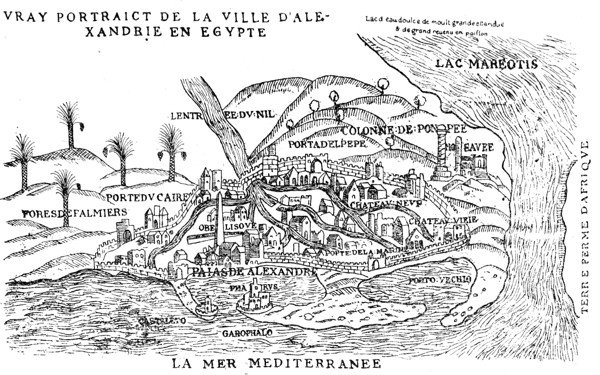
Extrait des Observations de plvsieurs singvlaritez etc. par Pierre Belon du Mans Paris 1554
84(iv). Another irritable visitor landed here in 1779—the lively but spiteful Mrs. Eliza Fay. Being a Christian, she was not allowed to disembark in the Western Harbour nor to ride any animal nobler than a donkey. She visited Cleopatra’s Needles and Pompey’s Pillar, then writes to her sister “I certainly deem myself very fortunate in quitting this place so soon.” She makes no mention of the English community, but was entertained by the Prussian Consul, and has left an unflattering account of his stout wife.
There are some old maps, compiled from the accounts of travellers, but bearing little reference to reality. That of Pierre Belon (1554) is reproduced on p. 83. Its main errors are the introduction of the Nile, and the outflow of Lake Mariout to the sea. It shows the two harbours, the Arab walls, Cleopatra’s Needles, Pompey’s Pillar and the Canopic or Rosetta Gate (Porte du Caire). The Turkish town has not yet been built. De Monconys’ map of 1665—see frontispiece—is in some ways still more absurd; Cleopatra’s Needle has turned into a pyramid. The mound in the right centre is meant for Fort Cafarelli. The beginnings of the Turkish Town appear on Ras-el-Tin. In 1743 Richard Pocock published the first scientific map in his “Description of the East;” measurements and soundings are given. Captain Norden the Dane brought out a good pictorial plan of the “New,” i.e. Eastern harbour, showing the seamarks. And the exact extent of Alexandria’s decay is shown in the magnificent map published by the French expedition under Napoleon. There we see that the Arab enclosure is empty except for a few houses on Kom-el-Dik and by the Rosetta Gate, and that the population—only 4,000—is huddled into the wall-less Turkish Town.
With Napoleon a new age begins.
Turkish Town: p. 124.
Rosetta: p. 185.
Cleopatra’s Needles: p. 161.
Pompey’s Pillar: p. 144.
Fort Cafarelli: p. 170.
85
SECTION V.
MODERN PERIOD.
86
NAPOLEON (1798-1801).
On July 1st 1798 the inhabitants of the obscure town saw that the deserted sea was covered with an immense fleet. Three hundred sailing ships came out from the west to anchor off Marabout Island, men disembarked all night and by the middle of next day 5,000 French soldiers under Napoleon had occupied the place. They were part of a larger force, and had come under the pretence of helping Turkey, against whom Egypt was then having one of her feeble and periodic revolts. The future Emperor was still a mere general of the French Republic, but already an influence on politics, and this expedition was his own plan. He was in love with the East just then. The romance of the Nile valley had touched his imagination, and he knew that it was the road to an even greater romance—India. At war with England, he saw himself gaining at England’s expense an Oriental realm and reviving the power of Alexander the Great. In him, as in Mark Antony, Alexandria nourished imperial dreams. The expedition failed but its memory remained with him: he had touched the East, the nursery of kings.
Leaving Alexandria at once, he marched on Cairo and won the battle of the Pyramids. Then an irreparable disaster befel him. He had left his admiral, Brueys, with instructions to dispose the fleet as safely as possible, since Nelson was known to be in pursuit. Under modern conditions Brueys would have sailed into the Western Harbour, but in 1798 the reefs that cross the entrance had not been blasted away, and though the transports got in the passages were rather dangerous for the big men-of-war. Brueys was nervous and thought he had better take them round to an anchorage, supposed impeccable, in the Bay of Aboukir. Nelson followed him, attacked him unexpectedly and destroyed his fleet. 87Details of this famous engagement, the so-called “Battle of the Nile,” are given in another place (p. 177); its result was to lose for Napoleon the command of the sea. The French expedition took Cairo and remained powerful on land, but could receive no reinforcements, no messages, and withered away like a plant that has been cut at the root. Turkey declared against it, and a Turkish force, supported by British ships, landed at Aboukir (July 1799). Here Napoleon was successful. He commanded in person and in a series of brilliant engagements drove the invaders into the sea: this is the “Land” battle of Aboukir (described in detail p. 179). But his dreams had been shattered by Nelson. He saw that his destiny, whatever it was, would not be accomplished in the East, and meanly deserting his army he slipped back to France.
We now come to the first British expedition, and to its successful and interesting campaign. In March 1801 Sir Ralph Abercrombie landed with 1,500 men at Aboukir. His aim was not to occupy Egypt, but to induce the French armies to evacuate it. He marched westward against Alexandria, keeping close to the sea. The country on his left was very different to what it is now, and to understand his operations two of the differences must be remembered. (i) The “Lake of Aboukir,” since drained, stretched from Aboukir Bay almost as far as Ramleh. As it connected with the sea, it was full of salt water. (ii) The present Lake Mariout was almost dry. It contained a little fresh water, but most of its enormous bed was under cultivation. It lay twelve feet below the waters of Lake Aboukir, and was protected from them by a dyke. Thus Abercrombie saw water where we see land, and vice versa. He advanced with success as far as Mandourah, because his left flank was protected by Lake Aboukir. But when he wanted to attack the French position at Ramleh he feared they would outflank him over the dry bed of Mariout. His losses had been heavy, his advance was held up; wounded in the thigh by a musket shot, he had to abandon the 88command, and was carried on to a boat where he died; a small monument at Sidi Gaber commemorates him to-day. His successor, Hutchinson, took drastic measures. At the advice of his engineers he cut the dyke that separated Lake Aboukir from Mariout. The salt water rushed in, to the delight of the British soldiers, and in a month thousands of acres had been drowned, Alexandria was isolated from the rest of Egypt, and the left flank of the expedition was protected all the way up to the walls of the town. Later in the year a second British force landed to the west of Alexandria, at Marabout, and, caught between two fires, the French were obliged to surrender. They were given easy terms, and allowed to leave Egypt with all the honours of war. The British followed them; we had accomplished our aim, and had no reason to remain in the country any longer; we left it to our allies the Turks. But the sleep of so many centuries had been broken. The eyes of Europe were again directed to the deserved shore. Though Napoleon had failed and the British had retired, a new age had begun for Alexandria. Life flowed back into her, just as the waters, when Hutchinson cut the dyke, flowed back into Lake Mariout.
Marabout: p. 171.
“Battle of the Nile”: p. 177.
Lake Mariout: p. 190.
Ramleh: p. 166.
Abercrombie Monument, Sidi Gaber: p. 165.
Tomb of Col. Brice, d. 1801 (Greek Patriarcate): p. 106.
MOHAMMED ALI (1805-1848).
When Napoleon drove the Turks into the sea at Aboukir, among the fugitives was Mohammed Ali, the founder of the present reigning house of Egypt. Little is known of his origin. He was an Albanian, but born at Cavala in Macedonia where he is said to have distinguished himself as a tax collector in his earlier youth. His education was primitive; he was ignorant of history and economics and only learnt the Arabic 89alphabet late in life. But he was a man of great ability and power and an acute judge of character. He reappears in Egypt in 1801, still obscure, and fights under Abercrombie. When the English withdrew he profited by the internal disturbances and became in 1805 Viceroy of the country under the Sultan of Turkey.
His power was consolidated by the disastrous British expedition of 1807—General Frazer’s “reconnoitering” expedition, as it is officially termed. England was hostile to Turkey now, and Frazer was sent to see whether a diversion could be created in Egypt. He landed, like Napoleon before him, at Marabout, but with no more than the following regiments;—the 31st, the 35th, the 78th, and a foreign legion: 4,000 men in all. He occupied Alexandria and Rosetta, but before long Mohammed Ali had killed or captured half his force and he was obliged to ask for terms. They were readily granted. The “reconnoitering” expedition was allowed to reembark, and the only trace it has left of its presence in Alexandria is a tombstone of a soldier of the 78th, in the courtyard of the Greek Patriarchate.
For thirty years the power of Mohammed Ali grew, and with it the importance of Alexandria, his virtual capital. He freed the Holy Places of Arabia from a heretical sect, he interfered in Greece, he revolted against his suzerain the Sultan of Turkey, and invading Syria added it to his dominions. A kingdom, comparable in extent to the Ptolemaic, had come into existence with Alexandria as its centre, and it seemed that the dreams of Napoleon would be realised by this Albanian adventurer, and that the English would be cut off from India. England took alarm. And suddenly the empire of Mohammed Ali fell. Syria revolted (1840), supported by a British fleet, and soon the English admiral, Sir Charles Napier, was at Alexandria, and compelled the Viceroy to confine himself to Egypt. According to tradition the interview took place in the new Ras-el-Tin Palace, and Napier exclaims “If Your Highness will not listen to my unofficial appeal to you against the folly of 90further resistance, it only remains for me to bombard you, and by God I will bombard you and plant my bombs in the middle of this room where you are sitting.” Anyhow Mohammed Ali gave in. He had failed as a European power, but he had secured for his family a comfortable principality in Egypt, where he was king in all but name.
His internal policy was rather disreputable. He admired European civilization because it made people aggressive and gave them guns, but he had no sense of its finer aspects, and his “reforms” were mainly veneer to impress travellers. He exploited the fellahin by buying grain from them at his own price: the whole of Egypt became his private farm. Hence the importance of the foreign communities at Alexandria at this date: he needed their aid to dispose of the produce in European markets. He won over the British and other consuls to be his agents by giving them licences to export Egyptian antiquities, which were then coming into fashion; our own Consul Henry Salt—his tomb is here—was a particular offender in this. He also gave away “Cleopatra’s Needles” to the British and American Governments respectively; the obelisks that still remained on their original sites outside the vanished Caesareum, and would have lent such dignity to our modern sea front. Still, with all his faults, he did create the modern city, such as she is. He waved his wand, and what we see arose from the aged soil. Let us examine it for a moment.
Statue of Mohammed Ali: p. 102.
Mausoleum of his Family: p. 105.
Tomb of Soldier of the 78th: p. 106.
Ras-el-Tin Palace: p. 129.
Tomb of Henry Salt: p. 144.
Cleopatra’s Needles: pp. 136, 162.
THE MODERN CITY.
During the years 1798-1807 as many as four expeditions had landed at or near Alexandria—one French, one Turkish, and two English. Egypt had again been drawn 91into the European system. A maritime capital was necessary, and the genius of Mohammed Ali realised that it could be found not in the mediaeval ports of Damietta and Rosetta, but in a restored Alexandria. The city that we know to-day has followed the lines that he laid down, and it is interesting to compare his dispositions with those of Alexander the Great, over two thousand years before.
The main problem was the waters. The English, by cutting the dykes in 1801, had refilled Lake Mariout so that it had suddenly regained its ancient area. But it was too shallow for navigation and they had filled it with salt water instead of the former fresh: it gave no access to the system of the Nile. That system had to be tapped. Alexander could find the Nile at Aboukir (Canopic Mouth): now it was as far off as Rosetta (ancient Bolbitic Mouth). Consequently Mohammed Ali had to construct a canal 45 miles long. This canal, called the Mahmoudieh after Mahmoud, the reigning Sultan of Turkey, was completed in 1820. It was badly made and the sides were always falling in, but it led to the immediate rise of Alexandria and to the decay of Rosetta. Alexandria now had water communications with Cairo, to which was added communication by rail. The Harbour followed. Mohammed Ali developed the Western which had been the less important in classical times. The present docks and arsenals were built for him (1828-1833) by the French engineer De Cerisy. A fleet was added. To the same scheme belongs the impressive Ras-el-Tin Palace, which standing on a rise above the harbour dominated it as the Ptolemaic Palace had once dominated the Eastern; the favourite residence of the Viceroy, it indicated that his new kingdom was no mere oriental monarchy, but a modern power with its face to the sea.
Meanwhile the town started its development, but not on very regal lines. Houses began to run up and streets to sprawl over the deserted area inside the Arab Walls. It did not occur either to Mohammed Ali or to 92his friends the Foreign Communities that a city ought to be planned. Their one achievement was a Square and certainly quite a fine one—the Place des Consuls, now Place Mohammed Ali. The English were granted land to the north of the Square, on part of which they built their church, the French and the Greeks land to the south; areas were also acquired by other communities, e.g. by the Armenians. But there was no attempt to coordinate the various enterprises, or to utilise the existing features of the site. These features were: the sea, the lake, Pompey’s Pillar, the forts of Kom-el-Dik and Cafarelli, and the Arab Walls. The sea was ignored except for commercial purposes; the main thoroughfares still keep away from its shores, and even the fine New Quays are attracting no buildings to their curve. The lake was ignored even more completely—the lake whose delicate pale expanse might so have beautified the southern quarters; many people do not know that a lake exists. Pompey’s Pillar, instead of being the centre of converging roads, has been left where it will least be seen; only down the Rue Bab Sidra does one get a distant view of it. Similarly with the two forts; huddled behind houses. The Arab walls have been finally destroyed—remnants surviving in the eastern reach where they have been utilised (and well utilised) in the Public Gardens.
As Alexandria grew in size and wealth she required suburbs. The earliest development was along the line of the Mahmoudieh Canal, where the Villa Antoniadis and a few other fine houses have been built. But with the improvement of communications the rich merchants were able to live further afield. Two alternatives were open to them—Mex and Ramleh—and rather regrettably they selected the latter. Mex, with its fine natural features, might have developed into a very beautiful place: as it is a belt of slums have parted it from the town, and an execrable tram service has removed it even further. The town has spread to the east instead, to Ramleh, served at first by a railway and now by good electric trams.
93Such are the main features of Alexandria as it has evolved under Mohammed Ali and his successors. It does not compare favourably with the city of Alexander the Great. On the other hand it is no worse than most nineteenth century cities. And it has one immense advantage over them—a perfect climate.
Mahmoudieh Canal: p. 151.
Modern Harbour: p. 129.
Ras-el-Tin Palace: p. 129.
Square: p. 102.
English Church: p. 102.
Fort Kom-el-Dik: p. 106.
Fort Cafarelli: p. 170.
Pompey’s Pillar: p. 144.
Public Gardens: p. 154.
Villa Antoniadis: p. 157.
Mex: p. 171.
Ramleh: p. 166.
THE BOMBARDMENT OF ALEXANDRIA (1882).
Thus the city develops quietly under Mohammed Ali and his successors—one of whom, Said Pasha, is buried here. Attention was rather diverted from her by the cutting of the Suez Canal, and it is not until 1882 that anything of note occurs. She is in this year connected with the rebellion of Arabi, the founder of the Egyptian Nationalist Party. Arabi, then Minister of War, was endeavouring to dominate the Khedive Tewfik, and to secure Egypt for the Egyptians. Alexandria, which had held a foreign element ever since its foundation, was therefore his natural foe, and it was here that he opened the campaign against Europe that ended in his failure at Tel-el-Kebir. The details—like Arabi’s motives—are complicated. But four stages may be observed.
(i). Riot of June 11th.
This began at about 10 p.m. in the Rue des Soeurs; it is said that two donkey boys, one Arab and one Maltese, had a fight in a café, and that others joined in. The rioters moved down towards the Square, and at some 94cross roads near the Laban Caracol the British Consul was nearly killed. They were joined in the Square by two other mobs, one from the Attarine Quarter and one from Ras-el-Tin. British and other warships were in the harbour, but took no action, and the Egyptian troops in the city refused to intervene without orders from Arabi, who was in Cairo. At last a telegram was sent to him. He responded and the disorder ceased. There is no reason to suppose that he planned the riot. But naturally enough he used it to increase his prestige. He had shown the foreign communities, and particularly the British, that he alone could give them protection. In the evening he came down in triumph from Cairo. About 150 Europeans are thought to have been killed that day, but we have no reliable statistics.
(ii). Bombardment of July 11th.
British men-of-war under Admiral Seymour had been in the harbour during the riot, but it was a month before they took action. In the first place the British residents had to be removed, in the second the fleet required reinforcing, in the third orders were awaited from home. As soon as Seymour was ready he picked a quarrel with Arabi and declared he should bombard the city if any more guns were mounted in the forts. Since Arabi would not agree he opened fire at 7.0 a.m. July 11th. There were eight iron-clads—six of them the most powerful in our navy. They were thus distributed:—Monarch, Invincible and Penelope close inshore off Mex; Alexandra Sultan and Superb off Ras-el-Tin; while the two others the Temeraire and Inflexible were in a central position outside the harbour reef, half-way between Ras-el-Tin and Marabout; and off Marabout were some gun boats, under Lord Charles Beresford. The bombardment succeeded, though Arabi’s gunners in the forts fought bravely. In the evening the Superb blew up the powder magazine in Fort Adda. Fort Kait Bey was also shattered and the minaret of its 15th cent. Mosque was seen “melting away like ice in the sun.” The town, on the 95other hand, was scarcely damaged, as our gunners were careful in their aim. Arabi and his force evacuated it in the evening, marching out by the Rue Rosette to take up a position some miles further east, on the banks of the Mahmoudieh canal.
(iii). Riot of July 12th.
Unfortunately Admiral Seymour, after his success, never landed a force to keep order, and the result was a riot far more disastrous than that of June. With the withdrawal of Arabi’s troops the native population lost self control. The Khedive had now broken with Arabi, but during the bombardment he had moved from Ras-el-Tin Palace to Ramleh and his authority was negligible. Pillaging went on all day on the 12th, and by the evening the city had been set on fire. The damage was material rather than artistic, the one valuable object in the Square, the statue of Mohammed Ali, fortunately escaping. Rues Chérif and Tewfik Pacha—indeed all the roads leading out of the Square—were destroyed, and nearly every street in the European quarter was impassable through fallen and falling houses. Empty jewel cases and broken clocks lay on the pavements. Every shop was looted, and by the time Admiral Seymour did land it was impossible for his middies to buy any jam; one of them has recorded this misfortune, adding that in other ways Alexandria, then in flames, was “well enough.” Meanwhile the Khedive had returned to his Palace, and order was slowly restored. It is not known how many lives were lost in this avoidable disaster.
(iv). Military Operations.
A large British force was despatched under Lord Wolseley to the Suez Canal—the force that finally defeated Arabi at Tel-el-Kebir. But, until it reached Egypt, Alexandria remained in danger, for Arabi might attack from his camp at Kafr-el-Dawar. So the city had to be defended on the east. In the middle of July General Alison arrived with a few troops, including artillery, and 96occupied the barracks at Mustapha Pacha, the hill of Abou el Nawatir, and the water works down by the canal. He could thus watch Arabi’s movements. And he had a second strongly fortified position at the gates of the Antoniadis Gardens, in case he was attacked from the south. Here he was able to hold on and to harry the enemy’s outposts until pressure was relieved. His losses were slight; the regiments involved are commemorated by tablets in the English church. Next month Wolseley arrived, and having inspected the position re-embarked his troops and pretended that he was going to land at Aboukir. Arabi was deceived and prepared resistance there. Wolseley steamed past him, and landed at Port Said instead. Arabi then had to break up his camp, and the danger for Alexandria was over.
Rue des Sœurs: p. 170.
Fort Adda: p. 132.
Fort Kait Bey: p. 133.
Mustapha Barracks: p. 96.
Gun on Abou el Nawatir: p. 165.
Antoniadis Gardens: p. 157.
Tablets in English Church: p. 103.
Howitzer of Arabi; at Egyptian Government Hospital: p. 163.
97
CONCLUSION.
Since the bombardment of 1882, the city has known other troubles, but they will not be here described. Nor will any peroration be attempted, for the reason that Alexandria is still alive and alters even while one tries to sum her up. Politically she is now more closely connected with the rest of Egypt than ever in the past, but the old foreign elements remain, and it is to the oldest of them, the Greek, that she owes such modern culture as is to be found in her. Her future like that of other great commercial cities is dubious. Except in the cases of the Public Gardens and the Museum, the Municipality has scarcely risen to its historic responsibilities. The Library is starved for want of funds, the Art Gallery cannot be alluded to, and links with the past have been wantonly broken—for example the name of the Rue Rosette has been altered and the exquisite Covered Bazaar near the Rue de France destroyed. Material prosperity based on cotton, onions, and eggs, seems assured, but little progress can be discerned in other directions, and neither the Pharos of Sostratus nor the Idylls of Theocritus nor the Enneads of Plotinus are likely to be rivalled in the future. Only the climate only the north wind and the sea remain as pure as when Menelaus the first visitor landed upon Ras-el-Tin, three thousand years ago; and at night the constellation of Berenice’s Hair still shines as brightly as when it caught the attention of Conon the astronomer.
98
THE GOD ABANDONS ANTONY.
When at the hour of midnight
an invisible choir is suddenly heard passing
with exquisite music, with voices—
Do not lament your fortune that at last subsides,
your life’s work that has failed, your schemes that have proved illusions.
But like a man prepared, like a brave man,
bid farewell to her, to Alexandria who is departing.
Above all, do not delude yourself, do not say that it is a dream,
that your ear was mistaken.
Do not condescend to such empty hopes.
Like a man for long prepared, like a brave man,
like to the man who was worthy of such a city,
go to the window firmly,
and listen with emotion,
but not with the prayers and complaints of the coward
(Ah! supreme rapture!)
listen to the notes, to the exquisite instruments of the mystic choir,
and bid farewell to her, to Alexandria whom you are losing.
C. P. Cavafy.[6]
99
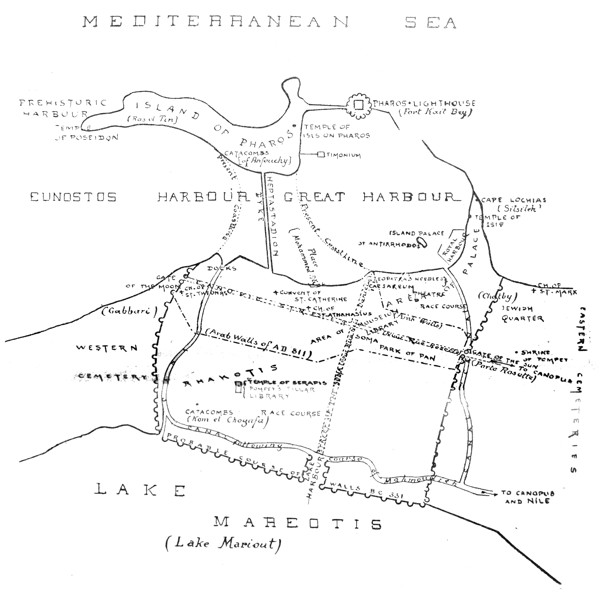
Alexandria: Historical Map Ancient Sites in Capitals Modern Sites bracketed (...)