"With other Tales of Faithful Friends and Favourites" (continued 6)
Reading edition
“It was a sight to see the two dogs together out for a ramble—Nero with his gigantic height, his noble proportions, and long flat coat of jetty black, and Vee-Vee, so altogether unlike him in every way, trotting along by his side in jacket of purest snow!
“Vee-Vee’s jacket used to be whiter on Saturday than on any other day, because it was washed on that morning of the week, and to make his personal beauties all the more noticeable he always on that day and on the next wore a ribbon of blue or crimson.
“Now, mischievous Nero, if he got a chance, was sure to tumble Vee-Vee into a mud-hole just after he was nearly dried and lovely. I am sure he did it out of pure fun, for when Vee-Vee came downstairs to go out on these occasions, Nero would meet him, and eye him all over, and walk round him, and snuff him, and smell at him in the most provoking teasing manner possible.
“‘Oh! aren’t you proud!’ he would seem to say, and ‘aren’t you white and clean and nice, and doesn’t that bit of blue ribbon, suit you! What do you think of yourself, eh? My master can’t wash me white, but I can wash you black, only wait till we go out and come to a nice mud-heap, and see if I don’t change the colour of your jacket for you.’
“Vee-Vee, though only a Pomeranian, learned a great many of Nero’s tricks; this proves that one dog can teach another. He used to swim along with Nero, although when first going into the water he sometimes lost confidence, and got on to his big friend’s shoulders, at which Nero used to seem vastly amused. He would look up at me with a sparkle of genuine mirth in his eye as much as to say—
“‘Only look, master, at this little fool of a Vee-Vee perched upon my shoulder, like a fantail pigeon on top of a hen-house. But I don’t mind his weight, not in the slightest.’
“Vee-Vee used to fetch and carry as well as Nero, in his own quiet little way. One day I dropped my purse in the street, and was well-nigh home before I missed it. You may judge of my joy when on looking round I found Vee-Vee coming walking along with the purse in his mouth, looking as solemn as a little judge. Vee-Vee, I may tell you, was only about two weeks old when I first had him; he was too young to wean, and the trouble of spoon-feeding was very great. In my dilemma, a favourite cat of mine came to my assistance. She had recently lost her kittens, and took to suckling young Vee-Vee as naturally as if she had been his mother.”
“How strange,” said Ida, “for a cat to suckle a puppy.”
“Cats, Ida,” I replied, “have many curious fancies. A book (Note 1) that I wrote some little time since gives many very strange illustrations of the queer ways of these animals. Cats have been known to suckle the young of rats, and even of hedgehogs, and to bring in chickens and ducklings, and brood over them. This only proves, I think, that it is cruel to take a cat’s kittens away from her all at once.”
“Yes, it is,” Ida said, thoughtfully; “and yet it seems almost more cruel to permit her to rear a large number of kittens that you cannot afterwards find homes for.”
“A very sensible remark, birdie. Well, to return to our mutual friend Nero: about the same time that he had as his bosom companion the little dog Vee-Vee, he contracted a strange and inexplicable affection for another tiny dog that lived quite a mile and a half away, and for a time she was altogether the favourite. The most curious part of the affair was this: Nero’s new favourite was only about six or seven inches in height, and so small that it could easily have been put into a gentleman’s hat, and the hat put on the gentleman’s head without much inconvenience to either the gentleman or the dog.
“When stationed at Sheerness, we lived on board H.M.S. P—, the flagship there. On board were several other dogs. The captain of marines had one, for example, a large, flat-coated, black, saucy retriever, that rejoiced in the name of ‘Daidles’; the commander had two, a large fox-terrier, and a curly-coated retriever called ‘Sambo.’ All were wardroom dogs—that is, all belonged to the officers’ mess-room—and lived there day and night, for there were no fine carpets to spoil, only a well-scoured deck, and no ladies to object. Upon the whole, it must be allowed that there was very little disagreement indeed among the mess dogs. The fox-terrier was permitted to exist by the other three large animals, and sometimes he was severely chastised by one of the retrievers, only he could take his own part well enough. With the commander’s curly retriever, Nero cemented a friendship, which he kept up until we left the ship, and many a romp they had together on deck, and many a delightful cruise on shore. But Daidles, the marine Officer’s dog, was a veritable snarley-yow; he therefore was treated by Nero to a sound thrashing once every month, as regularly as the new moon. It is but just to Nero to say that Daidles always commenced those rows by challenging Nero to mortal combat. Wild, cruel fights they used to be, and much blood used to be spilled ere we could part them. As an instance of memory in the dog, I may mention that two years after Nero and I left the ship, we met Captain L— and his dog Daidles by chance in Chatham one day. Nero knew Daidles, and Daidles knew Nero, long before the captain and I were near enough to shake hands.
“‘Hullo!’ cried Nero; ‘here we are again.’
“‘Yes,’ cried Daidles; ‘let us have another fight for auld lang syne.’
“And they did, and tore each other fearfully.
“Nero’s life on board this particular ship was a very happy one, for everybody loved him, from the captain downwards to the little loblolly boy who washed the bottles, spread the plasters, and made the poultices.
“The blue-jackets all loved Nero; but he was more particularly the pet of the marine mess. This may be accounted for from the fact that my servant was a marine.
“But every day when the bugle called the red-coats to dinner—
“‘That calls me,’ Master Nero would say; then off he would trot.
“His plan was to go from one table to another, and it would be superfluous to say that he never went short.
“Nero had one very particular friend on board—dear old chief engineer C—. Now my cabin was a dark and dismal one down in the cockpit, I being then only junior surgeon; the engineer’s was on the main deck, and had a beautiful port. As Mr C— was a married man, he slept on shore; therefore he kindly gave up his cabin to me—no, not to me, as he plainly gave me to understand, but to Nero.
“Nero liked his comforts, and it was C—’s delight of a morning after breakfast to make Nero jump on top of my cot, and put his head on my pillow. Then C— would cover him over with a rug, and the dog would give a great sigh of satisfaction and go off to sleep, and all the din and all the row of a thousand men at work and drill, could not waken Nero until he had his nap out.
“On Sunday morning the captain went round all the decks of the ship inspecting them—the mess places, and the men’s kits and cooking utensils, everything, in fact, about the ship was examined on this morning. He was followed by the commander, the chief surgeon, and by Nero.
“The inspection over, the boats were called away for church on shore. Having landed, the men formed into marching order, band first, then the officers, and next the blue-jackets. Nero’s place was in front of the band, and from the gay and jaunty way he stepped out, you might have imagined that he considered himself captain of all these men.
“Sometimes a death took place, and the march to the churchyard was a very solemn and imposing spectacle. The very dog seemed to feel the solemnity of the occasion; and I have known him march in front all the way with lowered head and tail, as if he really felt that one of his poor messmates was like Tom Bowling, ‘a sheer hulk,’ and that he would never, never see him again. You remember the beautiful old song, Ida, and its grand, ringing old tune—
“‘Here a sheer hulk lies poor Tom Bowling, The darling of our crew; No more he’ll hear the billows howling, For death has broached him to. His form was of the manliest beauty, His heart was pure and soft; Faithful below he did his duty, And now he has gone aloft.’
“It was on board this ship that Nero first learned that graceful inclination of the body we call making a bow, and which Aileen Aroon there has seen fit to copy.
“You see, on board a man-o’-war, Ida, whenever an officer comes on the quarter-deck, he lifts his hat, not to any one, remember, but out of respect to Her Majesty the Queen’s ship. The sailors taught Nero to make a bow as soon as he came upstairs or up the ship’s side, and it soon came natural to him, so that he really was quite as respectful to Her Majesty as any officer or man on board.
“My old favourite, Tyro, was so fond of music that whenever I took up the violin, he used to come and throw himself down at my feet. I do not think Nero was ever fond of music, and I hardly know the reason why he tolerated the band playing on the quarter-deck, for whenever on shore if he happened to see and hear a brass band (a German itinerant one, I mean), he flew straight at them, and never failed to scatter them in all directions. I am afraid I rather encouraged him in this habit of his; it was amusing and it made the people laugh. It did not make the German fellows laugh, however—at least, not the man with the big bassoon—for Nero always singled him out, probably because he was making more row than the others. A gentleman said one day that Nero ought to be bought by the people of Margate, and kept as public property to keep the streets clear of the German band element.
“But Nero never attempted to disperse the ship’s band—he seemed rather to like it. I remember once walking in a city up North, some years after Nero left the service, and meeting a band of volunteers.
“‘Oh,’ thought Nero, ‘this does put me in mind of old times.’
“I do not know for certain that this was really what the dog thought, but I am quite sure about what he did, and that was, to put himself at the head of that volunteer regiment and march in front of it. As no coaxing of mine could get the dog away, I was obliged to fall in too, and we had quite a mile of a march, which I really had not expected, and did not care for.
“Nero’s partiality for marines was very great; but here is a curious circumstance: the dog knows the difference between a marine and a soldier in the street, for even a year after he left garrison, if he saw a red-jacket in the street, he would rush up to its owner. If a soldier, he merely sniffed him and ran on; if a marine, he not only sniffed him, but jumped about him and exhibited great joy, and perhaps ended by taking the man’s cap in a friendly kind of a way, and just for auld lang syne.
“Nero’s life on board ship would have been one of unalloyed happiness, except for those dreadful guns. The dog was not afraid of an ordinary fowling-piece, but a cannon was another concern, and as we were very often at general quarters, or saluting other ships, Nero had more than enough of big guns. Terrible things he must have thought them—things that went off when a man pulled a string, that went off with fire and smoke, and a roar louder than any thunder; things that shook the ship and smashed the crockery, and brought his master’s good old fiddle tumbling down to the deck—terrible things indeed. Even on days when there was no saluting or firing, there was always that eight o’clock gun.
“As soon as the quartermaster entered the wardroom, a few seconds before eight in the evening, and reported the hour to the commander, poor Nero took refuge under the sofa.
“He knew the man’s knock.
“‘Eight o’clock, sir, please,’ the man would say.
“‘Make it so,’ the commander would reply, which meant, ‘Fire the gun.’
“This was enough for Nero; he was in hiding a full minute before they could ‘make it so.’”
“Is that the reason,” asked Ida, “why you sometimes say eight o’clock to him when you want him to go and lie down?”
“Yes, birdie,” I replied. “He does not forget it, and never will as long as he lives. If you look at him even now, you will see a kind of terror in his eye, for he knows what we are talking about, and he is not quite sure that even here in this peaceful pine wood some one might not fire a big gun and make it eight o’clock.”
“No, no, no,” cried Ida, throwing her arms around the dog, “don’t be afraid, dear old Nero. It shan’t be eight o’clock. It will never, never be eight o’clock any more, dearest doggie.”
Note 1. “Friends in Fur.” Published by Messrs Dean and Son, Fleet Street, London.
Chapter Twenty Eight.
The Story of Aileen’s Husband, Nero—Continued.
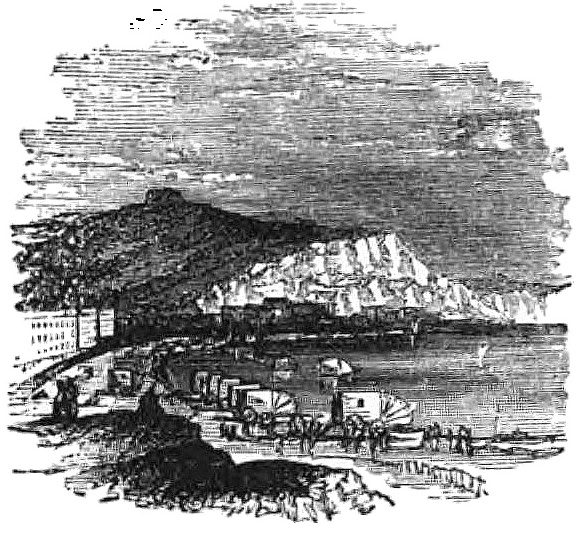
“His locked and lettered braw brass collar Showed him the gentleman and scholar.”
“You promised,” said my little companion the very next evening, “to resume the thread of Nero’s narrative.”
“Very prettily put, birdie,” I said; “resume the thread of Nero’s narrative. Did I actually make use of those words? Very well, I will, though I fear you will think the story a little dull, and probably the story-teller somewhat prosy.
“Do you know, then, Ida, that I am quite convinced that Providence gave mankind the dog to be a real companion to him, and I believe that this is the reason why a dog is so very, very faithful, so long-suffering under trial, so patient when in pain, and so altogether good and kind. When I look at poor old Nero, as he lies beside you there, half asleep, yet listening to every word we say, my thoughts revert to many a bygone scene in which he and I were the principal actors. And many a time, Ida, when in grief and sorrow, I have felt, rightly or wrongly, that I had not a friend in the world but himself.
“Well, dear, I had learned to love Nero, and love him well, when I received an appointment to join the flagship at Sheerness. The fact is I had been a whole year on sick leave, and Nero and I had been travelling for the sake of my health. There was hardly a town in England, Ireland, or Scotland we had not visited, and I always managed it so that the dog should occupy the same room as myself. By the end of a twelvemonth, Nero had got to be quite an old and quite a wise traveller. His special duty was to see after the luggage—in other words, Master Nero was baggage-master. When I left a hôtel, my traps were generally taken in a hand-cart or trolly. Close beside the man all the way to the station walked my faithful friend, he himself in all probability carrying a carpet bag, and looking the very quintessence of seriousness and dignified importance. As soon as he saw the porter place the luggage in the van, then back he would come to me, with many a joyous bark and bound, quite regardless of the fact that he sometimes ran against a passenger, and sent him sprawling on the platform.
“When we arrived at our journey’s end, Nero used to be at the luggage van before me. And here is something worth recording: as we usually came out at a door on the opposite side of the train to that at which we had entered, I was apt for a moment or two to forget the position of the luggage van. Nero never made a mistake, so I daresay his scent assisted him. As soon as the luggage was put on the trolly, and the man started with it, the dog went with him, but as the man often went a long way ahead of me, Nero was naturally afraid of losing sight of me; therefore if the porter attempted to turn a corner the dog invariably barked, not angrily, but determinedly, till he stopped. As soon as I came up, then the procession went on again, till we came to another corner, when the man had to stop once more. I remember he pulled a man down, because he would not stop, but he did not otherwise hurt him at all.
“In the train, he either travelled in the same carriage with myself, or in cases where the guard objected to this, I travelled in the van with the dog, so we were not separated.
“If a man is travelling much by train or by steamboat, he need never feel lonely if he has as splendid a dog as the Champion Theodore Nero with him; for the dog makes his master acquaintances.
“When Nero was with me, I could hardly stand for a moment at a street corner or to look in at a shop window without attracting a small crowd. I was never half an hour on the deck of a steamer without some one coming up and saying—
“‘Excuse me, sir, but what a noble-looking dog you have! What breed is he? Pure Newfoundland, doubtless.’
“This would in all probability lead to conversation, and many an acquaintance I have thus formed, which have ripened into friendships that last till this day.
“Well, Ida, when I received my appointment to the flagship, my very first thoughts were about my friend the dog, and with a sad feeling of sinking at my heart, I asked myself the question—‘Will Nero be permitted to live on board?’ To part with the dear fellow would have been a grief I could not bear to contemplate.
“An answer to the question, however, could not be obtained until I joined my ship, that was certain; so I started.
“It was in the gloaming of a blustering day in early spring that the train in which we travelled, slowly, and after much unseemly delay, rolled rattling into the little station at Sheerness, and after a shoulder-to-shoulder struggle between half a dozen boatmen, who wished to take me, bag and baggage, off somewhere, and the same number of cabbies, who wished to carry me anywhere else, I was lucky enough to get seated in a musty conveyance that smelt like the aroma of wet collie-dogs and stale tobacco, with a slight suspicion of bad beer. Against the windows of this rattletrap beat the cold rain, and the mud flew from the wheels as from a wet swab. Lights were springing up here and there in the street under the busy fingers of a lamp-lighter, who might have been mistaken for a member of the monkey tribe, so nimbly did he glide up and down his skeleton ladder, and hurry along at his task. The wind, too, was doing all in its power to render his work abortive, and the gas-lights burned blue under the blast.
“We were glad when we reached the hotel, but I was gladder still when, on making some inquiries about the ship I was about to join, I was told that the commander was extremely fond of dogs, and that he had two of his own.
“I slept more soundly after that.
“Next day, leaving my friend carefully under lock and key in charge of the worthy proprietor of the Fountain Hotel, I got into uniform, and having hired a shore boat, went off to my ship to report myself. To my joy I found Commander C— to be as kind and jovial a sailor as any one could wish to see and talk to. I was not long before I broached the subject nearest to my heart.
“‘Objection to your dog on board?’ he said, laughing. ‘Bring him, by all means; he won’t kill mine, though, I hope.’
“‘That I’m sure he won’t,’ I replied, feeling as happy as if I had just come into a fortune.
“I went on shore with a light heart, and hugged the dog.
“‘We’re not going to be parted, dear old boy,’ I said. ‘You are going on board with me to-morrow.’
“The evening before my heart was as gloomy as the weather; to-day the sun shone, and my heart was as bright as the sky was blue. Nero and I set out after luncheon to have a look at the town.
“Sheerness on two sides is bounded by the dockyard, which divides it from the sea. Indeed, the dockyard occupies the most comfortable corner, and seems to say to the town, ‘Stand aside; you’re nobody.’ The principal thoroughfare of Sheerness has on one side of it the high, bleak boundary wall, while on the other stands as ragged-looking a line of houses as one could well imagine, putting one in mind of a regiment of militia newly embodied and minus uniform. As you journey from the station, everything reminds you that you are in a naval seaport of the lowest class. Lazy watermen by the dozen loll about the pier-head with their arms, to say nothing of their hands, buried deeply in their breeches-pockets, while every male you meet is either soldier or sailor, dockyard’s man or solemn-looking policeman. Every shop that isn’t a beer-house, is either a general dealer’s, where you can purchase anything nautical, from a sail-needle to sea boots, or an eating house, in the windows of which are temptingly exposed joints of suspiciously red corned-beef, soapy-looking mutton and uninviting pork, and where you are invited to partake of tea and shrimps for ninepence.
“So on the whole the town of Sheerness itself is by no means a very inviting one, nor a very savoury one either.
“But away out beyond the dockyard and over the moat, and Sheerness brightens up a little, and spreads out both to left and right, and you find terraces with trim little gardens and green-painted palings, while instead of the odour of tar and cheese and animal decay, you can breathe the fresh, pure air from over the ocean, and see the green waves come tumbling in and break in soft music on the snowy shingle.
“Here live the benedicts of the flagship. At half-past seven of a fine summer morning you may see them, hurried and hungry, trotting along towards the dockyard, looking as if another hour’s sleep would not have come amiss to them. But once they get on board their ships, how magic-like will be the disappearance of the plump soles, the curried lobster, the corned-beef, and the remains of last night’s pigeon-pie, while the messman can hardly help looking anxious, and the servants run each other down in their hurry to supply the tea and toast!
“Of the country immediately around this town of Sheerness, the principal features are open ditches, slimy and green, evolving an effluvium that keeps the very bees at bay, encircling low flat fields and marshy moors, affording subsistence only to crazy-looking sheep and water rats. The people of Sheerness eat the sheep; I have not been advised as to their eating the rats.
“But, and if you are young, and your muscles are well developed, and your tendo Achillis wiry and strong, then when the summer is in its prime and the sun is brightly shining, shall you leave the odoriferous town and its aguish surroundings, and like ‘Jack of the bean-stalk,’ climb up into a comparative fairyland. At the top of the hill stands the little village of Minster, its romantic old church and ivied tower begirt with the graves of generations long since passed and gone, the very tombstones of which are mouldering to dust. The view from here well repays the labour of climbing the bean-stalk. But leave it behind and journey seaward over the rolling tableland. Rural hamlets; pretty villages; tree-lined lanes and clovery fields with grazing kine—you shall scarcely be tired of such quiet and peaceful scenery when you arrive at the edge of the clayey cliff, with the waves breaking among the boulders on the beach far beneath you, and the sea spreading out towards the horizon a vast plain of rippling green, crowded with ships from every land and clime. Heigho! won’t you be sorry to descend your bean-stalk and re-enter Sheerness once again?
“I do not think, Ida, that ship dogs’ lives are as a rule very happy ones. They get far too little exercise and far too much to eat, so they grow both fat and lazy. But in this particular flagship neither I nor my friend Nero had very much to grumble about. The commander was as good as he looked, and there was not an officer in the ship, nor a man either, that had not a kind word for the dog.
“The great event of the day, as far as Nero and I were concerned, was going on shore in the afternoon for a walk, and a dip in the sea when the weather was warm. Whether the weather was warm or not, Nero always had his bath, for the distance to the shore being hardly half a mile, no sooner had the boat left the vessel’s side than there were cries from some of us officers of the vessel—
“‘Hie over, you dogs, hie over, boys.’
“The first to spring into the sea would be Nero, next went his friend Sambo, and afterwards doggie Daidles. The three black heads in the water put one in mind of seals. Although the retrievers managed to keep well up for some time, gradually the Newfoundland forged ahead, and he was in long before the others, and standing very anxiously gazing seawards to notice how Sambo was getting on; for the currents run fearfully strong there. Daidles always got in second. Of Daidles Nero took not the slightest notice; even had he been drowning he would have made no attempt to save him; but no sooner did Sambo approach the stone steps than with a cry of fond anxiety, the noble Newfoundland used to rush downwards, seize Sambo gently by the neck, and help him out.
“I was coming from the shore one day, when Sambo fell from a port into the sea. Nero at once leapt into the water, and swimming up to his friend, attempted to seize him. The conversation between them seemed to be something like the following—
“Nero: ‘You’re drowning, aren’t you? Let me hold you up.’
“Sambo: ‘Nonsense, Nero, let go my neck; I could keep afloat as long as yourself.’
“Nero: ‘Very well, here goes then; but I must pick something up.’
“So saying, Nero swam after a piece of newspaper, seized that, and swam to the ladder with it; some of the men lent him a helping hand, and up he went.
“The flagship was a tall old line of battle ship; on the starboard side was a broad ladder, on the port merely a ladder of ropes. On stormy days, with a heavy sea on, the starboard ladder probably could not be used, and so the dog had to be lowered into the boat and hoisted up therefrom with a long rope. To make matters more simple and easy for him, one of the men made the dog a broad belt of canvas. To this corset the end of the rope was attached, and away went Nero up or down as the case happened to be.
“Although as gentle by nature as a lamb, Nero would never stand much impudence from another dog without resenting it. When passing through the dockyard one day, we met an immense Saint Bernard, who strutted up to Nero, and at once addressed him in what appeared to me the following strain—
“‘Hullo! Got on shore, have you? I daresay you think yourself a pretty fellow now? But you’re not a bit bigger than I am, and not so handsome. I’ve a good mind to bite you. Yah! you’re only a surgeon’s dog, and my master is captain of the dockyard. Yah!’
“‘Don’t growl at me,’ replied Nero; ‘my master is every bit as good as yours, and a vast deal better, so don’t raise your hair, else I may lose my temper.’
“‘Yah! yah!’ growled the Saint Bernard.
“‘Come on, Nero,’ I cried; ‘don’t get angry, old boy.’
“‘Half a minute, master,’ replied Nero; ‘here is a gentleman that wants to be brought to his bearings.’
“Next moment those two dogs were at it. It was an ugly fight, and some blood was spilled on both sides, but at last Nero was triumphant. He hauled the Saint Bernard under a gun carriage and punished him severely, I being thus powerless to do anything.
“Then Nero came out and shook himself, while the other dog lay beaten and cowed.
“‘I don’t think,’ said Nero to me, ‘that he will boast about his master again in a hurry.’
“Generosity is a part of the Newfoundland dog’s nature. At my father’s village in the far north, called Inverurie, there used to be a large black half-bred dog, that until Nero made an appearance lorded it over all the other dogs in the town. This animal was a bully, and therefore a coward. He had killed more than one dog.
“The very first day that he saw Nero he must needs rush out and attack him. He found himself on his back on the pavement in a few moments. Then came the curious part of the intercourse. Instead of worrying him, Nero simply held him down, and lay quietly on top of him for more than two minutes, during which time he appeared to reason with the cur, who was completely cowed.
“‘I’ll let you up presently,’ Nero said; ‘but you must promise not to attempt to attack me again.’
“‘I promise,’ said the other dog.
“Then, much to the amusement of the little crowd that had collected, Nero very slowly raised himself and walked away. Behold! no sooner had he turned his back than his prostrate foe sprang up and bit him viciously in the leg.
“It was no wonder Nero now lost his temper, or that he shook that black dog as a servant-maid shakes a hearthrug.
“I tried to intervene to save the poor mongrel, but was kept back by the mob.
“‘Let him have it, sir,’ cried one man; ‘he killed S—’s dog.’
“‘Yes, let him have it,’ cried another; ‘he kills dogs and he kills sheep as well.’
“To his honour be it said, I never saw Nero provoke a fight, but when set upon by a cur he always punished his foe. In two instances he tried to drown his antagonist. A dog at Sheerness attacked him on the beach one day. Nero punished him well, but seeing me coming to the dog’s rescue, he dragged the dog into the sea and lay on him there. I had to wade in and pull Master Nero off by the tail, else the other dog would assuredly have been drowned. I am referring to a large red retriever, lame in one leg, that belonged to the artillery. He had been accidentally blown from a gun and set fire to. That was the cause of his lameness.
“There was a large Newfoundland used to be on the Great Eastern, whose name was ‘Sailor.’ Before Nero’s appearance at Sheerness, he was looked upon as the finest specimen of that kind of dog ever seen. He had to lower his flag to Nero, however.
“They met one morning on the beach at the oyster beds.
“‘Hullo!’ said Sailor, ‘you are the dog that everybody is making such a fuss over. You’re Nero, aren’t you?’
“‘My name is Theodore Nero,’ said my friend, bristling up at the saucy looks of the stranger.
“‘And my name is Sailor, at your service,’ said the other, ‘and I belong to the largest ship in the world. And I don’t think much of you. Yah!’
“‘Good-morning,’ said Nero.
“‘Not so fast,’ cried the other; ‘you’ve got to fight first, but I daresay you’re afraid. Eh! Yah!’
“‘Am I?’ said Nero. ‘We’ll see who is afraid.’
“Next moment the oyster beach was a battle-field. But some sailors coming along, we managed to pull the dogs asunder by the tails. Whenever Sailor saw Nero after this he took to his heels and ran away. But a good dog was Sailor for all that, and a very clever water-dog. He used to jump from the top of the paddle-box of the great ship into the sea—a height, I believe, of about seventy feet.
“Nero’s prowess as a water-dog was well known in Sheerness, and wonderful stories are told about him, even to this day; not all of which are true, any more than the tales of the knights of old are. But some of our marines managed to turn his swimming powers to good account, as the following will testify.
“On days when it was impossible for me to get on shore, I used to send my servant with the dog for a swim and a run. When near the dockyard steps, a great log of wood used to be pitched out of the boat, and Nero sent after it. Anything Nero fetched out of the water he considered his own or his master’s property, which it would be dangerous for any one to meddle with. Well, as soon as he had landed with the log, Nero used to march up the steps, the water flowing behind from his splendid coat, up the steps and through the dockyard; the policemen only stood by marvelling to see a dog carrying such an immense great log of wood. If my servant carried a basket, that would be searched for contraband goods, rum or tobacco.
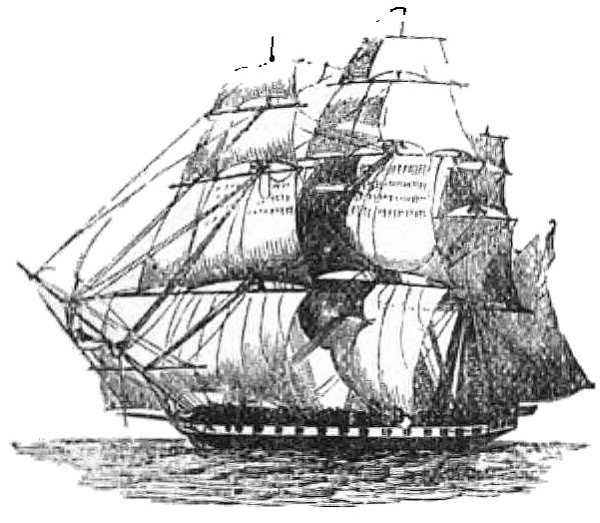
“Then my servant would pass on, smiling in his own sleeve as the saying is, for no one ever dreamed of searching the dog.”
“Searching the dog!” said Ida, with wondering eyes.
“Yes, dear, the dog was a smuggler, though he did not know it. For that log of wood was a hollow one, and stuffed with tobacco. I did not know of this, of course.”
“How wicked!” said Ida. “Why, Nero, you’ve been a regular pirate of the boundless ocean.”
Chapter Twenty Nine.
The Story of Aileen’s Husband, Nero—Continued.
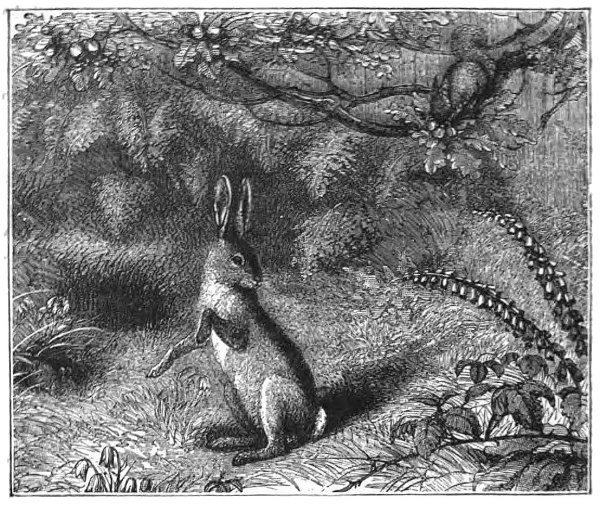
“Poor dog! he was faithful and kind, to be sure, And he constantly loved me, although I was poor.” Campbell.
“Do I think that Master Nero knows we are talking about him? Yes, birdie, of that I am quite convinced. Just look at the cunning old rogue lying there pretending to be asleep, but with his ears well forward, and one eye half-open. And Aileen, too, knows there is a bit of biography going on, and that it is all about her well-beloved lord and master.
“But to tell you one-tenth part of all that had happened to Nero, or to me and Nero together, would take far more time than I can spare, dear Ida. I could give you anecdote after anecdote about his bravery, his strength, his nobility of mind, and his wonderful sagacity; but these would not make you love him more than you do.
“And you never can love the faithful fellow half so much as I do. I have been blamed for loving him far too well, and reminded that he is only a dog.
“Only a dog! How much I hate the phrase; and sinful though I know it to be, I can hardly help despising those who make use of it. But of those who do use the expression, there are few, I really believe, who would wonder at me loving that noble fellow so well did they know the sincere friend he has been many a time and oft to me.
“He saved my life—worthless though it may be—he saved the life of another. Tell you the story? It is not a story, but two stories; and though both redound to the extreme wisdom and sagacity and love of the dog, both are far too sad for you to listen to. Some day I may tell them. Perhaps—”
There was a pause of some minutes here; Ida, who was lying beside the dog, had thrown her arms around his neck, and was fondly hugging him. Aileen came directly to me, sighed as usual, and put her head on my shoulder.
“Love begets love, Ida, and I think it was more than anything else the dog’s extreme affection for me, shown in a thousand little ways, that caused me to take such a strong abiding affection for him. He knew—as he does now—everything I said, and was always willing to forestall my wishes, and do everything in the world to please me.
“When ill one time, during some of our wanderings, and laid up in an out-of-the-way part of the country among strange people, it was a sad anxiety for me to have to tell the dog he must go out by himself and take his necessary ramble, as I was far too ill to leave my bed.
“The poor animal understood me.
“‘Good-bye, master,’ he seemed to say, as he licked my face; ‘I know you are ill, but I won’t stop out long.’
“He was back again in a quarter of an hour, and the same thing occurred every time he was sent by himself; he never stopped more than fifteen minutes.
“Would a human friend have been as careful? Do you not think that there were temptations to be resisted even during that short ramble of his—things he would have liked to have stopped to look at, things he would have liked to have chased? Many a dog, I have no doubt, invited him to stop and play, but the dog’s answer must have been, ‘Nay, nay, not to-day; I have a poor sick master in bed, and I know not what might happen to him in this strange place, and among so many strange people. I must hurry and get home.’
“When he did return, he did so as joyfully and made as much fuss over me as if he had been away for a week.
“‘I didn’t stop long, did I, master?’ he would always say, when he returned.
“But wasn’t he a happy dog when he got me up and out again? Weak enough I was at first, but he never went far away from me, just trotted on and looked about encouragingly and waited. I allowed him to take me where he chose, and I have reason to believe he led me on his own round, the round he had taken all by himself every day for weeks before that.
“‘Nero, old boy,’ I said to him one day, some time after this sickness, ‘come here.’
“The dog got up from his corner, and laid his saucy head on my lap.
“‘I’m all attention, master,’ he said, talking with his bonnie brown eyes.
“‘I don’t believe there are two better Newfoundlands in England than yourself, Nero.’
“‘I don’t believe there is one,’ said Nero.
“‘Don’t be saucy,’ I said.
“‘Didn’t I take a cup at the Crystal Palace?’
“‘Yes, but it was only second prize, old boy.’
“‘True, master, but nearly every one said it ought to have been first. I’m only two years old and little over, and isn’t a second prize at a Crystal Palace show a great honour for a youngster like myself?’
“‘True, Nero, true; and now I’ve something to propose.’
“‘To which,’ said the dog, ‘I am willing to listen.’
“‘Well,’ I said, ‘there are dozens of dog-shows about to take place all over the country. I want a change: suppose we go round. Suppose we constitute ourselves show folk. Eh?’
“‘Capital.’
“‘And you’ll win lots of prize-money, Nero.’
“‘And you’ll spend it, master. Capital again.’
“‘There won’t be much capital left, I expect, doggie, by the time we get back; but we’ll see a bit of England, at all events.’
“So we agreed to start, and so sure of winning with the dog was I that I bought that splendid red patent leather collar that you, Ida, sometimes wear for a waist-belt. The silver clasps on it were empty then, but each time the dog won a prize, the name of the town was engraved on one of the clasps.”
“They are pretty well filled up now,” said Ida.
“Yes, the dog won nineteen first prizes and cups in little over three months, which was very fair for those days. He was then dubbed champion. There was not a Newfoundland dog from Glasgow to Neath that would have cared to have met Nero in the show ring.
“He used to enter the arena, too, with such humour and dash, with his grand black coat floating around him, and the sun glittering on it like moonbeams on a midnight sea. That was how Nero entered the judging ring; he never slunk in, as did some dogs. He just as often as not had a stick in his mouth, and if he hadn’t, he very soon possessed himself of one.
“‘Yes, look at me all over,’ he would say to the judges; ‘there is no picking a fault in me, nor in my master either for that matter. I’m going to win, that’s what I’m here for.’
“But when I was presented with the prize card by the judge, Nero never failed to make him a very pretty bow.
“The only misfortune that ever befell the poor fellow was at Edinburgh dog-show.
“On the morning of the second day—it was a three or four day exhibition—I received a warning letter, written in a female hand, telling me that those who were jealous of the dog’s honours and winnings were going to poison him.
“I treated the matter as a joke. I could not believe the world contained a villain vile enough to do a splendid animal like that to death, and so cruel a death, for the sake of pique and jealousy. But I had yet to learn what the world was.
“The dog was taken to the show, and chained up as usual at his place on the bench. Alas! when I went to take him home for the night I found his head down, and hardly able to move. I got him away, and sat up with him all night administering restoratives.
“He was able to drink a little milk in the morning, and to save his prize-money I took him back, but had him carefully watched and tended all the remaining time that the show was open.
“We went to Boston, Lincoln, Gainsborongh, and all over Yorkshire and Lancaster and Chester, besides Scotland, and our progress was a triumph to the grand and beautiful dog. Especially was he admired by ladies at shows. Wherever else they might be, there was always a bevy of the fair sex around Nero’s cage. During that three months’ tour he had more kisses probably than any dog ever had before in the same time. It was the same out of the show as in it—no one passed him by without stopping to admire him.
“‘Aren’t we having a splendid time, master?’ the dog said to me one day.
“‘Splendid,’ I replied; ‘but I think we’ve done enough, my doggie. I think we had better retire now and go to sea for a spell.’
“‘Heigho!’ the dog seemed to say; ‘but wherever your home is there mine is too, master.’”
“There is a prize card hanging on the wall of the wigwam,” said Ida, “on which Nero is said to have won at a life-saving contest at Southsea.”
“Yes, dear, that was another day’s triumph for the poor fellow. He had won on the show bench there as well, and afterwards proved his prowess in the sea in the presence of admiring thousands.
“Your honest friend there, Ida, has been all along as fond of human beings and other animals as he is now. In their own country Newfoundlands are used often as sledge dogs, and sometimes as retrievers, but I do not think it is in their nature to take life of any kind, unless insect life, my gentle Ida. They don’t like blue-bottles nor wasps, I must confess, but Nero has given many proofs of the kindness of heart he possesses that are really not easily forgotten.
“Tell you a few? I’ll tell you one or two. The first seems trivial, but there is a certain amount of both pathos and humour about it. Two boys had been playing near the water at Gosport, and for mischiefs sake one had pitched the other’s cap into the tide and ran off. The cap was being floated away, and the disconsolate owner was weeping bitterly on the bank, when we came up. Nero, without being told, understood what was wrong in a moment; one glance at the floating cap, another at the boy, then splash! he had sprang into the tide, and in a few minutes had laid the rescued article at the lad’s feet; then he took his tongue across his cheek in a rough kind of caressing way.
“‘There now,’ he appeared to say, ‘don’t cry any more.’
“Nero ought to have made his exit here, and he would have come off quite the hero; but no, the spirit of mischief entered into him, and he shook himself, sending buckets of water all over the luckless lad, who was almost as wet now as if he had swam in after his cap himself. Then Nero came galloping up to me, laughing all over at the trick he had played the poor boy.
“This trick of shaking himself over people was taught him by one of my messmates; and he used to delight to take him along the beach on a summer’s day, and put him in the water. When he came out, my friend would march along in front of the dog, till the latter was close to some gay lounger, then turn and say, ‘Shake yourself, boy.’ The dénouement may be more easily imagined than described, especially if the lounger happened to be a lady. I’m ashamed of my friend, but love the truth, Ida.”
“How terribly wicked of Nero to do it!” said Ida.
“And yet I saw the dog one day remove a drowning mouse from his water dish, without putting a tooth in it. He placed it on the kitchen floor, and licked it as tenderly over as a cat would her kitten. He looked up anxiously in my face, as much as to say, ‘Do you think the poor thing can live?’
“Hurricane Bob there, his son, does not inherit all his father’s finest qualities; he would not scruple to kill mice or rats by the score. In fact, I have reason to believe he rather likes it. His mother was just the same before him; a kindly-hearted dog she was, but as wild as a wolf, and full of fun of the rough-and-tumble kind.”
“Were you never afraid of losing poor Nero?”
“I did lose him one dark winter’s night, Ida, in the middle of a large and populous city. Luckily, I had been staying there for some time—two weeks, I think—and there were different shops in different parts of the city where I dealt, and other places where I called to rest or read. The dog was always in the habit of accompanying me to the shops, to bring home the purchases, so he knew them all. The very day on which I lost the dog I had changed my apartments to another quarter of the city.
“In the evening, while walking along a street, with Nero some distance behind me, it suddenly occurred to me to run into a shop and purchase a magazine I saw in the window. I never thought of calling the dog. I fancied he would see me entering the book-shop and follow, but he didn’t; he missed me, and thinking I must be on ahead, rushed wildly away up the street into the darkness and rain, and I saw him no more that night.
“Only those who have lost a favourite dog under such circumstances can fully appreciate the extent of my grief and misery. I went home at long last to my lonely lodgings. How dingy and dreadful they seemed without poor Nero’s honest form on the hearthrug! Where could he be, what would become of him, my only friend, my gentle, loving, noble dog, the only creature that cared for me? You may be sure I did not sleep, I never even undressed, but sat all night in my chair, sleeping towards morning, and dreaming uneasy dreams, in which the dog was always first figure.
“I was out and on my way to the police offices ere it was light. The weather had changed, frost had come, and snow had fallen.
“Several large black dogs had been found during the night; I went to see them all. Alas! none was Nero. So after getting bills printed, and arranging to have them posted, I returned disheartened to my lodgings. But when the door opened, something as big as a bear flew out, flew at me, and fairly rolled me down among the snow.
“‘No gentler caress, master,’ said Nero, for it was he, ‘would express the joy of the occasion.’
“Poor fellow, I found out that day that he had been at every one of the places at which I usually called; I daresay he had gone back to our old apartments too, and had of course failed to find me there. As a last resort he turned up at the house of an old soldier with whom I had had many a pleasant confab. This was about eleven o’clock; it was eight when he was lost. Not finding me here, he would have left again, and perhaps found his way to our new lodgings; but the old soldier, seeing that something must be amiss, took him in, kept him all night, found my rooms in the morning, and fetched him home. You may guess whether I thanked the old man or not.
“When Dolls (see page 76) came to me first, he was in great grief for the loss of his dear master (Note 1). Nero seemed to know it, and though he seldom made much of a fuss over dogs of this breed, he took Dolls under his protection; indeed, he hardly knew how kind to be to him.
“I ought to mention that Mortimer Collins and Nero were very great friends indeed, for the poet loved all things in nature good and true.
“There was one little pet that Nero had long before you knew him, Ida. His name was Pearl, a splendid Pomeranian. Perhaps Pearl reminded Nero very much of his old favourite, Vee-vee. At all events he took to him, used to share his bed and board with him, and protected him from the attacks of strange dogs when out. Pearl was fat, and couldn’t jump well. I remember our coming to a fence one day about a foot and a half high. The other dogs all went bounding over, but Pearl was left to whine and weep at the other side. Nero went straight back, bounded over and re-bounded over, as if showing Pearl how easy it was. But Pearl’s heart failed, seeing which honest Nero fairly lifted him over by the back of the neck.
“I was going to give a dog called ‘Pandoo’ chastisement once. Pandoo was a young Newfoundland, and a great pet of Nero, whose son he was. I got the cane, and was about to raise it, when Nero sprang up and snatched it from my hand, and ran off with it. It was done in a frolicsome manner, and with a deal of romping and jumping. At the same time, I could see he really meant to save the young delinquent; so I made a virtue of necessity, and pardoned Pandoo.
“But Nero’s love for other animals, and his kindness for all creatures less and weaker than himself, should surely teach our poor humanity a lesson. You would think, to see him looking pityingly sometimes at a creature in pain, that he was saying with the poet—
“‘Poor uncomplaining brute, Its wrongs are innocent at least, And all its sorrows mute.’
“One day, at the ferry at Hotwells, Clifton, a little black-and-tan terrier took the water after a boat and attempted to cross, but the tide ran strong, and ere it reached the centre it was being carried rapidly down stream. On the opposite bank stood Nero, eagerly watching the little one’s struggles, and when he saw they were unsuccessful, with one impatient bark—which seemed to say, ‘Bear up, I’m coming’—he dashed into the water, and ploughed the little terrier all the way over with his broad chest, to the great amusement of an admiring crowd.
“On another occasion some boys near Manchester were sending a Dandie-Dinmont into a pond after a poor duck; the Dandie had almost succeeded in laying hold of the duck, when Nero sprang into the water, and brought out, not the duck, but the Dandie by the back of the neck.
“I saw one day a terrier fly at him and bite him viciously behind. He turned and snapped it, just once. Once was enough. The little dog sat down on the pavement and howled piteously. Nero, who had gone on, must then turn and look back, and then go back and lick the place he had bitten.
“‘I really didn’t intend to hurt you so much,’ he seemed to say; ‘but you did provoke me, you know. There! there! don’t cry.’”
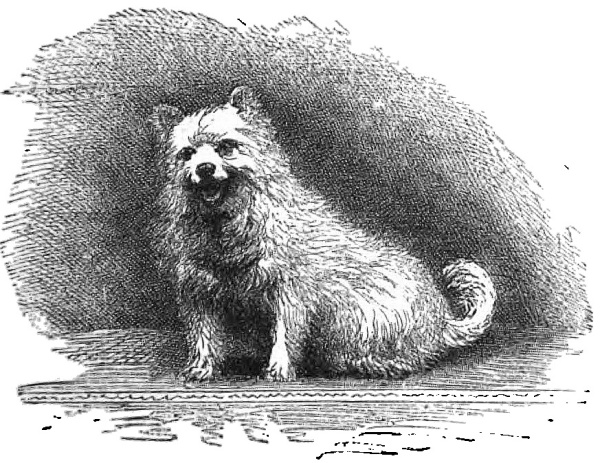
“Now then, Ida, birdie, let us have one good scamper through the pine wood and meadow, and then hie for home. Come on, dogs; where are you all? Aileen, Nero, Bob, Gipsy, Eily, Broom, Gael, Coronach? Hurrah! There’s a row! There’s music! That squirrel, Ida, who has been cocking up there on the oak, listening to all we’ve been saying, thinks he’d better be off. There isn’t a bird in the wood that hasn’t ceased its song, and there isn’t a rabbit that hasn’t gone scurrying into its hole, and I believe the deer have all jumped clean out of the forest; the hare thinks he will be safer far by the river’s brink; and the sly, wily old weasel has come to the conclusion that he can wait for his dinner till the dogs go home. The only animal that doesn’t run away is the field-mouse. He means to draw himself up under a burdock leaf and wait patiently till the hairy hurricane sweeps onward past him. Then he’ll creep out and go nibbling round as usual. Come.”
Note 1. The poet Mortimer Collins. He came into my possession shortly after his death.
Chapter Thirty.
Ida’s Illness—Mercy to the Dumb Animals.
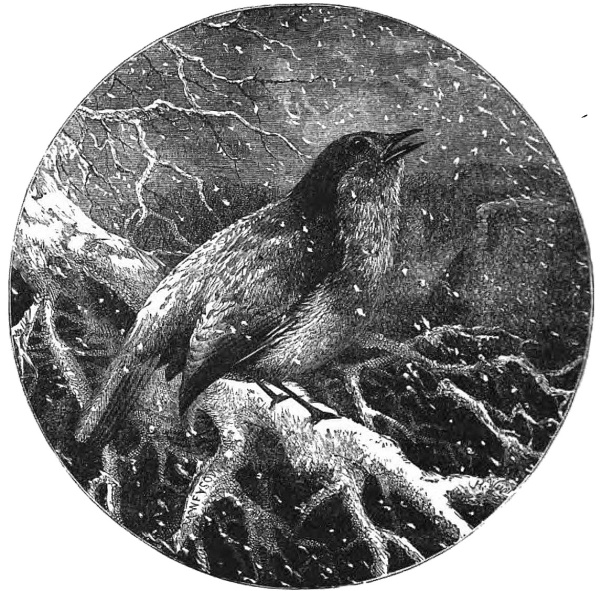
“Then craving leave, he spake Of life, which all can take but none can give; Life, which all creatures love and strive to keep, Wonderful, dear, and pleasant unto each, Even to the meanest; yea, a boon to all Where pity is, for pity makes the world Soft to the weak and noble to the strong.” E. Arnold’s “Light of Asia.”
It was sadly changed times with all of us when Ida fell ill.
Her illness was a very severe one, and for many weeks she literally hovered ’twixt death and life. Her spirit seemed like some beautiful bird of migration, that meditates quitting these cold intemperate shores and flying away to sunnier climes, but yet is loath to leave old associations and everything dear to it.
There was little done during these weeks, save attending to Ida’s comforts, little thought about save the child.
Even the dogs missed their playmate. The terriers went away to the woods every day by themselves. Eily, the collie, being told that she must make no noise, refrained from barking even at the butcher, or jumping up and shaking the baker by his basket, as had been her wont.
Poor Aileen Aroon went about with her great head lower than usual, and with a very apologetic look about her, a look that, beginning in her face, seemed to extend all the way to the point of her tail, which she wagged in quite a doleful manner.
Nero and she took turn and turn about at keeping watch outside Ida’s room door.
Ida’s favourite cat seldom left her little mistress’s bedside, and indeed she was as often in the bed as out of it.
It was winter—a green winter. Too green, Frank said, to be healthy; and the dear old man used to pray to see the snow come.
“A bit of a frost would fetch her round,” he said. “I’d give ten years of my life, if it is worth as much, to see the snow on the ground.”
The trees were all leafless and bare, but tiny flowers and things kept growing in under the shrubs in quite an unnatural way.
But Frank came in joyfully one evening, crying, “It’s coming, Gordon, it’s coming; the stars are unspeakably bright; there is a steel-blue glitter in the sky that I like. It’s coming; we’ll have the snow, and we’ll have Ida up again in a month.”
I had not quite so much faith in the snow myself, but I went out to have a look at the prospect. It was all as Frank had said; the weird gigantic poplars were pointing with leafless fingers up into a sky of frosty blue, up to stars that shone with unusual radiance; and as I walked along, the gravel on the path resounded to my tread.
“I’ll be right; you’ll see, I’ll be right,” cried Frank, exultant. “I’m an older man than you, Gordon, doctor and all though you be.”
Frank was right. He was right about the snow, to begin with. It came on next morning; not all at once in great flakes. No, big storms never begin like that, but in grains like millet-seed. This for an hour; then mingling with the millet-seed came little flakes, and finally an infinity of large ones, as big as butterflies’ wings. It was a treat to gaze upwards, and watch them coming dancing downwards in a dazzling and interminable maze.
It was beautiful!
It wanted but one thing at that moment to make me happy. That was the presence of our bright-faced, blue-eyed little pet, standing on the doorstep as she used to, gazing upwards, with apron outstretched to catch the falling flakes.
Frank was so overjoyed, he must needs go out and walk about in the snow for nearly an hour. I was in the kitchen engaged in some mysterious invalid culinary operation when Frank came in. He always came in through the kitchen now, instead of the hall, lest he might disturb the child.
Frank’s face was a treat to look at; it was redder, and appeared rounder than usual, and jollier.
“There’s three inches of snow on the ground already,” he remarked, joyfully. “Mary, bring the besom, my girl, to brush the snow off my boots. That’s the style.”
Strange as it may appear, from that very morning our little patient began to mend, and ere the storm had shown signs of abatement—in less than a week, in fact—Ida was able to sit up in bed.
Thin was her face, transparent were her hands; yet I could see signs of improvement; the white of her skin was a more healthful white; her great, round eyes lost the longing, wistful look they had before.
I was delighted when she asked me to play to her. She would choose the music, and I must play soft and low and sweet. Her fingers would deftly turn the pages of the book till her eyes rested on something she loved, and she would say, with tears in her eyes—
“Play, oh, play this! I do love it.”
I managed to find flowers for her even in the snowstorm, for the glass-houses at the Manor of D— are as large as any in the country, and the owner was my friend.
I think she liked to look at the hothouse fruit we brought her, better than to eat them.
The dogs were now often admitted. Even Gael and Broom were not entirely banished.
My wife used to sew in the room, and sometimes read to Ida, and Frank used to come in and sit at the window and twirl his thumbs. His presence seemed to comfort the child.
I used to write beside her.
“What is that you are writing?” she said one day.
“Nothing much,” I replied; “only the introduction to a ‘Penny Reading’ I’m going to give against cruelty to animals.”
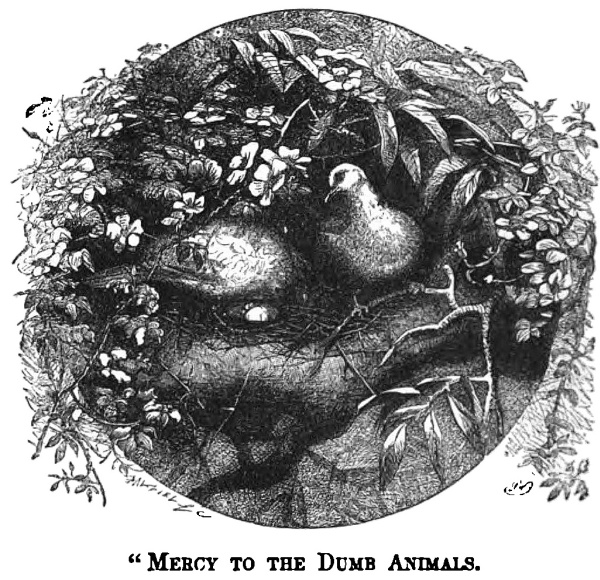
“Read it,” said Ida; “and to-morrow, mind, you must begin and tell me stories again, and then I’m sure I shall soon get well, because whatever you describe about the fields or the woods, the birds or the flowers I can see, it is just like being among them.”
I had to do as I was told, so read as follows:—
“Mercy to the Dumb Animals.
“‘I would give nothing for that man’s religion whose cat and dog are not the better for it.’—Dr Norman McLeod.
“‘We are living in an enlightened age.’ This is a remark which we hear made almost every day, a remark which contains just one golden grain of truth. Mankind is not yet enlightened in the broad sense of the term. From the night of the past, from the darkness of bygone times, we are but groping our way, as it were, in the morning-glome, towards a great and a glorious light.
“It is an age of advancement, and a thousand facts might be adduced in proof of this. I need point to only one: the evident but gradual surcease of needless cruelty to animals. Among all classes of the community far greater love and kindness is now manifested towards the creatures under our charge than ever was in days gone by. We take greater care of them, we think more of their comfort when well, we tend them more gently when sick, and we even take a justifiable pride in their appearance and beauty. All this only shows that there is a spirit of good abroad in the land, a something that tends to elevate, not depress, the soul of man. I see a spark of this goodness even in the breast of the felon who in his prison cell tames a humble mouse, and who weeps when it is cruelly taken from him; in the ignorant costermonger who strokes the sleek sides of his fat donkey, or the rough and unkempt drover-boy, who shares the remains of a meagre meal with his faithful collie.
“Religion and kindness to animals go hand in hand, and have done so for ages, for we cannot truly worship the Creator unless we love and admire His works.
“The heavenly teaching of the Mosaic law inculcates mercy to the beasts. It is even commanded that the ox and the ass should have rest on one day of the week—namely, the Sabbath; that the ox that treadeth out the corn is not to be muzzled; that the disparity in strength of the ass and ox is to be considered, and that they should not be yoked together in one plough. Even the wild birds of the field and woods are not forgotten, as may be seen by reading the following passage from the Book of Deuteronomy:—‘If a bird’s nest be before thee in any tree, or on the ground, whether they be young ones or eggs, and the dam sitting upon the young or upon the eggs, thou shalt not take the dam with the young: but thou shalt in any way let the dam go.’
“The Jews were commanded to be merciful and kind to an animal, even if it belonged to a person unfriendly to them.
“‘If thou see the ass of him that hateth thee lying under his burden, and wouldest forbear to help him, thou shalt surely help with him.’
“That is, they were to assist even an enemy to do good to a fallen brute. It is as if a man, passing along the street, saw the horse or ass of a neighbour, who bore deadly hatred to him, stumble and fall under his load, and said to himself—
“‘Oh! yonder is So-and-so’s beast come down; I’ll go and lend a hand. So-and-so is no friend of mine, but the poor animal can’t help that. He never did me any harm.’
“And a greater than even Moses reminds us we are to show mercy to the animals even on the sacred day of the week.
“But it is not so very many years ago—in the time when our grandfathers were young, for instance—since roughness and cruelty towards animals were in a manner studied, and even encouraged in the young by their elders. It was thought manly to domineer over helpless brutes, to pull horses on their haunches, to goad oxen along the road, though they were moving to death in the shambles, to stone or beat poor fallen sheep, to hunt cats with dogs, and to attend bull-baitings and dog and cock fights. And there are people even yet who talk of these days as the good old times when ‘a man was a man.’ But such people have only to visit some low-class haunt of ‘the fancy,’ when ‘business’ is being transacted, to learn how depraving are the effects of familiarity with scenes of cruelty towards the lower animals. Even around a rat-pit they would see faces more revolting in appearance than those of Doré’s demons, and listen to jests and language so ribald and coarse as positively to pain and torture the ear and senses. Goodness be praised that such scenes are every day getting more rare, and that the men who attend them have a wholesome terror of the majesty of human laws at least.
“Other religions besides the Christian impress upon their followers rules relating to kindness to the inferior animals. Notably, perhaps, that of Buddha, under the teachings of which about five hundred millions of human beings live and die. The doctrines of Gautama are sublimely beautiful; they are akin to those of our own religion, and I never yet met any one who had studied them who did not confess himself the better and happier for having done so. One may read in prose sketches of the life and teachings of Gautama the Buddha, in a book published by the Society for Promoting Christian Knowledge, or he may read them in verse in that splendid poem by Edwin Arnold called ‘The Light of Asia.’ Gautama sees good in all things, and all nature working together for good; he speaks of—
“‘That fixed decree at silent work which will Evolve the dark to light, the dead to life, To fulness void, to form the yet unformed, Good unto better, better unto best, By wordless edict; having none to bid, None to forbid; for this is past all gods Immutable, unspeakable, supreme, A Power which builds, unbuilds, and builds again, Ruling all things accordant to the rule Of virtue, which is beauty, truth, and use. So that all things do well which serve the Power And ill which hinder; nay, the worm does well (Note 1) Obedient to its kind; the hawk does well Which carries bleeding quarries to its young; The dewdrop and the star shine sisterly, Globing together in the common work; And man who lives to die, dies to live well, So if he guide his ways by blamelessness And earnest will to hinder not, but help All things both great and small which suffer life.’
“Those among us who have tender hearts towards the lower animals cannot help day after day witnessing acts of cruelty to them which give us great pain. We are naturally inclined to feel anger against the perpetrators of such cruelty, and to express that anger in wrathful language. By so doing I am convinced we do more harm than good to the creatures we try to serve. Calmness, not heat or hurry, should guide us in defending the brute creation against those who oppress and injure it. Let me illustrate my meaning by one or two further extracts from Arnold’s poem.
“It is noontide, and Gautama, engrossed in thought and study, is journeying onwards—
“‘Gentle and slow, Radiant with heavenly pity, lost in care For those he knew not, save as fellow-lives.’ “When,— “‘Blew down the mount the dust of pattering feet, White goats, and black sheep, winding slow their way, With many a lingering nibble at the tufts, And wanderings from the path where water gleamed, Or wild figs hung. But always as they strayed The herdsman cried, or slung his sling, and kept The silly crowd still moving to the plain. A ewe with couplets in the flock there was, Some hurt had lamed one lamb, which toiled behind Bleeding, while in the front its fellow skipped. And the vexed dam hither and thither ran, Fearful to lose this little one or that. Which, when our Lord did mark, full tenderly He took the limping lamb upon his neck, Saying: “Poor woolly mother, be at peace! Whither thou goest, I will bear thy care; ’Twere all as good to ease one beast of grief, As sit and watch the sorrows of the world In yonder caverns with the priests who pray.” So paced he patiently, bearing the lamb. Beside the herdsman in the dust and sun, The wistful ewe low-bleating at his feet.’
“Sorely this was a lesson which the herdsman, ignorant though he no doubt was, never forgot; farther comment on the passage is needless. Precept calmly given does much good, example does far more.”
Note 1. A fact which Darwin in his treatise on earthworms has recently proved.
Chapter Thirty One.
Mirram: A Sketch from the Life of a Cat—About Summer Songs and Songsters.
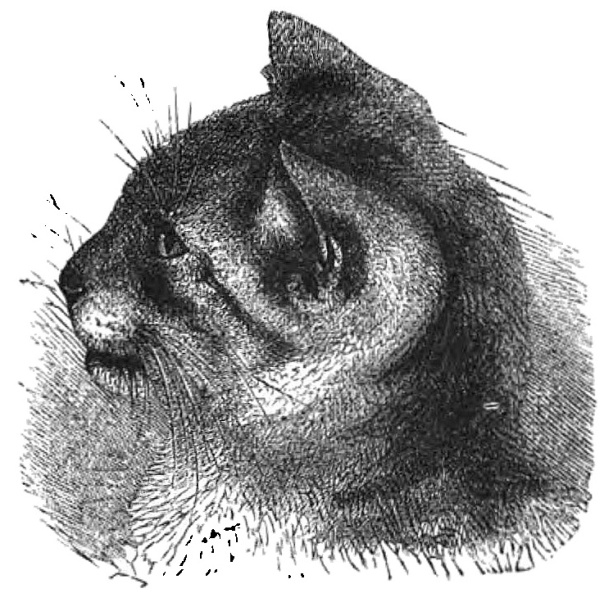
“The mouse destroyed by my pursuit No longer shall your feasts pollute, Nor rats, from nightly ambuscade, With wasteful teeth your stores invade.” Gay. “Books! ’tis a dull and endless strife, Come and hear the woodland linnet; How sweet his music! On my life There’s more of wisdom in it.” Wordsworth.
Ida continued to improve, and she did not let me forget my promise to resume my office of story-telling, which I accordingly did next evening, bringing my portfolio into Ida’s bedroom for the purpose.
Ida had her cat in her arms. The cat was singing low, and had his round, loving head on her shoulder, and his arms buried in her beautiful hair. So this suggested my reading the following:—
Mirram: A Sketch from the Life of a Cat.
“Mirram: that was the name of pussy. It appears a strange one, I admit; but you see there is nobody accountable for it except the little cat herself, for she it was who named herself Mirram. I don’t mean to say that pussy actually came to her little mistress, and said in as many words, ‘Mirram is a pretty name, and I should like to be called Mirram. Call me Mirram, please, won’t you?’
“For cats don’t talk nowadays, except in fairy tales; but this is how it was. She was the most gentle and kindly-hearted wee puss, I believe, that ever was born, and if you happened to meet her anywhere, say going down the garden walk, she would look lovingly and confidingly up in your face, holding her tail very erect indeed, and ‘Mirram’ she would say.
“You see, ‘Mirram’ was the only English word, if it be English, that pussy could speak, and she made it do duty on every occasion; so no wonder she came to be called Mirram.
“If she were hungry she would jump upon your knee, and gently rub her shoulders against you and say, ‘Mirram.’
“‘Mirram’ in this case might be translated as follows: ‘Oh, please, my dear little mistress, I am so hungry! I’ve been up ever since five o’clock this morning. With the exception of a bird which I found and ate, feathers and all, and a foolish little mouse, I’ve had no breakfast. Do give me a little milk.’
“This would be an appeal that you couldn’t resist, and you would give her a saucerful of nice new milk, telling her at the same time that it was very naughty of her to devour poor birds, who come and cheer us with their songs both in winter and in summer.
“Another morning she would come hopping in through the open window, when you least expected her, and say ‘Mirram’ in the most kindly tone. This would, of course, mean, ‘Good-morning to you. I’m glad to see you downstairs at last. I’ve been up and out ever since sunrise. And, oh! such fun I’ve been having. You can’t conceive what a fine morning it is, and what a treat it is to rise early.’
“And now, having introduced this little puss to you by name, I must tell you something about her playmates, and say a word or two about the place she lived in, and her life in general, and after that show you how pussy at one time came to grief on account of a little fault she had. Of course, we all have our little faults, which we should strive to conquer, and I may as well confess at once what Mirram’s was. Well, it was—thoughtlessness.
“The first and the chief of pussy’s playmates, then, was her child-mistress. Would you like to know what her name was? I will tell you with pleasure; and when you hear it I’m sure you will say it is a strange one. She had two Christian names—the first was Fredabel, the second was Inez—Fredabel Inez—the latter being Spanish.
“‘But,’ you will say, ‘is “Fredabel” Spanish too, because I never heard of such a name before?’
“No, I am quite sure you never did; for this reason: no child was ever called by that name before, the fact being that her papa invented the name for her, as it was the only way he could see to get out of a dilemma, or difficulty. And here was the dilemma. When pussy’s mistress was quite a baby, her two aunts came to see her, and they had no sooner seen her than they both loved her very much; so they both went one morning into her papa’s study, and the following conversation took place:—
“‘Good-morning, brother,’ said one aunt. ‘I love your baby very, very much, and I want you to call her after me—her first name, mind you—and when she grows up she won’t lose by it.’
“‘Good-morning, brother,’ said the other aunt. ‘I also love your dear baby very much, and if you call her first name after mine, when she grows up she’ll gain by it.’
“Well, when baby’s papa heard both the aunts speak like this, he was very much perplexed, and didn’t know what to do, because he didn’t want to offend either the one aunt or the other.
“But after a great deal of cogitation, he possessed himself of a happy thought, or rather, I should say, a happy thought took possession of him. You see the name of the one aunt was Freda, and the name of the other was Bella, so what more natural than that baby’s papa should compound a name for her between the two, and call her Fredabel.
“So he did, and both aunts were pleased and merry and happy.
“But at the time our tale begins baby hadn’t grown up, nor anything like it; she was just a little child of not much over four years old.
“Now, as the one aunt always called her Freda and the other Bella, and as everybody else called her Eenie, I think we had better follow everybody else’s example, and call her Eenie, too.
“Was Eenie pretty, did you ask? Yes, she was pretty, and, what is still better than being pretty, she was very kind and good. So no wonder that everybody loved her. She had a sweet, lovely face, had Eenie. Her hair, that floated over her lair shoulders, was like a golden sunbeam; her eyes were blue as the bluest sky, and large and liquid and love-speaking, and when she looked down her long dark eyelashes rested on cheeks as soft as the blossom of peach or apricot.
“Yet she was merry withal, merry and bright and gay, and whenever she laughed, her whole face was lighted up and looked as lovely as sunrise in May.
“I have said that Eenie was good and kind, and so she was; good and kind to every creature around her. She never tormented harmless insects, as cruel children do, and so all creatures seemed to love her in return: the trees whispered to her, the birds sang to her, and the bees told her tales.
“That was pussy Mirram’s mistress then; and it was no wonder Mirram was fond of her, and proud to be nursed and carried about by her. Mind you, she would not allow any one else to carry her. If anybody else had taken her up, puss would have said—‘Mirram!’ which would mean, ‘Put me down, please; I’ve got four legs of my own, and I much prefer to use them.’ And if the reply had been—‘Well, but you allow Eenie to handle and nurse you,’ pussy would have answered and said—
“‘Isn’t Eenie my mistress, my own dear mistress? Could any one ever be half so kind or careful of me as she is? Does she ever forget to give me milk of a morning or to share with me her own dinner and tea? Does she not always have my saucer filled with the purest, freshest water? and does she forget that I need a comfortable bed at night? No; my mistress may carry me as much as she pleases, but no one else shall.’
“Now Mirram was a mighty hunter, but she was also very fond of play; and when the dogs were in their kennels on very bright sunshiny days, and her little mistress was in the nursery learning her lessons, as all good children do, Mirram would have to play alone. She wasn’t afraid of the bright sunshine, if the dogs were; she would race up into a tall apple-tree, and laying herself full length on a branch, blink and stare at the great sun for half an hour at a time. Then—
“‘Oh!’ she would cry, ‘this resting and looking at the sun is very lazy work. I must play. Let me see, what shall I do? Oh! I have it; I’ll knock an apple down—then hurrah! for a game of ball.’
“And so she would hit a big apple, and down it would roll on the broad gravel-path; and down pussy would go, her face beaming with fun; and the game that ensued with that apple was quite a sight to witness. It was lawn-tennis, cricket, and football all in one. Then when quite tired of this, she would thrust the apple under the grass for the slugs to make their dinner of, and off she would trot to knock the great velvety bees about with her gloved paws. She would soon tire of this, though, because she found the bees such serious fellows.
“She would hit one, and knock it, maybe, a yard away; but the bee would soon get up again.
“‘It is all very well for you, Miss Puss,’ the bee would say; ‘your life is all play, but I’ve got work to do, for I cannot forget that, brightly though the sun is shining now, before long cold dismal winter will be here, and very queer I should look if I hadn’t laid up a store of nice honey to keep me alive.’
“And away the bee would go, humming a tune to himself, and Mirram would spy a pair of butterflies floating high over the scarlet-runners, but not higher than Mirram could spring. She couldn’t catch them, though.
“‘No, no, Miss Puss,’ the butterflies would say; ‘we don’t want you to play with us. We don’t want any third party, so please keep your paws to yourself.’
“And away they would fly.
“Then perhaps Mirram would find a toad crawling among the strawberry beds.
“‘You’re after the fruit, aren’t you?’ pussy would say, touching it gently on the back.
“‘No, not at all,’ the toad would reply. ‘I wouldn’t touch a strawberry for the world; the gardener put me here to catch the slugs; he couldn’t get on without me at all.’
“‘Well, go on with your work, Mr Toad,’ pussy would reply; ‘I’m off.’
“And what a glorious old garden that was for pussy to play in, and for her mistress to play in! A rambling old place, in which you might lose yourself, or, if you had a companion, play at hide-and-seek till you were tired. And every kind of flower grew here, and every kind of fruit and vegetable as well; just the kind of garden to spend a long summer’s day in. Never mind though the day was so hot that the birds ceased to sing, and sat panting all agape on the apple-boughs—so hot that the very fowls forgot to cackle or crow, and there wasn’t a sound save the hum of the myriads of insects that floated everywhere around, you wouldn’t mind the heat, for wasn’t there plenty of shade, arbours of cool foliage, and tents made of creepers?—and oh! the brilliancy of the sunny marigolds, the scarlet clustered geraniums, the larkspurs, purple and white, and the crimson-painted linums. No, you wouldn’t mind the heat; weren’t there strawberries as large as eggs and as cold as ice? And weren’t there trees laden with crimson and yellow raspberries? And weren’t the big lemon-tinted gooseberries bearing the bushes groundwards with the weight of their sweetness, and praying to be pulled? A glorious old garden indeed!
“But see, the dogs have got out of their kennels, and have come down the garden walks on their way to the paddock, and pussy runs to meet them.
“‘What! dogs in a garden?’ you cry. Yes; but they weren’t ordinary dogs, any more than it was an ordinary garden. They were permitted to stroll therein, but they were trained to keep the walks, and smell, but never touch, the flowers. They roamed through the rosary, they rolled on the lawn, they even slept in the beautiful summer-houses; but they never committed a fault—but in the autumn, when pears and apples dropped from the trees, they were permitted, and even encouraged, to eat their fill of the fruit. And they made good use of their privilege, too. These were pussy’s playmates all the year round—the immense black Newfoundlands, the princely boarhounds, the beautiful collies, and the one little rascal of a Scottish terrier. You never met the dogs without also meeting Mirram, whether out in the country roads or at home, on the leas or in the paddock; she pulled daisies to throw at the dogs in summer, and in winter she used to lie on her back, and in mere wantonness pitch pellets of snow at the great boar hound himself.
“The dogs all loved her. Once, when she was out with the dogs on a common, a great snarly bulldog came along, and at once ran to kill poor Mirram. You should have seen the commotion that ensued.
“‘It is our cat,’ they all seemed to cry, in a kind of canine chorus. ‘Our cat—our cat—our cat!’ And all ran to save her.
“No, they didn’t kill him, though the boarhound wanted to; but the biggest Newfoundland, a large-hearted fellow, said, ‘No, don’t let us kill him, he doesn’t know any better; let us just refresh his memory.’
“So he took the cur, and trailed him to the pond and threw him in; and next time that dog met Mirram he walked past her very quietly indeed!
“Mirram loved all the dogs about the place; but I think her greatest favourite was the wee wire-haired Scottish terrier. Perhaps it was because he was about her own size, or perhaps it was because he was so very ugly that she felt a kind of pity for him. But Mirram spent a deal of time in his company, and they used to go trotting away together along the lanes and the hedges, and sometimes they wouldn’t return for hours, when they would trot home again, keeping close cheek-by-jowl, and looking very happy and very funny.
“‘Broom’ this little dog had been called, probably in a frolic, and from some fancied resemblance between his general appearance and the hearth-brush. His face was saucy and impudent, and sharp as needles; his bits of ears cocked up, and his tiny wicked-looking eyes glanced from under his shaggy eyebrows, as if they had been boatman-beetles. I don’t think Broom was ever afraid of anything, and very important the little dog and pussy looked when returning from a ramble. They had secrets of great moment between them, without a doubt. Perhaps, if her mistress had asked Mirram where they went together, and what they did, Mirram would have replied in the following words—
“‘Oh! you know, my dear mistress, we go hunting along by the hedgerows and by the ponds, and in the dark forests, and we meet with such thrilling adventures! We capture moles, and we capture great rats and frightful hedgehogs, and Broom is so brave he will grapple even with a weasel; and one day he conquered and killed a huge polecat! Yes, he is so brave, and nothing can ever come over me when Broom is near.’
“Now, no one would have doubted that, in such a pretty, pleasant country home as hers, with such a kind mistress, and so many playmates, pussy Mirram would have been as happy as ever a pussy could be. So she was, as a rule; but not always, because she had that one little fault—thoughtlessness. Ah! those little faults, how often will they not lead us into trouble!
“I don’t say that pussy ever did anything very terrible, to cause her mistress grief. She never did eat the canary, for instance. But she often stopped away all night, and thus caused little Eenie much anxiety. Pussy always confessed her fault, but she was so thoughtless that the very next moonlight night the same thing occurred again, and Mirram never thought, while she was enjoying herself out of doors, that Eenie was suffering sorrow for her sake at home.
“On the flat roof of a house where Mirram often wandered, in the moonlight was a tiny pigeon-hole, so small she couldn’t creep in to save her life even, but from this pigeon-hole a bonnie wee kitten used often to pop out and play with Mirram. Where the pigeon-hole led to, or what was away beyond it, pussy couldn’t even conjecture, though she often watched and wondered for hours, then put in her head to have a peep; but all was dark.
“Perhaps, when she was quite tired of wondering, and was just going to retire for the night, the little face would appear, and Mirram would forget all about her mistress in the joy of meeting her small friend.
“Then how pleased Mirram would look, and how loudly she would purr, and say to the kitten—
“‘Come out, my dear, do come out, and you shall play with my tail.’
“But it was really very thoughtless of Mirram, and just a little selfish as well, not to at once let kittie have her tail to play with; but no.
“‘Sit there, my dear, and sing to me,’ she would say.
“Kittie would do that just for a little while. Very demure she looked; but kittens can’t be demure long, you know; and then there would commence the wildest, maddest, merriest game of romps between the two that ever was seen or heard of; but always when the fun got too exciting for her, kittie popped back again into her pigeon-hole, appearing again in a few moments in the most provoking manner.
“What nights these were for Mirram, and how pleasantly they were spent, and how quickly they passed, perhaps no one but pussy and her little friend could tell. When tired of romping and running, like two feline madcaps, Mirram would propose a song, and while the stars glittered overhead, or the moon shone brightly down on them, they would seat themselves lovingly side by side and engage in a duet. Now, however pleasant cats’ music heard at midnight may appear to the pussies themselves, it certainly is not conducive to the sleep of any nervous invalid who may happen to dwell in the neighbouring houses, or very soothing either.
“Mirram found this out to her cost one evening, and so did the kitten as well, for a window was suddenly thrown open not very far from where they sat.
“‘Ah!’ said Mirram, ‘that is sure to be some one who is delighted with our music, and is going to throw something nice to us.’
“Alas! alas! the something did come, but it wasn’t nice. It took the shape of a decanter of water and an old boot.
“One night pussy Mirram had stayed out very much longer, and Eenie had gone to bed crying, because she thought she would never, never see her Mirram more.
“Thoughtless Mirram! At that moment she was once again on the roof, and the kittie’s face was at the pigeon-hole. Mirram was sitting up in the most coaxing manner possible.
“‘Come out again,’ she was saying to kittie, ‘come out again. Do come out to—’
“She didn’t see that terrible black cat stealing up behind; but she heard the low threatening growl, and sprang round to confront her and defend herself.
“The fight was fierce and terrible while it lasted, and poor Mirram got the worst of it. The black cat had well-nigh killed her.
“‘Oh!’ she sobbed, as she dropped bitter, blinding tears on the roof,—‘oh, if I had never left my mistress! Oh, dear! oh, dear! whatever shall I do?’
“You see Mirram was very sad and sorrowful now; but then, unfortunately, the repentance came when it was too late.”
“Thank you,” Ida said, when I had finished; “I like the description of the garden ever so much. Now tell me something about birds; I’ll shut my eyes and listen.”
“But won’t you be tired, dear?” said my wife.
“No, auntie,” was the reply; “and I won’t go to sleep. I never tire hearing about birds, and flowers, and woods, and wilds, and everything in nature.”
“Here is a little bit, then,” I said, “that will just suit you, Ida. It is short. That is a merit. I call it—”
About Summer Songs and Songsters.
“Sweet is the melody that at this season of the year arises from every feathered songster of forest, field, and lea. I am writing to-day out in the fields, seated, I might say, in the very lap of Nature—my county is the very wildest and prettiest in all mid-England—and I cannot help throwing down my pen occasionally to watch the motions or listen to the singing of some or other of my wild pets. Nothing will convince me that I am not as well known in the woods as if I were indeed a denizen thereof. The birds, at all events, know me, and they do not fear me, because I never hurt or frighten them.
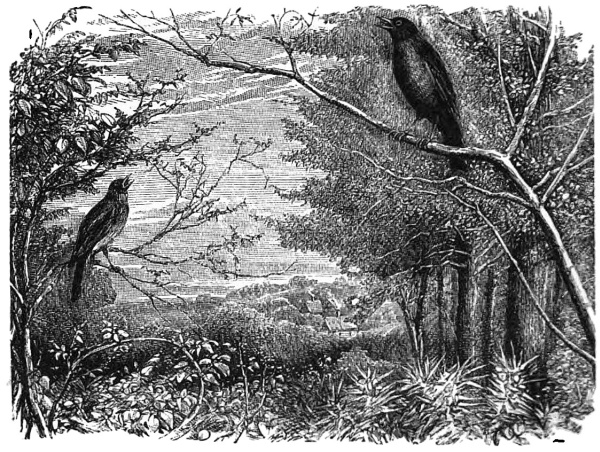
“High overhead yonder, and dimly seen against the light grey of a cloud, is the skylark. He is at far too great a height for me to see his head with the naked eye, so I raise the lorgnettes, and with these I can observe that even as he sings he turns his head earthwards to where, in her cosy grass-lined nest among the tender corn, sits his pretty speckled mate. He is singing to his mate. Yonder, perched on top of the hedgerow, is my friend the yellow-hammer. He is arrayed in pinions of a deeper, brighter orange now. Is it of that he is so proud? is it because of that that there comes ever and anon in his short and simple song a kind of half-hysterical note of joy? Nay, I know why he sings so, because I know where his nest is, and what is in it.
“In the hollow of an old, old tree, bent and battered by the wind and weather, the starling has built, and the male bird trills his song on the highest branch, but in a position to be seen by his mate. Not much music in his song, yet he is terribly in earnest about the matter, and I’ve no doubt the hen admires him, not only for the green metallic gloss of his dark coat, but because he is trying to do his best, and to her his gurgling notes are far sweeter than the music of merle, or the song of the nightingale herself.
“But here is something strange, and it may be new to our little folk. There are wee modest mites of birds in the woods and forests, that really do not care to be heard by any other living ears than those of their mates. I know where there is the nest of a rose-linnet in a bush of furze, and I go and sit myself softly down within a few feet of it, and in a few minutes back comes the male bird; he has been on an errand of some kind. He seats himself on the highest twig of a neighbouring bush. He is silent for a time, but he cannot be so very long; and so he presently breaks out into his tender songlet, but so soft and low is his ditty, that at five yards’ distance methinks you would fail to hear it. There are bold singers enough in copse and wild wood without him. The song of the beautiful chaffinch is clear and defiant. The mavis or speckled thrush is not only loud and bold in his tones, but he is what you might term a singer of humorous songs. His object is evidently to amuse his mate, and he sings from early morning till quite late, trying all sorts of trick notes, mocking and mimicking every bird within hearing distance. He even borrows some notes from the nightingale, after the arrival of that bird in the country; a very sorry imitation he makes of them, doubtless, but still you can recognise them for all that.