"With other Tales of Faithful Friends and Favourites" (continued 3)
Reading edition
“Did ever I see such a parcel of numskulls?” said Dominie W—. “Why, I believe that child there could tell you.”
I felt sure I could, and intimated as much.
“What is it, then, my dear?” said my teacher encouragingly. “Speak out, and shame the dunces.”
I did speak out, and with appalling effect.
“It’s a schoolmaster,” I said.
“A what?” roared the dominie.
“A schoolmaster,” I said, more emphatically; “it has a hump on its back.”
I didn’t mean to be rude, but I naturally imagined that the hump was the badge of the scholastic calling, and that the dromedary was dominie among the beasts.
“Oh! indeed,” said Dominie W—; “well, you just wait there a minute, and I’ll make a hump on your back.” And he moved off towards the desk for the strap.
As I didn’t want a hump on my back, instant flight suggested itself to me, as the only way of meeting the difficulty; so I made tracks for the door forthwith.
“Hold him, catch him!” cried the dominie, and a big boy seized me by the skirt of my dress. But I had the presence of mind to meet my teeth in the fleshy part of the lad’s hand; then I was free to flee. Down the avenue I ran as fast as two diminutive shanks could carry me, but I had still a hundred yards to run, and capture seemed inevitable, for the dominie was gaining on me fast. But help was most unexpectedly at hand, for, to my great joy, our pet bull-terrier, “Danger,” suddenly put in an appearance. The dog seemed to take in the whole situation at a glance, and it was now the dominie’s turn to shake in his shoes. And Danger went for him in grand style, too. I don’t know that he hurt him very much, but to have to return to school with five-and-thirty pounds of pure-bred bull-terrier hanging to one’s hump, cannot be very grateful to one’s feelings. I was not sent to that seminary any more for a year, but it dawned upon me even thus early that dogs have their uses.
When I was a year or two older I had as a companion and pet a black-and-tan terrier called “Tip,” and a dear good-hearted game little fellow he was; and he and I were always of the same mind, full of fan and fond of mischief. Tip could fetch and carry almost anything; a loose railway rug, for example, would be a deal heavier than he, but if told he would drag one up three flights of stairs walking backwards. Again, if you showed him anything, and then hid it, he would find it wherever it was. He was not on friendly terms with the cat though; she used him shamefully, and finding him one day in a room by himself she whacked him through the open window, and Tip fell two storeys. Dead? No. Tip fell on his feet.
One day Tip was a long time absent, and when he came into the garden he came up to me and placed a large round ball all covered with thorns at my feet.
“Whatever is it, Tip?” I asked.
“That’s a hoggie,” said Tip, “and ain’t my mouth sore just.”
I put down my hands to lift it up, and drew them back with pricked and bleeding fingers. Then I shrieked, and nursie came running out, and shook me, and whacked me on the back as if I had swallowed a bone. That’s how she generally served me.
“What is it now?” she cried; “you’re never out of mischief; did Tip bite you?”
“No, no,” I whimpered, “the beastie bited me.”
Then I had three pets for many a day, Tip and the cat and the hedgehog, who grew very tame indeed.
Maggie Hay was nursie’s name. I was usually packed off to bed early in the evening, and got the cat with me, and in due time Maggie came. But one night the cat and I quarrelled, so I slipped out of bed, and crept quietly down to the back kitchen, and returned with my hoggie in the front of my nightdress, and went back to my couch. I was just in that blissful state of independence, between sleeping and waking, when Maggie came upstairs to bed. The hoggie had crept out of my arms, and had gone goodness knows whither, and I didn’t care, but I know this much, that Maggie had no sooner got in and laid down, than she gave vent to a loud scream, and sprang on to the floor again, and stood shaking and shivering like a ghost in the moonlight. I suppose she had laid herself down right on top of my hoggie, and hoggie not being used to such treatment had doubtless got its spines up at once. I leave you to guess whether Maggie gave me a shaking or not. This pet lived for three long happy months, and its food was porridge and milk, morsels of green food, and beetles, which it caught on its own account. But I suppose it longed for its old gipsy life in the green fields, and missed the tender herbs and juicy slugs it had been wont to gather by the foot of the hedgerows. I don’t know, but one morning I found my poor hoggie rolled up in a little ball with one leg sticking out; it was dead and stiff.
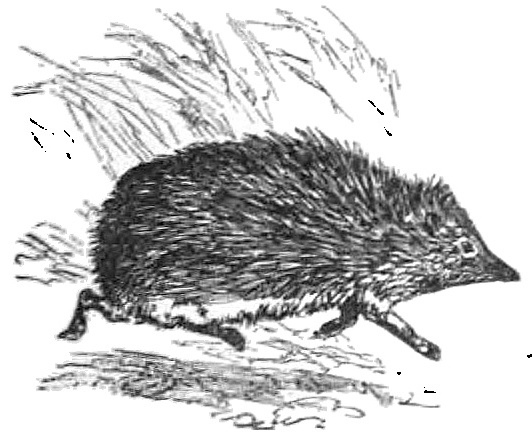
Maggie took it solemnly up by that one leg as if it had been a handle and carried it away and buried it; then she came back with her eyes wet and kissed me, and gave me a large—very large—slice of bread with an extra allowance of treacle on it. But there seemed to be a big lump in my throat; I tried hard to eat, but failed miserably, only—I managed to lick the treacle off.
My little friend Tip was of a very inquiring turn of mind, and this trait in his character led to his miserable end.
One day some men were blasting stones in a neighbouring field, and Tip seeing what he took to be a rat’s tail sticking out of a stone, and a thin wreath of blue smoke curling up out of it, went to investigate.
He did not come back to tell tales; he was carried on high with the hurtling stones and débris, and I never saw my poor Tip any more.
Chapter Twelve.
Early Studies in Natural History.
“Within a bush her covert nest A little birdie fondly prest; The dew sat chilly on her breast, Sae early in the morning.” Burns.
Shortly after the melancholy death of Tip, some one presented me with a puppy, and some one else presented me with a rook. My knowledge of natural history was thus progressing. That unhappy pup took the distemper and died. If treated for the dire complaint at all, it was no doubt after the rough and harsh fashion, common, till very lately, of battling with it.
So my puppy died. As to the rook, a quicker fate was reserved for him. The bird and I soon grew as thick as thieves. He was a very affectionate old chap, and slept at night in a starling’s cage in the bedroom. He was likewise a somewhat noisy bird, and very self-asserting, and would never allow us to sleep a wink after five in the morning. Maggie tried putting his breakfast into the cage the night before. This only made matters worse, for he got up at three o’clock to eat it, and was quite prepared for another at five. Maggie said she loved the bird, because he saved her so many scoldings by wakening her so punctually every morning. I should think he did waken her, with a vengeance too. He had a peculiar way of roaring “Caw! Caw!” that would have wakened Rip Van Winkle himself. Like the great Highland bagpipe, the voice of a healthy rook sounds very well about a mile off, but it isn’t exactly the thing for indoor delectation. But my uncle sat down upon my poor rook one day, and the bird gave vent to one last “Caw!” and was heard again—nevermore. My mother told him he ought to be more careful. My uncle sat down on the same chair again next day, and, somehow, a pin went into him further than was pleasant. Then I told him he ought to be more careful, and he boxed my ears, and I bit him, and nursie came and shook me and whacked me on the back as if I had been choking; so, on the whole, I think I was rather roughly dealt with between the two of them. However, I took it out of Maggie in another way, and found her very necessary and handy in my study of natural history, which, even at this early age, I had developed a taste for. I had as a plaything a small wooden church, which I fondled all day, and took to bed with me at night. One fine day I had an adventure with a wasp which taught me a lesson. I had half-filled my little church with flies to represent a congregation, but as they wouldn’t sing unless I shook them, and as Maggie told me nobody ever shook a real church to make the congregation sing, I concluded it was a parson they lacked, and went to catch a large yellow fly, which I saw on the window-ledge. He would make them sing I had no doubt. Well, he made me sing, anyhow. It was long before I forgot the agony inflicted by that sting. Maggie came flying towards me, and I hurled church, congregation, and all at her head, and went off into a first-class fit. But this taught me a lesson, and I never again interfered with any animal or insect, until I had first discovered what their powers of retaliation were; beetles and flies were old favourites, whose attendance at church I compelled. I wasn’t sure of the earthworm at first, nor of the hairy caterpillar, but a happy thought struck me, and, managing to secure a specimen of each, and holding them in a tea-cup, I watched my chance, and when nursie wasn’t looking emptied them both down her back. When the poor girl wriggled and shrieked with horror, I looked calmly on like a young stoic, and asked her did they bite. Finding they didn’t, they became especial favourites with me. I put every new specimen I found, instantly or on the first chance, down poor Maggie’s back or bosom, and thus, day by day, while I increased in stature, day by day I grew in knowledge. I wasn’t quite successful once, however, with a centipede. I had been prospecting, as the Yankees say, around the garden, searching for specimens, and I found this chap under a stone. He was about as long as a penholder, and had apparently as many legs as a legion of the Black Watch. Under these circumstances, thinks I to myself what a capital parson he’ll make. So I dismissed all my congregation on the spot, and placed the empty church at his disposal, with the door thereof most invitingly open, but he wouldn’t hear of going in. Perhaps, thought I, he imagines the church isn’t long enough to hold him, so I determined, for his own comfort, to cut him in two with my egg-cup, then I could capture first one end of him, and then the other, and empty them down nursie’s back, and await results. But, woe is me! I had no sooner commenced operations than the ungrateful beast wheeled upwards round my finger and bit it well. I went away to mourn.
When nine years old my opportunities for studying birds and beasts were greatly increased, for, luckily for me, the teacher of my father’s school nearly flogged the life out of me. It might have been more lucky still had he finished the job. However, this man was a bit of a dandy in his way, and was very proud of his school. And one fine day who should walk in at the open doorway but “Davy,” my pet lamb. As soon as he spied me he gave vent to a joyful “Ba-a!” and as there was a table between us, and he couldn’t reach me, he commenced to dance in front of it.
“Good gracious!” cried the teacher, “a sheep of all things in my school, and positively dancing.” On rushing to save my pet, whom he began belabouring with a cane, the man turned all his fury on me, with the above gratifying result.
I was sent to a far-off seminary after this.
Three miles was a long distance for a child to walk to school over a rough country. It was rough but beautiful, hill and dale, healthy moorlands, and pine woods. It was glorious in summer, but when the snows of winter fell and the roads were blocked, it was not quite so agreeable.
I commenced forthwith, however, to make acquaintance with every living thing, whether it were a creepie-creepie living under a stone, or a bull in the fields.
My pets, by the way, were a bull, that I played with as a calf, and could master when old and red-eyed and fierce, half a dozen dogs, and a peacock belonging to a farmer. This bird used to meet me every morning, not for crumbs—he never would eat—but for kind words and caresses.
The wild birds were my especial favourites. I knew them all, and all about them, their haunts, their nests, their plumage, and eggs and habits of life. I lived as much in trees as on the ground, used to study in trees, and often fell asleep aloft, to the great danger of my neck.
I do not think I was ever cruel—intentionally, at all events—to any bird or creature under my care, but I confess to having sometimes taken a young bird from the nest to make a pet of.
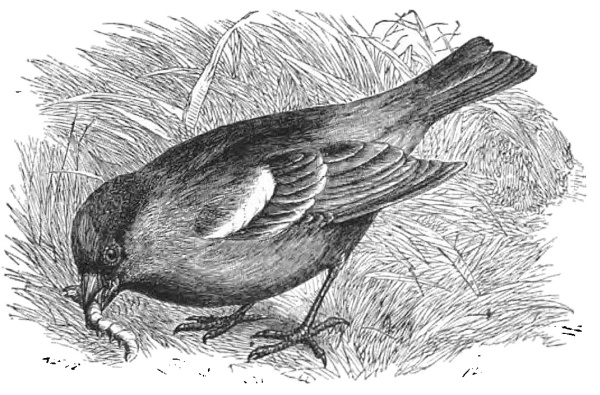
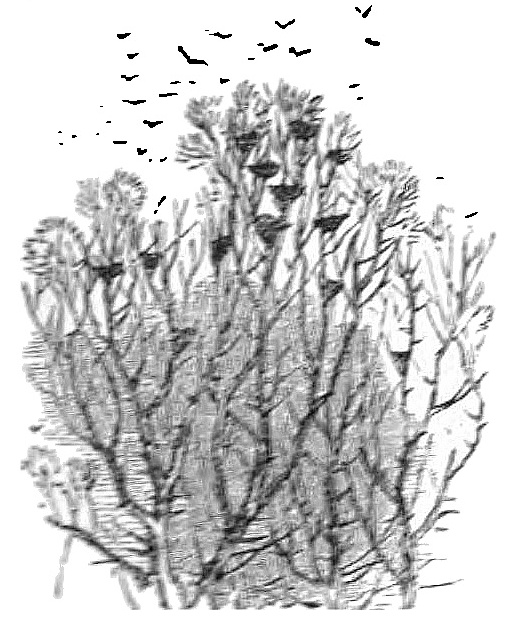
I myself, when a little boy, have often sat for half an hour at a time swinging on the topmost branches of a tall fir-tree, with my waistcoat pocket filled with garden worms, watching the ways and motions of a nest of young rooks, and probably I would have to repeat my aerial visit more than once before I could quite make up my mind which to choose. I always took the sauciest, noisiest young rascal of the lot, and I was never mistaken in my choice. Is it not cruelty on my part, you may inquire, to counsel the robbery of a rook’s nest? Well, there are the feelings of the parent birds to be considered, I grant you, but when you take two from five you leave three, and I do not think the rooks mourn many minutes for the missing ones. An attempt was made once upon a time to prove that rooks can’t count farther than three. Thus: an ambush was erected in the midst of a potato field, where rooks were in the habit of assembling in their dusky thousands. When into this ambush there entered one man, or two men, or three men, the gentlemen in black quietly waited until the last man came forth before commencing to dig for potatoes, but when four men entered and three came out, the rooks were satisfied and went to dinner at once. But I feel sure this rule of three does not hold good as far as their young ones are concerned. I know for certain that either cats or dogs will miss an absentee from a litter of even six or more.
Books are very affectionate towards their owners, very tricky and highly amusing. They are great thieves, but they steal in such a funny way that you cannot be angry with them.
Chapter Thirteen.
All About my Bird Pets.
“Ye ken where yon wee burnie, love, Runs roarin’ to the sea, And tumbles o’er its rocky bed Like spirit wild and free. The mellow mavis tunes his lay, The blackbird swells his note, And little robin sweetly sings Above the woody grot.” W. Cameron. “The gladsome lark o’er moor and fell, The lintie in the bosky dell, No blither than your bonnie sel’, My ain, my artless Mary.” Idem.
Scottish poets cannot keep birds out of their love-songs any more than they can the gloaming star, the bloom of flowers, the scent of golden gorse, or soft winds sighing through woods in summer. And well may the lovely wee linnet be compared to a young and artless maiden, so good and innocent, so gentle and unobtrusive is the bird, and yet withal so blithe. Nor could a better pet be found for girls of a quiet, retiring disposition than the linnet. Some call it a shy bird. This hardly coincides with my own experience, and I dearly like to study the characters of birds and animals of all kinds, and have often discovered something to love and admire even in the wildest beasts that ever roamed o’er prairie or roared in jungle. No, the linnet is not shy, but he is unostentatious; he seems to have the tact to know when a little music would be appreciated, and is by no means loath to trill his sweet song. He is also most affectionate, and if his mistress be but moderately kind to him, he may like other people well enough, but he will love but her alone, and will often and often pipe forth a few bars, in so low a key that she cannot but perceive they are meant for her ear only.
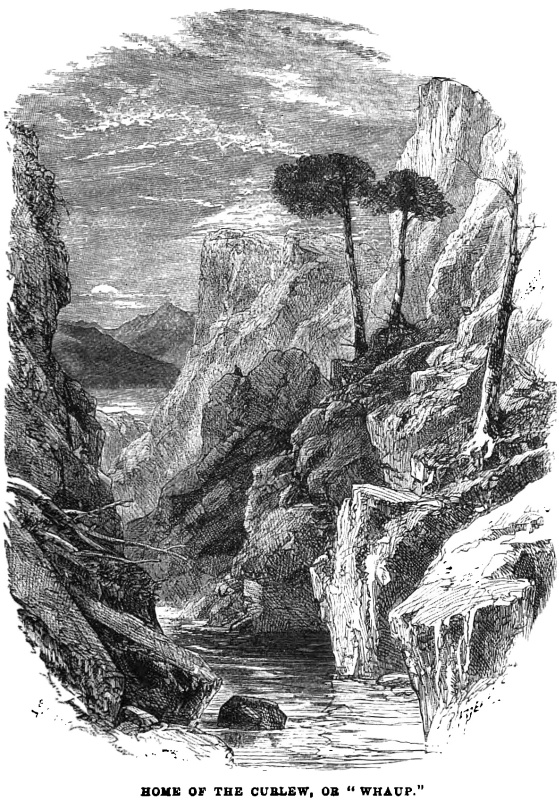
Even in the wild state the rose-linnet courts retirement. Thinking about this bird brings me back once more to the days of my boyhood. I am a tiny, tiny lad trudging home from the distant day-school, over a wide, wild moorland with about a stone of books—Greek and Latin classics and lexicons—in a leather strap over my shoulder. I am—as I ever wished to be—alone. That is, I have no human companionship. But I have that of the wild birds, and the thousand and one wild creatures that inhabit this great stretch of heathy wold, and I fancy they all know me, from yonder hawk poised high in the air to the merlin that sings on a branch of broom; from the wily fox or fierce polecat to the wee mouse that nestles among the withered grass. I have about a score of nests to pay a visit to—the great long-winged screaming whaup’s (curlew’s) among the rushes; the mire-snipe’s and wild duck’s near the marsh; the water-hen’s, with her charming red eggs, near the streamlet; the peewit’s on the knoll; the stonechat’s, with eggs of milky blue, in the cairn; the laverock’s, the woodlark’s, and the wagtail’s, and last, but not least, the titlin’s nest, with the cuckoo’s egg in it. But I linger but a short time at any of these to-day, for on my way to school I saw a rose-linnet singing on a thorn, and have been thinking about it all day. I have been three times thrashed for Cicero, and condemned to detention for two hours after my schoolmates are gone. I have escaped through the window, however. I shall be thrashed for this in the morning, but I should be thrashed for something, at all events, so that matters nothing. The sun is still high in the heavens, summer days are long, I’ll go and look for my linnet’s nest; I haven’t seen one this year yet. The heather is green as yet, and here and there on the moorland is a bush or patch of golden furze, not tall and straggling like the bushes you find in woods, that seem to stretch out their necks as if seeking in vain for the sunlight, but close, compact, hugging the ground, and seeming to weigh down the warm summer air around it with the sweetness of its perfume.
Now, on one of those very bushes, and on the highest twig thereof, I find my cock linnet. His head is held well up, and his little throat swells and throbs with his sweet, melodious song. But I know this is all tact on the bird’s part, and that his heart beats quick with fear as he sees me wandering searchingly from bush to bush. He is trying to look unconcerned. He saw me coming, and enjoined his pretty mate to lie close and not fly out, assuring her that if she did so all would be well.
He does not even fly away at my approach.
“There is no nest of mine anywhere near,” he seems to say. “Is it likely I would be singing so blithely if there were?”
“Ah! but,” I reply, “I feel sure there is, else why are you dressed so gaily? why have you cast aside your sombre hues and donned that crimson vest?”
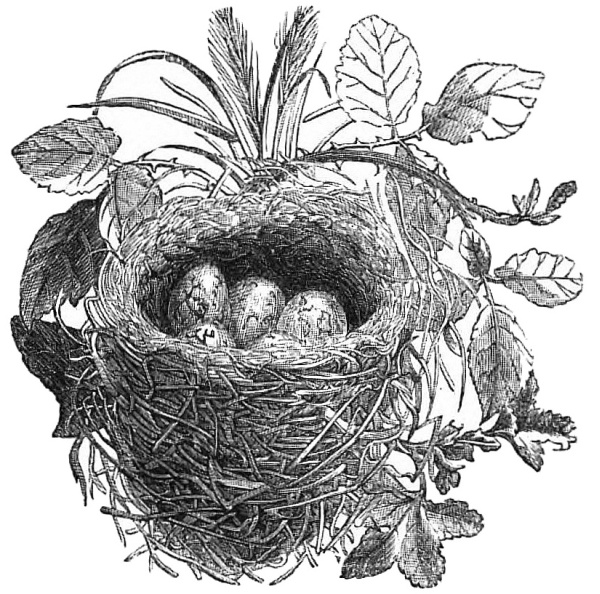
Pop—I am at the right bush now, and out flies the modest wee female linnet. She had forgotten all her mate told her, she was so frightened she could not lie close. And now I lift a branch and keek in, and am well rewarded. A prettier sight than that little nest affords, to any one fond of birds, cannot easily be conceived. It is not a large one; the outside of it is built of knitted grass and withered weeds, and on the whole it is neat; but inside it is the perfection of beauty and rotundity, and softly and warmly lined with hair of horse and cow, with a few small feathers beneath, to give it extra cosiness. And the eggs—how beautiful! Books simply tell you they are white, dotted, and speckled with red. They are more than this; the groundwork is white, to be sure, but it looks as if the markings were traced by the Angers of some artist fay. It looks as though the fairy artist had been trying to sketch upon them the map of some strange land, for here are blood-red lakes—square, or round, or oval—and rivers running into them and rivers rolling out, so that having once seen a rose-linnet’s egg, you could never mistake it for any other.
“I think,” said Ida, “I should like a linnet, if I knew how to treat it.”
“Well,” I continued, “let me give you a little advice. I have interested you in this bonnie bird, let me tell you then how you are to treat him if you happen to get one, so as to make him perfectly happy, with a happiness that will be reflected upon you, his mistress.”
I always counsel any one who has a pet of any kind to be in a manner jealous of it, for one person is enough to feed and tend it, and that person should be its owner.
Of course, if you mean to have one as a companion you will procure a male bird, and one as pretty as possible, but even those less bright in colour sing well. Let his cage be a square or long one, and just as roomy as you please; birds in confinement cannot have too much space to move about in. Keep the cage exceedingly clean and free from damp, give the bird fresh water every morning, and see that he has a due allowance of clean dry seed. The food is principally canary-seed with some rape in it, and a small portion of flax; but although you may now and then give him a portion of bruised hemp seed, be careful and remember hemp is both stimulating and over-fattening. Many a bird gets enlargement of the liver, and heart disease and consequent asthma, from eating too freely and often of hemp. In summer it should never be given, but in cold weather it is less harmful.
Green food should not be forgotten. The best is chic-weed—ripe—and groundsel, with—when you can get it—a little watercress. There are many seedling weeds which you may find in your walks by the wayside, which you may bring home to your lintie. If you make a practice of doing this, he will evince double the joy and pleasure at seeing you on your return.
Never leave any green food longer than a day either in or over the cage. So shall your pet be healthy, and live for many years to give you comfort with his sweet fond voice. I may just mention that the linnet will learn the song of some other birds, notably that of the woodlark. Sea-sand may be put in the bottom of the cage, and when the bird begins to lose its feathers and moult, be extra kind and careful with it, covering the cage partly over, and taking care to keep away draughts. After the feathers begin to come you may put a rusty nail in the water. This is a tonic, but I do not believe in giving it too soon.
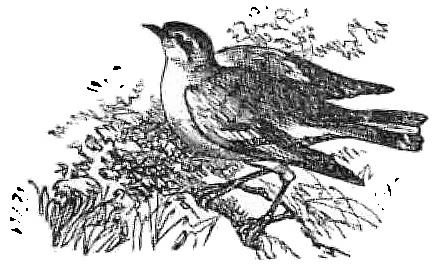
Let me now say a word about another of my boyhood’s pets—the robin.
But I hardly know where or how I am to begin, nor am I sure that my theme will not run right away with me when I do commence. My winged horse—my Pegasus—must be kept well in hand while speaking about my little favourite, the robin. Happy thought, however! I will tell you nothing I think you know already.
The robin, then, like the domestic cat, is too well known to need description. We who live in the country have him with us all the year round, and we know his charming song wherever we hear it. He may seem to desert our habitations for a few months in the early spring-time, for he is then very busy, having all the care and responsibility of a family on his head; but he is not far away. He is only in the neighbouring grove or orchard, and if we pay him a visit there he will sing to us very pleasantly, as if glad to see us. And one fine morning we find him on the lawn-gate again, bobbing and becking to us, and looking as proud as a pasha because he has his little wife and three of the family with him. His wife is not a Jenny Wren, as some suppose, but a lovely wee robin just like himself, only a trifle smaller, and not quite so red on the breast nor so bold as her partner. And the young ones, what charmingly innocent little things they look, with their broad beaks and their apologies for tails! I have often known them taken for juvenile thrushes, because their breasts are not red, but a kind of yellow with speckles in it.
“Tcheet, tcheet!” cries Robin, on the gate, bobbing at you again; “throw out some crumbs. My wife is a bit shy; she has never been much in society; but just see how the young ones can eat.”
Well, Robin is one of the earliest birds of a morning that I know. He is up long before the bickering sparrows, and eke before the mavis. His song mingles with your morning dreams, and finally wakes you to the joys and duties of another day, and if you peep out at the window you will probably see him on the lawn, hauling some unhappy worm out of its hole. I have seen Robin get hold of too big a worm, and, after pulling a piece of it out as long as a penholder, fly away with a frightened “Tcheet, tcheet!” as much as to say, “Dear me! I didn’t know there were yards and yards of you. You must be a snake or something.”
Robin sings quite late at night too, long after the mavis is mute and every other bird has retired. And all day long in autumn he sings. During the winter months, especially if there be snow on the ground, he comes boldly to the window-ledge, and doesn’t ask, but demands his food, as brazenly as a German bandsman. Sparrows usually come with him, but if they dare to touch a bit of food that he has his eye on they catch it. My robin insists upon coming into my study in winter. He likes the window left open though, and I don’t, and on this account we have little petulancies, and if I turn him out he takes revenge by flying against the French window, and mudding all the pane with his feet.
Almost every country house has one or two robins that specially belong to it, and very jealous they are of any strange birds that happen to come nigh the dwelling. While bird-nesting one time in company with another boy, we found a robin’s nest in a bank at the foot of a great ash tree. There were five eggs in it. On going to see it two days after, we found the nest and eggs intact, but two other eggs had been laid and deposited about a foot from the bank. We took the hint, and carried away these two, but did not touch the others. The eggs are not very pretty.
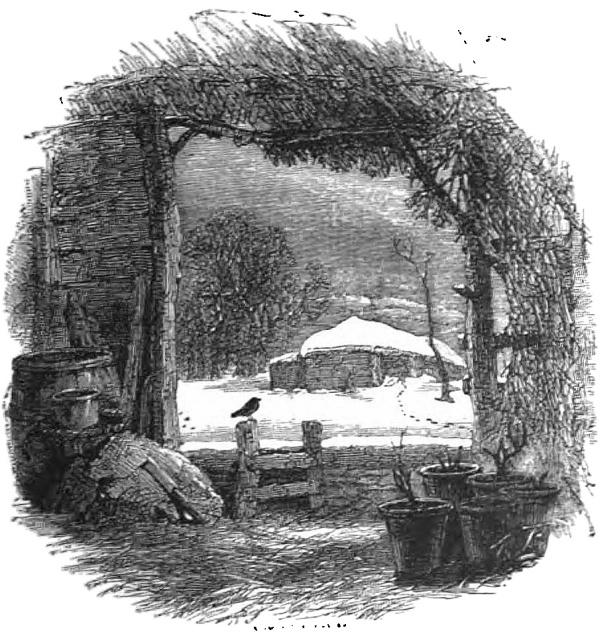
While shooting in the wildest part of the Highlands, and a long way from home, I have often preferred a bed with my dog on the heather to the smoky hospitality of a hut; and I have found robins perched close by me of a morning, singing ever so sweetly and low. They were only trying to earn the right to pick up the crumbs my setter and I had left at supper, but this shows you how fond these birds are of human society.
In a cage the robin will live well and healthily for many years, if kindly and carefully treated. He will get so tame that you needn’t fear to let him have his liberty about the room.
Let the cage be large and roomy, and covered partly over with a cloth. The robin loves the sunshine and a clean, dry cage, and, as to food, he is not very particular. Give him German paste—with a little bruised hemp and maw seed, with insects, beetles, grubs, garden and meal worms, etc. Let him have clean gravel frequently, and fresh water every morning. Now and then, when you think your pet is not particularly lively, put a rusty nail in the water.
Chapter Fourteen.
The Redstart, the Goldfinch, the Mavis, and Merle.
“They sang, as blithe as finches sing, That flutter loose on golden wing, And frolic where they list; Strangers to liberty, ’tis true, But that delight they never knew, And therefore never miss’d.” Cowper.
I was creeping, crawling, and scrambling one afternoon in the days of my boyhood, through tall furze at the foot of the Drummond Hill, which in England would be called a mountain. It was the Saturday half-holiday, and I was having a fine time of it among the birds. I was quite a mile away from any human dwelling, and, I flattered myself, from any human being either. I was speedily undeceived though. “Come out o’ there, youngster,” cried a terrible voice, almost to my ear. “I thought ye were a rabbit; I was just going to chuck a stone at your head.”
I crept forth in fear and trembling.
A city rough of the lowest type—you could tell that from the texture of the ragged, second-hand garments he wore; from his slipshod feet, his horrid cap of greasy fur, and pale, unwholesome face.
He proceeded to hoist a leafless branch, smeared with birdlime, in a conspicuous place, and not far off he deposited a cage, with a bird in it. Then he addressed me.
“I’m goin’ away for half an hour, and you’ll stop here and watch. If any birds get caught on the twigs, when I come back I’ll mebbe gie you something.”
When he came back he did “gie me something.” He boxed my ears soundly, because I lay beside the cage, and talked to the little bird all the time instead of watching.
You may guess how I loved that man. I have had the same amount of affection for the whole bird-catching fraternity ever since, and I do a deal every summer to spoil their sport. I look upon them as followers of a most sinful calling, and just as cruel and merciless as the slave-traders of Southern Africa. Many a little heart they break; they separate parent birds, and tear the old from their young, who are left to starve to death in the nest.
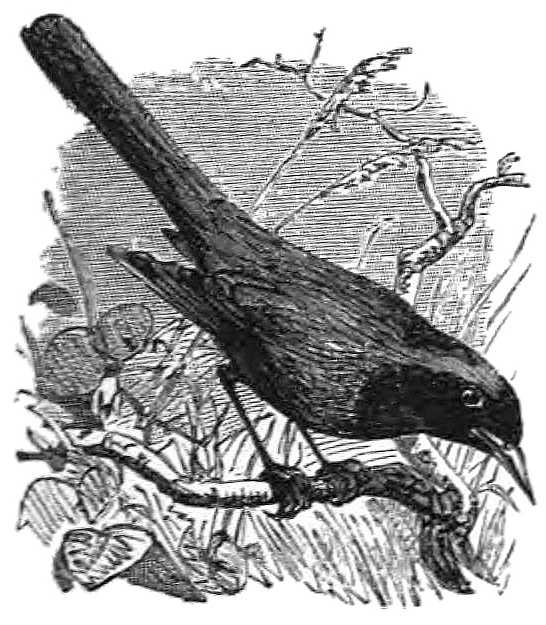
The redstart was a great favourite with me in these joyous days. In size and shape he is not unlike the robin; but the bill is black, the forehead white, the rest of the upper part of the body a bluish grey. The wings are brownish, the bird wears a bib of black, but on the upper portion of the chest and all down the sides there is red, though not so bright in colour as the robin’s breast. That is the plumage of the cock-bird, so these birds are easily known. They make charming cage pets, being very affectionate, and as merry as a maiden on May morning, always singing and gay, and so tame that you need not be afraid to let them out of the cage.
Another was the wren. Some would love the mite for pity sake. It is very pretty and very gay, and possesses a sweet little voice of its own; it needs care, however. It must not, on the one hand, be kept too near a fire or in too warm a room, and on the other it should be well covered up at night; a draught is fatal to such a bird. There is also the golden-headed wren, the smallest of our British birds, but I do not remember ever having seen one kept in a cage. There is no accounting for tastes, however. I knew a young lady in Aberdeen who kept a golden eagle in a cage of huge dimensions. He was the admiration of all beholders, and the terror of inquisitive schoolboys, who, myself among the number, fully believed he ate a whole horse every week, and ever so many chickens. While gazing at the bird, you could not help feeling thankful you were on the outside of the cage. I admired, but I did not love him much. He caught me by the arm one day, with true Masonic grip—I loved him even less after that.
Wrens are fed in the same way as robins or nightingales are. In the wild state they build a large roundish nest, principally of green moss outside, and with very little lining. There is just one tiny hole left in the side capable of admitting two fingers. Eggs about ten in number, very small, white, and delicately ticked with red. If I remember rightly, the golden wren’s are pure white. The nests I have found were in bushes, holly, fir, or furze, or under the branches of large trees close to the trunk. The back of the nest is nearly always towards the north and east.
The stonechat or stone-checker is a nice bird as to looks, but possesses but little song. It would require the same treatment in cage or aviary as the robin. So I believe would the whinchat, but I have no practical knowledge of either as pets.
With the exception of the kingfisher, I do not recollect any British bird with brighter or more charming plumage, than our friend the goldfinch. He is arrayed in crimson and gold, black, white, and brown, but the colours are so beautifully placed and blended, that, rich and gaudy though they be, they cannot but please the eye of the most artistic. The song of the goldfinch is very sweet, he is with all a most affectionate pet, and exceedingly clever, so much so that he may be taught quite a number of so-called tricks.
In the wild state the bird eats a variety of seeds of various weeds that grow by the wayside, and at times in the garden of the sluggard. Dandelion and groundsel seed are the chief of these, and later on in the season thistle seed. So fond, indeed, is the goldfinch of the thistle that the only wonder is that our neighbours beyond the Tweed do not claim it as one of the birds of Bonnie Scotland, as they do the curlew and the golden eagle. But, on the other hand, they might on the same plea claim a certain quadruped, whose length of ear exceeds its breadth of intellect.
“Won’t you tell us something,” said Ida, “about the blackbird and thrush? Were they not pets of your boyhood?”
“They were, dear, and if I once begin talking about them I will hardly finish to-night.”
“But just a word or two about them.”
It is the poet Mortimer Collins that says so charmingly:
“All through the sultry hours of June, From morning blithe to golden noon, And till the star of evening climbs The grey-blue East, a world too soon, There sings a thrush amid the limes.”
Whether in Scotland or England, the mavis, or thrush, is one of the especial favourites of the pastoral poet and lyrist. And well the bird deserves to be. No sweeter song than his awakes the echoes of woodland or glen. It is shrill, piping, musical. Tannahill says he “gars (makes) echo ring frae tree to tree.” That is precisely what the charming songster does do. It is a bold, clear, ringing song that tells of the love and joy at the birdie’s heart. If that joy could not find expression in song, the bird would pine and die, as it does when caught, caged, and improperly treated. When singing he likes to perch himself among the topmost branches; he likes to see well about him, and perhaps the beauties he sees around him tend to make him sing all the more blithely. But though seeing, he is not so easily seen. I often come to the door of my garden study and say to myself, “Where can the bird be to-night?” This, however, is when the foliage is on orchard and oaks. But his voice sometimes sounds so close to my ear that I am quite surprised when I find him singing among the boughs of a somewhat distant tree. This is my mavis, my particular mavis. In summer he awakes me with his wild lilts, long ere it is time to get up, and he continues his song “till the star of evening climbs the grey-blue East,” and sometimes for an hour or more after that. I think, indeed, that he likes the gloaming best, for by that witching time nearly all the other birds have retired, and there is nothing to interrupt him.
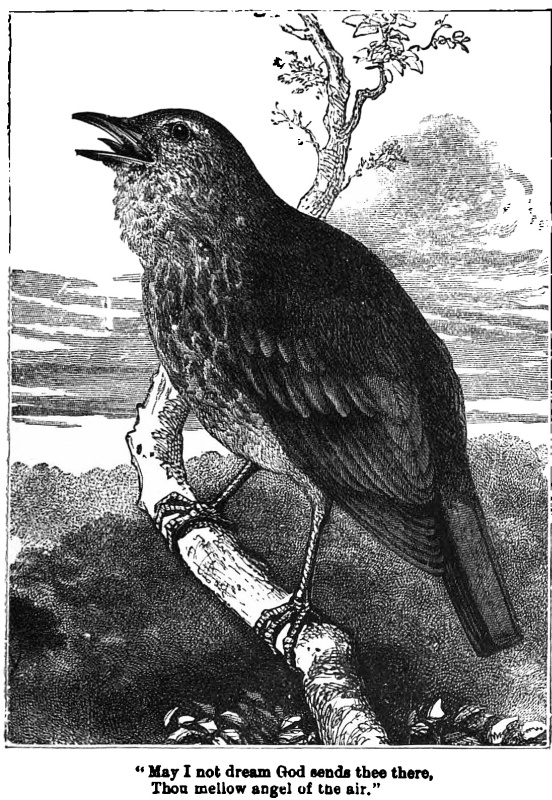
In winter my mavis sings whenever the weather is mild and the grass is visible. But he does not think of turning up of a morning until the sun does, and he retires much earlier. I have known my mavis now nearly two years, and I think he knows me. But how, you may ask me, Frank, do I know that it is the selfsame bird. I reply that not only do we, the members of my own family, know this mavis, but those of some of my neighbours as well, and in this way: all thrushes have certain expressions of their own, which, having once made use of, they never lose. So like are these to human words, that several people hearing them at the same time construe them in precisely the same way. My mavis has four of these in his vocabulary, with which he constantly interlards his song, or rather songs. They form the choruses, as it were, of his vocal performances. The chorus of one is, “Weeda, weeda, weeda;” of another, “Piece o’ cake, piece o’ cake, piece o’ cake;” of the third, “Earwig, earwig, earwig;” and of the last, sung in a most plaintive key, “Pretty deah, pretty deah, pretty deah.”
“That is so true,” said Ida, laughing.
On frosty days he does not sing, but he will hop suddenly down in front of me while I am feeding the Newfoundlands.
“You can spare a crumb,” he says, speaking with his bright eye; “grubs are scarce, and my poor toes are nearly frozen off.”
Says the great lyrist—
“May I not dream God sends thee there, Thou mellow angel of the air, Even to rebuke my earthlier rhymes With music’s soul, all praise and prayer? Is that thy lesson in the limes?”
I am lingering longer with the mavis than probably I ought, simply because I want you all to love the bird as I love him. Well, then, I have tried to depict him to you as he is in his native wilds; but see him now at some bud-seller’s door in town. Look at his drooping wings and his sadly neglected cage. His eyes seem to plead with each passer-by.
“Won’t you take me out of here?” he seems to say, “nor you, nor you? Oh! if you would, and were kind to me, I should sing songs to you that would make the green woods rise up before you like scenery in a beautiful dream.”
The male thrush is the songster, the female remains mute. She listens. The plumage is less different than in most birds. The male looks more pert and saucy, if that is any guide.
The mavis is imitative of the songs of other birds. In Scotland they say he mocks them. I do not think that is the case, but I know that about a week after the nightingales arrive here my mavis begins to adopt many of their notes, which he loses again when Philomel becomes mute. And I shouldn’t think that even my mavis would dare to mock the nightingale.
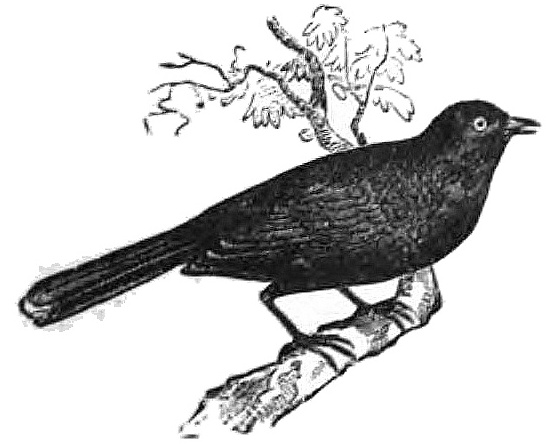
I have found the nest of the mavis principally in young spruce-trees or tall furze in Scotland, and in England in thick hedges and close-leaved bushes; it is built, of moss, grass, and twigs, and clay-lined. Eggs, four or five, a bluish-green colour with black spots. The missel-thrush, or Highland magpie, builds far beyond any one’s reach, high up in the fork of a tree; the eggs are very lovely—whitish, speckled with brown and red. I do not recommend this bird as a pet. He is too wild.
The merle, or blackbird, frequents the same localities as the mavis does, and is by no means a shy bird even in the wild state, though I imagine he is of a quieter and more affectionate disposition. It is my impression that he does not go so far away from the nest of his pretty mate as the mavis, but then, perhaps, if he did he would not be heard. The song is even sweeter to the ear than that of the thrush, although it has far fewer notes. It is quieter, more rich and full, more mellow and melodious. The blackbird has been talked of as “fluting in the grove.” The notes are certainly not like those of the flute. They are cut or “tongued” notes like those of the clarionet.
Chapter Fifteen.
A Bird-Haunted Churchyard.
“Adieu, sweet bird! thou erst hast been Companion of each summer scene, Loved inmate of our meadows green, And rural home; The music of thy cheerful song We loved to hear; and all day long Saw thee on pinion fleet and strong About us roam.”
It is usual in the far north of Scotland, where the writer was reared, to have, as in England, the graveyard surrounding the parish church. The custom is a very ancient and a very beautiful one; life’s fitful fever past and gone, to rest under the soft sward, and under the shadow of the church where one gleaned spiritual guidance. There is something in the very idea of this which tends to dispel much of the gloom of death, and cast a halo round the tomb itself.
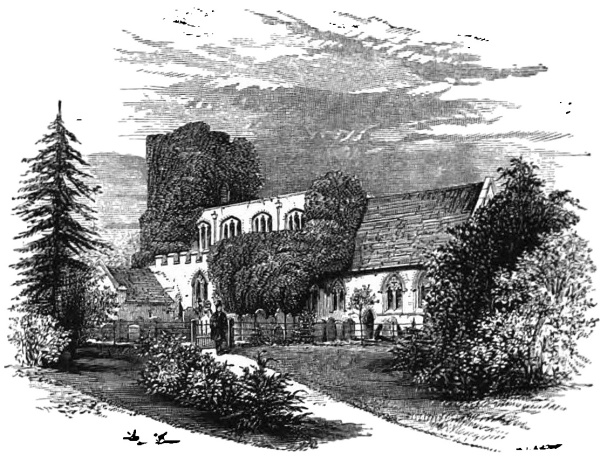
But at the very door of the old church of N— a tragedy had, years before I had opened my eyes in life, been enacted, and since that day service had never again been conducted within its walls. The new church was built on an open site quite a mile from the old, which latter stands all by itself—crumbling ivy-clad ruins, in the midst of the greenery of an acre of ancient graves. There is a high wall around it, and giant ash and plane trees in summer almost hide it from view. It is a solitary spot, and on moonlit nights in winter, although the highway skirts it, few there be who care to pass that way. The parish school or academy is situated some quarter of a mile from the auld kirkyard, and in the days of my boyhood even bird-nesting boys seldom, if ever, visited the place. It was not considered “canny.” For me, however, the spot had a peculiar charm. It was so quiet, so retired, and haunted, not with ghosts, but with birds, and many a long sunny forenoon did I spend wandering about in it, or reclining on the grass with my Virgil or Horace in hand—poets, by the way, who can only be thoroughly enjoyed out of doors in the country.
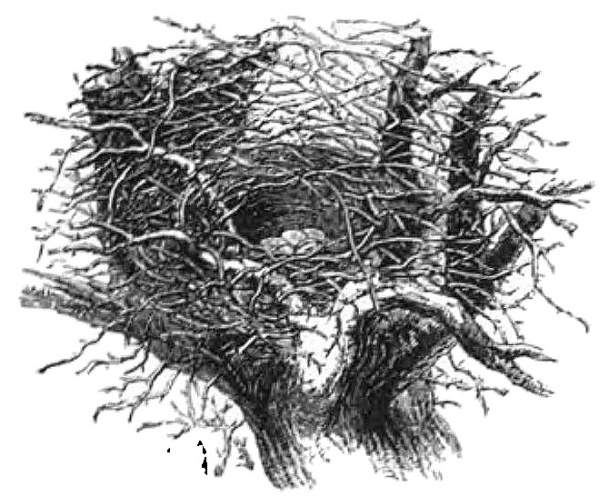
A pair of owls built in this auld kirkyard for years. I used to think they were always the same old pair, who, year after year, stuck to the same old spot, sending their young ones away to the neighbouring woods to begin life on their own account as soon as they were able to fly. They were lazy birds; for two whole years they never built a nest of their own, but took possession of a magpie’s old one. But at last the lady owl said to her lord—
“My lord, this nest is getting quite disreputable—we must have a new one this spring.”
“Very well,” said his lordship, looking terribly learned, “but you’ll have to build it, my lady, for I’ve got to think, and think, you know.”
“To be sure, my lord,” said she. “The world would never go on unless you thought, and thought.”
She chose an old window embrasure, and, half hid in ivy, there she built the new nest with weeds and sticks and stubble, while he did nothing but sit and talk Greek and natural philosophy at her.
There were tree sparrows built in the ivy of those crumbling walls, each nest about as big as the bottom of an armchair, and containing as many feathers as would stuff a small pillow-case, to say nothing of threads of all colours, hair, and pieces of printed paper. Seven, eight, and ten eggs would be in some of those, white as to ground, and beautifully speckled with brown and grey.
I have heard the tree sparrow called a nasty, common, dowdy thing. It really is not at all dowdy, and although it may be called the country cousin of the busy, chattering little morsel of feathers and fluff that hops nimbly but noisily about our roof-tops, and is constantly quarrelling with its neighbours, the tree sparrow is far more pretty. Nor is it quite plebeian. It is the Passer montanus of some naturalists, the becfin friquet of the French; it belongs to the Greek family, the Fringillidae, and does not the linnet belong to that family too? Yes, and the beautiful bullfinch and the gaudy goldfinch as well, to say nothing of the siskin and canary, so it cannot be plebeian. The tree sparrow makes a nice wee pet, very loving and gentle, and not at all particular as to food. It likes canary-seed, but insects and worms as well, and it is not shy at picking a morsel of sugar, nor a tiny bit of bread and butter.
There were more birds of the same family that haunted this auld kirkyard. The greenfinch or green-grosbeak used to flit hither and thither among the ivy like a tiny streak of lightning, and the pretty wee redpole was also there.
There was one bird in particular that used to build in the trees that grew inside the graveyard wall. I refer to my old friend and favourite the chaffinch, called in Scotland the boldie. He is most brilliant in plumage, being richly clad in russet red and brown, picked out with blue, yellow, and white. The chaffinch is lovely whether sitting or flying, whether trilling his song with head erect and throat puffed out, or keeking down from the branch of a tree with one saucy eye, to see if any one is going near his nest. His song in the wild state is more celebrated for brilliancy and boldness than for sweetness or variation, but in confinement it may be improved.
But this same nest is something to look at and admire for minutes at a time. I used to think my chaffinch—the chaffinch that built in my churchyard—was particularly proud of his nest.
“Pink, pink, pink,” he used to say to me; “I see you looking up at my nest. You may go up, if you like, and have a look in. She is from home just now, and there are four eggs in at present. There will be five by-and-by. Now, did you ever see such beautiful eggs?”
“Never,” I would reply; “they are most lovely.”
“Well, then,” he would continue, “pink, pink, pink! look at the nest itself. What do you think of that for architecture? It is built, you see, some twelve feet from the ground, against the stem, but held in its place by a little branch. It is out of the reach of cats; if it were higher up the wind would shake it, or the hawks would see it. It is not much bigger than your two hands; and just look at the artistic way in which the lichens are mingled with the moss on the outside, to blend with the colour of the tree!”
“Yes, but,” I would remark, “there are bits of paper there, as well as lichens.”
“Yes, yes, yes,” the bird would reply; “bits of paper do almost as well as lichens. Pink, pink, pink! There is the whole of Lord Palmerston’s speech there; Palmerston is a clever man, but he couldn’t build a nest like that.”
I mentioned the redpole. It is, as far as beauty goes, one of the best cage-birds we have; a modest, wee, affectionate, unassuming pet, but deficient in song.
“Cheet, cheet, cheet, cheet, cheet, cheet, chee-ee!” What sweet little voice is that repeating the same soft song over and over again, and dwelling on the last syllable with long-drawn cadence? The music—for music it is, although a song without variations—is coming from yonder bonnie bush of golden-blossomed broom, that grows in the angle between the two walls in a remote corner of the auld kirkyard. I throw Horace down, and get up from the grass and walk towards it.
“Chick, chick, chick, chick, chee-ee!”
“Oh, yes! I daresay you haven’t a nest anywhere near; but I know better.” This is my reply.
I walk across the unhallowed ground, as this patch is called, for—whisper it!—suicides lie here, and the graves have not been raised, nor do stones mark the spot where they lie.
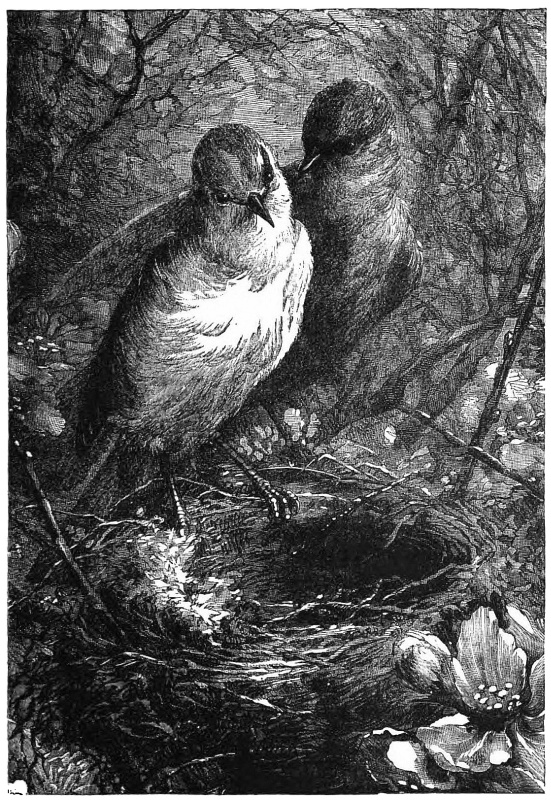
Here is the nest, in under a bit of weedy bank, and yonder is the bird himself—the yellow-hammer, skite, or yellow bunting—looking as gay as a hornet, for well he knows that I will not disturb his treasures. The eggs are shapely, white in ground, and beautifully streaked and speckled, and splashed with reddish brown. But there are no eggs; only four morsels of yellow fluff, apparently, surrounded by four gaping orange-red mouths. But they are cosy. I catch a tiny slug, and break it up between them, and the cock-bird goes on singing among the broom, while the hen perches a little way off, twittering nervously and peevishly.
“Chick, chick, che-ee!” says the bird. “I don’t pretend to build such a pretty nest as the chaffinch; besides, such a flimsy thing as his would not do on the ground; mine has a solid foundation of hay, don’t you see? That keeps out the damp, and that lining of hair is warmer than anything else in the world.”
A poor, persecuted little bird is this same yellow bunting; and schoolboys often, when they find the nest, scatter it and its precious contents to the four winds of heaven.
All the more reason why we should be kind to the pet if we happen to have it in confinement. It is true the wild song is not very interesting; but when a young one is got, it will improve itself if it can listen to the song of another bird, for nearly all our feathered songsters possess the gift of imitation.
Chapter Sixteen.
A Friend of my Student Days.
“He was a gash and faithfu’ tyke As over lap a sheugh or dyke.” Burns.
I had cured friend Frank’s dog of some trifling ailment, and she seemed fonder of me than ever. “Poor Meg,” I said, patting her.
Dogs are never ungrateful for kindnesses, but I have seen many noted instances of revenge, and so doubtless have many of my readers. Here is a case. At one time of day my father possessed a breed of beautiful black game-cocks. One of these had a great aversion to dogs, and a bull-terrier, who was tied up in a stall in the stable, came in for a considerable share of blows and abuse from a certain brave bird of the King Jock strain. I myself was a witness to the assault, but I dared not interfere, for to tell you the truth, that game-cock was one too many for me then, and I wouldn’t care to be attacked by a bird of the same kind even now. King Jock had come into the stable to pick a bit by himself, for he was far too cavalierly to eat much before the hens. “Give everything to the ladies and go without yourself” is game-cock etiquette. Presently he spied “Danger” lying in the stall with his head on his two fore-paws.
“Oh! you’re there, are you?” said King Jock, holding his head to the ground, and keening up with one eye at the poor dog. “Didn’t notice ye before. It ain’t so light as it might be.”
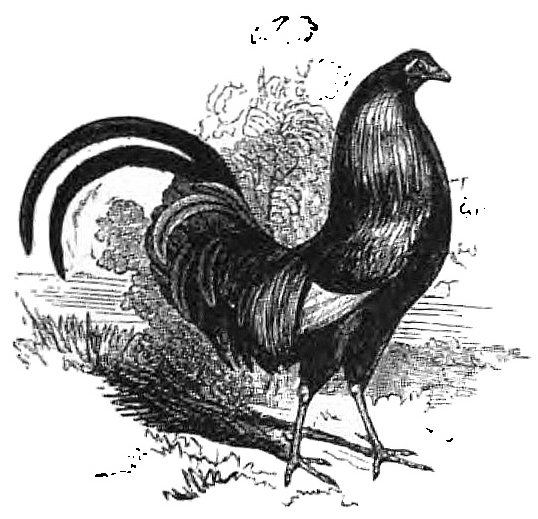
Danger gave one apologetic wag of his tail. “Pretty fellow you are, ain’t ye?” continued the cock, edging a bit nearer.
“Eh? Why don’t you speak?”
“Ho! ho! it’s chained ye are, is it? I’ve a good mind to let you have it on that ugly patched face of yours. And, by my halidom, I will too. Who ran through the yard yesterday and scared the senses out of half my harem? Take that, and that, and that. Try to bite, would you? Then you’ll have another; there! and there!”
Poor Danger’s head was covered with round lumps as big as half marbles, and each lump had a spur-hole. Cock Jock had made good practice, which he had much reason to repent, for one day Master Danger broke loose, and went straight away to look for his enemy. Jock possessed a tail that any cock might have been proud of, but after his encounter with Danger his pride had a fall, for in his speedy flight he got stuck in a hedge, and the dog tore every feather out, and would have eaten his way into, and probably through, King Jock himself, if the twig hadn’t snapped, and the bird escaped. After that King Jock was content to treat bull-terriers with quiet disdain.
Dogs know much of what is said to them, especially if you do not speak too fast, for, if you do, they get nervous, and forget their English. It is, in my opinion, better not to alter your form of speech, nor the tone of your voice, when talking to a dog. My old friend Tyro, a half-bred collie, but most beautiful animal, understood and was in the habit of being talked to in three languages, to say nothing of broad Scotch, namely, English, Gaelic, and Latin—no, not dog Latin, by your leave, sir, but the real Simon Pure and Ciceronic. I don’t mean to assert that he could appreciate the beauties of the Bucolics, nor Horatian love lays if read to him; but he would listen respectfully, and he would obey ordinary orders when couched in the Roman tongue. Every animal that had hair and ran was, to Tyro, a cat; every animal that had feathers was a crow, and these he qualified by size. In a flock of sheep, for instance, if you asked him to chase out the big “cat,” it was a ram, who got no peace till he came your way; if, in a flock of fowls, you had asked him to chase out the big “crow,” it was the cock who had to fly; if you said the wee crow, a bantam or hen would be the victim. An ordinary cat was simply a cat, and if you asked him to go and find one, it would be about the barn-yards or stables he would search. But if you told him to go and find a “grub-cat,” it was off to the hills he would be, and if you listened you would presently hear him in chase, and he would seldom return without a grub-cat, that meant a cat that could be eaten—i.e., a hare or rabbit. He knew when told to go and take a drink of water; but, at sea, the ocean all around him was pointed out to him as the big drink of water. In course of time he grew fond of the sea, though the commotion in the water and the breakers must have been strange and puzzling to him; but if at any time he was told to go and take a look at the big drink of water, he would put his two fore-paws on the bulwarks and watch the waves for many minutes at a time.
“I have often heard you speak of your dog Tyro, Gordon,” said Frank; “can’t you tell us his history?”
“I will, with pleasure,” I replied. “He was the dog of my student days. I never loved a dog more, I never loved one so much, with the exception perhaps of Theodore Nero—or you, Aileen, for I see you glancing up at me. No, you needn’t sigh so.”
But about Tyro. Here is his story:—He was bred from a pure Scottish collie, the father a powerful retriever (Irish). “Bah!” some one may here say, “only a mongrel,” a class of dogs whose praises few care to sing, and whose virtues are written in water. A watch-dog of the right sort was Tyro; and from the day when his brown eyes first rested on me, for twelve long years, by sea and land, I never had a more loving companion or trusty friend. He was a large and very strong dog, feathered like a Newfoundland, but with hair so soft and long and glossy, as to gain for him in his native village the epithet of “silken dog.” In colour he was black-and-tan, with snow-white gauntlets and shirt-front. His face was very remarkable, his eyes bright and tender, giving him, with his long, silky ears, almost the expression of a beautiful girl. Being good-mannered, kind, and always properly groomed, he was universally admired, and respected by high and low. He was, indeed, patted by peers and petted by peasants, never objected to in first-class railway cars or steamer saloons, and the most fastidious of hotel waiters did not hesitate to admit him, while he lounged daintily on sofa or ottoman, with the sang froid of one who had a right. Tyro came into my possession a round-pawed fun-and-mischief-loving puppy. His first playmate was a barn-door fowl, of the male persuasion, who had gained free access to the kitchen on the plea of being a young female in delicate health; which little piece of deceit, on being discovered by his one day having forgot himself so far as to crow, cost “Maggie,” the name he impudently went by, his head. Very dull indeed was poor Tyro on the following day, but when the same evening he found Maggie’s head and neck heartlessly exposed on the dunghill, his grief knew no bounds. Slowly he brought it to the kitchen, and with a heavy sigh deposited it on the hearthstone-corner, and all the night and part of next day it was “waked,” the pup refusing all food, and flashing his teeth meaningly at whosoever attempted to remove it, until sleep at last soothed his sorrow. I took to the dog after that, and never repented it, for he saved my life, of which anon. Shortly after his “childish sorrow,” Tyro had a difference of opinion with a cat, and got rather severely handled, and this I think it was that led him, when a grown dog, to a confusion of ideas regarding these animals, plus hares and rabbits; “when taken to be well shaken,” was his motto, adding “wherever seen,” so he slew them indiscriminately. This cat-killing propensity was exceedingly reprehensible, but the habit once formed never could be cured; although I, stimulated by the loss of guinea after guinea, whipped him for it, and many an old crone—deprived of her pet—has scolded him in English, Irish, and Scotch, all with the same effect.
Talking of cats, however, there was one to whom Tyro condescendingly forgave the sin of existing. It so fell out that, in a fight with a staghound, he was wounded in a large artery, and was fast bleeding to death, because no one dared to go near him, until a certain sturdy eccentric woman, very fond of our family, came upon the scene. She quickly enveloped her arms with towels, to save herself from bites, and thus armed, thumbed the artery for two hours; then dressing it with cobwebs, saved the dog’s life. Tyro became, when well, a constant visitor at the woman’s cottage; he actually came to love her, often brought her the hares he killed, and, best favour of all to the old maid, considerately permitted her cat to live during his royal pleasure; but, if he met the cat abroad, he changed his direction, and inside he never let his eyes rest upon her.
When Tyro came of age, twenty-one (months), he thought it was high time to select a profession, for hitherto he had led a rather roving life. One thing determined him. My father’s shepherd’s toothless old collie died, and having duly mourned for her loss, he—the shepherd—one day brought home another to fill up the death-vacancy. She was black, and very shaggy, had youth and beauty on her side, pearly teeth, hair that shone like burnished silver, and, in short, was quite a charming shepherdess—so, at least, thought Tyro; and what more natural than that he should fall in love with her? So he did. In her idle hours they gambolled together on the gowny braes, brushed the bells from the purple heather and the dewdrops from the grass, chased the hares, bullied the cat, barked and larked, and, in short, behaved entirely like a pair of engaged lovers of the canine class; and then said Tyro to himself, “My mother was a shepherdess, I will be a shepherd, and thus enjoy the company of my beloved ‘Phillis’ for ever, and perhaps a day or two longer.” And no young gentleman ever gave himself with more energy to a chosen profession than did Tyro. He was up with the lark—the bird that picks up the worm—and away to the hill and the moor. To his faults the shepherd was most indulgent for a few days; but when Tyro, in his over-zeal, attempted to play the wolf, he was, very properly, punished. “What an indignity! Before one’s Phillis too!” Tyro turned tail and trotted sulkily home. “Bother the sheep!” he must have thought; at any rate, he took a dire revenge—not on the shepherd, his acquaintance he merely cut, and he even continued to share the crib with his little ensnarer—but on the sheep-fold.
A neighbouring farmer’s dog, of no particular breed, was in the habit of meeting Tyro at summer gloaming, in a wood equidistant from their respective homes. They then shook tails, and trotted off side by side. Being a very early riser, I used often to see Tyro coming home in the mornings, jaded, worn, and muddy, avoiding the roads, and creeping along by ditches and hedgerows. When I went to meet him, he threw himself at my feet, as much as to say, “Thrash away, and be quick about it.” This went on for weeks, though I did not know then what mischief “the twa dogs” had been brewing, although ugly rumours began to be heard in all the countryside about murdered sheep and bleeding lambs; but my eyes were opened, and opened with a vengeance, when nineteen of the sheep on my father’s hill-side were made bleeding lumps of clay in one short “simmer nicht”; and had Tyro been tried for his life, he could scarcely have proved an alibi, and, moreover, his pretty breast was like unto a robin’s, and his gauntlets steeped in gore. Dire was the punishment that fell on Tyro’s back for thus forsaking the path of virtue for a sheep-walk; and for two or three years, until, like the “Rose o’ Anandale,” he—
“Left his Highland home And wandered forth with me,”
he was condemned to the chain.
He now became really a watch-dog, and a right good one he proved.
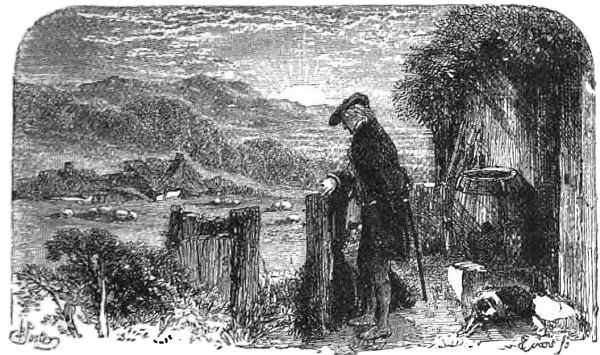
The chain was of course slipped at night when his real duties were supposed to commence. Gipsies—tinklers we call them—were just then an epidemic in our part of the country; and our hen-roosts were in an especial manner laid under blackmail. One or two of those same long-legged gentry got a lesson from Tyro they did not speedily forget. I have seldom seen a dog that could knock down a man with less unnecessary violence. So surely as any one laid a hand on his master, even in mimic assault, he was laid prone on his back, and that, too, in a thoroughly business-like fashion; and violence was only offered if the lowly-laid made an attempt to get up till out of arrest.
I never had a dog of a more affectionate disposition than my dead-and-gone friend Tyro. By sea and land, of course I was his especial charge; but that did not prevent him from joyously recognising “friends he had not seen for years.” Like his human shipmates, he too used to look out for land, and he was generally the first to make known the welcome news, by jumping on the bulwarks, snuffing the air, and giving one long loud bark, which was slightly hysterical, as if there were a big lump in his throat somewhere.
I should go on the principle of de mortuis nil nisi bonum; but I am bound to speak of Tyro’s faults as well as his virtues. Reader, he had a temper—never once shown to woman or child, but often, when he fancied his casus belli just, to man, and once or twice to his master. Why, one night, in my absence, he turned my servant out, and took forcible possession of my bed. It was hard, although I had stayed out rather late; but only by killing him could I have dislodged him, so for several reasons I preferred a night on the sofa, and next morning I reasoned the matter with him.
During our country life, Tyro took good care I should move as little as possible without him, and consequently dubbed himself knight-companion of my rambles over green field and heathy mountain, and these were not few. We often extended our excursions until the stars shone over us, then we made our lodging on the cold ground, Tyro’s duties being those of watch and pillow. Often though, on awakening in the morning, I found my head among the heather, and my pillow sitting comfortably by my side panting, generally with a fine hare between its paws, for it had been “up in the morning airly” and “o’er the hills and far awa’,” long before I knew myself from a stone.
Tyro’s country life ended when his master went to study medicine. One day I was surprised to find him sitting on the seat beside me. The attendant was about to remove him.
“Let alone the poor dog,” said Professor L. “I am certain he will listen more quietly than any one here.” Then after the lecture, “Thank you, doggie; you have taught my students a lesson.” That naughty chain prevented a repetition of the offence; but how exuberant he was to meet me at evening any one may guess. Till next morning he was my second shadow. More than once, too, he has been a rather too faithful ally in the many silly escapades into which youth and spirits lead the medical student. His use was to cover a retreat, and only once did he floor a too-obtrusive Bobby; and once he saved me from an ugly death.
It was Hogmanay—the last night of the year—and we had been merry. We, a jolly party of students, had elected to sing in the New Year. We did so, and had been very happy, while, as Burns hath it, Tyro—
“For vera joy had barkit wi’ us.”
Ringing out from every corner of the city, like cocks with troubled minds, came the musical voices of night-watchmen, bawling “half-past one,” as we left the streets, and proceeded towards our home in the suburbs. It was a goodly night, moon and stars, and all that sort of thing, which tempted me to set out on a journey of ten miles into the country, in order to be “first foot” to some relations that lived there. The road was crisp with frost, and walking pleasant enough, so that we were in one hour nearly half-way. About here was a bridge crossing a little rocky ravine, with a babbling stream some sixty feet below. On the low stone parapet of this bridge, like the reckless fool I was, I stretched myself at full length, and, unintentionally, fell fast asleep. How nearly that sleep had been my last! Two hours afterwards I awoke, and naturally my eyes sought the last thing they had dwelt upon, the moon; she had declined westward, and in turning round I was just toppling over when I was sharply pulled backwards toward the road. Here was Tyro with his two paws pressed firmly against the parapet, and part of my coat in his mouth, while with flashing teeth he growled as I never before had heard him. His anger, however, was changed into the most exuberant joy, when I alighted safely on the road, shuddering at the narrow escape I had just made. At the suggestion of Tyro, we danced round each other, for five minutes at least, in mutual joy, by which time we were warm enough to finish our journey, and be “first foot” to our friends in the morning.
When Tyro left home with me to begin a seafaring life, he put his whole heart and soul into the business. There was more than one dog in the ship, but his drawing-room manners and knowledge of “sentry-go” made him saloon dog par excellence.
His first voyage was to the Polar regions, and his duty the protection by night of the cabin stores, including the spirit room. This duty he zealously performed; in fact, Master Tyro would have cheerfully undertaken to take charge of the whole ship, and done his best to repel boarders, if the occasion had demanded it.
A sailor’s life was now for a time the lot of Tyro. I cannot, however, say he was perfectly happy; no dog on board ship is. He missed the wide moors and the heathy hills, and I’m sure, like his master, he was always glad to go on shore again.
Poor Tyro got old; and so I had to go to sea without him. Then this dog attached himself to my dear mother. When I returned home again, she was gone...
Strange to say, Tyro, who during my poor mother’s illness had never left her room, refused food for days after her death.
He got thin, and dropsy set in.
With my own hand, I tapped him no less than fifteen times, removing never less than one gallon and three quarters of water. The first operation was a terrible undertaking, owing to the dog making such fierce resistance; but afterwards, when he began to understand the immense relief it afforded him, he used to submit without even a sigh, allowing himself to be strapped down without a murmur, and when the operation (excepting the stab of the trocar, there is little or no pain) was over, he would give himself a shake, then lick the hands of all the assistants—generally four—and present a grateful paw to each; then he had his dinner, and next day was actually fit to run down a rabbit or hare.
Thinner and weaker, weaker and thinner, month by month, and still I could not, as some advised, “put him out of pain;” he had once saved my life, and I did not feel up to the mark in Red Indianism. And so the end drew nigh.
The saddest thing about it was this: the dog had the idea (knowing little of the mystery of death) that I could make him well; and at last, when he could no longer walk, he used to crawl to meet me on my morning visit, and gaze in my face with his poor imploring eyes, and my answer (well he knew what I said) was always, “Tyro, doggie, you’ll be better the morn (to-morrow), boy.” And when one day I could stand it no longer, and rained tears on my old friend’s head, he crept back to his bed, and that same forenoon he was dead.
Poor old friend Tyro. Though many long years have fled since then, I can still afford a sigh to his memory.
On a “dewy simmer’s gloaming” my Tyro’s coffin was laid beneath the sod, within the walls of a noble old Highland ruin. There is no stone to mark where he lies, but I know the spot, and I always think the gowan blinks bonniest and the grass grows greenest there.
Chapter Seventeen.
The Days When we went Cruising.
“O’er the glad waters of the dark-blue sea, Our thoughts as boundless and ourselves as free.” Byron.
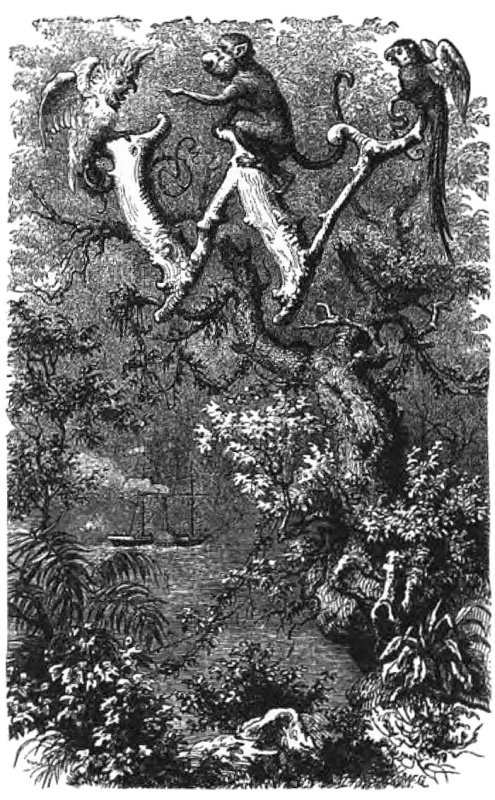
When cruising round Africa some years ago in a saucy wee gunboat, that shall be nameless, I was not only junior assistant surgeon, but I was likewise head surgeon, and chief of the whole medical department, and the whole of that department consisted of—never a soul but myself. As we had only ninety men all told, the Admiralty couldn’t afford a medical officer of higher standing than myself. I was ably assisted, however, in my arduous duties, which, by the way, occupied me very nearly half an hour every morning, after, not before, breakfast, by the loblolly boy “Sugar o’ Lead.” I don’t suppose he was baptised Sugar o’ Lead. I don’t think it is likely ever he was baptised at all. This young gentleman used to make my poultices, oatmeal they were made of, of course—I’m a Scot. But Sugar o’ Lead always put salt in them, ate one half and singed the rest. He had also to keep the dispensary clean, which he never did, but he used to rub the labels off the bottles, three at a time, and stick them on again, but usually on the wrong bottles. This kept me well up in my pharmacy; but when one day I gave a man a dose of powder of jalap, instead of Gregory, Sugar o’ Lead having changed the labels, the man said “it were a kinder rough on him.” Sugar o’ Lead thought he knew as much as I, perhaps; but Epsom salts and sulphate of zinc, although alike in colour, are very different in their effects when given internally. Sugar o’ Lead had a different opinion. Another of the duties which devolved upon Sugar o’ Lead was to clean up after the dogs. At this he was quite at home. At night he slept with the monkeys. Although the old cockatoo couldn’t stand him, Sugar o’ Lead and the monkeys were on very friendly terms; they lived together on that great and broad principle which binds the whole of this mighty world of ours together, the principle of “You favour me to-day and I’ll favour you to-morrow.” Sugar o’ Lead and the monkeys acted upon it in quite the literal sense.
At Symon’s Town, I was in the habit of constantly going on shore to prospect, gun in hand, over the mountains. Grand old hills these are, too, here and there covered with bush, with bold rocky bluffs abutting from their summits, their breasts bedecked with the most gorgeous geraniums, and those rare and beautiful heaths, which at home you can only find in hot-houses.
My almost constant attendant was a midshipman, a gallant young Scotchman, whom you may know by the name of Donald McPhee, though I knew him by another.
The very first day of our many excursions “in the pursuit of game,” we were wading through some scrub, about three or four miles from the shore, when suddenly my companion hailed me thus: “Look-out, doctor, there’s a panther yonder, and he’s nearest you.”
So he was; but then he wasn’t a panther at all, but a very large Pointer. I shouldn’t like to say that he was good enough for the show bench; he was, however, good enough for work. Poor Panther, doubtless he now rests with his fathers, rests under the shadow of some of the mighty mountains, the tartaned hills, over which he and I used to wander in pursuit of game. On his grave green lizards bask, and wild cinerarias bloom, while over it glides the shimmering snake; but the poor, faithful fellow blooms fresh in my memory still. I think I became his special favourite. Perhaps he was wise enough to admire the Highland dress I often wore. Perhaps he thought, as I did, that of all costumes, that was the best one for hill work. But the interest he took in everything I did was remarkable. He seemed rejoiced to see me when I landed, as betokened by the wagging tail, the lowered ears, slightly elevated chin, and sparkling eye—a canine smile.
“Doctor,” he seemed to say, “I was beginning to think you weren’t coming. But won’t we have a day of it, just?”
And away we would go, through the busy town and along the sea beach, where the lisping wavelets broke melodiously on sands of silvery sheen, where many a monster medusa lay stranded, looking like huge umbrellas made of jelly, and on, and on, until we came to a tiny stream, up whose rocky banks we would scramble, skirting the bush, and arriving at last at the great heath land. We followed no beaten track, we went here, there, and everywhere. The scenery was enchantingly wild and beautiful, and there was health and its concomitant happiness in every breeze. Sometimes we would sit dreamily on a rock top, Panther and I, for an hour at a time, vainly trying to drink in all the beauties of the scene. How bright was the blue of the distant sea! How fleecy the cloudlets! How romantic and lovely that far-off mountain range, its rugged outline softened by the purple mists of distance! These everlasting mountains we could people with people of our own imagination. I peopled them with foreign fairies. Panther, I think, peopled them with rock rabbits. Weary at last with gazing on the grandeur everywhere around us, we would rivet our attention for a spell upon things less romantic—bloater paste and sea biscuit. I shared my lunch with Panther.
Panther was most civil and obliging; he not only did duty as a pointer and guide, but he would retrieve as well, rock rabbits and rats, and such; and as he saw me bag them, he would look up in my face as much as to say—
“Now aren’t you pleased? Don’t you feel all over joyful? Wouldn’t you wag a tail if you had one? I should think so.”
Panther wouldn’t retrieve black snakes.
“No,” said Panther, “I draw the line at black snakes, doctor.”
I would fain have taken him to sea with me, as he belonged to no one; but Panther said, “No, I cannot go.”
“Then good-bye, dear friend,” I said.
“Farewell,” said Panther.
And so we parted.
He looked wistfully after the boat as it receded from the shore. I believe, poor fellow, he knew he would never see me again.
Conceive, if you can, of the lonesomeness, the dreariness of going to sea without a dog. But as Panther wouldn’t come with me, I had to sail without him. As the purple mountains grew less and less distinct, and shades of evening gathered around us, and twinkling lights from rocky points glinted over the waters, I could only lean over the taffrail and sing—
“Happy land! happy land! Who would leave the glorious land?”
Who indeed? but sailor-men must. And now darkness covers the ocean, and hides the distant land, and next we were out in the midst of just as rough a sea as any one need care to be in. My only companion at this doleful period of my chequered career was a beautiful white pigeon. Here is how I came by him. Out at the Cape, in many a little rocky nook, and by many a rippling stream, grow sweet flowerets that come beautifully out in feather work. Feather-flower making then was one of my chief delights and amusements; the art had been taught me by a young friend of mine, whose father grew wine and kept hunters (jackal-hunting), and had kindly given me “the run” of the house. Before leaving, on the present cruise, I had secured some particularly beautiful specimens of flowers, too delicate to be imitated by anything, save the feathers of a pigeon; so I had bought a pure white one, which I had ordered to be killed and sent off.
“Steward,” I cried, as we were just under weigh, “did a boy bring a white pigeon for me?”
“He did, sir; and I put it in your cabin in its basket, which I had to give him sixpence extra for.”
“But why,” said I, “didn’t you tell him to put his nasty old basket on his back and take it off with him?”
“Because,” said the steward, “the bird would have flown away.”
“Flown away!” I cried. “Is the bird alive then?”
“To be sure, sir,” said the steward.
“To be sure, you blockhead,” said I; “how can I make feather-flowers from a live pigeon?”
The man was looking at me pityingly, I thought.
“Can’t you kill it, sir? Give him to me, sir; I’ll Wring his neck in a brace of shakes.”
“You’d never wring another neck, steward,” I said; “you’d lose the number of your mess as sure as a gun.”
When I opened the basket, knowing what rogues nigger-boys are, I fully expected to find a bird with neither grace nor beauty, and about the colour of an old white clucking hen. The boy had not deceived me, however. The pigeon was a beauty, and as white as a Spitzbergen snow-bird. Out he flew, and perched on a clothes-peg in my bulkhead, and said—
“Troubled wi’ you. Tr-rooubled with you.”
“You’ll need,” said I, “to put up with the trouble for six months to come, for we’re messmates. Steward,” I continued, “your fingers ain’t itching, are they, to kill that lovely creature?”
“Not they,” said the fellow; “I wouldn’t do it any harm for the world.”
“There’s my rum bottle,” I said; “it always stands in that corner, and it is always at your service while you tend upon the pigeon.”
The cruise before, we had a black cat on board, that the sailors looked upon as a bird of evil omen, for we got no luck, caught no slavers, ran three times on shore, and were once on fire. This cruise, we had lots of prize-money, and never a single mishap, and the men put it all down to “the surgeon’s pet,” as they called my bird. He was a pet, too. I made him a nest in a leathern hat-box, where he went when the weather was rough. He was tame, loving, and winning in all his ways, and always scrupulously white and clean.
The first place we ran into was Delagoa Bay. How sweetly pretty, how English-like, is the scenery all around! The gently undulating hills, clothed in clouds of green; the trees growing down almost to the water’s edge; the white houses nestling among the foliage, the fruit, the flowers, the blue marbled sky, and the wavelets breaking musically on the silvery sands—what a watering-place it would make, and what a pity we can’t import it body bulk! The houses are all built on the sand, so that the beach is the only carpet. In the Portuguese governor’s house, where we spent such a jolly evening, it was just the same; the chair-legs sank in the soft white sand, the table was off the plane, and the piano all awry; and a dog belonging to one of the officers, a monster boarhound, with eyes like needles, and tusks that would have made umbrella handles, scraped a hole at one end of the room, and nearly buried himself. That dog, his owner told me, would kill a jackal with one blow of his paw; but he likewise caught mice like winking, and killed a cockroach wherever he saw one. His owner wrote this down for me, and I afterwards translated it.
Next morning, at eleven, the governor and his officers came off, arrayed in scarlet, blue, and burnished gold, cocked-hats and swords, all so gay, and we had tiffin in the captain’s cabin; Carlo, the dog, came too, of course, and seated himself thoughtfully at one end, abaft the mess table. There we were, then, just six of us—the captain, a fiery looking, wee, red man, but not half a bad fellow; the governor, bald in pate, round-faced, jolly, but incapable of getting very close to the table because of the rotundity of his body; his aide-de-camp, a little thin man, as bright and as merry as moonshine; his lieutenant, a jolly old fellow, with eyes like an Ulmer hound, and nose like a kidney potato; myself, and Carlo.
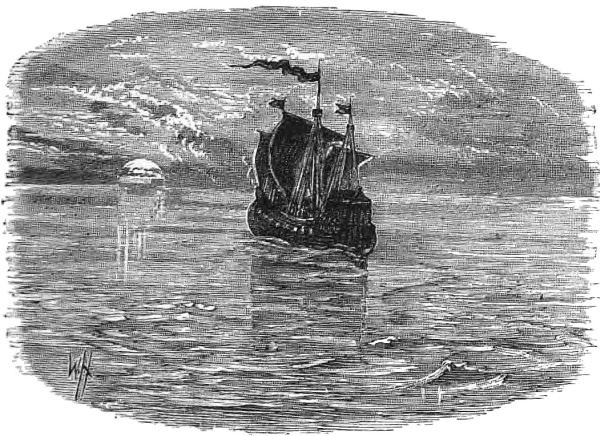
Our conversation during tiffin was probably not very edifying, but it was very spirited. You see, our captain couldn’t speak a word of Portuguese, and the poor Portuguese hadn’t a word of English. I myself possessed a smattering of Spanish, and a little French, and I soon discovered that by mixing the two together, throwing in an occasional English word and a sprinkling of Latin, I could manufacture very decent Portuguese. At least, the foreigners themselves seemed to understand me, or pretended to for politeness sake. To be sure they didn’t always give me the answer I expected, but that was all the funnier, and kept the laugh up. I really believe each one of us knew exactly what he himself meant, but I’m sure couldn’t for the life of him have told what his neighbour was driving at. And so we got a little mixed somehow, but everybody knew the road to his mouth, and that was something. We got into an argument upon a very interesting topic indeed, and kept it up for nearly an hour, and were getting quite excited over it, when somehow or other it came out, that the Portuguese had all the while been argle-bargling about the rights of the Pope, while we Englishmen had been deep in the mystery of the prices of yams and sucking pig, in the different villages of the coast. Then we all laughed and shook hands, and shrugged our shoulders, and turned up our palms, and laughed again.
Presently I observed the captain trying to draw my attention unobserved: he was squinting down towards the cruet stand, and I soon perceived the cause. An immense cockroach had got into a bottle of cayenne, and feeling uncomfortably warm, was standing on his hind-legs and frantically waving his long feelers as a signal of distress. I was just wondering how I could get the bottle away without letting the governor see me, when some one else spotted that unhappy cockroach, and that was Carlo.
Now Carlo was a dog who acted on the spur of the moment, so as soon as he saw the beast in the bottle he flew straight at it. That spring would have taken him over a six-barred gate. And, woe is me for the result! Down rolled the table, crockery and all; down rolled the governor, with his bald pate and rotundity of body; down went the merry little thin man; over rolled the fellow with the nose like a kidney potato. The captain fell, and I fell, and there was an end to the whole feast.
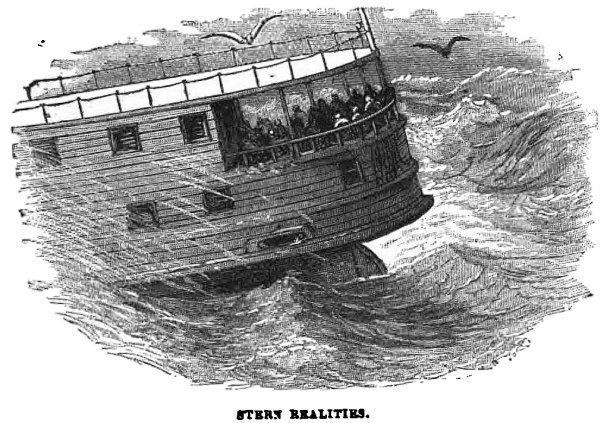
When we all got up, Carlo was intent upon his cockroach, and looking as unconcerned as if nothing out of the common had occurred.
Chapter Eighteen.
Blue-Jackets’ Pets.
“Hard is the heart that loveth nought.” Shelley. “All love is sweet, Given or returned. Common as light is love, And its familiar voice wearies not ever.” Idem.
Blue-jackets, as Her Majesty’s sailors are sometimes styled, are passionately fond of pets. They must have something to love, if it be but a woolly-headed nigger-boy or a cockroach in a ’baccy-box. Little nigger-boys, indeed, may often be found on board a man-o’-war, the reigning pets. Young niggers are very precocious. You can teach them all they will ever learn in the short space of six months. Of this kind was one I remember, little Freezing-powders, as black as midnight, and shining all over like a billiard ball, with his round curly head and pleasant dimply face. Freezing-powders soon became a general favourite both fore and aft. His master, our marine officer, picked him up somewhere on the West coast; and although only nine years of age, before he was four months in the ship, he could speak good English, was a perfect little gymnast, and knew as many tricks and capers as the cook and the monkey. Snowball was another I knew; but Snowball grew bad at an early age, lost caste, became dissipated, and a gambler, and finally fled to his native jungle.
Jock of ours was a seal of tender years, who for many months retained the affection of all hands, until washed overboard in a gale of wind. This creature’s time on board was fully occupied in a daily round of duty, pleasure, and labour. His duty consisted in eating seven meals a day, and bathing in a tub after each; his pleasure, to lie on his side on the quarter-deck and be scratched and petted; while his labour consisted of earnestly endeavouring to enlarge a large scupper-hole sufficiently to permit his escape to his native ocean. How indefatigably he used to work day by day, and hour after hour, scraping on the iron first with one flipper, then with another, then poking his nose in to measure the result with his whiskered face! He kept the hole bright and clear, but did not sensibly enlarge it, at least to human ken. Jock’s successor on that ship was a youthful bear of Arctic nativity. He wasn’t a nice pet. He took all you gave him, and wanted to eat your hand as well, but he never said “Thank you,” and permitted no familiarity. When he took his walks abroad, which he did every morning, although he never went out of his road for a row, he walked straight ahead with his nose downwards growling, and gnawed and tore everything that touched him—not at all a pet worth being troubled with.
Did the reader ever hear of the sailor who tamed a cockroach? Well, this man I was “shipmates” with. He built a little cage, with a little kennel in the corner of it, expressly for his unsavoury pet, and he called the creature “Idzky”—“which he named himself, sir,” he explained to me. Idzky was a giant of his race. His length was fully four inches, his breadth one inch, while each of his waving feelers measured six. This monster knew his name and his master’s voice, hurrying out from his kennel when called upon, and emitting the strange sound which gained for him the cognomen Idzky. The boatswain, his master, was as proud of him as he might have been of a prize pug, and never tired of exhibiting his eccentricities.
I met the boatswain the other day at the Cape, and inquired for his pet.
“Oh, sir,” he said, with genuine feeling, “he’s gone, sir. Shortly after you left the ship, poor Idzky took to taking rather much liquor, and that don’t do for any of us, you know, sir; I think it was that, for I never had the heart to pat him on allowance; and he went raving mad, had regular fits of delirium, and did nothing at all but run round his cage and bark, and wouldn’t look at anything in the way of food. Well, one day I was coming off the forenoon watch, when, what should I see but a double line of them ‘P’ ants working in and out of the little place: twenty or so were carrying a wing, and a dozen a leg, and half a score running off with a feeler, just like men carrying a stowed mainsail; and that, says I, is poor Idzky’s funeral; and so it was, and I didn’t disturb them. Poor Idzky!”
Peter was a pet mongoose of mine, a kindly, cosy little fellow, who slept around my neck at night, and kept me clear of cockroaches, as well as my implacable enemies, the rats. I was good to Peter, and fed him well, and used to take him on shore at the Cape, among the snakes. The snakes were for Peter to fight; and the way my wary wee friend dodged and closed with, and finally throttled and killed a cobra was a caution to that subtlest of all the beasts of the field. The presiding Malay used to clap his brown hands with joy as he exclaimed—“Ah! sauvé good mongoose, sar, proper mongoose to kill de snake.”
“You don’t object, do you,” I modestly asked my captain one day, while strolling on the quarter-deck after tiffin—“you don’t object, I hope, to the somewhat curious pets I at times bring on board?”
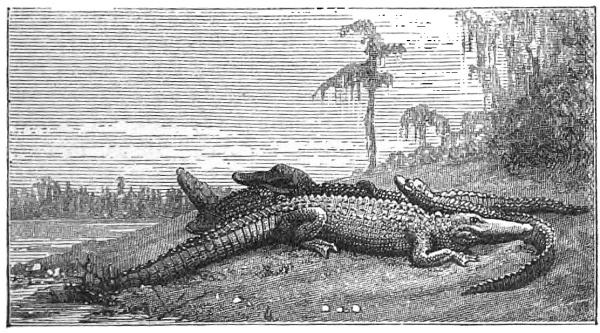
“Object?” he replied. “Well, no; not as a rule. Of course you know I don’t like your snakes to get gliding all over the ship, as they were the other day. But, doctor, what’s the good of my objecting? If any one were to let that awful beast in the box yonder loose—”