"With other Tales of Faithful Friends and Favourites" (continued 2)
Reading edition
About five minutes afterwards the fun was over. Nero happened to look at Aileen, who had stopped once more to rub her still stinging nose. Then the whole humour of the joke seemed to burst upon his imagination. Simply to smile was not enough; he must needs burst through a hedge, and get into a field, and it took ten minutes good racing round and round, as hard as his four legs could carry him, to restore this saucy rascal’s mental equilibrium.
Aileen Aroon was as fond of the lower animals, pet mice, cats, and rats, as any dog could be. Our pet rats used to eat out of her dish, run all over her, sit on her head while washing their faces, and go asleep under her chin.
I saw her one day looking quite unhappy. She wanted to get up from the place where she was lying, but two piebald rats had gone to sleep in the bend of her forearm, and she was afraid to move, either for fear of hurting the little pets or of offending me.
Seeing the situation, I at once took the rats away and put them in the cage; then Aileen got up, made a low and grateful bow, and walked out.
The following is the life-story of one of Aileen’s especial favourites:—
“Fairy Mary.”
My Mary is a rat. It is just as well to state this much at the outset. Candour, indeed, necessitates my doing so, because I know the very name of “rat” carries with it feelings which are far from pleasing to many. And now, having broken the ice, I may tell you that Mary is not an ordinary black or brown rat, but a rat of high, high caste indeed, having come from a far-away Oriental clime—Java, to wit. If you had never seen one of the same breed before, you would hardly take Mary to be a rat at all. Children are exceedingly fond of her; gentlemen admire her; old ladies dote on her, and young ones love her. I think even my black tom-cat is especially fond of her, judging from the notice he takes of her; he will sit for hours, and hardly ever take his green eyes off her cage.
Black Tom once paid Mary a domiciliary visit, by way of appearing neighbourly. It was a grand spring, but missed by an inch, so Tom returned, looking inglorious.
Having so far introduced my Mary, and confident you will like her better as you read on, let me try to describe the winsome wee thing. Mary—my rodent, let me call her—is smaller than a rat, and not quite the same in shape, for Mary’s symmetry is elegance itself. Her eyes round, protrusive, but loving withal, are living burning garnets—garnets that speak. Her whole body is covered with long snowy fur, far richer than the finest ermine, and with an almost imperceptible golden tint at the tips, this tint being only seen in certain lights. Her tail is perhaps one of her principal points of beauty—long, sweeping, and graceful; she positively seems to talk with it. The forearms are very short and delicate, the hind-legs strong and muscular. Sitting on one end is Mary’s almost constant position—kangaroo-like; then she holds up her little hands beseechingly before her. These latter are almost human in shape, and when she gives you her delicate, cold, transparent paw, you might easily fancy you were shaking hands with a fairy; and thus she is often called “Fairy Mary.” Mary’s hands are bare and pink, and the wrists are covered with very short downy fur, after which the coat suddenly elongates, so much so, that when she stands on end to watch a fly on the ceiling, you would imagine she wore a gown tight at the wrist, and with drooping sleeves.
Now Mary is not only beautiful, but she is winning and graceful as well, for every one says so who sees her. And in under her soft fur Mary’s skin is as clean and white and pure as mother-of-pearl. It only remains to say of this little pet, that in all her ways and manners she is as cleanly as the best-bred Persian cat, and her fur has not the faintest odour, musky or otherwise.
Fairy Mary was originally one of three which came to me as a present. Alas for the fate of Mary’s twin sister and only brother! A vagrant cat one evening in summer, while I was absent, entered by the open window, broke into the cage, and Mary alone was left alive. For a long time after this Mary was missing. She was seen at times, of an evening, flitting ghost-like across the kitchen floor, but she persistently refused to return to her desolated cage-home. She much preferred leading a free and easy vagrant kind of life between the cellar, the pantry, and the kitchen. She came out at times, however, and took her food when she thought nobody was looking, and she was known to have taken up her abode in one corner of the pantry, where once a mouse had lived. When she took this new house, I suppose she found it hardly large enough for her needs, because she speedily took to cleaning it out, and judging from the shovelfuls of rags, paper, shavings, and litter of all sorts, very industrious indeed must have been the lives of the “wee, tim’rous, cowerin’ beasties” who formerly lived there. Then Mary built unto herself a new home in that sweet retirement, and very happy she seemed to be.
Not happening to possess a cat just then, the mice had it all their own way; they increased and multiplied, if they didn’t replenish the kitchen, and Mary reigned among them—a Bohemian princess, a gipsy queen. I used to leave a lamp burning in the kitchen on purpose to watch their antics, and before going to bed, and when all the house was still, I used to go and peep carefully through a little hole in the door. And there Fairy Mary would be, sure enough, racing round and round the kitchen like a mad thing, chased by at least a dozen mice, and every one of them squeaking with glee. But if I did but laugh—which, for the life of me, I could not sometimes help—off bolted the mice, leaving Fairy Mary to do an attitude wherever she might be. Then Mary would sniff the air, and listen, and so, scenting danger, hop off, kangaroo fashion, to her home in the pantry corner.
It really did seem a pity to break up this pleasant existence of Mary’s, but it had to be done. Mice eat so much, and destroy more. My mice, with Mary at their head, were perfect sappers and miners. They thought nothing of gutting a loaf one night, and holding a ball in it the next. So, eventually, Mary was captured, and once more confined to her cage, which she insisted upon having hung up in our sitting-room, where she could see all that went on. Here she never attempted, even once, to nibble her cage, but if hung out in the kitchen nothing could keep her in.
At this stage of her existence, the arrangements for Mary’s comfort were as follows: she dwelt in a nice roomy cage, with two perches in it, which she very much enjoyed. She had a glass dish for her food, and another for her milk, and the floor of the cage was covered with pine shavings, regularly changed once in two days, and among which Mary built her nest.
Now, Fairy Mary has a very strong resemblance to a miniature polar bear, that is, she has all the motions of one, and does all his attitudes—in fact, acts the part of Bruin to perfection. This first gave me the notion—which I can highly recommend to the reader—of making Mary not only amusing, but ornamental to our sitting-room as well, for it must be confessed that a plain wooden cage in one’s room is neither graceful nor pretty, however lovely the inmate may be. And here is how I managed it. At the back of our sitting-room is the kitchen, the two apartments being separated by a brick wall. Right through this wall a hole or tunnel was drilled big enough for Mary to run through with ease. The kitchen end of this tunnel was closed by means of a little door, which was so constructed that by merely touching an unseen spring in the sitting-room, it could be opened at will. Against the kitchen end of the tunnel a cage for Mary was hung. This was to be her dining-room, her nest, and sleeping-berth. Now, for the sitting-room end of the tunnel, I had a painting made on a sheet of glass, over two feet long by eighteen inches high. The scene represented is from a sketch in North Greenland, which I myself had made, a scene in the frozen sea—the usual blue sky which you always find over the ice, an expanse of snow, a bear in the distance, and a ship frozen in and lying nearly on her beam ends. A dreary enough look-out, in all conscience, but true to nature.
There was a hole cut in the lower end of this glass picture, to match the diameter of the tunnel, and the picture was then fastened close against the wall. So far you will have followed me. The next thing was to frame this glass picture in a kind of cage, nine inches deep; the peculiarity of this cage being, that the front of it was a sheet of clear white glass, the sides only being of brass wire; the floor and top were of wood, the former being painted white, like the snow, and the latter blue, to form a continuation of the sky; a few imitation icebergs were glued on here and there, and one of these completely hides the entrance to the tunnel, forming a kind of rude cave—Fairy Mary’s cave.
In the centre of this cage was raised a small bear’s pole steps and all complete. We call it the North Pole. The whole forms a very pretty ornament indeed, especially when Mary is acting on this little Greenland stage.
Mary knows her name, and never fails to come to call, and indeed she knows a very great deal that is said to her. Whenever she pops through her tunnel, the little door at the kitchen end closes behind her, and she is a prisoner in Greenland until I choose to send her off. If she is in her kitchen cage, and I wish her to come north, and disport herself to the amusement of myself or friends—one touch to the spring, one cabalistic word, and there comes the little performer, all alive and full of fun.
Now I wish the reader to remember that Fairy Mary is not only the very essence of cleanliness, but the pink of politeness as well. Hence, Mary is sometimes permitted to come to table. And Mary is an honest rat. She has been taught to look at everything, but handle nothing. Therefore there cannot be the slightest possible objection to her either sitting on my shoulder on one end, and gazing wonderingly around her, or examining my ear, or making a nest of my beard, or running down my arm, and having a dance over the tablecloth. I think I said Mary was an honest rat, but she has just one tiny failing in the way of honesty, which, as her biographer, I am bound to mention. She can’t quite resist the temptation of a bit of butter. But she helps herself to just one little handful, and does it, too, with such a graceful air, that, for the life of me, I couldn’t be angry with her.
Well, except a morsel of butter, Mary will touch nothing on the table, nor will she take anything from your hand, if you offer it to her ever so coaxingly. She prefers to eat her meals in Greenland, or on the North Pole itself.
Mary’s tastes as regards food are various. She is partial to a bit of cheese, but would not touch bacon for the world. This is rather strange, because it was exactly the other way with her brother and sister.
The great treat of the twenty-four hours with Mary is to get down in the evening, when the lamps are lighted, to have a scamper on the table. Her cage is brought in from the kitchen, and set down, and the door of it thrown open. This cage thus becomes Mary’s harbour of refuge, from which she can sally forth and play tricks. Anything you place on the table is seized forthwith, and carried inside. She will carry an apple nearly as big as herself, and there will not be much of it left in the morning; for one of Mary’s chief delights is to have a little feast all to herself, when the lights are out. Lettuce leaves she is partial to, and will carry them to her cage as fast as you can throw them down to her. She rummages the work-basket, and hops off with every thimble she can find.
After Fairy Mary’s private establishment was broken up in the kitchen, it became necessary to clean up the corner of the pantry where she had dwelt. Then was Mary’s frugality and prudence as a housewife made clear to the light of day I could hardly be supposed to tell you everything she had stored up, but I remember there were crusts of bread, bits of cheese, lumps of dog-biscuit, halves of apples, small potatoes, and crumbs of sugar, and candle ends, and bones and herrings’ heads, besides one pair of gold sleeve-links, an odd shirt-stud, a glass stopper from a scent-bottle, brass buttons, and, to crown the lot, one silver threepenny-piece of the sterling coin of the realm.
And that is the story of my rat; and I’m sure if you knew her you, too, would like her. She is such a funny, wee, sweet little mite of a Mary.
Note 1. “The Cruise of the Snowbird” published by Messrs Hodder and Stoughton, Paternoster Row.
Chapter Seven.
Only a Dog.
“Old dog, you are dead—we must all of us die— You are gone, and gone whither? Can any one say? I trust you may live again, somewhat as I, And haply, ‘go on to perfection’—some way!” Tupper.
Poor little Fairy Mary, the favourite pet of Aileen Aroon, went the way of all rats at last. She was not killed. No cat took her. Our own cats were better-mannered than to touch a pet. But we all went away on a summer holiday, and as it was not convenient to take every one of our pets with us, Mary was left at home in charge of the servants. When we returned she was gone, dead and buried. She had succumbed to a tumour in the head which was commencing ere we started.
I think Aileen missed her very much, for she used to lie and watch the empty cage for an hour at a time, thinking no doubt that by-and-by Fairy Mary would pop out of some of her usual haunts.
“Dolls” was one of Aileen’s contemporaries, and one that she had no small regard for. Dolls was a dog, and a very independent little fellow he was, as his story which I here give will show.
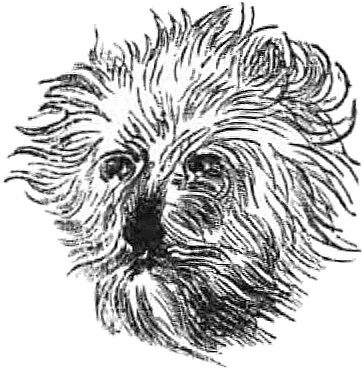
Dolls: His Little Story.
There was a look in the dark-brown eyes of Dolls that was very captivating when you saw it. I say when you saw it, because it wasn’t always you could see it, for Dolls’ face was so covered with his dishevelled locks, that the only wonder was that he could find his way about at all.
Dolls was a Scotch terrier—a real Scotch terrier. Reddish or sandy was he all over—in fact, he was just about the colour of gravel in the gloaming; I am quite sure of this, because when he went out with me about the twilight hour, I couldn’t see him any more than if he wasn’t in existence; when it grew a little darker, strange to say, Dolls became visible once more.
Plenty of coat had Dolls too. You could have hidden a glove under his mane, and nobody been a bit the wiser. When he sat on one end, gazing steadfastly up into a tree, from which some independent pussy stared saucily down upon him, Dolls looked for all the world like a doggie image draped in a little blanket.
Dolls had a habit of treeing pussies. This, indeed, was about the only bad trait in Dolls’ character. He hated a pussy more than sour milk, and nobody knew this better than the pussies themselves. Probably, indeed, they were partly to blame for maintaining the warfare. I’ve seen a cat in a tree, apparently trying her very best to mesmerise poor Dolls—Dolls blinking funnily up at her, she gazing cunningly down. There they would sit and sit, till suddenly down to the ground would spring pussy, and with a warlike and startling “Fuss!” that quite took the doggie’s breath away, and made all his hair stand on end, clout Master Dolls in the face, and before that queer wee specimen of caninity could recover his equanimity, disappear through a neighbouring hedgerow.
Now cats have a good deal more patience than dogs. Sometimes on coming trotting home of an evening, Dolls would find a cat perched up in the pear-tree sparrow-expectant.
“Oh! you’re there, are you?” Dolls would say. “Well, I’m not in any particular hurry, I can easily wait a bit.” And down he would sit, with his head in the air.
“All right, Dolls, my doggie,” Pussy would reply. “I’ve just eaten a sparrow, and not long ago I had a fine fat mouse, and, milk with it, and now I’ll have a nap. Nice evening, isn’t it?”
Well, Master Dolls would watch there, maybe for one hour and maybe for two, by which time his patience would become completely exhausted.
“You’re not worth a wag of my tail,” Dolls would say. “So good-night.” Then off he would trot.
But Dolls wasn’t a beauty, by any manner of means. I don’t think anybody who wasn’t an admirer of doormats, and a connoisseur in heather besoms could have found much about Dolls to go into raptures over, but, somehow or other, the little chap always managed to find friends wherever he went.
Dolls was a safe doggie with children, that is, with well-dressed, clean-looking children, but with the gutter portion of the population Dolls waged continual warfare. Doubtless, because they teased him, and made believe to throw pebbles at him, though I don’t think they ever did in reality.
Dolls was a great believer in the virtues of fresh air, and spent much of his time out of doors. He had three or four houses, too, in the village which he used to visit regularly once, and sometimes twice, a day. He would trot into a kitchen with a friendly wag or two of his little tail, which said, plainly enough, “Isn’t it wet, though?” or “Here is jolly weather just!”
“Come away, Dolls,” was his usual greeting.
Thus welcomed, Dolls would toddle farther in, and seat himself by the fire, and gaze dreamily in through the bars at the burning coals, looking all the while as serious as possible.
I’ve often wondered, and other people used to wonder too, what Dolls could have been thinking about as he sat thus. Perhaps—like many a wiser head—he was building little morsels of castles in the air, castles that would have just the same silly ending as yours or mine, reader—wondering what he should do if he came to be a great big bouncing dog like Wolf the mastiff; how all the little doggies would crouch before him, and how dignified he would look as he strode haughtily away from them; and so on, and so forth. But perhaps, after all, Dolls was merely warming his mite of a nose, and not giving himself up to any line of thought in particular.
Now, it wasn’t with human beings alone that this doggie was a favourite; and what I am now going to mention is rather strange, if not funny. You see, Dolls always got out early in the morning. There was a great number of other little dogs in the village besides himself—poodles, Pomeranians, and Skyes, doggies of every denomination and all shades of colour, and many of these got up early too. There is no doubt early morn is the best time for small dogs, because little boys are not yet up, and so can’t molest them. Well, it did seem that each of these doggies, almost every morning, made up its mind to come and visit Dolls. At all events, most of them did come, and, therefore, Dolls was wont to hold quite a tiny levée on the lawn shortly after sunrise.
After making obeisance to General Dolls, these doggies would form themselves into a conversazione, and go promenading round the rose-trees in twos and twos.
Goodness only knows what they talked about; but I must tell you that these meetings were nearly always of a peaceable, amicable nature. Only once do I remember a conversazione ending in a general conflict.
“Well,” said Dolls, “if it is going to be a free fight, I’m in with you.” Then Dolls threw himself into it heart and soul.
But to draw the story of Dolls to a conclusion, there came to live near my cottage home an old sailor, one of Frank’s friends. This ancient mariner was one of the Tom Bowling type, for the darling of many a crew he had been in his time, without doubt. There was good-nature, combined with pluck, in every lineament of his manly, well-worn, red and rosy countenance, and his hair was whitened—not by the snows of well-nigh sixty winters, for I rather fancy it was the summers that did it, the summers’ heat, and the bearing of the brunt of many a tempest, and the anxiety inseparable from a merchant skipper’s pillow. There was a merry twinkle in his eyes, that put you mightily in mind of the monks of old. And when he gave you his hand, it was none of your half-and-half shakes, let me tell you; that there was honesty in every throb of that man’s heart you could tell from that very grasp.
Yes, he was a jolly old tar, and a good old tar; and he hadn’t seen Dolls and been in his company for two hours, before he fell in love with the dog downright, and, says he, “Doctor, you want a good home for Dolls; there is something in the little man’s eye that I a sort of like. As long as he sails with me, he’ll never want a good bed, nor a good dinner; so, if you’ll give him to me, I’ll be glad to take him.”
We shook hands.
Now this was to be the last voyage that ever that ancient mariner meant to make, until he made that long voyage which we all must do one of these days. And it was his last too; not, however, in the way you generally read of in stories, for the ship didn’t go down, and he wasn’t drowned, neither was Dolls. On the contrary, my friend returned, looking as hale and hearty as ever, and took a cottage in the country, meaning to live happily and comfortably ever after. And almost the first intimation I received of his return was carried by the doggie himself, for going out one fine morning, I found Dolls on the lawn, surrounded as usual, by about a dozen other wee doggies, to whom, from their spellbound look, I haven’t a doubt he was telling the story of his wonderful adventures by sea and by land, for, mind you, Dolls had been all the way to Calcutta. And Dolls was so happy to see me again, and the lawn, and the rose-trees, and vagrant pussies, and no change in anything, that he was fain to throw himself at my feet and weep in the exuberance of his joy.
Dolls’ new home was at H—, just three miles from mine; and this is somewhat strange—regularly, once a month the little fellow would trot over, all by himself, and see me. He remained in the garden one whole day, and slept on the doormat one whole night, but could never be induced either to enter the house or to partake of food. So no one could accuse Dolls of cupboard love. When the twenty-four hours which he allotted to himself for the visit were over, Dolls simply trotted home again, but, as sure as the moon, he returned again in another month.
A bitter, bitter winter followed quickly on the heels of that pleasant summer of 187—. The snow fell fast, and the cold was intense, thermometer at times sinking below zero. You could ran the thrushes down, and catch them by hand, so lifeless were they; and I could show you the bushes any day where blackbirds dropped lifeless on their perches. Even rooks came on to the lawn to beg; they said there wasn’t a hip nor a haw to be found in all the countryside. And robin said he couldn’t sing at all on his usual perch, the frost and the wind quite took his breath away; so he came inside to warm his toes.
One wild stormy night, I had retired a full hour sooner to rest, for the wind had kept moaning so, as it does around a country house. The wind moaned, and fiercely shook the windows, and the powdery snow sifted in under the hall-door, in spite of every arrangement to prevent it. I must have been nearly asleep, but I opened my eyes and started at that—a plaintive cry, rising high over the voice of the wind, and dying away again in mournful cadence. Twice it was repeated, then I heard no more. It must have been the wind whistling through the keyhole, I thought, as I sunk to sleep. Perhaps it was, reader; but early next morning I found poor wee Dolls dead on the doorstep.
Chapter Eight.
A Tale Told by the Old Pine-Tree.
“Dumb innocents, often too cruelly treated, May well for their patience find future reward.” Tupper.
Bonnie Berkshire! It is an expression we often make use of. Bonnie Berks—bonnie even in winter, when the fields are robed in starry snow; bonnie in spring-time, when the fields are rolling clouds of tenderest green, when the young wheat is peeping through the brown earth, when primroses cluster beneath the hedgerows, and everything is so gay and so happy and hopeful that one’s very soul soars heavenwards with the lark.
But Berks I thought never looked more bonnie than it did one lovely autumn morning, when Ida and I and the dogs walked up the hill towards our favourite seat in the old pine wood. It was bright and cool and clear. The hedges alone were a sight, for blackthorn and brambles had taken leave of their senses in summer-time, and gone trailing here and climbing there, and playing all sorts of fantastic tricks, and now with the autumn tints upon them, they formed the prettiest patches of light and shade imaginable; and though few were the flowers that still peeped through the green moss as if determined to see the last of the sunshine, who could miss them with such gorgeous colour on thorn and tree? The leaves were still on the trees; only whenever a light gust of wind swept through the tall hedge with a sound like ocean shells, Ida and I were quite lost for a time, in a shower as of scented yellow snow.
My niece put her soft little hand in mine, as she said—“You haven’t forgotten the manuscript, have you?”
“Oh! no,” I said, smiling, “I haven’t forgotten it.”
“Because,” she added, “I do like you to tell me a story when we are all by ourselves.”
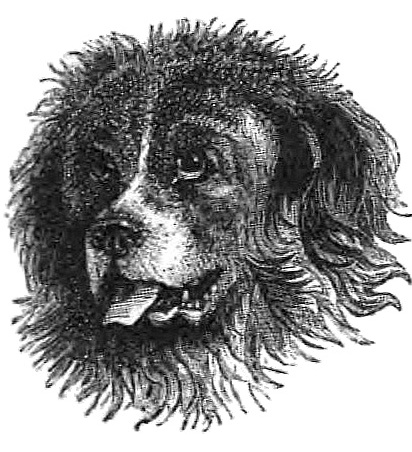
“Thank you,” said I, “but this story, Ida, is one I’m going to tell to Aileen, because it is all about a Newfoundland dog.”
“Oh! never mind,” she cried, “Nero and I shall sit and listen, and it will be all the same.”
“Well, Ida,” I said, when we were seated at last, “I shall call my tale—”
Blucher: The Story of a Newfoundland.
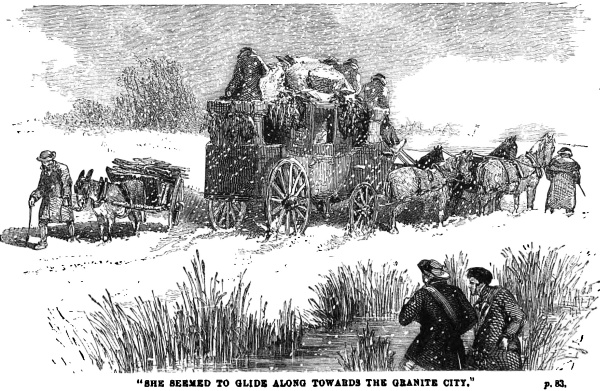
“We usually speak of four-in-hands rattling along the road. There was no rattling about the mail-coach, however, that morning, as she seemed to glide along towards the granite city, as fast as the steaming horses could tool her. For the snow lay deep on the ground, and but for the rattle of harness, and champing of bits, you might have taken her for one of Dickens’s phantom mails. It was a bitter winter’s morning. The driver’s face was buried to the eyes in the upturned neck of his fear-nothing coat; the passengers snoozed and hibernated behind the folds of their tartan plaids; the guard, poor man! had to look abroad on the desolate scene and his face was like a parboiled lobster in appearance. He stamped in his seat to keep his feet warm, although it was merely by reasoning from analogy that he could get himself to believe that he had any feet at all, for, as far as feeling went, his body seemed to end suddenly just below the knees, and when he attempted to emit some cheering notes from the bugle, the very notes seemed to freeze in the instrument. Presently, the coach pulled up at the eighth-milehouse to change horses, and every one was glad to come down if only for a few moments.
“The landlord,—remember, reader, I’m speaking of the far north, where mail-coaches are still extant, and the landlords of hostelries still visible to the naked eye. The landlord was there himself to welcome the coach, and he rubbed his hands and hastened to tell everybody that it was a stormy morning, that there would, no doubt, be a fresh fall ere long, and that there was a roaring fire in the room, and oceans of mulled porter. Few were able to resist hints like these, and orders for mulled porter and soft biscuits became general.
“Big flakes of snow began to fall slowly earthward, as the coach once more resumed its journey, and before long so thick and fast did it come down that nothing could be seen a single yard before the horses’ heads.
“Well, there was something or other down there in the road that didn’t seem to mind the snow a bit, something large, and round, and black, feathering round and round the coach, and under the horses’ noses—here, there, and everywhere. But its gambols, whatever it was, came to a very sudden termination, as that howl of anguish fully testified. The driver was a humane man, and pulled up at once.
“‘I’ve driven over a bairn, or a dog, or some o’ that fraternity,’ he said; ‘some o’ them’s continually gettin’ in the road at the wrang time. Gang doon, guard, and see aboot it. It howls for a’ the warld like a young warlock.’
“Down went the guard, and presently remounted, holding in his arms the recipient of the accident. It was a jet-black Newfoundland puppy, who was whining in a most mournful manner, for one of his paws had been badly crushed.
“‘Now,’ cried the guard, ‘I’ll sell the wee warlock cheap. Wha’ll gie an auld sang for him? He is onybody’s dog for a gill of whuskey.’
“‘I’ll gie ye twa gills for him, and chance it,’ said a quiet-looking farmer in one of the hinder seats. The puppy was handed over at once, and both seemed pleased with the transfer. The farmer nursed his purchase inside a fold of his plaid until the coach drew up before the door of the city hotel, when he ordered warm water, and bathed the little creature’s wounded paw.
“Little did the farmer then know how intimately connected that dog was yet to be, with one of the darkest periods of his life’s history.
“Taken home with the farmer to the country, carefully nursed and tended, and regularly fed, ‘Blucher,’ as he was called, soon grew up into a very fine dog, although always more celebrated for his extreme fidelity to his master, than for any large amount of good looks.
“One day the farmer’s shepherd brought in a poor little lamb, wrapped up in the corner of his plaid. He had found it in a distant nook of a field, apparently quite deserted by its mother. The lamb was brought up on the bottle by the farmer’s little daughter, and as time wore on grew quite a handsome fellow.
“The lamb was Blucher’s only companion. The lamb used to follow Blucher wherever he went, romped and played with him, and at night the two companions used to sleep together in the kitchen; the lamb’s head pillowed on the dog’s neck, or vice versa, just as the case might be. Blucher and his friend used to take long rambles together over the country; they always came back safe enough, and looking pleased and happy, but for a considerable time nobody was able to tell where they had been to. It all came out in good time, however. Blucher, it seems, in his capacity of chaperon to his young friend, led the poor lamb into mischief. It was proved, beyond a doubt, that Blucher was in the daily habit of leading ‘Bonny’ to different cabbage gardens, showing him how to break through, and evidently rejoicing to see the lamb enjoying himself. I do not believe that poor Blucher knew that he was doing any injury or committing a crime. ‘At all events,’ he might reason with himself, ‘it isn’t I who eat the cabbage, and why shouldn’t poor Bonny have a morsel when he seems to like it so much?’
“But Blucher suffered indirectly from his kindness to Bonny, for complaints from the neighbours of the depredations committed in their gardens by the ‘twa thieves,’ as they were called, became so numerous, that at last poor Bonny had to pay the penalty for his crimes with his life. He became mutton. A very disconsolate dog now was poor Blucher, moaning mournfully about the place, and refusing his food, and, in a word, just behaving as you and I would, reader, if we lost the only one we loved. But I should not say the only one that Blucher loved, for he still had his master, the farmer, and to him he seemed to attach himself more than ever, since the death of the lamb; he would hardly ever leave him, especially when the farmer’s calling took him anywhere abroad.
“About one year after Bonny’s demise, the farmer began to notice a peculiar numbness in the limbs, but paid little attention to it, thinking that no doubt time—the poor man’s physician—would cure it. Supper among the peasantry of these northern latitudes is generally laid about half-past six. Well, one dark December’s day, at the accustomed hour, both the dog and his master were missed from the table. For some time little notice was taken of this, but as time flew by, and the night grew darker, his family began to get exceedingly anxious.
“‘Here comes father at last,’ cried little Mary, the farmer’s daughter.
“Her remark was occasioned by hearing Blucher scraping at the door, and demanding admittance. Little Mary opened the door, and there stood Blucher, sure enough; but although the night was clear and starlight, there wasn’t a sign of father. The strange conduct of Blucher now attracted Mary’s attention. He never had much affection for her, or for any one save his master, but now he was speaking to her, as plain as a dog could speak. He was running round her, barking in loud sharp tones, as he gazed into her face, and after every bark pointing out into the night, and vehemently wagging his tail. There was no mistaking such language. Any one could understand his meaning. Even one of those strange people, who hate dogs, would have understood him. Mary did, anyhow, and followed Blucher at once. On trotted the honest fellow, keeping Mary trotting too, and many an anxious glance he cast over his shoulder to her, saying plainly enough, ‘Don’t you think you could manage to run just a leetle faster?’ Through many a devious path he led her, and Mary was getting very tired, yet fear for her father kept her up. After a walk, or rather run, of fully half an hour, honest Blucher brought the daughter to the father’s side.
“He was lying on the cold ground, insensible and helpless, struck down by that dreadful disease—paralysis. But for the sagacity and intelligence of his faithful dog, death from cold and exposure would certainly have ended his sufferings ere morning dawned. But Blucher’s work was not yet over for the night, for no sooner did he see Mary kneeling down by her father’s side, than he started off home again at full speed, and in less than half an hour was back once more, accompanied by two of the servants.
“The rest of this dog’s history can be told in very few words, and I am sorry it had so tragic an ending.
“During all the illness which supervened on the paralysis, Blucher could seldom, if ever, be prevailed on to leave his master’s bedside, and every one who approached the patient was eyed with extreme suspicion. I think I have already mentioned that Mary was no great favourite with Blucher, and Mary, if she reads these lines, must excuse me for saying, I believe it was her own fault, for if you are half frightened at a dog he always thinks you harbour some ill-will to him, and would do him an injury if you could. However, one day poor Mary came running in great haste to her father’s bedside. Most incautious haste as it turned out, for the dog sprang up at once and bit her in the leg. For this, honest Blucher was condemned to death. I think, taking into consideration his former services, and the great love he bore to his afflicted master, he might have been forgiven just for this once.
“That his friends afterwards repented of their rashness I do not doubt, for they have erected a monument over his grave. This monument tells how faithfully he served his master, and how he loved him, and saved his life, and although fifty years have passed since its erection, it still stands to mark the spot where faithful Blucher lies.”
Chapter Nine.
Tea on the Lawn, and the Story of a Starling.
“Thy spangled breast bright sprinkled specks adorn, Each plume imbibes the rosy-tinted morn.”
“Sit down, Frank,” said I; “my wife and Ida will be here presently. It is so pleasant to have tea out of doors.”
“Yes,” said Frank, “especially such tea as this. But,” he added, fishing a flower-spray from his cup with his spoon, “I do not want jasmine in mine.”
“Good wine needs no bush,” I remarked.
“Nor good tea no scent,” said my friend.
“Although, Frank, the Chinese do scent some of their Souchongs with jasmine, the Jasminum Sambuc.”
“Oh! dear uncle,” cried Ida, “don’t talk Latin. Maggie the magpie will be doing it next.”
“Ha! ha! ha!” laughed the pie called Maggie, who was very busy in the bottom of her cage. I never, by the way, heard any bird or human being laugh in such a cuttingly tantalising way as that magpie did.
It was a sneering laugh, which made you feel that the remark you had just made previously was ridiculously absurd. As she laughed she kept on pegging away at whatever she was doing.
“Go on,” she seemed to say. “I am listening to all you are saying, but I really can’t help laughing, even with my mouth full. Ha! ha! ha!”
“Well, Ida dear,” I said, “I certainly shall not talk Latin if there be the slightest chance of that impudent bird catching it up. Is this better?
“‘My slight and slender jasmine tree, That bloomest on my border tower, Thou art more dearly loved by me Than all the wealth of fairy bower. I ask not, while I near thee dwell, Arabia’s spice or Syria’s rose; Thy light festoons more freshly smell, Thy virgin white more freshly glows.’”
“And now,” said my wife, “what about the story?”
“Yes, tea and a tale,” cried Frank.
“Do you know,” I replied, “that the starling is the best of all talking pets? And I do wonder why people don’t keep them more often than they do?”
“They are difficult to rear, are they not?”
“Somewhat, Frank, when young, as my story will show.”
“These,” I continued, “are some kindly directions I have written about the treatment of these charming birds.”
“Dear me!” cried the magpie.
“Hold your tongue, Maggie,” I said, “or you’ll go into the house, cage and all.”
Maggie laughed sneeringly, and all throughout the story she kept interrupting me with impudent remarks, which quite spoiled the effect of my eloquence.
The Starling’s Cage.—This should be as large and as roomy as possible, or else the bird will break his tail and lose other feathers, to the great detriment of his plumage and beauty. The cage may be a wicker-work one, or simply wire, but the bars must not be too wide. However much liberty you allow Master Dick in your presence, during your absence it will generally be as well to have him inside his dwelling-place; let the fastening of its door, then, be one which he cannot pick. Any ordinary wire fastening is of no use; the starling will find the cue to it in a single day. Tin dishes for the bird’s food will be found best, and they must be well shipped, or else he will speedily tear them down. A large porcelain water fountain should be placed outside the cage; he will try to bathe even in this, and I hardly know how it can be prevented. Starlings are very fond of splashing about in the water, and ought to have a bath on the kitchen floor every day, unless you give them a proper bathing cage. After the bath place him in the sun or near the fire to dry and preen himself.
Cleanliness.—This is most essential. The cage and his feeding and drinking utensils should be washed every day. The drawers beneath must be taken out, cleaned, washed, and dried before being put back, and a little rough gravel scattered over the bottom of it. If you would wish your bird to enjoy proper health—and without that he will never be a good speaker or musician—keep all his surroundings dry and sweet, and never leave yesterday’s food for to-day’s consumption.
Food.—Do not give the bird salt food, but a little of anything else that is going can always be allowed him. Perhaps bread soaked in water, the water squeezed out, and a little new milk poured over, forms the best staple of diet. But, in addition to this, shreds of raw meat should be given, garden worms, slugs, etc. Carry him round the room on your finger, stopping when you see a fly on the wall or a picture-frame, and holding the starling near it. He will thus soon learn to catch his own flies, and take such delight in this kind of stalking that, as soon as he can speak, he will pester you with his importunities to be thus carried round.
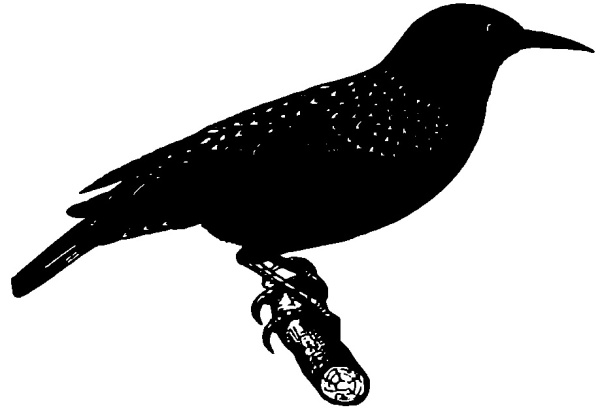
White fish these birds are very fond of, and also fresh salmon. Fruit should be given to them now and then, a fig being considered by them an especial delicacy. A little chickweed or other green food is also relished. This may be placed on the top of the cage. Finally starlings, no matter how well you feed them, will not thrive without plenty of exercise. The male bird is the better talker, and more active and saucy, as well as more beautiful and graceful in shape and plumage. Be assured the bird is very young before purchasing it.
My Starling “Dick.”
I feel very lonely now since my starling is gone. I could not bear to look upon his empty cage, his bath and playthings, so I have had them all stowed away; but the bird will dwell in my memory for many a day. The way in which that starling managed to insinuate itself into my heart and entwine its affections with mine, I can never rightly tell; and it is only now when it is gone that I really know how much it is possible for a human creature to love a little bird. The creature was nearly always with me, talking to me, whistling to me, or even doing mischief in a small way, to amuse me; and to throw down my pen, straighten my back, and have a romp with “Dick,” was often the best relaxation I could have had.
The rearing of a nest of starlings is always a very difficult task, and I found it peculiarly so. In fact, one young starling would require half-a-dozen servants at least to attend it. I was not master of those starlings, not a bit of it; they were masters of me. I had to get out of bed and stuff them with food at three o’clock every morning. They lived in a bandbox in a closet off my bedroom. I had to get up again at four o’clock to feed them, again at five, and again at six; in fact, I saw more sunrises during the infancy of that nest of starlings than ever I did before or since. By day, and all day long, I stuffed them, and at intervals the servant relieved me of that duty. In fact, it was pretty near all stuffing; but even then they were not satisfied, and made several ineffectual attempts to swallow my finger as well. At length—and how happy I felt!—they could both feed themselves and fly. This last accomplishment, however, was anything but agreeable to me, for no sooner did I open their door than out they would all come, one after the other, and seat themselves on my head and shoulders, each one trying to make more noise than all the rest and outdo his brothers in din.
I got so tired of this sort of thing at last, that one day I determined to set them all at liberty. I accordingly hung their cage outside the window and opened their door, and out they all flew, but back they came into the room again, and settled on me as usual. “Then,” said I, “I’m going gardening.” By the way they clung to me it was evident their answer was: “And so are we.” And so they did. And as soon as I commenced operations with the spade they commenced operations too, by searching for and eating every worm I turned up, evidently thinking I was merely working for their benefit and pleasure. I got tired of this. “O bother you all!” I cried; “I’m sick of you.” I threw down my spade in disgust; and before they could divine my intention, I had leaped the fence and disappeared in the plantation beyond.
“Now,” said I to myself, as I entered the garden that evening after my return, and could see no signs of starlings, “I’m rid of you plagues at last;” and I smiled with satisfaction. It was short-lived, for just at that moment “Skraigh, skraigh, skraigh” sounded from the trees adjoining; and before I could turn foot, my tormentors, seemingly mad with joy, were all sitting on me as usual. Two of them died about a week after this; and the others, being cock and hen, I resolved to keep.
Both Dick and his wife soon grew to be very fine birds. I procured them a large roomy cage, with plenty of sand and a layer of straw in the bottom of it, a dish or two, a bath, a drinking fountain, and always a supply of fresh green weeds on the roof of their domicile. Besides their usual food of soaked bread, etc, they had slugs occasionally, and flies, and earthworms. Once a day the cage-door was thrown open, and out they both would fly with joyful “skraigh” to enjoy the luxury of a bath on the kitchen floor. One would have imagined that, being only two, they would not have stood on the order of their going; but they did, at least Dick did, for he insisted upon using the bath first, and his wife had to wait patiently until his lordship had finished. This was part of Dick’s domestic discipline. When they were both thoroughly wet and draggled, and everything within a radius of two yards was in the same condition, their next move was to hop on to the fender, and flatter and gaze pensively into the fire; and two more melancholy-looking, ragged wretches you never saw. When they began to dry, then they began to dress, and in a few minutes “Richard was himself again,” and so was his wife.
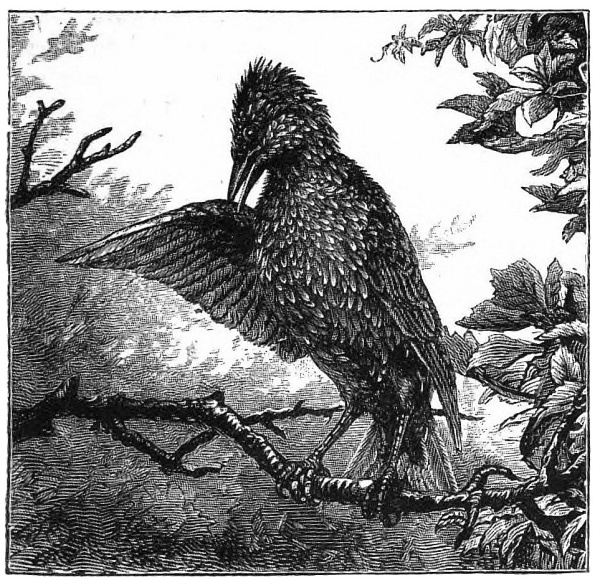
Starlings have their own natural song, and a strange noise they make too. Their great faculty, however, is the gift of imitation, which they have in a wonderful degree of perfection. The first thing that Dick learned to imitate was the rumbling of carts and carriages on the street, and very proud he was of the accomplishment. Then he learned to pronounce his own name, with the prefix “Pretty,” which he never omitted, and to which he was justly entitled. Except when sitting on their perch singing or piping, these two little pets were never tired engineering about their cage, and everything was minutely examined. They were perfect adepts at boring holes; by inserting the bill closed, and opening it like a pair of scissors, lo! the thing was done. Dick’s rule of conduct was that he himself should have the first of everything, and be allowed to examine first into everything, to have the highest perch and all the tit-bits; in a word, to rule, king and priest, in his own cage. I don’t suppose he hated his wife, but he kept her in a state of inglorious subjection to his royal will and pleasure. “Hezekiah” was the name he gave his wife. I don’t know why, but I am sure no one taught him this, for he first used the name himself, and then I merely corrected his pronunciation.
Sometimes Dick would sit himself down to sing a song; and presently his wife would join in with a few simple notes of melody; upon which Dick would stop singing instantly, and look round at her with indignation. “Hezekiah! Hezekiah!” he would say, which being interpreted, clearly meant: “Hezekiah, my dear, how can you so far forget yourself as to presume to interrupt your lord and master, with that cracked and quavering voice of yours?” Then he would commence anew; and Hezekiah being so good-natured, would soon forget her scolding and again join in. This was too much for Dick’s temper; and Hezekiah was accordingly chased round and round the cage and soundly thrashed. His conduct altogether as a husband, I am sorry to say, was very far from satisfactory. I have said he always retained the highest perch for himself; but sometimes he would turn one eye downwards, and seeing Hezekiah sitting so cosily and contentedly on her humble perch, would at once conclude that her seat was more comfortable than his; so down he would hop and send her off at once.
It was Dick’s orders that Hezekiah should only eat at meal-times; that meant at all times when he chose to feed, after he was done. But I suppose his poor wife was often a little hungry in the interim, for she would watch till she got Dick fairly into the middle of a song and quite oblivions of surrounding circumstances, then she would hop down and snatch a meal on the sly. But dire was the punishment far the deceit if Dick found her out. Sometimes I think she used to long for a little love and affection, and at such times she would jump up on the perch beside her husband, and with a fond cry sidle close to him.
“Hezekiah! Hezekiah!” he would exclaim; and if she didn’t take that hint, she was soon knocked to the bottom of the cage. In fact, Dick was a domestic tyrant, but in all other respects a dear affectionate little pet.
One morning Dick got out of his cage by undoing the fastening, and flew through the open window, determined to see what the world was like, leaving Hezekiah to mourn. It was before five on a summer’s morning that he escaped; and I saw no more of him until, coming out of church that day, the people were greatly astonished to see a bird fly down from the steeple and alight upon my shoulder. He retained his perch all the way home. He got so well up to opening the fastening of his cage-door that I had to get a small spring padlock, which defied him, although he studied it for months, and finally gave it up, as being one of those things which no fellow could understand.
Dick soon began to talk, and before long had quite a large vocabulary of words, which he was never tired using. As he grew very tame, he was allowed to live either out of his cage or in it all day long as he pleased. Often he would be out in the garden all alone for hours together, running about catching flies, or sitting up in a tree repeating his lessons to himself, both verbal and musical. The cat and her kittens were his especial favourites, although he used to play with the dogs as well, and often go to sleep on their backs. He took his lessons with great regularity, was an arduous student, and soon learned to pipe “Duncan Grey” and “The Sprig of Shillelah” without a single wrong note. I used to whistle these tunes over to him, and it was quite amusing to mark his air of rapt attention as he crouched down to listen. When I had finished, he did not at once begin to try the tune himself, but sat quiet and still for some time, evidently thinking it over in his own mind. In piping it, if he forgot a part of the air, he would cry: “Doctor, doctor!” and repeat the last note once or twice, as much as to say: “What comes after that?” and I would finish the tune for him.
“Tse! tse! tse!” was a favourite exclamation of his, indicative of surprise. When I played a tune on the fiddle to him, he would crouch down with breathless attention. Sometimes when he saw me take up the fiddle, he would go at once and peck at Hezekiah. I don’t know why he did so, unless to secure her keeping quiet. As soon as I had finished he would say “Bravo!” with three distinct intonations of the word, thus: “Bravo! doctor; br-r-ravo! bra-vo!”
Dick was extremely inquisitive and must see into everything. He used to annoy the cat very much by opening out her toes, or even her nostrils, to examine; and at times pussy used to lose patience, and pat him on the back.
“Eh?” he would say. “What is it? You rascal!” If two people were talking together underneath his cage, he would cock his head, lengthen his neck, and looking down quizzingly, say: “Eh? What is it? What do you say?”
He frequently began a sentence with the verb, “Is,” putting great emphasis on it. “Is?” he would say musingly.
“Is what, Dick?” I would ask.
“Is,” he would repeat—“Is the darling starling a pretty pet?”
“No question about it,” I would answer.
He certainly made the best of his vocabulary, for he trotted out all his nouns and all his adjectives time about in pairs, and formed a hundred curious combinations.
“Is,” he asked one day, “the darling doctor a rascal?”
“Just as you think,” I replied.
“Tse! tse! tse! Whew! whew! whew!” said Dick; and finished off with “Duncan Grey” and the first half of “The Sprig of Shillelah.”
“Love is the soul of a nate Irishman,” he had been taught to say; but it was as frequently, “Love is the soul of a nate Irish starling;” or, “Is love the soul of a darling pretty Dick?” and so on.
One curious thing is worth noting: he never pronounced my dog’s name—Theodore Nero—once while awake; but he often startled us at night by calling the dog in clear ringing tones—talking in his sleep. He used to be chattering and singing without intermission all day long; and if ever he was silent then I knew he was doing mischief; and if I went quietly into the kitchen, I was sure to find him either tracing patterns on a bar of soap, or examining and tearing to pieces a parcel of newly-arrived groceries. He was very fond of wines and spirits, but knew when he had enough. He was not permitted to come into the parlour without his cage; but sometimes at dinner, if the door were left ajar, he would silently enter like a little thief; when once fairly in, he would fly on to the table, scream, and defy me. He was very fond of a pretty child that used to come to see me. If Matty was lying on the sofa reading, Dick would come and sing on her head; then he would go through all the motions of washing and bathing on Matty’s bonnie hair; which was, I thought, paying her a very pretty compliment.
When the sun shone in at my study window, I used to hang Dick’s cage there, as a treat to him. Dick would remain quiet for perhaps twenty minutes, then the stillness would feel irksome to him, and presently he would stretch his head down towards me in a confidential sort of way, and begin to pester me with his silly questions.
“Doctor,” he would commence, “is it, is it a nate Irish pet?”
“Silence, and go asleep,” I would make answer. “I want to write.”
“Eh?” he would say. “What is it? What d’ye say?”
Then, if I didn’t answer—
“Is it sugar—snails—sugar, snails, and brandy?” Then, “Doctor, doctor!”
“Well, Dickie, what is it now?” I would answer.
“Doctor—whew.” That meant I was to whistle to him.
“Shan’t,” I would say sulkily.
“Tse! tse! tse!” Dickie would say, and continue, “Doctor, will you go a-clinking?” I never could resist that. Going a-clinking meant going fly-hawking. Dick always called a fly a clink; and this invitation I would receive a dozen times a day, and seldom refused. I would open the cage-door, and Dick would perch himself on my finger, and I would carry him round the room, holding him up to the flies on the picture-frames. And he never missed one.
Once Dick fell into a bucket of water, and called lustily for the “doctor;” and I was only just in time to save him from a watery grave. When I got him out, he did not speak a word until he had gone to the fire and opened his wings and feathers out to dry, then he said: “Bravo! B-r-ravo” several times, and went forthwith and attacked Hezekiah.
Dick had a little travelling cage, for he often had to go with me by train; and no sooner did the train start than Dick used to commence to talk and whistle, very much to the astonishment of the passengers, for the bird was up in the umbrella rack. Everybody was at once made aware of both my profession and character, for the jolting of the carriage not pleasing him, he used always to prelude his performance with, “Doctor, doctor, you r-r-rascal. What is it, eh?” As Dick got older, I am sorry, as his biographer, to be compelled to say he grew more and more unkind to his wife—attacked her regularly every morning and the last thing at night, and half-starred her besides. Poor Hezekiah! She could do nothing in the world to please him. Sometimes, now, she used to peck him back again; she was driven to it. I was sorry for Hezekiah, and determined to play pretty Dick a little trick. So one day, when he had been bullying her worse than ever, I took Hezekiah out of the cage, and fastened a small pin to her bill, so as to protrude just a very little way, and returned her. Dick walked up to her at once. “What,” he wanted to know, “did she mean by going on shore without leave?” Hezekiah didn’t answer, and accordingly received a dig in the back, then another, then a third; and then Hezekiah turned, and let him have one sharp attack. It was very amusing to see how Dick jumped, and his look of astonishment as he said: “Eh? What d’ye say? Hezekiah! Hezekiah!”
Hezekiah followed up her advantage. It was quite a new sensation for her to have the upper hand, and so she courageously chased him round and round the cage, until I opened the door and let Dick out.
But Hezekiah could not live always with a pin tied to her bill; so, for peace’ sake, I gave her away to a friend, and Dick was left alone in his glory.
Poor Dickie! One day he was shelling peas to himself in the garden, when some boys startled him, and he flew away. I suppose he lost himself, and couldn’t find his way back. At all events I only saw him once again. I was going down through an avenue of trees about a mile from the house, when a voice above in a tree hailed me: “Doctor! doctor! What is it?” That was Dick; but a rook flew past and scared him again, and away he flew—for ever.
That same evening, Ida, who had been absent for some little time, returned, and shyly handed me a letter.
“Whom is it from, I wonder, Ida,” I said; “so late in the evening, too?”
“Oh, it is from Maggie,” Ida replied.
“What!” I exclaimed; “from that impudent bird? Well, let us see what she has to say;” and opening the note, I read as follows:—
“Dear Master,—I fully endorse all you have written about the starling, especially as regards their treatment, and if you had added that they are pert, perky things, you wouldn’t have been far out. Well, we magpies build our nests of sticks on the tops of tall trees, lining it first with clay, then with grass; our eggs are five in number, and if they weren’t so like to a rook’s they might be mistaken for a blackbird’s. The nests are so big that before the little boys climb up the trees they think they have found a hawk’s. In some parts of the country we are looked upon with a kind of superstitious awe. This is nonsense; there is nothing wrong about us; we may bring joy to people, as I do to you, dear Doctor, by my gentle loving ways, but we never bring grief. We like solitude, and keep ourselves in the wild state to ourselves. Perhaps if we went in flocks, and had as much to say for ourselves as those noisy brutes of rooks, we would be more thought of. Even in the domestic state we like our liberty, and think it terribly cruel to be obliged to mope all day long in a wicker cage. It is crueller still to hang us in draughts, or in too strong a sun; while to keep our cage damp and dirty cramps our legs and gives us such twinges of rheumatism in our poor unused wings, that we often long to die and be at rest.
“The treatment, Doctor, you prescribe for starlings will do nicely for us, and you know how easily we are taught to talk; and I’m sure I do love you, Doctor, and haven’t I, all for your sake, made friends with your black Persian cat and your big Newfoundland dog?
“No, I’m not a thief; I deny the charge. Only if you do leave silver spoons about, and gold pens, and shillings and sixpenny-bits—why—I—I borrow them, that is all, and you can always find them in Maggie’s cage.
“We can eat all that starlings eat; yes, and a great many things they would turn up their supercilious bills at. But, remember, we do like a little larger allowance of animal food than starlings do.
“No more at present, dear Doctor, but remains your loving and affectionate Magpie, Maggie.”
N.b.—The grammatical error in the last sentence is Maggie’s, not mine.
Chapter Ten.
The Life and Death of Rook Toby.
“A dewy freshness fills the silent air; No mist obscures, nor cloud, nor speck, nor stain Breaks the serene of heaven: In full-orbed glory, yonder moon divine Rolls through the dark-blue depths. Beneath her steady ray The desert-circle spreads; Like the round ocean, girdled with the sky. How beautiful is night?”
“It most have been on just such another night as this, Frank, that Southey penned these lines,” I began.
“How about the dewy freshness?” said my wife, who is usually more practical than poetic. “Don’t you think, dear, that Ida had better go in?”
“Oh! no, auntie,” cried Ida; “I must stay and hear the story. It isn’t nine o’clock.”
“No,” Frank remarked, “barely nine o’clock, and yet the stars are all out; why, up in the north of Scotland people at this season of the year can see to read all night.”
“How delightful!” cried Ida.
The nodding lilacs and starry syringas were mingling their perfume in the evening air.
“Listen,” said my wife; “yonder, close by us in the Portugal laurel, is the nightingale.”
“Yes,” I replied, “but to-morrow morning will find the bird just a trifle farther afield, for some instinct tells him that our dark-haired Persian pussy is an epicure in her way, and would prefer philomel to fish for her matutinal meal.”
I am more convinced than ever that for the first two or three nights after their arrival in this country the nightingales do not go to sleep at all, but sing on all day as well as all night, the marvel being that they do not get hoarse. But after a week the night-song is not nearly so brilliant nor so prolonged, nor does it attain its pristine wild joyfulness until spring once more gilds the fields with buttercups. By day the song is not so noticeable, though ever and anon it sounds high over the Babel of other birds’ voices. But, of course, the thrush must sing, the blackbird must pipe, and vulgar sparrows bicker and shriek, and talk Billingsgate to each other, for sparrows having but little music in their own nature, have just as little appreciation for the gift in others.
“Look!” cried Frank; “yonder goes a bat.”
“Yes,” I said, “the bats are abroad every night now in full force. What a wonderful power of flight is theirs; how quickly they can turn and wheel, and how nimbly gyrate!”
“I much prefer the martin-swallow,” said Ida.
“We have no more welcome summer, or rather spring visitor, Ida, than the martin.
“‘He twitters on the apple-trees, He hails me at the dawn of day, Each morn the recollected proof Of time, that swiftly fleets away. Fond of sunshine, fond of shade, Fond of skies serene and clear, E’en transient storms his joys invade, In fairest seasons of the year.’”
“But I must be allowed to say that I object to the word ‘twitter,’ so usually applied to the song of the swallow. It is more than a meaningless twitter. Although neither loud nor clear, it is—when heard close at hand—inexpressibly sweet and soft and tender, more so than even that of the linnet, and there are many joyous and happy notes in it, which it is quite delightful to listen to. Indeed, hardly any one could attentively observe the song of our domestic martin for any length of time without feeling convinced that the dusky little minstrel was happy—inexpressibly happy. Few, perhaps, know that there is a striking similarity between the expressions by sound or, voice of the emotions of all animals in the world, whether birds or beasts, and whether those emotions be those of grief or pain, or joy itself. This is well worth observing, and if you live in the country you will have a thousand chances of doing so. Why does the swallow sing in so low a voice? At a little distance you can hardly hear it at all. I have travelled a good deal in forests and jungles and bush lands in Africa and the islands about it, and, of course, I always went alone, that is, I never had any visible companion—because only when alone can one enjoy Nature, and study the ways and manners of birds and beasts, and I have been struck by the silence of the birds, or, at all events, their absence of song in many of them.”
“Why should that be so, I wonder?” said Ida.
“Probably,” said Frank, “because the woods where the birds dwell are so full of danger that song would betray their presence, and the result be death. And the same reason may cause the house martins to lower their voices when they give vent to their little notes of tuneful joy.”
There was a moment’s pause: Aileen came and put her head in my lap.
“She is waiting for the story,” said Frank.
“Oh! yes,” my wife remarked; “both the dogs are sure to be interested in ‘Toby’s’ tale.”
“Why?” said Frank.
“Because,” my wife replied, “Toby was a sheep.”
Here Theodore Nero must join Aileen. The very name or mention of the word “sheep,” was sure to make that honest dog wag his tail.
“Two heads are better than one,” I once remarked in his presence.
“Especially sheep’s heads,” said the dog.
And now for the story.
Toby: The Story of a Sailor Sheep.
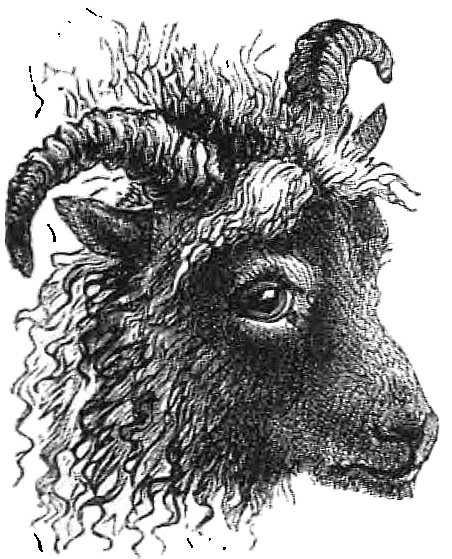
Now Toby was a sheep, a sheep of middling size, lightly built, finely limbed, as agile as a deer, with dark intelligent gazelle-like eyes, and a small pair of neatly curled horns, with the points protruding about an inch from his forehead. And his colour was white except on the face, which was slightly darker.
It was the good brig Reliance of Arbroath, and she was bound from Cork to Galatz, on the banks of the blue Danube. All went well with the little ship until she reached the Grecian Archipelago, and here she was detained by adverse winds and contrary currents, making the passage through among the islands both a dangerous and a difficult one. When the mariners at length reached Tenedos, it was found that the current from the Dardanelles was running out like a mill-stream, which made it impossible to proceed; and accordingly the anchor was cast, the jolly-boat was lowered, and the captain took the opportunity of going on shore for fresh water, of which they were scarce. Having filled his casks, it was only natural for a sailor to long to treat himself to a mess of fresh meat as well as water. He accordingly strolled away through the little town; but soon found that butchers were unknown animals in Tenedos. Presently, however, a man came up with a sheep, which the captain at once purchased for five shillings. This was Toby, with whom, his casks of water, and a large basket of ripe fruit, the skipper returned to his vessel. There happened to be on board this ship a large and rather useless half-bred Newfoundland. This dog was the very first to receive the attentions of Master Toby, for no sooner had he placed foot on deck than he ran full tilt at the poor Newfoundland, hitting him square on the ribs and banishing almost every bit of breath from his body. “Only a sheep,” thought the dog, and flew at Toby at once. But Toby was too nimble to be caught, and he planted his blows with such force and precision, that at last the poor dog was fain to take to his heels, howling with pain, and closely pursued by Toby. The dog only escaped by getting out on to the bowsprit, where of course Toby could not follow, but quietly lay down between the knight-heads to wait and watch for him.
That same evening the captain was strolling on the quarter-deck eating some grapes, when Toby came up to him, and standing on one end, planted his feet on his shoulders, and looked into his face, as much as to say: “I’ll have some of those, please.”
And he was not disappointed, for the captain amicably went shares with Toby. Toby appeared so grateful for even little favours, and so attached to his new master, that Captain Brown had not the heart to kill him. He would rather, he thought, go without fresh meat all his life. So Toby was installed as ship’s pet. Ill-fared it then with the poor Newfoundland; he was so battered and so cowed, that for dear life’s sake he dared not leave his kennel even to take his food. It was determined, therefore, to put an end to the poor fellow’s misery, and he was accordingly shot. This may seem cruel, but it was the kindest in the main.
Now, there was on board the Reliance an old Irish cook. One morning soon after the arrival of Toby, Paddy (who had a round bald pate, be it remembered) was bending down over a wooden platter cleaning the vegetables for dinner, when Toby took the liberty of insinuating his woolly nose to help himself. The cook naturally enough struck Toby on the snout with the flat of the knife and went on with his work. Toby backed astern at once; a blow he never could and never did receive without taking vengeance. Besides, he imagined, no doubt, that holding down his bald head as he did, the cook was desirous of trying the strength of their respective skulls. When he had backed astern sufficiently for his purpose, Toby gave a spring; the two heads came into violent collision, and down rolled poor Paddy on the deck. Then Toby coolly finished all the vegetables, and walked off as if nothing had happened out of the usual.
Toby’s hatred of the whole canine race was invincible. While the vessel lay at Galatz she was kept in quarantine, and there was only one small platform, about four hundred yards long by fifty wide, on which the captain or crew of the Reliance could land. This was surrounded by high walls on three sides, one side being the Pe’latoria, at which all business with the outside world was transacted through gratings. Inside, however, there were a few fruit-stalls. Crowds used to congregate here every morning to watch Toby’s capers, and admire the nimbleness with which he used to rob the fruit-stalls and levy blackmail from the vegetable vendors.
One day when the captain and his pet were taking their usual walk on this promenade, there came on shore the skipper of a Falmouth ship, accompanied by a large formidable-looking dog. And the dog only resembled his master, as you observe dogs usually do. As soon as he saw Toby he commenced to hunt his dog upon him; but Toby had seen him coming and was quite en garde; so a long and fierce battle ensued, in which Toby was slightly wounded and the dog’s head was severely cut. Quite a multitude had assembled to witness the fight, and the ships’ riggings were alive with sailors. At one time the brutal owner of the dog, seeing his pet getting worsted, attempted to assist him; but the crowd would have pitched him neck and crop into the river, had he not desisted. At last both dog and sheep were exhausted and drew off, as if by mutual consent. The dog seated himself close to the outer edge of the platform, which was about three feet higher than the river’s bank, and Toby went, as he was wont to do, and stood between his master’s legs, resting his head fondly on the captain’s clasped hands, but never took his eyes off the foe. Just then a dog on board one of the ships happened to bark, and the Falmouth dog looked round. This was Toby’s chance, and he did not miss it nor his enemy either. He was upon him like a bolt from a catapult. One furious blow knocked the dog off the platform, next moment Toby had leaped on top of him, and was chasing the yelling animal towards his own ship. There is no doubt Toby would have crossed the plank and followed him on board, had not his feet slipped and precipitated him into the river. A few minutes afterwards, when Toby, dripping with wet, returned to the platform to look for his master, he was greeted with ringing cheers; and many was the plaster spent in treating Toby to fruit. Toby was the hero of Galatz from that hour; but the Falmouth dog never ventured on shore again, and his master as seldom as possible.
On her downward voyage, when the vessel reached Selina, at the mouth of the river, it became necessary to lighten her in order to get her over the bar. This took some time, and Toby’s master frequently had to go on shore; but Toby himself was not permitted to accompany him, on account of the filth and muddiness of the place. When the captain wished to return he came down to the river-side and hailed the ship to send a boat. And poor Toby was always on the watch for his master if no one else was. He used to place his fore-feet on the bulwarks and bleat loudly towards the shore, as much as to say: “I see you, master, and you’ll have a boat in a brace of shakes.” Then if no one was on deck, Toby would at once proceed to rouse all hands fore and aft. If the mate, Mr Gilbert, pretended to be asleep on a locker, he would fairly roll him off on to the deck.
Toby was revengeful to a degree, and if any one struck him, he would wait his chance, even if for days, to pay him out with interest in his own coin. He was at first very jealous of two little pigs which were bought as companions to him; but latterly he grew very fond of them, and as they soon got very fat, Toby used to roll them along the deck like a couple of footballs. There were two parties on board that Toby did not like, or rather that he liked to annoy whenever he got the chance, namely, the cook and the cat. He used to cheat the former and chase the latter on every possible occasion. If his master took pussy and sat down with her on his knee, Toby would at once commence to strike her off with his head. Finding that she was so soft and yielding that this did not hurt her, he would then lift his fore-foot and attempt to strike her down with that; failing in that, he would bite viciously at her; and if the captain laughed at him, then all Toby’s vengeance would be wreaked on his master. But after a little scene like this, Toby would always come and coax for forgiveness. Toby was taught a great many tricks, among others to leap backward and forward through a life-buoy. When his hay and fresh provisions went down, Toby would eat pea-soup, invariably slobbering all his face in so doing, and even pick a bone like a dog. He was likewise very fond of boiled rice, and his drink was water, although he preferred porter and ale; but while allowing him a reasonable quantity of beer, the captain never encouraged him in the nasty habit the sailors had taught him of chewing tobacco.
It is supposed that some animals have a prescience of coming storms. Toby used to go regularly to the bulwarks every night, and placing his feet against them sniff all around him. If content, he would go and lie down and fall fast asleep; but it was a sure sign of bad weather coming before morning, when Toby kept wandering among his master’s feet and would not go to rest.
Pea-soup and pork-bones are scarcely to be considered the correct food for a sheep, and so it is hardly to be wondered at that Toby got very thin before the vessel reached Falmouth.
Once Toby was in a hotel coffee-room with his master and a friend of the latter’s, when instead of calling for two glasses of beer, the captain called for three.
“Is the extra glass for yourself or for me?” asked his friend.
The extra glass was for Toby, who soon became the subject of general conversation.
“I warrant noo,” said a north-country skipper, “that thing would kick up a bonnie shine if you were to gang oot and leave him.”
“Would you like to try him?” replied Captain Brown.
“I would,” said the Scot, “vera muckle.”
Accordingly Toby was imprisoned in one corner of the room, where he was firmly held by the Scotch skipper; and Captain Brown, after giving Toby a glance which meant a great deal, left the room. No sooner had he gone than Toby struggled clear of the Scotchman, and took the nearest route for the door. This necessitated his jumping on to the middle of the table, and here Toby missed his footing and fell, kicking over glasses, decanters, and pewter pots by the half-dozen. He next floored a half-drunken fellow, over whose head he tried to spring, and so secured his escape, and left the Scotch skipper to pay the bill.
One day Captain Brown was going up the steps of the Custom-house, when he found that not only Toby but Toby’s two pigs were following close at his heels. He turned round to drive them all back; but Toby never thought for a moment that his master meant that he should return.
“It is these two awkward creatures of pigs,” thought Toby, “that master can’t bear the sight of.”
So Toby went to work at once, and first rolled one piggie downstairs, then went up and rolled the other piggie downstairs; but the one piggie always got to the top of the stairs again by the time his brother piggie was rolled down to the bottom. Thinking that as far as appearances went, Toby had his work cut out for the next half-hour, his master entered the Custom-house. But Toby and his friends soon found some more congenial employment; and when Captain Brown returned, he found them all together in an outer room, dancing about with the remains of a new mat about their necks, which they had just succeeded in tearing to pieces.
Their practical jokes cost the captain some money one way or another.
One day the three friends made a combined attack on a woman who was carrying a young pig in a sack; this little pig happened to squeak, when Toby and his pigs went to the rescue. They tore the woman’s dress to atoms and delivered the little pig. Toby was very much addicted to describing the arc of a circle; that was all very good when it was merely a fence he was flying over, but when it happened that a window was in the centre of the arc, then it came rather hard on the captain’s pocket.
In order to enable him to pick up a little after his long voyage, Toby was sent to country lodgings at a farmer’s. But barely a week had elapsed when the farmer sent him back again with his compliments, saying that he would not keep him for his weight in gold. He led his, the farmer’s, sheep into all sorts of mischief that they had never dreamed of before, and he defied the dogs, and half-killed one or two of them.
Toby returned like himself, for when he saw his master in the distance he baa-ed aloud for joy, and flew towards him like a wild thing, dragging the poor boy in the mud behind him.
Toby next took out emigrants to New York, and was constantly employed all day in sending the steerage passengers off the quarter-deck. He never hurt the children, however, but contented himself by tumbling them along the deck and stealing their bread-and-butter.
From New York Toby went to Saint Stephens. There a dog flew out and bit Captain Brown in the leg. It was a dear bite, however, for the dog, for Toby caught him in the act, and hardly left life enough in him to crawl away. At Saint Stephens Toby was shorn, the weather being oppressively hot. No greater insult could have been offered him. His anger and chagrin were quite ludicrous to witness. He examined himself a dozen times, and every time he looked round and saw his naked back he tried to run away from himself. He must have thought with the wee “wifiekie comin’ frae the fair—This is no me surely, this is no me.” But when his master, highly amused at his antics, attempted to add insult to injury by pointing his finger at him and laughing him to scorn, Toby’s wrath knew no bounds, and he attacked the captain on the spot. He managed, however, to elude the blow, and Toby walked on shore in a pet. Whether it was that he was ashamed of his ridiculous appearance, or of attempting to strike his kind master in anger, cannot be known, but for three days and nights Toby never appeared, and the captain was very wretched indeed. But when he did return, he was so exceedingly penitent and so loving and coaxing that he was forgiven on the spot.
When Toby arrived with his vessel in Queen’s Dock, Liverpool, on a rainy morning, some nice fresh hay was brought on board. This was a great treat for Toby, and after he had eaten his fill, he thought he could not do better than sleep among it, which thought he immediately transmuted to action, covering himself all up except the head. By-and-by the owner of the ship came on board, and taking a survey of things in general, he spied Toby’s head.
“Hollo!” he said, “what’s that?” striking Toby’s nose with his umbrella. “Stuffed, isn’t it?”
Stuffed or not stuffed, there was a stuffed body behind it, as the owner soon knew to his cost, and a spirit that never brooked a blow, for next moment he found himself lying on his back with his legs waggling in the air in the most expressive manner, while Toby stood triumphantly over him waiting to repeat the dose if required.
The following anecdote shows Toby’s reasoning powers. He was standing one day near the dockyard foreman’s house, when the dinner bell rang, and just at the same time a servant came out with a piece of bread for Toby. Every day after this, as soon as the same bell rang—“That calls me,” said Toby to himself, and off he would trot to the foreman’s door. If the door was not at once opened he used to knock with his head; and he would knock and knock again until the servant, for peace’ sake, presented him with a slice of bread.
And now Toby’s tale draws near its close. The owner never forgave that blow, and one day coming by chance across the following entry in the ship’s books, “Tenedos—to one sheep, five shillings,” he immediately claimed Toby as his rightful property. It was all in vain that the captain begged hard for his poor pet, and even offered ten times his nominal value for him. The owner was deaf to all entreaties and obdurate. So the two friends were parted. Toby was sent a long way into the country to Carnoustie, to amuse some of the owner’s children, who were at school there. But the sequel shows how very deeply and dearly even a sheep can love a kind-hearted master. After the captain left him, poor Toby refused all food and died of grief in one week’s time.
Chapter Eleven.
A Bird-Haunted Lawn in June—Pets of my Early Years.
“Go, beautiful and gentle dove! But whither wilt thou go? For though the clouds tide high above. How sad and waste is all below. “The dove flies on. In lonely flight She flies from dawn to dark; And now, amidst the gloom of night, Comes weary to the ark. ‘Oh! let me in,’ she seems to say, ‘For long and lone has been my way; Oh! once more, gentle mistress, let me rest And dry my dripping plumage on thy breast.’” Rev. W. Bowles.
There is a kind of semi-wildness about our back lawn that a great many people profess to admire. It stretches downwards from my indoor study, from where the French windows open on to the trellised verandah, which in this sweet month of June, as I write, is all a smother of roses. The walk winds downwards well to one side, and not far from a massive hedge, but this hedge is hidden from view for the most part by a ragged row of trees. The Portuguese laurel, tasselled with charming white bloom at present, but otherwise an immense globe of green (you might swing a hammock inside it and no one know you were there), comes first; then tall, dark-needled Austrian pines, their branches trailing on the grass, with hazels, lilacs, and elders, the latter now in bloom. The lawn proper has it pretty much to itself, with the exception of the flower-beds, the rose-standards, and a sprinkling of youthful pines, and it is bounded on the other side by a tall privet hedge—that, too, is all bedecked in bloom. On the other ride of this hedge the view is shut in to some extent by tapering cypress trees, elms, and oaks, but here and there you catch glimpses of the hills and the lovely country beyond. Along this hedge, at present, wallflowers, and scarlet and white and pink-belled foxgloves are blooming.
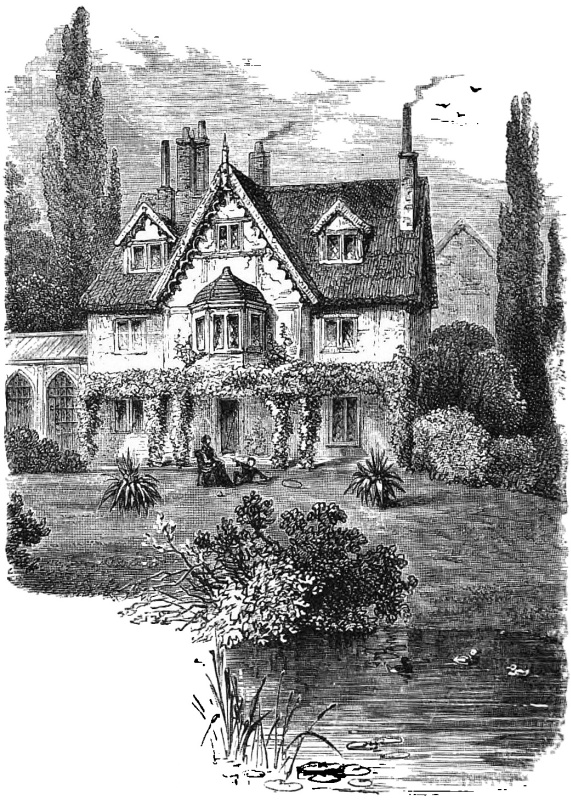
If you go along the winding pathway, past the bonnie nook—where is now the grave of my dear old favourite Newfoundland (the well-known champion, Theodore Nero)—and if you obstinately refuse to be coaxed by a forward wee side-path into a cool, green grotto, canopied with ivy and lilacs, you will land—nowhere you would imagine at first, but on pushing boughs aside you find a gate, which, supposing you had the key, would lead you out into open country, with the valley of the Thames, stretching from west to east, about a mile distant, and the grand old wooded hills, blue with the softening mist of distance, beyond that. But the lower part of the lawn near that hidden gate is bounded by a bank of glorious foliage—rhododendrons, syringas, trailing roses, and hero-laurels in front, with ash, laburnum, and tall holly trees behind. It may not be right to allow brambles to creep through this bank; nor raspberries, with their drooping cane-work; nor blue-eyed, creeping belladonna; but I like it. I dearly love to see things where you least expect them; to find roses peeping through hedgerows, strawberries building their nests at the foot of gooseberry clumps, and clusters of yellow or red luscious raspberries peeping out from the midst of rhododendron banks, as if fairy fingers were holding them up to view.
I’m not sure that the grass on this pet lawn of mine, is always kept so cleanly shaven as some folks might wish, but for my own part I like it snowed over with daisies and white clover; and, what is more to the point, the birds and the bees like it. Indeed, the lawn is little more than a vast outdoor aviary—it is a bird-haunted lawn. There is a rough, shallow bath under a tree at the end of it, and here the blackbirds, thrushes, and starlings come to splash early in the morning, and stare up at my window as I dress, as coolly as if they had not been all up in the orchard trees breakfasting off the red-heart cherries. I have come now, after a lapse of four years, to believe that those cherries belong to the birds and not to me, just as a considerable number of pounds of the greengages belong to the wasps.
The nightingales hop around the lawn all day, but they do not bathe, and they do not sing now; they devour terribly long earthworms instead. In the sweet spring-time, in the days of their wooing, they did nothing but sing, and they never slept. Now all is changed, and they do little else save sleep and eat.
There are wild pigeons build here, though it is close to two roads, and I see turtle-doves on the lawn every day.
“Did you commence the study of natural history at an early age, Gordon?” said Frank to me one evening, as we all sat together on this lawn.
“In a practical kind of a way, yes, Frank,” I replied, “and if I live for the next ten thousand years I may make some considerable progress in this study. Ars longa vita brevia est, Frank.”
“True; and now,” he continued, “spin us a yarn or two about some of the pets you have had.”
“Well, Frank,” I replied, “as you ask me in that off-hand way, you must be content to take my reminiscences in an off-hand way, too.”
“We will,” said Frank; “won’t we, Ida?”
Ida nodded.
“Given a pen and put in a corner, Frank, I can tell a story as well as my neighbours, but the extempore business floors me. I’m shy, Frank, shy. Another cup of tea, Dot—thank you—ahem!”
Pets of my Early Years.
There was no school within about three miles of a property my father bought when I was a little over two years of age. With some help from the neighbours my father built a school, which I believe is now endowed, but at that time it was principally supported by voluntary contributions. I was sent there as a first instalment. I was an involuntary contribution. Nurse carried me there every morning, but I always managed to walk coming back. By sending a child of tender years to a day-school, negative rather than positive good was all that was expected, for my mother frankly confessed that I was only sent to keep me out of mischief. The first few days of my school life flew past quickly enough, for my teacher, a little hunchback, be it remembered, whom you may know by the name of Dominie W—, was very kind to me, candied me and lollipopped me, and I thought it grand fun to sit all day on my little stool, turning over the pages of picture-books, and looking at the other boys getting thrashed. This latter part indeed was the best to me, for the little fellows used to screw their miserable visages so, and make such funny faces, that I laughed and crowed with delight. But I didn’t like it when it came to my own turn. And here is how that occurred:—There was a large pictorial map that hung on the schoolroom wall, covered with delineations of all sorts of wild beasts. These were pointed out to the Bible-class one by one, and a short lecture given on the habits of each, which the boys and girls were supposed to retain in their memories, and retail again when asked to. One day, however, the dromedary became a stumbling-block to all the class; not one of them could remember the name of the beast.