"With other Tales of Faithful Friends and Favourites" (continued 5)
Reading edition
One day when out walking, Pepper met a little long-haired dog about his own size and shape, but whereas Pepper was dressed like a gentleman Skye, in coat of hodden-grey, this little fellow was more like a merry man at a country fair, or a clown at a circus. He had been originally white, pure white, but his master had dyed him, and now he appeared in a blue body, a magenta tail, and ears of brightest green.
“I say, mistress,” said Pepper, looking up and addressing the lady who had charge of him, “did you—ever—in—all—your—born—days—see such a fright as that?”
“Hullo!” he continued, talking to the little dog himself, “who let you out like that?”
“Well,” replied the new-comer, “I dare say I do look a little odd, but you’ll get used to me by-and-by.”
“Used to you?” cried Pepper—“never! You are a disgrace to canine society.”
“The fact is,” said the other, looking somewhat ashamed “my master is a dyer, and he does me up like this just by way of advertising, you know.”
“Your master a dyer,” cried Pepper, “then you, too, shall die. Can you fight? I’m full of it. Come, we must have it out.”
“Come back, Pepper, come back, sir!” cried his mistress. But for once Pepper disobeyed; he flew at that funny dog, and in a few minutes the air was filled with the blue and magenta fluff, that the Skye tore out of his antagonist. The combat ended in a complete victory for Pepper. He routed his assailant, and finally chased him off the esplanade.
Pepper’s life at the seaside was a very happy one, or would have been except for the dyed dog, that he made a point of giving instant chase to, whenever he saw him.
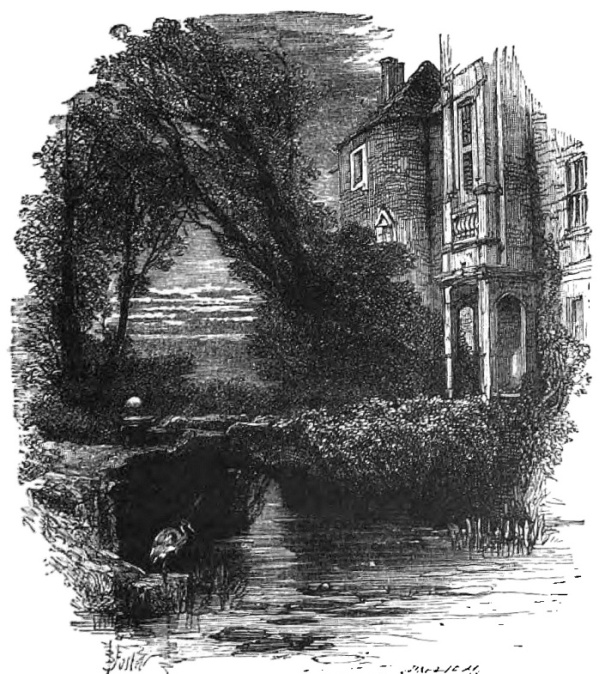
Pepper next turned up in Wales. Sir B. N— had taken a lovely old mansion between C—n and Ll—o, far removed from any other houses, and quite amongst the hills, and after seeing his wife and sister settled in the new abode, he went off to Scotland. A week after his departure, the two ladies got up a small picnic to Dolbadran Castle, whose ruins stand upon a steep rock overhanging the lake. Pepper of course accompanied the tourists, and the whole party returned at night rather fatigued. Mrs C— went to bed, and soon fell into a sound sleep, from which she was aroused by Pepper; he was barking at the bedside. She got up, gave him some water, and returned to bed, but Pepper continued to bark and run about the room in a very strange way; he seized the bedclothes, and pulled at them violently. So she put him outside the door in a long passage, which was closed at the other end by a thick green-baize covered door.
Poor Mrs C— was fated to have no rest. Pepper barked louder than ever, he tore at the door, and scratched as if he wished to pull it down; so his mistress again left her couch, and taking up a small riding-whip, proceeded to administer what she thought to be well-merited correction.
Pepper did not appear to care for the whip at all; he only barked the louder, and jumped up wilder; he even caught Mrs C—’s nightdress in his mouth, and attempted to drag her on towards the end of the passage.
You must be going mad, she thought. I’ll put you out of the house, for you will alarm the whole establishment; and thus thinking, she returned, followed by Pepper, who continued to clutch at her garments, into her room, put on her dressing-gown, and proceeded to carry her intention into effect.
Directly she opened the door at the end of the passage, she saw a bright light streaming from a sort of ante-room at the top of the staircase, on the opposite side of the corridor, and at the same moment became sensible of a strange smell of burning wood.
She flew across, and was nearly blinded by the smoke that burst forth immediately the ante-room door was opened. The whole house was on fire, and it was with considerable difficulty that Mrs C—, Lady N—, and the domestics, escaped from the burning mass.
Had Mrs C— been five minutes later before discovering the flames all must have perished; for there was a great quantity of wood-work in the house, and it burnt rapidly.
It matters little how the fire in this case originated, the fact remains that this Skye-terrier, Pepper, was the first to discover it, and his wonderful sagacity and determination, combined to save his friends from a fearful death.
“Ida,” said Frank, refilling his pipe, “you are beginning to wink.”
“It is time you were in bed, Ida,” said my wife.
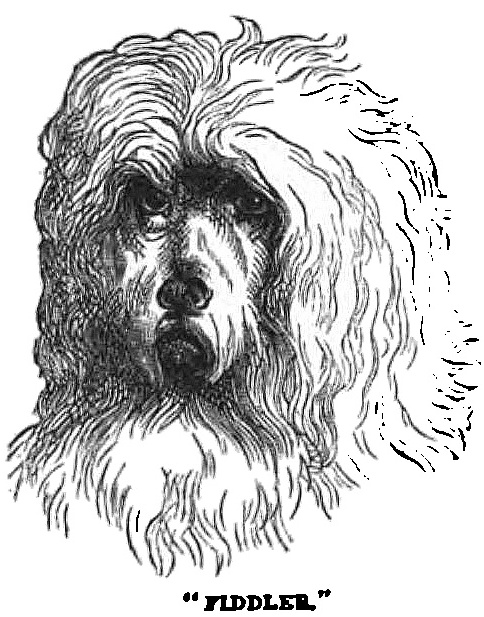
“Oh! but I do want to hear you read what you wrote yesterday about the poor blind fiddler’s dog,” cried Ida.
“Well, then,” I said, “we will bring the little dog on the boards, and make him speak a piece himself, and this will be positively the last story or anecdote to-night.”
The Blind Fiddler’s Dog.
The blind man’s dog commences in doggerel verse:—
“It really is amusing to hear how some dogs brag, And walk about and swagger, with tails and ears a-wag,— How they boast about their prizes and the shows they have been at, And their coats so crisp and curly, or bodies sleek and fat, Crying, There’s no mistake about it, for judges all agree, We’re the champion dogs of England, by points and pedigree.”
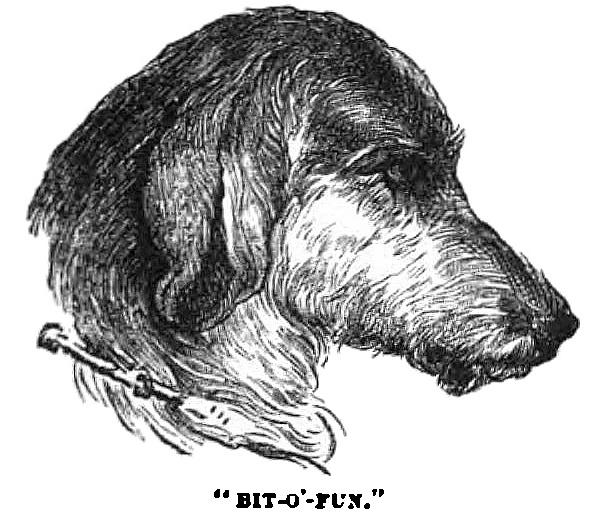
Heigho! I wonder what I am, then. Let me consider, I am a poor blind fiddler’s dog, to begin with; but of course that is only a trade. I asked “Bit-o’-Fun” the other day what breed I was. Bit-o’-Fun, I should tell you, is a champion greyhound, and not at all an unkind dog, only just a little haughty and proud, as becomes her exalted station in life. She was talking about the large number of prizes she had won for her master at the various shows she had been at.
“What breed do you think I am?” I asked her. Bit-o’-Fun laughed.
“Well, little Fiddler,” she replied, looking down at me with one eye, “I should say you were what we gentry call a mongrel.”
“Is that something very nice?” I inquired. “Do I come of a high family, now?”
Bit-o’-Fun laughed now till the tears came into her eyes.
“Family!” she cried. “Yes, Fiddler, you have a deal of family in your blood—all families, in fact. You are partly Skye and partly bulldog, and partly collie and partly pug.”
“Oh, stop!” I cried; “you will make me too proud.”
But Bit-o’-Fun went on—
“Your head, Fiddler, is decidedly Scotch; your legs are Irish—awfully Irish; you are tulip-eared, ring-tailed, and your feather—”
“My feather!” I cried, looking round at my back. “You never mean to say I have got feathers.”
“Your hair, then, goosie; feather is the technical term. Your feather is flat, decidedly flat. And, in fact, you’re a most wonderful specimen altogether. That’s your breed.”
I never felt so proud in all my life before.
“And you’re a great beauty, Bit-o’-Fun,” I said; “but aren’t your legs rather long for your body?”
“Oh, no!” replied Bit-o’-Fun; “there isn’t a morsel too much daylight under me.”
“And wouldn’t you like to have a nice long coat like mine?”
“Well, no,” said Bit-o’-Fun—“that is, yes, you know; but it wouldn’t suit so well in running, you see. Look at my head, how it is formed to cleave the wind. Look at my tail, again; that is what I steer with.”
“Oh! you’re perfection itself, I know,” said I. “Pray how many prizes have you taken?”
“Well,” answered the greyhound, “I’ve had over fifty pound-pieces of beef-steak and from twenty to thirty half-pound.”
“Do they give you beef-steak for prizes, then?” I asked.
“Oh dear no,” replied she; “but it’s like this: whenever I take a first prize my master gives me a one-pound piece of steak; if it’s only a second prize I only get half a pound, and I always get a kiss besides.”
“But supposing,” I asked, “you took no prize?”
“A thing which never happened,” said Bit-o’-Fun, rather proudly.
“But supposing?” I insisted.
“Oh, well,” she answered, “instead of being kissed and steaked, I should be kicked and Spratt-caked, or sent to bed without my supper.”
“And do you enjoy yourself at a show?” said I.
“Well, yes,” said the greyhound; “all doggies don’t, though, but I do. And master gives me such jolly food beforehand, and grooms me every morning, and washes me—but that isn’t nice, makes one shiver so—and then I have always such a nice bed to lie upon. Then I’m sent to the show town in a beautiful box, and men meet me at the station with a carriage. These men are sometimes very rough though, and talk angrily, and carry big whips, and smell horribly of bad beer and, worse, tobacco. One struck me once over the head. Now, if I had been doing anything I wouldn’t have minded; but I wasn’t: only I served him out.”
“What did you do?” said I.
“Why, just waited till I got a chance, then bit him through the leg. My master just came up at the same moment, or it might have been a dear bite to me.”
“And what is a dog-show like?” I asked.
“Oh!” said Bit-o’-Fun, “when you enter the show-hall, there you see hundreds and hundreds of doggies all chained up on benches. And the noise they make, those that are new to it, is something awful. At first I used to suffer dreadfully with headaches, but I’m used to it now. But it is great fun to see and converse with so many pretty and intelligent dogs, I can tell you. It is this conversation that makes all the row, for perhaps you want to talk with a doggie quite at the other end of the hall, and so you have to roar until you are hoarse. What do we speak about? Well, about our masters, and our points, and our food and exploits, and we abuse the judges, and wonder whether all the funny people we see have souls the same as we have, and so on. I have often thought what fun it would be if one of us were to break his chain some night, and let all the other doggies loose. Oh, wouldn’t we have a ball just!
“Well, we are taken out in batches to be judged, and are led round and round in a ring, while two or three ugly men, with hooks in their hands and ribbons in their buttonholes, shake their heads and examine us. That is the time I look my proudest. I cock my ears, straighten my tail, walk like a princess, and bow like a duchess, for I know that the eyes of all the world are on me, and, more than that, my master’s eyes. And then when they hang the beautiful ticket around my neck, oh, ain’t I glad just! But still I can’t help feeling for the poor doggies who don’t get any prize, they look so woe-begone and downhearted.
“But managers might do lots to make us more comfortable, by feeding us more regularly, and giving us better food and more water. Oh, I’ve often had my tongue hanging out, and feeling like a bit of sand-paper for want of a draught of pure water at a country show. And I’ve been at shows where they never gave us food, and no shelter from the scorching sun or the thunder-shower. Again, they ought to lead us all out occasionally, if only for five minutes, just to stretch our poor cramped legs. But they don’t, and it is very cruel. Sometimes, too, the people tease us. I don’t mind a pretty child patting me on the head, nor I don’t object to a sweet young lady bending over me and letting her long silky curls fall over my shoulder; but there are gawky young men, who come round and prod us with their sticks; and silly old ladies, who prick us with their parasols, and say, ‘Get up, sir, and show yourself.’ You’ve heard of my friend ‘Tell,’ the champion Saint Bernard, I dare say. No? Oh, I forgot; of course you wouldn’t. But, at any rate, one day a fat, podgy lady, vulgarly bedecked in satin and gold, goes up to Tell and points her splendid white parasol right at his chest. ‘Get up,’ says she, ‘and show yourself.’ Now Tell hasn’t the best of tempers at any time. So he did get up, and quickly, too, and showed his teeth and bit; and if his chain hadn’t been as short as his temper it would have been a sad thing for Mrs Podgy. As it was, he collared the parasol, and proceeded at once to turn it into toothpicks and rags, and what is more, too, he kept the pieces. So you see the life even of a show-dog has its drawbacks.”
“How exceedingly interesting!” said I; “wouldn’t I like to be a champion! Do you think now, Bit-o’-Fun, I would have any chance?”
“Well, you see,” said Bit-o’-Fun, smiling in her pleasant way, “there isn’t a class at present for Castle Hill collies.”
“What?” said I. “I thought you said a while ago I was a high-bred mongrel?”
“Yes, yes,” said Bit-o’-Fun; “mongrel, or Castle Hill collie; it’s all the same, you know.”
“You’re very learned, Bit-o’-Fun,” I continued. “Now tell me this, what do they mean by judging by points?”
“Well, you see,” replied Bit-o’-Fun, with a comical twinkle in her eye, “the judge goes round, and he says, ‘We’ll give this dog ten points for his head,’ and sticks in ten pins; and so many for his tail, and sticks in so many pins in his tail, and his coat and legs, and so on, and does the same with the other dogs, and the dog who has most pins in him wins the prize. Do you understand?”
“Yes,” I replied; “you put it as plain as a book. But it is queer, and I wouldn’t like the pins; I’m sure I should bite.”
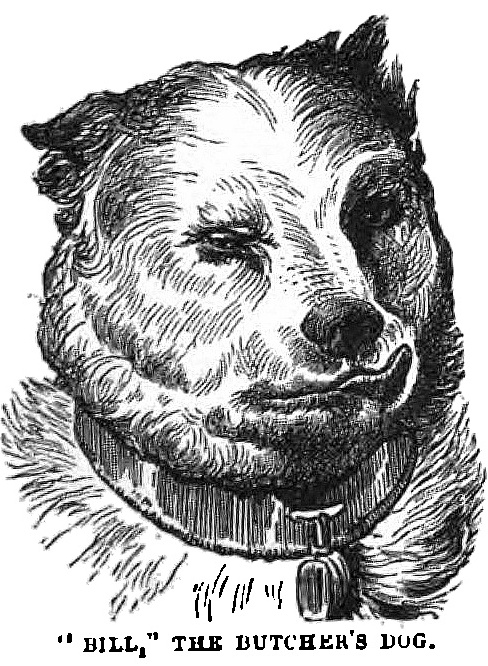
“Ha! ha! ha!” roared “Bill,” the butcher’s bull-and-terrier. I knew it was he before I looked round, for he is a nasty vulgar thing, and sometimes he bites me. “Ha! ha! ha!” he laughed again. “Good-morning, Bit-o’-Fun. Whatever have you been telling that little fool of a Fiddler?”
They always call me Fiddler, after my dear master.
“About the shows,” said Bit-o’-Fun.
“Why, you never mean to tell me, Fiddler, that you think of going to a show! Ha! ha! ha!”
“And suppose I did,” I replied, a little riled, and I felt my hair beginning to stand up all along my back, “I dare say I would have as much chance as an ugly patch-eyed thing like you.”
“Look here, Fiddler,” said Bill, showing all his teeth—and he has an awful lot of them—“talk a little more respectfully when you address your betters. I’ve a very good mind to—”
“To what, Master Bill?” said “Don Pedro,” a beautiful large white-and-black Newfoundland, coming suddenly on the ground.
“No one is talking to you, Don,” said Bill.
“But I’m talking to you, Bill,” said Don Pedro; “and if I hear you say you’ll dare to touch poor little Fiddler, I’ll carry you off and drown you in the nearest pond, that’s all.”
Bill ran off with his tail between his feet before Don Pedro had done speaking. Now isn’t Don Pedro a dear, good fellow?
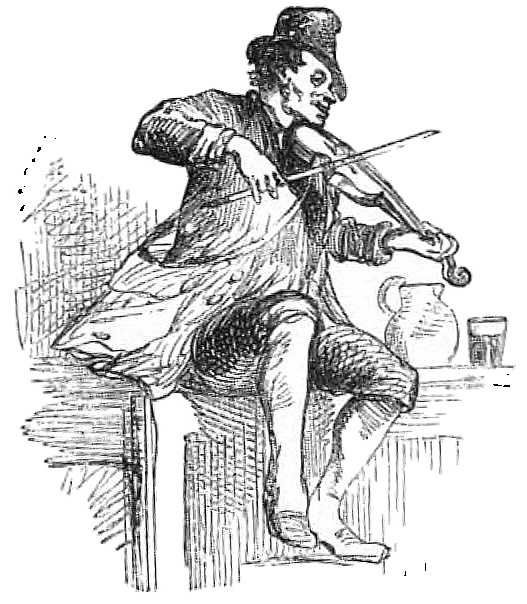
“Well, I’m not a champion dog, you see, though I modestly advance; I might have taken a prize or two if I’d ever had a chance; But shows, I fear, were never meant for the like of poor me,— Besides, my master isn’t rich, and couldn’t pay the fee; Yet I love my master none the less, and serve him faithfully. “Poor master’s got no eyes, you know, and I lead him through the street; And he plays upon the fiddle, and oh! he plays so sweet. That I wonder and I ponder, while my eyes with salt tears glisten. How so many people pass him by, and never stop to listen: How that nasty big blue man, with his nasty big blue coat. Moves master on so roughly that I long to bite his throat! “There are certain quiet side-streets where master oft I take, Where he’s sure to get a penny, and I a bit of cake; But at times the nights are rainy, and seem so very long, That I envy pets in carriages, though I know that that is wrong; And master’s growing very old, and his blood is getting thin, And he often shivers with the cold before I lead him in. “Poor master loves me very much, and I love master too; But if anything came over me, whatever could he do? I think of things like these, you know, when in my bed at night, Even in my dreams those nasty thoughts oft make me cry with fright! Yet, though my lot seems very hard, and my pleasures are but few I do not grieve, for well I know a dog’s life soon wears through; And I’ve been told by some there are better worlds than this, That, even for little doggies, there’s a future state of bliss: That faithfulness and love are things that cannot die, And sorrow here means joy there— in the realms beyond the sky.”
Chapter Twenty Four.
Mr and Mrs Polypus: A Story Founded on a Fact in Natural History.
“Our plenteous streams a varied race supply.” Pope. “Creatures that by a rule of Nature teach The art of order to a peopled kingdom.” Shakespeare.
Scene: The old pine forest; a beautiful day in later summer. Grey clouds flitting across the sky’s bright blue, and occasionally obscuring the sun’s rays. A gentle breeze going whispering through the woods, the giant elms, the lordly oaks, and the dark and gloomy firs bending and bowing as the wind passes among their branches. Patches of bright crimson here and there where the foxgloves still bloom; patches of purple and yellow where heather and furze are growing. Not a sound to be heard in all the wood, except the clear, joyous notes of the robin; all his young ones are safely hatched and fledged, and flown away, and he is singing a hymn of thanksgiving.
Aileen Aroon lying as usual with her great head on my lap, Theodore Nero as usual tumbling on the grass, Ida close at my side peeping over my shoulder at the paper I am reading aloud to her.
Ida (speaks): “What mites of people your hero and heroine are!”
The author: “Yes, puss; didn’t you order me to write you a tale with tiny, tiny, tiny people in it? Well, here they are. They are microscopic.”
Ida: “But of course it is not a true story; it is composed, as you call it.”
The author: “It is a romance, Ida; but it is a romance of natural history, because, you know, there are creatures called polyps that live in the sea, and are so small you have to get a microscope to watch their motions, and they often eat each other, or swallow each other alive, and do all sorts of strange things; and so I call my story—
“Mr and Mrs Polypus: A Tale of the Coralline Sea, a tale of the Indian Ocean, a romance of the coralline sea.
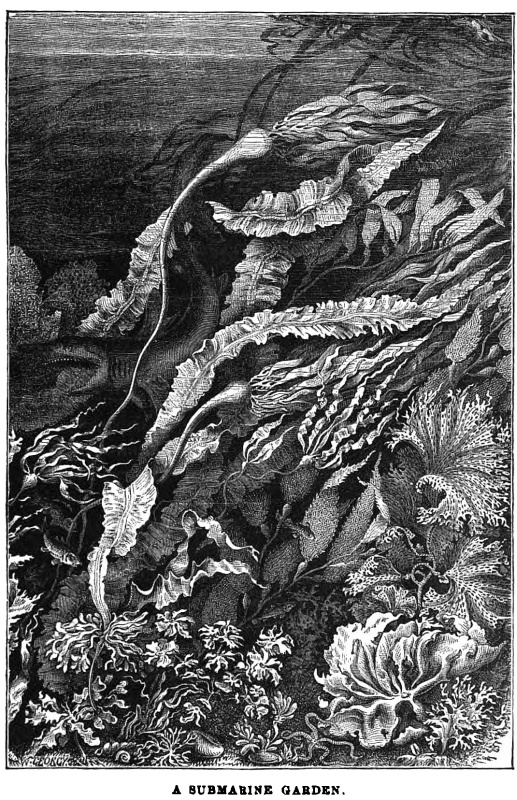
“Far down beneath the blue waves lived my hero and heroine all alone together in their crystal home, with its floors of coral and its windows of diamonds. The cottage in which they dwelt was of a very strange shape indeed, being nothing like any building ever you saw on the face of the earth—but it suited them well—and all around it was a beautiful garden of living plants. Well, all plants possess life; but these were, in reality, living animals, living beings, shaped like flowers, but as capable of eating and drinking as you or I am, only they were all on stalks, and could only catch their food as it floated past them. This seems somewhat awkward, but then they were used to it, and custom is everything. I don’t believe these animals growing on stalks ever wished to walk any oftener than human beings wished to fly.
“Mr and Mrs Polypus, as you may easily guess, were husband and wife, but for all that I am very sorry to have to tell you that they did not always live very peaceably together. They used to have little disagreements now and then; for they were only polyps, you must remember, and smaller far than water-babies. Their little quarrels were always about their food, for, if the truth must be told, Mr Polypus was somewhat of a tyrant to his tiny wife.
“Mr Polypus had many faults; he was, among other things, a very great glutton; so much so, that he did not mind his wife starving so long as he himself had enough to eat.
“Now a word or two about the personal appearance of my principal characters. They were indeed a funny-looking couple, and so small, that unless you had had good eyes, and a tolerably good microscope as well, it would have been impossible for you to see much of what they were doing at all. They were both the same shape, and had only one leg a-piece—a comparatively thick one though—so that when they walked about it was hop, hop, hop on one end, and very ridiculous it looked. But then, if they had only one leg each, Nature had made it up to them in the matter of arms; for instead of two only, as you have, they had a whole row of them all round their shoulders. Wonderfully movable arms they were too, and seemed all joints together, and neither he nor his wife could keep from whirling their arms about whenever they were excited. They had, in fact, so many arms that they could afford to place two pair akimbo, fold one or two pairs across the chest, and still have a few left to shake in each other’s faces when scolding; not that she did much of that, for she was very mild and obedient.
“The only food that Mr and Mrs Polypus got was little fishes, which came floating in through the window to them, or down the chimney, or in by the door; so that they never required to go to the market to buy any provisions; they only had to wait comfortably at their own fireside until breakfast or dinner swam in to them of its own accord. But this did not satisfy the craving appetite of Mr Polypus; so he used often to be from home, swimming up and down the streets, or hopping about at the bottom of the village of Coral Town, where fish did most abound; and it was only when he was away from home on a fishing expedition that poor pretty Mrs Polypus used to get anything to eat, for she was a quiet little woman, and always stopped at home. Poor thing, the neighbours were often very sorry for her; for hers had been a very sad story. For all she was so quiet now, she was once the gayest of the gay, the life and soul of the village of Coral Town. At every ball or party that was given, Peggy—for so she was then called—was the star; and whenever Peggy countenanced a picnic or an angling match, all the village went too and took his wife with him.
“When Peggy was still in her teens she fell in love with gay, rollicking young Mr Pompey, the potassium merchant. You know it was all potassium that they burned in Coral Town, because that burns under water, and coals won’t; and instead of the streets and houses being lighted with gas or oil at nights, they were illuminated with phosphorus. For the next six months after Pompey met pretty Peggy at a ball, their young lives were but as one happy dream; for Pompey loved Peggy dearly, and Peggy loved Pompey. Away down at the bottom of Coral Town was a beautiful submarine garden, with fresh-water shrubs of every shade and flowers of every hue, and there were lonely caves and grottoes and groves, and all kinds of lovely scenery imaginable; and here the lovers often met, and along the winding pathways they ofttimes hopped together. ’Twas here Pompey first declared his passion, and first beheld the love-light in his Peggy’s beaming eyes. One evening they were seated side by side in a coral cave. Everything around them was peaceful and still, the water clear and pellucid, and unbroken by a single ripple. They had sat thus for hours; for the time had flown very quickly, and Pompey had been reading a delightful book to Peggy, until it got so dark he couldn’t see. Far up above them were the phosphorescent lights in the village twinkling like stars in heaven’s firmament. The cave in which they sat was lighted up by a large diamond, which sparkled in the roof, and diffused a soft rose light all around, while here and there on the floor lay strange-shaped musical shells, which ever and anon gave forth sounds like Aeolian harps.
“‘Ah!’ sighed Pompey, and—
“‘Ah!’ sighed Peggy, and—
“‘When shall we wed?’ said Pompey, and—
“‘Whenever you please,’ said she.
“‘Oh! oh!’ cried a terrible voice at their elbows, ‘there’ll be two words to that bargain. He! he! There’s many a slip ’twixt the cup and the lip. Ha! ha!’
“And behold! there in the mouth of the cave stood an ugly old male polyp grinning and bobbing at them like some dreadful ogre.
“‘How dare you, sir!’ said Potassium Pompey, springing from his seat, and striding with a couple of hops towards the new-comer—‘how dare you intrude yourself on the privacy of affianced lovers?’
“‘Intrude? Ho! ho! Privacy? He! he! Affianced? Ha! ha!’ replied the old polyp. ‘I’ll soon let you know that, young jackanapes.’
“‘Sir,’ cried Pompey, ‘this insolence shall not go unpunished. Unhand me, Peggy.’
“‘Oh! hush, hush, pray hush,’ cried poor Peggy, wringing a few of her hands; ‘it’s my father, Pompey, my poor father.’
“‘That fright your father?’ replied Pompey; ‘but there, for your sake, my Peggy, and for the sake of his grey hairs, I will spare him.’
“‘Come along, Miss Malapert; adieu, Mr Jackanapes,’ cried the enraged father; and he dragged his daughter from the cave, but not before she had time to cast one tearful look of fond farewell on her lover, not before she had time to extend ten hands to him behind her back, and he had fondly pressed them all.
“Peggy’s father was a miserly old polyp, who lived in a superb residence in the most fashionable part of Coral Town. He had servants who went or came at his beck or call, a splendid chariot of pure gold to ride in, with pure-bred fish-horses, and the only thing he ever had to annoy him was that when he awoke in the morning he could not think of any new pleasure for the day that had dawned. Every day he had a lovely little polyp boy killed for his dinner—for polyps are all cannibals—and if that meal didn’t please him, then he used to eat one of the flunkeys. But for all his riches, he was not a gentleman. He had made all his money as a marine store dealer, and then retired to live at his mansion, with his only daughter Peggy.
“Now, for the next many days poor Potassium Pompey was a very unhappy polyp indeed. He went about his business very listlessly, neglected to eat, grew awfully thin, and let his beard grow, and people even said that he sometimes sold them bad potassium. As for Peggy, she was locked up in a room all by herself, and never saw any one at all, except her father, who five times a day came regularly to feed her, and when she refused to eat he cruelly crammed it down her throat. He was only a polyp, remember.
“‘I’ll fatten the gipsy,’ he said to himself, ‘and then marry her to my old friend Peterie. He can support a wife, for I always see him fishing, and he can’t possibly eat all he catches himself.’
“So it was all arranged that the wedding should come off, and one day, as Pompey was returning disconsolately from his office, he met a great and noisy crowd, who were huzzaing and waving their arms in the water, and shouting, ‘Long live the happy, happy pair!’ And presently up drove the old miser’s chariot, with six fish-horses, and polyp postillions to match; and seated there beside his detested rival, Pompey caught a glimpse of his loved and lost darling Peggy; thereupon Pompey made up his mind to drown himself right off. So he went and sought out the blackest, deepest pool, and plunged in. But polyps are so used to the water that they cannot drown, and so the more Pompey tried to drown himself, the more the water wouldn’t drown him; so at last he wiped his eyes, and—
“‘What a fool I am,’ said he, ‘to attempt death for the sake of one fair lady, when there are hundreds of polyps as beautiful as she in Coral Town. I’ll go home and work, and make riches, then I’ll marry ten wives, and hold them all in my arms at once.’
“But Pompey couldn’t forget his early love as quickly as he wished to, and often of an evening, when he knew that Mr Polypus was away at some of his gluttonous carousals, Pompey would steal to the window of her house and keek in through the chinks of the shutters, and sigh to see his beloved Peggy sitting all so lonely by herself at the little table, on which the phosphorus lamp was burning. And at the same time—although Pompey did not know it—Peggy would be gazing so sadly into the potassium fire, and thinking of him; she really could not help it, although she knew it was wrong, and poor pretty Mrs Polypus couldn’t be expected to be very cheery, could she?
“Well, one night she was sitting all alone like that, wondering what was keeping her husband so long, and if he would beat her, as usual, when he did come home. She hadn’t had a bit to eat for many, many hours, and was just beginning to feel hungry and faint, when a tiny wee fish swam in by the chimney, and pop! Mrs Polypus had it down her throat in a twinkling; but as ill-luck would have it, who should return at the very moment but her wicked husband. He had evidently been eating even more than usual, and looked both flushed and angry.
“‘Now, Mrs Polypus,’ he began, ‘I saw that. How dared you, when you knew I was coming home to supper, and there wasn’t a morsel in the larder?’
“‘Oh! please, Peterie,’ said poor little Mrs Polypus, beginning to cry, ‘I really didn’t mean to; but I was so hungry, and—’
“‘Hungry?’ roared the husband; ‘how dared you to be hungry?—how dared you be anything at all, in fact? But there, I shall not irritate myself by talking to you. Bring it back again.’
“‘Oh! if you please, Peterie—’ cried Mrs Polypus.
“‘Bring it back again, I say,’ cried Mr Polypus, making all his arms swing round and round like a wheel, till you could hardly have seen one of them, and finally crossing them on his chest; and, leaning on the back of the chair, he looked sternly down on his spouse, and said—‘Disgorge at once!’
“‘I won’t, then, and, what is more, I shan’t; there!’ said the wee woman, for even a woman as well as a worm will turn when very much trodden upon.
“‘Good gracious me!’ cried Mr Polypus, fairly aghast with astonishment; ‘does—she—actually—dare—to—defy me?’ but ‘Ho! ho!’ he added, likewise ‘He! he!’ and ‘we’ll see;’ and he strode to the window and bolted it, and strode to the door and bolted that; then he took the phosphorus lamp and extinguished it.
“‘It’ll be so dark, Peterie,’ said his wife, beginning to be frightened.
“‘There is light enough for what I have to do,’ said Peterie, sternly. Then he opened a great yawning mouth, and he seized her first by one arm, and then by another, until he had the whole within his grasp, and she all the time kicking with her one leg, and screaming—
“‘Oh! please don’t, Peterie. Oh! Peterie, don’t.’
“But he heeded not her cries, which every moment became weaker and more far-away like, until they ceased entirely, and the unhappy Mrs Polypus was nowhere to be seen. Her husband had swallowed her alive!
“As soon as he had done so he sat down by the fire, looking rather swollen, and feeling big and not altogether comfortable; but how could he expect to be, after swallowing his wife? He leaned his head on three arms and gazed pensively into the fire.
“‘After all,’ he said to himself, ‘I may have been just a little too hasty, for she wasn’t at all a bad little woman, taking her all-in-all. Heigho! I fear I’ll never see her like again.’
“Hark! a loud knocking at the door. He starts and listens, and trembles like the guilty thing he is. The knocking was repeated in one continuous stream of rat-tats.
“‘Hullo! Peterie,’ cried a voice; ‘open the door.’
“‘Who is there?’ asked Peterie at last.
“‘Why, man, it is I—Potassium Pompey. Whatever is up with you to-day that you are barred and bolted like this? Afraid of thieves? Eh?’
“‘No,’ said Peterie, undoing the fastenings and letting Pompey come in; ‘it isn’t that exactly. The fact is, I wasn’t feeling very well, and just thought I would lie down for a little while.’
“‘You don’t look very ill, anyhow,’ said Pompey; ‘and you are actually getting stouter, I think!’
“‘Well,’ replied Peterie, ‘you see, I’ve been out fishing, and had a good dinner, and perhaps I’ve eaten rather more, I believe, than is good for me.’
“‘Shouldn’t wonder,’ said Pompey, sarcastically; for the truth is, he had been keeking through the chinks of the shutters, and had seen the whole tragedy.
“‘A decided case of dropsy, I should think,’ added Pompey.
“Peterie groaned.
“‘Take a seat,’ he said to Pompey. ‘I believe you are my friend, and I want to have a little talk with you; I—I want to make a clean breast of it.’
“‘Well, I’m all attention,’ replied Pompey—‘all ears, as the donkey said.’
“‘Fact is, then,’ continued Peterie, ‘I’ve been a rather unhappy man of late, and my wife and I never understood one another, and never agreed. She was in love with some scoundrel, you know, before we were married—leastways, so they tell me—and I—I’m really afraid I’ve swallowed her, Pompey.’
“‘Hum!’ said Pompey; ‘and does she agree any better with you now?’
“‘No,’ replied Peterie, ‘that’s just the thing; she’s living all the wrong way, somehow, and I fear she won’t digest.’
“‘Wretch!’ cried Peterie, starting to his feet, ‘behold me. Gaze upon this wasted form: I am he who loved poor Peggy before her fatal marriage. Oh! my Peggy, my loved, my lost, my half-digested Peggy, shall we never meet again?’
“‘Sooner,’ cried Peterie, ‘perhaps than you are aware of. So it was you who loved my silly wife?’
“‘It was I.’
“‘Wretch, you shall die.’
“‘Never,’ roared Pompey, ‘while I live.’
“‘We shall see,’ said Peterie.
“‘Come on,’ said Pompey, ‘set the table on one side and give us room.’
“That was a fearful fight that battle of the polyps. It is awful enough to see two men fighting who have only two arms a side, but when it comes to twenty arms each, and all these arms are whirling round at once, like a select assortment of windmills that have run mad, then, I can tell you, it is very much more dreadful. Now Peterie has the advantage.
“Now Pompey is down.
“Now he is up again and Peterie falls.
“Now Peterie half swallows Pompey.
“Now Pompey appears again as large as life, and half swallows Peterie; but at last, by one unlucky blow administered by ten fists at once, down rolls Potassium Pompey lifeless on Peterie’s floor. Peterie bent over the body of Pompey.
“‘Bad job,’ he mutters, ‘he is dead. And the question comes to be, what shall I do with the body? Ha! happy thought! the struggle has given me an appetite, I’ll swallow him too.’
“Barely had he thus disposed of poor Pompey’s body, when a renewed knocking was heard at the outside door. There was not a moment to lose; so Peterie hastily set the furniture in order, and bustled away to open the door, and hardly had he done so when in rushed an excited mob of polyps headed by two warlike policemen, who headed them by keeping well in the rear, but being, after the manner of policemen, very loud in their talk.
“‘Where is Potassium Pompey?’ cried one; and—
“‘Ay! where is Potassium Pompey?’ cried another; and—
“‘To be sure, where is Potassium Pompey?’ cried a third; and—
“‘That is the question, young man,’ cried both policemen at once.
“‘Where is Potassium Pompey?’
“‘Oh!’ groaned Peterie, ‘would I were as big as a bullfrog, that I might swallow you all at a gulp.’
“‘Away with him, my friends,’ cried the warlike policemen, ‘to the hall of justice.’
“In the present state of Peterie’s digestive organs, resistance was not to be thought of; so he quietly submitted to be led out with ten pairs of handcuffs on his wrists, and dragged along the street, followed by the hooting mob, who wanted to hang him on the spot; but a multitude of policemen now arrived, and being at the rate of three policemen to each civilian polyp, the hanging was prevented. The justice hall was a very large building right in the centre of Coral Town. There the judges used to sit night and day on a large pearl throne at one end to try the cases that were brought before them.
“Now Potassium Pompey was a very great favourite in Coral Town, so that when the wretched Peterie was dragged by fifteen brave policemen before the pearl throne, the hall was quite filled, and you might have heard a midge sneeze, if there had been a midge to sneeze, so great was the silence. The first accuser was Popkins, the miserly old polyp who was poor Peggy’s father. He was too wretchedly thin and weak and old to hop in like any other polyp, so he came along the hall walking on his one foot and his twenty hands after the fashion of the looper caterpillar, which I daresay you have observed on a currant-bush.
“‘Where is me chee—ild?’ cried the aged miser, as soon as he could speak. ‘Give me back me chee—ild?’
“‘If that’s all you’ve got to say,’ said the judge, sternly, ‘you’d better stand down.’
“‘I merely want me chee—ild,’ repeated Popkins.
“‘Stand down, sir,’ cried the judge.
“After hearing various witnesses who had seen Pompey enter Peterie’s house and never return, the judge opened his mouth and spake, for Peterie had said never a word. The judge gave it as his unbiassed opinion that, considering all things, the mysterious disappearance of Mrs Polypus, coupled with that of Potassium Pompey, whom every one loved and admired, the absence of all defence on the part of the prisoner, and the extraordinary rotundity of his corporation, as well as the fact that he had always been a spare man, there could be little doubt of the prisoner’s guilt; ‘but to make assurance doubly sure,’ added the judge, ‘let him at once be opened, to furnish additional proof, and the opening of the prisoner, I trust, will close the case.’ If guilty, the sentence of the Court was that he should then be dragged to the common execution ground, and there divided into one hundred pieces, and he, the judge, hoped it would be a warning to the prisoner in all future time.”
(When a polyp is cut into pieces, each piece becomes a new individual.)
“Twenty policemen now rushed away and brought the biggest knife they could find; twenty more went for ropes, and having procured them, the wretched Mr Polypus was bound to a table, and before he could have said ‘cheese,’ if he had wanted to say ‘cheese,’ an immense opening was made in his side, and, lo and behold! out stepped first Potassium Pompey, and after him hopped, modestly hopped, poor Peggy. But the most wonderful part of the whole business was, that neither Peggy nor Pompey seemed a bit the worse for their strange incarceration. Indeed, I ought to say they looked all the better; for Pompey was all smiles, and Peggy was looking very happy indeed, and even Peterie seemed immensely relieved. Pompey led Peggy before the throne, and here he told all the story about how Peggy was murdered, and then how he, Pompey, was murdered next. And—
“‘Enough! enough!’ cried the judge; ‘away with the doomed wretch! Let the execution be proceeded with without a moment’s delay.’
“‘Please, my lord,’ said Peggy, modestly, ‘may I have a divorce?’
“‘To be sure, to be sure,’ said the judge; ‘you are justly entitled to a divorce.’
“‘And please, my lord,’ continued Peggy, ‘may—may—’
“‘Well? well?’ said the judge, with slight impatience, ‘out with it.’
“‘She wants to ask if she may marry me,’ said Pompey, boldly.
“‘Most assuredly,’ said the judge, ‘and a blessing be on you both.’
“In vain the unhappy Peterie begged and prayed for mercy; he was hurried away to the execution ground and led to the scaffold. In all that crowd of upturned faces, Peterie saw not one pitying eye. And now a large barrel was placed to receive the pieces, and, beginning with his head and arms, the executioners cut him into one hundred pieces, leaving nothing of Peterie but the foot.
“‘Now,’ cried the judge, ‘empty the barrel on the floor.’
“This was done.
“And it did seem that wonders would never cease, for as soon as each piece was thrown on the floor it immediately grew up into a real live polyp, and body and arms all complete and hopping; and the foot, which had been left, and which was more especially Peterie’s—being all that remained of him, you know—grew up into another polyp, and behold there was another and a new Peterie. He was at once surrounded by the ninety and nine new polyps, who all threw their arms—nineteen hundred and ninety arms—around his neck, and began to kiss him and call him dearest dada.
“‘On my honour,’ said Peterie, ‘I think this is rather too much of a joke.’
“But nobody had any pity on him, and the judge said—‘Now, Mr Polypus, let this be a lesson to you. Go home at once and work for your children, and remember you support them; if even one of them comes to solicit parish relief, dread the consequences.’
“‘How ever shall I manage?’ said poor Peterie.
“And he hopped away disconsolate enough amid his ninety and nine baby polyps all crying—
“‘Dada dear, give us a fish.’
“‘I think,’ said the judge, when Peterie had gone—‘I think, Mr Popkins, you cannot now do better than consent to make these two young things happy by letting them wed. Pompey, it is true, isn’t a king, but he has an excellent business in the potassium line, and none of us can live without fire, you know.’
“‘But I’m a king,’ cried the aged miser; ‘I have mines of wealth, and all I have is theirs. Come to your father’s arms, my Peggy and Pompey.’
“‘Hurrah!’ shouted the mob; ‘three cheers for the old miser, and three for Pompey the brave, and three times three for the bonny bride Peggy.’
“And away rolled Peggy in the golden chariot, with her father—such a happy, happy Peggy now; and Pompey was carried through the streets, shoulder high, to his old home.
“So nothing was talked about in Coral Town for the next month but the grandeur of the coming wedding, and the beauty of Peggy, and everybody was happy and gay except poor Peterie; for who could be happy with ninety-nine babies to provide for—ninety-nine breakfasts to get, ninety-nine dinners, ninety-nine teas and suppers all in one, two hundred and ninety-seven meals to provide in one day?
“There were no more fishing excursions for him, no more big dinners, and he worked and toiled to get ends to meet deep down in a potassium mine in the darkest, dismalest corner of Coral Town. And everybody said—
“‘It serves him right, the cruel wretch.’
“What a wonderful house that was which Pompey built for his Peggy!
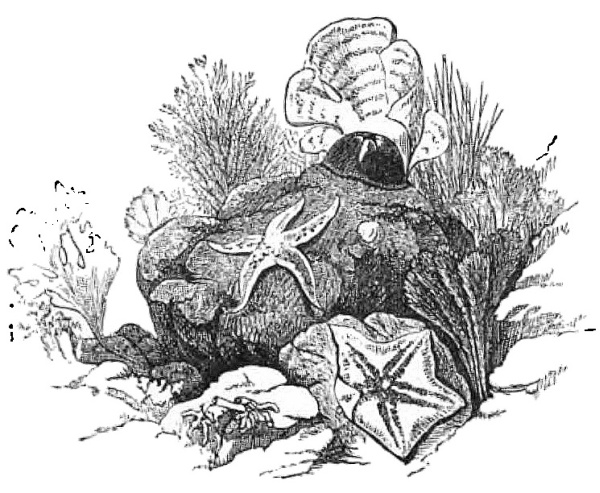
“It was charmingly situated on the slope of a wooded hill, quite in the country. Pompey spent months in furnishing and decorating it, and his greatest pleasure was to superintend all the work himself. Such trees you never saw as grew in the gardens and park, marine trees whose very leaves seemed more lovely than any terrestrial flower, and they were incessantly moving their branches backwards and forwards with a gentle undulating motion, as if they luxuriated in the sight of each other’s beauty. Such flowers!—living, breathing flowers they were, and radiant with rainbow tints, flowers that whispered together, and beckoned and bowed and made love to each other. Then those delightful rockeries, half hidden here and there amid the wealth of foliage, and there were curious shells of brilliant colours that made music whenever there was the slightest ripple in the water, and whole colonies of the quaintest little animals that ever you dreamt of crept in and crept out of every fissure or miniature cave in the rocks.
“At night the garden was all lighted up with phosphorescent lamps; but inside the palace itself, in the spacious halls, along the marble staircases, and in the beautiful rooms, nothing short of diamond lights would satisfy Pompey; for you must know that Pompey thought nothing too good for Peggy. So each room was lighted up by a diamond, that shone in the centre of the vaulted roof like a large and beautiful star. Some of these diamonds suffused a rosy light throughout the apartment, the light from others was of a paley green, and from others a faint saffron, while in one room the light from the diamond was for ever changing as you may see the planet Mars doing, if you choose to watch—one moment it was a bright, clear, bluish white, next a rainbow green, and anon changing to deepest crimson. This was a very favourite dining-hall with Pompey, for the simple reason that no one could be sure how his neighbour looked. For instance, if a lady blushed, it did not look like a blush—oh dear no—but a flash of rosy light; if an old gentleman indulged rather much in the pleasures of the table, and began to feel ill in consequence, not a bit of it, he was never better in his life—it was the bluish flash from the diamond; and so, again, if last night’s lobster salad rendered any one yellow and bilious-looking, he could always blame the poor pretty diamond.
“In some rooms the chairs themselves were made of precious stones, and the ottomans and couches built of a single pearl.
“At length everything was completed to Pompey’s entire satisfaction, and he had given any number of gay parties and balls, just by way of warming the house. Pompey flattered himself he had the best provisions in his cellars and the best-trained servants in all Coral Town, and of course nobody cared to deny that. These servants were nearly all of different shapes: some were properly-made polyps; some rolled in when Pompey touched the gong, rolled in like a gig-wheel without the rim, all legs and arms, and the body in the centre; some were merely round balls, and you couldn’t see any head or legs or arms at all till they stopped in front of you, then they popped them all out at once; some walked in, others hopped, one or two floated, and one queer old chap walked on the crown of his head. If you think this is not all strictly true, you have only to take a microscope and look for yourself.
“‘Heigho!’ said Pompey one day, after he had finished a dinner fit to set before a polyp king, ‘all I now want to make me perfectly happy is Peggy. Peggy—Peggy! what a sweetly pretty name it is to be sure! Peggy!’
“And that came too; for if you wait long enough for any particular day, it is sure to come at last, just as whistling at sea makes the wind blow, which it invariably does—when you whistle long enough.
“And never was such a day of rejoicing seen in Coral Town. The bells were ringing and the banners all waving almost before the phosphorescent lamps began to pale in the presence of day.
“Then everybody turned out.
“And everybody seemed to take leave of his senses by special arrangement.
“All but poor Peterie, who was left all by himself to work away in the deep, dark potassium mine. The wedding took place in Peggy’s father’s—Popkins’s—house. The old miser, miser no more though, was half crazy with joy. And nothing would satisfy him but to have one of the upper servants cooked for his breakfast. He didn’t care, he said, whether it was Jeames or the butler. So the butcher dressed the butler, and he was stewed for his master’s breakfast with sauce of pearls powdered in ambrosia.
“And after the ceremony was performed, Pompey appeared on the balcony, clasping Peggy to his heart with ten arms, while he gave ten other hands to Popkins, his father-in-law, to shake as he cried—
“‘Bless you, bless you, my children.’
“Then such a ringing cheer was heard, as never was heard before, or any time since. Even Peterie heard it down in the darkling mine, swallowed a ball of potassium, and died on the spot. As soon as Peterie was dead, he (Peterie) said, ‘Well now, I wonder I never thought of that before;’ because he at once grew up again into ten new polyps, who forthwith left the mine, joined the revellers, and shouted louder than all the rest.
“And when at last Peggy was in Peterie’s house, when the idol of his love became the light of his home, when he saw her there before him, so blooming and bonnie, he opened his twenty arms, and she opened her twenty arms, and—
“‘Peggy!’ cried Pompey; and—
“‘Pompey!’ cried Peggy; and—
“Down drops the curtain. It would be positively mean and improper to keep it up one moment longer.”
Chapter Twenty Five.
The Tale of the “Twin Chestnuts”; or, a Summer Evening’s Reverie.
“Twilight grey Had in her sober livery all things clad: Silence accompanied; for beast and bird, They to their grassy couch; these to their nests Were slunk, all save the wakeful nightingale: Hesperus that led The starry host rode brightest, till the moon Unveiled her peerless light, And o’er the dark her silver mantle threw.” Milton.
Running all along one side of our orchard, garden, and lawn are a row of tall and graceful poplar trees. So tall are they that they may be seen many miles away; they are quite a feature of the landscape, and tell the position of our village to those coming towards it long before a single house is visible.
These trees are the admiration of all that behold them, but, to my eye, there seems always connected with them an air of solemnity. All the other trees about—the spreading limes, the broad-leaved planes, and the rugged oaks and elms—seem dwarfed by their presence, so high do they tower above them. Their tips appear to touch the very sky itself, their topmost branches pierce the clouds. Around the stem of each the beautiful ivy climbs and clings for support; and this ivy gives shelter by night to hundreds of birds, and to bats too, for aught I know.
Their very position standing there in a row, like giant sentinels, surrounds them with an air of mystery to which the fact that they follow each other’s motions—all bending and nodding in the same direction at once—only tends to add. And spring, summer, autumn, or winter they are ever pointing skywards. In the winter months they are leafless and bare, and there is a wild, weird look about them on a still night, when the moon and stars are shining, which it would be difficult to describe in words. But sometimes in winter, when the hoar-frost falls and silvers every twiglet and branch till they resemble nothing so much as the snowiest of coral, then, indeed, the beauty with which they are adorned, once seen must ever be remembered.
But hardly has spring really come, and long before the cuckoo’s dual notes are heard in the glade, or the nightingale’s street, unearthly music fills every copse and orchard, making the hearts of all that hear it glad, ere those stately poplars are clothed from tip to stem in robes of yellow green, and their myriad leaves dance and quiver in the sunlight, when there is hardly wind enough to bend a blade of grass. As the summer wears on, those leaves assume a darker tint, and approach more nearly to the colour of the ivy that crowds and climbs around their stems. The wind is then more easily heard, sighing and whispering through the branches even when there is not a breath of air down on the lawn or in the orchard. On what we might well call still evenings, if you cast your eye away aloft, you may see those tree-tops all swaying and moving in rhythm against the sky; and if you listen you may catch the sound of their leaves like that of wavelets breaking on a beach of smoothest sand.
I remember it was one still summer’s night, long after sundown, for the gloaming star was shining, that we were all together on the rose lawn. The noisy sparrows were quiet, every bird had ceased to sing, there wasn’t a sound to be heard anywhere save the sighing among the topmost branches of the poplars. Far up there, a breeze seemed to be blowing gently from the west, and as it kissed the tree-tops they bent and bowed before it.
Ida lay in a hammock of grass, the book she could no longer see to read lying on her lap in a listless hand.
“No matter how still it is down here,” she said, “those trees up there are always whispering.”
“What do you think they are saying?” I asked.
“Oh,” she answered, “I would give worlds to know.”
“Perhaps,” she added, after a pause, “they hear voices up in the sky there that we cannot hear, that they catch sounds of—”
“Stop, Ida, stop,” I cried; “why, if you go on like this, instead of the wise, sensible, old-fashioned little girl that I’m so fond of having as my companion in my rambles, you will degenerate into a poet.”
“Ha! ha!” laughed Frank; “well, that is a funny expression to be sure. Degenerate into a poet. How complimentary to the sons and daughters of the lyre, how complimentary to your own bonnie Bobby Burns, for instance!”
Ida half raised herself in her hammock. She was smiling as she spoke.
“It was you, uncle, that taught me,” she said. “Did you not tell me everything that grows around us has life, and even feeling; that in winter the great trees go to sleep, and do not suffer from the cold, but that in summer they are filled with a glow of warmth, and that if you lop a branch off one, though it does not feel pain, it experiences cold at the place where the axe has done its work? Haven’t you taught me to look upon the flowers as living things? and don’t I feel them to be so when I stoop to kiss the roses? Yes, and I love them too; I love them all—all.”
“And I’ve no doubt the love is reciprocated, my little mouse. But now, talking about trees, if Frank will bring the lamp, I’ll read you a kind of a story about two trees. It isn’t quite a tale either—it is a kind of reverie; but the descriptive parts of it are painted from the life. Thank you, Frank. Now if the moths will only keep away for a minute, if it wasn’t for that bit of displayed humanity on the top of the glass in the shape of a morsel of wire gauze, that big white moth would go pop in and immolate himself. Ahem!”
The Twin Chestnuts: A Reverie. “They grew in beauty side by side.”
We weren’t the only happy couple that had spent a honeymoon at Twin Chestnut Cottage. In point of fact, the chestnuts themselves had their origin in a honeymoon; for in the same old-fashioned cottage, more than one hundred and ninety years ago, there came to reside a youthful pair, who, hand in hand, had just commenced life’s journey together. They each had a little dog, and those two little dogs were probably as fond of each other, after their own fashion, as their master and mistress were; and the name of the one dog was “Gip,” and the name of the other was “George”—Gip and George, there you have them. And it was very funny that whatever Gip did, George immediately followed suit and did the same; and, vice versa, whatever George did, Gip did. If Gip harked, George barked; if George wagged his tail, so did Gip. Whenever Gip was hungry, George found that he too could eat; and when George took a drink of water, Gip always took a mouthful as well, whether she was thirsty or not. Well, it happened one day in autumn, when the beauty-tints were on the trees—the sunset glow of the dying year—that the two lovers (for although they were married, they were lovers still) were walking on the rustling leaves, and of course George and Gip were no great way behind, and were having their own conversation, and their own little larks all to themselves, when suddenly—
“I say, Georgie,” said Gip.
“Well, my love?” replied George.
“I’m quite tired watching for that silly blind old mole, who I’m certain won’t come again to-night. Let us carry a chestnut home.”
“All right,” said George; “here goes.”
So they each of them chose the biggest horse-chestnut they could find, and they were only very small dogs, and went trotting home with them in their mouths; and when they got there, they each laid their little gifts at the feet of their loved master or mistress.
This they did with such a solemn air that, for the life of them, the lovers could not help laughing outright. But the little dogs received their due meed of praise nevertheless, and the two chestnuts were carefully planted, one on each side of the large lawn window. And when winter gave place to spring, lo! the chestnuts budded, budded and peeped up through the earth, each one looking for all the world like a Hindoo lady’s little finger, which isn’t a bit different, you know, from your little finger, only it is dark-brown, and yours is white. Then the little finger opened, and bright green leaves unfolded and peeped up at the sun and the blue sky, and long before the summer was over they had grown up into sprightly little trees, as straight as rushes, and very nearly as tall, for they had been very carefully watered and tended. Very pretty they looked too, although their leaves seemed a mile too big for their stems, which made them look like two very small men with very large hats; but the young chestnuts themselves didn’t see anything ridiculous in the matter.
These, then, were the infant chestnuts.
And as the years rolled on, and made those lovers old, the chestnuts still grew in height and beauty. And in time poor Grip died, and as George had always done exactly as Gip did, he died too; and Gip was laid at the foot of one tree, and George at the foot of the other, and their graves were watered with loving tears. And the trees grew lovelier still. And when at last those lovers died, the trees showered their flowers, pink-eyed and white, on the coffins, as they were borne away from the old cottage to their long, quiet home in the “moots.”
And time flew on, generation after generation was born, grew up, grew old, and died, and still the twin chestnuts increased and flourished, and they are flourishing now, on this sweet summer’s day, and shading all the cottage from the noonday sun.
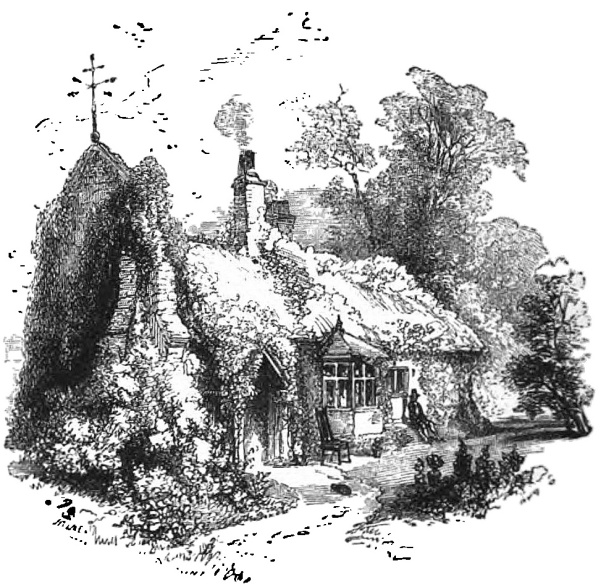
It is a very old-fashioned cottage, wholly composed, one might almost say, of gables, the thatch of some of which comes almost to the ground, and I defy any one to tell which is the front of the cottage and which isn’t the front. There are gardens about the old cottage, fruit gardens and flower gardens, and grey old walls half buried in ivy, which never looked half so pretty as in autumn, when the soft leaves of the Virginia creepers are changing to crimson, and blending sweetly with the ivy’s dusky green.
The principal gable is that abutting on to the green velvety lawn, which goes sloping downwards to where the river, broad and still, glides silently on its way to bear on its breast the ships of the greatest city of the world, and carry them to the ocean.
But the main beauty of the cottage lies in those twin chestnuts. No chestnuts in all the countryside like those two beautiful trees; none so tall, so wide, so spreading; none have such broad green leaves, none have such nuts—for each nutshell grows as big and spiny as a small hedgehog, and contains some one nut, many two, but most three nuts within the outer rind. I only wish you could see them, and you would say, as I do, there are no trees like those twin chestnuts.
The earth was clad in its white cocoon when first we went to Twin Chestnut Cottage, and the two giant trees pointed their skeleton fingers upwards to the murky sky; but long before any of the other chestnut-trees that grew in the parks and the avenues, had even dreamt of awakening from their deep winter sleep, the twin chestnuts had sent forth large brown buds, bigger and longer than rifle bullets, and all gummed over with some sticky substance, as if the fairies had painted them all with glycerine and treacle. With the first sunshine of April those bonnie buds grew thicker, and burst, disclosing little bundles of light-green foliage, that matched so sweetly with the brown of the buds and the dark grey of the parent tree.
Day by day we watched the folded leaves expanding; and other eyes than ours were watching them too; for occasionally a large hornet or an early bee would fly round the trees and examine the buds, then off he would go again with a satisfied hum, which said plainly enough, “You’re getting on beautifully, and you’ll be all in flower in a fortnight.”
And, indeed, hardly had a fortnight elapsed, from the time the buds first opened, till the twin chestnuts were hung in robes of drooping green. Such a tender green! such a light and lovely green! and the pendent, crumply leaves seemed as yet incapable of supporting their own weight, like the wings of the moth when it first bursts from its chrysalis. Then, oh! to hear the frou-frou of the gentle wind through the silken foliage! And every tree around was bare and brown save them.
Even the river seemed to whisper fondly to the bending reeds as it glided past those chestnuts twain; and I know that the mavis and the merle sung in a louder, gladder key when they awoke in the dewy dawn of morn, and their bright eyes rested on those two clouds of living green.
And now crocuses peeping through the dun earth, and primroses on mossy banks, had long since told that spring had come; but the chestnut-trees said to all the birds that summer too was on the wing. Cock-robin marked the change, and came no more for crumbs—for he thought it was high time to build his nest; only there were times when he seated himself on the old apple-tree, and sung his little song, just to show that he hadn’t forgotten us, and that he meant to come again when family cares were ended and summer had flown away.
Meanwhile, the flower-stems grew brown and mossy, and in a week or two the flowers themselves were all in bloom. Had you seen either of those twin chestnuts then, you would have seen a thing of beauty which would have dwelt in your mind as a joy for ever. It was summer now. Life and love were everywhere. The bloom was on the may—pink-eyed may and white may. The yellow laburnum peeped out from the thickets of evergreen, the yellow broom dipped its tassels in the river, and elder-flowers perfumed the wind. I couldn’t tell you half the beautiful creatures that visited the blossoms on the twin chestnut-trees, and sang about them, and floated around them, and sipped the honey from every calyx. Great droning, velvety bees; white-striped and red busy little hive-bees; large-winged butterflies, gaudy in crimson and black; little white butterflies, with scarlet-tipped wings; little blue butterflies, that glanced in the sunshine like chips of polished steel; and big slow-floating butterflies, so intensely yellow that they looked for all the world as if they had been fed on cayenne, like the canaries, you know. In the gloaming, “Drowsy beetles wheeled their droning flight” around the trees, and noisy cockchafers went whirring up among the blossoms, and imagined they had reached the stars.
When the roses, purple, red, and yellow, clung around the cottage porch, climbed over the thatch, and clung around the chimneys, when the mauve wisterias clustered along the walls, when the honeysuckle scented the green lanes, when daisies and tulips had faded in the garden, and crimson poppies shone through the corn’s green, a breeze blew soft and cool from the south-east, and lo! for days and days the twin chestnuts snowed their petals on the lawn and path. And now we listened every night for the nightingale’s song. They came at last, all in one night it seemed: “Whee, whee, whee.” What are those slow and mournful notes ringing out from the grove in the stillness of night? A lament for brighter skies born of memories of glad Italy?
“Churl, churl; chok, wee, cho!” This in a low and beautiful key; then higher and more joyful, “Wheedle, wheedle, wheedle; wheety, wheety, wheety; chokee, okee, okee-whee!”
Answering each other all the livelong night, bursting into song at intervals all the day, when, we wondered, did they sleep? Did they take it in turns to make night and day melodious, keeping watches like the sailors at sea? We thought the song of the mavis so tame now; but cock-robin’s had not lost its charm, just as the dear old simple “lilts” of bonnie Scotland, or the sadder ditties of the Green Isle, never pall on our ear, love we ever so well the lays of sunny Italy.
As the summer waned apace, and the leaves on the chestnuts changed to a darker, hardier green, the nightingales ceased their song; but, somehow, we never missed them much, there were so many other songsters. We used to wonder how many different sorts of birds found shelter in those twin chestnuts, apart from the bickering sparrows, who colonised it; apart from the merle and thrush, who merely came home to roost; apart from the starling, who was continually having quarrels with his wife about something or other; and apart from the noisy jackdaw, who was such an argumentative fellow, and made himself such a general nuisance that it always ended in his being forcibly ejected.
Robin was invariably the first to awake in the morning. As the first faint tinge of dawning day began to broaden in the east, he shook the dew from his wings, and gave vent to a little peevish twitter. Then he would hop down from the tree, perch on the gate, and begin his sweet wee song: “Twitter, twitter, twee!” We used to wonder if it really was a song of praise to Him who maketh the sun to rise and gladden all the earth.
“Twitter, twitter, twee!” Little birdies are so happy, and awake every morning as fresh and joyous as innocent children.
“Twitter, twitter, twitter, twee!” went the song for fully half an hour, till it was so light that even the lazy sparrows began to awake, and squabble, and scold, and fight; for you must know that sparrows hold about the same social rank in the feathered creation, that the dwellers around Billingsgate do among human beings.
Then there would be such a chorus of squabbling from the big trees, that poor robin had to give up singing in disgust, and come down to have his breakfast.
“Hullo!” he would cry, addressing a humble-bee, who with his wings all bedraggled in dew, was slowly moving across the gravel, thinking the sun would soon rise and dry him—for poor bees often do stay too long on thistles at night, get drugged with the sweet-scented ambrosia, and are unable to get home till morning—“Hullo!” robin would say; “do you know you’re wanted?”
The poor bee would hold up one arm in mute appeal.
“Keep down your hands,” robin would say; “I’ll do it ever so gently;” and off the bee’s head would go in a twinkling. Then robin would eye his victim till the sting ceased to work out and in, then quietly swallow it. This, with an earthworm or two, and a green caterpillar by way of relish, washed down with a bill-full of water from a little pool in a cabbage-leaf, would form robin’s breakfast; then away he would fly to the woods, where he could sing all day in peace.
And so the summer sped away in that quiet spot, and anon the fields were all ablaze with the golden harvest, and the sturdy leaves of our chestnut-trees turned yellow and brown, and the great nuts came tumbling down in a steady cannonade each time the wind shook the branches. And the twin chestnuts, perhaps, looked more lovely now than ever they had looked—they had borrowed the tints of the autumn sunset; yet their very beauty told us now that the end was not far away.
The wind of a night now moved the branches with a harsher, drier rustling, like the sound of breaking waves or falling water, and we often used to dream we were away at sea, tossed up and down on the billows. “Heigho!” we (Part of this page missing.)
There were days when the sun set in an ochrey haze, when the evening star with its dimmed eye looked down from a sky of emerald green, where as the gloaming deepened into night, not a cloud was there to hide the glittering orbs; then the fairies set to work to adorn the trees, and when morning came, lo! what a sight was there! All around the hoar-frost lay, white and deep on bush and brake, on the hedgerows and brambles; and every twiglet and thorn was studded with starry jewels on tit twin chestnuts, and they were trees no more—every branchlet and spray was changed to glittering coral; and garlands of silver and lace-work, lovelier far than human brains could ever plan or fingers weave, were looped from bough to bough, and hung in sheeny radiance around the sturdy stems.
Those dear old chestnut-trees!
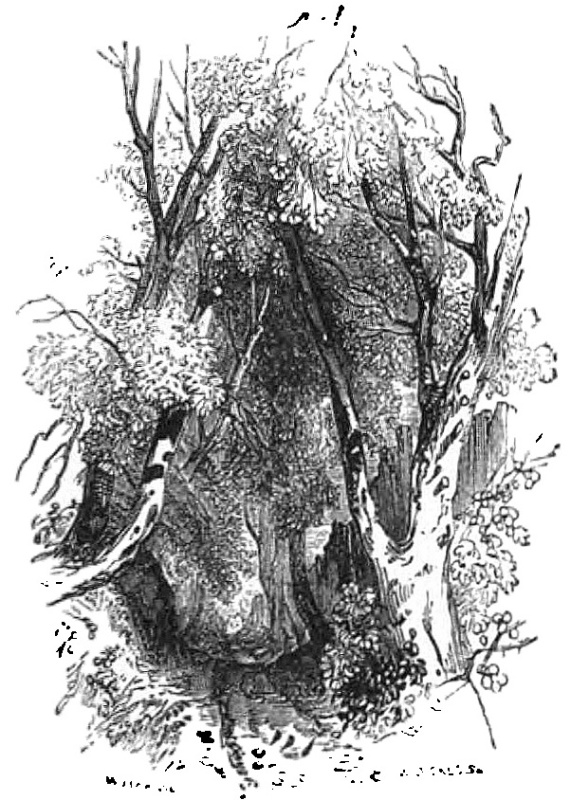
And as the seasons pass o’er the chestnut-trees, and each one clothes them in a beauty of its own, so across the seasons of our life Time spreads his varied joys: childhood, in its innocence, hath its joys, youth in its hope of brighter days, manhood in its strength and ambition, and old age in the peaceful trust of a better world to come.
Chapter Twenty Six.
The Story of Aileen’s Husband, Nero.
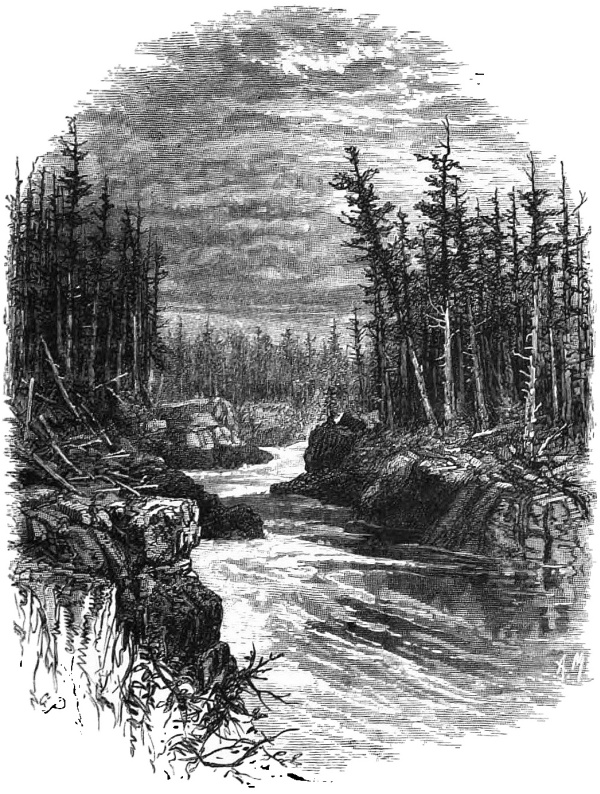
“The pine-trees, gathering closer in the shadows, Listened in every spray—”
I certainly had no intention of bringing tears to little Ida’s eyes; it was mere thoughtlessness on my part, but the result was precisely the same; and there was Ida kneeling beside that great Newfoundland, Theodore Nero, with her arms round his neck, and a moment or two after I had spoken, I positively saw a tear fall on his brow, and lie there like a diamond. Ah! such tears are far more precious than any diamonds.
“You don’t love that dog, mouse?” These were the words I had given utterance to, half-banteringly, as she sat near me on the grass playing with the dog. I went on with my writing, and when I looked up again beheld that tear.
Yes, I felt sorry, and set about at once planning some means of amends. I knew human nature and Ida’s nature too well to make any fuss about the matter—I would not even let her know I had seen her wet eyelashes, nor did I attempt to soothe her. If I had done so, there would have been some hysterical sobbing and a whole flood of tears, with red eyes and perhaps a headache to follow. So without looking up I said—
“By the way, birdie, did ever I tell you Nero’s story?”
“Oh, no,” she said, in joyful forgetfulness of her recent grief; “and I would so like to hear it. But,” she added, doubtfully, “a few minutes ago you said you could not talk to me, that you must finish writing your chapter. Why have you changed your mind?”
“I don’t see why in this world, Ida,” I replied, smiling, “a man should not be allowed to change his mind sometimes as well as a woman.”
This settled the matter, and I put away my paper in my portfolio, and prepared to talk.
Where were we seated? Why, under the old pine-tree—our very favourite seat. My wife was engaged at home turning gooseberries into jam, and had packed Ida and me off, to be out of the way, and friend Frank himself had gone that day on some kind mission or other connected with boys. I never saw any one more fond of boys than Frank was; I am sure he spent all his spare cash on them. He was known all over the parish as the boys’ friend. If in town Frank saw a new book suitable for a boy, it was a temptation he could not resist. If he had been poor, I’m certain he would have gone without his dinner in order to secure a good book for a boy. He was constantly finding out deserving lads and getting them situations, and the day they were going to start was a very busy one indeed for Frank. He would be up betimes in the morning, sometimes before the servants, and often before the maids came down he would have the fire lighted, and the kettle boiling, and everything ready for breakfast. Then he would hurry away to the boy’s home, to see he got all ready in time for the start, and that he also had had breakfast. He saw him to the station, gave him much kind and fatherly advice, and, probably, in the little kit that accompanied the lad, there were several comforts in the way of clothes, that wouldn’t have been there at all if friend Frank had not possessed the kindest heart that ever warmed a human breast.
I said Frank found out the deserving boys; true. But he did not forget the undeserving either, and positively twice every season what should Frank do but get up what he called—
“The Bad Boys’ Cricket Match.”
Nobody used to play at these matches but the bad boys and the unregenerate and the ungrateful boys. And after the match was over, if you had peeped into the tent you would have seen Frank, his jolly face radiant, seated at the head of a well-spread table, and all his bad boys around him, and, had you been asked, you could not have said for certain whether Frank looked happier than the boys, or the boys happier than Frank.
But I’ve seen a really bad boy going away from home to some situation, where Frank was sending him on trial, and bidding Frank good-bye with the big lumps of tears rolling down over cheeks and nose, and heard the boy say—
“God bless ye, sir; ye’ve been a deal kinder to me than my own father, and I’ll try to deserve all your goodness, sir, and lead a better life.”
To whom Frank would curtly reply, perhaps with a tear in his own honest blue eye—
“Don’t thank me, boy—I can’t stand that. There, good-bye; turn over a new leaf, and don’t let me see you back for a year—only write to me. Good-bye.”
And Frank’s boys’ letters, how he did enjoy them to be sure!
Dear Frank! he is dead and gone, else dare I not write thus about him, for a more modest man than my friend I have yet to find.
Well, Frank was away to-day on some good mission, and that is how Ida and I were alone with the dogs. Nero, by the way, was on the sick-list to some extent. Indeed, Nero never minded being put on the sick-list if there was nothing very serious the matter with him, because this entailed a deal of extra petting, and innumerable tit-bits and dainties that would never otherwise have found the road to his appreciative maw. As to petting, the dog could put up with any amount of it; and it is a fact that I have known him sham ill in order to be made much of. Once, I remember, he had hurt his leg by jumping, and long after he was better, if any of us would turn about, when he was walking well enough, and say—in fun, of course—“Just look how lame that poor dear dog is!” then Nero would assume the Alexandra limp on the spot, and keep it up for some time, unless a rat happened to run across the road, or a rabbit, or a hedgehog put in an appearance—if so, he forgot all about the bad leg.
“Well, birdie,” I said, “to give you anything like a complete history of that faithful fellow you are fondling is impossible. It would take up too much time, because it would include the history of the last ten years of my own life, and that would hardly be worth recording. When my poor old Tyro died, the world, as far as dogs were concerned, seemed to me a sad blank. I have never forgotten Tyro, the dog of my student days, I never shall, and I am not ashamed to say that I live in hopes of meeting him again.
“What says Tupper about Sandy, birdie? Repeat the lines, dear, if you remember them, and then I’ll tell you something about Nero.”
Ida did so, in her sweet, girlish tones; and even at this moment, reader, I have only to shut my eyes, and I seem to see and hear her once more as she sits on that mossy bank, with her one arm around the great Newfoundland’s neck, and the summer wind playing with her bonnie hair.
“Thank you, birdie,” I said, when she had finished.
“Now then,” said Ida.
“I was on half-pay when I first met Nero,” I began, “and for some time the relations between us were somewhat strained, for Newfoundlands are most faithful to old memories. The dog seemed determined not to let himself love me or forget his old master, and I felt determined not to love him. It seemed to me positively cruel to let any other animal find a place in my affections, with poor Tyro so recently laid in his grave in the romantic old castle of Doune. So a good month went past without any great show of affection on either side.
“Advancement towards a kindlier condition of feeling betwixt us took place first and foremost from the dog’s side. He began to manifest regard for me in a somewhat strange way. His sleeping apartment was a nice, clean, well-bedded out-house, but every morning he used to find his way upstairs to my room before I was awake, and on quietly gaining an entrance, the next thing he would do was to place his two fore-paws on the bed at my shoulder, then raise himself straight up to the perpendicular.
“So when I awoke I would find, on looking up, the great dog standing thus, looming high above me, but as silent and fixed as if he had been a statue chiselled out of the blackest marble.
“At first it used to be quite startling, but I soon got used to it. He never bent his head, but just stood there.
“‘I’m here,’ he seemed to say, ‘and you can caress me if you choose; I wouldn’t be here at all if I didn’t care just a little about you.’
“But one morning, when I put up my hand and patted him, and said—‘You are a good, honest-hearted dog, I do believe,’ he lowered his great head instantly, and licked my face.
“That is how our friendship began, Ida, and from that day till this we have never been twenty-four hours parted—by sea or on land he has been my constant companion.
“He was very young when I first got him, and had only newly been imported, but he was even then quite as big as he is now.
“The ice being broken, as I might say, affection both on his side and on mine grew very fast; but what cemented our friendship infrangibly was a terrible illness that the poor fellow contracted some months after I got him.
“He began to get very thin, to look pinched about the face, and weary about the eyes, his coat felt harsh and dry, and his appetite went away entirely.
“He used to look up wistfully in my face, as if wanting me to tell him what could possibly be the matter with him.
“The poor dog was sickening for distemper.
“All highly-bred dogs take this dreadful illness in its very worst form.
“I am not going to describe the animal’s sufferings, nor any part of them; they were very great, however, and the patience with which he bore them all would have put many a human invalid to shame. He soon came to know that I was doing all I could to save him, and that, nauseous though the medicines were he had to take, they were meant to do him good, and at last he would lick his physic out of the spoon, although so weak that his head had to be supported while he was doing so.
“One night, I remember, he was so very ill that I thought it was impossible he could live till morning, and I remember also sorrowfully wondering where I should lay his great body when dead, for we lived then in the midst of a great, bustling, busy city. But the fever had done its worst, and morning saw him not only alive, but slightly better.
“I was on what we sailors call a spell of half-pay, so I had plenty of time to attend to him—no other cares then, Ida. I did all my skill could suggest to get him over the after effects of the distemper, and soon had the satisfaction of seeing him one of the most splendid Newfoundlands that had ever been known in the country, with a coat that rivalled the raven’s wing in darkness and sheen.
“The dog loved me now with all his big heart—for a Newfoundland is one of the most grateful animals that lives—and if the truth must be told, I already loved the dog.
“Nero was bigger then, Ida, than he is now.”
“Is that possible?” said Ida.
“It is; for, you see, he is getting old.”
“But dogs don’t stoop like old men,” laughed Ida.
“No,” I replied, “not quite; but the joints bend more, the fore and hind feet are lengthened, and that, in a large dog like a Saint Bernard or Newfoundland, makes a difference of an inch or two at the shoulder. But when Nero was in his prime he could easily place his paws on the shoulder of a tall man, and then the man’s head and his would be about on a level.
“Somebody taught him a trick of taking gentlemen’s hats off in the street.”
“Oh!” cried Ida, “I know who the somebody was; it was you, uncle. How naughty of you!”
“Well, Ida,” I confessed, “perhaps you are right; but remember that both the dog and I were younger then than we are now. But Nero frequently took a fancy to a policeman’s helmet, and used to secure one very neatly when the owner had his back turned, and having secured it, he would go galloping down the street with it, very much to the amusement of the passengers, but usually to the great indignation of the denuded policeman. It would often require the sum of sixpence to put matters to rights.”
“I am so glad,” said Ida, “he does not deprive policemen of their helmets now; I should be afraid to go out with him.”
“You see, Ida, I am not hiding any of the dog’s faults nor follies. He had one other trick which more than once led to a scene in the street. I was in the habit of giving him my stick to carry. Sometimes he would come quietly up behind me and march off with it before I had time to prevent him. This would not have signified, if the dog had not taken it into his head that he could with impunity snatch a stick from the hands of any passer-by who happened to carry one to his—the dog’s—liking. It was a thick stick the dog preferred, a good mouthful of wood; but he used to do the trick so nimbly and so funnily that the aggrieved party was seldom or never angry. I used to get the stick from Nero as soon as I could, giving him my own instead, and restore it with an ample apology to its owner.
“But one day Nero, while out walking with me, saw limping on ahead of us an old sailor with a wooden leg. I daresay he had left his original leg in some field of battle, or some blood-stained deck.
“‘Oh!’ Nero seemed to say to himself, ‘there is a capital stick. That is the thickness I like to see. There is something in that one can lay hold of.’
“And before I could prevent him, he had run on and seized the poor man by the wooden leg. Nero never was a dog to let go hold of anything he had once taken a fancy to, unless he chose to do so of his own accord. On this occasion, I feel convinced he himself saw the humour of the incident, for he stuck to the leg, and there was positive merriment sparkling in his eye as he tugged and pulled. The sailor was Irish, and just as full of fun as the dog. Whether or not he saw there was half-a-crown to be gained by it I cannot say, but he set himself down on the pavement, undid the leg, and off galloped Nero in triumph, waving the wooden limb proudly aloft. The Irishman, sitting there on the pavement, made a speech that set every one around him laughing. I found the dog, and got the leg, slipping a piece of silver into the old sailor’s hand as I restored it.
“Well, that was an easy way out of a difficulty. Worse was to come, however, from this trick of Nero’s; for not long after, in a dockyard town, while out walking, I perceived some distance ahead of me our elderly admiral of the Fleet. I made two discoveries at one and the same time: the first was, that the admiral carried a beautiful strong bamboo cane; the second was, that master Nero, after giving me a glance that told me he was brimful of mischief, had made up his mind to possess himself of that bamboo cane. Before I could remonstrate with him, the admiral was caneless, and as brimful of wrath as the dog was of fun.
“The situation was appalling.
“I was in uniform, and here was a living admiral, whom my dog assaulted, the dog himself at that very moment lying quietly a little way off, chewing the head of the cane into match-wood. An apology was refused, and I couldn’t offer him half-a-crown as I had done the old wooden-legged sailor.
“The name of my ship was demanded, and with fear and trembling in my heart I turned and walked sorrowfully away.”
(This page missing.)
Chapter Twenty Seven.
The Story of Aileen’s Husband, Nero—Continued.
“His hair, his size, his mouth, his lugs, Showed he was none o’ Scotland’s dogs.” Burns.
“You see, dear,” I continued, “that Nero had even in his younger days a very high sense of humour and fun, and was extremely fond of practical joking, and this trait of his character sometimes led his master into difficulties, but the dog and I always managed to get over them. At a very early age he learned to fetch and carry, and when out walking he never seemed happy unless I gave him something to bring along with him. Poor fellow, I daresay he thought he was not only pleasing me, but assisting me, and that he was not wrong in thinking so you will readily believe when told that, in his prime, he could carry a large carpet bag or light portmanteau for miles without the least difficulty. He was handy, therefore, when travelling, for he performed the duties of a light porter, and never demanded a fee.
“He used to carry anything committed to his charge, even a parcel with glass in it might be safely entrusted to his care, if you did not forget to tell him to be very cautious with it.
“I was always very careful to give him something to carry, for if I did not he was almost sure to help himself. When going into a shop, for instance, to make a purchase, he was exceedingly disappointed if something or other was not bought and handed to him to take home. Once I remember going into a news-agent’s shop for something the man did not happen to have. I left shortly, taking no thought about my companion, but had not gone far before Nero went trotting past me with a well-filled paper bag in his mouth, and after us came running, gasping and breathless, a respectable-looking old lady, waving aloft a blue gingham umbrella. ‘The dog, the dog,’ she was bawling, ‘he has run off with my buns! Stop thief!’
“I stopped the thief, and the lady was gracious enough to accept my apologies.
“Not seeing me make any purchase, Nero had evidently said to himself—‘Why, nothing to carry? Well, I don’t mean to go away without anything, if my master does. Here goes.’ And forthwith he had pounced upon the paper bag full of buns, which the lady had deposited on the counter.
“At Sheerness, bathers are in the habit of leaving their boots on the beach while they enjoy the luxury of a dip in the sad sea waves. They usually put their stockings or socks in the boots. When quite a mile away from the bathing-place, one fine summer’s day, I happened to look round, and there was Nero walking solemnly after me with a young girl’s boot, with a stocking in it, in his mouth. We went back to the place, but I could find no owner for the boot, though I have no doubt it had been missed. Don’t you think so, birdie?”
“Yes,” said Ida; “only fancy the poor girl having to go home with one shoe off and one shoe on. Oh! Nero, you dear old boy, who could have thought you had ever been so naughty in the days of your youth!”
“Well, another day when travelling, I happened to have no luggage. This did not please Master Nero, and in lieu of something better, he picked up a large bundle of morning papers, which the porter had just thrown out of the luggage van. He ran out of the station with them, and it required no little coaxing to make him deliver them up, for he was extremely fond of any kind of paper to carry.
“But Nero was just as honest, Ida, when a young dog as he is now. Nothing ever could tempt him to steal. The only thing approaching to theft that could be laid to his charge happened early one morning at Boston, in Lincolnshire. I should tell you first, however, that the dog’s partiality for rabbits as playmates was very great indeed. He has taken more to cats of late, but when a young dog, rabbits were his especial delight.
“We had arrived at Boston by a very early morning train, our luggage having gone on before, the night before, so that when I reached my journey’s end, I had only to whistle on my dog, and, stick in hand, set out for my hotel. It was the morning of an agricultural show, and several boxes containing exhibition rabbits lay about the platform.
“Probably the dog had reasoned thus with himself:—
“‘Those boxes contain rabbits; what a chance to possess myself of a delightful pet! No doubt they belong to my master, for almost everything in this world does, only he didn’t notice them; but I’m sure he will be as much pleased as myself when he sees the lovely rabbit hop out of the box; so here goes. I’ll have this one.’
“The upshot of Nero’s cogitations was that, on looking round when fully a quarter of a mile from the station, to see why the dog was not keeping pace with me, I found him marching solemnly along behind with a box containing a live rabbit in his mouth. He was looking just a little sheepish, and he looked more so when I scolded him and made him turn and come back with it.
“Dogs have their likes and dislikes to other animals and to people, just as we human beings have. One of Nero’s earliest companions was a beautiful little pure white Pomeranian dog, of the name of ‘Vee-Vee.’ He was as like an Arctic fox—sharp face, prick ears, and all—as any dog could be, only instead of lagging his tail behind him, as a fox does, the Pomeranian prefers to curl it up over his back, probably for the simple reason that he does not wish to have it soiled. Vee-Vee was extremely fond of me, and although, as you know, dear Nero is of a jealous temperament, he graciously permitted Vee-Vee to caress me as much as he pleased, and me to return his caresses.