"With other Tales of Faithful Friends and Favourites" (continued 4)
Reading edition
“Don’t think of it, captain,” I interrupted; “he’d be the death of somebody, to a dead certainty.”
“No; I’m not such a fool,” he continued. “But if I shot him, why, in a few days you’d be billeting a boar-constrictor or an alligator on me, and telling me it was for the good of science and the service.”
The awful beast in the box was the most splendid and graceful specimen of the monitor lizard I have ever seen. Fully five feet long from tip to tail, he swelled and tapered in the most perfect lines of beauty. Smooth, though scaly, and inky black, tartaned all over with transverse rows of bright yellow spots, with eyes that shone like wildfire, and teeth like quartz, with his forked tongue continually flashing out from his bright-red mouth, he had a wild, weird loveliness that was most uncanny. Mephistopheles, as the captain not inaptly called him, knew me, however, and took his cockroaches from my hand, although perfectly frantic when any one else went near him. If a piece of wood, however hard, were dropped into his cage, it was instantly torn in pieces; and if he seized the end of a rope, he might quit partnership with his head or teeth, but never with the rope.
One day, greatly to my horror, the steward entered the wardroom, pale with fear, and reported: “Mephistopheles escaped, sir, and yaffling (rending) the men.” I rushed on deck. The animal had indeed escaped. He had torn his cage into splinters, and declared war against all hands. Making for the fore hatchway, he had seized a man by the jacket skirts, going down the ladder. The man got out of the garment without delay, and fled faster than any British sailor ought to have done. On the lower deck he chased the cook from the coppers, and the carpenter from his bench. A circle of Kroomen were sitting mending a foresail; Mephistopheles suddenly appeared in their midst. The niggers unanimously threw up their toes, individually turned somersaults backwards, and sought the four winds of heaven. These routed, my pet turned his attention to Peepie. Peepie was a little Arab slave-lass. She was squatting by a calabash, singing low to herself, and eating rice. He seized her cummerbund, or waist garment. But Peepie wriggled clear—natural—and ran on deck, the innocent, like the “funny little maiden” in Hans Breitmann. On the cummerbund Mephistopheles spent the remainder of his fury, and the rest of his life; for not knowing what might happen next, I sent for a fowling-piece, and the plucky fellow succumbed to the force of circumstances and a pipeful of buck-shot. I have him yonder on the sideboard, in body and in spirit (gin), bottle-mates with a sandsnake, three centipedes, and a tarantula.
With monkeys, baboons, apes, and all of that ilk, navy ships, when homeward bound, are ofttimes crowded. Of our little crew of seventy, I think nearly every man had one, and some two, such pets, although fully one-half died of chest-disease as soon as the ship came into colder latitudes. These monkeys made the little craft very lively indeed, and were a never-ending source of amusement and merriment to all hands. I don’t like monkeys, however. They “are so near, and yet so far,” as respects humanity. I went shooting them once—a cruel sport, and more cowardly even than elephant-hunting in Ceylon—and when I broke the wrist of one, instead of hobbling off, as it ought to have done, it came howling piteously towards me, shaking and showing me the bleeding limb. The little wretch preached me a sermon anent cruelty to animals that I shall not forget till the day I die.
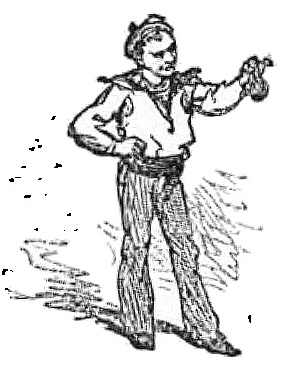
We had a sweet-faced, delicate, wee marmoset, not taller, when on end, than a quart bottle—Bobie the sailors called him; and we had also a larger ape, Hunks by name, of what our Scotch engineer called the “ill-gettit breed”; and that was a mild way of putting it. This brute was never out of mischief. He stole the men’s tobacco, smashed their pipes, spilled their soup, and ran aloft with their caps, which he minutely inspected and threw overboard afterwards. He was always on the black list; in fact, when rubbing his back after one thrashing, he was wondering all the time what mischief he could do next. Bobie was arrayed in a neatly fitting sailor-costume, cap and all complete; and so attired, of course could not escape the persecutions of the ape. Hunks, after contenting himself with cockroaches, would fill his mouth; then holding out his hand with one to Bobie, “Hae, hae, hae,” he would cry, then seize the little innocent, and escape into the rigging with him. Taking his seat in the maintop, Hunks first and foremost emptied his mouth, cramming the contents down his captive’s throat. He next got out on to the stays for exercise, and used Bobie as a species of dumb-bell, swinging him by the tail, hanging him by a foot, by an ear, by the nose, etc, and threatening to throw him overboard if any sailor attempted a rescue. Last of all, he threw him at the nearest sailor.
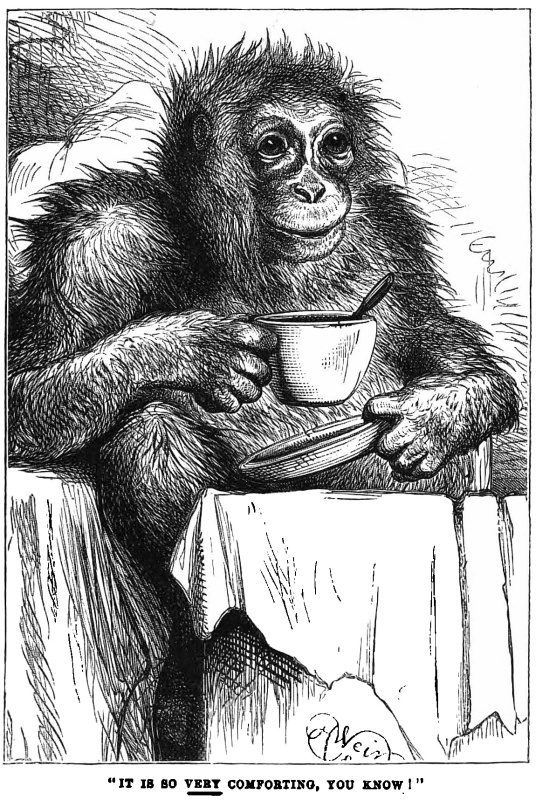
On board the Orestes was a large ape as big as a man. He was a most unhappy ape. There wasn’t a bit of humour in his whole corporation. “He had a silent sorrow” somewhere, “a grief he’d ne’er impart.” Whenever you spoke to him, he seized and wrung your hand in the most pathetic manner, and drew you towards him. His other arm was thrown across his chest, while he shook his head, and gazed in your face with such a woe-begone countenance, that the very smile froze on your lips; and as you couldn’t laugh out of politeness, you felt very awkward. For anything I know, this melancholy ape may be still alive.
Deer are common pets in some ships. We had a fine large buck in the old Semiramie. A romping, rollicking rascal, in truth a very satyr, who never wanted a quid of tobacco in his mouth, nor refused rum and milk. Whenever the steward came up to announce dinner, he bolted below at once; and we were generally down just in time to find him dancing among the dishes, after eating all the potatoes.
I once went into my cabin and found two Liliputian deer in my bed. It was our engineer who had placed them there. We were lying off Lamoo, and he had brought them from shore.
“Ye’ll just be a faither to the lammies, doctor,” he said, “for I’m no on vera guid terms wi’ the skipper.”
They were exactly the size of an Italian greyhound, perfectly formed, and exceedingly graceful. They were too tender, poor things, for life on shipboard, and did not live long.
In the stormy latitudes of the Cape, the sailors used to amuse themselves by catching Cape pigeons, thus: a little bit of wood floated astern attached by a string, a few pieces of fat thrown into the water, and the birds, flying tack and half-tack towards them, came athwart the line, by a dexterous movement of which they entangled their wings, and landed them on board. They caught albatrosses in the same fashion, and nothing untoward occurred.
I had for many months a gentle, loving pet in the shape of a snow-white dove. I had bought him that I might make feather-flowers from his plumage; but the boy brought him off alive, and I never had the heart to kill him. So he lived in a leathern hat-box, and daily took his perch on my shoulder at meal-times (see page 178).
It was my lot once upon a time to be down with fever in India. The room in which I lay was the upper flat of an antiquated building, in a rather lonely part of the suburbs of a town. It had three windows, close to which grew a large banyan-tree, beneath the shade of whose branches the crew of a line-of-battle ship might have hung their hammocks with comfort. The tree was inhabited by a colony of crows; we stood—the crows and I—in the relation of over-the-way to each other. Now, of all birds that fly, the Indian crow most bear the palm for audacity. Living by his wits, he is ever on the best of terms with himself, and his impudence leads him to dare anything. Whenever, by any chance, Pandoo, my attendant, left the room, these black gentry paid me a visit. Hopping in by the score, and regarding me no more than the bed-post, they commenced a minute inspection of everything in the room, trying to destroy everything that could not be eaten or carried away. They rent the towels, drilled holes in my uniform, stole the buttons from my coat, and smashed my bottles. One used to sit on a screen close by my bed every day, and scan my face with his evil eye, saying as plainly as could be—“You’re getting thinner and beautifully less; in a day or two, you won’t be able to lift a hand; then I’ll have the pleasure of picking out your two eyes.”
Amid such doings, my servant would generally come to my relief, perhaps to find such a scene as this: Two or three pairs of hostile crows with their feathers standing up around their necks, engaged in deadly combat on the floor over a silver spoon or a tooth-brush; half a dozen perched upon every available chair; an unfortunate lizard with a crow at each end of it, getting whirled wildly round the room, each crow thinking he had the best right to it; crows everywhere, hopping about on the table, and drinking from the bath; crows perched on the window-sill, and more crows about to come, and each crow doing all in his power to make the greatest possible noise. The faithful Pandoo would take all this in at a glance; then would ensue a helter-skelter retreat, and the windows be darkened by the black wings of the flying crows, then silence for a moment, only broken by some apologetic remark from Pandoo.
When at length happy days of convalescence came round, and I was able to get up and even eat my meals at table, I found my friends the crows a little more civil and respectful. The thought occurred to me to make friends with them; I consequently began a regular system of feeding them after every meal-time. One old crow I caught, and chained to a chair with a fiddle-string. He was a funny old fellow, with one club-foot. He never refused his food from the very day of his captivity, and I soon taught him a few tricks. One was to lie on his back when so placed for any length of time till set on his legs again. This was called turning the turtle. But one day this bird of freedom hopped away, fiddle-string and all, and a whole fortnight elapsed before I saw him again. I was just beginning to put faith in a belief common in India—namely, that a crow or any other bird, that has been for any time living with human beings, is put to instant death the moment he returns to the bosom of his family; when one day, while engaged breakfasting some forty crows, my club-footed pet reappeared, and actually picked the bit from my hand, and ever after, until I left, he came regularly thrice a day to be fed. The other crows came with surprising exactness at meal-times; first one would alight on the shutter outside the window, and peep in, as if to ascertain how nearly done I happened to be, then fly away for five or ten minutes, when he would return, and have another keek. As soon, however, as I approached the window, and raised my arm, I was saluted with a chorus of cawing from the banyan-tree; then down they swooped in dozens; and it was no very easy task to fill so many mouths, although the loaves were Government ones.
These pets had a deadly enemy in a brown raven—the Brahma kite; swifter than arrow from bow he descended, describing the arc of a great circle, and carrying off in his flight the largest lamp of bread he could spy. He, for one, never stopped to bless the hand of the giver; but the crows, I know, were not ungrateful. Club-foot used to perch beside me on a chair, and pick his morsels from the floor, always premising that two windows at least must be open. As to the others, their persecutions ended; they never appeared except when called upon. The last act of their aggression was to devour a very fine specimen of praying mantis I had confined in a quinine bottle. The first day the paper cover had been torn off, and the mantis had only escaped by keeping close at the bottom; next day, the cover was again broken, and the bottle itself capsized; the poor mantis had prayed in vain for once. Club-foot, I think, must have stopped all day in the banyan-tree, for I never went to the window to call him without his appearing at once with a joyful caw; this feat I used often to exhibit to my shipmates who came to visit me during my illness.
One thing about talking-birds I don’t remember ever to have seen noticed—namely, the habit some birds have of talking in their sleep. And, just as a human being will often converse in his dream in a long-forgotten language, so birds will often at night be heard repeating words or phrases they never could remember in their waking moments. A starling of mine often roused me at night by calling out my dog’s name in loud, distinct tones, although by day his attempts to do so were quite ineffectual. So with a venerable parrot we had on board the saucy Skipjack. Polly was a quiet bird in daylight, and much given to serious thought; but at times, in the stillness of the middle watch at sea, would startle the sailors from their slumbers by crying out: “Deen, deen—kill, kill, kill!” in quite an alarming manner. Polly had been all through the Indian mutiny, and was shut up in Delhi during the sad siege, so her dreams were not very enviable.
Do parrots know what they say? At times I think they do. Our parson on board the old Rumbler had no more attentive listener to the Sabbath morning service than wardroom Polly; but there were times when Polly made responses when silence would have been more judicious. There was an amount of humour which it is impossible to describe, in the sly way she one day looked the parson in the face, as he had just finished a burst of eloquence both impassioned and impressive, and uttered one of her impertinent remarks. For some months, she was denied access to church because she had once forgotten herself so far as to draw corks during the sermon—this being considered “highly mutinous and insubordinate conduct.” But she regained her privilege. Poor Poll! I’ll never forget the solemn manner in which she shut her eyes one day at the close of the service, as if still musing on the words of the sermon, on the mutability of all things created, and remarked: “Vanity, vanity, all is vanity, says—says:” she could say no more—the rest stuck in her throat, and we were left to ponder on her unfortunate loss of memory in uttering the admonitory sentiment.
Chapter Nineteen.
My Cabin Mates and Bedfellows: A Sketch of Life on the Coast of Africa.
“Whaur are gaun crawlin’ ferlie, Your impudence protects ye sairly.” Burns.
I was idly sauntering along the only street in Simon’s Town one fine day in June, when I met my little, fat, good-humoured friend, Paymaster Pumpkin. He was walking at an enormous pace for the length of his legs, and his round face was redder than ever. He would hardly stop to tell me that H.M.S. Vesuvius was ordered off in two hours—provisions for a thousand men—the Kaffirs (scoundrels) had crossed some river (name unpronounceable) with an army of one hundred thousand men, and were on their way to Cape Town, with the murderous intention of breaking every human bone in that fair town, and probably picking them leisurely afterwards. The upshot of all this, as far as I was concerned, was my being appointed to as pretty a model, and as dirty a little craft, as there was in the service, namely, H.M.S. Pen-gun. Our armament consisted of four pea-shooters and one Mons Meg; and our orders were to repair to the east coast of Africa, and there pillage, burn, and destroy every floating thing that dared to carry a slave, without permission from Britannia’s queen. Of our adventures there, and how we ruled the waves, I am at present going to say nothing. I took up my commission as surgeon of this interesting craft, and we soon after sailed.
On first stepping on board the Pen-gun, a task which was by no means difficult to a person with legs of even moderate length, my nose—yes, my nose—that interesting portion of my physiognomy, which for months before had inhaled nothing more nauseous than the perfume of a thousand heaths, or the odour of a thousand roses—my nose was assailed by a smell which burst upon my astonished senses, like a compound of asafoetida, turpentine, and Stilton cheese. As I gasped for breath, the lieutenant in command endeavoured to console me by saying—“Oh, it’s only the cockroaches: you’ll get used to it by-and-by.”
“Only the cockroaches!” repeated I to myself, as I went below to look after my cabin. This last I found to be of the following dimensions—namely, five feet high (I am five feet ten), six feet long, and six feet broad at the top; but, owing to the curve of the vessel’s side, only two feet broad at the deck. A cot hung fore and aft along the ship’s side, and the remaining furniture consisted of a doll’s chest of drawers, beautifully fitted up on top with a contrivance to hold utensils of lavation, and a Liliputian writing-table on the other; thus diminishing my available space to two square feet, and this in a break-neck position. My cot, too, was very conveniently placed for receiving the water which trickled freely from my scuttle when the wind blew, and more slowly when the wind didn’t; so that every night, very much against my will, I was put under the operations of practical hydropathy. And this was my sanctum, sanctorum; but had it been clean, or capable of cleaning, I am a philosopher, and would have rejoiced in it; but it was neither; and ugh! it was inhabited.
Being what is termed in medical parlance, of the nervo-sanguineous temperament, my horror of the loathsome things about me for the first week almost drove me into a fever. I could not sleep at night, or if I fell into an uneasy slumber, I was awakened from fearful dreams, to find some horrid thing creeping or running over my hands or face. When a little boy, I used to be fond of turning up stones in green meadows, to feast my eyes upon the many creeping things beneath. I felt now as if I myself were living under a stone. However, after a year’s slaver-hunting, I got so used to all these creatures, that I did not mind them a bit. I could crack scorpions, bruise the heads of centipedes, laugh at earwigs, be delighted with ants, eat weevils, admire tarantulas, encourage spiders. As for mosquitoes, flies, and all the smaller genera, I had long since been thoroughly inoculated; and they could now bleed me as much as they thought proper, without my being aware of it. It is of the habits of some of these familiar friends I purpose giving a short sketch in this chapter and next.
Of the “gentlemen of England who live at home at ease,” very few, I suspect, would know a cockroach, although they found the animal in their soap—as I have done more than once. Cockroaches are of two principal kinds—the small, nearly an inch long; and the large, nearly two and a half inches. Let the reader fancy to himself a common horsefly of our own country, half an inch in breadth, and of the length just stated, the body, ending in two forks, which project beyond the wings, the head, furnished with powerful mandibles, and two feelers, nearly four inches long, and the whole body of a dark-brown or gun-barrel colour, and he will have as good an idea as possible of the gigantic cockroach. The legs are of enormous size and strength, taking from fifteen to twenty ants to carry one away, and furnished with bristles, which pierce the skin in their passage over one’s face; and this sensation, together with the horrid smell they emit, is generally sufficient to awaken a sleeper of moderate depth. On these legs the animal squats, walking with his elbows spread out, like a practical agriculturist writing an amatory epistle to his lady-love, except when he raises the fore part of his body, which he does at times, in order the more conveniently to stare you in the face. He prefers walking at a slow and respectable pace; but if you threaten him by shaking your finger at him, it is very funny to see how quickly he takes the hint, and hurries off with all his might. What makes him seem more ridiculous is, that he does not appear to take into consideration the comparative length of your legs; he seems impressed with the idea that he can easily run away from you; indeed, I have no doubt he would do so from a greyhound. The creature is possessed of large eyes; and there is a funny expression of conscious guilt and impudence about his angular face which is very amusing; he knows very well that he lives under a ban—that, in fact, existence is a thing he has no business or lawful right with, and consequently he can never look you straight in the face, like an honest fly or moth. The eggs, which are nearly half an inch long, and about one-eighth in breadth, are rounded at the upper edge, and the two sides approach, wedge-like, to form the lower edge, which is sharp and serrated, for attachment to the substance on which they may chance to be deposited. These eggs are attached by one end to the body of the cockroach; and when fully formed, they are placed upon any material which the wisdom of the mother deems fit food for the youthful inmates. This may be either a dress-coat, a cocked-hat, a cork, a biscuit, or a book—in fact, anything softer than stone; and the egg is no sooner laid, than it begins to sink through the substance below it, by an eating or dissolving process, which is probably due to the agency of some free acid; thus, sailors very often (I may say invariably) have their finest uniform-coats and dress-pants ornamented by numerous little holes, better adapted for purposes of ventilation than embellishment. The interior of the egg is transversely divided into numerous cells, each containing the larvae of I know not how many infant cockroaches. The egg gives birth in a few weeks to a whole brood of triangular little insects, which gradually increase till they attain the size of huge oval beetles, striped transversely black and brown, but as yet minus wings. These are usually considered a different species, and called the beetle-cockroach; but having a suspicion of the truth, I one day imprisoned one of these in a crystal tumbler, and by-and-by had the satisfaction of seeing, first the beetle break his own back, and secondly, a large-winged cockroach scramble, with a little difficulty, through the wound, looking rather out of breath from the exertion. On first escaping, he was perfectly white, but in a few hours got photographed down to his own humble brown colour. So much for the appearance of these gentry. Now for their character, which may easily be summed up: they are cunning as the fox; greedy as the glutton; impudent as sin; cruel, treacherous, cowardly scoundrels; addicted to drinking; arrant thieves; and not only eat each other, but even devour with avidity their own legs, when they undergo accidental amputation. They are very fond of eating the toe-nails—so fond, indeed, as to render the nail-scissors of no value, and they also profess a penchant for the epidermis—if I may be allowed a professional expression—of the feet and legs; not that they object to the skin of any other part of the body, by no means; they attack the legs merely on a principle of easy come-at-ability.
In no way is their cunning better exhibited than in the cautious and wary manner in which they conduct their attack upon a sleeper. We will suppose you have turned in to your swinging cot, tucked in your toes, and left one arm uncovered, to guard your face. By-and-by, first a few spies creep slowly up the bulkhead, and have a look at you: if your eyes are open, they slowly retire, trying to look as much at their ease as possible; but if you look round, they run off with such ridiculous haste and awkward length of steps, as to warrant the assurance that they were up to no good. Pretend, however, to close your eyes, and soon after, one, bolder than the rest, walks down the pillow, and stations himself at your cheek, in an attitude of silent and listening meditation. Here he stands for a few seconds, then cautiously lowering one feeler, he tickles your face: if you remain quiescent, the experiment is soon repeated; if you are still quiet, then you are supposed to be asleep, and the work of the night begins. The spy walks off in great haste, and soon returns with the working-party. The hair is now searched for drops of oil; the ear is examined for wax; in sound sleepers, even the mouth undergoes scrutiny; and every exposed part is put under the operation of gentle skinning. Now is the time to start up, and batter the bulkheads with your slipper; you are sure of half an hour’s good sport; but what then? The noise made by the brutes running off brings out the rest, and before you are aware, every crevice or corner vomits forth its thousands, and the bulkheads all around are covered with racing, chasing, fighting, squabbling cockroaches. So numerous, indeed, they are at times, that it would be no exaggeration to say that every square foot contains its dozen. If you are wise, you will let them alone, and go quietly and philosophically to bed, for you may kill hundreds, and hundreds more will come to the funeral-feast. Cockroaches are cannibals, practically and by profession. This can be proved in many ways. They eat the dead bodies of their slain comrades; and if any one of them gets sick or wounded, his companions, with a kindness and consideration which cannot be too highly appreciated, speedily put him out of pain, and, by way of reward for their own trouble, devour him.
These creatures seem to suffer from a state of chronic thirst; they are continually going and returning from the wash-hand basin, and very careful they are, too, not to tumble in.
They watch, sailor-like, the motion of the vessel; when the water flows towards them, they take a few sips, and then wait cautiously while it recedes and returns. Yet, for all this caution, accidents do happen, and every morning you are certain to find a large number drowned in the basin. This forms one of the many methods of catching them. I will only mention two other methods in common use. A pickle-bottle, containing a little sugar and water, is placed in the cabin; the animals crawl in, but are unable to get out until the bottle is nearly full, when a few manage to escape, after the manner of the fox in the fable of the “Fox and Goat in the Well;” and if those who thus escape have previously promised to pull their friends out by the long feelers, they very unfeelingly decline, and walk away as quickly as possible, sadder and wiser ’roaches. When the bottle is at length filled, it finds its way overboard. Another method is adopted in some ships—the boys have to muster every morning with a certain number of cockroaches; if they have more, they are rewarded; if less, punished. I have heard of vessels being fumigated, or sunk in harbour; but in these cases the number of dead cockroaches, fast decaying in tropical weather, generally causes fever to break out in the ship; so that, if a vessel once gets overrun with them, nothing short of dry-docking and taking to pieces does any good.
They are decided drunkards. I think they prefer brandy; but they are not difficult to please, and generally prefer whatever they can get. When a cockroach gets drunk, he becomes very lively indeed, runs about, flaps his wings, and tries to fly—a mode of progression which, except in very hot weather, they are unable to perform. Again and again he returns to the liquor, till at last he falls asleep, and by-and-by awakes, and, no doubt filled with remorse at having fallen a victim to so human a weakness, rushes frantically away, and in trying to drink, usually drowns himself.
But although the cockroach is, in general, the bloodthirsty and vindictive being that I have described, still he is by no means unsociable, and has his times and seasons of merriment and recreation. On these occasions, the ’roaches emerge from their hiding-places in thousands at some preconcerted signal, perform a reel, or rather an acute-angled, spherically-trigonometrical quadrille, to the music of their own buzz, and evidently to their own intense satisfaction. This queer dance occupies two or three minutes, after which the patter of their little feet is heard no more, the buzz and the bum-m-m are hushed; they have gone to their respective places of abode, and are seen no more for that time. This usually takes place on the evening of a very hot day—a day when pitch has boiled on deck, and the thermometer below has stood persistently above ninety degrees. When the lamps are lit in the wardroom, and the officers have gathered round the table for a quiet rubber at whist, then is heard all about and around you a noise like the rushing of many waters, or the wind among the forest-trees; and on looking up, you find the bulkheads black, or rather brown, with the rustling wretches, while dozens go whirring past you, alight on your head, or fly right in your face.
This is a cockroaches’ ball, which, if not so brilliant as the butterfly ball of my early recollections, I have no doubt is considered by themselves as very amusing and highly respectable.
The reader will readily admit that the character of “greedy as gluttons” has not been misapplied when I state that it would be an easier task to tell what they did not eat, than what they did.
While they partake largely of the common articles of diet in the ship’s stores, they also rather like books, clothes, boots, soap, and corks. They are also partial to lucifer-matches, and consider the edges of razors and amputating-knives delicate eating. (Note 1.) As to drink, these animals exhibit the same impartiality. Probably they do prefer wines and spirits, but they can nevertheless drink beer with relish, and even suit themselves to circumstances, and imbibe water, either pure or mixed with soap; and if they cannot obtain wine, they find in ink a very good substitute. Cockroaches, I should think, are by no means exempt from the numerous ills that flesh is heir to, and must at times, like human epicures and gourmands, suffer dreadfully from rheums and dyspepsia; for to what else can I attribute their extreme partiality for medicine? “Every man his own doctor,” seems to be their motto; and they appear to attach no other meaning to the word “surgeon” than simply something to eat: I speak by experience. As to physic, nothing seems to come wrong to them. If patients on shore were only half as fond of pills and draughts, I, for one, should never go to sea. As to powders, they invariably roll themselves bodily in them; and tinctures they sip all day long. Blistering-plaster seems a patent nostrum, which they take internally, for they managed to use up two ounces of mine in as many weeks, and I have no doubt it warmed their insides. I one night left a dozen blue pills carelessly exposed on my little table; soon after I had turned in, I observed the box surrounded by them, and being too lazy to get up, I had to submit to see my pills walked off with in a very few minutes by a dozen ’roaches, each one carrying a pill. I politely informed them that there was more than a dose for an adult cockroach in each of these pills; but I rather think they did not heed the caution, for next morning, the deck of my little cabin was strewed with the dead and dying, some exhibiting all the symptoms of an advanced stage of mercurial salivation, and some still swallowing little morsels of pill, no doubt on the principle of similia similibus curantur, from which I argue that cockroaches are homoeopathists.
That cockroaches are cowards, no one, I suppose, will think of disputing.
I have seen a gigantic cockroach run away from an ant, under the impression, I suppose, that the little creature meant to swallow him alive.
The smaller-sized cockroach differs merely in size and some unimportant particulars from that just described, and possesses in a less degree all the vices of his big brother. They, too, are cannibals; but they prefer to prey upon the large one, which they kill and eat when they find wounded. For example, one very hot day, I was enjoying the luxury of a bath at noon, when a large cockroach alighted in great hurry on the edge of my bath, and began to drink, without saying “By your leave,” or “Good-morning to you.”
Now, being by nature of a kind disposition, I certainly should never have refused to allow the creature to quench his thirst in my bath—although I would undoubtedly have killed him afterwards—had he not, in his hurried flight over me, touched my shoulder with his nasty wings, and left thereon his peculiar perfume.
This very naturally incensed me, so seizing a book, with an interjectional remark on his impudence, I struck him to the deck, when he lay to all appearance, dead; so, at least, thought a wily little ’roach of the small genus, that had been watching the whole affair at the mouth of his hole, and determined to seize his gigantic relative, and have a feast at his expense; so, with this praiseworthy intention, the imp marched boldly up to him, pausing just one second, as if to make sure that life was extinct; then, seeing no movement or sign of life evinced by the giant, he very pompously seized him by the fore-leg, and, turning round, commenced dragging his burden towards a hole, no doubt inwardly chuckling at the anticipation of so glorious a supper.
Unfortunately for the dwarfs hopes, however, the giant now began to revive from the effects of concussion of the brain, into which state my rough treatment had sent him; and his ideas of his whereabouts being rather confused, at the same time feeling himself moving, he very naturally and instinctively began to help himself to follow, by means of his disengaged extremities. Being as yet unaware of what had happened behind, the heart of the little gentleman in front swelled big with conscious pride and dignity, at the thought of what a strong little ’roach he was, and how easily he could drag away his big relative.
But this new and sudden access of strength began presently to astonish the little creature itself, for, aided by the giant’s movements, it could now almost run with its burden, and guessing, I suppose, that everything was not as it ought to be, it peeped over its shoulder to see. Fancy, if you can, the terror and affright of the pigmy on seeing the monster creeping stealthily after it. “What had it been doing? How madly it had been acting!” Dropping its relative’s leg, it turned, and fairly ran, helping itself along with its wings, like a barn-door fowl whose wits have been scared away by fright, and never looked once back till fairly free from its terrible adventure; and I have no doubt it was very glad at having discovered its mistake in time, since otherwise the tables might have been turned, and the supper business reversed.
So much for cockroaches, and I ought probably to apologise for my description of these gentry being so realistic and graphic. If I ought to, I do.
Note 1. It is probable that the edges of razors, etc, are destroyed by a sort of acid deposited there by the cockroaches, similar to that which exudes from the egg; however, there is no gainsaying the fact.
Chapter Twenty.
My Cabin Mates—Concluded.
“The spider spreads her web, whether she be In poet’s towers, cellar or barn or tree.” Shelley.
The spider, however, is the great enemy of the small genus of cockroaches. These spiders are queer little fellows. They do not build a web for a fly-trap, but merely for a house. For the capture of their prey, they have a much more ingenious method than any I have ever seen, a process which displays a marvellous degree of ingenuity and cleverness on the part of the spider, and proves that they are not unacquainted with some of the laws of mechanics. Having determined to treat himself to fresh meat, the wary little thing (I forgot to say that the creature, although very small in proportion to the generality of tropical spiders, is rather bigger than our domestic spider, and much stronger) emerges from his house, in a corner of the cabin roof, and, having attached one end of a thread to a beam in the roof, about six inches from the bulkhead, he crawls more than half-way down the bulkhead, and attaching the thread here again, goes a little further down, and waits. By-and-by, some unwary ’roach crawls along, between the second attachment of the thread and the spider; instantly the latter rushes from his station, describes half a circle round his victim, lets go the second attachment of the thread—which has now become entangled about the legs of the ’roach—and, by some peculiar movement, which I do not profess to understand, the cockroach is swung off the bulkhead, and hangs suspended by the feet in mid-air; and very foolish he looks; so at least must think the spider, as he coolly stands on the bulkhead quietly watching the unavailing struggles of the animal which he has so nimbly done for; for Marwood himself could not have done the thing half so neatly. The spider now regains the beam to which the thread is attached, and, sailor-like, slides down the little rope, and approaches his victim; and first, as its kicking might interfere with the further domestic arrangements of its body, the ’roach is killed, by having a hole eaten out of its head between the eyes. This being accomplished, the next thing is to bring home the butcher-meat; and the manner in which this difficult task is performed is nothing less than wonderful. A thread is attached to the lower part of the body of the ’roach; the spider then “shins” up its rope with this thread, and attaches it so high that the body is turned upside down; it then hauls on the other thread, turns the body once more, and again attaches the thread; and this process is repeated till the dead cockroach is by degrees hoisted up to the beam, and deposited in a corner near the door of its domicile. But the wisdom of the spider is still further shown in what is done next. It knows very well—so, at least, it would appear—that its supply of food will soon decay; and being unacquainted with the properties of salt, it proceeds to enclose the body of the ’roach in a glutinous substance of the form of a chrysalis or air-tight case. It is, in fact, hermetically sealed, and in this way serves the spider as food for more than a week. There is at one end a little hole, which is, no doubt, closed up after every meal.
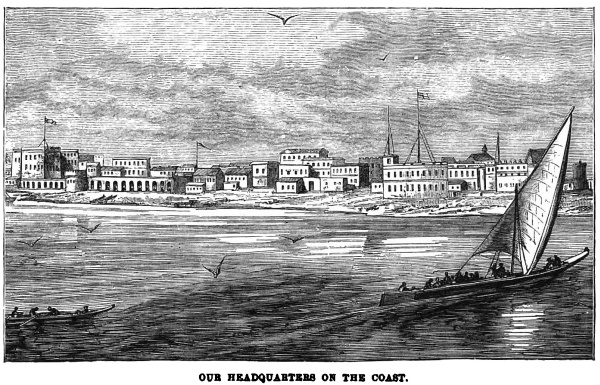
In my cabin, besides the common earwigs, which were not numerous, and were seldom seen, I found there were a goodly number of scorpions, none of which, however, were longer than two inches. I am not aware that they did me any particular damage, further than inspiring me with horror and disgust. It was very unpleasant to put down your hand for a book, and to find a scorpion beneath your fingers—a hard, scaly scorpion—and then to hear him crack below your boot, and to be sensible of the horrid odour emitted from the body: these things were not pleasant. Those scorpions which live in ships are of a brown colour, and not dangerous; it is the large green scorpion, so common in the islands of East Africa, which you must be cautious in handling, for children, it is said, frequently die from the effects of this scorpion’s sting. But a much more loathsome and a really dangerous creature is the large green centipede of the tropics. Of these things, the natives themselves have more horror than of any serpent whatever, not excepting the common cobra, and many a tale they have to tell you of people who have been bitten, and have soon after gone raving mad, and so died. They are from six to twelve inches in length, and just below the neck are armed with a powerful pair of sharp claws, like the nails of a cat, with which they hold on to their victim while they bite; and if once fairly fastened into the flesh, they require to be cut out. While lying at the mouth of the Revooma River, we had taken on board some green wood, and with it many centipedes of a similar colour. One night, about a week afterwards, I had turned in, and had nearly fallen asleep, when I observed a thing on my curtain—luckily on the outside—which very quickly made me wide awake. It was a horrid centipede, about nine inches long. It appeared to be asleep, and had bent itself in the form of the letter S. I could see its golden-green skin by the light of my lamp, and its wee shiny eyes, that, I suppose, never close, and for the moment I was almost terror-struck. I knew if I moved he would be off, and I might get bitten another time—indeed, I never could have slept again in my cabin, had he not been taken. The steward came at my call; and that functionary, by dint of caution and the aid of a pair of forceps, deposited the creature in a bottle of spirits of wine, which stood at hand always ready to receive such specimens. I have it now beside me; and my Scotch landlady, who seemed firmly impressed with the idea that all my diabolical-looking specimens of lizards and various other creeping things are the productions of sundry unhappy patients, remarked concerning my centipede: “He maun hae been a sick and a sore man ye took that ane oot o’, doctor.”
But a worse adventure befell an engineer of ours. He was doing duty in the stokehole, when one of these loathsome creatures actually crept up under his pantaloons. He was an old sailor, and a cool one, and he knew that if he attempted to kill or knock it off, the claws would be inserted on the instant. Cautiously he rolled down his dress, and spread a handkerchief on his leg a short distance before the centipede, which was moving slowly and hesitatingly upwards. It was a moment of intense excitement, both for those around him as well as for the man himself. Slowly it advanced, once it stopped, then moved on again, and crossed on to the handkerchief, and the engineer was saved; on which he immediately got sick, and I was sent for, heard the story, and received the animal, which I placed beside the other.
More pleasant and amusing companions and cabin mates were the little ants, a whole colony of which lived in almost every available corner of my sanctum. Wonderfully wise they are too, and very strong, and very proud and “clannish.” Their prey is the large cockroach. If you kill one of these, and place it in the centre of the cabin, parties of ants troop in from every direction—I might say, a regiment from each clan; and consequently there is a great deal of fighting and squabbling, and not much is done, except that the cockroach is usually devoured on the spot. If, however, the dead ’roach be placed near some corner where an army of ants are encamped, they soon emerge from the camp in hundreds, down they march in a stream, and proceed forthwith to carry it away. Slowly up the bulkhead moves the huge brute, impelled by the united force of half a thousand, and soon he is conveyed to the top. Here, generally, there is a beam to be crossed, where the whole weight of the giant ’roach has to be sustained by these Liliputians, with their heads downward; and more difficult still is the rounding of the corner. Very often, the ants here make a most egregious mistake; while hundreds are hauling away at each leg, probably a large number get on top of the ’roach, and begin tugging away with all their might, and consequently their burden tumbles to the deck; but the second time he is taken up, this mistake is not made. These creatures send out regular spies, which return to report when they have found anything worth taking to headquarters; then the foraging-party goes out, and it is quite a sight to see the long serpentine line, three or four deep, streaming down the bulkhead and over the deck, and apparently having no end. They never march straight before them; their course is always wavy; and it is all the more strange that those coming up behind should take exactly the same course, so that the real shape of the line of march never changes. Perhaps this is effected by the officer-ants, which you may see, one here, one there, all along the line. By the officer-ants I mean a large-sized ant (nearly double), that walks along by the side of the marching army, like ants in authority. They are black (the common ant being brown), and very important, too, they look, and are no doubt deeply impressed by the responsibility of their situation and duties, running hither and thither—first back, then to the side, and sometimes stopping for an instant with another officer, as if to give or receive orders, and then hurrying away again. These are the ants, I have no doubt, that are in command, and also act as engineers and scouts, for you can always see one or two of them running about, just before the main body comes on—probably placing signal-staffs, and otherwise determining the line of march. They seem very energetic officers too, and allow no obstacle to come in their way, for I have often known the line of march to lie up one side of my white pants, over my knees, and down the other. I sat thus once till a whole army passed over me—a very large army it was too, and mightily tried my patience. When the rear-guard had passed over, I got up and walked away, which must have considerably damaged the calculations of the engineers on their march back.
Of the many species of flies found in my cabin, I shall merely mention two—namely, the silly fly—which is about the size of a pin-head, and furnished with two high wings like the sails of a Chinese junk; they come on board with the bananas, and merit the appellation of silly from the curious habit they have of running about with their noses down, as if earnestly looking for something which they cannot find; they run a little way, stop, change their direction, and run a little further, stop again, and so on, ad infinitum, in a manner quite amusing to any one who has time to look at and observe them—and the hammer-legged fly (the Foenus of naturalists), which possesses two long hammer-like legs, that stick out behind, and have a very curious appearance. This fly has been accused of biting, but I have never found him guilty. He seems to be continually suffering from a chronic stage of shaking-palsy. Wherever he alights—which is as often on your nose as anywhere else—he stands for a few seconds shaking in a manner which is quite distressing to behold, then flies away, with his two hammers behind him, to alight and shake on some other place—most likely your neighbour’s nose. It seems to me, indeed, that flies have a penchant for one’s nose. Nothing, too, is more annoying than those same house-flies in warm countries. Suppose one alights on the extreme end of your nasal apparatus, you of course drive him off; he describes two circles in the air, and alights again on the same spot; and this you may do fifty times, and at the fifty-first time, back he comes with a saucy hum-m, and takes his seat again, just as if your nose was made for him to go to roost upon, and for no other purpose at all; so that you are either obliged to sit and smile complacently with a fly on the end of your proboscis, or, if you are clever and supple-jointed, follow him all round the room till you have killed him; then, probably, back you come with a face beaming with gratification, and sit down to your book again, when bum-m-m! there is your friend once more, and you have killed the wrong fly.
In an hospital, nothing is more annoying than these flies; sleep by day is sometimes entirely out of the question, unless the patient covers his face, which is by no means agreeable on a hot day. Mosquitoes, too, are troublesome customers to a stranger, for they seem to prefer the blood of a stranger to that of any one else. The mosquito is a beautiful, feathery-horned midge, with long airy legs, and a body and wings that tremble with their very fineness and grace. The head and shoulders are bent downward at almost a right angle, as if the creature had fallen on its head and broken its back; but, for all its beauty, the mosquito is a hypocritical little scoundrel, who comes singing around you, apparently so much at his ease, and looking so innocent and gentle, that one would imagine butter would hardly melt in his naughty little mouth. He alights upon your skin with such a light and fairy tread, inserts his tube, and sucks your blood so cleverly, that the mischief is done long before you are aware, and he is off again singing as merrily as ever. Probably, if you look about the curtain, you may presently find him gorged with your blood, and hardly able to fly—an unhappy little midge now, very sick, and with all his pride fallen; so you catch and kill him; and serve him right too!
I should deem this chapter incomplete if I omitted to say a word about another little member of the company in my crowded cabin—a real friend, too, and a decided enemy to all the rest of the creeping genera about him. I refer to a chameleon I caught in the woods and tamed. His principal food consisted in cockroaches, which he caught very cleverly, and which, before eating, he used to beat against the deck to soften. He lived in a little stone-jar, which made a very cool house for him, and to which he periodically retired to rest; and very indignant he was, too, if any impudent cockroach, in passing, raised itself on its fore-legs to look in. Instant pursuit was the consequence, and his colour came and went in a dozen different hues as he seized and beat to death the intruder on his privacy. He seemed to know me, and crawled about me. My buttons were his chief attraction; he appeared to think they were made for him to hang on to by the tail; and he would stand for five minutes at a time on my shoulder, darting his tongue in every direction at the unwary flies which came within his reach; and, upon the whole, I found him a very useful little animal indeed. These lizards are very common as pets among the sailors on the coast of Africa, who keep them in queer places sometimes, as the following conversation, which I heard between two sailors at Cape Town, will show.
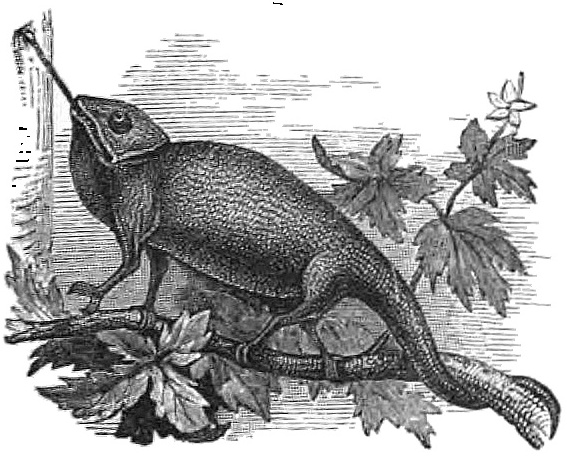
“Look here, Jack, what I’ve got in my ’bacca-box.”
“What is it?” said Jack—“an evil spirit?”
“No,” said the other, as unconcernedly as if it might have been an evil spirit, but wasn’t—“no! a chameleon;” which he pronounced kammy-lion.
“Queer lion that ’ere, too,” replied Jack.
But, indeed, there are few creatures which a sailor will not attempt to tame.
Chapter Twenty One.
Containing a Tale to Banish the Creepies.
“The noblest mind the best contentment has.” Spenser.
“Now,” said Frank, next night (we are all assembled drinking tea on the lawn), “after all those tales about your foreign favourites, and your pet creepie-creepies, I think the best thing you can do is to come nearer home and change your tactics.”
“I was dreaming about cockroaches last night,” said my wife; “and you know, dear, they are my pet aversion.”
“Yes,” cried Ida; “do tell us a story to banish the creepies.”
“Well then, here goes. I’ll tell you a story about a pet donkey and Nero’s son, ‘Hurricane Bob.’ Will that do? And we’ll call it—”
Jeannie’s Boarding-house: A Seaside Story.
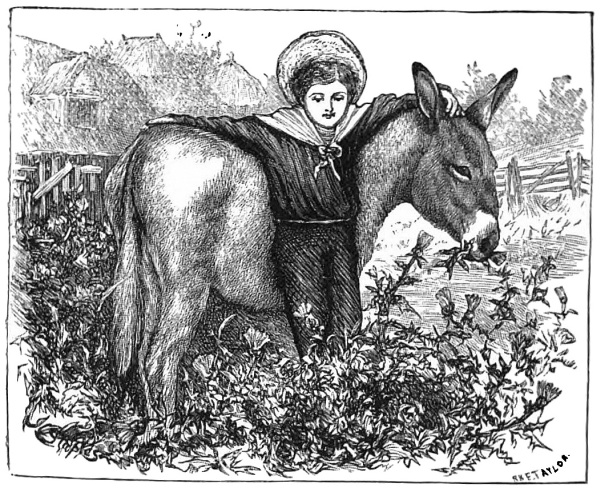
“Jeannie was an ass. I do not make this remark in any disparaging way, for a more interesting member of the genus donkey never, I believe, stood upon four legs. Indeed, I do not think I would be going too far if I said that I have known many individuals not half so wise who stood upon two. Now, although I mention Jeannie in the past tense, it is because she is not present with me, but she is still, I believe, alive and well, and is at this moment, I have little doubt, quietly cropping the grass on her own green field, or gazing pensively at the ocean from the Worthing sands.
“I must tell you who was my travelling companion when I first made the acquaintance of the heroine of this little sketch. He was a very large jet-black Newfoundland dog. Such a fellow! And with such a coat too, not one curly hair in all his jacket, all as straight as quills, and as sheeny as the finest satin. Hurricane Bob can play in the sea, toying with the waves for hours, and still not be wet quite to the skin, and when he comes on shore again he just gives himself a shake or two, buckets of water fly in all directions, for the time being he looks like an animated mop, then away he feathers across the sands, and in a few minutes he is dry enough for the drawing-room. Bob is quite an aristocrat in his own way, and every inch a gentleman—one glance at his beautiful face and his wide, thoughtful eyes would convince you of this—nor, on being introduced to him, would you be surprised to be told that not only is he a winner of many prizes himself, but that his father is a champion dog, and his grandfather before him as well. I do not think that Hurricane Bob—or Master Robert, as we call him on high days and holidays—has a single fault, unless probably the habit he has of going tearing along the streets and roads, when out for a walk, at the rate of twenty miles an hour. It is this habit which has gained for him the sobriquet of Hurricane; it is sometimes a little awkward for the lieges, but to his credit be it said that whenever he runs down a little boy or girl he never fails to stop and apologise on the spot, licking the hands of the prostrate one, and saying, as plainly as a dog can speak, ‘There, there, I didn’t really mean to hurt you, and you’ll be all right again in a minute.’
“We called the place where Jeannie lived, at Worthing, Jeannie’s boarding-house. It was a nice roomy stable, with a coach-house, a yard for exercise, and a loose-box. The door of the stable was always left open at Jeannie’s request, so that she could go out and in as she pleased. The loose-box was told off to Hurricane Bob; he had a dish of nice clean water, a box to hold his dog-biscuits, and plenty of dry straw, so he was as happy as a king.
“When his landlady, Jeannie, first saw him she sniffed him all over, while Bob looked up in her face.
“‘Just you be careful, old lady,’ said Bob, ‘for I might be tempted to catch you by the nose.’
“But Jeannie was satisfied.
“‘You’ll do, doggie,’ she said; ‘there doesn’t seem to be an ounce of real harm in your whole composition.’
“The other members of Jeannie’s boarding establishment were about twenty hens, old and young, more useful perhaps than ornamental. Now, any other landlady in the world would have had a bad time of it with this ill-bred feathered squad, for they were far from polite to her, and constantly grumbling about their food; they said they hadn’t enough of it, and that it was not good what they did get. Then they were continually squabbling or fighting with each other; the little fowls always stole all the big pieces, and the big fowls chased and pecked the little ones all round the yard in consequence, till their backs, under their feathers, must have been black and blue, and they hadn’t peace to eat the portion they had stolen. ‘Tick, tuck,’ the big fowl would say; ‘tick, tuck, take that, and that; tick, tuck, that’s what greed gets.’
“But Jeannie was a philosopher, she simply looked at them with those quiet brown eyes of hers, shook one ear, and said—
“‘Grumble away, grumble away, I’m too well known to be afraid of ye; ye can’t bring disgrace on my hotel. Hee, haw! Haw, hee! There!’
“Hurricane Bob paid his bill every morning and every night with a dog-biscuit. The first morning I offered Jeannie the biscuit she looked at me.
“‘Do you take me for a dog?’ she asked. Then she sniffed it. ‘It do smell uncommonly nice,’ she said; ‘I’ll try it, anyhow.’ So she took the cake in her mouth, and marched into the yard; but returned almost immediately, still holding it between her teeth.
“‘What’s the correct way to eat it?’ she inquired.
“‘That’s what I want you to find out,’ I said.
“Poor Jeannie! she tried to break it against the door, then against the wall, and finally against the paving stone, but it resisted all her efforts. Then, ‘Oh! I know,’ she cried. ‘You puts it on the ground, and holes it like a turnip.’ N.B.—I’m not accountable for Jeannie’s bad grammar.
“Every morning, when I came to see Master Robert, Jeannie ran to meet me, and put her great head under my arm for a cuddle. She called me Arthur, but that isn’t my name. She pronounced the first syllable in a double bass key, and the second in a shrill treble. Ar—thur! Haw, hee! Haw, hee!
“She was funny, was Jeannie. Some mornings, as soon as she caught sight of me, she used to go off into a fit of uncontrollable laughter, then she would apologise.
“‘I can’t help it, Arthur,’ she seemed to say. ‘It does seem rude, I daresay, but I really can’t help it. It’s the sight of you that does it. Hee, haw! Hee, haw!’
“One day, and one day only, Bob and his landlady nearly had a quarrel. Jeannie, having eaten her own biscuit, burst into the loose-box, to help the dog with his. ‘Ho, ho!’ said Hurricane Robert, ‘you’ve come to raise the rent, have ye? Just look at this, old lady.’ As he spoke, the dog lifted one lip, and showed such a display of alabaster teeth, that Jeannie was glad to retire without raising the rent.
“What was Jeannie like, did you ask? Why, straight in back and strong in limb, with beautiful long ears to switch away the flies in summer, with mild, intelligent eyes of hazel brown, and always a soft, smooth patch on the top of her nose for any one to kiss who was so minded. In winter Jeannie was rough in coat. She preferred it, she said, because it kept out the cold, and made an excellent saddle for her three little playmates to ride upon. Of these she was exceedingly fond, and never more pleased and proud than when the whole three of them were on her back at one time—wee, brown-eyed, laughing Lovat S—; young Ernie, bold and bright and free; and little winsome Winnie C—.
“To be sure they often fell off, but there was where the fun and the glee lay, especially when Jeannie sometimes bent her nose to the ground and let them all tumble on the sand in a heap. And that, you know, was Jeannie’s joke, and one that she was never tired of repeating.
“In summer Jeannie shone, positively shone, all over like a race-horse or a boatman beetle, and then I can tell you it was no easy matter for her playmates to stick on her back at all. She was particularly partial, as you have seen, to the society of human beings, and brightened up wonderfully as soon as a friend appeared on the scene, but I think when alone she was rather of a contemplative turn of mind. There was a rookery not far from Jeannie’s abode, and at this she never tired gazing.
“‘Well,’ said Jeannie to me one day, ‘they do be funny creatures, those rooks. I don’t think I should like to live up there, Ar—thur. And they’re always a-fighting too, just like my boarders be, and never a thing do they say from morning till night but caw, caw, caw. Now if they could only make a few remarks like this, Haw, hee! Haw, hee! Haw hee!’
“‘Oh! don’t, pray don’t, Jeannie,’ I cried, with my fingers in my ears.
“And now, then, what do you think made Jeannie such a bright, loving, and intelligent animal? Why, kindness and good treatment.
“Dear old Jeannie, I may never gaze upon her classic countenance again, but I shall not forget her. In my mind’s eye I see her even now, as I last beheld her. The sun had just gone down, behind a calm and silent sea; scarcely do the waves speak as they break in ripples on the sand, they do but whisper. And the clouds are tipped with gold and crimson, and far away in the offing is a ship, a single ship, and these are all the signs of life there are about, save Jeannie on the beach. Alone.
“I wonder what she was thinking about.”
Chapter Twenty Two.
An Evening Spent at our own Fireside.
“Well, puss,” says Man, “and what can you To benefit the public do?” Gay.
“Draw round your chair,” said I to Frank; “and now for a comfortable, quiet evening.”
Frank and I had been away all the afternoon, on one of our long rambles. Very pleasantly shone the morning sun, that had wooed us away; the ground was frozen hard as iron, there wasn’t a cloud in himmel’s blue, nor a breath of wind from one direction or another. But towards evening a change had come suddenly over the spirit of the day’s dream, which found my friend and I still a goodly two hours’ stride from home. Heavy grey clouds had come trooping up from the north-east, borne along on the fierce fleet wings of a ten-knot breeze; then the snow had come on, such snow as seldom falls in “bonnie Berks;” and soon we were surrounded by one of the wildest wintry nights ever I remember. Talking was impossible; we could but clutch our sticks and boldly hurry onwards, while the wind sighed and roared through the telegraph-wires, and the snow sifted angrily through the leafless hedgerows. It was a night that none save a healthy man could have faced.
Ah! but didn’t the light from the cosy, red-curtained window, streaming over our own snow-silvered lawn, amply reward us at last; while the nice dinner quite put the climax on our happiness.
“Now for your story,” said Frank. “Now for my story,” I replied; “I will call it—”
The Fireside Favourite: An Autobiography.
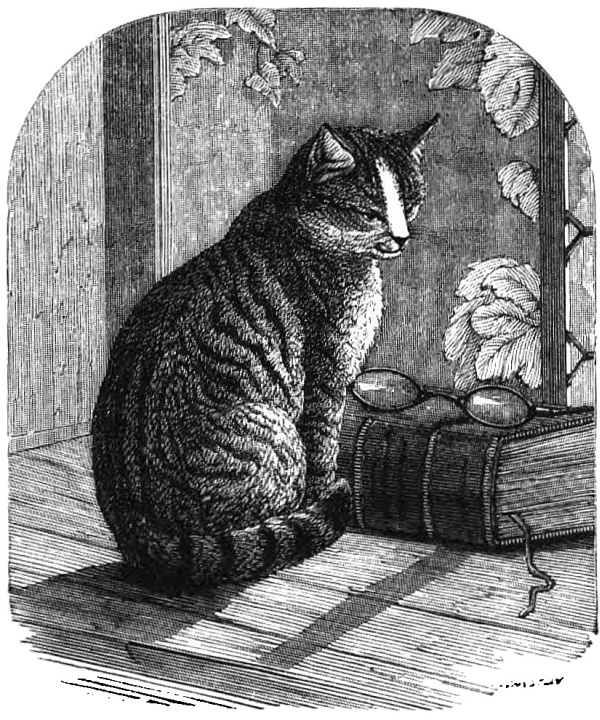
“The lines of some cats fall in pleasant places. Mine have. I’m the fireside favourite, I’m the parlour pet. I’m the beau idéal, so my mistress says, of what every decent, respectable, well-trained cat ought to be—and I looked in the glass and found it so. But pray don’t think that I am vain because I happen to know the usages of polite society, and the uses and abuses of the looking-glass. No cat, in my opinion, with any claim to the dignity of lady-puss, would think of washing her face unless in front of a plate-glass mirror. But I will not soon forget the day I first knew what a looking-glass meant. I was then only a silly little mite of a kitten, of a highly inquiring turn of mind. Well, one evening my young mistress was going to a ball, and before she went she spent about three hours in her dressing-room, doing something, and then she came down to the parlour, looking more like an angel than ever I had seen her. Oh, how she was dressed, to be sure. And she had little bunches of flowers stuck on all over her dress, and I wanted to play at ‘mousies’ with them; but she wouldn’t wait, she just kissed me and bade me be a good kitten and not run up the curtains, and then off she went. Yes; I meant to be an awfully good little kitten—but first and foremost I meant to see the interior of that mysterious room. By good luck the door was ajar, so in I popped at once, and made direct for the table. Such a display of beautiful things I had never seen before. I didn’t know what they all meant then, but I do now, for, mind you, I will soon be twenty years of age. But I got great fun on that table. I tried the gold rings on my nose, and the earrings on my toes, and I knocked off the lid of a powder-box, and scattered the crimson contents all abroad. Then I had a fearful battle with a puff which I unearthed from another box. During the fight a bottle of ylang-ylang went down. I didn’t care a bit. Crash went a bottle of flower-water next. I regarded it not. I fought the puff till it took refuge on the floor. Then I paused, wondering what I should do next, when behold! right in front of me and looking through a square of glass, and apparently wondering what it should do next, was the ugliest little wretch of a kitten ever you saw in your life—I marched up to it as brave as a button, and it had the audacity to come and meet me.
“‘You ugly, deformed little thing,’ I cried, ‘what do you want in my lady’s room?’
“‘The same to you,’ it seemed to say, ‘and many of them.’
“‘For two pins,’ I continued, ‘I would scratch your nasty little eyes out—yah—fuss-s!’
“‘Yah—fuss-s!’ replied the foe, lifting its left paw as I lifted my right.
“This was too much. I crept round the corner to give her a cuff. She wasn’t there! I came back, and there she was as brazen as ever. I tried this game on several times, but couldn’t catch her. ‘Then,’ says I, ‘you’ll catch it where you stand, in spite of the pane of glass!’
“I struck straight from the shoulder, and with a will too. Down went the glass, and I found I had been fighting all the time with my own reflection. Funny, wasn’t it?
“When mistress came home there was such a row. But she was sensible, and didn’t beat me. She took me upstairs, and showed me what I had done, and looked so vexed that I was sorry too. ‘It is my own fault, though,’ she said; ‘I ought to have shut the door.’
“She presented me with a looking-glass soon after this, and it is quite surprising how my opinion of that strange kitten in the mirror altered after that. I thought now I had never seen such a lovely thing, and I was never tired looking at it. No more I had. But first impressions are so erroneous, you know.
“My dear mother is dead and gone years ago—of course, considering my age, you won’t marvel at that; and my young mistress is married long, long ago, and has a grown family, who are all as kind as kind can be to old Tom, as they facetiously call me. And so they were to my mother, who, I may tell you, was only three days in her last illness, and gave up the ghost on a file of old newspapers (than which nothing makes a better bed), and is buried under the old pear-tree.
“Dear me, how often I have wondered how other poor cats who have neither kind master nor mistress manage to live. But, the poor creatures, they are so ignorant—badly-bred, you know. Why, only the other day the young master brought home a poor little cat he had found starving in the street. Well, I never in all my life saw such an ill-mannered, rude little wretch, for no sooner had it got itself stuffed with the best fare in the house, than it made a deliberate attempt to steal the canary. There was gratitude for you! Now, mind, I don’t say that I shouldn’t like to eat the canary, but I never have taken our own birds—no—always the neighbours’. I did, just once, fly at our own canary’s cage when I was quite a wee cat, but I didn’t know any better. And what do you think my mistress did? Why, she took the bird out of the cage and popped me in; and there I was, all day long, a prisoner, with nothing for dinner but seeds and water, and the canary flying about the room and doing what it liked, even helping itself to my milk. I never forgot that.
“Some cats, you know, are arrant thieves, and I don’t wonder at it, the way they are kicked and cuffed about, put out all night, and never offered food or water. I would steal myself if I were used like that, wouldn’t you, madam? But I have my two meals a day, regularly; and I have a nice double saucer, which stands beside my mirror, and one end contains nice milk and the other clean water, and I don’t know which I like the best. When I am downright thirsty, the water is so nice; but at times I am hungry and thirsty both, if you can understand me—then I drink the milk. At times I am allowed to sit on the table when my mistress is at breakfast, and I often put out my paw, ever so gently, and help myself to a morsel from her plate; but I wouldn’t do it when she isn’t looking. The other day I took a fancy to a nice smelt, and I just went and told my mistress and led her to the kitchen, and I got what I wanted at once.
“I am never put out at night. I have always the softest and warmest of beds, and in winter, towards morning, when the fire goes out, I go upstairs and creep (singing loudly to let her know it is I) into my mistress’s arms.
“If I want to go on the tiles any night, I have only to ask. A fellow does want to go on the tiles now and then, doesn’t he? Oh, it is a jolly thing, is a night on the tiles! One of these days I may give you my experience of life on the tiles, and then you’ll know all about it—in the meantime, madam, you may try it yourself. Let it be moonlight, and be cautious, you know, for, as you have only two feet, you will feel rather awkward at first.
“Did I ever know what it was to be hungry? Yes, indeed, once I did; and I’m now going to tell you of the saddest experience in all my long life. You see it happened like this. It was autumn; I was then about five years of age, and a finer-looking Tom, I could see by my mirror, never trod on four legs. For some days I had observed an unusual bustle both upstairs and downstairs. The servants, especially, seemed all off their heads, and did nothing but open doors and shut them, and nail up things in large boxes, and drink beer and eat cold meat whenever they stood on end. What was up, I wondered? Went and asked my mistress. ‘Off to the seaside, pussy Tom,’ said she; ‘and you’re going too, if you’re good.’ I determined to be good, and not make faces at the canary. But one night I had been out rather late at a cat-concert, and, as usual, came home with the milk in the morning. In order to make sure of a good sleep I went upstairs to an unused attic, as was my wont, and fell asleep on an old pillow. How long I slept I shall never know, but it must have been far on in the day when I awoke, feeling hungry enough to eat a hunter. As I trotted downstairs the first thing that alarmed me was the unusual stillness. I mewed, and a thousand echoes seemed to mock me. The ticking of the old clock on the stairs had never sounded to me so loud and clear before. I went, one by one, into every room. Nothing in any of them but the stillness, apparently, of death and desolation. The blinds were all down, and I could even hear the mice nibbling behind the wainscot.
“My heart felt like a great cold lump of lead, as the sad truth flashed upon my mind—my kind mistress had gone, with all the family, and I was left, forgotten, deserted! My first endeavour was to find my way out. Had I succeeded, even then I would have found my mistress, for cats have an instinct you little wot of. But every door and window was fastened, and there wasn’t a hole left which a rat could have crept through.
“What nights and days of misery followed!—it makes me shudder to think of them even now.
“For the first few days I did not suffer much from hunger. There were crumbs left by the servants, and occasionally a mouse crept out from the kitchen fender, and I had that. But by the fifth day the crumbs had all gone, and with them the mice, too, had disappeared. They nibbled no more in the cupboard nor behind the wainscot; and as the clock had run down there wasn’t a sound in the old house by night or by day. I now began to suffer both from hunger and thirst. I spent my time either mewing piteously at the hall-door, or roaming purposelessly through the empty house, or watching, watching, faint and wearily, for the mice that never came. Perhaps the most bitter part of my sufferings just then was the thought that would keep obtruding itself on my mind, that for all the love with which I had loved my mistress, and the faithfulness with which I had served her, she had gone away, and left, me to die all alone in the deserted house. Me, too, who would have laid down my life to please her had she only stayed near me.
“How slowly the time dragged on—how long and dreary the days, how terrible the nights! Perhaps it was when I was at my very worst, that I happened to be standing close by my empty saucer, and in front of my mirror. At that time I was almost too weak to walk; I tottered on my feet, and my head swam and moved from side to side when I tried to look at anything. Suddenly I started. Could that wild, attenuated image in the mirror be my reflection? How it glared upon me from its glassy eyes! And now I knew it could not be mine, but some dreadful thing sent to torture me. For as I gazed it uttered a yell—mournful, prolonged, unearthly—and dashed at me through and out from the mirror. For some time we seemed to writhe together in agony on the carpet. Then up again we started, the mirror-fiend and I. ‘Follow me fast!’ it seemed to cry, and I was impelled to follow. Wherever it was, there was I. How it tore up and down the house, yelling as it went and tearing everything in its way! How it rushed half up the chimney, and was dashed back again by invisible hands! How it flung itself, half blind and bleeding, at the Venetian blinds, and how madly it tried again to escape into the mirror and shivered the glass! Then mills began in my head—mills and machinery—and the roar of running waters. Then I found myself walking all alone in a green and beautiful meadow, with a blue sky overhead and birds and butterflies all about, a cool breeze fanning my brow, and, better than all, water, pure, and clear, and cool, meandering over brown smooth pebbles, beside which the minnows chased the sunbeams. And I drank—and slept.
“When I awoke, I found myself lying on the mat in the hall, and the sunlight shimmering in through the stained glass, and falling in patches of green and crimson on the floor. Very cold now, but quiet and sensible. There was a large hole in my side, and blood was all about, so I must have, in my delirium, torn the flesh from my own ribs and devoured it. (Note 1.)
“I knew now that death was come, and would set me free at last.
“Then the noise of wheels in my ears, and the sound of human voices; then a blank; and then some one pouring something down my throat; and I opened my eyes and beheld my dear young mistress. How she was weeping! The sight of her sorrow would have melted your heart. ‘Oh, pussy, pussy, do not die!’ she was crying.
“Pussy didn’t die; but till this day I believe it was only to please my dear mistress I crept back again to life and love.
“I’m very old now, and my thoughts dwell mostly in the past, and I like a cheery fire and a drop of warm milk better than ever. But I have all my faculties and all my comforts. We have other cats in the house, but I never feel jealous, for my mistress, look you, loves me better than all the cats in the kingdom—fact—she told me so.”
Note 1. Not overdrawn. A case of the kind actually occurred some years ago in the new town of Edinburgh.—The Author.
Chapter Twenty Three.
“Greyfriars’ Bobby”—“Pepper”—The Blind Fiddler’s Dog.
“Alas! for love if this were all, And nought beyond on earth.”
“A good story cannot be too often told,” said Frank one evening.
“Well, I doubt that very much,” said my wife; “there is a probability of a good story being spoiled by over-recital.”
“I’m of the same opinion,” I assented; “but as I intend the story of ‘Greyfriars’ Bobby’ to be printed in my next book, I will just read it over to you as I have written it.”
I had fain hoped, I began, to find out something of Bobby’s antecedents, and something about the private history of the poor man Grey, who died long before Bobby became a hero in the eyes of the world, and attracted the kindly notice of the good and noble William Chambers, then Lord Provost of Edinburgh. I have been unable to do so, however; even an advertisement in a local paper failed to elicit the information I so much desired.
What Mr Grey was, or who he was, no one can tell me. Some years ago, runs an account of this loving, faithful dog, a stranger arrived in Edinburgh bringing with him a little rough-haired dog, that slept in the same room with him, and followed him in his walks, but no one knew who the stranger was, or whence he came.
The following account of Bobby is culled from the Animal World of the second of May, 1870:—
“It is reported that Bobby is a small rough Scotch terrier, grizzled black, with tan feet and nose; and his story runs thus:—More than eleven years ago, a poor man named Grey died, and was buried in the old Greyfriars churchyard, Edinburgh. His grave is now levelled by time, and nothing marks it. But the spot had not been forgotten by his faithful dog. James Brown, the old curator, remembers the funeral well, and that Bobby was one of the most conspicuous of the mourners. James found the dog lying on the grave the next morning; and as dogs are not admitted he turned him out. The second morning the same; the third morning, though cold and wet, there he was, shivering. The did man took pity on him and fed him. This convinced the dog that he had a right there. Sergeant Scott, R.E., allowed him his board for a length of time, but for more than nine years he had been regularly fed by Mr Trail, who keeps a restaurant close by. Bobby is regular in his calls, being guided by the mid-day gun. On the occasion of the new dog-tax being raised, many persons, the writer amongst the number, wrote to be allowed to pay for Bobby, but the Lord Provost of Edinburgh exempted him, and, to mark his admiration of fidelity, presented him with a handsome collar, with brass nails, and an inscription:—‘Greyfriars’ Bobby, presented to him by the Lord Provost of Edinburgh, 1867.’ He has long been an object of curiosity, and his constant appearance in the graveyard has led to numberless inquiries about him. Many efforts have been made to entice him away, but unsuccessfully, and he still clings to the consecrated spot, and from 1861 to the present time he has kept watch thereon. Upon his melancholy couch Bobby hears the bells toll the approach of new inmates to the sepulchres around and about him; and as the procession solemnly passes, who shall say that the ceremony enacted over his dead master does not reappear before him? He sees the sobs and tears of the bereaved, and do not these remind him of the day when he stood with other mourners over the coffin which contained everything he loved on earth? In that clerical voice he rehears those slow and impressive tones which consigned his master’s body to ashes and dust. All these reminiscences are surely felt more or less; and yet Bobby, trustful, patient, enduring, continues to wait on the spot sacred to the memory of poor Grey. Poor Grey, did we say? Why, hundreds of the wealthiest amongst us would give a fortune to have placed upon their tombs a living monument of honour like this!—testifying through long years and the bitterest winters (with a blessed moral for mankind) that death cannot dissolve that love which love alone can evoke. When our eye runs over the gravestone records of departed goodness, we are sometimes sceptical whether there is not much mockery in many of the inscriptions, though the friends of the deceased have charitably erected an outward mark of their esteem. But here we have a monument that knows neither hypocrisy nor conventional respect, which appeals to us not in marble (the work of men’s hands), but in the flesh and blood of a living creature that cannot be tempted to desert his trust—in the devotion of a friend whose short wanderings to and fro prove how truly he gravitates to one yard of earth only—in the determination of a sentinel who means to die at his post.
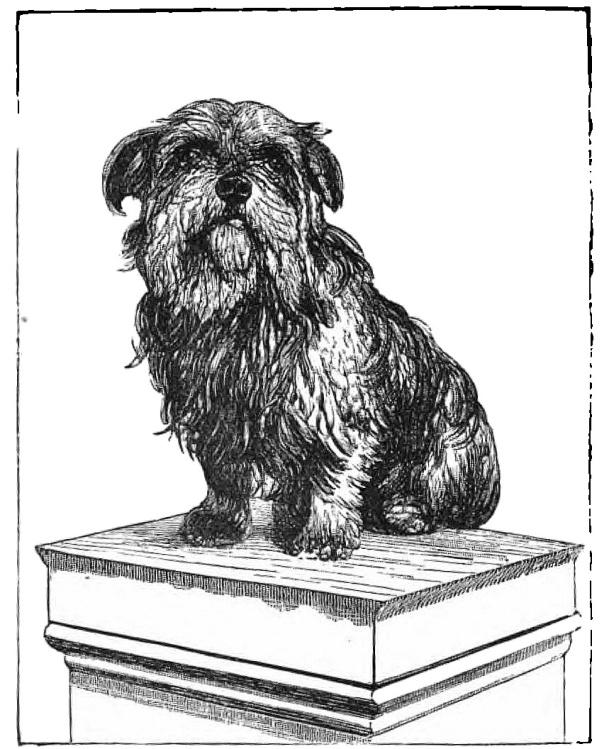
“I hear they say ’tis very lung That years hae come and gane, Sin’ first they put my maister here, An’ grat an’ left him lane. I could na, an’ I did na gang, For a’ they vexed me sair, An’ said sae bauld that they nor Should ever see him mair. “I ken he’s near me a’ the while, An’ I will see him yet; For a’ my life he tended me. An’ noo he’ll not forget. Some blithesome day I’ll hear his step; There’ll be nae kindred near; For a’ they grat, they gaed awa’,— But he shall find me here. “Is time sae lang?—I dinna mind; Is’t cauld?—I canna feel; He’s near me, and he’ll come to me, An’ sae ’tis very weel. I thank ye a’ that are sae kind, As feed an’ mak me braw; Ye’re unco gude, but ye’re no him— Ye’ll no wile me awa’. “I’ll bide an’ hope!—Do ye the same; For ance I heard that ye Had ay a Master that ye loo’d, An’ yet ye might na see; A Master, too, that car’d for ye, (O, sure ye winna flee!) That’s wearying to see ye noo—. Ye’ll no be waur than me?”
In the above account the words which I have italicised should be noted, viz, “a living creature that cannot be tempted to desert his trust, who means to die at his post.” These words were in a sense prophetic, for Bobby never did desert the graveyard where his master’s remains lie buried, until death stepped in to relieve his sorrows.
The following interesting letter is from Bobby’s guardian, Mr Trail, of Greyfriars Place, Edinburgh, who will, I feel sure, pardon the liberty I take in publishing it in extenso:—
“In answer to your note in reference to Greyfriars Bobby, I send the following extracts which state correctly the dates and other particulars concerning the little dog:—”
Scotsman, January 17th, 1872:—Many will be sorry to hear that the poor but interesting dog, Greyfriars Bobby, died on Sunday evening, January 14th, 1872. Every kind attention was paid to him in his last days by his guardian Mr Trail, who has had him buried in a flower plot near the Greyfriars Church. His collar, a gift from Lord Provost Chambers, has been deposited in the office at the church gate. Mr Brodie has successfully modelled the figure of Greyfriars Bobby, which is to surmount the very handsome memorial to be erected by the munificence of Baroness Burdett-Coutts.
“‘Edinburgh Veterinary College, March, 1872.
“‘To those who may feel interested in the history of the late Greyfriars Bobby, I may state that he suffered from disease of a cancerous nature affecting the whole of the lower jaw.
“‘Thomas Wallet.
“‘Professor of Animal Pathology.’
“There are several notices of an interesting nature in the following numbers of the Animal World concerning Greyfriars Bobby:—November 1st, 1869; May 2nd, 1870; February 1st, 1872; March 2nd, 1874.
“The fountain is erected at the end of George the Fourth Bridge, near the entrance to the Greyfriars churchyard. It is of Westmoreland granite, and bears the following inscription:—‘A tribute to the affectionate fidelity of Greyfriars Bobby.’
“In 1858, this faithful dog followed the remains of his master to Greyfriars churchyard, and lingered near the spot until his death in 1872. Old James Brown died in the autumn of 1868. There is no tombstone on the grave of Bobby’s master. Greyfriars Bobby was buried in the flower plot near the stained-glass window of the church, and opposite the gate.”
Poor Bobby, then, passed away on a Sunday evening, after watching near the grave for fourteen long years. He died of a cancerous affection of the lower jaw, brought on, doubtless, from the constant resting of his chin on the cold earth. I trust he did not suffer much. I feel convinced that Bobby is happy now; but no stone marks the humble grave where Bobby’s master lies. I wish it were otherwise, for surely there must have been good in the breast of that man whom a dog loved so dearly, and to whose memory he was faithful to the end.
The picture of Greyfriars Bobby here given is said to be a very good one, see page 239. You can hardly look at that wistful, pitiful little countenance, all rough and unkempt as it is, without feeling the whole truth of the story of Bobby’s faithfulness and love.
“Ah!” said Frank, when I had finished, “dogs are wonderful creatures.”
“No one knows how wonderful, Frank,” I said. “By the way, did ever you hear of, or read the account of, poor young Gough and his dog? The dog’s master perished while attempting to climb the mountain of Helvellyn. There had been a fall of snow, which partly hid the path and made the ascent dangerous. It was never known whether he was killed by a fall or died of hunger. Three months went by before his body was found, during which time it was watched over by a faithful dog which Mr Gough had with him at the time of the accident. The fidelity of the dog was the subject of a poem which Wordsworth wrote, beginning:—
“‘A barking sound the shepherd hears,’ etc.
“And now, Ida, I’ll change the tone of my chapter into a less doleful ditty, and tell you about another Scotch, or rather Skye-terrier, who was the means, in the hands of Providence, of saving life in a somewhat remarkable manner. Though I give the story partly in my own words, it was communicated to me by a lady of rank, who is willing to vouch for the authenticity of the incident.”
“Pepper.”
Pepper was our hero’s name. And Pepper was a dog; but I am unable to tell you anything about his birth or pedigree. I do not even know who Pepper’s father was, and I don’t think Pepper knew himself or cared much either; but had you seen him you would have had no hesitation in pronouncing him one of the handsomest little Skye-terriers ever you had beheld.
Pepper was presented to his mistress, the Hon. Mrs C—, by her mother-in-law, the late Lady Dun D—, and soon became a great favourite both with her and all the family. He was so cleanly in his habits, so brave and knightly, so very polite, and had a happy mixture of drollery and decorum about him which was quite charming! Every one liked Pepper. But “liked” is really not the proper word to express the strong affection which the lady portion of the household felt for him. They loved Pepper. That’s better. He was to them the “dearest and best fellow” in the world.
But woe is me that the best of friends must part. And so it came to pass that Pepper’s loving mistress had to go to town on business, or pleasure, or perhaps a mixture of both.
Now, everybody knows that the great wondrous world of London isn’t the place to keep dogs in, that is, if one wishes to see them truly happy and comfortable. For as they don’t wear shoes, as human beings do, they find the hard, stony streets very punishing to their poor little soft feet. Then they miss the green fields in which they used to romp, the hawthorn fences near which they used to find the hedgehog and mole, the crystal streams at which they were wont to quench their thirst, and the ponds in which they bathed or swam. Besides, there is danger for dogs in London. The danger of losing their way, the danger of being stolen, and the still greater danger of being run over by carts or carriages. But that isn’t all, for in the country you can keep even a long-haired Skye clean—clean enough, indeed, to sleep on the hearthrug, or even curl himself up on ottoman or couch, without his leaving any more mark or trace than my lady’s muff or the Persian pussy does; but a Skye-terrier in London is quite a different piece of furniture. London mud is proverbially black and sticky, and when a Skye gets thoroughly soused in it, why, not to put too fine a point on it, he isn’t just the sort of pet one would care to put under his head as a pillow.
Taking Pepper to London, therefore, would have involved endless washings of him, the risk of his catching cold, and, dreadful thought! the risk of offending the servants. True, he might be kept to the kitchen, but banished from the society of his dear mistress, and compelled to associate with servants and the kitchen cat; why, poor little Pepper would simply have broken his heart.
So the question came to be asked—
“Maggie, dear, what shall we do with Pepsy?”
“Oh! I have it,” said Maggie; “send him down to Brighton on a visit to dear Mrs W—y; she is such a kind creature, knows all the ways of animals so well; and, moreover, Pepper is on the best of terms with her already.”
So the proposal was agreed to, and a few days afterwards Mrs W—y received her little visitor very graciously indeed, and Pepper was pleased to express his approval of the welcome accorded him, and soon settled down, and became very happy in his Brighton home. His greatest delight was going out with his temporary mistress for a ramble; there was so much to be seen and inquired into, so many pretty children who petted him, so many ladies who admired him, and so many little doggies to see and talk to and exchange opinions on canine politics. But Pepper used to express his delight at going for a walk in a way which his new mistress deemed anything but dignified. People don’t generally care about having all eyes directed towards them on a public thoroughfare like the Brighton esplanade, or King’s Road. But Pepper didn’t care a bark who looked at him. He was intoxicated with joy, and didn’t mind who knew it; consequently, he used, when taken out, to go through a series of the most wonderful acrobatic evolutions ever seen at a seaside watering-place, or anywhere else. He jumped and barked, and chased his tail, rolled and tumbled, leapt clean over his own head and back again, and even made insane attempts to jump down his own throat. Inside, Pepper was content to romp and roll on the floor with a pet guinea-pig, and chase it or be chased by it round and round the room, or tenderly play with some white mice; but no sooner was his nose outside the garden gate, than Pepper felt himself in duty bound to take leave of his senses without giving a moment’s warning, and conduct himself in every particular just like a daft doggie, and had there been a lunatic asylum at Brighton for caninity, I haven’t a doubt that Pepper would have soon found himself an inmate of it.