A HISTORY (continued 7)
Reading edition
Anderson to Adjutant-General, Dec. 6, 1860. W.R. Vol. I., pp. 87, 88.
But, his duty was to obey, and so he resigned himself without a murmur to the hard conditions which had fallen to his lot. "I shall, nevertheless," adds Anderson, "knowing how excitable this community is, continue to keep on the qui vive and, as far as is in my power, steadily prepare my command to the uttermost to resist any attack that may be made.... Colonel Huger designs, I think, leaving Charleston for Washington to-morrow night. He is more hopeful of a settlement of impending difficulties without bloodshed than I am."
CHAPTER XXII THE PRESIDENT'S MESSAGE
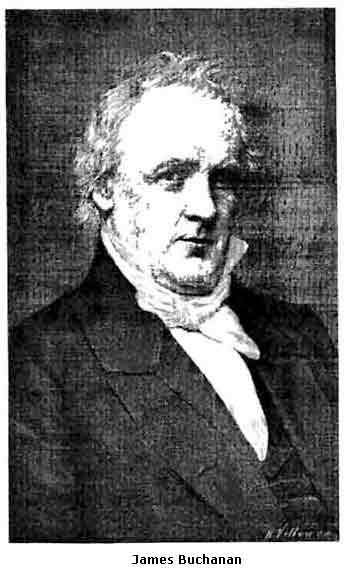
Less than a month intervened between the November election at which Lincoln had been chosen and the annual session of Congress, which would meet on the first Monday of December, and it was necessary at once to begin the preparation of the annual message. A golden opportunity presented itself to President Buchanan. The suffrages of his fellow-citizens had covered his political theories, his party measures, and his official administration with condemnation, in an avalanche of ballots.[1] But the Charleston conspirators had within a very few days created for him a new issue overshadowing all the questions on which he had suffered political wreck. Since the 6th of November the campaign of the Border Ruffians for the conquest of Kansas, and the wider Congressional struggle for the possession of the Territories, might be treated as things of the past. Even had they still been pending issues, they paled into insignificance before the paramount question of disunion. Face to face with, this danger, the adherents of Lincoln, of Douglas, of Bell, and the fraction of the President's own partisans in the free-States would be compelled to postpone their discords and as one man follow the constitutional ruler in a constitutional defense of the laws, the flag, and the territory of the Union.
Without change of position, without recantation of principle, without abatement even of declared party doctrine, honestly executing only the high mandate of the Constitution, he could turn from the old issues and take up the new. A single stride, and from the flying leader of a discomfited rout he might become the mailed hero of an overpowering host. Tradition, patriotism, duty, the sleepless monition of a solemn official oath, all summoned him to take this step, and the brilliant example set by President Jackson—an incident forever luminous in American history—assured him of the plaudits of posterity.
Unfortunately for himself and for his country, President Buchanan had neither the intellectual independence nor the courage required for such an act of moral heroism. Of sincere patriotism and of blameless personal rectitude, he had reached political eminence by slow promotion through seniority, not by brilliancy of achievement. He was a politician, not a statesman. Of fair ability, and great industry in his earlier life, the irresolution and passiveness of advancing age and physical infirmity were now upon him. Though from the free-State of Pennsylvania, he saw with Southern eyes and heard with Southern ears, and had convinced himself that the South was acting under the impulse of resentment arising from deliberate and persistent injuries from the North.
The fragment of an autograph diary of John B. Floyd, Secretary of War,[2] affords the exact evidence of the temper in which President Buchanan officially confronted the rebellion of the Southern States. The following are extracts from entries, on several days, beginning with November 7, 1860, the day following the Presidential election:
WASHINGTON CITY, November 7, 1860.
... The President wrote me a note this evening, alluding to a rumor which reached the city to the effect that an armed force had attacked and carried the forts in Charleston harbor. He desired me to visit him, which I did, and assured him that the rumor was altogether without foundation, and gave it as my opinion that there was no danger of such an attempt being made. We entered upon a general conversation upon the subject of disunion and discussed the probabilities of it pretty fully. We concurred in the opinion that all indications from the South looked as if disunion was inevitable. He said that whilst his reason told him there was great danger, yet his feelings repelled the conviction of his mind.
Judge Black, the Attorney-General, was present during a part of the conversation, and indicated an opinion, that any attempt at disunion by a State should be put down by all the power of the Government.[3]
November 9 ... A Cabinet meeting was held as usual at I o'clock; all the members were present, and the President said the business of the meeting was the most important ever before the Cabinet since his induction into office. The question, he said, to be considered and discussed, was as to the course the Administration should advise him to pursue in relation to the threatening aspect of affairs in the South, and most particularly in South Carolina. After a considerable amount of desultory conversation, he asked the opinions of each member of the Cabinet as to what should be done or said relative to a suggestion which he threw out. His suggestion was that a proposition should be made for a general convention of the States as provided for under the Constitution, and to propose some plan of compromising the angry disputes between the North and the South. He said if this were done, and the North or non-slaveholding States should refuse it, the South would stand justified before the whole world for refusing longer to remain in a confederacy where her rights were so shamefully violated. He said he was compelled to notice at length the alarming condition of the country, and that he would not shrink from the duty.
General Cass spoke with earnestness and much feeling about the impending crisis—admitted fully all the great wrongs and outrages which had been committed against the South by Northern fanaticism, and deplored it. But he was emphatic in his condemnation of the doctrine of secession by any State from the Union. He doubted the efficacy of the appeal for a convention, but seemed to think it might do well enough to try it. He spoke warmly in favor of using force to coerce a State that attempted to secede.
Judge Black, the Attorney-General, was emphatic in his advocacy of coercion, and advocated earnestly the propriety of sending at once a strong force into the forts in Charleston harbor, enough to deter, if possible, the people from, any attempt at disunion. He seemed to favor the idea of an appeal for a general convention of all the States.
Governor Cobb, the Secretary of the Treasury, declared his very decided approbation of the proposition for two reasons—first, that it afforded the President a great opportunity for a high and statesmanlike treatment of the whole subject of agitation, and the proper remedies to prevent it; secondly, because, in his judgment, the failure to procure that redress which the South would be entitled to and would demand (and that failure he thought certain), would tend to unite the entire South in a decided disunion movement. He thought disunion inevitable, and under present circumstances most desirable.
Mr. Holt, the Postmaster-General, thought the proposition for the convention dangerous, for the reason that if the call should be made and it should fail to procure redress, those States which now are opposed to secession might find themselves inclined, from a feeling of honor, to back the States resolving on disunion. Without this common demand and common failure he thought there would be no such danger of united action, and therefore a stronger prospect of some future plan of reconciliation.
Mr. Thompson, the Secretary of the Interior, thought well of the plan of calling for a general convention—thought his State (Mississippi) about equally divided between the union and disunion men. He deprecated the idea of force, and said any show of it by the Government would instantly make Mississippi a unit in favor of disunion.
Mr. Toucey, Secretary of the Navy, thought well of the appeal for the convention—coincided in an opinion I had expressed, that retaliatory State measures would prove most availing for bringing the Northern fanatics to their senses.
I expressed myself decidedly opposed to any rash movement, and against the idea of secession at this time. I did so because I think that Lincoln's administration will fail, and be regarded as impotent for good or evil within four months after his inauguration. We are to meet to-morrow at 1 o'clock.
Pollard, "Life and Times of Robert E. Lee," etc., pp. 790-94.
November 10 ... We had a Cabinet meeting to-day, at which the President read a very elaborate document, prepared either as a part of his message or as a proclamation. It was well written in the main, and met with extravagant commendation from General Cass, Governor Toucey, Judge Black, and Mr. Holt. Cobb, Thompson, and myself found much to differ from in it,—Cobb because it inculcated submission to Lincoln's election and intimated the use of force to coerce a submission to his rule, and because it reprehended the policy of the Kansas-Nebraska bill; Thompson because of the doctrine of acquiescence and the hostility to the secession doctrine. I objected to it because I think it misses entirely the temper of the Southern people and attacks the true State-Rights doctrine on the subject of secession. I do not see what good can come of the paper, as prepared, and I do see how much mischief may flow from it.
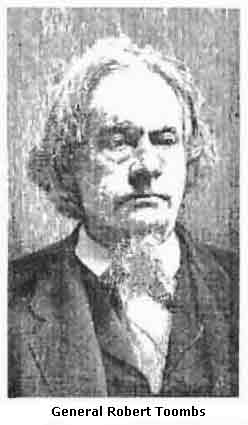
It is an open question whether we may accept these extracts at their full literal import. Either the words "coerce," "submission," "use of force," and so on, are written down by the diarist in a sense different from that in which they were spoken, or the President and several of his counselors underwent an amazing change of sentiment. But in a general way they show us that on the fourth day after Lincoln's election the Buchanan Cabinet was already divided into hostile camps. Cass of Michigan, Secretary of State, Toucey of Connecticut, Secretary of the Navy, Black of Pennsylvania, Attorney-General, and Holt of Kentucky, Postmaster-General, were emphatic Unionists; while Cobb of Georgia, Secretary of the Treasury, Thompson of Mississippi, Secretary of the Interior, and Floyd of Virginia, Secretary of War, were secessionists—the latter yet professing devotion to the Union, but with such ifs and buts as left sufficiently clear evidence of his inevitable drift to disloyalty.
All impulses of prudence and patriotism ought to have moved the President to reconstruct his Cabinet. But instead of some energetic executive act of this character, he seems to have applied himself to the composition of a political essay to teach the North its duty; as if his single pen had power to change the will of the people of the United States upon a point which they had decided by their votes only four days previously after six years of discussion. In the draft of this document, which he read to his Cabinet on November 10, we have the important record that "it inculcated submission to Lincoln's election, and intimated the use of force to coerce a submission to his rule"—positions which Floyd records were "met with extravagant commendations from General Cass, Governor Toucey, Judge Black, and Mr. Holt." This was a true touchstone; it instantly brought out not only the open secessionism of Cobb and Thompson, but the disguised disloyalty of Floyd.
It is a strange historical phenomenon that, with the President and a majority of the Cabinet in this frame of mind, the South should have been permitted to organize rebellion. The solution seems to lie in the temporizing feebleness of Buchanan and in the superior finesse and daring conspiracy of Cobb, Thompson, and Floyd.
Many indications make it evident that a long factional struggle took place over the preparation of the President's message. The telegraph announced several protracted Cabinet sessions; and as early as the 21st of November the points under discussion and the attitude of the President and his several official advisers were accurately foreshadowed in the newspapers. Nor were these momentous deliberations confined to the Cabinet proper. All the varieties of suggestion and contradictory counsels which were solicited or tendered we may never learn, and yet we know enough to infer the highest extremes and antagonisms of doctrine and policy. Jefferson Davis, the future chief of the rebellion, came on the one hand at the urgent call of his fellow-conspirators; Edwin M. Stanton, afterwards Buchanan's Attorney-General and Lincoln's Secretary of War,[4] was on the other hand called in by Mr. Buchanan himself, to help him through, the intricate maze of his perplexed opinions and inclinations. How many others may have come voluntarily or by summons it is impossible to guess. Many brains and hands, however, must have joined in the work, since the document is such a heterogeneous medley of conflicting theories, irreconcilable doctrines, impracticable and irrelevant suggestions. For at length the hesitating and bewildered President, unable to decide and impotent to construct, seems to have made his message a patchwork from the contributions of his advisers, regular and irregular, with the inevitable effect, not to combine and strengthen, but to weaken and confuse the warring thoughts and alien systems.
Aside from the mere recapitulation of department reports, the message of President Buchanan delivered to Congress on the 4th of December occupied itself mainly with two subjects—slavery and disunion. On the question of slavery it repeated the assertions and arguments of the Buchanan faction of the Democratic party during the late Presidential campaign, charging the present peril entirely upon the North. As a remedy it recommended an amendment to the Federal Constitution expressly[5] recognizing slavery in States which had adopted or might adopt it, and also expressly giving it existence and protection in the Federal Territories. The proposal was simply childish. Precisely this issue had been decided at the Presidential election; to do this would be to reverse the final verdict of the ballot-box.[6]
On the question of disunion or secession, the message raised a vague and unwarrantable distinction between the infractions of law and allegiance by individuals, and the infractions of law and allegiance by the commonwealth, or body politic denominated a State. Under the first head it held: That the Union was designed to be perpetual; that the Federal Government is invested with sovereign powers on special subjects, which can only be opposed or abrogated by revolution; that secession is unconstitutional, and is, therefore, neither more nor less than revolution; that the Executive has no right to recognize the secession of a State; that the Constitution has established a perfect government in all its forms, legislative, executive, and judicial, and this government, to the extent of its powers, acts directly upon the individual citizen of every State and executes its own decrees by the agency of its own officers; and, finally, that the Executive cannot be absolved from his duty to execute the laws.
But, continued the President, the laws can only be executed in certain prescribed methods, through the agency of courts, marshals, posse comitatus, aided, if necessary, by the militia or land and naval forces. The means and agencies, therefore, fail, and the performance of this duty becomes impraticable, when, as in South Carolina, universal public sentiment has deprived him of courts, marshals, and posse. Present laws being inadequate to overcome a united opposition, even in a single State, Congress alone has the power to decide whether they can be effectually amended.[7]
It will be seen from the above summary, that the whole of the President's rambling discussion of the first head of the disunion question resulted logically in three ultimate conclusions: (1) That South Carolina was in revolt; (2) that the Constitution, the laws, and moral obligation all united gave the Government the right to suppress this revolt by executing the laws upon and against the citizens of that State; (3) that certain defects in the laws paralyzed their practical enforcement.
Up to this point in his argument, his opinions, whatever may be thought of their soundness, were confined to the legitimate field of executive interpretation, and such as in the exercise of his official discretion he might with undoubted propriety communicate to Congress. But he had apparently failed to satisfy his own conscience in thus summarily reasoning the executive and governmental power of a young, compact, vigorous, and thoroughly organized nation of thirty millions of people into sheer nothingness and impotence. How supremely absurd was the whole national panoply of commerce, credit, coinage, treaty power, judiciary, taxation, militia, army and navy, and Federal fag, if, through the mere joint of a defective law, the hollow reed of a secession ordinance could inflict a fatal wound!
Appendix, "Globe," Dec. 3, 1860, p. 3.
The President proceeds, therefore, to discuss the second head of the disunion question, by an attempt to formulate and define the powers and duties of Congress with reference to the threatened rebellion. He would not only roll the burden from his own shoulders upon the National Legislature, but he would by volunteer advice instruct that body how it must be borne and disposed of. Addressing Congress, he says in substance: "You may be called upon to decide the momentous question, whether you possess the power by force of arms to compel a State to remain in the Union.... The question, fairly stated, is: Has the Constitution delegated to Congress the power to coerce a State into submission which is attempting to withdraw, or has actually withdrawn, from the Confederacy! If answered in the affirmative, it must be on the principle that the power has been conferred upon Congress to declare and make war against a State. After much serious reflection I have arrived at the conclusion that no such power has been delegated to Congress, or to any other department of the Federal Government.... It may be safely asserted that the power to make war against a State is at variance with the whole spirit and intent of the Constitution.... But if we possessed this power, would it be wise to exercise it under existing circumstances?... Our Union rests upon public opinion, and can never be cemented by the blood of its citizens shed in civil war.... Congress possesses many means of preserving it by conciliation; but the sword was not placed in their hand to preserve it by force."
Why did the message thus leap at one bound without necessary connection or coherence from the discussion of executive to those of legislative powers? Why waste words over doubtful theories when there was pressing need to suggest practical amendments to the statute whose real or imaginary defects Mr. Buchanan had pointed out? Why indulge in lamentations over the remote possibility that Congress might violate the Constitution, when the occasion demanded only prompt preventive orders from the Executive to arrest the actual threatened violation of law by Charleston mobs? Why talk of war against States when the duty of the hour was the exercise of acknowledged authority against insurrectionary citizens?
The issue and argument were wholly false and irrelevant. No State had yet seceded. Execute such laws of the United States as were in acknowledged vigor, and disunion would be impossible. Buchanan needed only to do what he afterwards so truthfully asserted Lincoln had done.[8] But through his inaction, and still more through his declared want of either power or right to act, disunion gained two important advantages—the influence of the Executive voice upon public opinion, and especially upon Congress; and the substantial pledge of the Administration that it would lay no straw in the path of peaceful, organized measures to bring about State secession.
Correspondence, N.Y. "Evening Post". London "Times," Jan. 9, 1851.
Washington "Constitution" of December 19, 1860.
The central dogma of the message, that while a State has no right to secede, the Union has no right to coerce, has been universally condemned as a paradox. The popular estimate of Mr. Buchanan's proposition and arguments was forcibly presented at the time by a jesting criticism attributed to Mr. Seward. "I think," said the New York Senator, "the President has conclusively proved two things: (1) That no State has the right to secede unless it wishes to; and (2) that it is the President's duty to enforce the laws unless somebody opposes him." No less damaging was the explanation put upon his language by his political friends. The recognized organ of the Administration said: "Mr. Buchanan has increased the displeasure of the Lincoln party by his repudiation of the coercion theory, and his firm refusal to permit a resort to force as a means of preventing the secession of a sovereign State." Nor were intelligent lookers-on in foreign lands less severe in their judgment: "Mr. Buchanan's message," said the London "Times," a month later, "has been a greater blow to the American people than all the rant of the Georgian Governor or the 'ordinances' of the Charleston Convention. The President has dissipated the idea that the States which elected him constitute one people."
CHAPTER XXIII THE CHARLESTON CONSPIRATORS
As President Buchanan might have foreseen, his inconsistent message proved satisfactory to neither friend nor foe. The nation was on the eve of rebellion and had urgent need of remedial acts, not of temporizing theories, least of all theories which at the late Presidential election had been rejected as errors and dangers. The message served as a topic to initiate debate in Congress; but this debate, resting only on the main subject long enough to cover the Chief Magistrate's views and recommendations as a whole, with almost unanimous expressions of dissent, and even of contempt, passed on to words of mutual defiance and open declarations of revolutionary purpose.
The conspirators in the Cabinet had done their work. By the official declarations of the President of the United States, the Government had tied its own hands—had resolved and proclaimed the duty and policy of non-resistance to organized rebellion. Henceforth disunionists, secessionists, nullifiers, and conspirators of every kind had but to combine under alleged State action, and through the instrumentalities of State Legislatures and State conventions cast off without let or hinderance their Federal obligations by resolves and ordinances. The semblance of a vote, a few scratches of the pen, a proclamation, and a new flag, and at once without the existence of a corporal's squad, or the smell of burnt powder, there would appear on the horizon of American politics, if not a de jure at least a de facto State!
If there had hitherto been any doubt or hesitation in the minds of the principal secession leaders of the South, it vanished under the declared policy of inaction of the Federal Administration. The President's message was a practical assurance of immunity from arrest and prosecution for treason. It magnified their grievances, specifically pointed out a contingent right and duty of revolution, acknowledged that mere public sentiment might override and nullify Federal laws, and pointedly bound up Federal authority in narrow legal and Constitutional restrictions. It was blind as a mole to find Federal power, but keen-eyed as a lynx to discover Federal impotence.
The leaders of secession were not slow to avail themselves of the favorable situation. Between the date of the message and the incoming of the new and possibly hostile Administration there intervened three full months. It was the season of political activity—the period during which legislatures meet, messages are written, and laws enacted. It afforded ample time to authorize, elect, and hold State conventions. Excitement was at fever heat in the South, and public sentiment paralyzed, despondent, and divided at the North.
Accordingly, as if by a common impulse, the secession movement sprang into quick activity and united effort. Within two months the States of South Carolina, Mississippi, Florida, Alabama, Georgia, Louisiana, and Texas, in the order named, by formal ordinances of conventions, declared themselves separated from the Union. The recommendation of Yancey's "scarlet letter" had been literally carried out; the Cotton States were precipitated into revolution.
In this movement of secession the State of South Carolina was the enthusiastic pioneer. At the date of the President's message she had already provided by law for the machinery of a convention, though no delegates had been elected. Nevertheless, her Legislature at once plunged pell-mell into the task of making laws for the new condition of independent sovereignty which by common consent the convention was in a few days to declare. Questions of army and navy, postal communication, and foreign diplomacy, for the moment eclipsed the baser topics of estray laws or wolf-scalp bounties, and the little would-be Congress fully justified the reported sarcasm of one of her leading citizens that "the Palmetto State was too small for a republic and too large for a lunatic asylum."
But, with all their outward fire and zeal for nationality, her politicians were restrained by an undercurrent of prudence. A revolution even under exceptional advantages is a serious thing.
Speech of Mr. Magrath in the South Carolina Convention, Dec. 19, 1860. "Annual Cyclopedia," 1861, p. 619.
Therefore the agitators of South Carolina scanned the President's message with unconcealed eagerness. In that paradox of assertions and denials, of purposes to act and promises to refrain, they found much to assure them, but also something to cause doubt. "As I understand the message of the President of the United States," explained Mr. Magrath to the South Carolina Convention, "he affirms it as his right, and constitutional duty, and high obligation to protect the property of the United States within the limits of South Carolina, and to enforce the laws of the Union within the limits of South Carolina. He says he has no constitutional power to coerce South Carolina, while at the same time he denies to her the right of secession. It may be, and I apprehend it will be, Mr. President, that the attempt to coerce South Carolina will be made under the pretense of protecting the property of the United States within the limits of South Carolina. I am disposed, therefore, at the very threshold to test the accuracy of this logic, and test the conclusions of the President of the United States."
"Mr. Buchanan's Administration," p. 126.
President Buchanan had indeed declared in his message that the Constitution gave the Federal Government no power to coerce a State. He had further said that the laws gave him no authority to execute civil or criminal process or suppress an insurrection with the help of the militia, or the army and navy, "in a State where no judicial authority exists to issue process, and where there is no marshal to execute it, and where, even if there were such an officer, the entire population would constitute one solid combination to resist him."
So far as mere political theories could go, this was certainly an important concession to the conspirators. In virtue of these doctrines, they could proceed, without danger to life and property, to hold conventions, pass secession ordinances, resign and refuse Federal offices, repudiate Northern debts, and effectively stop all Federal mails at the State line. But reading another passage in this paradoxical message of President Buchanan, they found these other propositions and purposes, involving a flat contradiction, and which with sufficient reason excited the apprehensions of Mr. Magrath and his fellow-conspirators. Said the message:
"The same insuperable obstacles do not lie in the way of executing the laws for the collection of the customs. The revenue still continues to be collected as heretofore at the custom-house in Charleston, and should the collector unfortunately resign, a successor may be appointed to perform this duty."
"Mr. Buchanan's Administration," p. 126.
"Then in regard to the property of the United States in South Carolina. This has been purchased for a fair equivalent 'by the consent of the Legislature of the State,' 'for the erection of forts, magazines, arsenals,' etc., and over these the authority 'to exercise exclusive legislation' has been expressly granted by the Constitution to Congress. It is not believed that any attempt will be made to expel the United States from this property by force; but if in this I should prove to be mistaken, the officer in command of the forts has received orders to act strictly on the defensive. In such a contingency the responsibility for consequences would rightfully rest upon the heads of the assailants."
It was, of course, in vain that Mr. Magrath and other South Carolina constitutional expounders protested against this absurd want of logic. It was in vain that they could demonstrate that protecting the property of the Union was but another name for coercion; that if the President could lawfully from another State appoint a successor to the Federal collector, he could in the same manner appoint a successor to the Federal judge, district attorney, and marshal; that if he could execute the revenue laws he could execute the steamboat laws, the postal laws, or the criminal laws; that if, with Federal bayonets, he could stop a mob at the door of the custom-house, he could do the same at the door of the court-room; that it would be no more offensive war to employ a regiment to protect a bonded warehouse than a jail; a shipping dock than a post-office; a dray-load of merchandise passing across a street than a mail car in transitu across a State; that coercing a Charleston belle to pay the custom duties on her silk gown, and a Palmetto orator to suffer the imposition of foreign tribute on his champagne was in fact destroying the whole splendid theory of exclusive State sovereignty.
It followed, therefore, that the issue was not one of constitutional theory, but of practical administration; not of legislation, but of war. The argument of the President's message was palpably illogical and ridiculous, but there in black and white stood his intention to collect the revenue and protect the public property; yonder in the bay were Pinckney, Moultrie, and Sumter; under the flag of the Union was a devoted band of troops and a brave officer, with orders to hold the fort.
For the present, then, the wall of Fort Moultrie was the iron collar around the neck of the coveted "sovereignty" of South Carolina. How to break that fetter was the narrow, simple problem. A half-finished inclosure of brick walls, standing in the midst of sand-hills which gave commanding elevations, and buildings which effectually masked the approach of an assaulting column, and containing, all told, but sixty men to guard 1500 feet of rampart. The street rabble of Charleston could any night clamber over the thinly defended walls, and at least a score of companies of minute men, drilled and equipped, could be brought by rail from the interior of the State to garrison and hold it. But what then? That would bring Federal troops in Federal ships of war, and in a short, quick struggle the substantial standing preparations of the Government would overcome the extemporized preparations of the State, and the insurrection would be hopelessly quelled.
Trescott's Narrative, Samuel Wylie Crawford, "Story of Sumter." pp. 28-30.
To prevent reënforcement was the vital point, and this had been clearly perceived and acted upon from the beginning. While the preparation of President Buchanan's message was yet under discussion the Cabinet cabal had earnestly deliberated upon the most effective intrigue to be employed to deter the President from sending additional troops to Charleston harbor. In pursuance of the scheme agreed upon by them in caucus, Trescott wrote a letter to Governor Gist suggesting that the Governor should write a letter "assuring the President that if no reënforcements were sent, there would be no attempt upon the forts before the meeting of the convention, and that then commissioners would be sent to negotiate all the points of difference; that their hands would be strengthened, the responsibility of provoking collision would be taken from the State, and the President would probably be relieved from the necessity of pursuing this policy." Governor Gist acted upon the suggestion and wrote, under date of November 29, back to Trescott (giving him liberty to show the letter to the President):
Gist to Trescott, Nov. 29, 1860. Crawford, p. 31.
Although South Carolina is determined to secede from the Federal Union very soon after her convention meets, yet the desire of her constituted authorities is, not to do anything that will bring on a collision before the ordinance of secession has been passed and notice has been given to the President of the fact; and not then, unless compelled to do so by the refusal of the President to recognize our right to secede, by attempting to interfere with our exports or imports, or by refusal to surrender the forts and arsenals in our limits. I have found great difficulty in restraining the people of Charleston from seizing the forts, and have only been able to restrain them by the assurance that no additional troops would be sent to the forts, or any munitions of war.... If President Buchanan takes a course different from the one indicated and sends on a reënforcement, the responsibility will rest on him of lighting the torch of discord, which will only be quenched in blood.
Trescott's Narrative, Crawford, pp. 34 (line 16) and 42 (lines 13-16).
Mr. Trescott showed this letter to the President on the evening of Sunday, December 2, and while his narrative does not mention any expression by Mr. Buchanan of either approval or dissent, his subsequent acts show a tacit acquiescence in Governor Gist's propositions.
There immediately followed by the leaders in Charleston, and their agents and spokesmen in Washington, the daily repetition of threats and complaints (thus originated by the latter), which were continued for nearly three and a half months. The purpose was twofold: first, by alternately exciting the fears and hopes of the Government to induce it to withhold reënforcement as a prudential measure of magnanimity and conciliation; secondly, to make it a cloak to hide, as far as might be, their own preparations for war. Had the Federal Government been in a condition of normal health and vigor, the farce would not have been effective for even a single day; but, with capital alarmed, with, parties divided into factions, with three traitors in the Cabinet, and a timid and vacillating Executive, by successive, almost imperceptible, degrees, the farce produced a policy and the policy led to an opening drama of civil war.
Leaving out of view anterior political doctrines and discussions, the first false step had been taken by the Administration in its doctrine of non-coercion, announced in the message; the second false step half logically resulting from the first, in its refusal on the first day of December to send Major Anderson the reënforcements he so urgently demanded. The Charlestonians clung to the concession with a tenacity which demonstrated their full appreciation of its value. Immediately there began to flow in upon Mr. Buchanan and his advisers, on the one hand magnified reports of the daily clamors of the Charleston mob, on the other hand encouraging intimations from the Charleston authorities that they, while adhering to their political heresies and demands, were yet averse to disorder and bloodshed, and to this end desired and invoked the utmost forbearance of the Government. Put in truthful language, their request would have been, "Help us keep the peace while we are preparing to break the law. Let the Government send no ships, men or supplies to the forts, in order that we may without danger or collision build batteries to take them. Armament by the Federal sovereignty is war, armament by State authority is peace." And it will forever remain a marvel that a President of the United States consented to this certain process of national suicide.
CHAPTER XXIV MR. BUCHANAN'S TRUCE
1860.
The concession yielded by Mr. Buchanan, instead of tending to conciliate the conspirators only brought upon him additional demands. It so happened that the principal Federal ships of war were absent from the harbors of the Atlantic coast on service in distant waters. But now, as a piece of good fortune amid many untoward occurrences, the steam sloop-of-war Brooklyn, a new and formidable vessel of twenty-five guns, which had been engaged in making preliminary surveys in the Chiriqui Lagoon to test the practicability of one of the proposed interoceanic ship canals, unexpectedly returned to the Norfolk navy yard on the 28th of November, less than a week before the meeting of Congress. She had until recently been under the command of Captain Farragut, afterwards famous in the war of the rebellion, and was, with trifling exceptions, ready for sea.
In the Cabinet, where the feasibility of collecting the customs revenue at Charleston on shipboard had already been discussed as a possible contingency, and especially where the forcible protection of the public property had also received serious consideration, this sudden appearance of the Brooklyn must have furnished a conclusive reason in favor of both these propositions. Be this as it may, when the President affirmed these duties in his message, the conspirators realized that he held the means of practical enforcement at instantaneous command. With a ship of war ready at Norfolk, with troops at Fortress Monroe, might not a careless émeute at Charleston bring the much-dreaded reënforcements to Moultrie, Sumter, and Pinckney, precipitate a dénouement, and prematurely ruin all their well-concocted schemes? There was urgent need to prevent the sailing of the steamer on such an errand.
Buchanan to Burnwell, Adams, and Orr, Dec. 31, 1860. W.R. Vol. I., p. 116.
On Saturday, December 8, four of the Representatives in Congress from South Carolina requested an interview of President Buchanan, which he granted them, in which they rehearsed their well-studied prediction of a collision at Charleston. One of their number has related the substance of their address with graphic frankness:
Hon. Wm. Porcher Miles, Statement before the South Carolina Convention, "Annual Cyclopedia," 1861, pp. 649-50.
"Mr. President, it is our solemn conviction that if you attempt to send a solitary soldier to these forts, the instant the intelligence reaches our people (and we shall take care that it does reach them, for we have sources of information in Washington so that no orders for troops can be issued without our getting information) these forts will be forcibly and immediately stormed.
"We all assured him that if an attempt was made to transport reënforcements, our people would take these forts, and that we would go home and help them to do it; for it would be suicidal folly for us to allow the forts to be manned. And we further said to him that a bloody result would follow the sending of troops to those forts, and that we did not believe that the authorities of South Carolina would do anything prior to the meeting of this convention, and that we hoped and believed that nothing would be done after this body met until we had demanded of the general Government the recession of these forts."
Here was an avowal to the President himself, not only of treason at Charleston, but of conspiracy in the Executive departments at Washington; a demand coupled with a menace; a proposal for a ten days' truce supplemented by a declaration of intention to proceed to extremities after its expiration. Instead of meeting these with a stern rebuke and dismissal, the President cowered and yielded to their demand. The sanctity of the Constitution, the majesty of the law, the power of the nation, the patriotism of the people, all faded from his bewildered vision; his irresolute will shrank from his declared purpose to protect the public property and enforce the revenue laws. He saw only the picture of strife and bloodshed which the glib tongues of his persecutors conjured up, and failed to detect the theatric purpose for which it was employed.
Buchanan to Commissioners, Dec. 31, 1860. W.R. Vol. I., p. 117.
He hastened to assure his visitors that it was his determination "not to reënforce the forts in the harbor, and thus produce a collision, until they had been actually attacked," or until he had "certain evidence that they were about to be attacked." Though this was only another concession, much like the first in outward semblance, it was nevertheless in its vital essence a fatal hurt to the rapidly shrinking Federal authority. The conspiracy had won the choice of position; when the combat should come it was in the attitude necessary to deal the first blow.
The main point secured, there was an exhibition of abundant diplomatic politeness between the parties. The President suggested that "for prudential reasons" it would be best to put in writing what they had said to him verbally. This they readily promised, and on Monday, the 10th, gave him, duly signed by five of the South Carolina Representatives, this important paper:
W.R. Vol. I., p. 116.
WASHINGTON, December 9, 1860.
In compliance with our statement to you yesterday, we now express to you our strong convictions that neither the constituted authorities nor any body of the people of the State of South Carolina will either attack or molest the United States forts in the harbor of Charleston previously to the action of the convention, and we hope and believe not until an offer has been made through an accredited representative to negotiate for an amicable arrangement of all matters between the State and Federal Government, provided that no reënforcements shall be sent into those forts, and their relative military status shall remain as at present.
Buchanan to Commissioners, Dec. 31, 1860. Ibid.
When President Buchanan came to look at the explicit language of this document, he shrank from the definite programme to which it committed him. "I objected to the word 'provided,' as it might be construed into an agreement on my part which I never would make. They said nothing was further from their intention; they did not so understand it, and I should not so consider it." There followed mutual protestations that the whole transaction was voluntary, informal, and in the nature of a mediation; that neither party possessed any delegated authority or binding power. They were not frank enough to explain to one another that the true object of each was delay—of the President, "that time might be gained for reflection"; of the Members, that time might be gained for the unmolested meeting of the convention, for passing the ordinance of secession, for further organizing public sentiment, and pushing forward military preparations at Charleston.
Buchanan to Commissioners, Dec. 31, 1860. W.R. Vol. I., p. 117.
The mask of official propriety worn over this pernicious intrigue, the disclaimers, the implications and mental reservations of which it was made up—all became absurd in view of the results it produced. The President, indeed, explains that it was no pledge or agreement. "But I acted," he naïvely admits, "in the same manner as I would have, done had I entered into a positive and formal agreement with parties capable of contracting, although such an agreement would have been, on my part, from the nature of my official duties, impossible. The world knows that I have never sent any reënforcements to the forts in Charleston harbor, and I have certainly never authorized any change to be made in their 'relative military status.'"
While the conspirators were thus taking effectual steps to bind the future acts of the Executive in respect to the forts in Charleston harbor, and to make sure that the rising insurrection in South Carolina should not be crippled or destroyed by any surprise or sudden movement emanating from Washington, they were not less watchful to counteract and prevent any possible hostile movement against them on the part of Major Anderson and his handful of officers and troops in Fort Moultrie, undertaken on his own discretion. Their boast of secret sources of information in Washington, coupled with subsequent events, furnish presumptive evidence that Mr. Floyd, Secretary of War, though yet openly opposing disunion, was already in their confidence and councils, and was lending them such active coõperation as might be disguised or perhaps still excused to his own conscience as tending to avert collision and bloodshed.
Shortly before, or about the time of the truce we have described, Secretary Floyd sent an officer of the War Department to Fort Moultrie with special verbal instructions to Major Anderson, which were duly communicated, and the substance of them reduced to writing and delivered to that officer on the 11th of December, the day following the conclusion of the President's unofficial truce at Washington. The importance of this document renders it worthy of reproduction in complete form.
Memorandum of verbal instructions to Major Anderson, 1st Artillery, commanding at Fort Moultrie, South Carolina:
You are aware of the great anxiety of the Secretary of War that a collision of the troops with the people of this State shall be avoided, and of his studied determination to pursue a course with reference to the military force and forts in this harbor which shall guard against such a collision. He has, therefore, carefully abstained from increasing the force at this point, or taking any measures which might add to the present excited state of the public mind, or which would throw any doubt on the confidence he feels that South Carolina will not attempt by violence to obtain possession of the public works or interfere with their occupancy. But as the counsel and acts of rash and impulsive persons may possibly disappoint these expectations of the Government, he deems it proper that you shall be prepared with instructions to meet so unhappy a contingency. He has, therefore, directed me verbally to give you such instructions.
Buchanan to Commissioners, Dec. 31, 1860. W.R. Vol. I., p. 117.
You are carefully to avoid every act which would needlessly tend to provoke aggression, and for that reason you are not, without evident and imminent necessity, to take up any position which could be construed into the assumption of a hostile attitude. But you are to hold possession of the forts in this harbor, and if attacked you are to defend yourself to the last extremity. The smallness of your force will not permit you, perhaps, to occupy more than one of the three forts, but an attack on or attempt to take possession of either one of them will be regarded as an act of hostility, and you may then put your command into either of them which you may deem most proper, to increase its power of resistance. You are also authorized to take similar defensive steps whenever you have tangible evidence of a design to proceed to a hostile act.
D.C. BUELL, Assistant Adjutant-General. FORT MOULTRIE, S.C., December 11, 1860.
This is in conformity to my instructions to Major Buell.
JOHN B. FLOYD, Secretary of War.
Doubleday, "Forts Sumter and Moultrie," p. 51.
Upon mere superficial inspection these instructions disclosed only the then dominant anxiety of the Administration to prevent collision. But if we remember that they were sent to Major Anderson without the President's knowledge, and without the knowledge of General Scott,[1] and especially if we keep in sight the state of public sentiment of both Charleston and Washington and the paramount official influences which had taken definite shape in the President's truce, we can easily read between the lines that they were most artfully contrived to lull suspicion while effectually restraining Major Anderson from any act or movement which might check or control the insurrectionary preparations. He must do nothing to provoke aggression; he must take no hostile attitude without evident and imminent necessity; he must not move his troops into Fort Sumter, unless it were attempted to attack or take possession of one of the forts or such a design were tangibly manifested. Practically, when the attempt to seize the vacant forts might come it would be too late to prevent it, and certainly too late to move his own force into either of them. Practically, too, any serious design of that nature would never be permitted to come to his knowledge. Supplement these literal negations and restrictions by the unrecorded verbal explanations and comments said to have been made by Major Buell, by his disapproval of the meager defensive preparations which had been made, such as his declaration that a few loop-holes "would have a tendency to irritate the people," and we can readily imagine how a faithful officer, whose reiterated calls for help had been refused, felt, that under such instructions, such surroundings, and such neglect "his hands were tied," and that he and his little command were a foredoomed sacrifice.[2]
CHAPTER XXV THE RETIREMENT OF CASS
Thus far Mr. Buchanan's policy of conciliation through concession had brought him nothing but disappointment, and whatever faint hope his loyal Cabinet advisers may have had at the outset in its saving efficacy was by practical experiment utterly destroyed. The non-coercion doctrine had been adopted as early as November 20, in the Attorney-General's opinion of that date. The fact was rumored, not only in the political circles of the capital, but in the chief newspapers of the country; and the three secession members of the Cabinet had doubtless communicated it confidentially to all their prominent and influential confederates. Since that time South Carolina had continued her preparation for secession with unremitting industry; Mississippi had authorized a convention and appointed commissioners to visit all the slave-States and propagate disunion, among them Mr. Thompson, Buchanan's Secretary of the Interior, who afterwards exercised this insurrectionary function while yet remaining in the Cabinet; the North Carolina Legislature had postponed the election of United States Senator; Florida had passed a convention bill; Georgia had instituted legislative proceedings to bring about a conference of the Southern States at Atlanta; both houses of the National Congress had rung with secession speeches, while frequent caucuses of the conspirators took place at Washington.
Cobb to Buchanan, "Washington Constitution," Dec. 12, 1860.
Mr. Buchanan's truce with the South Carolina Representatives had as little effect in arresting the secession intrigues as his non-coercion doctrine officially announced in the annual message. On the evening of the day (December 8)[1] on which he received the South Carolina pledge, the Secretary of the Treasury, Howell Cobb, of Georgia, tendered his resignation, announcing in the same letter his intention to embark in the active work of disunion. It had been generally understood that the non-coercion theories of the message were adopted by the President in deference to the wishes and under the influence of Cobb, Thompson, and Floyd, and undoubtedly they had also been largely instrumental in bringing about the unofficial truce at Charleston. If, amid all his fears, Mr. Buchanan retained any sensibility, he must have been profoundly shocked at the cool dissimulation with which Mr. Cobb, everywhere recognized as a Cabinet officer of great ability, had assisted in committing the Administration to these fatal doctrines and measures, and then abandoned it in the moment of danger. "My withdrawal," he wrote to the President, "has not been occasioned by anything you have said or done. Whilst differing from your message upon some of its theoretical doctrines, as well as from the hope so earnestly expressed that the Union can be preserved, there was no practical result likely to follow which required me to retire from your Administration. That necessity is created by what I feel it my duty to do; and the responsibility of the act, therefore, rests alone upon myself." Ignoring the fact that the Treasury was prosperous and solvent when he took charge of it, and that at the moment of his leaving it could not pay its drafts, Mr. Cobb, five days later, published a long and inflammatory address to the people of Georgia, concluding with this exhortation: "I entertain no doubt either of your right or duty to secede from the Union. Arouse, then, all your manhood for the great work before you, and be prepared on that day to announce and maintain your independence out of the Union, for you will never again have equality and justice in it."
G.T. Curtis, "Life of James Buchanan." Vol. II., p. 399.
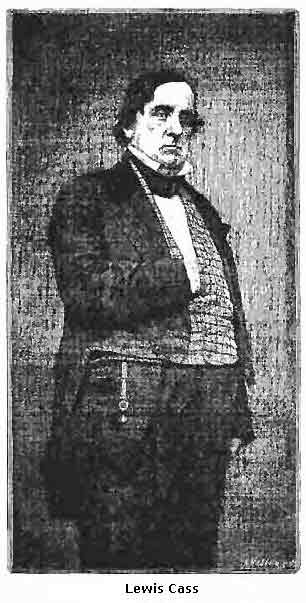
The President had scarcely found a successor for Mr. Cobb when the head of his Cabinet, Lewis Cass, Secretary of State, tendered his resignation also, and retired from the Administration. Mr. Cass had held many offices of distinction, had attained high rank as a Democratic leader, and had once been a Presidential candidate. His resignation was, therefore, an event of great significance from a political point of view. The incident brings into bold relief the mental reservations under which Buchanan's paradoxical theories had been concurred in by his Cabinet. A private memorandum, in Mr. Buchanan's handwriting, commenting on the event, makes the following emphatic statement: "His resignation was the more remarkable on account of the cause he assigned for it. When my late message (of December, 1860) was read to the Cabinet before it was printed, General Cass expressed his unreserved and hearty approbation of it, accompanied by every sign of deep and sincere feeling. He had but one objection to it, and this was, that it was not sufficiently strong against the power of Congress to make war upon a State for the purpose of compelling her to remain in the Union; and the denial of this power was made more emphatic and distinct upon his own suggestion."
See proceedings of convention in "Charleston Courier," Dec., 1860.
But this position was probably qualified and counterbalanced in his mind by the President's direct promise that he would collect the Federal revenue and protect the Federal property. In the nature of things the execution of this policy must not only precede but exclude all other theories and abstractions, and the Secretary of State probably waited in good faith to see the President "execute the laws." Little by little, however, delay and concession rendered this impossible. The collector at Charleston still nominally exercised his functions as a Federal officer; but it was an open secret among the Charleston authorities, and one which, must also by this time have become known to the Government at Washington, that he was only holding the place in trust for the coming secession convention. As to protecting the Federal property, the refusal to send Anderson troops, the President's truce, the gradual development of Mr. Buchanan's irresolution and lack of courage, and finally Mr. Cobb's open defection must have convinced Mr. Cass that, under existing determinations, orders, and influences, it was a hopeless prospect.
Floyd's Richmond Speech, N.Y. "Herald," Jan. 17, 1861, p. 2.
The whole question seems to have been finally decided in a long and stormy Cabinet session held on December 13. The events of the few preceding days had evidently shaken the President's confidence in his own policy. He startled his dissembling and conspiring Secretary of War with the sudden questions, "Mr. Floyd, are you going to send recruits to Charleston to strengthen the forts?" "Don't you intend to strengthen the forts at Charleston?" The apparent change of policy alarmed the Secretary, but he replied promptly that he did not. "Mr. Floyd," continued Mr. Buchanan, "I would rather be in the bottom of the Potomac to-morrow than that these forts in Charleston should fall into the hands of those who intend to take them. It will destroy me, sir, and, Mr. Floyd, if that thing occurs it will cover your name with an infamy that all time can never efface, because it is in vain that you will attempt to show that you have not some complicity in handing over those forts to those who take them."
The wily Secretary replied, "I will risk my reputation, I will trust my life that the forts are safe under the declarations of the gentlemen of Charleston." "That is all very well," replied the President, "but does that secure the forts?" "No, sir; but it is a guaranty that I am in earnest," said Floyd. "I am not satisfied," said the President.
Thereupon the Secretary made the never-failing appeal to the fears and timidity of Mr. Buchanan. He has himself reported the language he used: "I am sorry for it," said he; "you are President, it is for you to order. You have the right to order and I will consider your orders when made. But I would be recreant to you if I did not tell you that this policy of garrisoning the forts will lead to certain conflicts; it is the inauguration of civil war, and the beginning of the effusion of blood. If it is a question of property, why not put an ordnance sergeant into them—a man who wears worsted epaulets on his shoulders and stripes down his pantaloons—as the representative of the property of the United States. That will be enough to secure the forts. If it is a question of property, he represents it,[2] and let us wait until the issue is made by South Carolina. She will go out of the Union and send her commissioners here. Up to that point the action is insignificant. Action after this demands the attention of the great council of the nation. Let us submit the question to Congress—it is for Congress to deal with the matter."
Floyd's Richmond Speech, N.Y. "Herald," Jan. 17, 1861, p. 2.
This crafty appeal to the President's hesitating inclinations, and in accord with his policy hitherto pursued, was seconded by the active persuasions of the leading conspirators of Congress whom Floyd promptly called to his assistance. "I called for help from that bright Saladin of the South, Jefferson Davis, of Mississippi—and I said, 'Come to my rescue; the battle is a little more than my weak heart can support. Come to me;' and he came. Then came that old jovial-looking, noble-hearted representative from Virginia, James M. Mason. Here came that anomaly of modern times, the youthful Nestor, here came Hunter.... From the north, the south, the east, and the west there came up the patriots of the country, the champions of constitutional liberty, and they talked with the President of the United States, and they quieted his fears and assured him in the line of duty. They said, 'Let there be no force'; and the President said to me, 'I am content with your policy'; and then it was that we determined that we would send no more troops to the harbor in Charleston."
Strip this statement of its oratorical exaggeration, and the reader can nevertheless see, in the light of after occurrences, a vivid and truthful picture of a conspiring cabal, stooping to arts and devices difficult to distinguish from direct personal treachery, flattering, threatening, and coaxing by turns, and finally lulling the fears of the President, through his vain hope that they would help him tide over a magnified danger, and shift upon Congress a responsibility he had not the courage to meet.
Mr. Cass, however, could no longer be quieted. Through all the rhetoric, sophistry, and bluster of the conspirators he saw the diminishing resources of the Government and the rising power of the insurrection. With a last bold effort to rouse the President from his lethargy, he demanded, in the Cabinet meeting of the 13th, that the forts should be strengthened. But he was powerless to break the spell. Says Floyd: "The President said to him in reply, with a beautiful countenance and with a heroic decision that I shall never forget, in the council chamber, 'I have considered this question. I am sorry to differ from the Secretary of State; I have made up my mind. The interests of the country do not demand a reënforcement of the forces in Charleston. I cannot do it—and I take the responsibility of it upon myself.'"
The letters which were exchanged between the President and his premier set out the differences between them with the same distinctness. Mr. Cass, after premising that he concurred with the general principles laid down in the message, says:
Cass to Buchanan, Dec. 12, 1860. Curtis, "Life of Buchanan," Vol. II., p. 397.
In some points which I deem of vital importance, it has been my misfortune to differ from you. It has been my decided opinion, which for some time past I have urged at various meetings of the Cabinet, that additional troops should be sent to reënforce the forts in the harbor of Charleston, with a view to their better defense, should they be attacked, and that an armed vessel should likewise be ordered there, to aid, if necessary, in the defense, and also, should it be required, in the collection of the revenue; and it is yet my opinion that these measures should be adopted without the least delay. I have likewise urged the expediency of immediately removing the custom-house at Charleston to one of the forts in the port, and of making arrangements for the collection of the duties there, by having a collector and other officers ready to act when necessary, so that when the office may become vacant the proper authority may be there to collect the duties on the part of the United States. I continue to think that these arrangements should be immediately made. While the right and the responsibility of deciding belong to you, it is very desirable that at this perilous juncture there should be, as far as possible, unanimity in your councils, with a view to safe and efficient action.
To this statement the President replied:
Buchanan to Cass, Dec. 15, 1860. Curtis, "Life of Buchanan," Vol. II, p. 398.
The question on which we unfortunately differ is that of ordering a detachment of the army and navy to Charleston, and is correctly stated in your letter of resignation. I do not intend to argue this question. Suffice it to say that your remarks upon the subject were heard by myself and the Cabinet, with all the respect due to your high position, your long experience, and your unblemished character; but they failed to convince us of the necessity and propriety, under existing circumstances, of adopting such a measure. The Secretaries of War and of the Navy, through, whom the orders must have issued to reenforce the forts, did not concur in your views; and whilst the whole responsibility for the refusal rested upon myself, they were the members of the Cabinet more directly interested. You may have judged correctly on this important question, and your opinion is entitled to grave consideration; but under my convictions of duty, and believing as I do that no present necessity exists for a resort to force for the protection of the public property, it was impossible for me to have risked a collision of arms in the harbor of Charleston, and thereby defeated the reasonable hope which I cherish of the final triumph, of the Constitution and of the Union.
Holt, conversation with J.G.N., 1874.
The other Union members of the Cabinet received the rumor of Mr. Cass's resignation with gloomy apprehensions. Postmaster-General Holt, with whom by reason of their kindred opinions he had been on intimate terms, hastened to him to learn whether it were indeed true and whether his determination were irrevocable. Cass confirmed the report, saying that representing the Northern and loyal constituency which he did, he could no longer without dishonor to himself and to them remain in such treasonable surroundings. Holt endeavored to persuade him that under the circumstances it was all the more necessary that the loyal members of the Cabinet should remain at their posts, in order to prevent the country's passing into the hands of the secessionists by mere default. But Cass replied, No; that the public feeling and sentiment of his section would not tolerate such a policy on his part. "For you," he said, "coming from a border State, where a modified, perhaps a divided, public sentiment exists, that is not only a possible course, but it is a true one; it is your duty to remain, to sustain the Executive and counteract the plots of the traitors. But my duty is otherwise; I must adhere to my resignation."
In this honorable close of a long public career, General Cass gave evidence of the spirit which was to actuate many patriotic Democrats when the final ordeal came. It was to be regretted that he had not taken issue with his chief when his paradoxical message was read to the Cabinet, but much is to be allowed to the inertness of a man in his seventy-ninth year. Life-long placeman and unflinching partisan that he was, there was still so much of patriotic conscience in him that he could not stand by and see premeditated dishonor done to the flag he had followed in his youth and as Jackson's Secretary of War upheld in his maturer years. If Mr. Buchanan had been capable of amendment, he might have learned a salutary lesson from the manner in which this veteran politician ended his half century of public service.
"The President's objection to this was, that it was his bounden duty to preserve and protect the property of the United States. To this I replied, with all the earnestness the occasion demanded, that I would pledge my life that, if an inventory were taken of all the stores and munitions in the fort, and an ordnance sergeant with a few men left in charge of them, they would not be disturbed."
CHAPTER XXVI THE SENATE COMMITTEE OF THIRTEEN
The President's message provoked immediate and heated controversy in Congress. In the Senate the battle was begun by the radical secessionists, who at once avowed their main plans and purposes. Mr. Clingman, of North Carolina, opening the debate, predicted that the same political organization which had elected Lincoln must soon control the entire Government, and being guided by a sentiment hostile to the Southern States would change the whole character of the Government without abolishing its forms. A number of States would secede within the next sixty days.
Mr. Brown, of Mississippi, said the accumulating wrongs of years had finally culminated in the triumph of principles to which they could not and would not submit. All they asked was to be allowed to depart in peace.
"Globe," Dec. 5 1860, p. 11.
Mr. Iverson, of Georgia, invoking not only secession, but revolution and assassination, announced specifically the hopes of the conspirators. "I am satisfied that South Carolina will resolve herself into a separate sovereign and independent State before the Ides of January; that Florida and Mississippi, whose conventions are soon to meet, will follow the example of South Carolina, and that Alabama ... will go out of the Union on the 7th of January. Then the Georgia Convention follows on the 16th of that month; and if these other surrounding sisters shall take the step, Georgia will not be behind ... I speak what I believe on this floor, that before the 4th of March five of the Southern States at least will have declared their independence; and I am satisfied that three others of the Cotton States will follow as soon as the action of the people can be had. Arkansas, whose Legislature is now in session, will in all probability call a convention at an early day. Louisiana will follow. Her Legislature is to meet; and although there is a clog in the way of the lone star State of Texas, in the person of her Governor, ... if he does not yield to public sentiment, some Texan Brutus will arise to rid his country of the hoary-headed incubus that stands between the people and their sovereign will. We intend, Mr. President, to go out peaceably if we can, forcibly if we must."
"Globe," Dec. 5, 1860, p. 14.
Senator Wigfall, of Texas, took a high revolutionary attitude. "We simply say that a man who is distasteful to us has been elected and we choose to consider that as a sufficient ground for leaving the Union." He said he should "introduce a resolution at an early moment to ascertain what are the orders that have gone from the War Department to the officers in command of those forts" at Charleston. If the people of South Carolina believed that this Government would hold those forts, and collect the revenues from them, after they had ceased to be one of the States of this Union, his judgment was that the moment they became satisfied of that fact they would take the forts, and blood would then begin to flow.
Ibid., Dec. 10, 1860, p. 35.
Mr. Mason, of Virginia, said he looked upon the evil as a war of sentiment and opinion by one form of society against another form of society. The remedy rested in the political society and State councils of the several States and not in Congress. His State and a great many others of the slaveholding States were going into convention with a view to take up the subject for themselves, and as separate sovereign communities to determine what was best for their safety.
Ibid., Dec. 5, 1860, p. 12.
Senator Jefferson Davis, of Mississippi, was more reticent and politic, though no less positive and significant in his brief expressions. As a Senator of the United States he said he was there to perform his functions as such; that before a declaration of war was made against the State of which he was a citizen he expected to be out of the Chamber; that when that declaration was made his State would be found ready and quite willing to meet it.
"Globe," Dec. 5, 1860, p. 9.
The Republican Senators maintained for the greater part a discreet silence. To exult in their triumph would be undignified; to hasten forward officiously with offers of pacification or submission, and barter away the substantial fruits of their victory, would not only make them appear pusillanimous in the eyes of their own party, but bring down upon them the increased contempt of their assailants. There remained therefore nothing but silence and the feeble hope that this first fury of the disunion onset might spend itself in angry words, and be followed by calmer counsels. Nevertheless, it was difficult to keep entirely still under the irritating provocation. On the third day of the session, Senator Hale, of New Hampshire, replied to both the President's message and Clingman's speech. Mr. Hale thought "this state of affairs looks to one of two things; it looks to absolute submission, not on the part of our Southern friends and the Southern States but of the North—to the abandonment of their position; it looks to a surrender of that popular sentiment which has been uttered through the constituted forms of the ballot-box; or it looks to open war. We need not shut our eyes to the fact. It means war, and it means nothing else; and the State which has put herself in the attitude of secession so looks upon it.... If it is preannounced and determined that the voice of the majority expressed through the regular and constituted forms of the Constitution will not be submitted to, then, sir, this is not a Union of equals; it is a Union of a dictatorial oligarchy on the one side, and a herd of slaves and cowards on the other. That is it, sir; nothing more, nothing less."
While the Southern Democratic party and the Republican party thus drifted into defiant attitudes the other two parties to the late Presidential contest naturally fell into the rôle of peacemakers. In this work they were somewhat embarrassed by their party record, for they had joined loudly in the current charge of "abolitionism" against the people of the North, and especially against the Republican party. Nevertheless, they not only came forward to tender the olive branch, and to deprecate and rebuke the threats and extreme measures of the disunionists, but even went so far as to deny and disapprove the staple complaints of the conspirators.
"Globe," Dec. 4, 1860, p. 5.
It must be remembered to the lasting honor of Senator Crittenden that at the very outset of the discussion he repudiated the absurd theory of noncoercion. "I do not agree that there is no power in the President to preserve the Union; I will say that now. If we have a Union at all, and if, as the President thinks, there is no right to secede on the part of any State (and I agree with him in that), I think there is a right to employ our power to preserve the Union."
Ibid., Dec. 11, 1860, pp. 51, 52.
Senator Pugh, of Ohio, saying that he lived on the border of the slave-holding and non-slave-holding States, contended that the fugitive-slave law was executed every day, or nearly every day. It was in constant operation. He would venture to say that the slave-States had not lost $100,000 worth of slave property since they had been in the Union, through negligence or refusal to execute it.
"Globe," Dec. 11, 1860, p. 52.
Senator Douglas, of Illinois, said he supposed the fugitive-slave law was enforced with quite as much fidelity as that in regard to the African slave trade or the laws on many other subjects. "It so happens that there is the greatest excitement upon this question just in proportion as you recede from the line between the free and the slave-States.... If you go North, up into Vermont where they scarcely ever see a slave and would not know how he looked, they are disturbed by the wrongs of the poor slave just in proportion as they are ignorant of the South. When you get down South, into Georgia and Alabama, where they never lose any slaves, they are disturbed by the outrages and losses under the non-fulfillment of the fugitive-slave law just in proportion as they have no interest in it, and do not know what they are talking about."
Ibid., Dec. 10, 1860, p. 24.
Meanwhile, Senator Powell, of Kentucky, having given notice on the 5th, had on the 6th of December introduced a resolution to raise a special committee (afterwards known as the Senate Committee of Thirteen) to concert measures of compromise or pacification, either through legislation or Constitutional amendments. He said, however, he did not believe any legislation would be a remedy. Unequivocal constitutional guarantees upon the points indicated in the resolution under consideration were in his judgment the only remedies that would reach and eradicate the disease, give permanent security, and restore fraternal feeling between the people, North and South, and save the Union from speedy dissolution. "Let us never despair of the republic, but go to work promptly and so amend the Constitution as to give certain and full guarantees to the rights of every citizen, in every State and Territory of the Union."
"Globe," Dec. 10, 1860, p. 25. Ibid.
Ibid., p. 28. Ibid., p. 34.
The Republicans on this resolution generally offered only verbal criticisms or expressed their full approbation of its provisions. Senator King, of New York, offering an amendment, explained that while we hear occasionally of a mob destroying property, we also hear occasionally of a mob which assails an individual. He thought the security of person as important as that of property, and would therefore extend the inquiry to all these objects, if made at all. Senator Collamer, of Vermont, suggested striking out all about the condition of the country and the rights of property, and simply referring that part of the message which relates to the state of the Union to a special committee. Senator Foster, of Connecticut, said if there was a disposition here to promote the peace and harmony of the country, the resolution was a most appropriate one under which to make the effort. Senator Hale, of New Hampshire, said he was willing to meet any and everybody and say that if there can be pointed out anything in which the State that he represented had come short of her whole constitutional duty in letter and in spirit, she will do what she never did in the face of an enemy, and that is take a backward step. She was ready to perform her whole constitutional duty, and to stand there.
"Globe," Dec. 1860, pp. 25, 26.
Senator Green, of Missouri, while he joined in the general cry of Northern anti-slavery aggression and neglect of constitutional obligations, deemed it his duty to assist in making a united effort to save the Union. If he believed the present state of public sentiment of the North was to be enduring, he would say it is folly to talk about patching up the Union; but he looked forward to a reaction of public sentiment. Amendments to the Constitution, legal enactments, or repeal of personal liberty laws are not worth a straw unless the popular sentiment or the strong arm of the Government goes with them. He proposed to employ adequate physical force to maintain existing constitutional rights. He did not want any additional constitutional rights. He offered a resolution to inquire into the propriety of providing by law for establishing an armed police force, upon all necessary points along the line separating the slave-holding States from the non-slave-holding States, for the purpose of maintaining the general peace between those States; of preventing the invasion of one State by the citizens of another, and also for the efficient execution of the fugitive-slave law.
Ibid., pp. 28-30.
Senator Jefferson Davis, of Mississippi, denounced this proposition as a quack nostrum. He feared it was to rear a monster which would break the feeble chain provided, and destroy the rights it was intended to guard. Establishing military posts along the borders of States conferred a power upon this Federal Government, which it does not now possess, to coerce a State; it was providing, under the name of Union, to carry on war against States. From the history and nature of our government no power of coercion exists in it.
Ibid., p. 33.
Senator Brown, also of Mississippi, was no less emphatic in his condemnation of the scheme. He said, that a Southern Senator representing a State as much exposed as Missouri should deliberately, in times like these, propose to arm the Federal Government for the purpose of protecting the frontier, to establish military posts all along the line, struck him with astonishment. He saw in this proposition the germ of a military despotism. He did not know what was to become of these armies, or what was to be done with these military posts. He feared in the hands of the enemy they might be turned against the South; they would hardly ever be turned against the North.
"Globe," Dec. 10, 1860, pp. 30, 31.
Senator Green, in his reply, justly exposed the whole animus and thinly concealed import of these rough criticisms, by retorting that, to call that a military despotism amounts to just this: we are going out of the Union, right or wrong, and we will misrepresent every proposition made to save the Union. Who has fought the battles of the South for the last twenty-five years, and borne the brunt of the difficulty upon the border? Missouri, Kentucky, Virginia, and Maryland, while Mississippi and Louisiana have been secure; and while you have lost but one boxed-up negro, sent on board a vessel, that I remember, we have lost thousands and thousands. He knew it was unpopular in some sections to say a word for the Union. He hoped that feeling would react. Means to enforce and carry out the Constitution ought not to be ridiculed by calling it a quack remedy.
It is more likely that we may find in the response of Senator Iverson, of Georgia, the true reason which actuated the Cotton-State leaders in driving their people into revolution, regardless of the remonstrances of the border States.
Sir, the border slave-States of this Union complain of the Cotton States for the movement which is now in progress. They say that we have no right to take them out of the Union against their will. I want to know what right they have to keep us in the Union against our will. If we want to go out let us go. If they want to stay let them stay. They are sovereign and independent States, and have a right to decide these questions for themselves. For one, I shall not complain when, where, or how they go. I am satisfied, however, that they will go, when the time comes for them to decide. But, sir, they complain of us that we make so much noise and confusion on the subject of fugitive slaves, when we are not affected by the vitiated public sentiment of the Northern States. They say that we do not lose fugitive slaves; but they suffer the burden. We heard that yesterday. I know that we do not suffer in this respect; it is not the want of good faith in the Northern people, so far as the reclamation of fugitive slaves is concerned, that is causing the Southern States around the Gulf of Mexico and the Southern Atlantic coast to move in this great revolution now progressing. Sir, we look infinitely beyond this petty loss of a few negroes. We know what is coming in this Union. It is universal emancipation and the turning loose upon society in the Southern States of the mass of corruption which will be made by emancipation. We intend to avoid it if we can. These border States can get along without slavery. Their soil and climate are appropriate to white labor; they can live and nourish without African slavery; but the Cotton States cannot. We are obliged to have African slavery to cultivate our cotton, our rice, and our sugar fields. African slavery is essential not only to our prosperity, but to our existence as a people....
"Globe," Dec. 11, 1860, pp. 49-51.
I understand one of the motives which influence the tardy action of these two States [Virginia and Maryland], They are a little afraid of the opening of the African slave trade, and the cheapening of negroes. Now, sir, while I state here that I am opposed to the opening of the African slave-trade, because our negroes will increase fast enough, God knows, for our interest and protection and security; and while I believe that the great masses of the Southern people are opposed to it, yet I will not stand security that if the Cotton States alone form a confederacy they will not open the African slave-trade; and then what will become of the great monopoly of the negro market which Virginia and Maryland and North Carolina now possess?
The disunion Senators, while indulging in the violent and uncompromising language already quoted, had nevertheless here and there interjected phrases indicating a willingness to come to an understanding and adjustment, but their object in this seemed to be twofold: for a few days longer it would serve as a partial screen to their more active conspiracy, and in the possible event (which they evidently did not expect) of a complete surrender and abdication of their political victory by the Republican party, it would leave them in the advantageous condition of accepting triumph as a fruit of compromise.
"Globe," Dec. 4, 1860, p. 4. Ibid., Dec. 10, 1860, p. 29.
Ibid., p. 34. Ibid., Dec. 12, 1860, p. 72.
Thus, Senator Clingman said, "If gentlemen on the other side have anything to propose of a decisive and satisfactory character, I have no doubt the section from which I come would be willing to hear it." Senator Davis said, "If we are mistaken as to your feelings and purposes, give a substantial proof, that here may begin that circle which hence may spread out and cover the whole land with proofs of fraternity, of a reaction in public sentiment, and the assurance of a future career in conformity with the principles and purposes of the Constitution." Senator Brown said he never intimated they would not listen to appeals; he never said this case could not be adjusted; but he said there was no disposition on the Republican side to do it. Senator Wigfall said, "What is the use of our discussing on this side of the Chamber what we would be satisfied with when nothing has been offered us!"
It requires a minute search to find these scattered words of moderation in the torrent of defiance which characterized the speeches of the extreme disunionists during the first ten days of the session of Congress, and indications were not lacking that even these were wholly insincere, and meant only to mislead their opponents and the public. Strong proof of this is found in the careful speech of Senator Jefferson Davis, in which he lays down the issue without reserve, at the same time dealing in such vague and intangible complaints as showed intention and desire to remain unanswered and unsatisfied.. He said he believed the danger to be that a sectional hostility had been substituted for the general fraternity, and thus the Government rendered powerless for the ends for which it was instituted.
The hearts of a portion of the people have been perverted by that hostility, so that the powers delegated by the compact of union are regarded not as means to secure the welfare of all, but as instruments for the destruction of a part—the minority section. How, then, have we to provide a remedy? By strengthening this Government? By instituting physical force to overawe the States, to coerce the people living under them as members of sovereign communities to pass under the yoke of the Federal Government?...
"Globe," Dec. 10, 1860, p. 29.
Then where is the remedy, the question may be asked. In the hearts of the people is the ready reply; and therefore it is that I turn to the other side of the Chamber, to the majority section, to the section in which have been committed the acts that now threaten the dissolution of the Union.... These are offenses such as no people can bear; and the remedy for these is in the patriotism and the affection of the people, if it exists; and if it does not exist, it is far better, instead of attempting to preserve a forced and therefore fruitless union, that we should peacefully part, and each pursue his separate course.... States in their sovereign capacity have now resolved to judge of the infractions of the Federal compact and of the mode and measure of redress.... I would not give the parchment on which the bill would be written which is to secure our constitutional rights within the limits of a State where the people are all opposed to the execution of that law. It is a truism in free governments that laws rest upon public opinion, and fall powerless before its determined opposition.
To all that had so far been said, Senator Wade, of Ohio, made, on the 17th day of December, a frank and direct as well as strong and eloquent reply, which was at once generally accepted by the Republican party of the Senate and the country as their well-considered and unalterable position on the crisis. Said he:
I have already said that these gentlemen who make these complaints have for a long series of years had this Government in their own keeping. They belong to the dominant majority.... Therefore, if there is anything in the legislation of the Federal Government that is not right, you and not we are responsible for it.... You have had the legislative power of the country, and you have had the executive of the country, as I have said already. You own the Cabinet, you own the Senate, and I may add, you own the President of the United States, as much as you own the servant upon your own plantation. I cannot see then very clearly why it is that Southern men can rise here and complain of the action of this Government.... Are we the setters forth of any new doctrines under the Constitution of the United States? I tell you nay. There is no principle held to-day by this great Republican party that has not had the sanction of your Government in every department for more than seventy years. You have changed your opinions. We stand where we used to stand, That is the only difference.... Sir, we stand where Washington stood, where Jefferson stood, where Madison stood, where Monroe stood. We stand where Adams and Jackson and even Polk stood. That revered statesman, Henry Clay, of blessed memory, with his dying breath asserted the doctrine that we hold to-day.... As to compromises, I had supposed that we were all agreed that the day of compromises was at an end. The most solemn compromises we have ever made have been violated without a whereas. Since I have had a seat in this body, one of considerable antiquity, that had stood for more than thirty years, was swept away from your statute books.... We nominated our candidates for President and Vice-President, and you did the same for yourselves. The issue was made up and we went to the people upon it; ... and we beat you upon the plainest and most palpable issue that ever was presented to the American people, and one that they understood the best. There is no mistaking it; and now when we come to the capitol, I tell you that our President and our Vice-President must be inaugurated and administer the government as all their predecessors have done. Sir, it would be humiliating and dishonorable to us if we were to listen to a compromise [only] by which he who has the verdict of the people in his pocket should make his way to the Presidential chair. When it comes to that you have no government.... If a State secedes, although we will not make war upon her, we cannot recognize her right to be out of the Union, and she is not out until she gains the consent of the Union itself; and the chief magistrate of the nation, be he who he may, will find under the Constitution of the United States that it is his sworn duty to execute the law in every part and parcel of this Government; that he cannot be released from that obligation.... Therefore, it will be incumbent on the chief magistrate to proceed to collect the revenue of ships entering their ports precisely in the same way and to the same extent that he does now in every other State of the Union. We cannot release him from that obligation. The Constitution in thunder tones demands that he shall do it alike in the ports of every State. What follows? Why, sir, if he shuts up the ports of entry so that a ship cannot discharge her cargo there, or get papers for another voyage, then ships will cease to trade; or, if he undertakes to blockade her, and thus collect it, she has not gained her independence by secession. What must she do? If she is contented to live in this equivocal state, all would be well perhaps; but she could not live there. No people in the world could live in that condition. What will they do? They must take the initiative and declare war upon the United States; and the moment that they levy war, force must be met by force; and they must, therefore, hew out their independence by violence and war. There is no other way under the Constitution, that I know of, whereby a chief magistrate of any politics could be released from this duty. If this State, though seceding, should declare war against the United States, I do not suppose there is a lawyer in this body but what would say that the act of levying war is treason against the United States. That is where it results. We might just as well look the matter right in the face....
"Globe," Dec. 17, 1860, pp. 100-104.
I say, sir, I stand by the Union of these States. Washington and his compatriots fought for that good old flag. It shall never be hauled down, but shall be the glory of the Government to which I belong, as long as my life shall continue.... It is my inheritance. It was my protector in infancy, and the pride and glory of my riper years; and although it may be assailed by traitors on every side, by the grace of God, under its shadow I will die.
Ibid., Dec. 20, 1860, p. 158.
The Senate Committee of Thirteen was duly appointed on December 20 as follows: Lazarus W. Powell and John J. Crittenden, of Kentucky; R.M.T. Hunter, of Virginia; Wm. H. Seward, of New York; Robert Toombs, of Georgia; Stephen A. Douglas, of Illinois; Jacob Collamer, of Vermont; Jefferson Davis, of Mississippi; Benjamin F. Wade, of Ohio; William Bigler, of Pennsylvania; Henry M. Rice, of Minnesota; James E. Doolittle, of Wisconsin, and James W. Grimes, of Iowa.
It was a strong and representative committee, chosen from the four great political parties to the late Presidential election, and embracing recognized leaders in each, We shall see in a future chapter how this eminent committee failed to report a compromise, which was the object of its appointment. But compromise was impossible, because the conspiracy had resolved upon disunion, as already announced in the proclamation of a Southern Confederacy, signed and published a week before by Jefferson Davis and others.
CHAPTER XXVII THE HOUSE COMMITTEE OF THIRTY-THREE
Compare Boteler's statement of origin of his resolution, "Globe," Jan. 10, 1861, p. 316.
"Globe," Dec. 4, 1860, p. 6.
While this discussion was going on in the Senate, very similar proceedings were taking place in the House of Representatives, except that declarations of revolutionary purpose were generally of a more practical and decisive character. The President's message had no sooner been received and read, and the usual formal motion made to refer and print, than the friends of compromise, representing here, as in the Senate, the substantial sentiment of the border slave-States, made a sincere effort to take control and bring about the peaceable arrangement and adjustment of what they assumed to be the extreme differences between the South and the North. Mr. Boteler, of Virginia, seizing the momentary leadership, moved to amend by referring so much of the message "as relates to the present perilous condition of the country" to a special committee of one from each State. The Union being at that time composed of thirty-three States, this committee became known as the Committee of Thirty-three. Several other amendments were offered but objected to, and the previous question having been ordered, the amendment was agreed to and the committee raised by a vote of 145 yeas to 38 nays; the negative vote coming, in the main, from the more pronounced anti-slavery men.
"Globe," Dec. 4, 1860, p. 7. Ibid. Ibid.
Ibid. Ibid. "Globe," Dec. 4, 1860. p. 7.
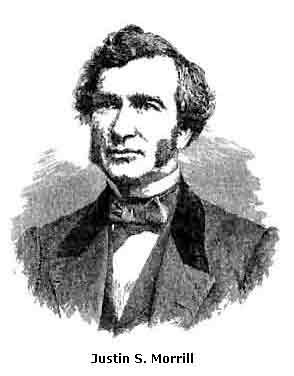
Though this was the first roll-call of the session, the disunion conspirators, one after another, made haste to declare the treasonable attitude of their States. Pending the vote, Mr. Singleton declined recording his name for the reason that Mississippi had called a convention to consider this subject. He was not sent here for the purpose of making any compromise or to patch up existing difficulties. Mr. Jones, of Georgia, said he did not vote on this question because his State, like Mississippi, had called a convention to decide all these questions of Federal relations. Mr. Hawkins, of Florida, said his people had resolved to determine, in convention in their sovereign capacity, the time, place, and manner of redress. It was not for him to take any action on the subject. His State was opposed to all and every compromise. The day of compromise was past. Mr. Clopton, of Alabama, declined voting because the State of Alabama is proceeding to consider in a convention what action is required to maintain her rights, honor, and safety. Believing that a State has the right to secede, and that the only remedy for present evils is secession, he would not hold out any delusive hope or sanction any temporizing policy. Mr. Miles, of South Carolina, said "the South Carolina delegation have not voted on this question because they conceive they have no interest in it. We consider our State as already withdrawn from the confederacy in everything except form." Mr. Pugh, of Alabama, said: "As my State of Alabama intends following South Carolina out of the Union by the 10th of January next, I pay no attention to any action taken in this body."