A HISTORY (continued 4)
Reading edition
Douglas, Baltimore Speech, Jan. 5, 1859. Pamphlet.
Once more, in a speech at Baltimore, Douglas repeated in substance what he had said at Memphis and New Orleans, and then in the beginning of January, 1859, he reached Washington and took his seat in the Senate. Here he began to comprehend the action of the Democratic caucus in deposing him from the chairmanship of the Committee on Territories. His personal influence and prestige among the Southern leaders were gone. Neither his revived zeal for annexation, nor his advanced views on the necessity for slave labor, restored his good-fellowship with the extremists. Although, pursuant to a recommendation in the annual message, a measure was then pending in the Senate to place thirty millions in the hands of President Buchanan with which to negotiate for Cuba, the attitude of the pro-slavery faction was not one of conciliation, but of unrelenting opposition to him.
Brown, Senate Speech, Feb. 28, 1859. "Globe," pp. 1241 et seq.
Towards the close of the short session this feeling broke out in an open demonstration. On February 23, while an item of the appropriation bill was under debate, Senator Brown, of Mississippi, said he wanted the success of the Democratic party in 1860 to be a success of principles and not of men. He neither wanted to cheat nor be cheated. Under the decision of the Supreme Court the South would demand protection for slavery in the Territories. If he understood the Senator from Illinois, Mr. Douglas, he thought a Territorial Legislature might by non-action or by unfriendly action rightfully exclude slavery. He dissented from him, and now he would like to know from other Senators from the North what they would do: "If the Territorial Legislature refuses to act, will you act? If it pass unfriendly acts, will you pass friendly? If it pass laws hostile to slavery, will you annul them and substitute laws favoring slavery in their stead?... I would rather," concluded he "see the Democratic party sunk, never to be resurrected, than to see it successful only that one portion of it might practice a fraud on another."
Brown, Senate Speech, Feb. 28, 1859. "Globe," pp. 1246-7.
Douglas met the issue, and defended his Freeport doctrine without flinching. The Democracy of the North hold, said he, that "if you repudiate the doctrine of non-intervention, and form a slave code by act of Congress, where the people of a Territory refuse it, you must step off the Democratic platform. I tell you, gentlemen of the South, in all candor, I do not believe a Democratic candidate can ever carry any one Democratic State of the North on the platform that it is the duty of the Federal Government to force the people of a Territory to have slavery when they do not want it."
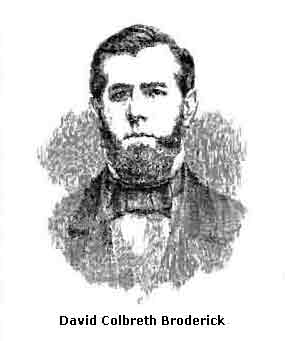
The discussion extended itself to other Senators; Jefferson Davis, of Mississippi, Clay, of Alabama, Mason, of Virginia, and Gwin, of California, seconded the demands and arguments of Brown; while Pugh, of Ohio, Broderick, of California, and Stuart, of Michigan, came to the help and defense of Douglas and non-intervention. Several Republicans drifted into the debate on behalf of the position and principles of their party, which of course differed from those of both Brown and Douglas. The discussion was continued to a late hour, and finally came to an end through mere lapse of time, but not until an irreparable schism in the Democratic party had been opened.
Douglas to Dorr, June 22, 1859. Baltimore "Sun," June 24, 1859.
Silence upon so vital an issue could not long be maintained. In the following June, an Iowa friend wrote to Douglas to inquire whether he would be a candidate for the Presidential nomination at the coming Charleston Convention. Douglas replied that party issues must first be defined. If the Democracy adhered to their former principles, his friends would be at liberty to present his name. "If, on the contrary," continued he, "it shall become the policy of the Democratic party, which I cannot anticipate, to repudiate these their time-honored principles, on which we have achieved so many patriotic triumphs, and in lieu of them the convention shall interpolate into the creed of the party such new issues as the revival of the African slave-trade, or a Congressional slave-code for the Territories, or the doctrine that the Constitution of the United States either establishes or prohibits slavery in the Territories beyond the power of the people legally to control it, as other property—it is due to candor to say that, in such an event, I could not accept the nomination if tendered to me."
Ray to Lincoln, July 27, 1858. MS.
We must leave the career of Douglas for a while, to follow up the personal history of Lincoln. The peculiar attitude of national politics had in the previous year drawn the attention of the whole country to Illinois in a remarkable degree. The Senatorial campaign was hardly opened when a Chicago editor, whose daily examination of a large list of newspaper exchanges brought the fact vividly under his observation, wrote to Lincoln: "You are like Byron, who woke up one morning and found himself famous. People wish to know about you. You have sprung at once from the position of a capital fellow, and a leading lawyer in Illinois, to a national reputation."
David Davis to Lincoln, Nov. 7, 1858. MS.
The compliment was fully warranted; the personal interest in Lincoln increased daily from the beginning to the end of the great debates. The Freeport doctrine and its effect upon the Democratic party gave these discussions both present significance and a growing interest for the future. Another friend wrote him, a few days after election: "You have made a noble canvass, which, if unavailing in this State, has earned you a national reputation, and made you friends everywhere."
Delahay to Lincoln, March 15, 1859. MS. Dennison to Trumbull, July 21, 1859. MS. Dorsheimer to Chase, Sept. 12, 1859. MS.
Kasson to Lincoln, Sept. 13, 1859. MS. Kirkpatrick to Lincoln, Sept. 15, 1859. MS. Weed to Judd, Oct. 21, 1859. MS.
That this was not the mere flattery of partial friends became manifest to him by other indications; by an increased correspondence filled with general commendation, and particularly by numerous invitations to deliver speeches in other States. The Republican Central Committee of New Hampshire wrote him that if Douglas came, as was expected, to that State, they desired Lincoln to come and answer him. The Central Committee of Minnesota wished him to come there and assist in their canvass. There was an incessant commotion in politics throughout the whole North, and as the season advanced calls came from all quarters. Kansas wanted him; Buffalo, Des Moines, Pittsburgh wanted him; Thurlow Weed telegraphed: "Send Abraham Lincoln to Albany immediately." Not only his presence, but his arguments, and ideas, were in demand. Dennison, making the canvass for Governor of Ohio, asked for a report of his debates for campaign "material."
That men in all parts of the Union were thus turning to him for help and counsel was due, not alone to the publicity and credit he had gained in his debates with Douglas in the previous year; it grew quite as much out of the fact that by his sagacity and courage he had made himself the safest, as well as the most available, rallying-point of the Republican party and exponent of Republican doctrine. The Lecompton quarrel in the Democratic party had led many prominent Republicans on a false trail. In Douglas's new attitude, developed by his Southern speeches and his claim to readmission into regular Democratic fellowship, these leaders found themselves at fault, discredited by their own course. Lincoln, on the contrary, not only held aloft the most aggressive Republican banner, but stood nearest the common party enemy, and was able to offer advice to all the elements of the Republican party, free from any suspicion of intrigue with foe or faction. The causes of his Senatorial defeat thus gave him a certain party authority and leadership, which were felt if not openly acknowledged. On his part, while never officious or obtrusive, he was always ready with seasonable and judicious suggestions, generous in spirit and comprehensive in scope, and which looked beyond mere local success.
Thus he wrote from Springfield to Schuyler Colfax (afterwards Vice-President of the United States), July 6, 1859: "I much regret not seeing you while you were here among us. Before learning that you were to be at Jacksonville on the 4th, I had given my word to be at another place. Besides a strong desire to make your personal acquaintance, I was anxious to speak with you on politics a little more fully than I can well do in a letter. My main object in such conversation would be to hedge against divisions in the Republican ranks generally, and particularly for the contest of 1860. The point of danger is the temptation in different localities to 'platform' for something which will be popular just there, but which, nevertheless, will be a firebrand elsewhere, and especially in a national convention. As instances, the movement against foreigners in Massachusetts; in New Hampshire, to make obedience to the fugitive-slave law punishable as a crime; in Ohio, to repeal the fugitive-slave law; and, squatter sovereignty, in Kansas. In these things there is explosive matter enough to blow up half a dozen national conventions, if it gets into them; and what gets very rife outside of conventions is very likely to find its way into them. What is desirable, if possible, is that in every local convocation of Republicans a point should be made to avoid everything which will disturb Republicans elsewhere. Massachusetts Republicans should have looked beyond their noses, and then they could not have failed to see that tilting against foreigners would ruin us in the whole Northwest. New Hampshire and Ohio should forbear tilting against the fugitive-slave law in such way as to utterly overwhelm us in Illinois with the charge of enmity to the Constitution itself. Kansas, in her confidence that she can be saved to freedom on 'squatter sovereignty,' ought not to forget that to prevent the spread and nationalization of slavery is a national concern, and must be attended to by the nation. In a word, in every locality we should look beyond our noses; and at least say nothing on points where it is probable we shall disagree. I write this for your eye only; hoping, however, if you see danger as I think I do, you will do what you can to avert it. Could not suggestions be made to leading men in the State and Congressional conventions, and so avoid, to some extent at least, these apples of discord."[1]
Colfax to Lincoln, July 14, 1859. MS.
By this time Colfax was cured of his late coquetting with Douglas, and he replied: "The suggestions you make have occurred to me.... Nothing is more evident than that there is an ample number of voters in the Northern States, opposed to the extension and aggressions of slavery and to Democratic misrule, to triumphantly elect a President of the United States. But it is equally evident that making up this majority are men of all shades and gradations of opinion, from the conservative who will scarcely defend his principles for fear of imperiling peace, to the bold radical who strikes stalwart blows regardless of policy or popularity. How this mass of mind shall be consolidated into a victorious phalanx in 1860 is the great problem, I think, of our eventful times. And he who could accomplish it is worthier of fame than Napoleon or Victor Emmanuel.... In this work, to achieve success, and to achieve it without sacrifice of essential principle, you can do far more than one like myself, so much younger. Your counsel carries great weight with it; for, to be plain, there is no political letter that falls from your pen which is not copied throughout the Union."
Lincoln to Canisius, May 17, 1859.
This allusion was called out by two letters which Lincoln had written during the year; one declaring his opposition to the waning fallacy of know-nothingism, in which he also defined his position on "fusion." Referring to a provision lately adopted by Massachusetts to restrict naturalization, he wrote: "Massachusetts is a sovereign and independent State; and it is no privilege of mine to scold her for what she does. Still, if from what she has done, an inference is sought to be drawn as to what I would do, I may, without impropriety, speak out, I say then, that, as I understand the Massachusetts provision, I am against its adoption in Illinois, or in any other place where I have a right to oppose it. Understanding the spirit of our institutions to aim at the elevation of men, I am opposed to whatever tends to degrade them. I have some little notoriety for commiserating the oppressed condition of the negro; and I should be strangely inconsistent if I could favor any project for curtailing the existing rights of white men, even though born in different lands, and speaking different languages from myself. As to the matter of fusion, I am for it, if it can be had on Republican grounds; and I am not for it on any other terms. A fusion on any other terms would be as foolish and unprincipled. It would lose the whole North, while the common enemy would still carry the whole South. The question of men is a different one. There are good patriotic men and able statesmen in the South whom I would cheerfully support, if they would now place themselves on Republican ground, but I am against letting down the Republican standard a hair's breadth."
The other was a somewhat longer letter, to a Boston committee which had invited him to a festival in honor of Jefferson's birthday. "Bearing in mind that about seventy years ago two great political parties were first formed in this country; that Thomas Jefferson was the head of one of them, and Boston the headquarters of the other, it is both curious and interesting that those supposed to descend politically from the party opposed to Jefferson, should now be celebrating his birthday, in their own original seat of empire, while those claiming political descent from him have nearly ceased to breathe his name everywhere...."
Lincoln to Pierce and others, April 6, 1859.
"But, soberly, it is now no child's play to save the principles of Jefferson from total overthrow in this nation. One would state with great confidence that he could convince any sane child that the simpler propositions of Euclid are true; but nevertheless he would fail, utterly, with one who should deny the definitions and axioms. The principles of Jefferson are the definitions and axioms of free society. And yet they are denied and evaded, with no small show of success. One dashingly calls them 'glittering generalities.' Another bluntly calls them 'self-evident lies.' And others insidiously argue that they apply only to 'superior races.' These expressions, differing in form, are identical in object and effect—the supplanting the principles of free government, and restoring those of classification, caste, and legitimacy. They would delight a convocation of crowned heads plotting against the people. They are the van-guard—the miners and sappers of returning despotism. We must repulse them, or they will subjugate us. This is a world of compensation; and he who would be no slave must consent to have no slave. Those who deny freedom to others deserve it not for themselves; and, under a just God, cannot long retain it. All honor to Jefferson—to the man who, in the concrete pressure of a struggle for national independence by a single people, had the coolness, forecast, and capacity to introduce into a merely revolutionary document an abstract truth, applicable to all men and all times, and so to embalm it there that to-day and in all coming days it shall be a rebuke and a stumbling-block to the very harbingers of re-appearing tyranny and oppression."
Lincoln's more important political work of the year 1859 was the part he took in the canvass in the State of Ohio, where a governor was to be chosen at the October election, and where the result would decide not merely the present and local strength of the rival candidates, but also to some extent indicate the prospects and probabilities of the Presidential campaign of 1860. The Ohio Democrats had called Douglas into their canvass, and the Republicans, as soon as they learned the fact, arranged that Lincoln should come and answer him. There was a fitness in this, not merely because Lincoln's joint debates with him in Illinois in the previous summer were so successful, but also because Douglas in nearly every speech made since then, both in his Southern tour and elsewhere, alluded to the Illinois campaign, and to Lincoln by name, especially to what he characterized as his political heresies. By thus everywhere making Lincoln and Lincoln's utterances a public target, Douglas himself, in effect, prolonged and extended the joint debates over the whole Union. Another circumstance added to the momentary interest of the general discussion. Douglas was by nature aggressive. Determined to hold his Northern followers in the new issues which had grown out of his Freeport doctrine, and the new antagonisms which the recent slave code debate in the Senate revealed, he wrote and published in "Harper's Magazine" for September, 1859, a political article beginning with the assertion that "Under our complex system of government it is the first duty of American statesmen to mark distinctly the dividing-line between Federal and Local authority." Quoting both the paragraph of Lincoln's Springfield speech declaring that "a house divided against itself cannot stand," and the paragraph from Seward's Rochester speech, announcing the "irrepressible conflict," Douglas made a long historical examination of his own theory of "non-intervention" and "popular sovereignty," and built up an elaborate argument to sustain his course. The novelty of this appeal to the public occasioned general interest and varied comment, and the expedient seemed so ingenious as to excite the envy of Administration Democrats. Accordingly, Attorney-General Black, of President Buchanan's Cabinet, at "the request of friends," wrote, printed, and circulated an anonymous pamphlet in answer, in which he admitted that Douglas was "not the man to be treated with a disdainful silence," but characterized the "Harper" essay as "an unsuccessful effort at legal precision; like the writing of a judge who is trying in vain to give good reasons for a wrong decision on a question of law which he has not quite mastered." Douglas, in a speech at Wooster, Ohio, criticized this performance of Black's. Reply and rejoinder on both sides followed in due time; and this war of pamphlets was one of the prominent political incidents of the year.
Thus Lincoln's advent in the Ohio campaign attracted much more than usual notice. He made but two speeches, one at Columbus, and one at Cincinnati, at each of which places Douglas had recently preceded him. Lincoln's addresses not only brought him large and appreciative audiences, but they obtained an unprecedented circulation in print. In the main, they reproduced and tersely re-applied the ideas and arguments developed in the Senatorial campaign in Illinois, adding, however, searching comments on the newer positions and points to which Douglas had since advanced. There is only space to insert a few disconnected quotations:
Now, what is Judge Douglas's popular sovereignty? It is as a principle no other than that, if one man chooses to make a slave of another man, neither that other man nor anybody else has a right to object....
If you will read the copyright essay, you will discover that Judge Douglas himself says, a controversy between the American Colonies and the Government of Great Britain began on the slavery question in 1699, and continued from that time until the Revolution; and, while he did not say so, we all know that it has continued with more or less violence ever since the Revolution....
Take these two things and consider them together; present the question of planting a State with the institution of slavery by the side of a question of who shall be Governor of Kansas for a year or two, and is there a man here, is there a man on earth, who would not say the governor question is the little one, and the slavery question is the great one? I ask any honest Democrat if the small, the local, the trivial and temporary question is not, Who shall be governor? while the durable, the important, and the mischievous one is, Shall this soil be planted with slavery? This is an idea, I suppose, which has arisen in Judge Douglas's mind from his peculiar structure. I suppose the institution of slavery really looks small to him. He is so put up by nature that a lash upon his back would hurt him, but a lash upon anybody else's back does not hurt him....
The Dred Scott decision expressly gives every citizen of the United States a right to carry his slaves into the United States Territories. And now there was some inconsistency in saying that the decision was right, and saying, too, that the people of the Territory could lawfully drive slavery out again. When all the trash, the words, the collateral matter was cleared away from it, all the chaff was fanned out of it, it was a bare absurdity; no less than that a thing may be lawfully driven away from where it has a lawful right to be....
The Judge says the people of the Territories have the right, by his principle, to have slaves if they want them. Then I say that the people in Georgia have the right to buy slaves in Africa if they want them, and I defy any man on earth to show any distinction between the two things—to show that the one is either more wicked or more unlawful; to show on original principles, that one is better or worse than the other; or to show by the Constitution, that one differs a whit from the other. He will tell me, doubtless, that there is no constitutional provision against people taking slaves into the new Territories, and I tell him that there is equally no constitutional provision against buying slaves in Africa....
Then I say, if this principle is established, that there is no wrong in slavery, and whoever wants it has a right to have it; that it is a matter of dollars and cents; a sort of question how they shall deal with brutes; that between us and the negro here there is no sort of question, but that at the South the question is between the negro and the crocodile; that it is a mere matter of policy; that there is a perfect right according to interest to do just as you please—when this is done, where this doctrine prevails, the miners and sappers will have formed public opinion for the slave trade....
Lincoln, Columbus Speech, Sept. 16, 1859. Debates, pp. 253-54
Public opinion in this country is everything. In a nation like ours this popular sovereignty and squatter sovereignty have already wrought a change in the public mind to the extent I have stated. There is no man in this crowd who can contradict it. Now, if you are opposed to slavery honestly, as much as anybody, I ask you to note that fact, and the like of which is to follow, to be plastered on layer after layer, until very soon you are prepared to deal with the negro everywhere as with the brute. If public sentiment has not been debauched already to this point, a new turn of the screw in that direction is all that is wanting; and this is constantly being done by the teachers of this insidious popular sovereignty. You need but one or two turns further until your minds, now ripening under these teachings, will be ready for all these things; and you will receive and support, or submit to, the slave trade revived with all its horrors, a slave code enforced in our Territories, and a new Dred Scott decision to bring slavery up into the very heart of the free North.
This Government is expressly charged with the duty of providing for the general welfare. We believe that the spreading out and perpetuity of the institution of slavery impairs the general welfare. We believe—nay, we know, that this is the only thing that has ever threatened the perpetuity of the Union itself....
Lincoln Cincinnati Speech, Sept. 17, 1859. Debates, pp. 267-8.
I say we must not interfere with the institution of slavery in the States where it exists, because the Constitution forbids it, and the general welfare does not require us to do so. We must not withhold an efficient fugitive-slave law, because the Constitution requires us, as I understand it, not to withhold such a law. But we must prevent the outspreading of the institution, because neither the Constitution nor the general welfare requires us to extend it. We must prevent the revival of the African slave trade, and the enacting by Congress of a Territorial slave code. We must prevent each of these things being done by either congresses or courts. The people of these United States are the rightful masters of both congresses and courts, not to overthrow the Constitution, but to overthrow the men who pervert the Constitution.
Parsons and others to Lincoln, Dec. 7, 1859. Debates, preface.
The Ohio Republicans gained a decided success at the October election. Ascribing this result in a large measure to the influence of Lincoln's speeches, the State Executive Committee resolved to publish in cheap book form the full Illinois joint debates and the two Ohio addresses, to serve as campaign material for the ensuing year. "We regard them," wrote the committee to Lincoln, "as luminous and triumphant expositions of the doctrines of the Republican party, successfully vindicated from the aspersions of its foes, and calculated to make a document of great practical service to the Republican party in the approaching Presidential contest."
Lincoln to Parsons and others, Dec. 19, 1859. Ibid.
Lincoln, thanking them for the flattering terms of their request, explained in his reply: "The copies I send you, are as reported and printed by the respective friends of Senator Douglas and myself at the time—that is, his by his friends, and mine by mine. It would be an unwarrantable liberty for us to change a word or a letter in his, and the changes I have made in mine, you perceive, are verbal only, and very few in number. I wish the reprint to be precisely as the copies I send, without any comment whatever."
The enterprise proved a success beyond the most sanguine expectations. A Columbus firm undertook the publication, itself assuming all pecuniary risk. Three large editions were sold directly to the public, without any aid from or any purchase by the committee—the third edition containing the announcement that up to that date, June 16, 1860, thirty thousand copies had already been circulated.[2]
[A] Douglas to Follet, Foster & Co., June 9, 1860. Debates, third edition, preface.
[B] Follet, Foster & Co. to Douglas, June 16, 1860. Ibid.
CHAPTER XI HARPER'S FERRY
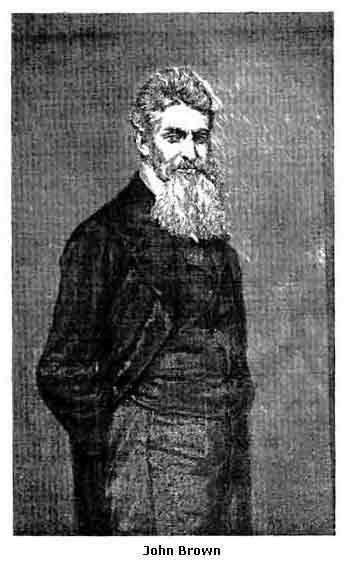
There now occurred another strange event which, if it had been specially designed as a climax for the series of great political sensations since 1852, could scarcely have been more dramatic. This was John Brown's invasion of Harper's Ferry in order to create a slave insurrection. We can only understand the transaction as far as we can understand the man, and both remain somewhat enigmatical.
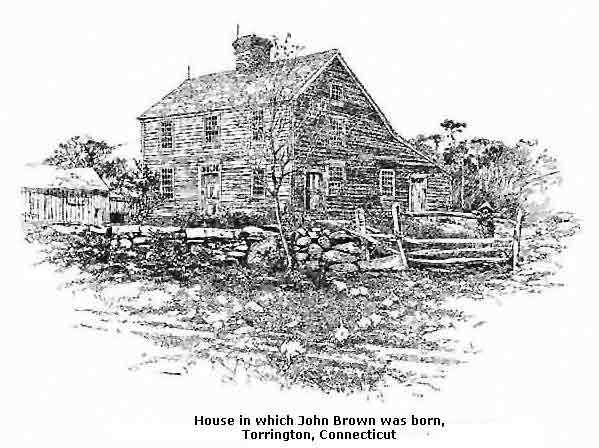
Of Puritan descent, John Brown was born in Connecticut in the year 1800. When he was five years old, the family moved to Ohio, at that time a comparative wilderness. Here he grew up a strong, vigorous boy of the woods. His father taught him the tanner's trade; but a restless disposition drove him to frequent changes of scene and effort when he grew to manhood. He attempted surveying. He became a divinity student. He tried farming and tanning in Pennsylvania, and tanning and speculating in real estate in Ohio. Cattle-dealing was his next venture; from this to sheep-raising; and by a natural transition to the business of a wool-factor in Massachusetts. This not succeeding, he made a trip to Europe. Returning, he accepted from Gerrit Smith a tract of mountain land in the Adirondacks, where he proposed to found and foster colonies of free negroes. This undertaking proved abortive, like all his others, and he once more went back to the wool business in Ohio.
Twice married, nineteen children had been born to him, of whom eleven were living when, in 1854, the Kansas-Nebraska bill plunged the country into the heat of political strife. Four of his sons moved away to the new Territory in the first rush of emigrants; several others went later. When the Border-Ruffian hostilities broke out, John Brown followed, with money and arms contributed in the North. With his sons as a nucleus, he gathered a little band of fifteen to twenty adventurers, and soon made his name a terror in the lawless guerrilla warfare of the day. His fighting was of the prevailing type, justifiable, if at all, only on the score of defensive retaliation, and some of his acts were as criminal and atrocious as the worst of those committed by the Border Ruffians.[1] His losses, one son murdered, another wounded to the death, and a third rendered insane from cruel treatment, are scarcely compensated by the transitory notoriety he gathered in a few fool-hardy skirmishes.
James Redpath, "Life of John Brown," p. 48.
Sanborn, in the "Atlantic," April, 1872.
These varied experiences give us something of a clue to his character: a strong will; great physical energy; sanguine, fanatical temperament; unbounded courage and little wisdom; crude, visionary ideality; the inspiration of biblical precepts and Old Testament hero-worship; and ambition curbed to irritation by the hard fetters of labor, privation, and enforced endurance. In association, habit, language, and conduct, he was clean, but coarse; honest, but rude. In disposition he mingled the sacrificing tenderness with the sacrificial sternness of his prototypes in Jewish history. He could lay his own child on the altar without a pang. The strongest element of his character was religious fanaticism. Taught from earliest childhood to "fear God and keep his commandments," he believed firmly in the divine authenticity of the Bible, and memorized much of its contents. His favorite texts became literal and imperative mandates; he came to feel that he bore the commission and enjoyed the protection of the Almighty. In his Kansas camps he prayed and saw visions; believed he wielded the sword of the Lord and of Gideon; had faith that the angels encompassed him. He desired no other safeguard than his own ideas of justice and his own convictions of duty. These ideas and convictions, however, refused obedience to accepted laws and morals, and were mere fantastic and pernicious outgrowths of his religious fanaticism. His courage partook of the recklessness of insanity. He did not count odds. "What are five to one?" he asked; and at another time he said, "One man in the right, ready to die, will chase a thousand." Perhaps he even believed he held a charmed life, for he boasted that he had been fired at thirty times and only his hair had been touched. In personal appearance he was tall and slender, with rather a military bearing. He had an impressive, half-persuasive, half-commanding manner. He was always very secretive, affected much mystery in movements, came and went abruptly, was direct and dogmatic to bluntness in his conversation. His education was scant, his reading limited; he wrote strong phrases in bad orthography. If we may believe the intimations from himself and those who knew him best, he had not only acquired a passionate hatred of the institution of slavery, but had for twenty years nursed the longing to become a liberator of slaves in the Southern States. To this end he read various stories of insurrections, and meditated on the vicissitudes, chances, and strategy of partisan warfare. A year's border fighting in Kansas not only suddenly put thought into action, but his personal and family sacrifices intensified his visionary ambition into a stern and inflexible purpose.
It is impossible to trace exactly how and when the Harper's Ferry invasion first took practical shape in John Brown's mind, but the indications are that it grew little by little out of his Kansas experience. His earliest collisions with the Border Ruffians occurred the spring and summer of 1856. In the autumn of that year the United States troops dispersed his band, and generally suppressed the civil war. In January, 1857, we find him in the Eastern States, appealing for arms and supplies to various committees and in various places, alleging that he desired to organize and equip a company of one hundred minute-men, who were "mixed up with the people of Kansas," but who should be ready on call to rush to the defense of freedom. This appeal only partly succeeded. From one committee he obtained authority as agent over certain arms stored in Iowa, the custody and control of which had been in dispute. From another committee he obtained a portion of the clothing he desired. From still other sources he received certain moneys, but not sufficient for his requirements. Two circumstances, however, indicate that he was practicing a deception upon the committees and public. He entered into a contract with a blacksmith, in Collinsville, Connecticut, to manufacture him 1000 pikes of a certain pattern,[2] to be completed in 90 days, and paid $550 on the contract. There is no record that he mentioned this matter to any committee. His proposed Kansas minute-men were only to be one hundred in number, and the pikes could not be for them; his explanation to the blacksmith, that they would be a good weapon of defense for Kansas settlers, was clearly a subterfuge. These pikes, ordered about March 23, 1857, were without doubt intended for his Virginia invasion; and in fact the identical lot, finished after long delay, under the same contract, were shipped to him in September, 1859, and were actually used in his Harper's Ferry attempt. The other circumstance is that, about the time of his contract for the pikes, he also, without the knowledge of committees or friends, engaged an adventurer, named Forbes, to go West and give military instruction to his company—a measure neither useful nor practicable for Kansas defense. These two acts may be taken as the first preparation for Harper's Ferry.
But merely to conceive great enterprises is not to perform them, and every after-step of John Brown reveals his lamentable weakness and utter inadequacy for the heroic role to which he fancied himself called. His first blunder was in divulging all his plans to Forbes, an utter stranger, while he was so careful in concealing them from others. Forbes, as ambitious and reckless as himself, of course soon quarreled with him, and left him, and endeavored first to supplant and then betray him.
Realf, Testimony Mason Report, p. 91. Ibid., pp. 91-4.
Meanwhile, little by little, Brown gathered one colored and six white confederates from among his former followers in Kansas, and assembled them for drill and training in Iowa; four others joined him there. These, together with his son Owen, counted, all told, a band of twelve persons engaged for, and partly informed of, his purpose. He left them there for instruction during the first three months of the year 1858, while he himself went East to procure means.
"Atlantic," July, 1872, p. 51.
At the beginning of February, 1858, John Brown became, and remained for about a month, a guest at the house of Frederick Douglass, in Rochester, New York. Immediately on his arrival there he wrote to a prominent Boston abolitionist, T.W. Higginson: "I now want to get, for the perfecting of by far the most important undertaking of my whole life, from $500 to $800 within the next sixty days. I have written Rev. Theodore Parker, George L. Stearns, and F.B. Sanborn, Esquires, on the subject."
Sanborn, "Life and Letters of John Brown," p. 438.
Correspondence and mutual requests for a conference ensued, and finally these Boston friends sent Sanborn to the house of Gerrit Smith, in Peterboro, New York, where a meeting had been arranged. Sanborn was a young man of twenty-six, just graduated from college, who, as secretary of various Massachusetts committees, had been the active agent for sending contributions to Kansas. He arrived on the evening of Washington's birthday, February 22, 1858, and took part in a council of conspiracy, of which John Brown was the moving will and chief actor.
"Atlantic," July, 1872, p. 52. Sanborn in "Atlantic," March, 1875, p. 329; also, Mason Report, pp. 48-59.
Brown began by reading to the council a long document which he had drafted since his stay in Rochester. It called itself a "Provisional Constitution and Ordinances for the People of the United States," which, as it explained, looked to no overthrow of States or dissolution of the Union, but simply to "amendment and repeal." It was not in any sense a reasonable project of government, but simply an ill-jointed outline of rules for a proposed slave insurrection. The scheme, so far as any comprehension of it may be gleaned from the various reports which remain, was something as follows:
Mason Report, p. 55. Sanborn, "Life and Letters of John Brown," p. 438.
Blair, Testimony, Mason Report, pp. 121-5.
Somewhere in the Virginia mountains he would raise the standard of revolt and liberation. Enthusiasts would join him from the free States, and escaped blacks come to his help from Canada. From Virginia and the neighboring slave-States of North Carolina, South Carolina, Georgia, Tennessee, and Kentucky, fugitive slaves, with their families, would flock to his camps. He would take his supplies, provisions, and horses by force from the neighboring plantations. Money, plate, watches, and jewelry would "constitute a liberal safety or intelligence fund." For arms, he had 200 Sharps rifles, and 200 revolvers, with which he would arm his best marksmen. His ruder followers, and even the women and children, he would arm with pikes to defend the fortifications. He would construct defenses of palisades and earth-works. He would use natural strongholds; find secret mountain-passes to connect one with another; retreat from and evade attacks he could not overcome. He would maintain and indefinitely prolong a guerrilla war, of which the Seminole Indians in Florida and the negroes in Hayti afforded examples. With success, he would enlarge the area of his occupation so as to include arable valleys and low-lands bordering the Alleghany range in the slave-States; and here he would colonize, govern, and educate the blacks he had freed, and maintain their liberty. He would make captures and reprisals, confiscate property, take, hold, and exchange prisoners and especially white hostages and exchange them for slaves to liberate. He would recognize neutrals, make treaties, exercise humanity, prevent crime, repress immorality, and observe all established laws of war. Success would render his revolt permanent, and in the end, through "amendment and repeal," abolish slavery. If, at the worst, he were driven from the mountains he would retreat with his followers through the free States to Canada. He had 12 recruits drilling in Iowa, and a half-executed contract for 1000 pikes in Connecticut; furnish him $800 in money and he would begin operations in May.
Sanborn in "Atlantic," March, 1875, p. 329.
Redpath, "Life of John Brown," p. 206. Sanborn in "Atlantic," July, 1872, p. 52.
This, if we supply continuity and arrangement to his vagaries, must have been approximately what he felt or dreamily saw, and outlined in vigorous words to his auditors. His listening friends were dumfounded at the audacity as well as heart-sick at the hopelessness of such an attempt. They pointed out the almost certainty of failure and destruction, and attempted to dissuade him from the mad scheme; but to no purpose. They saw they were dealing with a foregone conclusion; he had convoked them, not to advise as to methods, but to furnish the means. All reasonable argument he met with his rigid dogmatic formulas, his selected proverbs, his favorite texts of Scripture. The following, preserved by various witnesses as samples of his sayings at other times, indicate his reasoning on this occasion: "Give a slave a pike and you make him a man. I would not give Sharps rifles to more than ten men in a hundred, and then only when they have learned to use them. A ravine is better than a plain. Woods and mountain-sides can be held by resolute men against ten times their force. Nat Turner, with fifty men, held Virginia five weeks; the same number, well organized and armed, can shake the system out of the State." "A few men in the right, and knowing they are right, can overturn a king. Twenty men in the Alleghanies could break slavery to pieces in two years." "If God be for us, who can be against us? Except the Lord keep the city, the watchman waketh but in vain."
Ibid., March, 1875, p. 329. Sanborn, "Atlantic," July, 1872, pp. 53-4.
Sanborn, "Life and Letters of John Brown," p. 439.
One of the participants relates, that—"When the agitated party broke up their council for the night, it was perfectly plain that Brown could not be held back from his purpose." The discussion of the friends on the second day (February 23) was therefore only whether they should aid him, or oppose him, or remain indifferent. Against every admonition of reason, mere personal sympathy seems to have carried a decision in favor of the first of these alternatives. "You see how it is," said the chief counselor, Gerrit Smith; "our dear old friend has made up his mind to this course and cannot be turned from it. We cannot give him up to die alone; we must support him." Brown has left an exact statement of his own motive and expectation, in a letter to Sanborn on the following day. "I have only had this one opportunity in a life of nearly sixty years ... God has honored but comparatively a very small part of mankind with any possible chance for such mighty and soul-satisfying rewards ... I expect nothing but to endure hardness, but I expect to effect a mighty conquest, even though it be like the last victory of Samson."
Realf, Testimony, Mason Report, p. 99.
Nine days later Brown went to Boston, where the conspiracy was enlarged and strengthened by the promises and encouragements of a little coterie of radical abolitionists.[3] Within the next two months the funds he desired were contributed and sent him. Meanwhile Brown returned West, and moved his company of recruits from Iowa, by way of Chicago and Detroit, to the town of Chatham, in Canada West, arriving there about the 1st of May. By written invitations, Brown here called together what is described as "a quiet convention of the friends of freedom," to perfect his organization. On the 8th of May, 1858, they held a meeting with closed doors, there being present the original company of ten or eleven white members and one colored, whom Brown had brought with him, and a somewhat miscellaneous gathering of negro residents of Canada. Some sort of promise of secrecy was mutually made; then John Brown, in a speech, laid his plan before the meeting. One Delany, a colored doctor, in a response, promised the assistance of all the colored people in Canada. The provisional constitution drafted by Brown at Rochester was read and adopted by articles, and about forty-five persons signed their names to the "Constitution," for the "proscribed and oppressed races of the United States." Two days afterwards, the meeting again convened for the election of officers; John Brown was elected commander-in-chief by acclamation; other members were by the same summary method appointed secretary of war, secretary of state, secretary of the treasury, and two of them members of congress. The election of a president was prudently postponed.
This Chatham Convention cannot claim consideration as a serious deliberative proceeding. John Brown was its sole life and voice. The colored Canadians were nothing but spectators. The ten white recruits were mere Kansas adventurers, mostly boys in years and waifs in society, perhaps depending largely for livelihood on the employment or bounty, precarious as it was, of their leader. Upon this reckless, drifting material the strong despotic will, emotional enthusiasm, and mysterious rhapsodical talk of John Brown exercised an irresistible fascination; he drew them by easy gradations into his confidence and conspiracy. The remaining element, John Brown's son in the Chatham meeting, and other sons and relatives in the Harper's Ferry attack, are of course but the long educated instruments of the father's thought and purpose.
Stearns to Brown, May 14, 1858: Howe, Testimony, Mason Report, p. 177.
With funds provided, with his plan of government accepted, and himself formally appointed commander-in-chief, Brown doubtless thought his campaign about to begin; it was however destined to an unexpected interruption. The discarded and disappointed adventurer Forbes had informed several prominent Republicans in Washington City that Brown was meditating an unlawful enterprise; and the Boston committee, warned that certain arms in Brown's custody, which had been contributed for Kansas defense, were about to be flagrantly misused, dared not incur the public odium of complicity in such a deception and breach of faith. The Chatham organization was scarcely completed when Brown received word from the Boston committee that he must not use the arms (the 200 Sharps rifles and 200 revolvers) which had been intrusted to him for any other purpose than for the defense of Kansas. Brown hurried to Boston; but oral consultation with his friends confirmed the necessity for postponement; and it was arranged that, to lull suspicion, he should return to Kansas and await a more favorable opportunity. He yielded assent, and that fall and winter performed the exploit of leading an armed foray into Missouri, and carrying away eleven slaves to Canada—an achievement which, while to a certain degree it placed him in the attitude of a public outlaw, nevertheless greatly increased his own and his followers' confidence in the success of his general plan. Gradually the various obstacles melted away. Kansas became pacified. The adventurer Forbes faded out of sight and importance. The disputed Sharps rifles and revolvers were transferred from committee to committee, and finally turned over to a private individual to satisfy a debt. He in turn delivered them to Brown without any hampering conditions. The Connecticut blacksmith finished and shipped the thousand pikes. The contributions from the Boston committee swelled from one to several thousands of dollars. The recruits, with a few changes, though scattered in various parts of the country, were generally held to their organization and promise, and slightly increased in number. The provisional constitution and sundry blank commissions were surreptitiously printed, and captains and lieutenants appointed by the signature of John Brown "Commander-in-Chief," countersigned by the "Secretary of War."
Gradually, also, the commander-in-chief resolved on an important modification of his plan: that, instead of plunging at once into the Virginia mountains, he would begin by the capture of the United States armory and arsenal at Harper's Ferry. Two advantages seem to have vaguely suggested themselves to his mind as likely to arise from this course: the possession of a large quantity of Government arms, and the widespread panic and moral influence of so bold an attempt. But it nowhere appears that he had any conception of the increased risk and danger it involved, or that he adopted the slightest precaution to meet them.
Harper's Ferry was a town of five thousand inhabitants, lying between the slave-States of Maryland and Virginia, at the confluence of the Potomac and the Shenandoah rivers, where the united streams flow through a picturesque gap in the single mountain-range called the Blue Ridge. The situation possesses none of the elements which would make it a defensible fastness for protracted guerrilla warfare, such as was contemplated in Brown's plan. The mountains are everywhere approachable without difficulty; are pierced by roads and farms in all directions; contain few natural resources for sustenance, defense, or concealment; are easily observed or controlled from the plain by superior forces. The town is irregular, compact, and hilly; a bridge across each stream connects it with the opposite shores, and the Government factory and buildings, which utilized the water-power of the Potomac, lay in the lowest part of the point of land between the streams. The Baltimore and Ohio Railroad crosses the Potomac bridge.
On the 4th of July, 1859, John Brown, under an assumed name, with two sons and another follower, appeared near Harper's Ferry, and soon after rented the Kennedy Farm, in Maryland, five miles from town, where he made a pretense of cattle-dealing and mining; but in reality collected secretly his rifles, revolvers, ammunition, pikes, blankets, tents, and miscellaneous articles for a campaign. His rather eccentric actions, and the irregular coming and going of occasional strangers at his cabin, created no suspicion in the neighborhood. Cautiously increasing his supplies, and gathering his recruits, he appointed the attack for the 24th of October; but for some unexplained reason (fear of treachery, it is vaguely suggested) he precipitated his movement in advance of that date. From this point the occurrences exhibit no foresight or completeness of preparation, no diligent pursuit of an intelligent plan, nor skill to devise momentary expedients; only a blind impulse to act.
On Sunday evening, October 16, 1859, Brown gave his final orders, humanely directing his men to take no life where they could avoid it. Placing a few pikes and other implements in his one-horse wagon, he started with his company of eighteen followers at 8 o'clock in the evening, leaving five men behind. They cut the telegraph wires on the way, and reached Harper's Ferry about 11 o'clock. He himself broke open the armory gates, took the watchmen prisoners, and made that place his headquarters. Separating his men into small detachments, he took possession of, and attempted to hold, the two bridges, the arsenal, and the rifle-factory. Next he sent six of his men five miles into the country to bring in several prominent slaveowners and their slaves. This was accomplished before daylight, and all were brought as prisoners to Brown at the armory. With them they also brought a large four-horse farm wagon, which he now sent to transfer arms from the Kennedy farm to a school-house on the Maryland side of the Potomac, about one mile from the town.
Meanwhile, about midnight of Sunday, they detained the railroad train three hours, but finally allowed it to proceed. A negro porter was shot on the bridge. The town began to be alarmed. Citizens were captured at various points, and brought to swell the number of prisoners at the armory, counting forty or fifty by morning. Still, not until daylight, and even until the usual hour of rising on Monday morning, did the town comprehend the nature and extent of the trouble.
What, now, did Brown intend to do? What result did he look for from his movement thus far? Amid his conflicting acts and contradictory explanations, the indications seem clear only on two or three points. Both he and his men gave everybody to understand without reserve that they had come not to kill whites, but only to liberate slaves. Soon, also, he placed pikes in the hands of his black prisoners. But that ceremony did not make soldiers of them, as his favorite maxim taught. They held them in their hands with listless indifference, remaining themselves, as before, an incumbrance instead of a reënforcement. He gave his white prisoners notice that he would hold them as hostages, and informed one or two that, after daylight, he would exchange them for slaves. Before the general fighting began, he endeavored to effect an armistice or compromise with the citizens, to stop bloodshed, on condition that he be permitted to hold the armory and retain the liberated negroes. All this warrants the inference that he expected to hold the town, first, by the effect of terror; secondly, by the display of leniency and kindness; and supposed that he could remain indefinitely, and dictate terms at his leisure. The fallacy of this scheme became quickly apparent.
As the day dawned upon the town and the truth upon the citizens, his situation in a military point of view was already hopeless—eighteen men against perhaps 1000 adults, and these eighteen scattered in four or five different squads, without means of mutual support, communication, or even contingent orders! Gradually, as the startled citizens became certain of the insignificant numbers of the assailants, an irregular street-firing broke out between Brown's sentinels and individuals with firearms. The alarm was carried to neighboring towns, and killed and wounded on both sides augmented the excitement. Tradition rather than definite record asserts that some of Brown's lieutenants began to comprehend that they were in a trap, and advised him to retreat. Nearly all his eulogists have assumed that such was his original plan, and his own subsequent excuses hint at this intention. But the claim is clearly untenable. He had no means of defensive retreat—no provisions, no transportation for his arms and equipage, no supply of ammunition. The suggestion is an evident afterthought.
Whether from choice or necessity, however, he remained only to find himself more and more closely pressed. By Monday noon the squad in the rifle-works, distant one mile from the armory, had been driven out, killed, and captured. The other squads, not so far from their leader, joined him at the armory, minus their losses. Already he was driven to take refuge with his diminished force in the engine-house, a low, strong brick building in the armory yard, where they barricaded doors and improvised loop-holes, and into which they took with them ten selected prisoners as hostages. But the expedient was one of desperation. By this movement Brown literally shut himself up in his own prison, from which escape was impossible.
A desultory fire was kept up through doors and loop-holes. But now the whole country had become thoroughly aroused, and sundry military companies from neighboring towns and counties poured into Harper's Ferry. Brown himself at length realized the hopelessness of his position, and parleyed for leave to retreat across the river on condition of his giving up his prisoners; but it was too late. President Buchanan also took prompt measures; and on Monday night a detachment of eighty marines from the Washington navy-yard, under command of Brevet Colonel Robert E. Lee, of the United States army, the same who afterwards became the principal leader of the Confederate armies in the rebellion, reached the scene of action, and were stationed in the armory yard so as to cut off the insurgents from all retreat. At daylight on Tuesday morning Brown was summoned to surrender at discretion, but he refused. The instant the officer left the engine-house a storming-party of marines battered in the doors; in five minutes the conflict was over. One marine was shot dead in the assault; Brown fell under severe sword and bayonet wounds, two of his sons lay dead or dying, and four or five of his men were made prisoners, only two remaining unhurt. The great scheme of liberation built up through nearly three years of elaborate conspiracy, and designed to be executed in defiance of law, by individual enterprise with pikes, rifles, forts, guerrilla war, prisoners, hostages, and plunder, was, after an experimental campaign of thirty-six hours, in utter collapse. Of Brown's total force of twenty-two men, ten were killed, five escaped, and seven were captured, tried, and hanged. Of the townspeople, five had been killed and eight wounded.
Sanborn in the "Atlantic," Dec. 1875. p. 718.
While John Brown's ability for military leadership was too insignificant even for comment, his moral and personal courage compelled the admiration of his enemies. Arraigned before a Virginia court, the authorities hurried through his trial for treason, conspiracy, and murder, with an unseemly precipitancy, almost calculated to make him seem the accuser, and the commonwealth the trembling culprit. He acknowledged his acts with frankness, defended his purpose with a sincerity that betokened honest conviction, bore his wounds and met his fate with a manly fortitude. Eight years before, he had written, in a document organizing a band of colored people in Springfield, Massachusetts, to resist the fugitive-slave law: "Nothing so charms the American people as personal bravery. The trial for life of one bold, and to some extent successful, man, for defending his rights in good earnest, would arouse more sympathy throughout the nation than the accumulated wrongs and sufferings of more than three millions of our submissive colored population." Even now, when mere Quixotic knight-errantry and his own positive violation of the rights of individuals and society had put his life in forfeit, this sympathy for his boldness and misfortune came to him in large measure. Questioned by Governor Wise, Senator Mason, and Representative Vallandigham about his accomplices, he refused to say anything except about what he had done, and freely took upon himself the whole responsibility. He was so warped by his religious training as to have become a fatalist as well as a fanatic. "All our actions," he said to one who visited him in prison, "even all the follies that led to this disaster, were decreed to happen ages before the world was made." Perverted Calvinistic philosophy is the key which unlocks the mystery of Brown's life and deeds.
He was convicted, sentenced, and hanged on the 2d of December. Congress met a few days afterwards, and the Senate appointed an investigating committee to inquire into the seizure of the United States armory and arsenal. The long and searching examination of many witnesses brought out with sufficient distinctness the varied personal plottings of Brown, but failed to reveal that half a dozen radical abolition clergymen of Boston were party to the conspiracy; nor did they then or afterwards justify their own conduct by showing that Christ ever counseled treason, abetted conspiracy, or led rebellion against established government. From beginning to end, the whole act was reprehensible, and fraught with evil result. Modern civilization and republican government require that beyond the self-defense necessary to the protection of life and limb, all coercive reform shall act by authority of law only.
Mason Report, p. 18.
Upon politics the main effect of the Harper's Ferry incident was to aggravate the temper and increase the bitterness of all parties. Jefferson Davis, of Mississippi; Mason, of Virginia; and Fitch, of Indiana, Democratic members of the Senate investigating committee, sought diligently but unsuccessfully to find grounds to hold the Republican party at large responsible for Brown's raid. They felt obliged to report that they could not recommend any legislation to meet similar cases in the future, since the "invasion" of Virginia was not of the kind mentioned in the Constitution, but was "simply the act of lawless ruffians, under the sanction of no public or political authority." Collamer, of Vermont, and Doolittle, of Wisconsin, Republican members of the committee, in their minority report, considered the affair an outgrowth of the pro-slavery lawlessness in Kansas. Senator Douglas, of Illinois, however, apparently with the object of still further setting himself right with the South, and atoning for his Freeport heresy, made a long speech in advocacy of a law to punish conspiracies in one State or Territory against the government, people, or property of another; once more quoting Lincoln's Springfield speech, and Seward's Rochester speech as containing revolutionary doctrines.
Dec, 2, 1859. George Willis Cooke, "Life of Emerson," p. 140.
James Redpath, "Echoes of Harper's Ferry," p. 41.
In the country at large, as in Congress, the John Brown raid excited bitter discussion and radically diverse comment—some execrating him as a deservedly punished felon, while others exalted him as a saint. His Boston friends particularly, who had encouraged him with voice or money, were extravagant in their demonstrations of approval and admiration. On the day of his execution religious services were held, and funeral bells were tolled. "The road to heaven," said Theodore Parker, "is as short from the gallows as from a throne; perhaps, also, as easy." "Some eighteen hundred years ago," said Thoreau, "Christ was crucified; this morning, perchance, Captain Brown was hung. These are the two ends of a chain which is not without its links." Emerson, using a yet stronger figure, had already called him "a new saint, waiting yet his martyrdom, and who, if he shall suffer, will make the gallows glorious like the cross."
Lecture at Brooklyn, November 1, 1859. "Echoes of Harper's Ferry," p. 48.
Letter to Committee of Merchants, December 20, 1859. Ibid., p. 299.
Amid this conflict of argument, public opinion in the free-States gravitated to neither extreme. It accepted neither the declaration of the great orator Wendell Phillips, that "the lesson of the hour is insurrection," nor the assertion of the great lawyer Charles O'Conor, that slavery "is in its own nature, as an institution, beneficial to both races."
This chapter would be incomplete if we neglected to quote Mr. Lincoln's opinion of the Harper's Ferry attempt. His quiet and common-sense criticism of the affair, pronounced a few months after its occurrence, was substantially the conclusion to which the average public judgment has come after the lapse of a quarter of a century:
Lincoln, Cooper Institute Speech, Feb. 27, 1860.
Slave insurrections are no more common now than they were before the Republican party was organized. What induced the Southampton insurrection, twenty-eight years ago, in which at least three times as many lives were lost as at Harper's Ferry? You can scarcely stretch your very elastic fancy to the conclusion that Southampton was "got up by Black Republicanism." In the present state of things in the United States, I do not think a general or even a very extensive slave insurrection is possible. The indispensable concert of action cannot be attained. The slaves have no means of rapid communication; nor can incendiary freemen, black or white, supply it. The explosive materials are everywhere in parcels; but there neither are nor can be supplied the indispensable connecting trains.
Much is said by Southern people about the affection of slaves for their masters and mistresses; and a part of it, at least, is true. A plot for an uprising could scarcely be devised and communicated to twenty individuals before some one of them, to save the life of a favorite master or mistress, would divulge it. This is the rule; and the slave revolution in Hayti was not an exception to it, but a case occurring under peculiar circumstances. The gunpowder plot of British history, though not connected with slaves, was more in point. In that ease, only about twenty were admitted to the secret; and yet one of them, in his anxiety to save a friend, betrayed the plot to that friend, and, by consequence, averted the calamity. Occasional poisonings from the kitchen, and open or stealthy assassinations in the field, and local revolts extending to a score or so, will continue to occur as the natural results of slavery; but no general insurrection of slaves, as I think, can happen in this country for a long time. Whoever much fears or much hopes for such an event will be alike disappointed....
John Brown's effort was peculiar. It was not a slave insurrection. It was an attempt by white men to get up a revolt among slaves, in which the slaves refused to participate. In fact, it was so absurd that the slaves, with all their ignorance, saw plainly enough it could not succeed. That affair, in its philosophy, corresponds with the many attempts related in history, at the assassination of kings and emperors. An enthusiast broods over the oppression of a people till he fancies himself commissioned by Heaven to liberate them. He ventures the attempt, which ends in little else than his own execution. Orsini's attempt on Louis Napoleon, and John Brown's attempt at Harper's Ferry were, in their philosophy, precisely the same. The eagerness to cast blame on old England in the one ease, and on New England in the other, does not disprove the sameness of the two things.
"Tribune Almanac," 1860.
The aggravation of partisan temper over the Harper's Ferry incident found a manifestation in a contest over the Speakership in the House of Representatives as prolonged and bitter as that which attended the election of Banks. In the Congressional elections of 1858, following the Lecompton controversy, the Democrats had once more lost control of the House of Representatives; there having been chosen 113 Republicans, 93 Administration Democrats, 8 anti-Lecompton Democrats, and 23 South Americans, as they were called; that is, members, mainly from the slave-States, opposed to the Administration.
"Globe," December 5, 1859, p. 3.
This Thirty-sixth Congress began its session three days after the execution of John Brown, and the election of a Speaker was the first work of the new House of Representatives. The Republicans, not having a majority, made no caucus nomination; but John Sherman, of Ohio, had the largest following on the first ballot, and thereafter received their united efforts to elect him. At this point a Missouri member introduced a resolution declaring: "That the doctrines and sentiments of a certain book called 'The Impending Crisis of the South—How to Meet It,' purporting to have been written by one Hinton R. Helper [of North Carolina], are insurrectionary and hostile to the domestic peace and tranquillity of the country, and that no member of this House who has indorsed and recommended it, or the compend from it, is fit to be Speaker of this House."
This resolution was aimed at Sherman, who with some seventy Republicans of the previous Congress had signed a circular indorsing and recommending the book upon the general statement that it was an anti-slavery work, written by a Southerner. The book addressed itself to non-slaveholding Southern whites, and was mainly made up of statistics, but contained occasional passages of intolerant and vindictive sentiment against slaveholders. Whether it could be considered "insurrectionary" depended altogether on the pro-slavery or anti-slavery bias of the critic. Besides, the author had agreed that the obnoxious passages should not be printed in the compendium which the Republicans recommended in their circular. When interrogated, Mr. Sherman replied that he had never seen the book, and that "I am opposed to any interference whatever by the people of the free-States with, the relations of master and slave in the slave-States." But the disavowal did not relieve him from Southern enmity. The fire-eaters seized the pretext to charge him with all manner of "abolition" intentions, and by violent debate and the utterance of threats of disunion made the House a parliamentary and almost a revolutionary babel for nearly two months. Certain appropriations were exhausted, and the treasury was in great need of funds. Efforts were made to adopt the plurality rule, and to choose a Speaker for a limited period; but every such movement was resisted for the purpose of defeating Sherman, or rather, through his defeat to force the North into unconditional submission to extreme pro-slavery sentiment. The struggle, nominally over an incident, was in reality over a policy.
On January 30, 1860, Mr. Sherman withdrew his name, and the solid Republican vote was given to William Pennington, of New Jersey, another Republican, who, on February 1, was elected Speaker by 117 votes, 4 opposing members having come to his support. The South gained nothing by the obstructionist policy of its members. During the long contest, extending through forty-four ballots, their votes were scattered among many candidates of different factions, while the Republicans maintained an almost unbroken steadiness of party discipline. On the whole, the principal results of the struggle were, to sectionalize parties more completely, ripen Southern sentiment towards secession, and combine wavering voters in the free-States in support of Republican doctrines.
CHAPTER XII LINCOLN'S COOPER INSTITUTE SPEECH
Lincoln to McNeill, April 6, 1860. Lamon, "Life of Lincoln," p. 441.
Jas. A. Briggs to Lincoln, November 1, 1859. MS. Jas. A. Briggs in New York "Evening Post," August 16, 1867.
Among the many invitations to deliver addresses which Lincoln received in the fall of 1859, was one from a committee asking him to lecture in Plymouth Church, Brooklyn, in a course then in progress there, designed for popular entertainment. "I wrote," said Lincoln, "that I could do it in February, provided they would take a political speech, if I could find time to get up no other." "Your letter was duly received and handed over to the committee," was the response, "and they accept your compromise. You may lecture at the time you mention, and they will pay you $200. I think they will arrange for a lecture in New York also, and pay you $200 for that."
C.C. Nott to Lincoln, February 9, 1860. MS.
Financial obstacles, or other reasons, brought about the transfer of the engagement to a new committee, and the invitation was repeated in a new form: "The Young Men's Central Republican Union of this city [New York] very earnestly desire that you should deliver what I may term a political lecture during the ensuing month. The peculiarities of the case are these: A series of lectures has been determined upon. The first was delivered by Mr. Blair, of St. Louis, a short time ago; the second will be in a few days, by Mr. Cassius M. Clay, and the third we would prefer to have from you rather than any other person. Of the audience I should add that it is not that of an ordinary political meeting. These lectures have been contrived to call out our better, but busier citizens, who never attend political meetings. A large part of the audience will consist of ladies."
Lincoln to McNeill, April 6, 1860. Lamon, "Life of Lincoln." p. 441.
Lincoln, however, remained under the impression that the lecture was to be given in Brooklyn, and only learned after he reached New York to fulfill his engagement that he was to speak in the Cooper Institute. When, on the evening of February 27, 1860, he stood before his audience, he saw not only a well-filled house, but an assemblage of listeners in which were many whom, by reason of his own modest estimate of himself, he would have been rather inclined to ask advice from than to offer instruction to. William Cullen Bryant presided over the meeting; David Dudley Field escorted the speaker to the platform; ex-Governor John A. King, Horace Greeley, James W. Nye, James A. Briggs, Cephas Brainerd, Charles C. Nott, Hiram Barney, and others sat among the invited guests. "Since the days of Clay and Webster," said the "Tribune" next morning, "no man has spoken to a larger assemblage of the intellect and mental culture of our city." Of course the presence of such a gathering was no mere accident. Not only had Lincoln's name for nearly two years found constant mention in the newspapers, but both friendly and hostile comment had coupled it with the two ranking political leaders in the free-States—Seward and Douglas. The representative men of New York were naturally eager to see and hear one who, by whatever force of eloquence or argument, had attracted so large a share of the public attention. We may also fairly infer that, on his part, Lincoln was no less curious to test the effect of his words on an audience more learned and critical than those collected in the open-air meetings of his Western campaigns. This mutual interest was an evident advantage to both; it secured a close attention from the house, and insured deliberation and emphasis by the speaker, enabling him to develop his argument with perfect precision and unity, reaching perhaps the happiest general effect ever attained in any one of his long addresses.
He took as his text a phrase uttered by Senator Douglas in the late Ohio campaign—"Our fathers, when they framed the government under which we live, understood this question just as well, and even better than we do now." Lincoln defined "this question," with a lawyer's exactness, thus:
Does the proper division of local from Federal authority, or anything in the Constitution, forbid our Federal Government to control as to slavery in our Federal Territories? Upon this Senator Douglas holds the affirmative, and the Republicans the negative. This affirmation and denial form an issue, and this issue—this question—is precisely what the text declares our fathers understood "better than we."
From this "precise and agreed starting-point" Lincoln next traced with minute historical analysis the action of "our fathers" in framing "the government under which we live," by their votes and declarations in the Congresses which preceded the Constitution and in the Congresses following which proposed its twelve amendments and enacted various Territorial prohibitions. His conclusions were irresistibly convincing.
The sum of the whole is [said he] that of our thirty-nine fathers who framed the original Constitution, twenty-one—a clear majority of the whole—certainly understood that no proper division of local from Federal authority, nor any part of the Constitution, forbade the Federal Government to control as to slavery in the Federal Territories; while all the rest probably had the same understanding. Such unquestionably was the understanding of our fathers who framed the original Constitution; and the text affirms that they understood the question "better than we".... It is surely safe to assume that the thirty-nine framers of the original Constitution and the seventy-six members of the Congress which framed the amendments thereto, taken together, do certainly include those who may be fairly called "our fathers who framed the Government under which we live." And so assuming, I defy any man to show that any one of them ever, in his whole life, declared that in his understanding any proper division of local from Federal authority, or any part of the Constitution, forbade the Federal Government to control as to slavery in the Federal Territories. I go a step further. I defy any one to show that any living man in the whole world ever did, prior to the beginning of the present century (and I might almost say prior to the beginning of the last half of the present century), declare that in his understanding any proper division of local from Federal authority, or any part of the Constitution, forbade the Federal Government to control as to slavery in the Federal Territories. To those who now so declare, I give, not only "our fathers who framed the government under which we live," but with them all other living men within the century in which it was framed, among whom to search, and they shall not be able to find the evidence of a single man agreeing with them.
Now, and here, let me guard a little against being misunderstood. I do not mean to say we are bound to follow implicitly in whatever our fathers did. To do so would be to discard all the lights of current experience—to reject all progress, all improvement. What I do say is, that if we would supplant the opinions and policy of our fathers in any case, we should do so upon evidence so conclusive, and argument so clear, that even their great authority, fairly considered and weighed, cannot stand; and most surely not in a case, whereof we ourselves declare they understood the question better than we.
If any part of the audience came with the expectation of hearing the rhetorical fire-works of a Western stump-speaker of the "half-horse, half-alligator" variety, they met novelty of an unlooked for kind. In Lincoln's entire address he neither introduced an anecdote nor essayed a witticism; and the first half of it does not contain even an illustrative figure or a poetical fancy. It was the quiet, searching exposition of the historian, and the terse, compact reasoning of the statesman, about an abstract principle of legislation, in language well-nigh as restrained and colorless as he would have employed in arguing a case before a court. Yet such was the apt choice of words, the easy precision of sentences, the simple strength of propositions, the fairness of every point he assumed, and the force of every conclusion he drew, that his listeners followed him with the interest and delight a child feels in its easy mastery of a plain sum in arithmetic.
With the sympathy and confidence of his audience thus enlisted, Lincoln next took up the more prominent topics in popular thought, and by words of kindly admonition and protest addressed to the people of the South, showed how impatiently, unreasonably, and unjustly they were charging the Republican party with sectionalism, with radicalism, with revolutionary purpose, with the John Brown raid, and kindred political offenses, not only in the absence of any acts to justify such charges, but even in the face of its emphatic and constant denials and disavowals. The illustration with which he concluded this branch of his theme could not well be surpassed in argumentative force.
But you will not abide the election of a Republican President! In that supposed event, you say, you will destroy the Union; and then you say, the great crime of having destroyed it will be upon us! That is cool. A highwayman holds a pistol to my ear, and mutters through his teeth, "Stand and deliver, or I shall kill you, and then you will be a murderer!" To be sure what the robber demanded of me—my money—was my own; and I had a clear right to keep it; but it was no more my own than my vote is my own; and the threat of death to me to extort my money, and the threat of destruction to the Union to extort my vote, can scarcely be distinguished in principle.
But the most impressive, as well as the most valuable, feature of Lincoln's address was its concluding portion, where, in advice directed especially to Republicans, he pointed out in dispassionate but earnest language that the real, underlying conflict was in the difference of moral conviction between the sections as to the inherent right or wrong of slavery, and in view of which he defined the proper duty of the free-States.
A few words now [said he] to Republicans. It is exceedingly desirable that all parts of this great Confederacy shall be at peace and in harmony one with another. Let us Republicans do our part to have it so. Even though much provoked, let us do nothing through passion and ill temper. Even though the Southern people will not so much, as listen to us, let us calmly consider their demands, and yield to them if, in our deliberate view of our duty, we possibly can. Judging by all they say and do, and by the subject and nature of their controversy with us, let us determine, if we can, what will satisfy them.
Will they be satisfied if the Territories be unconditionally surrendered to them? We know they will not. In all their present complaints against us the Territories are scarcely mentioned. Invasions and insurrections are the rage now. Will it satisfy them if, in the future, we have nothing to do with invasions and insurrections? We know it will not. We so know, because we know we never had anything to do with invasions and insurrections; and yet this total abstaining does not exempt us from the charge and the denunciation.
The question recurs. What will satisfy them? Simply this: We must not only let them alone, but we must, somehow, convince them that we do let them alone. This, we know by experience, is no easy task. We have been so trying to convince them from the very beginning; of our organization, but with no success. In all our platforms and speeches we have constantly protested our purpose to let them alone; but this has had no tendency to convince them. Alike unavailing to convince them is the fact that they have never detected a man of us in any attempt to disturb them.
These natural and apparently adequate means all failing, what will convince them? This, and this only: cease to call slavery wrong, and join them in calling it right. And this must be done thoroughly—done in acts as well as in words. Silence will not be tolerated; we must place ourselves avowedly with them. Senator Douglas's new sedition law must be enacted and enforced, suppressing all declarations that slavery is wrong, whether made in politics, in presses, in pulpits, or in private. We must arrest and return their fugitive slaves with greedy pleasure. We must pull down our free-State constitutions. The whole atmosphere must be disinfected from all taint of opposition to slavery before they will cease to believe that all their troubles proceed from us.
I am quite aware they do not state their case precisely in this way. Most of them would probably say to us, "Let us alone, do nothing to us, and say what you please about slavery." But we do let them alone—have never disturbed them; so that, after all, it is what we say which dissatisfies them. They will continue to accuse us of doing until we cease saying.
I am also aware they have not, as yet, in terms, demanded the overthrow of our free-State constitutions. Yet those constitutions declare the wrong of slavery, with more solemn emphasis than do all other sayings against it, and when all these other sayings shall have been silenced, the overthrow of these constitutions will be demanded and nothing be left to resist the demand. It is nothing to the contrary that they do not demand the whole of this just now. Demanding what they do, and for the reason they do, they can voluntarily stop nowhere short of this consummation. Holding, as they do, that slavery is morally right, and socially elevating, they cannot cease to demand a full national recognition of it, as a legal right and a social blessing.
Nor can we justifiably withhold this on any ground, save our conviction that slavery is wrong. If slavery is right, all words, acts, laws, and constitutions against it are themselves wrong, and should be silenced and swept away. If it is right, we cannot justly object to its nationality—its universality! if it is wrong, they cannot justly insist upon its extension—its enlargement. All they ask we could readily grant, if we thought slavery right; all we ask they could as readily grant, if they thought it wrong. Their thinking it right, and our thinking it wrong, is the precise fact upon which depends the whole controversy. Thinking it right, as they do, they are not to blame for desiring its full recognition, as being right; but thinking it wrong, as we do, can we yield to them? Can we cast our votes with their view and against our own! In view of our moral, social, and political responsibilities, can we do this?
Wrong as we think slavery is, we can yet afford to let it alone where it is, because that much is due to the necessity arising from its actual presence in the nation; but can we, while our votes will prevent it, allow it to spread into the national Territories, and to overrun us here in the free-States? If our sense of duty forbids this, then let us stand by our duty, fearlessly and effectively. Let us be diverted by none of those sophistical contrivances wherewith we are so industriously plied and belabored, contrivances such as groping for some middle ground between the right and the wrong, vain as the search for a man who should be neither a living man nor a dead man, such as a policy of "don't care," on a question about which all true men do care, such as Union appeals beseeching true Union men to yield to Disunionists; reversing the divine rule, and calling, not the sinners, but the righteous to repentance; such as invocations to Washington, imploring men to unsay what Washington said, and undo what Washington did.
Neither let us be slandered from our duty by false accusations against us, nor frightened from it by menaces of destruction to the Government nor of dungeons to ourselves. Let us have faith that right makes might, and in that faith, let us, to the end, dare to do our duty as we understand it.
"New York Tribune," February 28, 1860.
The smiles, the laughter, the outburst of applause which greeted and emphasized the speaker's telling points, showed Mr. Lincoln that his arguments met ready acceptance. The next morning the four leading New York dailies printed the speech in full, and bore warm testimony to its merit and effect. "Mr. Lincoln is one of nature's orators," said the "Tribune," "using his rare powers solely to elucidate and convince, though their inevitable effect is to delight and electrify as well. We present herewith a very full and accurate report of this speech; yet the tones, the gestures, the kindling eye, and the mirth-provoking look defy the reporter's skill. The vast assemblage frequently rang with cheers and shouts of applause, which were prolonged and intensified at the close. No man ever before made such an impression on his first appeal to a New York audience."
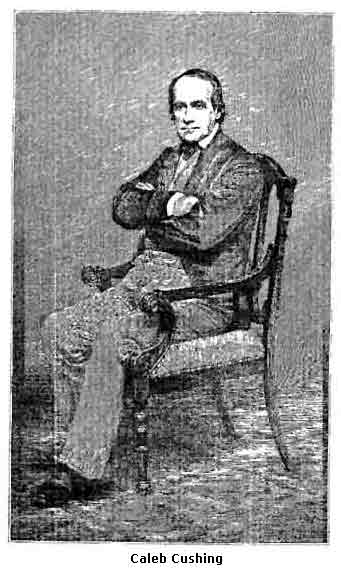
Pamphlet edition with notes and preface by Charles C. Nott and Cephas Brainerd, September, 1860.
A pamphlet reprint was at once announced by the same paper; and later, in the Presidential campaign, a more careful edition was prepared and circulated, to which were added copious notes by two members of the committee under whose auspices the address was delivered. Their comment, printed in the preface, is worth quoting as showing its literary value under critical analysis. "No one who has not actually attempted to verify its details can understand the patient research and historical labor which it embodies. The history of our earlier politics is scattered through numerous journals, statutes, pamphlets, and letters; and these are defective in completeness and accuracy of statement, and in indices and tables of contents. Neither can any one who has not traveled over this precise ground appreciate the accuracy of every trivial detail, or the self-denying impartiality with which Mr. Lincoln has turned from the testimony of 'the fathers' on the general question of slavery, to present the single question which he discusses. From the first line to the last, from his premises to his conclusion, he travels with a swift, unerring directness which no logician ever excelled, an argument complete and full, without the affectation of learning, and without the stiffness which usually accompanies dates and details. A single, easy, simple sentence of plain Anglo-Saxon words, contains a chapter of history that, in some instances, has taken days of labor to verify, and which must have cost the author months of investigation to acquire."
From New York Lincoln went to fill other engagements to speak at several places in New England, where he met the same enthusiastic popular reception and left the same marked impression, especially upon his more critical and learned hearers. They found no little surprise in the fact that a Western politician, springing from the class of unlettered frontiersmen, could not only mold plain strong words into fresh and attractive phraseology, but maintain a clear, sustained, convincing argument, equal in force and style to the best examples in their college text-books.
CHAPTER XIII THE CHARLESTON CONVENTION
The great political struggle between the North and the South, between Freedom and Slavery, was approaching its culmination. The "irrepressible conflict" had shifted uneasily from caucus to Congress; from Congress to Kansas; incidentally to the Supreme Court and to the Congressional elections in the various States; from Kansas it had come back with renewed intensity to Congress. The next stage of development through which it was destined to pass was the Presidential election of 1860, where, necessarily, the final result would depend largely upon the attitude and relation of parties, platforms, and candidates as selected and proclaimed by their National conventions.
The first of these National conventions was that of the Democratic party, long appointed to meet at Charleston, South Carolina, on April 23, 1860. The fortunes of the party had greatly fluctuated. The repeal of the Missouri Compromise had brought it shipwreck in 1854; it had regained victory in the election of Buchanan, and a majority of the House of Representatives in 1856; then the Lecompton imbroglio once more caused its defeat in the Congressional elections of 1858. But worse than the victory of its opponents was the irreconcilable schism in its own ranks—the open war between President Buchanan and Senator Douglas. In a general way the Southern Democracy followed Buchanan, while the Northern Democracy followed Douglas. Yet there was just enough local exception to baffle accurate calculation. Could the Charleston Convention heal the feud of leaders, and bridge the chasm in policy and principle? As the time approached, and delegation after delegation was chosen by the States, all hope of accommodation gradually disappeared. Each faction put forth its utmost efforts, rallied its strongest men. Each caucus and convention only accentuated and deepened existing differences. When the convention met, its members brought not the ordinary tricks and expedients of politicians with carte blanche authority, but the precise formulated terms to which their constituencies would consent. They were only messengers, not arbitrators. The Charleston Convention was the very opposite of its immediate predecessor, the Cincinnati Convention. At Cincinnati, concealment and ambiguity had been the central thought and purpose. Everybody was anxious to be hoodwinked. Delegates, constituencies, and leaders had willingly joined in the game of "cheat and be cheated." Availability, harmony, party success, were the paramount objects.
Douglas, Reply to Black, Pamphlet, Oct., 1859.
No similar ambiguity, concealment, or bargain was possible at Charleston. There was indeed a whole brood of collateral issues to be left in convenient obscurity, but the central questions must not be shirked. The Lecompton quarrel, the Freeport doctrine, the property theory, the "slave-State" dogma, the Congressional slave code proposal, must be boldly met and squarely adjusted. Even if the delegates had been disposed to trifle with their constituents, the leaders themselves would tolerate no evasion on certain cardinal points. Douglas, in his Dorr letter, had announced that he would suffer no interpolation of new issues into the Democratic creed. In his pamphlet reply to Judge Black he repeated his determination with emphasis. "Suppose it were true that I am a Presidential aspirant; does that fact justify a combination by a host of other Presidential aspirants, each of whom may imagine that his success depends upon my destruction, and the preaching a crusade against me for boldly avowing now the same principles to which they and I were pledged at the last Presidential election! Is this a sufficient excuse for devising a new test of political orthodoxy?... I prefer the position of Senator or even that of a private citizen, where I would be at liberty to defend and maintain the well-defined principles of the Democratic party, to accepting a Presidential nomination upon a platform incompatible with the principle of self-government in the Territories, or the reserved rights of the States, or the perpetuity of the Union under the Constitution."
"Globe," p. 658.
Jefferson Davis, Senate Speech, "Globe," May 17, 1860, p. 2155. "Globe", March 1, 1860, p. 935.
This declaration very clearly defined the issue on one side. On the other side it was also formulated with equal distinctness. Jefferson Davis, already recognized as the ablest leader of the Buchanan wing of the Democratic Senators, wrote and submitted to the United States Senate, on February 2, 1860, a series of resolutions designed to constitute the Administration or Southern party doctrines, which were afterwards revised and adopted by a caucus of Democratic Senators. These resolutions expressed the usual party tenets; and on two of the controverted points asserted dogmatically exactly that which Douglas had stigmatized as an intolerable heresy. The fourth resolution declared "That neither Congress nor a Territorial Legislature, whether by direct legislation or legislation of an indirect and unfriendly character, possesses power to annul or impair the constitutional right of any citizen of the United States to take his slave property into the common Territories, and there hold and enjoy the same while the Territorial condition remains." While the fifth resolution declared "That if experience should at any time prove that the judiciary and executive authority do not possess means to insure adequate protection to constitutional rights in a Territory, and if the Territorial government shall fail or refuse to provide the necessary remedies for that purpose, it will be the duty of Congress to supply such deficiency."
Party discipline was so strong among the Democrats that public expectation looked confidently to at least a temporary agreement or combination which would enable the factions, by a joint effort, to make a hopeful Presidential campaign. But no progress whatever was made in that direction. As the clans gathered at Charleston, the notable difference developed itself, that while one wing was filled with unbounded enthusiasm for a candidate, the other was animated by an earnest and stubborn devotion to an idea.
Murat Halstead, "Conventions of 1860."
"Douglas was the pivot individual of the Charleston Convention," wrote an observant journalist; "every delegate was for or against him; every motion meant to nominate or not nominate him; every parliamentary war was pro or con Douglas." This was the surface indication, and, indeed, it may be said with truth, it was the actual feeling of the Northern faction of the Democratic party. Douglas was a genuinely popular leader. He had the power to inspire a pure personal enthusiasm. He had aroused such hero-worship as may be possible in modern times and in American polities. Beyond this, however, the Lecompton controversy, and his open persecution by the Buchanan Administration, made his leadership and his candidacy a necessity to the Northern Democrats.
With Southern Democrats the feeling went somewhat deeper. Forgetting how much they owed him in the past, and how much they might still gain through him in the future, they saw only that he was now their stumbling-block, the present obstacle to their full and final success. It was the Douglas doctrine, squatter sovereignty, and "unfriendly legislation," rather than the man, which they had come to oppose, and were determined to put down. Any other individual holding these heresies would have been equally obnoxious. They had no candidate of their own; they worshiped no single leader; but they followed a principle with unfaltering devotion. They clung unswervingly not only to the property theory, but advanced boldly to its logical sequence—Congressional protection to slavery in the Territories.
Of the convention's preliminary work little is worth recording—there were the clamor and protest of contesting delegations and small fire of parliamentary skirmishes, by which factions feel and measure each other's strength. Caleb Cushing was made permanent chairman, for the triple reason that he was from Massachusetts, that he was the ablest presiding officer in the body, and was for the moment filled with blind devotion to Southern views. The actual temper of the convention was made manifest by the ready agreement of both extremes to join battle in making the platform before proceeding to the nomination of candidates. The usual committee of one member from each State was appointed, and to it was referred the deluge of resolutions which had been showered upon the convention.