A HISTORY (continued 3)
Reading edition
Cass to Stanton, December 2, 1857. Senate Ex. Doc. No. 8, 1st Sess. 35th Cong. Vol. I., pp. 112-13. Cass to Stanton, December 8, 1857. Ibid., p. 113.
Cass to Denver, December 11th, 1857. Senate Ex. Doc. No. 8, 1st Sess. 35th Cong. Vol. I., p. 120.
The first weather-sign came from Washington. On the day after Acting Governor Stanton convened the October Legislature in special session, and before news of the event reached him, Secretary Cass transmitted to him advance copies of the President's annual message, in which the Lecompton Constitution was indorsed in unqualified terms. A week later he was admonished to conform to the views of the President in his official conduct. At this point the State Department became informed of what had taken place, and the acting Governor had short shrift. On December 11 Cass wrote to J.W. Denver, Esq.: "You have already been informed that Mr. Stanton has been removed from the office of Secretary of the Territory of Kansas and that you have been appointed in his place." Cass further explained that the President "was surprised to learn that the secretary and acting Governor had, on the 1st of December, issued his proclamation for a special session of the Territorial Legislature on the 7th instant, only a few weeks in advance of its regular time of meeting, and only fourteen days before the decision was to be made on the question submitted by the convention. This course of Mr. Stanton, the President seriously believes, has thrown a new element of discord among the excited people of Kansas, and is directly at war, therefore, with the peaceful policy of the Administration. For this reason he has felt it his duty to remove him."
Walker, already in Washington on leave of absence, could no longer remain silent. He was as pointedly abandoned and disgraced by the Administration as was his subordinate. In a dignified letter justifying his own course, which, he reminded them, had never been criticized or disavowed, he resigned the governorship. "From the events occurring in Kansas as well as here," he wrote, "it is evident that the question is passing from theories into practice; and that as governor of Kansas I should be compelled to carry out new instructions, differing on a vital question from those received at the date of my appointment. Such instructions I could not execute consistently with my views of the Federal Constitution, of the Kansas and Nebraska bill, or with my pledges to the people of Kansas." "The idea entertained by some that I should see the Federal Constitution and the Kansas-Nebraska bill overthrown and disregarded, and that, playing the part of a mute in a pantomime of ruin, I should acquiesce by my silence in such a result, especially where such acquiescence involved, as an immediate consequence, a disastrous and sanguinary civil war, seems to me most preposterous."[13]
The conduct and the language of Walker and Stanton bear a remarkable significance when we remember that they had been citizens of slave States and zealous Democratic partisans, and that only hard practical experience and the testimony of their own eyes had forced them to join their predecessors in the political "graveyard." "The ghosts on the banks of the Styx," said Seward, "constitute a cloud scarcely more dense than the spirits of the departed Governors of Kansas, wandering in exile and sorrow for having certified the truth against falsehood in regard to the elections between Freedom and Slavery in Kansas."
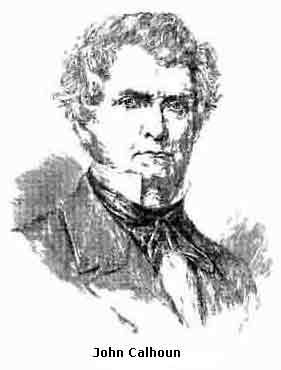
This "missing link," no less than the remaining portion of the journal printed in the proceedings of the investigating committee, is itself strong circumstantial proof of the imposture underlying the whole transaction. Many sections of the completed constitution are not even mentioned in the journal; it does not contain the submission clause of the schedule, and the authenticity of the document rests upon the signature and the certificate of John Calhoun without other verification.
CHAPTER VII THE REVOLT OF DOUGLAS
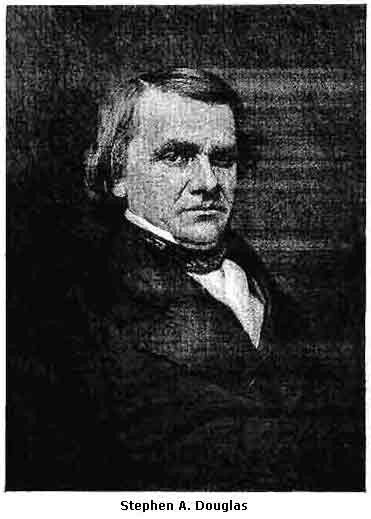
The language of President Buchanan's annual message, the summary dismissal of Acting Governor Stanton, and the resignation of Governor Walker abruptly transferred the whole Lecompton question from Kansas to Washington; and even before the people of the Territory had practically decided it by the respective popular votes of December 21,1857, and January 4,1858, it had become the dominant political issue in the Thirty-fifth Congress, which convened on December 7, 1857. The attitude of Senator Douglas on the new question claimed universal attention. The Dred Scott decision, affirming constitutional sanction and inviolability for slave property in Territories, had rudely damaged his theory. But we have seen how in his Springfield speech he ingeniously sought to repair and rehabilitate "popular sovereignty" by the sophism that a master's abstract constitutional right to slave property in a Territory was a "barren and a worthless right unless sustained, protected, and enforced by appropriate police regulations," which could only be supplied by the local Territorial Legislatures; and that the people of Kansas thus still possessed the power of indirect prohibition.
1857.
To invent and utter this sophism for home consumption among his distant constituents on the 12th of June (a few days before the Lecompton delegates were elected), and in so unobtrusive a manner as scarcely to attract a ripple of public notice, was a light task compared with that which confronted him as Senator, at the meeting of Congress in December, in the light of John Calhoun's doings and powers, of the scandal of the Oxford fraud, and of the indignation of Northern Democrats against the betrayal of Walker and Stanton.
One of his first experiences was a personal quarrel with Buchanan. When he reached Washington, three days before the session, he went to the President to protest against his adopting the Lecompton Constitution and sending it to Congress for acceptance. Buchanan insisted that he must recommend it in his annual message. Douglas replied that he would denounce it as soon as it was read. The President, excited, told him "to remember that no Democrat ever yet differed from an administration of his own choice without being crushed. Beware of the fate of Tallmadge and Rives."
Douglas, Milwaukee Speech, October 13, 1860.
"Mr. President," retorted Douglas, "I wish you to remember that General Jackson is dead."
In the election of Mr. Buchanan as President the South had secured a most important ally for the work of pro-slavery reaction. Trained in the belief that the South had hitherto been wronged, he was ready on every occasion to appear as her champion for redress; and Southern politicians were now eager to use his leadership to make their views of public policy and constitutional duty acceptable to the North. Respectable in capacity but feeble in will, he easily submitted to control and guidance from a few Southern leaders of superior intellectual force. In his inaugural, he sought to prepare public opinion for obedience to the Dred Scott decision, and since its publication he had undertaken to interpret its scope and effect. Replying to a memorial from certain citizens of New England, he declared in a public letter, "Slavery existed at that period, and still exists in Kansas, under the Constitution of the United States. This point has at last been finally decided by the highest tribunal known to our laws. How it could ever have been seriously doubted is a mystery."[1] In the same letter he affirmed the legality of the Lecompton Convention, though he yet clearly expressed his expectation that the constitution to be framed by it would be submitted to the popular vote for "approbation or rejection."
1857.
But when that convention adjourned, and made known its cunningly devised work, the whole South instantly became clamorous to secure the sectional advantages which lay in its technical regularity, its strong affirmance of the "property" theory, and the extraordinary power it gave to John Calhoun to control the election and decide the returns. This powerful reactionary movement was not lost upon Mr. Buchanan. He reflected it as unerringly as the vane moves to the change of the wind. Long before the meeting of Congress, the Administration organ, the "Washington Union," heralded and strongly supported the new departure. When, on the 8th of December, the President's annual message was transmitted and read, the Lecompton Constitution, as framed and submitted, was therein warmly indorsed and its acceptance indicated as the future Administration policy.
Buchanan, Annual Message, December 8, 1857.
The language of this message discloses with what subtle ingenuity words, phrases, definitions, ideas, and theories were being invented and plied to broaden and secure every conquest of the pro-slavery reaction. An elaborate argument was made to defend the enormities of the Lecompton Constitution. The doctrine of the Silliman letter, that "slavery exists in Kansas under the Constitution of the United States," was assumed as a conceded theory. "In emerging from the condition of territorial dependence into that of a sovereign State," the people might vote "whether this important domestic institution should or should not continue to exist." "Domestic institutions" was defined to mean slavery. "Free to form and regulate their domestic institutions"—the phrase employed in the Kansas-Nebraska act—was construed to mean a vote to continue or discontinue slavery. And "if any portion of the inhabitants shall refuse to vote, a fair opportunity to do so having been presented, ... they alone will be responsible for the consequences." "Should the constitution without slavery be adopted by the votes of the majority, the rights of property in slaves now in the Territory are reserved.... These slaves were brought into the Territory under the Constitution of the United States and are now the property of their masters. This point has at length been finally decided by the highest judicial tribunal of the country."
However blind Buchanan might be to the fact that this extreme interpretation shocked and alarmed the sentiment of the North; that if made before the late Presidential campaign it would have defeated his own election; and that if rudely persisted in, it might destroy the Democratic ascendency in the future, the danger was obvious and immediately vital to Douglas. His senatorial term was about to expire. To secure a reelection he must carry the State of Illinois in 1858, which had on an issue less pronounced than this defeated his colleague Shields in 1854, and his lieutenant Richardson in 1856. But more than this, his own personal honor was as much involved in his pledges to the voters of Illinois as had been that of Governor Walker to the voters of Kansas. His double-dealing caucus bargain had thus placed him between two fires—party disgrace at Washington and popular disgrace in Illinois. In such a dilemma his choice could not be doubtful. At all risk he must endeavor to sustain himself at home.
Douglas, Senate Speech, December 9, 1857. "Globe," p. 18.
He met the encounter with his usual adroitness and boldness. Assuming that the President had made no express recommendation, he devoted his speech mainly to a strong argument of party expediency, repelling without reserve and denouncing without stint the work of the Lecompton Convention. "Stand by the doctrine," said he, "that leaves the people perfectly free to form and regulate their institutions for themselves, in their own way, and your party will be united and irresistible in power. Abandon that great principle and the party is not worth saving, and cannot be saved after it shall be violated. I trust we are not to be rushed upon this question. Why shall it be done? Who is to be benefited? Is the South to be the gainer? Is the North to be the gainer? Neither the North nor the South has the right to gain a sectional advantage by trickery or fraud.... But I am told on all sides, 'Oh! just wait; the pro-slavery clause will be voted down.' That does not obviate any of my objections; it does not diminish any of them. You have no more right to force a free-State constitution on Kansas than a slave-State constitution. If Kansas wants a slave-State constitution she has a right to it; if she wants a free-State constitution she has a right to it. It is none of my business which way the slavery clause is decided. I care not whether it is voted down or voted up. Do you suppose, after the pledges of my honor that I would go for that principle and leave the people to vote as they choose, that I would now degrade myself by voting one way if the slavery clause be voted down, and another way if it be voted up? I care not how that vote may stand.... Ignore Lecompton; ignore Topeka; treat both those party movements as irregular and void; pass a fair bill—the one that we framed ourselves when we were acting as a unit; have a fair election—and you will have peace in the Democratic party, and peace throughout the country, in ninety days. The people want a fair vote. They will never be satisfied without it.... But if this constitution is to be forced down our throats in violation of the fundamental principle of free government, under a mode of submission that is a mockery and insult, I will resist it to the last."
President Buchanan and the strong pro-slavery faction which was directing his course paid no attention whatever to this proposal of a compromise. Shylock had come into court to demand his bond, and would heed no pleas of equity or appeals to grace. The elections of December 21 and January 4 were held in due time, and with what result we have already seen. John Calhoun counted the votes on January 13 and declared the "Lecompton Constitution with slavery" adopted, prudently reserving, however, any announcement concerning the State officers or Legislature under it. This much accomplished, he hurried away to Washington, where he was received with open arms by the President and his advisers, who at once proceeded with a united and formidable effort to legalize the transparent farce by Congressional sanction.
On the second day of February, 1858, President Buchanan transmitted to Congress the Lecompton Constitution, "received from J. Calhoun, Esq.," and "duly certified by himself." The President's accompanying special message argues that the organic law of the Territory conferred the essential rights of an enabling act; that the free-State party stood in the attitude of willful and chronic revolution; that their various refusals to vote were a sufficient bar to complaint and objection; that the several steps in the creation and work of the Lecompton Convention were regular and legal. "The people of Kansas have, then, 'in their own way,' and in strict accordance with the organic act, framed a constitution and State government, have submitted the all-important question of slavery to the people, and have elected a governor, a member to represent them in Congress, members of the State Legislature, and other State officers. They now ask admission into the Union under this constitution, which is Republican in form. It is for Congress to decide whether they will admit or reject the State which has thus been created. For my own part I am decidedly in favor of its admission and thus terminating the Kansas question."
1858.
The vote of January 4 against the constitution he declared to be illegal because it was "held after the Territory had been prepared for admission into the Union as a sovereign State, and when no authority existed in the Territorial Legislature which could possibly destroy its existence or change its character." His own inconsistency was lightly glossed over. "For my own part, when I instructed Governor Walker in general terms, in favor of submitting the constitution to the people, I had no object in view except the all-absorbing question of slavery.... I then believed, and still believe, that under the organic act, the Kansas Convention were bound to submit this all-important question of slavery to the people. It was never, however, my opinion that independently of this act they would have been bound to submit any portion of the constitution to a popular vote, in order to give it validity."
To the public at large, the central point of interest in this special message, however, was the following dogmatic announcement by the President: "It has been solemnly adjudged by the highest judicial tribunal known to our laws that slavery exists in Kansas by virtue of the Constitution of the United States. Kansas is, therefore, at this moment as much a slave-State as Georgia or South Carolina. Without this, the equality of the sovereign States composing the Union would be violated, and the use and enjoyment of a territory acquired by the common treasure of all the States would be closed against the people and the property of nearly half the members of the Confederacy. Slavery can, therefore, never be prohibited in Kansas except by means of a constitutional provision and in no other manner can this be obtained so promptly, if a majority of the people desire it, as by admitting it into the Union under its present constitution."
In the light of subsequent history this extreme pro-slavery programme was not only wrong in morals and statesmanship, but short-sighted and foolhardy as a party policy. But to the eyes of President Buchanan this latter view was not so plain. The country was apparently in the full tide of a pro-slavery reaction. He had not only been elected President, but the Democratic party had also recovered its control of Congress. The presiding officer of each branch was a Southerner. Out of 64 members of the Senate, 39 were Democrats, 20 Republicans, and five Americans or Know-Nothings. Of the 237 members of the House, 131 were Democrats, 92 Republicans, and 14 Americans. Here was a clear majority of fourteen in the upper and twenty-five in the lower House. This was indeed no longer the formidable legislative power which repealed the Missouri Compromise, but it seemed perhaps a sufficient force to carry out the President's recommendation. His error was in forgetting that this apparent popular indorsement was secured to him and his party by means of the double construction placed upon the Nebraska bill and the Cincinnati platform, by the caucus bargain between the leaders of the South and the leaders of the North. The moment had come when this unnatural alliance needed to be exposed and in part repudiated.
The haste with which the Southern leaders advanced step by step, forced every issue, and were now pushing their allies to the wall was, to say the least, bad management, but it grew logically out of their situation. They were swimming against the stream. The leading forces of civilization, population, wealth, commerce, intelligence, were bearing them down. The balance of power was lost. Already there were sixteen free-States to fifteen slave-States. Minnesota and Oregon, inevitably destined also to become free, were applying for admission to the Union.
Official Manifesto, Oct. 8, 1754. Senator Brown to Adams, June 18, 1856. Greeley, "Am. Conflict," Vol. I., p. 278.
Official proceedings, Pamphlet.
Still, the case of the South was not hopeless. Kansas was apparently within their grasp. Existing law provided for the formation and admission of four additional States to be carved out of Texas, which would certainly become slave-States. Then there remained the possible division of California, and a race for the possession of New Mexico and Arizona. Behind all, or, more likely, before all except Kansas, in the order of desired events, was the darling ambition of President Buchanan, the annexation of Cuba. As United States Minister to England he had publicly declared that if Spain refused to sell us that coveted island we should be justified in wresting it from her by force; as Presidential candidate he had confidentially avowed, amid the first blushes of his new honor, "If I can be instrumental in settling the slavery question upon the terms I have mentioned, and then add Cuba to the Union, I shall, if President, be willing to give up the ghost, and let Breckinridge take the government." Thus, even excluding the more problematical chances which lay hidden in filibustering enterprises, there was a possibility, easily demonstrable to the sanguine, that a decade or two might change mere numerical preponderance from the free to the slave-States. Nor could this possibility be waved aside by any affectation of incredulity. Not alone Mr. Buchanan but the whole Democratic party was publicly pledged to annexation. "Resolved," said the Cincinnati platform, "that the Democratic party will expect of the next Administration that every proper effort be made to insure our ascendency in the Gulf of Mexico"; while another resolution declaring sympathy with efforts to "regenerate" Central America was no less significant.
But to accomplish such marvels, they must not sit with folded hands. The price of slavery was fearless aggression. They must build on a deeper foundation than Presidential elections, party majorities, or even than votes in the Senate. The theory of the government must be reversed, the philosophy of the republic interpreted anew. In this subtler effort they had made notable progress. By the Kansas-Nebraska act they had paralyzed the legislation of half a century. By the Dred Scott decision they had changed the Constitution and blighted the Declaration of Independence. By the Lecompton trick they would show that in conflict with their dogmas the public will was vicious, and in conflict with their intrigues the majority powerless. They had the President, the Cabinet, the Senate, the House, the Supreme Court, and, by no means least in the immediate problem, John Calhoun with his technical investiture of far-reaching authority. The country had recovered from the shock of the repeal of the Missouri Compromise, and rewarded them with Buchanan. Would it not equally recover from the shock of the Lecompton Constitution?
It was precisely at this point that the bent bow broke. The great bulk of the Democratic party followed the President and his Southern advisers, even in this extreme step; but to a minority sufficient to turn the scale the Lecompton scandal had become too offensive for further tolerance.
In the Senate, with its heavy Democratic majority, the Administration easily secured the passage of a bill to admit Kansas with the Lecompton Constitution. Out of eleven Democratic Senators from free States, only three—Douglas of Illinois, Broderick of California, and Stuart of Michigan—took courage to speak and vote against the measure. In the House of Representatives, however, with a narrower margin of political power, the scheme, after an exciting discussion running through about two months, met a decisive defeat. A formidable popular opposition to it had developed itself in the North, in which speeches and letters from Governor Walker and Secretary Stanton in denunciation of it were a leading feature and a powerful influence. The lower House of Congress always responds quickly to currents of public sentiment; but in this case it caught direction all the more promptly because its members were to be chosen anew in the ensuing autumn. However much they might have party subordination and success at heart, some of them felt that they could not defend before their anti-slavery constituencies the Oxford frauds, the Calhoun dictatorship, the theory that slave property is above constitutional sanction, and the dogma that "Kansas is therefore at this moment as much a slave-State as Georgia or South Carolina." When the test vote was taken on April 1, out of the 53 Democratic representatives from the free-States 31 voted for Lecompton; but the remaining 22,[2] joining their strength to the opposition, passed a substitute, originating with Mr. Crittenden of the Senate, which in substance directed a resubmission of the Lecompton Constitution to the people of Kansas;—if adopted, the President to admit the new State by a simple proclamation; if rejected, the people to call a convention and frame a new instrument.
As the October vote had been the turning-point in the local popular struggle in the Territory, this adoption of the Crittenden-Montgomery substitute, by a total vote of 120 to 112 in the House of Representatives, was the culmination of the National intrigue to secure Kansas for the South. It was a narrow victory for freedom; a change of 5 votes would have passed the Lecompton bill and admitted the State with slavery, and a constitutional prohibition against any change for seven years to come. With his authority to control election returns, there is every reason to suppose that Calhoun would have set up a pro-slavery State Legislature, to choose two pro-slavery senators, whom in its turn the strong Lecompton majority in the United States Senate would have admitted to seats; and thus the whole chain of fraud and usurpation back to the first Border-Ruffian invasion of Kansas would have become complete, legal, and irrevocable, on plea of mere formal and technical regularity.
Foiled in its main object, the Administration made another effort which served to break somewhat the force and humiliation of its first and signal defeat. The two Houses of Congress having disagreed as stated, and each having once more voted to adhere to its own action, the President managed to make enough converts among the anti-Lecompton Democrats of the House to secure the appointment of a committee of conference. This committee devised what became popularly known as the "English bill," a measure which tendered a land grant to the new State, and provided that on the following August 3d the people of Kansas might vote "proposition accepted" or "proposition rejected." Acceptance should work the admission of the State with the Lecompton Constitution, while rejection should postpone any admission until her population reached the ratio of representation required for a member of the House. "Hence it will be argued," exclaimed Douglas, "in one portion of the Union that this is a submission of the constitution, and in another portion that it is not." The English bill became a law; but the people of Kansas once more voted to reject the "proposition" by nearly ten thousand majority.
Douglas, Senate Speech, March 22, 1858. App. "Globe," pp. 199, 200.
Douglas opposed the English bill as he had done the Lecompton bill, thus maintaining his attitude as the chief leader of the anti-Lecompton opposition. In proportion as he received encouragement and commendation from Republican and American newspapers, he fell under the ban of the Administration journals. The "Washington Union" especially pursued him with denunciation. "It has read me out of the Democratic party every other day, at least, for two or three months," said he, "and keeps reading me out; and, as if it had not succeeded, still continues to read me out, using such terms as 'traitor,' 'renegade,' 'deserter,' and other kind and polite epithets of that nature." He explained that this arose from his having voted in the Senate against its editor for the office of public printer; but he also pointed out that he did so because that journal had become pro-slavery to the point of declaring "that the emancipation acts of New York, of New England, of Pennsylvania, and of New Jersey were unconstitutional, were outrages upon the right of property, were violations of the Constitution of the United States." "The proposition is advanced," continued he, "that a Southern man has a right to move from South Carolina with his negroes into Illinois, to settle there and hold them there as slaves, anything in the constitution and laws of Illinois to the contrary notwithstanding." Douglas further intimated broadly that the President and Cabinet were inspiring these editorials of the Administration organ, as part and parcel of the same system and object with which they were pushing the Lecompton Constitution with its odious "property" doctrine; and declared, "if my protest against this interpolation into the policy of this country or the creed of the Democratic party is to bring me under the ban, I am ready to meet the issue."
He had not long to wait for the issue. The party rupture was radical, not superficial. It was, as he had himself pointed out, part of the contest for national supremacy between slavery and freedom. From time to time he still held out the olive-branch and pointed wistfully to the path of reconciliation. But the reactionary faction which ruled Mr. Buchanan never forgave Douglas for his part in defeating Lecompton, and more especially for what they alleged to be his treachery to his caucus bargain, in refusing to accept and defend all the logical consequences of the Dred Scott decision.
CHAPTER VIII THE LINCOLN-DOUGLAS DEBATES
The anti-Lecompton recusancy of Douglas baffled the plotting extremists of the South, and created additional dissension in the Democratic ranks; and this growing Democratic weakness and the increasing Republican ardor and strength presaged a possible Republican success in the coming Presidential election. While this condition of things gave national politics an unusual interest, the State of Illinois now became the field of a local contest which for the moment held the attention of the entire country in such a degree as to involve and even eclipse national issues.
In this local contest in Illinois, the choice of candidates on both sides was determined long beforehand by a popular feeling, stronger and more unerring than ordinary individual or caucus intrigues. Douglas, as author of the repeal of the Missouri Compromise, as a formidable Presidential aspirant, and now again as leader of the anti-Lecompton Democrats, could, of course, have no rival in his party for his own Senatorial seat. Lincoln, who had in 1854 gracefully yielded his justly won Senatorial honors to Trumbull, and who alone bearded Douglas in his own State throughout the whole anti-Nebraska struggle, with anything like a show of equal political courage and intellectual strength, was as inevitably the leader and choice of the Republicans. Their State convention met in Springfield on the 16th of June, 1858, and, after its ordinary routine work, passed with acclamation a separate resolution, which declared "that Abraham Lincoln is the first and only choice of the Republicans of Illinois for the United States Senate as the successor of Stephen A. Douglas." The proceedings of the convention had consumed the afternoon, and an adjournment was taken. At 8 o'clock that same evening, the convention having reassembled in the State-house, Lincoln appeared before it, and made what was perhaps the most carefully prepared speech of his whole life. Every word of it was written, every sentence had been tested; but the speaker delivered it without manuscript or notes. It was not an ordinary oration, but, in the main, an argument, as sententious and axiomatic as if made to a bench of jurists. Its opening sentences contained a political prophecy which not only became the ground-work of the campaign, but heralded one of the world's great historical events. He said:
Lincoln-Douglas Debates, p. 1.
"If we could first know where we are and whither we are tending, we could better judge what to do and how to do it. We are now far into the fifth year since a policy was initiated, with the avowed object and confident promise of putting an end to slavery agitation. Under the operation of that policy, that agitation has not only not ceased, but has constantly augmented. In my opinion it will not cease until a crisis shall have been reached and passed. 'A house divided against itself cannot stand.' I believe this Government cannot endure permanently, half slave and half free. I do not expect the Union to be dissolved—I do not expect the house to fall—but I do expect it will cease to be divided. It will become all one thing or all the other. Either the opponents of slavery will arrest the further spread of it, and place it where the public mind shall rest in the belief that it is in course of ultimate extinction; or its advocates will push it forward till it shall become alike lawful in all the States, old as well as new, North as well as South."
Then followed his demonstration, through the incidents of the Nebraska legislation, the Dred Scott decision, and present political theories and issues, which would by and by find embodiment in new laws and future legal doctrines. The repeal of the Missouri Compromise, the language of the Nebraska bill, which declared slavery "subject to the Constitution," the Dred Scott decision, which declared that "subject to the Constitution" neither Congress nor a Territorial Legislature could exclude slavery from a Territory—the argument presented point by point and step by step with legal precision the silent subversion of cherished principles of liberty. "Put this and that together," said he, "and we have another nice little niche, which we may ere long see filled with another Supreme Court decision, declaring that the Constitution of the United States does not permit a State to exclude slavery from its limits.... Such a decision is all that slavery now lacks of being alike lawful in all the States.... We shall lie down," continued the orator, "pleasantly dreaming that the people of Missouri are on the verge of making their State free; and we shall awake to the reality instead, that the Supreme Court has made Illinois a slave State."
His peroration was a battle-call: "Our cause, then, must be intrusted to and conducted by its own undoubted friends, those whose hands are free, whose hearts are in the work, who do care for the result. Two years ago the Republicans of the nation mustered over thirteen hundred thousand strong. We did this under the single impulse of resistance to a common danger, with every external circumstance against us. Of strange, discordant, and even hostile elements we gathered from the four winds, and formed and fought the battle through, under the constant hot fire of a disciplined, proud, and pampered enemy. Did we brave all then to falter now?—now, when that same enemy is wavering, dissevered, and belligerent? The result is not doubtful. We shall not fail—if we stand firm we shall not fail. Wise counsels may accelerate or mistakes delay it, but sooner or later the victory is sure to come."
See O.J. Hollister, "Life of Colfax," pp. 119-22.
J. Watson Webb to Bates, June 9, 1858. MS.
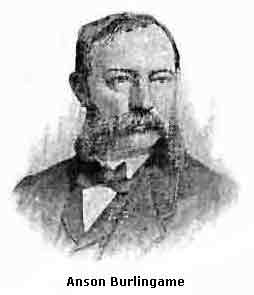
Lincoln's declaration that the cause of slavery restriction "must be intrusted to its own undoubted friends" had something more than a general meaning. We have seen that while Douglas avowed he did not care "whether slavery was voted down or voted up" in the Territories, he had opposed the Lecompton Constitution on the ground of its non-submission to popular vote, and that this opposition caused the Buchanan Democrats to treat him as an apostate. Many earnest Republicans were moved to strong sympathy for Douglas in this attitude, partly for his help in defeating the Lecompton iniquity, partly because they believed his action in this particular a prelude to further political repentance, partly out of that chivalric generosity of human nature which sides with the weak against the strong. In the hour of his trial and danger many wishes for his successful reëlection came to him from Republicans of national prominence. Greeley, in the New York "Tribune" as well as in private letters, made no concealment of such a desire. Burlingame, in a fervid speech in the House of Representatives, called upon the young men of the country to stand by the Douglas men. It was known that Colfax and other influential members of the House were holding confidential interviews with Douglas, the object of which it was not difficult to guess. There were even rumors that Seward intended to interfere in his behalf. This report was bruited about so industriously that he felt it necessary to permit a personal friend to write an emphatic denial, so that it might come to Lincoln's knowledge. On the other hand, newspapers ventured the suggestion that Lincoln might retaliate by a combination against Seward's Presidential aspirations.
Wentworth to Lincoln, April 19, 1858. MS.
Rival politicians in Illinois were suspicious of each other, and did not hesitate to communicate their suspicions to Lincoln. Personal friends, of course, kept him well informed about these various political under-currents, and an interesting letter of his shows that he received and treated the matter with liberal charity. "I have never said or thought more," wrote he, "as to the inclination of some of our Eastern Republican friends to favor Douglas, than I expressed in your hearing on the evening of the 21st April, at the State Library in this place. I have believed—do believe now—that Greeley, for instance, would be rather pleased to see Douglas reëlected over me or any other Republican; and yet I do not believe it is so because of any secret arrangement with Douglas—it is because he thinks Douglas's superior position, reputation, experience, and ability, if you please, would more than compensate for his lack of a pure Republican position, and, therefore, his reëlection do the general cause of Republicanism more good than would the election of any one of our better undistinguished pure Republicans. I do not know how you estimate Greeley, but I consider him incapable of corruption or falsehood. He denies that he directly is taking part in favor of Douglas, and I believe him.[1] Still his feeling constantly manifests itself in his paper, which, being so extensively read in Illinois, is, and will continue to be, a drag upon us. I have also thought that Governor Seward, too, feels about as Greeley does; but not being a newspaper editor, his feeling in this respect is not much manifested. I have no idea that he is, by conversation or by letter, urging Illinois Republicans to vote for Douglas."
Lincoln to Wilson, June 1, 1858. MS.
"As to myself, let me pledge you my word that neither I nor my friends, so far as I know, have been setting stake against Governor Seward. No combination has been made with me, or proposed to me, in relation to the next Presidential candidate. The same thing is true in regard to the next Governor of our State. I am not directly or indirectly committed to any one; nor has any one made any advance to me upon the subject. I have had many free conversations with John Wentworth; but he never dropped a remark that led me to suspect that he wishes to be Governor. Indeed it is due to truth to say that while he has uniformly expressed himself for me, he has never hinted at any condition. The signs are that we shall have a good convention on the 16th, and I think our prospects generally are improving some every day. I believe we need nothing so much as to get rid of unjust suspicions of one another."
Lincoln to Crittenden, July 7, 1858. Mrs. Coleman, "Life of Crittenden," Vol. II., p. 162.
Crittenden to Lincoln, July 29, 1858. Ibid., p. 163. Crittenden to Dickey, August 1, 1858. Ibid., p. 164.
While many alleged defections were soon disproved by the ready and loyal avowals of his friends in Illinois and elsewhere, there came to him a serious disappointment from a quarter whence he little expected it. Early in the canvass Lincoln began to hear that Crittenden, of Kentucky, favored the reëlection of Douglas, and had promised so to advise the Whigs of Illinois by a public letter. Deeming it well-nigh incredible that a Kentucky Whig like Crittenden could take such a part against an Illinois Whig of his own standing and service, to help a life-long opponent of Clay and his cherished plans, Lincoln addressed him a private letter making the direct inquiry. "I do not believe the story," he wrote, "but still it gives me some uneasiness. If such was your inclination, I do not believe you would so express yourself. It is not in character with you as I have always estimated you." Crittenden's reply, however, confirmed his worst fears. He said he and Douglas had acted together to oppose Lecompton. For this Douglas had been assailed, and he thought his reëlection was necessary to rebuke the Buchanan Administration. In addition Crittenden also soon wrote the expected letter for publication, in which phraseology of apparent fairness covered an urgent appeal in Douglas's behalf.
Lincoln-Douglas Debates, pp. 4-5.
In the evenly balanced and sensitive condition of Illinois politics this ungracious outside interference may be said to have insured Lincoln's defeat. While it gave him pain to be thus wounded in the house of his friends, he yet more deeply deplored the inexcusable blunder of leaders whose misplaced sympathy put in jeopardy the success of a vital political principle. In his convention speech he had forcibly stated the error and danger of such a step. "How can he [Douglas] oppose the advances of slavery? He don't care anything about it. His avowed mission is impressing the 'public heart' to care nothing about it.... For years he has labored to prove it a sacred right of white men to take negro slaves into the new Territories. Can he possibly show that it is less a sacred right to buy them where they can be bought cheapest? And unquestionably they can be bought cheaper in Africa than in Virginia. He has done all in his power to reduce the whole question of slavery to one of a mere right of property.... Now as ever, I wish not to misrepresent Judge Douglas's position, question his motives, or do aught that can be personally offensive to him. Whenever, if ever, he and we can come together on principle so that our great cause may have assistance from his great ability, I hope to have interposed no adventitious obstacle. But clearly he is not now with us—he does not pretend to be—he does not promise ever to be."
Lincoln, Springfield Speech, July 17, 1858. Debates, p. 55.
Lincoln in nowise underrated the severity of the political contest in which he was about to engage. He knew his opponent's strong points as well as his weak ones—his energy, his adroitness, the blind devotion of his followers, his greater political fame. "Senator Douglas is of world-wide renown," he said. "All the anxious politicians of his party, or who have been of his party for years past, have been looking upon him as certainly at no distant day to be the President of the United States. They have seen in his round, jolly, fruitful face post-offices, land-offices, marshalships, and cabinet appointments, chargé-ships and foreign missions, bursting and sprouting out in wonderful exuberance ready to be laid hold of by their greedy hands. And as they have been gazing upon this attractive picture so long, they cannot, in the little distraction that has taken place in the party, bring themselves to give up the charming hope; but with greedier anxiety they rush about him, sustain him, and give him marches, triumphal entries, and receptions, beyond what even in the days of his highest prosperity they could have brought about in his favor. On the contrary, nobody has ever expected me to be President. In my poor, lean, lank face, nobody has ever seen that any cabbages were sprouting out. These are disadvantages all taken together, that the Republicans labor under. We have to fight this battle upon principle, and principle alone."
1858.
Douglas and his friends had indeed entered upon the canvass with an unusual flourish of trumpets. Music, banners, salutes, fireworks, addresses, ovation, and jubilation with enthusiasm genuine and simulated, came and went in almost uninterrupted sequence; so much of the noise and pomp of electioneering had not been seen since the famous hard-cider campaign of Harrison. The "Little Giant," as he was proudly nicknamed by his adherents, arrived in Illinois near midsummer, after elaborate preparation and heralding, and made speeches successively at Chicago, Bloomington, and Springfield on the 9th, 16th, and 17th of July. The Republicans and their candidate were equally alert to contest every inch of ground. Mr. Lincoln made speeches in reply at Chicago on the 10th and at Springfield on the evening of Douglas's day address; and in both instances with such force and success as portended a fluctuating and long-continued struggle.
For the moment the presence of Douglas not only gave spirit and fresh industry to his followers, but the novelty impressed the indifferent and the wavering. The rush of the campaign was substituting excitement for inquiry, blare of brass bands and smoke of gunpowder for intelligent criticism. The fame and prestige of the "Little Giant" was beginning to incline the vibrating scale. Lincoln and his intimate political advisers were not slow to note the signs of danger; and the remedy devised threw upon him the burden of a new responsibility. It was decided in the councils of the Republican leaders that Lincoln should challenge Douglas to joint public debate.
The challenge was sent by Lincoln on July 24; Douglas proposed that they should meet at the towns of Ottawa, Freeport, Jonesboro, Charleston, Galesburg, Quincy, and Alton, each speaker alternately to open and close the discussion; Douglas to speak one hour at Ottawa, Lincoln to reply for an hour and a half, and Douglas to make a half hour's rejoinder. In like manner Lincoln should open and close at Freeport, and so on alternately. Lincoln's note of July 31 accepted the proposal as made. "Although by the terms," he wrote, "as you propose, you take four openings and closes to my three, I accede and thus close the arrangement." Meanwhile each of the speakers made independent appointments for other days and places than these seven; and in the heat and dust of midsummer traveled and addressed the people for a period of about one hundred days, frequently making the necessary journeys by night, and often speaking two and sometimes even three times in a single day. Thus to the combat of intellectual skill was added a severe ordeal of physical endurance.[2]
Lincoln entered upon the task which his party friends had devised with neither bravado nor misgiving. He had not sought these public discussions; neither did he shrink from them. Throughout his whole life he appears to have been singularly correct in his estimate of difficulties to be encountered and of his own powers for overcoming them. Each of these seven meetings, comprising both the Republican and Democratic voters of the neighboring counties, formed a vast, eager, and attentive assemblage. It needed only the first day's experience to show the wisdom of the Republican leaders in forcing a joint discussion upon Douglas. Face to face with his competitor, he could no longer successfully assume airs of superiority, or wrap himself in his Senatorial dignity and prestige. They were equal spokesmen, of equal parties, on an equal platform, while applause and encouragement on one side balanced applause and encouragement on the other.
In a merely forensic sense, it was indeed a battle of giants. In the whole field of American politics no man has equaled Douglas in the expedients and strategy of debate. Lacking originality and constructive logic, he had great facility in appropriating by ingenious restatement the thoughts and formulas of others. He was tireless, ubiquitous, unseizable. It would have been as easy to hold a globule of mercury under the finger's tip as to fasten him to a point he desired to evade. He could almost invert a proposition by a plausible paraphrase. He delighted in enlarging an opponent's assertion to a forced inference ridiculous in form and monstrous in dimensions. In spirit he was alert, combative, aggressive; in manner, patronizing and arrogant by turns.
Lincoln's mental equipment was of an entirely different order. His principal weapon was direct, unswerving logic. His fairness of statement and generosity of admission had long been proverbial. For these intellectual duels with Douglas, he possessed a power of analysis that easily outran and circumvented the "Little Giant's" most extraordinary gymnastics of argument. But, disdaining mere quibbles, he pursued lines of concise reasoning to maxims of constitutional law and political morals. Douglas was always forcible in statement and bold in assertion; but Lincoln was his superior in quaint originality, aptness of phrase, and subtlety of definition; and oftentimes Lincoln's philosophic vision and poetical fervor raised him to flights of eloquence which were not possible to the fiber and temper of his opponent.
It is, of course, out of the question to abridge the various Lincoln-Douglas discussions of which the text fills a good-sized volume. Only a few points of controversy may be stated. Lincoln's convention speech, it will be remembered, declared that in his belief the Union could not endure permanently half slave and half free, but must become all one thing or all the other. Douglas in his first speech of the campaign attacked this as an invitation to a war of sections, declaring that uniformity would lead to consolidation and despotism. He charged the Republicans with intent to abolish slavery in the States; said their opposition to the Dred Scott decision was a desire for negro equality and amalgamation; and prescribed his dogma of popular sovereignty as a panacea for all the ills growing out of the slavery agitation.
Lincoln-Douglas Debates, p. 75.
To this Lincoln replied that Republicans did not aim at abolition in the slave-States, but only the exclusion of slavery from free Territories; they did not oppose the Dred Scott decision in so far as it concerned the freedom of Dred Scott, but they refused to accept its dicta as rules of political action. He repelled the accusation that the Republicans desired negro equality or amalgamation, saying: "There is a physical difference between the two, which, in my judgment, will probably forever forbid their living together upon the footing of perfect equality; and inasmuch as it becomes a necessity that there must be a difference, I, as well as Judge Douglas, am in favor of the race to which I belong having the superior position. I have never said anything to the contrary, but I hold that notwithstanding all this there is no reason in the world why the negro is not entitled to all the natural rights enumerated in the Declaration of Independence—the right to life, liberty, and the pursuit of happiness. I hold that he is as much entitled to these as the white man. I agree with Judge Douglas he is not my equal in many respects—certainly not in color, perhaps not in moral or intellectual endowment; but in the right to eat the bread without the leave of anybody else, which his own hand earns, he is my equal, and the equal of Judge Douglas and the equal of every living man."
In return he pressed upon Douglas his charge of a political conspiracy to nationalize slavery, alleging that his "don't care" policy was but the convenient stalking-horse under cover of which a new Dred Scott decision would make slavery lawful everywhere.
Ibid., p. 82.
It is merely for the Supreme Court to decide that no State under the Constitution can exclude it, just as they have already decided that under the Constitution neither Congress nor the Territorial Legislature can do it. When that is decided and acquiesced in, the whole thing is done. This being true, and this being the way, as I think, that slavery is to be made national, let us consider what Judge Douglas is doing every day to that end. In the first place, let us see what influence he is exerting on public sentiment. In this and like communities public sentiment is everything. With public sentiment, nothing can fail; without it nothing can succeed. Consequently, he who molds public sentiment goes deeper than he who enacts statutes or pronounces decisions. He makes statutes and decisions possible or impossible to be executed.
The Democratic policy in regard to that institution will not tolerate the merest breath, the slightest hint, of the least degree of wrong about it. Try it by some of Judge Douglas's arguments. He says he "don't care whether it is voted up or voted down" in the Territories. I do not care myself, in dealing with that expression, whether it is intended to be expressive of his individual sentiments on the subject, or only of the national policy he desires to have established. It is alike valuable for my purpose. Any man can say that who does not see anything wrong in slavery, but no man can logically say it who does see a wrong in it; because no man can logically say he don't care whether a wrong is voted up or voted down. He may say he don't care whether an indifferent thing is voted up or down, but he must logically have a choice between a right thing and a wrong thing. He contends that whatever community wants slaves has a right to have them. So they have, if it is not a wrong. But if it is a wrong, he cannot say people have a right to do wrong. He says that upon the score of equality slaves should be allowed to go into a new Territory, like other property. This is strictly logical if there is no difference between it and other property. If it and other property are equal, his argument is entirely logical. But if you insist that one is wrong and the other right, there is no use to institute a comparison between right and wrong. You may turn over everything in the Democratic policy from beginning to end, whether in the shape it takes on the statute book, in the shape it takes in the Dred Scott decision, in the shape it takes in conversation, or the shape it takes in short maxim-like arguments—it everywhere carefully excludes the idea that there is anything wrong in it.
Lincoln-Douglas Debates, pp. 233-4.
That is the real issue. That is the issue that will continue in this country when these poor tongues of Judge Douglas and myself shall be silent. It is the eternal struggle between these two principles—right and wrong—throughout the world. They are the two principles that have stood face to face from the beginning of time; and will ever continue to struggle. The one is the common right of humanity and the other the divine right of kings. It is the same principle, in whatever shape it develops itself. It is the same spirit that says, "You work and toil and earn bread, and I'll eat it." No matter in what shape it comes, whether from the mouth of a king who seeks to bestride the people of his own nation and live by the fruit of their labor, or from one race of men as an apology for enslaving another race, it is the same tyrannical principle.
Lincoln-Douglas Debates, p. 56.
As to the vaunted popular sovereignty principle, Lincoln declared it "the most arrant Quixotism that was ever enacted before a community.... Does he mean to say that he has been devoting his life to securing to the people of the Territories the right to exclude slavery from the Territories? If he means so to say, he means to deceive; because he and every one knows that the decision of the Supreme Court, which he approves and makes especial ground of attack upon me for disapproving, forbids the people of a Territory to exclude slavery. This covers the whole ground from the settlement of a Territory till it reaches the degree of maturity entitling it to form a State constitution. So far as all that ground is concerned, the Judge is not sustaining popular sovereignty, but absolutely opposing it. He sustains the decision which declares that the popular will of the Territories has no constitutional power to exclude slavery during their territorial existence."
By no means the least interesting of the many points touched in these debates is Lincoln's own estimate of the probable duration of slavery, or rather of the least possible period in which "ultimate extinction" could be effected, even under the most favorable circumstances.
Lincoln-Douglas Debates, p. 157.
Now, at this day in the history of the world [said he, in the Charleston debate], we can no more foretell where the end of this slavery agitation will be than we can see the end of the world itself. The Nebraska-Kansas bill was introduced four years and a half ago, and if the agitation is ever to come to an end, we may say we are four years and a half nearer the end. So too we can say we are four years and a half nearer the end of the world; and we can just as clearly see the end of the world as we can see the end of this agitation. The Kansas settlement did not conclude it. If Kansas should sink to-day, and leave a great vacant space in the earth's surface, this vexed question would still be among us. I say then there is no way of putting an end to the slavery agitation amongst us, but to put it back upon the basis where our fathers placed it, no way but to keep it out of our new Territories—to restrict it forever to the old States where it now exists. Then the public mind will rest in the belief that it is in the course of ultimate extinction. That is one way of putting an end to the slavery agitation.
The other way is for us to surrender and let Judge Douglas and his friends have their way and plant slavery over all the States; cease speaking of it as in any way a wrong; regard slavery as one of the common matters of property and speak of negroes as we do of our horses and cattle. But while it drives on in its state of progress as it is now driving, and as it has driven for the last five years, I have ventured the opinion, and I say to-day that we will have no end to the slavery agitation until it takes one turn or the other. I do not mean to say that when it takes a turn towards ultimate extinction it will be in a day, nor in a year, nor in two years. I do not suppose that in the most peaceful way ultimate extinction would occur in less than a hundred years at least; but that it will occur in the best way for both races, in God's own good time, I have no doubt.
But the one dominating characteristic of Lincoln's speeches is their constant recurrence to broad and enduring principles, their unremitting effort to lead public opinion to loftier and nobler conceptions of political duty; and nothing in his career stamps him so distinctively an American as his constant eulogy and defense of the philosophical precepts of the Declaration of Independence. The following is one of his indictments of his political opponents on this point:
Lincoln-Douglas Debates, p. 225.
At Galesburg the other day, I said, in answer to Judge Douglas, that three years ago there never had been a man, so far as I knew or believed, in the whole world, who had said that the Declaration of Independence did not include negroes in the term "all men." I re-assert it to-day. I assert that Judge Douglas and all his friends may search the whole records of the country, and it will be a matter of great astonishment to me if they shall be able to find that one human being three years ago had ever uttered the astounding sentiment that the term "all men" in the Declaration did not include the negro. Do not let me be misunderstood. I know that more than three years ago there were men who, finding this assertion constantly in the way of their schemes to bring about the ascendency and perpetuation of slavery, denied the truth of it. I know that Mr. Calhoun and all the politicians of his school denied the truth of the Declaration. I know that it ran along in the mouth of some Southern men for a period of years, ending at last in that shameful though rather forcible declaration of Pettit, of Indiana, upon the floor of the United States Senate, that the Declaration of Independence was in that respect "a self-evident lie" rather than a self-evident truth. But I say, with a perfect knowledge of all this hawking at the Declaration without directly attacking it, that three years ago there never had lived a man who had ventured to assail it in the sneaking way of pretending to believe it and then asserting it did not include the negro. I believe the first man who ever said it was Chief-Justice Taney in the Dred Scott case, and the next to him was our friend, Stephen A. Douglas. And now it has become the catchword of the entire party. I would like to call upon his friends everywhere to consider how they have come in so short a time to view this matter in a way so entirely different from their former belief; to ask whether they are not being borne along by an irresistible current, whither they know not?
In the joint debates, however, argument and oratory were both hampered by the inexorable limit of time. For the full development of his thought, the speeches Lincoln made separately at other places afforded him a freer opportunity. A quotation from his language on one of these occasions is therefore here added, as a better illustration of his style and logic, where his sublime theme carried him into one of his more impassioned moods:
The Declaration of Independence was formed by the representatives of American liberty from thirteen States of the Confederacy, twelve of which were slave-holding communities. We need not discuss the way or the reason of their becoming slave-holding communities. It is sufficient for our purpose that all of them greatly deplored the evil and that they placed a provision in the Constitution which they supposed would gradually remove the disease by cutting off its source. This was the abolition of the slave trade. So general was the conviction, the public determination, to abolish the African slave trade, that the provision which I have referred to as being placed in the Constitution declared that it should not be abolished prior to the year 1808. A constitutional provision was necessary to prevent the people, through Congress, from putting a stop to the traffic immediately at the close of the war. Now if slavery had been a good thing, would the fathers of the republic have taken a step calculated to diminish its beneficent influences among themselves, and snatch the boon wholly from their posterity? These communities, by their representatives in old Independence Hall, said to the whole world of men: "We hold these truths to be self-evident: that all men are created equal; that they are endowed by their Creator with certain inalienable rights; that among these are life, liberty, and the pursuit of happiness." This was their majestic interpretation of the economy of the Universe. This was their lofty, and wise, and noble understanding of the justice of the Creator to his creatures. Yes, gentlemen, to all his creatures, to the whole great family of man. In their enlightened belief, nothing stamped with the Divine image and likeness was sent into the world to be trodden on and degraded, and imbruted by its fellows. They grasped not only the whole race of man then living, but they reached forward and seized upon the farthest posterity. They erected a beacon to guide their children, and their children's children, and the countless myriads who should inhabit the earth in other ages. Wise statesmen as they were, they knew the tendency of prosperity to breed tyrants, and so they established these great self-evident truths, that when in the distant future some man, some faction, some interest, should set up the doctrine that none but rich men, or none but white men, or none but Anglo-Saxon white men, were entitled to life, liberty, and the pursuit of happiness, their posterity might look up again to the Declaration of Independence and take courage to renew the battle which their fathers began, so that truth and justice and mercy and all the humane and Christian virtues might not be extinguished from the land; so that no man would hereafter dare to limit and circumscribe the great principles on which the temple of liberty was being built.
Now, my countrymen, if you have been taught doctrines conflicting with the great landmarks of the Declaration of Independence; if you have listened to suggestions which would take away from its grandeur and mutilate the fair symmetry of its proportions; if you have been inclined to believe that all men are not created equal in those inalienable rights enumerated by our chart of liberty, let me entreat you to come back. Return to the fountain whose waters spring close by the blood of the revolution. Think nothing of me—take no thought for the political fate of any man whomsoever—but come back to the truths that are in the Declaration of Independence. You may do anything with me you choose, if you will but heed these sacred principles. You may not only defeat me for the Senate, but you may take me and put me to death. While pretending no indifference to earthly honors, I do claim to be actuated in this contest by something higher than an anxiety for office. I charge you to drop every paltry and insignificant thought for any man's success. It is nothing; I am nothing; Judge Douglas is nothing. But do not destroy that immortal emblem of Humanity—the Declaration of American Independence.[3]
"NEW YORK, "July 24, 1858.
"MY FRIEND: You have taken your own course—don't try to throw the blame on others. You have repelled Douglas, who might have been conciliated and attached to our own side, whatever he may now find, it necessary to say, or do, and instead of helping us in other States, you have thrown a load upon us that may probably break us down. You knew what was the almost unanimous desire of the Republicans of other States; and you spurned and insulted them. Now go ahead and fight it through. You are in for it, and it does no good to make up wry faces. What I have said in the 'Tribune' since the fight was resolved on, has been in good faith, intended to help you through. If Lincoln would fight up to the work also, you might get through—if he apologizes, and retreats, he is lost, and all others go down with him. His first Springfield speech (at the convention) was in the right key; his Chicago speech was bad; and I fear the new Springfield speech is worse. If he dare not stand on broad Republican ground, he cannot stand at all. That, however, is his business; he is nowise responsible for what I say. I shall stand on the broad anti-slavery ground, which I have occupied for years. I cannot change it to help your fight; and I should only damage you if I did. You have got your Elephant—you would have him—now shoulder him! He is not so very heavy, after all. As I seem to displease you equally when I try to keep you out of trouble, and when, having rushed in in spite of me, I try to help you in the struggle you have unwisely provoked, I must keep neutral, so far as may be hereafter. Yours,
(Signed) "HORACE GREELEY.
"J. MEDILL, Esq., Chicago, (very) Ill.
"What have I ever said in favor of 'Negro equality' with reference to your fight? I recollect nothing."
The above is from a manuscript copy of Greeley's letter, but it bears internal evidence of genuineness.
CHAPTER IX THE FREEPORT DOCTRINE
Lincoln-Douglas Debates, p. 68.
What has thus far been quoted has been less to illustrate the leading lines of discussion, than to explain more fully the main historical incident of the debates. In the first joint discussion at Ottawa, in the northern or anti-slavery part of Illinois, Douglas read a series of strong anti-slavery resolutions which he erroneously alleged Lincoln had taken part in framing and passing. He said: "My object in reading these resolutions was to put the question to Abraham Lincoln this day whether he now stands and will stand by each article in that creed and carry it out.... I ask Abraham Lincoln to answer these questions in order that when I trot him down to lower Egypt[1] I may put the same questions to him."[2]
Lincoln-Douglas Debates, p. 87.
In preparing a powerful appeal to local prejudice, Douglas doubtless knew he was handling a two-edged sword; but we shall see that he little appreciated the skill with which his antagonist would wield the weapon he was placing in his hands. At their second joint meeting, at Freeport, also in northern Illinois, Lincoln, who now had the opening speech, said, referring to Douglas's speech at Ottawa: "I do him no injustice in saying that he occupied at least half of his reply in dealing with me as though I had refused to answer his interrogatories. I now propose that I will answer any of the interrogatories, upon condition that he will answer questions from me not exceeding the same number. I give him an opportunity to respond. The judge remains silent. I now say that I will answer his interrogatories, whether he answers mine or not; and that after I have done so, I shall propound mine to him."
Lincoln then read his answers to the seven questions which, had been asked him, and proposed four in return, the second one of which ran as follows: "Can the people of a United States Territory, in any lawful way, against the wish of any citizen of the United States, exclude slavery from its limits, prior to the formation of a State constitution?"[3]
To comprehend the full force of this interrogatory, the reader must recall the fact that the "popular sovereignty" of the Nebraska bill was couched in vague language, and qualified with the proviso that it was "subject to the Constitution." The caucus which framed this phraseology agreed, as a compromise between Northern and Southern Democrats, that the courts should interpret and define the constitutional limitations, by which all should abide. The Dred Scott decision declared in terms that Congress could not prohibit slavery in Territories nor authorize a Territorial Legislature to do so. The Dred Scott decision had thus annihilated "popular sovereignty," Would Douglas admit his blunder in law, and his error in statesmanship?
He had already faced and partly evaded this dilemma in his Springfield speech of 1857, but that was a local declaration and occurred before his Lecompton revolt, and the ingenious sophism then put forth had attracted little notice. Since that time things had materially changed. He had opposed Lecompton, become a party recusant, and been declared a party apostate. His Senatorial term was closing, and he had to look to an evenly balanced if not a hostile constituency for reëlection. The Buchanan Administration was putting forth what feeble strength it had in Illinois to insure his defeat. His Democratic rivals were scrutinizing every word he uttered. He stood before the people to whom he had pledged his word that the voters of Kansas might regulate their own domestic concerns. They would tolerate no juggling nor evasion. There remained no resource but to answer Yes, and he could conjure up no justification of such an answer except the hollow subterfuge he had invented the year before.
Lincoln to Asbury, July 31, 1858.
Lincoln clearly enough comprehended the dilemma and predicted the expedient of his antagonist. He had framed his questions and submitted them to a consultation of shrewd party friends. This one especially was the subject of anxious deliberation and serious disagreement. Nearly a month before, Lincoln in a private letter accurately foreshadowed Douglas's course on this question. "You shall have hard work to get him directly to the point whether a Territorial Legislature has or has not the power to exclude slavery. But if you succeed in bringing him to it—though he will be compelled to say it possesses no such power—he will instantly take ground that slavery cannot actually exist in the Territories unless the people desire it, and so give it protection by Territorial legislation. If this offends the South, he will let it offend them, as at all events he means to hold on to his chances in Illinois." There is a tradition that on the night preceding this Freeport debate Lincoln was catching a few hours' rest, at a railroad center named Mendota, to which place the converging trains brought after midnight a number of excited Republican leaders, on their way to attend the great meeting at the neighboring town of Freeport. Notwithstanding the late hour, Mr. Lincoln's bedroom was invaded by an improvised caucus, and the ominous question was once more brought under consideration. The whole drift of advice ran against putting the interrogatory to Douglas; but Lincoln persisted in his determination to force him to answer it. Finally his friends in a chorus cried out, "If you do, you can never be Senator." "Gentlemen," replied Lincoln, "I am killing larger game; if Douglas answers, he can never be President, and the battle of 1860 is worth a hundred of this."
When Lincoln had finished his opening speech in the Freeport debate, and Douglas in his reply came to interrogatory number two, which Lincoln had propounded, he answered as follows:
Lincoln-Douglas Debates, p. 95.
The next question propounded to me by Mr. Lincoln is, Can the people of a Territory in any lawful way, against the wish of any citizen of the United States, exclude slavery from their limits, prior to the formation of a State constitution? I answer emphatically, as Mr. Lincoln has heard me answer a hundred times from every stump in Illinois, that in my opinion the people of a Territory can, by lawful means, exclude slavery from their limits, prior to the formation of a State constitution. Mr. Lincoln knew that I had answered that question over and over again. He heard me argue the Nebraska bill on that principle all over the State in 1854, in 1855, and in 1856, and he has no excuse for pretending to be in doubt as to my position on that question. It matters not what way the Supreme Court may hereafter decide as to the abstract question whether slavery may or may not go into a Territory under the Constitution, the people have the lawful means to introduce it or exclude it, as they please, for the reason that slavery cannot exist a day or an hour anywhere, unless it is supported by local police regulations. Those police regulations can only be established by the local Legislature, and if the people are opposed to slavery they will elect representatives to that body who will by unfriendly legislation effectually prevent the introduction of it into their midst. If, on the contrary, they are for it, their legislation will favor its extension. Hence, no matter what the decision of the Supreme Court may be on that abstract question, still the right of the people to make a slave Territory or a free Territory is perfect and complete under the Nebraska bill. I hope Mr. Lincoln deems my answer satisfactory on that point.
The remarkable theory here proposed was immediately taken up and exhaustively discussed by the leading newspapers in all parts of the Union, and thereby became definitely known under the terms "unfriendly legislation" and "Freeport doctrine." Mr. Lincoln effectually disposed of it in the following fashion in the joint debate at Alton:
Lincoln-Douglas Debates, pp. 234-5.
I understand I have ten minutes yet. I will employ it in saying something about this argument Judge Douglas uses, while he sustains the Dred Scott decision, that the people of the Territories can still somehow exclude slavery. The first thing I ask attention to is the fact that Judge Douglas constantly said, before the decision, that whether they could or not, was a question for the Supreme Court. But after the court has made the decision he virtually says it is not a question for the Supreme Court, but for the people. And how is it he tells us they can exclude it? He said it needs "police regulations," and that admits of "unfriendly legislation." Although it is a right established by the Constitution of the United States to take a slave into a Territory of the United States and hold him as property, yet unless the Territorial Legislature will give friendly legislation, and, more especially, if they adopt unfriendly legislation, they can practically exclude him. Now, without meeting this proposition as a matter of fact, I pass to consider the real constitutional obligation. Let me take the gentleman who looks me in the face before me, and let us suppose that he is a member of the Territorial Legislature. The first thing he will do will be to swear that he will support the Constitution of the United States. His neighbor by his side in the Territory has slaves and needs Territorial legislation to enable him to enjoy that constitutional right. Can he withhold the legislation which his neighbor needs for the enjoyment of a right which is fixed in his favor in the Constitution of the United States, which he has sworn to support? Can he withhold it without violating his oath? and more especially, can he pass unfriendly legislation to violate his oath? Why this is a monstrous sort of talk about the Constitution of the United States! There has never been as outlandish or lawless a doctrine from the mouth of any respectable man on earth. I do not believe it is a constitutional right to hold slaves in a Territory of the United States. I believe the decision was improperly made, and I go for reversing it. Judge Douglas is furious against those who go for reversing a decision. But he is for legislating it out of all force, while the law itself stands. I repeat that there has never been so monstrous a doctrine uttered from the mouth of a respectable man.
The announcement and subsequent defense by Douglas of his "Freeport doctrine" proved, as Lincoln had predicted, something more important than a mere campaign incident. It was the turning-point in Douglas's political fortunes. With the whole South, and with a few prominent politicians of the North, it served to put him outside the pale of party fellowship. Compared with this his Lecompton revolt had been a venial offense. In that case he had merely contended for the machinery of a fair popular vote. This was the avowal of a principle as obnoxious to the slavery propaganda as the unqualified abolitionism of Giddings and Lovejoy. Henceforth all hope of reconciliation, atonement, or chance of Presidential nomination by the united Democratic party was out of the question. Before this, newspaper zealots had indeed denounced him for his Lecompton recusancy as a traitor and renegade, and the Administration had endeavored to secure his defeat; now, however, in addition, the party high-priests put him under solemn ban of excommunication. How they felt and from what motives they acted is stated with singular force and frankness in a Senate speech, soon after the Charleston Convention, by Senator Judah P. Benjamin, of Louisiana, one of the ablest and most persistent of the conspirators to nationalize slavery, and who, not long after, was one of the principal actors in the great rebellion:
Up to the years 1857 and 1858 no man in this nation had a higher or more exalted opinion of the character, the services, and the political integrity of the Senator from Illinois [Douglas] than I had.... Sir, it has been with reluctance and sorrow that I have been obliged to pluck down my idol from his place on high, and to refuse to him any more support or confidence as a member of the party. I have done so, I trust, upon no light or unworthy ground. I have not done so alone. The causes that have operated on me have operated on the Democratic party of the United States, and have operated an effect which the whole future life of the Senator will be utterly unable to obliterate. It is impossible that confidence thus lost can be restored. On what ground has that confidence been forfeited, and why is it that we now refuse him our support and fellowship? I have stated our reasons to-day. I have appealed to the record. I have not followed him back in the false issue or the feigned traverse that he makes in relation to matters that are not now in contest between him and the Democratic party. The question is not what we all said or believed in 1850 or in 1856. How idle was it to search ancient precedents and accumulate old quotations from what Senators may have at different times said in relation to their principles and views. The precise point, the direct arraignment, the plain and explicit allegation made against the Senator from Illinois is not touched by him in all of his speech.
Benjamin, Senate Speech, May 22, 1860. Pamphlet.
We accuse him for this, to wit: that having bargained with us upon a point upon which we were at issue, that it should be considered a judicial point; that he would abide the decision; that he would act under the decision, and consider it a doctrine of the party; that having said that to us here in the Senate, he went home, and under the stress of a local election, his knees gave way; his whole person trembled. His adversary stood upon principle and was beaten; and lo! he is the candidate of a mighty party for the Presidency of the United States. The Senator from Illinois faltered. He got the prize for which he faltered; but lo! the grand prize of his ambition to-day slips from his grasp because of his faltering in his former contest, and his success in the canvass for the Senate, purchased for an ignoble price, has cost him the loss of the Presidency of the United States.
1858.
The Senatorial canvass in Illinois came to a close with the election on the 2d of November and resulted in a victory for Douglas. The Republicans, on their State ticket, polled 125,430 votes; the Douglas Democrats, 121,609; the Buchanan Democrats, 5071. By this plurality the Republican State officers were chosen. But in respect to members of the Legislature the case stood differently, and when in the following January the Senatorial election took place in joint session of the two Houses, Douglas received the vote of every Democrat, 54 members, and Lincoln the vote of every Republican, 46 members, whereupon Douglas was declared elected Senator of the United States for six years from the 4th of March, 1859.
The main cause of Lincoln's defeat was the unfairness of the existing apportionment, which was based upon the census of 1850. A fair apportionment, based on the changes of population which had occurred, would have given northern Illinois a larger representation; and it was there the Republicans had recruited their principal strength in the recent transformation of parties. The Republicans estimated that this circumstance caused them a loss of six to ten members.
Lincoln, Cincinnati Speech, Sept. 17, 1859. Debates, p. 263.
But the unusual political combinations also had a large influence on the result. Lincoln, in an Ohio speech made in the following year, addressing himself to Kentuckians, thus summarized the political forces that contributed to his defeat: "Douglas had three or four very distinguished men of the most extreme anti-slavery views of any men in the Republican party expressing their desire for his reëlection to the Senate last year. That would of itself have seemed to be a little wonderful, but that wonder is heightened when we see that Wise, of Virginia, a man exactly opposed to them, a man who believes in the divine right of slavery, was also expressing his desire that Douglas should be reëlected; that another man that may be said to be kindred to Wise, Mr. Breckinridge, the Vice-President, and of your own State, was also agreeing with the anti-slavery men in the North, that Douglas ought to be reëlected. Still to heighten the wonder, a Senator from Kentucky, whom I have always loved with an affection as tender and endearing as I have ever loved any man, who was opposed to the anti-slavery men for reasons which seemed sufficient to him and equally opposed to Wise and Breckinridge, was writing letters to Illinois to secure the reëlection of Douglas. Now that all these conflicting elements should be brought, while at daggers' points with one another, to support him, is a feat that is worthy for you to note and consider. It is quite probable that each of these classes of men thought, by the reëlection of Douglas, their peculiar views would gain something; it is probable that the anti-slavery men thought their views would gain something; that Wise and Breckinridge thought so too, as regards their opinions; that Mr. Crittenden thought that his views would gain something although he was opposed to both these other men. It is probable that each and all of them thought they were using Douglas, and it is yet an unsolved problem whether he was not using them all."
After a hundred consecutive days of excitement, of intense mental strain, and of unremitting bodily exertion, after speech-making and parades, music and bonfires, it must be something of a trial to face at once the mortification of defeat, the weariness of intellectual and physical reaction, and the dull commonplace of daily routine. Letters written at this period show that under these conditions Mr. Lincoln remained composed, patient, and hopeful. Two weeks after election he wrote thus to Mr. Judd, a member of the Legislature and Chairman of the Republican State Central Committee: "I have the pleasure to inform you that I am convalescing and hoping these lines may find you in the same improving state of health. Doubtless you have suspected for some time that I entertain a personal wish for a term in the United States Senate; and had the suspicion taken the shape of the direct charge I think I could not have truthfully denied it. But let the past as nothing be. For the future my view is that the fight must go on. The returns here are not yet complete, but it is believed that Dougherty's vote will be slightly greater than Miller's majority over Fondey. We have some 120,000 clear Republican votes. That pile is worth keeping together. It will elect a State ticket two years hence."
Lincoln to Judd, Nov. 15, 1858.
"In that day I shall fight in the ranks, but shall be in no one's way for any of the places. I am especially for Trumbull's reëlection; and, by the way, this brings me to the principal object of this letter. Can you not take your draft of an apportionment bill and carefully revise it till it shall be strictly and obviously just in all particulars, and then by an early and persistent effort get enough of the enemies' men to enable you to pass it? I believe if you and Peck make a job of it, begin early and work earnestly and quietly, you can succeed in it. Unless something be done, Trumbull is inevitably beaten two years hence. Take this into serious consideration."
Ibid., Nov. 16, 1858.
On the following day he received from Mr. Judd a letter informing him that the funds subscribed for the State Central Committee did not suffice to pay all the election bills, and asking his help to raise additional contributions. To this appeal Lincoln replied: "Yours of the 15th is just received. I wrote you the same day. As to the pecuniary matter, I am willing to pay according to my ability, but I am the poorest hand living to get others to pay. I have been on expenses so long without earning anything that I am absolutely without money now for even household purposes. Still, if you can put in $250 for me towards discharging the debt of the committee, I will allow it when you and I settle the private matter between us. This, with what I have already paid, and with an outstanding note of mine, will exceed my subscription of $500. This, too, is exclusive of my ordinary expenses during the campaign, all which being added to my loss of time and business, bears pretty heavily upon one no better off in world's goods than I; but as I had the post of honor, it is not for me to be over-nice. You are feeling badly—'And this too shall pass away.' Never fear."
Lincoln to Dr. Henry, Nov. 19, 1858. MS.
The sting of personal defeat is painful to most men, and doubtless it was so to Lincoln. Yet he regarded the passing struggle as something more than a mere scramble for office, and drew from it the consolation which all earnest workers feel in the consciousness of a task well done. Thus he wrote to a friend on November 19: "You doubtless have seen ere this the result of the election here. Of course I wished, but I did not much expect, a better result.... I am glad I made the late race. It gave me a hearing on the great and durable question of the age, which I could have had in no other way; and though I now sink out of view, and shall be forgotten, I believe I have made some marks which will tell for the cause of civil liberty long after I am gone."
Lincoln to Asbury, November 19, 1858.
To these one other letter may be added, showing his never-failing faith in the political future. To a personal friend in Quincy, Illinois, who had watched the campaign with unusual attention, Lincoln wrote that same day: "Yours of the 13th was received some days ago. The fight must go on. The cause of civil liberty must not be surrendered at the end of one or even one hundred defeats. Douglas had the ingenuity to be supported in the late contest, both as the best means to break down and to uphold the slave interest. No ingenuity can keep these antagonistic elements in harmony long. Another explosion will soon come."
1858.
Douglas was also greatly exhausted by the wearing labors of the campaign; but he had the notable triumph of an assured reëlection to the Senate and the congratulations of his enthusiastic friends to sustain and refresh him. Being an indefatigable worker, he was already organizing a new and more ambitious effort. Three weeks after election he started on a brief tour to the Southern States, making speeches at Memphis and New Orleans, of which further mention will be made in the next chapter. Perhaps he deemed it wise not to proceed immediately to Washington, where Congress convened on the first Monday of December, and thus to avoid a direct continuance of his battle with the Buchanan Administration. If so, the device proved ineffectual. The President and his partisans were determined to put the author of the "Freeport doctrine" under public ban, and to that end, when Congress organized, one of the first acts of the Senate majority was to depose Douglas from his place as chairman of the Committee on Territories, which he had held in that body for eleven years.
CHAPTER X LINCOLN'S OHIO SPEECHES
When Lincoln, in opening the Senatorial campaign of Illinois, declared that the Republican cause must be intrusted to its own undoubted friends "who do care for the result," he displayed a much better understanding of the character and aims of his opponent than those who, not so well informed, desired the adoption of a different course. Had the wishes of Greeley and others prevailed, had Douglas been adopted by the Illinois Republicans, the party would have found itself in a fatal dilemma, No sooner was the campaign closed than Douglas, having entered on his tour through the South, began making speeches, apparently designed to pave his way to a nomination for President by the next Democratic National Convention. Realizing that he had lost ground by his anti-Lecomptonism, and especially by his Freeport doctrine, and having felt in the late campaign the hostility of the Buchanan Administration, he now sought to recover prestige by publishing more advanced opinions indirectly sustaining and defending slavery.
Hitherto he had declared he did not care whether slavery was voted down or voted up. He had said he would not argue the question whether slavery was right or wrong. He had adopted Taney's assertion that the negro had no share in the Declaration of Independence. He had asserted that uniformity was impossible, but that freedom and slavery might abide together forever. But now that the election was over and a new term in the Senate secure, he was ready to conciliate pro-slavery opinion with stronger expressions. Hence, in a speech at Memphis, he cunningly linked together in argument unfriendly legislation, slavery, and annexation. He said: "Whenever a Territory has a climate, soil, and production making it the interest of the inhabitants to encourage slave property, they will pass a slave code."
Wherever these preclude the possibility of slavery being profitable, they will not permit it. On the sugar plantations of Louisiana it was not a question between the white man and the negro, but between the negro and the crocodile. He would say that between the negro and the crocodile, he took the side of the negro; but between the negro and the white man, he would go for the white man. The Almighty has drawn the line on this continent, on the one side of which the soil must be cultivated by slave labor; on the other by white labor. That line did not run on 36º and 30' [the Missouri Compromise line], for 36º and 30' runs over mountains and through valleys. But this slave line, he said, meanders in the sugar-fields and plantations of the South, and the people living in their different localities and in the Territories must determine for themselves whether their "middle bed" is best adapted to slavery or free labor.
Douglas, Memphis Speech, Nov. 29, 1858. Memphis "Eagle and Enquirer."
Referring to annexation, he said our destiny had forced us to acquire Florida, Louisiana, Texas, New Mexico, and California. "We have now territory enough, but how long will it be enough? One hive is enough for one swarm of bees, but a new swarm comes next year and a new hive is wanted." Men may say we shall never want anything more of Mexico, but the time would come when we would be compelled to take more. Central America was half-way to California and on the direct road. The time will come when our destiny, our institutions, our safety will compel us to have it. "So it is," concluded he, "with the island of Cuba.... It is a matter of no consequence whether we want it or not; we are compelled to take it, and we can't help it".
Douglas, New Orleans Speech, Dec. 6, 1858. Pamphlet.
When Douglas reached New Orleans he substantially repeated these declarations in another long speech, and, as if he had not yet placed himself in entire harmony with Southern opinion, he added a sentiment almost as remarkable as the "mudsill" theory of Hammond, or the later "cornerstone" doctrine of Stephens: "It is a law of humanity," said he, "a law of civilization, that whenever a man or a race of men show themselves incapable of managing their own affairs, they must consent to be governed by those who are capable of performing the duty. It is on this principle that you establish those institutions of charity for the support of the blind, or the deaf and dumb, or the insane. In accordance with this principle, I assert that the negro race, under all circumstances, at all times, and in all countries, has shown itself incapable of self-government."