A HISTORY (continued 6)
Reading edition
Wise says his accounts from Philadelphia are cheering for old Buck in Pennsylvania. I hope they be not delusive. Vale et Salute [sic].
Colonel Davis.
In these letters we have an exact counterpart of the later and successful efforts of these identical conspirators, conjointly with others, to initiate rebellion. When the Senatorial campaign of 1858 between Lincoln and Douglas was at its height, there was printed in the public journals of the Southern States the following extraordinary letter, which at once challenged the attention of the whole reading public of the country, and became known by the universal stigma of "The Scarlet Letter." In the light of after events it was both a revelation and a prophecy:
Quoted in Appendix to "Globe" for 1859-60, p. 313.
MONTGOMERY, June 15, 1858.
DEAR SIR: Your kind favor of the 15th is received. I heartily agree with you that [no] general movement can be made that will clean out the Augean stable. If the Democracy were overthrown, it would result in giving place to a greater and hungrier swarm of flies.
The remedy of the South is not in such a process. It is in a diligent organization of her true men for prompt resistance to the next aggression. It must come in the nature of things. No national party can save us; no sectional party can ever do it. But if we could do as our fathers did—organize "committees of safety" all over the Cotton States (it is only in them that we can hope for any effective movement)—we shall fire the Southern heart, instruct the Southern mind, give courage to each other, and at the proper moment, by one organized concerted action, we can precipitate the Cotton States into a revolution.
The idea has been shadowed forth in the South by Mr. Ruffin; has been taken up and recommended in the "Advertiser" (published at Montgomery, Alabama), under the name of "League of United Southerners," who, keeping up their old party relations on all other questions, will hold the Southern issue paramount, and will influence parties, legislatures, and statesmen. I have no time to enlarge, but to suggest merely.
In haste, yours, etc.,
WM. L. YANCEY
To James Slaughter, Esq.
The writer of this "Scarlet Letter" had long been known to the country as a prominent politician of Alabama, affiliated with the Democratic party, having once represented a district of that State in Congress, and of late years the most active, pronounced, and conspicuous disunionist in the South. In so far as this publication concerned himself, it was no surprise to the public; but the project of an organized conspiracy had never before been broached with such matter-of-fact confidence.[1]
An almost universal condemnation by the public press reassured the startled country that the author of this revolutionary epistle was one of the confirmed "fire-eaters" who were known and admitted to exist in the South, but whose numbers, it was alleged, were too insignificant to excite the most distant apprehension.
The letter was everywhere copied, its author denounced, and his proposal to "precipitate the Cotton States into a revolution" held up to public execration. Mr. Yancey immediately printed a statement deploring the betrayal of personal confidence in its publication, and to modifiy[2] the obnoxious declaration by a long and labored argument. But in the course of this explanation he furnished additional proof of the deep conspiracy disclosed by the "Scarlet Letter." He made mention of "A well-considered Southern policy, a policy which has been digested, and understood, and approved by the ablest men in Virginia, as you yourselves must be aware," to the effect that while the Cotton States should begin rebellion, "Virginia and the other border States should remain in the Union," where, by their position and their counsels, they would form a protecting barrier to the proposed separation. "In the event of the movement being successful," he continued, "in time Virginia and the other border States that desired it could join the Southern Confederacy."
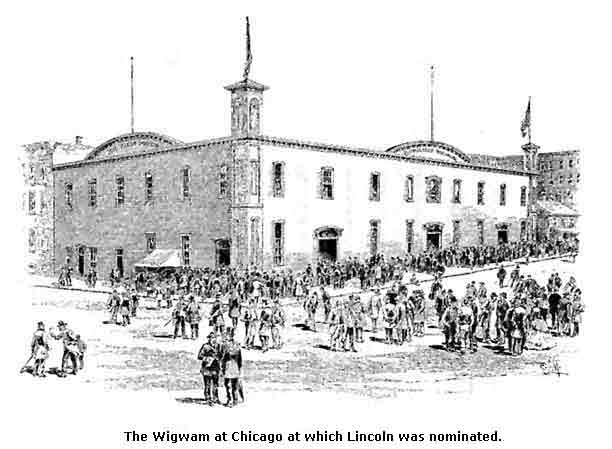
Less than ordinary uncertainty hung over the final issue of the Presidential campaign of 1860. To popular apprehension the election of Lincoln became more and more probable. The active competition for votes by four Presidential tickets greatly increased his chances of success; and the verdict of the October elections appeared to all sagacious politicians to render his choice a practical certainty. Sanguine partisans, however, clung tenaciously to their favorites, and continued to hope against hope, and work against fate. This circumstance produced a deplorable result in the South. Under the shadow of impending defeat the Democrats of the Cotton States made the final months of the canvass quite as much a threat against Lincoln as a plea for Breckinridge. This preaching of secession seemed to shallow minds harmless election buncombe; but when the contingency finally arrived, and the choice of Lincoln became a real event, they found themselves already in a measure pledged to resistance. They had vowed they would never submit; and now, with many, the mere pride of consistency moved them to adhere to an ill-considered declaration. The sting of defeat intensified their resentment, and in this irritated frame of mind the secession demagogues among them lured them on skillfully into the rising tide of revolution.
In proportion to her numbers, the State of South Carolina furnished the largest contingent to the faction of active conspirators; and to her, by a common consent, were accorded the dangers and honors of leadership. Since conspiracies work in secret, only fragmentary proofs of their efforts ever come to light. Though probably only one of the many early agencies in organizing the rebellion, the following circular reveals in a startling light what labor and system were employed to "fire the Southern heart" after the November election:
O.J. Victor, "History of the Southern Rebellion." Vol. I., p. 203.
CHARLESTON, Nov. 19, 1860. EXECUTIVE CHAMBER, "The 1860 Association."
In September last, several gentlemen of Charleston met to confer in reference to the position of the South in the event of the accession of Mr. Lincoln and the Republican party to power. This informal meeting was the origin of the organization known in this community as "The 1860 Association."
The objects of the Association are:
First. To conduct a correspondence with leading men in the South and by an interchange of information and views prepare the slave-States to meet the impending crisis.
Second. To prepare, print, and distribute in the slave States, tracts, pamphlets, etc., designed to awaken them to a conviction of their danger, and to urge the necessity of resisting Northern and Federal aggression.
Third. To inquire into the defenses of the State, and to collect and arrange information which may aid the Legislature to establish promptly an effective military organization.
To effect these objects a brief and simple Constitution was adopted, creating a President, a Secretary and Treasurer, and an Executive Committee specially charged with conducting the business of the Association. One hundred and sixty-six thousand pamphlets have been published, and demands for further supplies are received from every quarter. The Association is now passing several of them through a second and third edition.
The conventions in several of the Southern States will soon be elected. The North is preparing to soothe and conciliate the South by disclaimers and overtures. The success of this policy would be disastrous to the cause of Southern Union and Independence, and it is necessary to resist and defeat it. The Association is preparing pamphlets with this special object. Funds are necessary to enable it to act promptly. "The 1860 Association" is laboring for the South, and asks your aid.
I am, very respectfully your obedient servant,
ROBERT N. GOURDIN, Chairman of the Executive Committee.
The half-public endeavors of "The 1860 Association" to create public sentiment were vigorously seconded by the efforts of high official personages to set on foot concerted official action in aid of disunion. In this also, with becoming expressions of modesty, South Carolina took the initiative. On the 5th of October, Governor Gist wrote the following confidential letter, which he dispatched by a secret agent to his colleagues, the several Governors of the Cotton States, whom the bearer, General S.R. Gist, visited in turn during that month of October.
The responses to this inquiry given by the Executives of the other Cotton States were not all that so ardent a disunionist could have wished, but were yet sufficient to prompt him to a further advance.
MS. Confederate Archives, U.S. War Department.
EXECUTIVE DEPARTMENT, UNIONVILLE, S.C., Oct. 5, 1860. His EXCELLENCY GOVERNOR MOORE.
DEAR SIR: The great probability, nay almost certainty, of Abraham Lincoln's election to the Presidency renders it important that there should be a full and free interchange of opinion between the Executives of the Southern, and more especially the Cotton, States, and while I unreservedly give you my views and the probable action of my State, I shall be much pleased to hear from you; that there may be concert of action, which is so essential to success. Although I will consider your communication confidential, and wish you so to consider mine so far as publishing in the newspapers is concerned, yet the information, of course, will be of no service to me unless I can submit it to reliable and leading men in consultation for the safety of our State and the South; and will only use it in this way. It is the desire of South Carolina that some other State should take the lead, or at least move simultaneously with her. She will unquestionably call a convention as soon as it is ascertained that a majority of the electors will support Lincoln. If a single State secedes, she will follow her. If no other State takes the lead, South Carolina will secede (in my opinion) alone, if she has any assurance that she will be soon followed by another or other States; otherwise it is doubtful. If you decide to call a convention upon the election of a majority of electors favorable to Lincoln, I desire to know the day you propose for the meeting, that we may call our convention to meet the same day, if possible. If your State will propose any other remedy, please inform me what it will probably be, and any other information you will be pleased to give me.
With great respect and consideration,
I am yours, etc.,
Wm. H. Gist.
Governor Thos. O. Moore.
MS. Confederate Archives.
EXECUTIVE DEPARTMENT, RALEIGH, N.C., Oct. 18, 1860.
DEAR SIR: I have the honor to acknowledge the receipt of your favor of the 5th, which reached me on the 12th inst.
In compliance with your request, I will give as accurately as it is in my power to do the views and feelings of the people of North Carolina upon the important subject of your communication.
Political differences and party strife have run so high in this State for some years past, and particularly during the past nine months, that anything like unanimity upon any question of a public nature could scarcely be expected; and such is the case with the one under consideration. Our people are very far from being agreed as to what action the State should take in the event of Lincoln's election to the Presidency. Some favor submission, some resistance, and others still would await the course of events that might follow. Many argue that he would be powerless for evil with a minority party in the Senate, and perhaps in the House of Representatives also; while others say, and doubtless with entire sincerity, that the placing of the power of the Federal Government in his hands would prove a fatal blow to the institution of negro slavery in this country.
None of our public speakers, I believe, have taken the ground before the people that the election of Lincoln would, of itself, be a cause of secession. Many have said it would not, while others have spoken equivocally.
Upon the whole I am decidedly of opinion that a majority of our people would not consider the occurrence of the event referred to as sufficient ground for dissolving the union of the States. For which reason I do not suppose that our Legislature, which will meet on the 19th prox., will take any steps in that direction—such, for instance, as the calling of a convention.
Thus, sir, I have given you what I conceive to be the sentiment of our people upon the subject of your letter, and I give it as an existing fact, without comment as to whether the majority be in error or not.
My own opinions, as an individual, are of little moment. It will be sufficient to say, that as a States-Rights man, believing in the sovereignty and reserved powers of the States, I will conform my actions to the action of North Carolina, whatever that may be. To this general observation I will make but a single qualification—it is this: I could not in any event assent to, or give my aid to, a political enforcement of the monstrous doctrine of coercion. I do not for a moment think that North Carolina would become a party to the enforcement of this doctrine, and will not therefore do her the injustice of placing her in that position, even though hypothetically.
With much respect, I have the honor to be,
Your ob't. serv't,
JOHN W. ELLIS.
His Excellency William H. Gist, Governor of South Carolina
MS. Confederate Archives.
ALEXANDRIA, LA., 26th October, 1860. His EXCELLENCY GOVERNOR GIST.
DEAR SIR: Your favor of the 5th inst. was received a few days ago at this place. I regret my inability to consult with as many of our leading citizens as I wished, but I will not delay in replying any longer. You will (of course) consider my letter as private, except for use in consultation with friends. I shall not call a convention in this State if Lincoln is elected, because I have no power or authority to do so. I infer from your letter that an authority has been vested in you by your Legislature to call a convention in a specified contingency. Our Legislature has taken no action of that or any similar kind. That body will meet in regular annual session about the middle of January; but it is not improbable that I may consider it necessary to convene it at an earlier day, if the complexion of the electoral colleges shall indicate the election of Lincoln.
Even if that deplorable event shall be the result of the coming election, I shall not advise the secession of my State, and I will add that I do not think the people of Louisiana will ultimately decide in favor of that course. I shall recommend that Louisiana meet her sister slaveholding States in council to consult as to the proper course to be pursued, and to endeavor to effect a complete harmony of action. I fear that this harmony of action, so desirable in so grave an emergency, cannot be effected. Some of the Cotton States will pursue a more radical policy than will be palatable to the border States, but this only increases the necessity of convening the consultative body of which I have spoken. I believe in the right of secession for just cause, of which the sovereignty must itself be the judge. If therefore the general Government shall attempt to coerce a State, and forcibly attempt the exercise of this right, I should certainly sustain the State in such a contest.
There has never been any indication made by Louisiana, or by any public body within her limits, of her probable course in the event of an election of a Black Republican President, and she is totally unprepared for any warlike measures. Her arsenals are empty. While some of her sister States have been preparing for an emergency, which I fear is now imminent, she has been negligent in this important matter.
If coming events should render necessary the convocation of the Southern Convention, I shall endeavor to compose the representation of Louisiana of her ablest and most prudent men, if the power shall be vested in me to appoint them. However, I presume the Legislature will adopt some other course in the appointments. The recommendations of such a body assembled in such a crisis must necessarily carry great weight, and if subsequently ratified and adopted by each State by proper authority, will present the South in united and harmonious action.
I have the honor to be your Excellency's ob't serv't
THOS. O. MOORE.
MS. Ibid.
MACON, Oct. 26, 1860. His EXCELLENCY Gov. GIST.
DEAR SIR: Your letter of Oct. 5 was handed me by General Gist. Having but few moments to reply, I write this more to acknowledge its receipt than to reply to its contents. Our friends in this State are willing to do anything they may have the power to do to prevent the State from passing under the Black Republican yoke. Our people know this, and seem to approve such sentiments, yet I do not believe Mississippi can move alone.
I will call our Legislature in extra session as soon as it is known that the Black Republicans have carried the election. I expect Mississippi will ask a council of the Southern States, and if that council advise secession, Mississippi will go with them. If any State moves, I think Mississippi will go with her. I will write at length from Jackson.
Yours respectfully,
JOHN J. PETTUS.
MS. Confederate Archives.
EXECUTIVE DEPARTMENT, MILLEDGEVILLE, GA., Oct. 31, 1860. His EXCELLENCY W.H. GIST.
DEAR SIR: I have the honor to acknowledge the receipt of your favor by the hand of General Grist, with whom I have had a free interchange of opinions. In the event of the election of Mr. Lincoln to the Presidency I have no doubt that Georgia will determine her action by a convention of the people, which will probably be held before the 4th day of March next. Her Legislature, which convenes here next Wednesday, will have to determine on the time when the convention shall be held. My opinion is that the people of Georgia will, in case of the election of Lincoln, decide to meet all the Southern States in convention and take common action for the protection of the rights of all. Events not yet foreseen may change their course and might lead to action on the part of Georgia without waiting for all the Southern States, if it should be found necessary to her safety. I have handed General Gist a copy of my message on our Federal relations, which will be sent to our Legislature on the first day of the session. I send only the forms from the press as it is just being put in type. I may make some immaterial alterations before it is completed. If your State remains in the Union, I should be pleased that she would adopt such retaliatory measures as I recommend in the message, or others which you may determine to be more appropriate. I think Georgia will pass retaliatory laws similar to those I recommend, should Lincoln be defeated. Should the question be submitted to the people of Georgia, whether they would go out of the Union on Lincoln's election without regard to the action of other States, my opinion is they would determine to wait for an overt act. The action of other States may greatly influence the action of the people of this State. This letter is not intended for publication in the newspapers, and has been very hastily prepared.
I have the honor to be your Excellency's
Ob't serv't,
JOSEPH E. BROWN.
MS. Confederate Archives.
EXECUTIVE DEPARTMENT, MONTGOMERY, ALA., October 25, 1860. His EXCELLENCY W.H. GIST.
DEAR SIR: Your letter of the 5th inst. was handed me a few days since by General Gist. I fully concur with you in the opinion that Lincoln will be elected President, and that a full and free interchange of opinion between the Executives of the Southern States, and especially of the Cotton States, should be had as to what ought to be done and what will be done by them to protect the interest and honor of the slave-holding States in the event he should be elected.
My opinion is, that the election of Lincoln alone is not sufficient cause for a dissolution of the Union; but that fact, when taken in connection with the avowed objects and intentions of the party whose candidate he is, and the overt acts already committed by that party in nullifying the fugitive-slave law, and the enactment of personal liberty bills in many of the non-slave-holding States, with other acts of like kind, is sufficient cause for dissolving every tie which binds the Southern States to the Union.
It is my opinion that Alabama will not secede alone, but if two or more States will coöperate with her, she will secede with them; or if South Carolina or any other Southern State should go out alone and the Federal Government should attempt to use force against her, Alabama will immediately rally to her rescue.
The opinions above expressed are predicated upon observation and consultation with a number of our most distinguished statesmen. The opinion thus expressed is not intended as a positive assurance, but is my best impression as to what will be the course of Alabama. Should Lincoln be elected, I shall certainly call a convention under the provisions of the resolutions of the last General Assembly of the State. The convention cannot be convened earlier than the first Monday in February next, and I have fixed upon that day (in my own mind). The vote of the electors will be cast for President on the 5th day of December, after which it will require a few days to ascertain the result. Thirty days' notice will have to be given after the day upon which, the delegates to the convention will be elected, and the convention is required to convene in two weeks after the election. This is not a matter of discretion with me, but is fixed by law. I regret that earlier action cannot be had, as it may be a matter of much importance that all the States that may determine to withdraw from the Union should act before the expiration of Mr. Buchanan's term of service.
The facts and opinions herein communicated you are at liberty to make known to those with whom you may choose to confer, but they are not to be published in the newspapers.
I have had a full and free conversation with General Gist, the substance of which is contained in this letter. He will, however, give it to you more in detail. It is my opinion that all the States that may determine to take action upon the election of Lincoln should call a convention as soon as practicable after the result is known.
With great respect, your ob't serv't,
B. MOORE.
MS. Confederate Archives.
EXECUTIVE DEPARTMENT, Nov. 9, 1860. His EXCELLENCY GOVERNOR GIST.
DEAR SIR: Your communication of the 5th ultimo reached me per last mail under cover from General States Rights Gist, with an explanatory note from that gentleman in relation to the subject-matters thereof.
The mode employed by your Excellency to collect authoritatively the views of several of the Executives of the Southern States as to their plan of action in the event of the election of Lincoln, commends itself warmly to my judgment. Concert of action can alone be arrived at by a full and free interchange of opinion between the Executives of the Cotton States, by whom it is confidently expected that the ball will be put in motion.
We are in the midst of grave events, and I have industriously sought to learn the public mind in this State in the event of the election of Lincoln, and am proud to say Florida is ready to wheel into line with the gallant Palmetto State, or any other Cotton State or States, in any course which she or they may in their judgment think proper to adopt, looking to the vindication and maintenance of the rights, interest, honor, and safety of the South. Florida may be unwilling to subject herself to the charge of temerity or immodesty by leading off, but will most assuredly cooperate with or follow the lead of any single Cotton State which may secede. Whatever doubts I may have entertained upon this subject have been entirely dissipated by the recent elections in this State.
Florida will most unquestionably call a convention as soon as it is ascertained that a majority of the electors favor the election of Lincoln, to meet most likely upon a day to be suggested by some other State.
I leave to-day for the capital, and will write you soon after my arrival, but would be pleased in the mean time to hear from you at your earliest convenience.
If there is sufficient manliness at the South to strike for our rights, honor, and safety, in God's name let it be done before the inauguration of Lincoln.
With high regard, I am yours, etc.,
M.S. PERRY
Direct to Tallahassee.
P.S. I have written General Gist at Union C.H.
Two agencies have thus far been described as engaged in the work of fomenting the rebellion: the first, secret societies of individuals, like "The 1860 Association," designed to excite the masses and create public sentiment; the second, a secret league of Southern governors and other State functionaries, whose mission it became to employ the governmental machinery of States in furtherance of the plot. These, though formidable and dangerous, would probably have failed, either singly or combined, had they not been assisted by a third of still greater efficacy and certainty. This was nothing less than a conspiracy in the very bosom of the National Administration at Washington, embracing many United States Senators, Representatives in Congress, three members of the President's Cabinet, and numerous subordinate officials in the several Executive departments. The special work which this powerful central cabal undertook by common consent, and successfully accomplished, was to divert Federal arms and forts to the use of the rebellion, and to protect and shield the revolt from any adverse influence, or preventive or destructive action of the general Government.
"RICHMOND, VA., "May 28, 1858. "To WM. SERGEANT, ESQ.:
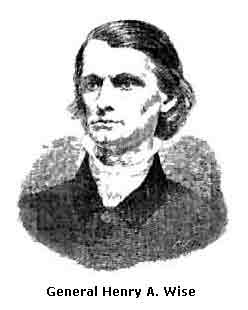
"... The truth is that there is in the South an organized, active, and dangerous faction, embracing most of the Federal politicians, who are bent upon bringing about causes of a dissolution of the Union. They desire a united South, "but not a united country. Their hope of embodying a sectional antagonism is to secure a sectional defeat. At heart, they do not wish the Democracy to be any longer national, united, or successful. In the name of Democracy they propose to make a nomination for 1860, at Charleston; but an ultra nomination of an extremist on the slavery issue alone, to unite the South on that one idea, and on that to have it defeated by a line of sectionalism which will inevitably draw swords between fanatics on one side and fire-eaters on the other. Bear it in mind, then, that they desire to control a nomination for no other purpose than to have it defeated by a line of sections. They desire defeat, for no other end than to make a pretext for the clamor of dissolution....
"Yours truly,
"HENRY A. WISE." MS.
CHAPTER XVIII THE CABINET CABAL
Very soon after the effort to unite the Cotton-State governors in the revolutionary plot, we find the local conspiracy at Charleston in communication with the central secession cabal at Washington. James Buchanan, of Pennsylvania, was still President of the United States, and his Cabinet consisted of the following members: Lewis Cass, of Michigan, Secretary of State; Howell Cobb, of Georgia, Secretary of the Treasury; John B. Floyd, of Virginia, Secretary of War; Isaac Toucey, of Connecticut, Secretary of the Navy; Jacob Thompson, of Mississippi, Secretary of the Interior; Joseph Holt, of Kentucky, Postmaster-General; and Jeremiah S. Black, of Pennsylvania, Attorney-General. It was in and about this Cabinet that the central cabal formed itself. Even if we could know in detail the successive steps that led to the establishment of this intercourse, which so quickly became "both semi-official and confidential," it could add nothing to the force of the principal fact that the conspiracy was in its earliest stages efficient in perverting the resources and instrumentalities of the Government of the United States to its destruction. That a United States Senator, a Secretary of War, an Assistant Secretary of State, and no doubt sundry minor functionaries, were already then, from six to eight weeks before any pretense of secession, with, "malice aforethought" organizing armed resistance to the Constitution and laws they had sworn to support, stands forth in the following correspondence too plainly to be misunderstood. As a fitting preface to this correspondence, a few short paragraphs may be quoted from the private diary of the Secretary of War, from which longer and more important extracts appear in a subsequent chapter. Those at present quoted are designed more especially to show the names of the persons composing the primary group of this central cabal, and the time and place of their early consultations and activity.
EXTRACTS FROM FLOYD'S DIARY.[1]
November 8, 1860 ... I had a long conversation to-day with General Lane, the candidate for Vice-President on the ticket with Mr. Breckinridge. He was grave and extremely earnest; said that resistance to the anti-slavery feeling of the North was hopeless, and that nothing was left to the South but "resistance or dishonor"; that if the South failed to act with promptness and decision in vindication of her rights, she would have to make up her mind to give up first her honor and then her slaves. He thought disunion inevitable, and said when the hour came that his services could be useful, he would offer them unhesitatingly to the South. I called to see the President this evening, but found him at the State Department engaged upon his message, and did not see him. Miss Lane returned last evening from Philadelphia, where she had been for some time on a visit. Mr. W.H. Trescott, Assistant Secretary of State, called to see me this evening, and conversed at length upon the condition of things in South Carolina, of which State he is a native. He expressed no sort of doubt whatever of his State separating from the Union. He brought me a letter from Mr. Drayton, the agent of the State, proposing to buy ten thousand muskets for the use of the State....
November 10 ... Beach, Thompson, and Cobb came over with me from Cabinet and staid, taking informally a family dinner. The party was free and communicative; Toucey would not stay for dinner. Mr. Pickens, late Minister to Russia, came in after dinner with Mr. Trescott, Assistant Secretary of State, and sat an hour, talking about the distracted state of public feeling at the South. He seemed to think the time had come for decisive measures to be taken by the South.
November 11 ... I spent an hour at the President's, where I met Thompson, Robert McGraw, and some others; we sat around the tea-table and discussed the disunion movements of the South. This seems to be the absorbing topic everywhere.
November 12 ... Dispatched the ordinary business of the department; dined at 5 o'clock; Mr. Pickens, late Minister to Russia, Mr. Trescott, Mr. Secretary Thompson, Mr. McGraw, Mr. Browne, editor of the "Constitution," were of the party. The chief topic of discussion was, as usual, the excitement in the South. The belief seemed to be that disunion was inevitable; Pickens, usually very cool and conservative, was excited and warm. My own conservatism seems in these discussions to be unusual and almost misplaced.
Benson J. Lossing, "The Civil War in America," Vol. I., p. 44. (Note.)
W.H. TRESCOTT TO E. BARNWELL RHETT. WASHINGTON, Nov. 1, 1860.
DEAR RHETT: I received your letter this morning. As to my views or opinions of the Administration, I can, of course, say nothing. As to Mr. Cobb's views, he is willing that I should communicate them to you, in order that they may aid you in forming your own judgment; but, you will understand that this is confidential—that is, neither Mr. Cobb nor myself must be quoted as the source of your information. I will not dwell on this, as you will, on a moment's reflection, see the embarrassment which might be produced by any authorized statement of his opinions. I will only add, by way of preface, that after the very fullest and freest conversations with him, I feel sure of his earnestness, singleness of purpose, and resolution in the whole matter.
Mr. Cobb believes that the time is come for resistance; that upon the election of Lincoln, Georgia ought to secede from the Union, and that she will do so; that Georgia and every other State should, as far as secession, act for herself, resuming her delegated powers, and thus put herself in position to consult with other sovereign States who take the same ground. After the secession is effected, then will be the time to consult. But he is of opinion, most strongly, that whatever action is resolved on should be consummated on the 4th of March, not before.
That while the action determined on should be decisive and irrevocable, its initial point should be the 4th of March. He is opposed to any Southern convention, merely for the purpose of consultation. If a Southern convention is held, it must be of delegates empowered to act, whose action is at once binding on the States they represent.
But he desires me to impress upon you his conviction, that any attempt to precipitate the actual issue upon this Administration will be most mischievous—calculated to produce differences of opinion and destroy unanimity. He thinks it of great importance that the cotton crop should go forward at once, and that the money should be in the hands of the people, that the cry of popular distress shall not be heard at the outset of this move.
My own opinion is that it would be well to have a discreet man, one who knows the value of silence, who can listen wisely, present in Milledgeville, at the meeting of the State Legislature, as there will be there an outside gathering of the very ablest men of that State.
And the next point, that you should, at the earliest possible day of the session of our own Legislature, elect a man as governor whose name and character will conciliate as well as give confidence to all the men of the State,—if we do act, I really think this half the battle,—a man upon whose temper the State can rely.
I say nothing about a convention, as I understand, on all hands, that that is a fixed fact, and I have confined myself to answering your question. I will be much obliged to you if you will write me soon and fully from Columbia.
It is impossible to write to you, with the constant interruption of the office, and as you want Cobb's opinions, not mine, I send this to you.
Yours,
W.H.T.
MS. Confederate Archives.
THOS. F. DRAYTON TO GOVERNOR GIST. CHARLESTON, 3d Nov., 1860.
On the 22d of last month I was in Washington, and called upon the Secretary at War, in company with Senator Wigfall, of Texas, to make inquiries as to the efficiency and price of certain muskets belonging to the United States, which had been altered by the Ordnance Department from flint to percussion. They will shoot for 200 yards as well as any smooth-bored gun in the service, and if rifled will be effective at 500 yards. But if the conical ball will be made lighter by enlarging the hollow at the base of the cone, the effective range may be increased to seven hundred yards. Should your Excellency give a favorable consideration to the above, I can have the whole of what I have stated authenticated by the board of ordnance officers, who inspected and reported to the Secretary at War upon these muskets. If ten thousand or more of these muskets are purchased, the price will be two ($2) dollars each; for a less quantity the charge will be $2.50 each. If a portion or all of them are to be rifled, the Secretary says he will have it done for the additional cost of one ($1) dollar per barrel. As this interview with Mr. Secretary Floyd was both semi-official and confidential, your Excellency will readily see the necessity, should this matter be pursued further, of appointing an agent to negotiate with him, rather than conduct the negotiation directly between the State and the Department ... I unhesitatingly advise purchasing several thousand of them ... There are many other important facts in connection with the above that I could disclose, but will reserve them for some other occasion, that I may give them verbally as soon as I can find a day to wait upon your Excellency in Columbia.
The State of Texas has engaged twenty thousand (20,000) of these muskets, and the State of Kentucky purchased several thousand last summer.
Ibid.
THOS. F. DRAYTON TO GOVERNOR GIST. CHARLESTON, 6th Nov., 1860.
I have only within a few hours received yours of the 5th inst., authorizing me to purchase from the War Department at Washington ten thousand rifles of pattern and price indicated in my letter to your Excellency of the 3d inst.
I accept the appointment and will discharge the duty assigned to the best of my ability and with the least possible delay. For I feel that the past and present agitation are ruinous to our peace and prosperity and that our only remedy is to break up with dispatch the present Confederacy and construct a new and better one. I will communicate with Mr. Secretary Floyd to-night and have the rifles put in preparation so as to have them for use at an early day....
I would wish that my agency in this transaction be kept private until I reach Washington, or indeed till I write to say the arms are on their way to Columbia....
Ibid.
THOS. F. DRAYTON TO GOVERNOR GIST. CHARLESTON, 8th Nov., 1860.
I have just received your letter of the 7th inst., and I think I can render you all the information you desire, without resorting to any agent. If my ability can only be made to keep pace with my zeal, I hope yet to render some service to the dear old State of South Carolina.
MS. Confederate Archives.
THOS. F. DRAYTON TO GOVERNOR GIST. CHARLESTON, 16th Nov., 1860.
I have been most reluctantly detained here by an accidental fall, and also by business of an urgent kind associated with the railroad. My absence from Washington, however, has not delayed the execution of your order for the rifles; the Secretary of War has had the preparation of them in hand for some time.
When I write to you from Washington, had I not better address you through your private secretary ... Please address me at Washington to the care of Wm. H. Trescott, Esq. ... I will give strict attention to your letter of the 7th inst., and hope to furnish you with much of the information you desire, for I am quite sensible of the importance of knowing the views and policy of the President at this juncture.
MS. Confederate Archives.
THOS. F. DRAYTON TO GOVERNOR GIST. WASHINGTON, 19th Nov., 1860.
... I called this morning upon the Secretary of War to make arrangements for the immediate transmission of the rifles to Columbia, but much to my astonishment he informed me that since he had looked over the report of "Small Fire-arms" (now inclosed) that he found he had labored under an error in stating to me that the ten thousand rifles I had engaged were ready for delivery when called for by me. He said he could have them rifled, but it would take three or four months to execute the contract, but suggested that we should purchase the 10,000 smooth-bored muskets instead, as a more efficient arm, particularly if large-sized buckshot should be used, which, put up in wire case capable of containing 12 of them, would go spitefully through an inch plank at 200 yards. I was much astonished at the result of my interview with Governor Floyd to-day, for he had not only informed me that the rifles would be ready for me on my arrival, but told Mr. Trescott so likewise, and that if I had been in Washington last Saturday I could have got them.... If you will be satisfied with the smooth-bored muskets like the specimen forwarded to you, I will purchase them. Better do this, although not the best pattern, than be without arms at a crisis like the present. Colonel Benjamin Huger can give you much information about these muskets. This is derived not only from Mr. Floyd, but also from General J.E. Johnston, Quartermaster-General, who was President of the Ordnance Board who had these muskets changed from flint to percussion, and also from smooth-bore to rifle, and he says that for our purposes the smooth-bored musket is preferable to the altered rifle. The why I cannot explain to-day.... I also send you a letter from Mr. Trescott, in reply to certain inquiries from me. I am unable to make any comments upon them nor to add other facts which I will forward you more leisurely to-morrow....
MS. Confederate Archives.
W.H. TRESCOTT TO THOS. F. DRAYTON. WASHINGTON, Nov. 19, 1860.
(Private, Confidential.)
MY DEAR DRAYTON: It is difficult to reply specifically to your inquiries, partly because I do not believe that the exact course of the Administration has been yet determined on, and partly because my knowledge, or rather my inference, of its intentions is derived from intercourse with its members which I am bound to consider confidential. I do not regard it of serious importance to you to know the individual opinions of either the President or the Cabinet. No action of any sort will be taken until the message has been sent indicating the opinions of the Executive, and that message, whatever it be, will find our Legislature in session, and the convention on the point of meeting. I think it likely that the President will state forcibly what he considers the grievances of the South, that he will add that he does not think, if the right of secession existed, it would be a wise policy for the State to adopt, and that he does not think the right to secede does exist, and then refer the whole matter to Congress; what he will do when the State does secede, he has not said, and I do not know, nor any man, I believe. He will do, as we will, what he believes to be his duty, and that duty, I suppose, will be discharged in full view of the consequences following any line of action that may be determined on. But I think that, as long as Cobb and Thompson retain seats in the Cabinet, you may feel confident that no action has been taken which seriously affects the position of any Southern State.
I think that I may safely rely upon my knowledge of what will be done, and you may rely upon my resignation as soon as that knowledge satisfies me of any move in a direction positively injurious to us, or altering the present condition of things to our disadvantage. When you pass through on Wednesday, however, I will speak to you more fully.
Yours,
W.H.T.
Ibid.
THOS. F. DRAYTON TO GOVERNOR GIST. WASHINGTON, 19th Nov., 1860.
Mr. Buchanan, while he can discover no authority under the Constitution to justify secession by a State, on the other hand he can find no power to coerce one to return after the right of secession has been exercised. He will not allow entry or clearance of a vessel except through the Custom-house, to be established as soon as secession is declared, upon the deck of a man-of-war off the harbor of Charleston. He will enforce the collection of duties, not by navy, but by a revenue cutter, as our collector now would do if his authority was resisted. I will write to you more fully when I return from New York, where I go to-morrow at daylight, at the suggestion of the Secretary of War, who deems it important that I should go there to make arrangements for shipping the arms (should you still want them) from that point instead of this city ... Do send a copy of the list of arms at the arsenals to H.R. Lawton, Milledgeville, Ga. I am getting some smooth-bored muskets for Georgia, like the specimen I sent you.
MS. Confederate Archives.
THOS. F. DRAYTON TO GOVERNOR GIST. WASHINGTON, 23d Nov., 1860.
I arrived here at 6 A.M. from New York, where I had gone at the suggestion of Mr. Floyd to engage Mr. G.B. Lamar, President of the Bank of the Republic, to make an offer to the Secretary for such a number of muskets as we might require. The Secretary at War was reluctant to dispose of them to me, preferring the intermediate agency. Mr. Lamar has consented to act accordingly, and to-day the Secretary has written to the commanding officer [at] Watervliet Arsenal to deliver five or ten thousand muskets (altered from flint to percussion) to Mr. Lamar's order. Mr. Lamar will pay the United States paymaster for them, and rely upon the State to repay him. I have been most fortunate in having been enabled to meet the payments for the arms through Mr. L., for I feel satisfied that without his intervention we could not have effected the purchase at this time.... I expect to return at daylight to-morrow to New York, for I am very anxious about getting possession of the arms at Watervliet, and forward them to Charleston. The Cabinet may break up at any moment, on differences of opinion with the President as to the rights of secession, and a new Secretary of War might stop the muskets going South, if not already on their way when he comes into office.
I will write to you again by the next mail. The impression here and elsewhere among many Southern men is, that our Senators have been precipitate in resigning; they think that their resignations should have been tendered from their seats after they had announced to the Senate that the State had seceded. Occupying their seats up to this period would have kept them in communication with Senators from the South and assisted very powerfully in shaping to our advantage coming events.
If any further quotation be necessary to show the audacity with which at least three Secretaries and one Assistant Secretary of Mr. Buchanan's Cabinet engaged in flagrant conspiracy in the early stages of rebellion, it may be found in an interview of Senator Clingman with the Secretary of the Interior, which the former has recorded in his "Speeches and Writings" as an interesting reminiscence. It may be doubted whether Secretary Thompson correctly reported the President as wishing him success in his North Carolina mission, but the Secretary is, of course, a competent witness to his own declarations and acts.
T.L. Clingman, "Speeches and Writings," pp. 526, 527.
About the middle of December [1860] I had occasion to see the Secretary of the Interior on some official business. On my entering the room, Mr. Thompson said to me, "Clingman, I am glad you have called, for I intended presently to go up to the Senate to see you. I have been appointed a commissioner by the State of Mississippi to go down to North Carolina to get your State to secede, and I wished to talk with you about your Legislature before I start down in the morning to Raleigh, and to learn what you think of my chance of success." I said to him, "I did not know that you had resigned." He answered; "Oh, no, I have not resigned." "Then," I replied, "I suppose you resign in the morning." "No," he answered, "I do not intend to resign, for Mr. Buchanan wished us all to hold on, and go out with him on the 4th of March." "But," said I, "does Mr. Buchanan know for what purpose you are going to North Carolina?" "Certainly," he said, "he knows my object." Being surprised by this statement, I told Mr. Thompson that Mr. Buchanan was probably so much perplexed by his situation that he had not fully considered the matter, and that as he was already involved in difficulty, we ought not to add to his burdens; and then suggested to Mr. Thompson that he had better see Mr. Buchanan again, and by way of inducing him to think the matter over, mention what I had been saying to him. Mr. Thompson said, "Well, I can do so, but I think he fully understands it." In the evening I met Mr. Thompson at a small social party, and as soon as I approached him, he said, "I knew I could not be mistaken. I told Mr. Buchanan all you said, and he told me that he wished me to go, and hoped I might succeed." I could not help exclaiming, "Was there ever before any potentate who sent out his own Cabinet ministers to excite an insurrection against his Government!" The fact that Mr. Thompson did go on the errand, and had a public reception before the Legislature, and returned to his position in the Cabinet is known, but this incident serves to recall it.
To this sketch of the Cabinet cabal it is necessary to add the testimony of his participation, by one who, from first to last, was a principal and controlling actor. Jefferson Davis records that:
Jefferson Davis, "Rise and Fall of the Confederate Government," Vol. I., pp. 57, 58, 59.
In November, 1860, after the result of the Presidential election was known, the Governor of Mississippi, having issued his proclamation convoking a special session of the Legislature to consider the propriety of calling a convention, invited the Senators and Representatives of the State in Congress to meet him for consultation as to the character of the message he should send to the Legislature when assembled.... While engaged in the consultation with the Governor just referred to, a telegraphic message was handed to me from two members of Mr. Buchanan's Cabinet, urging me to proceed "immediately" to Washington. This dispatch was laid before the Governor and the members of Congress from the State who were in conference with him, and it was decided that I should comply with, the summons ... On arrival at Washington, I found, as had been anticipated, that my presence there was desired on account of the influence which it was supposed I might exercise with the President (Mr. Buchanan) in relation to his forthcoming message to Congress. On paying my respects to the President, he told me that he had finished the rough draft of his message, but that it was still open to revision and amendment, and that he would like to read it to me. He did so and very kindly accepted all the modifications which I suggested. The message was, however, afterwards somewhat changed.
In the documents we have presented, though they manifestly form but the merest fragment of the secret correspondence which passed between the chief conspirators, and of the written evidence recorded by them in various forms, then and afterwards, we have a substantial unmasking of the combined occult influences which presided over the initiatory steps of the great American Rebellion—its central council—the master wheel of its machinery—and the connecting relation which caused all its subordinate parts to move in harmonious accord.
With the same mind to dictate a secession message to a Legislature and a non-coercion message to Congress—to assemble insurrectionary troops to seize Federal forts and withhold Government troops from their protection—to incite governors to rebellion and overawe a weak President to a virtual abdication of his rightful authority, history need not wonder at the surprising unity and early success of the conspiracy against the Union.
CHAPTER XIX FROM THE BALLOT TO THE BULLET
The secret circular of Governor Gist, of South Carolina, heretofore quoted, inaugurated the great American Rebellion a full month before a single ballot had been cast for Abraham Lincoln. This was but repeating in a bolder form the action taken by Governor Wise, of Virginia, during the Frémont campaign four years before. But, instead, as in that case, of confining himself to a proposed consultation among slave-State executives, Governor Gist proceeded almost immediately to a public and official revolutionary act.
On the 12th of October, 1860, he issued his proclamation convening the Legislature of South Carolina in extra session, "to appoint electors of President and Vice-President ... and also that they may, if advisable, take action for the safety and protection of the State." There was no external peril menacing either the commonwealth or its humblest citizen; but the significance of the phrase was soon apparent.
South Carolina "House Journal," Called Session, 1860, pp. 10, 11.
A caucus of prominent South Carolina leaders is said to have been held on October 25, at the residence of Senator Hammond. Their deliberations remained secret, but the determination arrived at appears clearly enough in the official action of Governor Gist, who was present, and who doubtless carried out the plans of the assemblage. When the Legislature met on November 5 (the day before the Presidential election) the Governor sent them his opening message, advocating both secession and insurrection, in direct and undisguised language. He recommended that in the event of Lincoln's election, a convention should be immediately called; that the State should secede from the Federal Union; and "if in the exercise of arbitrary power and forgetful of the lessons of history, the Government of the United States should attempt coercion, it will be our solemn duty to meet force by force." To this end he recommended a reorganization of the militia and the raising and drilling an army of ten thousand volunteers. He placed the prospects of such a revolution in a most hopeful and encouraging light. "The indications from many of the Southern States," said he, "justify the conclusion that the secession of South Carolina will be immediately followed, if not adopted simultaneously, by them, and ultimately by the entire South. The long-desired coöperation of the other States having similar institutions, for which the State has been waiting, seems to be near at hand; and, if we are true to ourselves, will soon be realized."
Governor Gist's justification of this movement as attempted was (in his own language) "the strong probability of the election to the Presidency of a sectional candidate by a party committed to the support of measures, which if carried out will inevitably destroy our equality in the Union, and ultimately reduce the Southern States to mere provinces of a consolidated despotism to be governed by a fixed majority in Congress hostile to our institutions."
This campaign declamation, used throughout the whole South with great skill and success, to "fire the Southern heart," was wholly defective as a serious argument.
As to the alleged destruction of equality, the North proposed to deny to the slave-States no single right claimed by the free-States. The talk about "provinces of a consolidated despotism to be governed by a fixed majority" was, in itself an absurd contradiction in terms, which repudiated the fundamental idea of republican government. The acknowledgment that any danger from anti-slavery "measures" was only in the future, negatived its validity as a present grievance. Hostility to "our institutions" was expressly disavowed by full constitutional recognition of slavery under State authority. The charge of "sectionalism" came with a bad grace from a State whose newspapers boasted that none but the Breckinridge ticket was tolerated within her borders, and whose elsewhere obsolete "institution" of choosing Presidential electors by the Legislature instead of by the people, combined with such a dwarfed and crippled public sentiment, made it practically impossible for a single vote to be cast for either Lincoln or Douglas or Bell—a condition mathematically four times as "sectional" as that of any State of the North.
Finally, the avowed determination to secede because a Presidential election was about to be legally gained by one of the three opposing parties, after she had freely and fully joined in the contest, was an indulgence of caprice utterly incompatible with any form of government whatever.
There is no need here to enter upon a discussion of the many causes which, had given to the public opinion of South Carolina so radical and determined a tone in favor of disunion. Maintaining persistence, and gradually gathering strength almost continuously since the nullification furor of 1832, it had become something more than a sentiment among its devotees: it had grown into a species of cult or party religion, for the existence of which no better reason can be assigned than that it sprang from a blind hero-worship locally accorded to John C. Calhoun, one of the prominent figures of American political history. As representative in Congress, Secretary of War under President Monroe, Vice-President of the United States under President John Quincy Adams, for many years United States Senator from South Carolina, and the radical champion of States Rights, Nullification, and Slavery, his brilliant fame was the pride, but his false theories became the ruin, of his State and section.
South Carolina "House Journal," Called Session, 1860, pp. 16, 17.
Governor Gist and his secession coadjutors had evidently still a lingering hope that the election might by some unforeseen contingency result in the choice of Breckinridge. On no other hypothesis can we account for the fact that on the 6th of November, when Northern ballots were falling in such an ample shower for Lincoln, the South Carolina Legislature, with due decorum and statute regularity, appointed Presidential electors for the State, and formally instructed them to vote for Breckinridge and Lane. The dawn of November 7 dispelled these hopes. The "strong probability" had become a stubborn fact.
When the certain news of Lincoln's election finally came, it was hailed with joy and acclamation by both the leaders and the people of South Carolina. They had at length their much coveted pretext for disunion; and they now put into the enterprise a degree of earnestness, frankness, courage, and persistency worthy of a better cause. Public opinion, so long prepared, responded with enthusiasm to the plans and calls of the leaders. Manifestations of disloyalty became universal. Political clubs were transformed into military companies. Drill-rooms and armories were alive with nightly meetings. Sermons, agricultural addresses, and speeches at railroad banquets were only so many secession harangues. The State became filled with volunteer organizations of "minute men."
The Legislature, remaining in extra session, and cheered and urged on by repeated popular demonstrations and the inflamed speeches of the highest State officials, proceeded without delay to carry out the Governor's programme. In fact, the members needed no great incitement. They had been freshly chosen within the preceding month; many of them on the well-understood "resistance" issue. Their election took place on the 8th and 9th days of October, 1860. Since there was but one party in South Carolina, there could be no party drill; but a tyrannical and intolerant public sentiment usurped its place and functions. On the sixteen different tickets paraded in one of the Charleston newspapers, the names of the most pronounced disunionists were the most frequent and conspicuous. "Southern rights at all hazards," was the substance of many mottoes, and the palmetto and the rattlesnake were favorite emblems. There was neither mistaking nor avoiding the strong undercurrent of treason and rebellion here manifested, and the Governor's proclamation had doubtless been largely based upon it.
South Carolina, "House Journal," Called Session, 1860, pp. 13, 14.
The first day's session of the Legislature (November 5) developed one of the important preparatory steps of the long-expected revolution. The Legislature of 1859 had appropriated a military contingent fund of one hundred thousand dollars, "to be drawn and accounted for as directed by the Legislature." The appropriation had been allowed to remain untouched. It was now proposed to place this sum at the control of the Governor to be expended in obtaining improved small arms, in purchasing a field battery of rifled cannon, in providing accouterments, and in furnishing an additional supply of tents; and a resolution to that effect was passed two days later, The chief measure of the session, however, was a bill to provide for calling the proposed State Convention, which it was well understood would adopt an ordinance of secession. There was scarcely a ripple of opposition to this measure. One or two members still pleaded for delay, to secure the coöperation of Georgia, but dared not record a vote against the prevailing mania. The chairman of the proper committee on November 10 reported an act calling a convention "for the purpose of taking into consideration the dangers incident to the position of the State in the Federal Union," which unanimously became a law November 13, and the extra session adjourned to meet again in regular annual session on the 26th.
Meanwhile public excitement had been kept at fever heat by all manner of popular demonstrations. The two United States Senators and the principal Federal officials resigned their offices with a public flourish of their insubordinate zeal. An enthusiastic ratification meeting was given to the returning members of the Legislature. To give still further emphasis to the general movement a grand mass meeting was held at Charleston on the 17th of November. The streets were filled with the excited multitude. Gaily dressed ladies crowded balconies and windows, and zealous mothers decorated their children with revolutionary badges. There was a brisk trade in fire-arms and gunpowder. The leading merchants and prominent men of the city came forth and seated themselves on platforms to witness and countenance a formal ceremony of insurrection. A white flag, bearing a palmetto tree and the legend Animis opibusque parati (one of the mottoes on the State seal), was, after solemn prayer, displayed from a pole of Carolina pine. Music, salutes, and huzzahs filled the air. Speeches were addressed to "citizens of the Southern Republic." Orations and processions completed the day, and illuminations and bonfires occupied the night. The preparations were without stint. The proceedings and ceremonies were conducted with spirit and abandon. The rejoicings were deep and earnest. And yet there was a skeleton at the feast; the Federal flag, invisible among the city banners, and absent from the gay bunting and decorations of the harbor shipping, still floated far down the bay over a faithful commander and loyal garrison in Fort Moultrie.
CHAPTER XX MAJOR ANDERSON
President Buchanan and his Administration could not, if they would, shut their eyes to the treasonable utterances and preparations at Charleston and elsewhere in the South; but so far neither the speeches nor bonfires nor palmetto flags, nor even the secession message of Governor Gist or the Convention bill of the South Carolina Legislature, constituted a statutory offense. For twelve years the threat of disunion had been in the mouths of the Southern slavery extremists and their Northern allies the most potent and formidable weapon of national politics. It was declaimed on the stump, elaborated in Congressional speeches, set out in national platforms, and paraded as a solemn warning in executive messages.
Mr. Buchanan had profited by the disunion cry both as politician and functionary; and now when disunion came in a practical and undisguised shape he was to a degree powerless to oppose it, because he was disarmed by his own words and his own acts. The disunionists were his partisans, his friends, and confidential counselors; they constituted a remnant of the once proud and successful party which, by his compliance and coöperation in their interest, he had disrupted and defeated. Their programme hitherto had been the policy upon which he had staked the success or failure of his Administration, so that in addition to every other tie he was bound to them by the common sorrow of political disaster.
Being in such intimate relations and intercourse with the leaders of the Breckinridge wing of the Democratic party during the progress of the Presidential canvass, and that party being made up so exclusively of the extreme Southern Democrats, the President must have had constant information of the progress and development of the disunion sentiment and purpose in the South. He was not restricted as the other parties and the general public were to imperfect reports and doubtful rumors current in the newspapers.
But in addition there now came to him an official warning which it was a grave error to disregard. On October 29, one week before the election, the veteran Lieutenant-General Winfield Scott, General-in-Chief of the Army, communicated to him in writing his serious apprehensions of coming danger, and suggested such precautions as were then in the power of the Administration. Beginning life as a farmer's boy, collegian, and law student, General Scott from choice became a soldier, devoting himself to the higher aims of the profession of arms, and in a brilliant career of half a century had achieved world-wide renown as a great military captain. In the United States, however, the military is subordinated to the civic ambition, and Scott all his life retained a strong leaning to diplomacy and statesmanship, and on several important occasions gave his country valuable service in essentially civic functions. He had been the unsuccessful Presidential candidate of the Whig party in 1852, a circumstance which no doubt greatly increased his personal attention to current politics, then and afterwards. As the first military officer of the nation, he was also the watchful guardian of the public peace.
Lieut.-General Winfield Scott, "Autobiography," Vol. I., p. 234.
The impending rebellion was not to him, as it was to the nation at large, a new event in politics. Many men were indeed aware, through tradition and history, that it was but the Calhoun nullification treason revived and pushed to a bolder extreme. To General Scott it was almost literally the repetition of an old experience. A generation before, he was himself a prominent actor in opposing the nullification plot. About the 4th of November, 1832, upon special summons, he was taken into a confidential interview by President Jackson, who, after asking Scott's military views upon the threatened rebellion of the nullifiers in Charleston harbor, by oral orders charged him with the duty of enforcing the laws and maintaining the supremacy of the Union; the President placing at his orders the troops and vessels necessary for this purpose. Scott accepted the trust and went to Charleston, and while humoring the nullification Quixotism existing there, he executed the purpose of his mission, by strengthening the defenses and reenforcing; the Federal forts.[1] His task was accomplished with the utmost delicacy, but with firmness. The rebellion was indeed abandoned upon pretense of compromise; but had a conflict occurred at that time the flag of the Union would probably not have been the first to be lowered in defeat.
It was, therefore, most fitting that in these new complications Lieutenant-General Scott should officially admonish President Buchanan. He addressed to him a paper entitled "Views suggested by the imminent danger (October 29, 1860) of a disruption of the Union by the secession of one or more of the Southern States"; and also certain supplementary memoranda the day after, to the Secretary of War, the two forming in reality but a single document. General Scott was at this time residing in New York City, and the missives were probably twenty-four hours in reaching Washington. This letter of the commander of the American armies written at such a crisis is full of serious faults, and is a curious illustration of the temper of the times, showing as it does that even in the mind of the first soldier of the republic the foundations of political faith were crumbling away. The superficial and speculative theories of Scott the politician stand out in unfavorable contrast to the practical advice of Scott the soldier.
Once break the Union by political madness, reasons Scott the politician, and any attempt to restore it by military force would establish despotism and create anarchy. A lesser evil than this would be to form four new confederacies out of the fragments of the old.[2] And on this theme he theorizes respecting affinities and boundaries and the folly of secession.
"Mr. Buchanan's Administration," Appendix, p. 289.
The advice of Scott the soldier was wiser and more opportune. The prospect of Lincoln's election, he says, causes threats of secession. There is danger that certain forts of national value and importance, six totally destitute of troops, and three having only feeble and insufficient garrisons, may be seized by insurgents. "In my opinion all these works should be immediately so garrisoned as to make any attempt to take any one of them, by surprise or coup de main, ridiculous." There were five companies of regulars within reach, available for this service. This plan was provisional only; it eschewed the idea of invading a seceded State; and he suggested the collection of customs duties, outside of the cities.
"Mr. Buchanan's Administration," p. 104.
Buchanan, in the "National Intelligencer," Oct. 1, 1862.
Eight to ten States on the verge of insurrection—nine principal sea-coast forts within their borders, absolutely at the mercy of the first handful of street rabble that might collect, and only about four hundred men, scattered in five different and distant cities, available to reënforce them! It was a startling exhibit of national danger from one professionally competent to judge and officially entitled to advise. His timely and patriotic counsel President Buchanan treated with indifference and neglect. "From the impracticable nature of the 'Views,' and their strange and inconsistent character, the President dismissed them from his mind without further consideration." Such is Mr. Buchanan's own confession. He indulges in the excuse that to have then attempted to put these five companies in all or part of these nine forts "would have been a confession of weakness instead of an exhibition of imposing and overpowering strength." "None of the Cotton States had made the first movement towards secession. Even South Carolina was then performing all her relative duties, though most reluctantly, to the Government," etc. "To have attempted such a military operation with so feeble a force, and the Presidential election impending, would have been an invitation to collision and secession. Indeed, if the whole American army, consisting then of only sixteen thousand men, had been 'within reach' they would have been scarcely sufficient for this purpose."
The error of this reasoning was well shown by General Scott in a newspaper controversy which subsequently ensued.[3] He pointed out that of the nine forts enumerated by him, six, namely, Forts Moultrie and Sumter in Charleston harbor, Forts Pickens and McRae in Pensacola harbor, and Forts Jackson and St. Philip guarding the Mississippi below New Orleans, were "twin forts" on opposite sides of a channel, whose strength was more than doubled by their very position and their ability to employ cross and flanking fire in mutual support and defense. These works, together with the three others mentioned by General Scott, namely, Fort Morgan in Mobile harbor, Fort Pulaski below Savannah, and Fortress Monroe at Hampton Roads, were all, because of their situation at vital points, not merely works of local defense, but of the highest strategical value. The reënforcements advised would surely have enabled the Government to hold them until further defensive measures could have been arranged; and the effect of such possession on the incipient insurrection may be well imagined when we remember the formidable armaments afterwards employed in the reduction of such of them as were permitted, without an effort on the part of President Buchanan to prevent it, to be occupied by the insurgents.
But the warning to the Administration that the Southern forts were in danger came not alone from General Scott. Two of the works mentioned by him as of prime importance were Forts Moultrie and Sumter in Charleston harbor. There was still a third fort there, Castle Pinckney, in a better condition of repair and preparation than either of the former, and much nearer the city. Had it been properly occupied and manned, its guns alone would have been sufficient to control Charleston. But there was only an ordnance sergeant in Castle Pinckney, only an ordnance sergeant in Fort Sumter, and a partial garrison in Fort Moultrie. Both Sumter and Moultrie were greatly and Castle Pinckney slightly out of repair. During the summer of 1860 Congress made an appropriation for these works; and the engineer captain who had been in charge for two years had indeed been ordered to begin and prosecute repairs in the two forts.
Report, F.J. Porter. W.R.[4] Vol. I., pp. 70-72.
Craig to Floyd, Oct. 31, 1860, with Floyd's indorsement. W.R. Vol. I., pp. 67-8.
Captain J.G. Foster, the engineer to whom this duty was confided, was of New England birth and a loyal and devoted soldier. He began work on the 12th of September; and not foreseeing the consequences involved, employed in the different works between two and three hundred men, partly hired in Charleston, partly in Baltimore. There were in the several forts not only the cannon to arm them, but also considerable quantities of ammunition and other government property; and aware of the hum of secession preparation which began to fill the air in Charleston, Captain Foster in October asked the Ordnance Bureau at Washington for forty muskets, with which to arm twenty workmen in Fort Sumter and twenty in Castle Pinckney. "If," wrote the Chief of Ordnance to the Secretary of War, "the measure should on being communicated meet the concurrence of the commanding officer of the troops in the harbor, I recommend that I may be authorized to issue forty muskets to the engineer officer." Upon this recommendation, Secretary of War Floyd wrote the word "approved." Under the usual routine of peaceful times the questions went by mail to Colonel Gardner, then commander of the harbor, "Is it expedient to issue forty muskets to Captain Foster? Is it proper to place arms in the hands of hired workmen? Is it expedient to do so?"
Gardner to Craig, November 5, 1860. W.R. Vol. I., pp. 68-9.
To this Colonel Gardner replied, under date of November 5, that, repeating what he had already written, his fears were not of any attack on the works, authorized by the city or State, but there was danger of such an attempt from a sudden tumultuary force; and that while in such an event forty muskets would be desirable, he felt "constrained to say that the only proper precaution—that which has no objection—is to fill these two companies with drilled recruits (say fifty men) at once, and send two companies from Old Point Comfort to occupy, respectively, Fort Sumter and Castle Pinckney."
Dawson, "Historical Magazine," January, 1872, p. 37.
F.J. Porter to Cooper, November 11, 1860. W.R. Vol. I., pp. 70-72.
His answer and recommendation were both business-like and soldierly, and contained no indications that justify any suspicion of his loyalty or judgment. Meanwhile, on the heels of this official call for reënforcements, came a still more urgent one. It is alleged on the one hand that complaints of the inefficiency of Colonel Gardner had reached Washington, and that, in consequence thereof, either the Secretary of War or the President sent for specific information in regard to it. Major Fitz John Porter, then Assistant Adjutant-General, on duty in the War Department, went in person to Charleston, and made the examination. There are, on the other hand, several vague allegations by the insurgents, to the substantial effect that this call for reënforcements was Colonel Gardner's real offense; leaving the implication that Major Fitz John Porter's inspection was purposely instituted to find reasons for removing the Colonel and thus frustrating the obligation to send him additional troops. The order for Major Porter's visit was made on November 6; he returned to Washington and made an oral statement, and on the 11th of November wrote out his report for the Department in due form.
Doubleday, "Forts Sumter and Moultrie," p. 19.
According to this report, while Colonel Gardner had been remiss in a few minor details, he had in reality been vigilant, loyal, and efficient in main and important matters. He had foreseen the coming danger, had advised the Government, and called for reënforcements; had recommended not only strengthening the garrison of Moultrie, but the effective occupation of both Sumter and Castle Pinckney; and had made an effort in good faith to remove the public arms and goods from their exposed situation in the arsenal in the city of Charleston, to the security of the fort. Though Southern in feeling and pro-slavery in sentiment, he was true to his oath and his flag; and had he been properly encouraged and supported by his Government, would evidently have merited no reproach for inefficiency or indifference.
1860.
But the fatal entanglement of Buchanan's Administration with the slavery extremists had the double effect of weakening loyalty in army officers and building up rebellion among the Southern people. Instead of heeding the advice of Colonel Gardner to reënforce the forts, it removed him from command, and within two months the President submitted silently to the taunt of the South Carolina rebel commissioners that it was in punishment for his loyal effort to save the Government property. Whatever the motive may have been, the Government was now fully warned, as early as November 11, a week before the first secession jubilee in Charleston, and more than a month before the passage of the secession ordinance, of the imminence of the insurrection and danger to the forts. General Scott had warned it, Colonel Gardner had warned it, and now again Major Porter, its special and confidential agent, had not only repeated that warning, but his report had been made the basis of Government discussion in the change of commanders.
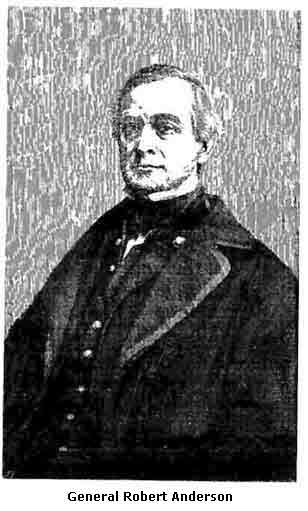
The action of the Government was unusually prompt. On November 11, as we have seen, Major Porter made his written report, and on the 13th he delivered to Major Robert Anderson in New York the order to take command of the forts and forces in Charleston harbor. Major Anderson, suitably qualified by meritorious service, age, and rank, was deemed especially acceptable for the position because he was a Kentuckian by birth, and related by marriage to a prominent family of Georgia. Such sympathies as might influence him were supposed to be with the South, and his appointment would not, therefore, grate harshly on the susceptibilities of the Charlestonians.
The statement, many times repeated, that he owned a plantation in the South is incorrect. He never owned a plantation in Georgia or anywhere else. On the death of his father he came into possession of a small number of slaves. These he liberated as soon as the proper papers could be executed and sent to him at his distant post; and he always afterwards helped them when they were in need and applied to him.[5]
F.J. Porter to Dawson. "Historical Magazine," January, 1872, pp. 37, 38.
The army headquarters being then in New York, Major Anderson on the same day called on General Scott, and in conversation with the veteran General-in-Chief learned that army affairs were being carried on at Washington by Secretary Floyd, without consulting him. Under these circumstances Scott did not deem himself authorized to interfere even by suggestion. Nevertheless, the whole Charleston question seems to have been fully discussed, and the relative strength of the forts, and the possible necessity of occupying Sumter commented upon in such manner as no doubt produced its effect in the subsequent action of Anderson. Major Anderson next went to Washington, and received the personal instructions of Secretary Floyd, and returning thereafter to New York, General Scott in that city gave him on November 15th formal written orders to proceed to Fort Moultrie and take command of the post.
"You have probably heard of the arrival of two or three companies at Charleston in the last six weeks, and you may hear that as many more have followed. There is nothing inconsistent with the President's message in these movements. The intention simply is that the forts in the harbor shall not be wrested from the United States.... The President, I presume, will stand on the defensive, thinking it better to discourage than to invite an attack—better to prevent than to repel one."—Lieut.-Gen. Winfield Scott, "Autobiography." Vol. I., p. 242.
1. The Potomac River and the Chesapeake Bay to the Atlantic. 2. From Maryland along the crest of the Alleghany (perhaps the Blue Ridge) range of mountains, to some point on the coast of Florida. 3. The line from say the head of the Potomac to the west or north-west, which it will be most difficult to settle. 4. The crest of the Rocky Mountains.
The South-east Confederacy would, in all human probability, in less than five years after the rupture, find itself bounded by the first and second lines indicated above, the Atlantic, and the Gulf of Mexico, with its capital at say Columbia, South Carolina. The country between the second, third, and fourth of those lines would, beyond a doubt, in about the same time, constitute another Confederacy, with its capital at probably Alton or Quincy, Illinois. The boundaries of the Pacific Union are the most definite of all, and the remaining States would constitute the Northeast Confederacy with its capital at Albany."—Scott, "Views," printed in "Mr. Buchanan's Administration," pp. 287-288, Appendix.
CHAPTER XXI THE CHARLESTON FORTS
Foster to De Russey, November 24, 1860. W.R. Vol. I., p. 76.
Major Anderson reached Fort Moultrie and assumed command on the 21st of November, 1860. Having from his several interviews with the President, Secretary of War, and Lieutenant-General Scott become fully impressed with the importance of his trust, he proceeded as a first duty to acquaint himself thoroughly with his situation and resources. The great Charleston secession celebration on the 17th had been held while he was on his way; the glare of its illumination was extinguished, the smoke of its bonfires had been dissipated by the fresh Atlantic breezes, and its holiday insurgents had returned to the humdrum of their routine employments. It was, therefore, in uninterrupted quiet that on the 23d of November he in company with Captain Foster made a tour of inspection to the different forts, and on the same day wrote out and transmitted to the War Department a somewhat detailed report of what he saw with eyes fresh to the scenes and surroundings, which, as he already felt, were to become the subjects of his most intense solicitude. On the main point, indeed, there was no room for doubt. Agreeing with General Scott, with Colonel Gardner, and with Major Porter, he gave the Government its fourth warning that the harbor must be immediately and strongly reenforced.
Anderson to Adjutant-General, November 23, 1860. W.R. Vol. I., p. 74.
... The garrison now in it [Moultrie] is so weak as to invite an attack, which is openly and publicly threatened. We are about sixty, and have a line of rampart of 1500 feet in length to defend. If beleaguered, as every man of the command must be either engaged or held on the alert, they will be exhausted and worn down in a few days and nights of such service as they would then have to undergo.
Such, in brief, was the condition of the fort he had been sent to hold. Moultrie was clearly the weak point of the situation. Already informed, to some extent at least, by the superior military genius of General Scott, in his recent interviews with that distinguished commander, Major Anderson now more forcibly, from personal inspection, comprehended its strong points. What was then perfectly obvious to the trained military insight of Scott and Anderson is now in the light of historical events quite as obvious to the civilian. Look at any good map of Charleston harbor, and it will be seen that the city lies on the extreme point of a tongue of land between the Ashley and Cooper rivers, every part being within easy range under the guns of Castle Pinckney, on a small island, three-quarters of a mile distant. Four miles to seaward is the mouth of the harbor, and nearly midway therein stood the more extensive and imposing work of Fort Sumter, its guns not only sweeping all the approaches and ship-channels, but the shores and islands on either hand. It needs but a glance at the map to see that with proper garrisons and armaments Fort Sumter commanded the harbor. and Castle Pinckney commanded the city.
If the Government could hitherto plead ignorance of these advantages against the rising insurrection, that excuse was no longer left after the report of Major Anderson. In this same report he calls attention to them in detail. Though not in a complete state of defense, he gives notice that Fort Sumter "is now ready for the comfortable accommodation of one company, and indeed for the temporary reception of its proper garrison. Captain Foster states that the magazines (four) are done and in excellent condition; that they now contain forty thousand pounds of cannon-powder and a full supply of ammunition for one tier of guns. This work [Sumter] is the key to the entrance of this harbor; its guns command this work [Moultrie], and could soon drive out its occupants. It should be garrisoned at once."
Still more strenuously does he insist upon the value of Castle Pinckney. "Castle Pinckney, a small casemated work, perfectly commanding the city of Charleston, is in excellent condition with the exception of a few repairs, which will require the expenditure of about five hundred dollars.... It is, in my opinion, essentially important that this castle should be immediately occupied by a garrison, say, of two officers and thirty men. The safety of our little garrison would be rendered more certain, and our fort would be more secure from an attack by such a holding of Castle Pinckney, than it would be from quadrupling our force. The Charlestonians would not venture to attack this place [Moultrie] when they knew that their city was at the mercy of the commander of Castle Pinckney.... If my force was not so very small I would not hesitate to send a detachment at once to garrison that work." So full of zeal was Major Anderson that the Government should without delay augment its moral and material strength, that in default of soldiers he desired to improvise a garrison for it by sending there a detachment of thirty laborers in charge of an officer, vainly hoping to supply them with arms and instruct them in drill, and hold the work until reënforcements should come. Having in detail proposed protective measures, he again, in the same letter, forcibly presents the main question of the hour to the Secretary of War, whose weakness and treachery were as yet unsuspected.
Anderson to Adjutant General, Nov. 23, 1860. W.R. Vol. I., pp. 75-6.
Fort Sumter and Castle Pinckney must be garrisoned immediately if the Government determines to keep command of this harbor. I need not say how anxious I am—indeed determined, so far as honor will permit—to avoid collision with the citizens of South Carolina. Nothing, however, will be better calculated to prevent bloodshed than our being found in such an attitude that it would be madness and folly to attack us.... The clouds are threatening and the storm may break upon us at any moment. I do, then, most earnestly entreat that a reënforcement be immediately sent to this garrison, and that at least two companies be sent at the same time to Fort Sumter and Castle Pinckney—half a company, under a judicious commander, sufficing, I think, for the latter work.... With these three works garrisoned as requested, and with a supply of ordnance stores, for which I shall send requisitions in a few days, I shall feel that, by the blessing of God, there may be a hope that no blood will be shed, and that South Carolina will not attempt to take these forts by force, but will resort to diplomacy to secure them. If we neglect, however, to strengthen ourselves, she will, unless these works are surrendered on their first demand, most assuredly immediately attack us.
Adjutant-General to Anderson, Nov. 24, 1860. W.R. Vol. I., p. 76.
Ibid., Nov 28, 1860, W.R. Vol. I., p. 77.
If Major Anderson had added no further word to the clear and straightforward statement and recommendation thus far quoted, his professional judgment and manly sense of duty would stand honorably vindicated before posterity. But his language of loyalty, of wisdom, of humanity, of soldierly devotion, which ought to have elicited a reply as inspiring as a drum-roll or a trumpet-blast, brought him no kindred echo. There was fear in the Executive Mansion, conspiracy in the Cabinet, treason and intrigue in the War Department. Chilling instructions came that he might employ civilians in fatigue and police duty, and that he might send his proposed party of laborers to Castle Pinckney. Meanwhile some of his suggestions would be under consideration; besides, he was cautioned to send his communications to the Adjutant-General or Secretary of War, with the evident purpose to forestall and prevent any patriotic order or suggestion which might otherwise reach him from General Scott.
Nevertheless, Anderson did not weary in his manifest duty. His letters of November 28 and December 1, though perhaps not as full and urgent, are substantial repetitions of his former recommendations. The growing excitement of the Charleston populace and the increasing danger to the forts are restated with emphasis. He says that there appears to be a romantic desire urging the South Carolinians to have possession of Fort Moultrie. Various reports come, that as soon as the State should secede the forts would be demanded, and if not surrendered, they would be taken. All rumors and remarks indicate a fixed purpose to have these works. The Charlestonians are drilling nightly, and making every preparation for the fight which they say must take place.
Anderson to Adjutant-General, Nov. 28, 1860. W.R. Vol. I., pp. 78-9.
Ibid., Dec. 1, 1860. W.R. Vol. I. pp. 81-2.
Once more he repeated that the security of Fort Moultrie would be more greatly increased by throwing garrisons into Castle Pinckney and Fort Sumter than by anything that could be done in strengthening its own defenses. He sent a detailed report of his command to force again upon the attention of the Department his fatal deficiency in numbers, and to show the practical impossibility of repelling an assault, or resisting a siege with any reasonable hope of success. His letters reached the same inevitable conclusion: "The question for the Government to decide—and the sooner it is done the better—is, whether, when South Carolina secedes, these forts are to be surrendered or not. If the former, I must be informed of it, and instructed what course I am to pursue. If the latter be the determination, no time is to be lost in either sending troops, as already suggested, or vessels of war to this harbor. Either of these courses may cause some of the doubting States to join South Carolina. I shall go steadily on preparing for the worst, trusting hopefully in the God of battles to guard and guide me in my course."
While Anderson was thus penning the plain issue, as it lay in the clear light of a soldier's conception of right and conviction of duty, another pen was framing the reply agreed upon by the President and his advisers at Washington. Major Anderson might have faith in the God of battles, but what faith could he have in a Government holding one-third of a vast continent peopled by thirty millions of freemen which could not or would not, in face of the most urgent reiterated appeals and the most imminent and palpable necessity, send him two or three companies of recruits, when the possession of three forts, the peace of a city, the allegiance of a State, if not the tremendous alternative of civil war, hung in the balance?
Adjutant-General to Anderson, Dec. 1, 1860. W.R. Vol. I., pp. 82, 83.
"It is believed,"—so ran the reply, and apparently the final decision of the Government,—"from information thought to be reliable, that an attack will not be made on your command, and the Secretary has only to refer to his conversation with you, and to caution you that should his convictions unhappily prove untrue, your actions must be such as to be free from the charge of initiating a collision. If attacked, you are, of course, expected to defend the trust committed to you to the best of your ability. The increase of the force under your command, however much to be desired, would, the Secretary thinks, judging from the recent excitement produced on account of an anticipated increase, as mentioned in your letter, but add to that excitement and might lead to serious results."
This renunciation by the War Department of the proper show of authority and power, demanded by plain necessity and repeatedly urged by its trusted agents, must have touched the pride of Anderson and his brother officers. But a still deeper humiliation was in store for them, The same letter brought him the following notice: "The Secretary of War has directed Brevet Colonel Huger to repair to this city as soon as he can safely leave his post, to return there in a short time. He desires you to see Colonel Huger, and confer with him prior to his departure on the matters which have been confided to each of you."
Abner Doubleday, "Reminiscences of Forts Sumter and Moultrie," p. 42.
Colonel Huger was an ordnance officer of the army, then stationed for duty in Charleston, of distinguished connections in that city, and having on that account as well as personally great local influence.
What the precise nature of the instructions were, which the Department sent him, does not appear from any accessible correspondence. The result of the action which the two officers took thereunder is, however, less doubtful.
It appears to have been, in effect, a mission by two army officers of honorable rank, in obedience to direct commands from the Secretary of War, to humbly beg the Charlestonians not to assault the forts. Major Anderson on his part dismisses the distasteful mission with a significantly curt report: "I have the honor to acknowledge the receipt on the 4th of your communication of the 1st instant. In compliance therewith I went yesterday to the city of Charleston to confer with Colonel Huger, and I called with him upon the Mayor of the city, and upon several other prominent citizens. All seemed determined, as far as their influence or power extends, to prevent an attack by a mob on our fort; but all are equally decided in the opinion that the forts must be theirs after secession."
What a bitter confession for a brave and sensitive soldier, who knew that with half a company of artillerymen in Castle Pinckney, as he had vainly demanded, the Charleston mob, with the conspiring Governor and insurgent secession convention, would have been compelled to accept from him, as the representative of a forbearing Government, the safety of their roof-trees and the security of their hearthstones.