A HISTORY (continued 5)
Reading edition
Had an amicable solution of the slavery issue been possible, this platform committee would have found it, for it labored faithfully to accomplish the miracle. But after three days and nights of fruitless suggestion and persuasion, the committee reappeared in convention. Upon four points they had come to either entire or substantial agreement. In addition to re-affirming formally the Cincinnati platform of 1856, they advised the convention to favor, 1. The faithful execution of the fugitive-slave law. 2. The protection of naturalized citizens. 3. The construction of a Pacific railroad. 4. The acquisition of the Island of Cuba. But upon the principal topic, the question of slavery in the Territories, they felt compelled to report that even an approximate unanimity was impossible. In undisguised sorrow they proceeded to present two radically different reports. The convention, not yet in the least realizing that the great Democratic party had suffered fatal shipwreck in the secret committee-room, listened eagerly to the reports and explanatory speeches of the majority and minority of the committee.
The majority report[1] planted itself squarely upon the property theory and Congressional protection. Mr. Avery, of North Carolina, said it was presented in the name of 17 States with 127 electoral votes, every one of which would be cast for the nominee. He argued that in occupying new Territories Southern men could not compete with emigrant-aid societies at the North. These could send a voter to the Territories for the sum of $200, while it would cost a Southern man $1500. Secure political power by emigration, and permit the Territorial Legislatures to decide the slavery question, and the South would be excluded as effectually as by the Wilmot proviso. Cuba must be acquired, and the flag of this great country must float over Mexico and the Central American States. But if you apply this doctrine of popular sovereignty, and establish a cordon of free-States from the Pacific to the Atlantic, where in the future are the South to emigrate? They asked the equal right to emigrate with their property, and protection from Congress during the Territorial condition. They would leave it to the people in convention assembled, when framing a State constitution, to determine the question of slavery for themselves. They had no purpose but to have a vexed question settled, and to put the Democratic party on a clear unclouded platform, not a doubled-faced one—one face to the North and one face to the South.
Henry B. Payne, of Ohio, presented and defended the report of the minority.[2] It asserted that all questions in regard to property in States or Territories were judicial in their character, and that the Democratic party would abide by past and future decisions of the Supreme Court concerning them. Mr. Payne explained that while the majority report was supported by 15 slave and two free-States,[3] representing 127 electoral votes, the minority report was indorsed by 15 free-States,[4] representing 176 electoral votes. He argued that, by the universal consent of the Democratic party, the Cincinnati platform referred this question of slavery to the people of the Territories, declaring that Congress should in no event intervene one way or the other, and that all controversies should be settled by the courts. Now the proposition of the majority report was to make a complete retraction of those two cardinal doctrines of the Cincinnati platform. The Northern mind had become thoroughly imbued with this great doctrine of popular sovereignty. You could not tear it out of their hearts unless you tore out their heart-strings themselves. "I repeat, that upon this question of Congressional non-intervention we are committed by the acts of Congress, we are committed by the acts of National Democratic Conventions; we cannot recede without personal dishonor, and, so help us God, we never will recede!"
Between these extremes of recommendation another member of the platform committee—Benjamin F. Butler, of Massachusetts—proposed a middle course. He advocated the simple reaffirmance of the Cincinnati platform. If it had suffered a double interpretation, so had the Bible and the Constitution of the United States. But beyond serving to consume time and amuse the convention, Mr. Butler's speech made no impression. The real tournament of debate followed, between William L. Yancey, of Alabama, and Senator George E. Pugh, of Ohio.
Halstead, "Conventions of 1860," pp. 5, 48.
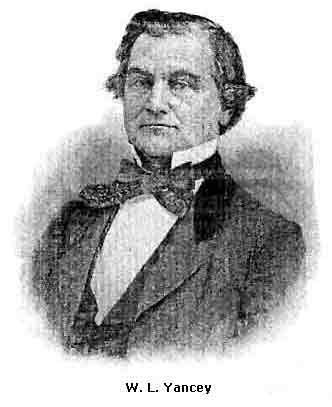
It turned out in the end that Mr. Yancey was the master-spirit of the Charleston Convention, though that body was far from entertaining any such suspicion at the beginning. In exterior appearance he did not fill the portrait of the traditional fire-eater. He is described as "a compact middle-sized man, straight-limbed, with a square-built head and face, and an eye full of expression"; "a very mild and gentlemanly man, always wearing a genuinely good-humored smile, and looking as if nothing in the world could disturb the equanimity of his spirits." He had, besides, a marvelous gift of persuasive oratory. He was the Wendell Phillips of the South, for, like his Northern rival, he was a born agitator. Above all his colleagues, he was the brain and soul and irrepressible champion of the pro-slavery reaction throughout the Cotton States. He was tireless and ubiquitous; traveling, talking, writing, lecturing, animating every intrigue, directing every caucus, making speeches and drafting platforms at every convention. To defend, propagate, and perpetuate African slavery was his mission. He was the ultra of the ultras, accepting the institution as morally right and divinely sanctioned, desiring its extension and inclined to favor, though not then himself advocating, the re-opening of the African slave-trade. He held that all Federal laws prohibiting such trade ought to be repealed so that each State might decide the question for itself. Still more, Mr. Yancey was not only an agitator and fire-eater, but for years an insidious, persevering conspirator to promote secession. Occupying such a position, he was naturally the champion of the Cotton States at Charleston. The defense of the ultra demands of the South was by common consent devolved upon him,[5] and it was understood long beforehand that he was prepared with the principal speech from that side.
In full consciousness of the fact that he and his colleagues were then at Charleston with a predetermination to force a programme of disruption expressly designed as a prelude to intended disunion, Mr. Yancey stood up and with smiling face and silvery tones assured his hearers that he and his colleagues from Alabama were not disunionists per se. Then he proceeded with his speech. Only its key-note was new, but the novelty was of startling import to Northern delegates. The Northern Democrats, he stated, were losing ground and falling before their victorious adversaries. Why? Because they had tampered with, and pandered to, the anti-slavery sentiment. They had admitted that slavery was wrong. This was surrendering the very citadel of their argument. They must re-form their lines and change their tactics. They must come up to the high requirements of the occasion and take a new departure. The remainder of his speech was an insinuating plea for the property doctrine and Congressional intervention, for which the galleries and convention rewarded him with long and earnest applause. Even if the great Southern agitator's speech had been wanting in point and eloquence, success was supplied by the unmistakable atmosphere and temper of this great Charleston audience.
The more astute of the Douglas delegates were struck with the dismay of a new revelation. Their cause was lost—their party was gone. Senator Pugh, of Ohio, resented the dictation of the advocates of slavery in a warmth of just indignation. He thanked God that at last a bold and honest man had told the whole truth of the demands of the South. It was now before the country that the South did demand an advanced step from the Democratic party. He accurately traced the downfall of the Northern Democracy to her changing and growing exactions. Taunted with their weakness, they were now told they must put their hands on their mouths and their mouths in the dust. "Gentlemen of the South," said Mr. Pugh, "you mistake us—we will not do it."
Such language had never been heard in a Democratic National Convention, and the hall was as still as a funeral. This was Friday night, the fifth day of the convention. "A crisis" had long been whispered of as the skeleton in the party closet. It seemed to be at hand, and in a parliamentary uproar the "question" was vehemently demanded, but the chairman skillfully managed at length to secure an adjournment.
The "crisis" had in reality come on Thursday night, in the committee-room, in the hopeless first double report of its platform committee. The dissolution of the convention did not take place till the Monday following. A great party, after a vigorous and successful life of thirty years, could not die easily. The speeches of Avery and Payne, of Yancey and Pugh, on Friday, were recognized as cries of defiance, but not yet accepted as moans of despair. On Saturday morning. President Buchanan's lieutenant, William Bigler, of Pennsylvania, essayed to ride the storm and steer to a Southern victory. But he only succeeded in securing a recommittal of both platforms to the committee. Nothing, however, was gained by the manoeuvre. Saturday afternoon the committee once more reported the same disagreement in slightly changed phraseology;[6] two antagonistic platforms, presenting the same sharp difference of principle—one demanding Congressional intervention, the other declaring against it. Then the parliamentary storm was unloosed for the remainder of that day with such fury that the chairman declared his physical inability to continue a contest with six hundred gentlemen as to who should cry the loudest, and threatened to leave the chair. On Monday, April 30, the seventh day of the convention, a final decision was reached. The proposal of Butler's report simply to reaffirm the Cincinnati platform was supported by only 105 ayes to 198 noes. Then, by 165 to 138, the convention voted to substitute the minority report for that of the majority; in other words, to adopt the Douglas non-intervention platform.
The explosion was near, but still delayed, and the delegates of the Cotton States sat sullenly through a tangle of routine voting. Finally, the question was renewed on Butler's proposition to adopt the Cincinnati platform pure and simple. This was the red flag to the mad bull. Mississippi declared that the Cincinnati platform was a great political swindle on one half the States of the Union; and from that time on the Cotton States ceased to act as a part of the convention. As soon as a lull in the proceedings permitted, Mr. Yancey put in execution his programme of demand, disruption, disunion, and rebellion, labored for through long years, and announced by himself, with minute distinctness, nine months before.[7] Led by the Alabama delegation, the Cotton States,—Alabama, Mississippi, Louisiana, South Carolina, Florida, Texas, and Arkansas,—with protests and speeches, with all the formality and "solemnity" which the occasion allowed, seceded from the Charleston Convention, and withdrew from the deliberations in Institute Hall.
That same Monday night the city of Charleston expressed its satisfaction by a grand jubilee. Music, bonfires, and extravagant declamation held an excited crowd in Court-house Square till a late hour; and in a high-wrought peroration Yancey prophesied, with all the confidence and exultation of a triumphant conspirator, that "perhaps even now the pen of the historian is nibbed to write the story of a new revolution."
The corroboration and fulfillment of the plot here indicated are found in the official proceedings of the Alabama Convention and the Alabama Legislature. The convention on January 13, 1860, expressly instructed its delegation at Charleston to secede in case the ultra-Southern doctrines were not incorporated in the National Democratic platform, and sent Mr. Yancey as a delegate to execute their instructions, which he did as the text states.
The Alabama Legislature, on its part, passed a joint resolution, which the Governor approved, February 24, 1860, providing "that upon the election of a President advocating the principles and action of the party in the Northern States calling itself the Republican party," the Governor should forthwith call a convention of the State. This convention was duly called after the election of Mr. Lincoln, and passed the secession ordinance of Alabama.
CHAPTER XIV THE BALTIMORE NOMINATIONS
Though the compact voting body of the South had retired from the Charleston Convention, her animating spirit yet remained in the numbers and determination of the anti-Douglas delegates. When on Tuesday morning, May 1, the eighth day, the convention once more met, the Douglas men, with a view to making the most of the dilemma, resolved to force the nomination of their favorite. But there was a lion in the path. Usage and tradition had consecrated the two-thirds rule. Charles E. Stuart, of Michigan, tried vainly to obtain the liberal interpretation, that this meant "two-thirds of the votes given," but Chairman Cushing ruled remorselessly against him, and at the instance of John B. Howard, of Tennessee, the convention voted (141 to 112) that no person should be declared nominated who did not receive two-thirds of all the votes the full convention was entitled to cast.
This sealed the fate of Douglas. The Electoral College numbered 303; 202 votes therefore were necessary to a choice. Voting for candidates was begun, and continued throughout all the next day (Wednesday, May 2). Fifty-seven ballots were taken in all; Douglas received 145½ on the first, and on several subsequent ballots his strength rose to 152½. The other votes were scattered among eight different candidates with no near approach to agreement.[1]
The dead-lock having become unmistakable and irremediable, and the nomination of Douglas under existing conditions impossible, all parties finally consented to an adjournment, especially as it was evident that unless this were done the sessions would come to an end by mere disintegration. Therefore, on the tenth day (May 3), the Charleston Convention formally adjourned, having previously resolved to reassemble on the 18th of June, in the city of Baltimore, with a recommendation that the several States make provision to fill the vacancies in their delegations.
Mr. Yancey and his seceders had meanwhile organized another convention in St. Andrew's Hall. Their business was of course to report substantially the platform rejected by the Douglas men, and for the rejection of which they had retired. Mr. Yancey then explained to them that the adoption of this platform was all the action they proposed to take until the "rump democracy" should make their nomination, when, he said, "it may be our privilege to indorse the nominee, or our duty to proceed to make a nomination." Other seceders were more impatient, and desired that something be done forthwith; but as the sessions were continued to the second and third day, their overflowing zeal found a safety-valve in their speeches. Mr. Yancey's programme prevailed, and they also adjourned to meet again in Richmond on the 11th of June.
At the time of the disruption, rumors were current in Charleston that the movement, if not prompted, was at least encouraged and sustained by telegrams from leading Senators and Representatives then at their Congressional duties in Washington. As the day for reassembling in Baltimore drew near, the main fact was abundantly proved by the publication of an address, signed by Jefferson Davis, Toombs, Iverson, Slidell, Benjamin, Mason, and some fourteen others, in which they undertook to point out a path to union and harmony in the Democratic party. They recited the withdrawal of eight States at Charleston, and indorsed the step without qualification. "We cannot refrain," said the address, "from expressing our admiration and approval of this lofty manifestation of adherence to principle, rising superior to all considerations of expediency, to all trammels of party, and looking with an eye single to the defense of the constitutional rights of the States." They then alleged that the other Democratic States remained in the convention only to make a further effort to secure "some satisfactory recognition of sound principles," declaring, however, their determination also to withdraw if their just expectation should be disappointed. The address then urged that the seceders should defer their meeting at Richmond, but that they should come to Baltimore and endeavor to effect "a reconciliation of differences on a basis of principle." If the Baltimore Convention should adopt "a satisfactory platform of principles,"—and their votes might help secure it,—then cause of dissension would have ceased. "On the other hand," continued the address, "if the convention, on reassembling at Baltimore, shall disappoint the just expectations of the remaining Democratic States, their delegations cannot fail to withdraw and unite with the eight States which have adjourned to Richmond." The address, in another paragraph, explained that the seventeen Democratic States which had voted at Charleston for the seceders' platform, "united with Pennsylvania alone, comprise a majority of the entire electoral vote of the United States, able to elect the Democratic nominees against the combined opposition of all the remaining States."
This was a shrewd and crafty appeal. Under an apparent plea for harmony lurked an insidious invitation to Delaware, Virginia, North Carolina, Missouri, Tennessee, Kentucky, California, Oregon, and Pennsylvania to join the seceders, reconstruct the Democratic party, cut off all the "popular sovereignty" recusants, and secure perpetual ascendency in national politics through the consolidated South. The signers of this address, forgetting their own constant accusation of "sectionalism" against the Republicans, pretended to see no impropriety in proposing this purely selfish and sectional alliance. If it succeeded, their triumph in the Union was irresistible and permanent; if it failed, it served to unite the South for secession and a slave confederacy.
If any Democrat harbored a doubt that the proposed reconciliation meant simply a reunion on the Davis-Yancey platform, the doubt was soon removed. In the Senate of the United States, Jefferson Davis was pressing to a vote his caucus resolutions, submitted in February, to serve as a model for the Charleston platform; and this brought on a final discussion between himself and Douglas.
"Globe," May 7, 1860, p. 1940. Appendix. "Globe," May 15 and 16, 1860, pp. 312, 313, and 316.
"Globe," May 17, 1860, p. 2151. Ibid., p. 2153. Ibid., p. 2155.
Davis had begun the debate on the 7th of May by a savage onslaught on "Squatter Sovereignty"—a fallacy, he said, fraught with mischief more deadly than the fatal upas, because it spread its poison over the whole Union. Douglas took up the gauntlet, and, replying on May 15 and 16, said he could not recognize the right of a caucus of the Senate or the House to prescribe new tests for the Democratic party. Senators were not chosen for the purpose of making platforms. That was the duty of the Charleston Convention, and it had decided in his favor, platform, organization, and least of all the individual, by giving him a majority of fifty votes over all the other candidates combined. He reprobated the Yancey movement as leading to dissolution and a Southern confederacy. The party rejected this caucus platform. Should the majority, he asked, surrender to the minority? Davis, replying on the 17th, contended that Douglas had, on the Kansas policy of the Administration, put himself outside the Democratic organization. He desired no divided flag for the party. He preferred that the Senator's banner should lie in its silken folds to feed the moth; "but if it impatiently rustles to be unfurled in opposition to ours, we will plant our own on every hill." Douglas retorted, and again attacked the caucus dictation. "Why," he asked, "are all the great measures for the public good made to give place to the emergency of passing some abstract resolutions on the subject of politics to reverse the Democratic platform, under the supposition that the representatives of the people are men of weak nerve who are going to be frightened by the thunders of the Senate Chamber?" Davis rejoined, that they wanted a new article in the creed because they could not get an honest construction of the platform as it stood. "If you have been beaten on a rickety, double-construed platform, kick it to pieces, and lay one broad and strong, on which men can stand." "We want nothing more than a simple declaration that negro slaves are property, and we want the recognition of the obligation of the Federal Government to protect that property like all other." A somewhat restrained undertone of personal temper had been running through the debate, and Jefferson Davis could not resist an expression of contempt for his opponent. "The fact is," said he, "I have a declining respect for platforms. I would sooner have an honest man on any sort of a rickety platform that you could construct, than to have a man I did not trust on the best platform which could be made."
Douglas promptly called attention to the inconsistency of Davis's method of forcing his resolutions with one breath and avowing his indifference to a platform with another, especially as Yancey and his own followers had seceded on the platform and not on the man; but he did not press his adversary to the wall, as he might have done, on the insincerity which Davis's sneer exposed. He was hampered by his own attitude as a candidate. Douglas, who had received 150 votes at Charleston, and who expected the whole at Baltimore, could not let his tongue wag as freely as Davis, who had received only one vote and a half at Charleston, and could count on none at Baltimore; else he might have denounced him on the score of patriotism. For Jefferson Davis, like Yancey, only not so constantly, and like so many others of that secession coterie, blew hot and cold about disunion as occasion demanded. This same debate of May 17 furnished an instructive example.
"Globe," May 17, 1860, p. 2151.
In the beginning of the day's discussion Davis indulged in a repetition of the old alarm-cry: "And so, sir, when we declare our tenacious adherence to the Union, it is the Union of the Constitution. If the compact between the States is to be trampled into the dust; if anarchy is to be substituted for the usurpation which threatened the Government at an earlier period; if the Union is to become powerless for the purposes for which it was established, and we are vainly to appeal to it for protection—then, sir, conscious of the rectitude of our course, and self-reliant within ourselves, we look beyond the confines of the Union for the maintenance of our rights."
"Globe," May 17, 1860, p. 2156.
But after Douglas had made a damaging exposure of Yancey's disunion intrigues, which had come to light, and had charged their animus on the Charleston seceders, Davis changed his tone. He said there were not more than seventy-five men in the lodges of the Southern Leagues. He did not think the Union was in danger from them. "I have great confidence," said he, "in the strength of the Union. Every now and then I hear that it is about to tumble to pieces; that somebody is going to introduce a new plank into the platform, and if he does, the Union must tumble down; until at last I begin to think it is such a rickety old platform that it is impossible to prop it up. But then I bring my own judgment to bear, instead of relying on witnesses, and I come to the conclusion that the Union is strong and safe—strong in its power as well as in the affections of the people."
The debate made it very plain that it was not reconciliation but domination which the South wanted. So in due time (May 25) the Jefferson Davis resolutions, affirming the "property" theory and the "protection" doctrine, were passed by a large majority of the Democratic Senators.
June 18, 1860.
When the Charleston Convention proper reassembled at Baltimore, it was seen that the programme laid out by Jefferson Davis and others in their published address had been adopted. The seceders had met at Richmond, taken a recess, and now appeared at Baltimore making application for readmission. But some of the States that withdrew at Charleston had sent contesting delegations, and it resolved itself into tangled rivalry and quarrel of platforms, candidates, and delegations all combined. For four days a furious debate raged in the convention during the day, while rival mass-meetings in the streets at night called each other "disorganizes," "bolters," "traitors," "disunionists," and "abolitionists." When Douglas, before a test-vote was reached, sent a dispatch suggesting that the party and the country might be saved by dropping his name and uniting upon some other candidate, his followers suppressed the dispatch.
On the fifth day at Baltimore the Democratic National Convention underwent its second "crisis," and suffered its second disruption. This time the secession was somewhat broadened; Chairman Cushing resigned his seat, and Virginia, North Carolina, Tennessee, Delaware, Maryland, Kentucky, and California withdrew wholly or in part to join the States which had gone out at Charleston.
For the time the disunion extremists were keeping their scheme too well masked for us to establish clearly its historical record. But the signs and footprints of their underplot are evident. Here at Baltimore, as at Charleston, and as on every critical occasion, Mr. Yancey was conspicuously present. Here, as elsewhere, he was no doubt persistently intriguing for disunion in secret while ostentatiously denying disunion purposes in public.
Halstead, "Conventions of 1860."
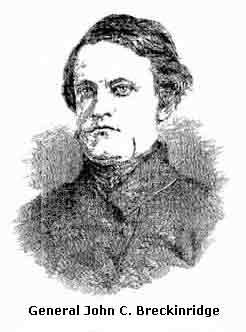
But little remained to do after the disruption at Baltimore, and that little was quickly done. The fragments of the original convention continued their session in the Front-street Theater, where they had met, and on the first ballot nominated Stephen A. Douglas for President by an almost unanimous vote. The seceders organized, under the chairmanship of Caleb Cushing, in Maryland Institute Hall, and also by a nearly unanimous ballot nominated as their candidate for President, John C. Breckinridge, of Kentucky. Then Mr. Yancey, who in a street mass-meeting had declared that he was neither for the Union per se nor for disunion per se, but for the Constitution, announced that the Democracy, the Constitution, and, through them, the were yet safe.
A month prior to the reassembling of the Charleston "Rumps" above described, Baltimore had already witnessed another Presidential convention and nomination, calling itself peculiarly "National," in contradistinction to the "sectional" character which it charged upon the Democratic and Republican parties alike. This was a third party, made up mainly of former Whigs whose long-cherished party antagonisms kept them aloof from the Democrats in the South and the Republicans in the North. In the South, they had been men whose moderate anti-slavery feelings were outraged by the repeal of the Missouri Compromise and the Lecompton trick. In the North, they were those whose traditions and affiliations revolted at the extreme utterances of avowed abolitionists. In both regions many of them had embraced Know-Nothingism, more as an alternative than from original choice. The Whig party was dissolved; Know-Nothingism had utterly failed—their only resource was to form a new party.
In the various States they had, since the defeat of Fillmore in 1856, held together a minority organization under names differing in separate localities. All these various factions and fragments sent delegations to Baltimore, where they united themselves under the designation of the Constitutional Union Party. They proposed to take a middle course between Democrats and Republicans, and to allay sectional strife by ignoring the slavery question.
1860.
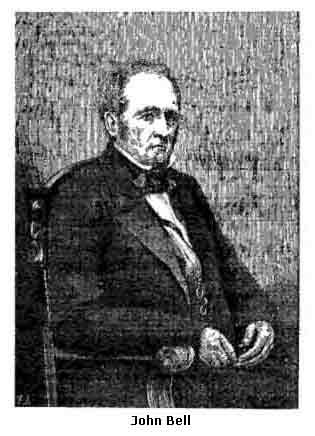
Delegates of this party, regular and irregular, from some twenty-two States, convened at Baltimore on the 9th of May. John J. Crittenden, of Kentucky, called the meeting to order, and Washington Hunt, of New York, was made temporary and permanent chairman. On Thursday, May 10, they adopted as their platform a resolution declaring in substance that they would "recognize no other political principle than the Constitution of the country, the Union of the States, and the enforcement of the laws." They had no reasonable hope of direct success at the polls in November; but they had a clear possibility of defeating a popular choice, and throwing the election into the House of Representatives; and in that case their nominee might stand on high vantage-ground as a compromise candidate. This possibility gave some zest to the rivalry among their several aspirants. On their second ballot, a slight preponderance of votes indicated John Bell, of Tennessee, as the favorite, and the convention made his nomination unanimous. Mr. Bell had many qualities desirable in a candidate for President. He was a statesman of ripe experience, and of fair, if not brilliant, fame. Though from the South, his course on the slavery question had been so moderate as to make him reasonably acceptable to the North on his mere personal record. He had opposed the repeal of the Missouri Compromise and the Lecompton outrage. But upon this platform of ignoring the political strife of six consecutive years, in which he had himself taken such vigorous part, he and his followers were of course but as grain between the upper and nether millstones. Edward Everett, one of the most eminent statesmen and scholars of New England, was nominated for Vice-President.
This party becomes historic, not through what it accomplished, but by reason of what a portion of it failed to perform. Within one year from these pledges to the Constitution, the Union, and the enforcement of the laws, Mr. Bell and most of his Southern adherents in the seceding States were banded with others in open rebellion. On the other hand, Mr. Everett and most of the Northern members, together with many noble exceptions in the border slave-States, like Mr. Crittenden, of Kentucky, kept the faith announced in their platform, and with patriotic devotion supported the Government in the war to maintain the Union.
CHAPTER XV THE CHICAGO CONVENTION
1860.
In recognition of the growing power and importance of the great West, the Republican National Convention was called to meet in Chicago on the 16th of May. The former Presidential canvass, though resulting in the defeat of Frémont, had nevertheless shown the remarkable popular strength of the Republican party in the country at large; since then, its double victory in Congress against Lecompton, and at the Congressional elections over the Representatives who supported Lecompton, gave it confidence and aggressive activity. But now it received a new inspiration and impetus from the Charleston disruption. Former possibility was suddenly changed to strong probability of success in the coming Presidential election. Delegates were not only quickened with a new zeal for their principles; the growing chances spurred them to fresh efforts in behalf of their favorite candidates. Those who had been prominently named were diverse in antecedents and varied in locality, each however presenting some strong point of popular interest. Seward, of New York, a Whig of preeminent fame; Chase, of Ohio, a talented and zealous anti-slavery Democrat, an original founder of the new party; Dayton, of New Jersey, an old Whig high in personal worth and political service; Cameron, of Pennsylvania, a former Democrat, now the undisputed leader of an influential tariff State; Bates, of Missouri, an able and popular anti-slavery Whig from a slave-State; and last, but by no means least in popular estimation, Lincoln, of Illinois.
Pickett to Lincoln, April 13, 1859. MS.
The idea of making Lincoln a Presidential candidate had occurred to the minds of many during his growing fame. The principle of natural selection plays no unimportant part in the politics of the United States. There are always hundreds of newspapers ready to "nail to the mast-head" the name of any individual which begins to appear frequently in dispatches and editorials. A few months after the close of the Lincoln-Douglas debates, and long before the Ohio speeches and the Cooper Institute address, a warm personal friend, the editor of an Illinois newspaper, wrote him an invitation to lecture, and added in his letter: "I would like to have a talk with you on political matters, as to the policy of announcing your name for the Presidency, while you are in our city. My partner and myself are about addressing the Republican editors of the State on the subject of a simultaneous announcement of your name for the Presidency."
Lincoln to Pickett, April 16, 1859. MS.
To this Lincoln replied: "As to the other matter you kindly mention, I must in candor say I do not think myself fit for the Presidency. I certainly am flattered and gratified that some partial friends think of me in that connection; but I really think it best for our cause that no concerted effort, such as you suggest, should be made."
Lincoln to Judd, Dec. 9, 1859. MS.
A much more hopeful ambition filled his mind. Notwithstanding his recent defeat, he did not think that his personal contest with Douglas was yet finished. He had the faith and the patience to wait six years for a chance to repeat his political tournament with the "Little Giant." From his letter quoted in a previous chapter we know he had resolved to "fight in the ranks" in 1860. From another, we know how generously he kept faith with other Republican aspirants. "If Trumbull and I were candidates for the same office you would have a right to prefer him, and I should not blame you for it; but all my acquaintance with you induces me to believe you would not pretend to be for me while really for him. But I do not understand Trumbull and myself to be rivals. You know I am pledged not to enter a struggle with him for the seat in the Senate now occupied by him; and yet I would rather have a full term in the Senate than in the Presidency."
Lincoln to Frazer, Nov. 1, 1859. MS.
This spirit of fairness in politics is also shown by the following letter, written apparently in response to a suggestion that Cameron and Lincoln might form a popular Presidential tickets "Yours of the 24th ult. was forwarded to me from Chicago. It certainly is important to secure Pennsylvania for the Republicans in the next Presidential contest; and not unimportant to also secure Illinois. As to the ticket you name, I shall be heartily for it after it shall have been fairly nominated by a Republican National Convention; and I cannot be committed to it before. For my single self, I have enlisted for the permanent success of the Republican cause; and for this object I shall labor faithfully in the ranks, unless, as I think not probable, the judgment of the party shall assign me a different position. If the Republicans of the great State of Pennsylvania shall present Mr. Cameron as their candidate for the Presidency, such an indorsement of his fitness for the place could scarcely be deemed insufficient. Still, as I would not like the public to know, so I would not like myself to know, I had entered a combination with any man to the prejudice of all others whose friends respectively may consider them preferable."
Lincoln to Judd, Feb. 9, 1860. MS. Also printed in a pamphlet.
Not long after these letters, at some date near the middle of the winter 1859-60, the leaders of the Republican party of Illinois met at Springfield, the capital of the State, and in a more pressing and formal manner requested him to permit them to use his name as a Presidential candidate, more with the idea of securing his nomination for Vice-President than with any further expectation. To this he now consented. His own characteristic language, however, plainly reveals that he believed this would be useful to him in his future Senatorial aspirations solely, and that he built no hopes whatever on national preferment. A quarrel was going on among rival aspirants to the Illinois governorship, and Lincoln had written a letter to relieve a friend from the imputation of treachery to him in the recent Senatorial contest. This act of justice was now used to his disadvantage in the scramble for the Illinois Presidential delegates, and he wrote as follows: "I am not in a position where it would hurt much for me not to be nominated on the national ticket; but I am where it would hurt some for me not to get the Illinois delegates. What I expected when I wrote the letter to Messrs. Dole and others is now happening. Your discomfited assailants are most bitter against me; and they will for revenge upon me, lay to the Bates egg in the South, and to the Seward egg in the North, and go far towards squeezing me out in the middle with nothing. Can you not help me a little in this matter in your end of the vineyard?"
The extra vigilance of his friends thus invoked, it turned out that the Illinois Republicans sent a delegation to the Chicago Convention full of personal devotion to Lincoln and composed of men of the highest standing, and of consummate political ability, and their enthusiastic efforts in his behalf among the delegations from other States contributed largely to the final result.
1860.
The political campaign had now so far taken shape that its elements and chances could be calculated with more than usual accuracy. The Charleston Convention had been disrupted on the 30th of April, and adjourned on May 3; the nomination of John Bell by the Constitutional Union party occurred on May 10. The Chicago Convention met on May 16; and while there was at that date great uncertainty as to whom the dissevered fragments of the Democratic party would finally nominate, little doubt existed that both the Douglas and Buchanan wings would have candidates in the field. With their opponents thus divided, the plain policy of the Republicans was to find a candidate on whom a thorough and hearty union of all the elements of the opposition could be secured. The party was constituted of somewhat heterogeneous material; a lingering antagonism remained between former Whigs and Democrats, protectionists and free-traders, foreign-born citizens and Know-Nothings. Only on a single point were all thus far agreed—opposition to the extension of slavery.
But little calculation was needed to show that at the November polls four doubtful States would decide the Presidential contest. Buchanan had been elected in 1856 by the vote of all the slave States (save Maryland), with the help of the free States of New Jersey, Pennsylvania, Indiana, Illinois, and California, Change the first four or even the first three of these free-States to the Republican side, and they, with the Frémont States of 1856, would elect the President against all the others combined. The Congressional elections of 1858 demonstrated that such a change was possible. But besides this, Pennsylvania and Indiana were, like Ohio, known as "October States," because they held elections for State officers in that month; and they would at that early date give such an indication of sentiment as would forecast their November vote for President, and exert a powerful, perhaps a decisive, influence on the whole canvass. What candidate could most easily carry New Jersey, Pennsylvania, Indiana, and Illinois, became therefore the vital question among the Chicago delegates, and especially among the delegates from the four pivotal States themselves.
William H. Seward, of New York, was naturally the leading candidate. He had been longest in public life, and was highest in official rank. He had been Governor of the greatest State of the Union, and had nearly completed a second term of service in the United States Senate. Once a prominent Whig, his antecedents coincided with those of the bulk of the Republican party. His experience ran through two great agitations of the slavery question. He had taken important part in the Senate discussions which ended in the compromise measures of 1850, and in the new contest growing out of the Nebraska bill his voice had been heard in every debate. He was not only firm in his anti-slavery convictions, but decided in his utterances. Discussing the admission of California, he proclaimed the "higher law" doctrine in 1850;[1] reviewing Dred Scott and Lecompton, he announced the "irrepressible conflict" in 1858.[2] He had tact as well as talent; he was a consummate politician, as well as a profound statesman. Such a leader could not fail of a strong following, and his supporters came to Chicago in such numbers, and of such prominence and character, as seemed to make his nomination a foregone conclusion. The delegation from New York, headed by William M. Evarts, worked and voted throughout as a unit for him, not merely to carry out their constituents' wishes, but with, a personal zeal that omitted no exertion or sacrifice. They showed a want of tact, however, in carrying their street demonstrations for their favorite to excess; they crowded together at the Richmond House, making that hotel the Seward headquarters; with too much ostentation they marched every day to the convention with music and banners; and when mention was made of doubtful States, their more headlong members talked altogether too much of the campaign funds they intended to raise. All this occasioned a reaction—a certain mental protest among both Eastern and Western delegates against what have come to be characterized as "machine" methods.
The positive elements in Seward's character and career had developed, as always happens, strong antagonisms. One of the earliest symptoms among the delegates at Chicago was the existence of a strong undercurrent of opposition to his nomination. This opposition was as yet latent, and scattered here and there among many State delegations, but very intense, silently watching its opportunity, and ready to combine upon any of the other candidates. The opposition soon made a discovery: that of all the names mentioned, Lincoln's was the only one offering any chance for such a combination. It needed only the slightest comparison of notes to show that Dayton had no strength save the New Jersey vote; Chase little outside of the Ohio delegation; Cameron none but that of Pennsylvania, and that Bates had only his Missouri friends and a few in border slave-States, which could cast no electoral vote for the Republicans. The policy of the anti-Seward delegates was therefore quickly developed—to use Lincoln's popularity as a means to defeat Seward.
The credit of the nomination is claimed by many men, and by several delegations, but every such claim is wholly fictitious. Lincoln was chosen not by personal intrigue, but through political necessity. The Republican party was a purely defensive organization; the South had created the crisis which the new party was compelled to overcome. The ascendency of the free-States, not the personal fortunes of Seward, hung in the balance. Political victory at the ballot-box or a transformation of the institutions of government was the immediate alternative before the free-States.
Victory could be secured only by help of the electoral votes of New Jersey, Pennsylvania, Indiana, and Illinois. It was therefore a simple problem: What candidate could carry these States? None could answer this question so well as their own delegates, and these, when interrogated, still further reduced the problem by the reply that Seward certainly could not. These four States lay on the border land next to the South and to slavery. Institutions inevitably mold public sentiment; and a certain tenderness towards the "property" of neighbors and friends infected their people. They shrunk from the reproach of being "abolitionized." They would vote for a conservative Republican; but Seward and radicalism and "higher law" would bring them inevitable defeat.
N.Y. "Tribune," May 18, 1860.
Who, then, could carry these doubtful and pivotal States? This second branch of the question also found its ready answer. The contest in these States would be not against a Territorial slave code, but against "popular sovereignty "; not with Buchanan's candidate, but with Douglas; and for Douglas there was only a single antagonist, tried and true—Abraham Lincoln. Such, we may reasonably infer, was the substance of the discussion and argument which ran through the caucus-rooms of the delegates, day and night, during the 16th and 17th of May. Meanwhile the Seward men were not idle; having the large New York delegation to begin with, and counting the many positive committals from other States, their strength and organization seemed impregnable. The opposing delegations, each still nursing the chances of its own candidate, hesitated to give any positive promises to each other. At midnight of May 17, Horace Greeley,[3] one of Seward's strongest opponents, and perhaps better informed than any other single delegate, telegraphed his conclusion "that the opposition to Governor Seward cannot concentrate on any candidate, and that he will be nominated."
Chicago was already a city of a hundred thousand souls. Thirty to forty thousand visitors, full of life, hope, ambition, most of them from the progressive group of encircling North-western States, and strung to the highest tension of political excitement had come to attend the convention. Charleston had shown a great party in the ebbtide of disintegration, tainted by the spirit of disunion. Chicago exhibited a great party springing to life and power, every motive and force compelling coöperation and growth. The rush and spirit of the great city, and the enthusiasm and hope of its visitors, blended and reacted upon each other as if by laws of chemical affinity. Something of the freshness and sweep of the prairie winds exhilarated the delegates and animated the convention.
No building in the city of Chicago at that time contained a hall with sufficient room for the sittings of the great assemblage. A temporary frame structure, which the committee of arrangements christened "The Wigwam," was therefore designed and erected for this special use. It was said to be large enough to hold ten thousand persons, and whether or not that estimate was entirely accurate, a prodigious concourse certainly gathered each day within its walls.
The first day's session (May 16) demonstrated the successful adaptation of the structure to its uses. Participants and spectators alike were delighted with the ease of ingress and egress, the comfortable division of space, the perfection of its acoustic qualities. Every celebrity could be seen, every speech could be heard. The routine of organization, the choice of officers and committees, and the presentation of credentials were full of variety and zest. Governor Edwin D. Morgan, of New York, as Chairman of the National Republican Committee, called the convention to order; and when he presented the historic name of David Wilmot, of Pennsylvania, for temporary chairman, the faith of the audience in the judgment of the managers was already won. The report of the committee on organization in the afternoon made George Ashmun, of Massachusetts, a most skillful parliamentarian ready in decision and felicitous in his phrases, the permanent presiding officer. One thing was immediately and specially manifest: an overflowing heartiness and deep feeling pervaded the whole house. No need of a claque, no room for sham demonstration here! The galleries were as watchful and earnest as the platform. There was something genuine, elemental, uncontrollable in the moods and manifestations of the vast audience. Seats and standing-room were always packed in advance, and, as the delegates entered by their own separate doors, the crowd easily distinguished the chief actors. Blair, Giddings, Greeley, Evarts, Kelley, Wilmot, Schurz, and others were greeted with spontaneous applause, which, rising at some one point, grew and rolled from side to side and corner to corner of the immense building, brightening the eyes and quickening the breath of every inmate.[4]
With the second day's proceedings the interest of delegates and spectators was visibly increased, first by some sharp-shooting speeches about credentials, and secondly by the main event of the day—the report from the platform committee. Much difficulty was expected on this score, but a little time had smoothed the way with almost magical effect. The great outpouring of delegates and people, the self-evident success of the gathering, the harmonious, almost joyous, beginning of the deliberations in the first day's session, were more convincing than logic in solidifying the party. These were the premonitions of success; before such signs of victory all spirit of faction was fused into a generous glow of emulation.
The eager convention would have accepted a weak or defective platform; the committee, on the contrary, reported one framed with remarkable skill. It is only needful to recapitulate its chief points. It denounced disunion, Lecomptonism, the property theory, the dogma that the Constitution carries slavery to Territories, the reopening of the slave-trade, the popular sovereignty and non-intervention fallacies, and denied "the authority of Congress, of a Territorial Legislature, or of any individuals to give legal existence to slavery in any Territory of the United States." It opposed any change in the naturalization laws. It recommended an adjustment of import duties to encourage the industrial interests of the whole country. It advocated the immediate admission of Kansas, free homesteads to actual settlers, river and harbor improvements of a national character, and a railroad to the Pacific Ocean. Bold on points of common agreement, it was unusually successful in avoiding points of controversy among its followers, or offering points for criticism to its enemies.
It is not surprising that Charleston and Chicago should furnish many striking contrasts. At the Charleston Convention, the principal personal incident was a long and frank speech from one Gaulden, a Savannah slave-trader, in advocacy of the reopening of the African slave-trade.[5] In the Chicago Convention, the exact and extreme opposite of such a theme created one of the most interesting of the debates. The platform had been read and received with tremendous cheers, when Mr. Giddings, of Ohio, who was everywhere eager to insist upon what he designated as the "primal truths" of the Declaration of Independence, moved to amend the first resolution by incorporating in it the phrase which announces the right of all men to "life, liberty, and the pursuit of happiness." The convention was impatient to adopt the platform without change; several delegates urged objections, one of them pertinently observing that there were also many other truths enunciated in the Declaration of Independence. "Mr. President," said he, "I believe in the ten commandments, but I do not want them in a political platform." Mr. Giddings's amendment was voted down, and the anti-slavery veteran, feeling himself wounded in his most cherished philosophy, rose and walked out of the convention.
Murat Halstead, "Conventions of 1860," p. 138.
Personal friends, grieved that he should feel offended, and doubly sorry that the general harmony should be marred by even a single dissent, followed Mr. Giddings, and sought to change his purpose. While thus persuading him, the discussion had passed to the second resolution, when George William Curtis, of New York, seized the chance to renew substantially Mr. Giddings's amendment. There were new objections, but Mr. Curtis swept them away with a captivating burst of oratory. "I have to ask this convention," said he, "whether they are prepared to go upon the record before the country as voting down the words of the Declaration of Independence?... I rise simply to ask gentlemen to think well before, upon the free prairies of the West, in the summer of 1860, they dare to wince and quail before the assertions of the men in Philadelphia, in 1776—before they dare to shrink from repeating the words that these great men enunciated." "This was a strong appeal, and took the convention by storm," wrote a recording journalist. A new vote formally embodied this portion of the Declaration of Independence in the Republican platform; and Mr. Giddings, overjoyed at his triumph, had already returned to his seat when the platform as a whole was adopted with repeated and renewed shouts of applause that seemed to shake the wigwam.
The third day of the convention (Friday, May 18) found the doors besieged by an excited multitude. The preliminary business was disposed of,—the platform was made,—and every one knew the balloting would begin. The New York delegation felt assured of Seward's triumph, and made an effort to have its march to the convention, with banners and music, unusually full and imposing. It proved a costly display; for while the New York "irregulars" were parading the streets, the Illinoisans were filling the wigwam: when the Seward procession arrived, there was little room left except the reserved seats for the delegates. New York deceived itself in another respect: it counted on the full New England strength, whereas more than half of it had already resolved to cast its vote elsewhere. This defection in advance virtually insured Seward's defeat. New York and the extreme North-west were not sufficiently strong to nominate him, and in the nature of things he could not hope for much help from the conservative middle and border States. But this calculation could not as yet be so accurately made. Caucusing was active up to the very hour when the convention met, and many delegations went to the wigwam with no definite programme beyond the first ballot.
What pen shall adequately describe this vast audience of ten thousand souls? the low, wavelike roar of its ordinary conversation; the rolling cheers that greeted the entrance of popular favorites; the solemn hush which fell upon it during the opening prayer? There was just enough of some unexpected preliminary wrangle and delay to arouse the full impatience of both convention and spectators; but at length the names of candidates were announced. This ceremony was still in its simplicity. The more recent custom of short dramatic speeches from conspicuous and popular orators to serve as electrifying preludes had not yet been invented. "I take the liberty," said Mr. Evarts, of New York, "to name as a candidate to be nominated by this convention for the office of President of the United States, "William H. Seward." "I desire," followed Mr. Judd, "on behalf of the delegation from Illinois, to put in nomination as a candidate for President of the United States, Abraham Lincoln of Illinois." Then came the usual succession of possible and alternative aspirants who were to be complimented by the first votes of their States—"William L. Dayton, Simon Cameron, Salmon P. Chase, Edward Bates, Jacob Collamer, John McLean. The fifteen minutes required by this formality had already indisputably marked out and set apart the real contestants. The "complimentary" statesmen were lustily cheered by their respective State delegations; but at the names of Seward and Lincoln the whole wigwam seemed to respond together.
Halstead, "Conventions of 1860," p. 145.
There is something irresistibly exciting in the united voice of a great crowd. For a moment the struggle appeared to resolve itself into a contest of throats and lungs. Indiana seconded the nomination of Lincoln, and the applause was deafening. Michigan seconded the nomination of Seward; the New York delegation rose en masse, waved their hats, and joined the galleries in a shout which doubled the volume of any yet given. Then a portion of the Ohio delegates once more seconded Lincoln, and his adherents, feeling themselves put upon their mettle, made an effort. "I thought the Seward yell could not be surpassed," wrote a spectator; "but the Lincoln boys were clearly ahead, and, feeling their victory, as there was a lull in the storm, took deep breaths all round, and gave a concentrated shriek that was positively awful, and accompanied it with stamping that made every plank and pillar in the building quiver."
The tumult gradually died away, and balloting began. Here we may note another contrast. The Charleston Convention was reactionary and exclusive; it followed the two-thirds rule. The Chicago Convention was progressive and liberal; it adopted majority rule. Liberal even beyond this, it admitted the Territories and border slave-States, containing only a minority or fraction of Republican sentiment, to seats and to votes. It was throwing a drag-net for success. Under different circumstances, these sentimental delegations might have become powerful in intrigue; but dominated as they were by deeper political forces, they afforded no distinct advantage to either candidate.[6]
Though it was not expected to be decisive, the first ballot foreshadowed accurately the final result. The "complimentary" candidates received the tribute of admiration from their respective States. Vermont voted for Collamer, and New Jersey for Dayton, each solid[7]. Pennsylvania's compliment to Cameron was shorn of six votes, four of which went at once for Lincoln. Ohio divided her compliment, 34 for Chase, 4 for McLean, and at once gave Lincoln her 8 remaining votes. Missouri voted solid for her candidate, Bates, who also received a scattering tribute from other delegations. But all these compliments were of little avail to their recipients, for far above each towered the aggregates of the leading candidates: Seward, 173½; Lincoln, 102.[8]
In the groundswell of suppressed excitement which pervaded the convention there was no time to analyze this vote; nevertheless, delegates and spectators felt the full force of its premonition; to all who desired the defeat of Seward it pointed out the winning man with, unerring certainty. Another little wrangle over some disputed and protesting delegate made the audience almost furious at the delay, and "Call the roll!" sounded from a thousand throats.
A second ballot was begun at last, and, obeying a force as sure as the law of gravitation, the former complimentary votes came rushing to Lincoln. The whole 10 votes of Collamer, 44 from Cameron, 6 from Chase and McLean, were now cast for him, followed by a scatter of additions along the roll-call. In this ballot Lincoln gained 79 votes, Seward only 11. The faces of the New York delegation whitened as the balloting progressed and the torrent of Lincoln's popularity became a river. The result of the second ballot was: Seward, 184½; Lincoln, 181; scattering, 99½[9]. When the vote of Lincoln was announced, there was a tremendous burst of applause, which the chairman prudently but with difficulty controlled and silenced.
The third ballot was begun amid a breathless suspense; hundreds of pencils kept pace with the roll-call, and nervously marked the changes on their tally-sheets. The Lincoln figures steadily grew. Votes came to him from all the other candidates—4½ from Seward, 2 from Cameron, 13 from Bates, 18 from Chase, 9 from Dayton, 3 from McLean, 1 from Clay. Lincoln had gained 50½, Seward had lost 4½. Long before the official tellers footed up their columns, spectators and delegates rapidly made the reckoning and knew the result: Lincoln, 231½; Seward, 180.[10] Counting the scattering votes, 465 ballots had been cast, and 233 were necessary to a choice; only 1½ votes more were needed to make a nomination.
A profound stillness suddenly fell upon the wigwam; the men ceased to talk and the ladies to flutter their fans; one could distinctly hear the scratching of pencils and the ticking of telegraph instruments on the reporters' tables. No announcement had been made by the chair; changes were in order, and it was only a question of seconds who should speak first. While every one was leaning forward in intense expectancy, David K. Cartter sprang upon his chair and reported a change of four Ohio votes from Chase to Lincoln. There was a moment's pause,—a teller waved his tally-sheet towards the skylight and shouted a name,—and then the boom of a cannon on the roof of the wigwam announced the nomination to the crowds in the streets, where shouts and salutes took up and spread the news. In the convention the Lincoln river now became an inundation. Amid the wildest hurrahs, delegation after delegation changed its vote to the victor.
A graceful custom prevails in orderly American conventions, that the chairman of the vanquished delegation is first to greet the nominee with a short address of party fealty and promise of party support. Mr. Evarts, the spokesman for New York, essayed promptly to perform this courteous office, but was delayed a while by the enthusiasm and confusion. The din at length subsided, and the presiding officer announced that on the third ballot Abraham Lincoln, of Illinois, received 364 votes, and "is selected as your candidate for President of the United States." Then Mr. Evarts, in a voice of unconcealed emotion, but with admirable dignity and touching eloquence, speaking for Seward and for New York, moved to make the nomination unanimous.
The interest in a National Convention usually ceases with the announcement of the principal nomination. It was only afterwards that the delegates realized how fortunate a selection they made by adding Hannibal Hamlin, of Maine, to the ticket as candidate for Vice-President. Mr. Hamlin was already distinguished in public service. He was born in 1809, and became a lawyer by profession. He served many years in the Maine Legislature and four years as a Representative in Congress. In 1848 he was chosen to fill a vacancy in the United States Senate, and in 1851 was reelected for a full term. When in 1856 the Cincinnati Convention indorsed the repeal of the Missouri Compromise, which he had opposed, Mr. Hamlin formally withdrew from the Democratic party. In November of that year the Republicans elected him Governor of Maine, and in January, 1857, reelected him United States Senator.
Halstead, "Conventions of 1860," p. 154.
For the moment the chief self-congratulation of the convention was that by the nomination of Lincoln it had secured the doubtful vote of the conservative States. Or rather, perhaps, might it be said that it was hardly the work of the delegates—it was the concurrent product of popular wisdom. Political evolution had with scientific precision wrought "the survival of the fittest." The delegates leaving Chicago on the various homeward-bound railroad trains that night, saw that already the enthusiasm of the convention was transferred from the wigwam to the country. "At every station where there was a village, until after 2 o'clock, there were tar-barrels burning, drums beating, boys carrying rails, and guns great and small banging away. The weary passengers were allowed no rest, but plagued by the thundering of the cannon, the clamor of drums, the glare of bonfires, and the whooping of boys, who were delighted with the idea of a candidate for the Presidency who thirty years before split rails on the Sangamon River—classic stream now and for evermore—and whose neighbors named him 'honest.'"
CHAPTER XVI LINCOLN ELECTED
Thus the Presidential canvass in the United States for the year 1860 began with the very unusual condition of four considerable parties, and four different tickets for President and Vice-President. In the order of popular strength, as afterwards shown, they were:
First. The Republican party, which at the Chicago Convention had nominated as its candidate for President, Abraham Lincoln, of Illinois, and for Vice-President, Hannibal Hamlin, of Maine. Its animating spirit was a belief and declaration that the institution of slavery was wrong in morals and detrimental to society; its avowed policy was to restrict slavery to its present limits in the States where it existed by virtue of local constitutions and laws.
Second. The Douglas wing of the Democratic party, which at Baltimore nominated Stephen A. Douglas, of Illinois, for President, and whose candidate for Vice-President was Herschel V. Johnson, of Georgia.[1] It declared indifference as to the moral right or wrong of slavery, and indifference to its restriction or extension. Its avowed policy was to permit the people of a Territory to decide whether they would prevent or establish slavery, and it further proposed to abide by the decisions of the Supreme Court on all questions of constitutional law growing out of it.
Third. The Buchanan wing of the Democratic party, which at Baltimore nominated John C. Breckinridge, of Kentucky, for President, and Joseph Lane, of Oregon, for Vice-President. Its animating spirit was a belief and declaration that slavery was morally right and politically beneficial; its avowed policy was the extension of slavery into the Territories, and the creation of new slave States, whereby it might protect and perpetuate itself by a preponderance, or at least a constant equality, of political power, especially in the Senate of the United States. As one means to this end, it proposed the immediate acquisition of the island of Cuba.
Fourth. The Constitutional Union party, which in its convention at Baltimore nominated John Bell, of Tennessee, for President, and Edward Everett, of Massachusetts, for Vice-President. It professed to ignore the question of slavery, and declared that it would recognize no political principle other than "the Constitution of the Country, the Union of the States, and the enforcement of the Laws."
Curtis, "Life of Buchanan," Vol. II., p. 294.
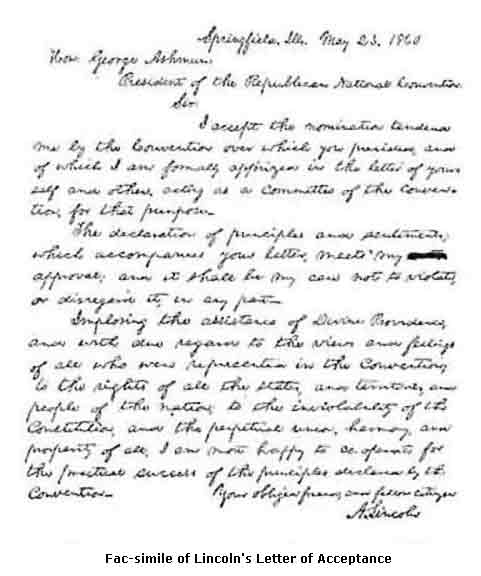
The first, most striking feature of the four-sided Presidential canvass which now began, was the personal pledge by every one of the candidates of devotion to the Union. Each of the factions was in some form charging disunion motives or tendencies upon part or all of the others; but each indignantly denied the allegation as to itself. To leave no possible doubt, the written letters of acceptance of each of the candidates emphasized the point. Lincoln invoked "the inviolability of the Constitution, and the perpetual union, harmony, and prosperity of all." Douglas made his pledge broad and full. "The Federal Union," wrote he, "must be preserved. The Constitution must be maintained inviolate in all its parts. Every right guaranteed by the Constitution must be protected by law in all cases where legislation is necessary to its enjoyment. The judicial authority, as provided in the Constitution, must be sustained, and its decisions implicitly obeyed and faithfully executed. The laws must be administered, and the constituted authorities upheld, and all unlawful resistance to these things must be put down with firmness, impartiality, and fidelity." "The Constitution and the equality of the States," wrote Breckinridge, "these are symbols of everlasting union. Let these be the rallying cries of the people." Bell declared that, if elected, all his ability, strength of will, and official influence should be employed "for the maintenance of the Constitution and the Union against all opposing influences and tendencies." Even President Buchanan, in a little campaign speech from the portico of the Executive mansion, hastened to purge himself of the imputation of suspicion or fear on this point. He declared that neither of the Democratic conventions was "regular," and that therefore every Democrat was at liberty to vote as he thought proper. For himself, he preferred Breckinridge. The Democratic party, when divided for the moment, "has always closed up its ranks, and become more powerful even from defeat. It will never die whilst the Constitution and the Union survive. It will live to protect and defend both."
No progress was made, however, towards a reunion of the Democratic party. The Buchanan faction everywhere waged unrelenting war on Douglas, both in public discussion and in the use of official patronage. The contest was made with equal obstinacy and bitterness in the Northern and the Southern States. Douglas, on his part, was not slow to retaliate. He immediately entered on an extensive campaign tour, and made speeches at many of the principal cities of the Northern States, and a few in the slave-States. Everywhere he stigmatized the Breckinridge wing of the Democracy as an extremist and disunion faction,[2] charging that it was as obnoxious and dangerous as the Republicans. Whatever be his errors, it must be recorded to his lasting renown that he boldly declared for maintaining the Union by force. At Norfolk, Virginia, the question was put to him in writing. "I answer emphatically," replied Douglas, "that it is the duty of the President of the United States, and all others in authority under him, to enforce the laws of the United States passed by Congress, and as the courts expound them, and I, as in duty bound by my oath of fidelity to the Constitution, would do all in my power to aid the Government of the United States in maintaining the supremacy of the laws against all resistance to them, come from what quarter it might. In other words, I think the President, whoever he may be, should treat all attempts Douglas, to break up the Union by resistance to the laws, as Old Hickory treated the nullifiers in 1832."
Douglas, Norfolk Speech, August 25, 1860.
All parties entered upon the political canvass with considerable spirit; but the chances of the Republicans were so manifestly superior that their enthusiasm easily outran that of all their competitors. The character and antecedents of Mr. Lincoln appealed directly to the sympathy and favor of the popular masses of the Northern States. As pioneer, farm-laborer, flat-boatman, and frontier politician, they saw in him a true representative of their early if not their present condition. As the successful lawyer, legislator, and public debater in questions of high statesmanship, he was the admired ideal of their own aspirations.
While the Illinois State Republican Convention was in session at Decatur (May 10), about a week before the Chicago Convention, the balloting for State officers was interrupted by the announcement, made with much mystery, that "an old citizen of Macon County" had something to present to the convention. When curiosity had been sufficiently aroused, John Hanks, Lincoln's fellow-pioneer, and a neighbor of Hanks, were suddenly marched into the convention, each bearing upright an old fence-rail, and displaying a banner with an inscription to the effect that these were two rails from the identical lot of three thousand which, when a pioneer boy, Lincoln had helped to cut and split to inclose his father's first farm in Illinois, in 1830. These emblems of his handiwork were received by the convention with deafening shouts, as a prelude to a unanimous resolution recommending him for President. Later, these rails were sent to Chicago; there, during the sittings of the National Republican Convention, they stood in the hotel parlor at the Illinois headquarters, lighted up by tapers, and trimmed with flowers by enthusiastic ladies. Their history and campaign incidents were duly paraded in the newspapers; and throughout the Union Lincoln's ancient and local sobriquet of "Honest Old Abe" was supplemented by the national epithet of "The Illinois Bail-splitter." Of the many peculiarities of the campaign, one feature deserves special mention. Political clubs, for parades and personal campaign work, were no novelty; now, however, the expedients of a cheap yet striking uniform and a half-military organization were tried with marked success. When Lincoln made his New England trip, immediately after the Cooper Institute speech, a score or two of active Republicans in the city of Hartford appeared in close and orderly ranks, wearing each a cap and large cape of oil-cloth, and bearing over their shoulders a long staff, on the end of which blazed a brilliant torch-light. This first "Wide Awake"[3] Club, as it called itself, marching with soldierly step, and military music, escorted Mr. Lincoln, on the evening of March 5, from the hall where he addressed the people, to his hotel. The device was so simple and yet so strikingly effective that it immediately became the pattern for other cities. After the campaign opened, there was scarcely a county or village in the North without its organized and drilled association of "Wide Awakes," immensely captivating to the popular eye, and forming everywhere a vigilant corps to spread the fame of, and solicit votes for, the Republican Presidential candidate. On several occasions twenty to thirty thousand "Wide Awakes" met in the larger cities and marched in monster torch-light processions through the principal streets.
His nomination also made necessary some slight changes in Mr. Lincoln's daily life. His law practice was transferred entirely to his partner, and instead of the small dingy office so long occupied by him, he was now given the use of the Governor's room in the State-house, which was not needed for official business during the absence of the Legislature. This also was a room of modest proportions, with scanty and plain furniture. Here Mr. Lincoln, attended only by his private secretary, Mr. Nicolay, passed the long summer days of the campaign, receiving the constant stream of visitors anxious to look upon a real Presidential candidate. There was free access to him; not even an usher stood at the door; any one might knock and enter. His immediate personal friends from Sangamon County and central Illinois availed themselves largely of this opportunity. With men who had known him in field and forest he talked over the incidents of their common pioneer experience with unaffected sympathy and interest, as though he were yet the flat-boatman, surveyor, or village lawyer of the early days. The letters which came to him by hundreds, the newspapers, and the conversation of friends, kept him sufficiently informed of the progress of the campaign, in which personally he took a very slight part. He made no addresses, wrote no public letters, held no conferences. Political leaders several times came to make campaign speeches at the Republican wigwam in Springfield. But beyond a few casual interviews on such occasions, the great Presidential canvass went on with scarcely a private suggestion or touch of actual direction from the Republican candidate.
It is perhaps worth while to record Lincoln's expression on one point, which adds testimony to his general consistency in political action. The rise of the Know-Nothing or the American party, in 1854-5 (which was only a renewal of the Native-American party of 1844), has been elsewhere mentioned. As a national organization, the new faction ceased with the defeat of Fillmore and Donelson in 1856; its fragments nevertheless held together in many places in the form of local minorities, which sometimes made themselves felt in contests for members of the Legislature and county officers; and citizens of foreign birth continued to be justly apprehensive of its avowed jealousy and secret machinery. It was easy to allege that any prominent candidate belonged to the Know-Nothing party, and attended the secret Know-Nothing lodges; and Lincoln, in the late Senatorial, and now again in the Presidential, campaign, suffered his full share of these newspaper accusations.
Lincoln to Edward Lusk, October 30, 1858. MS.
We have already mentioned that in the campaign of 1844 he put on record, by public resolutions in Springfield, his disapprobation of, and opposition to, Native-Americanism. In the later campaigns, while he did not allow his attention to be diverted from the slavery discussion, his disapproval of Know-Nothingism was quite as decided and as public. Thus he wrote in a private letter, dated October 30, 1858: "I understand the story is still being told and insisted upon that I have been a Know-Nothing. I repeat what I stated in a public speech at Meredosia, that I am not, nor ever have been, connected with the party called the Know-Nothing party, or party calling themselves the American party. Certainly no man of truth, and I believe no man of good character for truth, can be found to say on his own knowledge that I ever was connected with that party."
Lincoln to Hon. A. Jonas, July 21, 1860. MS.
So also in the summer of 1860, when his candidacy for President did not permit his writing public letters, he wrote in a confidential note to a friend: "Yours of the 20th is received. I suppose as good or even better men than I may have been in American or Know-Nothing lodges; but, in point of fact, I never was in one, at Quincy or elsewhere.... And now a word of caution. Our adversaries think they can gain a point if they could force me to openly deny the charge, by which some degree of offense would be given to the Americans. For this reason it must not publicly appear that I am paying any attention to the charge."
Lincoln to Dr. Theodore Canisius, May 17, 1859.
His position on the main question involved was already sufficiently understood; for in his elsewhere quoted letter of May 17, 1859, he had declared himself against the adoption by Illinois, or any other place where he had a right to oppose it, of the recent Massachusetts constitutional provision restricting foreign-born citizens in the right of suffrage. It is well to repeat the broad philosophical principle which guided him to this conclusion: "Understanding the spirit of our institutions to aim at the elevation of men, I am opposed to whatever tends to degrade them."
As the campaign progressed the chances of the result underwent an important fluctuation, involving some degree of uncertainty. The Democratic disruption, and the presence of four tickets in the field, rendered it possible that some very narrow plurality in one or more of the States might turn the scale of victory. Calculating politicians, especially those belonging to the party hitherto in power, and who had enjoyed the benefits of its extensive Federal patronage, seized eagerly upon this possibility as a means of prolonging their official tenure, and showed themselves not unwilling to sacrifice the principles of the general contest to the mere material and local advantage which success would bring them.
Greeley, "American Conflict," Vol. I., p. 324.
Accordingly, in several States, and more notably in the great State of New York, there was begun a quiet but unremitting effort to bring about a coalition or "fusion," as it was termed, of the warring Democratic factions, on the basis of a division of the spoils which such a combination might hope to secure. Nor did the efforts stop there. If the union of the two factions created the probability, the union of three seemed to insure certainty, and the negotiations for a coalition, therefore, extended to the adherents of Bell and Everett. Amid the sharp contest of ideas and principles which divided the country, such an arrangement was by no means easy; yet in a large voting population there is always a percentage of party followers on whom the obligations of party creeds sit lightly. Gradually, from talk of individuals and speculations of newspapers, the intrigue proceeded to a coquetting between rival conventions. Here the formal proceedings encountered too much protest and indignation, and the scheme was handed over to standing committees, who could deliberate and bargain in secret. It must be stated to the credit of Douglas, that he publicly rejected any alliance not based on his principle of "non-intervention";[4] but the committees and managers cared little for the disavowal. In due time they perfected their agreement that the New York electoral ticket (numbering thirty-five) should be made up of adherents of the three different factions in the following proportion: Douglas, eighteen; Bell, ten; Breckinridge, seven. This agreement was carried out, and the fusion ticket thus constituted was voted for at the Presidential election by the combined opponents of Lincoln.
In Pennsylvania, notwithstanding that Douglas disapproved the scheme, an agreement or movement of fusion also took place; but in this case it did not become complete, and was not altogether carried out by the parties to it, as in New York. The electoral ticket had been nominated by the usual Democratic State Convention (March 1) prior to the Charleston disruption, and, as it turned out, about one-third of these nominees were favorable to Douglas. After the disruption, the Douglas men also formed a straight, or Douglas, electoral ticket. In order to unite the two wings at the October State election, the Executive Committee of the original convention recommended (July 2) that the electors first nominated should vote for Douglas if his election were possible; if not, should vote for Breckinridge. A subsequent resolution (August 9) recommended that the electors should vote for either Douglas or Breckinridge, as the preponderance of Douglas or Breckinridge votes in the State might indicate. On some implied agreement of this character, not clearly defined or made public, the Douglas, Breckinridge, and Bell factions voted together for governor in October. Being beaten by a considerable majority at that election, the impulse to fusion was greatly weakened. Finally, the original Democratic State Committee rescinded (October 12) all its resolutions of fusion, and the Douglas State Committee withdrew (October 18) its straight Douglas ticket. This action left in the field the original electoral ticket nominated by the Democratic State Convention at Reading, prior to the Charleston Convention, untrammeled by any instructions or agreements. It was nevertheless a fusion ticket in part, because nine of the candidates (one-third of the whole number) were pledged to Douglas. What share or promise the Bell faction had in it was not made public. At the Presidential election it was voted for by a large number of fusionists; but a portion of the Douglas men voted straight for Douglas, and a portion of the Bell men straight for Bell.[5]
Greeley, "American Conflict," Vol. I., p. 328.
Ibid., p. 328.
In New Jersey also a definite fusion agreement was reached between the Bell, Breckinridge, and Douglas factions. An electoral ticket was formed, composed of two adherents of Bell, two of Breckinridge, and three of Douglas. This was the only State in which the fusion movement produced any result in the election. It turned out that a considerable fraction of the Douglas voters refused to be transferred by the agreement which their local managers had entered into. They would not vote for the two Bell men and the two Breckinridge men on the fusion ticket, but ran a straight Douglas ticket, adopting the three electors on the fusion ticket. By this turn of the canvass the three Douglas electors whose names were on both tickets were chosen, but the remainder of the fusion ticket was defeated, giving Lincoln four electoral votes out of the seven in New Jersey. Some slight efforts towards fusion were made in two or three other States, but accomplished nothing worthy of note, and would have had no influence on the result, even had it been consummated.
All these efforts to avert or postpone the grave political change which was impending were of no avail. In the long six years' agitation popular intelligence had ripened to conviction and determination. Every voter substantially understood the several phases of the great slavery issue, its abstract morality, its economic influence on society, the intrigue of the Administration and the Senate to make Kansas a slave-State, the judicial status of slavery as expounded in the Dred Scott decision, the validity and the effect of the fugitive-slave law, the question of the balance of political power as involved in the choice between slavery extension and slavery restriction—and, reaching beyond even this, the issue so clearly presented by Lincoln whether the States ultimately should become all slave or all free. In the whole history of American polities the voters of the United States never pronounced a more deliberate judgment than that which they recorded upon these grave questions at the Presidential election in November, 1860.
From much doubt and uncertainty at its beginning, the campaign swept onward through the summer months, first to a probability, then to an assurance of Republican success. In September the State of Maine elected a Republican governor by 18,000 majority. In October the pivotal States gave decisive Republican majorities: Pennsylvania 32,000 for governor, Indiana nearly 10,000 for governor, and Ohio 12,000 for State ticket and 27,000 on Congressmen. Politicians generally conceded that the vote in these States clearly foreshadowed Lincoln's election. The prophecy not only proved correct, but the tide of popular conviction and enthusiasm, rising still higher, carried to his support other States which were yet considered uncertain.
The Presidential election occurred on November 6,1860. In seventeen of the free-States—namely, Maine, New Hampshire, Massachusetts, Rhode Island, Connecticut, Vermont, New York, Pennsylvania, Ohio, Indiana, Illinois, Michigan, Wisconsin, Minnesota, Iowa, California, and Oregon—all the Lincoln electors were chosen. In one of the free-States (New Jersey) the choice resulted in 4 electors for Lincoln and 3 for Douglas, as already explained. This assured Lincoln of the votes of 180 Presidential electors, or a majority of 57 in the whole electoral college. The 15 slave-States were divided between the other three candidates. Eleven of them—Alabama, Arkansas, Delaware, Florida, Georgia, Louisiana, Maryland, Mississippi, North Carolina, South Carolina, and Texas—chose Breckinridge electors, 72 in all. Three of them—Kentucky, Tennessee, and Virginia—chose Bell electors, 39 in all; and one of them—Missouri—Douglas electors, 9 in number, which, together with the 3 he received in the free-State of New Jersey, gave him 12 in all: the aggregate of all the electors opposed to Lincoln being 123.
The will of the people as expressed in this popular vote was in due time carried into execution. As the law prescribes, the Presidential electors met in their several States on the 5th of December, and cast their official votes according to the above enumeration. And on the 13th of February, 1861, the Congress of the United States in joint session made the official count, and declared that Abraham Lincoln, having received a majority of the votes of Presidential electors, was duly elected President of the United States for four years, beginning March 4, 1861.
One feature of the result must not be omitted. Many careless observers felt at the time that the success of Lincoln was due entirely to the fact of there having been three opposing candidates in the field; or, in other words, to the dissensions in the Democratic party, which divided its vote between Breckinridge and Douglas. What merely moral strength the Democratic party would have gained had it remained united, it is impossible to estimate. Such a supposition can only be based on the absence of the extreme Southern doctrines concerning slavery. Given the presence of those doctrines in the canvass, no hypothesis can furnish a result different from that which occurred. In the contest upon the questions as they existed, the victory of Lincoln was certain. If all the votes given to all the opposing candidates had been concentrated and cast for a "fusion ticket," as was wholly or partly done in five States, the result would have been changed nowhere except in New Jersey, California, and Oregon; Lincoln would still have received but 11 fewer, or 169 electoral votes—majority of 35 in the entire electoral college. It was a contest of ideas, not of persons or parties. The choice was not only free, but distinct and definite. The voter was not, as sometimes happens, compelled to an imperfect or partial expression of his will. The four platforms and candidates offered him an unusual variety of modes of political action. Among them the voters by undisputed constitutional majorities, in orderly, legal, and unquestioned proceedings, chose the candidate whose platform pronounced the final popular verdict that slavery should not be extended, and whose election unchangeably transferred the balance of power to the free-States.
The "Wide Awake" organization grew out of the first campaign meeting in Hartford on February 25, 1860—State election campaign. Hon. Cassius M. Clay was the speaker, and after the meeting was escorted to the Allyn House by a torch-light parade. Two of the young men who were to carry torches, D.G. Francis and H.P. Blair, being dry goods clerks, in order to protect their clothing from dust and the oil liable to fall from the torches, had prepared capes of black cambric, which they wore in connection, with the glazed caps commonly worn at the time. Colonel George P. Bissell, who was marshal, noticing the uniform, put the wearers in front, where the novelty of the rig and its double advantage of utility and show attracted much attention. It was at once proposed to form a campaign club of fifty torch-bearers with glazed caps and oil-cloth capes instead of cambric; the torch-bearing club to be "auxiliary to the Young Men's Republican Union." A meeting to organize formally was appointed for March 6; but before the new uniforms were all ready, Abraham Lincoln addressed a meeting in Hartford on the evening of March 5. After his speech, the cape-wearers of the previous meeting with a number of others who had secured their uniforms escorted Mr. Lincoln to the hotel.
The club was definitely organized on the following night. William P. Fuller, city editor, had, in noticing this meeting for organization, written in the "Courant" of March 3: "THE WIDE AWAKES.—The Republican club-room last evening was filled as usual with those who are going to partake in the great Republican triumph, in this State in April next," etc., etc. The name "Wide Awakes" was here applied to the Republican Young Men's Union, torch-bearers included; but at the meeting of March 6, the torch-bearers appropriated it by making it the distinctive title to their own special organization, which almost immediately, there as elsewhere, swallowed up the names and the memberships of other Republican clubs. Just one year after they escorted Mr. Lincoln in their first parade, he was inaugurated President of the United States.
CHAPTER XVII BEGINNINGS OF REBELLION
Disunion was not a fungus of recent growth in American politics. Talk of disunion, threats of disunion, accusations of intentions of disunion, lie scattered rather plentifully through the political literature of the country from the very formation of the Government. In fact, the present Constitution of the United States was strenuously opposed by large political factions, and, it may almost be said, succeeded by only a hair's-breadth. That original opposition perpetuated itself in some degree in the form of doubts of its duration and prophecies of its failure. The same dissatisfaction and restlessness resulted in early and important amendments, but these did not satisfy all dissenters and doubters. Immediate and profound conflict of opinion sprang up over the administration and policy of the new Government; active political parties and hot discussion arose, the one side proclaiming that it was too strong, the other asserting that it was too weak, to endure.
Before public opinion was well consolidated, the war of 1812 produced new complaints and new opposition, out of which grew the famous Hartford Convention. It has been charged and denied that this was a movement of disunion and rebellion. The exact fact is not important in our day; it is enough that it was a sign of deep political unrest and of shallow public faith. Passing by lesser manifestations of the same character, we come to the eventful nullification proceeding in South Carolina in the year 1832. Here was a formal legislative repudiation of Federal authority with a reserved threat of forcible resistance. At this point disunion was in full flower, and the terms nullification, secession, treason, rebellion, revolution, coercion, constitute the current political vocabulary. Take up a political speech of that period, change the names and dates, and the reader can easily imagine himself among the angry controversies of the winter of 1860.
Nullification was half-throttled by Jackson's proclamation, half-quieted by Clay's compromise. But from that time forward the phraseology and the spirit of disunion became constant factors in Congressional debate and legislation. In 1850, it broke out to an extent and with an intensity never before reached. This time it enveloped the whole country, and many of the wisest and best statesmen believed civil war at hand. The compromise measures of 1850 finally subdued the storm; but not till the serious beginning of a secession movement had been developed and put down, both by the general condemnation of the whole country, and the direct vote of a union majority in the localities where it took its rise.
Among these compromise acts of 1850 was the admission of California as a free-State. The gold discoveries had suddenly filled it with population, making the usual probation as a Territory altogether needless. A considerable part of the State lay south of the line of 36º, 30', and the pro-slavery extremists had demanded that it should be divided into two States—one to be a free and the other to be a slave-State—in order to preserve the political balance between the sections, in the United States Senate. This being refused, they not only violently opposed the compromise measures, but organized a movement for resistance in South Carolina, Georgia, and Mississippi, demanding redress, and threatening secession if it were not accorded. A popular contest on this issue followed in 1851 in these States, in which the ultra-secession party was signally overthrown. It submitted sullenly to its defeat; leaving, as always before, a considerable faction unsatisfied and implacable, only awaiting a new opportunity to start a new disturbance. This new opportunity arose in the slavery agitation, beginning with the repeal of the Missouri Compromise in 1854, and ending with the election of Lincoln. Daring this six years' controversy, disunion was kept in the background because the pro-slavery party had continual and sanguine hope of ultimate triumph. It did not despair of success until the actual election of Lincoln, on the 6th of November, 1860; consequently, even in the Southern States, as a rule, disunion was frowned upon till near the end of the Presidential campaign, and only paraded as an evil to be feared, not as a thing to be desired.
This aspect, however, was superficial. Under the surface, a small but determined disunion conspiracy was actively at work. It has left few historical traces; but in 1856 distinct evidence begins to crop out. There was a possibility, though not a probability, that Frémont might be elected President; and this contingency the conspirators proposed to utilize by beginning a rebellion. A letter from the Governor of Virginia to the Governors of Maryland and other States is sufficient proof of such an intent, even without the evidence of later history.
RICHMOND, VA., Sept. 15, 1856.
DEAR SIR: Events are approaching which address themselves to your responsibilities and to mine as chief Executives of slave-holding States. Contingencies may soon happen which would require preparation for the worst of evils to the people. Ought we not to admonish ourselves by joint council of the extraordinary duties which may devolve upon us from the dangers which so palpably threaten our common peace and safety? When, how, or to what extent may we act, separately or unitedly, to ward off dangers if we can, to meet them most effectually if we must?
I propose that, as early as convenient, the Governors of Maryland, Virginia, North Carolina, South Carolina, Georgia, Florida, Alabama, Louisiana, Texas, Arkansas, Mississippi, and Tennessee shall assemble at Raleigh, N.C., for the purpose generally of consultation upon the state of the country, upon the best means of preserving its peace, and especially of protecting the honor and interests of the slave-holding States. I have addressed the States only having Democratic Executives, for obvious reasons.
This should be done as early as possible before the Presidential election, and I would suggest Monday, the 13th of October next. Will you please give me an early answer, and oblige,
Yours most truly and respectfully,
HENRY A. WISE.
His Excellency Thomas W. Ligon, Governor of Maryland.
If any explanation were needed of the evident purpose of this letter, or of the proposed meeting, it may be found in the following from Senator Mason, of Virginia, to Jefferson Davis, of Mississippi, who was at the time Secretary of War under President Pierce:
O.J. Victor, "American Conspiracies," p. 520.
SELMA, NEAR WINCHESTER, Va., Sept. 30, 1856.
MY DEAR SIR: I have a letter from Wise, of the 27th, full of spirit. He says the Governors of North Carolina, South Carolina, and Louisiana have already agreed to rendezvous at Raleigh, and others will—this in your most private ear. He says, further, that he had officially requested you to exchange with Virginia, on fair terms of difference, percussion for flint muskets. I don't know the usage or power of the department In such cases, but if it can be done, even by liberal construction, I hope you will accede. Was there not an appropriation at the last session for converting flint into percussion arms? If so, would it not furnish good reason for extending such facilities to the States? Virginia probably has more arms than the other Southern States, and would divide, in case of need. In a letter yesterday to a committee in South Carolina, I give it as my judgment, in the event of Frémont's election, the South should not pause, but proceed at once to "immediate, absolute, and eternal separation." So I am a candidate for the first halter.