XVI Clearing the Docket.
Reading edition
Cheyennes still disagree among themselves about the number of sleeps the combined tribes stayed at different camps along the way from east of Powder river to the Little Bighorn and back again to the Powder river country. For a long time there was disagreement as to the length of time we had been at the battle camp before the Custer soldiers came. Some said we had been there only one sleep, others said two sleeps. This dispute was settled, though, several years ago, when a band of Ogallalas visited us on this reservation. In a great gathering with them at our Lame Deer agency there was a general rehearsing of the battle at the Little Bighorn. Little Hawk, a Cheyenne, spoke of us having slept there two nights before the soldiers came. Somebody corrected him:
“We had slept there only one night.”
“I bet you we had been there two sleeps,” Little Hawk replied. He spread out a blanket and laid upon it some money.
His money was matched. Other bets were made, by other Indians differing in their beliefs on the subject. Old men then were called upon, one after another, to tell what was in their memories concerning the question. White Elk, young Chief Little Wolf, Wooden Leg, various other old Cheyennes and several of the old Sioux, all were asked for expressions of their beliefs. Each one of them said:
“One sleep.”
Little Hawk and his supporters finally had to admit themselves mistaken. In the general exchange of talk, many corroborating incidents were mentioned. There came then a full agreement that we had been in this camp only one night, that the soldiers attacked us the next morning, that after the fighting had ended we moved our camps a short distance northwestward and stayed there all of this night, and that in the late afternoon of the day after the great battle we left the place and traveled all night and all the next day up the Little Bighorn valley. Of the two nights at the battle place, one had been at the first camping spot where the soldiers attacked us and the other had been at the second camping spot, a short distance away, where we moved on account of our death losses.
For fifty years we old Cheyennes talked of Bear Coat, or General Miles, as having been big chief of the soldiers who came up the Little Bighorn valley the next day after the Custer battle.[61] We have been corrected by our present white man doctor friend. He informs us that General Miles did not come into this country until more than a month after that time. He says that a General Terry and a General Gibbon were the chiefs of these soldiers. I never before had heard of either of these two men.
I never had heard of any of General Custer’s relatives having been killed with him, until our present white man doctor friend told us about the two brothers and the brother-in-law and the nephew. He tells us also that General Custer’s body was not cut up. I do not know why he was spared, if such was the case. I never heard of any favorings of any dead man there. I do not know of any reason for intentional difference in treatment of them.
It was not then known to us who was the chief of these white men soldiers. It was not known to us where they had come from. We supposed them to be the same men we had fought on the Rosebud, eight days before. We had not known who was the chief of those soldiers on the Rosebud. I never heard any Indians at that time guessing as to who he may have been. It made no difference to us.
I have been told that certain different ones of Indians have claimed special honor for having killed Custer himself. All such men are only boasting to get attention. There was no talk of this kind during the hours and days right after the battle. If there had been, all of us would have known of it. I tell you again: None of us knew anything about Custer being there. The few Southern Cheyennes and the few Sioux warriors who had seen him in earlier times did not learn until many weeks later that he had been killed in this battle. It was weeks or months later when the most of us first learned that there ever was such a man. The white people, not the Indians, told us.
Even if some white man soldier in the battle had been well known to all of the Indians it would have been hard to recognize him there. During the first hour or two of the fighting we were too far away to single out and recognize any particular one. As we got close, the air became more and more full of smoke and dust. The Indians were greatly excited. All of the white men went crazy. It must have been that not any one of them looked like his natural self. I believe that not any warrior then was thinking of trying to find out which one was the chief of the soldiers nor which soldier might be a past acquaintance. Every fighter, on both sides, was sweating and dust-covered. The dead soldiers were dirty and bloody. Very soon, they were much worse than that. Their best friends would not have known them.
Of the thirty Indians killed in both fights, I believe about half fell from the bullets of the Custer men. Of these fifteen or so killed by the Custer men, there were more of them fell during the first close fighting, when Lame White Man led us and himself was killed, down toward the river, than fell at any other one section of the field. The soldiers in the entire battle with the Custer men could have killed a great many more of us, or we should have gone away and left them after some further fighting, if their whisky had not made them go crazy and shoot themselves. I do not know just how many of them we killed, but I believe the number was not more than twenty or thirty, all together. Some of these were during the slow distant shooting time and some were after we had gone among them and found badly wounded men to kill at once. There was no capturing alive. I did not hear any Indian talk of wanting to make such capture.
All of our dead Cheyennes were found, were taken away and were buried. I am not sure about all of the Sioux dead, but it seems they all must have been found, as there was the remainder of that afternoon and much of the next day to make search. The three dead Corn Indians I saw were left where they had been killed.
None of the Custer soldiers came any closer to the river than they were at the time they died. When the first Indians went out and met them, and exchanged shots with them, these soldiers were riding along the ridge far out northeastward.[62] They kept moving westward along its crest until they spread out on the ridge lower down, the ridge where the most of the battle took place. After about an hour and a half of the slow fighting at long distances, the group of forty soldiers who rode down from the ridge along a broad coulee and toward the river were charged upon by Lame White Man, followed at once by many Cheyennes and Sioux. This place of the first Indian charge and the first sudden great victory is inside of the present fence around the battlefield and at its lower side.
The most important warrior among the Cheyennes was Lame White Man. I believe all of our old men consider him so. Next in importance and usefulness were Old Man Coyote, leading chief of the Crazy Dog warriors, Last Bull, leading chief of the Fox warriors, and Crazy Head, one of our tribal chiefs who had been a warrior society chief when he was a younger man. The first Indians to go across the river and fire upon the Custer soldiers far out on the ridge were two Sioux and three Cheyennes. These three Cheyennes were Roan Bear, Buffalo Calf and Bobtail Horse. This last named man is still living, his home being on the Rosebud side of our reservation.
Two Moons used to tell white people of his own great importance in the battle. I believe he was brave, like many others there, but he was not thought of as being very important. He was one of the nine little chiefs of the Fox warriors. The only special way I heard him talked about was concerning his having a repeating rifle, the only one of such guns among the Cheyennes in this battle. When the smaller part of our Cheyenne tribe surrendered to General Miles, at Fort Keogh, Two Moons was chosen by him as their one big chief. For several years those Indians were governed by General Miles. From time to time, in the years following, others of our people were added to these. The coming of Little Wolf made a difference, but he lost his place when he killed the Cheyenne. When all of the tribe finally were assembled on the present reservation, the Fort Keogh officers and the government agents still kept Two Moons as the one big chief over all of us. I do not know of there being among us any great dissatisfaction because of this, but I do know that it was General Miles, not the Cheyennes, who selected him as our leader.
There are yet living (1930) among the Cheyennes more than twenty men and about the same number of women who were full-grown people with us in the camp beside the Little Bighorn. I suppose that each tribe of the Sioux have, in proportion, the same numbers. We have many more who were children in the camp and who remember much of what was done at that time. Last Bull, leading chief of the Fox warriors, took his family and joined the Crows after the days of peace came. His two daughters married Crow men. The scared and screaming girl I took upon my horse when the soldiers burned our forty lodges on Powder river has become an old woman, a Cheyenne-Crow woman. She is known to the white people as Mrs. Passes.
Every time I have been where white people have been asking questions about the Custer battle, somebody has wanted to know:
“Where was Sitting Bull during the fight?”
For a long time I did not understand why this question was pressed so strongly. Then I learned that white people had been saying: “Sitting Bull was a coward. He was not with the warriors in the fighting.”
I do not know where he was. I had not thought about trying to find out. I suppose he was helping the women and children and old people, where he belonged. He had a son in the fight. Any man having a son serving as a warrior was expected to stay out of battles and give the son his chance to get warrior honors. Lame White Man, the Southern Cheyenne tribal chief who was killed, went into the fight because of his having no son there. I suppose it was the same with Chief Crazy Horse, of the Ogallalas, and Chief Hump Nose, of the Arrows All Gone. I do not know of any other tribal chiefs or old men having mixed into the battle. My father stayed in the camps, but his staying there was not on account of personal fear.
I am not ashamed to tell that I was a follower of Sitting Bull. I have no ears for hearing anybody say he was not a brave man. He had a big brain and a good one, a strong heart and a generous one. In the old times I never heard of any Indian having spoken otherwise of him. If any of them changed their talk in later days, the change must have been brought about by lies of agents and soldier chiefs who schemed to make themselves appear as good men by making him appear as a bad man.
It is comfortable to live in peace on the reservation. It is pleasant to be situated where I can sleep soundly every night, without fear that my horses may be stolen or that myself or my friends may be crept upon and killed. But I like to think about the old times, when every man had to be brave. I wish I could live again through some of the past days when it was the first thought of every prospering Indian to send out the call:
“Hoh-oh-oh-oh, friends: Come. Come. Come. I have plenty of buffalo meat. I have coffee. I have sugar. I have tobacco. Come, friends, feast and smoke with me.”
FOOTNOTES:
THE END
Legend for opposite map: A.—Near the present-day Crow Agency, Montana.
1. Uncpapa camp circle.
2. Blackfeet Sioux camp circle.
3. Minneconjoux camp circle.
4. Arrows All Gone camp circle.
5. Ogallala camp circle.
6. Cheyenne camp circle.
Arrows show Reno troops’ advance and retreat.

7. Reno battle line, for a few minutes.
8. Present Garryowen railroad station.
9. Reno entrenchment hill, after retreat across the river.
10. Present Custer monument, in field enclosed by fence.
11. Broad coulee of Medicine Tail creek just across east from Cheyenne camp circle.
The long links, show approach of Custer troops, moving northwestward, along a high ridge.

Scattered crossmarks, x x x, show where irregular second camps of Indians were placed.
Little Bighorn river flowing northwestward.
Indians forded river at Medicine Tail coulee and also went along hills from Reno hill, 9, to intercept Custer soldiers.
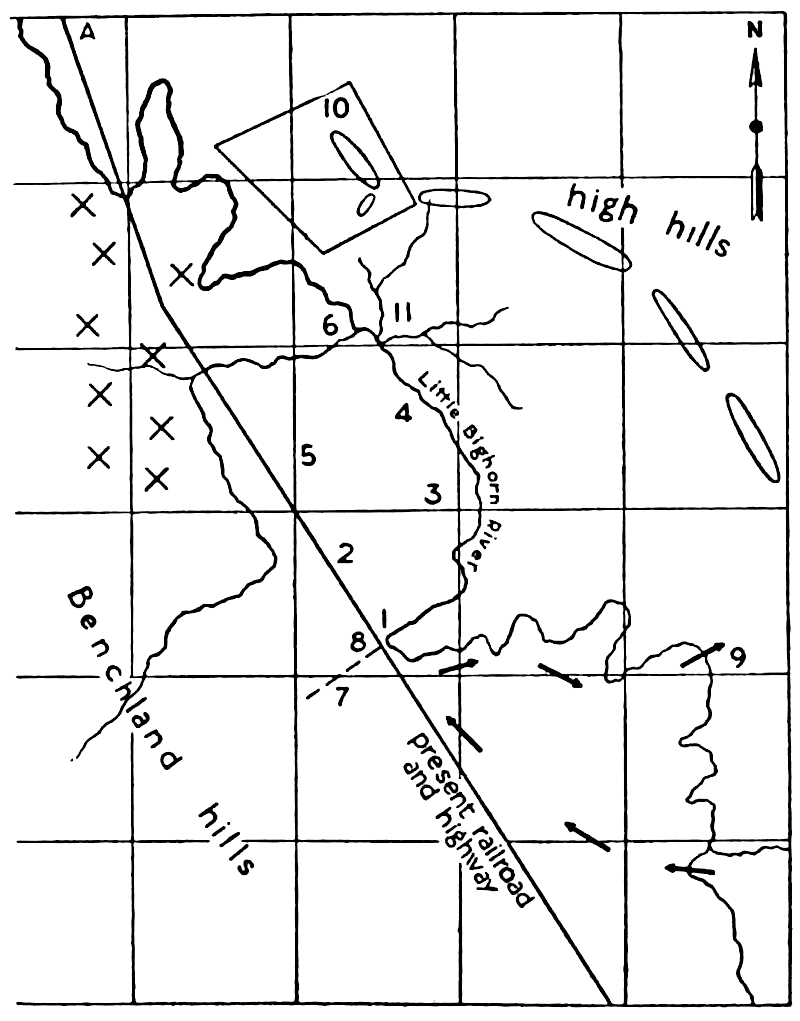
Camp Sites and Other Salient Points in Vicinity of Custer Battlefield, Montana.
Legend for opposite map: A.—Present-day Miles City, Montana. B.—Present-day Hardin, Montana. C.—Near the present-day Sheridan, Wyoming.
1. Cheyenne camp whipped out and burned, on Powder river, just above mouth of Little Powder river, March 17, 1876.
2. Where Cheyennes joined the Ogallala band.
3. Where Ogallalas and Cheyennes together joined Sitting Bull’s Uncpapas. Minneconjoux Sioux also came here, making four separate camp circles.
4. Arrows All Gone Sioux joined here, making five camp circles.
5. Powder river. Blackfeet Sioux made here the sixth camp circle. Other small bands had come, but not enough for tribal camp circles.
6. Camp at Tongue river.
7. Upper Wood creek, where they stayed five or six days, for a great buffalo hunt.
8. The six camp circles on the Rosebud river, about May 19th.
9. Where the Uncpapas had their sun dance, in early June.
10. Reno creek camp, from which the Indians went out at night to fight Crook’s soldiers, on the upper Rosebud.
11. Site of the Crook fight, on the upper Rosebud, June 17th.
12. Custer battle, June 25th.
All moved away together, in the same six tribal camp circles, until they arrived back at 3, east of Powder river. Here the great combined camp was broken up, and the tribes separated, about July 15th.
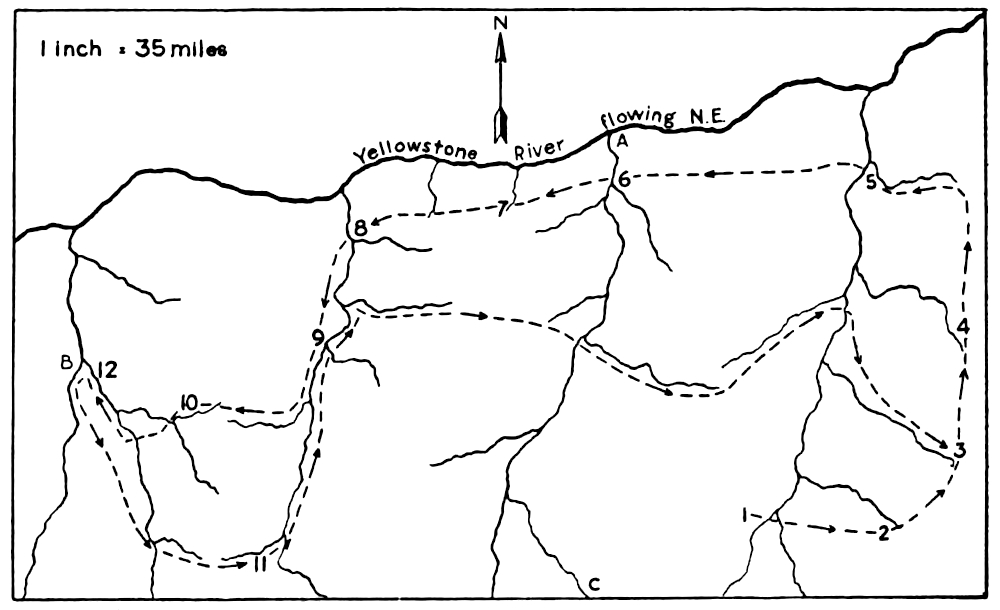
Sketch Map of Hostile Indians’ Course of Travel in Montana, 1876.