XV A Tamed Old Man.
Reading edition
Thirty years after the great battle against Custer, there was a gathering of Indians and white people at the Little Bighorn. Besides a few of our people, there were Crows, Sioux, Arapahoes, Shoshones, Nez Perces, Kiowas, Piegans, Gros Ventres and Paiutes, these last known to us as Fish-Eaters.
All Cheyennes who had fought in the battle were asked to come and join the other Indians and the white people in a peace feast. The place is only two short days of wagon traveling from our Lame Deer agency. But only a few Cheyennes would go there for the gathering. Among us there was much of such talk as: “Soldiers will be there. Seeing us might anger them so much as to make them want to kill us.”[58] Seven of us decided to go. These were the younger Chief Little Wolf, White Elk, Bobtail Horse, Two Moons, Buffalo Calf, myself Wooden Leg, and Brave Bear, a Southern Cheyenne. Four of the seven men took along their wives and their lodges.
In a big council lodge of the Crows a white man medicine doctor[59] asked different ones to tell something of the great battle. He said he had heard the white people say that Two Moons was a great warrior there, and he asked Two Moons to make a speech. This Cheyenne stood up and talked a long time. He said he had been the big chief of all the Cheyennes during the fight. He filled the ears of his hearers with lots of other lies, while the rest of us laughed among ourselves about what he was saying. Other Cheyennes and Sioux were asked to get up and talk, but none of them would do so.
The medicine doctor looked at my cousin, the younger Chief Little Wolf, and asked him:
“Were you at the Custer battle?”
“Yes.”
“Were you in the first fight above the camps?”
“No.”
“Who took the soldier horses?”
“The Sioux took most of them. The Cheyennes got a few. There were many Sioux and only a few Cheyennes in the fight.”
“Who took the soldier guns?”
“The same—the Sioux got many, the Cheyennes got a few.”
“Did you see Custer, either before or after he was killed?”
“I do not know. Nobody knew anything about Custer.”
“Our soldiers afterward could not find the bodies of all the white men killed. What became of them?”
“I do not know.”
“Were any of them taken away and hidden?”
“I think not, but I do not know.”
“Were any of them, either dead or alive, taken to the camps?”
“I think not. I never heard of any taken there.”
“Tell me all about what you saw and what you did at the battle.”
But Little Wolf would not tell. I said to him: “Go on, tell the truth, but do not talk like Two Moons did.” He was afraid, though. There were many white people and soldiers all around us, and he feared they might become angry.
White Elk, Bobtail Horse, Two Moons, Brave Bear, Buffalo Calf and the Sioux men all answered the same kind of questions in the same way. But none of them except Two Moons would say anything further about the fight. Bobtail Horse was either nervous or scared, so he got tangled a little. The doctor asked him the same kind of questions. Then he asked:
“How old are you?”
Bobtail Horse sat there as though he did not understand what was being asked. Pretty soon he began to count on his fingers. He counted them over and over. Finally he said: “I do not know.” All of us knew exactly one another’s age, but none of us interfered to help him in answering the question. The doctor did not ask him any further questions.
In my turn at the talking I was asked the same kind of questions:
“Wooden Leg, were you in the Custer battle?”
“Yes, I was there.”
“Were you in the first fight up above the camps?”
“Yes.”
“Good. How old were you at that time?”
“Eighteen winters.”
“How old are you now?”
“Forty-eight.”
“Good. Tell me where you were during all of the time. Tell me what you saw and what you did.”
I told him. It happened I was the only Indian at this gathering who had been in the first fight with what the white people call the Reno soldiers. It began with my brother and I being awakened by the shooting and our running to get our horses. I followed my own doings up the valley and into the chase after the soldiers through the river and up the hill. I showed how I had taken a rifle from a soldier. I described the killing of the Corn Indian and my taking his gun. The doctor wrote on a piece of paper as I talked. My cousin Little Wolf interrupted me: “You tell too much. Stop talking.”
But I did not stop. It appeared none of the soldiers nor other white people listening to me were angry. This medicine doctor looked to me like a good man, one who understood that we had killed soldiers who had come to kill us. I described to him the way I had helped to kill the soldier getting water at the river. I told about the Indians surrounding the Custer soldiers on the long ridge and about many things that happened there. The doctor still was writing on the paper. He broke in with some questions and I answered each one as straight as I knew how to answer it. Little Wolf said to me: “Tell him Custer killed himself, and see if he becomes angry.” But I did not say anything about that. Other Indians, at other times, had tried to tell of the soldiers killing themselves, but the white people listening always became angry and said the Indians were liars, so I thought it best to keep quiet. Other questions came:
“Did you see Custer?”
“I suppose I did, but I do not know. I think that no Indians there knew anything about him being with the soldiers.”
“Did you see soldiers having special marks on the shoulders of their coats?”
“Yes, I noticed some of them.”
“Did you know they were chiefs among the soldiers?”
“I did not know then, but I know now.”
“How many soldiers did you see having the markings on the shoulders?”
“I do not know. When we were fighting them they all looked alike to us, the same as a herd of buffalo.”
“How many Indians were killed?”
I told him the number of dead Cheyennes, Uncpapas and others.
“Good,” he said, and he wrote the numbers on his paper.
The Cheyennes and some other Indians went with a few soldiers to Fort Custer, not far from the place where had been the great battle. The soldier officers at the fort shook hands with all of us. We gathered together, and some friendly speeches were made by officers and by Indians. All I said there was: “A long time ago we were enemies. Today we are friends.” The medicine doctor rode beside me as we were going to and from the fort. We made sign-talk together along the way. I showed him the only place where the Cheyenne tribe ever camped west of the Bighorn river. From the top of the Fort Custer hill we could see the place, just across from the mouth of the Little Bighorn.
Many pictures were made of Cheyennes, Sioux, Nez Perces and Crows. Some were made on the valley and by the river where had been the first fight, others were made on the battle ridge and at its northern side. Pictures were made at night when the Indians were dancing. The bright flashes scared some of the Indians, but soon it was learned what was being done.
Wagons came loaded with rations. We were given plenty of beef, bacon, bread, crackers, coffee, sugar, meat in cans, and other food. We were on the valley by the river, where had been the fight with the Reno soldiers. A soldier officer rode about, saying:
“All Indians who were in the Custer battle get rations. No others are to be given any food.”
But when the distribution began, lots of Crows came running. They crowded forward saying:
“Oh, meat! Give some to us.”
Their actions made me angry. I let loose my tongue:
“You—Crows—you are like children. All Crows are babies. You are not brave. You never helped us to fight against the white people. You helped them in fighting against us. You were afraid, so you joined yourselves to the soldiers. You are not Indians.”
Bobtail Horse said to me: “Ssh, keep your temper.” My cousin Little Wolf said: “You are doing right. Tell them what we think of them.” The Crows stopped asking for the rations. All of them went back and kept quiet.
Besides the rations given to us every day, each of us was paid three dollars at the end of each day, for four days. When the gathering ended and we were getting ready to go back to our reservation, we were given plenty of extra food to eat along the way. Some of it was eaten by ourselves and our friends after we arrived home.
Another great gathering of whites and Indians assembled there fifty years after the battle. All of the Cheyennes, particularly the men who had been in the battle, were invited to go. Many lodges of our people traveled over the divide to that place and camped there, but I stayed at my home. Two times I was called to our Ashland district telephone for a talk from the agency. “We want you to go to the great peace celebration,” I was told. At each time of this talking I made reply: “I will think about it.” The more I thought about it, the more I felt like staying away. The battlefield is on the present Crow Indian reservation. I do not want to go upon their lands. I have made up my mind never again to go to any place where I might be called upon to shake hands with a Crow.
The younger Chief Little Wolf, my cousin, had the boyhood name Thorny Tree. His mother was a sister of my father and of the older Little Wolf’s first wife. The young nephew Thorny Tree showed special bravery at a battle with the Shoshones. The old chief was so pleased at this manly conduct of his wife’s relative that he told the young warrior:
“I give you my name. From this day on you shall be Little Wolf.”
This younger man stayed with the Cheyennes at the Pine Ridge reservation, after the peaceful times came. Among them he was made a tribal chief. When the band of them were moved to our Tongue River reservation he was made a chief of the entire tribe. A few years later he was accepted as the principal old man chief. He told me that during the years he was living at Pine Ridge he often was mistaken for the same Little Wolf who led the Cheyennes in their flight from the South. In fact, he was with that band of fleeing Cheyennes, but he joined that group of them who went to Pine Ridge. The older Little Wolf and his last followers came to Powder river and on to Fort Keogh. The old chief never was at Pine Ridge after that time.
My cousin told me that white people often embarrassed him also in supposing him to have been famed as Chief Little Wolf at the Custer battle. In this case, the older man was not in the fight, he and a small band of Cheyennes having followed on the trail of the soldiers and having arrived at the camps after the white men all had been killed. The younger Little Wolf was already there with the great tribal assemblage. The family lodge of his father, Big Left Hand, was near to my own father’s family lodge. This last Chief Little Wolf, my cousin, died in 1927, at the age of 76 years.
I visited the Arapahoes and the Shoshones, in Wyoming, several years ago. Eight Cheyenne men, some of us with our wives and our tepees went on this trip. I had a Custer gun, borrowed from a Cheyenne who kept it in hiding. We saw a big band of elk in a valley of the Bighorn mountains. I was chosen to lead the hunters in getting ourselves close to them. I said: “Yes, I will lead, but you others must stay back until I tell you it is time for all to show themselves and begin to shoot.” As we got well toward the elk band they suddenly ran away into a forest. I soon learned that one of our men had pushed on ahead and frightened them. “You are foolish,” was all I could say to him. We saw trails of other elk, plenty of them, but we did not see any others of the elk themselves.
High up on the top of a rocky bluff we saw a bighorn, what the white people call a mountain sheep. Different ones of us shot at it and missed it. Another man and I then shot, at the same moment. The animal tumbled down the mountain. When we got to it we found that both of our bullets had struck the front part of its body. We enjoyed that meat. It was the first bighorn meat I had eaten for several years.
Nine sleeps we made on our way to the reservation where we were going. We stopped with the Arapahoes, good friends of the Cheyennes all during the old times. There had been friendly intermarriages between our people and theirs. There was much of inquiring about Arapahoes living among us on our reservation. These people made gifts to us. They could not give much, because they were as poor as the Cheyennes.
We moved camp for a visit with the Shoshones. In the old times they and the Cheyennes were constantly on terms of enmity. But now they received us cordially. From all sides came, “How,” “How,” “How.” An old chief of theirs went riding among them and calling out: “Everybody come and shake hands with our guests, the Cheyennes. Let them know we are glad they came to visit us.”
Men, women, old people, boys, girls, all moved along past our group and greeted us with handshakes. They brought food. There were big piles of all kinds of things the Indians like to eat. After a while, they began to bring horses. One after another they kept giving these to us. Every Cheyenne among us had more horses than he could lead, when we parted from the Shoshones. I had nine of them presented to me. When we got back among our own people at home we were the richest Indians in our tribe. We had horses to give away to our friends. All of the Cheyennes agreed that the Shoshones have good hearts, that they are a good people.
An Arickaree Indian visited me at my place on Tongue river a few years ago. We talked of the Custer battle. He told me one of their chiefs had been killed there. He described him. The special features of his war clothing were a fine buckskin shirt and a necklace made of bear claws. I described to him the Arickaree I had helped to kill. This one had on a buckskin shirt. An eagle feather stood up from his back hair. A red string tied his hair together behind. If he had a bear-claw necklace I did not see it. I did not see this kind of necklace on any of the three Arickarees I saw dead. It may be one of the other two had one and it had been taken from him before I saw the dead body.
I went to Washington when I was fifty-five years old. Little Wolf, Two Moons and Black Wolf were old men with me as delegates to speak for our tribe. Three younger men who could talk the white man language went with us. They were Willis Rowland, Ben Shoulderblade and Milton Little White Man. At a meeting with white men, there were some speeches made. Two Moons did most of the talking for us. The rest of us did not care to make any long talks. Two Moons told these people he was a big chief leading all of the Cheyennes at the Custer battle. None of us said anything in dispute of him at the meeting, but when we got away to ourselves Black Wolf said to him: “You are the biggest liar in the whole Cheyenne tribe.” Two Moons laughed and replied: “I think it is not wrong to tell lies to white people.”
The same white man medicine doctor who had been at the gathering by the Little Bighorn was in Washington. He was good to us, helping us to see the strange sights in the big city. He could make good signs, so he and I talked much together. We went up to the top of a very tall stone he said was Washington’s monument. We rode up to the top and walked a long and winding stairway to the bottom.
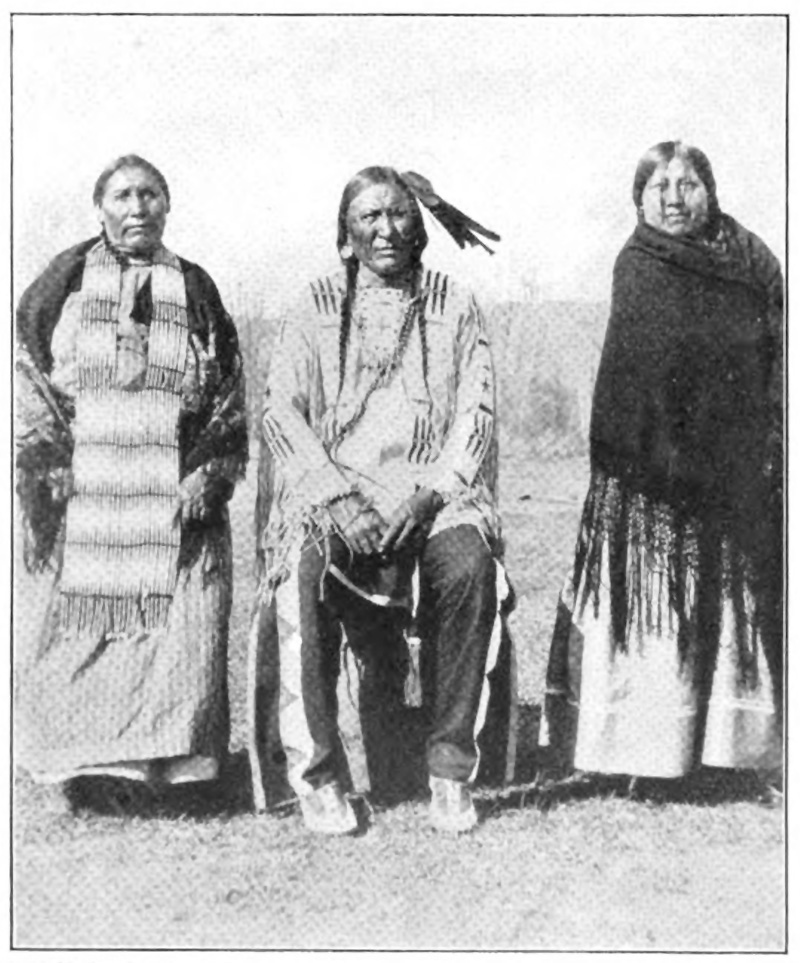
Photo by Hogan
Wooden Leg, his wife and their daughter, in 1914
A big ship took us Cheyennes out upon the great water. All of us became sick and vomited. “It is the same as whisky,” we said to each other. The ship took us to New York. There we visited our friend Bird, the old-time Indian story white man. The white man medicine doctor was traveling with us. He went with us on to Philadelphia, where we visited the biggest trader store I ever saw. In a theater in this city we sat upon a platform before a great crowd of white people. I was asked to make a speech. I talked, but only for a short time. One of our interpreters repeated to them what I said. This visit to the great cities was at some time during the spring (1913), in March or April, I believe.
I lied to one man in New York. He asked me many questions. For a while I answered them as best I could. But it began to appear he was trying to show the old-time Indians as being low and mean people. I had told him a great deal about the fighting, about the taking of horses and saddles and guns, about other matters of this kind. I found I did not like him, so I decided to end our talk.
“What time of day was it when all of the Custer soldiers had been killed?” he asked me.
“I don’t know,” I answered him.
“Did the Indians keep the money they took from the soldiers?”
“I don’t know.”
“Did you get any of it?”
“I don’t know.”
After these answers he quit talking to me and went away.
The medicine doctor friend came several years afterward from Washington to our Lame Deer agency. I saw and talked with him here. I still keep a big flag he gave to me. I liked him. He was a good man, one having a heart good toward Indians.
The guns taken by Cheyennes from the Custer soldiers were given up or had been thrown away by those of our people who surrendered at the White River agency. I think that all of the Sioux also had to give their guns of all kinds to the soldiers chiefs at their reservations. But at Fort Keogh General Miles was good to the Cheyennes. He allowed them to keep their guns. I suppose that many Indians threw away their Custer guns, for fear of being found out and punished for having killed those soldiers. But the Fort Keogh Cheyennes kept theirs hidden. A few of these have been buried with the owners who died. But even to this day, I know of several of the Custer rifle guns hidden among the people on our reservation. White Elk and Spotted Wolf used to have Custer soldier six-shooters. These two men are dead. I do not know what became of their six-shooters. The Cheyennes also have yet some of the Custer soldier ammunition belts and saddle-bags. They do not like to tell of having these captured war things, because there are some white people who become angry when they talk of the old times of warfare between the whites and the Indians.[60]
I have yet four of the ten arrows I made from the cattle neckyoke picked up at the town when we were on our way to the South. For keeping my comb and paints I have a flat pouch made from a bootleg. The boots I got at the White River agency the next day after my hunting party went there to surrender. Another young man and I were walking in the neighborhood of the soldier tents there. I found a pair of soldier boots among some other articles also cast aside by the white men. The soles were worn, but the tops were good. I knew how to make use of them. I cut off the worn bottom parts and kept the tops. My mother sewed one of them into the pouch. I know of some Cheyennes who still have such carriers made from bootlegs of Custer soldiers.
I lost the medicine pipe given to me by the Ogallala Sioux man at the White River agency. That was my second medicine pipe. The third one came to me when I was somewhere past forty years old. An Uncpapa Sioux visiting me at my place gave it to me. I still have it. It is made of the red stone found in their part of the country. After he had given to me this pipe I went on a journey into the Bighorn mountains. There I got some blue stone of the kind used for making Indian pipes. I made two of them. I now have three pipes, one red one and two blue ones. I have kept all three of them for several years, and I do not expect to sell any of them.
I was baptized by the priest at the Tongue river mission when I was almost fifty years old. My wife and our two daughters were baptized too. I think the white people pray to the same Great Medicine we do in our old Cheyenne way. I do not go often to the church, but I go sometimes. I think the white church people are good, but I do not believe all of the stories they tell about what happened a long time ago. The way they tell us, all of the good people in the old times were white people. I am glad to have the white man churches among us, but I feel more satisfied when I make my prayers in the way I was taught to make them. My heart is much more contented when I sit alone with my medicine pipe and talk with the Great Medicine about whatever may be troubling me.
Our old ways of worship were kept up through several years after we came to this reservation. Our Great Medicine dances and other old ceremonies were carried out as we had them in the days when we traveled over the whole hunting region. Then the government compelled us to quit them. I think this was not right. Lately, though, the conditions have changed. We were allowed to have our Great Medicine dance in 1927, again in 1928 and in 1929.
We had good medicine men in the old times. It may be they did not know as much about sickness as the white men doctors know, but our doctors knew more about Indians and how to talk to them. Our people then did not die young so much as they do now. In present times our Indian doctors are put into jail if they make medicine for our sick people. Whoever of us may become sick or injured must have the agency white man doctor or none at all. But he can not always come, and there are some who do not like him. I think it is best and right if each sick one be allowed to choose which doctor he wants. When Eddy was agent he let us keep our own old ways in all these matters. Our people liked him the best of all the agents we have had.
A policeman came to my place, one time, and told me that Eddy wanted to see me at the agency office. He did not say what was wanted. I thought: “What have I done?” I went right away. I never had been much about the agency, and I did not know Eddy very well. But the people all the time were saying he was a good man, so I was not afraid. When I got there, a strange white man was at the office. The interpreter told me this man was from Washington. Eddy and the other man talked to me a little while, about nothing of importance. Then Eddy said:
“We want you to be judge.”
The Indian court was held at the agency. My home place was where it now is, over a divide from the agency and on the Tongue river side of the reservation. I accepted the appointment. I was paid ten dollars each month for going to the agency and attending to the court business one or two times each month. Not long after I had been serving as judge, Eddy called me into his office. He said:
“A letter from Washington tells me that Indians having two or more wives must send away all but one. You, as judge, must do your part toward seeing that the Cheyennes do this.”
My heart jumped around in my breast when he told me this. He went on talking further about the matter, but I could not pay close attention to him. My thoughts were racing and whirling. When I could get them steady enough for speech, I said to him:
“I have two wives. You must get some other man to serve as judge.”
He sat there and looked straight at me, saying nothing for a little while. Then he began talking again:
“Somebody else as judge would make you send away one of your wives. It would be better if you yourself managed it. All of the Indians in the United States are going to be compelled to put aside their extra wives. Washington has sent the order.”
I decided to keep the office of judge. It appeared there was no getting around the order, so I made up my mind to be the first one to send away my extra wife, then I should talk to the other Cheyennes about the matter. I took plenty of time to think about how I should let my wives know about what was coming. Then I allowed the released one some further time to make arrangements as to where she should go. The first wife, the older one, had two daughters. The younger wife had no children. It seemed this younger one ought to leave me. I was in very low spirits. When a wagon came to get her and her personal packs I went out and sat on a knoll about a hundred yards away. I could not speak to her. It seemed I could not move. All I could do was just sit there and look down at the ground. She went back to her own people, on another reservation. A few years later I heard that she was married to a good husband. Oh, how glad it made my heart to hear that!
I sent a policeman to tell all Cheyennes having more than one wife to come and see me. One of them came that same afternoon. After we had smoked together, I said:
“The agent tells me that I as the judge must order all Cheyennes to have only one wife. You must send away one of yours.”
“I shall not obey that order,” he answered me.
“Yes, it will have to be that way,” I insisted.
“But who will be the father to the children?” he asked.
“I do not know, but I suppose that will be arranged.”
“Wooden Leg, you are crazy. Eddy is crazy.”
“No. If anybody is crazy, it is somebody in Washington. All of the Indians in the United States have this order. If we resist it, our policemen will put us into jail. If much trouble is made about it, soldiers may come to fight us. Whatever man does not put aside his extra wife may be the cause of the whole tribe being killed.”
Many of our men were angered by the order. My heart sympathized with them, so I never became offended at the strong words they sometimes used. Finally, though, all of them sent away their extra wives. Afterward, from time to time, somebody would tell me about some man living a part of the time at one place with one wife and a part of the time at another place with another wife. I just listened, said nothing, and did nothing. These were old men, and I considered it enough of change for them that they be prevented from having two wives at the same place. At this present time I know of only one old Cheyenne man who has two wives. They are extremely old, are sisters, and they have been his two wives for sixty or more years. He stays a part of the time with one of them and a part of the time with the other. The sister-wives visit each other, but they have different homes, several miles apart.
Throughout ten years I kept the position of judge. I rode my horse or went in my wagon to the agency once or twice each month. It became tiresome to me. Eddy went away, and we had another agent. I decided to resign, and I did so. After I had been out of the office a few years there was another change in agents. The man we now have, the one we have named Sioux Agent, was put in charge of our reservation. One day, Sioux Agent sent a message calling me to his office.
“I want you to be judge again,” he said. “You will be paid twenty-five dollars each month.”
That was better than the ten dollars each month I had been paid during the ten years of my first service. I took his offer. So now, in my old age, I am helping my people to learn the ways of the white man government. For the old people, it is a great change, so I try to apply my thoughts at teaching the young Cheyennes whatever I am expected to teach.
I was chosen two times as a little chief of the Elk warriors, in the old times. But in each instance I got somebody else to take my place. Also, at two different times of election of tribal chiefs, since we have been on the reservation, a band of warriors came to me and said: “We want you to be a big chief of the tribe.” But I did not want to have that position, so in each instance I told my friends to choose some other man, some one who would like to have it. Some white people, at different times, have called me, “Chief Wooden Leg.” But I never was a chief, neither of my warrior society nor of the tribe.
My younger brother’s name was Twin. When he grew up to manhood he went from here to the Minneconjoux Sioux. There he was appointed a policeman. He continued in that duty until his death, a few years ago. My mother died here at my home, on the Tongue river reservation. My younger sister and myself are the only members of my father’s family yet living. This sister is the wife of Little Eagle. Their farm place is only a few miles down the valley from mine.
Both of my daughters went to school at the Tongue river mission. They lived there during the school months. Each Sunday we were allowed to take them to our home. At other times we might go to the mission and see them for a few minutes. Later, I built a house only a quarter of a mile from the Mission, and on a sloping hillside above it. We could look from our front door and see the children at any time when they might be outside of the school buildings. My wife and I were pleased at their situation in life. “They will have more of comfort and happiness than we have had,” we said to each other.
But the younger daughter fell into an illness when she was about fourteen years old. We expected she soon would be herself again, but she grew worse instead of better. She became so weak she could not stay any longer at the school. She continued to go on downward after we brought her to our home. Finally, her spirit went back to the Great Medicine.
All of our love now was fixed upon the other daughter. She advanced to full young womanhood. She could read the white man books, and she could write letters to our friends far away. But she too became ill, the same as her younger sister. During all of one winter she gradually wasted away. Every afternoon her body burned with fever. Every night her bed was soaked with the sweating. Every morning she coughed almost to strangling. Neither the medicines of the agency physician nor the prayers of our own medicine men could help her. Just when the spring grass was coming up, she was buried in our mission cemetery.
My heart fell down to the ground. I decided then that the white man school is not good for Indian children. I think they do not get enough of meat at the boarding schools. I think too that they are kept in school too much during each year. They ought to be out and free to go as they please during all of the good weather of the autumn and the spring. It may be that white children can stand it to be in school most of the year. I do not believe, though, that Indian children can stand it. It is not good sense to have the whites and the Indians living by the same rules.
My sister’s daughter and her husband had pity for me and my wife. They gave to us their oldest son. He makes his home with us. On the agency roll his name is Joseph White Wolf. But according to the Indian way he is our boy, our grandson. He is a good boy, comforting and helpful to us. I pray often that he may become a good man, may get a good wife, may have many children and may live far into old age.
My farming land is back from the valley, on a creek flowing into Tongue river. Each year I have some alfalfa hay and some oats or wheat, or both. I have a garden of vegetables, including an acre or more of corn for our own food. All together, twenty-one acres was the most land I had in cultivation in one season. That was a few years ago. I do not have that much now. I become tired more quickly than I did in past times. It appears my legs are not now made of wood, as they used to be.
I get pension money each month because of my service as a scout at Fort Keogh. For a while it was twenty dollars monthly. Then it was increased to thirty dollars. Now it is forty dollars. As I grow older it will be further increased. My pay as judge added to this pension money makes enough for me to buy food and clothing for my wife and boy, without need for farming. But I like to have more than I need, so I can help my friends. I can not do this many more years.
A few other old Cheyennes get the pension money. We few are the rich men of our tribe of very poor people. Many of our old men and women have a hard time getting enough food. Some white people say to them: “You have good land, so you ought to be prosperous.” They appear not to understand that Indians are not born farmers. Besides, many among us are older than I am. Even if these did know how to farm, they have not the strength to do it.
Another thing the white people appear not to understand: The old Indian teaching was that it is wrong to tear loose from its place on the earth anything that may be growing there. It may be cut off, but it should not be uprooted. The trees and the grass have spirits. Whatever one of such growths may be destroyed by some good Indian, his act is done in sadness and with a prayer for forgiveness because of his necessities, the same as we were taught to do in killing animals for food or skins. We revere especially the places where our old camp circles used to be set up and where we had our old places of worship. There are many of such spots on our reservation. White people look at them and say: “These Indians are foolish. There is good land not plowed.” But we like to see these places as they were in the old times. They help to keep in our hearts a remembrance of the virtues of the good Cheyennes dead and gone from us.