III Cheyenne Ways of Life.
Reading edition
The warrior societies were the foundation of tribal government among the Cheyennes. That is, the members of the warrior societies elected the chiefs who governed the people. Every ten years the whole tribe would get together for the special purpose of choosing forty big chiefs. These forty then would select four past chiefs, or “old men” chiefs, to serve as supreme advisers to them and to the tribe. There were not any hereditary chiefs among the Cheyennes.
The Elk warriors, the Crazy Dog warriors and the Fox warriors were the ruling societies of the Northern Cheyennes. Other like organizations had been in existence before my time, but during all of the period of my boyhood and manhood those three were the only active ones in our northern branch of the double tribe. Each warrior society had a leading war chief and nine little war chiefs. So, there were many men who might claim the title of chief. All together there were seventy-four such officials, counting both the tribal rulers and the warrior society rulers. There were four “old men” tribal chiefs, forty tribal big chiefs, three leading warrior chiefs and twenty-seven little warrior chiefs. Ordinarily they were ranked or held in respect in this order, the old men chiefs first, the little warrior chiefs last.
The warrior chiefs had original authority only in their societies, each in his own special organization. By alternation, though, the tribal chiefs delegated governmental power to the warrior chiefs. That is, one group or another of the warrior chiefs and their followers were called upon to serve as active subordinate officials to carry out the orders promulgated by the big chiefs. Such warrior society group, when on this duty, were like the white man’s sheriffs, policemen, soldiers.
Promotion in public life followed the line from private member of a warrior society to little chief of the same, then to leading chief, then to big chief of the tribe, finally to old man chief. Of course, all of the tribal and old men chiefs were members of one or another of the warrior societies. It often occurred that in time of battle or in organized great hunting expeditions a tribal big chief or an old man chief had, during such time, the low standing of a mere private person subordinate to the rule of the warrior chiefs. And, in many instances some man might be at the same time both a warrior chief and a tribal big chief or even an old man chief. Little Wolf had this honor put upon him. Even after he had become one of the four old men chiefs he was kept in office as leading chief of the Elk warriors.
Four unmarried and virtuous young women were chosen as honorary members of each warrior society. If one of these entered into marriage or became unchaste she lost her membership and some other young woman was chosen in her place. The young women took no active part in the proceedings. They were allowed merely to sit inside the lodge of assemblage, there quietly looking on. At the society dances no women were permitted to do any of the work. Two little chiefs were appointed on each occasion to do the cooking, to serve the feast or to perform any other menial service necessary. The meetings or dances were held in privately owned lodges of members. The coverings were lifted or were removed so that spectators might view the affair from the outside. The three different societies had the same character of organization, and their social and military operations were carried out on the same general lines. A man could join only one of them.
I joined the Elk warriors when I was fourteen years old. We were camped then at Antelope creek, near the Black Hills. Their herald chiefs were going about the camp circle calling, “All Elk warriors come for a dance and a feast.” They were gathering at a large tepee made of two family lodges combined into one. Left Handed Shooter, at that time leading chief of the Elks, came to my father’s lodge and said to me:
“We want you to join the Elk warriors.”
Oh, how important I felt at receiving this invitation! I had been longing for it, waiting to be asked, wishing I might grow older more rapidly in order to get this honorable standing already held by my father and my two older brothers. Seventy or more Elks were dancing. Occasionally one fired a gunshot into the air. As they danced they were scraping their “rattlesnake sticks,” the special emblem of Elk membership. Each of these sticks was made of hard wood, in the form of a stubby rattlesnake seven or eight inches long. On each stick was cut forty notches. Another stick was used for scraping back and forth along the notches. The combined operation of many instruments made a noise resembling the rattlesnake’s warning hum. Each member owned his personal wooden stick, but there was one made from an elkhorn that was kept always by someone as a trustee for the society. No payment nor gift was necessary for admission into a warrior organization.
In the camp circles, in the tribal movings from place to place, in the great tribal hunts, in the times of Great Medicine or other general ceremonial dances—in fact, at all times of our lives some one or other warrior society was authorized or commanded by the tribal chiefs to take charge of the government. Ordinarily there was shift of the delegated authority by regular rotation, but such change in regular order was not always the case. The conclave of big chiefs decided which society should have it. A society might be appointed to act for one day, two days, three days, any stated length of time, or they might be appointed to serve during the continuation of some certain event. At any time their appointment might be revoked by the big chiefs and another society named in their stead. Anyhow, some one or other warrior band was on duty at all times to put into execution the will of the big chiefs.
Perhaps at some time the Crazy Dog warriors might be acting as the policemen at this particular place of camping. Perhaps the four old men chiefs might determine that a general buffalo hunt ought to be entered upon. A herald on horseback was sent about the camp to proclaim:
“All chiefs, open your ears and listen. Come to the council lodge.”
There the matter was discussed. Perhaps it was decided first to move camp farther down the river, or up the river, or over to the next valley, or yet farther away. The big chiefs then considered which warrior society should conduct the camp movement. Perhaps they agreed upon the Fox warriors. The leading chief and the little chiefs of this society were notified there at the council. The old man herald went out to ride again about the camps and call out:
“All Cheyennes, open your ears and listen. Tomorrow morning we move to Tongue river. Have your lodges down and yourselves and your horses ready. The Fox warriors will lead us.”
The next morning, as all were preparing for the move, the Fox warriors assembled out forward in the direction of the intended movement. The old man herald instructed them: “You are the leaders today. Make all of the people obey you. Make them stay in their proper places. If any of them disobey our ordinary rules of travel you may pony-whip them, you may shoot their horses, you may kill their dogs, you may break their guns or their bows, you may punish them in any way that seems to you best, except you are not allowed to kill any Cheyenne.” The Crazy Dog warriors, who had been policemen in the camp, now went off duty and became merely Cheyenne individuals. The leading chief of the Fox warriors was the most important man of that day, his little chiefs and their subordinate warriors were his helpers. The tribal old men chiefs and big chiefs led the camp movement, the Fox warrior band immediately following them or sending their members from time to time back along the caravan to keep order. The big chiefs in front decided when it was time to stop for a rest, when to move on again, when and where to camp. The Fox soldiers transmitted and enforced their orders. When the big chiefs chose a spot for the camp their herald stationed himself where he could tell all of the oncoming people, “Camp here.” If there were any disputes about special location of lodges the Fox warriors settled the disputes. In fact, though, there rarely were any such disputes. Every camp circle of the Cheyennes was arranged very much like their preceding circles. Families or related families or clans set up their lodges at all times in about the same location with regard to each other. Always the horseshoe incomplete circle opened to the east. Always every individual lodge in the camp likewise had its entrance opening toward the east—toward the rising sun.
To organize for the tribal buffalo hunt another council was called. This or any other council usually was held at and after darkness, by the light of a great bonfire. The big chiefs regularly would tell the leading warrior chiefs, “We want four good and reliable warriors to scout and discover the location of a buffalo herd.” When the warrior leaders had nominated these four the old man herald moved on horseback through the camp calling out their names and the duty put upon them. They went to the council and there received their instructions through their warrior chiefs. They performed the scout duty according to their orders—nobody ever dared refuse to go—and upon their return a report was made to the old man herald. Meantime, perhaps the big chiefs decided that the Elk warriors should conduct the buffalo hunting party. The herald went out and proclaimed:
“All Cheyennes, open your ears and listen. Many buffalo have been discovered by our scouts. Sharpen your knives and your arrow points. See that your guns are in good order. Have your riding horses and your pack horses ready. Tomorrow morning we go. The Elk warriors will lead and conduct the hunt.”
The Elks then actually led the party. Nobody but big chiefs were allowed to go in front of them. The Elk warriors did all of the scouting for game and watching for enemies while the party was on the move. Any non-Elk intruder would be pony-whipped, or worse. If any Elk himself disobeyed the orders of his warrior chiefs this disobedient one was punished, either by his fellow Elks upon their own initiative or by command of the warrior chiefs. The effort at all times was to carry out well whatever governmental task was placed upon the warriors, either on the hunts, at the camps, during a journey, in time of battle or under any conditions where they were vested with authority. The three societies competed against each other for efficiency in governmental action as well as in all other affairs appertaining to respectable manhood. There was competition also within each society, every ambitious member trying to outdo his fellows in all worthy activities.
The Fox warriors were leading a buffalo hunt one time when I was about sixteen years old. We then were on Crow creek, northeast of where Sheridan, Wyoming, now stands. Last Bull was the leading chief of the Fox soldiers. I was riding with three other youths about my age.
“Oh, lots of buffalo!” one boy suddenly exclaimed.
We skirted around the band of hunters and got forward. A Fox warrior saw us crowding ahead. We also saw him, and we whirled our horses to go back. Two or three of the Foxes followed us. We scattered. I made a dash for Tongue river. It was frozen solid. My horse slipped and slid, but I got across. My pursuers stopped at the stream, but I kept on going away from them. I did not know what became of the other three boys. I was scared. My heart was thumping, thumping, pounding my breast. I expected to be pony-whipped, to have my horse killed and my clothing torn to pieces. But it appeared they never found out our identity.
Another time, about a year later, I got into the same kind of trouble. This time we were moving camp. The Crazy Dog warriors were in the lead and conducting the movement. We were traveling up the Tongue river, far up, above the present Sheridan, and were about to go over the divide to the upper Powder river. Two other youths and myself forgot the rules. We rode forward from our proper place in the procession and went on out to a hilltop, there to have a look over the country, as every Indian naturally likes to do.
Four Crazy Dog warriors were right after us. They were riding fast. The other two boys got away, but my pony played out on me. I had to stop and dismount. I was frightened to distraction, but my mind was made up to take bravely whatever punishment they might inflict. Nevertheless, I became mentally upset when four determined-looking Fox warrior policemen dashed up to me.
“Do not whip me,” I begged. “Kill my horse. You may have all of my clothing. Here—take my gun and break it into pieces.”
But after a talk among themselves they decided not to do any of these penal acts. They scolded me and said I was a foolish little boy. They asked my name, and I told them. That was the last time I ever flagrantly violated any of the laws of travel or the hunt.
A guard line usually was thrown out by the warrior policemen when any buffalo herd was about to be attacked. It was required that all of the hunters remain behind this line until every preparation was made and until the appointed managers gave the word for a general advance. Of course, all were excited, anxious to get at the game. Or, somebody might think the policemen were too slow in completing the preparatory steps. So, occasionally an impatient hunter became obtrusive. This one was pretty sure to bring upon himself a lashing with pony whip thongs or a clubbing with the reversed heavy handle. Finally would come the signal:
“Go!” Then the wild Indian chase was on.
Special warrior society hunts often were engaged upon. For these only the members of the one particular organization were eligible. The societies contested against each other in this regard, each trying to beat the others in quantity of meat and skins brought back to camp. Left Handed Shooter, leading chief of the Elk warriors, one time appointed me as one of the four preliminary scouts to locate buffalo for an exclusively Elk warrior hunt. We went out at night. Winter weather, snow on the ground. Early in the morning we found a big herd. We returned to camp and reported the discovery. An old man herald called the Elk warriors and shouted out information of our report and of the proposed hunting party.
Old Bear, a big chief, got four or five other Cheyennes to slip out with him for a premature raid upon the herd we had located for our Elk warrior adventure. Little Wolf, at that time a little warrior chief, took with him a band of Elks and followed the lawbreakers. Little Wolf opened the attack upon them by sending an arrow that killed Old Bear’s horse. The Elk band pony-whipped all of the Old Bear group, including the big chief himself, and made them go back and stay in camp.
Feathered Wolf, an Elk warrior, one time attached himself uninvited to a hunting party of Crazy Dog warriors. He was leading two pack horses for carrying the meat he expected to get. Some Crazy Dogs warned him:
“You do not belong with us. You ought to go back.”
“But I am badly in need of meat,” he pleaded.
Others came and urged him to return. They talked of punishing him by whipping, but they did nothing. They ended merely by telling him:
“You are crazy.”
He mingled with the hunters and shot away all of his arrows as they chased the herd. When the killing was done he said:
“I killed one buffalo and helped in the killing of another. You should give me plenty of meat.”
“Yes, we’ll give you some of it,” different ones promised him.
But nobody gave him any. He had to go back to his home lodge with his two pack horses empty and himself hungry.
At his lodge that evening he announced a smoking circle. He stood out in front of his tepee and called invitations to many members of the Crazy Dog society. It was supposed he hoped thus to lead them into making gifts of the appetizing food. But all of the invited ones were busy at something else, so he had to smoke alone and the drying poles beside his tepee remained bare. His wife brought him the smoking outfit. “Ah, kinnikinick,” he chuckled contentedly. He filled his pipe and smoked it to the last ashes. Pretty soon he became pale, weak, sick, then he vomited. His wife too had punished him. She had given him the strongest tobacco she could find in the camp.
Two certain men were observed one time to have a big supply of buffalo meat hanging on the drying poles by their tepees. There had been a special warrior society hunt that day, but these men did not belong to that society. Investigation showed they had obtained their store from one of the animals killed in a side coulee and overlooked by the lawful hunters. The meat was taken from the two men, their guns were broken, their pack saddles were cut up, their lodges were torn down and burned.
Half a dozen Sioux pushed themselves one time into an Elk warrior hunt. We always were friendly with the Sioux, about the same as if they were Cheyennes, but these were out of place at this particular time, and they knew it. Little Wolf led a party of his Elks in whipping them away. Two or three of the uninvited guests had blood running from head cuts made by the heavy handles of the pony whips. The Sioux—the plains Indians generally—had laws and customs similar to ours, so it was considered they had incurred our penalty. Often a disobedient Cheyenne or an intruding hunter might gain immunity from a whipping by prompt confession of guilt and by voluntary yielding of horses to be killed or of other property to be destroyed.
The arrow was the preferred weapon when on a tribal hunt in a buffalo herd or when a large party were joined in the pursuit. Each rider shot arrow after arrow into whatever animal was convenient to him during the tumult of the running chase. When it was ended he had one or more arrows in various dead buffalo scattered over the area covered by the flight of the herd. Every man kept his own arrows always marked in some peculiar manner whereby they could be identified, so when the field was reviewed after the termination of the killing he could find out which buffalo he had killed or had helped to kill. It could be learned in each instance which arrow was the fatal one and which were of little or no importance. Thus the claims to skin and meat could be settled. In case of disagreement, the chiefs decided the question. Gun bullets could not be distinguished the one from the other, so the guns were used only when one man was hunting alone or when a small party of special friends hunted together. The guns also had to have powder and lead and caps, which we did not always have on hand. We could make the arrows, or we often recovered them from the dead animal.
Different tribes had different ways of making their arrows. All arrows belonging to members of any certain tribe were made according to a certain general plan, so that by examination of any arrow it could be learned to what tribe the owner belonged. I used to be able to distinguish several different tribal forms from one another. I can recollect now the distinguishing features of four of them: The Crow, Sioux, Pawnee and Cheyenne.
The Crow butt end was whittled to a sharp ridge and the notch was cut across this ridge, the same as was done by the Cheyennes. Their metal or stone point was a long triangle with its shortest side at the arrow’s shaft and with all three sides formed in exactly straight lines, these features likewise the same as in the Cheyenne arrows. Both of these had the slender neck whittled from the notch end in a long taper to the main shaft. But the distinction was in the size of the shaft. The Crow shaft always was fat and heavy. The Cheyenne shaft was slender.
The Sioux arrow had its notch extremity cut flat across the end, in this respect differing from all of the others, which were beveled on two sides to make a sharp ridge for the notch. The neck of the Sioux arrow was begun just below the notch by a circular cut straight into the wood. Then, beginning further down, the neck was shaved and tapered carefully up to this straight cut. The Sioux metal or stone points differed from all others. The form in general was the same long triangle, but the short side at the arrow’s shaft had a deep concave curve. Thus it had two horns or barbs. Here was the particular brand of the Sioux arrow.
The Pawnees had the flat butt end and its notch the same as the Sioux. But the neck below the notch was tapered like a Crow or a Cheyenne arrow. The triangle points were also the same as on the Crow and Cheyenne arrows, having no horns or barbs.
The Cheyenne arrow was distinguished from the Pawnee by its notch cut into a sharp ridge instead of into a flat surface butt end. Its tapering neck, its sharp ridge butt end and its straight line point separated it from the Sioux. The diameter of the shaft rendered it readily distinguishable from the Crow. Moreover, the Cheyennes had one peculiar brand that plainly indicated their arrows. This characteristic was in the three wavy lines symmetrically spaced around the shaft and painted all the way along it from the feathers to the base of the hard point. These special wavy stripes were designed as having a spirit or medicine influence, to help in killing the buffalo. Communication with the Great Medicine above us is supposed to be made in wavy lines, not straight lines.
All Indian arrows I ever saw have three rows of clipped feathers set symmetrically into slots in the neck and upper shaft for a distance of five or six inches. Between these feather rows are three straight lines painted in color, usually red. The shaft may be painted according to the fancy of the individual, or according to his personal mode of branding it. Old Cheyennes told me that in past times all Cheyenne arrows were painted blue. This was done by way of respectful regard for the blue waters of a certain highly revered lake in the Black Hills. During my days most arrow points were metal, although a few men, especially the older men, continued to make them of stone. All Indian arrows were of the same length—that is, every man made his own arrows to measure exactly from his armpit to the tips of his fingers.
Other weapons differed in the different tribes, and sometimes a certain form of weapon was characteristic of a certain tribe. The Sioux were the only Indians I knew who made regular use of the stone war-club made by attaching an oval stone to the end of a stick wrapped with rawhide. The Cheyennes rarely carried one of these, while a Sioux appeared not fully equipped unless he had one tucked into his belt. Instead, the Cheyenne counterpart implement was a hatchet or small ax. Sometimes the hatchet was transformed into a fancy pipe for ceremonial smoking. The metal head was drilled for the bowl and a little round canal was burned through the central length of the handle to serve as a pipestem.
Spears were used by the Cheyennes. The long and slender points might be of metal or they might be of stone or of bone, the rib of a buffalo or a bone from some other animal serving well for such purpose. The shaft was decorated, of course. Great care often was taken in its coloring and general design. A regular feature of the plan was the eagle feather attachments. One eagle feather having a black tip dangled from the shaft near the hard point’s base. Two eagle feathers floated from a slender buckskin thong tied to the upper end of the shaft.
The Sioux had knife sticks for fighting. These had long shafts, the same as a spear. But instead of the attached point at the end there were three blades at the shaft’s side and near its end. The blades were in a row, close together, and were tied there by rawhide after having been set into a slot. They projected out three or four inches from the heavy shaft. Sometimes the edges were straight, sometimes they were pointed so that they resembled a section of sickle bar for a mowing machine. Always they were kept sharpened to a keen edge.
The earrings of an Indian often indicated his tribal stock. A Cheyenne ear had but one piercing, only one ring, and this ring was looped directly through or close up to the ear. The Crow likewise had but one piercing and only one ring or shell disc, but this was suspended below the ear by an intervening strand. The one piercing of the Sioux ear had a long loop directly through it, and from the bottom of this long loop dangled another loop of the same kind. The Pawnees, Kiowas and Apaches had various piercings around the edge of the ear lobe, each piercing having in it a small ring. The Arapahoes and the Utes had ear decorations resembling the Cheyennes.
The Sioux wore necklaces, regularly in single strands. The Crow necklaces ordinarily were in multiple strands. In the old times the Cheyennes did not wear decorative necklaces, but later they adopted the fashion to some extent. Mostly they designed them in single strands, like the Sioux standard plan. But the multiple curved loops of the Crows became also fashionable among us. Eagle feathers stuck up from the back hair of many a Sioux. The number of such feathers worn by any one man was supposed to denote the number of enemies he had killed. The Cheyennes never adopted this custom.
All Indian lodges coming under my observation were built on the same general lines. The conical tepee was the standard form. Buffalo skin was the standard material for covering the poles. The size was regulated according to the quantity of skins available or according to the number of persons in the household or according to some other special condition. But there were tribal differences that enabled an informed observer to distinguish camps or even to classify a lone tepee.
The Sioux lodge was unusually tall and was narrow at the base. Its flap opening at the top was large and long. The Pawnee lodge was the opposite of the Sioux. It was remarkably low and broad, and it had a short and small top flap opening. The Cheyennes and the Arapahoes had tepee plans alike, in general form midway between the Sioux and the Pawnee structure. The camp circle as a whole was in all cases the same—a horseshoe with its opening to the east. All Indians had also the same custom of placing each tepee with its entrance opening facing the rising sun.
Inside the Cheyenne lodge an old woman slept just at the left side of the entrance. Next past her, still on the left side, the lodge’s owner and his wife had their bed. If the family was large the girls slept near the father and mother while the boys were located across on the opposite side of the earth floor. Other adults, or whatever guests might be there, were placed between the spaces allotted to the boys and the girls or were put between the boys and the right hand side of the entrance opening.
An old woman was an important part of every household organization. This was the custom among all of the plains Indians, especially in families where girls were growing up. This old woman saw that each occupant of the lodge used only his or her own proper bed or place of waking repose. She compelled each to keep his or her personal belongings beside or at the head of the owner’s assigned space. She was at the same time the household policeman, the night watchman and the drudge. Ordinarily her badge of office was a club. She was conceded the authority to use this club in enforcing the rules of the lodge.
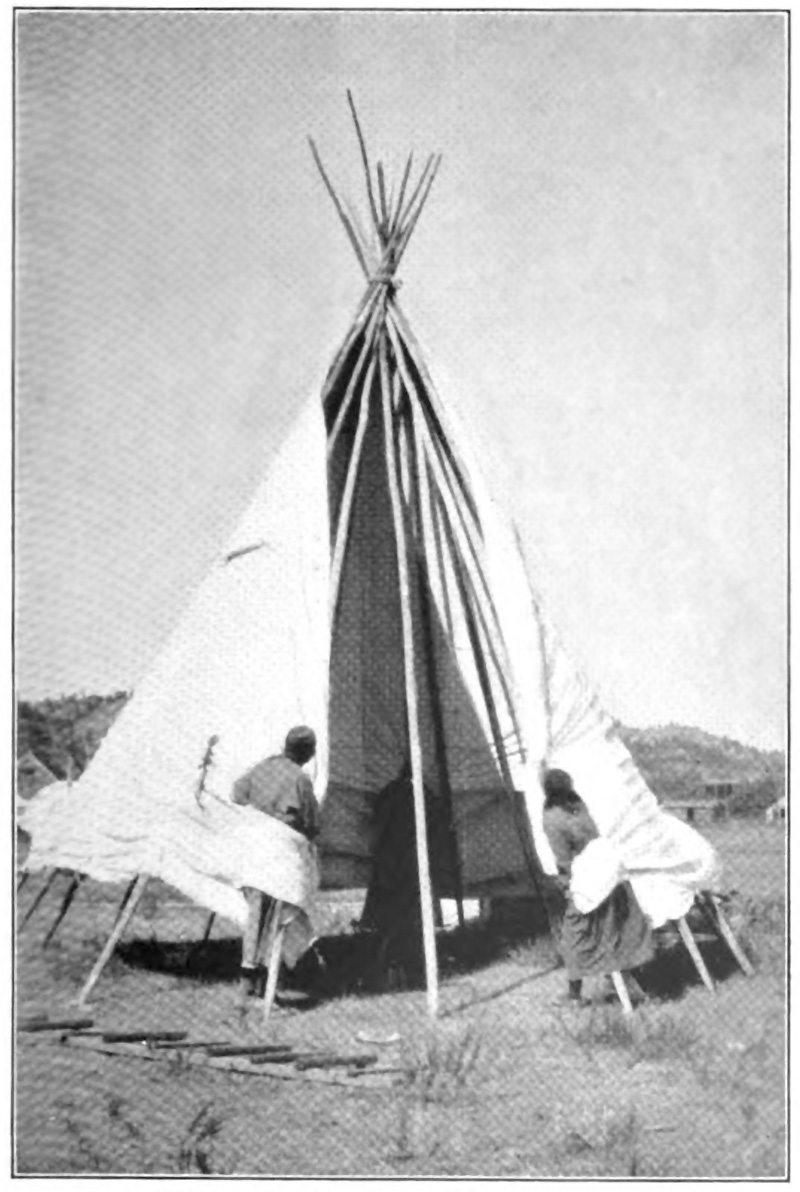
Cheyenne women setting up a tepee
From fifteen to seventeen buffalo skins were united to make a covering for the usual Cheyenne lodge. When skins were plentiful not many lodges had less than fifteen, regardless of the condition that some of the tepees might have in each only a young married couple, with perhaps an old woman or some other one or two added people. On the other hand, rarely was a lodge larger than seventeen skins, even if twenty people were sheltered there. The larger lodges had to have heavier poles, and, in moving, these with the skins had to be transported by the horses. Too much of such burden hindered the progress of the camp movement. Big lodges made pleasant abodes, but they were troublesome in traveling. The average and usual Cheyenne tepee was twelve to fifteen feet in diameter across its earth floor. The height from the floor’s center to the tepee’s peak was the same as the diameter of the floor. That was the regular standard architectural plan of a Cheyenne lodge.
The camp circle of the Northern Cheyenne tribe, all assembled, enclosed a space about one-fourth or one-third of a mile in diameter. It usually straddled a small stream of water. If the location permitted, a position was taken near to a larger stream into which the small one emptied. Hunting parties or war parties of men made themselves temporary night shelters of willow wands stuck into the ground, bent over and tied together for a dome roof, then covered with robes. Or, such parties crept into caves or sought the protection of heavy brush and thick foliage. The main camp never went into high mountains during the winter. Too much snow. Mountain campings were made during the summer season.
For moving the village, the usual time for leaving the old site was about nine o’clock in the morning, I believe. Not much if any preparation was made until that morning came. The arrival at the next stop would be about the middle of the afternoon. Long before dark the whole village would be set up and everybody would be at home, as if this had been the dwelling place for many months. A thousand or several thousand people might travel along that way from day to day, actually moving their towns or cities, taking all of their property, their wives and children and old people, their horses and their dogs, everything that made up a full home life. I think that is better than the white people can do.
The women did all of the work of moving. They took down the lodges, packed and attended to the transportation of them and all of the household effects, set up the lodges at the new location and put all of the furnishing and personal baggage in the right places in each lodge. The whole removal was accomplished during a part of one day. In such traveling we sometimes could outrun the soldiers, notwithstanding they had only themselves and their horses to care for. We often got our homes and all of our people and their belongings across rivers where the soldiers could not or did not follow us.
The women brought wood, cut it, kept the fires burning, cooked the food, cared for the children, did all of the home work. The men took care of the horses, guarded against enemies and fought them when necessary or when desirable, hunted the wild game, brought in the meat and the skins. Ordinarily a man did not toil at domestic tasks nor did a woman hunt or fight. In emergency, though, either a man or a woman might aid or take the place of the other.
Women used saddles for riding. They sat astride. The saddles were made by them, the tree of elkhorn or of hard wood, this wrapped with buffalo rawhide sewed in place with shredded tendon sinew thread. They also made pack saddles of the same material, but having a different form. Old men likewise used saddles. But young men always rode bareback. I learned to use a saddle as a scout at Fort Keogh after our Indian roaming and fighting days were past. The white people say we mount a horse from the wrong side, but I never changed that. They say too that we do not know how to sharpen a knife. In doing this we grind only one side of the knife’s edge. But we make them keen by that method. I see no need for grinding both sides of a knife’s blade.
I did not smoke during my boyhood. As a youth I took occasional tastes, but the habit was not formed. The Cheyennes of those days did not chew tobacco. My father gave me a medicine pipe, for devotional or ceremonial smoking, when I was seventeen years old. He himself made it. The bowl was of red stone. My mother made me a long buckskin pouch and beaded it, this to contain my pipe and tobacco—or, the mixture that commonly is known as kinnikinick. This mixture was half tobacco—plug tobacco shaved off and dried—and half dried inner bark of the red willow. In the South our people used some other kind of bark, as our northern red willow did not grow there.
Old-time pipes, before my days, were made of deer leg bone. The bone was wrapped with rawhide strips taken from the back of a buffalo’s head. This wrapping was partly for the spirit influence and partly to keep the bone from breaking when heated by the smoking.
We wore clothing, winter and summer. We had light summer moccasins and heavy winter moccasins. These always were cut low and had but one string, whereas the Sioux moccasins were cut high, to lap around the legs, and had two or more strings. One time I saw some white children barefooted. I pitied them, supposing them to be very poor. When I was a small boy, a soldier at the fort on Buffalo creek gave me a hat. Not long afterward I lost it. I was eighteen years old before I got another one. It was not customary for men, except old men, to wear any special head covering. Women all went bareheaded or covered the head with a shawl or a blanket or a robe.
The buffalo hat was worn by old men. It was made of buffalo rawhide. A broad oval segment of the skin was used. An irregular circle was marked on this surface, the drawing made to accord with the shape of the head. From the center to the outer rim of this circle several cuts were made. The cut flaps were lifted to stand upright. This left the crown wide open and its rim surrounded by the upstanding diamond points. A leather thong under the chin held the hat in place.
Our people learned from the Crows this way of making hats. That is, we discovered the idea from them. One time, when the Cheyennes were camped on Tongue river above the present Sheridan, the Crows stole some horses from us. As the Cheyennes pursued them the Crows abandoned the horses and fled. They lost two hats, and the Cheyennes found these. They were used as patterns. My father used to wear a cloth over his open-top hat, to shield his head from the sun’s heat. Every old man made his own hat.
Buffalo robes from adult animals served as overcoats for men or women. Buffalo calf or deer robes were used by the children. Buffalo hair sometimes was stuffed into the moccasins to keep the feet warm. Grease paint was used on the face for the principal purpose of shielding the skin from cold during the winter and from sunburn during the summer. The most common color was a brownish red, but personal fancy might choose some other color or some combination. Each warrior also had his particular mode of painting himself, his spirit or medicine ornamentation, when preparing for battle or for death or for social mingling.
All of the best clothing was taken along with him when any warrior set out upon a search for conflict. The articles were put into a special bag—ordinarily a beautifully beaded buckskin pouch, but perhaps a rawhide one—and this was slung at one side of his horse. The bag also contained extra moccasins—beaded moccasins—warbonnet, paints, a mirror, special medicine objects, or anything else of this nature. If a battle seemed about to occur, the warrior’s first important preparatory act was to jerk off all his ordinary clothing. He then hurriedly got out his fine garments. If he had time to do so he rebraided his hair, painted his face in his own peculiar way, did everything needful to prepare himself for presenting his most splendid personal appearance. That is, he got himself ready to die.
The idea of full dress in preparation for a battle comes not from a belief that it will add to the fighting ability. The preparation is for death, in case that should be the result of the conflict. Every Indian wants to look his best when he goes to meet the Great Spirit, so the dressing up is done whether the imminent danger is an oncoming battle or a sickness or injury at times of peace. Some Indian tribes did not pay full attention to this matter, some of them seeming not to care whether they took life risks while naked or while only partly clad or shabbily clad. But the Cheyennes and the Sioux were careful in following out the procedure. When any of them got into a fight not expected, with no opportunity to dress properly, they usually ran away and avoided close contact and its consequent risks. Enemy people not understanding their ways might suppose them to be cowards because of such flight. In fact, these same apparent cowards might be the bravest of the brave when they have on their good clothing and feel that they may present a respectable appearance if called from this life to meet the Great Spirit.
The naked fighters, among the Cheyennes and the Sioux, were such warriors as specially fortified themselves by prayer and other devotional exercises. They had special instruction from medicine men. Their naked bodies were painted in peculiar ways, each according to the direction of his favorite spiritual guide, and each had his own medicine charms given to him by this guide. A warrior thus made ready for battle was supposed to be proof against the weapons of the enemy. He placed himself in the forefront of the attack or the defense. His thought was: “I am so protected by my medicine that I do not need to dress for death. No bullet nor arrow can harm me now.” On the other hand, a warrior not made ready by special religious exercise and appliances had in his heart the thought: “A bullet or an arrow may hit me and kill me. I must dress myself so as to please the Great Spirit if I should go now to Him.”
Warbonnets were not worn by all warriors. In fact, there were only a few such distinguished men in each warrior society of our tribe. It was expected that one should be a student of the fighting art for several years, or else that he be an unusually apt learner, before he should put on the crown of eagle feathers. He then did so upon his own initiative, or perhaps because of the commendatory urgings of his seniors. The act meant a profession of fully acquired ability in warfare, a claim of special accomplishment in using cunning and common sense and cool calculation coupled with the bravery attributed to all warriors. The wearer was supposed never to ask mercy in battle. If some immature young man pretended to such high standing before it seemed to his companions that he ought to do so, he was twitted and shamed into awaiting his proper time. I first put on my warbonnet when I was thirty-three years old, fourteen years after I had quit the roaming life. After a man had been accepted as a warbonnet man he remained so throughout his lifetime. War chiefs and tribal chiefs ordinarily were warbonnet men, but this was not a requirement for these positions. Pure modesty might keep the bravest and most capable fighter from making the claim. Also, an admittedly worthy wearer of the warbonnet might not be chosen for or might refuse all official positions. The feathered headpiece, then, was not a sign of public office. It was a token of individual and personal feeling as to his own fighting capabilities.
The warbonnet was made by the man who was to wear it. His wife, mother or sister made only the beaded band for the forehead. The man made also whatever spirit charm objects he might use, or he got a medicine man to make them for him. The women made all of the war shirts, leggings, moccasins and such clothing for the men. They also made all of the common clothing for the men, for themselves, and for all members of the household. The men made their own pipes, weapons, lariat ropes and such other articles as were used by men only.
Our hand mirrors were not used entirely for dressing and painting. We made use of them for signaling. Two persons who understood each other could exchange thoughts in this way over long distances, and even when they could not see each other. Some kinds of such signals were understood by all of our people. The little glass was often useful in approaching a camp when the traveler was in doubt whether it was an assemblage of his own people or of an enemy or unknown people. In such cases, flashes of inquiry and flashes of response, or lack of responses, settled the doubt.
My father bought me a rifle and a six-shooter when I was about sixteen years old. He got them at a trader’s store somewhere, when he went away on a journey to the place. He exchanged buffalo robes for them. The rifle was a muzzle loader, using powder, bullet and caps. The six-shooter also was loaded in the same way. Before that time I had learned to shoot with other people’s guns, but these were the first ones I ever owned.
Some Indians used to cut off the rifle barrels, to make them lighter for carrying on horseback. It was supposed they would shoot just as well with the short barrel. We never cut off the stock. The shortened rifles were used in chasing buffalo on horseback. Such weapons could be handled with one hand while the horse was controlled with the other. They were known to us as the “buffalo gun.”
An old-time way of killing buffalo was by chasing them in winter over a steep bluff into a deep snowdrift. As they floundered there they could be speared or beaten to death. A few times I was in that kind of hunt. I heard old people tell of having used snowshoes to go after buffalo, but I never saw any of that kind of hunting. We always stripped the meat from the bones while butchering. The only bones we took were the ribs. We sometimes used the legs as mauls to break up the ribs. Oh, how good was buffalo rib roast!
Four arrows was the regular allowance for the killing of one buffalo during a horseback chase. The need of more than that number was discreditable to the skill of the bowman. Less than that was a matter for boasting. If one killed a buffalo with only one arrow, that was wonderful.
I have helped in the chasing of antelope bands over a cliff. In the Black Hills was one special place where we worked for our meat in that manner. The creek near by was called Antelope creek. The first time I went there an old man accompanied me. We located ourselves in hiding near the base of the cliff, with women and old people and children. Two young men rounded up a herd and drove them over for us. Many of them were killed or got broken legs. We clubbed to death the injured ones.
We could get food, clothing and shelter from the buffalo only. Saddles and harness, halters and bridles, were made by using their rawhide. Stout thongs for all purposes were cut from them. For a rawhide lariat rope, long strands were cut by following around the outside of a buffalo rawhide. Three or four of these strands were plaited together. Buffalo hair, particularly from the neck of a bull, also was spun into long strands and plaited to make a lariat. The buffalo, then, was very important to us in our mode of life. When any man went out specially hunting them he usually led two or three pack horses to bring in his gathered supply of food and skins.
Fishing lines were made of horsehair. The hairs were tied to make long threads, and these were plaited together. We got metal hooks from the white men traders. I have caught rabbits also with baited hooks on the horsehair lines. I heard of eagles having been captured in that way. But I never tried it on an eagle. The Arapahoes used to be great eagle hunters. Old men told me the Cheyennes in past times had caught them from pits. The pit was covered with sticks, and a dead rabbit or some other tempting flesh bait was placed upon the sticks over the center of the pit. The hunter hid himself below the bait. When an eagle alighted he seized its legs, jerked it down, grabbed its head and wrung its neck.
Twisting rabbits out of a hollow log, using a forked stick to get the hold for pulling them, was a boyhood game. I set my muzzle loader rifle one time on the upper Rosebud as a trap and caught a fox. I have caught coyotes by that same means. The taking of the bait pulled the trigger and shot the animal. A piece of fat meat was the best lure for them. I have poisoned lots of wolves and got their pelts. A good way is to put the poisoned meat upon the top of a stick stuck into the snow, the meat being about on a level with a wolf’s body. The trapper goes back next day and follows the trial of whatever wolf might have gone away from the stick.
My first choice of meat was antelope. Buffalo was a close second choice. Deer and elk came next. It appeared, though, that no Indian ever got actually turned against buffalo flesh. Beaver, rabbit, prairie chickens, bear, fish and turtles are good. Otter or wolf are not good, except wolf pups taste good if one be hungry. Dogs are the same as wolves. An old dog or an old wolf being boiled sickens me. Boiling pups give out almost as bad an odor.
Salt was in use by the Cheyennes before I was born. We used it when we had it, but we did not always have it. There was a stream known to the Indians as Salt creek somewhere in the South. From there the Southern Cheyennes used to bring to us great chunks of salt. We sometimes smoked our meat, partly to help in preserving it and partly because the flavor was an agreeable change at times.
Steel and flint was the usual source of fire. Neither my older brother nor myself had these, but my father had a good pair. We used to borrow from him. In the usual personal traveling pack was a small box or bag containing steel, flint and kindling. Dried buffalo dung, usually known as “buffalo chips,” makes good kindling when it is pulverized. Spark, kindle, blow, spark, kindle, blow, until a small blaze is started. Then put on twigs or grass, then small wood, then large wood. Buffalo chips in their natural chunks made good wood.
The Crows used to have a custom of making a pile of buffalo chips to be kicked to pieces by whoever might come to camp pretending to bear an important message. This was by way of oath that he would tell the truth. There was no such custom among the Cheyennes. Our way was to build a bonfire and call the chiefs. No oath of any kind was taken. It was supposed the truth would be told without special promise. Perhaps that was not the case with the Crows.
I have heard of another Crow custom different from the Cheyenne way. I have been told that when a Crow stole a horse or found any article it was expected of him that he give it away. It was considered not right for him to keep it. A Cheyenne might present a stolen horse or a found article to a relative or a friend, but it was regarded as entirely fair and proper for him to keep it for himself if he chose to do so. Ordinarily he kept it. I admire the old Crow way of acting in that respect. Such conduct makes a good and unselfish heart.
The Sioux often buried their dead on scaffolds, but I never saw any Cheyenne burials in that way. Sometimes our dead were put upon platforms on tree branches. Mostly, though, they were placed in small hillside rocky caves if these were convenient. In later times, and in many instances at the present day on our reservation, the dead body was deposited on the surface of the ground on a rocky hill or in some place out of the way of usual travel. The body was well wrapped in blankets or skins, and it may or may not have been put into a wooden box. In either case a heap of stones was piled over it to shield it from animals.
Our women used to cut their legs and arms, usually in crosswise slashes, as an act of mourning. Some of them—the older ones—yet do this. A married woman cut off her hair, in ragged form, if her husband died. In mourning for other relatives the hair might be worn loose and uncombed for a long or a short time. Men did not cut the flesh in mourning. They let loose the hair or cut off their braids. Men who had lost relatives often cut off also the manes and the tails of their horses as a sign of mourning.
There was no marriage ceremony among the Cheyennes. Such union was mainly a simple agreement between the two principal parties. In far back old times young men purchased their brides, but during my days this was not the custom among us. In our later practice presents might be given by the young man, these ordinarily to the girl’s brothers. But these were given after the marriage, as an indication of good will, not as a purchase price. Reciprocal gifts often were made to the newly married couple.
The older way of entering upon the preliminary steps toward marriage was for the young man first to consult his own father. An old woman relative was enlisted as an emissary. “Tell the girl’s father I will give him four horses (or some other number of horses) for his daughter as a wife for my son.” The old woman went and negotiated with the father and his daughter. If the offer or some modification of it were agreed upon, the initiative father gathered together or borrowed from relatives such horses or blankets or other gifts as were required. These were taken to the lodge of the girl’s father. The prospective bride was put upon a blanket. Her personal belongings were put there with her or were wrapped in another package. She and her property were carried to the lodge of the young man’s father and placed inside, the carriers leaving her there and going elsewhere. The young man seized her as his wife. All of the supposed purchase gifts often were bestowed upon the young couple. Relatives of the two parties exchanged presents and compliments. The old woman emissary got a horse. Gifts all around were made in accordance with the ability of the people interested and in accordance with the degree of satisfaction felt because of the event.
Our most common custom was for the young man to do all of his own managing of the affair. In the night time he crept stealthily to the vicinity of the loved one’s parental tepee. He looked and listened—listened long and intently. He crept closer, still closer, until he was at the outside wall of that side of the lodge where slept the one he was seeking. He whispered, perhaps had to whisper more loudly, to awaken her. They conversed in whispers, possibly the first time they ever had spoken directly to each other, although all their lives they had lived in the same camps.
“Will—will—will you marry me?”
“Y-y-yes.”
She crept out and joined him. They went together to the lodge of the young man’s brother or sister or to a place where dwelt elder relatives of his.
The next morning two intruders were discovered there, a young man and his young wife. The discovery was announced, all parties interested were informed. Not often was the information displeasing. Ordinarily all concerned were contented and manifested their contentment in the usual exchange of gifts.
The newly married couple lived temporarily at the lodge of relatives on one or the other side, preferably with a brother or a sister of the husband. This was but a fleeting residence. The first important duty of the husband was to get skins for a tepee, either by borrowing them or by taking them in the hunt. Then it was the duty of the young wife to tan and sew together these skins and set up a home lodge.
Plural wives were kept by many of the old Cheyennes. The one family lodge sheltered the entire combined family. Commonly the two or more wives were born sisters. This condition checked or prevented the jealous quarreling likely to occur were they from different families. Two wives ordinarily was the limit. But in my time I knew two different men who each had three wives living with him. In each of these instances the three wives were sisters. The two men were named Red Arms and Plum Tree. Both of them and their entire families were in the Cheyenne camp on the Little Bighorn when we had the great battle there. Plum Tree was the father of Sun Bear and Two Feathers. Both of these sons of his fought the soldiers at that time, and Two Feathers is yet living here on the Tongue river.
Captive women from other tribes were made wives of our men. There were many of such among us. Spotted Hawk’s mother was a Ute woman captured by our people when she was a small girl. The old Chief Dull Knife, or Rabbit, or Morning Star, had as his wife a Pawnee captive woman. At the time she came to us, two other Pawnee women were brought and were taken into marriage for bringing up Cheyenne children. Crow women stolen long ago by our warriors in raids were mothers of some important Cheyennes, including Big Foot, Big Thigh and the Chiefs Crazy Head and Little Horse. I do not know of any Cheyenne women having been captured from us by the Crows. The Pawnees and the Shoshones got away with some of them.
An unfaithful wife did not incur any public penalty, according to the laws of the Cheyennes and the Sioux. Her husband might inflict some penalty. That was permissible, but he was not conceded the right to kill her. I knew one man who cut a great gash in his wife’s forehead because of her going with another man. Ordinarily, though, the loss of his wife’s affection was looked upon as a joke on the husband, and he kept quiet about it or pretended that he did not bewail the loss. The Arapahoes had a tribal punishment for a wife’s unfaithfulness. They cut off the end of the woman’s nose. Then any future observer might have notice of her frailty when contemplating the taking of her as his wife.
Fighting between Cheyennes, either men or women, was forbidden by the tribal laws. In case of a fight some chief near at hand would call out: “Warriors, separate these fighters and whip them.” The warrior policemen then on duty would respond to the call. A band of them would give such punishment as seemed to them fitting. If the fighters renewed their strife they might have punishment added, might have their tepees torn down, their horses killed, property damage done to them in some other way, any suitable and sufficient punishment—except, no policeman warrior nor anyone else lawfully could kill a Cheyenne.
Pony whips, either the lashes or the heavy stick handles, were the customary attacking weapons in a personal fight. Cheyennes did not use fists as the white people do. Not often did any two women fight. If they did, they merely scratched and pulled hair. It was more of a comic show than an alarming sight to see two women clawing each other. I never heard of any Cheyenne woman killing another nor maliciously killing a man. Nor did the men kill women. I used to hear old people talk about a Cheyenne named Wounded Elk who had beaten his wife and then shot her, killing her. I never heard of any other like case. That incident happened before I was born.
Suicides were not uncommon among us. Men shot themselves, women hung themselves. Foolish ones yet do such acts. Several years ago my neighbor and friend Whirlwind shot himself to death. Five or six years ago a woman hanged herself at Lame Deer. Many of these sad occurrences, particularly among the women, have come to pass during my lifetime.
A sister of Bobtail Horse and Hollow Wood hung herself when I was yet a small boy and our people were camped on a branch of the Tongue river. Her mother had scolded and threatened her, but had not struck her, as the striking of any child was not customary among the Cheyennes. But the girl was ashamed and crestfallen because of the scolding. She brooded a while, then she disappeared. Searchers failed to find her. Two years later, a Cheyenne young man hunting deer in that vicinity found the remains of her body suspended by the neck from a tree limb. Several years before that time another young woman had done this same act near there on this same stream. From this first incident, and confirmed by the later one, the creek got a permanent name. It became known as Hanging Woman creek. It flows into Tongue river from the east side, just above the present white man village of Birney, Montana.
As we were in camp one time on the Rosebud, below Lame Deer creek, another boy and I went rambling afoot among the timber by the stream. We suddenly came upon a woman dangling and strangling. I had no knife. The other boy had one.
“Cut the rope,” I urged him.
He already was about to do this. We let the woman down upon the ground. I ran to the creek near by, got a mouthful of water, hurried back and squirted the water into her face. I stayed beside her while my companion rushed into the camp to tell her people. A band of women came, bringing a blanket. They put the disabled one upon the blanket and carried her to her home lodge. A medicine man was called. The next day I saw the woman. She gave no indication then of having had any unusual experience.
A widow Cheyenne woman was living in our camp at a time when we had stopped on the east side of the upper Little Bighorn river. Her husband had been killed three or four years before then, in the battle where Cheyennes and Sioux had won a great victory over the soldiers. (Fort Phil Kearny, 1866.) From this Little Bighorn camp my older brother and another boy and myself went out riding. I then was about twelve years old. Ahead of us, on a branching creek, we saw a woman walking rapidly afoot. She had a blanket over her head and shoulders. She turned into a thickly wooded gulch beside the creek and disappeared into the timber. We wondered a little at her strange actions, but we felt it not proper to follow her. Pretty soon three other boys came galloping their horses.
“Did you see any lone woman around here?” they asked anxiously.
“Yes, she went there,” and we indicated the wooded gulch.
My two companions followed them. I went to a plum patch. As I stood there eating plums I saw a man and a woman hurrying up toward the gulch. Both of them were crying. I followed them.
The five boys were trying to revive the woman being sought, who had hanged herself. But she now was dead. The body was rolled into the blanket she had been wearing and she was taken into camp.
This widow had been dependent upon friends for her support since her husband’s death. She had a daughter eight or nine years old. One day the young widow asked her mother for a certain fine robe. The mother refused. The request was urged. Still the mother for some reason said, “No.” The aggrieved and disconsolate young woman was so downcast by this apparent coldness of her mother that she went out and hanged herself.
My mother’s sister hung herself in their family lodge when we were in camp one time on Powder river. I was nine years old. Our family lodge was right beside the one where dwelt this aunt of mine. My mother heard the noise of the struggling and strangling. The sister’s tepee entrance flap was tied shut, but my mother burst through it. She found my aunt suspended by a rawhide rope tied high upon a pole of the lodge. She hastily cut the rope and cut it again from her sister’s neck. White Bull, a medicine man, was called. His medicine then was the tusks of a bear. He held these over and around my aunt while he got down upon his hands and knees and grunted like a bear. He kept this up until she suddenly had a hard coughing spell and brought up a chunk of something that had been choking her. She soon stood up and was all right. White Bull was a good medicine man. He saved the lives of lots of Cheyennes.
Only one wildly insane Cheyenne person did I ever see. As I was out on a hill beside the camp one day I heard a woman screaming. I looked in the direction of the sound and saw a woman outside a lodge charging about here and there and tearing off her clothing. People were running to the scene. I hastened down there. A chief called out:
“Warriors, come.”
Warrior policemen rushed there from all parts of the camp. They seized the woman and held her while medicine men were summoned. I stood there among the surrounding crowd and watched the proceedings. Finally the medicine men caused her to gag and choke and cough out the tail of a deer. At once she came into her right mind. Our medicine men always could cure that kind of sickness.
This woman had another attack of this same kind some months after that first one. The medicine men gave her the same kind of treatment. Again she spat out the tail of a deer and instantly became sane. Not long after that she got married. She had a third attack a month or so after the marriage. Her husband did not send for any medicine man this time. He himself tied her and whipped her. He beat and lashed his wife until she spat out a deer tail. This cured her right away. I never heard of her going insane after that time.
The killing of any Cheyenne was the most serious offense against our tribal laws. The punishment was prompt. A council of the big chiefs and the warrior chiefs was called at once. The case was inquired into. If guilt was evident, the offender began without delay the payment of his penalty. Sometimes action was taken without the council being assembled, the situation being so clear that unanimity of feeling was expressed either for or against the person charged with the crime. The defendant was not permitted to be present at the trial council. When the decision was rendered he was notified at his lodge by the warrior policemen. If found guilty they proceeded at once to put into effect the regular fixed and standard punishment.
“Get ready to go,” they ordered him.
Banishment for four years was the main penalty. It had to be entered upon that same day. If the offender protested or dallied, he might suffer the additional infliction of being whipped, of having his horses killed or his tepee destroyed. If he acceded willingly, he was allowed to take along his possessions. In any case, he had to go. His wife or his children might go with him or remain with the tribe, as they might choose. If he had a medicine pipe, that sacred object regularly possessed by every adult male Cheyenne, his very first act of entrance upon the banishment was the smashing to fragments of this most revered talisman. Everything else he owned he might take along with him. But he must not have the devotional medicine pipe.
Two or three miles from the main camp was considered a sufficient distance for the banished one. Relatives might visit him there or take food to him, but it was not allowable for them to remain long, and in no case should they remain after sundown. The chief spiritual guide or medicine man of the tribe withdrew the sacred protection, so the outlawed one was altogether out of touch with the Great Medicine. He kept watch of the camp movements, and he could follow at a distance with his lone tepee and set it up at a distance within sight of but out of convenient hearing of the new camp location. He hunted alone. If in the course of his hunting he accidentally came close to other Cheyennes, it was expected he should hasten away from them. The warrior policemen would whip him, or they might kill him, if he should offer to intrude himself. It was not permissible for anyone to speak to him nor in any other manner extend to him a friendly recognition. He was entirely avoided—or, it was required of him that he entirely avoid all other Cheyennes. Day after day, month after month, summer and winter, fair or foul weather, for four complete years he lived altogether the life of a scorned hermit. He was conceded the right to join some other tribe, but he did not do this. The great obstacle was, the people of the other tribe surely would ask: “Whence came you, and why?”
When the four years ended, the absolved man came back and took temporary abode in the lodge of relatives. Soon he set up his own lodge. He was admitted then to the principal rights, privileges and immunities of a recognized member of the tribe. But to this rehabilitation there were some important exceptions. For one, he never thereafter was allowed to have a medicine pipe nor to take part in any smoking circle. He was tolerated in personal presence there, if he chose thus to place himself, but as the pipe was being moved along from one to another it always went on past him, just as if he were not there at all. Nobody abused him. They simply ignored him. Hence, he ordinarily kept entirely away from such gatherings.
An insignificant little pipe having a short stem was conceded to him as an individual comfort. But he had to smoke always alone. Such little pipes were made of stone or of the leg bone of a deer or of some other material not used for making the venerated pipe used in formal smoking. When I was a little boy I used to see one certain very old man who smoked one of these little short-stemmed pipes. I did not understand why he should do this. I asked my father about it. He told me: “He killed a Cheyenne.”
Social ostracism in various ways haunted the subsequent life of the murderer otherwise cleansed from his stain. If he came hungry to any lodge he was fed. But when he was gone, the spoon or dish he had used was destroyed. If he sat upon a robe, nobody else ever afterward would sit upon it. If he became needy, gifts were taken to his lodge, but this was done by way of pity rather than by way of friendly feeling. By exemplary conduct he might partly restore his standing, but it never was fully restored.
One time, when I was a boy five or six years old, all of the Northern Cheyennes and all of the Southern Cheyennes were camped together by the Giving White Medal river.[10] Each of the tribes had its sacred medicine tepee, the Northern Cheyennes for their Buffalo Head and the Southern Cheyennes for their Medicine Arrows. The great double camps remained together several days. There were many ceremonies, many social dances and other affairs, much going back and forth between the two camps in the renewal of old acquaintance and the making of new acquaintance.
Chief of Many Buffalo and Rolling Wheel were two men belonging then to our Northern Cheyenne tribe. Chief of Many Buffalo was not married. Rolling Wheel had a wife and a small boy. This wife was tempted by the single man, and she took her boy and went to live with him. Rolling Wheel complained to the chiefs. He asked that Chief of Many Buffalo be compelled to give him a certain running horse, the swiftest animal in the whole tribal herd.
“Yes, he must give you that horse,” the chiefs decided.
An old man was sent to notify Chief of Many Buffalo. The owner of the racer announced that he would keep it, that he had concluded he did not want the woman. He sent her away to her father’s lodge. “That makes no difference,” the old man said. “Rolling Wheel now owns that horse.”
He went and informed the aggrieved husband of the situation. He told him:
“The horse belongs to you. Go and get it.”
“I go now,” Rolling Wheel replied.
He took his lariat rope and went out among the herd. There on a little knoll stood Chief of Many Buffalo, armed with a rifle.
“Go away,” the armed man commanded.
But Rolling Wheel kept on after the horse. The rifle flashed and barked. The man with the lariat tumbled forward dead. Chief of Many Buffalo was a murderer.
This banished man was not allowed to have any tepee. For four years he slept in caves or in other natural shelters he might find in the neighborhood of our camping places. At the end of his term of isolation he left us and went to the Southern Cheyennes. There he married a widow of that tribe. Soon afterward he brought her and her two children to join us. They made their permanent home with our people. I remember clearly the time of their arrival at our camp. I was ten years old. We were on Crow creek, a stream that flows into Tongue river just north of the present Sheridan.
The misguided wife of the dead Rolling Wheel remained for several years an inhabitant of her father’s lodge. Finally she was married to another Cheyenne. She was my aunt, a sister of my father, White Buffalo Shaking Off the Dust.
A Cheyenne named Hawk came to us when I was a small boy. I heard people talk of him. They said he had been away four years, in consequence of his having killed Sharp Nose. From the repeated stories I learned the details.
The two men had been out together capturing wild horses or on a raid upon an enemy herd. They brought home three horses, one of them considered a specially good animal and the other two of inferior grade. Each one wanted to keep the first choice and give the two others to his companion. They quarreled. It appeared that Sharp Nose had the better claim to preference, but Hawk had possession of the disputed animal. He had it picketed beside his lodge.
Sharp Nose on horseback and his father afoot went there to argue further about the matter. Hawk sat just outside his tepee entrance. He had his bow and arrows. As the two approached, he stood up and declared:
“I am going to kill you right now.”
His arrow went through the body of the young man on horseback. Sharp Nose plunged forward and fell dead to the ground. His father shouted imprecations upon the hot-headed killer. The father of Hawk intervened to take a part in the affair. This old man went into their tepee and came out with a muzzle-loading rifle in his hands. The father of the dead Sharp Nose turned and walked away toward the camp boundaries. The rifle was leveled and fired at him. He staggered, evidently wounded, but he did not fall. The shooter reloaded his rifle with powder, bullet and cap. By that time the retreating victim was far off and still walking away. A second shot was sent after him. This time the result was fatal.
Hawk and his father were banished at once, not being allowed to take with them any property whatever. I used to gaze upon the returned Hawk with awe-stricken feelings. People whispered, “He killed a Cheyenne.” I do not remember ever having seen his father. I believe the old man died while they were in exile. The killing had been done somewhere between Cherry creek and the Arickaree river (northeastern Colorado). When Hawk joined the tribe again we were near the agency south of the Black Hills.
No property indemnity payment nor any other substitute penalty could take the place of the four years of banishment put upon a willful killer. If a killing were accidental, the survivor might be compelled to give horses and other presents to the relatives of the deceased, or he voluntarily and promptly might do his best to make amends to them in that manner. If no blame whatever rested upon him, he need pay nothing. Yet, it was customary for him to show in some such way his sadness of heart because of the occurrence.
Two youths, brothers, found one time a wolf’s den. One of them took his lariat and crawled into the hillside cave to get pups. He felt about in the darkness, got the rope about a pup’s hind feet and dragged it out. They knocked it in the head and he went back after another one. This time, either a pup or an old wolf bit his hand. He retreated. Outside he got a forked stick. With this projecting out in front of him, he returned to the attack upon the wolves. The forked end got engaged in the hair and skin of the wolf. The youth twisted and tugged, backing out and dragging after him the snarling and snapping animal. The brother stood with his rifle poised and ready to shoot. Limbs of brush diverted his aim, and the bullet crashed into the head of the other boy. The shocked and weeping brother put the dead body upon a horse and took it to their home lodge. People flocked there to see and to hear.
“You killed him in anger,” somebody accused.
“No, it was an accident,” he sobbed out. And he explained how it had occurred.
A group of warrior policemen went with him out to the wolf’s den. There he rehearsed for their observation all of the incidents of the happening. They became fully satisfied that he had no intention to kill his brother, that it truly was entirely accidental. The youth was released with no penalty whatever.
As we were camped one time on the upper Powder river, when I was about thirteen years old, Wolf Medicine and other men loaded their pack horses with buffalo robes and other skins and went to the trader post at the southward (Fort Laramie) for buying some supplies. They got tobacco, caps, powder, lead, sugar, and goods of that character. Wolf Medicine brought a sack of flour. Our women were just then learning how to make bread. Wolf Medicine’s wife knew how to make it so it tasted good. He was a little chief of the Elk warriors, and he wanted to give them a feast. He said to his wife:
“Make plenty of bread. I shall invite all Elks to come.”
“How,” she assented, and she went immediately at mixing flour and water. Then: “Oh, I have no soda.”
A young woman there said: “My mother has soda. I will go and get some.” She went to her home lodge and told her mother. This woman rummaged among her packages, looking into one after another. “Here it is,” she finally announced. The young woman took the white powder to the wife of Wolf Medicine. As the good cook proceeded with her work, her proud husband went out to the front of his lodge and stood there calling:
“All Elk warriors, come. Wolf Medicine has a feast of bread.”
That brought them in droves. The wife engaged some helpers. They fried many slices of bacon and they boiled a great potful of coffee. When the food was being eaten everybody said: “Wolf Medicine’s wife can make good bread.” The hearts of the husband and the wife were made glad by the compliments showered upon them.
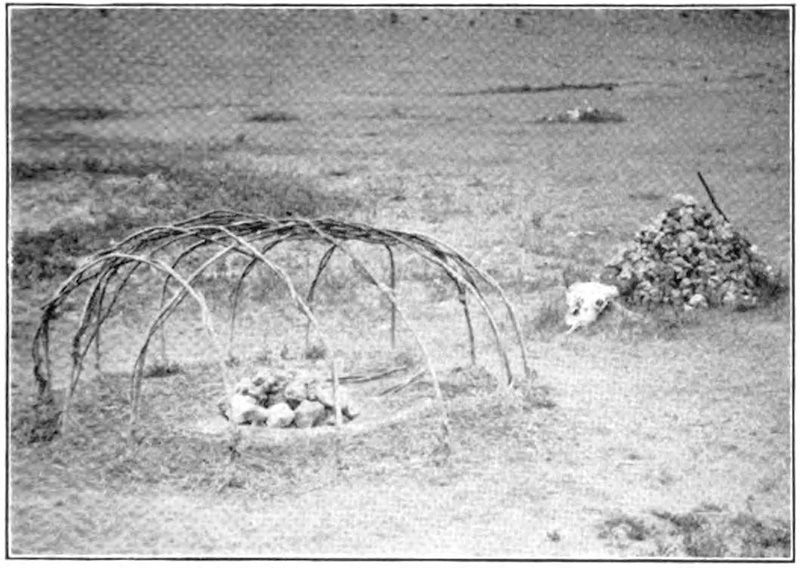
A Cheyenne sweat lodge
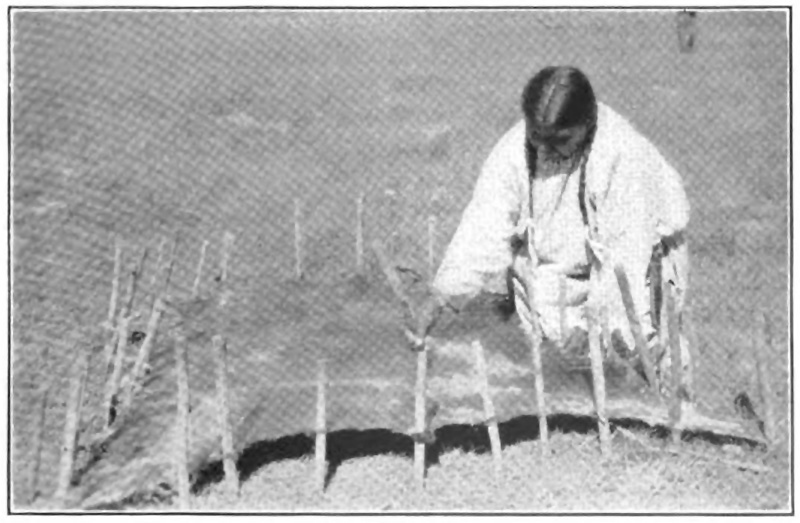
A Cheyenne woman tanning
After the feast, Wolf Medicine brought a supply of tobacco. The assemblage was converted into a grand smoking party. They passed the pipe and chatted and told stories. After a while somebody said: “I feel sick. My stomach pains me.” Just then the neighbor woman came running and screaming:
“I gave you the wrong powder! It is the wolf poison!”
The commotion aroused and brought the whole population of the camp. The victims were wallowing and groaning. An old man herald went among them calling out: “Make yourselves vomit.” Some already had done this, others began at once to gag their throats with fingers poked into them. Two men, Old Bear and White Elk, did not do this. Instead, they took doses of gunpowder in water. Both of these men had convulsions and were sick a long time, but they finally recovered full health. All of the others got relief soon after the gagging and vomiting. One of them was my father. As a test, some remnants of bread was given to two dogs. Both of the dogs went into convulsions and died. The woman who had provided the supposed soda was not punished. On the contrary, she was for a long time afterward so distressed in mind that people sympathized with and tried to console her.
A certain half-Sioux-half-Cheyenne man was married to a Cheyenne woman and they lived with our tribe. He killed one of our Cheyennes, served his exile term of four years and returned to a small village of Cheyennes where were his relatives. That was considered right, but his next movement was considered not right. He went to visit another Cheyenne village where were many relatives of the man he had killed. Warning was sent to him not to come there, that he would be killed, but he heeded not the notice, or he designed to show special bravery that might win a good standing. Two Cheyenne men accompanied him to the visited camp.
The three companions went from lodge to lodge, being received courteously and fed at the various stopping places. A brother of the man who had been killed sat in his own lodge, there meditating and saying nothing to anybody. He kept beside him a loaded rifle. From time to time, as the three men moved among the lodges he watched them from the interior of his tepee. People began to taunt him:
“You are afraid.”
“No, I will kill him today.”
The Sioux-Cheyenne walked at all times between the two Cheyenne companions when the three went from any one lodge to another. But as they were passing across one open area the middle man stopped and bent himself forward to tie a loose moccasin string. In a moment the bang of a rifle shot rang out from the watcher’s tepee. The half-Sioux pitched headfirst to the ground. His death was regarded by all as an earned infliction. The chiefs agreed: “He ought not to have come so soon to this place where are his victim’s relatives. His slayer did right.”
An Ogallala Sioux man had one of our women as his wife. They lived with our people. The couple had much domestic trouble. It was said the husband grossly abused his wife. The matter came to a climax as our Cheyennes were camped on the Giving White Medal river. I was a baby or a small child, and my knowledge of it comes only from hearsay stories. But in later times I knew the people involved.
The maltreated wife had two brothers, Dirty Moccasins and Tall White Man—not the present old man Tall White Man, but another Cheyenne dead many years ago. These two brothers decided to end the continual humiliation of their sister. They got their bows and arrows and went man-hunting. Each of them sent an arrow through the body of the offending Sioux and put out the lights of his life. They were not banished. Besides their having the natural sympathy of the people, the dead man was a Sioux, not a Cheyenne. Nevertheless, ever after that, Dirty Moccasins smoked only a deer bone pipe and Tall White Man used always a little stone one. For many years I saw him as a scrawny and feeble old man smoking the tiny short-stemmed stone pipe.
The Sioux and his wife had a ten-year-old daughter. When she grew to womanhood she married a Cheyenne man named Elk Creek. This couple had three daughters, grandchildren of the Sioux killed by the two brothers. One of these grandchildren married Round Stone, another married a Fort Keogh soldier named Thompson, the third is the wife of Willis Rowland, our present interpreter at the Lame Deer agency.
I heard a story about two Sioux in a Sioux camp who quarreled concerning the ownership of a horse. One of them had possession of the animal. The other sat in his lodge and brooded over what he regarded as a wrong done to him. He planned an unusual mode of carrying out revenge. He went to a Cheyenne camp near by and inquired there for a medicine man. A Cheyenne led him to a certain lodge.
“I have important business,” the Sioux announced. “Come out where nobody can hear us.”
The three went out of the camp, to a hilltop. The young Cheyenne served as negotiator between the Sioux and the medicine man.
“I want him to kill a Sioux,” the visitor proposed.
There was some exchange of talk about the compensation to the medicine man. Finally, an agreement was reached. The medicine man received a blanket, some moccasins and clothing, some food and a keen-bladed and sharp-pointed sheathknife. A day was consumed in settling the conditions. While this was going on, the Sioux camp moved away and was set up elsewhere. The angry Sioux and the medicine man followed them. The lodge of the enemy was pointed out. The medicine man drew the figure of a man upon the outside wall of the lodge. At the right place he made a special picture of the heart. Then he told the angry Sioux:
“Take this knife. At dawn tomorrow morning you must stab the heart picture I have drawn. Then bring to me the knife.”
The commanded procedure was carried out. The wielder of the weapon was astonished when blood flowed freely from the stabbed picture heart. He ran away and told the medicine man, told him of the blood and returned to him the knife.
“Good. He will die tonight,” came the assuring declaration.
As the medicine man went back to the Cheyennes he congratulated himself on the clever trick he had played upon his confiding employer. “Good knife, good blanket, good clothing, all for me,” he chuckled. But: That same night the enemy Sioux man actually became ill. He vomited blood, and before morning he was dead. I do not like that kind of medicine actions. Such use of the powers makes bad Indians.
The warrior days of a Cheyenne man began at the age of about sixteen or seventeen, or sometimes a little earlier for such activities as were not very difficult or risky. They ended somewhere between thirty-five and forty, according to particular circumstances. The regular rule was, every man was classed as a warrior and expected to serve as such until he had a son old enough to take his place. Then the father retired from aggressive fighting and the son took up the weapons for that family. If a man came into early middle age without any son, he adopted one. If he had more than one son, he might allow the additional one or more to be adopted by another man who had none. By following this system, all of the offensive fighting was done by young men, mostly the unmarried young men. The fathers and the older men ordinarily stayed in the background, to help or to shield the women and children. Or, if it was practicable, the fathers and old men and women followed out the young warriors and stayed at a safe distance behind, there to sing cheering songs and to call out advice and encouragement. If a warrior’s father or some other old person put himself unnecessarily forward in a battle he was likely to be criticised for his needless risk, and also the young warriors felt aggrieved at his taking from them whatever of honors might be gained in the combat. In general, the young men were supposed to be more valuable as fighters and less valuable as wise counselors, while the older men were estimated in the opposite way. It was considered as being not right for an important older man to place himself as a target for the missiles of the enemy, if he could avoid such exposure. Even in a surprise attack upon us, it was expected the seniors should run away, if they could get away, while the more lively and supposedly more ambitious young men met the attack.
Our war chiefs—that is, the three leading chiefs and the twenty-seven little chiefs of our three warrior societies—were more useful as instructors in quiet assemblage than as directors of operation in times of battle. There were frequent gatherings of the warrior societies, each in its own gathering, where the chiefs exchanged ideas about methods of combat and about daily care of the personal self, and where the listening young warriors learned their lessons. If some aggressive war was contemplated, these chiefs agreed upon the plans. But when any battle actually began it was a case of every man for himself. There were then no ordered groupings, no systematic movements in concert, no compulsory goings and comings. Warriors of all societies mingled indiscriminately, every individual went where and when he chose, every one looked out for himself only, or each helped a friend if such help were needed and if the able one’s personal inclination just then was toward friendly helpfulness. The warrior chiefs called out advice, perhaps a reminder of some rule of action theretofore discussed in the gatherings, or perhaps some special suggestion that exactly fitted the immediate situation, such as, “Yonder is one whose horse is down; go right in after him.” Ordinarily the advice of the chiefs was heeded. But the obedience was a voluntary one. In battle, the chiefs had not authority to issue commands that must be obeyed.
Special war parties made up of members of some certain warrior society often went out seeking conflict with the enemy. The warrior societies competed with each other for effectiveness in this kind of activity, as well as in all other activities regarded as commendable. At times, the members of some certain warrior society would be selected by the tribal chiefs to do all of the tribal fighting in some case where the opposition was looked upon as being not great enough to make necessary the use of the entire tribal military forces. If this appointed segment of our fighters did well they were acclaimed. If they did not do well, especially if other warriors had to go to their assistance, the original combatants were discredited. Ordinarily, whatever warrior society was on duty as camp policemen had also the duty as special camp defenders. It was their business to be the first ones out to meet any attack upon the camp. Members of the other societies added their help if necessary, refrained from doing so if they were not needed. If the enemy onset was sufficient to render needful the resistance of all of the warriors in the camp, all of them were called by the heralds of the tribal chiefs. In cases of extreme danger, even the old men and some of the women might use whatever weapons they could seize and wield.
The Sioux tribes had ways closely resembling those of the Cheyennes. We traveled and visited much with them, particularly with the Ogallalas, sometimes with the Minneconjoux. The Sioux tribal governments were almost the same as ours. Each of them had numerous tribal chiefs, each had various warrior societies and chiefs of them. Their warriors dressed for death in battle, all of their people dressed for death in time of peace, according to the same customs among us. Their warrior training by precept and by discipline was similar to our system. They fought their battles as a band of individuals, the same as we fought ours, and the same as was the way of all Indians I ever knew. They had war dances and medicine dances differing only a little from our ceremonies of this kind. So when white people learn the ways of the Cheyennes they have learned also a great deal of the ways of the Sioux and of other Indians in this part of the world.