XII Surrender of the Cheyennes.
Reading edition
Just before the grass began to show itself in the early part of the spring, two visitors arrived at our camp on the Little Bighorn. One of these was our captured old woman, Sweet Woman. The other was a half-breed Sioux we called White.[49] Each had a horse to ride and each was leading a pack horse. In their packs were tobacco and other things, for gifts to the principal chiefs. The visitors said they had been sent out from the soldier fort at the mouth of Tongue river, to invite us to come there and surrender peaceably. They brought a promise from Bear Coat,[50] the soldier chief there, that we should not be harmed and should be given plenty of food.
Sweet Woman told us all of the captives were well. She said they had been treated well, that they had a lodge for themselves and that Bear Coat had a soldier guard near their lodge at all times to keep other soldiers from bothering them. This Sweet Woman was a sister of White Bull’s wife. She was a widow. Her husband had been dead many years. He had been a black man, and the name for him was Black Man. As a boy he had been captured by the Cheyennes. She was a tall and thin woman, but she was healthy.
Our chiefs counciled about this proposal. It was decided quickly that we might as well go in that direction. The final decision could be made at some other place. We moved then eastward by camps and sleeps of one night each. We stopped one night at the mouth of Hanging Woman creek, where we had fought the soldiers in the middle of the winter before. Some other young men and I climbed up among the rocks where we had fought. We searched for Big Crow’s body. We found it. It was lying with the back partly propped up against a bush in a thin group of small pines. The right hand was up and behind the head. The left hand was over the breast. We could not decide whether he had been dead when left there or had put himself into this position and had frozen to death. We stretched out the dead man and covered him with stones. His people felt better when we told them what we had done.
The half-breed Sioux traveled with us to Tongue river. Some of the chiefs decided to go with him to the soldier fort and find out what might happen to the Cheyennes if all should go there. They left us and went down the valley. The Cheyennes going on this journey of peacemaking were: Old Wolf and Crazy Head, tribal big chiefs. Little Creek and Two Moons, little chiefs of the Crazy Dog and Fox warrior societies. White Bull, a medicine man but not a chief. The Elk warriors did not send any chief.
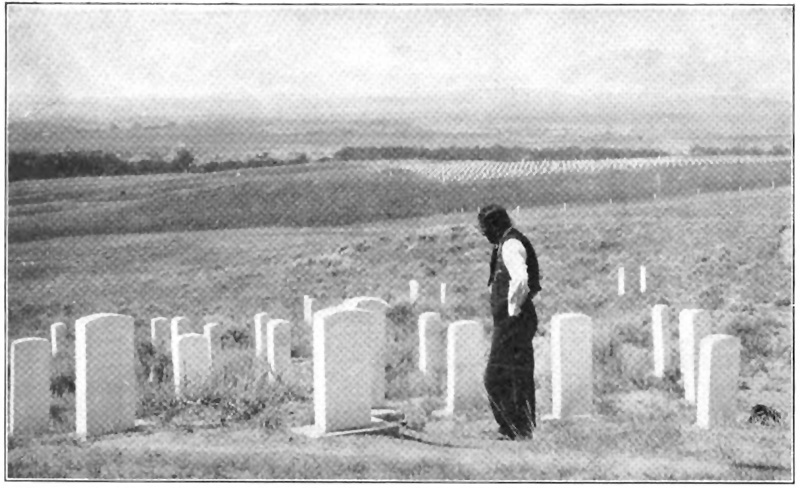
Big Beaver, a veteran Cheyenne warrior, standing at the spot where he saw the last Custer soldier killed June 25, 1876
The tribe and the Ogallalas with us kept on moving eastward. At Powder river it was decided to wait for the return of the chiefs who had gone to the fort. The Ogallalas with us separated from us and traveled on. Most of them said they were going to the agency. A little band of them went down Powder river. All of the Cheyennes remained in tribal circle camp on the west side of Powder river, above the mouth of Little Powder river, only a short distance above the place where we had been burned out a year before this time.
The four chiefs came back to us at this Powder river camp. White Bull was not with them. They told us he had stayed with the soldiers, to scout for them in hunting for Indians. This news did not please us. As we looked at it, the surrendering to the soldiers was good if one felt like doing this. But an offer to help them to kill friends showed a bad heart.
I was affected more, though, by other news the chiefs brought. It was concerning my sister Crooked Nose, one of the captives. When the chiefs were only a part of the first day out in coming back from the fort, somebody followed them to tell them about her. She had been very sad in heart because of a belief she never again would see her people. She had felt better when the chiefs came, but when they went away again she fell into deep grief. Her sorrow was so great that she got out her hidden six-shooter I had given to her and shot herself dead. My heart almost stopped beating when I heard about her death in this way. She had been a good sister, kind to everybody.
Seven Cheyennes from the agency came to the camp on Powder river. They had one tepee lodge but no women were with them. They came only to tell us we ought to surrender at the agency. They said all of the Indians there were being fed well, were being treated well in every way. Nobody was being punished in any manner for past conduct in warfare against the soldiers. To my father and to most of the Cheyennes this sounded more attractive than the invitation to go to the Elk river fort.[51] Our people were better acquainted with conditions at the agency. Besides, the Ogallalas had the same agency with us, so these people also would be there. Our old men counciled about whether the tribe should surrender. And, if so, where they should go. It was decided to let every Cheyenne choose for himself.
Little Wolf and the other principal chiefs chose to go to the agency. Charcoal Bear, the medicine chief, said the sacred buffalo head and the medicine lodge should follow them. Their choice influenced the course of most of the tribe. My father said we ought to go with them. For two or three days, I believe, the chiefs and the people talked about the matter. Finally, the main body of the tribe set off toward the agency. A smaller part of it determined to go to the Elk river soldier fort. These were convinced by Two Moons and White Bull’s relatives that they would receive better treatment there.
But not all of the Cheyennes were ready yet to surrender at any place. Fourteen or fifteen men, six or seven of them having wives and children, separated off to go westward. White Hawk, a little chief of the Elk warriors, was with them. They said they were going to join the Minneconjoux Sioux, who then were in camp on Rosebud creek or on a branch of it that afterward was called Lame Deer creek. The principal chief of these Minneconjoux Sioux was Lame Deer.
I joined another band still desiring most the freedom we considered to be ours by right. Thirty-four Cheyennes made up this band. Last Bull, leading chief of the Fox warrior society, was the big man of our party. His warrior followers at this time were from all three of the societies. The people making up this group of further hunters were these:
Last Bull, his wife and two daughters.
Many-Colored Braids, his wife, two daughters and a son.
Little Horse, his wife, two daughters and a son.
Black Coyote, his wife and small daughter.
Dog Growing Up, his wife and one small boy.
Fire Wolf, Yellow Eagle, Spotted Wolf, Chief Going Up a Hill, White Bird, Buffalo Paunch, Big Nose, Meat, Medicine Wolf, Horse Road, Little Shield, Yellow Horse, my brother Yellow Hair and myself Wooden Leg. All of these were unmarried young men.
Five tepee lodges were taken along and set up at each camping place, by the wives of the five married men. The unmarried young men slept mostly unsheltered, or at each camping they made for themselves little willow or tree branch lodges. They did their own cooking, most of the time, but often some young man would give a part of his meat to some woman as payment to her for cooking his meat for him. I dwelt all the time in the lodge of Last Bull, as a member of his family. He felt very friendly to me because of my having helped his wife and children at the time the soldiers came to the Cheyenne camp the year before, on Powder river.
Every man in this band had a good gun of some kind. I had my rifle taken from the soldier. I had not used up much of the ammunition I had found on the battle grounds at that time and afterward. I did not do any more shooting than was necessary in getting plenty of meat. I was saving my cartridges for fighting whatever soldiers might come.
We traveled and hunted all about the country on the upper Powder river and the upper Tongue river. We had to be moving often, because game was not plentiful. Every day scouts were out trying to locate buffalo. All of the time they were on the lookout too for soldiers or for Crows or Shoshones. We were not loafing idly. We were working and earning our living.
A baby boy was born to the wife of Black Coyote at one of the camps. The wife of Many-Colored Braids took care of her, as medicine woman. As we moved from place to place, the young woman and her baby were put into a travois bed. The other women helped in taking down and setting up her lodge. Her personal name was Calf Road. She was specially famous because she had fought as a warrior with her husband Black Coyote at the battle with the soldiers on the upper Rosebud. Now there were thirty-five people in our band.
I was sent alone from this band one time to scout for buffalo. I took with me a pack horse to bring back whatever meat I might get. I had on the led horse a soldier pack saddle belonging to Last Bull. I stayed out three sleeps. I saw a few deer and antelope but no buffalo.
We were having a good many days of hunger. Our horses had plenty of grass, but our own ribs were becoming thin. Our clothing was wearing out, and we could not get enough of skins to renew them and to keep our beds and our lodges in good order. My soldier coat and breeches were gone, and my last shirt and cloth breeches were almost in tatters. The only good article of wear I had now was my big white hat I had captured at the Rosebud battle.
A Cheyenne named Yellow Eagle added himself to us. He had been at the agency not long before. We decided to have him and White Bird go there together and spy out the conditions. They went. In a week or so they were back among us.
“Good treatment, plenty of food, blankets, everything, nobody punished,” they reported.
We started right away for the agency. But not all of us yet were ready to go there. Medicine Wolf, Growing Dog, Meat and my brother Yellow Hair said they were going to stay out hunting. They said it would not be long before lots of Indians would be back out here, the same as had been here during the year before. I was almost persuaded to remain with them, but Last Bull said he now was convinced the Indians would not come back to this country. So I kept with the main part of our band. We traveled southeastward toward the White River agency of the Cheyennes and the Ogallalas.
At a white man house far along our way we stopped to see if the people there might give us some food. The only people there were two white men. They acted as if they were badly frightened, but we made peace signs to them, and only two of us went to their door. We made signs that our Indians all were very hungry, and we asked them for something to eat. They gave us a little beef meat and some sugar and coffee. We were glad to get this, and we told them our hearts were good toward them.
Three strange Indians on horseback approached us from our front as we arrived about a day’s journey from the agency. We could see they were Indians, but they had on soldier clothing. This alarmed us. All of our men cocked their guns and went out in front of the women and children. We watched and waited. The three Indians stopped. At a distance they made signs to us. They told us they were soldier scouts come out to help us find our way to the agency. We allowed them to join us and remain with us the remainder of the way. One of them was a Cheyenne, another was a Sioux, the third was a Cheyenne-Sioux named Fire Crow.
It made all of us feel good to see the hundreds of Indian lodges as we came near to the agency.[52] We galloped our horses forward. We cheered and fired gunshots into the air. Some soldiers came running out from their tents, but they soon saw we were friendly and were only celebrating and notifying our people we had come. We saw great camps of Arapahoes and Ogallalas as well as the tribal camp circle of our own Cheyennes. Many soldiers also were there, in their own separate camp. Several of the soldier chiefs came and shook hands with our men and said, “How.” One of these soldier chiefs we specially liked. We learned from a Cheyenne his name among the Indians was White Hat.[53] He could make good sign-talk. It appeared he understood Indians better than any white man soldier I ever had seen. I suppose that was why we liked him.
A white man married to a Cheyenne woman was acting as interpreter for the soldiers. His name was Rowland. But White Hat did not need any interpreter in talking to us, he could make the sign-talk so well. After the general handshaking, White Hat said:
“Now, you men must give to me your guns and your horses.”
We were not expecting this, but we trusted him, so we began to do as he had asked. But Black Coyote jumped back and said he would not give up his gun. He cocked it and stood there. He was much excited. Just then three Sioux dressed in soldier clothing came riding toward us. Black Coyote aimed his gun at them. Last Bull pushed the gun aside and said:
“Don’t shoot. You are crazy.”
He talked to Black Coyote, telling him that a shot just now might cause all of us to get killed. White Hat motioned the three Sioux to go away, and they did so. Black Coyote then quieted down. He gave his gun to Last Bull, and this leader gave it to a soldier with White Hat. I was the only one among us having a gun captured from the soldiers at the battle on the Little Bighorn. When I handed it to a soldier he gave it to White Hat. White Hat examined it with apparent great interest. He then called other soldier chiefs to look. Finally he asked me:
“Where did you get this gun?”
I did not answer him at once. He asked me again, making signs so clear that I could not help but make some kind of answer. I told him the truth. I showed him just how I had seized it and wrenched it away from a soldier riding toward the river during the first part of the great battle a year before this time. The way they talked about it, it appeared the Indians had not been giving them these guns taken from the soldiers. After a little while, White Hat shook hands again with me and made signs to me: “You are a brave man. Do not be afraid any soldier will want to kill you.”
The next morning all of us went to the agency buildings for gifts we had been told would be there for us. Wagons came with the presents. They were unloaded in piles. Blankets, clothing and different kinds of food were in the piles. Two of our people were appointed to divide up and distribute the articles among all of us. Our hearts now were glad. It seemed good to be here with plenty and not be in fear of soldiers.
I received other gifts. An Ogallala Sioux presented me with a medicine pipe, the first one I had owned since the loss of mine when the soldiers burned out our forty lodges on lower Powder river. A Cheyenne young man gave me a wad of paper money like I had seen at the time of the great battle. He said: “You can buy things at the trader’s store with this paper.” I put it into my pocket. After a while I got a Sioux young man friend to go with me to the agency trader’s store. I took out my money and gave it all to the trader. He counted it over and over. Then he asked me, in Sioux speech:
“Where did you get all of this money?”
My Sioux friend quickly answered:
“He got it from Custer.”
The trader said to me:
“The soldiers are going to hang you.” This startled me at first, but both he and my Sioux friend laughed, so I knew he was only joking.
“Now, what all do you want?” the trader asked, after they had joked me a little while.
I got first a red and yellow shirt. Then I got some breeches that fitted me much better than the pair that had been given to me by the agency people. I picked out a fine red blanket, a hat and a big silk scarf. I got plenty of tobacco. I bought coffee, sugar, meat and other things. I did not want all of the goods I bought, but the trader kept telling me of what I ought to have. After each time he brought me what I asked for, he took from the money some part of it. Then he would ask:
“And what else?”
I did not know how much the different articles were worth. I kept on choosing some other until finally the trader said:
“Your money is all gone.”
My friend helped me to carry all of my property to my home lodge. I wore the new hat just bought. But I took along the old white hat I had captured from the soldiers. I gave this old one to my father. He was much pleased to get it. It was the first white man hat he ever owned. He threw away then the old Indian buffalo hat he had been wearing.
Some of the Cheyennes who had gone to the Elk river soldier fort were here now. They had been sent here by the soldiers. Other Cheyennes had stayed at that fort, the men joining the soldiers as scouts for them. All of these Cheyennes brought here were dwelling in soldier tents. Many other Indians, Cheyennes, Ogallalas and Arapahoes, also had the soldier tents. These were larger than most of the Indian tepees then in use. The tepees were smaller than usual because only a few buffalo skins had been taken during this summer.
There was some dissatisfaction among the Cheyennes on account of talk of them being taken to the South. The agent and the soldier chiefs had said we ought to go there and be joined as one tribe with the Southern Cheyennes. Our people did not like this talk. All of us wanted to stay in this country near the Black Hills. But we had one big chief, Standing Elk, who kept saying it would be better if we should go there. I think there were not as many as ten Cheyennes in our whole tribe who agreed with him. There was a feeling that he was talking this way only to make himself a big Indian among the white people. The white men chiefs would not talk much to any Cheyenne chief but him. They gave him extra presents and treated him as if he were the only chief in the tribe, when he was but one of our forty tribal big chiefs. One day he went about telling everybody:
“All get ready to move. The soldiers are going to take us from here tomorrow.”
Lots of Cheyennes were angry. We had understood that when we surrendered we were to live on our same White River reservation. We had given up our guns and our horses and had quit fighting because of this promise. Now, after we had put ourselves at this great disadvantage, the promise was to be broken. But we could not do anything except obey him. So, three sleeps after my small band had come to what we thought was to be our home, the whole tribe was on its way to what we now call Oklahoma.