II Roamers in the Game Lands.
Reading edition
The first agency for our Northern Cheyennes that I heard anything about was said to have been at the mouth of the Cheyenne river, east of the Black Hills. But I never was there. Afterward it was located south of the Black Hills, near the present Pine Ridge agency for the Ogallala Sioux. I have been told the white people called this the Red Cloud agency, but the Cheyennes knew it as the White River agency. I was at this place two times, but only for a few days in each instance. My father’s family was almost all of the time with other Cheyennes moving about over the country between the Black Hills and the Bighorn river. Here we hunted the game and the enemy Crows and Shoshones, and here we lived in every way the life of the plains Indians of those times. It was not an idle existence. We were busy much of the time, fighting our enemies or gathering food and clothing and sheltering skins.
As we were camped on lower Tongue river, when I was about nine years old, one morning a herald startled the people by his cry:
“Our horses all are gone!”
There followed a lively stir among the young men. A party of them, mounted on a few horses that had been overlooked by the raiders, hurried away on the trail. A thin snow helped them. In the late afternoon they caught up with the lost herd, apparently abandoned. But after a search of the vicinity they discovered that somebody was in a canyon cave there. One of the Cheyennes crawled into the cave, in an endeavor to verify the supposition. The verification came in the form of an arrow that hit him in the right eye. He quickly backed out. “Everybody bring wood,” the Cheyenne leader ordered. They built a fire at the cave’s opening. With blankets they fanned the flames and the smoke into the hole. The prisoners fanned outward and thrust sticks at the fire heap to push it away. “Bring more wood,” the leader called. The one-sided contest went on until two Crow Indian men burst out from the cave almost suffocated and in desperation. The first one out was beaten and stabbed to death by the surrounding Cheyennes. The second one got past them, sprang upon one of their horses and dashed away. The Cheyennes pursued him. He happened to mount a slow animal, so it was not long before the chase developed into a beating by pony whip handles. The Crow suddenly jerked his mount to a standstill. At the same moment he flashed out his sheathknife and made a vicious sidewise stab. The blade buried itself in the breast of a Cheyenne, who fell dead. The other Cheyennes rushed upon the Crow. In a twinkling he had received many death blows from various weapons. Somebody scalped him, and then they cut off his feet, hands and head. I was not with this party, but I was in the camp. I heard all about it when they returned.
I saw the killing of another Crow, though, when we were at this same camp on Tongue river. One morning a Cheyenne horse was discovered dragging a rawhide lariat looped about its lower jaw. This was peculiarly the Crow way of bridling a horse, the Sioux and Cheyennes ordinarily making a headstall and mouth bit with the rope. Evidently some Crow had captured our horse and it had escaped from him during the night. There was a scurrying out to inspect and count our herd. Apparently no others were missing. The inquiry was directed then toward an examination of the ground on the outskirts of the area where the ponies were grazing. Three strange horses had come from the hills to the westward and gone away in a gallop. Another trail was of human footprints, these imprinted as if the maker of them had been lame and had been using a stick for support. This trail led to a hillside cliff. There under the shelter of an overhanging stone roof lay a Crow Indian man apparently dead or sound asleep. A Cheyenne leveled his rifle at close range and fired. The Crow partly jumped up to a sitting attitude and then fell back dead. Investigation showed him to have a broken leg and a broken arm. The horse he had captured was not well tamed, and it had bucked him off. Perhaps it first had carried him away from his companions, and perhaps either he or the horse had made a noise that might have alarmed the camp, whereupon the two other marauders had abandoned him and fled. As I now reflect back sixty years, I pity that unfortunate Crow Indian. But at that time I felt no pity.
Nine Crows came and stole a band of our horses at a time when we were camped far up the Tongue river. I then was about sixteen years old. I joined the pursuing party of Cheyennes. We rode fast and far, following the trail over hills and valleys toward the Bighorn river. Some of our horses, including mine, played out. Four of us turned to go back while the others went on after the Crows. Porcupine was the oldest of my returning group of four. Night was coming upon us, so we stopped to sleep and to rest our horses. During the night a sound of moving horses awakened us. We kept quiet, listening and looking. Porcupine saw someone on horseback about a hundred yards distant from us. He called out a challenge: “Cheyenne? Crow?” The rider lashed his mount to dash away. Porcupine fired his rifle in the direction of the fleeing prowler. We learned nothing then of the outcome of this incident. But several months later an Arapaho friend told us of the ending. He had been hunting in this region, and right where we had slept that night he found the dead body of a Crow shot through from back to front.
The others who had gone on after the Crows driving our herd caught up with them just below the old soldier fort on the Bighorn river. My older brother was with them, and he told me what happened there. The horse band was across on the west side, and four Crows were having a playful time at bathing in the river. They were swimming, splashing, joking, laughing. The dozen or more Cheyennes kept themselves hidden and hurriedly dressed themselves for a fight while their horses rested a few minutes. Then they burst into their war-songs and charged into the water upon the surprised and defenseless bathers. Three Crows were killed, one escaped. All of our horses were recovered and three of theirs were added to the band. The third Crow killed was an old man, but he was very active. He dodged, jumped, dived. But the Cheyennes had too many spears jabbing at him and too many bullets flying toward him. My brother’s six-shooter put the fatal blow upon him.
The following year, when our tepees were assembled on the west side of Tongue river just across from the mouth of Hanging Woman creek, my father and I went out one day to get an antelope. He was about to shoot at one when the animal and some others with it suddenly ran away. We were hidden, so it seemed certain their fright came from someone else. We crept and peeped. Pretty soon we saw a group of Indian hunters on horseback.
“They are Crows,” my father excitedly whispered.
Oh, what clever dodging we did! We got to our horses, mounted them, kept them moving through gullies and brushy spots until we reached the home camp. A band of Cheyennes joined us to attack the Crows. At a long distance off we followed them until our horses tired out. By this time we were at the upper branches of the Rosebud. We gave up the chase. Nobody hurt.
Great herds of buffalo west of the Bighorn used to draw the Cheyennes over into that Crow country for the hunt. We camped on the eastern side, but our hunting parties crossed the river and went as far as Shooting at the Bank creek.[7] Each hunter led one or more pack horses to carry the meat and skins taken. Many times I have swam the Bighorn or some other river while holding in my teeth the leading rope of my riding pony. The pack horse rope would be held in the same way or might be tied to the tail of this leader. My clothing would be compressed into a bundle and strapped to the back of my head.
As we were camped on the east side of the Bighorn, about two years before the great Custer battle, three Crows were seen one day chasing antelope on our side of the river. Report of their presence there was brought to our camp. An old man herald mounted his pony and went about the camp circle calling out:
“Crows are after our antelope herds. They may steal our horses.”
Six Cheyenne young men got their war clothing packs, mounted their war ponies and set out to find the bold Crows. I was not with them, but a special friend of mine was one of the pursuing party and he told me of their experience. They crossed the Bighorn river just below where had been the soldier fort. During the course of the pursuit they killed two Crows. The third one was followed on to the main Crow camp beside Shooting at the Bank creek. The six Cheyennes lingered there to spy upon the camp. The lingering was a little too extended, for soon they found themselves engaged in a fight with a much larger band of Crows. A Cheyenne wearing a double tailed warbonnet had his horse shot down, then the man himself was shot through the thigh, this disability rendering him an easy mark for fatal blows that soon fell upon him. A second Cheyenne was killed by arrows or bullets. A third one met death by the same means. The other three escaped and made their way back to our side of the river and to the home camp circle.
During this same summer the Crows made a raid one night on our horse herd. Of course, when daylight revealed the situation a war party of Cheyennes went out for revengeful retaliation. I was not in camp at this time, being on a hunting trip toward the mountains, but Braid told me of what happened. He was one of the band of avenging Cheyennes. The Crows drove all of the horses to their camp on Shooting at the Bank creek. The Cheyennes hid themselves to watch for some opportunity for reprisal. But the crafty Crows evidently discovered them or had planned thus to entrap them. Notice came only when a horde of them charged out for a fight. Two of the Crows were killed and two Cheyennes also met death. Braid’s horse was shot down and he himself was hit by a bullet that broke the bones in the lower part of one of his legs. A companion on horseback took Braid up behind him and the two got away into safety. All of the Cheyennes then fled from the field. Braid is yet alive, at the age of eighty-nine years, his home being on the Rosebud side of this Tongue River reservation. The white people call him Arthur Brady.
About a year before these events just related a big camp of Cheyennes was located on the Little Bighorn a short distance below where Greasy Grass creek empties into it. Fresh footprints of unknown horses near the camp site aroused suspicion. Crows? Shoshones? People conjectured. An old man herald rode about and notified everybody. That night all of the horses were brought into the camp circle and picketed among the lodges. Many watchful people slept lightly or awakened from time to time and peered out from the tepee flaps. Last Bull, asleep in a small tepee with his wife, was startled by the snorting of a mule he had picketed near by. The mule snorted again, then a third time. Last Bull saw a human form crawling along toward his mule. The aroused man had no gun, so he crept under his tepee wall and into the next one, there to borrow a six-shooter from an old woman.
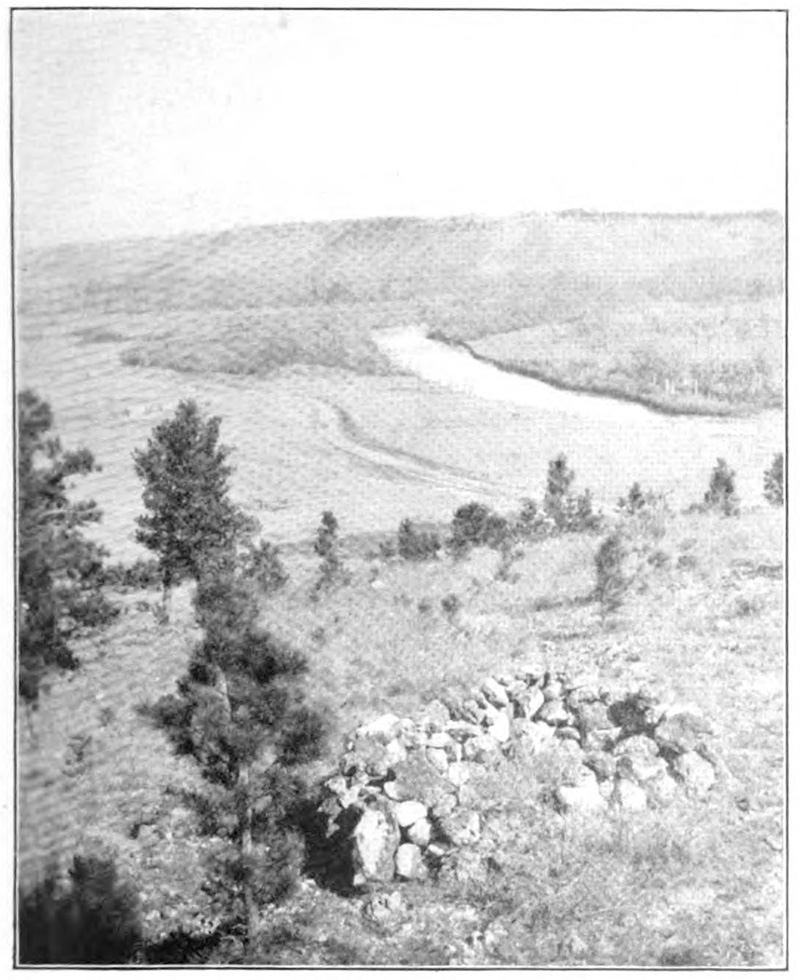
Stone pen (in foreground) used by old-time Indians as lookout shelter for sentinel. This one is on a hill overlooking Tongue river, near Ashland, Montana
Fire Wolf saw the wriggling form cut the rope and move off leading the mule. He bravely jumped out, without any weapon, and seized the intruder. They grappled and struggled. The stranger had a rifle. During the scuffle it was discharged. The noise aroused the camp. Cheyennes came running. Cries rang out:
“Kill the Crow! Kill the Crow!”
The thief jerked out a sheathknife and stabbed Fire Wolf again and again until the Cheyenne had to let loose his hold. The freed man sprang to his feet and ran, leaving the mule. A shot from Last Bull’s borrowed six-shooter brought him down. A dozen Cheyennes closed in upon him and beat him to death. Fire Wolf had some bad knife wounds, but he recovered. The clothing, the bodily decorations in general and the mode of hair dressing revealed the dead Indian as being not a Crow. He was a Flathead, perhaps a visitor among the Crows or a member of a band visiting and hunting with them.
A battle with the Shoshones was fought near the headwaters of Powder river when I was about fifteen years old (1873). A small band of Cheyennes had their lodges a day’s journey farther up the river from the main body of the tribe. I was with the small band. Four or five Shoshones came at night to our little camp and stole our horses. We walked to the main camp and told of the raid. All were for immediate war against the whole Shoshone tribe. “Kill all of the Shoshones,” was the common cry. The main camp moved on up the river to our small encampment. There preparations were made for the warfare. That very night thirty-two Shoshone warriors came into the view of our night sentinels. Evidently the enemies had planned to wipe out our little band, not knowing of the presence now of the whole tribe.
The sentinels raised an alarm. Yet the Shoshones did not offer to retreat until they found themselves overwhelmed by a great body of our warriors. Their horses were tired from the journey to our camp while ours were just taken from their picket ropes. Perhaps the raiders had been saying, “We shall kill all of the Cheyennes here,” but now they plunged their horses into a long and deep canyon in their effort to get away from us. The Cheyennes strung themselves all along both sides of the canyon. Shooting was kept up during the balance of the night and until an hour or more after daylight. Two of the enemy escaped. Thirty of them were killed in the canyon. Seven of our Cheyennes also lost their lives. We recovered the horses the four had stolen. This fight was on a small creek flowing into the west side of Powder river from the mountains near by.
White Bull was leading a hunting party one time in the Elk river country. I was yet a small boy, so I was not with them. Their scouts observed the distant herds of buffalo excited. Crows? Shoshones? White soldiers? The Cheyennes hid themselves for the night. In the early morning they found moccasin tracks by a creek. The moccasin trail led to a Blackfeet camp. There the Cheyennes stirred up a fight, but I believe nobody was killed. The great warrior Roman Nose rode back and forth in front of the Blackfeet and defied them. All of them were said to have shot at him without a bullet or arrow having harmed him. He had a powerful spirit or medicine protection for himself. White Bull had taught him this medicine.
Soldiers got after a small band of mingled Cheyennes and Sioux near the Black Hills one time. We were running away when a Cheyenne was killed. Two Sioux, another Cheyenne and myself went back to recover his dead body. We got off our horses and crept over a hill. We four took our dead companion by his hands and feet and dragged him over the knoll. There we rolled him into a blanket and we took the four corners. Bullets were whistling all about us. The blanket ripped and the body fell through the opening. We again took hold of the hands and feet, and in this way we got him to our horses and delivered him to his own people.
Several months before the great battle with Long Hair (General Custer) and his soldiers, some Cheyennes coming from the agency on White river told us that the white men were going to come out and fight us. As parties went out for hunting, a lookout was kept for these white enemies. My brother, myself and two other Cheyenne young men went on a special scouting journey. We were camped then far up the Powder river. At night we four slept out in the open country. Early in the morning a fifth Cheyenne came to us. “Soldiers are near us,” he said. We learned our horses were missing. The soldiers had taken them. We all ran away afoot. We scattered in different directions, except my brother and me, who went together into a canyon. Soldiers rode along on both sides of the canyon and shot at us. We shot back at them, first using up our bullets and then resorting to our arrows. We kept creeping along the canyon. The soldiers gradually dropped away. We were not harmed nor did we know of our having harmed any of them. When they left us we carefully worked our way on up the canyon and over a hill toward our camp. Breathing hard, almost exhausted, frightened to the verge of collapse, we stopped for a few minutes of rest. Then we hurried on. At the outskirts of the camp circle we paused to send a warning wolf howl. The people all gathered about us.
“What has happened?” they asked.
We told of our experience. At the same time the other returned young men were giving the same kind of information. The chiefs ordered everybody to pack up, and the camp was moved far on down the Powder river. Some of us stayed back to watch the soldiers. One night I saw them in their camp. Two sentinels were walking back and forth near their horses. I or any of my companions could have killed either or both of them. But this would have endangered our people, so we did nothing of that kind. We stole back our horses, though. I got the same horse they had taken from me a few nights before this. Our camp kept on moving, and the soldiers never found us on this hunt.
A great band of Southern Cheyennes came for a visit to us in the Black Hills about two years before the Custer battle on the Little Bighorn. All of us joined together then for a long hunting journey to the westward, to the Powder river, the Tongue and the Little Bighorn. Many thousands of buffalo, deer, antelope. Many skins, much meat, everybody happy and prosperous and in health. On the Little Bighorn river we had one day of Great Medicine thanksgiving dancing just below the mouth of Greasy Grass creek. Further down the valley the camp divided, half of the people going northwestward to trouble the Crows while the other half took a southwestward course toward the country of the Shoshones.
I went to the Shoshone country. We did not see any of those Indians, but a few of us saw their agency. We saw also the soldier houses there. We kept clear of the soldiers, and I think they never knew we were in that region until after we had gone. We rounded up and drove off a herd of white man cattle and killed every beef. Game was scarce there, and we needed the food.
We followed the mountains to upper Powder river, where we joined again with the Cheyennes who had separated from us on the Little Bighorn. After a few days of feasting in the great combined camp, there began to be departures in bands, bands, bands, for return to the agency south of the Black Hills. My small remaining group went to Otter creek, a tributary of the lower Tongue river. Good hunting, lots of game, on this creek. We followed it to its head and moved on eastward to Powder river. We went up that stream and diverted to the Little Powder river. Here other Cheyennes came to us. Then more arrived, and yet more. Again a great band of us were roaming together.
An early autumn snowstorm in the upper Powder river region put a check upon our great summer movements. Separations came again. Indians went back again to the agency for the winter. My band moved over to the upper Tongue river. Here, only a short distance down that stream from the present white man town of Sheridan, Wyoming, buffalo in great throngs were feeding. We had but to kill and eat. As I now think back upon those days, it seems that no people in the world ever were any richer than we were. That is all anybody actually needs—a good shelter, plenty of food, plenty of fuel, plenty of good water. We stayed all winter in this vicinity. My father and his family never cared to live at the agency.
In every herd of buffaloes the adult males were about equal in size and of the same dark brown color. All buffalo cows likewise were about equal in size, smaller than the bulls. The sucking calves were of yellow color. At the age of one year they began to change to the darker yellow and then to brown and dark brown or black.
A white buffalo was killed by the Cheyennes on a branch of the upper Powder river. That was when I was a boy, about the time the soldier fort was there. Many Cheyennes were after the animal, but Left Handed Shooter killed it. Such animal was regarded as a spirit being or a “medicine” animal. The assembled Cheyennes stood back from this one in respectful awe. Left Handed Shooter could not persuade anyone to help him in skinning it. He alone took the hide from the whole body, separating off the head and horns.
Four medicine women were called to Left Handed Shooter’s lodge. They pegged down the sacred skin, dried it, scraped it with their elkhorn scrapers, did all of the work of tanning it as a robe with the hair left on it. An old medicine man then took it to his lodge. There he painted it. He put upon the smooth inside many black suns, many black moons, many stripes, all in groups of four, the Indian sacred number.
The painted skin then was hung upon a tall pole. The horned head was put upon another pole near by. All of the spirit men or medicine men came, all of the people assembled. There were many long prayers, to the Great Medicine above and to the spirits below. Finally an old man announced:
“We give this tanned white robe to the Great Medicine above. We give the head and horns to the spirits below.”
The robe was taken down from the pole and was carefully folded. Medicine men and women then respectfully carried it with the head and horns to the top of a hill. There these revered objects were left as gifts to the unseen rulers of the Indian world. The meat of the animal was not considered as sacred. It was eaten, the same as if it were any other buffalo flesh.
After that time another white buffalo was seen and chased by Cheyennes on Tongue river below the present town of Sheridan, Wyoming. It was a fleet-footed and long-winded animal. All of the Cheyenne horses were exhausted in the chase. The coveted buffalo escaped us, and I never heard of anyone having seen it afterward.
I killed a buffalo cow having white hair covering the upper and inner thighs, the back part of the belly, the udder, and having white teats. My mother took great care in tanning it and made of it a fine robe for me. It either was taken or was burned by the soldiers who drove us from our camp on the Powder river a few months before the Custer soldiers came.
A black buffalo calf was killed by Exhausted Elk far up the Tongue river. It being black instead of the usual yellow color of the calves caused it to be treated as a spirit animal. Four medicine women tanned its skin, assembled medicine men held ceremonies, the congregated people looked upon it with veneration. The skin was painted and placed upon a hill as a sacrifice gift to the Great Medicine, the same as was done with the skin of the white buffalo. Also, its flesh was eaten as if it were only an ordinary buffalo calf.
A half-bull-half-cow buffalo was killed one time by the Cheyennes. My father helped in the killing of it. This animal was of enormous size. It was big, fat, had a tall back, long horns, and its hump was almost double the size of the average buffalo bull. My father called friends to his lodge for a feast upon this meat. It was not regarded as a medicine animal. The heart and the liver were cut into big slices to be eaten raw, as Indians usually ate these parts. Only the old medicine men ate of these slices at my father’s feast.
There always was some danger mixed with the pleasures of wild game hunting. I remember a Cheyenne who was gored terribly by a buffalo bull. He recovered, though. After that he became known as Buffalo Not Kill Him. Walking Whirlwind, a young man about my age, had his shoulder torn by a bear. He also recovered.
A bear attacked three old Cheyenne women as they were picking berries on Tongue river. One of the women was badly clawed. The two companions put her upon a horse and took her to camp. She died just after her arrival there. At that same time one of our men was out hunting. He saw a bear, shot it and killed it. As he approached the dead animal he observed dried blood all about its nose and its cheeks. This strange condition puzzled him. In skinning the bear he carefully preserved the bloody muzzle. When he arrived in camp with his meat packed in the skin he learned of the killing of the old woman. Everybody agreed this must have been the bear that killed her.
Two Cheyenne men, Bear Dung and Sun Road, went buffalo hunting from a camp of ours on the lower Rosebud. As they were circling about a milling herd a bull sunk its horns into the belly of Bear Dung’s horse, ripped it open, lifted and tossed aside the animal. Bear Dung went sprawling to the ground. The bull immediately plunged at the man and gored him to death. Sun Road hurried into camp and told of the sad occurrence. The dead man’s women relatives took out a travois and brought him to camp. He was a brother of Buffalo Hump, an old Cheyenne now living on the Rosebud. Sun Road also is still alive, his home being on the Rosebud side of our reservation.
Competitive sports used to interest us. Horse races, foot races, wrestling matches, target shooting with guns or with arrows, tossing the arrows by hand, swimming, jumping and other like contests were entered upon. In the tribe such competition usually was between men representing the three warrior societies. These were the Elk warriors, the Crazy Dog warriors and the Fox warriors. If any Sioux tribe or big band camped jointly with us the matches were between representative members of the two tribes. Bets were made on every kind of contest. The stakes were of guns, ammunition, bows and arrows, blankets, horses, robes, jewelry, shirts, leggings, moccasins, everything in the line of personal property. The betting always was on even terms. Articles were piled upon a blanket, matched articles in apposition to each other. The winners took all and shouted over the victory.
The Elk warriors, the society to which I belonged, had the best runners. Our speediest man on foot was named Apache. He was almost as tall as I was and he was much heavier. He had remarkably big thighs. One time at a double camping with the Ogallalas on upper Powder river a foot race was arranged between the two tribal champions. The Ogallala fast man was tall and slender. His name was Black Legs. The distance they were to run was about a mile, I believe, although at that time we had no measurements for distance. Four friends of each man accompanied the two racers to the starting point. A revolver shot told them when to go. Near the finish the Sioux fell exhausted. Our man Apache was very tired, but he ran on to the end of the route. Of course, the Cheyennes took all of the stakes, let out a chorus of cheers and fired their guns into the air. “The Cheyenne medicine broke his legs,” the Sioux said when their man collapsed.
The old Chief Little Wolf had been a great runner when he was a young man. The longer the distance the better it suited him. As the Cheyennes and the Ogallalas were traveling together in moving camp there was much bantering such as, “I think the Sioux can travel faster than the Cheyennes can,” or, “It appears the Cheyennes must go a little more slowly in order not to run away from their friends the Sioux.” Finally a young Sioux jokingly challenged Little Wolf to a foot race.
“How,” assented Little Wolf, “I’ll run with you.”
The caravan was stopped and arrangements were made for the race. Little Wolf then was past fifty years of age, while his Sioux challenger was just entering young manhood. Nevertheless, the Cheyennes backed their chief heavily. A great pile of bets were placed upon the containing blankets. Four Cheyennes and four Sioux went with the two men to the agreed starting point, which must have been three or four miles away. At the crack of a revolver shot the race began. Up to the last mile the young Sioux kept well in the lead. Then he began to move more slowly. It appeared Little Wolf never changed his pace. So he closed up toward the leader. In the last part of the last mile he went ahead, still running at what appeared to be his same rate while the other man’s speed continued to lessen. By a broad hundred yards Little Wolf won the contest. Many of the Sioux, even some who had lost bets, joined the Cheyennes in cheering for the old man.
A good wrestler and general strong man was Little Hawk. He and Buffalo Hump and Brave Wolf made up a playful raiding group in the camp one time after a great hunting party had brought in lots of buffalo beef. All about the camp circle there were drying poles loaded with meat. The three young men had not been fortunate in the chase, so they decided to borrow from their friends. They went to a certain tepee.
“We need meat,” they announced. “Your drying poles are too full, and we think our wants can be supplied there. But Little Hawk wants to wrestle for it. If anybody here can throw him we shall not take any food from this lodge.”
Nobody there wanted to accept this challenge. The young men took some meat and went on to another tepee. There they made the same kind of announcement and proposition. There likewise all of the men present feared to grapple with Little Hawk, and there also the three joking robbers helped themselves from the bountiful store. At the next tepee the transaction was more complex. After some exchange of talk the spokesman of the lodge said:
“Big Thigh is here. He says he will wrestle you.”
The conditions of the match were agreed upon. The two men stripped to their breechcloths. A group of onlookers assembled. The group soon became a great crowd. Big Thigh and Little Hawk appeared equally confident. Both of them rushed into the grapple. They tugged and shoved and tripped. The advantage seemed to shift back and forth. The throng of spectators whooped and danced. There was some partisan cheering, but most of it was merely the expression of delight at witnessing this tribal championship battle. After several minutes of fierce and continuous struggling Little Hawk began to weaken and wilt. Big Thigh pinioned the arms of his antagonist and bore him face downward to the ground. The victor sat astride the back of the vanquished and sprinkled handfuls of dirt upon him. He also picked up a folded blanket lying near by and used this as a soft club in pretense at beating into complete submission the defeated Little Hawk. Shouts of congratulation greeted the conqueror while jeers were heaped upon the under dog and his two confederates. Brave Wolf and Buffalo Hump, ridiculed to complete embarrassment and compelled to replace their looted buffalo meat, quickly took themselves into hiding.
Our target shooting was with rifles, revolvers and arrows. For the arrow contests an erect wooden figure of a man was the customary mark. Sometimes the arrows were shot from the bow, sometimes they were tossed by hand. Both accuracy and extent of penetration counted in either form of this archery. Shooting arrows for long distance was another test of capability. Here a strong bow and a powerful arm and hand were important elements for success. In all of these games the regular rule allowed four successive shots for each contestant. Fine points in the manipulation of arrows were brought out in the sidewise tossing of them at short distances, each toss being made in attempt at the exact crossing of another arrow thrown out by an opponent.
Most of our few rifles were muzzle loaders and our revolvers usually were of the kind using caps and moulded bullets. The target for practice with them ordinarily was a black ring as broad as a large hand marked upon an animal’s dried shoulderblade or upon a barked tree. Teams of three or more men on each side often were arrayed against each other for either the arrow or gun contests. Usually the teams represented their respective warrior societies. On many occasions, though, there were personal engagements. In these there might be sought only an honorable distinction or there might be betting added as an incentive to achievement. An incident of this character that was much talked about among the Cheyennes came up at a time when we were camped on the Powder river.
Jules Seminole brought a keg of whisky to the camp. He got it at some white man trading post. He was a southern half-breed married to one of our Northern Cheyenne women and accounted as belonging to our tribe. One of our young men solicited him:
“Give me a drink of your whisky.”
“No, but I’ll bet a drink that I can beat you at shooting,” Seminole proposed. “What have you to bet?”
The young man feared defeat. But he went canvassing here and there in an effort to find someone who would take up Seminole’s challenge. One after another declined to contest. Finally, in jest rather than in earnest, he put the case before an old medicine man who was totally blind in one eye and partly blind in the other.
“I’ll bet a good buffalo robe against the whole keg of whisky that I can beat you at shooting,” the old man declared to Seminole.
Seminole evidently suspected some kind of trick. He hesitated, but the urgings of the gathered crowd carried him into acceptance of this counter proposition.
A tree was barked and a black circle target drawn upon this clean surface. Seminole shot first. He had a cartridge rifle. The bullet imbedded itself an inch or so below the black circle.
“Get me a pin,” the old medicine man requested of his young helper.
The pin was brought. The aged Cheyenne placed it point forward upon his right palm. He held this palm upward in front of his eyes. His squint wrinkles deepened and his lips formed themselves into a pucker. A sudden puff of his breath caused the pin to vanish. Nobody knew what had become of it.
“Examine the target,” the performer told them.
There it was, buried to its head just inside the circle. The people all wondered. The keg of whisky was conceded to its new owner.
“I’ll bet a horse against the whisky that you can’t do anything like that again,” Seminole dared him.
“How,” came instantly a responsive agreement.
The target was placed more distant, this at the request of Seminole and by assent of his competitor. Onlookers became involved in the betting. The medicine man found many backers of his mysterious powers. The half-breed adjusted his sights. He took an unusually long and careful and steady aim. “Bang!” His bullet struck within an inch of the circle’s center. His betting supporters were gleeful, the opposition were in doubt. They awaited anxiously the next move of their champion.
“Bring me a claw of a redbird,” he calmly ordered.
A dozen young men put themselves into his service. They wanted to help him in drinking the whisky. Within a minute he had the required object.
The redbird claw was placed upon the same upturned palm where had been the pin. “The target is too far,” came a complaint. Then: “Yes, I can see it now.” Puff! The claw was gone. Where? Right into the central black spot of the black circle target!
All comers had a drink of the whisky. A tin cup was brought and the old medicine man dipped in and passed out hot liquid mouthfuls to hundreds of Cheyennes. Nobody got enough to make him drunk. I spat out my mouthful. It did not taste good.
Red Haired Bear and his wife were traveling with their lone lodge one time in the Black Hills. At their noon camp he saw deer tracks and set off to follow them. They led him up a dry coulee and into the timber. There a strong and disagreeable odor was wafted to him. He grasped his gun more firmly and went on. Just then a big snake stood up and flashed its tongue at him. Its head was above his head and its body resembled a tree. It struck him—one, two, three, four times. It backed off and poised as if to strike again. He was sickened, but he aimed his gun.
“Great Medicine, help me,” he prayed.
“Yes, be brave and I will help you,” a reply came from above.
He bethought himself not to shoot at its head, since the bullet might glance off harmless. He shot it through the neck. The immense serpent threshed about in terrible fashion, crushing bushes and tearing up the earth. But it gradually quieted down, and finally it lay dead.
The faint and terrified man took the back trail for his camp. He had four gullies to cross. He got over the first one without much difficulty. The second one troubled him. Just before he started across the third one he almost fainted. But he braced up and went over it. He was dizzy and wobbling as he approached the fourth gully. “Be brave now,” the Great Medicine said to him. He had dropped his gun, but the encouraging words led him to pick it up and go on. He staggered into and out of this fourth obstacle. At the camp he told his wife of what had occurred. She gave him a big dose of gunpowder in water. Then he vomited, the vomit having the same odor as had come from the snake. A second dose of gunpowder brought up more of the poison. A third treatment had the same effect, but the odor now was almost gone. The fourth time he took the mixture it stayed down in his stomach. Then he felt all right. Red Haired Bear himself told me of this experience. But he was not a reliable man, so I never was sure whether it was true or not.
White Frog and Red Hat told a story of them having an adventure of this same kind. They had been to the trading post, where they had taken their pack horses loaded with skins of beaver, buffalo and antelope. While returning they arrived at Tongue river just above the mouth of Crow creek. The water was high. They dismounted, waded and led their horses to an island. For crossing the next channel they drove the horses ahead of them. The men were naked and were holding their clothing over their heads as they waded.
A monstrous snake rose up from the water and threatened them. “It will eat up both of us,” they exclaimed together. They prayed the Great Medicine to pity them. At once there came a flood of rain and a whirling wind. The wind picked up the snake, dragged it along the water’s surface for a short distance, then lifted it into the air. It went up, up, up, and soon it was gone from their sight. White Frog and Red Hat agreed in their stories to us that the snake was so big it looked like a floating log. One Cheyenne who heard them said it might have been a floating log that looked like a snake.
When Black Wolf went one time on a deer hunt he saw two women sitting on the edge of a cliff. Both women were beautiful in face and form. As they sat there dangling their feet over the cliff they beckoned to him. He went to them and sat down beside them. Pretty soon his nostrils perceived a strong odor of deer. At the foot of the cliff, in a pool of clear water, he saw a reflection of himself with two deer beside him. “You are only two deer,” he accused the women. At that they both jumped up. They changed instantly into deer and went bounding away into the timber.
A Southern Cheyenne out hunting saw a lovely woman by a grove of trees, braiding her hair. She looked at him and smiled. That was enough to draw him straight to her. But when he took hold of her he smelled her flesh.
“Oh, you deceitful deer!” he exclaimed.
She struggled then to free herself from him. But he held firm. He tied her hands together and tied her feet together. The deer woman declared:
“If you keep me thus tied you will die. If you let me go loose you will live to be old and always will be in good luck.”
He decided to let her go free. She ran away as a doe deer. When the man arrived at his home lodge he was wildly insane. Medicine men were called. He told them the story of his meeting the deer woman. The medicine men prayed for him. His right mind soon came back to him.
I had one time a strange adventure with a deer. I shot it with my rifle, the bullet passing through it from the rump forward. It ran away, I followed. I shot again, this time the bullet going through its chest, right to left. It turned around. Another shot made another hole through its chest, left to right. A fourth and a fifth bullet likewise was sent into and out of its front body. It ran to a bushy grove. In this grove I found it lying down. It was facing me. It was not only alive, but it appeared not to have been hurt at all. I hesitated and trembled a little as I drew my six-shooter. At close range I aimed at the middle of its forehead. The bullet brought blood from the exact point where I had aimed. But the deer appeared unharmed. I fired again, aiming at the same spot, and a new trickle of blood flowed out. Still the animal gave no sign of having been injured. I stood there and thought about the case. I decided to shoot once more—an eighth effort. That is two times the Indian sacred number four. I moved up close and put my revolver’s muzzle near the middle of the ridge above the deer’s right eye. Holding myself steady, I pulled the trigger. Instantly afterward the animal’s body became limp. It was dead.
I do not entirely understand that. It may be I was dreaming, but it does not seem like a dream.[8] The Cheyennes consider all deer as having strong spirit powers. Medicine men like to get their medicine strength.
An old Cheyenne man and his wife told me a story, when I was a boy, about a big stone that stands near Antelope creek west of the Black Hills. They said that at some time, long ago, some Indian girls were at play there. They were poking a forked stick into a hole, in search for beaver. They touched something, twisted, pulled, and brought out some hair on the end of the stick. They supposed it to be the hair of a wolf, a coyote or a porcupine. As they talked of it, a bear of immense size came from the hole. It chased the girls, capturing many of them and tearing them to pieces. Two sisters escaped. The bear followed them, going to their home tepee, but it did not harm them. When night came, the two girls crept out. They met two young men and told them of the frightful animal. “It can not be killed by any shot in its head nor its heart nor in other parts of its body,” they told the two young men, “but a shot through its foot, from the bottom upward, will kill it.” The young men considered the case. Then they said to the two girls: “All of us will hide here and wait.”
When the bear awakened in the morning it learned the two girls were gone. It moved about inside and then outside, smelling of the ground. Sniff, sniff, sniff, sniff. It set off on the trail of the girls, following to the base of the great stone. There it sat down upon its haunches and looked upward toward the stone’s top. Pretty soon it began climbing up the steep side. A little distance up, its feet slipped and it slid down. It tried again, this time going higher, but it slid down again. Trials were made at many places. But always the effort was a failure.
The two young men and the two girls were hidden close by. One of the young men shot an arrow at the bottom of the bear’s foot as it was clambering up the stone. When it went up again he shot another arrow. On another effort of the bear a third arrow was sent after it. The three arrows whizzed past the bear and went on high into the air. They came down without doing any damage. The fourth arrow flashed past very close to the bear’s left hind foot. The animal slid down and ran away. The arrow kept on going up, up, and it never came down.
I have seen many times the long upright marks of the bear’s claws on this great column of stone. They are deep seams or furrows. It must have been a monster of a bear. As far back as I can remember, all of the Indians called this stone Bear Tepee or Bear Lodge.[9]
An old Cheyenne man and I were traveling together one time past the Bear Tepee. He told me a story about it. He said that a long time ago—nobody knew how long—an Indian man journeying alone chose to sleep at the base of this tall stone. A buffalo head was lying near him. He slept four nights. During that time the Great Medicine took both him and the buffalo head to the top of the high rock. When the man awakened he could find no way to get down. He was hungry and thirsty, but he had neither food nor water. He was greatly distressed in mind. He thought of his wife and his children. He wept and prayed all day. At night, exhausted, he slept again. During that night the Great Medicine gently took him down again to his leaf bed on the ground. The buffalo head was left at the top, near the edge. That Indian man was said by some people to have been an Apache, others said he was a Shoshone, yet others declared he was a Cheyenne.
I saw that buffalo head many times. The first time was when I was with the old man and he told me the story of it. He had a spyglass and we looked through it. We could see plainly that it was the head of a buffalo. I was a small boy at that time, eight or ten years old. The Bear Tepee is four or five hundred feet high, maybe higher, and its sides are straight up and down. How else could a buffalo head get up there except it be placed there by the Great Medicine?
I have heard many old Cheyennes say that a long time ago the Great Medicine used to come down to the earth and talk with people. They said He had camped and visited and smoked with the old-time Cheyennes. Lots of times I have heard them talk about Him having given to our people the Black Hills and all of the gold there.