SUPPLEMENTARY CHAPTER, GIVING LATEST INFORMATION.
Reading edition
It is now just one year since I left Washington Territory, and I am glad to be able to report,Rapid growth of Seattle and Spokane Falls. on the best authority, that the great interests heretofore described have progressed, some of them with accelerating speed. The city of Seattle has added 10,000 to her population, and Spokane Falls 5,000 to hers.
Mining has spread its area, multiplied its diggings, and gone forward at every point amazingly. Agriculture during the past year has not advanced with equal rapidity. This is easily accounted for by the influences of the mines and cities. The crops were fair, but not as large as in some former years; but no fears need be entertained with regard to this great interest.
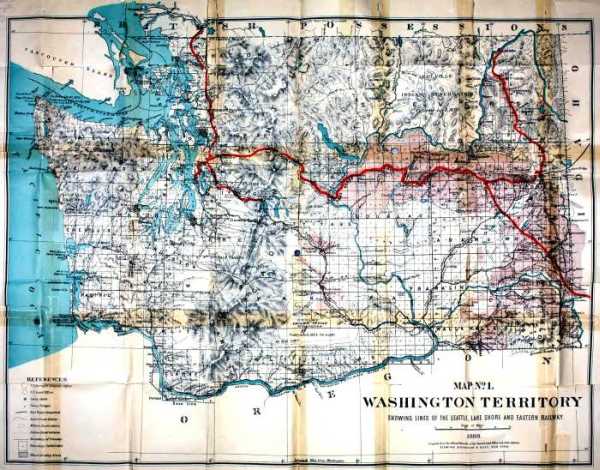
Change in the location of the railroad.The trunk line of the Seattle, Lake Shore & Eastern Railway will cross the Cascade Mountains at Cady's Pass instead of at Snoqualmie Pass as originally designed, and reach the Columbia River by the Wenatchie Valley. Crossing the great river near the mouth of the Wenatchie, where it is thought that a city will be developed, and passing along the northern limb of the Great Bend country, it will connect with the other end of the road which is now under construction to Wheatland.
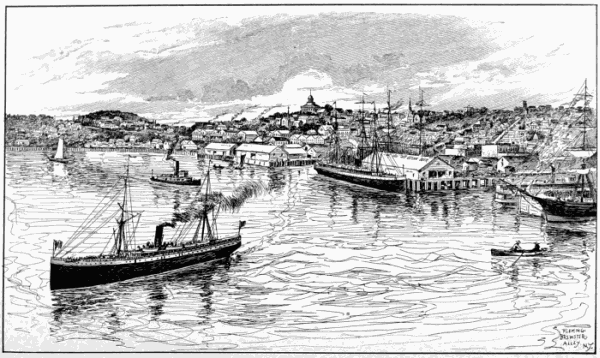
VIEW OF SEATTLE AND THE HARBOR, WASHINGTON TERRITORY, SHOWING DOCKS OF THE SEATTLE, LAKE SHORE AND EASTERN RAILWAY.
A report from Paul F. Mohr, chief engineer, in regard to this new line, is embraced in this chapter. Something is said about the Wenatchie Valley, also, by Mr. Whitworth.
But the original line is by no means abandoned. It has probably reached Hop Ranch before this time, and will be continued through the great timber belt, passing Salal Prairie, at least as far as the iron and marble beds on Mt. Logan. No doubt in time the road will cross Snoqualmie Pass, and continue to the mineral beds on the Cle-ellum and elsewhere.
I have obtained the following interesting and valuable reports from Mr. Whitworth, who has been frequently mentioned in this report, Mr. Routhe, president of the Board of Trade of the city of Spokane Falls, and Paul F. Mohr, Esq., chief engineer.
REPORT FROM F. H. WHITWORTH, ESQ., CIVIL AND MINING ENGINEER ON SEATTLE, ETC.
Seattle, W. T., Oct. 2, 1888.
I now proceed to answer your questions.
1. Present population of Seattle, and commercial growth?
Population of Seattle.A census was taken in June of this year, and the total enrolled was 19,700. I presume it was safe to say that the population then was 20,000, and that now it is from 22,000 to 25,000, for although houses have been built very rapidly, there is not a house, or a room hardly, that is not occupied.New manufacturing establishments. There are now seven brick-yards in operation, each manufacturing from 10,000 to 50,000 per day. Two boiler-works have been added to the manufacturing interests since you were here. Three saw-mills, besides four on the line of the Seattle, Lake Shore & Eastern Railway between here and Gilman, have been built, and all have more than they can do.
A new fish-canning establishment has been started, and is in successful operation. A pile-creosoting works, an extensive shipyard works, a shingle mill, and a timber-preserving works and saw-mill are all under way on the north side of Salmon Bay.
New steamers.The Alaskan and the T. J. Potter, two magnificent steel steamers, and the Harry Bailey and Hassalo, good-sized passenger steamers, besides three or four tugs, and an extra steamer on the Alaska route, as well as an extra steamer every second or third week for freight from San Francisco, have been added to the Seattle fleet since you were here.
2. The Moss Bay Company.
There seems to be no question but that the location on the eastern shore of Lake Washington is definite.The iron company at work. A contract has been made with Denny, and with those holding with Guy, but not with Guy himself. I understand that no contract has been made with, or for, any other one, although Mr. Kirk has been and is still examining all other places.
Mr. Kirk, and Mr. Williams, another of the firm, are living on the grounds at Kirkland, and have a force of men preparing the grounds, the position of the different buildings having all been located. Brick and other material is being placed on the ground.
They have entered into contract to roll for the Seattle, Lake Shore & Eastern Railway 30,000 tons steel at Kirkland, to be delivered within the next twelve months. They, however, will bring the blooms from Moss Bay for this.
Coking coals.Coke is the fuel Mr. Kirk wants, and thinks he will have. But I do not think that the question of coke supply is settled yet. Mr. Kirk's property that we visited (Section 2) is, so far, not developing as they had hoped. Mr. Kirk has disposed of his interest there. The Smith coking ovens that we visited at Wilkeson are still producing a small amount of coke. One or two other veins have been opened at Wilkeson recently, and the company opening are proposing to put up ovens, and work and coke their coal. It probably will make about the same quality of coke as the Smith mine. The only coal that has been analyzed and stands that test for coke, is Section 34, near Kirk's Section 2. We got some samples of it, you remember.
The Snoqualmie coal has been taken possession of by a Mr. Niblock, who talks now of going to work to open. That, you know, cokes well in the open air.
The following is the cross-section of our best veins at Ruffner, or Raging River, Section 16. Roof, sandstone:
FT.INS.
Mixed Coal and Slate 12
Coal (clean)31
Rock3
Coal6
Rock6
Coal13
Total, coal, 4 ft. 10 in., rock, 9 in.; which seems to be very strong coking coal. This bench can be worked to advantage, I think.
We have another, also, of about three feet of coal, clean, and it is underlaid with three feet of fire-clay, which probably will be as valuable as coal. I have burned some of the brick, and sent some away to be tested.
No further discovery has been made in the neighborhood of the Denny or Guy mines. At the "Chair Peak" Iron Mines, owned by Mr. Wilson, Kelly, et al., as they have examined further, the deposit has shown itself much larger than at first supposed. It is about two and a half miles from the Guy lode, on Mt. Logan.
New discoveries of iron ore.Some quite extensive iron deposits have been discovered on the west side of the Sound, nearly due west from Seattle. They have not yet been analyzed.
What is thought to be a very rich deposit of iron has just recently been found on one of the islands in the San Juan group, within the territory of the United States, said to equal the Texada deposit in British Columbia, which the iron works at Irondale, near Point Townsend, use. The Irondale furnace commenced work again about a month since.
In regard to the precious metals: there have been no developments of importance on this side of the mountain.
The Okanogan, Salmon River, Cœur d'Alene and Colville mines promise richer and richer as they are more developed.
Lumber business growing.4. The activity in the lumber business is unabated—is on the increase. The increase of the lumber mills, that I have mentioned in the first part of this letter, indicates that.
The traffic on the railroad, both in logs and manufactured lumber, is much larger than had been anticipated, and is increasing. In July the road hauled 2,843,464 feet of logs. September log haul was about ten per cent. greater. I could not get the exact figures to-day.
Population and freights increasing.5. Spokane Falls is still growing very rapidly, and now claims 12,000 to 15,000 inhabitants, and is building very substantially. Along the line of railroad on this side of the mountain the country is filling up, of course, with small ranches or home-makers, and those already on the line are making increased clearings, and will therefore have more to ship.
The following shows something of what is being done in July: "Coal freight, 2,750 tons; miscellaneous, 3,090; passenger traffic, $6,150; and the advance has been about the same as in logs, except on coal."Labor strike at Gilman Mine.
[6. Mr. Whitworth next gives an account of certain difficulties and troubles, chiefly with miners, which ended in a "strike" that was somewhat prolonged, but he thought the men would soon go to work on the company's terms. Of course, the high hopes concerning these mines (Gilman) had not been realized. Mr. W. proceeds as follows:]
Gilman coal seams.On the Smith, or No. 4 vein, we had just got the gangway driven far enough to turn rooms. The Andrews vein we were driving the gangway entirely in the coal, but were not yet far enough to turn rooms. Nos. 1 and 2 veins had gotten, with the gangway, well in under the hill, and was looking very fine, and turning out good coal. With the prospect of No. 4, or Smith vein, and Andrews vein, I am still well pleased. On the vein in Section 26, just across the valley, I have started in a tunnel to open it; have already driven about sixty feet through the rock, and have about seventy feet still to go. This tunnel is still going on, not having been stopped by the 'strike.'
Progress of the West Coast Railroad.The West Coast Railroad is completed to Snohomish City, and trains run regularly, the bridge across the river being completed only about ten days ago. Both passenger and freight traffic is much larger than anticipated. They are grading, and expect to have ready for service yet this fall, five miles beyond Snohomish. Along most of the entire line the timber is very fine and abundant, and a great deal of the land adjacent is rich agricultural.
Resources of the country along the new line across Cady's Pass.7. Concerning the new line across Cady's Pass and down Wenatchie Valley.
[After some remarks respecting grades, etc., Mr. Whitworth proceeds as follows:]
On this [west] side of the mountain [Cascade] the timber reaches right up nearly to the summit, as in the Snoqualmie, and the reports are this region is rich in coal, and probably also in iron, with some indications of precious metals. Soon after crossing the divide the line will reach the very rich agricultural valley of the Wenatchie, which is called "the garden of Eastern Washington," and traverse its entire length. And it will pass within a comparatively short distance of the mineral districts on the northern slope of that range called Mt. Stuart.
I have heard that there were numerous indications of coal near the mouth of the Wenatchie on both sides of the Columbia. This, too, will be the nearest main line to the rich mineral district of Salmon River, or Okanogan, as well as all that northern mineral belt which extends to the Rockies, and will strike the heart of the Big Bend wheat-fields. It will also be eighty miles shorter than the other line. True, Ellensburg and the Cle-ellum district will be missed, but I think this will be more than compensated for by those I have spoken of.
8. Of the progress of the work.
Progress in building the road.On this side of the mountains no work except surveys has been done on this line. At Spokane Falls the bridge across the river, and about forty miles of track is finished, and they are now operating, I believe, with very encouraging prospects. On the Snoqualmie line they are pushing on. The trains now run regularly to Raging River. The bridge across that stream is not yet completed, but will probably be by the 1st of November, and it is expected that the trains will be running to the Hop Ranch by December 1st.
The branch or spur up Raging River to the Ruffner mine, on Section 16, is located, and some little work has been done, but it is not being prosecuted at present, so I do not expect we will be able to get out any coal from there before next spring or early summer.Cable Railway in Seattle.
Another item showing the prosperity of Seattle, is the opening of a five-mile circuit of cable road to Lake Washington, which occurred last Saturday. I will send you some papers giving some items that may be of interest.
Southern Pacific Railroad supposed to be coming to Seattle Harbor.A syndicate of men prominent in the Southern Pacific Railroad management purchased Milton Point, the land directly west, across Seattle Bay, from the town, and are clearing it off, and say they will make extensive improvements over there in the near future. They are building a large ferry steamer, and have a franchise to run a ferry hourly between town and the front. It is to be on the route by December 1st. Report says that the Southern Pacific is coming in there.
At Smith Cove quite a little town is building up, and property is advancing all around there.
REPORT FROM E. A. ROUTHE, ESQ., CONCERNING SPOKANE FALLS, ETC.
Spokane Falls, Oct. 17, 1888.
Growth of Spokane Falls.Our city has progressed in growth splendidly since you were here. There are now fully 13,000 inhabitants. The census of July 1st showed 12,000. About $1,500,000 have been expended in buildings this year. Eight business blocks of brick and granite have been built this season. One of these cost $150,000. Four of these blocks are three stories, three are four stories, and one five stories.
SPOKANE FALLS, WASHINGTON TERRITORY.
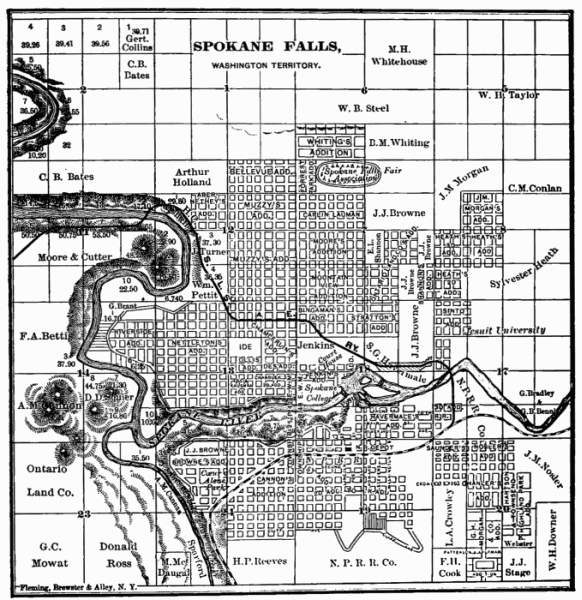
Forty miles of the Seattle, Lake Shore & Eastern Railway will be completed between here and the Big Bend by December 1st. The iron, engines and cars are nearly all here, and the farmers in Lincoln County are greatly rejoiced at the opportunity for shipping their grain and stock to market.
Prodigious development of the mining interests.The development in the mines this year has been greater than all the work done heretofore. The gold mines near Murray, Idaho, have yielded beyond the hopes of all interested in them. I saw four gold bricks, at the First National Bank, said to contain $37,000. These were from one mine, a South Fork mine of the Cœur d'Alene.
The Kootenai country is now reached by steamer after leaving the Northern Pacific road at Sand Point. A good deal of development work is progressing, and the ore is being shipped out daily. It is mostly silver-bearing galena. A new town just above the British line on the Kootenai Lake has been started. It is called "Nelson." I shall send you some formulated data at an early date.
The crops have been good, though not so good as last year. Emigration to the farming sections does not come in as fast as we would like—in fact, not as rapidly as to the towns. I think it will be better after the election.
REPORT FROM PAUL F. MOHR, ESQ., CHIEF ENGINEER OF THE SEATTLE, LAKE SHORE & EASTERN RAILWAY, CONCERNING THE CADY'S PASS AND WENATCHIE ROUTE.
Spokane Falls, W. T., Dec. 3, 1888.
The following is a report of the proposed line from West Coast Branch to mouth of Wenatchie River:
I. ENGINEERING FEATURES.
Engineering details of the new route.The proposed line will leave the West Coast Branch at a point six miles south of Snohomish City, running east, crossing the Snohomish River on drawbridge at the junction of the Snoqualmie and Skykomish rivers: thence up the right bank of Skykomish on a 1 per cent. (52.8 feet per mile) grade, a distance of forty miles from point of beginning. Thirty-five miles of 2 per cent. (105.6 feet per mile) grade carries the line to Cady's Pass and mouth of tunnel. The tunnel will be 3,500 feet long, in granite rock; probably little or no lining will be necessary.
Descending to the east by a 2 per cent. grade, following the Wenatchie River, a distance of twenty miles. Descending and level grades alternate for the next twenty-five miles, where 1,000 feet of tunneling will be required in the divide between the Wenatchie and Chumstick rivers. This tunnel saves eight miles of distance in the following eighteen miles, and avoids entering the box cañon of the Wenatchie, a difficult and expensive piece of work.
The development in the Chumstick valley is especially easy. Thence into the Wenatchie valley again, on a 1 per cent. grade, a distance of twenty-seven miles, to the mouth of the Wenatchie River.
A summary of the distances and grades shows a very prettily balanced scheme for operating cheaply and effectively.
SUMMARY OF DISTANCES AND GRADES.
DISTANCE.GRADE.
West Coast Branch to end of 1% grade,40m.× 1%
End of 1% grade to tunnel,35m.× 2%
Tunnel section,3,500 ft.
Tunnel to foot of 2% grade,20m.-2%
Foot of 2% grade to Wenatchie52m. -1% (or less.)
The introduction of 1 per cent. grades, though higher than the water grades of the Wenatchie and Skykomish rivers, is justified as balanced against the 2 per cent. mountain grades and the saving effected thereby in the bench country, which prevails along both rivers mentioned.
While tunnel is being driven, a 4 per cent. cross-over through Cady's Pass can be cheaply put in if necessary.
II. RESOURCES.
Mr. Mohr's account of the resources of the new route.West of the Cascade Range the road will pass through a densely wooded district, through which, with the additional aid of transportation facilities by river now existing, an immense logging industry will be created. The red fir and white cedar now being taken out are superior in quality to those of any section of this coast. Each mile as opened will therefore become an immediate source of income. Considerable prospects and discoveries of gold and silver have already been found, and a number of men are now at work making such developments as are practicable in the absence of transportation facilities. With the opening of the road a heavy mineral traffic will be developed in the future.
Near the summit large deposits of iron are sure to be found, judging from the extraordinary local magnetic variations.
Twenty miles west of the summit are iron-soda springs, which will no doubt become quite famous.
East of the Cascade Summit the country tributary to the road is covered with open, fine forests; the timber is principally second growth yellow and black pine, in tall and straight trees, forming very valuable timber. This prevails for forty miles east of the summit. The remaining country to the mouth of the Wenatchie River is rich agricultural land, fairly well settled up between the Cascade Summit and the mouth of the Wenatchie River.
Very extensive indications of coal and iron are found; and along all of the tributaries of the Wenatchie considerable deposits of precious metals have been discovered, which will no doubt be rapidly developed in the future.
This entire section of country has been well known to miners and prospectors for the past twenty years, but the total lack of transportation facilities has thus far prevented any considerable development of mining properties.
At the confluence of the Wenatchie River with the Columbia River (which will likewise be the crossing point for the Seattle, Lake Shore & Eastern Railway) we find the Columbia River is navigable as far up as the Okanogan country. A large city is destined to spring up at this point, which will control, by means of the Columbia River, a very extensive tributary country.
The valleys of the Entiat, Chelan, Methow, Okanogan, and other rivers, which drain an extraordinary mineral belt, with occasionally fine districts of agricultural land, will provide an enormous quantity of freight for the road. None of this freight will be able to find an outlet except by this road, by reason of the fact that very swift and rocky rapids, which begin about twelve miles south of our crossing and continue for some fifty miles, will for at least a great many years prevent practicable or profitable navigation to points below our crossing.
III. SCENERY.
The aesthetic side of railroading has undoubtedly a large commercial value, and in this instance it will be secured without additional expense. It will certainly prove a valuable factor in the obtainment of passenger traffic. From the city of Seattle to the Columbia River an ever changing succession of magnificent and surprising views will meet the eye of the traveler. Indeed, I believe that the scenic attractions of the Seattle, Lake Shore & Eastern Railway will stand pre-eminent among all the railroads on this coast.
Mr. Mohr's report opens up a region almost unknown heretofore, which is shown to abound in the finest timber, to possess superior agricultural lands, and to give indications of rich deposits of coal, iron, and the precious metals.
All the reports I have seen from Washington Territory confirm the impressions I first received in regard to its wonderful resources.
W. H. RUFFNER
Lexington, Va., Dec. 13, 1880.
Seattle, W. T., Jan. 9, 1889.
Dr. W. H. Ruffner.
Dear Sir: In relation to your request for such additional data as may be of interest in connection with your Report, especially such data as relate to the changes in population since the time of your visit here a little over a year ago, likewise relating to new developments in the plans of the Seattle, Lake Shore & Eastern Railway Co. and other matters of interest, I respectfully state the following:
The immigration into Washington Territory since December, 1887, has been very heavy, and while there are no statistics showing the number of immigrants, except such as have taken up their residence in the towns and cities, I am, I feel sure, not far from the truth, when I estimate their number at 65,000. Of this number,
Spokane Falls has received about8,000
Seattle"""10,000
Tacoma"""7,000
The remaining number may be assumed to have been distributed about as follows:
To the various small towns east of the Cascade Mountains7,500
To the various small towns west of the Cascade Mountains6,000
To the agricultural and mining regions east of the Cascade Mountains16,000
To the agricultural, timber, and mining region west of the Cascade Mountains 10,500
The usual proportion between the populations of country and towns in Western States and Territories is as three to one (roughly estimated); this would indicate that the towns and cities have received more than their fair proportion of the entire immigration, and this is true. The consequence will, therefore, undoubtedly be that of the immense immigration predicted for the year 1889 a correspondingly larger percentage will reach the rich agricultural, mineral, and timber lands of Washington Territory, and thus restore the proper balance.
Since Mr. Whitworth's report and yours, an additional cable railroad and an electric street railway have been started at Seattle, and quite a number of new enterprises have been commenced.
At Spokane Falls considerable terminal facilities for the Seattle, Lake Shore & Eastern Railway have been added, a system of warehouse and mill tracks has been agreed upon between the Northern Pacific Railroad Co. and the Seattle, Lake Shore & Eastern Railway Co. to be built and operated jointly by the two companies, a new cable street railroad has been projected and partly built, and about five miles of street railway has been placed in operation. Extensive improvements in the development of the water power are in progress, several new bridges have been built, and a general air of prosperity pervades the place. To indicate the importance of the business of Spokane Falls it is only necessary to state the fact that this city has paid nearly $1,750,000 to the Northern Pacific Railroad during the year 1888 for freights and passages.
The Seattle, Lake Shore & Eastern Railway Co. has decided to build a branch line from some point near the crossing of the Grand Coulee to the Okanogan mines (Conconnully district), about seventy miles, work to be commenced as soon as the main line shall be completed. This feeder will command a very extensive business, perhaps equal to the enormous business of the Cœur d'Alene mines which is now enjoyed by the Northern Pacific Railroad.
Since Mr. Whitworth's last report to you, considerable development work has been done upon the Grand Ridge mines 2-1/2 miles east of Gilman and adjacent to our railroad; the vein developed is four feet thick and furnishes a hard, compact coal, superior for domestic purposes to any coal yet found in that section. Shipments commenced last month, and the prospects for a heavy output are very flattering.
The Spokane Division of the Seattle, Lake Shore & Eastern Railway, extending from Spokane westwardly, a distance of forty-five miles, is practically finished; trains are running regularly, and as soon as our motive-power and cars can be disengaged from the work of "ballasting" we will be able to do considerable business.
Very respectfully yours, PAUL F. MOHR, CHIEF ENGINEER.