SPECIAL REMARKS on the Country and its Resources along the Line of the Seattle, Lake Shore and Eastern Railway.
Reading edition
SEATTLE.
Commercial and manufacturing advantages.Concerning this city of 15,000 to 16,000 inhabitants, I need not repeat what has been so well said in the reports of Governor Squire, and of United States officers who have examined and reported to the Government with regard to this location—notably, Gen. Isaac I. Stephens, Gen. George B. McClellan, Gen. Nelson A. Miles, and others; also by the Seattle Chamber of Commerce. Its location, its harbor, its people, its commerce and manufactures, its solid and rapid growth, and its local relation to all the great natural resources of the Territory, give to Seattle advantages which cannot be equaled by any other port on the Sound. Its climate, as to temperature, both in winter and summer, is remarkable.Good climate. It is pleasantly cool in summer, and in winter rarely severe. Its only drawback is an excess of moisture for perhaps four months of the winter season. But this is preferable to the violent storms and deep snows and extreme cold to which the Eastern plains and the upper Mississippi country are subject, and which sometimes attack New York and the New England States. On Puget Sound there are no blizzards nor cyclones, and rarely so much as an inch of snow. The medical testimonies give a very favorable hill of health.
The industries of city and country are prosecuted with less interruption from weather than in any of the States east of the Rocky Mountains. The annual rainfall is not greater, not so great, indeed, as in some parts of the Atlantic seaboard. It is not so well distributed among the months as it is eastward; but outdoor work rarely stops on Puget Sound.
Good population.The population of Seattle struck me as exceedingly good. Her controlling classes are men of character, intelligence and substance. The appearance of the stores, the streets, the offices, and factories, would do credit to an old city. Water, electric lights, street railways, good fire companies, well organized police, handsome residences, churches, schools—all attest the progress of her civilization. High civilization.Her wharves and railroad depots are crowded with business. The special pride of the city seems to be her schools, public and private. Her large and handsome school buildings seem purposely to have been placed in the most prominent positions. Her public school system is well organized and supported. The University of the Territory is located here, and in full operation. These things, considered together, augur most favorably for the future of this young city.
Railroad lines.Her growth will be rapidly accelerated by the extension of her railroads. Besides her coal roads, she will soon be practically the connecting point of certainly two, and perhaps three, transcontinental railroad lines. She now has railroad connection with the Northern Pacific, and will shortly be connected with the Canadian Pacific by the West Coast road. But the road that will do most for Seattle, indeed, the road which of itself would make a city at its Sound terminus, is the Seattle, Lake Shore and Eastern Railroad. This will be true if the road never crosses the limits of Washington Territory; but no doubt it will ultimately cross the continent, or at least have close transcontinental connections.
When these roads are thus extended, they will bring vast quantities of lumber, and of mineral and agricultural products, and carry in exchange foreign and domestic products for the supply of the rural and mining population, to say nothing of the great Eastern trade. Her coastwise and foreign trade have already been discussed.
The chief ship-building centre.Puget Sound must also become the chief ship-building centre of the continent, and the possession by Seattle of the great fresh-water lakes so close to the Sound, and the fact that here will be the point where the Bessemer pig-iron and its products will be manufactured, will give this point advantage over all others on the Sound. Seattle will build ships for England, New England, South America, Asia, and the Islands of the Ocean; and just here will first be seen the dawning of the new day which will come to our American merchant marine, of late so depressed. And the Government itself must sooner or later establish on Lake Washington a navy-yard where ships can be built of the best material at minimum cost; and where her ships out of commission can lie landlocked, secure from the teredo and the corroding effects of sea-water, and can at once get rid of their barnacles.Seattle better located than San Francisco.
Seattle can have no rival on the Pacific Coast except San Francisco, which has the only good harbor and entrance outside of Puget Sound, but which has no coal, nor iron, nor timber, and whose back-country does not equal the Snoqualmie valley of East Washington for agricultural and mineral capabilities.
THE TERMINAL PROPERTY OF THE SEATTLE, LAKE SHORE AND EASTERN RAILROAD.
Unrivalled terminal property.The city and suburban property which the railroad has secured is singularly valuable, and will afford every facility for city and foreign business. It is correctly described in the documents of the company. No future road can acquire such facilities. They approach a monopoly of great value.
SUBURBAN INTERESTS.
But two entrances by land.There can be practically but two railroad entrances to Seattle, one from the south, and the other from the north, owing to the bluff ground on which the city is built, with Puget Sound in front and Lake Washington in the rear. The roads from the existing coal mines and from the Northern Pacific enter from the south; the Lake Shore road enters from the north. Suburban improvements will no doubt be extended both north and south. But it seemed to me that for residences and amusements the northern end has the advantage,Superiority of the northern suburbs. as the high lands are more convenient to the railroad, and command fine views of those beautiful lakes on the east, and of the Sound on the west. Here will be the pleasant drives, the place for sailing, rowing and swimming; for open-air games, picnics, etc. On the east side of Lake Washington will be vegetable and fruit gardens and dairies, whose products will reach the city by this railroad; to all of which have been added the powerful influence of the Moss Bay operations.
The logging business begins in sight of the city, and a number of logging camps were already in operation along the first twenty miles of the railroad. After the loggers, follow the farmers. Already a surprising number of people have established homes in this direction.
Factories of the future.Near the Sound and a little distance from the city will be great saw-mills, grain elevators, canneries, and, in time, fish-oil and fertilizer mills, tanneries, smelting furnaces, sulphuric acid and other chemical works. And here will be the ship canalShip canal. connecting the lakes with the Sound, and the shipyards of the future.
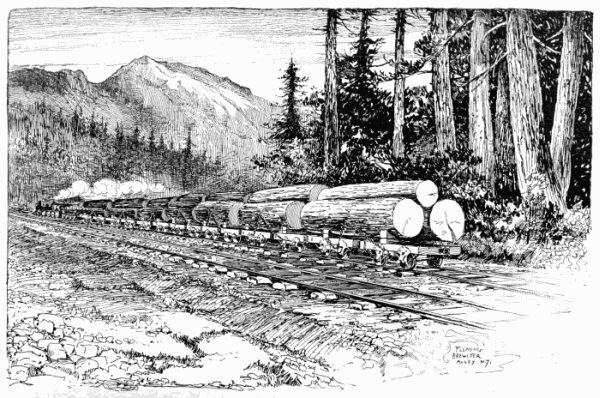
A TRAIN-LOAD OF LOGS ON THE SEATTLE, LAKE SHORE AND EASTERN RAILWAY.
TIMBER.
The great lumber interest will have a larger and richer field on the Seattle, Lake Shore and Eastern Railroad than on any other through line in Washington Territory.Superiority of the timber on the Seattle, Lake Shore and Eastern Railway. On the line of the Northern Pacific Railroad the timber is abundant, but too small for the mill, except in a very few spots. The other roads show but little left close by, and the trees never had the size of those of Snoqualmie Valley. The West Coast road, which will be tributary to the Lake Shore Railroad, will pass through good forests; but, according to my information, the forests on the line of the Lake Shore road are the very best in Washington Territory.
The forest of mill timber beginning in sight of Seattle, continues with some intermissions to the top of the Cascade Mountains. It increases in size and quantity to a point far up on the mountain side, and the trees continue of good size all the way to the top. Crossing the Cascade Mountains, on the east side the trees are quite numerous, but smaller than on the west side, though some of them can be sawed. Continuing eastward, the trees get fewer and smaller, and change from fir to ordinary yellow and bull pine. In the plateau country of the Great Bend there are only scattered groups of stunted trees to be seen, and, excepting a few skirts along the bluffs of the Columbia, no forests of mill timber are to be met with until after passing the Idaho line.
The forests described.I will now review this timber belt with more particularity. After leaving Seattle, there is a somewhat elevated country between the lakes and Puget Sound, which is largely covered with mill timber of medium size. Perhaps two feet and a half would be about the average diameter of the logs. Here, as everywhere, the principal timber, and that most cut and valued, are the Douglas fir and the white cedar.
Continuing along Lake Samamish, and up Squak Creek, these forests continue on both sides at some distance off. A large body of moderately sized timber runs off toward the northeast, covering the hills which lie in front of the mountain range. Passing the Gilman mines, we meet but little large timber until we enterForests of Raging River. the valley of Raging River. Here there is an almost unbroken forest of splendid timber, extending from near the mouth as far up as I went, namely, ten miles from the mouth. The mill timber here would average from six to ten inches more in diameter than that we passed near Lake Washington; and there seemed to be a vast body of it in this valley. As far up on the hill or mountain side as I went, or could see, the trees retain their large size.
At the upper coal mines I found this to be the case to the mountain top, 800 or 900 feet above the river. The trees were not only large, and thick on the ground, but extremely tall and free from knots. I was told that the heavy forest continued a considerable distance above the upper coal mines.
Forests near Hop Ranch.In the Snoqualmie Valley proper are to be found the largest forests and the largest trees. The farmers and hop-growers have destroyed thousands of acres of the finest timber trees on the continent, but many, many thousand acres still remain unbroken. Between Falls City and Hop Ranch the wagon road passed through two or three miles of this magnificent timber. Turning from the road, I ascended the Snoqualmie Mountain, and all the way up to the coal openings I traveled in the densest forest of the largest trees I had ever seen. Passing the cleared country about Hop Ranch, I again plunged into one of these monstrous forests, and traveled three or four miles through it without a break. The sun never touches the earth in these forests. The trees rise to the height of 250 feet or upward, and lock their branches together far overhead, shutting out the sunlight and awing the traveler. Their trunks seem to stand absolutely straight and plumb from the ground to the top. I had studied the long-leafed pine forests of Georgia, Alabama, and Mississippi.Superior to the Long Leaf forests of the Southern States and of the Mississippi Bottom. I had traveled for a hundred miles through that marvelous forest on the Yazoo Delta, where it seemed to me that Nature had done her utmost in covering the ground with vast and lofty trees; but here in the Snoqualmie valley I traveled through forests that for the size, height, and number of trees to the acre, as much exceeded the forests of the Yazoo bottom as the latter exceeded all other forests I had ever seen. The Snoqualmie forest also exceeds all others I have known in the immense quantity of its fallen timber, which renders locomotion off of the trails extremely slow and difficult. The railroad ascends the South Fork of the Snoqualmie. I did not go up the Middle Fork, but was told that the timber is fine in that valley also.
Trees ten feet in diameter.The little Salal Prairie, five or six miles long, and six miles from Hop Ranch, breaks the continuity of the forests, but with that exception, it continues to the pass of the mountain. As to the size of the trees, I feel sure that I saw hundreds that would average ten feet in diameter. I measured two that were by no means singular, and one gave a circumference of thirty-three feet (equal to eleven feet diameter), and the other not much less. There is no doubt that many of these trees are 300 feet in height. I think it likely that theAverage nearly five feet in diameter and 250 feet high. average height of the mill timber on the line of the road from Raging River, for two-thirds of the way up the main mountain (a distance of over twenty-five miles), is 250 feet, and 150 feet of this clear of limbs, and hence of knots. And I think that the average diameter of the butt-cuts of the mill timber would be near five feet. I found my greatest difficulty in estimating by the eye the average number of trees to an acre. I can only say that I not only never saw so many, but I never conceived it possible for such a number of large trees to be supported by the soil of an acre of ground. It was not unusual to see many trees of six to eight feet in diameter standing within ten feet of each other. I knew, of course, that there were single trees in California, and elsewhere, larger than any single specimens to be found here, but I did not know before going to Washington Territory that such forests as these were to be found on the face of the earth.
Lumber product per acre.I shall leave to men better versed in the details of the lumber business than I to estimate the quantity of sawed lumber which would be yielded by an acre of such timber, and by the many thousands of acres which lie on, or near, the line of this railroad. Somebody published that the average yield of the Washington Territory forests would be 30,000 feet to the acre, and this may be, because there is much small and scattered timber; but if this amount be multiplied by six, it would not do justice to the forests I saw in the Snoqualmie valley. There are single trees that would make 30,000 feet of lumber. It is fortunate that the fir and cedar timber are preferred by the lumbermen, as these varieties constitute the larger portion of the forest. Undoubtedly the hemlock will all be wanted at an early day, and so of the larch and the less abundant trees, both evergreen and deciduous.
The bearing of these facts on the interests of the railroad are obvious. Such bodies of timber, standing close to the road for a distance of eighty miles, would of itself guarantee the success of the road for a generation to come.
And there is everything favorable in the position of the timber with reference to the track, especially if the track, in ascending the mountain, can be kept near the river. It is to be hoped that the timber along the right of way will be saved for sawing. It would be no small item in paying for the road.
There will promptly spring up along the whole line both logging-camps and saw-mills. Besides those already in operation, I heard of some large new enterprises projected. The demand for lumber is so insatiable, and the profits of the business so good, that an extensive fresh field like this will be entered with avidity by an army of lumbermen.
AGRICULTURAL PRODUCTS.
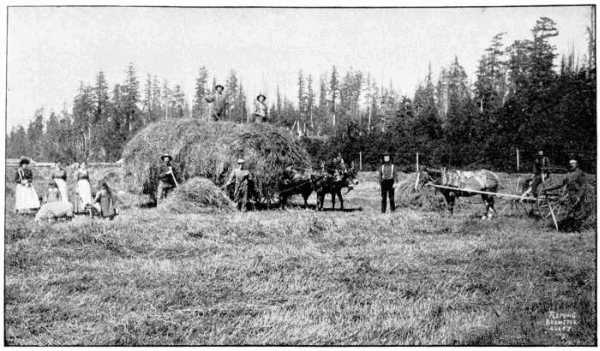
Agricultural freights.The agricultural interest is not so large at present on the west side of the Cascade Range, as the timber, coal and iron interests, but it is growing, and will become exceedingly important. East of the Cascade Mountains this will be the chief railroad interest in the beginning, though ultimately it will be surpassed by the tonnage of the mines. I have heretofore described the soils and vegetable products of West Washington, but would say specially with regard to the belt we are considering, that it is destined to be a fine agricultural region. The bottom lands of Squak Creek, and of Snoqualmie River, including all its branches and tributaries, are extremely fertile, and suited to produce the largest crops of grass, oats, barley, hops, and roots of almost every sort, besides most of the overground vegetables.
HAY-MAKING IN WASHINGTON TERRITORY ALONG LINE OF SEATTLE, LAKE SHORE AND EASTERN RAILWAY.
Produce of Hop Ranch.At my request, Mr. Wilson, the manager, and one of the owners of the Hop Ranch, furnished me the following written statement concerning that estate, which, although larger than any other on the route, is not richer than many other places of smaller size.
MR. WILSON'S LETTER.
Snoqualmie, W. T., Nov. 3, 1887.
Dr. Ruffner.
Dear Sir: In response to your request, I make the following memoranda. Our Hop Farm consists of 1,500 acres of rich alluvial soil; 300 acres in hops, which produce from 1,800 to 2,000 pounds per acre. We also raise 150 acres of oats, producing sixty to seventy-five bushels per acre. From 100 to 150 acres in hay, producing about three tons to the acre. Also large quantities of vegetables, such as potatoes, carrots, turnips and onions. All kinds of root vegetables are prolific except sweet potatoes. Fruits, such as apples, pears, prunes, plums, and berries of all kinds, are in abundance. Last year we had over 5,000 bushels of apples.
At present we ship in about 500 tons per year of merchandise and supplies, and ship out, in the way of hops and other things, from 400 to 500 tons per year. This we could double if we had railroad facilities for shipping. We employ during the winter—that is, in November, December and January—about forty men; the rest of the year, from 75 to 1,200 men and women. The keeping up of this supply of labor, which all comes from Seattle, would be quite an item to the traffic of a railroad. I presume you know that where there are a large number of people employed, they are continually coming and going. In speaking with a railroad contractor the other day, he told me that in order to keep 500 men at work, he had to keep 1,500 on the road. This will also be an important item when the mines are working above here. There are a great many items of interest to which I might call your attention, but I will confine myself to the above at present.
Yours, very respectfully, T. G. WILSON, SECRETARY AND MANAGER OF THE HOP GROWERS' ASSOCIATION.
Farming, fruit and grazing lands.Besides the bottom lands, there are large areas of what might be called table-lands, north and northeast of the lakes, which are top-dressed with glacial drift, but which will be well adapted to the crops of the country, and especially to fruits. And besides the table-lands, the smaller mountains are generally adapted to agriculture, and especially to grazing. My impression, as heretofore stated, is that, ultimately, West Washington will become a great grazing region, though it is generally supposed that East Washington is to be the chief cattle country. But the mild and equable climate, and the abundance of rain, ensures abundant forage summer and winter in West Washington. This will be important for the feeding of cities farther south, as well as for sending canned and refrigerator beef far and wide over the Pacific Ocean. The growth of vegetables, especially of root crops, is something phenomenal on both sides of the Cascade Mountains, and will furnish a large item of commerce, as is shown already by the large shipments of potatoes from Seattle, and the multiplication of canneries.
Hops, barley and beer.The hop interest is a large one, but the low prices of the last year or two have checked the progress of this industry. Breweries have already been established at Seattle, and elsewhere on Puget Sound, and, as the chief materials for beer (barley and hops) are produced here so cheaply and abundantly, we may expect Puget Sound beer to become quite a large item of commerce.
The Snoqualmie and Squak valleys have as yet but a scattered agricultural population, but ultimately farms will be opened along all the streams, and even high up on the Cascade Mountains.
The two great railroads.On the east side of the Cascade Mountains the Seattle, Lake Shore and Eastern Railway will closely parallel the Northern Pacific Railroad for a short distance in the Yakima River valley, but will probably leave it soon after entering the most productive part. The route, however, may be varied to suit circumstances, and as to this point no doubt would be if the talk of making Ellensburg the State capital should become serious. The remark may here be thrown in that this meeting of the two railroads in the Yakima valley will be no disadvantage to the Seattle road, as the distance to Puget Sound is about the same, and the incidental advantages are in favor of Seattle.
The Great Bend country.Crossing the Columbia River, the railway will enter the great plateau which has been so fully described, and if the passage should be made at Rock Island Rapids, it will cross the plateau at its widest part. Nothing more need be said as to the great agricultural capabilities of the plateau country. The Great Bend, or northern limb of the plateau, is more extensive than the southern division, but it is a much less settled country, owing partly to want of transportation, and partly to want of water. This scarcity of water in Douglas CountyDouglas County. was formerly thought to be incurable without a resort to artesian wells; but experiment has shown that wells of good water can be obtained at moderate depths, as I was informed by Mr. Smith, a resident of the county, and by Mr. Nash, the lawyer, who owns property there. The population and, consequently, the business of this large county is limited at present, but it has a large body of good land in it, which will attract settlers before long. Its soil is of the same character as that of other parts of the plateau; but the general impression seemed to be that it was not quite equal to the land of the Snake River Basin, or to the adjoining county of Lincoln, owing in part to a larger proportion of rough land. I do not, however, consider this question by any means as settled. The best area for wheat is supposed to be that which borders on Lincoln County. If the route for the Seattle railway which is preferred by Mr. Mohr, should be adopted, it would pass across the northern part of the county, by many persons considered the best part, and leave the great body of the county out of reach to the southward.
Lincoln County.Lincoln County, through the length of which the road must pass, is universally admitted to be among the best agricultural counties on the plateau. It is also settling up rapidly, and has become a large producer of wheat, even at the disadvantage of a long haul in wagons. Mr. Curtis, who buys much of the Lincoln County wheat for his mill at Spokane Falls, says that the average yield of wheat is twenty-five bushels per acre, though in 1886 (the year of failure) it fell to sixteen and one-half bushels. Captain McGowan, of Lincoln County, also gave twenty-five bushels as the average crop, and said this would hold good for the whole period since the settlement of the county, including the bad year 1886.
Spokane County.By reference of the official map showing the wheat areas, it will be seen that the Seattle railway passes through the middle of these areas in both Lincoln and Spokane counties. The testimony was entirely favorable in regard to horticultural and pomological products, as well as to the agricultural, in the strict sense. The population of the three counties, Douglas, Lincoln and Spokane, was put by Governor Semple at nearly 18,000; about 17,000 of which was in Lincoln and Spokane.Price of farming lands. Much land has been bought with a view to settlement as well as speculation, and this would be occupied and cultivated pari passu with the progress of the railroad, and there yet remains much good land which can be bought at low prices, say from one dollar to five dollars an acre, and will attract settlers. Farming lands here will have market at the mines north of the Columbia River, at Spokane Falls, where there will be a large city, as well as large mills, and at Seattle, where there will be a large demand not only for the city, but for shipping.
Tonnage.No reliable estimates can now be made as to what business this Great Bend country will furnish ten to twenty years hence. We have only this to guide us, namely, that the part of the plateau which lies south of the Northern Pacific Railroad now furnishes 400,000 tons of wheat for transportation annually, besides other freight and passengers; and it has not reached one-half of its producing capacity. Mr. Mohr estimates the income from mail and express as one-fifth the income from freight, and passenger fares as one-quarter of the whole amount from tonnage. Though the country lying north of the Northern Pacific Railroad is much larger in area than that which lies south of it, it may not average as well, and cannot all be controlled by one railroad; but it will certainly furnish large tonnage; much more than is common in agricultural regions.
At present the product of wheat in this region is estimated at 100,000 bushels, but this amount would probably be doubled the first year after the railroad comes, and rapidly increased afterward. Much of the mining business already crosses this territory, and will, no doubt, greatly increase.
COAL.
I have, under the head of Economic Geology, described so fully the coal deposits of Washington Territory, especially the beds along the line of the Seattle, Lake Shore and Eastern Railway, that it remains only to show the application of these facts to the interests of this railway. The Seattle railway passes five coal fields.The road passes five, if not six, separate coal fields between Seattle and the Columbia River, namely, the Squak or Gilman mines, 40 miles from Seattle; the Washington mines, 43 miles; the Raging River, 46 to 50 miles; the Snoqualmie Mountain, 56 miles; the Yakima (or Roslyn), 75 miles; and perhaps the Wenatchie, 140 miles.
So far as appears at present, the Seattle railway will have a monopoly of all these fields except the Yakima or Roslyn. This it will share with the Northern Pacific; but it will have exclusive control of the market between the Yakima and Spokane Falls, which will be almost wholly dependent upon coal for fuel. Also, it will furnish whatever of this coal may be wanted by the mining country north of the Columbia. And in the Spokane Falls market it will have the advantage of bringing the coal by a route fifty miles shorter.
The coal on the west side of the Cascade Mountains will go to Seattle for consumption and shipment, except so much as may be wanted for iron making, and other manufacturing purposes along the line of the road. Coke will be in demand for furnaces, foundries, engines, etc., in Seattle, Spokane Falls, and many other places. But its largest consumption will be in iron furnaces which will be erected for smelting the ores of the Cascade Mountains.Largest shipments from the Gilman Mines.
The largest shipments will be from the Gilman Mines for domestic and steam-boiler purposes. The coal must, of course, come in competition with other coals which are mined within the basin of Puget Sound, but it has an advantage over all competitors in the ease, safety, and cheapness with which it can be mined. This will not, of course, be realized for the first few months whilst driving the entries, but when the mines shall have been fully opened I think it will be without rival in the cost of production.Superior mining advantages of the Gilman Mines. This will be evident from the following report made to me by Mr. Whitworth, showing the disadvantages in the mode of working the other mines of the Territory. The terrible explosion which has lately occurred in the deep mines of Vancouver's Island shows that the Canadians are also working at a disadvantage.
MR. WHITWORTH'S LETTER.
Mr. Whitworth's testimony.
"At Cedar River the coal is all hoisted from a slope, and the gangways run at right angles to the slope, and the 'brests' at right angles to the gangways, or parallel to the slope, or nearly so. The angle of the pitch is about 18°. And the cars are run up to the 'brests' to the working face of the coal, and coal shoveled into the cars. A movable windlass or drum allows the loaded car to haul the empty one up to face of coal.
"At Black Diamond the coal is all hoisted from a slope; gangways at right angles to slope, and 'brests' at right angles to gangways, and parallel to slope. This pitch is a little steeper, about 20° or 22°, but not sufficiently steep for the coal to run. Therefore it has to be shoveled down the slope of the 'brest,' or the 'brest' floor temporarily ironed; and is loaded into car from 'brest' chute.
"Franklyn has both systems, hoisting up a slope, and working on a water-level gangway. They have two slopes, one outside and one inside. This pitch is 45° and more. Gangways run on the strike of veins, and 'brests' up the pitch. Coal runs freely on the floor of 'brests.'
"What it costs now to mine at Newcastle I do not know. The cost of coal above the water-level gangway put into the railroad cars varies from 85 cents (one month only) to $1.50 per ton; $1.10 about the average. For the first six months I do not think we (at Gilman) can calculate less than $1.25 per ton.
"The veins which they work or have worked at Newcastle are No. 4—No. 2, as it is called, which is really Nos. 1 and 2 united—and Bagley vein. No. 4 is worked out on two lifts, the water level, and the one below. The third lift they have not cross-cut to it, as the slope is on No. 2. No. 2 is almost closed on third lift east of Coal Creek. First two lifts, of course, are worked out. And west of Coal Creek the working has progressed nearly to the boundary of their land, and passed the division of the vein into Parts 1 and 2; so that they are getting but little coal out of it. But most of the coal comes from Bagley. Bagley is never worked, or but slightly, when the others are furnishing plenty of coal. Bagley there consists of two portions of about seven feet each, with one to two feet of rock and slate between. In the lower bench there is about four or four and a half feet of good coal; the rest is bony. And in the upper bench there is from three to four feet of good coal, and the balance bony. When they are pressed for coal there is a strong temptation to mine and ship the entire fourteen feet of coal, and bony coal, as it all looks quite well. This temptation, I know, under the old administration, was sometimes yielded to, and I have supposed such was the case now. In fact, in getting that coal some time since for home use, I have several times seen the straight Bagley from top to bottom in the ton. No. 2. The united vein at its best is ten and a half feet, between splendid walls, about one and a half inch mining on the bottom, and a parting near the centre one inch thick. That never disappeared, but increased both ways until the veins were finally separated. No. 2 separate was about five feet clean, at least with no permanent partings. No. 1, about four and a half feet of coal with a three-inch streak of fine clay eighteen inches from the top, the balance clean."
So much from Mr. Whitworth.
Cost of mining coal.Governor Semple puts the prime cost of the coal of the Puget Sound basin generally at from $2.00 to $2.30 per ton, delivered at tide-water; which is, I suspect, below the fact. James F. Jones, in charge of mines on the Northern Pacific Railroad in the Puget Sound basin, reports the cost per ton at the mines delivered on the cars as ranging from $1.00 to $2.50 per ton, averaging $1.75.
The minimum of cost is reached when the seams are of good thickness and comparatively free from slate, and can be entered on the end by a level entry above water and be mined upward; to which may be added natural pitch enough in the seams for the coal to be self-loading; that is, to run by gravity from the upper gangways to the cars on the main entry. And to these conditions may be added a number of different parallel seams close together with their bluff ends all coming up to a line in the most convenient way for entry and delivery. It is rarely the case that such an assemblage of favorable conditions can be found, and where they exist the successful future of the property is absolutely assured.
Cost at Gilman Mines.In my opinion, the Gilman coal seams combine all the advantages above mentioned, and if allowed ordinary rates of transportation, can always be mined at a profit. As long as the Newcastle seams could be worked above water-level the average cost per ton was $1.10, but they never had the same advantages there as at Gilman, and most of their mining has been downward. $1.00 per ton is certainly high enough for Gilman after the entries are driven in sufficiently for large operations. If Mr. Whitworth succeeds in putting out the coal at $1.25 for the first six months, as he thinks he can, there need be no fear as to the future.
Prices of coal.The selling price of coal on Puget Sound has ranged from $3.00 to $5.00 a long ton in former years, averaging $4.00—the price being the same for the product of all the different mines. Mr. Whitworth reports the price this winter at $6.50 a ton for all (including Newcastle), except Cedar River, which is $5.00. The distances from Puget Sound to Portland and to San Francisco, the principal markets, are: to San Francisco, between 800 and 900 miles by water; to Portland, 450 by water, and 150 by rail. There is now rail connection all the way to San Francisco. The average cost of sending coal to San Francisco, either from Puget Sound or Vancouver's Island, is $2.00. The usual price in San Francisco and Portland has been from $4.25 to $6.00 for coarse, and from $2.75 to $3.75 for small. On the 1st of February, 1888, the cargo price in San Francisco was—for Coos Bay coal, $9.50; Seattle coal, $10; South Prairie, $10; Nanaimo (domestic), $10; Nanaimo (steam), $12; Lehigh, $18; Cumberland, $12.
These figures make it evident that a good margin of profit may be calculated on from the Gilman coal. Mr. Whitworth will not be able to get his bunkers up until he has his road in operation to the mines; but, with temporary chutes, he can load 100 tons a day from the time the road opens, say March 15th. In six weeks after beginning he expects to increase to 300 tons a day, and one month later he can make the output 600 tons a day. As the headings are driven in the product can be increased to almost any desired amount.
The Washington Mines, on Squak Creek, I did not see; and concerning the Raging River Mines I have no settled convictions. As to the coking coal on Snoqualmie Mountain, we may expect important developments. Undoubtedly the new road will promptly enter upon a large and increasing coal business.
IRON ORE.
Handling the iron ores.The question here respecting iron ores along this road is not as to their quantity, or quality, or as to their utilization, but only as to what road or roads will handle the business that will arise from this source. Naturally the bulk of it belongs to the Seattle, Lake Shore and Eastern Railway, and at one time there seemed to be no doubt that large iron-works would at once be established at Salal Prairie by the Moss Bay Company, of England; but the east shore of Lake Washington has finally been settled upon for the great plant of this wealthy company; which of itself will go far to establish the natural monopoly which the Lake Shore Railway seems to have of the ores on the west side of Cascade Mountains. And in regard to the magnetic ores generally, this road, from its location, would seem to be master of the situation. All the iron ore on the west side of the mountain is owned by men whose interests are identified with Seattle, and with this line of railroad.Furnace sites The best point for manufacture in itself considered, the best chance for fuel, the best line for transportation, the best point for trading and for shipment, are all on the line of the Seattle Railway. Good furnace sites may be found at many points, but Salal Prairie is a spot which seems to have been set apart by nature for a manufacturing town.Salal Prairie. It lies near the intersection of the valleys of the South Fork and Middle Fork branches of Snoqualmie River, is about six miles long and three miles wide, is flat, dry, salubrious, and well supplied with water. It has a natural outlet to the South, as well as to the east and west, is convenient to the iron ore and limestone of both the Middle and South Fork, and not far distant from the ores of Cle-ellum. It is less than ten miles from Snoqualmie coking coal,Charcoal cheaply produced. and fifteen miles from the Green River coals. And, what I think is a still better resource for fuel, it is in the midst of the great Snoqualmie forests, where saw-mills will soon be felling the timber, and providing an endless supply of slabs and refuse tree-tops, from which charcoal could be manufactured at very small expense.
It is well known that charcoal is the best of all fuels for making iron, because of its freedom from damaging impurities. Its expensiveness generally prevents its being much used now, but here the cost need not exceed five cents per bushel, and 100 to 120 bushels would suffice for a ton of iron. The only question concerning the charcoal made from fir timber is as to its ability to bear the burden in a tall stack. It is becoming common now to utilize the by-products of wood, formed during its conversion into charcoal, by a process which makes the charcoal stronger. But all difficulty on this point can be relieved by conforming the size of the furnace-stack to the strength of the charcoal. This is the only fuel which has ever been used on the Pacific coast for the smelting of iron ores. These enterprises have not been particularly successful thus far, rather because of the inferior quality of the ore, than from any defect in the fuel. The bog ore and the limonites which were used at Irondale, near the Canada line, and at Oswego on the Willamette, were generally low in iron and high in phosphorus, and the bog ores were soon exhausted.
Quantity of charcoal to the ton of iron.At Irondale, near Port Townsend, recourse has been had to a refractory ore obtained on Texada Island, in Victoria Sound, on which a duty of seventy-five cents a ton has to be paid, and which requires a large amount of fuel for smelting it, perhaps as much as 150 bushels of charcoal. But Mr. H. T. Blanchard, who is interested in the Irondale Works, says in a late letter (November 29, 1887):
"It is perfectly safe to rate charcoal at six cents per bushel, and the quantity necessary to make a ton of pig-metal not to exceed 120 bushels, with a good chance of getting it down to ninety bushels per ton with fair ores."
The iron ores of the Cascade Mountains will be taken to some extent to mix with the inferior ores near the coast, but they will be chiefly worked into Bessemer-pig and steel rails.Bessemer ores commonly distant from fuel. Steel-making ores are not common anywhere, and are widely separated from fuel, which makes them very costly in the States east of the Rocky Mountains. This well-known fact is alluded to by Mr. Swank, in his report on the Iron Trade of 1886, in the following words:
"It is also a fact worthy of notice, for which geologists may find a reason, that nowhere in this country are our best steel-making ores found in proximity to mineral fuel, either anthracite or bituminous, while in some parts of the Lake Superior region, even timber suitable for the manufacture of charcoal is almost wholly wanting."
High cost of Lake Superior ores.The most important deposits of steel ores in the United States are on Lake Superior and in Missouri; but these ores are smelted chiefly by the Connellsville coke of Pennsylvania, which is 700 to 800 miles distant. The Cranberry ores of North Carolina are some hundreds of miles from fuel. A late number of the Iron Trade Review quotes the prices of ore at Cleveland, Ohio, the principal receiving point of Lake Superior ores, as follows:
Specular and Magnetic Bessemer, per ton$7.00 to $7.50
Bessemer Hematites" 5.75 to 6.70
Cost of producing ore in Pennsylvania.The same authority gives the cost of the ore and coke necessary for the production of a ton of iron in Mahoning Valley district, at $9.90 for the ore and $4.50 for the coke = $14.40. To this must be added about $4.25 for flux, labor, management, interest and repairs, making a total of $18.65 as the cost of producing one ton of pig-metal.
Cost of Bessemer-pig in Snoqualmie Valley.Thus the superior advantages of the Snoqualmie Valley are readily seen. Here are steel ores, two kinds of fuel, and the limestone in close proximity. Putting the fuel at more than I think it would cost; putting the cost of mining the ore at the maximum cost at Cranberry, N. C., and freight at double price, and we have as the cost of a ton of Bessemer-pig, as follows:
Ore$3 00
Fuel6 00
Flux50
Labor and management2 00
Interest and repairs1 50
$13 00
This is lower than the present cost of producing Bessemer-pig anywhere in the United States, according to the best of my information; and at the same time the market is better.Large market for steel rails. The demand for steel rails in the Rocky Mountain country and in the Pacific States is, and will be, large and permanent, while the demand in China and other foreign countries will constantly increase. And so will it be with machinery and tools of all kinds, agricultural, mining and manufacturing. This demand will be both domestic and foreign, and constantly enlarging. And it may be safely asserted that no railroad exists, or can be built anywhere in the Pacific States, which will compare with the Seattle, Lake Shore and Eastern Railway in its control of the iron business.
THE OTHER MINERALS.
Limestone.I have already said so much as to the convenience and excellence of the limestone beds associated with the magnetic ores,Marble, granite, sandstones, slates. that I will only allude to them here as constituting the great resource for furnace-flux, for building-stone, for lime, and for monumental and ornamental marble. This will be an important item for transportation. The granite, also, will be wanted for building, and for paving blocks. There are, no doubt, quartzites, sandstones and slates which will be in request; some for the supply of silica needed for tempering fire-clay (which latter is reported to have been found on Cedar River in large quantity and of good quality); some for road metal; some for paving; some for building.
Precious and base metals.In this group, however, the great resource is in the ores of the precious and base metals, which have been fully described under a former head. Too little is known of the silver and lead and gold ores of the Snoqualmie Valley to lay much stress upon them. The indications do not justify us in ranking them with the ores of the Columbia Valley.
The gold placer mining of the Yakima country makes no large show so far. The silver, lead and copper ores, described by Mr. Burch, may develop largely, but as yet no calculations can be made as to their value in supplying tonnage. This field ranks with the Wenatchie, Chelan, and Methow regions, being undeveloped, and yet so full of promise as to deserve careful attention.
Okinagane, Colville and Kootenai.The mines of the Okinagane and Colville regions promise large results. All this mineral region, up to and including the Okinagane, lies fairly within the patronage ground of the Seattle Railway as it pursues its course to Spokane Falls. The Colville and Cœur d'Alene, to which may now be added the Kootenai, mining regions, constitute a large area lying north and east of Spokane Falls, and offer themselves as possible routes for the Manitoba Railway, but chiefly as tempting fields for railroad enterprises. The city of Spokane Falls is deeply interested in bringing in the trade of these growing mines, and the Seattle Railway corporation may wisely consider the prizes here offered.
Cœur d'Alene.Railroad building has begun in the Cœur d'Alene country. The Cœur d'Alene Railway and Navigation Company have constructed a narrow-gauge road from the Old Mission, near the junction of the north and south forks of the Cœur d'Alene River,Transportation lines to the mining regions. a distance of about thirty-five miles. The tonnage is said to be much greater than this narrow-gauge can handle at present.
From the Old Mission, which is now the terminus of the narrow-gauge road, the ores are taken by steamboat and barges down the Cœur d'Alene River, and up the lake to Fort Cœur d'Alene, where connection is made with the Spokane Falls and Idaho Railroad, running from Fort Cœur d'Alene to Hauser Junction, on the main line of the Northern Pacific Railway. This arrangement enables the mines to send out and bring in their freight, but it is not satisfactory. There seems to be an opening for a line from Spokane Falls directly into that country. It would cost $20,000 a mile, by Mr. Mohr's calculation, and would be seventy-five miles long. If, however, it be true, as reported, that the Northern Pacific Railroad will make a cut-off from Missoula across the Cœur d'Alene Mountains, this field will be occupied; which, however, is not probable.
The Chewelah, Colville, Summit, Metalline and Kootenai mining districts could all be reached by a line from Spokane Falls by way of Colville and Little Dalles. And by running a spur from Colville to a point below Kettle Falls on the Columbia River, control could be gained, first, of the navigation between Mahkin Rapids and Kettle Falls, and also the long stretch of navigable river from the Little Dalles to Death Rapids in Canada, crossing the Canadian Pacific Railroad at Farwell. It is calculated that 750 miles of navigation would thus be opened by the addition of a piece of track twenty-five miles long, connecting the Kootenai River with Arrowhead Lake.
A new discovery of silver-lead ores, made on the Kootenai Outlet River, is making a great stir just now. The body of ore is said to be the largest yet discovered. We shall expect the Manitoba people to be looking into this development. There is also some talk of the mining region on both sides of Kettle River, near the Canada line. The Pend d'Oreille district is also promising. All this is suggested as food for thought and investigation.