A GENERAL ACCOUNT OF WASHINGTON TERRITORY.
Reading edition
HISTORICAL.
Denny, of Denny Mines.The first white man who ever settled near the site of Seattle (Mr. Arthur A. Denny) now lives in that city, and can scarcely be called an old man. The country remained unsettled so long, partly because of its inaccessibility from the East, and partly because it was disputed territory between the United States and Great Britain. It became a separate Territory only in 1853.Causes of delay in settlement. No transcontinental line of railroad touched any part of Washington Territory until four years ago, when the Northern Pacific passed across the eastern part of the Territory, and united with the road along the Columbia River, which had been built by the Oregon Railway and Navigation Company, and which had barely entered this Territory. Following this line to Portland, Oregon, and then completing the road from Portland, northward, the railroad reached Puget Sound at Tacoma by this circuitous route in 1883.
The Northern Pacific Railroad has, during the present year (1887), succeeded in reaching Tacoma by a more direct, though still angular, line, crossing the Cascade Mountains at Stampede Pass.
Whilst thus comparatively unknown and inaccessible, it is not surprising that population should at first come in slowly. Those who came to Western Washington were chiefly lumbermen. Since that time farmers have settled large tracts of country, commerce has become large, and now every interest is going forward with great rapidity.
The population in 1880 was 67,000.Population of Washington Territory. Governor Semple, in his report for 1887, puts the population at 143,669, which shows a gain in seven years of over 100 per cent. But the Governor himself declares that the enumerations made since 1880 are unreliable, and it is claimed by intelligent gentlemen in Seattle that the present population exceeds 175,000. It is increasing rapidly day by day. The fact seems suddenly to have burst upon the country at large that here, in this neglected corner, is a wide region offering perhaps the richest inducements to immigration of any part of the United States.
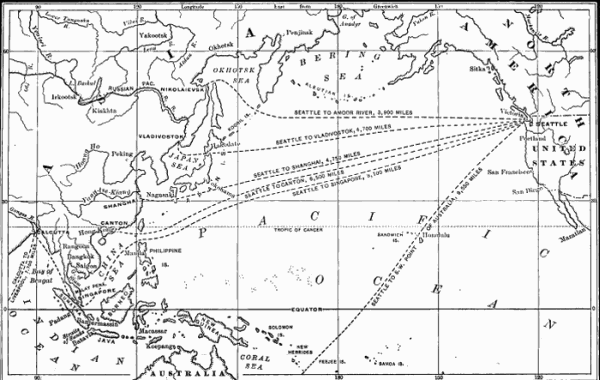
MAP OF ASIA AND PACIFIC OCEAN.
LOCATION AND MARKET.
(This should be read with a map of Asia and Pacific Ocean.)
In spite of Oriental exclusiveness, now broken down, the Asiatic trade has always formed a large element in the commerce of the world, and has long been sought by the great maritime powers of Europe, especially by England. For this she conquered India, and seized upon many islands of the ocean. For this she battered in the gates of China, and established herself permanently at Hong Kong, at the entrance to the River of Canton.
In these countries,Majority of the human race in the countries of the Pacific. and upon these islands, live more than half the human race, and with all the barbarism of some, and the old-fashioned civilization of even the best, the large majority of these people are producers of a multitude of articles wanted by the civilized world. And of late these peoples have become possessed with a strange desire to avail themselves of the products of European and American art. This market will not only grow rapidly in its demands, but the currents of trade will be diverted from Europe to America. In fact, the settlement of the west coast of America inaugurated a revolution greaterChange in the currents of trade. than that which substituted the voyage around the Cape of Good Hope for the camel train across the Asiatic continent. It gave America a standpoint from which she would ultimately wrest the bulk of the vast trade of the Orient from Europe. The cutting of the Suez Canal mended the hold of England and other maritime European states on the Oriental market, in fact secured for them the advantage of a shorter line to the Southern Asiatic market as far as the Malay Peninsula; but as for the rest of that great market included in the Pacific Islands, the Chinese Empire, Japan and Siberia, the revolutionary movement has commenced, whereby the bulk of that trade will be taken from England and Holland by the merchants of San Francisco and Puget Sound.
The trade of ChinaThe China trade. alone has been estimated at $130,000,000 per annum, the greater part of which is absorbed by England, and the annual value of the export and import trade of England with the Pacific Islands has been put at $75,000,000. This already immense market may and will be enlarged, especially in China, by means of railroad and steamboat connections, which will bring to the coast the products of the interior sections. Much of the China trade now goes overland into and through India, and also through Siberia, to be consumed by the way, or pushed through to the termini of European railroads and ship-lines which are reaching to get it. And, as the transportation becomes better, so will the production increase. Railroad building, until lately forbidden in China, has now commenced, and will, in the nature of the case, go on rapidly. The result will be to bring most of the trade to the Pacific coast, and thus reverse all the interior movements.
Even the capital of the Empire, the great Peking, and the productive region around it, have depended largely on the overland trade to Europe, and especially on the great Russian market opened annually at Novgorod. It only needs a railroad from the back country, through Peking direct to the coast, to bring this large trade under American control. Mr. James G. Swan (Hawaiian Consul) has written a valuable pamphlet on the regions drained by the Amoor River, in which he shows that there is an immense trade "now lying dormant in Siberia, Mongolia, Manchooria, Northern China, Corea and Japan, which will be brought into active life and diverted to the American shore of the North Pacific Ocean by the great continental railroads which will have the outlet of their commerce through the Straits of Fuca."
He gives the population of these countries as follows:
Siberia4,000,000
Mongolia12,000,000
Manchooria5,000,000
Japan36,000,000
—————
Total57,000,000
The Amoor RiverThe trade of the Amoor River, Japan, etc., with its great Chinese tributary, the Songaree, furnishes over 2,600 miles of steamboat navigation (a second Mississippi), but, owing to a great bend to the south, the Amoor can be reached by a short line of railroad from the Russian port Vladivostock, or Poisette Harbor. Japan lies on the way from Puget Sound to the region referred to. Major Collins, some years ago, said in a letter to Secretary Marcy concerning this market: "One item, cotton fabrics, might be introduced to the amount of millions yearly; then there are many products of these countries that could be received in exchange. This must be done through the Amoor and its affluents. It can hardly be estimated what a revolution in trade and commerce can be effected in this region; and the fondness of the people for luxuries and foreign merchandise being very great, if the means of procuring them were facilitated and the prices cheapened, the consumption would be immense, and in a few years a trade of many millions would be effected."
Major Collins thought that these people would consume annually five dollars per head of American goods; Mr. Swan estimates two dollars per head. These goods would be paid for in silks, tea, rice, furs, skins, wax, fossil ivory, plumbago, tin, precious stones, naval stores, etc. It is said that the overland trade of North China to Russia now requires for its transportation a caravan line of 36,000 camels and bullocks, and 100,000 horses, and that the Siberian trade is as large as that of China. The tea sold at Novgorod amounts to $5,000,000 each annual fair. The caravan tea is preferred to the ship tea, which is said to be injured by the voyage through the tropics; another argument for the North American route.
Since Mr. Swan'sThe new railroad across Siberia to St. Petersburg. pamphlet, the news comes that the Russian Government is now actively engaged in building a railroad from St. Petersburg across Siberia to Vladivostock on the Japan Sea; and the expectation is general that this imperial power will seize Corea so as to bring the terminus of her railroad to Ninsen at the south point of Corea. All the great trade which will thus be developed is in addition to the existing trade of China and the Islands, and will probably swell the China, Japan and Russian trade to over $200,000,000, to which is to be added the Australian and Island trade, which already is, no doubt, over $100,000,000.
The American Pacific States have decisive advantages over all others in controlling the Pacific trade.Now comes the practical question, Who are to handle this vast trade of $300,000,000 annually? No one nation exclusively, of course. The Dutch and other small powers will have a little of it; but the only contest will be between England and the American Pacific Coast. England has the lion's share now, but this great nation will hereafter labor under too many disadvantages in its contest with America. America has the needful capital, material, pluck and energy, and enjoys certain decisive advantages, as, for example—1. In distance, which of itself would in this case decide the matter; 2. In the local production of certain staple articles which will be in great demand, and which England cannot supply so cheaply, if at all, such as lumber, meats, flour, canned goods, cheap cottons, and agricultural and other machinery, which, if not cheaper, can be more readily adapted to the wants of the market; 3. In possessing the back country of Eastern America, whereby the entire United States become tributary both ways to the Pacific commerce; to which may be added, 4. The ever-flowing river in the Pacific Ocean, flowing in a circle from Japan to the American coast and back—the famous Kuro Shiwo, or Japanese current; a current which gives a gain to every ship of twenty miles a day in distance; the current which brings the disabled Japanese junks to the American coast.
The half-way point on the Pacific side between America and England is the Malay Peninsula. This leaves even Australia and all of OceanicaAdvantage in distances. nearer to us than to England, and all of China, Japan and Siberia thousands of miles nearer to us. Hong Kong and Canton are the English headquarters in China, and yet our Pacific coast is 5,000 miles nearer to these than England is. It is also 6,500 miles nearer to Shanghai, which is a more important port than Canton, because of its greater nearness to the rice and tea producing sections. The advantages are still greater in respect to Peking, Japan, Vladivostock, the terminus of the projected Russian railway, and the entire country drained by the Amoor. Our commerce is now within thirty days of the coast of China, and will be in less than ten days when the fast mail and express and passenger steamers are launched. I insert a table of distances, which is full of significance.
ROUGH ESTIMATES OF DISTANCES.
MILES
Puget Sound to mouth of Amoor River3,900
" " " Vladivostock4,700
" " " Shanghai5,750
" " " Canton6,500
" " " Singapore8,100
" " " S. W. point of Australia9,550
San Francisco to Vladivostock5,200
" " " Shanghai6,100
" " " Canton6,800
" " " Singapore8,400
" " " S. W. point of Australia9,500
" " " St. Petersburg via Vladivostock9,700
St. Petersburg to Vladivostock4,500
San Francisco to Calcutta10,200
Liverpool to mouth of Amoor River13,550
" " Vladivostock 12,700
" " Shanghai 11,750
" " Canton 10,900
" " S. W. point of Australia 10,750
" " Singapore 9,300
" " Calcutta8,700
Liverpool and Puget Sound are about equally distant from west coast of the Malay Peninsula.
MILES
New York to Canton, via Puget Sound9,500
" " Shanghai " " 7,800 to 8,000
By this it will be seen that New York, by way of Puget Sound, is 1,400 miles nearer to Canton than Liverpool is, and nearly 4,000 miles nearer to Shanghai. Mr. Swan makes the distance from the Pacific coast less than I have given. It should also be noted that Puget Sound has the advantage of distance over San Francisco also.
Puget Sound has also the advantage over all competitorsAdvantage in productions. of being able to produce a large bulk of the materials for commerce in its own vicinity. In this report there will be a large array of facts concerning the present and future productions of Washington Territory, which will amply confirm and illustrate the above statement. The only real competitor of Puget Sound on the American coast is British Columbia, but British Columbia cannot vie with Washington Territory in the production of the materials of commerce, and Canada at large furnishes no such background as the United States.
Coastwise trade.It will, of course, not be overlooked, that in the great coastwise trade which the Pacific States have and must always have with each other, they will minister to each other's prosperity. And here it will be shown that Puget Sound will have the advantage in supplying the wants of others.
South American trade.In addition to these is the foreign trade along the coast of British Columbia, Mexico, Central America, and all the Pacific States of South America. Chili is a prosperous State. She has nearly doubled the volume of her trade in ten years. From 1874 to 1883 her exports went up from $32,000,000 to $73,000,000, and her imports from $35,000,000 to $50,000,000. The United States imports over $4,000,000 of goods from the Pacific side of South America, and exports about $8,000,000 to these states. England, however, gets the most of the West South American trade, so that here again we must enter the lists with Britannia. Already the contest has begun, and our Pacific States must bear off the palm sooner or later.
Large existing trade.Thus it is evident that a vast field of commercial enterprise is wide open to the people of Washington Territory as well as to Oregon and California. And our commercial statistics show what handsome progress has already been made. Taking both exports and imports, there is already a business of $80,000,000 done by the seven Pacific ports of entry. San Francisco is now far ahead of the others, and this city has nothing to fear from any other port except Puget Sound, which will gain upon her rapidly and ultimately surpass her. Washington Territory has all that California has on which to trade, and a great deal besides; and has the advantage of position. When our commercial statistics were made up, Puget Sound had no direct railroad communication with her own back country east, much less a transcontinental line. A very different story will be told a few years hence. I here insert a table of summaries which show that the commercial revolution is now in operation.
PORTS OF THE PACIFIC.TOTAL VALUE OF EXPORTS OF DOMESTIC MERCHANDISE FOR YEAR ENDING TOTAL VALUE OF IMPORTS OF MERCHANDISE FOR YEAR ENDING
JUNE 30, JUNE 30, JUNE 30, JUNE 30,
1885.1887. 1885. 1887.
Humboldt, Cal.$201,500$1,731
Oregon 1,928,829 161,170
Puget Sound, W. T. 1,877,485 238,036
San Diego, Cal. 65,654 71,106
San Francisco, Cal. 37,082,520$32,027,995 35,040,350$40,707,708
Willamette, Oregon 4,142,156 277,386
Wilmington, Cal. 252,673 187,348
$45,550,817$35,977,127
In the latest report to which I have access, San Francisco is the only one of the Pacific ports mentioned separately.
Much of the exports above reported to the credit of Oregon really came down the Columbia River from the eastern part of Washington Territory; and the great bulk of the exports from San Francisco consists of wheat, flour, and other breadstuffs, an item in which Washington Territory can surpass all competitors. The following table shows the principal items of export from the Pacific ports.
Let it be noted that in respect to the production of the larger items, to wit, wheat and flour, wood and its manufactures, animals, iron and steel and their manufactures, machinery of all sorts, fish, etc., Washington Territory can surpass all competitors.
PRINCIPAL EXPORTS OF DOMESTIC MERCHANDISE, YEAR ENDING JUNE 30, 1885.
PORTS ON THE PACIFIC.APPROXIMATE VALUES.
Humboldt, Cal.$165,000Wood, and Manufactures of.
Oregon, Oregon { 1,493,600 400,000 32,000Canned Salmon. Wheat and Flour. Wood, and Manufactures of.
Puget Sound, W. T. { 830,000 240,000 160,000Wood, and Manufactures of. Wheat and Flour. Animals.
San Diego, Cal. { 58,000 4,000 1,800Animals. Wood, and Manufactures of. Machinery.
San Francisco, Cal. { 27,226,000 1,211,000 900,000 745,000 700,000 650,000 430,000 375,000 358,000 Wheat, Flour, and other Breadstuffs. Manufactures of Iron and Steel. Fish. Ginseng. Cotton Manufactures. Wood, and Manufactures of. Fruit. Gunpowder, etc. Medicines, etc.
Willamette, Oregon { 3,339,153 704,000 37,000Wheat. Flour and Breadstuffs. Wood, and Manufactures of.
Wilmington, Cal. { 211,928 33,600Wheat. Honey.
Note.—Humboldt, Oregon, San Diego, Willamette, and Wilmington have almost no exports except those included in this list. Puget Sound and San Francisco have a great variety of exports.