APPENDIX C.
Ernest Georg Ravenstein translation
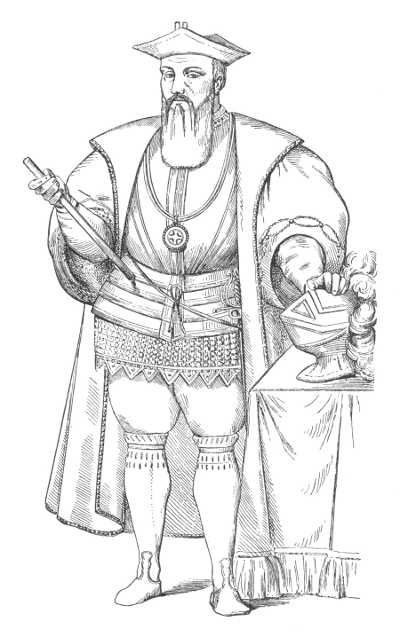
Vasco da Gama. (From a Paris MS. of Barretto de Rezende.)
THREE PORTUGUESE ACCOUNTS OF VASCO DA GAMA’S FIRST VOYAGE (1608-1646).
I.—Jornal das Viagens dos Portuguezes as Indias, 1608.
The late Visconde de Santarem, in his Noticia dos Manuscriptos, 2nd edition, Lisbon, 1863, p. 93, draws attention to the existence of a MS. in the Bibliothèque Nationale at Paris, which in his opinion furnishes most valuable chronological information on the Portuguese voyages to India, from 1497 to 1632. We have translated from this codex all that refers to the first voyage of Vasco da Gama; and a perusal of the translation will, we think, convince the reader that he has before him, not a document based upon authentic sources, but a compilation of very doubtful value.
We have examined three copies, or rather editions, of this Jornal das Viagens dos Portuguezes ás Indias, viz.:—
1. Bibl. Nat. Port. 8, No. 85. This is the earliest of the three MSS., for it only extends to the year 1608. On folio 206b is a statement to the effect that it was copied in 1618 from a MS. in the possession of the Conde de Vidigueira.
2. Bibl. Nat. Port. 46. This, formerly, bore the number 10023, and is the MS. described by Santarem. It is identical with Port. 8, except that its information is extended to the year 1632.
3 British Museum Add. MSS. 20902. This is the MS. quoted by Dr. Walter de Gray Birch (The Commentaries of the Great Afonso Dalboquerque, ii, p. xvi). It is still more recent than the preceding, having been extended by an unknown author to the year 1653. A list of the Viceroys up to 1610 is appended. The marginal notes are derived from Pedro Barretto de Rezende’s Livro das Armadas.
The Year 1497.
On the second of June, 1497, there set sail from Lisbon for the discovery of Oriental India, Vasco da Gama, the second son of Estevão da Gama, comptroller (veador) of the household of the King Don Affonso V, and of Doña Isabel Sodré, his wife, as captain-major of four vessels: himself in the São Raphael; Paulo da Gama, his elder brother, in the São Gabriel; Nicolao Coelho in the São Miguel.
Gonçalo Nunes was captain of a vessel carrying provisions, which this side (antes) the Cape of Good Hope were transferred to the other vessels, when he returned to this kingdom [of Portugal]. And the vessel S. Gabriel, in which went Paulo da Gama, being much dilapidated, so as to be unable to continue the voyage, was broken up for the purpose of repairing the other vessels, in a river of Cafraria, beyond the Cape of Good Hope, which was named the river of Mercy. And Paulo da Gama went over to the vessel of his brother, while his people were distributed among the two vessels. Thence they continued their voyage.
Having come to an anchor at Moçambique, where the Sheikh attempted to take the vessels by treachery, they disembarked at the island of São Jorge, where was celebrated the first mass beyond the Cape of Good Hope. Thence they went to Quiloa and Mombaça, and the kings of all these islands attempted to act treacherously, but God would not permit their success.
At Melinde the King made them honestly welcome, and gave them trustworthy pilots, who guided them to Angediva, where they fought the fustas of the Sabayo, the governor of Goa, over whom they gained the victory. And thence they went to Calicut, where the Samori planned many treacherous acts which took no effect. Thence they went to Cochin, where the King received them well, and to Cananor, in the same manner. There they completed the loading of the two vessels, and returned to this kingdom, arriving safely at Lisbon on September 18th, 1499.386
Paulo da Gama died of an illness in the island of Terçeira, at the city of Angra, and lies buried in the monastery of São Francisco of that city.387
II.—Luiz de Figueiredo Falcão, 1612.
Luiz de Figueiredo Falcão was secretary of King Philip II of Portugal (Philip III of Spain), and is the compiler of a Livro em que se contem toda a Fazenda, & Real Patrimonio dos Reynos de Portugal, India, ilhas adjacentes de sua coroa, which was printed by order of the Portuguese Government in 1859.
The Preface is dated “Madrid, October 20, MDC.VII”, but this is evidently a misprint, for reference is made in it to a list of captains who went to India since 1497 as containing information up to the year 1612; and instead of VII, we ought therefore to read XII, the date of the book being thus 1612.
The author had access to the original records in the India House, and claims to have expended three years upon the compilation of his work, which certainly contains a mass of information of the highest interest. Nevertheless, his book is not free from errors, many of which have already been pointed out by Cunha Rivara in an Appendix to a translation of the Viagem de Francisco Pyrard, published at Nova Goa in 1858. Texeira de Aragão (Boletim, Lisbon Geographical Society, vi, p. 578) also warns against accepting without question all the statements made by this author.
We quote the following information on Vasco da Gama’s first voyage from a “List of Captain-majors and Captains who went to India since 1497”, p. 137:—
1497.
In the year 1497 there departed for India Vasco da Gama, the first discoverer, as captain-major of four vessels. He left Lisbon on July 8th, 1497.
São Miguel, flagshipPilot: Pero d’Alenquer.
São RaphaelCaptain: Paulo da Gama, brother of Vasco da Gama. Pilot: João de Coimbra.
BerrioCaptain: Nicolao Coelho. Pilot: Pero Escolar.
A ship (nao)Captain: Gonçalo Nunez, a retainer of Vasco da Gama. She carried provisions.388
The Berrio, with her captain, returned and reached the bar of Lisbon on July 10th, 1499.
Vasco da Gama went from India to Cape Verde, where he remained with his brother, Paulo da Gama, who died there, and whose body he conveyed to the island of Terçeira, and he sent one of his servants with the São Raphael to Lisbon.
Vasco da Gama himself reached Lisbon in a caravel on August 29th, two years and nearly two months after he had left that port.
It is scarcely necessary to point out that the flagship was the São Gabriel, and that Paulo da Gama came back in that vessel and not in the store-ship. It was, indeed, Paulo’s own ship, the São Raphael, which was burnt off Tangáta.
As an instance of the author’s inconsistencies, we need only quote the following passage from a “Summary Statement of Vessels which left Portugal for India”, p. 194:—
Between July 10th, 1499, on which day there arrived in the port of Lisbon the ship São Raphael, in which Vasco da Gama had gone to India in 1497, and 1612, there came back from India 425 vessels.
It was the Berrio which came back on July 10th, the São Raphael having been burnt off Mtangata; and Vasco da Gama did not go in the S. Raphael, by the author’s own (erroneous) statement.
III.—Pedro Barretto de Rezende, 1646.
Captain Pedro Barretto de Rezende, a professed Knight of the Order of St. Benedict of Aviz, and a native of Pavia,389 is the author of a Livro do Estado da India, consisting of three Parts and an Appendix, of which MS. copies exist in the British Museum (Sloane Collection, No. 197) and the Bibliothèque Nationale (Port. 1, and Port. 36). Part I of this work contains a succinct account of the doings of the Viceroys of India up to 1634, and gives portraits of all of them; Parts II and III contain plans of the Portuguese forts between the Cape of Good Hope and China, with descriptions; whilst the Appendix furnishes an account of the “armadas” or fleets which were sent to India up to 1605.
Dr. Walter de Gray Birch (Commentaries of the Great Afonso Dalboquerque, i, pp. vii-xiii) has given an account of the MS. of this work existing in the British Museum.
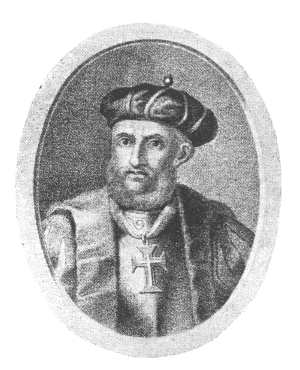
Vasco da Gama as Viceroy. (After Correa’s portrait in the Palacio do Governo, at Goa.)
If this valuable document should ever be printed, it will be necessary to collate the copies existing in London, Paris, and probably also elsewhere, for they are not in all respects identical. Port. 36 seems to me to deserve the preference as far as respects Part I, but Part II (the description of the forts) has been abridged, as compared with Port. 1. The portraits in this latter are more neatly done than in Port. 36. No reference to the source of these full-length portraits is made by the author. They certainly differ from the portraits designed in 1547 by a native artist under the supervision of Gaspar Correa, and published in the Lisbon edition of his Lendas (see t. iv, p. 596). Lord Stanley (Vasco da Gama, p. ix) says that Correa’s portraits are “better” than those in Rezende’s work. All that we can say is that they are not worse. Our full-length portrait is from a MS. of Barretto de Rezende in the Bibliothéque Nationale, as reproduced in Charton’s Voyageurs anciens et modernes. The small oval portrait is from a copy of Correa’s painting which was made by order of D. Francisco, da Assumpção de Brito, who was installed Archbishop of Goa in 1774. It was first published in 1817 in a work entitled Retratos e Elogios de Varões e Donas.
First Voyage, 1497; Four Sails.
King John II of Portugal having died without a legitimate son, Dom Manuel was proclaimed King on October 27th, 1495; and as this fresh dignity entailed that he should prosecute the undertakings initiated by his predecessors, he proposed to himself to go on with the discovery of Oriental India by sea, which, seventy-five years before, had been set going.
In 1496 he had many councils on this affair, and in consequence of the resolutions arrived at he agreed (assentou) to despatch on this enterprise one Vasco da Gama, and forthwith arranged for the fleet to be sent, the work upon which was carried on with such expedition that rigging and all was ready by Saturday, July 8th, 1496.
The fleet (armada) only included three ships of from 100 to 320 tons, and there went in them, between sailors and soldiers, 260 persons. In addition there was a ship carrying provisions.
The flag-ship, in which Vasco da Gama, the captain-major, embarked, was called the São Gabriel, and Pero de Alemquer was the pilot. The second ship was called the São Raphael; Paulo da Gama, the brother of said Vasco, was captain, and João de Coimbra, pilot.
The third vessel was called the Berrio; Nicolao Coelho was her captain and Po. Escolar her pilot.
Gonsalo Nunes, a retainer (criado) of Vasco da Gama, was captain of the cargo-ship (nao); only provisions went in her. These, as also the crew, having been transferred to the other ships at the Cape of Good Hope, they set fire to her.
They set sail from the bar of Lisbon on July 8th, 1497, arrived at Moçambique on March 1st, 1498, made Mombasa on Palm Sunday, the 7th of April,390 and Melinde on the 15th of the same month.
There he took pilots to guide him to India, and on May 16th of the same year, ’498,391 he made the land at a port on the coast of Mallavar (Malabar), in the kingdom of the Samorim, two leagues below Callecut, which is the principal city and capital of that kingdom. There he remained seventy-four days, in the course of which, induced thereto by the Moors who live in that country, he practised upon us a thousand deceits. But having discovered that for the sake of which he had been sent, namely, India, of which he was able to take home such good intelligence, he determined to return to Portugal, and set sail on August 29th of this same year, namely, ’498. At the Anjediva islands he careened the ships and took in water, and there he took a Jew who, by order of Sabayo, the King of Goa, had visited him, it being the intention, immediately after the return of this Jew, to send a fleet against him (Vasco da Gama).
Vasco da Gama departed thence and made the coast of Melinde. Wishing to depart thence for this kingdom, the ship São Raphael, in which was his brother, was lost on the same shoals on which she had already once grounded on the way out to India. The loss of this ship did not give much concern to Vasco da Gama, for he was short of men, and those in her were distributed among the two other vessels. He passed Moçambique, doubled the Cape of Good Hope on March 20th, 1499; when near the Cape Verde Islands a severe storm separated the two vessels, namely, that in which he (Vasco) was from her consort in which was Nicolau Coelho, who, leading, lost sight of Vasco da Gama, and reached the bar of Lisbon392 on July 10th of said year.
Vasco da Gama only arrived on August 29th in a caravel, for his brother, Paulo da Gama, being very ill, he went from the island of São Thiago to that of Terçeira, allowing his ship to be taken to Lisbon by João de Sá.
And Vasco da Gama buried his brother, whose death much afflicted him, in the island of Terçeira, and after that landed at Lisbon on August 29th, as stated above, or two years after he had started on his discovery.
From the Livro das armadas e capitaes que forão a India, which, as already stated, forms an Appendix to Rezende’s Livro do estado da India, we take the following:—
Vasco da Gama, captain-major, 1497.
He departed on July 8th, by order of King Dom Manuel, with four ships to discover India, viz.:
Vasco da Gama in the S. Gabriel. Paulo da Gama, his brother, in the S. Raphael. Nicolao Coelho in the ship Berrio. Gonçalo Nunes in a store-ship.
The people and provisions in the ship of Gonçalo Nunes were distributed among the other ships after the Cape of Good Hope had been passed, and beyond the Aguada (watering-place) of S. Braz, and this ship, having been stripped, was set on fire.
The ship of Paulo da Gama stranded on the voyage home to Portugal on the shoals between Guilva [Kilwa] and Mombaça, and these shoals were named after the S. Raphael which had now run aground upon them. Her people were distributed among the two companion-ships.