A JOURNAL FROM JAPAN
Reading edition
Note.—Initials in italics refer to Japanese people, and in ordinary capitals to Westerners.
August 6, 1907.—We lost a good deal of the wonderful Inland Sea at night, and there is no moon, but all this morning we have seen fairy-like islands. I was up at five, and saw the morning sun lighting the mists. Scattered all over the sea are green islands and little cliffs, sometimes with a single tree on them, perched in just the most effectively pretty attitude. These beautiful lands must have been made on the seventh day, when God was resting and dreaming of Paradise.
August 10.—I am much surprised to find how like Venice Tokio is, with its numerous waterways. This hotel is on a very tiny island with six bridges, which connect it with the numerous other islands which seem to compose a large part of Tokio—there are waterways, lakes, docks, or rivers everywhere. It takes more than half an hour’s rickshaw drive to get to the Embassy, where I called this morning. At first I was a little disappointed in the streets, pretty and quaint though they were, but when we came to the broad roads outside the moats of the Imperial Palace, I found far more of beauty and wonder than I had expected. Roads, grey sloping walls, green banks running up from the green water which shadowed the great trunks of fantastic trees—the heart of the city, and no sign of its life. In the grey sloping walls was a silent strength and majesty, in the beautiful trees a fantastic charm; the whole being one of the most impressive views I have ever seen in a city—a sight that brought tears to one’s eyes.
Then just as I was passing, a few regiments of soldiers crossed from one great gate into another—regiments with none of the new smartness of ours. All their clothes were travel-stained and dusty, the reserve boots packed on their backs were patched, their swords clean, but not with the cleanness of the new metal. The two leaders of each company had instruments like wide bugles, and one by one they answered each other with a few notes up and down the line—only one sounding at once, and apparently at haphazard, but together giving a weird chant as the sun-scorched men went forward. Again that pull at the heart-strings that Japan knows so well how to give.
The Embassy lies quite near the palace enclosure. I found Mr. L—— (representative of the Ambassador) away, of course, as in August no one remains here who can go. His subordinate, however, got a series of blue letters out referring to my case, and put me on my way. Apparently they have taken a lot of trouble, and I shall find things very smooth sailing in one way, but already I find the under-currents are swift and difficult to steer through.
In the afternoon I went to the Botanical Gardens and Institute, of which I cannot speak fully yet. The first impression, however, must be recorded. The gardens are beautiful. The part with the little lakes and streams, distant views and wistaria arbours, more beautiful than anything of the kind I have yet seen. Some of the Gymnosperm trees are also very fine indeed. Parts of the garden are allowed to run wild, and there is a want of gardeners—the old story. The low, wooden-built, picturesque Institute, with palms growing almost into its windows, can show London and Manchester a good deal. A wonderful lot of special apparatus and conveniences are there. At first I was most struck by this “primitive” place possessing a large aetherising apparatus for hastening germination in seeds, two chambers with double blackened doors, etc., for the breeding of fungi, a special oven-room with a variety of furnaces and ovens—in fact, several pieces of apparatus the usual Botanical Department lacks.
When returning in the rickshaw at night (it is an hour’s drive to the hotel) the pretty Japanese lanterns decorated the dark streets. Our festival arrangements are here the daily custom. Alas, that there are now several red and white brick abominations of buildings in this low-built, grey wooden town. These brick buildings are quite new; but some of the older Europeanised buildings are beautiful, for example, the Japan Bank is dignified and graceful, of grey stone, set in brilliant green gardens.
August 11.—I had an exciting time going about Tokio; of course I could (and did until to-day) go in a rickshaw, but then one is simply a parcel of goods to be delivered. To-day I sallied forth to a place three miles away, and to get there had to take three different tram-cars and walk a mile through little twisting streets. I took a map and got there without losing myself once until within a hundred yards of the place; then my guardian angel (in the shape of Professor F——) turned up and rescued me, though as I had planned this expedition without his knowledge, and spoken of it to no one, it was nothing short of a miracle. Tokio is enormous, for its two millions or so live in single-storied houses, and there are many parks and gardens, so that it is very easy to get thoroughly lost, and no one of the common people can speak English. In the afternoon I got one of my desires, and saw a real Japanese house. It was perfectly exquisite in snowy white, soft straw colour, and grey—I took the shoes from off my feet. It belonged to the widow of an officer killed in the war and her daughter; and as a most exceptional favour I am to be allowed to take part of the house and live with them as a kind of lodger. I could sing for joy. My rooms, of course, are small, but exquisite as a sea-shell; I shall live as nearly as possible in true Japanese style. The house is on rising ground, fifteen minutes from the Botanical Gardens, in a part that is almost country, near a great Buddhist Temple; the air fresh and inspiring after that on the flats down here in Tsukiji.
August 12.—Glorious weather. I conveyed my luggage to my house and found that boxes look detestably out of place in such a dwelling, and appear more unutterably hideous than ever.
In the afternoon I had tea in the big summer-house in the Botanical Gardens. The room is really a good-sized lecture hall, only flat and open after Japanese style; the three side walls had their screens taken out, and so we looked on to the lakes and streams of the landscape garden. At tea there was quite a party. Professor M—— most kind and jolly—also several of the younger botanists, and the Director of the Geological Survey, representing both himself and the Minister of Agriculture and Commerce, within whose jurisdiction I come.
The Stimmung is strange and fascinating, and quite indescribable. Professor M—— is in Japanese dress; real Japanese tea (totally unlike our tea) and real Japanese cakes, also as unlike cakes as possible. One is a kind of jelly, made of seaweed, and is very nice. I had my first lesson in eating with chop-sticks, and have “graduated.”
I had dinner with Dr. M—— and Professor F——, and then returned for my first night in a true Japanese house. It is a myth that the daughter of the house can speak English, and so I have to speak Japanese! They all kneel on the matting and touch the floor with their hands and foreheads, and I do a half-hearted imitation of the courtesy. It crushes my frocks, but otherwise does me no harm to be polite. The matting on the floor is delightful, so springy to walk on as well as pleasing to the eye.
My futons (soft, thick quilt-like mats) are beauties—silk and velvet—and I feel ashamed to lie on them. The mosquito curtains are nearly as big as the room, and make a high, four-square tent when erected, but everything is put away in the day, and no sign of sleeping remains; hence everything gets aired and there is no possibility of dust collecting under beds. In many of the household arrangements we are far behind the Japanese. They have reduced simplicity to a fine art. The bath, where one sits upright instead of lying down, is most comfortable; but of course mine was too hot after a short time in it, as the fire is inside it, and I had to rush out and get help—in Japanese!
At night the stillness was absolute, but the strangeness of the day kept sleep away.
August 13.—If things go on at this rate, my Journal must cease to record anything but bald facts. I visited the Imperial University, a series of buildings scattered among landscape gardens and little patches of wood, covering many acres. I saw the specimens of all kinds in the Geological Museum from Hokkaido preparatory to going there, and after that I was taken to lunch in another open house in the midst of the University grounds, looking down on a lake called the Goten. Afterwards I was allowed to examine further specimens, and then went to a tea-party at Professor F——’s house—a gem of a house, with three little distinct gardens. We had the most wonderful dishes of quaintly decorated rice and seaweed, fish, and cakes. I am glad to say chop-sticks are now mastered. This afternoon’s visit deserves a chapter instead of a paragraph. I dined alone in the same restaurant as with the party last night, the food European, but all else Japanese. On my way home I bargained in the shops for some trifles and succeeded in buying them. As I passed the great temple near my house and looked across the grove of trees toward it, I saw the wonderful Fujii mountain standing out against a sky of crimson and gold, with a crescent moon riding near—a view never to be forgotten.
One of the events of the day was a long newspaper interview, and when I returned at 8 o’clock there was another reporter most politely waiting for another interview—a nice, polite, pretty boy, who sat on the floor and bowed and wrote down my honourable views on Japanese houses, people, and customs, and on other things in general. It appears, that though I have not been aware of it, the papers have published endless “facts” about me—perhaps it is as well they are in Japanese characters and therefore a sealed book to me. I have protested my little best against the erection of hideous red brick buildings in this sweet city, a desecration which I see beginning, and I hope they will take it to heart, and forbid their erection.
August 14.—Some of the Professors kindly took me to visit the Principal of the University in solemn state; he was most gracious, and (through an interpreter) said most ridiculously flattering things. According to him only one “specialist” lady has visited Japan before, and she was elderly. Therefore they all marvel at me, as though I were some curious kind of butterfly! We then visited the Director of the Imperial Geological Survey. The Director is most kind, as is also the chief Inspector of Mines, and they put every facility in my way. The Director gave me all the information he could and the largest geological map of the district, which is very small, only about one-hundredth part of the scale I am accustomed to do geological work with, so that things will be difficult. The Government here has kindly written to the Governor of Hokkaido and to the owners of the Mines, so that I should fare as well as possible. The Director of the Survey gave me an enormous, delightfully cooked, but curious lunch—beginning with cold roast beef and salad, going to hot fish, and then three kinds of meats, and ice-cream! They showed me the Survey Museum; the specimens are just being shifted to a fine new building, but some were arranged, and a few cases had been specially laid out for me. I feel quite ashamed that they take so much trouble for me.
Tea at Professor M——’s private house, which is even more fascinating than Professor F——’s, with a beautiful green garden all round it. He has brought several pictures and many things back from England, and speaks as though he had enjoyed his visit very much. Both Japanese and English tea were served, one after the other, as well as cakes and fruit, which a daintily-dressed maid knelt beside us to prepare.
August 15.—I spent the day at Enoshima, an island about two hours’ journey from Tokio. It is perfectly exquisite. The island is connected with the mainland by a very long narrow bridge of rickety planks, over the mile of sand which may be covered by the tide, or may be dry, according as the sand drifts year by year. The little island is very steeply hilly and well-wooded, and is laid out in long flights of stone steps up and down the hills, leading to the numerous temples and shrines. It is a sacred island, sacred to the goddess of Luck (and a few others), and except for bazaars, where wonderful shells are sold, and the houses for the pilgrims to rest in, there is almost nothing but temples and shrines on the island. At every turn of the pathway something quaint or pretty meets the eye, while the views out to sea, across to the mainland and other islands, are magnificent. Going across the bridge homeward the wind was so strong that we were nearly blown off it several times, but the waves were grand, and a heavy rainstorm added to the effect.
August 16.—A day of many final preparations for what is going to be an arduous time in Hokkaido.
August 17.—Before starting for the northern wilds I received the last pieces of advice and information at the station from the Director of the Survey, Professor M——, Professor F——, Dr. Ye——, and others, who all saw me off, and I am now alone and really started.
The life in this train is different from anything I have yet seen in trains, yet very comfortable, with dining-car where they cook beside you what you order. Near me was sitting a smart man, cultured-looking, and extremely well-dressed in perfect English style. Thus he remained for an hour; then, the heat being great, he took off his coat, then his waistcoat, and finally came to his shirt alone! Then he pulled over him a loose kimono and removed every stitch but that, finally winding a soft silk sash round his waist and sitting down, all without removing his gold-rimmed glasses or turning a hair! The transformation was extraordinary, and during the whole ridiculous scene, acted within two feet of me, he was so utterly unconscious and dignified, and so many others in the long car did the same, that I began to wonder if we aren’t a little super-prudish in England. During the night that man was most thoughtful and kind to me, insisting on my using his rug, and finally doing an act of service that called for such unselfishness that I am sure we underrate the innate courtesy of Japanese men to women; and he was, of course, a perfect stranger.
The scenery nearly all the way is simply glorious. These hackneyed words are totally unfit for use in describing this fairy-like land; one would choose to pick words freshly coined, beaten out of pure gold of love by an artist, words as fresh as the greenness of this earth’s garment, and as dainty as its feathery decorations of bamboos. Words, in fact, which do not exist are the only ones fit to use about the country of Japan.
The bamboo is so different from what I had imagined it, and is, in fact, more like a graceful and unusually symmetrical birch tree than anything else! These pretty trees (for one must look on each sprout as a tree) grow in groves, but many of them stand singly, or scattered in small numbers among the pines, with which they make a contrast similar to that we sometimes see in England where birch and pine grow together. Among the low wood, and through the hedges, stand numbers of our tall white “Madonna lilies,” with even larger flowers than our best ones, and a few red tiger-lilies; while in the ponds, though it is late, are still blooming the huge white flowers of the lotus. The white lilies are particularly wonderful—I have seen thousands to-day.
August 18.—I arrived at Aomori early this morning, and lost much temper because I had to lose much time in getting on to the ship. The language, of course, was partly the difficulty, but the natives are excruciatingly slow to move. After three hours of talking and arguing and going over things again and again, at last I reached the steamer—a very good little ship with nice state-rooms and saloons; of course very small. The state-rooms have three berths, and I find my two companions are men. It was a shock at first, but they seemed so surprised at my being surprised, that I thought again that we have too much of the trail of the serpent about our customs. I slept in the train with men near me, why not in the steamer? It is only for one night.
August 19.—At Sapporo, the capital of Hokkaido, I was met by Professor My—— and Professor Y——; both very kind. They brought me to Mrs. B——, an English missionary lady, who is kindly putting me up. Her husband is away; he is the renowned authority on the Aino race, and they have adopted an Aino girl as their daughter. Professors My—— and Y—— are kindly making inquiries about my trip inland, and we are to call on the Governor to-morrow.
The most striking thing about Japanese travelling is the care they take of the railway carriages. Every two hours the floors were washed down. At night the guard came along and put every one’s boots and shoes or sandals perfectly tidy and symmetrical in front of them as they slept. My boots, with their long legs, caused him much trouble, as they would not remain in a tidy position, the legs flopping first on one side and then on the other as he tried to make them stand up.
There are now torrents of rain, so that I have seen little of Sapporo yet, beyond the fact that its pretty green streets melt into the country whilst still being in the town, and that their vista is closed by green wooded hills. If this fearful rain continues my start must be delayed.
August 20.—It is still raining; as they have not had any for weeks, I fear it may last some time, and as I have to work in the rivers any way, it will be rather serious. Otherwise I am very content to remain here for a while. This morning we went to call on the Governor in state. He is old, and not at all like a typical Japanese, for he is large and stout, and looks very German. He had studied in Germany in the ’seventies and still spoke some German. All his Cabinet came in, one after the other, and were introduced, and the process was very solemn and awe-inspiring. They insisted on giving me two whole sets of maps of Hokkaido, though I only needed the sheets of quite a small district. Also the Governor insists that as well as Professor Y—— (who is to be interpreter), as well as an official from the Department of Agriculture and Commerce, as well as several coolies, I must have a policeman to escort me to the mountains. I besought him not to force him on me, but it is an honour they delight to give me, and I had to submit. Too much zeal and too much kindness are as difficult to contend with as too little. We then called on the Department of Agriculture and Commerce, and there were more formalities and more talk—when I shall get to the actual hammering of rocks I can’t imagine. They showed me the College of Agriculture in the afternoon, a huge campus with well-fitted departments scattered over it. It is to be converted into a University on the 11th of next month.
With the help of Professor Y—— this evening I made a variety of purchases, among them the cloth leggings and curious tabi or stiff socks, with a special place for the big toe, which we shall use with straw sandals in the mountains.
August 21.—We started very early this morning and reached Yubari (headquarters of a coal mine) about 3 P.M., the scenery by the way being beautiful but not very striking. The valleys show how recently they had been cleared of forest, by the numerous stumps still left standing through the cultivated fields. The hills all clad with untouched, impenetrable virgin forest. Yubari is a “big” town, almost entirely consisting of the 4000 to 5000 workers in the coal mines. We put up at the Club-house of the coal mine. I have one room, which serves also as dining- and drawing-room; my party, including the policeman (mercifully in plain clothes), has the other. There were visits from the Head of the coal mine and others, and more talk, and we got some information which will be valuable if it proves to be reliable. Geology is peculiarly difficult here, however, as the ground is so covered with forest and thick undergrowth that uncertainty is inevitable about many things.
August 22.—We began the day at 5, and the regular escort is now raised to 10, with temporary additions between every stage! I have given up protesting that so many people require quantities of food, which will have to be carried, and would now look on 100 without a murmur. Life in the Club-house last night was not without its interest. I couldn’t get to bed for constant visits and interviews from officials; the last gentleman came after I had prepared for bed, and I conversed with him in my night-gown (which, mercifully, was long and rather like a tea-gown), but he never turned a hair—coming in on me before I could put on a dressing-gown. The maids are all excessively sweet and polite, but they slide open the partitions noiselessly, with no warning, and catch me unawares.
We went a short distance farther by rail and then changed into very small coal-trucks, which run on a small track to the coal mine of Ōyubari, which has been recently opened. The vegetation of the clearing through which the track was laid was very striking. The dominant plant was Sasa, a species something like a bamboo, which reaches 3 feet to 6 feet in height, and grows over everything, and forms a dense undergrowth all through the forests also. Sub-dominant plants were Vitis, a very luxuriant specimen with huge tendrils, and an extremely prickly shrub that caught one round the feet. A noticeable plant was a very large Viburnum, which has a liane-like habit and clambers up high trees. At the end of the track lies a group of houses for the people who are beginning to work the mine, the little wooden dwellings surrounded by the limitless, untouched forest, and standing on its very visible remains in the clearing. More bowing, kindness, and talk, the Manager giving me for my absolute use and sole habitation his very own house, where things are surprisingly pretty and comfortable. As I am the first foreigner many of the work-people have seen, a certain amount of staring was done, though they are by no means so rude as some travellers would have us believe.
We went through the forest and up the river prospecting, and found scrambling along the steep banks of friable shale by no means easy; but the escort assists me greatly, and one of them carries me on his back on the frequent occasions when it is necessary to cross the river. The only use the policeman has been so far, was to lend his sword to cut chop-sticks, which had been forgotten, and of course we had no knives and forks with us at all, for I have learnt to get on very comfortably without.
August 23.—A long day going up-stream collecting nodules, which are very big and very hard to break. The scenery up the rivers, with the magnificent forests, is very fine. It is a curious sensation to be in the midst of this boundless forest and see peak after peak densely clad by trees which no man has touched. Trouble with the coolies—a traveller hasn’t all his time to gaze at Nature.
August 24.—Really it is hard work to carry tents and everything along these rivers. Often I alone find it difficult to go, and I have nothing to carry—except my fan and my hammer, both of which are in constant use. Sometimes it would be impossible to go where we have been with boots, the straw sandals give such a clinging grasp that we are able to get a foothold on a steep rock which in boots it would be mad to attempt.
Fortunately the river into which one would be precipitated is seldom deep enough to be dangerous. The day’s scientific results are solid, but not thrilling. Tents are a luxury, but I would rather sleep out under the stars. With all these coolies and people I am not allowed to do my own cooking, but I most fervently wish I might. The food is rendered needlessly trying by their attempts at European cooking—but they mean so well! They even carried a chicken for my consumption, but will only cook it for ten minutes, so it is as hard as the stones we are hunting for.
August 25.—This morning the whole party got up very early and went off fishing in the river. Line fishing being slow, they used dynamite, which is against the law of the land. However, it was suggested by our policeman that the method should be used, and he provided the dynamite! As he was the only representative of the law within miles, our consciences were clear. They chose a deep still part of the river, the dynamite exploded with foam, and many dead fish floated up, which the coolies plunged into the water to obtain. Our breakfast trout were very fresh, and tasted delicious after being roasted on sticks over the camp-fire. The camp is on a tiny island mid-stream, and with the white tent, and the shelter of boughs for the coolies, is extremely picturesque. On the bank opposite, luxuriant trees and ferns hang over the clear water; if I were only here unofficially I should be perfectly happy. It is a curious feeling being the leader of an expedition and being fussed after so much, and determining whether a dozen men shall go up-stream or down, sleep here or walk on farther. We are returning to the little coal mine settlement of Ōyubari to-night, after collecting a good many specimens.
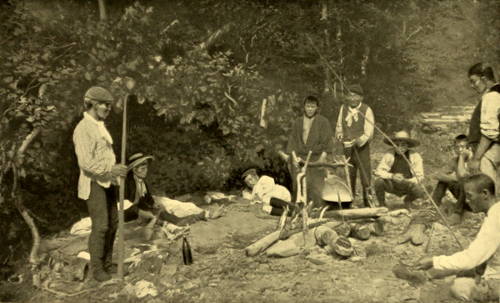
COOKING THE BREAKFAST FISH ROUND THE CAMP FIRE
August 26.—We went into the Ōyubari mine. One of its seams is 22 feet thick. There are quite simple workings, and no fossils. We then returned along the track in trucks to meet the train for Yubari, where I examined the rubbish tip of the mines, without much success. The policeman never leaves me, and scrambles up and down the stones after me with an extremely amused smile. The whole expedition causes him considerable trouble, but also it is a source of many future jokes and stories, for him as well as for me. To-day he was dressed in the dignified flowing robes of grey and black silk worn by Japanese gentlemen (policemen are of a much higher class here than with us), and he looked far too beautiful to mess about the coal. (He is pictured in the photograph which faces p. 12.)
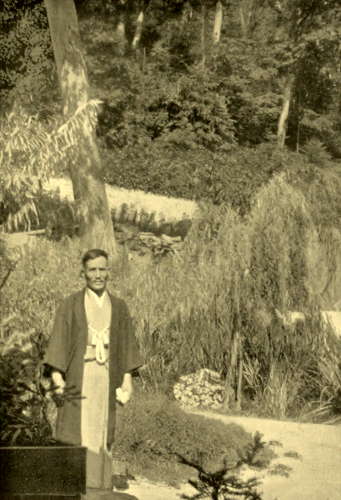
MY POLICEMAN IN HIS PRIVATE DRESS
August 27.—Mining and river work.
August 28.—We came to Poronai, which is often called Horonai, as no Japanese name begins with P, and the word being Aino it is softened in this way. The distance traversed was really very small, but mountains and other things interfered, so that it took a long time to get here. I went down the coal mine, which is very interesting. I proved to be a source of intense excitement to the natives, who crowded round in tiers, and formed a sea of faces with round staring eyes. The policemen frequently drove them off in a friendly way.
August 29.—Rather a sad day. Mr. Y——, my trusty and well-beloved friend, was called away by telegram to Hakodate, where a fearful fire has practically swept the town away, destroying more than fourteen thousand buildings, and among them all the property of his parents and other relatives. To look at the outer man, with his long arms and legs sticking out beyond a white suit, 6 inches too small in every direction, with several patches on his knees, and his hideous tie sticking straight out in front of him as he walks through the streets of the capital of Hokkaido, no one could imagine him to be a Professor. After a glance at his quaint eyes, twinkling in his comical face above his spectacles, one might suspect him of having a character, but after travelling with him as I have done for these two weeks, under very unusual circumstances, it is easy to recognise and admire his exceptional character. He is one of the small dozen of men whom I really like and respect. Now he is gone, and I must wrestle with an escort which cannot speak as much English as I can Japanese, which latter is next to nothing. The complexities of life are bad enough when one travels with a policeman, a land-surveyor, a special courier and correspondent, an interpreter, a local guide, and half a dozen coolies, all in one’s private train! But when the interpreter is the one to be snatched away, they are rather worse. Without him we went a stiff journey to-day, over a track 6 inches wide, through the mountains. The sasa grows solidly over the whole land, usually shoulder high, but often over my head, and the path is only on the ground, and is usually quite invisible—one’s feet feel it, but one’s eyes cannot see it. A hatefully prickly shrub and thick tangles of vine complicate matters further. And an English botanist before my start said that Japanese vegetation was like English! This endless sasa and forest goes on for miles, broken only by the streams. Down some of the streams we walked, where blue hydrangeas and passion-flowers bend over the water, and where little crayfish live in thousands. It poured with rain after mid-day, and we were glad to discover a seam of coal cropping out in the stream, and make a huge roasting fire. Coming back through the sasa in that rain was like walking in a river up to one’s neck.
August 30.—We all came on the few miles to Ikushimbets. As regards food the tide has turned indeed, and I am literally stuffed with good things, till I feel ashamed that I have not an infinite capacity for containing them; yet this is the tiniest hamlet, existing only because of the coal mine. We entered the mine in the afternoon; it has very unusual workings, as the beds are practically vertical, and is most interesting. How true was Lady Cicely Wainflete’s estimate of an escort! One of my “protectors” took fright in the mine, and had to be gently led by the hand and soothed with soft words, while I was left to come alone down the slope while the sensation lasted.
August 31.—Another wet day. We worked up the river collecting. It is rougher than Yubari river. The coolies manage to make roaring fires even in the pouring rain. One of the escort is splendid, and does nearly everything, including carrying me across the deep parts of the river, which is really a coolie’s work. It is only a pity he can’t speak English.
In the rain the coolies wear very effective coats made of straw, which make them look like the most veritable hairy Ainos; for the straw stands out all round for about 2 feet, and sheds the rain splendidly.
September 1.—This morning was by far the most difficult time we have had. The recent heavy rains have swollen the rivers, and as we depend entirely on the river bed for our track, it is serious. The water is also muddy instead of clear, and there are very deep pools into which it is easy to slip, so that every crossing is rather risky, and we have to cross innumerable times. This river is much worse than Yubari, being deeper, and often at the deep parts, where it is impossible to go in the water, the rocks are steep or overhanging on either side. Mercifully, even the apparently crumbling shale is not treacherous. At last the escort made me realise its value; without a couple of them to put their feet to make steps, or to give a hand round corners, I could not have got along at all. Also in crossing a river we were so many and all kept hands, and so there was no real danger. How the loaded coolies could manage I cannot imagine. It was only the feeling that as I was the leader I daren’t show fright, that kept me going over some of those places. However, we were well rewarded, for the fossils I got that afternoon were the best obtained so far, and after several hours’ brilliant sunshine the water perceptibly lessened. (The photograph opposite shows the round nodules which I was collecting in the river.)
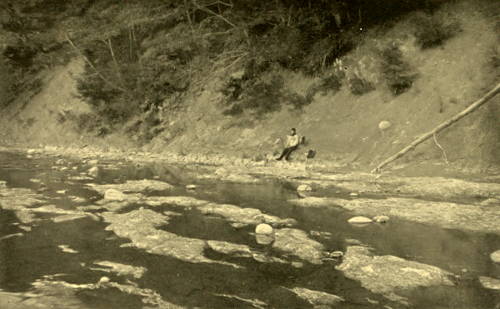
THE SHALLOWS OF THE RIVER, SHOWING THE ROUNDED NODULES WHICH CONTAIN THE FOSSILS I WAS SEEKING
September 2.—We came on to Itashinai—a distance which should have taken one hour, but really took four and a half. In the lower part of the valleys where cultivation has begun there are many little houses scattered—houses made entirely of straw! Rice straw is put to all imaginable uses: sandals, ropes, walls, roofs, cushions, coats, bags, and many other things are made of it. Of these things the walls are the least effective, and afford but a miserable shelter for the people in the straw houses. In the fields where countless tree-stumps still stand up through the crops, millet, beans, and maize are principally grown. There are also small patches of leeks, carrots, potatoes, “egg plants,” and herbs. There are no formal gardens, and flowers are few, except for a large-flowered convolvulus and red tiger-lilies. The forest and sasa come right down to the edge of the cultivated patches, and in it one could be lost in five minutes.
I spent the afternoon and evening trying to obtain information, and the difficulties, not only of language, are immense. Every question must be asked in at least half a dozen different ways, and an average conclusion drawn; it requires more than the patience of Job.
September 3.—Coal-mining from early morning; the engineer of the mines is very intelligent and speaks English, and I found some good specimens, so the day was successful. With some of the other people I have been driven to despair. The land-surveyor distracted me the other day. After we had been walking for about four hours steadily up-stream, I wished to find the exact spot where we were on the map, and, among other data, asked him how far he thought we had come (a matter of 6 or 7 miles). “Oh,” he said, with pride, “nearly 500 feet!” I always ask for all distances several times, in miles and Japanese ri which I can make out; but they like to show off by telling me in feet, and nothing is so difficult to obtain as the answer to the question asked.
September 4.—Sapporo once more. A day of official calls, bowing, compliments and formalities. They asked me to lecture to the women’s Aikoku-fujin-kai: the request of the Governor can hardly be refused after all he has done, so it had to be. The lecture was held in the large hall of the Government House, the body of the hall filled with women, the galleries with men; the Governor acting as chairman and giving an immensely lengthy introductory speech, of which I could only guess the drift from words here and there,—Professor My—— following on with another. It is easy to speak in an interpreted address, because there is so much time to think between the paragraphs; but I am sure it has not the same effect on an audience as the direct address. Some, of course, understood my English. Before the lecture there was a reception, and I was regaled with tea and cakes and left to the tender mercies of the ladies, and men who can only speak Japanese; later, however, the Governor’s German was available, and so it was all right, and we were quite cheerful till the interpreter arrived with a solemn face and a black suit.
The Japanese audience does not clap or make any sound,[1] but bows low at the beginning and end of the speeches, and when I began, “Your Excellency,” the Governor got up out of his chair and bowed. All the ladies were in native costume, I was glad to see (how I detest the semi-European clothes of the streets!), and some were in beautiful taste, but, curiously enough, of all the 300 I alone had embroidery on my dress, in the land where we imagine embroidery is rife! I have already found that the “Jap” things we see so much of in England are in small relation to the real Japanese things, but are chiefly “export articles,” which is a Japanese term of reproach.
After reaching home, in about an hour, a courteous secretary followed, bringing with him all the cakes which I had not eaten at the reception. Alas, that etiquette demanded that I should return the pretty red lacquer trays they came in!
September 5.—I spent the morning seeing the Museum (pathetic) and the Botanical Gardens (most interesting) of Sapporo. Mr. B—— took me out in the afternoon, and we had a long and delightful talk—even though he is a missionary! I received a most valuable and magnificent present from the people to whom I lectured last night. Apparently the lecture pleased them—for of course no well-bred Japanese will tell one to one’s face that he is pleased or otherwise with anything one does. Mr. Y—— came to supper and we were all very merry.
September 6.—Another present! The Inspector of Mines “fears I shall not be able to get good food when I leave Sapporo” and brings me a dozen tins of the best meats! chicken, beef, and all kinds of things. I often wonder why people say that the Japanese are not sincere in their kindness.
I saw a most interesting method of laying a foundation of a native building—two dozen women pulling on a fan of ropes, and singing in a weird way, half drawing and twisting between each pull. A couple of men directed the heavy pounder which they raised in this way, and let it fall with a crash to stamp down the earth.
In the afternoon I paid two official and one delightful call, and saw the beginning of the “Opening of the University” decorations. The College attains the dignity of a University on September 11. They are still actively building new departments and have unlimited ground for more; the whole temple of learning is most pleasing, extensive, and picturesque.
September 7.—I left early for Shiroi, a small village which is largely pure Aino. A contingent saw me off at Sapporo, and I was extremely sorry to say farewell to some of them; but to be alone once more is a real pleasure. At Shiroi I saw all there was to be seen; the little straw homes and boats (it is a fishing village) of the Aino are very different from those of the Japanese.
Some of the Aino are extremely picturesque and dignified-looking, their long, thick, black hair standing out all round their patriarchal heads. They are not all small; most of the men I have seen are taller than I am, and very thick-set. The women are terribly disfigured by green tattoo marks on their faces, the most essential of which is the one across the lips, which has the appearance of a moustache. One or two of the young women who have not been tattooed are very handsome. They are a fundamentally different race from the Japanese, and there is very good evidence that they are actually descended from the stone-tool using people, who once covered all the Japanese islands.
I came on to Noboribetsu to spend the night. It is about ten miles from the station, and to it runs the first road I have yet seen outside a village. Such a road! It is a marvel to me how we ever got out of its swamps and ruts, and how the wheels could all be at such extremely various and varying angles without coming off. Half-way there it got dark, and the rest of the journey we went tearing down little slopes or crashing and jolting over the ruts, when there was only a margin of about a foot between us and a ravine. Yet nothing happened.
September 8.—I spent last night in the crater of a semi-active volcano! Yet it was not so thrilling as it sounds. The crater is nearly a mile across, and much of it is just like a deep-wooded circular valley, in which are a little hotel and one or two houses. Only a couple of hundred yards or so away from the hotel the active part remains, however, and there are vents and small cones, bubbling streams of boiling water, and piles of sulphur in any quantity. Some of the boiling basins are black and solid-looking, and some frisky with little geysers—most of them tame enough for close acquaintance, but a few dangerous and impossible to approach. As I look out on the hotel garden the steam rises in thick clouds from the boiling stream bubbling through it, which is utilised for baths. The Guide-book naively says: “The only drawback to a visit to the springs of Noboribetsu is the chance of meeting naked bathers.” I would say “certainty of meeting.” But I got off quite alone and went up through the woods, following a track of course—it would be mad to leave it here—and saw three snakes in an hour, one nearly 4 feet long hardly moved from the path. I met an Aino, tattooing and all, and we exchanged a few courtesies in bad Japanese. Aino itself is a curiously hard language, nearly all k’s.
September 9.—A wet drizzling day, which blurs all the landscape, so that trees, sky, rain and sulphurous clouds all merge into one another. The air is heavy, and full of the odour of rotten eggs. I am the only European here, and am living absolutely à la Japonaise. The place is entirely untouched by our civilisation, and my room is a gem of native art: the delicate wooden trellis-work and bands of black lacquer on the paper doors and windows, the beautiful heavy metal fire-pot and embossed kettle are real Japanese of good quality. I sincerely wish I could bring such a room to London, it would delight those followers of the art nouveau who have retained some of their original conceptions of the beauty of simplicity. I was rather glad to leave the hot choking fumes, however, and reach Mororan at night. It is a pretty little port, in a beautiful bay forming a splendid natural harbour. I went on board at 9 o’clock at night.
September 10.—We should have arrived at 10 or 11 o’clock this morning at Aomori (on the main island), but there was a storm, the tail of one of the typhoons which are abounding this year, and we did not get in until after 4 in the afternoon. While waiting three hours to catch the train I saw a little of the town, and spent some time soothing a distracted missionary and his wife, recently from America, and not yet accustomed to waiting, and trusting large sums of money to Japanese porters with no guarantee that they would get the tickets they wanted. Japan takes some learning, and a highly-strung American accustomed to New York bustle must find it a peculiarly hard lesson.
September 11.—I arrived at Matsushima station at 5 o’clock this morning and took a kuruma[2] to the place itself, on the way stopping to climb a small hill which overlooks the wonderful archipelago—one of the three greatest sights of Japan. As I sat there the sun rose, and lit up the gleaming water and the thousand pine-decked islands, whose shapes are so fantastic that one can only imagine them to be the work of the drollest of trolls, who with his drollery had a soul that was rare enough to combine nobility of beauty with fantastic form.
The hamlet of Matsushima is built among similar rocks on the dry land, which has certainly risen from the sea. This little place, utterly unspoiled by European influence (I did not even see a European hat), is the Japan I have dreamed of, and had begun to fear I should not find. I cannot describe it here; if anything can move me to write literature some day, it may be that place as I saw it at sunrise.
I sailed among the fairy islands in a dreamland boat—which went so slowly and so smoothly that I thought it did not move—to Shiogama, in which I saw no romance, and took a kuruma for 5 miles off the line of beaten roads, and the railway to a tiny hamlet by the sea. Here I put up in an inn built on a little rocky peninsula, which is just big enough to hold it and a few pine trees. When the tide is in we cannot get into the front door! The room which I have opens on two sides to the sea, the front is shut off only by folding-doors from another with three sides open to the sea, so that at will I could have my three walls removed and the sea view all round. A more ideally beautiful situation it would be quite impossible to find: on either side stretch blue bays with sandy shores, and rocky islets with twisted pines growing on them in all manner of ways, and beyond lie line after line of blue hills, which in the distance merge into the blue sky.
September 12.—To-day was spent in finding out paths to tiny fishing hamlets along the coast, and seeing ever new and delightful rocks—one is pierced by a big hole, 30 feet or so above sea-level.
At night there was a great sensation in the bay, as many big fishing-boats came in. On the shore they lit huge blazing fires, the men and women singing all the time, and every now and then one of them seizing a burning brand and rushing into the water with it up to their necks, and even swimming out with it to the boats. The new moon rose clear and sparkling above the bay. It seemed wicked to go to bed. I am the only visitor of any kind staying in this hotel.
September 13.—My hours are primitive: rising with the sun about 6, and breakfasting; eating again at 12 and 6, and going to bed after seeing the sunset shadows deepen into night and the stars rise over the sea—i.e. about 7 o’clock.
I walked into Shiogama for some shopping, but was much noticed by the country people, for I wore a white blouse, a skirt, and hat. Here the women all wear long blue trousers and short tunic-like kimonos, and I found they took no notice of me at all when I wore what I wore in the mountains, namely, short close knickers and coat to match.
September 15.—Alas, it is the last day of my short holiday. The weather has been perfect these four days.
September 16.—A long and tedious day travelling, beginning at 5 in the morning. I did not reach my Tokio home till 11 at night, and then found that they had given me up and all gone to bed. On the way I had to change and wait two hours at Sendai, which I therefore explored a little. It is noted for ornaments and trays made of fossil wood so-called, which is found in quantity in a mountain near by. It seems to be gymnospermic, however, and to correspond more to our “bog-oak” than to an actual fossil, so I lost scientific interest in it, but liked it well enough as a curiosity to buy some specimens.
September 17.—After a month’s absence my correspondence has accumulated, and to-day has been spent largely in reading and writing letters. Also, this is just the last day or so for the swimming out of the spermatozoids of Ginkgo, and I spent a few delightful hours in the Laboratory watching their infusorian-like movements and the quick vibrations of their spiral crowns of cilia. Fancy cutting up dozens of juicy Ginkgo seeds! I lunched in the Institute with the botanical staff, who have a wonderfully detailed knowledge of all my doings, likes and dislikes—from the newspaper! Apparently one or other of my retinue has acted as special correspondent for the papers. Mercifully, it is all published in Japanese characters, so that the European residents can’t read it, or I should not dare to present my introductions.
September 18.—A quiet day at the Institute, trying to overtake my writing arrears. The last forty-eight hours it has rained incessantly, and the roads are an interesting study. They may be divided into three main classes, viz. those which are well made, and which have been washed spotlessly clean by the rain—these are very few and far between; those which have retained the water, and mixed it with their own soil until there is a swamp of thick, boggy, squashy mud from 2 to 10 inches deep—these predominate; and those on which water alone is to be seen, varying from 2 inches to 3 feet in depth. Through a quarter of a mile of the latter I had to come, in a kuruma of course, but the man was up to his hips in water, and I was glad indeed that my house is on the top of a hill as I saw the floods rushing through the houses.
September 22.—The roads of Tokio are a never-ending source of delight when their muddiness does not force itself home. A hundred times in a walk, even in the heart of the city, one comes upon a bend of the road where groves of bamboo or pine trees are seen, as though one were far away in the country; or a rivulet will cross the lane (so many of the city roads are like nothing but our country lanes), and its mossy banks hanging with ferns are luxuriant, as only our Lake District streams are luxuriant, in their glorious greenery of delicate fronds. Or perhaps a bend of the road will take one away from a little village of shops into a narrow avenue of straight-growing cryptomerias, leading to a tiny shrine or temple with its garden and moss-grown stepping-stones. Along the line of the electric city railway we all walk freely, and to-day I found corners of woodland and scraps of meadow along its course—little forgotten scraps of land where small bamboos and feathery grasses, and sweet white and blue flowers grow in brilliant, fresh, dustless perfection. A hundred times a day I ask myself, “Can this be a city?” While the main streets are “streety” enough, the charming spots are always only a few yards away from them.
I cannot understand how it is that land and rents are so outrageously dear, dearer even than in the parts of London just outside the city. Here so much seems to be left to run wild, or to form a garden or field round a tiny house—wasted commercially—but what a rich delight to those who live in this sweet garden city!
Early this morning I had a real Japanese experience. I was wakened at about 5 o’clock by a tremendous sensation among my walls and floor, as though they were all striving to part company. I at once thought of a typhoon, and as my floor was swaying like the ocean waves, I started to rush downstairs, my room being the only one on the second story. Then I rushed back, thinking of all the awful tales of robberies I had heard, and seeing a figure approaching me, I accosted it angrily and demanded it to give an account of itself and be off! It was some time before I recognised myself in the glass! All the time the floor was swaying violently in what I fancied was a fearful wind—when it suddenly stopped, and I lay down feeling very sea-sick. Then, and then only, did I remember that I was in a land of earthquakes, and had just experienced my first. I heard later in the day that it had been a moderately bad one.
September 23.—A rather broken day with papers at the Institute. I have not yet worked off my Hokkaido debt of letters and presents.
There was a local festival in the temple near my house, and the houses were gay with scarlet and white lanterns, and branches of scarlet and white paper flowers.
September 24.—A universal holiday, and the Institute is shut. The day was filled with sight-seeing, temples and gardens. Of the several I saw, two in the heart of the city were in such striking contrast as to be worth an attempt at description.
To the one, the approach was lined by rows of little open shops, whose trivial gaudy wares were pressed upon the throngs of passers-by. In the open court of the temple were many stalls and small tea-houses, and hundreds of pigeons fluttering about to be fed. One could buy one sen’s worth (about a farthing’s worth) of peas and rice from the numerous little stalls kept by ancient women. The birds did not appreciate my offering properly, as it was a festival, and they were already overfed, and so contented themselves with pruning their feathers perched on the great eaves of the temple, or on the nose or curly tail of some of the many great dragons. In the vestibule of the temple (this is hardly the right word, but I know no other to express it) hundreds of people clattered in their wooden clogs, and chattered loudly, gazing through the wire-netting into the inner portion, where the priests and readers in gorgeous array and pomp were carrying on a service. The whole effect was not unlike that of a good Roman Catholic Church, but more glittering and richer. As I was watching, a large part of the ceremony seemed to consist in turning over the folds of manuscript very rapidly, giving the effect of endless streams of writing. Into a money-box, as large as a small swimming bath, the devotees threw their small coins, often over the heads of the groups in front of them. Glitter, bustle, noise, and crowds characterise this temple. The other I found by chance in one of the dear little side roads I love. It stood grey and solemn in the midst of its green garden, its great bell in a little house beside it, and its old stone figures and great lotus of copper. Twisted pines and moss-grown paths around it, and behind a silent grove of pine and bamboo. Complete silence in the heart of the city, and though I remained in the garden some time no person came to disturb its peace. Greyness and greenness—and one brilliant golden butterfly dancing above the great green copper lotus, one shrub with scarlet flowers flung against a grey sky—and in the heart of it all the silence of Buddha, whose heart does not seem to beat as he contemplates the universe.
September 25.—A tiring day, but little to show for it. Tokio certainly makes one very sleepy, and also demands the expenditure of much time to get a small result.
September 26.—Official visit to the Director of the Survey—time spent getting there and back, three hours—length of visit, ten minutes. The rest of the day at the Institute.
September 27.—An amusing day spent at the sale by auction of all the household effects of the Spanish consul. It appears that these sales are recognised social functions, and all the good Society was represented, from the Embassy and some Baronesses downwards. I managed to get two feather pillows for twice what they cost in England, but half what they cost here in the shops; and so hope to rest more peacefully at night now. There is such a frightful duty on all foreign goods that every one here buys what they can at these sales; as they are all the goods of friends, which have sometimes been the round of several distinguished families, there is no feeling against obtaining them. It only wanted tea and a little music to be like an “At Home.”
September 28.—A quiet day at the Institute. The gardens surrounding it are largely situated on elevated ground, so that one looks down on tree tops and out over an expanse of clear blue sky and lovely light clouds. Now the temperature is like our best days in June, and the actual sunshine still hotter and brighter.
September 29.—Sunday—so we went to visit temples. This time to a tiny lonely one in the country to the north of the town. Though it was less than 10 miles out of Tokio, everything was fresh and beautiful, and quite untainted with the horrible suburban effect of our environs—it was real country, though not at all solitary. Between the green fields, where the crops looked as fresh and vigorously sprouting and green as with us in the late spring, were quiet lanes and narrow roads overhung by the swaying feathery shafts of the tall bamboos. Every quarter of a mile or so in all directions were little woods of bamboo and pine or cryptomeria, in the midst of which generally one or two small houses nestled, their thick thatches overgrown by the blue-flowered relative of tradescantia, which is here so pretty and so plentiful. Surrounded by its little grove of cryptomerias the wooden temple stands apart from all houses—a small closed building, hung with gaudy pictures from the devotees whose prayers have been answered. Leading to it is an imposing flight of well-kept stone steps, but as there is no gate, and a dozen paths through the wood lead to the temple by easier grades, they are more for show than use. A big stone trough stands filled with water for the worshippers to wash their hands before folding them in prayer—but I saw no worshippers, and I stayed there in the quiet for a number of hours.
A fraction of a mile away was the small ill-kept cemetery, with little grey headstones and forlorn wooden laths with the names of the dead, but no visible graves.
The tall tsuzuki reed, with its clusters of feathery fruits standing out against the sky at evening, and the stars twinkling through the beautiful bamboo and the trees of sweet chestnuts, all seemed far too fresh and unsullied to be so near a city. The Japanese can certainly populate a place without defacing it. The absence of all railings and notice boards is also very soothing.
September 30.—A cut-up day at the Institute. Dr. Y——, one of the geologists from the Survey, visited me and we spent some time discussing the beds of Hokkaido. This country is an extremely difficult one for us all, so little is yet quite reliably finished, as exposures are so scarce.
October 1.—A long morning down at the Survey Offices with the Director and Dr. Y——, chiefly planning for the next venture, which is to be in the directly opposite direction from the last, and promises difficulties not a few. This time I will not go with a huge escort like the last.
On the way back to the Institute I looked into the biggest drapers while the sale of the year was on—all Japanese of course, and very amusing.
October 6.—A miserable, wet day, spent with small profit at the Institute preparing for another long expedition. The least heavy rain seems to give rise to floods at some place or other, and again the roads were quite impassable except for the coolies, who drew my kuruma through.
October 8.—I arrived at last at Okayama at about 3 in the afternoon, very dirty after the night in the train, and tired for want of food—to be met by a party of Japanese, most kind and welcoming, who took me to a charming hotel and kept me sitting and talking for two hours without a chance of even washing! They also took me to see the renowned Koraku-en garden, and it was half-past six before I could get a bath, and while I was still dressing the kuruma came to take me off to a meeting of Naturalists, which took the form of a dinner in my honour.
The gardens of Koraku-en were certainly very pretty, but less so than one would expect from the descriptions of them one reads. They were once the private property of the owner of the castle at the foot of which they lie. In them are vistas and views cleverly constructed, and many pretty little rocky islands and bridges. There are also some sacred cranes which live in separate apartments in a house of their own, and which take the air and sun themselves in the best part of the day. What pleased me far more than these much-praised gardens were the little courts and gardens of the hotel in which I was staying. From my room I could look down from the verandah on to two little gardens, with dwarf trees and green paths and grey stepping-stones leading to imaginary distances.
On my way out, for the house was large and rambling, with several ways, I could pass a square garden but 10 feet or so big, in which was a little temple, with lanterns and lions and gateway all complete. Here every evening the lanterns were lit, and incense sticks glowed, sending a sweet scent along the corridors. It was the smallest temple I have seen, and also one of the prettiest additions to a house.
The dinner with the Naturalists was a somewhat trying affair. There was but one lady and she was obviously asked for my sake, and was put next me at the table. The President and I sat opposite to each other in the middle of the long table, and kept something of a conversation going, though I had to furnish all the subjects, which was a little difficult after more than twenty-four hours’ travelling and no rest after my arrival. The others were mute, except when I turned to ask a definite question, or said something which the President repeated to them, and suggested discussion. All could speak English nominally. The dinner was in foreign style and included four meat courses, and I found few of those present knew which things to eat with which table implement, so I was repaid in kind for the entertainment I must have afforded while learning to use chop-sticks. Fortunately it was possible to leave very early, and I welcomed a good night in my charming Japanese room.
October 9.—I was up at 6 to start to the real place for work and was seen off by a deputation, and shaken for some time in the train of a local branch line. After that came the truly awful business of the day—four hours in a kuruma!
The kuruma is a kind of mail-cart on two wheels (country specimens have no springs), and is drawn by a man over stony roads. The works of the thing jolt, jingle, and clang till one’s head splits and one’s bones feel sore.
The road lay along a very beautiful valley, however, cut out of the steep rocky sides running along the broad and beautiful river of Takahashi. I entirely escaped the Guide-book—not so easy a job either, as it is written by Chamberlain, who knows the country better than most Japanese, and who has numerous collaborators who seem to inform him of minute details, even of very out-of-the-way places. At the end of the journey I found a much better inn than I expected under the circumstances.
Then the excitement began—and I had to explain at the Prefecture that I had come to see coal, and to find out where it was. The maps are so small (Geol. Survey though they be) that one is extremely dependent on local information. To do all this in Japanese with people who did not understand a syllable of English, was no joke! It is the first time I have been so absolutely cut off from English; they could not even read Japanese names in Romaji print, in which my maps and all scientific things are now done. It was interesting—and I hammered away till I got my end, and found the Triassic coal I sought, but, alas, there was nothing in it of value to me. The trouble I had to get it began in Tokio, where they told me first it didn’t exist, second, that it was finished and the mines stopped down. In Okayama also they said no coal in this district existed—instinct kept me at it, however, and though the people even here said there was none, I insisted there was—and lo! after a while they took me to it. It was the very smallest and most primitive coal mine I ever saw, it is true—but it was coal. To-morrow I am going to another place: it is sad to find no fossils just here, they would have been such a triumph!
My dinner consisted of rice, green peas, and boiled chestnuts, with a little fish as well. One learns to value green peas, even though they be cold and floating in the water in which they were boiled, and eaten one by one with chop-sticks!
No three consecutive minutes of peace were allowed to me. I was desperately tired, and though I sat with my eyes shut for quite long periods and hardly spoke to them at all, my visitors sat on and on till I was frantic. I have a fellow-feeling now for animals at the Zoo.
October 10.—While still in bed, visitors began again this morning, and I had to shout to prevent an official visitor from coming in while I was taking off my night-gown. On starting two of them came with me, and their number more than doubled before the day was out. More terrible hours of kuruma riding—but the little village of Jito was worth a visit. Early in the morning heavy downy mists hung round the hills, and swirled up from the trees as the sun caught them. All the thousands of cobwebs were like fairy banners on the trees, and the rocky sides of the mountains rose from the rivers to be lost in the alluring distances. It was a sight well worth the shivering and the jolting, and directly the sun shone on one it gave a comforting heat. The nights are extremely cold, almost wintry, but the days are as hot as midsummer, hence the thick mists.
We entered the mine, which, unfortunately, though Triassic, is of no interest to me. A kind of dinner was given at the hotel at 2 o’clock, and I saw many rather crude native customs.
The man who had led me in the mine, whom I took to be a coolie, and to whom I gave sixpence, turned up at dinner. In the mine his entire costume had consisted of a striped flannelette shirt, very short, and a stand-up white collar!! Literally no more, and that was donned of course in my honour. Trousers with a red stripe down each leg, and socks, were added for the dinner.
Everything in this country seems to be the reverse of what it is with us, and here the dinner starts with much drinking of saké and very frequent exchange of the small cups; then no more is drunk and the food begins and finishes the feast.
After the coal mine business was finished, I was taken to a big school where there were festive sports going on, very similar in the main to our school sports, and obviously in imitation of them. Many of the boys and girls (the schools are mixed) were pretty and bright, though the Japanese child has not yet appealed to me as it does to those who gush over it.
October 11.—Things began at 6 this morning, when all the world was shivering in its thick white mantle of mist. After riding for a couple of hours the sun drove it all away, and by 10 o’clock I was streaming with perspiration from every pore as I went up the hills toward the little coal mine I had come out to see.
I thought I had fully impressed on the Japanese man who acted as local guide that I was desperately pressed for time and must return to the railroad town to-night—but after a couple of hours I found myself inside the big “middle school,” bowing to an English-speaking head, who soon asked me to give a lecture! Of course I refused, and said I was going at once to the coal mine, and would then return to Tatai, but he accompanied me to the mine, leaving his rightful duties with not the smallest compunction, and on the way requested me to stop and have my photograph taken. The Japanese are perfectly infuriating to one with a definite object and precious time. I cannot here retail the multitudinous instances of senseless delay I have had to suffer from, nor the irrelevant things I have had to examine. If I were to go at their rate I should be still looking at coal mines in Japan ten years hence. But I must not forget that I am seeing the country if I am not getting directly to my goal, and that I am in myself a certain amount of entertainment for them, a kind of creature they have not heard of before.
After a rather fruitless couple of hours in the mine (results locally interesting, as the Imperial Survey has mapped the district as solid granite) I had six hours in a kuruma returning to Tatai. The kuruma was just as uncomfortable as country ones always are, and as I was packed in with my fossils so that I could not change my position, and the roads were in places very bad, I was hardly in the mood at the end of the journey to be put into a train, merely to wait stock-still at the first local stopping-place for three-quarters of an hour. I am becoming far more patient than Job ever was, but at times my stock of patience runs out.
Apart from the mere weariness of one’s bones, the kuruma ride was very delightful. Every time I see the little groves of feathery bamboo in their grace and sweetness I rejoice anew. The valleys along which the road wound were very steep, and the great granite hills majestic and beautiful. The plants, too, are often charming, and one frequently sees a single trail of ampelopsis flung across the grey boulders. One great wall of granite was covered with blood-red ampelopsis and capped with the native pine, which is so rich in curious curves, and so green against the sapphire sky.
Although the country is quite wild and unspoiled, all along the flatter part of the valleys were very many houses—clusters of houses or hamlets lying at intervals of about one-eighth of a mile. It seems curious how the little rice fields, which are tucked into every available damp corner, can support so many people. Straw plaiting is also a source of income, and in almost every house some one was twisting the short lengths of gleaming white straw into braids.
The greatest charm of Japan is the way the natives have of inhabiting, even thickly populating, a district without in the least spoiling it—except of course where there is a railway, a few yards on either side are necessarily spoiled a little.
The single line of telegraph wire puzzled me not a little to-day. I could not imagine why, when it was raised in the usual way on posts 20 feet or more, it should be made of barbed wire, when I discovered that the effect was caused by millions of dragon-flies, perched singly on it at intervals of about 6 inches from each other! I never saw two closer than that, or more than 18 inches apart, for about 10 miles! Now and then one would fly off, or another settle, but most of them sat quite motionless on the wire. So the only “barbed wire” I have seen in Japan was made voluntarily by blue dragon-flies who sat there to sun themselves.
October 12.—The hour for rising gets earlier every day. This morning it was 5 o’clock, with the prospect of 12–14 hours in a wretched slow train. I am writing in the train now, at the stoppings, which are never less than five minutes, and often ten or fifteen minutes long, at every station. The whole distance in all these hours of travel will be less than 200 miles. The people in the train are, of course, a little interesting, but far more saddening. Where the train with its Western atmosphere has penetrated, the beautiful and dignified robes, the silken skirts and kimonos of both men and women, though principally of the men, are giving place to a hybrid mixture of all the vulgar and hideous garments of “civilisation.” Only a few of the most cultured Japanese know how to dress in good taste in our things, the others are unspeakable.
Just now the train is skirting a part of the coast of the famous “Inland Sea,” and small islands lie thickly scattered in it, with their pines clinging by great twisting roots on to their rocks. The persimmon trees, with their great golden fruits, look very beautiful beside the pines, and are richly laden with their delicious fruit, so that they are noticeable from quite a distance.
After arriving at Tokuyama in the evening I went at once to the Naval Briquette factory of the Government, who own the coal mine farther on which I wish to see. A most courteous and charming Director, who had been in both France and England, put me on my way.
October 13.—I started early by train for Omine, where the mine lies on a little railway built on purpose for it during the last war. The coal is one of the very few smokeless ones in Japan, and therefore very important. Omine is a tiny hamlet, practically composed of miners and mine officials,—where the inn is poor but every one only too anxious to please.
The mines are interesting scientifically, of Rhaetic age. As they belong to the Navy, the surgeon attached to the mines wears the uniform of a Naval Officer, little sword and all, and is very smart. The coal is carried for a long distance by iron baskets on wires across valleys—stretches of wire 200 yards, with no support. It is so strange to find the mixture of modern engineering and science with such primitive native ways.
The weather is lovely, still scorching midsummer sunshine floods the hills, on which a tree here and there shows a flare of crimson autumn colouring.
October 14.—The Chief Engineer here is most helpful, and offered to come with me to Habu, a very small mine 20 kilometres or so distant, where we had to travel by kuruma. At first I refused, but afterwards I was very glad his importunity had prevented my coming alone. The kuruma left us to walk the last 3–4 kilometres. There was no definite road, and an old woman volunteered to guide us across little tracks through rice fields and along the sandy seashore, and through rice fields again. The maps of course show none of these footpaths, and without Japanese help it would have been impossible to find the place. The mine, when we got there, was the most primitive I have ever seen, smaller than at Nariwa. On the way our old woman leader took us up from the shore to a big house standing by itself, telling us that here the manager of the mine lived. As we had despaired of ever finding the mine, this encouraged us, but we found the house was only in the process of building, and was of course not inhabited. It was a beautiful house, with a great temple-like porch gate, an inner courtyard, and quite a number of out-houses and servants’ dwellings. Then, when we came to the mine, we found the owner to be a common working man, and we saw his wife going into the mine to work like the rest of the peasant women! The whole situation seemed so ridiculously incongruous. A case of nouveau riche retaining their old habits while their palace was being built.
In the mines I have often come across women, naked to the waist and up to the knee, working underground with the men. To-day I saw such a pretty girl, and her beautiful rounded body was far too sweet to be smeared with coal.
To-night we went on to Shimonoseki, and my Omine companion kindly took me to his father’s house there. A delightful house, with a great flight of rough granite steps leading up to it like those to a temple. Here I inhabited three big rooms, opening out of each other, as well as a dressing-room. They were extremely kind, and only spoiled things by refusing to believe that I could prefer not to have chairs, etc. brought into their rooms for my use. I pleaded with them, and was allowed to sit on cushions on the floor, but could not escape a European dinner instead of the true Japanese meal. However, it was very good, and I made up for several past meals of poor quality. I was given the seat of honour, and my host and I ate alone—his father, mother, aunt, and sister visiting us for short intervals, and bringing various things, but never sitting with us. They are certainly wealthy people, and not very cultured, yet there was not the slightest attempt at display. All that the rooms contained were a single vase of beautiful flowers in the corner by the kakemono (long picture), a couple of quaint ornaments, cushions, and in one of the rooms a beautiful polished table 6 inches high, on which was a carved tray with hand-painted tea-cups, and the hibachi (charcoal brazier) with an ornamental kettle boiling on it.
October 15.—I got up about 5.30, and crossed over to Kiushiu—my host coming to see me off and giving all possible help. I did not arrive at the mine—Namazuta—till 12.30. The mine is a large one, and though of Tertiary age, contains very many interesting stones.
After examining the mine I returned very late at night to Fukuoka, having escaped proper meals all day. The chief of the coal mine kindly gave me fish and rice and a few real Japanese things at 4.30. At Fukuoka the inn very noisy, but otherwise all right.
October 16.—Noise kept me awake till after 12, and I had to get up about 6.30. I visited the head office, where officials are arranging for my introduction to several small mines in Amakusa, which is an island off the island of Kiushiu—and on which no human being speaks a word of English, and all the natives speak such a curious dialect that even the Japanese themselves cannot understand it. I guess I shall have a gay time. On this whole expedition the amount of hours of travelling per hour in a coal mine is very great, and I seem to be going night and day to see a mine here and there. (Things have got wrong here somehow. I have forgotten to mention the Miike mine.)
Some of the scenery is very beautiful, and though, of course, I am missing all the regulation sights, I see glimpses of beauty here and there.
The train arrived very late at Misumi, a little port, from which I shall go to Amakusa. The moon was shining over the calm sea, stretching into many inlets and set with many islands, and the effect was most beautiful and romantic. Though I thought the train had landed me in Misumi, it turned out that I had to take a kuruma to the hotel, and it went right out into the country, over a hill where not a human being or habitation was to be seen, and I began to think the kuruma man had designs on my life and purse. After half an hour he landed me on the other side of the peninsula, where the village proper lies, and where there is a moderately good hotel. On the ride we passed many mud-walled thatched cottages, without a sign of life in them. The Japanese live in open houses by day, but at night they put boarded shutters up before every window, so that no one (at least no Japanese, I insist on mine being opened) in Japan sleeps with fresh air round him, which, I believe, is the reason there is so much consumption. They cannot see the silliness of doing this, and are constantly bragging that they live in the open air, when all their eight to nine hours of sleep are spent in these very stuffy rooms, with a lamp and generally a charcoal fire burning beside them.
October 17.—The boat was supposed to start at 9 A.M. this day, but 1 P.M. saw it still gaily coaling. It is the very smallest steamer I have ever been in, not really as good as a ferry-boat, but the prospective journey is to last twelve hours. While waiting about the landing-place I saw many strange fish which were being brought in. One big fishing-boat had a load of huge creatures, bigger than men, of two kinds. One kind like lovely dragons, with long snouts and great wing-like fins, the other fish the most curious I have ever seen, and apparently, though I don’t know at all, some kind of shark. They were about 8 feet long and thick as a man’s body, and their heads were quite flat and square-ended.
I could not have imagined such strange creatures, a drawing gives none of the extraordinary effect they made lying there in numbers, their great flat bodies heavier than a man could lift unaided. They are to be eaten, but seem to me to be terribly coarse.
There is no first class on this steamer, and I am the only second class passenger, but as my portion should be in a minute cabin with stuffy curtains and tightly fixed port-holes, I am squatting on deck with the third class people, who are as thick as flies round a honey-pot. There are mats spread on the deck, and most of the people are lying on them wedged against each other. I am sitting on my bags, leaning fairly comfortably against the rail and next to the only man who is a real cute traveller. He has spread his blanket (Japanese always travel with blankets, generally white ones!) its full size, and is lying in the middle, with a clear 2 feet of spare space all round him, and it is characteristic of Japanese travellers that though the others are terribly crowded no one sits on his blanket or asks him to curtail its extent. The scenery is lovely, and the sea without a ripple. On every side are hills with range after range of jagged peaks, and in the sea countless pine-decked islands; land lies all round, and it is difficult to believe one is at sea. 2 P.M.—I am certainly seeing life: we have just had tea in picnic fashion, squatting here together—and indeed most picnics are made to far less beautiful places than this island-dotted sea. One of the women had brought a tray of small cakes, all looking excellent, but most of them made with the sweet bean paste I have not yet learned to like, though there were delicious sponge-cakes as well, five of which I got for 1¼d.—and I paid three farthings for my tea, which was three times what any one else did. They would have given it to the foreigner for nothing—but one must support the honour of one’s country in a far land, and I have learned that though the Japanese give very freely and refuse a dozen times to take payment, they are not really at all averse to receiving it.[3]
We are twisting in and out of the inlets and coming very close to the islands, and if the landscape were not so much softer and greener and more rounded, I could well imagine we were in the Fjords of Norway. The rocks are in places very white, and here and there near villages are groups of lime-kilns of primitive type. There are fleets of fishing-boats everywhere—and I believe (by this time I have seen a good deal of the country) that there are no consecutive 2 miles along the whole coast of Japan without a fishing village! It is not on the coast, but in the mountains that the really solitary places are to be found.
I arrived almost in the middle of the night, to be welcomed on the ship by various folk, from the inn-keeper upwards and downwards—there was a regular lantern procession of people. They all stopped round or in my room to talk or stare, according to their social stations; the landlord coming midway, he sat just outside the limit of the room—which was, of course, widely opened on three sides—and held converse with all of us within, or hurled abuse at all the maids and boys and small children who collected without. Fortunately the chief official of the mines left soon, intimating that it was late, so I got to bed earlier than I expected and slept well, though, as my window-walls were wide open, it was so light that I had to put up my umbrella. It is getting quite usual for me to sleep under my open umbrella, and as the mats they spread on the floor are never more than 3 or 4 inches thick, it feels very like sleeping on the seashore, and I quite enjoy it, though at first I used to wake up and wonder where I could be.
October 18.—Early this morning I started to look at mines—with five people in my official train. This island is one of the least civilised of Japan, and there are practically no roads on it, though tracks here and there, and some surprisingly big coal mines. We went from place to place on foot and in small fishing-boats across the bays, which would have caused very long detours to walk round; and these were numerous, for these islands are very much cut up, and the sea surprises one everywhere one goes, generally on two or three sides at once.
Some of the bigger fishing-boats we passed were most interesting, and looked, on a small scale, exactly like my imagination of what an old Egyptian boat must have been. The six oars (one can hardly call them oars in our sense of the word, for they are thick, and much the same shape from end to end, and with a little twist in them) were manned each by three naked men, all standing clad in their skins (which the scorching hot sun had burnt a lovely brown gold colour), and with the minutest white-and-blue waist cloth. Round their heads they had a white or white-and-blue towel tied fillet fashion, with a bow on one side. As they bent and rose over the oars they shouted all the time and very hoarsely a sort of meaningless refrain—but it was very good for keeping time and could be heard a long way off. Of the three oars on each side of the ships, two were pulled one way and one the other, and as the pullers kept forgetting which was which, I could not understand how the boats ever progressed, but they did, and at a pretty good speed, but far out at sea they put up sails. My little boat tried a sail for a short time. It was nearly square, with a bamboo to keep it out at each end, but the peg which held it down gave out when a puff of wind came and the boat tipped over gaily. The mast was tied in a very primitive fashion, and I wondered how the fishermen ever dared to go out to sea in such a craft. It landed us safely, however. One coal mine we went to was high up, 700 feet straight up from the sea, and amid pretty scenery. At one mine, where the people were most kind, they had gone to the extent of carrying a tea-cup with a handle for me, because they said I could not use their kind without a handle (as though I never drank out of glasses), but the owner of the mine took off all his English clothes, down to the shortest shirt I have ever seen, which was open up the back, and did not think I might find that a little more difficult to put up with than a cup without a handle. It is a good thing that I had all the up-to-date ideas of hygiene before I came!
October 19.—To-day was spent in returning to the main island of Kiushiu, for the little ship took nine to ten hours about it. The start to-day was made in good time, so that three separate sets of people were late, and the steamer stopped to take them on one by one. A skiff came along propelled by three boards pulled up from the bottom of the boat, and left us two passengers. In order to get to the north of this small island of Amakusa, though only 25 miles or so from the south of the island, I must go back to the main island, to Mogi, and take another steamer back to the northern port of Amakusa!—multiplying the distance a hundred-fold, but there seems nothing else to do, it is impossible (they assert) to go on foot, and very dangerous to go in a small boat round the coast, and no steamer runs. The chief manager of the mines, who has some in the north and some in the south, has to go this ridiculous round every time he goes between them.
As the northern mines are the same formation and contain identical specimens with those I have collected in sufficient quantity in the south, I shall not return, it is too ridiculous and too expensive of time.
October 20.—I reached Nagasaki and found Mr. G—— (the half Japanese son of a Scotchman and an important person here) most kind. He arranged for a delightful steam-launch all to myself to take me to Takashima, a small island which exists for, and is entirely populated by, the coal-mining people, to whom it belongs.
The mine was the first opened in Japan, and was for some time owned by Mr. G——’s father; it is the most completely arranged I have yet seen, probably owing to its age, but is rather dangerous to work, as it goes miles under the sea, and there is a large quantity of gas. Last year 300 men were killed in it—I was on the very spot where the chief engineer was found dead.
There is another little island very near to it, with a coast-line of only 4000 feet and a population of 2500! It also has a mine which is entirely under the sea. If the little islands had not stuck up out of the sea to show where the coal lay hid below it, Japan would have been much the poorer. As well as working huge quantities, the quality of this coal is the best they have. They must use salt water, of course, so they combine their engine work with salt making, and thus make a lot of money, as well as provide their thousands of people with distilled water for domestic purposes. It was very funny to go only a couple of yards from the black coal sacks to the great room filled with snowy salt.
In the evening I went to dinner with the G——s, and then they took me to a kind of semi-amateur theatrical performance at the theatre. About 3000 people were in the theatre, very crowded, and nearly all sitting on the floor in the little divisions corresponding to boxes, but which fill practically all the space of a Japanese theatre. The only amusing thing—except the spectators themselves—was a huge dragon made to move and wriggle by a dozen men, and which darted in and out after a golden ball—it depends on some legend or other which I have not yet learned.
October 21.—Mrs. G—— saw me off at the station and brought butter and fruit, and the largest pear I have ever seen in my life, which is most delicious. A prospect of two nights and three days before reaching Tokio.
October 22.—As this train only stops about every fifty miles or so, and we have to pay extra for its being an express, there are relatively few passengers, and none of them at all amusing except one old man, whom I take to be a Chinaman. He is tall and dressed in widest garments, the trousers being of such flowing description that he hitches them up behind when he walks, as a lady does her skirts. He has an amber-coloured silk jacket, slashed up the front, and into this and the front of his lower garments he has stuffed so many things that he looks very rotund, which he isn’t by nature. His long hair is done on the top of his head inside a little fine gauze hat, with a band under his chin, and he wears enormous brown horn spectacles attached to the hat.
He smokes a pipe a yard long, and sits all day, with his swathed feet crossed Buddha fashion, on a brilliant cerise-pink blanket. He cannot speak a word of Japanese, but can of course write Chinese, so that when any one wants his ticket or anything from him it must be written down, or else his three attendants sent for. The attendants are travelling third class, two in a costume like his, but simpler, the third in a European knicker-suit combined with a similar gauze hat! Here we see Chinese writing acting as a medium of communication between these people, who cannot understand a word of the other’s spoken language.