A JOURNAL FROM JAPAN (continued 2)
Reading edition
October 23.—I am surprised how well I sleep in these rackety trains—but the East is very soporific. Much of the scenery is pretty, particularly the hilly distances. Indeed, most of Japan seems to be beautiful. I am spending the day reading through the dictionary, a word here and there sticks and is useful sometimes. It is awful to be so entirely without literature—nothing is obtainable but character Japanese, of which, of course, I cannot read a word, and I have had nothing to read for weeks on these tedious journeyings. This express train is quite good, and there is an excellent luncheon car attached.
October 24.—A day spent at the Institute seeing after letters, etc., which of course have all been awaiting my return. I also received congratulatory and other visits from several people. They seem to think it some wonderful thing that I go into the mines! At Nagasaki, the trouble I had to escape interviewers! Two telephoned up for permission to see me, two came to the hotel, and I refused to see them, and one followed me to the station, and though I used some insulting Japanese to him, he bought a ticket and followed me to the train. I wouldn’t speak a word to him, so I guess very unfavourable comments appeared.
October 25.—A very full day, which I began by calling on the Vice-Minister of Education, to whom an official call has long been due. Once more I had to grieve over the poverty and bad taste of the European furniture with which so many official Japanese are replacing their own simple and dignified arrangements.
I then went to a Faculty lunch at the University—to-day being the day when all the professors of the Science College meet and lunch together. Through the week the other colleges and faculties have their day. I met many friendly people, Professor S—— being particularly charming. The dining-hall is in Japanese style, but tables and food European. The floor mats being Japanese, we must take off our boots and patter about in slippers, which are all made of one size and belong to the University. I can’t keep them on, and people are always fetching me new ones when I quietly discard an importunate pair.
The Minister of Education has this year started a sort of Academy of Pictures, and gave me an invitation for the private view. There were three sections, Japanese paintings proper, oils after the manner of foreigners, and sculpture. The latter very bad; the two former sections, though containing only about a couple of hundred exhibits, yet had a larger number of beautiful things than our Academy ever shows. The selection had been very careful, eight out of every ten rejected, and each hung with at least 1 foot of wall space all round it, and nothing skied!
October 26.—A party from the Botanical Institute went on a botanical excursion to Nikko, a very renowned and lovely district about 2000 feet above the sea. The temples there are marvellous, and the whole region one of the “three places” of Japan, and so well known and often described that I shall not attempt to give any account of its technical glories. A few things struck me specially, but the glorious carving and gilding and rich beauty of the temples I am not qualified to describe. In the temple I specially liked the Sacred Horse. Dear beast (he is alive, of course), he had been at the war and come through safely, but his rider, a prince of the Imperial house, who had been a High Priest up to the dis-establishment of the priesthood, was killed. The horse now lives in his beautiful dwelling in the temple, and is fed by the faithful on beans, which are sold at a farthing a dish. It seems so cruel to give him such small helpings at a time that I gave him half a dozen simultaneously, and so the keeper-priest gave me a picture of this animal in all his sacred trappings.
One of the principal glories of the temples is the magnificent avenue of giant cryptomeria trees,—an avenue more than 20 miles long, all planted 300 years ago by a single Daimio. Along the turbulent stony river a quiet paved path runs beneath tall trees, and beside it are many little shrines and temples. On the hill above, with a great flight of stone steps leading to it, is the tomb of the first great Shogun, a man in his time mightier than the Mikado. The stones used in the building of the steps and foundations are enormous, and one wonders how it was possible to engineer them 300 years ago. Now it would be almost an impossibility to build in such a grand style. Close to the temples is the small Alpine garden belonging to the University, and really a branch of the Tokio Botanical Garden. It is small, but charming, with many little streams and rocky pinnacles on which the alpine plants are growing, and from it is a splendid view of the fine hills beyond. Every tourist goes to Nikko, and every book on Japan describes it, so I need say nothing.
October 27.—We continued on foot up the hills to Chuzenji, a large lake about 4500 feet up—the steep valleys up which we went were quite indescribably glorious, with the autumnal colourings of the maples and other trees.
Crimson and scarlet, chrome, ochre, vermilion and orange, gold and copper coloured trees, covering the grey rocks and massed against a sapphire sky. Such magnificence of colouring was beyond all imagination—and was indeed a “botanical lesson.” We passed several notable waterfalls, one of which had a particularly interesting geological structure.
October 28.—We returned down to Nikko and took the train to Tokio. Though it is sad to leave their beauty we are glad to get back to warmth, for the lovely heights were very cold.
October 29.—The day was spent at the Institute and paying official calls. The fossil cutting-machine is going on splendidly. Professor F—— is showing engineering genius in getting its house built.
October 30.—I was at work at the Institute all day, chiefly writing letters to try to catch up the arrears. Late in the afternoon I called at the Embassy, and found that the Ambassador is a very genial man, who professes to be interested in fossils and asks permission to come and see them. Will he, I wonder?
November 1.—A glorious sunny day, which lured me out from my room in the Institute, and made me take my book to the little grove of pine trees by the Laboratory, where I lay in the sun, as solitary as in the middle of a forest—the blue sky above as brilliant as one can imagine it.
November 2.—All to-day was spent in moving to my new rooms, which are both upstairs, and open out of each other in the convenient Japanese fashion, and as I am planning to sleep on the true Japanese quilts (which are put away during the day), I shall have two reception rooms, or one big drawing-room, at will. Along the rooms is a broad verandah, so that, as the partitions can be moved between it and the rooms, I have quite a lot of space if I like to give a party.
November 3.—I am increasingly charmed with my rooms. The hostess is so friendly and nice, and the five dogs keep us so safe from robbers that I can have all my walls and windows open at night if I like.
I looked out on to my little Japanese garden this morning and saw my host with a watering-can, but the hasty conclusion which an Englishman would come to, that he was watering the plants, was wide of the mark—he was watering the stones, which are carefully chosen to lie in an irregular fashion, and so simulate the rocky bed of a little stream. There is also a pond in this garden, and a forest and a shrine, and the whole thing is not more than 30 feet square.
Dr. H—— took me to a Nō performance. These are extremely interesting old plays, some of them written about 300 years ago, and they are still acted in the same way as they were originally. The intonation (which is most peculiar), dresses, steps, even the movements of the hands, are all according to prescribed rules, and all so highly specialised and conventionalised that it is hard even for most Japanese to understand them. The arrangements of stage, actors, chairs, musicians, etc. remind one partly of the old Greek plays and partly of the original Shakespearean style of acting. There is no scenery, but one pine tree and a few necessary implements; the music-makers and chorus sit on the stage at the back and side, and chant in unison with the “dancing” (which by the way is a series of slow and very stiff poses, not dancing at all in our sense of the word). The stage is square, and projects out so that the audience sit on three sides of it.
The performance began at 9 in the morning, but I was there soon after half-past eight to see the audience come in. There was no artificial light, and as it poured with rain it was at times rather dark, and the rain came in in places. I left at 3.30 and it was still going on—not being over till 4.30. This was not all one piece, but a series of about six short plays, each representing only one incident or situation, and quite disconnected. As the Japanese themselves do not fully understand it without years of study, I could not expect to, but was most interested nevertheless. Mr. Poel would have enjoyed it vastly, for, as he considers should be the case with great literature, nearly all scenery and such things are left to the imagination, and the whole interest of the audience centres in the principal actor’s words. It is impossible to describe this fully, the Nō is totally different from the Japanese theatre proper, and is only visited by refined or highly-cultured people, who study it deeply. Dr. Mk——, who was to interpret for me, went to sleep! Dr. H—— has studied the pieces for years and knows them well, but can explain very little to me about them. All the pieces are contained in half a dozen volumes, and therefore the study is a possible one, just as the study of Shakespeare is possible, but may take a lifetime. None of the pieces are less than 150 years old.
To-day was the Mikado’s birthday, and pouring wet!
November 4–8.—An uneventful week in Tokio, doing little, but spending a lot of time and energy thereon. On the 8th (Friday) I lunched once more with the Science Faculty at the Goten, and was treated most kindly. There are, naturally, no other women there, but I sit between the President and the Dean, and have quite a good time.
November 9.—The King’s Birthday and gloriously fine! I had luncheon with the P——s, and went with them to the Ambassador’s garden party, where we sat on the lawn and ate ices and strolled about. Numerous ambassadors, princes, and ministers, and other big-wigs were on show, some wearing massive decorations. The ball-room was open, and at about 4.30 we began to dance. Several Japanese in European costume danced, but the prettiest Japanese ladies were those who wore their own lovely ceremonial dress, which is far more dignified than ours.
I had dinner out, and then went to a dance in the evening, where the belle of the ball was a girl whose father was English and mother was Japanese. She had such lovely shoulders that I longed to be a man and marry her.
November 10.—I stopped all night with the P——s. Poor Professor P—— had to go off somewhere at 6 in the morning. As one can hear a whisper from one room in the next, of course it woke me up, but I was glad, because the sunrise was one of magically lovely clear tints, that I have never seen out of Japan, and it shed a fairy radiance on glowing crimson maple and golden Ginkgo trees.
In the afternoon we had tea with Professor M—— and Professor F——. The latter took me to the famous popular shows of chrysanthemums, where the chief feature is the life-size models of actors and theatre scenes, all made of millions of minute flowering chrysanthemums still growing, the red skirt, white sleeves or golden shield all being masses of self-coloured flowers. The effect is, of course, simply curious, and an evidence of gardener’s skill—not pretty. Some of the other exhibits were huge plants, with a “thousand” blooms (really 300–400) all simultaneously open, and other plants with every imaginable kind of chrysanthemum growing from one main stem, a triumph of grafting, but not of beauty.
November 15.—A quiet day’s work, and in the late afternoon tea at the British Embassy. In the evening an invitation “by order of the Emperor” arrived for the Imperial garden party at Akasaka Palace. It was amusing to see the awe with which my landlady viewed it—the Imperial Crest being almost sacred in this country. She took it in her hands as a good Catholic might a piece of the true cross, and raised it three times to her forehead, and asked leave to take it to show her husband. I shine from the reflected glory.
November 16.—The morning was spent at the Institute, and then the afternoon at the lovely house and garden of Professor S——. It is a very large and beautifully unspoiled Japanese garden of the old style. The maple trees were red and the pines green—and here and there among them were bushes bearing the loveliest fresh pink and crimson roses. October and November are called by some “the little Spring,” and these rose bushes might well be those of June with us. The scent of the roses is not so sweet as with us, but the texture of the petals more delicate, so that they have a wonderful semi-transparency, which ours seldom attain.
November 19.—The Emperor’s garden party took place to-day, and was attended by numerous Princes and Princesses, Ambassadors, Ministers and the “élite of Tokio Society.” Americans flock by the hundred, as their Ambassador asks invitations for them, and as they have no court and “all men are equal,” some very queer ones come. The other nations resent it, and the English Ambassador is particularly strict, so that very few English can come—unless they hold some official position with the Japanese Government. My scientific mission secured me the much-coveted invitation, and I am right glad I went, for the palace gardens were extremely lovely. They are in the best style of landscape gardening, and are most extensive. The glowing crimson of the Japanese maple, and the golden of the Ginkgo showed up brilliantly against the many green pines; small waterfalls and lakes abound, and I think we must have walked nearly half a mile before reaching the point where the show of chrysanthemums and the meeting of the guests took place. The chrysanthemums were very much like those at the popular shows, but of course rather finer, and were spoiled by being tied to straight sticks and arranged symmetrically. Some had enormous numbers of flowers, 800 or so from a single plant and all flowering simultaneously. The flowers were arranged like the jets of a huge candelabra, and in one way were most effective, but the people were by far the most interesting part of the entertainment. The Empress was a little indisposed, so we had to be content with the Crown Prince and Princess and a train of minor Princes and Princesses. The Empress has, unfortunately, made European dress compulsory at all Court functions, so that most Japanese ladies do not come, and those who do are got up in garments which they do not thoroughly understand and therefore cannot wear with grace. Also they go hopelessly wrong in choosing the colours. And as to hats! But this cannot be an article on millinery. The quaintest lady there was in early Victorian costume—a hat like a Cambridge pork pie and a skirt of rusty brown, that was hooped and looped up like those our mothers wore when they were young.
Her husband was equally pathetic. She was a great contrast to the rest of them, who were in ultra fashionable and befeathered robes, of a style unknown to our “élite.”
The quaintest gentleman there was in a top hat of prehistoric date, a frock-coat which showed every seam, and sand-shoes! And he was a high official, who doubtless in his beautiful native dress looked dignified and inspired respectful admiration.
When it came to feeding I was surprised to find that the Imperial allowance was but one plate each, and on this the guests put ham, tongue, and chicken, jelly, rolls, and ice-cream, sweets and cakes, and ate them indiscriminately; even my English knights did not hesitate to bring me jelly, ice-cream, sandwiches and cakes on one plate. There was champagne galore, and beautiful cut-glass glasses, which one appreciates in this land where glass is so expensive and bad, and where most glass articles of everyday use at home are not obtainable. (This reminds me that I have spent a fortnight hunting for a little glass jug and cannot get one.) Admiral Togo was the most impressive figure there, shorter than most of the Japanese, thick-set and upright, and conversing with very few people. Baron Kikuchi remembered me, which, as he saw me for only half an hour five months ago, speaks much for his social gifts. As he came up smiling, and waited for me to speak, I remembered him, for he is quite unlike any other Japanese I have ever seen.
After the party the catching of one’s kuruma was an exciting game; there was no system of getting at them, and the several hundreds of guests and several hundreds of coolies simply wandered about in the maze of kurumas shouting and looking for each other. When the police were directly applied to they were helpful for a foreigner, as there were few of us, and of course we are more easily spotted than the natives.
I forgot to note that the only Princess with whom I chatted had a strong American accent; it sounded very strange. She had found a lot of fossils in her garden where they are sinking a well, and seemed a little interested in them.
November 22.—Professor S—— took me to visit Count Okuma in the morning; he is reported to be the second greatest statesman in Japan, and has a lovely house and grounds, which he was gracious enough to show me. Every ordinary day he has about thirty or forty visitors, and is one of the busiest men in the country. He has an old face, with almost no hair, and is tall for a Japanese, and dignified in his silken robes, and distinctly pleasing. He could speak no English, so that conversation was rather limited, as he spoke more than usually indistinctly, but he was amused with Professor S——’s account of me, and very gracious. The rooms are nearly all provided with European chairs and tables, rich and handsome, the drawing-room in which he received me upholstered in gold brocaded silk, which harmonised well with the handsome old gold and painted screens from ancient Japan which stood round the room. I begged to see the Japanese wing of the house, which he showed me. His Japanese guest chambers were, to my taste, far more beautiful, though perforce less able to display his wealth. He is the Chamberlain of Japan in one sense, and has the finest orchid houses in the country. They were very beautiful, but not on the same scale as with us. The Japanese landscape garden is the chief glory of his place. He has also a fine collection of dwarf trees, and I watched one of his gardeners pruning a mighty forest of pines three inches high, growing on a headland jutting out to sea in a porcelain dish.
In the evening the Biologists gave a dinner in honour of Professor M——’s safe return from Java, and my advent. About forty or so were there (all men, of course), and it was a very jolly dinner indeed, commencing at 5.30, and as I was a foreigner and used to late hours (!), continuing till 9. Nearly every one had been abroad, and between them they knew almost all my European and American scientific friends—so I did not feel at all as though I was in a strange land. They all stood up to drink the health of the guests, so I had to make a little after-dinner speech,—a thing I hate, and am not able to do very well.
November 23.—This morning I got up while it was dark, and only arrived here after dark—here being a district where beautiful fossil Angiosperms are reported. There was a four-hours’ ride in a kuruma, along one of the straightest roads I ever saw, for the first half of the time. After that the mountains were lovely, clad with pine and maple, a few of which were still crimson, with the clear water rushing over the green rocks. Though they told me it would be frightfully cold up in the mountains so late, I am very comfortable in this inn, where the hot water for the baths runs perpetually from a boiling natural spring. The baths are delightful, and if cyanophyceae make them slippery, what matter?
November 24.—This morning early I started off on foot in glorious hot sunshine to get the fossils, and succeeded in getting more than my coolie could carry. I am almost the only visitor in the place, and every one is very kind and very interested. My colloquial Japanese comes a cropper now and then—but I get what I want, which is the main thing. The rocky valleys and woods are very lovely, and I appreciate the loneliness after these Tokio weeks. I should like always to live in complete solitude two days in seven.
The rocks in the neighbourhood are volcanic and are of a lovely green, so that the water rushing over them is particularly beautiful. The woody valleys are quite deserted, but are still warm in the sun, and gay with crimson leaves and berries, and some brilliant purple berries of a colour I never saw in Nature before—it is just like one of my detested aniline dyes, but looks quite beautiful when painting the skin of a berry!
November 25.—Hours and hours of kuruma riding, and then five hours in the train, which in that time managed to do less than 100 miles, though it was on the main line and there was no change anywhere.
During the kuruma ride I saw the first flock of sheep I have seen in Japan, about a dozen good-sized, clean, and healthy-looking animals.
I also learned that monkeys are wild in the woods, but did not see any.
November 26.—I spent the day at the Institute with the new fossils and minor matters. At two o’clock I went to see the Marquis and Marchioness N——, who have a fine house and garden in the centre of the town near the palace. They were very kind, and showed me over the houses and garden, the former in European style, rich, but not quite aesthetic, the latter in Japanese style, with dwarf trees and quaint cut bushes, placed with an eye to effect, and where the outlook is over the tops of the town (where, I grieve to say, smoky chimneys of factories are rising up to curse and kill the beauty of the town) to the bay, with its ships on the blue water. Tea was served twice in two different drawing-rooms, and I found I had to risk insulting my hostess by speaking my low-class Japanese. I had expected her to speak English, as the invitation had been in excellent English, but I was forced to speak to a Court lady in the language of the vulgar. In Japan there are more grades of language, and even more varieties of vocabulary, than one can imagine, e.g. I already know for the word is the following:—
is Gosarimasu (arranged according to the politeness).
Gosaimasu
Gosaimas
Arimasu
Arimas
Desu
Des
And of course there must be heaps and heaps of other forms I don’t know yet.
November 27.—The morning was spent at the Institute; at 12.30 Baron and Baroness K—— had invited me to lunch with several of the Japanese professors. Everything was in the best European style, with excellent food and ten courses for lunch! After that the Baroness kindly took me to the Japanese part of the house, where the dolls were being aired. This, I think, must be explained. Dolls in Japan are very important things, and have a feast and ceremony once a year, in March; and these dolls are very valuable—wonderfully dressed figures of ancient kings and their attendants, court ladies and ministers, with houses and exquisite lacquered furniture, chariots and sedan-chairs, boxes and swords and fans—the dolls from 4 to 10 inches high, and the furniture in rough proportion, exquisitely lacquered and finished—little gems, some of the things, and, of course, never given to the children to play with.
I sleep just now with a sword by my hand, in case of robbers, who, by the way, visited us every day last week but one. The dogs bark when they come, and after ten minutes or so of furious noise my house Herr gets up, armed with a mild wrath and a sword, and the robbers beat a retreat. Now one day it chanced that Professor M—— had given me a huge quince, hard as a stone. The quince had been given to me because I had pined for quince jam, in the making of which I pride myself. Well, I had made my jam one evening, and its fine smell rejoiced my heart (and perhaps attracted the robbers), but the core of the quince remained, weighing about half a pound, and as hard as a brick. At night the robbers came, the dogs barked in vain for my house Herr to arise. At last I looked out of my window, aimed the core of the stony quince with all my might, and presumably hit the robber, for he decamped suddenly, and with much more noise than he made coming. Hence I gather that housewifely instincts in women may have uses hitherto undreamed of.
November 28.—A day at the Institute spent in soaking the fossils in gelatine—a tedious but necessary job which I must do myself. Oh, Tokio in the rain, what a place it is! In London we grumble if by accident we step into a “mud pie” left by the street cleaners at some corner of the road, but in Tokio in the wet one must walk through one continuous soft mud pie, along roads where there is no footpath. Of course, take a kuruma, is the native reply, but kurumas, though cheap, will easily run up into three or four shillings a day at that rate, and they jolt one’s spine to a jelly. The Japanese who walk do so on wooden clogs of a curious kind, with two high stilt-like parts of quite thin wood, so that it is difficult to balance. I fall off even the low kind, and could not walk in them any distance, even if I didn’t fall, as one must take such short steps.
November 29.—Still pouring wet. I went to lunch at the Faculty lunch; however, the Dean was most charming, and the President of the University did his best to be, but speaks very little English, so that we say much the same kind of things to each other every day. How ridiculous are the people who imagine “all Japanese are alike”; as I look along the table I see every possible type (except the brutally coarse or sensual one), which may be seen in the English nation, so beyond the fact that all are rather darkly brown or slightly yellow, what need to describe them?
In one way, how much more important the University professors are to their country than is a similar body of Englishmen to England! They represent practically all the science in the country, and the Emperor receives them at Court thrice a year, when they wear beautiful uniforms covered with gold lace, and in their hands lies largely the honour of the country, the old spirit of nobility, as distinct from commercialism and apart from mere militarism, both of which are now getting so rampant here.
November 30 to December 6.—No time to write this up, though I have been doing a lot of things.
December 7.—There was an interesting meeting at the University to-day, when Professor S—— was fêted, because it is the 25th anniversary of his professorship, as well as his silver wedding. The meeting was held in the hall in the Botanical Gardens, where the room opens out Japanese fashion on to the garden, just where it is prettiest, with its ponds and landscape trees. About 200 were there, I should imagine, and I was the only foreigner—his wife and daughters the only other ladies. The speeches, of course, were in Japanese, so I understood very little, but things were explained to me. They have collected about £300, and will devote it to a prize for research in chemistry. They have also got a nice likeness of him, which goes to his family. Baron Kikuchi made the chief speech; he had met him first in England, when they were university students together.
As I cannot understand enough to follow the sense of the speeches, my attention is concentrated on the eloquence or otherwise of the speakers and the musical qualities of the language. Judged from the individual words one would expect it to be a very flowing and beautiful speech, as every syllable ends in a vowel, but alas, it loses so much from the abrupt breaks they make in the middle of the sentences, e.g. “Ano-né—anata nó—kiodai wa—uchi ní—mairimasho ká.” It is impossible to give the rather staccato effect with pauses between the words. Also, even the good speakers are very apt to hesitate for exactly the right word, even more than our speakers do. This is not to be wondered at, for, as well as their own language, they have incorporated the entire Chinese language and classics (with a special pronunciation of their own), as well as a good many words from other tongues. I know a man who has studied steadily for forty years and is making a dictionary which surpasses any that the Japanese themselves have produced, and yet every day he learns some new fact about a word, or some new word.
December 8.—To-day was wet and cold, so I stopped at home (it was Sunday) and had visitors in the afternoon. We have had some frightfully cold weather these last few days, and my furs are very useful. One curious thing that I have noticed here, the gravel of the path to the Institute is lifted several inches up in the air by little delicate ice pillars, and these support the pebbles and sheets of mud so that the path looks quite as usual until one treads on it, when, of course, down one goes. The pillars are of clear ice, 1 or 2 inches high, and less than a pencil stem in thickness, growing in a forest like moss together. They even raise very heavy slabs of solid stone 20 or 30 pounds in weight, but they only come when the night is clear and still.
December 11.—A beautiful, warm, sunny day, the sky as blue as midsummer and the air sweet. At the Institute doing nothing worth recording in the day-time. In the evening I had been asked to give a short address to some of the students of the Law Department of the Imperial University. I spent more than an hour getting there, for “No. 3” Y—— Street represents at least thirty houses, as is so often the case in Tokio, so that one must go from door to door asking the householder’s name. Indeed, this is a “Land of Approximate Time.”
The club was small and very jolly, and I quite enjoyed the evening. There was only one Japanese lady there, the mother of one of the students, who was herself half German. She was very charming and much more intelligent-looking than the pure Japanese women. There was a small earthquake this evening.
December 12.—Another earthquake this morning! but quite small, and still a third at midday, also too small to be any fun. We are having lovely, hot, sunny weather, and for the first time there were a number of house flies in my room.
December 13.—A bright sunny day with a clear blue sky and ice pillars on the ground—such heavenly weather that I hated to remain in the Institute. Dinner with the G——s at the Embassy in the evening.
December 17.—The machinery for the fossils is now installed and very fine it is. It is far and away more compact, more ingeniously contrived, and grander than our English outfit. I have been endlessly astonished at the resource displayed by Professor F—— in the whole business.
December 18.—A day at the Institute testing the cutting-machine. As to-day the machinery goes for the first time, all the workmen have to be treated to Soba (a kind of macaroni made of buckwheat), and we had the chief engineer from the factory to tea. The machinery goes almost noiselessly, and the ingenious shield round the wheel makes it very clean. At present, however, it cuts rather slowly, probably because the wheels are new and have not got thoroughly penetrated by the carborundum. In the evening I went to a nice dance.
December 19.—A quiet day at the Institute. The Japanese fossils are harder than the English ones, and take a lot of cutting.
In the evening the Geologists of Tokio gave me a dinner—European style, of course; they cannot understand that I would much prefer Japanese style. There were no other ladies, and no foreigners, and the dinner was very enjoyable; as nearly all of them could speak English or German, conversation did not flag. I am beginning not to be so afraid of after-dinner speeches, though I make them very short.
Afterwards we sat round and talked music the whole evening, some examples of all their kinds being given by a dear old fat professor, whose name I have forgotten, and who looked very German. It seemed rude to refuse to let them hear English and other European music, so I sang a Norwegian, a Scotch, an English, and a German song; the two latter they did not like—the two former pleased them, as I knew they would. Their music is so fundamentally different that they cannot like our music without training, particularly soprano singing; the minor key Scotch things appeal to them much more directly. I rather like their music, which is somewhat unusual for a foreigner—but the strained sound in it which they cultivate (a question largely of breathing) spoils it for me. On the other hand, our clear notes, with no sound of the breath, do not please them!
But, as they are always telling me, a foreigner cannot understand their tastes.
Two of the party saw me home at the modest hour of half-past nine, but as the dinner began at five, my entertaining powers were pretty well exhausted.
December 20.—A day at the Institute cutting slices of the fossils.
December 21.—I spent the morning at the Institute and the afternoon shopping for Christmas, and the latter was most entertaining. The shops are delightful, but the kankobas are much nicer. They are a kind of bazaar or arcade, where all manner of things are sold, and one walks as through a maze between the stalls in little winding alleys. They are filled with lower and middle-class Japanese, all buying their year-end presents. Gifts are given from the 25th to the 30th of the month, and every one has to give every one something. Also every one has to pay every farthing he owes by the New Year, so that it is a great time of settling up, and those who cannot make two ends meet, though honest for the rest of the year, are very apt to turn burglar for the few days before the 1st. Householders have to be very careful just now.
December 22.—The fascination of Tokio streets is upon me. How often does one come out into a lonely country lane, or turn into a gem of a little temple garden so near a busy street!
Coming home down a steep hill at sunset I saw the great Fuji Mountain standing out in all its calm magnificence, black and grey against a crimson sky. The huge single cone, with sweeping curves, was like a silhouette, and below rolled a tumbled wave of smaller hills, while high above the one clear evening star shone over the great peak.
Every evening on my way home I see the clear evening star, that seems larger and more brilliant in this land than anywhere else I have been. The days and nights are heavenly now.
December 23.—All to-day I worked at the Institute—the cutting-machine is now getting finally smartened up. The Hokkaido fossils are unfortunately harder, and therefore slower to cut, than the English ones were at home, as we have been testing to-day.
December 24.—More presents, and further work on the cutting-machine.
December 25.—A brilliant sunny Christmas. I was taken to church by the P——s. Then went to midday dinner with Mrs. W——.
After that I went for tea (though after the dinner it was quite impossible to eat anything) to the English Sh——s. Then in the evening had dinner at the P——s, where I spent the night. We had a very jolly time, and I won the prize (a silver spoon) at the Geography Game, of all things!
December 26.—In the morning we all spent the time skipping in the garden to work off yesterday’s feeds, and as the afternoon was my day at home, I went home: several nice people called, among them Professor S——, who brought gifts, one of which was a huge and beautifully executed enlargement of the group at the University the day of his silver professorship celebrations.
December 27 and 28.—The fossils fill all my time, so I cannot have Christmas holidays. I worked at the Institute; nothing special arose.
December 29.—Round my house the garden is now ready for the onslaught of winter. All the delicate shrubs done up in straw, and decorated with little top-knots, they look quaint. Then the bare ground is covered with straw, and very neatly edged with rope to look pretty. Some of the pine trees which have rather brittle branches have a kind of tent of string over them, which is to prevent the weight of the snow breaking them, so that everything looks neat and well prepared for the cold.
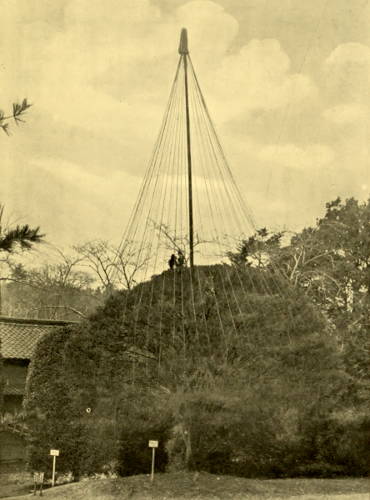
THE PINE TREE TIED UP FOR THE WINTER
The Camellia tree has still opening flowers, out in this neatly packed-up little garden, and they look gay among its glossy leaves.
It is only at nights that it is so cold, and then often there is more than an inch of ice on our little pond, all to be melted in the sun of midday.
December 30.—The University is shut for the New Year holiday, so I cannot work there now, and played tennis in the morning and spent the rest of the day “domestically.” The climate rots one’s clothes so, that there is plenty to do. I also made up some writing.
January 1, 1908.—This is the greatest day of the year in Japan. Until long past midnight the people in my house were up preparing for it. Outside the door of every house is a pair of leafy bamboos and pines, and over every front door a line of pointed straws. Most also have a wreath with fern leaves, sea-weed, fish, and a large kind of bitter orange—each of these symbolic of some special aspect of good luck. In the house are found the mochi cakes, a kind of round cake made with much-pounded rice-paste, a horrid glutinous sticky mass, but very essential for the future welfare of the household! These are put two together in little piles; and there is a pair of big ones, 10 inches or so across, and a number of little ones all round it. The little ones are distributed on white papers in various nooks and crannies of the house, and are said to be for the rats, though those I have watched have not appealed as yet to those ubiquitous creatures. At the end of the year there is a rampage of present-giving, in which, of course, I had to join. The gift from my house lord overwhelmed me with its splendour: he presented a beautiful ancient sword, with pearl-inlaid sheath, a handle richly set, and ornamented with gold flowers. I had given very small things, only cotton dresses to the maids, and a silk bag to the lady. The sword is a gem, and I love it very much—but perhaps it is only lent me for the year I am here: I don’t quite know, but gathered from their flow of words that I was to take it to England.
On the first day of the year every one wears their very grandest silk robes, and instead of my usual breakfast I was requested to partake of the prescribed New Year dishes. The two maids and the mistress, all in their best (and in their best the Japanese women are truly butterfly-like and fascinating), brought a tray, and on the tray a stand of old valuable lacquer with three lacquer drinking-cups, out of all of which I should have drunk, and exchanged with her, the special sweet saké that is a vital element in the proceedings. To pacify my hostess I sipped from one, and handed it to her. She raised the cup to her forehead and drank also a sip. Then I had to eat the three foods. A kind of paste, or rather “shape,” of finely-pounded fish, a kind of rolled omelette, and a mash of sweet stuff made principally of chestnuts, and, of course, mochi. The three subsidiary dishes I did not eat, one of which looked too queer, a kind of foundation of small brown beans with brilliantly coloured pickles. The dishes were covered with beautifully embroidered silk crape, representing a gold tortoise or turtle (old age luck), storks (ditto), pine, plum blossom, and other New Year symbolic plants and animals.
I had a present from one of the men at the Institute of a dear little dwarf plum tree, with sweet-smelling pink blossoms, which scented the room. There is not a sign of a leaf on the little tree, which is now covered with blossom.
The streets of Tokio are simply enchanting, the pine and bamboo at every door, and wherever there are shops, strings of gay red and white lanterns. At night it is a fairy-land. All the girls, and a good many of the boys, all in their very best, are out in the streets playing battledore and shuttlecock with gaily decorated bats and light feathered cocks—such bright, pretty groups.
In the afternoon I went to the reception at the British Embassy, held after the Court, with nearly every one in Court dress and uniforms—some too magnificent. There was quite a crush of Pomp and Circumstance, and the brilliance can only be imagined by those who have been to Court, and they need no description of it. Yes, clothes make the man, and ’tis well that gold lace is so dear, or we would all be Personages.
January 2.—This morning I started to the seaside, Kamakura, with the P——s. This little village is only thirty miles or so from Tokio, and one can run down in a couple of hours (quick for Japanese railways), and get a nice sandy beach and wild hills.
At the hotel, which is quite European, there was a number of other English, and we joined forces, and went picnics and had games and dances together in high feather.
The principal sight of the place is the great Dai Butsu, or gigantic metal statue of a seated Buddha. Most Japanese Buddhas are travesties of nature and abominations of art—but this one compels reverence and attracts devotion. Its stillness (a stillness far greater than that of a house, a statue, or any ordinary inanimate thing), its great size and the wonderful calm on the face, the beautiful human lips and broad-based nose, all make one dream and presently drop a tear or two if no one is looking. Several of us went together by day to see it—but in the evening I slipped off alone to its little grove and saw it in the starlight. Unfortunately there was no moon that night. For technical descriptions of its size, etc. you can see the guide-books or hear any traveller’s gossip. It is one of the sights of Japan.
January 3.—We all went for a picnic all day on the hills, looking out over the sea on three sides: and we had a sleep on the hill-top at noon, and came back as it grew cold at 4 o’clock for tea.
January 4.—Also a lovely day, only I wandered off alone and got lost in the long bamboo grass, 10 feet high, and got no lunch. I came back for tea at 4 all right, however. It is a curious sensation coming down a steep hill-side with no path through this high stuff. I don’t want to repeat it.
January 6.—The day was spent at the Institute: the floor of the fossil laboratory is being concreted, so it is locked up for a bit. All my time was taken up with the welcome letters which I found awaiting me, having accumulated for a number of days, during which there was an exceptional lot of mails.
January 7.—All day at the Institute, picking up dropped stitches. The term has not yet begun for the students.
January 8.—I was at the Institute in the morning, and at Professor F——’s for tea in the afternoon, where some New Year customs and flowers were shown, the New Year plants being the pine, the plum, and the bamboo.
January 9.—The New Year decorations are beginning to be pulled down from the streets, but a little tuft of pine is left in the place of each, and sometimes surrounded with a garland of rope.
As I was at home this afternoon, I had long talks with my landlady, to whom I seem to afford a great amount of interest. The clothes of a Japanese woman are really very cold and draughty for winter, because of the way the skimpy skirt opens in front (there is no front seam, it is only folded and confined by the broad obi or belt), though they may have as many as half a dozen padded garments on at once. She sees me, of course, in all stages of dress and undress, and greatly admires my warm spun knickers and stockings!
January 10.—I have been in this house now nearly two and a half months—except, of course, when I have been away—and every night I have had identically the same things for dinner. Dreadful! Not at all—I have come to the conclusion that it is a most excellent plan. How many men and women are worried and bored by the never-ending question, “What can we have for dinner?” If you always have the same things this most troublesome of all domestic problems disappears. No one wants anything but water to bathe in, unless they be fairy princesses or Queens of Scots, and yet the delight of a bath never palls: in these months I have had the same things to eat daily and relished them hugely. Consciously or unconsciously, we are so much the creatures of habit that if we are led to expect variety in our dinners, the same menu repeated twice becomes tiring and three times insufferable. We even remember what we had last week—but if we have daily food always the same, we judge only its quality, and if it is well cooked, relish it. Of course the menu must be wide and well chosen. I, for example, have the same five kinds of vegetables always served with my small piece of steak, and the frying of the fish is superb. From this peace I am now driven out by my landlady, who has at last realised that some variety would be, to say the least of it, usual. She consulted me about it, and has bought a cookery book of “sea food,” as foreign cookery is called, so I gave her a lesson in soups for a beginning, that being the part of the menu she managed least well. Oh me!—those dear peaceful dinners—I recommend every one to try the plan; it is philosophically sound and practically excellent.
I went to lunch at the Faculty and found many, but not all, the Professors there. Term has only theoretically begun. The day has been gloriously brilliant, so that one could shout for joy, though after sunset it was frightfully cold. At half-past five the stars came out, brilliant points of diamond light through the trees.
January 11.—I spent all the morning testing copper disks and the gas-engine, etc., though it was Saturday. Late in the afternoon I called on a Mrs. K—— with a card of introduction. Unfortunately, I have been far too busy to present half my introductions, but I wanted to know some more Japanese ladies, so called on this one. What a contrast she was to the others I have met! Running downstairs to meet me and chattering all kinds of greetings, expostulating against my removing my shoes (a thing, by the way, which is absolutely essential in all true Japanese houses, because of their beautiful floors), commenting on the weather, and thanking me for coming till my breath was quite taken away. Soon I discovered the reason for all these unusual things—she had been eleven years in America, and had studied at one of the Universities. Her husband had been eight years in America. She was exceedingly nice, but so unlike a Japanese! with her thickly scattered adjectives of “dear,” “sweet,” and “lovely,” though she was dressed in Japanese style.
We were comparing the marriage customs of the different nations. In Japan a man asks, “Whom does my father and mother wish for me,” if he does ask anything at all. In New York the man asks, “How much money has she?”—in Boston, “In which College did she study?”—in Philadelphia, “Who were her ancestors?”—and in England, “Does she love me?” Mrs. K——’s marriage seems to have been made in Boston: her subject was zoology and her husband’s medicine—all very unusual in a Japanese. She informed me that Japanese clothes are so much more difficult to make than foreign, which astonished me, for there are only straight lines in a Japanese dress. But it has to be evenly padded and lined, which makes the trouble. She also informed me that all the English and Americans married to Japanese are so “sweet and dear”—the different customs making their characters patient and charming.
It is true that in their eyes the average Westerner is childishly quick-tempered and troublesome.
January 12.—New Year calls on Professor and Mrs. S——, and a dinner-party at Professor F——’s, where every one but I was Japanese. Though the food was all European, we sat on the floor all the time and ate off a table a foot high. After dinner numerous reproductions of famous pictures were brought out, and I amused myself (and them also, I expect) by making them give their real opinions on the beauty or otherwise of the people in them. Most of our beautiful women would be wasted in Japan. Blue eyes are hard and unloving! Burne-Jones’ chins are laughable; Botticelli’s Madonna has no beauty and the saints are ugly. But Burne-Jones’ women’s hands are lovely, and the reflection in the water of one of his attendants of Venus very lovely too. Turner’s pictures are too crowded with detail!! Kaulbach was much admired.
January 13–15.—These three days have been very cold, and I have been at the Institute practically all the time cutting fossils; the machine going at normal speed, giving finally very good results. But who would have imagined that on the amount of water dropping on the revolving wheel depends the rate at which you cut through your stone—or that carborundum put on at 1 inch or 2 inches from the cutting point makes all the difference in the world? These and a thousand little details like them have to be learnt by series of experiments. The weather has been lovely, and even wonderful. One day there was snow, and it covers these little Japanese houses so picturesquely, picking out the detail and making them more like picture-book-land than ever. The sky is brilliantly blue, and the hot sun melts the snow on the little pine trees, so that they are like fountains of glittering drops, while from the grassy banks beneath them soft wreathing clouds of white steam curl up and are lost in the blue, and I long to be a poet. But the next day! The roads were quite unspeakable, and for many days following.
January 17.—At the Institute all day again. At 2 o’clock Sir Claude Macdonald (the Ambassador) and Mr. Clive (the Secretary) came to see me and the stones. The former is huge, and with his glorious fur-lined coat and pale-green suède-edged waistcoat, looked sadly out of place in my work-room, which is nearly filled with packing-cases and lumps of coal, but they stayed ever so long. The people are much honoured that the representative of his Britannic Majesty should have visited their Institute.
January 18.—I worked at fossils all day, and this evening, commencing at 5, was the Biologists’ supper. Every biologist in Tokio comes, from head professors to first-year students, about 130 in all, and I was the only lady, of course. This time we ate from high tables, sitting on European chairs, but we ate Japanese food with chop-sticks! The most thrilling things were sagittaria and ginkgo seeds! cooked quite soft in a dish which is a kind of cross between a soup and a custard (a gay thing to eat with chop-sticks any way!), and by carefully biting the tiniest piece off the top of the seed one can see the embryo and suspensors; the endosperm alone, of course, is the only part eaten. Just as we have chocolates or almonds on the table through the meal, they had tins of tiny dried fish, about half an inch or so big and quite crisp, like roasted pea-nuts. It was a very frivolous meeting; there was story-telling with much laughter, and comic pictures of various professors and students under amusing circumstances; and a drawing by lot for gifts of all sorts of things, from an old newspaper or a turnip to books or ornaments.
January 24.—Canada Balsam is causing much trouble in the fossil work-shop, and I spent most of the day over its little fads and vagaries. The young man who is to learn how to cut the fossils (after we have learnt ourselves and can teach him) is very quaint in his personal appearance, and reminds me constantly of the Golliwog, his hair grows so far down his neck and the back of his head is so flat. I fear some day I shall give vent to the amusement he causes me. But he is undoubtedly quick in some ways and very tidy in his methods.
January 25.—I had to mess round over the gas-engine all the morning, and in the afternoon (Saturday) went to watch some of the mad foreigners playing, or trying to play, I should say, Hockey. They were only six a side, but I really wouldn’t join in spite of their entreaties, for they were not playing on grass, but on bare earth! The dust was awful, and I should think very unhealthy. It is simply impossible to get any grass in Tokio, it is only to be seen in small quantities in a few sacred places, and even then dies down all through the winter, so that it is quite unusable. Moss and liverworts grow here so well that it is very curious that grass is so impossible to cultivate. Professor M—— is trying experiments with English grass seed at the gardens, but it isn’t very successful, though better than the native product.
January 26.—I called on Mrs. G—— at the Embassy. I heard a true story of certain small children in Yokohama, a girl and a boy: the former caused her mother much sorrow because of her habit of fibbing. Her brother fell out of the window and was helpless in bed for some time, and she was left to amuse him one Sunday afternoon. When the mother returned she found pencil scribbling all over her white dimities, and said, “Who did this?” (a form of question she usually avoided, using subtler means). “Brother,” promptly answered the maiden. When asked why she told that lie, said, “Because I forgot Brother couldn’t get out of bed to do it!”
January 27.—A day spent on work of various sorts on the fossils. A terrible wind suddenly arose in the afternoon, and going home along the streets it blew first on one side and then on the other, and the dust it raised hung like a fog all over the city, while the sun, usually a fiery brilliance at which one dare not blink, hung like a disk of pale gold in the fawn-coloured sky. Along the road, as one walked, fancying peace, suddenly a snake-like form would rise, its cobra head would expand till it formed a huge surging wave, that spit and stung and blinded; or a little whirlpool would start at one’s feet, shake itself and open in a second into a great torrent, that showered upwards instead of downwards. I never saw such dust, but they say it will be worse in February.
January 30.—A national holiday, so no work was allowed at the Institute. I gave a tea-party, only to about twenty people, of whom the merriest and jolliest was Baron K——! When I have seen him hitherto it has been in solemn manners. The intense agitation this caused in my house all day cannot be imagined by you English people who give tea-parties every little while! The entire household for the entire day was quivering with excitement; and I must add to their credit that they produced several treasures of art, kakemonos and gold screens, from the go-down (or safe), where they are kept.
January 31.—I was fossil-cutting all day, a nice new stem and leaf turned up to cheer us on. The following cutting may be amusing; it was in the Japan Gazette a few days ago:—
An amusing incident occurred at an “At home” in Tokyo this week. A matron, talking to a slender young woman in a pretty art gown of blue velvet, said, “Oh, I hear Dr. Stopes is here. I want to meet the delightful old party. I understand he is strong on fossils.” Later on she said to her hostess, “Who is that girl I’ve been talking to, in the blue dress? seems a nice girl.” “That is Dr. Stopes, the learned geologist,” said the hostess, and the Yokohama matron collapsed.
February 1.—I was fossil-cutting all morning. Aluminium, of all metals, seems to be forging ahead as the prize saw-maker.
February 2.—A dull day, so I didn’t go out exploring as I had intended, but snuggled into bed all the morning to counteract the cutting-machine, which is really rather wearing.
February 3.—At work all day on the fossils. Dinner at the P——s, after which I had to give the long-promised lecture on fossils to the Literary Society of Tokio. Naturally, to an audience in which missionaries played an important part, but little science was desirable. However, they seemed pleased to hear about the various adventures connected with fossil collecting.
February 4.—At work in the Institute over fossils all day. In the course of my walk to the Institute, which takes about forty minutes, I pass quiet streets which are little frequented by the foreigner. In all these months I have never yet met a single foreigner between my house and the Institute, though in other parts of the town they are common enough.
Every day I see something or other I long to record, and forget when it comes to writing this journal what it was.
The shops are now full of oranges. Small ones, like our “Tangerines,” but native grown, and seedless. They are sent to the shops in little boxes, universally the same size. How sensible the Japanese are about such things—in spots! But oranges are a little tedious, and there is really almost nothing else to be had but tasteless and expensive apples. This country is still in that primitive state when we can only get the fruits and flowers that are locally in season. Even well-off people, who at home could command strawberries in March and roses in December, must here eat the things at the time Nature intended. It has a certain charm but—I am a Londoner.
Another striking thing about this country’s products is the extraordinary richness and variety of the vegetation,—palms and pines, bamboos and magnolias, chestnuts and orange trees, rice and roses; the number of plant species in the little country of Japan alone exceeds that in all Europe. Also the number of species of birds and insects is extraordinarily great, and their brilliance and beauty quite unusual. Yet it has been said by one who knows the country, “The flowers have no scent, the fruit no flavour, and the birds no song!”
To this, I myself would add, “and the people no souls.” And in the whole saying there is truth enough to justify its existence, probably as much truth as there is in any saying, for in all our sheaves of words there are but a few ears bearing the grains of truth. Now I hasten to add that a spray of plum blossom in January scents a whole room with its fragrance; that the native-grown figs are the most luscious and sweet I ever tasted, and the nightingales’ thrilling melody to be heard even in the cities; while I have met men and women who are as the plum, the fig, and the nightingale. And yet on the whole, that hard saying is true.
February 5.—At the fossil workshop all day. Nearly every day in this clear weather I see the great Fujisan, its whiteness high up in the clouds on the horizon. The pearl of mountains, that, alas, I have not seen yet except from this great distance. From her superb height she looks down on this grey-roofed city, and I wonder if she sees in it all the things I see! The dirt, for instance, and the horrors of disease. I have praised so much in Tokio that I think you can bear to hear something of the other side, of the sights that sicken and appal. Of these, the ones that struck me first were the numerous children (only very young ones) with frightful eczema; the one that now haunts me is the sight of lepers. They are not allowed to live in the city, when in an advanced state of disease, but they are allowed to come in and beg. One may easily touch one by accident! To-day I was within a foot of one before I noticed it. They hold out their hands, with the fingers eaten away, gruesome sights, and mumble prayers for alms. Once one died, or nearly died, on the road, a crowd formed round, with a policeman on guard, but no one would touch it to give assistance.
On the whole, the Japanese do not fear leprosy nearly so much as we do, they say we over-rate its contagion; but how can they pretend to civilisation with such sights in their streets?
One hears on all sides, from themselves and from others, that the Japanese are pre-eminently a clean people. In their houses that is true, but just outside! Even to-day in all the smaller streets of Tokio a little gutter or ditch runs along on either side and carries away, or is blocked by, as the case may be, all the refuse and drainage of the houses near by. No wonder that even Ambassadresses get typhoid. I am thankful there are chickens kept by so many poor people, that roam the streets and pick at the dainties, but I wonder if it is wise to take a raw egg beaten into milk.
February 6.—There are more stars in Japan than in (or over, should I say?) England. After the glowing sun sinks from the cloudless blue sky, the stars spring out at once, and by 6 o’clock the heavens are crowded. In the milky way one sees not a haze of white, but a glittering stream of bright minute gems. Sometimes too the stars have haloes, quite big ones, such as we only see round our moon, and when they shine out of the clear sky they almost dazzle.
February 7.—I was at the fossil laboratory all day, cutting away at my stones. Dinner with the P——s, and after that the Tokio Bachelors’ Ball—a truly delightful function. I left at 2 A.M. and walked the 3 odd miles home with two nice men. It was really too cold to ride in these open kurumas, even with two rugs and an eiderdown. The walk through the quiet streets under these ever enchanting stars was delightful. One of the men was a military attaché here, and has been to camp with Japanese regiments. I find every one who knows only military men thinks less highly of the Japanese character than do those who mix with the University men. It is not unnatural that the army is rather suffering from “swelled head”—and then, who would give a German Professor for half a dozen or more of the German officers!
February 8.—Though Saturday, and though I did not get to bed till 4, I went to the fossils from 10 till 4, and then to tea with Professor F——, where we discussed dancing, which does not seem to find favour in his eyes, or in those of most Japanese.
February 9.—A nice quiet morning in bed; after lunch I went with Miss C—— and J—— to see the temple of Kwannon at Akasaka. People who habitually drive in carriages see less of the truly Japanese streets than do the kuruma riders. Most of the old roads are so narrow that a carriage cannot pass, and they must perforce go through the newer or widened streets, where they encounter electric trams and maybe glass-windowed stores for “Foreign Goods.” Not that these latter do not afford amusement—one may see a Store that carries on the “Import and Manufacture of Grocers”—another that sells “Unnecessary Provisions.” Of which latter I may add there are many in Tokio, to wit, the beaded mittens, crochet atrocities, Paisley shawls, etc., ad infinitum, that are destroying the beauty and harmony of the national costume, and are making the people ludicrous in their hybrid garb. An irritating little habit the coachman and Betto[4] have, is to cry in hoarse duet to every child or old woman (of which not less than several thousand seem to be encountered in a drive) to warn them off the road. It becomes inexpressibly irritating to the unfortunates in the carriage.
I think I have already spoken of the temple, the most popular one in Japan, where incessant crowds are praying or clattering through, or come with aches and pains to lay their hands on the wooden figure that will heal. It is a case of physician heal thyself, for the poor god has all its features rubbed flat by the hands of a sick humanity. The temple is so popular and so certainly described in every book of travel, that I shall not stop to do so. It is situated in the Whitechapel of Tokio, and the stalls and entertainments in the neighbouring grounds are reminiscent in some degree of a Bank Holiday—though noisy behaviour is lacking.
February 11.—A national holiday, so that schools, etc. are closed. To-day the Emperor ceremoniously worships his ancestors, attended by practically all the Government head officials, including Professor M——, who wears a uniform smothered with gold lace. I went to lunch with Mr. Mj—— in his house in Azabu, which is surrounded by a lovely garden, with pines and a pond and regular scenery. The party was composed of foreigners, and we sat at a table 1 foot high, and had a sumptuous Japanese luncheon. His two little girls—aged six and eight, in brilliant true Japanese kimonos—were very gay in entertaining us, pouring out the saké and singing many little songs (“God save the King” among them), and bringing their dolls to table. Not at all shy, and not at all like Japanese children in this, and yet not forward, they were pretty, bright little things.
February 13.—Fossil-cutting all morning. We are getting on finely now; it is nice to see the actual structure at last, leaves, stems, and roots are turning up with all their cells very well preserved in the stone.
February 15.—Fossil-cutting all the day. The engine has a curious way of giving little explosions when it is not quite clean at the burner—they make the boy jump to such an extent that I fear he is a coward. Also, when I put the molten pans of metal into water and they fizzle, he won’t go on working near me till I have assured him that it is perfectly safe. I sometimes wonder if the Japanese are really brave except when worked up to it en masse. Several people who have been here some time tell me they think they are not.
February 16.—I spent the day out of Tokio in a country place, about an hour-and-a-half’s walk from Akabane. The country was slightly hilly, the sunshine brilliantly hot, and the jagged snow-covered hills in the distance very lovely. The fields were cultivated with wheat and green stuff, and here and there patches filled with the round tea bushes. The houses were all set amid trees, tall and red-brown trees, though “evergreens.” The same leaves, now looking so dead, revive their chlorophyll, and become green in the spring. The plum trees, pink and white, were in bloom, but they were the only flowers we saw. In the plain were rice fields, all dead and brown, but here and there along the little irrigating canals green grass roots flourished. Japanese grass all goes brown in the winter, but I am beginning to suspect that it is the dryness that does it, for here and there in damper, very shady places, I find brilliant green roots. By the broad river, with only one house near it, and that set some way back in clumps of bamboo, was a plain of tall coarse reed-like plants, partly cut down for mat-making. Here we are promised masses of pink primroses in the spring. Some young bamboos were green, and amid these we lay and listened to the absolute silence, undisturbed all the day. There was not even a bird’s song or an insect’s buzz, and one might have imagined it the top of some snowy peak for the stillness of it all.
In the evening I went to dinner at the G——s, and enjoyed it very much; there were some entertaining people there.
February 17.—On my way to the College I pass a small factory, whose owner keeps his coal piled up in a great heap on the road against the wall. It doesn’t seriously interfere with the traffic, as the road is quite wide enough for a good-sized cart to pass even with it there, and I have never seen two trying to pass. The coal has been there many weeks now, but no one seems even to think of stealing it, though the houses around are extremely poor. I thought it wonderful honesty till I remembered that the Japanese think coal horrid, smoky, dirty stuff, quite unfit for use in rooms, but even so, in their bath-tubs they burn wood, and it might well tempt them to go after dark and help themselves. The streets, of course, are totally devoid of “street lamps.”
February 19.—I often wonder why I have not mentioned before the most extraordinary furs worn by the Japanese men. Though the fox is a kind of evil witch, a devil in popular imagination, yet practically every man wears a great fox skin round his neck. No pretence about making up into “boas” or anything: it is simply the whole skin, unlined, and doubled, fur outwards, along the middle of the back. The tail is then put through a hole in the animal’s head or neck, and both hang down in front of the wearer. A really rich man has so fine a skin that the bushy, brilliant red-yellow tail hangs down to his waist, waving around when he walks. Japanese ladies almost never wear furs, except when in foreign costume.
February 20.—Quietly busy over the fossils. There is no need to relate the innumerable details that require attention or exasperate one—the sections are yielding good results, all things considered, and I quite enjoy the cutting.
February 21.—Though the sun is so hot through the day that I sit in it with almost nothing on but a thin slip, night and morning are so cold that one shivers, and the ice is thick on the little pond in my garden. Yet a stark-naked youth comes to the well in the next garden, and a trim little maid works the rope and brings up buckets of cold water, which he pours over himself, and then proceeds to dry himself with a towel which he first carefully soaks in water (in the true Japanese way). This corner of the garden is the meeting-place of three gardens, and the well is common to the three households, so that sometimes a second maid may assist in his morning amusement. Behind the trees I can see the painted wood walls of the Mission church, where people go in European clothes to sing hymns.
February 22.—I had been really bullied into playing Hockey to represent the world against Japanese-born British. They were, of course, far stronger than we, as nearly all live together in Yokohama and practice twice a week, while none of us had played together before. We got 2 goals to their 4, however, and patted ourselves on the back.
Returning by train (Yokohama to Tokio, of course, is the chief line of rail in the country, so that the incident should not be compared with doings in some far-off highland place in Scotland), the train suddenly drew up with a jerk, far from one station and about the same distance from the next. The passengers were surprised, some slightly alarmed, and the train calmly waited for some time and then started racing back to the station from which we had come. We all resigned ourselves to a broken bridge, overturned carriages on the track, or something of the sort, and finally drew up at the station we had just left—much commotion on the platform, and we learned that from the luggage van some parcels had not been delivered! They were delivered over to the proper person and the train started off once more, to reach Tokio not a little late.
February 24.—There have been signs of the coming Dolls’ Festival, to take place on the 3rd day of the 3rd month. I have mentioned them already (see p. 74). The shops are now full of them, and most fascinating they are, but too expensive to indulge in as I should like. The figures are all in little boxes, and sit solemnly, with their stiff robes spread out, as though they were really the nobles that they represent, and every one is interested in buying them, or at least gazing at them in their temporary homes. Several shops have sprung up this week filled with these boxes of dolls, and selling nothing else.
February 25.—At work all day at fossils, the record so far, for with the boy I cut and finished eleven sections in one day, some very nice. A ball at the British Embassy in the evening, very pleasant. Many interesting and amusing things happened, but unless given in great detail would not appeal to any one outside local gossip. Captain von L—— introduced me to the loveliest woman there—an American (sad to hear their awful accent coming out of such patrician lips!), the one who at a previous dance had so entranced me and my young partner that we spent our sitting-out time following her around to see her eat ices and laugh; her manner was perfection—calm, still, and gracious, honey-sweet looks in eyes that never smiled while one was speaking to her, and that just broke into little curls of smiles as she answered—a suggestion of humility while waiting to hear another’s banalities, yet with it a commanding dignity that forbade any one else to interrupt the person who was speaking to her. Her name is Mrs. D——, and I am going to see her, as she very graciously invited me to do. I wonder if she includes thought-reading among her other charms and read my admiration? Her high-heeled pink satin slippers twinkled gaily in the dance; she did not hesitate to lift the Worth frock very high—with such ankles I wouldn’t! On her white soft neck were the loveliest little blue veins, I never saw anything so suggestive of living marble. She was like white marble, with an underflush of rose and violet. The little wrinkles at the corners of her eyes added to her charm rather than detracted from it. She is the only woman in Tokio who has bewitched me.
There was a very striking-looking girl, daughter of a French mother and a Japanese father, her hair done cavalier fashion, with a side bunch of ringlets under a big white bow; her very French frock and tiny waist became her well, and she strode through the Lancers with such a devil-may-care manner that we could not but remark her—favourably too in spite of it all.
Tokio is a fine soil for gossip, very good-natured and amusing. I love it, it’s such a relaxation after gas-engines and fossils.
February 27.—Sunshine wonderful again—just the remains of the recent snow left here and there. I regret to find that the people in my house have been lying to me for long about a point on which I laid some stress—a whole complex of lies as well as the actual disobedience.
February 28.—I visited the Charmer to-day, and stayed an unconscionably long time. No one has bewitched me in this way since my school-days. She had a lovely gown of blue-and-white chiffon. Several people were there—Baron and Baroness S——, Count C——, and the wife of the Swiss Minister. I had about half an hour of the Charmer to myself—her husband is the Naval Attaché. She was simply alluring, and her house is far the prettiest I have yet seen in Tokio. She was telling me how all the Corps Diplomatique agree that there is no capital in the world where the social life is so delightful, and where there is so much gaiety and friendliness among the Corps as a whole, as in Tokio. Also there is really no other capital where other people can enter the charmed circle; that, of course, is the result of the small number of Westerners in the place, and their social position; as I have remarked before, there are almost no commercial people in Tokio.
At lunch at the Faculty to-day. Dr. Y—— brought me a paper on fossils to correct the English, he is soon starting for Europe. I have mentioned him before as being a rising paleontologist, such a shy, young-looking creature, utterly lacking in all social gifts; I wonder how he will fare in Europe, perhaps some of you who read this may meet him. He is predestined to be professor in a new University about four years hence.
February 29.—I worked at the fossils till 12, and then set out for Baron H——’s long arranged luncheon party.
We were received in rooms with tables and chairs, and an oil-painting! There were the “lace” curtains found in every “foreign style” Japanese house, alas! The Baroness was very gracious and sweet, and acceded to my request to play on the Koto, playing a very charming piece.
As we sat on the cushions I could just see out of the small panes of glass put into the paper soji, and I delighted in the garden, with its trees of pink and white plum just bursting into blossom. After some time the men came in and Baron H—— showed us his collection of sword rings and knives, etc., all good, and some very beautiful.
March 1.—It was terribly wet all night and this morning; I went to lunch with Miss B—— (before mentioned as a very amusing lady, despite the fact that she is a missionary). I think no one would be better qualified to write memoirs than she. I was hearing something about the inner life of the Court at Korea. She is a friend of the English lady doctor who attended the royal ladies, and it was all extremely amusing, but it is not my place to tell her anecdotes.
I returned early to do some writing, but was greeted by my landlady with the announcement that to-day, to-morrow, and the next day are the Festival of the Dolls. I must, therefore, drink some special sweet thick saké and eat various sweets, some nice little ones like fried caterpillars being very tasty. I was also asked to come and see the pictures and screens brought up from the store-house, two of them 200 years old, and one, a really magnificent one, 500 years,—gold with plum blossom and birds. I am constantly seeing new treasures they have in hiding.
They gave me a lovely granite hill with clustering rosy flowers growing round its base—all 6 inches square—and we admired together the wet pine leaves in the garden.
March 2.—Fossil-cutting all day; a very nice dance in the evening after dinner with the P——s, where I spent the night.
March 3.—The Dolls’ Festival. Mr. Mj—— and his three little girls have a very gorgeous collection; the dolls, however, are far too exalted for any child to play with them. The Mj——s must literally have hundreds of these expensive little miniatures of the Emperor and Empress in the old-style garments, of historical and mythological figures, of musicians and actors from the Nō—all of whose dress is a wonder of design and execution. Then there were all the household utensils in tiny lacquered form, and on the little trays and dishes was real food arranged, as well as large models of fish in sugar. There was even a little temple, with most of the appointments correct. A large room was given over to them, and looked like a bazaar, but the arrangement was not merely chosen to display the detail, it was all according to prescribed rule—the Emperor and Empress on the top shelf, with their jingling elaborate head-dresses and long silk tassels on their many robes; below them the musicians; on the lowest shelf the tray of food, the little houses, screens and fans in inexhaustible variety. The children are provided with special sweet food which they themselves eat, the crisp sweet “puffed” rice, sweet blocks of jelly and sugar concoctions of many kinds. The guests were also provided with these dainties, and some of them were delicious, but I could not drink the sauce-like saké.
In the evening there was our inaugural dinner of the London University Union in Japan. I found there was quite a number of old U.C.L. students in Japan, and so started the idea, which was very keenly taken up by Professor S——; others joined in, Baron K——, Professor S——, Professor F——, Professors L——, S——, etc. etc., up to the number of twenty-one, are members, and the first dinner was quite a success. Professor S——, Baron K—— and I form the Committee elected then, and I hope the Union will live. Cambridge and Harvard, etc. all have their Unions, why should London be less honoured and remembered by her children?
March 4.—A long day at fossils.
March 5.—Fossils till 4—then I went to tea with Mrs. D——. She had invited the American Ambassadress and her niece to meet me, and I liked them both. The former is very like a slightly slimmer and handsomer Miss S—— of Wintersdorf! Mrs. D—— had another lovely frock, and was a dream of sweetness and beauty. Why do I always fall in love with women!
March 7.—Fossils all day till 4.30, then to tea with Dr. H—— and his wife, recently married and very cordial; they live in a really tiny Japanese house, no room more than six mats, but so spick and span, with a dear little garden. Though I have done my best to teach that man how to treat a wife—and he always seemed to be drinking it in quite properly—she herself brought the tea for us two, taking none herself (I know she has a maid), and sitting in the corner away from us, and not even taking a cushion to sit on, when he had been shamed into giving her one by my remarking that she had none. However, they seem happy, and she looks quite well, and she has not a soul quivering with every touch of the material things of life. She says he loves her very much, and has loved no other woman.
March 8.—To-day I visited the sick. Poor Mrs. G—— was riding in a kuruma a week ago and the Embassy carriage ran into her, knocked the kuruma to pieces, and the horse fell on Mrs. G—— and rolled over! How she escaped fearful injuries no one knows, but a muscle is severed and she can’t walk just now. She looked very pretty in bed, and was holding quite a court. Horses in Japan are really dangerous and constantly run away.
I called my duty call on Baroness H—— after the luncheon party, and the conversation did not flag, though what she thought of my Japanese (the horrors of which I am daily realising more acutely) I don’t know, as she held it under with her fine native politeness.
I have read two interesting books this week—Lieutenant Sakurai’s Human Bullets and As the Hague Ordains, the supposed journal of the wife of a Russian prisoner who comes to him in Japan, and is gradually converted to love the Japanese. The first book was rather a shock to all one’s preconceived notions about the unflinching bravery and repression of feelings among the Japanese soldiers! They were either weeping or embracing each other or writing sentimental letters—on every other page. I was quite sick of all their tears and self-adulation, though the writer gave a vivid picture of the ghastly carnage of the siege of Port Arthur. Yet people praise the book and don’t seem to notice the sentimentality as much as I do. I wonder if those who praise it have read it.
I heard from an old resident (thirty years here) that the Japanese are the most sentimental people under the sun. Oh, ye who stop at home and dream your dreams about Japan! Stay there.
March 9.—The following happened a few days ago, and I should have put it in then, but I forgot. The day was miserable, wet, cold, and windy, with snow blustering about, and instead of quietly having lunch in the warm Institute I was told we were to go to the big state-rooms at the other side of the gardens. There I found that all the Biology students and the Botanical and garden staff were lunching in Japanese style. There was a special kind of pink rice, with small beans boiled with it, and the various more or less savoury pieces of fish, vegetables, and a kind of pancake that go to make up a bento. Afterwards we all had packets of highly ornamental sticky cakes, chiefly made of the stodgy bean-paste I cannot eat, but some were good. This was the feast of the God Inari (the God of Rice), who is very appropriately worshipped by the botanists. After the feast we cowered under our umbrellas and went a pilgrimage through the gardens to his shrine, where we found the hundred-year-old blue cotton banner put up outside. Within the shrine was incense, lit by the Botanical Laboratory attendant, and a great tray of cakes, the same as we had been eating. Led by the Staff, we all rang the bell to call Inari’s attention to our visit, and clapping our hands in prayer we gave him a few sens each, throwing the copper coins in among the cakes. Then we ploughed our way through the bog-like paths to the Institute.
March 10.—So seedy that I did not get up at all. It is the very first day in my life that I have ever spent in bed (except for the measles, when I was too ill to notice anything much), and I feel it a solemn and important event. The first half of the day sped on magic wings, and I wondered how one could be so bête as to find bed a wearisome place when one is surrounded by the lovely golden lights on bare wood. How we spoil wood by staining and painting it! The range of delicate colour in the woodwork of my room is a perfect delight. Then I had also a little tree, shaped like a weeping-willow, but one mass of rosy pink plum blossom, some flowers wide open, with recurved petals and a flare of silver stamens, others in perfectly round crimson buds, alluring as only roundness can be.
Till 3 o’clock in the afternoon that tree and the wood made me blissfully happy, but the hours between 3 and 5 seemed terribly long, and by night I was sated with the delights of bed. The next day seemed very far off.
March 13.—I went to the Institute in the morning and cut some fossils. It has simply been an influenza cold, but it has rather played havoc; after lunch at the Faculty and a long and varied talk with the Dean, I wasn’t fit to do any more, so I called on the B——s and went to tea with the Charmer on my way home to bed. I went to bed before 6 o’clock, and was so worn out that I howled for an hour, but dinner revived me, and I am now as cheerful as if I hadn’t contemplated suicide two hours ago. Tokio is a terrible place for ups and downs. To-day it is fearfully cold, even my bath towel frozen; and a week ago it was like summer for two days—one day a miserable snowstorm, the next glowing blue skies.
March 14.—In the afternoon a party had been arranged to visit a noted plum garden at Omori, and have tea in a tea-house. As the H——s had asked me to go home with them to dinner and sleep, I went, though by the end of the day I was far too tired out. We carried cakes, trusting the tea-house for cups and hot water. The plum garden was indescribably beautiful, and a typical “Japanese” scene. The garden sloped in the double hollow of a shell-shaped valley, and the rich white bloom on the trees surged up it as the thick drifting mists surge up a mountain pass. Standing out from the cloud-sea of blossoms, like peaks from out the mists, were two or three tea-houses, white papered and inhabited by gaily-decked maidens, and men who admired the plums, in grey silk. The sky was clear sapphire, and the sea beyond lay like a blue gauze veil along the horizon. While the others went on into the midst of the trees, I left the garden and sat in the sun on the steps of a little temple, which was a perfect harmony of curves, and behind lay a bamboo grove.
Tea was amusing, for Captain S—— would not take off his boots, and therefore had to walk with his feet in the air; which he did on his knees or hands. The tea-house was perched on the side of a hill, and looked down on rice fields and woody patches on little elevations. After tea we explored the temple and its pretty groves, and had a lovely merry-go-round ride on the old revolving library, a huge thing, but so perfectly poised that we could all sit on it and go round without its even creaking.
March 16.—Called on Mrs. P—— on my way to the Institute in the morning. She captured me, and then and there my clothes were taken off and I was put to bed—and was secretly thankful to be there. She is quite exceptionally kind to take me in in this way.
March 25.—At work all day over fossils—then dressed in my green-and-gold Venetian dress and called on Mrs. G—— on the way to the Embassy dinner. She and her children were having a preliminary view of some of the gowns—she is, alas, still in bed. The party was splendid—several Japanese were there in magnificent old court dresses and simply marvellous arrangements for their hair. Baroness S—— also wore Japanese court dress. Perhaps I had better shortly describe it. The lower part consists of scarlet trousers with extremely wide stiff legs, and the garment is much like our “divided skirt” of some years ago, but the cloth is much stiffer. Over it is a gorgeously embroidered kimono, with sweeping train. Some of the hair ornaments are extremely bizarre, others (according to the period) rather simple, the hair falling down the back and tied in three places.
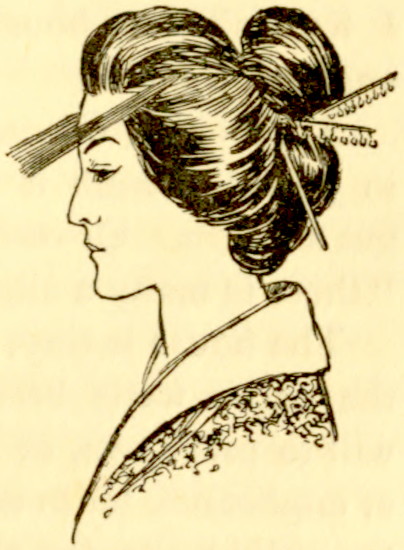
One, something like the sketch, was very effective, the funny little brush of hair coming straight out at either side being its speciality. Several of the Englishmen came as Japanese pirates, etc., with great wigs of long hair, rich gold-embroidered robes and swords; the girls were not remarkable. After dinner we all went along to the German Embassy, and met there the parties from all the other Embassies. The scene in the reception-rooms and in the beautiful white ball-room was vivid and gorgeous beyond my power to describe. Whom to describe, when nearly all were beautiful or striking, and nearly all of the important folk in Tokio were present? Count H—— (the foreign minister) was in old daimio dress, with two swords and rich brocade—and one could not imagine how he ever came to wear anything else! The evening was one to remember, with its brilliance and beauty and courtliness.