A JOURNAL FROM JAPAN (continued 3)
Reading edition
March 26.—Yesterday morning at breakfast I had imagined I would remain in my present house as long as I was in Japan. This morning by ten o’clock I had taken a house and garden of my own and engaged a maid!
Apparently, one can do things quickly sometimes in Japan, though it is usually a terrible business to get a house. Of course, I haven’t yet moved in, and “there is many a slip,” etc.
The house is tiny, but is said to have five rooms—the paper walls between these can be taken out at will to make two, or even one room. There are lots of cupboards, for in this, as in all true Japanese houses, the solid walls are all lined with great cupboards, a yard deep and reaching from floor to ceiling. The rent of the house with its garden is about 7s. a week! Less than I have been paying for my two rooms.
The joy of these houses is that one needs almost no furniture, they are provided with the soft, thick straw mats (tatami), and these serve as carpets if one likes. I infinitely prefer their delicate straw colour and black borders, which harmonise with the cream walls and unpainted woodwork, to the clashing carpets most people have. Then fireplaces being absent, overmantels, fenders, coal-scuttles and fire-irons are all represented by a little china bowl of ashes, manipulated with metal chop-sticks. Beds, though introduced by many foreigners into such houses, I dispense with, and use the native mattresses on the mats, so that they are folded away in the big cupboards by day and the room is used for what one will. Wardrobes are also needless incumbrances, the wall cupboards serving excellently—wash-stands are but eyesores, as the little bath-rooms are so arranged that one can splash at will and the water all runs away from the sloping floor. So I am a householder, and prepared to lead the simple life.
Providence must have arranged it all, for the cook next door (that is at Mrs. P——’s, I forgot to state) has a protégée who wants an easy place in a foreigner’s house, and doesn’t care so much for money, as she is timid and wants experience before going to a big house—but she can bake bread and Scotch scones and cakes! I pay her 18s. a month and give her no food at all! She even brings her own saucepans and mattresses! Well, it all looks too good to be true, and until I have moved in I had better say no more about my own little house.
I went back to my present abode, for it was my At Home day, and I entertained some Japanese, who were charmed with Arthur Rackham’s illustrations of Rip Van Winkle, and thought they showed something of the spirit of Japanese art, which I think is true.
I flew down to the station for Yokohama, and dined there with Mrs. L——, and dressed in a fancy dress costume and set out with her and her daughter to a mi-carême ball. I enjoyed the dance hugely.
March 27.—Rushed up to Tokio in the morning; to the University for lunch, where I had a long talk with the Dean. The Mitsui family (the Japanese Rothschilds) gave the money for the fossil laboratory and part of the apparatus, and the Dean proposes (now that everything is practically finished in the making of the arrangements) to give a tea-party in the Botanic Gardens to show the building apparatus and slides (I have cut 221 so far), as well as the new herbarium buildings. As I have often remarked, he is very English in his tastes and culture, and he planned to give what would be usual in England—tea and coffee and cakes. But when I saw him yesterday, how he had fallen! Nothing less than meats and wines and jellies would satisfy him. It was not his own wish, but he had been driven into it by the strength of the custom in Japan, which demands that if you have guests at all (even at 3 or 4 in the afternoon) you must give them a meat feed, and that they must eat like greedy schoolboys. Whence comes it? This mad ostentatious display, and the guzzling, which is so foreign to their real culture. A mutation derived from crossing such distinct cultures as those of Japan and Europe, not even a hybrid with the characters of one of the parents. Well, I laughed at Professor S——, for he said he hated the custom and had hoped to set the fashion for simplicity in this party of his, but that he was really afraid to do so; he would be the laughing-stock of the Japanese if he only gave tea, coffee, and chocolate, ice-cream, cakes and sandwiches from 3 to 6 o’clock! I asked him where the spirit of his Samurai ancestors lay sleeping—asked him who could set the fashion for reasonable entertainments if not himself, in his exalted position of Dean of the University—and got him to swear to me that he would be a pioneer, that he would be brave and face the ordeal of being the laughing-stock of the Japanese. I wonder how it will go.
This unwritten law, which demands such a lavish hospitality if any is given, is, I see, one of the chief causes that there is so little social life, in our sense of the thing, among the Japanese. It is a real strain on their purse and their time, and they naturally ask guests seldom when they give so much trouble.
To ask a guest to come to your house and give him only tea and cake, or a dinner of no greater magnificence than the one you eat yourself every night, is almost impossibly rude.
After cutting fossils till 5, I went home to entertain a Japanese to the same food that I eat every day. Am I a laughing-stock among them? Doubtless, and for more things than one.
March 28.—Fossil-cutting all morning. Late in the afternoon I called on Mr. and Mrs. B——, who have come up to Tokio for a couple of weeks from Sapporo, where the snow is in parts 28 feet deep—the worst they have had for more than twenty years. They have brought up their adopted daughter—the Aino girl I described from Sapporo—this time we were able to talk in Japanese, which of course she generally speaks.
March 31.—I am making the experiment of going on a walking tour for a few days with friends, and we have chosen Boshu peninsula, as it is little frequented and beautiful. We were up at 5 o’clock this morning. Very late too, as we should have got up at 4.30. However, we managed to catch the boat which is to take us to Boshu Province, the scene of our tour. The sail past Tokio down the bay was very calm and lovely; we had perfect weather and were allowed, as a special privilege, to go on the top front part of the deck, where we had a good view. Fuji gleamed white over clouds and pine tree foregrounds, and the sky was blue. The journey lasted seven hours, and we saw many small bays and islands down the coast, of perfect loveliness.
Landing at Hojo in Boshu about 1 o’clock, we walked across a point of the peninsula to Mera. Here the inn we expected to find was demolished, but we found another and got put up. It was next door to a big school, however, and we had a very large and very interested audience of about a hundred children in constant attendance. C—— had never been to a Japanese inn before, and we were a very merry party indeed. The scenery here was in no way striking, that I hope is to come.
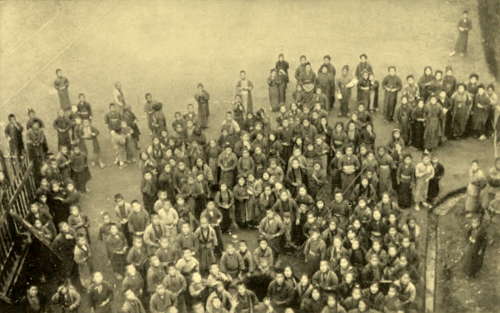
A LARGE AND INTERESTED AUDIENCE OF SCHOOL CHILDREN WATCHED OUR PROCEEDINGS AT MERA
April 1–5.—We have been walking all day all these days, and there was no time to write in this journal, for though we have walked and slept very little we have eaten and talked and laughed so much that we had time for nothing else.
The first day’s walk was disappointing, flat, not very near the sea, and with villages every half-mile or so, but we reached a pretty place by 5 o’clock, and slept at Chikura in greater comfort than we did at Mera.
Between Chikura and Wada, our next day’s walk, the coast was prettier, but the weather dull, raining, in fact, and we did not get the sea-bathing we had hoped. At luncheon-time it was very wet, and we sat in a row under the porch of a Buddhist temple (it is like a country lich-gate) and ate our cold rations. An old woman stopped to gaze at us, and M—— (who speaks excellent Japanese, having been here since she was two years old) asked her if she thought we were funny to sit there. “No,” she said, “you came to play and you are playing. This child” (pointing to a baby of nine months on her back) “also plays.” Parts of the road were fascinating, through bits of pine wood and past many a little temple. I particularly noticed the great hedges, walls really, of podocarpus, and the numerous lovely blooming camellias, peach and cherry trees. Between Wada and Kominato the road was still prettier, with rocky bays and pines. We attracted a good deal of attention, because C—— and M—— had red hair and J—— yellow. I alone escaped most of it. The evenings were really very funny. We all dropped into Japanese ways soon enough. We had many jokes, but none of them would interest folk eleven thousand miles away. Wada to Kominato was our longest day, and half the walking party got driven! What with our pack-horse laden with luggage and the two kurumas, M—— and I were highly amused at the walking tour. We were able to get milk nearly everywhere, which is noteworthy in Japan, where it is usually a great difficulty to find it outside the cities. The Boshu people drink it themselves, and excellent it was.
Kominato to Katsuura was a short walk, but a very wet one, and we became more Japanese than ever. I discarded boots and walked with my skirts up to my knees, bare legs and Japanese tabi, as did J—— and C——. We bought the great round bamboo hats the coolies wear, and were altogether very picturesque. I came to no harm, but the others were not so well wrapped up in woollen under-things, and C—— in particular suffered. It was funny, when she broke down, to see her gobble up three hard-boiled eggs faster than M—— could peel them for her! It became one of the jokes of the party. My saucepan (the little one I have carried in all my walking and many other tours, and that I bought in beloved München and made jam in) has also become proverbial. I told every one to bring one, but they all laughed the advice to scorn, and now grudgingly acknowledge the service mine does, though it runs itself off its legs to provide them with cocoa, and to turn hard uneatable meat into soup.
The hotels we have stopped at have been fairly good, but Japanese cooking does not always coincide with our tastes.
At Katsuura we turned in, wet to the skin, and very hungry, to the inn recommended to us, but found it rather more of a pot-house than any we had been in, so M—— and I went out in the torrents and sought another and found it—one with three stories (the first I have seen outside the city), the top one consisting of two lovely rooms, with verandah, which we took, and the beauty of the wooden trellis-work in the soji, the reverential politeness of the men and maids, and the luxury of silk to lie on and to cover us, was well worth the 5s. a day it cost! Hotels in Boshu are very cheap, and for the first time I have been astonished by the smallness of our bills—of course it is out of the way of Tokio and Yokohama people (seven hours in a small steamer, with sudden and frequent storms, keeps off a crowd), and there are no mines or special industries to bring commercial people. It seems to be a little scrap of Japan of thirty years ago, where the people were all simple-minded and polite, and content with little money. The beauty is not superlative, but is really very charming, and unspoiled, and with the lovely shore and blue sea, the place is well worth the visit.
On Sunday (5th) it was simply pelting with rain, and the roads were unspeakably awful with the heavy recent rains, so that we were quite gloomy. The third miserable day in succession, and we had such brilliant weather in Tokio for weeks! Ōhara is about 10 miles off, and we had reckoned to walk in there in time to catch the 3 train to Tokio, but it was impossible, and we chartered a basha (a kind of carriage), reputed to hold eight, but we four found it a tight fit. I went with the others in it, instead of walking, though I felt like a shorn Samson, because I wanted to see them off at Ōhara, and really walking was an impossibility. After seeing them to the train, I was going on farther by myself. They had to return, because they teach in a school, and the holidays were to be over on Monday—but I am free a little longer.
Well, that basha, it was quite worth going into! No windows, but sides of beaten brass that would let down at our pleasure. The only drawback to brass as a window is that it necessitates patience. Unless we opened the windows we couldn’t see out, if we shut them they crashed and clattered like drums and cymbals. If we shut them we were stuffy, and if we opened them we were frozen and drowned by driving rain. We managed with forbearance and care to fit our knees into the space between the seats, but thought with wonder how a single other knee could get in, and the space was legally that for four more! The road was as indescribably rutty and muddy as a country road can be in any country of the world, and it had further a dash of a Swiss mountain road as it came along some of the cliffs by the sea. We were frightfully cold, and stopped at a tea-house to fill “Tommy,” the hot-water bottle, who had hitherto been a useless burden to the party, but was at a premium to-day. At this tea-house we also bought three bright red lobsters for 1¼d. each, and they helped to amuse us. Not long after we found that the wheel was only held together by its rim, and it had to be knocked into shape every few minutes; fortunately it was the off-side one from the cliff. When I said farewell at the train we were loath to part—but as I tucked up my skirts, slung on my knapsack and put on my mountaineering cloak, I was consoled by the thought I was really off walking and alone, and once more had the open road before me and my fancy as my guide.
As the roads were so terrible, and it was late and wet, I decided to stop off for the night near by—and went about a mile and a half to the coast and found a perfectly ideal inn. It was in a tiny bay, all by itself, or rather on the cliff above a tiny bay, on the peninsular point of which was a miniature temple. No human foot-print but mine was on the sand of the shore, and none but the maids of the house within call. I took a small room upstairs, facing the sea, where the breakers dashed on to the cliffs, and found that though inside the house, on one side it was open, because a big piece of cliff stuck right into the building. This gave a charming view of moss-grown rocks, and a hollow stone with a lake in it, all lying between me and the next-door room.
The bath-room was downstairs, and to reach it one went along a long corridor hewn out of solid rock. The bath-room itself was also built in the solid rock, and was a great vault-like place. How J—— and M—— would have revelled in it!
The food was such that my saucepan worked wonders with it, and converted stony chicken, hard rice, and half-cooked green pickle into a very tasty stew. The beds were excellent, though not of silk, and I slept splendidly. Last night we had talked till one o’clock, so to-night I turned in at 8.30 and slept till 8.15. Alternations of solitude and company are refreshing, and though I enjoyed those girls immensely, and laughed as I haven’t done since I left England, it is delicious to be alone with the grey sea in a hotel half hewn out of solid rock.
April 6. After pouring all night the clouds broke about 9 o’clock, and I set forth in sight of gleams of blue between the grey; the hotel people were all very polite, though all they got out of me was 2s. 8d. It is a hotel I shall note and hope to return to, I wish I could bring some of my friends there from home. In the next little bay, where the cliffs are also very steep right down to the sea, so that there is no beach at high tide, the fishermen beach their boats on a series of piles and trestles, and very picturesque and quaint they look.
The cliffs here are all limestony and sandy, and seem rather recent and unfossiliferous.
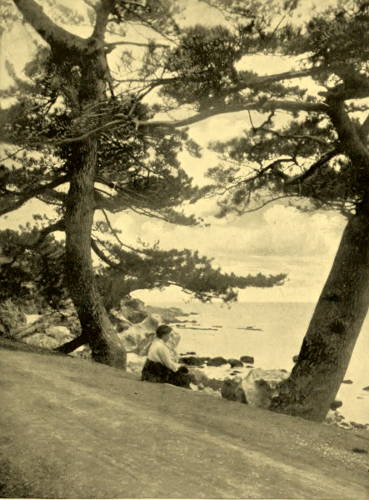
THE COAST ROAD ALONG WHICH WE WALKED ROUND BOSHU
I walked partly by road, partly along the shore about 14 miles, a short distance, but the way was very heavy and the day hot. About half-way were some lovely pine woods with mossy floor and May-flowers, and I lay there for lunch. Violets of many kinds had been the chief, almost I might say the only, wild flower we had noted hitherto, but here were several others. Daisies, like our home ones, only bigger and purple; a lovely intense blue sedum, and a small shrub, with crimson flowers, the Japonica, were the most striking and beautiful of those I noticed.
The last 4 or 5 miles lay along a curious shore. A greater contrast to that of my last night’s lodging could not be imagined. The whole coast was flat for several miles inland, and the beach was a great stretch of dark grey sand with the small beginnings of dunes here and there, and must have been more than a mile in width. Along its desolate extent were dotted little houses, grey as the sand, and built with their roofs touching the ground on two sides!—these sides presumably being those of the prevailing winds. They looked as though the full tide should sweep over them, the beach behind them appeared so unreclaimed, but they seem to have stood there for long, some were almost buried under the piled-up sand. I can give no idea of the vastness and the desolation of this view. The houses seemed mere hummocks in the wilderness, for under the eaves a man can hardly stand upright, and the boats look almost as big as the houses. There is absolutely no vegetation near them, only, at the edge of the dunes, a few small pine trees venture farther out than anything, but the little ones run grave risks of being buried. I had intended to spend the night at Jehinomiya, but found it lies a mile from the coast, so when I found groves of pine trees, a broad river, with a tiny village and a lot of country houses of the summer-house type, I put up at the inn, which is not bad. The hamlet is called Sendocre, and the inn looks out over a broad river and into deep groves of pine. The frogs are all making as much noise as they can with their watchman’s rattle-like voices, but otherwise there is perfect peace; everything is in complete contrast to last night’s cliff-perched, spray-splashed, storm-tossed house.
April 7.—What a day of sights and impressions! I cannot tell a quarter of them, or to-day’s experiences would fill this volume.
The mile to Jehinomiya lay along the river by a narrow foot-path, with pine plantations near at hand. From thence to the next town (Mobara) was 10 miles of road, at first between villages and large farm-houses. The rice fields lying on each side of the road were the scene of the country people’s labours, men and women working together up to their knees in the soft black squelchy mud. They were dressed quite alike, with dark-blue cotton clothes, very tight-fitting trousers down to the ankle, and long tunics with a blue-and-white towel tied over their heads. Some of them burrowed in the mud for roots of weeds, some used a heavy fork to bring the soil into ridges, and in one field I saw a wooden plough dragged by a dejected-looking horse. The chickens, everywhere abundant, seem a particularly large and healthy type, and they too worked in the rice fields, hopping from ridge to ridge after the workers had turned it over and revealed small grains and worms, which they captured. As in Boshu, so in this province, cows are remarkably plentiful and good-looking. The clusters of cottages with their grey thatched roofs made a series of lovely pictures, beside each was one or more glowing bush of apricot or peach, and the white feathery branches of cherry flower, soft, rich, and with a feeling like whipped-cream when you kissed them, floated over the rest like white clouds. For 3 or 4 miles the road lay through pine woods, real pine woods, with a soft mossy floor and violets, not the high, coarse bamboo usual in Japan, that makes it impossible to pass. At the edge of the road were many low shrubs with thick masses of the terra-cotta-coloured flowers, like Japonica, so that a line glowed on either side of the sandy track. There were also purple pansies and pale violets, and the world seemed a very fair place.
At Mobara I passed a school just coming out, and very few of the little boys even troubled to follow me; none called out any remarks. My knapsack is carried in somewhat the native fashion for slinging bundles, and even though I wear skirts, they think I am a man—their men wear skirts too, and a plain panama sun hat very like mine. Thank heaven my hair isn’t red. A few discover I am a woman, but the fact excites little interest.
A less beautiful 5 miles took me to Chōnan, and from there 2½ more to the place where I branched off across the rice fields to see a famous temple of great age. The last mile of the road was splendidly hilly and well wooded, and on the banks were huge blue forget-me-nots. The road passed under one of the hills by a bent tunnel, pitch dark, and very weirdly echoing. I could not see where my feet were going, and wondered if any local bandits made it their headquarters; they could not have found a more excellent place. Slightly disappointing, was it not, that I went through that cavernous tunnel alone and without any incident? To reach the temple I had then to follow narrow paths across the rice fields, and was not surprised to learn from the people at a tea-house at the foot of the temple hill that they had never seen a foreign lady before. The hill on which the Buddhist temple of Kasamori is built is magnificently wooded; on the summit stands a high isolated pyramid of rock, and on the top of this the temple is built. This main building dates from 1028, extremely old for Japan, where the original buildings of the oldest temples have usually been destroyed by fire and rebuilt again and again.
The view from the temple itself was superb. One stood on a level with the topmost branches of the giant trees, and looking through them saw all round stretch after stretch of green valleys, and crest after crest of darkly wooded hills. The trunks of the trees near by were covered with epiphytes and creepers, and in the valleys grew ferns and violets.
In a little tea-house I made myself some cocoa in my saucepan, and the people wanted to taste it, and seemed highly amused with me, particularly with my folding knife and spoon, and the metal cup that fitted on so neatly. Thus fortified I retraced my steps to Chōnan, and towards Mobara. I expected to find an inn on the way, but none appeared, and I had to walk right back to Mobara. Then troubles began, and after walking these 27 miles I was tossed from inn to inn, no room anywhere! Not that there were so many inns, for it is a small town, and at last, in despair, I decided to go to the station and take a train to Chiba, the provincial capital, where there would surely be room, but I was tired and hungry, and had two hours to wait for the train. In Japanese inns it is very different from ours; if you have no room you cannot get a meal, as there is no such thing as a dining-room.
However, I found a charming little tea-house, where I got a rest and a meal, and they arranged with a hotel by the station to put me up, or shall I say “take me in”? for certainly I would not have gone to the place under other conditions.
April 8.—Came back by the 8.15 train and reached Tokio early in the afternoon. After calling on Miss B—— I went to the P——s to dinner and to make the finishing touches to the arrangements about my removal, which is planned for two days hence. The blow that awaited me should not have been unexpected in this land, where no one seems to consider a promise more binding than a compliment is true. Well! though I had taken it before I went to Boshu on certain understandings, I found my house sold to some one else when I returned! As I had arranged with my present people to leave directly on my return from Boshu, I was not a little vexed, particularly as the house suited me so perfectly in every way.
The new owner was willing to let it at a rent of 40% higher than I had taken it for, and he further refused to do any of the necessary papering and plastering that I had had guaranteed me, so that instead of ordering the removal carts, I have to sit down and argue with the landlord, and it may take three weeks to settle. I really grieve that it is so utterly impossible to trust the Japanese; I had loved them so before I had suffered so much of this sort of thing.
April 9.—The cherry flowers yesterday were like great clouds touched rosy by the setting sun, and to-morrow is the garden party of Professor S——’s ambitions, and to-day! nearly a foot of snow on my window ledge—everything buried and broken, as none have seen them before. There is more snow to-day than there was through all the winter put together, and the pink cherry flowers are cloaked so as to conceal their very existence; they do not lend the snow even a flush of pink.
There was no way of getting to the Botanical Institute but by walking, and I am very glad indeed that I did choose to venture out, instead of listening to the counsels of the Japanese and remaining at home. The streets were almost deserted, and I trod unspoiled snow, which sometimes reached half-way to my knees. It still snowed heavily, and the weight of the umbrella became a burden, as well as being a useless encumbrance, as I was always putting it to one side or the other to gaze at some new delight, while the gusts whirled in and under it from every side. Devastation and ruin lay on every side; great boughs were blown off the cherry trees and lay across the road. The magnolias which yesterday sent up glittering white chalices to heaven, to-day hung limp yellow rags beneath the snow-laden boughs; even the glow of the flaring crimson plum was quenched. In front of a temple I daily pass, a great cryptomeria was shattered across the road, its main shaft broken into three pieces, so that the whole tree shut down like a concertina.
Every telegraph and telephone wire was broken, the ends lying like traps curled under the snow ready for one’s legs, and the rest looped from pole to pole in festoons of white rope, for the snow stuck to the wires till they were as thick as my arm. On the tram lines a few snowed-up and deserted trams stood helpless, and not even a kuruma passed to jeer at them.
It continued snowing all day, and as the roads were so unspeakably and unusually bad, I decided to go calling and see the town thoroughly when I was about it. So I walked to the Embassy, about 2½ miles or so, and saw the streets, one after the other, in the same condition of ruin. The traffic was still almost nil, but some people had been up and down the big main street by the Kudan, and a certain amount of snow had melted. That Kudan hill was a bog on the surface and a river below, and as there were no footpaths, I was through it nearly to my knees. After paying several calls in the neighbourhood, I decided to go and see what Azabu looked like, and walked over there; the P——s would not let me away again, the roads were too terrible, and so I stopped the night there.
Obviously the garden party is postponed.
April 10.—The snow is still lying thickly everywhere, but on the road the foot tracks are nearly knee-deep in slush. The papers are full of accounts of yesterday’s storm. It appears that all the railways, as well as trams and telegraphs, were cut off. There was no possibility of getting to Yokohama even, and the Kobe express was snowed up for the day 10 miles from Tokio. A few trams are running this morning—they are repairing wires as quickly as possible. By the end of the day nearly all the cars were in working order; I think they have been quite remarkably quick over them, but the telegraph wires are still hanging in festoons or tripping one up.
It is quite a good thing the snow put the party off, for it is the funeral day of the young Prince Arusigawa, and also we were not nearly ready with the cutting-machine—the automatic carborundum apparatus is still far from complete.
April 11.—I removed from Yakuojimaimachi to my own little house. After there was the bother of them having sold it while I was away, there was so much talk and bother about rent, cleaning, papering, and everything, that I got cross and said I would move on the 11th, as I originally said I would, and when I was in the house I would discuss all these points! That soon settled matters; my goods were put on two man-carts with great care by the entire family, and plants and all were safely brought to my little Azabu house. I began to pack this morning at 8.30, and was ready for the carts at 10.30! That is the outcome of the Japanese feruské (a square ornamental cloth in which goods are tied), it is so easy to tie up quilts, cushions, and looking-glasses all together in one huge coloured pocket-handkerchief. The placing of my few goods on the little carts took till 12.30, but they were in Azabu, unpacked and paid, by 2.30. Some things are cheap in Japan. Fortunately it was a lovely bright day, so nothing got wet.
I found the house being cleaned by my bright little maid, whose name is O Fuji-san, and who seems to like to have me for a mistress and to live next to the P——s, whose cook is her great friend, and trained her. She is rather a better-class girl than most servants, and was early left an orphan, and her guardian is glad for her to be with people who will look after her. She is quite pretty, and unusually bright and intelligent-looking. I expect it will seem to you a preposterous thing to do, to take a house and go in for “furnishing” and all the worries and expense of a household. But in Japan it is very different from in England—the houses need practically no furniture, the huge cupboards in every room hold all one’s goods, and so wardrobes, etc. etc. are superfluous (and, besides, they utterly ruin the look of a Japanese room), while the soft tatami (special thick mats in every house) serve as carpets, bedstead, and mattress, and all one needs is a thick quilt to lie on, another to cover one, with a couple of sheets and a pillow. I have the few chairs and the table and cabinet I had for the last house, and with a lovely brilliant blue cloisonné vase on an ebony stand, a dwarf pine tree, and a bunch of white cherry flowers in the tokonomo, my room looks an aesthetic dream, with its cream walls, cream floors, and wooden trellis-work with white paper windows. If I could but carry it as it is to London! Yet here people prefer Brussels carpets and rooms packed with knick-knacks. They are living in the realisation of the dream of our aesthetes and “simple livers,” and they prefer the things we are trying to escape. I speak of the foreigners, but even the richer Japanese are casting aside the exquisite refinement, the studied and cultured beauty of simplicity, to add a mêlée of “foreign” additions and “luxuries” to their rooms. The soothing harmonies of form and tone are broken, and there is a strife of shrieking colour, of glaring inharmonies.
April 12.—I gave my little maid carte blanche to buy the essentials for her kitchen. One stove, costing 5s., I had already arranged for, the rest she had to buy. At the end of the day she came with all the items written down in a bill 3 yards long. I went in fear and trembling to inspect it and the purchases, and was greatly relieved to find the sum total under ten shillings. Many of the items were deliciously amusing; for instance, 1 sen 5 rin (a sum equal to a farthing plus half a farthing) attracted my attention. It was a fan to fan the charcoal when it refused to burn. For one farthing she got a splendid lamp cleaner, for 8d. a lamp with white glass shade, while ¾d. more provided the chain to hang it up by. The second stove cost 5½d. and burns splendidly; it is made of red earthenware, and has a little door that opens and shuts. These items will make you think that I am either making game of you or of myself, but seriously, I set no limit to the girl’s purchases, and she has got the usual things an unsophisticated Japanese uses in her kitchen. Of course, I have a few things, and bought some expensive items like enamel saucepans and frying-pans—but I think this little house has not cost me £3 to fit up, and, as I said before, to fit up comfortably, and with a distinct beauty. I only hope the housekeeping will run as smoothly as it promises to do, and the house prove as convenient to live in as it is pretty to look at.
April 13.—The way that maid manages a four-course dinner, with three saucepans and half a dozen bits of charcoal in the fivepenny stove, is nothing short of miraculous—everything was very well cooked too. I wasted about an hour over the house this morning, but got off to the Institute after that. It is rather farther to go now, and takes some time even with the tram, but one can’t get everything one wants, and were I near the Institute, I should be so far from all the foreigners as to be quite isolated, and that, I find, in this climate, is not very healthy.
April 14.—The cherry trees are now wonderfully beautiful; contrary to the croakings of the pessimists, the snow has not ruined them, and the trees are covered with bloom. They say they are bleached, and certainly the pink is so delicate as to be entirely elusive when one looks at an individual bloom. I went to the renowned Oyeno Park, where groves of trees are laden with bloom. It was a little late, and some of the petals were falling, so that there seemed to be a whirling snowstorm of flakes that gleamed pearly white in the sunshine. The ground was covered, and all the pools of water left by the recent snows were thickly fringed with white. Tokio is everywhere a fairy-land of beauty, for cherry trees by the hundred are blooming in it. One has the impression of being in the midst of clouds that float between the branches of the pine trees, and rest over grey roofed cottages. The strip of soil in front of the Embassy is covered with a treble avenue of flowering trees, and the paths are petal-strewn between the brilliant green grass patches. The difference in the grass in the last two weeks is very noticeable—from a brown patchy covering over bare earth it has become a thick emerald cloak.
April 15.—My little maid’s guardian came to see me and to thank me for taking care of her. As a matter of fact it is she who is taking care of me; I couldn’t have imagined a house run more smoothly. The guardian is a nice man, good-looking, though middle-aged, and able to speak German, so we got on all right. He brought me some pots of pretty flowers, and some pansies with scent which are treasures, as the lovely pansies here are scentless. It is a very curious point, how well English flowers grow here, getting lovely large blooms, but one and all losing their scent. It makes one quite sad when great luscious roses, pansies, and even mignonette, are scentless—they seem to have lost their souls.
April 19.—I spent the morning gardening; in my little garden nothing much is growing yet, the last people were very careless. I have dug and planted, the chief thing I planted being stones. I have learnt their value in a garden, and I also go out with a watering-can and water my poor little stones. Alas, all the really beautiful ones were too expensive to buy. I went in to lunch with the P——s, because they were having ice-cream, and afterwards went to tea with old Mr. G—— (father of the Mr. G—— I mentioned at the Takashima coal mines, near Nagasaki). His house is surrounded by an extremely lovely garden, with masses of flowers, and a view right across to Fujis. While we were standing on the lawn a lady visitor turned down her glove and rubbed some bites on her arm. Mr. G—— bent over her, and with an air of courteous solicitude, said, “That is not one of my fleas, I hope.” No one seemed to think the remark in any way curious till I said I wished I had a snapshot of that to send to Punch.
April 22.—Cutting fossils till 3.30, and then I went to Professor M——, and then on to the S——s to pay my party call. Professor S—— was out, but Mrs. S—— at home, and as nice and talkative as could be expected in Japanese, when the concrete bounds the realm of my speech. When I got home I found Professor S—— had just been to see me! and we had each travelled 6 miles to visit each other, and crossed. I was very sorry. He had brought some butter, made by the agricultural students, hoping I should like it. I had once mentioned how difficult it was to get butter fit to eat in Tokio.
To-day I saw the first bewitchingly pretty child I have seen in this country—with great round black eyes, with a look of heaven in them. She was dressed in a scarlet flowered kimono that showed the outlines of her little limbs, and her hair was tied with scarlet ribbon in a little tuft at either side. She was dancing along with a parasol held high over her head, but she would not even smile at me, and I would gladly have taken her in my arms and kissed her, she looked so perfectly in tune with the dancing cherry clusters and the blue heavens.
April 23.—I feel that I can never go into a tram again. The horror of my last ride! A leper came and sat down beside me, almost on top of me, and the cars are so crowded I could not get away. He was not in the worst stages, of course, but some of his finger-tips were eaten away and one eye was blinded—there is none of the “white as snow” business about lepers, it is an eating away of the digits, and finally the limbs. I was only near him for five minutes, till the first stopping-place—but——. I have said before, I think, that the Japanese don’t think it really contagious; there was perhaps not the least danger, but we are accustomed to think mere contact with a leper fatal.
The single cherries are now over, and the long double ones beginning. They are rose pink and really as big as small rambler roses, each head hanging down on its long stalk. The rich clusters on the branches are quite unimaginably beautiful; could one suppose the kisses of tiny children materialised and hung by fairies against the blue sky, one might well believe the cherry flowers to be the kisses of all the golden-haired pink-cheeked babies.
April 24.—Friday again—how fast and furious fly the weeks, and there are only four in a month, four and a few days ōmaki. When they give you a one-sen present after a five-dollar purchase, they call it ōmaki here, and many a sen have I received that way. I wish Nature would give me a few years ōmaki here and now, I want to stay here longer. I went to lunch at the Faculty, the first of the term. Professor S—— very nice; afterwards I went to inquire how Professor F—— was, but he was too ill to see me.
April 25.—Saturday. Fossil-cutting all morning. The double cherries are now beginning and are showing masses of colour between the trees of single cherry, which are quite green. Pansies are everywhere in the little shops, and so are gold-fish. Many small shops have suddenly added glass globes of gold-fish to their wares; the white glass sparkles in the sun, and the fish are very bright and pretty. They are very clever at grafting gold-fish. One may get them with two or more tails so neatly grafted on that the creatures live very happily, and look quite as though they had been born so, and were rather proud of it than otherwise.
April 26.—A very beautiful sunny day. I dried my hair in my little garden—it will break my heart to leave this house and garden, there is no doubt about it. It isn’t more than 20 yards square, but it is full of features—two ponds, a river, stepping-stones, woodland glades, pansy beds, and tiny grass plots. As I sit in it and look over the roof of my tiny house I see the blue sky through a group of tall cryptomerias, with a tall silver ash stem, a maple and chestnut clothed in vivid green to throw up their blackness in strong relief. I picked the dead flowers off the blooming plants, and then set out with sandwiches and some writing to the woods, which I was optimistic enough to expect to find in Tokio! And I found them! Within half an hour of my house I came upon a sudden steep track off the high road, and followed it into a wood on a hill, where I lay all day, with a vast panorama of green valleys below my feet, violets and wild wistaria around me, and pine trees over my head, and no human being near me all the time. Thank God for the quiet woods. It is the best source of strength and comfort I know, to lie on a hill alone all day.
This little wood is the first quite solitary comfortable place I have found in Tokio’s immediate neighbourhood—one could hardly have expected to get so sweet a place so near a big city. But I trust to my feet to lead me to woods wherever I am, even in London’s suburbs, and they generally do.
April 27.—A quiet day at work at the University; some new delight in the way of flowers appears every day and charms me. I put a new plant into my garden most evenings.
April 28.—After this week of glorious weather that to-day should be wet—cruel! The day when the Emperor and Empress had invited me (as well as a few hundred other people!) to the Imperial garden party. All the morning it literally streamed with rain, but I hoped against hope, uselessly, of course, for the early morning decides whether the Emperor will be there or not. However, about half-past one my hope was rewarded, for the rain stopped, though it was not bright, and that meant we would be allowed to see the gardens, which, of course, is a thing in itself well worth doing. So I decided to set off, not, of course, in my best bib and tucker, and Mrs. P—— went with me, a little against her will. The others would not come, though J—— had bought a new frock and a four-guinea hat for the occasion, which is the event of the summer season. Right glad I was that I went—the gardens were lovely, and there were a lot of people in semi-garden-party state. We ate the chicken and ice-cream, fruit and champagne intended for the whole party, and had really a much more enjoyable, if less distinguished, time than if the official party had taken place and the Emperor been present. A number of the diplomats were there.
By far the most striking individual was an Indian prince, in a glorious pale-blue and gold uniform, with turban and a delicious gold pompon. He was extremely tall and thin, and held himself erect as a young pine.
The cherry petals were falling, and whitened the pines and floated on the lake in wind-blown drifts. The wistarias were covered with buds just clouded with a purple haze, and every one of the many pines and other gymnosperms gleamed brilliant green among trees, the young shoots’ vividness giving an effect of bloom, where the maple leaves were crimson. The maple, which has crimson leaves in spring, does not get the brilliant colouring in the autumn, like the other species, but is equally highly prized for its spring beauty. The garden slopes down to the sea, which runs along one wall of stone, and in the trees were hundreds of sea-gulls. The benevolent despot has fenced off a part of the garden; here no one is allowed to enter, and here the wild-birds nest—the sea-gulls building and rearing their young on branches of trees covered with luxuriant epiphytes! Some of the trees are very old, and in one I found a big tufted bamboo growing as an epiphyte in the ancient stem of a flowering cherry tree. Something disturbed the nesting birds—was it the smell of champagne and cigars in the neighbourhood, or the clanking of spurs and swords?—and they rose in hundreds and wheeled in the sky, such a flight of them I have never seen. Some were pure white and gleamed like cherry petals in the grey sky, but most were grey, like the drifting clouds.
April 29.—A quiet day’s work, the weather was bright, lovely, out of sheer perversity. My maid gave me some fritters for dinner, of a kind I had not ordered, and when I asked her what they were, she said hassu, that is, the lotus. The sacred flower makes delicious fritters! I daresay if one could capture the rosy-tinted evening clouds they would make good ice-cream.
May 2.—I went to Professor Fw——’s: he was kindly taking me as his guest to an afternoon luncheon-party at the Admiralty gardens. At his house I met an interesting Japanese who spoke excellent English, and who is said to be one of the greatest Japanese musicians. He invented an organ of some sort, and has had a special audience with the Kaiser Wilhelm. We drove to the Admiralty, passing safely the fierce bayoneted sentries, and across a yard hideous with brick buildings and smoky chimneys—through a gate in a high wall, and were—in a deep forest glade, under shade of palm trees and ferns, back in time three hundred years! The gardens were those of a very famous Daimio, and were laid out with the greatest care and at a boundless expense. In them are all the stages of the Tokkaido,—scenes from China, wild mountain views and iris gardens, falls of water and lakes. In fact a series of scenes of wonderful beauty, of peace and suggestion, of dreamland poetry—only the tallest of the cryptomerias and pines were standing as dead skeletons, killed by the smoky chimneys on the other side of the boundary wall. These great gardens are entirely closed, and it is very difficult even to get permission to see them, the authorities of the Admiralty are so afraid of spies.
The special party to-day was to welcome the married daughter of one of the earliest and most useful of the American missionaries, a Dr. Brown, who had had a school in Yokohama, and who had as pupils many men now very distinguished. Among other people I was introduced to a very charming, thoroughly Europeanised, and handsome man—and of course did not catch his name. He walked with me a little while through the gardens, and we talked of the beauty of Tokio and the destruction of that beauty by “reformations” some years ago, before the Japanese had learned to appreciate native art as well as they do now (though much of the same sort goes on to-day), and I quoted one of the specially terrible places, the hideous red-brick Exhibition-like buildings (Government buildings) that ruin the view of the grey moat with green banks and trees and old white and grey buildings round the palace, one of the most lovely sights any city in the world can show. I exclaimed against the vandalism, the criminal folly of the architect, whom I surmised was some second-rate foreigner. “Yes,” my companion answered, “it is bad. I was the Chairman of the Building Committee at that time, but I suppose the architect was morally responsible.”
You may imagine my feelings. I knew, of course, by the look of the man he was some one of importance, but how could I guess who he was? I am not sorry, however, that he heard it.
A further surprise awaited me; he made the speech of the evening, and turns out to have been Dr. Brown’s youngest and most promising pupil, and to-day to be the world-known Ambassador Tsuzuki, representative at the last Hague Conference! He said good-bye very graciously—his laurels don’t rest on the beauty of those buildings, and I had not touched him on a vital point after all.
May 3.—I really had to make up my mind once for all to learn to get on a bicycle by myself without the aid of a devoted male friend. Hitherto I have always ridden with people who put me on—here I am alone. I bought a bicycle from the missionaries, which had been discarded by one of their number. But after being at the bicycle shop for a little it seems in good order, for it was an excellent frame, and now I determined to ride, as Tokio’s distances waste so many hours a day that I can stand it no longer. After a few hours’ steady determination, I find I can get on very well without the male friend. But those of you who read this and have played that part, don’t think I could have got on without you at the time.
About midday I decided to go and see the renowned Azalea gardens at the village of Okabu, some few miles off, and so I took my maid as a treat for both of us (she never having seen the flowers), and shut up the house. There is no lock or key, and any thief had only to slide a paper screen and slip in, but we told the cook next door to keep a weather eye open, and set off gaily in the sunshine.
Along the main street of Okabu are a dozen nursery gardens, all filled with azaleas, and so laid open that you can walk round and see everything, and buy what you please, but not unless you please. Even when you want to buy it is rather difficult to find any one who will sell to you. When you do, he will just seize the flowering bush and pull it up, shake the mud off the roots, wrap them in paper and tie a big loop of string to it; you carry it home, stick it anywhere in your garden, and it goes on as though it had never moved an inch. The sunshine and rain make things grow so easily here, it certainly doesn’t depend on any special “skill of the Japanese” in this case, for I myself stuffed the azaleas into my garden and saw the man pull them up like weeds.
In one garden there was an entry fee—of three farthings. Here the whole garden was filled with plants all one height (about 3 feet), and all flat on the top, and all covered with flowers—a crimson sea. Generally speaking, though, the flowers individually were far less beautiful in colour, and smaller in size than our azaleas, the interest and special charm lay in the masses of them, and the number of gardens one after the other that cultivated them.
There were crowds of people in their best clothes, and stalls on the road selling sweets, and the inevitable hair ribbons of brilliant colour; with here and there a gold-fish dealer or a seedsman.
We lunched in a little tea-house and came back laden with flowers—four beautiful glowing azaleas, a brilliant fern-like green shrub, and a budding yellow broom, for which I paid a sum total of exactly elevenpence.
The roots were all tied up neatly in paper—and then they wouldn’t let us on the car! Other people were carrying them tied up in feruskés just exactly as ours were in paper, so I was furious and asked a policeman why. “Had we no feruskés? Then we must cover them completely in paper, and the officials would not see them.” “But the roots were covered in paper,” I replied, “other people have them like that.” “Ah, they have roots in feruskés or handkerchiefs, then the officials cannot see that the roots are there, but they can see the roots through paper. If, however, you cover them completely, then they will not know they are flowers at all. Roots are not allowed on the tram.”
We went to a shop and got newspapers to cover them up, and the same officials who had barred my way smiled approval!
May 4.—A pouring day, the roads simply awful, as it came down in torrents all night. My little plans for getting to work early on my bicycle were all knocked on the head. I saw not a soul in the Institute all day, and was glad when Mrs. P—— came across to have a little chat. I am arranging about a Debate, Tokio doesn’t seem really to know what that is! But we meet at parties and talk endless gossip, so I am going to give a tea-party, have an amusing Debate (if possible), and found a society which, I hope, will live for ever, like Mother’s Norwood one. I forgot, because in a way it came in between two days, that the other night we went to the Greek Church Easter Service. It is held at midnight, and the Russian Greek Church is by far the most successful of the churches here. It is the only one with an imposing building, the only one with a great choir, and a sense of wealth and success in the appearance of the interior. The great domed building stands high on a hill, and can be seen from most parts of Tokio. We found a huge crowd of Japanese waiting to go into the gates, and as they entered each bought a candle and lit it, so that, as well as the regular altar and other candles, the church was illuminated with hundreds of these tapers. The Bishop, in gorgeous white and gold, was seated in the centre of the church, and swung incense over the people, while a choir, quite unaccompanied, sang the whole service. This choir is splendid, though composed of Japanese, and is one of the wonders of the church. The congregation crowded into the church area, where there were no seats, but the floor was covered with carpet (which would certainly be a sea of candle grease in the morning), on which the people stood or sat. There were very many children present, some very tiny, and all in their best. A few of them were charmingly beautiful pictures. The service, sung by the choir, was followed by few of the congregation; they stood or sat reverently, seeing to their candles and sometimes crossing themselves, but they did not hesitate to go through their ceremonial bows if they met an acquaintance, some going down on the floor and touching it with their foreheads, to the peril of the tapers. The service was principally chanted, but sometimes the voices rose into a grand chorus, and all the time the Bishop and his clergy kept up a picturesque ceremonial. The altar was magnificent, vast, and gilded and lit with huge candles. We felt the whole ceremonial and its setting splendid, impressive, but almost weird. The power of the Bishop is clear, if one only knew that he got all those hundreds of Japanese out at midnight, while for social functions they find 9 o’clock too late.
We had to walk home, and came through the outer palace gardens and under the ancient Japanese gates, lovely in the moonlight, and palpitating with the lives of the past.
May 5.—The weather cleared up nicely and I set off gaily on my bicycle, but a dozen things went wrong with it, and I left it at a shop, hoping they would steal it, and I should never see it again. I cut fossils all day without seeing a soul to speak a word to, and went back to the shop and found they had not stolen the bicycle, but had put it right, so that it went quite well. I set off on it to cross Tokio and call on Miss H——, who had a private view of some copper-plate etchings done by a friend of hers, and very charming they were. The roads of Tokio should be simply blood-curdling. There is no rule for the traffic, the electric cars are the only things that keep any kind of order, and foot-passengers and playing children simply swarm. Fortunately there are few carts or carriages, but those few dart about anyhow, and the horses often run away. One has simply to thread one’s way through this stream of things. The children are particularly trying, and take no notice of violent bells and shouts.
May 8. Professor M—— came to take me to the Faculty lunch. A serio-comic incident happened just before we started. He came for me to the fossil laboratory, and waited a minute while I was finishing a stone. As he stood there, a stone, which I was heating in molten zinc, exploded, and the zinc flew in drops all over the room, and settled on all of us, but fortunately only on our clothes. The bright hard drops looked quite funny on his coat and hat, and some of them wouldn’t peel off. There must have been some internal moisture or gas in the stone; it is the first time such a thing has happened. After lunch Professor S—— took me and Professor Y—— to see his garden (he lives within easy walking distance of the University), and it was a delightful sight. I have described the house and garden before, and now it was gay with pink roses and many different coloured azaleas. His tiny daughter was running about with “bells on her shoes.” Little bells were fastened on the under-side of the wooden clog, “on the same principle,” the Professor said, “as the bell is round the neck of a kitten—it is convenient to know where it is.”
After an hour’s rest I returned to the fossils, and at 4 bicycled off to Baroness d’A——’s garden party,—bicycled in a white muslin frock, which, had the people not thrown buckets of water into the roads, would have come through scathless, but as it was, was heavily specked with mud all up the front, and I felt all the carriage folk staring at me. Otherwise I had a good time, and arranged some details about the forthcoming Debate.
May 9.—At work all day on fossils. Dr. M—— came to the laboratory about 2, and we had a long chat; he is one of the very few Japanese who know enough of my work to be really interested.
May 10.—On Sunday Professor S—— asked me to go to see the celebrated Buton flowers (paeonies), and I set off at 9 and met him and his wife at Ryonokubashi at 10. We then drove to the gardens, which lie across the river, in quite a slummy part of the town. The south part of Tokio, across the river, corresponds in a way with the south of London, and is distinctly its working quarter.
The paeonies were under the shade of straw mats, which roofed them and the spectators in, and a lovely sight they were. Each flower was really huge, about a foot across, but, as a rule, there was but one on a plant. White, pink, crimson, and almost black, and all the shades so beautiful and artistic, they were infinitely more pleasing than the chrysanthemums.
In the same garden were also a number of dwarf trees—now I have bought several at various times, and was always astonished at the cheapness and prettiness, but here, a very (to me) inartistic one cost £4, and the only one I really liked was £9!
After lunch we took the train, and went out of Tokio for some distance to a place where there was a very renowned wistaria flower. The trunk of this enormous tree was twisted and gnarled with intertwining branches, and all together was about 12 feet in diameter. The branches were all trained on props over bamboo, and formed a great flat roof, over an appreciable part of an acre! The flower clusters hang so thickly and evenly as to give the appearance of a ceiling of long tassels. The tails seemed to be only a foot or so long, but when measured were found to be 2 or 3, some even 3 feet 6 inches long! The whole sight was very charming, and quite startling, but perhaps less romantically beautiful than one had imagined it. The gardens had only this one tree on show, and under it the people sat and walked about and drank tea.
On returning we missed the connecting train and had an hour and a half to wait; it was cold and began to rain. I didn’t mind, for Professor S—— was very interesting, and we talked of nearly everything under heaven and earth—but the more I see of him the less I think he is a typical Japanese; he is an exceptional one. I was sorry for poor Mrs. S——, however, who could not follow our conversation very well, and who had no one else to talk to. We dined at a restaurant in Tokio, and I got back home after a thirteen-hours outing, practically tête à tête with a Japanese man—and bored I had not been for a moment, and people here say you can’t get any real companionship from the Japanese. I say it is those people’s own faults.
May 11.—Torrents of rain all day, so that I did nothing but work at the Institute—which was somewhat hampered by the absence of the boy who runs the engine. I got home in an awfully bad temper, after battling with everything all day—but the bright dripping green of the trees all round me, and the peace of my little house, soon soothed me up.
May 12.—Pouring rain all day again; it was so hateful ploughing through these streets, with no side-walks and mud 6 inches deep, that I decided not to go to-morrow, but stop at home. There was a dance at the K——’s, and I had a good time. A charming American was there, who smiled all the time and made one happy just to look at him. There was also a young, fair-haired Mr. B——. His teachers must have been very proud of him; he had the bright smile and the “good” look of a favourite boy, and an ornament to the Y.M.C.A. I felt sure he must be a missionary, but he turned out to be an artist, just out, and to stay a year, painting all sorts of things, Japanese portraits among them. He seemed much astonished when he found I had travelled alone—I am sure his sisters never would,—and when I tried to soothe him by quoting my French and other tours (to show I thought it an everyday sort of thing to do), he seemed so very astonished that I drew in the rein and got him to talk of his own character, which causes him trouble and interest.
May 13.—The rain cleared off, but the roads are still bad, yet by the time I came home they were beginning to be dusty.
They dry here at a quite wonderful rate, and in the most terrible weather one has always the consolation of knowing that when it clears it will do so thoroughly and completely.
May 14.—After the day’s work I called round to see how Professor F—— was, as I had heard nothing of any kind for a fortnight. I saw him for a short time—his face was rather swollen, for they have been injecting strychnine, but otherwise he looked all right, only he could see so little. The cure seems to make almost no progress.
As I was near, I called on the S——s as a duty (and pleasure) call, and came away with a lovely bunch of roses, the Professors, when caught unawares like this, are always in true Japanese dress—and look so nice in it.
In the evening was the last Cinderella—and a very nice dance it was.
May 16.—I stopped at home to-day—as the great Debate began at 3, and I had to borrow chairs from several neighbours. I hope to-day to found a Debating Society in Tokio (there is such a dearth of anything more than dances and gossip, you at home couldn’t believe!), and have been raking people out—I have got Miss C—— and Miss H—— to oppose each other on the subject, “Chaperons should be abolished.” Frivolous enough—but one must put the pill in jam here in Tokio, and I hope gradually to get sober and instructive. The Debate was really more of a success than I had dared to hope, and I got nearly every one to speak by the little device of drawing numbers by lot, even Baroness d’A—— and Mrs. P——, who swore they wouldn’t. I had thought, after founding it to-day, to leave it till the hot season passed, but people are keen to have one in June—so it is encouraging. The use of a Japanese house came out strikingly to-day—when I took out my sliding partitions and made nearly my whole house one big room. The weather and the garden behaved themselves—and mercifully everything went off well. Of course the motion was lost, only two people wishing to abolish chaperons.
May 18.—A nice bright day. I bicycled home by the library and got some books of Hearn’s; I am thinking of getting up a Debate on Lafcadio Hearn next time, if I can; most people here knew him personally—and so few seem to realise that he was great, and almost all run him down! So I expect a very interesting time of it; there will be no difficulty in getting speakers to condemn, but who is going to stand up for him!
May 19.—I just called in on Miss B—— on my way home, and asked her to propose “That the picture of Japan presented in Lafcadio Hearn’s books is totally fallacious.” She consents—I anticipate some fun, and she is (I believe I have remarked before) quite the best conversationalist in Tokio, and a missionary (whom Hearn detested) to boot.
May 20.—Fossil cutting and examining all day. I have been arranging the fossil slides, the series got mixed, and it is no joke to keep them straight. Professor Y—— called in to see me (he is off to Europe very soon); and invited me to “tiffin at 5” in a few days. The wording is a little puzzling, isn’t it?
I called to inquire how Professor F—— is, and was glad to find him a little better, though very little, but with no prospect of perfect recovery.
Strawberries are beginning in the shops; it is such a treat after having had only apples and oranges for all these months. The temperature is delightful, like our July, and I enjoy it greatly, but the nights are still very cool, so that I have a hot-water bottle and the winter quilt. Things are beginning to bite me again, great horrid things of all kinds. Spiders and centipedes come out at night, and all sorts of creatures I never saw before; already I am rendered unnecessarily hideous with bites, what it will be later on I don’t know. I saw the J——s to-day, who once lived here twenty years; they said that Japan is a country that “grows on one” till it is heart-breaking to leave it. I feel that already, it is a pity I have stopped so long. I don’t ever want to go now except to escape insects. The horrid “semi” have begun to sizzle to-night. They are the things that sit in the trees all night and make a sound as though you have a headache; only when they stop for a second or two, you realise you haven’t got one inside your head—but outside. Well, even in Eden there was the serpent, and I suppose sizzling semis aren’t as bad as serpents, at any rate their influence is less far-reaching.
May 21.—Fossilising all morning, and in the afternoon I was “at home”—blessed day! These two days in the month I look forward to hugely. A number of people came, among them Mrs. H——, a charming woman, young Mr. M——, son of the man who was Dean of the University before Professor S——, and Professor S—— himself. He came at an interval between Mrs. G——’s call and some others, and we started on Japanese poetry. It seems to be very subtle, so subtle, in fact, that even such a cultivated man can’t understand it right away. Though there is no rhyme and the form lies in the middle of syllables, there is great ingenuity shown in finding words with double meaning suggestive of some poetical idea. The G——s, who called also, have been here thirty years, at least the Mrs. G—— has, and both she and her daughter like the Japanese greatly, and are much liked by them. I am going to get Miss G—— to oppose Miss B—— in the Debate on Hearn. I am glad to find some one who will stand up so sincerely and heartily for Lafcadio Hearn.
May 22.—After fossil-cutting walked along to the Faculty lunch with Professor M—— and talked nothing particular, as usual. At 5 I went over to Professor Y—— “for tiffin,” and was received in a foreign style room, and sad it was. Though so tiny a man, he has a large family, as all the Professors seem to have, unlike the corresponding men in our country. A Mrs. N—— was there, and a Miss X——, a teacher in a school. I resent very much the fact that all women school teachers (as well as girl pupils) have to wear a special kind of skirt (and very hideously ungraceful it is) over their kimonos, so that every one knows them to be teachers, just as we know hospital nurses. Perhaps it is the hideousness of the skimpy skirt, all open at both sides, that I resent, as much as the fact that it is a uniform marking these women out as apart from their fellows. Once, when I asked why it was all the teachers I saw were so plain featured, I was answered by a Japanese man, “well, if a girl is pretty, she can be married and does not need to go in for teaching.” And we hear so much of the “reverence of the Japanese for teachers.” It seems to me the Japan that we Europeans have at last learned to know, and whose characteristics we have had drummed into our ears, is already a thing of the past, and as altmodisch as our early Victorian furniture, which the Japanese are picking up as “new styles.” But though our furniture may change so fast as to bewilder them, does our national character too change with a startling rapidity equal to the Japanese?
The streets to-day looked unusually upset, and the reason of it is that it is the time of universal spring cleaning,—a spring cleaning that does not originate from the domestic tyrant, but from the main Government, and that is inspected by the police before you have a little yellow tab of paper pasted on your door to say that you are clean. All the tatami must be taken up and beaten, all the boards in the kitchen floor, under which lie hidden oil cans and charcoal, shoes or saucepans, according to the pleasure of the maids, must be taken out and the glory holes cleaned and smothered in white disinfectant powder; the front step of your hall, which, of course, is also a box in disguise, is cleared of its winter geta and powdered white, while the props of your house (all Japanese houses are raised about 1½ feet above the ground) are smothered till one thinks it has snowed. When the policeman is satisfied that all this has been done, and then only, will he give you the yellow ticket. It seems to me an excellent plan—one which would be applied with advantage to some of our slums. The smaller streets to-day were perfect markets, as from the little houses every single thing is turned out on to the road, and the mats beaten there. It added not a little to the thrills of bicycling, and was an instructive illustration of the simplicity of the smallest households.
May 23.—After working at fossils all morning, I cycled over to Miss B—— for lunch. She was as entertaining as usual. I often think she is one of the best talkers I have met. After lunch she took me to call on Mrs. M——, and I followed her kuruma on my bicycle. The M——s, of course, live in a splendid house, equally, of course, it was “foreign style,” with signs everywhere of wealth. The hall was like that of a hotel, and not a modern Waring furnished hotel either, and the drawing-room filled with chairs “upholstered” (there is no other word for it) in various brocades, with different heavy-patterned brocade curtains hung over every door and window in the stiff symmetrical style of last century’s low-water period. On the lovely verandah, looking out into a splendid garden, were round iron marble-topped tables, one was almost surprised there was no advertisement for whisky, or at least Cerebos salt match-holders. That was all I saw of the house to-day, except one little statue carved out of marble, so pure and transparent that the light shone through it as it stood in the window, among a tableful of various articles of cost. Its lovely curves were transfigured by the light behind it, so that they shone ethereal, and one could fancy it a fairy form coming in on a sunbeam—I had not realised fully before how transparent white marble is, and how suited to suggest unearthly beauty when carved in human form. I fixed my eyes on this and forgot the pink-and-green upholstered chairs.
The Women’s University owed much to this family at its foundation, and they asked me if I would like to see over it, which of course I would, so they are to take me on Friday. It will perhaps seem curious that I have made no previous effort to see this very important Institution, but I had my reasons, and the M——s are the best possible people to take me now; I am glad to go. I did not know before going there, but found out afterwards, that they gave the land on which it was built, and that Mrs. H—— (sister of Mrs. M——) was, with Marquis Ito, one of the first people to whom President N—— went with his plans fourteen years ago, and from whom he got much encouragement and practical help.
May 25.—I am getting quite an expert on my bicycle. The people in the street, too, seem to have got used to seeing me, and do not bump into me as often as they used to! Though there are some who are unspeakably idiotic; one to-day, for instance, walking toward me steadily for a long way, seeing me clearly, went suddenly at a right angle into the front wheel. The traffic here is exasperating, as the roads are very narrow; there is no foot-path and no rule of the road, and people dodge about like flies, while just this week Diabolo has arrived in Tokio apparently, and is played now in the middle of the road. It is quite startling, the suddenness of this universal appearance of Diabolo, and it is made in a form that the poorest children can buy for a few farthings. Yet with it all I think there is less danger of a real accident in Tokio than in any place in England, because nothing goes fast, no motors or hansoms come on fleet-tyred wheels, and if one bicycles moderately it is really very safe. I have only knocked one baby over, but I shall never forget its eyes looking up at me through the spokes of the wheel, it looked so reproachful, but it was entirely its own fault, and it was not hurt a bit.
May 26.—Why do the Japanese lie so circumstantially, and then not even blush when they are found out? I had ordered some cards to be printed for the Debating Society and went round to see why they did not come. The man whom I asked went away and came back saying that the printer foreman had sent me three or four proofs, and having received no reply could not proceed with the work. I said I had returned a corrected proof some time ago, and sent him back to inquire again (knowing of old that determination generally produces the thing you want); he returned saying my proof had not come, but if I here corrected it the cards would be printed to-night; still I was not satisfied, and sent him back again, and lo, he brought the 300 cards all printed, and with the corrections in them I had added in the proof I returned.
And each succeeding story was uttered with such an amount of detail and an air of conviction!
May 28.—I got to the M——s, as arranged, at 9 o’clock, and there found Mrs. H——, who wished to come with us to the Women’s University. She was very unlike Mrs. M——, and dressed in European style, but her hair was very slightly streaked with grey, and I thought her 45—she told me she was 60. President N—— told me she herself had opened a coal mine in Kyshyu twenty-five years ago, and she was the first woman who had ever done anything of the kind here. We drove over in their carriage, as it is a long way to the University, and I was very agreeably surprised. I had heard a good deal about it, particularly that it was more of a school than a College, and not a University at all—partly this is true, but it is already a College with the foundations of University teaching and equipment, and particularly in chemistry, for which there are four laboratories, strangely enough, the arrangements are excellent. The University buildings practically amount to a village, for there are 700 or more students in residence, and more than 1000 students altogether, and there are numerous different subjects taught, from chemistry to cooking, and from flower arrangement and tea-making to law and mathematics. Law, by the way, is compulsory in the Domestic faculty—not a bad idea, is it? There are two children’s classes and schools, and a kindergarten, all part of the University—the idea being that women should be brought up in touch with children. Another very good feature is, that by far the largest number of the women graduates go back to their homes and get married, so that nearly all the students are studying to get the culture, not working for exams., so as to be able to become teachers.
Mr. A——, the Dean, was with us nearly all the time, and was dressed in Japanese ceremonial robes and a bowler hat. When he took off the bowler, one saw that he had a fine forehead, and that his face was altogether one of considerable beauty. His was undeniably a face with ideals. Mr. N——, the President, was rather a similar type of man, but perhaps less artistically fine. Both were very cordial, and we had an interesting talk, for they were all-round developed men, and one could talk to them as to an Englishman—not like so many of these Japanese scientists, who are (or try to be) that and nothing more.
The M——s then took me back to lunch, which was in European style; the food was excellent, but with all their wealth, they had no dainty silver on the table, whose large extent looked rather drear.
After lunch they showed me the garden, taking me to the Japanese part, which was splendid, hilly with green groves and streams, and a waterfall. I saw also their Japanese rooms, most beautiful, except that they had a blue plush carpet put over the mats; there was, however, nothing else in them but the proper appointments—and I delighted in their quiet harmonies.
I got back to the laboratory in time to get in an afternoon’s work.
May 30.—Fossils all morning—and preparing microscope, etc. for my Monday’s expedition, when I am going after cycads. Went along to tea with Professor F——, who is a little better now, and from whom I needed some information about the place I was going to.
June 1.—The household was up at 5 this morning, and I got off to the station a good deal too early for the train, which is a fault on the right side. After seven hours along the renowned old Tokkaido, where to-day a railway runs, I landed at Yejiri, and went in a kuruma about a couple of miles farther to a very noted cycad temple. I deposited my microscope and baggage on the temple steps, which I converted into a temporary laboratory, and scratched myself sadly on the cycas leaves while examining the coming fruits. The cycads are really wonderful—so tall, and curved and branched innumerably.
After pottering around for a while, I broached the subject of stopping all night at the temple, and soon got my way. The priest is extremely old and frail, and looks stupid, but I don’t think he is; there is also an old woman, whom I presume is his wife, who will do what little cooking I shall get.
It is a charmingly situated temple, and the gardens are very sweet, so decked with the beauties of age. It lies on the slope of a hill, just midway between the top and the flat rice fields below us, and is one of the most peaceful habitations it is possible to imagine. The priest seems to spend all his time, clad like one of the poorest peasants, working in the gardens, which are very well kept, and which, like all true old Japanese gardens, suggest that the little details had been planned to please a child. On tiny islands are perched minute lanterns, and across streams over which one could step are bridges or stepping-stones.
There are such hundreds of frogs just at present, as he walks one would think the priest was spilling his basket of plants into the water, there are so many splashes where he passes, but it is only the countless frogs hopping out of his way into their native element.
After a rather meagre supper of eggs and rice (it is quite surprising how tired one gets of eggs and rice, even in one meal) I wandered round the garden, tottering along with great circumspection, for I was mounted on geta (the wooden clog-like things I have previously mentioned). The stillness was complete, as the temple was closed to visitors and the old priest and his wife were in the house. Range after range of hills stood back from the sea towards Fuji mountain, whose position I knew, but who was hidden in the clouds. In the valley the ripe barley glowed golden, and between its little fields were the bare wet patches waiting for the rice to be planted out, and reflecting now the clouds that hung low in the sky. Brilliant emerald squares marked the nurseries of the tiny rice plants, growing in neat little oblongs by themselves, and still less than 6 inches high. Suddenly I felt an electric presence, and looked behind me at a cleft in the hill to see the slimmest silver curve of a new moon that I had ever seen. She rode in the sky so swiftly that, as I watched, I could fancy the waves of blue ether tossed from the prow of the little boat, and while I gazed she passed again behind the hill. So delicate a moon, a silver thread curved on a bow, but its fairy light was more bewitching than many a great round moon’s brilliance.
In the night the priest woke, and gave a cry to his wife, and I looked out, but the night was black, the fleet moon had lured every star away.
June 2.—Early they rose, and though I took about an hour leisurely eating my breakfast, it was finished before half-past eight. I went to the cycad trees for a while and worked at them. How huge they are! The one on which I am now sitting, eight feet or so above the ground, spreads all round me like a grove of trees, but is only one much-branched individual. At my feet, in the main trunk of the tree, is a minute temple, but I think the gods have deserted it, for within is only one image half a foot high, from which the paint has worn away.
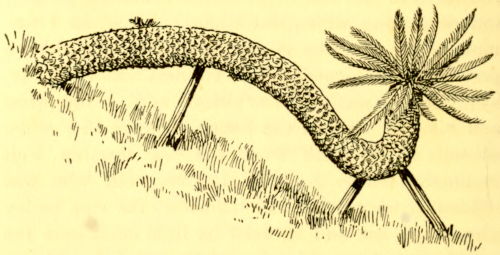
THE CURIOUS BENT CYCAD IN THE TEMPLE GROUNDS.
Opposite me is a funny old cycad, not branched at all but bent. It grows on a slope, and is propped up with legs here and there. In the morning I saw Mount Fuji quite magnificently. She stands alone in the sky, three times higher in appearance (and more in fact) than any hill near, with a coronet of snow, and a cloak of clouds round her shoulders, which cut her off from the earth. Immensely more impressive than when seen from Tokio.
What a peaceful day! I stop in the midst of my examination of the cycads to fall into an aimless reverie, and am waked up by a frog croaking from a porcelain-green throat at my side. Big black butterflies come lumbering along, and one thinks they are stupid birds till they settle on a crimson azalea flower, and coming up from the rice fields is a low-toned rattling chorus of frogs and semi. Just before supper I went up the next little hill to see the temple of Kwannon on its top. There are 270 solid stone steps up to the temple, all neatly squared and nearly 8 feet wide—but the temple itself is built of mouldering wood. It commands a splendid view of the rice and barley fields, and then the sea, which lies but a mile away. Behind the temple is a hilly country with many trees and little cultivated patches here and there. There are lots of white Canterbury bells among the tall grasses, and the wild Fuji wistaria branches climb round many a trunk.
After supper the moon rode high in the pale grey sky—but it is so small even now, only what I would have thought was a first day moon in England. Perhaps the brilliantly clear air of Japan last night allowed me to see the crescent before it was really a moon at all, but was the soul of a moon before it was born.
June 3.—To get me to the station by 8.30 the good people started getting up at 5, and talked so that I could hear every word, repeating again and again the time that they must wake me. But once they had “waked” me, not a word did they say, and crept about like mice. The contrariness of the Japanese is incomprehensible. The kuruma came an hour before I ordered it—and I kept him waiting more than an hour by their clock, and then got to the station sixty-five minutes too soon for the train!
After a few stations, I was struck by a pretty beach, and hopped off the train, determined to have a bathe and go on by the next, whenever it might be, to-day or to-morrow. The station-master was very nice, and took charge of my luggage, from which I extracted a towel. The village—Kanbara by name—was very small, and there were a good many fishing-boats at intervals along the shore, but they were nearly deserted. The water was just delicious, so warm that one could not feel it at all, I never bathed in such a perfect temperature, but I expect our creeping cold water is more bracing. I sunned on the beach for a while, and found a train at midday that will take me a good deal quicker than the one I left, as it is a semi-express.
I had to wait about twenty minutes on the platform for it, and was of course gazed at solemnly by a number of small children who did not offer a remark, they were so young that very likely I was the first foreigner they had really seen at close quarters. There was a good deal of difference of opinion as to my sex. My panama hat always bewilders them, as only men wear them here.
The station-master came up and had a little chat, and took me to his room, because there was a chair there, which was very nice of him; though the chair was no more comfortable really than the bench, the quiet and coolness of his room was pleasant.
When I got off the train I had not told him that it was my intention simply to get a bathe, but had diplomatically said I wished to see his neighbourhood, which had evidently pleased him. I told him about the bathe afterwards, which seemed also to please him, for I had enjoyed it very much. I got to Tokio quite uneventfully before night.
June 8.—Fossil-cutting all day. In the afternoon there was a quite terrific thunder-storm, one peal seemed to break inside the very house. Then hail! The largest known for forty years, and really the hailstones were as large as eggs, some were measured by Professor P——, and were 2½ inches in diameter!
By a really quaint coincidence it was the Festival of the God of Thunder, and the storm took place in the middle of the temple festival. There seems some justification for a folk-belief in mythology. When the worshippers prayed for mercy from the fearful hail, the sun soon shone.
June 9.—Professor F—— came to tea in my house, which he now saw for the first time—and when I think how he had to arrange everything with my landlady in the last one, I feel quite proud of my progress. He is still ill, though a little better, and to-morrow goes away to some celebrated hot springs.
June 11.—Working at fossils all day: I developed some photos of cycads I took at Yejiri, but the weather is so hot the gelatine dissolves!
The air is now filled with mosquitoes and minute biting flies, and I would like to be a hedgehog. They sing so loudly outside the net that I can’t sleep, and though they don’t get inside the net much they are so vexed about it, and I am “so sweet to eat,” as my little maid says, they just howl on the top note of rage.
June 12.—A working day, in which the only attempt at excitement was the lunch at the Goten, but as Professor S—— was away it was a little like flat soda-water.
June 13.—I went to see the Agricultural University; it is at the end of the Aoyama tram, and quite away into the country. It possesses a very impressively beautiful stretch of ground, over which the different Institute Buildings are dotted. Dr. M—— met me and took me over. The botanical department is not very big, but those who do research there get every convenience. The only noteworthy thing was the curious arrangement of the paraffin oven, stuck right down in the ground like the hut of a cave-dweller, with steep steps into it and a metal entrance door. This is an old arrangement as a precaution against fire, for, of course, all the buildings are of wood. Of the other departments, I was principally interested in the silk-worm houses, where huge numbers of worms were reared. A scientist was there doing experiments with hybrids, and working at Mendel’s laws and the commercial value of different crosses. More convenient creatures for such a purpose one could hardly imagine. They need no cages, for they can neither fly nor run! When the moths hatch out you can pick them up, pop them down beside any other one you like, and they stay where you put them and mate, and you get a new generation in about thirty days. They are kind enough to fasten their eggs themselves in series on numbered cards, and are, in fact, as well behaved as any scientifically constructed animal could ever be imagined to be.