A JOURNAL FROM JAPAN (continued 5)
Reading edition
Afterwards I rode over to Hongo—an awful way across the country and city, to dinner with Professor S——, his wife and family. He had his lovely dream of a garden lit by a brilliant full moon, and the translucent stone lanterns among the trees. Roses grew on the trees, huge dainty ones, and sweet-scented rose-hearted buds. It was a vision of perfect beauty to be remembered. Afterwards he and his brother, who is an excellent singer, sang me some Nō songs, and everything was so harmonious, so lovely, so simply dignified.
November 9.—At work on fossils all day after my lecture, which was the last. Professor S—— spoke and “made me blush,”—his English is simply wonderful, I know few Englishmen who speak better,—the substance of what he said for me was more than kind, though I must deduct something from him, as from all Japanese, for, whatever faults they may have, they really are polite to people they know.
November 11.—Fossils all day. In the evening the great event—my farewell dinner from the University, given at the famous Maple Club. A farewell dinner, and they all know quite well that I do not sail till January! The reason it is given now is partly to thank me for the lectures and partly because of the weather! As the entertainment is to be true Japanese style, in a Japanese house, it is deemed necessary to have it before it becomes really cold.
I have looked forward very much to this party, for it is quite one of the treats of Tokio to be entertained at the Maple Club. My hosts were, of course, all Japanese, the University Professors, among them were a few Japanese ladies, one of whom I knew pretty well, the daughter of Baron H——. I was the only foreigner.
The rooms are splendidly large, about 100 mats when all opened out. It took me quite a long time to count up the mats, for I am rather stupid at it. In an ordinary room one can estimate immediately whether it is an 8 or 10 mat room, by the way they are placed, and without any counting. We were seated all round the edge of the end room, I in front of the tokonomo, as the chief guest. It left a large space in the middle to start with, but very soon the maids began to bring dishes of things to eat, and every guest had the same placed before him on the ground; as dish after dish was placed in front of us all, each in the same relative position before every guest, there grew up a symmetrical border pattern all round the room, which slowly encroached on the centre.
It made all moving about very difficult, really impossible for one with skirts, which most of us had, as a number of the men came in hakama (stiff silk divided skirts worn by men when dressed for ceremony). Moving about would not have been at all out of place, as the feeding was very intermittent, and it was only towards the very end of the evening that they brought the rice. While we were eating, a kind of superior geisha danced; three girls dressed in ancient-time costumes performed an old well-known dance supposed to bring good luck. Afterwards they brought in a red-arched bridge and some flowers, and did the butterfly dance—two red-and-white and two white, in such lovely embroidered dresses with butterfly wings on their backs, which they opened and shut. The whole effect was charmingly pretty. They said they were the same girls who waited on us earlier, but I did not recognise them. All the rooms and dishes and lacquer were ornamented with maple leaves, and they brought sweet cakes in the form of coloured maple leaves, which we ate before dinner and through the evening.
Professor S—— made a speech which really made me blush. He, in the goodness of his heart, may have meant what he said, but I can’t believe it voiced the views of any of the others. Then they all banzaied, and drank my health. Of course, I had to make a reply speech—after one of the men who had come to the lectures thanked me,—and read a poem he had made about me—it is a thousand times harder to make an “after-dinner-return-thanks” speech than a long scientific lecture. I did it somehow. Later, I proposed the health of the future of Japan, amid hearty banzais—but always feel a miserable failure at such things.
Baron K—— sat next me—he had just returned to Tokio, because to-morrow the great Sven Hedin is going to arrive, and he is on the reception committee. The dinner began at 5.30 and I went at 9.30, though I could have enjoyed it still longer, for the border of dishes had begun to melt, and we could move about a little. There is a beautiful garden, too, with a view of the sea in day-time, the Club being situated on the crest of the hill above Shiba Park. The whole building and atmosphere of the place is very charming, and I enjoyed the evening greatly.
I was shopping in the Ginza—the so-called “Regent Street” of Tokio. I need hardly say that the name is given by the Japanese. Paper was one of the things I needed. It is curious, in this land where so much is made of paper, how very difficult it is to get anything like our strong brown paper for parcels, or our letter paper, or our manuscript paper. The native sheets are unglazed, and though tough in one way are useless for parcels unless one gets oil paper, and even then the sheets are very small and are pasted together.
November 16.—Sven Hedin lectured to-day at the University, and I had been asked to tea previously to meet him before it. He is rather short, but sturdy, and very bronzed and rosy. His face is narrow, his eyes close together, and looking still closer, as he is evidently short-sighted, and has an exceptionally deep vertical groove between them. He gave me the impression of being a genial, friendly, hardy, pushful, but not a great man. The only other lady there was Madame G——, the mother of the French Ambassador, whom I think I have mentioned before. She was very gracious, as she always is, but cannot speak a word of anything but French. We all walked over to the Lecture Hall from the Goten—a slow and solemn procession. About the only people who spoke were Hedin and Madame G——, a few people said a sentence or two to me, but even the genial Dean seemed to be overpowered by the funereal solemnity of the march. I had my cycle, and the French Ambassador helped me to haul it up the steps! His only remark was, “Très moderne,” which was very moderate of him. In the lecture I was placed in the front row, between Madame G—— and Baron K——, and got into nice hot water! The poor lady couldn’t understand a word of the lecture, and Hedin often said things to make us laugh, and she could not join in, so now and then I translated a word or two for her. This upset Baron K——, who nudged me violently from the other side, so I had to stop, but then I hurt the lady, for I didn’t dare answer her further questions. After the lecture, when Hedin said he knew we were all interested, because no one spoke a word, and that was the sure test of interest, I felt worse and worse!
Hedin was received with tremendous applause, and spoke for two hours or more. His account was most interesting, though once or twice we felt he “drew the long bow.” His English was fluent, but amusing—“Here was I catched”—“There I did a beautiful discovery”—“We took camels laden with ice” (pronounced “eyes”)—so that I wondered quite a while what on earth “eyes” were for, and I worked up a little theory that they were part of the devotional paraphernalia of the Lamas before he said that they melted the “eyes” to give water in the desert. There is no need to give an account of his lecture—it has already appeared in Harper’s, and he is writing a book. He is not at all shy about his work, and is very clever at “buttering” the Japanese, so will be popular here. The students were very quiet while he spoke, and seemed to follow all his jokes.
November 17.—After fossils all day, I went to Hedin’s second lecture at the University. Several of the American Legation people and some ladies came this time, and he lectured for more than two and a half hours! Yesterday he tried to draw a tadpole on the board, and failed miserably, showing complete ignorance of its shape and of how to draw, but to-day there were many excellent sketches of the country and people given as slides on a screen. I did not get home and begin dinner until 8.30, and the lecture began at 4.30. He was cheered splendidly after his lecture; the papers are full of him and his doings. I thought I would escape Baron K—— this time, and got in a filled row behind the American Ambassador, but some people moved along—in came Baron K—— and sat down by me! However, as I had no one to talk to to-day, I behaved quite like a model schoolgirl, and took off my hat when the views came on without being asked, so perhaps I have reinstated myself in his eyes.
November 23.—A national holiday, so the Institute was locked, and I had, perforce, to take a holiday. It blew a perfect hurricane all day, and I was thankful to be able to stay at home. The dead leaves whirled into the garden, but the sky was brilliant, and the crimson maple trees glowed in the sunshine. My little house was protected, and I sat all day on a wide-open verandah. The day passed very peacefully and swiftly and I did some sewing for my clothes, that, even with an ideal maid, requires one’s own attention. At 4.30 the sun left the house, and the cold descended on me.
November 24.—From an early hour preparations were made to have a Botanical Demonstration for Sven Hedin. Ginkgo and cycas spermatozoids were provided, yeast of the native wine, fossil slides under the microscope—all in working order. But the poor man is being rushed all over Tokio to such an extent that but a short time was available for each thing. He was cordial and nice, and professed to like the fossils, and seemed fairly intelligently interested, and made every one feel pleased with him.
He lunched in the festival rooms at the foot of the garden, and when he had gone Professor S—— sang a Te Deum, and Professor K—— came back and looked at the fossils again, and with Professor F—— we had a merry tea-party. After the day was done I called in at the Embassy on the Z——s, who returned recently, and found them at home with a few guests. It amuses me very much to note the conversations in the different Tokio sets. The continual cry among the diplomats is, “There are no women in Tokio!” “So few women, we can’t give dinners,” etc. etc. Up the old cry came again to-day. But in the houses of the permanent residents, the clergy, missionaries, University professors, etc., the cry is, “There are so many, too many, girls, so difficult to get men for the dances.” Professedly the two sets mix, but practically they don’t to any real extent. But the tactless bad manners of the diplomats, who will announce to the ordinary people in Tokio that there are no women in Tokio, while those same ordinary people know that there are, and that the diplomats know that there are, is very amusing to one outside it all. One of my secret seldom-expressed ambitions, even as a girl at College, was to be an Ambassadress. Who would believe it? But now I am only too thankful that I know what a life it is, and will never need to fear that I drop into it dazzled and unawares. It is an endless round of calling and dining: they profess to complain of it themselves, but take little interest in anything else. Some one said to me, “The diplomats have no interest but themselves, and no subject of conversation but themselves,” and it really isn’t far from the truth.
November 25.—After working till it was dark, and worrying the laboratory attendants (for, nominally, we should all clear off at 4 now, but I can’t get out of the habit of working later, particularly now that there is so much to do), I called on Mrs. N——. She is the American wife of a Japanese journalist—a writer whose articles I have noticed. We started a correspondence, and she came to see me, but I was out. It was no easy job to find the house, for she had recently moved, so I went to the old house, but as it led to a little incident which illustrates the courtesy of the nice Japanese, I will relate it. I went to the house called No. 90, but, as I have remarked before, there may be twenty houses of the same number. Of course it was the wrong one, but they told me the N——s had left the house, and gone to Kamakura. The little lady of the house at which I inquired sent her maid to fetch the address, and asked me to sit down while she went. Then, with gentle voice, she asked all the polite questions—where I lived? how long I had been in the country? what was my native land? All capped by compliments on my Japanese. She fetched a book of picture post cards to entertain me, and when her maid returned, sent her again to make sure if Mrs. N—— was not living in the neighbourhood. When she found that she was, the lady herself came with me a little way to show me the road to follow, as if I had been an honoured guest.
As at last the gate was reached, a young lad came out in the dusk, and of him I inquired if it was really the house. He too had a soft voice and a courteous manner, and helped me to open the gate. After I had conversed with Mrs. N—— a little while, I learned that he was Lafcadio Hearn’s eldest son, the one he loved so, and wrote of so sweetly in many of his letters.
Mrs. N—— was dressed in grey: perhaps it was the shadow of the lamplight, but I received the impression that her life was in grey shadows. Her little son, however, was a bright contrast—round eyes, rosy cheeks, with a woollen cap with a long point and a dangling tassel—he was like a pixy. He was only four years old, but acted as interpreter between his mother and the maid. There was also the merriest kitten I ever saw—round, soft, and tailless, with a scatter of claws and a jump like a grasshopper, as it dashed after the shadow of the tail it never had. The grey woman spoke with such a sad lifeless voice—slowly, as though it were rather troublesome to have to speak at all, but not in unfriendly fashion. I heard much of the Hearns, as Mr. N—— is a very intimate friend of the family, and Mrs. N—— has come close to the eldest lad, and teaches him.
I heard from her what I have heard from many people, that Mrs. Hearn can neither speak nor write a single word of English. That baby English at the end of the Life and Letters is either a translation or a concoction.
There are many letters of Hearn’s to his wife in childish Japanese, that, since the appearance of Gould’s atrocious book, Mrs. Hearn has placed in Mr. N——’s hands for publication, though before that she had not wished to make them public.
November 27.—After the morning’s work, I went to the Goten for the Faculty lunch. Professor T—— took me from there to see the Anthropological Department of the University. They have a very considerable space, and lots of specimens of all kinds, though I did not see many European ones. The stone implements naturally interested me most. There are extraordinary numbers of arrowheads, and a good many celts of rough polished stone. It appears that there are no palaeoliths in the country; it is certainly true that none have been found, but that does not satisfy me that palaeolithic man did not live in Japan. Shell mounds of late Neolithic age seem to be the chief fundorts for the tools. In many cases earthenware, beads, and such like are found with them. The arrowheads are made of flint, rather more opaque and with a duller patina than English flint. But many of them are of obsidian, some of which are beautifully clear. There are also agate and chert ones, and one perfect gem of pure quartz. Their shapes are much like those common in Scotland, but a few were a little unusual with particularly fine edges, and some were very minute. The arrowheads rather preponderated, but I was more struck by the scrapers, which were particularly beautiful, and of a type I have not discovered anywhere before. There were many variations among the scrapers, the top edge being beautifully chipped; it was evident that a thong had kept them in a handle. Of the type composed of a straight single flake, so common at home, I saw very few.
Professor T—— has made the best arrangement for keeping the specimens I have ever seen—small tin boxes, with glass tops, and fastened by a tight ring clasp. The specimens, placed on cotton-wool in it, are immovable when the lid is shut, and the boxes can be placed in any position, but directly they are open they are free, and can be handled, unlike those sewn on to the irritating museum cards.
December 5.—At the Institute all day. I don’t at all approve of this Saturday work, but am too busy to feel justified in taking a single day off, as I can only work in the Institute; even writing for this work I can’t do at home, because I need the specimens and books at my hand.
December 6.—Lovely brilliant sunshine, but a heavy wind, so I am spending the day lying on a futon on the engawa (open verandah all along the house), in perfect shelter, for the ∠ shape of the house keeps off all the wind and cuts off none of the sun, and I am lying in a pink cotton kimono with my hair down, and can fancy myself on an August beach! but I know directly the sun goes in, Jack Frost will pop out, and in my thickest padded clothes I shall shiver. The sunshine is everything here—no wonder they put the sun and nothing else on their flag. The sky is more blue than our August heaven—and although dead leaves are whirling, the cryptomerias are green and the maples blood-red, while my rose bush has flawless leaves, with crimson petioles. Would it were always November in Japan!
December 11.—I have been too busy to write all these days, and as it happened, there has really been nothing worth recording except my discontent with the artisans and trades-people, which had perhaps better be left untold. To-day I lunched at the Goten and met Baron M——, last year the Minister of Education. He was very friendly and “made conversation” in quite a European and un-Japanese style, though I thought him stiff last year.
In the evening we had the second dinner of the University of London Union. Viscount I—— was there, the first Japanese to come to London to study, and a very entertaining brusque old man he is! Count H——, recently Ambassador to England, took me in, and there were sixteen of us altogether, seven foreigners and nine Japanese. It was quite a jolly dinner.
Count H—— proposed the toast “The University,” and later on Professor S—— proposed the toast “M. C. S.,” which they all stood and drank with banzai, so I have had my health drank by an Ambassador and a Viscount. But one has to pay for these delights—and the price is heavy—an after-dinner-return-thanks speech! Now I can lecture without feeling quite a fool, and I can speak at Debates, but when it comes to after-dinner speeches I am done for. I don’t know why I remain so stupid over it; this time in the return-thanks speech I entirely forgot the thanks! After dinner there was some business, and we elected Professor L—— to the Committee. Then various of us told stories or gave recitations, and we had a little laughter. I walked my bicycle back with Professor L—— to the broad road, and we discussed Dante, Milton, and other great ones on the way, and I am much relieved to find he doesn’t approve of the translation of Dante I have been reading. I began to fear I must be a monster, as I couldn’t feel the expected respect for Dante.
I then mounted my iron steed—which was champing its bit, a habit it has lately, and I can’t break it off with any amount of oil—and rode through the silent streets with an undertoned caroling. There is something very exhilarating about a ride under brilliant stars, through silent roads where silhouettes of pine trees cut the sky—after a good dinner and jolly company.
December 12.—Went over to Oyeno Park to see the Imperial Museum. It is really very fine indeed, a much more extensive and beautiful collection than I had expected, particularly of lacquer, kakemonos, and costumes of old Japan. Their Japanese collections were magnificent. But as I expect they are described by a thousand other pens, I won’t repeat. Suffice it to say that we had planned to go out to lunch at 1, though the usual University time is 12, and when we thought to look at a watch it was half-past two! and we were very cold as well as hungry. There are nice gardens round the Museum, which lie in the Park, and it was a very pleasant morning altogether.
December 13.—It has been a brilliant day with glowing sun, and at one Mrs. N—— and the Brownie son of hers came to lunch. The Brownie looked and acted splendidly, and was a pleasure, and his eyes twinkled a keen appreciation rare in men of four years old when, after warning him to be good and not to spill anything, I tipped the pheasant’s bread-crumbs into my own lap, and he got through the meal without a mishap of any sort. Almost immediately after lunch we went over to—Where do you think?—Lafcadio Hearn’s house, to see his wife and family! A rare privilege, for the sanctum is unusually well guarded. But Mrs. N——’s friendship has won me the way in, for, as I said, the eldest boy learns English from her and is devoted to her.
The house is some way out of town, in pure Japanese style, with a Japanese name on the lamp, for you will remember Hearn became a Japanese and took a Japanese name, which is written in Chinese characters over his door. “Koizumi,” we pronounce it.
There is a nice garden, visible partly from the entrance, where was the children’s swing. As we entered we passed along an engawa (verandah) bounding a tiny internal square of garden on our way to the reception-room. This was in the purest Japanese style, well built, with pretty woodwork, a thing one learns to notice in this country. I immediately observed the kakemono, which was exceptionally beautiful, tall peaks of bare rock pillars standing up against a grey sky, where a moon half shone through a band of cloud. A picture that one could never forget and yet would ever wish to see instead of merely remembering. I remarked on it to Mrs. Hearn, who told me that “Lafcadio had very good taste in kakemonos,” and always bought only what pleased him exactly. Wise man! when he had the cash! There was also a bronze in the room, the bent stalk of a fading lotus leaf with the collapsed blade of the leaf, and though there sounds no beauty in that, the bronze throbbed with it. Mrs. Hearn was very friendly: less shy and quiet than most Japanese women, she was yet distinctly Japanese in her shyness and quietness. Without beauty, she pleased.
She and the children were all in usual Japanese costume, and the only “foreign” things in the room were ourselves and the cakes and cups of tea she brought us. I inquired if she liked foreign food, and she told me that she did, very much, and that “Lafcadio” always ate it, for though he liked all the things to be pure Japanese, and would have nothing he could help that was not, Japanese food upset him, and he always had foreign food, but that now she never prepared it. We chatted about many things, and she spoke freely of Hearn, of whom I did not dare at first to ask any questions till she had spoken voluntarily so much, to show that she liked to speak of him.
After the tea and cakes we went to Hearn’s study, and got a sight of the real Japanese garden at the back of the house. The study was lined with low book-shelves filled with many charming volumes in French and English. There was a very high table made specially for him, for his extremely short sight, and the famous pipe box, with dozens of long tiny-bowled Japanese pipes.
The children were with us freely, and also a friend, a Mr. ——, who was the first student Hearn had in Japan, and who has remained faithful through everything, and now acts as adviser and friend of the family, and lives in part of the house. He was bright and intellectual-looking, beyond the average, and speaks excellent English.
Mrs. Hearn insisted on us staying to a meal, which we could not avoid doing without positive rudeness, though we had only expected afternoon tea. It was a “first-class” Japanese meal, with nearly all the things I like (sometimes the things are quite uneatable, as, for example, the “sea-cucumbers” in a raw salad, which are also first-class things), and I enjoyed it, but I got home at 8 instead of 5 as I expected.
The children were with us most of the evening, showing Brownie picture-books, of which they had a fine stock. Hearn evidently liked Andrew Lang’s fairy books, for they were nearly all there.
In his study, where we had supper, was the little family shrine, built rather like a miniature temple of plain wood; within was Hearn’s photo, and before it burnt a tiny lamp and stood dainty vases of small flowers. According to Japanese ideas, the spirit of the departed inhabits this dwelling and needs the love and attention of his kindred, and takes part in their life. Is Christianity more consoling to the bereaved than this? From the window by the shrine could be seen the grove of the tall bamboo Hearn loved, and in the room floated one or two of the mosquitoes with which he had such sympathy.
To see the eldest son, after having read that tender, wonderful letter of Hearn’s about his birth, was, I believe, a mistake. Hearn’s words had made me love the child—but he isn’t a child any longer, and is now a thin lanky youth, shy of manner and slow in English speech. But perhaps—for there is promise in his face—I shall like him well as a man in the years to come. How Hearn wove words into an opalescent cobweb! I could imagine him feeling intoxicated with the beauty of words—nay, he must have been, for as a reader I am intoxicated by words of his, which must have affected him a thousand times more strongly.
December 16.—It has been blowing a perfect hurricane, and is blowing still, so that I panted on my cycle to the University, but enjoyed the ride back, for by a most unusual chance the wind didn’t turn and face me on my home way also, as it generally does, but stopped respectfully behind me and blew me gaily at full speed up hills which always make me dismount on usual days. The sky was brilliantly clear, and Mount Fuji shone blue-and-white in the morning, and purple-black in front of a copper-and-gold sky at night. Wonderful mountain! “The only thing in Japan that is not overrated,” as some one told me he felt it was.
December 20.—Writing all the early part of the day, but went along to tea with the D——’s and met Ambassador O——. We had a cosy time; in the course of conversation the Ambassador told me to listen,—and then said that it was not necessarily the cleverest people who made the most mark in the world, but the people who wrote what they knew, who gave to the world of their knowledge, instead of letting it die with them, as so many of the truly great have done. The D——’s house is peculiarly charming—it is not, of course, a “salon” in any sense of the word, but more there than anywhere I know people really converse and sometimes say things that the Autocrat of the Breakfast Table might pop straight into his book. Though what they actually are I cannot record, the after effect is much the same as reading a chapter of a light, well-written book.
And the rooms too are so pretty, a charming mixture of Japanese and Western daintiness, like a black-eyed rosy-cheeked Eurasian, who sparkles with the beauty of both the parent countries.
December 21.—I worked hard all day. Professor F—— is back and we got quite a lot done. In the evening I went to some pretty tableau from Pride and Prejudice, arranged by a number of people I know, and at 10 went into the Opera House, where I met a party of friends. This Opera House merits a word of description. As in the newspaper it said—“For the first time we in Tokio can sit in a foreign theatre, listen to a foreign orchestra, and see a foreign play played by foreigners all at one time.” The theatre, or Opera House, built partly on the Vienna model, was opened only a few days ago, and is now playing Dorothy, by amateurs, but many of them have professional talent and training. The white-and-gilt interior, the brilliant lights without, and the real “home” effect of the piece were delightful after all these months without the possibility of anything of the sort. To permanent residents here it will be a very great boon, and is already patronised by all the Legations and many of the best Japanese. Outside were panting motors, and—I discovered that the smell of petrol is delightful in its reminder of home!
December 23.—I learn that last evening the D——’s house was burnt to the ground! That pretty house I liked so much! I am indeed grieved. The danger of the houses, which are all wood, is very great here. I have been in Japan about eighteen months, and in that time the Naval Attachés of both the British and American Embassies have been utterly burnt out. If a Japanese house goes, only one or two of the curios which are in use will be destroyed, the rest are safe in a “go-down,” but in a foreign house all the curios are about and in use, and a fire sweeps the whole away. How extravagant we foreigners are!
December 24.—I went up to the University intending to have a day’s quiet work—but at 9.30 Mrs. M—— (one of the family who gave the gas-engine) brought her sons to see the fossils being cut. Not much was done before lunch, when Dr. Mk—— was there. Soon after that the Dean came, and made a delightful stay, and we had just finished tea with him when the President, Baron H——, came and wanted to see some fossils, so we showed him some of the prettier ones under the microscope. I am glad he came and really saw the things. So that, after all, the Christmas eve I had expected to work through became a series of “parties” all the time, and I enjoyed it more than I had expected to, though I worked less.
December 26.—I got to the University at 9.30, though this same morn I crept into bed at 1 A.M. Work did not seem very exciting, but it was soon laid on one side, for the Dean came again. This time in an official capacity, bearing a huge box tied up nicely. This he solemnly opened up, and we found another box inside tied with broad green silk cord, which when opened revealed cotton-wool and yellow wrappings, which when removed gave place to squares of heavy rich white silk brocade, which were wrapped round the most wonderful blue-grey silver cloisonné vases—not the ordinary, but the special, new, rare and precious kind, made with very few silver wires, so that the colours melt into each other, and it looks like Markazu or Copenhagen porcelain. Far more than half are marred in the manufacture, so that a perfect pair are gems. These two of mine (for now I am the proud owner of them) are as beautiful as can be, on little carved ebony stands. Only far too beautiful for me. They are an official present from the University, in “recognition of the stimulus I have been to botany in Japan!”
I went round to call on Baron H—— (the President) on my way back home, to say my few halting words of thanks—but what can one say on such occasions, when, moreover, the present should come from me, who have accepted their hospitality so long? But they, out of their goodness of heart or courtesy, reverse everything, and profess to be indebted to me! I cannot cope with it at all.
December 27.—Time is now so precious, and the College will be shut for the New Year very soon, so I went to the laboratory to-day and worked till nearly 4 o’clock. A miserable wet day, with the streets ankle deep in slush. The pines and bamboos of the New Year are beginning to appear before the doors, and at the corners are stalls which sell the knotted rope festoons which every house will have over its gate. But the weather has a depressing effect to-day, and lanterns and gay street stalls are few and far between.
December 28.—A bright sunny day, but the roads are just unspeakable. My bicycle got quite blocked up a dozen times, so that the space between the mud-guard and the tyre was filled tight from top to bottom.
Hard at work at the Institute all day, for this is the last day before we are locked out for the New Year’s holiday.
December 29.—The Institute was quite locked up to-day, not even the attendant coming, but as we are so hard pressed I got permission to go and the garden porter unlocked the door for me, and let me into the cold echoing building. I was dripping wet and very cross at coming in the rain, no one who could possibly arrange otherwise would ever go out in the rain in Tokio. The old man brought me a little fire of charcoal, which started the stove, and then left me all alone in the place, where the only sound was the rain dripping and the scratching of an occasional rat, which made me think robbers had come to the place when the whole responsibility lay on me. After an hour I heard soft stealthy footsteps, and stood prepared to pounce on the unlawful intruder—when there was a knock at the door and in walked the Dean. He came nominally about the farewell party the University Union is getting up for me, but I expect it was also semi-official, as to have the place open was rather an anxiety, I fear. His stealthiness was the result of the rain, for he came in rubbers!
Later on Professor F—— came, and we got on well with the work, because there were none of the usual disturbing demands of the other workers in the Institute. On the way home it was forced in upon me that life was not worth living in Tokio when it rained.
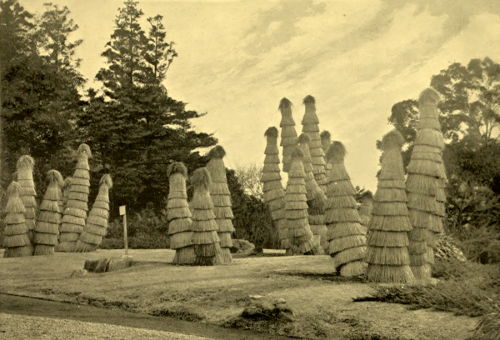
THE BOTANICAL GARDENS IN WINTER DRESS. A GROUP OF CYCADS PROTECTED AGAINST SNOW
December 30.—At work again in the locked Institute, but the sun shone and we were consequently more cheerful.
December 31.—As it is the day before the New Year, Professor F—— is too busy to work, so I brought home my microscope and some fossils to do here, and had a nice quiet day at home. The days before the New Year are the busiest of the whole three hundred and sixty-five for every Japanese. In the evening Flora and I went down to the Ginza to see the big Matsuri and buy what took our fancy, provided our purses were large enough. This Ginza Matsuri is one of the features of Tokio this time of the year, and is particularly attractive on the last night of the year. The pavements on both sides of the streets are thronged with people, and lined with mats on the kerb, covered with curios and oddments and modern articles of all kinds. The pavement spaces are marked off and numbered, and let out by the police long before. As every one must pay all his debts by the end of the year, lots of curios go cheaper then than at any other time—though great bargains are not to be had in Tokio any more, too many foreigners have visited it. It was entertaining to watch the crowds, and lots of the curios were very nice. Gold screens I should love—but their size would make them terrible to pack for the journey. Fortunately the rain held off to-night, else many a poor person would suffer for his debts!
January 1, 1909.—A bright sunny day for the New Year. This year I did not enter at all into the national customs, but went for a walk with Flora to see her school, the Convent of which, I think, I have spoken before. The new grounds they now have are very extensive and beautiful—how delicious the reality of country one can get in Tokio! It is possible in their garden to feel miles from any habitation and in the midst of woodland. When we returned I found I had missed an event—a visit from the Dean in his Court uniform, cocked-feathered hat, gold lace, sword and all. He had much impressed my maid,—alas, that I should have missed the great sight of a University Professor in the panoply of state! All the higher Government officials must go to the palace (unless ill) and pay their respects to the Emperor on the morning of the New Year, after which they make a tour of calls on each other. In the evening I dined with the F——s; we were a merry party and danced till late.
January 5.—A national holiday, so work was once more impossible; instead, we went down to see the sea at Enoshima. I had great hopes that the cone of Fuji mountain would show above the coast over the water. It is one of the loveliest views of Fuji, and I have never yet seen it. The day was fine, but not clear enough for that, however. Enoshima island, reached by the long bridge from the sandy shore, has often been described, so there is no need to reiterate its beauties.
It was a solemnly lovely day—not a glowing one, and the line of black foreground on the opposite coast, overtopped by fainter and fainter jagged ridges of hills, had the beauty of an old Japanese master. Alas, that the jewel of it all, Mount Fuji, was not to be seen. In all the eighteen months here I have never yet seen the cone above the coast hills from the sea, which is the most lovely view of all, they say, and this is my last chance. After buying a few strings of shells from the countless stores on the little island, and watching a naked brown man dive into the deep waves and come up with a living fish in his hand, which he presented to me, and doing all the other things essential to be done in Enoshima, we returned to the mainland, and as we had half an hour to wait I insisted on going up an attractive-looking hill. It was a Temple hill, with beauty and solitude for its crown, and such a view as I shall never forget of rocky coast and grey villages, of the sea with its jewel islands, and of the wave-like crested hills, a grey and black and purple view, with a dull green foreground and an atmosphere of mystery. Tokio! most favoured city, to have such a coast so very near. What we miss in London!
January 6–8.—Working hard, morning, noon, and night, with packing of fossils and books, and household goods thrown in.
January 9.—At work all day at the Institute; in the late afternoon a call at the Embassy about the official thanks to the Japanese, then on to Miss C—— about the next Debate, and, finally, a scamper to dress for dinner at Mrs. W——’s. When dressed it was too late to do anything but cycle there, but half-way on my road it began to snow! We had a very jolly dinner, and I felt increasingly affectionate towards Tokio, the people were all so kind. The snow had stopped, so I cycled back, though it lay thick on the ground, and it came on again before I got home, but a chiffon scarf protects one wonderfully from snow, and it was so pretty riding through it, instead of being cooped up in a kuruma, with danger of the men falling and breaking one’s neck. Kurumas aren’t at all safe in snowy weather, and are bitterly cold.
January 10.—The snow must have fallen nearly all the night, for it lay deep this morning. Soon after 10 it became bright and clear, and I set off to see the temples in Shiba Park. Very few people were about, and in the park just a stray poet or two and a photographer. I climbed one of the hills in it, and before me lay the sea, beneath the snow-clad trees and temple roofs. I turned, and scarlet through the festoons of gleaming white glowed the fretwork of a pagoda. Up and down little hills I wandered, the great trees standing free as in a forest, and the ground, as in a forest, trellised with big roots. The snow hid the low bamboos and gave the whole hilly landscape such a look that one needed no imagination to fancy oneself in a distant mountain forest, till the curved roof and crimson sides of a temple showed between the trees. In absolute solitude I walked, on untrodden snow, with no sight or sound of man—round me the musical clouds of snow that fell as the wind swayed the boughs of the tall cryptomerias above my head. And this is the heart of a capital city, Tokio, queen of cities. The long line of stone lanterns, the crimson bridge, the temples and trees, as well as the forest beauty, were rendered indescribably lovely by this snow. A friend was to have come with me to see the temples, and the snow prevented him—poor foolish man! But I am glad I was there alone.
January 11.—A brilliant, clear day. I was at work all the morning. In the afternoon was the party at the Nobles Club, given as a farewell for me by the London University Union. Quite a lot of people came, and I was transfixed in the middle of it all by a presentation from Baron K——, in the name of the Union, of three lovely gold lacquer boxes. Gold lacquer! A thing I have longed to possess, and a gift as well as a party from the dear Union, which I never dreamed would notice my departure.
It was not a little overwhelming, and I had to make a speech of thanks, and bungled it, of course.
Most of the fifty or so people who came to the party were my friends, guests of the Union, and one of them, as she said “Good-bye,” said to me also “Thank you.” I answered, of course, “Oh, you mustn’t thank me, I did not give the party.” “Well, then,” she said hurriedly, “thank you for going away.” My raised eyebrows and appealing eyes perhaps made her add, as she did going out of the door, “so that we can have a party.” She was not a humorist, but one of those dear, solemn people who take life seriously.
This party and the beautiful gift has touched me deeply; all the members of the Union contributed, English and Japanese alike.
January 14.—The last lunch at the Goten, I expect, for next week will certainly be busy. These Faculty lunches have certainly been very pleasant, and I am sorry they are coming to an end, like many another thing in this country for me. More P.P.C. calls in the afternoon. As I returned in the dark I met more than one man running with tinkling bell, clad in only a white cotton kimono. I have noticed several such quaint folk lately, and Professor F—— told me that in the coldest season a number of people will do this. It is a kind of remnant of the old “hardening” processes of Bushido, when children were sent barefoot and hungry across the snow, or sent supper-less to bed. None of those I saw running looked very robust, and I wondered whether such spasmodic hardening as a run on a cold winter’s night, practically naked, might not defeat its own ends. It looks on the face of it as though daily hardening might be more effective, in which case these same youths could discard the thick woollen mufflers they wear over mouths and ears and noses as they go out in the sunny streets.
January 17.—At 1 o’clock I sallied forth with a long calling list. Fortunately, one can call early on Japanese ladies. Baron and Baroness H—— were both in, and very gracious. It is difficult to say “good-bye.”
There were several other short calls, and then my last visit to the S——s’ pretty house, from which I saw the beautiful garden for the last time.
Afterwards I went to see the grey lady, Mrs. N——. Four-year-old Brownie remembered me and welcomed me in, doing the honours of the house and showing me all his toys. The grey lady is revealing herself a little—I am sorry I must go, and so will not see her again; people who really interest one are not too many on this earth. She started life as a scientist, but found chemistry so easy that it was no mental discipline, so she took to history, where dates have no reasons and are therefore hard to remember, but here, too, she came out top of the classes. She lies behind the poetry of that Japanese poet who wrote in English, and was so praised by Rossetti, the N—— of American fame, if I am not much mistaken, though she does not tell one so consciously.
January 18.—A long day at the Institute working and packing, and then to the M——s’ to dinner. The house is being re-done up, and some of the rooms are now very charming. Mr. M——, Mrs. M——, Mrs. H——, and several others were there, and the dinner was pleasant, but afterwards the treat came. When we went into the drawing-room I noticed a tray with lots and lots of white vases and cups and plates, and wondered what they were for. They told us almost at once. They had a great porcelain-maker there, and on the stone verandah were set up the furnaces and ovens and attendants, and we were to paint the porcelain, and it would be baked and glazed and finished before our eyes that evening! What it is to be a millionaire, and how much more to be one who could devise such charming pleasures. We all set to work gaily, the sons and little girl came in, and we had a very merry time. The quality of our painting doubtless left something to be desired, but we did not think of that till after, and really some of them were pretty, even the next day. The baking was the great excitement. The little furnaces were surrounded by glowing charcoal, fanned by the white-clad potters till a cloud of sparks rose over the fiery clay. We were half shut in in the verandah, but could see between the fires the snowy garden. The heat was so great that we rushed in and out of the drawing-room with no thought of cold, and multiplied our pots and vases rapidly. The time flew too swiftly, and I had to leave many still to be baked and to be seen to-morrow. This, too, was a farewell party for me, and the kindness and grace of my hostess made it a very pleasant one.
January 19.—Called at 9.30 at the M——s’, just to see the exhibition of our last night’s pottery-making, and found a big show, only one piece having been broken in the baking, which seems very good for furnaces erected in a private house. I had to hurry away to the Institute, for every moment is now urgently needed for my scientific work, and, fortunately, got on pretty well with it to-day.
January 22. A busy day—calls on the way home and a dinner at the P——s’, where I am now going to stop the two nights till I leave, as my house must get packed up and sold up. Professor S—— came to dinner, and the F——s. Professor P—— has only been back a few days from London by Siberia, and had home news. After the guests left at 11.30 I went over to my house, took off my evening frock, and prepared for a night’s work. There was no help for it—packing, letters, P.P.C. cards, and a hundred things had to be done, and still there was work at the Institute. The night flew by, with cocoa and cake at 3.30, and after breakfast I went to the Institute to finish up things there. A few calls had to be paid on the way back, so much kindness from so many friends necessitates calling. After dinner I was approaching insanity over the folly of the men who were padlocking my trunks.
January 24.—The P——s were very good, and let me wake them up at 6.30; then there were a few little things to do, a look round mine own little house, all empty and forlorn, and we set off for the station.
As I left at 8.20 on Sunday morning I never expected any one to see me off, except perhaps one or two special friends, but there was quite a big crowd of kindly folk, the M——s with lovely flowers from their greenhouse, and all with good wishes. Why I didn’t break down and howl on the platform I don’t know. Professor S——, Professor F——, Dr. M——, Dr. H——, and my maid came to Yokohama to the boat with me, where they cheered me till it started by photographing the party in groups and writing picture post cards, and walking round the deck with me one at a time in friendly converse.
Then, just before we sailed, I saw a gleam of what looked like Fuji mountain. Was she going to forget her cruelty and coyness and show herself to me over the water at last, at the latest possible moment? But the clouds closed again, the tender took my last friends from me, the ladder was up, and we steamed away as the bell sounded for lunch. Then after it I went on deck, and before me lay a wonderful panorama, near rocky coast, pine-crested, then beyond a dark line of more distant woods and bays, and in the midst, perfect, peerless, cloudless, the cone of the snow-white Fuji mountain!
I gazed and gazed for an hour at the changing view of ever lovely coast and ever lovely mountain!
Round the mountain top light clouds collected and dispersed like flying veils; one rose from the crater and dissolved like a puff of smoke, some circled the base and shut off the crown from the black fringing trees below.
So, as I left Japan, her greatest beauty showed herself to me.