A JOURNAL FROM JAPAN (continued 4)
Reading edition
It was very wet, so the picnic planned for the afternoon did not come off, and I stayed a long time. It was interesting to notice some native Indians studying here, and to find that they, and one or two others who could not speak Japanese, had special classes held in English and given by a Japanese teacher for the various subjects. Who needs to learn any “world language” but English?
June 15.—An uneventful working day, but in the evening there was the Debate. We are going to have alternately afternoon and evening meetings, so as to try to please all varieties of people.
Miss B——’s paper was very amusing, as we all expected it would be, but very superficial also, so that I felt she had been convinced on the side of Hearn, for she brought no real serious argument against him. Miss G—— opposed her well, and brought far more solid reasons in favour of Hearn’s view of Japan; the two supporters were good, particularly “the Poetess,” who supported Hearn. Many of the audience spoke very well, but when it came to voting so many refrained that the votes were level, and I had to give the casting vote, of course in favour of Hearn.
June 19.—All yesterday the Institute had been undergoing extensive cleaning, and this morning was spent in expectation and preparation of exhibits—the great Dr. Koch, the world-famed German bacteriologist, was coming to see the Institute. Professor F—— was brought back from the mountain before his cure was finished to be on duty; my fossil slides were borrowed and put under microscope, and the spermatozoids of ginkgo were on show. He came, after the whole Institute and Baron H—— had waited in a flutter of excitement for nearly an hour; he is a big stout man, not very intellectual-looking. Though interested he had evidently been trotted round a great deal. He seemed to like the fossils, and asked me to show him a section of a leaf, as well as those I had under the microscope.
Then he was trotted off to a purely masculine dinner at the garden house. The newspapers have been full of his coming, his doings, and sayings. They say they are going to put a telephone up Mount Fuji, so as to be able to interview him from the top!
June 22 and 23.—Uneventful working days, with a little reading of Matthew Arnold’s Essays in Criticism in the evening. I am reading aloud to Mrs. St——, who lives next door but one, and who must not use her eyes at present. We are doing Arnold pretty thoroughly, life, poems, and essays, and patted ourselves on the back when we found in an essay on his work that he “appeals exclusively to the cultured section of the educated classes!”
June 24.—At work all day; in the evening I gave a farewell party for the P——s (who leave on Friday), and invited about 30 people, of whom 26 or so accepted. It would have been preposterously ambitious in England, but here my little house, with the rooms thrown into one, and the garden lit with Chinese lanterns, made it a pleasure to play at entertaining. The room lit with lanterns looked very pretty; chairs and lemonade glasses I borrowed from next door, and all went merry as a marriage bell. Though it was the rainy season, the night was gloriously fine. The Dean and one or two Professors of the University, two clergymen and some minor folk from the Embassy disported themselves like children. Even the Poetess came, and entered into the games. We had a collection of 20 sen toys for Professor P——, and some of the things people brought were charming. By 11.30 all but a select few departed, but it was after 12 before these went. What a simple happy thing life in a Japanese house can be!
June 25.—Fossil-cutting all day. Miss M——, Mrs. H——, and President N—— came to see the fossil cutting-machine at work, and also some of the slides under the microscope. They were interested, but of course did not fully realise their significance, for fossils are principally for specialists.
June 26.—At 6.30 this afternoon Professor and Mrs. P—— left. What a crowd there was to see them off! By the same train the wife and daughter of the Austrian Ambassador were leaving, and that brought all the Legations’ representatives. Really the platform was so packed we could hardly move—and if there had been tea going round it would have seemed like a garden party. The train looked comfortable, with wagons-lit—and every one was entertained by the huge “send-off,” so that few tears were shed—but I am deeply sorry to lose the friends that train carries away.
June 30.—A good day’s work. In the evening there was a dinner where met all the botanists of Tokio. One or two could not come, but there were 18 men there. Seemingly foreign food is greatly appreciated—certainly there were more courses than the laws of health allow. It was amusing to note knives slipped furtively down after they had touched asparagus when their owners noted me holding a spike aloft in bare fingers—but otherwise the company behaved and looked much as a similar set of people would look anywhere. The sky, seen out of the windows, was the most astonishingly blue I have ever seen. The soft velvety depth of it suggested the impossibility of stars gleaming on its surface (as they usually do at night), they would have been drowned. The brilliant blueness like that of a cornflower or a solid mass of cornflowers that had flung off their colour into the surrounding air, till every particle for miles, each separate and distinct, was blue. Usually the sky seems a flat or a dome-shaped sheet of colour over us, to-night it was a solid vapoury mass of quivering blue particles—indescribable, but thrilling as an electric shock, and as unforgettable. After we had dined we talked, until I suggested Dr. H—— should give us a piece of Nō recitation; he studies its peculiar singing-like declamation and renders it well. Then others sang, and I was convulsed by “Home, Sweet Home,” sung by one of the young lecturers, “to prevent me feeling home-sick.” His rendering of it was intensely funny, but his voice was pretty good. Afterwards he sang a long Japanese battle song. We left at 9.45, and some of us, I fear, will be ill after that dinner.
July 1.—An uneventful and solitary day’s work. Professor F—— too ill to come. I only suffered spasmodic anger from an outraged digestive mechanism, and continued my usual occupations, and dined with the Sh——s in the evening. The little Japanese girl I have mentioned as staying with her is pretty nice. Alas, to-morrow she is going to be put into foreign dress! She is going to marry Prince S——, however, who is very pro-English, and as she will be much about the court, is compelled to wear it by that sad decree of the Empress.
I heard one good story of a little English girl who went home after having spent all her early years in Japan. In the train between Southampton and London she was much interested with the outlook, the sheep particularly fascinating her, and she called on her mother to admire them: “Look, what a lot!” “Why, here is another!” “There, mother, look, look!” she kept exclaiming, when a benevolent old gentleman said, “Why are the sheep so interesting, little girl? Haven’t you seen a sheep before?”
“Of course I have,” she answered, drawing herself up; “of course—we have two in the Zoo in Tokio.”
July 2.—Fossil-cutting all morning—I seem to be followed by misfortune, for the boy who works the engine has been away all this week, and my scientific colleague here only one afternoon! However, I keep at it, and slides are slowly accumulating, with a few nice things in them.
July 3.—Fossils in the morning and lunch at the Goten; Professor S—— jolly and talkative, and a great pleasure to meet. Professor F—— came in the afternoon, and we did a lot of looking through slides. There are a number of pretty little things among the fossils that puzzle us completely.
July 5.—There was a luncheon party with some nice neighbours to-day, and while we were there some strolling Japanese singers came to the door, and we gave them a few sen and watched them. There were an old woman and a young woman, both good-looking, and with the quaint huge round hats of their class, the young man wore a battered European-style hat—a jarring note, that was repeated in the little girl’s hat, red stockings, and European shoes. It is always the men and the children who wear the horrors of civilisation.
The child danced, clumsily and heavily with her feet, but moving her little body in all kinds of ways with wonderful grace and agility, and a strength in holding difficult curves; her hands too, so prettily shaped, were carefully posed and moved, now rigid, almost bending back, and now swiftly fluttering; she had an old gilt fan, which she opened and manœuvred, but her round pretty face was absolutely set. There was a haunting suggestion of bedraggled beauty in it all, beauty that had once adorned a noble’s palace and had been cast into the streets, and from soft white tabi and silk robes had taken to tight cotton gowns and old red stockings, with a hole showing above the down-trodden heel of a shoe.
Yesterday the Ministry resigned—and the commercial people are on the verge of revolt against the fearful expenditure on army and navy, while the country is so poverty-stricken. I could weep with Hearn over this country, and the hats they wear are enough to start me off!
I have read every word of the cross-examination and trial of Bethell over the Korean matters; you have probably heard of it at home; in many ways I feel that the Japanese use their catch phrases, “love of country”—“love of Emperor,” as cloaks for unscrupulous behaviour public and private, just as our county councillors seem to lose private honesty in dealing with public affairs. The Japanese have 20,000 troops active in Korea, and cannot keep order—my only surprise is that any Koreans submit at all without decent open warfare; they were not conquered, but tricked and coerced into having their Government absolutely controlled by the Japanese Government. Were I a Korean I should at least demand to be properly conquered. Yet, of course, from the point of view of world politics Japan must control Korea, only—God pity the Koreans who have themselves a spark of “love of country” or “love of Emperor.”
July 6.—A solitary day’s work—on the way home I called to inquire after Mrs. M——, who has been in bed for about a month, and I noticed that the ceiling of their big drawing-room is all of satin, embroidered with huge flowers and life-size peacocks and other birds. One can only think of the cost of it, and deplore that it was not put as hangings where one could admire the work.
I had to go by tram to-day, as the bicycle is in hospital, and noticed such a quaint sign over a shop. Most of the very funny ones have been gradually weeded out by thoughtless people informing the owners of their eccentricity, so that the streets are not nearly so entertaining as they were years ago.
This I saw, however:—
“Au Klnds wool are sell in her.”
I also noticed “Fruit’s Shops.”
How lazy a bicycle makes one, it feels a serious imposition to have to walk 2 miles of city road, though the Tokio streets do not seem to get any less entertaining because I am accustomed to them.
July 7.—We had a fine afternoon, so I did a little tidying up in my garden. During these many days of heavy rain the leaves have grown luxuriantly, but the flowers have quite ceased to come out in a world where they are only drenched with unkind torrents instead of being kissed by the warm sun they will get if they wait a few weeks longer. My four little lawns, altogether no bigger than a billiard table, are now like a jungle, and I planted them so few weeks ago. It is very pretty to watch the little side paths, where the moss and lichens and liverworts seem to grow every day; the small paths where O Fuji-san (my maid) does not walk are now quite green—more aged-looking than paths a hundred years old with us. The little stone lantern I bought the day of the paeony flowers, is also green, with a faint haze of centuries over it! It is the lovely greenness of Tokio that marks it out from every city I have seen before. To-day, bicycling along the road above the moat, I could well have believed myself far in the country, with the high green grass on the steep banks of the moat and the grey-green pines growing above and shading it. The green and the grey and the blue that lies in and over this city, blue in the sky and blue in the gowns of every one; grey on the tree trunks, the moats, and the houses; green everywhere there is foot-hold for a moss plant, are a harmony that thrills one’s very soul.
July 9.—Work till 5.30, and then dinner at 6, with Professor S——. This was arranged to suit Professor B——, from New Zealand, who goes to bed at 8.30 or so. Professor O——, the seismologist, and Professor T——, the anthropologist, were also there. It was, of course, a “foreign style” dinner, and was done with great magnificence. Professor B—— talked with almost no comments from any one, but the conversation was never dull.
Professor S——’s garden was more of a dream than ever,—lit with stone lanterns and with a few red roses among the green, the moon being in a watery mist, and we turned the light down, and listened to the bell-like tones of a little “Bell insect,” hanging in a 2-inch cage in the garden. The note was slightly muffled, but musical, penetrating, and sad—one of those notes that act as an “Open Sesame” to the gate of emotions—that is, I should say, to some people’s emotions. Professor B—— had the insect under a “scientific scrutiny” for a whole minute, and then produced his note-book, and the light was turned up while he wrote down his observation that the noise is made by the rubbing of the wings where they slightly overlap.
July 10.—The last day’s lunch at the Goten, and a lot of work of one sort and another got out of hand. Collecting plant-material, etc., takes more time than one would think. The fossil lab.-boy is ill again, and fossils are hanging fire a little, for I can’t do more than three things at once.
July 12.—Writing all morning; the weather is glorious, and the rainy season seems to be pretty well over, and has been a record one. The rain came at the right time, lasted the right length of time, and was cool instead of “steamy hot,” as it often is—we cannot be too thankful for these mercies. Even as it is, the inside of my writing case and the whole of my shoes and straps are covered with blue mould.
I paid several calls in the afternoon—my neighbours are off to the mountains first thing to-morrow morning—lucky people! How I wish I could feel free to do the same, instead of grinding over these old fossils. Soon Tokio will be empty of all the sane people who inhabit it in the winter.
As I am writing I hear the tune of “Auld Lang Syne” set to Japanese and sung lustily. It is one of the favourite foreign tunes among the Japanese, and many sing it without knowing it isn’t Japanese, I believe.
July 13.—I was in the garden with Professor F—— for the first time this year. We were getting some gymnosperm material, and found a brilliant green frog sitting in the sunshine on a brilliant green leaf. He told me he would be brown on a barky branch, so I picked the frog up and put him on the curve of a broad brown branch, and, sure enough, the webs of his feet went quite brown in a minute, and his back went a much darker, duller green, but we couldn’t wait to see him all turn brown, it took too long.
July 14.—Absolutely alone all day. The engine and fossil boy and Professor F—— are all ill again, and the other people not visible. I felt more than a little ill myself, and my bicycle was so bad it had to go into hospital. A very grey day—and in the evening torrents of rain fell from the heavens, and I began to feel inclined to weep also, when Mrs. F——’s little daughter came round to ask me to go in to dinner, as the weather was so depressing. Eastern life has its share of compensations.
July 15.—At 11 I started my work, and took some micro-photos, and I am also seeing about chemical analysis of nodules, covering glasses of great size for fossil slides, printing of photos, artificial cultivation of ginkgo prothallia (and the wretches insist on going mouldy, like my boots), collecting of gymnosperm material, and half a hundred other things that are pulling me in as many directions as the points of a compass for a universe of six dimensions. Why I was such an ass as to undertake both fossil and recent work, I can’t imagine—one must go to the wall.
Coming home late to-day (Professor F—— turned up about 3.30), I passed through the road to a temple where there was a children’s festival, along whose sides were rows of gay little stalls with all manner of bright things to tempt the children, who throng in holiday attire. I never saw more children and fewer elders, and all the children were so bright, and, excepting for the crude, almost savage decorations in their hair, so prettily dressed. The various toys and eatables are indescribable, all brilliant and all ridiculously cheap, from half of a farthing up to a penny or so being the normal prices. Among the eatables were little brown germinating beans, with long white rootlets sticking out, then there was a special stall for a kind of clear seaweed jelly, which was squeezed into a glass cup through a bamboo squirt.
Very decorative little stalls were arranged with brilliant seaweed and shells, and one man did quite a lively trade cutting up small wriggling living fish. That is one thing about eating raw fish, it should be alive to be really good. As you may imagine, I have not yet tested it. Then there is the man that “pops” sugary beans over a charcoal fire, and makes a delicious noise with his shaking grid-like box. The dealer of live red crabs attracts a crowd, and the crabs crawl up the sides of his cage as he pours water down on their backs. Though why any one should buy the crabs, I don’t know, for they are less than 2 inches from toe to toe. One boy I met had a lovely toy—a great dragon-fly, 6 inches across the wings, eagerly flying attached to a red thread—but alas! I soon saw it was real.
All the sentimental nonsense that is written about Japanese love of animals is simply not worth the paper it is written on, and as for their treatment of horses! In England I would go up and beat a man myself that I only pass quickly here, with a prayer for his horse.
There was inevitably among the stalls one for second-hand odds and ends. These I examined carefully, for it is just at such times one can get lovely curios very cheaply. This time I got a tiny double figure, most delicately carved, and an old carved horn comb.
July 16.—My “At Home” day—and therefore, of course, pouring in torrents. When I get to the level ground below the Botanical Gardens I found the road under 2 feet of water. Fortunately there were kurumas waiting to ferry one across, and I got in one, and had a man to carry my bicycle on his shoulders. It was serio-comic to see the houses with 2 and 3 feet of water in them, and clothes hung up out of reach of the dirty flood. The channels between the houses are deep, and I saw several people waist high, with a pole, feeling their way. To think that less than six hours’ rain made that flood, and that it is in the city of Tokio, and that it happens every few weeks in the summer, fills one with surprise. How can they put up with it? It only means the deepening of the channel of the little stream which drains the district—but men and women tuck up their skirts and wade a quarter of a mile up to their knees, and those whose houses the water invades place what they can of their goods out of its way—and probably the last thing any one of them would do would be to grumble at the City Council.
I bought some peaches coming back, they are now in season, and in Tokio more than in any place I know it is a case of “gather ye roses while ye may.” They were very big, soft, and glowing crimson, and cost one halfpenny each. When we cut them the stones separated perfectly, and the rich blood-red flesh stained one’s lips and fingers with its juice. In buying fruit and vegetables the only Chinese character I know is of great use, it is that for “Mountain,” and is used for piles of cucumbers or trios of peaches, and I can read “one mountain cost 10 sen,” or whatever it may be that a cucumber mountain costs.
By the way, it may interest you at home to know that a pile of four cucumbers costs 3 sen, which is exactly 3 farthings the lot. Are you surprised that I eat boiled cucumbers with white sauce? It is at home a vegetable we could not often indulge in, with cucumbers 1s. each, but here, where all things are ridiculous prices, being either too dear or too cheap, I have the power to indulge in this delicate dish.
Eggs are funny things here; they get dear in the summer, just when the man in Punch finds his hens begin to lay. Here the extreme heat enervates the hens for a couple of months in the summer.
July 17.—A long solitary day’s work till the late afternoon, when Professor F—— came, and we did a little “joint work”—it is beginning to be almost farcical; however, without him I should never have got on at first, so it is all right.
July 18.—Work till 2, when a party of provincial botanists came to the laboratory, and I met once more the Mr. O—— who was kind to me at Okoyama in my second tour, as funny and as amusing as ever, with his twinkling black eyes and mobile eyebrows, that so incongruously reminded me of “the silk-worm moth eyebrows of a woman.” At 3 I left the party, who had, of course, to see all the sights of the Institute, among which was the “Fossil Lab.”
July 19.—At 6.30 I got up to go and see the “Morning Glories,” huge brilliant convolvulus flowers, which are specially cultivated in a number of gardens in a part of the town near Oyeno Park. We went to about a dozen gardens, and saw many of the flowers, though it is still a little early in the season. The flowers are trained in pots to grow round light bamboo frames, and are specially cultivated to be very large. Each morning at ten o’clock all the flowers that have bloomed that day are picked off, so as to ensure the next day’s blooms shall not be deprived of any nourishment. The bells are very large and extremely brilliant, blue, purple, magenta, all the possible intense shades of each. The flowers are almost a little crude, some verging on vulgarity in their flaring tones. Many of them are delightful, and some so large they are said to reach 8 inches or so across a single bloom; such huge ones I did not see, but what I saw made it possible to believe in the bigger ones.
In some of the gardens there are many other beautiful things to be seen, one in particular was almost like a museum of precious things. There were open rooms in it, with the flowers arranged according to the best artistic styles, with valuable dwarf trees and curios placed beside them; there were three old kakemonos I should have loved to possess. In this garden also was a wonderful collection of landscape stones, arranged as islands on flat porcelain trays filled with water. It was indeed a case of bringing the mountain to Mahomet—perfect rocky scenes, with gleaming waterfalls made by streaks of white quartz. The innumerable lovely stones—from an inch to a foot high—represented perfectly, enchantingly, all types of grand, beautiful, natural scenery. The one I liked best was (even in Japanese things my fancy usually hits on the most expensive) just a thousand yen in price!
An old man, apparently master of the garden, came up and talked to us, he was curious to see a foreigner so interested in stones, and wished to hear which I liked best, and so on. I wished I could speak fluently with him, he was just the type of character that seems to be dying out, and that is so rich in interest and quaint wisdom and remote culture. His deep wrinkles and keen light eyes were so attractive. I wished I had gold to spend in that garden, he and I would enjoy the good old Japanese way of spending several days over selecting the treasures. He had a pretty little piece of carved white jade among his flowers, six inches long and an inch high—a foil for a dark foliage arrangement, £20 it cost, he said, and he didn’t lie as to its worth.
This is the first nursery garden I have been in that seems to be the creation of an old artistic Japanese, it was indeed charming.
Afterwards we lunched in Oyeno Park, and then I went a round of calls on my bicycle, then home to have two friends to tea, and a view of copies of old Japanese prints: half a chapter I forced myself to write in the evening sent me to sleep.
July 20–24.—An uneventful week of work, all the Institute seems asleep, and Professor F—— only came an hour or two for some of the days till Friday, when we worked very hard.
July 25.—The cycads in Tokio won’t flower, and it is a long way to go to the places they are reported to grow, so that when I heard they were to be found in Yokohama, I went off at once by an early train to visit the various gardens where they are said to be found. There were two female trees and a male, but they were not very healthy; still, as the Tokio ones refuse to bloom, and as I need them, they will be visited by my pilgrimages.
What a hideous influence is the “foreign” style at Yokohama, where red brick warehouses and treeless streets covered with a pall of smoke remind one of the “advance” made by modern Japan. Fortunately the plague spots are not very extensive, one needs to go but a very little way to find beauty again, but I shudder for the future when moss-grown walls and green hedges shall have been ousted from the cities, as they are from ours.
July 26.—I got up at 6 to go to Boshu after more cycads, as the temple, Awajinja, is reported to have fine ones. The sail down the coast in the little steamer was very pleasant. It took seven and a half hours, but we passed very pretty scenery, and for some time seemed out of sight of land in a sea dotted with innumerable white-sailed fishing-boats. In the middle of the day many of the fishers were taking a siesta, the square sail lowered so as to lie along the boat and form an awning, under whose shade they slept.
When we neared the coast, it required but the smallest imagination to picture myself in a savage country, for over the rocks ran and scrambled dark brown men, stark naked, not even the proverbial string of beads to adorn them. They had long bamboo poles in their hands, which they waved like savage spears, and gave them a truly wild aspect.
After landing I bicycled about 8 miles to the temple, and found splendid male flowers on the cycads, but no female. Last year there were lots of female. It is too bad, this year seems to be so unfavourable for the seeds.
I put up at a little hotel near the sea, and after six went down for a bathe. The coast was perfect, shelving rocks sloping out to sea, with little bathing coves and sheltering rocks, and, as I imagined, perfect solitude. But, of course, in this out of the way place I had been noticed, and before I was in the water a minute a crowd of women and children had collected. Nothing I could do or say would drive them away, and so I had to get out and dress under the fire of their eyes and criticisms. In their long-drawn country tones they kept up a running commentary, “Ooā—how white she is!” “Is she married?” “Why does she wear a dress in the sea?” “How old can she be?” “Perhaps twenty years.” There was no escape from nearly fifty people forming a cordon but 3 feet away from me; if I had fled they would have followed; so I dressed as leisurely and as unconcernedly as if I were at home, and gravely buttoned the little buttons of my bodice and put on my stockings while I returned the compliment and made a searching examination of them.
The boy children were naked, with smooth glowing copper limbs like sun-burned clay—as indeed they were. The girl children had usually some floating robe of a dressing-gown nature, open to show the whole body, or caught at the waist and turned down to leave the upper part free. Bright-eyed they were and muddy-cheeked, but neither pretty nor attractive. The women were naked to below the waist, the kimono being turned down over the girdle to form a kind of double skirt. No one wore any ornament of any kind, save a few coloured beads to tie their hair, but few of them had even that. The men wore 3 inches of cloth round their waists and sometimes a band round their heads made of a small Japanese towel. All were perfectly quiet, and the remarks were made one at a time by the older women; the children stood open-mouthed. I know that the blue of the sea-water makes one gleam like white ivory, and as all my clothes were white, I suppose the effect must have seemed novel to them. The deep colour of the Japanese is chiefly due to sunburn, but as they are exposed to it from their earliest days it gets so ingrained that they may not realise it is an attempt at clothing on the part of a body otherwise so unprotected.
July 27.—I rode back again to the starting-point of the steamer, and got there twenty minutes too soon, and so went along the shore and had a bathe. The steamer was very crowded and hot—I wonder who it was that started the fiction that a Japanese crowd does not possess an odour? Why, the detestable smell of the rancid oil in the women’s hair is enough for one alone, without any of the other items, which include a peculiarly virulent pickle, daikon, and an odour of decayed fish that hangs over a good many in a poor crowd.
The heat is now upon us, and as I returned on my cycle through the Tokio streets I met gentlemen with fans, schoolboys with fans, errand-boys with big baskets and fans, kuruma men with fans, even the men dragging heavy carts fanned themselves as they struggled along. Yet very few women had fans, only the ladies riding in kurumas.
July 28.—I had to go up to the University and to several places and get ready for my start to-morrow. Fearfully hot.
July 29.—Started for Hakone. After the railway journey there was a tram ride for several miles along the old Tokkaido road; a beautiful avenue of Cryptomerias shaded it most of the way, and on one side gleams of the blue sea shone between the tree trunks. After reaching the foot of the hills there was a four-hours’ walk up the pass, by a steep and very rough path, with beautiful views of a clear river rushing over big rocks, and blue hills rising peak by peak behind the trees.
My luggage was carried by the quaintest human being to whom I have ever spoken—a dwarf. He hardly reached up to my elbow, and had bent legs and long arms, yet he was very strong and very genial, though so hideous. His back view was like this sketch, and his short stick, about 18 inches long, was very thick and used as a walking-stick or a support to prop up the saddle-like luggage-holder when he rested.
Going with him quite alone through the narrow paths in the woods I felt as though I had been transported into the Middle Ages, where damsels were served by strange dwarfs who led them to witches’ haunts and fairies’ palaces. I walked slowly in this dreamland, and he pattered along, half in a run, for his legs were so short that my slow pace was haste for him. But I need not have felt that his burden was too heavy, I met several charcoal-burners carrying six and seven times more than his load. It is wonderful what the natives can carry here.
We passed a mountain hamlet, a double row of houses built along a path. There was a runnel of clear water rushing down the middle of the road, and a tributary stream brought between each of the houses to join it. In its building the village must be very old, and is not so “Japanese” looking as the buildings of the plain. There seemed to be no gardens, but in the space between the houses grew banks of blue hydrangeas, crimson phlox, and great white lilies.
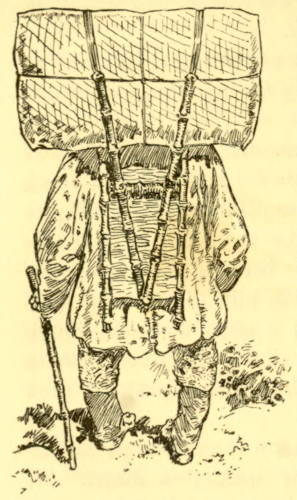
THE QUAINTEST BOW-LEGGED DWARF CARRIED MY LUGGAGE, AND TROTTED ON AHEAD LIKE A BEAR.
After a long and rather weary pull up the hills, where the road was bad and very stony, we crested them, and looked down on the lake of Hakone, girt with Cryptomerias.
In the evening I was housed in an old dwelling where daimios used to sleep when they travelled along the Tokkaido—by the lake whose farther shore was cut off by driving clouds. One could imagine it an ocean, and cool fresh breezes made me forget the stifling heat of Tokio.
July 30.—We are living in the clouds; below, above, and around us they swirl and writhe in the wind, sometimes breaking a little to show us the edge of the lake, but then directly driving together again and shutting us out from all but our own garden. Below us in the plain the sun will be shining and the people sweltering, but we are cool—and damp.
July 31.—Still the mist and clouds dance past and wreathe round the trees in such enchanting wise that they make poems and pictures and mysteries of the swift visions they are allowed to reveal.
Sad that I am ill—terrible pain in the night, so that I had to rouse the house; and all day I have done nothing—but grin sometimes when it returned.
August 1.—Clouds still there; and I am a little better though not well. The household in which I am staying is unconsciously amusing. It is to join J—— that I came; the other inmates are missionaries of uncertain age,—very high church, with prayers night and morning, grace before and after meat, with devout crossings and bows, till I long to tell them they are popish idolaters, but refrain, for J——’s sake. The first night I felt too crushed to venture a remark at meals; the book I brought (a clever light thing by Barry Pain) was said to be “such weak rubbish it seemed a pity to read it” by the lady who told us all one evening that she “had read a very great deal—and among it no rubbish!”
J—— begs me not to catch her eye at meals, and I refrain. The Pan-Anglican Congress and the Bishops attending it are the staple articles of interest at present.
While we are not supposed to be seen in a kimono “because the Japanese think us ridiculous in them” (with which I quite agree in one way), the Japanese servants are brought into prayers, and I wonder whether prayers said in Japanese by an English woman escape the ridiculous!
The village street was illuminated last night and to-night with square paper lanterns, for to-day is a great festival at the temple by the lake; and there will be a week’s matsuri, during which time the carpenter cannot mend the boat because he wishes to play with his children. Sunshine came for a couple of hours and we went in a boat to the temple. The boat was beached at the end of a little path, leading straight up from the water to the temple, by a flight of grey stone steps, moss-grown and decked with ferns. On either side were great Cryptomerias and bamboo, a cool deep wood in which the greyness and the greenness were set off by huge white lilies and their visitors, black butterflies with blue-tipped wings. Our path was solitary, but by another meeting it trooped gaily dressed villagers, brilliant in blue, red, and pink—sometimes whole families, father, mother, sons, and daughters in blue kimonos all alike.
The temple service was already well begun before we got there, but we came in time to see the presentation of the first-fruits. In the outer part of the temple the congregation sat on the floor,—the front rows all occupied by elderly gentlemen clad in their black haori with white mons, behind them sat the small boys, and at the back the young girls. By accident, or for some reason I do not understand, there were no women at all in the temple, though a few old ones with babies stood outside. They made no difficulty about us entering, so perhaps it was the preparations for the feasts to follow which kept (as it so often does at home) the women from worship. While the solemnity of presentation went on a man with a ridiculously flat face, dressed in semi-foreign style, played a harmonium, like the ones missionaries use on the seashore in the summer holidays. It was only given the chance of droning half a dozen notes with no tune audible to Western ears, but it was solemn enough, and had a certain fitness for the occasion. Three priests officiated, one in white and one in yellow over-dress with baggy trousers, just like a Turkish lady’s, beneath, and one in a lovely peach-coloured satin dress, an exquisite “Liberty” colour, and a great contrast to the harsh yellow one. The other brought the lacquer trays of offerings to him, with many slow reverences, and he walked up the altar steps and presented them. The walking up the steps was quite a feat—he turned his body sideways, at right angles to the steps, and brought both his feet together on each step. I noticed that his toes were moved up and down in the way prescribed in the ceremonial walk of the Nō.
One of the missionary ladies amused me as we were coming away. She dropped behind with another missionary and said in a tragical stage whisper, “Did you see that English lady in a red-striped dress? She was buying charms and mementoes of the priest! Oh, I hope she is not one of them! It is so horrible to think of——” This dear lady takes all things very seriously, and is as devoid of humour as any one I have met. I marked the lady in a red-striped dress, and discovered that she was carrying a quite new scarlet Kelly & Walsh (a little phrase-book used by all tourists). We all buy little odds and ends when we are touristing.
August 2.—I feel still ill. I expect it was the relative cold and the constant wet, for all the time the clouds were driving through us. So I walked down the pass and went back to Tokio—a long hot journey. Last summer I described all the varieties of undress one can study in the railway carriage, and as the Kobe express cars are as big as big Pullmans and crowded, you can imagine I did not lack entertainment.
August 3.—I went up to the University and the Bank in the morning, and in the afternoon Professor B—— came to tea. He is as talkative as ever, but is now thoroughly disgusted with the Japanese. Their “futility,” their “absurd waste of time,” their “indirectness” irritate him, as they must irritate any one; and he sees no deeper to the things one loves, and which in some degree compensate. He proclaims, infuriated, that all the mysticism that was ever in Japan was brought there by Lafcadio Hearn himself.
August 4.—I set off with my bicycle, carrying all my luggage, for a fossil-insect hunt in Shiobara. The train takes five hours, according to the time-table, to go to the nearest station, and after that I had about 16 miles to ride to the haunt of the fossil insects. Fossil insects are shy and scarce, and I am the first to stalk them here, so I came with a double lot of patience; and I believe I remarked half a year ago, I have been so battered and worn in this country, where my impetuous spirit tugs at Oriental passivity in vain, that I have now normally the patience of two Jobs.
The train journey was remarkable only for the small quantity of clothing the passengers in the cushioned second class (pauper as I am, I only once travelled third) considered essential. Then the bicycle began, and as I spun past the jolting kurumas the other travellers engaged, my heart rejoiced, for not only was I safe from their horrors, but I should reach the hotel first and get the pick of what rooms there might be; for it is a hot-spring place, and much frequented in August.
The first half of the journey was nearly flat, and I have described it before, when I came to this place hunting plants; and then the hills began, but the road was splendidly graded, and I rode up all but one with great ease. The road followed the winding valley, and sometimes seemed to hang over the roaring flood of the river beneath, so precipitous was the slope. At each curve of the road a broiling sun shone on me, and at each convex bend there was a waterfall, which seemed to emanate the coolness of hidden ice, and as the road curved and wound in and out like a Chinese dragon’s tail, I did not lack sensations. The beauty of the solitude of a million trees whispering together, of the silvery blue water and the grey rocks, shone with a clearness and brilliance that is so rare in England, and that is one of the chief charms of this country.
When I arrived and settled into my rooms, I had a bath. It was a big hotel, built for the hot springs which ran directly into the baths, and I was ushered into a bath-room where a man and woman were disporting themselves after the manner of Adam and Eve before the Fall. I felt like the serpent; but refused, with more tact than he showed, to form a third. This surprised the bath-attendant, who, however, allowed me to wait, and then stood outside the door all the time I was bathing to keep others out, and only peeped through the broken glass in the door now and then just to see whether I was ready to come out. After the bath he escorted me across the road (I had to sleep in the annexe), holding the umbrella over me, as I trotted along in a kimono and a pair of stilt-like gheta. In the luxury of idleness after supper I watched a woman in the house opposite. She was clad in a brilliant blue kimono, just the right old china blue—open at the throat, and her face and neck were the colour of warm sun-tanned unstained wood. “Olive,” I suppose people call the complexion, but it was warmer, and more beautiful than that, while her hair was smooth and black as polished ebony, arranged with a series of rich curves in it. The old abused word “chaste” expressed her more exactly than any other I know. The tawdry fluffiness of most of our women’s dress and hair seemed like flannelette beside rich satin as compared with her. Yet a curl may bewitch one and entangle one’s soul, I know—a curl, but not the frippery and broken lines that are so rife in Europe. I wonder till I verge on lunacy how it is that the West has not yet discovered the glory that lies in smooth curves and gleaming surfaces, and in lines of cloth, unbroken by frilling and tucking and ruching and pleating.
August 5.—I hunted fossil insects morning and afternoon, and got a haul, better than I might have expected, if not so good as I had hoped. I left the bicycle at a primitive little saw-mill, turned by the river one has to cross to get the fossil quarry. The people are all greatly interested in it, never having seen a woman’s bicycle before. The hotel is about a couple of miles from the fossil place, so I go on it as far as I can get, for it is hot to walk, and stones are heavy to carry.
August 6.—Another quiet day. I took a walk over the stream up a branch valley. How gloriously limpid and clear the water is. The solitude is complete, and yet there are footpaths where one can wander without battling with sasa. It is a particularly charming place.
August 7.—I got very wet while getting fossils, indeed, it was like fishing rather than anything else. After I got back there was a terrible storm, really a small typhoon; one realised then why the houses are built with such greatly projecting roofs. The rain washed over them in a torrent, a white cascade, and streamed off the sides and swirled up into the air like a great waterfall. I have never seen anything like it; the whole building was like a giant fountain of dashing white water, and the wind blew till I feared for our roof.
August 8.—I had great luck cycling back to the station in excellent weather, but found the train was two hours late, owing to the destruction of last night’s storm; and before we got back to Tokio it was three hours late, so that instead of getting home just in time for dinner, I arrived, famished, at nearly 10. A kind Japanese lady gave me some biscuits in the train, for which I was grateful indeed; they were Huntley and Palmers’ “Osborne,” and M’Vitie and Price’s Shortbread! The joy of meeting these dear old friends in such an unexpected place was even greater than the relief my internal economy felt. They must have been wealthy people to have such biscuits, as, indeed, I had previously suspected, for the girls’ blue and white kimonos, that would naturally have been of cotton, were made of silk—poor children! for it is really much hotter than the plebeian cotton.
August 9.—A quiet day of rest. It is very hot, and I expect I am the only foreigner fool enough to be in Tokio.
August 10–12.—I spent a short time at the Institute and the rest at home, writing in my garden, and battling with mosquitoes and mould, but really having a restful time, for I ran away (thinking it the better part of valour) from the former, and write inside a mosquito net.
August 13.—I set off with my bicycle to Yejiri to see the cycads again. As it is 7½ hours’ journey by slow train, I went to the farther station of Shizuoka, at which the express stops, and got there in five hours, to bicycle 7 miles back to the temple. The wicked old sinner of a priest had written to me, in answer to my requests, to say that there were no cones this year, and I had believed him till I heard by chance it was false. And I found quantities of cones—twenty-six huge things, a foot and a half long, on one tree!
The smell of these cones is very strong, like pineapple and cake fermented together; it is a very thick smell, and in a room one of the cones was very persistent and penetrating, though it did not seem to attract any insects at all.
I had difficulty with the females, for the trees are awfully tall and shaky, but by tying two ladders together I got at them, and clung for my life to the sturdy leaves. The temple is as sweet as ever, but the evening was wet. As I sat over my supper in the house, which is all opened up so as to look very big, the priest unconcernedly took off his only garment and had his bath without closing the bath-room partition, while his wife went about all the time with about a yard of cotton round her hips.
Clothes, you will say, fill a large part of this journal, but Japan is one great exhibition in the art, mistakes, or want of clothes. Everything from perfection to nothingness is to be seen nearly every day. Everything from a soul-thrilling beauty and dignity to a side-aching farce of incongruity.
August 14.—I set off at half-past six to get back to Shizuoka, as I expected Professor B—— to tea in the afternoon in Tokio. Well, first they put me on the sea road, which at the start seems more direct than the one I came by, but actually follows the bays and hills, and adds several up and down miles to the journey. Then, even when I started, it was steadily pouring with rain. Then both my tyres went flat with punctures, quite unmendable in those wilds. Then the road was bad and narrow, and made of stones the size of marbles up to the size of a doubled fist. Then the streams flooded, and I had to go through thirty or forty of them which had decided to go over instead of under or beside the road. Then the roar of a landslip added a fillip of excitement. Then the growl of thunder and the brilliance of lightning, which I fancied might be attracted by my spokes. Then, not torrents of rain, but cataracts, waterspouts, Niagara falls!
I said naughty things ever so many times, but stuck on my bicycle and wouldn’t get off for the stony-bedded little torrents that impertinently crossed the roads, and just went through them. What matter if I couldn’t see the bottom upon my bicycle, I couldn’t see it any better if I waded them. I folded up the sheets (I always travel with sheets for sleeping), put them in a pad under my cloak to try and keep my back dry, but soon they were saturated and merely added to the general weight of water. I never felt more depressed and more weary; what with the road as it was, the floods, and the punctures, I couldn’t go much more than 5 miles an hour, and that with jolting like an Irish cart, and at an expense of effort that would have taken me 20 miles an hour the day before. All the time I ploughed along I remembered the part I was to act by 4 o’clock in Tokio, clad in white samite (I mean muslin), gracefully dispensing tea and small talk to a distinguished visitor.
There was nothing to do to counterbalance the leg-aching pedalling or to lend a little warmth to the clammy, dripping mass that I was. I got to the station and missed the train! There was two hours’ interval to the next, and I was so drowned I couldn’t go to a hotel, for the abominable sun had come out as I got to the station and the sky was blue and innocent-looking, and every one was dry, and supercilious to a creature who left pools at every step. A little sweet-shop provided hot water and peppermint, and things drained off a little as I rode slowly back, and then walked round and round and round the waiting-room reading Thackeray’s Pendennis, as the crowd entertained itself with speechless staring, and the porters volubly sympathised as I took a towel out of my bag, which was less saturated than the rest of me, and dried my hair a little.
When the next train came it was mercifully the Nagasaki express, with a dining-car attached, so I left my car and went along and had coffee. The waiters were so sympathetic, that as I was the only customer, one offered to lend me a nice dry kimono of his own while I took everything off, and they dried them over the train fire. As every other passenger was in a kimono I felt less shy than the situation warranted, till I saw the stuck-up nose of an English lady tourist at the far end of the passenger car as I returned in my Japanese rig-out.
However, it was better than sitting five hours in a super-saturated condition. They dried my things very quickly, for fortunately they had nothing else to do (the weather was now glorious), and except that all the colours from belts, books, and cases had got on to the garments I was normal again, and got back to Tokio in time to have just changed my dress, when the cheery voice of Professor B—— hailed me in the garden.
August 17.—What a thunder-storm! I never could have imagined anything like it. One peal lasted eleven minutes, and another began again after a couple of seconds’ interval, and so they kept it up for an hour and a half, rolling round and round the heavens, as though the gods played nine-pins with Mount Fuji. The lightning was almost continuous, too, and filled the heavens with broad sheets of flame. Yet with all the terrific massiveness and grandeur of the storm, it lacked the point of sharp concentration that would have added terror. I always enjoy a storm, unless it is centred and concentrated just above me. And this stupendous storm was the finest display I have ever imagined, let alone experienced, and I did not grudge the hours of sleep of which it robbed me.
The morning dawned clear and still, but the garden was full of wrecked things.
August 19.—Are the gods never going to have mercy and stop their cruel play of battering Professor F——, and through him me and our fossil work? Instead of coming early in the morning, as we arranged, he came very late, with the horrible news that he had just heard that the people who lived in his house before him (he moved last year) had a leper in the family! Consequently he and his household have stood grave danger of getting this ghastly disease, and may actually have it now, the latent period is so uncertain and often so long that the doctor cannot tell for some time to come. It sometimes lies dormant for years. Of course, he must move at once, and in the meantime take every possible precaution. A nice waste of time, even if there were not the horror hanging over it all!
How this country can possibly pretend to be a first-class Power, how it can build warships and drill armies to the blare of trumpets, how it can have a “World’s Fair” in a few years, and invite all the nations to join in its Exhibition, and all the time have hundreds and thousands of lepers scattered about the country, and marrying—how they can do this simply passes my comprehension.
In this land of islands why don’t they take one, fenced round by the sea, and isolate the fearful disease? In a generation Norway cleared the country of lepers—but here one may touch one any day. On my way back I saw several beggars, ghastly creatures, kneeling by the wayside, with fingerless hands, all purple blotched. True, it is not so contagious as we imagine it to be, being chiefly hereditary, but that makes it all the easier to stamp out if they will do it.
I am not really afraid (not terrified, at least) for Professor F—— (and through him, for myself), but I fear the removal will still further hinder the progress of the fossil work.
August 21.—I worked all day at fossils, and was much vexed to find that the powerful heat has brought bubbles in the Canada Balsam of nearly every slide! Botanists alone will understand the tragic significance of this, and they will sympathise and be merciful when I bring the bubbly preparations home!
You at home can hardly understand how hot the sun is, really burning hot, and many of my trays were so placed that the sun has been falling on them all the time I was away, resulting in thousands of bubbles. I discovered it by chance to-day, when I had mounted and examined some, and then left them for an hour where the sun got at them, and I found a thousand minute bubbles in each of the scorching slides. Alack!
August 27.—This morning at breakfast, thinking over cones, a question arose in my mind about those of Cryptomeria which I could not settle without a specimen, and which checked my line of thought, so I gave it up and glanced out of the window beside which I was sitting in search of lighter amusement (for there is a nice vine there whose tendrils curl round and round in a very pretty way), and by my hand, growing on the little hedge I had never noticed very specially before, was a Cryptomeria cone! Having associated the Cryptomeria always with the stately giants that surround the temples, I had never associated these green hedges, three feet high, with them, nor did I realise that they could bear cones while so young. It still remains a problem whether perhaps a fairy, listening to my thoughts, had not touched with her magic wand the branch nearest me, so that it produced the cone, for not another was to be found anywhere around.
I gathered it, cut it open, and settling the point I wanted, was able to pick up all the dropped stitches of the argument and carry it on. Fairies are most useful creatures to scientists!
August 28.—As my bicycle was once more having a puncture mended, I had to go in the tram, as it is far too hot to walk all the way. In this boiling weather the tram was as full as ever, 50 people where but 20 should be, standing so thickly all down the middle that they were pressed against each other on all sides, and every window and every ventilator and the door all closed! I slammed down two windows, but could not reach the ventilators, as they are so high up; directly I got the chance, I opened a window on the opposite side, but no one else followed the example, though the Japanese seem to feel the heat much more than I do, when not in a foreign style vehicle or house.
Taking this in conjunction with the remarks Japanese have often made to me about the foreigners’ dislike of fresh air, and in conjunction also with numerous other observations of a similar nature, I am forced to conclude that the Japanese, as a nation, are not at all sensitive to bad air. Their houses, built according to the ancient plan, force them, by their construction, to live in ideally fresh rooms, but put them in a foreign house, and everything is hermetically sealed.
August 29.—I went into one of the Laboratories to-day, and found four men, three gas burners, and a stove at work, without an inch of window open—it nearly stifled me. I have noticed this Laboratory before, and never, all through this scorching summer, have I seen the windows unclasped. It is a foreign style building, of course.
August 30.—I got up very early and set off on my bicycle to see the sacred lotus flowers on the great pond near Oyeno Park, but I did not get there in time to see them burst open, for that takes place at sunrise, but the flowers were fresh and fair, still unfaded by the heat of the day when I got to the edge of the water. There must have been several acres of them, with their great leaves overtopped by huge rosy flowers. The purity and radiance of their opaque yet lustrous petals is something I have never seen surpassed in any other flowers, and as they stand up in a rich succession of curves to form a 9-inch bowl, their cumulative effect is magnificent, while in them glows a golden radiance of captured sun-rays. Glorious flowers!
A little island lies in the pond, which is reached by a bridge, and on it is a temple, with shrines standing on it. There those who come to see the lotus worship in their simple way, pulling the temple bell and clapping their hands to ensure that the gods hear the short muttered prayer and put to their credit the half-farthings they bestow. One is always hearing of the lack of religion among the Japanese, but there never was a land with so many shrines and temples. On my way back I passed a shrine under a tree trunk on a crowded thoroughfare. It was only a toy building a couple of feet high, but a workman was busy arranging his offering of dangling white papers. Religion and daily life are mingled here.
September 2.—I set off for Hayama, a little seaside place not far from Tokio, hoping to escape this dreadful heat. Though really a very trifling journey, it takes several hours, as the trains are so slow. It lies beyond the well-known Kamakura, and is much more beautiful and open, as it is round the point of the bay, and is mercifully free from most of the crowd that overwhelms Kamakura in summer.
The little hotel I went to stands on a hill among the woods, looking down on the sea; it was beautifully quiet, but it was “foreign style,” and the beds were miserable. I made a most interesting observation very shortly after my arrival: some ants had built the most extraordinary galleries all up the branches of a tree, and they had taken the leaves and rolled them up, and built houses inside them.
Then in some cases they had covered the whole twig over with their sandy houses, and just left little bits of leaves sticking out here and there.[5] I was ever so much interested, and found several plants of the same kind (a species of smooth-leaved holly) with the same thing happening. I fancy it is new to science, and I wish now I had brought down some instruments and reagents to examine it properly, but I brought nothing as I decided I would have one week’s real holiday.
It was amusing to find how difficult it was to get anything to fix the specimens and bring them back home. There was only one shop that sold foreign biscuits and so had tins, but they wouldn’t sell or give a tin for love or money. No, they said, they had no tins; of course I did not believe them, and roamed round the shop opening every tin to see what was in it, and I found one that was empty. But they refused absolutely to sell it. They were returning to Tokio, it was the end of the season, and they needed it for packing their own things, and they would not sell it—no, not for a yen. But I grew desperate in the thought of my specimens, probably new to the scientific world, and whose preservation depended on that tin; the man who owned it sat and smiled on his Japanese mats, his geta (sandals) were not in sight, and I knew I could run fast enough to get a start any way. So I took the tin under my arm (a huge square biscuit one it was too) and smiling, explained that I must and would have that tin, and put down 30 sen on his table and said I was just going to take it, and off I went. He didn’t chase me; I suppose he thought it hopeless, and besides, I had paid a very good price, for the tin was ancient and bent.
Then came the search for spirit to preserve it in, for I wanted to have the ants and all in situ; but one could not expect to find spirit in such a village, and it was no shock to find there was none. Then I bethought me of saké, the poet-famed drink, the wine of the marriage cups and the friendly festival, and I sent a maid for a jorum of saké; the wine is reported to be very highly alcoholic, I know two spoonfuls sent me to sleep after weeks of sleeplessness, and in the saké I plunged my specimens and hoped for the best.
September 3.—I moved to a Japanese hotel down on the shore, far more comfortable for bathing—and with much cosier sleeping arrangements. It is curious, but I am miserable in a bed now unless it is soft and safe feeling. If it is hard and rises up in the middle I dream of precipices all night, for all this year I have slept on the floor, which seems so nice and safe, and really the obvious thing to do when you have tatami floors.
This hotel has a garden with pine trees, and a swing and cross bars, so I can exercise myself to my heart’s content, while it is quite isolated, the last house in the village and far from its neighbours. A delightful spot, to which I shall hope to return. The maid, O Sayo San, is the politest I ever met; and of all wonderful things, they refused Chadai money the first night when I offered it in an envelope in the ultra best Japanese way on my arrival.
September 4.—It is rather too bad, but the weather has turned miserably cold, both here and in Tokio, and I should have been at work in comfort, while bathing is not the pleasure it would have been the week before in the broiling sun. But there are several nice people down here, Tokio friends.
September 5.—I got the loan of the “Bromide” book from Mrs. C——, how good it is. Have all you who read this read the little book called “Are you a Bromide?” If not, do so; for I fear if you haven’t, much of the humour of life is a sealed book to you. It has added greatly to my enjoyment, and it can be read in half an hour.
Coming home I looked into the grove of the village temple, a pretty little place on a small hill, and was at first much puzzled by an apparition.
You know (or more probably don’t know) that the most usual form of decoration in a temple is torn strips of white paper, which hang down. Real paper usually—only very grand temples have gold as a symbol of torn paper! Such hanging strips are put in the mouths of the sacred animals very often, and you may see a pair of foxes sitting, carved in stone, with these paper spouts streaming from their mouths or floating on the breeze as they sit immovable. These foxes are often more dog-like than fox-like, and sometimes cleverly painted, but no one could confuse them with a real dog. But in this temple grove was a wonderful creature—a single one, not a pair as is usual—and instead of sitting on either side of the path to the shrine, he sat absolutely in the middle of the path—upright, pointed nose straight ahead, ears erect, and from his mouth the long fluttering streamer of sacred paper; so he sat, immovable, and before him I stood immovable but astonished, so marvellously was he wrought and coloured; could he but move, one would swear he was alive, but his gleaming eyes fixed glassy and unwinking on the distance to infinity in front of him, and only the paper fluttered in the breeze. I walked to either side and gazed—there was something impellingly arresting about this silent image—and for ten minutes I must have lingered near it, perhaps hypnotised by the fluttering white paper and the gleaming eyes; and then the creature rose, still holding the sacred paper in its mouth, and without a sound or a movement except the inevitable placing of its feet, walked down the centre of the path into the shadows of the shrine.
A dog?—a spirit? A wonderful dog then, and surely a spirit such as one only meets in the haunts of medieval religions.
September 7.—A simple day—bathing and walking and emptying my mind of thought as much as possible. Fuji mountain, alas, I cannot see, as the rain clouds cloak her, but on the horizon lies, dimly, Oshima, the burning island, and round the points of the rocky shore are countless islets crowned with a twisted pine or girt with white-fringed waves. From the hills one looks down on a long series of bays with brilliant blue horizon and solid white line at the shore—the Japanese artists are much truer to nature than we think.
September 9.—I went early to the Institute, where there is grand excitement over Ginkgo; the sperms are just swimming out, and they only do it for a day or two each year. It is no such easy business to catch them, in 100 seeds you can only get five with sperms at the best of times, and may get one and be thankful. I spent pretty well the whole day over them, and got three, and several in the pollen tube, not yet quite ripe. It is most entertaining to watch them swimming, their spiral of cilia wave energetically.
September 10 and 11.—Hunting Ginkgo sperms nearly all the time; but about 3 on Friday I began to feel so queer and feverish that I went home and took my temperature; it was 103°, so I went to bed.
September 12.—Still so feverish and queer feeling that I stopped in bed, though the temperature is down a little; but this is usually the case with fever, and I have been almost delirious in the night with the most absurd ideas.
All this long quiet day I lay and enjoyed the beauty of my room. I had the quilts which make a Japanese bed laid in the drawing-room, as several people came to see me, and for my own pleasure; it is nicer in the room with one’s favourite vase and kakemono. How funny this mixture of bedroom and drawing-room will sound in England! But there is nothing “bedroomy” in a Japanese house.
People who have seen my rooms may wonder where the beauty was that could keep me occupied a whole day in its contemplation, because most people seem to judge rooms by the number of beautiful things massed into them, and to think that twenty beautiful vases massed together on a stand counteract the clashing effects of three discordant antimacassars (this word is so old-fashioned, I never learnt how to spell it!)
As I lay I faced a wall of pale, warm, creamy distemper, with a band of cream unpainted wood about two feet from the unpainted beams of the ceiling, which show so beautifully their graining and the curving designs of their natural growth. In one side of the wall is a window, with wooden bars crossing and re-crossing till it looks like a diamond-paned window, only the glass is replaced by semi-transparent paper. This is taken down though, and I look out on to the smooth grey bark of a tree whose leaves are like the shining laurel leaves in a Burne-Jones design, and interlaid against the vivid blue of the sky. The window-ledge is inside the room (not outside in our mad Western way), and on it stands a low grey-green dish in which is growing a graceful spraying plant beside a gnarled grey stone that looks like a piece of a forest rock. Beside the window are short grey-green curtains, edged with a broad band of Chinese embroidery in which blue, pink, and coral run riot with half the other colours on the palette of a Watts. The other half of the wall is occupied with a bamboo settee, covered with the same cloth as the curtains, above which is a square of Japanese embroidery—a great golden flower (a richer tone of the colour of the walls) on a grey-green ground, with butterflies hovering over it—framed in dark brocade with a thread of gold. Above the band of wood is a picture, yellow, brown, and grey, a river scene at dusk. At right angles to this wall I can see the Tokonoma recess—a yard deep and two yards long and nearly as high as the room. It is dark brown, with one long kakemono—a grey-brown bird on a withered, gnarled branch, the work of an old and valued Chinese artist (lent me by Professor S——); below it to one side a stand of ebony, with a brilliant blue cloisonné vase round the slender stem of which curls a fiery dragon, and its colour is living and gleams against the brown. Then on the other side grows a little bent and twisted tree, in a flat earthenware bowl, and in the corner stands my sword. The left side of the house as I lie is open to the garden; there is no wall, and I look out over my own little green plot, with its Thuya trees and glowing “morning glories,” to the tree tops of the land around. In the verandah hangs a square black lamp which I had lit as the swift night fell, and from whose opaque white sides shines a light so soft that it does not frighten the moon or the fire-flies. Then the floor of my room is covered with tatami—straw mats closely fitted and edged with black, and the sliding walls of the cupboard recesses that make the room solid are also straw-coloured, with a narrow border of black. The wooden fretwork of the soji supports the white paper through which light shines so radiantly and softly; then there are a few straw-coloured chairs, a dark wood table and grey-green cushions—and that is all.
September 14.—As my temperature rose to 104° last night I felt I ought to have a doctor—the first doctor I have called in in my whole life! I felt it a serious and terrible event. But I am not seriously ill, an internal chill (probably the cold bathing at Hayama, one gets chills here so easily) and a temperature which runs up very soon in this country. He is taking the temperature down with drugs. I told him I must go to the Institute to-morrow, but he laughs.
September 22–24.—Quiet uneventful days at the Institute, working at fossils hard. What a lot of results you will expect! But to get one line of result often means days of labour over petty detail that does not show.
September 26.—At work all day till I went to the meeting of the Botanical Society where Professor M—— spoke of his visit to China during the vacation, but I couldn’t understand very much.
September 28.—At the Institute all day, at night how it rained! Like a typhoon rain, only lasting all night at high pitch; I couldn’t sleep for it.
September 29.—The results of that rain! It was fair in the morning so I bicycled, thinking that as the rain was so heavy it would have cleaned the roads. And so it had, cleaned them just as long boiling cleans the bones of a chicken, and there was only left the stony skeleton of most of the roads; but in the high ground of Azabu, where the roads are pretty well made, they were passably good.
But then I got to Koishikawa, and about a mile from the Institute the entertainment began. Coming down a tram-line road I had been rather astonished to see straw piled up all round the telegraph posts, and several domestic articles such as pillows lying about the road, but where the tram stops I saw the reason, this road, a big main high road, was entirely under a rushing flood of water. I asked a policeman if there was any way of getting to the Botanical Gardens without going through it, but there was none.
I got a kuruma man to take me and my cycle on a kuruma, and by keeping in the central ridge of the road, he waded with me through this mile of water. But what devastation on either side! Men walking by their houses (placed a little lower than the road) up to their shoulders in water, though it had subsided a good deal already, all sorts of things floating about, and signs of ruin everywhere. The underground channel they had made for the river burst through in one place, and at the side of the road a regular roaring waterfall. As we went along floating tatami (heavy mats of straw, as much as one can lift and about 6 feet long and 2–3 inches thick) rushed on the kuruma, and my man had difficulty in getting round them, for he couldn’t drop the shafts to free his hands for that would have landed me in the water. We got there without mishap, but saw many tragi-comic sights, for the loss and wreckage among the small one-storied shops is terrible.
Coming back the water had subsided a little, but there was still much to go through. It was funny to watch people wading through it; on the shore on either side men balanced themselves on one leg on their high stilt-like geta (no easy feat I can assure you) and drew off their trousers, but not always without a spill. Piles and piles of straw mats, washed into pulp, were all over the place. When I returned home I heard that in the low ground in my neighbourhood six children had been drowned.
September 30.—In the papers one reads of many deaths and terrible loss of property from the floods, which were almost universal in the low ground of the city. There are regular hills of straw and wreckage all along the main highway I passed yesterday in a kuruma and the smell is far from pleasing, but there is no other way into the gardens, as the other roads are still under water.
In the evening we had a Debate, “That lies may be justifiable”; an excellent meeting, nearly all of the people speaking, and very amusing. One missionary got up and said she was most strongly in favour of lying and that she told three or four every day! Shrieks of laughter, for she spoke immediately after a very sweet missionary who spoke in favour of truth. All the rest of us were about equally divided, and the truth only won by three votes on more than thirty.
October 4.—Went to Ōmori and walked on to the temple on the hill beyond. Its green groves and quietness were very peaceful and lovely. It is almost woodland there, and there are few people. In the temple grove was a scarlet high pagoda, which gleamed between the stately trees. The spot is so peaceful and sweet and I was so tired of working that the day was very pleasant. We collected moss, and some little stones covered with it, and I had five Cryptomeria seedlings to make a forest, and with them I made a miniature landscape in a flat earthenware dish when I returned home—but it isn’t half as easy as it looks!
October 5.—At work on the fossils; at 2 o’clock I gave the first of my course of lectures at the University, the room was more than full, several standing all through the hour, and there were several Professors and the Dean there. I didn’t do so badly as I feared, after being so long out of practice, but the flying chalk made me hoarse. It was a little terrifying, and half of them didn’t understand very much owing to the language difficulty, but the others did. It is nice lecturing again, it is an excellent tonic.
October 12.—At work at fossils in the morning—my lecture at 2. I find as I have to speak so slowly to be clear, that there isn’t much time in an hour. There is a sort of demonstration with microscopics afterwards which helps.
It is now very cold at night and in the early morning, but still warm enough to wear cotton frocks in the middle of the day. The clear moon is wonderful.
October 13.—At work all day on fossils, cycled back in time to dress for a dance, to which I cycled, as it was a lovely night. It was a very jolly dance and not the least pleasure of the evening was cycling back with Mr. G—— instead of jolting and freezing and catching cold in a slow kuruma. Out of every 24 hours the cycle saves me one to two or more in this slow Tokio, so that I shouldn’t grumble at it.
October 16.—At work all the morning, lunch with the Faculty at the Goten, and then at work all the afternoon. The fossils proved so enticing that though I had worn a traily frock all day intending to go to the Belgian Legation garden party, when it came to the point the fossils won, and I didn’t go. In the evening I cycled down to dinner at our Embassy.
When once one makes up one’s mind to a cycle, one can even go out to dinner on it. I wondered, however, what the footman thought when he had to lift it into the Embassy hall in case of thieves getting it in the garden (I was told he has a brother who is an attaché at the French Embassy! The Japanese are very quaint that way—one Count or Baron or other is driven up to the door every day by his own brother as a coachman). Thanks to the unmoved countenance of flunkeydom, added to the immobility of the Japanese, I could sail into the dining-room, past the same man, trailing a pink silk skirt with apparent dignity.
October 21.—Fossils all day. I cycled round on my way home and paid my dance calls. The streets, particularly in the neighbourhood of the Ginza and the station, are now very gay and crowded for the American Fleet, of which a really enormous fuss is being made. There are arches, and bands, and processions, and all manner of things all over the place. Bands of school children go about with flags, and—for the first time since I have been in Japan—I was insulted on my cycle by grown men, not once, but six times in the course of half an hour! Not badly, but in a coarse rude tone I was called out to, and one madman waved a lantern suddenly in my face on the cycle and nearly upset me. I suppose they are over-excited, for everywhere the echo rings with protestations of undying devotion to the Americans, for one of whom I would naturally be taken.
October 22.—A horribly wet morning, but by midday a lovely sun came out, and it felt almost like midsummer. When I got to the Embassy garden party (it was given to welcome Admiral Sperry) I found it had been postponed in the morning, but as the weather was now so lovely, it was put on again. That is to say, it was half on and would be repeated to-morrow. So we had one of the bands, and quite a lot of the American officers and other people turned up. The chief sight was seeing Admiral Sperry and Admiral Togo sitting side by side looking on at a kind of sword-dance. The dance itself was very dull, as all Japanese posture dances are unless you understand them intimately, but there were some sparks when the swords clashed, and one of the swords broke by accident, which was entertaining. It was rather wonderful the way the dancer to whom this happened kept his countenance, and put it in the sheath at the appointed time as calmly as if it hadn’t been a mere stump.
The American officers were a sad disillusionment. One fancies good class Americans must be all like the soulful adoring youths at the feet of the Gibson girls, but they aren’t—at least those officers aren’t. In fact, though they would be mad to hear it, they were mostly not easy to distinguish from Japanese when both stood with their caps down over their eyes, as they always wear them, except that the Americans looked the less smart owing to the untidy appearance of their small squash caps. So many of them were short and insignificant. Admiral Sperry, though not imposing or impressive in any way, seemed pleasant and keen, and was tall.
October 23.—Lunch at the Goten, with quite a lot of foreign visitors,—two Russians, a geologist and a botanist, and two Germans interested in law or some such thing. I hear we are to have Sven Hedin, which will be really interesting. I hope I shall see him.
October 24.—The Fleet left to-day, and the following was put in the paper: “Gentlemen will not be allowed on the platform except in frock-coats and silk hats; ladies in corresponding dress.”
The passion of the Japanese for the silk hat is intense, fervid, one might almost say it has become a fetish. But we have hitherto been spared a corresponding dress!
Think of its parallel in England—no gentleman allowed into Euston Station without a silk hat.
After working at fossils all morning (as you can imagine, I didn’t go to the station) I went along to preside at a Debate at Baroness d’A——’s. This Debate was on marriage. I had asked a very cultured missionary lady, with silver hair, to take a literary debate. No, said she, she was not interested in that, but if she might propose that “The unmarried life is the happier, then she would take the Debate.” So we had quite an amusing Debate, fortunately rather superficial.
The people here are not in touch with all our modern types, and I did not need to speak against the ranting type, who rave against men and marriage and prove themselves deformed. No, there were no such “problem” people here, only young spinsters who didn’t dare to say they would like to be married, and wives who didn’t dare or wish to speak against marriage, and elderly spinsters who were clever enough to be amusing without touching a fundamental note. The ranting type seems mercifully to be confined to big communities; I suppose it is an inevitable result of city life, where some must sterilise, but it is a pity when they have the power to write books.
In the evening I had a few of the Japanese botanists to dinner, and they seemed pretty well amused, or were sufficiently polite to pretend to be so. Fortunately they are not accustomed to violent amusement, nor have they the jaded palate of the European city dweller, so they are less exacting, for which I am thankful, as it was the first dinner-party I have given.
October 25.—In the afternoon I went to tea with Professor F—— and met Professor R—— from Russia, and others. We taught Professor R—— to use chop-sticks, and we examined dwarf trees, of which Professor F—— has some beautiful specimens. In a room in which dwarf trees are displayed everything must be specially simple and dignified. If the tree is not in the tokonomo, for instance, the screen behind it must be white, pure white, not even flecked with gold-dust. And when one sees it arranged rightly, one realises the true rightness of it, and the beauty seems to stand out clearly, with the outline of the tree against the background of white. I love more and more the simple culture of the old style Japanese when in harmonious surroundings. Though they have quite lovely and valuable dwarf trees in Kew, they are lost in the greenhouse with all the other things; the rays and suggestions from the other plants around them intermingle and conflict, till they produce a grey haze of mist in which the spirit of beauty envelops herself and is invisible; but if you place but one of those trees in the right place, she steals out and is radiant before you.
October 28.—A long quiet day of work. While we were at lunch an envelope was brought to Professor F—— containing 75 sen, partly in copper coins. It was a present from the Emperor! When I had done laughing he explained to me the reason. It is soon the Emperor’s birthday, and therefore all Government officials are expected to go to the palace to pay their respects, when they would receive a cup of saké and some light food. But to go one must have a grand gold-laced uniform, and many of the younger men don’t have it, also if every one went there would be an impossible crush, so that only the seniors go. The juniors now dispense with the formal letter stating that they are ill, but continue to receive the price of a cup of saké from the Emperor! Though the sum may seem ridiculous, it is an interesting survival, and as there are about ten thousand officials in the country, it is no joke for the Emperor!
October 30.—An uneventful day lunch at the Goten. I had been invited to go to the Peeresses School for their sports, as the Emperor was to be there, and I wished to see the school and the Royalty watching sports—but was prevented by the fossils.
October 31.—Frightfully cold and raining in torrents. I lit the lamp in my room in the Institute to try to warm me a little, but with lots of thick clothes as well, I shivered all day. In the evening I put on a fur-lined coat over my gown, and even then was too cold to write. There will be floods again if the rain continues so torrential.
November 1.—Gloriously sunny and clear. In a tussore silk frock I sat all day writing in my garden. One need never despair during rainy weather in Japan,—it doesn’t leave one in the clouds for long. Fresh green peas were brought in the pods for my approval, which they naturally got. There is a kind of second spring in November, and the roses are blooming in beauty. In the evening I went up the mound near me and looked down on the tree-covered country below, where curled white mists between the black trunks. Straight opposite stood Fuji mountain, with a coronet of golden clouds and a cloak of crimson, while in the deep blue behind began to peep out tiny stars.
November 3.—A national holiday, so the laboratory was locked up, and I couldn’t get work done there.
In the afternoon I went to a tea-party with friends. Coming home we did a lot of shopping, and had quite a festive time, as there was a kind of fair on and the streets were gay with lanterns and a bright crowd, and the shops full of the most delightful trifles. This street near our hostess is one of the best for shopping, as it is little frequented by foreigners and is a well-known shopping place for the Japanese. We went into both the kankobas (a kind of open bazaar I have described before), and I only wished for a bottomless purse. Nevertheless one must not run away with the idea, so often suggested by tourists, that all the native Japanese things are artistic and beautiful. Many are, but by far the greater number are not, and even when prepared to buy I often have to wait long and examine many stalls before finding the thing I want.
November 4.—Fossils all day. On the way home I called at the American Embassy—had the good luck to find the O——s alone.
I often wish Mrs. O—— were not the Ambassadress, as she is so charming and beautiful, I should like to know her intimately, but as it is, of course she is always overrun with people.
November 7.—Work in the morning. In the afternoon I went to a garden party at a Japanese Professor’s. He has a pretty garden, with houses in it for the various scions of the family. He had a lottery and all the guests had presents, some very pretty Japanese things. There were a number of remarkably bright and attractive little Japanese girls in brilliant kimonos, and some pretty maids a little older. At 4 we sat down to a typical “first class party” tea—cold meats of a dozen kinds, savoury jellies, hot soup, cakes, sweets, fruit, beer, ginger-beer and tea (at the end) were served to every one. And yet if you ask a Japanese about the old customs of the country he will assure you that simplicity and frugality is the chief note in their entertainments, and so it is and was in the pure Japanese style, but when they touch anything “foreign” they must outdo the foreigners.
We were placed curiously at the tables, the Japanese ladies put indoors, where the room opens wide on the garden, the foreign ladies in the garden, and the gentlemen somewhere else in the garden, quite out of sight of the ladies! And the men were perhaps quite happy that way, for they could smoke in peace.
The weather is lovely, and one could not imagine it was really November, but for the swiftly waning light. The roads riding home are terribly dark, but fortunately fewer children play in them at night than by day.
November 8.—I rode over to Shingawa to lunch with the D——s (he is Naval Attaché). They haven’t been in the house long, but they had brought out with them treasures given to their parents years ago, and so have many gems of Japanese carving and porcelain. The house is pretty within, and it was nice to meet some one who had recently come from home.