Chapter V · THE CONFEDERATE STATES
Reading edition
The nation, shaken by those four never to be forgotten years of awful war, could not return to the thoughts or to the life that had gone before them. An old age had passed away, a new age had come in, with the sweep of that stupendous storm. Everything was touched with the change it had wrought. Nothing could be again as it had been. The national consciousness, disguised, uncertain, latent until that day of sudden rally and call to arms, had been cried wide awake by the voices of battle, and acted like a passion now in the conduct of affairs. All things took their hue and subtle transformation from it: the motives of politics, the whole theory of political action, the character of the government, the sentiment of duty, the very ethics of private conduct were altered as no half century of slow peace could have altered them.
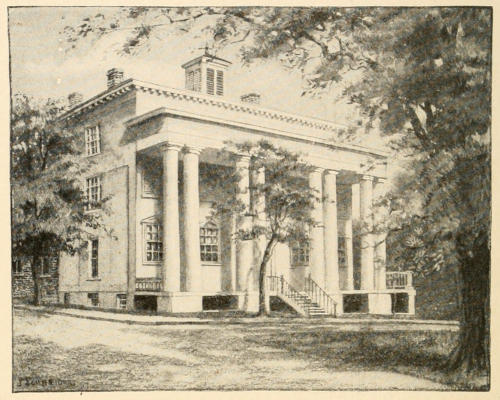
THE WHITE HOUSE OF THE CONFEDERACY, RICHMOND
The sheer cost, the unspeakable sacrifices of the desperate struggle, made ineffaceable record of themselves in the thoughts and purposes of people and politicians alike. What had been spent to fight the fight out passed calculation. It had cost the country more than seven hundred men for every day of all the four long years of campaign and battle: four hundred killed or mortally wounded on the field, the rest dead of disease, exposure, accident, or the slow pains of imprisonment. The federal government had spent thirty-four hundred million dollars upon the war,—nearly two and a half millions for every day it had lasted; and less than eight hundred millions of that vast sum had come into its coffers from the taxes. More than twenty-six hundred millions had been added to the national debt. The Confederacy had piled up a debt, upon its part, of nearly fourteen hundred millions, and had spent, besides, no man could say how much; for the scant yield of the taxes had been supplemented by direct requisitions on the farmers for the food supplies of the armies; States had undertaken, so far as they could, to support their own volunteers in the field; private purses had been opened to pay for the equipment of sons and brothers sent to the front,—every public and every private source had been drained.
In the North four men out of every nine of the military population had been enlisted for a service of three years in the field: in all 1,700,000 out of a military population of 4,600,000. Of these three hundred and sixty thousand had lost their lives; one hundred and ten thousand by the actual casualties of the field. But the sacrifices of the South had been greater yet,—immeasurably greater. The North had spent out of its abundance; the South had spent all that it had, and was stripped naked of its resources. While the war lasted it had been stripped naked also of its men. Nine men out of every ten of fighting age had gone from country-sides and towns to the field, reckoning only those who enlisted for at least three out of the four years of the struggle. Before the war ended mere half grown boys and men grown old were included in the muster. The total military population of the South was but 1,065,000. Nine hundred thousand of these she drew into her armies for at least three years of service. The lives of close upon three hundred thousand she gave as her sacrifice of blood,—more than one-fourth of all fit for the field. Ninety-four thousand lost their lives in actual battle. South Carolina lost one-fourth of her military population by the casualties of the field. The armed hosts and power of the North increased as the strength and resources of the South diminished. In 1861 the South had had 98,000 men in the field, the North 187,000; in March, 1865, though their levies had risen at the culmination of their effort but a little more than a year before to 471,000, the southern commanders had only 175,000 men to surrender to armies which aggregated 980,000 against them. The muster of federal forces increased even while the last scenes of war were being enacted and its tasks drawn to a close. When the surrender of the southern armies came they had grown by more than ten thousand, and there were 1,000,516 men awaiting their final discharge.
They were rapidly disbanded: sent home, when once peace was assured, at the rate of three hundred thousand a month. Only fifty thousand men were retained as a standing force. They turned to the duties of peace again and were absorbed into the mass of men whence they had come as quietly as if even civil war were but an episode in the long story of the national life. The common tasks of the communities to which they returned had gone forward, uninterrupted, without them; they returned merely to fill in the vacant places again and make complete once more the industries of their homes. The southerners, on the contrary, paroled at their surrender, and humanely bidden keep their horses for the spring ploughing, turned back to fields swept bare and desolate, villages whose life had first languished and then stood still, towns without trade or industry, where everything waited to be planned and begun anew, as if there had been no past to place foot upon. Their country had indeed, as General Lee said, to be “built up on a new basis.” They carried back to it no smallest part of what the ravages and untold costs of war had stripped away. Their lives were divested of everything that belonged to the age gone by save only their thoughts: thoughts of irreparable loss, of principles long revered but now discredited, of a social order cut up by the roots, of a life thrust away to be henceforth a mere bitter memory, of a future of new effort to be faced with all the pains of utter disaster thick upon them.
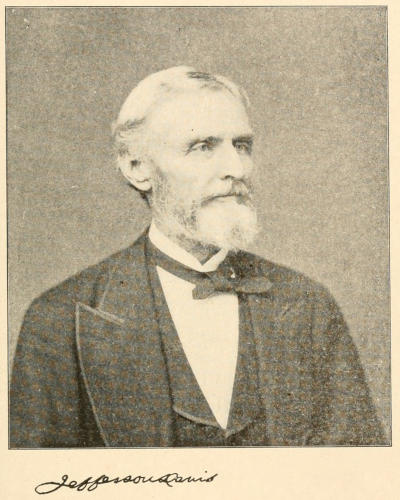
JEFFERSON DAVIS
Travellers from over sea had said that to cross the line between North and South was like passing from one century to another. In the one section they found an almost antique order of life, changed scarcely at all from that which settlers out of the elder England of the Stuarts and the Prince of Orange had established in Virginia and the Carolinas; in the other, all that belonged to the modern world,—communities quick with the movements of a various commerce, busy with mining, manufactures, the construction of railways, the diversification of industry. The South kept still the social order and the social and political ideals of an elder generation. Slavery gave it a touch half mediæval, half oriental. There was something of the patriarchal way of life in the broad country-sides where masters of fields and flocks and herds went in and out upon their errands of superintendence among groups of dusky slaves; something, too, that recalled the mediæval lord and his serfs. And yet there was the air of the nineteenth century, too, the touch of democracy, in the plain and wholesome simplicity of the planters’ lives, and their frank comradeship with all their neighbors who were of their own privilege of citizenship. The commerce of the modern world passed in and out at the southern ports as at those of the North. Southern merchants felt the spirit of the times in all their enterprises; railways brought the products of every land and region to their shops and warehouses; the impulses of the world and of its changing thought stirred there as elsewhere. What held the South back in the way of the older centuries was its unaltered, its unalterable social order, which belonged to the age in which the constitution had been devised, not to that in which its whole spirit and operation had been subtly changed by the pervasive processes of national growth.
When they conceived that the time had come to put their right of withdrawal from the Union into practice, the southern statesmen showed at once, with a manifest naturalness and sincerity, what generation they were of. They acted, with an all but unconscious instinct, upon the principles of 1788. They conceived the unmaking of the constitution to be, not an act of revolution or of lawless change, but a simple, though it were solemn, legal transaction, like the formal abrogation of a great treaty, to be effected by the same means by which it had originally been adopted. South Carolina, who led in the fateful business, adjourned her legislature and called a constitutional convention together: a body like that which had declared her assent to the constitution in the far year 1788. By formal ordinance of that convention the ordinance of the convention of 1788 was repealed, and the connection of the State with the Union authoritatively severed. That was her act of “secession,” taken in the highest sovereign fashion known to her law and tradition. As in 1788, so now there was no submission of the action of the convention to the vote of the people for ratification. A representative convention was as sovereign in South Carolina in 1860 as in 1788. The other States followed her example as of course. Their theory of constitutional right and practice was identical with hers. Each State in its turn called a convention, as in the old days of the formation of the Union, and committed to it as of course the sovereign determination of the political connections of the commonwealth. Each convention in turn repealed the ordinance of the convention which had stood in its place seventy years before.
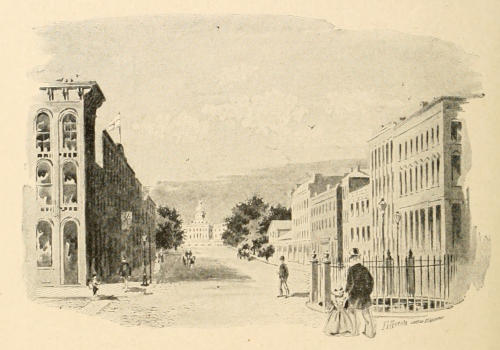
MONTGOMERY, ALABAMA, IN 1862
And then, because the old process was being reversed and a government not made but set aside, the same conventions went on to take up the task of reconstruction, that another government, more to their liking, might be set up in the place of the familiar one now rejected. They chose delegates to meet at Montgomery and frame a constitution under which a government should be established for the seceded States about to be combined in a new confederacy. When the work of the Montgomery convention was finished, they ratified and accepted it, without resort to the people or renewal of their authority. It was a critical time. Those who directed the unprecedented business were subtly aware, for all their stout theory of legal right, that the touch of revolution was upon all that they did. The work was therefore hurried forward. Hot feeling was astir. Rumors of force to be used, of armed resistance by the North, were in the air. It was imperative that the new group of States should be ready as soon as possible with a common organization through which they could act effectively and to a common purpose. The convention at Montgomery, therefore, at once chose officers for the new government as well as a constitution, and gave it an immediate temporary organization; and the sovereign conventions of the several States unhesitatingly ratified all that it did. Not until the year was out which had been fixed as the term of the provisional government was the direct action of the people asked for, except in Texas, which came to its resolution of secession while the new confederate government was in process of formation, and Virginia, which waited until it had been formed. In each of those States the ordinance of secession was submitted to the vote of the people and ratified by them. Even when the term of the provisional government had expired the voters of the new Confederacy were asked, not to ratify the constitutional arrangements upon which it had been founded, but only the choice of officers which the convention had made. They chose electors and members of Congress, merely, and affairs went on as they had been planned.
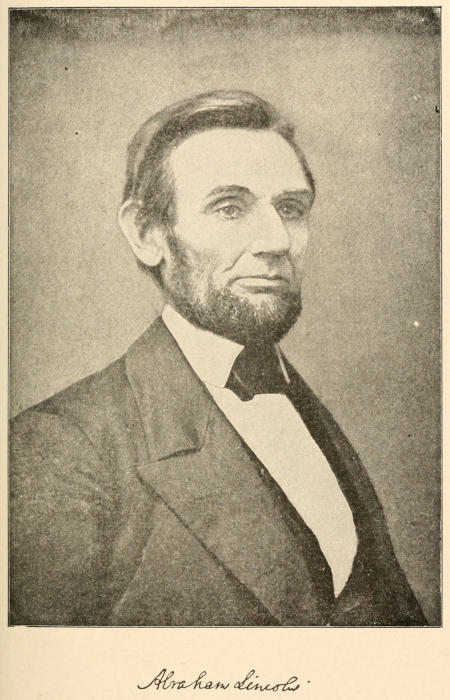
ABRAHAM LINCOLN
There was here no distrust of the people. No one doubted the legal validity of what had been done or deemed the method revolutionary or undemocratic. Nowhere else was there such homogeneity of opinion as in the South, nowhere else so habitual an acquiescence in conservative and established ways of action. It was not, however, a habit rooted in lethargy or indifference. Nowhere else in the world, perhaps, was there a more alert political population, a rank and file more keenly alive to points of political doctrine and practice. Politics were everywhere the favorite theme of conversation. Many a white man of the poorer class could read as little as any slave; but he heard his leaders so often upon every question of moment, whether of domestic or of foreign policy, at court, on market days, at neighborhood rallies for political discussion or religious exercise, at public barbecue and festival, that news came to him without newspapers and the principles of politics without books. Every matter of large significance or small he heard debated by the best informed men of the country-side. They gave him, first or last, no small part of what they had learned by travel, by reading, by service in the public councils. Through them he knew the characters and the motives of public men, the gossip as well as the controversies of politics, the happenings and the humors of the wide world. With such things to talk about around the fireside and at the cross-roads shop, upon his long rides from plantation to plantation and with his cronies upon every casual meeting, he had more than books could have given him.
Southern speakers felt as much put upon their mettle before audiences gathered at their neighborhood hustings in the midst of a season of controversy as before any audience gathered in the capitol at Washington. Southern voters were not likely to be made dupes of. They had elected the men who sat in the sovereign conventions which cut their connection with the Union with a full knowledge of the business they were to meet upon, and did not doubt that the conclusions of those bodies were their own authentic acts. Political method was not in dispute among them. They accounted themselves disciples of Mr. Calhoun in respect of constitutional right and the legal remedy for abuses in the conduct of the federal government. What he had taught them was in their minds the commonplace and matter of course foundation of political theory. They did not doubt that they had the right to secede, or that sovereign representative conventions were the proper instruments of secession.
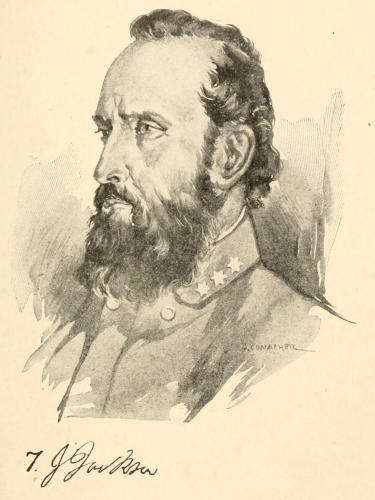
THOMAS JONATHAN JACKSON
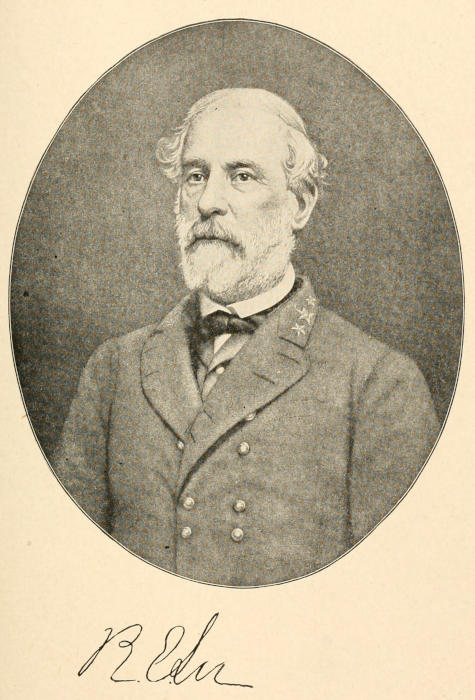
ROBERT EDWARD LEE
But many of them had doubted the policy and the occasion. Men forgot afterwards the sturdy fight made among the southern people for the preservation of the Union, by men whom all southerners loved and would upon ordinary occasion have followed right willingly; forgot the doubtful balance of parties and opinion there had been among them for many anxious years together. That final breach and agitation between North and South had begun, not a single short year before, when Mr. Lincoln was nominated and the Republican party began to gather for its triumph, but in 1848, when the territory acquired from Mexico was to be disposed of as between North and South and southern men had insisted that the balance between the sections, disturbed in 1820 by the compromise concerning Missouri, should be redressed. Mr. Douglas’s unpalatable doctrine of “squatter sovereignty” had deepened the mischief. He softened it as he could, to keep the southern men at his back; but the disguise of his careful phrases was stripped off by Mr. Lincoln in debate. The searching questions of a masterful opponent forced him to say that, though no law of Congress could exclude property in slaves from the Territories, the unfriendly provisions of territorial law itself might, if the settlers chose, render its tenure practically impossible. From that day the southern leaders knew that to act with a party which followed Mr. Douglas was to lose the constitutional battle they had fought a long generation through for the balance of power between North and South. There was steadfast love for the Union in the South as in the North. Mr. Calhoun had loved it, and it had broken his heart that he could not save it upon the principles which he conceived to be its heart and life. Men who knew the South only by some casual glimpse of southern men, some brief journey through the southern country, some transient sojourn of a single season, deemed the southern people as unstable, as easily stirred to rash action as a Gallic populace, so passionately did they seem to respond to the appeals of their orators, so eagerly did they yield themselves to the excitements of every agitation. But they were an English folk, strengthened here and there by the sober Scots-Irish strain and the earnest blood of the steadfast Huguenot. They held to their principles, their habits, their prepossessions with a simple, instinctive, undeliberate consistency which no excitement of the moment really touched or unsettled. They had been schooled, as all the nation had, in a loyal allegiance to the Union which their own statesmen had done so much to set up and make illustrious. Whatever their old-fashioned view of the character of its constitution or of the rights of the States as members of the great partnership, no ordinary occasion, no sudden gust of passion could have torn their thoughts from those old moorings. It had taken a long twelve years of agitation to get them in revolutionary mood, and men whom they equally loved and heeded had stood all those critical days through on the one side and on the other in determined combat, some to save, some to break the Union. It was by appealing to their very conservatism, their attachment to the older models and theory of their government, that the advocates of secession had won.
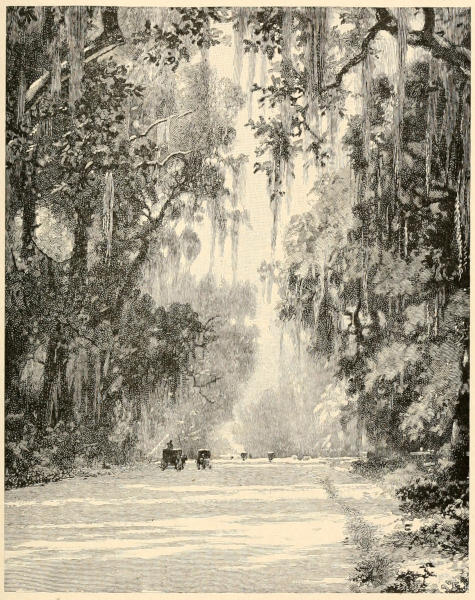
THE SHELL ROAD, MOBILE
It had been a battle of statesmen and orators, and only at the last had the advocates of secession triumphed. Many an influential planter in the South was by sheer instinct of class and tradition a Whig, and held himself, alike by interest and by natural obligation, an ally, not of the democracy to which Mr. Jefferson had given life, but of men of property and of vested right everywhere. If his neighbors and the small farmers and the tradesmen of the towns were Democrats, even they chose their party alliances by a conservative instinct: because they deemed the Democratic party a conservator of old views, the most trustworthy opponent of newfangled doctrine and revolutionary change. Many a Whig planter believed devoutly in the sovereign rights of his State, and the preservation of those rights was at the very heart of every southern Democrat’s creed; but love of the Union and reverence for law underlay the thought of all alike and stuck fast in the stubborn fibre of an English race. It was such a people that went to school to its orators to learn the issues and the final purposes of the fateful decade 1850-1860. A few resolute men turned them to secession.
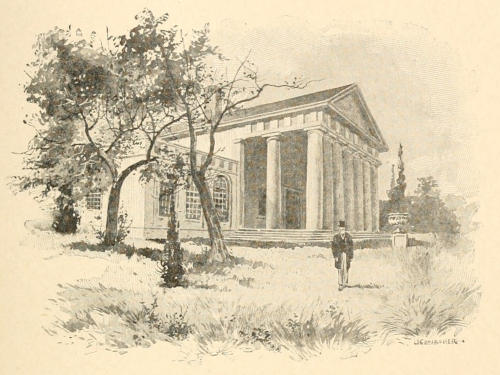
ARLINGTON, THE RESIDENCE OF GENERAL ROBERT E. LEE
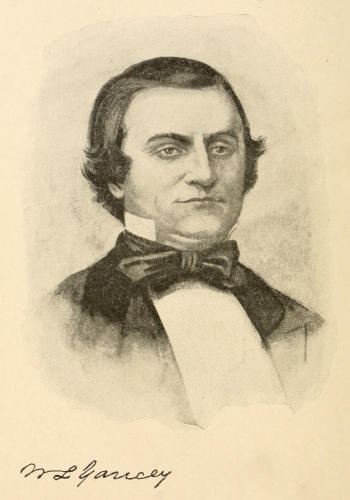
WILLIAM LOWNDES YANCEY
A single figure stood for a while, almost alone, at the front of the coming revolution, the figure of William L. Yancey, of Alabama. Before Mr. Calhoun died Mr. Yancey took up the theme which had darkened the last utterances of the aged Carolinian like a prophecy of ruin,—took it up, not as a counsel of despair, but as a counsel of duty. Compromise between North and South, he declared, was out of the question. In 1846 he resigned his seat in Congress because he would not act with any party which so much as debated the exclusion of slavery from the Territories; and went home to spend the remainder of his life and every power of his strong mind in the advocacy of a course which once and for all rejected compromise and accepted only the doctrines which should forever safeguard the constitutional rights and material interests of the South, even though such a course should lead to a disruption of the Union. He was a man of no majesty of presence, no adventitious grace of manner; never studied his art as agitator or sought to catch the people by any assault of passionate appeal; but burned with a conviction which had its own dignity and irresistible might; used the ways of frank, direct, engaging speech which went most naturally with his open, unaffected nature; argued his case to the bottom, plead it with whole-souled ardor, as a thing not of expediency but of right, and was careless where it should take fire of itself. Above all, his words rang, upon every theme he touched, in a voice whose slightest tone thrilled along the blood, so rich, so flexible, was it, so compact of the quiet passion of the mind. While others wavered, caught now at this expedient and again at that to turn the current he was setting against them,—against the Union itself,—he held steadfast, undoubting, to his simple theme. Majorities followed him and left him; conventions heard him now with acquiescence and again with deep disquietude and passionate dissent; but no man could decline to listen when he spoke, and none who heard him could long steel himself against the charm and power of his appeal. It was the tones of his voice, the resonant echo of his theme, that seemed to linger in the air after every controversy. It was he more than any other who taught the South what Douglas really meant; he, more than any other, who split the ranks of the Democratic party at Charleston, made the election of Douglas impossible, and brought Mr. Lincoln in.
He had foreseen what must come, and hesitated as little after the event as before it. He was for immediate and final secession; and, though he had to carry the fight to the very floor of the convention of his State, met to make the final critical decision, he won it there, by an initial majority of eight votes. Twenty-four members of the convention stood out against the action to the very last, and refused to put their names to the fateful paper which cut their connection with the Union; but the people accepted the decision of the majority, and he had his way. Men whom they had followed through many a long year, when Mr. Yancey was only their incomparable orator, not their leader, the people now rejected; and their own capital town of Montgomery saw the government of the Confederacy set up.
Georgia had been won by a like slow and stubborn contest, doubtful till the very last. Even Mr. Stephens had held stoutly, indomitably to the side of the Union until the final movements of the fight had been lost and won,—the slender, delicate, singular man whom the convention at Montgomery made Vice President of the Confederacy: a man whose fragile, shadowy body seemed scarcely able to endure the keen flame of his thought. He admitted the legal right of secession, but he turned upon every argument of expediency or necessity urged in its favor a searching light of ridicule, criticism, satire which it was hard for any man to stand in and not flinch. The piercing tones of his high-pitched, feminine voice seemed to add to the cutting force of his words. But men of a different sort had overborne him. One figure in particular took the imagination and ruled the spirits of that susceptible people, the figure of Thomas R. R. Cobb. The manly beauty of his tall, athletic person; his frank eyes on fire; his ardor, as of a man not arguing a case of politics or expediency but given over to a cause not less sacred, not less fraught with the issues of life and death, than religion itself; his voice, as musical and as sure to find its straight way to the heart as Mr. Yancey’s, made his words pass like a flame from country-side to country-side.
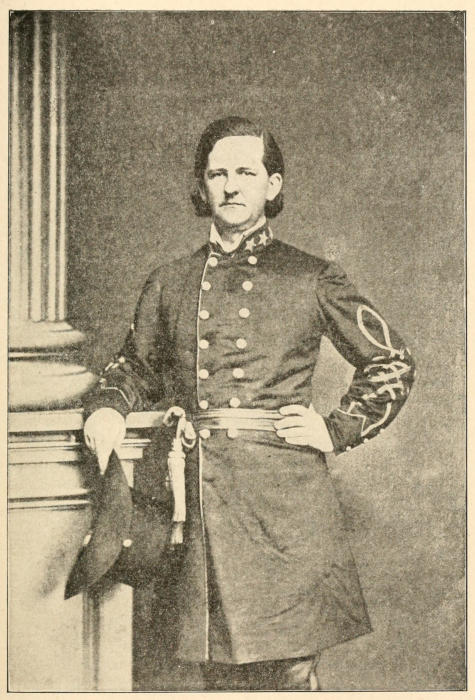
THOMAS R. R. COBB
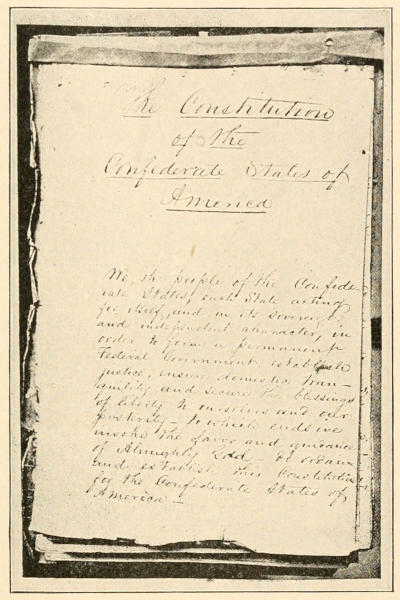
FIRST PAGE OF THE ORIGINAL DRAFT OF THE CONSTITUTION OF THE CONFEDERATE STATES
There could be no doubt what the constitution of the Confederacy should be. The advocates of secession had not rejected the constitution of the United States as it had been in the first days, when read, as they conceived, in its simplicity and original import, but only the corrupt interpretations which had been put upon it, the leadership of parties which would have wrested its meanings to the South’s destruction. They made a constitution at Montgomery, therefore, which they meant to be in all essential things a counterpart of the constitution of the Union which they had abandoned,—except that in their own document what they held to be the implicit meanings of that constitution were made explicit, and its errors and weaknesses of detail corrected. “We, the people of the Confederate States, each State acting in its sovereign and independent character,” ran its preamble, in order that the rôle of the States in the free partnership might not again be questioned. Protective tariffs it specifically prohibited, as well as all internal improvements at the general charge; and the power to emit bills of credit it did not grant. The recognition and protection of slavery in all territories of the new government it made an explicit principle of fundamental law. The importation of negro slaves from foreign countries, on the other hand, it explicitly forbade; and the Congress was given power to prohibit the introduction of slaves from any State or Territory of the older Union. New States were to be admitted only by a vote of two-thirds of each house of Congress, “the Senate voting by States.” Every state legislature was accorded the right to impeach confederate officials whose duties lay entirely within its own territory. The demand of “any three States assembled in their several conventions” was made sufficient to secure the calling of a convention of all the States for the amendment of the constitution. It was thought best, in view of experience in the older Union, to extend the presidential term to six years, and to make the President ineligible for re-election. The President was explicitly given authority to remove at his pleasure the principal officer in each of the executive Departments and all persons connected with the diplomatic service; but he was empowered to remove other civil officers only for dishonesty, inefficiency, misconduct, or neglect, or when their services were unnecessary, and he was required to report to the Senate his reasons for removal in every such case. He was granted the right to veto individual items in appropriation bills; and the Congress was forbidden, except by a two-thirds vote, to make any appropriations not asked for and estimated by the heads of the executive Departments, unless such appropriations were for the legitimate expenses of Congress itself or for the payment of just claims against the government which had been judicially determined. Congress was authorized to grant seats upon its floor and the right of debate upon all public measures to the heads of the several executive Departments, in order that Congress and the Executive might act in closer harmony and easier co-operation than had been possible in the old Union.
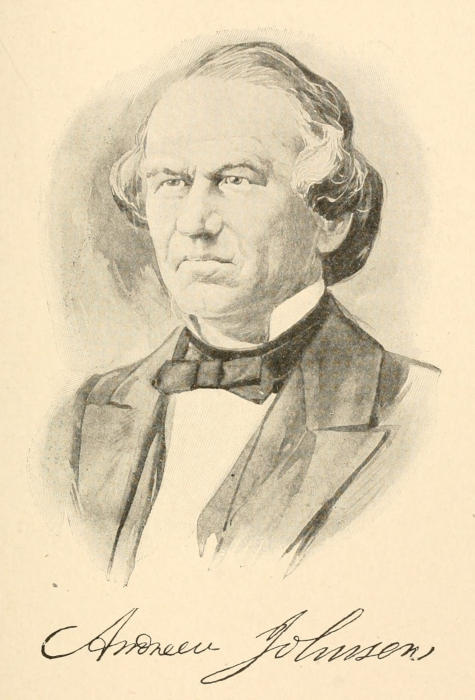
ANDREW JOHNSON
There was to be no time of peace, it turned out, in which to make test of these new provisions. They bespoke men as their authors who had kept an observant and sagacious eye upon affairs, and who had perceived very clearly where some of the dangers and inconveniences of the older system lay; but no work of criticism or of reconstruction was of much avail amidst the furious storms of war into which the new government was plunged from the very outset. Whatever frame of government they might have devised, the Executive must have stood supreme at the front of all action while war held, a war for very existence. A nice balance of constitutional adjustment was out of the question. Counsel was hastened, debate postponed; the exigency of each occasion determined the means and the mode of action. Constitutional safeguards gave way to the mere problem of making the existence of the government good upon the battle-field. Critics of what was done might for a little while affect opinion out of doors or at a distance from the field, but they could not change the course of affairs. Moreover, war itself altered the whole atmosphere of opinion. No doubt at first the people had been persuaded, perhaps overruled, by a handful of leaders, and had assented with a vague hope rather than with any confident purpose to the radical courses of secession, resentful of the wrongs they conceived themselves to have suffered in the Union rather than desirous of independence or of a new government set up in rivalry to the old upon that familiar seaboard. They had been assured that there would be no permanent separation: that new terms and a stricter understanding of rights must be had with the northern partners, and that better terms could be made out of the Union than in it, by secession than by submission. No doubt their leaders had themselves believed this, had actually hoped to see their States re-enter the old Union with a new security for their interests, a firmer, more definite position of right. Only the actual use of force against them had changed their temper and their hope; and war had wrought as deeply upon the spirits of the people as upon their own. When once the call to arms was made, doubts dropped away, the spirit of a whole people leaped within them, the very provisions of their new constitution became for the time almost a matter of indifference. Debate was over, and spontaneous action had begun, touched with a new ardor and a terrible enthusiasm.
Not every one, indeed, was caught by the new passion. Here and there groups of men held stubbornly off from the desperate business and would not be drawn into it. In one of the northern counties of Alabama, Mr. Yancey’s own State, Union men outnumbered secessionists four to one and maintained themselves in military organization. A southern county of Mississippi accepted the doctrine of secession, indeed, but interpreted it in its own behoof, and itself solemnly seceded from the State and from the Confederacy rather than send its men to distant battle fields. And yet the real burden of the war fell, not upon the spirits of men, but upon the resources of the country. Though the South should call upon every man of her fighting population to go into the field, she had but one-fourth as many men fit for the field as the North. Armies must be fed and clothed, besides, and the South was put to the utmost strain to keep her men as well even as the ragged levies of the Revolution had been kept, who had deemed it a plentiful bounty to escape starvation. A four years’ war was of necessity a war of resources, and the South was but an agricultural region, its population spread widely abroad over a great area, only here and there a railway, its matchless stores of coal and iron almost untouched, no manufactures set up, save here and there a cotton mill or a woolen factory, its own cotton woven, for the use of southerners themselves, chiefly in the great manufacturing centres of the North.
Southerners knew themselves dependent on Europe or the northern States for almost every yard of cloth, every coat or shoe or hat that they wore; for their agricultural implements, carpenter’s tools, wagons, cordage, nails, harness, saddles, axes, tubs, buckets, their very chemicals and medicinal drugs,—for everything except their bread and meat. The war shut them close within their boundaries. The cordon of blockading fleets all but sealed their ports; the steady extension of the federal lines down the valley of the Mississippi River and across the broad reaches of the States of Mississippi and Tennessee to the southern spurs of the Appalachians at Chattanooga thrust their western frontier in to the mountains. Between that impenetrable wall and the closed seas they were pent up, with no markets, no means of life or comfort or subsistence, no military supplies save such as they could themselves make or take from their enemy. They could get no more railroad iron, no more locomotives, no more railway carriages or cars for freight, no more steam boilers or engines, no more telegraph wire, no more spades to use in the trenches, unless, in the midst of war, they created out of hand an entire industrial system, for which they had neither trained master mechanics nor fit workmen.
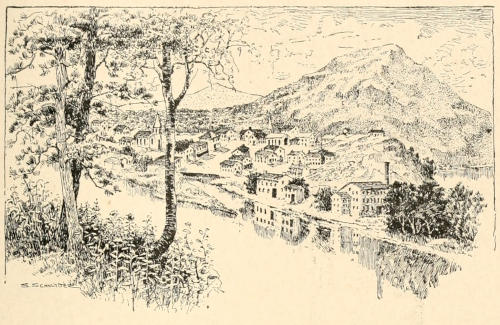
CHATTANOOGA, TENNESSEE, IN 1862
Her cotton, her tobacco, and her rice, had supplied the South with the wealth with which she had paid the prices of the world for her clothing and her tools and all the varied product of the factories. Of the great staples rice and cotton she had almost a monopoly. Her cotton fields supplied half the world; her rice and tobacco found their way into every market. Nearly one-third of the Indian corn of the country, moreover, came from her plantations. But, without markets, the crops were valueless. The value of the cotton exported in 1860 had been $202,741,351. In 1861 it was but $42,000,000; in 1862 but $4,000,000. The value of the rice exported in 1860 had been $2,567,399. The value of that exported in 1862 was $156,889. The rice fields, moreover, lay upon the exposed southern coasts, where the federal fleets gathered stronger and stronger month by month, and had presently to be abandoned. It was no slight embarrassment and bred a great disturbance of values that there was no way, so long as she was thus shut in, by which the South could replenish her stock of specie. Some specie there was, of course, in the banks; some came in at the outset by way of loans obtained abroad, before the blockading fleets were numerous enough to intercept it; but its quantity was insignificant as compared with what was needed to hold the currency stable when treasure was being poured out for the war. The bulk of it was paid out almost at once to meet foreign balances. Private individuals hoarded all they could lay their hands on, and it practically passed out of circulation. Paper money took its place, the promises of States as well as of the confederate government itself; grew in volume from month to month with startling rapidity; and sank in value as the old continental paper had sunk in the days of the Revolution. No man knew for how much he was selling his crops when he sold them for paper. No man could guess how much of that questionable currency would be necessary to pay his debts another year. Postal clerks at Richmond presently found themselves obliged to resign because they could not live on a salary of nine thousand dollars.
Abundant harvests of grain filled the fields all the anxious four years through. The smiling valley of the Shenandoah and the fertile fields of central Georgia had been the chief granary of the South. The Shenandoah was swept from end to end by the contending armies; the grain of central Georgia ripened just in time, in 1864, to feed the army of General Sherman as it pushed southward to the sea. But other fields supplied what the ravages of war destroyed. Cotton being no longer salable, provident planters sowed corn in its stead. What seemed next to impossible was to get the grain to market. The railways were in constant use by the armies; the common roads were falling into utter disrepair; wagons and teams were at the front with the soldiers; many a household within but a few miles of well-filled granaries found itself put to sore straits to get food. It was hard, moreover, to live on maize alone. Very little wheat grew in the southern fields; very far from enough to supply all the southern country with wheaten bread. Southern housekeepers were put to their wits’ ends to devise means to diversify the diet of their households and make it wholesome. New food stuffs were brought into requisition: peas that had before been offered only to cattle, roots that had hitherto been thought only curious or medicinal. Coffee and tea were shut out with the closing of the ports, and every possible substitute was tried.
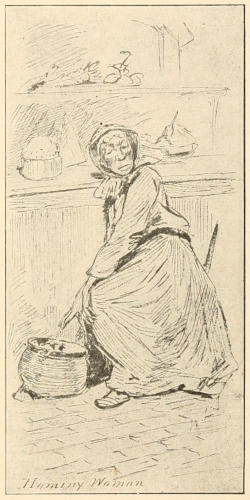
A STREET HUCKSTER IN RICHMOND, VIRGINIA
And yet to get food was a simpler matter than to get shoes and clothing. Looms which had not seen thread since the Revolution were brought forth out of attics and put to the task of making “homespun” for a whole household. Since tanneries were few and used their primitive processes with infinite slowness, leather could scarcely be had; and when shoes wore out there was nothing for it but either to go barefooted or substitute rude wooden clogs shod with iron. Men followed the armies to pick up for the tanner the hides of the animals slaughtered for the soldiers’ food. Riding saddles were stripped of their skirts that no piece of leather might be wasted. In mild weather the children could go without shoes; in severe weather they were kept within doors. The very cards with which the cotton fibre was carded for use on the looms had teeth of steel wire which could not be replaced when they wore out, and every card was guarded and mended like a priceless treasure. Infinite care and a novel ingenuity gave to every domestic duty a new significance. Every plantation had its smoke-house, and before the war came on carefully cured hams and sides of bacon had furnished the commonest dish of meat, whether for the table of the slave’s cabin or of the master’s house; but the South had then imported its salt. There were but one or two salt mines within the borders of the Confederacy; and when armed men and ships had been drawn about those borders there was not salt enough for the smoke-houses. There was scarcely enough for the kitchen. The very floors of the smoke-houses were scraped for the salt that might be got from the drippings of past years; and gentle and common alike went without their accustomed dish of bacon.
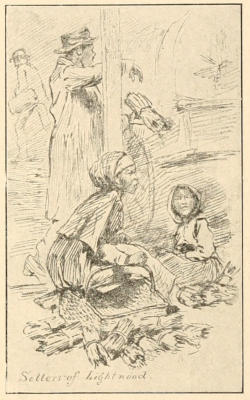
SELLERS OF FIREWOOD IN RICHMOND, VIRGINIA
The armies, of course, suffered most from every kind of want that had come upon the land. To march without shoes, to make shift with torn and ragged clothing which there was little hope of replacing, to fight and endure hardship on half-cured bacon and a scant dole of hard corn bread, to go without coffee or any stimulant, and finally to lack even healing medicines in the inevitable hospital put men of the stoutest constitution to tests more fatal oftentimes than those of the battle-field itself. There was coarse food enough in the country, but the government had scant means of paying for it and had no efficient commissariat through which to make sure of supplying the armies even with such things as it could obtain. One difficulty that immensely increased from year to year was the utterly insufficient means of transportation. There were a few long lines of railway which linked the main towns and sea-ports of the country together; but the armies could not be always lying close to these, and there were few side lines by which to reach the camps if the movements of the war drew the armies to a distance. Such lines as there were, moreover, hopelessly deteriorated from month to month. Such iron and steel works as the Confederacy contained or could build while the war lasted had to be used almost exclusively for the manufacture of cannon and military supplies, and could not have been drawn off from that indispensable work to make new rails and locomotives and car trucks for the railways even if there had been iron enough. And there was not iron enough. The country had to be stripped of every spare scrap of iron to make and repair the weapons of war. When rails wore out they could be replaced only by tearing up sidings and minor lines of road. When rolling stock fell into disrepair no new cars could be had. When the war was over little more seemed left of the railways than their graded road-beds and odds and ends of their rolling stock hardly fit for further use.
The commanders in the field often found themselves as hard put to it to obtain military stores as to get food and clothing. The devoted women at home sent thousands of homespun garments to the front for their sons and husbands and brothers, and warm socks without number knitted with their own hands; even cut their carpets up to be sent to the camps for blankets; but the women could not make powder and guns. Considerable supplies of arms and munitions had been got in from England before the blockade was drawn tight about the ports, and across the border through Mexico before Texas and the Gulf ports had been cut off from the rest of the Confederacy by the pressure of hostile armies down the valley of the Mississippi. At the first act of secession southern forts and arsenals had been seized with large supplies of arms. General Jackson made rich prize of military supplies at Harper’s Ferry; and many another success in arms swept the booty of the field into the confederate chests and armories. But with all this there were not arms enough for the great musters that went to the front. Cannon and arms had to be made, and made without materials except such as were already at hand. Every brass bell that could be found went to the foundry to be melted down and cast into cannon. Devoted housekeepers even contributed their brass preserving kettles and every piece of household brass that could be spared. Private fowling pieces were used when muskets lacked, and ancient muskets and side arms came once more into use which had hung upon the wall as curious heirlooms ever since the days of the Revolution.
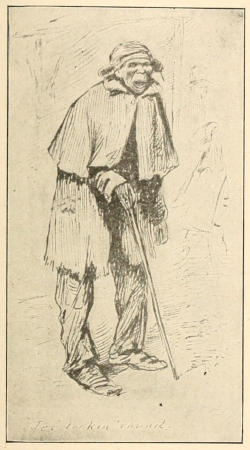
A SUPERANNUATED DARKY IN RICHMOND, VIRGINIA
All the fire-arms used by the confederate armies were muzzle-loaders, and the mere supply of percussion caps became a matter of no small difficulty. A mechanic at the Richmond arsenal, the chief factory of arms, ingeniously contrived a machine by means of which a million caps could be pressed and filled every twenty-four hours; but the loss of the copper mines of Tennessee followed the occupation of Chattanooga by the federal forces, and the supply of sheet copper out of which the caps were made was suddenly cut off. An officer was despatched, accordingly, to North Carolina to buy and forward to Richmond every turpentine and brandy still he could find in the State, and the copper from these supplied all the caps used by General Lee’s army during the closing year of the war. The caps were usually filled with fulminate of mercury; mercury could be had only from abroad; and the supply gave out. Diligent experiment was made, and it was discovered that a combination of chlorate of potash and sulphuret of antimony could be successfully substituted. The inventive genius and practical resourcefulness of men and officers alike were quickened by the extraordinary exigencies of those fearful years to make the most of what they had. Common glass demijohns were converted into contact torpedoes to close the channels of the southern rivers, and did their work with terrible execution. An assaulting party rolled bales of cotton before them for shelter as they worked their way forward to the storming of a position. Skilful and experienced mechanics were lacking, foundrymen, ship carpenters, engineers,—for the South had hitherto had no need of these; but every man of education in the armies turned his wits and knowledge to practical account upon occasion and supplied the lack as best he could.
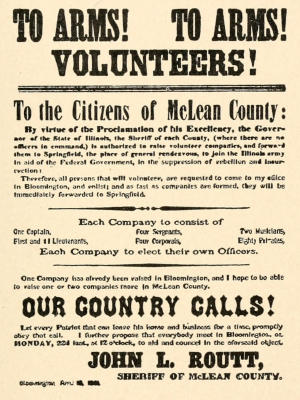
A CALL FOR VOLUNTEERS IN ILLINOIS
Almost every white man of fighting age, and many who were too young or too old for the field, came first or last into the ranks, and the war seemed to be using the whole capacity of a proud and capable race. Hundreds of thousands volunteered; the rest were drawn in by conscription. Where it was necessary to use the entire fighting population it was impossible to rely on voluntary service, and the South, with its scant numbers for the field, resorted to conscription sooner than the North. It was absolutely necessary, of course, to leave some men at home to do the indispensable work of peace by which homes and armies alike were to be supported; but men enough even for that were not left at last, so inexorably had a drastic conscription swept the country of every possible soldier. So early as April, 1862, the confederate Congress had made all between the ages of eighteen and thirty-five subject to military service; in September of the same year it extended the obligation to men of forty-five; and before the end of the war it had called upon boys of sixteen and old men of sixty. Slaves served the armies from the first as body servants, teamsters, hostlers, cooks, and laborers on the fortifications. Before the war closed the confederate Congress, in its straits for men, authorized, with something like general approval, the enrollment of slaves as armed troops; but not until the end was at hand and the measure too late to be of practical importance.
Such measures were but a proof of how the southern country was being stripped of everything, its men and its resources alike. There was proof in every action of the new government they had set up of the exigent difficulties, the utterly disconcerting perplexities brought upon the southern people by that unparalleled upheaval of civil war. In all counsels southern men had stood foremost in the advocacy of a central government of strictly defined and carefully limited powers, which should give to individuals and States the utmost possible latitude of independent privilege compatible with the maintenance of political authority and social order. They had flung out of the Union because the federal government had seemed to them to go too far in the arrogation of power. And yet the government they themselves had set up by way of protest became, amidst the entanglements of a war which involved its very existence, a power centralized beyond example in the history of America. Not only did all authority centre at Richmond, but all power at Richmond centred in the President and the heads of the executive Departments, particularly the Secretaries of the Treasury and of War.
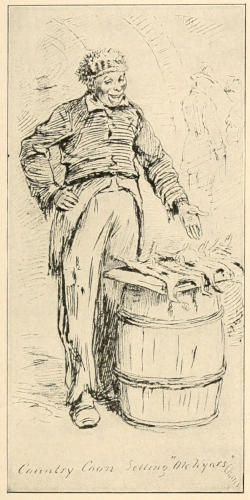
A SELLER OF RABBITS AND HARES, RICHMOND, VIRGINIA
The North had a like taste of the consequences of war. Mr. Lincoln himself could not curb the wilful mastery of his Secretary of War. The rights of individuals gave way before the orders of an executive department: the supremacy of the war party and the power of the army were the law of the nation’s life. But there was a limit. The courts were open; the law was not silenced; men lived their ordinary lives and were unmolested so long as they kept their hands from affairs which touched the government. Trade and peaceful employment were not throttled by a cordon of fleets and armies drawn about the land. Opinion moved openly and was outspoken, and every man could draw for himself the limits even of a government grown despotic to save the Union. But in the South war was, for the time being, the occupation and absorbing interest of a whole people. No man could draw wholly apart and live his own life. It was necessary, moreover, that the action of the war should be ordered, not by legislation and debate, but by executive authority, central, efficient, unquestionable. It was no time to stand on the punctilios of law. There was no certain means, indeed, of determining what the law was. The supreme court provided for by the constitution of the Confederacy had not been organized. War had come too soon. Litigation was postponed to the necessary first task of making the government sure of a chance to live at all.
The houses could exercise no real restraint upon the Executive, because they did not put themselves into a position to understand or control it. Mere hereditary jealousy of executive influence made them unwilling to act upon the provision of their constitution which authorized them to bring the heads of the executive departments into their sittings to answer questions and take part in debate. There was, therefore, no intimacy of common counsel between Congress and the Executive; and the Executive, standing in the midst of affairs, standing where action was imperative, power necessary, debate perilous, stood at the centre of all initiative. Congress had no choice but to uphold its hands, and back it with the measures which the time, not statesmen’s preferences, made necessary. Bitter debates from time to time marked its action. Sharp criticisms which cut to the quick of motive and policy rang in its halls. Many a battle of will against will disturbed the relations of the President and the houses. But more and more did the drift of war sweep all counsel into its current. Year by year the houses were emptied of their abler members, as the continental Congress had been in the old days of the Revolution. They were more needed for service in the field than for debate at Richmond. It grew less and less possible, moreover, to discuss the exigent matters of the war with open doors, through which voices of censure and doubt, of discord and protest, might get abroad, to the demoralization of opinion and the heartening of foes. From the first, when subjects of defence were under discussion, the sessions of the Congress had been secret. More and more did every question seem to become a question of defence, until at last secret sessions became the rule, open sittings the exception.
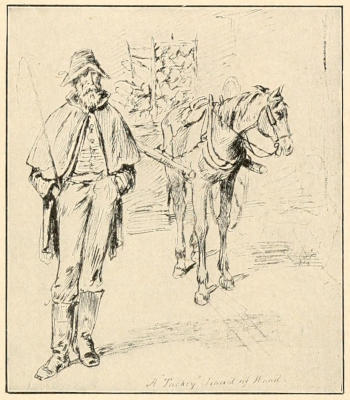
A WOOD PEDDLER, RICHMOND, VIRGINIA
It was in part the prudence of defence, not against enemies in the field, but against opinion within the Confederacy itself, that led the houses to close their doors so often. Opinion moved very uneasily under the masterful action of the government. Men were silenced rather than convinced. The right to the writ of habeas corpus had been promptly suspended in the South, as in the North. Those who showed themselves too openly out of sympathy with the government soon learned that arrest would follow a frank expression of their views. Even freedom of movement from place to place was restricted: no one could stir far abroad from his home without a passport from the government. There was little to wonder at if men chafed hotly under restraints which kept the hand of government, it seemed, upon every individual’s thoughts and affairs. It had never been so before in the history of America. It almost passed belief that it should be so now in the South, where men loved individual dignity and independence with an abiding passion. It was singular how docile proud men became. Only once was there any notable instance of resistance to the government’s sweeping acts of power. Governor Brown, of Georgia, when the conscription laws seemed to him to have passed all reasonable bounds of exaction, refused in set terms to allow the confederate recruiting officers to put the law into execution within the State. For the rest, there was hardly more than quiet distress and muttered protest.
The financial measures of the government showed the straits to which it was put to support the struggle, and the extraordinary lengths to which the exigencies of the war were stretching its powers, quite as clearly as its wholesale drafts of men and its arbitrary arrests in rebuke of dissent. In its need for money the government had resorted to every expedient known to finance, even the most drastic and desperate. Money it knew from the first to be scarce. The banking capital of the South was but one seventh that of the North; the accumulation of specie and of stocks of goods out of all proportion smaller, and more restricted in geographical distribution. At the very outset provision was made for the payment of taxes in kind. When its redundant issues of Treasury notes failed to add enough to the direct taxes to meet the necessities of the exchequer, the government sought and obtained of the planters loans from their crops,—promises of the payment into the Treasury of a certain proportion of the yield of their fields, in return for eight per cent. bonds. When the time came in which the crops could not be sold for lack of a market, the government directly purchased the products of the fields, paying for them with bonds, for lack of anything else to pay. The several States themselves took supplies from the people for the troops they had undertaken to maintain in the field, and paid for them only with their own certificates of indebtedness. The property of all alien enemies was confiscated. In 1863, as it came to the final pinch of necessity, Congress authorized the seizure of food supplies at rates fixed every sixty days by state commissioners. There was hot protest and indignation at this, but necessity had become the law of the land. Some might grumble, and even make as if they would resist, but there was in fact no limit to the devotion of the people to the cause they had espoused. Women gave their very hair to be sold for the support of the government their men had sworn to establish.
Before the end came that government had thrust its hand into practically every affair, whether public or private, that touched the sources of life. It had even gone into trade. When all money was spent loans and taxes came into its hands in the shape of the crude products of the soil. Cotton and food stuffs were a kind of legal tender in trade, but the stocks which accumulated in the government store-houses were too great and bulky to be made currency of in the purchases of the executive departments. The cotton, especially, it could not get rid of unless some exit could be made to foreign markets. The Treasury Department, therefore, would grant no clearance papers to any vessel preparing for the desperate attempt of running the blockade which did not make up at least one half its cargo out of the government stores. Blockade running became a sort of government monopoly, either in the hands of the state governments or in the hands of the government at Richmond. Both what should be taken out and what should be brought in were determined by those who had charge of public affairs.
The wealth and resources of the North increased and were multiplied, the while. Four million seven hundred thousand acres of the public domain at the West were taken up by new settlers, who moved forward to occupy them as if in a time of peace. Nearly four thousand miles of railway were built. The value of imports leaped up to a sum which presently almost equalled for the North alone the total value of the imports of the whole country in 1860, the South included. Manufactures flourished as if under a new stimulation. Though it was spending blood like water, the population of the North was replenished; though money was poured out as if drunk up by the very soil of the battle fields, wealth kept pace with the demands made upon it, and more than kept pace.
One of the most distressing evidences of the straits the South had been brought to was the state of the prisons in which she was forced to keep the thousands of prisoners who fell into the hands of her armies. More than two hundred thousand, first and last, were taken; and only some sixteen thousand of these were paroled upon the field. There were as many southern soldiers in the northern prisons. Not until the war seemed turning towards its end could an exchange of prisoners be arranged. The federal authorities knew their superiority in fighting population and did not care to lose it by returning fighting men to the South. If her soldiers died in southern prisons, they were dying for their country there, General Grant said, as truly as if they lost their lives in battle. Thirty thousand men died in the confederate prisons; as many more in the prisons of the North: the numbers almost exactly balance,—in the South, 30,156, out of 196,000 who were prisoners; in the North, 30,152, out of 227,000. But the causes were different. In the northern prisons the bitter chill of winter claimed as many lives as the rigors and privations of prison discipline. In the South there were not prisons, there were not guards, there was not food enough. Men could not be spared from the field to guard the prisons, and many thousands were crowded together under a handful of men. Proper sanitary precautions were in the circumstances impossible. The armies themselves lacked food and went without every comfort, and the prisoners could fare no better,—inevitably fared worse, because they were penned within a narrow space and lacked the free air of the camp. A subtle demoralization touched the government of the Confederacy itself as the war went its desperate course, and those who kept the prisons felt that demoralization with the rest.
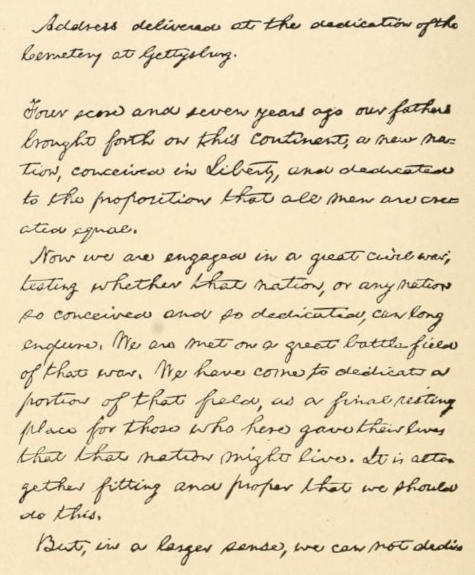
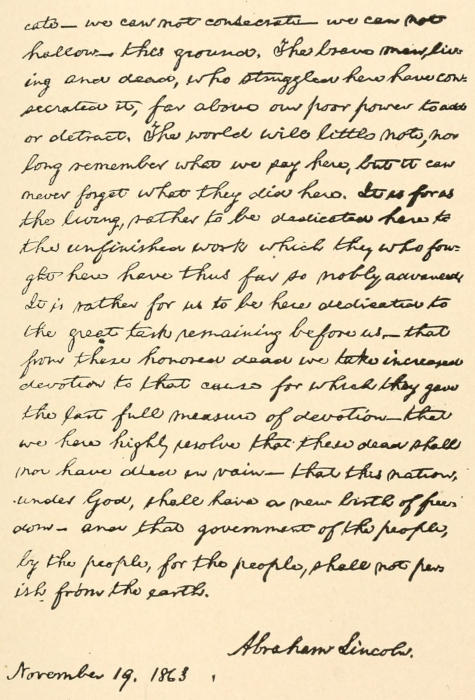
FACSIMILE OF MR. LINCOLN’S AUTOGRAPHIC COPY OF THE GETTYSBURG ADDRESS, MADE BY HIM FOR THE SOLDIERS’ AND SAILORS’ FAIR AT BALTIMORE, IN 1864
No one could wonder to see even a people such as the southerners had shown themselves to be lose heart at last, acknowledge the bitter fortunes of those last days intolerable, and yield in a sort of despair. It had taken all the vigor and audacity of their government to keep them to the hopeless business as the year 1864 disclosed what it had in store for them. Not a little of the dogged perseverance and undaunted action of those closing months of the struggle had been due to the masterful characteristics of Mr. Jefferson Davis, the President of the Confederacy. He had served a distinguished apprenticeship in arms in the Mexican war, a still more distinguished apprenticeship in affairs in the cabinet and in the Senate of the United States. He had the pride, the spirit of initiative, the capacity in business which qualify men for leadership, and lacked nothing of indomitable will and imperious purpose to make his leadership effective. What he did lack was wisdom in dealing with men, willingness to take the judgment of others in critical matters of business, the instinct which recognizes ability in others and trusts it to the utmost to play its independent part. He too much loved to rule, had too overweening a confidence in himself, and took leave to act as if he understood much better than those did who were in actual command what should be done in the field. He let prejudice and his own wilful judgment dictate to him the removal of Joseph E. Johnston from the command at Atlanta, the only man who could have made Sherman’s march to the sea impossible. He sought to control too many things with too feminine a jealousy of any rivalry in authority. But his spirit was the life of the government. His too frequent mistakes were the result as much of the critical perplexities of an impossible task as of weakness of character. He moved direct, undaunted by any peril, and heartened a whole people to hold steadfast to the end.
The end came with every sign of sheer exhaustion and despair. Many a southern man had gone into that terrible contest against his better judgment, not wishing to see the Union broken, but yielding to his neighbors’ views and the challenge of the summons to arms. Such men were a minority, here and there very strong, but nowhere strong enough to make their will prevalent in affairs; and they had very loyally offered their lives and their property for the cause they would rather have seen vindicated in some other way. When those last days came they took heart to acknowledge the inevitable, and to urge peace as a mere means to avoid utter destruction. While they cried to their rulers peace seemed to come almost of itself. The southern armies melted away by wholesale desertion. There was nothing to eat, there was next to nothing to put into the guns themselves; the women and children at home were starving as well as the men in the camps, their only helpers and protectors. It was more than the human spirit could bear. Men turned by the hundreds, by the thousands, by the tens of thousands from the camps to the roads which led homeward. The end had manifestly come. There was no need to stay to see it come. If they stayed at all, how could they leave until it came; and how could the women and children wait? When the surrender came federal rations had to be served out to those who were left to save them from the helpless weakness of starvation.
And so their land was to be “built up on a new basis,” as General Lee said. The South had thrown her life into the scales and lost it. There had been extraordinary devotion and heroism and mastery on both sides,—in the South a devotion and sacrifice hardly to be matched save in some war of religion; armies of the same race and breeding had met and neither had known how to yield; the end could not come until one or the other was overwhelmed; the South had been overwhelmed; and the most terrible war of modern times was over. Statesmen and patriots might well look about them and see with a sort of dismay what there was to be reconstructed throughout the whole fabric of the national life. The Union had been saved; it was yet to be rehabilitated.
Most of the authorities for this chapter are to be found mentioned under the sources at the end of Chapter IV.; but there are a few which should here be added: J. L. M. Curry’s The Southern States of the American Union and Civil History of the Government of the Confederate States; J. C. Schwab’s Confederate States of America (chiefly a financial history); Frank A. Montgomery’s Reminiscences of a Mississippian in Peace and War; J. W. Du Bose’s Life of William L. Yancey; William Garrott Brown’s The Lower South in American History; David Dodge’s Domestic Economy of the Confederacy in volume 58 of the Atlantic Monthly; John S. Wise’s End of an Era; and various essays scattered through the Publications of the Southern History Society.