Chapter IV · ARMED DIVISION
Reading edition
For a little while there was a calm upon the surface of affairs. Agitation fell quiet after the hard-won compromise, and the way seemed clear again for the sober counsels of peace, the everyday business and routine of politics and growth. But passion was none the less awake because it had fallen silent for a space. Thoughtful men could not forget what had been said in the debates which had accompanied the compromise, or how near those debates had seemed to bring them to a yawning gulf, where every danger gaped wide and obvious. “If you who represent the stronger portion,” Mr. Calhoun had said, in words whose passion seemed all the deeper because of their slow and sober cadence, “if you who represent the stronger portion cannot agree to settle the great questions at issue on the broad principles of justice and duty, say so; and let the States we both represent agree to separate and depart in peace.” And issue had been joined very sharply, for there had been men of a new temper on the other side who had spoken as frankly: free-soil Whigs and free-soil Democrats, men in their prime, but just come into Congress, bold and ready to push their views at any risk. Mr. Seward, the new Whig senator from New York, had proved himself in those memorable debates a veritable philosophical radical, alike in opinion and in purpose. He had utterly repudiated all compromise, had denied the possibility of an equilibrium between the slave States and the free, and had declared the common domain of the country to be devoted to justice and liberty not only by the constitution but also by “a higher law than the constitution.” He believed, he said, that slavery must give way “to the salutary instructions of economy and to the ripening influences of humanity”; that “all measures which fortified slavery or extended it tended to the consummation of violence,—all that checked its extension or abated its strength tended to its peaceful extirpation”; and that no makeshift or avoidance could make the issue either slow or doubtful. Mr. Calhoun had died with these things in his ears, face to face with the very tragedy he had striven with all the intensity of his deep nature to avert.
Men who gave little heed to debates and thought only of what they saw and knew presently found themselves stirred with a fresh and vivid passion of the mind as they witnessed or learned of the operations of the Fugitive Slave Law. The constitution itself commanded in explicit terms that fugitives from service, as well as fugitives from justice, who should escape from one State into another, should be delivered up and returned upon demand; and Congress, so long ago as 1793, had adopted a measure intended to secure obedience to the constitution in that matter. The behests of that statute, however, had been addressed, not to federal officers, but to the officials of the several States; magistrates and sheriffs in the northern States had shown greater and greater slackness in performing their duty under the statute, had, indeed, come more and more to neglect it altogether, as opinion against slavery gathered head; and the Supreme Court of the United States had finally made utter dead letter of the law by deciding, in the case of Prigg vs. Pennsylvania (1842), that Congress could not in any case legally impose upon the officials of a State the duty of executing a law of the United States. The new law, therefore, which went with the compromise measures of 1850, provided in very imperative and rigorous fashion for the direct action of the federal authorities. The whole machinery of federal courts, commissioners, marshals, and deputies was put at the service of slave owners for the recovery of their runaway slaves; their simple affidavit was made sufficient proof of their right of ownership and recovery and of the identity of the negro claimed; federal marshals were made personally responsible for the successful execution of the writs of seizure and rendition; every private citizen summoned to assist was obliged to obey under heavy penalties; no doubt or difficulty or delay was anywhere permitted to be interposed if a master but made formal claim under oath.
The execution of the law, vigorously pushed by the southerners,—pushed even against one-time slaves long settled at the North but safe until now against apprehension; evaded, protested against, even resisted with riot and force of arms in the North, bred irritation and excitement which no art of the politician could check, no counsel of prudence divert. It brought open contest of opinion wherever executed, and every question which compromise and makeshift had sought to quiet and put by burned with a new and fiercer flame. Opinion and action were not to be controlled now as they had been in the early years of the republic, when men took their cue from their leaders. The broad extension of the suffrage had put the fortunes of all parties and policies in the hands of a thorough-going democracy. The free, inquisitive judgments of common men determined now what the method of affairs should be. New voters were added to the rolls, it might be ten or fifteen thousand by the year, as the population grew unchecked the seasons through. Public prints multiplied, and spread news and opinion in ways incalculable by politicians, upon a scale which no man could reckon. Close upon two thousand miles were added every year to the railways of the country, and telegraph lines in the same measure. There was no longer any checking or anticipating the sweep of impulse and opinion among a people more and more knit together by intercourse, interest, and acquaintance. New men, a new generation, again crowded forward; parties could not dictate what they should think; parties were indeed themselves to be transformed and mastered, rather, by the new forces now free of the field.
For two sad years Mr. Webster and Mr. Clay sought to keep the nation in hand, chiding every show of uneasiness or agitation under the compromise they had labored to effect; speaking of the measures of 1850 as the indispensable props of the constitution and of the Union itself; making all sober counsels of peace ring eloquent in every perfect phrase of conciliation and persuasion their genius could coin or their striking utterance and presence enforce. But quiet would not come at their bidding. Mr. Webster had lost his hold upon his own people. They had deemed his advocacy of the compromises a base and cowardly retreat from the high place of doctrine and of statesmanship he had held so gallantly against Mr. Hayne, and now thought his defence of them but aggravation of his apostasy. Mr. Clay seemed already of another generation dead and gone. The new forces afield were not for his handling. Both men died with the infinite uneasiness of that last failure heavy upon them, Mr. Clay in June, Mr. Webster in October, 1852, fearing that they saw and knew what was to follow. The stage was clearing for another scene.
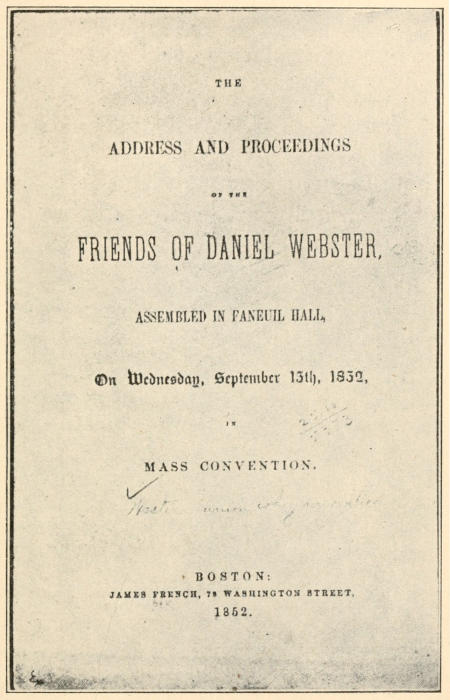
TITLE-PAGE OF A CONTEMPORARY PAMPHLET
It was, indeed, difficult until these older figures were withdrawn to realize how radically the scene had changed, how singularly confused and altered the field of politics had become. Mr. Clay, Mr. Calhoun, and Mr. Webster, the notable men who had now made their sad exit, had come into affairs forty years ago, upon the eve of the second war with England. In their lifetime the very character of the government had changed. In the days when they had entered Congress, themselves men of a new generation, the country lived under a sort of parliamentary system. Congress looked to the Executive for guidance. The President’s cabinet was made up of the recognized leaders of the dominant party. The succession to the presidency was determined by congressional caucus, and the Secretaryship of State was looked upon as the post of succession to the headship of the government. Parties were organized under men who got their authority from training and from close association with ruling groups of influential statesmen whose primacy in affairs no one dreamed of disputing. Massachusetts had her ruling coterie of authoritative leaders no less than Virginia. Her professional classes, her lawyers and ministers for the most part, determined her action in politics,—university men, most of them, who yielded precedence to training, to experience, to age, to learning as of course, and put young men by to await their turn. Among them, as among the Virginians, certain families enjoyed a prescriptive pre-eminence. Any Englishman might have found the air and the method of action in that school of affairs of the familiar kind of all tradition amongst English speaking peoples.
The connection between Congress and the Executive was, it is true, private, not open or upon the floor of the houses. The President’s official advisers did not appear in debate or take their places upon the floor as parliamentary leaders. The houses had by explicit vote declined to hear them there. Neither did they resign, as the King’s ministers did, when the measures they suggested were defeated in a legislative vote. Their advice was given in private conference; they had no recognized responsibility for party legislation; they suffered no personal defeats and enjoyed no personal triumphs in Congress. But their influence was direct and powerful; and the government, for all its theoretical separation of parts, went forward as if of a single piece whenever the houses were of the President’s party.
It had stood so until John Quincy Adams became President, with no party at his back, the representative of a group, not of a national majority. Already, in Mr. Monroe’s day, the “era of good feeling,” in which party lines were fading out and the discipline of parties was relaxed, Congress had got ready, with new standing committees, to act independently and on its own initiative. When Mr. Adams came in it took leave to criticise and resist rather than follow him; and after Mr. Adams came the democratic upheaval which made a return to the older principles and methods of action forever impossible. It was noteworthy that there had fallen, with that change, a blight of final discredit upon the congressional caucuses which had for so long assumed to nominate the Presidents. Scattered state legislatures had made nominations of their own at the very dawn of General Jackson’s day; conventions, called together by no party, by no group of political leaders even, but representing, it appeared, only some special class of citizens or some single locality, had volunteered also their advocacy of this man or that for the presidency. The political intimacy between Congress and the Executive having been lost, Congress lost also its initiative in choosing the nominal leader of the nation. That privilege passed to men such as those who had so shrewdly and so successfully set the currents of opinion running for General Jackson: private managers who knew how to use the machinery of newspaper comment, of busy personal correspondence, and of local organization to make opinion and control elections.
The process of change was a little obscured while General Jackson was President. No man had ever dominated the politics of the country with a more complete or unmistakable mastery. Congress did his bidding as willingly and as promptly as it had done the bidding of Washington or Jefferson. Few men stopped then to note the fact that he purposed nothing constructive, that his work was negative, reactionary, directed towards the “simplification” of the government and the tearing down of what the Federalists had built up. Neither did it appear at once what it meant that the President was making the patronage of office, not the action of Congress, the real instrument of his power. He gave office to men who kept the discipline of parties at the elections, to local political managers, to the editors of serviceable newspapers, to those who watched and sought to govern the movements of popular opinion.
When he was gone it began to appear what the whole change was which had been brought to pass. It had become the habit of all parties alike to make their nominations for office in organized party conventions, and to look to the make-up of the conventions through the local managers who expected to profit by their success. The convention which nominated a President formulated also the programme of its party. Its declarations of principle bound the President whom it nominated, not only; they bound also the representatives of the party in Congress. And yet the convention was not elected for any kind of responsible service. Its members were not men picked out to frame legislation and test it by the processes of debate, or for any of the slow deliberations which make sound policy. They met to act without debate. They sat only for a day or two; got no real acquaintance with each other’s principles or motives; acted hastily and under excitement. What was of more consequence still, they were chosen by the management and nomination of unknown men, the self-constituted party overseers of the several localities from which they came; men whom native shrewdness, or watchful, time-serving sagacity had made masters of the arts of nomination and election: small office holders, busy talkers, the editors of rural newspapers, the ruling spirits of local political clubs.
Here was a wholesale decentralization of politics. Opinion began to be made by a sort of incalculable plébiscite. Party leaders found themselves, not giving suggestions, but taking them from the general drift. Congress presently showed itself apt rather to register the impressions which came to it, it hardly knew how, from the innumerable minor politicians of its dominant party than to originate measures and policies of its own. Party action yielded, too, to new forces of disintegration: for this new machinery of initiative facilitated division as well as organization. If old parties could be ruled by conventions, new parties could be created by them. It presently became a familiar thing to learn of the existence of a new party by learning of the assembling of a new convention which had put forth a new platform, and nominated a new candidate for the presidency. Every year set for a presidential election was now apt to yield some such significant symptom of shifting opinion, to show some new party formed or some recent party grown strong and aggressive. At any time the agitation of new questions or the alteration of old might produce a familiar fruitage of conventions. Men of independent initiative might at almost any time of excitement get their separate following, improvise their separate organization, and confuse the field of action by the introduction of what claimed and tried to be a new party.
When, in 1840, the Whigs put Mr. Van Buren from office it looked for a brief space as if the older traditions of the government were to be revived, as if Congress and the Executive were once more to draw together under the leadership of men both in the President’s cabinet and on the floor of the houses. But General Harrison’s death made that once more impossible. Mr. Tyler pleased the Democrats as little as he pleased the Whigs; and the two branches of the government drifted further apart than ever. Once again, in 1848, the Whigs won; and some of their chief men became the President’s advisers, Mr. Webster among them, as at the outset of General Harrison’s term. But there was only a faint flicker of the revival of tradition in that. It was too late to go back to the old ways of administration.
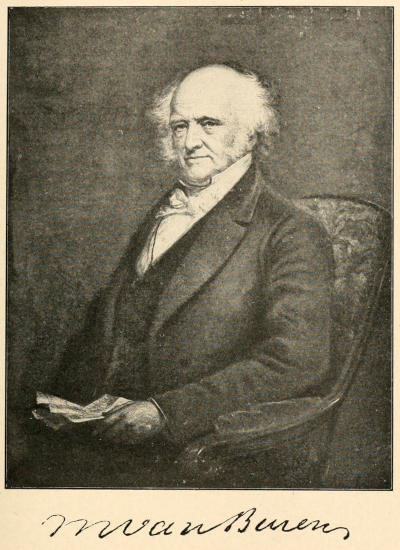
MARTIN VAN BUREN
In all ordinary seasons, while the old parties kept their discipline and their prestige, mere flurries of independent action might cause politicians little or no uneasiness; but in seasons when men’s minds were likely to take a touch of passion from the questions of the hour there was no telling what a new convention might portend. This new and facile machinery of agitation was as suitable for acts of principle as for schemes of manipulation. Mr. Clay and Mr. Webster looked from their death-beds upon a strangely altered scene. Passions were astir which might shake parties to pieces at any moment. The rule of parliamentary leaders belonged to an age gone by. Compromises arranged in Congress were conclusive of nothing should the thought of the nation once shake the foundations upon which they rested.
Even yet, however, the signs of change were partially obscured. A presidential election fell in that year, and parties seemed steadier than before in their choice of candidates and issues. A convention of Free Soilers met again (August 11, 1852), as four years before, and again spoke their uncompromising programme very plainly: “No more slave States, no more slave Territories, no nationalized slavery, no national legislation for the extradition of slaves”; but their following proved less numerous than it had been in 1848. The Whig ranks were not a little thinned and disordered by the uneasiness and defections of a time of dread and doubt; and when the party convention, in June, put forward General Winfield Scott, a third popular soldier, as its candidate, and declared itself entirely satisfied with the compromise of 1850, many a man of conviction and initiative turned away from it, as from a party which had lost courage and statesmanship. But the Democrats acted with their old-time confidence and unanimity, and won, upon a declaration of views which committed them not only to the maintenance of the compromise but also to an unqualified adoption of “the principles laid down in the Kentucky and Virginia Resolutions of 1798 and 1799 and the Report of Mr. Madison to the Virginia legislature in 1799,”—principles which they declared themselves resolved to carry out “in their obvious meaning and import.” Such a programme would have satisfied even Mr. Calhoun. They had not been able to nominate any one of their recognized leaders for the presidency; for their convention had acted, as always, under a rule which prescribed two-thirds as the majority necessary for a nomination, and neither Mr. Cass nor Mr. Buchanan nor Mr. Douglas had been able to command so large a support; but their choice had fallen upon Mr. Franklin Pierce, of New Hampshire, whose handsome person and prepossessing manners, whose record as a gallant commander of volunteers in the Mexican war and an honorable, even if undistinguished, representative of his State in Congress, they could look upon with some degree of complacency.
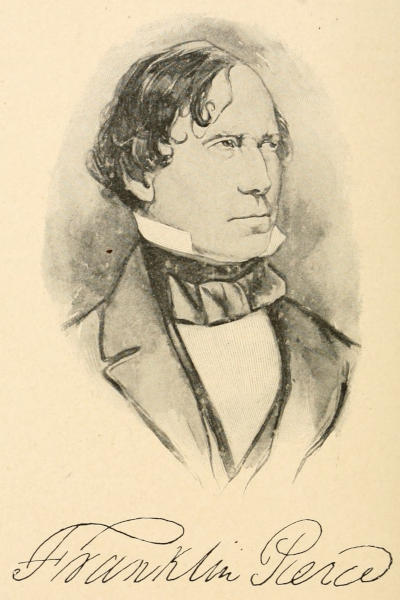
FRANKLIN PIERCE
They supported him with every appearance of heartiness, and carried every State for him except Vermont, Massachusetts, Tennessee, and Kentucky, securing two hundred and fifty-four electoral votes as against General Scott’s forty-two. The popular vote for Mr. Pierce exceeded that for his two opponents combined by less than sixty thousand out of a total vote of more than three millions; but it was noteworthy how widespread and general the success of the Democrats had been; how completely they had closed the breaches made in their ranks four years before. Apparently they controlled both the country and the government.
Not that the country was quiet or at ease. Opinion shifted feverishly, incalculably, as if moved and driven by some unquiet spirit which it sought by some means to lay or escape. The Democrats had won in the elections because the Whigs had suffered hopeless division of opinion and had already in fact fallen asunder upon the question of slavery. The Democrats alone, with their chief strength at the South, kept their organization and their power of united action. Men who could not act with them now looked for a party, and yet feared to form one which should bring the sections face to face and fight the slavery question out. And yet they could not thrust that question into the background or forget it. Territories were always making and to be made. That unresting host forever moving upon the western plains and rivers must presently be told what Congress meant itself to do, or let them do, with regard to the use and ownership of slaves. Root-and-branch opponents of slavery were very actively and aggressively making opinion against it without too tenderly considering either the politicians who wanted to think of something else or the merchants and manufacturers who dreaded to see peace and trade disturbed. During the very summer of the presidential campaign (1852) Mrs. Harriet Beecher Stowe had published Uncle Tom’s Cabin, a stirring story of the life of a southern slave, and the book had done more, as it were upon the instant, to bring opinion to a quick awakening than any score of political pamphlets could have done. Its moving scenes, its pathos, its humor touched with tears, its air as of the real tragedy and pity and hope of life acted upon sensitive minds with a power they could not resist; and bred everywhere a slow passion of philanthropic reform which politicians had presently to look to. It was not a true picture of slavery. It was a romance sprung out of the sympathetic imagination of a refined and sensitive woman, whose pity kindled at every thought of the black bondsmen at the South. It told, unquestionably, of what slavery might produce, of what no doubt it did produce upon occasion, of the terrible possibilities and in some part the terrible realities of the master’s power and the slave’s subjection; but no one could read in it the real life of the negro or take from it any just conception of the system of slavery as administered by the vast majority of southern masters. Those who read it, nevertheless, knew no other picture than this, and were filled with pity and deep horror. Politicians had presently good reason to know what this new engine of agitation meant.
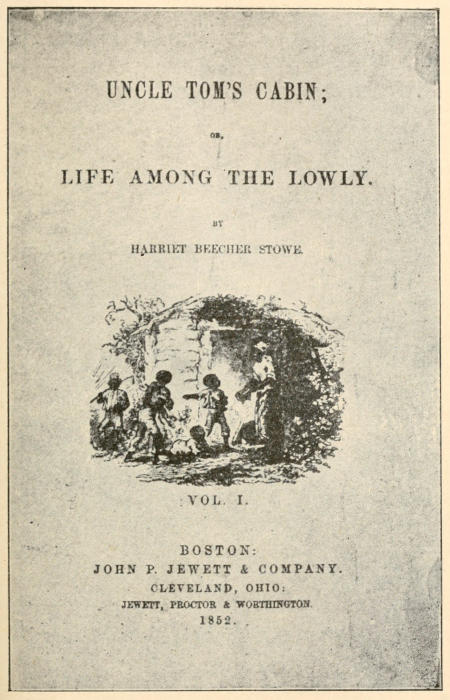
TITLE-PAGE OF “UNCLE TOM’S CABIN”
Still, those who chose looked another way and refused to be drawn into this matter. All who felt the older motives of politics strong within them and dreaded upheaval declined to touch the critical business. Men of uncompromising free soil convictions, on the other hand, whether Whigs or Democrats hitherto, slowly drew off from the regular parties and formed outspoken plans of opposition, frankly making slavery their issue. But the majority of Democrats adhered steadily to their party, and the majority of Whigs dreaded the threatened conflict and doubted its outcome; sought any diversion rather than make this ugly issue the acknowledged and only line between parties. Many persuaded themselves that the most immediate peril of the country came from the sudden and enormous influx of foreigners which recent years had witnessed. The great flood poured in at the eastern ports and left its most unwholesome deposits there; sent on the best things it carried to the western farms and the open regions of the interior. It brought men whom revolution had thrust out of the old world, men who wanted power and were apt at intrigue, restless men, many of whom were outcasts, some of whom were desperadoes. Now at last there came even men out of the alien Orient to the lands by the Pacific. Here was cause enough for uneasiness. If men looked for an issue, here was one: the preservation of the country’s institutions in the face of such inroads, the maintenance of a safe ascendency in affairs for those born and bred to the politics and manners of America.
So long ago as 1844 matters had shaped themselves very sharply on this issue in New York and Philadelphia, the cities most threatened by the unwelcome invasion. Now feeling began to gather head upon a greater scale. A secret “Order of United Americans” was formed, whose motto was, “Americans must rule America”; and to this order many uneasy men were drawn to whom its principles were a pleasant relief from the stress of the slavery question; as well as all those who dreaded or hated the foreigner or feared to see the Roman Catholic church of the Continent brought into power in America along with its thousands of adherents crowding in. Only those who were advanced to the highest ranks of the Order’s hierarchy were inducted into its full mysteries; the rest professed entire ignorance of its secrets, often of its very existence, and were dubbed “Know Nothings” for their reticence.
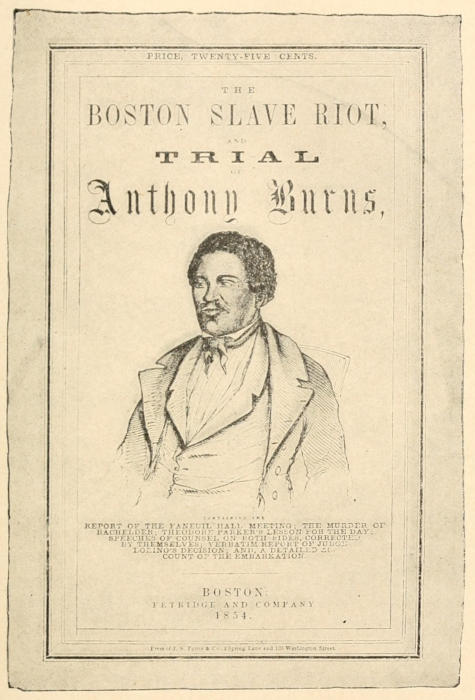
COVER OF PAMPHLET ON THE BOSTON SLAVE RIOT
In some quarters the rising philanthropic feeling of the time found expression in a very pronounced renewal of the temperance movement. The year 1851 witnessed the adoption in Maine of a stringent law which absolutely forbade the manufacture or sale of intoxicating liquors within the State; and many earnest people elsewhere hailed the novel statute as a hopeful promise of social betterment, an example to be emulated. But such things did not yet draw to them the deeper currents of the country’s thought. To every man who looked thoughtfully upon the face of affairs the slavery question obviously stalked obtrusive at the front of all policy, despite compromises and evasions. It was the southerners, besides, who seemed always to force the fighting. Whether the question were the reception of a petition against the continuance of the slave trade in the District of Columbia or the acquisition and government of new territory or the admission of a state into the Union, they let no opportunity go by to make known their claims and rights under the constitutional arrangement. They saw with the keen insight of those who lose that the game of growth and extending power went steadily against them. They valued the Union as dearly as the men of the North, were bent upon its preservation as earnestly and honorably as their compatriots of any section; but they were convinced, with good reason, that its preservation depended upon the maintenance of an equilibrium between the sections, and they were determined, with Mr. Calhoun, to make their fight now, while yet there was a chance to win. They waged it, accordingly, like men suspiciously on guard in the face of a subtile enemy, and upon occasion deeply irritated even their friends with their noisy and ceaseless protests, driving their enemies to a like watchfulness and aggression.
Upon the assembling of the first Congress of Mr. Pierce’s administration fortune seemed for the nonce to smile upon them. They were accorded a victory sudden, unlooked for, radical, costly, which instantly put a new face upon affairs,—nothing less than the repeal of the Missouri compromise and the opening of every Territory that remained to slavery. No one but Mr. Douglas would have had the audacity to attempt so revolutionary a measure; but Mr. Douglas had the hardihood of the frontier and the initiative of a natural leader of men. Stephen A. Douglas was one of the senators from Illinois. He had gone west out of Vermont when a mere lad, had served a rough apprenticeship in the new country, had made himself a lawyer and a judge of the supreme court of the young State before he was thirty, had entered the House of Representatives in 1843, at thirty, and the Senate in 1847, at thirty-four, and was now in his prime, showing at their full vigor the extraordinary qualities which had won him his quick advancement. His short and massive figure, his square head, steady, deep-set eyes, and mouth cut straight and firm, in lines unsensitive and full of will, bespoke him the man he was: a man to make and have his way, fearless, sincere, compact of force; commanding others, but not to be commanded himself; coarse-fibred, daring, ready witted, loud, and yet prepossessing withal, winning friends and receiving homage.
He watched as keenly as Mr. Benton did the progress of the West, and had become, by natural selection, chairman of the Senate’s Committee on Territories. Across the broad “Platte country,” he knew, which stretched all the way from Iowa and Missouri to the foot of the great Rockies, lay the chief highway into the far West. He feared, in common with other western men, that it might be closed against travel by treaties made at Washington with the Indian tribes whose hunting fields lay upon it, and all the movement of life and settlement in the West embarrassed by the erection of an Indian reservation athwart the great route; and ever since he came into Congress, ten years ago, he had been pressing the question of its settlement and organization as a Territory instead. In the session of 1853-54 he had his will in the matter at last, and brought on political revolution besides. As chairman of the Senate Committee on Territories, he introduced, early in January, 1854, a bill which provided for the organization of the Platte country as the Territory of Nebraska; but, finding many features of the bill unacceptable to the Senate, presently withdrew it and substituted another (January 23d) which provided for the creation of two Territories, Kansas and Nebraska, the one lying immediately to the west of the once disputed ground of Missouri, the other lying to the north beyond Iowa, upon the great plains through which the Platte found its way to the Missouri. The first measure had provided that the people of the new Territory should make their own choice in the matter of slavery; in the second measure the Missouri compromise was explicitly “declared inoperative and void,” because “inconsistent with the principles of non-intervention by Congress with slavery in the States and Territories as recognized by the legislation of 1850.” The healing work of two generations of statesmen was destroyed at a stroke. Mr. Douglas deemed such a course dictated by “a proper sense of patriotic duty,” in order that the compromise measures of 1850 might be given their full effect, the right of Congress to interfere with the question of property in slaves clearly negatived, and the entire sovereignty of the people in their self-constituted groups, first as Territories and then as States, conspicuously set up, as the doctrine which seemed to him most likely to solve every practical difficulty. Mr. Pierce, the President, pronounced the bill a return to a “sound principle, which the compromise of 1820 infringed upon.”
It was in fact matter of revolution. The southern members eagerly accepted what they had not asked for; northern men who were of the triumphant Democratic ranks blindly followed Mr. Douglas; and by the end of May the bill was law, spite of protests, spite of every sign of the profound and painful sensation it was to make, the country through. Mr. Seward and Mr. Chase were no longer alone in the Senate; Hamilton Fish, of New York, Solomon Foote, of Vermont, Benjamin Wade, of Ohio, Charles Sumner, of Massachusetts stood with them to contest the ground against slavery every foot, by every means of word or action. But they availed nothing against the confident majorities which Mr. Douglas led, and the thing was done.
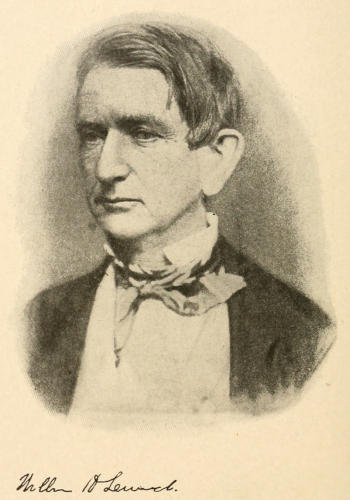
WILLIAM H. SEWARD
Strict party discipline was maintained in the houses, and Mr. Douglas was unmistakably the leader of the Democratic majority. He might almost be said to be for the moment the leader of the government. Congress had learned very thoroughly how to do without the leadership or suggestions of the Executive; had organized itself very efficiently for action on its own initiative. The House very readily yielded itself to the control of its Speaker, whom it was more and more coming to regard not only as its presiding officer but also as its political leader. Its committees were constituted by his appointment, and it more and more gave itself over to the guidance of its committees. Mr. Polk, when he was Speaker, had set the example of constituting each committee in such a way as to make it an instrument for carrying the purposes of the leaders of the majority into effect in legislation; and the machinery of party action was every year growing more perfect. The Senate chose its committees by ballot, and debated their recommendations with a thoroughness which the House, with its more numerous membership, could not often emulate; but the committees of the Senate, no less than the committees of the House, formulated every action decided upon by the party leaders. The chairman of each committee, indeed, enjoyed an initiative in respect of the matters referred to his committee which often escaped the control of the leaders when he chose to ignore them. It was in part because of this new, efficient, and thorough-going way of action in Congress that Presidents and their cabinets fell more and more into the background in the origination of policy. Mr. Douglas had wished to be President: but was much more powerful in his real place of leadership on the floor of the Senate. Mr. Pierce accepted what he planned. He had his way with regard to Kansas and Nebraska as he could have had it in no other capacity than as chairman of the Committee on Territories.
No man could have wished to see his success produce a more dramatic effect. It was instantaneous. Kansas became at once a veritable battle ground. There was a fatal ambiguity in the law. Did it mean that the people could make their choice with regard to slavery now, while they were yet but citizens of a Territory, through their territorial legislatures, or must they wait until they made their formal constitutions as states and obtained admission into the Union? Whatever its meaning, the matter was evidently to be decided by numbers, by filling the inchoate state with a prevailing majority out of the South or with a prevailing majority out of the North,—by the conquest of effectual occupation. And so each section began to pour its settlers in. Nebraska was out of the question. It lay too far to the northward; no one in the South looked to see slavery make its way thither. But men must go to Kansas, and go at once, ready for any heat of conflict.
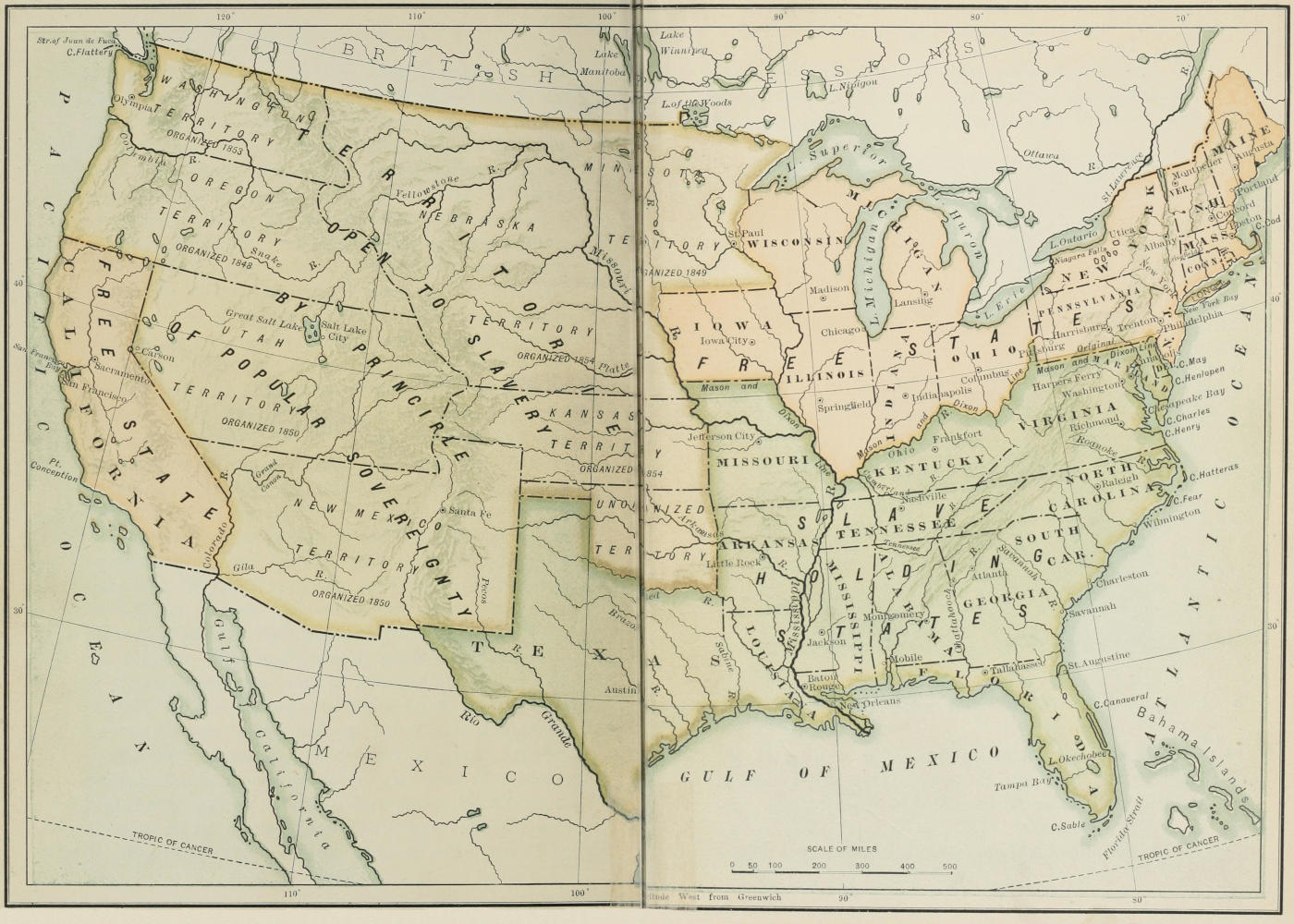
THE UNITED STATES, MARCH 4TH, 1855.
BORMAY & CO., N. Y.
It was singular how the strong discipline and self-confident spirit of party held the Democrats together in face of the country’s manifest sharp revulsion against what they had done. Too steady for panic, too sure of the practical soundness and efficacy of the radical measures they had entered upon to be seriously disconcerted, they held doggedly on their way. But with the Whigs it was different. Their party had been short-lived at best; they had looked chiefly to the North for support; they had gone to pieces in the election of 1852 as completely and as irretrievably as the Federalists had gone to pieces in the election of 1800; their adherents were afield looking for a new allegiance, a new way of action. Some were simply “Anti-Nebraska men,” opponents of the extension of slavery; some knew not how to vote; some crowded, for diversion, into the ranks of the Know Nothings. The elections of 1854 and 1855 brought strange surprises. The Know Nothings won a sudden series of successes. In the autumn of 1854 they elected their candidates for the governorship in Massachusetts and Delaware and put close upon a hundred members into the federal House of Representatives. In the autumn of 1855 they carried New Hampshire, Massachusetts, Rhode Island, Connecticut, New York, Kentucky, and California, and fell but a little short of majorities in six of the southern States. Their successes filled the House of Representatives and the offices of government in the States with new and unknown men. The House of Representatives which met in December, 1855, was so variously and whimsically compounded of Anti-Nebraska men, Free Soilers, Democrats, southern pro-slavery Whigs, Know Nothings who favored the extension of slavery and Know Nothings who opposed it, that nothing was certain of it except that it contained a majority against the administration.
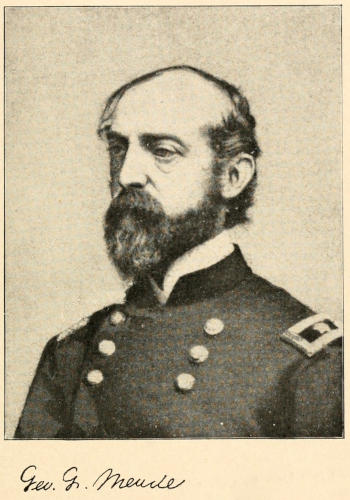
GEORGE GORDON MEADE
But another year (1856) brought the opposition together into a clearly defined “Republican” party, into which all Anti-Nebraska men, whether one-time Democrats or one-time Whigs, whether for a little while Free Soilers or for a still shorter time Know Nothings, were drawn with united purpose. Many things besides Mr. Douglas’s revolutionary Kansas-Nebraska bill had given heat and cohesion to their gathering opposition. Before that bill had been introduced the administration had purchased of Mexico (December 30, 1853), through Mr. James Gadsden, of South Carolina, the minister of the United States, forty-five thousand square miles of additional territory, lying at the south of the Gila River, to round out the acquisitions of 1848, the root of controversy and compromise. The year the Kansas-Nebraska Act became law, Mr. Pierce had, moreover, at the solicitation of southern men, directed the American ministers to Great Britain, France, and Spain, Mr. James Buchanan, of Pennsylvania, Mr. John Y. Mason, of Virginia, and Mr. Pierre Soulé, of Louisiana, to confer and report to him upon the desirability of the acquisition of Cuba by the United States. They met at Ostend, in Flanders, and reported that in their opinion the acquisition of Cuba would be highly advantageous to the United States; and that, rather than suffer it to be Africanized, as Santo Domingo had been, the United States would be justified in wresting it from Spain by force, if Spain would not sell. News came now and again, too, of armed expeditions out of the southern ports against some Central American state, and of repeated, though unsuccessful, attempts, by force or strategy, to gain possession of more territory to the south of Texas. There was no evidence that these lawless raids had any support or countenance from the federal government or from any government, or responsible person even, in the South itself; but the painful impression they made chimed ominously with that made by the Gadsden purchase and the “Ostend manifesto.” There seemed an organized effort afoot to extend upon every hand the area of slavery.
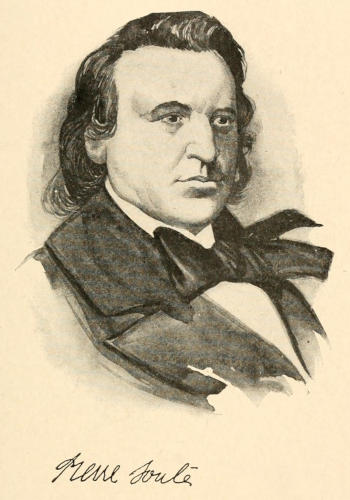
PIERRE SOULÉ
The new party of opposition, however, did not perfect its organization or draw its strength effectively together soon enough to win the presidential election of 1856. A remnant of the Whig party was still in the field; the Know Nothings did not know that they had already lost their following, and put candidates confidently into nomination; the Republicans had still to compound a Free-Soil-Anti-Nebraska-Whig creed and find a candidate to please their one-time Democratic supporters,—John C. Frémont, the dashing young soldier and explorer who had found the passes of the Rockies and taken part in the conquest of California. The Democrats, keeping still a virtually unbroken organization in the face of foes divided, elected their candidates, Mr. James Buchanan, of Pennsylvania, and Mr. John C. Breckinridge, of Kentucky, by the safe majority of fifty-two electoral votes. But the popular vote for their candidates had fallen nearly four hundred thousand short of that cast for their opponents; the Republicans had carried every northern State except Pennsylvania, New Jersey, Indiana, and Illinois; and there was in the success of the Democrats, it was to be suspected, nothing but a temporary triumph.
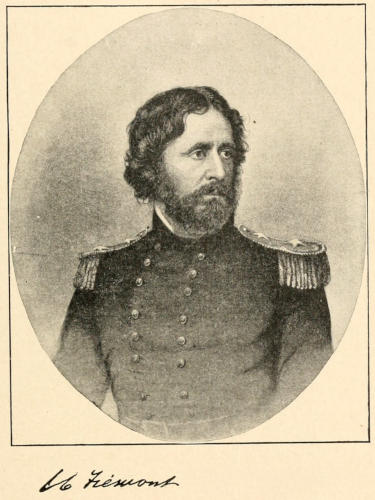
JOHN CHARLES FRÉMONT
Widespread financial distress clouded the winter that followed the presidential election, and filled all the year 1857 with its deep disquietude, now sharp and touched with panic, now a slow, dull lethargy in which merchants and manufacturers and transportation companies and bankers merely waited and did not hope. The sudden growth of enterprise and commerce which had followed the rapid extension of railways and the establishment of steam navigation upon the seas, to which the discovery of gold in California had given added stimulation, and which every item of the steady growth of industry and of the nation itself had assisted to keep in heart these ten years, had inevitably bred mere speculation, tempted men to unsound ventures, added excitement to confidence, harebrained scheming to the sober making of plans, and credit had at last been overstrained and wrecked by dishonesty, miscalculation, and flat failure. It seemed to public men that the tariff, as it stood, contributed to the distress of the time, because it steadily drew into the Treasury of the United States a surplus which was just so much money withheld from circulation. During the short session of Congress which immediately preceded the inauguration of Mr. Buchanan, all parties amicably united, therefore, in putting on the free list many of the raw materials of manufacture hitherto taxed and in reducing the general level of duties to twenty-four per cent.
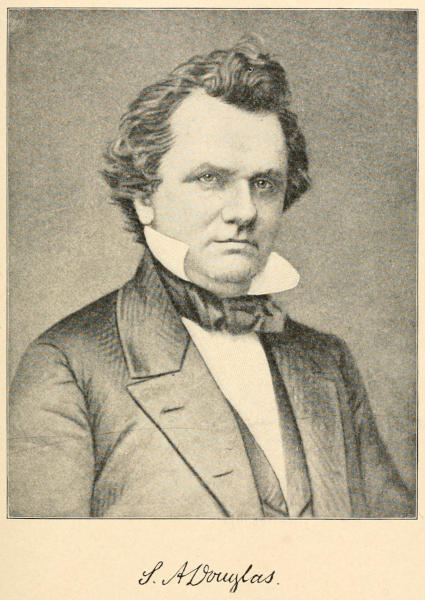
STEPHEN ARNOLD DOUGLAS
No debate, no legislation, concerning the tariff had ever been so temperate, so good natured, so full of amicable concert and quick accommodation since the war of 1812. It was a notable sign how the interest of parties had been withdrawn from old questions and fixed upon new. The financial depression and slow recovery of credit which made the year 1857 memorable among men of business constituted no part of the strain of politics. It was of infinitely more consequence that two days after the inauguration of Mr. Buchanan the Supreme Court of the United States uttered, through Mr. Taney, its Chief Justice, an opinion which went even beyond the Kansas-Nebraska Act in its radical rejection of the Missouri compromise. The case was that of Dred Scott, a negro of Missouri, whom his master had taken first into one of the free States and then into the territory from which slavery had been excluded by the legislation of 1820. The negro sought, after his return to Missouri and the death of his master, to obtain his freedom, on the ground that his temporary residence on free soil had operated to annul his master’s rights over him; but the court decided against him. More than that, though it left the proper field of the case itself, and therefore uttered mere obiter dicta, in doing so, it went on to declare that the legislation of 1820, which had forbidden slavery in part of the territory of the United States, must be considered unconstitutional and without legal effect. Slaves, as such, Mr. Taney argued, for the court, were not citizens, in the contemplation of the constitution, but property merely; neither Congress nor the territorial governments, which derived their whole authority from Congress, could legally legislate with hostile purpose against any kind of property belonging to citizens of the States; slave owners might carry their slaves, as they might carry any other property, where they chose within the federal domain; none but a State could exclude their lawful bondsmen.
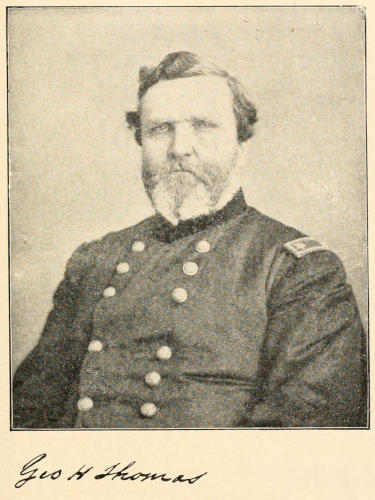
GEORGE HENRY THOMAS
Here was not only a blow in the face for all Free Soilers, Anti-Nebraska men, and Republicans, but a blow dealt straight at Mr. Douglas’s doctrine of popular sovereignty as well. The court’s opinion suffered no interference with slavery by any authority but that of a full-fledged State, and the exclusion of slavery from Territories was out of the question. Out of the question in law, it seemed, but yet not in fact. How the fact was to be settled the country had but to look to Kansas to see. There the rush of numbers and the clash of armed men had played a quick drama out, stained by blood and ruffianly force. Men had come first from Missouri near at hand, and out of the slave-holding States which lay back of her, and then from the free States of the northwest and far New England, some upon their own private errands of change or profit or adventure, some in organized bands sent forward by public or private subscription, by individuals or societies, engaged to see the crusade out upon the one side or the other. Men of initiative in the North had accepted the Kansas-Nebraska Act as a challenge to go and take the land and hold it against slavery, by peaceful means or by force; had bought supplies and arms, and had equipped sturdy men by the score for the journey and the strife at its end. The lawless of the one faction had vied with the lawless of the other in acts of violence and even of treachery, and all the country had gazed these three years upon the dark things done in “bleeding Kansas.”
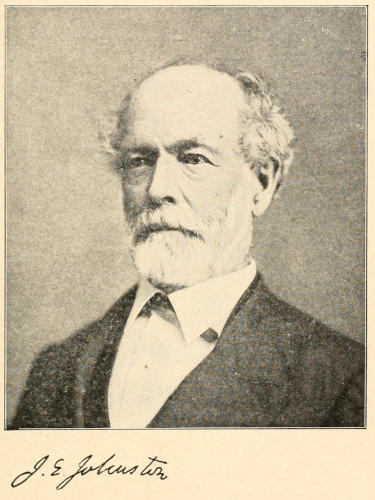
JOSEPH ECCLESTON JOHNSTON
Until this year of Mr. Buchanan’s presidency the pro-slavery settlers had kept the upper hand and controlled for the most part the legislation of the Territory; but by the autumn of that year their majority was lost, their control wrested from them by the settlers out of the North, crowding in at last in numbers greater than their own. Their final act of power was to call a constitutional convention and submit to the vote of the people a constitution which established slavery. The question submitted to the people’s vote was not, however, the adoption or rejection of the constitution, but merely its adoption “with slavery” or “without slavery.” The clauses by which it directly sanctioned slavery were by no means the only clauses which affected the critical matter. It contained, besides, numerous provisions which were not to be affected by the vote, which threw effective safeguards round about existing property in slaves, quite independently of the establishment of a slave-holding system; and great numbers of anti-slavery men, not being suffered to vote against the instrument as a whole, would not vote at all. It was consequently adopted “with slavery” and sent to Congress along with the usual application for admission into the Union. The anti-slavery legislature of the Territory, elected in the autumn of 1857, immediately ordered the instrument submitted as a whole to the people’s vote, and it was rejected by an overwhelming majority, the pro-slavery men in their turn refraining from voting.
Mr. Buchanan, finding himself in fact the head of a party whose chief strength lay in the South, and yielding more and more as events thickened to the influence of the southern men in his cabinet, favored the admission of the Territory under the constitution adopted “with slavery,” as in technical form at any rate the legal expression of the wish of the people of the Territory. But Mr. Douglas, no mere partisan, after all, but a man steadfast in the principles upon which he had professed to act, refused to be a party to the act. He knew, as the whole country did, that this constitution, sent in the name of Kansas, was not in fact the constitution preferred by a majority of its people. To adopt it would be, not the recognition, but the repudiation of popular sovereignty. There were Democratic majorities in both houses, but members enough followed Mr. Douglas to defeat the resolution of admission, and it failed. A line of cleavage had shown itself within the Democratic ranks, and the plot of politics was sensibly thickening.
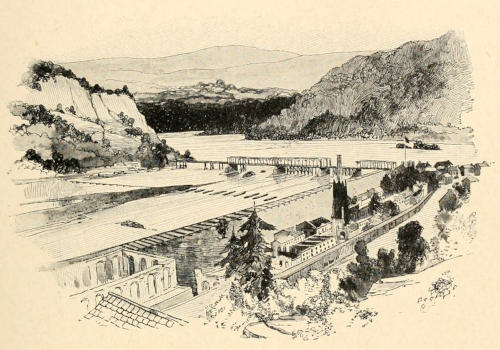
HARPER’S FERRY IN 1859
Another year, and it was more evident than ever where the issue cut and how the opinion of the country was turning. The elections of 1858 disclosed very serious losses for the Democrats. Five Republican senators were added to the twenty already in active and aggressive opposition; the Republican representation in the House was increased from ninety-two to one hundred and nine; the President’s own State was carried for the Opposition; and no observant man doubted what the causes were. They were indeed fixed with dramatic force in the mind of the whole country by the circumstances of Mr. Douglas’s own barely successful struggle for re-election to the Senate. The Republicans of Illinois put into the field against him a man new, like the party itself, but racy of the soil and of the time. Abraham Lincoln was forty-nine years old, Mr. Douglas’s senior by four full years; but, though he came late into the view of the nation, he came with toughened fibre, athletic in mind and body. He had struggled out of meanest poverty to a place among the men who led by processes familiar enough upon that rough frontier, where every man had his own way to make, his own training to get, for himself, whether in books or in action; but the genius he had put into the task had wrung out of the old processes a new and greater type of man. He had had the instinct of the student in the midst of affairs and had made himself a master of ideas, and of language as an instrument of mastery. He had devised for himself straight thrusts of speech and a use of words that acted always like the application of light,—spoke like a swordsman who knows not only his fence, but also the temper of his blade and the seats of life which the sword can touch.
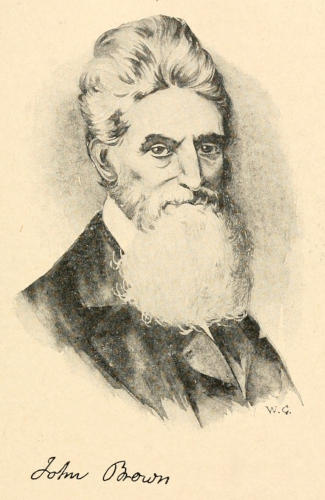
JOHN BROWN
Mr. Douglas knew his antagonist, and knew that he had arranged no light matter when he had agreed to meet him in public debate, up and down the State, upon the issues of the day. All the country knew that a novel and very striking figure, the figure of an untutored master among men, had emerged upon the general field of politics when it heard what the debate had brought forth. “A house divided against itself,” Mr. Lincoln said, in phrases which stuck in the mind, “cannot stand. I believe this country cannot endure half slave and half free. I do not expect the house to fall, but I expect it will cease to be divided. It will become all one thing or all the other.” What, he asked Mr. Douglas, became of the doctrine of popular sovereignty if the Dred Scott decision was accepted as law? The territorial legislatures, replied Mr. Douglas, could hold slavery back, if not by actual prohibition, at least by hostile restriction and impediment. Then a territorial legislature can do what Congress itself cannot? asked Mr. Lincoln,—and the country knew, the Democrats whom he essayed to lead knew, how embarrassed Mr. Douglas had been for an answer. He won his seat, but he lost his following at the South.
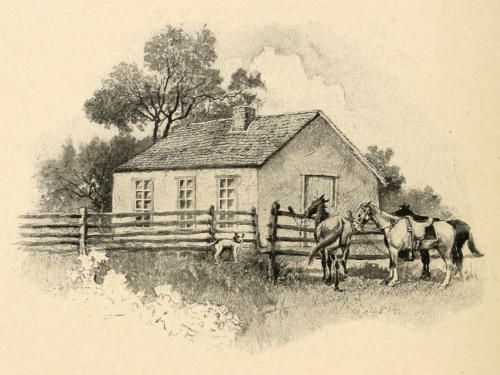
THE DUNKER CHURCH, WHERE JOHN BROWN PREACHED THE NIGHT OF THE RAID
That same year, the elections notwithstanding, Mr. Buchanan urged upon Congress, in his annual message (December 6th), fresh territorial expansion at the South: the acquisition of Cuba, vigorous action on the Isthmus against Nicaragua and Costa Rica, and a protectorate over the nearer parts of the Mexican Republic, which appeared to be on the point of going to pieces. No indifference, no hostility abated his zeal in these matters. He could get nothing; the Republicans held the balance of power in the House of Representatives since the election; policy stood still there. But out of doors the rising passion of parties took its natural course.
The autumn of 1859 brought a sinister thing to light which startled the whole country, but the South most deeply, with its disclosure of what passion, though it were but individual passion, might lead to. One John Brown, come out of Kansas for the purpose, attempted of a sudden, on the night of Sunday, October 17, 1859, a liberation of the slaves round about Harper’s Ferry, in Virginia, madly hoping to set a general insurrection aflame and bring emancipation on by force. The attempt failed miserably, and Brown was sent to the scaffold; but that was not the whole of the matter. The striking character and self-forgetful passion of the man held the attention and moved the spirits of every one who looked upon the event to heed it. He was a mad fanatic, but no common rascal and adventurer. He had gone, four years before, out of Connecticut, with his four sons, to throw himself into the struggle against slavery in Kansas, and had got a price set upon his head there for lawless violence and massacre; but there was in him the spirit as if of a blind and maddened crusader; he fought and did deep evil, not for himself, but for a cause; and men held their breath at thought of him as if at sudden sight of some fateful omen. To the eyes of the southern men his image loomed big, as the very embodiment of the party arrayed against them and the institutions they lived under. Brown was found to have obtained money and arms by subscription out of the North. They had been supplied him, it turned out, for use in Kansas, not for use at Harper’s Ferry; but the southerners made no discrimination in that matter. In either case, it was aid given to a man who was expected to fight slavery at any cost, and without reckoning of law or consequences. They would not now distinguish between that and the objects of the Republican party itself.
They coupled this fatal raid with the systematic and successful attempts of the northern States to nullify the Fugitive Slave Law. Runaway slaves seized under that law had again and again been rescued by force, and the rescuers had escaped punishment by the action of friendly juries and the systematic application of the writ of habeas corpus. Every possible obstacle had been put in the way of the operation of the law by state statutes,—lawyers had been disbarred for acting for those who claimed the runaways, the use of state prisons had been denied, and state officers had been heavily fined for participating in the execution of the federal enactment.
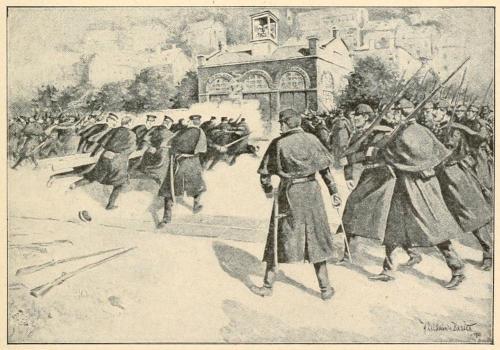
COLONEL LEE’S MARINES BREAKING INTO THE ENGINE-HOUSE AT HARPER’S FERRY
While the impressions made by the unhappy affair at Harper’s Ferry were still vivid, while the heat it had engendered was still at its height, the presidential campaign of 1860 came on, and the havoc sectional feeling had made was laid painfully bare. The Democratic party was at last hopelessly rent into factions, divided, as was inevitable, upon the question of standing, with Mr. Douglas, for the principles of the Kansas-Nebraska legislation, of the sovereignty of the people of a Territory no less than of the people of a State, or, with the southern men, for the extreme doctrine of the Dred Scott case. No agreement was possible; the men of the one view and of the other had come at last to the parting of the ways. The usual party convention was tried, but was broken at once into factions, each of which tried to rally the party to itself in a separate convention of its own. The one faction nominated Mr. Douglas; the other Mr. Breckinridge, the Vice President. The Republicans, meeting in Chicago, where the ardent enthusiasm of the Illinois men for their newly risen champion was felt at its full, put aside Mr. Seward, whom the country and the party itself had confidently expected to see named, and nominated Mr. Lincoln for President. A third party, heir of the Know Nothings, but strengthened also by many conservative men who had despised Know Nothingism and meant now merely to hold the country off, if they could, from all extremes, met and made its nominations also, calling itself the “Constitutional Union” party, and avowing as its simple creed “no political principle other than the constitution of the country, the union of the States, and the enforcement of the laws.”
In the election which ensued almost every man who doubted whither to turn with his vote acted, when the day came, with the Republicans, and Mr. Lincoln was elected President. The electoral vote was to be, one hundred and eighty for Mr. Lincoln, one hundred and twenty-three for his three opponents combined. With the exception of four votes won at a hazard in New Jersey, which had divided its votes between Mr. Lincoln and Mr. Douglas, the Democrats had obtained not a single electoral vote in the North or West. Virginia, Tennessee, and Kentucky had cast their votes for Mr. Bell, the nominee of the “Constitutional Union” party; the rest of the South had voted for Mr. Breckinridge. Mr. Douglas was to receive the nine votes of Missouri and the three which New Jersey had withheld from Mr. Lincoln. It was an ominous thing, nevertheless, that, despite his undoubted majority in the electoral college, the election had gone against Mr. Lincoln, reckoning by the vote of the people, by a majority of close upon a million out of a total vote of but a little more than four millions and a half. In almost every State that Mr. Lincoln had carried the vote for Mr. Douglas had trodden close upon the heels of his own. The total vote had been 4,682,069. Of this Mr. Lincoln had received 1,866,452, Mr. Douglas 1,376,957, Mr. Breckinridge and Mr. Bell together 1,438,660. In the North and West alone the vote cast against Mr. Lincoln had been 1,575,000. In Oregon and California, whose electoral votes he was to receive, the aggregate opposition vote had been nearly twice that cast for him. It was a deeply perilous thing that such a victory, won upon such issues, should have been won so narrowly, and through a minority of the nation.
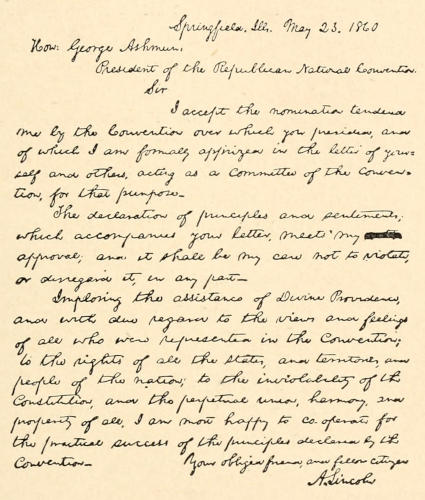
FACSIMILE OF LINCOLN’S LETTER OF ACCEPTANCE
Before Mr. Lincoln was inaugurated seven southern States had withdrawn from the Union, and revolution was upon the country. The southern leaders of the extreme school of state rights and the doctrine of the Dred Scott case had consciously, avowedly staked everything upon the election, and accepted the result as conclusive of what self-respect and political exigency demanded of them. They looked upon this coming into power of the men of a minority which had set itself to check slavery and to shut the slave-holding States in, in order that they might be thrust from their place in the politics of the nation, as a thing fatal to the very principles of the partnership formed in those first days when the constitution had been framed, and accepted as a pledge of equality between the States. The Republican party had, indeed, always and with all proper emphasis disavowed any wish or intention to lay any hand of molestation or change upon the domestic institutions of the South itself. The anti-slavery men who were abolitionists were little more numerous in 1860 than they had been in 1840, and those who spoke for the Republicans vehemently disclaimed all alliance or sympathy with them. But, though they did not mean to lay the axe to the root of the tree, the partisans of Mr. Lincoln did mean to gird it about and let it die where it stood, as one of the senators from Louisiana passionately told them. They meant by law and force to keep slavery from getting any growth or outlet whatever. They meant also to nullify, if they could not repeal, the laws whose adoption the constitution commanded for the apprehension and return of runaway slaves, and put the whole system of slavery, so far as they might within the formal limits of the fundamental law, beyond the recognition or countenance of federal statute. Their creed and their actions alike were compounded of hostility towards the South; and the challenge of their success was direct and unmistakable. Men of southern mettle could not disregard or decline it.
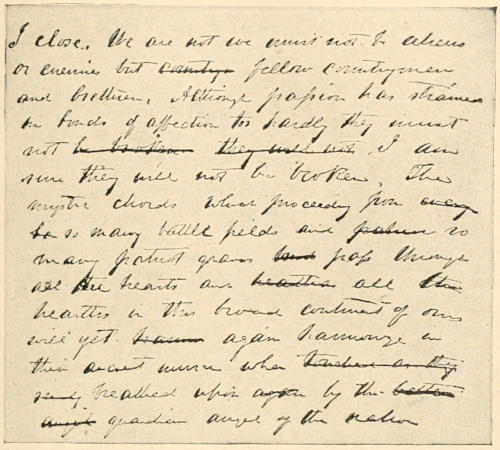
MR. SEWARD’S SUGGESTION FOR THE CLOSE OF MR. LINCOLN’S INAUGURAL ADDRESS
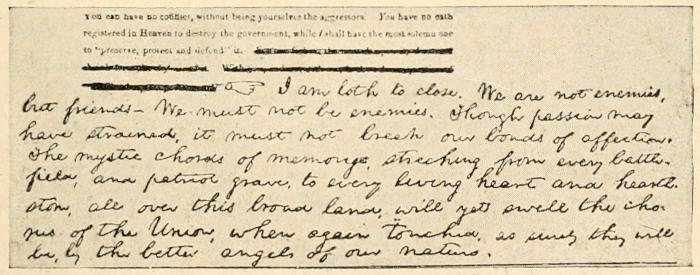
CLOSING PARAGRAPH, IN MR. LINCOLN’S HANDWRITING, OF THE INAUGURAL ADDRESS
Pride and self-vindication seemed the more imperatively to command that it should be accepted by the southerners because of what their opponents had said, with sneer and taunt and bitter detraction, about the system of slavery, which they maintained and stood for. No man who candidly looked back to the indisputable records of the colonial time could justly deem them responsible for its establishment. They had very earnestly and again and again protested against the traffic in slaves which the crown permitted, and the inevitable growth of servile labor which that hateful traffic brought in its train, to the thrusting out of white men and of the free labor which everywhere else gave dignity and efficiency to English communities; but the authority of king and parliament alike had forced and fostered it until it had seemed as if the entire slave trade of the world centred at their ports. Free hired labor had been once for all driven out, whether they would or no; the black people had multiplied among them until emancipation became a thing not to be ventured upon; work in the wet southern rice fields, upon the broad acres of tobacco, amidst the sugar cane, and out in the hot furrows of grain came at length, with long use and fixed custom, to seem a thing which only the African could stand. The northern States, ere separation from England set them free to be quit of slavery, if they chose, by emancipation, had diligently sought to rid themselves of the few negroes who had unsuitably found places of service in them by sending them also, as occasion offered, to the southern slave markets. Finally, when fate and slow habit and their own very multitude had fixed them, millions strong, upon the South, a base and support upon which all society seemed to rest, their labor, already indispensable, became of a sudden immensely profitable in the blazing sun of the cotton fields by reason of the invention of Whitney’s cotton gin.
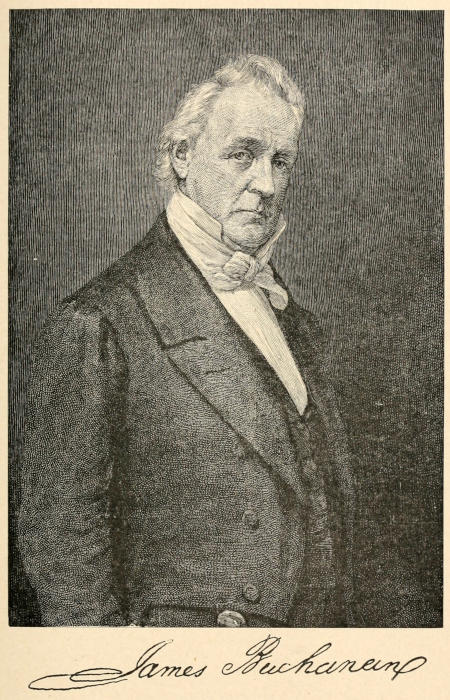
JAMES BUCHANAN
The system of slavery necessarily deprived the South of a body of small, yeomen farmers; but small farms abounded, nevertheless. A great majority of the southern farmers owned no slaves at all. If they could not afford to hire negroes from some neighboring planter who had hands to spare, they worked their fields themselves, like farmers everywhere. If they could afford to hire a negro or two, they worked with them, side by side, in the fields.
It was the accusation of moral guilt in the matter of slavery that stung the southern men most intolerably. They knew with what motives and principles they administered it, and felt to the quick the deep injustice of imputing to them pleasure or passion or brutal pride of mastery in maintaining their hold upon the slaves. Many a thoughtful man amongst them saw with keen disquietude how like an incubus slavery lay upon the South; how it demoralized masters who were weak, burdened masters who were strong, and brought upon all alike enormous, hopeless economic loss. Although the productive labor of the South was almost exclusively agricultural, more rich land lay waste and unfilled there than in any other region of the country held in use and occupation. The indolent slaves did not work as free laborers would have worked, and could not be made to. Intensive methods of farming were out of the question. Land had first to be used, without artificial renewal, and then allowed long to lie fallow and get its recuperation by the slow processes of nature. The narrow margin of profit under such a system of labor and tillage constantly threatened to disappear altogether. And yet the care of the slaves, their maintenance like a huge family of shiftless children, remained a duty and a burden which the master could not escape, good season or bad, profit or no profit.
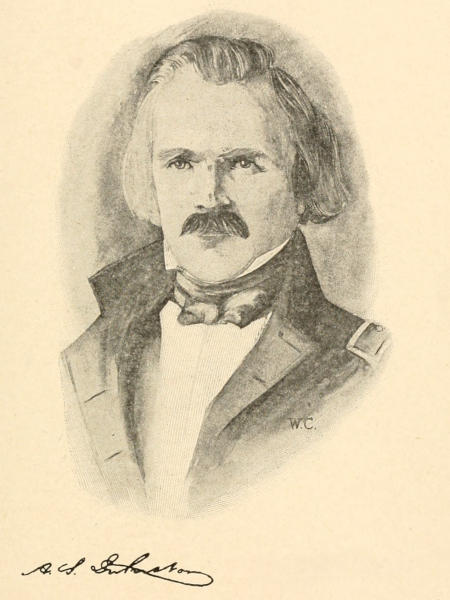
ALBERT SIDNEY JOHNSTON
Travelers could find whatever condition they looked for among the slaves. Where it was necessary to assemble and keep them hundreds strong upon remote plantations, lying in some malarial district upon the coast or in the river bottoms, where they could live but their master could not, they were often enough hard driven by brutal men, themselves mere hired drudges, who cared for nothing but to get the exacted stint of work out of them. But where the master was himself at hand there was almost always moderation, a firm but not unkindly discipline, a real care shown for their comfort and welfare. They were taught handicrafts, because each plantation was of necessity, in respect of every simpler kind of work, a complete industrial community. It was necessary that it should maintain its own shoemakers, tailors, carpenters, bricklayers, blacksmiths, and men of all work. There was seldom any town near at hand to supply even its commoner wants. The punishments each master meted out he allotted rather as magistrate than as master. The offences which he punished would most of them have gone before a magistrate had the offenders been freemen. “On principle, in habit, and even on grounds of self-interest, the greater part of the slave owners were humane in the treatment of their slaves,—kind, indulgent, not over exacting, and sincerely interested in the physical welfare of their dependants,” said an eminent northern man of letters, speaking of what he saw in 1844.
Domestic slaves were treated with affection and indulgence, cared for by the mistress of the household. The life of a southern planter’s wife was a life of executive labor, devoted chiefly to the care and training of her slaves. Social privilege and the proud esprit of their class bred in southern masters a sense of the obligations of station; and the spirit of the better men ruled the conduct of the less noble. The demoralizing influences of the system were checked as much as it was in human nature to check them. Southern gentlemen despised a slave trader as heartily as any northern man did, necessary though his occupation seemed to be; sold and bought slaves by private arrangement when they could; and sought in every way to keep the worst features of the system at a minimum.
That very fact, their very consciousness that they exercised a good conscience in these matters, made them the more keenly sensitive to the bitter attacks made upon them at the North, the more determined now to assert themselves, though it were by revolution, when they saw a party whose chief tenet seemed to be the iniquity of the South, about to take possession of the federal government. They had the inevitable haughty pride of a privileged class. Probably not more than one white man out of every five in the South was a slave holder; not more than half had even the use or direction of slaves. Hundreds of the merchants, lawyers, physicians, ministers who were the natural ruling spirits of the towns owned none. But the men who were slave owners were the masters of politics and of society. Their sensibilities were for all practical purposes the sensibilities of the South; and for close upon forty years now it had seemed as if at every turn of the country’s history those sensibilities must be put upon the rack. The Missouri compromise of 1820 had treated the institution of slavery which they maintained as an infection to be shut out by a line as if of quarantine. The alarming insurrection of the slaves of southeastern Virginia under Nat Turner in 1831; the English Act of Emancipation and the formation of the American Anti-Slavery Society in 1833; the slow and dangerous Seminole war, which dragged from 1832 to 1839, and was as much a war to destroy the easy refuge of runaway and marauding negroes in Florida as to bring the Indians, their confederates, to submission; the critical Texas question; the Mexican war and the debatable Wilmot proviso; the Kansas-Nebraska Act, the “free-soil” campaign, the break-up of the Whigs and the rise and triumph of the Republicans:—it had been a culminating series of events whose wounds and perplexities were always for the South. Southerners might have looked upon the election of Mr. Lincoln as only a casual party defeat, to be outlived and reversed, had it not come like a dramatic dénouement at the end of the series. As it was, it seemed the last, intolerable step in their humiliation.
The North had not realized as the South did what the election of 1860 meant. Southern men had been keenly conscious that the issues of revolution hung upon it. That consciousness explained the votes of Virginia, Tennessee, and Kentucky, cast for Mr. Bell, the candidate of the Constitutional Union party. In other parts of the South as well votes by the tens of thousands had been cast for the candidates of that party, by men who loved the Union, dreaded revolution, prayed for peace, and sought this means of escape from the fatal antagonisms of the regular parties. Northern voters, too, had been uneasy; but the air of opinion about them had not been charged as the southern air was with the keen forces of passion put to its final test. There was not among them the universal feeling which stirred in the South, that politics had come at last to a breaking strain.
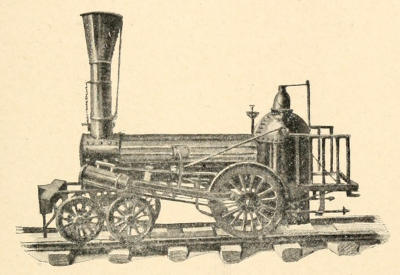
THE “GEORGE WASHINGTON” LOCOMOTIVE, 1835
South Carolina, alone among the States, still chose her presidential electors through her legislature. Having chosen her eight electors upon the appointed day in 1860, and instructed them to vote for Mr. Breckinridge, her legislature remained in session to learn the result, prepared to take action at once should what it feared come to pass. When the news came that a majority in the electoral college had been secured for Mr. Lincoln, it immediately called a state convention, provided for the purchase of arms, and adjourned. On the 20th of December following the convention which it had called, sitting in Charleston, adopted an ordinance which solemnly repealed the act of the convention of the 23d of May, 1788, whereby the State had accepted the constitution of the United States as part of its fundamental law, together with all subsequent ratifications of federal constitutional amendments, and formally declared the union hitherto “subsisting between South Carolina and other States, under the name of the United States of America,” dissolved and ended. By the first day of February following Mississippi, Florida, Alabama, Georgia, Louisiana, and Texas had also seceded. On the fourth day of February (1861) delegates appointed by the several conventions of the seceding States met in convention at Montgomery, Alabama, to frame a provisional constitution and choose a provisional executive for a separate southern Confederacy. Mr. Jefferson Davis, until a few weeks before a senator of the United States from Mississippi, was chosen provisional President, Mr. Alexander Hamilton Stephens, until two years before a member of the federal House of Representatives from Georgia, provisional Vice President. In March a permanent constitution was adopted, to take effect the next year. True to their theory of government, the southern States had returned to the political methods of 1788. Each State had, not by popular vote, but by sovereign convention, withdrawn from the Union, as she had acceded to it. The same conventions that had chosen the delegates sent to Montgomery ratified the constitution which they framed, and authorized the inauguration of the new Confederacy.
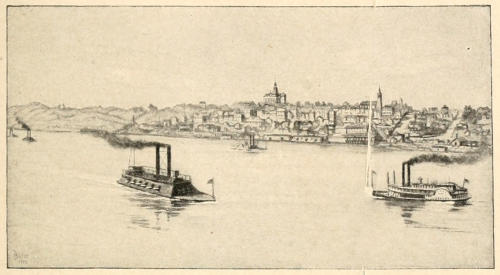
VICKSBURG, MISSISSIPPI, 1863
It was corporate action, taken with the initiative and promptness of men skilled alike in the theory and in the practice of constitutional action, as Mr. Calhoun and all southern statesmen expounded it. They assumed that, since each of their States had entered the Union of its own accord, as into a free partnership, and might have declined to enter it, it was clearly within its privilege to withdraw when just cause for withdrawal seemed to exist. It was an assumption the theory of which would hardly have been seriously questioned while the generation lived which made the Union; though that generation would have been as ready as any that followed it, no doubt, to make protest, it might be of arms, against actual secession. Neither change of thought nor change of political conditions in the nation at large had altered the thought of the South with regard to the character of the government; for she had not herself changed, and her own thought had kept steadfastly to the first conception of the Union. But to the rest of the country such a theory had become little less than incredible, often as southern statesmen had expounded and pressed it. The constitution of a nation, though written, cannot remain a mere legal document. The life of each succeeding generation must inevitably be read into it, if only, because it must be men of successive generations who read and interpret it. They can but comprehend it in terms of their own lives. It must become the vehicle of their growing thought, if it is to suffice them; must serve as the skeleton frame of a living organism. For a majority of the nation no conception of the Union was now possible but that which Mr. Webster had seemed to create and bring once for all to their consciousness in that debate with Hayne which had been a turning point in all men’s thinking. A Union full of new States, themselves its own creation; a people recruited out of almost every civilized nation of the world, bound together by railway and telegraph, busy with enterprises which no State or section could imprison within local boundaries, quick and various, as in the old days, but now at last conscious of its unity and its organic integrity, could not turn back to a particularistic creed which might make every jar of politics threaten to break its joints asunder.
And so it happened that the action of the southern States took the North by surprise. Often as they had heard the doctrine of secession preached, the northern people looked upon it as a singular and novel thing when they saw it thus put into practice. The spirit, precision, and concert, the despatch and radical thoroughness with which the southern men acted, as if upon a programme familiar and matter of course, filled the North for a little with mere dull amazement. Their quick pace in revolution, their confidence as of men who had no doubts or misgivings, confused and for a brief space dismayed those to whom the North naturally looked for counsel and guidance. The very month South Carolina seceded, before any other State had taken action to join her, she sent commissioners to Washington to arrange, as of course, for a division of the national debt and for the formal transfer of all national property lying within the State; and Mr. Buchanan knew not what to do. He promptly and unequivocally denied the right of the States to secede; but he knew, he said, no legal means of actually preventing their secession. The law officers of the government could give him no light; from no quarter came any clear counsel or unhalting judgment in the matter. Congress attempted measures of compromise. A Peace Conference assembled, at the suggestion of Virginia, to discuss plans of accommodation, and a committee of the Senate concurred in its recommendations: the extension of the Missouri compromise line to the Pacific, the positive establishment of slavery by law south of that line, and compensation from the federal treasury for all fugitive slaves rescued after arrest. But Congress seemed partially dissolved, ere the winter was over, by the withdrawal of members from the States which one by one seceded; nothing could be done while it seemed insecure of its very membership; there was nowhere agreement or coolness or courage enough to make any plan feasible.
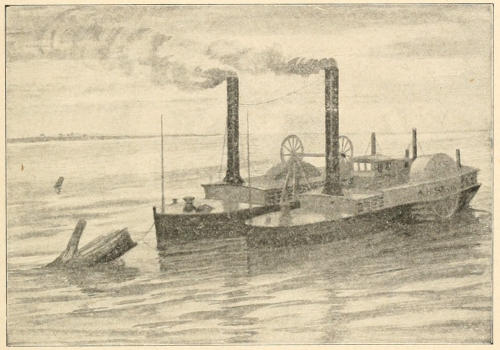
A SNAG BOAT ON THE MISSISSIPPI RIVER
The southern men withdrew from the cabinet, as they withdrew from the House and the Senate; southern men by the score left also the lower ranks of the civil service and went home to offer their services to the new Confederacy; southern officers withdrew from the army and the navy as their States seceded; the authorities of the newly federated States took possession, as they left the old Union, of the arsenals, forts, custom houses, and post offices within their territory. Before the authorities at Washington had made up their minds what to do every fortified place in the South was in the possession of the Confederacy except Fortress Monroe in Chesapeake Bay, Fort Sumter in Charleston harbor, Fort Pickens at Pensacola, and the fortifications near Key West. All familiar things seemed dissolving, and Mr. Buchanan scarcely knew what government he had to handle. Some of the men about him upon whom he was obliged to depend believed that the southern states had a right to do as they were doing; others denied their right but knew not how to check them; still others knew what ought to be done but had not the courage or the initiative to do it. All the country waited, the President himself included, to see what Mr. Lincoln and his Republican advisers would do.
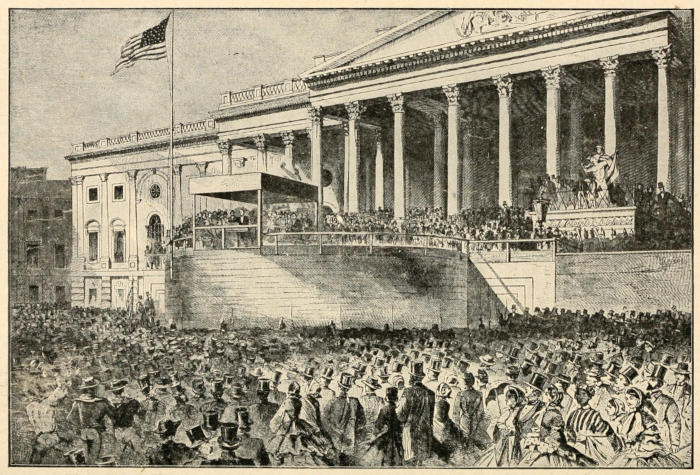
LINCOLN MAKING HIS FIRST INAUGURAL ADDRESS
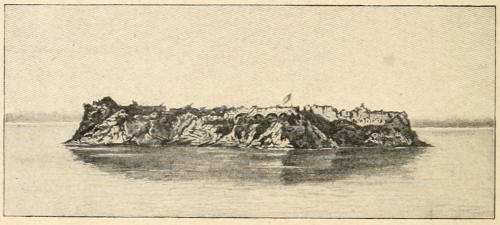
FORT SUMTER ON NOVEMBER 10, 1863
Men noted the sad and anxious eyes of the new President; noted also, with a certain deep misgiving, his gaunt and uncouth figure, as of a man too new, too raw, too awkward, too unschooled in affairs for the terrible responsibilities and tangled perplexities of the great office he undertook. They did not know the mastery of the man; they did not see that the straight fibre of this new timber was needed to bear the strain of affairs grown exigent beyond all common reckonings. There was the roughness of the frontier upon him. His plain clothes hung unthought of on his big, angular frame; he broke often, in the midst of weighty affairs of state, into broad and boisterous humor; he moved and did the things assigned him with a sort of careless heaviness, as if disinclined to action; and struck some fastidious men as hardly more than a shrewd, good natured rustic. But there had been a singular gift of insight in him from a lad. He had been bred in straitened, almost abject poverty; his shiftless father had moved from place to place in search of support and shelter for his growing family, and had nowhere got for them more than a bare subsistence; and yet this lad had made even that life yield him more than other boys got from a formal schooling. He matured as slowly as another; his life quietly kept pace with the simple folk who were his neighbors, no vital sign of his special gifts giving noticeable prophecy of what he was to be; but there came a power of mastery into his mind, nevertheless. He took pains to get to the heart of what others about him but half understood; he used his wits for argument and observation as another lad might have used them for play, and made the use of words, the exact speech which hit his meaning always at the centre, his method of analysis. And so his mind had filled as each item of his experience made its record, as each glimpse of the world came to him. He had made a career for himself in his State which culminated in his debate with Senator Douglas, to which all the country paused to listen; and he was ready to be President by the time he became President. He called both Mr. Seward and Mr. Chase, the hitherto accepted leaders of his party, into his cabinet, the one as Secretary of State, the other as Secretary of the Treasury; but he associated others with them who were of other views and of his own personal choosing; and he himself made his own choice of policy.
His breeding among plain people like himself, accustomed to respect law with simplicity and obey it without subtlety, gave him the direct vision which politicians lacked. He revered the constitution, had sworn to preserve and defend it, and would not “take an oath to get power and break the oath in using that power”; but he viewed his duty in the large, and declared it his conviction that it would be breaking that oath, and not keeping it, if, “to save slavery or any minor matter,” he should “permit the wreck of government, country, and constitution all together.” He sought to combine conciliation with this clear purpose to preserve the Union; but while those about him swung from this measure to that and were weak in their excitement, he was only patient and watchful, waiting for opinion and the right day of action.
The time came when, early in April, 1861, word was sent from Washington to the governor of South Carolina that Fort Sumter would be reinforced and provisioned against seizure. The message was sent on April 8th. On the 12th fire was opened upon the fort; on the 14th, ere reinforcements could reach them, its little garrison surrendered. On the 15th Mr. Lincoln called, by proclamation, for seventy-five thousand volunteers. Upon that signal, four more southern States seceded: Arkansas on the 6th of May, North Carolina on the 20th, Virginia on the 23d; and Tennessee on the 8th of June. Issue was made up, and all men knew what it meant,—not compromise, but war.
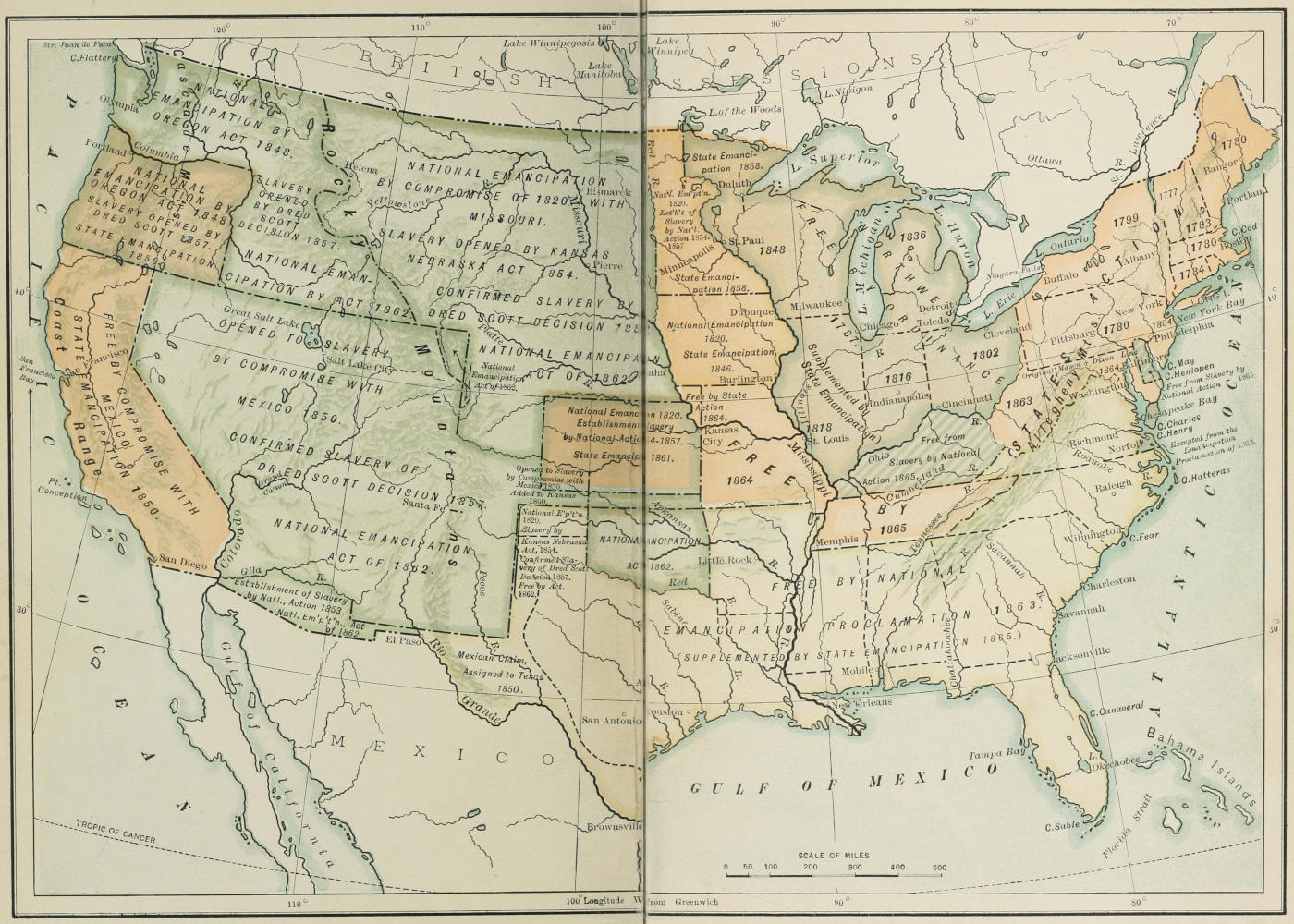
SLAVERY IN THE UNITED STATES, 1775-1865.
BORMAY & CO., N. Y.
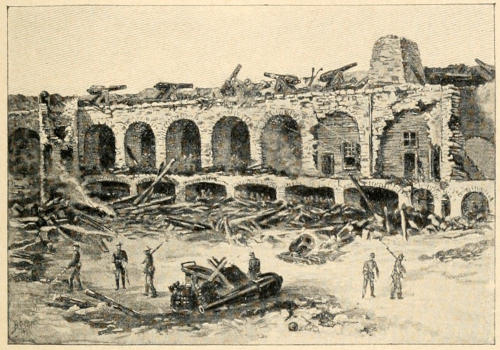
INTERIOR OF FORT SUMTER AFTER THE BOMBARDMENT, DECEMBER, 1863
The southern leaders had not at first expected this. They had thought to bring on a constitutional crisis, but not a civil war. They had meant at any hazard to make good their rights under the federal arrangement, and had deliberately resorted to secession because they thought that better terms could be made out of the Union than in it; but they had expected their opponents at the North to come to terms. Their people had followed and upheld them upon that expectation, and would not willingly have followed them on any other. But when the sound of the guns at Sumter was heard it became at once another matter. The thrill of a new purpose and passion shot through the country, north and south. It was with the one side as with the other. The southern people would not at the first choice have deliberately set themselves with open eyes to bring a war of revolution on; the people of the North, as conservative of law and of right as the men of the South, drew back, at the first shock and surprise of secession, from coercion or violence, questioned anxiously what they should do, and hesitated as their government did. Mr. Seward, of the President’s own household, made the amazing suggestion that the slavery question be ignored and the country drawn together to support some aggressive stroke of foreign policy, which should rekindle the national feeling and fill all sections alike with the old temper of patriotism, the South with the rest. It was the sound of war and the call for men that changed the very atmosphere, north and south alike, and set all thoughts in a new channel. Richmond was made the capital of the Confederacy, instead of Montgomery, as if to put the officers of its government at the front, the northern and southern capitals face to face. Mr. Davis called for volunteers in the South, as Mr. Lincoln did in the North; and the call was responded to eagerly and at once, in the one section as in the other. Even then men were slow to realize the awful business in hand; expected the fighting to be brief, accommodation or surrender to come at once. In the South men flocked to the rallying places and set out with their regiments in blithe spirits, as if for a holiday excursion, not knowing the grip of fate that had closed upon them. But a little while, and these hallucinations had passed away.
The war which ensued disclosed its real nature soon enough. For a year it lingered and was desultory, without plan, speed, or vigor, as if both sides waited, as indeed they did, to muster their resources, contrive a proper organization for the struggle, and discover each beyond a peradventure the temper and purpose of the other. But after that there was neither doubt nor pause in the desperate business, and all the world saw how the flames of civil war had enveloped a whole continent. It was a noteworthy thing how prompt and decisive the grapple of the sections was, for all there had been at first long months of doubt and hope, of confused preparation and all the slow processes by which conservative men adjust themselves to the exigencies of a revolutionary crisis. In the South there was a government to make, as well as an army; in the North a government to remake, a civil service to reconstitute. A year was needed to supply administrative means and make men and methods ready, on the one side as on the other. But a year sufficed.
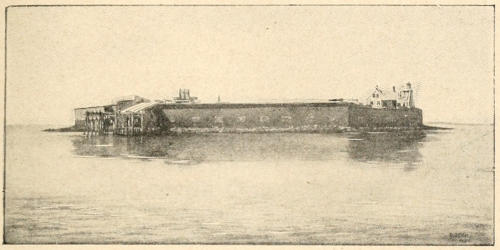
FORT SUMTER, AS REBUILT
Actual fighting, no less than strenuous efforts to be ready for it, had added its sharp definition to all else that the year disclosed. In July (1861) General McDowell had moved with the new federal levies from Washington southward, for a stroke at Richmond. At Bull Run, on the 21st, he had met the confederate forces under Generals Beauregard and Joseph E. Johnston, and after a stubborn and sanguinary battle had been thrown back in utter rout, his regiments not to be kept together because of the panic and confusion of their flight. But it had been a battle and nothing more. The troops on the one side as on the other were raw volunteers; both governments had hoped until the other day to see the conflict ended by a mere show of force or by some sudden stroke, and the confederate commanders were as little prepared to follow up an advantage as their opponents would have been. For a moment the South thought that this battle was all; the confederate troops themselves believed that it was, and incontinently set out in crowds for their homes, without leave taken. In fact it had only shown that there must be set campaigns and a war of conquest.
Down all the long border between North and South which followed the river Ohio to the Mississippi, the lines had been made clear, the while, which were to be the boundaries of the Confederacy, its outer lines of defence. The western counties of Virginia, beyond the long southwestern line of the Blue Ridge, sympathized, in this issue between slavery and the Union, with the men of the North, not with the men who had carried their State out of the Union, and federal troops, operating there out of Ohio under General McClellan, drove the detachments of confederate volunteers sent against them back over the mountains. In Kentucky also and Missouri slowly gathering armies out of the North pressed the frontier of secession in; and kept the great stream of the Ohio open beyond its junction with the Cumberland and the Tennessee, flowing southward, all the way to the Mississippi itself. Missouri, though at first it had seemed as if the other faction would control her, was held off from co-operation with the Confederacy by the sentiment of her own people. Kentucky, too, slave State though she was from of old, refused to cast in her lot with the seceding States about her; and confederate forces, though they operated for a little while within her territory and found many sympathizers and partisans there, and many men willing to swell their ranks, operated almost as if upon alien ground and kept their lines at constant hazard. These, then, it presently appeared, were the long extended frontiers, from the Potomac, upon which the national capital lay, through the far Cumberland Gap to the Mississippi at Columbus in Kentucky, from which the northern armies, growing in strength with every month, must strike in at the defences of the South.
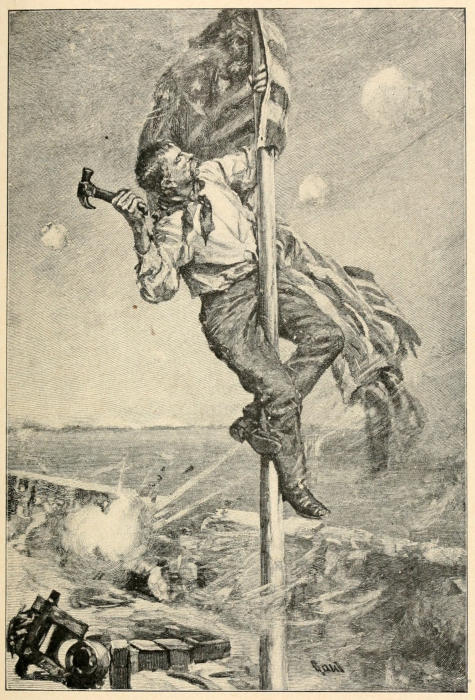
SERGEANT HART NAILING THE COLORS TO THE FLAG-STAFF, FORT SUMTER
Mr. Lincoln called Congress to assemble in extra session on July 4, 1861; and it addressed itself very heartily to the task of supplying the government with means of mastery. It voted the moneys asked for by the Executive, and the loan necessary to supply them; authorized the President to call for five hundred thousand volunteers; declared a blockade of the southern ports; gave explicit statutory definition to conspiracy against the government; and provided for the confiscation of all property used against it. In the regular session which presently followed, in December, it set out at once, in systematic wise, upon the policy of aid and taxation by which it meant at one and the same time to increase the resources of the country and put them at the service of the government. By midsummer, 1862, its programme was complete and enacted into law. Tariff duties were increased at every point at which domestic producers could be protected against foreign competition, and direct taxes were laid upon the products thus favored: specific taxes on iron, steel, paper, coal oil, leather, and a few other manufactures put upon a special list, and on other manufactures a general tax ad valorem. A liberal charter was given for a Union Pacific Railway which was to bind the two coasts of the continent together and give an eastern outlet to the produce of the West, and with it were given immense grants of public land along its route in aid of its construction. “Homestead” plots of the public land were offered at a nominal price to heads of families who would settle upon them in the West; and large sections of the public domain were voted to the western States in aid of the establishment of agricultural colleges,—in order that the spread of population and of productive industry might be more than ever quickened and the accumulation of wealth forced on apace; while at the same time a general income tax was established, railway, steamboat, and express companies were required to pay to the government a percentage of their gross receipts, and various occupations were closed except to those who would take out federal licenses. It was a policy of nurse and use which could not fail to yield the sinews of war. It meant that the resources of the North were to be added to and diversified at the very time they were being spent.
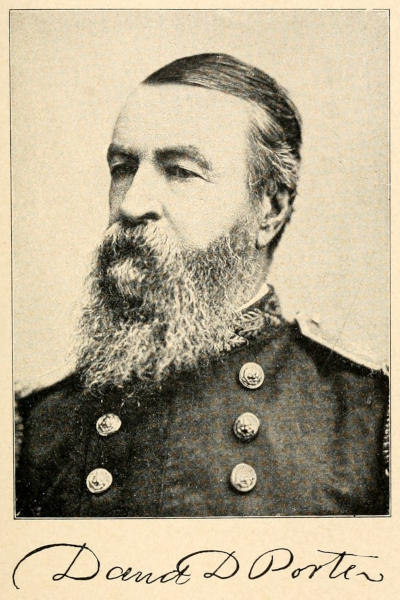
DAVID DIXON PORTER
It had already become evident that the federal government must look for no sympathy from abroad in its effort to prevent secession. The sympathy of foreign governments, it was plain, if the events of the first year of the anxious business were to be read as evidence, was with the South, not with the North. It was likely they would observe very complacently any process of war or disintegration which promised to break the power of the huge republic growing up in the west, ere its rivalry in trade and influence should menace them. The blockade of the southern ports was, moreover, a direct blow at a lucrative trade in which more than one of them was interested. Immediately upon receiving news of Mr. Lincoln’s proclamation of the blockade and of Mr. Davis’s answering offer to grant letters of marque and reprisal against the commerce of the United States both France and England had issued proclamations of neutrality which gave to the confederate government international standing as a belligerent; and before the year was out an ugly incident seemed for a moment to threaten war with England.
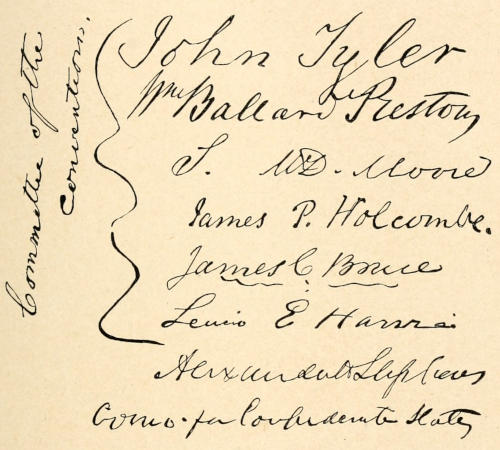
SIGNATURES OF THE COMMISSIONERS OF VIRGINIA AND THE SOUTHERN CONFEDERACY
The most influential classes in England were known to sympathize with the South; hundreds of English factories must stand idle and thousands of workingmen be brought to the verge of starvation, if the South, the great cotton field of the world, was to be shut against commerce; and the southern leaders were prompt to seek England’s active countenance. They sent commissioners over sea both to England and to France, to ask recognition: to England Mr. James M. Mason, of Virginia, a grandson of George Mason, the statesman of the Revolution; to France Mr. John Slidell, of Louisiana. Leaving Charleston for the West Indies, they took passage at Havana on the English steamer Trent for England. On the 8th of November the steamer was overhauled in the Bahama channel by a United States man-of-war, and the commissioners were taken from her and carried prisoners to Fort Warren, in Boston harbor. It was a gross breach of international law, and of principles which the United States government had itself always been forward to insist upon; and England made instant protest, significantly accompanied by preparations for war. The act was disavowed and the prisoners released so soon as the matter was looked into. Mr. Lincoln had no mind to take any false step or cast any doubt on the principles of his government at such a juncture. But the unpleasant feelings provoked by the unfortunate affair were not so easily put by. War between the two nations had come close enough to give both a very disturbing glimpse of possible fatal antagonisms.
The spring of 1862 saw armies upon all the long borders of the Confederacy and fleets upon the coasts and on the western rivers. The area of the war was defined. Before the end of the year its whole scope and character were determined. In the West stroke after stroke of the federal arms forced the confederate lines southward. The accumulating northern armies and flotillas broke their way down the valleys of the western rivers like an irresistible, crushing weight. In the East, on the contrary, all things hung doubtful. The federal commanders there had not the gifts of the men in the West and fought against antagonists who outplayed them at every move. They found no way to concentrate their force upon the southern armies; were puzzled how to take the best way of attack and yet keep Washington covered; and Richmond seemed more inaccessible than the heart of Alabama.
Men who had the character and the capacity to succeed in the field made their way one by one to federal command in the West at the very outset: conspicuous among them Ulysses Grant, a quiet soldier whose qualities only a day of action could bring out. He had won a first lieutenancy at twenty-five in the Mexican war; but few except his immediate superiors had noticed how his capacity had shown itself upon occasion in that fighting. He came of plain stock in which there was small impulse of achievement; his faculties fell dull in all ordinary seasons; there was a rustic simplicity about him which made him pass unnoticed among strangers, a lack of self-assertion which rendered him disinclined to quarrel with obscurity. He had withdrawn from the army at thirty-two because the empty routine of a soldier’s life worked a deep demoralization upon his easy-going nature when no action of consequence was in hand; but at the outbreak of the war he had enlisted again, as a volunteer, and had been given command of southeastern Missouri with the rank of general of brigade in the volunteer service.
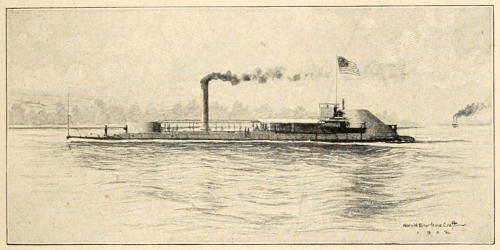
THE OSAGE, TYPE OF IRON-CLAD USED ON THE MISSISSIPPI RIVER
Then it was that the qualities which had slept in him, save for a few glimpses of the day amidst the fighting in Mexico, began to be shaken wide awake by what was to be done, and the responsibility which lay upon him to do it. It was he who, in the early autumn of 1861 (September 4th and September 6th), occupied Cairo and Paducah, the keys to the rivers at his front. The one lay at the junction of the Ohio and the Mississippi, the other at the junction of the Ohio and the Tennessee. From Cairo the Mississippi flowed down to the Gulf through the very heart of the Confederacy; at Paducah the Tennessee found its outlet, coming all the long way round about Tennessee out of the northern counties of Alabama; and near at hand, scarcely ten miles away, came down the Cumberland from its six hundred mile journey through Kentucky and northern Tennessee.
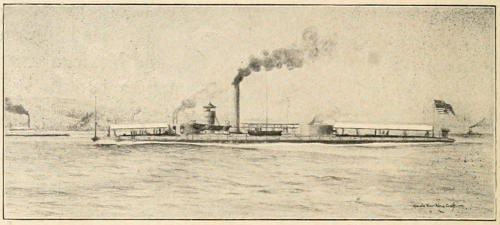
THE CHICKASAW, TYPE OF IRON-CLAD USED ON THE MISSISSIPPI RIVER
In February, 1862, the movement of the federal troops southward began, up the valleys of the rivers, under General Pope, General Buell, General Thomas, and General Grant, supported at each advance by gunboats on the rivers, and by midsummer a great wedge of armed men and boats had been driven into the confederate territory. General Grant, supported by a fleet of gunboats under Commodore Foote, moved up the Tennessee River and took Fort Henry on February 6th; and on the 16th crossed to the Cumberland and took Fort Donelson. Following his movement, a force under General Pope, similarly supported by an armed flotilla, with infinite difficulty cleared the Mississippi of the confederate blockades at New Madrid and Island Number Ten, lying like outposts at the northern boundary lines of Arkansas and Tennessee.