Chapter III · THE EXTENSION OF SLAVERY
Reading edition
It remained to be seen whether the forces bred in the Jacksonian time were also spent and gone, with the passing from office of the men who had personified them. It was difficult to reason upon cause and effect amidst such scenes of change. Unquestionably a veritable revolution had been wrought in American politics and social action while Jackson and his partisans ruled in affairs; but who could say whether these men had been products or causes of that revolution? No doubt there had been an air of lawlessness in the headstrong action of the uncompromising, frontier soldier who had been President. The fruit of his rough handling had shown itself obviously enough during the mild reign of his lieutenant and successor. And the country had seemed to take its cue from General Jackson. Riot and brawling disorder had everywhere been thrust into affairs with unexampled boldness, success, immunity from punishment. Headstrong men sought everywhere to take the law into their own hands and do what seemed best in their own eyes,—used force to win strikes against their employers, to carry elections, to silence abolitionist agitators and drive free negroes out of the cities, to destroy the power of the Roman Catholics coming in at the ports, to punish offences which the courts too slowly dealt with or let go by, to get food when prices rose too high. Men fought in armed bands in city streets because they were of opposite religious creeds or rival political factions or antagonistic races, the native against the immigrant, the Protestant against the Roman Catholic. On a memorable night in August, 1834, an Ursuline convent in Charlestown, within sight of the rising shaft on Bunker Hill which was to mark the dawn of liberty in America, had been sacked and put to the torch, because of the rage of a Protestant mob against the growing power of the Romish church, coming in with the Irish immigrants; and the officers of the town had stood inactive by.
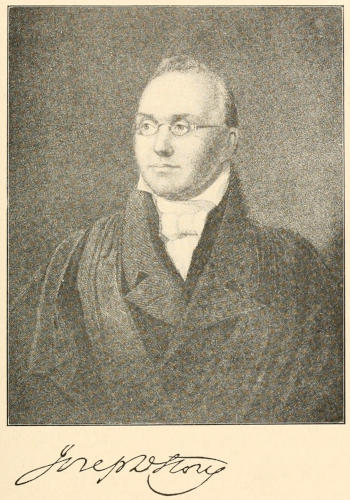
JOSEPH STORY
No man could justly say that General Jackson stood for such things. He kept the law, as he understood it, very punctiliously and with a fine sense of honor, and made others keep it also. His challenge was only to those who opposed him in matters of policy or in the application of law, or sought to put upon him the too formal restraints of judicial decision. Those who judged calmly of affairs saw alike in him and in the uneasy disorders of the time only signs of one and the same thing. In the new democracy which Jackson represented the mass of common men took leave to assert themselves in all things, and use their own standards of right; brushed law aside upon occasion to get at their object; sought to rectify abuses by direct blows of force,—the force of voting numbers or the force of arms. No doubt riots grew more common in Jackson’s second term than they had been in his first, and seemed to keep pace with his fight against the Bank, his arbitrary use of authority in reaching his ends concerning it, his ruthless dealings with the credit of the country. No doubt, too, his friends and partisans spoke too foolishly and too much like demagogues of “the natural hatred of the poor to the rich.” But great economic forces moved also with equal pace towards change and disturbance. The relations of capital and labor were altered, whether General Jackson acted or not; prices rose and wages shifted by laws he did not understand. Railways changed the course and the speed of the nation’s life; enterprise set men’s minds upon every bold adventure; men of every kind flung conservatism off and became radical, reckless, ungoverned in action. Cause and effect were not in such a day to be easily distinguished. No one could say what was permanent, what merely temporary and accidental in the new and novel order. One thing only was evident, that a new and irregular fervor and a new standard of action had been brought into affairs.
The Whigs themselves had conformed. They had come into power in masquerade. Instead of putting one of their real leaders forward for the presidency, they had nominated a western soldier, whose rugged strength and simple claim upon the admiration of the country had made him a popular favorite. They had themselves played the rôle of a reforming Opposition merely, whose mission it was to turn a company of sophisticated politicians out of office, with all their corrupt and incapable following, and put a simple man of the people in,—a Whig Jackson. Their campaign had been conducted without serious debate or proposals of policy; had been a mere noisy round of torch-light processions, merry-making barbecues, and boisterous neighborhood rallies. Their emblem had been the frontier log cabin and a keg of hard cider, the solacing drink of the frontiersman. It was a masquerade of pure democracy, in the new taste, and they had played it out to perfection.
But when the election was over and they had won, the costumes of the play were put by. At last they were assured of majorities in both houses of Congress; small majorities, indeed,—in the House, twenty-five, in the Senate, six,—an uncomfortable reminder of the narrow margin of votes by which they had won; but a working majority, none the less; and the real leaders of the party, once more free to speak their serious purposes, came forward with the programme by which they meant to carry the government back to the traditions which the Democrats had ruthlessly broken.
That programme included the repeal of the Independent Treasury Act, the establishment of a new national bank, the authorization of an immediate loan for the relief of the Treasury, a system of new tariff duties to supply the government with a permanent revenue, and the distribution among the States of the proceeds of the sales of the public lands. The financial distress of the time had touched the government somewhat sharply, and General Harrison’s first act was to summon Congress to meet in extraordinary session on the last day of May, to consider measures of relief.
But before it could assemble he was dead, and every plan at which he was to have assisted had fallen into confusion. The excitement and the fatigues of the campaign for the presidency, capped by the infinite worry and exhaustion that came upon him like a flood when hordes of office seekers and advisers began to crowd about him after his election and induction into office, proved too much for his strength at sixty-eight. He suddenly sickened, and exactly one month after his inauguration (April 4, 1841) was dead.
John Tyler was President, to whom no Whig had looked for leadership. He was a southern Democrat; had been opposed to the Bank upon principles of public policy, as General Jackson had been, but had held off from his leader in the matter of the deposits and had disapproved his reckless blows at credit, no less than his masterful attitude towards Mr. Calhoun and the doctrines held in South Carolina; and had been named Vice President with General Harrison only because Whigs of Mr. Clay’s stamp knew that they had in their following many men who were not in all matters of their way of thinking, and were uneasily aware that their party was but a conglomerate party of opposition, to which the votes of such discontented or independent southern Democrats as Mr. Tyler would be very serviceable. And so the masquerade of the campaign had had a touch of prophecy in it, after all: here were the triumphant Whigs with a Democratic President!
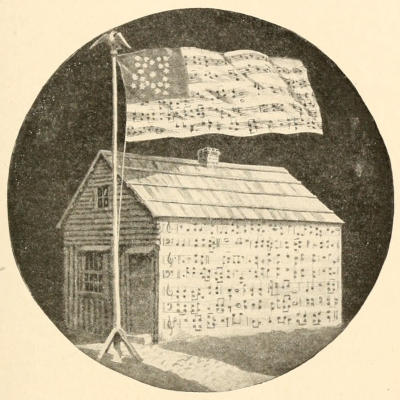
CAMPAIGN SYMBOL OF 1840
Their programme, of course, hopelessly miscarried. Mr. Tyler felt very keenly the delicacy of his position, and the almost necessarily compromising character of the middle course he felt bound to attempt. Nature and habit forbade him the frank, straightforward, unhesitating course which alone could have won him prestige and credit. He had neither initiative nor audacity enough for leadership; tried soft-spoken diplomacy where he should have used candid avowals of his real opinion; courted compromise and accommodation only to reject them at last; insisted upon his own views only after he had created the impression that he would yield them; seemed false and insincere because he parleyed so long before taking his stand; and pleased no one, not even himself. He had been glad to see the Bank’s charter expire in 1836, and did not wish to see the Bank re-established now; but the Whig leaders were his advisers; he felt and showed a real desire to yield everything he could that stood in the way of their plans. Conference followed conference in the matter of the Bank, for upon that everything hinged; twice he seemed about to meet their wishes; twice he failed them. A bill was drawn and passed in which several features of the old charter were modified to suit his views, but he vetoed it (August 16, 1842). Another bill was drawn and passed which made concessions still more radical to his scruples, but again he vetoed it (September 9th). Each time he hesitated; each time his friends said that he would sign the bill; each time he fell back at the moment of final action, as was his wont, upon his real convictions.
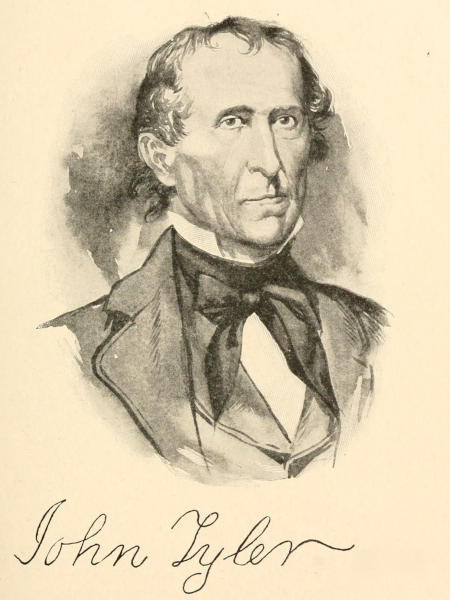
JOHN TYLER
The Whigs in Congress were inexpressibly chagrined and exasperated; publicly declared, with an unmistakable note of passion, that “all political connection between them and John Tyler was at an end from that day forth”; and sullenly saved such remnants of their programme as they could. Even before the open breach came the leaders of the party had drawn away from him, and he had been cut off from all real intimacy of counsel with the men whom Congress heeded. General Harrison had associated with himself a cabinet made up of men who were known to be accredited spokesmen of the party, making Mr. Webster, whom half the country regarded as the greatest of Whigs, his Secretary of State; and Mr. Tyler, sincerely desirous of making as slight a break as possible in the continuity of the party’s policy, had asked these gentlemen to retain their places. But even before his final veto of the Bank bill they had found it impossible to regard themselves as really in his confidence. By the middle of September, 1841, all of them had withdrawn except Mr. Webster, who remained only until important negotiations with England touching the northeastern boundary should have been brought to a successful issue. The Whigs had in effect withdrawn their hands from the Executive. Not only was the President’s leadership gone, but the best traditions the Whig leaders stood for, of a policy which joined Congress and the Executive under a common leadership, were broken, and affairs were set adrift to take the chance currents of politics.
The President signed the bill for the repeal of the Independent Treasury Act, consented to the necessary loan and to the changes in the tariff which had been planned, and agreed to the distribution among the States of the moneys received from sales of the public lands. But, without the bank, these measures lacked all constructive efficiency. The Independent Treasury arrangements having been set aside, and no other fiscal agency having been provided or authorized, the way in which the revenues should be kept and handled was left entirely to the discretion of the Treasury, without guidance or restraint of law, throughout all the rest of Mr. Tyler’s administration.
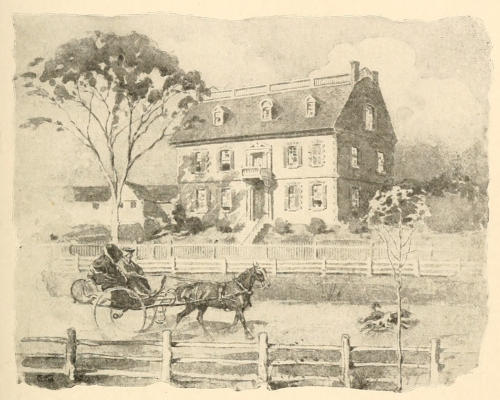
THE HANCOCK HOUSE, BOSTON. FROM A SKETCH MADE IN 1833
The Whig tariff Act was passed at the regular session of 1841-1842. It incontinently upset the compromise arrangements of 1833. The Act of 1833 had provided for a progressive reduction in the rates of duty which should be complete by the first of July, 1842, when the rates should have reached a uniform level of twenty per cent. The Whigs suffered them to stay at that level only two months. On and after the first of September following, it was enacted, the rates were to be increased again, for the sake of the revenue. Twice the President vetoed the bill, because of provisions contained in it of which he did not approve. It was passed a third time, without the provisions he objected to, and he signed it.
From the outset, so soon as the democratic masquerade with which they had come in was over, opinion had run against the Whigs. So early as the autumn of 1841 local elections had begun to go against them in States which they had but just now carried for General Harrison; and the mid-term elections of 1842 swept away their majority in the House of Representatives. It had been but twenty-five; it was supplanted now by a Democratic majority of sixty-one,—a loss of forty-three seats. The Senate they still held by a narrow margin; but, without the House, they could do nothing of consequence. Their dream of reconstructing the old régime from which the Democrats had torn the country away was rudely dissipated.
The Whig leaders were now to find out what changes of politics had come to stay. They had not perceived that what they had witnessed under General Jackson was not a temporary madness of reaction against the statesmanship and the ideals of the generation which had given the nation its first form and policy, but a permanent shifting of points of view, for men in office and out, a turning away once and for all from the old to new questions that went with the making of the nation. Whether they would or no, they were in the hands of the new democracy, their fortunes as a party committed to the swift changes of the passing time. Important as the matters were with which they dealt, their programme had been a programme of old questions, not of new. Change worked too swiftly now to make it any longer possible for any party, however led or constituted, to hark back to the policy of a time twelve years gone by. There had been transient humors, no doubt, as well as permanent alterations of fortune, in Jackson’s day: things which came with the heady excitements of the time and sank away again as affairs steadied to the new order. But, though passions subsided and hasty errors fell away from men’s thoughts as the air cooled and cleared, all things kept their new face, and the reckonings of politics could no more be forced back to their old scale than the reckonings of trade or the operations of credit. It was made evident enough while Mr. Tyler sat out his unexpected presidency that the questions which cried for settlement were no longer questions of banking and currency, or even questions of tariff, but the fundamental institutional choices of mere growth: the questions which went inevitably with the setting up of every new State and the occupation of every new piece of territory.
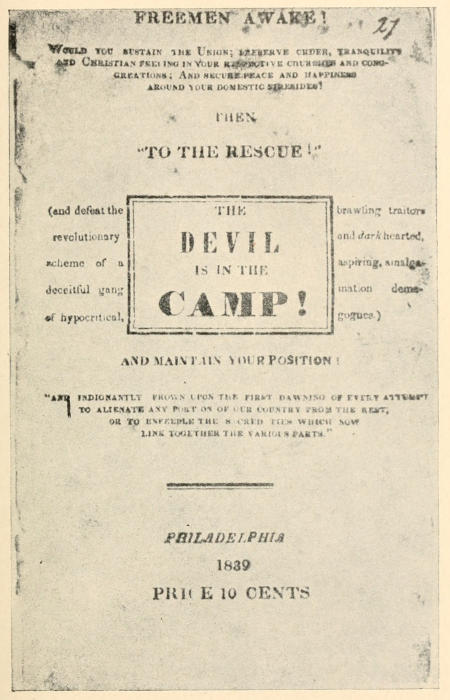
TITLE-PAGE OF ANTI-ABOLITION PAMPHLET
It was this making and remaking of the country that had upset the old order of politics and brought the untempered airs of the West into all forecasts of the political weather. Half the economic questions of that day of change took their magnitude and significance from the westward expansion. It was in the new regions of the country, with their undeveloped riches inflaming the imagination, that speculation ran its reckless course with the most incorrigible hardihood. Railways outran population and failed as investments because settlement spread rather than compacted. Statesmen had always to be studying some law of growth, checking or indulging some wild adventure of enterprise. And there was in the midst of all a fundamental choice which did not alter like the rest.
The chief choice always to be made at every stage of the unhalting westward movement was the choice concerning slavery: the choice which had been debated very temperately at first when the great Ordinance for the government of the Northwest Territory was adopted in the days of the Confederation, but which had struck many a spark of passion out when handled again at the admission of Missouri into the Union, and which seemed every time it was touched more dangerous and disturbing than before. Now it seemed to lie everywhere at the front of affairs,—not the question of the abolition of slavery, but the question of its territorial extension. The men who had formed the Anti-Slavery Society were frank abolitionists; demanded much more than the mere limitation of the area of slavery; set themselves to make sentiment for its absolute destruction. But their ranks were sparsely filled, and their agitations did little but offend a practical, law-abiding people. Every man who knew aught of affairs knew the tenor of the constitution in that matter. Slavery within the States which were already members of the Union was an institution with which the federal government could have nothing to do, which no opinion even could touch or alter save the opinion of the States concerned: a question of domestic law in respect of which the choice of each little commonwealth was sovereign and final. Had the full roster of the States been made up, agitators in Congress would have found themselves obliged to confine their attacks to the slave trade in the District of Columbia and the commerce in slaves between the States. But the full roster of the States was not made up: all the great Louisiana purchase remained to be filled with them; and with the making of every community there must come again this question of the freedom of labor or the extension of slavery. The fateful choice was always making and to be made.
The Whig leaders were profoundly disturbed to see it thrust forward in very practical shape, made a thing to be faced squarely and at once, by the President whom they had undesignedly put into office. In April, 1844, Mr. Tyler sent to the Senate a treaty of annexation which he had negotiated with Texas. Secret negotiations, a piece of business privately carried to completion and made public only when finished, suited well with the President’s temper and way of action. A man naturally secretive, naturally fond, not of concealments, but of quiet and subtile management, not insincere, but indirect in his ways of approach, he relished statecraft of this sort, and no doubt liked the Texan business all the better because it seemed to demand, in its very nature, a delicate and private handling. The Senate rejected the treaty by the very decisive vote of 16 to 35, men of both parties alike deeply irritated that the President should spring this weighty matter upon the country in such a fashion, taking no counsel beforehand save such as he chose to take. But the question, once put definitely forward, could not be thrust aside again. It was too vitally connected with the mastery of the continent, too plainly a thing which lay at the heart of western plans, to be put aside by vote of the Senate. It had come to be fought out as a party issue; and the Democrats were better prepared for it than the Whigs. They were at least capable of exercising choice. The Whig party was too curiously and too variously compounded to meet any new question without painful hesitation and deep embarrassment.
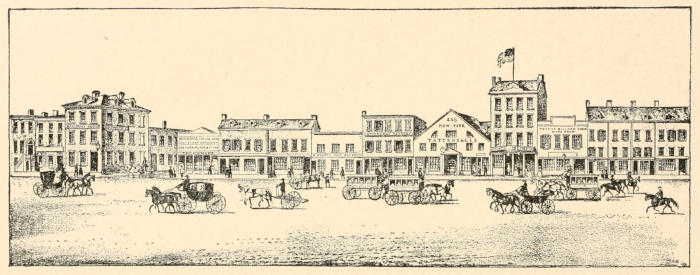
BROADWAY, EAST SIDE, BETWEEN GRAND AND HOWARD STREETS, NEW YORK, 1840
Texas had sprung up, a young empire at the southwest, within a decade. No doubt all the vast region which she claimed and dominated had in strict right been a part of the broad, vague “Louisiana” which Mr. Jefferson had purchased of France in 1803; but the United States had yielded their claim to it in 1819, in order to secure all of Florida in the treaty with Spain. Mr. Adams, then Secretary of State, New Englander though he was, had wished to insist upon setting the southwestern boundary of the United States forward to the Rio Grande del Norte; but Mr. Monroe, the President, southerner though he was, had thought it best, as the rest of his cabinet did,—Mr. Crawford, of Georgia, Mr. Calhoun, of South Carolina, and Mr. Wirt, of Virginia, among them,—that the East should not be so disquieted. “Having long known the repugnance with which the Eastern portion of the Union have seen its aggrandizement to the West and South,” wrote Mr. Monroe to General Jackson, “I have been decidedly of the opinion that we ought to be content with Florida for the present.” He had seen then that it was only “for the present”; and he had irritated the South and West more than he had pleased the East. By abandoning a full third of the Louisiana claim he had made the Missouri compromise of the next year (1820) no settlement at all, but merely a new point of departure in the struggle for the extension of slavery and the expansion of the South. In the drawing of that line of compromise the southern men had gained hardly so much as one-fourth of what had been conceded to the northern interest, and the balance of power between the sections remained still to be redressed.
Texas did not remain the property of Spain. While the treaty of 1819 lay unconfirmed at the dilatory court of Madrid, the people of Mexico broke away from their allegiance to the crown of Spain (1821) and established their independence, sweeping Texas within their dominion. In 1825 Mr. Adams offered Mexico a million dollars for the territory, but got nothing for his offer but the jealous distrust of the new government. General Jackson offered five millions for it, and only intensified the distrust. In 1827 the “State of Coahuila and Texas” became a member of the Mexican federal union.
At first, to get increase of strength in her struggle with Spain, Mexico had encouraged immigration out of the United States. At first her law permitted slavery. When she grew fearful of the too strong desire of the United States for Texas she shut her doors, so far as law and ordinance could shut them, against immigrants out of the East. To win favor with the negroes of Hayti against Spain, she abolished slavery. But immigrants were not to be gainsaid; that long border could neither be watched nor guarded. Slaves came with their masters, too, and Mexican laws had to be suspended for the benefit of the Americans, who would not heed them.
The masterful men who poured in across the long border came for the most part from the southern States. They found Mexican rule a thing sore to bear, arbitrary, inconstant, without principle, without stability of power. As their numbers increased, therefore, they made bold to take things into their own hands; framed a constitution for Texas which was to their own liking; and, when they could not obtain the sanction of the Mexican government for it, put it into operation without sanction (1833), making a revolution out of the right of local self-government. In 1836, the government of Mexico being overturned and Santa Anna, its President, made dictator in his own behoof, they seceded, and made good their independence in a battle (San Jacinto, April 21, 1836) which the usurper was not likely to forget. With bowie knives and clubbed rifles, a little army of seven hundred and forty-eight Texans, under the redoubtable Sam Houston, fell in true frontier fashion upon the sixteen hundred Mexicans Santa Anna had brought against them; left about six hundred of their enemies dead upon the field; gave themselves more than two hundred wounded Mexicans to take care of when the dreadful work was over; took seven hundred and thirty prisoners; and had the dictator himself to show for trophy. Of their own number but six were killed and twenty-five wounded. “I was thirty years too soon!” cried Aaron Burr, when the news was brought him in his solitude,—an aged man, ostracized, forgotten.
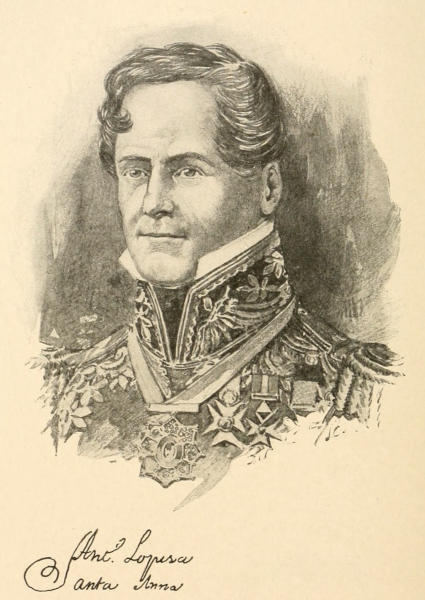
GENERAL SANTA ANNA
The European states which coveted her trade recognized the independence of Texas the next year (1837). General Jackson recognized it as promptly. He took counsel, after his masterful fashion, neither with Congress nor with any one except the friends of Texas herself. He was himself General Houston’s friend, and had no doubt what countenance the Executive of the United States should give the chief of the new state. Texas was her own mistress in her own empire.
But the men who had peopled her out of the South had not taken possession of her government to maintain themselves in independence. They had taken possession in order to bring the fair territory into the Union to which they conceived her properly to belong. Her broad expanses were the natural growing ground of the South. The political advantages the South would reap from the addition of Texas to the Union were palpable and obvious,—so palpable and obvious that politicians in the East deemed her virtual conquest by southern men a concerted scheme for southern aggrandizement. Only by the addition of territory and the creation of new states south of the line drawn by the Missouri compromise could the South hope to preserve that equality between the sections in the Senate upon which she instinctively felt her safety, the integrity and even the continuance of her chosen ways of life, to depend. The vast area of Texas, big enough for half a dozen states, would be a make-weight indeed, and was a stake worth playing for. It looked to the rest of the country as if the South had deliberately played for it, using lawless and ambitious men as pieces in the game. It was said that General Houston had gone from his home in Tennessee, a disappointed and discredited man, expressly “to kindle an internal insurrection” out of the inflammable material sent ahead of him, “and separate Texas from Mexico.” Like every frontier, the country teemed with men come for adventure, and not too squeamish of what sort it should be. Those who were suspicious felt sure they had come for a particular adventure planned beforehand,—that Texas had been garrisoned with conspirators to serve the ambition of the South. She had in fact come by her settlers out of the States like any other frontier. Her independence came as inevitably as the unpalatableness of Mexican authority to the temper of the new comers. The proposal to bring her into the Union came from men who had taken possession of her, not to secure independence, but only a new home where they should be as free as Americans within the border they had crossed. The matter had been broached to Mr. Van Buren; but he had read the signs of the times and had declined to have anything to do with it. Mr. Tyler took it up with a certain eagerness. A southerner himself, bred to the southern point of view, holding the constitutional doctrines of the South very absolutely and in a form almost as radical and unqualified as that in which Mr. Calhoun, now his Secretary of State, had uttered them, in defence of nullification, and minded to maintain the old balances of the federal system where he could, the annexation of Texas seemed to him a step which every statesman should wish to take.
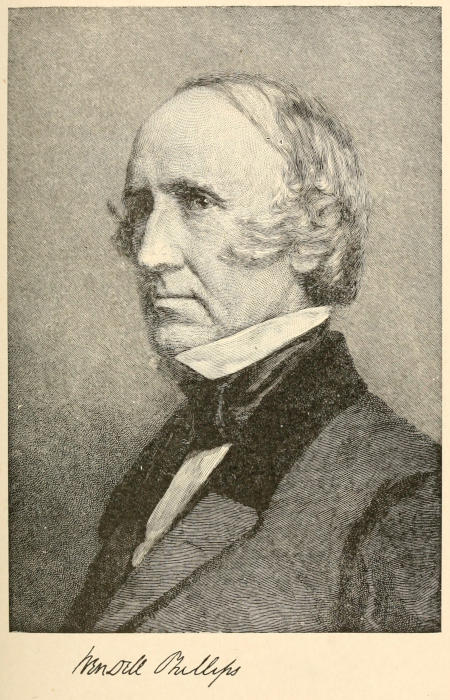
WENDELL PHILLIPS
Texas stood ready to accept a separate rôle should her overtures be rejected. Should the jealousy of warring parties exclude her from the Union, “a rival power will soon be built up,” said General Houston, “and the Pacific as well as the Atlantic will be component parts of Texas in thirty years.... All the powers which either envy or fear the United States would use all reasonable exertions to build us up as the only rival power that can exist on this continent.” The long coast of the Pacific above her was open to be occupied: she could look forward to having the Californias and New Mexico for the taking. “They must come,” her confident leader declared; “it is impossible to look on the map of North America and not perceive the rationale of the project.”
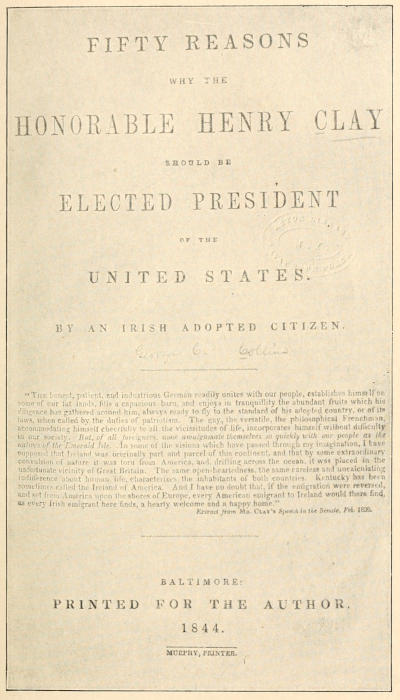
TITLE-PAGE OF A CAMPAIGN PAMPHLET
But she was not left to try the experiment. Though the treaty which he submitted to the Senate failed when it came to the vote, in June, 1844, Mr. Tyler had brought Texas in within less than a twelvemonth after its rejection. The summer of 1844 had brought together again the nominating conventions of the parties, to make ready for the next presidential election; and the Senate had waited to vote as the Whig convention should wish it to vote. The Whig convention had said nothing about the annexation of Texas in its declaration of principles, but it had put Mr. Clay in nomination for the presidency, and Mr. Clay, whom all the party knew to be its real leader, had decided against any immediate step towards annexation. The Democratic convention, more bold and candid than the Whig, declared very flatly for “the reoccupation of Oregon and the reannexation of Texas at the earliest practicable period” and made those critical matters distinct as the real issues of the campaign. Unable to agree upon any one of the recognized Democratic leaders for the presidential nomination, it named Mr. James K. Polk, of Tennessee, as the candidate of the party, a man long prominent in the Democratic ranks in the House of Representatives, and an avowed advocate of annexation. Mr. Clay shifted uncomfortably as the fight went forward; explained his position overmuch; sought to conciliate opinion on both sides; and lost support where he had seemed most likely to receive it. The abolitionists had brought a “Liberty” party into existence, and now put a candidate of their own into the field. They drew their strength more from the Whigs than from the Democrats, and their ranks were swelled more and more as Mr. Clay made doubting Whigs more and more uneasy. Their sixty thousand votes decided the election. Mr. Polk spoke but one purpose, showed himself a frank, unhesitating party man, held his followers to an open path, and, by narrow majorities, won in fifteen out of the twenty-six States.
It was when the campaign was over and the election decided that Mr. Tyler had the satisfaction of himself bringing Texas into the Union. The country had given its verdict; the houses, accepting the verdict, passed a joint resolution in favor of the admission of Texas; and the President signed the resolution on March 3, 1845, the day before Mr. Polk entered upon the succession.
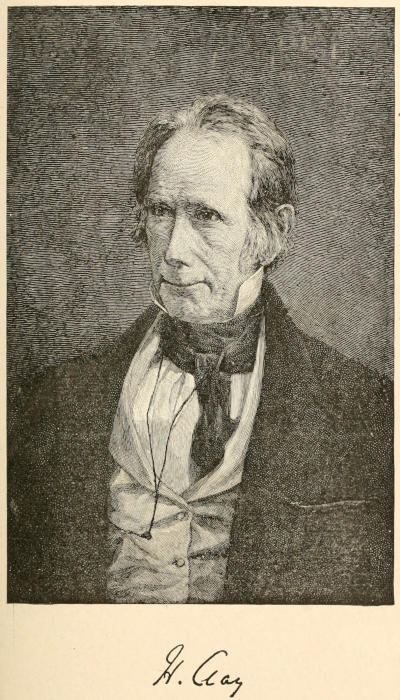
HENRY CLAY
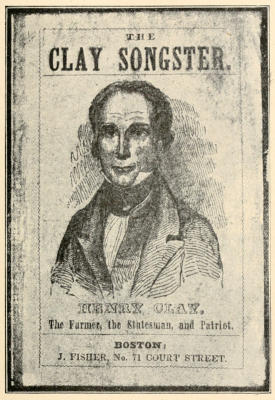
TITLE-PAGE OF “THE CLAY SONGSTER”
It remained for Mr. Polk to deal with the consequences. The programme of his party seemed to have saddled two wars upon him. Mexico would quite certainly contest the boundary claims of Texas at the south; and the Democratic programme coupled “the reoccupation of Oregon” with “the reannexation of Texas,”—a matter which very likely held at its heart a war with England. Russia had seemed the rival claimant most to be feared in the Oregon country in 1823, when Mr. Monroe, looking towards that quarter as well as towards the south, uttered his significant warning to the European powers against any aggression, whether in search of territory or of sovereignty, in the Americas; but Russia had agreed with England and the United States, in 1824 and 1825, to make no claim south of 54° 40′ north latitude; and England and the United States, waiving for the time their own rival pretensions, had maintained since that settlement an informal joint occupation of the country. Latitude 42° had been fixed, by the treaty of 1819 between the United States and Spain, as the northern limit of the Spanish possessions upon the Pacific. From the Lake of Woods to the doubtful Oregon country the northern boundary of the United States followed the forty-ninth parallel of north latitude.
All things might have stood as they were had that distant coast remained unused, unpeopled. But settlers and fur traders were moving there, as everywhere upon the tempting continent. English trading companies attempted to exercise exclusive rights there, the whole region through; set up their trading posts north and south upon the rivers; and kept American traders out. But not American settlers. Squatters came in, indifferent what title they held if only they had that of actual possession. Organized bands of settlers followed upon the heels of isolated squatters and single families, and little settlements began to be clustered here and there upon the rivers. The government at Washington refused to give them any grants for their lands, remembering its covenant of joint occupation with England; but the English could not exclude or oust them; and men and families who came to stay and make homes for themselves began presently to seem much more like actual owners of the disputed country than mere traders could or the agents of fur companies. Doubtful boundaries at the Pacific were fast becoming a distinct menace to peace. There were men in Congress, too, like Mr. Benton, who sought upon every opportunity to take the aggressive and force the government to a final settlement with Great Britain.
Disputes with England seemed to dog the steps of almost every Administration. It was but three years since Mr. Webster and Lord Ashburton had settled the difficult matter of the northern boundary of Maine by running a compromise line between Canadian and American territory upon the Atlantic. The air of politics, moreover, had never been quite still enough in America for dispassionate settlements by treaty. A veritable storm of outspoken opinion beat about every matter of controversy with foreign countries, if once it happened to catch the ear of the heady democracy which presidents and cabinets had it as their difficult task to lead. And that democracy was more confident, more wilful, more headstrong now, since General Jackson had shown it its way to supremacy, than it had ever been before. Presidents were no longer likely to attempt to withstand it as General Washington had withstood it in the day of its outcry against Mr. Jay’s treaty with England. Mr. Polk was a man of his party; the question of the occupation of Oregon had taken hold of the imagination and the passion of the country; the convention which had nominated him had demanded that nothing less than the whole of the disputed region be required of England, up to the very line of the Russian claim; the cry of the campaign had been “Fifty-four forty or fight.” England, on her part, pushed her claim southward to the Columbia River, where her fur traders had set a station up. Only the cooling processes of actual negotiation cleared the matter and brought safer counsels in. Mr. Buchanan, the new Secretary of State, was not of the fibre to insist in the face of emphatic refusal of what he demanded; the English government looked with evident uneasiness upon the state of opinion in the United States; a comparison of views brought concessions on each side; and in 1846 the Senate consented to a treaty which continued the line of the forty-ninth degree of north latitude to the Georgian Straits as the definitive northern boundary of the Union.
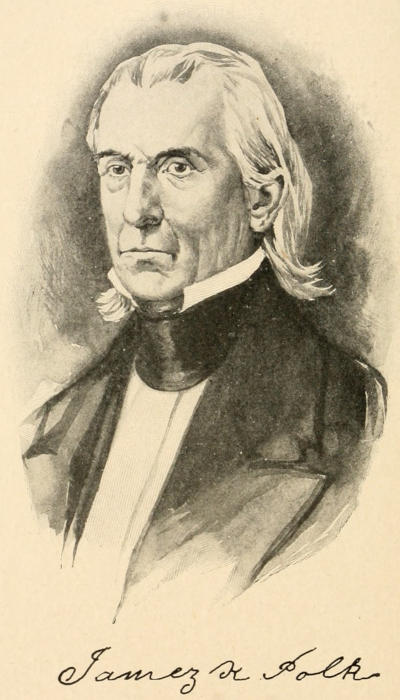
JAMES K. POLK
The Texan boundaries were another matter. Here the government dealt with a rival and neighbor with whom no compromise was necessary. Texas claimed, not only everything north and west of her that had been Spain’s or Mexico’s all the way to latitude 42°, but also so much of the territory of her one-time partner State, Coahuila, as lay between the Nueces and the Rio Grande del Norte at the south; and Mr. Polk espoused and acted upon her claims at the south even before her formal admission into the Union was complete. He ordered General Zachary Taylor to occupy the western bank of the Nueces with a small force of United States troops, and during the summer of 1845 sent him reinforcements which raised his strength to nearly four thousand men. In December, 1845, Texas became in full form a State of the Union; and early in the following year the President ordered General Taylor to advance to the Rio Grande. His presence there threatened the Mexican town of Matamoros, just beyond the river, and the Mexican commander at Matamoros demanded his withdrawal to the Nueces. General Taylor refused to withdraw. The Mexicans crossed the river, and on April 23d ambushed a small body of American dragoons. Two weeks later they attacked General Taylor in force and he repulsed them (Palo Alto, May 8, 1846). The next day Taylor in his turn attacked, and drove the Mexicans back across the river in disastrous rout. On the 18th General Taylor himself passed the Rio Grande and occupied Matamoros.
“Mexico,” the President told Congress on the 11th of May, while yet he had had no news except that of the ambush of the 23d of April, “Mexico has passed the boundaries of the United States ... and shed American blood upon American soil. War exists, and exists by the act of Mexico herself.” He had not consulted Congress before he ordered General Taylor forward to the Rio Grande and brought this momentous matter to a head, though it had been in session when the order was issued. He had taken full responsibility for that upon himself. War indeed existed,—but by whose act Congress was no longer at liberty to inquire. There was nothing for it but to vote supplies and an army; and a formal declaration of war was resolved upon May 13, 1846, before news of the real fighting on the Rio Grande had reached the capital.
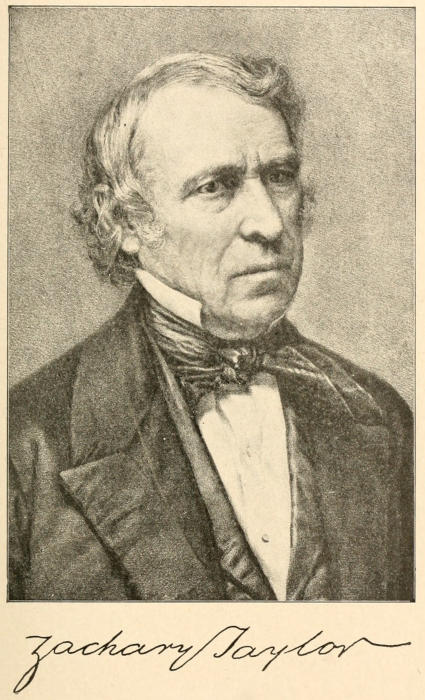
ZACHARY TAYLOR
Until autumn all things stood as they were between the belligerents while an army was made ready; but late in August General Taylor moved again, and within a month, by severe and dogged fighting (September 21-23), took the strongly fortified town of Monterey, a full hundred and seventy miles to the west of Matamoros on the highway to the Mexican capital. In November General Winfield Scott, the ranking officer of the federal service, was given chief command, and in January, 1847, General Taylor’s force was reduced to a scant five thousand to recruit the immediate command of his superior, sent by sea to attack Vera Cruz. On the 22d and 23d of February Santa Anna attacked him, with four times his numbers, where he lay at defence on the broken plain of Buena Vista, thinking to crush him while he was weak; and was repulsed. The Americans were no longer raw militia, men and officers alike, as they had been in the extemporized armies of 1812. Though they were for the more part volunteers, their officers were professionals, and they were drilled and handled with a skill and thoroughness that made veterans of them with a single battle.
Their steadiness and prowess were put to full test with General Scott in the south. There they had not only to take Vera Cruz by set siege (March 9-29, 1847) in order to make good their landing, but had also to scale the huge escarpments of the vast table-land upon which the Mexican capital lay, two hundred miles away, more than seven thousand feet above the sea, and to make their way across the broken, hilly plains beyond, fighting everywhere as they went against an enemy who outnumbered them and was secure against surprise within safe inner lines of communication. And yet from the carrying of the pass at Cerro Gordo (April 18, 1847) to the storming of the high fortress of Chapultepec (September 13th) there was no pause or miscarriage in the steady process of their victories. The city of Mexico lay amidst guarding fortresses and was set about by morasses crossed only by narrow causeways. But the Americans moved everywhere with the businesslike certainty and precision of men well handled, and their volunteer ranks seemed less in need of officers than other armies did. Individual pluck and dash and resourceful daring showed, irresistible, in all that they did. They fought men as brave as themselves, a subtile, spirited race, tenacious to the last of all that it could hold; they fought, also, against odds and moved everywhere against fortified places; but they won undaunted at every onset. By the 15th of September they were in complete and formal possession of the enemy’s capital and Mexico was in their hands, within but a little more than six months of their landing.
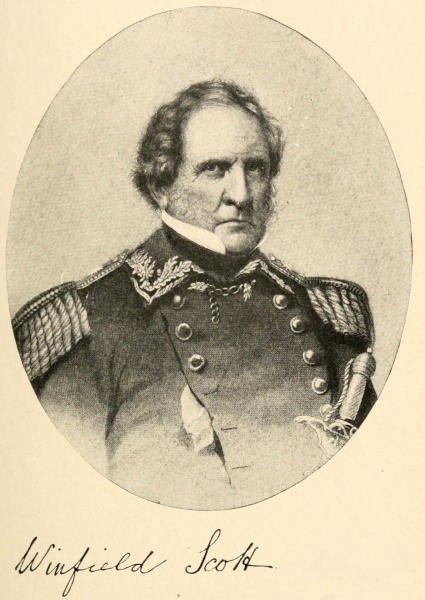
WINFIELD SCOTT
Meanwhile the government at Washington had broadened the scope and meaning of the war beyond all expectation. During the summer of 1846 and the winter of 1846-1847 it had seized, not merely the disputed territory which Texas claimed, but also the whole country of the Pacific slope beyond, from Oregon to the Gila River, to which the United States could have no conceivable right except that of conquest. The thing was easily accomplished. A fleet under Commodores Sloat and Stockton and a few troops acting here and there under Colonel Kearney and Captain Frémont moved almost as they pleased; and a territory of six hundred thousand square miles was added to the United States.
The war, with all its inexcusable aggression and fine fighting, was brought to its formal close by a treaty, signed at Guadeloupe Hidalgo on the 2d of February, 1848, by which Mexico recognized the Rio Grande as the southwestern boundary line of Texas and ceded New Mexico and California, of which the United States had taken possession by force of arms. For this territory, seized and ceded, the United States agreed to pay Mexico fifteen million dollars.
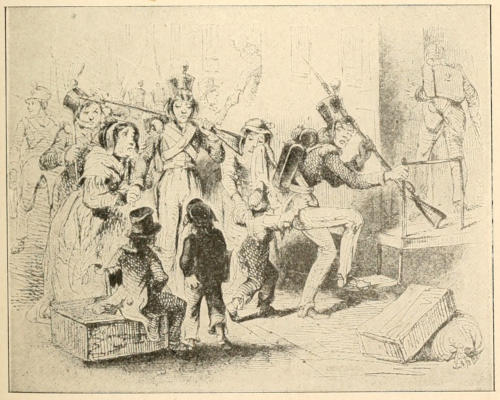
THE DEPARTURE OF THE PHILADELPHIA VOLUNTEERS FROM PHILADELPHIA
From a humorous drawing by F. O. C. Darley.
It had been evident from the first what the outcome of the war must be. When, in August, 1846, Congress had had under consideration an additional money vote of two millions, “for the settlement of the boundary question with Mexico,” there had been no doubt in the mind of any candid or well informed man that the money was really to be spent for the acquisition of territory as opportunity offered. Members of Congress very well knew what question that opened again. Mr. David Wilmot, a Democratic member of the House from Pennsylvania, therefore, promptly offered as an amendment to the vote the proviso that neither slavery nor involuntary servitude should be permitted in any territory that might be acquired from Mexico. The amendment passed the House with the money vote, but miscarried in the Senate, with the money vote itself, because it provoked debate and there was not time enough at the fag-end of a session to push it past debate to its passage. It was necessary that the matter of the proviso should be settled. The Missouri compromise line ran only to the western boundary of the Louisiana purchase; the war brought accessions of territory as extensive, almost, as Louisiana itself; the question of the extension of slavery once more awaited debate and settlement. Here were vast provinces greater than the entire area of the original Union. Was slavery to be carried into them, and were slave States to be erected along the mountains and by the Pacific which should preserve the political balance of North and South in the Senate? The “Wilmot proviso” must be adopted or rejected; its question could not be put out of sight.
While the war lasted and the troublesome questions it bred were yet in abeyance, the Democrats made good the programme of domestic administration they had set themselves. By the elections of 1844 both houses of Congress had become Democratic, and party measures could be carried. In July, 1846, therefore, a new tariff Act was passed which brought protective duties down almost to a strict revenue basis, and considerably enlarged the free list. In August an Act was passed which once more established the Independent Treasury, substantially as Mr. Van Buren had planned it. The expenses of the war were met, so far as the revenues fell short, by large issues of interest-bearing treasury notes. The Democratic leaders were steadfast in their determination neither to use the banks nor to increase the tariff in order to assist the Treasury.
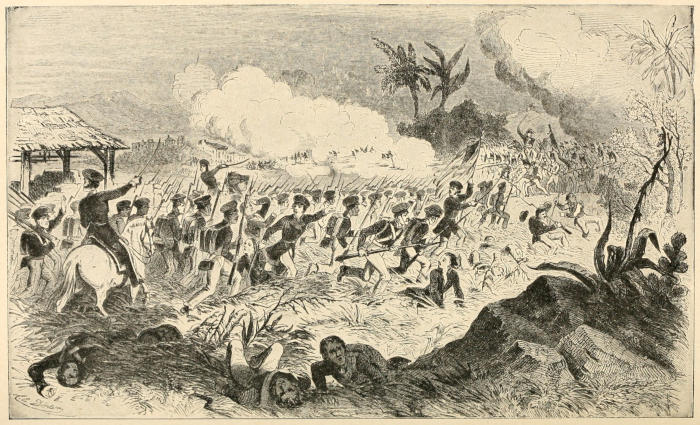
CHARGE OF THE “PALMETTOS” AT CHURUBUSCO
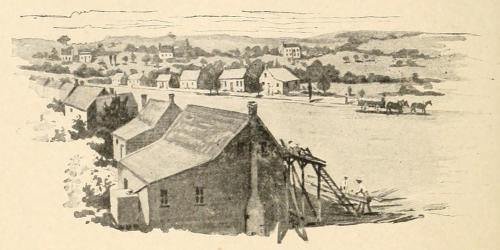
MAIN STREET IN AUSTIN, TEXAS, ABOUT 1845
But their power came to an end with the first Congress of Mr. Polk’s administration. The congressional elections of the autumn of 1846 transformed the majority in the House from Democratic to Whig again. The Senate, more slow to change, remained Democratic. With the houses no longer agreed, party plans fell into confusion. Congress was once more disturbed by questions which lay deeper than politics and cut both parties athwart with the lines of faction. The question of slavery had returned again to plague it. The Democratic Senate wished to pass an appropriation bill “for the settlement of the boundary question” in which nothing should be said about the extension of slavery; the Whigs of the House insisted upon Mr. Wilmot’s proviso. Oregon was drawn into the controversy. The Senate would agree to no bill organizing Oregon as a Territory which excluded slavery; the House would adopt no measure which did not exclude it. The treaty of peace and cession found the houses still unagreed. Not until August, 1848, could they agree even upon the organization of Oregon. Then the Senate yielded and the Territory was organized under a law which extended to her area the prohibitions of the Ordinance of 1787. But in the matter of California and New Mexico the dead-lock was unbroken. All measures failed, and the new territories were left with no law but such as they had got from Mexico.
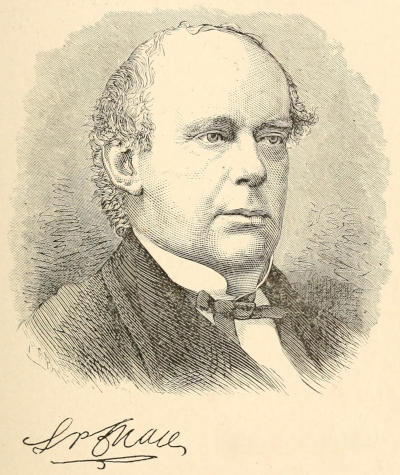
SALMON PORTLAND CHASE
Democratic politicians, indeed, put forward a political doctrine in the matter which, if accepted, would make it unnecessary for Congress to act at all upon the chief question at issue. The introduction or non-introduction of slavery into those territories, they said, was not a thing to be determined beforehand or by federal authority: it must be determined by circumstances and by the free choice of the people who were to make their homes there. It ought to be their privilege to choose their own institutions and economy of life, and Congress ought not to attempt to dictate what their choice should be. They called this a principle of democracy, that every community should determine its own life; but it came too late to their lips to look like anything more than a counsel of timidity and inaction, a makeshift party doctrine of “squatter sovereignty”; and opinion was neither stayed nor satisfied by the compromise it offered.
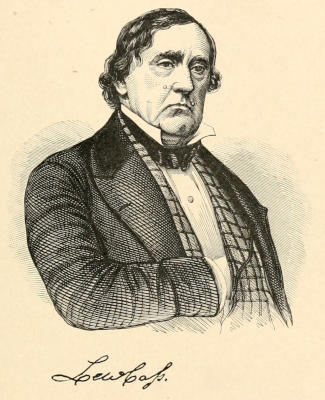
LEWIS CASS
That year of dead-lock between the houses was the year also of a presidential election; and no one who looked observantly upon the incidents of that year doubted what significant changes were setting in. The airs of opinion blew now out of this quarter and again out of that, but their shifting currents foretold, to those who could read the weather, the setting in of the trades, which should blow continuously and with increasing volume out of one quarter a long season through. Both Whigs and Democrats observed the signs of the times, and fell silent upon the main issue that was in every man’s mind, awaiting steadier weather. The Democrats, turning from Mr. Polk, nominated Mr. Lewis Cass, of Michigan, for President, a man conspicuous among them for conservative temper and liberal ways of thought, and spoke in their declaration of principles only of old doctrines, deliberately excluding an avowal of the doctrine of non-interference with the extension of slavery. The Whigs, more cautious still, fell back again upon their tactics of 1840: nominated for President General Zachary Taylor, no politician but a frank soldier like General Harrison; for Vice President Mr. Millard Fillmore, of New York; and made no declaration of principles at all. But the issue was not obscured. A strong faction of Democrats in New York drew off from their party in open protest against the programme it did not avow, and in conjunction with men of their own mind out of four other States nominated Mr. Van Buren, who had stood from the first in frank opposition to the extension of slavery. Nor was that all. In August, at Buffalo, still another convention came together, composed of delegates out of eighteen States, to form an independent free soil party, pledged neither to interfere with slavery in the States, whose laws Congress had no power to change, nor to permit its introduction into the Territories, whose laws Congress was empowered to make; and it also put Mr. Van Buren in nomination.
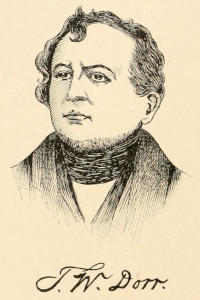
THOMAS WILSON DORR
The Democratic split in New York cost Mr. Cass the election. The thirty-six votes of the State went to General Taylor; and thirty-six was General Taylor’s majority in the electoral college. Mr. Van Buren received nearly three hundred thousand votes. The “Free Soilers” had drawn their strength rather from the Whigs than from the Democrats, it turned out, except in New York, and were to hold the balance of power in the next House, where neither Democrats nor Whigs could command a majority without them. Only the Senate remained Democratic. A “free soil” campaign had cut party lines sharply athwart, and no man could safely forecast what was to come.
All things seemed touched with change. The country offered but a confused and troubled stage upon which to order parties or make and execute plans of action. The decade through new forces had seemed to gather head, and old forces to be checked and altered (1840-1850). Rhode Island had found herself obliged to enlarge her suffrage and make liberal changes in her old-fashioned constitution, kept unaltered since old colony days, in order to quiet actual rebellion, under one Thomas Dorr. The legislature of New York had been obliged to secure fee simple titles for the men who farmed the lands on the Hudson still leased, for a rent in kind, from the heirs of the Dutch patroons; because they flatly refused to pay the rents any longer, resisted the sheriff’s process with arms, and would pay for nothing but absolute title. Six thousand miles of railway were built while Mr. Tyler negotiated the annexation of Texas and Mr. Polk thrust Mexico to the wall. The population of the country increased from seventeen to twenty-three millions. Florida, Iowa, and Wisconsin, as well as Texas, were added to the roll of States. The electric telegraph, spreading with the railways, whose administration it so much eased and simplified, quickened also and gave sweep to the movements of trade and of opinion.
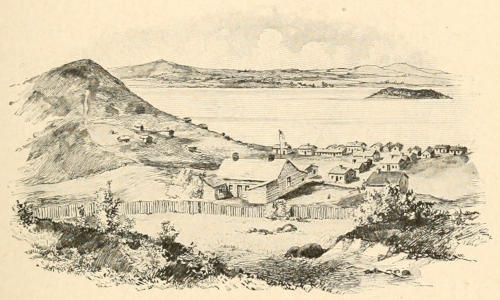
SAN FRANCISCO, CALIFORNIA, IN 1848
A great tide of immigration, moreover, began to pour in, such as the country had never seen before. Until 1842 there had never been so many as a hundred thousand immigrants in a single year; but in 1845 there were one hundred and fourteen thousand, and by 1849 there were two hundred and ninety-seven thousand coming in within a twelvemonth, the tide rising steadily from year to year. These were years of deep distress over sea. 1846 and 1847 were the years of the terrible famine in Ireland; 1848 saw European states shaken once again by revolution. Not only men out of Ireland, looking for a land where there was food, but men also out of the old monarchies of the continent, looking for a land where there was liberty,—men of wholly foreign speech and habit, seeking a free place for a new life, bent upon their own betterment, and thinking little of aught that did not touch their own fortunes,—came crowding endlessly in. They did not go into the South, where labor was not free, for they were laborers. They crowded, rather, into the cities at the north, or pushed on to the virgin West. Their coming, thousands upon thousands, their ceaseless movement into the West, their stir as of an invading host, subtly gave new impulse to the general movement and resettlement of the population, already afoot of its own accord: to the opening of new lands, the diversification of industry, the quick growth of a nation always making and to be made. Until now the country had been developed for the most part only by men out of the old homes of the first settlers and by natural increase of its own people. Now there was added this power of increase and subtle impulse of change from without. And the tide of men from over sea, once set running, did not ebb or recede. Statesmen found themselves obliged to accommodate affairs to a day of new forces, which escaped them and dominated all that they did.
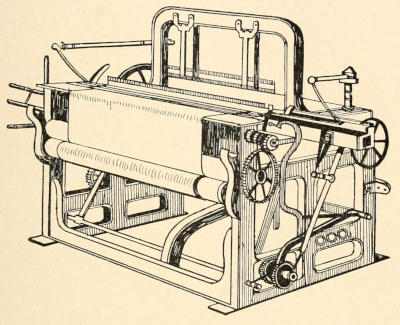
ENGLISH POWER LOOM FOR WEAVING COTTON, 1847
Whether it came by immigration or by natural increase, growth of population meant the augmentation, not of sectional, but of national forces. The slave-holding States, though their number included Missouri and Arkansas, which shared the growth of the frontier, showed, even with Texas added, an increase of but little more than two millions in the decade, while the rest of the country saw nearly four millions added to its strength. Industry, too, moved with as quick a pace as population, and invention bettered and facilitated its processes at every step. By 1846 a fully practicable sewing machine had been developed and patented. In 1847 the rotary printing press was invented. The power loom was still further varied and perfected. An age of machinery was pushing forward every process of production, every means of communication, everything that touched either thought or effort.
Though the southern politicians talked only of constitutional rights, and seemed to fight only for the extension of slavery, southern merchants held conventions to plan railways to the Pacific and debated measures for linking their trade with the expanding West. Their thoughts ran eagerly and with a certain enthusiasm upon the great future of the nation, in which they wished to take their part. Their plans were made upon the scale of the continent; they spoke in the spirit of the new age, and sought their right rôle in the general development. And yet there was in all that they said and urged an unmistakable note also of apprehension. They wished to take part, and yet began to fear that they could not. They spoke of the nation, and of their duty and their opportunity in it; but the nation of their thought was not a nation which could easily be united in joint efforts of business. It was a nation sectionalized and divided by social and economic contrasts too gross and obvious to be overlooked; a nation whose several regions showed interests diverse and separate, hardly to be reconciled. This they saw, some vaguely, some with painful clearness, and a deep uneasiness grew upon them more and more from year to year. The spirit and the power of the time were turned against them.
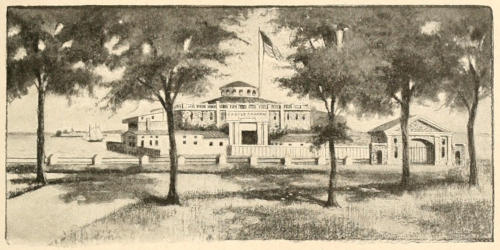
CASTLE GARDEN, NEW YORK, IN 1850
And the issues which made their place apart a fact, not of speculation but of certainty, were mightily hastened by every force afoot in the life of the country as it grew. It became evident almost at once that Congress could not avoid or even postpone its choice with regard to slavery in the new territories seized from Mexico. The very month the treaty of Guadeloupe Hidalgo was signed (February, 1848) rich deposits of gold were discovered in California; and before the politicians at Washington were ready to organize the region as a Territory it had filled with an aggressive population which was making ready to demand its admission into the Union as a State. Before the census of 1850 was taken eighty thousand settlers had made their way thither, eager for treasure. Some had struggled across the interminable plains and over the mighty ridges of the Rockies; some had taken ship and gone the long way round about Cape Horn; some had crossed the isthmus of Central America and made their way in such craft as offered up the Pacific coast. The plains were ere long strewn with the bleaching bones of men and beasts, the coasts with frail craft cast away upon the incautious, eager voyage; but the quest did not cease or slacken. Thousands reached the faraway goal, found the golden fleece, and set themselves to build a State. It was evident enough that, with such things happening, Congress could not put action off.
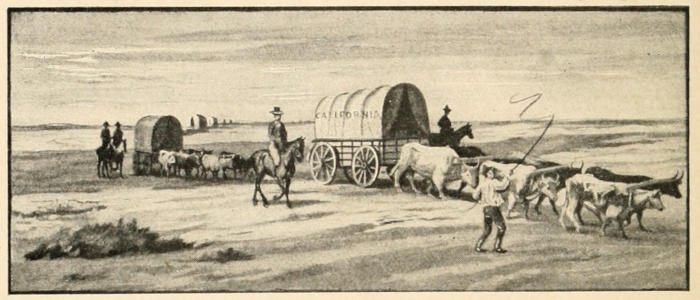
EMIGRANT TRAIN CROSSING THE PLAINS
The new President, too, forced the matter most uncomfortably. General Taylor had no sooner become President than he acted upon the situation in the West with a soldier’s practical, businesslike candor and directness. He advised the settlers in California and New Mexico to frame state constitutions and apply at once for admission to the Union with institutions of their own choosing; and the Californians acted upon his advice so promptly that by the time Congress met they had erected a complete government, and he had ordered General Riley, the provisional military governor of the territory, to withdraw. When the houses assembled the frank soldier President advised them to admit the new State at once, and to postpone action with regard to New Mexico until it also should have completed its preparations for admission, then in progress.
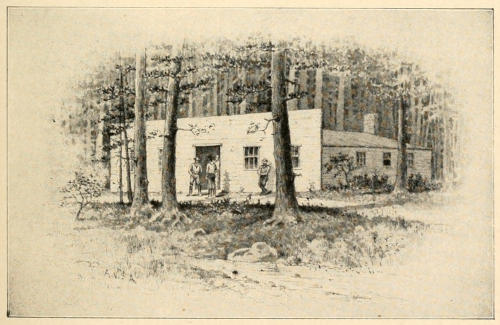
A TYPICAL HOTEL IN THE MIDDLE MINES, CALIFORNIA, ABOUT 1850
But the thing was not to be so easily and simply handled. A deep excitement had spread through the country that eventful year. Again it had come to seem as if the future of the Union hung upon this issue. Very significant things had been said and threatened, which it was not easy to forget or dismiss. So long ago as 1843 John Quincy Adams, who thirty-five years before had left the Federalists because they talked of dissolving the Union, had joined with other Whigs in declaring that the addition of Texas to the South would bring about and justify disunion. Mr. Garrison, the leader of the abolitionists, had proposed in 1845 that Massachusetts should lead in a movement to withdraw from the Union, and had won very hearty applause for the suggestion from an anti-annexation convention. The masses of the people, it is true, did not heed these things; the counsels of sober statesmen were not seriously affected by them. But almost every northern State demanded, through its legislature, the adoption of the Wilmot proviso, and every southern State protested against it, in tones not to be mistaken. The southern men, to whose demands Mr. Calhoun gave the touch of final definiteness which only words of precision such as he used could give, now denied outright the power of the federal government to exclude slaves, the legitimate property of southern settlers, from the Territories of the United States, and asserted the right of the people of the Territories “to act as they pleased upon the subject of the status of the negro race amongst them, as upon other subjects of internal policy, when they came to form their constitutions.” The air was full of disquieting rumors as to what the southerners meant to do should Congress set that principle aside: how they meant to shut their ports against the North and turn all their arts and all their power towards building up an alliance, at once political and economic, with the West: how in the last resort they meant to secede from the Union altogether.
It was not an air in which action was easy to be determined upon. Even compromise seemed for a long time impossible. Mr. Clay, with the dignity of old age upon him, once more came forward as mediator, with counsels of accommodation for which he plead, not in his old tones of commanding leadership, but in new tones almost of supplication which it was very moving to hear. Mr. Webster ceased to speak of the constitution as an instrument of authority; spoke of it, rather, as a thing to be maintained by seeking ways of peace and compromise. But not until many anxious months had gone by, full of bitter, estranging debate, within the houses and without, could terms of agreement be hit upon. It was agreed at last, in the closing months of 1850, that California should be admitted to the Union as a free State, with the constitution she had herself formed; that the rest of the Mexican cession should be left open to slavery, should events and the movement of population out of the South establish it there; that the slave trade should be abolished in the District of Columbia; and that a stringent fugitive slave law should provide the southerners with effective legal means of recovering runaway slaves. Such was the bundle of measures that had to be got together to quiet all parties.
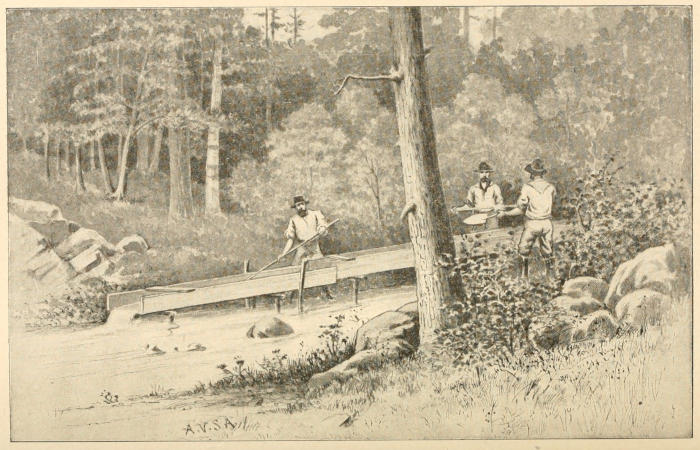
SLUICE WASHING FOR GOLD IN THE MIDDLE MINES, CALIFORNIA, ABOUT 1850
Meanwhile Mr. Calhoun was dead (March 31, 1850), while compromise yet hung doubtful,—and the President himself (July 9, 1850), of a sudden fever; and Mr. Fillmore was President, a man more amenable to the control of the leaders of Congress and of his party than the sturdy soldier had been whom he succeeded. The face of affairs had changed again with the settlement of the principles of compromise.
It meant more than the mere passing away of a notable figure that Mr. Calhoun was dead at such a juncture,—a tall, spare old man, the lines of whose striking face and haunting, deep-set eyes marked him as the very embodiment of a single stern and watchful purpose, an ascetic knight challenger set down in lonely guard to keep an ancient shrine of doctrine. Eight years before he had told his friends upon what single principle he had acted since 1825, and must ever act so long as he remained upon the field of action. He had opposed Mr. Adams and Mr. Clay, had first supported General Jackson and then turned from him, had acted with the Whigs against Mr. Van Buren and with Mr. Tyler against the Whigs always with this one hope and purpose, “to restore the old state rights Republican doctrines of ’98; under the solemn belief that on their restoration the existence of our free popular institutions depended.” He came of the hard-willed, indomitable stuff of the north of Ireland, and showed in all his strenuous course “the definite mind, the inflexible purpose, the reserved, self-restrained, somewhat ungenial temper of the Ulsterman.” When he went off the stage politics seemed bereft of some force as of private and personal conviction, and left to the guidance of men who looked for their opportunity, not for their day of justification.
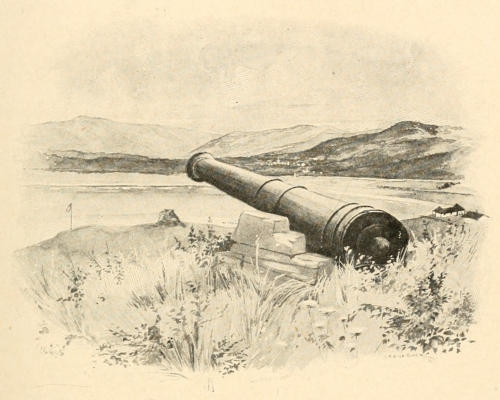
OLD SPANISH FORT AT MONTEREY, CALIFORNIA, IN 1848
Our leading general authorities are still George Tucker, volume IV., Bryant and Gay, volume IV., James Schouler, volumes IV. and V., and H. von Holst, volumes II.-VI. Here we begin to have as guide Mr. James Ford Rhodes’s History of the United States from the Compromise of 1850, volumes I. and II. We turn also, as before, to Carl Schurz’s Henry Clay and Theodore Roosevelt’s Thomas H. Benton in the American Statesmen Series; Calvin Colton’s Life and Speeches of Henry Clay; George Ticknor Curtis’s Life of Daniel Webster and Life of James Buchanan; Alexander Johnston’s History of American Politics; Edward Stanwood’s History of the Presidency; and A. W. Young’s American Statesman.
The list of special authorities on particular topics or individual aspects of the history of the time is very long. The following may represent the whole. J. N. Larned’s History for Ready Reference, which, under the title United States and under various special titles connected with the history of the country, contains copious and admirably selected extracts from the best writers; Lalor’s Cyclopaedia of Political Science, Political Economy, and United States History; J. McK. Ormsby’s History of the Whig Party; Henry A. Wise’s Seven Decades of the Union; Alexander H. Stephens’s Constitutional View of the War between the States; R. S. Ripley’s War With Mexico; William Jay’s The Mexican War; A. M. Williams’s Sam Houston and the War of Independence in Texas; C. E. Lester’s Houston and His Republic; R. D. Hunt’s Genesis of California’s First Constitution in the thirteenth volume of the Johns Hopkins University Studies in Historical and Political Science; D. King’s Thomas W. Dorr, a Life of the leader of the rebellion in Rhode Island; E. R. Potter’s Considerations on Questions on Rhode Island; E. P. Cheyney’s Anti-Rent Agitation in New York; James Russell Soley’s Wars of the United States, James B. Angell’s Diplomacy of the United States, and Winsor and Channing’s Territorial Acquisitions and Divisions in the seventh volume of Winsor’s Narrative and Critical History of America; Albert Gallatin’s Right of the United States of America to the North Eastern Boundary; William Barrows’s Oregon in the American Commonwealth Series.
Among the most useful biographies are Lyon G. Tyler’s Letters and Times of the Tylers; Josiah Quincy’s Life of John Quincy Adams; W. W. Story’s Life of Joseph Story; E. M. Shepard’s Martin Van Buren in the American Statesmen Series; F. W. Seward’s Seward at Washington (1846-1861); E. L. Pierce’s Life of Charles Sumner; Pleasant Stovall’s Life of Robert Toombs; William P. Trent’s Life of W. G. Simms; A. C. McLaughlin’s Lewis Cass in the American Statesmen Series; Nicolay and Hay’s Life of Lincoln; and Albert B. Hart’s Salmon P. Chase in the American Statesmen Series.
Among the innumerable writings on slavery and the slavery question which now begin to be useful the following may be mentioned: Horace Greeley’s American Conflict and History of the Struggle for Slavery Extension; W. Goodell’s Slavery and Anti-Slavery; the first volume of J. W. Draper’s History of the Civil War; E. A. Pollard’s Lost Cause; Henry Wilson’s History of the Rise and Fall of the Slave Power; Hodgson’s Cradle of the Confederacy; George Lunt’s Origin of the Late War; Marion G. McDougall’s Fugitive Slaves; W. P. and F. J. Garrison’s Life of William Lloyd Garrison; W. H. Siebert’s Underground Railroad; Thomas R. R. Cobb’s Inquiry into the Law of Negro Slavery and Historical Sketch of Slavery; J. C. Hurd’s Law of Freedom and Bondage; Charles Francis Adams’s Life of Richard Henry Dana; William Jay’s Miscellaneous Writings on Slavery; Leverett W. Spring’s Kansas in the American Commonwealth Series; Eli Thayer’s Kansas Crusade.
Shosuke Sato’s Land Question, in the fourth volume of the Johns Hopkins University Studies in Historical and Political Science treats of the system of public lands which underlay the westward expansion; Mr. F. W. Taussig’s Tariff History sketches the political and economic aspects of tariff legislation; and Mr. David Kinley’s Independent Treasury System narrates the various vicissitudes through which Mr. Van Buren’s favorite plans passed before their final acceptance by Congress.
The chief sources are the Register of Debates; the Congressional Documents; the Congressional Globe; Thomas H. Benton’s Abridgment of the Debates of Congress; Niles’s Register, besides which the National Era (Washington), the New York Times, the New York Tribune, the New York Evening Post become available for contemporary matter; Thomas H. Benton’s Thirty Years’ View; Nathan Sargent’s Public Men and Events; John Quincy Adams’s Memoirs; Martin Van Buren’s Inquiry into the Origin and Growth of Political Parties in the United States; Chevalier de Bacourt’s Souvenirs of a Diplomat; Mrs. Chapman Coleman’s Life of John J. Crittenden; Alexander Johnston’s Representative American Orations; Hugh McCulloch’s Men and Measures of Half a Century; George W. Curtis’s Correspondence of John Lothrop Motley; Amos Kendall’s Autobiography; Thurlow Weed’s Autobiography; Herndon’s Life of Lincoln; F. W. Seward’s Seward: An Autobiography; Frederick Law Olmsted’s Cotton Kingdom; Ben. Perley Poore’s Perley’s Reminiscences; W. Kennedy’s Rise and Prospects of Texas; W. C. Crane’s Life and Select Literary Remains of Sam Houston; Hinton R. Helper’s The Impending Crisis; Susan D. Smedes’s Memorials of a Southern Planter; Frances Anne Kemble’s Journal of a Residence on a Georgia Plantation; the Personal Memoirs of Ulysses S. Grant; the case of Luther vs. Borden, touching the relation between the federal and state authorities in the matter of the rebellion in Rhode Island, reported in the seventh volume of Howard’s Supreme Court Reports, p. 1; the cases of Prigg vs. Pennsylvania, 16 Peters’s Reports, 539, and Ableman vs. Booth, 21 Howard, 506, touching upon the law with regard to fugitive slaves; and the Kansas Historical Collections.