PREFACE TO THE SEVENTH EDITION. (continued 6)
Reading edition
In the court of chivalry the proceedings were different. When the cause could not be decided on the evidence of witnesses, or the authority of documents, the constable and mareschal required pledges from the two parties, and appointed the time of battle, the place, and the weapons,—a long sword, a short sword, and a dagger; but allowed the combatants to provide themselves with defensive armour according to their own choice. A spot of dry and even ground, sixty paces in length and forty in breadth, was enclosed with stakes seven feet high, around which were placed the serjeants-at-arms, with other officers, to 97keep silence and order among the spectators. The combatants entered at opposite gates; the appellant at the east, the defendant at the west end of the lists: and each severally swore that his former allegations and answers were true; that he had no weapons but those allotted by the court; that he wore no charms about him; and that he placed his whole confidence on God, on the goodness of his cause, and on his own prowess. Then taking each other by the hand, the appellant swore that he would do his best to slay his adversary, or compel him to acknowledge his guilt: the defendant, that he would exert all his powers to prove his own innocence. When they had been separately conducted to the gates at which they entered, the constable, sitting at the foot of the throne, exclaimed thrice, “Let them go,” adding to the third exclamation, “and do their duty.” The battle immediately began: if the king interposed, and took the quarrel into his own hands, the combatants were separated by the officers with their wands, and then led by the constable and mareschal to one of the gates, through which they were careful to pass at the same moment, as it was deemed a disgrace to be the first to leave the place of combat. If either party was killed, or cried “Craven,” he was stripped of his armour on the spot where he lay, was dragged by horses out of the lists, through a passage opened in one of the angles, and was immediately hanged or beheaded in presence of the mareschal.
Trial by battle was used not only in military and criminal cases, but also in one kind of civil action, namely, in writs of right, which were not to determine the jus possessionis, but the less obvious and more profound question of the jus proprietatis. In the simplicity of ancient times, it was thought not unreasonable that a matter of such difficulty should be left to the decision of Providence by the wager of battle. In this case the battle was waged by champions, because, in civil actions, if any party to the suit dies, the suit must abate, or end, and therefore no judgment could be given.
The last trial by battle that was waged in the court of Common Pleas at Westminster was in the thirteenth year of Queen Elizabeth, A. D. 1571, as reported by Sir James Dyer; and was held in Tothill Fields “non sine magnâ juris consultorum perturbatione.” There was afterwards one in the court of Chivalry in 1631, and another in the county palatine of Durham in 1628.
The Wager of Battle was accounted obsolete, until it was unexpectedly demanded and admitted in 1817, in a case of supposed murder; and it has since been abolished by act of parliament, 59 George III. c. 46.
BAY. (More anciently Severy.) One whole compartment of a building. As the whole structure consists of a repetition of 98bays, the description of one bay comprises most of the terms used in architectural nomenclature. The accompanying block figures are purposely composed of discordant parts, to comprise the greater number of terms.
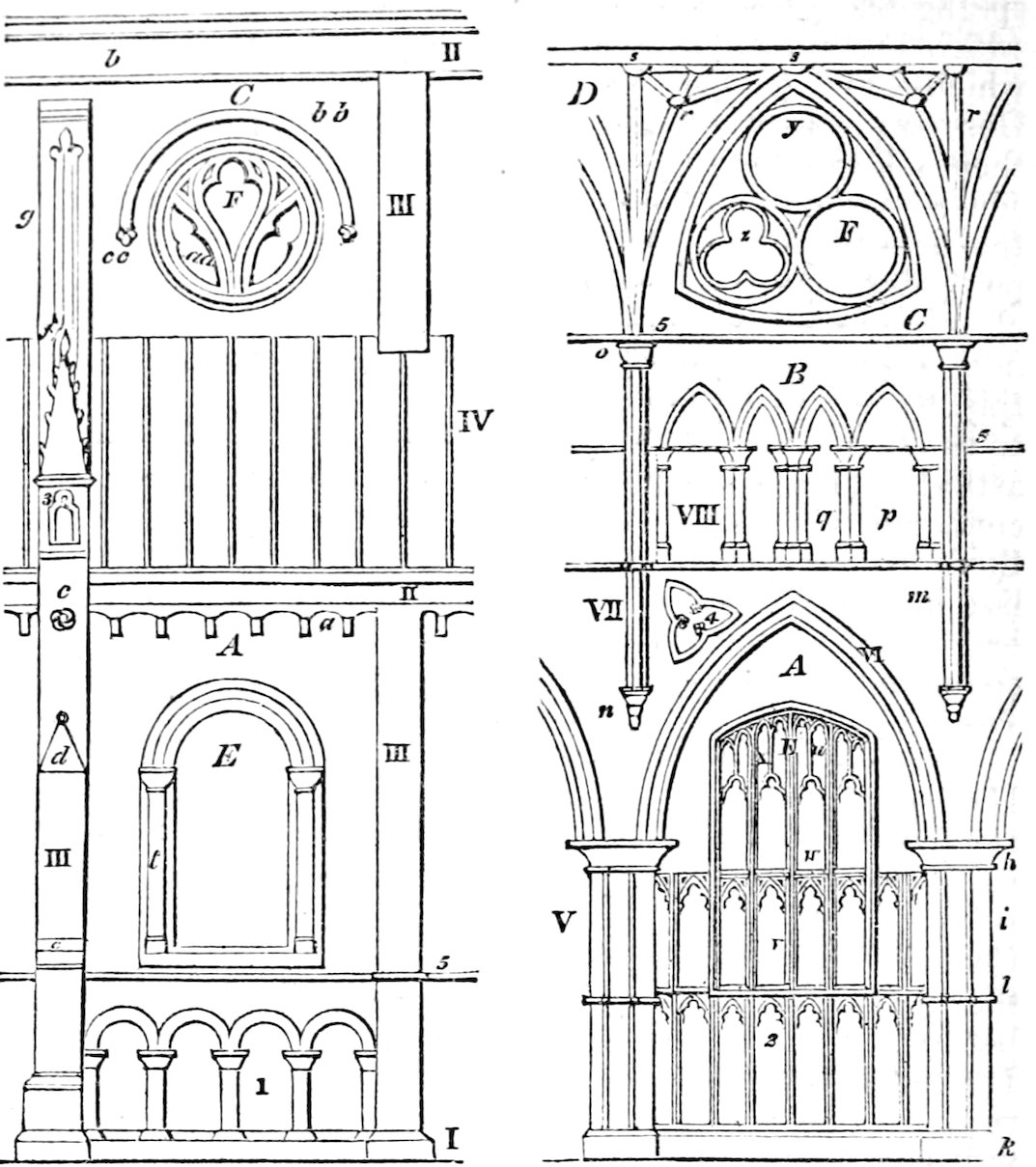
EXTERIOR.
A.
Aisle. I. Basement. II. Parapet. a. Corbel table. b. Cornice. c. Gurgoyle. III. Buttress. d. Pedimental set-off. e. Plain set-off. f. Finial. g. Flying buttress, or arch-buttress. IV. Aisle roof.
C.
Clerestory.
INTERIOR.
A.
Aisle. V. Pier. h. Capital. i. Shaft. k. Base. l. Band. VI. Pier arch. m. Spandril. VII. Vaulting shaft. n. Corbel. o. Capital.
B.
Triforium. VIII. Triforium arcade. p. Blank arches. q. Pierced arches.
C.
Clerestory.
D.
Vault. r. Groining ribs. s. Bosses.
COMMON TO EXTERIOR & INTERIOR.
E.
Aisle windows. t. Jamb shafts. u. Tracery (Perpendicular). v. Mullions. w. Transom. x. Batement lights.
F.
Clerestory windows. y. Tracery (Geometrical). z. Cusping or foliation. aa. Tracery (Flowing). bb. Hood, in the exterior more correctly dripstone. cc. Corbel, or label.
DECORATIONS COMMON TO BOTH.
1.
Arcading (Norman to Decorated.)
2.
Panelling (Perpendicular).
3.
Niche.
4.
Panel.
5.
String.
BEADS, or BEDES. A word of Saxon origin, which properly signifies prayers; hence Bidding the Bedes meant desiring the prayers of the congregation, and from the forms used for this purpose before the Reformation is derived the Bidding of prayer, prescribed by the English canons of 1603. (See Bidding Prayer.) From denoting the prayers themselves, the word came to mean the little balls used by the Romanists in rehearsing and numbering their Ave-marias and Paternosters. (See Rosary.) A similar practice prevails among the dervises and other religious persons throughout the East, as well Mahometans as Buddhists and other heathens. The ancient form of the Bedes, or Bidding Prayer, is given in the Appendix to Collier’s Eccl. Hist. vol. ii. No. 54, which shows that our present Bidding Prayer was founded on that model.
BEATIFICATION. (See Canonization.) In the Romish Church, the act by which the pope declares a person happy after death. Beatification differs from canonization. In the former the pope does not act as a judge in determining the state of the beatified, but only grants a privilege to certain persons to honour him by a particular religious worship, without incurring the penalty of superstitious worshippers. In canonization, the pope blasphemously speaks as a judge, and determines, ex cathedrâ, on the state of the canonized. It is remarkable, that particular orders of monks assume to themselves the power of beatification.
BEDDERN, BEDERNA. The name still retained of the vicar’s college at York, and of the old collegiate building at Beverley. Query, whether it may be somewhat the same as Bedehouse, i. e. an hospital?—Jebb.
BEGUINES. A congregation of nuns, founded either by St. Begghe, duchess of Brabant, in the seventh century, or by Lambert le Begue, a priest and native of Liege, who lived in the twelfth century. 99They were established first at Liege, and afterwards at Nivelle, in 1207, or, as some say, in 1226. From this last settlement sprang the great number of Beguinages, which are spread over all Flanders, and which have passed from Flanders into Germany. In the latter country, some of them fell into extravagant errors, and persuaded themselves that it was possible in the present life to attain to the highest perfection, even to impeccability, and a clear view of God, and in short, to so eminent a degree of contemplation, that, after this, there was no necessity of submitting to the laws of mortal men, civil or ecclesiastical. The Council of Vienne, in 1311, condemned these errors, but permitted those who continued in the true faith to live in chastity and penitence, either with or without vows. There still subsist many communities of Beguines in Flanders.—Hist. des Ord. Relig. viii. c. i.
BEL AND THE DRAGON (THE HISTORY OF). An apocryphal and uncanonical book of Scripture. It was always rejected by the Jewish Church, and is extant neither in the Hebrew nor the Chaldee language, nor is there any proof that it ever was so. St. Jerome gives it no better title than “the fable of Bel and the Dragon.” It is, however, permitted to be read, as well as the other apocryphal writings, for the instruction and improvement of manners.
Selden (De Diis Syris, Syntagma ii. cap. 17) thinks, this little history ought rather to be considered as a sacred poem or fiction, than a true account. As to the Dragon, he observes, that serpents (dracones) made a part of the hidden mysteries of the Pagan religion; as appears from Clemens Alexandrinus, Julius Firmicus, Justin Martyr, and others. And Aristotle relates, that, in Mesopotamia, there were serpents which would not hurt the natives of the country, and infested only strangers. Whence it is not improbable that both the Mesopotamians themselves and the neighbouring people might worship a serpent, the former to avert the evil arising from those reptiles, the latter out of a principle of gratitude. But of this there is no clear proof, nor is it certain that the Babylonians worshipped a dragon or serpent.—Aristot. περὶ θαυμασιων ἀκουσματων.
BELFRY. The place where the bells are hung; sometimes being a small arch placed on the gable of the church, sometimes a tower or turret. The belfries were originally detached from the church, as may be still seen in many places in Italy. Instances of this have been known in England, as at Chichester, and at Salisbury (the belfry in the latter place was destroyed some years ago). The great central towers of our cathedrals and abbeys were not originally constructed for bells, but for lanterns, to give light to the central portion of the church. The bells were contained in the towers, or turrets, at the west end, or at the angles of the church. Many churches had more than one bell tower. In Canterbury cathedral the ring of bells is contained in the south-western tower; the small bell, or Bell-Hurry, which is rung just before the service, is placed in the great central tower.
BELIEVERS (πιστοὶ, or Faithful). A name given to the baptized in the early Church, as distinguished from the Catechumens. The believer was admitted to all the rites of Divine worship, and instructed in all the mysteries of the Christian religion.—Bingham.
BELLS. Bells of a small size are very ancient, but larger ones are of a much later date. The lower part of the blue robe worn by the Jewish high priest was adorned with pomegranates and gold bells. The kings of Persia are said to have had the hem of their robes adorned in like manner. The high priest probably gave notice to the people, and also desired permission to enter the sanctuary, by the sound of these bells, and by so doing escaped the punishment of death annexed to an indecent intrusion.
On the origin of church bells, Mr. Whitaker, in his “History of Manchester,” observes, that bells being used, among other purposes, by the Romans, to signify the times of bathing, were naturally applied by the Christians of Italy to denote the hours of devotion, and summon the people to church.
“Bells,” says Nicholls, “were not in use in the first ages of Christianity. For, before the Christians received countenance from the civil power, they were called together by a messenger, who went about from house to house, some time before the hour the congregation met. After this they made use of a sounding plank hanging by a chain, and struck with a hammer. The precise time when bells first came in use is not known. Paulinus, bishop of Nola, in Campania, in order to give notice to the most remote inhabitants when prayers began, hung up a large brass vessel, which, when struck upon by a hammer, gave such a sound as he desired for his purpose. This was about the year 420. Hence the two Latin names for a great bell—Nola, 100from the town; and Campana, from the country where they were first used.”
But, whatever may be the connexion of bells with the city of Nola, there is no ground for referring the first use of them to Paulinus; Bingham pronounces the opinion to be “certainly a vulgar error.” Others say they took the latter of these names, not from their being invented in Campania, but because it was there the manner of hanging and balancing them, now in use, was first practised; at least that they were hung on the model of a sort of balance invented or used in Campania.
The Greek Christians are usually said to have been unacquainted with bells till the ninth century, when their construction was first taught them by a Venetian. But it is not true that the use of bells was entirely unknown in the ancient Eastern churches, and that they called the people to church, as at present, with wooden mallets, like the clappers or cresselles, used instead of bells in many churches of the Romish communion, during the holy week. (See Cresselle.) Leo Allatius, in his Dissertation on the Greek Temples, proves the contrary from several ancient writers. He says bells first began to be disused among them after the taking of Constantinople by the Turks; who, it seems, prohibited them, lest their sound should disturb the repose of the souls which, according to them, wander in the air.
In Britain, bells were used in churches before the conclusion of the seventh century, in the monastic societies of Northumbria, and as early as the sixth, even in those of Caledonia. And they were therefore used from the first erection of parish churches among us. Those of France and England appear to have been furnished with several bells. In the time of Clothaire II., king of France, A. D. 610, the army of that king was frightened from the siege of Sens, by ringing the bells of St. Stephen’s Church. The second excerption of Egbert, about A. D. 750, which is adopted in a French capitulary of 801, commands every priest, at the proper hours, to sound the bells of his church, and then to go through the sacred offices to God. And the Council of Eanham, in 1009, requires all the mulcts for sins to be expended in the reparation of the church, clothing and feeding the ministers of God, and the purchase of church vestments, church books, and church bells. These were sometimes composed of iron in France; and in England, as formerly at Rome, were frequently made of brass; and, as early as the ninth century, there were many cast of a large size and deep note. Ingulphus mentions, that Turketulus, abbot of Croyland, who died about A. D. 870, gave a great bell to the church of that abbey, which he named Guthlac; and afterwards six others, viz. two which he called Bartholomew and Betelin, two called Turkettul and Tatwin, and two named Pega and Bega, all which rang together; the same author says, “Non erat tunc tanta consonantia campanarum in totâ Angliâ.” Not long after, Kinsius, archbishop of York, (1051–1061,) gave two great bells to the church of St. John, at Beverley, and at the same time provided that other churches in his diocese should be furnished with bells. Mention is made by St. Aldhelm, and William of Malmesbury, of bells given by St. Dunstan to churches in the West. The number of bells in every church gave occasion to a curious and singular piece of architecture in the campanile or bell tower: an addition which is more susceptible of the grander beauties of architecture than any other part of the edifice. It was the constant appendage to every parish church of the Saxons, and is actually mentioned as such in the laws of Athelstan.
The uses of church bells are summed up in the following monkish distichs:—
“Laudo Deum verum, plebem voco, congrego clerum,
Defunctos ploro, pestem fugo, festa decoro.”
“Funero plango, fulgura frango, sabbata pango,
Excito lentos, dissipo ventos, paco cruentos.”
Before bells were hung, they were formerly, and in the Romish communion they still are, washed, crossed, blessed, anointed with chrism, and named by the bishop. This ceremony was commonly styled baptizing them. (See Martène de Antiq. Eccl. Ritibus, ii. 296.) Some say that it was introduced by Pope John XIII., who occupied the pontifical chair from 965 to 972, and who first consecrated a bell in the Lateran church, and gave it the name of John the Baptist. But it is evidently of an older standing, there being an express prohibition of the practice in a capitular of Charlemagne in 789—ut clocæ non baptizentur.
The following are the regulations of the Church of England on the subject of bells.
By a constitution of Archbishop Winchelsea, the parishioners shall find, at their own expense, bells with ropes.
Canon 81. The churchwardens or questmen, and their assistants, shall not suffer the bells to be rung superstitiously, upon holy days or eves abrogated by the Book of Common Prayer, nor at any other times, 101without good cause to be allowed by the minister of the place, and by themselves.
Canon 111. The churchwardens shall present all persons, who by untimely ringing of bells do hinder the minister or preacher.
Canon 15. Upon Wednesdays and Fridays weekly, the minister at the accustomed hour of service shall resort to the church or chapel, and warning being given to the people by tolling of a bell, shall say the litany.
Canon 67. When any is passing out of this life, a bell shall be tolled, and the minister shall not then slack to do his last duty. And after the party’s death, (if it so fall out,) there shall be rung no more but one short peal, and one other before the burial, and one other after the burial.
Rubric concerning the service of the church. “And the curate that ministereth in every parish church or chapel, being at home, and not being otherwise reasonably hindered, shall say the same in the parish church or chapel when he ministereth, and shall cause a bell to be tolled thereunto a convenient time before he begin, that the people may come to hear God’s word, and to pray with him.”
Although the churchwardens may concur in directing the ringing or tolling of the bells on certain public and private occasions, the incumbent may prevent the churchwardens from ringing or tolling them at undue hours, or without just cause. Proceedings may be instituted in the ecclesiastical court against churchwardens who have violently and illegally persisted in ringing the bells without consent of the incumbents.
Bells were used in Ireland at a very early period. Harris, in his edition of Ware, (vol. ii. p. 129,) quotes Bede as an authority for the use of bells in the sixth century, and observes on Molyneux’s opinion that the popular name of the round tower in Ireland was derived from a Germanico-Saxon word, signifying a bell. Mr. Petrie, in his recent laborious essay on the Irish Round Towers, has shown that these towers, as their name denotes, their form and locality suggest, and tradition teaches, were intended for ecclesiastical belfries. And in the same work, as well as in the documents collected by Irish antiquarians, it is shown that bells were known in Ireland as far back as the age of St. Patrick. Some of these ancient bells are still in existence.
Nankin, in China, was anciently famous for the largeness of its bells; but their enormous weight having brought down the tower in which they were hung, the whole building fell to ruin, and the bells have ever since been disregarded. One of these bells is near 12 English feet high, the diameter 7½ feet, its circumference 23 feet, and the thickness of the metal about the edges 7 inches; its figure almost cylindrical, except for a swelling in the middle. From these dimensions its weight is computed at 50,000 lbs.
In the churches of Russia the bells are numerous, and distinguished by their immense size; they are hung, particularly at Moscow, in belfries or steeples detached from the churches, with gilt or silvered cupolas, or crosses; and they do not swing, but are fixed immoveably to the beams, and rung by a rope tied to the clapper, and pulled sideways. One of these bells, in the belfry of St. Ivan’s church at Moscow, weighed 127,836 English lbs. It has always been esteemed a meritorious act of religion to present a church with bells, and the piety of the donor has been estimated by their magnitude. The emperor Bodis Godunof gave a bell of 288,000 lbs. to the cathedral of Moscow, but he was surpassed by the empress Anne, (or, as Dr. Clarke and others say, Alexis, in 1653,) at whose expense a bell was cast, weighing no less than 443,772 lbs., which exceeds in size every bell in the known world. Its height is 21 feet, the circumference at the bottom 67 feet 4 inches, and its greatest thickness 23 inches. The beam to which this vast machine was fastened being accidentally burnt by a fire in 1737, the bell fell down, and a fragment was broken off towards the bottom, which left an aperture large enough to admit two persons abreast without stooping.
In the Russian Divine service the number of strokes on the bell announces what part of it is beginning. Several blows are struck before the mass; three before the commencement of the liturgy; and, in the middle of it, a few strokes apprize the people without, that the hymn to the holy Virgin is about to be sung, when all work is immediately suspended, they bow and cross themselves, repeating silently the verse then singing in the church.—Overall. For some curious directions as to the chiming of the bells in ancient times in Lichfield cathedral, see Dugd. Monast. ed. 1830, vi. 1256.—Jebb.
BELL, BOOK, AND CANDLE. Between the seventh and the tenth century, the sentence of excommunication was attended with great solemnities. The most important was the extinction of lamps or candles by throwing them on the ground, 102with an imprecation, that those against whom the curse was pronounced might be extinguished or destroyed by the vengeance of God. The people were summoned to attend this ceremony by the sound of a bell, and the curses accompanying the ceremony were pronounced out of a book by the minister, standing in a balcony. Hence originated the phrase of cursing by bell, book, and candle.
BEMA. The name of the bishop’s throne in the primitive church, or, as some understand it, the whole of the upper end of the church, containing the altar and the apsis. This seat or throne, together with those of the presbyters, was always fixed at the upper end of the chancel, in a semicircle beyond the altar. For anciently, the seats of the bishops and presbyters were joined together, and both were called thrones. The manner of their sitting is related by Gregory Nazianzen in his description of the church of Anastasia, where he speaks of himself as bishop, sitting upon the high throne, and the presbyters on lower benches on each side of him.—Bingham. (See Apsis and Cathedral.)
BENEDICITE. A canticle used at Morning Prayer, after the first lesson. This canticle is so called because, in the Latin version, it so begins. It is called “The Song of the Three Children,” because Hananiah, Mishael, and Azariah (whom the prince of the eunuchs named Shadrach, Meshach, and Abednego, Dan. i. 7) are reported to have sung it in the burning fiery furnace, into which they were cast by order of Nebuchadnezzar for adhering stedfastly to their God, (Dan. iii. 19,) &c., and in which God preserved them in a miraculous manner (ver. 27).—Dr. Bennet.
This and the Te Deum are the only hymns used in our service that are of man’s composing. Our Church being careful, even beyond all the ancient Churches, in singing to God, to sing in the words of God.—Dr. Bisse. This statement of Dr. Bisse is not altogether correct. The hymns “Holy, holy, holy Lord God of hosts,” and the “Gloria in Excelsis,” though suggested by Holy Scripture, are human compilations. And the metrical Veni Creator is also of man’s composing. The Benedicite was prescribed to be used in Lent, by King Edward VI.’s First Book.—Jebb.
BENEDICTINES. An order of monks who profess to follow the rules of St. Benedict. The Benedictines, being those only that are properly called monks, wear a loose black gown, with large white sleeves, and a capuche, or cowl, on their heads, ending in a point behind. In the canon law they are styled black friars, from the colour of their habit. The rules of St. Benedict, as observed by the English monks before the dissolution of the monasteries, were as follows: they were obliged to perform their devotions seven times in twenty-four hours, the whole circle of which devotions had respect to the passion and death of Christ: they were obliged always to go two and two together: every day in Lent they were obliged to fast till six in the evening; and abated of their usual time of sleeping and eating; but they were not allowed to practise any voluntary austerity without leave of their superior: they never conversed in their refectory at meals, but were obliged to attend to the reading of the Scriptures: they all slept in the same dormitory, but not two in a bed: they lay in their clothes: for small faults they were shut out from meals: for greater they were debarred religious commerce, and excluded from the chapel: incorrigible offenders were excluded from the monasteries. Every monk had two coats, two cowls, a table book, a knife, a needle, and a handkerchief; and the furniture of his bed was a mat, a blanket, a rug, and a pillow.
The time when this order came into England is well known, for in 596 Gregory the Great sent hither Augustine, prior of the monastery of St. Andrew at Rome, with several other Benedictine monks. Augustine became archbishop of Canterbury; and the Benedictines founded several monasteries in England, as also the metropolitan church of Canterbury. Pope John XXII., who died in 1354, after an exact inquiry, found, that, since the first rise of the order, there had been of it twenty-four popes, near 200 cardinals, 7000 archbishops, 15,000 bishops, 15,000 abbots of renown, above 4000 saints, and upwards of 37,000 monasteries. There have been likewise of this order twenty emperors and ten empresses, forty-seven kings, and above fifty queens, twenty sons of emperors, and forty-eight sons of kings, about one hundred princesses, daughters of kings and emperors, besides dukes, marquises, earls, countesses, &c., innumerable. This order has produced a vast number of eminent authors and other learned men. Rabanus set up the school of Germany. Alcuinus founded the university of Paris. Dionysius Exiguus perfected the ecclesiastical computation. Guido invented the scale of music, and Sylvester the organ. They boast to have produced Anselm, Ildephonsus, Venerable Bede, &c. There are nuns likewise 103who follow the order of St. Benedict: among whom those who call themselves mitigated, eat flesh three times a week, on Sundays, Tuesdays, and Thursdays; the others observe the rule of St. Benedict in its rigour, and eat no flesh unless they are sick. The Benedictines were the most extensive and powerful order in England. All the cathedral convents, with the exception of the Augustinian monastery of Carlisle, were of this order, as were four out of the five that were converted into cathedrals by Henry VIII., viz. Gloucester, Oxford, Peterborough, and Chester: and all the mitred abbeys, with the exception of Waltham and Cirencester, which were Augustinian. In Ireland they yielded in importance and numbers to the Augustinians. They were the great patrons of church architecture and of learning in England. The chief branches of the Benedictine order in England were the Cluniacs, founded by Bernon, abbot of Gigniac, in 913; and the Cistercian, founded by Robert, abbot of Molême, at Citeaux in Burgundy, in 1098. (See Cluniacs and Cistercians.)
BENEDICTION. A solemn act of blessing performed by the bishops and priests of the Church. In the Jewish Church, the priests, by the command of God, were to bless the people, by saying, “The Lord bless thee, and keep thee. The Lord make his face to shine upon thee, and be gracious unto thee. The Lord lift up his countenance upon thee, and give thee peace.” In the Church of England, several forms of blessing are used agreeing with the particular office of which they form a part. The ordinary benediction at the close of Divine service, from the end of the Communion office, is in these words: “The peace of God, which passeth all understanding, keep your hearts and minds in the knowledge and love of God, and of his Son Jesus Christ our Lord: and the blessing of God Almighty, the Father, the Son, and the Holy Ghost, be amongst you, and remain with you always.” The former part of this is taken from Philippians iv. 7, and the latter may be considered as a Christian paraphrase of Numbers vi. 24, &c. Other forms of blessing, or modifications of the above, may be found in the offices for Confirmation, Matrimony, and Visitation of the Sick. The benediction at the end of the Communion Service must be said by the bishop, if he be present.
In the Romish Church, on Holy Thursday, the officiating priest blesses, consecrates, and exorcises, three sorts of oils. The first is that used in extreme unction; the second that of the Chrysma; the third that of the Catechumens; ending with this salutation, Ave sanctum oleum, “Hail holy oil!” after which the new-made holy oils are carried in procession into the sacristy.—Piscara, Praxis Cerem.
In Spain, and some parts of France bordering upon Spain, the custom of blessing meats at Easter is still preserved. This is supposed to be done in opposition to the heresy of the Priscillianists, which infected Spain and Guienne: for Priscillian held, that the devil, and not God, was the creator of flesh, and that the faithful ought to reject it as impure and wicked. This blessing is scarce ever used, except in those churches, and near those places, where that heresy formerly prevailed.—Alcet’s Ritual.
On Easter eve they perform the ceremony of blessing the new fire. At the ninth hour, the old fire is put out, and at the same time an Acolyth lights the new fire without the church. The officiating priest, with his attendants, walks in procession to the place where the ceremony is to be performed. After repeating a form of prayer, he makes the sign of the cross over the fire. In the mean time the Thuriferary puts some coals into the thurible, into which the priest throws some frankincense, having first blessed it: then he sprinkles the fire with holy water, saying, Asperges me, Domine, “Thou wilt sprinkle me, O Lord.” This ceremony of the holy fire seems to be borrowed from pagan superstition; for the ancient Romans used to renew the fire of Vesta in the month of March, as Ovid informs us;
Adde quod arcanâ fieri novus ignis in æde
Dicitur, et vires flamma refecta capit.
Add that the hallowed fire new vigour takes,
And round the sacred walls with added lustre breaks.
The principal use of this holy fire, among the Roman Catholics, is to light therewith the Paschal taper; which likewise receives its benediction, or blessing, by the priest’s putting five grains of incense, in the form of a cross, into the taper. This blessed taper must remain on the gospel-side of the altar from Easter eve to Ascension day.—Baudry, Manual. Cerem. Fast. lib. iii. 144. Piscara, Praxis Cerem.
The blessing of baptismal fonts (another piece of Popish superstition) is performed, among other ceremonies, by the priest’s blowing thrice on the water, and in three different places; and afterwards plunging a taper thrice into it, observing to sink it 104deeper the second time than the first, and the third than the second, saying at each immersion, Descendat in hanc plenitudinem fontis virtus Spiritus Sancti, i. e. “May the influence of the Holy Spirit descend on this water.”—Piscara, ibid.
On the eve before Christmas, the holy father blesses a sword, enriched with precious stones, wrought in the form of a dove; with a ducal hat fixed on the point of it, richly adorned with jewels. (Sacra Cerem. Eccl. Rom.) This he sends as a present to some prince, for whom he has a particular affection, or some great general, who has deserved it by fighting against the enemies of the Church. Pope Pius II. sent the hat and sword to Lewis XI., with four Latin verses engraved on the blade, by which his Holiness exhorted him to destroy the Ottoman empire. The popes, according to Aymon, ground this custom on what is said in the Second Book of the Maccabees, c. v., that “Judas the Maccabee, going to fight Nicanor, general of the army of Antiochus, saw in a dream the high priest Onias praying to God for the Jewish people, and the prophet Jeremiah presenting him with a sword, and saying these words; ‘Receive, Judas, this holy sword, which is given thee by the Lord, to destroy the enemies of Israel.’”
But one of the most extraordinary benedictions of this kind is that of bells; in the performance of which there is a great deal of pomp and superstition. (See Bells.)
BENEDICTUS. The Latin for “blessed,” which is the first word in one of the hymns to be said or sung after the second lesson in the Morning Service of the Church. The Benedictus is taken from Luke i., from the 68th to the 72nd verse, being part of the song of Zacharias the priest, concerning his son John the Baptist, who was to be the forerunner of Christ, but was then only in his infancy.
When the gospel was first published to the world, the angels sang praise; and all holy men, to whom it was revealed, entertained these “good tidings” with great joy. And since it is our duty also, whenever we hear the gospel read, to give glory to God, therefore the Church appoints this hymn, which was composed by holy Zacharias upon the first notice that God had sent a Saviour to mankind, and is one of the first evangelical hymns indited by God’s Spirit upon this occasion. Its original therefore is Divine, its matter unexceptionable, and its fitness for this place unquestionable.—Dean Comber.
This prophecy of Zacharias, called “Benedictus,” for the reason already mentioned, was uttered on the birth of John the Baptist; and is a thanksgiving for the redemption of mankind, of which he was to publish the speedy approach. It copies very nearly the style of the Jewish prophets, who described spiritual blessings by temporal imagery. Thus meaning to praise the “Father of mercies” (2 Cor. i. 3) for delivering all nations from the dominion of the wicked one, it “blesses the Lord God of Israel for saving his people from their enemies, and from the hand of those that hate them.” Now this kind of language was laid aside after our Saviour’s ascension; and therefore the prophecy before us is not of later date, but genuine. Yet it sufficiently explains to what sort of “salvation” it refers, by mentioning “the remission of sins, the giving of light to them that sat in darkness, and the guiding of their feet into the way of peace.” And so it may teach us both the fitness and the method of assigning to the Old Testament predictions an evangelical interpretation. The people, in repeating it, should remember, that the words, “And thou, child, shalt be called the prophet of the Highest,” belong, not to our Saviour, but to the Baptist. And it is easily to be apprehended, that if, in the dawning which preceded “the Sun of righteousness,” (Mal. iv. 2,) good Zacharias offered up his thanks with such transport, we, to whom he shines out in full splendour, ought to recite it with double gratitude.—Abp. Secker.
Though the hundredth psalm is almost constantly used after the second lesson, there seems no good reason why this hymn should be laid aside. They are both equally indited by the Holy Spirit, and both admirably calculated to assist the devotion and elevate the affections of a Christian congregation: and the hymn, being placed first, seems to have been intended for more general use than the psalm.—Waldo.
The Church hath appointed two songs of praise and thanksgiving to be used, either of them after each lesson, but not so indifferently but that the former practice of exemplary Churches and reason may guide us in the choice. For the “Te Deum,” “Benedictus,” “Magnificat,” and “Nunc Dimittis,” being the most expressive jubilations and rejoicings for the redemption of the world, may be said more often than the rest, especially on Sundays and other festivals of our Lord.—Bishop Sparrow.
The Benedictus was used exclusively after the second lesson in the First Book of King Edward VI.
BENEFICE. In the ecclesiastical sense of the word, means a church endowed with 105a revenue for the performance of Divine service, or the revenue itself assigned to an ecclesiastical person, by way of stipend for the service he is to do that church.
As to the origin of the word, we find it as follows, in Alcet’s Ritual: “This word was anciently appropriated to the lands, which kings used to bestow on those who had fought valiantly in the wars; and was not used in this particular signification, but during the time that the Goths and Lombards reigned in Italy, under whom those fiefs were introduced, which were peculiarly termed Benefices, and those who enjoyed them, Beneficiarii, or vassals. For notwithstanding that the Romans also bestowed lands on their captains and soldiers, yet those lands had not the name of Benefices appropriated to them, but the word benefice was a general term, which included all kinds of gifts or grants, according to the ancient signification of the Latin word. In imitation of the new sense, in which that word was taken with regard to fiefs, it began to be employed in the Church, when the temporalities thereof began to be divided, and to be given up to particular persons, by taking them out of those of the bishops. This the bishops themselves first introduced, purposely to reward merit, and assist such ecclesiastics as might be in necessity. However, this was soon carried to greater lengths, and at last became unlimited, as has since been manifest in the clericate and the monasteries. A benefice therefore is not merely a right of receiving part of the temporalities of the Church, for the service a person does it; a right, which is founded upon the gospel, and has always subsisted since the apostolic age; but it is that of enjoying a part of the temporalities of the Church, assigned and determined in a special form, so as that no other clergyman can lay any claim or pretension to it.—And in this age it is not barely the right of enjoying part of the temporalities of the Church; but is likewise a fixed and permanent right, in such a manner that it devolves on another, after the death of the incumbent; which anciently was otherwise; for, at the rise of benefices, they were indulged to clergymen only for a stated time, or for life; after which they reverted to the Church.”
It is not easy to determine when the effects of the Church were first divided. It is certain that, till the 4th century, all the revenues were in the hands of the bishops, who distributed them by their Œconomi or stewards; and they consisted chiefly in alms and voluntary contributions. When the Church came to have inheritances, part of them were assigned for the maintenance of the clergy, of which we find some footsteps in the 5th and 6th centuries; but the allotment seems not to have been a fixed thing, but to have been absolutely discretional, till the 12th century.
Benefices are divided by the canonists into simple and sacerdotal. The first sort lays no obligation, but to read prayers, sing, &c. Such kind of Beneficiaries are canons, chaplains, chantors, &c. The second is charged with the cure of souls, the guidance and direction of consciences, &c. Such are rectories, vicarages, &c. The canonists likewise specify three ways of vacating a benefice; viz. de jure, de facto, and by the sentence of a judge. A benefice is void de jure, when a person is guilty of crimes, for which he is disqualified by law to hold a benefice; such are heresy, simony, &c. A benefice is void both de facto and de jure, by the natural death, or resignation, of the incumbent. Lastly, a benefice is vacated by sentence of the judge, when the incumbent is dispossessed of it by way of punishment for immorality, or any crime against the state.
The Romanists, again, distinguish benefices into regular and secular. Regular benefices are those held by a religious or monk of any order, abbey, priory, or convent. Secular benefices are those conferred on the secular priests; of which sort are most of their cures.
The Church distinguishes between dignities and benefices. The former title is only applicable to bishoprics, deaneries, archdeaconries, and prebends: the latter comprehends all ecclesiastical preferments under those degrees; as rectories and vicarages. It is essential to these latter, that they be bestowed freely, reserving nothing to the patron; that they be given as a provision for the clerk, who is only an usu-fructuary, and hath no inheritance in them; and that all contracts concerning them between patron and incumbent be, in their own nature, void.
BENEFICIARIES, or BENEFICIATI. The inferior, non-capitular members of cathedrals, &c., were so called in many Churches abroad; as possessing a benefice or endowment in the Church. They very much corresponded to our minor canons and vicars choral, &c.—Jebb.
BENEFIT OF CLERGY. The privilegium clericale, or, in common speech, the benefit of the clergy, had its origin from the pious regard paid by Christian princes 106to the Church of Christ. The exemptions which they granted to the Church were principally of two kinds: 1. Exemption of places consecrated to religious offices from criminal arrests, which was the foundation of sanctuaries. (See Sanctuary, Asylum.) 2. Exemptions of the persons of the clergy from criminal process before the secular magistrate in a few particular cases, which was the true origin and meaning of the privilegium clericale. Originally the law was held that no man should be admitted to the privilege of the clergy but such as had the habitum et tonsuram clericalem. But, in process of time, a much wider and more comprehensive criterion was established, every one that could read being accounted a clerk or clericus, and allowed the benefit of clerkship, whether in holy orders or not.
BEREANS. An obscure sect of seceders from the Scottish establishment, which originated in the exclusion of one Barclay from the parish of Fettercairn, in Kincardineshire, in 1773. They adopted the name of Bereans in allusion to the text—“These (the Bereans) were more noble than those in Thessalonica, in that they received the word with all readiness of mind, and searched the Scriptures daily, whether those things were so.” (Acts xvii. 11.) The Bereans reject all natural religion,—they take faith to be a simple credence of God’s word,—they consider personal assurance of the essence of faith, and unbelief as the unpardonable sin. They deny any spiritual interpretation to the historical books of the Old Testament, and reckon the Psalms so exclusively typical or prophetical of Christ, as to be without application to the experience of individual Christians.
BEREFELLARII. In the collegiate church of Beverley the seven inferior clergymen, ranking next after the prebendaries, were so called. The origin of the name is unknown; though it appears from ancient records, that it was a popular and vulgar one; their proper designation being Rectores Chori; that is, a sort of minor canons. They were also called Personæ. (See Rector Chori, and Persona.)—See Dugdale’s Monasticon, ed. 1830, vi. 1307.—Jebb.
BERENGARIANS. A denomination, in the eleventh century, which adhered to the opinions of Berenger, archdeacon of Angers, the learned and able opponent of Lanfranc, whose work has been in part recovered, and was printed a few years since at Berlin. “It was never my assertion,” says he, “that the bread and wine on the altar are only sacramental signs. Let no one suppose that I affirm that the bread was not become the body of Christ from being simple bread by consecration on the altar. It plainly becomes the body of Christ, but not the bread which in its matter and essence is corruptible, but in as far as it is capable of becoming what it was not, it becomes the body of Christ, but not according to the manner of the production of his very body, for that body, once generated on earth so many years ago, can never be produced again. The bread, however, becomes what it never was before consecration, and from being the common substance of bread, is to us the blessed body of Christ.” His followers, however, did not hold to his doctrines, which, in themselves, were a Catholic protest against Romish errors.—Cave, Hist. Literar. Sæc. Hildebrand.
BIBLE. (See Scripture and Canon of Scripture.) The name applied by Christians by way of eminence to the sacred volume, in which are contained the revelations of God. The names and numbers of the canonical books will be found under the word Scripture.
The division of the Scriptures into chapters, as they are at present, took place in the middle ages. Some attribute it to Stephen Langton, archbishop of Canterbury, in the reigns of John and Henry III. But the real author of this invention was Hugo de Sancto Caro, commonly called Hugo Cardinalis, from his being the first Dominican raised to the degree of cardinal. This Hugo flourished about the year 1240. He wrote a Comment on the Scriptures, and projected the first Concordance, which is that of the Latin Vulgate Bible. As the intention of this work was to render the finding of any word or passage in the Scriptures more easy, it became necessary to divide the book into sections, and the sections into subdivisions. These sections are the chapters into which the Bible has been divided since that time. But the subdivision of the chapters was not then in verses as at present. Hugo subdivided them by the letters A, B, C, D, E, F, G, which were placed in the margin at an equal distance from each other, according to the length of the chapters. About the year 1445, Mordecai Nathan, a famous Jewish Rabbi, improved Hugo’s invention, and subdivided the chapters into verses, in the manner they are at present.
The first English Bible we read of was that translated by Wickliff, about the year 1360. A translation of the New Testament by Wickliff was printed by Lewis, 107about 1731, and the whole of Wickliff’s translation has lately been published at Oxford. J. de Trevisa, who died about 1398, is also said to have translated the whole Bible; but whether any copies of his translation are remaining, does not appear. The first printed Bible in our language was that translated by W. Tindal, assisted by Miles Coverdale, printed abroad in 1526; but most of the copies were bought up and burnt by Bishop Tunstal and Sir Thomas More. Of this edition but two copies are known to exist, one of which was discovered by Archdeacon Cotton, in St. Paul’s Library. It only contained the New Testament, and was revised and republished by the same person in 1530. The prologues and prefaces added to it reflect on the bishops and clergy; but this edition was also suppressed, and the copies burnt. In 1532, Tindal and his associates finished the whole Bible, except the Apocrypha, and printed it abroad; but while he was afterwards preparing a second edition, he was taken up and burnt for heresy in Flanders. On Tindal’s death, his work was carried on by Coverdale, and John Rogers, superintendent of an English Church in Germany, and the first martyr in the reign of Queen Mary, who translated the Apocrypha, and revised Tindal’s translation, comparing it with the Hebrew, Greek, Latin, and German, and adding prefaces and notes from Luther’s Bible. The earliest edition was printed in 1535, it is supposed at Zurich; though the book has no place nor name. He dedicated the whole to Henry VIII. in 1537, under the borrowed name of Thomas Matthews; whence this has been usually called Matthews’ Bible. It is supposed to have been printed at Hamburgh, and licence obtained for publishing it in England, by the favour of Archbishop Cranmer, and the Bishops Latimer and Shaxton. The first Bible printed by authority in England, and publicly set up in churches, was this same Tindal’s version, revised and compared with the Hebrew, and in many places amended, by Miles Coverdale, afterwards bishop of Exeter; and examined after him by Archbishop Cranmer, who added a preface to it; whence this was called Cranmer’s, or the great Bible. It was printed in 1539 by Grafton and Whitchurch, and in 1540 by Whitchurch, (some copies have “Richard Grafton,”) and published in 1540; and, by a royal proclamation, every parish was obliged to set one of the copies in their church, under the penalty of forty shillings a month: yet, two years after, the Popish bishops obtained its suppression by the king. It was restored under Edward VI., suppressed again under Queen Mary’s reign, and restored again in the first year of Queen Elizabeth, and a new edition of it given, 1562, printed by Harrison. Some English exiles at Geneva, in Queen Mary’s reign, viz. Goodman, Gilbie, Sampson, Cole, Whittingham, and Knox, made a new translation, printed there in 1560, the New Testament having been printed in 1557; hence called the Geneva Bible, containing the variations of readings, marginal annotations, &c., on account of which it was much valued by the Puritan party in that and the following reigns. Coverdale has also been supposed to have had a part in this version; but from what is known of his movements, it appears impossible that he should have been concerned in it. Archdeacon Cotton says, “The first edition of this version was for many years the most popular one in England, as its numerous editions may testify. After the appearance of King James’s translation, the use of it seems to have declined; yet a fondness for its notes still lingered; and we have several instances of their being attached to editions of the royal translation, one of which kind was printed so lately as 1715.” Archbishop Parker resolved on a new translation for the public use of the Church; and engaged the bishops and other learned men to take each a share or portion; these, being afterwards joined together and printed, with short annotations, in 1568, in large folio, by Richard Jugge, made, what was afterwards called, the Great English Bible, and commonly the Bishops’ Bible. In 1569 it was also published in octavo, in a small but fine black letter; and here the chapters were divided into verses, but without any breaks for them, in which the method of the Geneva Bible was followed, which was the first English Bible where any distinction of verses was made. It was afterwards printed in large folio, with corrections, and several prolegomena, in 1572; this is called Matthew Parker’s Bible. The initial letters of each translator’s name were put at the end of his part; ex. gr. at the end of the Pentateuch, W. E. for William Exon; that is, William [Alley], bishop of Exeter, whose allotment ended there; at the end of Samuel, R. M. for Richard Menevensis, or Richard [Davies], bishop of St. David’s, to whom the second allotment fell, and so with the rest. The archbishop overlooked, directed, examined, and finished the whole. This translation was used in the churches for forty years, though the Geneva Bible was more 108read in private houses, being printed above twenty times in as many years. King James bore to the Geneva version an inveterate hatred, on account of the notes, which, at the Hampton Court conference, he charged as partial, untrue, seditious, &c. The Bishops’ Bible, too, had its faults. The king frankly owned that he had seen no good translation of the Bible in English; but he thought that of Geneva the worst of all. After the translation of the Bible by the bishops, two other private versions had been made of the New Testament; the first by Laurence Thompson, from Beza’s Latin edition, with the notes of Beza, published in 1582, in quarto, and afterwards in 1589, varying very little from the Geneva Bible; the second by the Romanists at Rheims, in 1584, called the Rhemish Bible, or Rhemish translation. These translators finding it impossible to keep the people from having the Scriptures in their vulgar tongue, resolved to give a version of their own, as favourable to their cause as might be. It was printed on large paper, with a fair letter and margin. One complaint against it was, its retaining a multitude of Hebrew and Greek words untranslated, for want, as the editors express it, of proper and adequate terms in the English to render them by; as the words azymes, tunike, holocaust, prepuce, pasche, &c.: however, many of the copies were seized by Queen Elizabeth’s searchers, and confiscated; and Thomas Cartwright was solicited by Secretary Walsingham to refute it; but after some progress had been made in it, Archbishop Whitgift prohibited his proceeding further, judging it improper that the doctrine of the Church of England should be committed to the defence of a Puritan. He appointed Dr. Fulke in his place, who refuted the Rhemists with great spirit and learning. Cartwright’s Refutation was also afterwards published in 1618, under Archbishop Abbot. About thirty years after their New Testament, the Roman Catholics published a translation of the Old, at Douay, 1609 and 1610, from the Vulgate, with annotations, so that the English Roman Catholics have now the whole Bible in their mother tongue; though it is to be observed, they are forbidden to read it without a licence from their superiors: and it is a curious fact, that there is not an edition of the Bible which does not lie under the ban of one or of all the popes, most of them being in the Index Expurgatorius. The last English Bible was that which proceeded from the Hampton Court conference in 1603: where, many exceptions being made to the Bishops’ Bible, King James gave order for a new one: not, (as the preface expresses it,) for a translation altogether new, nor yet to make a good one better, or, of many good ones, one best. Fifty-four learned men were appointed to this office by the king, as appears by his letter to the archbishop, dated 1604; which being three years before the translation was entered upon, it is probable seven of them were either dead, or had declined the task; since Fuller’s list of the translators makes but forty-seven, who, being ranged under six divisions, entered on their province in 1607. It was published in 1611 in fol. by Barker, with a dedication to James, and a learned preface; and is commonly called King James’s Bible. After this, all the other versions dropped, and fell into disuse, except the Epistles and Gospels in the Common Prayer Book, which were still continued according to the Bishops’ translation till the alteration of the liturgy in 1661, and the Psalms and Hymns, which are to this day continued as in the old version. See for a full list of the editions of the English Bible, Archd. Cotton’s List of the Editions of the English Bible, &c.
The New Testament was translated into Irish in the 16th century. Nicholas Walsh, chancellor of St. Patrick’s, and John Kearney, treasurer of the same cathedral, began this work in 1573. In 1577 Walsh was appointed bishop of Ossory, but still proceeded in his undertaking, till he was murdered in 1585. Some years before this, Nehemiah Donnellan (who was archbishop of Tuam in 1595) had joined Walsh and Kearney in their undertaking. This translation was completed by William O’Donnell, or Daniel, successor of Donnellan in the archiepiscopal see, and published in 1603. Bishop Bedell procured the Old Testament to be translated by Mr. King, who being ignorant of the original languages, executed it from the English version. Bedell revised it, comparing it with the Hebrew, the LXX., and the Italian version of Diodati. He supported Mr. King, during the undertaking, with his utmost ability, and, when the translation was finished, would have printed it at his own house, if he had not been prevented by the troubles in Ireland. This translation (together with Archbishop Daniel’s version of the New Testament) was printed in London in 1685, at the expense of the celebrated Robert Boyle.—King’s Primer of the Church History of Ireland. Horne’s Introduction to the Holy Scriptures.
The Welsh version (the New Testament 109only) was published in the 16th century. The act of 5 Eliz. c. 28, directed that the Bible and Prayer Book should be translated into Welsh; committing the direction of this version to the four Welsh bishops. The translators were, Thomas Huet, precentor of St. David’s, Richard Davies, bishop of St. David’s, and William Salesbury. It was printed in London in 1567. The former edition was revised, and the Old Testament translated, chiefly by William Morgan, bishop of Llandaff, afterwards of St. Asaph. This was printed in 1588, and was revised by Richard Parry, bishop of St. Asaph, and reprinted in 1620: the basis of all subsequent editions.—Horne’s Introd.
The Manx version of the Bible was begun by the exertions of Bishop Wilson, by whom the Gospel of St. Matthew only was printed. His successor, Bishop Hilderley, had the New Testament completed and printed between the years 1756 and 1760. The Old Testament was completed two days before his death in 1772.—Horne’s Introd. Butler’s Life of Bishop Hilderley.
By the 80th canon, “a Bible of the largest volume” is one of those things which the churchwardens are bound to provide for every parish church.
BIDDING PRAYER. The formulary which the Church of England, in the 55th of the canons of 1603, directs to be used before all sermons, lectures, and homilies, is called the Bidding Prayer, because in it the preacher is directed to bid or exhort the people to pray for certain specified objects. The custom of bidding prayers is very ancient, as may be seen in St. Chrysostom’s and other liturgies, where the biddings occur frequently, and are called Allocutions.
The 55th canon of the Convocation of 1603, is as follows: “Before all sermons, lectures, and homilies, the preachers and ministers shall move the people to join with them in prayer, in this form, or to this effect, as briefly as conveniently they may: ‘Ye shall pray for Christ’s Holy Catholic Church, that is, for the whole congregation of Christian people dispersed throughout the whole world, and especially for the Churches of England, Scotland, and Ireland. And herein I require you most especially to pray for the king’s most excellent Majesty, our sovereign Lord James, King of England, Scotland, France, and Ireland, defender of the faith, and supreme governor in these his realms, and all other his dominions and countries, over all persons, in all causes, as well ecclesiastical as temporal. Ye shall also pray for our gracious Queen Anne, the noble Prince Henry, and the rest of the king and queen’s royal issue. Ye shall also pray for the ministers of God’s holy word and sacraments, as well archbishops and bishops, as other pastors and curates. Ye shall also pray for the king’s most honourable council, and for all the nobility and magistrates of this realm, that all and every of these in their several callings may serve truly and faithfully, to the glory of God, and the edifying and well-governing of His people, remembering the account that they must make. Also ye shall pray for the whole commons of this realm, that they may live in the true faith and fear of God, in humble obedience to the king, and brotherly charity one to another. Finally, let us praise God for all those which are departed out of this life in the faith of Christ, and pray unto God that we may have grace to direct our lives after their good example, that, this life ended, we may be made partakers with them of the glorious resurrection in the life everlasting,’ always concluding with the Lord’s Prayer.”
The special pleading of some Presbyterians and their advocates, renders it necessary to observe, that the Church of Scotland alluded to, is not the present Presbyterian establishment.
The assertion made by the adversaries of the Church of England is this, that the 55th canon bids us pray for the Church of Scotland, and must have recognised “that Church under a Presbyterian form as it now is, because none other, at that time, existed.”
Now we may commence our observations by remarking upon the extreme improbability of the alleged fact, that those who passed the 55th canon should contemplate in the Bidding Prayer, the Presbyterian community of Scotland, and regard it as a sister to the Churches of England and Ireland.
The leading members of the Convocation were, Andrewes, Overall, and King, eminent men, and of most decided views on Church government. Can the student of ecclesiastical history refrain from smiling when he is told that a Convocation of the English clergy, headed by these divines, who had already given a character to the age in which they lived, intended to place the “Holy Kirk,” as the Presbyterians styled their denomination, on the same footing as the Churches of England and Ireland?
The president of the Convocation was Bancroft. Dr. Sumner has taught us how immense are the powers which the president 110of a Convocation possesses, and how unscrupulously those powers can be used to silence the Convocation, if it be suspected that the majority of the members differ in opinion from the president. Bishop Bancroft was certainly not more likely to be tolerant of opposition than our present primate, and what Bancroft’s opinion of Presbyterianism was, is stated in a sermon which he published. Of “the Holy Kirk,” as the Presbyterians called themselves, Bancroft said that “they perverted the meaning of the Scriptures for the maintenance of false doctrine, heresy, and schism,” and he likens that “Holy Kirk” to “the devil’s chapel in the churchyard in which Christ hath erected his Church.” We consider Bancroft’s language as unjustifiably violent; but such being his language, it is monstrous to suppose that he intended to place that Kirk, in his estimation so unholy, on the same footing as the Churches of England and Ireland, or that he would not have discontinued the Convocation, if he had suspected that it would recognise that Kirk as a sister Church.
The king who gave his consent to the canons, and who, in giving his consent, acted, not as a sovereign in these days, on the advice of his ministers, but on his own authority, was James I. And King James’s opinion on Presbyterianism was sufficiently decided, and by this time well known:
“That bishops ought to be in the Church, I have ever maintained as an apostolic institution, and so the ordinance of God; contrary to the Puritans, and likewise to Bellarmine, who denies that bishops have their jurisdiction immediately from God. (But it is no wonder he takes the Puritans’ side, since Jesuits are nothing but Puritanpapists.) And as I ever maintained the state of bishops and the ecclesiastical hierarchy for order’ sake, so was I ever an enemy to the confused anarchy or parity of the Puritans, as well appeareth in my Basilicon Doron. Heaven is governed by order, and all the good angels there; nay, hell itself could not subsist without some order; and the very devils are divided into legions, and have their chieftains: how can any society then upon earth exist without order and degrees? And therefore I cannot enough wonder with what brazen face this Answerer could say, that I was a Puritan in Scotland and an enemy to Protestants: I that was persecuted by Puritans there, not from my birth only, but ever since four months before my birth? I that, in the year of God 1584, erected bishops, and depressed all their popular parity, I then being not eighteen years of age? I that in my said book to my son do speak ten times more bitterly of them nor of the Papists; having in my second edition thereof affixed a long apologetic preface, only in odium Puritanorum? I that, for the space of six years before my coming into England, laboured nothing so much as to depress their parity and reerect bishops again? Nay, if the daily commentaries of my life and actions in Scotland were written, (as Julius Cæsar’s were,) there would scarcely a month pass in all my life, since my entering into the 13th year of my age, wherein some accident or other would not convince the cardinal of a lie in this point. And surely I give a fair commendation to the Puritans in that place of my book, where I affirm that I have found greater honesty with the Highland and Border thieves than with that sort of people.”—Premonition to the Apology for the Oath of Allegiance, p. 44.
Now is it credible that a monarch, despotic in his disposition, and peculiarly despotic in what related to the Church; in an age when the supremacy was asserted and exercised with as much of inconsiderate tyranny as the most determined liberal of the present age could wish or recommend,—is it credible that a despotic sovereign, holding these opinions, would give his sanction to a canon which would raise the system he dreaded and abhorred to a parity with the Church of England and Ireland?
Certainly the advocates of Presbyterianism must be prepared to believe things very incredible to men of reasoning minds, if they can believe this to be probable.
But if we refer to history, what we find to be thus improbable, is proved to be impossible. “The Church, under a Presbyterian form, as it now is,” did not at that time exist as a recognised body, or an establishment. We will refer for proof, in the first place, to the Compendium of the Laws of Scotland, published by authority, where we read that “From the time that the Assembly of Perth was held, (1597,) the Presbyterian Constitution of the Church, as established in 1592, and the legitimate authority of its General Assemblies and other judicatories, may be regarded as subverted by the interferences of King James the Sixth. On the 19th December, 1597, soon after the Assemblies of Perth and Dundee, he brought his projects under the consideration of parliament; when an act was passed ordaining that such pastors and ministers as his Majesty should at any time please to invest with the office, place, and dignity of bishop, abbot, or other prelate, 111should, in all time hereafter, have vote in parliament, in the same way as any prelate was accustomed to have; declaring that all bishoprics presently vacant, or which might afterwards become vacant, should be given by his Majesty to actual preachers and ministers. Henceforward, therefore, and indeed from the Assembly at Perth, (1597,) the Church of Scotland must be regarded as Episcopalian;”—in principle, we may add, though not fully developed.”—Compendium of the Laws of the Church of Scotland, part ii. p. 36.
In the year 1600, “the Presbyterian form of government was, after eight years of intolerable agitation, abolished by the king, with the full consent of an overwhelming majority of the ministers and the applause of the people, whose opinions seem to have been changed by experience of its tyranny.”—Stephens’s History of the Church of Scotland, vol. i. p. 417.
The Scottish parliament had also passed an act, in 1597, “That such pastors and ministers as his Majesty should promote to the place, dignity, and title of a bishop, or other prelate, at any time, should have a voice in parliament, as freely as any ecclesiastical prelate had in times past.” In the year 1600, the king informed the Assembly, that “there was a necessity of restoring the ancient government of the Church;” and, consequently, under the sanction of parliament, “persons were nominated to the bishoprics that were void,” before the end of the year.—Skinner’s Church History, vol. ii. pp. 234–236.
And so we find that what, reasoning a priori, we should consider so improbable as to be almost incredible, was in point of fact impossible, “The Church of Scotland under a Presbyterian form, as it now is,” could not be intended by the canon, for such a Church did not exist as a recognised body in the state. On the contrary, as early as 1598, an act of the Scottish parliament had secured to the bishops and other ecclesiastical prelates to be appointed by the king their seats in parliament. And before the year 1600, bishops were nominated to the sees of Aberdeen, Argyle, Dunkeld, Brechin, and Dunblane. David Lindsay and George Gladstone were in that year designated to the sees of Ross and Caithness.
But it is said, these were not persons whom we regard as bishops; they were not consecrated, they were only titular bishops. Every child who has looked into ecclesiastical history knows this. But what do the advocates of Presbyterianism take by the fact? The fact is this, Presbyterianism was legally abolished: Episcopacy was legally established: the bishops were nominated: but the bishops designate were not yet consecrated. Can it be doubted to what the canon referred? It is absolutely certain that it could not refer to Presbyterianism; to what, then, did it refer? Ecclesiastical affairs in Scotland were in a transitional state. It was known that the king intended to introduce the substance of Episcopacy as well as the form. His principles were known. His power undoubted. The act of parliament enabled him to designate bishops. He had designated them; but he himself said, “I cannot make you bishops,” that was to be done by consecration. The Church of Scotland was in the very act of being formed and organized. The Convocation, acting prospectively, spoke of it as it was about to be, and as it soon after became. The bishops designate were consecrated in 1610.
But we must not stop here. So far from true is it, that “the Church of Scotland under a Presbyterian form, as it now is,” was the Church contemplated by the 55th canon, that by other canons passed in this very Convocation of 1603, the Presbyterians were actually excommunicated.
The Presbyterians had anathematized the Church of England. We have only to refer to the “Book of the universal Kirk,” to see that at the fourth session of the General Assemblie, held at Dundee, in 1580, the following was enacted: “Forasmeickle as the office of a bischop, as it is now usit, and commonly taken within this realme, hes no sure warrand, auctoritie, nor good ground out of the Book and Scriptures of God, but is brocht in by the folie and corruptions of [men’s] invention, to the great overthrow of the Kirk of God; the haill assembly of the Kirk, in ane voice, after liberty given to all men to reason in the matter, none opposing themselves in defending the said pretendit office, finds and declares the samein pretendit office, useit and termeit, as above said, unlawfull in the selfe, as have had neither foundation ground, nor warrant within the Word of God.”—Pt. ii. 453.
This was subsequently ratified in the second session of the General Assembly, holden at Edinburgh, in 1592. Again, in the Conference connected with the General Assembly, holden at Montrose, in 1600, it was maintained by the Kirk, that “The Anglican Episcopal dignities, offices, places, titles, and all Ecclesiastical Prelacies, are flat repugnant to the Word of 112God;” and that “all corruptions of these bishopricks are damned and rejected.”
So spake the sect which the advocates of Presbyterianism maintain that we place in our Bidding Prayer on the same footing as the Churches of England and Ireland. How the members of this “Holy Kirk” spoke of the Prayer Book, we learn from the president of the Convocation himself. Their language was, “That it (the Prayer Book) is full of corruption, confusion, and profanation; that it contains at least five hundred errors; that the orders therein described are carnal, beggarly, dung, dross, lousy, and anti-Christian. They say we eat not the Lord’s supper, but play a pageant of our own, to make the poor silly souls believe they have an English Mass; and so put no difference betwixt truth and falsehood, betwixt Christ and anti-Christ, betwixt God and the devil!”—See Bancroft’s Sermon, p. 284.
Such were the feelings and principles and charity and forbearance of the Presbyterians of that age; and how does the Church of England deal with such persons? Let the Church of England speak for herself through the canons of 1603:—
Canon 4. “Whosoever shall affirm, That the form of God’s worship in the Church of England, established by law, and contained in the Book of Common Prayer and Administration of Sacraments, is a corrupt, superstitious, or unlawful worship of God, or containeth anything in it that is repugnant to the Scriptures; let him be excommunicated ipso facto, and not restored, but by the bishop of the place, or archbishop, after his repentance, and public revocation of such his wicked errors.”
Canon 6. “Whosoever shall hereafter affirm, That the rites and ceremonies of the Church of England by law established are wicked, anti-Christian, or superstitious, or such as, being commanded by lawful authority, men, who are zealously and godly affected, may not with any good conscience approve them, use them, or, as occasion requireth, subscribe unto them; let him be excommunicated ipso facto, and not restored until he repent, and publicly revoke such his wicked errors.”
Canon 7. “Whosoever shall hereafter affirm, That the government of the Church of England, under his Majesty, by archbishops, bishops, deans, archdeacons, and the rest that bear office in the same, is anti-Christian, or repugnant to the word of God; let him be excommunicated ipso facto, and so continue until he repent, and publicly revoke such his wicked errors.”
Canon 8. “Whosoever shall hereafter affirm, or teach, That the form and manner of making and consecrating bishops, priests, or deacons, containeth anything that is repugnant to the word of God; or that they who are made bishops, priests, or deacons in that form, are not lawfully made, nor ought to be accounted, either by themselves or by others, to be truly either bishops, priests, or deacons, until they have some other calling to those divine offices; let him be excommunicated ipso facto, not to be restored until he publicly revoke such his wicked errors.”
Canon 9. “Whosoever shall hereafter separate themselves from the communion of saints, as it is approved by the apostles’ rules in the Church of England, and combine themselves together in a new brotherhood, accounting the Christians who are conformable to the doctrine, government, rites, and ceremonies of the Church of England, to be profane, and unmeet for them to join with in Christian profession; let them be excommunicated ipso facto, and not restored, but by the archbishop, after their repentance, and public revocation of such their wicked errors.”
We can conceive nothing in the records of absurdity, more absurd than the idea that the very parties by whom Presbyterians were excommunicated, should be the parties to speak of their denomination as a sister Church. At the time when the 55th canon was enacted, the two kingdoms had been united, and the king of the two kingdoms had expressed his determination to unite the two Churches; he had already taken measures to effect his purpose, and in a few years he succeeded in his object. The Convocation, acting under his commands, excommunicated the Presbyterians, whom he hated, and held out the hand of fellowship to the Church, which he was rearing amidst the ecclesiastical anarchy of Scotland. “True,” says a learned writer: “the bishops were not consecrated till a few years later, but when the law of the land had recognised their estate, and the men were known and appointed, it appears to me a verbal shuffle, and something more, (unintentional, of course,) to say, ‘the Church of Scotland was then, as now, Presbyterian.’”
The reader who desires to see the subject more fully treated, is referred to Chancellor Harington’s most able Letter on the 55th Canon. To Chancellor Harington the writer of this article is indebted for the extract from the Premonition. It is quoted, but imperfectly, in Macrie’s Life of Andrew Melville.
113BIER. A carriage on which the dead are carried to the grave. It is to be provided by the parish.
BIRTH-DAYS. In the ancient Church, this term, in its application to martyrs, and the festivals in honour of them, expressed the day on which they suffered death, or were born into the glory and happiness of the kingdom above. In this sense it stood distinct from the time of their natural birth into the world, which was considered as an event so inferior, that its ordinary designation was merged in that of a translation to the joys of a better world. “When ye hear of a birthday of saints, brethren,” says Peter Chrysologus, bishop of Ravenna in the 5th century, “do not think that that is spoken of in which they are born on earth, of the flesh, but that in which they are born from earth into heaven, from labour to rest, from temptations to repose, from torments to delights, not fluctuating, but strong, and stable, and eternal: from the derision of the world to a crown and glory. Such are the birthdays of the martyrs that we celebrate.”
BISHOP. (See Orders, Apostolical Succession, Succession, Archbishop.) This is the title now given to those who are of the highest order in the Christian ministry. The English word comes from the Saxon bischop, which is a derivative from the Greek Ἐπισκοπος, an overseer or inspector.
The doctrine of Scripture, as it relates to the office of bishop, may be briefly stated thus:—As the Lord Jesus Christ was sent by the Father, so were the apostles sent by him. “As my Father hath sent me,” he says soon after his resurrection, “even so send I you.” Now, how had the Father sent him? He had sent him to act as his supreme minister on earth; as such to appoint under him subordinate ministers, and, to do what he then did when his work on earth was done, to hand on his commission to others. The apostles, in like manner, were sent by Christ to act as his chief ministers in the Church, to appoint subordinate ministers under them, and then, as he had done, to hand on their commission to others. And on this commission, after our Lord had ascended up on high, the apostles proceeded to act. They formed their converts into Churches: these Churches consisted of baptized believers, to officiate among whom subordinate ministers, priests, and deacons were ordained; while the apostle who formed any particular Church exercised over it episcopal superintendence, either holding an occasional visitation, by sending for the clergy to meet him, (as St. Paul summoned to Miletus the clergy of Ephesus,) or else transmitting to them those pastoral addresses, which, under the name of Epistles, form so important a portion of Holy Scripture. At length, however, it became necessary for the apostles to proceed yet further, and to do as their Lord had empowered them to do, to hand on their commission to others, that at their own death the governors of the Church might not be extinct. Of this we have an instance in Titus, who was placed in Crete by St. Paul, to act as chief pastor or bishop; and another in Timothy, who was in like manner set over the Church of Ephesus. And when Timothy was thus appointed to the office of chief pastor, he was associated with St. Paul, who, in writing to the Philippians, commences his salutation thus: “Paul and Timotheus to the servants of Jesus Christ who are at Philippi, with the bishops and deacons.” Now we have here the three orders of the ministry clearly alluded to. The title of bishop is, doubtless, given to the second order: but it is not for words, but for things, that we are to contend. Titles may be changed, while offices remain; so senators exist, though they are not now of necessity old men; and most absurd would it be to contend that, when we speak of the emperor Constantine, we can mean that Constantine held no other office than that held under the Roman republic, because we find Cicero also saluted as emperor. So stood the matter in the first age of the gospel, when the chief pastors of the Church were generally designated apostles or angels, i. e. messengers sent by God himself. In the next century, the office remaining, the designation of those who held it was changed, the title of Apostle was confined to the Twelve, including St. Paul; and the chief pastors who succeeded them were thenceforth called bishops, the subordinate ministers being styled priests and deacons. For when the name of bishop was given to those who had that oversight of presbyters, which presbyters had of their flocks, it would have been manifestly inconvenient, and calculated to engender confusion, to continue the episcopal name to the second order. And thus we see, as Christ was sent by the Father, so he sent the apostles; as the apostles were sent by Christ, so did they send the first race of bishops; as the first race of bishops was sent by the apostles, so they sent the second race of bishops, the second the third, and so down to our present bishops, who thus trace their spiritual descent from St. Peter and St. 114Paul, and prove their Divine authority to govern the Churches over which they are canonically appointed to preside.
The three orders of the ministry in the New Testament stand thus: 1st order, Apostle. 2nd order, Bishop, Presbyter, or Elder. 3rd order, Deacon. Afterwards, the office remaining the same, there was a change in the title, and the ministers of Christ were designated thus: 1st order, Bishop, formerly Apostle. 2nd order, Presbyter or Elder. 3rd order, Deacon.
The offices of an apostle and a bishop are thus distinguished by the learned Barrow: “The apostleship is an extraordinary office, charged with instruction and government of the whole world; but episcopacy is an ordinary standing charge affixed to one place, and requiring a special attendance there.”—See Consecration of Bishops.
The judgment of the Church of England with respect to the primitive existence of the episcopal order is this: “It is evident unto all men diligently reading Holy Scripture and ancient authors, that from the apostles’ time there have been these orders of ministers in Christ’s Church,—Bishops, Priests, and Deacons.”—Preface to the Ordination Service.
BISHOPS’ BIBLE. (See Bible.)
BISHOPS, ELECTION OF. When cities were at first converted to Christianity, the bishops were elected by the clergy and people: for it was then thought convenient that the laity, as well as the clergy, should concur in the election, that he who was to have the inspection of them all might come in by general consent.
But as the number of Christians increased, this was found to be inconvenient; for tumults were raised, and sometimes murders committed, at such popular elections. To prevent such disorders, the emperors, being then Christians, reserved the election of bishops to themselves; but the bishop of Rome, when he had obtained supremacy in the Western Church, was unwilling that the bishops should have any dependence upon princes; and therefore brought it about that the canons in cathedral churches should have the election of their bishops, which elections were usually confirmed at Rome.
But princes had still some power in those elections; and in England we read, that, in the Saxon times, all ecclesiastical dignities were conferred by the king in parliament.
From these circumstances arose the long controversy about the right of investiture, a point conceded, so far as our Church is concerned, by Henry I., who only reserved the ceremony of homage to himself from the bishops in respect of temporalities. King John afterwards granted his charter, by common consent of the barons, that the bishops should be eligible by the chapter, though the right of the Crown in former times was acknowledged. This was afterwards confirmed by several acts of parliament. This election by the chapter was to be a free election, but founded upon the king’s congé d’ élire: it was afterwards to have the royal assent; and the newly-elected bishop was not to have his temporalities assigned until he had sworn allegiance to the king; but it was agreed, that confirmation and consecration should be in the power of the pope, so that foreign potentate gained in effect the disposal of all the bishoprics in England.
But the pope was not content with this power of confirmation and consecration; he would oftentimes collate to the bishoprics himself: hence, by the statute of the 26 Edward III. sec. 6, it was enacted as follows, viz. The free elections of archbishops, bishops, and all other dignities and benefices elective in England, shall hold from henceforth in the manner as they were granted by the king’s progenitors, and the ancestors of other lords, founders of the said dignities and other benefices. And in case that reservation, collation, or provision be made by the court of Rome, of any archbishopric, bishopric, dignity, or other benefice, in disturbance of the free elections aforesaid, the king shall have for that time the collations to the archbishoprics and other dignities elective which be of his advowry, such as his progenitors had before that free election was granted; since that the election was first granted by the king’s progenitors upon a certain form and condition, as to demand licence of the king to choose, and after the election to have his royal assent, and not in other manner; which conditions not kept, the thing ought by reason to resort to its first nature.
Afterwards, by the 25 Henry VIII. c. 20, all Papal jurisdiction whatsoever in this matter was entirely taken away: by which it is enacted—That no person shall be presented and nominated to the bishop of Rome, otherwise called the pope, or to the see of Rome, for the office of an archbishop or bishop; but the same shall utterly cease, and be no longer used within this realm.
And the manner and order as well of the election of archbishops and bishops, as of the confirmation of the election and 115consecration, is clearly enacted and expressed by that statute. By the statute of the 1 Edward VI. c. 2, all bishoprics were made donative, and it has been supposed by some, that the principal intent of this act was to make deans and chapters less necessary, and thereby to prepare the way for a dissolution of them.
But this statute was afterwards repealed, and the matter was brought back again, and still rests upon the statute of the 25th Henry VIII. c. 20.
When a bishop dies, or is translated, the dean and chapter certify the queen thereof in Chancery, and pray leave of the queen to make election. Thereupon the sovereign grants a licence to them under the great seal, to elect the person, whom by her letters missive she has appointed; and they are to choose no other. Within twenty-six days after the receipt of this licence they are to proceed to election, which is done after this manner: the dean and chapter having made their election, must certify it under their common seal to the queen, and to the archbishop of the province, and to the bishop elected; then the queen gives her royal assent under the great seal, directed to the archbishop, commanding him to confirm and consecrate the bishop thus elected. The archbishop subscribes it thus, viz. Fiat confirmatio, and grants a commission to his vicar-general to perform all acts requisite to that purpose. Upon this the vicar-general issues a citation to summon all persons who oppose this election, to appear, &c., which citation (in the province of Canterbury) is affixed by an officer of the Arches, on the door of Bow church, and he makes three proclamations there for the opposers, &c. to appear. After this, the same officer certifies what he has done to the vicar-general; and no person appearing, &c., at the time and place appointed, &c., the proctor for the dean and chapter exhibits the royal assent, and the commission of the archbishop directed to his vicar-general, which are both read, and then accepted by him. Afterwards the proctor exhibits his proxy from the dean and chapter, and presents the newly-elected bishop to the vicar-general, returns the citation, and desires that three proclamations may be made for the opposers to appear; which being done, and none appearing, he desires that they may proceed to confirmation, in pœnam contumaciæ; and this is subscribed by the vicar-general in a schedule, and decreed by him accordingly. Then the proctor exhibits a summary petition, setting forth the whole process of election; in which it is desired that a certain time may be assigned to him to prove it, and this is likewise desired by the vicar-general. Then he exhibits the assent of the queen and archbishop once more, and that certificate which he returned to the vicar-general, and of the affixing the citation on the door of Bow church, and desires a time may be appointed for the final sentence, which is also decreed. Then three proclamations are again made for the opposers to appear, but none coming they are pronounced contumaces; and it is then decreed to proceed to sentence, and this is in another schedule read and subscribed by the vicar-general. On one memorable occasion, see Reg. v. Abp. of Canterbury, Q. B., Jan. 25, 1848, the court of Q. B. pronounced this to be a mere useless form and ceremony. It was a time when political and party feeling ran higher, perhaps, than at any time since the reign of James II., and it is hoped that, should a similar case occur, justice would be done to the Church. Then the bishop elect takes the oath of supremacy, canonical obedience, and that against simony, and then the dean of the Arches reads and subscribes the sentence. The dean and chapter are to certify this election in twenty days after the delivery of the letters missive, or they incur a premunire. And if they refuse to elect, then the queen may nominate a person by her letters patent. So that, to the making a bishop, these things are requisite, viz. election, confirmation, consecration, and investiture. Upon election, the person is only a bishop Nomine, and not In re, for he has no power of jurisdiction before consecration.
In the time of the Saxons, as indeed was generally the case throughout Europe, all bishops and abbots sat in state councils, by reason of their office, as they were spiritual persons, and not upon account of any tenures; but after the Conquest the abbots sat there by virtue of their tenures, and the bishops in a double capacity, as bishops and likewise as barons by tenure. When, in the 11th year of Henry II., Archbishop Becket was condemned in parliament, there was a dispute who should pronounce the sentence, whether a bishop, or a temporal lord: those who desired that a bishop should do it, alleged that they were ecclesiastical persons, and that it was one of their own order who was condemned; but the bishops replied, that this was not a spiritual but a secular judgment; and that they did not sit there merely as bishops, but as barons; and told the House 116of Peers, Nos barones, vos barones pares hic sumus. In the very year before, in the tenth of Henry II., it was declared by the Constitutions of Clarendon, that bishops, and all other persons who hold of the king in capite, have their possessions of him sicut baroniam, et sicut cæteri barones, debent interesse judiciis curiæ regis, &c.; and that they ought to sit there likewise as bishops; that is, not as mere spiritual persons, vested with a power only to ordain and confirm, &c., but as they are the governors of the Church. It is for this reason that, on the vacancy of a bishopric, the guardian of the spiritualities is summoned to the parliament in the room of the bishop; and the new bishops of Bristol, Chester, Gloucester, Oxford, and Peterborough, which were made by Henry VIII., and the bishops of Ripon and Manchester, have no baronies, and yet they sit in parliament as bishops of those sees by the king’s writ. This view of the case is confirmed by the analogy of Scotland, where the bishops sat in parliament as representing the spirituality, one of the estates of the realm. The bishops of Ireland were, from the time of the submission of that country to Henry II., elected exactly as in England, under the king’s licence, and by virtue of a congé d’élire directed to the chapters. The statute of provisors was in force in Ireland as well as England; and although, from the unsettled state of the country, irregular elections occasionally took place in distant provinces, it can be clearly shown that this was in consequence of the weakness of the Crown, and in contradiction to the law. (See Ware’s Irish Bishops, passim, and Cotton’s Facti Ecclesiæ Hibern.) The right of election was taken away from the chapters, as in England, in the reign of Henry VIII., and never restored. The Irish bishops are, in consequence, still nominated, as their English brethren were till Queen Elizabeth’s reign, by letters patent.
BLASPHEMY. (From the Greek word, βλασφημέω, quasi βλάπτω τὴν φήμην.) An injury to the reputation of any, but now used almost exclusively to designate that which derogates from the honour of God, whether by detracting from his person or attributes, or by attributing to the creature what is due to God alone.
Blasphemy is a crime both in the civil and canon law, and is punishable both by the statute and common law of England.
The sin of blasphemy incurred the public censure of the primitive Christian Church. They distinguished blasphemy into three sorts. 1. The blasphemy of apostates, whom the heathen persecutors obliged, not only to deny, but to curse Christ. 2. The blasphemy of heretics, and other profane Christians. 3. The blasphemy against the Holy Ghost. The first sort we find mentioned in Pliny, who, giving Trajan an account of some Christians, whom the persecutions of his times had made to apostatize, tells him, they all worshipped his images, and the images of the gods, and cursed Jesus Christ. And that this was the common way of renouncing their religion, appears from the demand of the proconsul to Polycarp, and Polycarp’s answer. He bid him revile Christ: to which Polycarp replied; “These eighty-six years I have served him, and he never did me any harm; how then can I blaspheme my King and my Saviour?”—These blasphemers, as having added blasphemy to apostasy, were reckoned among the apostates, and punished as such, to the highest degree of ecclesiastical censure.—Bingham, Origin. Eccles. b. xvi. ch. 7, § 1. Plin. Ep. 97, lib. x. Euseb. Hist. Eccles. lib. iv. cap. 15.
The second sort of blasphemers were such as made profession of the Christian religion, but yet, either by impious doctrines or profane discourses, derogated from the majesty and honour of God and his holy religion. This sense of blasphemy included every kind of heresy; whence the same punishment the Church had appointed for heretics, was the lot of this kind of blasphemers. And that in this notion of blasphemy they included all impious and profane language, appears from Synesius’s treatment of Andronicus, governor of Ptolemais. He was contented to admonish him for his other crimes; but, when he added blasphemy to them, saying, no one should escape his hands, though he laid hold of the very foot of Christ, Synesius thought it high time to proceed to anathemas and excommunication.—Bingham, ibid. § 2.