PREFACE TO THE SEVENTH EDITION. (continued 15)
Reading edition
Witness my hand this —— day of ——, in the year of our Lord one thousand eight hundred and ——.
[Signature and address of] G. H.”
Declaration to be written at the foot of the Nomination.
The declaration to be signed by the incumbent and curate is to be in the same form as that given above, so far as the word “statement;” after which, proceed as follows: “Without any deduction or reservation whatsoever.
Witness our hands this —— day of ——, one thousand eight hundred and ——.
[Signatures of] G. H. and E. F.”
2. Letters of orders, deacon and priest.
3. Letters testimonial to be signed by three beneficed clergymen, in the following form:
“To the Rt. Rev. ——, Lord Bishop of ——.
“We, whose names are here under written, testify and make known that A. B., clerk, bachelor of arts, (or other degree,) of —— college, in the university of ——, nominated to serve the cure of ——, in the county of ——, hath been personally known to us for the space of[A] three years last past; that we have had opportunities of observing his conduct; that during the whole of that time we verily believe that he lived piously, soberly, and honestly, nor have we at any time heard anything to the contrary thereof; nor hath he at any time, as far as we know or believe, held, written, or taught anything contrary to the doctrine or discipline of the United Church of England and Ireland; and, moreover, we believe him in our consciences to be, as to his moral conduct, a person worthy to be licensed to the said curacy.
In witness whereof we have hereunto set our hands this —— day of ——, in the year of our Lord one thousand eight hundred and ——.
[4]C. D. rector of ——.
E. F. vicar of ——.
G. H. rector of ——.”
To be countersigned, if all or either of the subscribers to the testimonial are not beneficed in the diocese of the bishop to whom it is addressed, by the bishop of the diocese wherein their benefices are respectively situate.
On receipt of these papers, the bishop, if he be satisfied with them, will either appoint the clergyman nominated to attend him, to be licensed, or issue a commission to some neighbouring incumbent.
Before the licence is granted, the curate is to subscribe the Thirty-Nine Articles, and the three articles in the 36th canon; to declare his conformity to the liturgy of the United Church of England and Ireland, and to take the oaths of allegiance and supremacy, and of canonical obedience:—
“I, E. F., do swear that I will pay true and canonical obedience to the Lord Bishop of —— in all things lawful and honest. So help me God.”
The licence will be sent by the bishop 272to the registry-office, and from thence it will be forwarded to the churchwardens.
Within three months after he is licensed, the curate is to read in the church the declaration appointed by the Act of Uniformity, and also the certificate of his having subscribed it before the bishop.
By the 106th section of the Residence Act, (1 & 2 Vict. c. 106,) it is enacted that no spiritual person shall serve more than two benefices in one day, unless in case of unforeseen and pressing emergency, in which case he shall forthwith report the circumstance to the bishop.
The directions as to notices to be given for the curate to give up the cure, are contained in the 95th section of the said act, and for his quitting the house of residence in the 96th section; and as to notice of the curate’s intention to relinquish the cure, in the 97th section; and power is given to the bishop, by the 98th section, to revoke any licence to a curate, (after having given him sufficient opportunity to show reason to the contrary,) subject to an appeal to the archbishop of the province within one month after service of revocation.
(1.) Form of notice by a new incumbent to a curate to quit curacy, or to give up possession of house of residence.
“I, A. B., clerk, having been duly admitted to the rectory of ——, in the county of ——, and diocese of ——, do hereby, in pursuance of the power and authority for this purpose vested in me by virtue of the act of parliament passed in the first and second years of her present Majesty’s reign, intituled ‘An Act to abridge the holding of benefices in plurality, and to make better provision for the residence of the clergy,’ give notice to and require you, C. D., clerk, to quit and give up the curacy of —— aforesaid [the following to be added where applicable, and to deliver up possession of the rectory house of —— aforesaid, and the offices, stables, gardens, and appurtenances thereto belonging, and (if any) such part of the glebe land as has been assigned to you] at the expiration of six weeks from the giving of this notice to you.
Witness my hand this —— day of ——, one thousand eight hundred and ——.”
(2.) Form of notice by an incumbent, with consent of the bishop, to a curate to quit curacy, or to give up house of residence.
“I, A. B., clerk, rector of ——, in the county of ——, and diocese of ——, in pursuance of the power and authority for this purpose vested in me by virtue of the act of parliament passed in the first and second years of her present Majesty’s reign, intituled ‘An Act to abridge the holding of benefices in plurality, and to make better provision for the residence of the clergy,’ do hereby, with the permission of the Right Reverend —— Lord Bishop of the diocese of —— aforesaid, signified by writing under his lordship’s hand, give notice to, and require you, C. D., clerk, my licensed curate of —— aforesaid, to quit and give up the said curacy of —— [the following to be added where applicable, and the rectory house of —— aforesaid, and the offices, stables, gardens, and appurtenances thereto belonging, and (if any) such part of the glebe land as has been assigned to you] at the expiration of six calendar months from the giving of this notice to you.[5]
Witness my hand this —— day of ——, one thousand eight hundred and ——.”
Form of bishop’s permission to an incumbent to give his curate notice to quit curacy, or give up possession of house of residence.
(Applicable to notice No. 2. only.)
“I, ——, Lord Bishop of ——, do hereby, on the application of A. B., clerk, rector of ——, in the county of ——, and my diocese of ——, signify my permission for him to require and direct C. D., clerk, his licensed curate at —— aforesaid, to quit and give up the said curacy [the following to be added where applicable, and to deliver up possession of the rectory house of —— aforesaid, and the offices, outhouses, gardens, and appurtenances thereto belonging, and (if any) such part of the glebe land as has been assigned to the said C. D., as such curate] upon six calendar months’ notice thereof being given to such curate.
Given under my hand this —— day of ——, one thousand eight hundred and ——.”
Note.—The notice No. 1. applies only to an incumbent newly admitted to a benefice, and must be given within six months after such admission.
The notice No. 2. applies to every other case of an incumbent requiring his curate to quit the curacy. The consent of the bishop is required only in the latter case.
The 112th section of the act referred to in the notices contains directions as to the mode in which the notice is to be 273served; and it directs that “it shall be served personally upon the spiritual person therein named, or to whom it shall be directed, by showing the original to him and leaving with him a true copy thereof, or, in case such spiritual person cannot be found, by leaving a true copy thereof at his usual or last known place of residence, and by affixing another copy thereof upon the church door of the parish in which such place of residence shall be situate.” The notice must, immediately after the service thereof, be returned into the Consistorial Court, (or the Court of Peculiars, in the case of an archbishop’s or bishop’s peculiar; see sect. 108,) and be there filed, together with an affidavit of the time and manner in which the same shall have been served.
The stipends to be paid to curates by non-resident incumbents must be in strict conformity with the directions of the act of parliament 1 & 2 Vict. c. 106. Clergymen who were incumbents of benefices before July 20th, 1813, cannot be compelled (see sect. 84) to pay more than £75 per annum as a stipend to the curates of such benefices, but the bishop may add to that sum £15 in lieu of a house.
Non-resident incumbents admitted to benefices after the above date, are to allow stipends according to the following scale, prescribed by the 85th section:
The lowest stipend is £ 80
If the population amount to 300, the stipend is to be 100
If the population amount to 500, the stipend is to be 120
If the population amount to 750, the stipend is to be 135
If the population amount to 1000, the stipend is to be 150
or the whole value of the benefice, if it does not exceed these sums respectively. Where the net yearly income of a benefice exceeds £400, the bishop may (by sect. 86) assign a stipend of £100, notwithstanding the population may not amount to 300; and if with that income the population amounts to 500, he may add any sum not exceeding £50 to any of the stipends payable by the last-mentioned incumbent, where the curate resides within the benefice, and serves no other cure. Where the population exceeds 2000, the bishop may require the incumbent to nominate two curates, with stipends not exceeding together the highest rate of stipend allowed to one curate.
Incumbents who have become incapable of performing their duties from age, sickness, or other unavoidable cause, (and to whom, from these or from any other special and peculiar circumstances, great hardship would arise if they were required to pay the full stipend,) may (by sect. 87) be relieved by the bishop, with the consent of the archbishop of the province.
The bishop may (by sect. 89) direct that the stipend to a curate licensed to serve two parishes or places shall be less for each by a sum not exceeding £30 per annum than the full stipend.
All agreements for payment of a less stipend than that assigned by the licence are (by sect. 90) declared to be void; and if less be paid, the remainder may be afterwards recovered by the curate or his representatives. When a stipend, equal to the whole value of a benefice, is assigned to the curate, he is (by sect. 91) to be liable to all charges and outgoings legally affecting the benefice; and (by sect. 94) when such a stipend as last mentioned is assigned, and the curate is directed to reside in the glebe house, he is to be liable to the taxes, parochial rates, and assessments of the glebe house and premises; but in every other case in which the curate shall so reside by such direction, the bishop may, if he shall think fit, order that the incumbent shall pay the curate all or any part of such sums as he may have been required to pay, and shall have paid, within one year, ending at Michaelmas day next preceding the date of such order for any such taxes, parochial rates, or assessments, as should become due at any time after the passing of the act.
For other particulars as to curates’ stipends and allowances, &c., see the act 1 & 2 Vict. c. 106, from sect. 75 to 102, both inclusive.
CURE. The spiritual charge of a parish, or, in a larger sense, the parish itself. When Christianity was first planted in this nation, the bishops were constantly resident at their cathedrals, and had several clergymen attending them at that place, whom they sent to preach and convert the people, where there was the greatest probability of success; and the persons thus sent either returned or continued in those places, as occasion required, having no fixed cures or titles to particular places; for being all entered in the bishop’s registry, (as the usual course then was,) they could not be discharged without his consent. Afterwards, when Christianity prevailed, and many churches were built, the cure of souls was limited both as to places and persons. The places are those which we now call parishes, the extent whereof 274is certainly known, and the boundaries are now fixed by long usage and custom. The parsons are the ministers, who, by presentation, institution, and induction, are entitled to the tithes and other ecclesiastical profits arising within that parish, and have the cure of souls of those who live and reside there: and this the canonists call a cure In foro interiori tantum; and they distinguish it from a cure of souls, In foro exteriori, such as archdeacons have, to suspend, excommunicate, and absolve, and which is Sine pastorali cura: and from another cure, which they say is In utroque simul, that is, both In exteriori et interiori foro: and such the bishop has, who has a superintendent care over the whole diocese, intermixed with jurisdiction.
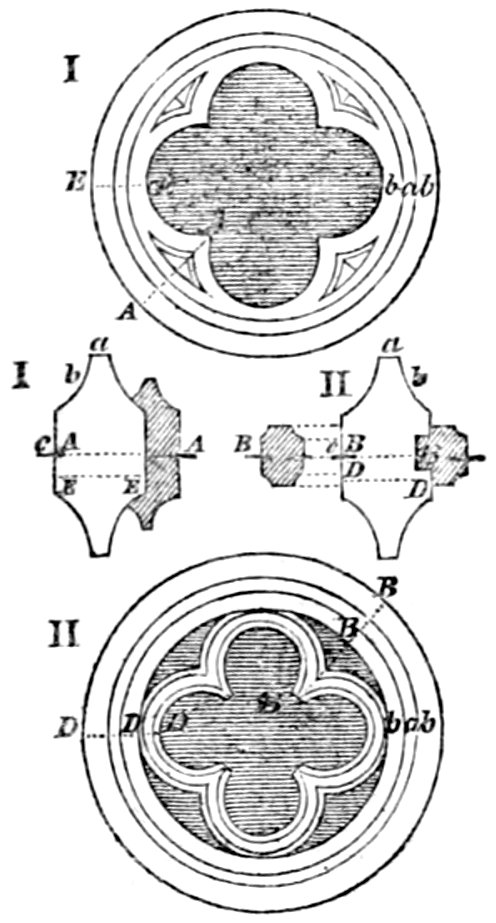
CUSPS. (In church architecture.) The projecting points from the foliation of arches or tracery. Cusping first appeared in the Geometric period, and was continued so long as Gothic architecture was employed. Besides the more obvious differences arising from the number of cusps, which, however, it is needless to particularize, there is one very great peculiarity of the earlier cusping which ought to be clearly understood. Let the tracery bar consist of three planes, a the wall, b the chamfer, and c soffit plane (the latter of course not being visible in the two larger diagrams, which, being elevations, show no line at right angles to the wall). In the more common cusping, the cusp is formed by carrying out the whole of the soffit and part of the chamfer plane, and leaving an unpierced hollow, or eye, in the tracery bar, as at A A, fig. I; A A in the section answering to A A in the elevation, and E E to E E. In the Earlier or Geometrical cusping, the tracery bar is completed all round, and the cusp carries with it no part either of the soffit or of the chamfer, but is let into the soffit, always in appearance, sometimes in fact, as a separate piece of stone, as at B D, fig. II. Here, too, the cusp leaves a free space between itself and the tracery bar, as at B B B in elevation, and section II. D D D, representing the place of departure of the cusp from the tracery bar. This is generally called soffit cusping, from its springing exclusively from the soffit plane.
DAILY PRAYERS. “All priests and deacons are to say daily the morning and evening prayer, either privately or openly, not being let by sickness or some other urgent cause. And the curate that ministereth in every parish church or chapel, being at home, and not being otherwise reasonably hindered, shall say the same in the parish church or chapel where he ministereth, and shall cause a bell to be tolled thereunto a convenient time before he begin, that the people may come to hear God’s word, and pray with him.”—Preface to the Book of Common Prayer. As this is not only a direction of the Church, but also part of an act of parliament, any parishioners desirous of attending daily prayers might compel the clergyman to officiate, by bringing an action against him, as well as by complaining to the bishop. For this, of course, there can seldom be any necessity, as most of the clergy would be too happy to officiate, if they could secure the attendance of two or three of their parishioners. By the general practice of the clergy it seems to be decided, that they are to say the morning and evening prayer in private, if they cannot obtain a congregation; though, even under those circumstances, the letter of the rubric seems to direct them to say the offices at church, if possible. It is a cheering sign of the times, that the number of instances in which the daily prayers are duly said in church is rapidly on the increase.
DALMATIC, was formerly the characteristic dress of the deacon in the administration of the holy eucharist. It was also worn by the bishop at stated times; and in the Latin Church still forms part of the episcopal dress, under the chasuble. It is a robe reaching below the knees, and open at each side for a distance varying at different periods. It is not marked at the back with a cross like the chasuble, but in the Latin Church with two narrow stripes, the remains of the angusti clavi worn on the old Roman dress. In the Greek 275Church it is called colobion, is covered with a multitude of small crosses, and has no sleeves. The dalmatic is seen on the effigies of bishops on monuments, and in some old brasses, over the alb and the stole, the fringed extremities of which reach just below it. It has received its name from being the regal vest of Dalmatia. It is the same as the tunicle, which is directed to be worn according to the rubrics of King Edward VI.’s First Prayer Book, by the priests and deacons who may assist the priest at the holy communion. Like all the other ecclesiastical vestures, it was curtailed by the corrupt practice of later ages in the West, so as not to reach further than the knees.—Jebb.
DAMNATORY CLAUSES. (See Athanasian Creed.)
DANIEL (THE BOOK OF). A canonical book of the Old Testament. Daniel descended from the royal house of the kings of Judah, and was contemporary with Ezekiel. (An. 606, before Christ.) He was of the children of the captivity, being carried to Babylon when he was about eighteen years of age. His name is not prefixed to his book; yet the many passages in which he speaks in the first person, are a sufficient proof that he was the author of it. The style of Daniel is not so lofty and figurative as that of the other prophets: it is clear and concise, and his narrations and descriptions simple and natural; in short, he writes more like an historian than a prophet.
He was a very extraordinary person, and was favoured of God, and honoured of men, beyond any that had lived in his time. His prophecies concerning the coming of the Messiah, and the other great events of after-times, are so clear and explicit, that Porphyry objected to them, that they must have been written after the facts were done.—Prideaux, Connect. P. I. b. iii. Ann. 534. Hieron. in Proœm. ad Com. in Dan.
The Jews do not reckon Daniel among the prophets; and the reason they assign is, because he rather lived the life of a courtier, in the palace of the king of Babylon, than that of a prophet. They add, that, though he had Divine revelations given to him, yet it was not in the prophetic way, but by dreams and visions of the night, which they look upon as the most imperfect way of revelation, and below the prophetic. But Josephus, one of the ancientest writers of that nation, reckons him among the greatest of the prophets, and says further of him, that he conversed familiarly with God, and not only foretold future events, as other prophets did, but determined likewise the time when they should come to pass. But our Saviour, by acknowledging Daniel as a prophet, puts his prophetic character out of all dispute.—Maimonid, in More Nevochim, p. 2, ch. 45. Huet. Demonstr. Evangel. Prop. 4, ch. 14. Joseph. Antiq. lib. x. ch. 12. Matt. xxiv. 15.
Part of the book of Daniel was originally written in the Chaldee language; that is, from the fourth verse of the second chapter to the end of the seventh chapter; and the reason was, because, in that part, he treats of the Chaldean or Babylonish affairs. All the rest of the book is in Hebrew.—Hieron. in Præf. ad Dan. The Greek translation, used by the Greek Churches throughout the East, was that of Theodotion. In the Vulgar Latin Bible, there is added, in the third chapter, after the twenty-fourth verse, the Song of the Three Children, and, at the end of the book, the History of Susanna, and of Bel and the Dragon: the former is made the thirteenth, and the latter the fourteenth chapter of the book, in that edition. But these additions were never received into the canon by the Jews; neither are they extant in the Hebrew or the Chaldee language, nor is there any proof that they ever were so.
The first six chapters of the book of Daniel are a history of the kings of Babylon, and what befell the captive Jews under their government. In the last six, he is altogether prophetical, foretelling, not only what should happen to his own Church and nation, but events in which foreign princes and kingdoms were concerned; particularly the rise and downfal of the four secular monarchies of the world, and the establishment of the fifth, or spiritual kingdom of the Messiah.
It is believed that Daniel died in Chaldea, and that he did not take advantage of the permission granted by Cyrus to the Jews of returning to their own country. St. Epiphanius says he died at Babylon, and herein he is followed by the generality of historians.
“Amongst the old prophets,” says the great Sir Isaac Newton, “Daniel is most distinct in order of time, and easiest to be understood; and therefore, in those things which relate to the last times, he must be made the key to the rest. His prophecies are all of them related to one another, as if they were but several parts of one general prophecy. The first is the easiest to be understood, and every following prophecy adds something new to the former.”—Observations on Daniel, pp. 15, 24.
276DATARY. An officer in the pope’s court. He is always a prelate, and sometimes a cardinal, deputed by his Holiness to receive such petitions as are presented to him, touching the provision of benefices. By his post, the datary is empowered to grant, without acquainting the pope therewith, all benefices that do not produce upwards of twenty-four ducats annually; but for such as amount to more, he is obliged to get the provisions signed by the pope, who admits him to audience every day. If there be several candidates for the same benefice, he has the liberty of bestowing it on which of them he thinks proper, provided he has the requisite qualifications. The datary has a yearly salary of two thousand crowns, exclusive of the perquisites, which he receives from those who apply to him for any benefice. This office has a substitute, named the sub-datary, who is likewise a prelate, and has a yearly pension of a thousand crowns: but he is not allowed to confer any benefice, without acquainting the datary therewith. When a person has obtained the pope’s consent for a benefice, the datary subscribes his petition with an annuit sanctissimus, i. e. the most holy father consents to it. The pope’s consent is subscribed in these words, Fiat ut petitur, i. e. Be it according to the petition. After the petition has passed the proper offices, and is registered, it is carried to the datary, who dates it, and writes these words—Datum Romæ apud, &c.: Given at Rome in the pontifical palace, &c. Afterwards the pope’s bull, granting the benefice, is despatched by the datary, and passes through the hands of more than a thousand persons, belonging to fifteen different offices, who have all their stated fees. The reader may from hence judge how expensive it is to procure the pope’s bull for a benefice, and what large sums go into the office of the datary, especially when the provisions, issued from thence, are for bishoprics, and other rich benefices.—Broughton.
DEACON. (See Bishop, Presbyter, Priest, Orders, Clergy.) The name Διάκονοι, which is the original word for deacons, is sometimes used in the New Testament for any one that ministers in the service of God: in which large sense we sometimes find bishops and presbyters styled deacons, not only in the New Testament, but in ecclesiastical writers also. But here we take it for the name of the third order of the clergy in the Church. Deacons are styled by Ignatius, “ministers of the mysteries of Christ,” adding that they are “not ministers of meats and drinks, but of the Church of God.” In another place he speaks of them as “ministers of Jesus Christ,” and gives them a sort of presidency over the people, together with the bishops and presbyters. Cyprian speaks of them in the same style, calling them “ministers of episcopacy and the Church,” and referring their origin to the Acts of the Apostles; and he asserts that they were called ad altaris ministerium, to the ministry and service of the altar. Optatus had such an opinion of them as to reckon their office a lower degree of the priesthood. At the same time it is to be observed, that in this he was singular. By those who regarded them as a sacred order, they were generally distinguished from priests by the name of ministers and Levites. The ordination of a deacon differed in the primitive Church from that of a presbyter, both in the form and manner of it, and also in the gifts and powers that were conferred by the ordinance. In the ordination of a presbyter, the presbyters who were present were required to join in imposition of hands with the bishop. But the ordination of a deacon might be performed by the bishop alone, because, as the [fourth] Council of Carthage words it, he was ordained not to the priesthood, but to the inferior services of the Church: “quia non ad sacerdotium sed ad ministerium consecratur.” It belonged to the deacons to take care of the holy table and all the ornaments and utensils appertaining thereto; to receive the oblations of the people, and present them to the priest; in some churches, to read the Gospel both in the communion service and before it also; to minister the consecrated bread and wine to the people in the eucharist; in some churches, to baptize; to act as directors to the people in public worship, for which purpose they were wont to use certain known forms of words, to give notice when each part of the service began, and to excite people to join attentively therein; to preach, with the bishop’s licence; in extreme cases to reconcile the excommunicated to the Church; to attend upon the bishop, and sometimes to represent him in general councils. Deacons seem also to have discharged most of the offices which now devolve upon churchwardens.—Bingham.
The Church of England enjoins that “none shall be admitted a deacon except he be twenty-three years of age, unless he have a faculty;” and she describes the duties of a deacon in her office as follows: “It appertaineth to the office of a deacon, in the church where he shall be appointed 277to serve, to assist the priest in Divine service, and specially when he ministereth the holy communion, and to help him in the distribution thereof, and to read Holy Scripture and homilies in the church; and to instruct the youth in the catechism; in the absence of the priest to baptize infants, and to preach, if he be admitted thereto by the bishop. And, furthermore, it is his office, where provision is so made, to search for the sick, poor, and impotent people of the parish, to intimate their estates, names, and places where they dwell, unto the curate, that by his exhortation they may be relieved with the alms of the parishioners, or others.”
In the rubric after the sentences of the Offertory, it is ordered, that “while these sentences are in reading, the deacons, churchwardens, or other fit persons appointed for that purpose, shall receive the alms for the poor,” &c.
The deacon cannot pronounce the absolution, or minister at the holy communion, except as an assistant. And if the rubrics be strictly construed according to the letter, neither can he read the versicles before the Psalms, or after the Lord’s Prayer, (at its second occurrence,) nor the latter part of the Litany, beginning at the Lord’s Prayer; nor any part of the Communion Service, except the Gospel, (not according to the rubric, however, but in virtue of the licence in the Ordination Service,) the Creed, and the confession. He is permitted to baptize only in the absence of the priest; and perhaps the same remark may apply to the other occasional offices.
DEACONESS. A woman who served the Church in those offices in which the deacons could not with propriety exercise themselves. This order was also appointed in the apostolic age. They were generally widows who had been only once married, though this employment was sometimes exercised by virgins. Their office consisted in assisting at the baptism of women, in previously catechizing and instructing them, in visiting sick persons of their own sex, and in performing all those inferior offices towards the female part of the congregation, which the deacons were designed to execute for the men. St. Paul (Rom. xvi.) speaks of Phœbe as servant, or deaconess, of the church at Cenchrea, which was a haven of Corinth. Deaconesses appear to be the same persons as those whom Pliny, in his famous letter to Trajan, styles “ancillæ quæ ministræ dicebantur;” that is, “female attendants, called assistants, ministers, or servants.” It appears, then, that these were customary officers throughout the churches; and when the fury of persecution fell on Christians, these were among the first to suffer. They underwent the most cruel tortures, and even extreme old age was not spared. It is probable that they were blessed by the laying on of hands, but it is certain they were not permitted to execute any part of the sacerdotal office. This order continued in the Greek Church longer than in the Latin. It was generally disused in the Western Church in the fifth century, but continued in the Eastern Church until the twelfth. The deacon’s wife appears sometimes to have been called a deaconess, as the presbyter’s wife was styled presbytera, and the bishop’s wife episcopa.
DEAD. (See Burial of the Dead.) If all our prayers and endeavours for our friend prove unavailable for the continuance of his life, we must with patience submit to the will of God, “to whom the issues of life and death belong:” and therefore, after recommending his soul to God, which immediately upon its dissolution returns to Him, it is fit we should decently dispose of his body, which is left to our management and care. Not that the dead are anything the better for the honours which we perform to their corpses (for we know that several of the ancient philosophers cared not whether they were buried or not; and the ancient martyrs of the Christian Church despised their persecutors for threatening them with the want of a grave). But those who survive could never endure that the shame of nature should lie exposed, nor see the bodies of those they loved become a prey to birds and beasts. For these reasons, the very heathens called it a Divine institution, and a law of the immortal gods. And the Romans especially had a peculiar deity to preside over this affair. The Athenians were so strict, that they would not admit any to be magistrates, who had not taken care of their parents’ sepulture, and beheaded one of their generals after he had gotten a victory, for throwing the dead bodies of the slain, in a tempest, into the sea. And Plutarch relates, that, before they engaged with the Persians, they took a solemn oath, that, if they were conquerors, they would bury their foes; this being a privilege which even an enemy hath a right to, as being a debt which is owing to humanity.
2. It is true, indeed, the manner of funerals has varied according to the different customs of several countries; but all civilized nations have ever agreed in 278performing some funeral rites or other. The most ancient manner was by “burying them in the earth;” which is, indeed, so natural, that some brutes have been observed, by mere instinct, to bury their dead with wonderful care. The body, we know, was formed of the dust at first, and therefore it is fit it should “return to the earth as it was” (Gen. iii. 19; Eccles. xii. 7); insomuch that some heathens have, by the light of reason, called burying in the earth the being “hid in our mother’s lap,” and the being “covered with her skirt.” And that “interment,” or enclosing the dead body in the grave, was used anciently by the Egyptians and other nations of the East, is plain from the account we have of the embalming, and from their mummies, which are frequently found to this day whole and entire, though some of them have lain above three thousand years in their graves. That the same practice of burying was used by the patriarchs, and their successors the Jews, we have abundant testimony from the most ancient records in the world, the books of Moses; by which we find, that their funerals were performed, and their sepulchres provided with an officious piety (Gen. xxiii. 4; xxv. 9; xxxv. 29; xlix. 31); and that it was usual for parents to take an oath of their children, (which they religiously performed,) that they should bury them with their fathers, and carry their bones with them, whenever they quitted their land where they were. (Gen. xlvii. 29–31; xlix. 29–33; l. 25, 26; Exod. xiii. 19. See also Josh. xxiv. 32; Acts vii. 16; Heb. xi. 22.) In succeeding ages, indeed, it became a custom in some places to burn the bodies of the dead; which was owing partly to a fear that some injury might be offered them if they were only buried, by digging their corpses again out of their graves; and partly to a conceit, that the souls of those that were burnt were carried up by the flames to heaven.
3. But though other nations sometimes used interment and sometimes burning, yet the Jews confined themselves to the former alone. There is a place or two indeed in our translation of the Old Testament, (1 Sam. xxxi. 12; Amos vi. 10,) which might lead us to imagine that the rite of burning was also used by them sometimes. But upon consulting the original texts, and the customs of the Jews, it does not appear that the burnings there mentioned were anything more than the burning of odours and spices about their bodies, which was an honour they usually performed to their kings. (2 Chron. xvi. 14; xxi. 19; Jer. xxxiv. 5.) So that, notwithstanding these texts, we may safely enough conclude, that interment, or burying, was the only rite with them; as it was also in after-times with the Christian Church. For wherever Paganism was extirpated, the custom of burning was disused; and the first natural way of laying up the bodies of the deceased entire in the grave obtained in the room of it.
4. And this has always been done with such solemnity, as is proper to the occasion. Sometimes, indeed, it has been attended with an expensive pomp, that is unseemly and extravagant. But this is no reason why we should not give all the expressions of a decent respect to the memory of those whom God takes from us. The description of the persons who interred our Saviour, the enumeration of their virtues, and the everlasting commendation of her who spent three hundred pennyworth of spikenard to anoint his body to the burial, have always been thought sufficient grounds and encouragements for the careful and decent sepulture of Christians. And, indeed, if the regard due to a human soul, rendered some respect to the dead a principle that manifested itself to the common sense of heathens, shall we think that less care is due to the bodies of Christians, who once entertained a more glorious inhabitant, and were living temples of the Holy Ghost? (1 Cor. vi. 19;) to bodies which were consecrated to the service of God; which bore their part in the duties of religion; fought the good fight of faith and patience, self-denial and mortification; and underwent the fatigue of many hardships and afflictions for the sake of piety and virtue;—to bodies which, we believe, shall one day be awakened again from their sleep of death; have all their scattered particles of dust summoned together into their due order, and be “fashioned like to the glorious body of Christ” (Phil. iii. 21; see also 1 Cor. xv. 42–44); as being made partakers of the same glory with their immortal souls, as once they were of the same sufferings and good works. Surely bodies so honoured here, and to be so glorified hereafter, and which too we own, even in the state of death, to be under the care of a Divine providence and protection, are not to be exposed and despised by us as unworthy of our regard. Moved by these considerations, the primitive Christians, though they made no use of ointments whilst they lived, yet they did not think the most precious too costly to be used about the dead. And yet this was so far from being reproached with superstition, 279that it is ever reported as a laudable custom, and such as had something in it so engaging, so agreeable to the notions of civilized nature, as to have a very considerable influence upon the heathens, who observed and admired it; it becoming instrumental in disposing them to a favourable opinion at first, and afterwards to the embracing of the Christian religion, where these decencies and tender regards to deceased friends and good people, were so constantly, so carefully, and so religiously practised.—Dean Comber. Wheatly.
Christ’s Church, that is, the whole number of the faithful, is usually divided into two parts; namely, the Church militant, and the Church triumphant. By the Church militant, or in a state of warfare, we mean those Christians who are at present alive, and perpetually harassed with the temptations and assaults of the world, the flesh, and the devil, and whose life is consequently a continual warfare under the banner of our blessed Saviour. By the Church triumphant, we mean those Christians who have departed this life in God’s true faith and fear; and who now enjoy in some measure, and after the day of judgment shall be fully possessed of, that glory and triumph, which is the fruit of their labours, and the reward of those victories which they obtained over their spiritual adversaries, during the time of their trial and combat here upon earth.—Dr. Bennet.
After the Offertory in the eucharist is said, and the oblations of bread and wine, with the alms for the poor, are placed upon the table, the minister addresses this exhortation to the people: “Let us pray for the whole state of Christ’s Church militant here in earth.” The latter part of this sentence is wanting in Edward’s First Book. The words “militant here in earth,” which were designed expressly to exclude prayer for the dead, were inserted in the Second Book, in which that part of this prayer, which contained intercession for the dead, was expunged. It was the intention of the divines who made this alteration, to denote that prayers are not to be offered up for the dead, whose spiritual warfare is already accomplished; but for those only who are yet “fighting the good fight of faith,” and are consequently in a capacity of needing our prayers.—Shepherd.
Although the doctrine of purgatory be a comparatively modern doctrine, yet prayers for the justified dead, for the increase of their happiness, and for our reunion with them, were introduced early into the Church. But it can be proved:
First. That, the prayers of the primitive Church for the dead, being especially for those who were accounted saints par excellence, and including even the Blessed Virgin and the Holy Apostles, prayer to the departed saints, whoever they may be, as it is practised by the churches under the Roman obedience, must be contrary in theory, as it is in fact, to the primitive practice; since it were impossible to pray to and for the same persons.
Secondly. That it was not for the release of the spirit of the departed from purgatory that the Church supplicated Almighty God. For this also were incompatible with prayer for the Blessed Virgin, and other eminent saints, of which there was never any doubt but that they were already in Abraham’s bosom, or even, as in the case of martyrs, in heaven itself.
Thirdly. That works of supererogation formed no part of the system of primitive theology; since all were prayed for as requiring the mercy of God, though it was not declared to what particular end.
Fourthly. That the use of hired masses for the dead, who may have been persons of exceeding criminality, and have died in mortal sin, is utterly at variance with the practice of the Church of old.—See Archbishop Usher and Bingham.
DEADLY SIN. We pray in the Litany to be delivered from “all deadly sin.” In the strict sense of the word every sin is deadly, and would cause eternal death if it were not for the intervention of our blessed Saviour. Even what are called infirmities and frailties, are in this sense deadly. But persons under grace have for these offences “an Advocate with the Father, Jesus Christ the righteous, and he is the propitiation for our sins.” (1 John ii. 2.) Their infirmities and frailties, therefore, if they are trying to overcome them, are not deadly to persons under grace, or baptized persons justified by faith, although, if persevered in, and uncorrected, they may terminate in deadly sin; and they consequently require continual repentance, lest they should grow into such a fearful burden. But even to persons under grace we learn, from 1 John v. 16, 17, that there are “sins unto death,”—which must mean sins that put us out of a state of grace, and this is done by any wilful sin persevered in. By deadly sin in a Christian is meant wilful sin, persevered in, which deprives us of all Christian privileges. (See Sin.)
DEAN. Of deans there are two sorts; 1st, the dean of a cathedral, who is an 280ecclesiastical magistrate, next in degree to the bishop. He is chief of the chapter, and it is supposed is called a dean, (Decanus,) from a similar title in ancient monasteries, of an officer who presided over ten monks.
The dean represents the Archpresbyter, or Protopapas, who all the world over, from the most ancient times, was found under one denomination or another in the principal church of the diocese, to which a body of clergy was uniformly attached. Notre Dame at Paris had a dean as early as 991 at least. There was a dean of Bangor in 603; of Llandaff in 612; at Canterbury from 825 to 1080, then the name of Prior was substituted. Salisbury had its dean in 1072; Lincoln, 1092. In conventual cathedrals, the head was generally prior, the bishop being virtually abbot. The dean was the first dignitary of the cathedral; the head of the corporation; and, in subordination to the bishop, has, according to the statutes of more ancient cathedrals, the cure of souls over the members of the cathedral, and the administration of the corrective discipline of the Church. He has also duties in the choir and the chapter in common with all the chapter. He is by our law a sole corporation, that is, he represents a whole succession, and is capable of taking an estate as dean, and conveying it to his successors. 2nd, Rural deans, whose office is of ancient date in the Church of England, long prior to the Reformation, as it has been throughout Europe, and which many of the bishops are now reviving. Their chief duty is to visit a certain number of parishes, and to report their condition to the bishop. (See Rural Dean.) The dean was not always head of the chapter abroad; the provost being sometimes the superior. But he had always the administration of the discipline in spirituals, [curam animarum, as it is expressly called in statutes both of home and foreign Churches,] the provosts often concerning themselves merely in temporals, and he had the superintendence of the choir, or cathedral body. (See Dictionnaire de Droit Canonique, Lyons, 1787, voce Doyen.) They were, in fact, very much like the deans in our colleges, though more strictly limited ad sacra. The Dean of Faculty, in most ancient and some modern universities, presided over the meetings of their respective faculties, and maintained the academical discipline.
DEAN AND CHAPTER. This is the style and title of the governing body of a cathedral. A chapter consists of the dean, with a certain number of canons, or prebendaries, heads of the church—capita ecclesiæ. The origin of this institution is to be traced to a remote antiquity. A missionary bishop, when converting our ancestors, would take his position in some central town, with his attendant priests: these, as opportunity offered, would go to the neighbouring villages to preach the gospel, and administer the other offices of the Church. But they resided with the bishop, and were supported out of his revenues. By degrees parochial settlements were made; but still the bishop required the attendance of certain of the clergy at his cathedral, to be his council; (for the bishops never thought of acting without consulting their clergy;) and also to officiate in his principal church or cathedral. These persons, to qualify themselves for their office, gave themselves up to study, and to the maintenance and decoration of their sanctuary; the services of which were to be a model to all the lesser churches of the diocese. Forming, in the course of time, a corporation, they obtained property, and ceased to be dependent upon the bishop for a maintenance. And being considered the representatives of the clergy, upon them devolved the government of the diocese when vacant; and they obtained the privilege, doubtless on the same principle, of choosing the bishop, which originally belonged to the whole clergy of the diocese, in conjunction with the bishops of the province. In this privilege they were supported by the kings of the country, who perceived that they were more likely to intimidate a chapter into the election of the royal nominee, than the whole of the clergy of a diocese. But still the deans and chapters sometimes acting independently, an act was passed under Henry VIII., by which a dean and chapter refusing to elect the king’s nominee to the bishopric become individually outlawed, lose all their property, and are to be imprisoned during pleasure. Since that time these corporations have always succumbed to the royal will and pleasure. The great object of the institution, it will be perceived, is, 1st, To provide the bishop with a council; 2nd, To make provision for a learned body of divines, who, disengaged from parochial cares, may benefit the cause of religion by their writings; 3rd, To make provision, also, that in the cathedral church of each diocese the services shall be performed with rubrical strictness, and with all the solemnity and grandeur of which our services are capable.
281It is not to be denied, that, during the last century, this institution was greatly abused. Patrons made use of it to enrich their own families or political partisans; and the cathedral clergy, instead of giving themselves up to learned labours, dwelt chiefly on their livings, coming merely for a short time to their cathedrals: as their estates advanced in value, they expended the income on themselves, instead of increasing the cathedral libraries, and rendering the choirs more efficient, by raising the salaries of the choristers, and doubling or trebling their number: finally, being forgetful of the command of the Church, that, “in cathedral and collegiate churches and colleges, where there are many priests and deacons, they shall all receive the communion with the priest, every Sunday at the least,” many deans and chapters have, most unjustifiably, discontinued the weekly communion. Whether individual members of chapters consider these observances superstitious or not, it is on these conditions they enjoy their property; and if they cannot conscientiously keep the conditions, they ought conscientiously to resign their places. These things required reform; and forecasting men, seeing no symptoms of improvement, expected that the arm of the Lord would be made bare for vengeance; and the Lord made use of the secular government of England as his instrument of chastisement. The British legislature, acting on the precedent of Cardinal Wolsey and Henry VIII., has seized a large portion of the property belonging to the deans and chapters, and has reduced the number of canons. May this be a warning to the deans and chapters as they now exist! May patrons make the cathedral close the abode of men of learning, and may the members of chapters sacrifice even their private property to render their cathedral choirs what they ought to be! May they have strength of mind to sacrifice all they have in the world, rather than elect as a bishop an unworthy nominee of the Crown, if, peradventure, the Crown nominate a Sabellian, or an Arian, or a Socinian heretic. (See Chapters, Canons, and Prebendaries.)
DECALOGUE. The ten precepts, or commandments, delivered by God to Moses, and by him written on two tables of stone, and delivered to the Hebrews, as the basis and foundation of their religion. The history of this great event, together with the ten commandments themselves, are recited at large in the 19th and 20th chapters of the book of Exodus.
The Jews called these commandments, by way of excellence, the ten words, from whence they had afterwards the name of Decalogue. But it is to be observed, that they joined the first and second into one, and divided the last into two. They understand that against stealing to relate to the stealing of men, or kidnapping, alleging, that the stealing of another’s goods or property is forbidden in the last commandment.—De Legib. Hebr. lib. i. c. 2.
“Most divines,” says the learned Spencer, “seem to have been of opinion, that God gave the Decalogue, to be a general rule of life and manners, and as it were a summary, to which all other precepts, either of the law or the gospel, may be reduced. Hence they rack their brains, to fix so large and extensive a meaning on all these commands, that all duties, respecting God or our neighbour, may be understood to be contained in them. But no one, who duly considers the matter, can think it probable, that the Decalogue was therefore given, that it might be a kind of compendium of all the other laws of the Pentateuch; since those eminent precepts of the law, ‘Thou shalt love the Lord thy God with all thy heart,’ and ‘Thou shalt love thy neighbour as thyself,’ cannot be found in the Decalogue, without affixing a meaning to some commands quite foreign to the natural sense of the words, and subjecting them to an arbitrary interpretation. To give my opinion in a few words; the chief scope and intent of the Decalogue was to root out idolatry and its more immediate effects, and to add force and authority to the other laws contained in the Pentateuch. For who can persuade himself, that God would have collected together, into the one little system of the Decalogue, those ten precepts, which have scarce any connexion with each other, had they not all naturally tended to destroy idolatry and its primary effects?” The author then proceeds to confirm the truth of this assertion by a distinct consideration of each precept of the two tables.
It has been a question, and even matter of admiration, why God, in delivering laws to the Hebrews, kept precisely to the number ten. This question is answered by the above-cited author, (Id. ib. § 2,) who assigns the following reasons for this proceeding. “First, the number ten exceeds all others in perfection and capacity: for in it are comprehended all the diversities of numbers and their analogies, and all the geometrical figures which have any relation to numbers. Secondly, A Decad seems to have been in most esteem and 282use, among all nations, from the earliest times. Thirdly, As the number ten comprehends in it all others, so the Decalogue was to be a kind of representative of all the other laws of Moses, which were too numerous to be distinctly and separately rehearsed from Mount Sinai. Lastly, The number ten was a sacred number, and most frequently applied to the things mentioned in the Law: as will be evident to those, who carefully read over the institutes of Moses.”
The Samaritans, to raise and maintain the credit of their temple on Mount Gerizim, forged an eleventh command or precept, which in their Pentateuch they added at the end of the Decalogue, both in Exodus and Deuteronomy. It was this: “When the Lord thy God shall have brought thee into the land of Canaan, whither thou goest to possess it, thou shalt erect to thyself large stones, and shalt write on them all the words of this Law. And, after thou shalt have passed over Jordan, thou shalt place those stones, which I command thee this day, on Mount Gerizim, and shalt build there an altar to the Lord thy God, an altar of stone,” &c.
DECLARATION. (See Conformity.)
DECORATED. The style of architecture which succeeded the Geometrical about 1315, and gave place to the Perpendicular about 1360.
The most obvious characteristic of this style is the window tracery (see Tracery); but all the parts and details have also their appropriate features. The doorway is no longer divided by a central shaft. The windows are larger than in the former style, and their mullions have in general fewer subordinations of mouldings. The corner buttresses are usually set diagonally instead of in pairs, and the buttresses generally are of considerable projection, and much enriched with pediments and niches. The piers consist generally of four shafts with intervening hollows, set lozengewise; and the detached shaft is wholly discontinued. The triforium, which had begun to lose its relative importance in the Geometrical, is in this style generally treated as a mere course of panelling at the base of the clerestory windows, which are proportionally enlarged. Arcading begins to be superseded by panelling. Foliage, and other carving, is treated with less force and nature than in the preceding style; and heraldry begins to appear. The vaulting (see Vaulting) is more intricate. One or two mouldings and decorations are almost peculiar to this style, especially the ogee in all its forms and in every position. The ball-flower and the scroll moulding, it has in common with the Geometrical, but far more frequently. (See Moulding.) The broach spire is still used, but begins to give way to the parapet and spire.
DECRETALS. The name given to the letters of popes, being in answer to questions proposed to them by some bishop or ecclesiastical judge, or even particular person, in which they determined business, as they thought fit. In the ninth century there appeared a collection of decretal letters ascribed to more than thirty popes, succeeding each other in the first three centuries. The author is unknown, but they are generally ascribed to a certain Isidore Mercator, and pass usually under his name. Their uniform tendency is to exalt papal power, and exactly on those points for which no sanction can be alleged from Scripture, or from the early periods of any genuine Church history; such as supreme authority over bishops, the receiving appeals from all parts of the world, and the reservation of causes for the hearing of the Roman see. In the words of Fleury, “They inflicted an irreparable wound on the discipline of the Church, by the new maxims which they introduced in regard to the judgment of bishops and the authority of the pope.” Dr. Barrow mentions them among the chief causes by which the power of the bishop of Rome has been advanced: “The forgery of the decretal epistles (wherein the ancient popes are made expressly to speak and act according to some of his highest pretences, devised long after their times, and which they never thought of, good men) did hugely conduce to his purpose; authorizing his encroachments by the suffrage of ancient doctrine and practice.” “Upon these spurious decretals,” (writes the historian of the middle ages,) “was built the great fabric of papal supremacy over the different national Churches: a fabric which has stood after its foundation crumbled beneath it; for no one has pretended to deny, during the last two centuries, that the imposture is too palpable for any but the most ignorant ages to credit.” Their effect was, to diminish the authority of metropolitans and provincial synods, by allowing to an accused bishop, not only the right of appeal, but the power also of removing any process into the supreme court at Rome. And on this account it has been supposed that the decrees were forged by some bishop who desired to reduce the power of his immediate superior. But whoever may have been the author, and whatever the origin, there is no doubt that the popes 283became, from the first, their most strenuous defenders.
The best account of these forgeries is to be found in the posthumous work of Van Espen, Commentarius in Jus Novum Canonicum, part ii. diss. 1, p. 451–475. See also De Marca, De Concord. iii. c. 4, 5, p. 242; Natalis Alexandri Hist. Eccles. sæc. i. diss. 13, p. 213; Coci Censura quorundam Scriptorum, &c., passim.—Sanderson. Robins, Evidence of Scripture against the Roman Church.
DEDICATION, FEAST OF. The wake or customary festival for the dedication of churches signifies the same as vigil or eve. The reason of the name is thus assigned in an old manuscript: “Ye shall understand and know how the evens were first founded in old times. In the beginning of Holy Church it was so, that the people came to the church with candles burning, and would wake and come with lights towards night to the church in their devotions: and after, they fell to lechery, and songs, and dances, harping and piping, and also to gluttony and sin; and so turned the holiness to cursedness. Wherefore the holy Fathers ordained the people to leave that waking, and to fast the even. But it is still called vigil, that is, waking in English: and it is also called the even, for at even they were wont to come to church.” It was in imitation of the primitive ἀγάπαι, or love feasts, (see Agapæ,) that such public assemblies, accompanied with friendly entertainments, were first held upon each return of the day of consecration, though not in the body of churches, yet in the churchyards, and most nearly adjoining places. This practice was established in England by Gregory the Great; who, in an epistle to Mellitus the abbot, gives injunctions to be delivered to Augustine the monk, a missionary to England; amongst which he allows the solemn anniversary of dedication to be celebrated in those churches which were made out of heathen temples, with religious feasts kept in sheds or arbours, made up with branches and boughs of trees round the said church. But as the love feasts held in the place of worship were soon liable to such great disorders, that they were not only condemned at Corinth by St. Paul, but prohibited to be kept in the house of God by the 20th canon of the Council of Laodicea, and the 30th of the third Council of Carthage: so, from a sense of the same inconveniences, this custom did not long continue of feasting in the churches or churchyards; but strangers and inhabitants paid the devotion of prayers and offerings in the church, and then adjourned their eating and drinking to the more proper place of public and private houses. The institution of these church encœnia, or wakes, was, without question, for good and laudable designs: at first, thankfully to commemorate the bounty and munificence of those who had founded and endowed the church; next, to incite others to the like generous acts of piety; and, chiefly, to maintain a Christian spirit of unity and charity, by such sociable and friendly meetings. And therefore care was taken to keep up the laudable custom. The laws of Edward the Confessor gave peace and protection in all parishes during the solemnity of the day of dedication, and the same privilege to all that were going to or returning from such solemnity. In a council held at Oxford, in the year 1222, it was ordained, that among other festivals should be observed the day of dedication of every church within the proper parish. And in a synod under Archbishop Islip, (who was promoted to the see of Canterbury in the year 1349,) the dedication feast is mentioned with particular respect. This solemnity was at first celebrated on the very day of dedication, as it annually returned. But the bishops sometimes gave authority for transposing the observance to some other day, and especially to Sunday, whereon the people could best attend the devotions and rites intended in this ceremony. Henry VIII. enjoined that all wakes should be kept the first Sunday in October.
This laudable custom of wakes prevailed for many ages, till the Puritans began to exclaim against it as a remnant of Popery. By degrees the humour grew so popular, that at the summer assizes held at Exeter, in the year 1627, the Lord Chief Baron Walter and Baron Denham made an order for suppression of all wakes. And a like order was made by Judge Richardson for the county of Somerset, in the year 1631. But on Bishop Laud’s complaint of these innovations, the king commanded the last order to be reversed; which Judge Richardson refusing to do, an account was required from the Bishop of Bath and Wells, how the said feast days, church ales, wakes, and revels, were for the most part celebrated and observed in his diocese. On the receipt of these instructions, the bishop sent for and advised with seventy-two of the most orthodox and able of his clergy; who certified under their hands, that, on these feast days, (which generally fell on Sundays,) the service of God was more solemnly performed, and 284the church much better frequented, both in the forenoon and afternoon, than on any other Sunday in the year; that the people very much desired the continuance of them; that the ministers did in most places the like, for these reasons, viz. for preserving the memorial of the dedication of their several churches, for civilizing the people, for composing differences by the mediation and meeting of friends, for increase of love and unity by these feasts of charity, and for relief and comfort of the poor. On the return of this certificate, Judge Richardson was again cited to the council table, and peremptorily commanded to reverse his former order. After which it was thought fit to reinforce the declaration of King James, when perhaps this was the only good reason assigned for that unnecessary and unhappy licence of sports: “We do ratify and publish this our blessed father’s decree, the rather because of late, in some counties of our kingdom, we find, that, under pretence of taking away abuses, there hath been a general forbidding not only of ordinary meetings, but of the feasts of the dedication of churches, commonly called wakes.” However, by such a popular prejudice against wakes, and by the intermission of them in the confusions that followed, they are now discontinued in many counties, especially in the east and some western parts of England, but are commonly observed in the north and in the midland counties.
DEFENDER OF THE FAITH. (Fidei Defensor.) A peculiar title belonging to the sovereign of England; as Catholic to the king of Spain, and Most Christian to the king of France. These titles were given by the popes of Rome. That of Fidei Defensor was first conferred by Pope Leo X. on King Henry VIII., for writing against Martin Luther; and the bull for it bears date quinto idus Octobris, 1521. It was afterwards confirmed by Clement VII. On Henry’s suppression of the monasteries, the pope of Rome deprived him of this title, and had the presumption and absurdity to depose him from his crown. Therefore the title was conferred by a higher authority than the pope, the parliament of England, in the thirty-fifth year of Henry’s reign. By some antiquarians it is maintained that the bull of Leo only revived a title long sustained by the English kings.
DEGRADATION is an ecclesiastical censure, whereby a clergyman is deprived of the holy orders which formerly he had, as of a priest or deacon; and by the canon law this may be done two ways, either summarily or by word only, or solemnly, as by divesting the party degraded of those ornaments and rights which were the ensigns and order of his degree.
Collier thus describes the form of degradation of a priest, in the case of Fawke, burnt for heresy in the reign of Henry IV. After being pronounced a heretic relapsed, he was solemnly degraded in the following manner:
From the order of To be taken from him,
1 Priest. 1 The paten, chalice, and pulling off his chasuble.
2 Deacon. 2 The New Testament and the stole.
3 Sub-deacon. 3 The albe and the maniple.
4 Acolyth. 4 The candlestick, taper, urceolum.
5 Exorcist. 5 The office for exorcisms.
6 Reader. 6 The lectionarium, or legend book.
7 Ostiarius, or Sexton. 7 The keys of the church-doors, and surplice.
After this, his ecclesiastical tonsure was obliterated, and the form of his degradation pronounced by the archbishop; and being thus deprived of his sacerdotal character, and dressed in a lay habit, he was put into the hands of the secular court, with the significant request, that he might be favourably received.
The ancient law for degradation is set forth in the sixth book of the Decretals; and the causes for degradation and deprivation are enumerated by Bishop Gibson.—See Gibson’s Codex, p. 1066–1068.
By Canon 122, Sentence against a minister, of deposition from the ministry, “shall be pronounced by the bishop only, with the assistance of his chancellor and the dean, (if they may conveniently be had,) and some of the prebendaries, if the court be kept near the cathedral church; or of the archdeacon, if he may be had conveniently, and two other at the least grave ministers and preachers to be called by the bishop, when the court is kept in other places.”
DEGREE. Psalms or Songs of Degrees is a title given to fifteen psalms, which are the 120th and all that follow to the 134th inclusive. The Hebrew text calls them a song of ascents. Junius and Tremellius translate the Hebrew, by a song of excellencies, or an excellent song, because of the excellent matter of them, as eminent persons are called men of high degree. (1 Chr. xvii. 17.) Some call them psalms of elevation, because, say they, they were sung with an exalted voice; or because at every psalm the voice was raised: but the translation of psalms of degrees has more generally obtained. Some interpreters think, that they were so called because they were sung upon the fifteen steps of the temple; but they are not agreed about the place where these fifteen steps were. Others think they were so called, because they were sung in a gallery, which they say was in the court of Israel, 285where sometimes the Levites read the law. But others think, that the most probable reason why they are called songs of degrees, or of ascent, is, because they were composed and sung by the Jews on the occasion of their going up to Jerusalem, after the deliverance from the captivity of Babylon, whether it were to implore this deliverance from God, or to return thanks for it after it had happened: others, that they were severally composed not only upon this, but upon other remarkable occasions when they made their ascent to the temple.
DEGREES in the universities denote a quality conferred on the students or members thereof, as a testimony of their proficiency in the arts and sciences, and entitling them to certain privileges. They were first instituted by Pope Eugenius III. at the suggestion of Gratian, the celebrated compiler of the canon law, in 1151; but were limited to the faculty of canon law, for the encouragement of which they were instituted; and consisted of the ranks of bachelor, licentiate, and doctor. Shortly after Peter Lombard instituted similar degrees in theology in the university of Paris. In the course of time degrees were given in other faculties, those of arts and medicine being added. In many of the foreign universities, theology and canon law have each their three classes of degrees as above stated; medicine has generally but two, bachelor and doctor; and arts two, bachelor and master. The designation of doctor in philosophy is very modern. The English universities have only two degrees, bachelor and doctor in the superior faculties; master and bachelor in arts. The student of civil law is not, properly speaking, a graduate. Formerly separate degrees were given in England (as abroad) in canon and civil law; but the distinction ceased in the 17th century. Oxford has for some time ceased to confer degrees in utroque jure, (i. e. civil and canon law,) but only in civil law. Hence her graduates are D. C. L. and B. C. L., and not L. L. D. and L. L. B., as at Cambridge and Dublin. The three ancient universities of England and Ireland confer degrees in music. Anciently degrees in grammar, doctorate, mastership, and baccalaurenti were given at Oxford or Cambridge. But they fell into disuse in the 17th century.
DEISTS. Those who deny the existence and necessity of any revelation, and profess to acknowledge that the being of a God is the chief article of their belief. The term Deist is derived from the Latin word Deus, God. The same persons are frequently called infidels, on account of their incredulity, or want of belief in the Christian dispensation of religion.—Consult Boyle’s Lectures, Leland’s View of Deistical Writers, Leslie’s Short and Easy Method with the Deists, Watson’s Apology for the Bible.
Dr. Clarke, (Evidences of Nat. and Rev. Rel. Introd.,) taking the denomination in its most extensive signification, distinguishes deists into four sorts. The first are, such as pretend to believe the existence of an eternal, infinite, independent, intelligent Being; and who, to avoid the name of Epicurean Atheists, teach also, that this Supreme Being made the world; though, at the same time, they agree with the Epicureans in this, that they fancy, God does not at all concern himself in the government of the world, nor has any regard to, or care of, what is done therein.
The second sort of deists are those, who believe, not only the being, but also the providence of God, with respect to the natural world; but who, not allowing any difference between moral good and evil, deny that God takes any notice of the morally good or evil actions of men; these things depending, as they imagine, on the arbitrary constitution of human laws.
A third sort of deists there are, who, having right apprehensions concerning the natural attributes of God, and his all-governing providence, and some notion of his moral perfections also; yet, being prejudiced against the notion of the immortality of the human soul, believe, that men perish entirely at death, and that one generation shall perpetually succeed another, without any future restoration or renovation of things.
A fourth, and the last sort of deists, are such, as believe the existence of a Supreme Being, together with his providence in the government of the world, as also all the obligations of natural religion; but so far only as these things are discoverable by the light of nature alone, without believing any Divine revelation.
These, Dr. Clarke observes, are the only true deists: but, as the principles of these men would naturally lead them to embrace the Christian revelation, he concludes, there is now no consistent scheme of deism in the world. “The heathen philosophers, those few of them, who taught and lived up to the obligations of natural religion, had indeed a consistent scheme of deism so far as it went. But the case is not so now. The same scheme is not any longer consistent with its own principles, if it 286does not now lead men to believe and embrace revelation, as it then taught them to hope for it. Deists, in our days, who reject revelation when offered to them, are not such men as Socrates and Cicero were; but, under pretence of deism, it is plain, they are generally ridiculers of all that is truly excellent in natural religion itself. Their trivial and vain cavils; their mocking and ridiculing, without and before examination; their directing the whole stress of their objections against particular customs, or particular and perhaps uncertain opinions, or explications of opinions, without at all considering the main body of religion; their loose, vain, and frothy discourses; and, above all, their vicious and immoral lives; show plainly and undeniably, that they are not really deists, but mere atheists; and consequently not capable to judge of the truth of Christianity.”
“We are fallen into an age, (says another learned author, Jenkyns, Reasonableness of Christ. Relig. in the Preface,) in which there are a sort of men, who have shown so great a forwardness to be no longer Christians, that have catched at all the little cavils and pretences against religion—but they both think and live so ill, that it is an argument for the goodness of any cause that they are against it. It was urged as a confirmation of the Christian religion by Tertullian, that it was hated and persecuted by Nero, the worst of men: and I am confident, it would be but small reputation to it in any age, if such men should be fond of it. They speak evil of the things they understand not, and are wont to talk with as much confidence against any point of religion, as if they had all the learning in the world in their keeping, when commonly they know little or nothing of what has been said for that against which they dispute.”
Prateolus (Elench. Hæres.) mentions a sect of deists (as they were called) which sprung up in Poland, in the year 1564. They were a branch of the Lutherans, and, coming into France in 1566, settled at Lyons. Their leader (he tells us) was one Gregorius Pauli, a minister of Cracow. They boasted, that God had bestowed on them much greater gifts than on Luther and others, and that the destruction of Antichrist was reserved for them. They asserted, that there is one nature, or Deity, common to the Father, Son, and Holy Ghost, but not one and the same essence; and that the Father alone is the one only true God.
These deists (as Prateolus calls them) ought rather to be denominated Arians.
DELEGATES. The court of delegates was so called, because these delegates sat by force of the king’s commission under the great seal, upon an appeal to the king in the court of Chancery, in three causes: 1. When a sentence was given in any ecclesiastical cause by the archbishop or his official: 2. When any sentence was given in any ecclesiastical cause in places exempt: 3. When a sentence was given in the admiral’s court, in suit civil and marine, by the order of the civil laws. And these commissioners were called delegates, because they were delegated by the king’s commission for these purposes.
For the origin of the high court of delegates, see 24 Hen. VIII. c. 12, and 25 Hen. VIII. c. 19, §4. By the 2 & 3 Wm. IV. c. 92, the powers of the high court of delegates, both in ecclesiastical and maritime causes, are transferred to her Majesty in council; which transfer is further regulated by the 3 & 4 Wm. IV. c. 41, and by 7 & 8 Vict. c. 69. This act does not extend to Ireland.
The Judicial Committee of the Privy Council, consists of
The Lord President.
The Lord Chancellor.
The Lord Keeper of the Great Seal. Provided they be councillors.
The Chief Justice of the Court of Queen’s Bench.
The Master of the Rolls.
The Vice-chancellor.
The Chief Justice of the Court ofCommon Pleas.
The Chief Baron of the Exchequer.
The Judge of the Prerogative Court of Canterbury.
The Judge of the Admiralty Court.
The Chief Judge of the Bankruptcy Court.
All who have held the aforenamed offices.
Two privy-councillors appointed by
the sign-manual.
No matter is to be heard unless in the presence of at least four members of the committee; and no report or recommendation made to the Crown, unless a majority of the members present at the hearing shall concur in such report or recommendation.
DEMIURGE. (From δημιουργὸς, an artificer.) The name given by some Gnostic sects to the Creator of the world, who, according to them, was different from the supreme God. (See Gnostics.)
DEMONIACS. Persons possessed of the devil. That the persons spoken of in the New Testament as possessed of the devil, were not simply lunatics, is clear 287from a mere perusal of the facts recorded. The devils owned Christ to be the Messiah; they besought him not to torment them; they passed into the swine and drove them into the sea. The manner in which our Lord addressed the demoniacs clearly shows that they were really such: he not only rebuked the devils, but called them unclean spirits, asking them questions, commanding them to come out, &c. We find also that, for some time, in the early ages of the Church, demoniacs existed, as there was a peculiar service appointed in the Church for their cure. (See Energumens.)
DENARII DE CARITATE. (Lat.) Customary oblations, anciently made to cathedral churches, about the time of Pentecost, when the parish priests, and many of their parishioners, went in procession to visit their mother-church. This custom was afterwards changed into a settled due, and usually charged upon the parish priest, though at first it was but a gift of charity, or present, towards the support and ornament of the bishop’s see.
DENOMINATIONS, THE THREE. The general body of dissenting ministers of London and Westminster form an association so styled, which was organized in 1727. The object of the association appears to be political. The Three Denominations are, the Presbyterian, (now Socinian,) Independent, and Baptist.
DEO GRATIAS. (Lat.) God be thanked. A form of salutation, anciently used by Christians, when they accosted each other. The Donatists ridiculed the use of it; which St. Augustine defended, affirming, that a Christian had reason to return God thanks when he met a brother Christian. It is at present used only in the sacred offices of the Romish Church. We have something like it in the Communion Service of our own Church, in which the minister says, Let us give thanks unto our Lord God.
DEPOSITION. (See Degradation.)
DEPRECATIONS. (See Litany.)
DEPRIVATION is an ecclesiastical sentence, whereby a clergyman is deprived of his parsonage, vicarage, or other spiritual promotion or dignity.
By Canon 122. Sentence against a minister, of deprivation from his living, “shall be pronounced by the bishop only with the assistance of his chancellor and the dean, (if they may conveniently be had,) and some of the prebendaries, if the court be kept near the cathedral church; or of the archdeacon, if he may be had conveniently, and two other at the least grave ministers and preachers to be called by the bishop, when the court is kept in other places.”
The causes of deprivation may be reduced to three heads, viz. to want of capacity, contempt, and crimes. Nonconformity is thus specially punished by 1 Eliz. c. 2, 13 Eliz. c. 12, 14 Car. II. c. 4. Dilapidation used to be held a good cause of deprivation, yet that it has ever been inflicted as a punishment of dilapidation does not appear, either by the books of common or canon law. In all causes of deprivation, where a person is in actual possession of an ecclesiastical benefice, these things must concur: 1st, A monition or citation of the party to appear: 2nd, A charge given against him by way of libel or articles, to which he is to give an answer: 3rd, A competent time must be assigned, for proofs and interrogatories: 4th, The person accused shall have the liberty of counsel to defend his cause, to except against witnesses, and to bring legal proofs against them: and 5th, There must be a solemn sentence, read by the bishop, after hearing the merits of the cause, or pleadings on both sides. These are the fundamentals of all judicial proceedings in the ecclesiastical courts, in order to a deprivation. And if these things be not observed, the party has a just cause of appeal, and may have a remedy in a superior court.
By 1 & 2 Vict. c. 106, s. 31, spiritual persons trading contrary to the provisions of that act, may be, for the third offence, deprived.
DESK. This is the name usually given to the pulpit or pew in which morning and evening prayers are sung or said in the English churches. The using of this pulpit for prayer is peculiar to the English Church, and has a very unpleasant effect. The First Prayer Book of Edward VI. ordered “the priest, being in the choir, to begin the Lord’s Prayer, called Pater Noster, (with which the morning and evening services then began,) with a loud voice:” so that it was at that time the custom for the minister to sing or say the morning and evening prayer, not in a desk or pulpit, but at the upper end of the choir or chancel, near the altar, towards which, whether standing or kneeling, he always turned his face in the prayers. This gave great offence, however, though it had been the custom of the Church of England for many hundred years, to some superstitious weaker brethren, who so far forgot their charity as to call it anti-Christian. The outcry, however frivolous and vexatious, prevailed so far, that when, 288in the fifth year of King Edward, the Prayer Book was altered, the following rubric appeared instead of the old one, viz. “The morning and evening prayers shall be used in such places of the church, chapel, or chancel, and the minister shall so turn him, as the people best may hear. And if there be any controversy therein, the matter shall be referred to the ordinary, and he or his deputy shall appoint the place.” This caused great contentions—the more orthodox kneeling in the old way, and singing or saying the prayers in the chancel, and the innovators, or ultra-Protestants, adopting new forms, and performing all the services in the body of the church. In the reign of Elizabeth, the rubric was brought to its present form: “that the morning and evening prayers shall be used in the accustomed place in the church, chapel, or chancel,” by which was clearly meant the choir or chancel, which had been for centuries the accustomed place; and it cannot be supposed that the Second Book of Edward, which lasted only one year and a half, could establish a custom. A dispensing power, however, was left with the ordinary, who might determine it otherwise, if he saw just cause. Pursuant to this rubric, the morning and evening services were again, as formerly, sung or said in the chancel or choir. But in some churches, owing to the too great distance of the chancel from the body of the church, in others owing to the ultra-Protestant superstition of the parishioners, the ordinaries permitted the clergy to leave the chancel, and read prayers from a pew in the body of the church. This innovation and novelty, begun first by some few ordinaries, and recommended by them to others, grew by degrees to be more general, till at last it came to be the universal practice; insomuch that the convocation, in the beginning of King James the First’s reign, ordered that in every church there should be a convenient seat made for the minister to read service in. In new churches, where there can be no complaint of the size of the chancels, there seems to be no reason why the ordinaries should not now remove the desk, and send the clergy back to their proper place, to sing or say the prayers in the chancel. At all events, they might get rid of that unsightly nuisance, a second pulpit instead of a reading pew. If the prayers are to be preached to the people, as well as the sermon, one pulpit might suffice. It is gratifying to know, that since the article was written in the first edition of this work, this disfigurement of our churches has been very generally removed. It is to be observed, that the word does not once occur in the Prayer Book.
DEUS MISEREATUR. The Latin name for Psalm lxvii., which may be used after the second lesson at evening prayers, instead of the Nunc Dimittis, except on the twelfth day of the month, when it occurs among the psalms of the day. It was first inserted in our service in the Second Book of King Edward VI.
DEUTERONOMY. A canonical book of the Old Testament. The word implies a second law, the principal design of it being, a repetition of the laws already delivered; which was a necessary thing, inasmuch as the Israelites, who had heard it before, were dead in the wilderness, and there was sprung up another generation of men, who had not heard the Decalogue, or any other of the laws openly proclaimed. It contains likewise some new laws; such as the taking down malefactors from the tree in the evening; the making of battlements on the roofs of houses; the expiation of an unknown murder; the punishment to be inflicted upon a rebellious son; the distinction of the sexes by apparel; the marrying a brother’s wife after his decease: as also, orders and injunctions concerning divorce; laws concerning men-stealers; concerning unjust weights and measures; concerning the marrying of a captive woman; concerning servants that desert their master’s service; and several other laws, not only ecclesiastical and civil, but also military. There are inserted likewise some transactions, which happened in the last year of the travels of the Israelites through the wilderness.
Deuteronomy is the last book of the Pentateuch, or five books of Moses; though some have questioned whether it was written by that legislator, because, in the last chapter, mention is made of his death and burial, and of the succession of Joshua after him. But this only proves that the last chapter was not written by Moses, but added by some other person; most probably by Ezra, when he published an edition of the Holy Scriptures. (See Pentateuch.)
DEVIL. From Διάβολος, which signifies an accuser, or calumniator. The two words, Devil and Satan, are used in Scripture to signify the same wicked spirit, who with many others, his angels or under-agents, is fighting against God; and who has dominion over all the sons of Adam, except the regenerate; and who is, in his 289kingdom of this world, the nearest imaginable approximation, at infinite distance indeed, to the omnipotence of the Godhead.
DIACONATE. The office or order of a deacon. (See Deacon.)
DIACONICUM. (Gr. and Lat.) This word has different significations in ecclesiastical authors. Sometimes it is taken for that part of the ancient church in which the deacons used to sit during the performance of Divine service, namely, at the rails of the altar; sometimes for a building adjoining to the church, in which the sacred vessels and habits were laid up; sometimes for that part of the public prayers which the deacons pronounced. Lastly, it denotes an ecclesiastical book, in which are contained all things relating to the duty and office of a deacon, according to the rites of the Greek Church.
DIAPER. In church architecture, a decoration of large surfaces with a constantly recurring pattern, either carved or painted. Norman diapers are usually either fretted or zigzag lines, or imbrications of the masonry; and not only plain surfaces, but pillars, and small shafts, and even mouldings, are diapered, as the cable moulding surrounding the nave at Rochester. In the succeeding styles, flowers and leaves are the most frequent patterns, which, in the Geometrical style, are often of extreme beauty and delicacy. After the fourteenth century, diapers are painted only, and now even the hollows of mouldings are thus treated.
DIET. The assembly of the states of Germany. We shall only notice the more remarkable of those which have been held on the affairs of religion.
The Diet of Worms, in 1521, where Alexander, the pope’s nuncio, having charged Luther with heresy, the Duke of Saxony said, that Luther ought to be heard; which the emperor granted, and sent him a pass, provided he did not preach on this journey. Being come to Worms, he protested that he would not recant unless they would show him his errors by the word of God alone, and not by that of men; wherefore the emperor soon after outlawed him by an edict.
The first Diet of Nuremberg was held in 1523, when Francis Cheregat, Adrian VI.’s nuncio, demanded the execution of Leo X.’s bull, and of Charles V.’s edict, published at Worms, against Luther: but it was answered, that it was necessary to call a council in Germany, to satisfy the nation about its grievances, which were reduced to a hundred articles, some whereof struck at the pope’s authority, and the discipline of the Roman Church: they added that, in the interim, the Lutherans should be commanded not to write against the Roman Catholics, &c. All these things were brought into the form of an edict, and published in the emperor’s name.
The second Diet of Nuremberg was in 1524. Cardinal Cangegio, Pope Clement VII.’s legate, entered the town incognito, for fear of exasperating the people there: the Lutherans having the advantage, it was decreed that, with the emperor’s consent, the pope should call a council in Germany; but, in the interim, an assembly should be held at Spire, to determine what was to be believed and practised; and that to obey the emperor, the princes ought to order the observance of the edict of Worms as strictly as they could. Charles, angry at this, commanded that edict to be very strictly observed, and prohibited the assembly at Spire.
The first Diet of Spire was held in 1526. The emperor Charles V. being then held in Spain, named his brother, Archduke Ferdinand, to preside over that assembly, where the Duke of Saxony and Landgrave of Hesse demanded a full and free exercise of the Lutheran religion, so that the Lutherans preached there publicly against Popery; and the Lutheran princes’ servants had these five capital letters, V.D. M.I.Æ., embroidered on their sleeves, signifying, Verbum Dei manet in Æternum, to show publicly they would follow nothing else but the pure word of God. The archduke, not daring to oppose this, proposed two things, the first concerning the Popish religion, which was to be maintained in observing the edict of Worms; and the second concerning the aid demanded by Lewis, king of Hungary, against the Turks: the Lutherans prevailing about the first, it was decreed, that the emperor should be desired to call a general or national council in Germany within a year, and that in the mean time every one was to have liberty of conscience, and whilst they were deliberating in vain about the second, King Lewis was defeated and slain at the battle of Mohatz.
The second Diet of Spire was held in 1529. It was decreed against the Lutherans, that wherever the edict of Worms was received, it shall be lawful for nobody to change his opinion; but in the countries where the new religion (as they termed it) was received, it should be lawful to continue in it till the next council, if the old religion could not be reestablished there without sedition. Nevertheless the mass was not to be abolished there, and 290no Roman Catholic was allowed to turn Lutheran; that the Sacramentarians should be banished out of the empire, and the Anabaptists put to death; and that preachers should nowhere preach against the doctrine of the Church of Rome. This decree destroying that of the first Diet, six Lutheran princes, viz. the Elector of Saxony, the Marquis of Brandenburg, the two Dukes of Lunenburg, the Landgrave of Hesse, and the Prince of Anhalt, with the deputies of fourteen imperial towns, protested in writing, two days after, in the assembly, against that decree, which they would not obey, it being contrary to the gospel; and appealed to the general or national council, to the emperor, and to any other unprejudiced judge. From this solemn protestation came that famous name of Protestants, which the Lutherans took presently, and the Calvinists and other reformed Christians afterwards. They also protested against contributing anything towards the war against the Turks, till after the exercise of their religion was free in all Germany. Next year the emperor held the famous Diet of Augsburg.
The first Diet of Augsburg was called in the year 1530, by the emperor Charles V., to reunite the princes about some matters of religion, and to join them all together against the Turks. Here the Elector of Saxony, followed by many princes, presented the confession of faith called the Confession of Augsburg. The conference about matters of faith and discipline being concluded, the emperor ended the Diet by a decree, that nothing should be altered in the doctrine and ceremonies of the Church of Rome till a council should order it otherwise.
The second Diet of Augsburg was held in 1547. The electors being divided concerning the decisions of the Council of Trent, the emperor demanded that the management of this affair should be left to him, and it was resolved, that every one should conform to the council’s decisions.