PREFACE TO THE SEVENTH EDITION. (continued 31)
Reading edition
PERSEVERANCE, FINAL. According to the Calvinistic system, the elect receive the grace of perseverance, so that when grace has once been received, they cannot finally fall from it. This follows from their view of election. But, according to the Catholic view of grace and of election, men may fall, and fall finally, from the grace they have once received. The reader is requested to refer to the article on Election; this may be considered a continuation. Since the reformed Church of England (with the primitive and Catholic) regards election as an admission into the pale of the visible Church Catholic, not a necessary and infallible admission into eternal glory, she obviously could not teach the doctrine of the assured final perseverance of every individual among the elect; but, annexing a totally different sense to the word elect itself from that which is jointly advocated by Calvin and by Arminius, she consistently pronounces that the elect, as she understands the term, may finally fall away, and thence may everlastingly perish.
To this moral possibility of final apostasy the Anglican Church, as was felt by the Calvinistic party in the conference at Hampton Court, alludes, though she does not specifically there define the matter, in her sixteenth Article.
“After we have received the Holy Ghost, we may depart from grace given and fall into sin; and, by the grace of God, we may rise again, and amend our lives.”
Here it seems to be not obscurely intimated, that the elect, even after they have received the Holy Ghost, may so depart from grace given, and may so fall into sin, that they either may, or may not, be restored by the influential grace of God.
580Such, accordingly, was doubtless perceived to be the case by the Calvinistic party; for otherwise it is impossible to account for their proposed alteration of the article, which would have made it speak the language of assured personal final perseverance.
They moved King James, that, to the original words of the article, “after we have received the Holy Ghost, we may depart from grace given, and fall into sin,” might be subjoined the following explanatory addition, “yet neither totally nor finally.”
Had this addition been made, the seventeenth Article would doubtless have taught the doctrine of the final perseverance of all the elect. The wish to make it do so imported a consciousness that the reformed Anglican Church held no such doctrine.
Nor was this consciousness ill-founded. The homily on “Falling from God” as we might anticipate from its very title, distinctly asserts, in both its parts, the moral possibility, in the elect, of finally departing from grace given, and of thus perishing everlastingly.
The doctrine of the possibility of the elect finally falling away, says Faber in his work on “Election,” from grace to perdition; a doctrine which, in truth, is nothing more than the inevitable and necessary result of that ideality of election, which, from primitive antiquity, has been adopted by the Anglican Church, is very distinctly and very affectingly propounded also in her admirable and sublime burial service.
“Spare us, Lord most holy, O God most mighty, O holy and merciful Saviour, thou most worthy Judge eternal, suffer us not, at our last hour, for any pains of death, to fall from thee.”
The prayer before us is couched in the pluralizing form, and the persons who are directed concurrently with the officiating minister to use it, are those identical persons who, having been chosen in the course of Divine providence, and brought by baptism into the pale of the visible Church, have thence been declared to be the elect people of God.
Consequently those who, in the judgment of the Church of England, are the elect people of God, are nevertheless directed to pray, that the Lord would not suffer them, at their last hour, for any pains of death, to fall from him.
Hence, as the English Church understands the term elect, it is possible, from the very necessity of such a prayer, that those who are elect may not only for a season fall away from God and be afterward renewed by repentance, but may even fall away from him totally and finally.
PERSON. (See Trinity.) On the awful subject of the persons in the Trinity we shall merely quote the Athanasian Creed. “The Catholic faith is this. That we worship One God in Trinity, and Trinity in Unity; neither confounding the Persons, nor dividing the substance. For there is One Person of the Father, another of the Son, and another of the Holy Ghost.
“But the Godhead of the Father, of the Son, and of the Holy Ghost, is all One: the glory equal, the majesty co-eternal.”
The application of the term “Persons” to the sacred Three has been objected to; but it is defensible on the ground of the impossibility of finding a phrase equally expressive, and less objectionable. Archbishop Tillotson well says, “Because we find the Father, Son, and Holy Ghost spoken of in Scripture as we should speak of three Persons, therefore we call them Persons; and since the Holy Spirit of God in Scripture hath thought fit, in speaking of these three, to distinguish them from one another, as we use in common speech to distinguish three several persons, I cannot see any reason why, in the explication of this mystery, which purely depends upon Divine revelation, we should not speak of it in the same manner as the Scripture doth.” Precision in speaking of objects of faith seems, beyond this, impossible. That the Father, Son, and Holy Ghost are three, distinguished from each other in Scripture, is clear; as it is also that there is but one God. Why, then, refuse the word “Persons,” used with due reverence and humility, by which we only understand a peculiar distinction in each, making, in some way, a difference from the other two? Indeed the objection was despised as a bad one by even Socinus himself.
But in fact the word “Person” is used by St. Paul as applied both to the Father and the Son; to the former, Heb. i. 3; to the latter, 2 Cor. ii. 10, and also iv. 6, as it should have been rendered.
The word was used, and well applied, against the opinion entertained by the Sabellians, that there was but one real Person in the Godhead with different manifestations; and the notion of three hypostases with an individual unity in the Divine essence, was generally received in the Church as a proper mean for avoiding the opposite heresies of Sabellius and Arius.
581The Latin Church understanding “substance” by the term hypostasis, as used by the Greek Church, and denying three substances, would not readily use that term, but adopted the word “Person,” (Persona,) to characterize the three distinct subsistencies in the one Divine essence. And hence has arisen a charge, (the word hypostasis being used for Person in the Greek copies of the Creed,) that the Nicene and Athanasian Creeds are in opposition to each other; the former asserting that the Son “is of one substance with the Father,” while, according to the latter, there is one substance of the Father, another of the Son, &c. But as the word is rightly translated in our version “Person,” from the original Latin, the objection, which is still repeated, (the passage being quoted as if it were one “substance”—not one “Person—of the Father,” &c.,) is persevered in under a mistake, if it be not a wilful misrepresentation.—See Bull and Waterland.
PERSONA. A term applied in ancient cathedral and collegiate churches to those who held particular offices, not necessarily of dignity, or of jurisdiction, but involving personal responsibility, and strict residence. In England, at Salisbury and other cathedrals of the old foundation, the dignitaries, as the dean, precentor, chancellor, and treasurer, &c., were called Personæ Principales, or Privilegiatæ, as having each a peculiar office, connected with the service of the church. At St. Paul’s the four archdeacons were included in this title, though somewhat incorrectly.—Dugdale’s St. Paul’s, p. 235. In other places, as at York, and Beverley, the inferior priests were called Personæ. Abroad the Personnate were chiefly offices of the inferior collegiate clergy, generally implying some individual office, as subchanter, sacristan, &c. &c.—Jebb.
PETER-PENCE was an annual tribute of one penny, paid at Rome out of every family, at the feast of St. Peter. This, Ina, the Saxon king, when he went in pilgrimage to Rome, about the year 740, gave to the pope, partly as alms, and partly by way of recompense for a house erected in Rome for English pilgrims. It continued to be generally paid until the time of King Henry VIII., when it was enacted, that henceforth no person shall pay any pensions, Peter-pence, or other impositions, to the use of the bishop and see of Rome.
PETER’S, ST., DAY. A festival of the Christian Church, observed on the twenty-ninth of June.
St. Peter was born at Bethsaida, a town situated upon the banks of the sea of Galilee. He was originally called Simon, or Simeon, to which our Saviour, after his conversion, added the name of Cephas, which, in the vulgar language of the Jews, signified a stone, or rock: from thence it was derived into the Greek Πέτρος, (Petrus,) which is of the same import. Our Lord probably intended to denote thereby the constancy and firmness of his faith, and his activity in building up the Church.
St. Peter was a fisherman by trade, and brother of St. Andrew, who first brought him to our Saviour. He became a disciple and follower of Christ, upon seeing the miracle of the great draught of fishes, and was one of his most immediate companions. He is by the ancients styled the mouth of the apostles, because he was the first and forwardest, on all occasions, to profess his zeal and attachment to our Saviour; for which reason our Lord pronounced him blessed. But it does not appear that our Saviour gave any personal prerogative to St. Peter, as universal pastor and head of the Church. He is first placed among the apostles, because, as most think, he was first called. If he is styled “a rock,” all the apostles are equally styled “foundations;” and the power of the keys is promised to the rest of the apostles as well as to St. Peter.
This apostle became a great example of human frailty, in his behaviour upon the approach of our Saviour’s sufferings. It is well known, that, for fear of being involved in the punishment with which his Master was threatened, he disclaimed all knowledge of him, and denied him thrice. But he soon recovered from his fall, and endeavoured by penitential tears to wash away his guilt.
St. Peter’s first mission, after our Saviour’s ascension, was to those Christians whom Philip the deacon had converted in Samaria; where he conferred on them the gift of the Holy Ghost, and severely rebuked Simon Magus, for imagining the gift of God could be purchased with money. Some time after, he had a special vision from heaven, by which the Divine goodness removed those prejudices of his education, which the Jews had entertained against the Gentiles. In the dispute between the Jewish and Gentile converts, he declared God’s acceptance of the Gentiles, and that the yoke of the Jewish rites ought not to be laid upon them. Yet afterwards he dissembled his Christian liberty, and thereby confirmed the judaizing Christians in their errors; for which he stands justly 582rebuked by St. Paul. Being imprisoned by Herod, he was miraculously delivered by an angel, who knocked off his chains, and conducted him to a place of safety.
St. Peter, afterwards, preached at Antioch, and was the first bishop of that place. He likewise preached the gospel to the Jews dispersed in Pontus, Galatia, Cappadocia, and Asia. Towards the latter end of his life, he went to Rome, about the second year of the emperor Claudius, where he laboured in establishing Christianity, chiefly among the Jews, being the apostle of the circumcision. Here he set himself to expose the impostures of Simon Magus, which he did successfully, by working himself those wonders that Simon falsely boasted of. Particularly, he raised to life a kinsman of the emperor, which the magician had attempted in vain. And, when Simon Magus, to recover his reputation, pretended to fly up to heaven from the hill of the Capitol, by the prayers of St. Peter his artificial wings failed him, and falling he was so bruised, that in a short time he died.
St. Peter suffered martyrdom about the year of Christ 69, under the emperor Nero, whom he had provoked by his success against Simon Magus, and by his reducing many dissolute women to a sober and virtuous life; and it was probably in that persecution when the emperor burnt Rome, and charged the Christians with the guilt and punishment of it. He was crucified with his head downwards. It is said, his body was embalmed by Marcellinus the presbyter, and buried in the Vatican, near the Triumphal Way, where there was a church erected to his memory, now the famous cathedral of St. Peter’s at Rome.
PEWS. These are enclosed seats in churches. Pews, according to modern use and idea, were not known till long after the Reformation. Enclosed pews were not in general use before the middle of the seventeenth century: they were for a long time confined to the family of the patron.
There were, however, long before there were enclosed pews, appropriated seats: and as concerning seats many disputes arise, we will mention what the law is as to these particulars. As to seats in the body of the church, the freehold of the soil is in the incumbent, and the seats are fixed to the freehold; yet, because the church itself is dedicated to the service of God, and the seats are built that the people may more conveniently attend Divine service, therefore, where there is any contention about a seat in the body of the church, upon complaint made to the ordinary, he may decide the controversy by placing that person in it whom he thinks fit: and this power is conferred upon him by law, because he who has the general cure of souls within his diocese, is presumed to have a due regard to the qualities of the contending parties, and to give precedence to him who ought to have it. And though the seats are built and repaired at the charge of the parish; and the churchwardens should prescribe, that, by reason thereof, they have used to dispose them to such persons as they thought fit, yet since of common right the ordinary has the disposal thereof, and by the same right the parishioners ought to repair them, therefore such prescription shall not be allowed against his jurisdiction. But this jurisdiction extends only to placing or displacing the inhabitants of the parish; for the ordinary cannot grant a seat to a man and his heirs, because a seat in the church properly belongs to some house in the parish, and not to the person, but as owner of the house; and if such grant should be good to a man and his heirs, they would have the seat, though they lived in another parish, which is very unreasonable, and contrary to the original intention of building seats in churches, which was for the inhabitants of that parish, that they might more conveniently attend the service of the church; and certainly if the bishop cannot make such a grant, no private person can do it, for the reasons before mentioned.
But where there is no contention, and the ordinary does not interpose, because there is no complaint, there the parson and churchwardens have power to place the parishioners in seats; and in some places the churchwardens alone have that power by custom, as in London. If a seat is built in the body of the church, without the consent of the bishop, the churchwardens may pull it down, because it was set up by a private person without the licence of the ordinary; but it hath been held, that if in removing such seat they cut the timber, or break it, an action of trespass lies against them. This, like many other cases reported by Mr. Noy, is not law: for the freehold of the church being in the incumbent, when the person has fixed a seat to it, it is then become parcel of his freehold, and consequently the right is in him, so that the breaking the timber could not be prejudicial to the other, because he had no legal right to the materials after they were fixed to the freehold. And because seats in the body 583of the church are to be disposed by the parson and churchwardens, therefore it was formerly held that a man cannot prescribe for a seat there; and yet he might prescribe for the upper part of a seat there. But now the law is settled as to this matter, viz. that one may prescribe for a seat in the body of the church, setting forth that he is seised of an ancient house, &c., and that he and all those whose estate he hath therein, have, time out of mind, used and had a seat in the body of the church for themselves and their families, as belonging to the said house, and that they repaired the said seat; and the reason why he must allege that he repaired it is, because the freehold being in the parson, there must be some special cause shown for such a prescription; but as to this matter the court distinguished between an action on the case brought against a disturber and a suggestion for a prohibition: for in the first case you need not allege that you repair, because the action is brought against a wrong-doer; but upon a suggestion for a prohibition it must be alleged that you repair, because otherwise you shall not divest the ordinary of that right which properly belongs to him. Tenants in common cannot make a joint prescription to a seat in a church, but they may prescribe severally; and if they should bring an action jointly for a disturbance, and upon the evidence it should appear they are tenants in common, they must be nonsuited, because such evidence will not maintain the title upon which the action is founded, for though it is a possessory action, yet since that possession must be maintained by a title derived out of a prescription, they must prescribe severally. And in these prescriptions there is not much exactness required; for if an action on the case is brought for disturbing the plaintiff, &c., it is not sufficient for him to allege, that he is seised in fee of a messuage, &c., (without saying it is an ancient messuage,) and that he, and all those whose estate he hath in the said messuage, had (without saying time out of mind) a seat in the church, which they used to repair as often as there was occasion, &c., this is well enough, because the action is founded on a wrong done by one who disturbed him in his possession; in which action the plaintiff will recover damages, if the verdict is found for him. It is true he may libel in the spiritual court, and prescribe there for a seat, &c.; but if the prescription is denied, a prohibition will be granted; if it is not denied, then that court may proceed to sentence, which, if it happen to be against the prescription, in such case also a prohibition will lie, because the suit being upon a prescription, the proceedings in it were coram non judice in that court; but this seems unreasonable, for it can be only to discharge the person of the costs which he ought to pay. As to seats in aisles of churches, the law is, that if a man has a house in a parish, and a seat in the aisle of the church which he has repaired at his own charge, he shall not be dispossessed by a bishop: if he should, he may have a prohibition, because it shall be intended to be built by his ancestors, with the consent of parson, patron, and ordinary, and appropriated by them to his and their use; and if he is disturbed by any other person in sitting there, he may have an action on the case against him, but then he must prove that he repaired it: and so it was adjudged between Dawtree and Dee, for seats in a little chapel in the north part of the chancel of Petworth, in Sussex; for though no man can tell the true reason of prescriptions, yet some probable reason must be alleged to gain such a peculiar right, and none is more probable than repairing it. And this will entitle a man to a seat in an aisle, though he lives in another parish; and therefore, where the plaintiff set forth that he had an ancient messuage in the parish of H., and that he and all those whose estate he had in the said house, had a seat in the aisle in the parish church of B.; this is a good prescription for a seat in the aisle, because he or they might build or repair it, though it is not a good prescription to have a seat in nave ecclesiæ of another parish. As to the chancel, the ordinary hath no authority to place any one there, for that is the freehold of the rector; and so is the church; but he repairs the one, but not the other, and it is for this reason that an impropriator hath the chief seat in the chancel. But yet a man may prescribe to have a seat here, as belonging to ancient messuage.
So much for the laws of pews: the history of their gradual introduction into churches seems to be as follows:—
The first mention that we find made of a reading pew is in Bishop Parkhurst’s Articles of Visitation for his diocese of Norwich, (1596,) where it is ordered, “That in great churches, where all the people cannot conveniently hear the minister, the churchwardens and others, to whom the charge doth belong, shall provide and support a decent and convenient seat in the body of the church, where the said 584minister may sit or stand, and say the whole of the Divine service, that all the congregation may hear and be edified therewith; and that in smaller churches there be some convenient seat outside the chancel door, for that purpose.”
Before this time, the appointed place for the priest was in the choir, or, as appointed in the Second Book of King Edward, in such place of the church, chapel, or chancel, as the people may best hear, without any note of the provision of a pew, or any mention of “a little tabernacle of wainscot, provided for the purpose.” The first authority for the setting up of reading desks in all our churches, is the canon of 1603.
The earliest pew for the use of the congregation remaining, whose age is determined by the appearance of a date, is in the north aisle of Geddington St. Mary, Northamptonshire, and has the following inscription:
Churchwardens, William Thorn,
John Wilkie,
Minister, Thomas Jones, 1602.
Another pew occurs in the same church, dated 1604.
From this time till the episcopate of Wren, bishop of Hereford, pews seem to have become more universal, and only then to have found their deserved rebuke. Among other questions in his several articles of visitation we find the following: “Are all the seats and pews so ordered, that they which are in them may kneel down in time of prayer, and have their faces up to the holy table?” “Are there any privy closets or close pews in your church? Are any pews so loftily made, that they do any way hinder the prospect of the church or chancel, so that they which be in them are hidden from the face of the congregation?”
The last question points at another objection to pews, besides their destructive effect on the interior of a church. They seem to have originated with the Puritans, and to have been intended to conceal the persons sitting in them, that they might, without conviction, disobey the rubrics and canons, providing for a decent deportment during Divine service. The injunctions especially avoided under cover of pews, were the order to bow at the name of Jesus, and the rule to stand at the Gloria Patri.
It would, however, be equally absurd and unjust to apply such remarks to the present times; nor shall we offer any reasons against pews instead of open benches, except that they destroy the ecclesiastical character of a church, that they encourage pride, that they make a distinction where no distinction ought to exist, and that they must be erected at a loss of 20 per cent. of church accommodation.—See the Cambridge Camden Society’s History of Pews.
PHARISEES. From the Hebrew word Pharez, division, or separation. (In other words, sectarians, or separatists.) The most sanctimonious sect of the Jews, forming their religious world. They were denounced by our Lord for their hypocrisy, that is to say, the hypocrisy of the majority. St. Paul was originally a Pharisee: “after the most strictest sect (αἵρεσιν) of our religion, I lived a Pharisee.” Acts xxvi. 5.
PHILIP, ST., AND ST. JAMES’S DAY. A festival of the Christian Church, observed on the first day of May.
I. St. Philip was a native of Bethsaida, in Galilee, and probably a fisherman, the general trade of that place. He had the honour of being first called to be a disciple of our blessed Saviour. It was to Philip our Saviour proposed that question, what they should do to procure so much bread as would feed the vast multitude that followed him? It was to him the Gentile proselytes addressed themselves, when desirous to see Jesus. And it was with Philip our Lord had that discourse concerning himself before the last supper.
The Upper Asia fell to this apostle’s lot, where he took great pains in planting the gospel, and by his preaching and miracles made many converts. In the latter end of his life, he came to Hierapolis in Phrygia, a city very much addicted to idolatry, and particularly to the worship of a serpent or dragon of prodigious bigness. St. Philip, by his prayers, procured the death, or, at least, the disappearing, of this monster, and convinced its worshippers of the absurdity of paying Divine honours to such odious creatures. But the magistrates, enraged at Philip’s success, imprisoned him, and ordered him to be severely scourged, and then put to death; which, some say, was by crucifixion; others, by hanging him up against a pillar.
St. Philip is generally reckoned among the married apostles; and it is said, he had three daughters, two whereof persevered in their virginity, and died at Hierapolis; the third, having led a very spiritual life, died at Ephesus. He left behind him no writings. The Gospel, under his name, was forged by the Gnostics, to countenance their bad principles, and worse practices.
585II. St. James the Less is styled, in Scripture, our Lord’s brother; and by Josephus, eminently skilful in matters of genealogy, expressly called the brother of Jesus Christ: by which the ancient Fathers understand, that he was Joseph’s son by a former wife. He was surnamed the Less, to distinguish him from the other St. James; and that either from the stature of his body, or the difference of his age. But he acquired a more honourable appellation from the piety and virtue of his life; which was that of St. James the Just, by which he is still known.
After our Saviour’s ascension, St. James was chosen bishop of Jerusalem. St. Paul, after his conversion, addressed himself to this apostle, by whom he was honoured with the right hand of fellowship. It was to St. James, St. Peter sent the news of his miraculous deliverance out of prison. This apostle was principally active at the Synod of Jerusalem, in the great controversy concerning the Jewish rites and ceremonies. He was of a meek and humble disposition. His temperance was admirable; for he wholly abstained from flesh, and drank neither wine nor strong drink, nor ever used the bath. Prayer was his constant business and delight, and by his daily devotions his knees were become as hard and brawny as camels.
St. Paul having escaped the malice of the Jews, by appealing to Cæsar, they resolved to revenge it upon St. James, who was accused before their council of transgressing the Law, and blaspheming against God. The scribes and Pharisees endeavoured, by flattering speeches, to engage him, at the confluence of the paschal solemnity, to undeceive the people concerning Jesus Christ; and, that he might be the better heard, they carried him with them to the top of the temple. There they addressed him in these words; “Tell us, O just man, what are we to believe concerning Jesus Christ, who was crucified?” He answered with a loud voice; “He sits in heaven on the right hand of the Majesty on high, and will come again in the clouds of heaven.” Enraged at this reply, they threw him down from the place where he stood; and being very much bruised, though not killed, he recovered strength enough to get upon his knees, and pray for his murderers, who loaded him with a shower of stones, till one with a fuller’s club beat out his brains.
PHOTINIANS, or SUTINIANS. Heretics, in the fourth century, so denominated from Photinus, bishop of Simich, a person of great accomplishments, and who, in the first years of his administration of that see, appeared very regular, but changed suddenly after he had taught the people the knowledge of the true God, that is, attempted to corrupt them, says Vincentius Lirinensis, by his detestable opinions and doctrine; for, not contented with renewing the errors of Sabellius, Paulus Samosatenus, Cerinthus, and Ebion, he added to their impieties, that Jesus Christ was not only mere man, but began to be the Christ when the Holy Ghost descended upon him in Jordan.
PHYLACTERY. (φυλακτήριον.) This word is derived from the Greek, and properly denotes a preservative, such as pagans carried about them to preserve them from evils, diseases, or dangers; for example, they were stones, or pieces of metal, engraved under certain aspects of the planets. The East is to this day filled with this superstition; and the men do not only wear phylacteries for themselves, but for their animals also.
PICARDS. The name of a Christian sect, who improved the mistakes of the Adamites to the extravagance of going naked. They sprung up in the beginning of the fifteenth century, and were denominated from one Picard, who set it on foot: he ordered all his proselytes to go naked, called himself the Son of God, and pretended he was sent into the world as a new Adam, by his Father, to refresh the notion, and restore the practice of the law of nature, which, he said, consisted principally in two things, the community of women, and going stark naked. And one of the principal tenets of this people was, that their party were the only free people in nature, all other men being slaves, especially those who wore any clothes upon the score of modesty.
PIE. This was the table used before the Reformation to find out the service belonging to each day. If the word be of Greek origin, it may be referred to πίναξ or πινακίδιον. But the Latin word is pica, which perhaps came from the ignorance of the friars, who have thrust in many barbarous words into the liturgies. Some say pie is derived from litera picata, a great black letter in the beginning of some new order in the prayer, and among printers that term is still used, the pica letter.
PIER. The solid masses of masonry between arched openings, as in bridges, and between windows and doors. This name is so often given to the pillars in Gothic architecture, that it would be pedantic entirely to disuse it in that sense; but it ought in strictness to be confined at 586least to those wall-like square pillars, which are found in Norman architecture; as, for instance, alternately with proper pillars in Durham cathedral, or in the nave of Norwich.
Pier, Norwich.
PIETISTS. A set of zealous but misguided men in Germany, the followers of Philip James Spener, who attempted the revival of what he called vital religion in Germany in the seventeenth century, and to that end assembled around him those like-minded with himself, and in societies which he formed, commonly called Colleges of Piety, laid the foundations of many disorders. His disciples, as is usual, far outran the more measured zeal of their master; and their false notions, amounting sometimes to principles of mutiny and sedition, gave rise to a long and bitter controversy in Germany.
PILGRIMAGE. A kind of superstitious discipline, which consists in making a journey to some holy place, in order to adore the relics of some deceased saint. Pilgrimages began to be made in the fourth century, but they were most in vogue after the end of the eleventh century, when every one was for visiting places of devotion, not excepting kings and princes; and even bishops made no difficulty of being absent from their churches on the same account.
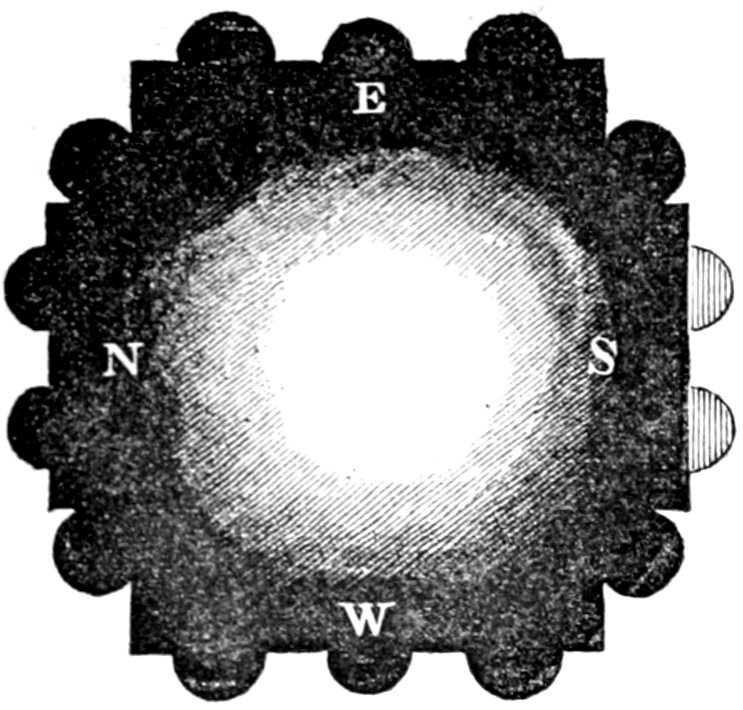
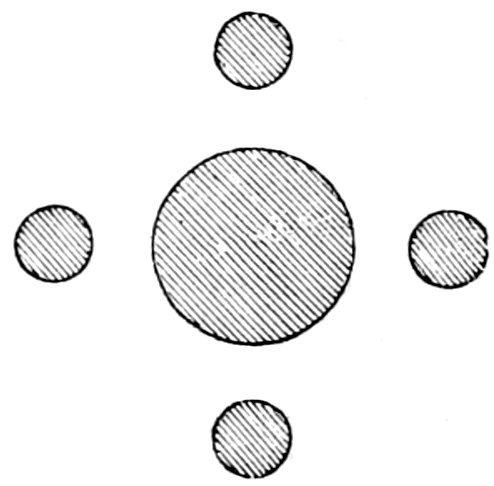
PILLAR. The isolated support of an arch, including base, shaft, and capital, in Norman and Gothic architecture. There were great variations in the forms of pillars during the progress of ecclesiastical architecture. The Norman pillar is often a square, pier-like mass, relieved by attached semi-pillars, or by three-quarter shaft in retiring angles, as in the accompanying example from Norwich; or it is a cylindrical shaft, often fluted, or cut in zigzags or other diaper patterns. The Early English pillar frequently consists of a central bearing shaft, surrounded by smaller detached shafts; either set almost close to the central shaft, sometimes even within hollows, as at York, so as to lose the effect of their separateness, or at a very considerable distance from the central shaft, as at Chichester and Ely.

Pillar, Norwich.

York
Chichester.

Ely.
The Geometrical pillar but seldom retains the detached shaft. Its section is 587perhaps more usually a quatrefoil than any other single form; but there are countless varieties, the mouldings always of course following the style to which they belong. The accompanying example is from St. Asaph. The Decorated pillar is equally various in section; where it is moulded, the ogee usually forms part of it, but in small and plain examples it is very frequently a simple octagon. In the Perpendicular the pillar follows the general poverty of the style, but it is also distinguished by the base being stilted; by the outer mouldings being continuous, and the inner order only being carried by an attached shaft with a capital; and by its being narrower from east to west than from north to south. The exceptions, however, to all these rules are so numerous, that they could only be represented by many illustrations.

St. Asaph.
PINNACLE. A small spire-like termination to a buttress, or to any decorative shaft rising above the parapet. In buttresses, especially flying buttresses, the pinnacles are of great use in resisting the outward pressure by their weight. They do not occur in Norman architecture; they are, in fact, a correlative of the pointed arch.
The pinnacle at the temple at Jerusalem was probably the gallery, or parapet, or wall on the top of the buttresses, which surrounded the roof of the temple, properly so called. Josephus tells us that the roof of the temple was defended by pretty tall golden spikes, to hinder birds from alighting thereon. It was not on the roof of the temple that Jesus Christ was placed, but on the wall that surrounded the roof.—Calmet’s Dict. of the Bible, ed. Taylor.
PISCINA. Originally signified a fishpond; and in a secondary sense, any vessel for holding or receiving water. A water drain, usually accompanied with decorative features, near the altar, on the south side. The piscina is often the only remaining indication of the place where an altar has been. Some churches have double piscinas.
PISCIS, PISCICULI, and VESICA PISCIS. The fish is an hieroglyphic of Jesus Christ, very common in the remains of Christian art, both primitive and mediæval. The origin of it is as follows:—From the name and title of our blessed Lord, Ἰησοῦς Χριστὺς Θεοῦ Ὑιὸς Σωτὴρ, Jesus Christ, the Son of God, the Saviour, the early Christians, taking the first letter of each word, formed the name ἸΧΘΥΣ, Piscis, a fish. From this name of our blessed Lord, Christians also came to be called Pisciculi, fishes, with reference to their regeneration in the waters of baptism, consecrated to that effect by our blessed Lord, the mystical ἸΧΘΥΣ. Thus Tertullian, speaking of Christians, says, “for we, after our Lord and Saviour, Jesus Christ, our ἸΧΘΥΣ, are also fishes, and born in the water; nor are we otherwise saved but by remaining in the water.” The Vesica Piscis, which is the figure of an oval, generally pointed at either end, and which is much used as the form of the seals of religious houses, and to enclose figures of Jesus Christ, or of the saints, also has its rise from this name of our blessed Lord: though some say, that the mystical Vesica Piscis has no reference, except in its name, to a fish, but represents the almond, the symbol of virginity and self-production. Clement of Alexandria, in writing of the ornaments which a Christian may consistently wear, mentions the fish as a proper device for a ring, and says, that it may serve to remind the Christian of the origin of his spiritual life.
PIUS IV. (See Creed.)
PLANETA. (See Chasuble.)
PLENARTY, (from the word plenus, “full,”) signifying that a church is full, or provided with, an incumbent.
PLURALITY. This is where the same person obtains two or more livings with cure of souls. There are various canons of the Church against the practice; and the authorities of the Church are taking prompt measures to abolish it in the English Church. The statute 1 & 2 Vic. c. 106, and subsequently the 13 and 14 Vic. c. 98, made very important changes in the law of England regarding pluralities.
PLUVIALE. Another name for the cope: so called because it was originally a cloak, a defence from the rain. (See Cope.)
PLYMOUTH BRETHREN. Of this sect, who call themselves the Brethren, the following account is taken from the Register-general’s return.
“Those to whom this appellation is applied receive it only as descriptive of their individual state as Christians—not as a name by which they might be known collectively 588as a distinct religious sect. It is not from any common doctrinal peculiarity or definite ecclesiastical organization that they have the appearance of a separate community; but rather from the fact that, while all other Christians are identified with some particular section of the Church of God, the persons known as ‘Brethren’ utterly refuse to be identified with any. Their existence is, in fact, a protest against all sectarianism; and the primary ground of their secession from the different bodies to which most of them have once belonged, is, that the various tests by which, in all these bodies, the communion of true Christians with each other is prevented or impeded, are unsanctioned by the Word of God. They see no valid reason why the Church (consisting of all true believers) which is really one, should not be also visibly united, having as its only bond of fellowship and barrier of exclusion, the reception or rejection of those vital truths by which the Christian is distinguished from the unbeliever. Looking at existing churches, it appears to them that all are faulty in this matter; national Churches by adopting a too lax—dissenting Churches by adopting a too limited—criterion of membership. The former, it appears to Brethren, by considering as members all within a certain territory, mingle in one body the believers and the unbelievers; while the latter, by their various tests of doctrine or of discipline, exclude from their communion many who are clearly and undoubtedly true members of the universal Church. The Brethren, therefore, may be represented as consisting of all such as, practically holding all the truths essential to salvation, recognise each other as, on that account alone, true members of the only Church. A difference of opinion upon aught besides is not regarded as sufficient ground for separation; and the Brethren, therefore, have withdrawn themselves from all those bodies in which tests, express or virtual, on minor points, are made the means of separating Christians from each other.
“In the judgment of the Brethren, the disunion now existing in the general Church is the result of a neglect to recognise the Holy Spirit as its all-sufficient guide. Instead, they say, of a reliance on his promised presence and sovereignty as Christ’s vicar on earth, ever abiding to assert and maintain his lordship in the Church according to the written Word, men, by their creeds and articles, have questioned the sufficiency of Scripture as interpreted to all by him, and, by their ministerial and ritual appointments, have assumed to specify the channels through which only can his blessings be communicated. All these various human forms and systems are believed by Brethren to be destitute of scriptural authority, and practically restrictive of the Holy Spirit’s operations.
“Chiefly with regard to ministry are these opinions urged; the usual method of ordaining special persons to the office, being held to be unscriptural and prejudicial. They conceive that Christians in general confound ministry (i.e. the exercise of a spiritual gift) with local charges, as eldership, &c. Such charges, they infer from Scripture, required the sanction of apostles or their delegates, to validate the appointment (Acts xiv. 23; Titus i. 5); whereas the ‘gifts’ never needed any human authorization (Acts xviii. 24–28; Rom. xii.; 1 Cor. xii.—xvi.; Phil. i. 14; 1 Peter iv. 9, 10). Further, they urge that while Scripture warrants the Church to expect a perpetuity of ‘gifts,’—as evangelists, pastors, teachers, exhorters, rulers, &c.,—because they are requisite for the work of the ministry, (Eph. iv. 7–13,)—it nowhere guarantees a permanent ordaining power, without which the nomination or ordaining of elders is valueless. All believers are, it is affirmed, true spiritual priests capacitated for worship, (Heb. x. 19–25,) and all who possess the qualifications from the Lord are authorized to evangelize the world or instruct the Church; and such have not alone the liberty, but also an obligation to employ whatever gift may be intrusted to their keeping. Hence, in their assemblies, Brethren have no pre-appointed person to conduct or share in the proceedings; all is open to the guidance of the Holy Ghost at the time, so that he who believes himself to be so led of the Spirit, may address the meeting, &c. This arrangement is considered to be indicated as the proper order in 1 Cor. xiv.,—to flow from the principle laid down in 1 Cor. xii.,—and to be traceable historically in the Acts of the Apostles. By adopting it, the Brethren think that they avoid two evils, by which all existing sects are, more or less, distinguished; the first, the evil of not employing talents given to believers for the Church’s benefit; the second, the evil of appointing as the Church’s teachers men in whom the gifts essential for the work have not yet been discovered. The Brethren, therefore, recognise no separate orders of ‘clergy’ and ‘laity’—all are looked upon as equal in position, (Matt. xxiii. 8; 1 Cor. x. 17; xii. 12–20, &c.,) 589differing only as to ‘gifts’ of ruling, teaching, preaching, and the like (Rom. xii. 4–8; 1 Cor. xii. 18, 28, &c.). The ordinances, consequently, of baptism, when administered, and the Lord’s supper, which is celebrated weekly, need no special person to administer or preside (Acts ix. 10–18; x. 48; xx. 7; 1 Cor. xi.). Another feature of some importance is, that wherever gifted men are found among the Brethren, they, in general, are actively engaged in preaching and expounding, &c., on their own individual responsibility to the Lord, and quite distinct from the assembly. So that, though they may occasionally use the buildings where the Brethren meet, it is in no way as ministers of the Brethren, but of Christ.
“The number of places of worship which the Census officers in England and Wales returned as frequented by the Brethren was 132; but probably this number is below the truth, in consequence of the objection which they entertain to acknowledge any sectarian appellation. Several congregations may be included with the number (96) described as ‘Christians’ only.”
PŒNULA. (See Chasuble.)
POLITY, ECCLESIASTICAL. By this is meant the constitution and government of the Christian Church, considered as a society.
Scarce anything in religion (says a learned author) has been more mistaken than the nature and extent of that power, which our blessed Saviour established in his Church. Some have not only excluded the civil magistrates of Christian states from having any concernment in the exercise of this power, and exempted all persons invested with it from the civil courts of justice, but have raised their supreme governor of the Church to a supremacy, even in civil affairs, over the chief magistrate; insomuch that he has pretended, on some occasions, to absolve subjects from their allegiance to their lawful princes; and others have run so far into contrary mistakes, as either to derive all spiritual power wholly from the civil magistrate, or to allow the exercise thereof to all Christians without distinction. The first of these opinions manifestly tends to create divisions in the State, and to excite subjects to rebel against their civil governors: the latter do plainly strike at the foundation of all ecclesiastical power; and wherever they are put in practice, not only the external order and discipline, but even the sacraments of the Church must be destroyed, and its whole constitution be quite dissolved.
The nature of ecclesiastical polity will be best understood by looking back to the constitution of the ancient Christian Church.
The Church, as a society, consisted of several orders of men. Eusebius reckons three: viz. the Ἡγούμενοι, Πιστοὶ, and Κατηχούμενοι, i. e. rulers, believers, and catechumens. Origen reckons five orders: but then he divides the clergy into three orders, to make up the number. Both these accounts, when compared together, come to the same thing. Under the Ἡγούμενοι, or rulers, are comprehended the clergy, bishops, priests, and deacons; under the Πιστοὶ, or believers, the baptized laity; and under the Κατηχούμενοι, or catechumens, the candidates for baptism. The believers were perfect Christians; the catechumens imperfect. The former, having received baptism, were allowed to partake of the eucharist; to join in all the prayers of the Church; and to hear discourses upon the most profound mysteries of religion: more particularly the use of the Lord’s Prayer was the sole prerogative of the believers, whence it was called Εὐχὴ πιστῶν, the prayer of believers. From all these privileges the catechumens were excluded. (See Catechumens.)
The distinction between the laity and the clergy may be deduced from the very beginnings of the Christian Church; notwithstanding that Rigaltius, Salmasius, and Selden pretend there was originally no distinction, but that it is a novelty, and owing to the ambition of the clergy of the third century, in which Cyprian and Tertullian lived. (See Clergy.)
The clergy of the Christian Church consisted of several orders, both superior and inferior.
The superior orders of the clergy were, 1. The Bishops; 2. The Presbyters; 3. The Deacons.
It has been pretended that the bishops and presbyters were the same; and this opinion has given rise to the sect of the Presbyterians. But it is clearly proved against them, from ecclesiastical antiquity, that bishops and presbyters were distinct orders of the clergy. (See Bishops, Deacons, Presbyters, and Presbyterians.)
Among the bishops there was a subordination, they being distinguished into, 1. Primate Metropolitans; 2. Patriarchs or Archbishops; 3. Diocesan Bishops; 4. Chorepiscopi or Suffragan Bishops. (See the articles Archbishops, Chorepiscopi, Diocese, Patriarchs. and Primates.)
The presbyters were the second order of the superior clergy, and besides being 590the bishop’s assistants in his cathedral church, had the care of the smaller districts, or parishes, of which each diocese consisted. (See Parishes and Presbyters.)
The deacons were the third order of the superior clergy, and were a kind of assistants to the bishops and presbyters, in the administration of the eucharist, and other parts of Divine service. There were likewise deaconesses, or female deacons, who were employed in the service of the women. Out of the order of deacons was chosen the archdeacon, who presided over the deacons and all the inferior officers of the Church. (See the articles Archdeacons, Deacons, and Deaconesses.)
The inferior orders of the clergy were, 1. The Sub-deacons; 2. The Acolyths; 3. The Exorcists; 4. The Readers; 5. The Door-keepers; 6. The Singers; 7. The Copiatæ, or Fossarii; 8. The Parabolani; 9. The Catechists; 10. The Syndics; 11. The Stewards. (See each under their respective articles.)
All these orders of the clergy were appointed to their several offices in the Church by solemn forms of consecration or ordination, and had their respective privileges, immunities, and revenues. And, by means of this gradation and subordination in the hierarchy, the worship and discipline of the primitive Church were exactly kept up, according to St. Paul’s direction, “Let everything be done decently, and in order.”
How far the constitution of our own Church agrees with, or has departed from, this plan of the ancient hierarchy, may be seen at one glance of the eye. We have the general distinction of bishops, presbyters or priests, and deacons. Among the first we retain only the distinction of archbishops (with the title likewise of primates) and bishops, having no patriarchs or chorepiscopi. And as to the inferior orders of the clergy, as acolyths, &c., they are all unknown to the Church of England. The Romish Church has retained most of them, but it were to be wished she came as near to the faith and worship, as she does to the external constitution, of the hierarchy of the ancient Church.
But, as no society can subsist without laws, and penalties annexed to the breach of them, so the unity and worship of the Christian Church were secured by laws both ecclesiastical and civil. The ecclesiastical laws were, either rules and orders made by each bishop for the better regulation of his particular diocese; or laws made, in provincial synods, for the government of all the diocese of a province; or, lastly, laws respecting the whole Christian Church, made in general councils, or assemblies of bishops from all parts of the Christian world. (See Synods.)
The civil laws of the Church were those decrees and edicts, made from time to time by the emperors, either restraining the power of the Church, or granting it new privileges, or confirming the old.
The breach of these laws was severally punished both by the Church and State. The ecclesiastical censures, respecting offenders among the clergy, were, chiefly, suspension from the office, and deprivation of the rights and privileges of the order. Those respecting the laity consisted chiefly in excommunication, or rejection from the communion of the Church, and penance both public and private.
POLYGLOTT BIBLES, are such Bibles, or editions of the Holy Scriptures, as are printed in various languages, at least three, the texts of which are ranged in opposite columns. Some of these Polyglott editions contain the whole Bible, others but a part of it. The principal Polyglotts that have yet appeared are these following:—
1. The Bible of Francis Ximenes, cardinal of the order of St. Francis. It was printed in 1514–17, in four languages—Hebrew, Chaldee, Greek, and Latin. From having been printed at Alcala, in Spain, anciently Complutum, this is called the Complutensian Polyglott. It cost Cardinal Ximenes 50,000 ducats.
2. The Psalter of Justiniani, bishop of Nebbio, of the order of St. Dominic. It appeared in 1516, in five languages; Hebrew, Chaldee, Greek, Latin, and Arabic.
3. The Psalter, by John Potken, provost of the collegiate church of St. George, at Cologne, published in 1518, in four languages—Hebrew, Greek, Chaldee, and Latin.
4. The Pentateuch, published by the Jews, at Constantinople, in 1546, in Hebrew, Chaldee, Persian, and Arabic; with the commentaries of Solomon Jarchi.
5. The Pentateuch, by the same Jews, in the same city, in 1547, in four languages—Hebrew, Chaldee, the vulgar Greek, and Spanish.
6. An imperfect Polyglott, containing only fragments of the book of Genesis and of the Psalms; the Proverbs, the prophets Micah and Joel, with part of Isaiah, Zechariah, and Malachi; published by John Draconitis, of Carlostad, in Franconia, in 1563–5, in five languages—Hebrew, Chaldee, Greek, Latin, and German.
7. Christopher Plantin’s Polyglott Bible, 591published by order of Philip II., king of Spain, Antwerp, in 1569, 1572. It is in eight volumes, and in Hebrew, Chaldee, Greek, and Latin: with the Syriac version of the New Testament. This is called the Antwerp Polyglott.
8. Vatablus’s Polyglott Bible, being the Old Testament in Hebrew and Greek, with two Latin versions, one of St. Jerome, the other of Sanctus Pagninus; and Vatablus’s notes. The editorship is attributed to R. Stephens, by Bishop Walton. Dibdin ascribes it to Bertramus, Hebrew professor at Geneva. It appeared at Heidelberg, in 1586.
9. A Bible in four languages, Hebrew, Greek, Latin, and German, published by David Wolder, a Lutheran minister, at Hamburg, in 1596.
10. The Polyglotts of Elias Hutter, a German. The first, printed at Nuremberg, in 1599, contains the Pentateuch, Joshua, Judges, and Ruth, in six languages; viz. the Hebrew, Chaldee, Greek, Latin, Luther’s German, and Sclavonian; or French, Italian, or Saxon; the copies varying according to the nations they were designed for.
This author published the Psalter and New Testament, in Hebrew, Greek, Latin, and German. But his chief work is the New Testament in twelve languages, viz. Syriac, Greek, Hebrew, Italian, Spanish, French, Latin, German, Bohemian, English, Danish, and Polish. This was printed at Nuremberg, in 1599.
11. M. le Jay’s Bible, in seven languages, printed at Paris, in 1645. The languages are, the Hebrew, Samaritan, Chaldee, Greek, Syriac, Latin, and Arabic.
12. Walton’s Polyglott, published in England, in 1657. In nine languages, viz. the Hebrew, Chaldee, Greek, Samaritan, Syrian, Arabic, Æthiopic, Persic, and Latin; though no one book is printed in so many. This was the most complete and perfect Polyglott ever published. It consists of five volumes, with prolegomena, by Walton, which are in themselves a treasure of biblical criticism, some treatises in the first volume, several new Oriental versions in the fourth and fifth, and a very large collection of various readings in the sixth.
13. Reineccius’, or the Leipsic Polyglott, printed at Leipsic, 1753, in 3 vols., in Latin, German, Hebrew, and Greek: a cheap and commodious edition.
14. Bagster’s Polyglott, London, 1821, 4to and 8vo, in five languages, Hebrew, Greek, Latin, English. Syriac.
POLYGLOTT PRAYER BOOK. The English Prayer Book was published in 1819, in eight languages, English, French, Italian, German, Spanish, ancient and modern Greek, and Latin.
PONTIFICAL. A book containing the offices used by a bishop, at consecration of churches, &c. Thus the Roman Pontifical is the book of offices for a bishop, according to the rites of the Roman Church. In England the Pontifical is not by authority published separately from the liturgy, so that it is never called by that name; though the offices of confirmation and ordination, in fact, compose the English Pontifical. For the consecration of churches and churchyards we have no office appointed by sufficient authority. (See Consecration of Churches.)
PONTIFICALIA. Properly the ensigns of a pontiff’s or bishop’s office; but the term is loosely used for any ecclesiastical dress. It is so used in the account of Bishop Andrewes’ consecration of St. Mary’s, Southampton, in Sparrow’s collection: “Episcopus capellam statim ingressus niduit se pontificalibus.”
POOR MAN’S BOX; or Poor Men’s Box. Till the last review, it was directed that the collection at the offertory should be put into the Poor Man’s Box: a term which (in imitation of the Scotch liturgy) was altered in the last review to a decent basin. It is clear, however, from many documents, that basins of gold and silver, and other metinal were used in the Church of England ever since the Reformation. In Ireland the Poor Man’s Box, or poor-box, as it is generally called, is still in general use. An oval box, half covered, of copper or wood, with a long handle. The Poor Man’s Box does not seem to be the same as the Alms’ Chest, prescribed by the 84th canon. So Wheatly observes: “not, I presume, into that fixed in the church, but into a little box which the churchwardens, or some other proper persons, carried about with them in their hands, as is still the custom at the Temple Church in London.”—Jebb.
POPE, THE. The sovereign pontiff, or supreme head, of the Romish Church. The appellation of Pope (Papa) was, anciently, given to all Christian bishops: but, about the latter end of the eleventh century, in the pontificate of Gregory VII., it was usurped by the bishop of Rome, whose peculiar title it has ever since continued.
The spiritual monarchy of Rome sprang up soon after the declension of the Roman empire; and one great, though remote, instrument, in promoting the increase of this monarchy, so pernicious to the supreme civil power, was, the barbarity and 592ignorance which from that time spread itself over the Western parts.
Rome was chosen for the place of residence of the ecclesiastical monarchy, because this city had the particular prerogative of being the capital city of the Roman empire, where the Christian religion had its first rise and increase. For what is related concerning St. Peter’s chair is nothing but a vain pretence, which may easily be seen from hence, that, afterwards, the bishop of Constantinople had the next place assigned him after the bishop of Rome, only because that city was then the place of the emperor’s residence, and called New Rome. And when afterwards the Western empire was come to decay, and the city of Rome had lost its former lustre, the bishop of Constantinople disputed the precedency with the Roman bishop. It is true the emperor Phocas granted the right of precedency to Boniface III., then bishop of Rome, who thereupon took upon him the title of Œcumenical bishop: but this did not imply any power or jurisdiction over the rest; for the other patriarchs never acknowledged any. So that here are no footsteps of Divine institution to be found, the papal power being purely human, and an usurpation upon the rights of other sees.
The bishops of Rome did not extend their power over the Western parts all at once; but it was introduced from time to time, by degrees, by various artifices, and under various pretences. What chiefly contributed to its growth was, first, the emperors choosing other places of residence besides Rome; for, by their constant presence there, they might easily have kept under the ambitious designs of the bishops. In the next place, the Western empire was divided into several new kingdoms, erected by the several barbarous and pagan nations, and these, having been converted to the Christian faith by the direction of the Romish Church, thought themselves obliged to pay her the profoundest respect.
In the fifth century, the bishops on this side of the Alps began to go to Rome, to visit the sepulchres of St. Peter and St. Paul. This voluntary devotion insensibly grew into a necessity. From hence it was easy for the popes afterwards to pretend, that the bishops ought to receive their confirmation from Rome. Besides, some other bishops and churches, that were novices in comparison of the ancient Roman Church, used to refer themselves to, and ask the advice of, the Church of Rome, concerning matters of great consequence, and the true interpretation of the canons. Hence the bishops of Rome, perceiving their answers were received as decisions, began to send their decrees before they were demanded. And hence they set themselves up as judges of the differences arising between the bishops, and, encroaching on the right and jurisdiction of the metropolitans, proceeded to suspend and depose whom they thought fit. At the same time, by making void the decisions of the provincial synods, they so diminished their authority, that by degrees they were quite abolished. Add to this, that Gregory VII. forced the bishops to take an oath of fealty to the popes, and by a decree enacted that none should dare to condemn any one, who had appealed to the pope. Nor did they forget to send legates or nuncios to all places, whose business was to exercise, in the pope’s name, the same authority, which had formerly belonged to the bishops and provincial synods. (See Legate.)
It is certain that many Romish bishops, especially among those on this side the Alps, were to a late period opposed to the pope’s authority; which evidently appeared at the Council of Trent, where the French and Spanish bishops insisted very strongly to have it decided, that bishops are obliged to residence by the law of God; the consequence of which was, the deriving their authority from God alone. The pope met with great difficulty before he could surmount this obstacle; and therefore it is very likely this will be the last council, since the pope will scarce put his grandeur to the hazard and decision of such another assembly. Not to mention that they are now of no farther use, since the Jesuits and others have taught, that the pope is infallible, and superior to councils. However that may be, the bishops are obliged for their own sakes not to withdraw themselves from the pope’s jurisdiction, since thereby they would fall under the civil power, and would be obliged to seek protection from their sovereigns, who must be potent princes, if they could protect them against the pope; so that they think it wiser, of two evils to choose the least.
The spiritual monarchy of Rome could not have been established, had its bishops continued dependent on any temporal prince; and therefore the popes took their opportunity to exempt themselves from the jurisdiction of the Greek emperors, whose authority was mightily decayed in Italy. This was greatly forwarded by the dispute concerning the use of images. For the emperor Leo Isaurus having quite ejected them out of the churches, Pope 593Gregory II., who stood up for the images, took occasion to oppose him, and stirred up the Romans and Italians to refuse to pay him tribute; by which means the power of the Greek emperors was lost in Italy, and these countries began to be free and independent of any foreign jurisdiction.
The pope, having freed himself from the authority of the emperors of Constantinople, and being in danger from the Lombards, who endeavoured to make themselves masters of Italy, had recourse for protection to the kings of France. Pepin, and afterwards Charles the Great, having entirely subdued the Lombards, these princes gave to the papal chair all that tract of land, which had been formerly subject to the Greek emperors. To obtain this gift, it is said, the pope made use of a fictitious donation of Constantine the Great, which, in those barbarous times, was easily imposed upon the ignorant world. By virtue of this grant, the popes pretended to a sovereign jurisdiction over these countries; which the people at first refused to submit to, thinking it very strange, that the pope, who was an ecclesiastical person, should at the same time pretend to be a temporal prince. When, therefore, the Romans mutinied against Leo III., he was forced to seek for assistance from Charles the Great, who restored the pope. On the other hand, the pope and people of Rome proclaimed Charles emperor; whereby he was put in possession of the sovereignty of that part of Italy, which formerly belonged to the governors of Ravenna, and the other remnants of the Western empire; so that the popes afterwards enjoyed these countries under the sovereign jurisdiction of the emperor, who therefore used to be called the patron and defender of the Church, till the reign of the emperor, Henry VI.
The popes at length began to grow weary of the imperial protection, because the emperor’s consent was required in the election of a pope, and, if they were mutinous, the emperors used to check them, and sometimes turn them out of the chair. The popes, therefore, for a long time, employed various artifices to exempt themselves from the power of the emperors. To this end, they frequently raised intestine commotions against them. But the reign of Henry IV. furnished them with an opportunity of putting their designs in execution. For Pope Gregory VII., surnamed Hildebrand, had the boldness to excommunicate this emperor, on pretence that he made a traffic of church benefices, by selling them to all sorts of persons, whom he installed before they had taken orders. And, not satisfied with this, he cited the emperor before him, to answer to the complaints of his subjects, and declared him to have forfeited all right and title to the empire. This obliged the emperor to renounce the right of constituting bishops. And though his son, Henry V., endeavoured to recover what was forcibly taken away from his father, and made Pope Paschal a prisoner, yet were the whole clergy in Europe so dissatisfied, that he was obliged at last to resign the same right again into the pope’s hands. This affair gave rise to the factions of the Guelfs and Ghibelines, the first of which were for the pope, the latter for the emperor. The succeeding emperors found so much work in Germany, that they were not in a condition to look after Italy; whereby the pope had sufficient leisure to make himself sovereign, not only over his own possessions, but over all possessions pertaining to the Church.
But the pope, not satisfied with this degree of grandeur, quickly set on foot a pretension of far greater consequence. For now he pretended to an authority over princes themselves, to command a truce between such as were at war together, to take cognizance of their differences, to put their kingdoms under an interdict, and, if they refused submission to the see of Rome, to absolve their subjects from their allegiance, and to deprive them of their crowns. This has been attempted against many crowned heads, and put in execution against some of them. And for this abominable pretension they pleaded their fictitious decretals, (see Decretals,) which grant to the popes an unlimited power over all Christians whatever. Pope Boniface VIII. gave the world clearly to understand his meaning, at the jubilee kept in the year 1300, when he appeared sometimes in the habit of an emperor, and sometimes in that of a pope, and had two swords carried before him, as the ensigns of the ecclesiastical and civil power.
But the popes could not long enjoy this intolerable usurpation in quiet; for it was often called in question, till they were obliged to desist in part from their pretensions. In particular, Philip the Handsome, king of France, gave several great blows to the papal authority. But the ensuing schisms, and the double elections, when the opposite factions chose two different popes at the same time, contributed most towards weakening the power of the holy see. Hence an occasion was taken 594to bridle the pope’s authority by general councils, which often proceeded so far as to depose the holy fathers. Therefore it is not to be wondered that, since the Council of Trent, the popes have been very averse to the calling of general councils, and seem to have bid adieu to them for ever. To this may be added, that the translation of the papal chair, by Clement V., from Rome to Avignon, where the popes constantly resided for seventy years together, carried along with it several inconveniences, which proved greatly prejudicial to the ecclesiastical monarchy. Among others, the pope’s authority being founded upon this belief, that St. Peter had been at Rome, and by his presence had communicated a particular prerogative and holiness to that chair, it was very much questioned whether the same could be transferred to Avignon.
But, when the ecclesiastical monarchy seemed to be come to the pinnacle of its grandeur, when all the Western parts were either in communion with, or in obedience to, the Church of Rome, by the influence of the Reformation, the pope became only the spiritual head of a sect, and eventually, as a civil power, of very slight importance.
The manner of the election of a pope is as follows: nine or ten days after the funeral of a deceased pope, the cardinals enter the conclave, which is generally held in the Vatican, in a long gallery, where cells of board are erected, covered with purple cloth, one for each cardinal. (See Conclave.)
The election is made by scrutiny, access, or adoration. The first is, when each cardinal writes the name of him whom he votes for, in a scroll of five pages. On the first is written by one of his servants, that the cardinal may not be discovered by his hand, “Ego eligo in summum pontificem reverendum dominum meum cardinalem.” On this fold two others are doubled down, and sealed with a private seal. On the fourth the cardinal writes his own name, and covers it with the fifth folding. Then, sitting in order on benches in the chapel, with their scrolls in their hands, they go up to the altar by turns, and, after a short prayer on their knees, throw the scroll into a chalice upon the table, the first cardinal bishop sitting on the right hand, and the first cardinal deacon on the left. The cardinals being returned to their places, the cardinal bishop turns out the scrolls into a plate, which he holds in his left hand, and gives them one by one to the cardinal deacon, who reads them with an audible voice, while the cardinals note down how many voices each person has; and then the master of the ceremonies burns the scrolls in a chafing-dish, that it may not be known for whom any one gives his voice. If two-thirds of the number present agree, the election is made, and he, on whom the two-thirds fall, is declared pope.
When the choice is made by access, the cardinals rise from their places, and, approaching him whom they would have elected, say, Ego accedo ad reverendissimum Dominum. The choice by adoration is much after the same manner, only the cardinal approaches him whom he would have chosen with the profoundest reverence. But both the one and the other must be confirmed by the scrutiny.
There has been another way of choosing a pope, namely, by compromise: that is, when the differences have risen so high that they could not be adjusted in the conclave, they have referred the choice to three or five, giving them leave to elect any one, provided it were determined within the time that a candle lighted by common consent should last. Sometimes they have had recourse to what is called inspiration; that is, the first cardinal rises up in chapel, and, after an exhortation to make choice of a capable person, immediately, as if inspired, names one himself: to which, if two-thirds of the cardinals present agree, he is reckoned legally chosen.
When one of the cardinals is chosen pope, the master of the ceremonies comes to his cell, to acquaint him with the news of his promotion. Whereupon he is conducted to the chapel, and clad in the pontifical habit, and there receives the adoration, or the respects paid by the cardinals to the popes. Then, all the gates of the conclave being opened, the new pope shows himself to the people, and blesses them, the first cardinal deacon proclaiming aloud these words: Annuntio vobis gaudium magnum; Papam habemus. Reverendissimus Dominus Cardinalis—electus est in summum Pontificem, et eligit sibi nomen. After this, he is carried to St. Peter’s church, and placed upon the altar of the holy apostles, where the cardinals come a second time to the adoration. Some days after is performed the ceremony of his coronation, before the door of St. Peter’s church, where is erected a throne, upon which the new pope ascends, has his mitre taken off, and a crown put upon his head, in the presence of the people. Afterwards is a grand cavalcade from St. Peter’s church to St. John Lateran, where the archbishop of that church presents the new 595pope with two keys, one of gold the other of silver.
It is probable that, in the first ages of the Church, the Roman clergy elected the pope; and some think the people had a share in the election. Afterwards, Odoacer, king of the Eruli, and Theodoric, king of the Goths in Italy, would suffer no election of a pope to be made without their consent. But this was abolished in 502, under Pope Symmachus. The succeeding princes, however, reserved to themselves a right to confirm the newly elected pope, who, without this confirmation, could not take possession of the pontificate. The tenth century saw several popes elected and deposed at the fancy of the Roman nobility and Italian princes. But, since the election of Celestin II., in 1443, the cardinals have retained the power of election, independent of the Roman people, or of any sovereign prince whatever.
It is a general maxim, in the choice of a pope, to elect an Italian; which is done, not only because they choose rather to bestow this dignity on a native of Italy than on a foreigner, but also because the security and preservation of the papal chair depends, in a great measure, on the balance which is to be kept between France and Spain: but this is not to be expected from a French or Spanish pope, who would quickly turn the scale, and, by granting too great privileges to his countrymen, endeavour to exclude others from the papal chair. It is also a sort of maxim, to choose a pope who is pretty far advanced in years, that there may be the quicker succession, and that it may not be in the power of a pope, during a long reign, to alter their customs, or, by making his family too powerful, to entail, as it were, the papal chair upon his house. They also take care that he be not too near akin to the deceased pope, that the vacant church benefices may not be engrossed by one family. It often happens, that one is chosen pope, of whom nobody thought before; and this comes to pass, when the cardinals are tired out by so many intrigues, and are glad to get out of the conclave. It is also observed, that a pope often proves quite another man, when he comes to sit in the chair, than that he was before, when only a cardinal.
Ever since the time of Pope Sixtus IV., that is, since the year 1471, the popes have made it their business to enrich their families out of the Church revenues, of which there are very remarkable instances. For it is related that Sixtus V., during a reign of five years, bestowed upon his family above three millions of ducats. The house of the Barbarini, at the death of Urban VIII., was possessed of 227 offices and Church benefices, whereby they amassed thirty millions of scudi.
Sergius III., (A. D. 904,) or Sergius IV., (A. D. 1009,) who was before called Os Porci, i. e. Swine-Face, is said to have been the first pope who changed his name upon his exaltation to the pontificate. This example has been followed by all the popes since his time, and they assume the names of Innocent, Benedict, Clement, &c.
When a pope is elected, they put on him a cassock of white wool, shoes of red cloth, on which is embroidered a gold cross, a mantle of red velvet, the rochet, the white linen albe, and a stole set with pearls. At home, his habit is, a white silk cassock, rochet, and scarlet mantle. In winter his Holiness wears a fur cap; in summer, a satin one. When he celebrates mass, the colour of his habit varies according to the solemnity of the festival. At Whitsuntide, and all festivals of the martyrs, he officiates in red; at Easter, and all festivals of virgins, in white; in Lent, Advent, and eves of fasting days, in violet; and on Easter-eve, and at all masses for the dead, in black. All these colours are typical: the red expresses the cloven tongue, and the blood of the martyrs; the white, the joy caused by our Saviour’s resurrection, and the chastity of virgins; the violet, the pale aspect of those who fast; and the black, grief and mourning.
The pope’s tiara, or crown, is a kind of conic cap, with three coronets, rising one above the other, and adorned with jewels. Paul II. was the first who added the ornaments of precious stones to his crown. The jewels of Clement VIII.’s crown were valued, they say, at 500,000 pieces of gold. That of Martin V. had five pounds and a half weight of pearls in it. “Nor is there anything unreasonable in this, (says Father Bonani,) since the pope governs the kingdom of Christ in quality of his viceroy; now this kingdom is infinitely superior to all the empires of the universe. The high priest of the Jews wore on his head and breast the riches which were to represent the majesty of the Supreme God. The pope represents that of the Saviour of the world, and nothing better expresses it than riches.” We must not omit, that the two strings of the pontifical tiara represent the two different manners of interpreting the Scriptures, the mystical and the literal.
The pope has two seals. One is called 596“the fisherman’s ring,” and is the impression of St. Peter holding a line with a bait to it in the water. It is used for those briefs that are sealed with red wax. The other seal is used for the bulls which are sealed with lead, and bears the figures of St. Peter and St. Paul, with a cross on one side, and a bust, with the name of the reigning pope, on the other. Upon the decease of a pope, these seals are defaced and broken by the cardinal Camerlengo, in the presence of three cardinals.
When the pope goes in procession to St. Peter’s, the cross is carried before him on the end of a pike about ten palms long. “Many reasons,” says F. Bonani, “authorize this custom. It is a monument of the sufferings of Jesus Christ, and of the pope’s adherence to the Saviour of the world. It is the true mark of the pontifical dignity, and represents the authority of the Church, as the Roman fasces did that of the consuls.” At the same time two grooms bear two fans on each side of his Holiness’s chair, to drive away the flies. This (according to the above-cited author) represents the seraphim covering the face of God with their wings.
The custom of kissing the pope’s feet is very ancient; to justify which practice, it is alleged, that the pope’s slipper has the figure of the cross upon the upper leather; so that it is not the pope’s foot, but the cross of Christ, which is thus saluted.
There are but few instances of the papal power in England before the Norman Conquest. But the pope, having favoured and supported William I. in his invasion of this kingdom, made that a handle for enlarging his encroachments, and, in that king’s reign, began to send legates hither. Afterwards he prevailed with King Henry I. to part with the right of nominating to bishoprics; and, in the reign of King Stephen, he gained the prerogative of appeals. In the reign of Henry II. he exempted all clerks from the secular power. This king, at first, strenuously opposed his innovation; but, after the death of Becket, who, for having violently opposed the king, was slain by some of the royal adherents, the pope got such an advantage over the king, that he was never able to execute the laws he had made. Not long after this, by a general excommunication of the king and his people, for several years, King John was reduced to such straits, that he surrendered his kingdoms to the pope, to receive them again, and hold them of him under a rent of a thousand marks. In the following reign of Henry III., partly from the profits of our best Church benefices, and partly from the taxes imposed by the pope, there went yearly out of the kingdom to Rome £70,000 sterling. But in the reign of Edward I., it was declared by the parliament, that the pope’s taking upon him to dispose of English benefices to foreigners, was an encroachment not to be endured; and this was followed by the statute of Provisors against popish bulls, and against disturbing any patron, in presenting to a benefice; which was afterwards enacted in Ireland also.
But the pope’s power received a mortal blow in England, by the reformation in religion, begun in the reign of Henry VIII.; since which time, to maintain the pope’s authority here, by writing, preaching, &c., was, till lately, made a premunire upon the first conviction, and high treason upon the second.
POPERY. (See Church of Rome, Council of Trent, Romanism.) By Popery we mean the peculiar system of doctrine, by adopting which the Church of Rome separates herself from the rest of the Catholic Church, and is involved in the guilt of schism. The Church of Rome, or Popery, has departed from the apostles’ doctrine, by requiring all who communicate with her to believe, as necessary to salvation,
1st, That that man is accursed who does not kiss, and honour, and worship the holy images.
2nd, That the Virgin Mary and other saints are to be prayed to.
3rd, That, after consecration in the Lord’s supper, the bread is no longer bread, and the wine no longer wine.
4th, That the clergyman should be excommunicated who, in the sacrament of the Lord’s supper, gives the cup to the people.
5th, That they are accursed who say that the clergy may marry.
6th, That there is a purgatory; that is, a place where souls which had died in repentance are purified by suffering.
7th, That the Church of Rome is the mother and mistress of all churches.
8th, That obedience is due from all Churches to the bishop of Rome.
9th, That they are accursed who deny that there are seven sacraments.
From those doctrines, contrary to Scripture and the primitive Church, have resulted these evil practices.
From the veneration of images has sprung the actual worship of them.
The invocation of the Blessed Virgin, and of other saints, has given rise to the greatest blasphemy and profaneness.
597The bread in the eucharist has been worshipped as though itself were the eternal God.
From the doctrine of purgatory has sprung that of indulgences, and the practice of persons paying sums of money to the Romish bishops and clergy, to release the souls of their friends from the fabulous fire of purgatory.
Popery is a corrupt addition to the truth, and we can give the very dates of the several corruptions.
Attrition, as distinguished from contrition, was first pronounced to be sufficient.
The priest’s right intention was first pronounced to be indispensable to the valid participation of the sacraments, and
Judicial absolution was first publicly authorized, by the Council of Trent, A. D. 1551.
Auricular confession was first enjoined by Innocent III., at the fourth Council of Lateran, A. D. 1215.
Apocrypha received as canonical first at the Council of Trent, A. D. 1547.
Compulsory celibacy of the clergy, first enjoined publicly at the first Council of Lateran, A. D. 1123.
Communion in one kind only, first authoritatively sanctioned by the Council of Constance, A. D. 1414.
Use of images and relics in religious worship, first publicly affirmed and sanctioned in the second Council of Nice, A. D. 787.
Invocation of saints, first taught with authority by the fourth Council of Constantinople, A. D. 754.
Papal infallibility was utterly unknown to the third Council of Constantinople, A. D. 680.
Papal supremacy, first publicly asserted by the fourth Council of Lateran, A. D. 1215.
Prayers in a foreign tongue, first deliberately sanctioned by the Council of Trent, were expressly forbidden by the fourth Council of Lateran, A. D. 1215.
Purgatory and indulgences, first set forth by the Council of Florence, A. D. 1438.
The Roman number of the sacraments was first taught by the Council of Trent, A. D. 1545.
Transubstantiation was first publicly insisted on by the fourth Council of Lateran, A. D. 1215.
POPPY HEAD. The ornamental finial of a stall end. In design the poppy heads are extremely various; but they are almost universally made to assume the outline of the fleur-de-lis, to which not only foliage, but figures, faces, and whole groups, are made to conform themselves.
PORCH. A part of the church in which anciently considerable portions of the marriage service and of the baptismal services were performed. Being commenced here they were finished in the church.
POSTILS. A name anciently given to sermons or homilies. The name sprung from the fact that these were usually delivered immediately after reading of the Gospel (quasi post illa, sc. Evangelia). Also, printed expositions of Scripture, from the text being first exhibited, and post illa (after the words of the text) the explication of the writer.
PRÆMUNIRE, in law, is either taken for a form of writ, or for the offence whereon the writ of præmunire is granted. The writ in question is named from its initial words Præmunire facias, and it is chiefly known in ecclesiastical matters from a persecuting use to which it is applied by the statute of 25 Hen. VIII. c. 20, which enacts, that if the dean and chapter refuse to elect the person nominated by the king to the vacant bishopric, or if any archbishop or bishop refuse to confirm or consecrate him, they shall incur the penalties of the statutes of the præmunire. These penalties are no less than the following:—From the moment of conviction, the defendant is out of the king’s protection, his body remains in prison during the king’s pleasure, and all his goods, real or personal, are forfeited to the Crown. He can bring no action, nor recover damages, for the most atrocious injuries, and no man can safely give him comfort, aid, or relief.
PRAGMATIC SANCTION, THE. (From πρᾶγμα, business.) A rescript or answer of the sovereign, declared by advice of his council, to some college, order, or body of people, upon their consulting him in some case of their community.—Hutman.
Referring to the expression historically, the earliest Pragmatic Sanction on record is that drawn up by Louis IX., king of France, in 1268, against the encroachments of the Church and Court of Rome. It related chiefly to the rights of the Gallican Church, with reference to the elections of bishops and clergy. It was superseded in 1438 by the Pragmatic Sanction of Charles VII., which was drawn up at Bourges. This having re-asserted the rights and privileges claimed for the Gallican Church under Louis IX., it accorded with the Council of Basle, at that time sitting, in maintaining that a general council is 598independent of the pope, and in asserting that all papal bulls should be null and void unless they received the consent of the king. It withheld also the payment of annates. (See Annates.) Pope Pius II. succeeded in obtaining the abrogation of this sanction for a time. But the parliament of Paris refused to approve the conduct of Louis XI. in setting it aside, and he was compelled to restore it to its original influential position. It accordingly remained in full force up to the year 1517, when it was supplanted by the concordat, which was agreed upon between Francis I. and Pope Julius II. Although by the concordat privileges were given and received on both sides, yet the real advantages were on the side of Rome; which advantages it has ever since been her constant aim to improve.
PRAISE. A reverent acknowledgment of the perfections of God, and of the blessings flowing from them to mankind, usually expressed in hymns of gratitude and thanksgiving, and especially in the reception of the holy eucharist—that “sacrifice of praise, and sublimest token of our joy.” (See Eucharist.)
PRAXEANISTS. (See Patripassians.)
PRAYER. The offering up of our desires to God for things agreeable to his will, in the name of Christ, by the aid of his Spirit, with confession of our sins, and thankful acknowledgment of his mercies. The necessity of prayer is so universally acknowledged by all who profess and call themselves Christians, and so clearly enjoined in Scripture, that to insist upon this duty—this sacred and pleasant exercise to the renewed in heart—is unnecessary. Prayer is either private or public, and it implies faith in the particular providence of God. The general providence of God acts through what are called the laws of nature. By his particular providence God interferes with those laws, and he hath promised to interfere in behalf of those who pray in the name of Jesus. As we are to shape our labours by ascertaining, through the circumstances under which we are providentially placed, what is the will of God with reference to ourselves; as, for example, the husbandman, the professional man, the prince, all labour for different things placed within their reach, and do not labour for that which God evidently does not design for them; so we are to regulate our prayers, and we may take it as a general rule, that we may pray for that for which we may lawfully labour, and for that only. And when we pray for what is requisite and necessary for the body or the soul, we are at the same time to exert ourselves. Prayer without exertion is a mockery of God, as exertion without prayer is presumption. The general providence of God requires that we should exert ourselves, the particular providence of God that we should pray.
(For public prayer, see Liturgy and Formulary.)
PRAYER BOOK. (See Liturgy and Formulary.)
PREACHING. Proclaiming or publicly setting forth the truths of religion. Hence the reading of Scripture to the congregation is one branch of preaching, and is so denominated in Acts xv. 21. “Moses of old time hath in every city them that preach him, being read in the synagogues every sabbath day.” See Archbishop King’s valuable Treatise On the Inventions of Men, in which he demonstrates the extensive sense of preaching, as scripturally used; showing that all public services in the church are, in a certain sense, preaching. The term is, however, generally restricted to the delivering of sermons, lectures, &c.
Article XXIII. “It is not lawful for any man to take upon him the office of public preaching, or ministering the sacraments in the congregation, before he be lawfully called and sent to execute the same. And those we ought to judge lawfully called and sent, which be chosen and called to this work by men who have public authority given unto them in the congregation, to call and send ministers into the Lord’s vineyard.”
In the same convocation in which subscription in the Thirty-nine Articles was imposed upon the clergy, it was enjoined, with respect to preachers: “In the first place, let preachers take care that they never teach anything in the way of preaching, which they wish to be retained religiously and believed by the people, except what is agreeable to the doctrine of the Old and New Testament, and what the catholic fathers and ancient bishops have collected from that same doctrine.”—Canon. Eccles. Angl. xix. A. D. 1571.
Canon 36. “No person shall be received into the ministry, nor admitted to any ecclesiastical living, nor suffered to preach, to catechise, or to be a lecturer or reader of divinity in either university, or in any cathedral, or collegiate church, city, or market town, parish church, chapel, or any other place within this realm, except he be licensed either by the archbishop or by the bishop of the diocese where he is to be placed, under their hands and seals, or by 599one of the two universities under their seal likewise; and except he shall first subscribe to the three articles concerning the king’s supremacy, the Book of Common Prayer, and the Thirty-nine Articles (see Orders): and if any bishop shall license any person without such subscription, he shall be suspended from giving licences to preach for the space of twelve months.”
And by the 31 Elizabeth, c. 6. “If any person shall receive or take any money, fee, reward, or any other profit, directly or indirectly, or any promise thereof, either to himself or to any of his friends, (all ordinary and lawfully fees only excepted,) to procure any licence to preach, he shall forfeit £40.”
After the preacher shall be licensed, then it is ordained as follows:
Canon 45. “Every beneficed man, allowed to be a preacher, and residing on his benefice, having no lawful impediment, shall, in his own cure, or in some other church or chapel (where he may conveniently) near adjoining, where no preacher is, preach one sermon every Sunday of the year; wherein he shall soberly and sincerely divide the word of truth, to the glory of God, and to the best edification of the people.”
Canon 47. “Every beneficed man, licensed by the laws of this realm (upon urgent occasions of other service) not to reside upon his benefice, shall cause his cure to be supplied by a curate that is a sufficient and licensed preacher, if the worth of the benefice will bear it. But whosoever hath two benefices shall maintain a preacher licensed, in the benefice where he doth not reside, except he preach himself at both of them usually.”
By Canon 50. “Neither the minister, churchwardens, nor any other officers of the Church, shall suffer any man to preach within their churches or chapels, but such as by showing their licence to preach shall appear unto them to be sufficiently authorized thereunto, as is aforesaid.”
Canon 51. “The deans, presidents, and residentiaries of any cathedral or collegiate church shall suffer no stranger to preach unto the people in their churches, except they be allowed by the archbishop of the province, or by the bishop of the same diocese, or by either of the universities; and if any in his sermon shall publish any doctrine either strange or disagreeing from the word of God, or from any of the Thirty-nine Articles, or from the Book of Common Prayer, the dean or residents shall by their letters, subscribed with some of their hands that heard him, so soon as may be, give notice of the same to the bishop of the diocese, that he may determine the matter, and take such order therein as he shall think convenient.”