PREFACE TO THE SEVENTH EDITION. (continued 40)
Reading edition
TOBIT, THE BOOK OF. An apocryphal book of Scripture, so called. Tobit, whose history is related therein, was of the tribe of Nephthali, and one of those whom Salmanassar, king of Assyria, carried away captive, when he took Samaria, and destroyed the kingdom of Israel. This happened in the fourth year of the reign of Hoshea, king of Israel, and the sixth of Hezekiah, king of Judah. The tribe of Nephthali was indeed carried away before by Tiglath-Pileser, king of Assyria; but this was not a general captivity, there being several still left behind.
The Book of Tobit was written in Chaldee, by some Babylonian Jew, and seems, in its original draught, to have been the memoirs of the family to which it relates, first begun by Tobit, then continued by Tobias, and finished by some other of the family; and afterward digested by the Chaldee author into that form in which we now have it. It was translated out of the Chaldee into Latin by St. Jerome, and his translation is that which we have in the Vulgar Latin edition of the Bible. But there is a Greek version much ancienter than this, from which was made the Syriac version, and also that which we have in English among the apocryphal writers, in our Bible. But the Chaldee original is not now extant. The Hebrew copies of this book, as well as of that of Judith, seem to be of a modern composition. It being easier to settle the chronology of this book than that of the Book of Judith, it has met with much less opposition from learned men, and is generally looked upon, both by Jews and Christians, as a genuine and true history; though, as to some matters in it, (particularly that of the angel’s accompanying Tobias, in a long journey, under the shape of Azarias, the story of Raguel’s daughter, the frightening away of the devil by the smoke of the heart and liver of a fish, and the curing of Tobit’s blindness by the gall of the same fish,) it is much less reconcilable to a rational credibility. These things look more like poetical fictions than the writings of a sacred historian, and afford an objection against this book, which does not lie against the other.
This book is very instructive, full of religious and pious thoughts, and written in a plain, natural, and easy style. Tobit lived an hundred and two years; lost his sight at fifty-six years of age, and recovered it in the sixtieth. Before his death, he foretold the destruction of Nineveh, which happened under Nebuchadnezzar and Ahasuerus, that is, under Astyages and Nabopalasar.
TOLERATION. Johnson defines this word as “the allowance given to that which is not approved.” The Church, as the depository and dispenser of religious truth, cannot bring within the range of its theory the allowance of that which it holds to be error. The Church of England holds (see Art. VI.) that it is not to be required of any man, that anything should be believed as an article of the faith, or be thought requisite or necessary to salvation, which is not read in Holy Scripture, nor may be proved thereby. But if any man profess what is clean contrary to that which the Church has laid down as an article of the faith, then, in the Church’s view, he professes what is contrary to the Scripture, and there can be no warrant for allowing that which is contrary to the Scripture. The Church, however, while refusing any allowance to error, may refrain from denunciation and persecution of those who profess and maintain erroneous doctrines; and in this respect the 753Church of England is conspicuously more charitable than the Church of Rome: that Church, which dares not venture to say that she requires nothing to be believed but that which may be found in Holy Scripture, or may be proved thereby, nevertheless, wherever she has the power, punishes those who refuse assent to her theories, and makes them personally answerable for the heterodoxy of their principles. Such is not the practice of the Church of England.
The State or political government in England, admits toleration, in the sense of the word as defined by Johnson. Although the Church is united with the State, and the State must be held to approve of the doctrines of the Church, yet it allows, and to a certain extent supports, religious teaching which the Church holds to be erroneous. Whether this be done upon the principle that the State does not hold itself competent to decide between truth and error in religion, but acts merely as the head of a community, in which a variety of conflicting doctrines are maintained, or whether it be done upon the ground of expediency, or what Dr. Paley calls “general utility,” (see his “Moral Philosophy,” book vi. ch. x.,) it is not necessary here to inquire.
Previously to the year 1688, the statute law (see 35 Eliz. and 22 Car. II. c. 1) forbade the public exercise of other religions than that of the Church of England. But the statute of 1 W.& M. c. 18, commonly called the Toleration Act, recognised and admitted the public profession of the religion of Protestant Dissenters, (except those who denied the doctrine of the Trinity,) while it confirmed all the severities, then upon the statute book, against the religion of Papists. This act, however, did not relieve Dissenters from the operation of the Corporation Act, 13 Car. II. c. 1, nor from that of the Test Act, 25 Car. II. c. 2. These acts, which made it necessary that all members of the corporations of towns, and all persons holding office under the Crown, should receive the sacrament of the Lord’s supper according to the usage of the Church of England, continued in force until the year 1828, when they were repealed by the 9 Geo. IV. c. 17.
By the Toleration Act of 1 W. & M. c. 18, it was provided, that no law or statute of the realm, made against Papists or Popish recusants, should extend to persons dissenting from the Church of England, who should take the oaths of allegiance and supremacy, and make and subscribe the declaration against Popery.
Section 8, provides that no person dissenting from the Church of England, in holy orders, or pretended holy orders, or pretending to holy orders, nor any preacher or teacher of any congregation of dissenting Protestants, that shall make and subscribe the declaration aforesaid, and take the said oaths at the general or quarter sessions of the peace, to be held for the county, town, parts, or division where such person lives, which court is hereby empowered to administer the same, and shall also declare his approbation of and subscribe the Articles of Religion mentioned in the statute made in the 13th of Queen Eliz., except the 34th, 35th, and 36th, and these words in the 20th Article, viz. “the Church hath power to decree rites or ceremonies and authority in controversies of faith,” shall be liable to any of the pains or penalties mentioned in former acts.
Section 17, provides that neither this act, nor any clause, article, or thing herein contained, shall extend or be construed to extend to or give any ease, benefit, or advantage to any Papist or Popish recusant whatsoever, or any person that shall deny in his preaching or writing the doctrine of the blessed Trinity, as it is declared in the aforesaid Articles of Religion.
By the 19 Geo. III. c. 44, it was recited, that certain Protestant Dissenters had an objection to the declaration in favour of the articles set forth in sect. 8 of the Toleration Act; and it was provided that, in lieu of that declaration, the following might be made:—“I, A. B., do solemnly declare, in the face of Almighty God, that I am a Christian and a Protestant, and, as such, that I believe that the Scriptures of the Old and New Testament, as commonly received among Protestant Churches, do contain the revealed word of God, and that I do receive the same as the rule of my doctrine and practice.”
In 1813, by 53 Geo. III. c. 160, the clause of the Toleration Act, excepting those persons who denied the doctrine of the Trinity, was repealed.
As to Roman Catholics, the severity of the laws against them was relaxed in 1778, and again in 1780. Further disabilities were removed in 1793, and at subsequent periods; but still they were excluded from parliament, and from all important civil offices, till 1829, when the Roman Catholic Emancipation Act was passed (10 Geo. IV. c. 7); and, in regard to all civil and political rights and privileges, they were placed upon the same footing as Protestants. Since then they have endeavoured, in respect to ecclesiastical matters, to assert 754an independence of the Crown of Great Britain, to which the Church of England itself does not lay claim. This attempt has been met by the 14 & 15 Vict. c. 60.
TONSURE. The having the hair clipped in such a fashion as the ears may be seen and not the forehead, or a shaved spot on the crown of the head. A clerical tonsure was made necessary about the fifth or sixth century. No mention is made of it before, and it is first spoken of with decided disapprobation.
The ancient tonsure of the Western clergy by no means consisted in shaven crowns: this was expressly forbidden them, lest they should resemble the priests of Isis and Serapis, who shaved the crowns of their heads. But the ecclesiastical tonsure was nothing more than polling the head, and cutting the hair to a moderate degree.
The rituals tell us, the tonsure is a mark of the renunciation of the world and its vanities; but the hair that is left denotes with what sobriety the person tonsured ought to use the things of this world.
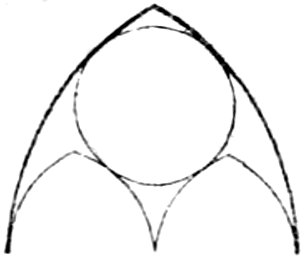
fig. 1.
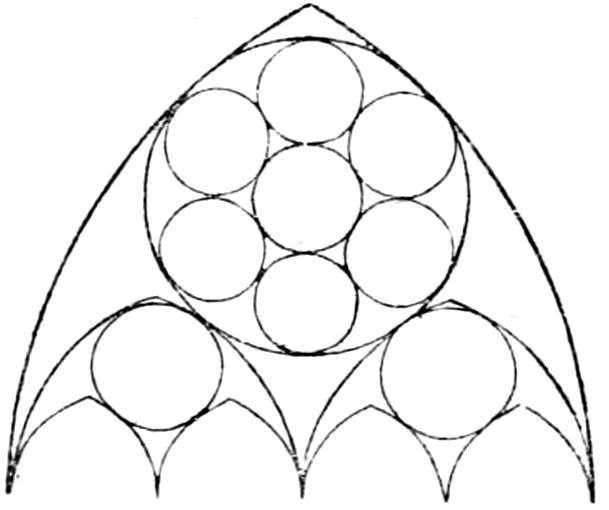
fig. 2.
TRACERY. The system of ornamental framework in a window, or in a compartment of panelling or screen-work. The first form of tracery was doubtless suggested by the pierced circle often found between the heads of two lancets, and connected with them by a single hood.[18] For some time the form thus suggested (fig. 1.) was rigidly adhered to; even the number of lights being, in a great majority of cases, either two, four, or eight, the square and cube of two, and the simple two-light window was multiplied into itself once or twice, as in (fig. 2.), so that the pattern may be expressed by a geometrical series a1, a2, a3. Windows of three or other odd numbers of lights were less frequent and less successful; and the reduplication was effected by arithmetical rather than geometrical progression, the six-light windows being of two three-light windows, with the addition of a centre piece (see figs. 3. and 4.). Throughout the windows of this early style of tracery, all is effected by simple reduplication, no attempt being yet made to extend a single composition throughout the space to be filled. Circles, when of a considerable size, were filled with smaller circles (see fig. 2.) or with cusping (fig. 4.) designed after the same laws. But we must omit for the future all consideration of cusping, (see Cusping,) and everything but the mere pattern of the tracery.
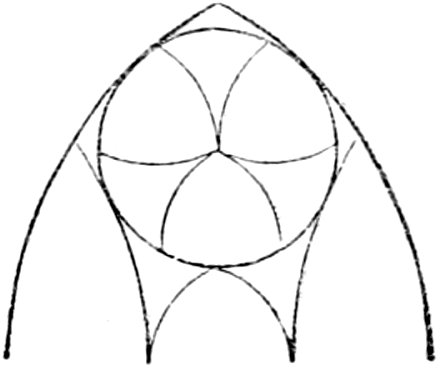
fig. 3.
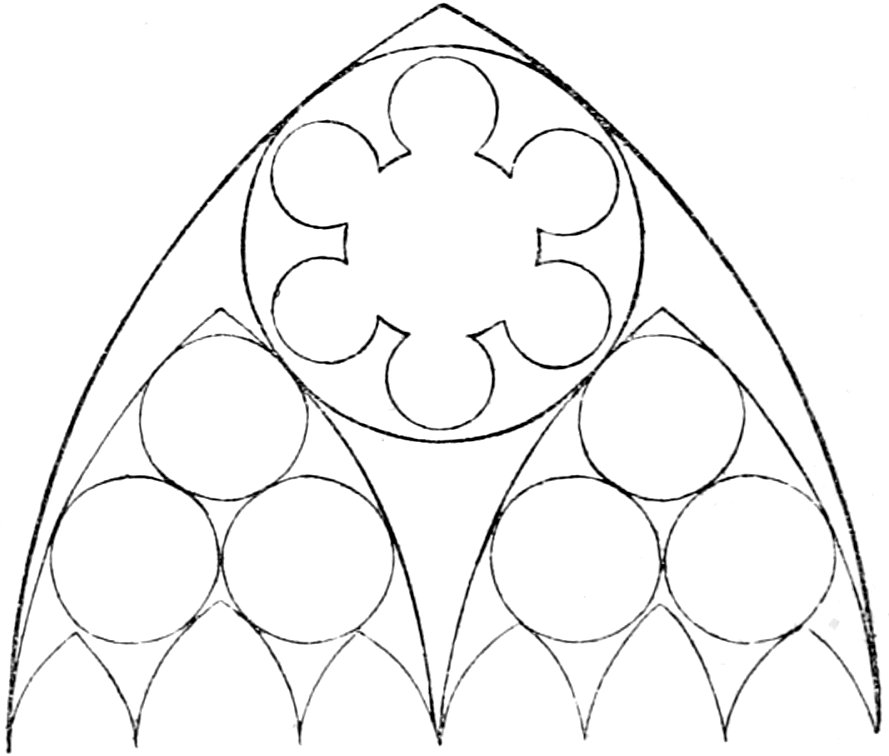
fig. 4.
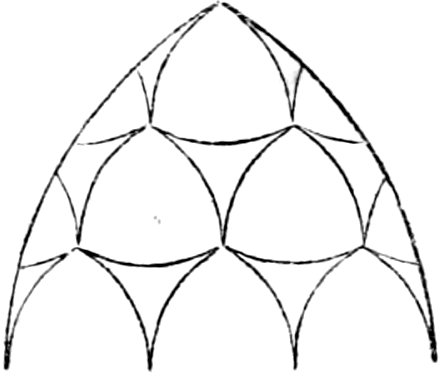
fig. 5.
755
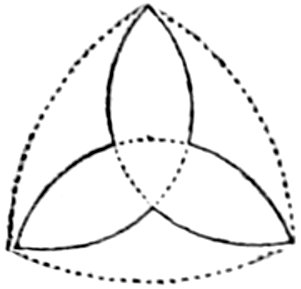
fig. 6.
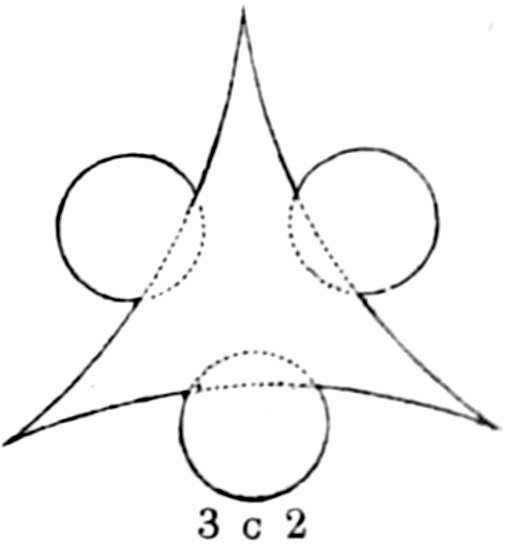
fig.7.
The exclusive use of circles led to great sameness of character, and the first effort to avoid this was by the introduction of convex-sided triangles, sometimes alone (fig. 5.), sometimes enclosed in or accompanying circles (fig. 3). Later still this triangle is resolved into a three-lobed figure, of which, however, the triangle is still the ruling form (fig. 6.). All these characteristics belong to the earlier class of Geometrical tracery, which is called concentric, because each perfect figure is either itself a circle, or is composed of circles or parts of circles struck from centres within the resultant figure, and themselves in the circumference of a circle, whose centre is the centre of the whole system. Thus in fig. 2. eight circles are struck either from the same centre, or points in the circumference of a circle concentric with the containing circle. In figs. 3. and 5. the triangles are composed of parts of circles, of which the centres are the opposite angles, and as the triangles are equilateral, all the centres are in the circumference of the circle whose centre is the centre of the triangle. This may be called the first law of the concentric Geometrical. It has two corollaries, 1. that each line forms a part of one figure, only, and, 2. that each circle, or part of a circle, touches, or cuts, but never flows into, another. As this law is broken, its consequences also are reversed; and we get an excentric Geometrical, in which there is no one ruling centre within the figure; but, on the contrary, the spirit of the style consists in having curves struck from centres alternately within and without the resulting figure, as in the accompanying trilobate and tricuspidate triangle (fig. 7.); but still the lines cut or touch, and never flow into one another. In fig. 8. we have lines each forming parts of two figures, which is the same as fig. 5., with the omission of the lower side of each triangle, and the consequent rejection of a centre of construction, i. e. from concentric the figure has become excentric. This makes a very near approach to the flowing Decorated, which indeed it becomes by the reversal of the last remaining rule, i. e. by suffering the curves which are struck from circles within and without the resulting figure, and which already form part of two figures, to flow into another, instead of cutting or touching. By this process, fig. 4. is altered into the ordinary reticulated tracery of the flowing Decorated (fig. 9.); and fig. 10., instead of fig. 1., becomes a normal form.
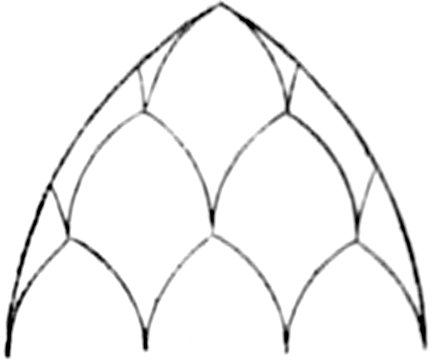
fig. 8.
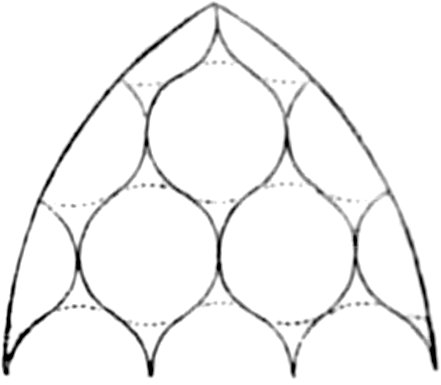
fig. 9.
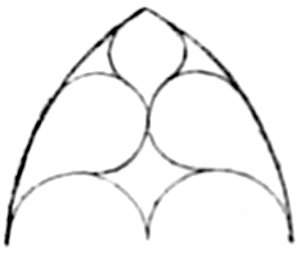
fig. 10.
This introduction of curves of contrary flexure is the ruling principle of flowing tracery, and its results are far too various to be pursued here. We must, however, observe, that in England the resulting forms have a great tendency to become pear-shaped, i.e. with the lower end pointed and the upper round and turned downward; whereas, on the Continent, while our Decorated was stiffening into the Perpendicular, their Geometrical was waving upward in their Flamboyant, which differs, as to mere pattern of tracery, from our flowing, in having both ends of each figure acutely pointed, and the upper point with an additional curve upward. Our own Perpendicular is scarcely worthy to be 756called tracery; its normal form is represented by mere intersections of vertical and horizontal lines (fig. 11.).
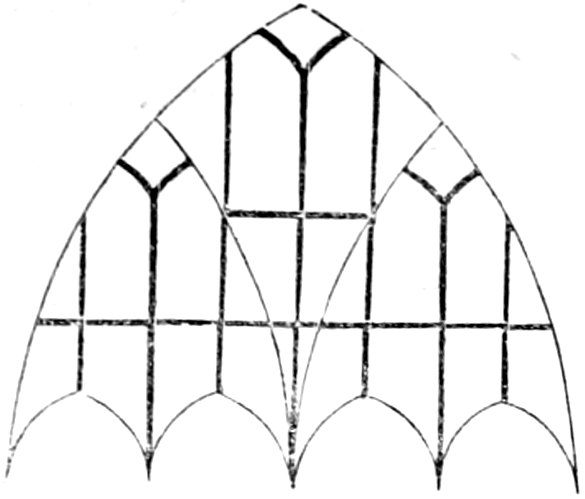
fig. 11.
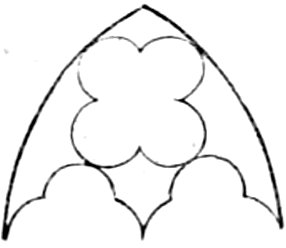
fig. 12.
We have at present described only the component figures of tracery. The character of windows is further altered by several other means common to all the styles, consistent with every form here described. Thus, for instance, tracery is grouped in these three ways: a large and prominent centre-piece is carried by two independent arches (fig. 2.); or it is divided into two windows, as it were, by two main arches, of the same curvature with the window arch (figs. 3. and 11.); or it fills the whole window head with no such equal division of its parts[19] (figs. 5., 8., 9.); or, again, it is divided into foil and foiled tracery, the latter being the ordinary form, the first that of tracery, which itself, in its principal bars, follows the direction of foils, without a circumscribing arch (fig. 12.); or, again, according as the surface of the tracery bar which traces the pattern is a fillet, an edge, or a roll, it is fillet, edge, or roll tracery; or, again, if it is only a plate of stone, pierced, without being moulded, it is plate tracery. Flowing tracery is convergent, or divergent, or reticulated. But the greatest source of beauty next to cusping is the due subordination of mouldings, which is itself sufficient to remedy the apparent sameness of pattern in the concentric Geometrical, and which adds infinite grace to the flowing tracery, in which, however, it is too seldom found. The student of ecclesiastical architecture will do well to pursue the subject of this article in Sharpe’s “Decorated Windows,” and in Freeman’s “Essay on the Origin and Development of Window Tracery.”
TRACT, in the Roman Missal, is an anthem, generally taken from the Psalms, following, and sometimes substituted for, the Gradual, (i.e. the anthem after the Epistle,) during penitential seasons, as the third Sunday in Advent, the three Sundays before Lent, Sundays, Mondays, Wednesdays, and Fridays in Lent, Easter Saturdays, and Easter Even, and certain holidays. Cardinal Bona says it is so called, “a trahendo: quia tractim et graviter, et prolixo descensu cantatur,” because it is sung in a protracted or slow manner.—Jebb.
TRADITION. (See Fathers.) The doctrine which has been delivered or handed down from one age to another. The great deference paid by the Church of England as a branch of the Catholic Church to tradition, is so misrepresented by the wicked, and so misunderstood by the weak, that we quote the following passage from Palmer’s “Treatise on the Church.” Speaking of those who calumniate us for our use of this doctrine, he says: “The various methods which these men employ in endeavouring to prevent any appeal to the tradition of the Church, may be classed under the following heads:
“1. Systematic misrepresentation. We do not appeal, in proof of Christian doctrine, to the ancient Christian writers as in any way infallible. Our sentiments on this head are well known; they have been repeatedly explained. We hold that the doctrine of any Father, however great and learned he may have been, e. g. that of Augustine, Athanasius, Ambrose, or Basil, is to be rejected in any point where it contradicts Scripture. We consider all these writers as uninspired men, and therefore liable to mistakes and errors like other theologians. Therefore it involves a studied misrepresentation of our meaning and principle, when we are met by assertions or proofs that particular Fathers have taught errors in faith or morality—that they were credulous—that their writings are in some points obscure—that their criticisms or interpretations of Scripture are sometimes mistaken—that they invented scholastic doctrines and were tinged with false philosophy—that the later Fathers were better theologians than the earlier—that there are Fathers against Fathers, and councils against councils, on some points. This is all calculated merely to excite prejudice against an appeal to the doctrine of the Church, by misrepresenting our design and principle 757in making it. Our answer to all these arguments is, that we do not appeal to the Fathers as inspired and authoritative writers, but as competent witnesses of the faith held by Christians in their days. If they are not to be trusted in this, they are not to be trusted in their testimony to the facts of Christianity, and the external evidence of revelation is subverted.
“2. Pretended respect for religion. Under this head may be classed that mode of argument which rejects any appeal to the doctrine of the Christian Church, under pretence that the Word of God alone ought to be the rule of our faith, in opposition to all the doctrines of man; that the Scripture constitutes a perfect rule of faith, needing nothing else; that it must necessarily be plain in all essential points, and that it is its own interpreter. The end of all this pretended reverence for Scripture is, to obtain an unlimited liberty of interpreting it according to our own reason and judgment, even in opposition to the belief of all Christians from the beginning. But in asserting this liberty to all men, it follows inevitably that no particular interpretation of Scripture is necessary to salvation; that Scripture has no Divine meaning; that it is not a revelation. In short, tradition is thrown aside, under pretence of veneration for the Scripture, in order that men may be enabled to distort, or misinterpret, and to destroy that very Scripture.
“The same may be observed of that pretended zeal for the defence of the Reformation, which infidels, Unitarians, and other enemies of the doctrine and discipline of the Church allege as a plea for rejecting all appeal to the doctrines of the universal Church. ‘The doctrines of the Reformation,’ they say, ‘cannot be defended if this appeal is allowed; Popery must triumph.’ Excellent men! They will maintain the Reformation at all hazards; all evidence shall be pronounced worthless if it be opposed to the interests of that sacred cause! But what is the end sought by all this pretended devotion? It is, that every man may be permitted, without any check, to interpret Scripture in such a manner as to subvert all the doctrines of the Reformation, whether positive or negative, to prove the Reformation itself needless, erroneous, bigoted, equally absurd as the system to which it was opposed, and more inconsistent. I charge these men with the grossest hypocrisy. Never was there a more daring attempt to palm an imposture on the credulous and unthinking, than this effort of deists and heretics to set aside tradition under pretence of zeal for the Reformation. They are the opponents of the Reformation. They are the representatives of those whom the Reformation condemned. They reject its doctrines, they charge it with ignorance, bigotry, intolerance, errors as gross as those of Popery. They have separated from its reformed institutions, as anti-Christians, and only exist by a perpetual attack upon them. The Reformation has no connexion with these men: its defence belongs exclusively to those who maintain its doctrines and adhere to its institutions, and they alone are proper judges of the mode of argument suited to its interests.
“3. Statements directly untrue. Under this head may be included the palmary argument employed by all sects against any appeal to the tradition of the Church universal, namely, that it was the principle of the Reformation to reject any such appeal; and its principle was, ‘the Bible alone is the religion of Protestants.’ Nothing can be more untrue than this assertion; the Reformation as a whole acknowledged and appealed to the authority of Catholic tradition, though it denied the infallibility of particular Fathers and councils. With equal veracity it is asserted that the Church of England rejects tradition in her sixth Article of Religion, when it is manifest that her object is simply to maintain the necessity of Scriptural proof for articles of faith; while our canons, our rituals, and the whole body of our theologians, so notoriously uphold the authority of tradition, that it is a subject of unmeasured complaint on the part of those who disbelieve the doctrines of the Church. The nature of these various arguments testifies sufficiently that the doctrine of the universal Church is opposed to those who employ them. It could be nothing but a feeling of despair on this point, which could have induced men to resort to perpetual misrepresentation, to false pretences, and to untruths. The employment of these weapons by all sects, in order to prevent any appeal to universal tradition, proves two points. First, as the sole fundamental principle on which they all agree is, the rejection of an appeal to the doctrines of the Church as a check on the interpretation of Scripture, and the assertion of an unlimited right of private interpretation; this principle is the source of all their divisions and contradictions, and therefore must be radically false. Secondly, the doctrine of the universal Church from the beginning must condemn that of all modern 758sects, in every point in which they differ from our Catholic and apostolic Churches; and therefore, on every such point, they are in error, and misinterpret Scripture, and the Church is in the right.”
TRADITIONS OF THE CHURCH. (See Ceremony.) “It is not necessary that traditions and ceremonies be in all places one, and utterly like; for at all times they have been divers, and may be changed according to the diversities of countries, times, and men’s manners, so that nothing be ordained against God’s word. Whosoever, through his private judgment, willingly and purposely, doth openly break the traditions and ceremonies of the Church, which be not repugnant to the word of God, and be ordained and approved by common authority, ought to be rebuked openly, (that others may fear to do the like,) as he that offendeth against the common order of the Church, and hurteth the authority of the magistrate, and woundeth the consciences of the weak brethren.
“Every particular or national Church hath authority to ordain, change, and abolish, ceremonies or rites of the Church ordained only by man’s authority, so that all things be done to edifying.”—Article XXXIV.
The word “tradition” is not here used in the same sense in which it was used in the explanation of the sixth Article. It there signified unwritten articles of faith, asserted to be derived from Christ and his apostles: in this Article it means customs or practices, relative to the external worship of God, which had been delivered down from former times; that is, in the sixth Article, traditions meant traditional doctrines, of pretended Divine authority; and in this it means traditional practices acknowledged to be of human institution.—Bp. Tomline.
The word means the same as is expressed immediately by the word “ceremonies,” which is only explanatory; and which the Church afterwards calls “rites,” supposing them the same with ceremonies.—Dr. Bennet.
TRADITORS. Persons who in times of persecution delivered the sacred Scriptures and other ecclesiastical records to their persecutors, were thus called, and were subjected to severe censures.
TRANSEPT. (See Cathedral.)
TRANSITION. About the year 1145, the use of the pointed arch was introduced into English architecture, and with this so many constructive changes in the fabric, that though Norman decorations were long retained, and even the round arch was used, except in the more important constructive portions, a style equally distinct from Norman and from Early English was the result, and this style is called Semi-Norman, or Transition. Before the close of the twelfth century, the round arch had entirely disappeared, and the Early English, or Lancet, style was fully developed about 1190.
TRANSLATION. The removal of a bishop from the charge of one diocese to that of another, in which case the bishop in his attestations writes “anno translationis nostræ,” not “anno consecrationis nostræ.”
Also, in literature, the rendering of a work from the original into another language. All the scriptural portions of the Prayer Book are not derived from the translation in common use. For example, the Psalter is from the great English Bible set forth and used in the time of Henry VIII. and Edward VI.
Translation of festivals. In the Roman Church, when two festivals of a certain class concur on the same day with other festivals of the same or similar class, the celebration of one or other of these festivals is transferred to some future day, according to rules which are given in the Breviary and Missal. This is called a translation.—Jebb.
TRANSOM. A horizontal mullion, or cross-bar, in a window or in panelling. The transom first occurs in late Decorated windows, and in Perpendicular windows of large size it is of universal occurrence.
TRANSUBSTANTIATION. The pretended miraculous conversion or change of the bread and wine into the very body and blood of our Lord, which the Romanists suppose to be wrought by the consecration of the priest. This false doctrine is condemned by the Church of England in her 28th Article. “The supper of the Lord is not only a sign of the love that Christians ought to have among themselves one to another, but rather it is a sacrament of our redemption by Christ’s death: insomuch that to such as rightly, worthily, and with faith receive the same, the bread which we break is a partaking of the body of Christ; and likewise the cup of blessing is a partaking of the blood of Christ.”
Transubstantiation, (or the change of the substance of bread and wine,) in the supper of the Lord, cannot be proved by holy writ: but it is repugnant to the plain words of Scripture, overthroweth the nature of a sacrament, and hath given occasion to many superstitions.
“The body of Christ is given, taken, and eaten in the supper, only after an 759heavenly and spiritual manner. And the mean whereby the body of Christ is received and eaten in the supper is faith.
“The sacrament of the Lord’s supper was not by Christ’s ordinance reserved, carried about, lifted up, or worshipped.”
Bishop Beveridge has the following remarks on this article, from Scripture and the Fathers:
“Scripture and Fathers holding forth so clearly, that whosoever worthily receives the sacrament of the Lord’s supper doth certainly partake of the body and blood of Christ, the devil thence took occasion to draw men into an opinion, that the bread which is used in that sacrament is the very body that was crucified upon the cross; and the wine after consecration the very blood that gushed out of his pierced side. The time when this opinion was first broached was in the days of Gregory III., pope of Rome. The persons that were the principal abettors of it were Damascen in the Eastern, and afterwards Amalarius in the Western Churches. It was no sooner started in the East, but it was opposed by a famous council at Constantinople, consisting of 338 bishops, the famous opposers of idol worship. But afterwards, in the second Council of Nice, it was again defended, and in particular by Epiphanius the deacon, who confidently affirmed that, ‘after the consecration, the bread and wine are called, are, and are believed to be, properly the body and blood of Christ.’ In the West also, Amalarius having broached this opinion, Paschasius Radbertus readily swallowed it down. But Rabanus Maurus, Ratramnus or Bertramnus, (of whom more presently,) as also Johannes Scotus Erigena, not only stuck at it, but refused it, and wrote against it as a poisonous error. And, after them, Berengarius too, who was not only written against by Lanfranc, archbishop of Canterbury, but condemned for it in a council held at Verceli, (where the book of Johannes Scotus of the eucharist was also condemned,) and at another council held at Rome about the same time. And though he did recant his opinion at a council held at Tours, and another at Rome, as some think, so as never to hold it more, yet his followers would never recant what they had learned of him. But in the Lateran Council, held A. D. 1215, the opinion of the real or carnal presence of Christ was not only confirmed, but the word transubstantiated was newly coined to express it by; that council determining that ‘there is one universal Church of the faithful, without which there is none saved; in which Jesus Christ himself is both priest and sacrifice, whose body and blood in the sacrament of the altar are truly contained under the shapes of bread and wine; the bread being transubstantiated, or substantially changed into his body, and the wine into his blood, by the power of God; that for the perfecting the mystery of our union, we might receive of him what he had received of us.’ And ever since this word was thus forged by this council, the abettors of this opinion have made use of it to declare their minds by concerning this great mystery; still holding with the Council of Trent, ‘that by the consecration of the bread and wine is made a change of the whole substance of bread into the substance of the body of Christ our Lord, and of the whole substance of the wine into the substance of his blood; which change is aptly and properly called by the holy Catholic Church transubstantiation.’ So that, according to this opinion, the bread and wine, which before are properly bread and wine only, and not the body and blood of Christ, are after consecration as properly the body and blood of Christ, only, and not bread and wine; the bread being changed by the words of consecration into the very body of Christ that hung upon the cross; and the wine into the very blood that ran in his veins, and afterwards issued forth out of his side.
“Now the doctrine delivered in the former part of this article being so much abused, that they should take occasion from that great truth to fall into this desperate error, so as to say the bread and wine are really changed into the body and blood of Christ, because he doth really partake of the body and blood of Christ, that rightly receives the bread and the wine; that truth is no sooner delivered but this error is presently opposed. It being no sooner declared that the bread we break is a partaking of the body, and the cup we bless a partaking of the blood, of Christ, but it is immediately subjoined, that, notwithstanding the truth of that assertion, yet transubstantiation, or the change of the bread and wine into the body and blood of Christ, is to be rejected upon a fourfold account. First, because it cannot be proved by the Scriptures. Secondly, it is repugnant to them. Thirdly, it overthroweth the nature of the sacrament. Fourthly, it hath given occasion to many superstitions. Of which in their order briefly.
“1. As for the first, that this doctrine of transubstantiation cannot be proved from the Holy Scriptures, is plain from the 760insufficiency of those places which are usually and principally alleged to prove it; and they are the sixth of St. John’s Gospel, and the words of institution. In the sixth chapter of St. John’s Gospel, we find our Saviour saying, ‘My flesh is meat indeed, and my blood is drink indeed.’ (John vi. 55.) And many such like expressions hath he there concerning our eating of his flesh, and drinking of his blood. From whence they gather, that the bread and wine are really turned into the body and blood of Christ; not considering, first, that our Saviour said these words at the least a year before the sacrament of the Lord’s supper was instituted. For when Christ spake these words, it is said, that ‘the passover was nigh,’ (ver. 4,) whereas the institution of the sacrament was not until the passover following; and it is very unlikely that he should preach concerning that sacrament before it was instituted. To which we may also add, that our Saviour here saith concerning the flesh and blood here spoken of, ‘Except ye eat the flesh of the Son of man, and drink his blood, ye have no life in you’ (ver. 53); whereas it is manifest that a man may be deprived of the sacramental bread and wine, and yet have life in him; for otherwise all that die before they receive the sacrament must of necessity be damned. And, therefore, though the thing signified, even the flesh and blood of Christ, is here to be understood, yet the signs themselves of the sacrament cannot. And so this place, not intending the bread and wine in the sacrament, cannot be a sufficient foundation to ground the transubstantiation of that bread and wine into the body and blood of Christ. And, secondly, suppose this place was to be understood of the sacrament, when our Saviour saith, ‘My flesh is bread indeed, and my blood is drink indeed:’ this might prove indeed that Christ’s body and blood were turned into bread and drink, but not at all that [that] bread and drink are turned into his body and blood. Thirdly, it is plain that in these words our Saviour doth not mean any external or bodily, but internal and spiritual, feeding upon him. So that whosoever thus feedeth upon him shall never die, (ver. 50,) but live for ever (ver. 51). Yea, ‘He that eateth my flesh, and drinketh my blood, dwelleth in me and I in him’ (ver. 56). So that, as Origen observeth, ‘No wicked man can eat of this bread here spoken of; whereas it is as clear as the noonday sun, that sinners, as well as saints, the worst as well as the best of men, may eat the bread and drink the wine in the sacrament.’ And as the sixth of St. John’s Gospel doth not, so neither do the words of institution, ‘This is my body,’ prove the transubstantiation of the bread into the very body of Christ. For he that saith, because our Saviour said, ‘This is my body,’ the bread is therefore changed into his body, may as well say that, because Joseph said, ‘The seven good kine are seven years, and the seven good ears are seven years,’ (Gen. xli. 26,) therefore the seven good kine, and the seven good ears, were all changed into seven years. And because Daniel said to Nebuchadnezzar, ‘Thou art this head of gold,’ (Dan. ii. 38,) therefore Nebuchadnezzar must needs be changed into a head of gold; whereas it is plain that in Scripture that is often said to be a thing which is only the sign of it: as God is pleased to explain himself when he said of circumcision, ‘This is my covenant,’ (Gen. xvii. 10,) and in the next verse, ‘And it shall be a sign or token of the covenant betwixt me and you’ (ver. 11). And what sense the Most High explains himself by in that sacrament we may well understand him in this. When he said, ‘This is my covenant,’ he tells us what he meant by that phrase, even ‘This is the sign of my covenant:’ and so here, when Christ said, ‘This is my body,’ according to his own explication of himself before, it is no more than if he should have said, ‘This is the sign or token of my body.’ And therefore saith Augustine, ‘For if sacraments should not have a certain resemblance of the things whereof they are sacraments, they would not be sacraments at all; but from this resemblance they often receive the names of the things themselves. Therefore, as after a certain manner the sacrament of Christ’s body is the body of Christ, and the sacrament of the blood of Christ is the blood of Christ; so the sacrament of faith (baptism) is faith.’ So that the words, ‘This is my body,’ prove no more than that the bread was the sign or sacrament of his body; not at all that it is really changed into his body. But that this doctrine of transubstantiation cannot be proved from the Scriptures, is further evident in that it is contrary to them.
“2. And this is the second thing here asserted of transubstantiation, that it is ‘repugnant to the plain words of the Holy Scriptures;’ which to prove I need go no further than to show, that the Scripture doth still assert them to be bread and wine after as well as before consecration. And this one might think was plain enough, 761in the first place, even from the words of institution themselves; for the Scripture saith, ‘And as they were eating Jesus took bread and blessed it, and gave it to the disciples, and said, Take, eat, this is my body.’ (Matt. xxvi. 26.) So that that which Jesus took was bread, that which Jesus blessed was bread, that which Jesus gave to his disciples was bread; and therefore that of which he said, ‘This is my body,’ must needs be bread too, as the Fathers long ago acknowledged. And truly in reason it cannot be denied; for there is no other antecedent to the pronoun ‘this’ but ‘bread;’ for the ‘body’ of Christ, that cometh after it, cannot possibly be the antecedent to it. For, according to the principles of our adversaries themselves that hold this opinion, the bread is not changed into the body of Christ before consecrated, nor is it consecrated until the words, ‘This is my body,’ be all pronounced; so that when the priest saith, ‘This,’ there is no such thing as the body of Christ present, that not coming in till both that and the following words too are perfectly uttered; and therefore the body of Christ can by no means be looked upon as the antecedent to this pronoun; but that it is bread and bread only that it hath reference to. So that ‘This is my body,’ is as much as to say, ‘This bread is my body, this bread that I have taken, and blessed, and give unto you, is my body.’ Now, as Bellarmine himself acknowledged, this proposition, ‘This bread is my body,’ cannot possibly be taken any other ways than significatively, so as that the sense should be, ‘This bread signifies my body,’ is a sign or sacrament of it; it being absolutely impossible that bread should be the very body of Christ: for if it be bread, and yet the very body of Christ too, then bread and the body of Christ would be convertible terms. So that the very words of institution themselves are sufficient to convince any rational man, whose reason is not darkened by prejudice, that that of which our Saviour said, ‘This is my body,’ was real bread, and so his body only in a figurative or sacramental sense; and by consequence that the bread was not turned into his body, but his body was only represented by the bread. But if this will not do, we may consider, in the second place, the institution of the other part of the sacrament; for it is said, ‘And he took the cup, and gave thanks, and gave it to them, saying, Drink ye all of it; for this is my blood of the new testament, which is shed for many for the remission of sins.’ (Matt. xxvi. 27, 28.) Where these last words, ‘for this is my blood,’ &c., being the words of consecration; and our Saviour having given them the cup before, and bidden them to drink all of it; it could not possibly be meant of anything else than the wine in the cup of which he said these words. To which we may also observe what follows, even after the words of consecration: ‘But I say unto you, I will not drink henceforth of this fruit of the vine, until that day when I drink it new with you in my Father’s kingdom.’ (Matt. xxvi. 29.) Whence we see our Saviour himself, even after he had consecrated the wine, still calls it the fruit of the vine; and in saying that he will drink no more of the fruit of the vine, plainly shows that it was the fruit of the vine which he before drank. So that the very wine of which he said, ‘this is my blood,’ was wine still, and the fruit of the vine; which I hope none of our adversaries will say the very blood of Christ is. But, thirdly, this may be discovered also from the words of the apostle: ‘The cup of blessing which we bless, is it not the communion of the blood of Christ? The bread which we break, is it not the communion of the body of Christ?’ (1 Cor. x. 16); where we may take notice of two things. First, that he here calleth the sacramental elements still ‘a cup,’ or wine, and bread, ‘the bread which we break;’ so that it is still bread: and, secondly, that the cup of blessing is the communion of the blood, and the bread broken the communion of the body, of Christ. Now, if the bread be the communion of his body, and the cup the communion of his blood, it cannot be that the cup should be his real blood, and the bread his real body; for then it would be as much as if he should have said, ‘The blood of Christ is the communion of the blood of Christ, and the body of Christ the communion of the body of Christ;’ and so the body of Christ must be the communion of itself, which is impossible; to which we might also add the several places where the apostle calls the elements still bread and wine, or the cup; as, ‘For as oft as ye eat this bread and drink this cup.’ (1 Cor. xi. 26.) “Whosoever shall eat this bread and drink this cup of the Lord unworthily,” &c. (Ver. 27.) ‘But let a man examine himself, and so let him eat of that bread and drink of that cup.’ (Ver. 28.) From whence it is manifest, that that which we eat at the sacrament is bread, and not the very body of Christ; that which we drink, the cup or wine, and not the very blood of Christ; and therefore, 762that to say it is not bread nor wine, but the very body and blood of Christ, is repugnant to the plain words of the Scripture.
“3. The third thing is, that it ‘overthroweth the nature of the sacrament,’ which I need not spend many words to prove; for in a sacrament it is required, first, that there be some outward sign representing spiritual grace; whereas if the bread be really changed into the body of Christ, there is no outward sign at all in the sacrament, there being nothing else but the body and blood of Christ, which are not signs, but the thing signified. Nay, as Augustine observes, ‘The signs themselves are the sacraments,’ and therefore where there is no sign there can be no sacrament. And so, by depriving this sacred ordinance of its outward signs, they degrade it from being a sacrament, making it to have nothing of the nature of a sacrament in it. And therefore, if they will still hold, that by the words of consecration the bread and wine are substantially changed into the body and blood of Christ, let them cease to call that holy action any longer a sacrament, but name it ‘the body and blood of Christ;’ for, according to their opinion, there is nothing in it but the body and blood of Christ. So that it is plain that, by this doctrine, the nature of a sacrament in general must be destroyed, or this sacrament in particular must be expunged out of their catalogue of sacraments.
“4. The fourth and last thing here objected against this doctrine of transubstantiation is, that it ‘hath given occasion to many superstitions,’ which any one that ever observed their customs and practices cannot but acknowledge. For this fond opinion possessing their brains, that the bread is the real body of Christ hung upon the cross, and pierced for their sins, oh! how zealous are they in wrapping it up neatly in their handkerchiefs, laying it up in their treasures, carrying it about in their processions; yea, and, at the length, in worshipping and adoring it too!”
This learned and orthodox bishop proceeds to show how inconsistent this tenet is with the teaching of the Fathers. We add a few quotations upon the subject from other orthodox divines.
“The article next condemns the Popish doctrine of transubstantiation, or the change of the substance of bread and wine into the real substance of Christ’s body and blood, in the administration of the Lord’s supper. The idea of Christ’s bodily presence in the eucharist was first started in the beginning of the eighth century, and it owed its rise to the indiscretion of preachers and writers of warm imaginations, who, instead of explaining judiciously the lofty figures of Scripture language upon this subject, understood and urged them in their literal sense. Thus the true meaning of these expressions was grossly perverted: but as this conceit seemed to exalt the nature of the holy sacrament, it was eagerly received in that ignorant and superstitious age; and was by degrees carried farther and farther, by persons still less guarded in their application of these metaphorical phrases. This has always been a favourite doctrine of the Church of Rome, as it impressed the common people with higher notions of the power of the clergy, and therefore served to increase their influence. It met however with opposition upon its original introduction, particularly from Bertram and John Scot; and again at the first dawn of the Reformation, both upon the Continent and in this country. It was objected to by the Waldenses; and there are strong expressions against it in some parts of Wickliff’s works. Luther, in contradiction to the other reformers, only changed transubstantiation into consubstantiation, which means that the substance of Christ’s body and blood is present in the holy sacrament with the substance of the bread and wine; and his perseverance in this opinion was a principal cause of the division among the reformed churches. He was opposed by Zuingle and Calvin, but the Confession of Augsburg, which was drawn up by Melancthon, favours consubstantiation. There is, however, considerable doubt concerning the real sentiments of Melancthon upon this subject, especially in the latter part of his life. Some of our early English reformers were Lutherans, and consequently they were at first disposed to lean towards consubstantiation; but they seem soon to have discovered their error, for in the articles of 1552 it is expressly said, “A faithful man ought not either to believe or openly confess the real and bodily presence, as they term it, of Christ’s flesh and blood in the sacrament of the Lord’s supper.” This part of the article was omitted in 1562, probably with a view to give less offence to those who maintain the corporal presence, and to comprehend as many as possible in the Established Church.”—Bp. Tomline.
In arguing against this doctrine we may first observe, that it is contradicted by our senses, since we see and taste that 763the bread and wine after consecration, and when we actually receive them, still continue to be bread and wine, without any change or alteration whatever. And again, was it possible for Christ, when he instituted the Lord’s supper, to take his own body and his own blood into his own hands, and deliver them to every one of his apostles? or was it possible for the apostles to understand our Saviour’s command to drink his blood literally, when they were forbidden, under the severest penalties, to taste blood by the law of Moses, of which not only they themselves, but Christ also had been a strict observer? They expressed not the slightest surprise or reluctance when Christ delivered to them the bread and wine, which could not have been the case, had they conceived themselves commanded to eat the real body and drink the real blood of their Lord and Master. The bread and wine must have been considered by them as symbolical, and indeed the whole transaction was evidently figurative in all its parts; it was instituted when the Jews, by killing the paschal lamb, commemorated their deliverance from Egyptian bondage by the hand of Moses, which was typical of the deliverance of all mankind from the bondage of sin by the death of Christ, “the Lamb slain from the foundation of the world;” and as the occasion was typical, so likewise were the words used by our Saviour: “This is my body which is broken,” and “this is my blood which is shed.” But his body was not yet broken, nor was his blood yet shed; and therefore the breaking of the bread, and the pouring out of the wine, were then figurative of what was about to happen, as they are now figurative of what has actually happened. He also said, “This cup is the new testament in my blood” (1 Cor. xi. 25); which words could not be meant in a literal sense; the cup could not be changed into a covenant, though it might be a representation or memorial of it. Our Saviour called the wine, after it was consecrated, “the fruit of the vine,” (Matt. xxvi. 29,) which implied that no change had taken place in its real nature. Since then the words, “This is my body,” and “This is my blood,” upon which the Papists pretend to support this doctrine, were manifestly used in a figurative sense, and must have been so understood by the apostles, to whom they were originally addressed, we may safely pronounce that “transubstantiation, or the change of the substance of bread and wine, in the supper of the Lord, cannot be proved by Holy Writ.” That the early Christians understood our Saviour’s words in a figurative sense, appears from the writings of more than twenty Fathers, without a single authority on the opposite side.—Bp. Tomlins.
1. That transubstantiation is “repugnant to the plain words of Scripture,” appears from St. Paul’s saying, “we are all partakers of that one bread” (1 Cor. x. 17); and, “as often as ye eat this bread” (1 Cor. xi. 26); so that it is bread, and not Christ’s flesh, even when we eat and partake thereof. Parity of reason proves the same of the wine. 2. That transubstantiation “overthroweth the nature of a sacrament” is evident, because it supposes what we eat and drink to be, not the sign, but the thing signified. 3. It has also “given occasion to many superstitions.” That it has given occasion to abominable idolatry is evident from the adoration of the host, which is grounded on it. But, though idolatry is worse than superstition, yet it is different from it. Wherefore, for the proof of this branch of the proposition, let it be considered, that, in cases of imminent danger or great calamities, the host is exposed by the Papists, to appease God’s anger, and prevent or remove his judgments: or reference may be had to the provisions made in the Romish Church, in the event of any accident happening to the consecrated elements. Our reformers were too well acquainted with these superstitions: though, blessed be God, we have not instances ready at hand.—Dr. Bennet.
TRAVERSE. A seat of state with a canopy, formerly placed at the upper end of the choir in the royal chapels, and temporarily in cathedrals, for the use of the sovereign.
TREASURER. A dignitary formerly existing in all cathedrals and collegiate churches of old foundation in England, and in Ireland and Scotland in such churches as followed the English model. The treasurer was not the bursar, but rather the chief sacristan. He had the care of the plate, vestments, furniture, necessaries of Divine service; the control of the sacristan and inferior officers, of the bells, and the general superintendence of the fabric. In many foreign churches the place of treasurer was discharged by a dignitary called a sacristan; but in others, as at Glasgow, and the royal chapel, Stirling, there was a treasurer and a sacristan, both dignitaries. In cathedrals of the new foundation, the treasurer is merely the bursar; the canons taking this office in annual rotation.—Jebb.
764TRENT, COUNCIL OF. (See Roman Catholic Church, Popery, Council of Trent.) This important council met in 1545, and was dissolved in 1563. Its nominal period extended over eighteen years, but its actual sessions occupied less than five. Protestants from the days of Luther had been urgent for the convocation of a free synod. They had reiterated the demand at Nuremberg, and Ratisbon, and Spires. There were indeed on both sides earnest and pious persons who were anxious that the questions at issue should be settled by competent authority. The evil lives of the clergy, and the general disorders of the Church, afforded another strong reason by which many were influenced. At the same time, the endless extortions of the papal chancery had raised disputes in every European state, which there seemed no other hope of allaying. It was the great object of the pope and his adherents to condemn Lutheran doctrine, and to avoid definition on points disputed in the Roman Church. Clement VII. had promised that a general council should be held in Italy for raising subsidies against the Turks, and for the suppression of heresy, but he really used his influence to prevent its assembling. On his death in 1534 his successor, Paul III., published a bull of convocation. Various difficulties however arose, partly on account of the proposed place of meeting, and partly through the war between the emperor and the king of France, and interposed a delay of some years. The city of Trent in the Tyrol, on the confines of Italy and Germany, and now in the dominions of Austria, was at length selected, the summons was issued, and the council was opened December 13, 1545. The meeting had been so long deferred, that when a few ecclesiastics and others assembled, it was hardly believed that the synod was really convened; and the importance of the movement was not perceived until somewhat later.
The first three sessions were occupied by preliminary matters, after which the actual business commenced. The constitution of the assembly, as well as the form of procedure, was governed by arbitrary rules. The legates presided as the representatives of the pope; who also appointed the secretaries and other officers. Bishops alone were allowed to vote, but an exception was made in the case of certain abbots and generals of orders, for whose admission no precedent could however be alleged, but such as would be equally availing for all presbyters. Proxies were generally refused, although some were allowed by the sole authority of the pope. All discussions were confined to previous congregations, and in the sessions which followed there was no deliberation, but only the acceptance or rejection of the proposed conclusions. The judgments of the council were embodied partly in decrees which profess to contain the Catholic doctrine on the points in question, partly in canons by which the contrary opinions are anathematized as heretical.
In the fourth session, which was held April 5, 1546, somewhat less than fifty bishops being present, it was decreed that the canon of Scripture includes the books commonly called apocryphal, and that tradition is to be received as of equal authority with the written Word; that the Vulgate is to be taken for the standard text, and no interpretation allowed but such as the Church has affixed. In the fifth session the decree on original sin was passed; in the sixth, that on justification; and in the seventh, that on the sacraments in general, and baptism and confirmation in particular. In the eighth session, the removal to Bologna was appointed, where the two following sessions were held; but no decrees were passed, and in September, 1547, the council was prorogued. The translation to an Italian city had been made under a bull of Paul III., when the German bishops were urgent for reformation, and there seemed no other escape. A disease which broke out at Trent was the alleged excuse. In 1551 the council was again convened by Julius III., who had been present at a former period as legate. The eleventh and twelfth sessions were spent in formal business; in the thirteenth the sacrament of the eucharist was treated; in the fourteenth, the sacraments of penance and extreme unction; in the fifteenth, a safe-conduct was granted to the Protestants; and in the sixteenth, which was held in April, 1552, the prorogation of the council for two years was decreed. Paul IV. was, however, resolutely opposed to its revival, on the ground that his authority was higher than that of a synod, which was therefore needless; and by the threat of secular reformation he deterred some princes from urging the reassembling of the council, which did not take place till January, 1562, when the seventeenth session was held under Pius IV. In the eighteenth, certain of the fathers were appointed to prepare an index of prohibited books, and at the same time, the safe-conduct was removed; in the eighteenth and nineteenth no business was transacted; in the twenty-first, the communion under one 765kind was enjoined for all, except the celebrant; in the twenty-second, the sacrifice of the mass was declared to be a true and Catholic doctrine; in the twenty-third, the subject handled was the sacrament of order; in the twenty-fourth, the sacrament of matrimony; and in the twenty-fifth, decrees were passed on purgatory, the invocation of saints, the worship of relics and images, indulgences, fasting, the index of prohibited books, the catechism, the breviary, and the missal. After which, the decrees passed under Paul III. and Julius III. were read, and the council was dissolved.
In reviewing the history of this remarkable assembly, it is impossible to overlook the want of unity both in purpose and opinion among its members. The representatives of the emperor of Germany, of the kings of France and Spain, of the duke of Bavaria, and of other secular princes, urgently demanded the reformation of the Church, while the partisans of the Roman court were desirous only to suppress Protestantism. There were none but Italians on whom the pope could entirely depend, for even the Spanish prelates wished his power to be restrained, and that of other bishops to be enlarged. The Germans and French demanded the restoration of the cup, and the marriage of the clergy, while the Spaniards, who opposed them on these points, were united with them on some others against the Roman faction. One great party was urgent that the later sessions should be declared a continuation of the earlier, while another vehemently opposed the declaration; and the council never ventured to rule the question either way. There were endless conflicts between the bishops and the monastic orders, and of Franciscans and Dominicans, with each other. Whether the Blessed Virgin was conceived without sin; what is the true nature of transubstantiation; whether Christ offered himself in the holy supper; whether the apostles were ordained priests at that time or previously,—were among the topics of vehement contention. On the subject of the great doctrine of justification by faith, the members of the council were far from being agreed, and it is beyond denial that some of them held the Protestant view. Even the scanty number, who ventured to decide on the canon of Scripture, and on tradition, were at variance among themselves. Some disputes lasted throughout the whole period, such as whether the council should be said to represent the universal Church; whether the legates should have the privilege of proposing all matters for debate; and whether doctrine should precede reformation. The question of the residence of bishops, that is, whether it is binding by Divine ordinance, or by the law of the Church, in which important considerations were involved, excited long and angry conflicts. Day after day, through weeks and months of the most critical period, the dispute was renewed. The legates themselves were divided; and at one time the dissolution of the council seemed inevitable.
There are many controverted points on which the council gives no information, and they are the very questions which it was most important to decide. No one can learn from its decrees, for instance, what is the sound doctrine about purgatory, nor in what due veneration for images consists, nor which is the sacramental form in penance, or matrimony, nor what is the nature of original sin, nor what is the proper definition of a sacrament. There were some subjects debated more than sufficiently, but left at last undecided; and there were some positions which the council could not renounce, because this would have contradicted the decrees of former popes and councils, and which they could not affirm, because they were opposed by powerful members of the existing Church.
In spite, however, of the imperfect and contradictory statements of the Fathers of Trent, they had no hesitation in pronouncing judgment on what they esteemed Lutheran opinions. We can indeed find no parallel for the prodigality of their curses, unless we go back to the days of the Donatists. They reach not only to those whom the Church of all ages has called blessed, but to many also of the doctors most esteemed in the Roman communion itself. If any one, for example, denies that the works of justified persons are truly meritorious of eternal life, or that the mass is a true and propitiatory sacrifice, or that the custom of confessing privately to a priest has existed from the apostolic age, or that the Church has power to change an institution of Christ, he falls under the imprecation of the council. In the decree of the last session on the invocation of saints, and the use of images and relics, an anathema is pronounced, not only against those who teach, but those who even think differently. And yet the synod which spoke with so much boldness had no claim, either from numbers or character, to be taken as the representative of the Catholic Church. In the first seven sessions held under Paul III., when the ground was laid for maintaining all the 766errors and corruptions of the Roman Church, less than sixty bishops were present. In the thirteenth, under Julius III., when transubstantiation and the worship of the host were defined, only forty-five bishops and two cardinals were assembled. And in the ninth session there were only thirty-five collected, who yet presumed to take the title of an Ecumenical Council. In the later sessions held under Pius IV., there was a greater number of bishops at Trent; but the chief subjects in dispute had been ruled in the earlier periods of the council, and the deficiency of numbers was not remedied by any subsequent confirmation. Of those who were present, the chief part were Italians; some were bishops of inconsiderable sees, and some mere titulars. There were among them not a few, who subsisted on pensions granted by the pope.
The council was in no sense the free assembly to which Luther and others had appealed, for it was guided throughout by papal influence; and, as the Protestants complained in 1546, it was not convened in a neutral place, while the pope, who was the great delinquent on trial, was allowed to be the judge in his own cause. There were external causes at work, which prevented the freedom of debate. At the very time when the doctrine of justification was under review, a league was formed between the pope and the emperor, for putting down the Protestants; and while the council was debating, the bishop of Rome was sending his contingent of troops. In the council itself, the legates assumed unreasonable authority, and their interruptions were the subject of continual complaint. During the later sessions, the Inquisition was in full force, and there were persons present in the council who had been sufferers. The assembly was overborne by Italian prelates. At one time, when very important subjects were under discussion, there were no more than two bishops to represent the Church of France. On another occasion, forty bishops were sent by the Roman court for the purpose of carrying a particular point, by outvoting the Spanish bishops, by whom it was opposed. We find the ambassadors of secular princes expressing in the strongest language their sense of the tyranny under which the council was held, and by which its freedom was annihilated.
No one who considers these circumstances can wonder that the beneficial reforms of the Church did not result, which had been so long expected and so anxiously desired. They had been demanded, but in vain, by the emperor, and other great princes, as well as by diets and other assemblies of the empire. Even as late as 1563, the French ambassador delivered a list of thirty-four articles of required reformation. After the twenty-second session we find the Imperialists affirming that none of the desired changes had been proposed. And just before the close of the council, the Spanish ambassador came to the legates with a written complaint, that the principal things for which it was assembled had been omitted, and the rest carried with precipitation. The French envoy filled the letters which he addressed to his court with similar testimony. Whatever beneficial changes in the administration of Church affairs seemed to have been made, were neutralized by the terms in which the rights of the see of Rome were reserved, and which were vague enough to admit every abuse, the pope himself being constituted judge in each case, and possessing also a dispensing power.
The last session was brought hastily to a close, partly through the diplomatic skill of the legate Morone; but chiefly on account of the illness of the pope, because everybody knew that if he died during the sitting of the assembly, a schism was inevitable.
The history of the council was written, in 1619, by Sarpi, and forty years later by Cardinal Pallavicini. The former was the most learned person of the age, a statesman and historian as well as a divine; the latter is chiefly known as an apologist of the court and Church of Rome. His work has been described as more injurious to papal interests than that of his predecessor; because if the one has shown how much may be said against the Council of Trent, the other has made it equally plain how little can be alleged in its defence.
The decrees of the council were signed by only 255 members: four of these were legates of the papal see; two, cardinals; three, patriarchs; twenty-five, archbishops; one hundred and sixty-eight, bishops; thirty-nine, deputies of absent prelates; seven, abbots; and seven were generals of religious orders. The Greek Church and the English Church were not represented. It was subscribed on separate schedules, by the ambassadors of the sovereigns who still adhered to the Romish system.
The following are the anathemas of the council.
I. The sacred œcumenical and general synod of Trent, lawfully assembled in the Holy Ghost, and presided over by the three legates of the apostolic see, having 767it constantly in view that, by the removal of errors, the gospel, which, promised aforetime in the Holy Scriptures by the prophets, Christ himself first published with his own mouth, and then commanded his apostles to preach to every creature, as the source of all saving truth and instruction of manners, should be preserved pure in the Church; and clearly perceiving that this truth and this instruction are contained in written books and unwritten traditions, which traditions have been received by the apostles from the mouth of Christ himself, or dictated by the Holy Spirit, and by the apostles handed down even to us, receives and reverences, conformably to the example of the orthodox Fathers, with the same pious regard and veneration, all the books as well of the Old as of the New Testament—both having God for their author, and the traditions relating both to faith and practice, inasmuch as these traditions were either delivered by word of mouth, from Christ, or dictated by the Holy Ghost, and preserved by uninterrupted succession in the Catholic Church. The books received by this council are, of the Old Testament, the five books of Moses, viz. Genesis, &c., Joshua, Judges, Ruth, four of Kings, two of Chronicles, first of Esdras, second of Esdras, called Nehemias, Tobias, Judith, Esther, Job, Psalms of David, consisting of 150, Proverbs, Ecclesiastes, Cantica, Wisdom, Ecclesiasticus, Isaiah, Jeremiah, with Baruch, Ezekiel, Daniel, twelve minor prophets, viz. Hosea, &c., the first and second of Maccabees. Of the New Testament, the four Gospels, the Acts of the Apostles, the Epistle of St. Paul the Apostle to the Romans, two to the Corinthians, one to the Galatians, one to the Ephesians, one to the Philippians, one to the Colossians, two to the Thessalonians, two to Timothy, one to Titus, one to Philemon, one to the Hebrews, the Epistle catholic of St. James, the two Epistles of St. Peter, the three Epistles of St. John, the Epistle of St. Jude, and the Revelations of St. John.
Whosoever shell not receive these books entire with all their parts, (i. e. the Apocrypha as well as the canonical books,) as they are used to be read in the (Roman) Catholic Church, and are contained in the ancient Vulgate Latin edition, for sacred and canonical, and shall knowingly and wilfully contemn the aforesaid traditions: let him be accursed. (See Bible, Scripture, Apocrypha.)
II. Moreover, in order to repress the arrogant and self-sufficient, the council decrees, that no one, relying on his own wisdom, shall presume to pervert and interpret Holy Scripture to his own sense, in matters of faith and manners, pertaining to the edification of Christian doctrine, contrary to the sense which hath been and is maintained by the holy mother Church, to whom it belongs to judge of the true meaning and interpretation of the Holy Scriptures, or contrary to the unanimous consent of the Fathers, even if such interpretations should never be made public. (See Fathers and Tradition.)
III. Whosoever shall say, that the sacraments of the New Law were not all instituted by Jesus Christ our Lord, or that they are more or less in number than seven; that is to say, baptism, confirmation, the Lord’s supper, penance, extreme unction, orders, and matrimony; or that any one of these seven is not truly and properly a sacrament: let him be accursed. (See Seven Sacraments.)
IV. Whosoever shall say, that by the sacraments of the New Law, grace is not conferred by the mere performance of the act, but that faith alone in the Divine promise is sufficient to obtain grace: let him be accursed. (See Opus Operatum.)
V. Whosoever shall say, that it is not requisite that the ministers, when celebrating the sacraments, should have, at least, the intention of doing that which the Church doeth: let him be accursed. (See Intention, Priests’.)
VI. Whosoever shall say, that the free will of man, after the sin of Adam, was lost and extinguished: let him be accursed. (See Free Will.)
VII. The formal cause of justification is the righteousness of God: not that whereby he is himself righteous, but that whereby he maketh us righteous; that with which we, being by him endowed, are renewed in the spirit of our mind, and are not only accounted, but are truly called, and are righteous, each of us receiving into himself righteousness, according to the measure whereby the Spirit divideth to every man severally as he will, and according to every man’s disposition and co-operation. (See Sanctification.)
VIII. Whosoever shall say, that the ungodly is justified by faith alone, so as to understand that nothing else is required to co-operate in obtaining the grace of justification; and that it is by no means necessary that he should be prepared and disposed by the motion of his own will: let him be accursed. (See Justification.)
IX. Whosoever shall say, that in the mass there is not a true and proper sacrifice offered up to God, and that the 768offering up is no more than the giving us Christ to eat: let him be accursed. (See Satisfaction, Romish.)
X. Whosoever shall say, that by these words, “This do in remembrance of me,” Christ did not ordain the apostles, priests, or that he did not appoint that they and other priests should offer up his body and blood: let him be accursed. (See Orders.)
XI. Whosoever shall say, that the sacrifice of the mass is one only of praise and thanksgiving, or a bare commemoration of the sacrifice made on the cross, but not a propitiatory sacrifice, or that it is profitable only to the partaker, and that it ought not to be offered up for the quick and the dead for sins, pains, satisfactions, and other necessities: let him be accursed. (See Mass, Sacrifice of.)
XII. Whosoever shall deny, that in the most holy sacrament of the eucharist, the body and blood, together with the soul and Divinity, of our Lord Jesus Christ, and, consequently, the whole of Christ, are truly, really, and substantially contained; but shall say that they are there only symbolically, figuratively, or virtually: let him be accursed. (See Real Presence and Transubstantiation.)
XIII. Whosoever shall say, that in the holy sacrament of the eucharist, the substance of bread and wine remains, together with the substance of the body and blood of our Lord Jesus Christ, and shall deny that wonderful and singular change of the whole substance of the bread into the body, and of the whole substance of the wine into the blood, the species of bread and wine still remaining, which change the (Roman) Catholic Church very fitly calleth Transubstantiation: let him be accursed. (See Transubstantiation.)
XIV. Whosoever shall say, that Christ exhibited in the eucharist is only spiritually eaten, and not also sacramentally and really: let him be accursed. (See Eucharist.)
XV. Whosoever shall say, that in the most holy sacrament of the eucharist, Christ, the only-begotten Son of God, is not to be adored with the worship called Latria even outwardly; nor honoured by a peculiar festival, nor solemnly carried about in processions, according to the praiseworthy and universal rite and usage of the holy Church, nor exposed publicly to the people to be worshipped, and that its worshippers are idolaters: let him be accursed. (See Corpus Christi.)
XVI. Whosoever shall say, that the holy eucharist ought not to be reserved in a sacred place, but is immediately after consecration necessarily to be distributed to those present, or that it ought not to be carried in a respectful manner to the sick: let him be accursed. (See Elevation of the Host.)
XVII. Whosoever shall say, that it is the commandment of God, or necessary to salvation, that all and every faithful Christian should receive the most holy sacrament of the eucharist, under both kinds: let him be accursed. (See Communion in One Kind.)
XVIII. Whosoever shall say, that the holy Catholic Church hath not been moved by just cause and reason to administer the bread only to the laity, and even to the clergy not officiating, or that it is in error in so doing: let him be accursed. (See Cup.)
XIX. Whosoever shall deny, that the whole of Christ, the source and author of all grace, is received in the bread, because, as some falsely affirm, according to Christ’s own institution, he is not received under one and each kind: let him be accursed. (See Communion in One Kind.)
XX. Whosoever shall say, that the mass ought to be performed only in the vulgar tongue: let him be accursed. (See Liturgy.)
XXI. The Catholic Church, instructed by the Holy Ghost, and in conformity to the Holy Scriptures, and the ancient tradition of the Fathers, hath taught in its sacred councils, and, lastly, in this œcumenical synod, that there is a purgatory, and that the souls detained therein are assisted by the prayers of the faithful, and more especially by the acceptable sacrifice of the altar. (See Purgatory.)
XXII. Whosoever shall say, that after receiving the grace of justification, any penitent sinner hath his offence so remitted, and his obnoxiousness to eternal punishment so blotted out, as to render him no longer obnoxious to temporal punishment, to be undergone either in this world or in the future in purgatory, before an entrance can be opened to the kingdom of heaven: let him be accursed. (See Purgatory.)
XXIII. This holy synod enjoins all bishops and others who undertake the office of teaching, to instruct the faithful, that the saints who reign together with Christ offer up their prayers to God for men, that it is good and profitable to invoke them in a supplicating manner, and that, in order to procure benefit from God through his Son Jesus Christ our Lord, who is our only Redeemer and Saviour, we should have recourse to their 769prayers, help, and assistance; and that those persons hold impious opinions who deny that the saints enjoying eternal happiness in heaven are to be invoked; or who affirm, that the saints do not pray for men, or that the invoking them that they may pray ever for every one of us in particular, is idolatry, or is repugnant to the word of God, and contrary to the honour of the one Mediator between God and men, Jesus Christ, or that it is foolish to supplicate orally or mentally those who reign in heaven. (See Invocation of Saints.)
XXIV. Also the bodies of the holy martyrs and others living with Christ, having been lively members of Christ and temples of the Holy Ghost, and to be raised again by him to eternal life and glory, are to be reverenced by the faithful, as by them many benefits are bestowed by God on men; so that they who affirm that reverence and honour are not due to the reliques of saints, or that it is useless for the faithful to honour them or other sacred monuments, and a vain thing to celebrate the memory of the saints, for the purpose of obtaining their assistance, are wholly to be condemned, as the Church hath before condemned and now condemns them. The images of Christ, and of the Virgin Mother of God, and of the other saints, are to be set up and retained, especially in churches, and due honour and reverence to be paid unto them. (See Image Worship, Mariolatry, and Relics.)
XXV. Since the power of granting indulgences hath been bestowed by Christ upon the Church, and such power thus Divinely imparted hath been exercised by her even in the earliest times; this holy synod teaches and enjoins that the use of indulgences, as very salutary to Christian people, and approved of by the sacred councils, be retained in the Church, and pronounces an anathema on such as shall affirm them to be useless, or deny the power of granting them to be in the Church. (See Indulgences.)
XXVI. The holy synod exhorts and adjures all pastors, by the coming of our Lord and Saviour, that as good soldiers they enjoin the faithful to observe all things which the holy Roman Church, the mother and mistress of all Churches, hath enacted, as well as such things as have been enacted by this and other œcumenical councils. (See Church of Rome.)
XXVII. The chief pontiffs, by virtue of the supreme authority given them in the universal Church, have justly assumed the power of reserving some graver criminal causes to their own peculiar judgment. (See Supremacy, Papal.)
XXVIII. The more weighty criminal charges against bishops which deserve deposition and deprivation may be judged and determined only by the supreme Roman pontiff. (See Pope.)
XXIX. This holy synod enjoins all patriarchs, primates, archbishops, bishops, and all others who, by right or custom, ought to assist at a provincial council, that in the first provincial synod that may be holden after the conclusion of the present council, they do openly receive all and each of the things which have been defined and enacted by this holy synod; also that they do promise and profess true obedience to the supreme Roman pontiff, and at the same time publicly detest and anathematize all heresies condemned by the sacred canons, the general councils, and especially by this present synod. (See Popery.)
XXX. Whosoever shall say, that the clergy in holy orders, or regulars having made a solemn profession of chastity, may contract marriage, and that a marriage so contracted is valid, notwithstanding the ecclesiastical law or vow; and that to maintain the contrary is nothing else than to condemn matrimony, and that all may contract marriage who do not feel themselves to have the gift of continence, even though they should have made a vow of it: let him be accursed; since God denies it not to such as rightly ask it, nor will he suffer us to be tempted above what we are able. (See Celibacy.)
XXXI. Whosoever shall say, that the state of matrimony is to be preferred to the state of virginity or single life, and that it is not better or more blessed to continue in virginity or single life: let him be accursed. (See Matrimony.)
TRENTAL. A service of thirty masses for the dead, usually celebrated on as many different days.
TRICANALE. “A round ball with a screw coin for the water of mixture,” at the holy communion in Bishop Andrewes’s chapel, and in Canterbury cathedral. Canterbury’s Dom., 1646, and Neale’s Hist. of the Puritans, vol. ii. pp. 223, 224.—Jebb.
TRIFORIUM. Any passage in the walls of a church, but generally restricted in its use to the passage immediately over the arches of the great arcade, usually, in Norman and Early English, marked by an arcade of its own. It is so called as being in most cases a triple aperture, opening to the nave. In the Geometrical style, the Triforium is sometimes treated as a mere 770decorative arcade, connected in composition with the clerestory; and in the Decorated it sinks still lower into a course of panels, pierced at intervals; while in the Perpendicular it either wholly disappears, or is a mere lengthening of the mullions of the clerestory windows.
TRINITY. (See Person, God, Jesus, Christ, Messiah, Son of God, Holy Ghost.) Of Faith in the Holy Trinity.—“There is but one living and true God, everlasting, without body, parts, or passions: of infinite power, wisdom, and goodness; the Maker and Preserver of all things, both visible and invisible. And in unity of this Godhead there be three persons, of one substance, power, and eternity; the Father, the Son, and the Holy Ghost.”—Article I.
“Whosoever will be saved: before all things it is necessary that he hold the Catholic faith. Which faith, except every one do keep whole and undefiled, without doubt he shall perish everlastingly. And the Catholic faith is this: That we worship one God in Trinity, and Trinity in Unity: neither confounding the Persons, nor dividing the substance.”—Athanasian Creed.
Here it is said, that in the unity of the Godhead there be three persons; that is, though there be but one living and true God, yet there be three persons, who are that one living and true God. Though the true God be but one in substance, yet he is three in subsistence; and so three in subsistence, as still to be but one in substance. And these three persons, every one of which is God, and yet all three but one God, are really related to one another; as they are termed in Scripture, one is a Father, the other a Son, the other a Holy Ghost. The first is Father to the second, the second is Son to the first, the third is neither Father nor Son, but the issue or spirit of both. The first was a Father from eternity, as well as God; the second was God from eternity, as well as a Son; the third was both Holy Ghost and God from eternity, as well as either of them. The Father is the first person in the Deity; not begotten, nor proceeding, but begetting; the Son, the second, not begetting, nor proceeding, but begotten; the Holy Ghost, the third, not begotten, nor begetting, but proceeding. The first is called the Father, because he begot the second; the second is called the Son, because he is begotten of the Father; the third is called the Holy Ghost, because breathed both from the Father and the Son.
And though these be thus really amongst themselves distinct from one another, yet are they not distinct in the Divine nature; they are not distinct in essence, though they be distinct in the manner of their subsisting in it. The Father subsists as a Father, the Son as a Son, the Holy Ghost as a Spirit, and so have distinct subsistences; yet have all the same numerical substance. We say numerical or individual substance; for otherwise they might have all the same Divine nature, and yet not be the same God. As Abraham, Isaac, and Jacob were three distinct persons, and had all the same human nature; yet they could not all be called one man; because, though they had but one human nature, yet they had it specifically, as distinguished into several individuals; not numerically, so as to be the same individual man; and, therefore, though they had but one specifical, they had several numerical, natures, by which means Abraham was one man, Isaac another, Jacob a third. And upon the same account is it, that, amongst the angels, Gabriel, Michael, Raphael, though they have the same angelical nature, yet they are not the same angel. But here the Father, Son, and Holy Ghost have not only the same Divine nature “in specie,” but “in numero;” and so have not only one and the same nature, but are one and the same God. The Father is the self-same individual God with the Son; the Son is the self-same individual God with the Father; and the Holy Ghost is the self-same individual God with them both. We say, individual God, for the Divine nature is not divided into several Gods, as the human is into several men, but only distinguished into several persons, every one of which hath the same undivided Divine nature, and so is the same individual God. And thus it is, that in the unity of the Godhead there be three persons, Father, Son, and Holy Ghost; which great mystery, though we be not able adequately to conceive of it, yet the Scriptures give a sufficient testimonial to it.—Beveridge.
The sublime mystery of the Trinity in Unity is taught by revelation—not by reason; although it is not in contradiction to this, rightly exercised, nor more unintelligible than many of the “things hard to be understood” in Holy Scripture. A plurality in the Godhead is indicated by the language of the very earliest revelations; which plurality is plainly expressed under the Gospel dispensation—a sacred Three being enumerated by mutual relation in the form of baptism, and by name in the apostolic benediction; which Three are also 771frequently mentioned together elsewhere, though not in terms so clear.
The doctrine may perhaps be gleaned as much from the economy of creation, as from that of redemption; and herein may be observed, that in the very commencement of the sacred history, the Deity is mentioned under a term of plural signification; and when man, the more eminent work, is to be made, and is afterwards spoken of, a Divine council seems implied: “Let us make man,” &c., “the man is become as one of us!” This peculiar fact seems referred to, and corroborated by, the introduction to St. John’s Gospel; which declares that the “Word was in the beginning with God.” Again, each of the sacred Three is noticed as acting separately in the work. With respect to the Father this is clear from innumerable passages, in which the Lord God is mentioned as the Creator, unless in such a Trinity be implied, which then shortly decides the point at issue. Of the Son it is said, “all things were made by him;” and expressly, “without him was not anything made that was made.” (John i. 3; Col. i. 16.) And of the Holy Spirit, that by him are made and created both man and beast. (Job xxxiii. 4; Ps. civ. 30.) Thus is that passage intelligible, “By the word of the Lord were the heavens made: and all the host of them by the breath of his mouth.” (Ps. xxxiii. 6.) The mode of operation in the work of redemption has been before noticed. To all these may be added, that the sacred Three are mentioned equally as sending and instructing the prophets and teachers, (Jer. vii. 25; Matt. ix. 38; x. 5; Acts xxvi. 16–18; Isa. xlviii. 16; Acts xiii. 2, 4; xx. 28,)—and equally speaking by them. (Heb. i. 1; 2 Cor. xiii. 3; Mark xiii. 11.) Each, too, gives life—raises the dead—and is joined in the form of baptism, and Christian benediction.
The word Elohim is a plural noun (Gods); and as that was the first term used in the Divine revelation, it seems intended to indicate that plurality—the holy Trinity—afterwards more plainly revealed. And it is to be noticed, that by this word (Elohim) was the earliest revelation made to man. In this was the faith of the patriarchs expressed, as particularly in Gen. xxviii. 20–22; and by this name God expressly declares he appeared unto them, when by his “name Jehovah” he was “not known.” (Ex. vi. 3.) Indeed this latter term seems for a time to have been used less as a name, than as a character, of the Elohim, since it was subsequently that it was announced as the “name”—I AM—by which the Divine plurality was to be known in unity. (Ex. iii. 14; vi. 2.) Jehovah God hath not been “seen at any time;” whereas, of the Elohim, one, at least—the angel Jehovah in prelude to his incarnation—condescended frequently to appear, and talk with man. The translation of Jehovah by Adonai (or Lords) is also remarkable; with the coincidence to be found in the mode adopted by the heathen, of speaking of their gods; as in the name of Baalim for Baal. (Judges ii. 11; Hosea xi. 2.)
That Elohim implies plurality seems evident, from the construction of such a passage as Gen. xx. 13, where it is said, “when they, Elohim, caused me to wander.” Again, (xxxv. 7,) when “they appeared unto him,” at Bethel. And (Josh. xxiv. 19) “the Elohim are holy.” In Ps. lviii. 11, the Elohim are called “judges;” in Ps. cxlix. 2; Isa. xliv. 2, and liv. 5, “makers” and “kings;” in Eccl. xii. 1, “creators;” and in Jer. xxiii. 36, “the living Gods.” Other places are mentioned by Parkhurst; as Gen. xxxi. 53; Deut. iv. 7; v. 23, or 26; 1 Sam. iv. 8; 2 Sam. vii. 23; Isa. vi. 8; Jer. x. 10, &c.
In perfect accordance with this is the first great commandment given from Mount Sinai: “I am the Lord thy God,” (Jehovah Elohim,) thou “shalt have no other gods before me;” more plainly set forth in the baptismal “name”—the Father, the Son, and the Holy Ghost, a “holy, blessed, and glorious Trinity,” in inseparable Unity, and perfect co-equality, as may be most safely concluded, from the various passages in which the sacred Three are mentioned in different order—the Father first, in Matt. xxviii. 19,—the Son first, in 2 Cor. xiii. 14,—and the Holy Ghost first, in 1 Cor. xii. 4–6; Eph. iv. 4–6, and Luke i. 35.
The laws and ordinances of the Jews were peculiarly adapted to guard the pure worship against heathen idolatry; therefore, when the legislator, in speaking of God, uses a term implying plurality, which he does, with verbs and persons singular, above thirty times, this, too, in the Decalogue, and in the repetition of laws, and frequently prefaced by an address, demanding attention,—“Hear, O Israel!” “Thus saith the Lord!” it could not but be that plurality in the Godhead was intended to be announced. This is strongly corroborated by such expressions as “holy Gods,” “thy Creators,” being used by Joshua and Solomon; the one an eminent type of Christ, the other inspired with 772learning in an extraordinary degree.—See Bishop Huntingford’s “Thoughts on the Trinity,” xxii., xxiii. And we may be rather confirmed in the opinion, by the futile attempts of the Jewish Rabbins, to make tolerable sense of the peculiar phraseology adopted, while denying the implication of a plurality.
The doctrine of a Trinity, and this in Unity, is not then an arbitrary assumption, or an attempt to be wise “above that which is written;” but it necessarily arises out of certain Scriptural expressions and passages, which though apparently, or to human sense, contradictory to each other, must in reality be consistent: and the Catholic, or orthodox system, framed on the whole of these, reconciles them in a more easy and natural manner than any other scheme offered.