PREFACE TO THE SEVENTH EDITION. (continued 3)
Reading edition
APOSTLES’ CREED is used by the Church between the third part of the daily service, namely, the lessons, and the fourth part, namely, the petitions, that we may express that faith in what we have heard, which is the ground of what we are about to ask. For as “faith cometh by hearing, and hearing by the word of God,” (Rom. x. 17,) so we must “ask in faith,” if we “think to receive anything of the Lord.” (James i. 6, 7.) For “how shall we call upon him, in whom we have not believed?” (Rom. x. 14.) But as all the doctrines of Scripture, though equally true, are not of equal importance, the more necessary articles have been, from the beginning of Christianity, collected into one body, called in Scripture, “the form of sound words” (2 Tim. i. 13); “the words of faith” (1 Tim. iv. 6); “the principles of the doctrine of Christ” (Heb. vi. 1); but in our common way of speaking at present, “the Creed,” from the Latin word, credo, which signifies “I believe.” Now the ancient Churches had many such creeds; some longer, some shorter; differing on several heads in phrase, but agreeing in method and sense, of which that called “the Apostles’ Creed” is one. And it deserves this name, not so much from any certainty, or great likelihood, that the apostles drew it up in these very expressions; though some, pretty early, and many since, have imagined they did; as because it contains the chief apostolic doctrines, and was used by a Church which, before it grew corrupt, was justly respected as the chief apostolic settlement, I mean, the Roman.—Abp. Secker.
The opinion which ascribes the framing of this Creed to the apostles in person, though as ancient as the first account we have of the Creed itself from Ruffinus, in the year 390, is yet rendered highly improbable, as by many collateral reasons, so especially by this argument, that it is not appealed to in elder times as the sacred and unalterable standard. And therefore our excellent Church with due caution styles it, in her 8th Article, “that which is commonly called the Apostles’ Creed.” But though it seems not to have been compiled or formally drawn up by the apostles themselves, yet is its authority of sufficient strength; since it may still be demonstrated to be the apostles’, or rather the apostolic, creed, in three several respects. First, as it is drawn from the fountains of apostolical Scripture. Secondly, as it agrees in substance with the confessions of all orthodox Churches, which make up the Apostolic Church in the extended meaning of the word. Thirdly, as it was the creed of an Apostolic Church in the restrained sense of that term, denoting a Church founded by the apostles, as was that of Rome.—Kennet.
Though this Creed be not of the apostles’ immediate framing, yet it may be truly styled apostolical, not only because it contains the sum of the apostles’ doctrine, but also because the age thereof is so great, that its birth must be fetched from the very apostolic times. It is true, the exact form of the present Creed cannot pretend to be so ancient by four hundred years; but a form, not much different from it, was used long before. Irenæus, the scholar of Polycarp, the disciple of St. John, where he repeats a creed not much unlike to ours, assures us, that “the Church, dispersed throughout the whole world, had received this faith from the apostles and their disciples;” which is also affirmed by Tertullian of one of his creeds, that “that rule of faith had been current in the Church from the beginning of the gospel:” and, which is observable, although there was so great a diversity of creeds, as that scarce two Churches did exactly agree therein, yet the form and substance of every creed was in a great measure the same; so that, except there had been, from the very plantation of Christianity, a form of sound words, or a system of faith, delivered by the first planters thereof, it is not easy to conceive how all Churches should harmonize, not only in the articles themselves into which they were baptized, but, in a great measure also, in the method and order of them.—Lord Chancellor King.
The Creed itself was neither the work of one man, nor of one day; but the composure of it was gradual. First, several of the articles therein were derived from the very days of the apostles: these were the articles of the existence of God, the Trinity; that Jesus was Christ, or the Saviour of the world; the remission of sins; and the resurrection of the dead. Secondly, the others were afterwards added by the primitive doctors and bishops, in opposition to gross heresies and errors that sprung up in the Church.—It hath been received in all ages with the greatest veneration and esteem. The ancients declare their respect and reverence for it with the most noble and majestic expressions; and in these latter times, throughout several centuries of years, so great a deference 40hath been rendered thereunto, that it hath not only been used in baptism, but in every public assembly it hath been usually, if not always, read as the standard and basis of the Christian faith.—Lord King.
But neither this, nor any other creed, hath authority of its own equal to Scripture, but derives its principal authority from being founded on Scripture. Nor is it in the power of any man, or number of men, either to lessen or increase the fundamental articles of the Christian faith: which yet the Church of Rome, not content with this its primitive creed, hath profanely attempted, adding twelve articles more, founded on its own, that is, on no authority, to the ancient twelve, which stand on the authority of God’s word. (See Creed of Pope Pius IV.) But our Church hath wisely refused to go a step beyond the original form; since all necessary truths are briefly comprehended in it, which it is the duty of every one of us firmly to believe, and openly to profess. “For with the heart man believeth unto righteousness, and with the mouth confession is made unto salvation.” (Rom. x. 10.)—Abp. Secker.
The place of the Creed in our liturgy is, first, immediately after the lessons of Holy Scripture, out of which it is taken; and since faith comes by hearing God’s word, and the gospel doth not profit without faith, therefore it is very fit, upon hearing thereof, we should exercise and profess our faith. Secondly, the Creed is placed just before the prayers, as being the foundation of our petitions; we cannot “call on him, on whom we have not believed” (Rom. x. 14); and since we are to pray to God the Father in the name of the Son, by the assistance of the Spirit, for remission of sins and a joyful resurrection, we ought first to declare that we believe in God the Father, the Son, and the Holy Ghost, and that there is remission here and resurrection hereafter to be had for all true members of the Catholic Church, and then we may be said to pray in faith. And hence St. Ambrose and St. Augustine advise Christians to say it daily in their private devotions; and so our old Saxon councils command all to learn and use it, not as a prayer, (as some ignorantly or maliciously object,) but as a ground for our prayers, and a reason for our faith and hope of their acceptance: upon which account also, as soon as persecution ceased, and there was no danger of the heathens overhearing it, the Creed was used in the public service.
And there are many benefits which we may receive by this daily use of it. For, first, this fixes it firmly in our memories, that we may never forget this blessed rule of our prayers, nor be at any time without this necessary touchstone to try all doctrines by. Secondly, thus we daily renew our profession of fidelity to Almighty God, and repeat that watchword which was given us when we were first listed under Christ’s banner, declaring thereby that we retain our allegiance to him and remain his faithful servants and soldiers; and no doubt that will move him the sooner to hear the prayers which we are now making to him for his aid. Thirdly, by this we declare our unity amongst ourselves, and show ourselves to be members of that holy Catholic Church, by and for which these common prayers are made. Those who hold this one faith, and those only, have a right to pray thus; nor can any other expect to be admitted to join in them; and therefore this Creed is the symbol and badge to manifest who are fit to make these prayers, and receive the benefit of them.
Wherefore, in our daily use of this sacred form, let us observe these rules:—First, to be heartily thankful to God for revealing these divine, mysterious, and saving truths to us; and though the Gloria be only set at the end of St. Athanasius’s Creed, yet the duty of thanksgiving must be performed upon every repetition of this Creed also. Secondly, we must give our positive and particular assent to every article as we go along, and receive it as an infallible oracle from the mouth of God; and for this reason we must repeat it with an audible voice after the minister, and in our mind annex that word, “I believe,” to every particular article; for, though it be but once expressed in the beginning, yet it must be supplied and is understood in every article; and to show consent the more evidently, we must stand up when we repeat it, and resolve to stand up stoutly in defence thereof, so as, if need were, to defend it, or seal the truth of it, with our blood. Thirdly, we must devoutly apply every article, as we go along, to be both a ground for our prayers and a guide to our lives; for if we rightly believe the power of the Father, the love of the Son, and the grace of the Holy Ghost, it will encourage us (who are members of the Catholic Church) to pray heartily for all spiritual and temporal blessings, and give us very lively hopes of obtaining all our requests. Again, since these holy principles were not revealed and selected out from all other truths, for any other end but to make 41us live more holily, therefore we must consider, how it is fit that man should live, who believes that God the Father is his Creator, God the Son his Redeemer, and God the Holy Ghost his Sanctifier; who believes that he is a member of that Catholic Church, wherein there is a communion of saints, and remission for sins, and shall be a resurrection of the body, and a life everlasting afterwards. No man is so ignorant but he can tell what manner of persons they ought to be who believe this; and it is evident, that whoever firmly and fully believes all this, his faith will certainly and necessarily produce a holy life.—Dean Comber.
In the First Book of King Edward VI., the Apostles’ Creed followed the lesser litany, “Lord, have mercy upon us,”—and immediately after it was repeated the Lord’s Prayer. The alteration, as it at present stands, was made in the Second Book.—Jebb.
APOSTOLIC, APOSTOLICAL, something that relates to the apostles, or descends from them. Thus we say, the apostolical age, apostolical character, apostolical doctrine, constitutions, traditions, &c. In the primitive Church it was an appellation given to all such Churches as were founded by the apostles, and even to the bishops of those Churches, as the reputed successors of the apostles. These were confined to four: Rome, Alexandria, Antioch, and Jerusalem. In succeeding ages, the other Churches assumed the same title, on account, principally, of the conformity of their doctrine with that of the Churches which were apostolical by foundation, and because all bishops held themselves successors of the apostles, or acted in their respective dioceses with the authority of apostles. The first time the term apostolical is attributed to bishops, is in a letter of Clovis to the Council of Orleans, held in 511; though that king does not in it expressly denominate them apostolical, but apostolicâ sede dignissimi, highly worthy of the apostolical see. In 581, Guntram calls the bishops, assembled at Macon, apostolical pontiffs. In progress of time, the bishop of Rome increasing in power above the rest, and the three patriarchates of Alexandria, Antioch, and Jerusalem having fallen into the hands of the Saracens, the title apostolical came to be restricted to the pope and his Church alone. At length some of the popes, and among them Gregory the Great, not content to hold the title by this tenure, began to insist that it belonged to them by another and peculiar right, as the successors of St. Peter. In 1046, the Romish Council of Rheims declared, that the pope was the sole apostolical primate of the Universal Church.
APOSTOLICAL CONSTITUTIONS AND CANONS. These two collections of ecclesiastical rules and formularies were attributed, in the early ages of the Church of Rome, to Clement of Rome, who was supposed to have committed them to writing from the mouths of the apostles, whose words they pretended to record. The authority thus claimed for these writings has, however, been entirely disproved; and it is generally supposed by critics, that they were chiefly compiled during the second and third centuries; or that, at least, the greater part must be assigned to a period before the first Nicene Council. We find references to them in the writings of Eusebius, Epiphanius, and Athanasius, writers of the third and fourth centuries. A modern critic supposes them not to have attained their present form until the fifth century. The Constitutions are comprised in eight books. In these the apostles are frequently introduced as speakers. They contain rules and regulations concerning the duties of Christians in general, the constitution of the Church, the offices and duties of ministers, and the celebration of Divine worship. The tone of morality which runs through them is severe and ascetic. They forbid the use of all personal decorations and attention to appearance, and prohibit the reading of the works of heathen authors. They enjoin Christians to assemble twice every day in the church for prayers and psalmody, to observe various fasts and festivals, and to keep the sabbath (i. e. the seventh day of the week) as well as the Lord’s day. They require extraordinary marks of respect and reverence towards the ministers of religion; commanding Christians to honour a bishop as a king or a prince, and even as a kind of God upon earth, to render to him absolute obedience, to pay him tribute, and to approach him through the deacons or servants of the Church, as we come to God only through Christ! This latter kind of (profane) comparison is carried to a still greater extent, for the deaconesses are declared to resemble the Holy Spirit, inasmuch as they are not able to do anything without the deacons. Presbyters are said to represent the apostles; and the rank of Christian teachers is declared to be higher than that of magistrates and princes. We find here, also, a complete liturgy or form of worship for Christian churches; containing not only a description of ecclesiastical 42ceremonies, but the prayers to be used at their celebration.
This general description of the contents of the books of Constitutions is alone enough to prove that they are no productions of the apostolic age. Mention also occurs of several subordinate ecclesiastical officers, such as readers and exorcists, who were not introduced into the Church until the third century. And there are manifest contradictions between several parts of the work. The general style in which the Constitutions are written is such as had become prevalent during the third century.
It is useless to inquire who was the real author of this work; but the date and probable design of the forgery are of more importance, and may be more easily ascertained. Epiphanius, towards the end of the fourth century, appears to be the first author who speaks of these books under their present title, Apostolical Constitutions. But he refers to the work only as one containing much edifying matter, without including it among the writings of the apostles; and indeed he expressly says that many persons had doubted of its genuineness. One passage, however, to which Epiphanius refers, speaks a language directly the reverse of what we find in the corresponding passage of the work now extant; so that it appears probable that the Apostolical Constitutions, which that author used, have been corrupted and interpolated since his time. On the whole, it appears probable, from internal evidence, that the Apostolical Constitutions were compiled during the reigns of the heathen emperors, towards the end of the third century, or at the beginning of the fourth; and that the compilation was the work of some one writer (probably a bishop) of the Eastern Church. The advancement of episcopal dignity and power appears to have been the chief design of the forgery.
If we regard the Constitutions as a production of the third century, (containing remnants of earlier compositions,) the work possesses a certain kind of value. It contributes to give us an insight into the state of Christian faith, the condition of the clergy and inferior ecclesiastical officers, the worship and discipline of the Church, and other particulars, at the period to which the composition is referred. The growth of episcopal power and influence, and the derivation of the episcopal authority from the apostles, is here clearly shown. Many of the regulations prescribed, and many of the moral and religious remarks, are good and edifying; and the prayers especially breathe, for the most part, a spirit of simple and primitive Christianity. But the work is by no means free from traces of superstition; and it is occasionally disfigured by mystical interpretations and applications of Holy Scripture, and by needless refinements in matters of ceremony. We find several allusions to the events of apostolical times; but occurrences related exclusively in such a work, are altogether devoid of credibility, especially as they are connected with the design of the compiler to pass off his book as a work of the apostles.
The Canons relate chiefly to various particulars of ecclesiastical polity and Christian worship; the regulations which they contain being, for the most part, sanctioned with the threatening of deposition and excommunication against offenders. The first allusion to this work by name, is found in the Acts of the Council which assembled at Constantinople in the year 394, under the presidency of Nectarius, bishop of that see. But there are expressions in earlier councils, and writers of the same century, which appear to refer to the Canons, although not named. In the beginning of the sixth century, fifty of these Canons were translated from the Greek into Latin by the Roman abbot, Dionysius the Younger; and, about the same time, thirty-five others were appended to them in a collection made by John, patriarch of Constantinople. Since that time, the whole number have been regarded as genuine in the East; while only the first fifty have been treated with equal respect in the West. It appears highly probable, that the original collection was made about the middle of the third century, or somewhat later, in one of the Asiatic Churches. The author may have had the same design as that which appears to have influenced the compiler of the Apostolical Constitutions. The eighty-fifth Canon speaks of the Constitutions as sacred books; and from a comparison of the two books, it is plain that they are either the production of one and the same writer, or that, at least, the two authors were contemporary, and had a good understanding with each other. The rules and regulations contained in the Canons are such as were gradually introduced and established during the second and third centuries. In the canon or list of sacred books of the New Testament, given in this work, the Revelation of St. John is omitted; but the two Epistles of St. Clement and Apostolical Constitutions are inserted.—Augusti.
43APOSTOLICAL FATHERS. An appellation usually given to the writers of the first century, who employed their pens in the cause of Christianity. Of these writers, Cotelerius, and after him Le Clerc, have published a collection in two volumes, accompanied both with their own annotations and the remarks of other learned men. Among later editions may be particularly mentioned that by the Rev. Dr. Jacobson, Regius Professor of Divinity at Oxford, which, however, does not include Barnabas or Hermas. See also The Genuine Epistles of the Apostolic Fathers, by Archbishop Wake, and a translation of them in one volume 8vo, by the Rev. Temple Chevallier, B. D., formerly Hulsean lecturer in the University of Cambridge. The names of the apostolical fathers are, Clement, bishop of Rome, Ignatius, bishop of Antioch, Polycarp, bishop of Smyrna, and Hermas. To these Barnabas the apostle is usually added. The epistles and other writings of these eminent men are still extant. A more admirable appendix to the pure word of God, and a more trustworthy comment on the principles taught by inspired men, cannot be conceived. As eye-witnesses of the order and discipline of the Church, while all was fresh and new from the hands of the apostles, their testimony forms the very summit of uninspired authority. None could better know these things than those who lived and wrote at the very time. None deserve a greater reverence than they who proclaimed the gospel, while the echo of inspired tongues yet lingered in the ears of the people.
APOSTOLICAL SUCCESSION. (See Succession.) The line in which the ministry of the Church is handed on from age to age: the corporate lineage of the Christian clergy, just as in the Jewish Church there was a family lineage. The Church of England maintains the apostolical succession in the preface to her Ordination Service. Those are said to be in apostolical succession who have been sent to labour in the Lord’s vineyard, by bishops who were consecrated by those who, in their turn, were consecrated by others, and these by others, until the derived authority is traced to the apostles, and through them to the great Head of the Church. The apostolical succession of the ministry is essential to the right administration of the holy sacraments. The clergy of the Church of England can trace their connexion with the apostles by links, not one of which is wanting, from the times of St. Paul and St. Peter to our own.—See Appendix to Rose’s Commission and consequent Duties of the Clergy: Perceval’s Doctrine of the Apostolical Succession, 2nd edition; Sinclair (Rev. John) on the Episcopal Succession; and Courayer’s Defence of the English Ordinations.
APOSTOLICI, or APOTACTICI. Heretics in Christianity, who sprung from the Encratites and Cathari, and took these names because they pretended to be the only followers of the apostles, and because they made a profession of never marrying, and renounced riches. Epiphanius observes, that these vagabonds, who appeared about the year 260, for the most part made use of the apocryphal Acts of St. Andrew and St. Thomas. There was another sect of this name, about the twelfth century, who were against marriage, and never went without lewd women: they also despised infant baptism, would not allow of purgatory, invocation of saints, and prayers for the dead, and called themselves the true body of the Church, condemning all use of flesh with the Manichæans.—Bingham, Antiq. Chr. Ch.
APOTACTITÆ, or APOTACTICI. (See Apostolici.)
APPARITOR. Apparitors (so called from the principal branch of their office, which consists in summoning persons to appear) are officers appointed to execute the orders and decrees of the ecclesiastical courts. The proper business and employment of an apparitor is to attend in court; to receive such commands as the judge shall please to issue forth; to convene and cite the defendants into court; to admonish or cite the parties to produce witnesses, and the like. Apparitors are recognised by the 138th English Canon, which wholly relates to them.—Jebb.
APPEAL. The provocation of a cause from an inferior to a superior judge. (1 Kings xviii.; Acts xxv.) Appeals are divided into judicial and extra-judicial. Judicial appeals are those made from the actual sentence of a court of judicature. In this case the force of such sentence is suspended until the cause is determined by the superior judge. Extra-judicial appeals are those made from extra-judicial acts, by which a person either is, or is likely to be, wronged. He therefore resorts to the legal protection of a superior judge. By the civil law, appeals ought to be made gradatim; but by the canon law, as it existed before the Reformation, they might be made omisso medio, and immediately to the pope; who was reputed to be the ordinary judge of all Christians in all causes, having a concurrent power with all ordinaries. Appeals to the pope 44were first sent from England to Rome in the reign of King Stephen, by the pope’s legate, Henry of Blois, bishop of Winchester (A. D. 1135–1154). Prior to that period, the pope was not permitted to enjoy any appellate jurisdiction in England. William the Conqueror refused to do him homage. Anglo-Saxon Dooms do not so much as mention the pope’s name: and the laws of Edward the Confessor assert the royal supremacy in the following words:—“Rex autem, qui vicarius Summi Regis est, ad hoc constitutus est, ut regnum et populum Domini, et super omnia sanctam ecclesiam, regat et defendat ab injuriosis; maleficos autem destruat et evellat.” The Penitential of Archbishop Theodore (A. D. 668–690) contains no mention of appeals to Rome; and in the reign of Henry II., at the Council of Clarendon, (A. D. 1164,) it was enacted, “De appellationibus si emerserint ab archidiacono debebit procedi ad episcopum, ab episcopo ad archiepiscopum, et si archiepiscopus defuerit in justitia exhibenda, ad dominum regem perveniendum est postremo, ut præcepto ipsius in curia archiepiscopi controversia terminetur; ita quod non debeat ultra procedi absque assensu domini regis.” Notwithstanding this law, and the statutes made against “provisors” in the reigns of Edward I., Edward III., Richard II., and Henry V., appeals used to be forwarded to Rome until the reign of Henry VIII., when, by the statutes of the 24 Henry VIII. c. 12, and the 25 Henry VIII. c. 19, all appeals to the pope from England were legally abolished. By these statutes, appeals were to be finally determined by the High Court of Delegates, to be appointed by the king in chancery under the great seal. This jurisdiction was, in 1832, by 2 & 3 William IV. c. 92, transferred from the High Court of Delegates to the Judicial Committee of the Privy Council; whose “report or recommendation,” when sanctioned by the Crown, is a final judgment.
The Crown, however, used to have the power to grant a commission of review after the decision of an appeal by the High Court of Delegates. (26 Henry VIII. c. 1; 1 Eliz. c. 1, Goodman’s case in Dyer’s Reports.) This prerogative Queen Mary exercised by granting a review after a review in Goodman’s case, regarding the deanery of Wells. (See Lord Campbell’s Judgment in the Court of Queen’s Bench in Gorham v. the Bishop of Exeter.) It is a remarkable fact that, although the statutes for restraint of appeals had been repealed on Queen Mary’s accession, no appeal in Goodman’s case was permitted to proceed out of England to the pope.
The commissions of review were not granted by Queen Mary under the authority of Protestant enactments, but by virtue of the common law, regarding the regalities of the Crown of England. It does not appear that by the 2 & 3 William IV. c. 92, 3 & 4 William IV. c. 41, 7 & 8 Vict., the prerogative is interfered with; and that the Crown is compelled to adopt the “report or recommendation” of the Judicial Committee of the Privy Council: on the contrary, the sovereign is quite free to sanction or reject such report, which only becomes valid as a decision on the royal assent being given. The ancient Appellant Court of Delegates still subsists in Ireland.
APPELLANT. Generally, one who appeals from the decision of an inferior court to a superior. Particularly those among the French clergy were called appellants, who appealed from the bull Unigenitus, issued by Pope Clement in 1713, either to the pope better informed, or to a general council. This is one of the many instances in which the boasted unity of the Roman obedience has been signally broken; the whole body of the French clergy, and the several monasteries, being divided into appellants and non-appellants.
APPROPRIATION is the annexing of a benefice to the use of a spiritual corporation. This was frequently done in England after the Norman Conquest. The secular clergy were then Saxons or Englishmen; and most of the nobility, bishops, and abbots being Normans, they had no kind of regard to the secular clergy, but reduced them as low as they could to enrich the monasteries; and this was the reason of so many appropriations. But some persons are of opinion, that it is a question undecided, whether princes or popes first made appropriations: though the oldest of which we have any account were made by princes; as, for instance, by the Saxon kings, to the abbey of Crowland; by William the Conqueror, to Battle Abbey; and by Henry I., to the church of Salisbury. It is true the popes, who were always jealous of their usurped supremacy in ecclesiastical affairs, did in their decretals assume this power to themselves, and granted privileges to several religious orders, to take appropriations from laymen: but in the same grant they were usually required to be answerable to the bishop in spiritualibus, and to the abbot or prior in temporalibus, which was the common form of appropriations till the 45latter end of the reign of Henry II. For at first those grants were not in proprios usus: it was always necessary to present a clerk to the bishop upon the avoidance of a benefice, who, upon his institution, became vicar, and for that reason an appropriation and a rectory were then inconsistent. But because the formation of an appropriation was a thing merely spiritual, the patron usually petitioned the bishop to appropriate the church; but the king was first to give licence to the monks that, quantum in nobis est, the bishop might do it. The king being supreme ordinary, might of his own authority make an appropriation without the consent of the bishop, though this was seldom done. Appropriations at first were made only to spiritual persons, such as were qualified to perform Divine service; then by degrees they were extended to spiritual corporations, as deans and chapters; and lastly to priories, upon the pretence that they had to support hospitality; and lest preaching should by this means be neglected, an invention was found out to supply that defect by a vicar, as aforesaid; and it was left to the bishop to be a moderator between the monks and the vicar, for his maintenance out of the appropriated tithes; for the bishop could compel the monastery to which the church was appropriated to set out a convenient portion of tithes, and such as he should approve, for the maintenance of the vicar, before he confirmed the appropriation.
It is true the bishops in those days favoured the monks so much, that they connived at their setting out a portion of small tithes for the vicar, and permitted them to reserve the great tithes to themselves. This was a fault intended to be remedied by the statute 15 Rich. II. cap. 6; by which it was enacted, that in every licence made of an appropriation this clause should be contained, viz. that the diocesan should ordain that the vicar shall be well and sufficiently endowed. But this statute was eluded; for the abbots appointed one of their own monks to officiate; and therefore the parliament, in the 4th year of Henry IV. cap. 12, provided that the vicar should be a secular clergyman, canonically instituted and inducted into the church, and sufficiently endowed; and that no regular should be made vicar of a church appropriate. But long before the making of these statutes the kings of England made appropriation of the churches of Feversham and Milton in Kent, and other churches, to the abbey of St. Augustine in Canterbury, by these words: “Concessimus, &c., pro nobis, &c., abbati et conventui, &c., quod ipsi ecclesias predictas appropriare ac eas sic appropriatas in proprios usus tenere possint sibi et successoribus in perpetuum.” The like was done by several of the Norman nobility, who came over with the king, upon whom he bestowed large manors and lands; and out of which they found tithes were then paid, and so had continued to be paid even from the time they were possessed by the Saxons: but they did not regard their law of tithing, and therefore they held it reasonable to appropriate all, or at least some part of, those tithes to those monasteries which they had founded, or to others as they thought fit; and in such cases they reserved a power to provide for him who served the cure; and this was usually paid to stipendiary curates. But sometimes the vicarages were endowed, and the very endowment was expressed in the grant of the appropriation, viz. that the church should be appropriated upon condition that a vicarage should be endowed; and this was left to the care of the bishop. But whenever the vicar had a competent subsistence by endowment, the monks took all opportunities to lessen it; and this occasioned several decretals prohibiting such usage without the bishop’s consent, and that no custom should be pleaded for it, where he that served the cure had not a competent subsistence. And it has been a question whether an appropriation is good when there is no endowment of a vicarage, because the statute of Henry IV. positively provides that vicarages shall be endowed. But it is now settled, that if it is a vicarage in reputation, and vicars have been instituted and inducted to the church, it shall be presumed that the vicarage was originally endowed. Thus much for the tithes: but the abbot and convent had not only the tithes of the appropriate churches, but the right of patronage too; for that was extinct, as to the former patron, by the appropriation, unless he had reserved the presentation to himself; and that made the advowson disappropriate, and the church presentable as before, but not by the old patron, but by the abbot and convent, who were then bound, upon a vacancy, to present a person to the bishop. Sometimes the bishop would refuse the person presented unless they consented to such an allowance for his maintenance as he thought fit, and therefore they would present none. This occasioned the making another decretal, which gave the bishop power to present; but this did not often 46happen, because the monks were favoured by the bishops; that is, the poorer sort, for the rich would not accept his kindness. They always got their appropriations confirmed by the pope, and their churches exempted from the jurisdiction of the bishop. But now all those exemptions are taken away by the statute 31 Henry VIII. cap. 13, and the ordinary is restored to his ancient right. Before giving an account of that statute, it will not be improper to mention the forms of appropriations both before and since that time. A licence being obtained of the king as supreme ordinary, and the consent from the diocesan, patron, and incumbent, thereupon the bishop made the grant.
By the aforesaid statute, those appropriations which were made formerly by bishops, and enjoyed only by religious houses, are now become the inheritance of laymen; and though the bishop’s power in such cases is not mentioned in the statute, yet the law leaves all matters of right just as they were before; for when those religious houses were surrendered, the king was to have the tithes in the same manner as the abbots had them in right of their monasteries; and there is a saving of the rights and interests of all persons; so that, if before the dissolution the vicar had an antecedent right to a competent maintenance, and the bishop had power to allow it, it is not taken away now.
This is the law of England, and it is founded on good reason: for tithes were originally given for the service of the Church, and not for the private use of monasteries; and it may be a question, whether a monastery was capable of taking an appropriation, because it is not an ecclesiastical body; for by the canons they could not preach, baptize, or visit the sick, and they had no cure of souls. This matter was disputed between St. Bernard, a Cistercian monk, and Peter the Venerable: the first was dissatisfied that monks should take tithe from the secular clergy, which was given to support them in attending the cure of souls; the other answered him, that monks prayed for souls, but tithes were not only given for prayers, but for preaching, and to support hospitality. Upon the whole matter, appropriations may be made by the joint consent of the queen, the ordinary, and the patron who hath the inheritance of the advowson; and he must have the queen’s licence, because she hath an interest in it as supreme ordinary: for it might happen that the presentation may be devolved on her by lapse, and such licence was usually granted when the church was void; but if it is granted when the church is full, it does not make the appropriation void, though such grant should be in general words, because, where it may be taken in two intents, the one good, the other not, it shall be expounded in that sense which may make the grant good. It is true, the best way is to give a licence in particular words, importing that the appropriation shall take effect after the death of the incumbent: however, if it is a license per verba de præsenti, yet it is good for the reason already mentioned. The bishop must likewise concur, for he has an interest in the presentation, which may come to him by lapse before it can be vested in the queen. Besides, an appropriation deprives him of institution, for it not only carries the glebe and tithes, but gives to the corporation a spiritual function, and supplies the institution of the ordinary: for in the very instrument of appropriation it is united and given to the body corporate in proprios usus, that is, that they shall be perpetual parsons there: this must be intended where there are no vicarages endowed, and yet they cannot have the cure of souls because they are a body politic; but the vicar who is endowed and comes in by their appointment, has the cure.
APSE, or APSIS. A semicircular or polygonal termination of the choir, or other portion of a church. The word signifies in Greek a spherical arch. It was called in Latin testudo, or concha, from the same reason that a hemispherical recess in the school-room at Westminster was called the shell. The ancient Basilicas, as may still be seen at Rome, had universally a semicircular apse, round which the superior clergy had their seats; at the upper end was the bishop’s throne; the altar was placed on the chord of the arc; the transept, or gallery, intervened between the apse or the choir. There the inferior clergy, singers, &c., were stationed, and there the lessons were read from the ambos. (See Choir and Chaunt.) This form was generally observed, at least in large churches, for many ages, of which Germany affords frequent specimens. And as Mr. Neale has shown in his very valuable remarks on the Eastern churches, (Hist. of the Holy Greek Church,) the apse is the almost invariable form even in parish churches in the East. Of this arrangement there are traces in England. Then large Saxon churches, as we collect from history, generally had an eastern apse at least, and often several others. In Norman churches of large size, the apse was very frequent, 47and it was repeated in several parts of the church. These inferior apses represented the oriental exedræ, which usually terminate their sacristies. Norwich and Peterborough cathedrals convey a good impression of the general character of Norman churches in this respect. Traces of the apse are found also at Winchester, Rochester, Ely, Lincoln, Ripon, Gloucester, and Worcester cathedrals, besides St. Alban’s, Tewkesbury, and other conventual churches. So also at Canterbury, where the apse seems to have been disturbed by subsequent arrangements. But it is remarkable that the ancient archiepiscopal chair stood behind the altar in a sort of apse till late in the last century. Traces of the ancient apse at Chester have been discovered of late years. In small churches, as Steetley, Derbyshire, and Birkin, Yorkshire, the eastern apse alone is found, nor is this at all a universal feature. See Mr. Hussey’s Notice of recent discoveries in Chester Cathedral. There are three very interesting English specimens in Herefordshire, viz. as at Kilpech, Moccas, and Peter Church; all small parish churches, and of Norman date; and with regular chancel below the apse. In the early British and Irish churches there is no trace of an apse, even in those which the learned Dr. Petrie, in his essay on round towers, attributes to the 5th and 6th centuries. With the Norman style the apse was almost wholly discontinued, though an early English apse occurs at Tidmarsh, Berkshire, and a decorated apse at Little Maplestead; the latter is, however, altogether an exceptional case. There seems to have been some tendency to reproduce the apse in the fifteenth century, as at Trinity church, Coventry, and Henry VII.’s chapel, Westminster; but the latter examples entirely miss the breadth and grandeur of the Norman apse. Yet the later styles might have had one great advantage in the treatment of this feature in their flying buttresses spanning the outer aisle of the apse, which is often so striking a feature in foreign churches, and to which the perpendicular clerestory to the Norman apse of Norwich makes some approach. Some writers have confounded the apse with the choir or chancel; and think that, according to primitive usage, the holy table ought to stand between the latter and the nave: whereas in fact it always stood above the choir; so that in churches where there is no apse (and none was required when there were no collegiate or capitular clergy) its proper place is close to the eastern wall of the church. See Cathedral.
AQUARII. A sect of heretics who consecrated their pretended eucharist with water only, instead of wine, or wine mingled with water. This they did under the delusion that it was universally unlawful to drink wine; although, as St. Chrysostom says, our blessed Lord instituted the holy eucharist in wine, and himself drank wine at his communion table, and after his resurrection, as if by anticipation to condemn this pernicious heresy. It is lamentable to see so bold an impiety revived in the present day, when certain men, under the cloak of temperance, pretend a eucharist without wine, or any fermented liquor. These heretics are not to be confounded with those against whom St. Cyprian discourses at large in his letter to Cæcilian, who, from fear of being discovered, from the smell of wine, by the heathen in times of persecution, omitted the wine in the eucharist cup. It was indeed very wrong and unworthy of the Christian name, but far less culpable than the pretence of a temperance above that of Christ and the Church, in the Aquarii. Origen engaged in a disputation with them.—Epiph. Hæres. xlvi.; August. de Hæres. c. 46.; Theodoret, de Fab. Hæret. lib. i. cap. 20.; Cyprian, Ep. lxiii. ad Cæcilium.; Conc. Carth. iii. can. xxiv.; Bingham.
ARABICS, or ARABIANS. Heretics who appeared in Arabia in the third century. According to Eusebius and St. Augustine, they taught that the soul died, and was corrupted with the body, and that they were to be raised together at the last day.
ARCADE. In church architecture, a series of arches supported by pillars or shafts, whether belonging to the construction, or used in relieving large surfaces of masonry: the present observations will be confined to the latter, that is, to ornamental arcades.
These were introduced early in the Norman style, and were used very largely to its close, the whole base story of exterior and interior alike, and the upper portions of towers and of high walls being often quite covered with them. They were either of simple or of intersecting arches: it is needless to say that the latter are the most elaborate in work, and the most ornamental; they are accordingly reserved in general for the richer portions of the fabric. There is, moreover, another, and perhaps even more effective, way of complicating the arcade, by placing an arcade within and behind another, so that the wall is doubly recessed, and the play of light and shadow greatly increased. The 48decorations of the transitional, until very late in the style, are so nearly those of the Norman, that we need not particularize the semi-Norman arcade. In the next style the simple arcade is, of course, most frequent. This, like the Norman, often covers very large surfaces. Foil arches are often introduced at this period, and greatly vary the effect. The reduplication of arcades is now managed differently from the former style. Two arcades, perfect in all their parts, are set the one behind the other, but the shaft of the outer is opposite to the arch of the inner series, the outer series is also more lofty in its proportions, and the two are often of differently constructed arches, as at Lincoln, where the outer series is of trefoil, the inner of simple arches, or vice versâ, the two always being different. The effect of this is extremely beautiful.
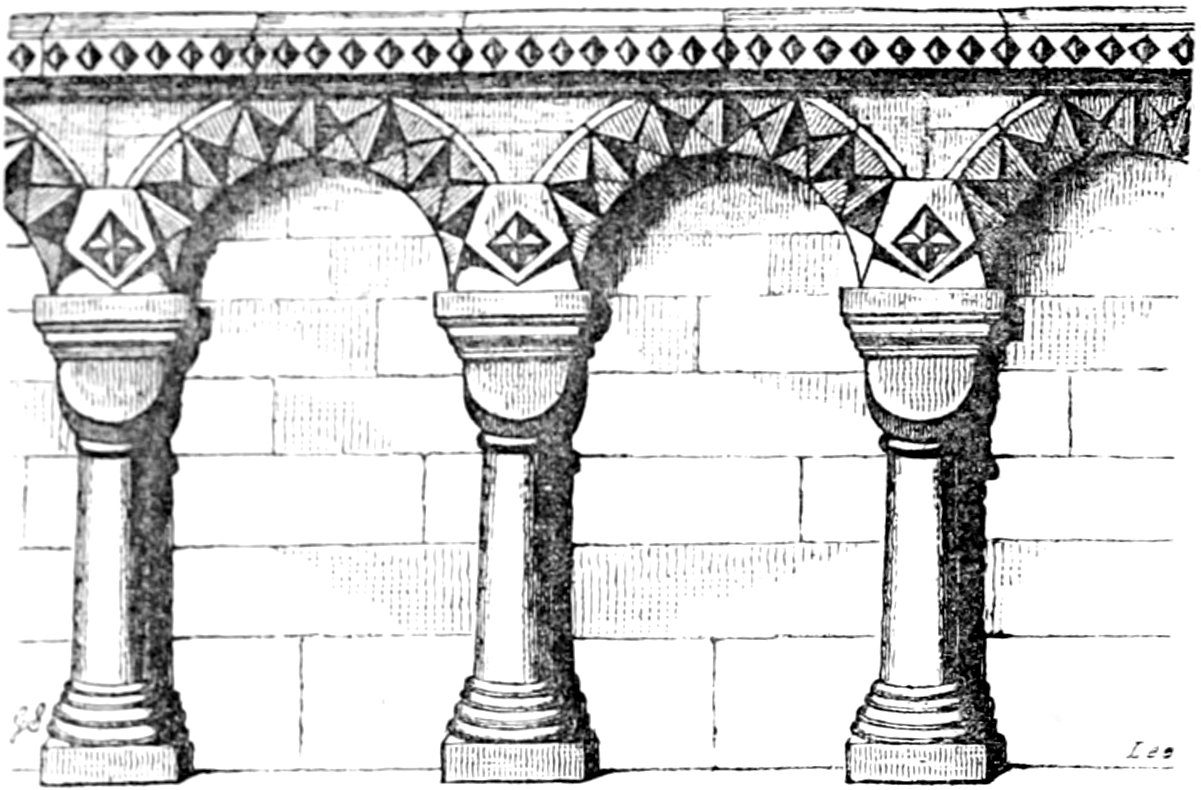
Norman Arcade from Canterbury.
But the most exquisite arcades are those of the Geometrical period, where each arch is often surmounted by a crocketted pediment, and the higher efforts of sculpture are tasked for their enrichment, as in the glorious chapter-house of Salisbury, Southwell, and York; these are, however, usually confined to the interior. In the Decorated period partially, and in the Perpendicular entirely, the arcade gave place to panelling, greatly to the loss of effect, for no delicacy or intricacy of pattern can compensate for the bright light and deep shadows of the Norman and Early English arcades.
ARCANI DISCIPLINA. The name given to a part of the discipline of the early Church in withdrawing from public view the sacraments and higher mysteries of our religion: a practice founded on a reverence for the sacred mysteries themselves, and to prevent their being exposed to the ridicule of the heathen. Irenæus, Tertullian, and Clement of Alexandria are the first who mention any such custom in the Church. And the Disciplina Arcani gradually fell into disuse after the time of Constantine, when Christianity had nothing to fear from its enemies.—Bingham. Augusti.
ARCH. All architecture may be divided into the architecture of the entablature and of the arch, and as the very terms denote, the arch is the differential of the latter. Romanesque and Gothic fall under this head. Our view of the arch is limited to a description of its several forms; an estimate of its effects on style, and its mechanical construction, being beyond our province.

Semicircular. Horse-shoe. Stilted.
The Saxon and the Norman arch were alike semicircular in their normal form, though in Norman buildings we often find a greater arc of a circle, or “horse-shoe” arch, or the semicircle is “stilted:” to one or other of which constructions it was necessary to resort when an arch of higher proportion than a semicircle was required. In the middle of the twelfth century the pointed arch was introduced. It was used for a long time together with the semicircle, and often with an entire absence of all but Norman details; and it is worthy of note that the pointed arch is first used 49in construction, as in the great pier arches, and evidently, therefore, from an appreciation of its mechanical value, and not till afterwards in lighter portions, as windows and decorative arcades. The pointed arch has three simple forms, the equilateral, the lancet, and the drop arch; the first described from the angles at the base of an equilateral, the second of a triangle whose base is greater, the third of a triangle whose base is less, than the sides. These forms are common to every style, from Early English downwards. In the Perpendicular period a more complex arch was introduced, struck from four centres, all within or below the base of the arch. This modification of the arch is of great importance, as involving differences of construction in the fabric, especially in the vaulting, so that it has a place in the history of Gothic architecture only inferior to the introduction of the pointed arch.
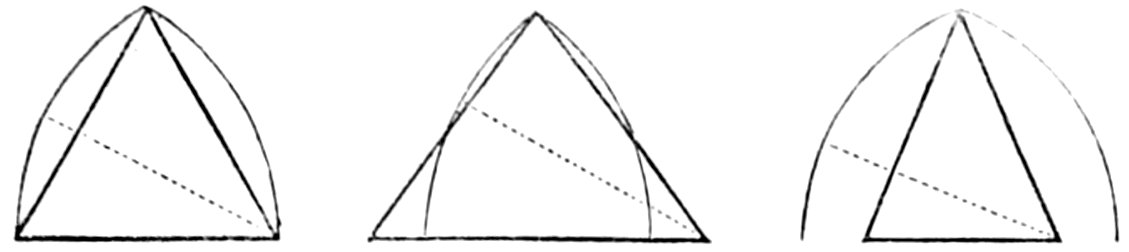
Equilateral. Lancet. Drop.
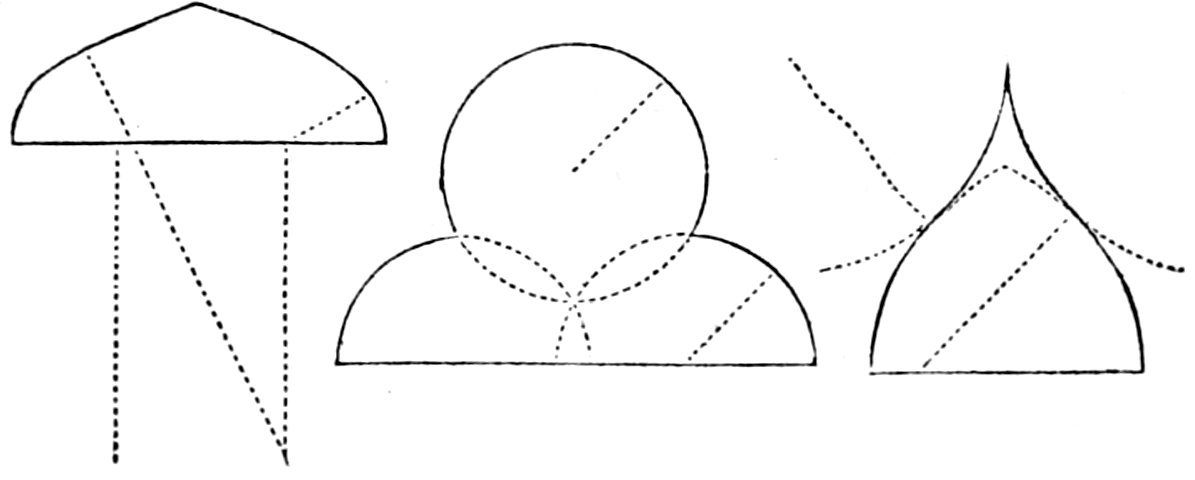
Four-centred. Foil. Ogee.
There are, besides, other modifications of the arch, struck from more than two centres, but these are either of less frequent occurrence, or merely decorative. We may mention the foil and the ogee arch; the former struck from four centres, two without and two within the resulting figure, and flowing into one another; the latter from several centres, according to the number of foils, all generally within the resulting figure, and cutting one another. The foil arch precedes in history the foliation or cusping of arches and tracery, which it no doubt suggested; the ogee arch came in with ogee forms of tracery and of cusping, and outlived them.
ARCHBISHOP. An archbishop is the chief of the clergy in a whole province; and has the inspection of the bishops of that province, as well as of the inferior clergy, and may deprive them on notorious causes. The archbishop has also his own diocese wherein he exercises episcopal jurisdiction, as in his province he exercises archiepiscopal. As archbishop, he, upon the receipt of the king’s writ, calls the bishops and clergy within his province to meet in convocation. To him all appeals are made from inferior jurisdictions within his province; and, as an appeal lies from the bishops in person to him in person, so it also lies from the consistory courts of his diocese to his archiepiscopal court. During the vacancy of any see in his province he is guardian of the spiritualities thereof, as the king is of the temporalities; and, during such vacancy, all episcopal rights belong to him. The archbishops in England have from time to time exercised a visitatorial power over their suffragans, in use till the time of Archbishop Laud. The archbishops of Ireland have immemorially visited their suffragans triennially: the Episcopal Visitation being there annual. (See Stephens’ Edition of the Book of Common Prayer, with notes, vol. i. pp. 26–30.)
Some learned men are of opinion, that an archbishop is a dignity as ancient as the apostles’ time, for there were primi episcopi then, though the name of archbishop was not known until some ages afterwards; and that the apostle himself gave the first model of this government in the Church, by vesting Titus with a superintendency over all Crete. Certain it is that there were persons soon after that time, who, under the name of metropolitans, 50exercised the same spiritual and ecclesiastical functions as an archbishop; as for instance the bishop of Carthage, who certainly assembled and presided in provincial councils, and had ecclesiastical jurisdiction over the bishops of Africa; and the bishops of Rome, who had the like primacy in the suburbiconian provinces, viz. middle and southern Italy, with Sicily, and other adjacent islands. Moreover, the Apostolical Canons, which were the rule of the Greek Church in the third century, mention a chief bishop in every province, and most of them about the eighth century assumed the title of archbishops; some of which were so in a more eminent degree, viz. those of Rome, Constantinople, Antioch, and Alexandria, which were the four principal cities of the empire. To these the archbishop of Jerusalem was added by the Council of Chalcedon, in 451, because that was the capital city of the Holy Land, and these five were called patriarchs.
The archbishop of Canterbury is styled primate of all England and metropolitan, and the archbishop of York primate of England. They have the title of Grace, and Most reverend Father in God by Divine Providence. There are two provinces or archbishoprics in England, Canterbury and York. The archbishop of Canterbury has the precedency of all the other clergy; next to him the archbishop of York. Each archbishop has, within his province, bishops of several dioceses. The archbishop of Canterbury has under him, within his province, Rochester, London, Winchester, Norwich, Lincoln, Ely, Chichester, Salisbury, Exeter, Bath and Wells, Worcester, Lichfield, Hereford, Landaff, St. David’s, Bangor, and St. Asaph; and four founded by King Henry VIII., erected out of the ruins of dissolved monasteries, viz. Gloucester and Bristol, now united into one, Peterborough, and Oxford. The archbishop of York has under him six, viz. the bishop of Chester, erected by Henry VIII., and annexed by him to the archbishopric of York, the bishops of Durham, Carlisle, Ripon, and Manchester, and the Isle of Man, annexed to the province of York by King Henry VIII. The dioceses of Ripon and Manchester have been formed in the province of York within the last few years, by act of parliament. The archbishop of Armagh is styled primate of all Ireland. The archbishop of Dublin, primate of Ireland. Before the late diminution of the Irish episcopate, there were two other archbishops, viz. of Cashel, styled primate of Munster, and Tuam, primate of Connaught. Under Armagh were the bishoprics of *Meath, *Down, *Derry, Dromore, Raphoe, *Kilmore, and Clogher. Under Dublin, Kildare, Ferns, and *Ossory. Under Cashel, *Limerick, *Cork, Cloyne, *Killaloe, and Waterford. Under Tuam, Clonfert, Elphin, and Killala. At present Cashel is a suffragan of Dublin, Tuam of Armagh; and only those suffragan bishoprics marked with an asterisk are retained. The bishops of Calcutta and Sydney, being metropolitans, are archbishops in reality, though not in title.
ARCHDEACON. In the English branch of the united Church, and most European Churches, each diocese is divided into archdeaconries and parishes. Sometimes a diocese has but one archdeaconry; sometimes four or five. But in Ireland there is but one archdeacon to each diocese (several dioceses being often united under one bishop); and archdeaconries, as ecclesiastical divisions, are there unknown. The dioceses of Dublin and Ardfert may be regarded as exceptions, but not with justice: as the archdeaconry of Glendaloch in the former, and of Aghadoe in the latter, belonged originally to separate dioceses, which have been drawn into the adjacent ones: so that the dividing boundaries are now unknown. (Jebb.) Over the diocese the bishop presides; over the archdeaconry one of the clergy is appointed by the bishop to preside, who must be a priest, and he is called an archdeacon; over the parish the rector or vicar presides. An archdeacon was so called anciently, from being the chief of the deacons, a most important office at a very early period in the Christian Church.
The antiquity of this office is held to be so high by many Roman Catholic writers, that they derive its origin from the appointment of the seven deacons, and suppose that St. Stephen was the first archdeacon: but there is no clear authority to warrant this conclusion. Mention is also made of Laurentius, archdeacon of Rome, who suffered A. D. 260; but although he was called archdeacon, (according to Prudentius,) he was no more than the principal man of the seven deacons who stood at the altar. “Hic primus è septem viris qui stant ad aram proximi.” (Prudent. Hymn. de St. Steph.) At Carthage the office appears to have been introduced within the last forty years of the third century, as St. Cyprian does not mention it, whereas in the persecution of Diocletian Cecilian is described as archdeacon, under the bishop Mensurius. St. Jerome 51says, “that the archdeacon was chosen out of the deacons, and was the principal deacon in every church, just as the archpresbyter was the principal presbyter.”
But even in St. Jerome’s time, the office of archdeacon had certainly grown to great importance. His proper business was, to attend the bishop at the altar; to direct the deacons and other inferior officers in their several duties, for their orderly performance of Divine service; to attend the bishop at ordinations, and to assist him in managing and dispensing the revenues of the Church: but without anything that could be called “jurisdiction,” in the present sense of the word, either in the cathedral or out of it.
After the Council of Laodicea, A. D. 360, when it was ordained that no bishop should be placed in country villages, the archdeacon, being always near the bishop, and the person mainly intrusted by him, grew into great credit and power, and came by degrees, as occasion required, to be employed by him in visiting the clergy of the diocese, and in the despatch of other matters relating to the episcopal care.
He was the bishop’s constant attendant and assistant, and, next to the bishop, the eyes of the whole Church were fixed upon him; it was therefore by no means unusual for him to be chosen the bishop’s successor before the presbyters, and St. Jerome records, “that an archdeacon thought himself injured if he was ordained a presbyter.” (“Certe qui primus fuerit ministrorum, quia per singula concionatur in populos, et a pontificis latere non recedit, injuriam putat si presbyter ordinetur.”—Hieron. Com. in Ezek. c. 48.)
The author of the “Apostolical Constitutions” calls him the Ὁ παρεστὼς τῷ ἀρχιερεῖ; and St. Ambrose informs us, in the account which he gives of Laurentius, archdeacon of Rome, that it belonged to him “to minister the cup to the people when the bishop celebrated the eucharist, and had administered the bread before him.”—Ambros. de Offic. lib. i. c. 41.
At the beginning of the seventh century, he seems to have been fully possessed of the chief care and inspection of the diocese in subordination to the bishop.
But the authority of the archdeacon, in ancient times, was chiefly a power of inquiry and inspection; and the gradual growth of his “jurisdiction,” properly so called, during the middle ages, is a subject of difficult inquiry. Pope Clement V. gives an archdeacon the title of “oculus Episcopi,” saying that “he is in the bishop’s place, to correct and amend all such matters as ought to be corrected and amended by the bishop himself, unless they be of such an arduous nature, as that they cannot be determined without the presence of his superior the bishop.”
Regularly, the archdeacon cannot inflict any punishment, but can only proceed by “precepts” and “admonitions.”
Beyond this, all the rights that any archdeacon enjoys, subsist by grants from the bishop, made either voluntarily, or of necessity, or by composition. (See the case of composition made between the bishop of Lincoln and his archdeacons, in Gibson’s Codex, vol. ii. p. 1548.)
As to the divisions in England of dioceses into archdeaconries, and the assignment of particular divisions to particular archdeaconries, this is supposed to have begun a little after the Norman conquest. We meet with no archdeacons vested with any kind of jurisdiction in the Saxon times. Archbishop Lanfranc was the first who made an archdeacon with power of “jurisdiction,” in his see of Canterbury, and Thomas, the first archbishop of York after the Conquest, was the first in England that divided his diocese into archdeaconries; as did also Remigius, bishop of Lincoln. When the Norman bishops, by reason of their baronies, were tied by the Constitutions of Clarendon to strict attendance upon the kings in their parliaments, they were obliged, for the administration of their dioceses, to grant larger delegations of power to archdeacons, who visited when they did not (de triennio in triennium). Archdeacons, therefore, with us, could not have this power of jurisdiction by common right, or by immemorial custom; the power which the archdeacon has is derived from the bishop, although he himself is an ordinary, and is recognised as such by the books of common law, which adjudge an administration made by him to be good, though it is not expressed by what authority, because, as done by the archdeacon, it is presumed to be done “jure ordinario.”
In the 22nd of Henry I. we have the first account of their being summoned to convocation; and in the 15th of Henry III., and in the 32nd year of the same king, they were summoned by express name.
This being the original of archdeacons, it is impossible for them to prescribe to an independency on the bishop, as it was declared in a court of law they might, and endeavoured to be proved by the gloss on a legatine constitution, where we read that an archdeacon may have a customary jurisdiction distinct from the bishop, and to which he may prescribe. But the meaning 52of it is, not that there can be an archdeaconry by prescription, and independent of the bishop, but that the archdeacon may prescribe to a particular jurisdiction, exempt from the ordinary; which jurisdiction has customarily been enjoyed by him and his predecessors time out of mind.
The archdeaconries of St. Alban’s, of Richmond, and Cornwall, are cases of this kind; these jurisdictions are founded upon ancient customs, but the archdeacon is still subordinate to the bishop in various ways; he being, in our law, as he is according to the canon law, vicarious episcopi.
According to Lyndwood and other canonists, he can inquire into crimes, but not punish the criminals; he has, in one sense, according to the casuists, a cure of souls, by virtue of his office, though it is in foro exteriori tantum et sine pastorali cura; and has authority to perform ministerial acts, as to suspend, excommunicate, absolve, &c., therefore by the ecclesiastical law he is obliged to residence. And that may be one reason why he may not be chosen to execute any temporal office that may require his attendance at another place; another reason is because he is an ecclesiastical person. But he has no parochial cure, and therefore an archdeaconry is not comprehended under the name of a benefice with cure; for if one who has such benefice accepts an archdeaconry, it is not void by our law, though it is so by the canon law. And yet, though he has not any parochial cure, he is obliged to subscribe the declaration pursuant to the statute, 14 Charles II. It is true, he is not expressly named therein, but all persons in holy orders are enjoined to subscribe by that statute; and because an archdeacon must be in those orders, therefore he must likewise subscribe, &c. And as he has a jurisdiction in certain cases, so, for the better exercising the same, he has power to keep a court, which is called the Court of the Archdeacon, or his commissary, and this he may hold in any place within his archdeaconry. With regard to the Archdeacon’s Court, it was said by the justices of the Common Pleas, 2 & 3 William and Mary, in the case of Woodward and Fox, that though it might be supposed originally that the jurisdiction within the diocese was lodged in the bishop, yet the Archdeacon’s Court had, “time out of mind,” been settled as a distinct court, and that the statute 24th of Henry VIII. chap. xii. takes notice of the Consistory Court, which is the bishop’s, and of the Archdeacon’s Court, from which there lies an appeal to the bishop’s. (See Appeal.) There is an officer belonging to this court, called a registrar, whose office concerns the administration of justice, and therefore the archdeacon cannot by law take any money for granting it; if he does, the office will be forfeited to the queen. Regarding parochial visitations by archdeacons, see “Articles and Directions to the Incumbents and Churchwardens within the Archdeaconry of Surrey,” in Gibson’s Codex, vol. ii. p. 1551–1555; and see post, “Visitation.”
By 1 & 2 Vict. c. cvi. s. 2, an archdeacon may hold, with his archdeaconry, two benefices under certain restrictions; or a benefice and a cathedral preferment.
He is also, whilst engaged in his archidiaconal functions, considered to be resident on his benefice. In cathedrals of the old foundation, the archdeacons of the diocese, how numerous soever, were members of the greater chapter, and had stalls in the choir. This was the universal custom on the continent, and is uniformly the case in Ireland, as it was also in Scotland. In the diocese of Dublin, the archdeacon of Dublin has a stall in both of the cathedrals there, the archdeacon of Glendaloch however only in that of St. Patrick’s.
The archdeacons of Ireland have not for a long time exercised any jurisdiction. It is however evident from old documents that they did exercise it in ancient times. The bishops hold annual visitation.
ARCHES, COURT OF. The Court of Arches is an ancient court of appeal, belonging to the archbishop of Canterbury, whereof the judge is called the Dean of Arches, because he anciently held his court in the church of St. Mary-le-Bow (Sancta Maria de Arcubus); though all the spiritual courts are now holden at Doctors’ Commons.
ARCHIMANDRITE. A name formerly given to the superior of a monastery: it is derived from the word μάνδρα, by which monasteries were sometimes called. The term Archimandrite is still retained in the Greek Church.
ARCHPRIEST, or ARCHIPRESBYTER. An ancient title of distinction, corresponding to our title, rural dean, revived under most unhappy pretensions among the Romanists of England, in the year 1598. These men, finding themselves without bishops, importuned the pope, Clement VII., to supply their need; but instead of sending them, as they desired, a number of bishops, he gave them but one ecclesiastical superior, Robert Blackwell, who after all was merely a priest; an archpriest indeed he was called, but as 53such having no episcopal power. In the early times this title was given to the chief presbyter in each church, presiding over the church next under the bishop, and taking care of all things relating to the church in the bishop’s absence. In this case however, instead of being placed in a cathedral church, or discharging the office of rural dean, under a bishop or archdeacon, he was appointed to govern all the Romish clergy of England and Scotland, without one or the other. Here then we find Rome, while preserving an old title, inventing an office hitherto unknown to the Christian world. And, when appointed, what could the archpriest do? He could merely be a rural dean on a large scale. He could merely overlook his brother clergy. He could not discharge any functions properly episcopal. He could not ordain priests, confirm children, nor consecrate chapels, should circumstances permit or require. It is plain, then, that the archpriest was a very imperfect and insufficient substitute for a bishop. The archpriest in many foreign churches, in Italy especially, answers to our cathedral dean. In some Italian dioceses, somewhat to our rural dean.—Darwell.
ARCHONTICS. Heretics who appeared in the second century, about A. D. 175, and who were an offshoot of the Valentinians. They held a quantity of idle stories concerning the Divinity and the creation of the world, which they attributed to sundry authors; and hence they were called Archontics, from the Greek word ἀρχων, which means prince or ruler.
ARIANS. (See Councils.) Heretics, so named from Arius, their first founder: they denied the three persons in the Holy Trinity to be of the same essence, and affirmed the Word to be a creature, and that once (although before the beginning of time) he was not. They were condemned by the Council of Nice, in 325.
The doctrine of Arius may be thus stated:—The Son sprang not from the nature of the Father, but was created from nothing: he had, indeed, an existence before the world, even before time, but not from eternity. He is, therefore, in essence different from the Father, and is in the order of creatures, whom he, however, precedes in excellence, as God created all things, even time, by his instrumentality; whence he was called the Son of God, the Logos, or Word of God. As a creature the Son is perfect, and as like to the Father as a creature can be to the Creator. But as he has received all things as a gift, from the favour of the Father,—as there was a period in which he was not,—so there is an infinite distance between him and the nature of the Father; of which nature he cannot even form a perfect idea, but can enjoy only a defective knowledge of the same. His will was originally variable, capable of good and of evil, as is that of all other rational creatures: he is, comparatively at least, free from sin; not by nature, but by his good use of his power of election; the Father, therefore, foreseeing his perseverance in good, imparted to him that dignity and sublimity above all other creatures, which shall continue to be the reward of his virtues. Although he is called God, he is not so in truth, but was deified in that sense in which men, who have attained to a high degree of sanctity, may arrive at a participation of the Divine prerogatives. The idea then of a generation of the Son from the essence of the Father is to be absolutely rejected.
This doctrine, which must have corresponded to the superficial understandings, and to the yet half-pagan ideas, of many who then called themselves Christians, attacked the very soul of the Christian doctrine of the redemption; for, according to this doctrine, it was not God made man, but a changeable creature, who effected the great work of the redemption of fallen man. The devout Christian, to whom faith in the God-man, Christ, the only Divine Mediator, opened the way to an intimate union with God, saw by this doctrine that his Redeemer and Mediator was as infinitely removed from the essence of God as himself; he saw himself driven back to the ancient pagan estrangement from God, and removed to an unattainable distance from him.—See Maimbourg, Hist. of Arians. For an account of the revival of Arianism in the last century, see Van Mildert’s Life of Waterland.
ARK OF THE COVENANT. So the Jews called a small chest or coffer, three feet nine inches in length, two feet three inches in breadth, and two feet three inches in height, (Prideaux, Connect. Part i. Book iii.,) in which were contained “the golden pot that had manna, and Aaron’s rod, and the tables of the covenant,” as well the broken ones (according to the Rabbins) as the whole. Heb. ix. 4. Over the ark was the mercy-seat, and it was the covering of it. It was made of solid gold (Exod. xxv. 17–22); and at the two ends of it were two cherubims looking inward toward each other, with expanded wings, which, embracing the whole circumference of the mercy-seat, 54met on each side in the middle. The whole (according to the Rabbins) was made out of the same mass, without joining any of the parts by solder. Here it was that the Shechinah, or Divine presence, rested, both in the tabernacle and in the temple, and was visibly seen in the appearance of a cloud over it. And from hence the Divine oracles were given out, by an audible voice, as often as God was consulted in the behalf of his people. And hence it is, that God is said, in Scripture, to dwell between the cherubims, on the mercy-seat, because there was the seat or throne of the visible appearance of his glory among them. And for this reason the high priest appeared before this mercy-seat once every year, on the great day of expiation; at which time he was to make his nearest approach to the Divine presence, to mediate, and make atonement for the whole people of Israel.—R. Levi, Ben. Gersom, Solomon, &c. Lev. xvi. 2; 1 Sam. iv. 4; 2 Sam. vi. 6; 2 Kings xix. 15; 1 Chron. xiii. 6; Psal. lxxx. 1; Lev. xvi. 14, 15; Heb. ix. 7.
The ark of the covenant was, as it were, the centre of worship to all those of that nation, who served God according to the Levitical law; and not only in the temple, when they came thither to worship, but everywhere else, in their dispersion throughout the whole world, whenever they prayed, they turned their faces towards the place where the ark stood, and directed all their devotions that way. Whence the author of the book of Cosri justly says, that the ark, with the mercy-seat, and cherubims, were the foundation, root, heart, and marrow, of the whole temple, and all the Levitical worship therein performed. And therefore had there been nothing else wanting in the second temple, but the ark only, this alone would have been reason enough for the old men to have wept, when they remembered the first temple, in which it stood; and for the saying of Haggai, that the second temple was as nothing in comparison of the first; so great a share had the ark of the covenant in the glory of Solomon’s temple. However, the defect was supplied as to the outward form: for, in the second temple, there was also an ark, of the same shape and dimensions with the first, and put in the same place: but it wanted the tables of the law, Aaron’s rod, and the pot of manna; nor was there any appearance of the Divine glory over it, nor any oracles delivered from it. The only use that was made of it was, to be a representative of the former on the great day of expiation, and to be a repository of the Holy Scriptures; that is, of the original copy of that collection of them made by Ezra, after the captivity. In imitation of which, the Jews, in all their synagogues, have a like ark, or coffer, in which they keep their Scriptures. 1 Kings viii. 48.—Lightfoot, of the Temple, ch. xv. § 4.
The place of the temple where the ark stood, was the innermost and most sacred part, called the Holy of Holies, and sometimes the most holy place; which was made on purpose for its reception. This place, or room, was of an exact cubic form, being thirty feet square, and thirty feet high. In the centre of it, the ark was placed upon a stone (say the Rabbins) rising three fingers’ breadth above the floor. On the two sides of it stood two cherubims, fifteen feet high, at equal distance between the centre of the ark and each side of the wall; where, having their wings expanded, with two of them they touched the side walls, whilst the other two met and touched each other exactly over the middle of the ark.—Yoma, cap. v. § 2.
The ark, while it was ambulatory, with the tabernacle, was carried on the shoulders of the Levites, by the means of staves, overlaid with gold, and put through golden rings. Exod. xxv. 13, 14; xxvii. 6; Num. iv. 4–6; 1 Chron. xv. 15.
What became of the old ark, on the destruction of the temple by Nebuchadnezzar, is a dispute among the Rabbins. Had it been carried to Babylon with the other vessels of the temple, it would have been brought back again with them, at the end of the captivity. But that it was not so, is agreed on all hands; whence it is probable it was destroyed with the temple. The Jews contend, that it was hid and preserved by Jeremiah. Some of them will have it, that King Josiah, being foretold by Huldah the prophetess that the temple, soon after his death, would be destroyed, caused the ark to be deposited in a vault, which Solomon, foreseeing this destruction, had built on purpose for the preservation of it.—Buxtorf, de Arca, cap. xxi., xxii.
ARMENIANS. The Christians of Armenia, the first country in which Christianity was recognised as the national religion, in consequence of the preaching of Gregory, called The Illuminator, in the beginning of the fourth century. At a later time the Armenians adopted the Eutychian or Monophysite heresy, asserting that the human nature of Christ is swallowed up of the Divine; or is no more properly human than a drop of vinegar put into the sea can 55afterwards be reckoned vinegar. They do not deny the real presence in the eucharist, they do not mix water with their wine, nor do they consecrate unleavened bread. They abstain from eating blood and things strangled. They scrupulously observe fasting; and fasts so frequently occur, that their whole religion seems to consist in fasting. They admit infants to the sacrament of the eucharist: they reject purgatory and prayers for the dead: they fast on Christmas day, and they allow marriage in their priests. The Armenians were anciently subject to the patriarchs of Constantinople, but they now have their own patriarchs.
ARMINIANS. A powerful party of Christians, so called from Arminius, professor of divinity at Leyden, who was the first that opposed the then received doctrines in Holland, of an absolute predestination. They took the name of Remonstrants, from a writing called a Remonstrance, which was presented by them to the states of Holland, 1609, wherein they reduced their peculiar doctrines to these five articles:—
1. That God, from all eternity, determined to bestow salvation on those who, as he foresaw, would persevere unto the end in their faith in Jesus Christ; and to inflict everlasting punishment on those who should continue in their unbelief, and resist, to the end of life, his Divine assistance; so that election was conditional; and reprobation, in like manner, the result of foreseen infidelity and persevering wickedness.
2. On the second point, they taught, That Jesus Christ, by his suffering and death, made an atonement for the sins of mankind in general, and of every individual in particular; that, however, none but those who believe in him can be partakers of that Divine benefit.
3. On the third article they held, That true faith cannot proceed from the exercise of our natural faculties and powers, nor from the force and operation of free will; since man, in consequence of his natural corruption, is incapable either of thinking or doing any good thing; and that, therefore, it is necessary to his conversion and salvation, that he be regenerated and renewed by the operation of the Holy Ghost, which is the gift of God, through Jesus Christ.
4. On the fourth they believed, That this Divine grace, or energy of the Holy Ghost, begins, advances, and perfects everything that can be called good in man; and that, consequently, all good works are to be attributed to God alone; that nevertheless, this grace, which is offered to all, does not force men to act against their inclinations, but may be resisted and rendered ineffectual by the perverse will of the impenitent sinner.
5. And on the fifth, That God gives to the truly faithful, who are regenerated by his grace, the means of preserving themselves in this state; and, though the first Arminians entertained some doubt with respect to the closing part of this article, their followers uniformly maintain, That the regenerate may lose true justifying faith, fall from a state of grace, and die in their sins.
The synod of Dort, consisting of Dutch, French, German, and Swiss divines, and held in 1618, condemned their opinions.
ARMS. Armorial bearings, whether borne by individuals or by corporate bodies and corporations sole: among which are reckoned bishops, colleges, and other ecclesiastical persons and bodies. A bishop empales his family coat with the arms of his see, to denote his spiritual marriage with his Church; but the arms of the see occupy the dexter side of the escutcheon, or the side of greater honour. When a bishop is married, he empales the arms of his wife with his own family coat, on a separate escutcheon; and this escutcheon is placed by the sinister side of the shield, empaling his own coat with the arms of the see. Many of the arms of bishoprics contain allusions to the spiritual character of the person who bears them. Thus the archbishops of Canterbury, Armagh, and Dublin, each bear a pall, in right of their sees; as did the archbishop of York till his arms were changed about the beginning of the sixteenth century to two keys crossed saltierwise, and a crown royal in chief. Colleges often assume the family coat of their founder as their arms.
ARTICLES, THE THIRTY-NINE. The Thirty-nine Articles, based on the Forty-two Articles framed by Archbishop Cranmer and Bishop Ridley in the reign of Edward VI., were presented by his Grace the archbishop of Canterbury, Dr. Parker, to the convocation of the province of Canterbury which was convened with the parliament in January, 1562, and by the convocation they were unanimously approved. In 1566 a bill was brought into parliament to confirm them. The bill passed the Commons, but by the queen’s command was dropped in the Lords. In 1571 the convocation revised the articles of 1562, and made some alterations in them. In the same year an act was passed, “to 56provide that the ministers of the Church should be of sound religion.” It enacted that all ecclesiastical persons should subscribe to “all the articles of religion which only contained the confession of the true faith and of the sacraments, comprised in a book imprinted, entitled ‘Articles,’ whereupon it was agreed by the archbishops and bishops, and the whole clergy in convocation holden at London, in the year of our Lord God 1562, according to the computation of the Church of England, for the avoiding of diversities of opinions, and for the establishing of consent touching true religion, put forth by the queen’s authority.” In 1628 an English edition was published by royal authority, to which is prefixed the declaration of Charles I. The English Articles were adopted by the Irish convocation in 1615.
Some have thought that they are only articles of union and peace; that they are a standard of doctrine, not to be contradicted or disputed; that the sons of the Church are only bound to acquiesce silently in them; and that the subscription binds only to a general compromise upon those articles, that so there may be no disputing or wrangling about them. By this means they reckon, that though a man should differ in his opinion from that which appears to be the clear sense of any of the articles; yet he may with a good conscience subscribe them, if the article appears to him to be of such a nature, that though he thinks it wrong, yet it seems not to be of that consequence, but that it may be borne with and not contradicted.
Now as to the laity, and the whole body of the people, certainly to them these are only the articles of Church communion: so that every person, who does not think that there is some proposition in them that is erroneous to so high a degree that he cannot hold communion with such as hold it, may, and is obliged to, continue in our communion; for certainly there may be many opinions held in matters of religion, which a man may believe to be false, and yet may esteem them to be of so little importance to the chief design of religion, that he may well hold communion with those whom he thinks to be so mistaken.
But what the clergy are bound to by their subscriptions is much more than this. The meaning of every subscription is to be taken from the design of the imposer, and from the words of the subscription itself. The title of the Articles bears, that they were agreed upon in convocation, “for the avoiding of diversities of opinions, and for the establishing of consent touching true religion.” Where it is evident that “a consent in opinion” is designed. If we in the next place consider the declarations that the Church has made in the canons, we shall find, that though by the fifth canon, which relates to the whole body of people, such only are declared to be excommunicated ipso facto, who shall affirm any of the articles to be erroneous, or such as he may not with a good conscience subscribe to; yet the thirty-sixth canon is express for the clergy, requiring them to subscribe “willingly and ex animo,” and “acknowledge all and every article to be agreeable to the word of God:” upon which canon it is, that the form of the subscription runs in these words, which seem expressly to declare a man’s own opinion, and not a bare assent to an article of peace, or an engagement to silence and submission. The statute of the 13th of Queen Elizabeth, chap. 12, which gives the legal authority to our requiring subscriptions, in order to a man’s being capable of a benefice, requires that every clergyman should read the Articles in the Church, with a declaration of his unfeigned assent to them. These things make it appear very plain, that the subscriptions of the clergy must be considered as a declaration of their own opinion, and not as a bare obligation to silence.—Bishop Burnet.
We learn from the New Testament, that those who first embraced the gospel declared their faith in Jesus, as the promised Messiah, in simple and general terms (Acts viii. 37); and there is no ground for supposing that the apostles required this declaration to be made in any one particular form of words. No such formulary is transmitted to us; and, had any ever existed, it would probably have been cited or alluded to in the New Testament, or in the early apologies for Christianity. Every bishop was authorized to prescribe a formulary for the use of his own church; and there are still extant in writers who lived near to the apostolic age, several abstracts of Christian faith, which, though they agree in substance, vary in expression. But, when heresies gained ground, and destroyed uniformity of belief among Christians, it became necessary to have a public standard of faith; and to this cause we are to attribute the origin of creeds. The design of these creeds was to establish the genuine doctrines of the gospel, in opposition to the errors which then prevailed; and to exclude from communion with the orthodox Church of Christ all who held heretical opinions. New dissensions and controversies continually arose; 57and we have to lament that, in process of time, “the faith, which was once delivered unto the saints,” became corrupted in the highest degree; and that those very councils, which were convened according to the practice of the apostolic age, for the purpose of declaring “the truth as it is in Jesus,” gave their sanction and authority to the grossest absurdities and most palpable errors. These corruptions, supported by secular power, and favoured by the darkness and ignorance of the times, were almost universally received through a succession of many ages, till at last the glorious light of the Reformation dispelled the clouds which had so long obscured the Christian world.
At that interesting period the several Churches, which had separated themselves from the Roman communion, found it expedient to publish confessions of their faith; and, in conformity to this practice, Edward the Sixth, the first Protestant king of England, caused to be published by his royal authority forty-two “Articles, agreed upon by the bishops and other learned and good men, in the convocation held at London in the year 1552, to root out the discord of opinions, and establish the agreement of true religion.” These Articles were repealed by Queen Mary, soon after her accession to the throne. But Queen Elizabeth, in the beginning of her reign, gave her royal assent to thirty-nine [or rather thirty-eight] “Articles, agreed upon by the archbishops and bishops of both provinces, and the whole clergy, in the convocation holden at London in the year 1562, for avoiding diversities of opinion, and for the establishing of consent touching true religion.” These Articles were revised, and some small alterations made in them, in the year 1571; since which time they have continued to be the criterion of the faith of the members of the Church of England on the subjects to which they relate. The Articles of 1562 were drawn up in Latin only [in reality the Articles both of 1552 and of 1562 were set forth in our authorized English version, as well as in Latin]; but, in 1571, they were subscribed by the members of the two houses of convocation, both in Latin and English; and, therefore, the Latin and English copies are to be considered as equally authentic. The original manuscripts, subscribed by the Houses of Convocation, were burnt in the Fire of London; but Dr. Bennet has collated the oldest copies now extant, and it appears that there are no variations of any importance.
It is generally believed that Cranmer and Ridley were chiefly concerned in framing the forty-two Articles, upon which our thirty-nine are founded. But Bishop Burnet says, that “questions relating to them were given about to many bishops and divines, who gave in their several answers, which were collated and examined very maturely; all sides had a free and fair hearing before conclusions were made.” Indeed, caution and moderation are no less conspicuous in them than a thorough knowledge of the Scriptures, and of the early opinions and practice of Christians.
These Thirty-nine Articles are arranged with great judgment and perspicuity, and may be considered under four general divisions: the first five contain the Christian doctrines concerning the Father, the Son, and the Holy Ghost; in the sixth, seventh, and eighth, the rule of faith is established; the ten next relate to Christians, as individuals; and the remaining twenty-one relate to them, as they are members of a religious society. But, as all confessions of faith have had a reference to existing heresies, we shall here find, not only the positive doctrines of the gospel asserted; but also the principal errors and corruptions of the Church of Rome, and most of the extravagances into which certain Protestant sects fell at the time of the Reformation, rejected and condemned.—Bp. Tomline.
The various forms through which the Articles have passed, may be seen in Cardwell’s Synodalia, and in Hardwick’s History of the Articles. In 1615, a set of Articles of a Calvinistic nature were compiled by the Irish convocation; but it does not appear that they ever received the sanction of parliament. These, however, were superseded in 1635 by the English Articles, which were then adopted by the Irish Convocation. (See Introduction to Stephens’ Book of Common Prayer, from the Dublin MS., vol. i., xxxvii.–xxxix.) The old Articles are given at length. In general, these perfectly agree with the English Articles; but the doctrines of the Lambeth Articles are introduced.
ARTS. One of the faculties in which degrees are conferred in the universities. In the English and Irish universities there are two degrees in arts, that of Bachelor and that of Master. The whole circle of the arts was formerly reduced to seven sciences, grammar, rhetoric, logic, arithmetic, geometry, music, and astronomy; and these again were divided into the trivium, including the first three, and the quadrivium, including the remaining four. Music is now considered as a separate faculty at 58Oxford, Cambridge, and Dublin; as the degrees of Doctor and Bachelor of Music are given. Grammar was a separate but subordinate faculty at Oxford and Cambridge, in which there were three degrees, Doctor, Master, and Bachelor. There is an instance in Wood’s Athenæ Oxon., of a Doctor in Grammar and Rhetoric (Robt. Whityndon, 1513). The last record of grammatical degrees at Oxford is in 1568; at Cambridge in 1539. The faculty of arts is called that of philosophy in some foreign and more modern universities, there the degrees are Doctor and Candidate.
ASAPH, Psalms of. One of the three Temple Choirs bore the designation of the Sons of Asaph: from Asaph, their leader, in the time of David. They were descendants of Gershom, the eldest son of Levi. Twelve Psalms are entitled Psalms of Asaph: viz. the 50th, 73rd, 74th, 75th, 76th, 77th, 78th, 79th, 80th, 81st, 82nd, and 83rd. Critics are divided in opinion, as to whether these were composed or adopted by the above-named Asaph, or by one of the same name, but of later date, or were appropriated to the peculiar use of the Sons of Asaph, in the courses of attendance at the temple.
ASCENSION DAY. This holy day has been kept in the Christian Church from the earliest times. It is reckoned by the compiler of the Apostolic Constitutions among the other great festivals, Christmas day, the Epiphany, Easter, and Whitsunday; and St. Augustine speaks of it as either instituted by the apostles, or by some early and numerously attended councils of the primitive bishops, whose authority he considered most beneficial in the Church. “On this day,” says St. Chrysostom, “the reconciliation between God and mankind was completed, the long enmity was dissolved, the blasting war brought to an end.” “On this day, we, who had been shown to be unworthy of earth, were raised to the hope of heaven; we, who were not fit to receive dominion even on earth below, were exalted to the kingdom which is above; and our nature, kept out by cherubim from an earthly paradise, may now sit above the cherubim on high.” Christ, the first-fruits of our nature, having obtained this perfection, we that are his members may hope to partake the same glory. This hope the returning day of his ascension should ever bring into our minds, and we should keep it for the sustaining of our hope, and in thankfulness for the grace it brought. It is one of the days which the Church especially recommends for the receiving of the holy communion. (See the Special Preface in the Communion Office.) It is difficult to account for the too prevalent neglect of this high festival of our Church, on any other ground than the encroachment of worldly principles upon the minds of men, to the displacing of the principles of the Church. Ascension day is one of the six holy days for which special psalms are appointed. The three Rogation days are appointed to prepare us for its right celebration, and yet, because it is not marked by worldly festivities, many neglect and pass it by. It is observed as a scarlet day at Oxford and Cambridge. It is popularly called Holy Thursday. By 27 Henry VI. cap. 5, the holding of fairs or markets was prohibited on Ascension day, as well as on other high holidays, and on Sundays, &c.; making an exception however of the four Sundays in harvest: and it was enacted that the fair should be held on some other day preceding or following. That part of the act which related to Sundays in harvest was repealed by 13 and 14 Vict. cap. 23. The rest of the act remains unrepealed.