Volume 1 / Part 2 — PART II.
Reading edition

MYRON AND PHEIDIAS.
Three great names represent the early prime of Greek sculpture, namely, Myron, Pheidias, and Polycleitos of Argos. These three are thought to have been fellow pupils of the Argive sculptor Ageladas.
The present part of the catalogue deals with Myron and Pheidias. The third part deals first with their immediate successors in Attica, and then turns to Polycleitos of Argos and the sculptures of the Peloponnese; and next to the special class of Greek reliefs.
MYRON.
Myron of Eleutherae in Attica worked at Athens in the first half of the fifth century b.c. Although he had not entirely abandoned the archaic style (notably, in his rendering of hair, Pliny, H. N. xxxiv., 58), he was distinguished for his skill in representing life. His power lay partly in the rendering of vigorous movement in sculpture, as in his athletic statues, and partly in a realistic imitation of nature, as in his famous cow.
No original works of Myron are extant. His best known work, the Discobolos, is preserved in copies, one of which is described below. The bronze statuette of Marsyas in the Bronze Room may be studied after a group of Athenè and Marsyas by Myron.
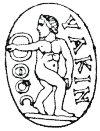
Fig. 5.
250. Graeco-Roman copy of the bronze Discobolos of Myron. A young athlete is represented in the act of hurling the disk. He has swung it back, and is about to throw it to the furthest possible distance before him. The head, as here attached, looks straight to the ground, but in the original it looked more backwards as in a copy formerly in the Massimi palace at Rome. (Cf. Lucian, Philopseud. 18.) Compare a gem in the British Museum (Fig. 5; Cat. of Gems, No. 742, pl. G), which is inscribed ΥΑΚΙΝΘΟϹ. According to a judgment of Quintilian, the laboured complexity of the statue is extreme, but any one who should blame it on this ground would do so under a misapprehension of its purpose, inasmuch as the merit of the work lies in its novelty and difficulty. "Quid tam distortum et elaboratum, quam est ille discobolos Myronis? si quis tamen, ut parum rectum, improbet opus, nonne ab intellectu artis abfuerit, in qua vel praecipue laudabilis est ipsa illa novitas ac difficultas?"—Quint. Inst. Orat., ii., 13. 10.—Found in 1791 in Hadrian's Villa at Tivoli. Townley Coll.
Marble; height, 5 feet 5 inches. Restorations:—Nose, lips, chin, piece in neck, part of disk and r. hand; l. hand; piece under r. arm; pubis; r. knee; a small piece in r. leg, and parts of the toes. Specimens, I., pl. 29; Mus. Marbles, XI., pl. 44; Clarac, V., pl. 860, No. 2194 b; Ellis, Townley Gallery, I., p. 241; Guide to Graeco-Roman Sculptures, I., No. 135; Stereoscopic, No. 149; Wolters, No. 452.
PHEIDIAS AND THE SCULPTURES OF THE PARTHENON.
The sculptures of the Parthenon illustrate the style of Pheidias, the greatest of Greek sculptors.
Pheidias, son of Charmides, the Athenian, was born about 500 b.c. He was a pupil of the sculptor Ageladas, of Argos, or, according to others, of Hegias or Hegesias, of Athens. His youth was passed during the period of the Persian wars, and his maturity was principally devoted to the adornment of Athens, from the funds contributed by the allied Greek states during the administration of Pericles.
Among the chief of the works of this period was the Parthenon, or temple of the virgin Goddess Athenè. The architect was Ictinos, but the sculptural decorations, and probably the design of the temple, were planned and executed under the superintendence of Pheidias. The building was probably begun about b.c. 447 (according to Michaelis, b.c. 454). It was sufficiently advanced to receive the statue of the Parthenos in b.c. 438, and was probably completed either in that year or a little later. It stood on the Acropolis of Athens, on a site which had been already occupied by a more ancient temple, commonly supposed to have been an ancient Parthenon, which was burnt on the sacking of Athens by the Persians, b.c. 480. Recently, however, the foundations of an early temple have been discovered between the Parthenon and the Erechtheion. It has been thought that this is the Pre-Persian Parthenon, and that the traces of an older foundation below the existing Parthenon only date from the time immediately following the Persian wars. A building is supposed to have then been begun, on a plan somewhat different from that which was carried out by Ictinos and Pericles.
The Parthenon was of the Doric order of architecture, and was of the form termed peripteral octastyle; that is to say, it was surrounded by a colonnade, which had eight columns at each end. The architectural arrangements can be best learnt from the model, which is exhibited in the Elgin Room. See also the plan (fig. 6.) and elevation (pl. iv.).
The principal chamber (cella) within the colonnade contained the colossal statue of Athenè Parthenos (see below, Nos. 300-302). Externally the cella was decorated with a frieze in low relief (see below, p. 145). The two pediments, or gables at each end of the building (see below, Nos. 303, 304) were filled with figures sculptured in the round. Above the architrave, or beam resting on the columns, were metopes, or square panels, adorned with groups in very high relief, which served to fill up the spaces between the triglyphs, or groups of three vertical parallel bands, representing beam ends. All these sculptured decorations were executed, like the architecture, in Pentelic marble.
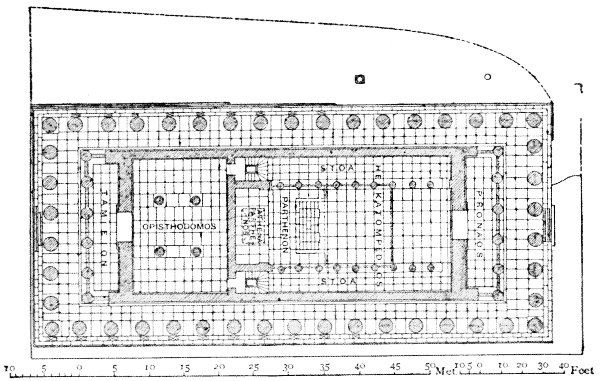
Fig. 6.—Plan of the Parthenon. (From Michaelis.)
The statue of the Parthenos is known to have been in existence about 430 a.d.; but not long after this date the figure was removed, and the Parthenon was converted into a Christian church, dedicated at first to Santa Sophia (or the Divine Wisdom), and afterwards to the Panagia (or Virgin Mary). For the purposes of the church, an apse was built at the east end of the cella, and the entrance was moved to the west end. The building was also given a vaulted roof, which covered the cella alone. In consequence the frieze was exposed to the weather, and the east pediment was much destroyed. From 1206 to 1458, during the period of the Frankish Dukes of Athens, the Parthenon was a Latin church. Athens was taken by the Turks in 1458, and the Parthenon was again an Orthodox Greek church for two years. In 1460, however, it was converted into a Turkish mosque. From this date it probably suffered little until 1687, when Athens was taken by the Venetian General, Morosini. In the course of a bombardment of the Acropolis, the besiegers succeeded in throwing a shell into a powder magazine in the Parthenon, and caused an explosion that destroyed the roof and much of the long sides of the building. Further injury was done by Morosini, who made an attempt to take down the central group of the west pediment, which was still nearly complete.
Fortunately, many of the sculptures had been drawn by a skilful artist before the explosion. In 1674 Jacques Carrey, a painter in the suite of the Marquis de Nointel, French ambassador at the Porte, made sketches of large portions of the frieze and metopes, and of the then extant portions of the pedimental compositions. These drawings are preserved in the French Bibliothèque Nationale, and are constantly referred to in discussions of the Parthenon sculptures.
In 1688 Athens was restored to the Turks, and from this date to the end of the last century the sculptures of the Parthenon were exposed to constant injury. Some of them were made into lime, or built into walls by the Turkish garrison; others were mutilated by the travellers who from time to time obtained admission to the Acropolis, and broke off portable fragments of the sculptures.
In 1749, when the west pediment was drawn by Dalton, many figures still remained in position which had disappeared before the time of Lord Elgin. Several portions also of the frieze, which were seen by Stuart, had disappeared at the beginning of the present century. On the other hand, the east pediment, being inaccessible, suffered no important change between 1674 and 1800.
In the years 1801-3 many of the sculptures of the Parthenon were removed to England by the Earl of Elgin, then British ambassador at Constantinople, by means of a firman obtained from the Porte (see p. 6). The Elgin Collection, which includes other marbles obtained from Athens and elsewhere, together with casts and drawings, was purchased from Lord Elgin by the British Government in 1816 for £35,000. Several portions of the sculptures of the Parthenon have been discovered since the time of Lord Elgin on the Acropolis and its slopes, or in various parts of Europe, to which they had been taken by travellers. These are represented as far as possible in the British Museum by plaster casts.
The following aids to the study of the Parthenon will be found in the Elgin Room:—
Model of the Athenian Acropolis, showing its condition in the year 1870. Presented by Prof. Adolf Michaelis.
Model of the Parthenon. The model was made by R. C. Lucas, on a scale of a foot to 20 feet, and represents the state of the temple in 1687, after the explosion, but before Morosini had attacked the west pediment.
Carrey's drawings of the pediments. Photographic reproductions of the originals are exhibited.
A restored view of the Athenian Acropolis. By Richard Bohn.
Bibliography of the Parthenon.
The work of Michaelis, Der Parthenon (Leipzig, 1871), collects the material for the study of the Parthenon, and contains an excellent digest of all that had been written on the subject up to the year 1871. For later writers, see below passim, and Wolters. For the chronology of Pheidias, see Loeschcke, in Untersuchungen A. Schaefer gewidmet, p. 25; for the question as to his master, see Klein, Arch.-Epigr. Mittheilungen aus Oesterreich, VII., p. 64; Murray, Greek Sculpture, 2nd ed., p. 186. For the older temple on the site of the Parthenon, see Doerpfeld, in Athenische Mittheilungen, XII., p. 45; Harrison, Mythology of Anc. Athens, p. 467. The plan given above is taken from Michaelis. Important modifications have been proposed by Doerpfeld, Athenische Mittheilungen, VI., pl. 12, p. 283; Harrison, loc. cit., p. 464. For the mediæval history of the Parthenon, see Laborde; Athènes aux XVe, XVIe, et XVIIe Siècles (Paris, 1854); Gregorovius, Athen im Mittelalter (1889). Facsimiles of Carrey's drawings are in the British Museum, and have been partially published in the works of Laborde, Le Parthénon (Paris, 1848). For photographic copies of the drawings of the pediments, see Antike Denkmäler, I., pls. 6, 6a. Dalton's views of the Acropolis were published in 1751, but the remains of Athens were little known till the appearance of The Antiquities of Athens, by James Stuart and Nicolas Revett. (London: vol. I., 1762; vol. II., 1787; vol. III., 1794; vol. IV., 1816; vol. V., 1830). A second edition, with additional matter, but having inferior illustrations, was issued in 1825-1830. The original drawings, made for this work by Pars, were presented to the British Museum by the Society of Dilettanti. The official inquiry into the proceedings of Lord Elgin is contained in the Report from the Select Committee of the House of Commons on the Earl of Elgin's Collection of Sculptured Marbles; &c. (London, 1816).
STATUE OF ATHENÈ PARTHENOS.
The colossal statue of Athenè Parthenos by Pheidias was placed within the central chamber of the Parthenon. The figure was made of gold and ivory, and was, with its base, about 40 feet high. Athenè stood, draped in chiton and aegis. In her left hand she held her spear and shield. Between her and her shield was the serpent Erichthonios. On her outstretched right hand was a winged Victory, six feet high, holding a wreath. The helmet of the Goddess was adorned, according to Pausanias, with a Sphinx and Gryphons. From detailed copies of the head (Athenische Mittheilungen, viii., pl. 15; Cat. of Gems in B. M. 637, 638) we learn that the Gryphons were on the cheek-pieces, and that there was a figure of Pegasos on each side of the Sphinx. There was also a row of small horses at the front of the helmet. All available space was covered with reliefs. A battle between Greeks and Amazons (see below, Nos. 301, 302) was seen on the exterior of the shield, and one between Gods and Giants on its interior. On the base was a representation of the birth of Pandora (see No. 301) and on the edges of the sandals was a battle between Centaurs and Lapiths.
The statue disappeared from view with the fall of paganism. Nos. 300-302 afford some of the materials for its reconstruction. Rough reproductions of the figure also occur on Attic reliefs, such as Nos. 771-773.
The statuette, No. 300, is of service for the details of the composition, although it is artistically a poor copy. The Lenormant statuette, No. 301, though rough and incomplete, is of more value for its rendering of the features.
The column beneath the hand of Athenè (in No. 300) presents some difficulty, as it is not mentioned in descriptions of the statue and seldom occurs in reproductions of it. It is seen in an Attic relief (Michaelis, pl. 15, fig. 7) on a lead ticket (Zeitschr. für Numismatik, x., p. 152) and, in the form of an olive tree, on a Lycian coin of the time of Alexander (Zeitschr. für Num., loc. cit.; Murray, ii., pl. 11). It is more probable that an existing support should be omitted in reliefs, than that it should be inserted if non-existent. It is possible, however, that the support was not a part of the design of Pheidias, but was an addition, found to be necessary before the time of Alexander.
300. Cast of a statuette, copied from the Athenè Parthenos. The Goddess wears a helmet, ægis, chiton with diploïdion girt round the waist, bracelets and sandals; her left hand rests on her shield, which stands on its edge at her side. In the centre of the outside of the shield is a mask of Medusa, and inside a serpent; the right hand of Athenè is extended in front and rests on a column with the palm open upwards, holding a figure of Victory, in whose hands are remains of what is thought to be a garland. The head of the Victory is wanting. On the centre of the helmet of Athenè is a Sphinx, and at each side has been a Pegasos.
The statuette was found in a shrine in a private house. Compare the vision of Proclos, who was bidden to prepare his house for Athenè, when her statue was being removed by the Christians from the Parthenon, about 430 a.d. (Marinus, Proclos, 30; Michaelis, p. 270.)
The original, which is of Pentelic marble, is in the National Museum at Athens. Height, with plinth, 3 feet 5 inches. Found in 1880, near the Varvakion in Athens. Athenische Mittheilungen, VI., pls. 1, 2, p. 56; Journ. of Hellen. Studies, II., p. 3; Schreiber, Athena Parthenos des Phidias, pl. 1; Brunn, Denkmaeler, Nos. 39, 40; Waldstein, pl. 14; Harrison, Mythology and Monuments of Anc. Athens, p. 447. For literature see Waldstein, Essays, p. 270; Wolters, No. 467.
301. Cast of a statuette, copied from the statue of Athenè Parthenos. Athenè wears a helmet, ægis, and chiton with diploïdion girt round the waist; her right hand is extended in front with the palm open upwards as if to hold out the figure of Victory. In this part the statuette is unfinished, the marble underneath the right arm not having been hewn away. The left hand of the Goddess rests on her shield, which stands on its edge at her side; inside the shield is a serpent; outside are reliefs representing the battle between Greeks and Amazons, which is seen in more detail in No. 302. Among the figures, we recognise several which occur on No. 302. The figure of Pheidias (a, see No. 302) is near the top of the relief, and holds a stone, as described by Plutarch. Next him perhaps is Pericles (b) separated from the fallen Amazon (c), which is at the bottom of the shield, as in No. 302. The group of the Greek seizing an Amazon (d) is seen on the right as in No. 302. The fallen Amazon (e) with hands above her head is high up, on the left of the relief. In place of the group of an Amazon supporting her companion (f) which is in No. 302, we have here the same subject, but differently treated. The Gorgon's head is roughly indicated near the middle of the shield. From the manner in which the rest of the figure corresponds to the chryselephantine statue, it has been assumed that the rude outlines of figures in relief on the base of the statuette represent the composition of Pheidias, of which the subject was the birth of Pandora (Paus., i., xxiv., 7.)
The original of this statue, which is of marble, is in the National Museum at Athens. Height 1 foot 4¾ inches. Found in 1859 near the Pnyx, at Athens. Lenormant, Gazette des Beaux Arts, 1860, VIII., p. 133; Jahn, Pop. Aufsätze, p. 215, pl. 1; Michaelis, pl. 15, fig. 1, p. 273; Overbeck, Gr. Plast., 3rd ed., I., p. 253, fig. 54; Brunn, Denkmaeler, No. 38; Wolters, No. 466; Harrison, Mythology and Monuments of Anc. Athens, p. 449. For the Pandora relief, see Puchstein, in Jahrbuch des Arch. Inst., V., p. 113.
302. Fragment of shield supposed to be a rough copy from the shield of the statue of Athenè Parthenos. Pliny (H. N., xxxvi., 18) and Pausanias (i., 17, 2) state that the outside of the shield was ornamented with the representation of a battle between Greeks and Amazons. Plutarch adds (Pericles, 31) that one of the figures represented Pheidias himself as an old bald-headed man raising a stone with both hands, while in another figure, who was represented fighting against an Amazon, with one hand holding out a spear in such a way as to conceal the face, the sculptor introduced the likeness of Pericles. This story is probably of late origin, and invented to account for two characteristic figures on the shield. A head of Medusa, or Gorgoneion, encircled by two serpents, forms the centre of the composition on the fragment. Below the Gorgoneion is a Greek warrior (a, cf. No. 301), bald-headed, who raises both hands above his head to strike with a battle-axe. This figure has been thought to correspond with that of Pheidias in the original design. Next to him on the right is a Greek (b) who plants his left foot on the body of a fallen Amazon (c) and is in the act of dealing a blow with his right hand; his right arm is raised across his face and conceals the greater part of it. The action of this figure again presents a partial correspondence with that of Pericles as described by Plutarch. To the right of the supposed Pericles are two Greeks: the one advances to the right; the other (d) seizes by the hair an Amazon falling on the right. Above this group is an Amazon running to the right and a Greek striding to the left. His shield has the device of a hare. Above him are three armed Greeks, and the remains of another figure. On the left of the figure described as Pheidias is a Greek who has fallen on his knees. Further to the left is a fallen Amazon (e) who lies with her head towards the lower edge of the shield. Near her is a wounded Amazon (f) supported by a companion of whom but little remains. The lower part of a third figure, probably that of a Greek, is also seen. All the Amazons wear high boots and a short chiton, leaving the right breast exposed; their weapon is a double-headed axe. Red colour remains on the two serpents which encircle the Gorgon's head, on the shield of one of the Greeks and in several places on the draperies.—Obtained by Viscount Strangford from Athens.
Pentelic marble; height, 1 foot 4¾ inches; width, 1 foot 6 inches. Conze, Arch. Zeit., 1865, pls. 196, 197; Jahn, Pop. Aufsätze, p. 216, pl. 2, 1; Michaelis, pl. 15, fig. 34. Overbeck, Gr. Plast., 3rd ed., I., p. 255, fig. 55; Mitchell, p. 313; Mansell, No. 729; Wolters, No. 471; Harrison, Mythology and Monuments of Anc. Athens, p. 453. There is a fragment of a similar shield in the Vatican, Michaelis, pl. 15, fig. 35.
EASTERN PEDIMENT OF THE PARTHENON.
303. We know from Pausanias (i., 24, 5) that the subject of the composition in the eastern pediment had relation to the birth of Athenè, who, according to the legend, sprang forth, fully armed, from the brain of Zeus. As all the central part of this composition was already destroyed when Carrey made his drawing of the pediment, we have no means of ascertaining how the subject was treated; and whether the moment immediately after the birth was represented, as has been generally supposed, or, as has been also suggested, the moment immediately before the birth.
A relief surrounding a puteal or well-head, now at Madrid, has been thought to throw light on this question. There Zeus is enthroned, looking to the right; Athenè is before him, armed, and advances to the right. A Victory flies towards her with a wreath. Behind the throne of Zeus is Hephaestos, who has cleft the skull of Zeus with his axe, and starts back in astonishment. On the extreme right of the composition are the three Fates (Schneider, Geburt der Athena, pl. 1; Mitchell, p. 350, fig. 157). Unfortunately the subordinate figures have not a sufficient resemblance to those which are still extant of the Parthenon pediment, to allow us to assume a direct connection between the pediment and the relief. Some such composition, however, seems more consonant with the dignity of Athenè than the scheme which occurs on vases and Etruscan mirrors (e.g. on a vase in the British Museum, No. B. 53; Mon. dell' Inst., iii., pl. 44) where the Goddess is represented as a diminutive figure, above the head of Zeus. This conclusion is confirmed by Sauer's recent examination of the ground of the pediment. It is now proved that the middle of the east pediment was occupied by two figures of equal importance, and not by a single central figure of Zeus, such as is required, if we suppose that the subject was treated according to the tradition of the vase painters. It is further shown to be probable that Zeus was seated on the left of the centre, seen in profile and turned to the right, and that Athenè stood on the right of the centre, holding a spear in her outstretched right hand. The whole group between the figures G and K is thought, from the indications on the pediment, to have consisted of the following figures, in order from the left:—Standing figure, stepping inwards (cf. Hermes of the west pediment); standing figure; seated figure in profile to the right; figure standing immediately behind Zeus; Zeus and Athenè; Hephaestos (H); seated figure in profile to the left; standing figure; standing figure turned to the left (J); standing figure turned outward (compare G).
If we confine our attention to the extant pedimental figures, we find wide differences of opinion as to their interpretation. The figures in the angles are the only ones as to which there can be no doubt. On the left the sun-god, Helios, rises from the ocean, driving his car, and on the right the moon-goddess Selenè sets beneath the horizon.
These two figures may be interpreted as marking the boundaries either of Olympos or of the universe. It has also been suggested that they indicate the hour at which the birth took place. This, according to Attic tradition, was at sunrise.
Thus far the interpretation rests upon sure grounds. Of the remaining figures in the pediment, J has been generally recognised as Victory greeting the newly born Goddess, and G has been generally taken for Iris, announcing the news to the world (but see below, G). None of the remaining figures have been conclusively identified. Most of the numerous schemes of interpretation that have been proposed are exhibited in a table by Michaelis, Der Parthenon, p. 165, cf. Guide to the Elgin Room, I., Table A. As regards the general principles of interpretation it is to be observed that the schemes may be divided into two classes. We may either suppose with the earlier critics that the space bounded by Helios and Selenè represents Olympos, and that all the figures contained within this space are definite mythological personages, probably deities, who may be supposed to have been present at the birth; or we may assume that all the deities present were comprised in the central part of the pediment, and that the figures towards the angles belong to the world outside Olympos, to whom the news is brought. These may be definite mythological persons, or they may be figures personifying parts of the natural world. Compare the Homeric Hymn to Athenè, and Pindar, Olymp., vii., 35.
The best views of this pediment are (1) the drawing of Carrey in the Bibliothèque Nationale (pl. v., fig. 1). A facsimile in the British Museum; in Laborde, Le Parthénon, and Antike Denkmaeler, I., pl. 6 (exhibited in Elgin Room); (2) sketch by Pars, engraved in Stuart, vol. II., chap. I., pl. 1. The original drawing is in the Print Room of the British Museum. For a list of proposed restorations, see Schneider, Geburt der Athena, p. 23, pls. 2-7; Waldstein, Essays, p. 139. For Sauer's examination of the pediment, see Athenische Mittheilungen, XVI., pl. 3, p. 59; Antike Denkmaeler, I., pl. 58. The ends of the pediment are reproduced in figs. 7, 8.
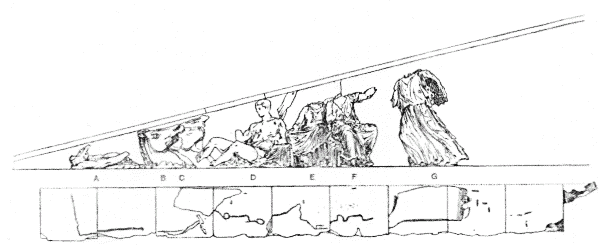
Fig. 7.—The South End of the East Pediment of the Parthenon (according to Sauer).
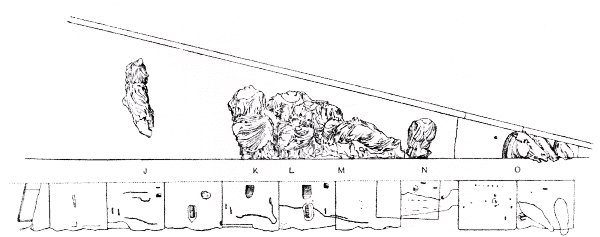
Fig. 8—The North End of the East Pediment of the Parthenon (according to Sauer).
303 A. Helios, in his chariot emerging from the waves. The head is wanting, the neck has a forward inclination corresponding with the action of the arms, which are stretched out in front of the body, holding the reins by which the upspringing horses of the Sun-god were guided and controlled. The head of Helios had been already broken away in Carrey's time; the wrist and hand of the right arm, now wanting, are shown in his drawing. The surface of the marble on the neck having been protected from weather by the cornice retains its original polish. At the back and between the arms are sculptured small rippling waves to represent a calm sea at sunrise. These waves are treated in the conventional manner usual in representations of water in Greek art; their profile shown on the edge of the plinth approximates very nearly to the well-known wave pattern. The metal reins have been attached to the upper surface of the plinth under the right forearm, and also under the right hand, now lost; three dowel holes in this part of the plinth served for their attachment. The waves were probably distinguished by colour. It has been noted by Michaelis that the angle in which this figure was placed is the darkest spot in the eastern pediment, and that it is only fully illumined by the early morning sun.
Mus. Marbles, VI., pl. 1; Michaelis, pl. 6, fig. 8; Overbeck, I., p. 303, fig. 61 (with B, C).
303 B, C. Two horses of Helios. The team of Helios was represented by four horses' heads, two of which still remain in position on the temple, at the back of the pediment. The two which are here are sculptured in the round out of one block of marble. They are represented emerging from the waves, the profile of which is sculptured in relief on the neck of the nearest horse. The head of the horse nearest the eye (B) looks outwards, and has projected beyond the plane of the pedimental cornice, so that it must have caught the light. The action of this horse's head is most spirited, though its effect is greatly impaired by the loss of the lower jaw, and the injury which the surface of the marble has received from exposure to the weather. The reins were of metal, and the points of attachment of reins and bridle are marked by three dowel holes in the plinth, a fourth behind the right ear, and a fifth inside the mouth. The head of the other horse on this block (C), which was advanced beyond the outside head, so as to be visible, is nearly destroyed; only the neck and back of the head remain.
Mus. Marbles, VI., pl. 2; Michaelis, pl. 6, fig. 9; Stereoscopic, No. 105. For the two heads still on the pediment, see Athenische Mittheilungen, XVI., p. 81.
303 D. This figure, which is commonly known as Theseus, reclines on a rock and faces the horses of Helios. He leans on his left arm in an easy attitude. The right arm is bent, but, as the hand is wanting, we can only form conjectures as to what its action may have been. It probably held a spear, or some other long object, the end of which may have been attached to the left ankle at the place where a dowel hole is still visible. According to some writers, the hole served for the attachment of the laced work of a sandal in bronze. (Ber. d. k. sächs. Ges. d. Wissenschaften, 1880, p. 44.) The legs are bent, the left leg drawn back under the right. The headdress is in the form of the krobylos (cf. No. 209). The body is entirely nude: over the rock on which the figure rests is thrown a mantle under which is strewn a skin, the claws of which are certainly those of some feline animal. The type and position of this figure present so much resemblance to the Heracles on the silver coins of Croton in Lower Italy (Mus. Marbles, vi., title-page), that it has been identified with that hero by Visconti, who supposed the skin on which he reclines to be that of a lion. This skin, however, seems more like that of a panther, on which ground the figure has been thought to be Dionysos, who appears in a very similar reclining attitude on another Athenian work, the Choragic monument of Lysicrates (No. 430, 1); compare the statue in the Louvre, Müller-Wieseler, Denkmaeler, ii., pl. 32, No. 360. Compare also the figure of Dionysos reclining, on a relief on an askos in the British Museum, No. G. 281 (see fig. 9). The figure, however, differs greatly in character, not only from the figure on the monument of Lysicrates, but also from the figure sometimes supposed to be Dionysos on the frieze of the Parthenon. (East side, No. 38.) More recently Brunn has interpreted this figure as the mountain of Olympos illumined by the first rays of the rising sun, and it must be acknowledged that the attitude and type of the so-called Theseus is very suitable for the personification of a mountain. Compare the figures of mountains from reliefs, collected by Waldstein (Essays, pp. 173, 174).
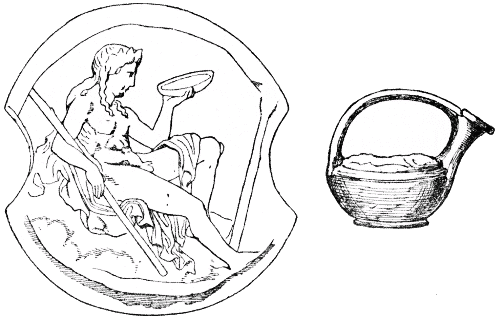
Fig. 9.
Mus. Marbles, VI., pls. 3, 4; Baumeister, Denkmaeler, p. 1180, fig. 1370; Michaelis, pl. 6, fig. 10; Overbeck, Gr. Plast., 3rd ed., I., p. 304, fig. 62; Murray, II., pl. 5; Stereoscopic, No. 105; Waldstein, Essays, pl. 6; Brunn, Ber. der k. bayer. Akad., Phil. hist. Cl., 1874, II., p. 14. The correct position of the figure in the pediment has been ascertained by Sauer (cf. fig. 7).
303 E, F. Two female figures, seated on square seats. They both wear a sleeveless chiton, girt at the waist, and a diploïdion. Over it is a mantle thrown over their lower limbs in a rich composition of folds. On the right wrist of the figure nearest the angle (E) is a dowel hole, probably for the attachment of a bracelet. Her companion (F), who wore metal fibulæ on each shoulder, extends her left arm towards the figure, which is advancing towards her. Her head has been broken off at the base of the neck, but it has probably been turned towards her companion, who rests her left arm affectionately on her shoulder, and who probably looked towards her, perhaps as if listening to the news brought by Iris. The seats, on which are laid folded carpets, are carved out of the marble with great care and delicacy of finish, the regular geometrical lines being valuable in opposition to the varied undulations of the drapery. In the sides and backs of both seats are oblong sunk panels, in one of which several archaeologists have tried unsuccessfully to read the name of an artist (see Michaelis, p. 174; Brunn, Griech. Künstler, i., p. 104). Most of the writers on the Parthenon, from Visconti downwards, have named this group Demeter and Persephonè, two deities, whose cult in Attica ranked second only to that of Athenè herself. This attribution would be strengthened if the reclining male figure could be identified with Dionysos, a deity whose worship in Attica was closely connected with that of the Eleusinian goddesses. The composition of the group has suggested to other archaeologists a sisterly rather than a filial relation between the figures. Bröndsted (Voyages et Recherches, ii., p. xi.) suggested that these two figures, with G, were the three Horae or Seasons, worshipped in Attica under the names Thallo, Auxo and Karpo. Brunn (followed by Waldstein) supposes that the two figures are Horae, but that they must be viewed as the warders of the gates of Olympos (Hom. Il., v., 749) rather than as Attic deities. On this theory the position of figure G, if it represents Iris, would indicate that she is on the point of reaching the boundary of Olympos and passing to the outer world.
Mus. Marbles, VI., pl. 5; Michaelis, pl. 6, fig. 11; Murray, II., pl. 4; Stereoscopic, No. 106; Rayet, Monuments, No. 32; Waldstein, Essays, pl. 7; Mitchell, Selections, pl. 6; Brunn, Ber. der k. bayer. Akad., Phil. hist. Cl., 1874, II., p. 15.
303 G. Iris (?).—This figure is moving rapidly to our left, the right knee bent. The left arm was probably extended; the right was bent nearly at a right angle. Both hands probably held parts of the mantle, of which a remnant floats behind, bellied out by the resistance of the air to the rapid movement of the figure. The feet are wanting from the instep. The figure was let into a socket about two inches deep, on the floor of the pediment. It seems to be exactly in the same condition as when Carrey saw it, except that in his drawing rather more of the neck appears than now remains. The dress is a Doric chiton, schistos, open down the left side, except for the girdle. Over this falls a diploïdion. The arms of this figure are small in proportion to the strength of the lower limbs, and the breasts undeveloped like those of a young girl. This would be consistent with the type of Iris as the messenger of Zeus and Hera, trained to swift movement. The head may have been half turned back towards the central group, but too little remains of the neck to make this certain. From the rapid movement of the figure in a direction turned away from the centre of the composition, archæologists have been nearly unanimous in thinking that the figure is Iris on her way to announce the event of the birth to the world outside Olympos. But the action is not that of a steady flight through the air, for which the Nikè of Paionios (No. 192) should be compared. It is rather that of a person starting aside in alarm. Moreover, the figure has not the wings of Iris, and on these grounds she has been called Eileithyia (Murray, ii., p. 71), Hebè (Brunn, Ber. d. k. bayer. Akad. Phil. hist. Cl., 1874, ii., p. 19), or simply a terrified maiden (Wolters, p. 254).
Mus. Marbles, VI., pls. 6, 7; Baumeister, Denkmaeler, p. 1183, fig. 1373; Stereoscopic, No. 106; Michaelis, pl. 6, figs. 12, 12a; Murray, II., pl. 4; Mitchell, Selections, pl. 6.
303 H. Cast of a torso of Hephaestos or Prometheus. Powerful male torso, from the neck to the groin. The action of the shoulders, and of the muscles of the ribs and back shows that the arms were raised. Perhaps both hands held an axe above the head, as if about to strike. This is the only fragment besides No. 303 J. which has any claim to be assigned to the central group of the eastern pediment. Though we have little knowledge of how the central group of this pediment was composed, we may suppose that the personage would not have been omitted through whose act of cleaving the head of Zeus with an axe the birth of Athenè was accomplished. In the most generally diffused version of the myth this was done by Hephaestos, but Attic tradition preferred to attribute the deed to Prometheus. The original, which was discovered on the east side of the Parthenon in 1836, is at Athens.
Michaelis, pl. 6, figs. 13, 13a.
303 J. Nikè, or Victory. Torso of a female figure, moving rapidly to the front, and to our left, with the right arm extended in the same direction. The figure wears a short sleeveless chiton with a diploïdion which is confined under the girdle, to facilitate rapid motion. A piece of bronze, which is fixed in the marble about the middle of the left thigh, may have served for the attachment of a metallic object, perhaps a taenia held in the left hand. At the back the drapery is tied together, so as to leave the shoulder-blades bare. On each shoulder-blade is a deep oblong sinking, which can only have served for the insertion of the wings, which must have been attached by dowels in the holes pierced round the sinkings. It may be inferred from the size of these sinkings that the wings were of marble, not metal.
It has generally been taken for granted, that this figure belongs to the eastern pediment, and it has been inferred from its height that it was not placed much nearer the centre than its present position.
This depends, however, on the original position of the wings. If they were raised above the head, the figure must have occupied a place nearer to the centre than it does at present. But it should be observed, that in Carrey's drawing of the eastern pediment this figure is not given, and, though Visconti states that it was found lying on the ground below the front of the temple, it has been contended that he may have been misinformed on this point, and that the figure so closely resembles one in the western pediment as drawn by Carrey and Dalton that it is probably the same. (See plate v., fig. 2, N, Michaelis, p. 175, pl. 7, fig. N, and Hilfstafel, fig. N.) This resemblance may be admitted; but if, on this ground, we identify the torso of Nikè with the figure in the western pediment (N), which stands by the car of Amphitritè, we have a Victory associated with the side of Poseidon, which seems inconsistent with the entire conception of the western pediment. Moreover, the figure in Carrey's drawing has a scarf hanging from the left arm, which seems not in character with the type of Victory; and, further, Carrey gives no indication of wings. On the other hand, the composition in the eastern pediment would be incomplete if Nikè were not present to welcome the new-born Athenè. On the whole, therefore, there is strong reason for leaving this torso in the pediment to which it was originally assigned by Visconti. In recent years two valuable additions have been made to this figure. The right thigh was identified and added in 1860, and the left knee in 1875. The figure is placed by Sauer in profile to the left.
Mus. Marbles, VI., pl. 9; Michaelis, pl. 6, figs. 14, 14a; Baumeister, Denkmaeler, p. 1182, fig. 1372.
303 K, L, M. Group of three female figures (or, perhaps, a group of two, with a third figure less closely associated, the figure K being made of a different block from L and M). The figures are seated on rocks, levelled on the top, and in the case of L, M, cut in step form to suit the composition. The rocks are covered with draperies. These three figures are considerably more complete in Carrey's drawings than now, and the motives can best be understood with the aid of the drawings. The figure K half turned her head towards the central scene. The right arm was bent at the elbow towards the front of the body. The figure L was headless in Carrey's time. The right arm, according to Carrey's drawing, was bent towards the right shoulder, as if the action had been that of drawing up the edge of the mantle with the right hand. The body of this figure is bent forward and the feet drawn far back, as would be the case with a person wishing to spring up. This motive forms a contrast to that of the reclining figure (M), whose right arm rests in her companion's lap, and whose tranquil attitude and averted gaze, shown by Carrey's drawing to have been directed towards the angle of the pediment, seem to indicate that the news of the birth has not yet reached her. K wears sandals, a chiton with diploïdion, and a mantle of thick substance which passes across the knees, and over the left shoulder, above which it may have been held with the left hand. L wears a fine chiton, confined with a cord beneath the arms, and a mantle covering the back and passing across the knees. M wears a fine chiton, confined at the waist by a girdle, and has a mantle wrapped about her legs. She appears to have worn a bracelet on the right arm.
On comparing the composition of this triad with that of the triad placed next to Helios in the opposite half of the pediment a curious analogy of treatment may be observed. The so-called Theseus (D), like the reclining figure (M), seems to be quite unconscious of the great event which is being announced, and they are turned as by law of attraction to the groups of Day and Night which bound the scene on either side. The central figure on either triad seems only half aroused, while on either side the figure nearest the central action appears to have heard the news of the birth. If the triad near Selenè are the Three Fates, as Visconti and many of his successors have supposed, their place would more naturally be in the central part of the composition, or at least they might be supposed to be more on the alert with respect to what was passing. By others it has been argued that the place of this triad in immediate succession to Selenè, and the direction in which the figure nearest to the angle (M) is turned, would point to some mythic connection between these three figures and the Goddess of the Moon. Such a connection is suggested by the names given to the group by Welcker, who saw in them the three daughters of Cecrops, Aglauros, Hersè, and Pandrosos, mythic impersonations of the Dew, who have a conspicuous place in Attic legend, though Pandrosos alone of the three seems to have been honoured with worship at Athens. The same desire to connect this triad with Selenè has led Brunn (Ber. d. k. bayer. Akad. Phil. hist. Cl., 1874, ii., p. 16) to see in them personifications of clouds.
Among the writers who have regarded K as separate from L and M, the most common opinion has been that K is Hestia; L and M have been called Aphroditè in the lap of Thalassa (Ronchaud), or of Peitho (Petersen), or Thalassa, the Sea, in the lap of Gaia, the Earth (Waldstein).
K. Mus. Marbles, VI., pl. 10; Michaelis, pl. 6, fig. 15; Murray, II., pl. 7; Mitchell, Selections, pl. 6; Stereoscopic, No. 108.
L. M. Mus. Marbles, VI., pl. 11; Baumeister, Denkmaeler, p. 1184, fig. 1374; Michaelis, pl. 6, fig. 16; Overbeck, Gr. Plast., 3rd ed., I., p. 308, fig. 63; Murray, II., pl. 7; Stereoscopic, No. 108; Waldstein, Essays, pl. 8; Mitchell, Selections, pl. 6.
303 N. Selenè.—It has been already stated that the horse's head in the right-hand angle of the pediment belongs to the Goddess of the Moon, who is represented by the torso cast in plaster (N) which stands next to it. The original of this torso, now at Athens, was discovered in 1840 on the east side of the Parthenon. The arms and head are wanting, the body is cut off below the waist, as only the upper part of the figure was shown on the pediment. The dress is a sleeveless chiton girt at the waist and fastened on each shoulder. The bosom is crossed diagonally by two bands which pass round to the back. Two large dowel holes in the girdle and two others on the shoulders mark where metallic ornaments have been attached. On the back is a remnant of drapery extending from shoulder to shoulder; this is probably part of a peplos, the ends of which may have fallen over the arms.
It has usually been assumed that Selenè was driving a chariot, and this has been conclusively proved by Sauer, who found the heads of two horses still in position on the pediment, and indications of a fourth head now lost. A theory recently suggested that Selenè rides a single horse is thereby rendered untenable.
Michaelis, pl. 6, figs. 17, 17a; cf. Wolters, pp. 256, 259; C. Smith, Journ. of Hellen. Studies, IX., p. 8; Stereoscopic, No. 109; Sauer, Athenische Mittheilungen, XVI., pl. 3, p. 84.
303 O. Horse's Head.—The head was so placed in the pediment that the muzzle projected over the cornice; in order to adjust it securely in this position, a portion of the lower jaw was cut away. The inner side of the top of the head has also been cut away, in order to give room for the upper member of the pediment. This head presents, as might have been expected, a marked contrast in motive to the pair in the opposite angle. The heads of the horses of Helios are thrown up with fiery impatience as they spring from the waves; the downward inclination of the head here described indicates that the car of Selenè is about to vanish below the horizon. In the whole range of ancient art there is, perhaps, no work in marble in which the sculptor has shown such complete mastery over his material. The nostrils "drink the air"; the fiery expression of the eye, the bold, sharply defined outlines of the bony structure so skilfully opposed to the sensitive flexibility of the nose, and the brawny tenseness of the arched neck, are so combined in this noble work that the praise bestowed on it by Goethe is not extravagant. "This work," he says, "whether created by the imagination of the artist or seen by him in nature, seems the revelation of a prototype; it combines real truth with the highest poetical conception." Behind the ears is a dowel hole; another is on the nose between the eyes and the mouth, and a third on the inner corner of the mouth. These show where a metal bridle was attached. On the crest of the hogged mane are eleven smaller holes, in which some metallic ornament must have been inserted. Two horses' heads still remain in the angle of the pediment. See above, 303 N.
Mus. Marbles, VI., pl. 12; Michaelis, pl. 6, figs. 18, 18a; Murray, II., pl. 6; Stereoscopic, No. 109.
WESTERN PEDIMENT OF THE PARTHENON.
304. The subject of the western pediment of the Parthenon according to Pausanias (i., 24, 5) was the strife of Poseidon with Athenè for the soil of Attica. This contest, according to tradition, took place on the Acropolis itself. Athenè, on this occasion, showed her power by making the soil produce the olive-tree; Poseidon, striking the ground with his trident, produced a salt spring, or, according to another and later version, a horse. The victory in the contest was adjudged to Athenè. The spot where this double miracle took place was marked in subsequent times by the joint temple of Erechtheus and Athenè Polias; within the precincts of which were the sacred olive-tree produced by Athenè, and the salt spring of Poseidon.
In the time of Carrey, the composition in this pediment was nearly perfect, and to understand the torsos which remain, reference should be made to Carrey's drawing (Plate v., fig. 2), or to the large model of the Parthenon. A few of the early writers on the Parthenon (Spon, Woods, Leake, Weber) mistook the western pediment for that which contained the representation of the birth of Athenè. If we omit the archaeologists who were under this misapprehension, we find that, while there is much difference of opinion as to the identification of the single figures in the western pediment as drawn by Carrey, it is generally admitted that the space bounded by the reclining figures in the angles represents the Acropolis between the two rivers of Athens, and that the figures to the left of Athenè are Attic deities or heroes, who would sympathise actively with her in the contest which is the subject of the pediment, while those to the right of Poseidon are the subordinate marine deities who would naturally be present as the supporters of the Ruler of the sea. The most interesting dissentient theory is that of Brunn (Ber. d. k. bayer. Akad. Phil. hist. Cl., 1874, ii., p. 23). By an ingenious but inconclusive series of arguments he has endeavoured to show that the west pediment contains a personified representation of the whole coast of Attica, from the borders of Megaris to Cape Sunium.
The great destruction of the western pediment since it was seen by Carrey may have been partly due to the explosion during the siege, but was chiefly the work of the Venetian General Morosini. After taking the Acropolis he tried to lower the horses of the car of Athenè, but the tackle he used broke, and this matchless group fell to the ground. If the fragments had been then collected and put together, much of this beautiful design might have been saved, but they remained on the spot where they fell till after the establishment of the Greek kingdom at Athens (1833), when such of them as were extant were gathered up and placed in a magazine on the Acropolis. They were subsequently moulded, and casts of them are now exhibited in the Elgin Room. Between the time of Morosini and the middle of the last century, when Dalton drew the western pediment, the work of destruction had been carried much further. In the right wing of the composition the figures N, O, Q, S, T, and in the left wing only four figures, A, B, C, and F(?) are shown in position on the pediment in Dalton's Plate. In the intervening middle space, two torsos are lying on the floor of the pediment. One of these is probably the Poseidon; the other may be the figure marked H. On the ground below the pediment lies the body of a draped figure, perhaps Athenè, and a fragment which may belong to the Poseidon.
All that remained in position in the western pediment when Lord Elgin's agents came to Athens were the figures B and C in the north angle, and in the south angle the lower part of the reclining female figure W. The figures are still in position, and the west end of the Parthenon was therefore not touched by Lord Elgin. The River-god A and the torsos H, L, M, O were found under the north-west angle of the pediment, after taking down a Turkish house built against the columns. The lower part of a female figure Q may also have been found on this spot.
After the Acropolis passed into the possession of the Greek government, the ground round the Parthenon was partly cleared of its ruins, and this led to the discovery, in 1835, of the crouching male figure V and of many fragments, among which are remains of the horses lowered by Morosini. The sculptures removed by Lord Elgin are exhibited in combination with casts of the remains now at Athens. The description that follows begins from the left or northern angle of the pediment.
304 A. Ilissos or Kephissos.—This figure, reclining in the angle of the pediment, is universally admitted to be a River-god, (cf. the description by Pausanias (v., 10, 7) of the pediment of the temple of Zeus at Olympia). The figure is popularly known as the Ilissos, but it may represent the Athenian Kephissos. According to Brunn's topographical scheme, it is a less familiar Kephissos, near Eleusis. This figure appears not to have suffered much since Carrey drew it. It was still in the pediment in Stuart's time, but had been thrown down at the date of Lord Elgin's mission. The body, half reclined, rests on the left arm, over which is the end of an himation, which falls behind the back in undulating lines, and is drawn up to the right knee. As the head and most of the right arm are wanting, their action must be a matter of conjecture; the general motion of the figure seems to indicate the moment of sudden transition from repose to action, and would be consistent with the supposition that the head was turned towards the central group, watching the momentous issue of the contest, and that the River-god was in the act of rising. In that case his right hand may have been drawing forward the end of his himation over his right knee. This figure has been long and deservedly celebrated for the perfection of its anatomy. In the front of the body, the flexibility of the abdominal muscles is finely contrasted with the strong framework of the ribs. The supple elastic character of the skin is here rendered with the same mastery as in the horse's head of the eastern pediment. At the back some of the surface has retained its original polish. In the undulating lines of the drapery, the sculptor has succeeded in suggesting the idea of flowing water without having recourse to direct or conventional imitation. The ground on which the figure reclines is a rock. The left hand rested on the bed of the pediment. A drawing by Pars taken during his visit to Athens in 1765-66 (engraved Stuart, ii., chap. I., pl. 9), shows part of the right forearm not shown in Carrey's drawing, and the outline of the four fingers of the left hand overlapping the edge of the pediment. A small attribute, probably of marble, was attached to the floor of the pediment in front of the figure.
Mus. Marbles, VI., pls. 13, 14; Mansell, 700; Baumeister, Denkmaeler, p. 1181, fig. 1371; Michaelis, pl. 8, fig. 1; Overbeck, Gr. Plast., 3rd ed., I., p. 310, fig. 64; Murray, II., pl. 8; Mitchell, Selections, pl. 4; Waldstein, Essays, pl. 3; Stereoscopic, No. 110; Sauer, Athenische Mittheilungen, XVI., p. 79.
304 A*. Between A and the two next figures (B, C) a space is shown in Dalton's drawing sufficient for a crouching figure, though no vestige of such a figure is indicated by Carrey. Traces also remain on the floor of the pediment (Sauer, Athenische Mittheilungen, xvi., p. 78). This gap may have been filled by a crouching Water Nymph, associated with the River-god. Brunn suggests a tributary of the Eleusinian Kephissos.
304 B, C. Cecrops and Pandrosos (cast).—This group still remains in the pediment at Athens, though much injured by exposure to the weather. It consists of a male figure, whose left thigh receives the main weight of his body, which leans a little to the right, resting on his left hand. With him is grouped a female figure, who has thrown herself in haste on both knees, with one arm round the neck of her companion. Her action expresses surprise at the event occurring in the centre of the pediment, towards which she has looked back. She wears a long chiton, and over it a diploïdion which falls below the girdle, and which has slipped from the left shoulder, leaving the left breast and side exposed. Her left arm, now entirely wanting, was broken off a little below the shoulder at the date of Carrey's drawing. The male figure has a mantle cast over his lower limbs. His right arm, which was broken off below the elbow in the time of Stuart, is now reduced to a stump. The right leg and knee and part of the right thigh have also been lost since the time of Stuart. It appears from the statements of travellers (cf. Michaelis, p. 194) that these figures lost their heads in the years 1802 and 1803. The careful drawing of the group made by Pars, and preserved in the British Museum (Stuart, ii., chap. I., pl. 9; Michaelis, pl. 8, fig. 2), shows that the heads of both figures were turned towards the central group, the head of the female figure being, moreover, slightly inclined over the left shoulder. In this drawing the right arm of the male figure is bent at a right angle, the upper part being nearly horizontal. On the ground between the pair is a convex mass, which has been recognised to be part of the coil of a large serpent. The remainder of this serpent may be seen at the back of the group, passing under the left hand of the male figure. In front of this hand the body of the serpent terminates in a joint with a rectangular sinking, into which a fragment from the Elgin Collection has been fitted. (Mus. Marbles, vi., pl. 8, fig. 2.)
This group has received various names. Spon and Wheler took it to represent Hadrian and Sabina, and their opinion was repeated by Payne Knight. The group has also been called Heracles and Hebè; Hephaestos and Aphroditè. The association of the serpent with the male figure has led Michaelis (p. 193) to recognise in him Asclepios, in which case the female figure would naturally be Hygieia, who is constantly associated with the father of the healing art, and who was worshipped, conjointly with Asclepios, in a shrine at the southern foot of the Athenian Acropolis. The bearded head, too, of the male figure, as drawn by Pars, would well accord with the type of Asclepios. On the other hand, the serpent in connection with that deity is usually coiled round his staff, not winding along the ground, as on the pediment. The whole composition of this serpent in relation to the kneeling male figure rather suggests the type of the earth-born Cecrops, as has been maintained by a considerable number of archæologists. If we adopt this attribution, then the female figure so intimately associated with the bearded figure in this group would be one of the daughters of Cecrops, perhaps Pandrosos. For the topographical interpretations of Boetticher (Marathon and Salamis) and of Brunn (Kithaeron and Parnes) there is no evidence.
Michaelis, pl. 8, fig. 2; Murray, II., pl. 9; Stereoscopic, No. 111. A remarkably accurate copy of this group was recently discovered at Eleusis, and is now in the National Museum at Athens. In the copy the coils of the serpent are omitted (Ἐφημερίς, 1890, pl. 12).
304 D, E, F. If B and C are Cecrops and one of his daughters, the two female figures (D, F), who in Carrey's drawing follow next, might be his other two daughters. The boy (E) between them would be, in that case, not the infant Iakchos between Demeter (D) and Korè (F), as several writers have supposed, but the young Erysichthon, son of Cecrops. According to Brunn's scheme these three figures personify Lycabettos, between Pentelicon and Hymettos.
Of the three figures D, E, F, only one fragment, now at Athens, has been identified, representing the left knee of a seated figure, with the right hand of a boy resting on it, and thus corresponding with Carrey's drawing of the seated figure on whose knee the boy Erysichthon rests his right hand. A cast of this fragment is exhibited in a Wall-Case (No. 339, 8). A fragment, now at Athens with the drapery on the right side of a figure seated on a rock, has been conjecturally assigned by Michaelis (pl. 8, fig. 5) to figure D or U. A cast is exhibited, No. 339, 7.
In Dalton's drawing a draped female torso, broken off at the knees, is placed next to C, which Michaelis (p. 191), conjectures to be the remains of F. Dalton has represented this figure with the chiton slipped down from the right shoulder so as to show the right breast and side. But the drawing by Pars shows next to C a part of a figure which accords more with D as drawn by Carrey. This fragment consists of a right arm bent at a right angle and advanced, and a line of drapery falling down the right side below the armpit. There is no reason to doubt that the figure to which the arm belonged was in position on the pediment when Pars drew it, and, if so, Dalton's drawing must be wholly inaccurate in respect to this figure. (See Michaelis, pl. 8, fig. 2.)
304 G. Next in order in Carrey's drawing is the seated female figure (G), who acts as charioteer to Athenè, and who has been generally recognised as Nikè. The only fragment which can be attributed with any probability to this figure is the head, obtained from Venice by Count de Laborde (No. 339, 1). A cast is exhibited in the Elgin Room.
304 H. Hermes (?).—In the background, between the figure G and the horses, Carrey gives a male figure (H), who looks back at the charioteer, while he moves forward in the same direction as the horses. The figure drawn by Carrey has been generally recognised in the torso in the Museum which has lost the head and lower limbs since Carrey's time, and is probably the same torso which Dalton represents lying on the bed of the pediment. This figure has been called Erechtheus, Erichthonios, Ares, Cecrops, Theseus, Pan, or Hermes. He is evidently aiding the charioteer in the management of the horses; an office very appropriate to Hermes, whose general character as a guide is expressed by such epithets as πομπαῖος, and who on other monuments is represented conducting a chariot.
The drapery which hangs at the back of the torso evidently represents a chlamys, which must have been fastened in front just above the left clavicle, where a hole is pierced to receive a metallic fastening. There is another hole between the collar-bones. The right arm was probably advanced nearly in a horizontal direction; the left arm may have had the elbow a little drawn back; and a portion of the chlamys evidently passed round this arm, and was probably twisted round it, a fashion of drapery characteristic of Hermes. Among the fragments of the Parthenon at Athens is a small piece of the left shoulder of this figure, a cast of which has been adjusted to the marble in the Museum. The remains of the left thigh show that the left leg was advanced as in Carrey's drawing. The fragments described below, Nos. 339, 9, and 339, 10, may belong to this figure. A fragment of plinth, with two feet, sometimes assigned to it, is described below, No. 329.
Mus. Marbles, VI., pl. 15; Michaelis, pl. 8, fig. 3.
304 L, M. Athenè and Poseidon.—The Athenè of which L is the remnant is drawn by Carrey moving rapidly to the left; her right arm, broken off above the elbow, is advanced horizontally in the same direction. Her left arm is broken off below the shoulder; she wears a long chiton, over which is a diploïdion, reaching to the hips, and falling in a fold over the girdle. The ægis, folded like a narrow band, passes obliquely across the bosom between the breasts, and has extended from the right shoulder round the left side, and probably across the back. It is scalloped on its lower edge, and at the points holes are pierced for the attachment of serpents of metal. In the centre of the ægis is another hole, in which a circular object six inches in diameter, doubtless a Gorgoneion, has been fixed. Carrey's drawing shows the base of the neck, which was broken off before the time of Lord Elgin. It has been recognised among the fragments on the Acropolis, and a cast of it is now adjusted to the marble. It is evident from this that the head of the goddess was turned towards her antagonist.
Mus. Marbles, VI., pl. 16; Michaelis, pl. 8, fig. 13.
304 M. The torso of Poseidon is made up of three parts. The fragment with the shoulders and upper part of the chest was removed by Lord Elgin; the fragment containing the remainder of the breast and the abdomen nearly to the navel has been since discovered, and the original is at Athens. Since this torso was engraved in the work of Michaelis (pl. 8, fig. 16), a small piece has been added to the lower part of the abdomen. It appears from Carrey's drawing that Poseidon was starting back in a direction contrary to that of Athenè, with the weight of his body thrown on the left knee, which is bent. Carrey's drawing shows the same portion of the right upper arm, which is preserved. It is raised with the shoulder and may have been extended in a nearly horizontal direction. The head in Carrey's drawing is slightly inclined over the right shoulder. At the back the upper part of the shoulders is roughly cut away; the chiselling does not appear to be ancient, but may have been done after the figure had fallen from the pediment. The upper part of this torso is remarkable for the grandeur of the lines.
Mus. Marbles, VI., pl. 17; Lower part, Michaelis, pl. 8, fig. 16; Laborde, Le Parthénon. The two parts are combined, Overbeck, Gr. Plast., 3rd ed., I., p. 312, fig. 65; Stereoscopic, No. 101.
Though we know from Pausanias that the strife between Athenè and Poseidon for the soil of Attica was the subject of the western pediment, the exact action represented by the central group cannot be determined. Most writers suppose that the combatants have produced their respective tokens, and that the strife is just decided. Among the fragments found on the Acropolis were three which are certainly parts of an olive-tree (Michaelis, pl. 8, fig. 15). The scale of these fragments, casts of which are exhibited (see below, Nos. 339, 15-17), would be suitable for a tree placed in the centre of the pediment between the two contending deities. If these fragments belong to the Parthenon (of which there is no positive proof), it seems natural to suppose that Athenè is represented as having produced her olive, which stood in the centre of the pediment, and was fixed in a rectangular socket, well adapted to support it (Sauer, Athenische Mittheilungen, xvi., pl. 3, p. 72). In this case the two gods are seen starting asunder, but looking inwards, after the decisive moment. The salt spring produced by the trident of Poseidon may also have had a place in the composition, though no trace of it is to be found either among the fragments or in Carrey's drawing.
The chief divergent theory is that of Stephani, who published a vase-painting representing the contest (Compte Rendu, 1872, pl. 1, p. 5; Journ. of Hellenic Studies, iii., p. 245). In that design Poseidon and Athenè form an antagonistic group, which in composition presents some resemblance with the central group in the pediment. The olive-tree is placed between them, and Poseidon controls, with his left hand, the upspringing horse. Stephani argues from the vase-painting that Pheidias made Poseidon produce the horse—a variant tradition, of which there are traces in late literature—that Poseidon was represented striking the ground with his trident and Athenè striking it with her lance to produce the tokens, which are shown, by anticipation, in the pediment itself. It is more likely that on the vase the tokens have been produced and Poseidon attacks, while Athenè defends the olive. But neither in the protagonists nor in the rest of the design on the vase is there that close correspondence in type and action which would justify the conclusion that the vase-painter copied directly any portion of the pedimental composition. On the other hand, considerable portions of the bodies of three horses in addition to those represented by casts in the British Museum (No. 341) have been discovered in the excavations on the Acropolis (Sauer, Athenische Mittheilungen, xvi., pl. 3, p. 73), and there can be little doubt that the figure known as Amphitritè (O) acted as the charioteer of Poseidon, and drove a pair of horses which corresponded closely to the team of Athenè, and completed the symmetry of the composition. Inasmuch therefore as each deity has a similar pair of horses, it is impossible to regard those of Poseidon as his distinctive token in the combat.
If we assume that this second pair of horses was attached to the chariot of Poseidon, room may be found for a representation of the salt spring either between the left leg of the Sea-god and the forelegs of his chariot horses, or beneath the horses.
For the vase picture already referred to, see also de Witte, in the Monuments Grecs de l'Association pour l'encouragement des études Grecques, No. 4, 1875; Brunn, Sitzungsber. d. k. bayer. Akad. Phil.-hist. Cl., 1876, p. 477; and Petersen, Arch. Zeit., 1875, p. 115. For more recent discussions on the subject of the dispute between Athenè and Poseidon, see Robert in Hermes, XVI., p. 60, and in Athenische Mittheilungen, VII., p. 48; Petersen in Hermes, XVII., p. 124; E. A. Gardner, in Journ. of Hellen. Studies, III., p. 244; Wolters, p. 259.
304 N. This figure, which may have been a Nereid, has been entirely lost since the time of Dalton, unless we identify it with the supposed Victory of the east pediment. (See No. 303 J.)
304 O. Amphitritè.—In Carrey's drawing this torso appears as a seated figure, the right foot on a higher level than the left, the left arm drawn back as if holding the reins; between the feet appears the head either of a dolphin or a marine monster. The head, left hand, and apparently the right arm of Amphitritè are wanting. According to Dalton's imperfect drawing, the figure had in his time lost the left forearm and left leg. The torso at present wants the head, right arm from the shoulder, left arm from below the shoulder, and all the lower limbs except the upper part of the left thigh. The body is clad in a long chiton without sleeves; an upper fold falls over the bosom as low as the waist, passing under a broad girdle such as would be suitable for charioteers. A small mantle passes obliquely across the back, one end passing over the left shoulder and under the left arm; the other had passed over the right shoulder. The places where metallic ornaments were attached on this figure are marked by five holes pierced in the marble, one of which is on the base of the neck, one on the right shoulder at the fastening of the chiton, and three on the left shoulder. On the inside of the left thigh are folds of fine drapery; the surface of the outside still shows that the chiton had been open at the side, schistos, as in Carrey's drawing. It should be noted that this figure was not seated, as Carrey has drawn it, but must have been standing with the body thrown back and the arms extended in front, like the charioteer (No. 33) in the north frieze.
Mus. Marbles, VI., pl. 18; Michaelis. pl. 8, figs. 18, 18a.
304 P, Q. Leucothea, with boy (?).—Lower limbs of a seated female figure, which in Carrey's drawing appears on the right of the Amphitritè, and which then had its head. The head of the female figure looks out of the pediment; the feet are placed very close together. In Dalton's drawing this figure is still in position, but headless. In its present state, nothing remains of this figure but the lap and legs to the ankles. On the right of the figure, the body of a youth (P) appears in Carrey's drawing. The beginning of the right thigh, with the lower part of the buttock, is still preserved; of the left thigh, the outline as far as the knee is preserved on the marble. Three fingers of his right hand may still be traced on the right knee of the female figure (Q), where they rest on an end of drapery, probably his himation, which reappears, wound round his left thigh. These remains show that the body of this boy faced the right side of the female figure, pressing against her. If we assume that she is a marine goddess, the name Leucothea seems the best attribution, and the youth at her side would then be Palaemon. A mantle is thrown over the thighs, falling down between the knees over the chiton. The folds are deeply undercut, as if to express the gentle agitation of the drapery by the movement of a light breeze. In Brunn's topographical scheme, P Q are the coast of Attica from Munychia to the Piraeus.
Mus. Marbles, VI., pl. 19; Michaelis, pl. 8, fig. 19.
304 R. A figure of a child appears in Carrey's drawing on the right of the figure Q. It is doubtful whether it should be associated most nearly with Q or with the figure next on the right (S). On the former supposition, the figure called above Leucothea has been interpreted as Leto with Apollo and Artemis; as Leda with the Dioscuri; or as Fostering Earth, Γῆ Κουροτρόφος, with children. On the latter supposition R has generally been called Eros associated with Aphroditè (S).
304 S, T. Next in Carrey's drawing comes a draped female figure (T), seated, in whose lap is a naked figure (S), supposed by Carrey to be female. This is generally supposed to be Thalassa, the Sea; the almost entire nudity of the figure in her lap (S) makes it probable that Aphroditè is here represented; her position in the lap of Thalassa would be a way of expressing her sea-born origin. According to Brunn, T is a personification of Cape Colias, and the figure of Aphroditè indicates a shrine of that Goddess which stood on the cape. If, as seems probable, the naked female figure is Aphroditè, the boy (R) is probably Eros. Both the female figures were still in the pediment when Dalton drew it. The marble fragment (T), representing the right thigh of a draped female figure seated on a rock, is probably the only extant remnant of Thalassa. A mantle has been brought round the lower limbs of this figure, so that one edge of it falls on the rock on which she is seated. This disposition of the drapery is indicated in Carrey's drawing. (Michaelis, pl. 8, fig. 20.)
304 U. Next in Carrey's drawing comes a female figure (U), seated and draped. This had fallen out of the pediment when Dalton drew it, and no fragment of it can now be identified. It had lost the head and arms in Carrey's time. The figure presents no distinctive characteristic by which she may be identified. She is probably a marine deity. Brunn interprets her as a personification of Cape Zoster.
304 V, W. Ilissos or Kephissos and Callirrhoè (?).—(Casts) The draped female figure (W) reclining in the extreme angle of the pediment appears in Carrey's drawing leaning on her right elbow, and with her head turned towards the male figure (V) who kneels on both knees, inclining his body towards his companion, and leaning on his left arm. The manner in which these figures are here associated suggests an intimate relation between the two; the female figure has all the characteristics of a local Nymph, and the flow of her drapery would well accord with an aquatic type. It seems probable, therefore, that the celebrated Athenian fountain Callirrhoè may be personified by this figure, and in that case the male figure next to her (V), though not in the reclining attitude usually characteristic of River-gods, may be the Ilissos, out of whose bed the fountain Callirrhoè rises. Brunn holds that V is a personification of the Attic coast, Paralia. This, however, appears, from a recently-discovered inscription, to be represented as female (Athenische Mittheilungen, xiii., p. 221); W according to the same archæologist is a personification of the Myrtoan Sea. Dalton's drawing shows no indication of either of these figures, though the lower half of the Callirrhoè is to this day in position on the pediment. The torso of the male figure had been broken, and was found in two places in the excavations on the Acropolis in 1833. The head, arms, and left leg have disappeared since Carrey's time. The right leg is doubled up under the figure; the left knee must have been somewhat higher. This figure is nude with the exception of a chlamys which falls down the back and passes in front over the right ankle. For a fragment which may belong to the left hand, see No. 339, 20. This agrees with the statement of Sauer (Athenische Mittheilungen, 1891, p. 81), that the figure leant with open hand on the ground.
The female figure (W) is reclining on her right side; the right knee has been more bent than the left. The upper part of the body seems, from the direction of the folds of the drapery, to have been slightly raised, and to have rested on the right elbow, as represented in Carrey's drawing. The dress is a long chiton, over which falls a diploïdion nearly to the waist. All that remains of the figure are the right side from below the arm to a little below the right hip, and parts of both legs wanting the knees. According to Carrey the left arm of this figure was raised so that the hand projected beyond the cornice. Between the figures V and W a hole is pierced in the bed of the pediment, in which some bronze object was inserted.
Figure V., Laborde, Le Parthénon; Michaelis, pl. 8, fig. 21; Figure W., Michaelis, pl. 8, fig. 22.
METOPES OF THE PARTHENON.
The metopes of the Parthenon are sculptured blocks which were inserted in the spaces, metŏpæ, left between the ends of the beams of the roof. These ends were represented by slabs, called triglyphs, from the three parallel vertical bands cut in them. Reference to the model of the Parthenon will show the relative position of the metopes and triglyphs.
The Parthenon had originally ninety-two metopes, thirty-two of which were on each of the long sides, and fourteen at each end. Many of these are now only preserved in the drawings by Carrey, having been destroyed in the great explosion. Unfortunately, however, Carrey was only able to sketch the metopes of the south side. Forty-one metopes still remain on the temple, but are for the most part so decayed through time and weather that there is great difficulty in making out their subject. The British Museum possesses fifteen original metopes brought from Athens by Lord Elgin. His contemporary, Choiseul-Gouffier, while ambassador at Constantinople, obtained one more (No. 313), which is now in the Louvre. These sixteen metopes are all from the south side of the Parthenon, and their subjects were taken from the contest between the Centaurs and Lapiths at the marriage-feast of Peirithoös. The first metope on the south side of the Parthenon, reckoning from the south-west angle, is still in position on the temple (Michaelis, pl. 3, 1); the second on the temple is the first of the series of fifteen in the Museum.
The sculpture of the metopes is in the highest relief attainable in marble, large portions of some of the figures being carved in the round so as to stand out quite free of the background. There is a remarkable inequality of style in the sculpture. Thus, for example, Nos. 319, 320 show traces of archaic feeling, and while No. 309 appears to be the work of an indifferent artist, Nos. 310, 316, 317 are admirable.
305. The Lapith kneels on the back of the Centaur, clasping his head with his left arm, and pressing the fingers of his left hand against his windpipe. The Centaur has been thrown on his right knee; his head is forced back, his mouth wide open as if uttering a cry of agony. His left hand vainly endeavours to dislodge the grasp on his throat, the right hand appears behind the right shoulder of the Lapith. When drawn by Carrey, the head and right foot of the Lapith and the right foreleg of the Centaur still remained. The head of Lapith may be No. 343, 6.
Mus. Marbles, VII., pl. 1; Baumeister, Denkmaeler, p. 1175, fig. 1364; Michaelis, pl. 3, ii.; Stereoscopic, No. 80, A.
306. The Lapith attacks the Centaur from behind, resting his right knee on his crupper, and extending forward his right arm to seize the neck of his foe. The Centaur, standing to the left, turns his human body half round to meet his adversary. A skin is wound about his left arm by way of shield. An ample chlamys hangs from the shoulders of the Lapith, and he wears boots. His left arm was drawn back to strike. A hole near the pit between the collar-bones and another on the lowest left rib show where a sword-belt has been attached. Two similar holes are to be seen on the body of the Centaur. These may have served for the attachment of a bronze weapon held in the right hand. The head of the Centaur still existed when Carrey drew this metope, but had disappeared before the time of Stuart.
Mus. Marbles, VII., pl. 2; Michaelis, pl. 3, iii.; Stereoscopic, No. 81.
307. The Centaur is victorious; with both hands raised above his head, he is about to hurl on his prostrate foe a large hydria. His equine body is rearing against the Lapith, who vainly endeavours to defend himself with his uplifted buckler, while the Centaur strikes at him with his fore feet. The right forearm of the Lapith, now wanting, has rested on the ground. A fragment of his right foot still remaining on the base of the metope below the left hind leg of the Centaur shows that this leg was extended nearly at full length, as it is drawn by Carrey. The heads of both these figures and the right arm of the Centaur are cast from the originals in the museum at Copenhagen, which were sent from Athens in 1688 by a Captain Hartmand, who probably served under Count Königsmark in Morosini's army. Round the head of the Lapith is a sinking into which a metallic band or wreath has been fitted. On the ground under the body of the Lapith are some folds of his chlamys, a fragment of which may be traced on his left arm. Michaelis adds to the Centaur's left hind-leg a hoof and lower part of leg, the original of which is in the museum at Copenhagen; but he expresses a doubt whether this fragment does not belong to the right hind-leg. When Carrey drew the metope, it was nearly perfect. On the upper margin of the marble still remains the bead and reel moulding which once ornamented all the metopes, but of which there are few traces elsewhere.
Mus. Marbles, VII., pl. 7; Stereoscopic, No. 82. For the two heads, see Bröndsted, Voyages et Recherches, p. 171; Mus. Marbles, VII., pl. 17; Michaelis, pl. 3, iv.
308. When Carrey saw this metope, the figure of the Lapith, now wanting, was still extant, and we must therefore supply the motive of the group by reference to his drawing (fig. 9). In the original composition, the Centaur, rearing up against his antagonist, grasps the Lapith's right thigh between his forelegs, extending his left arm towards him, probably to seize the hair of his head. The Lapith with extended right arm is trying to keep the Centaur at arm's length, while he struggles to escape; his left arm must have been raised. The right arm of the Centaur must have been drawn back to strike. All that now remains of the Lapith is a portion of the right wrist attached to the Centaur near his throat. A skin, fastened round the Centaur's neck, flies behind his back, falling over his left upper arm.
Mus. Marbles, VII., pl. 5; Michaelis, pl. 3, v.; Stereoscopic, No. 83.
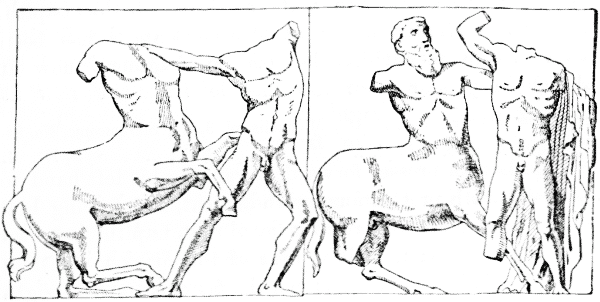
Fig. 9.—Metopes 308, 309, from Carrey.
309. In this metope, as drawn by Carrey (fig. 9), the right arm of the Lapith is raised with the forearm bent; the right hand, which probably held a sword, was already broken off in Carrey's time. His drawing gives the head and part of the right upper arm of the Centaur, and the left leg and half the right leg of the Lapith, but not his head. The Centaur, while pressing his left hand on the left shoulder of the Lapith, draws back a little from the blow with which he is menaced. The action of both figures is rather tame, and the victory undecided. An ample chlamys is shown falling at the back of the Lapith. Part of the right hind leg of the Centaur has been added in plaster from the marble fragment now at Athens.
Mus. Marbles, VII., pl. 15; Michaelis, pl. 3, vi.; Stereoscopic, No. 84.
310. The Lapith presses forward, advancing his left hand to seize the rearing Centaur by the throat, and forcing him on his haunches; the right arm of the Lapith is drawn back, as if about to strike; his right hand, now wanting, probably held a sword: a mantle fastened on the right shoulder falls over the left arm like a shield, and flies back behind. The Centaur, rearing up against his antagonist, tries in vain to pull away the left hand of the Lapith, which, in Carrey's drawing, he grasps. The head of the Centaur is a cast from the original at Athens. From the shoulders of the Centaur hangs a small chlamys; the folds fly behind, and show the violence and swiftness of the action. The head of the Lapith is a cast from the original, which is now in the Louvre. Carrey's drawing gives the missing parts of the legs of this group. This is, perhaps, the finest of all the metopes in the Museum. The action is most spirited, and the modelling very thorough and masterly.
Mus. Marbles, VII., pl. 3; Michaelis, pl. 3, vii.; Stereoscopic, No. 85; Waldstein, in Journ. of Hellen. Studies, III., pl. 23, p. 228; Essays, pls. 1, 2, p. 97.
311. The Lapith is kneeling on his right knee. The Centaur, the human portion of whose body is broken away, presses down his antagonist. From Carrey's drawing, taken when this metope was nearly complete, we learn what the action was. He represents the Centaur bending over the kneeling Lapith, and raising his right hand to strike a deadly blow at his antagonist, who looks up with his head thrown back, and stretches out his left arm towards the breast of the Centaur. A chlamys hangs down from the left arm of the Lapith. His right arm, which was lost in the time of Carrey, must have been raised. The right hind foot of the Centaur rests on a rock.
Mus. Marbles, VII., pl. 6; Michaelis, pl. 3, viii.; Stereoscopic, No. 86.
312. The Centaur has again the advantage. The Lapith is thrown down over a large wine vessel, pithos; the Centaur has grasped his left leg with his left hand, rolling him back on the jar. The Lapith seizes his antagonist by the beard with his left hand, while his right arm, now broken off, has been vainly extended behind him, seeking some support. The right thigh of this figure, the head and part of the right arm of the Centaur are casts from three fragments at Athens. Carrey's drawing gives the left arm and side of the Centaur, as well as his head. The head and right arm and hand of the Lapith are also shown in his drawing, but not the portion of right thigh which has recently been added. The wine vessel in this metope, and the hydria in No. 307, indicate the wedding feast of Peirithoös as the scene of the contest.
Mus. Marbles, VII., pl. 4; Michaelis, pl. 3, ix.; Stereoscopic, No. 87.
313. This metope is a cast from the one removed by Choiseul-Gouffier when French ambassador at the Porte, about the year 1787, and now in the Louvre. The group represents a Centaur carrying off a Lapith wife or maiden. The Centaur is rearing up; he grasps the woman between his forelegs. His left hand presses against her left side, and it appears from Carrey's drawing of this metope that his right hand grasped her right wrist. With her left hand she is vainly endeavouring to loosen his grasp round her waist, and to readjust her disordered drapery. She wears a chiton with diploïdion fastened on the right shoulder with a brooch. In the struggle the chiton has fallen from the left shoulder. On her right foot is a sandal with a thick sole; her left foot is broken off above the ankle. Carrey's drawing gives this foot resting on a rock, also other parts of the group which are now wanting.
Mus. Marbles, VII., pl. 16; Michaelis, pl. 3, x.; Stereoscopic, No. 88.
The next metope in order on the Parthenon is now only preserved in Carrey's drawing, which represents a Lapith armed with a shield, who seems to be stabbing the Centaur in the belly. The Centaur grasps the edge of the shield with his left hand. A fragment of this shield with the left arm of the Lapith inside and the fingers of the Centaur on the rim exists at Athens; cf. No. 343, 1.
Michaelis, pl. 3, xi.
314. This metope is cast from the original in the Acropolis Museum at Athens. It represents a Centaur seizing a Lapith wife or maiden. Carrey's drawing gives the head, left foreleg from the knee, and left hindleg of the Centaur, and the right arm of the female figure, all which parts are now wanting. The group presents a somewhat involved and complicated composition. The Centaur grasps the female figure's left arm with his left hand; his right arm, not shown, we must suppose to be passing round the back of her waist. While the left foreleg of the Centaur is firmly planted on the ground, his right foreleg clasps the left leg of the female figure, pressing at the back of her knee, so as to throw her off her balance. Her dress, a chiton with a diploïdion, is disordered in the struggle. The action of her right hand, as drawn by Carrey, indicates that she is attempting to readjust the upper part of her chiton. Her right leg from the knee to the ankle is supplied by a cast from a fragment at Athens; the foot is cast from another fragment, of which the original, No. 342, 1, exhibited in a Wall Case, probably belonged to the Elgin Collection. The action of this leg is awkward and ungainly.
Michaelis, pl. 3, xii.; Stereoscopic, No. 96a.
Next follow in Carrey's drawings thirteen metopes (Michaelis, xiii.-xxv.) of which we have only a few fragments. Of these the first eight (xiii.-xx.) represent subjects of which the import is unknown, and in which draped female figures predominate. Nos. xxii.-xxv. represent combats between Centaurs and Lapiths or Lapith women. If we suppose that No. xxi., which represents two women standing by an archaic statue as if for sanctuary, belongs to the Centaur series, then twelve metopes at each end of the south side, namely, i.-xii., xxi.-xxxiii. are devoted to this subject, while the eight central metopes are an independent series.
Fragments have been recognised as belonging to the thirteen metopes which have been destroyed since the time of Carrey. They are more fully described below.
" XV (?). Arm. See No. 342, 6.
" XVI. Male head and torso. See No. 342, 3.
" XXIV. Torso of Lapith. See No. 343, 5.
315.
This metope, the 26th in the original series, is from the eastern half of the south side of the temple. It represents a contest between a Centaur and Lapith. The Centaur, rearing, has raised his arms above his head, in order to strike his antagonist with some weapon, perhaps a branch of a tree. His antagonist thrusts the toes of his left foot against the equine chest of the Centaur between his forelegs, and, pressing his left hand against his adversary's right elbow, is trying to force him back on his haunches. His right arm, now wanting, has been drawn back to deal a blow; its position is marked by a projection on the ground of the relief. A chlamys hangs down at his back. From the want of apparent support for the right foot of the Lapith, the action of this figure appears weak and undecided. On the left upper arm are two holes for the attachment of some object, perhaps an end of drapery hanging free in front of the arm. Another hole on the flank of the equine portion of the Centaur, between the ribs and haunch, shows where the end of a skin, hanging down from the back, may have been attached. Parts of the right hind leg appear to have been attached by metal rivets. Carrey's drawing shows that this metope has suffered little since his time.
Mus. Marbles, VII., pl. 8; Michaelis, pl. 3, xxvi.; Stereoscopic, No. 89.
316. In this metope, the 27th in the original series, the Centaur, wounded in the back, attempts to fly, but is checked by the Lapith, whose left hand grasps him round the left side of the head, while his left leg presses against his hind-quarters. The right arm of the Lapith is drawn back to deal a blow, perhaps with a lance. The Centaur, rearing up in agony, presses his right hand against the wound in his back; his left arm, now wanting, must have been raised, as appears from Carrey's drawing, in which a small piece of the upper arm is given. The left foot of the Lapith presses firmly against a rock. A mantle falls over both arms, hanging in festoons behind his back. Carrey's drawing gives both the head, and right leg, and part of the right forearm of the Lapith. In composition and execution this is one of the finest of the extant metopes.