Volume 1 / Part 3 — THE SUCCESSORS OF PHEIDIAS. (continued 3)
Reading edition
690. Sepulchral vase, with relief. A young warrior, wearing chiton, shield and helmet, clasps the hand of an old man. Behind the man stands a woman, who makes a gesture with her right hand.
Inscribed with an elegiac inscription of four lines of which only the terminations remain.—Athens? Elgin Coll.
Pentelic marble; height, 2 feet 4¼ inches; diameter, 1 foot 3½ inches. Mus. Marbles, IX., pl. 32, fig. 1; Synopsis No. 122 (167); Ellis, Elgin Marbles, II., p. 161; C.I.G., 1041; C.I.A., II., 4312; Greek Inscriptions in Brit. Mus., CXXXII.
691. Sepulchral lekythos with relief. A young warrior, wearing a cuirass over a short tunic, a chlamys and a helmet, clasps the hand of a seated woman. He appears to hold a scroll in his left hand. Behind him is an attendant, holding a large shield.—Athens? Elgin Coll.
Pentelic marble; height, 2 feet 6 inches; diameter, 1 foot 6 inches. Mus. Marbles, IX., pl. 33, fig. 3; Synopsis No. 195 (228); Ellis, Elgin Marbles, II., p. 161.
692. Sepulchral lekythos with relief. An armed warrior, Sosippos, who wears a tunic, cuirass, and chlamys, clasps the hand of a seated woman, who, with her left hand clasps the right hand of a small girl standing at her knee. Behind the warrior is a boy carrying a large shield; behind the seated figure is a woman standing with her right hand raised to her chin.
Inscribed: Σώσιππος.—Athens? Elgin Coll.
Pentelic marble; height, 2 feet; diameter, 11 inches. Dodwell, Tour, I., p. 455; Mus. Marbles, IX., pl. 31, fig. 3; Synopsis No. 230 (239); Ellis, Elgin Marbles, II., p. 165; C.I.G., 1008; C.I.A., II., 4156; Greek Inscriptions in Brit. Mus., CXXVII.
693. Stelè, with a sepulchral lekythos in relief, supported by a winged Sphinx. On the vase is a relief representing two warriors, fully armed, standing with hands clasped. (Pl. xi., fig. 1.)
Inscribed: Ἀρχιάδης Ἁγν(ο)ύσιος, Πολεμόνικος Ἀθμονεύς—Archiades of Hagnus; Polemonicos of Athmonon.—Formerly in the Guilford Collection. Presented by G. Plucknett, Esq., 1886.
Pentelic marble; height, 2 feet 11½ inches width, 1 foot 1 inch. C.I.G., 552; C.I.A., II., 1700.
694. Stelè, with sepulchral relief. A seated woman, Xeno, clasps the hand of a girl, Cleo, who stands before her. Behind her, a bearded man, Hermodoros, leans on his staff and looks downwards. The stelè is surmounted by a rounded top as if for a palmette, which may have been painted.
Inscribed: Ξενώ, Ἑρμόδωρος, Κλεώ.—Athens?—Elgin Coll.
Pentelic marble; height, 2 feet 1 inch; width, 1 foot 2½ inches. Mus. Marbles, IX., pl. 30, fig. 4; Synopsis No. 373 (229); C.I.G., 981; C.I.A., II., 4042; Greek Inscriptions in Brit. Mus., CXXIV.
695. Sepulchral lekythos with relief. A youth, Polystratos, clasps the hand of a woman, Archagora, who is seated on a chair. A woman, Pithyllis, is seen in the background between these two figures. She stands in an attitude of grief, with her head bowed and her right hand raised to her veil.
Inscribed: Ἀρχαγόρα, Πιθυλλίς, Πολύστρατος.—Athens? Elgin Coll.
Pentelic marble; height, 1 foot 8 inches; diameter, 11 inches. Dodwell, Tour, I., p. 455; Mus. Marbles, IX., pl. 31, fig. 4; Synopsis, No. 182 (274); Ellis, Elgin Marbles, II., p. 165; C.I.G., 996; C.I.A., II., 3524; Greek Inscriptions in Brit. Mus., CXII.
696. Sepulchral lekythos with relief. A bearded man stands before a woman seated on a chair and clasps her hand. There is no trace of an inscription.—Athens? Elgin Coll.
Pentelic marble; height, 2 feet 11½ inches; diameter, 11 inches. Mus. Marbles, IX., pl. 33, fig. 1; Synopsis No. 132 (A. 50); Ellis, Elgin Marbles, II., p. 164.
697. Sepulchral lekythos with relief. A bearded man stands before a woman seated on a chair.
Inscribed above the head of the woman: Ἄδα. The name of the man may have been inscribed originally, but it is now obliterated.—Athens? Elgin Coll.
Pentelic marble; height, 1 foot 10½ inches; diameter, 1 foot. Mus. Marbles, IX., pl. 32, fig. 2; Synopsis No. 188 (110); Greek Inscriptions in Brit. Mus. CXI.; C.I.A., II., 3438.
698. Sepulchral lekythos with relief. A man, Alkimachos, stands before a seated woman, Hedylè, and clasps her hand. A girl stands behind Hedylè, and another girl of a smaller size stands behind Alkimachos.
Inscribed: Ἡδύλη, Ἀλκίμαχος.—Probably from Athens. From the Earl of Belmore's Collection, 1842.
Pentelic marble; height, 1 foot 5 inches; diameter, 1 foot 1 inch. Greek Inscriptions in Brit. Mus., CXVIII.; C.I.A., II., 3761.
699. Sepulchral lekythos with relief, much defaced. A woman seated on a chair clasps the hand of a woman standing before her. Behind the chair is a girl holding a box in her left hand.—From a store at Portsmouth. Perhaps from Smyrna.
Marble; height, 1 foot 7 inches; diameter, 1 foot.
700. Fragment of sepulchral relief. A youth standing clasps the hand of a bearded man, seated on a chair. Only the upper parts are preserved of both figures, together with the right side of the relief.—Athens? Elgin Coll.
Pentelic marble; height, 6 inches; width, 10½ inches. Synopsis, No. 423.
701. Fragment of sepulchral relief. A woman, seated on a chair, clasps the hand of a woman standing before her. Her left hand appears to have been raised to her veil. The upper parts of both figures are wanting, and also the left side of the relief. A nude boy with an uncertain object in his hands stands in the right corner.
Pentelic marble? Height, 1 foot; width, 11 inches.
702. A woman seated to the right, on a stool, holds her veil with the left hand, and clasps the arm of a boy standing before her. Behind the boy, and partly embracing him, stands a woman, who holds her veil with her right hand. On the left, behind the seated figure is a woman standing with the left hand raised to her cheek, and with the right hand supporting the left elbow. At the foot of the seat are two small female figures, one standing and one sitting. These six figures are in high relief. In the background are two men confronted in low relief; one is bearded. Two other heads also appear to have been inserted, and to have been afterwards obliterated. The relief is bounded by two pilasters and an architrave, with roof tiles above.
Inscribed: Σωπάτρα Παυσανίου. Ἀντίμαχος Παυσανίου. Φιλοπάτρα Μι[ρ]ύλου. Παυσανίας Ἀνδρίσκου. Sopatra and Antimachos are the children of Pausanias and Philopatra.—Pella.
Fine-grained white marble; height, 4 feet; width, 2 feet 6 inches. Greek Inscriptions in Brit. Mus., CLXXII.
703. An elderly bearded man, seated, to the left, clasps the hand of an old man standing before him. Both figures appear to be portraits. Small figures of boys stand at the right and left. The boy on the left holds an uncertain object. Above are a pediment with acroteria, and two olive wreaths, and the inscriptions Ὁ δῆμος Δημοκλῆν Ἀμφιλόχου, Ὁ δῆμος Δημοκλῆν Δημοκλήους, recording honorary decrees to Democles, son of Amphilochos, and Democles, son of Democles. Below is a metrical epitaph, in eight lines:
Τὸν πινυτὸν κατὰ πάντα καὶ ἔξοχον ἐν πολιήταις ἀνέρα γηραλ(έ)ου τέρματ' ἔχοντα βίου Αἴδεω νυχίοιο μέλας ὑπεδέξατο κόλπος εὐσεβέων θ' ὁσίην εὔνασεν ἐς κλισίην. μνῆμα δ' ἀποφθιμένοιο παρὰ τρηχῆαν ἀταρπὸν τοῦτο πάïς κεδνῇ τεῦξε σὺν εὐνετίδι. ξεῖνε σὺ δ' ἀείσας Δημοκλέος υἱέα χαίρειν Δημοκλέα στείχοις ἀβλαβὲς ἴχνος ἔχων.
—Smyrna. Presented by M. Duane and T. Tyrwhitt, Esqs., 1772.
Bluish Greek marble; height, 4 feet 5 inches; width, 1 foot 8½ inches. Montfaucon, Ant. Expl. Suppl., V., p. 25; Archaeologia, III., pl. 11, fig. 2; C.I.G., 3256; Kaibel, 237.
704. A man, Exakestes, seated, clasps the hand of his wife, Metreis, standing before him. She holds a spindle in her left hand. In the right and left corners of the relief are small figures of a boy and girl. The girl holds a casket. In the background of the relief are a stelè surmounted by two cornucopiae, and a candelabrum. Above, two wreaths and the honorary inscription, Ὁ δῆμος Ἐξακέστην Ἀνδροβούλου. Ὁ δῆμος Μητρεῖν Ἑρμίππου, Ἐξακέστου δὲ γυναῖκα. The relief is surmounted by a pediment with acroteria and a rosette.—Perhaps from Smyrna. Townley Coll.
Greek marble; height, 2 feet 5½ inches; width, 1 foot 4½ inches. Mus. Marbles, X., pl. 43; C.I.G., 3232; Ellis, Townley Gallery, II., p. 165; Wolters, No. 1806. This relief was once in the possession of Dr. Richard Mead (Mus. Meadianum, Pars alt., 1759, p. 239).
705. A woman seated clasps the hand of a young man who stands before her, placing his left hand on her shoulder. An older man stands on the left. The stelè is surmounted by a pediment.
Greek marble; height, 2 feet 2¼ inches; width, 1 foot 2 inches.
706. A woman, Laodikè (?), seated, clasps the hand of a youth standing before her. The relief is crowned by a pediment. A nearly illegible inscription appears to read: Λαοδίκη Ἡρ[οφίλου?] ... χαῖρε.
Pentelic marble; height, 2 feet 3¼ inches; width, 1 foot 2 inches.
707. A woman clasps the hand of a warrior, with short tunic, cloak and shield. On the left a second warrior, somewhat smaller, but similarly attired. Above is a pediment with acroteria and rosettes.—Kertch.
Limestone; height, 2 feet 4 inches; width, 1 foot 7 inches.
708. Two men, one bearded and the other a youth, stand clasping hands. They are father and son, each being named Bakchios. Above is a pediment with acroteria and rosettes.
Inscribed: Βάκχιε Βάγεος καὶ υἱὲ Βάκχιε χαίρετε.
Limestone; height, 2 feet 11¾ inches; width, 1 foot 8¾ inches. Greek Inscriptions in Brit. Mus., CLXXXIV.; Latyschev, II., 78.
709. A man and woman stand, clasping hands. A boy on the right. Above is a pediment with acroteria and rosettes.
Inscribed: Γάïος Γαΐου καὶ μητὴρ Βασιλι[νδ]ῖνα χαίρετε.—Kertch.
Limestone; height, 2 feet 6½ inches; width, 1 foot 7¼ inches. Greek Inscriptions in Brit. Mus., CLXXXVI.; Latyschev, II., 93.
710. Circular pedestal or altar on a square plinth, on one side of which is a sepulchral relief. A man stands on the right, clasping the right hand of a seated woman, probably his wife. She holds her veil with her left hand. Behind the woman stands Hermes Psychopompos, about to conduct her shade to Hades. He has petasos, talaria, chlamys and caduceus. On the right is another male figure standing, with folded hands, and beyond is what appears to be an altar. The altar is rectangular, and is surmounted by a conical object, round which a serpent is twined. By the side of the altar is the mutilated figure of a boy. On the extreme left behind Hermes is a sundial, to which his hand is pointing. At the side of the chair stands a draped female attendant of diminutive stature. This figure is much defaced, and the lower part is broken away. The head of this figure has been broken off, and the faces and general surface of all the figures are much eaten away by exposure to weather. This relief occupies about a third of the circle of the pedestal, the remainder being ornamented by festoons of ivy suspended between three bulls' heads. In the centre of the top of the pedestal is a round hole, as if to receive a dowel, and the surface of the marble seems prepared for a joint. The whole may have served as a pedestal for a statue.—Obtained from Greece by the fourth Earl of Aberdeen, and presented by the fifth Earl of Aberdeen, 1861.
Greek marble; height, 3 feet 7 inches; diameter, 2 feet 9 inches. Guide to Graeco-Roman Sculptures, Part II., No. 75.
RELIEFS REPRESENTING THE SEPULCHRAL BANQUET.
For a discussion of the interpretation of this class of reliefs, see above, p. 298.
711. Cast of a sepulchral relief, sometimes known as the "Death of Socrates." A man, bearded, reclines on a couch, with a bowl in his right hand, held out as if to pour a libation. A woman seated on a stool by the foot of the couch, extends her hands. On the right is a man, draped and bearded, and on the left a nude youth who stands with a jug by a large crater. Below the couch is a dog gnawing a bone. The original, of white marble, was found at the Piraeus in 1838, and is now in the National Museum at Athens.
Height, 1 foot 7½ inches; width, 2 feet 1 inch. Ἐφημερίς, 1839, No. 269; Le Bas, Mon. Fig., pl. 52; Pervanoglu, Familienmahl, p. 24, No. 60; Mitchell, p. 504; Wolters, No. 1052; Roscher, Lexicon, p. 2574.
712. Relief with banquet. Two male figures recline together on a couch. One is a bearded man, the other is a youth. The man holds a bowl in his left hand and places his right hand on the shoulder of the youth who turns his head towards him. Before the couch is a table with provisions. On the right is a nude youth with a jug and bowl. On the left is a youth, wearing tunic and chlamys, who leads a horse. The relief is bounded by pilasters and an architrave.
On the lower margin is the modern inscription Aesculapio Tarentino Salenius Arcas, added by some person who supposed that the relief was a votive tablet to Aesculapius. The inscription, however, makes it probable that the relief was obtained at Tarentum. The type of the horse also agrees well with that on the coins of Tarentum, of about the close of the fourth century, B.C. The relief is perhaps erected to a father and two sons. It is also possible that the two figures of the youth represent the same person, and that only two persons in all are here commemorated.—Presented by W. R. Hamilton, Esq., 1845.
Marble, probably Pentelic; height, 1 foot 10½ inches; width, 2 feet 9 inches. The upper right-hand corner is restored. P. Gardner, Journ. of Hellen. Studies, V., p. 105, and plate; Wolters, No. 1054; Roscher, Lexicon, p. 2575.
713. Relief with banquet, serpent, and sacrifice. Two men recline on a couch. Both have cups in their left hands. One holds up a rhyton terminating in a ram's head; the other stretches out his right hand to a long table which stands before the couch. A woman, seated on the end of the couch, holds a cup in her left hand and stretches out her right hand to the table. Below the table is a coiled serpent. On the left of the woman is a nude youth holding up a rhyton. Beyond is a square altar, to which a boy, who is now almost obliterated, leads a pig. He holds a bowl in his left hand. On the left are four adult persons and two infants, and above, the head of a horse in a frame. The relief is bounded by two pilasters surmounted by an entablature, above which roof-tiles are slightly indicated.—Townley Coll.
Pentelic marble; height, 1 foot 2 inches; width, 2 feet 2 inches.
714. Fragment of relief with banquet and sacrifice. On the right is part of the figure of a woman, who is seated at the foot of a couch, most of which is now lost. Before her is part of a table. At the foot of the couch is an altar which is approached by a procession of three adult persons and four children, one of whom leads a ram. Above, a horse's head is seen at a window. The relief is bounded by pilasters and an entablature, above which roof-tiles are shown.—Athens? Elgin Coll.
Pentelic marble; height, 1 foot 3 inches; width, 1 foot ½ inch. Mus. Marbles, IX., pl. 35, fig. 1; Synopsis, No. 279 (94); Welcker, Alte Denkmaeler, II., p. 273; cf. Welcker, loc. cit., II., pl. 13, No. 24; Pervanoglu, Familienmahl, p. 44, No. 174.
715. Fragment of relief, which may be supposed to have been similar to the preceding. Sacrificial procession, including a man, of whom but little remains, a woman, two children, and one draped figure, whose sex cannot be distinguished, carrying a large vessel on the head.—Athens? Elgin Coll.
Pentelic marble; height, 1 foot 4¾ inches; width, 9½ inches. Mus. Marbles, IX., pl. 36, fig. 3; Synopsis, No. 189 (284); Guide to Elgin Room, Part II., No. F. 6.
716. Relief with banquet and sacrifice. A male figure, who is half draped, reclines on a couch with a bowl in his right hand. He wears a polos and in type resembles a divinity. Before him is a table with food. A woman is seated on the foot of the couch and has a cup in her left hand. On the right a youth draws wine from a crater. On the left a man, woman, and boy approach as worshippers. The relief is bounded by two pilasters, surmounted by an entablature, above which are roof-tiles.—Townley Coll.
Pentelic marble; height, 9½ inches; width, 1 foot 1¾ inches. Ellis, Townley Gallery, II., p. 167; Welcker, Alte Denkmaeler, II. p. 278.
717. Relief with banquet and sacrifice. A male figure, half draped and wearing a polos as in the last relief, reclines on a couch. He has a cup in the left hand and a rhyton in the right hand. Before him is a table with food. A woman is seated at the foot of the couch, with a cup in her left hand. On the left a boy stands beside a jar of wine, which is raised on a pedestal. At the left a woman, and two smaller figures approach as worshippers. Above, the head of a horse is seen looking through an opening. The relief is bounded by two pilasters, surmounted by an entablature, above which are roof-tiles.—Halicarnassos. Presented by H.M. Sultan Abdul Medjid to Viscount Stratford de Redcliffe, and by him presented to the British Museum.
Marble; height, 10 inches; width, 1 foot 1 inch.
718. Fragment of relief. A nude male figure who seems to be wearing a Phrygian cap, and holds some object in his right hand, stands with his left hand over an altar. On the right side of the altar was a male figure making a libation. Only the right hand with the saucer, and the right foot remain. On the left a bearded man stands, with his right hand raised.—Athens? Elgin Coll.
Pentelic marble; height, 1 foot 6 inches; width, 1 foot 3 inches. Synopsis, No. 380 (101); Mus. Marbles, IX., pl. 37, fig. 1.
719. Group of persons about to sacrifice; from the left side of a sepulchral relief. On the right of the fragment is a man with a large amphora, turned to the right. Behind him are two men and two women, all standing as worshippers.—Mytilene.
Marble; height, 10 inches; width, 11 inches. Conze, Lesbos, p. 10, Note 3, No. 1.
720. Fragment of relief with banquet and serpent. A man reclines on a couch and pours a libation from a bowl. Before the couch is a table with food. A serpent is coiled beneath the table and stretches its head towards the bowl. On the left is the hand holding a casket (pyxis) of a woman, who had been seated at the foot of the couch. The relief is bounded by pilasters, an entablature and a roof.
Marble; height, 1 foot 1 inch; width, 9 inches.
721. Relief with a female figure of the type of the banquet reliefs. A woman seated, wearing a lofty head-dress (polos), holds an ivy-leaf fan in her left hand, and with the right hand appears to be offering a cup to a serpent.—Athens? Elgin Coll.
Pentelic marble; height, 2 feet 3½ inches; width, 1 foot 5¾ inches. Mus. Marbles, IX., pl. 38, fig. 3; Synopsis, No. 278 (238); Ellis, Elgin Marbles, II., p. 127, No. 278.
722. Relief with banquet. A man reclines on a couch with a cup in his left hand. Before him is a table with food. A woman is seated near the foot of the couch with her left hand raised to her veil. On the right is a boy in a short tunic, perhaps holding a kyathos. On the left is a girl who is standing, and seems to be holding a vase. The relief is surmounted by a pediment.
Inscribed: Ἑρμίας Ἀθανίωνος. Hermias, son of Athenion.—Athens. Strangford Coll.
Pentelic marble; height, 1 foot 5 inches; width, 10 inches. Greek Inscriptions in Brit. Mus., CXVI.; Arch. Anzeiger, 1864, p. 164*; Pervanoglu, Familienmahl, p. 15, No. 5.
723. Relief with banquet. A man reclines on a couch, with a bowl in his left hand; with the right hand he holds a wreath on his head. Before him is a table with food. The legs of the table terminate above in the form of swans' heads. Above is an olive wreath, containing the words Ὁ δῆμος; also a pediment, having acroteria, and containing a rosette.
Inscribed:
Ὁ δῆμος· Λήναιον Ἀρτεμιδώρου· καὶ τὸ πρὶν ἐν πολέμοις τηρῶν πύργον, παροδῖτα, καὶ νῦν τηρήσω, ὡς δύναμαι, νέκυς ὤν.
The 'tower' which Lenaios undertakes to defend in death has been conjectured to be the Dipylon gate at Athens, whence the relief was probably obtained.
Bluish Greek marble; height, 3 feet 11½ inches; width, 1 foot 7 inches. Rhein. Mus. N.F. 1848, p. 82; Kaibel, 111.
724. Sculptured pedestal. On the front is a relief of a banquet. A man reclines on a couch, with a table of food before him. He holds a bowl in his left hand, and clasps with his right hand the hand of a woman who is seated at the foot of the couch. A boy stands on the left. A wreath is carved on the pilaster to the right of the relief, which probably contained the inscription: Ὁ δῆμος.
Inscribed: Ἑλλανίων Ταρσεύς, Hellanion of Tarsus. On the right and left ends the pedestal is adorned with pediments. Above, it is roughly worked to fit the plinth of a statue.—Xanthos? Presented by J. Scott Tucker, Esq., R.N.
Bluish-grey marble; height, 2 feet ¼ inch; width, 2 feet 7 inches. Arch. Anzeiger, 1851, p. 128; Pervanoglu, Familienmahl, p. 34, No. 113.
725. Fragment of relief, with banquet. The upper half is wanting. A man reclines on a couch, and holds a bowl and a rhyton (?), which were perhaps of bronze attached, in the left and right hands respectively. A woman sits on the end of the couch. On the right is a diminutive male figure with the hands clasped. On the left is a girl, who stands leaning against the foot of the couch, and holds an ivy-leaf fan in her left hand.—Halicarnassos.
Marble; height, 1 foot 2 inches; width, 2 feet.
726. Relief with banquet and serpent. A man fully draped, reclines on a couch, with a bowl in his left hand. Before the couch is a table with provisions. A woman is seated on a stool by the foot of the couch. In her left hand she extends a bowl from which a serpent is drinking. The serpent is coiled about the trunk of a tree. On the right is a diminutive male figure standing by a crater; on the left is a female figure holding a box.—Found in a store at Portsmouth. Probably from Smyrna.
Bluish marble; height, 1 foot 10½ inches; width, 1 foot 6 inches.
727. Fragment of a relief with banquet and serpent. A man reclines on a couch holding a bowl in his left hand. A woman is seated on a chair by the head of the couch. A snake issues from under the chair and approaches the woman. One arm of the chair is supported by a figure of a Sphinx. The heads of both figures are wanting of Mytilene.
Marble; height, 11 inches; width, 10½ inches. Conze, Lesbos, p. 10, Note 3, No. 3.
728. Relief with banquet and serpent. A figure, apparently that of a man, reclines on a couch. He has long hair, and a closely-fitting chiton, and holds a cup in his left hand. Before him is a table with food, towards which he extends his right hand. A woman is seated on the foot of the couch, and gives drink from a bowl to a serpent. On the right a boy has drawn wine from a crater with a jug, and is offering a bowl to the reclining figure. Behind is a stair-like series of shelves, on which stand several vessels. On the left a woman raises her right hand with a gesture as of adoration. Above, a horse's head is seen looking through an opening. The relief is bounded by two Ionic columns surmounted by a flat arch.—Naucratis. Presented by the Egypt Exploration Fund, 1886.
Limestone, with traces of red paint; height, 1 foot 3 inches; width 1 foot 8½ inches. Gardner, Naukratis, II., p. 22.
729. Fragment of relief, with banquet and serpent. The fragment contains the upper part of a male figure, wearing a polos, reclining on a couch, holding a cup in the left hand, and having a table before him. A snake is coiled about one leg of the table.—Mytilene.
Marble; height, 1 foot ¾ inch; width, 7 inches. Conze, Lesbos, p. 10, Note 3, No. 2.
730. Fragment of relief, with banquet. A male figure reclines on a couch. Before him is a table with food. He has a rhyton in his right hand and a cup in his left hand.
Marble; height, 11 inches; width, 10 inches.
731. Fragment of relief with banquet. A male figure reclines on a couch between two columns, with a bowl in his right hand. A table with cups stands before the couch.—Thasos. Strangford Coll.
Marble; height, 9 inches; width, 1 foot 2 inches.
732. Fragment of relief with banquet. A male figure, whose legs alone are preserved, reclines on a couch. Before him is a table with food. A woman, whose lower limbs are alone preserved, is seated on a chair at the foot of the couch. A small draped figure of a youth is on the right, and there are remains of the figure of a girl on the left.
Marble; height, 1 foot 7 inches; width, 2 feet 6 inches.
733. Relief with banquet. A man, bearded, reclines on a couch, and holds up a rhyton in his right hand. Before him is a table with food. A woman is seated on the couch, and raises with the left hand a fold of her peplos. On the left a boy draws wine from a large crater. The head of a horse is seen at an opening. A round shield hangs on the wall. The relief is bounded by two pilasters and an entablature.—Excavated by Mr. Wood at Ephesus.
Ephesian marble; height, 1 foot 7½ inches; width, 2 feet 2½ inches.
734. Relief with banquet. A portrait figure of an old man, whose head is bound with a taenia, reclines on a couch with a two-handled cup in his left hand. Before him is a table with pomegranate fruits and other food. A portrait figure of a woman is seated near the foot of the couch, with her left hand raised to her veil. A boy in a short tunic stands on the right, and holds a kyathos for drawing wine; a rhyton and a vase are seen above his head. A girl kneels on the left below the seat of the woman; a dog lies between the legs of the table.—Townley Coll.
Greek marble; high relief. The upper part is wanting. Height 1 foot 8½ inches; width, 1 foot 6 inches. Mus. Marbles, X., pl. 49, fig. 2.
735. Relief with banquet. A male figure reclines on a couch, before which is a table with provisions. A woman is seated on a stool at the foot of the couch with her hand raised to her chin.
Inscribed: . . .νου χαῖρε.—Cyzicus. Presented by A. van Branteghem, Esq., 1890.
Marble; height, 10½ inches; width, 9½ inches. Rev. Arch., 1891, p. 12, No. 4.
736. Relief with banquet. Three elderly male figures recline on a long couch, wearing diadems and holding large bowls in their left hands. Before them is a table with two large pomegranates and a basket of fruit. At each end of the couch is a seated woman. The head is lost of the woman on the left. At the left angle in low relief is a diminutive figure of a girl, with a basket (calathos); at the right angle is a diminutive figure of a boy, with a crater. The relief is bounded by pilasters and an entablature. Below is the hull of a vessel in low relief, and the metrical epitaph of Dionysodoros, son of Pytheas.
Διονυσοδώρου τοῦ Πυθέου. α. Διονυσόδωρε, χαῖρε· β. καὶ σύ γε, ὦ φίλε, τὸ νῦν ἔχ[ον γ]είνωσκέ με ὧδε κείμενον, καλὸν καὶ ἀγαθὸν καὶ καλῶς ἐζωκότα, Λ]ιμναγενῆ γεγονότα, πᾶσι προσφιλ[ῆ].
—Brought from Cyzicus, in 1830, by H.M.S. Blonde. Found in 1880 in a store at Portsmouth.
Bluish Greek marble; height, 2 feet 5½ inches; width, 2 feet 8 inches. C.I.G., 3684; Kaibel, 245; Wolters, Rhein. Mus. N.F., 1886, p. 346.
737. Late relief with banquet. A man and woman recline on a couch. Before them is a table with food. The man puts his right arm round the neck of the woman, who appears to be holding a cup, or a wreath. On the left a woman is seated on a stool; beneath the couch are a child and a girl (the upper part alone seen), who holds a dish. The relief is bounded by two Doric columns and a pediment. The monument was erected by one Alexander for his mother, his wife Philippa, and himself. Penalties are prescribed for persons violating the tomb.
Inscribed: Ἀλέξανδρος Ἀλεξάνδρου Βειθυνιεὺ[ς] καὶ Νεικομηδεὺς ζῶν ἑαυτῷ κατεσκεύασ[α] τὸ μνημεῖον καὶ τῇ μητρί μου καὶ τῇ συμβίῳ Φιλίππᾳ Ποντιανοῦ. καὶ βούλομε μετὰ τὸ τεθῆναι ἡμᾶς εἰς τὴν καμάραν μηδένα ἕτερον ἀνοῖξε· εἰ δὲ παρὰ ταῦτα ποιήσει δώσει ἰς τὸν φίσκον δην. β͵φ̄ καὶ ἰς τὴν πόλιν δην. β͵φ̄. χαίρετε.—Smyrna. Presented by M. Duane and T. Tyrwhitt, Esqs., 1772.
Marble; height, 2 feet 9 inches; width, 1 foot 8 inches. Archaeologia, III., pl. 11, fig. 3; C.I.G., 3265; Pervanoglu, Familienmahl, p. 45, No. 180.
738. Sepulchral relief. Two men recline on a couch; a woman is seated on a stool at the head of the couch. The inscribed metrical epitaph, in which one Cassiodoros relates his death at the age of twenty-four, has no appropriateness to the relief.
Νυμφιδίου θαλάμοιο λιπὼν δυσπενθέα κόσμον καὶ γονέων οἰκ[τ]ρῶν δακρυόεντα δόμον κεῖμαι ἐς [αὐ]χμηροὺς καὶ ἀλαμπέας Ἀΐδος εὐνὰς εἴκοσ[ι τ]έσσαρ' ἔχων Κασσιόδωρος ἔτη· ἀπ[ροι]δὴς νοῦσ[ό]ς με συνήρπασε· μουνοέτι[ν δὲ ν]ηπ[ί]αχον κούρην λίπω ὑπ' ἠέλιον.—Antioch?
Marble; height, 1 foot 8 inches; width, 1 foot 3 inches. Drummond's Travels (1754), pl. facing p. 229, fig. 15 (very rudely drawn), and p. 237; C.I.G., 4466; Kaibel, 431. In Drummond's time the stone was "in the Library of the right worshipful the Levant Company" at Aleppo.
739. Stelè with reliefs in two panels. In the upper panel is a figure on a couch holding a bunch of grapes. The upper part of the figure is wanting. Before the couch are a table with food and three attendant male figures.
In the lower panel is a woman seated with a boy standing beside her. Most of these two figures is wanting. In front are two warriors standing, with shields and spears.—Kertch.
Limestone; height, 3 feet; width, 1 foot 9 inches. For the collection of sculptures from Kertch, see above, p. 8.
740. Relief with banquet. A draped figure, now for the most part lost, reclines on a very lofty couch, holding a two-handled cup in the left hand. On the left are the knees and legs of a woman seated on a lofty throne, with an arm supported by a series of arches. Before the couch is a table with vessels of wine. A boy stands on a stool, and holds a jug in his hands. On the right is an attendant. On the left is a female figure holding a vase, and a smaller figure.
Inscribed: . . . δε υἱὲ Ἀνδρονε[ίκ]ου χαῖρε. Hail! ... son of Andronicos.—Kertch.
Limestone; height, 2 feet 7 inches; width, 2 feet 7 inches. Greek Inscriptions in Brit. Mus., CLXXXII.; Latyschev, II., 212.
741. Lower part of relief with banquet, of very rude style. A male figure reclines to the right on a couch, holding a two-handled cup in the right hand. Before him is a table, with vessels of wine. At the end of the couch a woman is seated, enthroned, holding a veil with her left hand. A boy with an oinochoè stands on the right by the table. A girl with a pyxis stands on the left behind the throne. There are remains of pilasters. Inscribed: Ἰσιγόνη γυνὴ Ἡρακλίδου χαῖρε. Ἡρακλείδη γ(υνὴ) β̄ χαῖρε.—Kertch.
Limestone; height, 2 feet 8 inches; width, 2 feet 4½ inches. Greek Inscriptions in Brit. Mus., CXCI.; Latyschev, II., 96.
742. Sepulchral monument with a banquet relief of very rude style, contained in a lunette above the inscribed panel. A male figure reclines on a couch, with a cup in his right hand, with an uncertain object near the cup, which may perhaps be intended to represent the snake. A table stands before the couch with food. A woman sits on a stool at the foot of the couch, and holds her veil with her left hand. A small figure of a boy is at the head of the couch. On each side of the inscribed panel is a vine branch with grapes; above are a pine cone and two lions' heads to the front in high relief. Below are the remains of a relief with a mounted horseman. On the right and left edges of the relief are snakes. The inscription states that the monument is erected by Timocrates for his wife, his son, and himself.—Tomis.
Limestone; height, 6 feet 11 inches; width, 2 feet 8½ inches. Greek Inscriptions in Brit. Mus., CLXXVII.
743. Sepulchral monument with a banquet relief of the rudest style. Two male figures, one being bearded, recline on a couch, holding cups in their left hands. Before them is a table with food; beside it a boy with a cup and oinochoè (?), and a girl with a phialè. A woman is seated on a chair by the head of the couch, with the right hand raised to her chin. A vine branch with grapes runs round the relief and the inscribed panel. A Latin inscription states that the monument was erected in memory of a girl, Ulpia Aurelia Valeria.—Kertch.
Limestone; height, 7 feet 1 inch; width, 3 feet.
744. Late sepulchral relief. A man reclines on a couch. A woman stands at the foot of the couch. The relief is contained in an arch-shaped field below a pediment. Inscribed, ΛΥΤΕ ...—Obtained by the Euphrates Expedition (1835-1837) and presented by Sir J. C. Hobhouse, President of the Board of Control.
Marble; height, 2 feet; width, 1 foot 3 inches.
745. Sepulchral relief, with a man seated, and a man standing holding a scroll in his left hand. The two figures probably joined their right hands. In the right and left angles are diminutive figures. On the right is a horse's head. A tree with a snake is seen above a wall in the background. The relief is surmounted by an entablature.
Inscribed with the metrical epitaph:
Οὔπω] νυμφιδίων κραδίῃ πεπληθότα λέκτρων Δίφι]λον αἰακτῷ τῷδ' ὑπένασσε τάφῳ γνωτόν] τε γνωτή τε παναιδοίη<ι> Στρατονίκη ᾧ κ]αὶ Ἀλέξανδρον κοῦρον ὁμηγενέα, ἀστ]οῖς καὶ ξείνοισι προσηνέας, ἐσθλὰ μὲν εἰπεῖν ἐσθ]λὰ δὲ καὶ ῥέξαι πάντας ἐπισταμένους· Μαιο]γενές, σὺ δὲ παῖδας ἐν ἡρῴεσσι φυλάσσοις εὐσεβέ]ων αἰεὶ χῶρον ἐπερχόμενος
This sculpture, and the following, No. 746, have been placed here, though they do not include the banquet, because they have some details, such as the serpent and the horse's head, similar to those on the banquet reliefs.—Ephesus. Excavated by Mr. Wood, between the Magnesian Gate and the Temple of Artemis.
Ephesian marble; height, 3 feet; width, 1 foot 7½ inches. Wood, Ephesus, p. 123; Greek Inscriptions in Brit. Mus., DCXXVa.
746. A boy, Serapion, stands between two figures, probably those of his father and mother. All three are closely wrapped in himatia. Behind is a tree, about which is a serpent; a bird sits on a branch. The relief is bounded by pilasters, a circular arch with rosettes in the spandrels, and a pediment.
Inscribed: Σεραπίων, χρῆστε καὶ ἄλυπε χαῖρε.
Greek marble; height, 3 feet 2 inches; width, 1 foot 8¼ inches. This stone was formerly at Venice, and afterwards in London, "apud Dodd chemicum." Boeckh, C.I.G., 6990.
RELIEFS WITH RIDER AND HORSE, HEROIFIED.
In the following reliefs the deceased person is heroified, and represented as receiving libations or worship. The sepulchral serpent is frequently introduced. For a discussion of the type, see above, p. 301.
750. Sepulchral relief of a warrior. In the centre of the relief is a bearded male figure, heavily armed. He wears a helmet, cuirass, and greaves, and has a spear in his left hand. He stands near a trophy which consists of a helmet, cuirass, and greaves attached to the trunk of a tree. On the left side of the trophy stands a female figure, pouring a libation from a jug into a cup. A serpent, coiled about the trophy, drinks from the cup. On the right of the relief is the forepart of the warrior's horse and the head of a groom. The relief is bounded by two pilasters and an architrave.
The inscription on the upper and lower edges contains a list of names of men in the dative case, with their cities added. The persons commemorated belonged to various parts of the Peloponnesus, Northern Greece, Thrace and Macedonia. From the position of the inscription, it is plain that it is independent of the relief, and probably it is earlier.—Brought from Greece by Mr. Topham, 1725; Presented by Sir Joseph Banks and the Hon. A. C. Fraser, 1780.
Greek marble; height, 2 feet 1⅞ inch; width, 3 feet 8½ inches. Mus. Marbles, II., pl. 41; Ellis, Townley Gallery, II., p. 157; Jahn, De Ant. Minervae Simulacris, p. 23, pl. 3, fig. 1; C.I.G., 1936; Wolters, 437.
751. Mutilated relief. A horseman is mounted, to the right. He has an elaborate skin saddle-cloth, terminating with an animal's head before the horse. Behind on the left is an attendant with a tunic worn over one shoulder (heteromaschalos), and with a shield. On the right are an altar and a tree, about which a serpent is entwined. An uncertain object is seen in the upper left corner of the relief. The relief is very high. The horse originally had reins of bronze.
Marble; height, 3 feet; width, 3 feet.
752. Fragment of sepulchral relief? A figure was represented leading a horse to the right. Only one hand and foot, and parts of the horse remain. Before it stand three male figures on a smaller scale, each figure raising the right hand, making a gesture as of adoration. The relief was bounded by pilasters and an entablature.—Blayds Coll.
White marble; height, 1 foot 1 inch; width, 1 foot 1 inch.
753. Sepulchral relief. A youth rides on a horse, to the right, wearing a short tunic and cloak. He approaches a female figure, of a larger scale, who wears a long chiton and himation. She has an oinochoè in the right hand and a phialè in the left hand. Behind her is a bearded figure on a smaller scale with the right hand raised as in adoration.—Aphanda, Rhodes.
Marble; height, 1 foot 5 inches; width, 2 feet. Arch. Anzeiger, 1854, p. 485, No. 8; Athenische Mittheilungen, VIII., p. 370.
754. Fragment of a sepulchral relief, of a late period. A mounted horseman advances to a flaming altar. On the right of the altar is a pine tree, about which a snake is coiled. Only the head and forelegs of the horse, and the left hand of the horseman is preserved. The hand holds a double-headed axe. A dog stands below the horse.—Ephesus. J. T. Wood.
Ephesian marble; height, 1 foot 4½ inches; width, 8 inches. The figure with the double-headed axe resembles that of the so-called θεὸς σώζων on late reliefs from Asia Minor (Journ. of Hellen. Studies, VIII., p. 235; Roscher, Lexicon, p. 2564).
755. Fragment of a sepulchral relief of a late period. A mounted horseman with a chiton and a cloak flying behind him stands on the left of an altar, at which a draped youth makes a libation. On the right is a tree about which a snake is coiled. The left side of the relief is wanting.—Ephesus. J. T. Wood.
Ephesian marble; height, 1 foot 2 inches; width, 1 foot 5 inches.
756. Fragment of a sepulchral relief, with a figure of a mounted horseman wearing a chiton and cloak. The head of the rider, and the head and hind-part of the horse are wanting.—Ephesus. J. T. Wood.
Ephesian marble; height, 10 inches; width, 6½ inches.
757. Mounted horseman to the right. Before him stands a figure making a gesture of adoration. Above is a pediment, with rosettes. The relief is in very late rude style.
Inscribed: Ἠζοῦς Ἀπολλ[ωνί]δου τοῖς παράγ[ου]σιν χαίρειν.—From Phanagoria.
Limestone; height, 2 feet 4½ inches; width, 1 foot 2 inches. C.I.G., 2129; Greek Inscriptions in Brit. Mus., CCVI.; Latyschev, II., 378.
CASTS OF LYCIAN SEPULCHRAL RELIEFS.
The following casts are derived from Lycian rock-cut tombs, discovered by Sir C. Fellows. Tombs of the normal type have a facade with architecture imitating wooden construction. Behind the facade is a vestibule, or portico, often adorned with reliefs on each side. At the back is the door of the actual sepulchral chamber. Nos. 760-764 are derived from tombs of this type.
760. Cast of relief from the east or left side of the portico of a rock-cut tomb. Bellerophon mounted on Pegasos appears to be thrusting as with a spear at the Chimaera which is roughly indicated in the right-hand lower corner of the relief. Pegasos has the mane tied in a topknot between the ears, as in the relief from Xanthos, No. 86. The cast is painted in imitation of the original.—Tlos.
Height, 3 feet 6½ inches; width, 3 feet 7¾ inches. Fellows, Lycia, p. 136 and plate. For general view of the tomb, see Benndorf, Reisen in Lykien, I., p. 139, and pl. 42 (on the right).
761-4. Casts of reliefs from the sides of the portico of a rock-cut tomb at Pinara. The outside of the tomb has an elaborate facade with sculptured pediment, frieze, and other ornaments. (For general view, see Fellows, Lycia, pl. facing p. 141, and Benndorf, Reisen in Lykien, I., pl. 19.) Within the portico, on each side, projecting beam ends divide the sculpture into two panels. Each of the four reliefs represents a view of a Lycian city, but there is no proof that they are four different views of the city of Pinara, as Fellows thought (Lycia, p. 141).
761. Cast of the upper relief on the left or west side of the portico. View of part of a city on a hill, with castellated walls. Within are towers, with windows and connected by a wall, on which is a relief of three male figures.
Height, 3 feet ½ inch; width, 4 feet 2¼ inches.
762. Cast of the lower relief on the left or west side of the portico. View of part of a city on a hill with castellated walls and turrets, a large pylon (?) and several tombs of forms well known in Lycia. In the lower wall is a relief, with a draped and bearded man leaning on a staff and addressing a smaller figure. For the triangular arch openings in the wall, compare Dodwell, Pelasgic Remains, pl. 27, view of walls of a city near Mesolonghi.
Height, 2 feet 10 inches; width, 4 feet 2½ inches.
763. Cast of the upper relief on the right or east side of the portico. View of part of a city on a hill with castellated walls and turrets. A figure, apparently intended to represent a living man, and not a sculpture, as on the other reliefs, lifts his hand near one of the towers.
Height, 3 feet 2 inches; width, 4 feet ½ inch.
764. Cast of the lower relief on the right or east side of the portico. View of part of a city with castellated walls and turrets, built on natural rocks. On the right is a large structure resembling a tomb. On the left is a staircase, leading up to a door in a turret.
Height, 2 feet 10 inches; width, 4 feet ½ inch. The four reliefs are engraved, Fellows, Lycia, pl. facing p. 142; Benndorf, Reisen in Lykien, I., p. 54; Synopsis, Lycian Room, Nos. 148, 149.
765, 766. The following casts are from a portion of the sculptures decorating a tomb, discovered by Sir C. Fellows, at Cadyanda. The tomb is cut out of a large piece of detached rock, and in type somewhat resembles the large Lycian tombs in the British Museum, or the tomb of Xanthos, shown in the background of pl. iii., the principal difference being in the treatment of the roof. At the end of the tomb are two doors. One door is filled with an immovable panel, with a figure of a draped bearded man holding an oinochoè, and inscribed Σάλας, and in Lycian zzala. The second door is believed to have been fitted with a panel, having the wife of Salas in relief. (Fellows, Lycia, p. 117.) The reliefs, of which casts are preserved in the British Museum, formed a frieze immediately below the cornice on each side of the tomb. Below this frieze on each side was a combat of warriors on a larger scale.
Fellows, Lycia, p. 116; Petersen, Reisen in Lykien, II., p. 193. Views and plans of the tomb are included in the Scharf portfolio of drawings in the British Museum.
765. Cast of a portion of the relief on the south side of the tomb at Cadyanda.
At the left end of the relief a girl draped in plain long chiton with sleeves, and a cap with tassel, stands to the right holding an aryballos and alabastron. On the left of the principal relief is a group of four figures playing with knuckle-bones. In front are a girl seated and a girl kneeling, both closely draped and having long hair. Behind are a youth standing, wrapped in a mantle, and a woman who holds an aryballos in her left hand and wears her mantle over her head. All the figures make animated gestures. Near the head of the youth is the inscription Μέσος. Next on the right is a woman seated, holding a boy in her hands, and wearing her mantle over her head. Behind her is a female figure, much mutilated, standing to the left with her right hand under her chin. The remainder of the relief, which is not represented by a cast, appears to have contained either a sacrificial group (Scharf), or warriors (Petersen, Reisen in Lykien, ii., p. 193).
Height, 2 feet ¾ inch; length, 4 feet 2 inches. Fellows, Lycia, frontispiece, and pl. facing p. 116; Synopsis, Lycian Room, No. 151; Petersen, Reisen in Lykien, II., p. 194, fig. 84.
766. Cast of the relief on the north side of the tomb at Cadyanda. This relief which is much mutilated, appears to contain a banquet scene, with four couches, each having two persons reclining and several attendant figures. Two attendants stand near the first couch on the left. One has a wreath in the right hand. Near him is the inscription . . . Α. . . . Α. A smaller figure plays on the flute. On the first couch are remains of a figure seated, nearly erect, and of a figure lying with his head resting on his left hand and having a bowl in his right hand. A portion of the original sculpture is here inserted in the cast. Above is the inscription . . . εασοβ (?), and below is the bilingual inscription edazzala Εἰδασσάλας. The next group is obscure, but appears to consist of a figure seated, with the right hand stretched out, so as to be seen above the head of the figure last described, and a figure holding a child which stretches out its arms to a figure on the right. Below the first of these two figures is the bilingual inscription mezo Μέσος. On the left of the second of the two figures is the bilingual inscription zzala Σάλας, the Lycian being also repeated below, zzal(a). We must, therefore, suppose this figure to be Salas, the owner of the tomb. The child is named horlar (?) On the next couch is a draped figure reclining on the left elbow, and holding out his right hand to the child. Near this figure is the inscription ΣΙΡΟ (?), and below it, remains of an illegible inscription. Next on the right is a small draped female figure, seated on a chair, with the hands stretched out. Behind her is a larger figure standing, with the bilingual inscription ...katamna Ἑκατόμνας. On the third couch are two men reclining. Above the first is the inscription Κπάραμ[ος], and below [k]pparama. Below the second is the bilingual inscription mola Μόλος (?). Below the couch is a dog. On the fourth couch are also two men reclining. Above the first is the inscription Σέσκως, and below remains of the corresponding Lycian inscription ze...wwa. Below the second is a bilingual inscription, in which only the Greek name, Κενδύομις, is legible. A dog stands below the couch.
At the right end of the relief, corresponding to the figure at the left end of the north side, is a nude male figure dancing, with the bilingual inscription äkatam[n]a Ἑκατόμνας.
Height, 2 feet 1 inch; length, 8 feet 8 inches. Fellows, Lycia, pl. facing p. 116 (very inaccurate); C.I.G., 4225; Synopsis, Lycian Room, No. 152; Petersen, Reisen in Lykien, II., p. 193.
VOTIVE RELIEFS.
For an account of Greek votive reliefs, of the occasions on which they were dedicated and of the objects represented, see above, p. 302.
770. Fragment of relief. Zeus, wearing a mantle, is seated on a stool (diphros). His left arm is raised, as if resting on a sceptre. The right hand is extended. Near him is Hera, standing, with her right arm across her breast and her left hand raised to her veil. The relief which is only complete at the right side, was bounded by pilasters and an architrave. The missing part may have contained the figures of suppliants.—Athens (?). Elgin Coll.
Pentelic marble; height, 1 foot 7 inches; width, 1 foot 2 inches. Synopsis, No. 376 (227); Mus. Marbles, IX., pl. 37, fig. 2; cf. Schöne, Griechische Reliefs, pl. 25, figs. 104, 105.
771. Relief from the upper part of an inscribed stelè. Athenè, standing on the right of the scene, places with her right hand a wreath on the head of a male figure less in stature. On the left is a draped female figure holding out in her right hand a wreath or a cup. The left hand of this figure is raised to the level of the top of her head, as if resting on a staff. She wears a long chiton, over which is a diploïdion reaching nearly to the knees. A short mantle hangs on her left arm. Athenè is clad in a long chiton with diploïdion; her left hand rests on the edge of her shield at her side.
From a comparison of this relief, with other similar compositions from Athens, it is probable that it is the heading broken off from an honorary decree of the Athenian people by which a crown was conferred on some city or individual for services. (Compare above, p. 303; Schöne, Griech. Reliefs, pl. 16, fig. 75, p. 41; and the fragment, No. 772.)
The figure of Athenè here as on many other reliefs is in its general outlines copied from the Athenè Parthenos of Pheidias. (Compare Michaelis, pl. 15, figs. 6-17.)—Athens (?). Elgin Coll.
Pentelic marble; height, 11 inches; width, 1 foot 4½ inches. Mus. Marbles, IX., pl. 35, fig. 4; Synopsis, No. 375 (82); Elgin Room Guide, Part II., No. F. 4.
772. Fragment of relief from the upper part of an inscribed stelè. Athenè stands on the right; with her right hand she places a crown on the head of a youth, who stands facing her on the left. He is clad in a mantle. Athenè wears a crested helmet and a long chiton, over which is a diploïdion; on her breast is the aegis; her left hand holds her shield which rests on the ground on its edge. The relief was bounded by pilasters and a pediment. It is probable that originally a third figure balanced the figure of Athenè, as in the preceding relief, No. 771.
This figure of Athenè, like the preceding, is in its general outlines copied from the Athenè Parthenos of Pheidias.—Athens (?). Elgin Coll.
Pentelic marble; height, 1 foot 4 inches; width, 9½ inches. Mus. Marbles, IX., pl. 36, fig. 1; Synopsis, No. 371 (89); Elgin Room Guide, Part II., No. F. 5. For similar subjects, see Schöne, Griech. Reliefs, pl. 22, No. 96; Wolters, Nos. 1157-1181.
773. Part of a relief, from the upper part of an inscribed stelè. Athenè stands on the left, and with her right hand she crowns a draped male figure, apparently a bearded man, who raises his right arm as if in adoration. Athenè wears a helmet and chiton with diploïdion, and places her left hand on her shield, of which the inner side is shown. The spear of Athenè rests against her left shoulder, with its end on the ground inside the shield. The relief is bounded by pilasters, with entablature and roof-tiles. The figure of Athenè (like Nos. 771, 772) is roughly copied from the Athenè Parthenos of Pheidias.
Pentelic marble; height, 1 foot 6 inches; width, 9¾ inches.
774. Relief: Apollo receiving a libation from Victory. Apollo wears the dress of a Kitharoedos, namely, a long chiton with sleeves, over which is a diploïdion girt at the waist; a mantle hangs from his left shoulder; his long hair is looped up in a broad plait behind, under a diadem; a single long plait falls over each ear; he holds out a bowl with his right hand, while his left strikes his lyre, which is supported by a broad band passing over the left wrist; from the lyre hang two ends of ribbons; he wears armlets and sandals. The Victory is clad in a long chiton, over which is a diploïdion girt at the waist; she wears bracelets and armlets. Both figures stand with the heels raised from the ground: at the side of the Victory is a circular altar, on which is sculptured in relief a winged female figure between two festoons. This subject occurs on several other reliefs in marble, for one of which see below, No. 775, and also on a terracotta relief in the British Museum. (For a list, see Welcker, Alte Denkmaeler, ii., p. 37.) All these sculptures exhibit the same peculiar style of affected archaism, known as archaistic. On a comparison of the reliefs in which this subject occurs, it will be seen that the one here described is part of a larger composition in which Leto and Artemis follow behind Apollo, and a temple is introduced in the background; a tripod, a statue on a pedestal, the omphalos, a plane tree, and the Horae on the altar also occur as accessories. It seems probable that these reliefs are votive, and that in selecting as their subject the victory of Apollo in a musical contest, the dedicator indirectly commemorated his own triumph in a similar exercise of skill.—Hamilton Coll., 1772.
Marble; height, 2 feet 1 inch; width, 2 feet 1 inch. Restored: the greater part of the body of Apollo, lower part of body of Victory, column on left, and lower part of column on right. The parts restored have been copied from more perfect marbles in the Villa Albani. Mus. Marbles, II., pl. 13; Ellis, Townley Gallery, II., p. 113; Guide to Graeco-Roman Sculptures, I., No. 169; Wolters, No. 427; Welcker, Alte Denkmaeler, II., p. 41.
775. Fragment of a relief which probably commemorates a musical or dramatic victory. Two draped female figures move to the right: the foremost of these (Artemis) holds out in both hands a lighted torch; she also has a quiver with a bow projecting from it, behind her shoulder. The second figure, who is probably Leto, holds in her left hand a sceptre, the head of which is formed by a pomegranate flower. The drapery of both figures is arranged in the archaistic style. Both figures wear a long chiton with sleeves, over which is a long full garment reaching nearly to the feet; over this again is a diploïdion girt at the waist. A mantle falls from the left shoulder of Artemis, floating to below her knees; her companion with her right hand draws forward over her right shoulder the edge of a mantle, the other end of which falls over her left arm. The heads of both figures are encircled by a diadem, from beneath which two long plaits of hair fall on each shoulder.
These figures are moving beside a plain wall, beyond which is shown a Corinthian temple; the tiles of the roof with the ornamental fronts of the covering tiles are represented, but in incorrect perspective: on the extreme left of the scene is a tripod standing on a polygonal pedestal which forms the termination of the wall.
In order to understand the subject of this fragment, it must be compared with similar reliefs in which the remainder of the original composition has been preserved. (See above, No. 775.) We may assume that the fragment here described, when complete, had on the right a figure of Apollo Kitharoedos leading the procession, and holding out a bowl to receive a libation from a Victory. The temple represented in these reliefs may be that of Apollo at Delphi.—Elgin Coll.
Pentelic marble; height, 2 feet 4 inches; width, 1 foot 9 inches. Mus. Marbles, IX., pl. 36, fig. 2; Guide to Elgin Room, Part II., No. F. 2; Welcker, Alte Denkmaeler, II., p. 40.
776. Votive relief representing an offering to Apollo. On the right, the god is seated on the omphalos, holding up his right hand. The object held up in this hand has been broken away. A mantle is wrapped round his body, and he wears sandals. On the left are three mortals, clad in Roman military armour, who appear to be approaching as if to consult the Oracle of Apollo, and who, from the difference of stature, are probably a father and two sons. Between them and the god are two female figures, of colossal proportions, who stand to the front, their heads turned towards Apollo. Each wears a diadem, and the figure on the left holds a box containing incense in her left hand. These two figures are thought to be Leto and Artemis, whose worship was associated with that of Apollo. The relief is bounded by two pilasters surmounted by an entablature. On the base are the remains of a dedication to Apollo, in elegiac verse, which has been restored as follows, by Koehler:
Σ[οὶ] Χάρ[μος, βα]σιλεῦ Παιὰν, ἑκατηβόλ' Ἄπολ[λον], Ἱππο[κράτους δῶρον] π[αῖ]ς ἀνέθηκε τόδε.—Townley Coll.
Pentelic marble; height, 1 foot 7¾ inches; width, 2 feet 8 inches. Presented by the Duke of Bedford to Mr. Townley, in 1805. Mus. Marbles, II., pl. 5; Ellis, Townley Gallery, II., p. 135; Guide to Graeco-Roman Sculptures, I., No. 200; Wolters, No. 1849; C.I.G., 1946; C.I.A., II., 1527b; Kaibel, 799; Rhein. Mus. N.F., 1886, p. 346; Cavaceppi, Raccolta d'Antiche Statue, III., pl. 1.
777. Fragment of votive relief dedicated by Asclepiodotos to Apollo Tadokomeites. The upper part is missing. On the right is the figure on a colossal scale of Apollo Kitharoedos, preserved only from the knees downwards. On the left a draped male figure kneels by an altar, holding a ram, and having a knife in the right hand. Behind the altar is a tree. On the left of the relief, a male figure, whose head is wanting, stands holding a conical object in his right hand.
Inscribed: Ἀσκληπιόδοτος Διφίλου Ἀπόλλωνι Ταδοκωμείτῃ εὐχήν.—Cyzicus. Presented by A. van Branteghem, Esq., 1890.
Marble; height, 1 foot 1 inch; width, 11½ inches. Rev. Arch., 1891, p. 12, No. 3.
778. Fragment of votive relief. Artemis stands with the right arm on her right thigh, and leaning on what appears to be a torch. She wears a huntress dress, with short chiton, and has a hound standing beside her. On the right is an altar at which a male worshipper appears to be making an offering. On the extreme right is the hand and drapery of a female figure making a gesture of adoration.—Ephesus. J. T. Wood.
Ephesian marble; height, 1 foot 1 inch; width, 9 inches.
779. Fragment of relief, including the upper part of a standing figure of Artemis, from the middle of the thighs. At her left side was a stag, of which the head alone remains. In the centre is a female figure with the right arm extended. On the right is a female worshipper of smaller stature, who has the right hand raised, making a gesture of adoration. Around the relief is a rudely cut rocky background.
Greek marble; height, 1 foot 1½ inches; width, 1 foot.
780. Votive relief (?). Two youths on horseback, probably the Dioscuri, though the conical cap, pileus, by which they are distinguished is wanting. Each wears a chiton and chlamys. They are beardless; their hair is short and bound with a diadem; the bridles have been painted in red, which is still faintly visible on the marble. The horses are small and compact, like those on the frieze of Parthenon, and have hogged manes.—Purchased from Sir W. Hamilton, 1772.
Marble; height, 1 foot 5½ inches; length, 1 foot 9¼ inches. Mus. Marbles, II., pl. 11; Ellis, Townley Gallery, II., p. 111; Guide to Graeco-Roman Sculptures, Part I., No. 153.
781. Votive relief. Two youthful male figures, perhaps the Dioscuri, stand to the front, having an altar between them. One is nude, and the other only has drapery on the left arm. They have spears in their left hands. One appears to be holding an oinochoè in his right hand, and the other a phialè. They stand between two Ionic columns, surmounted by an entablature, with antefixal tiles, and festoons of rosettes above.
Marble; height, 1 foot 6½ inches; width, 1 foot 2¾ inches.
782. Votive tablet with relief representing Kybelè seated. She wears a polos, and has a tympanum in the left hand, and has a lion by her left side. With the right hand she holds a phialè over an altar; on the left of the altar is a male worshipper standing.—Cyzicus. Presented by A. van Branteghem, Esq.
Marble; height, 7 inches; width, 4 inches. Rev. Arch., 1891, p. 12 No. 6.
783. Votive relief. Kybelè seated within a distyle temple. On her head is a calathos; a long tress of hair falls on each shoulder; she wears a long chiton with sleeves and girt at the waist, and a mantle. In her right hand she holds a bowl; at her right side is a lion; her left hand is advanced as if it had held a sceptre, probably of metal, which is now wanting. On each side of the base of the calathos is a hole, probably for the attachment of a metal wreath.—Elgin Coll.
Greek marble; height, 1 foot 3 inches; width, 9 inches. Mus. Marbles, IX., pl. 35, fig. 2; Synopsis, No. 293 (97); Guide to Elgin Room, Part II., No. F. 7.
784. Votive relief. Kybelè seated, with a recumbent lion in her lap, its head to the left. In her right hand she has a bowl; in her left she holds some object, the form of which cannot be made out. She wears a long chiton, girt at the waist, and a mantle. Her head is broken off; on each side of her neck a long tress falls on her shoulder. Sculpture late and rough.—Presented by J. P. Gandy Deering, Esq., 1820.
Greek marble; height, 11 inches; width, 10½ inches. Synopsis, No. 300 (103*).
785. Fragment of a relief, probably votive, containing Hermes, who wears a short chiton, chlamys, and petasos, and holds out a phialè in the right hand. On his left is a female figure, also holding a phialè. On the right, the right arm alone remains of a third figure with a phialè.—Knidos.
Marble; height, 1 foot 3 inches; width, 1 foot ½ inch.
786. Relief with three figures. On the left is Athenè, having long chiton, peplos, helmet, aegis, spear. Beside her is a seated animal, perhaps a lion. In the centre is Aphroditè (?), wearing long chiton, peplos, and polos. She has a spear in her left hand, and a much mutilated Eros (?) standing by her side. On the right is a figure of the deified Heracles (?), half-draped in mantle and lion's skin, with the club in his left hand and a sceptre or thyrsus in his right hand. He appears to wear the Egyptian crown.—Presented by H. Gally Knight, Esq., 1839.
Parian marble (?); height, 1 foot 1½ inches; width, 1 foot 1¼ inches. Wolters, No. 1845.
787. Fragment of a relief, with a male figure, heavily draped, wearing long chiton and himation, and having long hair falling on the shoulders. The left hand is raised, and there are marks of the attachment of a metal object, perhaps a sceptre or thyrsos. The figure also wore a metal wreath. The relief, which is only complete on the right side, was bounded by pilasters and an entablature.—Athens (?). Elgin Coll.
Pentelic marble; height, 2 feet 5 inches; width, 1 foot 7 inches. Mus. Marbles, IX., pl. 38, fig. 1; Synopsis, No. 176 (107).
788. Fragment of a relief, with a group of gods, viz.: Hermes, with caduceus and petasos; Zeus, with a sceptre; and Kybelè, having a polos and sceptre. Each of the three holds out a bowl in the right hand. On the left, in low relief, is a diminutive figure seated on rocks by a ship; on the right are two warriors, seated, having shields and swords.
Marble; height, 1 foot 4 inches; width, 1 foot 10 inches.
789. Relief, representing offerings to Eileithyia (?). A draped female figure is seated on a chair with foot-stool, turned to the right. With the left hand she holds a part of her mantle which passes over her head. On the right is a draped woman who approaches, holding a closely-swathed baby on her left arm, and making a gesture with the right hand. A similar figure stands on the right, with a baby on her left arm, and having the right hand raised to her head in a manner expressive of sorrow. Behind the chair is a woman advancing, holding a baby in both arms, and on the left is a woman who carries a dish (?) on her left hand and has a casket hanging from her right hand.
The separate figures would be well suited to a sepulchral relief, on which the seated figure and a figure with a baby might well be represented. The whole composition, however, seems more suitable for a representation of mothers making offerings to some goddess, perhaps Eileithyia.—From Sigeum in the Troad. Elgin Coll.
Bluish marble; height, 1 foot 4 inches; length, 5 feet 9 inches; width, 2 feet. The marble was probably the sculptured base of a statue or group. Afterwards it was roughly converted into a water-basin, and in modern times it served as a seat at the right side of the door of a church at Sigeum. The Sigean inscription formed a corresponding seat at the left side of the door. Lady M. Wortley Montagu, Letter XLIV. (of July 31, 1718); Chandler, Travels in Asia Minor (1775), p. 36; Antiquities of Ionia, I., p. i. (The original drawing by Pars is in the Brit. Mus.) Choiseul-Gouffier, Voyage Pittoresque, II., pl. 19; Synopsis, No. 324 (99); Mus. Marbles, IX., pl. 11.
790. Relief: Cyrenè crowned by Libya. This relief represents the nymph Cyrenè in the act of strangling a lion, while, to commemorate this triumph, a crown is held over her head by Libya.
Inscribed:
Κυρήνην πολίων μητρόπτολιν ἣν στέφει αὐτὴ ἠπείρων Λιβύη τρίσσον ἔχουσα κλέος, ἐνθάδ᾽ ὑπὲρ μελάθροιο λεοντοφόνον θέτο Κάρπος, εὐξάμενος, μεγάλης σῆμα φιλοξενίης.
The inscription may be thus translated: "Here over the architrave, Karpos, making this dedication, placed Cyrenè, mother of cities, slayer of lions, in token of great hospitality. Libya, who has the glory of being a third continent, herself crowns her."
Cyrenè stands on the left, in attire very like that of Artemis as a huntress. She wears a chiton reaching to the knees, over which is a chlamys, and buskins; her hair is drawn back from her face. Both her arms are locked round the lion's neck. Libya wears a long chiton girt at the waist, and a mantle fastened between the breasts and falling down behind; her hair, bound with a diadem, is arranged over her forehead in long, regular curls, and falls down her neck; at her side is an animal couchant, of which the head is broken off, and which is perhaps a gazelle. The scene takes place on rocky ground. Two vines arch their branches over the group.
According to the legend told by Pindar (Pyth. ix. 26) Cyrenè was the daughter of Hypseus, king of the Lapiths in Thessaly, whose flocks she guarded against wild beasts. Apollo, seeing her slaying a lion in the valleys of Pelion, became enamoured of her, and carried her off to the part of Libya which afterwards bore her name. According to another legend (Scholiast on Apoll. Rhod. Argon., ii., 498, &c.), Eurypylos, king of Libya, had promised a portion of his kingdom to the person who would slay a lion then dreaded for his ravages. Cyrenè performed this exploit, and received in reward the promised district. It is probably in connection with this later legend that Libya is introduced crowning Cyrenè in the relief. Aristaeus, a mythic founder of Cyrenè, was the son of Apollo and Cyrenè. The form of the relief suggests that it may have been a metope, and the words ὑπὲρ μελάθροιο in the inscription have therefore been translated "above the architrave."—Found outside the Temple of Aphroditè, Cyrenè.
Marble; height, 3 feet 4 inches; width, 2 feet 3 inches. Smith and Porcher, pl. 76, p. 98; pl. 83, No. 19. R. C. Puckett, De marmoribus tribus Cyrenaicis; Bonn, 1868, p. 16, and Plate; Guide to Graeco-Roman Sculptures, Part II., No. 129; Overbeck, Griech. Kunstmythologie, III., p. 496; Atlas, pl. 26, fig. 16; Wolters, No. 1916; Studniczka, Kyrene, p. 31. The inscription is given by Kaibel, add. 842a (in some points incorrectly). For the legends of Cyrenè, see Studniczka, p. 39.
791. Fragment from the right side of a votive relief. Heracles stands, nude, with the lion-skin and club on his left arm. The head and extended right hand are wanting. On the left is a fragment of a draped figure. The relief was contained in pilasters, surmounted by an entablature.
Pentelic marble; height, 2 feet ½ inch; width, 10 inches.
792. Fragment of a votive relief. A beardless male figure stands to the front, with a chlamys on the raised left arm, and with a cup held out in his right hand. On the right is the right arm, and a portion of the skirt of another figure, perhaps female, of equal scale. On the left is the figure, much defaced, of a bearded worshipper.—Elgin Coll.
Pentelic marble; height, 1 foot ¼ inch; width, 10 inches. Synopsis, No. 361 (84); Mus. Marbles, IX., pl. 35, fig. 3.
793. Votive relief to Demeter and Persephonè (?). Two female figures, each wearing a chiton and himation, stand to the front. Between them is the stump of a tree, on which the figure on the right (Persephonè (?)) leans her right elbow.—Castellani Coll.
Limestone; height, 1 foot; width, 10¾ inches. Restorations:—Upper part of ground and frame of relief with top of tree and right forearm of Persephonè.
794. Fragment of relief, with the lower part of a draped female figure, standing on a nude prostrate figure of a boy. On the right is a Gryphon and on the left a large serpent.—From Amphitheatre, Gortyna.
White marble; height, 1 foot; width, 11¼ inches. The Gryphon and serpent are attributes of Sarapis on a relief at Andriakè in Lycia. Petersen, Reisen in Lykien, II., p. 42, fig. 31.
795. Left side of votive tablet, on which is sculptured a female figure standing to the front, holding a bowl in her right hand: her head and left arm from above the elbow are broken away. Some vertical object, perhaps a censer, similar to that held by figure No. 56 in the eastern frieze of the Parthenon, or perhaps a fold of her mantle, is sculptured on the right.—Athens. Inwood Coll.
Pentelic marble; height, 7¾ inches; width, 6 inches. Elgin Room Guide, Part II., No. F. 12.
796. Fragment of relief, containing a part of a half-draped bearded man, standing as if leaning on a staff, to the right, holding what appears to be a flower in his right hand; and also part of the figure of a woman holding what appears to be a pomegranate. The figures may be those of suppliants with offerings on a votive relief.—Cyrenè.
White marble; height, 6½ inches; width, 11 inches. Smith and Porcher, p. 107, No. 138.
797. Fragment of relief containing a half-draped elderly male figure, and a female figure wearing a long chiton. Perhaps a fragment of a votive relief.—Temple of Aphroditè, Cyrenè.
White marble; height, 1 foot; width, 10 inches. Smith and Porcher, p. 104, No. 88.
798. Votive relief, with two plaits of formally twisted hair, dedicated to Poseidon by Philombrotos and Aphthonetos. The relief is bounded by two pilasters and an entablature.
Inscribed: Φιλόμβροτος, Ἀφθόνητος Δεινομάχου, Ποσειδῶνι.—From Phthiotic Thebes, in Thessaly. Presented by Col. Leake, 1839.
Marble; height, 1 foot 1½ inches; width, 1 foot 2½ inches; Millingen, Ancient Unedited Monuments, Part II., pl. 16, fig. 2; Leake, Travels in Northern Greece, IV., p. 361; Greek Inscriptions in Brit. Mus., CLXIII.; Daremberg and Saglio, Dict. des Antiqs., s.vv. Coma and Donarium. On the custom of dedicating hair by youths reaching manhood, see Daremberg and Saglio, loc. cit., and Bull. de Corr. Hellénique, 1888, p. 479. See also Mus. Worsleyanum, pl. 9.
The following votive tablets (Nos. 799-808), with representations of portions of the human body and with votive inscriptions to Highest Zeus (Ζεὺς ὕψιστος), were discovered by the fourth Earl of Aberdeen, in 1803. Excavations were made at the foot of the rock-wall near the rock-cut structure commonly known as the Bema of the Pnyx, and the tablets which were then found, are presumed to have fallen from niches cut to receive them in the rock above (Dodwell, Tour, i., p. 402). It has been argued that the spot where the reliefs were found was not the Pnyx, but the altar of Highest Zeus (Welcker, Der Fels-Altar des Höchsten Zeus, &c., 1852). The inscriptions, however, which are here described, are of Roman times, and are of little value for the decision of the question. (Cf. Hicks, Greek Inscriptions in Brit. Mus. lx.)
799. Tablet with votive relief representing a female breast dedicated by Eutychis.
Inscribed: Εὐτυχὶς ὑψίστῳ εὐχή(ν).—Pnyx, Athens. Elgin Coll.
Pentelic marble; height, 5¾ inches; width, 5½ inches. Dodwell, Tour, I., p. 403; Synopsis, No. 210 (245); Mus. Marbles, IX., pl. 41, fig. 3; C.I.G., 504; Ellis, Elgin Marbles, II., p. 105, No. 210; Greek inscriptions in Brit. Mus., LXVI.
800. Tablet with votive relief representing a female breast, dedicated by Isias.
Inscribed: Εἰσιὰς ὑψ[ίστῳ] εὐ[χήν].—Pnyx, Athens. Elgin Coll.
Pentelic marble; height, 8 inches; width, 6½ inches. Dodwell, Tour, I., p. 403; Synopsis, No. 209 (247); Mus. Marbles, IX., pl. 41, fig. 2; C.I.G., 505; Ellis, Elgin Marbles, II., p. 105, No. 209; Greek Inscriptions in Brit. Mus., LXVII.
801. Tablet with votive relief, representing a pair of eyes, dedicated by Philemation.
Inscribed: Φιλημάτιν [ε]ὐχὴν ἀνέ[θ]ηκεν.—Pnyx, Athens. Elgin Coll.
Pentelic marble; height, 3½ inches; width, 5½ inches. Dodwell, Tour, I., p. 403, with woodcut; Synopsis, No. 214 (251); Mus. Marbles, IX., pl. 41, fig. 5; C.I.G., 506; Ellis, Elgin Marbles, II., p. 105, No. 212; Greek Inscriptions in Brit. Mus., LXVIII.
802. Fragment of a votive relief, which originally represented a pair of eyes in relief, but now has little remaining except the left eye and part of the inscription: ὑψ]ίστ[ῳ.—Pnyx, Athens. Found by the fourth Earl of Aberdeen in 1803, and presented by the fifth Earl of Aberdeen in 1861.
Pentelic marble; height, 3¾ inches; width, 5 inches. Greek Inscriptions in Brit. Mus., LXIX. This relief is perhaps identical with C.I.G., 499.
803. Fragment of votive relief, with toes and the forepart of the right foot.—Pnyx, Athens. Elgin Coll.
Pentelic marble; height, 6½ inches; width, 5½ inches. Synopsis, No. 217 (253); Mus. Marbles, IX., pl. 41, fig. 4; Ellis, Elgin Marbles, II., p. 105, No. 217.
804. Tablet with votive relief of vulva, dedicated by Olympias.
Inscribed: Ὀλυμπιὰς ὑψίστῳ εὐχήν.—Pnyx, Athens. Elgin Coll.
Pentelic marble; height, 5½ inches; width, 7½ inches. Dodwell, Tour, I., p. 403; Synopsis, No. 216 (246); C.I.G., 500; Greek Inscriptions in Brit. Mus., LXII.
805. Tablet with votive relief, representing a human face from the bridge of the nose downwards, dedicated by Tertia.
Inscribed: Τερτία ὑψίστῳ εὐχήν.—Pnyx, Athens. Elgin Coll.
Pentelic marble; height, 8½ inches; width, 7¾ inches. Dodwell, Tour, I., p. 404, with woodcut; Synopsis, No. 218 (250); Mus. Marbles, IX., pl. 41, fig. 7; C.I.G., 501; Ellis, Elgin Marbles, II., p. 105, No. 218; Greek Inscriptions in Brit. Mus., LXIII.
806. Tablet with votive relief, representing a pair of arms, within a panel, dedicated by Claudia Prepusa. The hands are wanting.
Inscribed: Κλαυδία Πρέπουσα εὐχαριστῶ ὑψίστῳ.—Pnyx, Athens. Elgin Coll.
Pentelic marble; height, 6 inches; width, 7¼ inches. Dodwell, Tour, I., p. 402, with woodcut; Synopsis, No. 215 (248); Mus. Marbles, IX., pl. 41, fig. 6; C.I.G., 502; Ellis, Elgin Marbles, II., p. 105, No. 215; Greek Inscriptions in Brit. Mus., LXIV.
807. Tablet with votive relief, representing a female breast somewhat broken, dedicated by Onesimè.
Inscribed: Ὀνησίμη εὐχὴν Διῒ ὑψίστῳ.—Pnyx, Athens. Elgin Coll.
Pentelic marble; height, 4⅞ inches; width, 6 inches. Dodwell, Tour, I., p. 403; Synopsis, No. 211 (249); Mus. Marbles, IX., pl. 41, fig. 1; C.I.G., 503; Ellis, Elgin Marbles, II., p. 105, No. 211; Greek Inscriptions in Brit. Mus., LXV.
808. Fragment of a votive relief, with part of a thigh, or perhaps part of the shoulder.
Inscribed: . . . . α θεῷ ὑψί[στῳ ε]ὐχήν.—Pnyx, Athens. Found by the fourth Earl of Aberdeen in 1803, and presented by the fifth Earl of Aberdeen in 1861.
Pentelic marble; height, 4¼ inches; width, 4½ inches. Greek Inscriptions in Brit. Mus., LXX.
809. Tablet with votive relief representing a left leg from above the knee in relief, dedicated to Asclepios and Hygieia.
Inscribed: Ἀσκληπίῳ καὶ Ὑγ(ι)είᾳ εὐχαριστήριον.—Found in 1828, in a Shrine of Asclepios in Melos. Blacas Coll.
Parian marble; height, 1 foot 1½ inches; width, 7½ inches. Annali dell' Inst., 1829, p. 341; Exp. de Morée, III., pl. 29, fig. 2; C.I.G., 2429; Greek Inscriptions in Brit. Mus., CCCLXV. This relief was found together with the fine head of Asclepios (No. 550) and with a votive inscription (C.I.G., 2428).
810. Tablet with votive relief, representing a right ear. The right side of the tablet is lost.—Cyrenè.
Marble; height, 6¾ inches; width, 10 inches. Smith and Porcher, p. 108, No. 148.
811. Square votive tablet, dedicated by Anthusa, the daughter of Damainetos. On the tablet, within a raised wreath, the following objects are sculptured in relief:—In the centre is a bowl (phialè) inscribed with the dedication. Round this bowl are ranged a mirror, a torch, a spindle, a comb, a small phial, a small box with a lid containing three little circular boxes, which probably held paints; a pair of shoes; a small mortar, containing a pestle, shaped like a bent thumb; a knife, a strigil, a bottle, two bodkins, a small oval box with a lid, which probably held a sponge; a pair of shoes, and a conical object like a cap. The raised wreath which encircles these objects is composed of pomegranates, ears of corn, and ivy-berries, round which a sash is wound. Outside the wreath, on the upper right-hand corner of the tablet, a situla is sculptured in low relief, and a small footstool (?) on the lower corner on the same side. The corresponding angles on the left side of the tablet have been broken away, but the upper angle appears to have contained a situla. The relief is inscribed Ἀνθούση Δαμαινέτου ὑποστάτρια. Ὑποστάτρια probably denotes some minister of inferior rank in the temple of the goddess to whom the tablet was dedicated. The explanation of the word στάτρια given by Hesychius (ἐμπλεκτρία), makes it probable that the function of the ὑποστάτρια here mentioned was to dress the image of the goddess. This and the tablet No. 812 were found by the Earl of Aberdeen built into a ruined Byzantine church at Slavochori in Laconia, a place which is believed to be the site of the ancient Amyclae. The combination of pomegranates and ears of corn, the symbols of Persephonè and Demeter, with ivy-berries and fir-cones, the symbols of Dionysos, makes it probable that in the temple in which these tablets were dedicated, these deities had a joint worship.
Pausanias (iii., 20, 4) mentions a town near Amyclae called Bryseae, where was a temple of Dionysos which none but women were permitted to enter, and where women only performed the sacrifices. It is not improbable, as Lord Aberdeen conjectured, that these votive tablets were originally dedicated in this temple, and thence brought to Slavochori. It was a common custom among the Greeks to dedicate articles of female attire and toilet in the temples of goddesses. (See Greek Inscriptions in Brit. Mus., No. xxxiv.)—Brought from Greece by George, fourth Earl of Aberdeen; presented by George, fifth Earl of Aberdeen, 1861.
Marble; height, 3 feet; width, 2 feet 9½ inches. This sculpture, with the following, was first published, in a strangely perverted form, by Caylus (Recueil d'Antiq., II., pl. 51), from drawings by Fourmont. Lord Aberdeen published them, with an engraving in Walpole's Memoirs relating to Turkey, London, 1817, I., p. 446. See also C.I.G., 1467; Leake, Travels in the Morea, I., p. 188, and Peloponnesiaca, pp. 163-165; Greek Inscriptions in Brit. Mus., CXLI.; Wolters, No. 1852; Guide to Graeco-Roman Sculptures, Part II., No. 11; Mansell, No. 728.
812. Votive tablet, dedicated by a priestess called Claudia Ageta, on which are sculptured in relief various articles of the toilet. In the centre is a bowl inscribed with the name of the priestess, Κλαυ(δία) Ἀγήτα Ἀντιπάτρου, ἱέρεια; round it are the following objects:—On the left of the bowl, a shell to hold unguents, two mirrors (one much smaller than the other), a small comb, a hair-pin, a small bottle for unguents, a small oval tray with a lid, containing a sponge, a larger bottle, a cylindrical object, and a circular object like a stud; above the bowl is a small elliptical box, a bottle, and an object which appears to be a net for the hair; below are a comb, two bodkins, and a strigil. On the right of the bowl are two pairs of shoes, two studs linked together, a small mortar (in which is a pestle like a bent thumb), a spoon, and a small oblong box with a lid, into which are fitted six little circular boxes or bottles. Round these sculptured objects runs a raised frame richly ornamented with fir-cones, ivy, ears of corn, and pomegranates, and with a coiled snake in its lower side.—From Slavochori in Laconia (cf. No. 811). Presented by the fifth Earl of Aberdeen, 1861.
Marble; height, 2 feet 3½ inches; width, 3 feet 6 inches. Walpole's Memoirs relating to Turkey, 1817, I., p. 446; C.I.G., 1466; Greek Inscriptions in Brit. Mus., CXLII.; Guide to Graeco-Roman Sculptures, Part II., No. 12; Wolters, No. 1851.
813. Fragment of a votive relief dedicated by a victor in a torch race. On the right a youth, with a whisk for sprinkling, and a man stand at an altar. The head of the man is lost. Three nude athletes, of whom two are bearded, stand on the left conversing. Above is an entablature with the dedicatory inscription: Ὁ δεῖνα λ]αμπάδι νικήσας, γυμνασιαρχῶν [ἀνέθηκεν].—Athens. Strangford Coll.
Pentelic marble; height, 1 foot 5½ inches; width, 1 foot ½ inch. C.I.G., 257; Greek Inscriptions in Brit. Mus., XLI.; C.I.A., II., 1221.
814. Votive tablet in commemoration of a victory in the chariot race. A draped charioteer drives a chariot, drawn by four horses, which move to the left in spirited action. Over them floats in the air a winged Victory extending a wreath, now wanting, towards the charioteer. The left side of the relief and the lower edge have been broken away. The missing portion on the left probably contained a figure running in front of the chariot, as the end of a staff and traces of the hand which grasped it, appear at the edge of the slab. The charioteer wears a tunic girt at the waist; a scarf passing round the back of the head bellies out with the wind, while the ends, drawn back under the arms, float behind.
This figure appears to be female, and in that case would doubtless be a personification, possibly of the city to which the victorious charioteer belonged. A similar votive tablet mounted on a pilaster is shown outside a house or temple in the composition representing the visit of Dionysos to Icarios, in the third Graeco-Roman Gallery (Guide to Graeco-Roman Sculptures, Pt. I., No. 176), and such commemorative tablets were often dedicated by Agonistic Victors. Compare a fragmentary relief at Athens, on which a horse is crowned by Victory. (Schöne, Griechische Reliefs, pl. 18, fig. 80.)—From Consul Logothetis' house at Athens. Elgin Coll.
Pentelic marble; present height, 2 feet 3½ inches; width, 2 feet 8 inches. Mus. Marbles, IX., pl. 38, fig. 2; Ellis, Elgin Marbles, II., p. 126; Synopsis, No. 197 (236).
815. Fragment of a relief, perhaps a votive tablet in commemoration of a chariot race. Four heads of horses in rapid movement to the right; the head of the foremost horse has been held by a figure, of which the right hand only remains.
Marble; height, 11½ inches; width, 1 foot 1 inch. Guide to Graeco-Roman Sculptures, Part II., No. 47.
816. Votive relief. Hecatè stands, turned to the left, with a large torch in her left hand. With the right hand she places a wreath on the head of a mare standing before her. She wears a chiton, confined by bands crossing on the breast, such as are common on figures of charioteers, Furies, and others. Behind her is a large dog. The relief is surmounted by a large pediment. This relief appears to have been dedicated by the owner of a successful horse.—Crannon in Thessaly. Presented by Col. Leake, 1839.
White marble, with remains of blue paint on the ground; height, 1 foot 3½ inches; width, 1 foot 11 inches. Millingen, Anc. Uned. Monuments, II., pl. 16, fig. 1. Compare a relief at Athens, Schöne, Griechische Reliefs, pl. 26, fig. 108.
817. Votive relief with three figures standing to the front. On the right is Apollo wearing the dress of a minstrel, having a long chiton girt at the waist, and a himation. He holds out a phialè in his right hand. On the right is an omphalos, about which a snake is coiled. The central figure, who is bearded, wears the dress of Dionysos with short tunic, high boots, and a himation closely confined. He has a torch in the left hand and holds out a phialè in the right hand. On the left is a figure of Zeus, with a phialè held out in the right hand, and a sceptre in the left hand. The relief is bounded by two pilasters surmounted by an entablature and pediment.
Below is a group of six male figures reclining, who are sketched out in low relief. Before them are four figures: (a) on the left a comic figure seated, playing on double flutes, and beating time with a kroupezion or scabellum; (b) a nude female figure dancing; (c) a comic figure running, wearing a Phrygian cap, and having a pair of double flutes in each hand; (d) on the right, a figure with an oinochoè in each hand drawing wine from a large vessel.
Inscribed: Διῒ ὑψίστῳ κ(αὶ) τῷ χ(ό)ρῳ Θάλλος ἐπώνυμος τὸν τελαμῶνα ἀπέδωκα. The relief (τελαμών) appears to have been dedicated by a successful dramatic poet, Thallos, who gave his name to the fête.—Cyzicus. Presented by A. van Branteghem, Esq.
Marble; height, 3 feet 1½ inches; width, 1 foot 10 inches. Rev. Arch., 1891, p. 10, No. 1. Compare a relief now at Athens, from Nicaea, in Conze, Reise auf der Insel Lesbos, pl. 19; Lüders, Dionys. Künstler, pl. 2.
london: printed by william clowes and sons, limited, stamford street and charing cross.
Plate I.
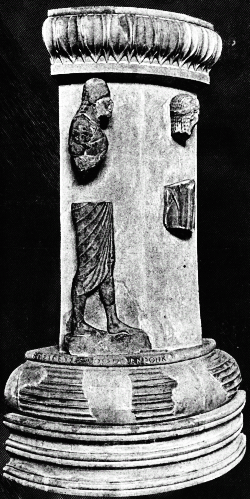
Sculptured Column From the Archaic Temple at Ephesus. No. 29
Plate II.
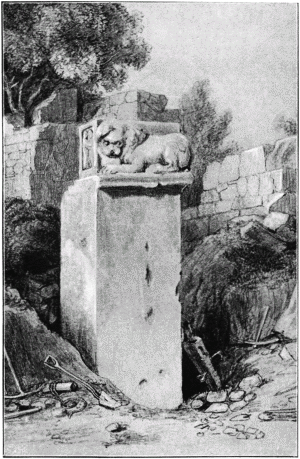
View of the Lion Tomb at Xanthos. No. 80.
(From a drawing by George Scharf.)
Plate III.
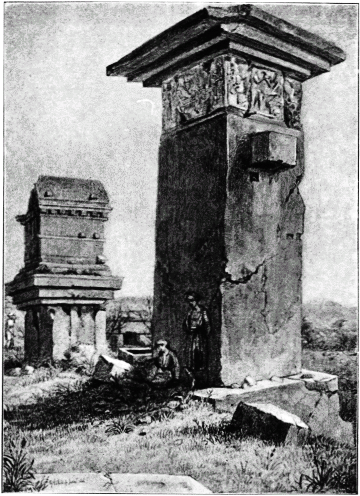
View of the Harpy Tomb at Xanthos. No. 94.
(From a drawing by George Scharf.)
Plate IV.
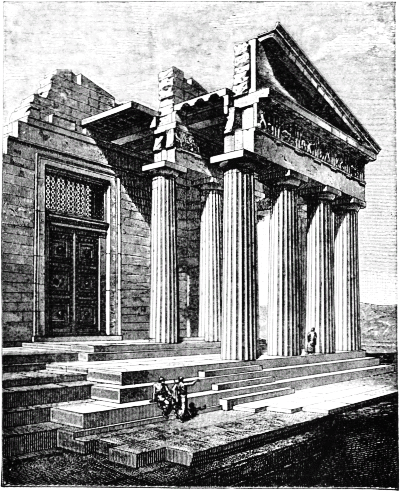
Sectional View of the East End of the Parthenon.,
(G. Niemann.)
Plate V.

Fig. 1. Carrey's Drawing of the East Pediment of the Parthenon.
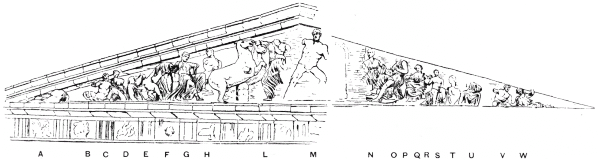
Fig. 2. Carrey's Drawing of the West Pediment of the Parthenon.
Plate VI.
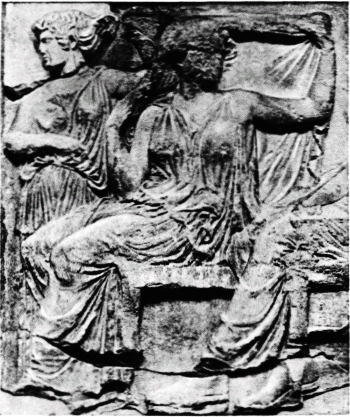
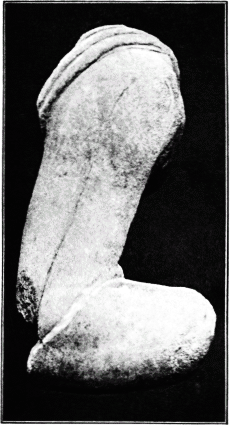
Fig. 1. Iris and Hera. East Frieze of Parthenon. Nos. 27, 28. Fig. 2. Arm. No. 330.
Plate VII.
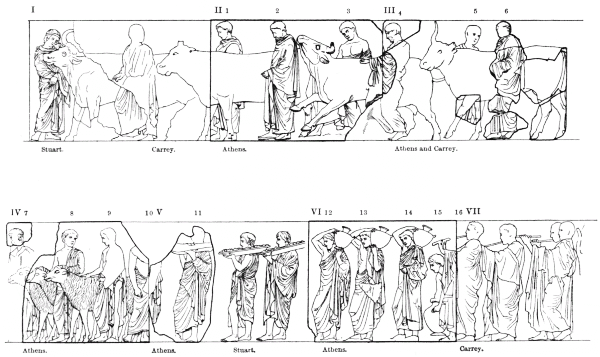
The North Frieze of the Parthenon (Slabs I.-VII.) Restored.
Plate VIII.
The North Frieze of the Parthenon (Slabs VII.-XIII.) Restored.
Plate IX.
Lusieri's Drawing of the Missing Group From the Monument of Lysicrates. No. 430, 5.
Plate X.
View of the Temple of Apollo at Phigaleia. (From a Photograph.)
Plate XI.
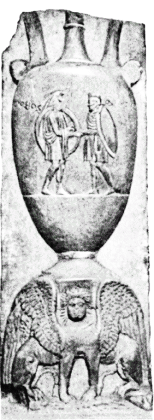
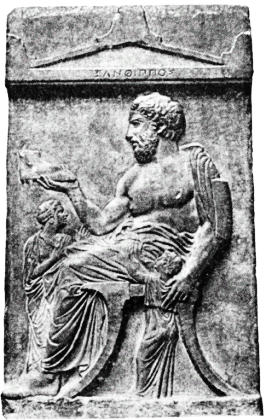
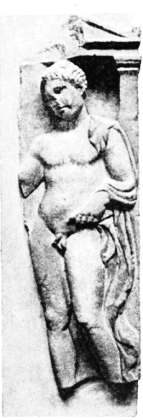
Fig. 1. Sepulchral Relief. No. 693. Fig. 2. Monument of Xanthippos. No. 628. Fig. 3. Sepulchral Relief. No. 627.
Plate XII.
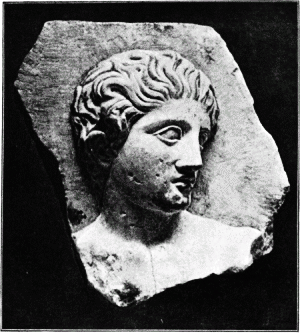
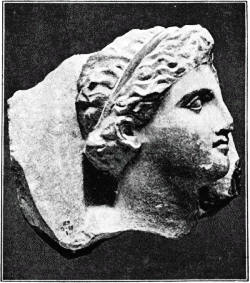
Fig. 1. Fragment of a Sepulchral Relief. No. 673. Fig. 2. Fragment of a Sepulchral Relief. No. 672.
Transcriber's Note A List of Illustrations has been added to the Book. Some illustrations have been moved to the ends of their descriptive paragraphs to allow for freer flow of the text. This may result in a changed page number in the List of Illustrations. (e.g., page 135 changed to page 136) There are some inconsistencies in the spelling of (foreign) proper names throughout the book. In each case, both forms have been retained. There were a few instances of the high dot, ·, or Greek colon, in the Greek text, which have been retained. Some parts of the Greek inscriptions are enclosed in brackets. This would appear to indicate restoration of indistinct or missing text. Journal numbers (X...; and x...; etc.) occur in both upper and lower case throughout book. Both forms have been retained. Pages 108 and 136: Fig. 9 was used twice in the original book, and both instances have been retained. The abbreviations 'C. I. A. (Corpus Inscriptionum Atticarum.) and C. I. G. (Corpus Inscriptionum Graecarum.) are spaced until page 297, and unspaced (C.I.A and C.I.G.) from page 304 until the end of the book. Both forms have been retained. Page 10: 'donotion' corrected to 'donation' - " ... have been acquired by donation or bequest," Page 11, Footnote 42: '214' corrected to '211'. Numbers '212', '213' and '214' do not exist. Thus, '211' is the number before '215'; and '211' fits the category of the other numbers in this footnote. "See Nos. 211, 643, 652, 667, 680, 693, 699, 726, 736." Page 46: 'Beechino' corrected to 'Beecheno' - "See also Solly, Memoirs of W. J. Müller, 1875; Beecheno," Page 64: 'real' corrected to 'reel' - "... but include bead and reel mouldings," Return to Top