Volume 1 / Part 1 — ARCHAIC PERIOD.
Reading edition

SCULPTURES FROM MYCENAE.
The sculptures contained in the first section of this catalogue are derived from the site of Mycenae, the first four being fragments of important works of architecture. There is great uncertainty as to the date and origin of the Mycenaean monuments. A theory frequently advanced supposes that they are remains of an old civilization whose centre was Argolis, and which was swept away by Dorian invaders. If this view is accepted, Nos. 1-6 are separated by a long interval of years, and by a time of great political change, from the remaining sculptures in this volume. From No. 7 onwards we have works produced during the historical period; but the remains of Mycenae acquire interest from the consideration that they may be authentic memorials of a dynasty only dimly remembered in the Homeric Poems.
1-4.Fragments of architecture from the building, commonly known as the 'Treasury of Atreus' at Mycenae. This building is a dome-covered tomb (tholos) of beehive shape, approached by a long passage (dromos). It is cut out from the side of a hill, and built of heavy masonry, covered with earth, so as to form a tumulus. It was partially excavated by Lord Elgin, and more completely in 1879 by the Greek Archæological Society. The fragments Nos. 1-4 are parts of an elaborately decorated doorway to the tomb. They have been incorporated in a somewhat fanciful restoration which was made by Donaldson, and which has been much modified by later investigators.
For plans and views, see Stuart, 2nd ed., IV. pls. 1-5 (with Donaldson's restoration). Dodwell, Pelasgic Remains, pls. 9, 10. Athenische Mittheilungen, IV., p. 177, pls. 11-13 (Thiersch); Mitchell, p. 143. Donaldson's restoration is based on an earlier attempt by Lord Elgin's artists, which is now among the Elgin drawings in the British Museum.
1.Fragment from the 'Treasury of Atreus' at Mycenae. The decoration consists of three bands of the wave pattern, separated by mouldings. Two of these bands are in low relief; the third is in high relief, with a hole bored in the centre of each spiral for the insertion of glass or metal ornaments. Among the tools employed by the artist, the chisel, saw, and the tubular drill, were plainly included. From the fact that the end of the fragment is cut at an acute angle, it is inferred that this fragment was placed above the doorway of the building, in contact with a relief of triangular form. It is also possible that it may have formed part of a triangular slab above the door. A piece of red marble, similarly decorated, which is now at Athens, exactly fits the apex of the triangular opening (Athenische Mittheilungen, iv., pl. 13, fig. 1, a.).—Elgin Coll.
Red marble. Height, 1 foot 4¼ inches; width, 3 feet 2¾ inches. Stuart, 2nd ed., IV., pl. 4, fig. 10; p. 32; cf. pl. 5; Dodwell, Tour, II., p. 232; Murray, I., p. 38; Wolters, No. 3.
2.Fragment from the 'Treasury of Atreus' at Mycenae. The decoration consists of a band of the wave pattern, and a band of lozenges in low relief, the bands being separated by mouldings of similar character to those of No. 1. The saw and chisel were used by the artist.
This slab, according to Donaldson, formed a part of the architrave, over the entrance to the building. According to Dodwell, it was 'found by the excavators of the Earl of Elgin, near the Treasury of Atreus.'—Elgin Coll.
Hard green limestone; height, 1 foot 6 inches; width, 3 feet 6 inches. Stuart, 2nd ed., IV., pl. 4, fig. 9; cf. pl. 5; Dodwell, Tour, II., p. 232; Murray, I., p. 39; Wolters, No. 2.
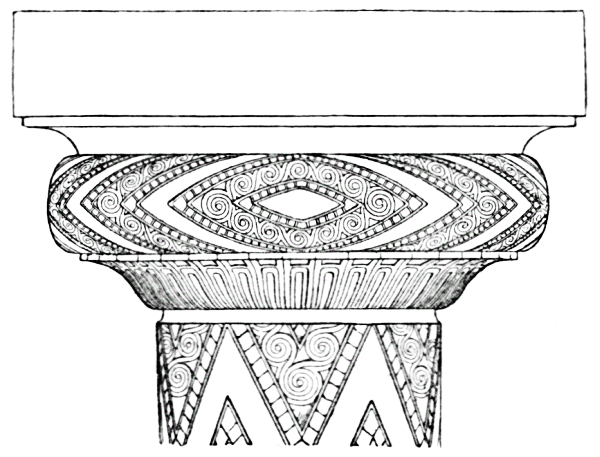
Fig. 1.—Restored Capital from the 'Treasury of Atreus' (after Puchstein).
3.Fragment from the 'Treasury of Atreus' at Mycenae. This fragment, which is decorated with a portion of a wave pattern enclosed by two mouldings meeting at an acute angle, is a part of one of the columns that flanked the entrance to the building. These columns were decorated with an elaborate system of ornament, composed of zigzag bands of the wave pattern, best understood on reference to drawings of the complete column (cf. fig. 1). The tubular drill has been used as in No. 1.—Presented by the Institute of British Architects, 1843.
Hard green limestone; height, 11 inches; width, 9 inches. For drawings of the restored column, with its capital (formerly taken for the base) compare Stuart, 2nd ed., IV., pl. 4, figs. 1-5, pl. 5. Dodwell, Tour, II., pl. facing p. 232; Murray, I., p. 40; Puchstein, Das Ionische Capitell, p. 50. For fragments of the capital, see Gell, Itinerary, pl. 7; Mitchell, p. 145, fig. 70.
4.Fragment from the 'Treasury of Atreus' at Mycenae. This is a part of the lower member of the capital of a pilaster flanking the great doorway (cf. fig. 1).—Presented by the Institute of British Architects, 1843.
Hard green limestone; height, 3½ inches; width, 10 inches. Puchstein, Das Ionische Capitell, p. 50.
5.Fragment of relief. Head and shoulder of rampant lion. From the shape of the fragment it appears to have been a part of a triangular relief filling the space above a doorway. (Compare No. 1 and the Gate of Lions at Mycenae.) The lion's paw is extended as if towards another lion confronting him. A pattern is drawn in fine lines on the shoulder. Behind the lion is a branch of laurel.
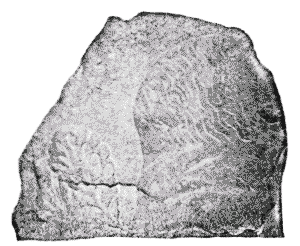
Fig. 2.—Relief from Mycenae (?), No. 5.
A part of this relief has been exposed to a corroding influence, which has acted uniformly on the surface, so that the design is sunk, but not obliterated.—Mycenae (?) Elgin Coll.
Limestone; height, 1 foot 10¼ inches; width, 2 feet 2 inches. Synopsis, No. 204 (158). Murray (2nd ed.), I., p. 61.
6.Fragment of relief. Forelegs and part of body of bull standing to left. A joint is worked in the stone, in front of the bull.—Mycenae (?) Elgin Coll.
Green limestone, closely resembling that of No. 5, but not identical with it. Both are composed principally of flakes of mica, which are, however, larger and more abundant in No. 6 than in No. 5. Height, 1 foot 4½ inches; width, 2 feet 5 inches. Synopsis, No. 224 (160).
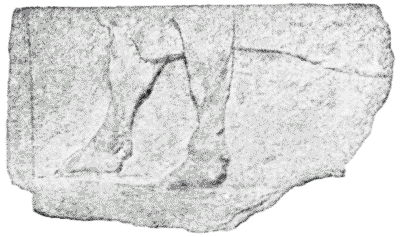
Fig. 3.—Relief from Mycenae, No. 6.
SCULPTURES FROM BRANCHIDAE.
The temple and oracle of Apollo at Didyma, near Miletus, in Asia Minor, were from time immemorial in the hands of the priestly clan of the Branchidae, whose name came to denote the place itself. This temple was destroyed by the Persians—probably by Darius on the suppression of the Ionian Revolt—about 495 b.c. (Herod. vi., 19. See, however, Strabo, xiv., p. 634; xi., p. 518.) After its destruction, the temple was not rebuilt till the time of Alexander. The temple was connected with the harbour Panormos by the Sacred Way. Along this the sculptures stood at intervals. They are dedicatory offerings made to Apollo, probably by the persons represented.
The following are the materials for fixing the period to which the sculptures of Branchidae must be assigned. It is certain that none of them are later than the destruction of the temple by the Persians, and the latest of them (No. 16) appears a generation earlier than the works associated with that period. On the other hand, there is no reason to place the oldest before the early part of the sixth century b.c. Thus these sculptures cover the period of (say) 580-520 b.c. On epigraphic grounds, the date may be more closely defined. It is believed that the older form for η ⊟ was changed to Η shortly before 550 b.c. By this criterion, Nos. 10, 17, belong to an older group, and No. 14 to a later group. An inscribed base now in the British Museum with the name of an artist, Terpsicles, also belongs to the older group (Roehl, I.G.A., 484). It has been suggested that Chares of Teichioussa (No. 14) was one of the local tyrants who were established after the destruction of the kingdom of Croesus (546 b.c.), and this agrees well with the epigraphical evidence.
The statues of Branchidae are of interest because they exhibit the process by which the grotesque coarseness of primitive work tends towards the stiff and formal refinement that marks the later stage of archaic art. The series in the British Museum breaks off before the second stage has been completely attained, but it can be well supplemented by a seated female figure from Miletus, now in the Louvre (Rayet et Thomas, Milet et le Golfe Latmique, pl. 21).
The sculptures of the Sacred Way were discovered by Chandler in 1765 (Antiqs. of Ionia, 1st ed., I. p. 46; Chandler, Travels in Asia Minor, 1775, p. 152). They were more accurately examined by Gell, and the second Dilettanti expedition in 1812 (Antiqs. of Ionia, 2nd ed., 1821, Part I., p. 29, vignette, and ch. III., pl. 1; Müller, Denkmaeler, I., pl. 9, fig. 33). A more accurate sketch was made by Ross (Arch. Zeit., 1850, pl. 13). Such of the sculptures as could be found in 1858 were removed by Sir C. Newton; Newton, II., p. 527. On the inscriptions see Kirchhoff, Studien, 4th ed., pp. 19, 25.
7.Female figure, seated on a chair, with her hand resting on her knees. The head is wanting, and the upper part of the body is much mutilated. The figure wears a long chiton, with sleeves, and a diploïdion. The feet of this figure (as of all the other figures) are bare. The drapery falls down in front of the legs in stiff conventional folds. The sleeve, however, of the chiton is worked in a more natural manner. There are remains of a key-pattern on the sides of the cushion of the chair.—Sacred Way, Branchidae.
Parian marble; height, 3 feet 9 inches. Mansell, No. 607.
8.Male figure, seated on a chair, with his hands resting on his knees. The head, shoulders, left forearm, and hand are wanting. The figure wears a long chiton with sleeves and a mantle. The lower part of the chiton is entirely conventional, but parts of the mantle, and the outlines of the arms are worked after nature. On the ends of the cushion there is a pattern of zigzag lines.—Sacred Way, Branchidae.
Parian marble; height, 3 feet 11¼ inches. Newton, II., p. 534; Mansell, No. 604 (left).
9.Female figure, seated on a chair with hands resting on her knees. The right hand is wanting, and also the toes and front of the base, which seem to have been attached separately. The figure wears a long chiton and a mantle, which passes over the back of the shoulders, under the right arm, and in both directions across the left shoulder. Neither garment has indications of fold, and the edges are conventionally treated. The face, as far as can be seen, was full and thick. The hair falls in pointed tresses, the undulations of which are indicated in a conventional manner. The right ear is finished with care. This chair has no cushion, the drapery of the figure being seen under the arms.—Sacred Way, Branchidae.
Parian marble; height, 5 feet 2 inches. Newton, I., pl. 75 (2nd from right); Rayet et Thomas, Milet et le Golfe Latmique, pl. 26 (right); Overbeck, Gr. Plast., 3rd ed., I., p. 94, fig. 11c; Wolters, No. 7.
10.Male figure, seated on a chair, with the right hand resting on the right knee, and the left hand beside the left thigh. The head, and the fingers of the left hand are wanting. The figure wears a chiton with sleeves, and a mantle, which passes round the body, under the right arm, and passes in both directions over the left shoulder, so as to hang down in folds over the knees. The ends of the cushion, the sleeves of the chiton, and a part of the chiton seen on the left knee, are decorated with the key pattern.
On the left arm of the chair is the inscription: Εὔδημός με ἐποίε(ι)ν —"Eudemos made me."—Sacred Way, Branchidae.
Parian marble; height, 5 feet 1 inch. Newton, I., pl. 75 (right); pl. 97, No. 71; II., p. 534; p. 783; Kirchhoff, Studien, 4th ed., p. 26; Roehl, I.G.A., 485; Roberts, Greek Epigraphy, p. 162.
11.Male figure, seated on a chair, with left hand on left knee, and right hand, with palm turned upwards, on right thigh. The head, right shoulder, and right hand are wanting. The figure wears a chiton with sleeves, and a mantle. The folds of the lower parts are entirely conventional, but those of the upper part of the chiton are indicated by delicate wavy grooves. The hair falls behind in tresses which are cut off square on the shoulders.—Sacred Way, Branchidae.
Parian marble; height, 4 feet 4 inches; Newton, I., pl. 74 (right); Mansell, Nos. 603 (left), 604 (right).
12.Male figure, seated on a chair, with left hand resting on left knee, and right hand, with palm turned upwards, by right knee. The head, shoulders, and breast, and the right hand are wanting. The figure wears a chiton with sleeves, and a mantle, which passes under the right arm, while the ends cross the left shoulder in contrary directions. The artist has attempted to render the fine folds of the upper part of the chiton.
The four legs of the chair are decorated with a design which appears to be developed from the lotus bud, and is seen on Assyrian reliefs. On the back of the top rail of the chair is the late inscription: Νίκη Γλαύκου, which is either "Nikè, daughter of Glaukos," or, perhaps, a formula of the Christian period, "Victory of Glaukos!"—Sacred Way, Branchidae.
Parian marble; height, 5 feet. Newton, I., pl. 97, No. 73; II., p. 531, fig. 2; p. 787; Kirchhoff, Studien, 4th ed., p. 20.
13.Male figure seated on a chair, with left hand resting on left knee, and right hand, with palm turned upwards, by the right thigh. The head and the right hand are wanting. The figure wears a chiton, and a mantle which passes round the body under the right arm, and passes in both directions over the left shoulder, so as to hang down in folds before the knees. The artist has attempted to render the fine folds of the upper part of the chiton, and has decorated the front legs of the chair as in No. 12. The statue has been broken and repaired in ancient times with lead cramps.—Sacred Way, Branchidae.
Marble; height, 4 feet 8 inches. Newton, pl. 75 (second from left); II., p. 531, fig. 1; Mansell, No. 605; Overbeck, Gr. Plast., 3rd ed., I., p. 94, fig. 11b.
14.Statue of Chares, a male figure, seated on a chair, with left hand resting on left knee, and right hand, with palm turned upwards, by the right thigh. The head and hands are wanting. The figure wears a chiton with sleeves and a mantle which passes under the right arm, while the ends pass in contrary directions over the left shoulder. The sleeves of the chiton are bordered with a key pattern, which is doubled along the seam.
On the right leg of the chair is the inscription:

Χάρης εἰμὶ ὁ Κλε(ί)σιος Τειχιο(ύ)σ(σ)ης ἀρχὸς . ἄγαλμα το(ῦ) Ἀπόλλωνος.
"I am Chares, son of Kleisis, ruler of Teichioussa. The statue is the property of Apollo."—Sacred Way, Branchidae.
Parian marble; height, 4 feet 10 inches. Newton, pl. 74 (left); pl. 97, No. 72; II., pp. 532, 784; Mansell, No. 614; Rayet et Thomas, Milet et le Golfe Latmique, pl. 25; Dieulafoy, L'Art Antique de la Perse, Part III., pl. 15; Wolters, No. 6; Kirchhoff, Studien, 4th ed., p. 19; Roehl, I.G.A., 488; Roberts, Greek Epigraphy, p. 163; Palaeographical Society, Facsimiles, I., No. 76.
15.Male figure, seated on a chair, with left hand on left knee, and right hand by right thigh. The head and right hand are wanting. The figure wears a chiton with sleeves and a mantle which passes under the right arm, while the ends cross the left shoulder in contrary directions. The fine folds of the upper part of the chiton are indicated.—Sacred Way, Branchidae.
Parian marble; height, 4 feet 2 inches.
16.Female figure, seated on a chair, with hands on her knees. The head and feet are wanting. The figure wears a sleeved chiton with a diploïdion and a veil. The sleeves terminate with long folds. The veil falls down over the shoulders, in numerous folds.
In attempting to indicate the legs with greater detail than his predecessors, the artist has rendered them as if they were nude; but in naturalness and freedom this statue is conspicuously the most advanced of the series.—Sacred Way, Branchidae.
Parian marble; height, 4 feet. Newton, pl. 75 (left); Mansell, No. 603 (right); Rayet et Thomas, Milet et le Golfe Latmique, pl. 26 (left); Overbeck, Gr. Plast., 3rd ed., I., p. 94, fig. 11a; Wolters, No. 7.
17.Lion, recumbent, with right fore-paw passing in front of the body, and with left paw laid over it. The hind quarters are half turned over, the animal lying on the right haunch. The head is wanting. The mane is rendered by stiff pointed locks of hair of conventional form. The pose, however, of the animal shows careful study of nature.
On the flank is the inscription:
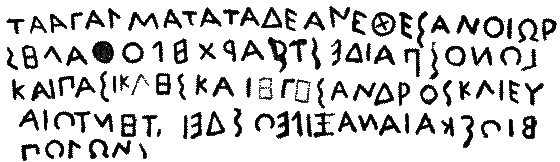
1. Τὰ ἀγάλματα τάδε ἀνέθεσαν οἱ Ὠρ- ίωνος παῖδες το(ῦ) ἀρχηγο(ῦ), Θαλῆς καὶ Πασικλῆς καὶ Ἡγήσανδρος κ[α]ὶ Εὔ- βιος καὶ Ἀναξίλεως, δε[κά]την τῷ Ἀ- 5. πόλ(λ)ωνι.
"The sons of Orion, the governor, Thales, Pasicles, Hegesander, Eubios and Anaxileos dedicated these statues as a tithe to Apollo."—Sacred Way, Branchidae.
Marble; height, 2 feet 6¼ inches; length, 7 feet. Newton, I., pl. 97, No. 66; II., p. 777; Kirchhoff, Studien, 4th ed., p. 26; Roehl, I.G.A., 483; Roberts, Greek Epigraphy, p. 161; Mansell, No. 615.
18.Sphinx or lion, recumbent. This figure has been called a Sphinx or a lion-sphinx. The distinguishing marks of a Greek Sphinx are wanting, as the head is lost, and the figure is wingless.—Sacred Way, Branchidae.
Marble; height, 4 feet 2 inches; length, 6 feet 11½ inches. Antiqs. of Ionia, 2nd ed., I., p. 29; Ross, Arch. Zeit., 1850, p. 132; Müller, Denkmaeler, I., pl. 9, No. 33; Newton, II., p. 535; Milchhoefer, Athenische Mittheilungen, IV., p. 50.
19.Beardless male head, from an archaic statue. The left shoulder is preserved. The hair falls in tresses, as in the case of No. 9.—Branchidae.
Marble; height, 1 foot 3 inches; Rayet et Thomas, Milet et le Golfe Latmique, pl. 27.
20.Female head (unfinished (?)) from an archaic statue. The figure wears a veil which covers the whole of the head, except the face. The ears are indicated beneath the veil.—Branchidae.
Marble; height, 9 inches.
21.Relief, with figures moving to the right, in a dance. It is incomplete at both ends, and appears to have been part of a frieze formed of several slabs. On the left are a woman and a man joining hands. On the right is a woman between two men; of the man on the right only the right leg is preserved. The right hand of the woman is seen behind, while her left hand is held by the man before her. The man on the left of this group has some object, perhaps a cup, in his right hand which is stretched out behind him. Between the two groups, and in the background, a woman rushes to the right, holding branches (?) in her raised hands.
The men are considerably larger than the women. The women wear a plain chiton, the men a chiton and mantle. All have bracelets, and long hair, which falls in a peculiar manner over the forehead; one wears a taenia, the remainder have stephanae. All the limbs are indicated under the draperies, even those of the figures in the background, which are seen through their own draperies and those of their companions.—Presented by J. Scott Tucker, Esq., R.N. Karakewi (Teichioussa), near Branchidae.
Marble; height, 1 foot 9 inches; width, 2 feet 11 inches. Rayet et Thomas, Milet et le Golfe Latmique, pl. 27; Brunn, Denkmaeler, No. 101 B.
SCULPTURES FROM LYDIA.
The following sculptures were found in 1882 by Mr. George Dennis, C.B., in one of the tumuli at Bin Tepè, near Sardes. Perrot (v., p. 904) suggests that they may have been part of a series of reliefs of a hunting scene, decorating the sepulchral chamber. The date is uncertain, but the reliefs may well be earlier than the fall of Croesus.
22.Relief. Three horsemen moving to the right. They wear large helmets and cuirasses, with shoulder plates, and carry spears.
The figures are cut in a narrow panel, and appear to have served an architectural purpose.—Bin Tepè, Sardes.
Marble; height, 7¼ inches; width, 1 foot 5 inches. Perrot and Chipiez, V., p. 903, fig. 535; Murray, Gr. Sculpt., 2nd ed., I., p. 107.
23.Relief. Three deer, moving to the right, grazing. From a panel nearly similar to the preceding.—Bin Tepè, Sardes.
Marble; height, 6¾ inches; width, 1 foot 4 inches. Perrot and Chipiez, V., p. 904, fig. 536; Murray, Gr. Sculpt., 2nd ed., I., p. 107.
SCULPTURES FROM EPHESUS.
The great temple of Artemis (or Diana), at Ephesus, which ranked among the seven wonders of the ancient world, was built in the middle of the 4th century b.c. It was, according to tradition, the latest of a long series of buildings. Not fewer than eight successive temples have been enumerated by Falkener (Ephesus, p. 214; cf. Pliny, H. N., xvi., 213). The excavations, however, have only produced the remains of two temples. The earlier of the two, which is here described, is probably that which was begun early in the sixth century b.c., by the architects Theodoros, Chersiphron and Metagenes, was in course of construction during the reign of Croesus (Brunn, Gr. Künstler, ii., p. 382), and was burnt by Herostratos on the night of Alexander's birth (356 b.c.). The later temple, the remains of which are exhibited in the Ephesus Room, was then built to replace that which had been burnt; and the excavations have proved the interesting fact that the most remarkable features of the later temple were borrowed from its predecessor.
The extant fragments of the early temple were found by the late Mr. J. T. Wood, in excavations which he carried on at Ephesus for the Trustees of the British Museum. These fragments had, for the most part, been used as building materials, and were extracted from certain massive piers which rested against the foundations of the walls of the temple cella. Mr. Wood assigned the piers to the Byzantine period, but only adduced evidence to show that they were later than the walls of the temple. It is therefore possible that they may have been added at an early period, to strengthen the foundations.
Wood, Ephesus, pp. 190, 259. For the reconstruction of the archaic temple, see Journ. of Hellen. Studies, X. (1889), p. 1 (A. S. Murray). The material is a finely-grained marble, with occasional strongly marked blue veins.
Architectural Fragments.
24.Part of a wall-stone from the archaic temple.
Length, 2 feet 7½ inches; width, 1 foot 8 inches.
25.Capital of Ionic column. Several fragments have been discovered, from which it is possible to reconstruct with tolerable certainty the capitals and necking of the columns of the archaic temple.
Journ. of Hellen. Studies, X., p. 8.
26.Fragment of volute from cap of column. The groove between two mouldings is filled with two strips of lead to which gold leaf is attached.
Length, 7 inches. Wood, Ephesus, p. 245; Journ. of Hellen. Studies, X., p. 9.
27.Fluted fragment of column. The drum to which this fragment belonged was 4 feet 3 inches in diameter, and had 40 flutings.
Height, 1 foot 10 inches; width, 3 feet 6 inches.
28.Fragment of the base of an unfinished column, with torus moulding and horizontal flutings only partially carried out.
Height, 1 foot 4 inches; width, 3 feet. Journ. of Hellen. Studies, X., p. 5, part of fig. 3b.
29.Base of sculptured column. The column has necessarily been reconstructed from various fragments, which cannot be proved to have belonged originally to the same column, but the combined fragments serve to give a general idea of the appearance of the column. (Plate I.)
1.The sculpture is surmounted by an egg and tongue moulding 11½ inches high, which is not shown in the plate, Journ. of Hellen. Studies, x., pl. 3. There are considerable remains of red paint.
2.Immediately below the sculptures is a moulding, which contains fragments inscribed as follows:
ΒΑ ΚΡ ΑΝ ΕΝ,
which have been restored as Βα[σιλεὺς] Κρ[οῖσος] ἀν[έθηκ]εν. 'King Croesus dedicated (the column).' It is known from a statement of Herodotus that Croesus gave most of the columns of the temple at Ephesus [Herod. i. 92, Κροίσῳ δὲ ἔστι καὶ ἄλλα ἀναθήματα ἐν τῇ Ἑλλάδι πολλά . . . ἐν δὲ Ἐφέσῳ αἵ τε βόες αἱ χρύσεαι καὶ τῶν κιόνων αἱ πολλαί]. It is probable that the columns were inscribed with dedicatory inscriptions, of which we here have fragments. The later temple had a similar series of inscriptions. The columns offered by Croesus must be earlier than the date of his fall, 546 b.c. The inscriptions are no doubt of the same age as the columns, and they may have been seen by Herodotus (Hicks, Greek Inscriptions in Brit. Mus., dxviii.).
3.Below the moulding is the restoration of an early Ionic base. (Journ. of Hellen. Studies, x., pl. 3, and p. 8).
The following fragments are inserted in the restoration of the sculptured base:—
4.Upper part of male figure in high relief standing to the right, wearing a close-fitting tunic, with sleeves to the elbows, and having a lion's skin about the body and with long hair. The upper part of the face is broken away. The right arm was bent at the elbow, and crossed the body.
Height, 2 feet. Journ. of Hellen. Studies, X., pl. 3.
5.Lower part of male figure in high relief standing to the right, wearing what appears to be a himation, falling to the knees.
Height, 3 feet 3 inches. Murray, I., p. 112; Journ. of Hellen. Studies, X., pl. 3.
6. Female head, to the right, in high relief. The hair is enclosed by a diadem, and falls down on the shoulders. A large circular earring in the right ear. There are considerable remains of dark red paint in the hair. The chin is broken away.
Height, 1 foot ½ inch. Murray, I., p. 111.
7. Middle part of a female figure, to the right, in high relief. The figure wears a tunic, tied with a narrow girdle, and a diploïdion which fell in long folds at the sides. A key-pattern was painted on the central fold of the dress.
Height, 1 foot 2 inches.
The following fragments from the bases of the columns, are not inserted in the restoration:—
30.Fragment, in high relief, of the head and shoulders of a figure, from the drum of a column. The front surface is broken away, but the figure appears to have looked to the front, with long hair falling on the shoulders, which are draped.
Height, 1 foot 3 inches.
31.Fragment, in high relief, of the right thigh of a draped figure, standing to the right.
Height, 1 foot 1½ inches. Worked above with a bed for another drum.
32.Middle part of a draped figure to the left in high relief. The figure wears a tunic with sleeves and himation. The left hand is pressed close to the thigh.
This fragment is similar in style to the sculptures on the columns, but must have come from a rectangular base, corresponding to the rectangular bases in the later temple.
Height, 1 foot 2 inches. Murray, I., p. 113.
33.Fragment of a head containing the middle of the face. A straight edge is worked along the left cheek.
Height, 8½ inches.
34.Fragment of the left side of a female head, wearing a band across the forehead, a veil, and a circular earring. Some red on the lips.
Height, 9½ inches.
35.Fragment of the upper part of a head, wearing a close-fitting veil, with curls between the veil and the forehead.
Height, 4 inches.
36.Fragment of the right side of a head, containing the cheek, ear, and a part of a veil which falls behind the ear.
Height, 8 inches.
37.Fragment of a head, containing the left ear, and wearing a veil; hair falls down at the back of the head.
Height, 6 inches.
38.Fragment of a head, similar to the last.
Height, 9½ inches.
39.Fragment of the left side of a head, turned to the left, and wearing a veil. It contains a part of the ear and eye.
Height, 6 inches.
40.Fragment from the top of a head, with hair.
Height, 6 inches.
41.Fragment from the right side of a head, with part of the neck, and hair falling down. The hair is coloured red.
Height, 3½ inches.
42.Fragment, from the right side of a head, containing the top of the ear and hair falling over it.
Height, 4 inches.
43.Fragment of drapery, terminating in zigzag folds.
Height, 7½ inches.
44.Fragment of drapery, with the bottom of several folds. It has an incised maeander, as in No. 29, 7, and a palmette ornament painted in red.
Height, 6 inches.
45.Fragment of the lower moulding of a sculptured base, with a left great toe to the right, and the remains of a rectangular object rising from the moulding.
Height, 6½ inches; width, 1 foot 6½ inches.
The Cornice of the Archaic Temple.
The restoration of the Sculptured Cornice, which has been built up from the small fragments excavated by Mr. Wood, is certainly accurate in its general outlines, although the result is quite unique in form. In place of the small cornice with floral decorations, common in later temples (compare the cornice from Phigaleia, No. 505), the archaic temple of Artemis was surmounted by a lofty cornice, 2 ft. 10¾ in. high. Lions' heads projected at intervals, and drained off the rain water. The intervals between the lions' heads were occupied by metope-like compositions, carved in a delicate early style.
The original frieze probably extended along the two long sides of the temple. The existing remains are small portions of at least thirty figures. It is therefore impossible to reconstruct the separate groups with much certainty, although the subjects can, to a certain extent, be conjectured. An attempted restoration of a combat between a Lapith and a Centaur is exhibited. The frieze also included chariots and horses; warriors in chariots, and on foot; and perhaps scenes with Harpies.
The central group on the cornice with the combat of a Centaur and Lapith is composed of the following fragments. See Journ. of Hellen. Studies, x., p. 2, for sketches of No. 46, 1-18.
46. 1.Fragment with the forelegs, which are human, and the hind hoof of a kneeling Centaur. In front the greaved left leg of a Lapith.
Height, 7 inches; width, 1 foot 7 inches. Journ. of Hellen. Studies, X., pl. 4, fig. 6.
2.Hand with branch, from top of cornice, presumed to be the hand of a Centaur.
Height, 4 inches; width, 5½ inches.
3.Part of branch, from top of cornice.
Height, 3 inches; width, 8 inches.
4.Back of head of Lapith, to left, with part of top moulding of cornice. Short curling hair.
Height, 5 inches; width, 6 inches.
5.Lower part of cuirass of Lapith worn over a short tunic.
Height, 3 inches; width, 8½ inches.
Two female figures are placed as spectators on each side of the combat. On the left the remains are:—
6.Part of a female head, turned to the right, and wearing a taenia.
Height, 4½ inches; width, 4½ inches.
7.Part of drapery of standing female figure.
Height, 4 inches; width, 6 inches.
8.Feet of standing female figure, wearing shoes, with slightly turned-up toes, and three bands across each shoe.
Height, 6 inches; width, 7½ inches.
The remains of the figure on the right of the group are:—
9.Upper part of female head to the left, wearing a diadem.
Height, 3 inches; width, 5 inches.
10.Part of middle of female figure, standing to the left, wearing chiton and himation. The left hand by the side.
Height, 3½ inches; width, 8½ inches.
The following fragments have also been inserted in the restored cornice:—
11.Head of youth, to the left, with short hair.
Height, 3 inches; width, 6 inches. Journ. of Hellen. Studies, X., pl. 4, fig. 1.
12.Upper part of female head, to the left. The chief mass of the hair is confined by a peaked cap, the ends passing out through the top. A part of the hair terminates in short curls round the forehead, and part falls down in front of the ears. A laurel wreath surrounds the cap.
Height, 4 inches; width, 6 inches. Journ. of Hellen. Studies, X., pl. 4, fig. 2.
13Right foot and part of skirt of female figure walking, to the right.
Height, 9 inches; width, 8 inches.
14.Right foot of a figure standing, to the left.
Height, 3 inches; width, 4½ inches.
15.Part of the back of the head and the shoulders of a figure standing with his back turned to the front. He wears a chiton, and the hair falls in curls on his shoulders.
Height, 5 inches; width, 5 inches. Journ. of Hellen. Studies, X., pl. 4, fig. 3.
16.Fragment containing the legs of a figure standing with back turned to the front, perhaps a part of the figure described in the last number. The right leg wears a greave. This fragment also contains the right thigh of a figure kneeling to the front.
Height, 10 inches; width, 1 foot 2 inches.
The restored part of the cornice also contains:—
17.Lion's head. The front and lower parts of the face are wanting.
Height, 10 inches; width, 1 foot 2 inches.
18.Lion's head. The front of the upper jaw is wanting. Red paint in the ears and the mouth.
Height, 1 foot 6 inches; width, 1 foot 7 inches.
The following are the principal fragments, from the cornice, not inserted in the restoration:—
Male Figures, turned to the Right.
47. 1.Parts of head and breast of figure, with helmet, tunic, and cuirass (?). Long hair falls over the shoulder.
Height, 7 inches; width, 7 inches. Journ. of Hellen. Studies, X., pl. 4, fig. 5.
2.Part of helmet, and top edge of cornice; also the fingers of the right hand of the figure, throwing a spear (?).
Height, 2½ inches; width, 6 inches.
3.Right shoulder, covered with shoulder plates.
Height, 4½ inches; width, 7 inches.
4.Left thigh, bent at knee; a corner of drapery falls on the thigh; wears greave.
Height, 6 inches; width, 7 inches.
5.Right knee of figure advancing to right; behind, the leg, wearing a greave, of a fallen warrior (?).
Height, 5½ inches; width, 5 inches.
6.Knees of a prostrate warrior, wearing greaves, trodden down by a horse's hoof.
Height, 3 inches; width, 7 inches.
7.Knee wearing greave, slightly bent.
Height, 4 inches; width, 3½ inches.
8.Left knee, partly covered with drapery.
Height, 3 inches; width, 3½ inches.
Male Figures to the Left.
9.Upper part of helmeted head with vizor raised.
Height, 3½ inches; width, 5½ inches.
10.Upper part of helmet, with projecting horn.
Height, 2½ inches; width, 5½ inches.
11.Back of neck and lower part of helmet.
Height, 2½ inches; width, 5 inches.
12.Hips of a draped male (?) figure.
Height, 4 inches; width, 8½ inches.
13.Right forearm of a figure lying prostrate, with head to the right and with the arm bent at the elbow.
Height, 4 inches; width, 8 inches.
14.Right leg, wearing greave, of a figure striding to the left.
Height, 5 inches; width, 9½ inches.
15.Right arm, extended, wearing a shield.
Height, 4 inches; width, 7 inches.
Figures with the Back turned to the Front.
16.Shoulders and upper part of back of a figure wearing a chiton.
Height, 5 inches; width, 8¼ inches.
17.Shoulders and upper part of back of a figure wearing a chiton across the right shoulder only.
Height, 3 inches; width, 8½ inches.
Female Figures to the Right.
18.Lower moulding of cornice, with the right foot and lower edge of the drapery of a figure moving to the right.
Height, 8 inches; width, 1 foot 3 inches.
19.Lower moulding of cornice with the left foot and part of the drapery of a figure moving to the right.
Height, 5 inches; width, 7½ inches.
Female Figure to the Front.
20.Part of the right arm, extended, and wearing a shield (?). A short sleeve reaches to the elbow, coming from beneath a shoulder plate.
Height, 4 inches; width, 8 inches.
Female Figures to the Left.
21.Fragment of a figure turned to the left, with fine delicate drapery (?).
Height, 3½ inches; width, 6 inches.
22.Left hand, beside the thigh, holding a fold of drapery.
Height, 3 inches; width, 9 inches.
23.Fragment of a draped figure, containing the legs between the knees and the ankles.
Height, 4 inches; width, 4 inches.
Fragments of Chariot Groups, and Horses.
24.Left knee and part of the left thigh of a figure stepping to the right into a chariot. The figure wore a short chiton, probably under a cuirass, and greaves. Part of the inside of the chariot is painted red.
Height, 4 inches; width, 9½ inches.
25.Fragment containing the hips of a male figure, stepping to the left into a chariot. The figure wears a chiton beneath a cuirass, and perhaps holds a spear.
Height, 4 inches; width, 7½ inches.
26.Right hand closed and holding a rein (?).
Height, 2 inches; width, 5½ inches.
27.Right arm of a youthful nude figure holding the reins of a horse standing to the left, whose head is half turned to the front.
Height, 7 inches; width, 1 foot 1 inch. Journ. of Hellen. Studies, X., pl. 4, fig. 4.
28.Part of a horse's head to the left, with ear and mane.
Height, 4 inches; width, 7½ inches.
29.Back of a horse to the left, with a narrow thong tied about it.
Height, 4½ inches; width, 7 inches.
30.Part of the hind legs of a horse to the left.
Height, 7½ inches; width, 6 inches.
31.Two hoofs, side by side, as of the horses in a biga.
Height, 4 inches; width, 5 inches.
32.Part of lower moulding of cornice, and of chariot wheel. The moulding and the wheel are painted red, and the ground of the relief bright blue.
Height, 10 inches; width, 1 foot 6 inches.
33.Part of a chariot wheel, and of the body of a chariot, painted red.
Height, 6 inches; width, 8 inches.
34.Left hand grasping the leg of a horse, or of a Centaur (?). The ground is blue and red.
Height, 4 inches; width, 6¼ inches.
35.Fragment of a horse's tail, and part of the body of a chariot (?).
Height, 3 inches; width, 3½ inches.
Figures of Harpies (?).
Certain fragments, which are not easily deciphered, appear to belong to groups of winged draped beings, perhaps Harpies, carrying off diminutive figures. The snakes in Nos. 36-38 suggest the aegis of Athenè; but if No. 38 is correctly interpreted, some Gorgon-like figure must be imagined.
36.Neck and chin of a figure to the left, having a large circular earring, and a fringe of snakes round the neck.
Height, 3½ inches; width, 8 inches.
37.Fragment with snakes.
Height, 1½ inches; width, 5 inches.
38.Left hand of the figure No. 36 holding a draped figure under the knees. The right arm must be supposed to have supported the smaller figure, near the shoulders. To the right is part of a pendent wing.
Height, 3 inches; width, 9 inches.
39.Fragment with extremities of hair, and the beginning of a large wing, curving upwards.
Height, 3½ inches; width, 5 inches.
40.Fragment, apparently of the same wing as No. 39.
Height, 3½ inches; width, 6 inches.
41.Fragment of draped thighs of a figure half kneeling to the left with the right leg foremost. If the figure above described was half kneeling in the usual early scheme for the Gorgon, this fragment may well have belonged to it.
Height, 4 inches; width, 6 inches.
42.Fragment, perhaps from the same figure as the last.
Height, 3 inches; width, 5 inches.
43.Fragment of a winged, long-haired figure (?). The hair falls in a mass on the tip of the wing.
Height, 7½ inches.
44.Fragment of a Harpy, with a large bird's leg protruding from fine drapery; behind, a part of a wing. Compare the Harpies on the Harpy Tomb, No. 94.
Height, 6½ inches; width, 10 inches.
45.Fragment, with the leg of a Harpy, to the right (?).
Height, 7 inches; width, 1 foot 3½ inches.
Miscellaneous Fragments.
46.Fragment of the lower moulding, and two legs of a pig or ox to the right.
Height, 7 inches; width, 1 foot 1 inch.
47.Part of the leg of a chair. Traces of blue paint.
Height, 6 inches; width, 4½ inches.
48.Part of the same leg of a chair as No. 47, and nearly joining it. Traces of blue paint.
Height, 5¾ inches; width, 3½ inches.
49.Part of the leg and seat of a chair.
Height, 5 inches; width, 5 inches.
50.Part of the front leg of the chair to which No. 47 belongs.
Height, 2¼ inches; width, 2 inches.
51.Unintelligible fragment, perhaps derived from the cornice.
Length, 1 foot; height, 6 inches; width, 7 inches.
Fragments of Lions' Heads, from the Cornice.
52.Left side of lion's mane, with remains showing the attachment to the cornice.
Height, 1 foot 3 inches.
53.Lion's head from the cornice(?). The mouth is closed. The lower part is wanting.
Height, 1 foot 4 inches.
54.Upper part of lion's head from the cornice. Red paint on the mane.
Height, 11 inches; width, 1 foot 5 inches.
55.Right side of lion's head, from the cornice, with eye, ear, and part of mane.
Height, 7½ inches.
OTHER FRAGMENTS FROM EPHESUS.
48. 1.Fragment of the head of an ox, apparently projecting from a background, in high relief. The head is seen in three-quarter face to the left.
Height, 1 foot; width, 1 foot 5 inches.
2.Fragment of the head of an ox, including the forehead and eyes. Apparently the head is seen in three-quarter face to the left, as in the preceding.
Height, 10½ inches; width, 1 foot 6 inches.
3.Fragment with part of the flank of an ox (?), springing from a square base. Two horns intertwined (?) in relief on the side of the fragment. If the explanation offered is correct, the animal must have been part of an architectural member, such as occurs in the temple of Hera at Samos (Stuart, 2nd ed., vol. iv., Kinnard on Delos, pl. v.), or in the recently discovered bull's-head capital from Salamis, in Cyprus (Journ. of Hellen. Studies, xii., p. 134).
Height, 1 foot 2½ inches.
SCULPTURES FROM CARIA.
49.A series of rude figures in stone and marble which are found in primitive graves in the islands of the Aegean, and in Caria, have been conjectured by archæologists to be works of the early Carians. The figures in question are for the most part utterly conventional and gross representations of the female form. Male figures have also been occasionally found, and more elaborate subjects, such as a seated figure playing on the harp.
The specimens in the British Museum are exhibited in the First Vase Room with the pottery found in the same deposits. They are described in the Guide to the First Vase Room (1883), p. 21, and in the Journ. of Hellen. Studies, v., p. 50. Compare Perrot and Chipiez, v., pp. 334, 905; Journ. of Hellen. Studies, ix., p. 82; Athenische Mittheilungen, xvi., p. 46.
50.Torso of female figure holding a dove between her breasts with the left hand, and holding with the right hand a fold of drapery by her right side. She wears a long dress, girt at the waist, with a diploïdion and sleeves. The head, and the legs from above the knees are wanting.—Theangela, in Caria.
Marble; height, 1 foot 3 inches.
51.Beardless male head, having a considerable resemblance to No. 19.—From the Temple of Apollo, Calymna.
Marble; height, 9 inches. Assigned by Collignon (Gaz. Arch., 1886, p. 239) to the same school as No. 205.
SCULPTURES FROM RHODES.
52.Female head. The hair is parted over the middle of the head, and is brought in waving ripples to the ears. At the back of the head it is sketched in conventional lines. The head is bound with a taenia.—Rhodes.
Marble; height, 8½ inches.
53.Female head broken off at the top of the neck. The hair is brought forward over each temple in a plait; a piece of linen is wound round the head, passing under a band or diadem which encircles the head behind the ear. The head-dress is arranged so as to leave on the top of the head an aperture, through which the parting of the hair and a top-knot are shown. Over the upper part of the ear hang what appear to be three pendants; the lobe below is covered with an earring in the form of a circular flower of seven leaves. On the fractured edge of the neck are remains of drapery.—Rhodes.
Limestone; height, 5 inches.
54.Female figure seated in a chair, with footstool.—Camiros.
Limestone; height, 4⅛ inches.
55.Naked male figure; the legs broken off above the knees. The palms of the hands are placed against the thighs; the left leg has been advanced; parts of the arms are wanting. The hair is drawn back from the forehead in a smooth mass, and falls behind the ears over the nape of the neck, where it is cut off square. There are traces of red above the waist.—Camiros.
Limestone; height, 10 inches.
56.Naked male figure standing with the left foot advanced, and holding with his right hand the right hind leg of a lion, whose tail he grasps with his left hand. The head of this figure, the right arm and both feet are wanting. From the waist to the hips the body has been painted red all round. The lion has his tongue out; there are traces of red colour about his mouth.—Acropolis of Camiros.
Limestone; height, 10¼ inches.
57.Fragment of a male figure from above the hips nearly to the knees. The arms have been placed along the sides, with a hand on each hip.—Camiros.
Limestone; height, 4¼ inches.
58.Upper part of a naked male figure broken off at the waist. The hair is gathered into a thick mass behind the ears, and cut off square at the nape of the neck; on the top of the head is a snake coiled. The arms are broken away below the shoulders.—Camiros.
Limestone; height, 5 inches.
59.Upper part of female figure broken off above the waist. She wears a wreath of upright leaves set between two plain horizontal bands; the hair falls in a thick mass on each side of the neck. The arms are broken away.—Camiros.
Limestone; height, 4¾ inches.
60.Draped male figure broken off below the knees. He wears chiton with girdle and upper garment. With both hands this figure holds the young of some quadruped, probably a kid, in front of his breast. His hair is parted over his forehead, and falls behind the ears in a thick mass to the nape of the neck.—Camiros.
Limestone; height, 5⅜ inches.
61.Upper part of male figure from the base of the neck to the waist. In the right hand this figure holds a small ibex against his breast. His left arm is broken.—Acropolis of Camiros.
Limestone; height, 41⁄5 inches.
62.Lower part of a draped figure broken off at the waist. The left hand holds by the forelegs a fawn, on the body of which the right hand presses. Both arms are broken off below the elbow.—Acropolis of Camiros.
Limestone; height, 7 inches.
63.Lower part of a draped figure broken off at the waist, and wearing a chiton, which is bound with a girdle.—Camiros.
Limestone; height, 1 foot.
64.Lower half of draped figure wearing chiton. At the bottom of the skirt are traces of a red border; the fingers of the left hand are placed against the left hip.—Camiros.
Limestone; height, 7½ inches.
65.Lower half of draped figure broken off above the knees. The left hand has held against the side some object too indistinct to be made out.—Camiros.
Limestone; height, 6 inches.
66.Lower half of draped figure broken off above the knees. In bad condition.
Limestone; height, 4⅛ inches.
67.Draped male figure playing on the double flute, which he holds with either hand. The band for strengthening the muscles used in blowing the flute, phorbeia, is indicated by a red stripe; the chiton is ornamented with a narrow red stripe on the shoulder down each side, and round the hem.—Camiros.
Limestone; height, 9 inches.
68.Similar draped male figure playing on the double flute. The phorbeia is indicated by a red stripe across the mouth; the headdress, probably a wig, comes very low on the forehead, and falls in a thick mass on the back of the neck. On the head-dress, eyebrows, and flutes, are traces of black colour.—Camiros.
Limestone; height, 7⅜ inches.
69.Upper part of draped male figure. In his right hand he holds a lotos sceptre (?); his left arm hangs down by his left side. A thick mass of hair falls on each side of the neck.—Camiros.
Limestone; height, 4½ inches.
70.Androsphinx seated on a plinth. On the head are the combined crowns of Upper and Lower Egypt; in front is a collar, or pectoral; on the crown are traces of red colour. This Sphinx is a pseudo-Egyptian work.—Acropolis of Camiros.
Limestone; height, 5 inches.
71.Androsphinx seated on a plinth. On the head are the crowns of Upper and Lower Egypt.—Acropolis of Camiros.
Limestone; height, 3½ inches.
72.Androsphinx seated on a plinth. From the head falls a mass of long hair over the back and shoulders; the front of the body is covered with a collar or pectoral; the upper part of the wings is broken off.—Acropolis of Camiros.
Limestone; height, 5 inches.
73.Lion seated on a plinth. The mouth is open; the teeth are shown; about the lips and edge of the mane are traces of red colour.—Camiros.
Limestone; height, 5¼ inches.
74.Bird standing on a plinth with wings closed. Head broken off; tail long and spreading.
Height, 3¼ inches.
75.The Egyptian ram-headed deity, Knef, seated in a chair. He wears a long chiton bound with a girdle, on each side of which a lappet falls as far as the knees; a thick mass of hair falls from behind each horn on to the breast.—Lindos, in Rhodes.
Limestone; height, 4 inches.
SCULPTURES FROM XANTHOS.
The following sculptures, Nos. 80-97, are the archaic portion of the collection of sculptures from Xanthos, a town some ten miles from the sea, in the south-west of Lycia. The people of Lycia were a non-Hellenic race, but the sculptures of Xanthos are distinctly Greek, though not without traces of oriental influence (cf. No. 86). In the most important remains, especially in the Harpy Tomb (No. 94) we find the characteristics of the Ionian School of Asia Minor.
The sculptures of Xanthos were discovered by Mr. (afterwards Sir) Charles Fellows in April, 1838. (Fellows, A Journal written during an excursion in Asia Minor, 1838.) The discoverer revisited Xanthos in 1840, made a more minute examination of the remains, and published a further account. (An Account of Discoveries in Lycia, being a Journal kept during a second excursion in Asia Minor, 1840-1841, quoted as "Lycia.") In consequence of this work, a naval expedition, assisted by Fellows, was employed in Jan., Feb., 1842, to ship the Marbles of Xanthos for transport to England. (Fellows, The Xanthian Marbles; their acquisition, and transmission to England, 1843. This was reprinted by Fellows in Travels and Researches in Asia Minor, more particularly in the Province of Lycia, 1852, pp. 423-456.) Additional sculptures and casts from Lycia were obtained by a second expedition in 1843. (Athenæum, 1844, pp. 176, 339, 715, 779.) Besides the published material, valuable information may be obtained from the plans and drawings by Mr. George Scharf, who accompanied Fellows as draughtsman in 1840. The originals are preserved in the British Museum, and referred to in this Catalogue as Scharf's Drawings. See also Solly, Memoirs of W. J. Müller, 1875; Beecheno, E. T. Daniell, a Memoir, 1889, p. 40; and the publication of the Austrian expedition to Lycia, Reisen in Lykien, vol. I. ed. by Benndorf and Niemann, 1884; vol. II. by Petersen and von Luschan, 1889.
80.Sepulchral chest (soros), adorned with reliefs on the four sides. This tomb was made of a single block of hard coarse limestone. It was found by Fellows in its original position, on a stelè, which appears to have been about 9 feet high. On the top of the chest there is a rebate to receive the lid, which formed a separate block and has not been found. The lower part of the block was sawn off by Fellows, to facilitate transport. (Xanthian Marbles, p. 34.)
Perrot (vol. v., p. 396) is perhaps right in thinking that this is the oldest of the Xanthian monuments, and represents Lycian sculpture before the Ionian influence had begun to make itself felt.
The appearance of the monument as found is shown in Scharf's drawing, here reproduced (pl. ii.), and also in a water-colour drawing by W. J. Müller, now in the Print Room of the British Museum. Solly, Memoir of W. J. Müller, pl. facing p. 216; Fellows, Asia Minor, p. 168.
1.South Side.—Lion to the left, recumbent, in high relief. Between the paws of the lion is seen the head of a bull, which has been thrown over by the lion, and is seized by the throat. Below the forepaws of the lion is a tablet, which seems to have traces of an inscription.
Height, 3 feet 1½ inches; length, 4 feet; height of relief, 10 inches. Fellows, Lycia, pl. facing p. 176 (very poor); Prachov, pl. 1, fig. 1; Perrot and Chipiez, V., p. 392, fig. 277; p. 395, fig. 280; Dieulafoy, L'Art. Ant. de la Perse, III., pl. 16.
2.East Side.—Frieze in low relief, with its right end broken away. A horseman wearing helmet and cloak rides to the right. He is followed by an attendant, wearing a short chiton, and carrying a spear on his right shoulder. Behind, a warrior moves to the left, wearing a helmet with a large crest, a shield, and spear. On the left, a shield, supposed to be fastened on a wall. This relief, with its flat surface, devoid of detail, was probably painted.
Height, 1 foot 6½ inches; length, 3 feet 3 inches; height of relief, ½ inch. Fellows, Lycia, pl. facing p. 176 (very inaccurate); Perrot and Chipiez, V., p. 394, fig. 279.
3.North Side.—Lioness, in high relief, recumbent to right, playing with cubs. A cub is seen, with its forepaws across the paws of the lioness, and with its hind quarters to the right; a second cub lies on its back, over the first. The lower part of the relief is broken away.
Height, 2 feet 4 inches; length, 3 feet 6 inches; height of relief, 6 inches. Perrot and Chipiez, V., p. 391, fig. 276.
4.West Side.—This side seems to have contained two separate entrances to the tomb. On right and left were two groups in low relief. (A.) On the right, a man, nude, with long hair, and armed with sword, contending with a lion.
Height, 1 foot 10 inches; length, 1 foot 6 inches; height of relief, ¾ inch.
(B.) On the left a draped figure seated in a chair; left side alone remains.
Height, 1 foot 7 inches; height of relief, ¾ inch. Fellows, Lycia, pl. facing p. 176; Prachov, pl. 1, fig. 1; Perrot and Chipiez, V., p. 392, fig. 277; p. 393, fig. 278; Dieulafoy, L'Art Ant. de la Perse, III., pl. 16.
81.Frieze of Satyrs and animals, found by Fellows, built into the walls of the Acropolis at Xanthos.
Beginning from the left, the slabs of the frieze contain:
1, 2.Bearded Satyr in combat with a wild boar. The Satyr, who has pointed ears and tail, makes a thrust at the boar with a branch torn off a tree. The strange attitude of the Satyr is due to the artist's difficulty in dealing with the shape of the slab. Slab 1 has been much injured by dripping water. The two slabs are proved to be connected by the bough which is seen on both.
Prachov, pl. vi. a, a; vi. b, c; Wolters, Nos. 146, 145; Fellows, Lycia, pl. facing p. 174; Brunn, Denkmaeler, No. 104.
3.Lioness, couching for a spring, but with right paw raised.
Prachov, pl. vi. a, e.
4.Lion devouring deer. This group is of an established conventional form.
Fellows, Lycia, pl. facing p. 174; Wolters, No. 148; Prachov, pl. vi. b, d.; Dieulafoy, L'Art Ant. de la Perse, III., pl. 16; Brunn, Denkmaeler, No. 104.
5.Lynx to left, with right paw raised.
Prachov, pl. vi. a, b.; Wolters, No. 147.
6, 7.Bull contending with Satyr, who appears to be in a position similar to Satyr on slab 1; but a joint cuts off the right leg, and the left arm is wanting.
Prachov, pl. vi. a, f; vi. b, g. Coarse limestone. The height of the frieze is 2 feet 6¾ inches; the lengths of the slabs are: (1) 4 feet 9 inches; (2) 6 feet; (3) 5 feet 9 inches; (4) 5 feet 1½ inches; (5) 4 feet 11 inches; (6) 4 feet 9½ inches; (7) 3 feet 1 inch.
82.1-8. Frieze of cocks and hens. Six cocks and five hens represented as standing still, picking up food, or fighting. The work is carefully studied from nature.—Built into the walls of the Acropolis at Xanthos.
Coarse limestone; height, 1 foot 4½ inches; combined length of eight slabs, 28 feet 8 inches; Fellows, Lycia, pl. facing p. 174 (two slabs); Wolters, Nos. 136-144; Brunn, Denkmaeler, No. 103.
83.Part of a tomb (?). From each of two opposite sides, the head and forepaws of a lioness project. The heads are slightly turned towards the front.—Found at the foot of the Inscribed Monument, Xanthos.
Limestone; height, 1 foot 5 inches; length, 4 feet 1¾ inches. Fellows, Lycia, pl. facing p. 174.
84.Head and neck of a lion, from a tomb (?). Several pieces of the mane were separately worked and attached.—Xanthos.
Limestone; height, 1 foot 10 inches.
85.Fragment of unfinished relief, with two legs of a seat or couch (?).—Xanthos.
Limestone; height, 2 feet 4 inches. Compare Perrot and Chipiez, V., p. 304, fig. 211.
86.A frieze representing a procession moving from left to right. The figures beginning from the right are:—
1.An old man, seated in a car, driving two horses. Behind him stood an attendant, of whose figure a piece of drapery on the next slab alone remains.
2.A youth, leading a horse, saddled and bridled. He wears a short chiton, and carries a whip. Details of the hair were probably indicated with paint.
3, 4.A venerable old man, seated in a chair, placed in a war chariot drawn by two horses. He has long hair, bound with a taenia, and a long pointed beard. He wears a chiton with sleeves, and a mantle. He holds a pomegranate flower in his left hand, and a cup (?) in his right hand. Beside him is a charioteer treated like the youth of the preceding group. The reins, now lost, were made of bronze.
Youth riding a spirited horse, equipped like the horse of the second group. The rider wears a chiton with short sleeves, and a himation. He has long hair falling on the shoulders.
5.A group of draped persons moving to right, and composed of the following figures:—
Man (much mutilated) standing to right and turning to front. He holds a whisk in the right hand, and a spear in the left hand.
Man, carrying a spear over the left shoulder, supporting it with both hands clasped.
Man moving to right but looking back. He carries a spear on the left shoulder; right hand holds a fold of the drapery.
Man with spear on left shoulder and whisk in right hand.
Man with spear on right shoulder; left hand holds an edge of the himation.
Man with spear on left shoulder. The front part only of this figure is preserved.
The standing figures all wear a long chiton, with long sleeves, and a himation which is wrapped closely about the body, passing under the right arm and over the left shoulder.
The size and treatment of the horses on the frieze, and the use of whisks by the standing figures, show Oriental influences, although the artistic style is distinctly Greek. The upright crest on the head of the horse in the fourth group is seen on the horses of Persepolitan sculpture. Compare the Persepolitan casts in the British Museum, assigned to 500 b.c., and Fellows, Lycia, p. 173. The ends of the horses' tails are also tied with ribbon in the same way as here. Saddle-cloths occur on early vases from Daphnae (Petrie, Nebesheh and Defenneh, pl. 29, fig. 4), and on painted sarcophagi from Clazomenae (Journ. of Hellen. Studies, iv., p. 19, fig. 14).
The traces of Persian fashion make it probable that this relief is later than the Persian conquest of Xanthos by Harpagos (about 545 b.c.).
The architectural disposition of the frieze has not been ascertained. The slabs were found by Fellows, inserted in a wall of late date on the Acropolis of Xanthos (Benndorf, Reisen in Lykien, i., p. 86), but it is clear from the square holes that occur at intervals of 4 ft. 8 in., that stone beams, imitating wood construction, must once have projected, and from the raised border round the holes it is seen that this was the intention of the artist. It is probable that the frieze belonged to a tomb, and perhaps represented a funeral procession. It is not possible to say whether it was on the outside or on the inside of the building. (Compare Nos. 87, 88, and the tomb of Giöl-Baschi. Compare also the casts of reliefs from Pinara, Nos. 761-4, for the projecting beam ends.)—Acropolis of Xanthos.
A similar procession occurs on a sarcophagus from Amathus. (Cesnola, Cyprus, pl. 14.)
Height, 2 feet 9½ inches; combined length of five slabs, 17 feet 4 inches; height of relief, 2 feet 5 inches; but in parts, upper margin is cut into. Fellows, Lycia, pls. facing pp. 173, 177; Prachov, pl. 3; Cesnola, Cyprus, pls. 16, 17; Murray, I., pls. 4-6; Wolters, Nos. 131-134; Wolters in Jahrbuch des Arch. Inst., I., p. 84; Brunn, Denkmaeler, No. 102.
87.Slab from the left end of a frieze. A woman stands near the foot of a couch upon which a dead man is laid out. Only the end of the couch and the left foot of the corpse remain. The woman wears a long chiton, himation, cap with tassel, and earrings. Behind her stands a male attendant, wearing a short chiton, drawn up, beneath a girdle. He holds a small piece of drapery in his left hand.
A groove to the left of the group seems to show that this slab was at an interior angle of a building. The different dimensions make it unlikely that it was a part of the same frieze as No. 86.—Xanthos.
Limestone; height, 2 feet 9½ inches; length, 2 feet 7 inches. Prachov, pl. 1, fig. 2; Murray, I., pl. 6; Wolters, 135; Wolters in Jahrbuch des Arch. Inst., I. p. 83.
88.Slab from the left end of a frieze. A woman wearing a long chiton with sleeves and a himation stands to right with right hand raised, and holding a flower(?). She holds a piece of drapery in left hand. Before her, the remains of another figure.
At the left of this figure is a groove, suggesting that this was an interior angle stone.—Xanthos.
Limestone; height, 2 feet 9 inches; length, 3 feet 6 inches. Prachov, pl. 6 b. h; Wolters, Jahrbuch des Arch. Inst., I., p. 83.
89, 90.Gable end of a tomb. On each side of a doorway is a seated Sphinx, and above the lintel are two lions.—Xanthos.
89.The Sphinx on the left wears a cap enclosing most of the hair, a pendant earring, and a narrow taenia. There are traces of red paint on the cap, and of the markings of feathers on the wings. The head and fore-quarters of the lion are wanting.
Limestone; height, 3 feet 9 inches; width, 3 feet 1 inch. About 3 inches appear to be wanting on the right of the slab. Prachov, pl. 5, fig. 1 (the head only of the Sphinx); Dieulafoy, L'Art Ant. de la Perse, II., pl. 18, fig. 2; Brunn, Denkmaeler, No. 101a.
90.The Sphinx on the right of the doorway has her hair confined by a broad band, and has a pendant earring. The markings of the feathers may be seen on the wings. When first discovered in 1840, this relief was brilliantly coloured, as is recorded in a drawing by Scharf. The ground of the relief was bright blue; the feathers were red, black, blue, and white. The hair was yellow, and the taenia was painted with a white pattern on a red ground. The head and fore-quarters of the lion are wanting.
Limestone; height, 3 feet 4½ inches; width, 3 feet 4 inches. About 3 inches appear to be wanting on the left of the slab. Prachov, pl. 5, fig. 2; Museum of Class. Antiq., I., p. 251; Dieulafoy, L'Art Ant. de la Perse, II., pl. 18, fig. 2; Brunn, Denkmaeler, No. 101a.
91, 92.Gable end of a tomb. On each side of a doorway is a seated Sphinx. Above the lintel of the door is a space which may have held a relief, now wanting.—Xanthos.
91.The Sphinx on the left wears a stephanè; a tress of hair falls on the shoulder. There are faint traces of paint on the wing. The hind-quarters are missing.
Limestone; height, 2 feet 10 inches; width, 2 feet 2 inches. The joint of the stone is at the left side of the door. Prachov, pl. 4, fig. 2.
92.The Sphinx on the right has her hair bound with a narrow taenia. There are traces of paint on the wing. The hind-quarters are wanting.
Limestone; height, 2 feet 8 inches; width, 3 feet 1 inch. About 3 inches are lost from the left of this slab. Prachov, pl. 4, fig. 1 (the head only).
93.Gable end of a tomb. In the centre of the relief is a low column, with an Ionic capital, of peculiar form. A Siren stands to the front, on the column. She wears a short chiton, girt at the waist and with loose sleeves. She has spreading wings and tail, and bird's legs, but human arms which are extended in front of the wings. The head is wanting.
On each side of the column is a seated male figure. On the left is a beardless elderly man, wearing himation and chiton, with staff in left hand and right hand extended. On the right is a bearded old man, wearing chiton and himation, with staff in right hand and left hand extended. The back of the head is in part broken away; part was never represented. The lower part of the relief is wanting. A drawing by Scharf shows the colouring of the relief when discovered. The background was blue; the hair, the under side of the Siren's wings, the drapery of the man on the left, the shaft and part of the capital of the column were yellow; the drapery of the Siren and of the man on the right, the seats and part of the capital of the column were red.—Xanthos.
Limestone; height, 2 feet 9 inches; width, 3 feet 5 inches. Annali dell' Inst., 1844, p. 150.
The Harpy Tomb.
94.The monument known as the Harpy Tomb was discovered by Fellows among the ruins of Xanthos on April 19, 1838. It was more carefully examined and published by him in 1840 (Lycia, p. 170, and plate), and was brought to England in the spring of 1842. The tomb was described by Fellows in the following terms:—"The Harpy Tomb consisted of a square shaft in one block, weighing about eighty tons, its height seventeen feet, placed upon a base rising on one side six feet from the ground, on the other but little above the present level of the earth. Around the sides of the top of the shaft were ranged the bas-reliefs in white marble about three feet three inches high; upon these rested a capstone, apparently a series of stones, one projecting over the other; but these are cut in one block, probably fifteen to twenty tons in weight. Within the top of the shaft was hollowed out a chamber, which, with the bas-relief sides was seven feet six inches high, and seven feet square." (Fellows, Xanthian Marbles, p. 21; Asia Minor, p. 438.) For views of this tomb see the drawing by Scharf here reproduced (pl. iii.); also Mon. dell' Inst., iv., pl. 2; Benndorf, Reisen in Lykien, i., pl. 26. In Christian times, the tomb was made the cell of some Stylites, or dweller on a column. Traces of painting and monograms were found on the interior of the chamber. (Fellows, Xanthian Marbles, p. 21; Birch, Archæologia, xxx., p. 186.)
1.West Side.—This relief is divided into two unequal parts by a small doorway which formed the entrance to the tomb. This doorway may have been filled up with a slab of stone, resembling a funeral stelè, and the idea thus suggested was further carried out by the sculpture above of a cow giving suck to a calf. (Compare the tomb on the second frieze of the Xanthian Nereid Monument, Mon. dell' Inst., x., pl. 16, fig. 161.)
On the left of the entrance is an enthroned female figure. She is large and dignified, and is heavily draped. The left hand is raised, the right hand is extended and holds a bowl; she is adorned with stephanè and bracelets. The arm of the chair terminates in a ram's head, and is supported by a seated Sphinx. On the right is a second enthroned female figure of equal dignity. She is adorned with a stephanè and bracelets. With a graceful, if affected gesture of the right hand she holds up a pomegranate flower, and in the left hand she holds a pomegranate fruit. The back of the throne terminates in a swan's head, and the arm terminates in the head of a ram.
Three maidens, who are nearly alike, except in the attitudes of the hands, approach this figure. The first raises her mantle and chiton with the left and right hands respectively. The second has a pomegranate flower in her left hand, and a pomegranate fruit in her right hand. The third holds up an egg with her right hand, and holds the drapery in her left hand.
2.North Side.—An old man, draped and bearded, is seated on a chair to left; with the left hand he holds a spear, with the right hand he receives a crested helmet which is offered to him by a young warrior, who stands before him. The warrior has a short chiton, and leather cuirass, sheathed sword, greaves, and a large shield, which he supports with the left hand. Beneath the chair is a small bear.
At each side of this group, but disconnected from it, are figures commonly known as Harpies. They are represented as beings with the head, breasts and arms of maidens, while the lower part of the body is that of a bird conventionally rendered. It terminates in oval form with a spreading tail and bird's talons attached. Long wings spring from behind the shoulders and under the arms. Each creature wears a stephanè and chiton (see below). In their arms and talons each gently carries a diminutive draped female figure, that makes a gesture, as of affection.
At the right corner of the relief a draped figure crouches on the ground in an attitude of deep grief, and looks up to the flying figure above.
3.East Side.—A venerable bearded man is seated on a throne, to the right. He has a sceptre in the left hand, and holds up a flower in the right hand. The arm of the throne is supported by a Triton. Before him is a diminutive figure of a boy offering a cock.
Behind the enthroned figure are two draped male figures, standing to right. The first holds a pomegranate fruit in the left hand, and a doubtful object in the right hand. The second, who is bearded, holds a portion of his drapery with the left hand; with his right hand he holds his beard.
On the right of the relief is a youth, accompanied by a dog. He holds a stick with curved handle in his left hand, and has an uncertain object in his right hand. Part of it was made of metal, attached by a rivet. It may perhaps have been a kylix with a tall stem.
4.South Side.—A male figure, not bearded, is seated on a throne to right. He has a sceptre resting on his right shoulder. In the left hand he holds a pomegranate fruit, and in the right hand an apple. Before him stands a male (?) figure, holding a dove in the left hand by the wings, and having the right hand raised in a gesture of adoration. On each side of the main group, but disconnected from it, are the winged figures with their burdens as already described. With certain differences of detail, chiefly in the positions of the arms of the figures carried, these groups are nearly similar to those of the north side.
Drapery, &c.—All the figures on this tomb, except the "Harpies," the diminutive figures connected with them, and the warrior, are draped in chiton, and himation or peplos. The figures borne by the "Harpies" and the figure crouching in grief wear long chitons only. The "Harpies" wear chitons, of which the sleeves alone are indicated. All the principal figures wear shoes or sandals, so far as the feet are preserved, with the exception of the second figure behind the throne on the east side. The women on the west side, and the seated figure on the south side wear shoes with pointed toes. The remaining figures wear sandals only. All the figures on the east side had metal taeniae or stephanae, the holes for the attachment of the metal being still visible. The youth on the east side, as already stated, held a metal object in his hand.
Colouring.—The following indications of colour can be traced. The ground of the reliefs was bright blue. Part of the colour remains round the profile of the youth on the east side, and under the right wrist of the first figure behind the throne on this side. Birch (Archæologia, xxx., p. 192) states that he has seen scarlet on the crest of the helmet, and Scharf (Mus. of Class. Antiq., i., p. 252) that there were "traces of red in the hollow of the shields and upon sandals." Elsewhere the colour must be inferred from the inequalities of the surface of the marble, due to the unequal protecting powers of the different colours. There was an egg and tongue pattern on the lower moulding, and a maeander pattern on parts of the upper moulding. On the west side the chair of the figure on the right was painted with palmette ornament. On the east side there was also a palmette pattern on the side of the throne.
Interpretations.—The interpretations of this monument, that have been proposed, may be divided into three groups—
(1.) According to the first commentators, the subject represented was the rape of the daughters of Pandareos, king of Lycia, by the Harpies (Homer, Od. xx., l. 66. Gibson, in Fellows, Lycia, p. 171; Birch, Archæologia, xxx., p. 185.) The objections to this view are that the subject is an improbable one for representation on a tomb, that the "Harpies" evidently stand in a kindly relation towards the persons whom they carry, and that the reliefs do not agree well with the literary form of the myth. It is also doubtful whether the "Harpies" were imagined with bird-bodies at the period of these sculptures. (Furtwaengler, Arch. Zeit., 1882, p. 204.)
(2.) In the second group of theories, the enthroned figures are deities of the lower world to whom the souls of the dead pay reverence. On the west side are Demeter (left), and Persephonè (right), and three worshippers who carry symbols of life and birth, as the egg and the pomegranate. The door of the tomb signifies death, while the cow and calf, immediately above, suggest the renewal of life. The three seated figures remaining, are, according to this system, either Zeus (south), Poseidon (east), and Hades (north), (Braun, Annali dell' Inst., 1844, p. 151), or Zeus viewed under a triple aspect (Curtius, Arch. Zeit., 1855, p. 10). The symbolic system has been most elaborately worked out by Curtius (loc. cit., and Arch. Zeit., 1869, p. 10). Thus he regards the "Harpies'" bodies as intended for eggs, and so symbolical of life. This view is untenable, as the bodies are of the form usually given to birds in early art (Conze, Arch. Zeit., 1869, p. 78).
(3.) In the third and most recent group of theories, the seated figures are not deities, but heroified personages, buried in the tomb, to whom offerings are made by members of their family. (Milchhoefer, Arch. Zeit., 1881, p. 53; Wolters, p. 75.) This view is supported by analogies found elsewhere (cf. p. 299), while it avoids the difficulty of supposing deities to be represented on a tomb. But no parallel has been adduced for such a scene as a young warrior giving his arms to the figure of an heroified ancestor; moreover the dignity and adornments of the enthroned figures seem most appropriate to deities.
On the whole it seems best to suppose that we have on this tomb scenes connected with death, though we cannot attempt, for want of knowledge of Lycian mythology, to assign names to the personages represented. Maidens make offerings to female deities, and men to male deities. On the east side a boy makes an offering, on the north side a young warrior gives up his armour, and on the south side a man offers a bird. Kindly winged beings bear away the souls of the dead, and the crouching figure on the north side suggests the grief of the survivors. (Cf. Brunn, Sitzungsber. d. k. bayer. Akad. Phil. hist. Cl., 1872, p. 523, who points out the succession of ages among the figures, but does not consider the idea of death to be implied in the central groups of the north, east, and south sides.)
Style and Period.—In the Harpy Tomb we have a fine example of the work by the Ionian School of Asia Minor, whose chief characteristic is a certain voluptuous fulness of form, and languor of expression, contrasted with the muscular vigour of the Doric sculpture, and the delicate refinement characteristic of a part of the early Attic work (cf. Brunn, loc. cit., p. 205, and Rayet, Monuments, No. 13). It is uncertain whether the tomb is later than the Persian conquest of Xanthos (545 b.c.). It has a remarkable resemblance to the tomb of Cyrus at Pasargadae as described by Arrian (vi., 29) and Strabo (xv., 3, 7), although the force of the parallel is rather diminished if Fergusson (Nineveh and Persepolis, p. 215) has correctly identified the tomb. The Harpy reliefs are usually assigned to the close of the sixth century; but a comparison with the sculptures of Ephesus points to a date nearer 550 b.c.
The Harpy tomb is of marble. The reliefs measure 3 feet 4½ inches in height; 8 feet 2 inches in length on the east and west sides; 7 feet 6 inches on the north and south sides. Fellows, Lycia, p. 170, and pl.; Birch, Archæologia, XXX., p. 185; Braun, Annali dell' Inst., 1844, p. 133; Mon. dell' Inst., IV., pl. 3; Rhein. Mus., N.F., III., 1845, p. 481; Curtius, Arch. Zeit., 1855, p. 2, pl. 73; Overbeck, Gr. Plast., 3rd edit., I., p. 171; Murray, I., p. 116, pl. 3, and figs. 22-25; Rayet, Monuments, Nos. 13-16; Mitchell, p. 187, fig. 88 (west and south sides); Wolters, Nos. 127-130.
95.Fragment of relief, with parts of two female figures, draped and having sandals, moving to the right in a dance. The relief appears to have been on the face of a lintel, panelled on its lower side.—Xanthos.
Limestone; height, 1 foot 3½ inches. Prachov, pl. 6b, fig. i.; Murray (2nd ed.), I., p. 125.
96-98.The following sculptures illustrate the way in which the simplicity of an archaic statue is sometimes preserved in later sculptures serving an architectonic purpose:—
96.Torso of female figure, wearing a long dress with diploïdion, falling in flat surfaces with few folds. The left leg is advanced, the right hand gathered up a part of the drapery. The head and arms are wanting.—Xanthos.
Marble; height, 4 feet ¼ inch. Prachov, pl. 2, fig. 5.
97.Torso of female figure, nearly similar to preceding, but with surface much mutilated.—Xanthos.
Marble; height, 2 feet 4½ inches. Prachov, pl. 2, fig. 6.
98.Torso of female figure treated like No. 96, but holding the fold of drapery with the left hand.—Xanthos.
Marble; height, 3 feet 10½ inches. Prachov, pl. 2, fig. 4.
SCULPTURES FROM NAUCRATIS.
The remains here described were obtained for the most part from the site of the temple of Apollo at Naucratis, in the Nile Delta. The site of Naucratis was discovered by Mr. W. M. Flinders Petrie, and the remains of the temple were found in the course of excavations which he carried on, in 1884-5. A few sculptures also were found by Mr. E. A. Gardner in the excavations of 1885-6. The whole of the collections from Naucratis in the British Museum were presented by the Egypt Exploration Fund, which conducted the excavations.
Naucratis was a colony of Greeks, settled in Egypt for purposes of trade. It is situated to the west of the most westerly or Canopic mouth of the Nile, and is nearly midway between Cairo and Alexandria. The date of the foundation of Naucratis has been a subject of controversy. It is known that the colony owed much to Amasis, King of Egypt (564-526 b.c.). According to the statement of Herodotus (ii. 178), Amasis showed his friendship to the Greeks by giving, to those who came to Egypt, the city of Naucratis to live in (Φιλέλλην δὲ γενόμενος ὁ Ἄμασις ἄλλα τε ἐς Ἑλλήνων μετεξετέρους ἀπεδείξατο, καὶ δὴ καὶ τοῖσι ἀπικνευμένοισι ἐς Αἴγυπτον ἔδωκε Ναύκρατιν πόλιν ἐνοικῆσαι, κ. τ. λ.). The question has been discussed whether the words of Herodotus prove that Amasis was the first to allow the Greeks to live at Naucratis, or whether the account of Strabo (xvii., 1, 18) can be accepted, according to which Naucratis was already occupied by Greeks, especially by Greeks of Miletus. If Amasis introduced the Greeks to Naucratis, no Hellenic remains on the site can be older than 504 b.c. If an earlier settlement is assumed, it may have dated from the middle of the seventh century.
In either case the temple of the Milesian Apollo would have been among the earliest buildings erected. Herodotus states that by permission of Amasis, the Milesians independently founded a temenos of Apollo (χωρὶς δὲ ... ἐπ' ἑωυτῶν ἱδρύσαντο τέμενος ... Μιλήσιοι Ἀπόλλωνος). Messrs. Petrie and Gardner, arguing for the older date, put the foundation shortly after the middle of the seventh century.
The architectural remains are very scanty. Probably much of the first temple was built of mud bricks. The stone portions may have been used again in the building of the second temple, whose ornaments were of marble. Moreover, all marble and stone is eagerly sought for and removed by the modern Arab diggers.
Naukratis, Part I., 1884-5, by W. M. Flinders Petrie and others; Naukratis, Part II., 1885-6, by E. A. Gardner; G. Hirschfeld in Rhein. Mus., N.F., XLII. (1887), p. 209, and XLIV. (1889), p. 461; Kirchhoff, Studien, 4th edit. p. 43; Roberts, Greek Epigraphy, p. 323.
The First Temple of Apollo.
100.Columns.—The architectural members of the first temple were of limestone. They are insufficient to fix the dimensions of the temple, which was, however, small. Mr. Petrie supposes it to have been not more than twenty-five feet broad. A volute and a complete base of an Ionic column were discovered, but were immediately destroyed by Arabs. The following fragments are preserved:—
1, 2. Two members of an Ionic capital, consisting of two courses of an egg and dart moulding. The upper course is considerably the larger. The lower course is worked with a rebate to fit the upper course. Below the mouldings are the tops of the flutings.
Upper course—height, 5 inches; diameter, 1 foot 7½ inches; lower course—height, 4¼ inches; diameter, 1 foot 4½ inches. Naukratis, I., pl. 3.
3.Fragment of necking of a column, of a different design from the preceding, and surrounded by a pattern of lotus buds and lotus flowers.
Height, 11 inches; diameter, 1 foot 8 inches. Naukratis, I., pl. 3.
4.Fragment of necking of a column, somewhat similar to the preceding.
Height, 4 inches; width, 5 inches.
5.Drum of a limestone column with flutings.
Height, 4⅝ inches; diameter, 1 foot 6 inches.
6.Lower part of the base of an Ionic column.
Height, 4 inches; diameter, 1 foot 9 inches. Naukratis, I., pl. 3.
Miscellaneous Fragments from First Temple.
101. 1.Upper part of an acroterion, worked below with a rebate.
Height, 3½ inches. Naukratis, I., pl. 14a.
2.Angle piece, with half of a palmette.
Height, 5 inches. Naukratis, I., pl. 14a.
3.Fragment of a plane surface of limestone, with a series of circles painted in blue, white, and red.
Height, 2 inches; width, 7½ inches.
4, 5.
Fragments of two sculptured rosettes, perhaps intended for the decoration of mud surfaces, and probably derived from the earlier temple.
Diameters, 4½ inches and 3 inches. Naukratis, I., pl. 18, figs. 7, 8.
The Second Temple of Apollo.
102.The remains assigned to the second temple are of marble, instead of limestone. They are too fragmentary for restoration, but include bead and reel mouldings, egg and dart patterns, portions of palmette and lotus patterns of elaborate design. Several of the fragments are brilliantly painted with red and blue. The second temple probably belongs to the second half of the fifth century.
Compare Naukratis, I., pls. 14, 14a.
Miscellaneous Sculptures from Naucratis.
103.Fragment of the lower part of a draped standing figure. In the middle of the legs the drapery falls in conventional vertical folds. The figure is painted white with a red stripe down each side.—From the temenos of Apollo.
Limestone; height, 1 foot 5 inches. Naukratis, I., p. 13.
104.Upper part of an incense burner or small altar with rosettes and Uraei.
Limestone; height, 4¾ inches. Naukratis, I., pl. 18, fig. 11.
105.Part of a model of an Egyptian building.
Limestone; height, 5½ inches. Naukratis, I., pl. 18, fig. 1.
106.Model of a shrine.
Limestone; height, 8½ inches.
107.Portions of a group of two figures leading a bull to sacrifice. Of the first figure no part remains except the hands which held a rope round the bull's neck. The second figure stands beside the bull, and places his right hand on its back. The head is wanting. An amphora stands on the ground on each side of the figure. Red colour on the drapery and on the tops of the vases.—Temple of Apollo.
Limestone; height, 3 inches. Naukratis, I., pl. 2, fig. 21.
108.Part of a figure kneading dough in a trough. Of the figure only the hands and feet remain. Traces of red colour.—Temple of Apollo.
Limestone; height, 2⅛ inches. Naukratis, I., pl. 2, fig. 19.
109.Figure seated on a chair with a box on its lap. Before it a table on which lie four fish. The head of the figure is wanting.—Temple of Apollo.
Limestone; height, 1¾ inches. Naukratis, I., pl. 2, fig. 20.
110.Torso of a male statuette, from the neck to the knees, holding a lion by the tail and hind legs.
Alabaster; height, 5¾ inches. Naukratis, I., pl. 1, fig. 1.
111.Upper part of a statuette of a warrior(?). The figure wears a peaked helmet, a close-fitting tunic with sleeves, and armlets.
Alabaster; height, 4¼ inches. Naukratis, I., pl. 1, fig. 2.
112.Vessel for holding ointment (alabastron). The upper part is in the form of a female bust. The right hand holds a necklace on the breast. The left hand is by the side.
Alabaster; height, 7¼ inches. Naukratis, II., pl. 14, fig. 11.
113.Upper part of an alabastron similar to the preceding.
Alabaster; height, 3½ inches.
114.Head, wearing a band across the forehead, and having a headdress with a veil which is gathered back in folds from the front. Red on the lips and headdress.
Limestone; height, 4 inches. Naukratis, I., pl. 1, fig. 5.
115.Head, wearing a band across the forehead, from which lappets hang down before the ears. Delicately executed archaic work.
Alabaster; height, 2½ inches. Naukratis, II., pl. 17, fig. 13.
116.Fragment of the rim of a basin, supported by a Harpy-like being, carrying a diminutive figure at her breast. The figure is female, with spreading wings. On its left side, the body ends in the egg-like form of the figures on the Harpy tomb. On the opposite side, the form of the body is uncertain. The head is wanting.
Alabaster; height, 3 inches.
117.Nude female statuette, from the neck to the knees. She has necklaces, armlets, bracelets, and rings, which are partly in relief, and partly painted red. She wears also a red girdle, from which symbolic eyes are suspended, one on the abdomen, and one on the small of the back. The ends of this girdle fall one in front of each thigh, and finish in lotus flowers.
Limestone; height, 5⅜ inches. Naukratis, I., p. 33.
118.Statuette of a Hunter, standing, with two hares and two young boars slung over his shoulders. He holds his bow in the left hand, his hunting knife in the right hand. He wears a close-fitting cap, and tunic girt at the waist. Inscribed Καλλί[ας ἀνέθ]η[κε].—Temenos of Aphroditè.
Limestone; height, 1 foot 7½ inches. Naukratis, II., pl. 13, fig. 5.
119.Female statuette, wearing long, close-fitting drapery and head-dress; she wears a necklace and plays on a tympanum.—Temenos of Aphroditè.
Limestone; height, 5⅝ inches. Naukratis, II., pl. 14, fig. 9.
120.Upper half of female statuette wearing close-fitting drapery, and headdress. She wears a necklace, and holds a flower in the right hand between her breasts.—Temenos of Aphroditè.
Limestone; height, 6 inches. Naukratis, II., pl. 15, fig. 5.
121.Female figure, standing, wearing a close-fitting dress, necklace and shoes. She holds a part of the drapery in her right hand, before her body, and a bird in her left hand between her breasts. Necklace, armlets, bracelets, shoes, and stripes down her dress are painted red. The head is wanting.—Temenos of Aphroditè.
Limestone; height, 7⅛ inches. Naukratis, II., pl. 14, fig. 12.
122.Male figure, standing, playing on a lyre. He wears a chiton falling to the feet, a closely-fitting upper tunic, and boots. Parts of the tunic, lyre and boots are painted red. The head is wanting.—Temenos of Aphroditè.
Limestone; height, 7¼ inches. Naukratis, II., pl. 14, fig. 14.
123.Upper part of a female figure, standing. She wears a closely-fitting dress with long sleeves, and two necklaces. The right hand holds an ankh (?) near the thigh; on the left hand sits a goat, before her body. Red paint at the borders of the drapery, and on ankh.—Temenos of Aphroditè.
Limestone; height, 4¾ inches. Naukratis, II., pl. 14, fig. 8.
124.Undraped male figure, standing, holding a lion by the hind legs and tail. The left arm of the figure and the lion's tail are wanting.—Temenos of Aphroditè.
Limestone; height, 8¾ inches. Naukratis, II., pl. 14, fig. 10.
125.Part of a bearded figure, closely draped, holding a goat before his body by the legs. The head and body from the waist of the figure are wanting.—Temenos of Aphroditè.
Limestone; height, 3½ inches. Naukratis, II., pl. 15, fig. 1.
126.Female figure, enthroned. The left arm is wrapped in the mantle.—Temenos of Aphroditè.
Limestone; height, 3½ inches. Naukratis, II., pl. 14, fig. 3.
127.Isis and Osiris (?). Female figure, enthroned, wearing close-fitting dress, necklace, and large mantle passing over the back of her head. She holds a nude figure of a boy at her breast. Red paint on the veil.—Temenos of Aphroditè.
Limestone; height, 4¾ inches. Naukratis, II., pl. 14, fig. 7.
FRAGMENT FROM DELOS.
130.Fragment of a foot of a colossal statue of Apollo, together with a part of the plinth in the same block. The fragment consists of parts of the four greater toes of the left foot. The plinth has dowel holes at each side.
Naxian marble (?). Length of great toe, 1 foot 2 inches; height of plinth, 2 feet 1 inch. This fragment was found by W. Kennard at Delos, in 1818. Stuart, 2nd edit., III., p. 127; IV., section on Delos, pl. 4, fig. 2. It is no doubt a part of a colossal statue which was dedicated by the Naxians to Apollo at Delos, and of which the base and other parts still remain in situ. The base is inscribed on one side, Νάξιοι Ἀπόλλωνι, and on another side in archaic letters, Ταϝυτοῦ λίθου εἰμ' ἀνδρίας καὶ τὸ σφέλας: "I am of the same stone both statue and base." It is supposed that this is "the great statue of the Naxians" at Delos, which, it is said, was overturned by the fall of a brazen palm-tree dedicated by Nicias (Plutarch, Nicias, 3).
The first modern traveller who saw the statue was Bondelmonte (a.d. 1416), who found it prostrate, and says that he made an unsuccessful attempt to set it up (Liber Insularum Archipelagi, Sinner's edit., p. 92). In 1447 Cyriac of Ancona sketched the base with one foot still in position (Bull. dell' Inst., 1861, p. 182). When visited by Spon and Wheler in 1675, the head, hands and feet were lost, but the torso appears to have been nearly complete (Wheler, Journey, p. 56). In 1700 Tournefort only found the lower part of the body, and the thighs (Eng. ed. of 1741, vol. I., pl. facing p. 303). The parts seen by Tournefort remain at Delos, and have been described by several travellers. Welcker, Alte Denkmaeler, I., p. 400; Michaelis, Annali dell' Inst., 1864, p. 253; Furtwaengler, Arch. Zeit., 1882, p. 329. For the base and inscription, see Blouet, Exp. de Morée, III., pl. 3, figs. 3, 4 Bull. de Corr. Hellénique, III., p. 2.
CASTS FROM SELINUS.
The following sculptures, Nos. 135-139, were excavated at Selinus in 1823 by the architects William Harris and Samuel Angell. They are divided into two series, derived from different temples.
Selinus, a colony of Megara, in the south-west of Sicily, was founded about 628 b.c. The temple (commonly known as C), from which the sculptures, Nos. 135-137, were obtained, is the oldest temple on the Acropolis, and it is therefore probable that its construction was begun not long after the foundation of the city. The earlier sculptures are therefore assigned to the beginning of the sixth century b.c.