Volume 1 / Part 3 — THE SUCCESSORS OF PHEIDIAS. (continued 2)
Reading edition
The temple is built of the light grey limestone of the surrounding mountains. The sculptures, tiles, lacunaria, and capitals of the interior architecture were all of marble, which was probably obtained in the neighbourhood. The form of the building is that known as amphiprostyle peripteral hexastyle. The temple consisted of a central cella with a pronaos and opisthodomos, and was surrounded by a Doric colonnade, having six columns at the ends and fifteen columns at the sides. The pronaos and opisthodomos were each bounded by two Doric columns between antae, surmounted by metopes. The cella contained ten Ionic columns engaged in buttresses which connected them with the side walls. Towards the south end of the cella was a single Corinthian column, of remarkable form, which is now lost. Beyond it was the temple image, which by a peculiar arrangement is thought to have looked to the east, towards a side door, the orientation of the temple being nearly north and south. It has been thought that this arrangement may show that an ancient shrine was embodied in the later temple. (Curtius, Pelop., i., p. 329; Michaelis, Arch. Zeit., 1876, p. 161). The frieze was internal, and passed round the cella, with the exception of that portion which is south of the Corinthian column. (Compare the ground plan, fig. 22, and the view, plate xi.)
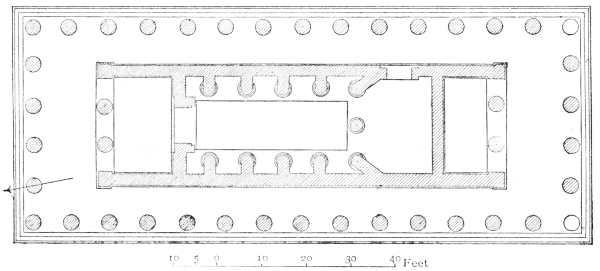
Fig. 22.—Plan of the Temple of Apollo at Phigaleia.
The temple was discovered by a French architect, Bocher, in November, 1765 (Chandler, Travels in Greece, 1776, p. 295). For descriptions of the architecture and sculpture, see Stackelberg, Der Apollotempel zu Bassae, in Arcadien, 1826; Donaldson, in Stuart, 2nd ed., vol. IV.; Blouet, Expédition scientifique de Morée, II; Museum Marbles, IV.; Leake, Travels in the Morea, II., chap. xii., p. 1; Ellis, Elgin and Phigaleian Marbles, II., p. 175; Cockerell, The Temple of Jupiter Panhellenius at Aegina, and of Apollo Epicurius at Bassae, near Phigaleia, in Arcadia, 1860; Overbeck, Gr. Plast., 3rd ed., I., p. 449; Murray, II., p. 169; Wolters, Nos. 880-912. For literature specially relating to the frieze, see below, p. 279. Views and plans of the temple are exhibited in a table case.
Architectural Fragments.
505. Two fragments of the cymatium cornice, with a pattern of palmettes alternating with palmettes of a plainer form, springing from acanthus leaves as on the cornice of the Erechtheion. The member to which these fragments belong surmounted the pediments.
Marble; height, 1 foot ⅛ inch; width, 4 feet 2¾ inches. The left-hand fragment is engraved in Mus. Marbles, IV., vignette. Synopsis, Nos. 26, 27; Cockerell, Phigaleia, pl. 6; Ellis, Elgin and Phigaleian Marbles, II., p. 212.
506. Fragment of a Doric capital, from a column of the external colonnade.
Limestone; height of fragment, 1 foot 5 inches; width. 1 foot 9 inches. Mus. Marbles, IV., pl. 25, fig. 4; Synopsis, No. 24; cf. Cockerell, Phigaleia, pl. 6.
507. Fragment of the capital of one of the Doric columns of the pronaos or opisthodomos, including the lower part of the echinus, and the upper part of the flutings.
Limestone; height, 5½ inches; width, 1 foot 6½ inches.
508. Fragment of the capital of one of the Ionic columns of the interior of the cella, with a part of the fluting. These capitals are of peculiar form, each column being connected at the back by a cross wall with the wall of the cella (see plan). The three exposed faces of the capital had each a pair of Ionic volutes. In the centre of the volute is a stud of marble separately made. The hole for it was prepared by a series of drill holes placed so as to form a ring-like depression, the centre of which was afterwards worked out. The profile of the side pairs of volutes was somewhat different to that of the front pair, whence it can be ascertained that the fragment in the British Museum contains a part of the front and right side of the cap.
Marble; height, 1 foot 6 inches. Mus. Marbles, IV., pl. 25, fig. 3; Synopsis, No. 25; Cockerell, Phigaleia, pl. 14.
509. 1. Roof tile, with antefixal end, with a palmette in relief above two volutes springing from an acanthus.
Marble; height, 1 foot 3¼ inches; length, 1 foot 8½ inches. Mus. Marbles, IV., pl. 25, fig. 1; Synopsis, No. 39; Exp. de Morée, II., pl. 19, fig. 1; Cockerell, Phigaleia, pl. 7.
2.
Part of roof tile from the ridge of the roof of the temple. The central portion is not worked with palmettes, as shown by Cockerell.
Marble; height of fragment, 1 foot 4 inches; length, 1 foot 6 inches. The complete length was about 2 feet 3 inches. Mus. Marbles, IV., pl. 25, fig. 2; Synopsis, No. 40; Cockerell, Phigaleia, pl. 7, figs. 5, 6.
Phigaleian Metopes.
The following fragments belong to a series of metopes in high relief, which were placed over the entrance to the cella of the temple, in a position similar to that occupied by the metopes of the Temple of Zeus at Olympia. In the Parthenon the frieze takes the place of the internal metopes, of which however a trace remains in the guttae which occur at regular intervals below the frieze, and which imply triglyphs.—Cockerell, Phigaleia, pl. 5.
The fragmentary state of the metopes makes the subjects uncertain, in most instances.
For a general view of the metopes, see Stereoscopic, No. 122.
510. Figure wearing a helmet with a projecting tail-piece (compare Parthenon frieze, south side, No. 4), a sleeveless chiton girt at the waist, and a small cloak. The figure wears a Gorgoneion on the breast; and with the left hand seems to be playing on a lyre, which is partly expressed in relief, and must have been further indicated in colour. The Gorgoneion suggests Athenè, but it is more likely that it is merely worn as an amulet, and the figure may be that of a Thracian citharist (cf. Wolters, p. 301). The dress is nearly the same as that of Orpheus on the well-known relief in the Villa Albani—(Zoega, Bassirel. Ant. i., pl. 42).
Marble; height, 1 foot 6 inches; width. 1 foot 4½ inches. Mus. Marbles, IV., pl. 24, fig. 1; Stackelberg, pl. 30, fig. 2; Exp. de Morée, II., pl. 23, fig. 2; Synopsis, No. 28; Cockerell, Phigaleia, pl. 8; Ellis; Elgin and Phigaleian Marbles, II, p. 213.
511. A mutilated male head, inserted in the same metope as last. It appears to have been bearded, but this is doubtful.
Marble; height, 5½ inches; width, 9 inches. Synopsis, No. 33.
512. Torso from the breasts to the knees of a female figure, wearing a fine clinging chiton and a mantle. The right hand holds two objects, perhaps crotala or possibly flutes, and the left hand was extended.
Marble; height, 1 foot 3 inches; width, 1 foot 5½ inches. Mus. Marbles, IV., pl. 24, fig. 2; Stackelberg, pl. 30, fig. 1; Exp. de Morée, II., pl. 23, fig. 1; Ellis, Elgin and Phigaleian Marbles, II., p. 213.
513. Lower part of a nude male figure from the waist to the ankle of the left leg, standing. The right leg is wanting. The figure stands to the left with drapery wrapped about the left arm.
Marble; height, 1 foot 10 inches; width, 9¼ inches.
514. Right knee of a draped female figure standing to the right.
Marble; height, 10 inches, width, 11 inches. Synopsis, No. 37.
515. Fragment with the upper moulding of a metope, and with a circular object in relief, which has a round depression in the centre. This object has been interpreted as a cymbal held up by a dancing figure. Perhaps, however, it may be a ring from the top of a tripod of Apollo, such as is frequently seen. Cf. Furtwaengler, Bronzen von Olympia, pl. 34.
Marble; height, 4 inches; width, 6 inches. Synopsis, No. 31.
516. Figure of Apollo Kitharoedos? A male figure, wearing the dress of a citharist, with a long tunic falling to the feet, confined by a belt and by bands crossing the breast. The figure also wears a flowing mantle, and has long hair falling on the shoulders. The figure is half turned to the right, and looks back to the left. If the preceding fragment is, as suggested, a part of a tripod, Apollo may be supposed to have been standing beside the Delphic tripod.
Marble; height, 2 feet 7½ inches; width, 1 foot 3 inches. The two main portions of the figure of Apollo, which have only recently been joined, give the height of the metopes. Synopsis, Nos. 36, 38.
517.
This metope, though in a fragmentary state, appears to represent the rape of a woman by a nude male figure. A woman wearing a sleeveless chiton and a mantle, 1.raises her right hand wrapped in the mantle to her head. Of the ravisher we only see the fingers of the right hand grasping the neck of the woman, and a part of his arm below the woman's right elbow, and behind her drapery.
2.
On the second fragment, which may be assumed to belong to the same metope, we see a part of the feet of the woman, the toes of the man's right foot, and doubtful traces of his left foot. He was probably represented as seizing the woman by the neck and the knees.
Cockerell suggests that the subject is Apollo pursuing Daphnè, who was a daughter of the neighbouring river Ladon, but he is mistaken in thinking that the man's fingers are stretched out straight, and have no grasp of the woman's neck.
Marble. Fragment 1: height, 1 foot 4½ inches; width, 1 foot 3 inches. Synopsis, No. 30; Exp. de Morée, II. pl. 23, fig. 3; Stackelberg, pl. 30, fig. 3; Mus. Marbles, IV., pl. 24, fig. 3; Ellis, Elgin and Phigaleian Marbles, II., p. 213. Fragment 2: height, 8¾ inches; width, 1 foot 4 inches. Synopsis, No. 35.
518. Upper part of body of draped female figure standing to the front.
Marble; height, 8 inches; width, 10 inches. Synopsis, No. 32.
519. Torso of an obese bearded figure, from the neck to the waist. The figure appears to have been seated, leaning back, and having a staff and drapery under the left arm. Cockerell restores it as a figure standing and leaning on a staff.
Marble; height, 1 foot ¾ inch; width, 8½ inches. Synopsis, No. 34; Cockerell, Phigaleia, pl. 5, Stackelberg, pl. 30, fig. 4; Exp. de Morée, II., pl. 23, fig. 4.
The Phigaleian Frieze.
The frieze of the Temple of Apollo Epicurios consists of 23 slabs of marble, somewhat resembling Pentelic. The slabs are each 2 feet 1¼ inches high, and they have a combined length of 101 feet ¾ inch. The frieze formed an internal decoration, above the colonnade within the cella, and had two long sides measuring 35 feet 9 inches, and two short sides measuring 14 feet 2⅛ inches. The excess in the measured length of the slabs is explained by the fact that they overlapped at the angles. The slabs are about 3½ inches thick, and rested on the edge of the architrave, being fastened with bolts to the ground behind.
The subjects represented are: (1) Battle of Lapiths and Centaurs; (2) Battle of Greeks and Amazons. The former subject has 11 slabs of a combined length of 45 feet 6¾ inches, while the latter has 12 slabs measuring 55 feet 6 inches. The Centauromachia, therefore, occupied two sides, less the length of one slab, which contained a part of the Amazonomachia.
Several attempts have been made to fix the probable order of the slabs, but except in certain cases we have no evidence. It is probable that the slabs, No. 541 with Heracles or Theseus, and No. 530 with Centaurs and Kaineus, were in the centres of two short sides. They are longer than any other slabs, and are well fitted to form the central groups in the compositions. Slab No. 540 was certainly a corner slab, as is proved by the rebate. Slab No. 532 was probably a corner slab. Slabs Nos. 527 and 528 evidently were next to each other, and No. 528 was probably at a corner. Beyond these fixed points, the order can only be determined by considerations of composition. In the description that follows, the slabs are taken in the present order of arrangement in the British Museum, which is that proposed by Mr. Murray (Greek Sculpt. ii. pl. 14) except as regards the position of the slabs of the north side.
The style of the reliefs is somewhat peculiar. Many of the types of combat are familiar in Attic sculpture. Compare the group of Kaineus with the same subject on the frieze of the Theseion, and the Centaur groups with the metopes of the Parthenon. At the same time the style of the work, with its high relief, somewhat florid and coarsely executed, is un-Attic, and it seems probable that the actual production of the reliefs was in the hands of local workmen. There is less certainty as to the designer. Among the artists suggested are Alcamenes (Stackelberg, p. 84), Cresilas (Sauer, Berliner Philol. Wochenschr., 1889, p. 583); an artist influenced by the paintings of Polygnotos (Murray, ii., p. 176); an Attic artist (Jahn, Pop. Aufsätze, p. 157), or an Arcadian artist under Attic influences (Overbeck, Gr. Plast., 3rd ed., i., p. 457.)
Literature relating to the Frieze. Wagner, Bassorelievi Antichi della Grecia. See also works quoted above, and on p. 272. For the proposed arrangements of the slabs of the frieze, see Cockerell, p. 56; Ivanoff, Annali dell' Inst., 1865, p. 29; Lange, Ber. der. K. sächs Ges. d. Wissenschaften, 1880, p. 56, pl. 3; Wolters, Nos. 883-905; Stereoscopic, Nos. 119, 120, 122.
Phigaleian Frieze, West Side.
520. A Centaur carries away a Lapith woman, who stretches out her arm in appeal for help. The woman's headdress is somewhat peculiar, consisting of a cap (sphendonè) and a narrow taenia, from under which the hair falls in small curls on the forehead. On the right of the slab an unarmed Lapith struggles with a Centaur, whose equine body is wholly unexpressed except for one leg which hardly seems to belong to him.
Length, 2 feet 5¾ inches. Synopsis, No. 7; Mus. Marbles, IV., pl. 7; Stackelberg, pl. 25.
521. On the left of this slab, a Centaur, whose head and lower parts are lost, flings a stone with each hand. The figure is shown to be a Centaur by the lion's skin over the left arm. On the right, a Centaur, who also wears a lion's skin knotted about his neck, treads down an armed Lapith, and grasps his right hand to prevent him striking with his sword. Between the two Centaurs is a Lapith woman, who hastens to her right and holds her mantle about her. The Centaur here and on certain other slabs has a horse's mane, which does not occur on the Centaurs of the Parthenon or of the Theseion.
Length, 4 feet 2½ inches. Synopsis, No. 6; Mus. Marbles, IV., pl. 6; Stackelberg, pl. 28.
522. On the left a Centaur draws towards himself a Lapith woman who tries to escape. She has a child on her left arm. The face of this figure has a strong resemblance to that of the supposed Amazon of Polycleitos, and the drapery of the breast is treated in the same way as that of some of the statues of Amazons. (Compare the fragment at Wörlitz, engraved Jahrbuch des Inst. i., pl. 4.)
On the right, a Centaur, who has a shield and lion's skin, tramples down a Lapith, whose hands are stretched out as if to keep the Centaur away. The Lapith is fully armed, having a cuirass above a chiton, a chlamys, and boots. He has no shield, but perhaps that of the Centaur may be supposed to have been captured from him, as no other Centaur is thus armed on the Phigaleian frieze, the Theseion, or the Parthenon.
Length, 4 feet 1½ inches. Synopsis, No. 3; Mus. Marbles, IV., pl. 3; Stackelberg, pl. 23.
523. Apollo and Artemis coming to the aid of the Lapiths. Artemis drives a chariot drawn by two stags; she wears the chiton, and large diploïdion crossed by bands, which is the dress of charioteers on the Parthenon sculptures. Her right foot is on the ground and she appears to be checking the chariot, while Apollo stands at its side and draws his bow. The bow, arrow, and reins were added in bronze. The chariot is represented three-quarters to the front.
Length, 3 feet 9½ inches. Synopsis, No. 11; Mus. Marbles, IV., pl. 11; Stackelberg, pl. 19.
524. Two Lapith women have taken refuge at the statue of a goddess, probably Artemis, as she is coming to their aid. One of the women stretches out her arms with a gesture of despairing entreaty. The other embraces the statue, which is a stiff archaic image wearing a polos; with her left hand she clings to her mantle which has been seized by the Centaur. The Centaur is attacked from behind by a Lapith who kneels on his back, has his left arm round the Centaur's neck, and is about to strike with the sword originally held in the right hand. On the right is a tree, with a lion's skin hanging from a bough. The appearance of a deity near his own image is not infrequent. (Cf. Journ. of Hellen. Studies, ix., pl. 1; Müller, Denkmaeler, pl. 44, fig. 206; Arch. Zeit., 1869, pl. 14.)
The group of the Lapith and Centaur is composed like the Parthenon metope, No. 305.
Length, 4 feet 6 inches. Synopsis, No. 10; Mus. Marbles, IV., pl. 10; Stackelberg, pl. 29.
525. A Lapith and a Centaur in combat. The Lapith draws away to the left, and is about to throw a stone, while he stretches out his shield on his left arm. The Centaur rears up, and seems to be throwing a stone held in both hands. The Lapith has only a helmet and small chlamys. He also wore a metal sword belt. On the right of the slab, a woman holding a boy on her right arm, moves quickly to the left. With her left hand she holds a floating piece of her veil.
Length, 4 feet 5 inches. Synopsis, No. 8; Mus. Marbles, IV., pl. 8; Stackelberg, pl. 20.
526. A Centaur is about to thrust with his sword at a Lapith, who seizes the Centaur's left foreleg and left hand. The Centaur has a lion's skin; the Lapith is unarmed. On the right of this slab another unarmed Lapith has forced the Centaur down on his knees. He kneels on the Centaur's back, and holds his hair with the right hand, and his wrists with the left hand.
Length, 4 feet 2½ inches. Synopsis, No. 5; Mus. Marbles, IV., pl. 5; Stackelberg, pl. 27.
527. The Centaur of this slab bites a Lapith in the neck. The Lapith is about to fall with relaxed limbs, but plunges his sword in the Centaur's body. At the same time the Centaur kicks out with his hind legs at a Lapith on the left, who holds out his shield as a defence. A dead Centaur lies on the ground. Both Centaurs have lions' skins. The Lapiths wore metal sword belts.
Length, 4 feet 1 inch. Synopsis, No. 2; Mus. Marbles, IV., pl. 2 Stackelberg, pl. 21; Brunn, Denkmaeler, No. 91.
528. A Centaur has been thrown down by two Lapiths. The one drags forward the Centaur by his hair, while the other kneels on his back, and has his hand and sword raised to strike. A Centaur, however, has come from behind and arrests the Lapith's blow, and tries to draw away his shield. The fallen Centaur feebly puts out his right hand behind his back to meet the stroke.
Length, 4 feet 1 inch. Synopsis, No. 1; Mus. Marbles, IV., pl. 1; Stackelberg, pl. 22.
Phigaleian Frieze, North Side.
529. On the left a Lapith and Centaur are wrestling. The Lapith holds the Centaur's head under his left arm, and the Centaur seizes the thigh of the Lapith, and tries to overthrow him, putting his right foreleg round the leg of the Lapith. The Centaur wears a lion's skin. On the right the Lapith has seized the Centaur by the hair, and is about to strike. The Centaur is helpless and can only stretch out his hands behind his back as a defence.
Length, 4 feet 4½ inches. Synopsis, No. 9; Mus. Marbles, IV., pl. 9; Stackelberg, pl. 24.
530. Two Centaurs heave a mighty stone to crush the invulnerable Kaineus. Kaineus is half-buried and holds his shield above his head. He probably held a sword in the right hand. Both Centaurs wear lions' skins. The same subject occurs on the frieze of the Theseion. Next on the right is a Lapith armed with shield and helmet, who seems to be dragging the Centaur by the hair. A woman moves to the right, holding her floating mantle with her right hand.
Length, 5 feet 3½ inches. Synopsis, No. 4; Mus. Marbles, IV., pl. 4; Stackelberg, pl. 26; Brunn, Denkmaeler, No. 90.
531. The remaining slab on this side contains a part of the battle of Greeks and Amazons. As the Amazon slabs are longer than the slabs of Centaurs by about 10 feet, it is clear that they must have filled two sides and a part of a third. (See above, p. 278.)
On the left a Greek and an Amazon are engaged in combat. The Greek has a helmet, boots, and a chiton which leaves the right shoulder bare. He advances his left arm with the mantle hanging from it, in the manner of Harmodios in the group of the Athenian Tyrannicides (compare the Panathenaic vase in the Fourth Vase Room, which has this group on the shield of Athenè). The Amazon wears a similar chiton, and rushes forward against the Greek, in the attitude of the Aristogeiton in the group mentioned above. On the right a wounded Amazon has sunk to the ground, and is supported by a companion who wears the chiton split at the side (schistos), like that of the Iris of the east pediment of the Parthenon.
Length, 4 feet 6½ inches; Synopsis, No. 20; Mus. Marbles, IV., pl. 20; Stackelberg, pl. 17.
Phigaleian Frieze, East Side.
532. On the left of the slab a Greek tries to drag an Amazon along by the hair. She is now unarmed, and tries to resist with both hands and with the weight of her body. Her shield is seen in the background. On the right an Amazon who has sunk to the ground, but appears not to be badly wounded, is defended by a companion who stands beside her, and stretches out a large shield.
Length, 4 feet 6¾ inches. Synopsis, No. 12; Mus. Marbles, IV., pl. 12; Stackelberg, pl. 7.
533. On the left a Greek makes a fierce attack on an enemy represented in the adjoining slab, which was probably the one just described. He has his sword arm raised above his head for a strong blow.
In the centre is a vigorous combat between a Greek and Amazon. The Greek covers himself with his shield and draws back for a spear thrust. The action of the Amazon appears to be that of thrusting a spear. The shield on her left arm is not expressed. In the tightly stretched skirt of the chiton the sculptor has sacrificed grace for truth to nature and vivid movement. On the right, an Amazon who has just received a mortal wound, is seen falling to the ground, with all her limbs relaxed.
Length, 4 feet 5¾ inches. Synopsis, No. 13; Mus. Marbles, IV., pl. 13; Stackelberg, pl. 8; Brunn, Denkmaeler, No. 88.
534. On the left a Greek drags down an Amazon from her horse, grasping her hair with the left hand. He probably held a sword in the right hand. The Amazon tries feebly to loosen his grasp. She wears the split chiton, like the Amazon of slab No. 531. On the right is an Amazon, who draws back a little, extending her shield, and at the same time raising her right hand to strike. Here, as in No. 533, the drapery is tightly stretched. The upper part of the figure of the Greek had been lost when the marbles were being transported from the temple. It was afterwards found in a house near Bassae, and was presented by J. Spencer Stanhope, Esq., 1816. (Cf. Stackelberg, p. 23.)
Length, 4 feet 4¾ inches. Synopsis, No. 17; Mus. Marbles, IV., pl. 17; Stackelberg, pl. 13; Brunn, Denkmaeler, No. 87.
535. An unarmed Amazon has taken refuge at an altar; a Greek has seized her by the hair, and tries to drag her away. The Amazon resists using her weight, and both arms. The Greek had a sword in his right hand.
On the right a Greek and Amazon are engaged in hand to hand combat, extending their shields and engaged in fence with their swords. The drapery of the Amazon is treated as on the two last slabs.
Length, 4 feet 6¾ inches. Synopsis, No. 22; Mus. Marbles, IV., pl. 22; Stackelberg, pl. 16; Brunn, Denkmaeler, No. 86.
536. A large part of the group on the left is wanting. The Greek appears to be dragging the fallen Amazon by the hair, and at the same time to be treading her down with his right foot. With both hands she tries to free herself from the grasp of the Greek. On the right, a Greek has fallen on his knees and holds up his shield as a defence against the victorious Amazon, whose right hand and sword are raised to strike.
Length, 4 feet 6¾ inches. Synopsis, No. 15; Mus. Marbles, IV., pl. 15; Stackelberg, pl. 12.
537. An Amazon is disarmed, and has fallen to the ground. She stretches out her right hand, as if in entreaty to a Greek who treads with his left foot on her knee, and is about to thrust with his sword. A second Greek approaches from the left. On the right an Amazon strides quickly forward to help her companion, and is about to strike the Greek.
Length, 4 feet 4¾ inches. Synopsis, No. 21; Mus. Marbles, IV., pl. 21; Stackelberg, pl. 11.
538. On the left, a Greek who is bearded and heavily armed, has thrown down an Amazon, whom he drags by the hair, while she tries to keep him at arm's length. On the right the Greek has fallen on his knees, and holds up his shield against the attack of the Amazon.
Length, 4 feet 5¾ inches. Synopsis, No. 19; Mus. Marbles, IV., pl. 19; Stackelberg, pl. 15.
539. A Greek who has been killed in the battle, and perhaps stripped, is being borne off the field on a companion's back. Another Greek who has been badly wounded in the right leg, leaves the field, leaning with his right hand on a spear, now wanting. He puts his left arm round the neck of a companion, who supports him round the body. In the centre of the slab an Amazon draws away a shield which belonged to one of the Greeks.
Length, 4 feet 9¼ inches. Synopsis, No. 14; Mus. Marbles, IV., pl. 14; Stackelberg, pl. 18.
Phigaleian Frieze, South Side.
540. This slab has a rebate on the left side, proving that it belongs to the left end of a frieze. On the left, a wounded Greek lying on the ground, is partly raised by a companion, who eagerly watches the fight, but for the moment only holds his sword in the left hand, while he uses his right hand to support the wounded man. A similar group occurs on the frieze of the Temple of Nikè (No. 421).
On the right a Greek and Amazon are fighting hotly. The Greek presses forward, and the Amazon at the same time draws back, collecting her strength for a blow. The Amazon wears the split chiton.
Length, 4 feet 8¾ inches. Synopsis, No. 16; Mus. Marbles, IV., pl. 16; Stackelberg, pl. 10.
541. The middle of the central slab is occupied by a single combat between Heracles and an Amazon. They are represented drawing back for a blow. The Amazon seems to be making a spear thrust while Heracles raises his club. The Amazon extends her shield; Heracles carries the lion skin on his left arm. The pose of these two combatants who have the most important position in the whole frieze, is very similar to that of the Poseidon and Athenè of the west pediment of the Parthenon. In both cases also the central group is bounded by figures of horses. The figure here called Heracles has also been interpreted as Theseus. On the left, a mounted Amazon is victorious, and thrusts with a spear at a wounded and fallen Greek. On the right, the Greek is the victor; he seizes the Amazon by arm and foot and throws her off her horse, which has fallen on its knees.
Length, 5 feet 10 inches. Synopsis, No. 18; Mus. Marbles, IV., pl. 18; Stackelberg, pl. 14; Brunn, Denkmaeler, No. 89.
542. A young Greek, wounded and fallen to the ground, raises his right hand, as if in defence against the blow about to be struck by the Amazon standing over him. Another Amazon hastily approaches from the left, and stretches out her hands, as if in defence of the Greek. On the right of the slab, an Amazon supports a wounded comrade, who is sinking to the ground with her head drooping and all her muscles relaxed.
Length, 4 feet 2¼ inches. Synopsis, No. 23; Mus. Marbles, IV., pl. 23; Stackelberg, pl. 9.
Fragments of the Temple Statue of Apollo.
A few small fragments of a colossal male statue were discovered during the excavations. As the fragments found belong to the extremities of the figure, and since they are proved to have been separate pieces attached, by the dowel holes, it is inferred that the statue was acrolithic, i.e., that the extremities only were of marble, while the rest of the figure was made of wood or other inferior material.
The original statue of Apollo Epicurios had been moved to Megalopolis from Bassae, before the time of Pausanias (Paus. viii., 30, 3). The foundation of Megalopolis took place in 368 b.c., and if the acrolithic statue was made to take the place of that which was removed it must be later than this date.
The two fragments here described are all that are in the British Museum, but four other small pieces were also discovered, and are engraved Stackelberg, pl. 31; reproduced Exp. de Morée, ii., pl. 23, fig. 5; Cockerell, pl. 16.
543. Fragment of the forepart of a right male foot, wearing a sandal.
White marble; length, 6½ inches. Stackelberg, pl. 31; Cockerell, pl. 16.
544. Fragment with the palm and base of the thumb of a right hand.
White marble; length, 6¼ inches. Stackelberg, pl. 31; Cockerell, pl. 16.
MISCELLANEOUS SCULPTURES, OF THE FIFTH CENTURY.
549. Bust of Pericles, wearing a helmet. Inscribed Περικλῆς (fig. 23). Wolters assigns the original from which this fine bust is copied to the end of the fifth century, and suggests that it may have been the work of Cresilas, with reference to which Pliny (H. N. xxxiv., 74) states that he made an Olympian Pericles, worthy of the title, and ennobled a noble subject. Plutarch explains the presence of the helmet as caused by the ugly shape of the head of Pericles (Plutarch, Pericles, 3). It is, however, more probable that the helmet merely denotes military rank. Found in the Villa of Cassius, at Tivoli, 1781.—Townley Coll.
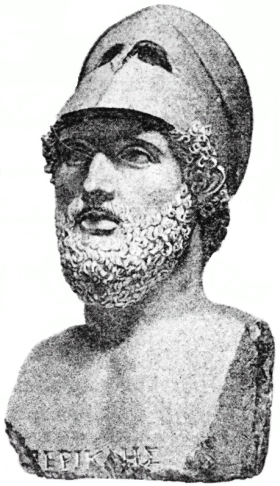
Fig. 23.—Bust of Pericles, No. 549.
Marble; height, 1 foot 11 inches. Restorations:—Nose, and small parts of helmet. Stuart, II., p. 42; Mus. Marbles, II., pl. 32; Ellis, Townley Gallery, II., p. 3; Arch. Zeit., 1868, pl. 2, fig. 1; Wolters, No. 481; Furtwaengler, Berl. Philol. Wochenschr., 1891, p. 286. Another copy, found at the same time as the present bust, is in the Vatican (Visconti, Iconogr. Grecque, pl. 15).
550. Head of Asclepios? Colossal ideal bearded head. The hair falls in heavy masses over the forehead, and on each side of the head. A heavy metal wreath was fastened by numerous rivets, which still remain. The head was formed of three principal pieces of marble, the heaviest piece being so shaped that it kept its position by its own weight. The piece at the back of the head is lost. A small piece, which is now missing, was also attached behind the right ear.
This head would serve as well for Zeus as for Asclepios, and it is possible that this may have been the original intention of the artist. It was, however, discovered in 1828, in a Shrine of Asclepios, in Melos. Blacas Coll.
Parian marble; height, 1 foot 11 inches. Exp. de Morée, III. pl. 29, fig. 1; Müller-Wieseler, Denkmaeler, II., pl. 60, fig. 763; Overbeck, Gr. Kunstmyth. pl. 2, figs. 11, 12; II., p. 88; Murray, Greek Sculpture, II., pl. 11, p. 130; Mitchell, Selections, pl. 13; Rayet, Monuments, II., No. 42; Stereoscopic, No. 113; Wolters, No. 1283; Paris, La Sculpt. Ant., p. 221. Two votive inscriptions to Asclepios and Hygieia were discovered with the head. One of these, with a votive relief of a leg, is now in the British Museum (No. 809).
551. Asclepios? A male draped torso broken off at the knees; the right arm is wanting from below the shoulder, where it has been fitted with a joint. The left arm, which is entirely concealed in the mantle, is placed akimbo. The back is unfinished. The composition is suitable to a figure of Asclepios, an attribution which was probably originally suggested by the fact that this torso was obtained by Lord Elgin from the neighbourhood of Epidauros. Two small fragments of the right leg were brought away with the torso.
Parian marble; height, 3 feet 1¼ inches. Mus. Marbles, IX., pl. 5; Ellis, Elgin Marbles, II., p. 121; Synopsis, No. 327; Elgin Room Guide, II., No. E. 1.
552. Female torso from the neck down to the waist. The dress is a chiton with diploïdion; part of the tresses of hair which fall down on the back still remains.—Elgin Coll.
Pentelic marble; height, 1 foot 3 inches. Synopsis, No. 281 (146); Elgin Room Guide, II., No. F. 15.
553. Left breast and part of left side of female figure wearing a chiton girt at the waist.—Elgin Coll.
Pentelic marble; height, 1 foot 3¼ inches. Synopsis, No. 277 (147). Elgin Room Guide, II., No. F. 16.
554. Upper part of the torso of a female figure moving quickly to the left, with the arms raised. She wears a sleeveless chiton which appears to have been unsewn (schistos) down the right side. The shoulders are broken, but there are remains of large dowel holes as if for the insertion of wings, and the figure is not unlike the Victories on the balustrade of the temple of Nikè.—Elgin Coll.
Pentelic marble; height, 1 foot. Synopsis, No. 321 (79).
555. Heads of Pelops and Hippodamia? Heroic heads of colossal male and female figures, turned to the right. The female head is in low relief, and wears a diadem, and a veil falling over the back of the head. Compare the heads in a terracotta relief in the British Museum (Ancient Terracottas in B. M., pl. 19, No. 34). The male head is almost worked in the round and wears a close-fitting helmet. Some drapery passes over the left shoulder. These two heads have long been called Pelops and Hippodamia, and it is very likely that the figures belonged to a chariot group. But they may well be the somewhat idea consort. Found in the sea near Girgenti (Agrigentum).—Townley Coll.
Greek marble, perhaps Parian; height, 1 foot 5¼ inches; width, 1 foot 4 inches. Mus. Marbles, X., pl. 32; Ellis, Townley Gallery, II., p. 153.
556. Head of Odysseus? Male head, with curling hair and short beard, wearing a peaked cap (pileus). The surface is much decayed, and most of the chin and mouth is broken away. This head may be from a sepulchral monument.—Elgin Coll.
Pentelic marble; height, 1 foot ½ inch. Mus. Marbles, IX., pl. 40, fig. 3; Ellis, Elgin Marbles, II., p. 119.
557. Fragment from the back of a head. The hair is drawn to a knot at the back of the head, and is confined by two bands, crossing one another.
Pentelic marble; height, 10½ inches.
558. Head of a maiden, wearing a closely-fitting cap. The style is characteristic of the fifth century.—Athens? Elgin Coll.
Pentelic marble; height, 9 inches. Synopsis, No. 239 (122).
559. Heroic head of a youth, inclined slightly to his left. The hair is very slightly indicated, and the back of the head is worked away, as if for a bronze helmet.—Obtained in Greece by the fourth Earl of Aberdeen in 1803, and presented by the fifth Earl of Aberdeen in 1861.
Coarse-grained marble; height, 11 inches. The head was found wearing a bronze helmet, which, however, did not fit, and has been removed.
560. Cast of marble owl. L. Ross (Annali dell' Inst., 1841, pl. C., p. 25), supposes that this owl was a votive offering which once surmounted a column found near it, on which is inscribed the name of Timotheos of the deme Anaphlystos. The lower part of the body, which is broken away, has lately been found. The feathers of the wings are set in formal rows, and the treatment throughout is characterised by an archaic severity, as has been remarked by Ross. The feathers have probably been painted.—Found on the Athenian Acropolis between the Propylaea and the Parthenon.
The original, of Pentelic marble, is in the Acropolis Museum, at Athens; height, 2 feet 2 inches. Ross, Arch. Aufsätze, I., pl. 14, fig. 3, p. 205; Elgin Room Guide, II., No. G. 7; Wolters, No. 111; Le Bas, Mon. Fig., pl. 62, fig. 3.
GREEK RELIEFS.
Most of the single Greek reliefs in the British Museum are described in the present section of the catalogue (Nos. 599-817.) Those reliefs which are known to have belonged to particular buildings, and to have served an architectural function, are catalogued separately. A few reliefs also, principally of the later Attic School, are reserved for a subsequent part.
We deal, in this place, with a number of works of minor importance, and of various degrees of artistic merit. At the same time they are of interest both for their subjects and also as showing the instinctive grace and skill of subordinate Greek craftsmen, even in hastily executed and unimportant work.
The following classification has been adopted, but the classes are not perfectly distinct, as the sepulchral reliefs sometimes partake of a votive character.
Sepulchral Reliefs.—599-618, Decorative Stelae. 619-680, Scenes from Daily Life and Animals. 681-686, Plain Vases. 687-710, Vases and reliefs with figures clasping hands. 711-746, Sepulchral Banquets, &c. 750-757, Rider and Horse, heroified. 760-766, Reliefs from Lycia.
Votive Reliefs.—770-794, Figures of the God or his attributes. 795-812, Figures of the Dedicator, or of the object dedicated. 813-817, Agonistic reliefs.
SEPULCHRAL RELIEFS.
The Greek sepulchral reliefs are of several distinct types, each type having an independent origin and history, though occasionally the different types are blended one with another.
The early Attic examples which are assigned to a period before the Persian wars, have recently been collected by Conze (Die Attischen Grabreliefs, Part 1), and we are thus enabled to trace the rise of the different types in Attica, so far as the materials discovered allow. The earliest and simplest form of monument is the plain stone (στήλη), set up on a mound (τύμβος) to mark the place of the grave, and such a tomb is well known to Homer (Il. xi., 371, etc.)
Such a stone would naturally bear the name of the deceased, together with the name of his father, or of the persons who erected the monument. The earliest Attic examples are also surmounted by a simple ornament, especially the palmette between volutes, partly in relief, and partly in colour. The treatment of the palmette closely resembles that of the antefixal ornament of the Parthenon (No. 352). At an uncertain period in the fifth century the use of the acanthus-leaf ornament was introduced, and the decoration of the stelae became elaborate and beautiful. It has been thought that the acanthus was developed by the Greeks of Ionia, before the middle of the fifth century, and only made its way slowly in Athens (Furtwaengler, Coll. Sabouroff, i., p. 8), but it cannot be proved to have become common before it had been made familiar by the architecture of the Erechtheion, towards the close of the fifth century. The early Corinthian capital of the single column of the Temple at Phigaleia appears to be copied from a stelè with volutes and an acanthus.
The smooth surface of the stone below the crowning ornament was used, from an early time, to receive a representation of the deceased person, which was either painted or in relief, the relief being itself painted. Such portraits, in the case of men—and only men's portraits are certainly known to be preserved of the archaic period—take the form either of a simple standing figure, or of a figure engaged in some occupation taken from life. See the figures of the Discobolos and of the spear-thrower (Conze, pls. 5, 7), and as an example of the painted portrait see the stelè of Lyseas (Conze, pl. 1). The male portrait is often accompanied by a small figure of a youth riding or leading a horse. On a class of monuments described below (Nos. 750-757) it is not impossible that the figure of the horse may have some special reference to death, but in the early Attic reliefs it seems more likely that the horse indicates the favourite pursuits or the knightly rank of the dead person. Compare Roscher, Lexicon, p. 2584, and Aristotle, Constitution of Athens, chap. 7, ed. Kenyon, where the horse standing beside an archaic figure of Anthemion, son of Diphilos (Class. Rev. 1891, p. 108), is said to prove his knighthood (ἱππάς). (Cf. Journ. of Hellen. Studies, v. p. 114; Conze, p. 4; Nos. 1, 14, 15, 16, 17, 19.)
The female figures, of which only uncertain specimens survive, were simple portraits, usually seated, and sometimes accompanied by other members of the family, usually represented on a diminutive scale. (Cf. Conze, No. 20.)
In one early Attic example there is an actual representation of mourners as on Etruscan or Lycian tombs. But in general, allusions to death and mourning are but slightly indicated. (Cf. Conze, No. 19, pl. 11.)
Finally, there is a type of monument, which contains the representation of some animal more or less associated with the grave, such as the cock (Conze, No. 22, pl. 13) or the Sphinx (Conze, No. 16, pl. 10, fig. 1b).
The foregoing are the main types of the early Attic reliefs. The British Museum does not contain any specimens of the early period, but the study of the early reliefs enables us to classify the later works, and to distinguish the indigenous Attic types from those that are imported, or of later development.
Decorative Stelae.—The stelae crowned with the palmette and acanthus acroteria are described below, Nos. 599-618. They are principally derived from Athens, but several specimens (Nos. 611-618) roughly worked in coarse limestone are a part of the collection of sculptures from Kertch. One of the best examples of Attic work of this class in the British Museum, will be found in the Department of Egyptian and Assyrian antiquities, namely the stelè of Artemidoros with a bilingual Greek and Phoenician inscription. (Dodwell, Tour i., p. 411; Greek Inscriptions in Brit. Mus., cix.)
Scenes from Daily Life and figures of Animals.—The monuments with portraits and scenes from daily life are catalogued below, Nos. 619-679. The incidents chosen are taken from all parts of life, and in late times are apt to be of a genre character with scenes from children's games, &c.
Reliefs with figures of horsemen, where the scene appears only to be an incident from daily life, and not connected with the heroification of the deceased, have also been placed here (Nos. 638, 661-666).
Examples of the figure of an animal placed on the tomb, of a symbolic or decorative character, are best seen among the archaic sculptures (compare those from Xanthos), but the bull, No. 680, is a specimen of a figure from an Attic stelè.
The types which have been described so far, are simple records of the deceased person. We turn now to various classes, which are not represented among the Attic remains of the archaic period, and which are more or less of religious or ritualist significance.
Vases.—The Sepulchral Vases, which are represented either in relief or in the round, are a common form of monument at Athens, and are connected with the observances paid to the dead. These vases which are sometimes lekythi, and sometimes amphorae or hydriae, may be decorated with patterns, or with subjects in relief, such as appear on other sepulchral stelae. They probably are to be traced from the vessels of pottery in which offerings were brought, to be poured out as libations on the tomb. Compare below the account of the "Sepulchral Banquet."
There is ancient authority for the view that the vase indicates an unmarried person. Eustath. on Il. XXIII., 141, p. 1293: καὶ τοῖς πρὸ γάμου δὲ τελευτῶσιν ἡ λουτροφόρος, φασίν, ἐπετίθετο κάλπις εἰς ἔνδειξιν τοῦ ὅτι ἄλουτος τὰ νυμφικὰ καὶ ἄγονος ἄπεισι. Demosthenes (in Leochar. pp. 1086 and 1089, ed. Reiske) speaks also of ἡ λουτροφόρος (sc. ὑδρία or κάλπις), being placed on the tomb of an unmarried person. (Kumanudis, p. 18; Greek Inscriptions in Brit. Mus., No. lxxx.)
On the other hand, the tombs of a father, Philoxenos, and of his sons Parthenios and Dion, in the Cerameicos at Athens were all surmounted by stone vases (C. I. A., ii., 3191-3193; Conze, p. 16). Perhaps a distinction must be made between the lekythi which represent libations at the tomb, and the hydriae, which have the special meaning mentioned above. An early instance of the Attic sepulchral vase, with painting and relief, is placed by Köhler on epigraphic grounds between 450 and 430 b.c. (Athenische Mittheilungen, x., pl. 13, p. 362.)
Figures clasping Hands.—In Attic reliefs, chiefly of the fourth and subsequent centuries, the two principal persons are often represented clasping right hands together, and such scenes are commonly known as Scenes of Parting. A more correct interpretation may be gathered from a fragment of an archaic sepulchral relief from Aegina (Athenische Mittheilungen, viii., pl. 17), in which a female figure, enthroned and holding a pomegranate (compare the Spartan reliefs mentioned below), clasps the hand of a standing figure, which is shown by the scale to be that of another deceased person. In this case the scene is laid in Hades, and the clasping of the hands is significant of affection, not of separation. Hence it has been thought that all subjects with the clasped hands represent the meeting and union in Hades after death (Furtwaengler, Coll. Sabouroff, i., p. 46). There is, however, no proof that the artist was always consciously placing the scene in Hades, and in No. 710 Hermes seems about to conduct the deceased person to the nether world. The presence of figures in attitudes of grief, of children and servants, seems to show that these reliefs are symbolic of family affection, though the artist had no very clear and logical conception of the moment depicted.
An early example of the clasping of hands on an Attic monument is supplied by the sepulchral vase above mentioned, of 450-430 B.C. (Athenische Mittheilungen, x., pl. 13.)
Such subjects as the foregoing are often placed within an architectural structure, usually consisting of two pilasters and an entablature, sometimes surmounted by a pediment. Various theories have been proposed on the subject. It has been suggested that the architectural ornament indicates the votive character of the relief (Journ. of Hellen. Studies, v., p. 111), or the home of the dead person (Pervanoglu, Grabsteine der alten Griechen, p. 14), but there is no evidence of any such special significance attaching to the form. (Compare Furtwaengler, Coll. Sabouroff, i., p. 52.)
The Sepulchral Banquet.—From the fourth century onwards, a type of relief commonly known as the Sepulchral Banquet becomes very common in Attica and elsewhere. In a normal example of the fully developed type, the chief figure is that of a man recumbent on a couch, holding a cup. Before him is a table with food. A woman, according to Greek custom, is seated upright at the foot of the couch. Boys or attendants are seen drawing wine. The head of a horse is often seen at the back of the relief. A snake is frequently introduced, and often drinks wine from a cup held by one of the figures. Further, a group of adorant figures, usually on a small scale, may be represented about to sacrifice at an altar, near the foot of the couch.
The meaning of this type has been a subject of long controversy, but it is best understood if the later reliefs are studied in connection with the oldest known specimens of the same subject. A series of archaic reliefs from the neighbourhood of Sparta (Athenische Mittheilungen, ii., pls. 20-25; Furtwaengler, Coll. Sabouroff, pl. 1; Journ. of Hellen. Studies, v., p. 123), contains subjects somewhat of the following character: A male and female figure, represented on a heroic or divine scale, are seated enthroned, holding as attributes a large two-handled cup, or a pomegranate. Figures of worshippers approach, carrying a pomegranate or a cock, and a snake is sometimes present. The sculptures of the Harpy Tomb (No. 94), have been sometimes classed with the works here described, but this has not yet been established.
The transition from the Spartan type to the Sepulchral Banquet type is still obscure, but a connecting link is furnished by a relief from Tegea (Athenische Mittheilungen, iv., pl. 7), in which the woman is enthroned, while the man reclines on a couch with a table before him. (Compare also the relief from Mytilene No. 727.) It seems probable that we have in these reliefs symbolic representations of offerings made by living relations or descendants for the pleasure and sustenance of the dead. Such offerings of food and drink made by the living at the tomb are common to all primitive peoples. The Egyptians, in particular, made regular offerings of actual food, and at the same time surrounded the mummy with sculptural representations of offerings, which, it was thought, served to satisfy the incorporeal double of the dead person. The early notion that the deceased was within the tomb, and enjoyed the food and drink offered to him in a material manner, became less distinct in later times. The periodical offerings assumed a more ritualistic and symbolic character, and were celebrated by the Greeks under the name of νεκύσια.
The older archaeologists thought for the most part that the Banquet reliefs were representations commemorative of life on earth, or descriptive of the pleasures enjoyed by the dead in Hades. Dumont (Rev. Arch., N.S. xx. p. 247) and Hollaender (De Operibus Anaglyphis), interpret them as referring to the periodical offerings made at the tomb. It will be seen that this view is not very different from that which has been adopted above, and which is the view of Gardner (Journ. of Hellenic Studies, v., p. 130), and Furtwaengler (Coll. Sabouroff, i., p. 28). The reliefs, however, have more force than mere pictorial groups, if we accept the Egyptian analogy, and allow that the sculpture represents, by substitution, the offerings of material food. The snake is naturally associated with the grave, from its rapid mysterious movements, and from living in caves and holes. Compare the story of the snakes that were seen by Polyeidos in the tomb of Glaukos. (Apollodor. 3, 3, 1; Roscher, Lexicon, p. 1687). The votive character of the Banquet reliefs is proved in some instances by inscriptions, (Journ. of Hellen. Studies, v., p. 116; Roscher, Lexicon, p. 2553). It is doubtful, however, whether the artist was always conscious of the meaning of his work, and in some instances, as in the tomb at Cadyanda in Lycia (No. 766), the banquet appears to be merely a scene from daily life, and as such it closely resembles some of the vase paintings. In No. 737 and other late examples, the relief, though of the type of the banquet, is commemorative rather than votive.
In Athens the type of the Sepulchral Banquet was also applied to another purpose, namely, for votive reliefs to Asclepios. The two classes of monuments are completely assimilated in those examples in which worshippers come to sacrifice at the end of the couch. Numerous specimens of reliefs have been found in the temenos of Asclepios at Athens, and it is possible that the sculptures from the Elgin Collection, Nos. 714, 715, belong to this series. In the newly-discovered papyrus fragments of Herodas, the sons of Praxiteles are mentioned as authors of a relief dedicated to Asclepios. A figure of Asclepios, composed like the principal figure of the sepulchral reliefs, has also been found on a vase from the Temple of the Cabeiri at Thebes (Ἐφημερίς, 1890, pl. 7). For other examples of the same type on vases of different meanings, see Athenische Mittheilungen, xiii., pl. 9; Arch. Anzeiger, 1890, p. 89. For the most recent discussion of the whole question, see Roscher, Lexicon, p. 2565.
Hero and Horse.—There is another type of sepulchral relief, somewhat akin to that above described, in which, however, the horse of the hero takes a more prominent position. The hero is seen either riding on his horse or standing near it, and receiving a libation poured out by a female figure, sometimes a Victory. Here also the snake is frequently introduced to mark the sepulchral character of the relief. In the earliest examples the connection between this type and the foregoing is made clearer by the presence of diminutive figures of supplicants bringing offerings, or making gestures of adoration. Compare a Theban relief (Athenische Mittheilungen, iv., pl. 16), and a relief in the Sabouroff Collection, inscribed Καλλιτέλης Ἀλεξιμάχῳ ἀνέθηκεν (Coll. Sabouroff, i., pl. 29), and a relief from Cumae (Roscher, Lexicon, p. 2555). For a list of reliefs with figures of horsemen, see Furtwaengler, Coll. Sabouroff, i., p. 40; Roscher, Lexicon, p. 2556. It has been thought that the horse is shown in these subjects on account of its association with Hades, but in some instances, if not in all, it relates to the pursuits and status of the deceased, and is introduced for the use of its master, and not for any Chthonian significance.
Reliefs from Lycia.—See below, p. 350.
Votive Reliefs.
A votive offering is, in its essence, a present made to a god or to a superior being, in order to secure some favour in the future, or to avert anger for a past offence, or to express gratitude for a favour received. The last purpose includes offerings made in fulfilment of a vow, the vow being a kind of contract between the individual and the god. Sometimes also objects were offered, nominally as gifts to the god, but in reality in order that they might be secure.
Votive offerings cover the whole field of life including persons, lands, buildings, and, in particular, objects appropriate (a) to the god or his worship, or (b) to the dedicator and the cause of his dedication.
a. Objects appropriate to the god include temples (compare the inscription of Alexander from Prienè, in the Hall of Inscriptions); parts of a temple (compare the columns dedicated by Croesus, No. 29); images of the god represented in an appropriate attitude (compare the reliefs, Nos. 770-794); objects connected with the worship of the god and temple furniture (compare the stool in the Hall of Inscriptions, dedicated by Philis to Demeter, and the vases from Naucratis in the First Vase Room); or lastly, attributes of the god, such as the owl of Athenè (No. 560), and the pigs found in the shrine of Demeter at Knidos, now in the Mausoleum Room.
b. Objects appropriate to the dedicator or the cause of his dedication include portraits of the dedicator, such as the statue of Chares (No. 14), or of the priestess Nicoclea, found in the temenos of Demeter of Knidos, or the statuette of the hunter of Naucratis (No. 118); spoils won in battle, as the helmet dedicated by Hiero, in the Etruscan Room; figures of victorious horses (No. 814); symbolic offerings such as the dedication of the hair or the down of the beard to Poseidon (cf. No. 798), or to a river god (Paus. viii., 41, 3); offerings connected with remarkable cures (compare Nos. 799-810, and, perhaps, the relief of Xanthippos, No. 628).
Where the object itself is perishable or otherwise unsuitable as an offering, the sculptured representation takes its place, by a natural process. Thus we have a representation of the hair, in place of the actual hair (No. 798), and the reliefs with limbs, mentioned above (Nos. 799-810). It has been already suggested that in the Sepulchral Banquet reliefs, which might be classed as votive reliefs, the banquet is represented in sculpture as a substitute for the actual offerings of food.
A special class of votive reliefs consists of those which are found at the head of decrees, treaties, and similar political documents. An Athenian treaty, for example, is headed by a representation of Athenè, and of the patron deity of the other state, which may appear in the attitude of a suppliant or adorant. (Compare Schöne, Griech. Reliefs, Nos. 48-53.) Similarly at the head of a decree of citizenship or proxenia, the newly admitted citizen appears as worshipping the goddess (cf. Schöne, No. 93, and p. 20, and below, Nos. 771-773).
STELAE SURMOUNTED BY DECORATIVE DESIGNS.
For an account of these stelae, see above, p. 296.
599. Stelè with two rosettes. Above, an acroterion, formed of acanthus leaves and palmette combined (fig. 24).
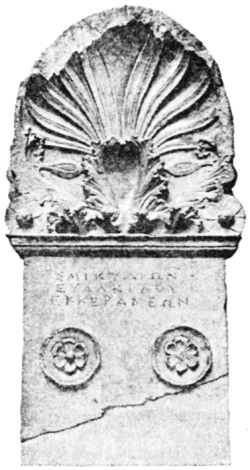
Fig. 24.—Sepulchral stelè of Smikylion, No. 599.
Inscribed Σμικυλίων Εὐαλκίδου ἐκ Κεραμέων—Smikylion, son of Eualkides, of the deme of the Cerameicos.—Athens. Presented by A. Robinson, Esq., R.N.
Pentelic marble; height, 2 feet 9½ inches; width, 1 foot 5½ inches. Synopsis No. 441. Greek Inscriptions in Brit. Mus., LXXXVI.; C.I.A., II., 2139.
600. Plain stelè of Hippocrates and Baukis; surmounted by an acroterion in low relief, of palmette form.
Inscribed Ἱπποκράτης, Βαυκίς. Below the surface of the stelè is flat, and probably was painted.—Athens. Elgin Coll.
Pentelic marble; height, 4 feet 1 inch; width, 1 foot 3 inches. Mus. Marbles, IX., pl. 29, fig. 4. Synopsis, No. 351 (175); Ellis, Elgin Marbles, II., p. 152; C.I.G., 958; C.I.A., II., 3810. Greek Inscriptions in Brit. Mus., CXX.
601. Fragment of a plain stelè, surmounted by an acroterion, in the form of a palmette in low relief, springing from acanthus leaves.
Inscribed Ἀσσκληπιόδωρος Θράσωνος Ὀλύνθιος, Ἐπικύδης Ἀσκληπιοδώρου Ὀλύνθιος—Asclepiodoros, son of Thrason, of Olynthos; Epikydes, son of Asclepiodoros, of Olynthos.—Probably from Athens. Elgin Coll.
Pentelic marble; height, 1 foot 5 inches; width, 1 foot ¾ inch. Mus. Marbles, IX., pl. 29, fig. 2; Synopsis, No. 258 (169); Ellis, Elgin Marbles, II., p. 152; C.I.G., 879; C.I.A., II., 3243; Greek Inscriptions in Brit. Mus., CVI.
602. Acroterion in form of palmette from a stelè.—Athens. Inwood Coll.
Pentelic marble; height, 1 foot 9 inches; width, 1 foot 10 inches. Synopsis, No. 418.
603. Acroterion, from a stelè, of palmette form, springing from acanthus leaves.—Inwood Coll.
Pentelic marble; height, 10 inches. Synopsis, No. 414; Inwood, Erechtheion, pl. 31, p. 147.
604. Fragment of an acroterion of a stelè in form of a palmette springing from acanthus leaves.—Athens? Elgin Coll.
Pentelic marble; height, 1 foot 8½ inches; width, 11 inches. Synopsis, No. 191 (95). Mus. Marbles, IX., pl. 29, fig. 3.
605. Stelè, surmounted by acroterion. One central palmette, and two half palmettes at the sides spring from acanthus leaves.
Inscribed Εὔμαχος Εὐθυμάχου [Ἀ]λωπέ[κ]ηθε[ν]—Eumachos, son of Euthymachos, of the deme of Alopekè.
Athens.—Obtained by Chandler in his Expedition for the Society of Dilettanti in 1765, and presented by the Society.
Pentelic marble; height, 1 foot 8 inches; width, 1 foot 5¼ inches. Synopsis, No. 283 (292*); C.I.G., 579; C.I.A., II., 1812. Greek Inscriptions in Brit. Mus., LXXIX.; Stereoscopic, No. 121; Wolters, No. 1104.
606. Top of stelè, with central palmette and two half palmettes, springing from acanthus leaves. Found in the side of a mound, near Maritza, Rhodes.
Marble; height, 2 feet 3 inches; width, 2 feet 3¼ inches.
607. Upper part of stelè, surmounted by a central palmette and two half palmettes, springing from acanthus leaves. Similar to last, but in lower relief.
Probably from Athens. Formerly in the collection of Lord Elgin.
Pentelic marble; height, 1 foot 7 inches; width, 1 foot 1¾ inches. Journ. of Hellen. Studies, VI., p. 42, No. 2.
608. Upper part of stelè, surmounted by a central palmette, and two palmettes at the sides, broken.
Inscribed Χαβρίας Σαλυπριανός. Chabrias of Selymbria.—Athens? Elgin Coll.
Pentelic marble; height, 1 foot 7 inches; width, 1 foot 5½ inches. Synopsis, No. 290 (226); Mus. Marbles, IX., pl. 30, fig. 1; C.I.G., 888; C.I.A., II., 3296; Ellis, Elgin Marbles, II., p. 152; Greek Inscriptions in Brit. Mus., CVII.
609. Top of stelè, in form of a capital of a pilaster with a palmette between two volutes springing from acanthus leaves, and an egg and dart moulding. Late work.
Probably from Athens. Formerly in the collection of Lord Elgin.
Pentelic marble; height, 9¾ inches; width, 11 inches. Journ. of Hellen. Studies, VI., p. 43, No. 6.
610. Top of stelè, in the form of the capital of a pilaster; treated in a similar way to the capitals of the Tower of the Winds. (Compare No. 447.) Late work.
Probably from Athens. Formerly in the collection of Lord Elgin.
Pentelic marble; height, 1 foot 2 inches; width, 1 foot 6 inches.
611. Upper part of stelè, with three rosettes; surmounted by a large acroterion.—Kertch.
Limestone; height, 3 feet 8 inches; width, 1 foot 11½ inches. The collection of sculptures from Kertch was obtained by Colonel Westmacott during the occupation of the town by the British and French troops in 1856.
612. Stelè, surmounted by acroterion.—Kertch.
Limestone; height, 3 feet; width, 1 foot 11 inches.
613. Stelè, with two rosettes in front and one at each side; surmounted by acroterion.—Kertch.
Limestone; height, 2 feet 10 inches; width, 1 foot 10 inches.
614. Top of stelè with rosettes. Originally surmounted by a large acroterion of which only the acanthus leaves at the base remain.—Kertch.
Limestone; height, 2 feet 6 inches; width, 2 feet 4 inches.
615. Upper part of stelè. Two rosettes in front and one on each side; above an acroterion, of which the top is wanting.—Kertch.
Limestone; height, 2 feet 11 inches; width, 1 foot 11 inches.
616. Fragment of palmette from the acroterion of a stelè.—Kertch.
Marble; height, 1 foot 7 inches; width, 1 foot 11 inches.
617. Palmette from top of stelè.—Kertch.
Limestone; height, 2 feet 6 inches; width, 1 foot 7½ inches.
618. Top of stelè, with acanthus leaves forming the base of the acroterion. The leaves are only sketched in outline on the front, but have been finished on the right and left.—Kertch.
Limestone; height, 2 feet 3 inches; width, 2 feet 3 inches.
SEPULCHRAL MONUMENTS WITH SCENES FROM DAILY LIFE.
619. Cast of the sepulchral relief of Hegeso. A lady, Hegeso, is seated on a chair, with a foot-stool. She appears to be taking a necklace from a box which is held by a servant standing before her. Hegeso is richly dressed in a chiton with short sleeves, himation and sandals. Her hair is confined by a sphendonè, or band, broadest in front. The servant has a close-fitting cap, and a plain chiton with long sleeves. The relief is bounded by two pilasters surmounted by a pediment, with acroteria.
Inscribed Ἡγησὼ Προξένο(υ)—Hegeso daughter of Proxenos.
This relief, which is unequalled for its grace and delicacy, appears to belong to the close of the fifth century b.c. The original, of Pentelic marble, is near the Dipylon at Athens, where it was discovered in 1870.
Height, 4 feet 9¾ inches; width, 3 feet 1 inch. Arch. Zeit., 1871, pl. 43, p. 19; C.I.A., II., 3753; Mitchell, p. 502; Waldstein, Essays, p. 309; Wolters, No. 1030; Conze, Attische Grabreliefs, No. 68, pl. 30; Stereoscopic, No. 123.
620. Cast of the sepulchral monument of Ameinocleia. A lady is engaged with a girl who is adjusting a sandal on her left foot. She chiefly supports herself on the right foot, and helps her balance by touching with her hand the head of the maid kneeling before her. As in the monument of Hegeso (No. 619), there is a marked contrast between the mistress, richly draped in a chiton and himation, and the girl before her, who has a plain long-sleeved chiton and a cap. On the left is a female figure, perhaps a sister of Ameinocleia. She seems to be reading a tablet. The composition is framed by two pilasters, surmounted by a pediment.
Inscribed Ἀμεινόκλεια Ἀνδρομένο(υ)ς θυγάτηρ Λ . . . Ameinocleia, daughter of Andromenes.... This relief appears to belong to the close of the 5th century B.C. The original, of Pentelic marble, which is now at Athens, was discovered in 1836 at the Piraeus.
Height, 4 feet 4¾ inches; width, 2 feet 3½ inches. Le Bas, Mon. Fig., pl. 65. C.I.A., II., 2687; Mitchell, p. 500; Wolters, No. 1032; Stereoscopic, No. 123.
621. Fragment of relief. A female figure, richly draped, is seated on a stool, to the left. The head, right arm, and knees are wanting.—Athens. Elgin Coll.
Pentelic marble; height, 2 feet 5 inches; width, 1 foot 5 inches. Mus. Marbles, IX., pl. 39, fig. 3. Synopsis, No. 280 (279).
622. Fragment of relief. The upper part of a female figure, richly draped, and seated, with her left hand raised, the left elbow supported by the right hand. Very high relief.—Athens. Elgin Coll.
Pentelic marble; height, 1 foot 7 inches; width, 1 foot 11½ inches. Synopsis, No. 419.
623. Fragment of relief. Draped male figure seated, three-quarters turned to the right, on a chair with a footstool. The head is wanting. Behind is part of a draped female figure standing. Her right arm is bent at the elbow, and crosses her breast.
Marble; height, 4 feet 11 inches; width, 2 feet 10½ inches.
624. Fragment of a relief. Torso of a male figure, wearing a mantle about his legs and over the left shoulder. Head, right leg, and left foot are wanting.—Athens. Strangford Coll.
Pentelic marble; height, 2 feet 6½ inches; width, 1 foot 3 inches.
625. A nude youth stands, half turned to the left, and takes some object, perhaps a lekythos, from a boy standing before him. The boy is nude except for a chlamys thrown over his left shoulder, which is probably that of the older youth. Compare the Parthenon frieze, north side, figure No. 110. The relief is bounded by two pilasters surmounted by a pediment. On the side of one of the pilasters is the inscription ΗΔΔ.—Delos. Presented by A. E. Impey, Esq., 1825.
Marble; height, 6 feet 5 inches; width, 3 feet 8½ inches. Mus. Marbles, XI., pl. 50; Ellis, Townley Gallery, II., p. 205.
626. A nude male figure, Tryphon, stands, half turned to the left, having a chlamys above the left arm, and a strigil in the right hand. The attitude is similar to that of the Hermes of Andros. Compare the copy from the Farnese Collection in the British Museum.
Inscribed Τρύφων Εὐτύχου—Tryphon, son of Eutychos.—Athens. Collection of Rev. F. V. J. Arundell.
Pentelic marble; height, 5 feet 11 inches; width, 3 feet. Restored: right hand upper corner. Mus. Marbles, XI., pl. 49; C.I.A., III., 3391; Greek Inscriptions in Brit. Mus., CXXIX.
627. Figure of a youth, standing, holding a bird, within a distyle portico, of which the left side is wanting. (Pl. xi., fig. 3.)—Athens. Strangford Coll.
Pentelic marble; height, 3 feet 1 inch; width, 11½ inches. Arch. Anzeiger, 1864, p. 164,* No. 2.
628. Sepulchral monument of Xanthippos. An elderly bearded figure is seated on a chair. He holds a foot in his extended right hand. Diminutive figures of a woman and a girl stand beside him. The girl is gazing at the foot, and raises her hands towards it, while the woman looks towards Xanthippos. She holds a bird in her right hand. It has been supposed that the foot is a votive offering, to commemorate a remarkable cure. Wolters, however, explains the object as a shoemaker's last (καλάπους, cf. Monumenti dell' Inst., xi. pl. 29), and interprets it as an allusion to the trade of Xanthippos. This theory hardly accounts for the gestures of the attendant figures.
Above the relief is a pediment, inscribed Ξάνθιππος. (Pl. xi., fig. 2.)
Brought from the monastery of Asomato or Petraki at Athens by Dr. Anthony Askew about 1747. Townley Coll.
Pentelic marble; height, 2 feet 9 inches; width, 1 foot 8 inches. Burney MSS., No. 402; Mus. Marbles, X., pl. 33; Ellis, Townley Gallery, II., p. 106; C.I.G., 980; C.I.A., II., 4040; Greek Inscriptions in Brit. Mus., CXXIII.; Wolters, No. 1019; Brueckner, Von den griech. Grabreliefs, p. 26.
629. Sepulchral monument of Jason. A physician, Jason, an elderly bearded man, is seated on a stool. Before him stands a boy, undergoing examination, and clearly shown to be suffering, by his swollen belly and wasted limbs. On the right is a vessel of peculiar form, resembling a cupping glass, but on a scale out of all proportion to that of the group, and not to be considered as a part of it.
The inscription runs: Ἰάσων ὁ καὶ Δέκμος Ἀχαρνεὺς ἰατρός, κ.τ.λ., and contains the names of 'Jason, called also Decimus, of the Acharnian deme, a physician,' and of other members of his family. The relief is surmounted by a row of roughly indicated antefixal tiles.
Obtained by Fauvel in Athens; afterwards in the Choiseul-Gouffier and Pourtalès Collections.
Pentelic marble; height, 2 feet 7 inches; width, 1 foot 10½ inches. C.I.G., 606; C.I.A., III., 1445; Panofka, Antiques du Cabinet Pourtalès, p. 78, pl. 26; Greek Inscriptions in Brit. Mus., LXXXI.; Wolters, No. 1804. On the cupping vessel see the two references last cited.
630. Sepulchral monument of Agathemeris and Sempronios Niketes. Draped male and female figures stand to the front. The woman wears the dress of a priestess of Isis, with a sistrum in her right hand and a vase in her left hand.
Inscribed Ἀγαθημερὶς Σ Η Ἀφροδεισίου ἐκ Κολ(λ)υτέων. Σενπρώνιος Νικήτης Κολλυτεύς. The letters Σ Η have not been explained.
Discovered, in 1826, between Athens and the Piraeus.—Presented by Gen. Malcolm.
Pentelic marble; height, 5 feet 6½ inches; width, 3 feet. C.I.G., 662b; C.I.A., III., 1760.
631. Figure of a youth, a son of one Diodoros, standing, with a chlamys wrapped about his left arm. He holds a cup (?) in the right hand and a strigil in the left hand. Beside him, a diminutive figure of a nude boy holding a strigil. A tree on the left.
Inscribed . . . Διοδώρου, χρῆστε, [χαῖρε.—Rhenea. From the Earl of Belmore's Coll.
Parian marble; height, 4 feet; width, 1 foot 8 inches. C.I.G., 2313.
632. Upper part of a sepulchral relief. A draped male figure is seated on a chair. Before him stands a figure also draped. In the background, a bearded man and a woman stand one on each side of the seated person.
The inscription runs Ἀρι]στονίκη Διοκλείο[υς Ξυ]π[ε(ταίων) | Κ]ηφισογένης Κηφισοφῶντος Ξυ(πεταίων) | Ἀριστ[ο]νίκη Κηφισοφῶντος Ξυπ(εταίων) | Κηφισοφῶν Κηφισοδώρου Ξυπε(ταίων). It contains the names of Aristonikè, daughter of Diocles, of Xypetè; of Kephisogenes and Aristonikè, probably the children of Kephisophon; and of Kephisophon, son of Kephisodoros of Xypetè.—Obtained in Greece by the fourth Earl of Aberdeen, and presented by the fifth Earl of Aberdeen.
Pentelic marble; height, 1 foot; width, 1 foot 2¼ inches. Greek Inscriptions in Brit. Mus., XC.; C.I.A., II., 2365.
633. Male figure stands to the left, with right arm extended. Before him is a table, on which is a large hydria.—Obtained in Greece by the fourth Earl of Aberdeen, and presented by the fifth Earl of Aberdeen.
Pentelic marble; height, 1 foot 7½ inches; width, 1 foot ¾ inch.
634. Beardless male figure stands, wearing a himation. He has a short staff or scroll in the left hand. The relief was originally surmounted by a pediment.
Inscribed Ἑρμόδωος Ἀριστομένου(ς)—Hermodoros, son of Aristomenes.
Bluish Greek marble; height, 3 feet 10 inches; width, 1 foot 6½ inches.
635. Bearded figure stands, draped in a himation. The stelè is surmounted by a bulbous ornament not worked in relief. Inscribed Ἐ]ράσιππος, [Κα]λλενίκου [Κρ]ιωεύς.—Erasippos, son of Callenicos of Crioa.—Athens? Elgin Coll.
Pentelic marble; height, 2 feet 1 inch; width, 9 inches. Mus. Marbles, IX., pl. 30, fig. 3; C.I.G., 665; C.I.A., II., 2223; Greek Inscriptions in Brit. Mus., LXXXVIII.
636. Stelè fitting into a base. Figures of an athlete anointing himself, and of an attendant holding spear and drapery.
Marble; height, 1 foot 11 inches; width, 1 foot 3½ inches.
637. Fragment of sepulchral relief, containing the upper parts of a bearded man and a woman conversing. On the left a younger female figure.
Inscribed: Ἀριστοδίκη, Ἀρίσταρχος, Ἀθηναΐς, Σήστιοι—Aristodikè, Aristarchos, and Athenais, of Sestos.—Athens. Found by Chandler, fixed in the wall of a church, on the road to Cephisia. Presented by the Society of Dilettanti.
Pentelic marble; height, 7¾ inches; width, 1 foot 2½ inches. Chandler, Inscriptions Ant., Part II., No. 95; Synopsis, No. 336 (236*); C.I.G., 892; C.I.A., II., 3313; Greek Inscriptions in Brit. Mus., CVIII.
638. A bearded figure, Aristocles, rides a prancing horse and places his right hand on its head. A youth in a short chiton runs behind the horse. Inscribed:
Πολλὰ μεθ' ἡλικίας ὁμοήλικος ἡδέα παίσας ἑκ γαίας βλαστὼν γαῖα πάλιν γέγονα. Εἰμὶ δὲ Ἀριστοκλῆς Πειραιεὺς, παῖς δὲ Μένωνος.
'After many pleasant sports with my comrades, I who sprang from dust, am dust once more. I am Aristocles, of the Piraeus, son of Menon.'—Athens. Elgin Coll.
Pentelic marble; height, 2 feet 8 inches; width, 1 foot 6 inches. Stuart, III., p. 56; Chandler, Inscriptions Ant., Part II., No. 78 ("fixed in a wall at the door of the Greek School"); Mus. Marbles, IX., pl. 34, fig. 3; Synopsis, No. 384 (213); C.I.G., 749; C.I.A., II., 2442; Greek Inscriptions in Brit. Mus., XCII.; Kaibel, 75.
639. A priestess stands, with chiton, and a knotted himation bordered with a fringe; she holds a key in her right hand, and a basket in her left hand. On the right is a tree. Above, a pediment with acroteria and a rosette; also an honorary wreath.
Inscribed: Ὁ δῆμος Ἰσιάδα Μητροδώρου Λαοδικίδα.—Decreed by the people, in honour of Isias of Laodicea, daughter of Metrodoros.—Smyrna. Presented by M. Duane and T. Tyrwhitt, Esqs., 1772.
Bluish Greek marble; height, 4 feet 2¼ inches; width, 1 foot 11 inches. Montfaucon, Ant. Expl. Suppl., V., p. 25; Archaeologia, III., pl. 11, fig. 1; Ellis, Townley Gallery, II., p. 161; C.I.G., 3234.
640. A draped female figure, seated on a chair, holds out a corner of her veil with her right hand. Another female figure stands before her, closely wrapped in her mantle. A diminutive female figure is in the right-hand corner of the relief. The relief is bounded by pilasters, a circular arch, and a pediment.
Parian marble? height, 3 feet; width, 2 feet 4 inches.
641. Fragment of sepulchral stelè, with the lower part of a female figure moving to the right.—From Mycenae. Inwood Coll.
Red marble; height, 10 inches; width, 10¾ inches. Synopsis, No. 427.
642. Late sepulchral relief. A female figure, seated on a stool, holds her mantle, which passes over her head, with the left hand, and a scroll (?) in her right hand. The relief is surmounted by an arch and rosettes, above which is a pediment with acroteria, unfinished, and a rosette.
Inscribed: Μοῦσις Ἀργαῖου Μιλησία. Mousis, daughter of Argaios of Miletus.—Athens. Found by Chandler. Presented by the Society of Dilettanti.
Pentelic marble; height, 2 feet 2¾ inches; width, 1 foot 2¼ inches. Chandler, Inscriptiones Ant., Part II., No. 91; Synopsis, 1st ed., Room VI., No. 27 (where Thomas Hollis is incorrectly said to be the donor); Ellis, Townley Gallery, II., p. 171; C.I.G., 726; Greek Inscriptions in Brit. Mus., CIII.
643. A female figure, draped, and seated on a stool, raises her right hand to draw her peplos over her head. A draped male figure stands before her, and a boy at the left corner; above is a pediment.
Inscribed with a name now illegible, and χαῖρε.—Found in a store at Portsmouth. Probably from Smyrna.
Marble; height, 2 feet; width, 1 foot 2½ inches.
644. Sepulchral relief, mutilated on the left. A female figure draped and seated on a chair, draws her peplos over her shoulder with her left hand. Above, a pediment.
Inscribed with a name now illegible, terminating in ω, and χαίρετε ἅπαντες.—Obtained by the fourth Earl of Aberdeen in Greece, and presented by the fifth Earl of Aberdeen.
Marble; height, 1 foot 9½ inches; width, 1 foot ½ inch. Greek Inscriptions in Brit. Mus., CXXXIII.; Conze, Attische Grabreliefs, No. 46; pl. 23, fig. 1.
645. Lower part of sepulchral relief, much mutilated. A female figure is seated to the front on a lofty throne. She holds a fruit in her left hand. On the left is a youth with a box; and on the right a female figure, whose right hand was raised to her chin. The arms of the throne are supported by Sphinxes.—Kertch.
Limestone; height, 1 foot 8 inches; width, 2 feet 2 inches.
646. A female figure, Demetria, seated on a chair, extends her right hand to a box, held by a girl standing before her; behind is another standing female figure.
Inscribed: [Δ]ημητρία.—Probably from Athens. Obtained by the fourth Earl of Aberdeen, and presented by the fifth Earl of Aberdeen.
Pentelic marble; height, 2 feet ½ inch; width, 1 foot 1 inch. Greek Inscriptions in Brit. Mus., CXIII.; C.I.A., III., 3072.
647. Lower part of a sepulchral relief. A fully draped female figure, wanting above the breast, is seated on a stool. The left hand was probably raised to the chin or to the veil. Before her, a female figure of which nothing remains except a portion of drapery, from the knees downwards. A small boy stands at the knee of the seated woman, and raises his right hand.—Athens? Elgin Coll.
Pentelic marble; height, 1 foot 6 inches; width, 1 foot 3 inches. Mus. Marbles, IX., pl. 39, fig. 2; Synopsis, No. 196 (162).
648. Boy seated on a rock fishing with a rod and line for a large fish, a basket in his left hand. Above a pediment.
Inscribed in rude late characters, Ἀγαθήμε<τ>ρος Ἀσιαχῷ συντρόφῶ μνημῆς χάριν.—Placed by Agathemeros in memory of his foster brother Asiachos.—Athens. Purchased from the Besborough Coll. 1801.
Pentelic marble; height, 1 foot 2 inches; width, 10½ inches. C.I.G., 6892.
649. A girl, seated on a stool, holds an open scroll on her lap. Before her is a column, on which is another scroll (?); on the left is a dog raising a paw. The relief is bounded by pilasters and a pediment, slightly sketched out.
Inscribed: Ἀβείτα ζήσασα ἔτη ῑ μῆνας δύο · χαίρετε—Avita, who lived ten years and two months. Hail.—Townley Coll.
Parian marble; height, 1 foot 1 inch; width, 11 inches. Ellis, Townley Gallery, II., p. 165. C.I.G., 6866; Wolters, No. 1811.
650. Youthful female figure, standing, holding an ivy-leaf fan in the right hand, and a part of the mantle with the left hand.
Inscribed: Σύνφορο[ν] ᾙρακλείδ[ου] Καρυστία. Synphoron, of Carystos, daughter of Heracleides.—Athens?
Pentelic marble; height, 1 foot 7 inches; width, 11½ inches. C.I.G., 857; C.I.A., III., 2510; Greek Inscriptions in Brit. Mus., CI.
651. Nude figure of boy, standing, with chlamys thrown over his left shoulder. He holds a partridge in his left hand, and holds its beak with his right hand.
Inscribed: Μενεκράτης Μένωνος—Menecrates, son of Menon.—Athens. Strangford Coll.
Pentelic marble; height, 1 foot 9 inches; width, 11 inches. Greek Inscriptions in Brit. Mus., CXXI.; C.I.A., III., 3276; Arch. Anzeiger, 1864, p. 164*.
652. Fragment of sepulchral relief. A draped female figure is seated on a couch, with right hand raised to her veil; before her, two girls, of whom one holds a ball and the other a fan.—Found in a store at Portsmouth. Probably from Smyrna.
Marble; height, 10 inches; width, 1 foot 1½ inch.
653. A boy throws a ball for a dog which springs up towards him.—Strangford Coll.
Pentelic marble; height, 1 foot 8 inches; width, 10½ inches. Arch. Anzeiger, 1864, p. 165*.
654. Draped male figure standing, with a boy at his side; above an arch, springing from pilasters, and surmounted by a pediment with rosette and acroteria.—Kertch.
Limestone; height, 2 feet 3¾ inches; width, 1 foot 9½ inches.
655. Sepulchral relief, rude and late. Standing, draped female figure raises her right hand to her cheek. The first inscription has been obliterated, and in place of it is the inscription, ΣΩΤ ... ΝΙΚΕ χαῖρε.
Greek marble; height, 2 feet 2½ inches; width, 1 foot.
656. Sepulchral monument of Artipous. An old woman is seated wrapped in her mantle, with a pomegranate in her left hand. A girl stands at her left side holding a box and a purse (?). The relief is bounded by pilasters, surmounted by a pediment with acroteria.
Inscribed: Ἀρτίπους Ἀλκίμα and ∟π. ∟ is a symbol chiefly used in Ptolemaic inscriptions to precede a numeral denoting a year. The inscription therefore appears to mean '80 years old,' if π is given its usual value.—Kertch.
Limestone; height, 4 feet ½ inch; width, 2 feet 5¾ inches. Greek Inscriptions in Brit. Mus., CCII.; Latyschev, II., 133.
657. A draped figure, Theodotè, seated on a throne, raises her left hand to her veil. Before her a figure of a girl, standing. The arms of the throne are supported by Sphinxes. Above the relief are an arch, springing from pilasters, a pediment with acroteria, and rosettes.
Inscribed: [Θεοδ]ότη γυνὴ [Μυρίνου, χαῖρε].—Kertch.
Limestone; height, 2 feet 5 inches; width, 1 foot 8½ inches. Greek Inscriptions in Brit. Mus., CCI.; Latyschev, II., 231. The restoration is taken from a copy, given by Latyschev, which was made before the inscription was broken.
658. A draped female figure, seated on a throne, raises her left hand to her veil, and holds a mirror in her right hand. A female figure stands before her. On each side of the standing figure is a diminutive figure of a girl; one holds a bird, and the other a vase. Above is a pediment with acroteria and rosettes.
Inscribed: Θεοφίλη θυγά[τηρ] . . . Theophilè, daughter of ....—Kertch.
Limestone; height, 2 feet 5 inches; width, 2 feet. Greek Inscriptions in Brit. Mus., CC.; Latyschev, II., 235b.
659. A female figure, seated on a throne, raises her left hand to her veil. On right and left are diminutive figures of girls. The arms of the throne are supported by Sphinxes. Above is an arch, springing from pilasters, a pediment with rosettes and acroteria.
Inscribed: Ἑλλὰς γυνὴ Μηνοδώρου, χαῖρε—Hellas, wife of Menodoros, farewell.—Kertch.
Limestone; height, 5 feet 1½ inches; width, 1 foot 11½ inches. Greek Inscriptions in Brit. Mus., CXCVII.; Latyschev, II., 228.
660. A draped female figure, seated on a chair to the front. The head is wanting. On the left is an attendant figure of a girl holding a box (pyxis). On the right is a horseman wearing chlamys, bow-case and bow, and sword. There is also a small part of a second horseman.—Kertch.
Limestone; height, 1 foot 6 inches; width, 2 feet 4 inches.
661. Two horsemen standing to right. The foremost has a sword, bow, bow-case; the hinder one wears a conical cap. Above, rosettes and a pediment, surmounted by acroteria.—Kertch.
Limestone; height, 3 feet 3 inches; width, 1 foot 11½ inches.
662. Sepulchral relief, with two panels. The upper panel contains a mounted horseman in a chlamys, galloping to the right. Of the lower panel only the upper part with one head remains. Above the relief is a pediment.—Kertch.
Limestone; height, 2 feet 3 inches; width, 1 foot 5 inches.
663. Horseman to the right, with tunic, chlamys, and bow-case with bow. Behind him, an attendant male figure. Below the horse is a dog running.
Inscribed: Δαΐσκε Ἀριαράμνου, χαῖρε—Daïscos, son of Ariaramnos, farewell.—Kertch.
Limestone; height, 2 feet 6 inches; width, 1 foot 10 inches. Greek Inscriptions in Brit. Mus., CLXXXVII.; Latyschev, II., 141.
664. Sepulchral relief in two panels. The upper part is broken away. The feet and tail of a horse, and a figure of a dog standing to right remain. Before the horse are the legs of a small attendant figure. In the lower panel is a horseman riding to the right, with bow, bow-case, sword and long spear. A colt stands beside the horse.
Inscribed: Ἀρτεμίδωρε Διογᾶ ἐπὶ τῆς πινακεῖδος, χαῖρε. Wolters translates, "Hail, Artemidoros, son of Diogas, officer in charge of the list."—Kertch.
Limestone; height, 2 feet 3 inches; width, 2 feet 1¾ inches. Greek Inscriptions in Brit. Mus., CLXXXIII.; Wolters, No. 1809 Latyschev, II., 131.
665. Fragment of relief, with figures of two horsemen standing confronted. The head of one and the head and body of the other are lost. They have short tunic, cloak, bow and arrows in bow-case, and a saddle cloth.—Kertch.
Limestone; height, 1 foot 5 inches; width, 1 foot 8 inches.
666. Fragment from the right-hand lower corner of a relief, which is perhaps sepulchral, with the lower parts of two mounted horsemen, wearing short tunics, cloaks and swords, moving rapidly to the left.—Athens. Strangford Coll.
Pentelic marble; height, 1 foot 7 inches; width, 1 foot 10 inches.
667. Sepulchral relief. A woman stands to the front wearing a chiton, and having a mantle wrapped closely about her. The relief is bounded by pilasters and a high-pitched pediment, in the tympanum of which is a vase in low relief. Inscribed Ἐπιγόνα Μοσχίωνος Μιλησία, Epigona, wife of Moschio, of Miletus.—Athens. Presented by J. Johnstone, Esq., 1890.
Pentelic marble? Height, 3 feet 9 inches; width, 1 foot 7 inches. This relief, which was seen at Athens, "in the court of Giorgaki Livaditi," by Spon in 1676 and by Fourmont in 1720, was dug up many years ago below a house in New Bond Street. Spon, Voyage (ed. 1679), II., p. 445; C.I.G., 706; C.I.A., III., 2660.
668. Fragment of relief, with the body and legs of a boy walking to the right. The arms appear to have been raised. A small piece of drapery is seen behind the back of the boy.—Elgin Coll.
Pentelic marble; height, 1 foot 6 inches. Synopsis, No. 198 (109).
669. Female head to the front in a somewhat severe style. Apparently broken from a relief. The features are those of a young girl. The hair is waved on each side, from a central parting.—Athens, 1848. Lenormant Coll.
Pentelic marble; height, 6¾ inches.
670. Helmeted head in profile to the right; broken from a relief. Above the helmet is what appears to be part of a horse's tail.—Inwood Coll.
Pentelic marble; height, 7 inches.
671. Head of a maiden, probably from a sepulchral relief. She wears a closely-fitting cap, with a small flap hanging down before the ear. There are remains of the tips of two fingers and a thumb resting on the top of the head, which make it probable that the complete figure was that of an attendant kneeling before her mistress, like the attendant who fastens the sandal of Ameinocleia (No. 620).—Athens? Elgin Coll.
Pentelic marble; height, 8 inches. Synopsis, No. 250 (114); Ellis, Elgin Marbles, II., p. 119.
672. Head of a youth, three-quarters turned to the right, from the side of a sepulchral relief. He wears a taenia, and there are traces of drapery which passed over the shoulder. There is a part of a pilaster on the left (Pl. xii., fig. 2.)—Athens.
Pentelic marble; height, 8 inches.
673. Head of a youth, half turned to the right, together with the neck and part of the breast. From a sepulchral relief. The waving locks of hair are freely treated. (Pl. xii., fig. 1.)—Athens.
Pentelic marble; height, 10 inches. The tip of the nose is restored.
674. Fragment of a sepulchral relief. A male head in high relief, wearing a taenia, is slightly bent forwards to the right. There are remains of drapery which passed over the shoulder. On the left is part of a pilaster which bounds the relief.
Marble; height, 6½ inches.
675. Female head, probably from a sepulchral relief. The neck is much bent. A portion of the right hand remains clasping the top of the head.
Marble; height, 6 inches.
676. Fragment of the head of a youth, perhaps from a sepulchral relief. A band passes across the forehead immediately below the hair.—Excavated by J. T. Wood, at Ephesus.
Marble; height, 5 inches.
677. Portrait head of a bearded man. This head appears to be derived from a sepulchral monument in very high relief, and to have been turned to the left, as the left side is carefully finished, while the right side is rough and inaccurate.—Athens? Elgin Coll.
Pentelic marble; height, 10½ inches. Synopsis, No. 242 (120).
678. Fragment of the right side of a relief which was probably sepulchral. A female figure, wearing a sleeved chiton and mantle, is seated on a chair. She extends her hands, probably towards a figure now wanting. On the right is the head of a figure looking to the right, and part of a pilaster which bounds the scene. On the left is part of the drapery of a third figure.—Ephesus. Strangford Coll.
Pentelic marble? Height, 1 foot 4 inches; width, 11 inches.
679. Fragment of a relief, perhaps sepulchral, containing the lower part of the body and the right leg of a warrior, who stands on rocky ground drawing himself rather to the left. He wears a short chiton, a cuirass with a triple row of flaps (pteryges), and a mantle. Behind are the legs from the knees of a recumbent figure. The warrior appears to have had a shield on the left arm, and the right arm raised for a spear thrust at a fallen enemy.—Found at the foot of the Inscribed Monument, Xanthos.
Hard limestone; height, 3 feet 4 inches; width, 1 foot 11 inches. Synopsis, Lycian Room, No. 141b. Joints at both sides show that the complete work was of considerable size. Compare the scenes of combat in the entrance of the rock tomb at Kiöbaschi. Benndorf, Reisen in Lykien, I., p. 135; and at Tyssa, loc. cit., II., p. 64.
680. Figure of bull lying down to the right, on rough ground. The head is worked in a very natural manner. The forms of the body are treated in the flat manner of a bas-relief. The back has been left unfinished. Probably the bull originally surmounted a tomb, at Athens. (Compare Curtius and Kaupert, Atlas von Athen, pl. 4.)—Brought from Greece by C. R. Cockerell. Presented by Lord Hillingdon.
Pentelic marble; height, 3 feet 2¾ inches; length, 5 feet. Journ. of Hellen. Studies, VI., pl. C., p. 32.
SEPULCHRAL VASES.
For the supposed significance of Vases as Sepulchral Monuments, see above, p. 297.
681. Plain sepulchral lekythos, in low relief.—Elgin Coll.
Pentelic marble; height, 2 feet 11 inches. Synopsis, No. 164 (276); Mus. Marbles, IX., pl. 34, fig. 1; Ellis, Elgin Marbles, II., p. 161.
682. Sepulchral lekythos, with relief. An old man, Pytharatos, stands, clasping the hand of a seated man, Herophilos, who is also old.
Inscribed: Πυθάρατος, Ἡρόφιλος.—Sloane Coll.
Pentelic marble; height, 2 feet 9 inches; diameter, 10¼ inches, Ellis, Townley Gallery, II., p. 221; Greek Inscriptions in Brit. Mus., CXXVI.
683. Plain sepulchral amphora of Phaidimos of Naucratis. Inscribed: Φαίδιμος Ναυκρατίτης.—Athens? Elgin Coll.
Pentelic marble; height, 3 feet 4½ inches; diameter, 11 inches. Synopsis, No. 124 (A. 51); Mus. Marbles, IX., pl. 33, fig. 4; Ellis, Elgin Marbles, II., p. 164; Greek Inscriptions in Brit. Mus., CV.; C.I.A., II., 3239.
684. Body of sepulchral amphora of Timophon, of Anagyrus, with ornate flutings, and a horizontal band of interwoven fillets. Rosettes at the base of the handles.
Inscribed: Τιμοφῶν Τιμοστράτου Ἀναγυράσιος.—Athens? Elgin Coll.
Pentelic marble; height, 1 foot 11 inches; diameter, 1 foot 2 inches. For the form, cf. vase held by the wind Skiron on the Tower of the Winds (Stuart, I., chap. III., pl. 19), and the relief from Icaria (American Journ. of Archaeology, V., p. 178, fig. 30). Published Dodwell, Tour, 1., p. 451; Synopsis No. 263 (163); Mus. Marbles, IX., pl. 32, fig. 4; Greek Inscriptions in Brit. Mus., LXXX.; C.I.G., 585. Kumanudis (Ἀττ. Ἐπιγ. No. 236, and p. 18) and Köhler (C.I.A. II., 1850) consider the inscription more recent than the vase.
685. Fragment from the top of a sepulchral amphora in relief, with patterns of foliage.—Formerly in Lord Elgin's Collection.
Pentelic marble; height, 11 inches. Journ. of Hellen. Studies, VI., p. 43, No. 4.
686. Sepulchral cippus of Anaxicrates with an amphora carved in low relief.
Inscribed: Ἀναξικράτης Δεξιόχου Ἀθηναῖος.—Athens? Elgin Coll.
Pentelic marble; height, 2 feet ½ inch. Synopsis, No. 123 (240); Mus. Marbles, IX., pl. 34, fig. 2; Greek Inscriptions in Brit. Mus., XCVI.; C.I.G., 801.
SEPULCHRAL VASES AND RELIEFS, WITH FIGURES CLASPING HANDS.
For the various interpretations that have been proposed for these scenes, commonly known as "Scenes of Parting," see above, p. 297.
687. Sepulchral lekythos with relief. A bearded figure stands before a woman seated on a stool, and clasps her hand.
Inscribed: Πάμφιλος Μειξιάδου Αἰγιλιεύς · Ἀρχίππη Μειξιάδου—Pamphilos, son of Meixiades, of Aigilia; Archippè, daughter of Meixiades. The figures represented are therefore brother and sister.—Found beside the portico of Hadrian, Athens. Elgin Coll.
Pentelic marble; height, 2 feet 4¾ inches; diameter, 1 foot 5 inches. Stuart I., pp. 44, 52; Dodwell, Tour, I., p. 454; Mus. Marbles, IX. pl. 33, fig. 2; Synopsis No. 192 (237); Ellis, Elgin Marbles, II., p. 164; C.I.G., 560; C.I.A., II., 1737; Greek Inscriptions in Brit. Mus., LXXV.
688. Sepulchral lekythos with relief. Two female figures, Philia and Metrodora, stand clasping hands. Two bearded figures, Mys and Meles, stand, one on the left and one on the right, each turning towards the central group.
Inscribed: Μύς, Φιλία, Μητροδώρα, Μέλης.—Athens? Elgin Coll.
Pentelic marble; height, 1 foot 9½ inches; diameter, 1 foot 1¼ inches, Mus. Marbles, IX., pl. 32, fig. 3; Synopsis No. 199 (148); C.I.G., 974; C.I.A., II., 3998; Greek Inscriptions in Brit. Mus., CXXII. Brueckner, Von den griech. Grabreliefs, p. 12, fig. K. A companion lekythos has been discovered at Chasani, in Attica, and is now at Athens. In this relief, Mys and Meles clasp hands, while Metrodora and Philia stand on the right and left. Brueckner, l.c.
689. Part of a sepulchral lekythos with relief. Two women, Callistratè (?) and Demostratè, stand with right hands joined. Behind the latter a girl stands in an attitude of grief with her head resting on her right hand. Behind the former is a youth supporting his chin on his right hand.
Inscribed: Δημοστράτη, Καλλιστρ[άτη].—Athens? Elgin Coll.
Pentelic marble; height, 1 foot 7 inches; diameter, 1 foot 5 inches. Mus. Marbles, IX., pl. 31, figs. 1, 2; Synopsis No. 275 (104); Ellis, Elgin Marbles, II., p. 165; C.I.G., 936; C.I.A., II., 3611; Greek Inscriptions in Brit. Mus., CXIV.