Volume 1 / Part 3 — THE SUCCESSORS OF PHEIDIAS.
Reading edition

SCULPTURES OF THE TEMPLE CALLED THE THESEION.
The building which is commonly known as the Temple of Theseus, or Theseion, stands about a quarter of a mile to the north-west of the Acropolis of Athens.
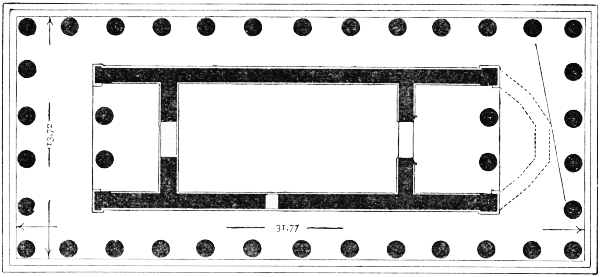
Fig. 15.—Plan of the Theseion. (From Baumeister.)
The temple is of the kind called peripteral hexastyle. Round the cella, or central chamber, is a single row of columns, thirty-four in number, of which there are six at each end. The order is Doric, with a frieze peculiarly arranged. On the eastern front are ten sculptured metopes, and there are four on each of the adjacent sides, making a total of eighteen sculptured metopes. The remaining metopes of the temple, fifty in number, are plain slabs, which may possibly have had painted on them figures or ornaments. Of the pedimental groups, which appear to have once existed at each end of the temple, nothing now remains except the marks of the attachment of sculptures. Within the colonnade the two ends of the cella are adorned with a frieze of Parian marble, which is still in position. At the west, the length of the frieze is only equal to the width of the cella; at the east, the frieze is continued as far as the epistyle, or beams surmounting the colonnade.
The west frieze is about 25 feet long; casts of 16 feet 4 inches are in the British Museum. The east frieze is about 37 feet long, and casts of 32 feet are in the Museum.
From the Middle Ages till recent times this building has been called the Temple of Theseus, and was supposed to have been dedicated to Theseus by the Athenians in the time of Kimon. That statesman had transferred the bones of Theseus to Athens from the island of Skyros in 469 b.c. The chief arguments for this attribution are:—(1) That labours of Theseus are represented on the metopes, and perhaps on the friezes; (2) that the building is not far from the place where, according to Leake and others, it might be expected from the description of Pausanias (i. 17, 2); (3) that the temple was dedicated as a Christian church to St. George, who corresponds in many ways to Theseus.
Ross, however (Das Theseion), tried to prove that this was not the Theseion. He argued that no connection could be traced between the external sculptures and the function of the building. He also argued that the real Theseion cannot have been a complete temple, and that it cannot have stood in the position of the temple now in question. He proposed to call the building a temple of Ares. It has since been suggested that Ares and Theseus may have been joint occupants of the temple, as Athenè and Erechtheus held the Erechtheion in common (Murray, i. p. 236). Curtius (Sieben Carten, text, p. 53) suggested that the temple may have been that of Heracles in Melitè. In this view he has been followed by Wachsmuth (Stadt Athen, i. p. 364). Other patron deities have also been proposed, as Apollo Patroös, or Heracles and Theseus together, or Hephaestos. Doerpfeld, followed by Miss Harrison (Mythology and Monuments of Anc. Athens, p. 112), is strongly in favour of the last-mentioned attribution, identifying the building with the temple of Hephaestos mentioned by Pausanias (i., 14, 6).
It is clear, from a comparison of other temples, that no conclusive argument can be drawn from the subjects of the sculptures, especially of the metopes, which may have little connection with the special purpose of the temple. At the same time we know that the Theseion was decorated with paintings relating to the story of Theseus, and, so far as any weight can be attached to the subjects of the sculptures, they favour the attribution of the building to Theseus. It has been suggested that the temple may have belonged to Heracles and Theseus in common—not on the ground that we hear of such a temple, but because the ten metopes on the east front relate to Heracles. But this fact is inconclusive. The Athenians would be content to point out the parallelism of Heracles and Theseus, even if Theseus was made to occupy a subordinate position. The newly-discovered Ἀθηναίων Πολιτεία of Aristotle furnishes some new evidence. The disarming of the Athenians by Peisistratos is said to have been effected in the following manner. He caused the citizens to put down their arms in the Theseion, presumably in the temenos of Theseus, that he might address them, and then drew them off to the Propylaea on the pretext that they would be better able to hear him. Meanwhile his agents shut up the arms in "the adjacent buildings of the Theseion" (ἐξοπλισίαν ἐν τῷ Θησείῳ [sic MS.] ποιησάμενος ... ἐκέλευσεν αὐτοὺς προσαναβῆναι πρὸς τὸ Πρόπυλον τῆς ἀκροπόλεως ... ἀνελόντες οἱ ἐπὶ τούτων τεταγμένοι τὰ ὅπλα αὐτῶν καὶ συγκληίσαντες εἰς τὰ πλησίον οἰκήματα τοῦ Θησείου κ.τ.λ. Aristot. Ἀθ. Πολ. ed. Kenyon, 15). From this it may be inferred that the Theseion was at no great distance from the Propylaea, though sufficiently removed for the success of the stratagem. Polyaenus (Strat. i., 21) tells the story, but states that the disarming took place in the Anakeion, and that the arms were shut up in the sanctuary of Aglauros. These are known sites below the north and north-west sides of the Acropolis. The account of Aristotle thus shows that there was a temenos and shrine of Theseus in existence long before the time of Kimon.
The date of the temple is necessarily uncertain. It cannot be older than the Persian invasion (480 b.c.), but most writers are of opinion that each part is rather older than the corresponding part of the Parthenon, both in the architecture (Julius, Annali dell' Inst. 1878, p. 205) and in the sculpture. There are many parallels between the metopes of the Parthenon and the sculptures, both metopes and friezes, of the Theseion. There is also a close analogy between the east friezes of the Parthenon and the Theseion in point of composition; moreover certain figures occur in both works (Murray, i. p. 244). But there is no trace in the Theseion of the low relief of the Parthenon frieze. The whole of the Theseion sculptures are metope-like in the treatment of the high relief. Overbeck states the order in point of time as follows:—Metopes of Theseion; metopes of Parthenon; west frieze of Theseion; east frieze of Theseion; frieze of Parthenon (Gr. Plast. 3rd ed. I., p. 349). Doerpfeld, however, followed by Miss Harrison, holds the temple to be later than the Parthenon.
It has been held by Brunn, Julius (Annali dell' Inst. 1878, p. 202), and Murray (i. p. 251), that the differences between the sculptures of the two temples are due to the fact that the sculptures of the Theseion were produced by the school of Myron.
Stuart, Antiqs. of Athens, vol. III., chap. i.; Mus. Marbles, IX., pls. 12-21; Müller, Denkmaeler, pl. 21; Kunstarch. Werke, IV., p. 1; Ross, Das Theseion (1st ed. 1838; 2nd ed., 1852); Ulrichs, Annali dell' Inst., 1841, p. 74; Leake, Topography of Athens (2nd ed.), p. 498; Gurlitt, Das Alter der Bildwerke des sog. Theseion; Brunn, Sitzungsber. der k. bayer. Akad. Phil.-hist. Cl. 1874, II., p. 51; Wachsmuth, Die Stadt Athen, I., p. 357; Julius, in Annali dell' Inst., 1877, p. 92; 1878, p. 193; and Mon. dell' Inst., X., pls. 43, 44, 58, 59; Overbeck, Gr. Plast., 3rd ed., I., p. 343; Murray, I., p. 235; Wolters, No. 526; Baumeister, s. v. Theseion; Elgin Room Guide, II., B., 1-16. The British Museum possesses an excellent series of drawings of the Theseion by Lord Elgin's artists.
Casts of the Metopes of the Theseion.
The ten metopes on the eastern front contain nine labours of Heracles, one labour being represented in two groups. The eight metopes at the east ends of the South and North sides represent the following exploits of Theseus:—On the South side—(1) The victory over the Minotaur. (2) The capture of the bull of Marathon. (3) The punishment of Sinis Pityocamptes. (4) The punishment of Procrustes (?). On the North side are—(1) The victory of Theseus over the robber Periphetes, also called Corynetes. (2) His contest with the Arcadian wrestler, Kerkyon. (3) The punishment of Skiron. (4) The capture of the sow of Crommyon.
Of these eighteen metopes the Museum possesses casts of only three, Nos. 1, 2, and 4 on the North side.
400. Theseus and the robber, Periphetes. Theseus stands over his adversary, who has been thrown down on the ground, and aims a blow at him. Both arms of Periphetes are stretched out as if to avert a spear-thrust, and it seems probable that the weapon of Theseus was a spear, which he directed with both hands. The left hand of Theseus still remains in front of his breast.
Height, 3 feet 9½ inches. Mus. Marbles, IX., pl. 20.
401. Theseus and Kerkyon, an Arcadian wrestler, who challenged all travellers to wrestle, and slew the vanquished. Theseus has lifted his adversary from the ground, and, clasping his hands together, grips him tightly round the body. Kerkyon is nearly helpless. His right arm passes behind the shoulder of Theseus, but with his left hand he seizes Theseus' right heel. Kerkyon is bearded, but the hair is hardly indicated in detail.
Height, 2 feet 9½ inches. Mus. Marbles, IX., pl. 21.
402. Theseus and the Sow of Crommyon. The sow stands on her hindlegs, resting her forefeet on the thigh and the drapery of Theseus. Theseus advances to the attack. The action of the right hand cannot be ascertained, but the right arm must have been raised above the head, and perhaps brandished a club. The left arm is concealed in the chlamys, which Theseus wears in this metope.
Height, 2 feet 9½ inches. Mus. Marbles, IX., pl. 21.
Casts of the West Frieze of the Theseion.
The subject of the West frieze of the Theseion admits of no doubt. Here we have represented the Battle of the Centaurs and Lapiths at the marriage feast of Peirithoös. It has been pointed out that this frieze appears to consist of metope-like groups, with a few figures added to give continuity between the different groups, such as is appropriate to a frieze. Thus, compare No. 403, 1 with the Parthenon Metope, No. 307. In the parts of the frieze, not represented by casts, compare the group engraved Overbeck, Gr. Plast. 3rd ed. i., p. 348, No. 2, with Michaelis, pl. 3, xxiv.; Overbeck, No. 6, with Parthenon metope, No. 311; Overbeck No. 8 with Michaelis, pl. 3, xi.
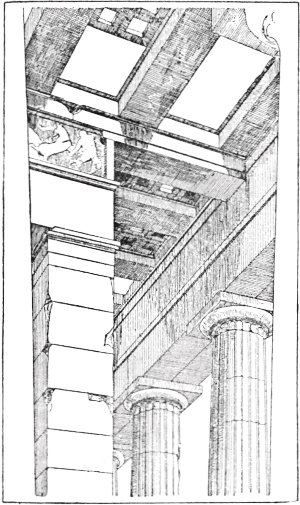
Fig. 16.—The disposition of the West Frieze of the Theseion. (From Baumeister).
403. 1. Combat of Centaur and Lapith. The Lapith is defeated and has fallen to the ground. He supports his body with the right arm, of which the hand alone remains. The left hand, which is wrapped in the chlamys, is raised imploringly to the Centaur, to whom also the head is turned. The victorious Centaur rears up above the Lapith, and is about to hurl a great stone, or perhaps a hydria, with both hands.
Height of this and the following slabs, 2 feet 9½ inches; length, 2 feet 10 inches. Mus. Marbles, IX., pl. 18.
Between Nos. 1 and 2 is a group, of which the Museum does not possess a cast, representing two Lapiths and a fallen Centaur.
2. On the left is a group of a Lapith and a Centaur. The combatants have for the moment drawn a little apart. The Lapith has recoiled for a blow; the attention of the Centaur seems more directed to the group on his left. The symmetry of the grouping, which is apparent in the frieze as a whole, requires us to regard these two figures as connected, though they may appear somewhat separated. The Centaur brandishes a branch of a tree, to which his hands are still attached, though the arms are lost. The Lapith had both arms raised, and perhaps held a battle-axe. His dress is a chlamys.
We next have a group of two Centaurs, rearing up, and heaving together a rock wherewith to crush the invulnerable Lapith, Kaineus, who is half buried in the ground between them, and who endeavours to defend himself with his shield uplifted on his left arm. His head is turned towards the Centaur on the right. His right arm, now wanting, may have rested on the ground. But it is possible, to judge from indications on the ground of the relief, that it was bent at the elbow, and pierced with a sword the abdomen of the Centaur. The Lapith wears a helmet.
On the right of this group is a Lapith hastening to give succour to Kaineus. His right arm, which was bent back at the elbow, had been raised to strike. His left arm has been muffled in a chlamys. He also wore a petasos, part of which is seen behind the shoulders. On the right of this figure is a group of a Lapith attacking a Centaur. The Lapith wears a crested helmet; on his left arm is a shield, within which his chlamys hangs from his arm. He also wears sandals. He places his left foot on a rock. The Centaur opposed to him is rearing, with his back turned to the spectator; his right arm, drawn back, has held some weapon, probably the branch of a tree; on his left arm and shoulder is the skin of a lion or panther which hangs down his back.
Length, 10 feet 9 inches. Mus. Marbles, IX., pls. 18, 19.
The next group on the frieze, which is not represented by a cast, contains a Centaur struggling with a Lapith who has fallen on his knees.
3. On the left is a Lapith, armed with shield and helmet, and wearing a chiton and sandals. He seems about to attack a Centaur, who rears to the right over the body of a Lapith, who has sunk down in a sitting position.
Length, 2 feet 9 inches. Mus. Marbles, IX., pl. 20.
Most of the figure of the seated Lapith, and the whole of the succeeding group of a Lapith and Centaur are not represented by casts in the Museum.
Casts of the East Frieze of the Theseion.
On the east frieze is represented a battle in the presence of six seated deities arranged in two groups. In one part of the frieze the combatants are hurling vast rocks. Colonel Leake (Topography of Athens, 2nd ed. p. 504), supposed that Heracles and some of the gods are engaged in a battle with giants, while other deities, among them some who usually take a leading part in the fray, merely sit and watch. This, however, is a scheme of Gigantomachia to which no parallel can be adduced.
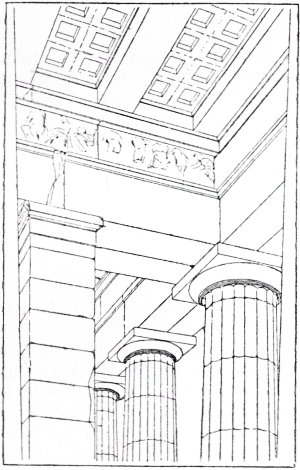
Fig. 17.—The disposition of the East Frieze. (From Baumeister.)
Brunn (Sitzungsber. der k. bayer. Akad. Phil.-hist. Cl., 1874, ii., p. 51), supposes the battle here represented to be that fought by the Athenians under Theseus against Eurystheus in defence of the Heracleidae. The scene on the left would thus represent the first rout of the troops of Eurystheus; then would come the storming of the Skironian pass by Theseus, where we might expect masses of rocks to be hurled on the assailants. The kneeling figure on the left of the central group (404, 4), who is being bound would, according to Brunn, be Eurystheus, who was taken prisoner and put to death. The figure on the extreme right (404, 8), who is stooping forward, Brunn supposes to be one of the victors erecting the boundary stone, which, according to the Attic legend, was set up by Theseus to mark the limits of the Peloponnese on the side of Attica.
The theory is highly ingenious; but it demands a forced interpretation of the rocks to suppose them to be lining the two sides of a pass; and it overlooks the close parallelism with the east frieze of the Parthenon, where the two groups of gods must be supposed to form a single background to the scene. Also, the Skironian pass was a road between rocks and the sea. Moreover, the vast size of the rocks indicates a giant race, rather than a group of warriors who are reduced to using stones in an extremity.
If the subject has any connection with Theseus, the theory of K. O. Müller seems the best that has been proposed. According to Müller (Kunstarch. Werke, iv. p. 1) it represents the Athenians under Theseus attacking the Pallantidae, or sons of Pallas, who was a son of Pandion, king of Attica. These in Attic legend (Plut. Theseus, 13) formed a league against Theseus. Müller supposes them to have been a race akin to the giants. Compare Soph. Ægeus, fr. 19, ed. Dindorf, ὁ σκληρὸς οὗτος καὶ γίγαντας ἐκτρέφων Πάλλας. See also Müller (p. 8) on the close connection between Pallas, son of Pandion, and the Attic Pallenè, with Pallas the giant and the Thracian Pallenè, the field of the great war of the gods and giants.
404. 1. On the left of the slab, two armed warriors carrying large shields on the left arm, and wearing, one a chlamys and one a chiton over the left shoulder only (heteromaschalos), advance to the right. Before them is a conquered adversary, who has been forced down on his knees by the victor, who appears to tread down his buttock, while his hands are engaged binding the hands of the prisoner. The victor wears a chlamys, but the prisoner is nude. The head of the prisoner was probably turned towards the victor. On the extreme right of the slab there remains the right foot of a figure. The original is extant (cf. Stuart, vol. iii. ch. i. pl. 15), and is a nude armed figure, moving to the right. The head is lost.
Height of this and the following slabs, 2 feet 9½ inches; length, 4 feet 6 inches. Mus. Marbles, IX., pl. 12.
2. On the next slab is a group of three deities seated on rocks, of whom the figure on the right is male and the other two female. The two female deities wear long chitons, in the one case with a diploïdion, and in the other case with sleeves. The figure on the left has the right hand, which is still preserved, by her side. It evidently held a spear. In Stuart's engraving this figure wears a helmet, but the drawing published by Le Roy (Les Ruines des plus beaux Monuments de la Grèce, 1758), though in most respects worthless, seems to show conclusively that the heads are conjecturally restored in Stuart, vol. iii. ch. i. pls. 15, 16, while in pls. 17 to 20 no restoration is attempted. The remains of the figure make it probable that the goddess here represented is Athenè.
The central figure turns towards Athenè, to whom her right arm was probably extended. Passing over the back of her head is a large mantle, which is also wrapped about the legs, and falls over the left arm. The male figure in the group probably looked to the right at the pair of combatants which follows next in order. He has a mantle twisted round his lower limbs and passing behind his back. His left hand rested on a sceptre held vertically, which has now been broken away. All these three figures wear sandals.
The second Goddess may well be Hera, and in that case her male companion would probably be Zeus.
Length, 4 feet 6 inches. Mus. Marbles, IX., pl. 13.
3. Combat of two warriors. The nude warrior on the left, armed with shield and helmet, presses forward to the attack; he probably held a sword in the right hand. His adversary, whose back is turned towards us, appears to be in retreat, but to be stopping to deliver a thrust, probably with a spear held in the right hand. His left arm must have held out a shield, of the rim of which a fragment remains, attached to the left thigh. His dress is a chiton heteromaschalos. On the right of the slab is seen the right foot of a warrior, belonging to the succeeding group, of which the British Museum possesses no cast. The warrior stretches out his shield to protect a wounded figure lying on the ground.
Length, 2 feet 10 inches. Mus. Marbles, IX., pl. 14. For the missing group, see Stuart, III., ch. I., pl. 17; Overbeck, Gr. Plast., 3rd. ed., I., p. 348.
4. Part of the legs of the wounded warrior just referred to remains on the ground, on the left. Next on the right are two warriors moving to the right. Both these figures are nude, but very seriously mutilated. It is doubtful whether the figure on the left was armed with a shield, like his companion. His right foot is advanced and he is hurrying forward.
Length, 2 feet 8 inches. Mus. Marbles, IX., pl. 14.
5. A battle scene, in which the combatants, four in number, are hurling rocks; a fifth, overcome in the fray, lies prostrate on the ground. In this combat one warrior appears to be fighting against three. On the left an heroic figure, which may well be Theseus, is seen advancing. In the confusion his mantle has fallen off, and only hangs over the left arm. With outstretched left hand he repels a huge stone hurled against him by his adversary; the right hand appears to have been stretched out behind the body, and may have held a sword. There appear to be no means of warding off the stone which the adversary throws with his left hand. Confronting the hero, supposed to be Theseus, is first the warrior just mentioned, who hurls a stone with each hand. Behind him is a second figure, who appears to be looking in the same direction. His right hand was probably holding a stone behind his head, while the left hand is stretched back to pick up another stone from the ground. The third warrior hurls a great stone with his right hand, while with his left hand he propels the large stone seen behind the shoulders of the central figure. The fallen figure lies on rocky ground in the middle of the group of combatants, his head is much below the level of his body; his right arm, now wanting, has been resting on a lower level, his left arm is folded helplessly across his body.
Length, 5 feet 10 inches. Mus. Marbles, IX., pl. 16.
6. Group of two warriors advancing rapidly to the right, each with a shield on the left arm. One is nude, the other wears a chiton heteromaschalos. Next on the right is a group of one female and two male deities seated on rocks, and observing the combat. The Goddess occupies the centre of the group, her head slightly inclined forward, and looking to the left. She wears a long chiton, sandals, and a mantle wrapped about her lower limbs. Both male figures have similar mantles. It may be conjectured that the three figures in order from the left are Poseidon, Demeter, and Dionysos; but it is impossible to attribute names to them with any confidence.
Length, 6 feet 6 inches. Mus. Marbles, IX., pl. 15.
7. Torso of a warrior armed with a large shield, who moves to the left front. The head, now wanting, was probably turned to the group next on the right, which consists of two male figures. The one on the left is evidently a victor holding a prisoner, who has his hands tied behind his back. The victor wears a chiton heteromaschalos, while the prisoner wears a chlamys.
Between this group and the next figure is a space, in which should be a male figure standing, turned a little to the right, and wearing a chlamys. He appears to be giving an order to the figure on the right.
Length, 3 feet 8 inches. Mus. Marbles, IX., pl. 17. For missing figure, see Stuart, III., ch. I., pl. 20; Overbeck, Gr. Plast., 3rd ed. I., p. 348.
8. Male figure turned to the left, and bending forward. Both arms have been extended in front of the body. The figure wears a helmet and a chiton girt at the waist. The left foot, which is advanced, rested on a higher level than the right foot. There is some uncertainty as to the motive of this figure. Stuart restores it as engaged in the erection of a trophy, and this is accepted by Schultz, De Theseo, p. 26; cf. Overbeck, Gr. Plast., 3rd ed., I., p. 353. For this however there is very little room. Leake suggested that the figure was engaged adjusting his greave (Topogr. of Athens, 2nd ed., p. 511).
Length, 1 foot 6 inches. Mus. Marbles, IX., pl. 17.
Architectural Fragments.
405.
Part of the ceiling, lacunaria, of the Theseion with six squares for soffits cut through the marble. See fig. 17.—Elgin Coll.
Length, 3 feet 11½ inches; breadth, 3 feet 4½ inches. Stuart, III., ch. I., pl. 8, fig. 2.
406. 1. Cover from panel of lacunar of the Theseion.—Elgin Coll.
Height, 10⅛ inches; breadth, 10⅛ inches. Synopsis, No. 365 (243); Stuart, III., ch. I., pl. 8, fig. 2.
2. Similar to last.
Height, 10⅛ inches; breadth, 9⅞ inches. Synopsis, No. 367 (254); Stuart, III., ch. I., pl. 8, fig. 2.
THE ERECHTHEION.
The Erechtheion is an Ionic temple of a peculiar form, which stands near the north side of the Acropolis of Athens. It embodies in a structure of the end of the fifth century the shrines about which the Athenian religion had centred from time immemorial, and to this fact the anomalous character of the plan must be ascribed.
The building consisted of a central cella divided into three portions, and having a portico of six columns at the east end; a porch of six columns at the north-west corner; and a porch of Caryatids at the south-west. It was built of Pentelic marble, with the exception of the frieze, which had a ground of dark Eleusinian marble.
The temple is known to have been incomplete in 409 b.c. At this time a minute survey of the building was made, by order of the Assembly, and the result was recorded in an inscription which is now in the British Museum. (C. I. G. 160; Newton & Hicks, Greek Inscriptions in Brit. Mus., xxxv.).
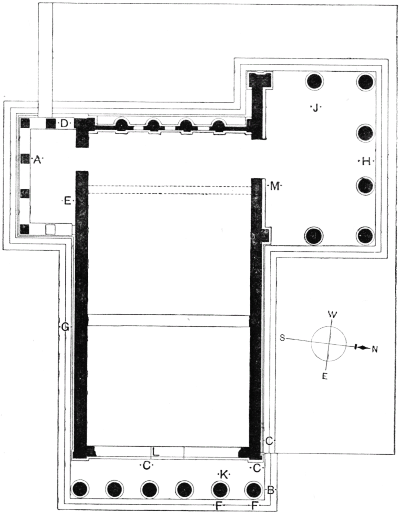
Fig. 18.—Ground Plan of the Erechtheion.
The east half of the building was devoted to Athenè Polias, whose archaic statue was placed in it.
The remainder of the building was associated with the cults of Poseidon, Erechtheus, Pandrosos, and others. The arrangement has been a subject of much controversy. The passage at the west of the cella probably contained altars of Poseidon (with Erechtheus), of Boutes, and of Hephaestos; the tokens of Poseidon, namely the salt spring, and the marks of the trident, were either in the west central chamber or below the north portico. The south porch served as an additional entrance, but it also contained the tomb of Cecrops. The Pandroseion, which contained the sacred olive-tree of Athenè, and a small shrine of Pandrosos, was annexed to the outside of the west end of the building.
The Elgin Collection contains several specimens of the architectural decorations of the Erechtheion. In the above plan (fig. 18), those parts of the building are indicated by letters from which fragments have been obtained. In some instances the exact position is uncertain.
For a discussion of the Erechtheion, see Harrison, Mythology and Monuments of Anc. Athens, p. 481.
407. So-called Caryatid, or Canephoros, κανηφόρος (fig. 19). One of the six female figures which served as columns in the southern portico of the Erechtheion. In the survey of the building these figures are called Korae, "maidens." They have been called Canephori (see p. 149) by Visconti (Memoirs on the Sculptures of the Earl of Elgin, p. 122), and others. It is true that the maidens here represented are such as those represented on the Parthenon frieze. But there is nothing that specially connects them with the Canephori, or persons who bore the sacred vessels on their heads. By some writers they have been called Caryatids, on account of a statement of Vitruvius (i., chap. 1) that women of Carya, a town of Arcadia, were represented as architectural supports—a punishment which they incurred for betraying the Greeks to the Persians.
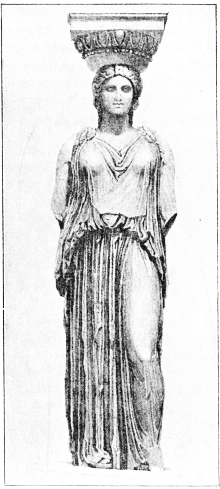
Fig. 19.—Caryatid of the Erechtheion.
The figure here described wears a long chiton, which is drawn up under the girdle, falling in rich folds, and is fastened on each shoulder by a circular brooch. Attached to this is the diploïdion, which falls down before and behind. In front it falls to the waist; behind it would trail on the ground, if a part were not looped up to the shoulders, so as to make a deep fold, falling as low as the hips. The hair from the back of the head falls in a thick mass between the shoulders, tied together with a band. The hair gathered from the forehead is woven into tresses. Two fall on each shoulder; the others are twisted round the head in the form of the krobylos (cf. p. 87). The arms are wanting from above the elbows. The right hand probably hung by the side, where the surface of the drapery is seen to have been protected from corrosion. The left hand has drawn from behind one corner of the diploïdion.
The head supports a capital, consisting first of a pad or cushion τύλη, such as was, and still is, used to support weights. (Compare the east frieze of the Parthenon, Nos. 30, 31.) From this the transition to the square abacus is effected by an egg and tongue and a bead and reel moulding.
This statue is admirably designed, both in composition and drapery, to fulfil its office as a part of an architectural design. While the massiveness of the draped figure suggests the idea that the support for the superimposed architecture is not structurally inadequate, the lightness and grace of the pose suggest that the maiden bears her burden with ease.
The original position of the figure is marked A on the plan. Four figures and part of a fifth still remain on the Acropolis. They are uniform in their general design, but differ slightly in pose and arrangement of drapery.
Pentelic marble; height, 7 feet 7 inches. Stuart, II., ch. II., pl. 19. Mus. Marbles, IX., pl. 6. Rayet, Monuments, No. 40; Mitchell, Selections, pl. 7; Murray, II., pl. 17; Wolters, No. 810; Stereoscopic, No. 115.
Architecture of the Erechtheion.
408. Ionic column from the north end of the eastern portico of the Erechtheion (B on plan). This being a column from an angle of the building, the volutes occur on two adjacent sides, so as to present themselves both to the east and north view.
Height, 21 feet 7½ inches. Synopsis, Nos. 125-7, 110; Stuart, II, ch. II., pls. 4, 5, 6.
409. Capital of one of the pilasters (antae) and part of necking or wall-band from the east wall of the Erechtheion (C, C, C on plan). It is to be observed that the frieze on the pilaster, though analogous to that on the walls, differs from it in details which heighten the richness of the effect, and which assimilate the pilaster to the columns of the east portico, while the walls resemble the capitals of the north portico. Moreover, on the pilaster the carving of the frieze is raised above the surface of the courses, while on the wall it is set back from the wall face.
The slab on the right must be from the north-east angle of the Erechtheion. The three slabs next to it might belong to the east, north, or south sides, as regards the form and design. But the excellent preservation of the surface, as compared with that of the unprotected north-east angle, seems to show that these slabs are derived from the east wall, where they were protected by the portico.
It is interesting to note the numerous repairs in the series of slabs. They probably date from the time of the construction of the building, and were meant to make good what was broken by accident in the course of construction. On the north side of the pilaster, seven inches of the bead and reel moulding immediately surmounting the anthemia have been skilfully inserted in a groove and fastened with lead. On the east side of the pilaster one of the beads of the lower bead and reel moulding was attached by a plug, of which the hole remains. On the next slab on the left one bead of the upper bead and reel moulding was similarly added. On the second slab from the left, one tongue of the egg and tongue moulding, one piece of spiral connecting the anthemia and one bead were let into the marble. Traces of red colour remain in the upper part of the frieze on this slab.—Elgin Coll.
Height, 1 foot 7½ inches. The slab containing the capital of the pilaster is 6 feet in length. Of the other slabs, two are each 4 feet 3 inches in length. The fourth is broken on the right-hand joint, and measures 4 feet 1½ inches. Synopsis Nos. 252-255 (127-130). Greek Inscriptions in Brit. Mus., I., p. 89, e, pl. 3, fig. 8. Stuart, II., ch. II., pl. 5. Inwood, Erechtheion, p. 110.
410. Fragment of frieze similar to last. Joint on left. Found on the north side of the Erechtheion.—Inwood Coll.
Height, 6 inches; breadth, 6 inches. Synopsis, No. 116. Inwood, Erechtheion, p. 138.
411. Fragment of leaf, bead and reel, and egg mouldings from the capital of a pilaster at the west side of the south portico of the Erechtheion (D on plan).—Inwood Coll.
Length, 1 foot 2¼ inches; height, 5½ inches. Synopsis, No. 118.
412. Cymatium moulding from inner architrave of the south portico of the Erechtheion (E on plan).
Height, 2½ inches; length, 7¼ inches. Synopsis No. 403. Inwood, Erechtheion, pl. 20. See also Stuart, II., ch. II., pl. 13.
413. Piece of architrave, probably part of the beam from the north angle of the east portico of the Erechtheion (F, F on plan). There is a joint on the left of this slab.—Elgin Coll.
Height, 2 feet 1 inch; length, 8 feet 2½ inches. Synopsis, No. 220 (85). Wilkins, Prolusiones, p. 29.
414. Piece of the architrave from the south wall of the Erechtheion, broken at each end (G on plan). It is connected with the preceding by a piece of moulding cast in plaster.—Elgin Coll.
Height, 2 feet 1 inch; length, 8 feet 5½ inches. Synopsis, No. 219 (291). Wilkins, Prolusiones, p. 29; Greek Inscriptions in Brit. Mus. I., pl. 3, fig. 9.
415. Piece of corona of cornice, from the north portico of the Erechtheion (H on plan). Although not derived from the same part of the temple, this fragment has been placed in connection with the slabs of the architrave, Nos. 413, 414, in order to show the original effect. The space of two feet between the corona and the architrave was occupied by the sculptured frieze. This consisted of marble figures in relief attached by metal clamps on a ground of black Eleusinian marble. A few fragments are extant at Athens.
Length, 4 feet 7 inches; height, 10½ inches; breadth, 1 foot 1½ inches. Synopsis, No. 289 (165). Stuart, II., ch. II., pls. 4, 5. For the frieze, see Brunn, Denkmaeler, Nos. 31-33; Overbeck, Gr. Plast., 3rd ed., I., p. 361.
416. Coffer from the lacunaria of the north portico of the Erechtheion (J on plan).—Elgin Coll.
Height, 3 feet 2 inches; breadth, 3 feet 5½ inches. Synopsis, No. 108 (299). See Stuart, 2nd ed., II., p. 73, note.
417. Part of coffer of east portico of the Erechtheion. Found near the eastern portico (K on plan).—Inwood Coll.
Height, 1 foot 4 inches; breadth, 1 foot 1¼ inches. Synopsis, No. 117. Inwood, Erechtheion, pl. 20.
418. Part of door jamb, perhaps from the eastern doorway of the Erechtheion (L on plan).—Inwood Coll.
Height, 1 foot 2¾ inches; breadth, 6½ inches. Synopsis, No. 115. Inwood, Erechtheion, pl. 20.
419. Cast of console, parotis, from the doorway in the north portico of the Erechtheion (M on plan).
Height, 2 feet 3 inches. Greek inscriptions in Brit. Mus., I., p. 98, § 14, b. Wilkins, Prolusiones, pls. 13, 14. Journ. of Hellen. Studies, XII., pl. 1.
420. Necking of Ionic column, copied from the columns of the east portico of the Erechtheion.—Elgin Coll.
Height, 11¼ inches; diameter, 2 feet 2½ inches. Synopsis, No. 120 (306*); Elgin Room Guide, II., No. A. 2.
TEMPLE OF NIKÈ APTEROS.
The temple of Nikè Apteros (Victory without wings), or more correctly of Athenè Nikè, stood on the projecting eminence to the south of the approach to the Propylaea at Athens (Paus., i. 22, 4).
The building had remained uninjured till the close of the seventeenth century, and was seen in 1676 by the travellers Spon and Wheler. But not long after, probably about the year 1685, the temple was demolished by the Turks, and the materials were used to build a bastion on the spot where the temple had stood.
In 1835 Ludwig Ross, and the architects Schaubert and Hansen took down the bastion and reconstructed the temple as it now stands. A sufficient amount of the lower part had remained undisturbed to enable them to proceed with certainty.
The temple consists only of a single cella, opening to the east, but has four columns at each end (tetrastyle amphiprostyle). It stood on a podium of three steps. The exterior was surrounded by a small frieze, 1 ft. 5½ in. high, and measuring 26 ft. on its long sides, and 17 ft. 2 in. at the ends. The annexed cut (fig. 20) shows the plan of the temple. The arrangement of the slabs of the frieze has been most fully discussed by Ross, but is still uncertain in parts. The west frieze, according to Ross, consisted of the two slabs, Nos. 421, 422, in the Elgin Collection, and the return faces of two slabs of the north and south sides. Each return measures 1 ft. 7 in. The slabs, Nos. 421, 422, measure respectively 6 ft. 8½ in., and 6 ft. 7¾ in. The total length, 16 ft. 6¼ in., is thus nearly equal to the estimated length of the side. The distribution of the slabs belonging to the long sides is doubtful. No. 425, cast from a corner stone, certainly belongs to the south side. Ross assigns No. 423 to the south side, No. 424 to the north side, on the hypothesis that the mounted horsemen on the same side proceed in the same direction. Kekulé (Die Balustrade, ed. 1869, p. 17) places them both on the south side, in an order more probable than that suggested by Hawkins (Mus. Marbles, ix., p. 29). The east side consisted of two slabs and two returns arranged similarly to those of the west.
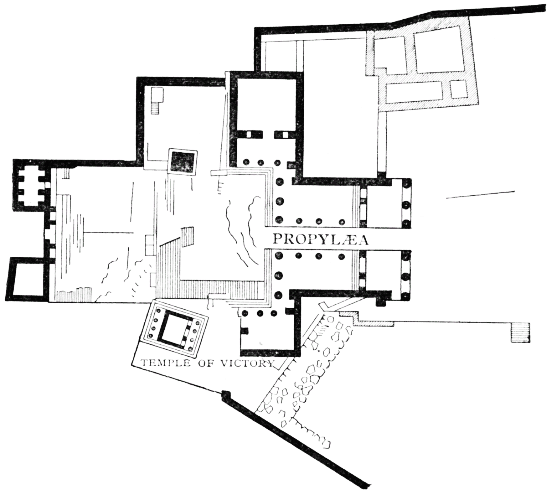
Fig. 20.—Plan of the Propylaea and Temple of Wingless Victory.
The subject of the east side appears to be a council of Gods. The long sides each contained a battle between Greeks and a series of warriors, mounted and on foot, wearing Asiatic costumes and probably intended to represent Persians. The west side is generally taken to represent a battle of Greeks with Greeks. Several attempts have been made to show that historical battles are represented on the frieze. Overbeck suggests that the three sides on which there are combatants belong to one battle, and he conjectures the battle of Platæa (479 b.c.), when Greeks defeated the Persians and their Greek adherents. Other writers, perhaps with more probability, deny that any definite battle is intended, and hold that we see merely a generalised representation of Athenians, victorious alike over Greeks and Barbarians.
It has been shown by Bohn (Die Propyläen, p. 31) and Doerpfeld on technical architectural grounds that the Temple of Victory was not contemplated in the first plans for the Propylaea, but that the form of the Propylaea was modified during the course of construction on account of it. The earliest date thus obtained for the beginning of the present building is about 432 b.c. There is nothing to show what time the temple took to build. In point of style there is a great resemblance between the sculptures of the frieze, and those of the frieze of the Erechtheion, of which a part was being worked, as we know from the inscription, in 409 b.c. The frieze of Nikè Apteros may perhaps be placed between 430 and 420 b.c.
Spon, Voyage (ed. 1679), II., p. 105; Wheler, Journey into Greece, p. 358; Stuart, II., ch. V., pls. 12, 13 (from drawings by Pars, now in the British Museum); Ross, Schaubert and Hansen, Die Akropolis von Athen; Abth. I. Der Tempel der Nike Apteros, 1839; Mus. Marbles, IX., pls. 7-10; Overbeck, Gr. Plast., 3rd ed., I., p. 363; Bohn, Die Propyläen der Akropolis zu Athen, 1882; Murray, II., p. 179; Kekulé (and Bohn) Die Reliefs an der Balustrade der Athena Nike; Wolters, Nos. 747-760. For Doerpfeld's views, see Harrison, Mythology and Monuments of Anc. Athens, p. 356. For further references see Wolters, p. 284. A photographic view of the temple is given by Baumeister, fig. 1234; and of Nos. 421 to 424 in Stereoscopic, No. 121.
The West Frieze.
421. The return of a slab of the north side, now at Athens, formed the left end of the frieze, and contains two figures advancing to the right to join the fray (Ross, pl. 11. h.). This is followed by slab No. 421, containing a battle of Greeks. In the first group on the left two warriors are engaged in vehement combat. The warrior on the left supports with his right knee the shoulder of a wounded comrade who has fallen at his feet and leans on his right arm. In the next group are two antagonists fighting over the body of a dead combatant, then a warrior who has overthrown his adversary and treads him down with his left foot. He raises his right hand to inflict the mortal wound, and may perhaps have grasped the victim's right wrist with his left hand. In the background is a trophy which appears to consist of a trunk of a tree, to which a helmet, shield, and cuirass have been attached. On the right of the slab is a warrior pursuing a foe flying to the right.—Elgin Coll.
Pentelic marble; height, 1 feet 5½ inches; length, 6 feet 8½ inches. Synopsis, No. 160 (259); Ross, pl. 11, i.; Mus. Marbles, IX., pl. 9; Baumeister, fig. 1240; Brunn, Denkmaeler, No. 118.
422. The first figure on the left of the slab appears to be hastening to the assistance of the flying warrior on the right of the slab just described. Next is a complicated group of five warriors fighting for the body of a wounded man. The latter has sunk helplessly on the ground. He is half raised and clasped under the arms by a friend who attempts to draw him away; a foe tries to seize an ankle, and covers himself meanwhile with his outstretched shield. More in the background two adversaries are engaged in hot combat. The warrior on the left probably had a sword, and that on the right a spear. A friend of the fallen man hastens up from the left. The right thigh of this figure, which is now wanting, is preserved in a drawing by Pars.
On the right are two pairs of combatants. In one of these groups a warrior, who has fallen on his right knee, tries to defend himself with his shield, while with the right hand he seizes a stone. The antagonist has his right arm raised to strike, perhaps with a battleaxe, and seizes with his left hand the shield of the kneeling figure. On the right of the slab one of the warriors flies before the assault of his antagonist, whose arms are both raised to strike him.—Elgin Coll.
Pentelic marble; height, 1 foot 5½ inches; length, 6 feet 7¾ inches. Synopsis, No. 161 (260); Ross, pl. 11, k.; Mus. Marbles, IX., pl. 10; Overbeck, Gr. Plast., 3rd. ed., I., fig. 81, p. q.; Baumeister, fig. 1239; Brunn, Denkmaeler, No. 118.
On the right of the slab described was the return of the corner slab of the south side, with a combat of two warriors.
Ross, pl. 11, 1.; Overbeck, Gr. Plast., 3rd ed., I., fig. 81, r.
There is a considerable variety of costumes on the west side of the frieze. Some of the figures are nude; others wear the chlamys only, the chiton only, or the two garments together. The chiton is sometimes worn on both shoulders, and some times only on one shoulder. The warriors are for the most part armed with helmets and large bucklers. In two instances a cap of a flexible material is worn instead of a helmet. None, however, of the costumes are non-Hellenic; and further the attempt made by Overbeck (i. p. 365), to show that the helmet of the figure on the extreme right of the frieze is distinctively Bœotian, is untenable (Wolters, p. 284).
The North and South Friezes.
423. Slab containing a part of the battle between Greeks and Persians. In the first group on the left, a Persian has fallen on his right knee, raising his right arm to defend his head. The antagonist presses his left foot on the right thigh of the Persian, raising his right arm for a spear thrust, and probably seizing the hair of the Persian with his left hand. Next is a group of two Persians and a Greek. One of the Persians lies dead on the ground; his mounted comrade urges his horse against the Greek, who draws back, and raises his arm to strike with a battle-axe.
The next group is composed of two Persians on foot and a Greek. In the centre is a wounded Persian, who has been forced down on his left knee and extends his arms forward in entreaty to the Greek, who drags him along, grasping the head of the Persian with his left hand. The right hand of the Greek must have held either a spear or a sword. On the right the other Persian turns back to defend his fallen comrade against the Greek. Both arms are raised to strike, and probably wielded a battle-axe. At his left side hangs a quiver. On the extreme right is a Greek moving to the right in pursuit of a flying Persian of whom only the leg and part of the drapery round the loins remain. The ground on which this scene takes place is rocky.—Elgin Coll.
Pentelic marble; height, 1 foot 5½ inches; length, 5 feet 10 inches. Synopsis, No. 158 (258); Ross, pl. 12, o; Mus. Marbles, IX., pl. 7; Overbeck, Gr. Plast., 3rd ed., I., fig. 81, i-l; Baumeister, fig. 1237; Brunn, Denkmaeler, No. 117.
424. The first pair of combatants on the left are a Persian, who has fallen on his right knee, and who holds up a shield in the form of a crescent, on his left arm to defend himself, and his antagonist, who advances from the right.
Next is a combat between a Greek on foot and a mounted Persian. The latter draws back his right hand, which must have been armed with a spear aimed at the Greek advancing from the left. The horse of the Persian rears as if to strike down with his forefeet the left arm of the Greek, which is thrust forward, protected by his shield. A dead Persian lies on the ground.
Behind the mounted Persian is a comrade, hastening to the left, and pursued by a Greek of whom nothing remains except part of his shield and of the drapery round his loins. This closes the scene on the right.—Elgin Coll.
Pentelic marble; height, 1 foot 5½ inches; length, 6 feet 1¼ inches. Synopsis, No. 159 (257); Ross, pl. 12, fig. g; Mus. Marbles, IX., pl. 8; Overbeck, Gr. Plast., 3rd ed., I., fig. 81, m, n; Baumeister, fig. 1238; Brunn, Denkmaeler, No. 117. On the position of these slabs, cf. p. 240.
425. A plaster cast from one of the slabs now in position on the temple. On the left is a mutilated group representing a Greek warrior turning to assist a comrade who has fallen on his right knee. Next is a Greek moving forward to pursue a mounted Persian who is flying to the right. On the extreme right a Persian on foot flies in the same direction. A slain Persian lies in the foreground. The position of this slab on the temple at the south-east angle is fixed by the relief on its return face which is part of the composition of the eastern front. This return is not given in the cast here described.
Height, 1 foot 5½ inches; length, 3 feet 11¼ inches. Ross, pl. 12, fig. a; Overbeck, Gr. Plast., 3rd ed., I., fig. 81, g, h; Murray, II., pl. 16, fig. 1.
The dress of the Persians in this frieze is the usual chiton with long sleeves, girt at the waist, and close-fitting trousers, anaxyrides. One of them, the kneeling figure in No. 424, wears a quiver and bow case, gorytos, from which appears the end of his bow, and two others wear quivers. The only Persian whose face is preserved is bearded, and wears the Persian headdress, the kidaris. The heads and weapons of both sets of combatants have been nearly all destroyed. Some of the Greeks are armed with the Argolic buckler. Others have a chlamys wound round the left arm or hanging loose from the body.
CASTS FROM THE BALUSTRADE OF THE TEMPLE OF NIKÈ APTEROS.
The temple of Nikè Apteros stood on a lofty projecting bastion, as may be seen from the model of the Acropolis. This bastion was surrounded for safety with a breast-high parapet, consisting of a frieze of sculpture in relief, facing outwards, surmounted by a bronze screen. Several fragments of the frieze or balustrade were discovered on the site, in 1835. (Ross, pl. 13.) Additional fragments were found by Beulé in 1852, and in more recent excavations to the east of the temple of Nikè, and on the south slope of the Acropolis. They are preserved in the Acropolis Museum at Athens.
The sculptures are too mutilated to be arranged in one composition. It is evident, however, that the frieze consisted of figures of Victories, variously engaged. Some lead bulls to sacrifice, while others are erecting or decking trophies in the presence of Athenè.
There is some uncertainty as to the date of the frieze. It cannot be older than the temple, and therefore not earlier than 432 b.c. Kekulé (Balustrade, p. 22), and Wolters (p. 289) hold that the frieze was produced immediately after that date. But a more admissible view is that which puts the balustrade at the very close of the fifth century. If the different fragments of the balustrade are examined, they seem to reveal a combination of various schools and methods. No. 426, severely draped in chiton and diploïdion, seems to have the somewhat stiff dignity best seen in sculptures of the Temple of Zeus at Olympia, but occasionally suggested by the Parthenon sculptures. The figures of Athenè (Kekulé, Balustrade, pl. ii.), have the spirit of the Parthenon frieze. In No. 427 and No. 428, the artist dwells on and emphasises the nude form, displaying it through transparent drapery in a manner that may well be supposed to have been that of the transition from Pheidias to Praxiteles. Finally, in the figure leading the bull (No. 429), there is a florid wealth of drapery, which, among early works, only finds a partial analogy in the frieze of Phigaleia, and which appears more akin to the Nikè of Samothrace than to Attic work of the fifth century. This want of uniformity in style suggests a time of transition in which the traditions of the school of Pheidias were still to some extent operative, while newer tendencies were beginning to make themselves felt. Perhaps also they indicate that the work was spread over a space of several years, such as might be expected in the troubled close of the fifth century b.c.
Height of Balustrade, 3 feet 2 inches. Ross, p. 17, pl. 13 (cf. ante, p. 241); Michaelis, Arch. Zeit., 1862, p. 249. All the materials are collected by Kekulé, Die Reliefs an der Balustrade der Athena Nike (1881), which superseded Kekulé, Die Balustr. d. Tempels d. Athena Nike (1869). See also Overbeck, Gr. Plast., 3rd ed., I., p. 369; Murray, II., p. 186; Wolters, Nos. 761-804. Stereoscopic, Nos. 158-160.
426. Victory standing, half turned to the left. She holds a greave in her left hand, with which she was probably decking a trophy. She wears a leather helmet.
Kekulé, Balustrade, pl. 5, fig. R; Overbeck, Gr. Plast., 3rd ed., I., fig. 82.
427. Winged Victory turned to the left stoops forward, raising her right foot in order to adjust or unfasten her sandal. A somewhat similar incident is seen on the Parthenon frieze, (west side, No. 29). There, however, the figure has his foot resting on a rock, while here the Victory balances herself on the left foot with the right leg high in the air, in a position of effort such as does not occur on the frieze of the Parthenon.
Ross, pl. 13, figs. B, Bb; Kekulé, Balustrade, pl. 4, fig. O; Overbeck, Gr. Plast., 3rd ed., I., fig. 82; Murray, II., pl. 16, fig. 4; Brunn, Denkmaeler, No. 35. The meaning of the subject is not known. In the ritual inscription of Andania the initiated are ordered to have bare feet, and possibly the Victory is supposed to be removing her sandals before entering a shrine. Dittenberger, Syll., 388, 15, cf. ibidem, 357, 25.
428 Winged Victory standing turned to the left, the right arm advanced. The right hand and all the left arm being broken away, the motive of this figure has not been ascertained, but probably the Victory was decking a trophy.
Kekulé, Balustrade, pl. 4, fig. M; Arch. Zeit., 1862, pl. 162; Overbeck, Gr. Plast., 3rd ed., I., fig. 82; Brunn, Denkmaeler, No. 35.
429. Two winged Victories about to sacrifice a bull, which one of them is holding back as it springs forward. The other Victory leads the way, moving to the right.
Ross, pl. 13, fig. A; Kekulé, Balustrade, pl. 1, fig. A; Overbeck, Gr. Plast., 3rd ed., I., fig. 82; Murray, II., pl. 16, fig. 3; Brunn, Denkmaeler, No. 34.
THE CHORAGIC MONUMENT OF LYSICRATES.
The Choragic Monument of Lysicrates is a small edifice which presents one of the earliest examples of the use of the Corinthian order in Greek architecture. It may be thus described. On a square basement is a cylindrical structure resting on six Corinthian columns. Between them are six equal panels of white marble closely joined; at each vertical joint a Corinthian column has been fitted, so as to project more than half its diameter. Between the capitals were figures of tripods in relief, of which only one now survives. Above the colonnade is the entablature and a cupola or tholos; this is in the form of a tiling of laurel-leaves richly decorated round the circumference with a double row of projecting ornaments. From the apex of the roof rises a mass of foliage arranged in a triple form, on the three most projecting leaves of which was placed a bronze tripod, dedicated by a choragos, who had provided a victorious chorus. An inscription on the architrave immediately below the figure of Dionysos furnishes the name and date of the dedicator. It runs,* "Lysicrates of Kikynna, son of Lysitheides, was Choragos. The youths of the tribe Acamantis were victors, Theon was the flute player, Lysiades an Athenian was the instructor of the Chorus, Euainetos was Archon." The mention of this magistrate fixes the date of the monument to b.c. 335-4.
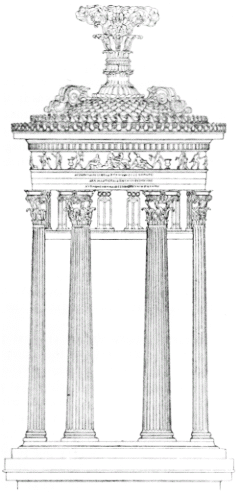
Fig. 21.—The Choragic Monument of Lysicrates. (After Stuart.)
The building still stands in its original position at Athens, below the eastern side of the Acropolis and a little to the north-east of the theatre of Dionysos. In antiquity it stood in a street called "the street of tripods" (Paus. i. 20, 1), because of the number of tripods which were there dedicated to Dionysos. At least as early as the 15th century the building was popularly known as the Lantern of Demosthenes. In the 17th and 18th centuries it was built into the wall of the French Capuchin monastery, and the interior served as the library of the Superior. The monastery was burnt in 1821, and the only trace of it is in a few tombstones of French citizens lying near. The monument now stands in an open square. Lord Elgin's casts are the best record of the frieze, as the sculptures, which are of Pentelic marble, have suffered considerably in the last ninety years.
The subject of the frieze here described is the victory of Dionysos over the Tyrrhenian pirates who had kidnapped him from Chios with the intention of selling him as a slave. The God revenged himself by transforming the pirates into dolphins, a myth which is to be found in the Homeric Hymn to Dionysos (No. vi.) and elsewhere (Ovid, Met. iii. 650; Nonnus, Dionys. xlv. 102; Philostr. Im. i. 19, &c. Cf. Gaz. Arch. 1875, p. 7). In the frieze the moment is represented when this transformation took place. According to Homer and most other writers, the event happened on board the ship, and the pirates were first terrified by a miraculous appearance of vines and wild beasts. The sculptor has preferred to represent the scene as passing on the rocky shore on which the pirates found Dionysos (Hom. Hymn, vi. l. 2) and has made Satyrs help in the vengeance. The subject is thus made to adapt itself to the requirements of sculpture. For a vase with a representation of the literary form of the legend, see Gerhard, Auserlesene Vasenbilder, i., pl. 49; Harrison, Mythology and Monuments of Anc. Athens, p. 251. An intaglio, with a pirate half transformed, as on the frieze, is engraved in the Gaz. Arch. 1875, p. 13.
It is convenient to take the architectural remains of Athens consecutively, and the monument of Lysicrates has therefore been inserted in this place. But the accurately ascertained date (335 b.c.) is a century later than the Parthenon, and it is easy to discern the change that has taken place. The form of Dionysos is becoming softer and more effeminate. The Satyrs on tip-toe belong to a scheme not introduced in the 5th century sculpture; more free play of humour is admitted. At the same time Attic schemes of composition present themselves, which had already come into use in the time of Pheidias.
This frieze is a remarkable example of the Greek power of combining variety and symmetry. On the right and left of Dionysos the groups correspond with great accuracy, but the correspondent groups always differ one from another. On each side of the God we have an attendant Satyr; a Satyr with a crater; a Satyr watching the conflict; a Satyr hastening to join it; a Satyr kneeling on a pirate; a Satyr about to strike a pirate thrown to the ground; a Satyr breaking off a branch from a tree; a pirate, half transformed, leaping into the sea. The remainder of the frieze is less exactly symmetrical.
Wheler, Journey, p. 397; Spon, Voyage (ed. 1679), II., p. 132. A view of the monument from the monastery garden is shown in Stuart, I., chap. IV., pl. 1. The view from the street is in Le Roy, Ruines, pl. 13. A view of the interior used as a library, Dodwell, Tour, I., pl. facing p. 289. A view subsequent to the destruction of the monastery is given, Exp. de Morée, III., pl. 96. For the present state of the monument see Harrison, Mythology and Monuments of Anc. Athens, p. 245. The original frieze is of Pentelic marble; height, 10½ inches. Stuart, I., ch. IV., pls. 1-26. Stuart's drawings which are freely restored are the basis of the inaccurate plate in Stuart, 2nd ed., Vol. I., ch. IV., pl. 30. The illustrations in most of the text-books are derived from the latter plate; e.g., Müller, Denkmäler, pl. 37; Overbeck, Gr. Plast., 3rd ed., II., p. 91. These works all repeat an erroneous order of the two groups of No. 8, which spoils the symmetry of the frieze; cf. Murray, II., p. 333. An independent and more accurate publication is that in Mus. Marbles, IX., pls. 22-26, taken from the Elgin casts. See also Ellis, Elgin Marbles, II., pp. 79-87. The British Museum also possesses a careful series of drawings from the sculptures, by Lord Elgin's artist, Lusieri. Report of the Elgin Committee, appendix, p. xli.; Wolters, No. 1328.
430. 1. In the centre of the composition is Dionysos turned to the left, reclining on a rock over which drapery is thrown. He leans on his left elbow; with his right hand he caresses a panther which fawns on his knees. In the left hand Dionysos appears to have held a cup and a thyrsos, of which traces appear behind his left shoulder. This figure is now entirely destroyed on the original. There is a considerable resemblance in the pose of Dionysos to that of the so-called Theseus of the east pediment of the Parthenon. On either side of Dionysos is a Satyr, seated on lower rocks. The Satyr on the right clasps his left knee with both hands. (Compare the figure on the east frieze of the Parthenon No. 26). His head was probably turned towards Dionysos. The Satyr on the left of the God rests his left hand on the rock behind him; his right knee is bent and the right leg drawn up under it; in his right hand he holds a thyrsos; his body and head are turned to the right.
Mus. Marbles, IX., pl. 24.
2. Next on the left is a Satyr advancing over rocky ground towards a large crater; in his right hand he holds an oinochoè, with which he is about to take wine from the crater; in his left hand has been a phialè; a fawn skin, nebris, hangs from his left shoulder. His head appears to have been turned towards Dionysos. On the opposite side of the vase stands a Satyr turned to the left, resting his elbows on the stump of a tree, over which is thrown a panther's skin; the top of a thyrsos appears above his right shoulder. He appears to have been bearded.
This figure looks on at the destruction of the pirates which is represented in a series of groups on the left, and which we must suppose to have taken place on a rocky shore overlooked by the higher ground on which Dionysos reclines.
Mus. Marbles, IX., pl. 24.
3. A Satyr advances to the left with a burning torch, with which he is about to assail the fallen pirate of the next group. This Satyr is nude and bearded. His head is bound with a diadem. The head and left leg are now lost on the original. The next group on the left represents a pirate thrown on his hands and knees upon the rocks. On his back kneels a Satyr whose right arm is upraised to strike his prostrate foe with some weapon which is not clearly shown in the relief, but which was probably a pedum, or perhaps a branch. The Satyr has a panther's skin floating in the air, at his back. Between the legs is a lump of plaster, which is due to a fault in the moulding.
Mus. Marbles, IX., pl. 23.
4. Next on the left is a bearded Satyr, who draws back to the right, to collect his force for a blow, with his thyrsos. Meanwhile he looks back at a pirate on his left, who kneels with his hands tied behind him, and looks round towards the Satyr in helpless terror. A panther's skin, hanging from the left shoulder of the Satyr, floats in the air at his back.
Mus. Marbles, IX., pl. 23.
5. The next figure on the left is a bearded Satyr who turns to the right kneeling on his left knee, set in the fork of a tree close to the edge of the sea; with both hands he is breaking off a branch. His panther's skin floats in the air behind his back. His right foot stands in shoal water, which is indicated by curling waves. Behind him on the left is a pirate, whose body to the waist is transformed into a dolphin, and who leaps head foremost into the sea.
Mus. Marbles, IX., pl. 23.
Between No. 5 and No. 6 is about a yard of frieze, wanting in the cast. This is given, freely restored, by Stuart. An accurate drawing by Lusieri is preserved in the Museum (Plate ix.). A bearded Satyr holds out a torch and pursues a pirate who runs away at full speed. A hole has been cut between them for the insertion of a beam. A rock and tree separate this group from the following, No. 6.
6. This group is rather better preserved in the drawing of Lusieri than in the cast. A young pirate is seated on the ground leaning on his left arm. The right hand is extended in supplication to the bearded Satyr, who is dragging him seawards by the foot. A hole has been cut through the figure for a beam. The Satyr stands in the waves. Behind him a pirate, half transformed, is in the act of leaping into the sea. This figure is now almost destroyed in the original. As it is leaping to the right, it belongs strictly to that part of the circular frieze which represents the scene on the right of Dionysos.
Mus. Marbles, IX., pl. 22.
7. On the right of the central group (No. 1) is a bearded Satyr moving to the right towards a large crater. In his right hand he holds up an oinochoè or wine jug. His left is extended over the crater and holds a phialè. This figure appears to be bearded, though it is drawn as beardless by Lusieri; the head is now wanting. Next on the right are two Satyrs, each wearing a panther skin. The Satyr on the left turns to the right and extends his right hand towards the second Satyr, as if giving him an order. The latter looks round to the left, as if to receive the order, while he is hastening to the right with both hands raised, as if pointing.
Mus. Marbles, IX., pl. 25.
8. Next on the right is a prostrate pirate, on whose buttock a bearded Satyr is kneeling with his left knee, while he holds the pirate's hands, as if to tie them behind his back. The pirate kneels on the rock, with his head pressed upon the ground and turned towards the spectator.
The next group on the right is composed of a Satyr, who has thrown a pirate backward on the rock, and is about to strike him with a pedum or club. The pirate has his left knee bent under him, and leans back on his right elbow: he advances his right foot and left arm to defend himself. He is drawn by Lusieri with a negro face and pointed ear. The ear seems pointed, but it is manifest that the features are wrongly drawn. The head is now wanting on the original. The Satyr has his body facing to the front and inclined to the left with the right leg advanced: his right hand is raised to the level of his head. The action shows that he is about to swing his body round to give effect to the blow which he is aiming at the pirate. On his left arm is the panther's skin, worn as a shield.
Mus. Marbles, IX., pl. 25.
9. In the next group are a Satyr and a transformed pirate, separated by a tree which marks the edge of the rocky shore, as at the opposite side of the frieze. The Satyr stoops forward, breaking off with both hands a branch of the tree, which he is about to use as a weapon. He is bearded. The right leg is now wanting on the original. The pirate darts head foremost into the water, pressing his feet against the trunk of the tree.
Mus. Marbles, IX., pl. 26.
10. On the right of the transformed pirate is a group representing a Satyr about to strike with a branch of a tree a pirate seated on the ground, whose head he draws back with his left hand, brandishing in his right hand the branch held behind his neck; from the left arm of the Satyr hangs his panther's skin. He is bearded. In the drawing of Lusieri he has an ivy wreath and pointed ears. On the original this group is mutilated almost beyond recognition. The last group on the right is composed of a Satyr darting forward with a lighted torch, which he is about to apply to a pirate seated on a rock with his hands tied behind his back. A large serpent behind the pirate has fastened its fangs on his right shoulder, and has one coil between his right arm and his back. The pirate looks round in agony towards his assailants. The serpent suggests the form of the legend usually current, in which Dionysos is assisted by strange monsters. According to Nonnus, Dionys., xlv., 1. 134, the ropes of the rigging of the ship turned to serpents.
431. Cast from the capital of a column of the Choragic Monument of Lysicrates.
Height, 2 feet ¾ inches. Synopsis, No. 360*. See Stuart, I., ch. IV. pl. 6, fig. 1.
THE CHORAGIC MONUMENT OF THRASYLLOS.
432. The statue of Dionysos, here described, originally decorated a choragic monument, of which some scanty remains may still be seen below the southern wall of the Acropolis of Athens, and immediately above the Dionysiac theatre. The monument was in the form of a portico, the architrave of which rested on three pilasters which masked the entrance to a cavern in the rock. Until removed by Lord Elgin the statue stood above the façade. Since the removal of the statue the portico itself has been destroyed, and at present only the base and lower portions of the pilasters stand in position, while fragments of the inscription lie close at hand. We learn from the inscription on the centre of the face of the monument that it was dedicated by Thrasyllos to commemorate the victory gained by his tribe in the dramatic contest in which he was himself choragos, in the archonship of Neaichmos (320 b.c.); C. I. G., 224; C. I. A., ii., 1247. On the right and left were inscriptions recording the dedication of tripods by Thrasycles, son of Thrasyllos, who was agonothetes in the archonship of Pytharatos (271 b.c.); C. I. G., 225, 226; C. I. A., ii., 1292, 1293. At some date intermediate between these two, probably about 310 b.c., the state had assumed the burden of providing the chorus, and the agonothetes or director of the contest took the place of the choragos, or provider of the chorus. (Hermann, Lehrb. d. Griech. Antiq., Müller's ed., iii., pt. ii., p. 339.)
It has commonly been supposed that the statue belongs to the dedication of Thrasyllos. Stuart made the infelicitous conjecture that it held the votive tripod on its lap. The most recent writer on the subject, Reisch (in the Athenische Mittheilungen, xiii., p. 383), conjectures that the monument of Thrasyllos was originally surmounted by a pediment on which was a tripod; and that the pediment was removed by Thrasycles, who placed the statue in the centre, and bases for his tripods at the sides. It is left unexplained what became of the tripod of Thrasyllos. From the style of the statue we cannot decide between the two dates. Reisch well points out that in composition and spirit there is an attempt, only partially successful, to preserve the manner of Pheidias as seen in the Parthenon pediments. The figure is majestic, but the drapery is rather heavy. The influence of the younger Attic school hardly makes itself felt.
The statue is that of a colossal seated figure, the head, arms, and right foot to the instep wanting. The body is clad in a talaric chiton, over which is a panther's skin, passing like a scarf from the left shoulder to the right side, and bound round the waist by a broad girdle, under which is seen the panther's face and teeth; an ample mantle passes from the back of the figure over the lower limbs, falling in rich folds across the lap. The head and left arm of this statue were of separate pieces of marble, and were originally morticed to the body. The head was wanting as early as the visit of Spon and Wheler to Athens in 1676. On the left thigh is a sinking about 6 inches deep, 5 long, and 1½ wide, in which some object may have been inserted, but which may have been used when the statue was being placed in position. On the drapery of the left shoulder there is a hole for a rivet. It seems probable that the God was represented with a lyre, the base of which rested on his left thigh. This instrument was the attribute of Dionysos Melpomenos (see Gerhard, Ant. Bildwerke, text, p. 240), and the costume of the figure seems assimilated to that of a citharist.—Elgin Coll.
Pentelic marble; height, 6 feet 3 inches. The stone is roughly hewn out at the back to lighten the figure. Wheler, Journey, p. 368; Le Roy, Ruines, pl. 8; Stuart, II., ch. IV., pls. 3, 6; Mus. Marbles, IX., pl. 1; Ellis, Elgin Marbles, II., p. 90; Overbeck, Gr. Plast., 3rd ed., II., p. 94; Reisch, Athenische Mittheilungen, XIII. (1888) pl. 8, p. 383; Stereoscopic, No. 114; Brunn, Denkmaeler, No. 119.
THE PROPYLAEA.
The Propylaea, or gateways to the Acropolis, were constructed by Mnesicles under the administration of Pericles, in the five years 436-431 b.c.
The main portion of the building consisted of two Doric portions, facing respectively inwards to the Acropolis and outwards. These were connected by a series of Ionic columns. The entrance was flanked on each side by wings (see the plan, fig. 20). The Elgin Collection contains a few architectural remains from the building. A portion of the cedar dowels which connected the drums of the columns of the Propylaea may be seen in the Bronze Room.—Presented by A. W. Franks, Esq. Cf. Dodwell, Tour, I., p. 313.
433. Capital of Doric column from the Propylaea. It is impossible to tell from the dimensions whether this capital is derived from the internal or external portico.—Elgin Coll.
Pentelic marble; width of abacus, 5 feet 5½ inches. Synopsis, No. 130 (206). Stuart, II., ch. V., pl. 7, fig. 1. Penrose, Athen. Architecture, ch. X., pl. 31; Bohn, Die Propyläen, pls. 11, 13, fig. 2.
434. Piece of drum of Ionic column from the inner order of the Propylaea.—Elgin Coll.
Pentelic marble; height, 1 foot 4½ inches; diameter, 3 feet ⅛ inch. Synopsis, No. 129. Penrose, Athen. Architecture, ch. X., pl. 32.
435. Part of band for supporting the beams of the ceiling in the central hall of the Propylaea. There are considerable remains of the painted mouldings.—Elgin Coll.
Pentelic marble; height, 1 foot 7¼ inches; length, 3 feet 10½ inches. Synopsis, No. 131 (308). Stuart, II., ch. V., pl. 8, fig. 1; Bohn, Die Propyläen, pl. 12, fig. 6.
MISCELLANEOUS ARCHITECTURAL FRAGMENTS.
436. Capital of one of the antae from the small Ionic temple near the Ilissos seen by Stuart, but destroyed since his time in 1780.—Elgin Coll.
Height, 1 foot ⅛ inch; breadth, 2 feet ½ inch. Synopsis, No. 170 (174). Stuart, I., ch. II., pl. 8, fig. 1. See also Leake, Topography of Athens, 2nd ed., p. 250.
437. Moulding with anthemion, plait, maeander, and leaf, bead and reel patterns. Found near the south-east anta of the Erechtheion.—Inwood Coll.
Height, 8¼ inches; breadth, 6¾ inches. Synopsis, No. 407. Inwood, Erechtheion, pl. 26, p. 138.
438. Antefixal ornament or acroterion from the temple of Demeter at Eleusis. For a similar ornament see Kinnard in Stuart's Antiquities of Athens, 2nd ed., iii., pl. 1, p. 53.—Elgin Coll.
Pentelic marble; height, 3 feet 7½ inches. Synopsis, No. 169 (173); Laborde, Le Parthénon, pl. 27.
439. Ornament of roof-tile, kalypter anthemotos. Purchased by Inwood at Athens.—Inwood Coll.
Pentelic marble; height, 8¾ inches. Synopsis, No. 417. Inwood, Erechtheion, pl. 28, fig. 3, p. 144.
440. Ornament of roof-tile. Probably purchased by Inwood at Athens.—Inwood Coll.
Pentelic marble; height, 10¾ inches. Synopsis, No. 412. Inwood, Erechtheion, pl. 28, fig. 2, p. 144.
441. Ornament of roof-tile, found "on the gable of a small Greek church, that appears to have been on the site of a temple" "in the gardens at Athens, beyond Mount Anchesmus."—Inwood Coll.
Pentelic marble; height, 8½ inches. Synopsis, No. 411. Inwood, Erechtheion, pl. 23, p. 131.
442. Ornament of roof-tile found built into a modern house near the Choragic Monument of Lysicrates.—Inwood Coll.
Pentelic marble; height, 11 inches. Synopsis, No. 413. Inwood, Erechtheion, pl. 28, fig. 5, p. 144.
443. Capital of Ionic column discovered by Inwood built into the wall of a small Greek chapel called Agia Marina on the left bank of the Ilissos at Athens. This is probably the site of the temple of Artemis Eucleia mentioned by Pausanias (i., 14, 5, and compare ix., 17, 1). Roses are sculptured in the eyes of the volutes. Inwood remarks (p. 136) that the central enrichment over the cymatium between the volutes is unusual. From the absence of mortices by which the capital could be secured to the architrave or to the shaft, he infers (p. 133) that this capital may have belonged to some sepulchral stelè or other work, where great strength of construction was not required. Bötticher, who engraves this or a similar capital, is of the same opinion. The opposite face of the capital is nearly all broken away.—Inwood Coll.
Pentelic marble; width from centre of volute to centre of volute, 12¾ inches. Synopsis, No. 398. Inwood, Erechtheion, p. 132, pls. 24-25. Bötticher, Tektonik, pl. 30, fig. 7, text, p. 299.
444. Volute of Ionic capital. Inwood (p. 128) states that it was found near the site of the temple of Nikè Apteros, and that from its scale it probably belongs to that temple. This, however, is not the case, as may be seen by comparing this fragment with the capital of the temple of Nikè Apteros in Ross, Akropolis von Athen, pls. vii., viii. The pulvinus of this capital is ornamented with leaves, as in the example from Athens in Bötticher's Tektonik, pl. 31, fig. 5, text, p. 299.—Inwood Coll.
Pentelic marble; height, 1 foot; breadth, 9½ inches. Synopsis, No. 404, where it is incorrectly described as a capital from the temple of Nikè Apteros. Inwood, Erechtheion, pl. 21.
445. Volute of Ionic capital, which, according to Inwood (p. 127) was found in a wall below the north side of the Acropolis at Athens. In the eye of this volute a rose is sculptured in relief. In the capitals of the Erechtheion there was a similar rose of bronze gilt, for which a recess is carved in the marble.—Inwood Coll.
Pentelic marble; height, 7¾ inches; breadth, 9 inches. Synopsis, No. 410. Inwood, Erechtheion, pl. 20; Bötticher, Tektonik, text, p. 299.
446. Fragment of the shaft of a column which was fluted with twenty-four flutes, the diameter being about two feet two inches. The dimensions differ from those of the columns of the Erechtheion.—Greece. Presented by W. R. Hamilton, Esq.
Marble; height, 1 foot 7 inches; width, 1 foot 6 inches.
447. Capital of Corinthian column, from one of the porches of the building at Athens, commonly known as the Tower of the Winds, or more correctly as the Horologium of Andronicus Cyrrhestes (built probably in the 2nd century b.c.).—Formerly in the Elgin Collection.
Marble; height, 1 foot 4½ inches. Stuart, I., chap. III., pl. 7.
448. Unfinished Ionic base.—Formerly in the Elgin Collection.
Marble; height, 9 inches; diameter, 1 foot 10¾ inches.
AGORACRITOS OF PAROS.
460. Fragment of colossal head, showing the right cheek, right eyelid and right side of the head as far as the ear. The hair is waved. On the crown of the head eleven holes are pierced in the marble, evidently for the attachment of a wreath or other ornament. The left side and back of the head have been cut or broken away. So far as can be inferred from the little original surface remaining, this head was in a fine style of the fifth century b.c.
The style and material of this work, and the place of its discovery, give good grounds for thinking that it is a fragment of the famous statue of Nemesis by Agoracritos of Paros. The exact date of Agoracritos is not recorded, but he is said to have been a favourite pupil of Pheidias. The statue of Nemesis is described as a colossal figure of the type of Aphroditè, holding in her hands an apple branch and a phialè, on which were figures of Aethiopians. She had no wings, and stood on a base, sculptured with subjects relating to the birth of Helen and the Trojan war. The figure wore a diadem, adorned with deer and figures of Victory of no great size. Compare the diadem of Pandora, described by Hesiod, Theogony, 581; the diadem of Hera of Polycleitos (Paus., ii., 17, 4); the Cypriote terracottas, in the Terracotta Room, wall cases 1 and 27; and the Cypriote sculptures in the Cyprus Room. The numerous holes mentioned above must have served for the attachment of an ornament of some weight, and so confirm the proposed identification.
According to tradition the statue was made of a block of Parian marble, which was brought by the Persians, before the battle of Marathon, to be erected as a trophy for the capture of Athens. (Paus., i., 33. 2; Anthol. Pal. App. Plan., iv., 221, 222, 263). Found on the site of the Temple of Nemesis at Rhamnus.—Presented by J. P. Gandy Deering, Esq., 1820.
Parian marble; height, 1 foot 4½ inches. Uned. Antiquities of Attica, p. 43; Leake, Athens and Demi of Attica, II., p. 108; Synopsis, No. 325 (273); Elgin Room Guide, II., No. E. 4; Six, Num. Chron. 3rd. Ser., II., p. 94; cf. coin of Cyprus, ibidem, pl. 5; Gardner, Journ. of Hellen. Studies, VIII., p. 47; Rossbach, Athenische Mittheilungen, XV., p. 64; Overbeck, Schriftquellen, 834-843.
POLYCLEITOS OF ARGOS AND THE PELOPONNESIAN SCHOOL.
Polycleitos of Argos was, as has already been observed (p. 90), one of the great pupils of Ageladas of Argos, who was also the master of Myron and perhaps of Pheidias.
Nothing is recorded as to the life of Polycleitos; his age, as compared with that of Pheidias, is not accurately known. It is probable that he was rather younger than Pheidias, as he was working at a later date. Pliny gives the 90th Olympiad, or 420 b.c., as the date of Polycleitos. This may be the date of his great statue of Hera at Argos, the older temple of Hera having been burnt in 422 b.c., and it was probably near the end of the sculptor's life.
No original works by the hand of Polycleitos survive, but several sculptures are known which can be shown with probability to have been copied more or less directly from originals, of which the character is thus ascertained.
Polycleitos was famous in antiquity as the author of a methodical system of proportions for the human form. One in particular of his figures, the Doryphoros, was known as the Canon, and was adopted as the ideal type of a youthful male figure by later sculptors. This figure, and its companion the Diadumenos (see below, Nos. 500, 501), are known to us from copies. They are of vigorous make and square build, but somewhat heavy when compared with the graceful youths of the Parthenon frieze. But the words of Quintilian, who says (Inst. Orat., xii., 10, 7) that some critics objected to the works of Polycleitos as being wanting in weight and unduly elegant, suggest that the extant copies do not convey an accurate impression of the bronze originals, and in fact some of the numerous Doryphoros heads which have been found in Italy present a profile which strikingly recalls the profiles of the youths on the Parthenon frieze. Polycleitos was also noted for his technical skill and perfect workmanship.
The works that have been associated with Polycleitos, in the British Museum, are here described (Nos. 500-503). A fragment, however, of a group of two boys playing with knuckle-bones (Mus. Marbles, ii., pl. 31), which was ascribed by Winckelmann to Polycleitos (Hist. de l'Art, Bk. vi., chap. 2; Pliny, H. N., xxxiv., 10), is no doubt of a later period, and is therefore omitted.
500. Graeco-Roman copy of the Diadumenos of Polycleitos. Statue of a nude youth, tying a band (taenia) about his head. He stands principally on the right leg, resting lightly on the left leg, and has both hands raised. The left hand is lost. The band was made of bronze, and holes remain for its attachment. The left side of the face has been very much rubbed down. By the side of the figure is a tree-stump.
That this figure is the Diadumenos of Polycleitos is indicated by its close resemblance in style to the figure at Naples, believed to be a copy of the Doryphoros (see No. 502). It would be a remarkable coincidence if we had two companion statues representing respectively a Diadumenos and a Doryphoros, known from the number of replicas to be copies of important works, and agreeing in style with what would be expected of the art of Polycleitos, but yet derived from independent sources.
The head was found at a distance of two-thirds of a mile from the torso. The torso was found in 1862 in the Roman Theatre, at Vaison (Vaucluse).
Marble; height, 6 feet 1 inch. Restorations:—Nose, fingers of right hand, parts of left thigh and of left shin and heel; also the upper part of the stump. The figure should perhaps be set with the ancient surface of the base horizontal, and so lean less forwards. Mon. dell' Inst., X., pl. 49, figs. 1-3; Annali dell' Inst., 1878, p. 11 (Michaelis); Rayet, Monuments, I., No. 30 and text; Overbeck, Gr. Plast., 3rd ed., I., p. 388; Murray, I., pl. 10, p. 274; Wolters, No. 508.
Other examples more or less nearly reproducing this type are:—(a) A bronze from the De Janzé Collection in the French Bibliothèque Nationale. Annali dell' Inst., 1878, pl. B, p. 11 (Michaelis); Rayet, Monuments, I., No. 31; Babelon, Le Cabinet des Ant. à la Bibl. Nationale, pl. 13. (b) A terracotta statuette in an English private collection. Journ. of Hellen. Studies, VI., p. 243, pl. 61. (c) A sepulchral relief from Praeneste, in the Vatican, commemorating one Tiberius Octavius Diadumenus, and having a relief of a Diadumenos, in allusion to the name. Pistolesi, Vaticano, IV. 84. (d) A gem. Journ. of Hellen. Studies, II. p. 352. See also No. 501.
501. Graeco-Roman statue of a Diadumenos. Statue of a nude youth standing, tying a band (taenia) about his head. Both arms were raised, but the left is lost. This figure, like the Diadumenos of Vaison (No. 500), stands principally on the right leg, but the left leg is differently placed, and the whole pose is thereby altered. By the side of the figure is a stump of a palm.
The hair falls in curls, and the figure is more youthful than the Diadumenos of Vaison. Except in the similarity of subject these statues have little in common, and if the Vaison figure represents the statue of Polycleitos, this figure would appear to be either an independent rendering of the same subject, or only remotely derived from Polycleitos. It was, however, for a long time regarded as a copy of the work of Polycleitos, and this view has been held by several writers, after the discovery of the Vaison Diadumenos.—Farnese Coll. 1864.
Pentelic marble; height, 4 feet 10¼ inches. Restorations:—Nose, parts of band. The right leg appears to be ancient, but worked over. In the earliest publications (Cavalieri, &c.) the left arm is drawn as if restored. The statue is first known in the Villa Madama, near Rome (Cavalieri, Ant. Stat. Urb. Romae Liber, 1569, pl. 97). It was afterwards in the Farnese Gardens, in the Farnese Palace, and at Naples. Guattani, Mem. Encicl., V., pl. facing p. 83; Gerhard, Ant. Bildwerke, pl. 69, p. 311; Müller-Wieseler, Denkmaeler, I., pl. 31, fig. 136; Clarac, V., pl. 858 c, 2189 a; Annali dell' Inst., 1878, pl. a, p. 20 (Michaelis); Murray, I., pl. 9, p. 273; Rayet, Monuments, text to No. 30; Mitchell, p. 388; Wolters, No. 509; Mansell, No. 726.
The Polycleitan origin of the Farnese statue is supported by Winckelmann (Hist. de l'Art, Bk. VI., chap. 2), Guattani (loc. cit.), Newton (Rayet, loc. cit.), Brunn (Annali dell' Inst., 1879, p. 218), Murray (loc. cit.).
502. Statuette copied from the Doryphoros of Polycleitos (?). Figure of youth having the arms broken off from the shoulders, and the legs from above the knees. The head is slightly bent forwards, and turned to the left of the figure. The left leg was advanced in front of the right leg.
The figure, like a bronze statuette at Athens (Mon. dell' Inst., viii., pl. 53), which it nearly resembles, may perhaps be a modified rendering of the Doryphoros of Polycleitos. The Doryphoros (spear-bearer) was a figure of a nameless athlete, which carried a spear, and which was the Canon or typical model of later sculptors (see above). The type was first recognized by Friederichs in a statue from Pompeii, now in the Museum at Naples, and other copies have since been identified.—Athens.
Marble; height, 9 inches. Unpublished. The principal examples of the type are:—(a) Figure at Naples (Friederichs, Doryphoros des Polyclet; Rayet, Monuments, I., No. 29; Overbeck, Gr. Plast., 3rd ed., I., fig. 84). (b) Relief from Argos (Athenische Mittheilungen, III., pl. 13; Mitchell, p. 386). (c) Bronze bust from Herculaneum, at Naples, found with a companion bust of an Amazon (Comparetti, La Villa Ercolanese, pl. 8, fig. 3). (d) Gem at Berlin (Overbeck, Gr. Plast., loc. cit.). For other copies, see Michaelis, Annali dell' Inst., 1878, p. 6; Wolters, Nos. 506, 507.
503. Head of Amazon, slightly inclined to the left and looking down, with an expression of pain on the face. The hair is parted in the middle, and drawn back over the ears to the back of the head, where it is gathered in a bunch. The sharp parallel lines in which it is worked suggest that the head is copied from a bronze original.
Pliny relates (H. N., xxxiv., 53) that four artists, Polycleitos, Pheidias, Cresilas and Phradmon, made statues of Amazons which were placed in the temple of Artemis at Ephesus. Polycleitos was accounted to have won the competition, as he obtained the second vote of each of his rivals. This account of the contest has the appearance of a late invention. There are, however, many statues and busts of wounded Amazons which appear to be copies, more or less exact, of three types, different one from another, but yet so far alike that they may have been produced by artists working on one plan.
The present head belongs to the type which various archaeologists (Klügmann, Rhein. Mus. 1866, p. 327; Michaelis, Jahrb. des Arch. Inst., i., p. 40) have assigned to Polycleitos. The complete figure is that of a wounded Amazon, leaning with the left arm on a pillar, and having the right hand resting on the top of the head.
Brought to England by Lyde Brown. Purchased by Townley, 1774.—Townley Coll.
Greek marble; height of ancient portion, 10¼ inches. Restorations:—Tip of nose, throat and bust. Mus. Marbles, X., pl. 5; Guide to Græco-Roman Sculptures, I., No. 150; Murray, I., p. 280; Jahrbuch des Arch. Inst., I., 1886, pl. 3, No. 2; p. 16, K, (Michaelis). There is a drawing by Cipriani in the British Museum (Add. MSS. 21,118, No. 12).
The best examples of the type are:—(a) A statue at Lansdowne House, London. Specimens of Ant. Sculpture, II., pl. 10. Cat. of Lansdowne Marbles, No. 83. (b) A bronze head from Herculaneum, now in the Museum at Naples. Comparetti, La Villa Ercolanese, pl. 8, fig. 1. (c) Compare the Amazon on the Phigaleian frieze (No. 522). For further literature and examples, see Michaelis, loc. cit.
504. Head of Hera (?). Ideal female head wearing a lofty diadem. The hair was brought to the back of the head, where it was tied in a knot, now lost.
It is thought possible that this head may be derived from the Argive statue of Hera by Polycleitos, for which the coins of Argos may be compared (Journ. of Hellen. Studies, vi., pl. 54, Nos. 12-15).—Girgenti.
Marble; height, 1 foot 4 inches. The lower part of the back of the head on the right side, which had been broken, has been in modern times roughly carved on the fractured surface to represent hair, and the end of the diadem. The surface of the face has also suffered from being worked over. The genuineness of the sculpture has been questioned, without reason. Mon. dell' Inst., IX., pl. 1; Helbig, Annali dell' Inst., 1869, p. 144; Overbeck, Gr. Kunstmyth., pl. 9, figs. 4, 5; II., p. 81, 3; Murray, I., p. 268; Wolters, No. 501; Furtwaengler, Arch. Zeit., 1885, p. 275, fig. A; Murray, Römische Mittheilungen, I., p. 123.
THE TEMPLE OF APOLLO AT PHIGALEIA.
The Temple of Apollo Epicurios, at Phigaleia, in Arcadia, stands in a slight depression on the bare and wind-swept side of Mount Cotylion, above the valley of the river Neda. It was discovered towards the end of the eighteenth century, but on account of its remote position it was seldom visited before 1811. In that year the party of explorers, who had previously discovered the pedimental sculptures of Aegina, began excavations which were completed in 1812. The party included Cockerell and Haller in the first season, and Haller, Stackelberg and Bröndstedt in the second season. The sculptures found were removed to Zante, and were purchased by the British Government in 1814.
The temple was visited by Pausanias, who describes it as being situated at the village of Bassae on Mount Cotylion, about five miles from Phigaleia. Pausanias states that the temple and its roof were alike built of stone, and that it might be counted among the temples of the Peloponnesus, second only to that of Tegea, for beauty of material and fineness of proportion. He adds that the temple was dedicated to Apollo Epicurios (the Helper), because the god had stayed a plague at Phigaleia in the time of the Peloponnesian war. The architect was Ictinos, the builder of the Parthenon (Paus. viii., 41, 5). The date of the temple is therefore about 430 b.c., although it is doubtful whether the plague in Arcadia was connected with the more celebrated pestilence at Athens.