Front matter (continued 5)
Reading edition
"Oh, Jim, wounded!" cried Dorothy, with a shriek of alarm, rushing toward him, while the dazed old man made no movement to prevent her.
"It is nothing, Dot darling," said the young fellow, manfully, but not making the slightest effort to avoid the caress. "I was wounded and taken on board the French flag-ship Bucentaur, from which I escaped to the Victory at Trafalgar, where Nelson beat the French fleet."
"Hey? What?" cried the old man. "Beat the French? But, of course, we always do that."
"I saw him killed, sir," added young Maurice.
"Who killed?" exclaimed Captain Venour, in astonishment.
"Lord Nelson, sir; right in the height of the battle."
"Good God!" cried Captain Venour. "Nelson gone? He was a reefer under me on the Hinchinbrook. It can't be possible!"
"Yes, sir, it is," replied the young captain.
There was a long pause.
"What next, sir?" asked Captain Venour.
"Well, sir, I swung myself on board the Victory in the action. Captain Hardy recognized me and gave me a gun division whose lieutenant had been killed, and—and that's all. No, sir; here's a paper from Lord Collingwood, who succeeded to the command after Lord Nelson died, recommending me to be appointed post-captain, and—and—that's all, sir. May I have Dorothy now, sir?"
"You may," answered the captain, feebly, utterly overcome by the astonishing recital. "Any man who has commanded a six-million-ton rock and fought at Trafalgar can have anything he wants,—if Dorothy is willing."
Dorothy signified unmistakably that she was willing.
"Poor Nelson!" continued the old captain. He rose slowly to his feet and turned away again, saying,—
"I will turn my back once more, young people, and mind, do it softly!"
"WHEN LOVELY WOMAN STOOPS TO FOLLY"
THE FATE OF A COQUETTE OF 1815
"When lovely woman stoops to folly, And finds too late that men betray, What charm can soothe her melancholy? What art can wash her guilt away?" Goldsmith
Marian Fletcher was certainly beautiful enough to excuse the jealousy of any man who loved her,—which, by the way, most men who knew her did! She was sufficiently a woman also to realize her own beauty—indeed, did ever daughter of Eve possess a charm of which she lacked knowledge? Even the most absolute ingénue is conscious that she is an ingénue, and Marian Fletcher was by no means that. And her wit and humor were not the least of her charms. She was gayety personified, light-hearted, healthy and red-cheeked, and joyous—quite a new woman for 1815, in fact; and that, too, in an artificial age in which languor and pallor, megrims and vapors were the fashion, "Nice customs curt'sy to"—beautiful women, and Marian had a fashion of her own. One word described the sum of her qualities,—fascination!
Even her best friends were forced to admit that she was a bit of a coquette, however. Indeed, if the truth were told, from the crown of her black hair, which brought to mind the usual simile of the raven's wing, down to her beautiful little feet, she was all of a coquette. She loved liberty, she loved love, she loved lovers. In addition to all of these things it might be said that, in her secret heart, she loved Robert Gardner. Whether she loved him more than she did the other three was a question which she had not settled to her own satisfaction, and about which Gardner himself was fearfully undecided.
She had said—but then she made many perjuries before the laughing Jove. She had permitted him to enjoy the fleeting and most unsatisfying pleasure of pressing his lips upon her brow. He believed that this was a step farther—he would have resented furiously any suggestion to the contrary—than any other suitor had gone. It was. She had allowed him to persuade her into a sort of an engagement, but the tie resulting was about as indefinite as could be imagined. With him—he was a sailor and his similes were nautical—it was a hempen cable which held him to her like a ship to a bower anchor. With her it was a daisy chain, ready to part at the first strain, and the strain was near at hand.
To celebrate the closing of the war of 1812, Colonel Fletcher, an old Revolutionary veteran and the father of the fair Marian, had assembled a house-party at his fine old place on the Hudson. He was a widower with a son and a daughter. The son had been an officer in Scott's army—a major—who had greatly distinguished himself in the Niagara campaign. Among others who had gladly accepted the veteran colonel's hospitality were two friends of young Major Fletcher, who had been college-mates with him at Harvard. One was Robert Gardner, a young lieutenant in the navy, and the other was John Mason, a young Virginian, who was a captain in the army. The young men had been guests of Colonel Fletcher before the war, and they had known Marian, whom they both loved, for several years. Their wooing, interrupted by the demands of the service, was at once renewed under the favorable circumstances of their meeting. Gardner was a gay, athletic, dashing young sailor,—blue-eyed, curly-haired, sunny in disposition; Mason, on the contrary, was tall and very slender, dignified and quiet, with a temper as dark as his complexion. One was impulsive, bold, impetuous; the other cool and determined, with an undercurrent of sleeping passion in his being; both were in the highest sense gentlemen.
The relations between the two men, at first friendly, had become markedly strained as their courtship proceeded, though no open rupture had yet occurred. Mason could not but be aware of Marian's preference for Gardner; yet, as she had not allowed the latter to announce their engagement, with dogged persistency the Virginian continued to proffer his attentions. Truth to say, these latter were not so unwelcome to the fair Marian as might be imagined. She had entered into a quasi-engagement with Gardner, yet she was by no means averse to the devotion of her melancholy yet handsome suitor, and her conduct between the two was not altogether above reproach. It was a joyous and delightful game,—also a dangerous!
On the evening in question it seemed that she had gone quite too far, and that even the hempen cable would not stand the strain which tautened it. During the day a pretty little lover's quarrel, which she had wilfully brought about to test her power, had culminated in an open rupture. Laughing at Gardner's pleas, she had devoted herself to Mason,—or had allowed Mason to devote himself to her, rather,—raising that young man to the seventh heaven of delight. She had ridden with him in the afternoon, gone to supper with him at night, and danced with him most of the evening at the party which had been arranged.
Manœuvring her out on the porch toward the close of the evening, Gardner unwisely endeavored to take her to task. Goaded beyond his power of restraint by her flirtation, he assumed an authority over her for which he had no warrant. Where he should have pleaded and entreated, he threatened and commanded. Miss Marian snapped her fingers at him metaphorically—she was too well bred to do such a thing physically. Rendered desperate by her obduracy, his anger passed all bounds and his words followed suit. The mock quarrel on her part became a real one. She repudiated him entirely, broke her engagement flatly, declared frankly that she did not love him,—and in the act of declaration she was convinced that she did,—and with her head high in the air, a brilliant flush on her cheek, and a sparkle of defiance in her eye, left him. He leaped from the porch and disappeared under the trees; she ran right into the arms of John Mason coming out of the house to seek her.
He saw her agitation, of course, and in her anger she let slip words which gave him a perfect clew to the cause of it. Before she realized what she did, she said that which she would have given worlds to recall—afterwards; then she was too much excited and indignant to care. Gardner had insulted her. She hated him.
"I hate him, too," said Mason, bending his head, his black eyes aflame in the shadow of the porch, "and the depth of my hatred is proportioned by my love for you, Marian. Give me leave, dearest, to make your cause mine."
His voice with its soft Southern tones was very persuasive and thrilling in the moonlight; there was such passion and yet such respect and adoration in its accents. He bent before her so deferentially and so pleadingly. There was such a contrast in his gentleness to the hectoring she had just undergone, that she yielded in spite of herself. With bent head she murmured words—she hardly knew what. Faintly resisting him, he swept her to his breast and pressed a kiss, not upon her forehead, but upon her lips.
At the instant a step on the porch interrupted them. Marian, already repentant, sprang from Mason's encircling arms and turned to see Gardner coming toward them. He had wandered about the grounds miserably after they had parted and had returned to sue for pardon, but what he had just seen had changed his mind. His face was convulsed with passion. Disregarding Marian, he stepped toward Mason, his hand upraised as if he would strike him down. There was murder in his heart. The girl screamed and then turned and fled in dismay. She had broken her engagement with a man whom she now realized she loved with all her heart, and she had promised herself to a man whom she knew she did not love. She had been bitterly unjust, in her folly, to both men.
The dancing for the evening was already over. The women of the party were retiring to their rooms, and Marian, sick at heart, slipped away and sought her chamber also. Throwing herself dressed upon her bed, she thought it over. Nothing would happen until the morning, she reasoned, and then she would make a clean breast of it to her father. He would extricate her from her difficulties.
Mason on the porch was already master of himself.
"Don't strike me!" he said to Gardner, "or I shall kill you where you stand! Besides, 'tis not necessary. I understand your feelings and I intend to give you satisfaction, but the cause of our quarrel must not be known. The reputation of the woman—I intend to make my wife must not be the subject of public comment. Control yourself, sir, I beg of you," he added, smiling triumphantly, as the other stamped his foot. "Let us repair to the house. The ladies will have retired, and we can easily manufacture sufficient public cause for a quarrel. I will take it upon myself. Come no nearer!" he said, thrusting his hand into the pocket of his coat as Gardner swayed toward him. "I warn you that I am armed. On my word, I will shoot you like a mad dog! I will submit to nothing from you. I am giving you a chance for your life and affording you every satisfaction as it is."
Gardner controlled himself with a mighty effort.
"You are right," he gasped; "'tis not through fear that I do not strike you, but, as you say, Miss Fletcher's name must not become the subject of gossip. You shall never marry her! I intend to kill you!"
"That's as may be," answered the other; "let us not come to blows about it. I am not used to such. 'Tis vulgar brawling. Control yourself. I take your arm, so. Though 'tis hateful to both of us, we must appear to be on friendly terms."
Arm in arm the two rivals entered the hall and no one dreamed of the deadly hatred which sundered them. After the departure of the women Colonel Fletcher and his guests sat down to spend the rest of the evening—morning rather—between cards and the bottle. Chance, or their own contrivance, made Mason and Gardner partners. Neither of the two partook of the wine. As the heat of Gardner's passion abated, he realized the necessity for acquiring his wonted calmness. He was a famous shot with the pistol, a weapon with which Mason was not so familiar, and he believed that if he had an opportunity he could kill him. He fully intended to do so.
It was an age in which duels were common and life was cheap. Mason was to afford the provocation and give the challenge. He said he would do so and he was a man of his word. Then, as the challenged party, Gardner would have the choice of weapons. As the game proceeded, Mason, who had made several irritating remarks upon his partner's playing, finally remarked, sneeringly:
"That's a cowardly deal, Gardner. Why don't you play more boldly, sir?"
"Cowardly!" cried Gardner, rising.
"That's what I said. But then what could you expect from a man who had been an officer on the Chesapeake?"
The allusion, of course, was to the capture of the American frigate Chesapeake by the British frigate Shannon, which was almost the solitary instance of English naval success in the war, but for which Gardner was in no way responsible.
"By gad, sir!" shouted Gardner, "if I play like a coward, you play like a booby! Your tactics are what one would naturally expect from a soldier whose chief exploit was in leading the flying troops from Bladensburg!" another American defeat and a disgraceful one at that, although Mason had there fought bravely until wounded.
"You shall wipe out this insult, sir!" responded Mason, rising in his turn.
"Yes," said the other, "in the only possible way."
"Gentlemen! Gentlemen!" interrupted some of the others.
"What's this?" exclaimed the colonel, leaving his table and approaching them. "Brawling in my house among my guests? I will have none of it!"
"Sir," cried Gardner, "you are a soldier. You are all soldiers here; I alone am a sailor. This person called me a coward, taunted me with the loss of the Chesapeake. By heavens, he shall apologize!"
"What?" said the colonel. "Did you make use of such intemperate language, Captain Mason?"
"I did, sir," responded the other, coolly, "and I may add that he accused me of leading the retreat at Bladensburg, which is a damnable lie, sir! I challenge him instantly!"
"He but anticipates my own desire," said Gardner. "You see, sir, the matter must be arranged. As the challenged party I name pistols, and if the time is agreeable I appoint this moment for the encounter. Major Fletcher will perhaps honor me by acting as my second."
"And Captain Lee," said Mason, turning to one of the others, "will, I am sure, act for me."
"Gentlemen," said the colonel, retiring with the seconds, "cannot this unhappy affair be arranged?"
"It is impossible, sir," replied Lee and his son, who had consulted a moment or two with their respective principals.
"There must be more behind this than appears."
"That's as may be, colonel; there is enough on the surface, anyway; the two men have deliberately insulted each other, and the duel must go on," replied Captain Lee.
"I entirely agree with Lee, father," assented Major Fletcher.
The preliminaries were soon arranged. The party had assembled in the dining-room. The long table was pushed to one side of the room. The colonel's duelling pistols had been loaded under the supervision of the seconds and each contestant had received his weapon. At one side of the apartment the men of the party were gathered; one of them held a lighted candelabrum high in the air to light both men equally. All other lights in the room had been extinguished. Pistol in hand at the table stood Colonel Fletcher. Six paces were measured in the centre of the room by the seconds, and marked off by two playing-cards laid on the floor. Mason and Gardner were placed opposite each other, each one with his right foot touching the card marking his station. It had been agreed between the seconds that the colonel should pronounce the words "one, two," and then "fire!" and that after the word "fire!" the combatants should fire at pleasure.
As is often the case, in the moment of danger Gardner's coolness came back to him. He believed that Marian had permitted herself to be inveigled into an engagement to Mason because of the quarrel and his behavior toward her. He felt confident that she loved him, and he intended to solve the dilemma in which she had placed herself by killing the other man. No feeling of pity, no intention to spare his rival, found even a momentary lodgment in his heart. As he stood thinking hard while the arrangements were being completed, he marked the very spot where the lace of Mason's coat crossed his heart, into which he intended to send his bullet. The soldier wore his usual uniform, and the frock coat loosely buttoned about his spare form gave him a stouter appearance than his proportions warranted.
It was Gardner's purpose to fire instantly upon the giving of the word, trusting to his quickness of movement and his accuracy of aim to kill his opponent before he had time to pull the trigger. As he looked at Mason standing so cool and so quiet before him, he felt that he would have need of all his skill and address to win the game, in which not only love, but life, were the stakes.
On Mason's part, while his desire to kill his opponent was as great as Gardner's, his tactics were different. Though ordinarily familiar with his weapon and able to give a good account of himself if he had his own time for firing, he knew that he would be at a tremendous disadvantage in a quick exchange of shots. He realized also that with his usual impetuosity Gardner would fire instantly the word was given. He determined, therefore, to submit to the fearful risk of receiving the hasty shot which he felt would come, and if he were then unharmed, deliberately take his time in returning it. He had no suspicion but that the acceptance of his suit had been genuine, and he longed to live with a double intensity on account of the depth of his passion.
All preparations having been made, the colonel took his place. The seconds removed a little distance away from their principals to be out of range.
"Are you ready, gentlemen?" said the colonel.
"Ready, sir!" answered both men, promptly.
They both stood slightly turned, their right sides presented, their arms depending, with the cocked pistol in the right hand.
"You know the conditions. I shall count 'one, two,' and then give the word 'fire!'" continued the colonel. "After the order is given you may discharge your weapons at will."
The colonel had a third pistol in hand, for what purpose no one quite understood. The silence was absolutely breathless.
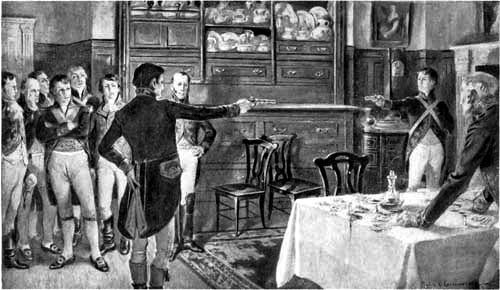
"One!" said the old soldier, his voice ringing hollow through the apartment
"One!" said the old soldier, his voice ringing hollow through the apartment.
"Two!" he said, more strongly.
"Fire!" he snapped out at last.
Instantly there was a flash of light, a cloud of smoke, a crashing report from Gardner's pistol. Mason's second, closely watching his principal, thought he saw a flick of dust rise from his coat. The Virginian staggered slightly, raised his left arm and laid it across his breast, but still stood erect, his pistol in his half-extended hand.
"Great God!" cried Gardner, hoarsely, as he saw his rival standing before him apparently unharmed. "Have I missed him?"
He put his hand in bewilderment to his head and staggered back from his position.
"Back to the card, sir!" thundered the colonel, cocking and raising his pistol and pointing it directly at Gardner.
"Of course, sir," returned the sailor, dauntlessly, stepping back to the card as he spoke. "I trust no gentleman here will think I shrank from the return bullet. 'Twas but surprise. Take your shot, I beg of you, Captain Mason."
His face was deadly pale, yet he forced a smile to his lips.
"You still have a shot, Captain Mason. Take it. We acquit Lieutenant Gardner of any timidity whatever," said the colonel, lowering his weapon.
Mason, who had grown as white as his rival, deliberately raised his pistol and took long and careful aim. The men in the room gazed breathlessly. They shifted about uneasily. Gardner stood with the smile petrified upon his face. Mason at last pressed the trigger, but the pistol missed fire and there was no discharge. The soldier lowered his arm and recocked his weapon.
"By heavens, it looks like murder!" burst forth one of the men.
"Silence, gentlemen!" shouted the colonel, handling his pistol again; "the man is entitled to his shot, and he shall have it. I'll kill the first man that interferes!"
"I beg him to take it," cried Gardner, with splendid courage, for if ever man could read his death-warrant in another's face, he saw it in the countenance of his antagonist.
Once more Mason raised his pistol. This time nothing prevented the discharge. His deliberate aim had been successful, and Gardner fell dead instantly, the bullet in his heart.
Mason, with the smoking pistol clenched in his hand, and with his left arm still pressed against his heart, walked over to the table and stood by it, leaning heavily upon it as he stared at the little group bending over his dead rival. At that moment the door was flung open and Marian, dressed as she had been at the dance, but with tear-stained face, frightened looks, and dishevelled hair, burst into the room. She happened to face Mason, and, her back being turned to the other end of the room, she did not see the body of Gardner.
"I heard shots," she cried; "have they—where is he?"
"Colonel and gentlemen," said Mason, faintly, coming forward with that left hand still pressed against his breast, "'tis an unseemly moment to announce it, but Miss Fletcher has honored me with a promise of herself to me to-night. We are——"
The girl turned to him with a look of abject horror and repulsion. She screamed faintly. The man was half blind apparently; he did not seem to realize.
"Have no fear for me, Marian dear," he went on, softly, "I am——"
"What have you done?" she shrieked. "Where is Robert Gardner? 'Tis he I love, not you!"
Her eyes instinctively followed the glances of those about her.
"Oh!" she cried. "What is that? Robert! Oh, my God, and I have killed you!"
Her voice rang through the room in such an awful note of agony that every man's heart stood still. The colonel moved toward her, but her living lover was quicker. He caught her arm.
"Don't touch me!" she cried, shrinking away from him. "There is blood on your hand! His blood! You are a murderer!"
Her bitter words recalled him in a measure to himself.
"No, madam," he answered, smiling faintly, "'Tis my own."
He tore open his coat, showing the bosom of his shirt and waistcoat stained with blood. He had been hit, but the loose coat had deceived his opponent's aim, and the bullet had missed the heart. He had so controlled himself that no one suspected that he was wounded, and he had almost bled to death in the effort.
The woman, the roses all shuddered out of her cheeks, a ghastly picture, stared from the dead to the living with dazed, terrified glances.
"You," continued Mason, swaying as he spoke,—"you have trifled with two honest men, and from your cursed coquetry one lies dead yonder and one—and one—dies—at your feet!"
He suddenly collapsed before her, caught feebly at her white satin skirt with his bloody hands as he lay upon the floor and strove to carry it to his lips.
"He loved you," he murmured, "and I, too—we were fools—for a woman."
That was all.
SAVED BY HER SLIPPER
A ROMANCE OF THE BORDER
"When greater perils men environ, Then women show a front of iron; And, gentle in their manner, they Do bold things in a quiet way." Thomas Dunn English
I.—IN FORT PATRICK HENRY
The Indians were out again!
The sharp rattling of a drum frantically beaten rolled through the little hamlet. The silent, pine-clad hills rising above the clearing on the bank sent the echoes clattering back over the river.
Scarcely had the peacefulness of the evening been broken by the first note of the clamor when from every door of hut or cabin the excited people poured out into the clearing and ran toward the stockade.
First came half-grown boys and girls, yelling half in terror, half in sport; then frightened mothers clasping crying babies to their troubled breasts with one hand, and with the other dragging stumbling little children. Then the men of the settlement, coatless, hatless, clad as they were in the various occupations in which they had been engaged at the moment, brought up the rear.
Some of the men endeavored to drive a few bewildered cattle; others helped to bring the younger children; but, whatever his action, each one carried a long, deadly rifle, as with grim, set faces they hurried toward the open gate of the fort on the shore. A panting horse stood by the gate, his drooping head giving evidence of the exhaustion following a desperate ride.
Inside the fort a young man, dressed in the usual fringed hunting-shirt and leggings, eternal garment of the Western pioneer, leaned upon his tall rifle and with eager gestures poured out the details of that message which had started the rolling of the drum.
The Indians were out,—the fierce Wyandotte, the bloody Mingo, the ruthless Shawnee. A huge war-party accompanying a band of British rangers from Detroit had been discovered in the woods early that September morning in 1777. They were marching toward Fort Patrick Henry on the banks of the Ohio, a rude white-oak stockade some sixteen feet high, extending along the river where now the mighty furnaces of Wheeling toss smoke and flame high into the air.
The Indians were yet some distance away; but the messenger, young Hugh McCullough, the bravest, most daring, most gallant young man among the thirty families clustered about the fort, and the one surest to hit his mark with the rifle, could not tell how soon they might be there. But they might appear at any moment; and Colonel Sheppard, the commander, deemed it best to bring all of the settlement people into the fort at once. Hence the sudden alarm and call to arms.
Presently the little enclosure was filled with crying children, boastful boys, frightened girls, serious women, and thoughtful men. The gates were shut; the younger children, under the care of the older women, sent to the safest room in the four corner block-houses, while the matrons set about preparing food, moulding bullets, making cartridges, and lending to the contemplated defence such other assistance as they could. The men and youths fell in with their respective companies and repaired immediately to their several stations, long practice and frequent alarms having made them familiar with the duties expected of them.
A long time they watched that evening, but no plumed, painted, savage figure could be seen through the trees, no sound broke the wonted stillness of the hills. Some of the little band of frontiersmen looked askance at young McCullough. Had he given a false alarm? himself deceived, taken them from their needed labors only to array them against some imaginary peril?
But no; he was the keenest scout and best woods-man in the settlement. A long row of sinister notches on the stock of his rifle marked the red marauders he had sent to their last account. It could not be; yet, if the Indians were coming, why did they not present themselves?
Old Colonel Sheppard and Major Ebenezer Zane, his second, did not hesitate; they trusted the young man. Requests to return to their homes were refused, the gates were kept closed, and by and by the women and children who could do so disposed themselves for the troubled sleep of an anxious night. There were keen watchers on the walls, but nothing broke the usual stillness.
The morning was dull and gray. Clouds of mist and fog dropped silently from the crest of the hills, sending down long, ghostlike arms writhing through the treetops over the town; still no sign of the enemy.
Smarting under the curious glances and sneers of some of the men, McCullough at last volunteered to go out and reconnoitre. Colonel Sheppard accepted his offer. While some one saddled his magnificent black horse, he broke from the group surrounding him and walked across the parade toward the farthest block-house, a room in which had been allotted to the family of Major Zane.
A tall, striking-looking young woman stood in the door-way. Most of the women in the fort wore linsey-woolsey frocks of the plainest cut, and, while some had Indian moccasins on their feet, the majority were barefoot. This girl was dressed in the fashion of, say, some six months before. There was a touch of brightness and color in her smart frock, albeit a few months of frontier wear had sadly dimmed its gayety. Shining silver buckles overspread her small, daintily shod, arched instep. Her short sleeves, extending only to the elbow, left bare her young brown arms, which had been white when she came to the settlement. The kerchief, crossed over her breast, but open at the neck, afforded a ravishing glimpse of her beautiful throat. Under her fair hair blue eyes sparkled, lighting, in spite of herself, with feeling as she comprehended the manly figure of young McCullough.
He was fluent enough in speech ordinarily; but now he blushed, hesitated, and stumbled awkwardly, as he dragged off his coonskin cap and bowed low before her.
"Good-morning, Mistress Elizabeth," he at length managed to stammer out; "how passed you the night?"
"As well, sir, as one could on a hard floor 'twixt crying children, frightened mothers, and quarrelling lads."
"'Tis not like Philadelphia, mistress?"
"No, indeed. To think that six months gone I was there, a girl in school, and now——"
"Now you are a teacher yourself, Mistress Zane, and we be all learning from you."
"Learning what, pray?"
"The game of hearts."
"Faith, Master McCullough, if rumor belie you not, I think you must have been a past master at that game before I came upon the scene."
"Nay, not so. Dame Rumor does me wrong, but——"
"Well, let it pass, Master McCullough. You brought the alarm, I believe. Was it real? Are there any Indians about?"
"We have not seen any as yet in the valley, but——"
"And was it you, sir, who tramped all night on the block-house over our heads?"
"I did, indeed, watch over—you, but——"
"Could you not have done it more softly, sir, and not add to the confusion the clatter of your feet and the thud of your gunstock? I knew it was you."
"Knew you my step, Mistress Elizabeth?" he queried eagerly, flushing with hope.
"Nay, sir," she answered, coolly; "none other had been so foolish; but the Indians?"
"I go to seek them now and would fain say good-by."
"What!" cried the girl, breathlessly, dropping her mood of airy banter, her face gone white in a moment. "What! you leave the stockade?"
"Ay, Mistress Elizabeth, and I am come to beg you—to wish you—to bid me good-speed."
"Where are you going and why?"
"Up the valley to beat up the red devils; to find them if they be not gone."
"Why, sir, you will be in danger!" cried the girl, piteously, stepping from the door-way and coming nearer to him.
"I am in more danger from your bright eyes than from any Indian that walks."
"A truce to this trifling, sir!"
"Nay, 'tis no trifling. My heart's gone to you. You have known it long since. Is it not so?"
She stopped with downcast head before him.
"They—they did not teach us things—like that—in Philadelphia."
"Nay, 'twas Mother Eve taught you, I'm thinking; and, as I may be—" he hesitated, and then continued softly, "a long time in coming back, I thought I must tell you now or you might never hear it. I love you." He turned away. "That's all."
She sprang toward him and grasped him by the arm.
"Go not," she whispered, her eyes brimming. "Stay." Her head sank forward; she trembled as if she would fall. Unmindful of all others, he slipped his arm around her waist. "Stay," she continued so softly that he could scarce hear her words, though he bent his head eagerly to catch them. "Stay—for me."
"Then you love, too, thank God!" he cried. "Nay, I must go; but I go for you."
II.—THE MAN'S DARING
His horse was ready at the gate now. The place was filled with men; yet, reckless of all who might note, he bent his head low and kissed her unresisting. Then he tore himself away and sprang to the saddle. With a wave of his hand toward the assemblage, a long glance at the girl who stood with clasped hands and white, upturned face staring after him, he struck spur to his horse and dashed out through the gate. They followed him with their gaze for a short distance up the road until he was lost in the trees which covered its winding course.
And so the morning wore on. About noon the watchers saw three or four Indians in the trees. The little band halted out of rifle range on the edge of the clearing, and scanned the deserted settlement and the fort with its starry banner drooping idly from its staff. The mist was heavier now; it was almost a fog.
Two men were ordered to go out the postern gate under cover of the river bank, creep along the shore until they gained the trees, and then endeavor to discover whether or not there were more Indians there. A little party of twelve, under Captain Mason, was assembled near the gate, ready to dash out and attack the Indians in sight if it were deemed advisable. It often happened that such a swift, sharp blow diverted a more serious attack.
Nothing had as yet been heard of McCullough. Elizabeth Zane had passed a morning of agonized apprehension. She was a motherless girl, who lived with her brother, the major; but she had spent most of her life in quiet Quaker Philadelphia at school. Only recently had she come to the frontier; this was her first experience in war—or love.
Suddenly the silence was broken by the sharp crack of a rifle. One of the Indians was seen to fall. The scouts had evidently attacked them. The fire was returned by the group of savages. There was a sharp fusillade in the woodland. Captain Mason and his comrades tore out of the fort and ran toward the sound of the firing. A wave of mist rolled down and shut them in.
The eager watchers on the walls could hear the rattle of the rifles and see the dark shadows cast by the forest shot with flashes of fire. The engagement seemed to be getting heavier. What was happening? They were not able to tell. The fog completely hid from their view the ravine in which the firing was going on.
Presently a man broke out of the mist and ran toward the fort. He was hatless; his gun was gone. He was bleeding from several wounds. His face was ghastly pale.
"Help!" he cried, brokenly. "The Indians are on us, hundreds of 'em!"
As he spoke he pitched forward and fell dead on his face just outside the gate. The fort was filled with excitement. The wife of the man who had just fallen shrieked with anguish, while the other women strove to comfort her and to hush the whimpering of the children.
Colonel Sheppard turned to another officer.
"Captain Ogle," he said, quickly, "take your company of twelve men, deploy them to the edge of the woods, and try to cover the retreat or bring off Mason and his men. Be careful, and do not be ambushed. We are but eleven men left here after you go to defend this post and one hundred women and children."
Again the gates were opened and a little band of determined hunters stole noiselessly toward the clearing. The rifle shots had ceased by this time, but they had been superseded by fierce Indian yells and a chorus of shrieks and cries from struggling men. Ogle's company stole rapidly forward, but before they could reach the place of conflict they were met by a fire which seemed to come from every direction. Out of the fog and smoke appeared the Indians, tomahawk in hand.
There was a fierce, wild mêlée for a moment, and then silence. A sudden breeze blew down the valley, lifting the fog; and the dismayed garrison saw the ground strewn with the bodies of their friends and neighbors, while just out of range the Indians danced, yelling frantically, jumping high into the air, and flourishing gory scalps, which they had wrenched from the heads of the fallen while some of them were yet alive. Four or five desperately wounded men gained the fort under a rattling rifle fire.
As the day cleared the Indians sought cover in the deserted houses on the edge of the woods and opened fire on the stockade. A perfect storm of bullets was hurled upon the fort; but the defenders, well protected, suffered no loss, and, firing slowly and deliberately in return, strove to make every shot tell and with good effect. The Indians could not expose themselves for a moment without being hit.
Presently down the mountain came a party of rangers under the British flag, militia from Canada. With drums beating and fifes squealing they marched up the road, dragging a small cannon, with which they opened an ineffectual fire upon the fort. After a while, however, wearying of this fruitless duel, the assailants withdrew out of range and the roar of the battle died away, although the investment of the place was still vigorously maintained.
About four o'clock a burst of yells and shouts attracted the attention of the garrison to the top of the hill overlooking the fort. A single horseman suddenly appeared on the brink above the clearing, his tall figure plainly silhouetted against the sky-line. The hill where he overlooked it was some three hundred feet high and almost perpendicular, although the rough slope was broken here and there by drifts and ledges. He reined in his horse abruptly on the very brink and gazed backward.
Elizabeth Zane stood by her brother on the roof of one of the block-houses. With eyes lighted by affection, she knew McCullough instantly. Presently others recognized him also. They could hear the yelling drawing nearer. They saw McCullough look to the right and the left and shake his head; they saw him turn and discharge his rifle at his unseen pursuers.
They realized the situation at once. There was a lost man on the brink of that hill, his gun discharged, weaponless, surrounded by Indians, who were closing in upon him to take him alive and torture him. Death at the stake! There was no salvation for him!
What could he do? Would he dismount and face them? Would he try to ride over them? A moment would tell. Elizabeth closed her eyes, and her anguished lips strove in vain to form the words of a prayer.
"He is going to try the hill!" cried Major Zane, suddenly.
The bold hunter shortened the bridle, backed his horse away from the hill a few feet, and then launched him into the air. The cry of defiance that he gave as he dropped down the steep slope could have been heard for miles around. Scarcely had he vanished from the crest of the hill when the faces of the Indians appeared over it. The edge of the bluff was instantly ringed with fire.
"He falls!" cried one from the fort.
"He is down!" screamed another.
"No, he makes it!"
"They've hit him!"
"He's reached the ground safe!"
"They've got him!"
"No, he's up again!"
"He's coming here!"
"To the gate! to the gate!"
The bold hunter had actually leaped, scrambled, fallen down that mighty precipice; and horse and man apparently were both unharmed at the bottom. It was a feat of daring horsemanship which has been the pride of the vicinity ever since.
Between him and the fort, however, lay the Indians. Startled and surprised by the hardihood and success of the descent, they stood dazed for a moment. Grasping his rifle by the barrel, with the butt up, McCullough swept down upon them. The first man who laid hand upon the bridle he brained with the rifle-butt. Dropping the rein, he cut at the next with his hunting-knife. The excited horse struck out savagely and beat out the brains of a third. The rest gave back for a moment. He was through!
In another second, bending low over the saddle, he was galloping madly toward the fort. Again the rifles cracked around him. They saw him falter in the saddle, sway uneasily. At the same time his horse gave a great bound forward. They had both been hit, then.
The Indians in their excitement ran after him, forgetting they were within range until the riflemen on the walls sent bullet after bullet straight to the mark. The brave horse staggered and fell outside the gate, pitching the man heavily on his head.
Under cover of the rifle fire, two men ran out of the open gate, and one woman, Elizabeth Zane, followed after. They picked up McCullough and brought him within the stockade and laid him on the ground. The young girl, white-faced, despairing, dropped by his side and took his head in her arms. Her kisses and piteous pleadings seemed to revive him, and a draught of spirits restored him.
"Safe, safe, Elizabeth!" he murmured. "Keep up a good heart, all," he added as soon as he could speak clearly. "Colonel Sheppard, I found the Indians out there."
"I see you did, my boy," said the colonel, smiling grimly. "What then?"
"I rode off to Colonel Swearingen and told him you were beleaguered, sir."
"Yes, and what did he say?"
"He'll raise a force and be with you in the morning. Where are the rest of the men?" he cried, looking around at the little handful of people. "Why are the women using the rifles?" he went on, noticing that the weakness of the garrison had compelled some of the women to take the places of the dead soldiers. "I'm needed here, I see. I am not hurt," he continued; "let me up!"
"But you are wounded!" cried Elizabeth. "You cannot."
"Nay, 'tis nothing," he exclaimed; "a flesh wound in the arm and a graze along the chest. When the horse fell he threw me so heavily that it stunned me. When my arm is bound up I'll be all right."
"Water here," called the colonel, "and some linen!"
"We have none in the fort, sir," answered Major Zane.
"A woman's petticoat, then."
"Take mine," cried Elizabeth, rising and lifting her outside skirt and tearing a strip off her underskirt.
"Nay, not your city finery, Mistress Elizabeth," protested McCullough, sitting up as well.
"Nothing is too fine for a brave man, sir," she answered, smiling proudly down at him.
"Not even Elizabeth Zane?" he questioned, cunningly.
"Not even Elizabeth Zane," she replied, bravely, in spite of her blushes.
"Thank God!" he whispered, as she bent down and bound up the wound.
"Zane," said the colonel, laughing at the oblivious pair, "did you ever know a peril so deadly that it could prevent two young people from making love?"
The wound, from which he had lost much blood, would have incapacitated a modern man from further fighting; but that little handful could not afford to lose a single member if they hoped to stand off the three hundred savages around the fort, so McCullough took his place on the walls with the rest. For some little time the interchange of fire was kept up, with further loss on the part of the Indians, but none at all to the Americans; but it was evident that some plan was being matured. The rangers were seen manœuvring through the trees; the cannon was dragged to a point where it could do greater execution.
Meanwhile Colonel Sheppard and Major Zane, with McCullough to second their efforts, were looking carefully to their defences. Every rifle, musket, and ancient pistol was brought out, charged, and laid at hand, ready for use. At this moment, however, a startling discovery was made: the powder had all but given out! Without powder they would be helpless to resist the assault which would apparently be delivered in a short time.
III.—THE WOMAN'S HEROISM
As the news spread among the men and the women, a panic filled their hearts. Was that crowded enclosure, filled with women and children, to be delivered to the ruthless passions of those ferocious Indians and the half-breed rangers? God forbid! Yet what was to be done?
"Oh, that we had some powder! I'd give my life for a keg of it!" exclaimed Colonel Sheppard, in despair. "Has every recess been searched?"
"We ransacked the fort, sir; there is none here," was the reply.
"I know where there is some," suddenly cried Major Zane. "In my cabin yonder there is a small keg of it; enough for us all. I had forgotten it until this moment. I'll go and get it."
The cabin was some sixty yards from the gate, and within easy rifle range of the busy enemy.
"'Tis sure death to venture there," cried the colonel; "besides, you are next in charge here. I cannot let you go."
"Let me go!" cried McCullough.
"Nay, you've done enough, and with your wounded arm you could not carry it. Besides, we need you."
"Let me!"
"I'll go," cried one and another, as the old colonel looked about him in an agony of indecision.
"We need you all; I can't spare a man," he muttered, hoarsely. "I don't see how we can hold the walls against another assault, as it is, with but a dozen able men here. Was ever man in such a position?"
"I will go, colonel," cried a clear voice from the women about the group of men.
"Elizabeth!" exclaimed her brother.
"Mistress Zane!" interrupted McCullough; "nay, you shall not. 'Tis no woman's work! I——"
"Silence, sir!" interrupted the colonel. "Who commands this garrison? 'Tis not woman's work, indeed; but we can spare no men. I cannot risk a single rifle. The maid shall go, and God bless her! If she falls, why, she but anticipates the fate of the rest of us."
"Elizabeth! Elizabeth!" cried McCullough, appealingly, still unconvinced; "you can't go! Think what your life is to me!"
"No more than yours is to me, Master Hugh," she answered, bravely, "and yet you went."
"Elizabeth, sister," cried Zane, "I can't let you go! You must not take this fearful risk!"
"Nay, gentlemen," interrupted Elizabeth, stoutly, "I will go! Open the gate. Do you cover me with your rifles as best you can. Good-by."
"Stay!" cried McCullough, grasping her by the arm. "Gentlemen, I love her and she loves me. Would you send away my promised wife? Must I see her killed before my eyes? Oh, let me try?"
"Nay, you shall not!" said the girl, kissing him and suddenly thrusting him from her, crying, "Forgive me!"
There was a flash of skirts through the open gate, and she was gone. Forgetful of his wounds, McCullough sprang to the top of the block-house nearest the gate. His own rifle in hand, and sweeping one or two others within reach, in spite of the pain from his injured arm, he knelt on the roof, peering eagerly down the hill.
As she left the block-house Elizabeth ran with the speed of a deer straight to her brother's house. She knew exactly where the powder lay concealed. She felt little fear in the advance. Seeing a woman running toward them, and ignorant of her purpose, the Indians probably would not attempt to harm her; but when she started back with the heavy keg of powder in her arms they would detect the reason for her movement and open fire upon her at once. Her comparatively slow progress under her burden would make her position exceedingly dangerous then. But that was a chance she realized she would have to take.
It happened just as she had anticipated. She gained the house without molestation and disappeared within the door-way for a moment, though it seemed hours to the men and women who watched from the fort until she appeared with the keg of powder on her shoulder. One glance she cast back toward the Indians standing gazing in startled surprise; one long look she threw toward the fort where, although she could not detect him in her excitement, she knew her lover was on guard, and then she started up the hill.
As she came out from the cover of the house the Indians saw the keg of powder upon her shoulder and at once realized what she was attempting to do. With roars of rage they opened fire. The bullets whistled and sang about her ears; they spattered the earth about her flying feet; one grazed her neck; another tipped her arm; a third glanced off the iron hoop of the keg she carried. If one struck the powder fairly, she would probably be blown to atoms. A new peril!
Her breath came quickly, her heart rose in her throat and seemed to choke her, mists swam before her eyes as she ran up the hill. Blindly she struggled on. She swayed to and fro over the rough ploughed ground, and the watchers thought she would have fallen or dropped her burden, but something superhuman in her enabled her to hold tight and press on.
She could not tell whether she ran rapidly or not; but her progress seemed slow, fearfully slow. Presently the firing stopped. Three of the Indians, tomahawk in hand, broke from the trees and recklessly started up the hill after her. They would try to capture her. Heedless of a possible rifle fire from the fort as they came within range, they leaped on her trail.
That was McCullough's opportunity. With a prayer in his heart that God might speed the bullet, he took careful aim. The first half-naked painted demon was nearing the girl with every bound. Two more steps and she would be in his grasp. She heard his feet on the ground; his yell rang in her ear. In spite of herself she started aside and looked around.
McCullough had his opening at last. A rifle shot rang out. She heard the scream of the bullet past her head. The savage threw up his hands, groaned horribly, and pitched forward with a bullet in his breast. Encouraged, she ran a few steps farther. Her foot caught in a forked piece of timber. The other pursuing Indians were near her now. The wood was filled with the enemy holding their fire and watching the mad chase.
"Let no one else fire," called McCullough. "You might hit her. Leave them to me."
These two savages, warned by the fate of the first, were wise enough to keep directly behind the fleeing girl. But, as her foot caught, she plunged sideways to extricate herself, leaving the shoe with its glittering silver buckle in the obstruction. That one second was enough for McCullough again. Once more the unerring rifle cracked and the second Indian fell.
Elizabeth, recovering her wits, ran sideways now. The third Indian, attracted by the shining buckle, stooped for a moment to pick it up. McCullough fired a third rifle, which some one put into his hand. The bullet shattered the Indian's arm. With a cry of pain and rage, his other hand dropped down toward the lost slipper, and this time a bullet from a fourth rifle found his heart.
The woods were ringed with fire now, but the girl was saved. When he saw that she had arrived at the fort gate, McCullough ran from the block-house and reached the entrance in time to catch her in his arms. Her poor little Philadelphia finery was red with blood from the wound in her neck, and her sweet young face was covered with the same gory embroidery.
She dropped the powder at the feet of the colonel and fainted in McCullough's arms, his own face scarcely less white than hers. One agonizing glance he gave to assure himself that her wounds were but slight ones, and he had to leave her to the women, for he was called to the walls.
While some of the women revived the girl, others, by Colonel Sheppard's directions, broke open the precious keg of powder and served it to the men. Those who could do so, took their places, rifle in hand, on the stockade; for the Indians and rangers now came out into the open. Carrying a great log, the Indians dashed recklessly at the fort, endeavoring to batter in the gate, while they kept down the fire of the defenders by the rapidity of their own discharge. They reached the gate and hammered on it with their ram; but the gallant little band within the walls, with their women helpers behind them, poured such a fire upon them that after heavy loss they retreated out of range, disheartened by their failure.
The next morning brought Colonel Swearingen and his militia levies, and at his approach the besiegers gave over the attempt and withdrew. The post was saved with the women and children. Elizabeth and McCullough were the heroes of the occasion.
"How could you do it?" asked Hugh of the girl, as they wandered together by the river that evening.
"I did it for you, dear," she answered.
"No, not only for me, but for the women and children; you thought of them?"
"Oh, yes; but I thought more of you than of the others, all the time. I knew you'd save me, Hugh. I was sure you would not let them take me. 'Twas your rifle——"
"Nay, dearest, 'twas your shoe." He took it fondly from his coat and kissed it. "This little shoe that turned you aside and gave me an opening. God forbid I should ever have to do such shooting again, dearest."
"Amen, Hugh, and yet He guided the bullets, I think."
"Yes, truly. And I never dreamed that you were such a heroine, Elizabeth. Where did you learn it? Not in Philadelphia, I am sure."
"No, Hugh, there is but one school in which they teach those things."
"And that is the school of——"
"Love," she whispered, hiding her head in his breast.
"SONNY BOY'S" DIARY
AN INCIDENT OF THE WAR IN CHINA
"Oh, a strange hand writes for our dear son—O stricken mother's soul! All swims before her eyes—flashes with black—she catches the main words only; Sentences broken—'gun-shot wound in the breast, cavalry skirmish, taken to hospital; At present low, but will soon be better.'" Walt Whitman
Among the most devoted of my parishioners was a certain Mrs. Allen,—devoted to the Church, of course, that is; although, if I may judge from her actions, I think she held me personally in high esteem as well. When I became acquainted with her she was a widow with one son. Other children, girls, had been born to her I learned afterward, but she had lost them in their early childhood; and, after the death of her husband, who had been a major in the marine corps of the United States navy, her life had been entirely devoted to this son, in whom her heart was so wrapped up that she fairly worshipped him.
She was a gentle, quiet, retiring little woman, sad-faced and inclined to melancholy when George, her son, was not with her. He was a hearty, healthy lad, abounding in strength and spirits, full of fun and mischief, but never vicious, and he certainly adored her with a genuine enthusiasm. His mother seemed actually to bask in the sunshine of his presence, and when they were together she was a different woman.
When I first knew them the boy had just been given an appointment at Annapolis; and though he graduated at the head of his class and should naturally have gone into the line of the navy, he had followed the family tradition by electing to serve in the marine corps, as his father and grandfather before him had done. He had risen to the grade of first lieutenant, and was one of the officers of the little band of United States marines who formed the Legation guard in Pekin during the terrible summer of 1900. I well remember the fearful anxiety and yet the superhuman resolution with which Mrs. Allen confronted those days of silence and suspense.
Sadly enough, among the first messages which got through from the besieged ministers was one announcing the death of her son. I was with her, of course, immediately upon the receipt of the news. Her grief was as silent as it was terrible. She made no complaint. The blow just struck her down. Her heart was affected in some way, and Dr. Taylor informed me, and I, in turn, told her that her days were numbered. I felt that it was best that she should know it. Now that her son had been taken, the desire to live left her, and she was almost happy in the thought that a short time—a month or two at most, the doctor said—would unite them again.
A few days after the receipt of the first bad news, freedom of communication having been restored meanwhile, the report of George's death was contradicted. Some one had blundered in the first message, and things were in such a state we could never find out who. He had been desperately wounded, they said, but would recover.
His mother brightened under this encouraging news. There was a faint rally and some improvement in her condition, but nothing of a permanent character. She realized the situation fully, but she summoned all her resolution and determination to her assistance and told me that she could not die until she had seen her son again. Dr. Taylor thought that probably she might survive under the inspiration of her devotion until the boy, about whom we continued to receive favorable reports, should come home again.
So she lingered through the summer, struggling, anxious, hopeful, determined. I happened to be with her on the eventful day when she received his first letter. The joy with which she took it from me and tore it open with her white, feeble, trembling hands was almost painful to witness. I felt as if I were intruding upon a meeting; but her blank look of astonishment changing to regret, and then to bitter disappointment, even anguish, as she mastered its contents was surprising.
"I have lost my boy," she said, with trembling lips, after a while, as she handed me the letter.
"What?" I cried.
"Oh, no; he is getting better and is coming back. I do not mean that; but—but—he is going to be married. Read it yourself."
Why, it was a letter to make any woman's heart proud, I thought, and I said so. There were sober words of thanksgiving to God that his life had been spared; a modest expression of satisfaction in the promotion to a captaincy, which had come to him for his splendid courage during the siege, notably when he led the attack on the sand-bag fort on the wall, where he was wounded; and lots of love for his mother. That was not all, though. He had been a demonstrative boy always, I suppose; he had lavished affectionate endearments upon her, and she had been first in his heart; but now—ah, there was the rub.
I realized, as I reflected on the situation, that I was only a man, and that no man had ever fathomed the subtle depths of a woman's—a mother's—heart. It was as she had said; he was going to be married. I must admit that nine-tenths of the letter was filled with descriptions of the young woman to whom he had plighted his troth. He sang her praises with the blindness of youth and the ardor of manhood.
They had met for the first time during the siege. She had been a belated traveller who had been caught in the Boxer uprising, and had been forced to take shelter in the Legation. She had shown herself to be a heroine, of course. Everybody was heroic in those days. We all expected they would be, and they were. After George had been wounded she had nursed him back to life and won her way into his heart in the process. It was all quite natural, certainly, and very romantic. She was coming back with him. They were to be married by one of the missionaries in the Legation, where the romance had begun, as soon as he was able to stand it, and he hoped soon to present to his mother a new daughter, who was "the best, the sweetest, the noblest little woman in the world, and whom I love and adore with all my heart," and so on until the end of the letter.
I thought myself that he might have spared her a little of that; and, as I watched Mrs. Allen's face and tried to talk to comfort her, I began to have a dim realization of what a shock it was. That boy had been everything to her, as I said, and she to him. She had always been first in his affection and he in hers. Alone in the world, the two had grown up together. Now that his life was spared, she confronted the fact that she was called upon to share him with another woman.
Oh, the bitterness of jealousy in old age! It was there. Oh, the hopeless feeling that comes over a mother when she realizes that, in a certain sense, she is supplanted! I saw it in the white face, the pressed lips, the trembling hands of the stricken woman leaning back in the chair before me. It matters not that it is the usual course of life; that did not make it easier for her. Other mothers had to bear such things, we both knew, but now it seemed different.
Well, I comforted her as best I could, said all things possible before I left her, but to little purpose, I fear. The next day she was dead. The second shock had been too much for her. I was with her when she passed away. When I came into the room I noticed that the table by her bed was covered with a pile of common red-backed blank books, which I had never seen before.
"Sonny Boy!"—that's what she called him; in spite of the fact that he was a great big fellow, and as manly as a soldier should be, he was always in her heart what he had been as a child—"Sonny Boy's diary," she whispered to me; "I want you to take them—keep them until he comes home and then give them to him. And I want you to read them, too, so that you may know—and—and—sympathize."
Sympathize with whom? I wondered. With George or with her? Ah, I soon found out. I thought she had gone after the prayers had been said, she lay on the bed so still and quiet. But she opened her eyes presently and whispered brokenly in the silence,—
"Tell him—I love him better than—than—any one in the whole world—will—ever—love him—Sonny—Boy."
After that her eyes remained open until I closed them.
I took the books home, and the evening of the day of the funeral I sat down to read them. It was late at night, or rather early in the morning, when I finished them, and then I did something for which my conscience has troubled me ever since.
I wish that I could tell you all that was in those little worn blank books. Every word of them had been written by her own hand. She began with his birth, the first entry being made as soon as she was able to hold a pen. She chronicled religiously every event that bore even the remotest relation to the boy. You could see how he grew into her life, how he became a part of it, and, finally, as the years passed by, all of it. There was nothing that he did or said which was not noted. His most trivial actions, his most unimportant words, were all faithfully set down and commented upon. In those books was the history of the development of a human being,—nay, the development of a great passion as well.
As he grew older, and his mother lost successively his father and the two little girls, it was easy to see how the boy became more and more to her. The entries were longer and more connected,—more coherent, I should say. There were whole pages filled with her speculations concerning him. She set down the ambitions she had cherished for his work, the hopes born in her heart for his future, her dreams of his achievements that were to be; she quoted freely from his letters when he was away at school. She inserted photographs of him in all stages of development. She wrote out the prayers she made for his welfare.
The entries abounded with expressions of her ever-growing, absorbing love for him. Yes, and when he had his boyish flirtations and had evidently written to her about charming girls he had met, the jealousy of a mother's heart spoke in her comments. It was quite evident to me as I read on, absorbed in it all, that she would never be able to bear the idea of any one coming between her and that lad. How she rejoiced in his successes and love for her! There were troubles, too,—illnesses, scrapes; but her love never wavered, and things always seemed to come right in the end.
I could see that the keeping of that diary had become a passion with her. She confessed herself to it as a devotee might to some spiritual adviser. She poured out her heart on those pages which no living eye but mine had ever seen, I verily believe. She was absolutely true; entirely frank. The book was a self-revelation, all unconscious. I could see the ennobling effect of that great passion. She grew greater as I read on and on. A soul was laid bare in the written pages. I seemed to be treading on hallowed ground as I tenderly turned the faded leaves. No one could ever have spoken aloud as she wrote. It's not in nature to do so. It was her secret heart, her most sacred feelings, her inmost soul that lived and vibrated in the silent letters. I seemed to be looking upon things not meant for mortal eyes.
And through it all there was a note of depreciation. Was she, could she, be worthy of him? Oh, the sweetness of the humility of a mother!
But I cannot linger to tell all the story, all I read, all I divined. At last came the entries of the present year. When he had gone away she had sworn she would be brave. He was a soldier, he must do his duty and uphold the honored name of his father; but, oh, the anxiety of it all! I could see that it had almost killed her; yet she had kept up under the dreadful strain until the news of his death came.
I am not ashamed to say that I put the book down and cried like a baby when I read what she had written. Broken-hearted sentences, bits of prayer, words of Scripture, "Oh, Absalom, my son, my son!" Tears on the pages. The leaves were alive with her words. As I said, they spoke as no human voice could have spoken. They told a tale which humanity could not have revealed. And her heart was broken.
Then came the entry on the day when I had told her she was doomed. The subdued joy with which she heard the news, with which she looked forward to the prospect of a speedy meeting, was quite evident. One phrase struck me on that page:
"The work of years is over; I lay down the pen," she had written. "Sonny Boy"—she never failed to use that title; she clung to it the more tenaciously as he grew older; it seemed very sweet to me—"is gone and I am going, thank God! In death as in life we will be together. 'The book may close over' and be opened no more. He cannot return to me, but I shall go to him. I shall write no more. I have left directions that this story of a life—or two lives, his and mine—shall be burned when I am gone to meet Sonny Boy."
But on the next page the entries began again. She had taken up her wonted life-long task once more when she found that he was living. Curiously enough, while there was joy in the pages now, I seemed to read in them more of regret—in spite of herself. The doom written against her could not be revoked. Yet the conditions were changed. She had to look forward to a long parting instead of an eternal meeting, and it hurt her. Yet she must live until he came back. I saw it was her will power alone that kept her up. She must see him again before she went out into the dark, or the light rather, to wait for him.
So, in a hand that grew more feeble from day to day, she jotted down her hopes and longings for her son. How much the trembling letters told of her growing weakness! how different were the characters from the bold, flowing, graceful writing of the beginning!
Finally I came to the entry—the last—on the day she had received the news of his approaching marriage. Oh, the anguish that ran through the written words! They seemed to gasp out her grief from the page; sometimes I could scarcely decipher them. I turned back to the entry following the report of his death, and I declare it was no more heart-broken. Another woman had come between them. With unconscious cruelty, in that fatal letter George had told her over and over again how much he loved the woman he was about to marry. She could not get away from it. Innocently enough, he had given her to understand that he loved the girl more than all the world. Thoughtlessly he plunged this dagger into his gentle mother's heart.
I didn't blame him for his feelings. He could not help them; and, as I said, it was human nature anyway. The experience is common to every mother in greater or less degree. She had to expect it, or she ought to have done so. Still, I did wish he had not been quite so enthusiastic; not that it would have made much difference, for it was the fact that killed. His mother had intuition enough, she loved him enough to divine the truth through any reticence.
"I can't bear it," I read, "to know that I have no longer the first place, that another woman is nearer to him than I. To feel that the first of his love is given to a stranger! The best of his heart is hers! Who is she? What right had she to come between us? What has she done for him compared to me? Ever since he was first put in my arms, ever since I heard him cry the first time after the awful pain and anguish of deliverance, he has been mine! Mine! Mine! And she has taken him! Oh, God, pity me! I cannot give him up and live! He must not bring her here. I shall never like her! I hate her! I do not believe she is—Oh, how wicked I am! And he will be so happy while I suffer! I'm glad he will be happy—but it kills me. Thank God! it will not be for long. I don't want to see her. Pity me, my Saviour! You had a mother! I am an old, lonely, dying woman. Mercy, mercy! I don't want to see him—either—that I should write it—my son! with a light in his eyes and love in his voice for another woman. I shall die now. Perhaps I may find comfort then. But I shall never forget. He wrote about her on seven pages of his letter, and one was enough for me. Oh, Sonny Boy, to lose you, to—your little old mother is breaking her heart! Be assured of one thing, my son, I love you and I have loved you better than any one in the whole world will ever love you"—these were the words she had whispered to me on her death-bed—"no matter how much joy you may have, how much happiness, no matter where you may go, whom you may meet, what they may say, no one in this world will ever love you as I have. No one will ever think of you as your mother."
That was all. And I'm afraid it was true.
"There is none In all this cold and hollow world, no fount Of deep, strong, deathless love, save that within A mother's heart."
I sat there in the gray of the morning with the open book in my hand. She had told me to give the volumes to George when he returned, and I could not—if I desired to do so—disregard her wish; yet to lay before him the sorrow, the regret, the sadness of that last entry: to leave with him that final thought of his mother, to cloud his wedded life with a suspicion which I knew he could never dispel, that his joy had been her death, his marriage had broken her heart—I could not do it! Still, to withhold from that boy the last words of his mother—it did not seem right!
What did I do? you ask. Well, with a horribly guilty feeling, I cut the last leaf containing those terribly piteous words out of the diary. I did it carefully so that he would never know that anything had been taken away. I felt like a thief all the time, somehow.
I did not destroy the leaf. I could not do so. I put it away carefully with my other treasures, and when George came home with his sweet, beautiful young wife,—and I thanked God he had her to help him bear his unfeigned sorrow at the loss of his mother,—I gave him the diary without the missing leaf; and her last message to him, as I delivered it, was one simply of love and blessing. And I almost felt as if his mother thanked me for it. I hope so.
I take out that missing leaf sometimes when I am alone in my study, and read it over and wonder whether, after all, I did right or not.
Extravaganzas
"'Tis a pleasure to please, and the straw that can tickle us
Is a source of enjoyment, though slightly ridiculous."
Oliver Wendell Holmes
"A careless song with a little nonsense in it now and then does not misbecome a monarch."
Walpole
THE AMAZING YARN OF THE BO'S'N'S MATE
AN ACCOUNT OF AN UNUSUAL PRIZE
"Now this is the tale that was told to me By a battered and shattered old son of the sea, To me and my messmate, Silas Green, When I was a guileless young marine." Ancient Sea Song
The second dog-watch, from six to eight in the evening, is the sailor's play-time. Unless some emergency requires it, drills and duties are suspended for the time being and Jackie, except for supper, has his time to himself. The older seamen usually collect on the forecastle; sometimes in the lee gangway in rough weather. There they sprawl themselves on the deck, or dispose themselves comfortably against the rails or the bitts, or even the anchor-fluke, if every place is occupied, or the boom boats if the waist be the place of assemblage, and smoke their pipes and yarn.
The ordinary seamen, the landsmen, and the ship's boys, if they are not rigorously excluded from the top-gallant forecastle, or from close proximity to the group of worthies who literally "take the deck," are forced to stand afar off, at any rate, where they listen to marvellous recitals as best they can. The midshipmen, however, as a species of privileged intermediaries between officers and men, often make a part of these exclusive circles, especially when yarning is going on.
Among all the tellers of strange tales on the famous United States frigate Neversink, Jack Lang, the old bo's'n's mate, held the chief place by general consent, and the sound of his deep voice raised in narration was sure to attract to his side every available reefer not specifically on duty, and all the old shellbacks, to whom yarning and listening to yarns were as the breath of life. And nowhere will you find better listeners than at a dog-watch "gam" on a ship's forecastle. The old man's services on the Neversink were invaluable in every way, his word was law forward of the mast as the captain's was on the quarter-deck, and even as a story-teller he was supreme.
One mild, pleasant evening this before-the-mast autocrat and raconteur found himself the centre of an interested group on the forecastle. The midshipmen were burning for a yarn. They had learned, however, that the surest way not to have their desire gratified was to ask a sailor for a story. Certainly this was true of this particular old salt, and it was necessary to approach him by indirection. The conversation turned, as it frequently does in the forecastle, on the quarter-deck, and everywhere else, on woman.
"Wot's the matter with leetle Sammy Bowline?" queried the old man in a pause in the conversation. "I seed him a-weepin' an' a-bellerin' like wot you Yankees call a 'caow' in the fust dog-watch."
"A cow don't weep, Jack," answered a maintopman who had been a lumbering bucolic dairyman when the Neversink left port six months since, but who was now a smart young light yardman.
"Hev you seen all the cow critters on the yearth, youngster?"
"No, but——"
"Well, some cows weeps, I sez, an' this'n' did," answered the old sailor, sententiously. "Anyway, Sammy Bowline, he bawled awful."
"I reckon he's homesick fer his ma," remarked Billy Clumpblock, the captain of the maintop. "I just guv him a few teches with me colt to take it out'n him, w'ich I've larned that w'alin' is werry good fer homesickness, an' sent him up in the top, as he calls it, to 'spell a watch.'"
"It's a sing'lar thing," continued the old bo's'n's mate, "how much men an' boys thinks of feemales, sech as mothers an' sech like pussons. It stands ter reason thay ain't necessary to nobody's existence, though it's agreed that we all had 'em onct, though I've got no evidence of it in my own case 'ceptin' general report. Look at this ship, now. There ain't a woman on board of her, an' if they was, she'd be considerably disorganized, w'ich I means the ship an' p'raps the feemale too."
"They seems ter be necessary on shore, though," remarked the chief quartermaster, a much-married man.
"P'raps they be. But they're no 'count on sea."
"I've heered them called the weaker sex," said the purser's yeoman, who was fond of literature of the dime novel variety. "I guess that's becus they can't make sailor-men out'n 'em."
"Wall, naow," drawled the Jack-o'-the-dust, a studious New Englander, given to historic research as he could manage it, "there hev been wimmin sailor-men. I've read abaout 'em. There was two pyrates once an' they was wimmin. An' they was the wust kind of pyrates, too."
"That's nateral," said the autocrat of the forecastle; "it stands ter reason that a woman'd be a bad sailor an' she'd also make a bad pirate."
"They wus good pyrates," continued the down-easter.
"Good pirates? There ain't no sech thing," chimed in another sailor, filling the responsible position of captain of the hold.
"I mean they wus bludthirsty feemale villains, an' they done the pyrate bisness up jest's fine's if they'd a-bin men."
"I had an amazin' experience with wimmin onct," said the old bo's'n's mate, reflectively.
"I should say you had," broke in a young midshipman; "I've heard you speak of your 'ol' woman' hundreds of times, and all the trouble you've caused her."
"I don't mean her, Mr. Bobstay. God rest her soul; she's dead, sir; an', as fer the kids, my darter's married an' the boys is God knows where. I brung 'em up ter be good sailor-men, though, an' wherever they is, I guess they're a-doin' of their dooty. This was another kind of a feemale. You see, lads an' young gentlemen all, in the Med't'ranean in 1800 I was bo's'n's mate, an', like this yere ship, we didn't kerry no bo's'n on the little hooker Grampus, the luckiest barkie that ever carried the American flag. She was schooner rigged w'en I was on her. Then they turned her inter a brig, an' now they're thinkin' o' makin' a full-rigged ship of her. They've done everything they kin to spile her. She's the slowest old tub afloat now, I'm telled, but let anything British take arter her an' she jest naterally takes a bone in her teeth an' rips away. Lordie, to think of that little ship a-doin' all the things she's done! Wall, where was I, mates?"
"You wa'n't now'ere. You was gittin' ready to go som'er's, tho', I guess," said the quartermaster.
"To be sure. Wall, as I was sayin', I was bo's'n's mate, an' that was bein' ekal to bein' bo's'n on that 'ere schooner, an' Commodore Rattlin was jest takin' command of her. My, but he's a sailor an' a fighter! I never seed any one like him an' I have fit in some right good hard battles sence, onless 'twas Commodore Paul Jones, w'en we tuk the Serrypis nigh onto forty years ago. I was a smart young foretopman in them days, lads, an' it was me wot the commodore sent out on that main-yard-arm to drop them grenades down the hatchway of the Serrypis that blowed her up. So I allus thought that I won a deal of that battle myself, though the commodore got the most credit. Let's see. W'ere was I?"
"You was on the Grampus w'ich Commodore Rattlin was takin' command of," said the Jimmy-Legs, lighting his pipe.
"So I was. So I was, tho' he was only a leftenant then, lads," continued the old man. "Wall, we was mighty keen for prize money in them days, an', fer that matter, I ain't never seed the day, so far's I'm consarned, w'en I wasn't ekally desirous of gittin' my share of the same. Now, you youngsters, an' you haymakers,—w'ich is a bit unjest to you, p'r'aps, becus you've larned to be putty fair sailor-men sence we tuk our departure from Boston,—ye know prize money's divided into twenty parts by the laws of the United States. The cap'n he gits three parts; the leftenants an' sailin'-master, they gits two parts; the marine officers, surgeon, purser, bo's'n, gunner, carpenter, master's mates, an' chaplain, they gits two; three parts goes to the steerage an' chief petty officers, the other petty officers gits three, an' the balance of the crew gits seven."
"Seems to me the crew don't git no fair share," interrupted one of the new hands.
"We're lucky to git anything at all," commented the old sea philosopher. "They used to say you throwed the prize money at a ladder. Wot went through was diwided betwixt the cap'n an' th' officers an' petty officers, the cap'n takin' the biggest share. Wot stuck to the rounds was fer the crew. An' if they hadn't tarred the rounds in sum instances I knows of," he went on, mendaciously, "they wouldn't a-got none. Howsomever, this yere explanation is necessary fer to understand this yarn."
"I'd like to know wot prize money's got to do with wimmin," remarked Billy Clumpblock.
"My lad," said the bo's'n's mate, sapiently, "prize money's got a lot to do with wimmin, as you'll find out, especially if you go ashore with a pocketful of it. It had suthin' to do with the wimmin I'm goin' to tell ye of, anyway. One pleasant day in December, 1803, we was a ratchin' to an' fro in the Med't'ranean on the Grampus a-lookin' out fer Algerian cruisers, w'en we run acrost a ketch."
"What's a ketch, Jack?" asked one midshipman.
"Well, a ketch—an' the rest on you pay attention, too; if ye just take notice to wotever I says, ye lubbers, you'll soon know a heap about the sea an' other things. Bein' a silent man myself, I don't say much, as ye may hev noticed; therefur, w'en I do say suthin' it's wal'able. A ketch is a wessel wot has one big mast set well aft about midships an' a little one way aft of the fust one. This is to leave a cl'ar space forrard fer a bum [bomb]. They're mostly used fer that, w'ich is w'y they are called bum ketches, ye know. This one, however, had a cargo more dangerous an' onsettlin' than bums would ha' been, fer w'en we ranged alongside an' throwed a shot over her, you never heered sech a screechin' an' yellin' in all yer life.
"'Good Lord!' said Cap'n Rattlin out loud, w'ich as he was young an' impulsive like an' not used to controllin' his feelin's like me, he jest spoke right out. 'Good Lord!' he sez, 'wot hev we run inter?'
"'It 'pears to me,' spoke up Mr. Parbuckle, actin' as his first luff, w'ich he was only a midshipman an' had no experience wotever with the feemale sex,—but I've allus noticed that it's them as has little experience as knows the most, specially 'bout wimmin,—'it 'pears to me,' he sez, 'that them's wimmin.'
"'Wimmin?' roars the cap'n. 'Wot are they a-doin' there? Well,' he sez, 'we'll soon find out,' sez he. With that he shoved the schooner in clus to the ketch an' hailed her. Of course, the conwersation bein' carried on in lingo Franco, w'ich I understands, it was all werry clear to me, an' I told the rest of the fok's'l wot was happ'nin'.
"'Ahoy!' the cap'n cried, 'wot ship is that?' An' then a measly old Turk he come over to the side an' throwed his flag in the water an' waved his arms an' bowed to the deck, but didn't say nuthin'. He was so skeered he was most frightened out of his baggy britches. He could see the smokin' matches, an' we was jest itchin' to turn our guns loose on the old heathen, with his wildcats, or wotever they was. The cap'n bein' young an' impetuous like, he hails ag'in. He sez,—
"'W'y don't you answer me?' he sez. 'Ain't ye got no tongue?' he sez. 'Don't you hear me? W'ere are you from? W'ere are you bound? Wot hev ye got on board? If ye don't speak up I'll turn a broadside on ye.'
"With that that old Turk he unstoppered his jaw tackle an' reels off an extr'ordin'ry lot o' stuff, but we makes out, me an' the cap'n does, that he was from Tripoli three days out. That his ketch's name was the Stamico, or sum sech other outlandish name, an' that she was loaded with feemale slaves fer the Sultan of Turkeys.
"Gosh-o'-mighty, if the cap'n hadn't insisted all the time on the most sharpest dissypline on that there leetle ship, I'd a yelled an' laughed outrajus, an' the men would hev busted inter cheers. As it was, I didn't dare to tell the crew all that bit of news; I jest guv 'em a leetle to keep 'em goin' an' hove to under the lee of the foremast where nobody seed me an' cut loose a few steps myself.
"'This is a putty how-de-do,' sez Cap'n Rattlin.
"'Wot'll we do, sir?' axes Mr. Parbuckle. 'Wot'll we do with them feemale slaves? I reckon we'll have to bring 'em aboard here, fer we can't let the ketch go,' sez that youngster.
"He was as excited as any of us, an' I reckon the cap'n was hisself, if the truth was to be told. Sech a prize as that ain't picked up every day at sea, ye know, shipmates.
"'You know old Commodore Ringtailboom,' continoos Mr. Parbuckle, grave-like; 'you know, sir, he wants a boat jest like this ketch for inshore work.'
"'You're right, sir,' sez Rattlin, werry solemn; 'take a boat, Mr. Parbuckle, an' go over there an' tell that beastly Turk we'll have to transship his cargo over here aboard the Grampus.'
"I was cox'n of that boat, young gentlemen, an' we went off armed to the teeth, not so much fer fear of the Turks, but on account of them feemales. You see, we didn't know wot'd happen to us with a ketch load of wimmin folk, an' we went prepared fer the wust. Wall, may I be jiggle-toggled, shipmates, but sech a screechin' an' yellin' you never heered w'en we got aboard. Bein' a chief petty officer an' the next in command, as it was, an' the most experienced, bein' a married man, Mr. Parbuckle, he tells me to go below an' see wot I could make out of the lot, w'ile he speaks to the beastly Turkey cap'n. Fer a reefer, young gentlemen," said the old sailor, "he was the bashfullest feller I ever seed. 'Tis a rare and onsettlin' quality in the class,—meanin' no offence," he added, amid a general laugh, in which the midshipmen heartily joined. "I didn't want nuthin' better'n that job, so I jumped below to tackle it, took off my hat, an' sez, most pleasant like, 'Ladies, yer most obejient an' 'umble sarvant.'
"They all run forrard at that an' crowded inter the eyes of the ship to git away from me. I suppose I must ha' looked mighty fierce, wot with cutlass an' pistol an' the pigtail we allus wore them days, an' w'en I tried to tell 'em that I come peaceable like, they was makin' sech a noise that they didn't seem to pay no 'tention to wot I said. I thought the best way to ca'm 'em an' to assure 'em of my peaceful intentions was—well—er—I jest caught the nearest one by the arm, slipped my own arm 'bout her waist, an'—an'—smacked her good!"
"Oh, Jack, you old sinner!" yelled the youngsters in chorus.
"Dooty, gentlemen; a true sailor-man is allus ready to sakerfice hisself fer his country, an' I done it cheerful then, bein' as 'twas in the line of dooty."
"I guess you did," said Midshipman Cringle, sagely.
"Thankee, sir," continued the bo's'n's mate, oblivious to the sarcasm. "She yelled sum at fust, but she seemed to like it. Of course, I repeats, it was all one to me, jest in the line of duty, as I sez, though I hev done more disagreeable jobs than that. I jest patted her on the head a bit w'en I got hold of her, an' told her to ca'm down, that we wa'n't goin' to hurt her, an' she seemed to feel summat assured, but, as we arterwards larned, she didn't understand a word I was a-sayin'! Howsomever, suthin' satisfied her. Perhaps 'twas my actions. Well, now, you youngsters, you must remember that I was younger then than I am now, an' there wa'n't a likelier sailor-man on the sea, ef I do say so myself. The rest of the cargo stopped makin' that infernal noise w'en they seed wot was happ'nin', an'——"
"Jack!" said Midshipman Futtocks, severely, "and you an old man! I'm ashamed of you!"
"Mr. Futtocks," said the old sailor, "as I hev said, it was strictly in the line of dooty, an' I was a young man at that time, sir. Mr. Parbuckle, he ordered me to pacify 'em, an' I was a-doin' the best I could. I was only a poor ignorant sailor-man in them days, an' couldn't be blamed fer a thing like that. W'ich I've got more experience now, tho' I don't say I wouldn't be willin' to sakerfice my feelin's to my dooty again if 'twas demanded of me. Well, I got 'em quiet by this means, anyway, w'ich I'm sorry to say you blames me fer, but w'ich my conscience is clear, an' I wish I could do it ag'in, an' I got 'em up on deck, too.
"'How did you get 'em quiet, Jack?' axed Mr. Parbuckle, who was busy arrangin' with the measly old Turkey w'en he seed me a leadin' 'em from below.
"'Well, sir,' sez I, 'I jest hauled alongside the nearest one, hove to, laid her aboard, an' s'luted her with a few light guns, an' the rest stopped a-yellin' at onct.'
"'Gad, man!' said the youngster, 'you've a genius fer dealin' with wimmin.' W'ich I tuk as a compliment, altho' comin' from one with no experience. Anyway, we got 'em aboard the Grampus all right arter aw'ile, an' ranged 'em on the quarter-deck. We didn't lose a solitary one, tho' they did beller an' bawl wuss'n Sammy Bowline at gittin' into the cutter. Mr. Parbuckle he was left in command of the prize, an' he a-protestin' bitterly; but the cap'n he sez he might send some of the prize over arter aw'ile to keep him company, but fer the present they must be mustered on the Grampus. Wall, we claimed that they all must be diwided up accordin' to law, bein' a lawful prize, an' we wasn't goin' to wait fer no prize court, nuther. The cap'n, bein' only a boy, he was in fer a lark like the rest on us, so he mustered the crew an' he made a speech.
"'Men,' he sez, 'as you knows, the prize laws of the United States diwides the prizes inter twenty parts. There ain't no money, but there are one hundred an' twenty feemale wimmin in this lot w'ich we've tuk. That's six wimmin to a part. I gits three, an' I'll make my ch'ice now. Ladies, yer most obejient,' he sez, grinnin' at 'em, an' them a-grinnin' back, becus, like me, he was young an' well favored them days, an' the feemales was havin' great larks, too. Then he steps forrard and picks out eighteen of the youngest and purtiest. Among 'em was the one I endeavored to impress myself on the ketch, an' as she passed me she made languishin' eyes at me; but she had to go with the rest, me bein' only a bo's'n's mate. So the cap'n he ranged his eighteen aft on deck, then the leftenants tuk their turn, an' the cap'n he chose fer Mr. Parbuckle, w'ich he was on the prize an' couldn't choose hisself, an' a mad young officer he was, too, seein' plain wot was a-goin' on an' him not there. Wall, arter the cap'n, the leftenants, an' the chief petty officers tuk their share, blast my eyes if there wa'n't left an assortment of the ugliest old wrecks you ever seed—forty-two of 'em—for the crew, an' them jest beginnin' to understand the game, too," said Jack, laughing, "fer they showed the greatest willin'ness to be tuk. An' sum of 'em must ha' been old enough fer grandmothers, too.