Front matter (continued 3)
Reading edition
"Probably she thinks she's as nice as I am," she continued, through her tears. "She would look upon me as an ignorant little country girl. She would wonder how you could possibly fall in love with me. I wonder about it myself. You do love me, don't you?" anxiously.
"Of course I do. I have told you a thousand times, and I mean it! I mean it more every time I tell you, and I want to tell you more every time I see you. I won't marry Josephine Remington, and that's all there is about it!"
"You must!" decisively.
"If you say that again, Emily, we will quarrel right here," sternly.
"Perhaps that would be best. If we quarrelled it would be easier to break it off."
"Well, we won't quarrel, then. But what I am going to do I cannot say. I'll just tell the truth and stick to it. I wish—oh, I wish—they hadn't come! I do not want to see her at all."
"But you must go, and go right away!"
"Oh, very well. The sooner it is over the better, perhaps. Good-by, Emily."
"Good-by, Richard," heartbrokenly.
"Won't you kiss me good-by? You have not kissed me since last night. You have not let me see you alone this long morning," reproachfully.
"No," answered Emily, with sad decision; "I do not believe I shall kiss you. We are not yet engaged, and you may not belong to me, after all. I think I would better not."
"Oh, all right, then," with a savage simulation of unconcern.
"You are not angry, are you?" timidly.
"No, I am not angry; but I am awfully——"
"You see I am afraid it's the end and another kiss would make it—harder."
She spoke slowly, with a note of interrogation in her voice. For answer he clasped her in his arms and kissed her fervently again and again. She remained weakly struggling for a moment, but finally returned his caresses. Presently, however,—after she had been well kissed, by the way,—her determination came back to her. She burst from his arms with a violent effort, exclaiming,—
"There, go! And I suppose you will be with them all day?"
"I will come back to you as soon as I can get away."
"Oh, Dick, I suppose I will have to go over there in the afternoon and invite them here. What will your mother think of me? I don't believe I ever met a high-born, high-bred lady in my life. I wouldn't know what to do."
"Do just as you always do; be yourself; and if my experience is any criterion, she will adore you as I do. Good-by."
CHAPTER XVII
Freed!
In the same little parlor of the inn in which he had lunched with Emily the day before, Revere awaited the entrance of his mother and Josephine. His mother entered first and immediately clasped him in fond embrace.
"Oh, Richard!" she exclaimed, tearfully; "I have been so miserable about you! You never said a word about the gravity of your accident, and I only learned about it accidentally. You are not suffering, are you? You have sustained no serious consequences?"
"No, mother dear; I'm all right. In fact, I feel better than I have felt for six months. It really did me good. It was awfully good of you to come to see about me, though. I should have written and told you all about it and assured you that nothing serious was the matter, but I thought it would alarm you if I did; if I dwelt upon it too fully, that is. I'm very glad to see you; but there was no real necessity for your coming."
"Richard," she answered, hesitatingly, with a long sigh of regret, "I did not come only on that account. To be perfectly frank with you, Josephine—you have not yet greeted her."
She stopped abruptly. He turned and faced Josephine, who had stood constrainedly in the door-way, apparently an unwilling witness of the meeting.
"Oh," he said to her; "how do you do, Josephine? I'm awfully glad to see you."
He had hitherto always signalized meetings of this kind by kissing her, generally upon the forehead or cheek. With a vivid recollection of his present situation, however, he hesitated awkwardly, and then concluded that it would be better to act as if nothing had happened. But to his great surprise the objection came from the young lady herself. As if she had divined something of his mental attitude, she drew back her head and thrust out her hand. He took it, feeling very much embarrassed, yet greatly relieved.
"What a greeting," said his mother, "between—but I forget. Josephine has something to say to you, Richard. She has made a decision which is a source of lasting grief to me, and will be to all who know you. I am sure it will be a great shock to you. Prepare yourself, my poor boy."
"Didn't you get my letter, Josephine?" said Richard, impetuously.
"No; I didn't receive any letter."
"Oh, then, you didn't——"
"Didn't what?"
"Well, er—nothing. What was it you wanted to say to me?"
"Richard," said the girl, "I may as well be frank with you. I——" She hesitated and turned her face away. "I want to break our engagement."
"Want to break our engagement!" he exclaimed, dazed at this development. "Why—I——"
"Yes," she said, honestly; "frankly, I do not believe that I care enough for you to marry you."
"But, Josephine——"
"Yes, yes; I know what you would say. I thought I loved you; but since I have come to know—Mr. Van Dorn, I am sure——"
"Josephine Remington, you don't mean to tell me that you have thrown me over for Charlie Van Dorn? Why, he——"
"Richard, don't say another word! I love Mr. Van Dorn, and he loves me, and I have promised to be his wife," with great dignity.
"Great heavens!" answered Richard, trying desperately to keep his happiness at this announcement out of his voice and out of his face; and yet he had to confess that he felt extremely annoyed at being rejected in this summary manner for a man who he conceived to be in every way inferior to himself.
He rejoiced, certainly; but the situation had elements of unpleasantness. For a moment or two these had predominated, but as he realized that he was free, he could hardly keep from shouting for joy. Indeed, he felt that his face would betray his secret, and he instinctively turned away from the two women, who were intently watching him, and covered it with his hand as he did so.
"Oh, Richard!" cried Josephine, contritely, "I'm so sorry; I didn't think you cared so much. I thought you felt as I do about the engagement,—only that it was an agreed thing, and everybody more or less expected it,—not that we loved each other very much—I'm so sorry."
"My poor boy!" said his mother, coming up and laying her hand tenderly on his bowed head; "this is nearly as great a disappointment to me as it must be to you, although, of course, my grief cannot be like yours. Josephine, why didn't you wait a little longer? And in his weak state, too!"
"Never mind," said Revere, smiling—they thought him smiling bravely, by the way!—"I dare say I shall get over it; and if Josephine really loves Charlie Van Dorn, who is a splendid fellow, of course it is very much better that she should tell me frankly than feel that she must remain bound by an engagement in which her heart does not enter. Let us say no more about it. I will take my medicine like a man," he continued, mendaciously; "and I congratulate you, Josephine, on your pluck. I presume that I may kiss you now, just as I have done before," he said, touching his lips to her forehead as he spoke.
"Yes, Richard. But I am sure they were never very lover-like kisses at best."
"Not like Van Dorn's, eh!" said Richard, smiling.
"Richard, how can you jest about so serious a subject?" exclaimed his mother. "Poor boy!" she said aside to Josephine; "I fear his nerves are shattered."
"They are, mother, they are," exclaimed Richard, rapturously, giving her a bear-like hug; "but it's all right."
"Then, you don't care so very much, after all?" said Josephine, in her turn disappointed at the equanimity, not to say levity, with which her quondam lover received the news of her engagement to another man.
"Care? Of course I care! There, don't say anything more about it. Mother, did they tell you that my life was saved by a—er—a young woman?"
Ah, Richard, where was Barry then?
"A young woman!" exclaimed his mother, peering at him through her lorgnette in her very best Boston manner. "What sort of a person is she?"
"She is not a person at all, mother," he answered, hotly and inconsequentially; "she is a charming young girl, the granddaughter of one of the most distinguished officers in the United States navy. And she is as beautiful as she is brave and good."
"And who may this distinguished man be?" asked his mother, doubtfully.
"Admiral Charles Stewart, of the Constitution."
"Mercy!" she exclaimed. "Is he yet alive? I remember hearing of him when I was a little girl."
"He is very much alive and his granddaughter lives with him over yonder," he answered, pointing out of the window across the bay toward the old white house embowered in the trees on Ship House Point. "That is his home, and he bade me say to you that he would be honored to have you and Josephine accept his hospitality while you are here. He begs to be excused for his apparent discourtesy in not coming to invite you in person, but he is unable to leave the house, he is so old and feeble. His granddaughter, however, will call this afternoon and extend the invitation, if it will be agreeable to you."
"I do not think we should stand on ceremony, Josephine, under the circumstances, and we will go ourselves and call upon the admiral immediately," said Mrs. Revere. "I should like to see this young lady and thank her for Richard. How shall we get there, Dick?"
"I will row you over if you will allow me. There is a road by land, but this is a quicker and pleasanter way."
"Excuse me, Richard; I think we would better go by land. I presume you can get some sort of a carriage. I confess I am not fond of boats at best, and since you were wrecked in the Josephine I have a horror of venturing on them."
"Very well, mother; I will make all the arrangements, and meanwhile go back to the admiral and tell him to expect you."
"Do so," said his mother; "we will go and make ready. Come, Josephine."
"Presently," answered Miss Remington; "I wish to speak to Dick a minute."
"Richard," said his whilom fiancée, when they were alone, "are you in love with that girl?"
"Well, er——"
"Answer me honestly!"
"I think it is very likely that I shall be, Josephine," he responded at last. "You see, since you have thrown me over I——"
"Dick Revere, I believe you are in love with her now; I don't believe you care a single bit whether I throw you over or not."
"Care!" exclaimed Revere. "I care immensely, I want to assure you, Josephine. But I really do not see, since you have thrown me over, that you have any right to object to my falling in love with anybody else, have you?"
"Oh, very well," said Josephine, petulantly; "no doubt what you say is true; but one thing is certain: I am just as anxious to see that girl as your mother is."
"Just about as anxious, I suppose," laughed Revere, "as I should be to see Charlie Van Dorn if I hadn't seen him until I am sick of the sight of him!" he said, meanly. "Well, prepare yourself, Miss Josephine Remington; you will see something charming when you do see 'that girl'! Good-by!"
CHAPTER XVIII
"But yet a Woman"
Revere had pulled in many an Academy boat race. He had stroked his cutter many a time when a cadet, but he never put so much vim and force into the oars as he did that morning. In an incredibly short time he was at the landing-place. Forgetful of his condition, he bounded up the hill as if he had been a boy. Emily and the admiral were still on the porch. Emily was looking very subdued and sad, and there was a world of entreaty in the agonized glance she cast upon him. His radiant face gave her delightful assurance, which his words turned into ecstasy. He chose a novel way of announcing his news to her.
"Admiral Stewart," he said, precipitately, as he stopped panting, "I have the honor to ask you for the hand of your granddaughter, Miss Emily. I love her and I—I have reason to believe that she——"
He hesitated and looked at the blushing girl, who had sprung to her feet at his first word, and now stood poised as if for flight.
It was all right, then; he was released, he was free! She knew that he would never have spoken to her grandfather unless he could honorably do so. Her heart that had been so heavy was leaping in her bosom at the gladsome thought. Free to love her, free to take her for his own! The other girl had given him up, then. How could she do it? But she had! And he was hers now! She must go away, though, while the two men talked it over.
She turned swiftly toward the entrance to the house. The admiral, wide awake instantly, turned and caught her by the hand. Escape cut off, she dropped on her knees by the old man's side. What answer would her grandfather make? What would he say or do?
"Child," he said at last, fondly looking down at her, "is this true?"
"True that he loves me, grandfather? He—he says so, sir."
"Do you believe him, my dear?"
"I—yes, sir; I think I do."
"And I do, too, Emily. If ever I heard truth ring in a man's voice, I hear it now. But this is not all. Do you love him, daughter?"
"Yes, grandfather," she whispered, "I'm afraid—I do."
She hid her face in her hands on his knee, and the old man laid his hand softly on her head, murmuring words of prayer and blessing. As Revere watched them he thought they made a perfect pair.
"Are you able to support a wife, lad?" asked the veteran, at last, as he stroked the sunny hair of his granddaughter.
"Yes, sir; amply able."
"You have something more than a lieutenant's pay, then?"
"Yes, sir; I have a private fortune of my own."
"And your mother?"
"I have not told her yet, sir; but she is coming to call upon you immediately, and then I shall do so. I have no doubt what her answer will be; although, whatever it be, I am a man in years and my own master, and——"
"Nay, lad, a man's never wholly his own master in the presence of a good mother, and I'd have no child of mine coldly welcomed into any family. We shall see what your mother says. If she be content, I shall be very glad. You have no other tie?"
Emily lifted her head and looked at Revere as this question was put. There were tears in her eyes and her heart almost ceased beating. She was sure of the answer, yet she longed to hear his specific reply.
"No, sir," answered the young man, boldly.
"Oh, Richard!" exclaimed Emily; "and Josephine!"
"Josephine!" said the old man; "who is she?"
"A connection of my family, sir, who has just announced to me her engagement to an estimable young man of our acquaintance."
"Richard," said Emily, springing to her feet, "you don't mean it?"
"I do. Will you kiss me now, Emily?"
Forgetful of the old man, she sprang into his arms.
"Children, children!" said the admiral, smiling indulgently; "you are in a great hurry, it seems to me. Ah, well, I remember when I was a lad, so many years ago, I was in a hurry, too. Now I wait. Indifferently I wait. It cannot be much longer, and yet, for your sake, dear child, I was loath to go. Now, please God,—and your mother, young sir,—the child will be cared for. We can go now, I and the ship. I trust I will be able to leave you in love's hands; in the hands of a gentleman and a sailor, an officer of the navy of the United States,—your mother consenting, my lad,—that is as I would have it. Revere, may God bless you as you deal tenderly and lovingly with this daughter of my old, old age."
"And may God judge me, sir, if I do not so," answered Richard, solemnly.
"This kiss is for you, grandfather," answered the happy Emily, turning to him.
CHAPTER XIX
The Usual Course
They were together on the gun-platform once more, Emily and Revere. She sat on the gun-carriage and he leaned against the parapet by her side. He held a fold of her dress in his hand.
"Now, Dick," she said, "tell me all about it. Was she vexed when she received your letter?"
"My darling, she has not seen it. She and mother started before my man got there. He is probably bringing it back here now. As good luck would have it, she has fallen in love with a certain Charles Van Dorn. He's rather a poor stick, too, I think."
"She must be a strange girl, Dick, to fall in love with anybody else when you were around."
"Well, I don't know. At any rate, she did fall in love, and she came here of her own motion to break the engagement."
"I wonder how she will feel when she gets the letter?"
"Well, dearest, I thought, under the circumstances, I wouldn't give it to her."
"Not give it to her?" cried the girl, with sudden promptness and decision; "indeed you will give her that letter, sir! She shall know you loved me before she released you, and that you were going to break the engagement yourself. I won't have her think for a moment that I just got you because she threw you over. Not give her the letter, indeed!"
"Well, Emily," said Revere, deprecatingly, greatly surprised at this outburst; "you see I thought I would save her the—er—humiliation, you know, of being rejected by a man."
"And you will inflict on me, Richard Revere, the humiliation of letting her think that I only have you because she didn't want you! That I——" furiously.
"Now, my dear; you know perfectly well that's different. If she has half an eye, as soon as she sees us together, she will know that I love you desperately as I never loved her. She is a bright girl."
"Bright! I don't think so!" contemptuously. "She is very stupid to give you up; but I'm glad she is——"
"I should think she would be awfully sorry to know that a man had broken his engagement with her, and that's why I——"
"Mr. Revere, I believe you are sorry yourself, after all! I believe you are half in love with her still!" reproachfully.
"Now, Emily, you know that's nonsense. Why, I felt so joyful when she said she was in love with that Van Dorn, that I had to turn away my face for fear she would see how enraptured I was."
"Why didn't you tell her frankly, honestly, right then, that you were pleased with it; that you were engaged to me; that you had broken the engagement before? It was your duty,—your duty to me. You failed me; you failed me before. I can't trust you." Most unkindly and unjustly spoken words were these, indeed.
"Why, Emily, my dear child——"
"I'm not a child, and don't you call me one! I am a woman, though you treat me like a child, and I'm not dear to you, either! You are sacrificing me to that other girl," bitterly, tearfully, but with great determination.
Revere was nonplussed by the revelation of these essentially feminine characteristics in Emily's otherwise charming personality. He did not know what to do or how to answer her in his bewilderment.
"Are you going to give her that letter or not?" she asked, insistently, after a pause which he appeared unable to break unaided.
"Well," he said at last, but very reluctantly, "I suppose if you insist upon it I must; but frankly, I think it would be better not to do so. I do not believe it is right."
"Is there something in it you don't want me to know?" suspiciously.
"Nothing; absolutely nothing. I told you all I said as near as I can remember. It's a matter of principle, Emily. I think you are wrong, dearest. I——"
"Oh, sir; then you will sacrifice me, will you, to your principle? Very well, Mr. Revere, understand one thing: if you do not give that letter to her as soon as you get it back, you do not get me. I will not have any one think I am a second choice."
"But, Emily——"
"Don't say anything more to me!" she flashed out. "I never was so angry in my life! Perhaps you are tired of me," impatiently and proudly.
"Perhaps you are tired of me," answered Richard, shortly, his own quick temper having at last reached the outbreaking point. "I think you are very cruel indeed, to want to hurt this poor girl's feelings, and I do not see why you are crying now, either," he added, as Emily, under the stimulus of this reproach, the force of which she recognized, put her handkerchief to her face and burst into tears. "It seems to me you have entirely the best of the game. My engagement is broken; I am free to love you, and I do, and to marry you, and I hope to. You have me," he went on with unconscious egotism; "that ought to content you. Josephine will know, as soon as she sees us together, that I love you," he continued, sharply, "and that's enough."
"I wonder what she would think of your love if she saw us together now," wailed Emily. "I don't care what you say; it's humiliating to me; it's brutal treatment. You say I have everything. You say I ought to be satisfied with you. I'm not! So, there!"
"Very well," said Revere, coldly; "I will leave you to think it over, and then, if you insist, I shall give her the letter, and you will be sorry for it as long as you live."
"I won't!" determinedly.
"I hope you will, anyway," with equal determination.
"I never dreamed you could be so rude and so unkind to me," she sobbed. "I am sorry that——"
"Perhaps you would like to break our engagement, Miss Sanford?" coldly.
"Oh, as you please, Mr. Revere," with well-simulated indifference.
"There is a carriage coming up the drive," he remarked, glad of a diversion when they had reached this uncomfortable point in the conversation. "My mother and Josephine are in it."
"Mercy!" exclaimed the girl, secretly glad of the interruption, too; "and they will see that I have been crying!"
"As to the engagement?" continued Richard, doggedly; but Emily started suddenly to her feet and ran up to the house, leaving his question unanswered. He followed her moodily and gloomily, feeling very low in spirits as well as very much annoyed.
Barry had been busy all day about the ship, but he had not been too much occupied to see Revere and Emily whenever they were within range, and he had kept close watch upon them. Too far away to determine what was going on by the gun, he could at least see that the girl was weeping, that she was unhappy, and he realized that she had left Revere in anger and disappointment. The young officer was beginning early to torment her, to break her heart,—so the old sailor surmised. If Barry needed any more inspiration, that was enough. But he was already sufficiently determined upon his plan, and he went back to his work with the fury of desperation renewed.
CHAPTER XX
Rivals Meeting
Revere reached the house just as the carriage drew up before the door. He assisted his mother and Josephine to descend therefrom, and the two ladies walked up the steps to the porch and were formally presented to the old admiral.
In honor of the occasion, for, as he said, he did not often have the privilege of entertaining guests of such distinction, the veteran had dressed himself in the old uniform in which he had fought his battles. The lace was faded and tarnished, and the coat hung loosely enough about his thin and shrunken figure; but the ancient uniform seemed to mark the age of the old man, typifying that past, forever gone, of which he had been so splendid a figure. The huge chapeau, the high stock, the ruffled shirt, the tight breeches, and the half-boots might have incited laughter in the irreverent; but to Richard and his mother, and to Josephine as well, they seemed entirely appropriate.
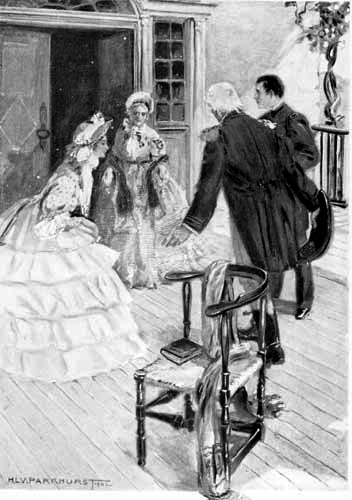
They were formally presented to the old admiral
And the admiral's manner—gracious, courteous—was quite in accord with his garments. It was distinctly old-fashioned in its gallantry and exquisite in its deference. Mrs. Revere, a grand dame herself, was evidently charmed with him; while on her own part she made a not less favorable impression upon the old gentleman, who, in his day, had always mingled with the best. It was long since the admiral had been in the society of such a woman, and he keenly delighted in the little conversation that ensued. Josephine, too, came in for a due share of attention, and, as any young girl would have done, she fell promptly in love with this charming old sailor.
The talk naturally enough turned upon Richard's adventure, and his mother could not say enough in her endeavor to express her gratitude and thankfulness for his rescue. The servant had announced that Miss Emily would be out presently, and the two women waited with unconcealed interest for her appearance.
Some natural anxiety filled the heart of Revere. He had no doubt as to the qualities of the woman he loved, but he wondered how she would strike his mother. She certainly was not like the young Boston women of his mother's social circle. Just as high bred as, and, in his mind, infinitely more beautiful than, Josephine Remington, yet she was of so entirely different a type that he could not restrain some misgivings. Of course he meant to marry Emily under any circumstances, and he had no fear, in spite of the quarrel which had temporarily overcast their happiness, but that she would marry him as well; but he was the only son of his mother, and it would be pleasanter all around if she should be attracted to Emily and be willing to welcome her within the precincts of her exclusive family.
He could see that she was delighted with the admiral, as, indeed, who could fail to be? When the old man informed her that he had known her husband's father intimately, and that the old commodore had cruised with him when he was a lieutenant; and when he said pleasant things about the commodore, who was deservedly held in high esteem in the family, and told her some charming little anecdotes illustrating his courage and ability, her heart was quite won.
The moments passed in pleasant conversation, therefore, until the quick ear of Richard recognized a light footfall in the hall. The door opened and Emily stepped out on the porch. With the bright sunlight of the afternoon falling upon her as she stood, clad in a simple white dress, against the dark background of the closed room, seen through the door-way, she made so charming a picture of virginal loveliness that he could scarcely repress a cry of admiration and delight.
At the sound of the opening of the door, Mrs. Revere turned and critically surveyed the girl through her lorgnette, and criticism at once gave place to approbation. The admiral instantly rose, and as Emily diffidently stepped toward him,—poor girl, it was quite an ordeal to her, this meeting,—he took her by the hand and presented her in due and ancient form to his two guests, bowing low, with the grace of a finished gentleman in spite of his age, as he did so.
The dress the girl wore, while of the finest material, was decidedly old-fashioned in its cut,—a fact both women had been quick to notice; but when she accompanied the admiral's bow by involuntarily dropping a sweeping courtesy, after a fashion much older than her dress, which went back almost to the days of her grandfather's uniform, in fact,—for he had taught her how to do it,—the effect was altogether charming. A little exclamation broke from the lips of the older woman. The lorgnette dropped from her hand, and, instead of shaking hands formally, as she had anticipated, Mrs. Revere rose and took the girl in her arms.
"My dear," she said, "how can I thank you for saving my boy's life? Why, I cannot believe that you did it! You do not look—you are so—forgive an old woman—so daintily beautiful, I don't understand where you got the strength to——"
"She did it, though, mother," interrupted Richard, joyfully, delighted at the turn of affairs.
"And she did it well," added the admiral, proudly; "no one could have done it better."
"It was nothing, madam," said Emily, blushing at these tributes; "I mean—Captain Barry did the most of it—did it all, in fact. I only steered the boat and held on to—Mr. Revere. Anybody could have done it."
"Nobody but you did, though," said Richard, promptly; "and if you had not been here, Miss Emily, I should have ended all my cruising then."
"I think it was a most splendid action, Miss Sanford," said Josephine, warmly, "and as an old friend of Richard I want to thank you, too."
"And this Captain Barry of whom you spoke," asked Mrs. Revere. "Where is he? I should like to thank him also. Who is he?"
"Just a common sailor, madam, a bo's'n's mate, long attached to my fortunes, and his father before him. Worthy men, both," answered the admiral. "He has been busy with the ship all day, but you will see him presently, doubtless. He has been trying to patch the old hulk up so that it may last a little longer. He watches over it as he watches over me—and my granddaughter. I sometimes think the ship and he and I will go together, and I have been greatly anxious as to what would become of this child then."
Mrs. Revere was not given to impulsive action. She was generally very self-contained, and usually carefully considered what she said before she spoke, but on this occasion she answered instantly,—
"Your granddaughter will never want a friend so long as I live, admiral, and I shall be happy, indeed, if I can repay some of the debt I owe her for Richard in that way."
"Mother," said Richard, "I have something to say to you. Admiral, you will pardon me if I ask Miss Emily to take Miss Josephine into the house for a few moments? No, sir; don't you go, please," he continued, as the admiral made a motion to rise; "I want you to hear, too."
"Certainly, certainly, my lad. Emily, show Miss Remington the treasures of your room, the model of the Susquehanna——"
"And the sword of the Constitution," interrupted Richard; "that is the rarest treasure of them all."
"Come, then, Miss Remington," said Emily, extending her hand to Josephine, "since we are dismissed."
Josephine instantly divined the meaning of Richard's request. She shot a glance at him of mingled amusement and annoyance, and found time to whisper as she passed him standing by the door, which he had opened for them,—
"You do love her, then? Traitor! Well, I do not wonder."
This was certainly magnanimous in her, yet she was not particularly happy over the situation. Not that she loved Revere, but a woman never forgives the defection of an old admirer. Although she may have been married for twenty years, when her sometime lover follows her example, she always feels that it is an evidence of masculine depravity and disloyalty.
However, Josephine could not justly reproach him in view of her declared affection for Charles Van Dorn. Yet he might have had the decency to wait a little longer, she thought, somewhat bitterly, as she left the porch. She was a generous girl, though, and had a good heart. When they were alone, she slipped her arm around Emily's waist, which was an unusual and remarkable familiarity under any circumstances on her part, and whispered in her ear,—
"Tell me, do you love him very much?"
"I—we quarrelled a few minutes ago about——"
"About me, I'll warrant," shrewdly.
"Yes," shamefacedly.
"You knew he was engaged to me, then?"
"Yes; he told me so."
"And you knew the engagement was broken this morning?"
"Yes, but——"
"Well, there is nothing to quarrel about. Tell me, now, honestly, do you love him very much?"
"More than anything under the sun," said Emily, burying her face on Josephine's shoulder; "don't you love him yourself?"
"I? Not a bit," laughed the older girl. "Oh, I mean, yes, of course, a great deal. I like and admire him immensely; but, you see, I happen to love—somebody else."
"I don't understand how you could love anybody else after having been engaged to Richard. Are you sure you don't?" ingenuously.
"Perfectly sure," complacently.
"And you are not giving him up for my sake?"
"Child, I had never a thought of you when I gave him up. I did it because I loved somebody else, and that's all. I would never have done for Dick, anyway; but you, I think, will suit him exactly. I hope you will be very happy, I'm sure."
"Do you think his mother——?" anxiously.
"I'm sure of that, too," answered Josephine, reassuringly. "We are going to be great friends, I know."
"I never had a friend,—a girl friend, that is,"—returned Emily; "I have missed one so much. You can't confide everything to your grandfather and a sailor-man like Captain Barry, you know."
"I should think not," laughed Josephine. "And I shall be so glad to be friends with you."
"And are you sure you do not love Dick?" doubtfully.
"I am quite sure of it," decidedly.
"It is so very hard for me to believe that, you know; I do not see how you could help it," innocently.
"Wait until you see Charlie—Mr. Van Dorn, I mean."
"I am sure that would make no difference," returned Emily, confidently.
CHAPTER XXI
A Happy Consummation
"Mother," said Richard, as the three were left alone, "I will be entirely brief and frank with you. I love Emily Sanford. It is a sudden feeling, I grant you, but I am sure none the less deep and abiding for that. I have reason to think that she loves me as well. This morning, after I came back from the inn, freed from the engagement by Josephine's own act, I asked the admiral if he would give her to me."
"I said, madam," interrupted the admiral, with natural pride, "that I would not withhold my consent provided the match were agreeable to yourself. I have reared and educated my granddaughter principally myself, and, naturally, she lacks many things which, I trust, she may easily acquire upon the good foundation I have endeavored to give her; but she has lived in an atmosphere of love and devotion in this house, and I would not have her an unwelcome intruder in any family. As to her family, madam, it is my own, and I think," he added with simple dignity, "that there is none better in the Republic. She will not come to your son portionless—there is a tidy little fortune for her after I am gone, and that will be soon, certainly. Of her personal qualities I may not speak. She is most dear to me. For the last twenty years of my life she has been everything to me. No one could have a more dutiful child, nor one sweeter and more tender. She has been the sunshine and joy of my old age. I can scarcely bear to think for a moment that she should leave me, but it is a matter of a short time only. The old ship and I are ready to go, and yet I would fain see her provided for before."
"Admiral Stewart," said Mrs. Revere, gravely, "you touch me profoundly. I divined that things might be as you say when I saw your granddaughter. The marriage of a son is always a grief to a mother," she continued, somewhat sadly. "She feels that, in a certain sense, she will be supplanted in her boy's heart, and I have long accustomed myself to think of another wife for Richard; but of her own will she has given him his freedom. I thought it would be a grief to my son, but I find that it is a joy. Is it not so, Richard?"
"Yes, mother, the greatest joy, almost, that ever came to me, except loving Emily."
"Very well. Admiral Stewart, I never had a little girl. God has given me but this, my son. I will receive Emily gladly. She shall be to me a daughter, indeed, and I will endeavor to be to her a mother."
"Emily! Josephine!" called Richard, instantly, stepping into the hall. "Come here!"
The deep satisfaction in his heart spoke in the tones of his voice. Emily and Josephine comprehended it well. As the two girls came on the porch, Mrs. Revere again took the younger in her arms.
"My dear child," she said, with kindly affection, "I learn that you are going to be my daughter. I am very glad. In fact," she added, drawing back her head and looking at the girl approvingly, "the more I see of you, I believe the more pleased I shall be."
"I congratulate you, Richard," said Josephine, "and I do it honestly, too. Emily and I are destined to be great friends, I am sure."
"Oh, Mrs. Revere," said Emily, her eyes filled with tears, she could not tell exactly why, "you have made me so happy! I know I have many things to learn, but with you to teach me and Mr. Revere to help me——"
"And me, too," interrupted Josephine; "don't forget me!"
"Yes, and you, I am sure I shall learn, and I shall try very hard to be what you want me to be and what I ought to be."
"Be your own sweet self, dear," said the older lady, patting her approvingly, "and you will do."
"Emily, bring me the sword of the Constitution," said the admiral. "Richard, lad, I give it to you," he added, as it was handed to him by the girl. "May you wear it always in defence of our beloved country, holding it ever at her service, defending the honor of her flag. After Emily it is my chiefest treasure, young sir. It has gone with me on many a cruise. I have worn it, not without some honor, too, in battles and on dangerous service. I give it gladly into your hands, as I give you Emily. I know you will wear the one honorably and treat the other lovingly. When you look upon it, when your children gather about your knee and marvel at its quaintness, mark the rudeness of the hilt in contrast to its jewelled scabbard and brilliant blade, tell them of me, who shall never see them. Tell them the story of 'Old Ironsides' and the last of the fighting captains of the Constitution."
"Sir," said Revere, as the old man solemnly pressed his lips to the iron guard and extended the sword to him, "I take it as a knight of old received the accolade; and, as the men of the past did, I swear upon the hilt of the sword that I will be everything a man ought to be to a woman, to your granddaughter,—and more."
At this moment Revere's man rode up to the porch, dismounted, touched his hat, and held out a letter, reporting,—
"I did not find them, sir."
"They are here, Baker. I'll take the letter. Say nothing about it to any one, and then go back to the inn and arrange to bring the trunks of the two ladies over here."
Revere had descended to the foot of the steps to meet the man, and he had spoken softly when referring to the letter, so that all the party on the porch heard of the colloquy was the direction about the baggage. Nor had any of them, except Emily, seen the man hand him the letter. With it in his hand, Revere walked up the steps and handed it to his betrothed without a word. A glance told her that it was addressed to Josephine Remington, and Emily understood instantly that it was the famous letter about which they had quarrelled.
What should she do was in her mind; what would she do in his. Her temptation was strong. It would have been a triumph to have handed the letter over to Josephine at once. She hesitated for a few seconds, and, choosing the greater triumph, thrust it quietly into the bosom of her dress. She had decided not to give it to Josephine, after all, so Revere read her smiling gesture, and in the same mute, eloquent way he thanked her for her forbearance.
"Who is this coming up the path?" said Josephine, tactfully, breaking the pause which threatened to become an awkward one, and pointing to the brow of the hill.
"It is Captain Barry," answered Emily, glad of the interruption.
"The old sailor of whom I spoke to you, madam," said the admiral, turning to Mrs. Revere.
"The man who rowed the boat the night Emily pulled me out of the water, mother," Revere explained.
"My man," said Mrs. Revere, graciously, as Barry stopped at the foot of the steps and saluted, "I have to thank you for a great deal, I understand. It was your strength and determination, coupled with this young lady's skill, that saved the life of my son. I owe you much, sir."
"You owe me nothing, ma'am," said Barry, ungraciously. "I only obeyed Miss Emily's orders. What she says, I do. I always do."
"Nevertheless, you did it," continued Mrs. Revere, struck by his harsh words and repellent manner, but trying to suppress her astonishment and be kind to this strange old man, "and I feel deeply grateful. Is there any way in which I can show it?"
"No way, ma'am," burst out the sailor, almost rudely.
He hated the whole brood,—mother, son, friend, all of them, it seemed.
"What's the matter with you, Captain Barry?" gently asked Emily, who had been scrutinizing the man's pale, haggard face, his bloodshot eyes, his utterly despairing, broken, yet firmly resolute look. She, too, had been surprised and deeply pained by his words and actions.
"Nothin', Miss Emily," he answered, turning toward her, his face working with emotion he vainly strove to control; "nothin'. I—Miss Emily—the ship——"
"What of the ship?" cried the admiral, suddenly.
"It's almost gone, your honor. I came to ask the leftenant to go down with me an' take another look at it."
"Certainly, Barry," cried Richard, springing to his feet, eager to do anything for the old man, and anxious to terminate a scene painful to all of them, although he could not tell why. "I shall be back in a few moments, Emily, mother. Good-by. Come along, man," he said, striding lightly down the path.
But Barry lingered in apparent reluctance at the foot of the steps. He seemed wistful to say something, but words failed him. He turned to go, stopped, faced about again.
"The ship," he said, hoarsely; "I'm afraid it's gone. Good-by, your honor. Good-by, Miss Emily," he added, hoarsely, and then he turned again with a gesture and a movement which gave to all who were so intently watching him the impression that he was somehow breaking away from his moorings, and walked rapidly down the hill.
"The ship! the ship!" murmured the admiral, oblivious of all the rest, leaning forward in his chair over the rail of the porch and gazing at the vessel.
His hand grasped the hilt of the sword of the Constitution, which Richard had handed back to him as he left. Emily stepped over to his side and stood there with her arm around his neck. They waited in silence a little, a foreboding of disaster stealing over them.
"I wonder," she said, presently, in tones of great anxiety, "what the matter can be? I am afraid it is something serious. I never knew Captain Barry so agitated."
"It's the end, daughter, the end. I feel it here," murmured the old man, staring before him.
"Grandfather, if you don't mind, I think I will go down to the ship," said Emily; "I'm so anxious."
"Don't go too near it, child," said the old man; "one life is enough for the ship."
"Shall I go with you?" asked Josephine, noticing how pale and worried Emily looked, and feeling somewhat alarmed herself.
"Go, both of you, and I will stay with the admiral. Look to Richard," said Mrs. Revere, apprehensively, sure now that something was seriously wrong.
Poor Emily was in two minds about the matter. She wished to remain with the old man, and yet, when she thought of Revere on that ship with Captain Barry, and how strangely, how madly, almost insanely, the sailor had looked, her heart smote her with undefined terror of she knew not what.
She must go! It might be too late already!
The two girls ran swiftly toward the ship in vague but rapidly increasing fear.
CHAPTER XXII
"Samson Agonistes"
As Revere and Barry walked down the hill the soul of the younger man was filled with light-hearted joy. He talked gayly to the old sailor, who had speedily joined him; and although the monologue—since Barry had said nothing—could not have been called a conversation, Richard did not heed his silence.
It was but a short distance from the house to the ship, but in the brief time required for the passage Barry lived over his life, or that part of it at least which was of moment. As life is compassed in instants to the drowning, so in these seconds through his mental vision swept the past. He saw again the admiral as he had seen him in the prime of manhood; he recalled once more the blue-eyed, sunny little baby he had held so tenderly in his unfamiliar arms; who, in the society of the two men, had grown to be a woman whom he loved. The days and years of happy companionship, of humble and faithful service on the one hand, of kind and generous recognition on the other, passed before him with incredible swiftness.
The thought moved him to a sudden tenderness. As his eyes fell upon the gay, debonair figure walking so carelessly by his side, he hesitated. For a moment his determination wavered. Revere did not look or act like a scoundrel, perhaps; but with equal swiftness came the terrible evidence of those papers, those damning papers in the locker! The ship, the maiden! The one was to be sold, the other betrayed. Under God, that should never be! And he had kissed her. He was bound to another. And she loved him and had wept before him. This trifler was breaking her heart.
Every laugh that rang in his ears in his changed mood added intensity to his malign purpose. He was no murderer, though. He believed himself a chosen instrument in God's hand to effect a mighty purpose,—salvation to those he loved.
Alas! humanity is never so hopelessly blind as when it does wrong, believing that God sanctions it for some longed-for end.
The two men stopped as they reached the ship.
"It's just here, sir," said the old sailor, hoarsely. "I've been examinin' her all mornin'. The supports is rottin' away. I think a touch'll send her down. Would you mind goin' in there an' takin' a look?"
He pointed toward a place on the keel enclosed between two rows of weather-worn timbers, which supported, or helped to support, the body of the ship. It was the place where, the night before, he and Emily had pledged their hearts to each other and solemnly plighted their troth. Revere recognized the spot, of course, with a thrill of recollection; but of course he made no mention of the fact. Barry knew it, however, and for that reason he had chosen it. The choice was part of his revenge. Where Revere had loved—or trifled—there he should die!
"Looks bad, doesn't it?" Revere said, walking into the cul-de-sac so carefully prepared for him, and stooping down and laying his finger on the mouldering keel.
Barry promptly followed him and stood between the outermost stanchions, barring the exit. The unconscious Revere was completely enclosed. The keel on the rotting ways was in front of him, on either side the close rows of supports, overhead the mighty floor of the ship, back of him the huge form of Captain Barry. He suspected nothing, however,—how should he?—until he turned to go back after his brief examination, when he was greatly surprised to find the way blocked.
His situation beneath the ship was such that he could not even stand upright, but was forced to remain in a crouching position of great disadvantage before the sailor. The old man stood with his arms extended from stanchion to stanchion, a perfect tower of strength and determination. It was useless for Revere, even if he had realized at that moment what was about to happen, to attempt to move him by force. In his weakened state he could do nothing. Even at his best he was no match for the huge old giant barring his way.
The old man's face was engorged with blood, his jaw was set rigidly, and a little fleck of foam hung upon his nether lip. There was such a glare of demoniac rage in his eyes, such an expression of mortal bitterness and malevolent antipathy in his grim and forbidding countenance, that the heart of the young man, though he was as brave a sailor as ever trod a deck, sank within him. He was fairly appalled by this display of sinister and unsuspected passion.
"My God, man!" cried Revere. "What's the matter? Stand aside!"
"No, sir, you can't pass me. I'll never stand aside. Say a prayer, for, as there's a ship above you an' a God that favors no traitors, your hour is come."
His usually rough voice, harsher than ever on account of his emotion, was shaking with passion.
"What do you mean?"
"I mean to kill you where you stand, where you kissed her last night, you traitor, you dog, you that disgraces your uniform, you that sells my ship, mine! You that robs the old admiral of life, that betrays Miss Emily, that breaks her heart! You thought to play with that child. But I know you! I found your orders. I read 'em, curse you! To sell the ship,—God! my ship, that I've lived on, that I've loved, for twenty-five years! I read your letters writ by that woman you're goin' to marry! I saw you kiss Miss Emily, I saw her go from you cryin'! Tears for you, damn you! You've got to die, an' I'll die with you! You'll have the company of a better man to hell, where you belong!"
The old man's voice rose almost to a scream as he recounted the ideas which had goaded him to this madness. The torrential sentences of the grim indictment fairly burst from his lips with ever-increasing force and fury. Revere heard him in a daze of surprise, at first scarcely comprehending the man's meaning; yet, after all, his words explained many things. As soon as the lieutenant found voice he protested.
"Barry, I swear to you——"
"Silence! It's too late to swear!"
Revere was brave; he fain would not die without a struggle for his life. Indeed, he had not divined the manner of his death; but before he could spring forward, Barry, as if he understood what he was about to do, said, ruthlessly,—
"Stand where you are! If you move, I'll kick you to death like a dog!"
He could easily have done it, as the advantage of position was with him. Rather anything than that, thought Revere, shuddering at the brutality of it. A prisoner, he could do nothing. The man was mad. If he chose to carry out his purpose, whatever it might be, the young man was helpless.
"Very well, Barry," he said, instantly accepting the situation, and summoning all his resolution to meet the inevitable, though his cheeks and lips were white, "you saved my life once, you may take it back now. I wish I could die standing, but if I cannot, why kneeling is as good a way as any for a man to meet his Maker. You tell me to say a prayer. Here it is. May God have mercy on your soul and on my soul, and may He keep the child. That's all."
Not moving from his position, the old man began kicking at the stanchions. The one on the right was defective, and gave way and fell at the first blow. A shiver seemed to run through the ship; Richard, for the first time, divined what was about to happen. He looked forward and aft. The effective supports were all gone; some rotten ones remained, outwardly intact, but bound to go under almost any pressure; the few sound ones left had been carefully sawed almost through. Why had he not noticed it? The whole ship, therefore, practically rested on a single stout stanchion toward which Barry had already turned. It was a splendid piece of timber, and Barry had put it in himself a year before. When that came down, the ship would crash into ruins and bury them beneath it.
As the prop upon the right had fallen, the hope leaped into his mind that he might get away through the gap; but Barry reached down and grasped him by the collar with one hand the instant the way was open, and held him firmly while he turned his attention to the other stanchion. It was hopeless for Revere to attempt anything.
Strange as it may seem, there was a certain admiration for the sailor in Revere's mind, even in that frightful moment. He realized that the attack upon him was not inspired by any petty cause. Given the belief of the sailor, it was natural; he respected him for his desire to stop what he believed to be base treachery; and Revere could have loved him for his willingness to sacrifice himself to prevent what he conceived to be a crime against the life of the admiral, the happiness of Emily, and the existence of the ship.
"Barry," said Revere, calmly,—he was quite master of himself now,—as the old man struck the last sound support a heavy blow with his foot, "I must tell you, not because I am afraid to die, or because I fear you, but to acquit myself of evil purpose in your mind, that my engagement with that other woman is broken; that not an hour ago, in my mother's presence, the admiral promised to give me his granddaughter to be my wife."
"The ship?" cried Barry, hoarsely, as he felt his vengeance slipping away from him, the cause itself being taken.
"I offered to buy it myself and leave it standing until it fell."
Men do not often lie in the very presence of death, and truth spoke in the younger man's voice,—truth so clear that it pierced the tortured soul of the jealous, mad, broken sailor. But, like many another man convinced against his will, he refused to accept these statements. It was a device, a cunning attempt to stay his hand and gain a life. He would not heed.
"I don't believe you, damn you!" he said, kicking furiously at the stanchion.
The last blow loosened it. Under the tremendous pressure from above, the stick began slowly, very slowly, to slide on its wooden shoe. Its motion was scarcely perceptible, yet it moved. Barry released his hold on it, took a single backward step, and Revere rose to his feet. Barry instantly grappled him with both hands. Revere was as a child in that iron grasp. He did not struggle. He would preserve his dignity in the face of death, and to attempt to escape would have been futile, anyway. The two faces confronted one another, the sailor's convulsed with anguish and rage, the officer's pale, but smiling a little; both equally determined.
Forward and aft the rotten or sawed supports were giving way in quick succession. Above them the ship was trembling and shivering from stem to stern. A strange creaking was heard. A moaning cry, swelling into a deep groan of anguish that had a sound of despair unspeakable in it. The death-song of the ship! It was coming down on the ways! Moving toward the water at last!
Fascinated, Revere turned his face upward and watched the shivering frame above his head, murmuring, as he did so, Emily's name. The huge bulk seemed to rise in the air for a second. To his distorted vision it appeared to sway back and forth, up and down, yet it had scarcely begun to move.
Ah! was it upon them?
It all happened in a few seconds. In another it would be over. Revere closed his eyes.
At that instant a scream fraught with terrible agony broke upon the ears of the two men.
"The ship is falling!" cried Emily's voice, high-pitched, shrill with mortal terror. "Richard! What are you doing? Oh, God! Captain Barry, save him!"
"Would that she might have been spared this!" flashed into Revere's mind. He would have called to her had not something happened instantly.
The voice awakened the dormant reason in the old man's being. She loved this boy; perhaps he had told the truth.
"Save him! save him!"
The words rang in his ears. He had never disobeyed a command of hers. He would not now. Too late! There was a terrible grating sound; the last stanchion was grinding in its wooden shoe; it was sliding faster! In another moment the ship would be upon them! He had turned his head as the first cry had met his ear, and had seen in one swift glance Emily and another woman not a hundred feet away. Emily was bending forward, her hands outstretched, struggling. She would have run to them under the ship had not the other woman held her firmly, protectingly. Both girls were white as death.
Barry seized Revere by the collar and threw him violently far from him. The young man pitched downward and fell headlong on the grass in the direction of the two women. The ground sloped abruptly away toward the water on that side of the ship. In that same instant the sailor threw up two great arms and caught the impending ship. He took the place of the quivering, buckling, sliding oaken timber. For a second he stood there in mighty majesty, a pillar of strength and resolution, a tower of flesh and blood, sustaining a ship-of-the-line, a human stanchion, magnificent in the frenzied, awful expression of a power superhuman. Rigid, unbreakable, indomitable, he shored up the ship,—Atlas holding the world!
"Go!" he gasped.
Revere, who had risen instantly, stepped toward him as if to assist him.
"Go! Can't hold——"
It had come. Angry at the momentary check, the ship fell upon the man as an avalanche falls upon the mountain. Beneath it the mighty knees were bowing, the stubborn back bending, the great arms trembling.
Revere sprang backward and slipped far down the slope.
As he fell he caught sight of burning eyes from a face white as the sea-froth, of lips set and bloodless, of jaws clinched, of sweat standing upon a bronzed forehead—picture impressed upon his soul forever!
There was a mighty roaring, detonating crash and all was over.
Crushed were the mighty arms, beaten down the massive shoulders, broken the iron knees. The life of the man went out in the fall, and the blood of his heart rippled along the blocks of the keel. With a concussion like the discharge of a battery, the mighty war-monster collapsed into a shapeless mass of timber, burying beneath it the man who had loved it best. The ship that had been his own was nothing but a heap of ruins above his still heart.
A cloud of dust rose and hung over the wreck in the quiet air.
War was to have been the trade of that ship-of-the-line. Blood should have run upon her white decks, death she should have dealt out and received, great battles should have made her famous, heroic men should have written her name eternally on the red pages of her country's history. Now it was finished; and yet, in the ending at least, there had been a slight fulfilment of her destiny—to kill.
No struggle could have been more superb than the quiet one just over; no effort more magnificent, no conflict more terrible, than that between the man and the ship. No ship had ever claimed a nobler victim than Barry, after all, and no fate could have been more fitting than that which had come to man and ship together in the end.
The old war-vessel had lived through the still ages of peace, had survived the long period of decay, had endured the disintegrating assaults of time, only to accomplish her manifest purpose of destruction as she fell.
And the hand that had loved her was the hand that had laid her low!
With dreadful feelings in their hearts, the three stood looking at the ruins of the ship.
"Barry! Captain Barry!" screamed Emily, wildly. "Where is he?"
"There!" gasped Revere, hoarsely.
"And is there no hope?"
"None. He is gone forever. My God, wasn't it terrible? He held up the ship!"
"Grandfather!" cried the girl, distraught. "Let us run to him."
The old man still sat on the porch, staring at what had been the object of his gaze for so many years. There was a peaceful, yet sorrowful, look upon his face. He had seen the ship fall; he realized that his hour had come. He was fronting death and he knew it, yet he was as calm as he had been when he had fronted death many times years before. They gathered about him, understanding, helpless.
"Ay," he said, "the cruise is over. Where's Barry?"
"Under the ship, sir."
"And a good end! Strike the flag. I've lost my last command."
Instantly Revere ran to the foot of the staff and silently cast off the halliards. As the little blue flag of a rear-admiral, with its white stars, came floating gracefully, reluctantly, down from the masthead where it had flown so long, the veteran slowly and painfully rose to his feet. With his right hand he lifted the sword of the Constitution, with his old vigor and his old grace he bared the blade and brought it up before him in graceful salute, while the flag fell into Revere's arms.
"Come aboard, sir," he said, softly, as if to an Eternal Captain.
He stood erect a moment and then sank gently back into the chair. For the first time in his life he forgot the weapon in his hand. The sword fell clattering at his feet. The emblem of power, authority, and rank, all now slipping from him, lay neglected where it fell. A smile quivered upon his lips, but otherwise he sat still and quiet, looking out into the future. A few seconds. The light faded from his eyes, the life left his heart. The ship had fallen, the flag was down. It was the end.
The old man had entered the last haven, dropped anchor in the final harbor. The little breeze which lifted his white hairs so tenderly had wafted his soul into another country, a better—that is, an heavenly!
With a low cry, Emily threw herself on her knees before him.
Down on Ship House Point a light, a flame, burst out amid the torn and shattered timbers. In a few moments the ruins of the now unheeded ship were blazing furiously. Barry had cunningly planned it so that the ship, after it had buried him, should be his funeral pyre.
Fitting it might have been, thought Revere in his heart, as he looked at the flames roaring up from the ship, if the body of the admiral, like that of the Vikings of old, might have been laid upon its burning timbers.
L'Envoi.
When he was buried, his country, recognizing his merit and remembering his services again, sent its best to honor him in death. Admiral Farragut, with a brilliant staff, was there. He was of the navy of the present, Revere represented the navy of the future, and both stood together at the grave of the navy of the past.
They buried him on the high hill overlooking Ship House Point. Down on the Point, at the admiral's feet as it were, and just where the ship had stood, Revere erected a huge block of rough granite which bore this inscription:
John Barry, Chief Boatswain's Mate of the United States Ship-of-the-Line Susquehanna, Who perished in the fall of that ship, September 20th, 1865. "Greater love hath no man than this, that a man lay down his life for his friends."
In the lofty character of his motives, in the atonement of his self-sacrifice, in the greatness of his end, his purpose of destruction was forgotten.
When his naval duties permitted, Emily and Richard often came back to the old white house on the hill in the summer, and to Charles Stewart Revere, John Barry Revere, little Emily Revere, and Richard Revere, Junior, it was the most fascinating spot on earth. They stand with their father by the huge Celtic cross which marks the admiral's resting-place, and hear again the story of the sword of the Constitution, destined one day to be drawn against the country in which it had been made. Or—and this they like even better—they sit with their mother (lovelier in Richard's eyes with every passing year) beneath the shadow of the mighty rock on the Point, while she tells them stories of old John Barry, and how at the last he held up the ship.
Part II
VERACIOUS TALES OF VARIOUS SORTS
"When fiction rises pleasing to the eye,
Men will believe, because they love the lie;
But truth herself, if clouded with a frown,
Must have some solemn proof to pass her down."
Churchill
"'Tis strange—but true, for truth is always strange,
Stranger than fiction."
Byron
"Variety's the very spice of life."
Cowper
Copyright, 1900 and 1902, by J. B. Lippincott Company.
Copyright, 1901 and 1902, by Charles Scribner's Sons.
Copyright, 1902, by Henry T. Coates & Company.
Copyright, 1902, by The Golden Rule Company.
Copyright, 1902, by Daily Story Company.
Copyright, 1902, by Cyrus Townsend Brady.
Coups de Théâtre
"The world's a theatre, the earth a stage,
Which God and Nature do with actors fill."
Thomas Heywood
A VAUDEVILLE TURN
COMEDY
"My soul, sit thou a patient looker-on, Judge not the play before the play is done: The plot has many changes: every day Speaks a new scene: the last act crowns the play." Francis Quarles
The most popular theatre in America, according to the advertisements, where nothing was played but the "continuous," was packed from parquet to top gallery with a perspiring crowd of pleasure-seekers one hot August night. The papers had said—via the society columns, of course—that everybody was out of town for the summer, and incidentally, therefore, that all the ordinary places of amusement were closed, except Les Variétés. However, the city was not quite deserted; for, of the anchored ninety-nine hundredths of the population, all who could do so, apparently in despair of other amusement, and attracted by the popular prices, had crowded into "the home of refined vaudeville," as it was called on the programme. The house was fluttering with fans; most of the spectators and actors felt as though they were slowly deliquescing in perspiration, but, on the whole, the audience seemed to be enjoying it.
The usual mélange—how natural and appropriate it seems to use French words when treating of the vaudeville!—of entertainments entirely suited even to a Mrs. Boffin, become a world-wide type of matronly modesty and virtue—had been provided by the high-minded and scrutinizing management. Ladies in short skirts capered nimbly over the stage to the "lascivious pleasing" of the banjo; gentlemen with one leg rode marvellously endowed bicycles in impossible ways; tumblers frisked and frolicked about without the slightest regard either for temperature or gravitation; happy tramps,—at least the announcements said they were happy,—whose airy, carefully tattered garments were in entire consonance with the heated atmosphere, delivered themselves of speeches full of rare old humor and fairly bristling with Bœotian witticisms. There were men singers and women singers, musical cranks, freak piano-players, monologue artists, burlesquers, and then a little play,—at least they said it was a play.
So with these multifarious stirrers-up-of-varied-emotions the evening drew toward its close. Finally, just before the biograph went through its eye-shattering, soul-distressing performance, the little boy who walked solemnly across the stage before each turn with such a queer, self-important strut that the regular patrons—those who came early and brought their luncheon—felt disappointed when he took a vacation, set out upon the racks, provided on either side of the proscenium arch for the purpose, a tablet bearing the name "Mademoiselle Hélène."
When the curtain rose thereafter the stage was set for a woodland. The lights were turned thrillingly low, so that the expectant audience were scarcely aware how the tiny little body, whom they saw standing in the full blaze of the calcium-light ray suddenly flashed upon her from the mysterious apparatus in the balcony, had reached the centre of the stage.
The little miss was apparently not more than six years old. She had short white stockings on her plump little pink legs, and her dainty feet were covered with black ankle ties. She wore fluffy little pink and white skirts like a ballet-dancer, and with her little bare arms she blew graceful kisses to the audience as she bounded before it. With her sweet blue eyes, her golden hair, she made a beautiful picture, as she pirouetted around the stage on the tips of her ten little toes, kicking up her little legs, bending her back, wriggling her skirts in imitation of older and more sophisticated performers,—to put it mildly,—which would have been more amusing if it had not been a little pitiful.
So little, so cool, so sweet, so fresh, so innocent she seemed, that in the hot theatre on that hot night no wonder a great, rapturous "oh-h-h!" of delight and approbation burst from feminine lips—and masculine ones, too, if the truth be told. As the little maid in perfect silence continued her dance, exclamations of admiration rose from the audience, and when she finished her first turn and stopped panting, bowing, hand-kissing, the theatre rang with hand-clapping. Though some of the fathers and mothers in the audience, with thoughts of their own little folk, murmured under breaths, "What a pity! She ought to be at home in bed!" the witchery of her movements and the charm of her face were as strong upon them as they were upon the others; more so—they had children of their own.
As she stopped and stood alone on the large stage after her final pas, bowing again and again and throwing more kisses in that sweetly infantile way, there was a commotion among the people enjoying "standing room only" in the passage-way at the back of the parquet. A tall, broad-shouldered man forced himself through the crowd, in spite of angry remonstrances and rude resistance, and ran down the aisle. His pale face was working with emotion, his eyes shining.
"Nellie!" he cried as he ran, in a voice that vibrated above the applause in the theatre. "Don't you know me? Nellie! Nellie!" he continued, stretching out his arms toward the little girl.
The noise of clapping hands died away as if by magic, as they heard the cry, full of love and longing. The man stopped in full view of the great audience. The little girl, hearing the cry, with one hand still in the air where the kisses had stopped half blown away, looked at the man over the footlights, half-dazed, apparently, by the situation.
"Papa! Papa!" she cried, suddenly awakening to life and bounding toward him. "Papa, take me home!" Every soul in the hushed theatre heard the words in the sweet treble of childhood.
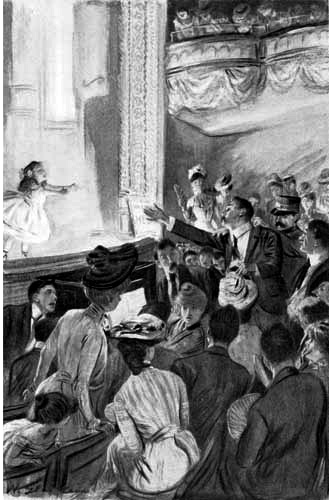
"Papa! Papa!" she cried, "take me home!"
"Where's your mother, baby?" asked the man, apparently oblivious of everything but the little lass.
"She's dead, papa," answered the child, brushing her little hand across her eyes. "I'm so glad you've found me. Oh, take me away!"
"I will! I will!" said the man, desperately, forcing his way toward the stage.
Two of the ushers and an officer had hurried down the aisle and seized him by the arms. The piano-player rose from his neglected instrument and caught him also.
"Let me go!" roared the man, shoving them aside with superhuman strength, apparently. "She's my daughter, I tell you! I will have her!"
The lights on the stage were suddenly turned up. A hard-featured man came forward and grasped the child by the arm.
"What's all this row?" he cried; "I'm the manager of Mademoiselle Hélène. Her mother left the child with me. She gets good food and clothes and is well taken care of. What more does she want?"
"I want my papa! Oh, I want you!" cried the little girl.
"And you shall have me, dear."
"No," said the man on the stage, roughly, "she shall not!"
"Gentlemen," cried the other man, turning about and facing the audience. "Friends, there is my little daughter. Her mother ran away from me, left me. I haven't seen Nellie for two years. I just happened in here to-night and recognized her, and——"
"Give him his daughter," broke out a burly man in the third row of the parquet, rising in his seat as he spoke and shaking his fist at the man on the stage, "or——"
The house was in a perfect uproar now. The women in tears, the men screaming with flushed, excited faces.
"Let him have her!"
"Give her up!"
"Let the child go with her father!"
"Shame! Shame!"
"Mob him!"
"Lynch the wretch!"
The man on the stage fairly quailed before this outburst of popular passion; the ushers and officer had released the other man, but before he could take a step the local manager appeared on the stage in the midst of the confusion. Lifting his hand to the crowd, he finally succeeded in stilling the tumult.
"I have heard it all!" he cried, as soon as he could command attention. "This theatre don't want to part father and daughter. Give the child to the man. And get out of here!" he added, turning fiercely and shaking his fist at the hard-featured man on the stage.
The latter let go the child's arm and shrank back in the wings, followed by the jeers of the crowd. Then the local manager took the little girl in his arms, stepped over the footlights, and handed her to the man who had claimed her.
He lifted her up, kissed her, and pressed her tenderly to his breast. She clasped her little arms around his neck and dropped her head on his shoulder with a low cry of content.
"Thank you, sir!" said the man to the manager; "thank you all, ladies and gentlemen! Oh, I have got her back again!"
He turned with his precious burden and walked rapidly down the aisle, passed out of the door, and disappeared in the night.
The house rang with cheers. Men and women stood up and clapped and applauded and yelled like mad. When a semblance of order was restored, the local manager dismissed the audience. As he said, none of the performers were in condition to go on further after the little tragedy they had witnessed, which had ended so happily, after all. Nor was the audience in a mood for any more vaudeville after the bit of real life in which they had participated.
"How did it go off, Bill?" asked the brown-haired man of the local manager in the office half an hour later.
"Fine!" said the manager. "It was the greatest act I ever saw. You did splendidly, old man. I congratulate you."
"It has only one disadvantage," remarked the hard-featured man: "you can only do it once in each town. It's only good for one-night stands."
"And didn't Nellie do it well?" returned the other.
"She did that," replied the local manager; "she couldn't have done it better! It almost made me weep myself."
"That child's a born actress," said the hard-featured man; "she'll be a treasure some day, sure."
"She's a treasure now," replied the local manager. "What a pity we couldn't do it over to-night!"
"Do you know, men," said the brown-haired man, "I feel real guilty somehow. Seems like such a fraud——"
"Nonsense, Bill!" interrupted the manager, yet with a note of sympathy in his tone.
"Rot!" commented hard features, not the least comprehending.
"Where is she now?" asked the other, shaking his head dubiously, still uncertain and unconvinced.
"Her father and mother took her home right after the performance, and I hope she is fast asleep in her bed by this time, like a good little girl," continued the manager. "Here's your check, Bill. Be on hand Monday night when we open at X——"
THE LAST TRIBUTE TO HIS GENIUS
TRAGEDY
"I have heard That guilty creatures sitting at a play, Have, by the very cunning of the scene, Been struck so to the soul that presently They have proclaim'd their malefactions; For murder, though it have no tongue, will speak With most miraculous organ." Shakespeare
The crime had been one of peculiar atrociousness. While the little old man who kept the quaint curiosity-shop down on Linden Street seemed to have few or no friends, he was blessed with a great many acquaintances, especially among the people of the better class, for whom it was quite a fad to visit the dingy, shabby little store, with its assortment of bric-a-brac, mouldy books, articles of virtu, and antiques, genuine or spurious, valuable or worthless, all heaped about in promiscuous confusion.
Indeed, the "Major" was not the least curious object in the collection. Few people knew that the title represented gallant and youthful soldiering in Rebellion days before he shrivelled and dried up in the musty little shop. When, therefore, he was found dead among his raffle of goods, about half after seven on a summer evening, with his brains brutally beaten out by a hammer, which lay by his side, the greatest excitement was manifested everywhere. That a man should be murdered in a store on one of the main thoroughfares of the city at that hour and in that way; that the murderer should make his escape by the front door, which was left open, were in themselves sufficiently remarkable facts to engage widespread attention.
Rewards were offered by the city government; the metropolitan police force, supplemented by the best detectives that could be imported, who were paid by private subscription, worked upon the case in vain. No clew presented itself, nothing whatever was discovered. The contents of the shop were finally sold at auction and the store was closed. The estate, which was surprisingly small, contrary to the general opinion,—which, in fact, consisted merely of the proceeds of the sale of the goods,—was administered in the interests of some distant connections, and the whole affair after a short time was practically forgotten. Yet somewhere on the earth a man wandered with the guilt of murder heavy on his soul.
When it was announced in the advertisements that Sir Henry Irving, the great English actor, was to play The Bells on Thursday night, society—and those not within the charmed circle who could scrape together the unusual price demanded by the elaborate nature of Sir Henry's staging—anticipated a great intellectual treat. To see the character of Matthias interpreted by such a master of the tragic art could hardly be called entertaining, of course, yet anything which takes us out of the humdrum routine of every-day life and quickens the blood that beats with such commonplace sluggishness ordinarily is most desirable. It is easy, therefore, to understand the avidity with which the opportunity for paying the unusual price for being shocked and terrified was welcomed.
The play, with its damnable iteration of chiming sleigh-bells and its awful portrayal of the struggles of a crime-stained human soul against diabolic memories, proceeded with that wonderful smoothness and effectiveness for which Sir Henry's productions were famous. After the short intermission at the close of the second act, the audience, most of whom were familiar with the story, settled themselves with delicious thrills of foreboding anticipation to witness the dreadful and harrowing dénouement in which the murderer's dream—that the crime of years is at last exposed and the brand of guilt is fixed upon his honored brow—is exhibited on the stage in all its terrific realism.
The house, including the stage, was totally dark. A weird, ghastly beam of light thrown from the wings fell fitfully upon the face of Sir Henry,—no, of Matthias himself. The great actor's identity was lost, merged, forgotten in the character he portrayed. Not another thing could be perceived in the theatre. The gaze of every man and woman and child in that vast assemblage was concentrated upon that beautiful, mobile, terrible face. The silence with which the audience listened to that piercing, shuddering voice out of the darkness was oppressive. Could one's attention have been distracted from that stage he might have caught the quickening intake of deep breaths, or here and there marked the low, quivering sighs with which nervous people, under the influence of that terrible portrayal of the agony of remorse and apprehension at detected murder, trembled, watched, and waited.
Yet there was nothing actually to be seen in the opera-house but the face of the actor, or sometimes a white, ghastly hand and a dim, dark suggestion of a body writhing in mortal torture, so keen as almost to pass belief, in a tour de force of unwilling confession. The detachment was perfect, the illusion was complete; there before them was a soul in judgment.
As the man was forced, under the influence of a higher power than his own, to describe the murder, the base violation of hospitality, the blow of the axe that killed a guest, by which fifteen years before he had laid the foundation of his fortune; as he was constrained to act again before his judges in hypnotic trance the awful happenings of the tragedy of that Christmas Eve, of which none had suspected him; and when, on being released from the spell, his confession was read to him by the court, and the realization came to him that the fabric of respectability which he had carefully created upon the shifting sand of murder had crashed into nothing,—who, that has seen it, or heard it, will ever forget the fearful anguish and despair of that wrecked soul?
As Matthias fell prostrate at the feet of the judges, moaning in utter desolation and abandonment, the appalling stillness was suddenly broken, and this time the sound came not from the stage. Out of the darkness of the auditorium a thin, high voice, fraught with a note of torture more real and intense, if possible, than that which the marvellous skill of the actor had produced, was hurled into the great vault of the theatre.
"No, no," it cried; "you are wrong. It was a hammer!"
The surprise of the audience for the moment held them still, while the voice shrieked out in the darkness,—
"It is enough! I'll confess. Guilty, oh, my God, guilty! It was I! The murder—light, for God's sake, light!"
A woman screamed suddenly. People rose to their feet. One of those strange, swaying movements which bespeak a panic ran through the crowd. Matthias on the stage rose instantly, faced about, and walked toward the dark footlights, a genuine horror in his soul this time, for no human voice that he had ever heard had carried such mortal pain as that which had just spoken. The theatre was filled with a babel of voices. Confused shouts and cries came from all sides.
"Lights, lights!"
"What is it?"
"Go on with the performance!"
At that instant the lights were turned up. There, in the middle aisle, a few rows from the orchestra rail, a tall, thin man, his haggard face white with emotion, his eyes staring, his teeth clinched 'neath bloodless lips, stood swaying unsteadily to and fro. His hands uplifted as if to ward off a blow, he stood utterly oblivious of everything but Matthias. From the chair beside him a woman with a face scarcely less white, in which were mingled incredulity, surprise, and horror, reached her arms up to him as if to save him.
"I can't stand it any longer!" cried the man, staring up at Matthias. "You've done it. I'll confess all! It has torn me to pieces!" he screamed, clutching at his throat. "The Major—I beat him to death with his hammer, like you did, for his money. I took it from his person. I knew it was there. I was his friend, his only friend. My God! There was no place to burn his body. He's always at my feet. He's staring at me now by you on the stage!"
Sir Henry shrank away involuntarily as the man went on.
"Pity, pity!" he wailed, staggering, stumbling forward, falling upon his knees nearer to Sir Henry. "Mercy!" he whispered at last, yet with such distinctness that they heard him in every corner of the theatre.
He knelt with his hands outstretched toward the stage, waiting for reprieve, sentence, condemnation,—God knows what.
The audience stared likewise with suspended hearts from the great but mimic figure of murder on one side of the footlights to the greater and real figure of murder upon the other. As they gazed the man wavered forward again, sank lower, his hands fell, but before he collapsed completely, an officer of the law, the first to recover his wits in the presence of the catastrophe, ran down the aisle and pounced upon him. Grasping his shoulder, he cried,—
"You're my prisoner. I arrest you!"
"Too late," whispered the man; "I'm—going—going—to plead—in another—court."
He pitched forward and fell on his face—dead. And a woman, dry-eyed with horror, old love surviving honor, respect, righteousness, knelt by his side, took his head in her arms, and strove to kiss away from his brow the mark of Cain.
So the mystery of the Major's murder was solved at last, and Sir Henry, as he thought it over in his chamber that night, realized that he had received the greatest tribute that mortal man could pay to his acting. His art had been so perfect—he had appeared the incarnation of terror, remorse, and retribution—that to that struggling soul he had been as the voice of conscience,—nay, as the very voice of God. For the man had actually given way, broken down, and confessed a secret crime under the mighty spell of his acting, and, as the criminal in the play, had died in the confession!
Out of the West
"The sun sets fair in that Western land,
Romance rides over the plains;
There hearts are gay at the close of day,—
Man's duty's done, God reigns."
Warren Giles
IN OKLAHOMA
AN IDYL OF THE PRAIRIE IN THREE FLIGHTS
"The sun lay dying in the west, The fresh breeze fanned my brow, I rode the steed I loved the best— Would I were riding now."
I.—THE FIRST FLIGHT
Most written stories end with a wedding, actual or prospective; but this story, like most stories in real life, begins with one. The little old stone church in Manhattan, Kansas, was crowded to the doors one June afternoon. The gray-haired President, the younger men and women of the faculty, and a small sprinkling of the towns-people were there; but the great mass of the congregation was made up of the students of the State Agricultural College, which was situated on a gentle hill just outside the town. It was Graduation Day, and the day on which Sue Belle Seville and Samuel Maxwell had elected to get married.
Samuel was a Kansas boy, Sue Belle a Kentucky girl. They were both orphans and both graduates from the college that day in the same class: Samuel from the agricultural and mechanical department, Sue Belle from the housekeeping, culinary, domestic sciences, and other of the many departments feminine. Maxwell was a manly, energetic, capable fellow, a good student, and a young man who, given an equal chance, should make a fine farmer. On that day he was the envy of all the young men of marriageable age in the college.
His bride to be, while she seemed made for better things than the ineffably monotonous drudgery of an ordinary farmer's wife, was nevertheless skilled enough, capable enough, resolute enough, to master her lot and be happy in it whatever it might be. She was a handsome girl, tall, straight, strong, black-haired, blue-eyed, with the healthiest whiteness in her face that one could imagine.
The brief wedding ceremony was soon over. Old Dr. Fairman, the President, gave the bride away in his usual courtly and distinguished manner, and as the village organist played the wedding-march on the sweet-toned old organ, Mr. and Mrs. Samuel Maxwell passed out of the church, followed by all of the congregation. At the end of the long cinder foot-path extending from the church-door under the double row of trees to the street stood a brand-new Studebaker wagon filled with household goods. Two stout, well-conditioned horses were harnessed to it, while two others, a good mare and a handsome young horse, a three-year-old colt, were fastened to the tail-board by long hitching-straps. The wagon had been transformed by a canvas canopy over the bed into what was popularly known as a "prairie schooner." The new canvas was white as snow in the sunlight.
Maxwell handed his wife to the seat on the front, pitched quarters to the negro boys who had been holding the horses' heads, gathered up the reins, and, amid a storm of cheers and a shower of rice—especially appropriate to an agricultural college, by the way—and other manifestations of joy and delight, drove away on the wedding journey. The watchers followed with their eyes the wagon lumbering slowly down the main street until it crossed the bridge over the Kansas River and disappeared among the hills to the southward.
After settling the expenses of their college course and paying for their outfit, the two young people found themselves in possession of some two thousand dollars between them; more than enough, they fancied, backed as it was—or should I say led?—by two stout hearts and by four strong young arms, to wrest a livelihood—nay, a fortune, perhaps—from the prairies of the West.
An old, old story, this. A pair of home-builders going out into a new land to conquer or die; to establish another outpost of civilization on the distant frontier, or to fail. A man and a woman who had taken their all in their hands to consecrate it by their toil to the service of humanity, and to stake their happiness on the success of their endeavor. True builders of the nation, they! Pickets they were, going ahead of the advance guard of the army of civilization's marchers, which, untold ages ago, started in some secluded nook in the far Orient, and, impelled by an irresistible desire for conquest, in successive waves of emigration, has at last compassed the globe, rolled around the world. Leaders, these two, of that mighty deluge of men and women for whom the sun of hope is ever rising,—but rising in the West.
Never was such a wedding journey. It was springtime in the most bountiful and fertile year that had come to the great State for a generation. The way of the lovers, as they plodded ever southward and westward, led them now past vast fields of yellowing wheat already beginning to ripen for the thresher. Sometimes they drove for miles through towering walls of broad-bladed, cool, green corn; sometimes the trail led them over the untilled, treeless prairies covered with tall, nodding sunflowers in all their gorgeous golden bloom,—blossoms which gave the State a name; and not infrequently their way would take them alongside a limpid river, in that happy season bank full from the frequent rains, where the winding road would be overhung by great trees.
They stopped at night at the different little towns through which their way passed, and once in a while they enjoyed the hearty welcome of a lone farm-house. Sometimes they hired a negro boy to drive the wagon from one stopping-place to another, while they mounted the two led horses and galloped over the prairie. Samuel rode well, but to see Sue Belle on that spirited young steed of hers was to see the perfection of dashing horsemanship. An instinctive judge of horse-flesh, she had bought that three-year-old herself. He was a chestnut sorrel with a white blaze on his face, and white forefeet, as handsome and spirited as his mistress. In honor of her native State, she called him Kentucky.
As they progressed farther and farther southwestward the land became more open, the farm-houses were greater distances apart, cultivated fields less frequent, the towns were fewer in number and diminishing in size, the rivers grew smaller and smaller, and trees almost vanished from the landscape. Finally, away out in Cimarron County, where the railroad stopped and civilization ended, they reached their journey's end. Such a wedding-trip they had enjoyed, such a honeymoon they had spent!
They bought a bit of flower-decked prairie, a quarter section crossed in one corner by a little creek flowing southward until it joined a larger steam flowing into the Arkansas River. The chosen land mostly lay on the south side of a slight elevation from which they could survey the grass-mantled plains melting into the unbroken horizon miles and miles away. The country about was entirely uncultivated and had been mainly given over to cattle-raising; it was a dozen miles to the nearest house and fifteen to the town of Apache, the county-seat.