Front matter (continued 4)
Reading edition
How still was that vast expanse of gently undulating land of which they were the centre! An ocean caught in a quiet moment, and every smoothly rolling wave petrified, motionless. How vast was the firmament above them! To lie in the grass at night and stare up into its blue unclouded distance filled with stars—shone they ever so gloriously anywhere else on the globe?—was to reduce one's self to a vanishing point in the infinite universe of God. Lonely? Yes, to ordinary people, perhaps, but not to these two home-builders. They were young, they were together, they were lovers, and they had to do prosaic, God-given labor.
So they pitched their stakes upon the verdant hill, and, toiling early and late, built there for themselves and those to come a home. With iron share they tore the virgin sod; with generous hands they sowed the seed; with all the hope of youth and love bourgeoning and blossoming in their breasts, they began the earth-old process of wresting a living from the tillage of the soil. "In the sweat of thy face shalt thou eat bread." So ran the primal truth. Ah, yes, but this time counted not a curse but a privilege, and enjoyed not without but within an Eden.
II.—THE SECOND FLIGHT
Spring-time again upon the farm, and they were bidding it good-by. Five years have dragged away, years filled with little but misfortune—years of freezing winters, burning summers, drought, or storm. Five lean years of failure, unprecedented but true. A long, deadly, paralyzing struggle with that terrible minatory face of nature which, thank God! is usually turned away from humanity, else we could not bear the sight. The sun had beaten upon the farm and burnt it up, the parasites had swarmed over the field and eaten it down, the winter cold had frozen the life out of it, the fierce storms had swept over it and torn it away,—winter and summer had been alike against them.
Last fall the deadly mortgage had grown from the little hand-breadth cloud until it had covered the land, blanketed it, blighted it, filled earth and sky to them. It was over. They had toiled for naught, and no profit had they taken of all their labor under the sun. They were beaten at last.
Once more the old Studebaker wagon. Within it a haggard, dogged, disappointed man,—yet indomitable; a woman still young, robbed forever of the brightness of youth, yet striving to nourish a spark of the old hope,—a mother, too. Two little children clung to her, healthy, lusty, strong, happy; they had neither known nor suffered. There was the same old team between the "tugs," sobered, quieted, saddened like their master, perhaps, and Kentucky. Kentucky was leaner than he should be, not so well nourished as they would like to have him, but his spirit was unabated. He, at least, had not been beaten down.
So they set forth again. "Once more into the breach," brave pair. Life insistently craves bread. Men must work; ay, and women too, though they may weep as well. There were the little children, oh, father and mother! treasure of health and teaching must be laid up for them. The old cause must be tried out yet again. Farewell to defeat, farewell to failure, farewell to the old. Let us stir up hope again, look forward into the future, deserve a triumph. All had been lost but love; that had not failed, and while God is it cannot. It is a mighty talisman with which to attempt the morrow. So armed, they started out again.
With one hundred dollars in his pocket, a small lot of household necessaries, a stove, some blankets, etc., and Kentucky, Samuel Maxwell and Sue Belle and the two children started out in the wagon again to have another wrestle with fortune. They determined to go to the Kansas-Indian Territory border and try to secure free land in Oklahoma Territory, which was to be opened for settlement that summer.
They hated the prairie where they had lived now. It was associated with their ruin, eloquent of their future. That season bade fair to be as bountiful a time as had been the year of their arrival, but they could not stay. They had pulled up the stakes, and nothing was left for them but to go on. Indeed, they were wishful to do so, and had they known that, as it happened, the five years of starvation, drought, and failure were to be succeeded by twice as many years of abounding plenty, they would not have stayed. They loathed the spot. They could not have remained anyway. Another man held the farm and succeeded where they had failed, reaping where they had sown.
It was late summer when they reached Solomon City, from which they had elected to make the run into the hitherto forbidden land. The place was filled with all sorts and conditions of men and women attracted by the possibility of getting a quarter section or a town lot practically free in the Cherokee strip; there were half a million of them on the border-line! And there, too, were congregated the human vultures that live to prey upon the crowd.
The distribution of the lots and sections was to be made on the principle of first come first served. All seekers for locations were to line up on the edge of the strip on a given date at a certain hour, and when a signal was given they were to rush into the Nation, drive a stake in a quarter section, or in a town lot at the places where the towns had previously been surveyed and lots plotted and staked out by the government, throughout the vast body of land in the Indian Territory thrown open for settlement. Then they were to hold their places, living in tents and shanties, until they could erect houses and prove their claims.
Samuel intended to ride Kentucky into the strip and take his chance at a town lot. He had had enough of farms. Not many miles below Solomon City, on the railroad running through the "strip,"—as the land was called,—the future town of Newlands had been laid out by the surveyors. It was a paper town as yet, but the day after the run would see it suddenly become a city, and good lots would probably be of value. If he could get a good one it might be worth several thousand dollars, and he could start again. It was a desperate chance, but he had to take it; there was nothing else.
Ill fortune was not yet done with them, however, for in scrambling down the bank of the river to get water for his team, the unfortunate man fell and broke his arm. He climbed up to the wagon, sank down on the dry grass beside it, and gave way. Sue Belle stood by with white face as the local doctor bound up his arm, but she did not cry. She felt that she had other things to do, that she must play the man, and that she could not indulge in the womanly luxury of weeping.
"I'm not crying, doctor, because it hurts," said Samuel, brushing away his tears with his uninjured arm; "but because this seems to be just the last straw in our bad luck. We were married five years ago, and we bought a farm in Cimarron. I'm a good farmer, I was born on a farm and raised on it, and I was trained in the Agricultural College in Kansas. I know the thing theoretically and practically, too, but everything failed us. We've lost everything, and we came here in the hope of getting something out of the strip. God's forgot us, I guess."
The doctor had seen many cases like that in the Southwest, and, though his heart was profoundly touched, he could do nothing.
That night Samuel lay awake in the wagon almost forgetting the pain in his arm wondering what would become of them. He had lugged out his old leather purse and counted the money that was left,—ten dollars! That was all that stood between them and starvation! The strip was to be opened to-morrow, the run would take place then. What, in God's name, could he do?
"Sam," said Sue Belle, lying awake by his side, "don't give way so!"
"Give way, dear!" he groaned. "How can I help it? Ten dollars between you and the children and starvation! This town here can't help any one. These people around us can't Look at them! They're as poor as we are. Five years of crop failure has hit them as hard as it has hit us. The run takes place to-morrow, and I can't ride. I did hope that I could get a town lot in Newlands. I don't believe that anything here can outrun Kentucky; but now—oh, my God! my God!"
"Sam dear, I'll ride Kentucky."
She spoke resolutely, having thought quickly, and her mind was made up.
"We've got no side-saddle," answered the man; "you know we sold it."
"I can ride astride," said the woman, having covered this point also in her mind. "I used to ride that way when I was a girl. I've done it hundreds of times, and I can make better time that way now."
"But, dear, you're a woman, and——"
"I can wear your clothes, dear. I'm almost as tall as you are. They'll be rather large, but——"
"Oh, Sue Belle, I can't allow you to go in there alone, in all that crowd, with——"
"I've got to do it, Sam! It's our last chance. It's for the children, not ourselves. We could die. We've done our best. But think of them!"
She rose from her bed and crept over to the back of the wagon where the little boy and girl lay sprawling side by side in the dreamless sleep of childhood. She pushed from the baby brows the curly hair matted with perspiration, and stooped and kissed them. She felt so strong, so brave, so resolute, as if the burden which she had hitherto shared with Samuel, or from which he had tried to spare her, had suddenly fallen upon her own shoulders, and in some strange way that she had been given strength to bear it.
Long time that night husband and wife talked over the situation. In the face of her determination the man could not do otherwise than give consent. In the morning, making him as comfortable as she could, she plodded up through the dust to the city and bought from the wondering shopkeeper a pair of high boots that fitted her, since it would be impossible for her to use her husband's huge ones. At Sam's insistent demand, she also hired for five dollars a poor stranded negro, who looked honest and faithful, to drive the wagon after her into the strip. That exhausted their ready money.
It was half after eleven o'clock when she returned to the wagon. The doctor had been there, and had done what he could for her fevered husband, but his arm still pained fearfully. He was up, however,—he had to be,—and seated on the dusty grass in the shadow of the canvas top. The children were playing about him. Bidding the negro boy hitch up the team, Sue Belle slipped under the wagon-cover and dropped the curtain. When she came out her tall form was encased in her husband's only remaining suit of clothes. She wore a soft felt hat with her hair tightly twisted under it. A loose shirt, trousers, and the new boots completed her costume. Womanlike, she had tied a blue silk handkerchief—last treasure-trove from her trousseau—around her neck. There was a painful flush upon her thin face and her eyes were filled with tears.
Samuel groaned and shook his head, the negro boy gazed with mouth wide open, his eyes rolling, and little Sue Belle shrank away from her mother garbed in this strange manner. Kentucky, who had been given the last measure of oats they possessed, did not recognize her until she spoke, and then he stared at her in a wondering way as she saddled and bridled him. A hatchet and a tent-peg tied securely to the saddle completed her preparations. By her husband's insistence she strapped a spur on her boot, although, as she said, she had never put a spur to Kentucky in her life.
"You may have to do it now, dear," said Maxwell, and to please him she complied.
Nobody paid any attention whatever to her, although the boundary was lined, as far as eye could see and for miles beyond, with crowds of people intending to make the run. On the very edge of the strip the runners had assembled on horseback or muleback, on bicycles, in buggies, sulkies, or in road wagons, and there were many dressed in jerseys and running shoes who intended to make the run on foot. Back of them in long lines were grouped wagons of all descriptions, mostly filled with women and children. All sorts and conditions of men were represented in the huge and motley throng.
It was a blazing hot day. The shifting horde raised clouds of dust above the line, from which the bare, treeless prairie stretched away southward for miles. There was not a soul on it except United States cavalrymen, who were spread out in a long line, each man being placed at a regular interval from his neighbor. To the front of the troopers, the captain in command sat his horse, holding his watch in his left hand to determine the correct time, while in his right he carried a cocked revolver.
Twelve o'clock was the appointed hour. The soldiers on either side held their loaded carbines poised carefully and looked toward the captain, or, if too far away to see him, toward the next in line who could. The signal for the start was to be given simultaneously over the whole extended strip, stretching for many miles along the Kansas border, by means of these troopers. No one was to move until the signal was given. The soldiers had scoured the country for days to evict the "sooners,"—those who had gone in before the appointed time and attempted to conceal themselves that they might secure the best lots.
Sue Belle turned and kissed the babies. Then she bent toward Samuel, but he rose painfully to his feet and stood flushed and feverish while he pressed her to his side with his sound arm.
"May God protect you, dear," he said, trembling with pain and agitation.
"He will! He will!" exclaimed the woman, fervently, strong in her endeavor. "Now be sure and have the wagon follow right after me. And you know the doctor said he'd get you taken in some place in town as soon as the run began; there'll be lots of room there then. I'm going to ride straight down to Newlands and try for a town lot. They'll find me there. They ought to be there by evening, and I'll manage somehow till then."
"But how'll you live till I get there?"
"I can cook or wash for hire; there'll be lots to do there, and I'll write to you at once. Don't worry about me, dear. I'm half crazy to think of leaving you ill and alone——"
"I wish you had a revolver, Sue Belle," groaned Samuel.
"I wish I had, too," answered the woman; "but never mind, we are in God's hands."
"Oh, Sue Belle, I can't let you go!"
"You must! I must go now! See! They're getting ready!"
She tore herself away from him and spoke to the colored boy.
"Joe," she said, "for God's sake, don't fail us! I leave you my two little children; if you guard them safely and bring them to me faithfully, whatever good fortune comes to us you shall share."
"'Deed I will, suh, ma'am, miss,—yes, suh," stammered the colored boy. "I'll tek good caah on 'em, mista—lady," he added, in his confusion.
III.—THE THIRD FLIGHT
Without another word the woman sprang on the horse and forced herself as near the line as she could. She had lost an opportunity of getting in the very front rank, but she knew her horse and did not care for that. It wanted perhaps a minute to twelve o'clock, and a silence settled down over the rude assemblage, although the excitement was at fever heat. Pushing and jostling would gain no advantage now. The gray old captain of cavalry sat his horse, intently gazing at his watch. The seconds dragged and the multitude waited breathlessly. Suddenly he closed it with a snap, lifted his pistol in the air, and before the smoke of the discharge blew away a quick volley rang along the line.
With a sort of a roar that echoed up into the heavens for miles the runners sprang forward. There was one mighty simultaneous surge of men and animals, and then the line began to break. In the cloud of dust that arose instantly, Maxwell, forgetful of his broken arm, strove vainly to follow with his gaze Sue Belle's flying figure. The next moment he noticed that the ground directly in front of him was deserted. An idea flashed into his mind. Regardless of his pain, he sprang to his feet, with his uninjured arm tore a loose bed-slat from the wagon, and, stepping across the line, thrust it into the finest quarter section of the strip. Nobody had thought of doing this. The land adjoined the town of Solomon City, and could probably be sold without delay for a good sum of money. It was his. They were saved!
Oh, why hadn't he thought of it before and prevented his wife from making the run? But it was too late; she was gone. Calling the negro, he had him take from the wagon a few of the boards which had been brought along for the purpose, and nail them together in a tent shape to make him a shelter. Laying a blanket and a quilt on the ground, and setting a bucket of water therein, he crawled under it, knowing that some one sent by the doctor would certainly come to him during the day, and determined to hold his claim if he died for it. Then he bade Joe load the children in the wagon, take them into the strip, tell his wife of his good fortune, and bid her come back to him, if she could.
What of the woman riding on with a broken heart, yet with a grim determination somehow to achieve fortune for her sick husband and her children? She kept Kentucky well in hand, and yet easily passed buggies, sulkies, runners, men on bicycles, and began to overtake the horsemen galloping southward over the prairie. At first the dust almost choked her. The man's saddle annoyed her, too; but as she got into clear air, and began to get accustomed to the strangeness of her position, she regained her self-control. She shook the reins lightly over the horse, and he lengthened his stride and quickened his speed, making swift progress for a long time.
Finally there was no one in front of her. To the right and left, as far as she could see, horsemen were galloping on; back of her they trailed in an ever-thinning mass. Most of them she was leaving rapidly. Kentucky was of racing stock. He was three-quarter-bred and game to the core. The sight of the other horses running by his side inspired him. He had been ridden in a wild dash across the prairie many a time, but never before in competition with other horses. He took to the race instinctively, and galloped on as if he had been trained to it from the beginning.
She had hard work to hold him, yet she knew she had a long ride before her, and if she did not keep him well in hand he would be blown before he went half the distance; so she held him down to it, riding warily, watching carefully for prairie-dog holes, for if the horse should thrust his leg into one he would break it, and that would be the end of him and her ride as well.
So she galloped on and on, still in the front line, and with every surging leap leaving some beaten runner behind. Now she drew ahead, now she led the whole vast throng, and now the horse was out of hand. He was running magnificently, but he had gotten away from her, not viciously, but in pure joy at being free in this mad race over the prairie. Presently she looked back. The nearest rider seemed to be half a mile behind her. It was not necessary for her to get so far ahead, and she tried again and again to check the horse, but without success.
Kentucky was running his own race now. How he swept through the air! It was magnificent! The exhilaration of the motion got into her blood. It was long since she had had such a ride. She, too, came of racing stock, and the habit of her sires reasserted itself in her being. For a moment she forgot Samuel, forgot the children. She forgot everything but that wide open prairie, the wind blowing across her face, the rapid rise and fall of the horse as he raced madly on. Youth came back to her and the joy of life; failure lay behind, success before. Her heart beat faster in her breast. Kentucky gallantly carried her forward. How long had she been riding? She could not tell. They were not at Newlands yet, she was certain, so she raced away. After a long time she looked back and was astonished to see two riders nearer to her than any had been when she had looked before; all the rest were miles behind.
The men were mounted on broncos,—the horse par excellence of the West,—wild, vagrant descendants of old Spanish breeds; animals without blood, without birth, without beauty, without style, without training, mean and vicious in disposition; utterly useless for a short dash, and in an ordinary race unable to approach a thoroughbred; but with a brutal, indomitable spirit, a capacity for unlimited endurance and tireless ability to run long distances and live on nothing, and do it day after day, which made them formidable and dangerous competitors for all other horses of whatsoever quality. They were loping along after her with an ugly yet very rapid gait, which they could keep up all day if necessary.
Sue Belle thought Kentucky's stride was not quite so sweeping as it had been; he seemed to be a little tired; still, he was doing his best manfully. Although he yet held the lead, he was not built for this kind of a run. She realized it, but there was nothing she could do to husband his strength, nothing left her but to gallop on. And yet there was lots of go in him yet. He was by no means done.
The prairie rolled away back of them as it was compassed by the flying feet, and still the mighty ride went on. The first bronco was nearer now. He was not quite a mile away, but the second was a longer distance behind the first and falling back. The rest were nowhere. Of all the throng only these three were in sight. Kentucky was very tired. Surely they must be near Newlands now! The other horse was coming up fast. She shook out the reins and called to her own. The pursuer was nearer! He was so near that at last Kentucky realized that he was being pursued. They were almost there! In front of them on the horizon she saw the land-office, the station, and the hundreds of white stakes marking the lots of the town.
The other horse was almost beside her now. Well, suppose he did win the race? There were hundreds of lots there, and the second choice would probably be as good as the first. Should she let him pass? No! That was not the Kentucky way. Should the horse do it? No, again. She leaned forward over the saddle and spoke to him; she drove the spur into him at last. The surprised horse bounded into the air with a sudden access of vigor, and he fairly leaped away from the bronco. It was his final effort; when this spurt was ended he would be done for. Would it be enough?
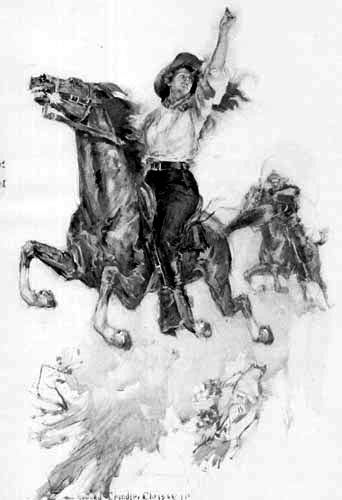
The surprised horse bounded into the air with a sudden access of vigor
In her excitement she turned and shouted back to the man, she knew not what, waving her hat in disdain. Presently she turned into what appeared to be the main street. Instinctively as they ran along she chose what seemed to be the best lot in the prospective city, and then reined in her panting, exhausted horse; she sprang to the ground, tore the peg and hatchet from the saddle-bow, and drove the stake in the lot. Not a moment too soon, with not a second to spare, she had won the race! The wild bronco came thundering upon her heels. The man jerked his horse to his haunches by the side of the triumphant thoroughbred, dropped a rein to the ground to keep him, sprang from the saddle, and stepped toward her.
"I want that there lot!" he said, roughly. "It's the best lot in the place. You kin take somethin' else."
Sue Belle rose to her feet. Her hat had fallen off in the wild ride and her black hair floated over her shoulders. Excitement had put a light in her eyes, color in her cheeks. She looked handsome, almost young again,—altogether beautiful. The man was right. She could see that she had succeeded in getting the best lot in the city. As she stood up the man stared at her wonderingly. He was a cowboy,—fringed trousers, bearskin chaparejos, loose shirt, broad hat, Mexican spurs, and all.
"Good God!" he shouted. "It's a woman!"
"Yes, I am a woman," answered Sue Belle, desperately.
"Well, I'm d——d!" he burst out.
"You've ordered me away from the lot, but——" she went on, heedless of his interruption.
"Well, gimme a kiss, sis, an' you kin stay on it," said the man, with a hideous leer.
Sue Belle looked around desperately. She was practically alone on the prairie save for this man and the other one, now about a mile distant. The station and land-office were too far away for her to summon assistance from them. She was absolutely helpless, entirely in this man's power.
"Will you let me alone if I do?" she asked, at last.
"Oh, come, now, you're too pretty to be left alone, my dear," said the man, coming closer.
Resisting the impulse to shriek, she faced him hatchet in hand. With swift feminine instinct she comprehended him in a glance. He was just an ordinary kind of a cowboy, bad when his bad side was uppermost, but capable of all sorts of nobility and self-sacrifice if his good side could be reached. She thought swiftly then,—she had to. She made up her mind to appeal to him.
"Wait," she said; "don't come nearer until I speak to you. You're right, I am a woman. I have a husband and two children. We had a little fortune which we put into a farm in Cimarron County five years ago. Through a succession of misfortunes we've lost every dollar. We have nothing except a team and this horse. We came down here to try to get something for our children. Yesterday my husband fell and broke his arm. He was going to ride in here. He could not do it. I had to make the run in place of him. I left him alone, back there on the edge of the strip, with his broken arm. With the last ten dollars we had on earth I bought these boots and employed a negro boy whom I never saw before to bring my little children after me. I want this lot. I won it fairly. It's the best lot in the town. But you are a man; you are stronger than I. You may—" she flushed painfully, "kiss me if you must,—if you will give me your word of honor that after that you will leave me this lot. You understand that I—I—only submit to it—for the sake of the children and for my poor husband."
Her eyes were full of tears now, as she clasped her hands, looked at him appealingly, and waited with burning face, trembling lips, and heaving bosom.
"Ma'am," said the cowboy, his face also flushing under his tan, as he took off his sombrero, "I don't want no kiss. Leastways, I don't take no kiss under these circumstances. You kin have that there lot. I jist rode in yere fer the fun of the thing. I don't want no lot nohow. What'd I do with it? Sell it fer booze. You beat me on the square, though if it had been five miles farther I'd a beat you. Them Kentucky hosses—I 'low he's a Kentucky hoss?—ain't no good fer long-distance runnin' side this flea-bitten bronc. I don't want no lot noways. You stay right here on that there lot, an' fer fear less'n somebody might come along an' try to make you give it up, I'll stay with you with my gun handy."
"Thank you and God bless you," said Sue Belle, gratefully, looking at him with swimming eyes.
Then she put her head down on Kentucky's saddle, where the horse stood cropping the short grass, threw her arm around his neck, and sobbed as if her heart would break. The cowboy surveyed her in astonishment and terror; but, before he could say anything, the second man came racing up.
"Well, you two young fellows have the best lots in the place, I suppose. I'll have to take what's left," said the newcomer, cheerfully. "Great Jupiter! what's that fellow crying about?"
"'Taint a feller," said the cowboy, "it's a female, a woman."
"A woman!" exclaimed the other. "Say, you cowboy," with an ugly look on his face, "have you been making a woman cry?"
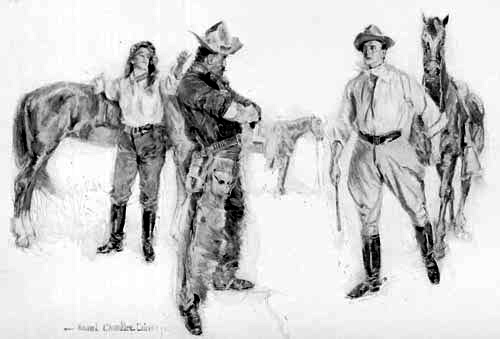
"Say, you cowboy, have you been making a woman cry?"
"I reckon I hev," answered the cowboy, nonchalantly.
"You infernal——" exclaimed the man, stepping toward him.
"Oh!" cried Sue Belle, raising her head, "he didn't. I'm crying for joy!"
As he caught sight of her the man bowed instantly toward her with the grace of a gentleman who recognized under any accident of clothes a lady.
"My husband is ill," said Sue Belle, swiftly divining another friend, one of another class, too; "he broke his arm yesterday, and I had to take our horse and ride here for him and the two little children, and this gentleman——"
"Lord!" said the cowboy, "I ain't no gent. I'm a cow-puncher."
"This gentleman came after me and promised to protect me from everybody. And that is why I cried."
"Sir," said the second man, extending his hand, "I beg your pardon for my suspicions. You are a gentleman."
"Nobody never called me one before," growled the cowboy, much embarrassed, shaking the proffered hand awkwardly but heartily. "I don't care fer no lot myself an' I'm goin' to hold this lot next to hern fer the little kids."
"Well, that's just about what I came for, too. I'm a student, a senior at Columbia College, New York, madam," he said, turning to Sue Belle, "out here for the summer to look after some of my father's Kansas property. I thought I'd run down here just for the fun of it. You said you had two children, did you not?"
"Yes, sir."
"Allow me. I will hold the lot on the other side of you for the other one. So you see, with this gentleman and myself, you will be surrounded and protected by the east and the west."
Before the afternoon was half gone all the lots in Newlands had been appropriated, lumber had been brought in, portable houses and tents erected, saloons opened, a daily paper started, and the young Bishop of Oklahoma was on the ground organizing a church; the place was actually assuming the appearance of a city even in so short a time. The story of Sue Belle's ride had been told everywhere by her gallant flankers, and by common consent the focus of activity for the city of Newlands was centred about those three lots. The happy, grateful woman could have sold them a hundred times at an increasing price had she chosen to do so.
Late in the afternoon Joe came up with the wagon and the children. He had been faithful to his trust. Sue Belle was very much frightened when she learned that her husband had secured a claim. She knew he would endeavor to hold it, and she feared extremely for him lying ill and alone on the prairie. Leaving the children in the care of some of the women who had followed their husbands on the trail, with the promise of the whole town that her three lots would be held inviolate for her, accompanied by her two faithful, self-constituted guardians, she mounted the refreshed Kentucky again and rode back to her husband, lying alone, half delirious, in his shed on the prairie, clinging desperately to his quarter section.
Thus the tide changed at last and now came flooding in with fortune.
PASSING THE LOVE OF WOMAN
THE END OF A FRONTIER TELL
"I am distressed for thee, my brother Jonathan: very pleasant hast thou been unto me: thy love to me was wonderful, passing the love of women."
The Bible
There were but two women in the camp, Martie was one of them, and Martie was the cause of it. The statement that it was on account of her they quarrelled, and it was through the quarrel the terrible state of affairs was brought about, cannot be denied.
Martie and her mother—her mother was the other woman in the camp, and, except that she had been responsible for Martie years before, she didn't particularly count—had come to the rough little mining settlement with Martie's father, a mining engineer, who represented certain speculative holdings in the East which needed personal attention.
Before they arrived the camp had been a fairly peaceable one: the boys got drunk just about so often, once in a while there was a shooting affair, but Medicine Dog was as orderly a camp as might have been found in Colorado, until Martie came. It was a serpent, I believe, that introduced the trouble in the Garden of Eden. I wonder what the wild beasts thought of the advent of Eve. At any rate, Martie first reformed and then disorganized Medicine Dog.
Following her arrival there was an ebullition of "boiled shirts,"—come by express in response to telegraphic communications with Denver, the first evidence of the reform. This was followed by the influx of a lone Chinaman, imported for the reboiling of the said shirts, his life, liberty, and the peaceful pursuit of his vocation over the tubs being guaranteed him by the camp, the second evidence of the reform. There was a consequent amelioration of manners, proportioned to the prevalence of shirt bosom, too. "Boiled shirts"—I use the language of the camp—are the beginning of that civilization of which "plug hats" are the end. Medicine Dog never got that far, except in its dreams; even Martie was not quite equal to promoting the "plug hat."
The saloon, too, felt the good—or evil, according to the point of view—effect of Martie's presence, and the wonderful part of it was that Big Sam, who dispensed liquor, profanity, and on occasions, if necessary, bullets from his "Colt's 45," from behind the bar, bore the situation philosophically. He was as much under Martie's sway as anybody else. That was the last evidence of the reform. And when a preacher—a wandering missionary—came along, Big Sam cheerfully, if temporarily, suspended business one Sunday morning and they had services in the saloon, the preacher on the counter to conduct them, and Martie on a table where they could all see her, with a portable organ to lead the singing.
That was the only time Martie's presence graced the saloon. The effect of her presence there was lasting. The boys could hardly swallow their whiskey during that or the next day.
"It tastes as if it had sugar in it," said Dan Casey, mournfully, subtly referring to the sweetening effect of Martie's visit. When it came to choosing between Martie and whiskey, the difficulties of the situation were enough to appall the stoutest heart in Medicine Dog.
Casey signified his change of heart in the matter of clothing by trimming his beard—there was no barber in the camp yet—and by adding a green tie to his shirt, and when MacBurns appeared with a yellow silk streamer across his bestarched bosom, Casey took it as a direct reflection upon his religious and political views, and for a time Medicine Dog threatened to resume its pristine liveliness.
The quarrel was compromised by Martie; for when she artfully caused the news to be circulated that she doted on red or blue ties and could not abide green or yellow ones, Casey and MacBurns discarded the colors of their choice and settled the affair by wearing Martie's.
Martie wore those colors herself. She was the reddest-cheeked, bluest-eyed, and bonniest girl that had ever come across the mountains, so Medicine Dog swore unanimously, at any rate. As occasion served, the various members of the camp maintained Martie's cause with strenuous and generally fatal effect to various gentlemen from other camps who were rashly inclined to question the assertion. Martie would have shone anywhere in the open air, and in womanless Medicine Dog she was a heroine, a queen. That was the beginning of disorganization, too.
The two men hardest hit were Jack Elliott and Dick Sanderson. Elliott was a jolly, happy-go-lucky fellow born in the East, Sanderson a quieter man from the middle West, who complemented his companion admirably. They worked a rich claim together on the mountain side with good results. They were steady-going fellows and both were dead shots with the rifle. They were great-hearted young men, who loved each other with an affection that some men develop under certain circumstances for one another until a woman intervenes. Martie intervened. Both men fell in love with her, and as they were men of education,—being fellow-graduates of the old University of Pennsylvania,—they were not content with the mere blind adoration which the rest of Medicine Dog exhibited. They wanted Martie, and as the days grew longer and they knew her better, they wanted her more and more.
Each man dreamed dreams of a house on the mountain side overlooking the camp with Martie as its mistress and with himself as titular, if not actual, master. There had never been a wedding celebrated in the valley, and they were both united upon the desirability of having one. Each one, however, wanted to be the bridegroom!
Martie recognized the difference between these two men and the rest of the camp, although in no way did they hold themselves aloof from the general society of Medicine Dog—that would not have been tolerated by the rest of the boys. She realized that either of them might legitimately aspire to her hand, for they were in an entirely different category from the rude, humble, faithful adorers like Big Sam and Casey and the boys, and Martie loved one of them.
But Martie was a coquette. It wasn't in a girl of Martie's temperament to be otherwise in a camp with a hundred men in love with her, the only other woman being Martie's mother, and she didn't count when Martie was around. And by degrees that which neither of the men wished, which both of them would fain have avoided, was brought about. There was a dissolution of partnership, a rupture of old associations, a shattering of ancient friendship. As is always the case, where both had loved, they now hated.
I said that they were both good shots with the rifle. That hardly describes their capacities. If the mine had failed, they could have earned a fortune on any vaudeville stage. One of their "stunts"—as the boys called it—was really remarkable. Such was their confidence in each other that when one balanced a little can of whiskey on his head and the other bored a hole through it neatly with his rifle at a distance of sixty yards and upward the spectators hardly knew whether to admire the nerve of the can-holder or that of the marksman the more; although Casey deprecated the performance on account of the liability of the whiskey to go to waste! They shot equally well, and sometimes the one and sometimes the other held the target. It had grown an old story to Medicine Dog, but strangers always wanted to see the feat performed. After the rupture between them they did it no more, of course.
It was Martie who had separated them and it was Martie who brought them together again. Both men paid assiduous court to her, and she positively refused under any circumstances to give either a final answer until they became friends once more and swore to accept her decision without prejudice to that friendship. Martie was a power, and she had her way.
A reconciliation was effected, and the two men went back to work on their joint claim.
Still, Martie hesitated over that decision. Some intuition told her that no promise would avail against the satisfaction on the one hand and the disappointment on the other when she made a choice; but make it she must, and finally, after much hesitation, she announced that she chose Sanderson. His joy could not quite obliterate in her mind the impression caused by Elliott's grief. Elliott was too much of a man, however, to make any open outcry. He believed that if Sanderson had been out of the way he would have been successful, and his belief was probably correct; but the matter had been decided, and he swallowed his disappointment as best he might and bore Sanderson's triumph in silence.
A sporty stranger came to Medicine Dog one day shortly after the engagement was announced, and the conversation in the saloon turned upon the marksmanship of the camp. Medicine Dog prided itself on the ability of Elliott and Sanderson. The stranger was incredulous, and wagers were made and the boys repaired in a body to the Elliott-Sanderson claim and told of the bets. Neither man was anxious for the test, but for the honor of the camp, and because of the disappointment of the boys themselves, they felt that they could not refuse. Each volunteered to hold the can and each urged the other to shoot. Finally they agreed to decide the matter by tossing a coin,—the usual method of settling mooted points.
Fate appointed Elliott to use the rifle. He seized the weapon and started up the trail to get his distance. In that same moment a grim and ghastly temptation, proportioned in its appeal to the strength of his passion, entered his soul. If he killed Sanderson the field would be free. Martie's affections were not so deeply engaged but that she might be won. The idea whitened his lips and blanched his face and shook his hand, and it occurred at the same moment to Sanderson. He realized, as he walked across the clearing and backed up against a tree, the possibilities of the situation, and his own dark face went as white as that of his companion. But he was game. His emotion was not fear,—at least not fear for himself,—or if it were fear, it was for Elliott. As he prepared to receive the shot he prayed—and he was not a praying man; nobody much at Medicine Dog was in the habit of praying then—that Elliott might be equal to resisting the terrible demand.
As for Elliott, his soul was torn in a perfect tempest. He could see nothing but the fact that there before him was the man who had won the object for which he would have given his soul, that the man was unarmed, that if he shot him no power on earth could ever connect him with the crime of murder, for he could swear that it was an accident. The best of marksmen sometimes make blunders; all do not shoot with the continued accuracy of a William Tell. Satan possessed the man's soul for the moment. Ay, it was the woman who had tempted the man,—so it was in the Garden of Eden,—but this time a woman innocent and unwitting. Poor little Martie! She could not help it, after all.
These thoughts crowded the minds of the two men as they took their stations. Elliott faced Sanderson and slowly raised his rifle. By a violent effort he mastered his trembling as he glanced along the polished barrel and drew the exquisite bead upon the little black spot on the can where he was to send the bullet.
There was something in the air, in the attitude of the two men, in the situation, which suddenly broke upon the consciousness of the onlookers. They shifted uneasily. Finally Big Sam burst out, amid a chorus of approval:
"For God's sake, Elliott, don't shoot! You're not in the mood to-day, old man. We'll willin'ly lose the bet. Give the stranger his money, boys."
It was Sanderson who broke the silence.
"What are you afraid of, Sam?" he cried, taking the can in his hands. "By Heaven, the man doesn't live," he shouted, translating everybody's thought in his impetuosity, "that dare charge my partner with foul play!"
"No, no, of course not," came in expostulation from the crowd of spectators.
"That's right, then," said Sanderson, calmly. "Go ahead, Jack. I'll trust you."
He lifted the can again to his head, folded his arms, and faced his friend, a little smile on his lips.
Once more Elliott lifted his gun, which he had dropped during the conversation. This time his nerves were quite steady. He glanced along the barrel again. Should he send a shot into that smiling face?—his friend's face? A moment would determine. He aimed long and carefully at the target he had selected.
The smile would have died away from Sanderson's face had he not fixed it there with a horrible effort. Elliott again so lingered over his aim that the men once more started to interfere. The tense situation was more than they could bear. What was the matter?
Suddenly the devil that had possessed him released the miner. Elliott's love for man passed his love for woman. He forgot Martie as he faced Sanderson. His courage came back to him and his clearness of vision.
He dropped his rifle, and before any one could stop him, although Sanderson screamed, "For God's sake, Jack, don't do it!" and the men surged toward him, he whipped out his pistol, pointed it at his own breast, pulled the trigger, and fell bleeding from a mortal wound through the right lung.
"Men," he gasped out brokenly, "you're right—I was going to kill—him—on account of—Martie, you know, but—but he trusted me and—I could—not. Yet I'm a murderer—in the—sight of God—and my punishment—is—this. Dick—don't tell Martie."
There was a look of peace on his face as they gathered around him. They drew back a little as Dick Sanderson knelt down and took him in his arms.
"Jack, Jack!" he sobbed, "I knew your temptation, but I knew you wouldn't shoot me, old man. You were braver than I. I don't know what would have happened if the coin had flipped my way. Oh, Jack, I wish to God you had killed me!"
"Now—I'm—forgiven," whispered Elliott, feebly, lifting his hand toward the other, and then he smiled, and then it was all over.
"Gentlemen," said Sanderson, crying like a baby, as he rose to his feet, "he died for me."
"And for Martie," added Casey.
"Yes, and for Martie."
"Stranger," said Big Sam, turning to the man who had made the wager, "the money is yourn. I wish to God we'd never bet!"
"Gentlemen," said the stranger, "I don't take no money from no gents w'ich is won under them circumstances, but if you gents'll come down to the saloon and likker with me——"
"That's handsome of you, stranger, but we don't none of us git no likker in this camp to-day. That there saloon closes in Medicine Dog until arter the funeral of the finest and whitest-hearted gentleman and the best shot that ever lived in this camp," said Big Sam, turning mournfully away.
With Great Guns and Small
"A thousand glorious actions that might claim
Triumphant laurels, and immortal fame,
Confus'd in crowds of glorious actions lie,
And troops of heroes undistinguished die."
Addison
"Who cries that the days of daring are those that are faded far,
That never a light burns planet bright to be hailed as the hero's star?
Let the deeds of the dead be laurelled, the brave of the elder years,
But a song we say, for the men of to-day, who have proved themselves their peers."
Clinton Scollard
THE FINAL PROPOSITIONS
A DRAMA OF THE CIVIL WAR
"Whether 'tis nobler in the mind to suffer The slings and arrows of outrageous fortune, Or to take arms against a sea of troubles, And by opposing end them?" Shakespeare
I.—AT THE TOP OF THE HILL
There wasn't a harder body of fighters in the army of the United States than "Kirke's Lambs." The only resemblance between this modern regiment and the famous body of horse which divided dishonors with Jeffreys after Sedgemoor, nearly two hundred years before, was in the name of their commander, for they were held under too iron a rule to degenerate into brutal and ferocious excesses. Besides, Kirke and the generals he served under always gave that body of hard riders plenty to do, so that they found an easy vent for their superfluous energies in legitimate fighting,—if any can be so called.
Kirke had grown up with the regiment from a subaltern to the colonel. Drafts had restored its depleted members from time to time, but in the spring of 1865 the Civil War was about over, and it was not considered necessary to complete its quota by an infusion of new blood then. There was but a handful of them left, therefore. The others—well, they said the bodies of "Kirke's Lambs" blazed a pathway from the Mississippi to the sea.
Kirke was an iron man everywhere and in everything,—in his business, in his regiment, and in his family, which now consisted of one solitary woman. The single child who had blessed the union had died before the war. The woman had been left alone for over four years. Kirke had never left the front and what he conceived to be his duty. He was a reticent, self-contained, undemonstrative man, whose affection made no show on the surface, though the current of it ran very still and deep. He actually idolized the woman who bore his name and had borne his son. On the death of that son he had made no great display of grief, though it cut him to the heart; and in general he gave little outward evidence of any strong affection to the poor, weak wife left so much alone and pining, like every woman in a like case.
She was a nervous, high-strung little body, utterly unable to see beneath the outward show; not strong enough to fathom Kirke's depths,—her heart was too light a plummet,—and it was a wonder to Jack Broadhead, who was Kirke's dearest friend and the second in command of the "Lambs," how she ever inspired the devotion that he, with better insight, divined that Kirke cherished for her.
Well, what was left of the regiment was out scouting. It had been ordered to clear up the remains of a Carolina brigade of Confederates which had been making things pleasant for the left flank of Sherman's army all the way to the sea and afterwards. One morning in February a party of some two hundred and fifty troopers, all that was left of the "Lambs," galloped over a rough road up a narrow valley toward the base of a buttress-like, tree-clad hill, upon the top of which lay ensconced the remains of that brigade.
They called it a brigade in the Confederate army, but it was really no more of a brigade than were some of Washington's during the Revolution: it was a handful of perhaps one hundred and fifty desperate, half-starved, ragged men, whose rifles and the bronzed, tense look of the hunted veteran at bay alone proclaimed them soldiers. They lay snug behind a hastily improvised breastwork on the crest of the hill. And they had retreated just as far as they intended to go. This was the limit.
Above them from an impromptu tree-trunk staff flapped and fluttered a ragged and tattered Confederate flag,—their last. They might have retreated farther, but to have gone northward would have thrown them into the arms of a division ranging the country, which would mean their annihilation or, if they scattered, their disintegration. Kirke had been pursuing them for a day or two. They knew his detachment, and in a spirit of reckless pugnacity they determined to have one good, square, stand-up fight before they quit the game, which everybody now knew was a losing one from the Confederate stand-point, with the inevitable end in plain sight. They had fought together during four years; they would fight together once more, let the end be what it would. A dangerous crowd to tackle.
With a skill which should have been manipulating an army, Hoyle, the brigadier-general in command of the remains, had disposed his men so that there was only one practicable way to attack them, and that was straight up the mountain. Their flanks were protected by ravines, and their rear could not be come at save by a détour of many miles over the mountains.
Kirke, halting his men at the foot of the hill, realized the situation as soon as he saw it. Could they take the hill by a direct front attack in the face of such a body of men, desperate old soldiers, who could shoot as straight and as fast as the remnants of that brigade could? Yet what else was there to do? He could not retire; he had been directed to put that brigade out of action, capture, or destroy it. He could not besiege it and starve it out. It was a problem.
While he was hesitating, Jack Broadhead, who had been left behind at head-quarters for a day, came galloping up with a few troopers as his escort. His quick, soldierly eye took in the desperate situation. After the necessary salutes had been exchanged a little conversation took place.
"That is a strong position, Bob."
"It is that, Jack."
"That fellow is a soldier, every inch of him."
"We knew that before."
"Yes. Well, what are you going to do about it?"
"I hardly know. Think we can take it?"
"Well, I don't know. Looks dubious. But we've got a crowd here that will storm hell itself, if somebody leads, you know."
"I'll lead, but this is worse than hell."
"Oh, by the way," Broadhead burst out, as a flash of recollection came to him, "I have a letter for you. It came just as I was leaving head-quarters."
He fumbled in the breast of his jacket, and as Kirke stretched out his hand indifferently he gave him the letter. The man's face changed slightly. A look of softness mitigated the iron aspect of his visage.
"Ah," he said, in a rarely communicative moment, "from my wife."
He tore it open. A glance put him in possession of its contents. Again his face changed. It was hard and grim at best, but never, thought Broadhead, as he watched him, had he exhibited a grimmer and harder look than at this moment. And there was a gleam almost of agony in the man's eyes. His lips trembled,—and for Kirke's lips to tremble was a thing unheard of! Broadhead saw him clench his teeth together and by a mighty effort regain his self-control. During the struggle he had crushed the letter in his hand.
After a minute he unclosed his fingers, smoothed out the paper, took out his pencil, and wrote a brief endorsement upon the bottom of it, signed his name, folded it up, and thrust it in the pocket of his coat.
"If anything happens to me, Broadhead,"—and there was a harsher ring than usual in his voice,—"this letter is to go back—to—to my—the writer."
"Very good," said Broadhead, who knew his superior too well to question him as to what had occurred. "I take it that you have decided to attack?"
"Yes. Men," said Kirke, wheeling his horse and facing the iron veterans who had come to love him as few soldiers were ever loved by their men, "there is that rebel brigade on the top of that hill,—what's left of them. You know what they are. We have tested their mettle in a dozen fights. Now we have to wipe them out. It is probable that a large part of us will be wiped out in the process, but that's no matter. Dismount and tie the horses. We want every man in action. Leave your sabres. We'll depend upon carbines and revolvers. We'll go up and pull that flag off that hill. The trees will cover us till we get near the crest. Halt there, form up, and make a rush for it. Save your fire until you get to the top."
The cheer that came in response was more like the growl of an angry animal. The men instantly followed the example of their leader and dismounted. Their horses were tied to the trees and saplings in the valley, and the men, circling the hill in a long line with Kirke in the centre and well in the lead, followed by Broadhead a short distance after, began to move up the slope through the trees.
It was still as death at the top. There was no sign of life there save the flag which rippled and fluttered gayly in the breeze. It was a bright, sunny morning. The cool touch of spring in the air made life sweet to all that possessed it. In the grim silence the men clambered up the steep slope and slowly neared the crest. Suddenly there was a puff of white smoke from the little log breastwork on the top. A moment later the crack of a rifle rolled down the hill, and the man nearest Kirke fell on the slope, rolled against a tree, and lay still. He had rashly exposed himself, and he was gone. They were good shots, those Johnnies.
The men as they advanced sought instinctively such cover as they could, skipping from tree to tree. Every once in a while, however, one of them would expose himself in the open, and the exposure was always followed by a shot which more than once caught its mark. The crest was bare of trees, and the command arrived at the edge of the clearing with some loss, and cautiously concentrated, hesitating a moment before breaking out into the open and rushing the hill.
"Now, men," said Kirke, "you see what we have to do. The quicker we do it the better for us. Give me that flag," he added, turning to the color-bearer. "Gibson,"—to his bugler,—"stand by to sound the charge when I give the signal."
There was nothing dramatic about Kirke, it was all a matter of pure business with him; but the men thought they had never seen so splendid a figure as he when he tore off his cap, jerked his revolver from his belt, seized the flag with his left hand, and stepped out in the open.
He nodded his head to the alert Gibson, and the shrill notes of the charge echoed through the hills. Ere it had died away the men heard their colonel say, "Come on!"
It was always Kirke's way to say "Come" rather than "Go."
With a mighty roar they sprang from the shelter of the trees and dashed for the ridge. A terrific volley greeted them. With a crash like thunder, which echoed and re-echoed through the hills, the Confederate fire was poured upon them. Had it not been that most of the men, firing down the hill, overshot the mark, the "Lambs" would have been blown into eternity. As it was, many of them fell, but the rest plunged dauntlessly into the smoke through which the red of the flag could dimly be discerned waving in the advance.
Again the rifles of the brigade cracked out, and this time sent their messengers of death crashing full into the face of Kirke's men. This time the carnage was terrible; there were many dead, but the blood of the living was up: they would have charged a moving express train. They tore recklessly through the smoke toward the top, following the flag.
Before the rifles could be reloaded the "Lambs" were at the breastwork, Kirke still in the lead. To leap the log walls was the work of a moment. The brigade was ready for them. The carbines cracked again and again; there was a grim, ghastly, awful struggle on the top of that hill around the foot of the Confederate flag-staff—then silence.
When the fighting stopped the few "Lambs" who were left leaned panting on their carbines, blood dripping from the gunstocks, surveying the tangled mass of dead and dying. The brigade had been annihilated.
Broadhead sprang to the staff to haul down the flag. He was nonplussed to find that there were no halliards, and that some one had evidently climbed a tree, which had been denuded of its limbs for the purpose, and nailed the flag there. He turned to look for Kirke, when, in the smoke that yet covered the field, he distinctly saw the man lift his revolver, pull its trigger, and blow out his brains.
In the confusion after the little battle, fortunately, no one noticed the action but himself. He was utterly at a loss to fathom the meaning of the suicide, but he quickly resolved that no one should know of it.
They buried the brigade with the dead "Lambs" around the foot of the staff, and Broadhead left the flag flying above them. He might have chopped down the tree and taken it, but it seemed fitting that the men who had defended it should have that last honor. The wind would whip it out in a day or two at best. Taking their wounded, they retraced their steps as they could, thinking that Kirke had been killed in the action, an opinion which Broadhead's report sedulously fostered. Broadhead carefully preserved Kirke's revolver, which he took from his dead hand, the letter, which he found in his breast pocket, his watch and sword, and a lock of his black curly hair.
II.—IN THE ROOM IN THE NIGHT
When the war was over, and they were mustered out soon afterwards, Broadhead hastened to Philadelphia and drove immediately to Kirke's house. It was empty. There was no sign of life about it. As he stopped on the doorstep in the late afternoon, wondering vaguely what had happened and what he should do next, the door of the adjoining house opened and a woman came out, of whom he made inquiry for Mrs. Kirke.
"Mrs. Kirke!" said the woman, in surprise. "And who may you be, may I ask?"
"I am—I was—Colonel Kirke's dearest friend."
"Is Colonel Kirke dead?"
"Yes."
"And a good thing, too," said the woman.
"Madam," cried Broadhead, indignantly, "do you realize what you say?"
"Certainly I do. Don't you know about Mrs. Kirke?"
"No. Is she dead?"
"It would be better if she were," she answered. "She ran away two months ago with a man named Allen, and after she left she sent me a letter enclosing the key of her house and requesting that I give it to Colonel Kirke when he returned from the war. So long as he is gone, I guess you might as well have it. Wait; I'll fetch it."
The woman turned back into the house as she spoke. This, thought Broadhead, sadly, was the explanation of it all. That letter. He had never examined it. He had held it sacred, but now he felt that he must open it. It might give him some clew as to the whereabouts of the woman. Yet he hesitated.
When the woman gave him the key he entered the lonely house. He went upstairs and sat down in Kirke's study, and there, overcoming his hesitation, he read the letter. It was the letter of a weak, hysterical woman, reproaching her husband for his lack of love, his seeming neglect, for her loneliness, and ended by saying that she had gone off with a man who loved her, and that he should never see her again. Kirke's endorsement was brief and as terse as the man's character.
"I have been to blame," he had written. "I did love you. I do. God only knows how much. I hope you may be happy. We are about to attack a strong position. I feel sure that after it is over I shall trouble you no more. You can marry the man—damn him!—and be happy."
How characteristic that was, thought Jack Broadhead, as he read,—that last touch! He cursed the man yet spared the woman. For a long time Broadhead sat there in that house, thinking, thinking, thinking. He wondered if he were the only mourner for poor Kirke. The twilight and then the darkness came stealing over the town, and still he sat there. By and by he heard a step—a hesitant, faltering step—in the hallway. He remembered now that he had left the street door open. He sat still and listened. The step mounted the stairs. It came along the short hall and stopped at the entrance of the library. He sat by the open window. The wandering figure was that of a woman. She saw the soldier silhouetted in the darkness against the light from the street lamp outside.
"Robert! Robert!" she cried. "You have come back! Thank God!"
Broadhead rose to his feet.
"No," he said, quietly, "it is not Colonel Kirke."
"Mr. Broadhead!" exclaimed the woman.
"Yes, Mrs.—Mrs.—er—Allen, is it not?"
"No, no!" she shrieked, shrinking back. "My—my husband?"
"Do you mean Colonel Kirke?"
"Yes. I have no other."
"And Allen?"
"He has cast me off, turned me away."
"Haven't you heard?"
"I have heard nothing. I have been blind—in hell—since——"
"Yes, I know."
"But Robert?"
"He is dead."
The woman sank into a chair, shuddering.
"When? How? Did he get my letter?"
"Yes. He was killed at the capture of a little hill in North Carolina on the day he received your letter. Here it is."
"Did he say anything before——"
"There is a message written in it."
"Give it me."
Striking a light at the gas-bracket, Broadhead handed her the letter. She read it through dry-eyed while he watched her. She had been a pretty, sweet, dainty, attractive-looking little woman, now she was a haggard, broken wreck.
"And he was killed by the enemy?" she asked at last.
"Madam," said Broadhead, sternly, "you shall hear the truth. He shot himself on the top of the hill the day of the battle with this revolver," laying the weapon on the table. "Here is his sword and his watch and a lock of his hair. I suppose you don't care for them."
"I care for everything that belonged to him more than Heaven itself."
"You are free now," said Broadhead; "you can marry your—your—friend."
"Never! He has driven me away, cast me off, and I hate him! I hated him from the very moment—I shall be free, anyway. He said nothing before he died?"
"Nothing."
"And this is all you can tell me?"
"All."
"Will you leave me now?"
"What? Alone in this empty house?"
"It's my house, isn't it? I am still Mrs. Kirke, am I not?"
"Yes, of course, but—I——"
"Will you go, please? You have discharged your errand. You have told me the dreadful truth. For God's sake, leave me!"
"May I not do something——"
"Nothing,—nothing. You may come back to-morrow morning and advise what to do. I am alone now, you see."
Broadhead stood uncertainly before her.
"Go, go!" she pleaded. "Don't you see that I wish to be alone for a little? You have been very good to me. I thank you."
She hesitatingly put out her hand to him.
"Won't you shake hands with me?" she pleaded. "I did very wrong. I fell very low. But I am very sorry."
Upon an impulse for which he rejoiced ever after, Broadhead clasped the thin, tiny hand in his own, held it a moment, bent low over it, and, with old-fashioned gallantry, kissed it,—that soiled, wasted hand!
"I forgive you," he said, and the voice of the dead seemed to speak to the woman through his lips.
He turned and left her alone,—alone in the darkness, alone with her memories, alone with her sorrow, alone with her repentance, alone with the weapon.
She lifted the heavy revolver with trembling hand. There was a single cartridge left in the chamber.
The next morning, in great anxiety, Broadhead came back to the house. He found the woman sitting quite white and still where he had left her, and the revolver was empty!
THE CAPTAIN OF H. B. M. SHIP DIAMOND ROCK
THE TALE OF A STRANGE SHIP OFF MARTINIQUE
"Come one, come all! this rock shall fly From its firm base as soon as I." Scott
I.—THE CONDITION
"I am a passed midshipman now, Dorothy dear, and I'm certain to get my swab——"
"Swab, Mr. Maurice?" interrupted the young lady, archly.
"Yes, my epaulet—a lieutenant's commission—this year; you know what I mean, Miss Venour. And, oh, I do love you so! With my pay and what father will allow me and what your grandfather will allow you we can get along,—that is, if you love me well enough to try it."
There was a long pause. The young lady looked down at her feet, while the arm of the young man stole around her waist. Tired at last of waiting, though the position was a charming one, the young officer recalled her to herself by a slight squeeze, which was answered by a delightful little shriek from the girl.
"What was it you were saying?" she asked, hurriedly drawing away.
"I was telling you that I loved you," he answered with dignity, releasing her, "and asking you to marry me when I got to be a lieutenant, if you love me. You do, don't you, Dorothy?" abandoning his stateliness and bending toward her entreatingly.
"Ye—es, I—I—I think so, Mr. Maurice—James, then," she continued, in compliance with a deprecatory wave of his hand, "or Jim—or—" she hesitated a moment and added the word "dear."
His face brightened. He sprang toward her in boyish delight; but she checked his rush with a pretty little motion, and continued, calmly,—
"You are a very nice boy indeed, but you are so young, you know——"
"Young!" he replied; "I am nineteen, and you are only seventeen yourself! You are scarcely old enough to be married."
"I am," she said, promptly; "I am old enough for anything."
"Old enough for me, Dot? Say, 'Yes!' You know I'm sure to come out a lieutenant from this cruise, and then you will be a year older, too, you know, and—oh, Dot, do take me! You'd better take me now, you know; you might not have a chance next year. I've been wounded once, and something tells me——"
He paused gloomily.
"Oh, Jim," she cried, "don't speak of it! But grandfather will never consent. You know perfectly well a lieutenant's pay does not amount to anything, and——"
"You are right there, Dot," broke in a deep voice, as a stout, red-faced old man in the uniform of a captain in the navy came strolling out upon the beach from behind a clump of rocks.
"Captain Venour!" exclaimed the young officer, starting back in dismay.
"Oh, grandfather, you have been listening! How shocking!" cried Dorothy.
"Listening!" snorted the old man, contemptuously, with a nice mixture of metaphors; "why, this young calf here has been roaring out his love like the bulls of Bashan."
"Sir—sir!" exclaimed Maurice, flushing painfully, "I love your granddaughter——"
"Stale news, lad. Everybody within half a mile of this knows it now," said the old man. "Why, the smack of your——"
"Grandfather!" interrupted Dorothy, promptly, emulating her lover's blush.
"And I want to marry her, sir, with your permission."
"Marry her!" shouted Captain Venour. "On the pay of a midshipman! You young——"
"I'm a passed midshipman now, sir," interrupted Maurice, "and I'm sure to be a lieutenant when I come back from this cruise to the West Indies,—and she says she loves me and that she will wait; didn't you, Dot?"
"Miss Venour, sir!" roared the old man, "in my presence! Did you make any foolish promises to this young man, Dorothy?"
"I—ye—es, sir; I said I—I'd—I'd wait," answered Dorothy, reluctantly.
"Yes? Well, you will; you'll wait until he gets to be a captain. A man isn't fit to be married until he has had command of a ship and three or four hundred men; he doesn't know how to manage a wife. Look at me! I married when I was a midshipman and—and—I know."
"But, sir, it will be fifteen years before I am a captain! Why, you weren't a captain yourself until you were forty, and I can never hope to equal your record."
"No more you won't," said the old man, somewhat mollified by the adroit compliment.
"Oh, grandfather, not forty years! We couldn't wait until then! Why, I'm only seventeen now, sir, and James—Mr. Maurice—is only nineteen. Please, sir——"
Dorothy dropped on her knees on the sand before him, and at a motion of her hand Maurice did likewise.
"Get up, get up, you young fools!" said the old man; "suppose some one should see us!"
"No, sir," said Dorothy, grasping the skirts of his coat tightly; "not until you modify your terms. You know he loves me, and—and—and I am so sorry for him," she added, ingenuously.
"Well," said the captain, to whom Dorothy was as the apple of his eye, "I'll knock off a little. He can marry you when he has command of a ship. If he is lucky, he might be made a lieutenant-commandant in five years. Now, up with you!"
The young people struggled to their feet and looked sadly at each other.
"Five years!" ejaculated the midshipman, mournfully.
"It's better than twenty, Jim," said Dorothy, cheerfully. "Can't you wait?"
"Wait! I will wait forever, Dot, I love you so——"
"Waugh!" roared the old captain, "are you going on with these proceedings before my very eyes, at my age? It's indecent! There," he added, turning his back to them and walking away a few steps, at the same time pulling an old silver watch from his pocket, "I'll give you just five minutes; and take my advice, youngster, when you cut out a prize under convoy of a ship-of-the-line, don't make so much noise about it."
"I'll get a command inside of a year, Dot darling, or die in trying," whispered the young man.
"I would rather have you alive without a command than dead with one, Jim," remarked Dorothy through her tears as the old captain came back toward them.
"Now, I take it, you have just about time to make the harbor around yonder point where your ship is waiting for you," he said. "You've said your good-bys, and you've got your answer, so you'd better up anchor and make a run for it. I'll take care Dot keeps her word, and mind you keep yours! Good-by and good luck to you. If you are half as impudent in the face of the enemy as you have been to me here, you will get the ship in a week."
The young midshipman clasped the proffered hand of the retired old sea-captain, wrung it warmly, looked longingly at Dorothy dissolved in tears on her grandfather's shoulder, and then turned and made his way slowly down the beach toward the town and the harbor.
II.—THE UNDERTAKING
H. B. M.'s ship-of-the-line Centaur, 74, Captain Murray Maxwell, flying the broad pennant of Commodore Samuel Hood, was cruising to and fro off the island of Martinique, in front of Fort Royal Bay, to blockade the port and capture in- and out-bound vessels. One afternoon in the month of January, 1804, the commodore and the captain were standing at the break of the poop discussing a problem. They had just been in chase of a fast-sailing French frigate, which had escaped them by boldly running under the lee of Diamond Rock, whither, through ignorance of the channel and want of pilots, they dared not follow. The thing had happened half a dozen times in the past month, and the commodore naturally was exasperated.
The rock itself was a huge mass of naked stone, about a mile in circumference at the base, and towering out of the water to a height of some six hundred feet, in shape resembling a rounded haystack. On the southward side the rock, sloping precipitously down to the water's edge, was absolutely unscalable. The east and southwestern sides were so broken as to be equally inaccessible, and the breakers, smashing with tremendous force on the western end, made landing difficult or impossible. The officer of the watch that afternoon, who happened to be our quondam midshipman, James Wilkes Maurice, who had, by a series of fortunate accidents and some gallantry as well, been appointed a lieutenant a month since, could not help overhearing the conversation.
"It's too bad!" said the commodore. "The scoundrels get under the lee of that rock every time and make a harbor, and I don't see how we can prevent it unless we get a battery of heavy guns up on the rock; but there appears to be no way up."
"If you please, sir," said Maurice, turning about and saluting in great trepidation, for the junior lieutenant was a very small man indeed beside the commodore, "there is a way up, sir. When I was a reefer on the Cerberus she was cruising around here, and one calm day a party of us received permission to go ashore on that pile of stone, and we managed to reach the top."
"Oho!" exclaimed the commodore, his eyes brightening. "And could you take a gun up?"
"Not the way we went, sir."
"Well, then, I am afraid your experience will not be of service."
"But, sir, if I might make so bold, sir——" continued the junior lieutenant, hesitatingly.
"Heave ahead! Out with it!" said the commodore.
"In calm weather, sir, there is no surf on that point, and it would be quite possible, I should think, to take the Centaur in close to the shore, and then with a hawser and a traveller from the main-topmast head we might make shift to land some guns."
"Capital!" exclaimed the commodore. "What do you think of it, Maxwell?"
"It is for you to say, sir," replied the cautious captain. "The weather is fine enough to-day, and we might try it. It will be risking His Majesty's ship, though, sir," he remarked, gravely.
"Fetch me a glass," said Sir Samuel, turning to the midshipman of the watch. When it was brought to him he took a long look at the base of the cliff, observing a little stretch of sandy beach, upon which the breakers usually tumbled with tremendous fury. This morning, fortunately, it seemed calm.
"I will answer, sir, that there is deep water under the cliff," ventured Maurice at this moment.
"Will you answer for the flag-ship, too, sir?" asked the commodore, keenly.
"No, sir, I——"
"I shall have to answer for that myself," he continued. "We'll try it, Captain Maxwell; the wind's off shore, the sea smooth as a mill-pond. We'll anchor the Centaur close under the lee of the rock off the west side there. Call away a boat. Let Mr. Maurice go in charge, and I myself will accompany him. We'll examine into the situation."
The investigation under the commodore proved the practicability of the bold scheme proposed by the young lieutenant. The Centaur was anchored close under the lee of the cliff, and with incredible labor five of her big guns—three long twenty-four-pounders and two eighteen-pounders—were landed on the rock. One end of a heavy cable was fastened to the main-topmast and the other was secured to the top of the cliff. Up this by means of a traveller the heavy guns were dragged. One of the twenty-four-pounders had been fitted upon a circular carriage commanding the landing-place, another was mounted on the northeast side, and the third upon a platform about midway up the rock. The two eighteen-pounders were planted on the very summit and commanded an immense distance. When the commodore had decided to undertake the manning of the rock, Maurice had sought an interview with him and explained his reason for aspiring to the command of the landing party, which would, in the natural course of events, be given to a much older man.
"So your marriage with little Dot Venour depends on your commanding something with a pennant fluttering above, does it? Lord!" roared the commodore, bursting into deep sea laughter, "and you want to hoist your juvenile broad pennant on this rock, and then you'll want to claim all sorts of privileges, you young dog! I didn't think that baby was old enough to be married yet, nor you either. Get along with you! I don't know what my old friend Venour would say if I'd be a party to this mad purpose of yours by giving you the command of this expedition. There, lad, go to your duty; I'll think about it," added the commodore, exploding with mirth again.
He thought so well about it, however, that when all preparations had been made, to the very great disgust of the older officers of the ship, he detailed Maurice to the command of the party. On account of his lack of rank, his junior officers were all midshipmen. He and the four midshipmen and one hundred and twenty men and boys, including some of the best seamen, composed the landing party, with four months' supply of provisions and ammunition. As the Centaur got under way and beat up toward Fort Royal, Maurice tore open an envelope the commodore had handed him when he bade him good-by. It was a commission and orders to command H. B. M.'s sloop-of-war Diamond Rock, five guns and one hundred and twenty men! He almost fell over the precipice in surprise and delight at the situation.
The rock was entirely barren except on the north-west side, where a little depression existed in which there was a group of stunted wild fig-trees. There were two or three caves half-way up to the summit, dry and airy, the floors covered with fine sand, of which the officers chose the smallest, the men another, and all hands made themselves very much at home. The crew was divided into watches, a station bill made out, lookouts appointed, and the regular routine of a man-of-war begun.
They had not long to wait to demonstrate their usefulness. Two days after the departure of the Centaur the lookout on the top of the rock saw a frigate under a tremendous press of canvas endeavoring to run between the rock and the shore and make for Fort Royal. Far away, and coming along like a gigantic white cloud, was a ship which was presently made out to be the Centaur. A drummer-boy, not the least important member of the crew of the Diamond Rock, beat to quarters, the men sprang to their stations, and the huge guns were loaded and carefully trained on the unsuspicious French ship. She came booming along at a terrific pace. Maurice, with a coolness remarkable in one so young, waited until she was well in range, and then, taking careful aim, with the long twenty-four half-way up the summit, ignited the priming.
With a terrific roar the ball sped straight to its mark. They were too far away to hear the crash as it struck the fore-topmast, but the fall of the mast and the confusion on the ship were plainly visible. With hearty British cheers the rest of the battery let drive at the oncoming frigate. One of the eighteens carried away the jib-stay and the jib-halliards. There was great consternation on the French frigate. No one had dreamed of an enemy in that quarter, and before they could make up their minds what to do a second broadside was poured upon them from the rock. Clearly the pass was untenable. The captain of the frigate was a good seaman, and he promptly turned about and made for the sea again. He hoped to escape the Centaur by his speed, but the old ship-of-the-line had the wind and heels of him now and she came rushing down upon the frigate. After a long pursuit and a gallant endeavor the French captain found himself under the Centaur's guns. There was nothing to do but to surrender. Throwing a prize crew on board, the Centaur ran off toward the rock. When near enough to be seen a string of flags fluttered out from the mizzen-topgallant yard-arm, and the delighted youngsters on the rock read the following:
"Well done, Captain Maurice!"
The men on the Centaur might have almost heard the cheers with which the men and boys on the rock greeted the signal. It had leaked out somehow that the young lieutenant whom they all loved, and to whose forethought the manning of the rock was due, was in some way fighting for his sweetheart as well as his country, and, above all men, the sailor loves a lover.
Scarcely a week passed without a brush with the enemy, and some months elapsed before the French learned that the passage which they had used with so much skill and success was finally closed to them, and, save at night, no vessels attempted the channel—not many then. There had been plenty of excitement during this period, but now all was changed. The Centaur and other ships sailed away, and the crew on the rock had little or no communication with the shore for over a year longer. Their provisions and water were replenished every quarter by a frigate, which was despatched for the purpose. Otherwise they seemed to have been forgotten. The novelty of the situation had worn off, and the monotony had begun to pall upon them dreadfully. Maurice and his young officers were at their wit's end to find employment for the men and keep them in good spirits. The discipline was, of course, sternly maintained, but, sailor-like, the men tired of the shore and pined for the unsteady deck of a ship; in addition, Maurice longed for Dorothy. He had not been able to send a word, nor had he received a line from that young lady. He was too proud to write to the commodore by one of the provisioning ships, and ask for relief.
One evening about the middle of May, 1805, when the provision-ship was about due on its quarterly trip, the watchers on the rock saw a great fleet of sixteen sail-of-the-line, seven frigates, three corvettes, and a number of smaller vessels, all flying the French flag, running through the channel toward Fort Royal. With joy in their hearts at the opportunity for action, the five guns on the stony sloop-of-war promptly opened fire upon the great French and Spanish fleet of M. de Villeneuve, who was prosecuting his attempt to befool Nelson by giving him that mad chase across the Atlantic and back which ended at Trafalgar.
The French ships returned the fire as they came within range of the rock, and their tremendous broadsides kicked up a deal of noise and cut up the face of the rock somewhat, but did no other damage. The crew of the rock made excellent practice, and, considering their force, rendered the passage interesting to the French. The ennui of the intervening months was forgotten. Villeneuve was furious. Never before had one lieutenant, four midshipmen, and one hundred-odd men (some of them had died during the sojourn) engaged successfully a splendid fleet of line-of-battle-ships. Toward evening one belated Spanish ship unsuspiciously attempted to anchor near the rock, but she was soon driven off with much loss. The elated Englishmen saw the fleet anchor at Fort Royal, now called, in deference to the republican form of government of France, Fort de France. Villeneuve, who was furiously angry, learned from the French at Fort de France that the formidable barrier was held by a handful of men, so he determined to capture the rock, and for that purpose, on the 29th of May, he detached a squadron consisting of the Pluton and Berwick, 74's, the frigate Sirene, 36, the Argus, 16, an armed schooner, and eleven gun-boats under the command of Commodore Cosmao, of the Pluton, with four hundred troops-of-the-line.
The rock had been blockaded ever since the arrival of the fleet at Martinique. When Maurice saw the ships bearing down upon him at break of day on the 31st of June, 1805, he knew what to expect. Owing to the fact that the supply-ship, which was due, had not arrived,—because of the blockade, doubtless, and the presence of the great French fleet,—Maurice unfortunately found himself with but a scanty supply of powder and shot. He determined to abandon two of the lower guns and concentrate his force about the eighteen-pounders and the twenty-four-pounder half-way up. Spiking the lower guns, thus destroying the battery, he withdrew to the summit of his command. For two days the ships were anchored near by, the mild weather permitting them to come close in. During this period the French poured an unremitting hail of shot upon the stone batteries of the rocky vessel. Maurice and his men answered the fire slowly but with great precision from their three remaining guns. Three of the gun-boats and two other small boats were sunk, and the larger ships were much cut up. The young captain might have protracted his defence indefinitely had not his powder entirely failed him. Observing the English fire to slacken, the French finally landed their troops on the beach at the foot of the rock. The last charge of the twenty-four hurled its iron missive of death among the Frenchmen huddled on the beach. Then, like a flock of goats, they sprang at the cliffs and clambered up the steep sides of the rock, which the fire of the ships cleared with showers of grape-shot. A feeble musketry-fire, for the small cartridges had been torn to contribute powder for the great guns, met them, but they came boldly on. As they swarmed over the rock Maurice and some of the older men struck at the advancing French with their swords. The two men nearest him were killed and he himself was badly wounded. There was nothing left but surrender. A French officer hauled down the English flag. The young captain had lost his first command. H. B. M.'s sloop-of-war Diamond Rock had passed into the hands of Admiral Villeneuve.
When the young captain recovered his senses in the cabin of the Bucentaur, the flag-ship of the French admiral, bound for Europe again, he did not know whether or not he had won Dorothy Venour.
III.—THE REWARD
Early in November, a week or so after the great battle of Trafalgar, which the young captain witnessed from the deck of the French ship, from which in the confusion he escaped to the Victory, where he did good service until the close of the action, he was landed at Portsmouth once more. In his pocket he bore two documents, one dated a year and a half back, and the other but yesterday. Led by an instinct which he could not explain, instead of going up to Captain Venour's house on the hill, he made his way through the town and along the beach toward that sheltered little cove from which he had taken his departure two years before. As he turned the point of rocks he saw a lonesome little figure seated on the sand, resting her chin in her hand and looking mournfully out over the sea. It was Dorothy. He stole up behind her, caught her under the arms, lifted her to her feet, and kissed her before she could utter a scream. When she recovered, however, she made up for her startled silence.
"Oh, Jim dear!" she cried, precipitating herself into his arms with a shriek of delight, "you look like a real man now!"
"I am a man, Dot darling," he replied, his eyes brightening as he saw her radiant face peeping out from the brown curls near his shoulder.
"Well, sir," exclaimed the deep voice of Captain Venour, coming down the beach,—singular how he always happened to be around at inopportune moments,—"you may be a man, but have you a command?"
"Oh, grandfather, he has command of me," cried Dorothy, archly, breaking away from her lover. "Won't I do?"
The old captain whistled.
"I've had command of a ship-of-the-line and I've tried to command one woman, but give me the ship-of-the-line," he answered, reflectively. "No, you won't do."
"Captain Venour," remarked the young man, gravely, "I have had a command, sir, and in accordance with your agreement I have come to claim your granddaughter."
"What was your command, my lad?" asked the captain, facetiously, "a dinghy or a jolly-boat?"
"Neither, sir."
"A cutter, then?"
"No, sir."
"A brig or a sloop-of-war?"
"No, sir."
"Good heavens!" exclaimed the captain; "you don't mean to say you have been in charge of a frigate or a ship-of-the-line, a boy like you?"
"No, sir, not quite," said the young man.
"Well, what did you command? Did it have two masts?"
"It didn't have any masts, sir."
"No masts!"
"No, sir; it was a rock."
"Good Lord!" ejaculated the old man, sitting down feebly and staring. "A rock? What do you mean? Are you trifling with me? That is no way to gain the lass."
"Well, sir," answered Maurice, gravely, "here are my orders authorizing me to command His Majesty's sloop-of-war Diamond Rock, five guns and one hundred and twenty men. It's a great stone hill off Martinique. I commanded it for one year and six months, at the end of which we beat off M. de Villeneuve's great fleet, and were only captured when our powder gave out, by a heavy squadron which bombarded us for two days. I was wounded——"