Front matter (continued 2)
Reading edition
"I saw it this morning in Miss Emily's room," said Revere. "I took the liberty of examining it, and I was struck by the beauty of the blade and the roughness of the hilt. I quite agree with you, sir. I should not have it changed for anything."
"I call it the sword of the Constitution," said Emily.
"How comes it in your room, may I ask, Miss Emily?"
"Grandfather gave it to me. I am the only son of the house, you see," she continued with a melancholy sigh. "I would that I had been a man."
"That is a wish in which I cannot join you," said the young officer, quickly.
"I think it's a pity," responded the girl, "that so great and gallant a sailor as my grandfather should leave no one to bear his name."
"My dear young lady, his name is borne in our history and upon our hearts," answered Revere, quickly. "The world will never forget 'Old Ironsides' and her last great fighting captain. The new navy is the child of the old, and, in a certain sense, we all feel the obligations of such distinguished ancestry. As for me, that I have been permitted to meet you, sir," he said, turning to the admiral, "in this intimate and familiar way, is one of the proudest moments of my life."
"Is it so?" said the old man, simply; "we only did our duty then, just as you are doing it now. Dave Farragut, now, he was trained in our school——"
"And we are trained in his school; so you see here is a connection. Some day we may show what we have learned from him, as he showed what he had learned from you."
"I doubt it not, young sir, I doubt it not; and while I have no sons or grandsons to bear my name, yet Emily is a good child. No one could wish for a better daughter."
"Of that I am quite sure," interrupted the lieutenant, spontaneously.
"And, perhaps," continued the admiral, simply, "in the hands of her children the sword of the Constitution may again be drawn in the service of our beloved country. But where is Barry? The sun is just setting. He should—Ah, there he is. Evening colors, Mr. Revere," said the veteran, rising to his feet as the gun on the terrace boomed out in salute, and standing still until the colors slowly and gracefully floated down.
One of the most beautiful of sights is the fall of a flag, when it comes down by your own hand and betokens no surrender. The declining banner lingers in the evening air with sweet reluctance until it finally drops into waiting hands with a touch like a caress.
"You see, we keep up the customs of the service as near as we can, sir. How is the ship, Barry?" the admiral asked, as the old sailor delivered his report, as he had done the evening before and on all the evenings of their long sojourn on Ship House Point.
"I have a fond fancy, Mr. Revere," resumed the veteran, after the termination of the customary conversation with the sailor, "that the ship and I will sail into the final harbor together. Both of us are old and worn out, laid up in ordinary, waiting for the end. But let us go into the house. The night air grows chill for me. Emily shall sing to us, and then I shall bid you good-night."
The girl's sweet, low voice, although unaccompanied, makes rare music in the old room. The admiral sits with his eyes closed, a smile upon his lips, beating the time upon the arm of his chair with his withered fingers. The songs the girl sings are of the music of the past; the words, those the admiral heard when he was a boy. Now it is a rollicking sea-chorus which bubbles from her young lips, now it is a sweet old ballad that his wife sang in the long ago time. His head nods, and he says, softly, under his breath, half in time with the rhythm,—
"Ay, just so. When I was a boy, so many years ago!"
Revere listens entranced, though possibly he had arrived at such a state that he would have listened entranced if she had sung badly,—which she did not. Her voice, though untrained, was delightful. It had the naturalness of bird notes, the freshness of youth, and the purity that charms the world. The airs were half-forgotten things, lingering familiarly in his memory. He may have heard them when he was a baby in his mother's arms, and she from her mother, and so on down through the long line of ancient ancestry maternal.
The sweetest songs, are they not the oldest? Have not the peasants of Sicily been singing the music of "Home, Sweet Home," for a thousand years?
And so the young man listens and loves, the old man listens and dreams, and the girl sings as never before, for this time she knows that a young heart beats in harmony with her voice. Alas for the old! he has had his day. Compelling youth enters and displaces him. Emily sings not merely for the past, but with thoughts reaching out into the future. When she stops, fain to be persuaded, Revere entreats her to continue, he begs for more. She knows not how to refuse, indeed does not wish to do so, so she sings on and on.
The admiral sleeps, but what of that? Youth listens, and by and by, as she strikes something that he knows, in a fresh, hearty tenor voice he ventures to join with her. In the harmony of their voices they almost see a prophecy of the future harmony of their lives.
Many a time has she sung to the admiral and the old sailor, but never quite as to-night. And Captain Barry has not been there. The heavy oaken chair, which he made himself from the timbers of the ship, which stands by the door, and which, in its rude strength, its severe plainness, somehow suggests the man, is empty. To the admiral she has sung like a voice from the past, to Barry her music has been like that of an angel in heaven, to Revere it is the voice of the woman he loves. But to-night, although he hears the music, Captain Barry will not come in. He stands on the porch, peering through the blinds. Unskilled as he is in the reading of character, unaccustomed to the observation of faces, there is no mistaking, even in the sailor's mind, the look in the eyes of Revere.
The young man sits opposite Emily, listening to her, watching her, drinking in the sweetness of the melody and the beauty of her face; the light that is in his eye is the light of a love that has come, not as the oak grows from the tiny seed, slowly developing through the ages, and spreading and bourgeoning until it fills the landscape, but the glory of a passion that has burst upon him with the suddenness of a tempest, and one that promises to be as irresistible in its onset. And Barry sees it all, divines, knows, feels, and in the light of another love recognizes at last his own futile passion. The revelation of hopelessness in the light of hope, of despair in the glow of success.
Never had the Bostonian been brought in contact with a personality quite like that of Emily. More beautiful girls, measured by the canons, he had seen, possibly; wiser in the world's ways, better trained, more accustomed to the usages of society, undoubtedly; but never one so sweet, so innocent, so fresh, so unspoiled, so lovely, and so lovable. As frank as she was beautiful, as brave as she was innocent, as pure as she was strong. There was no use denying it; he could not disguise it; he had loved her from the moment when, standing on the wreck, he saw her steering the skiff in the storm, with her fair hair blown out by the breeze and her face turned up toward him, full of encouragement and entreaty.
And Barry knew it now.
As a young sailor, Revere had flirted and frolicked with many girls, he had been staidly engaged to another for a long time, but not until that day had he really loved any one. As for the girl, she had taken him at his face value; and while it would hardly be just to say that she entirely reciprocated his feeling, yet it was easy to see whither her heart tended and what the end of the acquaintance would be unless something checked the course of the growing interest she felt in the young man.
Could Barry check it? He yearned to try. And all these things were plain to the old sailor. He suddenly found himself dowered with an unwonted ability to reason, to see, to read beneath the surface. 'Twas love's enlightening touch; hopeless, uncoveting, yet jealous love, that opened his eyes. Love blinds? Ay, but he enlightens, too.
Barry's glance through the window ranged from the dozing admiral to the adoring young man, and paused over the face, exalted, of the young woman. His breath came hard as he gazed, his heart rose in his throat and tried to suffocate him. He clinched his hands, closed his teeth—a dangerous man, there, under the moonlight. He cursed the gay young lieutenant under his breath, as Adam might have cursed the serpent who gave him, through the woman, of that tree of knowledge that opened his eyes and turned his paradise into a hell.
CHAPTER X
Facing World-Old Problems
When the lights in the house were all out, and they had all gone to their rest or their restlessness, to their dreams or their oblivion, the sailor returned to his ship. Lighting his lantern, that hung in the sheltered corner aft where he slung his hammock, he pulled from the breast of his shirt a little bundle of water-stained papers. One was a long, official-looking envelope, bearing the stamp of the Navy Department, and evidently containing an order or an important communication. Barry had often seen such envelopes addressed to the admiral. The others, if he could judge from the outside, were private letters, and the envelopes bore, he thought, a woman's handwriting. He arrived at this last conclusion instinctively, for he was without familiarity with such things; he had scarcely ever received a letter in his fifty years of life.
He had found them that morning on the shore by the landing, where they had fallen from the pocket of Revere's coat the night before. Instead of handing them to the young man, he had retained them; moved by what idea that they might be of value to him some day, who could say?
The envelopes had all been opened, and nothing prevented him from examining the contents. He was but a rude sailor; the niceties and refinements of other ranks of life were not for him, yet he hesitated to read the documents. Two or three times he half drew one of the letters from its envelope only to thrust it resolutely back. Miss Emily would not have read them, nor the admiral either; that he knew. Finally he gathered up the handful, put them in the locker near where he stood, and turned the key. He would not read them, but he would not return them, either.
Ah, Barry, 'tis not alone hesitant woman who loses!
He had won a partial advantage, the first skirmish in a battle which was to be renewed with increasing force with every passing hour. He would have given the world to have examined those documents and papers. They would tell him something of the errand of the man, perhaps; but he had not reached the breaking point,—not yet, although, under the influence of his furious jealousy and consequent animosity, he was not far from it. Unconsciously he contrasted Revere with himself, and suffered keenly in the ever-growing realization of his disadvantage. Old, common, rude, lonely, faithful, that was all,—and it was not enough.
As for Revere, the loss of the letters, which he had discovered when he put on his own uniform, annoyed him somewhat, although he did not consider it serious. That afternoon he had written to the Navy Department detailing his accident and asking that new orders be made out for him. He had also written to his mother, lightly mentioning his adventure and his lost baggage, and directing that other clothing be sent him immediately by his man. In this letter he had enclosed a short note for Josephine. In neither of them did he dwell much upon Emily Sanford.
Of the trio in the house he was one to whom oblivion did not come readily that night. He was facing a very serious crisis in his life. He had been betrothed to Josephine Remington, a far-off connection of his mother, since his graduation, and the betrothal was only the carrying out of a plan which had long been agreed upon between the respective families. The engagement was a matter of general notoriety, and was an accepted fact among their many friends. In the absence of any other affection, he had never realized that he had not loved Josephine as he should, and never suspected, until he had felt the touch of genuine passion, and had become thereby an authority upon the subject, that she did not love him either.
But what was to be done was a grave question. Was it right for him to make love to Emily Sanford, which he had certainly done, by implication at least, and which he certainly wanted to do directly and unequivocally, under the circumstances? or, was it right to allow Emily Sanford to fall in love with him, which, without vanity, he felt she might do, and which he fervently hoped with all his soul she would do, while he was engaged to Josephine? It certainly was not right. That was a conclusion about which there could be no other opinion.
He finally resolved that he would treat Emily Sanford with proper reserve, and circumspectly watch his conduct toward her for the present. Perhaps it would be best, after all, to try to put her out of his heart and keep to his engagement his mind suggested faintly. That was impossible he felt in his heart. It was Emily or nothing. No, he could not and he would not. He must at once secure a release from the one so that he could have the right to woo the other honorably and openly.
Yet, how to be free? Could he ask Josephine to release him? What would his mother think of such a demand, and how would his conduct in the affair be regarded by his friends? And yet he could not carry out his engagement. That was final. In one moment the delusion of years which he had accepted—nay, even encouraged—with a youth's indifference had been swept away. Love had smitten him; his eyes, too, had been opened. Whatever betided, there was but one woman in the world for him. Yet he must conceal his feeling and make no avowal until he was free. Poor Richard! He did not realize that the man does not live who can conceal from the woman he loves the fact that he loves her. It is in the very air, and nature has a thousand ways to tell the tale, with each one of which the most untutored woman suddenly grows familiar at the right moment.
They were puzzling and annoying questions, but, with a conduct quite what would be expected from so gallant a sailor, he at last made up his mind. Of one thing he was certain,—that he loved Emily, and that she was the only woman in the world for him. And he would be free. So Revere, like Barry, hesitated and was lost!
Even the situation with regard to the old ship was a puzzling one. There would be no evading the orders of the government. The ship must be sold to the best advantage and broken up. Yet to destroy the ship was to write the admiral's death-warrant. He had to obey his orders. No sentimental considerations would be allowed to interfere with the command of the department. Still, how could he do it? He did not dare tell the news to the admiral, he could not mention it to Emily, he would not even like to declare it to the old sailor.
The more he considered the situation the more unfortunate the position in which he found himself. As a lover,—of Emily, that is,—he was pledged to another woman. As a guest of the admiral, he was there to take away the ship. And, although he entered little into his calculations, he might have added, had he known it, that on both counts, ship and maiden, he was about to break the heart of the man who had saved his life. And all of this had been brought about in the most innocent and unwitting way. He felt himself, in some strange manner, the sport of a hard and malignant fortune.
The night was still and calm to the admiral, sleeping dreamlessly without foreboding; but to his granddaughter—ah, she was the dreamer. This young hero, this demigod from over the sea, how he had looked at her, how he had listened to her, how his eyes had seemed to pierce the very depths of her maiden soul! He had not complimented her upon her singing; he had only asked for more and still more. And how beautifully his voice had blended with hers! Was he, indeed, the fairy prince come at last to awaken the sleeping beauty of her passion,—to kiss into life the too long dormant feeling in her heart?
There are songs without words in maidens' hearts, and one of them rippled through the innocence of her girlish soul in the still watches of that heavenly night.
And they all forgot old Barry alone on the ship.
CHAPTER XI
Blows at the Heart
Revere spent the next morning in a thorough inspection of the ship. It was a duty enjoined upon him in the carrying out of his orders, and he had felt somewhat guilty in having neglected it the day before. His Naval Academy course had included instruction in wooden ship-building,—iron ships were only just beginning to be at that date,—and he therefore viewed the Susquehanna with the eyes of an expert. At his own request, he had been attended in this survey by the sailor Barry, although it is more than probable that, in any case, the old man would have insisted upon accompanying him.
With what jealous pain the veteran seaman dogged the footsteps of the young sailor and watched him examine his beloved ship! Nothing escaped Revere's rigid scrutiny. Barry himself, after his years of familiarity with the old hulk, could not have made a more exhaustive investigation. There was but one spot which Revere did not view. That was the private locker which the old seaman had made for himself in the one habitable portion of the ship.
"What's this?" Revere had asked, pausing before the closed, locked door. "Your traps, eh? Well, I guess we have no need to inspect them," he continued, smiling, and passing on.
Yet, had he known it, behind that closed door lay his fate, for the lost letters and papers—which Barry had not yet read—were there.
The keen, critical examination of the old ship by the young lieutenant enhanced the growing animosity of the sailor. His cool comments seemed like a profanation. Barry felt as if his enemy were appraising the virtues of his wife; as if, examining her in her old age, he were disappointed and surprised at not finding in her the qualities and excellencies of her youth. Every prying finger touch, crumbling the rotting wood, was a desecration. Every blow struck upon the timbers to test their soundness was an added insult.
Had the young man been less intent upon that task he would have seen in the clouded brow, the closed lips, the stern expression upon his companion's face something of the older man's exacerbated feelings; but, engrossed by his inspection, he noticed nothing. Indeed, like many very young naval officers of the time, he thought but little of the sailor at best. He was a part—and a very essential part—of the vast naval machine, of course, but otherwise nothing. When Revere grew older he would learn to estimate the value of the man upon the yard-arm, the man behind the gun, and to rate him more highly; but at present his attitude was more or less one of indifference.
It was true that Barry, equally with Emily, had saved his life; but by a perfectly natural trick of the mind—or heart, rather—all the heroism of that splendid achievement had focussed itself about the woman, and to Revere the man became an incident rather than a cause,—merely a detail. Just as the captain who leads the forlorn hope gets the mention in the despatches and enrolls his name upon the pages of history, to the exclusion of those other men, perhaps no less brave than he, who followed him, so Emily stood to the fore, and Barry's part was already half forgotten. This carelessly oblivious attitude of mind, which he divined even in the absence of any very specific outward evidence of it, added to the exasperation of the sailor, and he fairly hated the officer.
"There are certain categories of the mind which must be true, else would reason reel and totter on its throne." As an illustration, we cannot think of love without thinking of hate, and perhaps the capacity for one may be measured by the ability for the other. The man who loves high things, burns with corresponding hatred for the base,—or else something is lacking in his love; and, as is the case with all other antitheses of sentiment, both feelings find lodgment in the normal mind.
Barry had loved through years. He had loved the admiral, he had loved the ship, and, above all, he had loved the girl. The peaceful, quiet, even tenor of his life had offered no lodgment for antagonisms. To love, to serve,—that had been his happy existence. Living alone on Ship House Point, attending to his simple duties, wrapped up in his devotion, he had found neither cause nor reason for hatred, and when that awful passion found a lodgment in his bosom, it came so suddenly, so violently, that it destroyed the mental and spiritual balance of the man. The faculty of hating had years of disuse to make up for, and the feeling swept over him like a tidal wave, uncontrollable, appalling. The swiftness with which it developed had but added to his confusion. There is love at first sight, but there is antipathy as well. He was a living illustration of the latter fact.
So perverted had become the sailor's mind, under the influence of this rising feeling, that in his bewilderment he sometimes fancied that his antipathy was universal,—that he hated the admiral, the ship, Emily, himself! Yet this could not be; and in calmer moments, although without the power of analysis, he realized dumbly that these griping emotions were but the concomitants of his obsession.
Of all this the lieutenant was yet blithely unconscious. It is said that but a single object can engross the mind at one time, and that concepts of other objects, even if simultaneous therewith, are merely auxiliary thereto. Emily filled Revere's mental horizon to the exclusion of everything else. It was with difficulty he kept his mind away from her when, in pursuance of his duty, he inspected the ship. To Barry he paid but little attention, noticing him, if at all, in the most perfunctory way. Disassociated from Emily, the sailor counted for nothing.
To his relief and Barry's, presently the long task was over. The duty discharged, the two men scrambled down the battens which Barry had nailed to the side of the hulk to enable him to pass to and from the deck, and stood on the grass in the shadow of the ship.
"Well," said Revere, "she has been a fine ship in her day, Barry."
"Ay, sir; none better."
"See how sharp she is in the lines of her bow; look at the graceful swell forward. See how she fines down in her run aft, yonder. She should have been a good goer. The ship was built for speed as well as strength; and probably she was laid out by the rule-of-thumb, too," he continued, reflectively. "We don't build better to-day, with all our boasted science. Yes, she was a fine ship. I should like to have commanded her; but she is worthless now."
"Worthless!" exploded the old sailor, darkly; "worthless!"
"Absolutely. There is hardly a sound plank in her. The iron bolts, even, are rusted. I wonder how she holds together. The habit of years, perhaps; nothing else, surely. She's a positive danger. Some day she'll fall to pieces, and, if I were you, I'd sleep elsewhere."
"My God, sir!" exclaimed the old man, wrathfully, his face changing; "you don't know what you're sayin'! You can't mean it! Me leave the ship! I've slept on her for twenty-five years. You're wrong, sir! She's good for many a year yet. Some of the planks is rottin', I grant you, but most of the frames is good yet, an' she's sound at the heart. She'll weather many a storm, you'll see. Sound at the heart! Leave her! I'll leave her when she falls, and the admiral, too. He's an old man. My father sailed with him; he was a man when I was a boy; yet he's alive still, an' he'll live as long as she does, too."
"Nonsense, man!" said Revere; "you are dreaming! The ship ought to be broken up. She might be worth something as stove-wood of inferior quality," he continued, carelessly, and ruthlessly, too; "but I tell you she's a menace to every one who comes here."
"Broken up, sir!" gasped the man, forgetting duty, courtesy, everything, in his anger; "by heaven, I'd rather set fire to her with my own hands an' burn her down! Burn the life out of the admiral, an' out of me, too, than a timber on her should be touched! I tell you, I've lived on her. I know her. I love her! Don't dare to——"
"Look here, Barry," said the young man, quickly, but with great firmness, "you are rated a boatswain's mate in the United States navy, I believe, and as such I will have to caution you not to address me in this imperious way. There, man, hang it all, I oughtn't to have said that, perhaps," he continued, as he saw the man's face working with grief and rage. "You saved my life, you know, and the ship, I suppose, is dear to you, and I can well understand it. We'll say no more about it."
"I wish to God I hadn't," muttered the sailor, entirely unmollified.
"Well, now, that's rather ungracious of you; but, never mind, you did, and I can forgive an old salt a good deal; only there is one thing I must say: Miss Emily must not go aboard the ship any more. You can risk your life if you want to, but I won't have her risk hers; it's dangerous."
The old man noted the cool, proprietary note in the voice, and broke into fury; difference of rank and station quite obliterated from his perturbed mind.
"Mustn't, sir! Mustn't! I may be a bo's'n's mate, sir, an' you can command me, but you've got no call to say 'mustn't' to Miss Emily."
"Of course not; but I shall speak to the admiral. There, now, that will do. Keep cool. No harm's done. I have inspected the ship and shall report on her."
"What are you goin' to report, sir?"
"Well, by George! If you are not the most extraordinary blue-jacket I ever saw! What I report will be sent to the Secretary of the Navy. I do not publish it to the ship's crew. What's the matter with you, man? Pull yourself together. You seem to be in a dreadful state."
"What are you goin' to do with the ship?" insisted Barry, savagely.
"I'm not going to do anything with her. I have been sent here to report on her, and I shall report."
The situation had become tense. The young officer felt that he had humored the sailor long enough; indeed, that he had allowed him far more freedom in his address than he would had given any one else. Ignorant of the mainspring of the man's apparent antipathy to him, possessing no clew to the cause of it, unable to divine Barry's mental condition, he had been greatly surprised by his insolent and insulting conduct. It seemed to the lieutenant that his forbearance had reached its limit, and that something would have to give way. In another second there would have been trouble.
The state of affairs was relieved by the cause of it, for Emily appeared on the brow of the hill at that moment and called to the sailor. The old man instantly turned on his heel and, without deigning to notice the young man, walked toward her. Revere followed him promptly, and both men arrived at the top of the hill before her at the same moment.
By a violent effort the sailor had smoothed some of the passion out of his face, though he still looked white and angry.
"What's the matter, Captain Barry?" she asked, noticing his altered visage.
The man stood silent before her, not trusting himself to speak, especially as it would have been difficult to assign a tangible cause for his feelings, real though they were.
"I think I can tell you, Miss Emily," said Revere, pleasantly. "I have been inspecting the ship, and the man has not liked my opinion of her, I fancy."
"Captain Barry is very fond of the old ship, Mr. Revere," said Emily, quietly, "and I doubt not that any inspection of her hurts him."
The sailor looked at the girl gratefully, as a dog might have done. The young man's heart went out to her, too, for her kindly championship of the older man. He was glad, indeed, that she had found a way to dispel his anger, for the lieutenant was a kind-hearted young fellow, and would have all others about him happy, especially in this beginning of his romance.
"Well," he said, generously, "perhaps I did speak rather harshly of the ship. You see I hardly realized how you all love the old thing, and indeed 'tis a fine, melancholy old picture."
"It always reminds me of grandfather and Captain Barry—old on the one hand, strong on the other," responded Emily, divining the instinct of consideration in his heart that had prompted Revere's words, and smiling graciously at him.
It was reward enough for him, he thought, as he returned her approving glance with interest.
"You called me, Miss Emily," said the uncompromising Barry, speaking at last. "Do you want me?"
"Yes; I am going over to the village, and I wish you to row me across the harbor."
"By no means, Miss Emily," broke in Revere, promptly. "I claim that honor for myself."
"Do you think you are quite strong enough to do it?"
"Strong enough!" he exclaimed. "Certainly I am! I should like nothing better. Besides, I have business in the town myself: I expect answers to some letters and my man with a portmanteau and some other clothes. I should be delighted to row you to the village or anywhere."
"Well," said Emily, hesitating, "Captain Barry always rows me and——"
"All the more reason for giving him a rest; he is old and will be glad of this relief. Let the duty be performed by younger hands. Come, then, if you will allow me."
Barry stood silent during this little colloquy. His face, when Emily glanced at it, was as impassive as if he had been a stone image. He was putting great constraint upon himself, determined not to betray his feeling. If she could choose Revere, the acquaintance of a moment, and disregard him, the servant of years, let her do so. He would see. Not by word or look would he try to influence her. If he had ever heard of the Spartan with the wolf at his vitals, he would have realized what the story meant then.
Now, Emily much preferred to have Revere row her; he was a much more congenial companion than the grim, silent sailor. There was a sympathy, already an affection, developing between them which made her greatly enjoy his society. She would not have hesitated a moment, therefore, but for a certain understanding of the feeling entertained for her by the sailor. Not a sufficient comprehension, however, to amount to an assurance, but a deep enough realization to give her pause. What woman is there without that much comprehension? But when she saw Barry standing before her, impassive, stern, apparently indifferent, her hesitation left her for the moment, and, bidding the sailor inform her grandfather of her departure, she turned and descended the hill, followed by the lieutenant.
As the two walked away the tension on the man was released or broken. He stood trembling, looking after them. A flower which Emily had been wearing had fallen upon the walk. In other days he would have picked it up and carried it carefully to the ship as a priceless treasure. Now he ground it brutally under his heavy heel and stared at them, almost unconscious of his action, quivering with voiceless rage. Presently he went up to the old admiral, sitting dreaming on the porch, and, having mastered himself somewhat again, delivered his message.
Out in the harbor the little skiff, the same by means of which Revere's life had been saved, danced merrily along.
"I like to see the young people together, Barry," said the old man, gazing after them. "'Twas a fortunate gale that wrecked him at our door. We shall be going soon, you and I and the ship, and who will take care of Emily then? Perhaps——"
He spoke slowly and he did not finish the sentence, yet the concluding thought was perfectly plain to the sailor.
He raged over it as he returned to the ship.
CHAPTER XII
Broken Resolutions
For the preliminary stages in the making of love there is scarcely anything that is so delightful and convenient as a small boat just large enough for two.
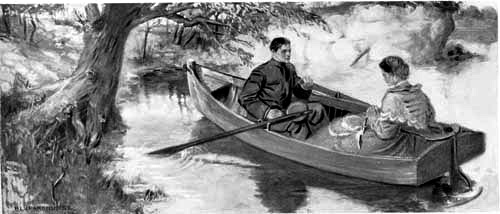
For the preliminary stages in the making of love there is scarcely anything that is so delightful … as a boat just large enough for two
Emily sat aft in the seat of honor, holding the yoke-lines and steering the skiff. In front of, and facing, her was Revere, with the oars, which, impelled by his powerful arms, afforded the motive power that speeded the boat on her way. He had been well trained, of course, and he rowed with the skill of a practised oarsman, a long, steady man-o'-war stroke, quick on the recover, delicate in the feather, deep and strong in the pull, which sent the boat flying over the water.
It was a sunny, delightful morning. The breeze blew soft over the harbor, and the water, rippling, bubbling, and lipping around the prow, made music suited indeed to words of love and beating hearts. Yet what they said was commonplace enough, after all. They did not say anything, in fact, for a few moments after they had pushed off from the little wharf. Revere was quite content to drink in the exquisite beauty of the young girl reclining in the stern-sheets before him.
He marked the freshness and sweetness of her face, the graceful curves of her vigorous, yet lissome, young body, and her dainty feet—the admiral was too thorough an aristocrat not to see his granddaughter well booted—peeping out from beneath the hem of her cool, flowing muslin skirt before him. From under her quaint, old-fashioned bonnet—a species of poke in vogue a year or two before—her blue eyes fearlessly and happily returned the ardent and admiring glances of his own. Lest the silence should prove embarrassing to her, however, and noticing, at last, that she dropped her eyes before him, he said,—
"I'd give a penny for your thoughts, Miss Emily, if I thought the coin would prove the open sesame to your mind."
"I was only thinking how beautifully you row, and wondering——"
"Yes, wondering?"
"How soon you had recovered from your accident, and how much better and stronger you seem than when I had to help you up the hill yesterday morning."
He laughed at this clever thrust, rather shamefacedly, it must be admitted, and flushed at the same time, while he answered her.
"I am afraid you will think me a great hypocrite," he admitted, contritely, realizing that he could lose nothing by frankness; "certainly, I am feeling very delightful—I mean, well and comfortable, now."
"Yet you are rowing in the hot sun! Now, I do not see how you can be comfortable at all, and I do not believe, since you feel so well now, that you needed any assistance whatever in getting up the hill. You deceived me. Neither my grandfather nor Captain Barry ever do that," she continued, gravely, at the same time looking reprovingly at him. She leaned back in the boat, as if the matter was decided. "I wanted to speak to you about it before, but there was always some one around."
"Miss Emily, let me explain," he exclaimed, filled with shame, surprised, yet pleased, to think she should take so trifling a matter so seriously. "You see," he added, half in jest and half in earnest, "after saving my life so gallantly the other night, I had rather a feeling of—er—dependence upon you, you know, the next morning, and it seemed natural and appropriate to ask you to help me up the hill. I could have gone up myself I—I suppose——"
"I am glad you are honest now, at any rate. I must say you seemed to acquire the feeling very lightly."
"Of honesty? Thank you!"
"I mean of dependence."
"I didn't. I never had it before. You see, it's dangerous to save a life. The one who is saved always feels that he belongs to the one who saves. Now, I——"
"How do you know so much about it?" she broke in, with instinctive promptness. She would like to have him complete his sentence, and yet, like all women, she tried to put it off; hence her interruption. "Did you ever save any one's life?"
"Yes, once," he replied, rather reluctantly, inwardly perturbed at the turn the conversation was taking.
"Oh, how was it?" she questioned, interestedly, dropping her tone of banter instantly. "Was it a fellow-officer?"
"No."
"A sailor, then?" anxiously.
"No; a young lady," desperately.
"Oh, a young lady!" she exclaimed in dismay, with a note of disappointment in her voice that she endeavored in vain to suppress, and which he was very glad indeed to recognize.
"Yes; one summer at Cape May. She got beyond her depth in the surf, and I swam out and brought her ashore without any great difficulty. Not a very romantic story, is it? Not half as much as—I mean, not at all——"
"Oh, I think it very romantic indeed," answered this child of nature, whose notions of romance and love and other things were drawn from the antique novels of her grandfather's library; "if I had saved any one's life I should——"
She stopped and blushed furiously as the natural answer to her impetuous remark sprang into her mind.
"I will finish for you," interrupted Revere, eagerly, his resolution of reticence recorded in his determination of the previous night growing decidedly faint in the face of the fascination she exercised over him. "I——"
He would have gone on, but something in her glance stopped him. With the quickness of love and intense sympathy he divined that the hour was not yet. There was an unspoken appeal in her eyes, in her burning cheek, her trembling hand, her heaving breast, which he could not disregard. He had been on the brink of an avowal. Thank heaven, he had stopped in time! For her sake and for his own he would be on his guard. He would not transgress again. He vowed it in his soul.
"I am deeply grateful," he went on, after a pause which somehow, in spite of him, expressed all he wished her to understand, "both to you and the sailor, and I hope to evidence my devotion and gratitude in some tangible way. By the way, what a strange character he seems! He appears to have taken a dislike to me. He said this morning he wished he had not saved me."
"How dared he speak so?" cried the girl, sitting up in the boat, her face flushed this time with indignation. "Not save your life? Why—but there," she went on, swiftly recovering herself, "he is a strange creature, as you say, and moody at times. He lives alone on the ship, and sees no one but grandfather and me. He is devoted to me. He would do anything for me."
"Those queer things in your room,—the harpoon, the shark's tooth, the model of the ship?"
"He put them there. They are odd things for a girl's room, are they not? but when you realize that they express the affection of an honest, faithful heart, they become quite fitting for any woman. Yes, I am fond of him, and I love those things for his sake. He is devoted to the admiral and to the ship, too."
Mr. Richard Revere was too profoundly conscious of the vast difference between Emily Sanford and any common sailor to feel the slightest jealousy at her ungrudging praise; indeed, he liked it.
"So I discovered," he assented, appreciatively. "Miss Emily, you go down to that ship sometimes; often, I suppose. Please do not go any more."
"Why not?" curiously.
"It is very insecure. I do not see how it can last much longer. Some day it will collapse into shapeless ruin; soon, I think. And if you were there——" He hesitated and looked at her. "Please do not go," he continued.
"But it will break Captain Barry's heart to have me refuse. I've always gone."
She spoke doubtfully, as if seeking a further reason.
"Better break his heart than throw away your life. Believe me, I have made a thorough inspection of the ship. It's unsafe. It's almost gone. I marvel that it stands now."
"Poor old ship!"
"Yes, 'tis sad indeed. But you won't go, will you?"
"Not—not—if you do not wish me,—I mean, not if it is unsafe," she answered, softly, looking down.
He had shot the boat in toward the shore of a little island in the harbor, and there, under the deep shadow of some overhanging trees, he stopped rowing, as he said, to rest a moment, just keeping the boat under control with the oars.
"Poor old ship!" continued the girl, mournfully, as she dabbled her sunburnt but shapely hand in the water; "when it goes, grandfather will go, Captain Barry will go, and I will be left—alone."
"No, no!" he exclaimed, softly, all his resolution gone in the face of the powerful yet innocent appeal. "Not alone, for I——"
"That girl?" she interrupted, meaningly.
"What girl?" impatiently.
"The one you saved. Is she beautiful?"
"Some people consider her so, I believe."
"What is she like?" breathlessly.
"She is tall and rather large. She has brown hair and brown eyes. She has been beautifully educated, and she is exquisitely bred."
"She sings, too, I suppose?"
"Yes; her voice has been very highly cultivated."
"And you have sung to her, with her?" sadly.
"Sometimes."
"That song we sang together last night?"
"Oh, no; she only sings classical music. I think she would disdain a simple ballad."
"Oh!" said the girl, with much disappointment, and humiliation as well; "I suppose they are simple, after all."
"I prefer them myself," answered Revere, tenderly.
The conversation was getting dangerous. She changed the subject at once.
"Have you made many cruises?"
"Only one. As soon as I was graduated I was ordered to the Hartford; but I was abroad when a lad, before I entered the Naval Academy."
"I suppose you have seen a great many beautiful and high-bred ladies in Boston and elsewhere?"
"Yes, a great many, indeed."
"Are they all very beautiful and charming?"
"Some of them are," he answered.
"I suppose," she said at last, desperately, "there are none of them like me?"
"No!" he replied, decisively.
"Is it so?" sadly. "Am I so different?"
"As different as day from night," joyously.
"Oh," softly, and with deep disappointment; "I have never been anywhere but just here. I have never seen any great ladies at all. I have never met any gentlemen except grandfather and—you. I do not know anything about the world beyond the horizon; but I have tried to read and learn, and I have dreamed about it, too. But I suppose one has to go and see before one can know of the people you speak of. You must think me so——"
"Emily," he said, his voice quivering with his feelings, "I have known you but two days, but I think you are the loveliest, the sweetest——"
She waved her hand in deprecation; but he would not be stopped this time. Truly he had forgotten all but his love for her.
"You do not know what the others know; I love you for that," he went on, impetuously. "You do not do what others do; I love you for that. You are not what the others are; I love you for that. There, it is out now. I did not mean to tell you just yet. I do not suppose that you can love me; at least, not yet. There is nothing in me that would win a woman's heart in two days, I know. But there is everything in you to win a man's heart in one glance; and I swear mine went out to you when I saw you holding the boat on the edge of the whirlpool, with your golden hair blown back in the wind and your blue eyes shining with encouragement and invitation."
It was heavenly to hear him, she thought. This was better than her dreams. She sat silent and still, her eyes persistently averted, quaffing deep draughts from a cup eternal, besides which even the nepenthe of the gods is evanescent.
"I won't ask you to answer me now; but will you not give me a trial?" he continued, hurriedly, fearing lest her silence might presage a refusal. "Let me have a chance to win your love, if I can. Let me see if I cannot make you love me. Won't you let me try? Emily, you are not even looking at me."
He was quite beside himself with anxiety now. She had been still so long. What could he do or say further? A small boat has its disadvantages for the ending of a love affair. In all his impatience he had to sit just where he was. He could come no nearer to her.
"If I could, Emily dear," he said, humbly beseeching her, "I would get down on my knees before you; but I can't in this little boat. Won't you please look at me? But perhaps you can more easily give me some hope if you don't look at me. Don't look. I'm not a very attractive fellow, I know."
This was an adroit move on his part, and his self-depreciation won a reply instantly.
"I—I like you very much," she said at last and very frankly. "I think I liked you when Captain Barry carried you up the hill,—even before, when you stood on the wreck. I wanted to help him. I don't know whether I—love you, but—what you have said has not been displeasing to me—on the contrary——"
"And you will try, you will wait? May I——?"
He waited breathless for her answer.
"Yes," she said at last, "you may."
"Oh, Emily!" he cried; "you have made me the happiest fellow on earth; and if I succeed in winning your love——"
"Do not despair," she whispered, softly, flashing a glance at him, her lips smiling, her eyes ashine with tears. "I think it has come," laying her hand on her heart with a sweet, unconscious movement. "I have dreamed ever since I was a woman that the prince would come some day from over the sea."
She stopped again. He stared at her in adoring silence. Her lips trembled, while her heart almost ceased to beat with the joy of it all. And her eyes were looking far away—over the sea, perhaps.
"We must not stay here longer," she said at last; "they will wonder what has become of us."
"You are the captain," he answered, laughing buoyantly in his happiness; "give your crew the order."
"Get under way, then," she replied, meeting his mood.
The little love scene had put strength into his arms. It seemed as if the power of his passion, failing other vent, had worked itself into the oar-blades, for the boat skimmed over the water like a bird, and in a few moments he unshipped his oars at the boat-landing. Swinging the skiff about so that the stern would be nearest the landing-place for her convenience, he stepped ashore, fastened the painter, and gave her his hand. Her own small palm met his great one frankly, and the two hands clung together in a clasp,—on his part of joy unspeakable, on hers of happy foreshadowings of the future.
Neither said anything as he helped her gravely up the steps. To kiss her then, even had they been alone, would have seemed to him sacrilege; there was something so holy, so innocent, so pure about the young girl, he thought, that he would like to throw himself upon his knees before her and kiss the steps her feet had trodden, so rapturous was his mood. Yet again, when he broke the silence, his words were commonplace. The noblest word would be ordinary when matched against his feelings then!
"What a sleepy, dull, dead little town this seems!" he remarked, looking curiously about him; "if it were a little handsomer, and overgrown with flowers and vines, it might be the town of the Sleeping Beauty; but the Beauty——"
"Is wide awake," she interrupted, a charming color irradiating her cheek, which made him sorry he had been so timid. "And awake without the prince's kiss, too!" she added, smiling archly, in that she was a very woman.
Perhaps, he thought, ruefully, she might not have resented that kiss, after all.
Well, the next time would see!
CHAPTER XIII
Love Holds the Yoke-Lines
As he anticipated, Revere found his man with a well-filled portmanteau and several letters awaiting him at the little old-fashioned country inn of the village. The morning was far spent when Emily finished her simple purchases, and the two lovers lunched together in the quaint old parlor of the inn. The girl, in her innocence of the customs of the world, was quite oblivious to the conventional necessity for a chaperon; so, without the embarrassment of a third party, they greatly enjoyed the wholesome and substantial meal provided for them by the skilful hands of the innkeeper's wife with whom Emily was a great favorite. They lingered a long time at the table in the cool old-fashioned room, and it was somewhat late in the afternoon when they started back to the Point, to which Revere had previously directed his man to repair with his baggage, by the land road.
The constraint which had been put upon both of them by the necessities of the business which had called them to the village, and the presence of other people wherever they went, for the officious but well-meaning landlady had frequently interrupted the privacy of the parlor even, had been the strongest force in developing the growing passions in their hearts.
Emily was a simple-minded maiden, with all the attributes of a very old-fashioned age. She had no mission to reform this world, which indeed she had found most sweet and fair, and sweeter and fairer that day than ever before; she stood for no so-called modern idea; she had no deep plan or mighty purpose for the amelioration of mankind,—or womankind either; she did not aim at the achievement of great results, the doing of mighty deeds. The complexities of her character did not manifest themselves in these ways.
Woman's sphere for her, if she thought of it specifically at all, was a very simple and a very old thing. To love and to be loved, to be first a faithful, happy wife, and second, please God, a wise, devoted mother, was the sum of her ambition.
There were no young men with whom she came in contact who could measure up to the standard of her social and intellectual requirements, and the chances that any would present themselves had been exceedingly small. So she had represented in her life a hope deferred, but without being heart-sick with the delay; she was of so sane, so healthy, and so happy a disposition that she had been saved all that. With the optimism of youth she had confidently expected that some day the prince would arrive, and when he came, together hand in hand they would go "over the hills and far away, to that new land which is the old." And the portals of that undiscovered country were now opening before her delighted vision.
Barely out of her teens, she had not grown impatient in her dreaming,—life had been too sweet and pleasant for that,—but the thoughtful and somewhat lonely years had made her ready, and it was no wonder that at the touch she yielded. When Revere came to her out of the deep, cast up at her feet by the waves of the sea, as it were, he fitted into anticipation already old. He represented the realization of her maidenly desires and her womanly hopes. That she should fall in love with him was entirely natural and quite to be expected, especially since he was blessed with a personality at once strong, lovable, and charming.
The reserve and the calmness of Revere's long line of Boston ancestry had been tempered, modified, brightened, by his sailor life and by his intimate contact with great and heroic men in the war which was just over. Frank, genial, generous, and not without a certain high-bred distinction in his manner, and blessed with a sufficiency of manly good looks, he might well have hoped to win any woman's heart.
The day had been a happy one to Emily, then; happier for her than for Revere, in fact, for that young man's conscience troubled him deeply, while there was no cloud on her sweet pleasure. If he had not been engaged to Josephine he would have revelled in his love for Emily; but he was not free. He was now bound to two women at the same time, and not in strictly honorable relationship to either. The false position was almost unbearable to a man of his fine sensitiveness, and that he had made it himself did not make it less easy to endure. He firmly resolved to extricate himself from his dilemma by informing Josephine at the first opportunity.
No other course was left to him. Since he had seen and known Emily he felt that it would be impossible for him to keep his previous engagement, and yet he realized that it would have been more honorable for him to have controlled himself as he had determined, better to have been less precipitate and to have waited until he had gained his release before he offered himself to Emily.
Carried away by his feelings, he had proposed to her in the boat, and he regretted, not the fact,—never that,—but that he had been so little master of himself, that he could not have delayed his wooing for a few days, until, being made free, he could definitely and properly and honorably ask her for her hand. He felt, for instance, that he could not speak to the old admiral upon the subject until he had secured his release. It would be impossible for him to approach that soul of ancient honor other than free.
Yet when he looked at the girl; when the clear, sweet notes of her fresh young voice thrilled in his ear; when walking by her side her dress brushed against him; when by chance or design he touched her, or her hand met his; when she looked at him out of those frank, honest blue eyes; when he saw the color come and go in her cheek, marked the beating of her heart, caught the unconscious affection with which her eye dwelt upon him at times, when she thought herself unobserved, he vowed that he stood excused in his own heart for his precipitancy.
Every moment when she did not feel and know that he loved her he, in his turn, counted a moment lost. He could hardly wait to get back to the house, where he determined to write to Josephine instantly and apprise her of the situation. He felt, as a matter of course, that she was too proud a woman to hold him to an unwilling engagement for a single moment. Whether she loved him or not he could not say. He thought not, he hoped not. Their engagement had been a matter-of-fact affair, and the courtship had been rather a cool one. He was perfectly certain that she liked him, but that was very different. He had never once seen her breath come quicker when he approached her, the color flush or fade in her cheek as he spoke to her. But he could not be sure. The veneer of birth, custom, and environment had not been worn off of her as it had been stripped from him, and her outward action beneath all this coolness afforded no infallible guide to her feelings.
If she loved him, that would indeed complicate the matter, but there could be—there must be—no other issue than that the engagement should be broken. He would be very sorry for her in that case, but there would be nothing else to be done. He could not help it that he had fallen in love with some one else, and the only honorable thing to do now was to tell the truth at once and break away. A man's reasoning, certainly!
As they approached the wharf where the boat was tied Emily noticed that Revere looked pale and tired. The violent current of his thoughts, the acuteness of the mental struggle in which he found himself involved, together with his low physical condition, had worn him out. Therefore the girl insisted upon rowing back herself.
Even in the dependence of the first love of a young maiden there is a feeling of protection, a foreshadowing of the instinct maternal, which is the foundation of most of the good things in this life, even of the habit and practice of religion. Emily, while she gloried in his virile manhood and dwelt happily upon his strength and vigor, already watched over Revere as she might have looked after a child. And she delighted in the opportunity of doing her lover further service. So Omphale might have considered Hercules.
"I want to show you how beautifully I can pull an oar," she artfully said, in answer to his expostulation, herself only half comprehending the deep springs of action that lay in her being; "and you look so tired. You know you are not yet strong. I ought not to have allowed you to come."
The sense of ownership implied in her last words was delightful to both of them.
"I am tired," he said, honestly, "but not too tired to row you back; and I wouldn't have missed this little voyage for all the cruises of a lifetime. Please get into the boat and take the yoke-lines."
"No," said Emily; "you said I was captain, and I mean to exercise the privileges of my position. Take the yoke-lines yourself. I insist upon it."
"Oh, very well," assented the young sailor, smiling at her; "I have been under orders, it seems to me, ever since I was born. First mother, then Josephine, and now you."
He sat down in the stern-sheets with affected resignation and gathered up the yoke-lines.
Emily's face had changed somewhat at this last remark, but she said nothing as she cast off the painter, stepped to the thwart, shoved off the boat, broke out the oars, and pulled away. She rowed a pretty stroke, quite as deft as Revere's had been, though lacking somewhat in power. As they cleared the wharf and headed out into the bay toward the Point she looked up at him.
"You have always been under orders, you say?"
"Yes."
"First your mother?"
"Yes."
"And then,—who did you say?" with poorly simulated indifference.
"Josephine,—Miss Josephine Remington," carelessly.
"And who is she?"
"Oh, she's an old friend of the family, a connection in a far-off way. She has lived with us pretty much since she was a child."
"Are you fond of her?" coldly.
"Yes," with mischievous promptness.
"I suppose so," looking away.
"But not so fond of her as I am of you, Emily," tenderly.
"Is that really true?" eagerly.
"Upon my word and honor," with convincing assurance.
"And you don't love her?"
"Not a bit. I love only one person in the world, and that is you," passionately.
"Was she the girl you saved?" relieved, but still somewhat anxious.
"She was."
"Does she love you, I wonder?"
"I think not. She never gave me half as much evidence of caring for me as——"
He stopped suddenly.
"As what?" she asked in swift alarm.
"As—forgive me, Emily—as you have this afternoon."
She stopped pulling instantly, her oar-blades lifted from the water in mid-stroke, drops trickling from them.
"Have I been bold and forward?" she cried in dismay. "Oh, what must you think of me?"
"You have been perfect," he answered, fervently; "simply perfect. I wouldn't have you changed an iota in any way. Don't let's talk about other people now. I'd rather talk about you. Tell me something about yourself, about the life you have lived, what you have done, what you have thought, what you have dreamed; tell me everything. I want to know it all."
"Yes, but are you sure you do not love her?"
"I never was so certain of anything in my life, except it be that I love you."
There was conviction in his voice which comforted her soul. Still, she sought enlightenment upon another point.
"Are you sure she doesn't love you?"
"I think it is very improbable."
"Well, I don't, then!" she exclaimed, vigorously resuming her stroke. "You saved her life, and I don't see how she could help it," she continued.
"I didn't save your life, though, Emily."
The boat was in the shadow of the island trees, where it had been when he had first spoken of love to her that morning. She let it drift; again the water made sweet music lipping along the side; they would associate it forever with these ineffable moments.
"No," she murmured, her honesty and innocence giving her courage to say that which another might have sought to conceal, "you didn't, but—I don't believe—I can—help it, either."
It was out now. His love had shown her her own. She was another woman; never again would she look at life with the eyes of the girl of yesterday. Ferdinand had come to Miranda; and Ariel had opened the eyes of the maiden to new things on the old island more wonderful than those revealed by Prospero's magic wand. And to Revere, too, the complexion of the world suddenly and swiftly altered.
"Oh, Emily, you don't mean it!" he cried in exultant surprise. He had not hoped so soon for this revelation of the woman's heart.
Her face was averted now, but she spoke distinctly enough for him to hear every whispered word.
"Yes, I think—I believe—I do. I have thought about it a great deal since you spoke."—Three hours ago! "And I believe I——"
She could not quite say it—yet.
"Emily, dearest, I am so happy it seems to me I can hardly breathe. I do not dare to look at you. I love you so! Come, let us hurry back to the shore."
"Mr. Revere——" she began, starting the boat again.
"That will not do at all," he interrupted, promptly and decisively; "you must call me something else—now that you—oh, do you?"
"Richard," she said, bravely.
"Those who love me call me 'Dick,'" pleadingly.
"I couldn't say that—not just yet—Dick!"
He laughed in sheer pleasure.
"I never knew what a pretty name I had before, Emily."
"I think it is lovely," she said, naïvely.
"Thank you. Do you like my other name, too?"
"Oh, ever so much."
"I am so glad, because it will be yours. Mrs. Richard Revere."
"Hush, how can you!" she cried, blushing furiously. "I want to ask one thing of you. Do not say anything about—to-day. That is, to grandfather or Captain Barry,—not just yet."
"I'm not likely to say anything about it to Captain Barry now or at any other time," he laughed; "and as for the admiral, it will do no harm for us to wait a day or two, I fancy,—that is, if you wish it, princess."
Her desire suited his plans admirably, for the delay would give him time to write and get his freedom.
"I want to enjoy it first alone," she went on, dreamily. "I want to have the knowledge that you love me all to myself, just for a day. It's so sacred, and so solemn a thing to me, Richard; so beautiful, that I want to keep it just here in my heart alone, for a little while."
She laid her hand upon her heart with the sweetest gesture as she spoke.
"It shall be so," he answered, frankly, adoring her. "Whatever you wish shall always be, if I can bring it about."
Oh, the rash promises of lovers!
"And you will let me have my happiness to myself, then? You will not think me foolish?"
"Not all to yourself, for, though I do not speak, I must still share it, and I think you are perfect in everything."
"We are at the wharf," she murmured. "I must go up to the house alone. Do not come with me. I want to think it over."
"But, dearest, I shall see you to-night?" he pleaded.
"Yes; but please do not persuade me now."
Respecting her desire, he doffed his cap and stood aside for her to pass, bowing low before her with all the chivalry of his race, all the ardor of his youth, all the devotion of his manhood in his look and attitude.
The sweetness of the present reality so far transcended her sometime imagination of it that the girl, on leaving him, walked away as if borne by seraph's wings through the air of heaven. Yet there was a note athwart her joy,—not exactly one of sadness or of heaviness, but a feeling, as it were, of maidenly awe before the bright vistas of happiness which had opened before her eyes, in her lover's presence, in his love. Unconsciously she put her hand to her face, as if the sight dazzled her.
A little distance away Revere, having fastened the boat, followed her up the hill. She did not look back, but she could hear his feet upon the steps. He was there, then. He was looking at her as he had looked at her in the boat. He loved her. What had she done to merit this?
She stopped on the porch by the chair where her grandfather sat gazing at the ship and dreaming as usual. She bent low and kissed him as she had never kissed him before. He awoke from his reverie with a start, half comprehending, and gazed from the girl entering the door to Revere coming up the walk.
"You have been a long time, lad," he said, as the latter stopped before him.
"Yes, sir. We took luncheon together at the old inn and rowed back slowly. Your granddaughter—I shall have something to say to you in a day or two, sir."
"I hope so," said the admiral, quietly. "I thought so. But don't wait too many days. Days are as moments to the young; to the aged they are as years."
That day Barry had not left the ship. With a long, old-fashioned glass that was chief among his treasures, which had belonged to the admiral, he had followed the boat across the harbor. He had divined—by what cunning who can say?—what had been said in the pauses under the trees. He had waited and watched for them until the lovers came back. He knew it all. Twenty times during the period of their stay upon the shore he had gone down to the locker and taken out the letters.
And at last he had succumbed to the temptation. The devil had won him in the end. Hidden away in his corner of the old vessel, he opened the bundle of letters and orders. And as he painfully deciphered them, one by one, it all became clear to him. This cursed officer had come to sell the ship over their heads. He had stolen Emily's heart, and yet he was engaged to be married to another woman. The letters from Josephine Remington puzzled him; but as he slowly blundered through them, with their casual references to an engagement, with their quiet assumption that all was understood between the two, Barry became convinced that Revere was simply amusing himself with the admiral's granddaughter.
And was he to stand idle, indifferent, impotent, while these things were going on? Was the old ship to be sold and broken up? His ship! His love, too! Was that sweet flower of innocence to be rifled of the chief treasure of her womanhood and he do nothing? Was she to be robbed of her happiness, too, while he was there? No, never!
His brain reeled under the pressure of his thoughts. What should he do? What could he do? In what way might he compass the destruction of this man? Save the ship and save the girl, too!
Ah! Like to one of old in his blindness, there flashed an idea into his mind, as he stood there with the crumpled letters in his clinched hand. At first it startled him. It was so bold; in a way it was so terrible. But he had brooded too long to look at that idea in more than one light. With the one thought of revenge upon the man who he imagined intended to sell the ship, and who would gain Emily Sanford, he brooded upon the notion until it took entire possession of him, and then, although it involved his own destruction, he grimly prepared to put it in practice.
CHAPTER XIV
In the Shadow of the Ship
The rest of the afternoon passed swiftly enough for Revere, because he was busy. He wrote a long letter to Josephine Remington, telling her frankly the whole situation: how he had met this girl, how he had loved her, how he had struggled against the feeling that had sprung up in his heart, honorably intending to keep his engagement, but each moment convinced him of the depth and fervor of this sudden affection. How he had come to the conclusion that it was not fair to bind her to a man who, while he admired and respected her, while he should ever hold her in the highest regard, did not, and could not, love her.
He had written to her thus frankly that she might break the engagement. He could not, he said, flatter himself that she loved him, or that it meant much to her; yet if he grieved her, he humbly begged her pardon, and hoped that some day, when she truly loved some one, she would find excuse for him.
It was fearfully hard to write such a letter, and as he read it over it seemed almost brutal in its frankness. Yet he reasoned that it were better to write it as he had than to attempt to conceal the facts; still, it was with many misgivings and thoroughly sick at heart at the unfortunate plight in which he had involved himself that he sealed it up.
The other letter was to the Secretary of the Navy. Revere reported faithfully the condition of the ship, estimated carefully what he thought she would be worth as firewood,—for the materials in her were fit for no other purpose,—and then frankly offered to buy her himself for twice the value he had put upon her. In a private letter, which he had enclosed in his official report, the secretary being an old friend of his family, he told why he wished to purchase the ship. He told him about the admiral, and the old sailor, and the admiral's granddaughter. He made him see very clearly that it would kill the old man to have the ship broken up, and, since he possessed ample means, he wished to have the privilege of purchasing it himself and saying nothing about it to the admiral, or to any one,—letting it stand where it was as long as it would. As a matter of fact, it would fall to pieces in a short time he was certain, and the admiral need never know anything about the transaction, provided the secretary were willing.
If there was any doubt as to the accuracy of his valuation of the ship, he suggested that another officer could be sent to appraise her, and he stood ready to pay twice the amount of the next appraisement for the privileges of ownership. In fact, the matter would best be done that way. It was a nice letter, and he felt sure his request would be granted.
Revere felt much better when he had completed these two letters. He felt that he could save the ship for the old admiral, and that he could save his honor as well by his tardy action. He gave the letters to his man, directing him to mail the one to the Secretary of the Navy, and get a horse and ride back to his mother's summer home at Alexandria Bay, deliver the other in person, and bring the answer to him immediately. He could not hear too quickly from Josephine.
The admiral retired early that evening,—was it from a consideration of past experience, thought Revere,—so the two lovers were left alone.
"Emily," said the young lieutenant, coming over toward her as the door closed behind the old veteran.
"No, no, not here, I beg of you!" said the girl, rising to her feet. "Come, let us go out into the moonlight. Down to the old ship. It should be a part—a witness—of our betrothal. I, too, have loved it. The earliest recollections of my childhood are about it. It has been a part of my life as well. Come, let us go."
She extended her hand to him as she spoke. He took it gravely, and the two stepped out of the house and stood upon the porch. The moonlight streamed across the old ship, standing lonely and still upon the Point beneath them. The cracks and crannies, the gaping seams of the broken, mouldering sides, the evidences of decay, were hidden in the shadows cast by the soft splendor.
They walked down to it and stopped in its shadow. Black, solid, and terrible in the silver light it loomed above their heads. They stood almost beneath it, and it towered into the skies above them. A trick of the imagination would have dowered it with spars covered with clouds of snowy canvas, and launched it upon the sea of dreams.
The girl still held the hand of the young officer. He waited for her pleasure, something telling him he should not wait in vain.
"I brought you here, Richard," she said, at last, very gravely, "that the old ship might hear you say,"—the words came from her in a faint whisper,—"that the ship might hear you say—you—loved me. Here I have stood often, gazing out upon the water, dreaming and waiting. Waiting for you, Richard, dreaming of you. And here you come to me and here—I give myself to you."
She faced him as she spoke and took his other hand. He stared at her in the shadow of the ship. The little autumn breeze swept softly over their faces. Slowly he bent his head toward her. She awaited him, smiling faintly, her heart beating half fearfully. It was so new and sweet. Then his lips met her own; he kissed her, he swept her to his breast, he gathered her in his arms. Her head lay upon his shoulder, her face was upturned to his. Her eyes were light in the darkness to him. The perfume of her breath enveloped him. A faint, passionate sigh of joy and content ineffable escaped her. He drank in the white, exquisite perfection of feature so close to him; the purity of her soul spoke there equally with the passion of her heart. She was his, his own; she loved him, she gave herself to him! May God deal so with him as he dealt with her!
"I love you, I love you!" he murmured.
Pity 'tis that there is no new word for each new meeting and mating of human hearts in this old world.
Pity 'tis that the words we say so lightly, that we use so frequently of things of less, of little, moment, should be the only ones we have with which to voice the deepest feeling of our being. Yet when the hour strikes, to each heart they come with the freshness of a new revelation, with the assurance of an eternal truth undiscovered until that hour. Never again would Emily be so happy as in that supreme moment of avowal and confession.
"I love you, I love you!"
It was only a whisper. She would have felt the truth had he been voiceless.
"I love you, I love you!"
It was but a murmur that blended with the sigh of the wind, that harmonized with the sound made by the breeze as it swept through the cracks and crannies of the ship, yet another listened, another heard.
Profanation to the royal arcanum of their hearts!
One had marked them descending the hill, one had divined that they would stop by the ship, one had gone down into the grim, black depths of the monster and with his ear pressed against the riven side had heard, and in the hearing had understood what he could not see.
So despair, heart-break, envy, jealousy, raged a few feet from love and joy and peace ineffable.
So in life it happens. Was there not a serpent in the Garden of Eden?
As he heard the sound of lip on lip, the break of kisses, and the murmur of caressing words, the man listening could endure no more. He turned and stumbled blindly away. Had it been mid-day he could not have seen where he went.
The sound of his going startled Emily.
"What is that?" she cried; "something moving on the ship!"
They listened, but Barry had gone far enough away by that time for them not to hear him more.
"'Twas nothing, dearest," answered Revere, holding her tenderly to him; "a piece of timber, a loosened plank, a tottering frame. The newest and best of ships are full of strange sounds, much more these old ones."
"Bit by bit it wears away," said the girl, sadly.
"Ay, sweet, old things go, but new ones come," answered Revere. "Life ends, yes, but new life begins. It begins for us. Come. We have told the ship the story. Let us go back to the hill."
"Keep thou the secret, old ship," said Emily, fancifully, yet half in earnest; "tell it not while thou livest, and if thou must fall, let it perish with thee."
She bent and kissed the plank. Where she kissed it Barry had listened. The whisper of love and the oath of despair,—a few inches of sheathing alone divided them.
CHAPTER XV
Forgiveness the First Lesson
"That kiss, sweetest," said Revere, gravely, as they walked up the hill, "has made the ship immortal in my heart. It shall stand until it falls away. I was sent here by the government to sell the ship. It was to be destroyed."
"Oh, Richard!" she cried in sudden anxiety and alarm at his words.
"Nay, love; say nothing of it to any one. It shall not be."
"Who will prevent it?"
"I."
"You! But how?"
"I shall buy it myself and let it stand as long as it will."
"How good you are!" she exclaimed, greatly relieved. "But, Dick, are you rich enough to buy a whole ship yourself?"
"My darling," he answered, "since you kissed me I think I have the mines of Golconda at my command."
"Ah, but kisses won't buy ships," returned the wise maiden. "Seriously, Richard?"
"Seriously, dearest, I suppose I am rich enough to buy anything I want; that is, anything in reason that is buyable. No fortune could put a price upon you, I am afraid."
"Nonsense, Dick!" said the girl. "Are you as rich as that?"
"I am of the opinion that I am," he said, somewhat reluctantly; he could not exactly comprehend why. "Does it disappoint you?"
"No, I believe not," she answered, doubtfully. "I never dreamed of such a thing, I'll admit. I always thought we would have a little cottage somewhere——"
"We?" joyfully.
"Of course. We. I was waiting for you, you know."
"Well, dearest, I hope you will become accustomed to something larger than a cottage. Money has some advantages, you know."
"I doubt not I shall if you will teach me. Oh, Dick, I am so happy! I feel so sorry for that other girl."
"What other girl?" he asked, faintly conscience-smitten.
"Josephine, you know. The girl you saved."
Her words struck him like a blow. They brought him to himself. He had to tell her the truth. They were by this time sitting side by side on the gun-carriage on the little platform overlooking the brow of the hill.
"Emily, dearest," said Revere, desperately. He hated to do it; he told himself that he was a fool to say anything, yet her presence and her trust compelled him. "I have something to confess to you. I cannot allow a shadow of deceit to rest on our happiness this heavenly night, and even though it hurts you——"
"Tell me, Dick," she said, as he lingered, reluctant to speak, "whatever it may be. I think I have had happiness enough to last a lifetime as it is; and you love me, don't you? It is not that you do not?"
"Love you? I worship you!"
"Then nothing can matter much," she interrupted.
"But I must say it," he persevered; "I am—I was engaged to marry——"
"Josephine?" a note of terror in the exclamation.
"Yes," with great contrition.
There was a long silence. The girl shrank away from him. She hid her face in her hands, but she did not weep. That would come later. Was she not to be happy, after all?
He felt so guilty and conscience-stricken that he made no attempt to restrain her movement of avoidance, although he longed to take her in his arms again.
"Oh, Richard, how could you?" she said at last, the misery and reproach in her voice cutting him to the heart.
"I could not help it."
It was the old answer that seems so weak, so futile, so foolish, and yet the only answer that could be given; a vague reply, and yet she comprehended.
"I've been a mean coward," he exclaimed. "But at least I love you, and I could not help it."
"Yes, I believe that—that you love me, I mean,—but you could have helped it," she answered, faintly.
"Well, I ought to have helped it," he admitted, in honest misery; "but I love you, and before you it was hard to be silent."
"But you loved the other girl before?"
"No, never, I swear to you!"
"Look me in the face, Richard."
She turned him about in the moonlight and gazed at him keenly, passionately, hungrily almost. He met her glance undaunted. The incubus of the secret was lifted from him—he was another man, even though still bound.
"Emily, I swear to you that my heart has never beat quicker at the thought of her since I have known her. Believe that."
"Yes, I do believe," said the girl, trustingly, at last.
"It is true, and you may. It was an engagement entered into as a sort of family affair, and I never cared anything about it one way or the other. I thought it would be rather pleasant——"
"Is that all?"
"Yes, on my honor, until I met you; and then I knew it could never be."
"You said you were engaged to her, Richard. What do you mean by that?"
"As soon as I could after I had spoken to you this afternoon I wrote to her, telling her the truth about my love for you and giving her a chance to break the engagement."
"Where is the letter?"
"It is gone."
"Suppose she will not break it?"
"She will, of course."
"Dick, I know that she loves you. I know she won't give you up. Oh, my heart is breaking!"
"Nonsense; she doesn't love me at all!"
"No woman could help it who knew you as I do," decidedly.
"No one knows me as you do, dearest. To no one have I ever shown my heart, myself, as I have shown them to you. She must give me up; she shall! I tell you I will marry no woman but you, no matter what happens!"
"And I, Dick, will marry no one but you. But, oh, the pity of it! Why didn't I know you before?"
"But you believe me, don't you, that I love you, only you?"
"Yes, yes, I believe," mournfully.
"And you will trust me?"
"Yes, I suppose I will have to trust you," she answered.
"But you won't do that merely because you have to, will you?" pleaded the young man, coming nearer to her.
"No," she said at last, faintly. "I will trust you because I—I love you."
He suddenly swept her to his breast again and kissed her once more. But she did not return his kiss, and immediately thrust him away from her.
"Please do not do that again, Richard; at least not yet," she murmured, as she resolutely disengaged herself from his embrace. "Poor girl! you don't love her. And now good-night. I must think—it's all so strange—I don't know. We will talk over what is best in the morning."
"But you love me still? You won't let this make any difference, will you?" he pleaded, in deadly anxiety, stretching out his hands to her.
"It won't make any difference in my love,—nothing will ever change that," she answered, sadly; "but it makes a great difference in my happiness."
Poor Emily! she was just learning that the beginning of a woman's love is forgiveness.
In the oldest of Books is written, "It is not good that man should be alone," and the saying is as true as it is ancient. The human being who looks at things through but one pair of eyes—his own—is apt to receive distorted impressions, to see strange visions, and to dream fearful dreams.
To be solitary is to go mad. Society is the preserver and promoter of intelligence and all the virtues; alas! of many of the vices as well. Men—ay, and women, too—have tried to dispense with humanity, seeking something higher. They have withdrawn themselves from the world a while, and, far from the madding crowd's ignoble strife, in the vast expanse of some limitless desert, or upon some rough-ribbed Sinai's rocky crest, in seclusion from the sound of tongues and the war of men, have sought to draw near to God.
And they have not found Him. Rather Satan has entered into them and they have become victims of diabolic obsession. For God is in the people. The human touch conveys the divine. The attrition of men is the outward force that makes character. Life is to fit in and be a part of daily duty among common men. So other and higher life is won.
Barry was a man, alone,—a madman now. Revere had added the finishing touch by breaking in upon the man's solitude. The admiral was becoming only a daily duty to the sailor. Habit had almost encysted his affection for his superior. As Emily had approached womanhood she had drawn away from Barry. He worshipped her from a greater and greater distance, constantly increasing. And now that she loved one of her own age and her own class, the old man felt that she had almost vanished from his sight. The last link that held him in touch with humanity was breaking. Should he not strike while there was time? Love was not for him, but hate is everybody's. He should claim his portion.
The rotting ship was his mountain, his desert, his hermitage. Its bare, gaunt timbers were his horizon. He looked, he listened, he read again the letters, he agonized, he broke, and was lost. And when the devil came to him, under the guise of good to be accomplished, he found a place ready, swept and garnished for him.
Oh, poor, blind, possessed old sailor!
CHAPTER XVI
A Cloud on the Horizon
A quickened conscience is not the best of soporifics, and Revere was a long time in getting to sleep. The miserable situation into which he had plunged himself, however, was alleviated by the consciousness, of which nothing could deprive him, that Emily loved him. And he persuaded himself that when a girl, such as he fancied her, loved, she loved forever. Which was true. There was much comfort for him in the idea. He could not, however, take the joy that should have been his in the realization of this glorious fact until his affairs with Josephine had been adjusted. As for Emily, she, too, mingled her grief at the pre-engagement with joy in Richard's love, but with less confidence in its permanence; and, like his, her hours were sorely troubled.
The next morning she carefully avoided seeing him except in the presence of others, and the topics they were both dying to discuss remained unbroached until a messenger from the village, a servant of the inn, delivered a note to Revere. The admiral and Emily were on the porch with him when the missive was handed to him. Barry was busy at something down on the ship. He had reported to the admiral early in the morning that there were some repairs that he wished to make which would probably take him the whole of the day. However, nobody, unless it was the admiral, missed him, in which lay the pity of it all.
Revere started with surprise as he glanced at the address on the envelope.
"Why!" he exclaimed, involuntarily, "it is from my mother! Can it be possible that she is here?"
"A lady guv it to me to bring to you," said the messenger. "She come to the tavern late last night, an' said as how she didn't want to disturb you until mornin'."
"Your mother!" exclaimed Emily. "Why—what can she—how does it——"
As she spoke Richard tore open the letter and glanced at its contents.
"She has heard some garbled account of my adventure," he said to Emily, "and she was worried, and has come over here to see me. That's all."
"Did she come alone?"
"Er—no; not exactly."
"Who is with her?" with dawning suspicion.
"Miss Remington."
"Oh!" with great surprise.
"Well, I must go to her at once, I suppose," said Revere, doubtfully.
"Of course," coldly and disdainfully.
"My lad," said the admiral, "the inn is but a poor place for ladies of quality and gentlefolk to stay. Present my compliments to your mother and her young friend, and beg them to honor me by accepting our hospitality while they abide in this latitude. Tell them, I beg of you, that my age and infirmities prevent me from extending the invitation in person, but that my granddaughter will call upon them later and invite them in my behalf."
"Oh, grandfather! I—I——"
"My mother will be delighted to receive Miss Emily," broke in Richard, quickly. "I have no doubt that her plans contemplate remaining here longer than a day, and I think she will be glad to accept your hospitality. She will be honored, I am sure. Meanwhile, I must go. May I have your boat, Miss Emily? I suppose that is the quickest way to the village?"
"Certainly, Mr. Revere."
"And will you not walk down to the landing with me?"
She hesitated, longing yet reluctant.
"Of course she will. Go with him, Emily," said the admiral, decisively.
"Richard," said the girl, as soon as they were out of earshot of the porch, "they have come about that letter."
"Yes," answered Revere, dejectedly, forgetting in his confusion that they had arrived the night before; "I suppose so. I didn't think it possible that it could have reached them by this time. My man must have made good time. Oh, dear; what shall I do? Was ever innocent man placed in so miserable a position?"
"Oh, Richard, you are involved innocently—you say you could not help loving me——"
"I couldn't."
"But you had no right to involve me, sir. But there, I won't reproach you. She won't give you up; you will have to keep your word, that's all."
She spoke with infinite sadness.
"You have loved me, anyway, and that's a great deal. I ought to be thankful for that, I suppose," she continued.
They were sheltered now from the observation of every one,—but Barry from the ship,—and she put her handkerchief up to her eyes and sobbed out the following in broken sentences:
"I've thought it out all night long, Richard. You saved that girl's life; she has a claim on you. I know she loves you deeply; and of course she won't give you up. I—I wouldn't myself," she wailed. "I hope you will be very hap—hap—happy with her and—you will forget all about this. Oh, Dick, Dick!"
"My heavens! Emily, you nearly drive me distracted! I tell you I couldn't be happy with an arch-angel if she were not you! She must give me up! She shall! I don't really suppose she will hesitate a moment. Why, if she could see you she would know in a glance that I could not help falling in love with you."