Part II Stories to Tell
Reading edition
I FAIRY AND WONDER TALES
(Adapted for Children, Three to Six Years.)
1. THE RUNAWAY PANCAKE
Once upon a time seven hungry children were standing around the fireside, watching their mother frying a pancake for supper. “Oh, give me a bit, mother dear, I’m so hungry,” each of the children said. “Yes,” said the mother, “only wait till it turns, and you shall have some.” Pancake trembled and tried to jump out of the pan, but its back was so weak that it fell flat again on the other side. When that side was cooked, and its back felt stronger, Pancake gave a spring, jumping right out of the pan upon the floor, and began rolling away like a wheel, out through the door and down the steep hill. “Stop! Stop! Pancake!” cried the mother, running after it with the frying-pan in one hand and the spoon in the other. “Stop! won’t you stop?” all the children screamed; but Pancake rolled on faster and faster down the hill. It was a funny sight to see a man, and a hen, and a rooster, and a duck, and a goose, and a gander, all joining in the chase, trying to catch Pancake, who slipped by them all and rolled on. At the bottom of the hill there was a deep river. Just as Pancake rolled near it a Pig came up and said, “Pancake, roll on my snout, and I’ll take you safely across.” “Thank you,” said Pancake, rolling right upon Piggy’s nose. He sat there till they reached the other side in safety. “Ouf! Ouf!” then grunted the Pig; “what will you pay me for carrying you across?” When Pancake said, “I haven’t anything to pay you,” the Pig threw back his head, opened his mouth wide, and down went Pancake, saying, “I wish I had been eaten by those poor, hungry children, rather than by this nasty Pig!” And that was the end of Runaway Pancake.
2. THE LITTLE RED HEN
Once there was a Little Red Hen that lived, so neat and tidy, all alone in her house in the wood. Over the hill and far away in a den in the rocks lived a bad young Fox. He wanted to eat the Little Red Hen, but every time he went to her home he could not get her. One morning he took a big bag and told his mother to have the pot boiling when he got home so they could cook the Hen for supper that night. Over the hill he crept, trot, trot, trot, and saw Little Red Hen picking up sticks in front of her house. The Fox quietly slipped in without being seen, and hid behind the door. The Little Red Hen came in with her apron full of sticks, but when she saw the Fox with his bushy tail spread out on the floor, she became so scared she flew with a great scream to a high beam under the roof. The tricky Fox began to whirl around and around after his tail so fast that the Hen got so dizzy she fell to the floor. Quickly the Fox picked her up, popped her into his bag, and trotted off for home. Coming to a hill he thought he would stop, to take a rest, and he put his bag on the ground. Quick as a wink the Hen pecked a hole in the bag, jumped out, rolled a stone into the bag in her place, flew away to her home, and locked the door. “The Little Red Hen is heavy,” said the Fox as he started off again. As soon as he saw his mother, he cried, “Here is the Hen for our supper. Lift the cover off the pot, while I pop her in.” When the mother lifted the cover, the young Fox untied the bag and gave it a shake. Pop! Splash! Splash! Into the boiling water dropped the heavy stone. Out flew the boiling water, splashing and scalding the young Fox and his mother to death. So the Little Red Hen lived happily and tidily in her house after that.
3. THE GOLDEN GOOSE
Once a mother lived with her three sons in a house in the woods. One day the mother said to the oldest son, “Go, and cut wood in the forest, and here is a good dinner for you.” At dinnertime a queer, little old man came up and said, “I’m so hungry. Give me some of your dinner.” “Be off,” said the selfish boy, and he ate all his dinner by himself. Then he began to chop down a tree, but his axe slipped and cut his leg, and he went hobbling home without any wood. Next day the mother said to the next boy, “Go, and cut wood in the forest, and here is a good dinner for you.” At dinnertime the same queer little old man came and said, “I’m so hungry. Give me some of your dinner.” “No,” said the selfish boy, who ate all his dinner by himself. Then he began to chop a tree, but his axe slipped and cut his foot, and he went hobbling home without any wood. The next morning the youngest boy, Dummling, said, “Mother, I’ll get you some wood.” His mother gave him only some dry crusts, and he went into the woods. The same little old man came, saying, “I’m so hungry. Give me some of your dinner.” “Yes, gladly, I will,” said Dummling. In a moment the little old man changed the dry bread into a rich feast, and they both ate as much as they wanted. Then the little old man said: “You have been kind to me. Now I will do something for you. Cut down this tree, and at the roots you will find a Golden Goose.” Dummling quickly chopped down the tree, and in a hollow at the roots found a Golden Goose. He picked it up and went to the nearest stopping-place for the night, where he found three sisters who wanted some of the golden feathers. So, when Dummling had gone to bed, the oldest girl went in where the goose was to pluck a feather, but she stuck fast. The second girl came in later to pluck a feather, and she stuck fast too. Then the third sister, greedy for a feather too, put in her hand to get one, and she stuck fast. So the three girls had to stay with the goose all night. The next morning Dummling came in, and, not noticing the girls were stuck fast to it, picked up the goose and started off with it under his arm. The three girls were obliged to follow as fast as their legs could carry them down the street. A minister seeing the strange sight called out, “Shame! following a man like that! Let go!” But as soon as he touched them he stuck fast and had to follow. Then a policeman ran up, saying to the minister, “For shame! following girls like that! Let go!” And as soon as he touched them he stuck fast and had to follow. It was a funny sight to see these five trudging behind one another. “Help! Help!” cried the policeman. Then two men going to work with picks and spades ran up, but as soon as they touched them they stuck fast and had to follow. So these seven, all in line, treading on one another’s heels, followed Dummling and his Golden Goose until they reached the gates of the city in which a King lived who had a daughter so very serious that no one could ever make her laugh. The King had promised that whoever could make her smile should have her for a wife, and should be the King’s son. When Dummling heard that he went at once near the palace window, and when the Princess looked out and saw such a comical sight she burst into a hearty laugh. So Dummling became the King’s son, and lived with the Princess and his Golden Goose, happy ever afterward.
4. DIAMONDS AND TOADS
Once there was a mother who lived with her two daughters in a house in the woods. The elder daughter was very proud and disagreeable; the younger one was kind, sweet-tempered, and beautiful. The mother was very fond of the elder daughter because she was more like herself, and she disliked the younger one and made her work hard all the time in the kitchen and go twice a day to carry water in a pitcher from the spring in the woods two miles from home.
One day, when this younger daughter was at the spring, a poor old woman came to her and asked her for a drink. “Yes,” said the kind, obliging girl, and she gave her a cool, refreshing drink from her pitcher. The woman said: “As you have been kind to me, I will give you this gift. At every word you speak a jewel or a flower shall come from your mouth.” When she reached home her mother scolded her for being gone so long. “I beg your pardon, mother dear,” she said, “for not being quicker.” And as she spoke, out of her mouth dropped two diamonds, two pearls, and six roses. “What do I see?” exclaimed her mother. When the girl told her all, the mother said: “I must send my dearest daughter to receive this gift too. Come, Fanny, see what comes out of your sister’s mouth when she speaks. All you have to do to get the same gift is to go and give the poor old woman a drink from the pitcher.” “I won’t go,” said the ugly-tempered girl; “let sister give me some of her jewels. She does not need them all.” At last her mother persuaded her to go, and she went grumbling all the way. When she reached the spring she saw, not the poor old woman her sister had met, but a beautiful lady, who asked her for a drink. It was the fairy changed from the old woman into a princess. “I did not come out to give you a drink,” said the selfish girl; “you can get water from the spring as well as I.” “You are not very polite,” said the fairy; “since you are so rude and unkind I give you this gift: At every word you speak, toads and snakes shall come out of your mouth.” The girl ran home, and as soon as she spoke to her mother two snakes and two frogs fell from her mouth. “What is this I see?” cried her mother. The girl tried to tell, but at every word toads and snakes dropped from her lips. And so it was forever after—jewels and flowers fell from the kind girl’s mouth, but only toads and snakes fell from the mouth of the girl who was rude and unkind.—Charles Perrault.
5. THE FROG KING
Once there was a king who had a little daughter so beautiful that the sun had never seen any one so beautiful. Close by the palace there was a dark wood, and underneath a large tree was a well. One day the little Princess sat by this well, tossing her golden ball into the air until at last it fell into the water. She began to cry bitterly. A Frog peeped out of the water and said, “What will you give me, King’s Little Daughter, if I get your ball for you?” “I will give you anything,” she said, “my pearls, my jewels, my golden crown.” “If you will let me be your playmate and sit by your side at table, and eat out of your golden plate, and sleep in your little snow-white bed, I will bring your ball to you again.” “I promise all,” she said, thinking that a Frog could not live with people. In a moment the Frog plunged into the water head foremost, caught the ball, and swam back with it in his mouth and threw it on the grass to her. She picked up her pretty plaything and ran away with it, heedless of the Frog’s cry, “Wait! Wait!” She did not listen, but ran home as fast as she could and forgot all about her promise to the Frog.
The next day as the royal family was seated at dinner, something came creeping, splish, splash, splish, splash, up the marble staircase. Then a knock was heard at the door, and a voice said, “King’s Little Daughter, open the door for me.” When she opened the door she saw the Frog. She screamed with fright, and slammed the door in his face. When she told her father of her promise to let the Frog be her playmate, the King said, “What you have promised you must keep. Go, and let him in!” She opened the door and the Frog hopped in and followed her step by step to the chair. “Lift me up!” he cried. She did not like to do this, but the King said, “What you have promised you must keep.” When the Frog was on the chair, he wanted to be on the table and eat out of the golden plate, and when she started to go upstairs he asked her to let him rest on her snow-white bed. She was afraid of the cold, clammy Frog, and she began to cry again. But the King said, “What you have promised you must keep. Ugly though he is, did he not help you when you were in distress, and will you despise him now?” So the Princess took hold of him with her fingers, carried him upstairs, and put him in a corner. When he pleaded again to rest on her snow-white bed, she became angry and took hold of him and threw him with all her might against the wall. “Now will you be quiet, hateful Frog?” she said. But when he fell to the floor suddenly he changed from a frog into a beautiful Prince with kind and shining eyes looking at her. He told her how he had been changed into a Frog by a very wicked fairy, and how no one but she could get him out of the well and change him into a King’s son again, and that when they grew older they would be married and live together in his kingdom. The next morning when the sun was up, a carriage appeared drawn by eight white horses, and when the King and Queen gave their consent for the Princess to go, she was glad to be the Queen and live in the Prince’s beautiful kingdom. But she never forgot what her father had told her, “What you have promised you must keep.”
6. RED RIDINGHOOD
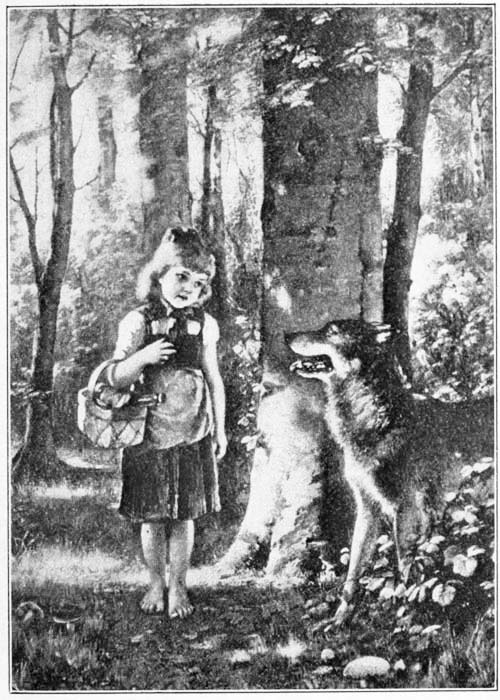
“GOOD MORNING, LITTLE GIRL, WHERE ARE YOU GOING?”
Once a sweet little girl, named Red Ridinghood, lived with her mother in a house near a wood, and her loving Grandmother lived on the other side of the wood. One day her mother said, “Take Grandmother this basket of fresh eggs, butter, and cakes, for she is ill. Be sure and not leave the main path.” The little girl said, “Yes, mother, I will do just what you say.” Then she took the basket and went skipping and singing happily through the wood, until she saw some beautiful flowers a little distance from the path. “I will gather just a bunch of these lovely flowers for Grandmother,” she said to herself; but she had not gone far when she met a big, gray Wolf, who said, “Good morning, little girl, where are you going?” “To my Grandmother’s,” she said. Then the Wolf ran on before and knocked at Grandmother’s door with his paw, “Thump! Thump!” Grandmother was better and had gone out for a walk. So the Wolf walked in, put on Grandmother’s nightcap, and jumped into her bed. Soon Red Ridinghood came up and knocked at the door. “Who’s there?” said a voice, trying to speak like Grandmother. “It is your little girl,” she said. “Come in, dear,” said the voice. When she entered and looked in the bed, she cried out, “O Grandmother, what big ears you have!” “The better to hear you, dear.” “What big eyes you have!” “The better to see you, dear.” “What big arms you have!” “The better to hug you, dear.” “What big teeth you have, Grandmother!” “The better to eat you!” cried the Wolf, springing up. He was just about to eat her when the door burst open and in rushed some wood-choppers who soon killed the big, gray Wolf. Red Ridinghood ran home to her mother as fast as she could, and said, “Oh, mother dear! it happened because I disobeyed you, and went in that horrid path where I met the Wolf. But I will never, never disobey again!”
7. GOLDILOCKS AND THE THREE BEARS
Three bears lived in a home of their own in the woods—one, a great, big Bear, the Father, with a great, big voice; a middle-sized Bear, the Mother, with a middle-sized voice; and Little Baby Bear, with a little, wee voice. One morning, when the three bears were taking a walk while waiting for their breakfast of milk and honey to cool, a naughty, disobedient, runaway girl, named Goldilocks, came along and peeped into their window. Seeing no one, she walked into the kitchen and began to taste the breakfast. Father Bear’s was too hot; Mother Bear’s was too cold; Baby Bear’s was just right, so she ate it all up. Then she went into the parlor to rest, and saw three chairs. Father Bear’s was too hard; Mother Bear’s was too soft; Baby Bear’s was just right, so she sat on it and broke it down. Then Goldilocks went up the narrow stairs to the bears’ bedroom. She climbed on Father Bear’s bed, but that was too high for her; the Mother’s was too low; but the Baby Bear’s bed was just right, so she fell fast asleep. Soon the three hungry bears came home. Father Bear roared, “Some one has been tasting my breakfast and sitting on my chair!” Mother Bear growled out: “Some one has been tasting my breakfast and sitting on my chair!” Baby Bear screamed, “Some one has been tasting my breakfast and eaten it all up, and sitting in my chair and broken it down!” The bears then rushed upstairs. “Some one has been on my bed!” roared Father Bear. “Some one has been on my bed too!” growled Mother Bear. “Some one has been in my bed, and here she is!” screamed Baby Bear. This awoke Goldilocks, who was so frightened she sprang out on the other side of the bed, jumped out of the window, and ran home as fast as she could.
8. THE SLEEPING BEAUTY[5]
Once a good King and Queen were so happy to have a little baby girl that they gave a great feast in the palace, to which they invited seven beautiful Fairies, each of whom brought her a rich present. But one ugly Fairy, named Jealousy, who was angry because she was not invited, said, “I’ll make the Princess cut her hand with a spindle, and she shall die!” Everybody began to cry, but one good Fairy said: “No, she shall not die, but she shall sleep for a hundred years, and can be awakened only by a good Prince.” The King ordered all spindles to be put away; but when the Princess was sixteen years of age an old woman, who had not heard of the King’s command to put away all spindles, let the young Princess spin. In a moment she had cut her hand and fell to the ground in a deep sleep. The good Fairy flew at once to her side and said: “She is not dead, but, as I said, she shall sleep a hundred years, and can be awakened only by a good Prince.” They carried the sleeping Princess home, but when the Fairy thought how lonely she would be on awaking in a hundred years, she touched with her wand all the maids and servants, even Mopsy, her pet dog, and all fell asleep and were left in the great room in the palace with the Sleeping Princess, who lay there dressed in her most beautiful, royal garments. The King and Queen died of grief soon after, and great trees grew up around the palace, hiding it from the world, until a hundred years passed away. One day a Prince, rich, handsome, and good, was hunting in this thick forest, when suddenly he saw the palace towers, and asked an officer what the building was. When the officer told him how the good Fairy had said a Sleeping Princess in the palace could be awakened only by a good Prince, he determined to try and awaken her. Quickly entering the strange palace he found the beautiful Princess, fair as wax, sleeping on her couch, dressed in her royal garments, which were very beautiful though so strange and old in style. There too were the maids and servants in their queer clothes, and Mopsy, the pet dog, sleeping at the side of the Princess. The King’s son quickly touched one of the fair hands of the Sleeping Beauty and stooped to kiss it, and in an instant the Princess opened her eyes wide and smiled at him. At the same moment all the maids and servants, and even Mopsy, awoke and looked as fresh as though they had been asleep only a night. The servants at once, helped by the good Fairy, prepared a rich wedding-feast in the great dining-hall. Then the good Prince took the beautiful Princess to his own palace, where they were married in great joy. The palace in the woods disappeared. The ugly old Fairy, Jealousy, had died years before, but the good Fairy, whose name was Patience, came often to visit the good Prince and his Beautiful Princess, who had awaked from her sleep of one hundred years.
9. JACK AND THE BEAN-STALK
Once a poor widow lived alone with her boy, Jack, who was careless and paid no attention to what his mother said. One day Jack saw her in tears, for, she said, “We have nothing now in the world but a cow, which we must sell to get food.” So next morning, taking the cow to market, Jack met a butcher who showed him some wonderful beans, which he offered to give for the cow. Jack gave him the cow for the beans, and ran home very happy, thinking his mother would be happy too over his good fortune. But his mother was so grieved that she threw the beans out of the window, and both of them went supperless to bed that night. Next morning, lo! the beans had grown so tall that the stalks made a ladder reaching far up into the sky. Unseen by his mother, Jack began climbing up, up, up, until he reached the top, where he saw a strange country, and in the distance a great house. This was the castle of a great Giant who had gone on a journey. The Giant’s wife received Jack kindly, giving him something to eat, and when the Giant came home she hid him in the oven. Through a crack Jack peeped and saw the Giant eat his supper and then place a wonderful hen on the table, and every time he said “Lay,” she laid a golden egg. When the Giant fell asleep Jack jumped out of the oven, picked up the hen, ran off with it, and climbed down the bean-stalk. He found his mother crying, but when Jack put the wonderful hen on the table and said “Lay,” his mother’s eyes grew big with surprise, and her tears dried at once. Soon they had as many golden eggs as they wished to live on. But one day a fox ran off with the golden hen. Again, unseen by his mother, Jack climbed the bean-stalk. This time the wife hid him in the lumber closet when the Giant came roaring home. Through a crack Jack peeped and saw the Giant eat his supper and then place on the table big bags of gold and silver, and play with them. When the Giant fell asleep, Jack jumped from the closet, picked up the bags of money, ran off with them, climbed down the bean-stalk like lightning, and ran home. He found his mother again in tears, but when Jack showed her the bags of gold her surprise made her smile again. Not long after that, again unseen by his mother, Jack climbed up the bean-stalk. This time the wife hid him in a large kettle when the Giant came roaring home. Lifting up the lid a little way, Jack peeped out and saw the Giant eat his supper and then take out a magic harp and began to play wonderful music. When he fell asleep Jack jumped out of the kettle, picked up the magic harp, and started off with it. But the magic harp called out “Master! Master!” so loudly that the Giant awoke and began running after Jack. But Jack reached the top of the bean-stalk first. He climbed down it like lightning, picked up his axe, and chopped down the bean-stalk at its roots, making it fall over just as the Giant began to climb down. In a moment the wicked old Giant fell down into the garden, with a loud noise like a falling tree. And that was the end of the Giant and the Bean-stalk. But Jack never again caused his mother any sorrow.
10. JACK, THE GIANT-KILLER
Once a poor farmer had a good son named Jack, who was wide-awake and always ready to help. Far up on the mountain in a great cave lived a wicked Giant named Carmoran, who was so fierce and frightful that everybody was afraid of him. Every time he wanted food he came down the mountain to the valley and carried off oxen on his back, and pigs and sheep tied around his waist. The people were in despair. One day Jack heard the town officers say: “All the treasure the Giant has hidden in his cave shall be given to whoever rids the land of this evil Giant!” Jack laughed and said to them, “I will try!” So he took his horn and pick-axe and shovel and began digging a pit, deep and broad, covering it with sticks and straw. Then he sprinkled earth over it until the place looked like solid ground. Then he stood on the other side of the pit, and just at the peep of day he put his horn to his mouth and blew, “Tan-tivy! Tan-tivy!” The old Giant awoke, rubbed his eyes and rushed out of his cave, and seeing Jack running away, cried, “You villain, I’ll pay you for troubling my sleep! I’ll boil you for breakfast!” Just as he said that down he fell into the pit, and the very foundations of the mountains trembled at his fall. “O Giant,” laughed Jack, “will no other food suit you than sweet Jack?” Jack was not long in killing the wicked old Giant in the pit. Then he went to the cave and brought out all the treasure. When the town officers heard of this good deed Jack, the farmer’s son, had done, they called him
“Jack, the Giant-killer.”
They gave him a sword and belt, and in the belt they wrote:
Here’s to the right valiant Cornishman Who slew the Giant, Carmoran.
11. ALADDIN AND HIS WONDERFUL LAMP
Once there was a Chinese boy named Aladdin, who was playing in the street, when a strange-looking man called to him, “My boy, I am your uncle! Come with me! I will give you great riches!” He took out of his pocket a beautiful gold ring, which he gave to the boy, who walked away with him. After a long time they came to a great stone which had a ring to lift it up. The man lifted up the stone and showed Aladdin a deep cave, saying to him: “At the other end of this cave there is a door leading to a palace and a garden of fruit trees where you will find a lamp hanging. Bring me this lamp and I will give you great riches.” This man was not Aladdin’s uncle, but a wicked magician, who wanted to use the boy to get this lamp for him, for it had power to make whoever possessed it greater than any prince. Aladdin went down into the cave and found the lamp and everything just as the man had said. When he came back to the mouth of the cave he said, “Uncle, help me up!” “Give me the lamp first,” said the man. “No,” said Aladdin, “I won’t give it to you until you help me out.” That made the magician very angry. So, uttering some magic words, he slammed the stone down over the mouth of the cave, and poor Aladdin was shut up alone in darkness. The disappointed boy sat a long time thinking what to do. But suddenly when he happened to rub the ring that the magician had put on his finger and forgotten, in an instant the Slave of the Ring, a queer, little old man, stood before him saying he was ready to do for him whatever he asked. “Then take me out of this cave,” said Aladdin, and instantly he was out. He ran home and showed his mother the lamp. “I will polish it, mother,” he said, “and then we can sell it for much money.” No sooner had he rubbed it than the Slave of the Lamp, a great strong Giant, stood before him, saying that he was ready to do for him whatever he asked. “Then, bring us plenty to eat,” said Aladdin, and instantly richest food on golden plates stood before him. Every time he rubbed the lamp the Slave of the Lamp came and gave him everything he asked. One day, when he became older, he fell in love with a beautiful Princess, and he asked his mother to take several golden vases full of rich jewels as a present to the King and beg him to let the Princess become his wife. The King laughed at such an idea, but said: “If your son will send me forty golden vases like these, full of the richest jewels, he shall have the Princess.” Aladdin quickly rubbed his lamp and asked the Slave of the Lamp to bring him forty golden vases filled with richer jewels than the former ones. The King was so delighted with them that he gave Aladdin the Princess to be his wife, and Aladdin asked the Slave of the Lamp for a grander palace to live in than the King’s. They lived very happily until one day, when Aladdin was away hunting, a strange-looking man came near the palace calling out, “Lamps! Lamps! Who will change old lamps for new ones?” A servant ran to her mistress and said, “Shall I exchange this ugly old lamp I found in the cupboard for a new one?” Without waiting for an answer she took it and sold it to the old pedler, who was really the wicked magician in disguise. So he got the lamp after all. Quickly he rubbed it, and when the Slave of the Lamp appeared, he said, “Transport Aladdin’s palace and all in it to Africa.” Instantly the palace was gone. When Aladdin returned from hunting, the King ordered the poor fellow’s head to be cut off at once, but Aladdin plead for forty days to find out where his palace and Princess had gone. Then he remembered his gold ring. This he quickly rubbed and asked the Slave of the Ring to transport him to his palace. Instantly Aladdin was transported to Africa, and stood in his palace before his Princess, who was in tears because of the wicked magician. Soon after that the Slave of the Ring helped him to get back his wonderful lamp by killing the wicked magician. Then the Slave of the Lamp transported him back to his home with his palace and the beautiful Princess. But Aladdin never again lost his wonderful lamp.
12. BOOTS AND HIS BROTHERS
Once there were three brothers, Peter, Paul, and John. Their father was very poor. One day, being unable to keep them longer, he told them they must go out into the world to earn their own living. Not far from their home lived a King, in front of whose palace-windows a great oak grew, with branches and leaves so thick that the light was shut out of the palace. The King had promised a great fortune to any one who would cut the oak down. Many tried, but the strange thing was, for every chip cut off two new chips took its place, so that the tree grew larger, rather than smaller, and the palace grew darker. The King had promised also to give his daughter and half his kingdom to any one who would dig a well so that he could get pure water for his palace. Many had tried to do this, but the rocks only grew bigger for all their digging and shoveling. When the three brothers heard of this, each said, “I will help the King and get the fortune, the King’s daughter and half the kingdom.” They started off in great expectation, but they had not gone far into the fir woods on the side of a steep hill, until they heard some one hewing and hacking farther up the hill in the wood. “Now, I wonder what that is?” said Jack. “Why, it’s a woodchopper, of course,” the two brothers answered; “you are always wondering about something!” “Still, I’d like to see,” said Jack, and up the hill he went while his brothers sauntered on. Jack soon saw a strange sight—an axe hacking and hewing away all by itself at the root of a great fir tree. “Good morning,” said Jack. “So you stay here all alone and hew, do you?” “Yes,” said the axe, “and here I’ve hewed and hacked a long, long time waiting for you!” “Well, here I am at last,” said Jack, and he put the axe into his bag. When he climbed down the hill and joined his brothers they laughed at him and said, “Well, what did you see?” “The axe that we heard,” Jack answered, but he said nothing more. Farther on they came to a great ridge of rock which ran up the mountainside, and far off they heard something digging and shoveling. “Now, I wonder what that is?” said Jack. “Why, it’s a woodpecker, of course,” answered the brothers; “you are so clever with your wonderings!” “Still, I’d like to see,” said Jack, and up the rock he climbed while his brothers sauntered slowly on. At the top of the rock he saw a strange sight—a spade digging and digging away all by itself. “Good morning,” said Jack. “So you stay here all by yourself and dig, do you?” “Yes,” said the spade, “and here I’ve been digging a long, long time waiting for you.” “Well, here I am at last,” said Jack, and he placed the spade in his bag, and returned to join his brothers, who laughed and said, “Well, what did you see?” “The spade that we heard,” said Jack. So they went along until they came to a brook at which each drank, and then Jack said, “I wonder now, where this water comes from?” “Why, water rises from a spring in the earth,” laughed the brothers. “I’ve a great mind to see where this brook starts from,” said Jack, starting to climb up. At the tiny source of the brook Jack found a walnut, out of which the water trickled. The walnut said, “I have trickled and trickled here many a long day, waiting for you.” “Well, here I am at last,” said Jack, as he filled the little hole in the walnut with moss and placed it carefully in the bottom of his bag and ran down to meet his brothers again. “Well, have you found out where the water comes from?” they said. “Yes,” said Jack, “out of a hole up there.” So they kept making fun of him, until at last they reached the King’s palace. They found the oak bigger and the rock harder than ever, because so many had tried in vain. The King, in discouragement and despair, had said, “Whoever tries and fails now shall have both his ears cut off, and he shall be placed on a desert island.” The three brothers were not afraid. First Peter, and then Paul, tried to chop down the oak and fill the well with water, but instead of the fortune, they got both their ears cut off, and they were sent off to a desert island. Then Jack was ready to try. “If you want to look like a sheared sheep with your two ears cut off, we’re ready for you,” said the King’s servants, really feeling sorry for the young man. But Jack took out the axe and said, “Hew! Hew!” and soon the great oak fell with a crash and great light shone in the palace. Then he took out the spade and said, “Dig! Dig!” and soon the rock broke in two and the well was deeper. Then he pulled out the walnut, took away the moss from the hole, and put the walnut in the well, and the water trickled, trickled so fast that very soon pure water filled the well. So Jack had felled the oak which darkened the palace, removed the rock, and filled the well in the palace-garden with water. Then the King gave him the great fortune, his daughter’s hand in marriage and one-half his kingdom, as he had promised. And the axe, and the spade, and the walnut said: “Those who have ears and will not use them must not complain if they are removed; and are we to blame if we help only those who are ready to use us?”
II FABLES
(Adapted for Children, Three to Nine Years.)
1. THE BOY AND THE NUTS
One day a selfish Boy saw a jar of nuts. He put his hand into the jar and grasped as many as his hand could hold. As the mouth of the jar was small he could not pull his hand out, so he became frightened and began to cry. “I can’t get my hand out!” he whined. A boy standing near said, “Take only half as many, and you can easily get your hand out!”
2. THE GOOSE WITH THE GOLDEN EGGS
Once there was a man who had a wonderful Goose that laid for him every day a fine golden egg. But the man wanted to get all the golden eggs at once. So he killed the Goose and cut her open, but found she was like all other geese. So he lost the Goose he had because he was so greedy and impatient.
3. THE DOG IN THE MANGER
Once a hungry Cow came to a manger full of hay. But a Dog was lying there, snarling and barking, and would not let the Cow come near the hay. “Mr. Dog,” mooed the Cow, “How selfish you are; you cannot eat the hay yourself, and you will let no one else have any of it.”
4. THE TOADSTOOL AND THE ACORN
In a forest a Toadstool once sprang up in a night. Early the next morning, as soon as the first passer-by touched it with his foot, the Toadstool fell to the earth and its life was ended. A little Acorn grew and grew and grew during more than one hundred years, and it is still standing strong and tall in the forest.
5. THE BOYS AND THE FROGS
One day some boys at play were throwing stones into a pond at some frogs. At last one old Frog peeped up out of the water and said, “Boys, why are you so cruel?” “We are only playing!” shouted the boys. The old Frog croaked back: “It may be fun for you, but remember it is death to us. Do to us as you would like us to do to you.”
6. THE DOVE AND THE ANT
Once a little Ant went down to the river to drink. He fell into the water and began to drown. Just then a Dove, perched on a tree, saw him and quickly dropped down a leaf, which served as a little boat on which the Ant sailed safely to the shore. “Thank you,” said the Ant as he shook his wet feet, “I shall not forget this.” Next day a Hunter was aiming his bow and arrow straight at the Dove when the Ant bit his foot, making the man jump, and the Dove flew away.
7. THE FOX AND THE GRAPES
A Fox who was hungry saw some large, juicy grapes on a vine high up in a tree. “How good they will taste,” said he; “I am going to have some of them.” Then he gave a run and leaped as high as he could, but the grapes were still far above his head. He could not reach them no matter how high he jumped. At last he trotted off in a rage, muttering, “I know those are sour grapes and not worth eating.”
8. THE CROW AND THE PITCHER
Once a Crow who was very thirsty found a pitcher with a little water at the bottom which he was unable to reach. He tried to overturn the pitcher but it was too heavy. “Ah! Ah! I know what I’ll do,” he said. So he gathered up pebbles from the ground, and one after another dropped them into the pitcher until the water gradually reached the top. Then the wise Crow was able to drink all the water he wanted.
9. THE WIND AND THE SUN
One morning the Wind said to the Sun, “I am stronger than you are.” The Sun said, “I know I am stronger than you are.” As they were quarreling over the question a traveler came in sight. So they agreed to decide the matter by seeing which first could make him take off his coat. Then the Wind began blowing, blowing as fiercely as he could. He nearly tore off the traveler’s coat, but the man buttoned his coat up more closely about him, and the Wind had to give up, beaten. Then the Sun, clearing away the clouds, shot his hottest beams down on the traveler’s back, and the man soon threw off his coat. Then the Sun said, “Wind, you make more noise, but, you see, I am stronger.”
10. THE SHEPHERD BOY AND THE WOLF
Once there was a boy who took care of a flock of sheep near a town. One day, when some men were working in the town, they heard the boy call, “Wolf! Wolf! The wolves are among the lambs!” The men ran up to him in great haste, but found no wolf among the lambs at all. The boy had a good laugh, and said, “I only called you for a joke!” He did the same thing two or three times. At last the wolves really came and began carrying off the lambs. The boy cried, “Wolf! Wolf! The wolves are carrying away the lambs!” But the men said, “He can’t fool us again!” So they would not come, and the wolves carried off many of the lambs. The foolish boy lost his place and found out, when too late, that a boy who tells lies, even in fun, may not be believed when he tells the truth.
11. THE LION AND THE FOX
Once an old Lion was sitting at the door of his den when a Rabbit came near. “Good morning, Bunny,” said the Lion, “come in and see my nice den.” “Thank you,” said Bun, and went in, but he did not come out again. Soon a Dog came by. “Come in, friend Doggie,” said the Lion. “Thank you,” said the Dog, and he went in, but he did not come out again. By and by a Fox came along. “Good morning, Mr. Fox,” said the Lion, “come in and see me.” “No, thank you, sir,” said the Fox, “I see the footprints of a Rabbit and a Dog going in, but I see no footprints pointing out.”
12. THE HARE AND THE TORTOISE
One day a Hare stood laughing at the slow pace of the Tortoise, and boasting how swiftly he could run. The Tortoise laughed back cheerfully, “Let us race five miles, and let Mr. Fox be the judge, and decide who beats.” So they got ready, and when the Fox said “One, two, three, go!” off they started. The slow-going Tortoise, jogging along, was soon left far behind by the swift-speeding Hare, who laughed at the fun and said, “I might as well take a nap!” When the Hare awoke he looked up and saw the Tortoise almost at the goal. Running like the wind he reached the goal a few minutes too late. “Oh, oh, my friend,” laughed Judge Fox, “slow and steady wins the race.”
13. ONE GOOD TRICK
Once a Cat and a Fox met in the wood. The Fox said: “I know a hundred different tricks for getting away from hunters’ dogs. How many do you know, Puss?” “I know only one,” said Puss, “and if that fails me I am a dead cat!” “Poor, poor Pussy,” sighed the Fox, “I am sorry for you!” Just then the cries of hunters and barking of dogs were heard. The Fox ran off as fast as he could, trying this trick and that, but the hunters’ dogs soon caught him. The Cat simply sprang up to the top of a tree. That was her one trick, and she was safe. “I see,” said Puss, as she saw the Fox carried off, “one good trick is better than a thousand poor ones.”
14. THE CONCEITED GRASSHOPPER
One day a very young Grasshopper and an old Rooster met out in a field. “I can jump higher than anybody,” chirped the Grasshopper. “All right; let me see you do it,” said the Rooster, at the same time opening his mouth wide as if he meant to yawn. “Here I go, then,” cried the Grasshopper. He jumped so high he landed right in the mouth of the Rooster, who gulped him down. That was the end of the boasting Grasshopper.
15. THE BLIND MEN AND THE ELEPHANT
Six blind beggars sitting by a roadside as an Elephant passed were told that they might touch it so that they would know what an Elephant was like. The first one touched only the Elephant’s side and said, “He is like a wall!” The second one felt only his tusk and said, “No, no, he is like a spear.” The third took hold of his trunk and said, “He is surely like a snake.” “No such thing,” cried the fourth, grasping one of his legs, “he is like a tree.” The fifth was a tall man and took hold of his ear, and said, “All of you are wrong, he is like a big fan.” The sixth man happened to catch hold of his tail, and cried, “O foolish fellows, he is not like a wall, nor a spear, nor a snake, nor a tree, nor a fan; he is exactly like a rope.” So the Elephant passed on while the six blind men stood there quarreling, each being sure he knew exactly how the Elephant looked, and each calling the others hard names because the rest did not agree with him.
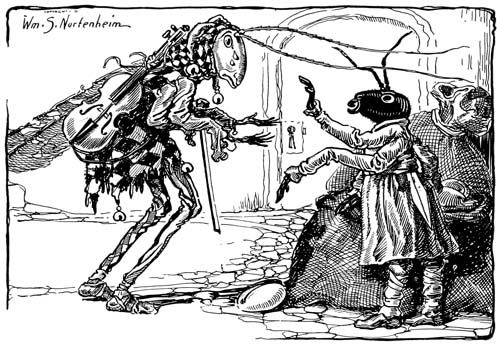
“THOSE WHO PLAY AND DANCE ALL SUMMER MUST EXPECT TO DANCE HUNGRY TO BED IN WINTER”
16. THE ANT AND THE GRASSHOPPER
One warm summer day an Ant was busy gathering food and laying it up for winter. A foolish little Grasshopper who saw him said: “Oh, you poor slave, why do you work so hard? See how I play and enjoy myself! Play and sing with me.” “No, no,” replied the Ant; “if I play now, what shall I have ready for winter?” “Oh, it isn’t winter yet,” said the idle long-legs, as he hopped off again to play. At last the cold, bitter winter came. Then the Grasshopper went to the Ant to beg for some food to keep from starving, but the Ant said, “Those who play and dance all summer must expect to dance hungry to bed in winter.”
17. THE FOX WITHOUT A TAIL
Once a Fox went trot, trot, trot, toward a hen-roost to catch a hen. But the farmer had set a trap in which Mr. Fox caught his long, bushy tail, and it came right off. As he trotted back home, ashamed to be seen without his tail, he said: “I know what I will do; I will tell the foxes tails are ugly and useless. Let us cut them off.” So he called all the foxes in council, but he took good care to hold his back against a tree, so they could not see that he did not have a tail. While he was making his speech, urging them to cut off their tails, one little fox peeped behind the tree and cried, “Oh! Oh! he has lost his tail!” Then another fox gave him a push, and as he ran off in shame, all the foxes laughed, “That is why he wanted us to cut off our tails.”
18. THE BOY AND THE ECHO
“Hurrah! Hurrah!” shouted a boy in the woods one day. “Hurrah! Hurrah!” some one shouted back. He thought it must be another boy in the woods, and started off to find him, but no other boy was to be seen anywhere. “Where are you?” he called out. “Where are you?” came back at once. “You are mocking me!” he cried. “You are mocking me,” came again the voice. “You are a goose,” the boy cried, becoming angry. “You are a goose,” came back the same voice. The boy began to cry, and ran home to tell his mother that a bad boy hiding in the woods called him bad names. “Did he speak first or you?” his mother asked. When he explained it all, his mother said: “There was only one boy there, and you were that boy, and what you heard was your echo. If you had spoken kind words, only kind words would have come back to you.”
19. THE CAMEL IN THE TENT
One cold night an Arab sat in his tent, and his Camel asked if he might put his nose inside the tent to keep it warm. “Yes,” said the kind-hearted man. Soon the Camel said, “Please let me put my neck inside,” which his master permitted. “It will take no more room if I put my two front feet inside too, will it?” pleaded the Camel. The man moved a little to allow that. “May I please put my hump in too?” begged the Camel. Then, as soon as his hump was in, the Camel walked in altogether. The Arab began to complain, but the Camel said, “If you do not like this small space, you can go outside yourself.” Then he gave the Arab a push that landed him right out of his tent and stayed inside all by himself. That was the Arab’s reward for allowing the Camel to put his nose inside the tent.
20. THE MONKEY AND THE CATS
Two Cats who had stolen a large piece of cheese were quarreling over dividing it. At last they decided to refer the matter to a Monkey, who took a pair of scales and, breaking the cheese into two pieces, placed a piece in each scale. “Let me see,” he said, taking out the heavier piece, “this piece weighs more than the other.” Then he bit off quite a piece and put it back on the scale, and, of course, it was lighter than the other piece. So he took a mouthful from that side, and continued taking from first one side and then the other, until the Cats cried, “Hold! Hold! Give us the two pieces and we will be satisfied.” “Not so fast,” replied the Monkey, “justice must be given,” and he continued to nibble one piece after another. The Cats saw their cheese was almost gone and begged for what was left. “No, no, my friends,” said the Monkey, “what remains belongs to me for my pay!” So he crammed the rest into his mouth and munched it in hearty enjoyment as he solemnly dismissed the court.
21. THE LION AND THE MOUSE
One day a Lion was lying fast asleep in a thick wood, when a little Mouse, playing “hide-and-seek,” ran over the Lion’s nose and awakened him. As quick as a flash the Lion caught the Mouse under his paw. “O Lion, do not eat me, please,” begged the Mouse, “I am such a little thing. I could not make you a mouthful. Let me go and some day I will do something to help you.” This made the Lion laugh, but he let the Mouse scamper off. Later on this good Lion was caught in a net and roared in distress. The Mouse heard him and ran up and said, “Now, Mr. Lion, I will do something to help you.” “How can you?” roared the Lion. Quickly the Mouse began to gnaw the net with his sharp little teeth. It took a long time, but at last the Lion was free. The Mouse laughed as he scampered away again, saying, “Little friends may help as much as great friends. I did help you after all, you see!”
22. THE LARKS IN THE WHEAT-FIELD
Once a Lark and her little ones lived together in a nest in a field of ripened wheat. The mother bird was afraid the reapers might come before the young larks could fly. So every morning when she went for food she told them to listen carefully to all they heard and tell her when she returned. On the first evening they said, “We heard the farmer tell his son to ask the neighbors to help reap the wheat.” “Oh, no danger yet,” said Mother Lark. The next evening they said, “We heard the farmer tell his son to ask his uncle and cousins to help reap the wheat.” “Oh, no danger yet!” said the mother. On the third evening they said, “To-day we heard the farmer say to his son, ‘To-morrow we will reap the wheat ourselves!’” “Then,” cried the mother, “we must fly away at once, for the wheat is sure to be cut now. When a man makes up his mind to do a thing himself, it is more likely to be done.” She took her young ones away at once, and the next day the wheat was reaped by the farmer and his son.
23. THE MILLER AND HIS DONKEY
Once an old Miller and his son were walking along a country road behind their Donkey, which they were driving to town to sell. On the way they met some girls who said, “Look! What stupid people to walk instead of riding.” Wishing to please them the old Miller put his son on the Donkey and walked along by their side. Soon they came to some men who shouted: “Look; what a lazy lout! Are you not ashamed to ride, while your poor old father walks?” Wishing to please them the Miller told his son to get down while he mounted and rode. Not long after they met some women who cried, “Look, what a shame for that selfish old father to ride while his son walks!” So the father, wishing again to please, took up his son behind him. They had not gone far when they met a man who said, “Look at that shameful sight! Why, those two strong fellows are better able to carry that poor beast than he is to carry them.” Wishing to please him the Miller and his son got down, tied the Donkey’s legs together between a long pole, shouldered the load, and began carrying the Donkey in this way along the road. When they came to the town bridge they met a crowd of people who shouted with such laughter and jeers at this funny sight of seeing them carrying a Donkey, that the frightened animal kicked himself loose, and fell over the bridge into the river and was drowned. The Miller said to his son, “By trying to please everybody we have pleased nobody and lost our Donkey.”
24. THE PERSIAN AND HIS SONS
Once there was a Persian Ruler, who lived in a great palace with his three sons. The father had a beautiful pearl which he decided to give to the son which showed himself the noblest. He called the three boys before him and asked each to tell the noblest deed he had performed in the last month. The eldest said: “Father, as I was traveling in a foreign land, a merchant trusted me with many valuable jewels, and he did not count them. I might easily have kept one or two and they would not have been missed, but I carried those jewels and delivered them all as safely as though they had been my own.” “My son,” said the father, “you were honest, and did a noble deed!”
“Father,” said the second son, “as I was walking in the country the other day, I saw a child playing by a lake, and while I watched, the child fell in and I saved the child.” “You have done your duty,” said the father, “and you too have done a noble deed.”
“Father,” said the third boy, “as I crossed over the mountain the other day, I saw a man who had done me a great wrong, sleeping near the edge of a dangerous precipice. I would have walked by without a word, only something within me called me to go back and awake him lest he fall over the precipice and be killed. I did this, knowing all the time that the man would not understand, and that he would be angry with me, as, indeed, he was.”
“My son,” cried the father, “your deed was the noblest. To do good to an enemy without hope of reward is indeed the noblest of all. The pearl is yours!”
III FOLK-TALES
(Adapted for Children, Six to Twelve Years.)
1. WHY THE BEAR HAS A STUMPY TAIL
One day a Bear met a Fox, who was slinking along with a string of fish he had stolen. “Where did you get those nice fish?” said the Bear. “That’s telling,” laughed the Fox; “but if you want to get some, go out on the ice, cut a hole in it, and stick your tail down in the hole and hold your tail there until you feel a bite. The longer you hold your tail in the hole the more fish you will get. Then all at once pull your tail out sidewise with a strong jerk.” The Bear went down to the ice and held his tail a long, long time in the hole until it was frozen fast in. Then he jerked it out with a side pull, and his tail snapped short off. And people used to think that is why the Bear has a stumpy tail.
2. WHY THE ROBIN’S BREAST IS RED
Far, far away to the North, in the bitter winter, a hunter and his little son sat down beside their fire, watching it day and night. They knew well that unless it was kept burning the people would freeze and the Bear would have the Northland all to himself. But one night when the father was ill and the boy was so tired that he fell fast asleep, the Bear stole up quietly and poked the fire with his big, wet paws. Thinking the fire was out, he went quickly away to his cave. But as soon as the Bear was gone, a little gray Robin flew down and fanned a tiny blue spark into a flame with her wings. As she did this, the little Robin’s breast was burned red. But wherever she flew after that, over all the woods, a fire began to burn, and the whole Northland became full of fires, and so the Bear did not have all the North country to himself. For a thousand years the people of the North have had a great love for the Robin. And they tell their children this story why the Robin’s breast became red.—Adapted from Coates’ “Nature Myths and Stories.”
3. THE MAN IN THE MOON
“Go out into the forest and gather sticks for the fire,” said the wood-cutter’s wife to her husband. “To-morrow will be Sunday, and we have no wood to burn.” “Yes,” he said, “I will go.” He went to the forest, but instead of getting the fire-wood, he sat by the bank of a stream and fished all day, and late at night went home without any wood. His wife was already asleep and did not know what he had done. Early the next morning he crept out to the forest, intending to bring wood before she would be astir. He cut the wood, and began carrying the bundle of sticks on his back, when a voice behind him said, “Put the wood down.” “I can’t,” he said, “my wife cannot cook dinner without it.” “You will have no dinner to-day,” said the voice. “My wife will not know I did not bring wood last night,” he said. “Put the wood down! It is Sunday, the day when men should rest from their work.” “Sunday or Monday,” said the man, “it is all one to me.” “Then,” said the voice, “if you will not keep Sunday on earth, you shall keep Monday in the heavens, and you shall carry your wood until the Judgment Day.”
The man could not tell how it was, but he felt himself being lifted up, up, up, sticks and all, till he was in the moon. “Here you shall stay,” said the voice. On any clear night, when you look up at the moon, you can still see a great shadow, like an old man with wood on his shoulder.
4. PROMETHEUS, THE GREEK FIRE-GIVER[6]
Long ago the Greek people believed that the world was ruled by many gods. They thought Jupiter was the father, with many powerful children. One of these was Prometheus, meaning “Forethought.” This god had a kind heart, and longed to help the poor and unhappy men of earth who lived in caves and holes in the rocks, hungry and cold. They ate their food raw, like the beasts. They had no tools, nor comforts. Prometheus said: “Poor man, how I pity him! If he only had fire, then he would be happy. Yes, man shall have fire, even if Jupiter kills me.” So one dark night he set out for Mount Olympus, the abode of the gods, stole a lighted brand, hid it in his bosom, and brought it down to man. “See the gift I bring you!” he cried. It was midwinter. Snows were deep on the ground. Ice covered the rivers. Men were shivering in the cold and little children were freezing. Prometheus laid wood together and touched it with his firebrand, and lo! the first fire on earth was started! Blue fingers were spread out to the wonderful warmth. Pinched faces smiled in the golden glow. “Summer is come again!” they shouted. They called Prometheus, the helper of man. But he became their teacher too. He showed them how to cook their food, make tools, and dig metals from the earth, and soon man was warm and happy and busy. One day Jupiter looked down from his high throne on the topmost peak of Mount Olympus and saw the fire-theft. In fearful anger he ordered his son, Vulcan, the blacksmith of the gods, to seize Prometheus, carry him away to the Caucasian Mountains, chain him fast to a huge rock, where a great vulture tore out his liver. There Prometheus suffered for ages; but generation after generation of men lived on earth, and died, blessing him for the gift he had brought to them. After many centuries of woe, Hercules found Prometheus, killed the vulture, broke the chain, and set free the suffering god, who said, “I am glad man has the fire-gift!” And the sight of man warming himself beside it and using it comforted him.
5. PHAETHON’S WONDERFUL RIDE
The Greeks believed that Apollo was the god of music and of hunting, and also of the sun. Every day, they thought, he rode through the sky in his golden chariot, drawn by fiery horses. One day Phaethon, meaning “the Bright and Shining One,” his son, said, “Father, let me drive your chariot for one day.” “My son,” said Apollo, “I cannot grant your request! ’Tis a mischief, not a gift, you ask. The road is steep and the four fiery steeds untamed. You would grow dizzy and fall and set the world on fire.” But Phaethon pleaded and, because he had promised, at last Apollo ordered the Hours to harness the horses and fling wide open the palace-gates. Phaethon took the reins and the whip in his hands. “My son,” said Apollo, “be sure to watch the horses with the greatest care, and do not use the whip.” At first Phaethon remembered his father’s words and he enjoyed his ride; but soon he became reckless and drove faster and faster until he lost his way. In trying to find it again he drove so near the earth that immediately trees shriveled, harvests withered, fountains dried up, cities were burned to ashes, and even the people of the land over which he was passing were burned black—which color the Negroes have to this day. This frightened Phaethon so much that he whipped up his horses, and drove them so far away that the earth turned to a sudden cold. The cries of the suffering people rose in chorus to Jupiter, who awoke from his deep sleep, and at once hurled his deadliest thunderbolt straight at the foolhardy Phaethon. In a moment the dead boy fell like a shooting star into the waters of a deep river. His intimate friend, Cycnus, continually plunged into the river in hope of finding all the scattered pieces of his body, until the gods changed him into a swan. And that is the reason, the Greeks thought, why the swan is ever mournfully sailing about, and often plunging his head into the water to continue his sad search for Phaethon.
6. THE STORY OF THE SUNFLOWER
Clytie was a water-nymph who lived in a cave at the bottom of the sea. She had never seen the earth or sky or stars or sun or light of day, in her dark home, deep in the sea. One morning she floated up so far that she reached the surface and swam to the beautiful green shore. Shaking the water out of her waving yellow hair, she sat and watched a golden ball which was arising out of the east. It was the sun. With wonder and delight her eyes followed him as he mounted higher and higher. It became noon, but Clytie never stirred. She scarcely seemed to breathe. Soon the sun sank lower and lower toward the west, and Clytie’s eyes still followed him with love. Then the sun sank from sight. Clytie fell upon her face in sorrow, crying, “Oh, the miracle! shall I ever see it again? I will not leave this spot. I will wait to see if the wonder may not return.” So through the long night she watched, and in the white light of dawn the great sun burst again in beauty upon the waiting eyes of Clytie, who followed him in his course, turning her sweet, sad face, east, south, and west as the day advanced. This she did day after day, until at last the gods, in pity, changed her into the sunflower. But the sunflower still follows, with upturned face, the daily journey of the sun.
So the heart that has truly loved never forgets, But as truly loves on to the close; As the sunflower turns to her god when he sets The same look which she turned when he rose.
7. THE GOLDEN TOUCH
Once there was a King, named Midas, who loved gold better than anything else in the world. Every day he went down into a dark room in his castle to play with his piles of gold, and to see them shine. One morning, before he arose from his bed, he sighed: “I wish I had the whole world for my treasure-room, and that it was full of gold all my own, then I would be very happy!” Just then a voice said, “Midas, you are a very rich man. You ought to be the happiest man in the world.” “I am not,” said the King; “but I would be if everything I touched would turn to gold.” “Are you sure you would not be sorry you made such a choice?” said the voice. “How could I be sorry? I would be the happiest man in the world!” “Very well, then,” said the voice, “you shall have the Golden Touch.” Just then a little sunbeam came through the window shining on his bed. He put out his hand and touched the coverlet, and it was turned to gold. He sprang from his bed and ran about the room, turning everything to gold. Then he dressed himself and was delighted to find his clothes became golden garments, and his spectacles turned to gold. Going down-stairs he went out into the garden, and kept plucking roses which changed into beautiful, shining gold. Even the dewdrops became little nuggets of gold. Then he went back into the house to breakfast, and had great fun changing his daughter’s bread and milk bowl into gold. Just then his daughter, Marygold, came into the room crying, “Oh, my beautiful roses are all ugly and yellow and without any fragrance.” “Don’t cry,” said her father; “let us eat.” But as soon as he touched his breakfast, the baked potatoes, fish, and cakes all became gold. He raised the cup of coffee to his lips. That too turned to gold, and of course he could not drink it. He looked at Marygold who was quietly eating her bread and milk. How he longed to have just one taste. Seeing her father’s sad face, Marygold ran to him, but as soon as he took her in his arms and kissed her she too became hard, shining gold, and even her tears were little nuggets of gold. Poor, unhappy King! His heart was sad. He threw himself on the floor and tried to pray, but the words would not come. All at once the room grew bright, and a voice said, “How do you like the Golden Touch?” “I hate the very name of gold!” cried the King. “I would give all I have just to see my daughter smile again.” “Then,” said the voice, “take a pitcher, go to the river, jump in head first and fill the pitcher with water; then sprinkle a few drops of it on everything you have changed to gold. Everything will become as before.” The King quickly did all the voice said. The first thing he did with the water was to sprinkle Marygold, who at once opened her eyes in life again. Then he went into the garden and changed the roses back to their natural beauty and fragrance. Nor did he stop until he had sprinkled water on everything he had changed to gold. Then he ate his breakfast with great joy. Only two things were left to remind him of the Golden Touch—the sand in the river and Marygold’s hair. As this made her more beautiful, Midas said that was the only gold he cared for after that.—Adapted from Hawthorne’s “Tanglewood Tales.”
8. SAINT GEORGE AND THE DRAGON
Once upon a time in the early days of the Christians, in the reign of the Emperor Diocletian, there was born in the province of Cappadocia, in Asia Minor, a beautiful baby boy, named George, who grew up to be a brave soldier and knight. Once when he was on a pilgrimage to the Holy Land he came to a town in the country of Libya where the people were living in great terror because a great dragon, with poisonous breath, had his home in a marsh outside the city walls. The monster had devoured their sheep and oxen, and the people were forced to shut themselves close inside their city and send out each day a sheep to satisfy the hunger of this dreadful dragon. At last not one sheep was left. Then the King ordered that each day two children, chosen by lot, should be sent out to the dragon. The people obeyed the King’s order and from day to day arose the bitter cries of parents upon whose children the cruel lot had fallen. But one morning the lot fell upon Cleodolinda, the beautiful fifteen-year-old daughter of the King. He was in despair, for he loved his little daughter most tenderly. He offered all the gold in the treasury and half his kingdom if she should be spared. But the parents who had been obliged to sacrifice their children insisted that the King’s daughter should be given to the dragon, and threatened to burn the King in his palace if he did not send her forth at once. The King pleaded for eight days longer to bid farewell to her. Then he sent her forth weeping, and arrayed in her royal robes, to die for her people. Walking timidly toward the terrible monster’s den, along the path strewn thick with the bleaching bones of her former playmates, she suddenly heard the sound of hurrying horse’s hoofs. She looked up, and there was a beautiful young knight in armor, on a milk-white horse, coming toward her with a gleaming spear, ready to do battle with any enemy that might cross his path. She cried, “Fly! fly for your life, Sir Knight!” But when he had heard her sad story, he said: “God forbid that I should fly! I will destroy this monster, your enemy, and deliver you through the power that lives in all true followers of Christ.” Just then the dragon came forth, half flying and half crawling toward them, clashing his bronze scales with horrid noise. Cleodolinda again begged the knight to fly and leave her to her fate. But Saint George made the sign of the cross and rushed upon the monster. The struggle was fierce and long, for it was hard to strike through the dragon’s bronze scales. But at last, with a blow like that of three strong men, Saint George pinned the dragon to the earth with his lance. Cleodolinda did not run away but, “with folded hands and knees full truly bent,” the brave girl stood near her champion, who said: “Touch him and see how tame he is. See, even his poisonous breath is gone. It is the power of good over evil.” Then he took the girl’s rich girdle, bound it round the great dragon, and gave one end to her, telling her to lead the dragon into the city. So the girl who had obediently gone out to the dragon expecting him to devour her, obediently led the powerless creature over the fields he had laid waste and over the bleaching bones of the children he had devoured, and the meek monster followed her like a lamb toward the walls of the city where the people were gathered in terror. Saint George called out: “Fear not, only believe in the Christ through whose might I have overpowered your enemy, and I will destroy the dragon before your eyes.” Then he took his sword and smote off the dragon’s head, and all the people hailed him as their deliverer. But Saint George bade them give God the praise. He preached to them so earnestly that the King and princess and all the people became Christians. He would not take the gold the King offered him, but ordered that it be distributed among the poor. Then he bade them all adieu and rode away to do in other lands like noble deeds of loving service. So this champion of the weak became the patron saint of merry England, and only the bravest knight or soldier may wear the cross and be called a Knight of Saint George.
9. SAINT PATRICK AND THE SNAKES
If you should ever sail across the ocean to Ireland, and travel on that Emerald Isle, you would be sure to hear many interesting stories about the good missionary, Saint Patrick. One story which was told many years ago by an old monk named Jocelin, is this:
Long, long ago, when Ireland was called Erin, and before Saint Patrick came to the island, the people were troubled with a plague of demons and reptiles. Patrick was the son of a Christian magistrate who lived in England. In the year A. D. 411, when Patrick was fifteen, some wild Irish raiders stole him and sold him as a slave in Ireland, where he remained in slavery for six years tending pigs upon the mountains. When this Christian boy, Patrick, made his escape to France, he resolved to return to Ireland and devote himself as a missionary to the conversion of the people. When he returned to Ireland to enter upon his mission, he found the country stricken because of the demons and reptiles. By means of a wondrous staff which he stretched toward heaven, and a holy bell, Fuin Foya, which when he rang was heard throughout Erin, he drove away the demons with howls of rage. Then, as he went about the land preaching and doing good to all the people, he found them still suffering with the plague of snakes and toads, which ugly reptiles he drove westward until they reached a high rock, when, with a hissing sound, they turned upon Saint Patrick and tried to poison him. But the saint was armed with his melodious bell, which had been given by the angels, and of all sounds in the world the ringing of a heavenly bell is most terrible to a reptile, and the silvery tones of this bell frightened the snakes and toads more than all the bells of the land ringing together. When Saint Patrick saw these wicked serpents making ready to sting him, and saw they all no longer obeyed his commands and his threats, he uncovered the bell and the moment they heard the first tinkle they rushed forward in a body to scramble up the side of the hill and away from the sound they hated. As soon as they reached the top they began to sway to and fro in their fright, for there, far beneath the dark rocks, lay the blue waters of the ocean. But they could not wait there long, for as soon as Saint Patrick came to the summit, he made a sign for them to come near him, and, creeping and crawling, they cowered at his feet, waiting to hear their doom. The good Saint Patrick stood over them and, lifting his staff in his hand, he pointed out far over the sea. “Forward, every one into the sea!” he commanded, “and henceforth this blessed Isle of Erin shall be free forever from your power of evil!” They lay at his feet hissing and writhing in agony, but Saint Patrick began to uncover his bell, Fuin Foya. As soon as they saw that, the reptiles rushed and tumbled down, down over the steep rocks. So, hissing and howling, they plunged into the sea and disappeared under the waves.
10. THE COYOTE AND THE INDIAN FIRE-BRINGER
One cold winter’s day, long, long ago, when the Coyote was the friend and the counselor of the Indian, a Boy of one of the tribes was ranging through a mountain forest with a big, gray Coyote. The poor Indians ran naked in the snow or huddled in caves in the rocks, and were suffering terribly in the cold. The Boy said, “I am sorry for the misery of my people.” “I do not feel the cold,” said the Coyote. “You have a coat of fur,” said the Boy, “and my people have not. I will hunt with you no more until I have found a way to make my people warm in the winter’s cold. Help me, O counselor.” The Coyote ran away, and when he came back, after a long time, he said, “I have a way, but it’s a hard way.” “No way is too hard,” said the Boy. So the Coyote told him they must go to the Burning Mountain to bring fire to the people. “What is fire?” asked the Boy. “Fire is red like a flower, yet not a flower; swift to run in the grass and destroy, like a beast, yet not a beast; fierce and beautiful, yet a good servant to keep one warm, if kept among stones and fed with sticks.”
“We will get the fire,” said the Boy. So the Boy and the Coyote started off with one hundred swift runners for the far-away Burning Mountain. At the end of the first day’s trail they left the weakest of the runners to wait; at the end of the second day the next stronger, and so for each of the hundred days; and the Boy was the strongest runner and went to the last trail with the Coyote. At last the two stood at the foot of the Burning Mountain, from which smoke rolled out. Then the Coyote said to the Boy, “Stay here till I bring you a brand from the burning. Be ready for running, for I shall be faint when I reach you, and the Fire-spirits will pursue me.” Up the mountainside he went. He looked so slinking and so small and so mean, the Fire-spirits laughed at him. But in the night, as the Fire-spirits were dancing about the mountain, the Coyote stole the fire and ran with it fast away from the Fire-spirits who, red and angry, gave chase after him, but could not overtake him. The Boy saw him coming, like a falling star against the mountain, with the fire in his mouth, the sparks of which streamed out along his sides. As soon as the Coyote got near, the Boy took the brand from his jaws and was off, like an arrow from a bent bow, till he reached the next runner, who stood with his head bent for running. To him he passed it, and he was off and away, and the spiteful Fire-spirits were hot in chase. So the brand passed from hand to hand and the Fire-spirits tore after each runner through the country, but they came to the mountains of the snows ahead and could not pass. Then the swift runners, one after the other bore it forward, shining starlight in the night, glowing red in the sultry noons, pale in the twilight, until they came safely to their own land. There they kept the fire among the stones and fed it with sticks, as the Coyote had said, and it kept the people warm.
Ever after, the Boy was called the Fire-bringer, and the Indians said the Coyote still bears the mark of fire, because his flanks are singed and yellow from the flames that streamed backward from the firebrand that night in the long ago.—Adapted from “The Basket Woman,” by Mary Antrim.
IV FAVORITES
(Adapted for Children, Six to Twelve Years.)
1. THE UGLY DUCKLING
Once upon a time a Duck was sitting all alone on her nest watching for her young ducklings to hatch. All at once the eggs seemed alive. “Peep! Peep!” and one little fluffy yellow head after another looked out. “Quack! Quack!” said the Duck, and all the ducklings quacked too, as well as they could. But one egg still remained unhatched, and it was the largest egg of all. “I must sit on it a little longer,” said Mother Duck very tenderly. This she did until at last the large egg cracked and out tumbled a large, ugly, gray Duckling. He seemed so different from the others that the mother thought sure that he must be a turkey, until she saw him swim in the water, just as well as her other children. But he was not so pretty as the others, and the poor, ugly Duckling was bitten and pecked and chased and kicked about and made fun of by all, and even his own brothers and sisters were unkind to him. At last he could bear it no longer, and he ran away, going on and on until he came to a swamp where the wild geese lived. “Bang! Bang!” went a gun in the morning, and two of the geese fell dead. In a moment more a large, terrible dog ran up. He put his nose close to the Duckling, showing his sharp teeth, and then “Splash! Splash!” he went out of the water without touching him. “I am so ugly a dog will not bite me,” the poor bird said, lying still until the gun stopped shooting. In the evening he flew away from the swamp and came to a hut where an old woman lived with a cat and a hen. These made so much fun of him because he was so ugly that he flew away from them and was very lonely and sad among the rushes all the long, cold winter until the spring came. Then one morning he flew on and on until he came to a large, beautiful garden where he saw three white swans moving on the smooth water. “I will fly to them,” he said. As soon as they saw him they swam toward him and began to stroke his neck with their beaks. Just then he looked down into the clear water, and was surprised at his own image. He saw himself no longer a dark, gray, ugly duckling, but a beautiful snow-white swan like the others. Little children running about the garden came up to throw bread and cake into the water. “Oh, see!” cried one of the children. “There is a new one! The new one is the prettiest!” The Swan was so happy he did not know what to do. He was not at all proud, but he shook his beautiful feathers, stretched his graceful, slender neck, and said: “Now, when people see me they will be glad! I never dreamed of such happiness when I was an ugly duckling!”—Adapted from Hans Christian Andersen.
2. THE KING OF THE GOLDEN RIVER
Once there were three brothers, Hans, Swartz, and Gluck, the youngest. These three brothers owned a rich farm in a valley far up on the mountainside. The apples that grew there were so red, the corn so yellow, the grapes so blue, and everything was so fertile that it was called “Treasure Valley.” On the very top of the mountain a river shone so bright and golden when lighted by the rays of the setting sun that people called it the “Golden River,” but its waters flowed down on the other side of the mountain. The two older brothers were so selfish and cruel that they were called the “Black Brothers.” They beat their brother Gluck so cruelly one day for being kind to some one that the West Wind punished them by blowing, blowing, blowing so hard that everything became dry and the valley became a desert. Then the three brothers went to live in the town, and the two oldest went from bad to worse, until one day they said, “We have nothing left in the world but Gluck’s Golden Pitcher.” This pitcher was a gift from his uncle, which Gluck highly prized, but the cruel brothers ordered him, while they were away, to put it into the melting-pot and make it into gold spoons that they might secure money to support them. While the melting-pot with the gold pitcher in it was warming over the hot fire, Gluck looked out of the window and saw the sun reflecting its yellow glow in the Golden River, far up on the mountain crest. He sighed, “How fine it would be if only that river were really gold. We wouldn’t be poor then!” “It wouldn’t be fine at all,” said a thin little voice from the melting-pot. “Pour me out! Pour me out! I’m too hot,” continued the thin little voice. It was the King of the Golden River, a queer little dwarf, who peeped out of the melting-pot and said: “Whoever climbs to the top of the mountain where the Golden River begins, and pours in three drops of holy water, shall find the river turned into gold. But whoever fails at the first trial can have no other, and will be changed into a big black boulder.” With these words the King of the Golden River vanished up the chimney. Just then the two brothers knocked at the door and came in, and when they saw the golden pitcher all melted away and vanished in smoke up the chimney, they beat poor Gluck black and blue for his carelessness. When Gluck told them what the King of the Golden River had said, at first they would not believe him, and then they quarreled so terribly over which should be the first to go, that a policeman came and Swartz was thrown into prison. Then Hans said, “I will be the first to get the gold.” He took a bottle of water and climbed up, up, up the mountainside until he met a dog so thirsty that his tongue hung from his mouth. Hans gave the dog a kick and passed on until he met a little child, who said, “I’m so thirsty.” But Hans gave the child a slap and passed on until he met a queer little old man, who cried, “Water! Water! I’m dying for water!” Hans spoke bad words and passed on, drinking up all the water himself. So when he came to the source of the Golden River he found that all his water was gone, and he did not have even three drops to put into the river. Then, in a rage, he threw the empty bottle into the stream, and immediately there was great thunder and lightning, and Hans was changed into a big black boulder.
When Hans did not return, Gluck went to work in a goldsmith’s shop to earn money enough to get Swartz out of prison. As soon as he was released he said, “Now I will try to get the gold.” So Swartz took a bottle of water and climbed up, up, up the mountainside, passing the poor, thirsty dog, the little child, and the queer little old man dying of thirst, without so much as sharing one drop of water with them. When he came to the source of the Golden River he found that all his water was gone and he did not have even three drops to pour into the river. Then, in a rage, he threw the empty bottle into the stream, and immediately there was great thunder and lightning, and Swartz was changed into a big black boulder beside his brother.
Gluck waited long for his brothers to return, but when they did not come he took a bottle of water and started to climb up, up, up the mountainside until he came to the poor thirsty dog, and the little child, and then the queer little old man, with each of whom Gluck kindly shared the water from his bottle, and when he reached the top of the mountain he found he had plenty of water still in his bottle. So he poured in three drops of his holy water into the heart of the river, but, to his surprise, he found that the river did not change into gold. The water began to flow down the other side of the mountain toward Treasure Valley. He was disappointed and sad. Then the King of the Golden River appeared again and said, “Follow the stream!” Then he noticed, as he went down the mountainside, that everywhere the river flowed flowers and vines and fruit trees blossomed, and soon all Treasure Valley was one rich, beautiful garden again. Then he saw that the river was indeed, as the King had said, a River of Gold. After that Gluck lived in a beautiful home in Treasure Valley. His apples were red, his corn was yellow, his grapes were blue, and everything became prosperous again. But the hungry and thirsty were never once sent empty away.—Adapted from John Ruskin.
3. THE CLOUD
One hot summer morning a little Cloud rose out of the sea and floated happily across the blue sky. Far below lay the earth, brown and dry and desolate from drought. The little Cloud could see the poor earth-people working and suffering in the heat, while she floated here and there in the sky without a care. “Oh, if I could only help those people,” said the Cloud. “If I could make their work easier and give the hungry ones food and the thirsty ones drink! Yes, I will help, I will!” And she began to sink softly down to the earth. As she sank lower she remembered when she was a tiny cloud-child in the lap of Mother Ocean she was told that if the clouds went too near the earth they would die. Thinking of that she held herself from sinking and swayed herself here and there in the breeze. Then she said, “Men of earth, come what may, I will help. I will.” All at once she became so large and wide-spread that the men of earth were afraid; the trees and the grasses bowed themselves; a wonderful light glowed from her heart; the sound of thunder rolled through the sky, and a love greater than words can tell filled the Cloud. Down, down, close to earth she swept, and gave up her life in a heavy shower of rain. That rain was the Cloud’s generous deed, but it was her death, and it was her glory too. Over the whole country round, as far as the rain fell, a lovely rainbow spread its arch, and all the brightest rays of heaven made its colors. It was the last greeting of a love so great as to sacrifice itself. Soon the rainbow was gone, but long, long after, the men and women, saved by the Cloud, kept her blessing in their hearts.—Adapted from “How to Tell Stories to Children,” Sara Cone Bryant.
4. THE GREAT STONE FACE
Far up in the mountains of New England there was a great rock in such a position as to resemble the features of a human face. There were the broad arch of the forehead, the eyes, the nose, and the lips. So real was it, the Great Stone Face seemed to be alive. Happy were the children who grew up to manhood or womanhood with this Great Stone Face before their eyes, for the features were all so noble and their expression like the glow of a great, warm heart, it was an education to look at it. There was a belief among the people who lived in the valley, that one day a boy would be born who would become the greatest and noblest man of his times, and whose face would exactly resemble the Great Stone Face. After a long time a boy grew up in the valley who learned to love the sight of this image. After his day’s work was done he would gaze up at it until he thought it seemed to notice him and give him a smile of kindness and encouragement in response to his look of love. Very often during those years a rumor arose that the great man foretold for ages had at last appeared. A boy who had grown up in the valley, had gone away and become a millionaire, returned, and people said, “This is he!” But it proved untrue. Then a soldier, and a statesman, and a poet arose, and people said, “This is he!” But it was not so. Meanwhile, the boy who quietly day by day lived, and labored, and looked up, and loved the Great Stone Face grew to manhood, becoming more and more like it, until one day everybody saw the resemblance, and cried, “This is he!” And it was. This good boy and young man had gradually grown in gentleness and goodness and love until his face became as magnetic and his influence as helpful in the valley as the Great Stone Face.—Adapted from Hawthorne.