Part II Stories to Tell (continued 2)
Reading edition
5. TOM, THE CHIMNEY-SWEEP
(Written by Canon Kingsley for his own little boy.)
Once there was a chimney-sweep, and his name was Tom. He lived in a great city, where there were plenty of chimneys to sweep. He never washed himself, he never had been taught to say his prayers, he could not read or write. One morning Tom and his master, Mr. Grimes, started off to sweep some chimneys in the country. Mr. Grimes rode the donkey, and Tom, with his brushes, walked behind. They overtook a poor old Irish woman, trudging along with a bundle on her back. She had a shawl on her head and a red dress. She spoke kindly to Tom, and they walked along together until they came to a spring. The master jumped from the donkey and dipped his head into the water, shaking his ears to dry them. Tom said, “Master, I never saw you wash before.” “Nor will you see me wash again, most likely. I did it for coolness, not for cleanliness. I’d be ashamed to want washing every week or so like any smutty collier-lad.” “I wish I might wash,” said poor little Tom. “Come along,” said Grimes. “What do you want with washing yourself?” and he began beating the poor boy. “Shame on you!” cried the old woman. “They that wish to be clean, clean they will be; they that wish to be dirty, dirty they will be. Remember!”
That day Tom swept so many chimneys that he got lost, and came down the wrong chimney in one house, and found himself standing in a room the like of which he had never seen before. There was a wash-stand with a basin and soap and brushes and towels. Looking toward the bed he held his breath, for there, under the snow-white coverlet, was the most beautiful little girl Tom had ever seen. “Are all the people like that when they are washed?” he thought. Then he looked at his wrists and tried to rub off the soot, and wondered if it ever would come off. Looking round he saw standing close to him a little, ugly, black, ragged boy with red eyes and grinning white teeth. “Who are you?” he said. “What does such a little black monkey want here?” But it was himself reflected in the great mirror, the like of which also Tom had never seen before. Tom found out then, for the first time, that he was dirty. He burst into tears and turned to sneak up the chimney again to hide himself, but he upset the fender and threw the fire-irons down with a great noise. Under the window there was a great tree, and Tom went down the tree like a cat and across the garden toward the woods. The gardener, who was busily engaged in watering the rose-bushes, saw him and gave chase; the milkmaid heard the noise and followed too; and so did the groom and the plowman, and the old Irish woman and Mr. Grimes. But Tom ran faster than all, and in the woods he was lost from view, and all went back again. On the bank of a river Tom sat down to rest, and was soon fast asleep and dreaming of the little clean girl and the Irish woman who said, “They that wish to be clean, clean they will be.” All at once he cried out, “I must be clean! I must be clean!” He awoke and went into the water, where he washed his feet, and suddenly he was changed into a Water-baby. Hundreds of other Water-babies were there, laughing and singing and shouting and romping in the clear, cool water, and all dressed in their little bathing-suits, so clean and white. The one that had been poor little Tom, the chimney-sweep, was the happiest and whitest among them all. And he never forgot the old Irish woman (who was really Queen of the Water-babies) or what she had said: “They that wish to be clean, clean they will be; they that wish to be dirty, dirty they will be.”—Adapted from “The Water-babies.”
6. WHERE LOVE IS, GOD IS
Once in a little town in Russia there was a lonely old cobbler who lived in a cellar. There was always plenty of work for him, for he was prompt and honest and industrious. But the cobbler was not happy, for it seemed to him God had been unkind to him in taking away his wife and children by death. But at last a good priest came and taught this unhappy cobbler to read the New Testament, and then he grew happy and contented, and changed in every way. One day as he was reading how the Lord was treated when he was on earth, he said to himself, “And suppose he came to me, would I treat him differently?” “Martin!”—and a Voice seemed close to his ear. “Who’s there?” the cobbler said; but no reply came. “Martin, Martin,” said the Voice again, “look to-morrow on the street; I am coming!” Next morning Martin waited and waited, but saw no stranger come near. An old soldier, whom he knew, came into his shop out of the snow, to whom the cobbler gave a cup of tea and whom he treated with kindness as he told him he was expecting his little Father, Christ. Later in the day a poor widow with a little child came into his shop out of the cold, to whom the cobbler gave warm food and a coat and some money, as he told her how he was expecting the Lord to come to him that day. In the late afternoon the cobbler saw from his cellar window a poor apple-woman fighting a boy who had stolen some of her apples. The cobbler rushed into the street and told the woman she ought to forgive the boy as the Lord forgave us. He purchased an apple which he gave to the boy, who, touched by the kindness, begged the apple-woman’s pardon and kindly helped her by carrying her heavy basket for her.
By the evening lamp-light the cobbler opened his New Testament and was disappointed because the Christ-guest had not come. Then a Voice whispered, “Martin! Dost thou not know me?” “Who art thou?” cried the cobbler. “’Tis I,” cried the Voice. “Lo, ’tis I!” And forth from the dark corner of the shop stepped the soldier, and then the widow with the little child, and then the old apple-woman and the lad with the apple. All smiled and vanished. But the heart of the cobbler was glad, and he saw at the top of the Gospel page these words: “I was an hungered and thirsty, and ye gave me drink; I was a stranger, and ye took me in.” And at the bottom of the page he read: “Inasmuch as ye have done it to one of the least of these my brethren, ye have done it unto me.” Then the cobbler saw that the Lord had really come to him and he had really received Him that day.—Adapted from Count Tolstoy.
7. THE PIED PIPER
(Written by Robert Browning, the poet, for the amusement of a friend’s son who was ill, and to give him subjects for drawings.)
Long ago in a country far away there was a town that was troubled with rats. These rats fought the dogs and killed the cats and bit the babies in their cradles. They ate up all the cheese. Yes, and often a man would find a rat’s nest in his Sunday hat. The people began to think they would have to move out and let the rats have the town. At last the Mayor and Council met to see if they could think of a way to get rid of them. They had almost given up when they heard a rap at the door. “Come in,” they said; and there stood a strange, tall, thin man, with a queer long coat, half yellow and half red, that came down to his heels, and a pipe upon which he played. “My friends,” said he, “I see you have a great many rats in your town. If I can rid you of them, will you give me a thousand guilders?” “Yes, fifty,” they cried; “only take away the rats!” Then Pied Piper stepped out into the street and began to blow on his pipe. Before he had played three notes, out of the houses the rats came tumbling—great rats, small rats, lean rats, fat rats, black rats, gray rats, brown rats, all following the Piper as if for their very lives. Straight to the river he walked, drawing the rats after him. In they plunged head first, and were all drowned. How the bells rang for joy! How the people shouted! The Mayor gave orders to poke out all the nests and fill up the holes. “First, if you please, my thousand guilders,” said the Piper. The Mayor and Council laughed: “Now the rats are dead, they won’t come back to life, you know. It was only a joke we spoke. We won’t give you more than fifty guilders.” Pied Piper threatened, but the Mayor said, “Do your worst. Blow your pipe till you burst.” Then the Piper stepped into the street again and played three notes, and at once all the children of the town came running, tripping, skipping, shouting merrily after the Piper and his wonderful music. When they reached the mountainside a great door suddenly opened and all the children went in with the Piper—all except one poor little lame boy who could not keep up, and came too late. And the door was shut. No one ever heard of the Piper or the children again. But the Mayor and Council agreed that when they owed any one anything after that they would pay it. And these words were kept in the town where all could see them: “Always keep your promise!”
8. DICK WHITTINGTON AND HIS CAT
Once there was a little boy named Dick Whittington, whose father and mother died and the people who took care of him were very poor. Often he had no breakfast or dinner. In the town where he lived Dick often heard about London, the great city, where people said nobody was ever hungry, nobody had to work, and the streets were paved with gold. Dick longed to go there. So one day when a big wagon, drawn by eight horses, all with bells on their heads, was going to London, Dick went along. But he was disappointed to find the streets covered with dirt instead of gold, and none would give the hungry boy even a crust of dry bread. At night he was so cold and tired he sat down on the stone steps of a great house and longed to be back in the town where he was born. Next day Dick found some work to do in the kitchen of this great house. He would have been happy there, but the cook beat him, and the rats and mice in the garret where he slept kept him awake at night, often running over his face. One day a gentleman gave him a penny. Dick bought a cat, which soon drove away all the rats and mice, and then the poor boy slept soundly every night.
Dick’s master was a rich merchant with great ships that he used to fill with all kinds of things to send to foreign lands. Whenever a ship was ready to sail it was his custom to call together all his servants and ask them to send something in the ship to trade for profit. So one day when the ship was ready, all the servants had something to send, except Dick, who said he had nothing in the world but a cat. “Send your cat, my lad,” said the master; “perhaps you will get something of profit for her.” Dick, with tears in his eyes, carried poor puss down to the ship and gave her to the captain. After the cat was gone the rats and mice came back and the cook treated Dick so cruelly that early one morning he ran away. He had not gone very far when he sat down on a stone to rest, and listened to the ringing of a merry chime of bells, which seemed to him to say:
Turn again, Whittington! Turn again, Whittington! Thrice Lord Mayor of London!
“If I am to be Lord Mayor of London,” said Dick, “I will go back and let the cook scold me as much as she pleases.” Then Dick turned back and reached the kitchen before any one missed him. Some time after that the ship came back, and the captain said Dick’s cat had won him a great fortune, for an African chief had bought the cat at a great price to drive away the rats and mice from the dining-table of his palace. Dick was cleaning pots in the kitchen when his master called him into his office. “Mr. Whittington,” he said, “your cat has brought you more money than I have in the whole world.” Dick was too kind to keep all for himself. He gave presents to his master’s daughter Alice, and to the captain, and to the sailors, and even to the cross old cook. When he was dressed in a nice suit of clothes he looked as handsome as any young man in London. So Dick Whittington, through his cat, became a rich merchant, married his master’s daughter, and became three times Lord Mayor of London.
9. THE BOY WHO HATED TREES
One night Dick was told by his father to rise early the next morning and help set out some new trees. “I hate trees,” said Dick, “I want to go fishing. I wish I lived in a land where there were no trees!” Then Dick fell asleep, and in his dream he heard the queerest rustling noise, and then a voice called out, “Here is a boy who hates trees!” A procession of trees came toward him. The willow was weeping; the poplar was trembling; the aspen was quaking; the pine and elm and maple and oak were followed by the fruit trees, like the apple and pear and cherry, while the walnut and birch and palm slowly brought up the rear. When all was quiet the Pine began: “Here is a boy that hates trees, and says we are of no use!” “Yes,” said the Maple, “and this morning he ate some of my sugar.” “Yes,” said the Willow, “and he made a whistle out of me.” “Yes,” said the Palm, “and he fanned himself with one of my leaves.” “And he got his bicycle tire out of me, and his rubber boots too,” said another tree. The Elm said: “I have a plan. The wind will help us. The wind is our friend.” So the wind took Dick and hurled him off to a great desert and dropped him down in a land where there were no trees. Dick felt very lonely and was full of fright when he saw a bear coming toward him in the distance, and there was no tree to climb. How glad he was that he was mistaken and that it was not a bear coming, but camels, with men on them. The men beckoned him to get up and ride, which he was glad to do. Soon he saw the men bowing down and thanking God and then waving their hands. Dick looked and saw a spot of green grass, a spring of cool water, and one of the things he hated—a tree. He thought he had never seen anything so beautiful in all his life. He tumbled off the camel, ran toward the tree, and threw his arms about it, saying, “Dear tree, dear tree!”
The next morning Dick was glad to help his father plant the trees, and the school-teacher on Arbor Day said, “I think if good care will help the trees, they will get it from Dick.”
10. THE PRINCE WHO HATED SPIDERS AND FLIES
A young Prince in a rage once said, “I wish all the spiders and flies were driven out of the world!” Not long after that he had to hide at the close of a great battle in a wood, where he fell asleep under a tree. A soldier found him there, and was about to kill him, when a fly tickled the Prince’s face, which awoke him, and made the soldier run away. That same night the Prince hid himself in a cave across the mouth of which a spider wove a web. Next morning two soldiers seeking him were about to enter the cave when they saw the spider’s web. “He can’t be in there,” they said, and passed on. So a hated fly and a spider, after all, saved the Prince’s life!
11. TIRED OF BEING A LITTLE GIRL
“Oh, dear me,” sighed a little girl one fine morning, “I wish I could be something else!” “What would you like to be?” said a little voice. “I would like to be a rosebud,” she said. In a moment she felt her skirts twisting about her body, and when she touched her pink dress it was not calico but rose-leaves. She looked at her feet and they had turned green. So she knew she was a rosebud, growing on a bush in a garden. The wind swung her back and forth. It was so nice to be a rosebud. Suddenly a beautiful Fairy bent over and said, “I will drink the dew and eat the tender leaves of the rosebud for dinner.” “Don’t, don’t,” cried the little girl, “if you do you will eat my head.” The Fairy began to laugh. “Please, make me something else, quick,” cried the little girl; “make me into a bird.” In a minute she was a real, live bird hopping around among the daisies. “This is great fun,” she cried, “but I begin to feel hungry.” “Do you?” said a little voice; “then I’ll feed you.” In front of her stood the ugliest little man, holding in his hand a slimy worm, which he wanted to put into her mouth. She screamed out, “I won’t eat that worm! I’m not a real bird! I’m a—I’m a——” Just then she awoke and found she had been dreaming under the apple tree. Then she ran as fast as she could into the house, and cried, “O mamma, I’d rather be a little girl than anything else.”
12. THE ELEPHANT AND THE TAILOR
One day a tailor was sitting with his feet crossed by an open window, making some fine clothes, when an elephant, passing down to the river, playfully put his trunk in at the window. The tailor, out of meanness, pricked the elephant’s trunk with his sharp needle. The elephant in pain quickly drew it back and jogged on his way to the riverside, where, after quenching his thirst, he filled his trunk and mouth with the muddiest water he could find, and went back to the tailor’s window and squirted it all over him and his fine clothes, making him a laughing-stock to all his neighbors.
13. THE LOST CAMEL
A wise man of the East once met a company of merchants who had lost their camel in the desert. “Was the camel blind in his right eye, and lame in his left foot?” asked the man. “Yes,” they said. “Had he lost a front tooth?” “He had.” “And was he loaded with wheat on one side and with honey on the other?” “Yes, yes.” “Then,” said the man, “I haven’t seen your camel.” The merchants were angry and said: “You must have seen him, because you know all about him. You have taken our jewels and money from his load.” They seized the man and brought him to the judge, who heard the story. The judge, as well as the merchants, thought the man knew more about the camel than he wished to tell. “How did you know the camel was blind in one eye?” asked the judge. “I knew the camel was blind in one eye because it had eaten the grass on only one side of the path.” “How did you know it was lame in its left leg?” “Because I saw that the print of that foot was fainter.” “How did you know he had lost a tooth?” “Because wherever it had grazed a small tuft of grass was left untouched in the center of the bunch.” “But how could you tell what its load was?” cried the merchants; “tell us that.” “The busy ants on one side and the flies on the other showed me the camel was loaded with wheat and honey, and I knew it had strayed because there were no footprints before or behind.” “Go,” said the judge, “look for your camel.” The merchants did so, and found the beast not far away.
14. THE STORY WITHOUT AN END
Once a King who never tired of hearing stories said: “If any one can tell me a story that will last forever, I will give him my daughter and half my kingdom, but if he fails he shall have his head cut off.” The King’s daughter was very pretty, so many young men tried; but a week, a month, two or three months was all they could spin out their story, and off came their heads. At last a young man came who said, “I can tell a story that will last forever.” The King and his daughter begged him not to try, for they did not want to see another fine fellow lose his head. But he insisted that he would not fail, and so began his story: “Once upon a time a king built a high granary, and filled it with wheat to the very top. But in building it the workmen had left a very little hole near the ground, just large enough to let one little ant through. So a little ant went in and carried off a grain of wheat, then another little ant went in and carried off another grain of wheat, then another little ant went in and carried off another grain of wheat.” Day after day, week after week, the story-teller kept saying, “Then another little ant went in and carried off another grain of wheat.” “Tell us what happened after that?” pleaded the King. “O King, I must first tell you this,” he said; and so he continued several weeks longer. At last the King cried; “Man! Man! you will drive me wild with your ants. Take my daughter; be my heir; rule my kingdom; but let me hear no more of your abominable ants.” So the man married the King’s daughter, and they lived happily. But the King never cared to hear any more stories.
V CHRISTMAS STORIES
(Adapted for Children, Six to Twelve Years.)
1. SAINT CHRISTOPHER
Once there was a very strong man who could carry such heavy loads that he was called “Offero,” meaning “The Bearer.” He was very proud of his strength and said, “I will serve only the greatest king on earth.” He found a rich and powerful king and served him, until one day he saw his master tremble. “Why do you tremble, O king?” he asked. “Because I fear Satan, who is too strong for me.” “Then I will serve him,” said Offero. He went at once and served Satan, until one day he noticed his new master tremble before a cross, the cross on which Christ hung to overcome the strength of Satan. Then Offero went everywhere in search of the stronger master, Christ. He found a boy who said: “Yes, Christ is the strongest King on earth or in heaven. But to find him you must cross a broad river whose current is so swift that men are drowned in trying to cross. If you serve Christ by carrying over on your strong shoulders the weak and the little ones, you shall find the Christ of your search on the other side.” Offero built a hut beside the swift-flowing river, and whenever he saw a poor traveler trying to cross the stream, he bore him on his strong shoulders. Well was he named “The Bearer,” for he carried many across, and not one was lost. His staff was a great palm tree which he had plucked up by the roots. One night as he was resting in his hut he heard the cry of a little child, calling, “Offero, will you carry me over this night?” A weak little child stood near the river. Offero helped him on his strong shoulders and, staff in hand, began to cross the flood. But the wind blew furiously, the waves rose high, and there was a roaring in his ears as if a great ocean were let loose. The weight upon his shoulders bore him down until he feared he would sink. But he held firmly to his strong staff and at last reached the other bank and placed the child safely on the ground. “What have I borne?” cried Offero; “it could not have been simply a young child, for the weight was too great!” Just then the child suddenly changed into the form of the strong Christ-King, who said: “Offero, as thou didst wish to serve me, I accepted thee as my servant. Thou hast borne, not the weight of a child, but the weight of a world. Thou shalt be called ‘Christ-Offer—the Christ-Bearer,’ and shalt serve me always. Plant thy staff in the ground, and it shall put forth leaves and fruit.” Christopher did so, and the dry staff flourished as the palm tree, and was covered with clusters of fruit; but the Christ-Child had vanished from his sight.
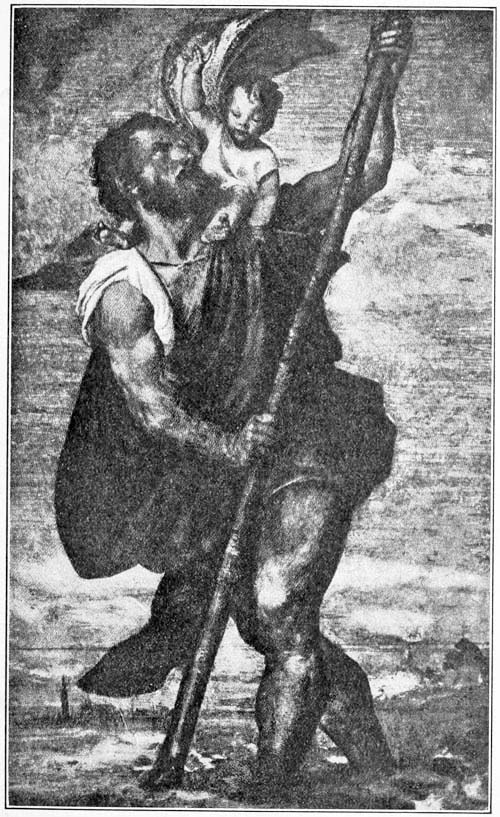
OFFERO ... BEGAN TO CROSS THE FLOOD
2. THE FIR TREE
Far away in the forest grew a little Fir Tree. Around him stood tall pines and firs so large that the little Fir felt very discontented, wishing so much to be like the other trees. “If I were tall like them,” sighed the Fir, “I would spread my branches so far the birds would build their nests in my boughs, and when the wind blew, I should bow grandly like them.” So unhappy was the little tree that he took no pleasure in the warm sunshine, the birds, or the bright clouds. One day in winter when the snow was on the ground, a little rabbit jumped right over the little tree’s head. Oh, that made him so angry! Two years after, the wood-cutters came and cut down several of the largest trees and carried them away. “Where do they take these trees?” the Fir Tree said; and a stork replied: “As I was flying here from Egypt I saw great masts on the ships. That is what large trees become.” “Oh, how I wish I were tall enough to be a mast and sail on the sea!” sighed the Fir Tree.
Christmastime came, and many young trees were cut down, some that were even smaller than the Fir Tree, and men carried them away in wagons. “Where do they take those trees?” the Fir Tree asked; and the sparrows chirped: “We know! we know! We peeped in at the windows in the town and saw little trees like those planted in the middle of a warm room, and made beautiful with gilded apples, gingerbread, toys, and a hundred lights.” “I wonder if anything like that will ever happen to me?” cried the discontented Fir Tree; “that would be better than crossing the sea. Oh, when will Christmas come?” The wind and air and sun and birds tried to make the Fir Tree happy, but he only grew more discontented with his lot. One day, just before Christmas, the wood-cutter came again, and this time the Fir Tree was the first to be cut down and carried off. But he could not think of happiness now, for he was sad at leaving his home in the forest. He knew that he would never again see his dear old friends, the trees, the bushes, the birds, and the flowers. That morning the Fir Tree was stuck upright in a tub that stood on a rich carpet in a splendid parlor. Some ladies came in and began to dress his boughs with very pretty things—sugar-plums, apples, oranges, walnuts, dolls; red, blue, and white candles; and to the top was fastened a glittering golden star that shone as brightly as any star in the sky. The tree looked very beautiful. “Oh,” sighed the tree, “I wish all the candles were lighted! Will the trees of the forest come to see me? Will the sparrows peep in at the windows? I wonder if I shall stay pretty like this always?” At last the candles were lighted; the folding doors opened; happy children trooped into the room shouting and dancing with joy at the sight of the wonderful Christmas tree. Older people came too, to look at the sight and enjoy the presents which were taken one after the other from the tree, until all the candles were burned low and put out and only the glittering star remained. The happy children danced about the room with their pretty toys, and no one cared for the tree or looked at him except the nurse, who peeped among his branches to see if an apple or a fig had been forgotten. All night the tree stood in darkness. In the morning the servants dragged the tree from the tub and placed him upstairs in the dark attic, where he stayed all winter, hidden away from sight and forgotten by every one. In the spring the tree was carried down-stairs and taken out into the yard. “Now I shall live again,” said the Fir Tree, and he spread out his branches. But alas! his leaves were all withered and yellow, yet the star of gold still hung in the top, glittering in the sunshine. A boy seeing the star ran up and pulled it off the tree. “Look what was sticking to this ugly old Christmas tree,” he cried, trampling on the branches until they cracked under his feet. A few minutes later the gardeners boy came up with an axe and chopped the tree into small pieces and threw them into the fire. And just as he was dying, the Fir Tree saw the little boy wearing the star on his breast and sighed, “The night I was crowned with that beautiful golden star was the happiest night of my life.” And he knew that night of happiness was the longed-for Christmas Eve.—Adapted from Hans Christian Andersen.
3. THE CHRISTMAS GIFT
Once in the sunny land of France there was a little girl named Piccola, who lived all alone with her mother. They were very poor, and little Piccola had no dolls or toys, and she was often hungry and cold. One day when her mother was ill, Piccola worked hard all day trying to sell the stockings which she knit, while her own little bare feet were blue with cold. As Christmas drew near she said to her mother: “I wonder what Saint Nicholas will bring me this year? I have no stocking to hang in the fireplace, but I shall put my wooden shoe on the hearth for him. He will not forget me, I am sure.” “Do not think of it this year, my dear child,” replied her mother; “we should be glad if we have bread enough to eat.” But Piccola could not believe she would be forgotten. On Christmas Eve she put her little wooden shoe on the hearth before the fire and went to sleep to dream of good Saint Nicholas. The poor mother looked at the shoe and thought how disappointed the little girl would be to find it empty in the morning, and sighed to think she had nothing to put in it. When the morning dawned Piccola awoke and ran to her shoe, and there in it lay something with bright eyes looking up at her. A little swallow, cold and hungry, had flown into the chimney and down to the room and had crept into the shoe for warmth. Piccola danced for joy, and clasped the shivering swallow to her breast. “Look! Look!” she said to her mother. “A Christmas gift, a gift from the good Saint Nicholas!” and she danced again in her little bare feet. Then she fed and warmed the little bird, and cared for it tenderly all winter long. In the spring she opened the window for it to fly away, but it lived in the woods near-by, and sang often at her door.—Adapted from “Child Life in Many Lands,” Blaisdell.
4. THE GOLDEN COBWEBS
(A story to be told by the Christmas tree)
The night before Christmas the tree was all trimmed with pop-corn, and silver nuts, and golden apples, and oranges, and walnuts, and dolls, and bonbons, and a hundred colored candles. It was placed safely out of sight in a locked room where the children could not see it until the proper time. But ever so many other little house-folks had seen it. Pussy saw it with her great gray eyes. The house-dog saw it with his steady brown eyes. The yellow canary saw it with his wise bright eyes. Even the little mice had a good peek at it. But there was some one who had not seen the Christmas tree. It was the little gray spider! The housemother had swept and dusted and scrubbed to make everything clean for the Christ-Child’s birthday and every spider had scampered away. At last the little gray spider went to the Christ-Child, and said: “All the others see the Christmas tree, dear Christ-Child, but we are cleaned up! We like to see beautiful things too!” The Christ-Child was sorry for the little spider, and he said, “You shall see it.” So on Christmas morning before any of the children were awake, the spiders came creeping, creeping, creeping down the attic stairs, along the hall, under the door, and into the room where the Christmas tree was standing. Oh! it was beautiful to their little eyes as they looked upon it as much as they liked. Then father spider, mother spider, and all the spider family went creeping, creeping, creeping up the tree and all over its branches, and in great joy hurried back to their home in the attic. The Christ-Child looked down to see if the tree was all ready for the children, and oh!—it was all covered over with cobwebs! “How badly the housewife will feel at seeing those cobwebs!” said the Christ-Child. “I will change them into golden cobwebs for the beauty of the Christmas tree.” So that is how the Christmas tree came to have golden cobwebs.—Adapted from “How to Tell Stories to Children,” by Sara Cone Bryant.
5. THE LEGEND OF THE CHRISTMAS TREE
One cold, wintry night, two little children were sitting by the fire when suddenly they heard a timid knock at the door. One of the children ran quickly and opened it. Outside in the cold and darkness, they saw a poor little boy, shivering, without shoes on his feet, and dressed in thin, ragged clothing. “Please, may I come in and warm myself?” he said. “Yes, indeed,” cried the children, “you shall have our place by the fire. Come in!” The little stranger boy came in and the kind children shared their supper with him and gave him their bed, while they slept on the hard bench. In the night they were awakened by strains of sweetest music, and, looking out of the window, they saw a band of children in shining garments coming near the house. They were playing on golden harps, and the air was full of Christmas music. Then lo! the Stranger-child, no longer in rags, but clad in silvery light, stood before them, and in his soft voice said: “I was cold and you let me in. I was hungry and you fed me. I was very tired and you gave me your nice soft bed. I am the Christ-Child who comes to bring peace and happiness to all kind children. As you have been good to me, may this tree every year bring rich gifts to you.” He broke a branch from the fir tree that grew near the door and planted it in the ground, and disappeared. But the branch grew into the Tree of Love, and every year it bore golden fruit for the kind children.—Adapted from Lucy Wheelock in Bailey-Lewis, “For the Children’s Hour.”
VI BIBLE STORIES FROM THE OLD TESTAMENT
(Adapted for Children, Six to Twelve Years.)
1. HOW THE WORLD WAS MADE
(Genesis 1, 2)
In the beginning, long, long ago, God created this wonderful world and all things in it. At first there was no earth, no sun, no moon or stars, no grass or trees, no seas or sky. This great round ball, on which we live, was nothing but a great cloud of mist without shape or size. Everywhere there was great darkness. God was living in his home in heaven, and he said, “Let there be light.” So light was the first wonderful thing God made. Then God separated the sky mists from the earth mists. He made the waters roll back into seas; and the mountains, with great lakes between, appeared. When the sun and moon and stars shone out more brightly, driving the mists and water away from the dry land, God made grass and trees and flowers to spring up in great beauty and abundance; and each tree and flower had little, tiny seeds to send up little shoots to make others. Then great swarms of living things appeared—strange fishes and sea-monsters to swim in the waters, reptiles and creeping things to creep on the land, birds to fly through the air, and all kinds of four-footed beasts to roam through the forests. Still, there was no man nor woman, nor any little child anywhere to enjoy what God had made. So God created a man and called his name Adam. God placed him in a large garden called Eden, filled with beautiful and useful things—rivers of water to water it, gold and precious stones, trees good for food, animals, birds, and fishes. Adam gave names to all the animals. But among them all there was not one to talk with him. So God made a beautiful companion for Adam and called her name Eve. This first man and woman lived together very happily in this beautiful Garden of Eden, caring for the flowers and fruit, watching the animals, loving each other, and talking with God, their Creator and Friend.
2. HOW A HAPPY HOME WAS LOST
(Genesis 3)
Adam and Eve were very happy in their beautiful garden-home in Eden. In the cool of the day, when the sun went down, and the garden was quiet, they knew that God was very, very near them, walking and talking with them. All the animals and plants, all the beautiful trees were for their use. But there was one tree with fruit that God, to teach them to obey, told them not to eat. For a long time they thought of nothing else but doing exactly what God told them. But one day Eve stopped in front of the tree and looked at the fruit. How good it looked! She wondered how it tasted. Then she turned to go away, for she knew that God had said that whoever tasted it would die. Just then she heard a voice. She looked, and the voice came from a bright, shining snake, coiled close in front of the tree. The snake said, “Did God say you shall not eat of any tree of this garden?” Eve said, “God said we shall not eat of this tree, nor touch it, lest we die.” “You will be like God if you eat it; you will know good and evil.” She listened to this voice tempting her to do what was wrong. Then she looked at the tree again. It looked so good to eat and so pretty, and as if it would make one know a great deal, that she picked some of the fruit and ate it. Then she ran and gave some to Adam, and he ate it too. That evening, when the sun was going down, making long shadows upon the grass, and a cool breeze was rustling the leaves, and the garden was all lonely and still, Adam heard the sound of God in the garden. Instead of gladly running to meet their heavenly Father and Friend, as they had always done before when he came to talk with them, they were afraid, and ran and hid themselves among the trees. God called to Adam, “Where art thou?” Guilty and ashamed, Adam said, “I heard thy voice, and I was afraid.” God said, “Hast thou eaten of the tree of which I commanded thee not to eat?” Adam said, “Eve gave it to me and I ate.” Eve said, “The snake tempted me, and I ate.” God told the snake he must crawl always flat on the ground, and every animal and man would hate him more than any other creature. He told Adam and Eve, because they had disobeyed him, they must be driven out of the beautiful garden and must dig and work hard in getting their food in desert lands among thistles and thorns, stones and timber, and at last, he said, they must die. But God still loved them, and gave them a beautiful promise of a loving Saviour who would be so obedient and pure and strong that he would prepare for them a beautiful city in the place of their garden-home, which they had lost through disobedience.
3. THE FIRST TWO BROTHERS
(Genesis 4)
The first two brothers in the world were Cain and Abel. They were born after their parents were driven out of their beautiful garden-home in Eden. When these boys grew up, Cain, the elder, became a farmer, and Abel became a shepherd. Their parents brought them up always to ask God to forgive them when they did wrong, and to bring offerings to him of what they had. One day when they came with their gifts, Abel, with a loving heart, carried a lamb, the best of his flock, but Cain brought some fruit in a careless way. God was well pleased with Abel’s gift, because of the love that came with it; but not with Cain’s, because Cain kept hatred to his brother in his heart. Cain was angry and his face became dark and scowling. God said: “Why are you angry and scowling? If you do well, will you not be happy? If you do not well, hatred in your heart will crouch, like a lion, ready to spring at you.”
But Cain paid no attention to God’s loving word. One day he said to Abel, “Come into the field with me.” When they were there alone, the crouching lion of hatred in Cain’s heart sprang up, and Cain lifted up his hand and slew his brother. Then Cain heard God’s voice saying, “Where is thy brother?” He answered untruthfully, “I know not; am I my brother’s keeper?” Then as Cain had done this wicked deed, God sent him from his home and parents to become a wanderer on the earth, working even harder than his father and his mother did. Cain’s suffering was just what he had brought upon himself, yet he said, “My punishment is greater than I can bear.” He was afraid wherever he went men would seek to kill him, for he knew he deserved to be killed. But God gave him a mark by which he could know that God was still watching over him and would not let any one kill him. So Cain went away and built a city and lived unhappily the rest of his life, away from his father and mother, because he had allowed hatred instead of love to live in his heart, and because he had not tried to please his loving Father in heaven.
4. THE FLOOD AND THE RAINBOW
(Genesis 6-8)
Once when God looked down on the people of the earth, he saw that there was only one good man to be found anywhere. All the rest were disobedient and very wicked. So God planned to save all who would be obedient to him, but to destroy all the disobedient, in order that such great wickedness should not increase over all the earth. God told Noah, the one just and good man, his plan. He told him to build a large ark, half boat and half house. It was to be five hundred feet long, fifty feet high, and eighty-three feet wide—about the size of a big ocean steamer to-day. There were to be three stories, many rooms, and a window on the top. The one door was to be on the side. This great houseboat was not to be for travel, but only to float on the water. In the ark Noah, his wife and sons, and his sons’ wives, and all others who would obey God, were to be saved. For one hundred long years Noah and his sons worked away building this strange ship—hammering, sawing, planing, and laying great beams hundreds of feet long. The people laughed at Noah and mocked him. It was very hard for Noah to be mocked, but he kept right on with his work, telling them of God and his holiness and how their wickedness was grieving God. But they would not listen, nor change their ways, nor believe any flood would come. At last the great ark was finished. Then Noah gathered together two of every kind of birds and animals, and they marched or flew into the ark, and behind them Noah and his family went in, with food for all to last for many months. And God shut the door. So they were safe because they had obeyed God.
Then the rain began to fall. Thunder crashed and echoed from the mountains and the wind dashed the rain against the ark. Torrents of rain came down, until soon the ark began to float. Higher and higher it rose, rocking and tossing, up above the treetops, above the hills, above the mountains. The flood had come, and the wicked people were all drowned. But Noah and his family were safe inside the ark. After forty days the rain stopped, but the water flooded in from the sea. For one hundred and fifty days the waters rose, and then began to go down. But the ark rested on one of the high mountains. Noah opened the window and sent forth a raven, and then a dove. The raven flew away, resting on things floating in the water. The dove came back several times, once bearing an olive-branch in her beak. At last she did not return, by which Noah knew the dove had found land on which to rest, and that the water was gone. Then Noah and all in the ark went out, after being in it more than a year. The first thing Noah did was to thank God for saving him and his family. Then Noah looked up in the clear, blue sky and there was a wonderful rainbow, with every color in it, arching the heavens. This was God’s sign and promise that he would never again destroy the world with water. So every time they saw a rainbow after that, they remembered that God was looking at it too, remembering this promise of his: “During all the days of the earth, sowing and reaping, and cold and heat, and summer and winter, and day and night, shall not cease.”
My heart leaps up when I behold A rainbow in the sky; So was it when my life began; So is it now I am a man; So be it when I shall grow old, Or let me die! The child is father to the man; And I could wish my days to be Bound each to each by natural piety.
5· THE GENEROUS UNCLE AND THE SELFISH NEPHEW
(Genesis 12-19)
Long, long after the flood, there lived a good man whose name was Abram, “the friend of God.” He was the first Hebrew. At first he lived in a large city on the river Euphrates. It was a beautiful city with fine buildings, gardens, fountains, statuary, and other things for comfort and pleasure. Abram and his people were rich. They had everything to make them happy, excepting one thing. Abram saw that in all that great city, in all that country, none worshiped God but himself. There were many temples where the people worshiped the sun, moon, stars, and many false gods. There were beautiful temples built, and beautiful music sung to the Sun-god, but no thanks were given to the great Creator of the sun and moon and man. A good deal of their worship was very wicked and cruel, and often boys and girls were burned to please the idols. Abram saw all this was false and wicked. One day God told him to leave that land and take a long journey to another land that God would show him. At last Abram reached a land so rich in vines, fruit trees, and pastures for flocks and herds, that it was called “the land flowing with milk and honey.” Here Abram and Lot, his brother’s son, lived in tents. Both were very rich in cattle, goats, sheep, servants, and silver and gold. But when the servants of Lot and Abram kept quarreling over which should have the best pasture for feeding their flocks, Abram said to Lot: “Let there be no quarrel between thee and me, and between our servants, for we are brethren. Choose the land you wish, and I will take what is left.” Abram was older than Lot, and had always been kind and generous, like a father, to him. Lot should have given his uncle the first choice. Instead of that, Lot greedily chose the well-watered plain-lands near the river Jordan, leaving to his uncle the hilly land. Abram generously let him keep them. Lot moved close to the wicked city of Sodom. Soon after, in a battle, Lot and his family and his servants were taken prisoners. Lot had not treated his uncle well, but that made no difference to Abram. He was a true friend, loving Lot even when he did not do right. So he rescued Lot and saved all the property the kings had stolen. Lot went back to Sodom, making his home this time inside the city, among its wicked people, and he grew more forgetful of God.
One day, in Sodom and Gomorrah, the cities of the plain, a great fire broke out which destroyed everything Lot had. Only for Abram’s prayer to God, Lot would have been burned up too. But for Abram’s sake, two angels came and led Lot and his wife and two daughters out of the city, telling them not to look back nor stay in all the plain, but flee to the mountains. Lot’s wife looked longingly back at the wicked cities, and was changed into a pillar of salt in the very plain upon which she, with Lot, had so much set her heart. Lot and his two daughters were saved only by fleeing to the mountain land that Lot had despised and Abram had taken. So, after all, the selfish nephew did not choose so well as the unselfish uncle, “the friend of God.”
Yes, Faith, Life, Song, most meetly named him “Friend”; All men’s he was and is, till time shall end. And in the Christ-path he so closely trod That all men saw he was “the Friend of God.”
6. THE OBLIGING GIRL AT THE WELL
(Genesis 24)
“Laughter” is a queer name for a boy. But “Laughter” is the name Abraham gave his son. That is what Isaac means. When Isaac grew up Abraham did not like the idea of his son marrying any of the young women of that land because they all worshiped idols; so he called his head servant and told him to go far away to the country where Abraham’s own people lived, and there find a young woman who would be the right sort of wife for Isaac. It was a long, long journey across the desert. Abraham gave the servant ten camels, and servants, and tents, with gold and silver, and precious stones and rich robes, to give as presents to the young woman and her family. After many days of travel the servant came to a city where some of Abraham’s people were still living. Outside the city was a well with a trough for the camels to drink from. He knew every evening young girls and women came with their pitchers for drinking water to this well. He decided when they came he would ask for a drink, and whoever gave him a drink and also offered to give the camels a drink by filling the watering-trough, would prove the wife for Isaac. He also prayed God to guide him. While he was praying there came to the well a beautiful young girl carrying a pitcher on her shoulder. When she had filled her pitcher the servant said, “Let me drink, please.” She said, “Drink, my lord,” and quickly let down her pitcher upon her hand and gave him a drink. Then seeing how tired the camels looked, her kind heart made her say, “I will get water for your camels too.” Camels drink a great deal of water, and there were ten of them, but this obliging girl did not stop filling the large watering-trough until every thirsty beast had drunk enough. Quietly the servant watched her, and when he saw how friendly she was he gave her a splendid gold earring and two beautiful bracelets of gold and asked her name and whether there was room in her father’s house for him to stay over night. She told him her name was Rebecca—a relative of Abraham’s family—and said there was plenty of room for them to spend the night. Then the servant thanked God, for he knew this kind, obliging girl was just the one whom God wanted to become Isaac’s wife. When they came to the house, the servant told his story to all, and gave still more beautiful presents to Rebecca and to her sister and brothers. Early the next morning the old servant wanted to start back at once, because God had prospered his journey. They called Rebecca and said to her, “Wilt thou go with this man?” And she said, “I will go.” So Rebecca’s queer bridal party, herself and her old nurse, Deborah, and several maids, mounted on camels and escorted by Abraham’s servants, began the long march to Isaac’s home in Canaan where she and Isaac were married. They loved each other dearly. And Abraham was glad that “Laughter” had found so good and true a wife in the friendly girl at the well.
7. THE LADDER THAT REACHED TO HEAVEN
(Genesis 28)
Isaac and Rebecca had two boys, Esau and Jacob. Esau became a hunter, and Jacob a shepherd. One day Esau came home from hunting very hungry. He asked Jacob to give him some of the red broth that he had just cooked. Jacob knew that Esau cared nothing for his birthright (that is, all that he would receive as the eldest son). But Jacob wanted that more than anything else in the world. So Jacob said, “Will you give me your birthright if I do?” Esau said, “Yes, I am starving; give me the broth for the blessing.” Jacob could not believe Esau meant it; but he did mean it, and so sold his birthright for something to eat. Not long after, Jacob received the birthright blessing from his father, Isaac. Then Esau was sorry and angry, and hated his brother, and planned to kill him. Rebecca told Jacob what Esau was planning to do, and sent him to her brother’s home to save Jacob’s life.
So Jacob had to leave his father and mother and home and start alone on a long journey with nothing but a long cloak to wrap about him at night. When the sun went down, as he was thinking of the great wrong he had done his brother, tired and sad at heart, he lay down to sleep on a stony hillside, placing one of the stones under his head for a pillow. At last he fell asleep, and in his dream he saw a ladder reaching from earth to heaven. He saw beautiful shining angels coming down the ladder and going back. At the top he saw God looking down on him, saying, “I am the Lord, the God of Abraham and thy father Isaac.” God promised if he would do what was right, that he would forgive all his wrong—be with him in all his journey and give him the wonderful promises made to Abraham and Isaac.
Early in the morning, when Jacob awoke, he knelt beside that stone, promising God that he would be a better man. He lived to be an aged man—one hundred and forty-seven years old—but he never forgot that place which he called “The House of God,” from which he saw the ladder that reached to heaven, showing him that God was near him.
From this story the beautiful lines of the hymn, which have been such a comfort to many upon battlefields and in the hour of death, were written:
Though like a wanderer, The sun gone down, Darkness be over me, My rest a stone, Yet, in my dreams I’d be, Nearer, my God, to thee, Nearer to thee.
8. THE SLAVE-BOY WHO BECAME A PRINCE
(Genesis 37 to 47)
Jacob had twelve sons, and Joseph was next to the youngest. He was the best loved of all, and his father showed how much he loved him by giving him a coat of many colors. This made his older brothers jealous and angry. When Joseph was sixteen years old he dreamed that he was binding sheaves of grain in a field with his eleven brothers and his father and mother, and all the other sheaves bowed down to his sheaf. Another dream he had was that the sun and moon and eleven stars bowed down to him. When Joseph awoke he told these queer dreams to his brothers. No wonder they called him “the dreamer” and teasingly said, “Shall we all, indeed, come to bow down to you?” Soon after this his nine big brothers caught this boy out in a field and put him down into a deep pit, and then sold him to camel-drivers as a slave for twenty pieces of silver (about one hundred and twenty dollars). Then they killed one of their own goats, dipped Joseph’s coat of many colors, which they had taken off him, into the blood, and taking it home, wickedly made their father think a wild beast had eaten Joseph. Jacob mourned for him as dead, and the brothers thought the dreamer would never tell any more of his dreams.
The camel-drivers sold Joseph as a slave in Egypt to a rich man who promoted him to be the chief ruler of his great house. It was a fine place for him. But one day some one told a very wicked lie about him, and he was cast into prison. But Joseph was so cheerful and kind and useful, even in prison, that he was soon placed over all the prisoners. When the king heard that Joseph had power to tell people the meaning of their dreams, he sent for him to tell the meaning of two dreams that troubled him. Joseph told the king his dreams. So Joseph was removed from prison to the king’s palace, and was dressed in fine clothes, with a gold chain around his neck and a gold ring on his finger, and made ruler over all the land, next to the king. Soon a great famine arose (just as Joseph had told the king) in all lands except Egypt, because Joseph had filled big barns with corn. Joseph’s ten brothers came from Canaan to Egypt to buy food to keep their families from starving. They were taken into the presence of the great ruler who sold the corn, and they bowed down to the earth before him. So the dreamer’s dream came true, though they did not know it then. Joseph knew them, and treated them kindly without letting them know he was their brother. He longed to see his youngest brother, Benjamin, and told the older brothers to bring him down with them when they came again, or they could have no more corn. When they brought him, and when Joseph looked upon Benjamin’s face, this great Prince of Egypt burst into tears and said, “I am Joseph, your brother, whom ye sold into Egypt, but whom God sent before you to preserve life.” Then they were afraid, but Joseph lovingly put his arms about their necks and kissed them and cried with them until they knew that he freely forgave them. So they went home quickly and brought their old father, Jacob, the good news, “Joseph is yet alive, and he is ruler over all the land of Egypt!” Jacob could scarcely believe them. But when they told him how he had forgiven their wickedness, he said, “I will go and see him before I die.” So all together they went to Egypt and lived in a beautiful house which Joseph gave them. Then he took good care of them all, and lived near his dear old father until the old man died, happily and peacefully, because he was with his beloved Joseph, whom he had lost as a slave and had found again as a prince.
9. THE BABY BROTHER IN A BASKET-BOAT
(Exodus 2)
Long, long ago, a little boy was born in a Hebrew home, at a time when a cruel king of Egypt ordered all Hebrew boys that were born, to be thrown to the crocodiles in the great river Nile. But this little babe was so beautiful that his mother hid him in the house and prayed God to keep him safe. She hid him carefully for three months. Then, being afraid some one might hear him, she went to the river and gathered some long, strong grasses that grew there and braided them together, making a small basket and shaping it like a boat. To make it warm and dry inside, and to keep it from sinking when placed in the water, she painted it with black paint inside and out. Early one morning, when all was ready, the mother took her baby boy quietly sleeping in the basket-boat, and went down to the river Nile, the little baby’s sister, Miriam, following closely behind her. The mother hid the basket among the tall grasses near the shore, and again prayed God to keep her baby safe. Miriam was left hiding in the tall grass near-by to see what would happen to her little brother in his new bed. Very soon the princess, the daughter of the cruel king of Egypt, with her maids, came down to the river to bathe. Quickly she spied the basket-boat and cried, “What is that floating on the water among the tall grasses? Bring it to me.” One of her maids ran and picked up the basket and brought it to the princess. When she opened it, there was the most beautiful baby boy she had ever seen! The child was wide awake, and seeing the strange face, began to cry. “It is one of the Hebrew babies that my father ordered drowned!” she said. “But I have found him, and I will keep him as my own little baby boy. I will call his name ‘Moses.’”
Miriam was watching from her hiding-place in the tall grasses. She ran out and said, “Shall I bring a nurse for the baby?” “Yes,” said the princess. Miriam ran home as fast as she could, and whom do you suppose she brought? The baby’s own mother! And the princess told her to take him home and nurse him and care for him for her, for she loved him as her very own, and the king would not harm him.
So the prayer that Moses’ mother made to God to take care of her little baby boy in the basket-boat was answered. And Moses grew up to be a great and good man.
10. WHY BOYS TAKE OFF THEIR HATS IN CHURCH
(Exodus 3)
When the boy Moses was old enough to leave his mother he went to live with his new mother in the king’s palace.
Moses was a good boy. He studied his lessons so well in school that he grew up to be one of the wisest and best young men in all the land. But Moses never forgot his own Hebrew people. He was not careless of the cruel way they were treated as slaves by the king’s officers. He tried to improve their sad condition in his own hasty way, but he soon saw that neither his own people nor their masters wanted a princess’s son to interfere. They were both ready to kill him for trying to help. So Moses had to flee for his life into the mountains where he became a shepherd. One day as he was leading his sheep up the mountainside, he saw a thorn-bush all aflame; and it kept on burning, but was not burned up. Moses wondered to see so strange a sight. Leaving his sheep he went near. Suddenly a Voice called out of the midst of the fire-bush, “Moses! Moses!” Moses answered, “Here am I.” The Voice said, “Take off thy shoes from off thy feet, for the place whereon thou standest is holy ground,” It was God, in the form of an angel, speaking to him. Moses at once took off his shoes and bowed reverently in the presence of God. Then God told him a better way by which he could help his downtrodden people and set them free from their cruel masters who were beating them and making their life so hard. He told Moses he wanted him to lead his people out of their bondage. At first Moses was afraid he was not able to do what God wanted him to do, but God said, “Certainly, Moses, I will be with thee.” Moses obeyed the Voice that spoke that day to him out of the fire-bush, and he became one of the greatest of leaders and lawgivers that this world ever saw. Men and boys take off their hats in church to-day for the same reason that Moses removed his shoes before the fire-bush—to show reverence in the presence of God and respect for his wonderful way of speaking to men.
II. THE BOY WHO LIVED IN A CHURCH
(1 Samuel 2, 3)
Once there was a little boy, about seven years old, who was taken by his mother to a beautiful church and left there to be educated by the minister, who lived in a room at the side of the church. The little boy’s mother had promised God that if he would give her a little boy she would give him back to him, and that all the days of his life her boy should serve him. So as soon as he was old enough to leave her she remembered her promise. A little room was fitted up for the little fellow next to the minister’s room. Little Samuel learned to trim the lamps, to open and close the church doors, and to be useful in many little ways in helping the minister. Once a year his mother came to see him, bringing for him a beautiful little, new, white coat, which she had made for him. It was the same kind of white coat the minister wore. One night as the little boy was lying asleep in his room, suddenly a beautiful Voice rang through the chamber, calling, “Samuel! Samuel!” Samuel thought it was the minister calling him. He ran to the minister’s room, saying, “Here am I!” “I called not,” said the minister; “lie down again.” So the boy went back to bed. Then again the Voice called, “Samuel!” Again he ran to the minister who said, “I called not; lie down again.” When all was quiet, the third time the Voice called, “Samuel!” and again the boy sprang up and ran quickly to the minister’s room. Then the minister knew God was calling him. “Go lie down,” he said, “and if you hear the Voice again, it is God calling you; say, ‘Speak, Lord, for thy servant heareth.’” As soon as Samuel lay down again, God called, “Samuel! Samuel!” and little Samuel kneeling beside his bed said, “Speak, Lord, for thy servant heareth.” Then God told him what he wished him to do for him when he grew older. So the little boy who was obedient to God’s voice grew up to be a great and good man, living always for the good of his people.
12. THE DAUGHTER WHO HONORED HER MOTHER
(Book of Ruth)
Far away in the strange land of Moab a poor widow started to return to her own home in the land of Israel. Ruth and Orpah, her two daughters-in-law, the wives of her sons who had just died, wished to go with her, for they could not think of the poor, old, sad mother returning all by herself on that long journey. But after they had gone a little way, the old mother kissed them and said, “Go back to your home and native land!” So Orpah kissed her good-bye and returned, but Ruth clung to her mother-in-law and said: “Entreat me not to leave thee and return from following after thee; for whither thou goest I will go; and where thou lodgest I will lodge; thy people shall be my people, and thy God my God; where thou diest will I die, and there will I be buried. Nothing but death shall part thee and me.” Ruth knew that where Naomi was going she would be poor, and that they would have to work hard, but she loved this old mother too much to leave her. Soon they saw the hills and then the houses of Bethlehem, Naomi’s home. They settled down in that little town, but were so poor they did not know how to get even food enough to eat. The time of year had come when the farmers were beginning to cut the barley—the harvest-time. It was the custom in that land to allow poor people to go into the fields and gather up the loose ears of barley that were left by the reapers; and Ruth went to glean a little food for herself and her mother. She happened to go into the field of a rich man named Boaz. By and by when Boaz came to see how the reapers were getting on, he saw Ruth gleaning, and asked his reapers who she was. They told him that she was Naomi’s daughter-in-law, just come from Moab. Then Boaz called her to him and told her that she was welcome to glean in his fields all through the harvest. He said: “I have heard all about your goodness to Naomi. May you be fully rewarded by Jehovah, the God of Israel, under whose wings you have come to take refuge.” At dinnertime Boaz told her to sit down with the reapers, who gave her food and drink. She ate all she wished, and still she had some left, which in the evening she took home with her, with the barley she had gleaned, to Naomi. At the end of the barley harvest, this great and good rich man, Boaz, fell in love with Ruth, and she became his wife. The old mother, Naomi, went to live with them in their large and beautiful house, and she never was in want again. When a little son came to them, Ruth called his name Obed, and when he grew to be an old man, he was the grandfather of King David. So Ruth, the gleaner, who was kind and loyal to her mother-in-law, became the great-grandmother of the greatest King of Israel.
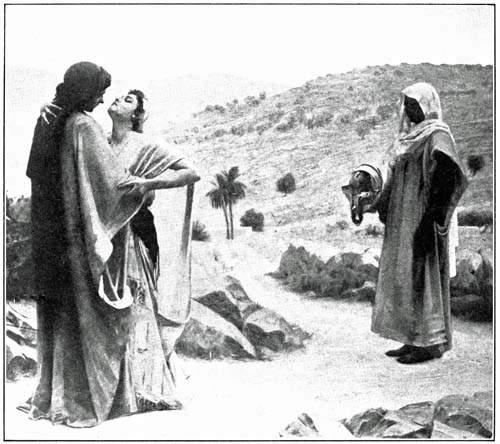
“ENTREAT ME NOT TO LEAVE THEE”
13. THE SHEPHERD-BOY WHO SLEW A GIANT
Far away on a hillside, one starry night, a shepherd-boy was watching his father’s sheep. The little lambs were cuddled up close to their mothers and all was quiet and peaceful in the moonlight when out of the woods near-by came a dark animal. It was a big brown bear that had come to steal a lamb. Nearer and nearer it came when the shepherd-boy, who loved his sheep, quickly placed a large sharp stone in his sling and slung it at the bear’s forehead. With a great cry of pain the bear rolled over dead. So the lambs were saved from the bear. Another time, a lion sprang out from behind a rock and, seizing a little baby lamb in his mouth, started to run away with it. On the minute the shepherd-boy was after him, slinging one of his sharp stones at the lion’s head. It struck the lion without killing him, but, letting the baby lamb go, he turned roaring and sprang at the boy. He caught him by the beard, and with his shepherd’s staff struck at him until the great animal fell back dead. So the lambs loved the shepherd still more, for he had saved them from the lion too. Some time after, this same shepherd-boy went out to the battlefield to take some corn and loaves of bread to his soldier brothers. While he was talking to his brothers a great giant came out and stood upon a high cliff and cried across the valley, “I dare any man to come and fight me!” This giant was ten and a half feet in height—so tall that a boy would not come as high as his knees. Upon his head was a helmet of brass; his whole body was covered with armor of brass; even on his legs were heavy plates of brass. In his hand he held a long staff with a sharp spear-point at the end; by his side hung a sword, and a man went before him carrying a shield. This was the famous Philistine giant, “Goliath,” before whom all the Hebrew soldiers trembled and ran away to their tents in fear. This young shepherd-boy was surprised that none dared go out and fight him, especially when he heard that King Saul had said whoever would kill this terrible giant should receive great riches and have the king’s daughter for his wife. This boy said, “I will go and fight him!” Some one told the king what he said, and Saul sent for him and said: “Surely you are not able to go and fight him; you are only a boy, and he has been a fighter from the time he was a boy.” This shepherd-boy bravely replied: “When I was smaller than I am now, I was watching my father’s sheep, and a bear and a lion came to take a lamb out of the flock, and I smote both the lion and the bear, and this giant shall be as one of them, because he has defied the armies of the living God. My God, who delivered me out of the paw of the lion and out of the paw of the bear, he will deliver me out of the hand of this boastful giant.” The king said, “My boy, go; and may God be with you.” Then he offered the shepherd-boy his armor of brass, his helmet, and sword. But the shepherd-boy said, “Please, may I go without these? My shepherd’s sling and staff, with God, are all I need.” Then he ran to the brook and selected five smooth stones and put them in his shepherd’s bag and went forth to meet the giant who came to meet him. When Goliath saw only a boy he said: “Am I a dog that you come to me with a stick! Come to me, boy, and I’ll give your flesh to the birds and beasts!” And he cursed him by his gods. The brave shepherd-boy did not flinch, but replied: “You come to me with a sword, and a spear, and a javelin. I come to you in the name of the God of the armies of Israel, whom you have defied. This day God will deliver you into my hands, and I will take your head from you and give it to the birds and wild beasts, that all the earth may know that there is a God in Israel, and that they may know that God saves not with sword or spear; for this battle is God’s, and he will give you into our hands.” The proud giant, clad in his brass armor, began walking toward the boy, who quickly put his hand into his bag, took out a stone, slung it with all his might at the giant’s forehead, and Goliath fell on his face to the ground—dead. Quickly he ran, stood on the giant, took the great sword of Goliath out of its sheath, and with one blow cut off the giant’s head in the sight of the soldiers of both armies. When the army of the giant saw that their champion was dead, they turned and ran away over the mountains and, with a shout of victory, Saul’s soldiers ran after them and took them prisoners. So the shepherd-boy, with a sling and a stone, and the help of God, won a great battle that day. He became the king’s son-in-law, and when Saul died he became king, one of the greatest and best kings Israel ever had—King David.
14. THE ARROW-BOY AND THE TWO FRIENDS
(1 Samuel 18 to 20)
The shepherd-boy who slew the giant was invited to live at the king’s palace, and he became a great friend of the king’s son, Jonathan. David and Jonathan soon loved each other greatly. All the people too came to love David more than they did King Saul. This made the king very jealous, and he resolved to kill this popular young soldier, whom everybody praised so much; even the women and girls singing of him in the streets:
Saul hath slain his thousands, And David his ten thousands.
When Jonathan suspected his father’s evil intentions, he told David to go away from the palace for three days. “After three days,” he said, “I will come to your hiding-place and bring an arrow-boy with me, and I will shoot three arrows. If I say to the boy, ‘Run and find the arrows on this side of you, come back,’ you can come back to the palace in safety; but if I say, ‘Haste, stay not,’ then there is danger, and you must flee.” After two days Saul missed David at the dining-table, and told Jonathan that if he found David he would surely kill him. And he threw a javelin at Jonathan to kill him too, because he was the friend of David. Quickly Jonathan went with the boy to the place appointed and shot an arrow far beyond the mark and cried to the boy, “Haste, stay not.” The boy ran and brought him the arrow and returned to the palace. David came out from his hiding-place. The two friends kissed each other and made promises of eternal friendship. And they saw each other only once after that day. So the arrow-boy helped the two friends.
15. THE LITTLE LAME PRINCE
(2 Samuel 4: 4; 9: 1-13)
One afternoon, long ago, a little boy prince five years old, was playing with his toys in his father’s palace, and his nurse was watching him. Suddenly a messenger ran up to the house and rushed in, bearing the sad news that a terrible battle had been fought between the Hebrews and the Philistines in which King Saul and the little prince’s father, Jonathan, David’s friend, had been slain. “Yes,” he said, “Saul and Jonathan are dead! Flee for your lives!” The nurse picked up the little boy in her arms to carry him away quickly, when, in her haste and fright, she stumbled and fell. In the fall the little boy’s ankles were broken, and ever after he was a helpless cripple. The little lame prince was hidden away in a friend’s house so safely that almost everybody supposed the Philistine soldiers must have slain him too. A few years afterward, David said: “Is there yet any left of the family of Saul that I may show the kindness of God to him for Jonathan’s sake?” One of the servants said, “Jonathan hath yet a son who is lame in both his feet.” “Bring him to me,” said David; and when he was before the king, David said: “Fear not; for I will surely show kindness to you for Jonathan, your father’s sake. I will give you his farm lands; and you shall eat at my table as one of my own sons.” So David’s friendship for Jonathan was shown to this lame prince who was crippled in both his feet, and whose name was Mephibosheth.
16. THE BABIES AND THE WISE JUDGE
(1 Kings 3)
One night a King was sleeping, and in his sleep he dreamed that God came to him and said, “Ask what I shall give thee.” He said, “Give me a wise heart to judge the people justly in all things.” God said to him: “Because you have not asked for riches, or long life, or the death of your enemies, but have asked for a heart of wisdom, I will give you a wise heart, and riches, and long life if you will obey me.”
The young King awoke; and it was a dream. But he became one of the richest and wisest of the kings of the earth to rule and to judge his people. One day two mothers came to him, each bringing a baby boy, but one was dead and one was alive. One mother said: “O king, judge my case! We two mothers live in one house. One night this woman’s baby boy died, and she came into my room and stole my little baby boy away, and put her dead baby boy in its place while I was sleeping. In the morning, there beside me in my bed was her dead baby.” The other woman said, “No, no, the living is my son, and the dead is your son.” The King said to his servants, “Go quickly, and bring me a sword!” They brought a sword. The King said, “Divide the living baby in two, and give half to one and half to the other.” The mother whose the living child was cried out to the King, “O my lord, give her the living child; do not slay it!” But the other said, “Yes, divide it.” Then the King knew which was the real mother and said, “Give her the living child; she is his mother.” All the people heard of this, and they said, “King Solomon is the wisest man that ever lived to rule wisely and to judge justly.”
17. THE LITTLE BOY KING
(2 Kings 11)
There were troublous times in a king’s palace when a little prince was born. He was only two months old when his father, the king, was killed in battle and this little baby boy had to be hidden away by his aunt in a storeroom in the sacred temple to save his life. For seven years he was hidden there and very few knew that the little boy, who should be the king, was alive. His grandmother, a very wicked and cruel woman, Athaliah, became queen. She first ordered all the royal children she could find to be put to death and then she did many such cruel and evil things so that her people became worse and worse. After seven long years, one day a good man in the temple told five brave captains his secret, and showed them the young king and asked their help to crown him king in the place of the wicked, cruel grandmother. They promised. Soon many other soldiers came to know the secret, and on a day they decided upon, these men armed themselves with swords and spears and shields, and gathered in the temple to crown the little boy king. His granduncle, the high priest, brought him out from his hiding-place, set him upon a high platform, put a little crown of gold upon his head, while all the men clapped their hands and cried, “Long live the king!” When the queen-grandmother heard the shouts she came to the temple and looked in, and behold, there was the little boy king standing on the platform with the crown upon his head and all the captains and guards and trumpeters and people rejoicing and blowing trumpets. The queen tore her clothes in anger and cried out, “Treason! Treason!” But all her soldiers and people were sick and tired of her cruel reign. So the captains seized her, led her out of the temple, and slew her near the horse-gate of her palace. So this little boy only seven years old was crowned king because he was of the family of King David and because God took care of him in his hiding-place during all those seven long years. He reigned as King of Judah many, many years, doing great good for God and for his people. His name was Joash.
18. THE WOMAN WHO SHARED HER LAST LOAF
(1 Kings 17)
In a land where no rain had fallen for long months the grass and flowers were withered, the fruit trees were dead, the grain-fields and gardens were hardened and parched, and the streams were almost dried up. In the time of this fearful famine a poor woman looked into her jar of flour and cruse of oil, and saw that they were almost empty. She said: “There is just enough flour to make one more little cake, and just enough oil to mix it. I will go and gather a few sticks and bake this little cake for my boy and myself, and we will eat it and die.” She went out to gather the sticks, when she heard some one speak. She looked up and saw a strange man standing near. He was tired and worn and dusty, as though he had been walking many miles in the hot sun. He said to her, “Fetch me, I pray you, a little water, that I may drink.” She forgot for a moment how hungry and sad she was, and started at once toward her house to get the water for him, when he called to her, “Bring me, I pray you, a morsel of bread in your hand.” She turned back with a sigh and said: “O sir, truly I have not a cake; I have only a handful of meal in the jar, and a little oil in the cruse; and now I am gathering two sticks that I may go in and prepare for me and my boy that we may eat it and die.” The man said: “Fear not; go and do as you have said, but make me a little cake first, and bring it out here to me, and afterward make a cake for yourself and your boy. For Jehovah, the God of Israel says, ‘The jar of meal shall not be empty, neither shall the little bottle of oil be empty, until it rains upon the earth.’”
She stood and looked at this strange man with his strange request—to share her very last piece of bread. She did not know who he was, nor who the God was he spoke of; she only knew that this man with the tired face was hungry too, and he had not even one piece of bread, and she said to herself, “I will share what we have with him.” She went back into her kitchen, kindled the fire with the sticks, scraped the last bit of flour from the jar, and poured in the last drop of oil from the cruse; but, when she had taken out enough for the little cake and looked into the jar and cruse, there was just as much flour and oil as before. She made the cake, took it to Elijah, God’s wonderful prophet, and she, and he, and her son had plenty to eat from the jar of meal that did not empty and the cruse of oil that did not fail all the days of that famine. And it all came about because that good woman, though hungry herself, was willing to share the little she had with another who was in need.
Is thy cruse of comfort failing? Rise and share it with another, And through all the years of famine it shall serve thee and thy brother. Love divine will fill thy storehouse, or thy handful will renew; Scanty fare for one will often make a royal feast for two. For the heart grows rich in giving; all its wealth is living grain; Seeds, which mildew in the garner, scattered, fill with gold the plain. Is thy heart a living power? Self-entwined its strength sinks low; It can only live by loving, and by serving love must grow. —Elizabeth Rundle Charles.
19. THE SLAVE-GIRL WHO HELPED A GREAT CAPTAIN
(2 Kings 5)
One day a sweet-faced little girl was playing in her home as happy as any little girl could be, all unconscious that a cruel battle was being fought. Suddenly some soldiers came and seized this little girl and carried her away with other prisoners to a far-off land where she was sold and became a slave-girl in the house of a great captain. She had to do errands for his wife and wait upon her, and do anything she asked. Often when this little girl was in her mistress’s room she saw big tears run down her cheeks, and a sad look come upon her face. One day she found out what made the tears. Captain Naaman was a leper. That was a terrible disease in his flesh which no doctor could cure. The little girl had often seen Captain Naaman. She thought he looked so fine in his rich uniform as he rode away in a chariot with prancing horses. She knew that the king of that land had made him captain over all his soldiers because he was so brave. “But he is a leper, he has leprosy—how sad!” she kept saying to herself; “how I wish I could help him!”
One day a thought flashed into her mind that made her eyes sparkle with joy. She knew in her own land there was a great and good man named Elisha who had done many wonderful things in helping people. She said, “I am sure he could make Captain Naaman well.” She could hardly wait to be sent for to do another errand, she was so eager to tell her mistress about Elisha. At last the call came, and as soon as she went into her mistress’s room, she said, “There is a good man in my land, Elisha, who could heal my master.” The mistress looked at her and said, “Tell me, daughter, tell me what you mean! Who is Elisha?” And the little girl told her all about the wonderful things the prophet had done. When Captain Naaman came home his wife told him what the little girl had said. The captain went to the palace and told the king, who said, “I will send a letter to the King of Israel; get ready to go.” So Captain Naaman started, riding in a beautiful chariot, drawn by prancing horses, the king’s servants riding beside him, carrying gifts of gold and silver and beautiful clothes which the king was sending as presents to the King of Israel. Every one looked as they rode away. The little girl was the most excited of all. At last Captain Naaman and his soldiers and chariot stopped at the door of the little house of Elisha, but the prophet did not even come out to see Naaman’s fine things, but simply sent a messenger to him, saying, “Go and wash in the river Jordan seven times and thy flesh shall come again to thee, and thou shalt be clean.” Naaman was angry and started to go back home as much a leper as he had come. But when his servants reasoned with him and persuaded him to do what the prophet said, he went down to the river Jordan, and dipped himself—once, twice, thrice, four times, five times, six times, seven times—when lo! his rough, red skin became soft and smooth as the skin of a little baby. Naaman was so pleased that he hurried back to the little house of the prophet to reward him, but not a thing would Elisha take from him. Then the captain hastened back to his own land and home. His wife and the little girl saw him coming. Up the street he rode and stopped in front of the beautiful house. “He is well! He is well!” cried the little girl. Then she knew a little girl can indeed be a great helper.
20. FOUR COLLEGE BOYS WHO KEPT STRONG
(Daniel 1)
Four boys, who were great friends, were taken from their homes and carried far away into a great city in a foreign land to live among strangers. One day the King ordered his officers to select from among the Jewish captive boys four of the brightest, and these four boys were chosen and brought into the King’s palace to be educated for three years in the King’s college for royal service. Thinking it a great honor to them, and that it would make them strong, the King ordered that these boys should be given a daily supply of the rich food and wine, such as he and all his military cadets received. But the very first time the silver tray, with all of these dainties, was brought to these four college boys, one of them, whose name was Daniel, said to the officer who took charge of them, “Please let us not have this rich food and wine, but have plainer food.” The officer laughed and said: “I am afraid that if you do not eat this rich food your faces will become thinner than those of the other college students, and then the King will cut off my head!” But Daniel said: “Try us ten days. Give us only vegetables to eat and water to drink. Then look at our faces and the faces of the other boys that eat the King’s rich food and drink his wine, and see.” The officer said he would try them for ten days. He did so, and at the end of that time their faces were fatter and rosier, their bodies plumper, and their minds clearer, stronger, and brighter than all the other boys. At the end of the three college years, the King sat upon a golden throne, and all the students were brought before him, and he saw that these four were stronger than all the rest, and that they knew ten times as much as the magicians and astrologers in all his kingdom. So Daniel, Shadrach, Meshach, and Abednego, these four friends who were true to their principle, showed after all that they kept their health and were stronger and better by going without the rich food and the royal wine.